CIS 674 
Introduction to Data Mining 
Srinivasan Parthasarathy 
srini@cse.ohio-state.edu 
Office Hours: TTH 2-3:18PM 
DL317 
© Prentice Hall 1
Introduction Outline 
GGooaall:: PPrroovviiddee aann oovveerrvviieeww ooff ddaattaa mmiinniinngg.. 
• Define data mining 
• Data mining vs. databases 
• Basic data mining tasks 
• Data mining development 
• Data mining issues 
© Prentice Hall 2
Introduction 
• Data is produced at a phenomenal rate 
• Our ability to store has grown 
• Users expect more sophisticated 
information 
• How? 
UUNNCCOOVVEERR HHIIDDDDEENN IINNFFOORRMMAATTIIOONN 
DDAATTAA MMIINNIINNGG 
© Prentice Hall 3
Data Mining 
• Objective: Fit data to a model 
• Potential Result: Higher-level meta 
information that may not be obvious when 
looking at raw data 
• Similar terms 
– Exploratory data analysis 
– Data driven discovery 
– Deductive learning 
© Prentice Hall 4
Data Mining Algorithm 
• Objective: Fit Data to a Model 
– Descriptive 
– Predictive 
• Preferential Questions 
– Which technique to choose? 
• ARM/Classification/Clustering 
• Answer: Depends on what you want to do with data? 
– Search Strategy – Technique to search the data 
• Interface? Query Language? 
• Efficiency 
© Prentice Hall 5
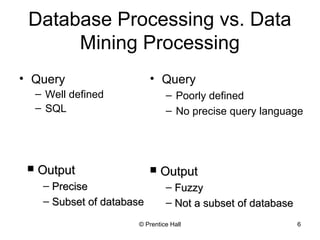
Database Processing vs. Data 
Mining Processing 
© Prentice Hall 6 
• Query 
– Well defined 
– SQL 
• Query 
– Poorly defined 
– No precise query language 
 OOuuttppuutt 
– PPrreecciissee 
– SSuubbsseett ooff ddaattaabbaassee 
 OOuuttppuutt 
– FFuuzzzzyy 
– NNoott aa ssuubbsseett ooff ddaattaabbaassee
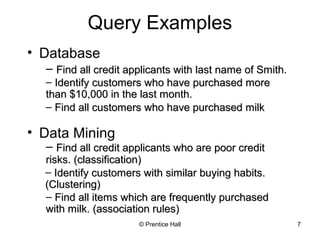
Query Examples 
– FFiinndd aallll ccrreeddiitt aapppplliiccaannttss wwiitthh llaasstt nnaammee ooff SSmmiitthh.. 
– IIddeennttiiffyy ccuussttoommeerrss wwhhoo hhaavvee ppuurrcchhaasseedd mmoorree 
tthhaann $$1100,,000000 iinn tthhee llaasstt mmoonntthh.. 
– Find all customers who hhaavvee ppuurrcchhaasseedd mmiillkk 
– FFiinndd aallll ccrreeddiitt aapppplliiccaannttss wwhhoo aarree ppoooorr ccrreeddiitt 
rriisskkss.. ((ccllaassssiiffiiccaattiioonn)) 
– IIddeennttiiffyy ccuussttoommeerrss wwiitthh ssiimmiillaarr bbuuyyiinngg hhaabbiittss.. 
((CClluusstteerriinngg)) 
© Prentice Hall 7 
• Database 
• Data Mining 
– FFiinndd aallll iitteemmss wwhhiicchh aarree ffrreeqquueennttllyy ppuurrcchhaasseedd 
wwiitthh mmiillkk.. ((aassssoocciiaattiioonn rruulleess))
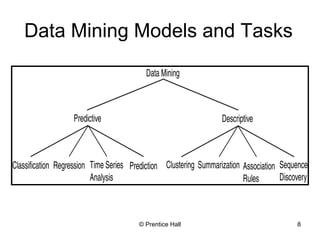
Data Mining Models and Tasks 
© Prentice Hall 8
Basic Data Mining Tasks 
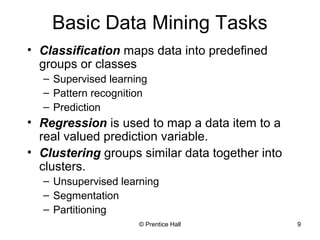
• Classification maps data into predefined 
groups or classes 
– Supervised learning 
– Pattern recognition 
– Prediction 
• Regression is used to map a data item to a 
real valued prediction variable. 
• Clustering groups similar data together into 
clusters. 
– Unsupervised learning 
– Segmentation 
– Partitioning 
© Prentice Hall 9
Basic Data Mining Tasks 
(cont’d) 
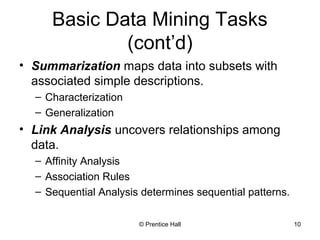
• Summarization maps data into subsets with 
associated simple descriptions. 
– Characterization 
– Generalization 
• Link Analysis uncovers relationships among 
data. 
– Affinity Analysis 
– Association Rules 
– Sequential Analysis determines sequential patterns. 
© Prentice Hall 10
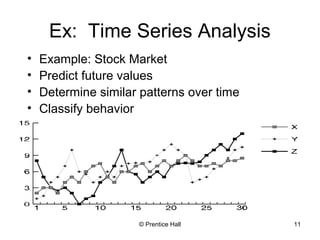
Ex: Time Series Analysis 
• Example: Stock Market 
• Predict future values 
• Determine similar patterns over time 
• Classify behavior 
© Prentice Hall 11
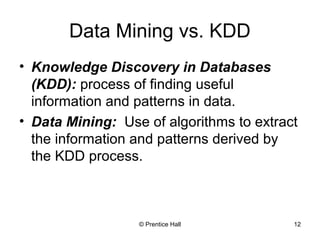
Data Mining vs. KDD 
• Knowledge Discovery in Databases 
(KDD): process of finding useful 
information and patterns in data. 
• Data Mining: Use of algorithms to extract 
the information and patterns derived by 
the KDD process. 
© Prentice Hall 12
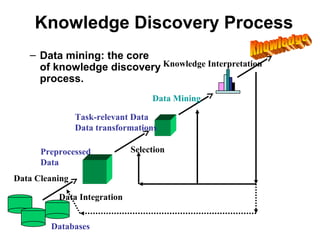
Knowledge Discovery Process 
– Data mining: the core 
of knowledge discovery 
Knowledge Interpretation 
process. 
Data Mining 
Task-relevant Data 
Data transformations 
Preprocessed 
Data 
Data Cleaning 
Data Integration 
Databases 
Selection
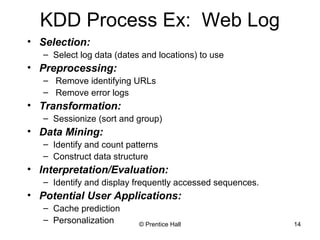
KDD Process Ex: Web Log 
• Selection: 
– Select log data (dates and locations) to use 
© Prentice Hall 14 
• Preprocessing: 
– Remove identifying URLs 
– Remove error logs 
• Transformation: 
– Sessionize (sort and group) 
• Data Mining: 
– Identify and count patterns 
– Construct data structure 
• Interpretation/Evaluation: 
– Identify and display frequently accessed sequences. 
• Potential User Applications: 
– Cache prediction 
– Personalization
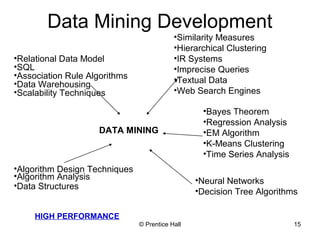
Data Mining Development 
•Similarity Measures 
•Hierarchical Clustering 
•IR Systems 
•Imprecise Queries 
•Textual Data 
•Web Search Engines 
•Bayes Theorem 
•Regression Analysis 
•EM Algorithm 
•K-Means Clustering 
•Time Series Analysis 
•Neural Networks 
•Decision Tree Algorithms 
DATA MINING 
© Prentice Hall 15 
•Relational Data Model 
•SQL 
•Association Rule Algorithms 
•Data Warehousing 
•Scalability Techniques 
•Algorithm Design Techniques 
•Algorithm Analysis 
•Data Structures 
HIGH PERFORMANCE
KDD Issues 
• Human Interaction 
• Overfitting 
• Outliers 
• Interpretation 
• Visualization 
• Large Datasets 
• High Dimensionality 
© Prentice Hall 16
KDD Issues (cont’d) 
• Multimedia Data 
• Missing Data 
• Irrelevant Data 
• Noisy Data 
• Changing Data 
• Integration 
• Application 
© Prentice Hall 17
Social Implications of DM 
• Privacy 
• Profiling 
• Unauthorized use 
© Prentice Hall 18
Data Mining Metrics 
• Usefulness 
• Return on Investment (ROI) 
• Accuracy 
• Space/Time 
© Prentice Hall 19
Database Perspective on Data 
Mining 
• Scalability 
• Real World Data 
• Updates 
• Ease of Use 
© Prentice Hall 20
Outline of Today’s Class 
• Statistical Basics 
– Point Estimation 
– Models Based on Summarization 
– Bayes Theorem 
– Hypothesis Testing 
– Regression and Correlation 
• Similarity Measures 
© Prentice Hall 21
Point Estimation 
• Point Estimate: estimate a population 
parameter. 
• May be made by calculating the parameter for a 
sample. 
• May be used to predict value for missing data. 
• Ex: 
– R contains 100 employees 
– 99 have salary information 
– Mean salary of these is $50,000 
– Use $50,000 as value of remaining employee’s 
salary. 
Is this a good idea? 
© Prentice Hall 22
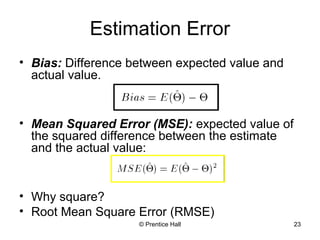
Estimation Error 
• Bias: Difference between expected value and 
actual value. 
• Mean Squared Error (MSE): expected value of 
the squared difference between the estimate 
and the actual value: 
• Why square? 
• Root Mean Square Error (RMSE) 
© Prentice Hall 23
Jackknife Estimate 
• Jackknife Estimate: estimate of parameter is 
obtained by omitting one value from the set of 
observed values. 
– Treat the data like a population 
– Take samples from this population 
– Use these samples to estimate the parameter 
• Let θ(hat) be an estimate on the entire pop. 
• Let θ(j)(hat) be an estimator of the same form 
with observation j deleted 
• Allows you to examine the impact of outliers! 
© Prentice Hall 24
Maximum Likelihood 
Estimate (MLE) 
• Obtain parameter estimates that maximize 
the probability that the sample data occurs for 
the specific model. 
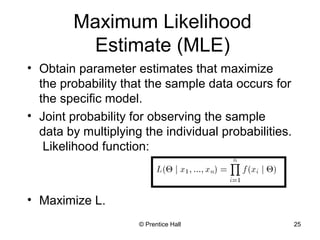
• Joint probability for observing the sample 
data by multiplying the individual probabilities. 
Likelihood function: 
© Prentice Hall 25 
• Maximize L.
MLE Example 
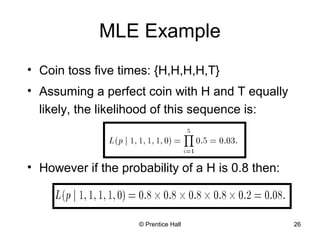
• Coin toss five times: {H,H,H,H,T} 
• Assuming a perfect coin with H and T equally 
likely, the likelihood of this sequence is: 
• However if the probability of a H is 0.8 then: 
© Prentice Hall 26
MLE Example (cont’d) 
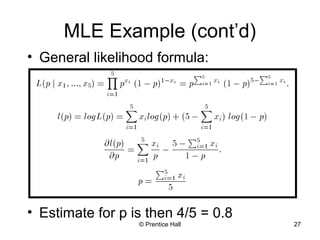
• General likelihood formula: 
• Estimate for p is then 4/5 = 0.8 
© Prentice Hall 27
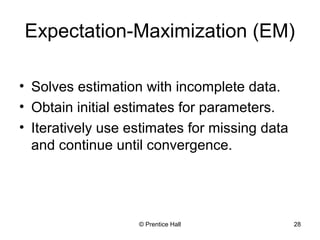
Expectation-Maximization (EM) 
• Solves estimation with incomplete data. 
• Obtain initial estimates for parameters. 
• Iteratively use estimates for missing data 
and continue until convergence. 
© Prentice Hall 28
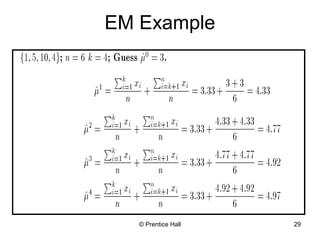
EM Example 
© Prentice Hall 29
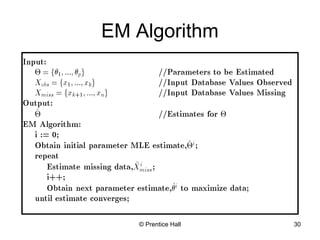
EM Algorithm 
© Prentice Hall 30
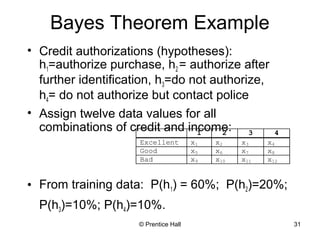
Bayes Theorem Example 
• Credit authorizations (hypotheses): 
h1=authorize purchase, h2 = authorize after 
further identification, h3=do not authorize, 
h4= do not authorize but contact police 
• Assign twelve data values for all 
combinations of credit and income: 
1 2 3 4 
Excellent x1 x2 x3 x4 
Good x5 x6 x7 x8 
Bad x9 x10 x11 x12 
• From training data: P(h1) = 60%; P(h2)=20%; 
P(h3)=10%; P(h4)=10%. 
© Prentice Hall 31
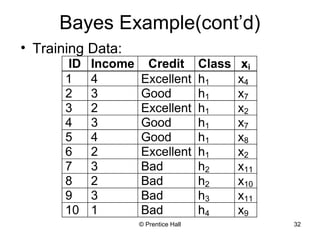
Bayes Example(cont’d) 
© Prentice Hall 32 
• Training Data: 
ID Income Credit Class xi 
1 4 Excellent h1 x4 
2 3 Good h1 x7 
3 2 Excellent h1 x2 
4 3 Good h1 x7 
5 4 Good h1 x8 
6 2 Excellent h1 x2 
7 3 Bad h2 x11 
8 2 Bad h2 x10 
9 3 Bad h3 x11 
10 1 Bad h4 x9
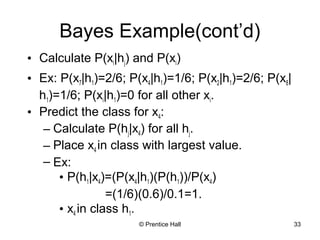
Bayes Example(cont’d) 
• Calculate P(xi|hj) and P(xi) 
• Ex: P(x7|h1)=2/6; P(x4|h1)=1/6; P(x2|h1)=2/6; P(x8| 
h1)=1/6; P(xi|h1)=0 for all other xi. 
• Predict the class for x4: 
– Calculate P(hj|x4) for all hj. 
– Place x4 in class with largest value. 
– Ex: 
• P(h1|x4)=(P(x4|h1)(P(h1))/P(x4) 
=(1/6)(0.6)/0.1=1. 
© Prentice Hall 33 
• x4 in class h1.
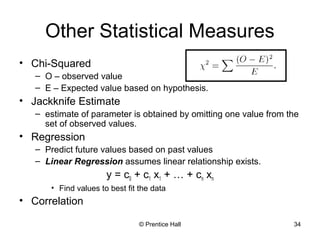
Other Statistical Measures 
© Prentice Hall 34 
• Chi-Squared 
– O – observed value 
– E – Expected value based on hypothesis. 
• Jackknife Estimate 
– estimate of parameter is obtained by omitting one value from the 
set of observed values. 
• Regression 
– Predict future values based on past values 
– Linear Regression assumes linear relationship exists. 
y = c0 + c1 x1 + … + cn xn 
• Find values to best fit the data 
• Correlation
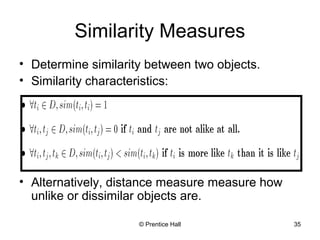
Similarity Measures 
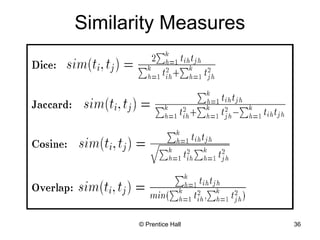
• Determine similarity between two objects. 
• Similarity characteristics: 
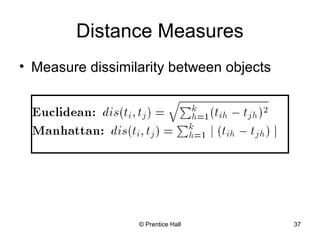
• Alternatively, distance measure measure how 
unlike or dissimilar objects are. 
© Prentice Hall 35
Similarity Measures 
© Prentice Hall 36
Distance Measures 
• Measure dissimilarity between objects 
© Prentice Hall 37
Information Retrieval 
• Information Retrieval (IR): retrieving desired 
information from textual data. 
• Library Science 
• Digital Libraries 
• Web Search Engines 
• Traditionally keyword based 
• Sample query: 
Find all documents about “data mining”. 
DM: Similarity measures; 
Mine text/Web data. 
© Prentice Hall 38
Information Retrieval (cont’d) 
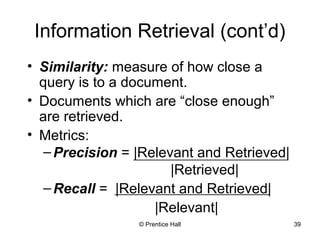
• Similarity: measure of how close a 
query is to a document. 
• Documents which are “close enough” 
are retrieved. 
• Metrics: 
–Precision = |Relevant and Retrieved| 
|Retrieved| 
–Recall = |Relevant and Retrieved| 
|Relevant| 
© Prentice Hall 39
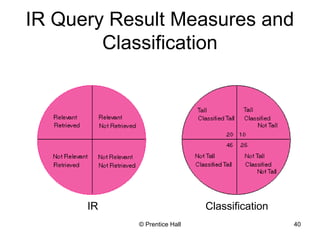
IR Query Result Measures and 
Classification 
IR Classification 
© Prentice Hall 40

data mining

  • 1.
    CIS 674 Introductionto Data Mining Srinivasan Parthasarathy srini@cse.ohio-state.edu Office Hours: TTH 2-3:18PM DL317 © Prentice Hall 1
  • 2.
    Introduction Outline GGooaall::PPrroovviiddee aann oovveerrvviieeww ooff ddaattaa mmiinniinngg.. • Define data mining • Data mining vs. databases • Basic data mining tasks • Data mining development • Data mining issues © Prentice Hall 2
  • 3.
    Introduction • Datais produced at a phenomenal rate • Our ability to store has grown • Users expect more sophisticated information • How? UUNNCCOOVVEERR HHIIDDDDEENN IINNFFOORRMMAATTIIOONN DDAATTAA MMIINNIINNGG © Prentice Hall 3
  • 4.
    Data Mining •Objective: Fit data to a model • Potential Result: Higher-level meta information that may not be obvious when looking at raw data • Similar terms – Exploratory data analysis – Data driven discovery – Deductive learning © Prentice Hall 4
  • 5.
    Data Mining Algorithm • Objective: Fit Data to a Model – Descriptive – Predictive • Preferential Questions – Which technique to choose? • ARM/Classification/Clustering • Answer: Depends on what you want to do with data? – Search Strategy – Technique to search the data • Interface? Query Language? • Efficiency © Prentice Hall 5
  • 6.
    Database Processing vs.Data Mining Processing © Prentice Hall 6 • Query – Well defined – SQL • Query – Poorly defined – No precise query language  OOuuttppuutt – PPrreecciissee – SSuubbsseett ooff ddaattaabbaassee  OOuuttppuutt – FFuuzzzzyy – NNoott aa ssuubbsseett ooff ddaattaabbaassee
  • 7.
    Query Examples –FFiinndd aallll ccrreeddiitt aapppplliiccaannttss wwiitthh llaasstt nnaammee ooff SSmmiitthh.. – IIddeennttiiffyy ccuussttoommeerrss wwhhoo hhaavvee ppuurrcchhaasseedd mmoorree tthhaann $$1100,,000000 iinn tthhee llaasstt mmoonntthh.. – Find all customers who hhaavvee ppuurrcchhaasseedd mmiillkk – FFiinndd aallll ccrreeddiitt aapppplliiccaannttss wwhhoo aarree ppoooorr ccrreeddiitt rriisskkss.. ((ccllaassssiiffiiccaattiioonn)) – IIddeennttiiffyy ccuussttoommeerrss wwiitthh ssiimmiillaarr bbuuyyiinngg hhaabbiittss.. ((CClluusstteerriinngg)) © Prentice Hall 7 • Database • Data Mining – FFiinndd aallll iitteemmss wwhhiicchh aarree ffrreeqquueennttllyy ppuurrcchhaasseedd wwiitthh mmiillkk.. ((aassssoocciiaattiioonn rruulleess))
  • 8.
    Data Mining Modelsand Tasks © Prentice Hall 8
  • 9.
    Basic Data MiningTasks • Classification maps data into predefined groups or classes – Supervised learning – Pattern recognition – Prediction • Regression is used to map a data item to a real valued prediction variable. • Clustering groups similar data together into clusters. – Unsupervised learning – Segmentation – Partitioning © Prentice Hall 9
  • 10.
    Basic Data MiningTasks (cont’d) • Summarization maps data into subsets with associated simple descriptions. – Characterization – Generalization • Link Analysis uncovers relationships among data. – Affinity Analysis – Association Rules – Sequential Analysis determines sequential patterns. © Prentice Hall 10
  • 11.
    Ex: Time SeriesAnalysis • Example: Stock Market • Predict future values • Determine similar patterns over time • Classify behavior © Prentice Hall 11
  • 12.
    Data Mining vs.KDD • Knowledge Discovery in Databases (KDD): process of finding useful information and patterns in data. • Data Mining: Use of algorithms to extract the information and patterns derived by the KDD process. © Prentice Hall 12
  • 13.
    Knowledge Discovery Process – Data mining: the core of knowledge discovery Knowledge Interpretation process. Data Mining Task-relevant Data Data transformations Preprocessed Data Data Cleaning Data Integration Databases Selection
  • 14.
    KDD Process Ex:Web Log • Selection: – Select log data (dates and locations) to use © Prentice Hall 14 • Preprocessing: – Remove identifying URLs – Remove error logs • Transformation: – Sessionize (sort and group) • Data Mining: – Identify and count patterns – Construct data structure • Interpretation/Evaluation: – Identify and display frequently accessed sequences. • Potential User Applications: – Cache prediction – Personalization
  • 15.
    Data Mining Development •Similarity Measures •Hierarchical Clustering •IR Systems •Imprecise Queries •Textual Data •Web Search Engines •Bayes Theorem •Regression Analysis •EM Algorithm •K-Means Clustering •Time Series Analysis •Neural Networks •Decision Tree Algorithms DATA MINING © Prentice Hall 15 •Relational Data Model •SQL •Association Rule Algorithms •Data Warehousing •Scalability Techniques •Algorithm Design Techniques •Algorithm Analysis •Data Structures HIGH PERFORMANCE
  • 16.
    KDD Issues •Human Interaction • Overfitting • Outliers • Interpretation • Visualization • Large Datasets • High Dimensionality © Prentice Hall 16
  • 17.
    KDD Issues (cont’d) • Multimedia Data • Missing Data • Irrelevant Data • Noisy Data • Changing Data • Integration • Application © Prentice Hall 17
  • 18.
    Social Implications ofDM • Privacy • Profiling • Unauthorized use © Prentice Hall 18
  • 19.
    Data Mining Metrics • Usefulness • Return on Investment (ROI) • Accuracy • Space/Time © Prentice Hall 19
  • 20.
    Database Perspective onData Mining • Scalability • Real World Data • Updates • Ease of Use © Prentice Hall 20
  • 21.
    Outline of Today’sClass • Statistical Basics – Point Estimation – Models Based on Summarization – Bayes Theorem – Hypothesis Testing – Regression and Correlation • Similarity Measures © Prentice Hall 21
  • 22.
    Point Estimation •Point Estimate: estimate a population parameter. • May be made by calculating the parameter for a sample. • May be used to predict value for missing data. • Ex: – R contains 100 employees – 99 have salary information – Mean salary of these is $50,000 – Use $50,000 as value of remaining employee’s salary. Is this a good idea? © Prentice Hall 22
  • 23.
    Estimation Error •Bias: Difference between expected value and actual value. • Mean Squared Error (MSE): expected value of the squared difference between the estimate and the actual value: • Why square? • Root Mean Square Error (RMSE) © Prentice Hall 23
  • 24.
    Jackknife Estimate •Jackknife Estimate: estimate of parameter is obtained by omitting one value from the set of observed values. – Treat the data like a population – Take samples from this population – Use these samples to estimate the parameter • Let θ(hat) be an estimate on the entire pop. • Let θ(j)(hat) be an estimator of the same form with observation j deleted • Allows you to examine the impact of outliers! © Prentice Hall 24
  • 25.
    Maximum Likelihood Estimate(MLE) • Obtain parameter estimates that maximize the probability that the sample data occurs for the specific model. • Joint probability for observing the sample data by multiplying the individual probabilities. Likelihood function: © Prentice Hall 25 • Maximize L.
  • 26.
    MLE Example •Coin toss five times: {H,H,H,H,T} • Assuming a perfect coin with H and T equally likely, the likelihood of this sequence is: • However if the probability of a H is 0.8 then: © Prentice Hall 26
  • 27.
    MLE Example (cont’d) • General likelihood formula: • Estimate for p is then 4/5 = 0.8 © Prentice Hall 27
  • 28.
    Expectation-Maximization (EM) •Solves estimation with incomplete data. • Obtain initial estimates for parameters. • Iteratively use estimates for missing data and continue until convergence. © Prentice Hall 28
  • 29.
    EM Example ©Prentice Hall 29
  • 30.
    EM Algorithm ©Prentice Hall 30
  • 31.
    Bayes Theorem Example • Credit authorizations (hypotheses): h1=authorize purchase, h2 = authorize after further identification, h3=do not authorize, h4= do not authorize but contact police • Assign twelve data values for all combinations of credit and income: 1 2 3 4 Excellent x1 x2 x3 x4 Good x5 x6 x7 x8 Bad x9 x10 x11 x12 • From training data: P(h1) = 60%; P(h2)=20%; P(h3)=10%; P(h4)=10%. © Prentice Hall 31
  • 32.
    Bayes Example(cont’d) ©Prentice Hall 32 • Training Data: ID Income Credit Class xi 1 4 Excellent h1 x4 2 3 Good h1 x7 3 2 Excellent h1 x2 4 3 Good h1 x7 5 4 Good h1 x8 6 2 Excellent h1 x2 7 3 Bad h2 x11 8 2 Bad h2 x10 9 3 Bad h3 x11 10 1 Bad h4 x9
  • 33.
    Bayes Example(cont’d) •Calculate P(xi|hj) and P(xi) • Ex: P(x7|h1)=2/6; P(x4|h1)=1/6; P(x2|h1)=2/6; P(x8| h1)=1/6; P(xi|h1)=0 for all other xi. • Predict the class for x4: – Calculate P(hj|x4) for all hj. – Place x4 in class with largest value. – Ex: • P(h1|x4)=(P(x4|h1)(P(h1))/P(x4) =(1/6)(0.6)/0.1=1. © Prentice Hall 33 • x4 in class h1.
  • 34.
    Other Statistical Measures © Prentice Hall 34 • Chi-Squared – O – observed value – E – Expected value based on hypothesis. • Jackknife Estimate – estimate of parameter is obtained by omitting one value from the set of observed values. • Regression – Predict future values based on past values – Linear Regression assumes linear relationship exists. y = c0 + c1 x1 + … + cn xn • Find values to best fit the data • Correlation
  • 35.
    Similarity Measures •Determine similarity between two objects. • Similarity characteristics: • Alternatively, distance measure measure how unlike or dissimilar objects are. © Prentice Hall 35
  • 36.
    Similarity Measures ©Prentice Hall 36
  • 37.
    Distance Measures •Measure dissimilarity between objects © Prentice Hall 37
  • 38.
    Information Retrieval •Information Retrieval (IR): retrieving desired information from textual data. • Library Science • Digital Libraries • Web Search Engines • Traditionally keyword based • Sample query: Find all documents about “data mining”. DM: Similarity measures; Mine text/Web data. © Prentice Hall 38
  • 39.
    Information Retrieval (cont’d) • Similarity: measure of how close a query is to a document. • Documents which are “close enough” are retrieved. • Metrics: –Precision = |Relevant and Retrieved| |Retrieved| –Recall = |Relevant and Retrieved| |Relevant| © Prentice Hall 39
  • 40.
    IR Query ResultMeasures and Classification IR Classification © Prentice Hall 40