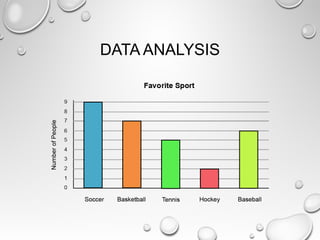
DATA ANALYSIS
• Data description
 Accuracy
Why?
• Data interpretation
 Critical thinking skills
Why?
• HTTPS://NEXS.KU.DK/ENGLISH/NEWS/2017/YOUR-STOOLS-
REVEAL-WHETHER-YOU-CAN-LOSE-WEIGHT/
DATA ANALYSIS
DORIN WANG
Nano patch
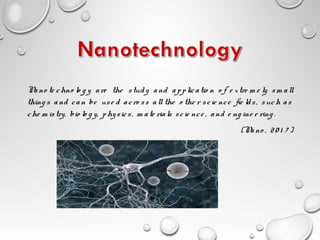
Nano te chno lo g y are the study and applicatio n o f e xtre m e ly sm all
thing s and can be use d acro ss all the o the r scie nce fie lds, such as
che m istry, bio lo g y, physics, m ate rials scie nce , and e ng ine e ring .
(Nano , 20 1 7 )
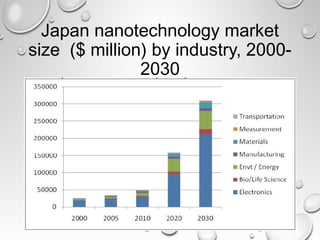
Japan nanotechnology market
size ($ million) by industry, 2000-
2030
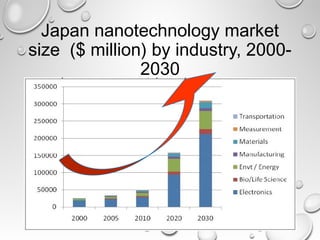
Japan nanotechnology market
size ($ million) by industry, 2000-
2030
LESSON AIMS
•Data analysis
Data description
Date interpretation
DATA DESCRIPTION
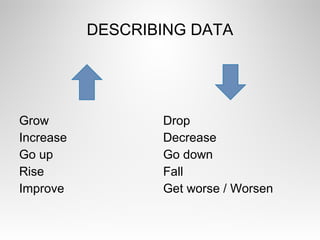
DESCRIBING DATA
DESCRIBING DATA
Grow
Increase
Go up
Rise
Improve
Drop
Decrease
Go down
Fall
Get worse / Worsen
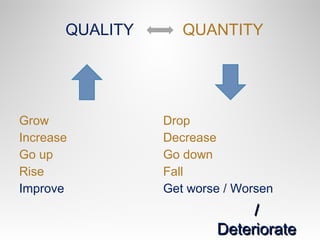
QUALITY QUANTITY
Grow
Increase
Go up
Rise
Improve
Drop
Decrease
Go down
Fall
Get worse / Worsen
//
DeteriorateDeteriorate
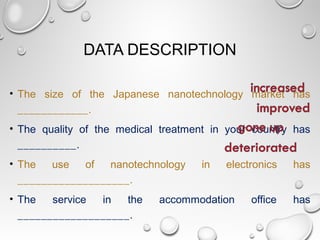
DATA DESCRIPTION
• The size of the Japanese nanotechnology market has
____________.
• The quality of the medical treatment in your country has
__________.
• The use of nanotechnology in electronics has
___________________.
• The service in the accommodation office has
___________________.
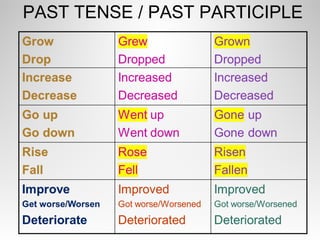
PAST TENSE / PAST PARTICIPLE
Grow
Drop
Increase
Decrease
Go up
Go down
Rise
Fall
Improve
Get worse/ Worsen
Deteriorate
PAST TENSE / PAST PARTICIPLE
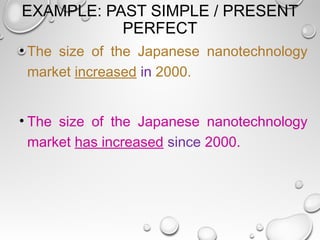
EXAMPLE: PAST SIMPLE / PRESENT
PERFECT
• The size of the Japanese nanotechnology
market increased in 2000.
• The size of the Japanese nanotechnology
market has increased since 2000.
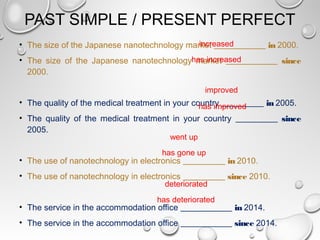
PAST SIMPLE / PRESENT PERFECT
• The size of the Japanese nanotechnology market ___________ in 2000.
• The size of the Japanese nanotechnology market ___________ since
2000.
• The quality of the medical treatment in your country _________ in 2005.
• The quality of the medical treatment in your country _________ since
2005.
• The use of nanotechnology in electronics _________ in 2010.
• The use of nanotechnology in electronics _________ since 2010.
• The service in the accommodation office ___________ in 2014.
• The service in the accommodation office ___________ since 2014.
increased
has increased
improved
has improved
went up
has gone up
deteriorated
has deteriorated
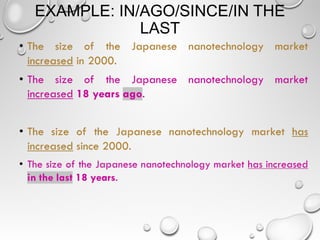
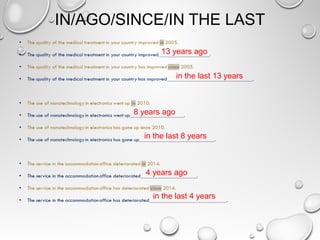
EXAMPLE: IN/AGO/SINCE/IN THE
LAST
IN/AGO/SINCE/IN THE LAST
13 years ago
in the last 13 years
8 years ago
in the last 8 years
4 years ago
in the last 4 years
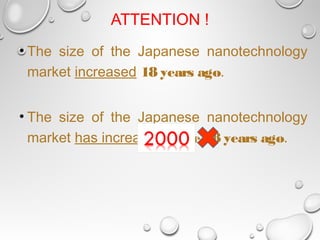
ATTENTION !
• The size of the Japanese nanotechnology
market increased 18 years ago.
• The size of the Japanese nanotechnology
market has increased since 18 years ago.
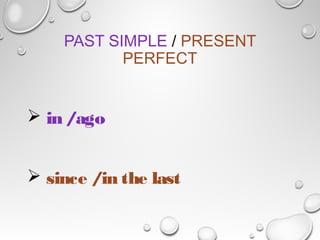
PAST SIMPLE / PRESENT
PERFECT
 in /ago
 since /in the last
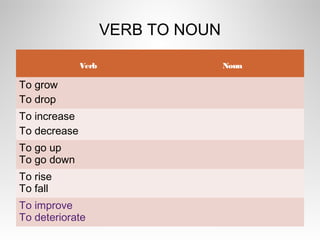
VERB TO NOUN
Verb Noun
To grow
To drop
To increase
To decrease
To go up
To go down
To rise
To fall
To improve
To deteriorate
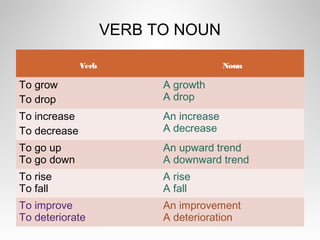
VERB TO NOUN
Verb Noun
To grow
To drop
A growth
A drop
To increase
To decrease
An increase
A decrease
To go up
To go down
An upward trend
A downward trend
To rise
To fall
A rise
A fall
To improve
To deteriorate
An improvement
A deterioration
VERB TO NOUN
increased
VERB TO NOUN
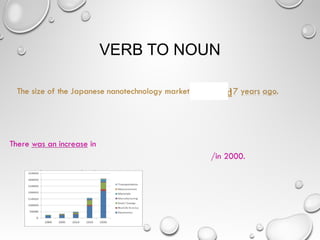
• The size of the Japanese nanotechnology market increased 17 years ago.
• There was an increase in the size of the Japanese nanotechnology
market 17 years ago/in 2000.
• The size of the Japanese nanotechnology market has increased in the
last 17 years.
• There has been an increase in the size of the Japanese nanotechnology
market in the last 17 years/since 2000.
VERB TO NOUN
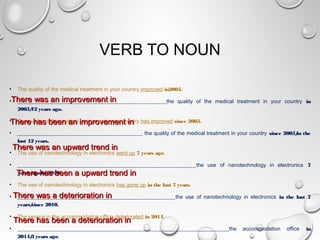
• The quality of the medical treatment in your country improved in2005.
• __________________________________________________the quality of the medical treatment in your country in
2005/12 years ago.
• The quality of the medical treatment in your country has improved since 2005.
• __________________________________________ the quality of the medical treatment in your country since 2005/in the
last 12 years.
• The use of nanotechnology in electronics went up 7 years ago.
• ____________________________________________________________the use of nanotechnology in electronics 7
years ago/in 2010.
• The use of nanotechnology in electronics has gone up in the last 7 years.
• _____________________________________________________the use of nanotechnology in electronics in the last 7
years/since 2010.
• The service in the accommodation office deteriorated in 2014.
• _______________________________________________________________________the accommodation office in
2014/3 years ago.
There was an improvement inThere was an improvement in
There has been an improvement inThere has been an improvement in
There was an upward trend inThere was an upward trend in
There has been a upward trend inThere has been a upward trend in
There was a deterioration inThere was a deterioration in
There has been a deterioration inThere has been a deterioration in
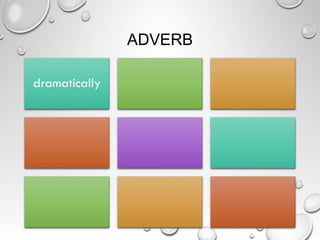
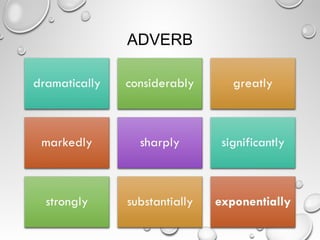
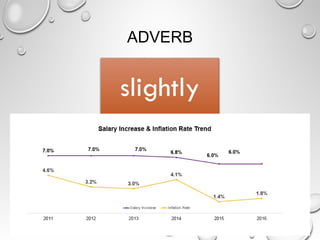
ADVERB
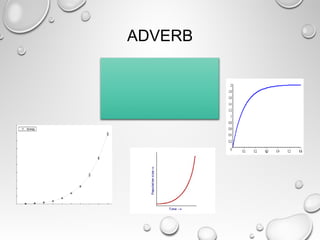
ADVERB
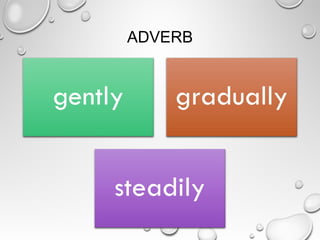
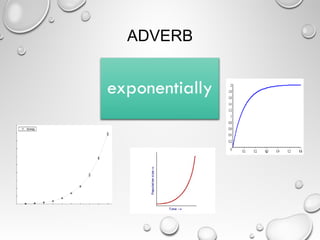
ADVERB
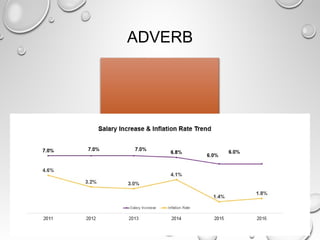
ADVERB
ADVERB
ADVERB
ADVERB
ADVERB
EXTRA VERB
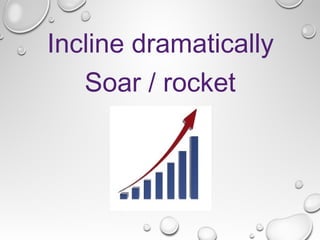
Soar / rocket
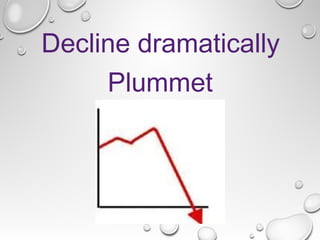
Incline dramatically
Plummet
Decline dramatically
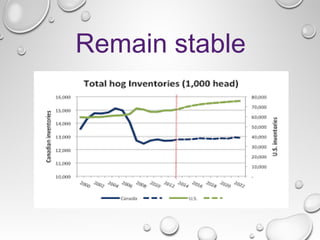
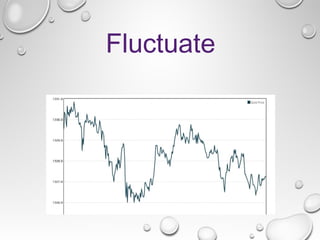
Fluctuate
Remain stable
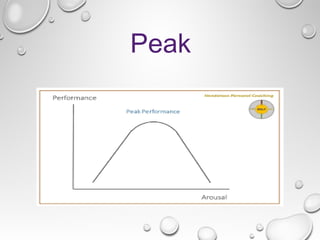
Peak
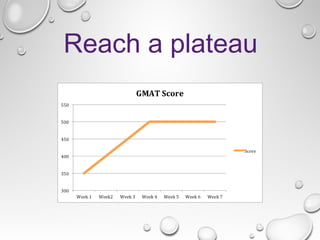
Reach a plateau
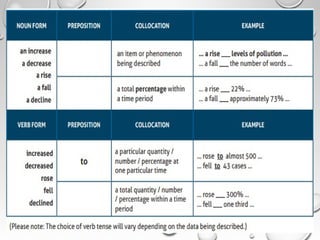
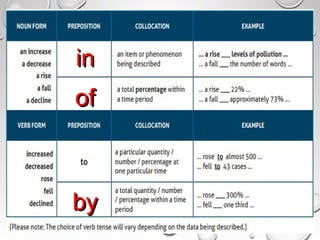
PREPOSITIONS FOR DATA
DESCRIPTION
inin
ofof
byby
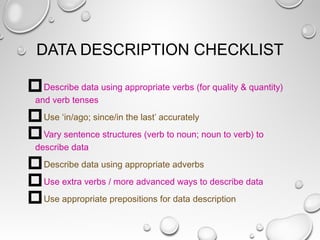
DATA DESCRIPTION CHECKLIST
Describe data using appropriate verbs (for quality & quantity)
and verb tenses
Use ‘in/ago; since/in the last’ accurately
Vary sentence structures (verb to noun; noun to verb) to
describe data
Describe data using appropriate adverbs
Use extra verbs / more advanced ways to describe data
Use appropriate prepositions for data description
DATA DESCRIPTION
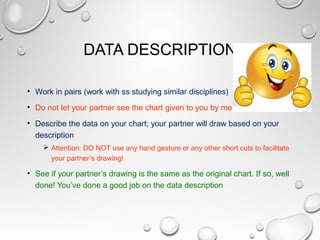
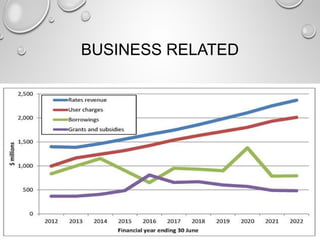
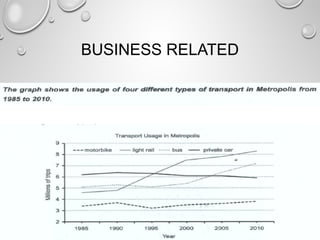
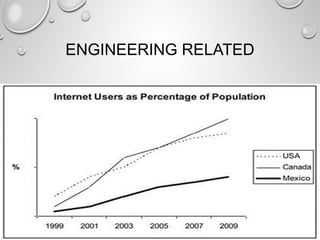
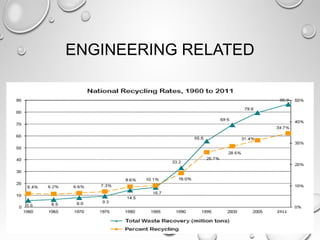
• Work in pairs (work with ss studying similar disciplines)
• Do not let your partner see the chart given to you by me
• Describe the data on your chart; your partner will draw based on your
description
 Attention: DO NOT use any hand gesture or any other short cuts to facilitate
your partner’s drawing!
• See if your partner’s drawing is the same as the original chart. If so, well
done! You’ve done a good job on the data description
BUSINESS RELATED
BUSINESS RELATED
ENGINEERING RELATED
ENGINEERING RELATED
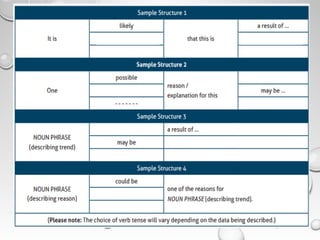
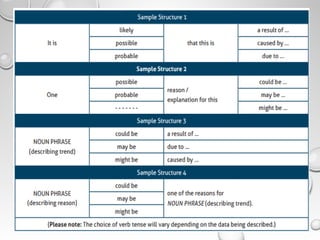
DATA INTERPRETATION
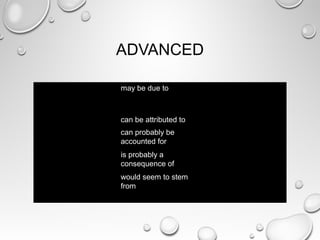
ADVANCED
may be due to
can be attributed to
can probably be
accounted for
is probably a
consequence of
would seem to stem
from
DATA ANALYSIS
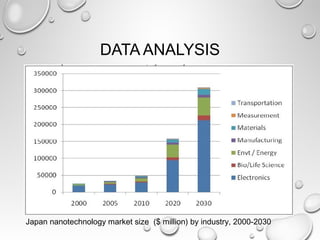
Japan nanotechnology market size ($ million) by industry, 2000-2030
DATA ANALYSIS
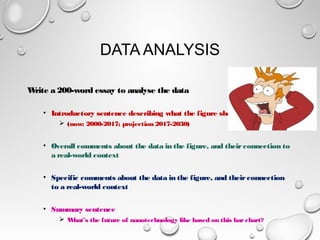
Write a 200-word essay to analyse the data
• Introductory sentence describing what the figure shows
 (now: 2000-2017; projection 2017-2030)
 
• Overall comments about the data in the figure, and theirconnection to
a real-world context
• Specific comments about the data in the figure, and theirconnection
to a real-world context
 
• Summary sentence
 What’s the future of nanotechnology like based on this barchart?
OVERALL TREND
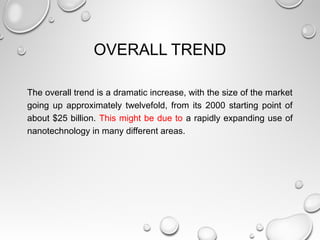
The overall trend is a dramatic increase, with the size of the market
going up approximately twelvefold, from its 2000 starting point of
about $25 billion. This might be due to a rapidly expanding use of
nanotechnology in many different areas.
SPECIFIC TRENDS
Amongst the differently coloured sectors, the most noticeable
change is that more and more market sectors are projected to be
using nanotechnology, and the absolute value of the market share
of all of them will rise. This could be explained by the fact that as
the emerging technology becomes more mature, confidence in its
use will increase. However, it can also be noted that the dominant
sector within Japanese nanotechnology will continue to be
electronics. Probably, this is because of the miniaturisation that
tends to take place with technology concentrating on going down to
as small a level as possible, the nanoscale.
LINKING WORDS FOR COMPARE AND
CONTRAST
Amongst the differently coloured sectors, the most noticeable
change is that more and more market sectors are projected to be
using nanotechnology, and the absolute value of the market share
of all of them will rise. This could be explained by the fact that as
the emerging technology becomes more mature, confidence in its
use will increase. However, it can also be noted that the dominant
sector within Japanese nanotechnology will continue to be
electronics. Probably, this is because of the miniaturisation that
tends to take place with technology concentrating on going down to
as small a level as possible, the nanoscale.
COMMENTARY ON RESULTS MAY
INCLUDE
• Explanations
• Comparisons between results
• Comments on whether the results are expected or unexpected
• Comments about unsatisfactory data
DATA ANALYSIS
ANALYSE QUALITATIVE DATA
In analysing the interview data, two themes emerged which will be discussed in this section. These
themes were: the complexity and challenges of working with families and the professional satisfaction
and challenges of program planning for children in preschool or childcare.
For each of these graduates, their work with children was clearly the area of their professional lives that
was bringing the most satisfaction, although there were some challenges identified. In the
interviews, the data reveal that they were all seeking ways to improve their pedagogy and achieving
success in different ways…
Angela suggested that in her second year of teaching she had changed in that she was programming in
a "more child oriented" way. She discussed this change:
One of the things I've changed is this idea of herding children through the kinder day: they go from indoor play to
snack time to the mat and so on. How I do it now is that I have a lot of different things happening at once. I'll have
a small group on the mat and there might be some children sitting down and having a snack and there's still some
children in home corner playing.
These comments seem to provide evidence that Angela is growing professionally for two reasons. First,
the ability to identify changes in her program suggests to me that she has deeper pedagogical
knowledge gained through critical reflection on her practice, and second, there is congruence between
her expressed beliefs and the practice she describes.
ANALYSE QUALITATIVE DATA
1. Identify the main idea in the analysis
2. Identify the phrases to referto the data
3. Identify the analysis of the data
ANALYSE QUALITATIVE DATA
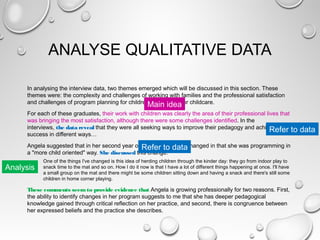
In analysing the interview data, two themes emerged which will be discussed in this section. These
themes were: the complexity and challenges of working with families and the professional satisfaction
and challenges of program planning for children in preschool or childcare.
For each of these graduates, their work with children was clearly the area of their professional lives that
was bringing the most satisfaction, although there were some challenges identified. In the
interviews, the data reveal that they were all seeking ways to improve their pedagogy and achieving
success in different ways…
Angela suggested that in her second year of teaching she had changed in that she was programming in
a "more child oriented" way. She discussed this change:
One of the things I've changed is this idea of herding children through the kinder day: they go from indoor play to
snack time to the mat and so on. How I do it now is that I have a lot of different things happening at once. I'll have
a small group on the mat and there might be some children sitting down and having a snack and there's still some
children in home corner playing.
These comments seemto provide evidence that Angela is growing professionally for two reasons. First,
the ability to identify changes in her program suggests to me that she has deeper pedagogical
knowledge gained through critical reflection on her practice, and second, there is congruence between
her expressed beliefs and the practice she describes.
Main idea
Refer to data
Refer to data
Analysis
DISCUSS YOUR FINDINGS
RESEARCH QUESTION
•Do your research findings support your initial hypothesis? Why
and how?
•Do your findings only support the hypothesis in part? Why and
how?
•Do your findings disprove your hypothesis? Why and how?
•What else do your findings tell you, over and above what you
initially set out to investigate?
DISCUSS YOUR FINDINGS
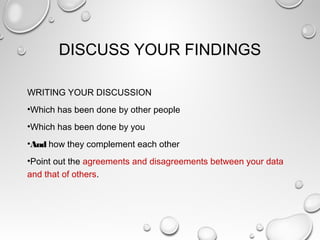
WRITING YOUR DISCUSSION
•Which has been done by other people
•Which has been done by you
•And how they complement each other
•Point out the agreements and disagreements between your data
and that of others.
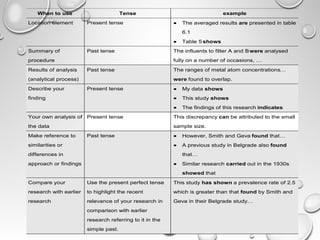
VERB TENSES FOR DATA
When to use Tense example
Location element Present tense • The averaged results are presented in table
6.1
• Table 5 shows
Summary of
procedure
Past tense The influents to filter A and Bwere analysed
fully on a number of occasions, …
Results of analysis
(analytical process)
Past tense The ranges of metal atom concentrations…
were found to overlap.
Describe your
finding
Present tense • My data shows
• This study shows
• The findings of this research indicates
Your own analysis of
the data
Present tense This discrepancy can be attributed to the small
sample size.
Make reference to
similarities or
differences in
approach or findings
Past tense • However, Smith and Geva found that…
• A previous study in Belgrade also found
that…
• Similar research carried out in the 1930s
showed that
Compare your
research with earlier
research
Use the present perfect tense
to highlight the recent
relevance of your research in
comparison with earlier
research referring to it in the
simple past.
This study has shown a prevalence rate of 2.5
which is greater than that found by Smith and
Geva in their Belgrade study…
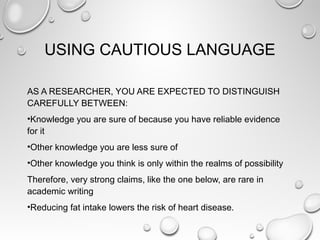
USING CAUTIOUS LANGUAGE
AS A RESEARCHER, YOU ARE EXPECTED TO DISTINGUISH
CAREFULLY BETWEEN:
•Knowledge you are sure of because you have reliable evidence
for it
•Other knowledge you are less sure of
•Other knowledge you think is only within the realms of possibility
Therefore, very strong claims, like the one below, are rare in
academic writing
•Reducing fat intake lowers the risk of heart disease.
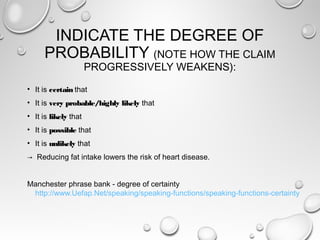
INDICATE THE DEGREE OF
PROBABILITY (NOTE HOW THE CLAIM
PROGRESSIVELY WEAKENS):
• It is certain that
• It is very probable/highly likely that
• It is likely that
• It is possible that
• It is unlikely that
→ Reducing fat intake lowers the risk of heart disease.
Manchester phrase bank - degree of certainty
http://www.Uefap.Net/speaking/speaking-functions/speaking-functions-certainty
INDICATE THE DEGREE OF
PROBABILITY (NOTE HOW THE CLAIM
PROGRESSIVELY WEAKENS):
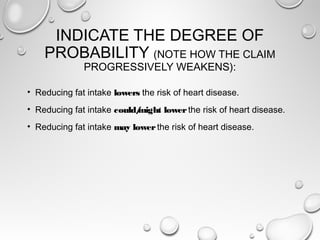
• Reducing fat intake lowers the risk of heart disease.
• Reducing fat intake could/might lower the risk of heart disease.
• Reducing fat intake may lower the risk of heart disease.
DISTANCE YOURSELF FROM THE
CLAIM:
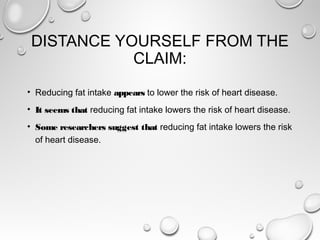
• Reducing fat intake appears to lower the risk of heart disease.
• It seems that reducing fat intake lowers the risk of heart disease.
• Some researchers suggest that reducing fat intake lowers the risk
of heart disease.
DISTANCE YOURSELF FROM THE
DATA, BY SHOWING ITS
LIMITATIONS:
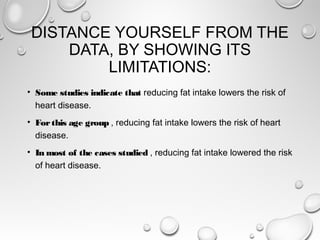
• Some studies indicate that reducing fat intake lowers the risk of
heart disease.
• Forthis age group , reducing fat intake lowers the risk of heart
disease.
• In most of the cases studied , reducing fat intake lowered the risk
of heart disease.
USE A QUALIFYING VERB:
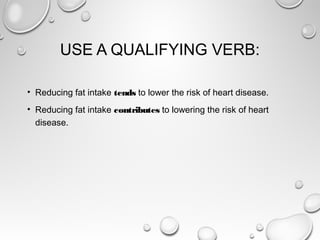
• Reducing fat intake tends to lower the risk of heart disease.
• Reducing fat intake contributes to lowering the risk of heart
disease.
IN PRACTICE, A COMBINATION OF
THESE METHODS IS OFTEN
USED:
• The majority of studies indicate that for this age group, reducing
fat intake contributes to lowering the risk of heart disease.
SELF-STUDY
Listening & note-taking
A needle-free vaccine patch that’s saferand way cheaper
https://www.ted.com/talks/mark_kendall_demo_a_needle_free_vac
cine_patch_that_s_safer_and_way_cheaper

Data interpretation

  • 1.
    DATA ANALYSIS • Datadescription  Accuracy Why? • Data interpretation  Critical thinking skills Why?
  • 2.
  • 3.
  • 4.
  • 5.
    Nano te chnolo g y are the study and applicatio n o f e xtre m e ly sm all thing s and can be use d acro ss all the o the r scie nce fie lds, such as che m istry, bio lo g y, physics, m ate rials scie nce , and e ng ine e ring . (Nano , 20 1 7 )
  • 6.
    Japan nanotechnology market size($ million) by industry, 2000- 2030
  • 7.
    Japan nanotechnology market size($ million) by industry, 2000- 2030
  • 8.
    LESSON AIMS •Data analysis Datadescription Date interpretation
  • 9.
  • 10.
  • 11.
  • 12.
    QUALITY QUANTITY Grow Increase Go up Rise Improve Drop Decrease Godown Fall Get worse / Worsen // DeteriorateDeteriorate
  • 13.
    DATA DESCRIPTION • Thesize of the Japanese nanotechnology market has ____________. • The quality of the medical treatment in your country has __________. • The use of nanotechnology in electronics has ___________________. • The service in the accommodation office has ___________________.
  • 14.
    PAST TENSE /PAST PARTICIPLE Grow Drop Increase Decrease Go up Go down Rise Fall Improve Get worse/ Worsen Deteriorate
  • 15.
    PAST TENSE /PAST PARTICIPLE
  • 16.
    EXAMPLE: PAST SIMPLE/ PRESENT PERFECT • The size of the Japanese nanotechnology market increased in 2000. • The size of the Japanese nanotechnology market has increased since 2000.
  • 17.
    PAST SIMPLE /PRESENT PERFECT • The size of the Japanese nanotechnology market ___________ in 2000. • The size of the Japanese nanotechnology market ___________ since 2000. • The quality of the medical treatment in your country _________ in 2005. • The quality of the medical treatment in your country _________ since 2005. • The use of nanotechnology in electronics _________ in 2010. • The use of nanotechnology in electronics _________ since 2010. • The service in the accommodation office ___________ in 2014. • The service in the accommodation office ___________ since 2014. increased has increased improved has improved went up has gone up deteriorated has deteriorated
  • 18.
  • 19.
    IN/AGO/SINCE/IN THE LAST 13years ago in the last 13 years 8 years ago in the last 8 years 4 years ago in the last 4 years
  • 20.
    ATTENTION ! • Thesize of the Japanese nanotechnology market increased 18 years ago. • The size of the Japanese nanotechnology market has increased since 18 years ago.
  • 21.
    PAST SIMPLE /PRESENT PERFECT  in /ago  since /in the last
  • 22.
    VERB TO NOUN VerbNoun To grow To drop To increase To decrease To go up To go down To rise To fall To improve To deteriorate
  • 23.
    VERB TO NOUN VerbNoun To grow To drop A growth A drop To increase To decrease An increase A decrease To go up To go down An upward trend A downward trend To rise To fall A rise A fall To improve To deteriorate An improvement A deterioration
  • 24.
  • 25.
    VERB TO NOUN •The size of the Japanese nanotechnology market increased 17 years ago. • There was an increase in the size of the Japanese nanotechnology market 17 years ago/in 2000. • The size of the Japanese nanotechnology market has increased in the last 17 years. • There has been an increase in the size of the Japanese nanotechnology market in the last 17 years/since 2000.
  • 26.
    VERB TO NOUN •The quality of the medical treatment in your country improved in2005. • __________________________________________________the quality of the medical treatment in your country in 2005/12 years ago. • The quality of the medical treatment in your country has improved since 2005. • __________________________________________ the quality of the medical treatment in your country since 2005/in the last 12 years. • The use of nanotechnology in electronics went up 7 years ago. • ____________________________________________________________the use of nanotechnology in electronics 7 years ago/in 2010. • The use of nanotechnology in electronics has gone up in the last 7 years. • _____________________________________________________the use of nanotechnology in electronics in the last 7 years/since 2010. • The service in the accommodation office deteriorated in 2014. • _______________________________________________________________________the accommodation office in 2014/3 years ago. There was an improvement inThere was an improvement in There has been an improvement inThere has been an improvement in There was an upward trend inThere was an upward trend in There has been a upward trend inThere has been a upward trend in There was a deterioration inThere was a deterioration in There has been a deterioration inThere has been a deterioration in
  • 27.
  • 28.
  • 29.
  • 30.
  • 31.
  • 32.
  • 33.
  • 34.
  • 35.
  • 36.
  • 37.
  • 38.
  • 39.
  • 40.
  • 41.
  • 42.
  • 44.
  • 45.
    DATA DESCRIPTION CHECKLIST Describedata using appropriate verbs (for quality & quantity) and verb tenses Use ‘in/ago; since/in the last’ accurately Vary sentence structures (verb to noun; noun to verb) to describe data Describe data using appropriate adverbs Use extra verbs / more advanced ways to describe data Use appropriate prepositions for data description
  • 46.
    DATA DESCRIPTION • Workin pairs (work with ss studying similar disciplines) • Do not let your partner see the chart given to you by me • Describe the data on your chart; your partner will draw based on your description  Attention: DO NOT use any hand gesture or any other short cuts to facilitate your partner’s drawing! • See if your partner’s drawing is the same as the original chart. If so, well done! You’ve done a good job on the data description
  • 47.
  • 48.
  • 49.
  • 50.
  • 51.
  • 54.
    ADVANCED may be dueto can be attributed to can probably be accounted for is probably a consequence of would seem to stem from
  • 55.
    DATA ANALYSIS Japan nanotechnologymarket size ($ million) by industry, 2000-2030
  • 56.
    DATA ANALYSIS Write a200-word essay to analyse the data • Introductory sentence describing what the figure shows  (now: 2000-2017; projection 2017-2030)   • Overall comments about the data in the figure, and theirconnection to a real-world context • Specific comments about the data in the figure, and theirconnection to a real-world context   • Summary sentence  What’s the future of nanotechnology like based on this barchart?
  • 57.
    OVERALL TREND The overalltrend is a dramatic increase, with the size of the market going up approximately twelvefold, from its 2000 starting point of about $25 billion. This might be due to a rapidly expanding use of nanotechnology in many different areas.
  • 58.
    SPECIFIC TRENDS Amongst thedifferently coloured sectors, the most noticeable change is that more and more market sectors are projected to be using nanotechnology, and the absolute value of the market share of all of them will rise. This could be explained by the fact that as the emerging technology becomes more mature, confidence in its use will increase. However, it can also be noted that the dominant sector within Japanese nanotechnology will continue to be electronics. Probably, this is because of the miniaturisation that tends to take place with technology concentrating on going down to as small a level as possible, the nanoscale.
  • 59.
    LINKING WORDS FORCOMPARE AND CONTRAST Amongst the differently coloured sectors, the most noticeable change is that more and more market sectors are projected to be using nanotechnology, and the absolute value of the market share of all of them will rise. This could be explained by the fact that as the emerging technology becomes more mature, confidence in its use will increase. However, it can also be noted that the dominant sector within Japanese nanotechnology will continue to be electronics. Probably, this is because of the miniaturisation that tends to take place with technology concentrating on going down to as small a level as possible, the nanoscale.
  • 60.
    COMMENTARY ON RESULTS MAY INCLUDE •Explanations • Comparisons between results • Comments on whether the results are expected or unexpected • Comments about unsatisfactory data
  • 61.
  • 67.
    ANALYSE QUALITATIVE DATA Inanalysing the interview data, two themes emerged which will be discussed in this section. These themes were: the complexity and challenges of working with families and the professional satisfaction and challenges of program planning for children in preschool or childcare. For each of these graduates, their work with children was clearly the area of their professional lives that was bringing the most satisfaction, although there were some challenges identified. In the interviews, the data reveal that they were all seeking ways to improve their pedagogy and achieving success in different ways… Angela suggested that in her second year of teaching she had changed in that she was programming in a "more child oriented" way. She discussed this change: One of the things I've changed is this idea of herding children through the kinder day: they go from indoor play to snack time to the mat and so on. How I do it now is that I have a lot of different things happening at once. I'll have a small group on the mat and there might be some children sitting down and having a snack and there's still some children in home corner playing. These comments seem to provide evidence that Angela is growing professionally for two reasons. First, the ability to identify changes in her program suggests to me that she has deeper pedagogical knowledge gained through critical reflection on her practice, and second, there is congruence between her expressed beliefs and the practice she describes.
  • 68.
    ANALYSE QUALITATIVE DATA 1.Identify the main idea in the analysis 2. Identify the phrases to referto the data 3. Identify the analysis of the data
  • 69.
    ANALYSE QUALITATIVE DATA Inanalysing the interview data, two themes emerged which will be discussed in this section. These themes were: the complexity and challenges of working with families and the professional satisfaction and challenges of program planning for children in preschool or childcare. For each of these graduates, their work with children was clearly the area of their professional lives that was bringing the most satisfaction, although there were some challenges identified. In the interviews, the data reveal that they were all seeking ways to improve their pedagogy and achieving success in different ways… Angela suggested that in her second year of teaching she had changed in that she was programming in a "more child oriented" way. She discussed this change: One of the things I've changed is this idea of herding children through the kinder day: they go from indoor play to snack time to the mat and so on. How I do it now is that I have a lot of different things happening at once. I'll have a small group on the mat and there might be some children sitting down and having a snack and there's still some children in home corner playing. These comments seemto provide evidence that Angela is growing professionally for two reasons. First, the ability to identify changes in her program suggests to me that she has deeper pedagogical knowledge gained through critical reflection on her practice, and second, there is congruence between her expressed beliefs and the practice she describes. Main idea Refer to data Refer to data Analysis
  • 70.
    DISCUSS YOUR FINDINGS RESEARCHQUESTION •Do your research findings support your initial hypothesis? Why and how? •Do your findings only support the hypothesis in part? Why and how? •Do your findings disprove your hypothesis? Why and how? •What else do your findings tell you, over and above what you initially set out to investigate?
  • 71.
    DISCUSS YOUR FINDINGS WRITINGYOUR DISCUSSION •Which has been done by other people •Which has been done by you •And how they complement each other •Point out the agreements and disagreements between your data and that of others.
  • 72.
  • 73.
    When to useTense example Location element Present tense • The averaged results are presented in table 6.1 • Table 5 shows Summary of procedure Past tense The influents to filter A and Bwere analysed fully on a number of occasions, … Results of analysis (analytical process) Past tense The ranges of metal atom concentrations… were found to overlap. Describe your finding Present tense • My data shows • This study shows • The findings of this research indicates Your own analysis of the data Present tense This discrepancy can be attributed to the small sample size. Make reference to similarities or differences in approach or findings Past tense • However, Smith and Geva found that… • A previous study in Belgrade also found that… • Similar research carried out in the 1930s showed that Compare your research with earlier research Use the present perfect tense to highlight the recent relevance of your research in comparison with earlier research referring to it in the simple past. This study has shown a prevalence rate of 2.5 which is greater than that found by Smith and Geva in their Belgrade study…
  • 74.
    USING CAUTIOUS LANGUAGE ASA RESEARCHER, YOU ARE EXPECTED TO DISTINGUISH CAREFULLY BETWEEN: •Knowledge you are sure of because you have reliable evidence for it •Other knowledge you are less sure of •Other knowledge you think is only within the realms of possibility Therefore, very strong claims, like the one below, are rare in academic writing •Reducing fat intake lowers the risk of heart disease.
  • 75.
    INDICATE THE DEGREEOF PROBABILITY (NOTE HOW THE CLAIM PROGRESSIVELY WEAKENS): • It is certain that • It is very probable/highly likely that • It is likely that • It is possible that • It is unlikely that → Reducing fat intake lowers the risk of heart disease. Manchester phrase bank - degree of certainty http://www.Uefap.Net/speaking/speaking-functions/speaking-functions-certainty
  • 76.
    INDICATE THE DEGREEOF PROBABILITY (NOTE HOW THE CLAIM PROGRESSIVELY WEAKENS): • Reducing fat intake lowers the risk of heart disease. • Reducing fat intake could/might lower the risk of heart disease. • Reducing fat intake may lower the risk of heart disease.
  • 77.
    DISTANCE YOURSELF FROMTHE CLAIM: • Reducing fat intake appears to lower the risk of heart disease. • It seems that reducing fat intake lowers the risk of heart disease. • Some researchers suggest that reducing fat intake lowers the risk of heart disease.
  • 78.
    DISTANCE YOURSELF FROMTHE DATA, BY SHOWING ITS LIMITATIONS: • Some studies indicate that reducing fat intake lowers the risk of heart disease. • Forthis age group , reducing fat intake lowers the risk of heart disease. • In most of the cases studied , reducing fat intake lowered the risk of heart disease.
  • 79.
    USE A QUALIFYINGVERB: • Reducing fat intake tends to lower the risk of heart disease. • Reducing fat intake contributes to lowering the risk of heart disease.
  • 80.
    IN PRACTICE, ACOMBINATION OF THESE METHODS IS OFTEN USED: • The majority of studies indicate that for this age group, reducing fat intake contributes to lowering the risk of heart disease.
  • 81.
    SELF-STUDY Listening & note-taking Aneedle-free vaccine patch that’s saferand way cheaper https://www.ted.com/talks/mark_kendall_demo_a_needle_free_vac cine_patch_that_s_safer_and_way_cheaper

Editor's Notes

  • #44 15 mins
  • #45 15 mins
  • #51 15 mins
  • #53 5 mins
  • #54 5 mins
  • #56 15 mins
  • #57 5 mins
  • #60 5 mins
  • #61 https://www.monash.edu/rlo/graduate-research-writing/write-the-thesis/writing-the-thesis-chapters/reporting-and-discussing-your-findings
  • #68 https://www.monash.edu/rlo/graduate-research-writing/write-the-thesis/writing-the-thesis-chapters/reporting-and-discussing-your-findings
  • #69 https://www.monash.edu/rlo/graduate-research-writing/write-the-thesis/writing-the-thesis-chapters/reporting-and-discussing-your-findings
  • #70 https://www.monash.edu/rlo/graduate-research-writing/write-the-thesis/writing-the-thesis-chapters/reporting-and-discussing-your-findings