Data error!, but where?
Errorlocate: find and replace erroneous fields in data using
validation rules
Edwin de Jonge
Statistics Netherlands / UseR! 2017
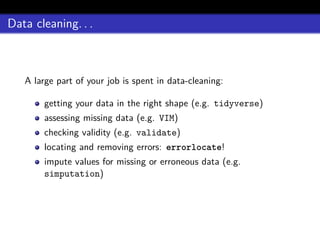
Data cleaning. . .
A large part of your job is spent in data-cleaning:
getting your data in the right shape (e.g. tidyverse)
assessing missing data (e.g. VIM)
checking validity (e.g. validate)
locating and removing errors: errorlocate!
impute values for missing or erroneous data (e.g.
simputation)
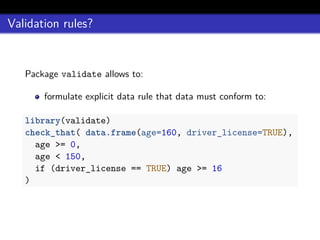
Validation rules?
Package validate allows to:
formulate explicit data rule that data must conform to:
library(validate)
check_that( data.frame(age=160, driver_license=TRUE),
age >= 0,
age < 150,
if (driver_license == TRUE) age >= 16
)
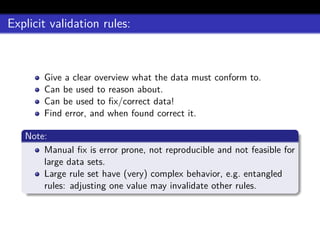
Explicit validation rules:
Give a clear overview what the data must conform to.
Can be used to reason about.
Can be used to fix/correct data!
Find error, and when found correct it.
Note:
Manual fix is error prone, not reproducible and not feasible for
large data sets.
Large rule set have (very) complex behavior, e.g. entangled
rules: adjusting one value may invalidate other rules.
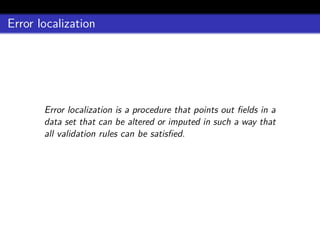
Error localization
Error localization is a procedure that points out fields in a
data set that can be altered or imputed in such a way that
all validation rules can be satisfied.
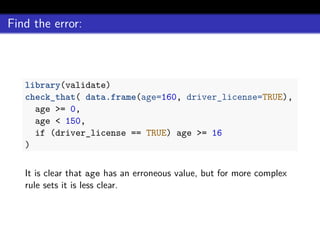
Find the error:
library(validate)
check_that( data.frame(age=160, driver_license=TRUE),
age >= 0,
age < 150,
if (driver_license == TRUE) age >= 16
)
It is clear that age has an erroneous value, but for more complex
rule sets it is less clear.
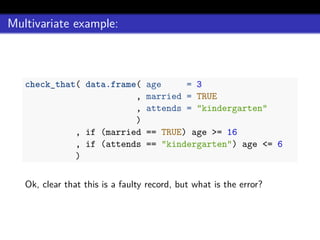
Multivariate example:
check_that( data.frame( age = 3
, married = TRUE
, attends = "kindergarten"
)
, if (married == TRUE) age >= 16
, if (attends == "kindergarten") age <= 6
)
Ok, clear that this is a faulty record, but what is the error?
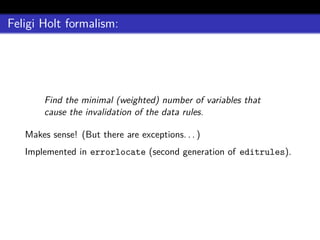
Feligi Holt formalism:
Find the minimal (weighted) number of variables that
cause the invalidation of the data rules.
Makes sense! (But there are exceptions. . . )
Implemented in errorlocate (second generation of editrules).
errorlocate::locate_errors
locate_errors( data.frame( age = 3
, married = TRUE
, attends = "kindergarten"
)
, validator( if (married == TRUE) age >= 16
, if (attends == "kindergarten") age <= 6
)
)$errors
## age married attends
## [1,] FALSE TRUE FALSE
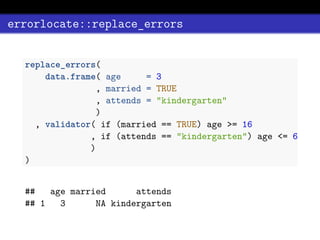
errorlocate::replace_errors
replace_errors(
data.frame( age = 3
, married = TRUE
, attends = "kindergarten"
)
, validator( if (married == TRUE) age >= 16
, if (attends == "kindergarten") age <= 6
)
)
## age married attends
## 1 3 NA kindergarten
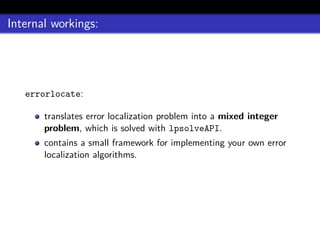
Internal workings:
errorlocate:
translates error localization problem into a mixed integer
problem, which is solved with lpsolveAPI.
contains a small framework for implementing your own error
localization algorithms.
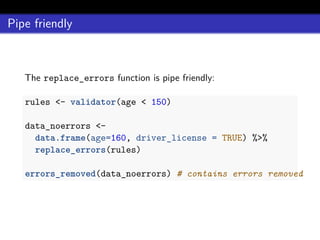
Pipe friendly
The replace_errors function is pipe friendly:
rules <- validator(age < 150)
data_noerrors <-
data.frame(age=160, driver_license = TRUE) %>%
replace_errors(rules)
errors_removed(data_noerrors) # contains errors removed
Thank you!
Interested?
install.packages("errorlocate")
Or visit:
http://github.com/data-cleaning/errorlocate

Data error! But where?

  • 1.
    Data error!, butwhere? Errorlocate: find and replace erroneous fields in data using validation rules Edwin de Jonge Statistics Netherlands / UseR! 2017
  • 3.
    Data cleaning. .. A large part of your job is spent in data-cleaning: getting your data in the right shape (e.g. tidyverse) assessing missing data (e.g. VIM) checking validity (e.g. validate) locating and removing errors: errorlocate! impute values for missing or erroneous data (e.g. simputation)
  • 5.
    Validation rules? Package validateallows to: formulate explicit data rule that data must conform to: library(validate) check_that( data.frame(age=160, driver_license=TRUE), age >= 0, age < 150, if (driver_license == TRUE) age >= 16 )
  • 6.
    Explicit validation rules: Givea clear overview what the data must conform to. Can be used to reason about. Can be used to fix/correct data! Find error, and when found correct it. Note: Manual fix is error prone, not reproducible and not feasible for large data sets. Large rule set have (very) complex behavior, e.g. entangled rules: adjusting one value may invalidate other rules.
  • 7.
    Error localization Error localizationis a procedure that points out fields in a data set that can be altered or imputed in such a way that all validation rules can be satisfied.
  • 8.
    Find the error: library(validate) check_that(data.frame(age=160, driver_license=TRUE), age >= 0, age < 150, if (driver_license == TRUE) age >= 16 ) It is clear that age has an erroneous value, but for more complex rule sets it is less clear.
  • 9.
    Multivariate example: check_that( data.frame(age = 3 , married = TRUE , attends = "kindergarten" ) , if (married == TRUE) age >= 16 , if (attends == "kindergarten") age <= 6 ) Ok, clear that this is a faulty record, but what is the error?
  • 10.
    Feligi Holt formalism: Findthe minimal (weighted) number of variables that cause the invalidation of the data rules. Makes sense! (But there are exceptions. . . ) Implemented in errorlocate (second generation of editrules).
  • 11.
    errorlocate::locate_errors locate_errors( data.frame( age= 3 , married = TRUE , attends = "kindergarten" ) , validator( if (married == TRUE) age >= 16 , if (attends == "kindergarten") age <= 6 ) )$errors ## age married attends ## [1,] FALSE TRUE FALSE
  • 12.
    errorlocate::replace_errors replace_errors( data.frame( age =3 , married = TRUE , attends = "kindergarten" ) , validator( if (married == TRUE) age >= 16 , if (attends == "kindergarten") age <= 6 ) ) ## age married attends ## 1 3 NA kindergarten
  • 13.
    Internal workings: errorlocate: translates errorlocalization problem into a mixed integer problem, which is solved with lpsolveAPI. contains a small framework for implementing your own error localization algorithms.
  • 14.
    Pipe friendly The replace_errorsfunction is pipe friendly: rules <- validator(age < 150) data_noerrors <- data.frame(age=160, driver_license = TRUE) %>% replace_errors(rules) errors_removed(data_noerrors) # contains errors removed
  • 15.