11
Copyright © 2019 CADS and/or its affiliates. All rights reserved. | CADS Confidential – Internal/Restricted/Highly Restricted
Sharala Axryd,
Founder and CEO of
The Center of Applied
Data Science
Data Driven
Digital Ecosystem
22
Copyright © 2019 CADS and/or its affiliates. All rights reserved. | CADS Confidential – Internal/Restricted/Highly Restricted
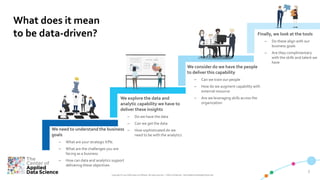
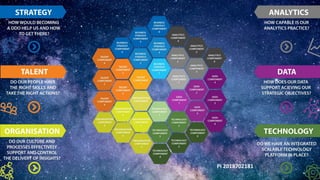
We need to understand the business
goals
‒ What are your strategic KPIs
‒ What are the challenges you are
facing as a business
‒ How can data and analytics support
delivering these objectives
We explore the data and
analytic capability we have to
deliver these insights
‒ Do we have the data
‒ Can we get the data
‒ How sophisticated do we
need to be with the analytics
We consider do we have the people
to deliver this capability
‒ Can we train our people
‒ How do we augment capability with
external resource
‒ Are we leveraging skills across the
organization
Finally, we look at the tools
‒ Do these align with our
business goals
‒ Are they complimentary
with the skills and talent we
have
What does it mean
to be data-driven?
33
Copyright © 2019 CADS and/or its affiliates. All rights reserved. | CADS Confidential – Internal/Restricted/Highly Restricted
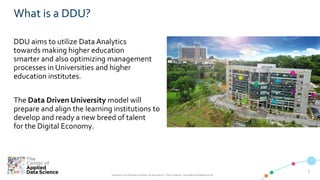
What is a DDU?
DDU aims to utilize Data Analytics
towards making higher education
smarter and also optimizing management
processes in Universities and higher
education institutes.
The Data Driven University model will
prepare and align the learning institutions to
develop and ready a new breed of talent
for the Digital Economy.
44
Copyright © 2019 CADS and/or its affiliates. All rights reserved. | CADS Confidential – Internal/Restricted/Highly Restricted
Key Success Factors for a Learning Institution
Developing New Breed of Industry-
ReadyTalent
• Finding the right mix of degrees and
skill areas for strong career prospects
• Marketable talent represent the
three pillars of digital workforce:
Analytics, Digital, Business
Readiness
Operational Excellence
• Need to build to be competitive and
build market resilience
• Analytics are an opportunity to not
only develop new curriculum areas
but also in-house project possibilities
leveraged get “smarter” in building
and defending unique, commercial
proposition
55
Copyright © 2019 CADS and/or its affiliates. All rights reserved. | CADS Confidential – Internal/Restricted/Highly Restricted
6
PI 2018702181
77
Copyright © 2019 CADS and/or its affiliates. All rights reserved. | CADS Confidential – Internal/Restricted/Highly Restricted
88
Copyright © 2019 CADS and/or its affiliates. All rights reserved. | CADS Confidential – Internal/Restricted/Highly Restricted
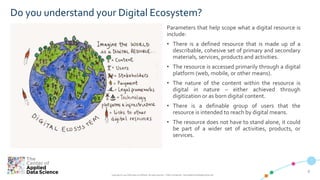
Parameters that help scope what a digital resource is
include:
• There is a defined resource that is made up of a
describable, cohesive set of primary and secondary
materials, services, products and activities.
• The resource is accessed primarily through a digital
platform (web, mobile, or other means).
• The nature of the content within the resource is
digital in nature – either achieved through
digitization or as born digital content.
• There is a definable group of users that the
resource is intended to reach by digital means.
• The resource does not have to stand alone, it could
be part of a wider set of activities, products, or
services.
Do you understand your Digital Ecosystem?
99
Copyright © 2019 CADS and/or its affiliates. All rights reserved. | CADS Confidential – Internal/Restricted/Highly Restricted
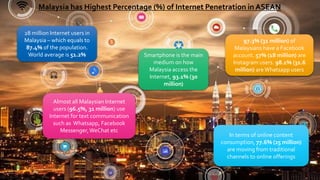
28 million Internet users in
Malaysia – which equals to
87.4% of the population.
World average is 51.2% Smartphone is the main
medium on how
Malaysia access the
Internet, 93.1% (30
million)
Almost all Malaysian Internet
users (96.5%, 31 million) use
Internet for text communication
such as Whatsapp, Facebook
Messenger,WeChat etc
97.3% (31 million) of
Malaysians have a Facebook
account. 57% (18 million) are
Instagram users. 98.1% (31.6
million) areWhatsapp users
Malaysia has Highest Percentage (%) of Internet Penetration in ASEAN
In terms of online content
consumption, 77.6% (25 million)
are moving from traditional
channels to online offerings
1010
Copyright © 2019 CADS and/or its affiliates. All rights reserved. | CADS Confidential – Internal/Restricted/Highly Restricted
1111
Copyright © 2019 CADS and/or its affiliates. All rights reserved. | CADS Confidential – Internal/Restricted/Highly Restricted
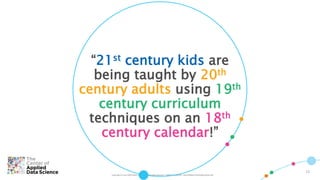
“21st century kids are
being taught by 20th
century adults using 19th
century curriculum
techniques on an 18th
century calendar!”
12
13
14
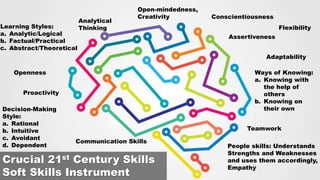
Crucial 21st Century Skills
Soft Skills Instrument
Analytical
Thinking
Open-mindedness,
Creativity
Openness
Conscientiousness
Proactivity
Learning Styles:
a. Analytic/Logical
b. Factual/Practical
c. Abstract/Theoretical
Assertiveness
Flexibility
Adaptability
Decision-Making
Style:
a. Rational
b. Intuitive
c. Avoidant
d. Dependent
Ways of Knowing:
a. Knowing with
the help of
others
b. Knowing on
their own
Teamwork
People skills: Understands
Strengths and Weaknesses
and uses them accordingly,
Empathy
Communication Skills
1515
Copyright © 2019 CADS and/or its affiliates. All rights reserved. | CADS Confidential – Internal/Restricted/Highly Restricted
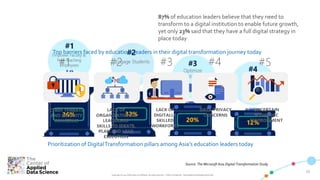
87% of education leaders believe that they need to
transform to a digital institution to enable future growth,
yet only 23% said that they have a full digital strategy in
place today
Source: The Microsoft Asia Digital Transformation Study
Prioritization of DigitalTransformation pillars among Asia’s education leaders today
Top barriers faced by educations leaders in their digital transformation journey today
1616
Copyright © 2019 CADS and/or its affiliates. All rights reserved. | CADS Confidential – Internal/Restricted/Highly Restricted
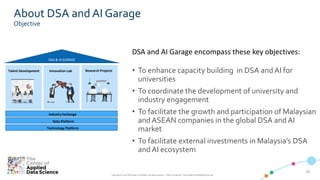
About DSA and AI Garage
Objective
DSA and AI Garage encompass these key objectives:
• To enhance capacity building in DSA and AI for
universities
• To coordinate the development of university and
industry engagement
• To facilitate the growth and participation of Malaysian
and ASEAN companies in the global DSA and AI
market
• To facilitate external investments in Malaysia’s DSA
and AI ecosystem
DSA & AI GARAGE
Talent Development Innovation Lab Research Projects
Industry Exchange
Data Platform
Technology Platform
1717
Copyright © 2019 CADS and/or its affiliates. All rights reserved. | CADS Confidential – Internal/Restricted/Highly Restricted
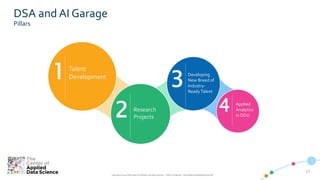
DSA and AI Garage
Pillars
Talent
Development1
Research
Projects2
Developing
New Breed of
Industry-
ReadyTalent
3
Applied
Analytics
in DDU
4
1818
Copyright © 2019 CADS and/or its affiliates. All rights reserved. | CADS Confidential – Internal/Restricted/Highly Restricted
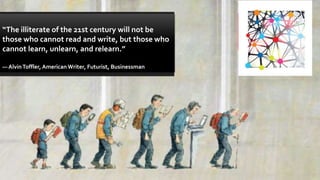
“The illiterate of the 21st century will not be
those who cannot read and write, but those who
cannot learn, unlearn, and relearn.”
— AlvinToffler, American Writer, Futurist, Businessman
1919
Copyright © 2019 CADS and/or its affiliates. All rights reserved. | CADS Confidential – Internal/Restricted/Highly Restricted
ThankYou!
Any Questions?

Data Driven Digital Ecosystem

  • 1.
    11 Copyright © 2019CADS and/or its affiliates. All rights reserved. | CADS Confidential – Internal/Restricted/Highly Restricted Sharala Axryd, Founder and CEO of The Center of Applied Data Science Data Driven Digital Ecosystem
  • 2.
    22 Copyright © 2019CADS and/or its affiliates. All rights reserved. | CADS Confidential – Internal/Restricted/Highly Restricted We need to understand the business goals ‒ What are your strategic KPIs ‒ What are the challenges you are facing as a business ‒ How can data and analytics support delivering these objectives We explore the data and analytic capability we have to deliver these insights ‒ Do we have the data ‒ Can we get the data ‒ How sophisticated do we need to be with the analytics We consider do we have the people to deliver this capability ‒ Can we train our people ‒ How do we augment capability with external resource ‒ Are we leveraging skills across the organization Finally, we look at the tools ‒ Do these align with our business goals ‒ Are they complimentary with the skills and talent we have What does it mean to be data-driven?
  • 3.
    33 Copyright © 2019CADS and/or its affiliates. All rights reserved. | CADS Confidential – Internal/Restricted/Highly Restricted What is a DDU? DDU aims to utilize Data Analytics towards making higher education smarter and also optimizing management processes in Universities and higher education institutes. The Data Driven University model will prepare and align the learning institutions to develop and ready a new breed of talent for the Digital Economy.
  • 4.
    44 Copyright © 2019CADS and/or its affiliates. All rights reserved. | CADS Confidential – Internal/Restricted/Highly Restricted Key Success Factors for a Learning Institution Developing New Breed of Industry- ReadyTalent • Finding the right mix of degrees and skill areas for strong career prospects • Marketable talent represent the three pillars of digital workforce: Analytics, Digital, Business Readiness Operational Excellence • Need to build to be competitive and build market resilience • Analytics are an opportunity to not only develop new curriculum areas but also in-house project possibilities leveraged get “smarter” in building and defending unique, commercial proposition
  • 5.
    55 Copyright © 2019CADS and/or its affiliates. All rights reserved. | CADS Confidential – Internal/Restricted/Highly Restricted
  • 6.
  • 7.
    77 Copyright © 2019CADS and/or its affiliates. All rights reserved. | CADS Confidential – Internal/Restricted/Highly Restricted
  • 8.
    88 Copyright © 2019CADS and/or its affiliates. All rights reserved. | CADS Confidential – Internal/Restricted/Highly Restricted Parameters that help scope what a digital resource is include: • There is a defined resource that is made up of a describable, cohesive set of primary and secondary materials, services, products and activities. • The resource is accessed primarily through a digital platform (web, mobile, or other means). • The nature of the content within the resource is digital in nature – either achieved through digitization or as born digital content. • There is a definable group of users that the resource is intended to reach by digital means. • The resource does not have to stand alone, it could be part of a wider set of activities, products, or services. Do you understand your Digital Ecosystem?
  • 9.
    99 Copyright © 2019CADS and/or its affiliates. All rights reserved. | CADS Confidential – Internal/Restricted/Highly Restricted 28 million Internet users in Malaysia – which equals to 87.4% of the population. World average is 51.2% Smartphone is the main medium on how Malaysia access the Internet, 93.1% (30 million) Almost all Malaysian Internet users (96.5%, 31 million) use Internet for text communication such as Whatsapp, Facebook Messenger,WeChat etc 97.3% (31 million) of Malaysians have a Facebook account. 57% (18 million) are Instagram users. 98.1% (31.6 million) areWhatsapp users Malaysia has Highest Percentage (%) of Internet Penetration in ASEAN In terms of online content consumption, 77.6% (25 million) are moving from traditional channels to online offerings
  • 10.
    1010 Copyright © 2019CADS and/or its affiliates. All rights reserved. | CADS Confidential – Internal/Restricted/Highly Restricted
  • 11.
    1111 Copyright © 2019CADS and/or its affiliates. All rights reserved. | CADS Confidential – Internal/Restricted/Highly Restricted “21st century kids are being taught by 20th century adults using 19th century curriculum techniques on an 18th century calendar!”
  • 12.
  • 13.
  • 14.
    14 Crucial 21st CenturySkills Soft Skills Instrument Analytical Thinking Open-mindedness, Creativity Openness Conscientiousness Proactivity Learning Styles: a. Analytic/Logical b. Factual/Practical c. Abstract/Theoretical Assertiveness Flexibility Adaptability Decision-Making Style: a. Rational b. Intuitive c. Avoidant d. Dependent Ways of Knowing: a. Knowing with the help of others b. Knowing on their own Teamwork People skills: Understands Strengths and Weaknesses and uses them accordingly, Empathy Communication Skills
  • 15.
    1515 Copyright © 2019CADS and/or its affiliates. All rights reserved. | CADS Confidential – Internal/Restricted/Highly Restricted 87% of education leaders believe that they need to transform to a digital institution to enable future growth, yet only 23% said that they have a full digital strategy in place today Source: The Microsoft Asia Digital Transformation Study Prioritization of DigitalTransformation pillars among Asia’s education leaders today Top barriers faced by educations leaders in their digital transformation journey today
  • 16.
    1616 Copyright © 2019CADS and/or its affiliates. All rights reserved. | CADS Confidential – Internal/Restricted/Highly Restricted About DSA and AI Garage Objective DSA and AI Garage encompass these key objectives: • To enhance capacity building in DSA and AI for universities • To coordinate the development of university and industry engagement • To facilitate the growth and participation of Malaysian and ASEAN companies in the global DSA and AI market • To facilitate external investments in Malaysia’s DSA and AI ecosystem DSA & AI GARAGE Talent Development Innovation Lab Research Projects Industry Exchange Data Platform Technology Platform
  • 17.
    1717 Copyright © 2019CADS and/or its affiliates. All rights reserved. | CADS Confidential – Internal/Restricted/Highly Restricted DSA and AI Garage Pillars Talent Development1 Research Projects2 Developing New Breed of Industry- ReadyTalent 3 Applied Analytics in DDU 4
  • 18.
    1818 Copyright © 2019CADS and/or its affiliates. All rights reserved. | CADS Confidential – Internal/Restricted/Highly Restricted “The illiterate of the 21st century will not be those who cannot read and write, but those who cannot learn, unlearn, and relearn.” — AlvinToffler, American Writer, Futurist, Businessman
  • 19.
    1919 Copyright © 2019CADS and/or its affiliates. All rights reserved. | CADS Confidential – Internal/Restricted/Highly Restricted ThankYou! Any Questions?

Editor's Notes

  • #2 To be used as 1st and Last slide
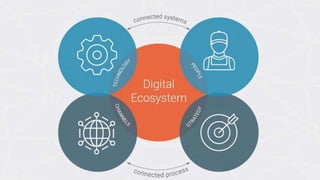
  • #6 At the highest level, digital ecosystems are comprised of companies, people, data, processes and things that are connected by the shared use of digital platforms. These partnering ecosystems are created to enable collaboration and provide mutually beneficial results to all parties involved. The idea is to create a collection of flexible services that can shift around and quickly be adapted to the ever-changing needs of a business. Each new digital ecosystem is a unique animal, like a Mr. Potato Head of carefully selected parts that serve a purpose both on their own and together. They allow businesses to move faster, maximize productivity, and minimize on-premises investments and liabilities. The inherent benefits multiply with every partner organization sharing applications, information and bandwidth through mutual use of the ecosystem. A 2017 study revealed that 79 percent of top-performing modern organizations participate in a digital ecosystem, while less than half of “average performer” companies have made the leap. This could be due to a combination of factors: budget, resistance to change or simply being ill-informed. As with any tech trend, the budget factor will diminish as vendors vie for mass adoption and bring down costs. Brands will have to deal with the other two on their own volition. Hint: If your tech stack already works together in some fashion, you’re on your way. In 2015, companies that generated at least half of their revenue through use of digital ecosystems saw growth and profits that were 27–32 percent higher than average. In the short time since, that silly phrase “digital transformation” has come to mean more things to wider samples of the population. Hospitals, farms and even homes are leaping forward into digital ecosystems of their own, with interconnected technology that is revolutionizing our lives in real time. The term “digital ecosystem” is starting to mean as much as “digital transformation” before it — making it harder to pin down and, like it or not, harder to escape.
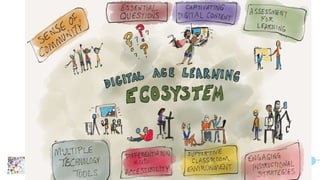
  • #8 When I visit a digital age classroom where students are actively using technology tools for inquiry and creating new products to show their learning, I see a similarity to an ecosystem. The students and teacher interact within the classroom environment in an organic way to construct learning experiences. What are the components of this digital age learning ecosystem? What facilitates a sustainable learning environment that endures over time and through adversity? A Sense of Community Teachers intentionally nurture a community in the digital age learning ecosystem. They know the interests, strengths, and challenges of their students, and they are eager to learn alongside them. Rather than viewing themselves as content experts with the primary purpose of directing instruction, teachers in the digital age learning ecosystem relish the roles of learner and explorer. Digital citizenship is ingrained throughout the practices of the classroom. Because students have typically developed their own norms and practices for how they should co-exist with technology, teachers in the digital age learning ecosystem must encourage appropriate netiquette and the responsible use of technology tools and resources. Essential Questions Teachers should design lessons or units of study within the digital age learning ecosystem by posing essential, open-ended questions. This strategy provokes deeper thinking and encourages students to develop additional questions for future exploration and possible solution. As teachers frame learning experiences around questions, they promote a stimulating culture of inquiry and innovation. Captivating Digital Content Students need access to rich multimedia content, including primary resources and documents in a digital age learning ecosystem. Teachers can model strategies for conducting smart searches for the just right information needed to answer the essential questions of the lesson. That information can be further reviewed for accuracy, authenticity, and relevancy in order to develop the students’ skills with digital literacy. By utilizing a learning object repository, teachers and students can access resources as well as upload and share the content they create within their learning activities. Assessment for Learning Teaching rote information to prepare for standardized assessments has dominated classroom practice for the last several years, resulting in teacher-directed learning and high-stakes assignments, grading, and reporting. Conversely, the teacher in the digital age learning ecosystem employs assessment for learning. This practice utilizes more risk-free formative assessments where the teacher continually checks for student understanding so that students are able to freely share their developing ideas and skills. Teachers also use multiple forms of assessment  in the process of learning so that students have more ways to experience success. These forms may include participation in discussion, student-produced content, and multimedia presentations. Multiple Technology Tools Whether students use their own technology tools that they bring to school in their pockets and backpacks or utilize school-provided technology resources, these devices develop new purposes within the digital age learning ecosystem. They are the means for building connections among teachers, students, and content. Different resources are also useful for different tasks. So, there may be a situation when a smartphone or a tablet is the appropriate tool for taking a photo, responding to a question, or accessing content, but other situations may require the use of a laptop or desktop computer, broadcast equipment, interactive whiteboard, or 3D printer. Learning when and how to use the right tool for a job are essential functions within the digital age learning ecosystem. Designs for Differentiation and Accessibility Because each student is unique, teachers in the digital age learning ecosystem realize that there is no one-size-fits-all approach to learning. Students have different strengths and challenges, so their learning experiences should be tailored for those personal differences. Personalizing learning should include support for English language learners and students with academic and physical needs as well as remediation and enrichment opportunities for all students, as needed. Thoughtfully designed accessibility features within the classroom engage all of the learners by reducing factors that may limit success and impede equitable participation. Supportive Classroom Environment The classroom environment of the digital age learning ecosystem includes both the physical and online areas that are used and curated by the teacher and students. There are a variety of learning spaces and tools available as needed for the students to use for different learning activities, including nooks for individual innovation and quiet reflection in addition to zones for collaborative work and discussion. The learning environment is vibrant, and furniture and equipment are mobile so that they can be easily rearranged to adjust for multiple learning situations and functions. Engaging Instructional Strategies Teachers plan instructional strategies that engage students within the digital age learning ecosystem. With a focus on the skills of communication, collaboration, creativity, and critical thinking, the processes involved in learning, rather than just the products, gain new importance. Not only does this focus ensure that students have multiple ways to show evidence of success in the classroom, it also helps them develop the skills necessary for success in their future careers. Digital age teachers consider how they implement these strategies throughout each day and realize that they can facilitate student learning without everyone doing the same thing, at the same time, and in the same way.
  • #9 Key to providing the right digital environment are well-trained, fully-engaged members of staff who can design and deliver courses with technology embedded in them. This approach fosters a climate of digital fluency that diffuses throughout the university, from students to chancellors and everyone in between. For example, Lancaster University is one institution which is leading the way with their ‘dot.everything’ approach, whereby all processes – from student admissions and assessment to requesting travel and managing payroll – are carried out online. As well as training up staff, universities are also starting to think about how they should create learning experiences and spaces which meet the needs of future students. The learning environment isn’t fixed and technology is far from static, so instead of developing new bespoke digital learning spaces, universities may be better off embedding digital technologies across the spaces they already have. Rather than investing in physical spaces and places, we need to invest in the people who can pass on the relevant digital skills to their students and colleagues. In fostering the right environment for digital learning, universities have a real opportunity to upskill at every level. But transforming a university into a smooth-running digital machine is a big task. It needs a holistic organisational approach, involving collaboration between learners, curriculum teams, departmental heads, support services, leaders and governors. This requires a senior member of staff with the strategic steer and focus to take the university’s digital vision forward. But ultimately it should be student needs which shape their decisions on investment in technology and how to drive forward digital learning. 
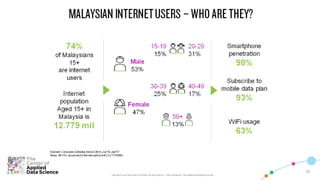
  • #10 Source: Data gathered from MCMC (Malaysian Communications and Multimedia Commission), Facebook, Department of Statistics Malaysia, etc. https://www.skmm.gov.my/skmmgovmy/media/General/pdf/Internet-Users-Survey-2018.pdf
  • #11 Malaysia ranks top 5 globally in mobile social media penetration, highest in region Malaysia was ranked top five globally and highest in Southeast Asia for mobile social media penetration, according to Hootsuite and We Are Social in their latest Digital 2019 report. Internet penetration in Malaysia said the report, stood at 80% with users spending a daily average of eight hours and five minutes online. “A healthy portion of this time, two hours and 58 minutes is attributed to social media consumption. “Emerging fourth globally in mobile social penetration, Malaysia is in the lead among Southeast Asian countries including Singapore is in sixth place, followed by Thailand (eighth) and the Philippines (10),” they said in a joint statement today. https://www.thesundaily.my/local/malaysia-ranks-top-5-globally-in-mobile-social-media-penetration-highest-in-region-DI468306 https://digitalinfluencelab.com/malaysia-digital-marketing-stats/
  • #15 “In a gentle way, you can shake the world.” —Gandhi Are you prepared for a career in the 21st century? If you’re not sure, you might want to rethink your next steps. According to the World Economic Forum, five years from now, over one-third of skills (35%) that are considered important in today’s workforce will have changed. By 2020, the Fourth Industrial Revolution will have brought us advanced robotics and autonomous transport, artificial intelligence and machine learning, advanced materials, biotechnology and genomics. The idea is to develop a tool that could assess the soft skills of data professionals but also give us the opportunity to use it for the assessment of soft skills of other types of employees as well. This includes many of the crucial employee 21st century skills, for example: ways of thinking (critical thinking mainly), communication, collaboration, creativity, ways of working (plan and prioritise work mainly), adaptability, etc. This is an initial pool of skills that we could test and see how they work. We could add more skills if we think there are more skills crucial for employees that we could test. So, in other words we try to develop a soft skills instrument, like a personality instrument, that measures different aspects of the personality and soft skills of employees that could be used in any industry. The next step is to gather data from professionals in order to identify skills dimensions (just like the EDGE instrument) and employee profiles. We have two aims: 1. The first aim is to test data professionals and try to identify profiles of data professions, for example which skills are prevalent in data professionals. In this sense, we could develop a use case around the crucial soft skills of data professionals. 2. The second aim is to start using it to different types of employees and identify how they perform on the identified soft skills. It could be used in employee recruitment and selection and later in team building. In team building it could be used as a tool that identifies employee profiles and helps in the development of teams with supplementary ways of thinking and working. But that could be done in a later stage when we manage to gather and analyse more data.
  • #19 A college degree at the start of a working career does not answer the need for the continuous acquisition of new skills, especially as career spans are lengthening. Vocational training is good at giving people job-specific skills, but those, too, will need to be updated over and over again during a career lasting decades. – The Economist Fortunately it doesn’t take much time or money to boost your skills to make you more competitive.  You just need to have a strategy for ensuring that your knowledge and skills are always up-to-date.  Even if you aren’t in a technical job, technical skills like software and social media help everyone.  Creative skills like graphic design and photography are also useful in a variety of jobs.  Skills like project management, team leadership, and conflict resolution are critical to anyone’s success. In short, knowledge work is an area that will continue to grow; career options will become more varied and require ongoing education to remaining current.
  • #20 2nd last slide. Final slide will be the same as the 1st slide.