Subnetting
1
Mask
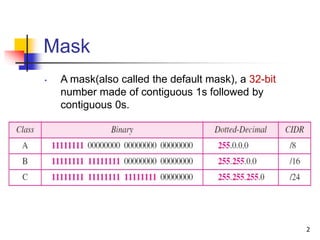
• A mask(also called the default mask), a 32-bit
number made of contiguous 1s followed by
contiguous 0s.
2
Host Addresses, Network address
and Broadcast ID
• Block Size:- Block size is size of subnet
including network address, hosts addresses
and broadcast address.
• Network address:- First address of subnet
is called network ID. This address is used to
identify one segment or broadcast domain
from all the other segments in the network.
3
cont'd...
• Broadcast ID:- There are two types of
broadcast, direct broadcast and full
broadcast.
• Direct broadcast or local broadcast is the
last address of subnet and can be hear by all
hosts in subnet.
• Full broadcast is the last address of IP
classes and can be hear by all IP hosts in
network. Full broadcast address is
255.255.255.255
4
cont'd...
• Host Addresses:- All address between
the network address and the directed
broadcast address is called host
address for the subnet.
5
Subnetting
• Subnetting is a process of breaking
large network in smaller network known
as subnet (a group of computers divided
by layer 3 IP address).
• Subnet are easier to manage.
• Subnetting reduces network traffic,
which improve network performance.
6
Supernetting
• Supernetting(the reverse process
of subnetting).
7
Method of subnetting
• The classless addressing schema is achieved
by using the subnetting process.
• Subnetting take places when we extend the
default subnet mask.
• To figure out subnetted subnet mask, we first
need to write down the default subnet mask.
Then find the host bits borrowed to create
subnets and convert them in to decimal.
8
Cont'd...
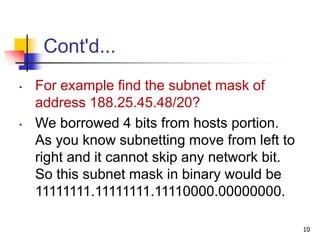
• For example find the subnet mask of
address 188.25.45.48/20?
• We borrowed 4 bits from hosts portion.
As you know subnetting move from left to
right and it cannot skip any network bit.
So this subnet mask in binary would be
11111111.11111111.11110000.00000000.
9
Cont'd...
• For example find the subnet mask of
address 188.25.45.48/20?
• We borrowed 4 bits from hosts portion.
As you know subnetting move from left to
right and it cannot skip any network bit.
So this subnet mask in binary would be
11111111.11111111.11110000.00000000.
10
Cont'd...
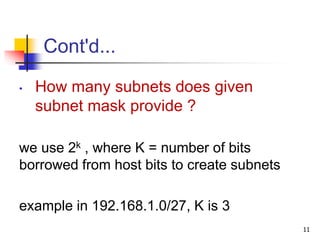
• How many subnets does given
subnet mask provide ?
we use 2k , where K = number of bits
borrowed from host bits to create subnets
example in 192.168.1.0/27, K is 3
11
Cont'd...
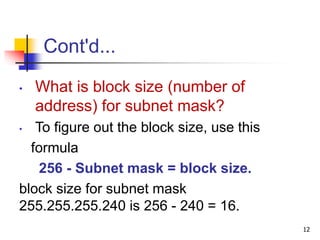
• What is block size (number of
address) for subnet mask?
• To figure out the block size, use this
formula
256 - Subnet mask = block size.
block size for subnet mask
255.255.255.240 is 256 - 240 = 16.
12
Cont'd...
• In other way the number of addresses
can be found by complementing the
mask, interpreting it as a decimal
number, and adding 1 to it.
13
Cont'd...
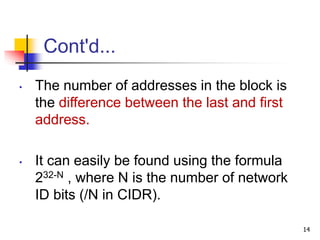
• The number of addresses in the block is
the difference between the last and first
address.
• It can easily be found using the formula
232-N , where N is the number of network
ID bits (/N in CIDR).
14
What are the valid subnets?
Calculating valid subnet is two steps process.
For example calculate the valid subnets for 192.168.1.0/26.
Borrowed host bits are 2 [26-24], because the address
belong to class C .
• Total subnets are 22 = 4.
• Subnet mask would be 255.255.255.192.
• Block size would be 256-192 = 64 = 232-26 .
• Start counting from zero at blocks of 64, so our valid
subnets would be 0,64,128,192.
15
What are the total hosts?
Total hosts are the hosts available per subnet.
To calculate total hosts use formula 2H = Total hosts.
H is the number of host bits.
For example in address 192.168.1.0/26 we have 32 - 26
[Total bits in IP address - Bits consumed by network address]
= 6.
Total hosts per subnet would be 26 = 64.
16
How many valid hosts are
available per subnet?
• Valid hosts are the number of hosts those can be
assigned to devices.
• It is imperative that every network, regardless of
Class and size, has a Network Address and a
Broadcast Address which
• cannot be used.
• In the Example 0,64,128,192 are Network
Address
17
What is a brodcast address
• Broadcast address is the last address of subnet.
This address is reserve for network broadcast,
and cannot be assigned to any host.
• In above example
• 0 Subnet has broadcast address 63
• 64 Subnet has broadcast address 127
• 128 Subnet has broadcast address 191
• 192 Subnet has broadcast address 255
18
What is a brodcast address
• Broadcast address is the last address of subnet.
This address is reserve for network broadcast,
and cannot be assigned to any host.
• In above example
• 0 Subnet has broadcast address 63
• 64 Subnet has broadcast address 127
• 128 Subnet has broadcast address 191
• 192 Subnet has broadcast address 255
19
Example
Assume that we have a subnet with the network number
21.100.19.0, and a subnet mask of 255.255.255.192
(i.e. a slash 26 network) which of the following IP addresses
would be on
the subnet?
a) 21.100.19.1
b) 21.101.19.1
c) 21.100.19.128
d) 21.100.19.62
20
Reading Assignment
IPv6
21

data communication and networking: subnetting

  • 1.
  • 2.
    Mask • A mask(alsocalled the default mask), a 32-bit number made of contiguous 1s followed by contiguous 0s. 2
  • 3.
    Host Addresses, Networkaddress and Broadcast ID • Block Size:- Block size is size of subnet including network address, hosts addresses and broadcast address. • Network address:- First address of subnet is called network ID. This address is used to identify one segment or broadcast domain from all the other segments in the network. 3
  • 4.
    cont'd... • Broadcast ID:-There are two types of broadcast, direct broadcast and full broadcast. • Direct broadcast or local broadcast is the last address of subnet and can be hear by all hosts in subnet. • Full broadcast is the last address of IP classes and can be hear by all IP hosts in network. Full broadcast address is 255.255.255.255 4
  • 5.
    cont'd... • Host Addresses:-All address between the network address and the directed broadcast address is called host address for the subnet. 5
  • 6.
    Subnetting • Subnetting isa process of breaking large network in smaller network known as subnet (a group of computers divided by layer 3 IP address). • Subnet are easier to manage. • Subnetting reduces network traffic, which improve network performance. 6
  • 7.
  • 8.
    Method of subnetting •The classless addressing schema is achieved by using the subnetting process. • Subnetting take places when we extend the default subnet mask. • To figure out subnetted subnet mask, we first need to write down the default subnet mask. Then find the host bits borrowed to create subnets and convert them in to decimal. 8
  • 9.
    Cont'd... • For examplefind the subnet mask of address 188.25.45.48/20? • We borrowed 4 bits from hosts portion. As you know subnetting move from left to right and it cannot skip any network bit. So this subnet mask in binary would be 11111111.11111111.11110000.00000000. 9
  • 10.
    Cont'd... • For examplefind the subnet mask of address 188.25.45.48/20? • We borrowed 4 bits from hosts portion. As you know subnetting move from left to right and it cannot skip any network bit. So this subnet mask in binary would be 11111111.11111111.11110000.00000000. 10
  • 11.
    Cont'd... • How manysubnets does given subnet mask provide ? we use 2k , where K = number of bits borrowed from host bits to create subnets example in 192.168.1.0/27, K is 3 11
  • 12.
    Cont'd... • What isblock size (number of address) for subnet mask? • To figure out the block size, use this formula 256 - Subnet mask = block size. block size for subnet mask 255.255.255.240 is 256 - 240 = 16. 12
  • 13.
    Cont'd... • In otherway the number of addresses can be found by complementing the mask, interpreting it as a decimal number, and adding 1 to it. 13
  • 14.
    Cont'd... • The numberof addresses in the block is the difference between the last and first address. • It can easily be found using the formula 232-N , where N is the number of network ID bits (/N in CIDR). 14
  • 15.
    What are thevalid subnets? Calculating valid subnet is two steps process. For example calculate the valid subnets for 192.168.1.0/26. Borrowed host bits are 2 [26-24], because the address belong to class C . • Total subnets are 22 = 4. • Subnet mask would be 255.255.255.192. • Block size would be 256-192 = 64 = 232-26 . • Start counting from zero at blocks of 64, so our valid subnets would be 0,64,128,192. 15
  • 16.
    What are thetotal hosts? Total hosts are the hosts available per subnet. To calculate total hosts use formula 2H = Total hosts. H is the number of host bits. For example in address 192.168.1.0/26 we have 32 - 26 [Total bits in IP address - Bits consumed by network address] = 6. Total hosts per subnet would be 26 = 64. 16
  • 17.
    How many validhosts are available per subnet? • Valid hosts are the number of hosts those can be assigned to devices. • It is imperative that every network, regardless of Class and size, has a Network Address and a Broadcast Address which • cannot be used. • In the Example 0,64,128,192 are Network Address 17
  • 18.
    What is abrodcast address • Broadcast address is the last address of subnet. This address is reserve for network broadcast, and cannot be assigned to any host. • In above example • 0 Subnet has broadcast address 63 • 64 Subnet has broadcast address 127 • 128 Subnet has broadcast address 191 • 192 Subnet has broadcast address 255 18
  • 19.
    What is abrodcast address • Broadcast address is the last address of subnet. This address is reserve for network broadcast, and cannot be assigned to any host. • In above example • 0 Subnet has broadcast address 63 • 64 Subnet has broadcast address 127 • 128 Subnet has broadcast address 191 • 192 Subnet has broadcast address 255 19
  • 20.
    Example Assume that wehave a subnet with the network number 21.100.19.0, and a subnet mask of 255.255.255.192 (i.e. a slash 26 network) which of the following IP addresses would be on the subnet? a) 21.100.19.1 b) 21.101.19.1 c) 21.100.19.128 d) 21.100.19.62 20
  • 21.