Download free for 30 days
Sign in
Upload
Language (EN)
Support
Business
Mobile
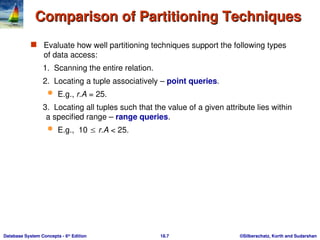
Social Media
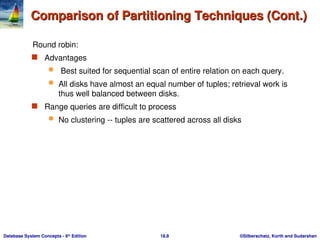
Marketing
Technology
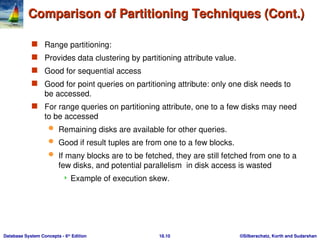
Art & Photos
Career
Design
Education
Presentations & Public Speaking
Government & Nonprofit
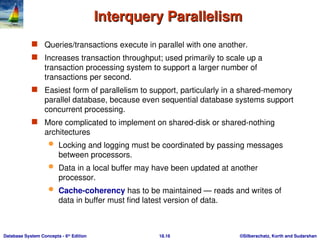
Healthcare
Internet
Law
Leadership & Management
Automotive
Engineering
Software
Recruiting & HR
Retail
Sales
Services
Science
Small Business & Entrepreneurship
Food
Environment
Economy & Finance
Data & Analytics
Investor Relations
Sports
Spiritual
News & Politics
Travel
Self Improvement
Real Estate
Entertainment & Humor
Health & Medicine
Devices & Hardware
Lifestyle
Change Language
Language
English
Español
Português
Français
Deutsche
Cancel
Save
Submit search
EN
Uploaded by
Mercy Joseph
PPT, PDF
4 views
Data base management system - Parallel Database
Data base management system - Parallel Database
Engineering
◦
Read more
0
Save
Share
Embed
Embed presentation
Download
Download to read offline
1
/ 46
2
/ 46
3
/ 46
4
/ 46
5
/ 46
6
/ 46
7
/ 46
8
/ 46
9
/ 46
10
/ 46
11
/ 46
12
/ 46
13
/ 46
14
/ 46
15
/ 46
16
/ 46
17
/ 46
18
/ 46
19
/ 46
20
/ 46
21
/ 46
22
/ 46
23
/ 46
24
/ 46
25
/ 46
26
/ 46
27
/ 46
28
/ 46
29
/ 46
30
/ 46
31
/ 46
32
/ 46
33
/ 46
34
/ 46
35
/ 46
36
/ 46
37
/ 46
38
/ 46
39
/ 46
40
/ 46
41
/ 46
42
/ 46
43
/ 46
44
/ 46
45
/ 46
46
/ 46
More Related Content
PDF
Parallel and distributed storage on databases
by
VivekMITAnnaUniversi
PPTX
Database Management systems concept.pptx
by
SHRIJANANIM
PPT
20. Parallel Databases in DBMS
by
koolkampus
PDF
Ch21
by
Subhankar Chowdhury
PPT
Ch20
by
Welly Dian Astika
PPTX
ch21.pptx distribution database system storage
by
OmerMohamed64
PPT
Advanced databases -client /server arch
by
Aravindharamanan S
PPT
Advancedrn
by
Aravindharamanan S
Parallel and distributed storage on databases
by
VivekMITAnnaUniversi
Database Management systems concept.pptx
by
SHRIJANANIM
20. Parallel Databases in DBMS
by
koolkampus
Ch21
by
Subhankar Chowdhury
Ch20
by
Welly Dian Astika
ch21.pptx distribution database system storage
by
OmerMohamed64
Advanced databases -client /server arch
by
Aravindharamanan S
Advancedrn
by
Aravindharamanan S
Similar to Data base management system - Parallel Database
PDF
DistibutedDB_Querying on distributed databases
by
VivekMITAnnaUniversi
PPT
Distributed Database Deadlock for computer science
by
Jyoti Sharma
PPT
Distributed databases for beginers simple.ppt
by
NilKanth2
PPTX
ADBS_parallel Databases in Advanced DBMS
by
chandugoswami
PPT
ch12.ppt
by
rsingh5987
PPTX
Parallel databases
by
Aniruddha Patil
PPT
distributed db unit1 korth.ppt
by
SaiSathguru
PPT
UNIT-1 PPT.pptCS 3492 DBMS UNIT 1 to 5 overview Unit 1 slides including purpo...
by
SakkaravarthiS1
PDF
Lecture Notes Unit3 chapter21 - parallel databases
by
Murugan146644
PPT
ch22a_ParallelDBs how parallel Datab.ppt
by
RahulBhole12
PPT
Parallel Database description in database management
by
chandugoswami
PPT
422_114_216_module_1-inroduction-1.ppt with detailed notes and explanation
by
farsankadavandy
PPT
The Database Environment Chapter 6
by
Jeanie Arnoco
PPT
Ch 7 Physical D B Design
by
guest8fdbdd
PPTX
Partitioning Design
by
Martin Cairns
PPT
ch19 (1).ppt
by
VaishnavChaudhari4
PPT
ch19.ppt
by
RudranilDas11
PPT
ch19.ppt
by
Dr. Rama Rao Karri
PPT
Ch22 parallel d_bs_cs561
by
Shobhit Saxena
PPT
VNSISPL_DBMS_Concepts_ch21
by
sriprasoon
DistibutedDB_Querying on distributed databases
by
VivekMITAnnaUniversi
Distributed Database Deadlock for computer science
by
Jyoti Sharma
Distributed databases for beginers simple.ppt
by
NilKanth2
ADBS_parallel Databases in Advanced DBMS
by
chandugoswami
ch12.ppt
by
rsingh5987
Parallel databases
by
Aniruddha Patil
distributed db unit1 korth.ppt
by
SaiSathguru
UNIT-1 PPT.pptCS 3492 DBMS UNIT 1 to 5 overview Unit 1 slides including purpo...
by
SakkaravarthiS1
Lecture Notes Unit3 chapter21 - parallel databases
by
Murugan146644
ch22a_ParallelDBs how parallel Datab.ppt
by
RahulBhole12
Parallel Database description in database management
by
chandugoswami
422_114_216_module_1-inroduction-1.ppt with detailed notes and explanation
by
farsankadavandy
The Database Environment Chapter 6
by
Jeanie Arnoco
Ch 7 Physical D B Design
by
guest8fdbdd
Partitioning Design
by
Martin Cairns
ch19 (1).ppt
by
VaishnavChaudhari4
ch19.ppt
by
RudranilDas11
ch19.ppt
by
Dr. Rama Rao Karri
Ch22 parallel d_bs_cs561
by
Shobhit Saxena
VNSISPL_DBMS_Concepts_ch21
by
sriprasoon
More from Mercy Joseph
PPT
Advanced SQL in Data Base management System
by
Mercy Joseph
PPT
Data base management system - Database Design
by
Mercy Joseph
PPT
DBMS - Introduction to SQL in Data Base management System
by
Mercy Joseph
PDF
OBT751 Analytical methods Instrumentation materials
by
Mercy Joseph
PPT
Industrial Electronics module 1 presentation
by
Mercy Joseph
PPTX
Industrial Electronics module 2 presentation
by
Mercy Joseph
PPTX
Industrial Electronics module 2 presentation
by
Mercy Joseph
PPT
Power Electronics Unit 2 Notes for B.E (EEE)
by
Mercy Joseph
PPTX
UNIT II DRIVE MOTOR CHARACTERISTICS.pptx
by
Mercy Joseph
PPTX
unit-i introduction.pptx Power Electronics
by
Mercy Joseph
PPTX
UNIT-III.pptx power electronics for B.E(EEE)
by
Mercy Joseph
Advanced SQL in Data Base management System
by
Mercy Joseph
Data base management system - Database Design
by
Mercy Joseph
DBMS - Introduction to SQL in Data Base management System
by
Mercy Joseph
OBT751 Analytical methods Instrumentation materials
by
Mercy Joseph
Industrial Electronics module 1 presentation
by
Mercy Joseph
Industrial Electronics module 2 presentation
by
Mercy Joseph
Industrial Electronics module 2 presentation
by
Mercy Joseph
Power Electronics Unit 2 Notes for B.E (EEE)
by
Mercy Joseph
UNIT II DRIVE MOTOR CHARACTERISTICS.pptx
by
Mercy Joseph
unit-i introduction.pptx Power Electronics
by
Mercy Joseph
UNIT-III.pptx power electronics for B.E(EEE)
by
Mercy Joseph
Recently uploaded
PPTX
Unit II Introduction to C programming ppts
by
pawarbhaktiit
PDF
graph graph graph theory Graph presentation .pdf
by
geekcooder2020
PPTX
CFP_Unit 3 Decision Control and Looping Statements
by
pawarbhaktiit
PPTX
CFP_Unit 5. Structure and Functions pptx
by
pawarbhaktiit
PDF
Flexibility Matrix Method of Analysis- Part B
by
Dr. Nitin Naik
PPT
5.1 Basic concept and hierarchy.ppt1234564
by
Chetansingh768231
PDF
Damped Oscillations through different mediums
by
andysoccer530
PDF
Learn Linux in your Android Phone (Learn on the Go)
by
Narendran Solai Sridharan
PDF
Environmental Engineering (3-0-2) Laboratory.pdf
by
Chemical Engineering Dept. NIT Rourkela-769008, Odisha, India
PDF
-الشهادة وعتماد 2.pdf كلريوس الهندسة المدنية والعمارية تخصص هندسة المساحة
by
qp123qp12320
PPTX
Attack surfaces and attack tress[inform]
by
ErAnilKumarGupta1
PPTX
Solar PV An Essential Requirement in renewable energy based sources Industria...
by
shilpashukla2025
PDF
Foundations and evolution of Artificial Intelligence - Mechanical Engineering...
by
vyankatesh1
PDF
Lec1a-infinite square well-particle in a box.pdf
by
b17052006bhuvanasent
PPTX
analog communication part one lecture note
by
hirutfanta1212
PPTX
analog communication part two lecture note
by
hirutfanta1212
PPTX
Basics_of_Electronics_Simplebysreeragsr.pptx
by
sreeragsr2006
PPT
OMRS for Railway people of Mechanical department
by
Arun Kumar Sharma
PPTX
Two Unethical Issue Engineers Practice.pptx
by
hehbe481
PPTX
Amperes Circuital Law and its appliocations
by
KasiselvanathanMarim1
Unit II Introduction to C programming ppts
by
pawarbhaktiit
graph graph graph theory Graph presentation .pdf
by
geekcooder2020
CFP_Unit 3 Decision Control and Looping Statements
by
pawarbhaktiit
CFP_Unit 5. Structure and Functions pptx
by
pawarbhaktiit
Flexibility Matrix Method of Analysis- Part B
by
Dr. Nitin Naik
5.1 Basic concept and hierarchy.ppt1234564
by
Chetansingh768231
Damped Oscillations through different mediums
by
andysoccer530
Learn Linux in your Android Phone (Learn on the Go)
by
Narendran Solai Sridharan
Environmental Engineering (3-0-2) Laboratory.pdf
by
Chemical Engineering Dept. NIT Rourkela-769008, Odisha, India
-الشهادة وعتماد 2.pdf كلريوس الهندسة المدنية والعمارية تخصص هندسة المساحة
by
qp123qp12320
Attack surfaces and attack tress[inform]
by
ErAnilKumarGupta1
Solar PV An Essential Requirement in renewable energy based sources Industria...
by
shilpashukla2025
Foundations and evolution of Artificial Intelligence - Mechanical Engineering...
by
vyankatesh1
Lec1a-infinite square well-particle in a box.pdf
by
b17052006bhuvanasent
analog communication part one lecture note
by
hirutfanta1212
analog communication part two lecture note
by
hirutfanta1212
Basics_of_Electronics_Simplebysreeragsr.pptx
by
sreeragsr2006
OMRS for Railway people of Mechanical department
by
Arun Kumar Sharma
Two Unethical Issue Engineers Practice.pptx
by
hehbe481
Amperes Circuital Law and its appliocations
by
KasiselvanathanMarim1
Data base management system - Parallel Database
1.
Database System Concepts,
6th Ed. ©Silberschatz, Korth and Sudarshan See www.db-book.com for conditions on re-use Chapter 18: Parallel Databases Chapter 18: Parallel Databases
2.
©Silberschatz, Korth and
Sudarshan 18.2 Database System Concepts - 6th Edition Chapter 18: Parallel Databases Chapter 18: Parallel Databases Introduction I/O Parallelism Interquery Parallelism Intraquery Parallelism Intraoperation Parallelism Interoperation Parallelism Design of Parallel Systems
3.
©Silberschatz, Korth and
Sudarshan 18.3 Database System Concepts - 6th Edition Introduction Introduction Parallel machines are becoming quite common and affordable Prices of microprocessors, memory and disks have dropped sharply Recent desktop computers feature multiple processors and this trend is projected to accelerate Databases are growing increasingly large large volumes of transaction data are collected and stored for later analysis. multimedia objects like images are increasingly stored in databases Large-scale parallel database systems increasingly used for: storing large volumes of data processing time-consuming decision-support queries providing high throughput for transaction processing
4.
©Silberschatz, Korth and
Sudarshan 18.4 Database System Concepts - 6th Edition Parallelism in Databases Parallelism in Databases Data can be partitioned across multiple disks for parallel I/O. Individual relational operations (e.g., sort, join, aggregation) can be executed in parallel data can be partitioned and each processor can work independently on its own partition. Queries are expressed in high level language (SQL, translated to relational algebra) makes parallelization easier. Different queries can be run in parallel with each other. Concurrency control takes care of conflicts. Thus, databases naturally lend themselves to parallelism.
5.
©Silberschatz, Korth and
Sudarshan 18.5 Database System Concepts - 6th Edition I/O Parallelism I/O Parallelism Reduce the time required to retrieve relations from disk by partitioning The relations on multiple disks. Horizontal partitioning – tuples of a relation are divided among many disks such that each tuple resides on one disk. Partitioning techniques (number of disks = n): Round-robin: Send the I th tuple inserted in the relation to disk i mod n. Hash partitioning: Choose one or more attributes as the partitioning attributes. Choose hash function h with range 0…n - 1 Let i denote result of hash function h applied to the partitioning attribute value of a tuple. Send tuple to disk i.
6.
©Silberschatz, Korth and
Sudarshan 18.6 Database System Concepts - 6th Edition I/O Parallelism (Cont.) I/O Parallelism (Cont.) Partitioning techniques (cont.): Range partitioning: Choose an attribute as the partitioning attribute. A partitioning vector [vo, v1, ..., vn-2] is chosen. Let v be the partitioning attribute value of a tuple. Tuples such that vi vi+1 go to disk I + 1. Tuples with v < v0 go to disk 0 and tuples with v vn-2 go to disk n-1. E.g., with a partitioning vector [5,11], a tuple with partitioning attribute value of 2 will go to disk 0, a tuple with value 8 will go to disk 1, while a tuple with value 20 will go to disk2.
7.
©Silberschatz, Korth and
Sudarshan 18.7 Database System Concepts - 6th Edition Comparison of Partitioning Techniques Comparison of Partitioning Techniques Evaluate how well partitioning techniques support the following types of data access: 1. Scanning the entire relation. 2. Locating a tuple associatively – point queries. E.g., r.A = 25. 3. Locating all tuples such that the value of a given attribute lies within a specified range – range queries. E.g., 10 r.A < 25.
8.
©Silberschatz, Korth and
Sudarshan 18.8 Database System Concepts - 6th Edition Comparison of Partitioning Techniques (Cont.) Comparison of Partitioning Techniques (Cont.) Round robin: Advantages Best suited for sequential scan of entire relation on each query. All disks have almost an equal number of tuples; retrieval work is thus well balanced between disks. Range queries are difficult to process No clustering -- tuples are scattered across all disks
9.
©Silberschatz, Korth and
Sudarshan 18.9 Database System Concepts - 6th Edition Hash partitioning: Good for sequential access Assuming hash function is good, and partitioning attributes form a key, tuples will be equally distributed between disks Retrieval work is then well balanced between disks. Good for point queries on partitioning attribute Can lookup single disk, leaving others available for answering other queries. Index on partitioning attribute can be local to disk, making lookup and update more efficient No clustering, so difficult to answer range queries Comparison of Partitioning Techniques (Cont.) Comparison of Partitioning Techniques (Cont.)
10.
©Silberschatz, Korth and
Sudarshan 18.10 Database System Concepts - 6th Edition Comparison of Partitioning Techniques (Cont.) Comparison of Partitioning Techniques (Cont.) Range partitioning: Provides data clustering by partitioning attribute value. Good for sequential access Good for point queries on partitioning attribute: only one disk needs to be accessed. For range queries on partitioning attribute, one to a few disks may need to be accessed Remaining disks are available for other queries. Good if result tuples are from one to a few blocks. If many blocks are to be fetched, they are still fetched from one to a few disks, and potential parallelism in disk access is wasted Example of execution skew.
11.
©Silberschatz, Korth and
Sudarshan 18.11 Database System Concepts - 6th Edition Partitioning a Relation across Disks Partitioning a Relation across Disks If a relation contains only a few tuples which will fit into a single disk block, then assign the relation to a single disk. Large relations are preferably partitioned across all the available disks. If a relation consists of m disk blocks and there are n disks available in the system, then the relation should be allocated min(m,n) disks.
12.
©Silberschatz, Korth and
Sudarshan 18.12 Database System Concepts - 6th Edition Handling of Skew Handling of Skew The distribution of tuples to disks may be skewed — that is, some disks have many tuples, while others may have fewer tuples. Types of skew: Attribute-value skew. Some values appear in the partitioning attributes of many tuples; all the tuples with the same value for the partitioning attribute end up in the same partition. Can occur with range-partitioning and hash-partitioning. Partition skew. With range-partitioning, badly chosen partition vector may assign too many tuples to some partitions and too few to others. Less likely with hash-partitioning if a good hash-function is chosen.
13.
©Silberschatz, Korth and
Sudarshan 18.13 Database System Concepts - 6th Edition Handling Skew in Range-Partitioning Handling Skew in Range-Partitioning To create a balanced partitioning vector (assuming partitioning attribute forms a key of the relation): Sort the relation on the partitioning attribute. Construct the partition vector by scanning the relation in sorted order as follows. After every 1/nth of the relation has been read, the value of the partitioning attribute of the next tuple is added to the partition vector. n denotes the number of partitions to be constructed. Duplicate entries or imbalances can result if duplicates are present in partitioning attributes. Alternative technique based on histograms used in practice
14.
©Silberschatz, Korth and
Sudarshan 18.14 Database System Concepts - 6th Edition Handling Skew using Histograms Handling Skew using Histograms Balanced partitioning vector can be constructed from histogram in a relatively straightforward fashion Assume uniform distribution within each range of the histogram Histogram can be constructed by scanning relation, or sampling (blocks containing) tuples of the relation
15.
©Silberschatz, Korth and
Sudarshan 18.15 Database System Concepts - 6th Edition Handling Skew Using Virtual Processor Handling Skew Using Virtual Processor Partitioning Partitioning Skew in range partitioning can be handled elegantly using virtual processor partitioning: create a large number of partitions (say 10 to 20 times the number of processors) Assign virtual processors to partitions either in round-robin fashion or based on estimated cost of processing each virtual partition Basic idea: If any normal partition would have been skewed, it is very likely the skew is spread over a number of virtual partitions Skewed virtual partitions get spread across a number of processors, so work gets distributed evenly!
16.
©Silberschatz, Korth and
Sudarshan 18.16 Database System Concepts - 6th Edition Interquery Parallelism Interquery Parallelism Queries/transactions execute in parallel with one another. Increases transaction throughput; used primarily to scale up a transaction processing system to support a larger number of transactions per second. Easiest form of parallelism to support, particularly in a shared-memory parallel database, because even sequential database systems support concurrent processing. More complicated to implement on shared-disk or shared-nothing architectures Locking and logging must be coordinated by passing messages between processors. Data in a local buffer may have been updated at another processor. Cache-coherency has to be maintained — reads and writes of data in buffer must find latest version of data.
17.
©Silberschatz, Korth and
Sudarshan 18.17 Database System Concepts - 6th Edition Cache Coherency Protocol Cache Coherency Protocol Example of a cache coherency protocol for shared disk systems: Before reading/writing to a page, the page must be locked in shared/exclusive mode. On locking a page, the page must be read from disk Before unlocking a page, the page must be written to disk if it was modified. More complex protocols with fewer disk reads/writes exist. Cache coherency protocols for shared-nothing systems are similar. Each database page is assigned a home processor. Requests to fetch the page or write it to disk are sent to the home processor.
18.
©Silberschatz, Korth and
Sudarshan 18.18 Database System Concepts - 6th Edition Intraquery Parallelism Intraquery Parallelism Execution of a single query in parallel on multiple processors/disks; important for speeding up long-running queries. Two complementary forms of intraquery parallelism: Intraoperation Parallelism – parallelize the execution of each individual operation in the query. Interoperation Parallelism – execute the different operations in a query expression in parallel. the first form scales better with increasing parallelism because the number of tuples processed by each operation is typically more than the number of operations in a query.
19.
©Silberschatz, Korth and
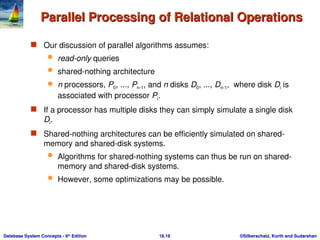
Sudarshan 18.19 Database System Concepts - 6th Edition Parallel Processing of Relational Operations Parallel Processing of Relational Operations Our discussion of parallel algorithms assumes: read-only queries shared-nothing architecture n processors, P0, ..., Pn-1, and n disks D0, ..., Dn-1, where disk Di is associated with processor Pi. If a processor has multiple disks they can simply simulate a single disk Di. Shared-nothing architectures can be efficiently simulated on shared- memory and shared-disk systems. Algorithms for shared-nothing systems can thus be run on shared- memory and shared-disk systems. However, some optimizations may be possible.
20.
©Silberschatz, Korth and
Sudarshan 18.20 Database System Concepts - 6th Edition Parallel Sort Parallel Sort Range-Partitioning Sort Choose processors P0, ..., Pm, where m n -1 to do sorting. Create range-partition vector with m entries, on the sorting attributes Redistribute the relation using range partitioning all tuples that lie in the ith range are sent to processor Pi Pi stores the tuples it received temporarily on disk Di. This step requires I/O and communication overhead. Each processor Pi sorts its partition of the relation locally. Each processors executes same operation (sort) in parallel with other processors, without any interaction with the others (data parallelism). Final merge operation is trivial: range-partitioning ensures that, for 1 j m, the key values in processor Pi are all less than the key values in Pj.
21.
©Silberschatz, Korth and
Sudarshan 18.21 Database System Concepts - 6th Edition Parallel Sort (Cont.) Parallel Sort (Cont.) Parallel External Sort-Merge Assume the relation has already been partitioned among disks D0, ..., Dn-1 (in whatever manner). Each processor Pi locally sorts the data on disk Di. The sorted runs on each processor are then merged to get the final sorted output. Parallelize the merging of sorted runs as follows: The sorted partitions at each processor Pi are range-partitioned across the processors P0, ..., Pm-1. Each processor Pi performs a merge on the streams as they are received, to get a single sorted run. The sorted runs on processors P0,..., Pm-1 are concatenated to get the final result.
22.
©Silberschatz, Korth and
Sudarshan 18.22 Database System Concepts - 6th Edition Parallel Join Parallel Join The join operation requires pairs of tuples to be tested to see if they satisfy the join condition, and if they do, the pair is added to the join output. Parallel join algorithms attempt to split the pairs to be tested over several processors. Each processor then computes part of the join locally. In a final step, the results from each processor can be collected together to produce the final result.
23.
©Silberschatz, Korth and
Sudarshan 18.23 Database System Concepts - 6th Edition Partitioned Join Partitioned Join For equi-joins and natural joins, it is possible to partition the two input relations across the processors, and compute the join locally at each processor. Let r and s be the input relations, and we want to compute r r.A=s.B s. r and s each are partitioned into n partitions, denoted r0, r1, ..., rn-1 and s0, s1, ..., sn-1. Can use either range partitioning or hash partitioning. r and s must be partitioned on their join attributes r.A and s.B), using the same range-partitioning vector or hash function. Partitions ri and si are sent to processor Pi, Each processor Pi locally computes ri ri.A=si.B si. Any of the standard join methods can be used.
24.
©Silberschatz, Korth and
Sudarshan 18.24 Database System Concepts - 6th Edition Partitioned Join (Cont.) Partitioned Join (Cont.)
25.
©Silberschatz, Korth and
Sudarshan 18.25 Database System Concepts - 6th Edition Fragment-and-Replicate Join Fragment-and-Replicate Join Partitioning not possible for some join conditions E.g., non-equijoin conditions, such as r.A > s.B. For joins were partitioning is not applicable, parallelization can be accomplished by fragment and replicate technique Depicted on next slide Special case – asymmetric fragment-and-replicate: One of the relations, say r, is partitioned; any partitioning technique can be used. The other relation, s, is replicated across all the processors. Processor Pi then locally computes the join of ri with all of s using any join technique.
26.
©Silberschatz, Korth and
Sudarshan 18.26 Database System Concepts - 6th Edition Depiction of Fragment-and-Replicate Joins Depiction of Fragment-and-Replicate Joins
27.
©Silberschatz, Korth and
Sudarshan 18.27 Database System Concepts - 6th Edition Fragment-and-Replicate Join (Cont.) Fragment-and-Replicate Join (Cont.) General case: reduces the sizes of the relations at each processor. r is partitioned into n partitions,r0, r1, ..., r n-1;s is partitioned into m partitions, s0, s1, ..., sm-1. Any partitioning technique may be used. There must be at least m * n processors. Label the processors as P0,0, P0,1, ..., P0,m-1, P1,0, ..., Pn-1m-1. Pi,j computes the join of ri with sj. In order to do so, ri is replicated to Pi,0, Pi,1, ..., Pi,m-1, while si is replicated to P0,i, P1,i, ..., Pn-1,i Any join technique can be used at each processor Pi,j.
28.
©Silberschatz, Korth and
Sudarshan 18.28 Database System Concepts - 6th Edition Fragment-and-Replicate Join (Cont.) Fragment-and-Replicate Join (Cont.) Both versions of fragment-and-replicate work with any join condition, since every tuple in r can be tested with every tuple in s. Usually has a higher cost than partitioning, since one of the relations (for asymmetric fragment-and-replicate) or both relations (for general fragment-and-replicate) have to be replicated. Sometimes asymmetric fragment-and-replicate is preferable even though partitioning could be used. E.g., say s is small and r is large, and already partitioned. It may be cheaper to replicate s across all processors, rather than repartition r and s on the join attributes.
29.
©Silberschatz, Korth and
Sudarshan 18.29 Database System Concepts - 6th Edition Partitioned Parallel Hash-Join Partitioned Parallel Hash-Join Parallelizing partitioned hash join: Assume s is smaller than r and therefore s is chosen as the build relation. A hash function h1 takes the join attribute value of each tuple in s and maps this tuple to one of the n processors. Each processor Pi reads the tuples of s that are on its disk Di, and sends each tuple to the appropriate processor based on hash function h1. Let si denote the tuples of relation s that are sent to processor Pi. As tuples of relation s are received at the destination processors, they are partitioned further using another hash function, h2, which is used to compute the hash-join locally. (Cont.)
30.
©Silberschatz, Korth and
Sudarshan 18.30 Database System Concepts - 6th Edition Partitioned Parallel Hash-Join (Cont.) Partitioned Parallel Hash-Join (Cont.) Once the tuples of s have been distributed, the larger relation r is redistributed across the m processors using the hash function h1 Let ri denote the tuples of relation r that are sent to processor Pi. As the r tuples are received at the destination processors, they are repartitioned using the function h2 (just as the probe relation is partitioned in the sequential hash-join algorithm). Each processor Pi executes the build and probe phases of the hash- join algorithm on the local partitions ri and s of r and s to produce a partition of the final result of the hash-join. Note: Hash-join optimizations can be applied to the parallel case e.g., the hybrid hash-join algorithm can be used to cache some of the incoming tuples in memory and avoid the cost of writing them and reading them back in.
31.
©Silberschatz, Korth and
Sudarshan 18.31 Database System Concepts - 6th Edition Parallel Nested-Loop Join Parallel Nested-Loop Join Assume that relation s is much smaller than relation r and that r is stored by partitioning. there is an index on a join attribute of relation r at each of the partitions of relation r. Use asymmetric fragment-and-replicate, with relation s being replicated, and using the existing partitioning of relation r. Each processor Pj where a partition of relation s is stored reads the tuples of relation s stored in Dj, and replicates the tuples to every other processor Pi. At the end of this phase, relation s is replicated at all sites that store tuples of relation r. Each processor Pi performs an indexed nested-loop join of relation s with the ith partition of relation r.
32.
©Silberschatz, Korth and
Sudarshan 18.32 Database System Concepts - 6th Edition Other Relational Operations Other Relational Operations Selection (r) If is of the form ai = v, where ai is an attribute and v a value. If r is partitioned on ai the selection is performed at a single processor. If is of the form l <= ai <= u (i.e., is a range selection) and the relation has been range-partitioned on ai Selection is performed at each processor whose partition overlaps with the specified range of values. In all other cases: the selection is performed in parallel at all the processors.
33.
©Silberschatz, Korth and
Sudarshan 18.33 Database System Concepts - 6th Edition Other Relational Operations (Cont.) Other Relational Operations (Cont.) Duplicate elimination Perform by using either of the parallel sort techniques eliminate duplicates as soon as they are found during sorting. Can also partition the tuples (using either range- or hash- partitioning) and perform duplicate elimination locally at each processor. Projection Projection without duplicate elimination can be performed as tuples are read in from disk in parallel. If duplicate elimination is required, any of the above duplicate elimination techniques can be used.
34.
©Silberschatz, Korth and
Sudarshan 18.34 Database System Concepts - 6th Edition Grouping/Aggregation Grouping/Aggregation Partition the relation on the grouping attributes and then compute the aggregate values locally at each processor. Can reduce cost of transferring tuples during partitioning by partly computing aggregate values before partitioning. Consider the sum aggregation operation: Perform aggregation operation at each processor Pi on those tuples stored on disk Di results in tuples with partial sums at each processor. Result of the local aggregation is partitioned on the grouping attributes, and the aggregation performed again at each processor Pi to get the final result. Fewer tuples need to be sent to other processors during partitioning.
35.
©Silberschatz, Korth and
Sudarshan 18.35 Database System Concepts - 6th Edition Cost of Parallel Evaluation of Operations Cost of Parallel Evaluation of Operations If there is no skew in the partitioning, and there is no overhead due to the parallel evaluation, expected speed-up will be 1/n If skew and overheads are also to be taken into account, the time taken by a parallel operation can be estimated as Tpart + Tasm + max (T0, T1, …, Tn-1) Tpart is the time for partitioning the relations Tasm is the time for assembling the results Ti is the time taken for the operation at processor Pi this needs to be estimated taking into account the skew, and the time wasted in contentions.
36.
©Silberschatz, Korth and
Sudarshan 18.36 Database System Concepts - 6th Edition Interoperator Parallelism Interoperator Parallelism Pipelined parallelism Consider a join of four relations r1 r2 r3 r4 Set up a pipeline that computes the three joins in parallel Let P1 be assigned the computation of temp1 = r1 r2 And P2 be assigned the computation of temp2 = temp1 r3 And P3 be assigned the computation of temp2 r4 Each of these operations can execute in parallel, sending result tuples it computes to the next operation even as it is computing further results Provided a pipelineable join evaluation algorithm (e.g., indexed nested loops join) is used
37.
©Silberschatz, Korth and
Sudarshan 18.37 Database System Concepts - 6th Edition Factors Limiting Utility of Pipeline Factors Limiting Utility of Pipeline Parallelism Parallelism Pipeline parallelism is useful since it avoids writing intermediate results to disk Useful with small number of processors, but does not scale up well with more processors. One reason is that pipeline chains do not attain sufficient length. Cannot pipeline operators which do not produce output until all inputs have been accessed (e.g., aggregate and sort) Little speedup is obtained for the frequent cases of skew in which one operator's execution cost is much higher than the others.
38.
©Silberschatz, Korth and
Sudarshan 18.38 Database System Concepts - 6th Edition Independent Parallelism Independent Parallelism Independent parallelism Consider a join of four relations r1 r2 r3 r4 Let P1 be assigned the computation of temp1 = r1 r2 And P2 be assigned the computation of temp2 = r3 r4 And P3 be assigned the computation of temp1 temp2 P1 and P2 can work independently in parallel P3 has to wait for input from P1 and P2 – Can pipeline output of P1 and P2 to P3, combining independent parallelism and pipelined parallelism Does not provide a high degree of parallelism useful with a lower degree of parallelism. less useful in a highly parallel system.
39.
©Silberschatz, Korth and
Sudarshan 18.39 Database System Concepts - 6th Edition Query Optimization Query Optimization Query optimization in parallel databases is significantly more complex than query optimization in sequential databases. Cost models are more complicated, since we must take into account partitioning costs and issues such as skew and resource contention. When scheduling execution tree in parallel system, must decide: How to parallelize each operation and how many processors to use for it. What operations to pipeline, what operations to execute independently in parallel, and what operations to execute sequentially, one after the other. Determining the amount of resources to allocate for each operation is a problem. E.g., allocating more processors than optimal can result in high communication overhead. Long pipelines should be avoided as the final operation may wait a lot for inputs, while holding precious resources
40.
©Silberschatz, Korth and
Sudarshan 18.40 Database System Concepts - 6th Edition Query Optimization (Cont.) Query Optimization (Cont.) The number of parallel evaluation plans from which to choose from is much larger than the number of sequential evaluation plans. Therefore heuristics are needed while optimization Two alternative heuristics for choosing parallel plans: No pipelining and inter-operation pipelining; just parallelize every operation across all processors. Finding best plan is now much easier --- use standard optimization technique, but with new cost model Volcano parallel database popularize the exchange-operator model – exchange operator is introduced into query plans to partition and distribute tuples – each operation works independently on local data on each processor, in parallel with other copies of the operation First choose most efficient sequential plan and then choose how best to parallelize the operations in that plan. Can explore pipelined parallelism as an option Choosing a good physical organization (partitioning technique) is important to speed up queries.
41.
©Silberschatz, Korth and
Sudarshan 18.41 Database System Concepts - 6th Edition Design of Parallel Systems Design of Parallel Systems Some issues in the design of parallel systems: Parallel loading of data from external sources is needed in order to handle large volumes of incoming data. Resilience to failure of some processors or disks. Probability of some disk or processor failing is higher in a parallel system. Operation (perhaps with degraded performance) should be possible in spite of failure. Redundancy achieved by storing extra copy of every data item at another processor.
42.
©Silberschatz, Korth and
Sudarshan 18.42 Database System Concepts - 6th Edition Design of Parallel Systems (Cont.) Design of Parallel Systems (Cont.) On-line reorganization of data and schema changes must be supported. For example, index construction on terabyte databases can take hours or days even on a parallel system. Need to allow other processing (insertions/deletions/updates) to be performed on relation even as index is being constructed. Basic idea: index construction tracks changes and “catches up” on changes at the end. Also need support for on-line repartitioning and schema changes (executed concurrently with other processing).
43.
Database System Concepts,
6th Ed. ©Silberschatz, Korth and Sudarshan See www.db-book.com for conditions on re-use End of Chapter End of Chapter
44.
©Silberschatz, Korth and
Sudarshan 18.44 Database System Concepts - 6th Edition Figure 18.01 Figure 18.01
45.
©Silberschatz, Korth and
Sudarshan 18.45 Database System Concepts - 6th Edition Figure 18.02 Figure 18.02
46.
©Silberschatz, Korth and
Sudarshan 18.46 Database System Concepts - 6th Edition Figure 18.03 Figure 18.03
Download


![©Silberschatz, Korth and Sudarshan
18.6
Database System Concepts - 6th
Edition
I/O Parallelism (Cont.)
I/O Parallelism (Cont.)
Partitioning techniques (cont.):
Range partitioning:
Choose an attribute as the partitioning attribute.
A partitioning vector [vo, v1, ..., vn-2] is chosen.
Let v be the partitioning attribute value of a tuple. Tuples such that
vi vi+1 go to disk I + 1. Tuples with v < v0 go to disk 0 and tuples
with v vn-2 go to disk n-1.
E.g., with a partitioning vector [5,11], a tuple with partitioning
attribute value of 2 will go to disk 0, a tuple with value 8 will go to
disk 1, while a tuple with value 20 will go to disk2.](https://image.slidesharecdn.com/ch18-260106182402-d5aa7315/85/Data-base-management-system-Parallel-Database-6-320.jpg)







![Attack surfaces and attack tress[inform]](https://cdn.slidesharecdn.com/ss_thumbnails/lecture03-260108015941-a4dee53b-thumbnail.jpg?width=640&height=640&fit=bounds)


