


Data Assimilation in Numerical Weather Prediction models
´Africa Peri´a˜nez
DWD, Germany
CERN, Geneva, February 20, 2014
Outline
Numerical Weather Prediction
Can Numerics Help?
Introduction to Numerical Weather Prediction models
Dynamical Systems, Inverse Problems and Data Assimilation
Fluid Dynamics and Physical Processes
Data Assimilation
Measurements: Stations, Sondes, Planes, Satellites
Data Assimilation in DWD
Basic Approach
Ensemble Kalman Filter
Conclusions
2 of 45
Outline
Numerical Weather Prediction
Can Numerics Help?
Introduction to Numerical Weather Prediction models
Dynamical Systems, Inverse Problems and Data Assimilation
Fluid Dynamics and Physical Processes
Data Assimilation
Measurements: Stations, Sondes, Planes, Satellites
Data Assimilation in DWD
Basic Approach
Ensemble Kalman Filter
Conclusions
3 of 45
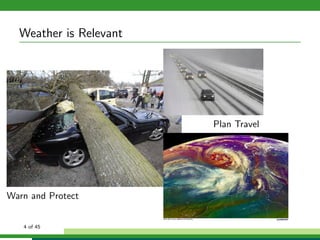
Weather is Relevant
Warn and Protect
Plan Travel
4 of 45
Weather is Relevant
Logistics
Rivers and Environment
Air Control
5 of 45
Outline
Numerical Weather Prediction
Can Numerics Help?
Introduction to Numerical Weather Prediction models
Dynamical Systems, Inverse Problems and Data Assimilation
Fluid Dynamics and Physical Processes
Data Assimilation
Measurements: Stations, Sondes, Planes, Satellites
Data Assimilation in DWD
Basic Approach
Ensemble Kalman Filter
Conclusions
6 of 45
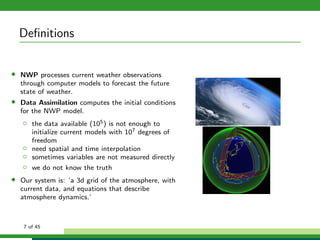
Definitions
• NWP processes current weather observations
through computer models to forecast the future
state of weather.
• Data Assimilation computes the initial conditions
for the NWP model.
◦ the data available (105) is not enough to
initialize current models with 107 degrees of
freedom
◦ need spatial and time interpolation
◦ sometimes variables are not measured directly
◦ we do not know the truth
• Our system is: ’a 3d grid of the atmosphere, with
current data, and equations that describe
atmosphere dynamics.’
7 of 45
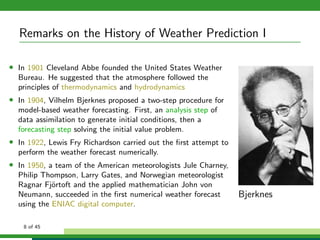
Remarks on the History of Weather Prediction I
• In 1901 Cleveland Abbe founded the United States Weather
Bureau. He suggested that the atmosphere followed the
principles of thermodynamics and hydrodynamics
• In 1904, Vilhelm Bjerknes proposed a two-step procedure for
model-based weather forecasting. First, an analysis step of
data assimilation to generate initial conditions, then a
forecasting step solving the initial value problem.
• In 1922, Lewis Fry Richardson carried out the first attempt to
perform the weather forecast numerically.
• In 1950, a team of the American meteorologists Jule Charney,
Philip Thompson, Larry Gates, and Norwegian meteorologist
Ragnar Fj¨ortoft and the applied mathematician John von
Neumann, succeeded in the first numerical weather forecast
using the ENIAC digital computer.
Bjerknes
8 of 45
Remarks on the History of Weather Prediction II
1962
Nimbus 1: 1964
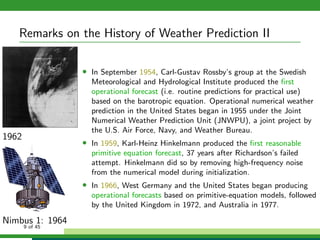
• In September 1954, Carl-Gustav Rossby’s group at the Swedish
Meteorological and Hydrological Institute produced the first
operational forecast (i.e. routine predictions for practical use)
based on the barotropic equation. Operational numerical weather
prediction in the United States began in 1955 under the Joint
Numerical Weather Prediction Unit (JNWPU), a joint project by
the U.S. Air Force, Navy, and Weather Bureau.
• In 1959, Karl-Heinz Hinkelmann produced the first reasonable
primitive equation forecast, 37 years after Richardson’s failed
attempt. Hinkelmann did so by removing high-frequency noise
from the numerical model during initialization.
• In 1966, West Germany and the United States began producing
operational forecasts based on primitive-equation models, followed
by the United Kingdom in 1972, and Australia in 1977.
9 of 45
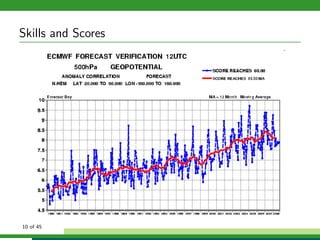
Skills and Scores
10 of 45
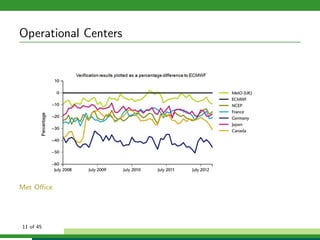
Operational Centers
Met Office
11 of 45
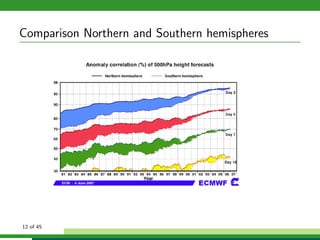
Comparison Northern and Southern hemispheres
12 of 45
Outline
Numerical Weather Prediction
Can Numerics Help?
Introduction to Numerical Weather Prediction models
Dynamical Systems, Inverse Problems and Data Assimilation
Fluid Dynamics and Physical Processes
Data Assimilation
Measurements: Stations, Sondes, Planes, Satellites
Data Assimilation in DWD
Basic Approach
Ensemble Kalman Filter
Conclusions
13 of 45
Outline
Numerical Weather Prediction
Can Numerics Help?
Introduction to Numerical Weather Prediction models
Dynamical Systems, Inverse Problems and Data Assimilation
Fluid Dynamics and Physical Processes
Data Assimilation
Measurements: Stations, Sondes, Planes, Satellites
Data Assimilation in DWD
Basic Approach
Ensemble Kalman Filter
Conclusions
14 of 45
Numerical Weather Prediction
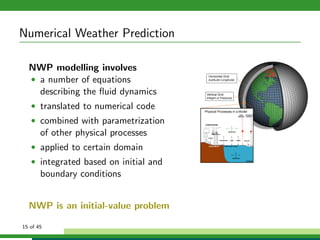
NWP modelling involves
• a number of equations
describing the fluid dynamics
• translated to numerical code
• combined with parametrization
of other physical processes
• applied to certain domain
• integrated based on initial and
boundary conditions
NWP is an initial-value problem
15 of 45
Fluid Dynamics and Physical processes
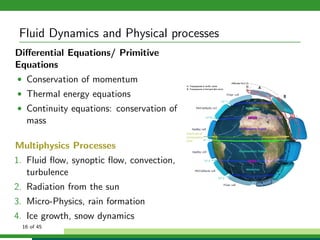
Differential Equations/ Primitive
Equations
• Conservation of momentum
• Thermal energy equations
• Continuity equations: conservation of
mass
Multiphysics Processes
1. Fluid flow, synoptic flow, convection,
turbulence
2. Radiation from the sun
3. Micro-Physics, rain formation
4. Ice growth, snow dynamics
16 of 45
Outline
Numerical Weather Prediction
Can Numerics Help?
Introduction to Numerical Weather Prediction models
Dynamical Systems, Inverse Problems and Data Assimilation
Fluid Dynamics and Physical Processes
Data Assimilation
Measurements: Stations, Sondes, Planes, Satellites
Data Assimilation in DWD
Basic Approach
Ensemble Kalman Filter
Conclusions
17 of 45
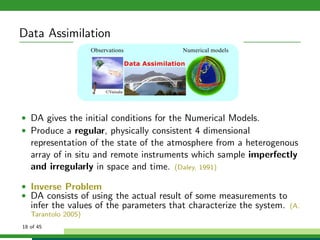
Data Assimilation
• DA gives the initial conditions for the Numerical Models.
• Produce a regular, physically consistent 4 dimensional
representation of the state of the atmosphere from a heterogenous
array of in situ and remote instruments which sample imperfectly
and irregularly in space and time. (Daley, 1991)
• Inverse Problem
• DA consists of using the actual result of some measurements to
infer the values of the parameters that characterize the system. (A.
Tarantolo 2005)
18 of 45
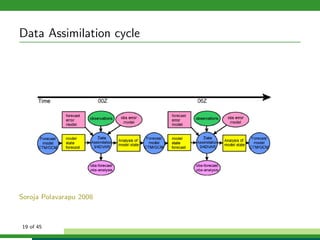
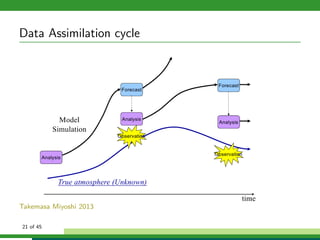
Data Assimilation cycle
Soroja Polavarapu 2008
19 of 45
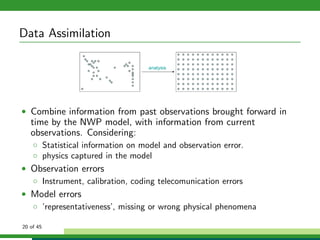
Data Assimilation
• Combine information from past observations brought forward in
time by the NWP model, with information from current
observations. Considering:
◦ Statistical information on model and observation error.
◦ physics captured in the model
• Observation errors
◦ Instrument, calibration, coding telecomunication errors
• Model errors
◦ ’representativeness’, missing or wrong physical phenomena
20 of 45
Data Assimilation cycle
Takemasa Miyoshi 2013
21 of 45
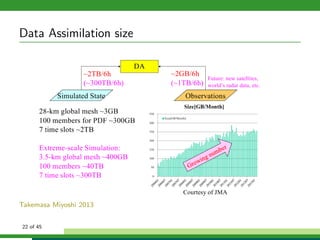
Data Assimilation size
Takemasa Miyoshi 2013
22 of 45
Outline
Numerical Weather Prediction
Can Numerics Help?
Introduction to Numerical Weather Prediction models
Dynamical Systems, Inverse Problems and Data Assimilation
Fluid Dynamics and Physical Processes
Data Assimilation
Measurements: Stations, Sondes, Planes, Satellites
Data Assimilation in DWD
Basic Approach
Ensemble Kalman Filter
Conclusions
23 of 45
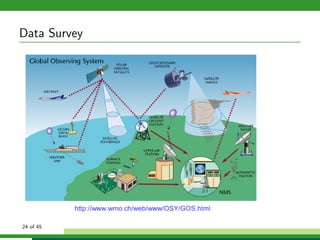
Data Survey
24 of 45
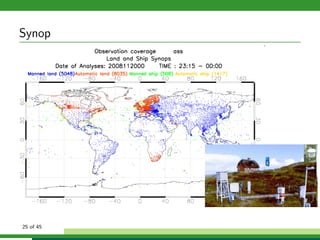
Synop
25 of 45
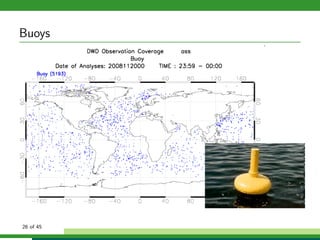
Buoys
26 of 45
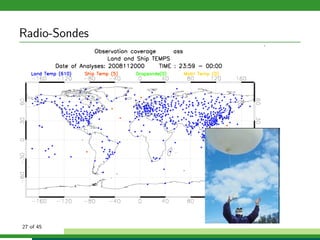
Radio-Sondes
27 of 45
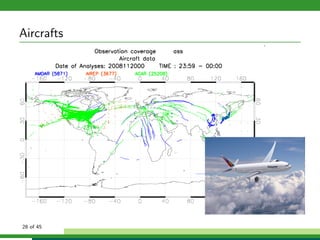
Aircrafts
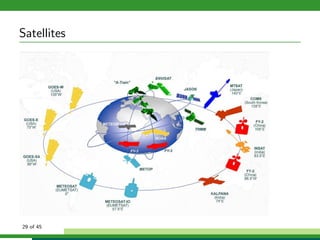
28 of 45
Satellites
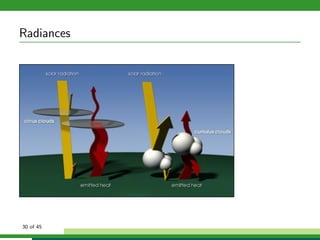
29 of 45
Radiances
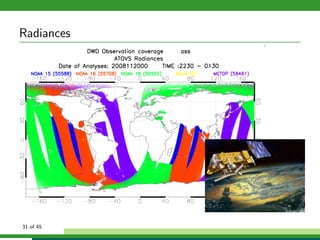
30 of 45
Radiances
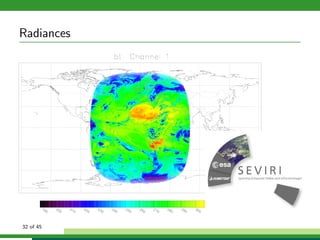
31 of 45
Radiances
32 of 45
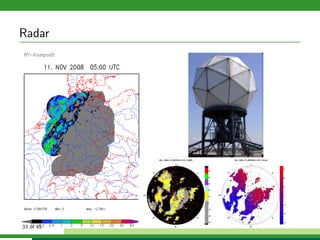
Radar
33 of 45
Outline
Numerical Weather Prediction
Can Numerics Help?
Introduction to Numerical Weather Prediction models
Dynamical Systems, Inverse Problems and Data Assimilation
Fluid Dynamics and Physical Processes
Data Assimilation
Measurements: Stations, Sondes, Planes, Satellites
Data Assimilation in DWD
Basic Approach
Ensemble Kalman Filter
Conclusions
34 of 45
DA in DWD
• Research and Development
• Section on Modelling:
◦ Unit Num. Modelling
◦ Unit Data Assimilation
◦ Unit Physics
◦ Unit Verification
35 of 45
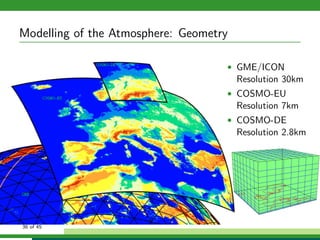
Modelling of the Atmosphere: Geometry
• GME/ICON
Resolution 30km
• COSMO-EU
Resolution 7km
• COSMO-DE
Resolution 2.8km
36 of 45
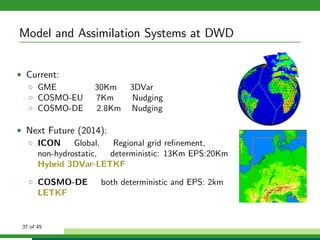
Model and Assimilation Systems at DWD
• Current:
◦ GME 30Km 3DVar
◦ COSMO-EU 7Km Nudging
◦ COSMO-DE 2.8Km Nudging
• Next Future (2014):
◦ ICON Global, Regional grid refinement,
non-hydrostatic, deterministic: 13Km EPS:20Km
Hybrid 3DVar-LETKF
◦ COSMO-DE both deterministic and EPS: 2km
LETKF
37 of 45
Outline
Numerical Weather Prediction
Can Numerics Help?
Introduction to Numerical Weather Prediction models
Dynamical Systems, Inverse Problems and Data Assimilation
Fluid Dynamics and Physical Processes
Data Assimilation
Measurements: Stations, Sondes, Planes, Satellites
Data Assimilation in DWD
Basic Approach
Ensemble Kalman Filter
Conclusions
38 of 45
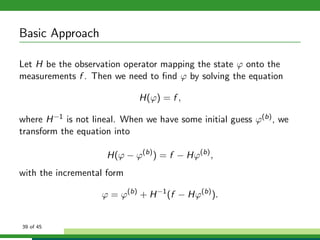
Basic Approach
Let H be the observation operator mapping the state ϕ onto the
measurements f . Then we need to find ϕ by solving the equation
H(ϕ) = f ,
where H−1 is not lineal. When we have some initial guess ϕ(b), we
transform the equation into
H(ϕ − ϕ(b)
) = f − Hϕ(b)
,
with the incremental form
ϕ = ϕ(b)
+ H−1
(f − Hϕ(b)
).
39 of 45
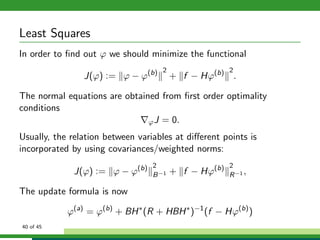
Least Squares
In order to find out ϕ we should minimize the functional
J(ϕ) := ϕ − ϕ(b) 2
+ f − Hϕ(b) 2
.
The normal equations are obtained from first order optimality
conditions
ϕJ = 0.
Usually, the relation between variables at different points is
incorporated by using covariances/weighted norms:
J(ϕ) := ϕ − ϕ(b) 2
B−1 + f − Hϕ(b) 2
R−1 ,
The update formula is now
ϕ(a)
= ϕ(b)
+ BH∗
(R + HBH∗
)−1
(f − Hϕ(b)
)
40 of 45
Outline
Numerical Weather Prediction
Can Numerics Help?
Introduction to Numerical Weather Prediction models
Dynamical Systems, Inverse Problems and Data Assimilation
Fluid Dynamics and Physical Processes
Data Assimilation
Measurements: Stations, Sondes, Planes, Satellites
Data Assimilation in DWD
Basic Approach
Ensemble Kalman Filter
Conclusions
41 of 45
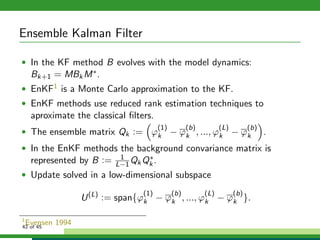
Ensemble Kalman Filter
• In the KF method B evolves with the model dynamics:
Bk+1 = MBkM∗.
• EnKF1 is a Monte Carlo approximation to the KF.
• EnKF methods use reduced rank estimation techniques to
aproximate the classical filters.
• The ensemble matrix Qk := ϕ
(1)
k − ϕ
(b)
k , ..., ϕ
(L)
k − ϕ
(b)
k .
• In the EnKF methods the background convariance matrix is
represented by B := 1
L−1QkQ∗
k .
• Update solved in a low-dimensional subspace
U(L)
:= span{ϕ
(1)
k − ϕ
(b)
k , ..., ϕ
(L)
k − ϕ
(b)
k }.
1
Evensen 199442 of 45
Outline
Numerical Weather Prediction
Can Numerics Help?
Introduction to Numerical Weather Prediction models
Dynamical Systems, Inverse Problems and Data Assimilation
Fluid Dynamics and Physical Processes
Data Assimilation
Measurements: Stations, Sondes, Planes, Satellites
Data Assimilation in DWD
Basic Approach
Ensemble Kalman Filter
Conclusions
43 of 45
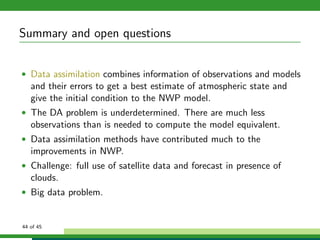
Summary and open questions
• Data assimilation combines information of observations and models
and their errors to get a best estimate of atmospheric state and
give the initial condition to the NWP model.
• The DA problem is underdetermined. There are much less
observations than is needed to compute the model equivalent.
• Data assimilation methods have contributed much to the
improvements in NWP.
• Challenge: full use of satellite data and forecast in presence of
clouds.
• Big data problem.
44 of 45
Thank you for your attention!
• africa.perianez@dwd.de
• Data Assimilation Unit
45 of 45

Data Assimilation in Numerical Weather Prediction Models

  • 1.
    Data Assimilation inNumerical Weather Prediction models ´Africa Peri´a˜nez DWD, Germany CERN, Geneva, February 20, 2014
  • 2.
    Outline Numerical Weather Prediction CanNumerics Help? Introduction to Numerical Weather Prediction models Dynamical Systems, Inverse Problems and Data Assimilation Fluid Dynamics and Physical Processes Data Assimilation Measurements: Stations, Sondes, Planes, Satellites Data Assimilation in DWD Basic Approach Ensemble Kalman Filter Conclusions 2 of 45
  • 3.
    Outline Numerical Weather Prediction CanNumerics Help? Introduction to Numerical Weather Prediction models Dynamical Systems, Inverse Problems and Data Assimilation Fluid Dynamics and Physical Processes Data Assimilation Measurements: Stations, Sondes, Planes, Satellites Data Assimilation in DWD Basic Approach Ensemble Kalman Filter Conclusions 3 of 45
  • 4.
    Weather is Relevant Warnand Protect Plan Travel 4 of 45
  • 5.
    Weather is Relevant Logistics Riversand Environment Air Control 5 of 45
  • 6.
    Outline Numerical Weather Prediction CanNumerics Help? Introduction to Numerical Weather Prediction models Dynamical Systems, Inverse Problems and Data Assimilation Fluid Dynamics and Physical Processes Data Assimilation Measurements: Stations, Sondes, Planes, Satellites Data Assimilation in DWD Basic Approach Ensemble Kalman Filter Conclusions 6 of 45
  • 7.
    Definitions • NWP processescurrent weather observations through computer models to forecast the future state of weather. • Data Assimilation computes the initial conditions for the NWP model. ◦ the data available (105) is not enough to initialize current models with 107 degrees of freedom ◦ need spatial and time interpolation ◦ sometimes variables are not measured directly ◦ we do not know the truth • Our system is: ’a 3d grid of the atmosphere, with current data, and equations that describe atmosphere dynamics.’ 7 of 45
  • 8.
    Remarks on theHistory of Weather Prediction I • In 1901 Cleveland Abbe founded the United States Weather Bureau. He suggested that the atmosphere followed the principles of thermodynamics and hydrodynamics • In 1904, Vilhelm Bjerknes proposed a two-step procedure for model-based weather forecasting. First, an analysis step of data assimilation to generate initial conditions, then a forecasting step solving the initial value problem. • In 1922, Lewis Fry Richardson carried out the first attempt to perform the weather forecast numerically. • In 1950, a team of the American meteorologists Jule Charney, Philip Thompson, Larry Gates, and Norwegian meteorologist Ragnar Fj¨ortoft and the applied mathematician John von Neumann, succeeded in the first numerical weather forecast using the ENIAC digital computer. Bjerknes 8 of 45
  • 9.
    Remarks on theHistory of Weather Prediction II 1962 Nimbus 1: 1964 • In September 1954, Carl-Gustav Rossby’s group at the Swedish Meteorological and Hydrological Institute produced the first operational forecast (i.e. routine predictions for practical use) based on the barotropic equation. Operational numerical weather prediction in the United States began in 1955 under the Joint Numerical Weather Prediction Unit (JNWPU), a joint project by the U.S. Air Force, Navy, and Weather Bureau. • In 1959, Karl-Heinz Hinkelmann produced the first reasonable primitive equation forecast, 37 years after Richardson’s failed attempt. Hinkelmann did so by removing high-frequency noise from the numerical model during initialization. • In 1966, West Germany and the United States began producing operational forecasts based on primitive-equation models, followed by the United Kingdom in 1972, and Australia in 1977. 9 of 45
  • 10.
  • 11.
  • 12.
    Comparison Northern andSouthern hemispheres 12 of 45
  • 13.
    Outline Numerical Weather Prediction CanNumerics Help? Introduction to Numerical Weather Prediction models Dynamical Systems, Inverse Problems and Data Assimilation Fluid Dynamics and Physical Processes Data Assimilation Measurements: Stations, Sondes, Planes, Satellites Data Assimilation in DWD Basic Approach Ensemble Kalman Filter Conclusions 13 of 45
  • 14.
    Outline Numerical Weather Prediction CanNumerics Help? Introduction to Numerical Weather Prediction models Dynamical Systems, Inverse Problems and Data Assimilation Fluid Dynamics and Physical Processes Data Assimilation Measurements: Stations, Sondes, Planes, Satellites Data Assimilation in DWD Basic Approach Ensemble Kalman Filter Conclusions 14 of 45
  • 15.
    Numerical Weather Prediction NWPmodelling involves • a number of equations describing the fluid dynamics • translated to numerical code • combined with parametrization of other physical processes • applied to certain domain • integrated based on initial and boundary conditions NWP is an initial-value problem 15 of 45
  • 16.
    Fluid Dynamics andPhysical processes Differential Equations/ Primitive Equations • Conservation of momentum • Thermal energy equations • Continuity equations: conservation of mass Multiphysics Processes 1. Fluid flow, synoptic flow, convection, turbulence 2. Radiation from the sun 3. Micro-Physics, rain formation 4. Ice growth, snow dynamics 16 of 45
  • 17.
    Outline Numerical Weather Prediction CanNumerics Help? Introduction to Numerical Weather Prediction models Dynamical Systems, Inverse Problems and Data Assimilation Fluid Dynamics and Physical Processes Data Assimilation Measurements: Stations, Sondes, Planes, Satellites Data Assimilation in DWD Basic Approach Ensemble Kalman Filter Conclusions 17 of 45
  • 18.
    Data Assimilation • DAgives the initial conditions for the Numerical Models. • Produce a regular, physically consistent 4 dimensional representation of the state of the atmosphere from a heterogenous array of in situ and remote instruments which sample imperfectly and irregularly in space and time. (Daley, 1991) • Inverse Problem • DA consists of using the actual result of some measurements to infer the values of the parameters that characterize the system. (A. Tarantolo 2005) 18 of 45
  • 19.
    Data Assimilation cycle SorojaPolavarapu 2008 19 of 45
  • 20.
    Data Assimilation • Combineinformation from past observations brought forward in time by the NWP model, with information from current observations. Considering: ◦ Statistical information on model and observation error. ◦ physics captured in the model • Observation errors ◦ Instrument, calibration, coding telecomunication errors • Model errors ◦ ’representativeness’, missing or wrong physical phenomena 20 of 45
  • 21.
    Data Assimilation cycle TakemasaMiyoshi 2013 21 of 45
  • 22.
    Data Assimilation size TakemasaMiyoshi 2013 22 of 45
  • 23.
    Outline Numerical Weather Prediction CanNumerics Help? Introduction to Numerical Weather Prediction models Dynamical Systems, Inverse Problems and Data Assimilation Fluid Dynamics and Physical Processes Data Assimilation Measurements: Stations, Sondes, Planes, Satellites Data Assimilation in DWD Basic Approach Ensemble Kalman Filter Conclusions 23 of 45
  • 24.
  • 25.
  • 26.
  • 27.
  • 28.
  • 29.
  • 30.
  • 31.
  • 32.
  • 33.
  • 34.
    Outline Numerical Weather Prediction CanNumerics Help? Introduction to Numerical Weather Prediction models Dynamical Systems, Inverse Problems and Data Assimilation Fluid Dynamics and Physical Processes Data Assimilation Measurements: Stations, Sondes, Planes, Satellites Data Assimilation in DWD Basic Approach Ensemble Kalman Filter Conclusions 34 of 45
  • 35.
    DA in DWD •Research and Development • Section on Modelling: ◦ Unit Num. Modelling ◦ Unit Data Assimilation ◦ Unit Physics ◦ Unit Verification 35 of 45
  • 36.
    Modelling of theAtmosphere: Geometry • GME/ICON Resolution 30km • COSMO-EU Resolution 7km • COSMO-DE Resolution 2.8km 36 of 45
  • 37.
    Model and AssimilationSystems at DWD • Current: ◦ GME 30Km 3DVar ◦ COSMO-EU 7Km Nudging ◦ COSMO-DE 2.8Km Nudging • Next Future (2014): ◦ ICON Global, Regional grid refinement, non-hydrostatic, deterministic: 13Km EPS:20Km Hybrid 3DVar-LETKF ◦ COSMO-DE both deterministic and EPS: 2km LETKF 37 of 45
  • 38.
    Outline Numerical Weather Prediction CanNumerics Help? Introduction to Numerical Weather Prediction models Dynamical Systems, Inverse Problems and Data Assimilation Fluid Dynamics and Physical Processes Data Assimilation Measurements: Stations, Sondes, Planes, Satellites Data Assimilation in DWD Basic Approach Ensemble Kalman Filter Conclusions 38 of 45
  • 39.
    Basic Approach Let Hbe the observation operator mapping the state ϕ onto the measurements f . Then we need to find ϕ by solving the equation H(ϕ) = f , where H−1 is not lineal. When we have some initial guess ϕ(b), we transform the equation into H(ϕ − ϕ(b) ) = f − Hϕ(b) , with the incremental form ϕ = ϕ(b) + H−1 (f − Hϕ(b) ). 39 of 45
  • 40.
    Least Squares In orderto find out ϕ we should minimize the functional J(ϕ) := ϕ − ϕ(b) 2 + f − Hϕ(b) 2 . The normal equations are obtained from first order optimality conditions ϕJ = 0. Usually, the relation between variables at different points is incorporated by using covariances/weighted norms: J(ϕ) := ϕ − ϕ(b) 2 B−1 + f − Hϕ(b) 2 R−1 , The update formula is now ϕ(a) = ϕ(b) + BH∗ (R + HBH∗ )−1 (f − Hϕ(b) ) 40 of 45
  • 41.
    Outline Numerical Weather Prediction CanNumerics Help? Introduction to Numerical Weather Prediction models Dynamical Systems, Inverse Problems and Data Assimilation Fluid Dynamics and Physical Processes Data Assimilation Measurements: Stations, Sondes, Planes, Satellites Data Assimilation in DWD Basic Approach Ensemble Kalman Filter Conclusions 41 of 45
  • 42.
    Ensemble Kalman Filter •In the KF method B evolves with the model dynamics: Bk+1 = MBkM∗. • EnKF1 is a Monte Carlo approximation to the KF. • EnKF methods use reduced rank estimation techniques to aproximate the classical filters. • The ensemble matrix Qk := ϕ (1) k − ϕ (b) k , ..., ϕ (L) k − ϕ (b) k . • In the EnKF methods the background convariance matrix is represented by B := 1 L−1QkQ∗ k . • Update solved in a low-dimensional subspace U(L) := span{ϕ (1) k − ϕ (b) k , ..., ϕ (L) k − ϕ (b) k }. 1 Evensen 199442 of 45
  • 43.
    Outline Numerical Weather Prediction CanNumerics Help? Introduction to Numerical Weather Prediction models Dynamical Systems, Inverse Problems and Data Assimilation Fluid Dynamics and Physical Processes Data Assimilation Measurements: Stations, Sondes, Planes, Satellites Data Assimilation in DWD Basic Approach Ensemble Kalman Filter Conclusions 43 of 45
  • 44.
    Summary and openquestions • Data assimilation combines information of observations and models and their errors to get a best estimate of atmospheric state and give the initial condition to the NWP model. • The DA problem is underdetermined. There are much less observations than is needed to compute the model equivalent. • Data assimilation methods have contributed much to the improvements in NWP. • Challenge: full use of satellite data and forecast in presence of clouds. • Big data problem. 44 of 45
  • 45.
    Thank you foryour attention! • africa.perianez@dwd.de • Data Assimilation Unit 45 of 45