Prepared by:
Angcual, Joan G.
Polon, Arlyn
Pannay, Benorina Joy
THE 1st
DARK AGES
_Chris Harman
1
How did the first dark
ages changed the
economy of
Mesopotamia especially
on the “surplus”?
QUESTIONS:
2
Can struggles always end
to new ruling elites and
exploited class?
3 Who really is/are the
contributors why Egypt attained
its first continuous peak of
civilization?
QUESTIONS:
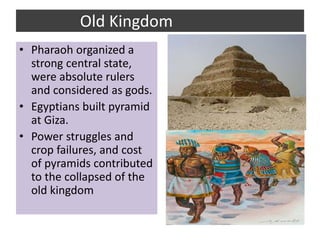
Old Kingdom
• Pharaoh organized a
strong central state,
were absolute rulers
and considered as gods.
• Egyptians built pyramid
at Giza.
• Power struggles and
crop failures, and cost
of pyramids contributed
to the collapsed of the
old kingdom
Historical Speculation
“The growth in the power and wealth of the ruling
class drove the living standards of the mass people
down to the minimum necessary for survival and
sometimes even lower.” (Harman, 2002)
“A ruling class that had arisen out of advances
in human productive powers now prevented
further advances.”
(Harman, 2002)
Historical
Speculation
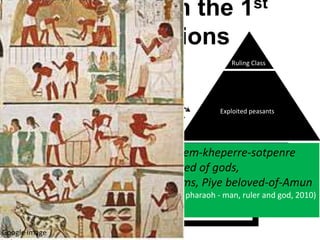
Struggles in the 1st
Civilizations
Ruling Class
Exploited peasants
impoverishment
exactions
Social revolutione.g. Egypt’s Old Kingdom
New exploiting
groups
King’s dependence on:
Split of ruling class
“Superstructure to which
correspond definitely forms of
social consciousness.”
–Marx and Engels as cited by Shrimp (n.d.)
The Good God praised me, Sekhem-kheperre-sotpenre
The Good God, beloved of gods,
The Son of Re, who acts with his arms, Piye beloved-of-Amun
(The pharaoh - man, ruler and god, 2010)
Google image
Secular priest
Struggles in the 1st
Civilizations
Ruling Class
“The splits within the ruling class were accompanied by the
growth of new subordinate classes.” (Harman, 2002)
M
E
S
O
-
A
M
E
R
I
K
A
priest
Artisans
Traders
Time and education: BUT not wage workers in modern sense
Accumulate wealth
E
G
Y
P
T
On Marx:
Traders
Accumulate wealth
E
G
Y
P
T
Struggles in the 1st
Civilizations
-by Shrimp as cited by (2002)
“…material productive forces of society come into conflict with the
existing relations of production…development of the productive forces
these relations turn into their fetters”
“class struggles historically could end ‘either in a revolutionary
reconstitution of society at large, or in the mutual ruin
of the contending classes”
Marx as cited by Harman (2002)
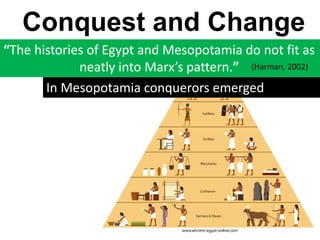
Conquest and Change
“The histories of Egypt and Mesopotamia do not fit as
neatly into Marx’s pattern.” (Harman, 2002)
In Mesopotamia conquerors emerged
Conquest and Change
“Foreign invasion had shaken up the
Egyptian social structure just enough to
allow improved means of making a
livelihood to break through after close on
1,000 years of near-stagnation.
Harman (2002)
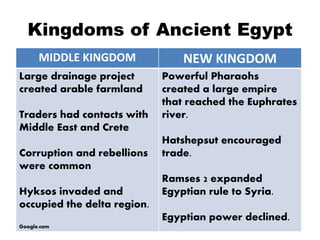
Kingdoms of Ancient Egypt
MIDDLE KINGDOM NEW KINGDOM
Large drainage project
created arable farmland
Traders had contacts with
Middle East and Crete
Corruption and rebellions
were common
Hyksos invaded and
occupied the delta region.
Google.com
Powerful Pharaohs
created a large empire
that reached the Euphrates
river.
Hatshepsut encouraged
trade.
Ramses 2 expanded
Egyptian rule to Syria.
Egyptian power declined.
Answers
Can struggle always end up to new ruling and exploited class?
“class struggles historically could end ‘either in a revolutionary
reconstitution of society at large, or in the mutual ruin of the
contending classes”
Marx as cited by Harman (2002)
How did the first dark ages changed the economy of
Mesopotamia especially on the “surplus”?
Marx as cited by Harman (2002)
“The conquest brought a flow of new raw materials and luxury
goods. At the same time the domestic surplus was now large
enough to provide for the most elaborated tombs and luxurious
palaces, not only for the pharaoh but also priests and regular
officials”.
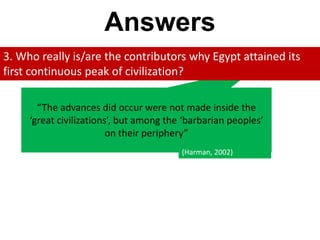
“The advances did occur were not made inside the
‘great civilizations’, but among the ‘barbarian peoples’
on their periphery”
Answers
3. Who really is/are the contributors why Egypt attained its
first continuous peak of civilization?
(Harman, 2002)
REFERENCES
HARMAN, C. (2002). A people’s history of the world. London:
Bookmarks Publications, Ltd.
SHRIMP, K. (n.d.).The validity of Karl Marx’s theory of
historical materialism.
The pharaoh - man, ruler and god. (2010). Retrieved
September 6, 2016 from http://www.reshafim.org.

Dark ages

  • 1.
    Prepared by: Angcual, JoanG. Polon, Arlyn Pannay, Benorina Joy THE 1st DARK AGES _Chris Harman
  • 2.
    1 How did thefirst dark ages changed the economy of Mesopotamia especially on the “surplus”? QUESTIONS: 2 Can struggles always end to new ruling elites and exploited class?
  • 3.
    3 Who reallyis/are the contributors why Egypt attained its first continuous peak of civilization? QUESTIONS:
  • 4.
    Old Kingdom • Pharaohorganized a strong central state, were absolute rulers and considered as gods. • Egyptians built pyramid at Giza. • Power struggles and crop failures, and cost of pyramids contributed to the collapsed of the old kingdom
  • 5.
    Historical Speculation “The growthin the power and wealth of the ruling class drove the living standards of the mass people down to the minimum necessary for survival and sometimes even lower.” (Harman, 2002)
  • 6.
    “A ruling classthat had arisen out of advances in human productive powers now prevented further advances.” (Harman, 2002) Historical Speculation
  • 7.
    Struggles in the1st Civilizations Ruling Class Exploited peasants impoverishment exactions Social revolutione.g. Egypt’s Old Kingdom New exploiting groups King’s dependence on: Split of ruling class “Superstructure to which correspond definitely forms of social consciousness.” –Marx and Engels as cited by Shrimp (n.d.) The Good God praised me, Sekhem-kheperre-sotpenre The Good God, beloved of gods, The Son of Re, who acts with his arms, Piye beloved-of-Amun (The pharaoh - man, ruler and god, 2010) Google image
  • 8.
    Secular priest Struggles inthe 1st Civilizations Ruling Class “The splits within the ruling class were accompanied by the growth of new subordinate classes.” (Harman, 2002) M E S O - A M E R I K A priest Artisans Traders Time and education: BUT not wage workers in modern sense Accumulate wealth E G Y P T
  • 9.
    On Marx: Traders Accumulate wealth E G Y P T Strugglesin the 1st Civilizations -by Shrimp as cited by (2002) “…material productive forces of society come into conflict with the existing relations of production…development of the productive forces these relations turn into their fetters” “class struggles historically could end ‘either in a revolutionary reconstitution of society at large, or in the mutual ruin of the contending classes” Marx as cited by Harman (2002)
  • 10.
    Conquest and Change “Thehistories of Egypt and Mesopotamia do not fit as neatly into Marx’s pattern.” (Harman, 2002) In Mesopotamia conquerors emerged
  • 11.
    Conquest and Change “Foreigninvasion had shaken up the Egyptian social structure just enough to allow improved means of making a livelihood to break through after close on 1,000 years of near-stagnation. Harman (2002)
  • 12.
    Kingdoms of AncientEgypt MIDDLE KINGDOM NEW KINGDOM Large drainage project created arable farmland Traders had contacts with Middle East and Crete Corruption and rebellions were common Hyksos invaded and occupied the delta region. Google.com Powerful Pharaohs created a large empire that reached the Euphrates river. Hatshepsut encouraged trade. Ramses 2 expanded Egyptian rule to Syria. Egyptian power declined.
  • 13.
    Answers Can struggle alwaysend up to new ruling and exploited class? “class struggles historically could end ‘either in a revolutionary reconstitution of society at large, or in the mutual ruin of the contending classes” Marx as cited by Harman (2002) How did the first dark ages changed the economy of Mesopotamia especially on the “surplus”? Marx as cited by Harman (2002) “The conquest brought a flow of new raw materials and luxury goods. At the same time the domestic surplus was now large enough to provide for the most elaborated tombs and luxurious palaces, not only for the pharaoh but also priests and regular officials”.
  • 14.
    “The advances didoccur were not made inside the ‘great civilizations’, but among the ‘barbarian peoples’ on their periphery” Answers 3. Who really is/are the contributors why Egypt attained its first continuous peak of civilization? (Harman, 2002)
  • 15.
    REFERENCES HARMAN, C. (2002).A people’s history of the world. London: Bookmarks Publications, Ltd. SHRIMP, K. (n.d.).The validity of Karl Marx’s theory of historical materialism. The pharaoh - man, ruler and god. (2010). Retrieved September 6, 2016 from http://www.reshafim.org.