MY BURNING ISSUE:
HOMELESSNESS IN CHICAGO
By: Daniel Gonzalez, Cycle 55
This Photo by Unknown Author is licensed under CC BY-SA
2 WHAT IS HOMELESSNESS?
Homelessness describes a situation where a
person does not have a fixed, regular, and
adequate nighttime residence—but what is
fixed, regular, and adequate depends on
who you ask. Homelessness is not one-size-
fits-all and there are many ways one person
can experience it. Someone may sleep in a
shelter, on the street, at a train station, and
double up with family or friends all in one
week.All these living situations should be
considered homeless.The Department of
Housing and Urban Development (HUD)
defines a person as homeless when they do
not have a permanent home and sleep in a
shelter, on the street, or in other places
that are not meant for living.
This includes people fleeing domestic
violence.With this definition, people
that are doubling up cannot receive
housing assistance from HUD.
However, doubling-up is the way most
people experience homelessness in
Chicago.The Department of Education
affirms that doubling up should be
included in definitions of homelessness.
The Department of Education knows
that a student might be staying in a
shelter, motel, car, or doubling up all in
one week.This definition better
reflects how most people experience
homelessness in Chicago.
3
KEY FINDINGS:
82% of people experiencing
homelessness are people of
color.
Chicagoans identifying as Black,
African American,Asian, Pacific
Islander,American Indian,
Alaska Native, and Multi-Racial
account for 55,857 people
experiencing homelessness—
19,970 people identified as
Hispanic or Latino/a/x. Only
12.6% of people experiencing
homelessness are white.
Black and African American
Chicagoans continue to
disproportionately experience
homelessness
Centuries of racist economic,
educational, and housing
practices continue to leave
Black Chicagoans more at risk
of homelessness. Black and
African American Chicagoans
account for 53% of all people
experiencing homelessness,
while making up only 29% of
the city’s total population.
4
KEY FINDINGS:
Hispanic and Latino/a/x Chicagoans
far more often experience
homelessness by couch-surfing.
Of all Hispanic and Latino/a/x
Chicagoans experiencing
homelessness, 91% are in
doubled-up situations.
Furthermore, national research
suggests that Hispanic and
Latino/a/x people are dramatically
under-represented in data on
street and shelter homelessness,
sometimes referred to as the
Latino Homeless Paradox.
Unaccompanied youth experiencing
homelessness are more likely to
temporarily stay with others than to
stay on the street or in shelters.
In 2021, 11,885 people experiencing
homelessness were unaccompanied
youth (age 24 and younger), 88% of
whom temporarily stayed with others.
In total, 3,143 unaccompanied youth
and their children (under age 18)
experienced homelessness. Most
families experiencing homelessness are
temporarily staying with others. In
2021, 24,500 people in families with
children were experiencing
homelessness and 68% were
temporarily staying with others..
ESTIMATE OF PEOPLE EXPERIENCING HOMELESSNESS IN CHICAGO
5
2015 2016 2017 2018 2019 2020 2021 2022
0
5,000
10,000
15,000
20,000
25,000
30,000
35,000
40,000
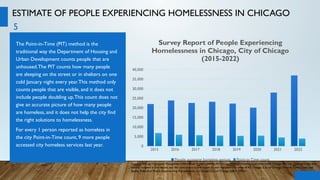
Survey Report of People Experiencing
Homelessness in Chicago, City of Chicago
(2015-2022)
People accessing homeless sevices Point-in-Time count
The Point-in-Time (PIT) method is the
traditional way the Department of Housing and
Urban Development counts people that are
unhoused.The PIT counts how many people
are sleeping on the street or in shelters on one
cold January night every year.This method only
counts people that are visible, and it does not
include people doubling up.This count does not
give an accurate picture of how many people
are homeless, and it does not help the city find
the right solutions to homelessness.
For every 1 person reported as homeless in
the city Point-in-Time count, 9 more people
accessed city homeless services last year.
Sources: Chicago Homeless Management Information System (HMIS),All Chicago Making Homelessness History.All Chicago was not involved in the data
analysis included in this report, and the conclusions in this report do not represent the views of All Chicago. City of Chicago Point-in-Time Count and
Survey Report of People Experiencing Homelessness in Chicago, City of Chicago (2015-2022).
ESTIMATE OF PEOPLE EXPERIENCING HOMELESSNESS IN CHICAGO
6
2015 2016 2017 2018 2019 2020 2021 2022
0
10,000
20,000
30,000
40,000
50,000
60,000
70,000
80,000
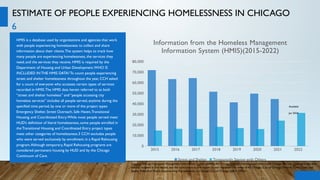
Information from the Homeless Management
Information System (HMIS)(2015-2022)
Street and Shelter Temporarily Staying with Others
HMIS is a database used by organizations and agencies that work
with people experiencing homelessness to collect and share
information about their clients.The system helps to track how
many people are experiencing homelessness, the services they
need, and the services they receive. HMIS is required by the
Department of Housing and Urban Development.WHO IS
INCLUDED IN THE HMIS DATA? To count people experiencing
street and shelter homelessness throughout the year, CCH asked
for a count of everyone who accesses certain types of services
recorded in HMIS.The HMIS data herein referred to as both
“street and shelter homeless” and “people accessing city
homeless services” includes all people served, anytime during the
specified time period, by one or more of the project types:
Emergency Shelter, Street Outreach, Safe Haven,Transitional
Housing, and Coordinated Entry.While most people served meet
HUD’s definition of literal homelessness, some people enrolled in
the Transitional Housing and Coordinated Entry project types
meet other categories of homelessness.3 CCH excludes people
who were served exclusively by enrollment in a Rapid Rehousing
program.Although temporary, Rapid Rehousing programs are
considered permanent housing by HUD and by the Chicago
Continuum of Care.
Sources: Chicago Homeless Management Information System (HMIS),All Chicago Making Homelessness History.All Chicago was not involved in the data
analysis included in this report, and the conclusions in this report do not represent the views of All Chicago. City of Chicago Point-in-Time Count and
Survey Report of People Experiencing Homelessness in Chicago, City of Chicago (2015-2022).
Available
Jan 2024
THE NIGHT
MINISTRY
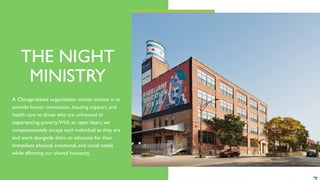
A Chicago-based organization whose mission is to
provide human connection, housing support, and
health care to those who are unhoused or
experiencing poverty.With an open heart, we
compassionately accept each individual as they are
and work alongside them to advocate for their
immediate physical, emotional, and social needs
while affirming our shared humanity.
8
THEIR IMPACT OVER THE PASTYEAR
5,926
Individuals who are unhoused or experiencing poverty provided
with lifesaving resources.
383
Visits to the emergency room prevented by Nurse Practitioners
and Volunteer Physicians, saving the public health system an
estimated $237,300 in ER costs.
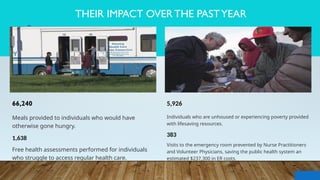
66,240
Meals provided to individuals who would have
otherwise gone hungry.
1,638
Free health assessments performed for individuals
who struggle to access regular health care.
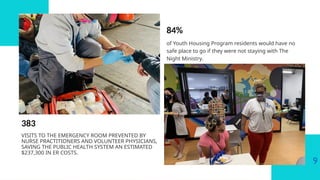
84%
of Youth Housing Program residents would have no
safe place to go if they were not staying with The
Night Ministry.
383
VISITS TO THE EMERGENCY ROOM PREVENTED BY
NURSE PRACTITIONERS AND VOLUNTEER PHYSICIANS,
SAVING THE PUBLIC HEALTH SYSTEM AN ESTIMATED
$237,300 IN ER COSTS.
9
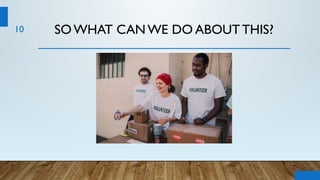
SO WHAT CAN WE DO ABOUT THIS?
10
11
MY SOLUTION
In Chicago, IL, at least 68,440 people are currently experiencing homelessness, and the solution is
straightforward: housing.The city needs a dedicated source of revenue to create affordable
housing for those in greatest need, along with the support services required to help individuals
stay housed and achieve their personal goals. Consistent, ongoing funding is crucial to cover the
costs of permanent housing, ensuring that future administrations do not deprioritize or fluctuate
support.A city-generated revenue stream is essential to house those experiencing all forms of
homelessness—whether on the streets, in shelters, or doubled up with others. Cities like Denver,
Seattle, Los Angeles, and San Francisco have already implemented similar dedicated funding
measures to address the issue.With homelessness on the rise in Chicago, now is the time to act.
12
SOURCES
https://www.thenightministry.org/impact
https://chicagohomeless.org/our-work/data-research/
THANKYOU
By Daniel Gonzalez, Cycle 55
13
This Photo by Unknown Author is licensed under CC BY-SA

Daniel's Burning Issue/Civics Project.pptx

  • 1.
    MY BURNING ISSUE: HOMELESSNESSIN CHICAGO By: Daniel Gonzalez, Cycle 55 This Photo by Unknown Author is licensed under CC BY-SA
  • 2.
    2 WHAT ISHOMELESSNESS? Homelessness describes a situation where a person does not have a fixed, regular, and adequate nighttime residence—but what is fixed, regular, and adequate depends on who you ask. Homelessness is not one-size- fits-all and there are many ways one person can experience it. Someone may sleep in a shelter, on the street, at a train station, and double up with family or friends all in one week.All these living situations should be considered homeless.The Department of Housing and Urban Development (HUD) defines a person as homeless when they do not have a permanent home and sleep in a shelter, on the street, or in other places that are not meant for living. This includes people fleeing domestic violence.With this definition, people that are doubling up cannot receive housing assistance from HUD. However, doubling-up is the way most people experience homelessness in Chicago.The Department of Education affirms that doubling up should be included in definitions of homelessness. The Department of Education knows that a student might be staying in a shelter, motel, car, or doubling up all in one week.This definition better reflects how most people experience homelessness in Chicago.
  • 3.
    3 KEY FINDINGS: 82% ofpeople experiencing homelessness are people of color. Chicagoans identifying as Black, African American,Asian, Pacific Islander,American Indian, Alaska Native, and Multi-Racial account for 55,857 people experiencing homelessness— 19,970 people identified as Hispanic or Latino/a/x. Only 12.6% of people experiencing homelessness are white. Black and African American Chicagoans continue to disproportionately experience homelessness Centuries of racist economic, educational, and housing practices continue to leave Black Chicagoans more at risk of homelessness. Black and African American Chicagoans account for 53% of all people experiencing homelessness, while making up only 29% of the city’s total population.
  • 4.
    4 KEY FINDINGS: Hispanic andLatino/a/x Chicagoans far more often experience homelessness by couch-surfing. Of all Hispanic and Latino/a/x Chicagoans experiencing homelessness, 91% are in doubled-up situations. Furthermore, national research suggests that Hispanic and Latino/a/x people are dramatically under-represented in data on street and shelter homelessness, sometimes referred to as the Latino Homeless Paradox. Unaccompanied youth experiencing homelessness are more likely to temporarily stay with others than to stay on the street or in shelters. In 2021, 11,885 people experiencing homelessness were unaccompanied youth (age 24 and younger), 88% of whom temporarily stayed with others. In total, 3,143 unaccompanied youth and their children (under age 18) experienced homelessness. Most families experiencing homelessness are temporarily staying with others. In 2021, 24,500 people in families with children were experiencing homelessness and 68% were temporarily staying with others..
  • 5.
    ESTIMATE OF PEOPLEEXPERIENCING HOMELESSNESS IN CHICAGO 5 2015 2016 2017 2018 2019 2020 2021 2022 0 5,000 10,000 15,000 20,000 25,000 30,000 35,000 40,000 Survey Report of People Experiencing Homelessness in Chicago, City of Chicago (2015-2022) People accessing homeless sevices Point-in-Time count The Point-in-Time (PIT) method is the traditional way the Department of Housing and Urban Development counts people that are unhoused.The PIT counts how many people are sleeping on the street or in shelters on one cold January night every year.This method only counts people that are visible, and it does not include people doubling up.This count does not give an accurate picture of how many people are homeless, and it does not help the city find the right solutions to homelessness. For every 1 person reported as homeless in the city Point-in-Time count, 9 more people accessed city homeless services last year. Sources: Chicago Homeless Management Information System (HMIS),All Chicago Making Homelessness History.All Chicago was not involved in the data analysis included in this report, and the conclusions in this report do not represent the views of All Chicago. City of Chicago Point-in-Time Count and Survey Report of People Experiencing Homelessness in Chicago, City of Chicago (2015-2022).
  • 6.
    ESTIMATE OF PEOPLEEXPERIENCING HOMELESSNESS IN CHICAGO 6 2015 2016 2017 2018 2019 2020 2021 2022 0 10,000 20,000 30,000 40,000 50,000 60,000 70,000 80,000 Information from the Homeless Management Information System (HMIS)(2015-2022) Street and Shelter Temporarily Staying with Others HMIS is a database used by organizations and agencies that work with people experiencing homelessness to collect and share information about their clients.The system helps to track how many people are experiencing homelessness, the services they need, and the services they receive. HMIS is required by the Department of Housing and Urban Development.WHO IS INCLUDED IN THE HMIS DATA? To count people experiencing street and shelter homelessness throughout the year, CCH asked for a count of everyone who accesses certain types of services recorded in HMIS.The HMIS data herein referred to as both “street and shelter homeless” and “people accessing city homeless services” includes all people served, anytime during the specified time period, by one or more of the project types: Emergency Shelter, Street Outreach, Safe Haven,Transitional Housing, and Coordinated Entry.While most people served meet HUD’s definition of literal homelessness, some people enrolled in the Transitional Housing and Coordinated Entry project types meet other categories of homelessness.3 CCH excludes people who were served exclusively by enrollment in a Rapid Rehousing program.Although temporary, Rapid Rehousing programs are considered permanent housing by HUD and by the Chicago Continuum of Care. Sources: Chicago Homeless Management Information System (HMIS),All Chicago Making Homelessness History.All Chicago was not involved in the data analysis included in this report, and the conclusions in this report do not represent the views of All Chicago. City of Chicago Point-in-Time Count and Survey Report of People Experiencing Homelessness in Chicago, City of Chicago (2015-2022). Available Jan 2024
  • 7.
    THE NIGHT MINISTRY A Chicago-basedorganization whose mission is to provide human connection, housing support, and health care to those who are unhoused or experiencing poverty.With an open heart, we compassionately accept each individual as they are and work alongside them to advocate for their immediate physical, emotional, and social needs while affirming our shared humanity.
  • 8.
    8 THEIR IMPACT OVERTHE PASTYEAR 5,926 Individuals who are unhoused or experiencing poverty provided with lifesaving resources. 383 Visits to the emergency room prevented by Nurse Practitioners and Volunteer Physicians, saving the public health system an estimated $237,300 in ER costs. 66,240 Meals provided to individuals who would have otherwise gone hungry. 1,638 Free health assessments performed for individuals who struggle to access regular health care.
  • 9.
    84% of Youth HousingProgram residents would have no safe place to go if they were not staying with The Night Ministry. 383 VISITS TO THE EMERGENCY ROOM PREVENTED BY NURSE PRACTITIONERS AND VOLUNTEER PHYSICIANS, SAVING THE PUBLIC HEALTH SYSTEM AN ESTIMATED $237,300 IN ER COSTS. 9
  • 10.
    SO WHAT CANWE DO ABOUT THIS? 10
  • 11.
    11 MY SOLUTION In Chicago,IL, at least 68,440 people are currently experiencing homelessness, and the solution is straightforward: housing.The city needs a dedicated source of revenue to create affordable housing for those in greatest need, along with the support services required to help individuals stay housed and achieve their personal goals. Consistent, ongoing funding is crucial to cover the costs of permanent housing, ensuring that future administrations do not deprioritize or fluctuate support.A city-generated revenue stream is essential to house those experiencing all forms of homelessness—whether on the streets, in shelters, or doubled up with others. Cities like Denver, Seattle, Los Angeles, and San Francisco have already implemented similar dedicated funding measures to address the issue.With homelessness on the rise in Chicago, now is the time to act.
  • 12.
  • 13.
    THANKYOU By Daniel Gonzalez,Cycle 55 13 This Photo by Unknown Author is licensed under CC BY-SA