



A Catalyst
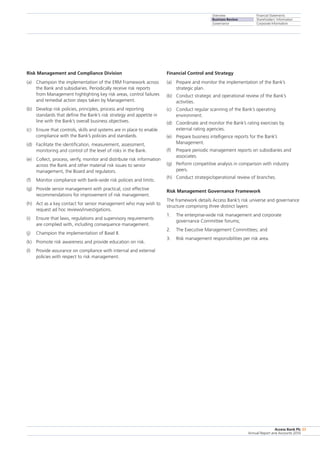
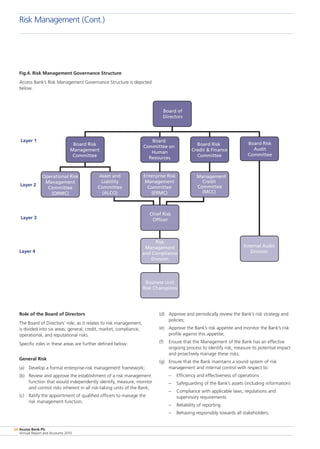
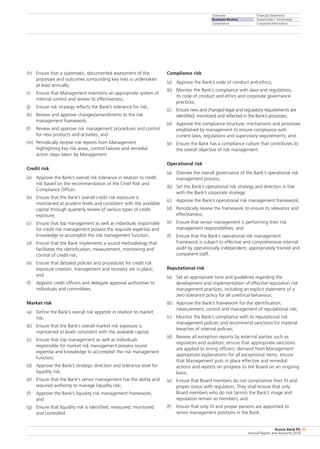
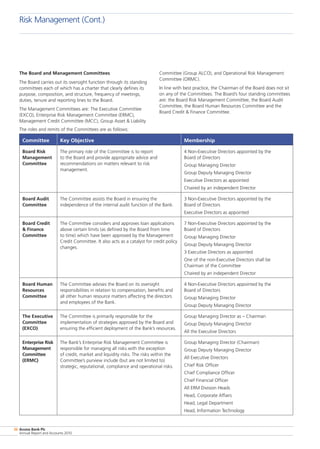
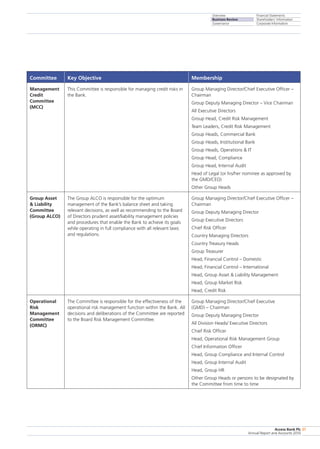
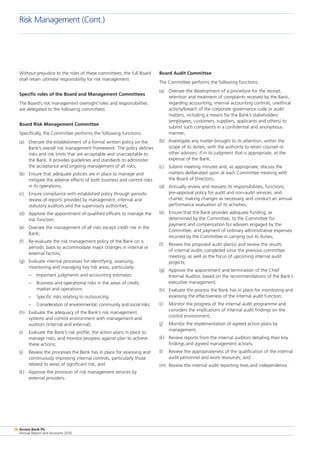
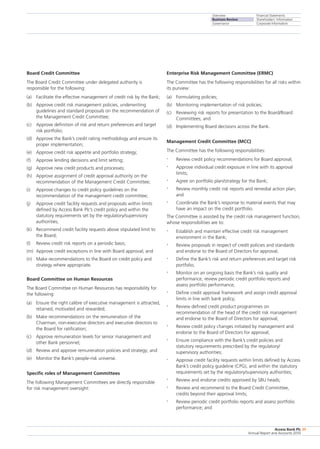
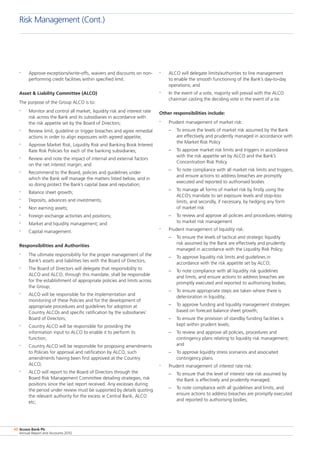
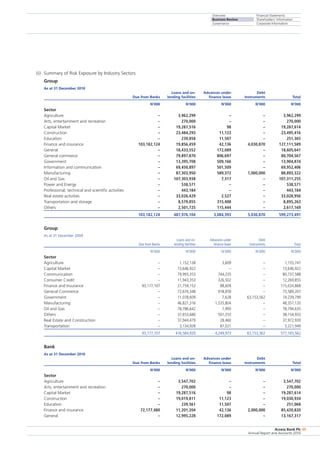
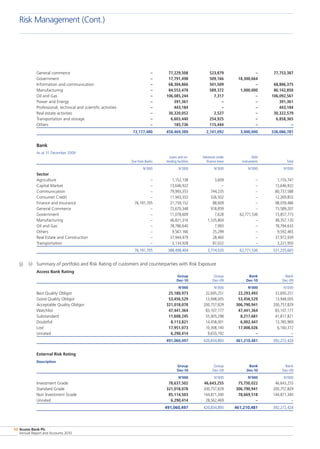
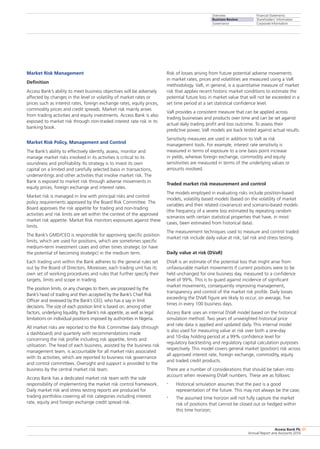
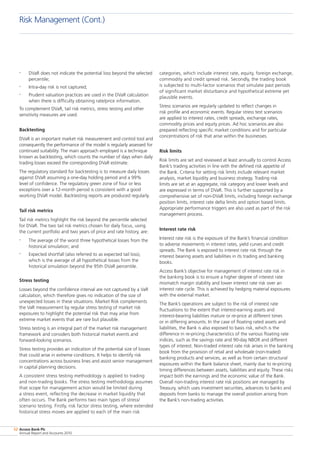
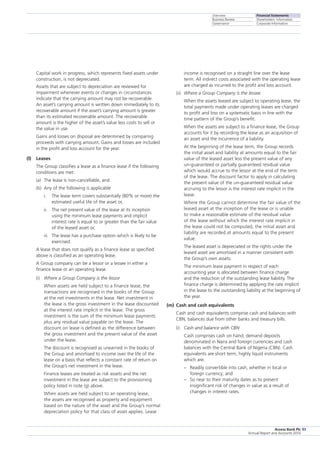
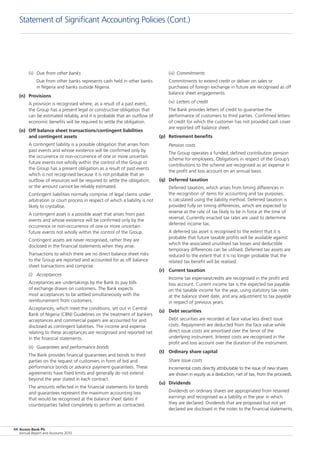
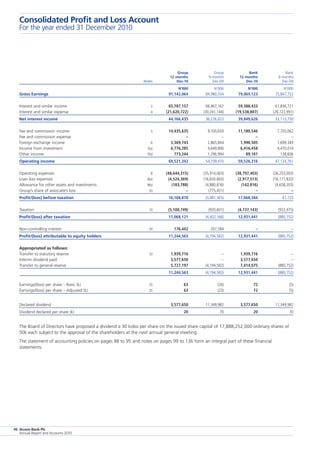
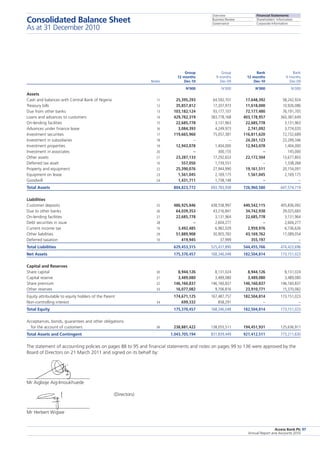
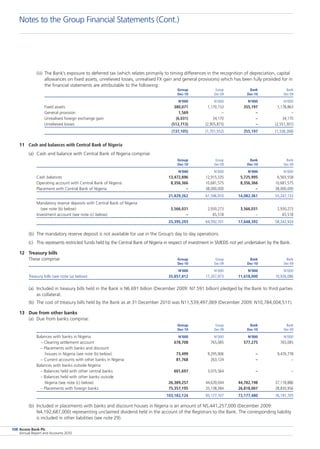
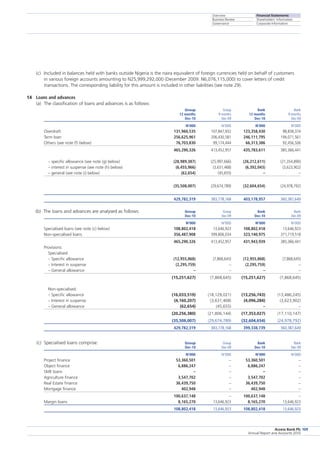
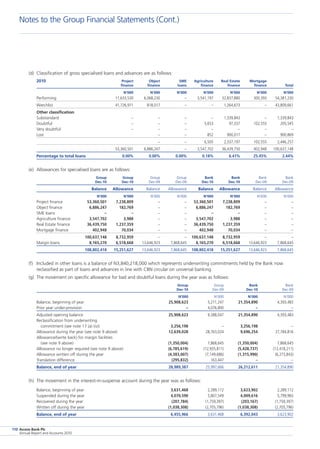
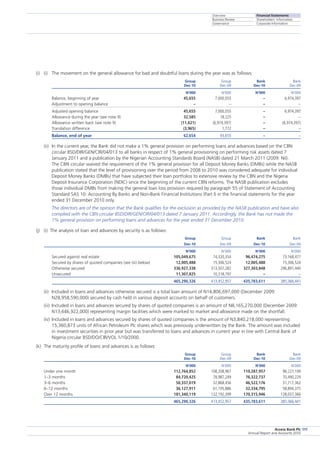
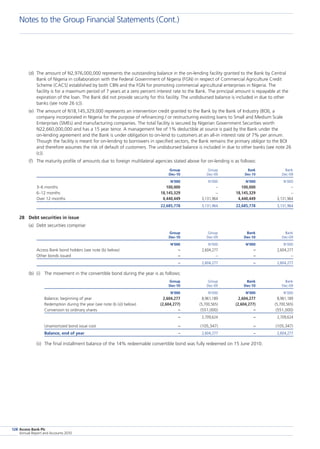
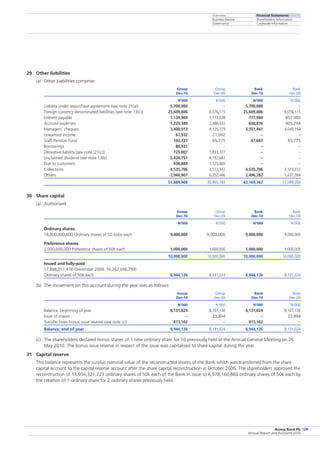
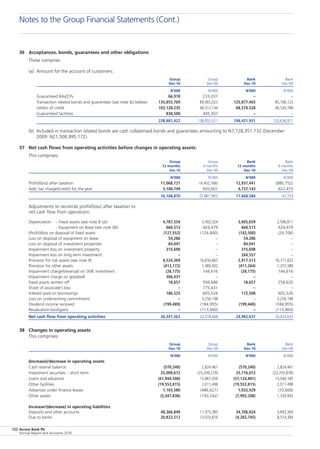
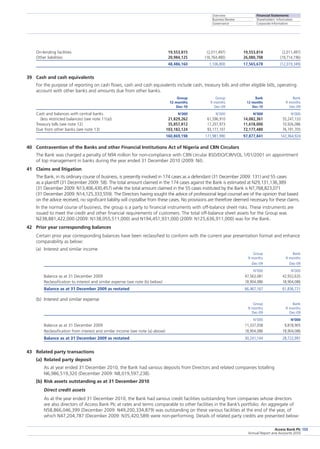
for Growth
in Africa
Access Bank Plc
Annual Report and Accounts 2010
ACCESSBANKPLCAnnualReportandAccounts2010
Access Bank Plc
Plot 1665, Oyin Jolayemi
Victoria Island, Lagos State,
Nigeria
T: (+234) 1 461 9264-9
F: (+234) 1 461 8811
www.accessbankplc.com
Access Bank Plc is the Bank of best practice with
consistent growth in all key performance indicators
over the past 8 years. We are currently one of the
largest banks in nigeria. As an emerging leader in Africa,
Access Bank seeks not only to rank amongst the top 3
nigerian Banking Groups but also to become a major
catalyst for growth across the African continent.
Introduction
& contents
1 strategic & Financial Highlights
2 Business Segment Review
4 location & offices
6 chairman’s statement
8 chief executive’s Review
71 directors, officers & Advisors
72 Board of directors
76 Management team
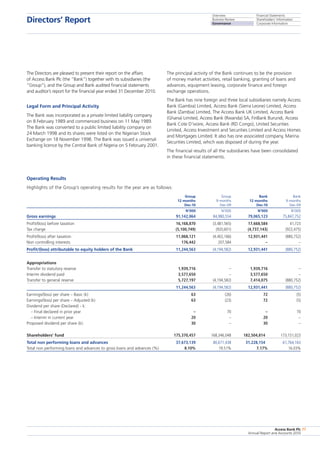
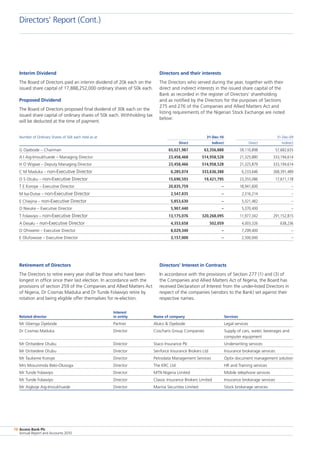
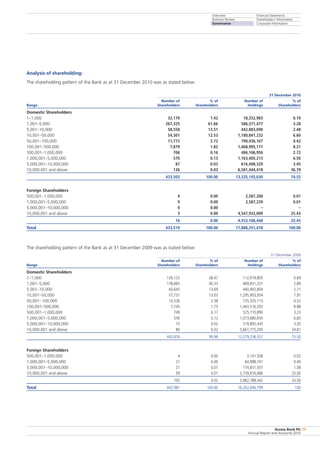
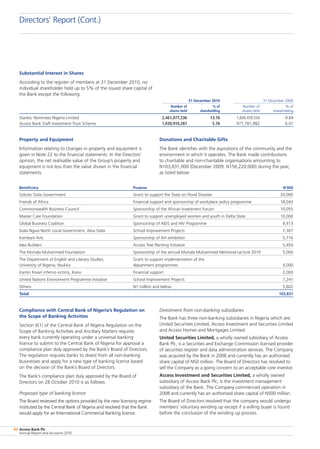
77 directors’ Report
82 directors’ Responsibilities & statutory
Audit committee Report
83 corporate Governance
10 Report of the external consultant on
the Board Assesment
12 Institutional Banking
14 Commercial Banking
16 Investment Banking
18 Retail Banking
20 Transaction Services
22 products & services
23 It services
24 our people & culture
26 corporate social Responsibility
28 Risk Management
oVeRVIeW
GoVeRnAnce
BusIness ReVIeW
87 Independent Auditor’s Report
88 statement of significant Accounting policies
96 consolidated profit & loss Account
97 consolidated Balance sheet
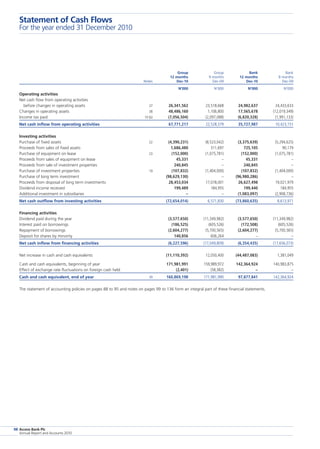
98 statement of cash Flow
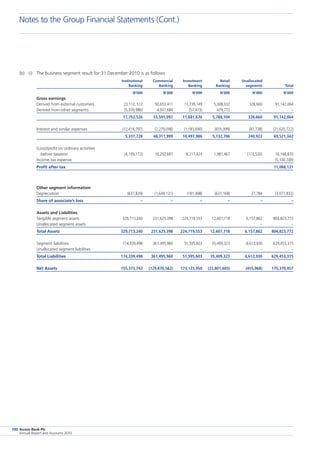
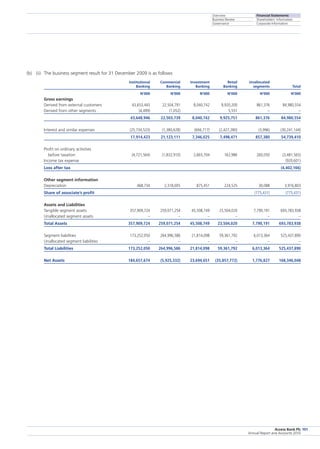
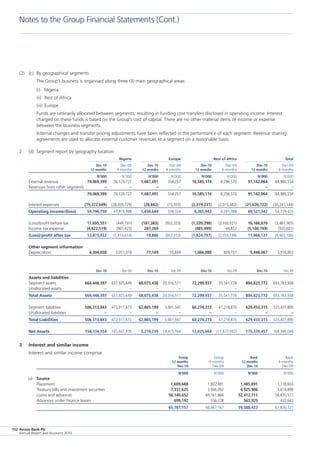
99 notes to the Group Financial statements
137 statement of Value Added
138 Four-Year Financial summary
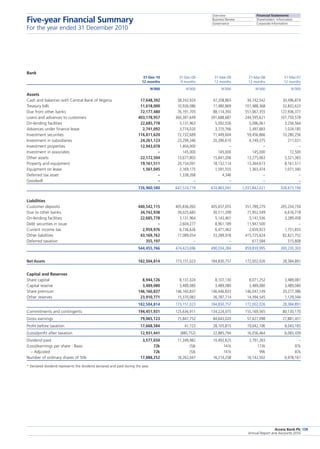
139 Five-Year Financial summary
140 notice of Meeting
141 capital Formation History
143 e-mandate Form
145 shareholder Information update Form
147 proxy Form
149 corporate directory
sHAReHoldeR InFoRMAtIon
coRpoRAte InFoRMAtIon
FInAncIAl stAteMents
Access Bank Plc
Annual Report and Accounts 2010
Access Bank’s corporate social Responsibility
(csR) Report is prepared in order to provide
information on the economic, environmental
and social performance that contributed to our
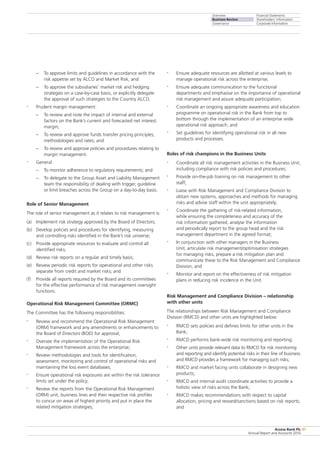
sustainability in 2010. A summary of which can
be found on page 26 of this report.
designed and produced by Rare corporate design, london
www.rarecorporate.co.uk
this report is printed on 150gsm Fsc silk art paper.
the Forest stewardship council is a non-profit entity that supports environmentally appropriate, socially
beneficial and economically viable management of the world’s forests. Fsc independently tracks, traces
and identifies wood fibers from the forest through every step of the procurement, manufacturing and
printing process, confirming that each supplier in the chain follows rigorous controls, management and
reporting practices.
Overview
Business Review
Governance
Financial Statements
Shareholders’ Information
Corporate Information
Access Bank Plc
Annual Report and Accounts 2010
1
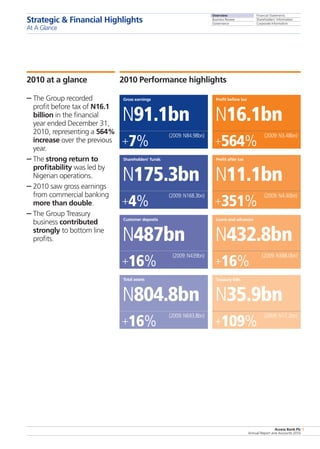
— The Group recorded
profit before tax of N16.1
billion in the financial
year ended December 31,
2010, representing a 564%
increase over the previous
year.
— The strong return to
profitability was led by
Nigerian operations.
— 2010 saw gross earnings
from commercial banking
more than double.
— The Group Treasury
business contributed
strongly to bottom line
profits.
Profit before taxGross earnings
Profit after taxShareholders’ funds
Loans and advancesCustomer deposits
Treasury billsTotal assets
N16.1bnN91.1bn
N11.1bnN175.3bn
N432.8bnN487bn
N35.9bnN804.8bn
+564%+7%
+351%+4%
+16%+16%
+109%+16%
(2009: N3.48bn)(2009: N84.98bn)
(2009: N4.40bn)(2009: N168.3bn)
(2009: N388.0bn)(2009: N439bn)
(2009: N17.2bn)(2009: N693.8bn)
Strategic  Financial Highlights
At A Glance
2010 at a glance 2010 Performance highlights
2 Access Bank Plc
Annual Report and Accounts 2010
Access Bank Plc’s business model is structured
along five major strategic business segments,
namely institutional banking, commercial
banking, financial markets, retail banking
and transaction services.
Business Segment Review
At A Glance
Institutional
Banking
Industry sectors covered
Cement  Flour
Financial Institutions
Food  Beverages
Oil  Gas
Telecoms
Transportation  Utilities
Target markets
Individuals
Trading
Manufacturing
Hospitality
Schools/Educational
Institutions
HNI/UHNI
Real Estate
Bureau de Change
Security  Armory
Asset Management
Information Technology
Transportation
Partnerships/Professional
Contribution to Total Assets
The Institutional Banking division offers a full
range of services to multinationals, large domestic
corporates and other institutional clients.
• We strive to provide premium relationship
management to top tier corporate clients,
while serving as an anchor to the value chain
model of the Bank.
• We also deliver corporate and structured
financial services to leading banks, insurance
companies, stock broking firms as well as
investment and asset management firms.
• Our focus is to add value by building long-
term relationships with our clients via a deep
understanding of their businesses and the
environment in which they operate.
The Commercial Banking division focuses on serving
all non-institutional clients within the value chain of
the Bank’s large corporate customers.
• This is achieved through the distribution of both
commercial and retail offerings as well as other
structured local and foreign organisations with
turnover in excess of N500 million.
• The division has chosen the value chain model as
its preferred approach to running the commercial
banking business at this time.
• Significant successes have been recorded with
the application of this strategy, showing the huge
potential for growth in our business with more
rigorous implementation.
Commercial
Banking
41%
29%
Results for this division
Page 13
Results for this division
Page 15
Overview
Business Review
Governance
Financial Statements
Shareholders’ Information
Corporate Information
Access Bank Plc
Annual Report and Accounts 2010
3
Institutional Banking:
(N4.15bn)+12%
+662%
Commercial Banking:
N10.3bn
+202%
Investment Banking:
N8.02bn
+1116%
Retail Banking:
N1.98bn
Contribution to Total Profit
2%
Retail Banking
Products offered
Treasury  Asset Management
Financial Advisory Services
Permanent/Long  Medium
Term Finance
Products offered
Personal accounts:
savings, current, investment
Credit products:
loans, advances, mortgages,
asset finance, small business
loans, credit cards
e-business:
internet banking, mobile
banking, merchant services,
customised corporate
solutions
Contribution to Total Assets
The objective of the Financial Markets division is to
provide innovative finance solutions to meet the
short, medium and long-term financing needs of
our clients.
• Our treasury group is at the forefront of fixed
income and foreign exchange trading in Nigeria,
while our global financial markets group continues
to build core competence in structured finance
and advisory transactions.
• During the period under review, we were
consistently voted the most professional foreign
exchange trading bank in Nigeria, and our treasury
team, the most professional money market dealers
in a monthly poll conducted by the Money Market
Association of Nigeria.
The Products  Retail Banking division currently
serves over 500,000 customer accounts providing
financial products and services to individuals and
small businesses in the value-chain of the Bank’s
corporate clients.
• Our products and services range from standard
to specialised savings, current and investment
accounts.
• Others include credit products, including personal
loans, advances, mortgages, asset finance, small
business loans and credit cards.
• Our e-business products include internet
banking, mobile banking, merchant services and
customised corporate solutions.
Financial
Markets
28%
Results for this division
Page 17
Results for this division
Page 19
2010
Total Profit
N16.17bn
2009
Total (Loss)
(N3.48bn)
%
Growth
4 Access Bank Plc
Annual Report and Accounts 2010
Nigeria
Burundi Côte D’ivoire Democratic
Republic Of
The Congo
Ghana
Contribution to Group
2010
Contribution to Group
2010
Contribution to Group
2010
Contribution to Group
2010
Contribution to Group
2010
LAGOS ACCRA
YAMOUSSOUKRO
BUJUMBURA
KINSHASA
Locations  Offices
Overview
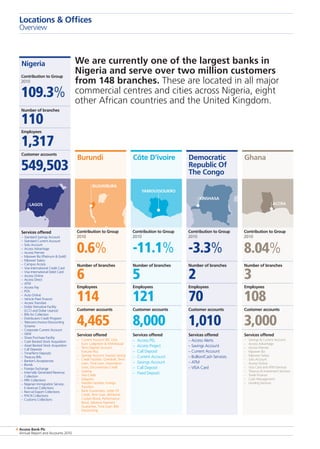
We are currently one of the largest banks in
Nigeria and serve over two million customers
from 148 branches. These are located in all major
commercial centres and cities across Nigeria, eight
other African countries and the United Kingdom.
Services offered
– 	Standard Savings Account
– 	Standard Current Account
– 	Solo Account
– 	Access Advantage
– 	Access Premier
– 	Mpower Biz (Platinum  Gold)
– 	Mpower Salary
– 	Campus Access
– 	Visa International Credit Card
– 	Visa International Debit Card
– 	Access Online
– 	Access Direct
– 	ATM
– 	Access Pay
– 	POS
– 	Auto Online
– 	Vehicle Fleet Finance
– 	Access Transfast
– 	Dollar Derivative Facility
(lcci and Dollar Usance)
– 	Bills for Collection
– 	Distributors Credit Program
– 	Telecoms Invoice Discounting
Scheme
– 	Corporate Current Account
– 	GEM
– 	Share Purchase Facility
– 	Cash Backed Stock Acquisition
– 	Asset Backed Stock Acquisition
– 	Call Deposits
– 	Time/Term Deposits
– 	Treasury Bills
– 	Banker’s Acceptances
– 	Bonds
– 	Foreign Exchange
– 	Internally Generated Revenue
Collection
– 	Firs Collections
– 	Nigerian Immigration Service-
E-revenue Collections
– 	Non-oil Export Collections
– 	Phcn Collections
– 	Customs Collections
Services offered
– 	 Current Account (Bif, USA,
Euro: Lodgment  Withdrawal
– 	 Term Deposit Account:
Fortune Plus
– 	 Savings Account: Kazoza Saving
– 	 Credit Facilities: Overdraft, Term
Loan, Time Loan, Importation
Lines, Documentary Credit
– 	 Leasing
– 	 Visa Cards
– 	 Diaspora
– 	 Transfer Facilities: Foreign
Transfers
– 	 Bank Guarantees: Letter Of
Credit, Term Loan, Bid Bond,
Custom Bond, Performance
Bond, Advance Payment
Guarantee, Time Loan, Bills
Discounting
Services offered
– 	Access PEL
– 	Access Project
– 	Call Deposit
– 	Current Account
– 	Savings Account
– 	Call Deposit
– 	Fixed Deposit
Services offered
– Access Alerts
– Savings Account
– Current Account
– Bullion/Cash Services
– ATM
– VISA Card
Services offered
– 	 Savings  Current Account
– 	 Access Advantage
– 	 Access Premier
– 	 Mpower Biz
– 	 Mpower Salary
– 	 Solo Account
– 	 Access Online
– 	 Visa Card and ATM Services
– 	 Treasury  Investment Services
– 	 Trade Finance
– 	 Cash Management
– 	 Lending Services
Number of branches
Number of branches Number of branches Number of branches Number of branches
Employees
Employees Employees Employees Employees
Customer accounts
Customer accounts Customer accounts Customer accounts Customer accounts
110
6 5 2 3
1,317
114 121 70 108
549,503
4,465 8,000 1,010 3,000
109.3%
0.6% -11.1% -3.3% 8.04%
Overview
Business Review
Governance
Financial Statements
Shareholders’ Information
Corporate Information
Access Bank Plc
Annual Report and Accounts 2010
5
Rwanda Sierra Leone The Gambia Zambia United
Kingdom
Contribution to Group
2010
Contribution to Group
2010
Contribution to Group
2010
Contribution to Group
2010
Contribution to Group
2010
KIGALI
FREETOWN BANJUL
LONDON
LUSAKA
Services offered
–	 Current Account Individual
–	 Current Account Corporate
–	 Standard Savings Account
–	 Solo Kiddies Account
–	 E-Banking (SMS, Internet
 Email)
–	 Foreign Operations  Funds
Transfer
–	 Central Clearing
–	 Credit Risk Management/
Remedial Asset
–	 Currency Trading/Treasury
–	 Paying Tellers (Local  Foreign
Currency
Services offered
–	 Savings Account
–	 Current Account
–	 ATM
–	 Visa
–	 Solo A/C
–	 Mpower Salary Account
–	 Access Advantage
–	 E-statement
–	 Access Alert
–	 Investment Banking
–	 Commercial Banking
–	 Institutional Banking
–	 Internet Banking
Services offered
–	 Current Account
–	 Access Advantage Account
–	 Mpower Biz Account
–	 Call Account
–	 Access Premier
–	 Money Market Account
–	 Savings Account
–	 Kiddies Save Account
–	 Savings Account – N/I (Islamic)
–	 Term Deposits
–	 Access Premier Plus
–	 Collections Account
–	 Domicilliary Accounts
–	 Collection Domicilliary Account
–	 Matured Term Deposits
Services offered
–	 Personal, Business, Online and 	
Private Banking
–	 Small Business Account
–	 Institutional, Commercial and
Internet Banking
–	 Payments  Collections
–	 Treasury
–	 SMS/Email Alert
–	 Accesspay
–	 Visa Debit Card
–	 Credit Card
–	 Mpower Biz
–	 Access Advantage and Premier
–	 Solo
–	 Standard Savings Account
–	 Standard Current Account
–	 Call Account
–	 Fixed Deposit
–	 Domicilliary Account
Services offered
–	 Trade Finance Service
–	 Commercial Banking
–	 Property Loans
–	 Private Bank
–	 Internet Banking
–	 Current Account
–	 Notice Deposit Account
–	 Business Account
–	 ATM
–	 Savings Account
Number of branches Number of branches Number of branches Number of branches Number of branches
Employees Employees Employees Employees Employees
Customer accounts Customer accounts Customer accounts Customer accounts Customer accounts
7 4 5 3 3
135 28 150 152 60
6,890 8,593 16,640 5,505 1,079
1.7% -0.4% -0.7% 0.03% -1.22%
6 Access Bank Plc
Annual Report and Accounts 2010
Chairman’s Statement
Welcome
In 2010, the bright signs of economic recovery that began to appear
at the tail end of 2009 were overshadowed by the possibility of
yet another financial crisis triggered by sovereign debt concerns
in Greece, Spain, Ireland and Portugal. Emerging markets and
developing economies however continue to outperform the global
economic growth index. In Nigeria, real GDP grew at 7.78%,
outperforming the prior year’s growth rate of 6.69% and indications
are that this growth momentum will be maintained in 2011 due
to high crude oil production levels and rising crude oil prices.
However, inflation remained well above the Central Bank’s implied
target range of 9.0% – 9.5%.
The Nigerian financial system is on the path to recovery, largely due to
the various initiatives introduced by the Central Bank of Nigeria (CBN)
in response to the Nigerian banking sector crisis.
Financial Performance
This is our Bank’s first full year Profit and Loss Accounts since the
adoption of 31st December as our year end. The period witnessed
an appreciable level of macroeconomic stability due to the various
policies instituted by the CBN, enabling our Bank to record a profit
before tax of N16.1 billion for the Group, a remarkable improvement
on our 2009 performance.
Dividend
The Board of Directors is recommending a final dividend of 30 kobo
per ordinary share, subject to appropriate withholding tax. This is in
addition to the interim dividend of 20 kobo per ordinary share paid
at half year 2010. This brings the total dividend per ordinary share for
the 2010 financial year to 50 kobo.
Subsidiaries
Following the Central Bank’s repeal of the Universal Banking
Guidelines, Access Bank Plc has received the CBN’s approval,
in principle, for its Compliance Plan to bring its operations into
conformity with the provisions of Central Bank of Nigeria’s
Regulations on the Scope of Banking Activities and Ancillary Matters.
Our Bank will divest fully from its two non-banking subsidiaries
namely, United Securities Ltd and Access Securities and Investment
Ltd, and integrate the operations of its mortgage banking subsidiary,
Access Homes and Mortgages Limited into its Retail Banking division.
The decision to exit our non-banking subsidiaries was taken following
a rigorous evaluation of the impact of the divestment on our long
term performance objectives.
By opting to divest from our non-banking subsidiaries, we have
chosen to focus on our core commercial banking operations, which
account for over 98% of our earnings. In arriving at this decision,
consideration was given to the growing global and local concerns
regarding the regulation of universal banks and we found it prudent
to be insulated from the regulatory challenges which universal banks
will face in future.
In view of the measures of best practice that Access Bank has
undertaken in the past, the Bank is confident that its transition to
operating under an international banking licence will be smooth
and seamless. Our subsidiaries in Ghana, Rwanda, Zambia,
and the United Kingdom continue to perform creditably whilst
the macroeconomic conditions in other countries hosting our
operations, most particularly Cote D’Ivoire, have not been beneficial
to our business model. Going forward, the Board of Directors and
Management have established minimum performance targets for all
our banking subsidiaries to ensure the future performance of each
subsidiary is profit additive.
Board of Directors and Human Capital Development
During the year, Dr Dewunmi Desalu resigned from the Board of
Directors. We are most appreciative of his contributions to the Bank
during his period of service and wish him continued success in his
endeavours. Our employees are the heart of our business, and we
continue to improve on our ability to recruit the brightest people in
the industry and develop them through exposure to international
best practices. This helps to ensure that the Bank is able to sustain
its ability to create value for all its stakeholders.
Mr Gbenga Oyebode, MFR
Distinguished shareholders, it is with
great pleasure that I welcome you
to the 22nd Annual General Meeting
of our Bank. I will be presenting
to you a brief review of the major
developments that have taken
place in our local markets and in the
wider global economy in which our
Bank operates, as well as providing
you with a summary of the Bank’s
performance for the financial year
ended 31st December 2010.
Overview
Business Review
Governance
Financial Statements
Shareholders’ Information
Corporate Information
Access Bank Plc
Annual Report and Accounts 2010
7
Corporate Governance and Risk Management
Access Bank continues to ensure strong adherence to best
practices in corporate governance premised on the independence
and separation of the Board’s supervisory responsibilities from
the management framework. Our governance standards are not
limited to the requirements of local statutes and regulations. Your
Board of Directors has taken the initiative to adopt, in certain areas,
governance standards that are higher than required by local code
and regulatory requirements.
Access Bank in 2010 became the first bank in Nigeria to fully adopt
International Financial Reporting Standards (IFRS) and has pioneered
the way for many of the other banks who are just beginning their
implementation process in 2011. The road map developed by the
CBN requires banks to have implemented IFRS by the year 2012.
The Bank has also invested in people, structures and processes to
take us to a functioning implementation of Basel II. During the
financial year, we employed a highly respected Chief Risk Officer
bringing with him a wealth of experience while also ensuring that
all the key positions in enterprise risk framework are filled. We have
established a system that ensures an integrated view of risk and
correlation/diversification benefits.
Growth Opportunities
One of our Bank’s strategic objectives is to rank amongst the top
three banking groups in Nigeria. The pursuit of this aspiration would
require the Bank’s expansion of its footprint either through the
pursuit of organic or inorganic growth strategies. An opportunity
currently exists in the context of the Central Bank of Nigeria’s
Banking Crisis Resolution Program for the Bank to pursue a
business combination with another bank towards achieving our
growth aspirations. The Board of Directors is working closely with
Management to undertake such actions as may be necessary to
successfully implement this initiative. In line with international best
practices, the proposed business combination will be conducted
transparently and subject to necessary shareholders, regulatory and
judicial approvals.
Special Resolution
One of the tools the Bank uses in retaining and motivating its high
performing employees are performance incentives. The Resolution,
which you will find in the Notice of Meeting, would enable the Bank
to establish an Employee Performance Share Plan, under which
units of the Bank’s shares will be awarded to eligible employees on
terms to be approved by the Board of Directors. The approval and
implementation of the proposed plan would increase the Bank’s
capacity to recruit and retain high performing employees.
The Board believes that the Resolution contained in the Notice
of Meeting is in the best interests of shareholders and the Bank
unanimously recommends that you vote in favour of the Resolutions.
Conclusion
Our sincere appreciation goes to our shareholders, customers,
employees and other stakeholders for their continued support of the
Bank, which has enabled us to record another year of very strong
performance. With your continued support, we look forward with
great excitement to successful years ahead as we work hard to
enhance returns for shareholders while continuing in our pursuit of
the Quest for Excellence in our customer services and operations.
MR GBENGA OYEBODE, MFR
CHAIRMAN, BOARD OF DIRECTORS
“Our Bank’s continuous
commitment to sustainable
fundamentals and strong
financial performance has
led to a return to profit”
8 Access Bank Plc
Annual Report and Accounts 2010
Global Environment
We must give due credit to the effectiveness of the various macro
prudential initiatives instituted by the Central Bank of Nigeria (CBN)
to stimulate economic growth as well as to ensure recovery of the
Nigerian banking sector. Furthermore, the CBN’s extensive reforms
focused on elevating the practice of Risk Management, Financial
Management as well as Corporate Governance by Nigerian banks,
have effectively leveled the playing field enabling those financial
institutions, whose business models are centered around sound
banking principles, to grow their business profitability.
Year 2010
During the period under review, our Bank provided exemplary
leadership to others by being the first Nigerian bank to fully convert
its accounting systems and policies to comply with International
Financial Reporting Standards IFRS. We also recruited a highly
regarded Chief Risk Officer to oversee the extensive investments
the Bank has made in the area of risk management, particularly the
functional implementation of our Basel II compliant risk framework.
In several other facets of our operations we have recorded
significant progress in our quest to attain world-class standards.
These developments have not gone unnoticed by a wide range of
stakeholders, with attendant goodwill and brand benefits.
We continue to expand our market share of customer segments
whose risk profile is consistent with our moderate risk appetite;
competition amongst banks for such business is quite keen, however
the quality of our human capital, effectiveness of our banking
solutions and confidence engendered by the Access Brand have
combined to give us a winning edge over our peers.
Our customers have strongly embraced our ‘go to market’ strategy
resulting in robust growth of over 15% in both loans and deposits.
In Nigeria, our increased market share and significant reduction in
risk expenses resulted in a phenomenal uplift in profit before tax
to N17.6 billion. Whilst our subsidiaries in Ghana, Rwanda, United
Kingdom and Zambia performed well, Cote D’Ivoire and Congo
performed poorly, indeed in view of the Cote D’Ivoire’s deteriorating
macroeconomic conditions we increased our provisions for risk
asset impairments leading to lower Group profits of N16.1 billion.
The Board of Directors has proposed a 30 kobo dividend per share
in addition to the 20 kobo interim dividend, thus ensuring a strong
dividend yield to our shareholders in excess of 5%.
Beyond 2010
There are several lessons to learn from the recent global economic
crisis which has also brought to the fore a number of critical issues
which are shaping and redefining Nigeria’s financial sector landscape.
Our Board and Management have spent a considerable amount of
time reflecting deeply on these issues and their implications for your
Bank going into the future.
Most analysts are unanimous in the view that post crisis, Access Bank
is in a significantly enhanced position amongst Nigeria’s 24 banks
when compared to its position before the financial crisis. However,
analysts are also quick to highlight the increasing importance of
‘scale’ as a key determinant of which Banks will rank amongst the
industry leaders in the years to come.
In 2007, I shared with you our corporate aspirations for the 5-year
period ended 2012. Amongst our corporate objectives is the goal
to rank among Nigerian’s top 3 financial service institutions.
Chief Executive’s Review
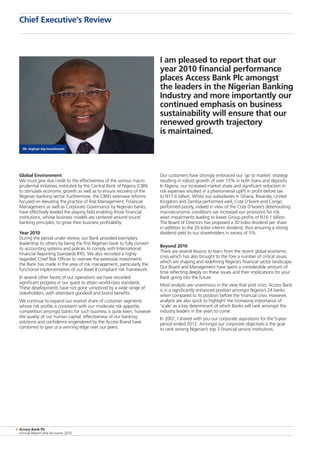
Mr. Aigboje Aig-Imoukhuede
I am pleased to report that our
year 2010 financial performance
places Access Bank Plc amongst
the leaders in the Nigerian Banking
Industry and more importantly our
continued emphasis on business
sustainability will ensure that our
renewed growth trajectory
is maintained.
Overview
Business Review
Governance
Financial Statements
Shareholders’ Information
Corporate Information
Access Bank Plc
Annual Report and Accounts 2010
9
Our analysis convinces us that a significant increase in the scale of
resources available to the Bank is required for the fulfillment of our
strategic objectives.
We will utilise the opportunities arising out of CBN’s Banking
Crisis Resolution Programme to pursue growth inorganically whilst
remaining focused on our existing organic growth game plan.
We are confident that the strong competencies we have built in-
house in the areas of mergers and acquisitions, together with the
engagement of world-class advisers with whom we have in the past
shared several successful business combinations, will enable
us to overcome the challenges to come.
In my usual tradition, I extend on behalf of all my colleagues our
appreciation to our customers, shareholders, regulators and other
stakeholders who continue to support our Quest for Excellence. I
would especially like to thank all our employees who continue to
demonstrate the quest for high performance and the hunger to
excel.
Most especially I give thanks to the Almighty for all He has made
possible.
God bless.
MR AIGBOJE AIG-IMOUKHUEDE
GROUP MANAGING DIRECTOR/CHIEF EXECUTIVE OFFICER
“The quality of our human capital,
effectiveness of our banking
solutions and confidence
engendered by the Access Brand
have combined to give us a
winning edge over our peers”
At the heart of everything we do, we will make our vision a
reality and our mission a successful one. Together they form
the bedrock of our business:
Vision
To transform our Bank into a world-class financial services provider.
Mission
To go beyond the ordinary, to deliver the perceived impossible,
in the Quest for Excellence.
Our Core Values:
Excellence
We strive to attain and exceed the highest possible standards
through our passionate and painstaking attention to detail.
Ethics
Our operations are transparent and always comply with
regulations, while decisions are based purely on business interest.
Trust
We have total confidence in one another. We will work tirelessly
to earn the faith, loyalty and confidence of our customers.
To this end, we will always deliver on contracts, agreements,
undertakings and assurances.
Teamwork
We hold the interest of the team above those of the individual,
while showing mutual respect for all employees and sharing
information throughout our organisation.
Passion for customers
Customers always come first. We develop a deep understanding
of our customers, approaching them with a positive “can do”
attitude and responding creatively to their needs.
Continuous learning
We are dedicated to continuous growth and career development.
This principle is applied at all levels and across all functions.
10 Access Bank Plc
Annual Report and Accounts 2010
Report of the External Consultant on the Board Assessment
Accenture
2nd Floor, Citibank Building, 27 Kofo Abayomi Street
P.M.B. 80085, Victoria Island· Lagos, Nigeria
Tel. +234 1 2707100· Fax: +2341 2707111
www.accenture.com
Friday, 18th March 2011
The Chairman
Access Bank Plc
Plot 1665, Oyin Jolayemi Street
Victoria Island, Lagos
Dear Sir,
REPORT OF THE EXTERNAL CONSULTANT ON THE BOARD ASSESSMENT OF
ACCESS BANK PLC
In compliance with the Central Bank of Nigeria (CBN) guidelines on the ‘Code of Cor-
porate Governance for Banks in Nigeria, Post Consolidation’ (the CBN CODE) we have
conducted the Annual Board Performance Assessment for Access Bank for the year
ended December 2010.
Our assessment focused on Access Bank’s compliance with the basic principles that
promote sound corporate ethics, accountability and transparency and standards set by
the CBN code.
The composition of the Board of Directors is in compliance with the requirements of
the CBN Code. There is clear separation of roles between the position of the Chairman
of the Board and the Managing Director/Chief Executive Officer. Board Committees
are properly constituted and there is a documented term of reference of each
subcommittee. The Chairman of the Board is not a member of any Board Committee.
Board members are knowledgeable in business and financial matters and understand
their fiduciary responsibilities as directors and roles in providing financial oversight and
enhancing shareholder value. The Board oversees and is involved in monitoring financial
and strategic performance of the Bank. There are appropriate audit structures, credit
processes, Risk Management Framework and Succession Planning Policy in compliance
with CBN code.
Following our assessment, specific recommendations in respect of areas for further im-
provement of the Board’s current good performance have been presented to the Board.
Yours sincerely,
ACCENTURE
Toluleke Adenmosun
Senior Executive, Financial Services
Overview
Business Review
Governance
Financial Statements
Shareholders’ Information
Corporate Information
Access Bank Plc
Annual Report and Accounts 2010
11
Accenture
2nd Floor, Citibank Building, 27 Kofo Abayomi Street
P.M.B. 80085, Victoria Island· Lagos, Nigeria
Tel. +234 1 2707100· Fax: +2341 2707111
www.accenture.com
Friday, 18th March 2011
The Chairman
Access Bank Plc
Plot 1665, Oyin Jolayemi Street
Victoria Island, Lagos
Dear Sir,
SUMMARY REPORT ON CORPORATE GOVERNANCE
We have reviewed the corporate governance arrangements at Access Bank Plc with regards
to the Central Bank Code on Corporate Governance for Banks, Post Consolidation and
find the Bank materially compliant with the requirements of the Code.
BASIS OF REVIEW
The Bank’s Memorandum and Articles of Association, Board Terms of Reference, Board
papers, minutes of Board meetings, Risk Management Framework and Succession
Planning Policy were reviewed for compliance and we also conducted interviews with
principal officers of the Bank.
We examined the Bank’s audit structures and credit processes as well as assessed
directors’ understanding of their fiduciary duties and roles in providing financial
oversight and enhancing shareholder value.
The review was conducted in February 2011.
SUMMARY OF FINDINGS
Based on our review of available documentation and after discussions carried out with
the principal officers listed above, Access Bank has been found to be compliant
with the requirements of the CBN Code on Corporate Governance.
The conclusion from our analysis is that the non-executive as well as executive directors
of the Bank fully understand their fiduciary duties and roles in providing financial
oversight and enhancing shareholder value.
Please find the full details of our findings and recommendations in respect of areas that
require attention attached.
Yours sincerely,
ACCENTURE
Toluleke Adenmosun
Senior Executive, Financial Services
Access Bank Plc
Annual Report and Accounts 2010
12 Access Bank Plc
Annual Report and Accounts 2010
12
Projects
1 Industrial Cartons Limited. In line with
its objectives to aid the manufacturing
industry in the country, Access Bank
granted Finance Lease Facility to the
tune of N1.44bn which was used to
finance the acquisition of a corrugated
carton production line. The automated
production line which has been installed,
has a production capacity of 2,200 tonnes
monthly. Address: Acme Crescent, Off
Acme Road, Agidingbi, Ikeja.
2 Nestle Nigeria Plc. Access Bank Plc
secured a term loan of N2Bn to finance
one of the key investment plans of Nestle
Nigeria in Milling and Malting plant. The
plants were constructed at the company’s
premises in Agbara and would aid the
increase in milling and malting capacity of
the company and its output in meeting
the needs of its consumers. Address: Km
32, Lagos Badagry Expressway, Agbara
Industrial Estate, Agbara, Ogun State.
3 Dangote Cement Plc. Address: (Obajana
Plant); Kabba-Lokoja Road, Obajana, Kogi
State. Lagos Office: 1, Alfred Rewane
Road, Falomo, Ikoyi, Lagos.
1
2
3
Overview
Business Review
Governance
Financial Statements
Shareholders’ Information
Corporate Information
Access Bank Plc
Annual Report and Accounts 2010
13
Institutional Banking division has experienced
and highly qualified professionals with deep
industry knowledge to run the business in the
targeted sectors. Despite the difficult operating
environment in the year, we maintained a close
relationship with our customers.
The highlight of our financial performance is
shown below:
Hence, in 2011 the Institutional Banking division
strategy continues to be superior customer
service via a relationship team;
— Focused on the customers’ value chain
meeting the needs of existing and new
customers through good grasp of their
business
— Signing of new investment grade corporate
customers for the Bank
— Aggressive loan recovery drive.
The Institutional Banking division serves
as the anchor of the value chain strategy/
model of Access Bank. The division
provides a full bouquet of products and
financial services through the various
e-channels and branch network of
the Bank.
The division is structured along the key
sectors in the economy the Bank has
chosen to play in and has built competence
in over the years. The customers we serve
are drawn from key sectors in the economy
such as; Oil  Gas, Telecommunications,
Financial Services, Food  Beverage,
Cement, Transportation and Household
Utilities. Good understanding of our
chosen sectors and proven successes
over the years have resulted in building
deep and long lasting relationships with
customers in our target market and
enhanced our ability to provide bespoke
products  services as value adding
solutions to their banking needs.
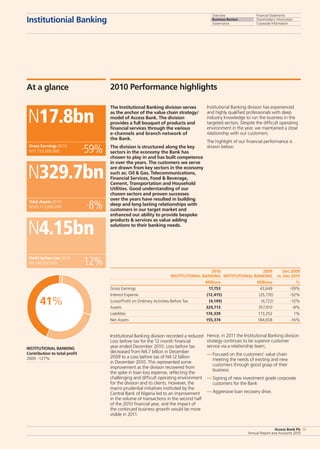
Institutional Banking division recorded a reduced
Loss before tax for the 12 month financial
year ended December 2010. Loss before tax
decreased from N4.7 billion in December
2009 to a Loss before tax of N4.12 billion
in December 2010. This represented some
improvement as the division recovered from
the spike in loan loss expense, reflecting the
challenging and difficult operating environment
for the division and its clients. However, the
macro prudential initiatives instituted by the
Central Bank of Nigeria led to an improvement
in the volume of transactions in the second half
of the 2010 financial year, and the impact of
the continued business growth would be more
visible in 2011.
Institutionial Banking
Institutional Banking
Contribution to total profit
2009: -127%
Gross Earnings 2010:
N17,753,000,000
Total Assets 2010:
N329,713,000,000
Profit before tax 2010:
N4,149,000,000
N17.8bn
N329.7bn
N4.15bn
-59%
-8%
-12%
At a glance 2010 Performance highlights
Access Bank Plc
Annual Report and Accounts 2010
13
	 2010 	 2009 	 Dec 2009
	 INSTITUTIONAL BANKING	 INSTITUTIONAL BANKING	 vs. Dec 2010
	 Millions	 Millions	 %
Gross Earnings	 17,753 	 43,649 	 -59%
Interest Expense 	 (12,415) 	 (25,735)	 -52%
(Loss)/Profit on Ordinary Activities Before Tax	 (4,149) 	 (4,722)	 -12%
Assets	 329,713	 357,910 	 -8%
Liabilities	 174,339	 173,252	 1%
Net Assets	 155,374	 184,658	 -16%
Overview
Business Review
Governance
Financial Statements
Shareholders’ Information
Corporate Information
41%
Access Bank Plc
Annual Report and Accounts 2010
14 Access Bank Plc
Annual Report and Accounts 2010
14
1
Projects
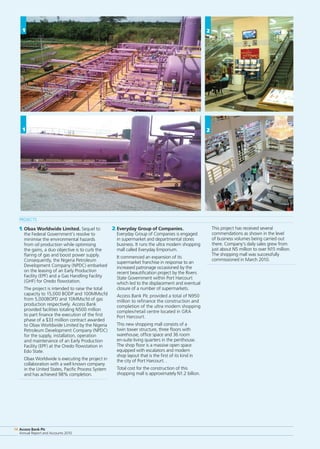
1.	Obax Worldwide Limited. Sequel to
the Federal Government’s resolve to
minimise the environmental hazards
from oil production while optimising
the gains, a duo objective is to curb the
flaring of gas and boost power supply.
Consequently, the Nigeria Petroleum
Development Company (NPDC) embarked
on the leasing of an Early Production
Facility (EPF) and a Gas Handling Facility
(GHF) for Oredo flowstation.
	 The project is intended to raise the total
capacity to 15,000 BODP and 100MMscfd
from 5,000BOPD and 10MMscfd of gas
production respectively. Access Bank
provided facilities totaling N500 million
to part finance the execution of the first
phase of a $33 miillion contract awarded
to Obax Worldwide Limited by the Nigeria
Petroleum Development Company (NPDC)
for the supply, installation, operation
and maintenance of an Early Production
Facility (EPF) at the Oredo flowstation in
Edo State.
	 Obax Worldwide is executing the project in
collaboration with a well known company
in the United States, Pacific Process System
and has achieved 98% completion.
2.	Everyday Group of Companies.
Everyday Group of Companies is engaged
in supermarket and departmental stores
business. It runs the ultra modern shopping
mall called Everyday Emporium.
	 It commenced an expansion of its
supermarket franchise in response to an
increased patronage occasioned by the
recent beautification project by the Rivers
State Government within Port Harcourt
which led to the displacement and eventual
closure of a number of supermarkets.
	 Access Bank Plc provided a total of N950
million to refinance the construction and
completion of the ultra modern shopping
complex/retail centre located in GRA
Port Harcourt.
	 This new shopping mall consists of a
twin tower structure, three floors with
warehouse, office space and 36 room
en-suite living quarters in the penthouse.
The shop floor is a massive open space
equipped with escalators and modern
shop layout that is the first of its kind in
the city of Port Harcourt. .
	 Total cost for the construction of this
shopping mall is approximately N1.2 billion.
	 This project has received several
commendations as shown in the level
of business volumes being carried out
there. Company’s daily sales grew from
just about N5 million to over N15 million.
The shopping mall was successfully
commissioned in March 2010.
2
2
1
Overview
Business Review
Governance
Financial Statements
Shareholders’ Information
Corporate Information
Access Bank Plc
Annual Report and Accounts 2010
15
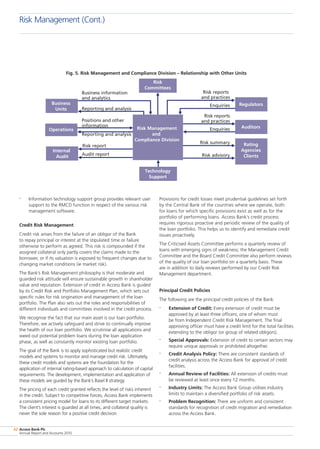
— Commercial Banking provided products and
services to suppliers, distributors and other
businesses with an annual turnover below
N5 billion
— Public Sector catered to Federal and State
Government ministries, agencies and
parastatals
— Wealth Management focused exclusively
on high net-worth individuals by providing
bespoke banking services.
The customer segments, in line with the value
chain model of the Bank, served customers
of large corporate customers in the Bank’s
chosen target markets/sectors: Oil  Gas,
Telecommunications, Cement, Financial
Institutions, Personal Care, Food  Beverages.
The highlight of our financial performance is
shown below:
the economy and industry entered the recovery
mode. Credit creation improved as a result of
various policies instituted by the Central Bank of
Nigeria to drive growth through lending to the
real sector of the economy.
In 2011, the operating environment will still be
challenging, however the Commercial Banking
division adhering to best practice will enlarge
market share of its customers businesses. The
group will embrace the values of efficiency,
transparency, accountability, discipline and
fairness to deliver an improved result in 2011.
The Commercial Banking division serves
businesses, suppliers, distributors of
large corporate organisations and public
sector (Federal and State Government
ministries, agencies and parastatals, wealth
management). The division offers a full
range of banking services and products
to meet the needs of the customers by
following the value chain of the customers.
Despite the changes in the operating
environment, we have remained
focused on our strategy driven by the
self sustaining value chain model. The
unusual changes therefore have resulted
in opportunities for the bank to sign
on new customers, and increase market
share of its customers’ business.
During the financial year, the Commercial
Banking division redefined its structure and
adopted a new organisational model that
was based on customer segments;
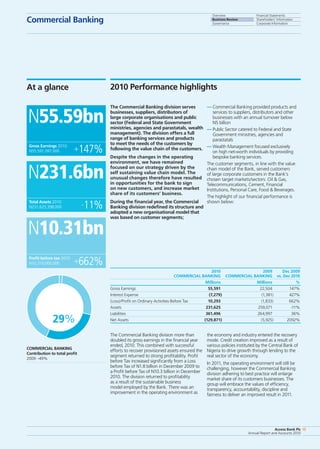
The Commercial Banking division more than
doubled its gross earnings in the financial year
ended, 2010. This combined with successful
efforts to recover provisioned assets ensured the
segment returned to strong profitability. Profit
before Tax increased significantly from a Loss
before Tax of N1.8 billion in December 2009 to
a Profit before Tax of N10.3 billion in December
2010. The division returned to profitability
as a result of the sustainable business
model employed by the Bank. There was an
improvement in the operating environment as
	 2010 	 2009 	 Dec 2009
	 COMMERCIAL BANKING	 COMMERCIAL BANKING	 vs. Dec 2010
	 Millions	 Millions	 %
Gross Earnings	 55,591 	 22,504 	 147%
Interest Expense 	 (7,279) 	 (1,381)	 427%
(Loss)/Profit on Ordinary Activities Before Tax	 10,293 	 (1,833)	 662%
Assets	 231,625 	 259,071	 -11%
Liabilities	 361,496	 264,997	 36%
Net Assets	 (129,871)	 (5,925)	 2092%
Commercial Banking
Access Bank Plc
Annual Report and Accounts 2010
15
Commercial Banking
Contribution to total profit
2009: -49%
Gross Earnings 2010:
N55,591,097,000
Total Assets 2010:
N231,625,398,000
Profit before tax 2010:
N10,310,000,000
N55.59bn
N231.6bn
N10.31bn
+147%
-11%
+662%
At a glance 2010 Performance highlights
Overview
Business Review
Governance
Financial Statements
Shareholders’ Information
Corporate Information
29%
Access Bank Plc
Annual Report and Accounts 2010
16
HIGHLIGHTS
1 Financial Markets. We have
renewed optimism for a rebound in
the financial markets in 2011.
2 Working for Africa. One of our
objectives is to increase the existing
financing channels for the private
and public sectors through access
to local and international Markets,
Trading, and Asset Management.
Access Bank Plc
Annual Report and Accounts 2010
16
1
2
Overview
Business Review
Governance
Financial Statements
Shareholders’ Information
Corporate Information
Access Bank Plc
Annual Report and Accounts 2010
17
the first bank to contribute market quotes for
wide-ranging instruments across sub-Saharan
African countries on the Bloomberg Professional
Software®
.
Corporate Finance Group
The operating performance for the Corporate
Finance Group in the year 2010 was limited
by several challenges, which include the
global financial meltdown, stunted economic
growth within the sub-Saharan African region,
unfavourable economic indicators (interest rates,
FX volatility and inflation) as well as capital
market downturn, among others. Our project
finance/on-lending segment was particularly
affected by the general liquidity squeeze in the
financial sector, which made Banks unwilling
to lend to viable projects on a long-term basis.
Funds received from development finance
institutions were left largely unutilised or
partially utilised. Opportunities for syndications
were also limited during the year 2010.
We have renewed optimism for a rebound in
the financial markets in 2011, as a result of
various measures being put in place by the
Central Bank of Nigeria, the recovery of
sub-Saharan Africa from the global financial
crisis, sound economic policy implementation
and favourable commodity prices.
In 2011, we will continue to build on the
platform for delivering exceptional value to our
stakeholders and to increasing our client base.
The Financial Markets division provides
specialised financing and investment
solutions, trading in Fixed Income and
Currency products for our customers.
These functions are carried out through
the Treasury Group and the Corporate
Finance Group.
Access Bank Treasury Group
The Treasury business contributed strongly to
bottom-line profits. Within a dynamic, market-
driven environment, our teams work closely
with corporate customers, pension funds, and
governments to deliver superior currency and
fixed income solutions tailored specifically for
their requirements. The Treasury Group focuses
on structuring risk management solutions to
help mitigate interest rate and foreign exchange
risks for the Bank and its customers. Operating
at the cutting edge of financial services, the
Group is widely acknowledged as a market
leader in the Treasury space as evidenced by
its ranking in the monthly polls conducted by
the Financial Markets Dealers’ Association.
We have demonstrated capability to enhance
the trading liquidity in various instruments as
we executed over 10% of the total secondary
market bond transactions conducted in Nigeria
in 2010. We also received acknowledgement as
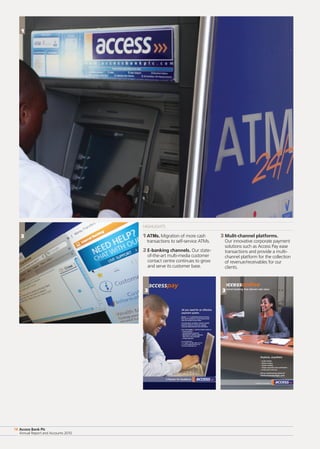
During the 12 month period ended 31
December 2010, Investment Banking division
was able to sustain and increase profit before
tax by 202% from 2.67bn in December 2009 to
8.022bn in December 2010. The division held
on to its comparative advantage of creating
exceptional value to its clients.
	 2010 	 2009 	 Dec 2009
	 INVESTMENT BANKING	 INVESTMENT BANKING	 vs. Dec 2010
	 Millions	 Millions	 %
Gross Earnings	 11,682 	 8,041 	 -45%
Interest Expense 	 (1,184) 	 (695)	 70%
(Loss)/Profit on Ordinary Activities Before Tax	 8,022 	 2,666	 208%
Assets	 224,720 	 45,509	 394%
Liabilities	 51,596	 21,814	 137%
Net Assets	 173,124	 23,695	 631%
Financial Markets
Access Bank Plc
Annual Report and Accounts 2010
17
INVESTMENT Banking
Contribution to total profit
2009: +172%
Gross Earnings 2010:
N11,682,000,000
Total Assets 2010:
N224,720,000,000
Profit before tax 2010:
N8,021,742,900
N11.7bn
N224.7bn
N8.02bn
-45%
+394%
+202%
At a glance 2010 Performance highlights
Overview
Business Review
Governance
Financial Statements
Shareholders’ Information
Corporate Information
28%
Access Bank Plc
Annual Report and Accounts 2010
18 Access Bank Plc
Annual Report and Accounts 2010
18
HIGHLIGHTS
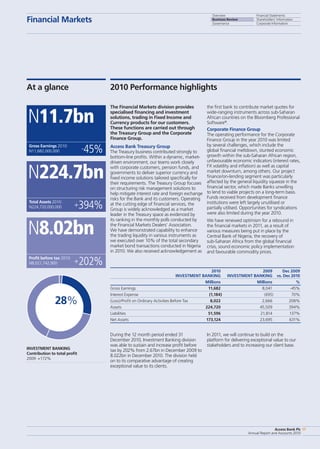
1 ATMs. Migration of more cash
transactions to self-service ATMs.
2 E-banking channels. Our state-
of-the-art multi-media customer
contact centre continues to grow
and serve its customer base.
3 Mulit-channel platforms.
Our innovative corporate payment
solutions such as Access Pay ease
transactions and provide a multi-
channel platform for the collection
of revenue/receivables for our
clients.
1
3
3 3
Overview
Business Review
Governance
Financial Statements
Shareholders’ Information
Corporate Information
Access Bank Plc
Annual Report and Accounts 2010
19
Retail Banking
Access Bank Plc
Annual Report and Accounts 2010
19
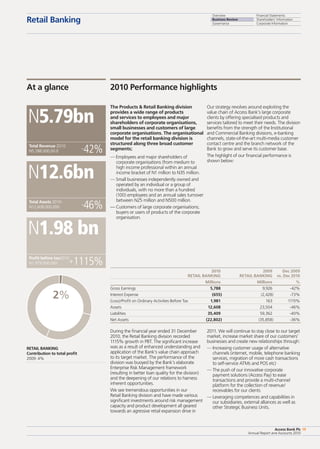
RETAIl Banking
Contribution to total profit
2009: 4%
Total Revenue 2010:
N5,788,000,00.0
Total Assets 2010:
N12,608,000,000
Profit before tax2010:
N1,979,000,000
N5.79bn
N12.6bn
N1.98 bn
-42%
-46%
+1115%
At a glance 2010 Performance highlights
Our strategy revolves around exploiting the
value chain of Access Bank’s large corporate
clients by offering specialised products and
services tailored to meet their needs. The division
benefits from the strength of the Institutional
and Commercial Banking divisions, e-banking
channels, state-of-the-art multi-media customer
contact centre and the branch network of the
Bank to grow and serve its customer base.
The highlight of our financial performance is
shown below:
During the financial year ended 31 December
2010, the Retail Banking division recorded
1115% growth in PBT. The significant increase
was as a result of enhanced understanding and
application of the Bank’s value chain approach
to its target market. The performance of the
division was buoyed by the Bank’s elaborate
Enterprise Risk Management framework
(resulting in better loan quality for the division)
and the deepening of our relations to harness
inherent opportunities.
We see tremendous opportunities in our
Retail Banking division and have made various
significant investments around risk management
capacity and product development all geared
towards an agressive retail expansion drive in
The Products  Retail Banking division
provides a wide range of products
and services to employees and major
shareholders of corporate organisations,
small businesses and customers of large
corporate organisations. The organisational
model for the retail banking division is
structured along three broad customer
segments;
— Employees and major shareholders of
corporate organisations (from medium to
high income professional within an annual
income bracket of N1 million to N35 million.
— Small businesses independently owned and
operated by an individual or a group of
individuals, with no more than a hundred
(100) employees and an annual sales turnover
between N25 million and N500 million.
— Customers of large corporate organisations;
buyers or users of products of the corporate
organisation.
	 2010 	 2009 	 Dec 2009
	 RETAIL BANKING	 RETAIL BANKING	 vs. Dec 2010
	 Millions	 Millions	 %
Gross Earnings	 5,788 	 9,926 	 -42%
Interest Expense 	 (655) 	 (2,428)	 -73%
(Loss)/Profit on Ordinary Activities Before Tax	 1,981	 163	 1115%
Assets	 12,608 	 23,504	 -46%
Liabilities	 35,409	 59,362 	 -40%
Net Assets	 (22,802)	 (35,858)	 -36%
2011. We will continue to stay close to our target
market, increase market share of our customers’
businesses and create new relationships through:
— Increasing customer usage of alternative
channels (internet, mobile, telephone banking
services, migration of more cash transactions
to self-service ATMs and POS etc)
— The push of our innovative corporate
payment solutions (Access Pay) to ease
transactions and provide a multi-channel
platform for the collection of revenue/
receivables for our clients
— Leveraging competences and capabilities in
our subsidiaries, external alliances as well as
other Strategic Business Units.
Overview
Business Review
Governance
Financial Statements
Shareholders’ Information
Corporate Information
2%
Access Bank Plc
Annual Report and Accounts 2010
20 Access Bank Plc
Annual Report and Accounts 2010
20
HIGHLIGHTS
• The Transaction Services
Division is central to the fulfillment
of Access Bank’s promise of
excellent service to its clientele
through delivery of world-class
service and creation of exciting
customer experience.
Overview
Business Review
Governance
Financial Statements
Shareholders’ Information
Corporate Information
Access Bank Plc
Annual Report and Accounts 2010
21
Transaction Services
Access Bank Plc
Annual Report and Accounts 2010
21
Overview
Business Review
Governance
Financial Statements
Shareholders’ Information
Corporate Information
The Transaction Services division is central
to the fulfillment of Access Bank’s promise
of excellent service to its clientele through
delivery of world-class service and creation
of exciting customer experience.
The division’s value proposition can be
summarised as Quality of Service Delivery,
Quality of Process Execution and Efficiency
of Operations. The division comprises of the
following groups: Central Processing Centre,
Global Trade, Branch Services, International
Operations and Total Quality Management.
The division is also the vehicle by which the Bank
mitigates most of the operational risks in the
Bank’s activities in line with organisational plan.
As part of its alignment with the Bank’s
corporate objectives and those of other business
divisions in the Bank, the Transaction Services
Division has in place relationship models
for engaging the different categories of the
Bank’s customers. At the core of the customer
engagement relationship model are select
Institutional and Public sector clients, who
constitute Tier 1. This category is followed by
Tier 2, which comprises of the Bank’s Corporate
and Large Commercial customers who typically
have direct business relationships with the Tier
1 clientele. High Networth and Private Banking
customers are also categorised as Tier 2. Further,
the customer engagement model covers the
Bank’s smaller commercial and individual clients,
who constitute Tier 3. This tier is typically made
of entities and persons with direct business or
personal relationship with entities in Tiers 1
and 2.
The engagement model is designed to
facilitate effective management of customers’
expectations and resource dedication for
actualisation of institutional objective of excellent
service and differentiated offerings to customers.
The actualisation of this objective largely rests on
the broad knowledge base and professionalism
of the Bank’s employees and their commitment
to one of the core institutional values: Passion
for Customers, for which key performance
indicators have been developed and measured
for improvement.
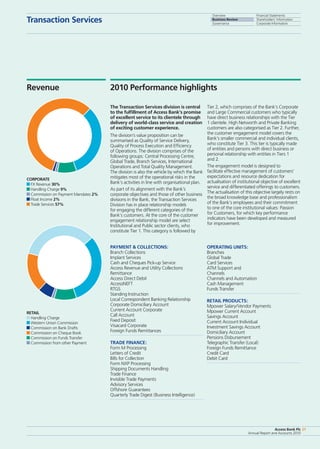
RETAIl
Handling Charge
Western Union Commission
Commission on Bank Drafts
Commission on Cheque Book
Commission on Funds Transfer
Commission from other Payment
Corporate
FX Revenue 30%
Handling Charge 9%
Commission on Payment Mandates 2%
Float Income 2%
Trade Services 57%
2010 Performance highlightsRevenue
OPERATING UNITS:
Branches
Global Trade
Card Services
ATM Support and
Channels
Channels and Automation
Cash Management
Funds Transfer
RETAIL PRODUCTS:
Mpower Salary/Vendor Payments
Mpower Current Account
Savings Account
Current Account Individual
Investment Savings Account
Domiciliary Account
Pensions Disbursement
Telegraphic Transfer (Local)
Foreign Funds Remittance
Credit Card
Debit Card
PAYMENT  COLLECTIONS:
Branch Collections
Implant Services
Cash and Cheques Pick-up Service
Access Revenue and Utility Collections
Remittance
Access Direct Debit
AccessNEFT
RTGS
Standing Instruction
Local Correspondent Banking Relationship
Corporate Domiciliary Account
Current Account Corporate
Call Account
Fixed Deposit
Visacard Corporate
Foreign Funds Remittances
TRADE FINANCE:
Form M Processing
Letters of Credit
Bills for Collection
Form NXP Processing
Shipping Documents Handling
Trade Finance
Invisible Trade Payments
Advisory Services
Offshore Guarantees
Quarterly Trade Digest (Business Intelligence)
Access Bank Plc
Annual Report and Accounts 2010
22
Our Products  Services
Access Bank Plc
Annual Report and Accounts 2010
22
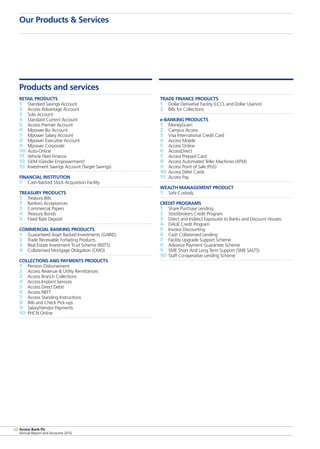
Products and services
RETAIL PRODUCTS
1	 Standard Savings Account
2	 Access Advantage Account
3	 Solo Account
4	 Standard Current Account
5	 Access Premier Account
6	 Mpower Biz Account
7	 Mpower Salary Account
8	 Mpower Executive Account
9	 Mpower Corporate
10	Auto-Online
11	 Vehicle Fleet Finance
12	 GEM (Gender Empowerment)
13	 Investment Savings Account (Target Savings)
FINANCIAL INSTITUTION
1	 Cash-backed Stock Acquisition Facility
TREASURY PRODUCTS
1	 Treasury Bills
2	 Bankers Acceptances
3	 Commercial Papers
4	 Treasury Bonds
5	 Fixed Rate Deposit
COMMERCIAL BANKING PRODUCTS
1	 Guaranteed Asset Backed Investments (GAINS)
2	 Trade Receivable Forfaiting Products
3	 Real Estate Investment Trust Scheme (REITS)
4	 Collaterised Mortgage Obligation (CMO)
COLLECTIONS AND PAYMENTS PRODUCTS
1	 Pension Disbursement
2	 Access Revenue  Utility Remittances
3	 Access Branch Collections
4	 Access Implant Services
5	 Access Direct Debit
6	 Access NEFT
7	 Access Standing Instructions
8	 Bills and Check Pick-ups
9	 Salary/Vendor Payments
10	PHCN Online
TRADE FINANCE PRODUCTS
1	 Dollar Derivative Facility (LCCL and Dollar Usance)
2	 Bills for Collections
e-BANKING PRODUCTS
1	 MoneyGram
2	 Campus Access
3	 Visa International Credit Card
4	 Access Mobile
5	 Access Online
6	 AccessDirect
7	 Access Prepaid Card
8	 Access Automated Teller Machines (ATM)
9	 Access Point of Sale (PoS)
10	Access Debit Cards
11	 Access Pay
WEALTH MANAGEMENT PRODUCT
1	 Safe Custody
CREDIT PROGRAMS
1	 Share Purchase Lending
2	 Stockbrokers Credit Program
3	 Direct and Indirect Exposures to Banks and Discount Houses
4	 DAUE Credit Program
5	 Invoice Discounting
6	 Cash Collaterised Lending
7	 Facility Upgrade Support Scheme
8	 Advance Payment Guarantee Scheme
9	 SME Short And Long Term Support (SME SALTS)
10	Staff Co-operative Lending Scheme
Overview
Business Review
Governance
Financial Statements
Shareholders’ Information
Corporate Information
Access Bank Plc
Annual Report and Accounts 2010
23
IT Services
Access Bank Plc
Annual Report and Accounts 2010
23
In 2010, key automation projects were successfully implemented
which resulted in business optimisation and delivered competitive
advantage for our business. A strategic approach utilised
engendered the reduction of the environmental impact of our
technology systems.
As a result, we have been able to achieve:
—	Business continuity
—	Process efficiency and cost reduction
—	Increased revenues and profitability
—	Robust governance and service excellence
—	Environmental sustainability.
During 2010, the following automation initiatives were successfully
delivered:
—	Automation of the front, middle and back office Treasury
processes. This has brought about significant improvements in
efficiency, accuracy, controls and significantly improved capability
to effectively serve our customers.
—	As a key development of our Enterprise Risk Management
Framework, automated Asset and Liability and Market Risk
applications were implemented. These applications have
transformed the Bank’s ability to take an integrated and
enterprise approach to risk management. A comprehensive Risk
Management Dashboard also provides Management with up to
date information of business performance across all risk categories.
—	Successful automation of our Global Trade business. This
platform automates the Global Trade process bringing about
improvements in responsiveness to customers, process quality and
risk management. A customer-facing portal to enable customer
self service in the comfort of their offices, with straight through
processing and transaction tracking.
—	Successful delivery and implementation of our suite of industry
leading integrated payments, collections, cash management and
payroll solutions for our clients. These solutions are integrated
into our customer’s systems to provide efficient and cost effective
bulk payments, collections and reporting capabilities, helping
customers integrate their payments and collections value chain.
As part of the continued significant investment in core technology
in the Bank, our state of the art Data Centre was launched in 2010.
One of the most sophisticated Data Centres in Financial Services in
Africa; it provides a high availability platform for all of our IT services
and has been built to sustain our Bank’s growth into the future.
As part of our service to Nigeria and the financial community, we
championed the adoption and implementation of the International
Financial Reporting Standards (IFRS) in Nigeria, active participation
and leadership in shaping the electronic payment services and the
shared service initiative of Central Bank of Nigeria.
The Bank continues to develop its enterprise architecture and
strategy for IT enabled business transformation to enable
sustainable business growth for 2011 and into the future. As
part of this strategy, it is now poised to overhaul its core banking
application in 2011 with Oracle Corporation’s latest FLEXCUBE
universal banking platform, further assisting our Bank to
effectively leverage technology into the future.
Access Bank has a robust Information Technology (IT)
system that enables it to effectively support Access
Bank Group’s business strategy for business growth
and sustainability.
Access Bank Plc
Annual Report and Accounts 2010
24
Our People  Culture
We encourage a sense of ownership in all aspects of our business,
develop requisite professional and ethical behavioural standards,
deliver superior client service, embrace sound financial discipline and
recognise and reward good performance. Our objective is to have
well-motivated staff that experience career satisfaction and take pride
in working for a respected organisation that offers progressive career
development at an individual level.
Recruitment and talent management
As a merit-driven organisation, Access Bank is committed to providing
equality in employment for all levels of staff. We have put a number of
global processes and programmes in place to capture and develop talent
from graduate entry to the most senior levels of the organisation.
At entry-level positions, we are interested in young, energetic, result-
oriented and highly intelligent individuals with a proven passion for
joining a team of driven and high performing professionals. Their
career journey begins with four months’ intensive training at the
Banking School of Excellence where our stars are identified. This
helps to reinforce the culture of Access Bank and ensures our people
develop the capability needed for business sustainability.
People are the core of Access Bank’s identity as
a responsible organisation. Our human resource
management practices are designed to create an
inclusive work environment that accommodates the
needs of each individual employee.
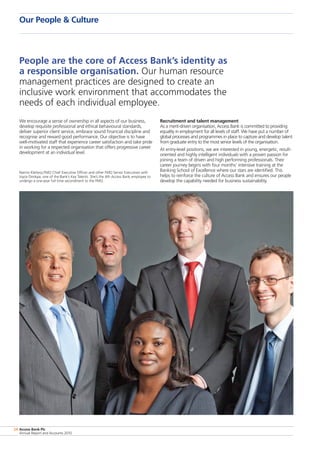
Nanno Kleiterp,FMO Chief Executive Officer and other FMO Senior Executives with
Joyce Dimkpa, one of the Bank’s Key Talents. She’s the 4th Access Bank employee to
undergo a one-year full time secondment to the FMO.
Overview
Business Review
Governance
Financial Statements
Shareholders’ Information
Corporate Information
Access Bank Plc
Annual Report and Accounts 2010
25
At the experienced hire level, we look for ambitious, self motivated
individuals with leadership qualities and capabilities, inspired and
ready to harness their potential in order to consistently exceed
customer expectations.
Recruitment is achieved via a web based e-recruitment portal which
provides a platform for equality and transparency throughout the
process. At the Access Bank School of Banking Excellence, the
performance of each trainee is set against clear and objectively
defined benchmarks. The level of performance against these
benchmark(s) determines the trainees’ absorption into the
organisation and subsequent performance evaluation.
Getting the best from our staff
The Human Resources Group at Access Bank in 2010 initiated,
implemented and supported the following programmes to enhance
employee productivity:
1 STI (Short Term Incentive): The Bank engaged Oliver Wyman
Consulting Services to conduct a process improvement programme
to assess the efficiency of key processes in the Bank and also
evaluate our strategy and overall operating model. The objective
was to manage cost and improve productivity associated with
the minimum hurdle rate of staff. Part of this was simplifying key
performance indicators in order to set clear goals, another factor
was the uncapping of our performance bonus in profit which
drives our employees’ productivity.
2 Revision of our Orientation Programme for managers and
above: To equip our line supervisors and business leaders with
the necessary tools and an understanding of our culture, the Bank
revised its global employee induction programme for managers
and above to improve their learning and skills development.
	 Programmes were initiated during the course of the 2010 financial
year to drive up the deposit volumes of our market-facing business
operations.
3 Exchange Programme with FMO: FMO is the entrepreneurial
development bank of the Netherlands. Annually, we second one
staff member to FMO for a year’s work experience to enhance staff
capacity. Currently we have a Senior Manager on secondment to
FMO in The Hague.
4 Training (international training and e-learning): Increasingly,
our focus is on developing competencies to build a more
sustainable organisation. Addressing long-term sustainability issues
will require different skillsets and ways of thinking. As part of a
bid to enhance our employees’ capacity, many of our staff were
sent for international training such as the Chartered Institute of
Personnel and Development. Our employees also achieved 89,791
training hours through our e-learning platform.
Working with others
During the 2010 financial year, Access Bank partnered with leading
universities and international organisations, such as AIESEC and the
British Council to create a pipeline for entry level talent.
Amongst our partnership initiatives were the following:
1 Conducting campus recruitment for final year undergraduates
2 Organising career counselling and a Career Day for third-year
undergraduates in all partnered universities
3 Presenting Access Bank Awards to the best graduating students
in the partnered universities.
In support and service of our country Nigeria and to help achieve
organisational objectives, Access Bank seconded a total of four
employees to government ministries and establishments:
— 	A Manager to the Ministry of Finance as a Special Assistant to the
Minister of State Finance
— 	A Manager to the Budget Office as a Special Assistant
— 	Most recently, two managers (one Senior Manager who is an
expert in Branch Expansion and one Assistant Manager from
the Corporate Communications department) to the Securities
Exchange Commission (SEC). The Commission is currently
rebranding its corporate identity and architectural structure
and needed a specialist with deep expertise in the field. Access
staff were seconded to the Commission with the intention of
replicating the formidable positioning of the Access Bank and
structure in the repositioning of the Commission’s brand. At the
same time, the SEC Director was recognised by Access as able
to benefit our architectural structure and position our brand
favourably within the industry.
The combination of these people-based initiatives have positioned
Access Bank as an employer of choice, redefined its performance
matrix and delivered value to stakeholders in a responsible manner.
Our Values: Excellence, Ethics,
Passion for customers, Teamwork,
Trust and Continuous learning
Access Bank Plc
Annual Report and Accounts 2010
26
Corporate Social Responsibility
Building a Sustainable Business
Responsible business practice
Access Bank’s responsible banking philosophy promotes financial
growth and enhances sustainable social and environmental causes
across a range of stakeholder groups. The Bank’s responsible
business practice is reflected in all aspects of its business operations
which include, but are not limited to, the following:
Economic development and advocacy: The Bank achieves
this through establishing linkages with local and international
governmental, non-governmental and private organisations of
repute to provide cutting-edge thought leadership and develop an
innovative business approach to societal development.
Gender and small and medium enterprise (SME) finance: Access
Bank aims to create equal financial opportunities through its support
for new and/or emerging businesses. This promotes financial growth
while enhancing social and environmental causes.
Environment: Core to our responsible practice is our support for
global sustainability efforts at making business operations more
conducive for individuals and the environment.
Treating customers fairly: Through this practice, we aim to build and
maintain sustainable, long-term relationships with our customers.
Employee and partner relations: This enables the Bank to create an
engaging and inclusive work environment while also developing new
business opportunities through CSR and sustainability initiatives.
In 2010, Access Bank’s innovative business approach to societal
development was achieved through the following initiatives:
— 	Access Bank contributed significantly towards the adoption of
the International Finance Reporting Standard (IFRS) in Nigeria.
To this end, the Bank organised an IFRS International Conference
aimed at preparing Nigerian banking industry stakeholders for
the successful adoption of the IFRS by 31 December, 2012.
— 	Reputed as a ‘Bank of Best Practice’, Access Bank has
commenced the strategic integration of environmental and
social (ES) risk management considerations into its business
operations. The review takes all significant ES issues into
consideration while ensuring that our business operations do
not degrade the environment or cause social harm. Through this
project, Access Bank achieved the following:
— 	Developed specific ES policies for sectors such as Oil  Gas
and Cement which have the greatest impacts on ES risks
— 	Reviewed and aligned ES policy and procedures with
international best practice standards
— 	Developed a risk management toolkit that will assist the
Bank in screening projects to identify potential ES risks;
determine appropriate level of ES due diligence required
for projects and integrate ES policy into existing credit
processes.
Community investment
With an ongoing commitment to appropriate 1% of annual profits
in support of charitable investments, the Bank actively seeks to
improve the affairs of host communities. It is noteworthy that
despite the difficult operating environment in 2010, Access Bank
did not curtail its commitments to social investments. Access Bank’s
community investment is conducted through strategic sponsorships
and donations; partnerships and employee volunteering.
Sponsorships and donations
At Access Bank, we also believe that Africans should take
responsibility for the development of Africa. To this end, the Bank
has taken a significant partnership step with the Global Fund by
contributing the sum of US$1 million to fund Global Fund’s ‘Gift
From Africa’ Project. This will be used to implement various strategic
projects to combat HIV/AIDS, TB and malaria across Africa.
Partnerships
Notable projects include the training of 250 small and medium
enterprises (SMEs) to develop HIV/AIDS, TB and malaria workplace
policies and programmes in partnership with Friends of the Global
Fund Africa, the hosting of a nationwide essay competition titled
‘My Tree and I’, and the launch of Green Clubs in 36 schools
across Nigeria under our “Going Green; Beyond Words” project
in collaboration with Idea Builders Initiative.
At Access Bank Plc, we recognise that responsible
business practice is fundamental to our long-term success.
Our approach to corporate social responsibility (CSR) is versatile,
as we believe it must be. In 2010, to ensure its continued relevance,
we undertook a rigorous process to comprehensively review our
CSR strategy in line with global trends and developments. As a
result, the Bank’s CSR strategy is currently implemented through
a two-pronged approach of responsible business practice and
community investment.
Overview
Business Review
Governance
Financial Statements
Shareholders’ Information
Corporate Information
Access Bank Plc
Annual Report and Accounts 2010
27
Employee volunteering
As a best-in-class financial services provider, the Bank believes that
its employees have their own responsibility to contribute to societal
development and so it supports participation in impactful initiatives
to address social concerns.
Empowered to contribute ideas, skills and resources to address social
issues, our 4500 employees are actively engaged in various high
impact and sustainable community development initiatives across
Africa in the focus areas of education, health and the environment.
So far, over 25,000 lives have been touched and impacted through
our employees. This includes around 15,000 students in educational
institutions, 100 orphans and vulnerable children affected by HIV/
AIDS, 1500 secondary school students educated about HIV/AIDS,
4000 hospital patients, 2000 community members gaining access
to portable water and around 3500 orphans, old people, prison
inmates and motherless children.
Through employees’ Adopt-A-School project, various institutions
such as Mafoluku Grammar School and Ladipo Grammar School
have been renovated and provided with facilities to ensure a
conducive learning environment; our mentorship and skills sharing
initiative has enhanced the National Youth Service Corp Scheme
while also benefiting secondary school students and teachers. Our
employees have developed stage plays to educate stakeholders on
HIV/AIDS and have also provided communities such as Ibeju Lekki
with borehole facilities for portable water. Oni Memorial Hospital
and Apapa General Hospital are beneficiaries of our hospital
intervention projects.
The Cervical Cancer Awareness Programme has provided free
screening for women and we also sponsored cataract eye surgery
for the less privileged in Calabar and Yola.
In recognition of our CSR efforts, Access Bank was named ‘Most
Socially Responsible Bank 2010’ at the African Banker Awards.
My Tree and I
Mini Health Mission
Cervical Cancer Awareness Programme
Most Socially Responsible Bank 2010
“So far, over 25,000 lives have
been touched and impacted
through our employees”
Access Bank Plc
Annual Report and Accounts 2010
28
“Access Bank Plc has a well-established risk governance
structure and an experienced risk team. Our risk management
framework provides essential tools to enable us to take timely
and informed decisions to maximise opportunities and mitigate
potential threats. Access Bank has taken pre-emptive action
to reshape the portfolio, tighten underwriting standards and
increase the frequency of risk monitoring and stress testing in
case of adverse scenarios or downturns.”
Approach to Risk
Risk is an inherent part of Access Bank Plc and its subsidiary
companies’ (“the Bank”) business activities. Access Bank’s overall risk
tolerance is established in the context of the Bank’s earnings power,
capital, and diversified business model. Effective risk management is
critical to any Bank for achieving financial soundness.
In view of this, aligning risk management to the Bank’s organisational
structure and business strategy has become an integral part of our
business. Access Bank’s risk management framework and governance
structure are intended to provide comprehensive controls and ongoing
management of the major risks inherent in its business activities. It
is also intended to create a culture of risk awareness and personal
responsibility throughout the Bank.
The Bank has taken pre-emptive action to reshape the portfolio,
tighten underwriting standards and increase the frequency of risk
monitoring and stress testing. These actions will not immunise the
Bank from the effects of a cyclical downturn in its core markets,
but should mitigate their impact.
Our risk profile at the end of 2010 is marked by a number of key
developments. The Bank has low exposure to higher-risk asset
classes, and has maintained vigilance and discipline in responding
to the challenging environment. It also has a diversified portfolio
across countries, products and customer segments; disciplined
liquidity management; a well-established risk governance
structure; and an experienced senior team.
Access Bank has been disciplined in its management of risk. The
Bank has increased its focus on the inter-relationships between risk
types and, where appropriate, underwriting standards have been
tightened. It has also conducted periodic reviews of risk exposure
limits and risk control disciplines so as to position itself against
adverse developments. To mitigate against higher levels of market
volatility and economic uncertainty, the Bank regularly subjects
its exposures to a range of stress tests across a wide variety of
products, portfolios and customer segments.
The Bank’s risk management architecture is carefully crafted to
balance corporate oversight with well-defined risk management
functions which fall into one of three lines of defence where risk
must be managed: lines of business, governance  control and
corporate audit. The Board of Directors and Management of the
Bank are committed to constantly establishing, implementing
and sustaining tested practices in risk management to match
those of leading international banks. We are convinced that the
long-term sustainability of our Bank depends critically on the
proper governance and effective management of our business.
As such, risk management occupies a significant position of
relevance and importance in the Bank.
The Board of Directors determines Access Bank’s overall objectives
in terms of risk by issuing risk policies. These policies define
acceptable levels of risk for day-to-day operations as well as
the willingness of Access Bank to assume risk, weighed against
the expected rewards. The umbrella risk policy is detailed in
the Enterprise Risk Management (ERM) Framework, which is a
structured approach to identifying opportunities, assessing the risk
inherent in these opportunities and actively managing these risks
in a cost-effective manner. It is a top-level integrated approach
to events identification and analysis for proper assessment,
monitoring and identification of business opportunities. Specific
policies are also in place for managing risks in the different risk
areas of credit, market and operational risks.
The evolving nature of risk management practices and the
dynamic character of the banking industry necessitate regular
review of the effectiveness of each enterprise risk management
component. In light of this, the Bank’s ERM Framework is subject
to continuous review to ensure effective and cutting-edge risk
management. The review is done in either or both of the following
ways: via continuous self-evaluation and monitoring by the Risk
Management and Compliance Divisions in conjunction with
internal audits; and through independent evaluation by external
auditors, examiners and consultants.
The Chief Risk Officer has primary responsibility for risk
management and the review of the ERM Framework and to
provide robust challenge to the management teams based on
quantitative and qualitative metrics. All amendments to the Bank’s
ERM Framework require Board approval. The risk management
division is responsible for the enforcement of the Bank’s risk
policy by constantly monitoring risk, with the aim of identifying
and quantifying significant risk exposures and acting upon such
exposures as necessary.
Overall, we view risk not only as a threat or uncertainty, but also as a
potential opportunity to grow and develop the business, within the
context of risk appetite. Hence, our approach to risk management
is not limited to considering downside impacts or risk avoidance; it
also encompasses taking risk knowingly for competitive advantage.
Access Bank approaches risk, capital and value management
robustly and we believe that our initiatives to date have positioned
the Bank at the leading edge of risk management.
Risk and Capital Drive Value
The pursuit of value requires us to balance risk assumed with
capital required. Hence, we have embarked on a journey, which
requires us to undertake analysis involving optimising the upside
and minimising the downside on an ongoing and rigorous basis.
We believe that this process will add value for our shareholders,
and provide security to our other capital providers and clients,
as well as ensure overall sustainability in our business activities.
Every business activity in our Bank requires us to put capital at
risk, in exchange for the prospect of earning a return. In some
activities, the level of return is quite predictable, whereas in other
Risk Management
Overview
Business Review
Governance
Financial Statements
Shareholders’ Information
Corporate Information
Access Bank Plc
Annual Report and Accounts 2010
29
activities the level of return can vary over a very wide range, ranging
from a loss to a profit. Accordingly, over the past year we have
expended substantial energy on improving our risk and capital
management framework, to focus on taking risks where we:
•	 Understand the nature of the risks we are taking, and what
the range of outcomes could be under various scenarios, for
taking these risks;
•	 Understand the capital required in order to assume these
risks;
•	 Understand the range of returns that we can earn on the
capital required to back these risks; and
•	 Attempt to optimise the risk-adjusted rate of return we can
earn, by reducing the range of outcomes and capital required
arising from these risks, and increasing the certainty of
earning an acceptable return.
Our objective of balancing risk, return and capital has led us to
enhance substantially our risk management methodologies, in
order to be able to identify threats, uncertainties and opportunities
and in turn develop mitigation and management strategies to
achieve an optimal outcome.
Fig. 1. Risk and Capital Drive Value
• Risk profile is
the key driver
of value creation
• Capital allocation
is the key driver
of value
• Required capital
is a function
of the risk
distribution
Risk
Value
Capital
Value is added for shareholders if our process allows us to
demonstrate sustainable risk-adjusted returns in excess of our
cost of capital. The process provides security to our capital
providers and clients by assuring them that we are not taking on
incremental risks which adversely affect the outcomes we have
contracted to deliver to them.
Basel II Implementation
Access Bank has applied the Basel II framework as part of
its capital management strategy since 2009. Substantial
enhancements were made to the risk management framework
based on the guidelines of the Basel II Capital Accord.
•	 Design of risk capital model to evaluate risks;
•	 A defined risk appetite that is aligned with business strategy
optimisation;
•	 Risk decisions based on accurate, transparent and rigorous
analytics;
•	 Stress tests to measure the potential impact to the Bank
of very large changes in various types of key risk factors
(eg interest rates, liquidity, non-performing loans) as well
as several potential impact of a number of historical and
hypothetical forward-looking systemic stress scenarios;
•	 Accountability through common framework to manage risks;
•	 Empowering risk managers to make decisions and escalate
issues; and
•	 Expertise, authority and independence of risk managers.
The Basel II Capital Accord is a set of new, more risk-sensitive
rules for capital requirement calculations, which came into effect
on 1 January 2007. The Basel II rules define the minimum capital
a financial institution should hold for unexpected events. They
also provide sets of minimum qualitative standards and risk
management practices that a financial institution should have in
place. The current Basel II rules include capital requirements for
operational risk, in addition to credit and market risk, which are
already covered in the current Basel I.
The Accord is made up of three pillars:
Pillar I covers the calculation of risk-weighted assets for credit risk,
market risk and operational risk;
Pillar II addresses the supervisory review process, the financial
institution’s capital adequacy assessment including other risks not
addressed under Pillar I and the strategy for maintaining capital
levels. In other words, it allows firms and supervisors to take a
view on whether the firm should hold additional capital to cover
the three Pillar 1 risk types, or to cover other risks. A firm’s own
internal models and assessments support this process; and
Pillar III addresses market discipline and requirements regarding
market disclosure of risk-related information. It covers external
communication of risk and capital information by banks.
Basel II also provides for different approaches to calculating capital
requirements.
At Access Bank, we are committed to the implementation of Basel
II in the medium term. To this end, a standing steering committee
leads the Bank’s Basel II effort, with the full support of the
Management of the Bank and the Board of Directors.
Through an embedded risk governance structure, a continuous
focus on credit, the management of the Bank’s liquidity position
and the monitoring of the Bank’s risk-weighted assets demand
and capital supply, the Bank ensures compliance with minimum
regulatory and Board-approved capital targets.
The Bank also monitors, on a continuous basis, risk trends in
business areas where the environment is changing and/or its
growth rates are increasing to ensure that the Bank remains
within its set risk appetite. For each of the risk trends, the
Executive Committee and Board are informed of changes in
the environment relating to the specific risk trend, the Bank’s
positioning, exposure and actions being taken or planned.
Enterprise-wide Stress Testing
As a part of our core risk management practices, the Bank
conducts enterprise-wide stress tests on a periodic basis to better
Access Bank Plc
Annual Report and Accounts 2010
30
understand earnings, capital and liquidity sensitivities to certain
economic scenarios, including economic conditions that are more
severe than anticipated. These enterprise-wide stress tests provide
an understanding of the potential impacts to our risk profile, capital
and liquidity. It generates and considers pertinent and plausible
scenarios that have the potential to adversely affect our business.
Stress testing and scenario analysis are used to assess the financial
and management capability of Access Bank to continue operating
effectively under extreme but plausible trading conditions. Such
conditions may arise from economic, legal, political, environmental
and social factors. Scenario(s) are carefully selected by a group
drawn from senior line of business, risk and finance executives.
Impacts to each line of business from each scenario are then
analysed and determined, primarily leveraging the models and
processes utilised in everyday management routines.
Impacts are assessed along with potential mitigating actions that
may be taken in each scenario. Analysis from such stress scenarios
is compiled for and reviewed through our Group ALCO, and the
Enterprise Risk Management Committee and serves to inform and
be incorporated, along with other core business processes, into
decision making by Management and the Board. The Bank would
continue to invest in and improve stress testing capabilities as a
core business process. See Fig. 2.
Our stress testing framework is designed to:
•	 Contribute to the setting and monitoring of risk appetite
•	 Identify key risks to our strategy, financial position, and
reputation
•	 Examine the nature and dynamics of the risk profile and assess
the impact of stresses on our profitability and business plans
•	 Ensure effective governance, processes and systems are in
place to co-ordinate and integrate stress testing
•	 Inform senior management
•	 Ensure adherence to regulatory requirements
Fig. 2. Stress Testing Framework
Stress Testing Forum
Country Stress Testing
Business
Stress
Testing
Risk Type Stress Testing
Scenario
Selection
Analysis
and Impact
Assessment
Management
Action
In 2010, stress testing activity was intensified, with specific focus
on certain asset classes, customer segments and the potential
impact of macroeconomic factors. Stress tests have taken into
consideration possible future scenarios that could arise as a result
of the development of prevailing market and environmental
conditions. Stress testing themes such as inflation, Naira exchange
rate fundamentals, declines in asset values, depletion of external
reserves, potential border conflicts are built into the testing to
ensure consistency of impacts on different risk types.
Examples of risk type stress testing are covered in the section on
Market risk.
Risk Management Philosophy, Culture,
Appetite and Objectives
Risk management philosophy and culture
Risk management is at the core of the operating structure of the
group. We seek to limit adverse variations in earnings and capital
by managing risk exposures within agreed levels of risk appetite.
Our risk management approach includes minimising undue
concentrations of exposure, limiting potential losses from stress
events and the prudent management of liquidity.
Our risk management process was effective throughout 2010,
despite a tough economic environment. However, the Bank’s
risk management is continuously evolving and improving, given
that there can be no assurance that all market developments,
in particular those of extreme nature, can be fully anticipated at
all times. Hence, executive management has remained closely
involved with important risk management initiatives, which have
focused particularly on preserving appropriate levels of liquidity
and capital, as well as managing the risk portfolios.
Risk management is integral to the Bank’s decision-making and
management process. The Bank’s ambition is to embed it in the
role and purpose of all employees via the organisational culture,
thus enhancing the quality of strategic, capital allocation and day-
to-day business decisions.
Risk Management (Cont.)
Overview
Business Review
Governance
Financial Statements
Shareholders’ Information
Corporate Information
Access Bank Plc
Annual Report and Accounts 2010
31
Access Bank considers risk management philosophy and culture
as the set of shared beliefs, values, attitudes and practices that
characterise how the Bank considers risk in everything it does,
from strategy development and implementation to its day-to-day
activities. In this regard, the Bank’s risk management philosophy
is that a moderate and guarded risk attitude ensures sustainable
growth in shareholder value and reputation.
The Bank believes that enterprise risk management provides the
superior capabilities to identify and assess the full spectrum of risks
and to enable staff at all levels to better understand and manage
risks. This will ensure that:
•	 Risk acceptance is done in a responsible manner;
•	 The executive and the Board of the Bank have adequate risk
management support;
•	 Uncertain outcomes are better anticipated;
•	 Accountability is strengthened; and
•	 Stewardship is enhanced.
The Bank identifies the following attributes as guiding principles
for its risk culture.
(a)	 Management and staff:
–	 Consider all forms of risk in decision-making;
–	 Create and evaluate business-unit and Bank-wide risk
profile to consider what is best for their individual business
units/department and what is best for the Bank as a whole;
–	 Adopt a portfolio view of risk in addition to
understanding individual risk elements;
–	 Retain ownership and accountability for risk and risk
management at the business unit or other point of
influence level;
–	 Accept that enterprise risk management is mandatory, not
optional;
–	 Strive to achieve best practices in enterprise risk
management;
–	 Document and report all significant risks and enterprise-
risk management deficiencies;
–	 Adopt a holistic and integrated approach to risk
management and bring all risks together under one or a
limited number of oversight functions;
–	 Empower risk officers to perform their duties
professionally and independently without undue
interference;
–	 Ensure a clearly defined risk management governance
structure;
–	 Ensure clear segregation of duties between market facing
business units and risk management/control functions;
–	 Strive to maintain a conservative balance between risk
and profit considerations; and
–	 Continue to demonstrate appropriate standards of
behaviour in development of strategy and pursuit of
objectives.
(b)	 Risk officers work as allies and thought partners to other
stakeholders within and outside the Bank and are guided in
the exercise of their powers by a deep sense of responsibility,
professionalism and respect for other parties.
(c)	Risk management is a shared responsibility. Therefore, the
Bank aims to build a shared perspective on risks that is based
on consensus.
(d)	 Risk management is governed by well-defined policies, which
are clearly communicated across the Bank.
(e)	 Equal attention is paid to both quantifiable and non-
quantifiable risks.
(f)	 The Bank avoids products and businesses it does not understand.
See Fig. 3.
Bank risk oversight approach
Our oversight starts with the strategy setting and business
planning process. These plans help us articulate our appetite for
risk, which is then set as risk appetite limits for each business unit
to work within.
The Bank’s Risk Management and Compliance Division provides a
central oversight of risk management across the Bank to ensure
that the full spectrum of risks facing the Bank are properly
Fig. 3. Risk Management Process
Group strategy and business planning
Risk appetite limits and policy setting
Risk
identification
Management
actions
Risk and
control
assessments
Risk
reportingMonitoring
Risk
adjusted
performance
management
Capital
allocation
Group oversights systems and tools
Access Bank Plc
Annual Report and Accounts 2010
32
identified, measured, monitored and controlled in order to
minimise adverse outcomes.
The division is complemented by the financial control and
regulatory/reputation risk group in the management of strategic
and reputational risks respectively.
The Chief Risk Officer coordinates the process of monitoring and
reporting risks across the Bank. Internal audit has the responsibility
of auditing the risk management and control function to ensure
that all units charged with risk management perform their roles
effectively on a continuous basis. Audit also tests the adequacy of
internal control and makes appropriate recommendations where
there are weaknesses.
Strategy and business planning
Risk management is embedded in our business strategy and
planning cycle. Testament to this is the inclusion of risk management
as one of our strategic priorities. By setting the business and risk
strategy, we are able to determine appropriate capital allocation and
target setting for the Bank and each of our businesses.
All business units are required to consider the risk implications of
their annual plans. These plans include analysis of the impact of
objectives on risk exposure. Throughout the year, we monitored
business performance regularly focusing both on financial
performance and risk exposure. The aim is to continue the
process of integrating risk management into the planning and
management process and to facilitate informed decisions.
Through ongoing review, the links between risk appetite, risk
management and strategic planning are embedded in the business
so that key decisions are made in the context of the risk appetite
for each business unit.
Risk appetite
Risk appetite is an articulation and allocation of the risk capacity
or quantum of risk Access Bank is willing to accept in pursuit of
its strategy, duly set and monitored by the Executive Committee
and the Board, and integrated into our strategy, business, risk and
capital plans. Risk appetite reflects the Bank’s capacity to sustain
potential losses arising from a range of potential outcomes under
different stress scenarios.
The Bank defines its risk appetite in terms of both volatility of
earnings and the maintenance of minimum regulatory capital
requirements under stress scenarios. Our risk appetite can be
expressed in terms of how much variability of return the Bank is
prepared to accept in order to achieve a desired level of result. It is
determined by considering the relationship between risk and return.
We measure and express risk appetite qualitatively and in terms of
quantitative risk metrics. The quantitative metrics include earnings
at risk (or earnings volatility) and, related to this, the chance of
regulatory insolvency, chance of experiencing a loss and economic
capital adequacy. These comprise our group-level risk appetite
metrics. In addition, a large variety of risk limits, triggers, ratios,
mandates, targets and guidelines are in place for all the financial
risks (eg credit, market and asset and liability management risks).
The Bank’s risk profile is assessed through a ‘bottom-up’ analytical
approach covering all major businesses, countries and products.
The risk appetite is approved by the Board and forms the basis for
establishing the risk parameters within which the businesses must
operate, including policies, concentration limits and business mix.
In 2010, we sought to enhance the consolidation, focus and
reporting of the key financial risk appetite metrics, and the cascade
from group level down to business unit and monoline level.
Accordingly, we established an enhanced suite of base case
[through-the-cycle (TTC)] risk appetite metrics and incorporated
these within the 2011–2016 business plans. Stressed (extreme
event) risk appetite metrics, linked to our stress- and scenario-
testing programme, will be finalised in 2011. Access Bank has
cultivated and embedded a prudent and conservative risk appetite,
focused on the basics and core activities of banking.
Risk management objectives
The broad risk management objectives of the Bank are:
•	 To identify and manage existing and new risks in a planned
and coordinated manner with minimum disruption and cost;
•	 To protect against unforeseen losses and ensure stability of
earnings;
•	 To maximise earnings potential and opportunities;
•	 To maximise share price and stakeholder protection;
•	 To enhance credit ratings and depositor, analyst, investor and
regulator perception; and
•	 To develop a risk culture that encourages all staff to identify
risks and associated opportunities and to respond to them
with cost effective actions.
Scope of risks
The scope of risks that are directly managed by the Bank are as
follows:
•	 Credit risk
•	 Operational risk
•	 Market and liquidity risk
•	 Legal and compliance risk
•	 Strategic risk
•	 Reputational risk
•	 Capital risk.
These risks and the framework for their management are detailed
in the enterprise risk management framework.
Responsibilities and functions
The responsibilities of the Risk Management and Compliance
division, the Financial Control and Strategy Group, Regulatory/
Reputation Risk Group with respect to risk management, are
highlighted opposite. The responsibilities of the Regulatory/
Reputational Risk Group are not included:
Risk Management (Cont.)
Overview
Business Review
Governance
Financial Statements
Shareholders’ Information
Corporate Information
Access Bank Plc
Annual Report and Accounts 2010
33
Risk Management and Compliance Division
(a)	 Champion the implementation of the ERM Framework across
the Bank and subsidiaries. Periodically receive risk reports
from Management highlighting key risk areas, control failures
and remedial action steps taken by Management.
(b)	 Develop risk policies, principles, process and reporting
standards that define the Bank’s risk strategy and appetite in
line with the Bank’s overall business objectives.
(c)	 Ensure that controls, skills and systems are in place to enable
compliance with the Bank’s policies and standards.
(d)	 Facilitate the identification, measurement, assessment,
monitoring and control of the level of risks in the Bank.
(e)	 Collect, process, verify, monitor and distribute risk information
across the Bank and other material risk issues to senior
management, the Board and regulators.
(f)	 Monitor compliance with bank-wide risk policies and limits.
(g)	 Provide senior management with practical, cost effective
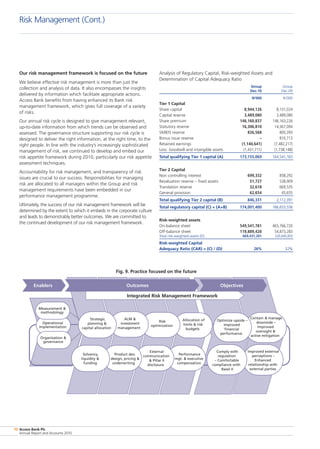
recommendations for improvement of risk management.
(h)	 Act as a key contact for senior management who may wish to
request ad hoc reviews/investigations.
(i)	 Ensure that laws, regulations and supervisory requirements
are complied with, including consequence management.
(j)	 Champion the implementation of Basel II.
(k)	 Promote risk awareness and provide education on risk.
(l)	 Provide assurance on compliance with internal and external
policies with respect to risk management.
Financial Control and Strategy
(a)	 Prepare and monitor the implementation of the Bank’s
strategic plan.
(b)	 Conduct strategic and operational review of the Bank’s
activities.
(c)	 Conduct regular scanning of the Bank’s operating
environment.
(d)	 Coordinate and monitor the Bank’s rating exercises by
external rating agencies.
(e)	 Prepare business intelligence reports for the Bank’s
Management.
(f)	 Prepare periodic management reports on subsidiaries and
associates.
(g)	 Perform competitive analysis in comparison with industry
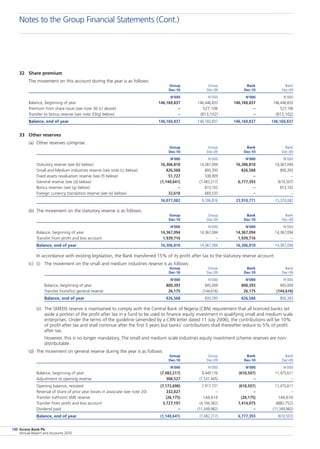
peers.
(h)	 Conduct strategic/operational review of branches.
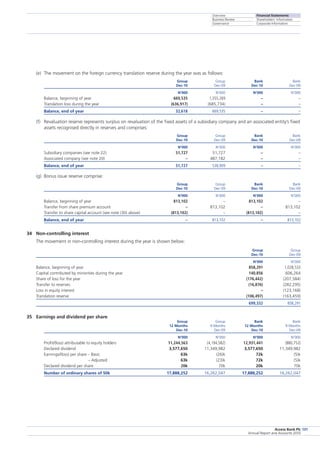
Risk Management Governance Framework
The framework details Access Bank’s risk universe and governance
structure comprising three distinct layers:
1.	 The enterprise-wide risk management and corporate
governance Committee forums;
2.	 The Executive Management Committees; and
3.	 Risk management responsibilities per risk area.
Access Bank Plc
Annual Report and Accounts 2010
34
Fig.4. Risk Management Governance Structure
Access Bank’s Risk Management Governance Structure is depicted
below.
Board of
Directors
Board Risk
Management
Committee
Operational Risk
Management
Committee
(ORMC)
Asset and
Liability
Committee
(ALCO)
Board
Committee on
Human
Resources
Enterprise Risk
Management
Committee
(ERMC)
Chief Risk
Officer
Risk
Management
and Compliance
Division
Business Unit
Risk Champions
Board Risk
Credit  Finance
Committee
Management
Credit
Committee
(MCC)
Board Risk
Audit
Committee
Internal Audit
Division
Layer 1
Layer 2
Layer 3
Layer 4
(d)	 Approve and periodically review the Bank’s risk strategy and
policies;
(e)	 Approve the Bank’s risk appetite and monitor the Bank’s risk
profile against this appetite;
(f)	 Ensure that the Management of the Bank has an effective
ongoing process to identify risk, measure its potential impact
and proactively manage these risks;
(g)	 Ensure that the Bank maintains a sound system of risk
management and internal control with respect to:
–	 Efficiency and effectiveness of operations
–	 Safeguarding of the Bank’s assets (including information)
–	 Compliance with applicable laws, regulations and
supervisory requirements
–	 Reliability of reporting
–	 Behaving responsibly towards all stakeholders;
Role of the Board of Directors
The Board of Directors’ role, as it relates to risk management,
is divided into six areas; general, credit, market, compliance,
operational, and reputational risks.
Specific roles in these areas are further defined below:
General Risk
(a)	 Develop a formal enterprise-risk management framework;
(b)	 Review and approve the establishment of a risk management
function that would independently identify, measure, monitor
and control risks inherent in all risk-taking units of the Bank;
(c)	 Ratify the appointment of qualified officers to manage the
risk management function;
Risk Management (Cont.)
Overview
Business Review
Governance
Financial Statements
Shareholders’ Information
Corporate Information
Access Bank Plc
Annual Report and Accounts 2010
35
(h)	 Ensure that a systematic, documented assessment of the
processes and outcomes surrounding key risks is undertaken
at least annually;
(i)	 Ensure that Management maintains an appropriate system of
internal control and review its effectiveness;
(j)	 Ensure risk strategy reflects the Bank’s tolerance for risk;
(k)	 Review and approve changes/amendments to the risk
management framework;
(l)	 Review and approve risk management procedures and control
for new products and activities; and
(m)	 Periodically receive risk reports from Management
highlighting key risk areas, control failures and remedial
action steps taken by Management.
Credit risk
(a)	 Approve the Bank’s overall risk tolerance in relation to credit
risk based on the recommendation of the Chief Risk and
Compliance Officer;
(b)	 Ensure that the Bank’s overall credit risk exposure is
maintained at prudent levels and consistent with the available
capital through quarterly review of various types of credit
exposure;
(c)	 Ensure that top management as well as individuals responsible
for credit risk management possess the requisite expertise and
knowledge to accomplish the risk management function;
(d)	 Ensure that the Bank implements a sound methodology that
facilitates the identification, measurement, monitoring and
control of credit risk;
(e)	 Ensure that detailed policies and procedures for credit risk
exposure creation, management and recovery are in place;
and
(f)	 Appoint credit officers and delegate approval authorities to
individuals and committees.
Market risk
(a)	 Define the Bank’s overall risk appetite in relation to market
risk;
(b)	 Ensure that the Bank’s overall market risk exposure is
maintained at levels consistent with the available capital;
(c)	 Ensure that top management as well as individuals
responsible for market risk management possess sound
expertise and knowledge to accomplish the risk management
function;
(d)	 Approve the Bank’s strategic direction and tolerance level for
liquidity risk;
(e)	 Ensure that the Bank’s senior management has the ability and
required authority to manage liquidity risk;
(f)	 Approve the Bank’s liquidity risk management framework;
and
(g)	 Ensure that liquidity risk is identified, measured, monitored
and controlled.
Compliance risk
(a)	 Approve the Bank’s code of conduct and ethics;
(b)	 Monitor the Bank’s compliance with laws and regulations,
its code of conduct and ethics and corporate governance
practices;
(c)	 Ensure new and changed legal and regulatory requirements are
identified, monitored and reflected in the Bank’s processes;
(d)	 Approve the compliance structure, mechanisms and processes
established by management to ensure compliance with
current laws, regulations and supervisory requirements; and
(e)	 Ensure the Bank has a compliance culture that contributes to
the overall objective of risk management.
Operational risk
(a)	 Oversee the overall governance of the Bank’s operational risk
management process;
(b)	 Set the Bank’s operational risk strategy and direction in line
with the Bank’s corporate strategy;
(c)	 Approve the Bank’s operational risk management framework;
(d)	 Periodically review the framework to ensure its relevance and
effectiveness;
(e)	 Ensure that senior management is performing their risk
management responsibilities; and
(f)	 Ensure that the Bank’s operational risk management
framework is subject to effective and comprehensive internal
audit by operationally independent, appropriately trained and
competent staff.
Reputational risk
(a)	 Set an appropriate tone and guidelines regarding the
development and implementation of effective reputation risk
management practices, including an explicit statement of a
zero tolerance policy for all unethical behaviour;
(b)	 Approve the Bank’s framework for the identification,
measurement, control and management of reputational risk;
(c)	 Monitor the Bank’s compliance with its reputational risk
management policies and recommend sanctions for material
breaches of internal policies;
(d)	 Review all exception reports by external parties such as
regulators and auditors; ensure that appropriate sanctions
are applied to erring officers; demand from Management
appropriate explanations for all exceptional items; ensure
that Management puts in place effective and remedial
actions and reports on progress to the Board on an ongoing
basis;
(e)	 Ensure that Board members do not compromise their fit and
proper status with regulators. They shall ensure that only
Board members who do not tarnish the Bank’s image and
reputation remain as members; and
(f)	 Ensure that only fit and proper persons are appointed to
senior management positions in the Bank.
Access Bank Plc
Annual Report and Accounts 2010
36
The Board and Management Committees
The Board carries out its oversight function through its standing
committees each of which has a charter that clearly defines its
purpose, composition, and structure, frequency of meetings,
duties, tenure and reporting lines to the Board.
The Management Committees are: The Executive Committee
(EXCO), Enterprise Risk Management Committee (ERMC),
Management Credit Committee (MCC), Group Asset  Liability
Committee (Group ALCO), and Operational Risk Management
Committee (ORMC).
In line with best practice, the Chairman of the Board does not sit
on any of the Committees. The Board’s four standing committees
are: the Board Risk Management Committee, the Board Audit
Committee, the Board Human Resources Committee and the
Board Credit  Finance Committee.
The roles and remits of the Committees are as follows:
Committee Key Objective Membership
Board Risk
Management
Committee
The primary role of the Committee is to report
to the Board and provide appropriate advice and
recommendations on matters relevant to risk
management.
4 Non-Executive Directors appointed by the
Board of Directors
Group Managing Director
Group Deputy Managing Director
Executive Directors as appointed
Chaired by an independent Director
Board Audit
Committee
The Committee assists the Board in ensuring the
independence of the internal audit function of the Bank.
3 Non-Executive Directors appointed by the
Board of Directors
Executive Directors as appointed
Board Credit
 Finance
Committee
The Committee considers and approves loan applications
above certain limits (as defined by the Board from time
to time) which have been approved by the Management
Credit Committee. It also acts as a catalyst for credit policy
changes.
7 Non-Executive Directors appointed by the
Board of Directors
Group Managing Director
Group Deputy Managing Director
3 Executive Directors as appointed
One of the non-Executive Directors shall be
Chairman of the Committee
Chaired by an independent Director
Board Human
Resources
Committee
The Committee advises the Board on its oversight
responsibilities in relation to compensation, benefits and
all other human resource matters affecting the directors
and employees of the Bank.
4 Non-Executive Directors appointed by the
Board of Directors
Group Managing Director
Group Deputy Managing Director
The Executive
Committee
(EXCO)
The Committee is primarily responsible for the
implementation of strategies approved by the Board and
ensuring the efficient deployment of the Bank’s resources.
Group Managing Director as – Chairman
Group Deputy Managing Director
All the Executive Directors
Enterprise Risk
Management
Committee
(ERMC)
The Bank’s Enterprise Risk Management Committee is
responsible for managing all risks with the exception
of credit, market and liquidity risks. The risks within the
Committee’s purview include (but are not limited to)
strategic, reputational, compliance and operational risks.
Group Managing Director (Chairman)
Group Deputy Managing Director
All Executive Directors
Chief Risk Officer
Chief Compliance Officer
Chief Financial Officer
All ERM Division Heads
Head, Corporate Affairs
Head, Legal Department
Head, Information Technology
Risk Management (Cont.)
Overview
Business Review
Governance
Financial Statements
Shareholders’ Information
Corporate Information
Access Bank Plc
Annual Report and Accounts 2010
37
Committee Key Objective Membership
Management
Credit
Committee
(MCC)
This Committee is responsible for managing credit risks in
the Bank.
Group Managing Director/Chief Executive Officer –
Chairman
Group Deputy Managing Director – Vice Chairman
All Executive Directors
Group Head, Credit Risk Management
Team Leaders, Credit Risk Management
Group Heads, Commercial Bank
Group Heads, Institutional Bank
Group Heads, Operations  IT
Group Head, Compliance
Group Head, Internal Audit
Head of Legal (or his/her nominee as approved by
the GMD/CEO)
Other Group Heads
Group Asset
 Liability
Committee
(Group ALCO)
The Group ALCO is responsible for the optimum
management of the Bank’s balance sheet and taking
relevant decisions, as well as recommending to the Board
of Directors prudent asset/liability management policies
and procedures that enable the Bank to achieve its goals
while operating in full compliance with all relevant laws
and regulations.
Group Managing Director/Chief Executive Officer –
Chairman
Group Deputy Managing Director
Group Executive Directors
Chief Risk Officer
Country Managing Directors
Country Treasury Heads
Group Treasurer
Head, Financial Control – Domestic
Head, Financial Control – International
Head, Group Asset  Liability Management
Head, Group Market Risk
Head, Credit Risk
Operational
Risk
Management
Committee
(ORMC)
The Committee is responsible for the effectiveness of the
operational risk management function within the Bank. All
decisions and deliberations of the Committee are reported
to the Board Risk Management Committee.
Group Managing Director/Chief Executive
(GMD) – Chairman
Group Deputy Managing Director
All Division Heads/ Executive Directors
Chief Risk Officer
Head, Operational Risk Management Group
Chief Information Officer
Head, Group Compliance and Internal Control
Head, Group Internal Audit
Head, Group HR
Other Group Heads or persons to be designated by
the Committee from time to time
Access Bank Plc
Annual Report and Accounts 2010
38
Without prejudice to the roles of these committees, the full Board
shall retain ultimate responsibility for risk management.
Specific roles of the Board and Management Committees
The Board’s risk management oversight roles and responsibilities
are delegated to the following committees:
Board Risk Management Committee
Specifically, the Committee performs the following functions:
(a)	 Oversee the establishment of a formal written policy on the
Bank’s overall risk management framework. The policy defines
risks and risk limits that are acceptable and unacceptable to
the Bank. It provides guidelines and standards to administer
the acceptance and ongoing management of all risks;
(b)	 Ensure that adequate policies are in place to manage and
mitigate the adverse effects of both business and control risks
in its operations;
(c)	 Ensure compliance with established policy through periodic
review of reports provided by management, internal and
statutory auditors and the supervisory authorities;
(d)	 Approve the appointment of qualified officers to manage the
risk function;
(e)	 Oversee the management of all risks except credit risk in the
Bank;
(f)	 Re-evaluate the risk management policy of the Bank on a
periodic basis to accommodate major changes in internal or
external factors;
(g)	 Evaluate internal processes for identifying, assessing,
monitoring and managing key risk areas, particularly:
–	 Important judgments and accounting estimates
–	 Business and operational risks in the areas of credit,
market and operations
–	 Specific risks relating to outsourcing
–	 Consideration of environmental, community and social risks;
(h)	 Evaluate the adequacy of the Bank’s risk management
systems and control environment with management and
auditors (internal and external);
(i)	 Evaluate the Bank’s risk profile, the action plans in place to
manage risks, and monitor progress against plan to achieve
these actions;
(j)	 Review the processes the Bank has in place for assessing and
continuously improving internal controls, particularly those
related to areas of significant risk; and
(k)	 Approve the provision of risk management services by
external providers.
Board Audit Committee
The Committee performs the following functions:
(a)	 Oversee the development of a procedure for the receipt,
retention and treatment of complaints received by the Bank,
regarding accounting, internal accounting controls, unethical
activity/breach of the corporate governance code or audit
matters, including a means for the Bank’s stakeholders
(employees, customers, suppliers, applicants and others) to
submit such complaints in a confidential and anonymous
manner;
(b)	 Investigate any matter brought to its attention, within the
scope of its duties, with the authority to retain counsel or
other advisors, if in its judgment that is appropriate, at the
expense of the Bank;
(c)	 Submit meeting minutes and, as appropriate, discuss the
matters deliberated upon at each Committee meeting with
the Board of Directors;
(d)	 Annually review and reassess its responsibilities, functions,
pre-approval policy for audit and non-audit services, and
charter, making changes as necessary, and conduct an annual
performance evaluation of its activities;
(e)	 Ensure that the Bank provides adequate funding, as
determined by the Committee, to the Committee for
payment and compensation for advisers engaged by the
Committee, and payment of ordinary administrative expenses
incurred by the Committee in carrying out its duties;
(f)	 Review the proposed audit plan(s) and review the results
of internal audits completed since the previous committee
meeting, as well as the focus of upcoming internal audit
projects;
(g)	 Approve the appointment and termination of the Chief
Internal Auditor, based on the recommendations of the Bank’s
executive management;
(h)	 Evaluate the process the Bank has in place for monitoring and
assessing the effectiveness of the internal audit function;
(i)	 Monitor the progress of the internal audit programme and
considers the implications of internal audit findings on the
control environment;
(j)	 Monitor the implementation of agreed action plans by
management;
(k)	 Review reports from the internal auditors detailing their key
findings and agreed management actions;
(l)	 Review the appropriateness of the qualification of the internal
audit personnel and work resources; and
(m)	 Review the internal audit reporting lines and independence.
Risk Management (Cont.)
Overview
Business Review
Governance
Financial Statements
Shareholders’ Information
Corporate Information
Access Bank Plc
Annual Report and Accounts 2010
39
Board Credit Committee
The Board Credit Committee under delegated authority is
responsible for the following:
(a)	 Facilitate the effective management of credit risk by the Bank;
(b)	 Approve credit risk management policies, underwriting
guidelines and standard proposals on the recommendation of
the Management Credit Committee;
(c)	 Approve definition of risk and return preferences and target
risk portfolio;
(d)	 Approve the Bank’s credit rating methodology and ensure its
proper implementation;
(e)	 Approve credit risk appetite and portfolio strategy;
(f)	 Approve lending decisions and limit setting;
(g)	 Approve new credit products and processes;
(h)	 Approve assignment of credit approval authority on the
recommendation of the Management Credit Committee;
(i)	 Approve changes to credit policy guidelines on the
recommendation of the management credit committee;
(j)	 Approve credit facility requests and proposals within limits
defined by Access Bank Plc’s credit policy and within the
statutory requirements set by the regulatory/supervisory
authorities;
(k)	 Recommend credit facility requests above stipulated limit to
the Board;
(l)	 Review credit risk reports on a periodic basis;
(m)	 Approve credit exceptions in line with Board approval; and
(n)	 Make recommendations to the Board on credit policy and
strategy where appropriate.
Board Committee on Human Resources
The Board Committee on Human Resources has responsibility for
the following:
(a)	 Ensure the right calibre of executive management is attracted,
retained, motivated and rewarded;
(b)	 Make recommendations on the remuneration of the
Chairman, non-executive directors and executive directors to
the Board for ratification;
(c)	 Approve remuneration levels for senior management and
other Bank personnel;
(d)	 Review and approve remuneration policies and strategy; and
(e)	 Monitor the Bank’s people-risk universe.
Specific roles of Management Committees
The following Management Committees are directly responsible
for risk management oversight:
Enterprise Risk Management Committee (ERMC)
The Committee has the following responsibilities for all risks within
its purview:
(a)	 Formulating policies;
(b)	 Monitoring implementation of risk policies;
(c)	 Reviewing risk reports for presentation to the Board/Board
Committees; and
(d)	 Implementing Board decisions across the Bank.
Management Credit Committee (MCC)
The Committee has the following responsibilities:
•	 Review credit policy recommendations for Board approval;
•	 Approve individual credit exposure in line with its approval
limits;
•	 Agree on portfolio plan/strategy for the Bank;
•	 Review monthly credit risk reports and remedial action plan;
and
•	 Coordinate the Bank’s response to material events that may
have an impact on the credit portfolio.
The Committee is assisted by the credit risk management function,
whose responsibilities are to:
•	 Establish and maintain effective credit risk management
environment in the Bank;
•	 Review proposals in respect of credit policies and standards
and endorse to the Board of Directors for approval;
•	 Define the Bank’s risk and return preferences and target risk
portfolio;
•	 Monitor on an ongoing basis the Bank’s risk quality and
performance, review periodic credit portfolio reports and
assess portfolio performance;
•	 Define credit approval framework and assign credit approval
limits in line with bank policy;
•	 Review defined credit product programmes on
recommendation of the head of the credit risk management
and endorse to the Board of Directors for approval;
•	 Review credit policy changes initiated by management and
endorse to the Board of Directors for approval;
•	 Ensure compliance with the Bank’s credit policies and
statutory requirements prescribed by the regulatory/
supervisory authorities;
•	 Approve credit facility requests within limits defined by Access
Bank’s credit policy guideline (CPG), and within the statutory
requirements set by the regulatory/supervisory authorities;
•	 Review and endorse credits approved by SBU heads;
•	 Review and recommend to the Board Credit Committee,
credits beyond their approval limits;
•	 Review periodic credit portfolio reports and assess portfolio
performance; and
Access Bank Plc
Annual Report and Accounts 2010
40
•	 Approve exceptions/write-offs, waivers and discounts on non-
performing credit facilities within specified limit.
Asset  Liability Committee (ALCO)
The purpose of the Group ALCO is to:
•	 Monitor and control all market, liquidity risk and interest rate
risk across the Bank and its subsidiaries in accordance with
the risk appetite set by the Board of Directors;
•	 Review limit, guideline or trigger breaches and agree remedial
actions in order to align exposures with agreed appetite;
•	 Approve Market Risk, Liquidity Risk and Banking Book Interest
Rate Risk Policies for each of the banking subsidiaries;
•	 Review and note the impact of internal and external factors
on the net interest margin; and
•	 Recommend to the Board, policies and guidelines under
which the Bank will manage the matters listed below, and in
so doing protect the Bank’s capital base and reputation;
•	 Balance sheet growth;
•	 Deposits, advances and investments;
•	 Non earning assets;
•	 Foreign exchange activities and positions;
•	 Market and liquidity management; and
•	 Capital management.
Responsibilities and Authorities
•	 The ultimate responsibility for the proper management of the
Bank’s assets and liabilities lies with the Board of Directors;
•	 The Board of Directors will delegate that responsibility to
ALCO and ALCO, through this mandate, shall be responsible
for the establishment of appropriate policies and limits across
the Group;
•	 ALCO will be responsible for the implementation and
monitoring of these Policies and for the development of
appropriate procedures and guidelines for adoption at
Country ALCOs and specific ratification by the subsidiaries’
Board of Directors;
•	 Country ALCO will be responsible for providing the
information input to ALCO to enable it to perform its
function;
•	 Country ALCO will be responsible for proposing amendments
to Policies for approval and ratification by ALCO, such
amendments having been first approved at the Country
ALCO;
•	 ALCO will report to the Board of Directors through the
Board Risk Management Committee detailing strategies, risk
positions since the last report received. Any excesses during
the period under review must be supported by details quoting
the relevant authority for the excess ie Central Bank, ALCO
etc;
•	 ALCO will delegate limits/authorities to line management
to enable the smooth functioning of the Bank’s day-to-day
operations; and
•	 In the event of a vote, majority will prevail with the ALCO
chairman casting the deciding vote in the event of a tie.
Other responsibilities include:
•	 Prudent management of market risk:
–	 To ensure the levels of market risk assumed by the Bank
are effectively and prudently managed in accordance with
the Market Risk Policy
–	 To approve market risk limits and triggers in accordance
with the risk appetite set by ALCO and the Bank’s
Concentration Risk Policy
–	 To note compliance with all market risk limits and triggers,
and ensure actions to address breaches are promptly
executed and reported to authorised bodies
–	 To manage all forms of market risk by firstly using the
Alco’s mandate to set exposure levels and stop-loss
limits, and secondly, if necessary, by hedging any form
of market risk
–	 To review and approve all policies and procedures relating
to market risk management
•	 Prudent management of liquidity risk:
–	 To ensure the levels of tactical and strategic liquidity
risk assumed by the Bank are effectively and prudently
managed in accordance with the Liquidity Risk Policy;
–	 To approve liquidity risk limits and guidelines in
accordance with the risk appetite set by ALCO;
–	 To note compliance with all liquidity risk guidelines
and limits, and ensure actions to address breaches are
promptly executed and reported to authorising bodies;
–	 To ensure appropriate steps are taken where there is
deterioration in liquidity;
–	 To approve funding and liquidity management strategies
based on forecast balance sheet growth;
–	 To ensure the provision of standby funding facilities is
kept within prudent levels;
–	 To review and approve all policies, procedures and
contingency plans relating to liquidity risk management;
and
–	 To approve liquidity stress scenarios and associated
contingency plans.
•	 Prudent management of interest rate risk:
–	 To ensure that the level of interest rate risk assumed by
the Bank is effectively and prudently managed;
–	 To note compliance with all guidelines and limits, and
ensure actions to address breaches are promptly executed
and reported to authorising bodies;
Risk Management (Cont.)
Overview
Business Review
Governance
Financial Statements
Shareholders’ Information
Corporate Information
Access Bank Plc
Annual Report and Accounts 2010
41
–	 To approve limits and guidelines in accordance with the
risk appetite set by ALCO and Market Risk; and
–	 To approve the subsidiaries’ market risk and hedging
strategies on a case-by-case basis, or explicitly delegate
the approval of such strategies to the Country ALCO.
•	 Prudent margin management:
–	 To review and note the impact of internal and external
factors on the Bank’s current and forecasted net interest
margin;
–	 To review and approve funds transfer pricing principles,
methodologies and rates; and
–	 To review and approve policies and procedures relating to
margin management.
•	 General:
–	 To monitor adherence to regulatory requirements; and
–	 To delegate to the Group Asset and Liability Management
team the responsibility of dealing with trigger, guideline
or limit breaches across the Group on a day-to-day basis.
Role of Senior Management
The role of senior management as it relates to risk management is:
(a)	 Implement risk strategy approved by the Board of Directors;
(b)	 Develop policies and procedures for identifying, measuring
and controlling risks identified in the Bank’s risk universe;
(c)	 Provide appropriate resources to evaluate and control all
identified risks;
(d)	 Review risk reports on a regular and timely basis;
(e)	 Review periodic risk reports for operational and other risks
separate from credit and market risks; and
(f)	 Provide all reports required by the Board and its committees
for the effective performance of risk management oversight
functions.
Operational Risk Management Committee (ORMC)
The Committee has the following responsibilities:
•	 Review and recommend the Operational Risk Management
(ORM) framework and any amendments or enhancements to
the Board of Directors (BOD) for approval;
•	 Oversee the implementation of the Operational Risk
Management framework across the enterprise;
•	 Review methodologies and tools for identification,
assessment, monitoring and control of operational risks and
maintaining the loss event databases;
•	 Ensure operational risk exposures are within the risk tolerance
limits set under the policy;
•	 Review the reports from the Operational Risk Management
(ORM) unit, business lines and their respective risk profiles
to concur on areas of highest priority and put in place the
related mitigation strategies;
•	 Ensure adequate resources are allotted at various levels to
manage operational risk across the enterprise;
•	 Ensure adequate communication to the functional
departments and emphasise on the importance of operational
risk management and assure adequate participation;
•	 Coordinate an ongoing appropriate awareness and education
programme on operational risk in the Bank from top to
bottom through the implementation of an enterprise wide
operational risk approach; and
•	 Set guidelines for identifying operational risk in all new
products and processes.
Roles of risk champions in the Business Units
•	 Coordinate all risk management activities in the Business Unit,
including compliance with risk policies and procedures;
•	 Provide on-the-job training on risk management to other
staff;
•	 Liaise with Risk Management and Compliance Division to
obtain new systems, approaches and methods for managing
risks and advise staff within the unit appropriately;
•	 Coordinate the gathering of risk-related information,
while ensuring the completeness and accuracy of the
risk information gathered, analyse the information
and periodically report to the group head and the risk
management department in the agreed format;
•	 In conjunction with other managers in the Business
Unit, articulate risk management/optimisation strategies
for managing risks, prepare a risk mitigation plan and
communicate these to the Risk Management and Compliance
Division; and
•	 Monitor and report on the effectiveness of risk mitigation
plans in reducing risk incidence in the Unit.
Risk Management and Compliance Division – relationship
with other units
The relationships between Risk Management and Compliance
Division (RMCD) and other units are highlighted below:
•	 RMCD sets policies and defines limits for other units in the
Bank;
•	 RMCD performs bank-wide risk monitoring and reporting;
•	 Other units provide relevant data to RMCD for risk monitoring
and reporting and identify potential risks in their line of business
and RMCD provides a framework for managing such risks;
•	 RMCD and market facing units collaborate in designing new
products;
•	 RMCD and internal audit coordinate activities to provide a
holistic view of risks across the Bank;
•	 RMCD makes recommendations with respect to capital
allocation, pricing and reward/sanctions based on risk reports;
and
Access Bank Plc
Annual Report and Accounts 2010
42
•	 Information technology support group provides relevant user
support to the RMCD function in respect of the various risk
management software.
Credit Risk Management
Credit risk arises from the failure of an obligor of the Bank
to repay principal or interest at the stipulated time or failure
otherwise to perform as agreed. This risk is compounded if the
assigned collateral only partly covers the claims made to the
borrower, or if its valuation is exposed to frequent changes due to
changing market conditions (ie market risk).
The Bank’s Risk Management philosophy is that moderate and
guarded risk attitude will ensure sustainable growth in shareholder
value and reputation. Extension of credit in Access Bank is guided
by its Credit Risk and Portfolio Management Plan, which sets out
specific rules for risk origination and management of the loan
portfolio. The Plan also sets out the roles and responsibilities of
different individuals and committees involved in the credit process.
We recognise the fact that our main asset is our loan portfolio.
Therefore, we actively safeguard and strive to continually improve
the health of our loan portfolio. We scrutinise all applications and
weed out potential problem loans during the loan application
phase, as well as constantly monitor existing loan portfolio.
The goal of the Bank is to apply sophisticated but realistic credit
models and systems to monitor and manage credit risk. Ultimately,
these credit models and systems are the foundation for the
application of internal rating-based approach to calculation of capital
requirements. The development, implementation and application of
these models are guided by the Bank’s Basel II strategy.
The pricing of each credit granted reflects the level of risks inherent
in the credit. Subject to competitive forces, Access Bank implements
a consistent pricing model for loans to its different target markets.
The client’s interest is guarded at all times, and collateral quality is
never the sole reason for a positive credit decision.
Provisions for credit losses meet prudential guidelines set forth
by the Central Bank of the countries where we operate, both
for loans for which specific provisions exist as well as for the
portfolio of performing loans. Access Bank’s credit process
requires rigorous proactive and periodic review of the quality of
the loan portfolio. This helps us to identify and remediate credit
issues proactively.
The Criticised Assets Committee performs a quarterly review of
loans with emerging signs of weakness; the Management Credit
Committee and the Board Credit Committee also perform reviews
of the quality of our loan portfolio on a quarterly basis. These
are in addition to daily reviews performed by our Credit Risk
Management department.
Principal Credit Policies
The following are the principal credit policies of the Bank:
•	 Extension of Credit: Every extension of credit must be
approved by at least three officers; one of whom must
be from Independent Credit Risk Management. The final
approving officer must have a credit limit for the total facilities
extending to the obligor (or group of related obligors).
•	 Special Approvals: Extension of credit to certain sectors may
require unique approvals or prohibited altogether.
•	 Credit Analysis Policy: There are consistent standards of
credit analysis across the Access Bank for approval of credit
facilities.
•	 Annual Review of Facilities: All extension of credits must
be reviewed at least once every 12 months.
•	 Industry Limits: The Access Bank Group utilises industry
limits to maintain a diversified portfolio of risk assets.
•	 Problem Recognition: There are uniform and consistent
standards for recognition of credit migration and remediation
across the Access Bank.
Fig. 5. Risk Management and Compliance Division – Relationship with Other Units
Risk
Committees
Auditors
Regulators
Rating
Agencies
Clients
Reporting and analysis
Business information
and analytics
Positions and other
information
Risk report
Audit report
Risk reports
and practices
Risk summary
Risk advisory
Enquiries
Enquiries
Risk reports
and practices
Reporting and analysis
Technology
Support
Operations
Internal
Audit
Business
Units
Risk Management
and
Compliance Division
Risk Management (Cont.)
Overview
Business Review
Governance
Financial Statements
Shareholders’ Information
Corporate Information
Access Bank Plc
Annual Report and Accounts 2010
43
Responsibilities of Business Units and Independent
Credit Risk Management
In Access Bank, Business Units and Independent Credit Risk
Management have a joint responsibility for the overall accuracy of
risk ratings assigned to obligors and facilities. Business Relationship
Managers will be responsible for deriving the ORR and FRR
using approved methodologies as set out in this policy, however,
Independent Credit Risk Management may also perform this function.
Notwithstanding who derives the risk rating, Independent Credit
Risk Management is responsible for reviewing and ensuring the
correctness of the ORR and FRR assigned to a borrower and
facilities. This review includes ensuring the ongoing consistency
of the business’ Risk Rating Process with Access Bank Risk Rating
Policy; ongoing appropriate application of the Risk Rating Process
and tools; review of judgmental and qualitative inputs into the
Risk Rating Process; ensuring the timeliness and thoroughness of
risk rating reviews; and ensuring that the documentation of the
Risk Rating Process is complete and current.
Independent Credit Risk Management has the final authority if
there is a question about a specific rating.
Credit process
The Bank’s credit process starts with portfolio planning and target
market identification. Within identified target markets, credits
are initiated by relationship managers. The proposed credits are
subjected to review and approvals by applicable credit approval
authorities. Further to appropriate approvals, loans are disbursed
to beneficiaries. On-going management of loans is undertaken
by both relationship management teams and our Credit Risk
Management Group. The process is applied at the Head Office
and in the subsidiaries.
If a preliminary analysis of a loan request by the account manager
indicates that it merits further scrutiny, it is then analysed in
greater detail by the account manager, with further detailed
review by Credit Risk Management. The concurrence of Credit Risk
Management must be obtained for any credit extension. If the
loan application passes the detailed analysis, it is then submitted
to the appropriate approval authority for the sise of facilities.
The standard credit evaluation process is based both on quantitative
figures from the Financial Statements and on an array of qualitative
factors. Factual information on the borrower is collected as well as
pertinent macroeconomic data, such as an outlook for the relevant
sector, etc. These subjective factors are assessed by the analyst and all
individuals involved in the credit approval process, relying not only on
quantitative factors but also on extensive knowledge of the company
in question and its management.
Credit Risk Measurement
Risk rating methodology
The credit rating of the counterparty plays a fundamental role in
final credit decisions as well as in the terms offered for successful
loan applications. Access Bank employs a robust credit rating
system based on international best practices (including Basel II
recommendations) in the determination of the Obligor and Facility
risks and thus allows the bank to maintain its asset quality at a
desired level.
In Access Bank, the objective of the Risk Rating Policy is to ensure
reliable and consistent Obligor Risk Ratings (‘ORRs’) and Facility Risk
Ratings (‘FRRs’) throughout the Bank and to provide guidelines for
risk rating for retail and non-retail exposures in the bank.
The Risk Rating Policy incorporates credit risk rating models which
estimate risk of obligor default and facility risks (covering both
recovery as well as exposure risk). These models are currently based
on expert judgment for retail and non-retail exposures. Our long-
term goal is to adopt the Internal Rating Based (“IRB”) approach.
The data required to facilitate the IRB approach is being gathered.
All Access Bank businesses that extend credit are subject to the
Risk Rating Policy.
Credit risk rating models in Access Bank Plc
The following are the credit risk rating models deployed by Access
Bank.
For Retail Exposures:
Obligor Risk Rating (ORR) Models have been developed for:
1.	 Personal Loans
2.	 Credit Cards
3.	 Auto Loans
4.	 Mortgage Loans
Facility Risk Rating (FRR) Models have been developed for:
1.	 Loss Given Default (LGD)
2.	 Exposure at Default (EAD)
For Non-Retail Exposures:
Obligor Risk Rating (ORR) Models have been developed for:
1.	 Sovereign (Approach to rating Sovereign Exposures using
external ratings)
2.	 Bank and NBFIs
3.	 Corporate
–	 Manufacturing Sector
–	 Trading Sector
–	 Services Sector
–	 Real Estate Sector
4.	 Small and Medium Enterprises (SME) without Financials
Facility Risk Rating (FRR) Models have been developed for
1.	 Loss Given Default (LGD)
2.	 Exposure at Default (EAD)
Access Bank Plc
Annual Report and Accounts 2010
44
Risk Rating Process
In Access Bank, all businesses must have a documented and
approved Risk Rating Process for deriving risk ratings for all
obligors and facilities (including those covered under Credit
Programmes). The Risk Rating Process is the end-to-end process
for deriving ORRs and FRRs and includes models, guidelines,
support adjustments, collateral adjustments, process controls, as
well as any other defined processes that a business undertakes
in order to arrive at ORRs and FRRs. Risk Rating Process of each
business must be in compliance with the Bank’s Risk Rating Policy
and deviations must be explicitly approved.
Establishing the Risk Rating Process is the joint responsibility of
the Business Manager and Independent Credit Risk Manager
associated with each business. The process must be documented
and must be approved by the Management Credit Committee.
The Risk Rating Process for each business must be reviewed and
approved every three years, unless more frequent reviews are
specified as a condition of the approvals. Interim material changes
to the Risk th, as determined by the Independent Credit Risk
Manager for the business, must be re-approved.
Risk Rating Scale and external rating equivalent
Access Bank operates a 12-grade numeric risk rating scale. The
risk rating scale runs from 1 to 8. Rating 1 represents the best
obligors and facilities and rating 8 represents the worst obligors
and facilities. The risk rating scale incorporates sub-grades and full
grades, reflective of realistic credit migration patterns.
The risk rating scale and the external rating equivalent is detailed
below:
Access Bank
Risk Rating
SP Long term
equivalent
Grade
1 AAA Investment Grade
2+ AA
2 A
2- BBB
3+ BB+ Standard Grade
3 BB
3- BB-
4 B Non Investment
Grade
5 B-
6 CCC
7 C
8 D
Credit Risk Control  Mitigation Policy
Authority Limits on Credit
The highest credit approval authority is the Board of Directors,
supported by the Board Credit Committee and further by the
Management Credit Committee. Individuals are also assigned
credit approval authorities in line with the Bank’s criteria for such
delegation set out in its Credit Risk and Portfolio Managament
Plan. The principle of central management of risk and decision
authority is maintained by the Bank. The maximum amount of
credit that may be approved at each subsidiary is limited, with
amounts above such limit being approved at the Head Office.
This structure gives Access Bank the possibility to incorporate
much needed local expertise, but at the same time manage risk on
a global level. Local Credit Committees of the Bank’s subsidiaries
are thus able to grant credits, but the sum total of the exposure
of the applicant and financially related counterparties is limited,
most commonly by the subsidiary’s capital. All applications that
would lead to exposures exceeding the set limit are referred to the
appropriate approval authority in the Head Office.
The credit approval limits of the principal officers of the Group are
shown in the table below
Authority Approval Limit
Board of Directors Limited to 20% of
Shareholders’ funds
unimpaired by losses
Board Credit Committee N6,000,000,000
Management Credit Committee N500,000,000
Group Managing Director N200,000,000
Group Deputy Managing Director N150,000,000
Group Executive Director N75,000,000
Managing Directors of bank
subsidiaries
N25,000,000
Collateral Policies
It is the Bank’s policy that all credit exposures are adequately
collateralised. Credit risk mitigation is an activity of reducing credit
risk in an exposure or transferring it to counterparty, at facility
level, by a safety net of tangible and realisable securities including
approved third-party guarantees/insurance.
In Access Bank, strategies for risk reduction at the transaction level
differ from that at the portfolio level. At transaction level, the most
common technique used by the bank is the collateralisation of the
exposures, by first priority claims or obtaining a third party guarantee.
Other techniques include buying a credit derivative to offset credit
risk at transaction level. At portfolio level, asset securitisation, credit
derivatives etc are used to mitigate risks in the portfolio.
Risk Management (Cont.)
Overview
Business Review
Governance
Financial Statements
Shareholders’ Information
Corporate Information
Access Bank Plc
Annual Report and Accounts 2010
45
•	 Shipping Documents (for imports);
•	 Bankers Acceptance;
•	 Life Assurance Policies.
Master Netting Arrangements
It is the Bank’s policy that all credit exposures are adequately
collateralised. Notwithstanding, our account opening
documentation allows the Bank to net off customers’ deposits
against their exposure to the Bank. Generally, transactions are
allowed to run on a gross basis, however, in cases of unfavourable
credit migration, the Bank may elect to invoke the netting
agreement.
Credit Related Commitments
It is the Bank’s policy that all credit exposures are adequately
collateralised. Credit risk mitigation is an activity of reducing credit
risk in an exposure.
Provisioning policy
Provisions for credit losses meet prudential guidelines set forth
by the Central Bank of the countries where the Group operates
both for loans for which specific provisions exist as well as for the
portfolio of performing loans.
However, primary consideration when approving credits is always
the obligor’s financial strength and debt-servicing capacity. The
guidelines relating to risk mitigant as incorporated in the guidance
note of BCBS on “Principles for the Management of Credit Risk”
(September 2000, Paragraph 34) are to be taken into consideration
while using a credit risk mitigant to control credit risk.
“Banks can utilise transaction structure, collateral and guarantees
to help mitigate risks (both identified and inherent) in individual
credits but transactions should be entered into primarily on the
strength of the borrower’s repayment capacity. Collateral cannot be
a substitute for a comprehensive assessment of the borrower or the
counterparty, nor can it compensate for the insufficient information.
It should be recognised that any credit enforcement actions (eg
foreclosure proceedings) can eliminate the profit margin on the
transaction. In addition, banks need to be mindful that the value of
collateral may well be impaired by the same factors that have led to
the diminished recoverability of the credit.”
The range of collaterals acceptable to the Bank includes:
•	 Cash/Deposit (domestic and foreign currency) with Bank
including certificates of deposit or comparable instruments
issued by the Bank;
•	 Certificates of Deposit from other banks;
•	 Commodities;
•	 Debt securities issued by sovereigns and public-sector
enterprises;
•	 Debt securities issued by banks and corporations;
•	 Equities – Stocks/Share Certificates of quoted blue chip
companies;
•	 Mortgage on Landed Property;
•	 Asset-backed securities;
•	 Charge on assets (Fixed and/or Floating) – premises/inventory/
receivables/merchandise/plant/machinery etc;
•	 Negative Pledges;
•	 Lien on Asset being financed;
•	 Stock Hypothecation;
Access Bank Plc
Annual Report and Accounts 2010
46
(g)	 (i)	 Risk Assets Analysis by Performance:
	 Group	 Group	 Bank	 Bank
	 Dec-10	 Dec-09	 Dec-10	 Dec-09
	 N’000	 N’000	 N’000	 N’000
Performing	 380,175,823	 249,674,343	 357,114,093	 240,495,101
Watchlist	 47,441,364	 83,107,177	 47,441,364	 83,107,177
Non-performing	 427,617,187	 332,781,520	 404,555,457	 323,602,278
Substandard	 11,608,245	 55,905,297	 8,217,681	 41,817,821
Doubtful	 8,113,821	 14,458,001	 6,002,447	 13,785,969
Lost	 17,951,073	 10,308,140	 17,008,026	 6,160,373
	 37,673,139	 80,671,438	 31,228,154	 61,764,163
	 465,290,326	 413,452,958	 435,783,611	 385,366,441
(h)	 (i)	 Summary of performing but past due loans:
		 Group
As at 31 December 2010
				 Financial
	 Retail	 Corporate	 SME	 Institution	 Total
	 N’000	 N’000	 N’000	 N’000	 N’000
Not yet due	 4,334,410	 308,210,551	 –	 12,868,766	 325,413,727
Past due up to 30 days	 3,136,538	 48,336,826	 –	 7,027,821	 58,501,185
Past due 31–60 days	 1,108,125	 30,317,378	 –	 773,072	 32,198,575
Past due 61–90 days	 458,185	 18,707,531	 –	 1,186,626	 20,352,342
	 9,037,258	 405,572,286	 –	 21,856,285	 436,465,829
	 	 Group
As at 31 December 2009
	 			 Financial
	 Retail	 Corporate	 SME	 Institution	 Total
	 N’000	 N’000	 N’000	 N’000	 N’000
Not yet due	 40,566,846	 194,239,258	 391,833	 13,554,464	 248,752,401
Past due up to 30 days	 11,699,647	 55,001,568	 10,139	 4,544,964	 71,256,318
Past due 31–60 days	 1,495,919	 8,513,869	 37,301	 31,570	 10,078,659
Past due 61–90 days	 508,008	 2,099,017	 84,922	 2,194	 2,694,141
	 54,270,420	 259,853,712	 524,195	 18,133,192	 332,781,519
		 Bank
As at 31 December 2010
				 Financial
		 Retail	 Corporate	 Institution	 Total
	 N’000	 N’000	 N’000	 N’000
Not yet due		 4,334,410	 308,210,551	 12,868,766	 325,413,727
Past due up to 30 days		 2,678,964	 45,012,977	 3,652,551	 51,344,492
Past due 31–60 days		 1,042,895	 30,019,478	 282,441	 31,344,814
Past due 61–90 days		 425,106	 18,071,536	 543,133	 19,039,775
		 8,481,375	 401,314,542	 17,346,891	 427,142,808
		 Bank
As at 31 December 2009
				 Financial
		 Retail	 Corporate	 Institution	 Total
	 N’000	 N’000	 N’000	 N’000
Not yet due		 37,573,956	 189,691,110	 13,229,846	 240,494,912
Past due up to 30 days		 11,656,121	 54,972,007	 4,538,049	 71,166,177
Past due 31–60 days		 918,234	 8,480,169	 31,570	 9,429,973
Past due 61–90 days		 410,005	 2,099,017	 2,194	 2,511,216
		 50,558,316	 255,242,303	 17,801,659	 323,602,278
Risk Management (Cont.)
Overview
Business Review
Governance
Financial Statements
Shareholders’ Information
Corporate Information
Access Bank Plc
Annual Report and Accounts 2010
47
	 (ii)	 Summary of non-performing loans per sector
		 Sector
	 Group	 Group	 Bank	 Bank
	 Dec-10	 Dec-09	 Dec-10	 Dec-09
	 N’000	 N’000	 N’000	 N’000
Agriculture	 307,561	 176,486	 6,505	 176,486
Capital Market	 9,974,431	 –	 8,493,597	 –
Construction	 5,371,206	 151,614	 3,824,542	 151,614
Education	 48,453	 42,496	 44,000	 42,496
Finance and Insurance	 1,154,789	 10,137,813	 503,764	 10,137,813
General	 1,456,826	 93,775	 767,771	 93,775
General Commerce	 6,860,752	 5,303,932	 6,032,352	 5,303,932
Information and Communication	 2,593,452	 17,662,170	 2,450,523	 17,662,170
Manufacturing	 3,102,428	 22,530,145	 2,937,596	 22,530,145
Oil and Gas	 5,376,278	 5,494,472	 4,989,703	 5,494,472
Real Estate Activities	 859,100	 100	 857,892	 100
Transportation and Storage	 522,376	 171,160	 299,117	 171,160
Others	 45,485	 18,907,275	 20,791	 –
	 37,673,139	 80,671,438	 31,228,154	 61,764,163
		 Summary of Non Performing Loans by Geography
		 Geography
	 Group	 Group	 Bank	 Bank
	 Dec-10	 Dec-09	 Dec-10	 Dec-09
	 N’000	 N’000	 N’000	 N’000
Abuja  North West	 101,145	 –	 101,145	 –
North Central	 712,780	 1,089,998	 712,780	 1,089,998
North East	 18,244	 –	 18,244	 –
South East	 3,780,923	 860,902	 3,780,923	 860,902
South South	 419,160	 431,458	 419,160	 431,458
South West	 27,671,651	 59,381,806	 26,195,902	 59,381,805
Rest of Africa	 4,969,236	 18,907,274	 –	 –
Europe	 –	 –	 –	 –
	 37,673,139	 80,671,438	 31,228,154	 61,764,163
(i)	 (i)	 Summary of Risk Exposure by Geographical Sectors
		 Group
As at 31 December 2010
		 Loans and on-	 Advances under	 Debt
	 Due from Banks	 lending facilities	 finance lease	 Instruments	 Total
	 N’000	 N’000	 N’000	 N’000	 N’000
Geography
Abuja  North West	 –	 1,444,122	 –	 3,000,000	 4,444,122
North Central	 205,706	 20,743,775	 547,483	 –	 21,496,964
North East	 –	 3,318,774	 –	 –	 3,318,774
South East	 122,233	 35,267,472	 535,060	 –	 35,924,765
South South	 148,980	 9,646,412	 18,179	 –	 9,813,571
South West	 346,043	 388,461,791	 1,808,192	 –	 390,616,026
Rest of Africa	 9,201,758	 22,046,730	 175,479	 –	 31,423,967
Europe	 89,482,429	 6,597,888	 –	 2,030,870	 98,111,187
Others	 3,663,962	 449,140	 –	 –	 4,113,102
	 103,171,111	 487,976,104	 3,084,393	 5,030,870	 599,262,478
Access Bank Plc
Annual Report and Accounts 2010
48
		 Group
As at 31 December 2009
	 	 Loans and on-	 Advances under	 Debt
	 Due from Banks	 lending facilities	 finance lease	 Instruments	 Total
	 N’000	 N’000	 N’000	 N’000	 N’000
Geography
Abuja  North West	 –	 1,267,755	 930	 62,771,536	 64,040,221
North Central	 –	 13,841,868	 951,599	 –	 14,793,467
North East	 –	 679,112	 1,495	 –	 680,607
South East	 –	 25,005,007	 96,865	 –	 25,101,872
South South	 –	 5,989,451	 49,437	 –	 6,038,888
South West	 10,324,115	 369,801,727	 2,673,694	 –	 382,799,536
Rest of Africa	 2,746,537	 –	 475,953	 382,026	 3,604,516
Europe	 62,121,758	 –	 –	 –	 62,121,758
Others	 17,984,697	 –	 –	 –	 17,984,697
	 93,177,107	 416,584,920	 4,249,973	 63,153,562	 577,165,562
		 Bank
As at 31 December 2010
		 Loans and on-	 Advances under	 Debt
	 Due from Banks	 lending facilities	 finance lease	 Instruments	 Total
	 N’000	 N’000	 N’000	 N’000	 N’000
Geography
Abuja  North West	 –	 1,444,122	 –	 3,000,000	 4,444,122
North Central	 205,706	 19,970,498	 547,483	 –	 20,723,687
North East	 –	 3,318,774	 –	 –	 3,318,774
South East	 122,233	 35,267,472	 535,061	 –	 35,924,766
South South	 148,980	 9,646,413	 18,179	 –	 9,813,572
South West	 100,356	 388,822,110	 1,640,369	 –	 390,562,835
Rest of Africa	 1,966,466	 –	 –	 –	 1,966,466
Europe	 69,633,739	 –	 –	 –	 69,633,739
Others	 –	 –	 –	 –	 –
	 72,177,480	 458,469,389	 2,741,092	 3,000,000	 536,387,961
		 Bank
As at 31 December 2009
	 	 Loans and on-	 Advances under	 Debt
	 Due from Banks	 lending facilities	 finance lease	 Instruments	 Total
	 N’000	 N’000	 N’000	 N’000	 N’000
Geography
Abuja  North West	 –	 1,267,755	 930	 62,771,536	 64,040,221
North Central	 –	 13,841,868	 951,599	 –	 14,793,466
North East	 –	 679,112	 1,495	 –	 680,607
South East	 –	 25,005,007	 96,865	 –	 25,101,872
South South	 –	 5,989,451	 49,437	 –	 6,038,888
South West	 10,241,863	 341,715,211	 2,673,694	 –	 354,630,769
Rest of Africa	 –	 –	 –	 –	 –
Europe	 65,949,842	 –	 –	 –	 65,949,842
Others	 –	 –	 –	 –	 –
	 76,191,705	 388,498,404	 3,774,020	 62,771,536	 531,235,665
Risk Management (Cont.)
Overview
Business Review
Governance
Financial Statements
Shareholders’ Information
Corporate Information
Access Bank Plc
Annual Report and Accounts 2010
49
	 (ii)	 Summary of Risk Exposure by Industry Sectors
		 Group
As at 31 December 2010
	 	 Loans and on-	 Advances under	 Debt
	 Due from Banks	 lending facilities	 finance lease	 Instruments	 Total
	 N’000	 N’000	 N’000	 N’000	 N’000
Sector
Agriculture	 –	 3,962,299	 –	 –	 3,962,299
Arts, entertainment and recreation	 –	 270,000	 –	 –	 270,000
Capital Market	 –	 19,287,516	 98	 –	 19,287,614
Construction	 –	 23,484,293	 11,123	 –	 23,495,416
Education	 –	 239,858	 11,507	 –	 251,365
Finance and insurance	 103,182,124	 19,856,459	 42,136	 4,030,870	 127,111,589
General	 –	 18,433,552	 172,089	 –	 18,605,641
General commerce	 –	 79,897,870	 806,697	 –	 80,704,567
Government	 –	 13,395,708	 509,166	 –	 13,904,874
Information and communication	 –	 69,450,897	 501,509	 –	 69,952,406
Manufacturing	 –	 87,303,950	 589,372	 1,000,000	 88,893,322
Oil and Gas	 –	 107,303,938	 7,317	 –	 107,311,255
Power and Energy	 –	 538,571	 –	 –	 538,571
Professional, technical and scientific activities	 –	 443,184	 –	 –	 443,184
Real estate activities	 –	 33,026,429	 2,527	 –	 33,028,956
Transportation and storage	 –	 8,579,855	 315,408	 –	 8,895,263
Others	 –	 2,501,725	 115,444	 –	 2,617,169
	 103,182,124	 487,976,104	 3,084,393	 5,030,870	 599,273,491
		 Group
As at 31 December 2009
	 	 Loans and on-	 Advances under	 Debt
	 Due from Banks	 lending facilities	 finance lease	 Instruments	 Total
	 N’000	 N’000	 N’000	 N’000	 N’000
Sector
Agriculture	 –	 1,152,138	 3,609	 –	 1,155,747
Capital Market	 –	 13,646,922	 –	 –	 13,646,922
Communication	 –	 79,993,353	 744,235	 –	 80,737,588
Consumer Credit	 –	 11,943,353	 326,502	 –	 12,269,855
Finance and Insurance	 93,177,107	 21,759,152	 88,609	 –	 115,024,868
General Commerce	 –	 72,670,348	 918,859	 –	 73,589,207
Government	 –	 11,078,609	 7,628	 63,153,562	 74,239,799
Manufacturing	 –	 46,821,316	 1,535,804	 –	 48,357,120
Oil and Gas	 –	 78,786,642	 7,993	 –	 78,794,635
Others	 –	 37,653,680	 501,253	 –	 38,154,933
Real Estate and Construction	 –	 37,944,479	 28,460	 –	 37,972,939
Transportation	 –	 3,134,928	 87,021	 –	 3,221,949
	 93,177,107	 416,584,920	 4,249,973	 63,153,562	 577,165,562
		 Bank
As at 31 December 2010
	 	 Loans and on-	 Advances under	 Debt
	 Due from Banks	 lending facilities	 finance lease	 Instruments	 Total
	 N’000	 N’000	 N’000	 N’000	 N’000
Sector
Agriculture	 –	 3,547,702	 –	 –	 3,547,702
Arts, entertainment and recreation	 –	 270,000	 –	 –	 270,000
Capital Market	 –	 19,287,516	 98	 –	 19,287,614
Construction	 –	 19,019,811	 11,123	 –	 19,030,934
Education	 –	 239,561	 11,507	 –	 251,068
Finance and insurance	 72,177,480	 11,201,204	 42,136	 2,000,000	 85,420,820
General	 –	 12,995,228	 172,089	 –	 13,167,317
Access Bank Plc
Annual Report and Accounts 2010
50
General commerce	 –	 77,229,508	 523,879	 –	 77,753,387
Government	 –	 17,791,498	 509,166	 18,300,664
Information and communication	 –	 68,304,866	 501,509	 –	 68,806,375
Manufacturing	 –	 84,553,478	 589,372	 1,000,000	 86,142,850
Oil and Gas	 –	 106,085,244	 7,317	 –	 106,092,561
Power and Energy	 –	 391,361	 –	 –	 391,361
Professional, technical and scientific activities	 –	 443,184	 –	 –	 443,184
Real estate activities	 –	 30,320,052	 2,527	 –	 30,322,579
Transportation and storage	 –	 6,603,440	 254,925	 –	 6,858,365
Others	 –	 185,736	 115,444	 –	 –
	 72,177,480	 458,469,389	 2,741,092	 3,000,000	 536,086,781
		 Bank
As at 31 December 2009
	 	 Loans and on-	 Advances under	 Debt
	 Due from Banks	 lending facilities	 finance lease	 Instruments	 Total
	 N’000	 N’000	 N’000	 N’000	 N’000
Sector
Agriculture	 –	 1,152,138	 3,609	 –	 1,155,747
Capital Market	 –	 13,646,922	 –	 –	 13,646,922
Communication	 –	 79,993,353	 744,235	 –	 80,737,588
Consumer Credit	 –	 11,943,353	 326,502	 –	 12,269,855
Finance and Insurance	 76,191,705	 21,759,152	 88,609	 –	 98,039,466
General Commerce	 –	 72,670,348	 918,859	 –	 73,589,207
Government	 –	 11,078,609	 7,628	 62,771,536	 73,857,773
Manufacturing	 –	 46,821,316	 1,535,804	 –	 48,357,120
Oil and Gas	 –	 78,786,640	 7,993	 –	 78,794,633
Others	 –	 9,567,166	 25,299	 –	 9,592,465
Real Estate and Construction	 –	 37,944,479	 28,460	 –	 37,972,939
Transportation	 –	 3,134,928	 87,022	 –	 3,221,950
	 76,191,705	 388,498,404	 3,774,020	 62,771,536	 531,235,665
(j)	 (i)	 Summary of portfolio and Risk Rating of customers and counterparties with Risk Exposure
Access Bank Rating
	 Group	 Group	 Bank	 Bank
	 Dec-10	 Dec-09	 Dec-10	 Dec-09
	 	 N’000	 N’000	 N’000	 N’000
Best Quality Obligor	 25,180,973	 32,695,251	 22,293,493	 32,695,251
Good Quality Obligor	 53,456,529	 13,948,005	 53,456,529	 13,948,005
Acceptable Quality Obligor	 321,018,078	 200,757,829	 306,790,941	 200,757,829
Watchlist	 47,441,364	 83,107,177	 47,441,364	 83,107,177
Substandard	 11,608,245	 55,905,298	 8,217,681	 41,817,821
Doubtful	 8,113,821	 14,458,001	 6,002,447	 13,785,969
Lost	 17,951,073	 10,308,140	 17,008,026	 6,160,372
Unrated	 6,290,414	 9,655,192	 –	 –
	 491,060,497	 420,834,893	 461,210,481	 392,272,424
External Risk Rating
Description
	 Group	 Group	 Bank	 Bank
	 Dec-10	 Dec-09	 Dec-10	 Dec-09
	 	 N’000	 N’000	 N’000	 N’000
Investment Grade	 78,637,502	 46,643,255	 75,750,022 	 46,643,255
Standard Grade	 321,018,078	 200,757,829	 306,790,941 	 200,757,829
Non Investment Grade	 85,114,503	 144,871,340	 78,669,518 	 144,871,340
Unrated	 6,290,414	 28,562,469	 –	 –
	 491,060,497	 420,834,893	 461,210,481	 392,272,424
Risk Management (Cont.)
Overview
Business Review
Governance
Financial Statements
Shareholders’ Information
Corporate Information
Access Bank Plc
Annual Report and Accounts 2010
51
Risk of losses arising from future potential adverse movements
in market rates, prices and volatilities are measured using a VaR
methodology. VaR, in general, is a quantitative measure of market
risk that applies recent historic market conditions to estimate the
potential future loss in market value that will not be exceeded in a
set time period at a set statistical confidence level.
VaR provides a consistent measure that can be applied across
trading businesses and products over time and can be set against
actual daily trading profit and loss outcome. To assess their
predictive power, VaR models are back tested against actual results.
Sensitivity measures are used in addition to VaR as risk
management tools. For example, interest rate sensitivity is
measured in terms of exposure to a one basis point increase
in yields, whereas foreign exchange, commodity and equity
sensitivities are measured in terms of the underlying values or
amounts involved.
Traded market risk measurement and control
The models employed in evaluating risks include position-based
models, volatility based models (based on the volatility of market
variables and their related covariance) and scenario-based models
(the frequency of a severe loss estimated by repeating random
scenarios with certain statistical properties that have, in most
cases, been estimated from historical data).
The measurement techniques used to measure and control traded
market risk include daily value at risk, tail risk and stress testing.
Daily value at risk (DVaR)
DVaR is an estimate of the potential loss that might arise from
unfavourable market movements if current positions were to be
held unchanged for one business day, measured to a confidence
level of 99%. This is to guard against incidence of significant
market movements, consequently improving management,
transparency and control of the market risk profile. Daily losses
exceeding the DVaR figure are likely to occur, on average, five
times in every 100 business days.
Access Bank uses an internal DVaR model based on the historical
simulation method. Two years of unweighted historical price
and rate data is applied and updated daily. This internal model
is also used for measuring value at risk over both a one-day
and 10-day holding period at a 99% confidence level for
regulatory backtesting and regulatory capital calculation purposes
respectively. This model covers general market (position) risk across
all approved interest rate, foreign exchange, commodity, equity
and traded credit products.
There are a number of considerations that should be taken into
account when reviewing DVaR numbers. These are as follows:
•	 Historical simulation assumes that the past is a good
representation of the future. This may not always be the case;
•	 The assumed time horizon will not fully capture the market
risk of positions that cannot be closed out or hedged within
this time horizon;
Market Risk Management
Definition
Access Bank’s ability to meet business objectives will be adversely
affected by changes in the level or volatility of market rates or
prices such as interest rates, foreign exchange rates, equity prices,
commodity prices and credit spreads. Market risk mainly arises
from trading activities and equity investments. Access Bank is also
exposed to market risk through non-traded interest rate risk in its
banking book.
Market Risk Policy, Management and Control
The Bank’s ability to effectively identify, assess, monitor and
manage market risks involved in its activities is critical to its
soundness and profitability. Its strategy is to invest its own
capital on a limited and carefully selected basis in transactions,
underwritings and other activities that involve market risk. The
Bank is exposed to market risk through adverse movements in
equity prices, foreign exchange and interest rates.
Market risk is managed in line with principal risks and control
policy requirements approved by the Board Risk Committee. The
Board approves the risk appetite for trading and non-trading
activities and risk limits are set within the context of the approved
market risk appetite. Market Risk monitors exposures against these
limits.
The Bank’s GMD/CEO is responsible for approving specific position
limits, which are used for positions, which are sometimes specific
medium-term investment cases and other times strategic (or have
the potential of becoming strategic) in the medium term.
Each trading unit within the Bank adheres to the general rules set
out by the Board of Directors. Moreover, each trading unit has its
own set of working procedures and rules that further specify their
targets, limits and scope in trading.
The position limits, or any changes to them, are proposed by the
Bank’s head of trading and then accepted by the Bank’s Chief Risk
Officer and reviewed by the Bank’s CEO, who has a say in limit
decisions. The size of each position limit is based on, among other
factors, underlying liquidity, the Bank’s risk appetite, as well as legal
limitations on individual positions imposed by authorities in Nigeria.
All market risks are reported to the Risk Committee daily (through
a dashboard) and quarterly with recommendations made
concerning the risk profile including risk appetite, limits and
utilisation. The head of each business, assisted by the business risk
management team, is accountable for all market risks associated
with its activities, which are reported to business risk governance
and control committees. Oversight and support is provided to the
business by the central market risk team.
Access Bank has a dedicated market risk team with the sole
responsibility of implementing the market risk control framework.
Daily market risk and stress testing reports are produced for
trading portfolios covering all risk categories including interest
rate, equity and foreign exchange credit spread risk.
Access Bank Plc
Annual Report and Accounts 2010
52
•	 DVaR does not indicate the potential loss beyond the selected
percentile;
•	 Intra-day risk is not captured;
•	 Prudent valuation practices are used in the DVaR calculation
when there is difficulty obtaining rate/price information.
To complement DVaR, tail risk metrics, stress testing and other
sensitivity measures are used.
Backtesting
DVaR is an important market risk measurement and control tool and
consequently the performance of the model is regularly assessed for
continued suitability. The main approach employed is a technique
known as backtesting, which counts the number of days when daily
trading losses exceed the corresponding DVaR estimate.
The regulatory standard for backtesting is to measure daily losses
against DVaR assuming a one-day holding period and a 99%
level of confidence. The regulatory green zone of four or less
exceptions over a 12-month period is consistent with a good
working DVaR model. Backtesting reports are produced regularly.
Tail risk metrics
Tail risk metrics highlight the risk beyond the percentile selected
for DVaR. The two tail risk metrics chosen for daily focus, using
the current portfolio and two years of price and rate history, are:
•	 The average of the worst three hypothetical losses from the
historical simulation; and
•	 Expected shortfall (also referred to as expected tail loss),
which is the average of all hypothetical losses from the
historical simulation beyond the 95th DVaR percentile.
Stress testing
Losses beyond the confidence interval are not captured by a VaR
calculation, which therefore gives no indication of the size of
unexpected losses in these situations. Market Risk complements
the VaR measurement by regular stress testing of market risk
exposures to highlight the potential risk that may arise from
extreme market events that are rare but plausible.
Stress testing is an integral part of the market risk management
framework and considers both historical market events and
forward-looking scenarios.
Stress testing provides an indication of the potential size of losses
that could arise in extreme conditions. It helps to identify risk
concentrations across business lines and assist senior management
in capital planning decisions.
A consistent stress testing methodology is applied to trading
and non-trading books. The stress testing methodology assumes
that scope for management action would be limited during
a stress event, reflecting the decrease in market liquidity that
often occurs. The Bank performs two main types of stress/
scenario testing. Firstly, risk factor stress testing, where extended
historical stress moves are applied to each of the main risk
categories, which include interest rate, equity, foreign exchange,
commodity and credit spread risk. Secondly, the trading book
is subjected to multi-factor scenarios that simulate past periods
of significant market disturbance and hypothetical extreme yet
plausible events.
Stress scenarios are regularly updated to reflect changes in
risk profile and economic events. Regular stress test scenarios
are applied to interest rates, credit spreads, exchange rates,
commodity prices and equity prices. Ad hoc scenarios are also
prepared reflecting specific market conditions and for particular
concentrations of risk that arise within the businesses.
Risk limits
Risk limits are set and reviewed at least annually to control Access
Bank’s trading activities in line with the defined risk appetite of
the Bank. Criteria for setting risk limits include relevant market
analysis, market liquidity and business strategy. Trading risk
limits are set at an aggregate, risk category and lower levels and
are expressed in terms of DVaR. This is further supported by a
comprehensive set of non-DVaR limits, including foreign exchange
position limits, interest rate delta limits and option based limits.
Appropriate performance triggers are also used as part of the risk
management process.
Interest rate risk
Interest rate risk is the exposure of the Bank’s financial condition
to adverse movements in interest rates, yield curves and credit
spreads. The Bank is exposed to interest rate risk through the
interest bearing assets and liabilities in its trading and banking
books.
Access Bank’s objective for management of interest rate risk in
the banking book is to ensure a higher degree of interest rate
mismatch margin stability and lower interest rate risk over an
interest rate cycle. This is achieved by hedging material exposures
with the external market.
The Bank’s operations are subject to the risk of interest rate
fluctuations to the extent that interest-earning assets and
interest-bearing liabilities mature or re-price at different times
or in differing amounts. In the case of floating rated assets and
liabilities, the Bank is also exposed to basis risk, which is the
difference in re-pricing characteristics of the various floating rate
indices, such as the savings rate and 90-day NBOR and different
types of interest. Non-traded interest rate risk arises in the banking
book from the provision of retail and wholesale (non-traded)
banking products and services, as well as from certain structural
exposures within the Bank balance sheet, mainly due to re-pricing
timing differences between assets, liabilities and equity. These risks
impact both the earnings and the economic value of the Bank.
Overall non-trading interest rate risk positions are managed by
Treasury, which uses investment securities, advances to banks and
deposits from banks to manage the overall position arising from
the Bank’s non-trading activities.
Risk Management (Cont.)
Overview
Business Review
Governance
Financial Statements
Shareholders’ Information
Corporate Information
Access Bank Plc
Annual Report and Accounts 2010
53
The principal tool used to measure and control market risk
exposure within the Bank’s trading portfolios is the open
position limits using the Earnings at Risk approach. Specified
limits have been set for open positions limits, which are the
expected maximum exposure the Group is to be exposed to.
Risk management activities are aimed at optimising net interest
income, given market interest rate levels consistent with the Bank’s
business strategies.
Interest-rate risk is monitored centrally with a Gap report. A
limits framework is in place to ensure that retained risk remains
within approved appetite. Interest rate risk also arises in each
of the Africa subsidiary treasuries in the course of balance
sheet management and facilitating customer activity. The risk is
managed by local treasury functions, subject to modest risk limits
and other controls.
Foreign exchange risk
Foreign Exchange risk is the exposure of the Bank’s financial
condition to adverse movements in exchange rates. The Bank
is exposed to foreign exchange risk primarily through its assets,
managing customers’ deposits and through acting as an
intermediary in foreign exchange transactions between central
and commercial banks.
The Bank’s foreign exchange risk is considered at a Bank level since
an effective overview of such risk is a critical element of the Bank’s
asset/liability risk management. The Board of Directors defines its
risk tolerance levels and expectations for foreign exchange risk
management and ensures that the risk is maintained at prudent levels.
Foreign exchange risk is quantified using the net balance of assets
and liabilities in each currency, and their total sum. The assets and
liabilities include current positions, forward positions, commitments,
and the market value of derivatives in foreign currency.
Our net total currency balance is always within specified regulatory
limits which is currently 1% of shareholders’ funds.
(k)	 (i)	 Group’s Exposure to Foreign Exchange Risk
	 Analysis detailing concentration of currency risk for On- and Off-balance sheet financial instruments as at 31 December 2010 is
as follows:
Group
As at 31 December 2010
	 Naira	 Dollar	 GBP	 Euro	 Others	 Total
	 N’000	 N’000	 N’000	 N’000	 N’000	 N’000	
Assets
Cash and balances with
  Central Bank of Nigeria	 16,318,885	 7,351,621	 367,582	 346,590	 1,010,616	 25,395,293
Treasury bills	 11,618,000	 –	 3,536,564	 –	 20,703,247	 35,857,812
Due from other banks	 44,480,008	 1,075,444	 52,628,509	 4,920,605	 77,558	 103,182,124
Loans and advances to customers	 353,850,536	 73,406,337	 807,104	 145,357	 1,572,986	 429,782,319
On-lending facilities	 21,221,329	 1,464,449	 –	 –	 –	 22,685,778
Advances under finance lease	 2,465,110	 649,282	 –	 –	 –	 3,084,393
Investment securities	 116,911,504	 –	 2,030,870	 –	 723,586	 119,665,960
Investment properties	 12,943,078	 –	 –	 –	 _	 12,943,078
Investment in associates	 –	 –	 –	 –	 –	 –
Other assets	 11,992,788	 8,146,513	 1,714,326	 1,352,499	 81,008	 23,287,133
Deferred tax asset	 –	 –	 209,740		 347,309	 557,050
Property and equipment	 19,161,511	 –	 242,534	 –	 5,986,031	 25,390,076
Equipment on lease	 1,561,045	 –	 –	 –	 –	 1,561,045
Goodwill	 1,431,711					 1,431,711
Total Assets (A)	 613,925,505	 92,093,645	 61,537,230	 6,765,051	 30,502,342	 804,823,772
Customer deposits	 372,868,009	 104,184,280	 6,624,146	 2,243,798	 1,005,612	 486,925,846
Due to other banks	 14,558,599	 43,584,541	 2,584,271	 1,784,634	 1,527,308	 64,039,353
On lending facilities	 21,221,329	 1,464,449	 –	 –	 	 22,685,778
Debt securities in issue	 	 	 –		 –	 –
Current income tax	 3,038,888	 –	 985,472	 –	 453,597	 3,492,485
Other liabilities	 47,712,967	 –	 –	 3,106,116	 85,353	 51,889,908
Deferred tax liability	 361,851	 –		 –	 58,094	 419,945
Total Liabilities (B)	 459,761,643	 149,233,270	 10,193,890	 7,134,548	 3,129,964	 629,453,315
Net on-balance sheet financial
position (A)-(B)	 154,163,862	 (57,139,625)	 51,343,340	 (369,498)	 27,372,378	 175,370,457
Off-Balance Sheet	 73,567,277	 155,339,210	 1,250,367	 7,976,358	 748,209	 238,881,422
Access Bank Plc
Annual Report and Accounts 2010
54
As at 31 December 2009
	 Naira	 Dollar	 GBP	 Euro	 Others	 Total
	 N’000	 N’000	 N’000	 N’000	 N’000	 N’000	
Total Financial Assets (A) 	 538,994,333 	 104,726,791	 11,254,624	 4,710,481 	 34,097,709 	 693,783,938
Total Financial Liabilities (B)	 396,824,554	 110,276,299	 8,993,118	 8,993,055	 27,350,864	 525,437,890
Net on-balance sheet financial
  position (A)-(B)	 169,169,779	 (5,549,508)	 2,261,506	 (4,282,547)	 6,746,845	 168,346,048
Off-Balance Sheet	 44,081,663	 81,508,308	 592,448	 9,166,292	 2,706,800	 138,055,511
Bank
As at 31 December 2010
	 Naira	 Dollar	 GBP	 Euro	 Others	 Total
	 N’000	 N’000	 N’000	 N’000	 N’000	 N’000
Assets
Cash and balances with
  Central Bank of Nigeria	 16,683,207	 493,785	 339,024	 132,376	 –	 17,648,392
Treasury bills	 11,618,000	 –	 –	 –	 –	 11,618,000
Due from other banks	 12,603,948	 54,393,780	 2,622,196	 2,500,135	 57,421	 72,177,480
Loans and advances to customers	 339,580,034	 61,895,086	 4,738	 126,113	 1,572,986	 403,178,957
On-lending facilities	 21,221,329	 1,464,449	 –	 –	 –	 22,685,778
Advances under finance lease	 2,259,782	 481,310	 –	 –	 –	 2,741,092
Investment securities	 116,811,620	 –	 –	 –	 –	 116,811,620
Investment in subsidiaries	 24,261,123	 –	 –	 –	 –	 24,261,123
Investment properties	 12,943	 –	 –	 –	 –	 12,943,078
Investment in associates	 –	 –	 –	 –	 –	 –
Other assets	 13,374,350	 7,155,033	 327,817	 1,234,301	 81,003	 22,172,504
Deferred tax asset	 –	 –	 –	 –	 –	 –
Property and equipment	 19,161,511	 –	 –	 –	 –	 19,161,511
Equipment on lease	 1,561,045	 –	 –	 –	 –	 1,561,045
Goodwill	 –	 –	 –	 –	 –	 –
Total Assets (A)	 592,079,027	 125,883,443	 3,293,775	 3,992,925	 1,711,410	 726,960,580
Customer deposits	 351,761,124	 84,125,954	 3,277,452	 1,377,403	 182	 440,542,115
Due to other banks	 12,986,517	 20,106,856	 2,622,196	 2,500,135	 57,421	 72,177,480
On-lending facilities	 21,221,329	 1,464,449	 16,861	 105,395	 1,527,310	 34,742,938
Debt securities in issue	 2,259,782	 481,310	 –	 –	 –	 2,741,092
Current income tax	 2,959,976	 –	 –	 –	 –	 116,811,620
Other liabilities	 40,023,762	 –	 752,743	 2,307,904	 85,353	 43,169,762
Deferred tax liability	 355,197	 –	 –	 –	 –	 355,192
Total Liabilities (B)	 429,307,905	 105,697,259	 4,047,055	 3,790,701	 1,612,845	 544,455,766
Net on-balance sheet financial
  position (A)-(B)	 162,771,122	 20,186,184	 (753,280)	 202,223	 98,565	 182,504,814
Off-Balance Sheet	 63,386,134	 123,320,551	 679,198	 6,413,354	 652,693	 194,457,931
As at 31 December 2009
	 Naira	 Dollar	 GBP	 Euro	 Others	 Total
	 N’000	 N’000	 N’000	 N’000	 N’000	 N’000
Total Financial Assets (A)	 522,711,134	 115,040,073	 9,179,606	 610,223	 33,683	 647,574,719
Total Financial Liabilities (B)	 351,776,950	 112,382,908	 4,827,007	 5,436,671	 160	 474,423,696
Net on-balance sheet financial
  position (A)-(B)	 170,934,184	 2,657,165	 4,352,599	 (4,826,448)	 33,523	 173,151,023
Off-Balance Sheet	 44,081,663	 72,529,536	 505,316	 8,221,803	 298,593	 125,636,911
Risk Management (Cont.)
Overview
Business Review
Governance
Financial Statements
Shareholders’ Information
Corporate Information
Access Bank Plc
Annual Report and Accounts 2010
55
Liquidity Risk
Liquidity risk arises when the Bank is unable to meet expected
or unexpected current or future cash flows and collateral needs
without affecting its daily operations or its financial condition.
The Bank is managed to preserve a high degree of liquidity so
that it can meet the requirements of its customers at all times,
including periods of financial stress.
The Bank has developed a liquidity management framework based
on a statistical model underpinned by conservative assumptions
with regard to cash inflows and the liquidity of liabilities. In
addition, liquidity stress tests assuming extreme withdrawal
scenarios are performed. These stress tests specify additional
liquidity requirements to be met by holdings of liquid assets.
The Bank’s liquidity has consistently been materially above
the minimum liquidity ratio and the requirements of its stress
tests. Global funding and liquidity risk management activities
are centralised within Corporate Treasury. We believe that a
centralised approach to funding and liquidity risk management
enhances our ability to monitor liquidity requirements, maximises
access to funding sources, minimises borrowing costs and
facilitates timely responses to liquidity events. We analyse and
monitor our liquidity risk, maintain excess liquidity and access
diverse funding sources including our stable deposit base.
The Board approves the Bank’s liquidity policy and contingency
funding plan, including establishing liquidity risk tolerance levels. The
ALCO, in conjunction with the Board and its Committees, monitors
our liquidity position and reviews the impact of strategic decisions on
our liquidity. Liquidity positions are measured by calculating the Bank’s
net liquidity gap and by comparing selected ratios with targets as
specified in the liquidity risk management manual.
Quantifications
Access Bank has adopted both qualitative and quantitative
approaches to measuring liquidity risk. Specifically, the Bank
adopted the following approaches:
(a)	 Funding and Liquidity plan;
(b)	 Gap Analysis; and
(c)	 Ratio Analysis.
The Funding and Liquidity plan defines the Bank’s sources
and channels of utilisation of funds. The funding liquidity risk
limit is quantified by calculating liquidity ratios and measuring/
monitoring the cumulative gap between our assets and liabilities.
The Liquidity Gap Analysis quantifies the daily and cumulative
gap in a business as usual environment. The gap for any given
tenor bucket represents the borrowings from, or placements to,
the market required to replace maturing liabilities or assets. The
Bank monitors the cumulative gap as a + or –20% of the total risk
assets and the gap as a + or –20% of total deposit liabilities.
Limit Management and Monitoring
Active management of liquidity through the framework of
limits and control presented above is possible only with proper
monitoring capabilities. The monitoring process focuses on
funding portfolios, the forward balance sheet and general
indicators; where relevant information and data are compared
against limits that have been established. The Bank’s Treasury
is responsible for maintaining sufficient liquidity by maintaining
sufficient high ratio of liquid assets and available funding for
near-term liabilities. The secured liquidity measure is calculated
and monitored by risk management. Increased withdrawals of
short-term funds are monitored through measurements of the
deposit base in the Bank. Liquidity risk is reported to the Board of
Directors on a quarterly basis.
Contingency Funding Plan
Access Bank has a contingency funding plan which incorporates
early warning indicators to monitor market conditions. The
Bank monitors its liquidity position and funding strategies on an
ongoing basis, but recognises that unexpected events, economic
or market conditions, earnings problems or situations beyond
its control could cause either a short or long-term liquidity crisis.
It reviews its contingency funding plan in the light of evolving
market conditions and stress test results.
To monitor liquidity and funding, Treasury prepares a liquidity
worksheet twice a month that project sources and uses of funds.
The worksheet incorporates the impact of moderate risk and
crisis situations. The worksheet is an integral component of the
contingency funding plan. Although it is unlikely that a funding
crisis of any significant degree could materialise, we consider it
important to evaluate this risk and formulate contingency plans
should one occur.
The contingency funding plan covers: the available sources of
contingent funding to supplement cash flow shortages; the lead
times to obtain such funding; the roles and responsibilities of
those involved in the contingency plans; and the communication
and escalation requirements when early warning indicators signal
deteriorating market conditions. Both short term and long term
funding crises are addressed in the contingency funding plan.
Access Bank Plc
Annual Report and Accounts 2010
56
(l)	 (i)	 Maturity Profile of Assets and Liabilities: On-balance Sheet
	 The maturity profile of the assets and liabilities on the Group’s balance sheet is as follows:
As at 31 December 2010
	 up to 1	 1–3	 3–6	 6–12	 1–5	 over 5		 Carrying
	 month	 months	 months	 months	 years	 years	 Total	 Value
	 N’000	 N’000	 N’000	 N’000	 N’000	 N’000	 N’000	 N’000
Assets
Cash and balances with
  Central Bank of Nigeria	 16,235,110	 8,989,421	 170,762	 –	 –	 –	 25,395,293	 25,395,293
Treasury bills	 13,313,179	 9,813,139	 510,392	 5,762,724	 6,458,378	 –	 35,857,812	 35,857,812
Due from other banks	 88,188,260	 8,763,335	 249,243	 549,063	 5,432,224	 –	 103,182,124	 103,182,124
Loans and advances
  to customers	 112,764,852	 84,720,425	 50,337,019	 36,127,911	 150,916,596	 30,423,523	 465,290,326	 429,782,319
On-lending facilities	 –	 970,938	 87,672	 150,177	 5,274,762	 16,202,229	 22,685,778	 22,685,778
Advances under
  finance lease	 14,744	 38,282	 21,568	 112,587	 2,897,212	 –	 3,084,393	 3,084,393
Investment securities	 1,151,851	 708,021	 2,690,920	 1,322,850	 875,931	 112,916,388	 119,665,960	 119,665,960
Investment property	 –	 –	 –	 –	 12,943,078	 –	 12,943,078	 12,943,078
Investment in associates	 –	 –	 –	 –	 –	 –	 –	 –
Other assets	 6,966,998	 5,590,881	 1,061,868	 9,961,505	 539,776	 –	 24,121,028	 23,287,133
Property and Equipment	 4,093,029	 –	 209,740	 –	 347,309	 –	 557,050	 557,050
Equipment on lease	 –	 –	 –	 –	 1,561,045	 –	 1,561,045	 1,561,045
Goodwill	 –	 –	 –	 –	 1,431,711	 –	 1,431,711	 1,431,711
Total Assets
(expected dates) – (A)	 242,728,023	 119,594,443	 55,339,184	 54,018,121	 200,652,902	 168,883,002	 841,165,674	 804,823,772
Liabilities
Customer deposits	 361,949,520	 94,250,745	 14,273,365	 14,730,097	 1,710,866	 11,253	 486,925,846	 486,925,846
Due to other banks	 13,429,601	 33,002,082	 5,679,645	 –	 –	 11,928,205	 64,039,353	 64,039,353
On-lending facilities	 –	 970,938	 87,672	 150,177	 5,274,762	 16,202,229	 22,685,778	 22,685,778
Debt securities in issue	 –	 –	 –	 –	 –	 –	 –	 –
Current income tax	 –	 2,238,159	 –	 1,254,326	 –	 –	 3,492,485	 3,492,485
Other liabilities	 3,906,323	 9,878,143	 3,358,893	 12,579,955	 22,166,593	 –	 51,889,908	 51,889,908
Deferred tax liability	 –	 –	 –	 419,945	 –		 419,945	 419,945
Total Liabilities
(expected dates) – (B)	 379,285,444	 140,340,067	 23,399,395	 29,134,500	 29,152,222	 28,141,687	 629,453,315	 629,453,315
Gap	 (136,557,422)	 (20,745,625)	 31,939,788	 24,883,621	 171,500,681	 140,691,316	 211,712,359	 175,370,457
Risk Management (Cont.)
Overview
Business Review
Governance
Financial Statements
Shareholders’ Information
Corporate Information
Access Bank Plc
Annual Report and Accounts 2010
57
(l)	 (ii)	 Maturity Profile of Assets and Liabiities: On-balance Sheet
	 The maturity profile of the assets and liabilities on the Group’s balance sheet is as follows:
As at 31 December 2009
	 up to 1	 1–3	 3–6	 6–12	 1–5	 over 5		 Carrying
	 month	 months	 months	 months	 years	 years	 Total	 Value
	 N’000	 N’000	 N’000	 N’000	 N’000	 N’000	 N’000	 N’000
Assets
Cash and balances with
  Central Bank of Nigeria	 61,041,748	 664,315	 2,886,638	 –	 –	 –	 64,592,701	 64,592,701
Treasury bills	 10,926,097	 6,262,968	 16,979	 1,500	 429	 –	 17,207,973	 17,207,973
Due from other banks	 33,153,640	 13,824,105	 46,199,274	 88	 –	 –	 93,177,107	 93,177,107
Loans and advances
  to customers	 93,157,987	 66,737,243	 31,400,847	 61,907,316	 149,052,215	 11,197,349	 413,452,957	 383,778,168
On-lending facilities	 –	 4,496	 49,541	 359,712	 2,718,214	 –	 3,131,963	 3,131,963
Advances under
  finance lease	 11,301	 57,218	 65,271	 464,858	 3,651,325	 –	 4,249,973	 4,249,973
Investment securities	 31,001,439	 13,489,580	 2,282,889	 4,187,525	 5,810,564	 18,285,384	 75,057,381	 75,057,381
Investment property	 –	 –	 –	 –	 1,404,000	 –	 1,404,000	 1,404,000
Investment in associates	 –	 –	 –	 –	 –	 300,155	 300,155	 300,155
Other assets	 5,718,898	 2,561,118	 116,237	 11,411,720	 –	 –	 19,807,973	 17,292,653
Deferred tax assets	 13	 –	 1,599	 1,338,269	 399,670	 –	 1,739,551	 1,739,551
Property and Equipment	 132,422	 956,472	 14,220	 32,637	 12,789,379	 14,019,860	 27,944,990	 27,944,990
Equipment on lease	 –	 –	 –	 –	 2,169,175	 –	 2,169,175	 2,169,175
Goodwill	 –	 –	 –	 –	 –	 1,738,148	 1,738,148	 1,738,148
Total Assets
(expected dates) – (A)	 235,143,545	 104,557,515	 83,033,495	 79,703,625	 177,994,971	 45,540,896	 725,974,047	 693,783,938
Liabilities
Customer deposits	 260,147,651	 173,663,918	 1,142,605	 3,519,372	 85,451	 –	 438,558,997	 438,558,997
Due to other banks	 430,280	 27,061,341	 15,724,454	 289	 477	 –	 43,216,841	 43,216,841
On-lending facilities	 650	 2,878	 30,535	 230,706	 2,064,976	 802,219	 3,131,964	 3,131,964
Debt securities in issue	 –	 –	 2,604,277	 –	 –	 _	 2,604,277	 2,604,277
Current income tax	 58	 –	 2,604	 6,979,367	 –	 –	 6,982,029	 6,982,029
Other liabilities	 3,595,020	 2,512,221	 851,062	 16,613,748	 7,332,609	 1,123	 30,905,783	 30,905,783
Deferred tax liability	 –	 –	 –	 –	 37,999	 –	 37,999	 37,999
Total Liabilities
(expected dates) – (B)	 264,173,659	 203,240,358	 20,355,537	 27,343,482	 9,521,512	 803,342	 525,437,890	 525,437,890
Gap	 (29,030,114)	 (98,682,843)	 62,677,958	 52,360,143	 168,473,459	 44,737,554	 200,536,157	 168,346,048
Access Bank Plc
Annual Report and Accounts 2010
58
(l)	 (iii)	 Maturity Profile of Assets and Liabilities: On-balance Sheet
		 The maturity profile of the assets and liabilities on the Bank’s balance sheet is as follows:
As at 31 December 2010
	 up to 1	 1–3	 3–6	 6–12	 1–5	 over 5		 Carrying
	 month	 months	 months	 months	 years	 years	 Total	 Value
	 N’000	 N’000	 N’000	 N’000	 N’000	 N’000	 N’000	 N’000
Assets
Cash and balances with
  Central Bank of Nigeria	 10,274,161	 7,374,230	 –	 –	 –	 –	 17,648,392	 17,648,392
Treasury bills	 11,618,000	 –	 –	 –	 –	 –	 11,618,000	 11,618,000
Due from other banks	 72,177,480	 –	 –	 –	 –	 –	 72,177,480	 72,177,480
Loans and advances
  to customers	 110,287,957	 76,322,737	 46,522,176	 32,334,795	 141,374,717	 28,941,229	 435,783,611	 403,178,957
On-lending facilities	 –	 970,938	 87,672	 150,177	 5,274,762	 16,202,229	 22,685,778	 22,685,778
Advances under
  finance lease	 3,444	 8,045	 20,103	 95,325	 2,590,696	 23,479	 2,741,092	 2,741,092
Investment securities	 1,151,851	 –	 2,690,920	 –	 –	 112,968,849	 116,811,620	 116,811,620
Investment in subsidiaries	 –	 –	 –	 –	 –	 24,261,123	 24,261,123	 24,261,123
Investment property	 –	 –	 –	 –	 12,943,078	 –	 12,943,078	 12,943,078
Investment in associates	 –	 –	 –	 –	 –	 –	 –	 –
Other assets	 10,429,434	 3,857,601	 174,412	 8,439,029	 –	 –	 22,900,476	 22,172,504
Deferred tax assets	 –	 –	 –	 –	 –	 –	 –	 –
Property and Equipment	 4,087,845	 –	 –	 –	 5,782,804	 9,290,862	 19,161,511	 19,161,511
Equipment on lease	 –	 –	 –	 –	 1,561,045	 –	 1,561,045	 1,561,045
Goodwill	 –	 –	 –	 –	 –	 –	 –	 –
Total Assets
(expected dates) – (A)	 220,030,173	 88,533,551	 49,495,283	 41,019,325	 169,527,102	 191,687,772	 760,293,205	 726,960,580
Liabilities
Customer deposits	 328,618,920	 92,149,398	 10,663,440	 8,278,228	 832,129	 –	 440,542,115	 440,542,115
Due to other banks	 231,394	 16,189,432	 5,335,593	 –	 12,986,519	 –	 34,742,938	 34,742,938
On-lending facilities	 –	 970,938	 87,672	 150,177	 5,274,762	 16,202,229	 22,685,778	 22,685,778
Debt securities in issue	 –	 –	 –	 –	 –	 –	 –	 –
Current income tax	 2,959,976	 –	 –	 –	 –	 –	 2,959,976	 2,959,976
Other liabilities	 1,573,308	 6,762,294	 3,219,897	 11,987,382	 19,626,881	 –	 43,169,762	 43,169,762
Deferred tax liability	 –	 –	 –	 355,197	 –	 –	 355,197	 355,197
Total Liabilities
(expected dates) – (B)	 333,383,598	 116,072,062	 19,306,602	 20,770,983	 38,720,291	 16,202,229	 544,455,766	 544,455,766
Gap	 (113,353,425)	 (27,538,510)	 30,188,680	 20,248,342	 130,806,810	 175,485,543	 215,837,440	 182,504,814
Risk Management (Cont.)
Overview
Business Review
Governance
Financial Statements
Shareholders’ Information
Corporate Information
Access Bank Plc
Annual Report and Accounts 2010
59
(l)	 (iv)	 Maturity Profile of Assets and Liabiities: On-balance Sheet
		 The maturity profile of the assets and liabilities on the Bank’s balance sheet is as follows:
As at 31 December 2009
	 up to 1	 1–3	 3–6	 6–12	 1–5	 over 5		 Carrying
	 month	 months	 months	 months	 years	 years	 Total	 Value
	 N’000	 N’000	 N’000	 N’000	 N’000	 N’000	 N’000	 N’000
Assets
Cash and balances with
  Central Bank of Nigeria	 57,989,812	 253,112	 –	 –	 –	 –	 58,242,924	 58,242,924
Treasury bills	 10,926,086	 –	 –	 –	 –	 –	 10,926,086	 10,926,086
Due from other banks	 29,751,879	 –	 46,439,826	 –	 –	 –	 76,191,705	 76,191,705
Loans and advances
  to customers	 90,985,906	 66,651,094	 29,989,928	 51,696,700	 136,051,471	 9,991,341	 385,366,441	 360,387,649
On-lending facilities	 –	 4,496	 49,541	 359,712	 2,718,214	 –	 3,131,963	 3,131,963
Advances under
  finance lease	 10,733	 54,684	 54,770	 336,568	 3,317,265	 –	 3,774,020	 3,774,020
Investment securities	 31,000,629	 13,489,580	 2,282,852	 1,863,658	 5,810,585	 18,285,384	 72,732,689	 72,732,689
Investment in subsidiaries	 –	 –	 –	 –	 –	 23,299,346	 23,299,346	 23,299,346
Investment property	 –	 –	 –	 –	 1,404,000	 –	 1,404,000	 1,404,000
Investment in associates	 –	 –	 –	 –	 –	 145,000	 145,000	 145,000
Other assets	 5,717,909	 2,561,560	 115,815	 7,556,668	 –	 –	 15,951,952	 13,677,803
Deferred tax assets	 –	 –	 –	 1,338,268	 –	 –	 1,338,268	 1,338,268
Property and Equipment	 51	 –	 –	 33,484	 6,102,408	 14,018,148	 20,154,091	 20,154,091
Equipment on lease	 –	 –	 –	 –	 2,169,175	 –	 2,169,175	 2,169,175
Goodwill	 –	 –	 –	 –	 –	 –	 –	 –
Total Assets
(expected dates) -(A)	 226,383,005	 83,014,527	 78,932,732	 63,185,058	 157,573,119	 65,739,219	 674,827,660	 647,574,719
Liabilities
Customer deposits	 236,712,183	 168,215,202	 528,793	 294,460	 85,454	 –	 405,836,092	 405,836,092
Due to other banks	 328,899	 23,011,332	 15,685,452	 –	 –	 –	 39,025,683	 39,025,683
On-lending facilities	 –	 2,878	 31,671	 230,219	 2,064,978	 802,219	 3,131,964	 3,131,964
Debt securities in issue	 –	 –	 2,604,277	 –	 –	 –	 2,604,277	 2,604,277
Current income tax	 –	 –	 –	 6,736,626	 –	 –	 6,736,626	 6,736,626
Other liabilities	 3,594,745	 2,512,218	 847,932	 2,801,550	 7,332,609	 –	 17,089,054	 17,089,054
Deferred tax liability	 –	 –	 –	 –	 –	 –	 –	 –
Total Liabilities
(expected dates) -(B)	 240,635,827	 193,741,629	 19,698,124	 10,062,855	 9,483,042	 802,219	 474,423,696	 474,423,696
Gap	 (14,252,822)	 (110,727,102)	 59,234,607	 53,122,203	 148,090,077	 64,937,000	 200,403,964	 173,151,023
Access Bank Plc
Annual Report and Accounts 2010
60
(m)	 (i)	 Maturity Profile of Contingent liabilities: Off-balance Sheet
		 Age analysis of contingent liabilities is presented below:
Group
As at 31 December 2010
	 up to 1	 1–3	 3–6	 6–12	 1–5	 over 5		 Carrying
	 month	 months	 months	 months	 years	 years	 Total	 Value
	 N’000	 N’000	 N’000	 N’000	 N’000	 N’000	 N’000	 N’000
Performance bonds and
  financial guarantees	 843,110	 2,078,426	 3,855,358	 113,489,494	 15,589,381	 –	 135,855,769	 135,855,769
Contingent Letters
  of credits	 14,438,167	 51,035,358	 31,730,624	 4,078,413	 845,673	 –	 102,128,235	 102,128,235
Guaranteed CP/Bankers
  acceptances	 –	 –	 66,918	 –	 –	 –	 66,918	 66,918
Guaranteed facilities	 –	 –	 830,500	 –	 –	 –	 830,500	 830,500
Other commitments	 –	 –	 –	 –	 –	 –	 –	 –
	 15,281,277	 53,113,783	 36,483,400	 117,567,907	 16,435,055	 –	 238,881,422	 238,881,422
Group
31 December 2009
	 up to 1	 1–3	 3–6	 6–12	 1–5	 over 5		 Carrying
	 month	 months	 months	 months	 years	 years	 Total	 Value
	 N’000	 N’000	 N’000	 N’000	 N’000	 N’000	 N’000	 N’000
Performance bonds and
  financial guarantees	 6,307,355	 12,094,985	 13,956,430	 21,241,563	 35,464,689	 –	 89,065,023	 89,065,023
Contingent Letters of credits	 2,858,585	 15,989,502	 19,975,288	 4,096,735	 5,392,035	 –	 48,312,145	 48,312,145
Guaranteed CP/Bankers
  acceptances	 –	 233,037	 –	 –	 –	 –	 233,037	 233,037
Guaranteed facilities	 –	 –	 445,307	 –	 –	 –	 445,307	 445,307
Other commitments	 –	 –	 –	 –	 –	 –	 – 	 –
	 9,165,940	 28,317,524	 34,377,025	 25,338,298	 40,856,724	 –	 138,055,511	 138,055,511
Bank
As at 31 December 2010
	 up to 1	 1–3	 3–6	 6–12	 1–5	 over 5		 Carrying
	 month	 months	 months	 months	 years	 years	 Total	 Value
	 N’000	 N’000	 N’000	 N’000	 N’000	 N’000	 N’000	 N’000
Performance bonds and
  financial guarantees	 2,248,885	 11,528,403	 31,598,809	 65,117,044	 15,384,262	 –	 125,877,403	 125,877,403
Contingent Letters of credits	 5,657,771	 37,691,153	 16,155,180	 8,210,301	 860,124	 –	 68,574,528	 68,574,528
Guaranteed CP/Bankers
  acceptances	 –	 –	 –	 –	 –	 –	 –	 –
Guaranteed facilities	 –	 –	 –	 –	 –	 –	 –	 –
Other commitments	 –	 –	 –	 –	 –	 –	 –	 –
	 7,906,656	 49,219,556	 47,753,988	 73,327,345	 16,244,386	 –	 194,451,931	 194,451,931
Bank
31 December 2009
	 up to 1	 1–3	 3–6	 6–12	 1–5	 over 5		 Carrying
	 month	 months	 months	 months	 years	 years	 Total	 Value
	 N’000	 N’000	 N’000	 N’000	 N’000	 N’000	 N’000	 N’000
Performance bonds and
  financial guarantees	 6,307,356	 12,094,985	 13,956,430	 17,282,663	 35,464,688	 –	 85,106,123	 85,106,123
Contingent Letters of credits	 2,858,585	 15,989,502	 12,193,931	 4,096,735	 5,392,036	 –	 40,530,789	 40,530,789
Guaranteed CP/Bankers
  acceptances	 –	 –	 –	 –	 –	 –	 –	 –
Guaranteed facilities	 –	 –	 –	 –	 –	 –	 – 	 –
Other commitments	 –	 –	 –	 –	 –	 –	 – 	 –
	 9,165,941	 28,084,487	 26,150,361	 21,379,398	 40,856,724	 –	 125,636,911	 125,636,911
Risk Management (Cont.)
Overview
Business Review
Governance
Financial Statements
Shareholders’ Information
Corporate Information
Access Bank Plc
Annual Report and Accounts 2010
61
Level 2 refers to the management function carried out by
Operational Risk Management Group. It has direct responsibility
for formulating and implementing the Bank’s operational risk
management framework including methodologies, policies and
procedures approved by the Board.
Level 3 refers to the operational function carried out by
all business units and support functions in the Bank. These
units/functions are fully responsible and accountable for the
management of operational risk in their units. They work in
liaison with operational risk management to define and review
controls to mitigate identified risks. Internal audit provides
independent assessment and evaluation of the Bank’s operational
risk management framework. This periodic confirmation of the
existence and utilisation of controls in compliance with approved
policies and procedures, provide assurance as to the effectiveness
of the Bank’s operational risk management framework. Some of
the tools being used to assess, measure and monitor operational
risks in the Bank include; a loss database of operational risk
events; an effective risk and control self-assessment process that
helps to analyse business activities and identify operational risks
that could affect the achievement of business objectives; and key
risk indicators which are used to monitor operational risks on an
ongoing basis.
Operational risk framework
The Bank’s current operational risk framework was implemented
in 2007 to meet internal and regulatory requirements. There has
been significant investment in the implementation of improved
measurement and management approaches for operational risk
to strengthen control, improve customer service, improve process
efficiencies and minimise operating losses. The Bank has applied
the Advanced Measurement Approach (AMA) under Basel II,
which commenced from the beginning of 2009. It is neither
cost-effective nor possible to attempt to eliminate all operational
risks. Events of small significance are thus expected to occur
and are accepted as inevitable with relevant budgeting for these
losses being exercised where appropriate. Events of material
significance are limited and the Bank seeks to reduce the risk from
these extreme events in a framework consistent with its agreed
risk appetite. Processes are in place to monitor management and
future mitigation of such events.
The role of the Independent Operational Risk department is to
establish, implement and maintain the operational risk framework
for the modelling and managing of the Bank’s operational risk,
while reinforcing and enabling operational risk management
culture throughout the Bank. The aim is to integrate, based on
international norms and best practices, all operational risk activities
and to compile a reliable operational risk profile contributing
to the Bank’s risk-reward profile. The key advantage introduced
by the current framework is the financial quantification and
modelling of operational risks. This functionality has significantly
improved the Bank’s operational risk measurement and
management capabilities.
Operational risk management
Operational risk is the risk of loss resulting from inadequate or failed
internal processes, people, or systems, or from external events. Our
definition of operational risk excludes regulatory risks, strategic
risks and potential losses related solely to judgments with regard to
taking credit, market, interest rate, liquidity, or insurance risks.
It also includes the reputation and franchise risk associated with
business practices or market conduct in which the Bank is involved.
Operational risk is inherent in Access Bank’s global business activities
and, as with other risk types, is managed through an overall
framework designed to balance strong corporate oversight with
well-defined independent risk management.
This framework includes:
•	 Recognised ownership of the risk by the businesses;
•	 Oversight by independent risk management; and
•	 Independent review by Corporate Audit.
We seek to minimise exposure to operational risk, subject to
cost trade-offs. Operational risk exposures are managed through
a consistent set of management processes that drive risk
identification, assessment, control and monitoring.
The goal is to keep operational risk at appropriate levels relative
to the characteristics of our businesses, the markets in which we
operate our capital and liquidity, and the competitive, economic
and regulatory environment. Notwithstanding these controls,
Access Bank incurs operational losses.
Our operational risk strategy seeks to minimise the impact that
operational risk can have on shareholders’ value. The Bank’s
strategy is to:
•	 Reduce the likelihood of occurrence of expected events and
related cost by managing the risk factors and implementing
loss prevention or reduction techniques to reduce variation
to earnings;
•	 Minimise the impact of unexpected and catastrophic events
and related costs through risk financing strategies that will
support the Bank’s long term growth, cash flow management
and balance sheet protection;
•	 Eliminate bureaucracy, improve productivity, reduce capital
requirements and improve overall performance through
the institution of well designed and implemented internal
controls.
In order to create and promote a culture that emphasises effective
operational management and adherence to operating controls,
there are three distinct levels of operational risk governance
structure in Access Bank Plc.
Level 1 refers to the oversight function carried out by the
Board of Directors, Board Risk Committee and the Executive
Management. Responsibilities at this level include ensuring
effective management of operational risk and adherence to the
approved operational risk policies.
Access Bank Plc
Annual Report and Accounts 2010
62
Risk and control self assessments (RCSAs)
In order to pro-actively identify and actively mitigate risks, the
operational risk framework utilises RCSAs. RCSAs are used at a
granular level to identify relevant material risks and key controls
mitigating these risks. The risks and controls are assessed on a
quarterly basis and relevant action plans are put in place to treat,
tolerate, terminate or transfer the risks, taking into account the
relevant business risk appetites. The RCSA programme is extensive
and covers the entire Group. The Internal Audit further tests the
effectiveness of the RCSAs within the normal course of auditing
and relevant metrics are monitored and actioned where relevant.
Key indicators (KIs)
A comprehensive set of KIs are in place across the Group, with
relevant and agreed thresholds set by the business. KIs are
monitored on a Group as well as business unit level, based on
significance. Threshold breaches are managed in accordance with
an agreed process across the Group.
Control issues (CIs)
A CI is defined as any aspect of the design, implementation or
operation of a control that could result in the control objective
not being achieved. A control objective is a statement that clearly
describes what the control has been designed to achieve and can
refer to a control that requires strengthening or one that requires
implementation due to a change in business risk appetite. Failure
of a control can cause an event that leads to a financial loss or
non-financial impact for the business. CIs identified are managed
and reported via a robust governance process.
Reporting
Business units are required to report on both a regular and an
event-driven basis. The reports include a profile of the key risks to
their business objectives, RCAs, CIs, KI dashboards and operational
risk events.
Capital modeling
The model applied to determine the Group’s operational risk
capital has passed rigorous reviews, validation and approval in
accordance with the Bank’s model risk governance processes.
Operational risk capital is allocated on a risk-sensitive basis to
business units in the form of Economic Capital (EC) charges,
providing an incentive to improve controls and to manage these
risks within appetite levels. The AMA capital model methodology
was designed, built and tested in 2008. The AMA model follows
an approach which is a combination of a key risk scenario (KRS)
based and a loss data approach. The AMA capital model enables
the Group to use internal and external data to assess the level of
risk and calculate an EC and Regulatory Capital (RC) charge. KRSs
are the main driver of the model. The Bank believes that this is
currently the most effective way to measure unexpected loss. KRSs
also provide a forward looking view of operational risk.
Management and control responsibilities
The first line of governance for managing operational risk rests with
the business and operational risk management forms part of the
day-to-day responsibilities of all business unit management. Business
unit staff report any identified breakdowns in control and any risk
events that may result in financial loss and/or reputation damage.
Amongst others, business management is responsible to ensure that
processes for identifying and addressing ineffective controls
and the mitigating of risk events are implemented and executed.
Operational Risk teams form the secondary line of governance by
ensuring that processes to identify weaknesses are effective, and
identified weaknesses are acted upon. Operational Risk Group enables
further governance. Operational risk management is monitored
at the Group Exco and ERMC meetings. The Bank’s operational risk
profile is presented to the Board quarterly. Control effectiveness
is monitored by the ERMC and by the Board; and the multi-layered
system of defences ensures pro-active operational risk management.
Measuring and managing operational risk
The Bank recognises the significance of operational risk and is
committed to enhancing the measurement and management
thereof. Within the Bank’s operational risk framework, qualitative
and quantitative methodologies and tools are applied (Group-wide)
to identify and assess operational risks and to provide management
information for determining appropriate mitigating measures.
Risk event data collection and reporting
A standard process is used for the recognition, capture,
assessment, analysis and reporting of risk events. This process
is used to help identify where process and control requirements
are needed to reduce the recurrence of risk events. Risk events
are loaded onto a central database and reported monthly to
the ERMC. The Group also uses a database of external public
risk events and is part of a consortium of international banks
that share loss data information anonymously to assist in risk
identification, assessment, modelling and benchmarking.
Key risk scenarios (KRS)
The Bank creates key risk scenarios (KRSs) that quantify the
Group’s operational risks. These KRSs are informed by internal
data, including internal loss experience, risk and control
assessments, key indicators, audit findings, external loss data and
is supplemented and validated by expert management judgment.
In addition to serving as major input to the operational risk capital
model, KRSs also inform management of the Group’s operational
risk landscape. KRSs are assessed on an expected and an extreme
impact basis and undergo rigorous challenge and validation
through various parties and process committees. This robust
governance process ensures coverage and accuracy of the KRSs.
Risk Management (Cont.)
Overview
Business Review
Governance
Financial Statements
Shareholders’ Information
Corporate Information
Access Bank Plc
Annual Report and Accounts 2010
63
Allocating capital
An allocation methodology is applied for allocating capital to
business units (for instance, an allocation from Access Bank to
Commercial Banking Division, Retail Banking Division, Institutional
Banking Group, etc). For each business unit, the allocation takes
into consideration not only the size of the business unit, but also
measures of the business unit’s control environment, namely open
audit findings, RCAs, KIs and losses. This translates to a risk-
sensitive allocation with the opportunity afforded to business to
identify actions to positively impact on their respective allocated
operational risk EC.
Expected loss (EL) budgeting mitigation
Basel II, under the AMA for operational risk makes provision for
mitigation of operational risk RC due to appropriate budgeting
and managing for EL. A significant portion of the Bank’s business
already budgets for expected losses and while the Group has
developed a methodology for the modelling of EL budgeting,
the Bank will not apply risk mitigation in the calculation of
its operational risk exposure, until such time as policies and
procedures are compliant to regulatory minimum requirements.
Insurance mitigation
Insurance policies are used as a way to mitigate operational risks.
These policies are current and remain applicable in the Bank’s
operating environment. Insurance coverage is purchased at Group
or cluster level to discharge statutory and regulatory duties, or to
meet counterparty commitments and stakeholder expectations.
The primary insurance policies managed by the Bank are:
•	 Comprehensive crime and electronic crime;
•	 Directors’ and officers’ liability; and
•	 Professional indemnity.
In terms of the Advance Management Approach (AMA), the
Bank may adjust its operational risk exposure result by no more
than 20% to reflect the impact of operational risk mitigants.
Globally, the use of insurance and other risk transfer mechanisms
for operational risk is in a state of rapid development and
pioneering work is being done across the industry. While the Bank
has developed a methodology for the modelling of insurance,
the Bank will not apply risk mitigation in the calculation of its
operational risk exposure until such time as insurance policies are
compliant to regulatory minimum requirements.
Information security and continuity of business
Information security and the protection of confidential and
sensitive customer data are a priority of Access Bank. The Bank
has developed and implemented an Information Security Risk
Management framework that is in line with best practice. The
framework is reviewed and enhanced regularly to address
emerging threats to customers’ information. The Operational Risk
Management Group in conjunction with Information Technology
continues to coordinate global preparedness and mitigate business
continuity risks by reviewing and testing recovery procedures.
Awareness campaigns are used to drive the business continuity
culture in the bank. A major development in our business
continuity efforts in 2010 included an alliance with one of our
strategic partners for the provision of disaster recovery centers
across our branch network.
Compliance risk management
Compliance Risk is the risk of damage to Access Bank’s integrity as
a result of failure (or perceived failure) to comply with relevant laws,
regulations, internal policies and procedures or ethical standards.
In addition to reputational damage, failure to effectively manage
Compliance Risk can expose financial institutions to fines, civil and
criminal penalties, payment of damages, court orders and suspension
or revocation of licenses. A failure (or perceived failure) can adversely
impact customers, staff and shareholders of Access Bank.
The Bank believes that fully embedded Compliance Risk
Management preserves the trust its customers, shareholders
and staff have in the Bank and is important for the way Access
Bank does business. Managing Compliance Risk is fundamental
to driving value. The pursuit of long term business sustainability
requires proper conduct of business activities in accordance with
the high ethical standards of Access Bank’s Business Principles.
These principles not only reflect laws and regulations, but are also
based on the Bank’s core values: excellence, ethics, and passion
for customers, team work, trust and continuous learning.
Ongoing changes and the continuous introduction of new
legislation have placed greater emphasis on the formal and
structured monitoring of compliance with legal, regulatory,
supervisory and internal requirements. Although legislative
changes place an administrative burden on the Bank, the
development of a framework provide the Bank with an
opportunity to commit more openly to a culture of compliance
within the Bank, its subsidiaries and divisions. In ensuring
compliance with laws and regulations, the Bank put in place
a robust Compliance Risk Management policy which set out
guidelines to manage the Group’s compliance risk made
indispensable by the expansion of Access Bank activities in various
jurisdictions, the evolving nature of the Global financial services
industry, the introduction of new legislation, and the update of
existing legislation; as well as the increasing complexities of the
Bank’s activities.
An efficient infrastructure has been put in place to enable
management to track current and emerging Compliance
Risk issues, to communicate these to internal and external
stakeholders, and to drive continuous improvement. Access Bank
understands that good Compliance Risk Management involves
understanding and delivering on the expectations of customers
and other stakeholders, thereby improving the quality of key
relationships based on honesty, integrity and fairness.
Our Compliance framework provides the platform for the
compliance programmes that are consistently applied across the
Bank to manage compliance risk. The framework has put in place
a Group-wide reporting compliance framework, encompassing
both mandatory (regulatory) and non-mandatory (self regulatory)
Access Bank Plc
Annual Report and Accounts 2010
64
compliance. This framework includes a common approach to
commitment and accountability, policies and procedures, controls
and supervision, monitoring, regulatory change management,
education and awareness and reporting.
We approach Compliance Risk Management on an enterprise
and line of business level. The Compliance and Internal Control
function provides oversight of significant compliance risk issues.
The function also develops and guides the strategies, policies and
practices for assessing and managing compliance risks across the
organisation. We re-established Compliance Resource Officers
meetings set-up to develop, manage and integrate a compliance
culture that meets global standards within the organisation.
Through education and communication efforts, a culture of
compliance is emphasised across the organisation.
We also mitigate compliance risk through a broad-based approach
to process management and improvement. The lines of business
are responsible for all the risks within the business line, including
compliance risks. Compliance Risk officers, working in conjunction
with senior line of business executives, have developed key
tools to address and measure compliance risks and to ensure
compliance with laws and regulations in each line of business.
Fig. 6. Compliance risk management framework
1
Compliance
risk
identification
2
Risk
assessment
3
Compliance
risk
mitigation4
Compliance
risk
monitoring
5
Compliance
risk
reporting
6
Compliance
manual
management
7
Independent
Review
Strategic risk management
Strategic risk is embedded in every line of business and is part
of the other major risk categories (credit, market, liquidity,
compliance and operational).
Strategic risk relates to the consequences that arise when the
environment in which decisions that are hard to implement
quickly and hard to reverse has an unattractive or adverse impact.
Strategic risk ultimately has two elements: doing the right thing at
the right time; and doing it well.
It is the risk that results from adverse business decisions,
ineffective or inappropriate business plans, or failure to respond to
changes in the competitive environment, business cycles, customer
preferences, product obsolescence, regulatory environment,
business strategy execution, and/or other inherent risks of the
business including reputational risk.
The Bank’s appetite for strategic risk is continually assessed within
the context of the strategic plan, with strategic risks selectively and
carefully taken to maintain relevance in the evolving marketplace.
Significant strategic actions, such as material acquisitions or capital
actions, are reviewed and approved by the Board. Using a plan
developed by Management, Executive Management and the Board
approve a strategic plan every three years. Annually, Executive
Management develops a financial operating plan and the Board
reviews and approves the plan. Executive Management, with
Board oversight, ensures that the plans are consistent with the
Bank’s strategic plan, core operating tenets and risk appetite.
The following are assessed in their reviews: forecasted earnings
and returns on capital; the current risk profile and changes
required to support the plan; current capital and liquidity
requirements and changes required to support the plan; stress
testing results; and other qualitative factors such as market growth
rates and peer analysis. Executive Management, with Board
oversight, performs similar analyses throughout the year, and
will define changes to the financial forecast or the risk, capital or
liquidity positions as deemed appropriate to balance and optimise
between achieving the targeted risk appetite and shareholder
returns and maintaining the targeted financial strength.
We use robust models to measure the capital requirements
for credit, country, market, operational and strategic risks. The
economic capital assigned to each line of business is based on
its unique risk exposures. With oversight by the Board, Executive
Management assesses the risk-adjusted returns of each business in
approving strategic and financial operating plans. The businesses
use economic capital to define business strategies, price products
and transactions, and evaluate customer profitability.
Reputational risk management
Reputation risk management is essentially concerned with
protecting an organisation from potential threats to its reputation.
Most importantly, reputational threats should be dealt with
proactively and effects of reputational events should be minimised.
The ultimate aim of reputation risk management is to avert the
likelihood of any crisis and ultimately ensure the survival of the
organisation. Nevertheless, managing reputational risk poses
particular challenges for many organisations. Access Bank, in
responding to the challenges posed by reputational risk, has put
in place a framework to properly articulate, analyse and manage
reputational risk factors.
Risk Management (Cont.)
Overview
Business Review
Governance
Financial Statements
Shareholders’ Information
Corporate Information
Access Bank Plc
Annual Report and Accounts 2010
65
The potential factors which affect the Bank’s reputational risk
profile include:
•	 A highly regulated financial services industry with high
visibility and vulnerability to regulatory actions that may
adversely impact its reputation. (eg corporate governance
crises);
•	 Consolidation activities ignited by the Central Bank of Nigeria
(CBN), resulting in a fusion of different cultures;
•	 Keen competition and largely homogeneous products and
services have led customers not to perceive significant
differences between financial service providers; and
•	 Given the financing nature of products and services they
provide, banks are not only exposed to their own reputation,
but also to the reputation of their clients.
With banks operating and competing in a global environment,
risks emerging from a host of different sources and locations is
difficult to keep up with and to know how best to respond if they
occur. The effects of the occurrence of a reputational risk event
include but are not limited to the following:
•	 Loss of current or future customers;
•	 Loss of public confidence;
•	 Loss of employees leading to an increase in hiring costs, or
staff downtime;
•	 Reduction in current or future business partners;
•	 Increased costs of capitalisation via credit or equity markets;
•	 Regulatory sanctions;
•	 Increased costs due to government regulations, fines, or other
penalties; and
•	 Loss of banking licence.
It is the Bank’s policy that, at all times, the protection of the Bank’s
reputation should take priority over all other activities, including
revenue generation. Reputational risk will arise from the failure
to effectively mitigate one or more of country, credit, liquidity,
market, regulatory and operational risk. It may also arise from the
failure to comply with social, environmental and ethical standards.
All employees are responsible for day-to-day identification and
management of reputational risk.
Fig. 7. Key Drivers of Reputational Risk
Backward-looking
Analysis
Forward-looking
Analysis
Credit Market
Operational
Or Business
Risk events
Financial
Market Data
eg Share
Price
News Flows
Audit/Risk 
Control Self
Assessment
(RCSA) findings
Corporate
Social
Responsibility
(CSR) Agenda
Corporate
Objectives
Prioritization of key risks to reputation value
• Portfolio view of reputation risks
• Underlying risk drivers and
• Historical information of effectiveness
of response
Outputs
• Identification of
past events with
high impact on
stakeholder
expectations and
market premium;
• Assessment of
severity and
duration of impact
on market premiums
and reputation
value; and
• Assessment of the
effectiveness of
the response.
• Identification of
events that could
affect reputation
value going
forward;
• Assessment of
the likelihood and
impact of such
potential events
on reputation
value; and
• Analysis of
underlying
reputation
drivers.
Access Bank Plc
Annual Report and Accounts 2010
66
Risk identification process
In identifying reputational risk factors, the Bank makes use of
the output of the operational risk identification process. At the
end of the operational risk identification sessions, risk profiles
shall be derived and analysed. In analysing the report, the Head
of Operational Risk Management Unit identifies risk events with
possible negative reputational impact on the Bank. These risk
events are analysed and those with a risk score of 3 and above
included in the reputational risk matrix report. The process relies
both on backward-looking and forward-looking analyses and
enables the Bank to isolate the key events that could affect the
Bank’s ability to meet stakeholders’ expectations.
The Bank shall identify a series of risk events with key drivers
that have the greatest impact on its ability to meet stakeholder
expectations.
These drivers include the following:
•	 Quality of corporate governance
•	 Management integrity
•	 Staff competence / support
•	 Corporate culture
•	 Risk management and control environment
•	 Financial soundness / business viability
•	 Business practices
•	 Customer satisfaction
•	 Legal / regulatory compliance
•	 Contagion risk / rumours
•	 Crisis management
•	 Transparency / accountability
•	 Product innovation.
The forward-looking portion of the analysis considers the
information on risk drivers from the backward-looking analysis of
historical data, and seek to identify potential future reputational
issues. This analysis is performed against the background of the
Bank’s corporate objectives, its corporate social responsibility
agenda and external factors. Access Bank seeks to leverage
existing information from audit findings, risk and control self-
assessments, environmental scanning and scenario planning
processes to the greatest extent possible.
Compilation of trigger events
In order to assist in the identification of key reputational risk
events, triggers that would set off the risk drivers should be
compiled through workshops with participants from relevant
business units.
The following table illustrates few trigger events for relevant risk drivers.
Risk Drivers Trigger Events
Corporate
governance and
leadership
•	 Corporate frauds and scandals
•	 Association with dishonest and
disreputable characters as directors,
management
•	 Association with politically exposed
persons
•	 Incidence of shareholders conflict
and Board instability
Regulatory
compliance
•	 Non-Compliance with laws and
regulation
•	 Non submission of Regulatory
returns
Delivering customer
promise
•	 Security failure
•	 Shortfall in quality of service/fair
treatment
•	 Bad behavior by employees
Workplace talent
and culture
•	 Unfair employment practices
•	 Not addressing employee grievances
•	 Uncompetitive remuneration
Corporate social
responsibility
•	 Lack of community development
initiatives
Corporate culture •	 Lack of appropriate culture to
support the achievement of
business objective
•	 Ineffective risk management
practices
•	 Unethical behaviours on the part of
staff and management
•	 Lack of appropriate structure for
employees to voice their concerns
Risk management
and control
environment
•	 Inadequate risk management and
control environment
•	 Continuous violations of existing
policies and procedures
Financial soundness
and business
viability
•	 Consistent poor financial
performance
•	 Substantial losses from unsuccessful
investment
Crisis management •	 Inadequate response to a crisis or
even a minor incident
Risk Management (Cont.)
Overview
Business Review
Governance
Financial Statements
Shareholders’ Information
Corporate Information
Access Bank Plc
Annual Report and Accounts 2010
67
Events data analysis
Events data analyses are conducted to assess the gap between
performance of the Bank and the expectation of stakeholders.
The nature of the gap and the reasons for the gap is analysed
for ensuing corrective action. Sample of events data analysed is
furnished below:
•	 Evaluating types of marketing efforts and implications for
Reputational Risk;
•	 Analysis of number of accounts opened vs closed;
•	 Calling effort analysis;
•	 Complaint log analysis; and
•	 Error resolution review.
Approach to managing reputation events
The Bank’s approach to managing reputation events, including
any relevant strategy and policies, is approved by the Board or its
delegated committee and subject to periodic review and update
by senior management to ensure that it remains appropriate
over time. In addition, the approach is well documented and
communicated to all relevant personnel.
Overall strategy / action plan
Each reputation event is different and a precise list of action which
may be taken to deal with the event, cannot be clearly specified.
Below are some guidelines used in developing overall strategy and
the required action plan:
•	 Timely reports and escalation of any reputational event to
senior management by all staff to management in a bid to
formulate an action plan to deal with the reputational events.
This will also enable the Bank to communicate the right
message to the right people at the right time;
•	 The Bank will seek to gain time for planning action in advance
through early recognition of warning signs and emerging
threats of reputational events;
•	 Although the detail of reputational events will vary from case
to case, a proper action plan covering some key areas should
be in place.
These include:
–	 Clear and precise objectives to be achieved, must be set;
–	 The target audiences with whom the Bank will be
communicating and their respective areas of interest or
concern to be addressed, must be defined;
•	 Decide the key messages to get across to the target
audiences. While the messages for different audiences may
vary, they should not be contradictory or inconsistent;
•	 Individual actions to be undertaken are coherent and mutually
supporting of the overall strategy;
•	 Specific actions to be undertaken will conform to the agreed
strategy and objectives; and
•	 All proposed actions must be timed and approved;
•	 Time schedule of events must be maintained from the start;
•	 Access Bank will consider how the facts of the situation will
be presented to target audiences in a manner which will
win their acceptance and understanding. However, in no
case should false information or distorted perspectives be
presented;
•	 In limiting damage to the Bank’s reputation, emphasis should
be placed on demonstrating to target audiences;
•	 The care Access Bank has taken to guard against the
recurrence of similar events; and
•	 The actions taken by the Bank in response to the event and
the effectiveness of those actions;
•	 Corporate Communications will be designated to handle all
communication matters, including media relations and public
announcements;
•	 Actions taken should cater for any possible impact on cross-
border operations;
•	 All relevant parties within the Bank will be adequately briefed
as the situation develops;
•	 All actions taken should be based on a thorough knowledge
of the facts of the situation, and be planned with a clear
understanding of the likely consequences (including any
follow-up action which may then be required).
The points mentioned above are not exhaustive and Access
Bank tailors their strategy and action plan to suit their specific
circumstances and needs.
Process
Access Bank has established a clear set of procedures for
managing such reputational events (including pre-planning how
certain situations may be handled).
These include:
•	 Reputational events to be captured are defined through
pre-determined criteria, triggering conditions or hypothetical
scenarios, etc. In determining what types of events to be
included, the Bank will have regard to the results of their
internal processes for identifying and assessing reputation
risk, as well as their vulnerability to reputation risk;
•	 Specify the process for identifying reputation events, including
the authority for deciding whether a reputation event has
occurred and for invoking procedures for managing the event;
•	 The impact of such events based on established standards
and criteria (with particular focus on the impact on the Bank’s
business and reputation) are measured;
•	 Appropriate response actions on how to deal with the
event in question and to protect the Bank’s reputation are
established and prioritised;
•	 All stakeholders that are affected by the event are notified
of the situation;
•	 Agreed actions will be implemented and stakeholders’
reaction to actions taken are monitored;
Access Bank Plc
Annual Report and Accounts 2010
68
•	 Reassess the situation and, in case of need, modifying agreed
actions;
•	 Ongoing reporting to the Board and Senior Management of
the progress and results of implementing agreed actions; and
•	 The post event review will be done and the lesson learnt will
be used to enhance the reputational risk management.
Post-event reviews
After a reputation event, the post-event review will be conducted
by Internal Audit and Risk Management Division to identify
any lessons learnt, or problems and weaknesses revealed, from
the event. Such reviews will be useful for providing feedback
and recommendations for enhancing the Bank’s reputation risk
management process, and should at least be conducted on
any major event affecting Access Bank. The Board and Senior
Management will be promptly informed of the results of any such
review conducted so that they can take appropriate actions to
improve its approach to managing reputation risk.
Capital risk management
Capital risk is the risk that the Bank’s total capital base is not
properly managed in a prudent manner.
Capital management objectives
The Bank has a number of capital management objectives:
•	 To meet the capital ratios required by its regulators and the
Bank internal ICAAP threshold;
•	 To maintain an adequate level of available capital resources as
cover for the economic capital (EC) requirements, calculated
at a 99.95% confidence level;
•	 To generate sufficient capital to support asset growth;
•	 To maintain an investment grade credit rating; and
•	 To achieve a return above the cost of equity.
Capital management strategy
The Bank’s capital management strategy is focused on maximising
shareholder value by optimising the level and mix of capital
resources. Decisions on the allocation of capital resources are
based on a number of factors including return on EC and on
regulatory capital (RC), and are part of the internal capital
adequacy assessment process (ICAAP).
Importance of capital management
Capital is managed as a Board level priority in the Bank
which reflects the importance of capital planning. The Board
is responsible for assessing and approving the Bank’s capital
management policy, capital target levels and capital strategy.
A capital management framework provides effective capital
planning, capital issuance, Basel II alignment, EC utilisation and
economic profit (EP) performance measurement criteria. The
following diagram illustrates the process the Group follows
to ensure end-to-end integration of the Bank’s strategy, risk
management and financial processes into the capital management
process. The purpose is to ensure that capital consumption in the
business divisions has an impact on performance measurement,
Fig. 8. Capital Management Process
Financial
Forecast
Group
Strategy
Performance
Measurement
Risk
Appetite
Capital transactions
• Retained profit
• Assess capital supply alternatives
given market demand
• Equity and other capital
transactions issuance, including
refinancing of existing capital
transactions
• Securitisation transactions
• Share buybacks/dividends
• Dividends from subsidiaries
composition
Medium Term Plans
Annual forecast
Regulatory capital
• Calculation of Pillar 1 capital
requirements
• Review and challenge of Pillar 1
requirements
Economic capital
• Review and challenge business
units’ demand for economic
capital
• Calculation of Group economic
capital
– Assess adequacy of Pillar 1 risks
– Calculate additional risks
Stressed capital
requirement
Stress capital supply
given market stressed
capital requirement
Stress and scenario testing
Capitalsupply
Capitaldemand
Capital management
Risk Management (Cont.)
Overview
Business Review
Governance
Financial Statements
Shareholders’ Information
Corporate Information
Access Bank Plc
Annual Report and Accounts 2010
69
which in turn translates into management performance
assessment and product pricing requirements and achievement of
the overall strategy within risk appetite.
Regulatory capital
In all the countries where Access Bank operates, banks are required
to hold a minimum capital level determined by the regulators.
Access Bank and individual banking operations are directly
supervised by the Central Bank of Nigeria and the respective
regulatory authorities in the countries in which the subsidiary
banking operations are domiciled.
The Group’s lead regulator, the Central Bank of Nigeria, sets
and monitors capital requirements for the Group as a whole.
In implementing current capital requirements, Central Bank of
Nigeria requires the Group to maintain a prescribed ratio of total
capital to total risk-weighted assets.
The Group’s regulatory capital is analysed into two tiers:
•	 Tier 1 capital, which includes ordinary share capital, capital
reserve, share premium, retained earnings, translation reserve
and minority interests after deductions for other regulatory
adjustments relating to items that are included in equity but
are treated differently for capital adequacy purposes.
•	 Tier 2 capital, which includes qualifying subordinated liabilities
and general provision allowances.
•	 The qualifying tier 2 capital cannot exceed tier 1 capital.
Banking operations are categorised mainly as trading book or
banking book, and risk weighted assets are determined according
to specified requirements that seek to reflect the varying levels of
risk attached to assets and off-balance sheet exposures.
Capital adequacy ratio
The capital adequacy ratio is the quotient of the capital base of
the Bank and the Bank’s risk weighted asset base. In accordance
with Central Bank of Nigeria regulations, a minimum ratio of 10%
is to be maintained.
Capital allocation
The allocation of capital between specific operations and activities
is, to a large extent, driven by optimisation of the return achieved
on the capital allocated. The amount of capital allocated to
each operation or activity is based primarily upon the regulatory
capital, but in some cases the regulatory requirements do not
reflect fully the varying degree of risk associated with different
activities. In such cases the capital requirements may be flexed to
reflect differing risk profiles, subject to the overall level of capital
to support a particular operation or activity not falling below the
minimum required for regulatory purposes.
Although maximisation of the return on risk-adjusted capital is
the principal basis used in determining how capital is allocated
within the Group to particular operations or activities, it is not
the sole basis used for decision making. Account also is taken of
synergies with other operations and activities, the availability of
management and other resources, and the fit of the activity with
the Group’s longer term strategic objectives.
Access Bank Plc
Annual Report and Accounts 2010
70
Our risk management framework is focused on the future
We believe effective risk management is more than just the
collection and analysis of data. It also encompasses the insights
delivered by information which facilitate appropriate actions.
Access Bank benefits from having enhanced its Bank risk
management framework, which gives full coverage of a variety
of risks.
Our annual risk cycle is designed to give management relevant,
up-to-date information from which trends can be observed and
assessed. The governance structure supporting our risk cycle is
designed to deliver the right information, at the right time, to the
right people. In line with the industry’s increasingly sophisticated
management of risk, we continued to develop and embed our
risk appetite framework during 2010, particularly our risk appetite
assessment techniques.
Accountability for risk management, and transparency of risk
issues are crucial to our success. Responsibilities for managing
risk are allocated to all managers within the Group and risk
management requirements have been embedded in our
performance management programme.
Ultimately, the success of our risk management framework will be
determined by the extent to which it embeds in the corporate culture
and leads to demonstrably better outcomes. We are committed to
the continued development of our risk management framework.
Analysis of Regulatory Capital, Risk-weighted Assets and
Determination of Capital Adequacy Ratio
	 Group	 Group
	 Dec-10	 Dec-09
	 N’000	 N’000
Tier 1 Capital
Share capital	 8,944,126	 8,131,024
Capital reserve	 3,489,080	 3,489,080
Share premium	 146,160,837	 146,163,226
Statutory reserve	 16,306,810	 14,367,094
SMIEIS reserve	 826,568	 800,393
Bonus issue reserve	 –	 810,713
Retained earnings	 (1,140,641)	 (7,482,217)
Less: Goodwill and intangible assets	 (1,431,711)	 (1,738,148)
Total qualifying Tier 1 capital (A)	 173,155,069	 164,541,165
Tier 2 Capital
Non controlling interest	 699,332	 858,292
Revaluation reserve – fixed assets	 51,727	 538,909
Translation reserve	 32,618	 669,535
General provision	 62,654	 45,655
Total qualifying Tier 2 capital (B)	 846,331	 2,112,391
Total regulatory capital (C) = (A+B)	 174,001,400	 166,653,556
Risk-weighted assets
On-balance sheet	 549,541,781	 465,766,720
Off-balance sheet	 119,889,420	 54,873,283
Total risk-weighted assets (D)	 669,431,201	 520,640,003
Risk-weighted Capital
Adequacy Ratio (CAR) = (C) / (D)	 26%	 32%
Risk Management (Cont.)
Fig. 9. Practice focused on the future
Outcomes Objectives
Integrated Risk Management Framework
Operational
implementation
Measurement 
methodology
Organisation 
governance
Contain  manage
downside –
Improved
oversight 
active mitigation
Performance
mgt.  executive
compensation
External
communication
 Pillar II
disclosure
Product dev.
design, pricing 
underwriting
Solvency,
liquidity 
funding
Allocation of
limits  risk
budgets
Risk
optimization
ALM 
investment
management
Strategic
planning 
capital allocation
Optimize upside –
Improved
financial
performance
Improved external
perceptions –
Enhanced
relationship with
external parties
Comply with
regulation
– Comfortable
compliance with
Basel II
Enablers
Overview
Business Review
Governance
Financial Statements
Shareholders’ Information
Corporate Information
Access Bank Plc
Annual Report and Accounts 2010
71
Mr Gbenga Oyebode, MFR	 Chairman
Dr Cosmas Maduka	 non-Executive Director
Mr Oritsedere Otubu	 non-Executive Director
Dr Adewunmi Desalu 	 non-Executive Director
Dr Babatunde Folawiyo	 non-Executive Director
Mr Emmanuel Chiejina	 non-Executive Director
Dr Mahmoud Isa-Dutse	 non-Executive Director
Mrs Mosunmola Belo-Olusoga	 non-Executive Director
Mr Aigboje Aig-Imoukhuede	 Group Managing Director/CEO
Mr Herbert Wigwe	 Group Deputy Managing Director
Mr Taukeme Koroye 	 Executive Director
Mr Okey Nwuke	 Executive Director
Mr Obeahon Ohiwerei	 Executive Director
Mr Ebenezer Olufowose	 Executive Director
Mr Sunday Ekwochi	 Company Secretary
Corporate Head Office
Access Bank Plc
Plot 1665, Oyin Jolayemi Street
Victoria Island, Lagos
Telephone: +234 01 262 1040-41
+234 01 264 1517-72
Email: info@accessbankplc.com
Website: www.accessbankplc.com
Independent Auditors
Audit Partner: Kabir Okunlola
KPMG Professional Services
22A, Gerrard Road, Ikoyi, Lagos
Telephone: +234 1 271 8955
Website: www.kpmg.com
Registrars
United Securities Limited
14 Idowu Taylor Street
Victoria Island, Lagos
Telephone: +234 01 730 898
+234 01 730 891
Governance
Directors, Officers  Advisors
Access Bank Plc
Annual Report and Accounts 2010
72
Board of Directors
Access Bank Plc
Annual Report and Accounts 2010
72
Mr Gbenga Oyebode, MFR
Chairman
Mr Gbenga Oyebode is the Managing Partner of Aluko  Oyebode
(Barristers, Solicitors and Trademark Agents) with decades of
experience in project finance; corporate law; energy and natural
resources law; telecommunications and aviation law. He is the
Chairman, Okomu Oil Palm Plc and also serves on the Board of MTN
Nigeria and Crusader Insurance Plc.
Mr Oyebode holds a Master of Laws from University of Pennsylvania,
Philadelphia (1982) and a Bachelor of Laws degree from the University
of Ife (1979).
He is a Barrister  Solicitor of the Supreme Court of Nigeria (admitted
June 1980) and an Attorney-at-law of the Supreme Court of New York
State (admitted November 1983). He is also a member of the Nigerian
Bar Association and the American Bar Society of International Law.
Dr Cosmas M. Maduka, D.BA
Non-Executive Director
Dr Cosmas Maduka D.BA (Honoris Causa UNN) is the current
President/Chairman of the Board of Directors, Coscharis Group. He is
an industrialist and philanthropist of great repute.
He is a member of the Electric Power Reform Implementation
Committee in Nigeria; a Trustee Board Member of the Human
Development Fund of the United Nations Development Programme
(UNDP).
As an astute businessman, Dr Cosmas has contributed immensely
towards the socio-economic growth and development of the nation.
He is the Vice President of the Nigeria-Japan Association.
Mr Emmanuel Ndubisi Chiejina
Non-Executive Director
Mr Emmanuel Chiejina is the Chairman and CEO of AshBard Energy
Company Limited and currently serves on the board of STACO
Insurance Plc, F  C Group and Green Technologies Limited. He
spent an active part of his career with Elf Petroleum Nigeria Limited
(Total EP) where he spent twenty-seven years and retired as Deputy
Managing Director in 2007.
Mr Emmanuel Chiejina is a graduate of Law from the University of
Lagos (1975). He was variously educated at Cranfield Institute of
Technology, European Institute of Business Administration (INSEAD),
University of London and London Business School.
Dr Adewunmi A. Desalu
Non-Executive Director
Dr Adewunmi A Desalu is the Managing Director, Botad General Ltd
and a Director at the Peninsula Asset Management and Investment
Company Ltd. He managed General Electric’s (GE) operations in
Nigeria between 1979-1985.
Dr Adewunmi A Desalu is an alumnus of the prestigious
Massachusetts Institute of Technology (MIT), USA and a member of
the Institute of Electrical Electronics Engineering, USA. He is a qualified
Electrical Engineer.
Overview
Business Review
Governance
Financial Statements
Shareholders’ Information
Corporate Information
Access Bank Plc
Annual Report and Accounts 2010
73Access Bank Plc
Annual Report and Accounts 2010
73
Dr Babatunde Folawiyo
Non-Executive Director
Dr Babatunde Folawiyo is the Group Managing Director of Yinka
Folawiyo Group with business interests in Power, Energy, Oil and
Gas sectors. He also serves as a Director on the board of MTN
Nigeria Ltd, Africa’s leading telecommunications company.
Tunde holds a Master of Laws from the University College London
(1985); a Bachelor of Laws from the University College London
(1984) and a Bachelor of Science degree in Economics from the
prestigious London School of Economics.
He was called to the Bar of England and Wales (Honorable Society
of the Inner Temple) in 1985. He started his law practice in Nigeria
with the firm of Ogunsanya and Ogunsanya, a firm where he
resigned in 1989 to become the Group Executive Director of Yinka
Folawiyo Group.
MR Oritsedere Samuel Otubu
Non-Executive Director
Mr Otubu is the Executive Chairman of Senforce Insurance Brokers,
and a Director of DAAR Communications Ltd, STACO Insurance Plc
and Food Emporium International, South Africa.
He holds a Masters and Bachelors degrees in Finance and Accounting
respectively from the Houston Baptist University, United States of
America.
Dr Mahmoud Isa-Dutse
Non-Executive Director
Dr Mahmoud Isa-Dutse is a Director of Northern Nigeria Flour Mills Plc,
Kano. His professional banking experience spanned over two decades.
He retired in 2002 as an Executive Director at United Bank of Africa Plc
where he was at various times in charge of Credit Risk Management,
Investment Banking and Corporate Banking.
Dr Mahmoud Isa-Dutse holds a PhD in Corporate Governance from
the Manchester Business School, University of Manchester; an MBA
from the Wharton Business School, University of Pennsylvania, USA;
and a BSc in Economics from Ahmadu Bello University, Zaria.
MRS Mosunmola Belo-Olusoga
Non-Executive Director
Mrs Mosunmola Belo-Olusoga is the Principal Consultant/Programme
Director of The KRC Limited. She served on the Board of Asset and
Resource Management Company and is the past Chairperson,
Equipment and Leasing Association of Nigeria.
She had an illustrious banking career spanning nearly 3 decades. She
retired from Guaranty Trust Bank in 2006 as the Executive Director,
Investment Banking and was at various times responsible for Risk
Management, Corporate and Commercial Banking, Investment
Banking, Transaction Service and Settlements (Local and Foreign
Operations). She served as Acting Managing Director of Trust Bank of
Africa Limited in 2003.
Mosunmola is a graduate of Economics from the University of Ibadan
(1979). She qualified as a Chartered Accountant in 1983 winning
1st place merit award and also the award of the Society of Women
Accountants of Nigeria prize for best qualifying candidate. She is a
fellow of both the Institute of Chartered Accountants of Nigeria and
the Chartered Institute of Bankers of Nigeria.
Access Bank Plc
Annual Report and Accounts 2010
74
Board of Directors (Cont.)
Access Bank Plc
Annual Report and Accounts 2010
74
MR AIGBOJE AIG-IMOUKHUEDE
GROUP MANAGING DIRECTOR/CHIEF EXECUTIVE OFFICER
An alumnus of Harvard Business School Executive Management
Programme, Aigboje holds an LLB and a BL degree from the University
of Benin and the Nigeria Law School respectively. He is a Fellow of
the African Leadership Institute under the auspices of Aspen Institute,
Colorado USA, and an Honorary Fellow of the Chartered Institute of
Bankers (CIBN). He has enjoyed a distinguished banking career of over
20 years, more than 10 of which were spent at Guaranty Trust Bank
Plc (GT Bank). In March 2002, Aigboje resigned from GT Bank to lead
a dynamic crop of accomplished bankers as the Group Managing
Director/Chief Executive Officer of Access Bank Plc, with the mandate
to transform it into a world-class financial services provider.
Aigboje’s visionary leadership has inspired Access Bank’s rapid and
unprecedented growth over the past nine years, which has seen it
rank amongst the top 10 in Nigeria from a position of 69th in 2002.
In October 2007, Aigboje himself was ranked amongst the top 10
Most Respected CEOs in the annual PricewaterhouseCoopers ‘Most
Respected Companies and CEOs Survey’, a documented testament
of his leadership acuity. Aigboje is a principled professional of proven
integrity and a respected public speaker. He is a pastor and is happily
married with children.
MR HERBERT WIGWE
GROUP DEPUTY MANAGING DIRECTOR
Herbert holds a BSc Degree in Accountancy from the University
of Nigeria, Nsukka, and a Masters Degree in Banking and
International Finance from the University College of North Wales.
An Alumnus of Harvard Business School, he holds a Masters Degree
in Financial Economics from the University of London and he is
also a Fellow of the Institute of Chartered Accountants of Nigeria
(ICAN). Herbert has over two decades of banking experience,
with over 10 years spent in Guaranty Trust Bank Plc (GT Bank).
He left his post as an Executive Director at GT Bank to champion,
with Aigboje, the transformation of Access Bank. His experience
covers Corporate/Institutional Banking, Commercial Banking and
Product Development. Herbert has led some of the industry’s
significant syndication arrangements including the offshore funding
arrangement of over $350 million for LNG’s Train III project.
Overview
Business Review
Governance
Financial Statements
Shareholders’ Information
Corporate Information
Access Bank Plc
Annual Report and Accounts 2010
75Access Bank Plc
Annual Report and Accounts 2010
75
MR AUKEME EDWIN KOROYE
EXECUTIVE DIRECTOR, OPERATIONS
Taukeme is a 1981 graduate in Business Administration from the
University of Lagos and a Fellow of the Institute of Chartered
Accountants of Nigeria. He began his banking career with Nigeria
International Bank, a subsidiary of Citigroup (NIB) in 1987, having
previously worked with PriceWaterhouse. At NIB, he worked in
Corporate Finance, Corporate Banking, Internal Control, International
Trade and Treasury Operations, and he rose to the position of Deputy
General Manager, Operations and Technology, before joining Access
Bank Plc in 2002. He has attended various training programmes,
both locally and internationally, including IBFC training, INSEAD
management and the Lagos Business School Computer programme.
He is an alumnus of Harvard Business School.
MR OBEAHON OHIWEREI
EXECUTIVE DIRECTOR, COMMERCIAL BANKING DIVISION
Obeahon holds a Masters Degree in Business Administration and
a Bachelors Degree in Mathematics. He has close to two decades’
banking experience across key banking functions including Branch
Services, Commercial Banking, Public Sector and Institutional/
Corporate Banking.
Obeahon began his professional banking career in Guaranty Trust
Bank Plc (GT Bank) and rose to the position of manager within six
years. After leaving GT Bank in 1998, he has worked with various
banks including Equatorial Trust Bank, Pacific Bank, Continental
Trust Bank and Standard Trust Bank, serving in various capacities
including, in 2004, as the pioneer MD/CEO of Standard Trust Bank,
Ghana. Obeahon has attended training programmes within and
outside the country including Accenture Training programme (USA),
Harvard Business School (USA), Manchester Business School (UK),
Lagos Business School, PricewaterhouseCoopers training and Arthur
Anderson and Co. He is an alumnus of Harvard Business School.
MR OKEY NWUKE
EXECUTIVE DIRECTOR, INSTITUTIONAL BANKING DIVISION
Okey holds an MBA (1998) in International Banking  Finance from
the University of Birmingham, UK, as a Chevening Scholar, and a BSc
Degree (1990) in Accounting from the University of Nigeria, Nsukka.
He is an associate member of Chartered Institute of Taxation and
a Fellow of the Institute of Chartered Accountants of Nigeria. Mr
Nwuke’s professional banking career spans 17 years, during which
he has gathered relevant experience in areas including Financial
Control, Institutional/Corporate Banking and Commercial Banking.
He began his career with Guaranty Trust Bank in 1991 in the Financial
Control Unit and rose to the position of Assistant General Manager,
Commercial Banking Group East, before moving to Access Bank Plc
in 2002 to join the management team driving the Bank’s successful
transformation. He has attended several leadership and professional
development programmes at Harvard, INSEAD, Euromoney, IMD, and
Arthur D Little. He is an alumnus of Harvard Business School.
MR EBENEZER OLUFOWOSE
EXECUTIVE DIRECTOR, Financial Markets
Ebenezer holds an MA Degree (1984) in International Economics from
the University of Sussex, Brighton, UK (Sir Adam Thomas Scholar)
and a BSc Degree (1982) in Economics from the University of Lagos,
Nigeria. He is an accomplished investment banker with 25 years’
banking experience which started in 1985 at NAL Merchant Bank
Plc (NAL). He then moved on to work at First City Monument Bank
(FCMB) and Guaranty Trust Bank Plc (GT Bank) where he worked as
Head of the Corporate Finance Group and Group Head, Investment
Banking, respectively. He was seconded to pioneer the take-off of GT
Bank Gambia as Managing Director/Chief Executive Officer where
he successfully obtained a banking licence from the Central Bank
of Gambia. Another success was his identification and placing of
GT Bank Gambia’s shares with carefully selected local shareholders.
In November 2002, he joined Nigeria International Bank Limited (a
subsidiary of Citigroup) as Executive Director and Head of Corporate
Finance and was later appointed Director of Citigroup in January
2007.
Ebenezer has attended various training programmes and courses
at renowned institutions including the International Law Institute,
Washington DC, Institute of Management Development, Lausanne,
Switzerland and the Lagos Business School, Nigeria. He has also
attended various leadership, corporate finance, credit and compliance
courses at Citigroup, NAL, FCMB and GT Bank. He is an alumnus of
Harvard Business School.
Access Bank Plc
Annual Report and Accounts 2010
76
Management Team
Access Bank Plc
Annual Report and Accounts 2010
76
Executive Management
Aigboje Aig-Imoukhuede
Group Managing Director/CEO
Herbert Wigwe 		
Group Deputy Managing Director
Taukeme Koroye 		
Executive Director, Operations
Okey Nwuke 		
Executive Director, Institutional Banking Group
Obeahon Ohiwerei 		
Executive Director, Commercial Banking Group
Ebenezer Olufowose 	
Executive Director, Financial Markets
Divisional Directors
Obinna Nwosu 		
Divisional Director, Retail Banking Division
Roosevelt Ogbonna 	
Divisional Director, Commercial Banking Division
General Managers
Bolaji Agbede 		
Head, Group HR
Banjo Adegbohungbe 	
Group Head, Global Trade  Payments
Kalu Agwu 		
Group Head, Branch Services Group
Pattison Boleigha 	
Head, Group Compliance  Internal Control
Tunde Coker		
Group Chief Information Officer
Victor Etuokwu 		
Head, Retail Banking Division
Innocent Ike 		
Super Regional Head, Federal Capital Territory, Abuja
Peter Iwegbu 		
Head, IT Domestic and Shared Services
Angela Jide-Jones 	
Group Head, Private Banking
Greg Jobome 		
Chief Risk Officer
Ashok Kumar 		
Senior Banking Advisor
Speedwell Ngoka 	
Regional Head, CCBG North East
Adeyemi Odusanya 	
Group Head, Commercial Banking Group West
Segun Ogbonnewo 	
Group Head, Central Processing Centre
Ojini Olaghere
Group Head, General Resource Management
Deputy General Managers
Jerry Akpomudiare 		
Group Head, CBD Ikeja
Arese Alonge 		
Group Head, Treasury Marketing Group
Hadiza Ambursa
Group Head, Corporate Finance Group
Ayodeji Awodein 		
Group Head, Personal Care  Other Corporates
Kayode Awolu 		
Group Head, Value Chain Management
Segun Edun
Head, Credit Risk Management – Institutional Banking  Subsidiaries
Seyi Kumapayi 		
Chief Financial Officer, Domestic
Ifeanyi Okeke 		
Group Head, Abuja CBD
Dapo Olagunju 		
Head, Group Treasury
Jo Osojie
Head, Retail Credit  Small Loans Risk Management
Raheem Owodeyi 		
Head, Subsidiaries Compliance  Internal Controls
Iyabo Soji-Okusanya 	
Group Head, Telecomms
Damos Solaru 		
Head, Branch Services International
Yinka Tiamiyu 		
Head, Group Internal Audit
Aliyu Tijani 		
Group Head, Credit Risk Management – Domestic
Assistant General Managers
Kameel Adebayo 		
Head, Financial Control (Group Office)
Ayobami Adegoke 		
Regional Head, Branch Services Abuja
Kola Ajimoko 		
Group Head, Operational Risk Management
Ben Akpaloo 		
Head, Compliance Unit
David Oludare Aluko 	
Group Head, CBG South-South
Adedokun Aremu 		
Head, Remedial Asset, Port Harcourt  South Region
Abiola Bashorun 		
Team Lead, Cluster Products Team I
Abubakar Bello 		
Regional Head, CBD North West 1
Joe Egwuatu 		
Head, Central Processing  Head Office Controls
Ifeanyi Emefiele 		
Head, IT Audit
Kathleen Erhimu 		
Regional Head, CBG, V/I 1 Cluster
Oladapo Fajemirokun 	
Head, Dangote Global Relationship
Nixon Iwedi 		
Head, Food and Beverages
Ola Isola 			
Head, Trade Finance (Access UK)
Lookman Martins 		
Regional Head, CBG Mainland 1
Usman Mohammed 	
Regional Head, CCBG North West 2
Nnamdi Nwankwo 		
Group Head, Oil  Gas
Fatai Oladipo 		
Group Head, Corporate Counsel
Bode Olamide Ojeniyi 	
Group Head, Financial Institutions
Gboyega Oloyede 		
Head, Human Resources (Subsidiaries)
Dare Owolabi 		
Head, Development and Innovation
Jekwu Ozoemene 		
Group Head, CBD Port Harcourt
Overview
Business Review
Governance
Financial Statements
Shareholders’ Information
Corporate Information
Access Bank Plc
Annual Report and Accounts 2010
77
The Directors are pleased to present their report on the affairs
of Access Bank Plc (the “Bank”) together with its subsidiaries (the
“Group”), and the Group and Bank audited financial statements
and auditor’s report for the financial year ended 31 December 2010.
Legal Form and Principal Activity
The Bank was incorporated as a private limited liability company
on 8 February 1989 and commenced business on 11 May 1989.
The Bank was converted to a public limited liability company on
24 March 1998 and its shares were listed on the Nigerian Stock
Exchange on 18 November 1998. The Bank was issued a universal
banking licence by the Central Bank of Nigeria on 5 February 2001.
The principal activity of the Bank continues to be the provision
of money market activities, retail banking, granting of loans and
advances, equipment leasing, corporate finance and foreign
exchange operations.
The Bank has nine foreign and three local subsidiaries namely Access
Bank (Gambia) Limited, Access Bank (Sierra Leone) Limited, Access
Bank (Zambia) Limited, The Access Bank UK Limited, Access Bank
(Ghana) Limited, Access Bank (Rwanda) SA, FinBank Burundi, Access
Bank Cote D’ivoire, Access Bank (RD Congo), United Securities
Limited, Access Investment and Securities Limited and Access Homes
and Mortgages Limited. It also has one associated company, Marina
Securities Limited, which was disposed of during the year.
The financial results of all the subsidiaries have been consolidated
in these financial statements.
Operating Results
Highlights of the Group’s operating results for the year are as follows:
		 Group	 Group	 Bank	 Bank
		 12 months	 9 months	 12 months	 9 months
		 Dec-10	 Dec-09	 Dec-10	 Dec-09
		 N’000	 N’000	 N’000	 N’000
Gross earnings		 91,142,064	 84,980,554 	 79,065,123	 75,847,752
Profit/(loss) before taxation		 16,168,870 	 (3,481,565)	 17,668,584 	 41,723
Tax charge		 (5,100,749)	 (920,601)	 (4,737,143)	 (922,475)
Profit/(loss) after taxation		 11,068,121 	 (4,402,166)	 12,931,441 	 (880,752)
Non controlling interests		 176,442 	 207,584 	 –	 –
Profit/(loss) attributable to equity holders of the Bank		 11,244,563 	 (4,194,582)	 12,931,441	 (880,752)
Appropriations
Transfer to statutory reserve		 1,939,716 	 –	 1,939,716 	 –
Interim dividend paid		 3,577,650 	 –	 3,577,650 	 –
Transfer to general reserve		 5,727,197 	 (4,194,582)	 7,414,075 	 (880,752)
		 11,244,563 	 (4,194,582)	 12,931,441	 (880,752)
Earnings/(loss) per share – Basic (k)		 63 	 (26)	 72 	 (5)
Earnings/(loss) per share – Adjusted (k)		 63 	 (23)	 72 	 (5)
Dividend per share (Declared) - k:		 	 	 	
  – Final declared in prior year		 – 	 70	 – 	 70
  – Interim in current year		 20 	 – 	 20 	 –
Proposed dividend per share (k):		 30	 –	 30	 –
Shareholders’ fund		 175,370,457	 168,346,048	 182,504,814	 173,151,023
Total non performing loans and advances		 37,673,139 	 80,671,438 	 31,228,154 	 61,764,163
Total non performing loans and advances to gross loans and advances (%)		 8.10%	 19.51%	 7.17%	 16.03%
Directors’ Report
Access Bank Plc
Annual Report and Accounts 2010
78
Number of Ordinary Shares of 50k each held as at		 	 31-Dec-10	 31-Dec-09
		 Direct	 Indirect	 Direct	 Indirect
G Oyebode – Chairman		 65,021,987	 63,356,888	 59,110,898	 57,682,635
A I Aig-Imoukhuede – Managing Director		 23,458,468	 514,958,528	 21,325,880	 333,194,614
H O Wigwe – Deputy Managing Director		 23,458,466	 514,958,528	 21,325,879	 333,194,614
C M Maduka – non-Executive Director		 6,285,074	 333,636,388	 6,233,646	 268,391,489
O S Otubu – non-Executive Director		 15,690,593	 19,421,795	 23,355,086	 17,671,178
T E Koroye – Executive Director		 20,835,759	 –	 18,941,600	 –
M Isa-Dutse – non-Executive Director		 2,547,835	 –	 2,316,214	 –
E Chiejina – non-Executive Director		 5,853,630	 –	 5,321,482	 –
O Nwuke – Executive Director		 5,907,440	 –	 5,370,400	 –
T Folawiyo – non-Executive Director		 13,175,076	 320,268,095	 11,977,342	 291,152,815
A Desalu – non-Executive Director		 4,353,658	 502,059	 4,003,326	 638,236
O Ohiwerei – Executive Director		 8,029,340	 –	 7,299,400	 –
E Olufowose – Executive Director		 3,157,000	 –	 2,500,000	 –
	 Interest	
Related director	 in entity	 Name of company	 Services	
Mr Gbenga Oyebode	 Partner	 Aluko  Oyebode 	 Legal services
Dr Cosmas Maduka	 Director	 Coscharis Group Companies	Supply of cars, water, beverages and
computer equipment
Mr Oritsedere Otubu	 Director	 Staco Insurance Plc	 Underwriting services
Mr Oritsedere Otubu	 Director	 Senforce Insurance Brokers Ltd	 Insurance brokerage services
Mr Taukeme Koroye 	 Director	 Petrodata Management Services	 Optix document management solution
Mrs Mosunmola Belo-Olusoga 	 Director	 The KRC Ltd	HR and Training services
Mr Tunde Folawiyo	 Director	 MTN Nigeria Limited	 Mobile telephone services
Mr Tunde Folawiyo	 Director	 Classic Insurance Brokers Limited	 Insurance brokerage services
Mr Aigboje Aig-Imoukhuede 	 Director	 Marina Securities Limited	 Stock brokerage services
Retirement of Directors
The Directors to retire every year shall be those who have been
longest in office since their last election. In accordance with the
provisions of section 259 of the Companies and Allied Matters Act
of Nigeria, Dr Cosmas Maduka and Dr Tunde Folawiyo retire by
rotation and being eligible offer themselves for re-election.
Directors’ Interest in Contracts
In accordance with the provisions of Section 277 (1) and (3) of
the Companies and Allied Matters Act of Nigeria, the Board has
received Declaration of Interest from the under-listed Directors in
respect of the companies (vendors to the Bank) set against their
respective names.
Interim Dividend
The Board of Directors paid an interim dividend of 20k each on the
issued share capital of 17,888,252,000 ordinary shares of 50k each.
Proposed Dividend
The Board of Directors proposed final dividend of 30k each on the
issued share capital of ordinary shares of 50k each. Withholding tax
will be deducted at the time of payment.
Directors and their interests
The Directors who served during the year, together with their
direct and indirect interests in the issued share capital of the
Bank as recorded in the register of Directors’ shareholding
and as notified by the Directors for the purposes of Sections
275 and 276 of the Companies and Allied Matters Act and
listing requirements of the Nigerian Stock Exchange are noted
below:
Directors’ Report (Cont.)
Overview
Business Review
Governance
Financial Statements
Shareholders’ Information
Corporate Information
Access Bank Plc
Annual Report and Accounts 2010
79
Analysis of shareholding:
The shareholding pattern of the Bank as at 31 December 2010 was as stated below:
 31 December 2010
		 Number of	 % of	 Number of	 % of
Range	 	 Shareholders	 Shareholders	 Holdings	 Shareholders
Domestic Shareholders
1–1,000		 32,179	 7.42	 18,252,983	 0.10
1,001–5,000		 267,325	 61.66	 586,371,477	 3.28
5,001–10,000		 58,558	 13.51	 442,883,090	 2.48
10,001–50,000		 54,301	 12.53	 1,180,841,232	 6.60
50,001–100,000		 11,772	 2.72	 790,436,167	 4.42
100,001–500,000		 7,879	 1.82	 1,468,995,171	 8.21
500,001–1,000,000		 706	 0.16	 486,106,950	 2.72
1,000,001–5,000,000		 570	 0.13	 1,163,405,213	 6.50
5,000,001–10,000,000		 87	 0.02	 616,408,329	 3.45
10,000,001 and above		 126	 0.03	 6,581,444,418	 36.79
		 433,503	 100.00	 13,335,145,030	 74.55
Foreign Shareholders
500,001–1,000,000		 4	 0.00	 2,587,200	 0.01
1,000,001–5,000,000		 9	 0.00	 2,587,239	 0.01
5,000,001–10,000,000		 0	 0.00	 –	 –
10,000,001 and above		 3	 0.00	 4,547,932,009	 25.43
		 16	 0.00	 4,553,106,448 	 25.45
Total		 433,519	 100.00	 17,888,251,478	 100.00
The shareholding pattern of the Bank as at 31 December 2009 was as stated below:
 31 December 2009
		 Number of	 % of	 Number of	 % of
Range		 Shareholders	 Shareholders	 Holdings	 Shareholders
Domestic Shareholders
1–1,000		 126,122	 28.47 	 112,919,805	 0.69
1,001–5,000		 178,665	 40.33 	 469,831,237	 2.89
5,001–10,000		 60,645	 13.69 	 440,492,804	 2.71
10,001–50,000		 57,731	 13.03 	 1,295,903,934	 7.97
50,001- 100,000		 10,526	 2.38 	 735,535,115	 4.52
100,001–500,000		 7,745	 1.75 	 1,443,516,292	 8.88
500,001–1,000,000		 749	 0.17 	 525,710,890	 3.23
1,000,001–5,000,000		 540	 0.12 	 1,073,680,650	 6.60
5,000,001–10,000,000		 73	 0.02 	 519,892,430	 3.20
10,000,001 and above		 80	 0.02 	 5,661,775,200	 34.81
		 442,876	 99.98	 12,279,258,357	 75.50
Foreign Shareholders
500,001–1,000,000		 4	 0.00	 3,141,508	 0.02
1,000,001–5,000,000		 21	 0.00	 64,998,741	 0.40
5,000,001–10,000,000		 21	 0.01	 174,831,507	 1.08
10,000,001 and above		 59	 0.01	 3,739,816,686	 23.00
		 105	 0.02	 3,982,788,442 	 24.50
Total		 442,981	 100.00	 16,262,046,799	 100
Access Bank Plc
Annual Report and Accounts 2010
80
Compliance with Central Bank of Nigeria’s Regulation on
the Scope of Banking Activities
Section 6(1) of the Central Bank of Nigeria Regulation on the
Scope of Banking Activities and Ancillary Matters requires
every bank currently operating under a universal banking
licence to submit to the Central Bank of Nigeria for approval a
compliance plan duly approved by the Bank’s Board of Directors.
The regulation requires banks to divest from all non-banking
businesses and apply for a new type of banking licence based
on the decision of the Bank’s Board of Directors.
The Bank’s compliance plan duly approved by the Board of
Directors on 28 October 2010 is as follows:
Proposed type of banking licence
The Board reviewed the options provided by the new licensing regime
instituted by the Central Bank of Nigeria and resolved that the Bank
would apply for an International Commercial Banking licence.
Divestment from non-banking subsidiaries
The Bank has three non-banking subsidiaries in Nigeria which are:
United Securities Limited, Access Investment and Securities Limited
and Access Homes and Mortgages Limited.
United Securities Limited, a wholly owned subsidiary of Access
Bank Plc, is a Securities and Exchange Commission licensed provider
of securities register and data administration services. The Company
was acquired by the Bank in 2008 and currently has an authorised
share capital of N50 million. The Board of Directors has resolved to
sell the Company as a going concern to an acceptable core investor.
Access Investment and Securities Limited, a wholly owned
subsidiary of Access Bank Plc, is the investment management
subsidiary of the Bank. The Company commenced operation in
2008 and currently has an authorised share capital of N500 million.
The Board of Directors resolved that the company would undergo
members’ voluntary winding up except if a willing buyer is found
before the conclusion of the winding up process.
Property and Equipment
Information relating to changes in property and equipment is
given in Note 22 to the financial statements. In the Directors’
opinion, the net realisable value of the Group’s property and
equipment is not less than the value shown in the financial
statements.
Donations and Charitable Gifts
The Bank identifies with the aspirations of the community and the
environment in which it operates. The Bank made contributions
to charitable and non-charitable organisations amounting to
N103,831,000 (December 2009: N156,220,000) during the year,
as listed below:
Substantial Interest in Shares
According to the register of members at 31 December 2010, no
individual shareholder held up to 5% of the issued share capital of
the Bank except the following:
	 31 December 2010	 31 December 2009
		 Number of	 % of	 Number of	 % of
		 shares held	 shareholding	 shares held	 shareholding
Stanbic Nominees Nigeria Limited		 2,461,077,236 	 13.76	 1,600,459,554	 9.84
Access Bank Staff Investment Trust Scheme		 1,030,910,287 	 5.76	 977,781,982	 6.01
Beneficiary	 Purpose	 N’000
Sokoto State Government 	 Grant to support the State on Flood Disaster	 20,000
Friends of Africa	 Financial support and sponsorship of workplace policy programme	 18,043
Commonwealth Business Council	 Sponsorship of the African Investment Forum	 10,055
Master Care Foundation	 Grant to support unemployed women and youth in Delta State	 10,000
Global Business Coalition	 Sponsorship of AIDS and HIV Programme	 9,413
Isiala Ngwa North Local Government, Abia State	 School Improvement Projects	 7,307
Kambani Arts	 Sponsorship of Art exhibition	 5,716
Idea Builders	 Access Tree Planting Initiative	 5,454
The Murtala Muhammed Foundation	 Sponsorship of the annual Murtala Muhammed Memorial Lecture 2010	 5,000
The Department of English and Literary Studies, 	 Grant to support implementation of the
University of Nigeria, Nsukka	 department programmes	 4,000
Kantin Kwari inferno victims, Kano	 Financial support	 2,000
United Nations Environment Programme Initiative	 School Improvement Projects	 1,241
Others	 N1 million and below	 5,602
Total		 103,831
Directors’ Report (Cont.)
Overview
Business Review
Governance
Financial Statements
Shareholders’ Information
Corporate Information
Access Bank Plc
Annual Report and Accounts 2010
81
Audit Committee
Pursuant to Section 359(3) of the Companies and Allied Matters Act of Nigeria, the Bank has an Audit Committee comprising three
Directors and three shareholders as follows:
1	 Mr Oluwatoyin Eleoramo	 –	 Shareholder	 Chairman
2	 Mr Alashi Steven Ola	 –	 Shareholder	 Member
3	 Mr Idaere Gogo Ogan	 –	 Shareholder	 Member
4	 Mr Oritsedere Otubu	 –	 Director	 Member
5	 Dr Cosmas Maduka	 –	 Director	 Member
6	 Mrs Mosunmola Belo-Olusoga	 –	 Director	 Member
The functions of the Audit Committee are as provided in Section 359(6) of the Companies and Allied Matters Act of Nigeria.
Auditors
KPMG Professional Services have indicated their willingness to continue in office as auditors in accordance with Section 357(2) of the
Companies and Allied Matters Act of Nigeria.
Plot 1665 Oyin Jolayemi Street 	
By ORDER OF THE BOARD
Victoria Island	
Lagos	
Sunday Ekwochi
	 Company Secretary
					 21 March 2011
Access Homes and Mortgages Limited, a wholly owned
subsidiary of Access Bank Plc, was incorporated in 2008 and
licensed by CBN to carry on mortgage banking business in January
2009 with an authorised share capital of N1 billion.
The Board of Directors resolved that the Bank will integrate the
operations of Access Homes and Mortgages Limited into its own
operations and the assets and liabilities of the company will be
transferred to the Bank.
Post Balance Sheet Events
There were no post balance sheet events which could have
a material effect on the state of affairs of the Group as at
31 December 2010 or the financial performance for the year
ended on that date that have not been adequately provided for
or disclosed.
Human Resources
(i)	 Employment of disabled persons
	 The Group operates a non-discriminatory policy in the
consideration of applications for employment, including those
received from disabled persons. The Bank’s policy is that the
most qualified and experienced persons are recruited for
appropriate job levels, irrespective of an applicant’s state of
origin, ethnicity, religion or physical condition.
	 In the event of any employee becoming disabled in the
course of employment, the Group is in a position to arrange
appropriate training to ensure the continuous employment
of such a person without subjecting the employee to any
disadvantage in career development. As at 31 December
2010, the Bank had no staff with physical disability
(December 2009: one).
(ii)	 Health, safety and welfare of employees
	 The Bank maintains business premises designed with a view
to guaranteeing the safety and healthy living conditions of
its employees and customers alike. Employees are adequately
insured against occupational and other hazards. In addition,
the Bank retains top-class hospitals where medical facilities
are provided for its employees and their immediate families
at its expense.
	 Fire prevention and fire-fighting equipment are installed in
strategic locations within the Bank’s premises.
	 The Bank operates both a Group Personal Accident and the
Workmen’s Compensation Insurance covers for the benefit of
its employees. It also operates a contributory pension plan in
line with the Pension Reform Act 2004 for its employees.
Employee involvement and training
The Bank encourages participation of employees in arriving at
decisions in respect of matters affecting their well being. Towards
this end, the Bank provides opportunities where employees
deliberate on issues affecting the Group and employee interests,
with a view to making inputs to decisions thereon. The Bank
places a high premium on the development of its manpower.
Consequently, the Bank sponsors its employees for various training
courses, both locally and overseas.
Access Bank Plc
Annual Report and Accounts 2010
82
Statement of directors’ responsibilities in
relation to the financial statements for the
year ended 31 December 2010
The Directors accept responsibility for the preparation of the
annual Financial Statements set out on pages 87 to 139 that give
a true and fair view in accordance with Statements of Accounting
Standards applicable in Nigeria and in the manner required by the
Companies and Allied Matters Act of Nigeria, the Banks and Other
Financial Institutions Act of Nigeria and relevant Central Bank of
Nigeria regulations.
The Directors further accept responsibility for maintaining
adequate accounting records as required by the Companies and
Allied Matters Act of Nigeria and for such internal control as
the directors determine is necessary to enable the preparation
of financial statements that are free from material misstatement
whether due to fraud or error.
The Directors have made assessment of the Company’s ability to
continue as a going concern and have no reason to believe that
the Bank will not remain a going concern in the year ahead.
SIGNED ON BEHALF OF THE BOARD OF DIRECTORS BY:
Mr Aigboje Aig-Imoukhuede 	 Mr Herbert Wigwe	
21 March 2011	 21 March 2011
Report of the statutory audit committee
To the members of Access Bank Plc:
In accordance with the provisions of Section 359(6) of the
Companies and Allied Matters Act of Nigeria, the members of the
Audit Committee of Access Bank Plc hereby report on the financial
statements for the year ended 31 December 2010 as follows:
—	We have exercised our statutory functions under section
359(6) of the Companies and Allied Matters Act of Nigeria and
acknowledge the cooperation of management and staff in the
conduct of these responsibilities.
—	We are of the opinion that the accounting and reporting
policies of the Bank and Group are in agreement with legal
requirements and agreed ethical practices and that the scope
and planning of both the external and internal audits for the
year ended 31 December 2010 were satisfactory and reinforce
the Group’s internal control systems.
—	We are satisfied that the Bank has complied with the provisions
of Central Bank of Nigeria Circular BSD/1/2004 dated 18
February 2004 on “Disclosure of insider related credits in the
financial statements of banks”. We hereby confirm that an
aggregate amount of N58,866,046,399 (December 2009:
N49,200,334,879) was outstanding as at 31 December 2010 of
which N47,204,787 (December 2009: N35,420,589) was non
performing (See Note 43).
—	We have deliberated on the findings of the external auditors
who have confirmed that necessary cooperation was received
from management in the course of their statutory audit and
we are satisfied with management’s responses thereon and
with the effectiveness of the Bank’s system of accounting and
internal control.
Mr Oluwatoyin Eleoramo
Chairman, Audit Committee
4 March 2011
Members of the Audit Committee are:
1	 Mr Oluwatoyin Eleoramo	 Shareholder	 Chairman
2	 Mr Alashi Steven Ola	 Shareholder	 Member
3	 Mr Idaere Gogo Ogan	 Shareholder	 Member
4	 Mr Oritsedere Otubu	 Director	 Member
5	 Dr Cosmas Maduka	 Director	 Member
6	 Mrs Mosunmola Belo-Olusoga	 Director	 Member
In attendance:
Sunday Ekwochi–Secretary
Directors’ Responsibilities  Statutory Audit Committee Report
Overview
Business Review
Governance
Financial Statements
Shareholders’ Information
Corporate Information
Access Bank Plc
Annual Report and Accounts 2010
83
INTRODUCTION
Access Bank Plc (“the Bank”) recognises that good corporate
governance is fundamental to earning and retaining the
confidence and trust of its stakeholders. It provides the structure
through which the objectives of the Bank are set and the means of
attaining those objectives.
The Codes of Corporate Governance for Banks in Nigeria Post
Consolidation issued by the Central Bank of Nigeria, the Securities
and Exchange Commission’s Code of Best Practice and Access Bank’s
Principles of Corporate Governance collectively provide the basis
for promoting sound corporate governance in the Bank. The Bank’s
subsidiary entities are guided by these principles in their governance
frameworks and also meet the requirements of their respective
jurisdictions to ensure local compliance. The Group’s governance
framework helps the Board to discharge its role of providing
oversight and strategic counsel in balance with its responsibility to
ensure conformity with regulatory requirements and acceptable risk.
Compliance with all applicable legislation, regulations, standards
and codes is an essential characteristic of the Bank’s culture. The
Board monitors compliance with these by means of management
reports, which include information on any significant interaction
with key stakeholders.
Governance structure
Shareholders’ Meeting
Shareholders meetings are duly convened and held in line with the
Bank’s Articles of Association and existing statutory and regulatory
regimes in an open manner, for the purpose of deliberating on
issues affecting the Bank’s strategic direction. This occurs through
a fair and transparent process and also serves as a medium
for fostering interaction between the Board, Management
and Shareholders. Attendance at the Annual General Meeting
is open to shareholders or their proxies while proceedings at
such meetings are usually monitored by members of the press,
representatives of the Nigerian Stock Exchange, Central Bank
of Nigeria and Securities and Exchange Commission. The Board
ensures that shareholders are provided with adequate notice
of the Meeting. An Extraordinary General Meeting may also be
convened at the request of the Board or shareholders holding not
less than 10% of the Bank’s paid-up capital.
The Board: Composition and Role
The Board comprises fourteen members, which include the
Chairman and seven Non-Executive Directors, the Group Managing
Director/CEO; Group Deputy Managing Director and four Executive
Directors. In line with best practice, there is separation of powers
between the Chairman and Managing Director. The Board is able to
reach impartial decisions as its Non-Executive Directors are a blend
of Independent and Non-Independent Directors with no shadow
or alternate Directors, which ensures that independent thought is
brought to bear on decisions of the Board. The effectiveness of the
Board derives from the diverse range of skills, competences of the
Executive and Non-Executive Directors who have exceptional degrees
of banking, financial and broader entrepreneurial experiences.
The Board is responsible for ensuring the creation and delivery of
sustainable value to the Bank’s stakeholders through its management
of the Bank’s business. The Board is accountable to the shareholders
and is responsible for the management of the Bank’s relationship
with its various stakeholders. The Board ensures that the activities
of the Bank are at all times executed within the applicable
and regulatory framework. The Bank’s Principles of Corporate
Governance, which is a set of principles which have been adopted
by the Board as a definitive statement of Corporate Governance,
defines such matters which have been reserved for the Board.
The matters reserved for the Board include, but are not limited to,
defining the Bank’s business strategy and objectives, formulating
risk policies and making decisions on the establishment of foreign
subsidiaries. Executive Management is accountable to the Board for
the development and implementation of strategy and policies.
The Board meets quarterly and emergency meetings are convened
as may be required by circumstances. The Annual Calendar of Board
and Committee meetings are approved in advance and all Directors
are expected to attend each meeting. The Annual Calendar of Board
Meetings includes a Board Retreat at an offsite location over three
days to consider strategic matters and review the opportunities and
challenges facing the institution. All Directors are provided with
notice, agenda and meeting papers in advance of each meeting
and, where a Director is unable to attend a meeting, he/she is
still provided with the relevant papers for the meeting while such
Director reserves the right to discuss with the Chairman the matters
he/she may wish to raise at the meeting. Decisions are also taken
between meetings via written resolutions circulated to all Directors in
accordance with the Articles of Association.
The Company Secretary and his team continue to provide dedicated
support to the Board ensuring that Directors receive timely and
accurate information required to fulfill their roles. Directors may at
the Bank’s expense take independent professional advice on matters
pertaining to their role as Directors. In addition, the Directors receive
monthly updates on developments in the business and regulatory
environment. The Board ensures the regular training and education
of board members on issues pertaining to their oversight functions.
Corporate Governance
For the year ended 31 December 2010
Access Bank Plc
Annual Report and Accounts 2010
84
The Standing Committees
The Board carries out its oversight function through its standing
committees each of which has a charter that clearly defines its
purpose, composition, and structure, frequency of meetings,
duties, tenure and reporting lines to the Board. In line with best
practice, the Chairman of the Board does not sit on any of
the committees. The Board’s four standing committees are:
the Board Risk Management Committee, the Board Audit
Committee, the Board Human Resources Committee and
the Board Credit  Finance Committee. The composition
and responsibilities of the Committees are set out below:
	 Board Audit	 Board Risk Management	 Board Credit  Finance	 Board Human Resources
Name	 Committee	 Committee	 Committee	 Committee
Mr Gbenga Oyebode1
	 –	 –	 –	 –
Dr Cosmas Maduka1
	 –	 –	 C	 –
Mr Oritsedere Otubu1
	 C	 –	 M	 M
Dr Mahmoud Isa-Dutse2
	 M	 C	 M	 –
Mr Emmanuel Chiejina2
	 –	 –	 M	 C
Dr Adewunmi Desalu1
	 –	 M	 M	 –
Mr Tunde Folawiyo1
	 –	 M	 M	 M
Mrs Mosunmola Belo-Olusoga1
	 M	 M	 M	 M
Mr Aigboje Aig-Imoukhuede3
	 –	 M	 M	 M
Mr Herbert Wigwe3
	 –	 M	 M	 M
Mr Taukeme Koroye3
	 M	 –	 –	 –
Mr Okey Nwuke3
	 –	 –	 M	 –
Mr Obeahon Ohiwerei3
	 –	 –	 M	 –
Mr Ebenezer Olufowose3
	 –	 M	 M	 –
Keys
C	 Chairman of Committee
M	 Member
–	 Not a member
1	 Non-Executive
2	 Independent Non-Executive
3	 Executive
Access Bank Plc
Board Human
Resources Committee
4 Regular
Board Audit
Committee
Board Risk
Management Committee
Board Credit 
Finance Committee
1. 7 Non-Executive
Directors
2. Managing Director
3. Deputy Managing
Director
4. 3 Executive Directors
Board of Directors
4 Regular, 1 Emergency
1. 4 Non-Executive
Directors
2. Managing Director
3. Deputy Managing
Director
1. 4 Non-Executive
Directors
2. Managing Director
3. Deputy Managing
Director
4. 1 Executive Director
1. 3 Non-Executive
Directors
2. 1 Executive Director
4 Regular 4 Regular, 1 Emergency4 Regular
Number of
Meetings
Committee
Composition
Number of
Meetings
Board Committees Composition
Corporate Governance (Cont.)
Overview
Business Review
Governance
Financial Statements
Shareholders’ Information
Corporate Information
Access Bank Plc
Annual Report and Accounts 2010
85
Board Audit Committee
The Committee assists the Board in fulfilling its oversight
responsibility relating to the integrity of the Bank’s financial
statements and the financial reporting process; the
independence and performance of the Bank’s internal and
external auditors; and the Bank’s system of internal control
and mechanism for receiving complaints regarding the Board’s
accounting and operating procedures. The Bank’s Chief
Internal Auditor and Chief Compliance Officer have access
to the Committee and make quarterly presentations to the
Committee. The Committee met five times during the 2010
financial year.
Board Risk Management Committee
The Committee assists the Board in fulfilling its oversight
responsibility relating to establishment of policies, standards
and guidelines for risk management, and compliance with
legal and regulatory requirements in the Bank. In addition,
it oversees the establishment of a formal written policy on
the overall risk management system. The Committee also
ensures compliance with established policies through periodic
reviews of reports provided by management and ensures the
appointment of qualified officers to manage the risk function.
The Committee evaluates the Bank’s risk policies on a periodic
basis to accommodate major changes in internal or external
environment. The Committee met four times during the 2010
financial year.
Board Credit and Finance Committee
The Committee considers and approves loan applications above
certain limits (as defined by the Board from time to time) which have
been approved by the Management Credit Committee. It also acts
as a catalyst for credit policy changes. The Committee oversees the
administration and effectiveness of, and compliance with, the Bank’s
credit policies through the review of processes and reports on the
recommendation of the Management Credit Committee and any
other means as it deems appropriate. The Committee met four times
during the 2010 financial year.
Board Human Resources Committee
The Committee advises the Board on its oversight responsibilities
in relation to compensation, benefits and all other human resource
matters affecting the Directors and employees of the Bank.
Specifically, the Committee is responsible for determining and
executing the processes for Board appointments, recommending
appropriate remuneration for Directors (both Executive and non-
Executive) and approving remuneration for all other members of
staff. The objectives of the Committee include ensuring that the
Bank’s human resources are maximised to support the long term
success of the institution and to protect the welfare of all employees.
The Committee met four times during the 2010 financial year.
Attendance at Board Committee Meetings
During the financial year ended 31 December 2010, the various
committees of the Board of Directors held four meetings each,
excluding the Board Audit Committee which held five meetings.
Directors’ attendance at these meetings are shown below:
						 Meeting
S/N	 Names of Directors	 BoD	 BRMC	 BCFC	 BHRC	 BAC
  1	 Mr Gbenga Oyebode 	 5	 N/A	 N/A	 N/A	 N/A
  2	 Dr Cosmas Maduka	 2	 N/A	 3	 N/A	 N/A
  3	 Dr Mahmoud Isa–Dutse	 5	 4	 4	 N/A	 5
  4	 Dr Adewunmi Desalu	 5	 1*	 4	 N/A	 N/A
  5	 Mr Oritsedere Otubu	 5	 N/A	 4	 4	 5
  6	 Mr Emmanuel Chiejina	 5	 N/A	 4	 4	 N/A
  7	 Mr Tunde Folawiyo	 5	 4	 4	 4	 N/A
  8	 Mrs Mosunmola Belo-Olusoga	 5	 4	 4	 4	 5
  9	 Mr Aigboje Aig-Imoukhuede	 5	 4	 4	 4	 2***
10	 Mr Herbert Wigwe	 5	 4	 4	 4	 2***
11	 Mr Taukeme Koroye	 4	 3**	 N/A	 N/A	 5
12	 Mr Okey Nwuke	 5	 3**	 4	 N/A	 N/A
13	 Mr Obeahon Ohiwerei	 5	 3**	 4	 N/A	 N/A
14	 Mr Ebenezer Olufowose	 5	 4	 4	 N/A 	 N/A
Key
BoD	 –	 Board of Directors’ meeting	 BAC	 –  Board Audit committee meeting
BRM	 –	 Board Risk Management Committee meeting	 *	 –  Became member of BRMC as from October 2010
BCF	 –	 Board Credit and Finance Committee meeting	 **	 –  Ceased being a member of BRMC as from July 2010
BHR	 –	 Board Human Resources Committee meeting	 ***	 –  Ceased being a member of BAC as from July 2010
Access Bank Plc
Annual Report and Accounts 2010
86
Executive Committee
The Executive Committee (EXCO) is made up of the Group
Managing Director as Chairman, the Group Deputy Managing
Director and all the Executive Directors as members. The
Committee meets to deliberate and take policy decisions on
the management of the Bank. It is primarily responsible for the
implementation of strategies approved by the Board and ensuring
the efficient deployment of the Bank’s resources.
Management Committees
These are standing committees made up of senior management
of the Bank. The Committees are also risk driven and are set up to
identify, analyse and make recommendations on risks pertaining to
the Bank’s day-to-day activities. They ensure that risk limits set by the
Board and the regulatory bodies are complied with and also provide
input to the various Board Committees in addition to ensuring the
effective implementation of risk polices. These Committees meet as
frequently as risk issues occur and take actions and decisions within
the confines of their respective powers.
The management committees include: Management Credit
Committee, Asset and Liabilities Committee, Enterprise Risk
Management Committee, Criticised Assets Committee and IT
Steering Committee.
Statutory Audit Committee
In compliance with Section 359 of the Companies and Allied
Matters Act 1990, the Bank constituted a Standing Shareholders
Audit Committee made up of three non-executive directors and
three shareholders. The composition of the Committee is as set
out below.
1	 Mr Oluwatoyin Eleoramo	 Shareholder	 Chairman
2	 Mr Alashi Steven Ola	 Shareholder	 Member
3	 Mr Idaere Gogo Ogan	 Shareholder	 Member
4	 Mr Oritsedere Otubu	 non-Executive Director	 Member
5	 Dr Cosmas Madukanon 	 non-Executive Director	 Member
6	 Mrs Mosunmola 	 non-Executive Director	 Member
	 Belo-Olusoganon
Succession Planning
Access Bank has a Succession Planning Policy which was approved
by the Board at its 112th meeting held on 16 November, 2007.
Succession planning is aligned to the Bank’s performance
management process. The policy identifies fifteen (15) key
positions, including Country Managing Director positions for
all Access Bank operating entities in respect of which there will
be formal succession planning. The Bank’s policy provides that
potential candidates for the other positions shall be identified at
the beginning of each financial year.
Code of Ethics
Access Bank has in place, a “Code of Conduct” which specifies
expected behaviour of its employees. The Code requires that each
Bank staff shall read the Code of Conduct document and sign a
confirmation that they have read and understood the document
upon employment. In addition, there is a re-affirmation process
that requires each member of staff to confirm understanding of
and compliance with the Code of Conduct at least once a year.
An affirmation exercise was held in the 2010 financial year in
accordance with the Bank’s policy. The Bank also has a Compliance
Manual which provides guidelines for addressing violations/
breaches and ensuring enforcement of discipline with respect to
staff conduct. The Bank has a Disciplinary Guide which provides
sample offences/violations and prescribes disciplinary measures
to be adopted in various cases. The Head of Human Resources is
responsible for the design and implementation of the “Code of
Conduct” while the Chief Compliance Officer is responsible for
monitoring and ensuring compliance.
Whistle Blowing
Access Bank has a whistle blowing policy which provides the
procedure for reporting suspected breaches of the Bank’s internal
policies, laws and regulations. There is a special e-mail address
and telephone hotline dedicated for whistle blowing. The Bank’s
Chief Compliance Officer (CCO) is responsible for monitoring and
reporting on whistle blowing.
Remuneration Report
The Report on Directors’ remuneration is as set out in page106.
Corporate Governance (Cont.)
Overview
Business Review
Governance
Financial Statements
Shareholders’ Information
Corporate Information
Access Bank Plc
Annual Report and Accounts 2010
87
KPMG Professional Service 			
22a Gerrard Road, Ikoyi
PMB 40014, Falomo
Lagos, Nigeria
Tel: +234 (1) 4632090-3, +234 (1)2694660-4, +234 (1) 2696040-4
Fax: +234 (1) 2691248, +234 (1) 2691775
www.kpmg.com
To the Members of Access Bank Plc
Report on the Financial Statements
We have audited the accompanying financial statements of Access
Bank Plc (“the Bank”) and its subsidiary companies (together “the
Group”), which comprise the balance sheets as at 31 December
2010, and the profit and loss accounts, statements of cash
flows and value added statements for the year then ended,
and the statement of accounting policies, notes to the financial
statements, the Group’s four year financial summary and the
Bank’s five year financial summary, as set out on pages 87 to 139.
Directors’ Responsibility for the Financial Statements
The directors are responsible for the preparation of financial
statements that give a true and fair view in accordance with
Statements of Accounting Standards applicable in Nigeria and in
the manner required by the Companies and Allied Matters Act of
Nigeria, the Banks and Other Financial Institutions Act of Nigeria,
and relevant Central Bank of Nigeria circulars, and for such
internal control as the directors determine is necessary to enable
the preparation of financial statements that are free from material
misstatement, whether due to fraud or error.
Auditor’s Responsibility
Our responsibility is to express an opinion on these financial
statements based on our audit. We conducted our audit in
accordance with International Standards on Auditing. Those
standards require that we comply with ethical requirements
and plan and perform the audit to obtain reasonable assurance
whether the financial statements are free from material
misstatement.
An audit involves performing procedures to obtain audit evidence
about the amounts and disclosures in the financial statements.
The procedures selected depend on the auditor’s judgment,
including the assessment of the risks of material misstatement
of the financial statements, whether due to fraud or error. In
making those risk assessments, the auditor considers internal
control relevant to the entity’s preparation and fair presentation of
the financial statements in order to design audit procedures that
are appropriate in the circumstances, but not for the purpose of
expressing an opinion on the effectiveness of the entity’s internal
control. An audit also includes evaluating the appropriateness of
accounting policies used and the reasonableness of accounting
estimates made by the directors, as well as evaluating the overall
presentation of the financial statements.
We believe that the audit evidence we have obtained is sufficient
and appropriate to provide a basis for our audit opinion.
Opinion
In our opinion, these financial statements give a true and fair view
of the financial position of Access Bank Plc (“the Bank”) and its
subsidiaries (together “the Group”) as at 31 December 2010,
and of the Group’s and Bank’s financial performance and cash
flows for the year then ended in accordance with Statements of
Accounting Standards applicable in Nigeria and in the manner
required by the Companies and Allied Matters Act of Nigeria,
Banks and Other Financial Institutions Act of Nigeria, and relevant
Central Bank of Nigeria circulars.
Report on Other Legal and Regulatory Requirements
Compliance with the requirements of Schedule 6 of the
Companies and Allied Matters Act of Nigeria
In our opinion, proper books of account have been kept by the
Bank, so far as appears from our examination of those books
and the Bank’s balance sheet and profit and loss account are in
agreement with the books of accounts.
Compliance with Section 27 (2) of the Banks and Other Financial
Institutions Act of Nigeria and Central Bank of Nigeria circular
BSD/1/2004
i.	 The Bank was charged a penalty for the contravention of the
provisions of a Central Bank of Nigeria’s Circular during the
year ended 31 December 2010. Details are disclosed in note
40 of the financial statements.
ii.	 Related party transactions and balances are disclosed in note
43 of the financial statements in compliance with the Central
Bank of Nigeria circular BSD/1/2004.
	 Lagos, Nigeria
	 21 March 2011
Independent Auditor’s Report
For the year ended 31 December 2010
Access Bank Plc
Annual Report and Accounts 2010
88
A summary of the principal accounting policies, applied consistently
throughout the current year and preceding annual financial years is set
out below.
(a)	 Basis of preparation
(i)	 These financial statements are the consolidated financial
statements of Access Bank Plc and its subsidiaries
(hereinafter collectively referred to as “the Group”). The
financial statements are prepared under the historical
cost convention modified by the revaluation of certain
investment securities, and comply with the Statements
of Accounting Standards issued by the Nigerian
Accounting Standards Board (NASB), the requirements
of the Companies and Allied Matters Act of Nigeria, the
Banks and Other Financial Institutions Act of Nigeria,
and Relevant Central Bank of Nigeria guidelines and
circulars.
	 The preparation of financial statements in conformity
with generally accepted accounting principles requires
the use of estimates and assumptions that affect the
reported amounts of assets and liabilities and disclosure of
contingent assets and liabilities at the date of the financial
statements and the reported amounts of revenues and
expenses during the reporting year. Although these
estimates are based on the directors’ best knowledge of
current events and actions, actual results ultimately may
differ from those estimates.
(ii)	 Reporting year
	 These Group financial statements have been prepared for
twelve-month year ended 31 December 2010 while the
comparative year are for the nine-month year ended
31 December 2009.
(b)	 Basis of consolidation
(i)	 Subsidiaries
	 Subsidiary undertakings, which are those companies
in which the Bank, directly or indirectly, has an interest
of more than half of the voting rights or otherwise has
power to exercise control over their operations, have
been consolidated. Where necessary, accounting policies
for subsidiaries have been changed to ensure consistency
with the policies adopted by the Bank. Separate disclosure
is made for non-controlling interest.
	 The consolidated financial statements combine the
financial statements of Access Bank Plc (“the Bank”) and
its subsidiaries (“the Group”) wherein there is majority
shareholding and/or control of the Board of Directors
and management. The consolidated subsidiaries are
Access Bank (Gambia) Limited, Access Bank (Sierra Leone)
Limited, Access Bank (Zambia) Limited, The Access Bank
(UK) Limited, Access Bank (Ghana) Limited, Access Bank
Rwanda, FinBank Burundi, Access Bank Cote d’ Ivoire,
Access Bank (R.D. Congo), United Securities Limited,
Access Investment and Securities Limited and Access
Homes and Mortgages Limited.
	 Inter-company transactions, balances and unrealised gains
on transactions between Group companies are eliminated
in preparing the Group financial statements. Unrealised
losses are also eliminated unless the transaction provides
evidence of impairment of the asset transferred.
(ii)	 Associates
	 Associates are those entities in which the Bank has
significant influence, but not control, over the financial
and operating policies. Investments in associates are
accounted for using the equity method of accounting
and are recognised at cost less impairment in the Bank’s
separate financial statements.
	 The Group’s share of the associates’ post acquisition
profits or losses is recognised in the profit and loss
accounts. Its share of post acquisition reserves is
recognised in reserves. The cumulative post acquisition
investments are adjusted against the carrying amount of
the investments.
	 When the Group’s share of losses equals or exceeds its
interest in an associate including any other unsecured
receivables, the Group’s carrying amount is reduced
to nil and recognition of further losses is discontinued
except to the extent that the Group has incurred legal or
constructive obligations or made payments on behalf of
an associate. Distributions received from an associate are
applied to reduce the carrying amount of the investment.
Adjustments are also made to the carrying amount of
the investment for changes in the Bank’s proportionate
interest in the associate arising from changes in equity
that have not been recognised in the associate’s profit and
loss account. Such changes include those arising from the
revaluation of properties, plant and equipment and from
foreign exchange translation differences. The Bank’s share
of those reserves is recognised directly in the equity of the
Bank.
(c)	 Goodwill on consolidation
	 Goodwill represents the excess of the purchase consideration
over the fair value of the Group’s share of the separable net
assets of subsidiaries acquired, at the date of the acquisition.
	 Goodwill is measured at cost, less accumulated impairment
losses. Goodwill is tested for impairment annually or more
frequently, if events or circumstances indicate that it might
have been impaired. Impairment losses are recognised in the
profit and loss account in the year in which they arise.
(d)	 Segment reporting
	 A segment is a distinguishable component of the Group that
is engaged either in providing related products or services
(business segment), or in providing products or services within
a particular economic environment (geographical segment),
which is subject to risks and rewards that are different from
those of other segments.
	 Segment information is presented in respect of the Group’s
business and geographical segments. The Group’s primary
format for segment reporting is based on business segments.
Statement of Significant Accounting Policies
For the year ended 31 December 2010
Overview
Business Review
Governance
Financial Statements
Shareholders’ Information
Corporate Information
Access Bank Plc
Annual Report and Accounts 2010
89
The business segments are determined by management
based on the Bank’s internal reporting structure. Segment
results, assets and liabilities include items directly attributable
to a segment as well as those that can be allocated on a
reasonable basis.
(e)	 Foreign currency translation
(i)	 Reporting currency
	 The consolidated financial statements are presented in
Nigerian Naira, which is the Bank’s reporting currency.
(ii)	 Transactions and balances
	 Transactions denominated in foreign currencies are
translated into Naira at the rates of exchange ruling at
the date of the transaction (or, where appropriate, the
rate of exchange in related forward exchange contracts).
Monetary assets and liabilities denominated in foreign
currencies are reported at the rates of exchange
prevailing at the balance sheet date. Any gain or loss
arising from a change in exchange rates subsequent to
the date of the transaction is included in the profit and
loss account.
(iii)	 Group companies
	 The results and financial position of all Group entities that
have a currency different from the reporting currency are
translated into the reporting currency as follows:
	 – Assets and liabilities for each balance sheet presented
are translated at the closing rate at the balance sheet
date, except for share capital and pre-acquisition
reserves, which are translated at their historical rates;
	 – Income and expenses are translated at average
exchange rates (unless this average is not a reasonable
approximation of the cumulative effect of the rates
prevailing on the transactions, in which case income
and expenses are translated at the rates prevailing at
the dates of the transactions); and
	 – All exchange differences arising on consolidation are
recognised as translation reserves in shareholders’
funds.
	 When a foreign operation is sold, such exchange
differences are recognised in the profit and loss account
as part of the gain or loss on sale. Goodwill and other
adjustments arising on the acquisition of a foreign entity
are treated as assets of the foreign entity and translated
at the closing rate.
(f)	 Income recognition
	 Credits to the profit and loss account are recognised as
follows:
	 Interest – recognised on an accrual basis except for interest
on non-performing credit facilities, which is recognised on a
cash basis.
	 Non-credit-related fees – recognised when the successful
outcome of the assignment can be determined and the
assignment is considered substantially completed.
	 Credit-related fees – spread systematically over the tenor
of the credit facility where they constitute at least 10% of
the projected average annual yield of the facility, otherwise
credited to the profit and loss account at the time of
occurrence.
	 Income from advances under finance leases – recognised
on a basis that provides a constant yield on the outstanding
principal over the lease term.
	 Commissions and fees – charged to customers for services
rendered – recognised at the time the service or transaction is
effected.
	 Investment income – recognised on an accrual basis and
credited to the profit and loss account.
	 Dividend income – recognised when the right to receive the
dividend is established.
	 Financial advisory services, issuing house and registrar fees –
recognised over the time the service is provided.
(g)	 Loans and advances
	 Loans and advances are stated net of provision for bad and
doubtful loans. Classification and provisioning is made in
accordance with the Prudential Guidelines for Deposit Money
Banks in Nigeria issued by the Central Bank of Nigeria for
each account in accordance with the terms of the related
facilities as follows:
Non-specialised loans
Interest and/or Principal		
outstanding for	 Classification	 Provision
Less than 90 days	 Performing	 0%
90 days but less than 180 days	 Substandard 	 10%
180 days but less than 360 days 	 Doubtful 	 50%
Over 360 days 	 Lost	 100%
Specialised loans
	 Loans are treated as specialised loans in accordance with
the criteria specified in the Prudential Guidelines for Deposit
Money Banks in Nigeria. The classifications and provisioning
for specialised loans take into consideration the cash flows
and gestation periods of the different loan types. Specialised
loans, as defined by the Prudential Guidelines for Deposit
Money Banks in Nigeria, comprise:
	 i.	 Project Finance;
	 ii.	 Object Finance;
	 iii.	 Income Producing Real Estate;
	 iv.	 Commercial Real Estate;
	 v.	 Mortgage Loan;
	 vi.	 SME Loan;
	 vii.	Agricultural Finance (including farm and non-farm
credits); and
	 viii.	Margin Loan.
Access Bank Plc
Annual Report and Accounts 2010
90
Project Finance
% of repayment on outstanding obligations due and/or days past due
	 % of repayment on 	 Days past due for	 % of provision on total	 Interest in
Classification	 outstanding amount due	 aggregate instalments	 outstanding balance	 suspense
Performing		 180 days	 0%	 0%
Watchlist	 60%–75%	 180 days	 0%	 100%
Substandard	 60%	 180 days–2 years	 25%	 100%
Doubtful	 60%	 2–3 years	 50%	 100%
Very Doubtful	 60%	 3–4 years	 75%	 100%
Lost	 60%	 4 years	 100%	 100%
Object Financing, Income Producing Real Estate and Commercial Real Estate
	 % of repayment on outstanding	 Days past due for	 % of provision on total	 Interest in
Classification	 obligation to amount due	 aggregate instalments	 outstanding balance	 suspense
Performing		 180 days	 0%	 0%
Watchlist	 Between 60% and 75%	 180 days	 0%	 100%
Substandard	 60%	 180 days–1 year	 25%	 100%
Doubtful	 60%	 1–2 years	 50%	 100%
Very Doubtful	 60%	 2–3 years	 75%	 100%
Lost	 60%	 3 years	 100%	 100%
Mortgage Loans
		 Days past due for mark-up/	 % of provision on total	 Interest in
Classification		 interest for short term facilities	 outstanding balance	 suspense
Performing		 90 days	 0%	 0%
Watchlist		 90 days	 0%	 100%
Substandard		 180 days	 10%	 100%
Doubtful		 1 year		 100%
Lost		 2 years	 100%	 100%
The un-provided balance of mortgage loans classified as doubtful should not exceed 50% of the estimated net realisable value of the related securities
SME Financing – Short term loans
		 Days past due for	 % of provision on total	 Interest in
Classification		 mark-up/interest or principal	 outstanding balance	 suspense
Performing		 90 days	 0%	 0%
Watchlist		 90 days	 0%	 100%
Substandard		 90 days–1 year	 25%	 100%
Doubtful		 1–1.5 years	 50%	 100%
Very Doubtful		 1.5–2 years	 75%	 100%
Lost		 2 years	 100%	 100%
SME Financing – Long term loans
		 Days past due for mark-up/	 % of provision on total	 Interest in
Classification		 interest or principal	 outstanding balance	 suspense
Performing		 90 days	 0%	 0%
Watchlist		 90 days	 0%	 100%
Substandard		 90 days to 1 year	 25%	 100%
Doubtful		 1 to 2 years	 50%	 100%
Very Doubtful		 2 to 3 years	 75%	 100%
Lost		 3 years	 100%	 100%
Statement of Significant Accounting Policies (Cont.)
Overview
Business Review
Governance
Financial Statements
Shareholders’ Information
Corporate Information
Access Bank Plc
Annual Report and Accounts 2010
91
Agricultural Financing – Short term loans
		 Days past due for mark-up/	 % of provision on total	 Interest in
Classification		 interest or principal	 outstanding balance	 suspense
Performing		 90 days	 0%	 0%
Watchlist		 90 days	 0%	 100%
Substandard		 90 days to 1 year	 25%	 100%
Doubtful		 1 to 1.5 years	 50%	 100%
Very Doubtful		 1.5 year to 2 years	 75%	 100%
Lost		 2 years	 100%	 100%
Agricultural Financing – Long term loans
		 Days past due for 	 % of provision on total	 Interest in
Classification		 aggregate instalments	 outstanding balance	 suspense
Performing		 90 days	 0%	 0%
Watchlist		 90 days	 0%	 100%
Substandard		 90 days to 1 year	 25%	 100%
Doubtful		 1 to 2 years	 50%	 100%
Very Doubtful		 2 to 3 years	 75%	 100%
Lost		 3 years	 100%	 100%
	 Unrealised mark-up/interest, in respect of non-performing
loans and advances are credited into interest in suspense
account, until they are realised in cash. Future interests
charged on the accounts are credited to the same account
until such facilities becomes performing.
	 Margin Financing
	 All margin facilities are assessed for impairment by
marking the underlying securities to market. The excess of
loan amounts above the market value of the underlying
securities is provisioned and charged to profit loss account
to accommodate actual and expected losses on the facility
amounts and is reported in specific provisions for margin loans.
	 Haircut adjustments
	 The Bank holds collateral against loans and advances to
customers in the form of executed and registered mortgage
interests over property, and other qualifying securities. No
provision is recognised on loans and advances to customers
to the extent of haircut adjustments determined based on the
weighted value of qualified collateral held against loans and
advances to customers classified as lost for a maximum period
of one year as prescribed by the prudential guidelines.
	 The weighted value of qualified collateral is adjusted to take
account of any possible future fluctuations in the value of the
collateral, occasioned by market movement.
	 The following haircut adjustments are applicable on all loan
types classified as lost:
	 Haircut adjustments
Description of Collateral	 weightings
Cash	 0%
Treasury bills and government securities eg bonds	 0%
Quoted equities and other traded securities	 20%
Bank Guarantees and Receivables of blue chip companies	 20%
Residential legal mortgage	 50%
Commercial legal mortgage	 50%
	 General provision
	 A minimum of 1% general allowance is made on all loans and
advances, which have not been specifically provided for. The
Bank did not make a general provision on loans and advances in
current year. This is in line with the revised Prudential Guidelines
and CBN circular BSD/DIR/GEN/CIR/04/013 dated 7 January
2011 and the Nigerian Accounting Standards Board (NASB)
publication dated 21 March 2011, which stated that a 1%
general provision on loans and advances is not required in the
current year for Deposit Money Banks, whose loan portfolios
have been subjected to extensive review by the CBN and
the Nigeria Deposit Insurance Corporation (NDIC) since the
beginning of the current CBN reforms up till 31 December 2010.
	 Write-off
	 Bad debts are written off against the related provision for
bad and doubtful debts when it is determined that they are
uncollectible. Subsequent recoveries on bad debts written off
are credited to the profit and loss account. A facility is written
off only when full provision has been made on such a facility
for at least one year.
(h)	 Other assets
	 Prepayments, receivables and other sundry debit balances
are classified as other assets and are stated at cost net of
allowances for amounts doubtful of recovery.
	 Allowances for doubtful accounts are made in line with the
provisions of the CBN Prudential Guidelines for receivables
whose collection has been identified by management as
doubtful. When a receivable is deemed not collectible, it is
written off against the related allowance and subsequent
recoveries are credited to the profit and loss account.
(i)	 Investment securities
	 The Group classifies its investments into the following
categories: short term investments, long term investments,
Access Bank Plc
Annual Report and Accounts 2010
92
investments in subsidiaries and investment in associates.
Investment securities (short-term and long-term investments) are
initially recognised at cost and classified upon initial recognition.
(i)	 Short term investments
	 Short term investments are investments that management
intends to hold for not more than one year. Debt and
equity securities intended to be held for a period not
exceeding one year and investments held for trading are
classified as short term investment. Investments held for
trading are those investments that the Group acquires
principally for the purpose of selling in the near term, or
holds as part of a portfolio that is managed together for
short term profit taking.
	 Short term investments in treasury bills and other
marketable securities are stated at net realisable value.
The gain/loss on revaluation is credited/charged to
profit and loss account during the year. Original cost is
disclosed.
(ii)	 Long term investments
	 Long term investments are investment securities other
than short term investments. Long term investments may
include debt and equity securities.
	 Long term investment in marketable securities are
carried at the lower of cost and net realisable value. Any
discount or premium arising on bonds is included in the
original cost of investment and is amortised over the
period of purchase to maturity. Market value of long term
investments is disclosed. Interest earned whilst holding
investment securities is reported as interest income.
Dividends receivable are included separately in dividend
income when a dividend is declared.
(iii)	 Investments in subsidiaries
	 Investments in subsidiaries are carried in the Bank’s
balance sheet at cost less provisions for impairment
losses. Where, in the opinion of the Directors, there has
been impairment in the value of an investment, the loss
is recognised as an expense in the year in which the
impairment is identified.
	 On disposal of an investment, the difference between the
net disposal proceeds and the carrying amount is charged
or credited to the profit and loss account.
(iv)	 Investments in associates
	 Investments in associates are carried in the Bank’s balance
sheet at cost less impairment.
	 On disposal of an investment in associates, the difference
between the net disposal proceeds and the carrying amount
is charged or credited to the profit and loss account.
(j)	 Investment property
	 An investment property is an investment in land or buildings
held primarily for generating income or capital appreciation
and not occupied substantially for use in the operations of the
Group. An occupation of more than 15% of the property is
considered substantial.
	 Investment properties are carried in the balance sheet at their
market value and revalued yearly on a systematic basis at
least once in every three years. Investment properties are not
subject to periodic charge for depreciation.
	 When there has been a decline in value of an investment
property, the carrying amount of the property is written down
to recognise the loss. Such a reduction is charged to the profit
and loss account. Reductions in carrying amount are reversed
when there is an increase, following a revaluation in accordance
with the Group’s policy, in the value of the investment property,
or if the reasons for the reduction no longer exist.
	 An increase in carrying amount arising from the revaluation
of investment property is credited to equity as revaluation
surplus. To the extent that a decrease in carrying amount
offsets a previous increase, for the same property that has
been credited to revaluation surplus and not subsequently
reversed or utilised, it is charged against that revaluation
surplus rather than the profit and loss account.
	 An increase on revaluation which is directly related to a
previous decrease in carrying amount for the same property
that was charged to the profit and loss account, is credited
to profit and loss account to the extent that it offsets the
previously recorded decrease.
	 On disposal of an investment property, the difference
between the net disposal proceeds and the carrying amount
is charged or credited to the profit and loss account.
	 Investment properties are disclosed separately from the property
and equipment used for the purposes of the business.
(k)	 Property and equipment
	 All property and equipment are initially recorded at cost. They
are subsequently stated at historical cost less depreciation.
Historical cost includes expenditure that is directly attributable
to the acquisition of the assets.
	 Subsequent costs are included in the asset’s carrying amount
or are recognised as a separate asset, as appropriate, only
when it is probable that future economic benefits associated
with the asset will flow to the Group and the cost of the asset
can be measured reliably. All other repairs and maintenance
are charged to the profit and loss account during the financial
year in which they are incurred.
	 Construction cost in respect of offices is carried at cost as
capital work in progress. On completion of construction, the
related amounts are transferred to the appropriate category
of property and equipment.
	 Depreciation is calculated on a straight line basis to write
down the cost of property and equipment to their residual
values over their estimated useful lives as follows:
Leasehold improvements	 Over the lease year
Land and buildings	 2%
Furniture, fixtures and equipment	 20%
Computer hardware	 33.33%
Motor vehicles	 25%
	
Statement of Significant Accounting Policies (Cont.)
Overview
Business Review
Governance
Financial Statements
Shareholders’ Information
Corporate Information
Access Bank Plc
Annual Report and Accounts 2010
93
	 Capital work in progress, which represents fixed assets under
­construction, is not depreciated.
	 Assets that are subject to depreciation are reviewed for
impairment whenever events or changes in circumstances
indicate that the carrying amount may not be recoverable.
An asset’s carrying amount is written down immediately to its
recoverable amount if the asset’s carrying amount is greater
than its estimated recoverable amount. The recoverable
amount is the higher of the asset’s value less costs to sell or
the value in use.
	 Gains and losses on disposal are determined by comparing
proceeds with carrying amount. Gains and losses are included
in the profit and loss account for the year.
(l)	 Leases
	 The Group classifies a lease as a finance lease if the following
conditions are met:
(a)	 The lease is non-cancellable, and
(b)	Any of the following is applicable
i.	The lease term covers substantially (80% or more) the
estimated useful life of the asset or,
ii.	The net present value of the lease at its inception
using the minimum lease payments and implicit
interest rate is equal to or greater than the fair value
of the leased asset or,
iii.	 The lease has a purchase option which is likely to be
exercised.
	 A lease that does not qualify as a finance lease as specified
above is classified as an operating lease.
	 A Group company can be a lessor or a lessee in either a
finance lease or an operating lease.
(i)	 Where a Group Company is the lessor
	 When assets are held subject to a finance lease, the
transactions are recognised in the books of the Group
at the net investments in the lease. Net investment in
the lease is the gross investment in the lease discounted
at the interest rate implicit in the lease. The gross
investment is the sum of the minimum lease payments
plus any residual value payable on the lease. The
discount on lease is defined as the difference between
the gross investment and the present value of the asset
under the lease.
	 The discount is recognised as unearned in the books of
the Group and amortised to income over the life of the
lease on a basis that reflects a constant rate of return on
the Group’s net investment in the lease.
	 Finance leases are treated as risk assets and the net
investment in the lease are subject to the provisioning
policy listed in note (g) above.
	 When assets are held subject to an operating lease,
the assets are recognised as property and equipment
based on the nature of the asset and the Group’s normal
depreciation policy for that class of asset applies. Lease
income is recognised on a straight line over the lease
term. All indirect costs associated with the operating lease
are charged as incurred to the profit and loss account.
(ii)	 Where a Group Company is the lessee
	 When the assets leased are subject to operating lease, the
total payments made under operating leases are charged
to profit and loss on a systematic basis in line with the
time pattern of the Group’s benefit.
	 When the assets are subject to a finance lease, the Group
accounts for it by recording the lease as an acquisition of
an asset and the incurrence of a liability.
	 At the beginning of the lease term, the Group records
the initial asset and liability at amounts equal to the fair
value of the leased asset less the present value of any
un-guaranteed or partially guaranteed residual value
which would accrue to the lessor at the end of the term
of the lease. The discount factor to apply in calculating
the present value of the un-guaranteed residual value
accruing to the lessor is the interest rate implicit in the
lease.
	 Where the Group cannot determine the fair value of the
leased asset at the inception of the lease or is unable
to make a reasonable estimate of the residual value
of the lease without which the interest rate implicit in
the lease could not be computed, the initial asset and
liability are recorded at amounts equal to the present
value.
	 The leased asset is depreciated or the rights under the
leased asset are amortised in a manner consistent with
the Group’s own assets.
	 The minimum lease payment in respect of each
accounting year is allocated between finance charge
and the reduction of the outstanding lease liability. The
finance charge is determined by applying the rate implicit
in the lease to the outstanding liability at the beginning of
the year.
(m)	 Cash and cash equivalents
	 Cash and cash equivalents comprise cash and balances with
CBN, balances due from other banks and treasury bills.
(i)	 Cash and balance with CBN
	 Cash comprises cash on hand, demand deposits
denominated in Naira and foreign currencies and cash
balances with the Central Bank of Nigeria (CBN). Cash
equivalents are short term, highly liquid instruments
which are:
	 –  Readily convertible into cash, whether in local or
foreign currency; and
	 –  So near to their maturity dates as to present
insignificant risk of changes in value as a result of
changes in interest rates.
Access Bank Plc
Annual Report and Accounts 2010
94
(ii) 	Due from other banks
	 Due from other banks represents cash held in other banks
in Nigeria and banks outside Nigeria.
(n)	 Provisions
	 A provision is recognised where, as a result of a past event,
the Group has a present legal or constructive obligation that
can be estimated reliably, and it is probable that an outflow of
economic benefits will be required to settle the obligation.
(o)	 Off balance sheet transactions/contingent liabilities
and contingent assets
	 A contingent liability is a possible obligation that arises from
past events and whose existence will be confirmed only by
the occurrence or non-occurrence of one or more uncertain
future events not wholly within the control of the Group or
the Group has a present obligation as a result of past events
which is not recognised because it is not probable that an
outflow of resources will be required to settle the obligation;
or the amount cannot be reliably estimated.
	 Contingent liabilities normally comprise of legal claims under
arbitration or court process in respect of which a liability is not
likely to crystallise.
	 A contingent asset is a possible asset that arises from past
events and whose existence will be confirmed only by the
occurrence or non-occurrence of one or more uncertain
future events not wholly within the control of the Group.
	 Contingent assets are never recognised, rather they are
disclosed in the financial statements when they arise.
	 Transactions to which there are no direct balance sheet risks
to the Group are reported and accounted for as off balance
sheet transactions and comprise:
(i)	 Acceptances
	 Acceptances are undertakings by the Bank to pay bills
of exchange drawn on customers. The Bank expects
most acceptances to be settled simultaneously with the
reimbursement from customers.
	 Acceptances, which meet the conditions, set out in Central
Bank of Nigeria (CBN) Guidelines on the treatment of bankers
acceptances and commercial papers are accounted for and
disclosed as contingent liabilities. The income and expense
relating to these acceptances are recognised and reported net
in the financial statements.
	 (ii)	 Guarantees and performance bonds
	 The Bank provides financial guarantees and bonds to third
parties on the request of customers in form of bid and
performance bonds or advance payment guarantees. These
agreements have fixed limits and generally do not extend
beyond the year stated in each contract.
	 The amounts reflected in the financial statements for bonds
and guarantees represent the maximum accounting loss
that would be recognised at the balance sheet dates if
counterparties failed completely to perform as contracted.
	 (iii)	 Commitments
	 Commitments to extend credit or deliver on sales or
purchases of foreign exchange in future are recognised as off
balance sheet engagements.
	 (iv)	 Letters of credit
	 The Bank provides letters of credit to guarantee the
performance of customers to third parties. Confirmed letters
of credit for which the customer has not provided cash cover
are reported off balance sheet.
(p)	 Retirement benefits
	 Pension costs
	 The Group operates a funded, defined contribution pension
scheme for employees. Obligations in respect of the Group’s
contributions to the scheme are recognised as an expense in
the profit and loss account on an annual basis.
(q)	 Deferred taxation
	 Deferred taxation, which arises from timing differences in
the recognition of items for accounting and tax purposes,
is calculated using the liability method. Deferred taxation is
provided fully on timing differences, which are expected to
reverse at the rate of tax likely to be in force at the time of
reversal. Currently enacted tax rates are used to determine
deferred income tax.
	 A deferred tax asset is recognised to the extent that it is
probable that future taxable profits will be available against
which the associated unutilised tax losses and deductible
temporary differences can be utilised. Deferred tax assets are
reduced to the extent that it is no longer probable that the
related tax benefit will be realised.
(r)	 Current taxation
	 Income tax expenses/credits are recognised in the profit and
loss account. Current income tax is the expected tax payable
on the taxable income for the year, using statutory tax rates
at the balance sheet date, and any adjustment to tax payable
in respect of previous years.
(s)	 Debt securities
	 Debt securities are recorded at face value less direct issue
costs. Repayments are deducted from the face value while
direct issue costs are amortised over the tenor of the
underlying instrument. Interest costs are recognised in the
profit and loss account over the duration of the instrument.
(t)	 Ordinary share capital
	 Share issue costs
	 Incremental costs directly attributable to the issue of new shares
are shown in equity as a deduction, net of tax, from the proceeds.
(u)	 Dividends
	 Dividends on ordinary shares are appropriated from retained
earnings and recognised as a liability in the year in which
they are declared. Dividends that are proposed but not yet
declared are disclosed in the notes to the financial statements.
Statement of Significant Accounting Policies (Cont.)
Overview
Business Review
Governance
Financial Statements
Shareholders’ Information
Corporate Information
Access Bank Plc
Annual Report and Accounts 2010
95
(v)	 Sale of loans or securities
	 A sale of loans or securities without recourse to the Group is
accounted for as a disposal and the assets excluded from the
balance sheet.
	 Profits or losses on sale of loans or securities without
recourse to the Group are recognised by the Group when the
transaction is completed.
	 The Group regards a sale of loans or securities as without
recourse, if it satisfies all the following conditions. Any sale not
satisfying these conditions will be regarded as with recourse:
Control over the economic benefits of the asset must be––
passed on to the buyer;
–– The seller can reasonably estimate any outstanding cost; and
There must not be any repurchase obligations.––
	 A sale or transfer of loans or securities with recourse where
there is an obligation to, or an assumption of, repurchase is not
treated as a sale, and the asset remains on the Group’s balance
sheet, with any related cash received recognised as a liability.
	 Profit arising from sale or transfer of loan or securities with
recourse to the seller is amortised over the remaining life.
However, losses are recognised as soon as they can be
reasonably estimated.
(w)	 Derivative financial instruments
	 A derivative is a financial instrument whose value changes in
response to the change in an underlying variable. It requires
little or no initial net investment relative to other types of
contracts that have similar responses to changes in market
conditions and that are settled at a future date.
	 The Group engages in interest rate and cross currency
swap transactions with counterparties. The swaps are
initially recognised in the balance sheet at fair value, with
a corresponding debit or credit as applicable in the profit
and loss account. Any changes in fair value are recognised
immediately in the profit and loss account.
	 The Group enters into sales or purchase of securities under
agreements to deliver such securities at a future date
(forward contracts) at a fixed price. Securities sold under a
forward contract agreement are accounted for as payable or
receivable on execution of the contracts. Fees earned on the
transaction are accounted for as fee income in the profit and
loss account.
(x)	 Earnings per share
	 The Group presents basic earnings per share for its ordinary
shares. Basic earnings per share are calculated by dividing
the profit or loss attributable to ordinary shareholders of
the Group by the weighted number of ordinary shares
outstanding during the year.
	 Adjusted earnings per share is determined by dividing the
profit or loss attributable to ordinary shareholders by the
weighted number of ordinary shares adjusted for any bonus
shares issued.
(y)	 Offsetting
	 Financial assets and liabilities are offset and the net amount
reported in the balance sheet when there is a legally
enforceable right to set off the recognised amounts and there
is an intention to settle on a net basis, or realise the asset and
settle the liability simultaneously.
Access Bank Plc
Annual Report and Accounts 2010
96
		 Group	 Group	 Bank	 Bank
		 12 months	 9 months	 12 months	 9 months
	 Notes	 Dec-10	 Dec-09	 Dec-10	 Dec-09
		 N’000	 N’000	 N’000	 N’000
Gross Earnings		 91,142,064	 84,980,554	 79,065,123	 75,847,752
Interest and similar income	 3	 65,787,157	 66,467,167	 59,388,433	 61,836,721
Interest and similar expense	 4	 (21,620,722)	 (30,241,144)	 (19,538,807)	 (28,722,991)
Net interest income		 44,166,435	 36,226,023	 39,849,626	 33,113,730
Fee and commission income	 5	 14,435,635	 9,700,659	 11,180,546	 7,703,062
Fee and commission expense	 	 –	 –	 –	 –
Foreign exchange income	 6	 3,369,743	 2,865,844	 1,990,505	 1,699,349
Income from investment	 7(a)	 6,776,285	 4,649,890	 6,416,458	 4,470,014
Other income	 7(b)	 773,244	 1,296,994	 89,181	 138,606
Operating income		 69,521,342	 54,739,410	 59,526,316	 47,124,761
Operating expenses	 8	 (48,644,315)	 (35,914,063)	 (38,797,403)	 (26,253,003)
Loan loss expenses	 9(a)	 (4,524,369)	 (16,650,665)	 (2,917,513)	 (16,171,832)
Allowance for other assets and investments	 9(b)	 (183,788)	 (4,880,816)	 (142,816)	 (4,658,203)
Group’s share of associate’s loss	 20	 –	 (775,431)	 –	 –
Profit/(loss) before taxation		 16,168,870	 (3,481,565)	 17,668,584	 41,723
Taxation	 10	 (5,100,749)	 (920,601)	 (4,737,143)	 (922,475)
Profit/(loss) after taxation		 11,068,121	 (4,402,166)	 12,931,441	 (880,752)
Non-controlling interest	 34	 176,442	 207,584	 –	 –
Profit/(loss) attributable to equity holders		 11,244,563	 (4,194,582)	 12,931,441	 (880,752)
Appropriated as follows:
Transfer to statutory reserve	 33	 1,939,716	 –	 1,939,716	 –
Interim dividend paid		 3,577,650	 –	 3,577,650	 –
Transfer to general reserve		 5,727,197	 (4,194,582)	 7,414,075	 (880,752)
		 11,244,563	 (4,194,582)	 12,931,441	 (880,752)
Earnings/(loss) per share – Basic (k)	 35	 63	 (26)	 72	 (5)
Earnings/(loss) per share – Adjusted (k)	 35	 63	 (23)	 72	 (5)
Declared dividend		 3,577,650	 11,349,982	 3,577,650	 11,349,982
Dividend declared per share (k)		 20	 70	 20	 70
The Board of Directors have proposed a dividend a 30 kobo per share on the issued share capital of 17,888,252,000 ordinary shares of
50k each subject to the approval of the shareholders at the next annual general meeting.
The statement of accounting policies on pages 88 to 95 and notes on pages 99 to 136 form an integral part of these financial
statements.
Consolidated Profit and Loss Account
For the year ended 31 December 2010
Overview
Business Review
Governance
Financial Statements
Shareholders’ Information
Corporate Information
Access Bank Plc
Annual Report and Accounts 2010
97
		 Group	 Group	 Bank	 Bank
		 12 months	 9 months	 12 months	 9 months
	 Notes	 Dec-10	 Dec-09	 Dec-10	 Dec-09
		 N’000	 N’000	 N’000	 N’000
Assets
Cash and balances with Central Bank of Nigeria	 11	 25,395,293	 64,592,701	 17,648,392	 58,242,924
Treasury bills	 12	 35,857,812	 17,207,973	 11,618,000	 10,926,086
Due from other banks	 13	 103,182,124	 93,177,107	 72,177,480	 76,191,705
Loans and advances to customers	 14	 429,782,319	 383,778,168	 403,178,957	 360,387,649
On-lending facilities	 15	 22,685,778	 3,131,963	 22,685,778	 3,131,963
Advances under finance lease	 16	 3,084,393	 4,249,973	 2,741,092	 3,774,020
Investment securities	 17	 119,665,960	 75,057,381	 116,811,620	 72,732,689
Investment in subsidiaries	 18	 –	 –	 24,261,123	 23,299,346
Investment properties	 19	 12,943,078	 1,404,000	 12,943,078	 1,404,000
Investment in associates	 20	 –	 300,155	 –	 145,000
Other assets	 21	 23,287,133	 17,292,653	 22,172,504	 13,677,803
Deferred tax asset	 10	 557,050	 1,739,551	 –	 1,338,268
Property and equipment	 22	 25,390,076	 27,944,990	 19,161,511	 20,154,091
Equipment on lease	 23	 1,561,045	 2,169,175	 1,561,045	 2,169,175
Goodwill	 24	 1,431,711	 1,738,148	 –	 –
Total Assets		 804,823,772	 693,783,938	 726,960,580	 647,574,719
Liabilities
Customer deposits	 25	 486,925,846	 438,558,997	 440,542,115	 405,836,092
Due to other banks	 26	 64,039,353	 43,216,841	 34,742,938	 39,025,683
On-lending facilities	 27	 22,685,778	 3,131,964	 22,685,778	 3,131,964
Debt securities in issue	 28	 –	 2,604,277	 –	 2,604,277
Current income tax	 10	 3,492,485	 6,982,029	 2,959,976	 6,736,626
Other liabilities	 29	 51,889,908	 30,905,783	 43,169,762	 17,089,054
Deferred taxation	 10	 419,945	 37,999	 355,197	 –
Total Liabilities		 629,453,315	 525,437,890	 544,455,766	 474,423,696
Net Assets		 175,370,457	 168,346,048	 182,504,814	 173,151,023
Capital and Reserves
Share capital	 30	 8,944,126	 8,131,024	 8,944,126	 8,131,024
Capital reserve	 31	 3,489,080	 3,489,080	 3,489,080	 3,489,080
Share premium	 32	 146,160,837	 146,160,837	 146,160,837	 146,160,837
Other reserves	 33	 16,077,082	 9,706,816	 23,910,771	 15,370,082
Equity attributable to equity holders of the Parent		 174,671,125	 167,487,757	 182,504,814	 173,151,023
Non-controlling interest	 34	 699,332	 858,291	 –	 –
Total Equity		 175,370,457	 168,346,048	 182,504,814	 173,151,023
Acceptances, bonds, guarantees and other obligations
  for the account of customers	 36	 238,881,422	 138,055,511	 194,451,931	 125,636,911
Total Assets and Contingent		 1,043,705,194	 831,839,449	 921,412,511	 773,211,630
The statement of accounting policies on pages 88 to 95 and financial statements and notes on pages 99 to 136 were approved by the
Board of Directors on 21 March 2011 and signed on its behalf by:
Mr Aigboje Aig-Imoukhuede	
		 (Directors)
Mr Herbert Wigwe		
Consolidated Balance Sheet
As at 31 December 2010
Access Bank Plc
Annual Report and Accounts 2010
98
		 Group	 Group	 Bank	 Bank
		 12 months	 9 months	 12 months	 9 months
	 Notes	 Dec-10	 Dec-09	 Dec-10	 Dec-09
		 N’000	 N’000	 N’000	 N’000
Operating activities
Net cash flow from operating activities
  before changes in operating assets	 37	 26,341,562	 23,518,668	 24,982,637	 24,433,633
Changes in operating assets	 38	 48,486,160	 1,106,800	 17,565,678	 (12,019,349)
Income tax paid	 10 (b)	 (7,056,504)	 (2,097,088)	 (6,820,328)	 (1,991,133)
Net cash inflow from operating activities		 67,771,217	 22,528,379	 35,727,987	 10,423,151
Investing activities
Purchase of fixed assets	 22	 (4,390,231)	 (8,523,042)	 (3,375,639)	 (5,294,625)
Proceeds from sales of fixed assets		 1,686,480	 311,697	 725,105	 90,179
Purchase of equipment on lease	 23	 (152,000)	 (1,075,781)	 (152,000)	 (1,075,781)
Proceeds from sales of equipment on lease		 45,331	 –	 45,331	 –
Proceeds from sale of investment properties		 240,845	 –	 240,845	 –
Purchase of investment properties	 19	 (107,832)	 (1,404,000)	 (107,832)	 (1,404,000)
Purchase of long term investment		 (98,629,130)	 –	 (96,980,286)	 –
Proceeds from disposal of long term investments		 28,453,034	 17,078,001	 26,627,498	 19,021,979
Dividend income received		 199,489	 184,955	 199,440	 184,955
Additional investment in subsidiaries		 –	 –	 (1,083,097)	 (2,908,736)
Net cash outflow from investing activities		 (72,654,014)	 6,571,830	 (73,860,635)	 8,613,971
Financing activities
Dividend paid during the year		 (3,577,650)	 (11,349,982)	 (3,577,650)	 (11,349,982)
Interest paid on borrowings		 (186,525)	 (605,526)	 (172,508)	 (605,526)
Repayment of borrowings		 (2,604,277)	 (5,700,565)	 (2,604,277)	 (5,700,565)
Deposit for shares by minority		 140,856	 606,264	 –	 –
Net cash inflow from financing activities		 (6,227,596)	 (17,049,809)	 (6,354,435)	 (17,656,073)
Net increase in cash and cash equivalents		 (11,110,392)	 12,050,400	 (44,487,083)	 1,381,049
Cash and cash equivalents, beginning of year		 171,981,991	 159,989,972	 142,364,924	 140,983,875
Effect of exchange rate fluctuations on foreign cash held		 (2,401)	 (58,382)	 –	 –
Cash and cash equivalent, end of year	 39	 160,869,198	 171,981,990	 97,877,841	 142,364,924
The statement of accounting policies on pages 88 to 95 and notes on pages 99 to 136 form an integral part of these financial statements.
Statement of Cash Flows
For the year ended 31 December 2010
Overview
Business Review
Governance
Financial Statements
Shareholders’ Information
Corporate Information
Access Bank Plc
Annual Report and Accounts 2010
99
1	 General information
	 The Bank was incorporated as a private limited liability
company on 8 February 1989 and commenced business on
11 May 1989. The Bank was converted to a public limited
liability company on 24 March 1998 and its shares were listed
on the Nigerian Stock Exchange on 18 November 1998. The
Bank was issued a universal banking licence by the Central
Bank of Nigeria on 5 February 2001.
	 The principal activity of the Bank continues to be the
provision of money market activities, retail banking, granting
of loans and advances, equipment leasing, corporate finance
and foreign exchange operations.
	 The Bank has nine foreign and three local subsidiaries
namely Bank (Gambia) Limited, Access Bank (Sierra Leone)
Limited, Access Bank (Zambia) Limited, The Access Bank UK
Limited, Access Bank (Ghana) Limited, Access Bank (Rwanda)
SA, FinBank Burundi, Access Bank Cote D’ivoire, Access Bank
(RD Congo), United Securities Limited, Access Investment and
Securities Limited and Access Homes and Mortgages Limited.
It also has one associated company, Marina Securities Limited
which was disposed of during the year.
2	 Segment analysis
(a)	 Business segment
	 The Group operates the following main business segments:
	 Institutional banking – The Institutional Banking division
provides bespoke comprehensive banking products and
services to corporate organisations to meet the needs of
this segment of the Bank’s customers.
	 Commercial banking – The Commercial Banking division
has presence in all major cities in the country. It provides
commercial banking products and services to the middle
and retail segments of the Nigerian market.
	 Investment banking – The Investment Banking division
provides innovative financing and risk management
solutions and advisory services for the Bank’s corporate
and institutional customers. The Group is also responsible
for formulation and implementation of financial market
products for the Bank’s customers.
	 Retail banking – The Retail Banking division provides private
banking services, private customer current accounts,
savings accounts deposits, investment savings products,
custody, credit and debit cards and customer loans.
	 Retail banking includes loans, deposits and other transactions
and balances with retail and public sector customers.
Notes to the Group Financial Statements
For the year ended 31 December 2010
Access Bank Plc
Annual Report and Accounts 2010
100
(b)	 (i)	 The business segment result for 31 December 2010 is as follows
		 	 Institutional	 Commercial	 Investment	 Retail	 Unallocated	
			 Banking	 Banking	 Banking	 Banking	 segments	 Total
			 N’000	 N’000	 N’000	 N’000	 N’000	 N’000
Gross earnings
Derived from external customers			 23,112, 512	 50,653,411	 11,739,149	 5,308,332	 328,660	 91,142,064
Derived from other segments			 (5,359,986)	 4,937,686	 (57,473)	 479,772	 –	 –
			 17,752,526	 55,591,097	 11,681,676	 5,788,104	 328,660	 91,142,064
Interest and similar expenses			 (12,414,797)	 (7,279,098)	 (1,183,690)	 (655,399)	 (87,738)	 (21,620,722)
			 5,337,728	 48,311,999	 10,497,986	 5,132,706	 240,922	 69,521,342
(Loss)/profit on ordinary activities
  before taxation			 (4,149,172)	 10,292,681	 8,217,424	 1,981,467	 (173,530)	 16,168,870
Income tax expense		 						 (5,100,749)
Profit after tax		 						 11,068,121
Other segment information
Depreciation			 (637,829)	 (1,649,121)	 (181,498)	 (637,168)	 27,784	 (3,077,832)
Share of associate’s loss		 	 –	 –	 –	 –	 –	 –
Assets and Liabilities
Tangible segment assets		 	 329,713,240	 231,625,398	 224,719,553	 12,607,718	 6,157,862	 804,823,772
Unallocated segment assets		 		 			 –	 –
Total Assets		 	 329,713,240	 231,625,398	 224,719,553	 12,607,718	 6,157,862	 804,823,772
Segment liabilities		 	 174,339,498	 361,495,960	 51,595,603	 35,409,323	 6,612,930	 629,453,315
Unallocated segment liabilities		 	 –	 –	 –	 –	 –	 –
Total Liabilities		 	 174,339,498	 361,495,960	 51,595,603	 35,409,323	 6,612,930	 629,453,315
Net Assets		 	 155,373,742	 (129,870,562)	 173,123,950	 (22,801,605)	 (455,068)	 175,370,457
Notes to the Group Financial Statements (Cont.)
Overview
Business Review
Governance
Financial Statements
Shareholders’ Information
Corporate Information
Access Bank Plc
Annual Report and Accounts 2010
101
(b)	 (ii)	 The business segment result for 31 December 2009 is as follows
			 Institutional	 Commercial	 Investment	 Retail	 Unallocated	
			 Banking	 Banking	 Banking	 Banking	 segments	 Total
			 N’000	 N’000	 N’000	 N’000	 N’000	 N’000
Gross earnings
Derived from external customers		 	 43,653,445	 22,504,791	 8,040,742	 9,920,200	 861,376	 84,980,554
Derived from other segments		 	 (4,499)	 (1,052)	 –	 5,551	 –	 –
			 43,648,946	 22,503,739	 8,040,742	 9,925,751	 861,376	 84,980,554
Interest and similar expenses		 	 (25,734,523)	 (1,380,628)	 (694,717)	 (2,427,280)	 (3,996)	 (30,241,144)
			 17,914,423	 21,123,111	 7,346,025	 7,498,471	 857,380	 54,739,410
Profit on ordinary activities
  before taxation		 	 (4,721,564)	 (1,832,910)	 2,665,704	 162,986	 260,050	 (3,481,565)
Income tax expense		 						 (920,601)
Loss after tax								 (4,402,166)
Other segment information
Depreciation	 		 468,734	 2,318,005	 875,451	 224,525	 30,088	 3,916,803
Share of associate’s profit	 						 (775,431)	 (775,431)
Assets and Liabilities
Tangible segment assets	 		 357,909,724	 259,071,254	 45,508,749	 23,504,020	 7,790,191	 693,783,938
Unallocated segment assets	 		 –	 –	 –	 –	 –	 –
Total Assets	 		 357,909,724	 259,071,254	 45,508,749	 23,504,020	 7,790,191	 693,783,938
Segment liabilities	 		 173,252,050	 264,996,586	 21,814,098	 59,361,792	 6,013,364	 525,437,890
Unallocated segment liabilities	 		 –	 –	 –	 –	 –	 –
Total Liabilities	 		 173,252,050	 264,996,586	 21,814,098	 59,361,792	 6,013,364	 525,437,890
Net Assets	 		 184,657,674	 (5,925,332)	 23,694,651	 (35,857,772)	 1,776,827	 168,346,048
Access Bank Plc
Annual Report and Accounts 2010
102
(2)	 (c)	By geographical segments
		 The Group’s business is organised along three (3) main geographical areas:
	 (i)	 Nigeria
	 (ii)	 Rest of Africa	
	 (iii)	 Europe
		Funds are ordinarily allocated between segments, resulting in funding cost transfers disclosed in operating income. Interest
charged on these funds is based on the Group’s cost of capital. There are no other material items of income or expense
between the business segments.
		Internal changes and transfer pricing adjustments have been reflected in the performance of each segment. Revenue sharing
agreements are used to allocate external customer revenues to a segment on a reasonable basis.
2	 (d)	 Segment report by geography location:
		 Nigeria		 Europe	 	 Rest of Africa		 Total
	 Dec-10	 Dec-09	 Dec-10	 Dec-09	 Dec-10	 Dec-09	 Dec-10	 Dec-09
	 12 months	 9 months	 12 months	 9 months	 12 months	 9 months	 12 months	 9 months
	 N’000	 N’000	 N’000	 N’000	 N’000	 N’000	 N’000	 N’000
External revenue	 79,069,399	 76,129,727	 1,487,491	 554,257	 10,585,174	 8,296,570	 91,142,064	 84,980,554
Revenues from other segments	 –	 –	 –	 –			 –	 –
	 79,069,399	 76,129,727	 1,487,491	 554,257	 10,585,174	 8,296,570	 91,142,064	 84,980,554
Interest expenses	 (19,272,649)	 (28,209,729)	 (28,842)	 (15,933)	 (2,319,231)	 (2,015,482)	 (21,620,722)	 (30,241,144)
Operating income/(loss)	 59,796,750	 47,919,998	 1,458,649	 538,324	 8,265,943	 6,281,088	 69,521,342	 54,739,410
(Loss)/profit before tax	 17,695,551	 (449,191)	 (187,383)	 (932,353)	 (1,339,298)	 (2,100,021)	 16,168,870	 (3,481,565)
Income tax expense	 (4,822,519)	 (965,423)	 207,269	 –	 (485,499)	 44,822	 (5,100,749)	 (920,601)
(Loss)/profit after tax	 12,873,032	 (1,414,614)	 19,886	 (932,353)	 (1,824,797)	 (2,055,199)	 11,068,121	 (4,402,166)
Other segment information
Depreciation	 4,304,038	 3,051,378	 77,149	 55,694	 1,066,880	 809,731	 5,448,067	 3,916,803
	 Dec-10	 Dec-09	 Dec-10	 Dec-09	 Dec-10	 Dec-09	 Dec-10	 Dec-09
Assets and liabilities
Segment assets	 664,448,397	 637,925,649	 68,075,438	 20,316,511	 72,299,937	 35,541,778	 804,823,772	 693,783,938
Unallocated assets	 –	 –	 –	 –	 –	 –	 –	 –
Total Assets	 664,448,397	 637,925,649	 68,075,438	 20,316,511	 72,299,937	 35,541,778	 804,823,772	 693,783,938
Segment liabilities	 506,313,843	 472,317,673	 62,865,199	 5,901,347	 60,274,273	 47,218,870	 629,453,315	 525,437,890
Unallocated liabilities	 –	 –	 –	 –	 –	 –	 –	 –
Total Liabilities	 506,313,843	 472,317,673	 62,865,199	 5,901,347	 60,274,273	 47,218,870	 629,453,315	 525,437,890
Net Assets	 158,134,554	 165,607,976	 5,210,239	 14,415,164	 12,025,664	 (11,677,092)	 175,370,457	 168,346,048
3	 Interest and similar income
	 Interest and similar income comprise:
		 Group	 Group	 Bank	 Bank
		 12 months	 9 months	 12 months	 9 months
		 Dec-10	 Dec-09	 Dec-10	 Dec-09
		 N’000	 N’000	 N’000	 N’000
(a)	 Source	 	 	 	
	 Placement	 1,609,688	 1,802,481	 1,485,891	 1,118,604
	 Treasury bills and investment securities	 7,337,625	 3,946,092	 4,925,906	 3,614,898
	 Loans and advances	 56,140,652	 60,161,866	 52,412,711	 56,670,577
	 Advances under finance leases	 699,192	 556,728	 563,925	 432,642
			 65,787,157	 66,467,167	 59,388,433	 61,836,721
Notes to the Group Financial Statements (Cont.)
Overview
Business Review
Governance
Financial Statements
Shareholders’ Information
Corporate Information
Access Bank Plc
Annual Report and Accounts 2010
103
		 Group	 Group	 Bank	 Bank
		 12 months	 9 months	 12 months	 9 months
		 Dec-10	 Dec-09	 Dec-10	 Dec-09
(b)	 Geographical location	 N’000	 N’000	 N’000	 N’000
	 Earned in Nigeria	 54,357,397	 58,206,337	 54,357,397	 58,118,323
	 Earned outside Nigeria	 11,429,760	 8,260,830	 5,031,036	 3,718,398
		 65,787,157	 66,467,167	 59,388,433	 61,836,721
4	 Interest and similar expense
Interest and similar expense comprise:		 Group	 Group	 Bank	 Bank
		 12 months	 9 months	 12 months	 9 months
		 Dec-10	 Dec-09	 Dec-10	 Dec-09
(a)	 Sources	 N’000	 N’000	 N’000	 N’000
	 Current accounts	 962,598	 1,135,818	 879,797	 1,028,010
	 Savings accounts	 111,719	 3,324,088	 41,112	 96,499
	 Time deposits	 16,030,106	 23,213,168	 14,294,944	 23,820,282
	 Inter-bank takings	 2,826,620	 1,468,049	 2,808,317	 2,742,841
	 Borrowed funds	 186,525	 605,526	 172,508	 605,526
Securities dealing	 1,503,154	 494,495	 1,342,129	 429,833
	 21,620,722	 30,241,144	 19,538,807	 28,722,991
(b)	 Geographical location	 	 	 	
	 Paid in Nigeria	 17,215,790	 26,659,903	 17,215,790	 26,655,908
Paid outside Nigeria	 4,404,932	 3,581,241	 2,323,017	 2,067,083
		 21,620,722	 30,241,144	 19,538,807	 28,722,991
5	 Fees and commission income	
Fees and commission income comprise:		 Group	 Group	 Bank	 Bank
		 12 months	 9 months	 12 months	 9 months
		 Dec-10	 Dec-09	 Dec-10	 Dec-09
		 N’000	 N’000	 N’000	 N’000
Credit related fees	 1,035,942	 252,891	 355,350	 145,598
Commission on turnover	 2,443,433	 1,836,336	 2,276,090	 1,733,891
Remittance fees	 293,582	 55,983	 181,708	 55,983
Letters of credit commission and fees	 2,171,186	 435,545	 1,043,849	 435,545
Facility management fees	 4,767,211	 2,775,699	 4,215,262	 2,775,699
Other fees and commission	 3,724,281	 4,344,205	 3,108,287	 2,556,346
		 14,435,635	 9,700,659	 11,180,546	 7,703,062
6	 Foreign exchange income	
Foreign exchange income comprise:		 Group	 Group	 Bank	 Bank
		 12 months	 9 months	 12 months	 9 months
		 Dec-10	 Dec-09	 Dec-10	 Dec-09
		 N’000	 N’000	 N’000	 N’000
Foreign currency trading	 3,035,497	 3,052,468	 1,886,858	 1,699,349
Exchange gain/(loss)	 334,246	 (186,624)	 103,647	 –
		 3,369,743	 2,865,844	 1,990,505	 1,699,349
7(a)	Income from investments	
Income from investments comprise:		 Group	 Group	 Bank	 Bank
		 12 months	 9 months	 12 months	 9 months
		 Dec-10	 Dec-09	 Dec-10	 Dec-09
		 N’000	 N’000	 N’000	 N’000
Dividend income	 199,489	 122,812	 199,440	 184,955
Profit on sale of securities	 5,625,019	 3,964,130	 5,277,678	 3,886,020
Rental income	 951,777	 562,948	 939,340	 399,039
		 6,776,285	 4,649,890	 6,416,458	 4,470,014
Access Bank Plc
Annual Report and Accounts 2010
104
7(b)	Other income
	 Other income comprise:
		 Group	 Group	 Bank	 Bank
		 12 months	 9 months	 12 months	 9 months
		 Dec-10	 Dec-09	 Dec-10	 Dec-09
		 N’000	 N’000	 N’000	 N’000
Derivative gain	 –	 113,900	 –	 113,900
Gain on disposal of fixed assets	 127,552	 124,840	 88,214	 24,706
Other income	 645,692	 1,058,254	 967	 –
		 773,244	 1,296,994	 89,181	 138,606
8	 Operating expenses
(a) 	(i)	 Analysis of operating expenses
		 Group	 Group	 Bank	 Bank
		 12 months	 9 months	 12 months	 9 months
		 Dec-10	 Dec-09	 Dec-10	 Dec-09
		 N’000	 N’000	 N’000	 N’000
Staff salaries and allowances	 15,616,036	 10,165,567	 11,542,019	 6,899,092
Directors emoluments	 531,626	 504,262	 261,663	 191,426
Depreciation on fixed asset and equipment on lease	 5,448,067	 3,916,803	 4,266,172	 3,021,290
Administrative and general expenses	 10,662,738	 7,585,827	 9,916,743	 8,412,190
Repairs  maintenance	 1,333,241	 1,710,617	 1,122,132	 1,334,908
Auditors’ remuneration	 278,664	 182,772	 144,000	 89,500
Insurance	 688,362	 2,149,346	 487,436	 450,584
Professional fees	 1,763,195	 2,473,716	 1,577,818	 2,297,516
Deposit insurance premium	 2,330,450	 1,587,537	 2,317,098	 1,587,537
Rent  rates	 1,538,743	 1,132,348	 815,613	 777,865
Travelling	 1,224,286	 808,423	 817,838	 602,721
IT levy	 394,752	 2,528	 176,686	 –
Derivative loss	 724,499	 –	 724,499	 –
Loss on disposal of investment properties	 84,041	 –	 84,041	 –
Other operating expenses	 6,025,615	 3,694,317	 4,543,645	 588,374
	 48,644,315	 35,914,063	 38,797,403	 26,253,003
	 (ii)	Auditor’s remuneration represents fees for two audits of the Bank: for the period ended 30 June 2010 and year ended
31 December 2010.
(b)	 Staff and executive directors’ costs
(i)	 Employee costs, including those of executive directors, during the year amounted to:
		 Group	 Group	 Bank	 Bank
		 12 months	 9 months	 12 months	 9 months
		 Dec-10	 Dec-09	 Dec-10	 Dec-09
		 N’000	 N’000	 N’000	 N’000
Wages and salaries		 15,199,755	 9,891,711	 11,245,365	 6,778,003
Pension costs		 416,281	 273,856	 296,654	 121,089
		 15,616,036	 10,165,567	 11,542,019	 6,899,092
(ii)	 The average number of persons in employment during the year is:
		 Group	 Group	 Bank	 Bank
		 12 months	 9 months	 12 months	 9 months
		 Dec-10	 Dec-09	 Dec-10	 Dec-09
		 Number	 Number	 Number	 Number
Managerial		 207	 197	 147	 167
Other staff		 1,547	 1,432	 1,170	 1,244
	 	 1,754	 1,629	 1,317	 1,411
Notes to the Group Financial Statements (Cont.)
Overview
Business Review
Governance
Financial Statements
Shareholders’ Information
Corporate Information
Access Bank Plc
Annual Report and Accounts 2010
105
(iii)	 Employees, other than directors, earning more than N900,000 per annum, whose duties were wholly or mainly discharged
in Nigeria, received remuneration
				 Group	 Group	 Bank	 Bank
		 		 12 months	 9 months	 12 months	 9 months
				 Dec-10	 Dec-09	 Dec-10	 Dec-09
		 Number	 Number	 Number	 Number
Below N900,000		 31	 20	 –	 –
N900,001	 –	 N910,000		 9	 –	 –	 –
N910,001	 –	 N1,000,000		 –	 4	 –	 –
N1,200,001	 –	 N1,440,000		 25	 23	 –	 7
N1,490,001	 –	 N1,500,000		 34	 –	 34	 –
N1,540,001	 –	 N1,550,000		 –	 –	 –	 –
N1,650,001	 –	 N1,660,000		 12	 –	 –	 –
N1,990,001	 –	 N2,010,000		 66	 28	 –	 –
N2,340,001	 –	 N2,370,000		 8	 10	 –	 –
N2,370,001	 –	 N2,380,000		 –	 –	 –	 –
N2,610,001	 –	 N2,620,000		 22	 11	 –	 –
N2,990,001	 –	 N3,000,000		 1	 2	 –	 –
N3,100,001	 –	 N3,300,000		 5	 –	 –	 –
N3,490,001	 –	 N3,500,000		 8	 16	 –	 –
N3,501,001	 –	 N3,910,000		 685	 707	 631	 703
N3,910,001	 –	 N3,920,000		 –	 –	 –	 –
N3,980,001	 –	 N3,990,000		 –	 –	 –	 –
N4,100,001	 –	 N4,310,000		 6	 25	 –	 –
N4,310,001	 –	 N4,320,000		 4	 –	 –	 –
N4,700,001	 –	 N4,740,000		 5	 12	 –	 –
N4,740,001	 –	 N4,750,000		 –	 –	 –	 –
N4,930,001	 –	 N4,940,000		 –	 –	 –	 –
N4,941,001	 –	 N5,529,000		 170	 191	 150	 171
N5,430,001	 –	 N5,440,000		 –	 –	 –	 –
N5,530,001	 –	 N5,740,000		 5	 –	 –	 –
N6,100,001	 –	 N6,750,000		 126	 133	 109	 114
N6,750,001	 –	 N6,760,000		 –	 –	 –	 –
N6,900,001	 –	 N7,200,000		 8	 3	 –	 –
N7,431,001	 –	 N7,489,000		 201	 110	 107	 110
N7,900,001	 –	 N8,750,000		 7	 89	 –	 –
N8,750,001	 –	 N8,760,000		 1	 57	 –	 –
N9,180,001	 –	 N9,190,000		 –	 –	 –	 –
N9,350,001	 –	 N10,810,000		 93	 –	 84	 89
N10,810,001	 –	 N10,820,000		 –	 –	 –
N11,000,001	 –	 N11,350,000		 61	 14	 60	 57
N11,350,001	 –	 N11,360,000		 2	 –	 –	 –
N11,950,001	 –	 N12,160,000		 16	 –	 –	 –
N12,620,001	 –	 N12,630,000		 1	 14	 –	 –
N13,261,001	 –	 N14,949,000		 53	 62	 53	 62
N15,101,001	 –	 N17,949,000		 38	 42	 38	 42
N18,101,001	 –	 N21,940,000		 19	 25	 19	 25
N22,101,001	 –	 N26,250,000		 16	 16	 16	 16
N26,251,001	 –	 N30,260,000		 15	 14	 15	 14
N30,261,001	 –	 N45,329,000		 1	 1	 1	 1
			 	 1,754	 1,629	 1,317	 1,411
Access Bank Plc
Annual Report and Accounts 2010
106
(c)	 Directors’ remuneration:
	 Remuneration paid to Directors of the Bank (excluding pension contributions and other benefits) was as follows:
		 		 Bank	 Bank
					 12 months	 9 months
	 				 Dec-10	 Dec-09
					 N’000	 N’000
Fees as directors				 7,900	 7,900
Other emoluments				 –	 –
Executive directors				 152,400	 116,125
Other directors				 101,363	 67,401
				 261,663	 191,426
	 The director’s remuneration shown above includes:
				 Bank	 Bank
				 12 months	 9 months
				 Dec-10	 Dec-09
					 N’000	 N’000
Chairman				 9,370	 8,063
Highest paid director				 38,650	 29,725
	 The emoluments of all other directors fell within the following ranges:
				 Bank	 Bank
				 12 months	 9 months
				 Dec-10	 Dec-09
						 Number	 Number
N5,000,001	 –	 N9,000,000				 –	 3
N9,000,001	 –	 N13,000,000				 2	 5
N13,000,001	–	 N20,000,000				 5	 4
N20,000,001	–	 N37,000,000				 5	 –
						 12	 12
9	 Diminution in value of assets
	 (a) Loan loss expenses comprise:
		 Group	 Group	 Bank	 Bank
		 12 months	 9 months	 12 months	 9 months
		 Dec-10	 Dec-09	 Dec-10	 Dec-09
		 N’000	 N’000	 N’000	 N’000
Loans and advances
  – Specific (see note 14(g))		 12,639,028	 28,763,023	 9,696,254	 27,784,816
  – General (see note 14(i))		 20,964	 (6,956,172)	 –	 (6,974,397)
  – Margin facilities (see note 14(g))		 (1,350,004)	 7,868,645	 (1,350,004)	 7,868,645
  – No longer required (see note 14(g))		 (6,785,619)	 (12,935,811)	 (5,428,737)	 (12,418,211)
On-lending facilities
  – General (see note 15(b))		 –	 –	 –	 –
  – No longer required		 –	 (51,435)	 –	 (51,435)
Advances under finance leases
  – Specific (see note 16(a))		 –	 –	 –	 –
  – General (see note 16(c))		 –	 –	 –	 –
  – No longer required (see note 16(b))		 –	 (37,586)	 –	 (37,586)
		 4,524,369	 16,650,665	 2,917,513	 16,171,832
Notes to the Group Financial Statements (Cont.)
Overview
Business Review
Governance
Financial Statements
Shareholders’ Information
Corporate Information
Access Bank Plc
Annual Report and Accounts 2010
107
	 (b)	 Allowance for other assets comprise:
  – Allowance on other assets (see note 21(d))		 649,436	 1,921,261	 558,242	 1,680,090
  – Allowance no longer required (see note 21(d))		 (1,061,608)	 (441,259)	 (969,506)	 (422,701)
Impairment charge/reversal on SME investment (see note 17(b)(xii))	 (26,175)	 144,616	 (26,175)	 144,616
Dimunition on underwriting commitment		 –	 3,256,198	 –	 3,256,198
Impairment loss on investment property (see note 19)		 315,698	 –	 315,698	 –
Impairment loss on long term investment (see note 18)		 –	 –	 264,557	 –
Impairment charge on goodwill		 306,437	 –	 –	 –
		 183,788	 4,880,816	 142,816	 4,658,203
10	 Taxation
(a) Current income tax charge		 Group	 Group	 Bank	 Bank
		 12 months	 9 months	 12 months	 9 months
		 Dec-10	 Dec-09	 Dec-10	 Dec-09
		 N’000	 N’000	 N’000	 N’000
Current income tax		 3,136,242	 1,102,186	 2,640,306	 905,183
Education tax		 351,374	 6,220	 287,098	 –
Prior year under provision		 116,274	 1,351,214	 116,274	 1,351,214
Income tax charge		 3,603,890	 2,459,620	 3,043,678	 2,256,397
Deferred tax charge/(credit)		 1,496,859	 (1,539,019)	 1,693,465	 (1,333,922)
Charge for the year		 5,100,749	 920,601	 4,737,143	 922,475
	 The Bank’s current income tax charge has been computed at the current company income tax rate of 30% (December 2009:
minimum tax rule). Education tax for the year has been charged at 2% of assessable profit.
	 Group current income tax charge includes statutory corporate income tax of subsidiary companies.
(b) Current income tax payable		 Group	 Group	 Bank	 Bank
		 Dec-10	 Dec-09	 Dec-10	 Dec-09
		 N’000	 N’000	 N’000	 N’000
Balance, beginning of year		 6,982,030	 6,586,353	 6,736,626	 6,471,362
Opening balances of previously unconsolidated subsidiary		 –	 13,073	 –	 –
Adjusted opening balance		 6,982,030	 6,599,426	 6,736,626	 6,471,362
Charge for the year (see note (a) above)		 3,603,890	 2,459,620	 3,043,678	 2,256,397
Payments during the year		 (7,056,504)	 (2,097,088)	 (6,820,328)	 (1,991,133)
Translation difference		 (36,931)	 20,071	 –	 –
Balance, end of year		 3,492,485	 6,982,029	 2,959,976	 6,736,626
(c) (i)	 The movement on the deferred tax assets account during the year was as follows:
		 Group	 Group	 Bank	 Bank
		 Dec-10	 Dec-09	 Dec-10	 Dec-09
		 N’000	 N’000	 N’000	 N’000
Balance, beginning of year		 1,739,551	 4,346	 1,338,268	 4,346
Prior year under–provision		 –	 179,319	 –	 –
Opening balance, as restated		 1,739,551	 183,665	 1,338,268	 4,346
Reversal during the year (see note (c)(ii) below)		 (1,338,268)	 –	 (1,338,268)	 –
Credit/(charge) for the year		 202,898	 1,555,886	 –	 1,333,922
Translation difference		 (47,131)	 –	 –	 –
Balance, end of year		 557,050	 1,739,551	 –	 1,338,268
	 (ii)	 The movement on the deferred tax liabilities account during the year was as follows:
		 Group	 Group	 Bank	 Bank
		 Dec-10	 Dec-09	 Dec-10	 Dec-09
		 N’000	 N’000	 N’000	 N’000
Balance, beginning of year		 37,999	 14,399	 –	 –
Opening balances of previously unconsolidated subsidiaries		 –	 9,382	 –	 –
Opening balance, as restated		 37,999	 23,781	 –	 –
Reversal during the year (see note (c)(i) above)		 (1,338,268)	 –	 (1,338,268)	 –
Charge/(credit) for the year		 1,699,757	 16,868	 1,693,465	 –
Translation difference		 20,457	 (2,650)	 –	 –
Balance, end of year		 419,945	 37,999	 355,197	 –
Access Bank Plc
Annual Report and Accounts 2010
108
	 (iii)	The Bank’s exposure to deferred tax (which relates primarily to timing differences in the recognition of depreciation, capital
allowances on fixed assets, unrelieved losses, unrealised FX gain and general provisions) which has been fully provided for in
the financial statements are attributable to the following:
		 Group	 Group	 Bank	 Bank
		 Dec-10	 Dec-09	 Dec-10	 Dec-09
		 N’000	 N’000	 N’000	 N’000
Fixed assets		 380,071	 1,170,153	 355,197	 1,178,863
General provision		 1,569	 –	 –	 –
Unrealised foreign exchange gain		 (6,031)	 34,170	 –	 34,170
Unrelieved losses		 (512,713)	 (2,905,875)	 –	 (2,551,301)
		 (137,105)	 (1,701,552)	 355,197	 (1,338,268)
11	 Cash and balances with Central Bank of Nigeria
(a)	 Cash and balance with Central Bank of Nigeria comprise:
		 Group	 Group	 Bank	 Bank
		 Dec-10	 Dec-09	 Dec-10	 Dec-09
		 N’000	 N’000	 N’000	 N’000
Cash balances		 13,472,896	 12,915,335	 5,725,995	 6,565,558
Operating account with Central Bank of Nigeria		 8,356,366	 10,681,575	 8,356,366	 10,681,575
Placement with Central Bank of Nigeria		 –	 38,000,000	 –	 38,000,000
		 21,829,262	 61,596,910	 14,082,361	 55,247,133
Mandatory reserve deposits with Central Bank of Nigeria
  (see note (b) below)		 3,566,031	 2,930,273	 3,566,031	 2,930,273
Investment account (see note (c) below)		 –	 65,518	 –	 65,518
		 25,395,293	 64,592,701	 17,648,392	 58,242,924
(b)	 The mandatory reserve deposit is not available for use in the Group’s day to day operations.
(c)	 This represents restricted funds held by the Central Bank of Nigeria in respect of investment in SMEEIS not yet undertaken by the Bank.
12	 Treasury bills
These comprise:		 Group	 Group	 Bank	 Bank
		 Dec-10	 Dec-09	 Dec-10	 Dec-09
		 N’000	 N’000	 N’000	 N’000
Treasury bills (see note (a) below)		 35,857,812	 17,207,973	 11,618,000	 10,926,086
(a)	 Included in treasury bills held in the Bank is N6.691 billion (December 2009: N7.591 billion) pledged by the Bank to third parties
as collateral.
(b)	 The cost of treasury bills held by the Bank as at 31 December 2010 was N11,539,497,069 (December 2009: N10,784,004,511).
13	 Due from other banks
(a)	 Due from banks comprise:
		 Group	 Group	 Bank	 Bank
		 Dec-10	 Dec-09	 Dec-10	 Dec-09
	 Balances with banks in Nigeria	 N’000	 N’000	 N’000	 N’000
  – Clearing settlement account		 678,708	 765,085	 577,275	 765,085
  – Placements with banks and discount
   houses in Nigeria (see note (b) below)		 73,499	 9,295,906	 –	 9,476,778
  – Current accounts with other banks in Nigeria		 81,768	 263,124	 –	 –
Balances with banks outside Nigeria:
  – Balances held with other central banks		 601,697	 3,075,564	 –	 –
  – Balances held with other banks outside
   Nigeria (see note (c) below)		 26,389,257	 44,639,044	 44,782,198	 37,118,886
  – Placements with foreign banks		 75,357,195	 35,138,384	 26,818,007	 28,830,956
		 103,182,124	 93,177,107	 72,177,480	 76,191,705
(b)	 Included in placements with banks and discount houses in Nigeria is an amount of N5,441,257,000 (December 2009:
N4,192,687,000) representing unclaimed dividend held in the account of the Registrars to the Bank. The corresponding liability
is included in other liabilities (see note 29).
Notes to the Group Financial Statements (Cont.)
Overview
Business Review
Governance
Financial Statements
Shareholders’ Information
Corporate Information
Access Bank Plc
Annual Report and Accounts 2010
109
(c)	 Included in balances held with banks outside Nigeria is the naira equivalent of foreign currencies held on behalf of customers
in various foreign accounts amounting to N25,999,292,000 (December 2009: N6,076,115,000) to cover letters of credit
transactions. The corresponding liability for this amount is included in other liabilities (see note 29).
14	 Loans and advances
(a)	 The classification of loans and advances is as follows:
		 Group	 Group	 Bank	 Bank
		 12 months	 9 months	 12 months	 9 months
		 Dec-10	 Dec-09	 Dec-10	 Dec-09
		 N’000	 N’000	 N’000	 N’000
Overdraft		 131,960,535	 107,847,932	 123,358,430	 98,838,374
Term loan		 256,625,961	 206,430,581	 246,111,795	 194,071,561
Others (see note (f) below)		 76,703,830	 99,174,444	 66,313,386	 92,456,506
		 465,290,326	 413,452,957	 435,783,611	 385,366,441
  – specific allowance (see note (g) below)		 (28,989,387)	 (25,997,666)	 (26,212,611)	 (21,354,890)
  – interest in suspense (see note (h) below)		 (6,455,966)	 (3,631,468)	 (6,392,043)	 (3,623,902)
  – general (see note (i) below)		 (62,654)	 (45,655)	 –	 –
		 (35,508,007)	 (29,674,789)	 (32,604,654)	 (24,978,792)
		 429,782,319	 383,778,168	 403,178,957	 360,387,649
(b) The loans and advances are analysed as follows:		 Group	 Group	 Bank	 Bank
		 Dec-10	 Dec-09	 Dec-10	 Dec-09
		 N’000	 N’000	 N’000	 N’000
Specialised loans (see note (c) below)	 108,802,418	 13,646,923	 108,802,418	 13,646,923
Non-specialised loans		 356,487,908	 399,806,034	 323,140,975	 371,719,518
		 465,290,326	 413,452,957	 431,943,939	 385,366,441
Provisions:
  Specialised:	
  – Specific allowance	 (12,955,868)	 (7,868,645)	 (12,955,868)	 (7,868,645)
  – Interest in suspense	 (2,295,759)	 –	 (2,295,759)	 –
  – General allowance		 –	 –	 –	 –
		 (15,251,627)	 (7,868,645)	 (15,251,627)	 (7,868,645)
  Non-specialised:
  – Specific allowance	 (16,033,519)	 (18,129,021)	 (13,256,743)	 (13,486,245)
  – Interest in suspense	 (4,160,207)	 (3,631,468)	 (4,096,284)	 (3,623,902)
  – General allowance		 (62,654)	 (45,655)	 –	 –
	 	 (20,256,380)	 (21,806,144)	 (17,353,027)	 (17,110,147)
		 (35,508,007)	 (29,674,789)	 (32,604,654)	 (24,978,792)
		 429,782,319	 383,778,168	 399,338,739	 360,387,649
(c)	 Specialised loans comprise:		 Group	 Group	 Bank	 Bank
		 Dec-10	 Dec-09	 Dec-10	 Dec-09
		 N’000	 N’000	 N’000	 N’000
Project finance		 53,360,501	 –	 53,360,501	 –
Object finance		 6,886,247	 –	 6,886,247	 –
SME loans		 –	 –	 –	 –
Agriculture finance		 3,547,702	 –	 3,547,702	 –
Real Estate finance		 36,439,750	 –	 36,439,750	 –
Mortgage finance		 402,948	 –	 402,948	 –
	 	 100,637,148	 –	 100,637,148	 –
Margin loans		 8,165,270	 13,646,923	 8,165,270	 13,646,923
		 108,802,418	 13,646,923	 108,802,418	 13,646,923
Access Bank Plc
Annual Report and Accounts 2010
110
(d)	 Classification of gross specialised loans and advances are as follows:
2010		 Project	 Object	 SME	 Agriculture	 Real Estate	 Mortgage
	 finance	 finance	 loans	 finance	 finance	 finance	 Total
	 N’000	 N’000	 N’000	 N’000	 N’000	 N’000	 N’000
Performing	 11,633,530	 6,068,230	 –	 3,541,197	 32,837,880	 300,393	 54,381,230
Watchlist	 41,726,971	 818,017	 –	 –	 1,264,673	 –	 43,809,661
Other classification
Substandard	 –	 –	 –	 –	 1,339,843	 –	 1,339,843
Doubtful	 –	 –	 –	 5,653	 97,337	 102,555	 205,545
Very doubtful	 –	 –	 –	 –	 –	 –	 –
Lost	 	 –	 –	 852	 900,017	 –	 900,869
	 	 –	 –	 6,505	 2,337,197	 102,555	 2,446,257
	 53,360,501	 6,886,247	 –	 3,547,702	 36,439,750	 402,948	 100,637,148
Percentage to total loans	 0.00%	 0.00%	 0.00%	 0.18%	 6.41%	 25.45%	 2.44%
(e)	 Allowances for specialised loans are as follows:
	 Group	 Group	 Group	 Group	 Bank	 Bank	 Bank	 Bank
	 Dec-10	 Dec-10	 Dec-09	 Dec-09	 Dec-10	 Dec-10	 Dec-09	 Dec-09
	 Balance	 Allowance	 Balance	 Allowance	 Balance	 Allowance	 Balance	 Allowance
	 N’000	 N’000	 N’000	 N’000	 N’000	 N’000	 N’000	 N’000
Project finance	 53,360,501	 7,238,809	 –	 –	 53,360,501	 7,238,809	 –	 –
Object finance	 6,886,247	 182,769	 –	 –	 6,886,247	 182,769	 –	 –
SME loans	 –	 –	 –	 –	 –	 –	 –	 –
Agriculture finance	 3,547,702	 3,988	 –	 –	 3,547,702	 3,988	 –	 –
Real Estate finance	 36,439,750	 1,237,359	 –	 –	 36,439,750	 1,237,359	 –	 –
Mortgage finance	 402,948	 70,034	 –	 –	 402,948	 70,034	 –	 –
	 100,637,148	 8,732,959	 –	 –	 100,637,148	 8,732,959	 –	 –
Margin loans	 8,165,270	 6,518,668	 13,646,923	 7,868,645	 8,165,270	 6,518,668	 13,646,923	 7,868,645
	 108,802,418	 15,251,627	 13,646,923	 7,868,645	 108,802,418	 15,251,627	 13,646,923	 7,868,645
(f)	 Included in other loans is a balance of N3,840,218,000 which represents underwriting commitments held by the Bank now
reclassified as part of loans and advances in line with CBN circular on universal banking.
(g)	 The movement on specific allowance for bad and doubtful loans during the year was as follows:
	 Group	 Group	 Bank	 Bank
	 Dec-10	 Dec-09	 Dec-10	 Dec-09
	 N’000	 N’000	 N’000	 N’000
Balance, beginning of year	 25,908,623	 5,211,247	 21,354,890	 4,393,483
Prior year under-provision	 –	 4,076,800	 –	 –
Adjusted opening balance	 25,908,623	 9,288,047	 21,354,890	 4,393,483
Reclassification from underwriting
  commitment (see note 17 (a) (iv))	 3,256,198	 –	 3,256,198	 –
Allowance during the year (see note 9 above)	 12,639,028	 28,763,024	 9,696,254	 27,784,816
Allowance/(write back) for margin facilities
  (see note 9 above)	 (1,350,004)	 7,868,645	 (1,350,004)	 7,868,645
Allowance no longer required (see note 9 above)	 (6,785,619)	 (12,935,811)	 (5,428,737)	 (12,418,211)
Allowance written off during the year	 (4,383,007)	 (7,149,686)	 (1,315,990)	 (6,273,843)
Translation difference	 (295,832)	 163,447	 –	 –
Balance, end of year	 28,989,387	 25,997,666	 26,212,611	 21,354,890
(h)	 The movement in the interest-in-suspense account during the year was as follows:
Balance, beginning of year	 3,631,468	 2,289,112	 3,623,902	 2,289,112
Suspended during the year	 4,070,590	 5,807,549	 4,009,616	 5,799,983
Recovered during the year	 (207,784)	 (1,759,397)	 (203,167)	 (1,759,397)
Written off during the year	 (1,038,308)	 (2,705,796)	 (1,038,308)	 (2,705,796)
Balance, end of year	 6,455,966	 3,631,468	 6,392,043	 3,623,902
Notes to the Group Financial Statements (Cont.)
Overview
Business Review
Governance
Financial Statements
Shareholders’ Information
Corporate Information
Access Bank Plc
Annual Report and Accounts 2010
111
(i)	 (i)	 The movement on the general allowance for bad and doubtful loans during the year was as follows:
	 Group	 Group	 Bank	 Bank
	 Dec-10	 Dec-09	 Dec-10	 Dec-09
	 N’000	 N’000	 N’000	 N’000
Balance, beginning of year	 45,655	 7,000,055	 –	 6,974,397
Adjustment to opening balance	 –	 –	 –	 –
Adjusted opening balance	 45,655	 7,000,055	 –	 6,974,397
Allowance during the year (see note 9)	 32,585	 18,225	 –	 –
Allowance written back (see note 9)	 (11,621)	 (6,974,397)	 –	 (6,974,397)
Translation difference	 (3,965)	 1,772	 –	 –
Balance, end of year	 62,654	 45,655	 –	 –
(ii)	 In the current year, the Bank did not make a 1% general provision on performing loans and advances based on the CBN
circular BSD/DIR/GEN/CIR/04/013 to all banks in respect of 1% general provisioning on performing risk assets dated 7
January 2011 and a publication by the Nigerian Accounting Standards Board (NASB) dated 21 March 2011 (2009: Nil).
The CBN circular waived the requirement of the 1% general provision for all Deposit Money Banks (DMBs) while the NASB
publication stated that the level of provisioning over the period from 2008 to 2010 was considered adequate for individual
Deposit Money Banks (DMBs) that have subjected their loan portfolios to extensive review by the CBN and the Nigeria
Deposit Insurance Corporation (NDIC) since the beginning of the current CBN reforms. The NASB publication excludes
those individual DMBs from making the general loan loss provision required by paragraph 55 of Statement of Accounting
Standard SAS 10: Accounting By Banks and Non-Bank Financial Institutions (Part I) in the financial statements for the year
ended 31 December 2010 only.
	 The directors are of the opinion that the Bank qualifies for the exclusion as provided by the NASB publication and have also
complied with the CBN circular BSD/DIR/GEN/CIR/04/013 dated 7 January 2011. Accordingly, the Bank has not made the
1% general provision on performing loans and advances for the year ended 31 December 2010.
(j)	 (i)  The analysis of loan and advances by security is as follows:
	 Group	 Group	 Bank	 Bank
	 Dec-10	 Dec-09	 Dec-10	 Dec-09
	 N’000	 N’000	 N’000	 N’000
Secured against real estate	 105,049,675	 74,320,354	 96,474,275	 73,168,477
Secured by shares of quoted companies (see (iii) below)	 12,005,488	 15,306,524	 12,005,488	 15,306,524
Otherwise secured	 336,927,338	 313,507,282	 327,303,848	 296,891,440
Unsecured	 11,307,825	 10,318,797	 –	 –
	 465,290,326	 413,452,957	 435,783,611	 385,366,441
(ii) 	Included in loans and advances otherwise secured is a total loan amount of N14,806,697,000 (December 2009:
N28,958,590,000) secured by cash held in various deposit accounts on behalf of customers.
(iii)	 Included in loans and advances secured by shares of quoted companies is an amount of N8,165,270,000 (December 2009:
N13,646,922,000) representing margin facilities which were marked to market and allowance made on the shortfall.
(iv)	 Included in loans and advances secured by shares of quoted companies is the amount of N3,840,218,000 representing
15,360,873 units of African Petroleum Plc shares which was previously underwritten by the Bank. The amount was included
in investment securities in prior year but was transferred to loans and advances in current year in line with Central Bank of
Nigeria circular BSD/DO/CIR/VOL.1/10/2000.
(k)	 The maturity profile of loans and advances is as follows:
	 Group	 Group	 Bank	 Bank
	 Dec-10	 Dec-09	 Dec-10	 Dec-09
	 N’000	 N’000	 N’000	 N’000
Under one month	 112,764,852	 108,208,967	 110,287,957	 96,227,109
1–3 months	 84,720,425	 78,987,249	 76,322,737	 70,490,229
3–6 months	 50,337,019	 32,868,456	 46,522,176	 31,717,362
6–12 months	 36,127,911	 61,195,886	 32,334,795	 58,894,375
Over 12 months	 181,340,119	 132,192,399	 170,315,946	 128,037,366
	 465,290,326	 413,452,957	 435,783,611	 385,366,441
Access Bank Plc
Annual Report and Accounts 2010
112
(l)	 The gross value of loans and advances by borrower is as follows:
	 Group	 Group	 Bank	 Bank
	 Dec-10	 Dec-09	 Dec-10	 Dec-09
	 N’000	 N’000	 N’000	 N’000
Insider related loans (see note (i) below)	 65,955,735	 49,690,091	 58,866,046	 49,200,335
Other loans	 399,334,591	 363,762,866	 376,917,565	 336,166,106
	 465,290,326	 413,452,957	 435,783,611	 385,366,441
	 (i)	 The non performing insider related loans as at the balance sheet date was N47,204,787 (December 2009: N35,420,589).
(m)	The gross value of loans and advances by sector is as follows:
	 Group	 Group	 Bank	 Bank
	 Dec-10	 Dec-09	 Dec-10	 Dec-09
	 N’000	 N’000	 N’000	 N’000
Agriculture	 3,780,784	 2,012,992	 3,547,702	 1,152,138
Arts, entertainment and recreation	 270,000	 216,030	 270,000	 216,030
Capital market	 19,287,516	 31,782,131	 19,287,516	 31,782,131
Construction	 20,050,437	 15,011,559	 19,019,811	 13,725,257
Education	 239,875	 326,861	 239,561	 326,861
Finance and insurance	 17,598,898	 11,566,313	 11,201,204	 10,575,225
General	 13,395,708	 12,445,315	 12,995,228	 11,378,908
General commerce	 56,288,917	 68,184,535	 54,619,803	 62,341,977
Government	 19,092,466	 13,146,249	 17,971,498	 11,078,609
Information and communication	 69,450,897	 66,840,594	 68,304,866	 61,113,195
Manufacturing	 85,394,186	 75,048,300	 84,553,478	 68,617,604
Oil and gas	 106,298,109	 77,980,922	 106,009,170	 77,465,056
Power and energy	 538,571	 696,611	 391,361	 636,920
Professional, technical and scientific activities	 443,184	 405,871	 443,184	 405,871
Real estate activities	 33,026,044	 31,251,918	 30,320,052	 28,574,021
Transportation and storage	 7,065,810	 6,536,756	 6,603,440	 5,976,638
Others	 13,068,924	 –	 5,739.03	 –
	 465,290,326	 413,452,957	 435,783,611	 385,366,441
(n)	 The analysis of loans and advances by performance is as follows:
	 Group	 Group	 Bank	 Bank
	 Dec-10	 Dec-09	 Dec-10	 Dec-09
	 N’000	 N’000	 N’000	 N’000
Non-performing
Substandard	 11,608,245	 55,905,297	 8,217,681	 41,817,821
Doubtful	 8,113,821	 14,458,001	 6,002,447	 13,785,969
Lost	 17,951,073	 10,308,140	 17,008,026	 6,160,373
	 37,673,139	 80,671,438	 31,228,154	 61,764,163
Performing	 427,617,187	 332,781,519	 404,555,457	 323,602,278
	 465,290,326	 413,452,957	 435,783,611	 385,366,441
15	 On-lending facilities
(a)	 This represents disbursement to customers in respect of on-lending facilities received from European Investment Bank, African
Development Bank, Nigeria Export Import Bank and Bank of Industry (see note 27).
		 Group	 Group	 Bank	 Bank
	 Dec-10	 Dec-09	 Dec-10	 Dec-09
	 N’000	 N’000	 N’000	 N’000
	 22,685,778	 3,131,963	 22,685,778	 3,131,963
Notes to the Group Financial Statements (Cont.)
Overview
Business Review
Governance
Financial Statements
Shareholders’ Information
Corporate Information
Access Bank Plc
Annual Report and Accounts 2010
113
(b)	 The maturity profile of on-lending facilities is as follows:
	 Group	 Group	 Bank	 Bank
	 Dec-10	 Dec-09	 Dec-10	 Dec-09
	 N’000	 N’000	 N’000	 N’000
1–3 months	 970,938	 4,496	 970,938	 4,496
3–6 months	 87,672	 49,541	 87,672	 49,541
6–12 months	 150,177	 359,712	 150,177	 359,712
Over 12 months	 21,476,991	 2,718,214	 21,476,991	 2,718,214
	 22,685,778	 3,131,963	 22,685,778	 3,131,963
(c)	 The analysis of on-lending facilities by performance is as follows:
	 Group	 Group	 Bank	 Bank
	 Dec-10	 Dec-09	 Dec-10	 Dec-09
	 N’000	 N’000	 N’000	 N’000
Performing	 22,685,778	 3,131,963	 22,685,778	 3,131,963
16	 Advances under finance lease
(a)	 Advances under finance lease comprise:
	 Group	 Group	 Bank	 Bank
	 Dec-10	 Dec-09	 Dec-10	 Dec-09
	 N’000	 N’000	 N’000	 N’000
Gross investment in finance lease	 3,480,431	 4,942,020	 3,137,130	 4,466,067
Unearned income	 (396,038)	 (692,047)	 (396,038)	 (692,047)
Net investment in finance lease	 3,084,393	 4,249,973	 2,741,092	 3,774,020
Specific allowance	 –	 –	 –	 –
General allowance	 –	 –	 –	 –
	 3,084,393	 4,249,973	 2,741,092	 3,774,020
(b)	 The maturity profile of the net investment in advances under finance lease is as follows:
	 Group	 Group	 Bank	 Bank
	 Dec-10	 Dec-09	 Dec-10	 Dec-09
	 N’000	 N’000	 N’000	 N’000
Under 1 month	 14,744	 11,301	 3,444	 10,733
1–3 months	 38,282	 57,218	 8,045	 54,684
3–6 months	 21,568	 65,271	 20,103	 54,770
6–12 months	 112,587	 464,858	 95,325	 336,570
Over 12 months	 2,897,212	 3,651,325	 2,614,175	 3,317,263
	 3,084,393	 4,249,973	 2,741,092	 3,774,020
(c)	 The analysis of advances under finance leases by performance is as follows:
	 Group	 Group	 Bank	 Bank
	 Dec-10	 Dec-09	 Dec-10	 Dec-09
	 N’000	 N’000	 N’000	 N’000
Performing	 3,084,393	 4,249,973	 2,741,092	 3,774,020
17	 Investment securities
(a)	 Investment securities – short term
	 Group	 Group	 Bank	 Bank
	 Dec-10	 Dec-09	 Dec-10	 Dec-09
	 N’000	 N’000	 N’000	 N’000
Trading securities (note (a (i)) below)	 1,773,988	 26,781,578	 1,056,706	 26,772,718
Stabilisation securities	 29,069	 31,151	 –	 –
Underwriting commitment (see note (a (iv)) below)	 –	 584,020	 –	 584,020
	 1,803,057	 27,396,749	 1,056,706	 27,356,738
Access Bank Plc
Annual Report and Accounts 2010
114
(b)	 (i)	 Investment securities – long term
	 Group	 Group	 Bank	 Bank
	 Dec-10	 Dec-09	 Dec-10	 Dec-09
	 N’000	 N’000	 N’000	 N’000
N50 billion Second Lagos State Government
  Fixed rate Bond 2008/2013	 –	 –	 –	 –
Federal Government Bonds (see note (b) (i) below)	 103,377,781	 35,998,818	 103,377,781	 35,998,818
Other bonds	 5,030,870	 382,026	 3,000,000	 –
Other quoted investments	 –	 1,713,013	 –	 –
	 108,408,651	 38,093,857	 106,377,781	 35,998,818
Other equity investments
Africa Finance Corporation (see note b) (iv) below)	 8,425,000	 8,425,000	 8,425,000	 8,425,000
Valucard Nigeria Plc (see note (b) (v) below)	 368,257	 368,257	 368,257	 368,257
Central Securities Clearing System Limited
  (see note (b) (vi) below)	 175,000	 175,000	 175,000	 175,000
IBTC Pension Managers (see note (b) (vii) below)	 141,177	 141,177	 141,177	 141,177
Credit Reference Company (see note (b) (viii) below)	 61,111	 61,111	 61,111	 61,111
Nigerian Inter-Bank Settlement System
  (see note (b) (ix) below)	 46,588	 46,588	 46,588	 46,588
Consolidated Discount House (see note (b) (x) below)	 10,000	 10,000	 10,000	 10,000
Small  Medium Scale Investments
  (see note (b) (xi) below)	 150,000	 150,000	 150,000	 150,000
Other investments (see note (b) (xiv) below)	 77,119	 189,642	 –	 –
	 9,454,252	 9,566,775	 9,377,133	 9,377,133
Net value of investment	 119,665,960	 75,057,381	 116,811,620	 72,732,689
	 (ii)	 The movement in investment securities – long term during the year is as follows:
	 Group	 Group	 Bank	 Bank
	 Dec-10	 Dec-09	 Dec-10	 Dec-09
	 N’000	 N’000	 N’000	 N’000
Balance, beginning of year	 47,660,632	 64,916,801	 45,375,951	 64,542,546
Addition during the year	 98,629,130	 –	 96,980,286	 –
Disposal during the year	 (28,426,859)	 (17,111,553)	 (26,601,323)	 (19,021,979)
Balance, end of year	 117,862,903	 47,805,248	 115,754,914	 45,520,567
(a)	 (i)	 Trading securities comprise:
	 Group	 Group	 Bank	 Bank
	 Dec-10	 Dec-09	 Dec-10	 Dec-09
	 N’000	 N’000	 N’000	 N’000
Trading FGN Bonds (see note (a (ii)) below)	 1,056,706	 26,772,718	 1,056,706	 26,772,718
Banker’s Acceptances	 717,282	 8,860	 –	 –
	 1,773,988	 26,781,578	 1,056,706	 26,772,718
	 (ii)	 Trading FGN bonds comprise:
	 Group	 Group	 Bank	 Bank
	 N’000	 N’000	 N’000	 N’000
10.75% 4th FGN Bond Series 1 (2010)	 –	 94,866	 –	 94,866
9.00% 4th FGN Bond Series 4 (2010)	 –	 80,535	 –	 80,535
7.00% 4th FGN Bond Series 12 (2010)	 –	 813,200	 –	 813,200
8.99% 4th FGN Bond Series 14 (2010)	 –	 622	 –	 622
12.99% 3rd FGN Bond Series 13 (2011)	 106,244	 3,401,643	 106,244	 3,401,643
10.50% 5th FGN Bond Series 3 (2011)	 –	 105,110	 –	 105,110
9.50% 4th FGN Bond Series 2 (2012)	 –	 53,545	 –	 53,545
9.23% 4th FGN Bond Series 5 (2012)	 –	 52,145	 –	 52,145
10.50% 6th FGN Bond Series 2 (2012)	 –	 747,600	 –	 747,600
9.92% 6th FGN Bond Series 1 (2012)	 –	 17,012	 –	 17,012
9.45% 5th FGN Bond Series 1 (2013)	 38,595	 350,845	 38,595	 350,845
Notes to the Group Financial Statements (Cont.)
Overview
Business Review
Governance
Financial Statements
Shareholders’ Information
Corporate Information
Access Bank Plc
Annual Report and Accounts 2010
115
10.50% 5th FGN Bond Series 4 (2013)	 3,671	 3,643,744	 3,671	 3,643,744
10.75% 4th FGN Bond Series 3 (2014)	 14,580	 48,741	 14,580	 48,741
9.20% 4th FGN Bond Series 6 (2014)	 53,475	 206,440	 53,475	 206,440
9.85% 4th FGN Bond Series 8 (2017)	 240,400	 220,360	 240,400	 220,360
9.35% 4th FGN Bond Series 9 (2017)	 438,038	 43,699	 438,038	 43,699
10.70% 5th FGN Bond Series 2 (2018)	 21,058	 356,086	 21,058	 356,086
15.00% 5th FGN Bond Series 5 (2028)	 –	 284,965	 –	 284,965
12.49% 6th FGN Bond Series 3 (2029)	 94,680	 6,461,500	 94,680	 6,461,500
7.00% 6th FGN Bond Series 4 (2019)	 45,965	 326,830	 45,965	 326,830
8.50% 6th FGN Bond Series 5 (2029)	 –	 9,463,230	 –	 9,463,230
	 1,056,706	 26,772,718	 1,056,706	 26,772,718
	 –	 –	 –	 –
(iii)	 The original cost of trading bonds as at 31 December 2010 was N1,069,469,000 (December 2009: N27,308,506,854).
(iv)	 Underwriting commitment represents the carrying value of 15,360,873 units of African Petroleum Plc shares underwritten
by the Bank. The principal sum and the allowance thereon have been reclassified to loans and advances. The analysis is
presented below:
	 Group	 Group	 Bank	 Bank
	 Dec-10	 Dec-09	 Dec-10	 Dec-09
	 N’000	 N’000	 N’000	 N’000
Cost	 3,840,218	 3,840,218	 3,840,218	 3,840,218
Revaluation loss	 (3,256,198)	 (3,256,198)	 (3,256,198)	 (3,256,198)
Reclassified to loans and advances	 (3,840,218)	 –	 (3,840,218)	 –
Reclassified to allowance for loans and advances
  (see note 14 (g))	 3,256,198	 –	 3,256,198	 –
	 –	 584,020	 –	 584,020
(b)	 (i)	 Long term investment in Federal Government Bonds comprises:
	 Group	 Group	 Bank	 Bank
	 Dec-10	 Dec-09	 Dec-10	 Dec-09
	 N’000	 N’000	 N’000	 N’000
10.75% 4th FGN Bond Series 1 (2010)	 –	 4,882,802	 –	 4,882,802
9.00% 4th FGN Bond Series 4 (2010)	 –	 13,061,110	 –	 13,061,110
7.95% 4th FGN Bond Series 7 (2010)	 9,076,616	 2,201,609	 9,076,616	 2,201,609
7.00% 4th FGN Bond Series 12 (2010)	 830,386	 1,796,020	 830,386	 1,796,020
12.99% 3rd FGN Bond Series 13 (2011)	 4,370,913	 1,170,273	 4,370,913	 1,170,273
10.50% 5th FGN Bond Series 3 (2011)	 521,481	 –	 521,481	 _
Federal Mortgage Bank of Nigeria Bond (2012)	 2,076,928	 2,132,358	 2,076,928	 2,132,358
9.23% 4th FGN Bond Series 5 (2012)	 373,994	 –	 373,994	 –
9.50% 4th FGN Bond Series 10 (2012)	 213,545	 –	 213,545	 –
9.92% 6th FGN Bond Series 1 (2012)	 423,092	 –	 423,092	 –
10.50% 6th FGN Bond Series 2 (2012)	 1,623,851	 –	 1,623,851	 –
10.98% 3rd FGN Bond Series 15 (2013)	 1,500,000	 1,500,000	 1,500,000	 1,500,000
11.99% 3rd FGN Bond Series 16 (2013)	 1,036,240	 1,048,400	 1,036,240	 1,048,400
9.45% 5th FGN Bond Series 1 (2013)	 3,505,848	 –	 3,505,848	 –
10.50% 5th FGN Bond Series 4 (2013)	 2,857,913	 –	 2,857,913	 –
5.50% 7th FGN Bond Series 1 (2013)	 544,587	 –	 544,587	 –
9.20% 4th FGN SERIES 6 (2014)	 959,224	 –	 959,224	 –
4.00% 7th FGN Bond Series 2 (2015)	 183,844	 –	 183,844	 –
9.35% 4th FGN Bond Series 9 (2017)	 582,059	 8,206,246	 582,059	 8,206,246
10.70% 5th FGN Bond Series 2 (2018)	 916,009	 –	 916,009	 –
7.00% 6th FGN SERIES 4 (2019)	 1,365,949	 –	 1,365,949	 –
15.00% 5th FGN Bond Series 5 (2028)	 10,612,314	 –	 10,612,314	 –
12.49% 6th FGN Bond Series 3 (2029)	 35,641,945	 –	 35,641,945	 –
8.50% 6th FGN Bond Series 5 (2029)	 21,470,123	 –	 21,470,123	 –
AMCON Consideration Bond (see 17 (b) (xv) below)	 2,690,920	 –	 2,690,920	 –
	 103,377,781	 35,998,818	 103,377,781	 35,998,818
(ii)	 The market value of long term FGN Bonds is N91,284,208,000 (December 2009: N34,386,444,000).
Access Bank Plc
Annual Report and Accounts 2010
116
(iii)	 Included in long term FGN bonds is an amount of N34,120,000,000 (December 2009: Nil) pledged as collateral by the
Bank for various transactions.
(iv)	 This represents the Bank’s investment in 61,250,000 (December 2009: 61,250,000) ordinary shares of US$1 each in
Africa Finance Corporation, representing 5.6% equity interest (December 2009: 5.6%).
(v)	 This represents the Bank’s investment in 368,256,737 (December 2009: 368,256,737) units of Valucard Nigeria Plc
representing 10% equity interest.
(vi)	 This represents the Bank’s investment in 50,000,000 (December 2009: 50,000,000) ordinary shares of N1 each in
Central Securities Clearing System, representing 5% equity interest.
(vii)	This represents the Bank’s investment in 75,000,000 (December 2009: 75,000,000) ordinary shares of N1 each in
IBTC Pension Managers, representing 15% equity interest.
(viii)	This represents the Bank’s investment in 107,407,407 (December 2009: 107,407,407) units of Credit Reference Company
representing 7.5% equity interest.
(ix)	 This represents the Bank’s investment in 52,583,291 (December 2009: 52,583,291) ordinary shares of N1 each in Nigerian
Inter-Bank Settlement System Plc, representing 7% equity interest.
(x)	 This represents the Bank’s investment in 10,000,000 (December 2009: 10,000,000) ordinary shares of N1 each in
Consolidated Discount Limited, representing 5% equity interest.
(xi)	 Investment in SMEEIS
The details of the investments are as shown below:
	 Group	 Group	 Bank	 Bank
	 Dec-10	 Dec-09	 Dec-10	 Dec-09
	 N’000	 N’000	 N’000	 N’000
First SMI Consortium Company	 13,750	 13,750	 13,750	 13,750
Midland Sugar Limited	 21,991	 21,991	 21,991	 21,991
Channel House Limited	 15,000	 15,000	 15,000	 15,000
Masdeladel Industries	 30,600	 30,600	 30,600	 30,600
Radmed Diagnostics	 37,100	 37,100	 37,100	 37,100
Vic Lawrence Associates	 –	 26,175	 –	 26,175
Tinapa Business Resort	 150,000	 150,000	 150,000	 150,000
See note (b) (xi) below	 268,441	 294,616	 268,441	 294,616
Impairment of SME investment (see note (b) (xii))	 (118,441)	 (144,616)	 (118,441)	 (144,616)
	 150,000	 150,000	 150,000	 150,000
	 The Bank makes investments under the Small and Medium Enterprises Equity Investment Scheme (SMEEIS) per the Policy
Guidelines for 2001 Fiscal Year.
	 (xii)	The movement in investment in SMEEIS during the year is as follows:
	 Group	 Group	 Bank	 Bank
	 Dec-10	 Dec-09	 Dec-10	 Dec-09
	 N’000	 N’000	 N’000	 N’000
Balance, beginning of year	 294,616	 294,616	 294,616	 294,616
Disposal during the year	 (26,175)	 –	 (26,175)	 –
Balance, end of year	 268,441	 294,616	 268,441	 294,616
   (xiii)	The movement in impairment of SMEEIS during the year is as follows:
	 Group	 Group	 Bank	 Bank
	 Dec-10	 Dec-09	 Dec-10	 Dec-09
	 N’000	 N’000	 N’000	 N’000
Balance, beginning of year	 144,616	 –	 144,616	 –
Addition during the year	 –	 144,616	 –	 144,616
Provision no longer required	 (26,175)	 –	 (26,175)	 –
Balance, end of year	 118,441	 144,616	 118,441	 144,616
   (xiv)	This represents other Group entities’ investment in unquoted equities.
Notes to the Group Financial Statements (Cont.)
Overview
Business Review
Governance
Financial Statements
Shareholders’ Information
Corporate Information
Access Bank Plc
Annual Report and Accounts 2010
117
	 (xv)	The analysis of AMCON Consideration Bonds is provided below:
	 Group	 Group	 Bank	 Bank
	 Dec-10	 Dec-09	 Dec-10	 Dec-09
	 N’000	 N’000	 N’000	 N’000
Gross value of investment	 3,618,988	 –	 3,618,988	 –
Addition during the year	 –	 –	 –	 –
Unearned income	 (928,068)	 –	 (928,068)	 –
Balance, end of year	 2,690,920	 –	 2,690,920	 –
	 AMCON Bond represents Initial Consideration Bonds Issued by the Asset Management Corporation of Nigeria (AMCON)
and fully guaranteed by the Federal Government of Nigeria. The Initial Consideration Bonds are three year zero coupon
with a yield to maturity of 10.125%. The Initial Consideration Bonds were issued to banks in exchange for non-performing
capital market loans as part of the Nigerian Government’s policy measures to reduce the negative impact of capital market
loans on the Nigerian banking industry and the economy as a whole.
18	 Investment in subsidiaries
	 Investment in subsidiaries comprise:
(a)	 Equity investment in subsidiaries
	 Group	 Group	 Bank	 Bank
	 Dec-10	 Dec-09	 Dec-10	 Dec-09
	 N’000	 N’000	 N’000	 N’000
Access Bank, UK (see note (c) below)	 –	 –	 7,458,100	 7,458,100
Access Bank, Ghana (see note (c) below)	 –	 –	 7,427,000	 7,427,000
Access Bank, Cote D’ivoire (see note (c) below)	 –	 –	 1,890,000	 1,890,000
Access Bank Rwanda (see note (c) below)	 –	 –	 1,578,825	 1,578,825
Access Homes  Mortgages (see note (c) below)	 –	 –	 1,000,000	 1,000,000
Access Bank, (R D Congo) (see note (c) below)	 –	 –	 1,818,450	 969,490
Access Bank, Zambia (see note (c) below)	 –	 –	 617,925	 617,925
FinBank, Burundi (see note (c) below)	 –	 –	 526,274	 526,274
Access Investment and Securities (see note (c) below)	 –	 –	 500,000	 500,000
Access Bank, Sierra Leone (see note (c) below)	 –	 –	 709,351	 489,600
Access Bank, Gambia (see note (c) below)	 –	 –	 892,556	 206,531
United Securities Limited (see note (c) below)	 –	 –	 107,199	 107,199
	 –	 –	 24,525,680	 22,770,944
Debt investment in subsidiaries
  Access Bank Zambia (see (b) (ii) below)	 –	 –	 –	 528,402
	 –	 –	 24,525,680	 23,299,346
Less: Provision for diminution (see note (b) h(iii) below)	 –	 –	 (264,557)	 –
Total investment in subsidiaries	 –	 –	 24,261,123	 23,299,346
(b)	 (i)	 The movement in investment in subsidiaries during the year is as follows:
	 Group	 Group	 Bank	 Bank
	 12 months	 9 months	 12 months	 9 months
	 Dec-10	 Dec-09	 Dec-10	 Dec-09
	 N’000	 N’000	 N’000	 N’000
Balance, beginning of year	 –	 –	 23,299,346	 20,390,610
Addition during the year	 –	 –	 1,083,097	 2,908,736
Transfer from deposit from investments (see note 21 (e))	 –	 –	 671,639	 –
Transfer to deposit for investment (see note 21 (e))	 –	 –	 (528,402)	 –
Balance, end of year	 –	 –	 24,525,680	 23,299,346
(ii)	 The debt investment in subsidiaries was converted to equity investment in the subsidiary during the year. The balance in
respect of this conversion is included in deposit for investment in note 21.
(iii)	 This represents the provision for diminution on the Bank’s investment in Access Investment and Securities Limited, a fully
owned subsidiary which the Bank plans to dispose of in 2011. The valuation was carried out by management and no
significant additional exposure is expected to result.
(iv)	 All valuations of other unquoted investments were carried out by management and the carrying values are not below costs
except in respect of impairments on investments already recognised.
Access Bank Plc
Annual Report and Accounts 2010
118
(c)	 Condensed results of consolidated entities
(i)	 The condensed financial data of the consolidated entities as at 31 December 2010, are as follows:
Condensed profit and loss		
					 Access								
				 Access	 Bank	 Access		
	 Group	 Elimination	 Access	 Bank	 Sierra	 Bank	
	 balances	 entries	 Bank Plc	 Gambia	 Leone	 Zambia	
	 N’000	 N’000	 N’000	 N’000	 N’000	 N’000	
Operating income	 69,521,342	 (148,485)	 59,526,316	 436,794	 316,801	 1,481,288	
Operating expenses	 (48,644,314)	 53,255	 (38,797,403)	 (504,928)	 (327,119)	 (1,283,243)	
Provision expense	 (4,708,158)	 (41,882)	 (3,060,329)	 (42,740)	 (59,796)	 (193,746)	
Profit before tax	 16,168,870	 (137,112)	 17,668,584	 (110,874)	 (70,114)	 4,299	
Taxation	 (5,100,749)	 –	 (4,737,143)	 (12,602)	 11,390	 –	
Profit for the year	 11,068,121	 (137,112)	 12,931,441	 (123,476)	 (58,724)	 4,299	
Condensed financial position	 31 December 2010
Assets
Cash and balances with
  Central Bank of Nigeria	 25,395,293	 –	 17,648,392	 372,839	 179,382	 4,055,851	
Treasury bills	 35,857,812	 –	 11,618,000	 255,622	 947,277	 2,648,002	
Due from other banks	 103,182,124	 (41,504,360)	 72,177,480	 687,101	 892,982	 (649,873)	
Loans and advances
  to customers	 429,782,319	 (1,372,657)	 403,178,957	 2,644,420	 504,335	 3,835,395	
On-lending facilities	 22,685,778	 –	 22,685,778	 –	 –	 –	
Advances under
  finance lease	 3,084,393	 –	 2,741,092	 –	 –	 114,997	
Investment securities	 119,665,960	 –	 116,811,620	 –	 –	 617,398	
Investment in subsidiaries	 –	 (24,261,123)	 24,261,123	 –	 –	 –	
Investment property	 12,943,078	 	 12,943,078
Investment in associates	 –	 –	 –	 –	 –	 –	
Other assets	 23,287,133	 (4,938,160)	 22,172,504	 670,188	 94,716	 702,533	
Deferred tax asset	 557,050	 –	 –	 –	 –	 347,310	
Property and equipment	 25,390,076	 –	 19,161,511	 788,321	 282,789	 931,587	
Equipment on lease	 1,561,045	 –	 1,561,045	 –	 –	 –	
Goodwill	 1,431,711	 1,431,711	 –	 –	 –	 –	
	 804,823,772	 (70,644,589)	 726,960,580	 5,418,491	 2,901,481	 12,603,200	
Financed by
Customer deposits	 486,925,846	 (17,660,813)	 440,542,115	 4,299,081	 2,080,042	 11,038,325	
Due to other banks	 64,039,353	 (25,824,405)	 34,742,938	 45,614	 304,092	 190,210	
On-lending facilities	 22,685,778	 –	 22,685,778	 –	 –	 –	
Debt securities in issue	 –	 –	 –	 –	 –	 –	
Current income tax	 3,492,485	 –	 2,959,976	 8,655	 (2,809)	 –	
Other liabilities	 51,889,908	 (787,344)	 43,169,762	 298,044	 145,282	 379,470	
Deferred taxation	 419,945	 –	 355,197	 –	 9,862	 –	
Equity and reserves	 175,370,457	 (26,372,029)	 182,504,814	 767,097	 365,019	 995,194	
	 804,823,772	 (70,644,592)	 726,960,580	 5,418,491	 2,901,488	 12,603,199	
Cash and cash equivalents	 160,869,198	 (41,504,360)	 97,877,841	 1,315,562	 2,019,641	 6,053,980	
Notes to the Group Financial Statements (Cont.)
Overview
Business Review
Governance
Financial Statements
Shareholders’ Information
Corporate Information
Access Bank Plc
Annual Report and Accounts 2010
119
31 December 2010
								 Access	 Access	
		 Access		 Access	 United	 Access	 Investment	 Homes	 Access
The Access	 Bank	 FinBank	 Bank Cote	 Securities	 Bank	 and	 and	 Bank
Bank UK	 Rwanda	 Burundi	 D’ivoire	 Limited	 (RD Congo)	 Securities	 Mortgages	 Ghana
N’000	 N’000	 N’000	 N’000	 N’000	 N’000	 N’000	 N’000	 N’000
1,448,555	 1,357,187	 533,220	 1,164,461	 318,975	 590,114	 (71,401)	 164,749	 2,402,768
(1,646,032)	 (1,220,556)	 (519,941)	 (1,767,467)	 (159,753)	 (1,050,005)	 (277,419)	 (111,532)	 (1,032,171)
–	 133,746	 (109,941)	 (1,183,784)	 (4,819)	 (67,846)	 –	 (7,757)	 (69,264)
(197,477)	 270,377	 (96,662)	 (1,786,790)	 154,403	 (527,737)	 (348,820)	 45,460	 1,301,333
207,269	 (82,407)	 –	 –	 (56,733)	 –	 –	 (28,643)	 (401,880)
9,792	 187,970	 (96,662)	 (1,786,790)	 97,670	 (527,737)	 (348,820)	 16,817	 899,453
–	 2,281,496	 244,636	 246,702	 –	 214,344	 –	 45	 151,606
3,536,564	 544,360	 178,707	 –	 –	 765,327	 –	 –	 15,363,953
52,628,509	 4,661,185	 1,986,252	 2,756,468	 5,681,467	 1,444,717	 392,251	 330,046	 1,697,899
7,808,045	 4,418,830	 1,555,186	 3,931,459	 –	 780,585	 –	 1,014,352	 1,483,412
–	 –	 –	 –	 –	 –	 –	 –	 –
–	 60,481	 –	 –	 –	 –	 –	 –	 167,823
2,030,870	 77,119	 –	 128,953	 –	 –	 –	 –	 –
–	 –	 –	 –	 –	 –	 –	 –	 –
–	 –	 –	 –	 –	 –	 –	 –	 –
1,619,176	 111,518	 296,198	 239,052	 382,110	 687,060	 181,343	 15,503	 1,053,392
209,740	 –	 –	 –	 –	 –	 –	 –	 –
242,534	 149,134	 192,358	 2,063,961	 29,944	 736,336	 31,304	 74,038	 706,259
–	 –	 –	 –	 –	 –	 –	 –	 –
–	 –	 –	 –	 –	 –	 –	 –	 –
68,075,438	 12,304,123	 4,453,337	 9,366,595	 6,093,521	 4,628,369	 604,898	 1,433,984	 20,624,344
10,143,734	 10,051,696	 3,617,777	 9,811,324	 –	 3,192,092	 –	 226,365	 9,584,108
51,735,993	 45,060	 –	 1,520,450	 –	 –	 –	 162,500	 1,116,901
–	 –	 –	 –	 –	 –	 –	 –	 –
–	 –	 –	 –	 –	 –	 –	 –	 –
–	 99,969	 –	 –	 63,743	 –	 –	 24,271	 338,680
985,472	 617,354	 234,578	 748,484	 5,555,423	 51,188	 75,785	 15,895	 400,515
–	 –	 –	 –	 6,654	 –	 –	 –	 48,232
5,210,239	 1,490,044	 600,982	 (2,713,663)	 467,701	 1,385,088	 529,113	 1,004,953	 9,135,905
68,075,438	 12,304,123	 4,453,337	 9,366,595	 6,093,521	 4,628,368	 604,898	 1,433,984	 20,624,341
56,165,073	 7,487,041	 2,409,595	 3,003,170	 5,681,467	 2,424,388	 392,251	 330,091	 17,213,458
Access Bank Plc
Annual Report and Accounts 2010
120
(ii)	 The condensed financial data of the consolidated entities as at 31 December 2009, are as follows:
Condensed profit and loss	
					 Access					
				 Access	 Bank	 Access		
	 Group	 Elimination	 Access	 Gambia	 Sierra	 Bank	
	 balances	 entries	 Bank Plc	 Bank	 Leone	 Zambia	
	 N’000	 N’000	 N’000	 N’000	 N’000	 N’000	
Operating income	 54,739,410	 (62,144)	 47,124,761	 536,878	 287,893	 385,801	
Operating expenses	 (36,689,494)	 (775,431)	 (26,253,003)	 (546,222)	 (390,130)	 (857,697)	
Provision expense	 (21,531,481)	 –	 (20,830,035)	 (51,192)	 (26,858)	 –	
Profit before tax	 (3,481,565)	 (837,575)	 41,723	 (60,536)	 (129,094)	 (471,896)	
Taxation	 (920,601)	 –	 (922,475)	 (16,593)	 (10,554)	 174,509	
Profit for the year	 (4,402,166)	 (837,575)	 (880,752)	 (77,129)	 (139,648)	 (297,387)	
Condensed financial position	 31 December 2009
Assets
Cash and balance with CBN	 64,592,701	 –	 58,242,924	 296,471	 89,612	 1,603,096	
Treasury bills	 17,207,973	 –	 10,926,086	 254,921	 296,735	 1,015,482	
Due from other banks	 93,177,107	 (23,418,998)	 76,191,705	 748,895	 583,910	 669,931	
Loans and advances to customers	 383,778,168	 (254,220)	 360,387,649	 2,303,442	 1,032,700	 1,439,531	
On-lending facilities	 3,131,963	 –	 3,131,963	 –	 –	 –	
Advances under finance lease	 4,249,973	 –	 3,774,020	 –	 –	 –	
Investment securities	 75,057,381	 (1,128,715)	 72,732,689	 8,860	 –	 296,742	
Investment in subsidiaries	 –	 (23,299,346)	 23,299,346	 –	 –	 –	
Investment property	 1,404,000		 1,404,000
Investment in associates	 300,155	 155,155	 145,000	 –	 –	 –	
Other assets	 17,292,653	 (1,555,623)	 13,677,803	 520,120	 107,826	 251,204	
Deferred tax asset	 1,739,551	 1,338,268	 –	 –	 –	 353,828	
Property and equipment	 27,944,990	 –	 20,154,091	 918,665	 481,421	 802,264	
Equipment on lease	 2,169,175	 –	 2,169,175	 –	 –	 –	
Goodwill	 1,738,148	 1,738,148	 –	 –	 –	 –	
	 693,783,938	 (47,763,599)	 647,574,719	 5,051,374	 2,592,204	 6,432,080	
Financed by
Customer deposits	 438,558,997	 (24,547,713)	 405,836,092	 3,943,895	 1,677,429	 5,479,900	
Due to other banks	 43,216,841	 (467,552)	 39,025,683	 494,588	 80,597	 467,552	
On-lending facilities	 3,131,964	 –	 3,131,964	 –	 –	 –	
Debt securities in issue	 2,604,277	 –	 2,604,277	 –	 –	 –	
Current income tax	 6,982,029	 –	 6,736,626	 11,085	 –	 –	
Other liabilities	 30,905,783	 (807,293)	 17,089,054	 348,047	 566,485	 309,145	
Deferred taxation	 37,999	 –	 –	 –	 21,962	 –	
Equity and reserves	 168,346,048	 (22,061,527)	 173,151,023	 253,756	 245,740	 289,792	
	 693,783,938	 (47,884,084)	 647,574,719	 5,051,370	 2,592,213	 6,546,389	
Cash and cash equivalents	 171,981,990	 (23,418,998)	 142,364,924	 1,300,288	 970,258	 3,288,510	
Notes to the Group Financial Statements (Cont.)
Overview
Business Review
Governance
Financial Statements
Shareholders’ Information
Corporate Information
Access Bank Plc
Annual Report and Accounts 2010
121
www.accessbankplc.com
					 Access			 Access	 Access	
		 Access		 Bank	 United		 Investment	 Homes	 Access
The Access	 Bank	 FinBank	 Cote	 Limited	 Access Bank	 and	 and	 Bank
Bank UK	 Rwanda	 Burundi	 D’ivoire	 Securities	 (RD Congo)	 Securities	 Mortgages	 Ghana
N’000	 N’000	 N’000	 N’000	 N’000	 N’000	 N’000	 N’000	 N’000
538,324	 1,579,833	 569,883	 1,364,324	 511,916	 795,119	 193,380	 152,085	 761,356
(1,470,677)	 (1,639,250)	 (651,030)	 (2,214,222)	 (246,172)	 (723,103)	 (192,648)	 (151,532)	 (578,376)
–	 (142,795)	 32,536	 (324,698)	 18,558	 (150,351)	 –	 –	 (56,646)
(932,353)	 (202,212)	 (48,611)	 (1,174,596)	 284,302	 (78,335)	 732	 553	 126,334
–	 (38,354)	 (27,888)	 –	 (86,090)	 (1,359)	 41,694	 1,448	 (34,939)
(932,353)	 (240,566)	 (76,499)	 (1,174,596)	 198,212	 (79,694)	 42,426	 2,001	 91,394
963,051	 2,481,642	 274,431	 445,391	 –	 105,574	 –	 62	 90,446
–	 –	 66,880	 –	 –	 6,624	 –	 –	 4,641,243
21,825,330	 4,351,666	 1,892,781	 1,435,157	 5,542,056	 543,302	 30,051	 2,956	 2,778,365
1,060,415	 6,780,508	 2,220,379	 6,733,692	 –	 949,314	 –	 248,948	 875,811
–	 –	 –	 –	 –	 –	 –	 –	 –
–	 –	 –	 –	 –	 –	 –	 –	 475,953
1,713,013	 79,107	 50,214	 176,756	 –	 –	 169,885	 958,830	 –
–	 –	 –	 –	 –	 –	 –	 –	 –
–	 –	 –	 –	 –	 –	 –	 –	 –
2,048,676	 110,483	 280,128	 403,249	 447,350	 448,061	 158,417	 14,411	 380,548
–	 –	 –	 –	 –	 –	 41,694	 5,761	 –
304,657	 206,494	 231,143	 3,089,217	 40,454	 978,269	 40,026	 89,290	 609,000
–	 –	 –	 –	 –	 –	 –	 –	 –
–	 –	 –	 –	 –	 –	 –	 –	 –
27,915,142	 14,009,899	 5,015,956	 12,283,462	 6,029,860	 3,031,144	 440,073	 1,320,258	 9,851,367
17,705,772	 12,280,649	 4,063,139	 9,923,445	 –	 1,273,496	 –	 13,193	 909,699
2,946,662	 63,105	 –	 –	 –	 76,180	 –	 –	 530,026
–	 –	 –	 –	 –	 –	 –	 –	 –
–	 –	 –	 –	 –	 –	 –	 –	 –
–	 19,015	 27,888	 –	 135,091	 –	 –	 4,313	 48,012
1,929,869	 309,208	 251,763	 4,896,516	 5,522,157	 33,960	 37,859	 300,751	 118,262
–	 –	 –	 –	 6,656	 –	 –	 –	 9,382
5,332,838	 1,337,921	 673,166	 (2,535,428)	 371,054	 1,647,509	 402,214	 1,002,001	 8,235,987
27,915,142	 14,009,899	 5,015,956	 12,284,534	 6,034,958	 3,031,144	 440,073	 1,320,258	 9,851,367
22,788,381	 6,833,308	 2,234,092	 1,880,548	 5,542,056	 655,500	 30,051	 3,018	 7,510,055
31 December 2009••
Access Bank Plc
Annual Report and Accounts 2010
122
(d)	 Principal subsidiary undertakings:
Details of consolidated subsidiaries as at 31 December 2010 are shown below:
	
Percentage of	
equity capital held %Country of	 Nature of				 Year end
incorporation	 Company name	 Business	 Dec-10	 Dec-09	 consolidated
United Kingdom	 The Access Bank, UK	 Banking	 100	 100	 31-Dec-10
Ghana	 Access Bank, Ghana	 Banking	 95	 95	 31-Dec-10
Cote d’Ivoire	 Access Bank, Cote D’ ivoire	 Banking	 88	 88	 31-Dec-10
Rwanda	 Access Bank Rwanda	 Banking	 75	 75	 31-Dec-10
Nigeria	 Access Homes and Mortgages	 Mortgage services	 100	 100	 31-Dec-10
Congo	 Access Bank (RDCongo)	 Banking	 100	 100	 31-Dec-10
Zambia	 Access Bank, Zambia	 Banking	 100	 100	 31-Dec-10
Burundi	 FinBank, Burundi	 Banking	 75	 75	 31-Dec-10
Nigeria	 Access Investment	 Investment management
	  and Securities	  and securities dealing	 100	 100	 31-Dec-10
Sierra Leone	 Access Bank, Sierra Leone	 Banking	 98	 97	 31-Dec-10
Gambia	 Access Bank, Gambia	 Banking	 77	 77	 31-Dec-10
Nigeria	 United Securities Limited	 Registrar services	 100	 100	 31-Dec-10
Notes to the Group Financial Statements (Cont.)
Overview
Business Review
Governance
Financial Statements
Shareholders’ Information
Corporate Information
Access Bank Plc
Annual Report and Accounts 2010
123
19	 Investment properties
(a)
	 Group	 Group	 Bank	 Bank
	 Dec-10	 Dec-09	 Dec-10	 Dec-09
	 N’000	 N’000	 N’000	 N’000
Balance, beginning of year	 1,404,000	 –	 1,404,000	 –
Addition during the year (see note (b) below)	 12,107,832	 1,404,000	 12,107,832	 1,404,000
Transfer from fixed assets (see note 22)	 71,830	 –	 71,830	 –
Disposal during the year	 (324,886)	 –	 (324,886)	 –
	 13,258,776	 1,404,000	 13,258,776	 1,404,000
Impairment loss during the year (see note 9 (b))	 (315,698)		 (315,698)	 –
Balance, end of year	 12,943,078	 1,404,000	 12,943,078	 1,404,000
(b)	 These investment properties were valued by Azuka Iheabunike and Partners, estate surveyors and valuers, in June 2010 using
the Comparative method of valuation to arrive at the open market value. As at 31 December 2010, the Directors are of the
opinion that there were no material fluctuations in the value of the Bank’s investment properties since its last valuation in
June 2010.
20	 Investment in associate
	 Group	 Group	 Bank	 Bank
	 Dec-10	 Dec-09	 Dec-10	 Dec-09
	 N’000	 N’000	 N’000	 N’000
Balance, beginning of year	 300,155	 650,547	 145,000	 145,000
Reversal of share of prior year losses in associate
  (see note 33 (d) )	 332,027	 –	 –	 –
Share of result for the year	 –	 (775,431)	 –	 –
Dividend paid	 –	 (62,143)	 –	 –
(Reversal)/share of fixed asset revaluation reserve	 (487,182)	 487,182	 –	 –
Disposal during the year	 (145,000)	 –	 (145,000)	 –
Balance, end of year	 –	 300,155	 –	 145,000
	 This represents the Bank’s investment in 116,000,000 ( December 2009: 116,000,000) ordinary shares of N1 each in Marina Securities
Limited incorporated in Nigeria, representing 29% (December 2009: 29%) equity interest in the company. This investment was
disposed of during the year.
21	 Other assets
(a)	 Other assets comprise receivables and prepayments arising from:
	 Group	 Group	 Bank	 Bank
	 Dec-10	 Dec-09	 Dec-10	 Dec-09
	 N’000	 N’000	 N’000	 N’000
FGN Bonds on repurchase agreement (see note 29 (a))	 5,700,000	 –	 5,700,000	 –
Prepayments (see note (b) below)	 4,203,989	 5,949,436	 2,562,634	 4,791,848
Interest receivable	 2,000,676	 2,120,979	 1,550,316	 1,725,019
Prepaid interest and discounts	 1,031,268	 2,547,120	 705,375	 2,547,120
Deposit for investment (see note (e) below)	 520,042	 500,001	 4,665,815	 1,678,017
Derivative assets (see note (c) below)	 1,110,803	 3,002,720	 416,230	 1,212,811
Other receivables	 9,554,250	 5,687,717	 7,300,106	 3,997,137
	 24,121,028	 19,807,973	 22,900,476	 15,951,952
Allowance on other assets (see note (d) below)	 (833,895)	 (2,515,320)	 (727,972)	 (2,274,149)
	 23,287,133	 17,292,653	 22,172,504	 13,677,803
(b)	 The maturity profile of prepayments is as follows
	 Group	 Group	 Bank	 Bank
	 Dec-10	 Dec-09	 Dec-10	 Dec-09
	 N’000	 N’000	 N’000	 N’000
Under one year	 1,939,888	 4,328,191	 816,199	 3,707,606
Over one year	 2,264,101	 1,621,245	 1,746,435	 1,084,242
	 4,203,989	 5,949,436	 2,562,634	 4,791,848
Access Bank Plc
Annual Report and Accounts 2010
124
(c)	 The fair value of derivative instrument held for risk management is as follows:
	 Group	 Group	 Bank	 Bank
	 Dec-10	 Dec-09	 Dec-10	 Dec-09
	 N’000	 N’000	 N’000	 N’000
Forward exchange contract assets (see note (a) above)	 1,110,802	 3,002,720	 416,230	 1,212,811
Forward exchange contract liabilities (see note 29 below)	 (725,007)	 (1,833,327)	 –	 –
	 385,795	 1,169,393	 416,230	 1,212,811
	 The Group uses derivatives not designated in a qualifying hedge relationship, to manage its exposure to foreign currency and
interest rate risks. The instruments used include forward contracts and cross currency linked forward contracts.
(d)	 The movement on the allowance on other assets during the year is as follows:
	 Group	 Group	 Bank	 Bank
	 Dec-10	 Dec-09	 Dec-10	 Dec-09
	 N’000	 N’000	 N’000	 N’000
Balance, beginning of year	 2,515,320	 1,035,318	 2,274,149	 1,016,760
Allowance during the year (see note 9(b))	 649,436	 1,921,261	 558,242	 1,680,090
Allowance no longer required (see note 9(b))	 (1,061,608)	 (441,259)	 (969,506)	 (422,701)
Allowance written off	 (1,269,253)	 –	 (1,134,913)	 –
Balance, end of year	 833,895	 2,515,320	 727,972	 2,274,149
(e)	 The movement on the deposit for investment during the year is as follows:
	 Group	 Group	 Bank	 Bank
	 12 months	 9 months	 12 months	 9 months
	 Dec-09		 Dec-09
	 N’000	 N’000	 N’000	 N’000
Balance, beginning of year	 500,001	 –	 1,678,017	 –
Addition during the year	 20,041	 500,001	 3,131,035	 1,678,017
Transfer from investment in subsidiaries (see note 18 (b) above)	 –	 –	 528,402	 –
Transfer to investment in subsidiaries (see note 18 (b) above)	 –	 –	 (671,639)	 –
Balance, end of year	 520,042	 500,001	 4,665,815	 1,678,017
22	 Property and equipment
(a)	 Group:
The movement on these accounts during the year is as follows:
	 	 Freehold,				
	 Construction 	 Leasehold	 Furniture		
	 Work in	 Land and	 Fittings 	 Computer	 Motor	
	 Progress	 Improvements	 Equipment 	 Hardware	 Vehicles	 Total
COST/VALUATION	 N’000	 N’000	 N’000	 N’000	 N’000	 N’000
Beginning of year	 5,268,957	 14,377,886	 10,892,471	 5,407,781	 4,976,867	 40,923,962
Additions	 488,358	 1,501,234	 1,155,586	 707,268	 537,785	 4,390,231
Disposals	 (519,878)	 (616,580)	 (512,081)	 (540)	 (483,580)	 (2,132,659)
Reversals	 (81,279)	 (3,781)	 (4,410)	 –	 –	 (89,470)
Write off	 (18,657)	 –	 –	 –	 –	 (18,657)
Transfers	 (696,879)	 922,732	 (140,302)	 (6,633)	 (78,918)	 –
Transfer to investment
  property (see note 19)	 –	 (71,830)	 –	 –	 –	 (71,830)
Translation difference	 (185,242)	 (70,630)	 (39,840)	 (30,023)	 9,302	 (316,433)
End of year	 4,255,380	 16,039,031	 11,351,424	 6,078,176	 4,961,456	 42,685,467
Accumulated Depreciation
Beginning of year	 –	 2,000,527	 4,974,532	 3,195,729	 2,808,184	 12,978,972
Charge for the year	 –	 940,112	 1,696,093	 1,175,341	 976,008	 4,787,554
Disposals	 –	 (126,186)	 (64,176)	 –	 (383,369)	 (573,731)
Reversals	 –	 –	 –	 –	 –	 –
Translation difference	 –	 178,629	 (208,204)	 154,073	 (21,902)	 102,596
End of year	 –	 2,993,082	 6,398,245	 4,525,143	 3,378,921	 17,295,391
Notes to the Group Financial Statements (Cont.)
Overview
Business Review
Governance
Financial Statements
Shareholders’ Information
Corporate Information
Access Bank Plc
Annual Report and Accounts 2010
125
Net Book Value
End of year	 4,255,380	 13,045,949	 4,953,179	 1,553,033	 1,582,535	 25,390,076
Beginning of year	 5,268,957	 12,377,359	 5,917,939	 2,212,052	 2,168,683	 27,944,990
(i)	 No leased asset is included in the above fixed assets accounts.
(ii)	 Authorised and contracted capital commitments as at the balance sheet date amounted to N24,535,178 (December 2009:
N123,420,514).
(b)	 Bank:
The movement on these accounts during the year is as follows:
		 Freehold, 				
	 Construction 	 Leasehold	 Furniture			
	 Work in	 Land and	 Fittings 	 Computer	 Motor	
	 Progress	 Improvements	 Equipment 	 Hardware	 Vehicles	 Total
Cost	 N’000	 N’000	 N’000	 N’000	 N’000	 N’000
Beginning of year	 4,455,088	 10,057,677	 8,447,549	 4,207,719	 3,904,433	 31,072,466
Additions	 477,722	 1,225,516	 842,594	 432,610	 397,197	 3,375,639
Disposals	 (478,143)	 –	 (85,014)	 (540)	 (337,840)	 (901,537)
Reversals	 (81,279)	 (3,781)	 (4,410)	 –	 –	 (89,470)
Transfers	 (266,886)	 223,662	 41,588	 1,636	 –	 –
Transfer to investment
  property (see note 19)	 –	 (71,830)	 –	 –	 –	 (71,830)
Write off	 (18,657)	 –	 –	 –	 –	 (18,657)
End of year	 4,087,845	 11,431,244	 9,242,307	 4,641,425	 3,963,790	 33,366,611
Accumulated Depreciation
Beginning of year	 –	 1,462,767	 4,273,530	 2,769,766	 2,412,312	 10,918,375
Charge for the year	 –	 677,615	 1,362,393	 839,957	 725,692	 3,605,657
Disposals	 –	 –	 (47,866)	 (323)	 (270,743)	 (318,932)
Reversals	 –	 –	 –	 –	 –	 –
End of year	 –	 2,140,382	 5,588,057	 3,609,400	 2,867,261	 14,205,100
Net Book Value
End of year	 4,087,845	 9,290,862	 3,654,250	 1,032,025	 1,096,529	 19,161,511
Beginning of year	 4,455,088	 8,594,910	 4,174,019	 1,437,953	 1,492,121	 20,154,091
(i)	 No leased asset is included in the above fixed assets accounts.
(ii)	 Authorized and contracted capital commitments as at the balance sheet date amounted to N24,535,178 (December 2009:
N123,420,514).
23	 Equipment on Lease:
	 Equipment on lease represents fixed assets leased to customers under operating lease arrangements. The movement on this
account during the year is as follows:
	 Motor Vehicle	 Equipment	 Total
Cost	 N’000	 N’000	 N’000
Beginning of year	 190,548	 5,482,231	 5,672,779
Additions	 –	 152,000	 152,000
Disposals	 –	 (139,000)	 (139,000)
Reversals	 –	 –	 –
End of year	 190,548	 5,495,231	 5,685,779
Accumulated Depreciation
Beginning of year	 181,765	 3,321,839	 3,503,604
Charge for the year	 7,131	 653,382	 660,513
Disposal	 –	 (39,383)	 (39,383)
End of year	 188,896	 3,935,838	 4,124,734
Net Book Value
End of year	 1,652	 1,559,393	 1,561,045
Beginning of year	 8,783	 2,160,392	 2,169,175
Access Bank Plc
Annual Report and Accounts 2010
126
24	 Goodwill
(a)	 The movement on this account during the year is as follows:
	 Group	 Group	 Bank	 Bank
	 Dec-10	 Dec-09	 Dec-10	 Dec-09
	 N’000	 N’000	 N’000	 N’000
Balance, beginning of year	 1,738,148	 1,738,148	 –	 –
Addition during the year	 –	 –	 –	 –
Balance, end of year	 1,738,148	 1,738,148	 –	 –
Impairment	 (306,437)	 –	 –	 –
Carrying value	 1,431,711	 1,738,148	 –	 –
(b)	 Goodwill is attributable to the following subsidiaries:
	 Group	 Group	 Bank	 Bank
	 Dec-10	 Dec-09	 Dec-10	 Dec-09
	 N’000	 N’000	 N’000	 N’000
Access Bank Rwanda	 681,007	 681,007	 –	 –
Finbank Burundi	 369,714	 369,714	 –	 –
Access Bank, Cote D’ivoire	 687,427	 687,427	 –	 –
	 1,738,148	 1,738,148	 –	 –
	 The purchased goodwill arising from the Bank’s investment in Access Bank, Cote d’Ivoire was impaired as at 31 December 2010
by N306.4 million based on directors’ assessment of the future cashflows and country risk.
25	 Customer deposits
(a)	 Deposits and other accounts comprise:
	 Group	 Group	 Bank	 Bank
	 Dec-10	 Dec-09	 Dec-10	 Dec-09
Demand	 N’000	 N’000	 N’000	 N’000
  – Current	 166,582,337	 133,379,004	 150,191,179	 111,112,350
  – Domiciliary	 67,747,277	 23,168,866	 66,324,840	 23,385,539
Savings	 15,308,599	 12,481,014	 13,325,442	 9,415,973
Term and call	 237,287,633	 269,530,113	 210,700,654	 261,922,230
	 486,925,846	 438,558,997	 440,542,115	 405,836,092
(b)	 The maturity profile of deposits and other accounts is as follows:
	 Group	 Group	 Bank	 Bank
	 Dec-10	 Dec-09	 Dec-10	 Dec-09
	 N’000	 N’000	 N’000	 N’000
Under 1 month	 361,949,520	 260,147,651	 328,618,920	 236,712,183
1-3 months	 94,250,745	 173,663,918	 92,149,398	 168,215,202
3-6 months	 14,273,365	 1,142,605	 10,663,440	 528,793
6-12 months	 14,730,097	 3,519,372	 8,278,228	 294,460
Over 12 months	 1,722,121	 85,451	 832,130	 85,454
	 486,925,846	 438,558,997	 440,542,115	 405,836,092
26	 Due to banks
(a)	 Balances due to banks comprise:
	 Group	 Group	 Bank	 Bank
	 Dec-10	 Dec-09	 Dec-10	 Dec-09
	 N’000	 N’000	 N’000	 N’000
Foreign borrowing (See note (b) below)	 19,786,001	 19,994,954	 20,996,158	 19,994,954
Inter-bank takings	 20,793,054	 11,619,261	 760,262	 7,494,000
Current account balances of banks	 10,473,780	 –	 –	 –
Due to multi-lateral agencies (see note (c) below)	 12,986,518	 11,602,626	 12,986,518	 11,536,729
	 64,039,353	 43,216,841	 34,742,938	 39,025,683
Notes to the Group Financial Statements (Cont.)
Overview
Business Review
Governance
Financial Statements
Shareholders’ Information
Corporate Information
Access Bank Plc
Annual Report and Accounts 2010
127
(b)	 Foreign borrowing represents trade related loans from foreign correspondent banks in respect of letters of credit negotiated on
behalf of customers. The corresponding receivables from these customers are included in loans and advances.
(c)	 Due to multilateral agencies represents outstanding obligation in respect of on-lending facilities not yet disbursed as at year end
(see note 27) and it includes:
	 Group	 Group	 Bank	 Bank
	 Dec-10	 Dec-09	 Dec-10	 Dec-09
	 N’000	 N’000	 N’000	 N’000
European Investment Bank	 477,140	 544,838	 477,140	 544,838
African Development Bank	 4,142,759	 4,409,242	 4,142,759	 4,409,242
Belgian Investment Company	 456,150	 400,099	 456,150	 400,099
Finnish Fund for Industrial Cooperation	 760,250	 749,400	 760,250	 749,400
International Finance Corporation	 1,710,563	 1,686,150	 1,710,563	 1,686,150
Netherlands Development Finance Company (FMO)	 3,485,285	 3,747,000	 3,485,285	 3,747,000
Due to Bank of Industry	 954,371	 –	 954,371	 –
Due to Central Bank of Nigeria under the
  Commercial Agriculture Credit Scheme	 1,000,000	 –	 1,000,000	 –
Others	 –	 65,897	 –	 –
	 12,986,518	 11,602,626	 12,986,518	 11,536,729
(d)	 The maturity profile of due to banks is as follows:
	 Group	 Group	 Bank	 Bank
	 Dec-10	 Dec-09	 Dec-10	 Dec-09
	 N’000	 N’000	 N’000	 N’000
Under 1 month	 13,429,601	 24,076,348	 231,394	 20,379,778
1–3 months	 33,002,082	 11,632,692	 16,189,432	 11,138,105
3–6 months	 5,679,465	 7,507,800	 5,335,593	 7,507,800
6–12 months	 –	 –	 –	 –
Over 12 months	 11,928,205	 –	 12,986,519	 –
	 64,039,353	 43,216,841	 34,742,938	 39,025,683
27	 On-lending facilities
(a)	 On-lending facilities represent obligations to foreign multilateral agencies in respect of the Bank’s role as an intermediary (see
Note 15) in respect of facilities disbursed to customers.
	 Group	 Group	 Bank	 Bank
	 Dec-10	 Dec-09	 Dec-10	 Dec-09
	 N’000	 N’000	 N’000	 N’000
European Investment Bank (see note (b))	 1,045,708	 2,300,454	 1,045,708	 2,300,454
Due to Belgian Investment Company	 –	 49,541	 –	 49,541
Due to African Development Bank (see note (c))	 418,741	 781,969	 418,741	 781,969
Due to Nigeria Export Import Bank	 100,000	 –	 100,000	 –
Due to Central Bank of Nigeria under the Commercial
  Agriculture Credit Scheme (see note (d))	 2,976,000	 –	 2,976,000	 –
Due to Bank of Industry (see note (e))	 18,145,329	 –	 18,145,329	 –
	 22,685,778	 3,131,964	 22,685,778	 3,131,964
(b)	 The amount of N1,045,708,000 (USD 6,877,396) represents outstanding balance in the on-lending facility granted to the Bank
by EIB (European Investment Bank) in September 2005 for a period of 9 years. Principal and interest are repayable quarterly and
semi annually based on the terms of the facilities with the obligor. Interest is reset every 90 days at 2.2% – 2.9% above LIBOR.
The Bank provided negative pledge as a security for this facility. The undisbursed balance is included in due to other banks (see
note 26 (c)).
(c)	 The amount of N418,741,000 (USD 2,753,969) represents the outstanding balance in the on-lending facility granted to the
Bank by ADB (African Development Bank) for a period of 9 years commencing in August 2007 with a moratorium of 2 years.
The principal amount is repayable semi annually after the moratorium year while interest is payable semi annually at 3% above
LIBOR. The Bank provided negative pledge as a security for this facility. The undisbursed balance is included in due to banks (see
note 26 (c)).
Access Bank Plc
Annual Report and Accounts 2010
128
(d)	 The amount of N2,976,000,000 represents the outstanding balance in the on-lending facility granted to the Bank by Central
Bank of Nigeria in collaboration with the Federal Government of Nigeria (FGN) in respect of Commercial Agriculture Credit
Scheme (CACS) established by both CBN and the FGN for promoting commercial agricultural enterprises in Nigeria. The
facility is for a maximum period of 7 years at a zero percent interest rate to the Bank. The principal amount is repayable at the
expiration of the loan. The Bank did not provide security for this facility. The undisbursed balance is included in due to other
banks (see note 26 (c)).
(e)	 The amount of N18,145,329,000 represents an intervention credit granted to the Bank by the Bank of Industry (BOI), a
company incorporated in Nigeria for the purpose of refinancing / or restructuring existing loans to Small and Medium Scale
Enterprises (SMEs) and manufacturing companies. The total facility is secured by Nigerian Government Securities worth
N22,660,000,000 and has a 15 year tenor. A management fee of 1% deductible at source is paid by the Bank under the
on-lending agreement and the Bank is under obligation to on-lend to customers at an all-in interest rate of 7% per annum.
Though the facility is meant for on-lending to borrowers in specified sectors, the Bank remains the primary obligor to the BOI
and therefore assumes the risk of default of customers. The undisbursed balance is included in due to other banks (see note 26
(c)).
(f)	 The maturity profile of amounts due to foreign multilateral agencies stated above for on-lending is as follows:
	 Group	 Group	 Bank	 Bank
	 Dec-10	 Dec-09	 Dec-10	 Dec-09
	 N’000	 N’000	 N’000	 N’000
3–6 months	 100,000	 –	 100,000	 –
6–12 months	 18,145,329	 –	 18,145,329	 –
Over 12 months	 4,440,449	 3,131,964	 4,440,449	 3,131,964
	 22,685,778	 3,131,964	 22,685,778	 3,131,964
28	 Debt securities in issue
(a)	 Debt securities comprise:
	 Group	 Group	 Bank	 Bank
	 Dec-10	 Dec-09	 Dec-10	 Dec-09
	 N’000	 N’000	 N’000	 N’000
Access Bank bond holders (see note (b) below)	 –	 2,604,277	 –	 2,604,277
Other bonds issued	 –	 –	 –	 –
	 –	 2,604,277	 –	 2,604,277
(b)	 (i)	 The movement in the convertible bond during the year is as follows:
	 Group	 Group	 Bank	 Bank
	 Dec-10	 Dec-09	 Dec-10	 Dec-09
	 N’000	 N’000	 N’000	 N’000
Balance, beginning of year	 2,604,277	 8,961,189	 2,604,277	 8,961,189
Redemption during the year (see note (b (ii)) below)	 (2,604,277)	 (5,700,565)	 (2,604,277)	 (5,700,565)
Conversion to ordinary shares	 –	 (551,000)	 –	 (551,000)
	 –	 2,709,624	 –	 2,709,624
Unamortized bond issue cost	 –	 (105,347)	 –	 (105,347)
Balance, end of year	 –	 2,604,277	 –	 2,604,277
(ii)	 The final installment balance of the 14% redeemable convertible bond was fully redeemed on 15 June 2010.
Notes to the Group Financial Statements (Cont.)
Overview
Business Review
Governance
Financial Statements
Shareholders’ Information
Corporate Information
Access Bank Plc
Annual Report and Accounts 2010
129
29	 Other liabilities
(a)	 Other Liabilities comprise:
	 Group	 Group	 Bank	 Bank
	 Dec-10	 Dec-09	 Dec-10	 Dec-09
	 N’000	 N’000	 N’000	 N’000
Liability under repurchase agreement (see note 21(a))	 5,700,000	 –	 5,700,000	 –
Foreign currency denominated liabilities (see note 13(c))	 25,609,806	 6,076,115	 25,609,806	 6,076,115
Interest payable	 1,139,969	 1,113,038	 777,944	 851,000
Accrued expenses	 1,220,380	 2,486,432	 650,876	 905,294
Managers’ cheques	 3,400,913	 4,125,279	 3,351,461	 4,040,154
Unearned income	 67,932	 21,692	 –	 –
Staff Pension Fund	 102,727	 65,775	 47,687	 65,775
Borrowings	 80,921	 –	 –	 –
Derivative liability (see note (21(c))	 725,007	 1,833,327	 –	 –
Unclaimed dividend (see note 13(b)	 5,428,751	 4,192,687	 –	 –
Due to customers	 936,889	 1,125,660	 –	 –
Collections	 4,535,706	 3,513,332	 4,535,706	 3,513,332
Others	 2,940,907	 6,352,446	 2,496,282	 1,637,384
	 51,889,908	 30,905,783	 43,169,762	 17,089,054
30	 Share capital
(a)	 Authorised:
	 Group	 Group	 Bank	 Bank
	 Dec-10	 Dec-09	 Dec-10	 Dec-09
	 N’000	 N’000	 N’000	 N’000
Ordinary shares
18,000,000,000 Ordinary shares of 50 kobo each	 9,000,000	 9,000,000	 9,000,000	 9,000,000
Preference shares
2,000,000,000 Preference shares of 50k each	 1,000,000	 1,000,000	 1,000,000	 1,000,000
	 10,000,000	 10,000,000	 10,000,000	 10,000,000
Issued and fully-paid
17,888,251,478 (December 2009: 16,262,046,799)
Ordinary shares of 50k each	 8,944,126	 8,131,024	 8,944,126	 8,131,024
(b)	 The movement on this account during the year was as follows:
	 Group	 Group	 Bank	 Bank
	 Dec-10	 Dec-09	 Dec-10	 Dec-09
	 N’000	 N’000	 N’000	 N’000
Balance, beginning of year	 8,131,024	 8,107,130	 8,131,024	 8,107,130
Issue of shares	 –	 23,894	 –	 23,894
Transfer from bonus issue reserve (see note (c))	 813,102	 –	 813,102	 –
Balance, end of year	 8,944,126	 8,131,024	 8,944,126	 8,131,024
(c)	 The shareholders declared bonus shares of 1 new ordinary share for 10 previously held at the Annual General Meeting on 26
May 2010. The bonus issue reserve in respect of the issue was capitalised to share capital during the year.
31	 Capital reserve
	 This balance represents the surplus nominal value of the reconstructed shares of the Bank which was transferred from the share
capital account to the capital reserve account after the share capital reconstruction in October 2006. The shareholders approved the
reconstruction of 13,956,321,723 ordinary shares of 50k each of the Bank in issue to 6,978,160,860 ordinary shares of 50k each by
the creation of 1 ordinary share for 2 ordinary shares previously held.
Access Bank Plc
Annual Report and Accounts 2010
130
32	 Share premium
	 The movement on this account during the year is as follows:
	 Group	 Group	 Bank	 Bank
	 Dec-10	 Dec-09	 Dec-10	 Dec-09
	 N’000	 N’000	 N’000	 N’000
Balance, beginning of year	 146,160,837	 146,446,833	 146,160,837	 146,446,833
Premium from share issue (see note 30 (c) above)	 –	 527,106	 –	 527,106
Transfer to bonus reserve (see note 33(g) below)	 –	 (813,102)	 –	 (813,102)
Balance, end of year	 146,160,837	 146,160,837	 146,160,837	 146,160,837
33	 Other reserves
(a)	 Other reserves comprise:
	 Group	 Group	 Bank	 Bank
	 Dec-10	 Dec-09	 Dec-10	 Dec-09
	 N’000	 N’000	 N’000	 N’000
Statutory reserve (see (b) below)	 16,306,810	 14,367,094	 16,306,810	 14,367,094
Small and Medium industries reserve (see note (c) below)	 826,568	 800,393	 826,568	 800,393
Fixed assets revaluation reserve (see (f) below)	 51,727	 538,909	 –	 –
General reserve (see (d) below)	 (1,140,641)	 (7,482,217)	 6,777,393	 (610,507)
Bonus reserves (see (g) below)	 –	 813,102	 –	 813,102
Foreign currency translation reserve (see (e) below)	 32,618	 669,535	 –	 –
	 16,077,082	 9,706,816	 23,910,771	 15,370,082
(b)	 The movement on the statutory reserve is as follows:
	 Group	 Group	 Bank	 Bank
	 Dec-10	 Dec-09	 Dec-10	 Dec-09
	 N’000	 N’000	 N’000	 N’000
Balance, beginning of year	 14,367,094	 14,367,094	 14,367,094	 14,367,094
Transfer from profit and loss account	 1,939,716	 –	 1,939,716	 –
Balance, end of year	 16,306,810	 14,367,094	 16,306,810	 14,367,094
In accordance with existing legislation, the Bank transferred 15% of its profit after tax to the statutory reserve account.
(c)	 (i)	 The movement on the small and medium industries reserve is as follows:
	 Group	 Group	 Bank	 Bank
	 Dec-10	 Dec-09	 Dec-10	 Dec-09
	 N’000	 N’000	 N’000	 N’000
Balance, beginning of year	 800,393	 945,009	 800,393	 945,009
Transfer from/(to) general reserve	 26,175	 (144,616)	 26,175	 (144,616)
Balance, end of year	 826,568	 800,393	 826,568	 800,393
(ii)	 The SMEEIS reserve is maintained to comply with the Central Bank of Nigeria (CBN) requirement that all licenced banks set
aside a portion of the profit after tax in a fund to be used to finance equity investment in qualifying small and medium scale
enterprises. Under the terms of the guideline (amended by a CBN letter dated 11 July 2006), the contributions will be 10%
of profit after tax and shall continue after the first 5 years but banks’ contributions shall thereafter reduce to 5% of profit
after tax.
	However, this is no longer mandatory. The small and medium scale industries equity investment scheme reserves are non-
distributable.
(d)	 The movement on general reserve during the year is as follows:
	 Group	 Group	 Bank	 Bank
	 Dec-10	 Dec-09	 Dec-10	 Dec-09
	 N’000	 N’000	 N’000	 N’000
Balance, beginning of year	 (7,482,217)	 9,449,176	 (610,507)	 11,475,611
Adjustment to opening reserve	 308,527	 (1,531,445)	 –	 –
Opening balance, restated	 (7,173,690)	 7,917,731	 (610,507)	 11,475,611
Reversal of share of prior year losses in associate (see note 20)	 332,027	 –	 –	 –
Transfer to/(from) SME reserve	 (26,175)	 144,616	 (26,175)	 144,616
Transfer from profit and loss account	 5,727,197	 (4,194,582)	 7,414,075	 (880,752)
Dividend paid	 –	 (11,349,982)	 –	 (11,349,982)
Balance, end of year	 (1,140,641)	 (7,482,217)	 6,777,393	 (610,507)
Notes to the Group Financial Statements (Cont.)
Overview
Business Review
Governance
Financial Statements
Shareholders’ Information
Corporate Information
Access Bank Plc
Annual Report and Accounts 2010
131
(e)	 The movement on the foreign currency translation reserve during the year was as follows:
	 Group	 Group	 Bank	 Bank
	 Dec-10	 Dec-09	 Dec-10	 Dec-09
	 N’000	 N’000	 N’000	 N’000
Balance, beginning of year	 669,535	 1,355,269	 –	 –
Translation loss during the year	 (636,917)	 (685,734)	 –	 –
Balance, end of year	 32,618	 669,535	 –	 –
(f)	 Revaluation reserve represents surplus on revaluation of the fixed assets of a subsidiary company and an associated entity’s fixed
assets recognised directly in reserves and comprises:
	 Group	 Group	 Bank	 Bank
	 Dec-10	 Dec-09	 Dec-10	 Dec-09
	 N’000	 N’000	 N’000	 N’000
Subsidiary companies (see note 22)	 51,727	 51,727	 –	 –
Associated company (see note 20)	 –	 487,182	 –	 –
Balance, end of year	 51,727	 538,909	 –	 –
(g)	 Bonus issue reserve comprise:
	 Group	 Group	 Bank	 Bank
	 Dec-10	 Dec-09	 Dec-10	 Dec-09
	 N’000	 N’000	 N’000	 N’000
Balance, beginning of year	 813,102	 –	 813,102	 –
Transfer from share premium account	 –	 813,102	 –	 813,102
Transfer to share capital account (see note (30) above)	 (813,102)	 –	 (813,102)	 –
Balance, end of year	 –	 813,102	 –	 813,102
34	 Non-controlling interest
	 The movement in non-controlling interest during the year is shown below:
			 Group	 Group
			 Dec-10	 Dec-09
			 N’000	 N’000
Balance, beginning of year			 858,291	 1,028,533
Capital contributed by minorities during the year			 140,856	 606,264
Share of loss for the year			 (176,442)	 (207,584)
Transfer to reserves			 (16,876)	 (282,295)
Loss in equity interest			 –	 (123,168)
Translation reserve			 (106,497)	 (163,459)
			 699,332	 858,291
35	 Earnings and dividend per share
	 Group	 Group	 Bank	 Bank
	 12 Months	 9 Months	 12 Months	 9 Months
	 Dec-10	 Dec-09	 Dec-10	 Dec-09
	 N’000	 N’000	 N’000	 N’000
Profit/(loss) attributable to equity holders	 11,244,563	 (4,194,582)	 12,931,441	 (880,752)
Declared dividend	 3,577,650	 11,349,982	 3,577,650	 11,349,982
Earnings/(loss) per share – Basic	 63k	 (26)k	 72k	 (5)k
– Adjusted	 63k	 (23)k	 72k	 (5)k
Declared dividend per share	 20k	 70k	 20k	 70k
Number of ordinary shares of 50k	 17,888,252	 16,262,047	 17,888,252	 16,262,047
Access Bank Plc
Annual Report and Accounts 2010
132
36	 Acceptances, bonds, guarantees and other obligations
	 These comprise:
(a)	 Amount for the account of customers:
	 Group	 Group	 Bank	 Bank
	 Dec-10	 Dec-09	 Dec-10	 Dec-09
	 N’000	 N’000	 N’000	 N’000
Guaranteed BAs/CPs	 66,918	 233,037	 –	 –
Transaction related bonds and guarantees (see note (b) below)	 135,855,769	 89,065,023	 125,877,403	 85,106,123
Letters of credit	 102,128,235	 48,312,144	 68,574,528	 40,530,788
Guaranteed facilities	 830,500	 445,307	 –	 –
	 238,881,422	 138,055,511	 194,451,931	 125,636,911
(b)	 Included in transaction related bonds are cash collaterised bonds and guarantees amounting to N7,728,351,732 (December
2009: N21,508,995,172).
37	 Net cash flows from operating activities before changes in operating assets:
	 This comprises:
	 Group	 Group	 Bank	 Bank
	 12 months	 9 months	 12 months	 9 months
	 Dec-10	 Dec-09	 Dec-10	 Dec-09
	 N’000	 N’000	 N’000	 N’000
Profit/(loss) after taxation	 11,068,121	 (4,402,166)	 12,931,441	 (880,752)
Add: tax charge/(credit) for the year	 5,100,749	 920,601	 4,737,143	 922,475
	 16,168,870	 (3,481,565)	 17,668,584	 41,723
	 Adjustments to reconcile profit/(loss) after taxation to
net cash flow from operations:
Depreciation – Fixed assets (see note 8 (a))		 4,787,554	 3,492,324	 3,605,659	 2,596,811
– Equipment on lease (see note (8))	 660,513	 424,479	 660,513	 424,479
(Profit)/loss on disposal of fixed assets	 (127,552)	 (124,840)	 (142,500)	 (24,706)
Loss on disposal of equipment on lease	 54,286	 –	 54,286	 –
Loss on disposal of investment properties	 84,041	 –	 84,041	 –
Impairment loss on investment property	 315,698	 –	 315,698	 –
Impairment loss on long term investment	 –	 –	 264,557	 –
Provision for risk assets (see note 9)	 4,524,369	 16,650,665	 2,917,513	 16,171,832
Provision for other assets	 (412,172)	 1,480,002	 (411,264)	 1,257,389
Impairment charge/(reversal) on SME investment	 (26,175)	 144,616	 (26,175)	 144,616
Impairment charge on goodwill	 306,437	 –	 –	 –
Fixed assets written off	 18,657	 594,686	 18,657	 258,620
Share of associate’s loss	 –	 775,431	 –	 –
Interest paid on borrowings	 186,525	 605,526	 172,508	 605,526
Loss on underwriting commitment	 –	 3,256,198	 –	 3,256,198
Dividend income received	 (199,489)	 (184,955)	 (199,440)	 (184,955)
Revaluation loss/(gain)	 –	 (113,900)	 –	 (113,900)
Net cash flow from operating activities	 26,341,562	 23,518,668	 24,982,637	 24,433,633
38	 Changes in operating assets
This comprises:
	 Group	 Group	 Bank	 Bank
	 Dec-10	 Dec-09	 Dec-10	 Dec-09
	 N’000	 N’000	 N’000	 N’000
(Increase)/decrease in operating assets
Cash reserve balance	 (570,240)	 2,824,461	 (570,240)	 2,824,461
Investment securities – short term	 25,009,672	 (23,249,279)	 25,716,012	 (23,705,878)
Loans and advances	 (61,944,500)	 13,967,059	 (57,124,801)	 15,040,185
Other facilities	 (19,553,815)	 2,011,498	 (19,553,815)	 2,011,498
Advances under finance leases	 1,165,580	 (486,621)	 1,032,929	 (10,668)
Other assets	 (5,347,838)	 (193,542)	 (7,992,208)	 1,339,993
Increase/(decrease) in operating liabilities
Deposits and other accounts	 48,366,849	 11,975,385	 34,706,024	 3,692,369
Due to banks	 20,822,512	 13,033,816	 (4,282,745)	 8,514,384
Notes to the Group Financial Statements (Cont.)
Overview
Business Review
Governance
Financial Statements
Shareholders’ Information
Corporate Information
Access Bank Plc
Annual Report and Accounts 2010
133
On-lending facilities	 19,553,815	 (2,011,497)	 19,553,814	 (2,011,497)
Other liabilities	 20,984,125	 (16,764,480)	 26,080,708	 (19,714,196)
	 48,486,160	 1,106,800	 17,565,678	 (12,019,349)
39	 Cash and cash equivalents
	 For the purpose of reporting on cash flows, cash and cash equivalents include cash, treasury bills and other eligible bills, operating
account with other banks and amounts due from other banks.
	 Group	 Group	 Bank	 Bank
	 12 months	 9 months	 12 months	 9 months
	 Dec-10	 Dec-09	 Dec-10	 Dec-09
Cash and balances with central banks	 N’000	 N’000	 N’000	 N’000
  (less restricted balances) (see note 11(a))	 21,829,262	 61,596,910	 14,082,361	 55,247,133
Treasury bills (see note 12)	 35,857,812	 17,207,973	 11,618,000	 10,926,086
Due from other banks (see note 13)	 103,182,124	 93,177,107	 72,177,480	 76,191,705
	 160,869,198	 171,981,990	 97,877,841	 142,364,924
40	 Contravention of the Banks and other Financial Institutions Act of Nigeria and CBN Circulars
	 The Bank was charged a penalty of N94 million for non-compliance with CBN circular BSD/DO/CIR/VOL.1/01/2001 on appointment
of top management in banks during the year ended 31 December 2010 (2009: Nil).
41	 Claims and litigation
	 The Bank, in its ordinary course of business, is presently involved in 174 cases as a defendant (31 December 2009: 131) and 55 cases
as a plaintiff (31 December 2009: 58). The total amount claimed in the 174 cases against the Bank is estimated at N29,131,136,389
(31 December 2009: N13,406,430,457) while the total amount claimed in the 55 cases instituted by the Bank is N7,768,823,071
(31 December 2009: N14,125,333,559). The Directors having sought the advice of professional legal counsel are of the opinion that based
on the advice received, no significant liability will crystallise from these cases. No provisions are therefore deemed necessary for these claims.
	 In the normal course of business, the group is a party to financial instruments with off-balance sheet risks. These instruments are
issued to meet the credit and other financial requirements of customers. The total off-balance sheet assets for the Group was
N238,881,422,000 (2009: N138,055,511,000) and N194,451,931,000 (2009: N125,636,911,000) was for the Bank.
42	 Prior year corresponding balances
	 Certain prior year corresponding balances have been reclassified to conform with the current year presentation format and enhance
comparability as below:
(a)	 Interest and similar income
			 Group	 Bank
			 9 months	 9 months
			 Dec-09	 Dec-09
	 		 N’000	 N’000
Balance as at 31 December 2009 			 47,563,081	 42,932,635
Reclassification to interest and similar expense (see note (b) below)			 18,904,086	 18,904,086
Balance as at 31 December 2009 as restated			 66,467,167	 61,836,721
(b)	 Interest and similar expense
			 Group	 Bank
			 9 months	 9 months
			 Dec-09	 Dec-09
	 		 N’000	 N’000
Balance as at 31 December 2009			 11,337,058	 9,818,905
Reclassification from interest and similar income (see note (a) above)			 18,904,086	 18,904,086
Balance as at 31 December 2009 as restated			 30,241,144	 28,722,991
43	 Related party transactions
(a)	 Related party deposit
	 As at year ended 31 December 2010, the Bank had various deposits from Directors and related companies totalling
N6,986,519,320 (December 2009: N8,019,597,238).
(b)	Risk assets outstanding as at 31 December 2010
	 Direct credit assets
	 As at the year ended 31 December 2010, the Bank had various credit facilities outstanding from companies whose directors
are also directors of Access Bank Plc at rates and terms comparable to other facilities in the Bank’s portfolio. An aggregate of
N58,866,046,399 (December 2009: N49,200,334,879) was outstanding on these various facilities at the end of the year, of
which N47,204,787 (December 2009: N35,420,589) were non-performing. Details of related party credits are presented below:
Access Bank Plc
Annual Report and Accounts 2010
134
	 Relationship to
Name of the company/individual	 Reporting Institution	 Name of the Directors	 Facility Type	
Integrated Wireless Technologies	 Chairman	 Mr Gbenga Oyebode	 Time Loan	
Aluko  Oyebode	 Chairman	 Mr Gbenga Oyebode	 Term Loan	
			 Term Loan	
			 On Lending	
Asset Management Group Ltd.	 Chairman	 Mr Gbenga Oyebode	 Term Loan	
MTN Communications	 Chairman	 Mr Gbenga Oyebode	 Time Loan	
Staff Investment Trust Scheme	 Staff	 Mr. Tek Koroye 	
		 Mr Herbert Wigwe	 Term Loan	
Yinka Folawiyo  Sons Ltd.	 Director	 Mr. Tunde Folawiyo	 Term Loan	
F Energy Limited	 Director	 Mr. Tunde Folawiyo	 Overdraft	
			 Term Loan	
DTD Services Ltd	 Director	 Mr Tunde Folawiyo	 Term Loan	
Decoll Prime Links Limited	 Director	 Mr Dere Otubu	 Overdraft	
			 Overdraft	
			 Finance Lease	
Standand Trust Assurance Plc	 Director	 Mr Dere Otubu	 Time Loan	
			 Term Loan	
			 Time Loan	
SIC Property and Investment Company	 Director	 Mr Dere Otubu	 Overdraft	
		 Mr Aigboje Aig-Imoukhuede	 Overdraft	
Marina Securities Limited	 Director	 Mr Herbert Wigwe	 Time Loan	
			 Finance Lease	
Etareotu Doris Koroye	 Director	 Mr Tek Koroye	 Finance Lease	
Obeahon-Ohiwerei Isioma Gloria	 Director	 Mr Obeahon Ohiwerei	 Finance Lease	
			 Overdraft	
			 USANCE	
Coscharis Motors Limited	 Director	 Dr Cosmas Maduka	 Term Loan	
Coscharis Technologies Limited	 Director	 Dr Cosmas Maduka	 Overdraft	
Simply Gifts  Interiors	 Director	 Mr Okey Nwuke	 Auto Loan	
VICTORIA M SULEIMAN	 Ex-Director	 Oba Shafi Sule	 Overdraft	
Alh Ahmed BH	 Ex-Director	 Alh Ahmadu Haruna		
DotDot Nig Ltd	 Ex-Director	Hon Dotun Animashaun	 Overdraft	
				
Off balance sheet engagements
Included in off balance sheet engagements is an amount of N1.39 billion (December 2009: N3.66 billion) representing Bonds and
Guarantees to companies in which certain directors and shareholders have interests. The balances as at 31 December 2010 are as follows:
	 Relationship to
Name of Company/Individual	 Reporting Institution	 Facility type	 Outstanding credit	
Coscharis Motors Limited	 Director	 Clean line LC Unconfirmed	 760,250,000	
		 operative LC	 308,052,090
		 Bid bond	 3,734,500
Coscharis Technologies Limited	 Director	 Clean line LC	 322,409,586	
			 1,394,446,175
Notes to the Group Financial Statements (Cont.)
Overview
Business Review
Governance
Financial Statements
Shareholders’ Information
Corporate Information
Access Bank Plc
Annual Report and Accounts 2010
135
Amount	 Status	 Nature of security
4,875,000	 Performing	 Debenture
9,583,000	 Performing	 Personal Guarantee
12,901,000	 Performing	 Personal Guarantee
849,455,575	 Performing	 Domiciliation
2,120,554,331	 Performing	 Domiciliation
16,486,720,000	 Performing	 Negative Pledge
8,250,875,000	 Performing	 Lien on Shares
300,023,000	 Performing	 Legal Mortgage
Cash Backed
Lien On shares
19,584,925,000	 Performing	 All Assets Debenture Lien on Deposits
Legal Mortgage
Corporate guarantee
Personal guarantee
869,668,000	 Performing	 Insurance
Legal Mortgage
Corporate guarantee
Personal guarantee
1,294,874,000	 Performing	 Insurance
130,559,706	 Performing	 Legal Mortgage
221,970,000	 Performing	 Lien on deposit
18,055,000	 Performing	 Vehicle financed
450,000,000	 Performing	 Debenture
2,500,000,000	 Performing	 Shares, cash and guarantee
366,000,000	 Performing
5,096,000	 Performing
303,435,000	 Performing	 Lien on shares
1,200,000,000		 LM on Property valued at N2.5b
1,581,000	 Performing	 Vehicle financed
823,000	 Performing	 Equipment financed
1,785,000	 Performing	 Vehicle financed
636,930,000	 Performing	 Negative Pledge
1,430,325,000	 Performing	 Negative Pledge
1,575,000,000	 Performing	 Negative Pledge
192,159,000	 Performing	 Corporate Guarantee
669,000	 Performing	 Vehicle financed
10,572,000	 Non Performing	 NA
10,430,787	 Non Performing	 Legal Mortgage
Mortgage
PG
26,202,000	 Non Performing	 Legal Mortgage
58,866,046,399
Status	 Nature of security
Performing	 Negative pledge
Performing
Access Bank Plc
Annual Report and Accounts 2010
136
44	 (a)	Compliance Plan with Central Bank of Nigeria’s
Regulation on the Scope of Banking Activities
	 Section 6 (1) of the Central Bank of Nigeria Regulation
on the Scope of Banking activities and ancillary matters
issued on 7 September 2010 requires every bank currently
operating under a universal banking licence to submit to
the Central Bank of Nigeria for approval a compliance
plan duly approved by the bank’s Board of Directors. The
regulation requires banks to divest from all non-banking
businesses and apply for a new type of banking licence
based on the decision of the Bank’s Board of Directors.
	 The Bank’s compliance plan which was duly approved by
the Board of Directors on 28 October 2010 is as follows:
	 Proposed type of banking licence
	 The Board of Directors of the Bank reviewed the options
provided by the new licensing regime instituted by the
Central Bank of Nigeria and resolved that the Bank should
apply for an International Commercial Banking licence.
By this, the Bank shall maintain a minimum paid up share
capital of N50,000,000,000 (fifty billion naira) as required
by the new CBN Regulation No 01, 2010 on the Scope,
Conditions and Minimum Standards for Commercial
Banks.
	 Divestment from non-banking subsidiaries
	 The Bank has three non-banking subsidiaries which
are: United Securities Limited, Access Investment and
Securities Limited and Access Homes and Mortgages
Limited.
	 United Securities Limited, a wholly owned subsidiary of
Access Bank Plc, is a Securities and Exchange Commission
licenced provider of securities register and data
administration services. The Company was acquired by
the Bank in 2008 and currently has an authorised share
capital of N50 million.
	 The Board of Directors has resolved to sell the Company
as a going concern to an acceptable core investor.
	
Access Investment and Securities Limited, a wholly
owned subsidiary of Access Bank Plc, is the investment
management subsidiary of the Bank. The Company
commenced operation in 2008 and currently has an
authorised share capital N500 million.
	 The Board of Directors resolved that the Company
would undergo members’ voluntary winding up except
if a willing buyer is found before the conclusion of the
winding up process.
	 Access Homes and Mortgages Limited, a wholly
owned subsidiary of Access Bank Plc, was incorporated in
2008 and licensed by CBN to carry on mortgage banking
business in January 2009 with an authorised share capital
of N1 billion.
	 The Board of Directors resolved that the Bank will
integrate the operations of Access Homes and Mortgages
Limited into its own operations and the assets and
liabilities of the company will be transferred to the Bank.
	 The financial position and performance of these
subsidiaries have been consolidated as control still exists
as at the balance sheet date.
(b)	 The total assets, net assets and gross earnings of
the subsidiaries to be disposed and/or wound up are
presented below:
	 United	 Access
	 Securities	 Investment
	 Limited	 and Securities	 Total
	 N’000	 N’000	 N’000
Total assets	 6,093,521	 604,898	 6,698,419
Net assets	 467,701	 529,113	 996,814
Gross earnings	 318,975	 9,684	 328,659
45	 Post balance sheet event
	 There were no post balance sheet events which could have a
material effect on the financial position of the Group as at 31
December 2010 or the profit for the year ended on that date
that have not been adequately provided for or disclosed.
Notes to the Group Financial Statements (Cont.)
Overview
Business Review
Governance
Financial Statements
Shareholders’ Information
Corporate Information
Access Bank Plc
Annual Report and Accounts 2010
137
	 Group	 Group	 Bank	 Bank
	 Dec-10	 Dec-09	 Dec-10	 Dec-09
	 12 months	 9 months	 12 months	 9 months	
	 N’000	 N’000	 N’000	 N’000
Gross earnings	 91,142,064	 84,980,554	 79,065,123	 75,847,752
Interest expense
  – Local	 (17,029,265)	 (26,054,378)	 (17,043,282)	 (26,050,382)
  – Foreign	 (4,404,932)	 (3,581,241)	 (2,323,017)	 (2,067,083)
Fees and commission expense	 –	 –	 –	 –
	 69,707,867	 55,344,935	 59,698,824	 47,730,287
Group’s share of associate’s loss	 –	 (775,431)
Loan loss expense:	 (4,524,369)	 (16,650,665)	 (2,917,513)	 (16,171,832)
Allowance on other assets	 (183,788)	 (4,880,816)	 (142,816)	 (4,658,203)
Allowance no longer required
Bought-in-materials and services
  – Local	 (27,580,212)	 (21,831,692)	 (22,989,212)	 (16,332,621)
  – Foreign	 –	 –	 –	 –
Value added	 37,419,498	 11,206,331	 33,649,283	 10,567,631
Distribution of Value Added	 	 %		 %		 %
To employees:
Employees costs	 15,616,036	 42	 10,165,567	 91	 11,542,019	 35	 6,899,092	 65
To government
Government as taxes	 5,100,749	 14	 920,601	 8	 4,737,143	 14	 922,475	 9
To providers of finance
Interest on borrowings	 186,525	 –	 605,526	 5	 172,508	 –	 605,526	 6
Interim dividend to shareholders	 3,577,650	 10	 –	 –	 3,577,650	 11	 –	 –
Retained in business:
  – For replacement of fixed assets	 4,787,554	 13	 3,492,324	 31	 3,605,659	 11	 2,596,811	 25
  – For replacement of equipment on lease	 660,513	 2	 424,479	 4	 660,513	 2	 424,479	 4
  – To pay interim dividend	 5,366,476	 14	 –	 –	 5,366,476	 16	 –	 –
  – To augment reserve	 2,123,995	 6	 (4,402,166)	 (39)	 3,987,315	 12	 (880,752)	 (8)
	 37,419,498	 100	 11,206,331	 100	 33,649,283	 100	 10,567,631	 100
Statement of Value Added
For the year ended 31 December 2010
Access Bank Plc
Annual Report and Accounts 2010
138
Group
	 31-Dec-10	 31-Dec-09	 31-Mar-09	 31-Mar-08
	 12 months	 9 months	 12 months	 12 months
	 N’000	 N’000	 N’000	 N’000
Assets
Cash and balances with Central Bank of Nigeria	 25,395,293	 64,592,701	 50,244,054	 34,818,118
Treasury bills	 35,857,812	 17,207,973	 12,781,254	 102,499,255
Due from other banks	 103,182,124	 93,177,107	 102,784,916	 550,887,906
Loans and advances to customers	 429,782,319	 383,778,168	 418,194,487	 245,836,040
On-lending facilities	 22,685,778	 3,131,963	 5,092,026	 5,096,061
Advances under finance lease	 3,084,393	 4,249,973	 3,725,766	 2,497,683
Investment securities	 119,665,960	 75,057,381	 72,286,917	 59,471,422
Investment in subsidiaries	 –	 –	 –	 4,034,589
Investment properties	 12,943,078	 1,404,000	 –	 –
Investment in associates	 –	 300,155	 650,547	 145,000
Other assets	 23,287,133	 17,292,653	 17,846,304	 13,188,296
Property and equipment	 25,390,076	 27,944,990	 23,390,109	 14,107,593
Equipment on lease	 1,561,045	 2,169,175	 1,591,555	 1,363,474
Deferred tax asset	 557,050	 1,739,551	 –
Goodwill	 1,431,711	 1,738,148	 1,738,148	 –
	 804,823,772	 693,783,938	 710,326,082	 1,033,945,437
Liabilities
Customer deposits	 486,925,846	 438,558,997	 430,096,946	 353,746,401
Due to other banks	 64,039,353	 43,216,841	 30,183,025	 69,402,840
On-lending facilities	 22,685,778	 3,131,964	 5,143,461	 5,147,536
Debt securities in issue	 –	 2,604,277	 8,961,189	 11,947,500
Current income tax	 3,492,485	 6,982,029	 6,586,353	 2,659,923
Other liabilities	 51,889,908	 30,905,783	 44,156,931	 415,851,544
Deferred taxation	 419,945	 37,999	 10,053	 624,523
Borrowings	 –	 –	 –	 2,704,505
	 629,453,315	 525,437,890	 525,137,958	 862,084,772
Net Assets	 175,370,457	 168,346,048	 185,188,124	 171,860,665
Capital And Reserves
Share capital	 8,944,126	 8,131,024	 8,107,130	 8,071,252
Capital reserve	 3,489,080	 3,489,080	 3,489,080	 3,489,080
Share premium	 146,160,837	 146,160,837	 146,446,833	 146,047,149
Other reserves	 16,077,082	 9,706,816	 26,116,548	 14,197,047
Non-controlling interest	 699,332	 858,291	 1,028,533	 56,137
	 175,370,457	 168,346,048	 185,188,124	 171,860,665
Commitments and contingents	 238,881,422	 138,055,511	 142,633,973	 155,725,829
Gross earnings	 91,142,064	 84,980,554	 89,552,702	 57,627,098
(Loss)/profit before taxation	 16,168,870	 (3,481,565)	 26,185,429	 19,042,106
(Loss)/profit after taxation	 11,068,121	 (4,402,166)	 20,814,216	 16,056,464
Non controlling interest	 176,442	 207,584	 –	 –
Profit attributable to equity holders	 11,244,563	 (4,194,583)	 20,814,216	 16,056,464
Dividend paid	 3,577,650	 11,349,982	 10,492,625	 2,791,263
(Loss)/earnings per share - Basic	 63k	 (26)k	 141k	 173k
  – Adjusted	 63k	 (23)k	 128k	 99k
Number of ordinary shares of 50k	 17,888,252	 16,262,047	 16,214,258	 16,142,502
* Declared dividend represents the dividend declared and paid during the year.
Four-year Financial Summary
For the year ended 31 December 2010
Overview
Business Review
Governance
Financial Statements
Shareholders’ Information
Corporate Information
Access Bank Plc
Annual Report and Accounts 2010
139
Bank
	 31-Dec-10	 31-Dec-09	 31-Mar-09	 31-Mar-08	 31-Mar-07
	 12 months	 9 months	 12 months	 12 months	 12 months
	 N’000	 N’000	 N’000	 N’000	 N’000
Assets
Cash and balances with Central Bank of Nigeria	 17,648,392	 58,242,924	 47,208,865	 34,742,542	 30,496,874
Treasury bills	 11,618,000	 10,926,086	 11,480,869	 101,488,368	 32,832,623
Due from other banks	 72,177,480	 76,191,705	 88,114,393	 551,067,355	 127,936,377
Loans and advances to customers	 403,178,957	 360,387,649	 391,688,687	 244,595,621	 107,750,578
On-lending facilities	 22,685,778	 3,131,963	 5,092,026	 5,096,061	 3,256,564
Advances under finance lease	 2,741,092	 3,774,020	 3,725,766	 2,497,683	 1,024,185
Investment securities	 116,811,620	 72,732,689	 71,449,604	 59,456,866	 10,280,256
Investment in subsidiaries	 24,261,123	 23,299,346	 20,390,610	 4,749,375	 211,021
Investment properties	 12,943,078	 1,404,000	 –	 –	 –
Investment in associates	 –	 145,000	 145,000	 145,000	 72,500
Other assets	 22,172,504	 13,677,803	 15,841,206	 13,275,063	 5,521,365
Property and equipment	 19,161,511	 20,154,091	 18,132,114	 13,364,613	 8,161,511
Equipment on lease	 1,561,045	 2,169,175	 1,591,555	 1,363,474	 1,071,340
Deferred tax asset	 –	 1,338,268	 4,346	 –	 –
Goodwill	 –	 –	 –	 –	 –
	 726,960,580	 647,574,719	 674,865,041	 1,031,842,021	 328,615,194
Liabilities
Customer deposits	 440,542,115	 405,836,092	 405,657,055	 351,789,279	 205,234,734
Due to other banks	 34,742,938	 39,025,683	 30,511,299	 71,952,549	 6,616,718
On-lending facilities	 22,685,778	 3,131,964	 5,143,461	 5,147,536	 3,289,458
Debt securities in issue	 –	 2,604,277	 8,961,189	 11,947,500	 –
Current income tax	 2,959,976	 6,736,626	 6,471,362	 2,659,923	 1,751,833
Other liabilities	 43,169,762	 17,089,054	 33,289,918	 415,725,624	 82,821,752
Deferred taxation	 355,197	 –	 –	 617,584	 515,808
	 544,455,766	 474,423,696	 490,034,284	 859,839,995	 300,230,303
Net Assets	 182,504,814	 173,151,023	 184,830,757	 172,002,026	 28,384,891
Capital and Reserves
Share capital	 8,944,126	 8,131,024	 8,107,130	 8,071,252	 3,489,081
Capital reserve	 3,489,080	 3,489,080	 3,489,080	 3,489,080	 3,489,080
Share premium	 146,160,837	 146,160,837	 146,446,833	 146,047,149	 20,277,386
Other reserves	 23,910,771	 15,370,082	 26,787,714	 14,394,545	 1,129,344
	 182,504,814	 173,151,023	 184,830,757	 172,002,026	 28,384,891
Commitments and contingents	 194,451,931	 125,636,911	 134,224,075	 155,169,565	 80,130,170
Gross earnings	 79,065,123	 75,847,752	 84,643,020	 57,627,098	 27,881,451
Profit before taxation	 17,668,584	 41,723	 28,105,815	 19,042,106	 8,043,165
(Loss)/profit after taxation	 12,931,441	 (880,752)	 22,885,794	 16,056,464	 6,083,439
Dividend paid	 3,577,650	 11,349,982	 10,492,625	 2,791,263 	 –
(Loss)/earnings per share - Basic	 72k	 (5)k	 141k	 173k	 87k
  – Adjusted	 72k	 (5)k	 141k	 99k	 87k
Number of ordinary shares of 50k	 17,888,252	 16,262,047	 16,214,258	 16,142,502	 6,978,161
* Declared dividend represents the dividend declared and paid during the year.
Five-year Financial Summary
For the year ended 31 December 2010
Access Bank Plc
Annual Report and Accounts 2010
140
Notice of the 22nd Annual General Meeting
Ordinary business
To consider and, if thought fit, pass the following as Ordinary
Resolutions:
1	 To receive and consider the report of the Directors, the Balance
Sheet, together with the Profit and Loss Account and the Auditor’s
Report thereon, for the period ended 31 December, 2010
2	 To elect/re-elect Directors;
3	 To declare a dividend;
4	To authorise the Directors to fix the remuneration of the Auditors;
5	 To elect/re-elect members of the Audit Committee.
Special business
A	To consider and if thought fit pass the following resolutions as an
Ordinary Resolution:
6	That the Directors’ fee for the financial year ending 31
December 2011 be and is hereby fixed at N7,900,000.00
(seven million, nine hundred thousand Naira only).
B	To consider and; if thought fit; pass the following resolution as a
Special Resolution:
7	 That subject to all relevant regulatory approvals being obtained,
the Directors be and are hereby authorised to establish for the
benefit of employees of the Company or any of its subsidiaries
an Employee Performance Share Plan for the award of units of
the Company’s shares to the Company’s employees on such
terms and conditions as the Directors shall from time to time
consider appropriate.
Proxy
A member entitled to attend and vote at the Annual General
Meeting is entitled to appoint a Proxy to attend and vote in his stead.
A Proxy need not also be a member. A proxy form is attached to the
Notice and it is valid for the purpose of the meeting. All instruments
of proxy should be duly stamped at the Stamp Duties Office and
deposited at the office of the Registrars, United Securities Limited,
14, Idowu Taylor Street, Victoria Island, Lagos, not less than 48 hours
prior to the time of the meeting.
Dated this 4th day of April 2011
BY ORDER OF THE BOARD
SUNDAY EKWOCHI
COMPANY SECRETARY
Notes
Dividend
If the proposed dividend of 30 Kobo per share is approved, dividend
warrants will be posted on Thursday, 28 April, 2011 to shareholders
whose names appear in the Register of Members on 10 April, 2011.
Closure of Register of Members
The Register of Members and Transfer Books of the Bank will be
closed on 11 April, 2011 to enable the Registrar to prepare for the
payment of the dividend.
Audit Committee
In accordance with S.359(5) of the Companies and Allied Matters
Act, 1990, any member may nominate a shareholder for election as
a member of the Audit Committee by giving notice in writing of such
nomination to the Company Secretary at least 21 days before the
Annual General Meeting.
Notice is hereby given that the 22nd Annual General meeting
of members of ACCESS BANK PLC will be held at the Lagoon
Restaurant, Ozumba Mbadiwe Avenue, Victoria Island, Lagos on
the 28 day of April 2011 at 12:00 noon to transact the following:
Shareholders’ Information
Notice of Meeting
Overview
Business Review
Governance
Financial Statements
Shareholders’ Information
Corporate Information
Access Bank Plc
Annual Report and Accounts 2010
141
TIMELINE	 	 Number of Shares	 Amount
11/5/98 Public Issue for Cash	 	 1,200,000,000 	 600,000,000
21/9/2001 Bonus		 300,000,000 	 150,000,000
23/09/2001 Public Issue for Cash		 1,200,000,000 	 600,000,000
31/03/2003 Bonus		 300,000,000 	 150,000,000
30/08/2004 Bonus		 1,000,000,000 	 500,000,000
31/08/2005 Bonus		 1,158,746,000 	 579,373,000
31/09/2005 Public Issue for Cash		 4,111,214,000 	 2,055,607,000
31/11/2005 Private Placement		 499,358,000 	 249,679,000
31/12/2005 Share Exchange-Capital  Marina		 4,187,003,722 	 2,093,501,861
31/10/2006 Share Reconstruction		 (6,978,160,860)	 (3,489,080,430)
31/07/2007 Public Issue for Cash		 9,164,340,987 	 4,582,170,494
31/12/2008 IFC Loan Conversion to Equity		 71,756,590 	 35,878,395
31/06/2009 Bond Conversion		 47,788,360	 23,894,180
31/06/2010 Bonus		 1,626,204,679	 813,102,000
End of year	 	 17,888,251,478 	 5,685,779
Capital Formation History
Following the passing into law by the National Assembly and the
official launch of the E-dividend payment system, all registrars have
been mandated to effect payment of dividend on behalf of their
client companies electronically.
The E-dividend payment system ensures that your dividend is credited
directly into the bank account of your choice within 24 hours of the
payment date.
In order to prepare for this new payment procedure, we require
you to kindly complete the E-dividend form below.
PLEASE NOTE THAT THE SECTION FOR YOUR BANK ACCOUNT
DETAILS HAS TO BE COMPLETED BY YOUR BANK.
Kindly return the duly completed form to the registrar,
United Securities Limited at the address stated below.
The completed form should be returned by post, or hand delivered
to the office of the registrar, United Securities Limited, 14, Idowu
Taylor Street, Victoria Island, PMB 12753, Lagos. T: 01-730 0898,
01- 2714566 – 7 F: 01-2714568 E: info@unitedsecuritieslimited.com
or to the nearest Access Bank Plc branch closest to the shareholder,
c/o Investor Relations Unit. E:investorrelations@accessbankplc.com.
Scanned copies of the form are not acceptable as only originals will
be processed.
I / We hereby request that from now, all dividend warrant(s) due to
me / us from my / our holdings in all the companies indicated above
be mandated to my / our Bank named above.
E-dividend Mandate Form
DATE DD/MM/YYYY
PHONE NUMBER
POSTAL ADDRESS
EMAIL ADDRESS 1
CITY STATE
EMAIL ADDRESS 2
BANK NAME
BANK ACCOUNT NUMBER
Incorporation number with company seal
Shareholder’s Signature or Thumbprint Shareholder’s Signature or Thumbprint AUTHORISED SIGNATURE  BANKERS STAMP
BANK SORT CODE
BRANCH CODE
BRANCH ADDRESS
SURNAME/NAME OF COMPANY
OTHER NAMES (FOR INDIVIDUAL SHAREHOLDER)
THIS SECTION TO BE COMPLETED BY YOUR BANK
Access Bank plc
Annual Report and Accounts 2010
144
I/We wish to request that my/our details as (a) shareholder(s) of
Access Bank Plc be amendedd to reflect the following information
The completed form should be returned by post, or hand delivered
to the office of the registrar, United Securities Limited, 14, Idowu
Taylor Street, Victoria Island, PMB 12753, Lagos. T: 01-730 0898,
01- 2714566 – 7 F: 01-2714568 E: info@unitedsecuritieslimited.com
or to the nearest Access Bank Plc branch closest to the shareholder,
c/o Investor Relations Unit. E:investorrelations@accessbankplc.com.
Scanned copies of the form are not acceptable as only originals will
be processed.
Shareholder Information Update Form
DATE DD/MM/YYYY
PHONE NUMBER
PRESENT POSTAL ADDRESS
EMAIL ADDRESS 1
CITY STATE
EMAIL ADDRESS 2
Incorporation number with company seal
Shareholder’s Signature or Thumbprint Shareholder’s Signature or Thumbprint AUTHORISED SIGNATURE  BANKERS STAMP
SURNAME/NAME OF COMPANY
OTHER NAMES (FOR INDIVIDUAL SHAREHOLDER)
Access Bank plc
Annual Report and Accounts 2010
146
22nd Annual General Meeting to be held at Lagoon Restaurant, Ozumba Mbadiwe Avenue, Victoria Island, Lagos
on 28th day of April 2011 at 12:00 noon
I/We
(Name of Shareholder in block letters)
Being a member/(s) of the above named Company hereby appoint Mr Gbenga Oyebode or failing him Mr. Aigboje
Aig-Imoukhuede as my/our proxy to vote for me/us and on my/our behalf at the 22nd Annual General Meeting of the
Company to be held on 28th
day of April 2011 and at any adjournment thereof.
Unless otherwise instructed, the proxy will vote or abstain from voting as he/she thinks fit.
Access Bank Plc RC 125384
22nd ANNUAL GENERAL MEETING TO BE HELD AT LAGOON RESTAURANT, OZUMBA MBADIWE AVENUE, VICTORIA ISLAND, LAGOS ON
28th DAY OF APRIL 2011 AT 12:00 noon
Name and Address of Shareholder
Number Of Shares Held
IMPORTANT:
1. Before posting the above proxy, please tear off this
part and retain it. A person attending the Annual
General Meeting of the Bank should produce this
card to secure admission to the meeting.
2. A member of the Bank is entitled to attend and
vote at the Annual General Meeting of the Bank.
He is also entitled to appoint a proxy to attend and
vote instead of him, and in this case, the above
card may be used to appoint a proxy.
3.	In line with best practice, the name of two
Directors of the Bank have been entered on
the proxy form to ensure that someone will be
at the meeting to act as your proxy, but if you
wish, you may insert in the blank space on the
form(marked*) the name of any person, whether
a member of the Bank or not will attend and vote
on your behalf instead of one of the Directors
named.
4. This proxy, when completed must be deposited at
the office of United Securities Limited, 14 Idowu
Taylor Street, Victoria Island, Lagos, not less than
48 hours before the time fixed for the meeting.
5. It is a requirement of the law under the Stamp
Duties Act, Cap 58, Laws of the Federation of
Nigeria, 2004, that any instrument of proxy to
be used for the purpose of voting by any person
entitled to vote at any meeting of shareholders
must bear a stamp duty.
6. If proxy form is executed by a company, it should
be sealed under its common seal or the hand and
seal of its attorney.
Proxy Form
RESOLUTIONS FOR AGAINST
1 To receive and consider the report of the Directors, the Balance Sheet, together with the Profit
and Loss Account and the Auditor’s Report thereon, for the period ended 31 December 2010.
2 To elect/re-elect Directors of the Company.
3 To authorise the Directors to fix the remuneration of the Auditors.
4 To elect/re-elect members of the Audit Committee.
5 To declare a dividend.
6 That the Directors’ fee for the financial year ending 31 December 2011 be and is hereby fixed
at N7, 900,000.00 (Seven million, nine hundred thousand Naira only).
7 That subject to all relevant regulatory approvals being obtained, the Directors be and are
hereby authorised to establish for the benefit of employees of the Company or any of its
subsidiaries an Employee Performance Share Plan for the award of units of the Company’s
shares to the Company’s employees on such terms and conditions as the Directors shall from
time to time consider appropriate.
Name of shareholder
Signature of person attending
Before posting the above form please tear off this part and retain it for admission to the meeting
DATE DD/MM/YYYY
Overview
Business Review
Governance
Financial Statements
Shareholders’ Information
Corporate Information
Access Bank Plc
Annual Report and Accounts 2010
149
ICICI Bank India
ICICI Bank Towers, Bandra-Kurla Complex
Bandra (E), Mumbai 400051
Sumitomo Mitsui Banking Corporation
Europe Limited
99 Queen Victoria Street
London EC4V 4EH, UK
Danske Bank
2-12 Holmens Kanal
DK-1092 Copenhagen K Denmark
Zenith Bank (UK) Limited
39, Cornhill
London, EC3V 3ND, UK
Handelssbanken Int. (Svenska)
SE-106 70 Stockholm
Sweden
Mashreq Bank
Post Box 1250
Dubai, UAE
KBC Bank Belgium
KBC Bank NV,
Havenlan 12
1080 Brussel Belgium
Mizuho
Bracken House, One Friday Street
London, EC4M 9JA, UK
Credit Suisse AG
Giesshübelstrasse 30
P.O. Box 100
CH-8070 Zurich
United Bank for Africa
40 East 52nd Street
New York 10022-5911, USA
Deutsche Bank
6 Bishopsgate
London EC2N 4A, UK
FBN UK
28 Finsbury Circus
London EC2M 7DT, UK
HSBC Bank
Johannesburg Branch
2 Exchange Square, 85 Mauder Street
Sandound, Sandton, 2196, SA
ING
24 Avenue Marmix, B – 1000
Brussels, Belgium
Standard Bank of South Africa
25, Saver Street
Johannesburg 2001, SA
UBS
P.O. Box CH – 8098
Zurich
Byblos Bank, London
Suite 5 Berkeley Square House
Berkeley Square
London W1J 6BS, UK
Bank of Beirut
Nig. Rep Office 5
Alfred Rewane Street
Ikoyi, Lagos
IFC
2121 Pennsylvania Av. NW
Washington DC 20433, USA
J.P. Morgan
Trinity Tower, 9 Thomas More Street
London E1W 1YT, UK
Head Office Address
Plot 1665 Oyin Jolayemi
Victoria Island
Lagos
Nigeria
+234-01-2805289-9
+234-01-4619264-9
Correspondent Banks
ANZ Bank Ltd
40 Bank Street, Canary Wharf
London E14 5EJ, UK
The Access Bank UK Limited
1 Cornhill
London EC3V 3ND, UK
BNP PARIBAS Paris
37 Place du Marche Saint-Honore-75031
Paris Cedex 01, France
CitiBank London
Citigroup Center Canada Square
Canary Wharf
London E14 5LB, UK
CitiBank New York
111 Wall Street
19th Floor/Zone 1
New York NY 10043 USA
CommerzBank AG
Corporate Banking Structured Export and Trade
Finance Kaiserplatz 60311 Frankfurt am Main
Germany
Standard Chartered Bank, London
22, Billiter Street
London EC3M 2RY, UK
Union Bank UK
14-18, Copthall Avenue
London EC2R 7DJ, UK
Corporate Information
Corporate Directory
Access Bank Plc
Annual Report and Accounts 2010
150
Corporate Directory (Cont.)
Cross River State
Calabar Branch
45 Murtala Mohammed Highway
082899294
Delta State
Asaba Branch
237, Nnebisi Road, Asaba
Delta State
056870660
Warri Branch
57, Effurun Sapele Road
Warri
07026060327
Ebonyi State
Abakaliki
44, Ogoja Road, Abakaliki
07023199626
Edo State
Akpakpava Branch
45, Akpakpava Road, Benin City
052-892949
Sapele Road Branch
145 Benin-Sapele Road
Opp NPDC
Benin City
054-811843
Uniben Branch
Alumni Building, University of Benin
Ugbowo Campus
052-880996
Uselu Branch
170, Uselu-Lagos Road
Near Uselu Market
Uselu
Benin City
052-880544
Ekiti State
Ado Ekiti Branch
Plot 5, New Secretariat Road
Ado Ekiti
07061208338
Enugu State
UNEC Branch
University of Nigeria Enugu Campus (UNEC)
048-488885
Ogui Road Branch
67, Ogui Road
By Nnamdi Azikwe Stadium
07023652 071
Wuse Market Branch
Erisco BONPET Plaza
36 Duola Crescent
Wuse Zone 5, Abuja
08120797214
Adamawa State
Yola Branch
13/15 Atiku Abubakar Way Jimeta, Yola
08021490008; 08021489827
Akwa Ibom State
Uyo Branch
21/23 Gibbs Street
Uyo
085-820699
Anambra State
Awka Branch
1, Ajekwe Close
Off Enugu-Onitsha Express Way
Awka
046-500832
Nnewi Branch
Zone 1 Block 15
Edo Ezemewi Road
Nnewi
046871525, 046871877
Onitsha Branch
6, New Market Road,
Onitsha
046-871548, 046-820237
Bauchi State
Bauchi Branch
24, Murtala Mohammed Way
Bauchi
08028099713
Bayelsa State
Yenagoa Branch
Plot 3, Onopa Commercial Layout
Alamieyesigha Way
Yenagoa
08023253197
Benue State
Makurdi Branch
5, Ogiri Okoh Road, Old GRA
Makurdi
08120329050, 08020560555, 08086686334
Borno State
Maiduguri Branch
Sir Kashim Ibrahim Way
Maiduguri
076-975896
Branch Network
Abia State
Abia Branch
4, Eziukwu Road
Aba
082-557217
Umuahia Branch
6, Library Avenue
Umuahia
088 660017
Abuja
Ademola Adetokunbo Branch
54, Ademola Adetokunbo Cresent
Wuse II
Abuja
08089046004
Aminu Kano Branch
Plot 1195, Aminu Kano Crescent
Wuse II
Abuja
08120620632; 07028072816
Asokoro Branch
Plot 87, Yakubu Gowon Crescent
Asokoro
Abuja
07084563620; 09-8746733; 09-8734432;
09- 8734496
Garki Branch
Plot 1231 Ahmadu Bello Way
Garki II
Abuja
08121384293; 07040214337
Herbert Macaulay Branch
Plot 247, Herbert Macaulay Way
Total House Building
Opposite NNPC Tower
Central Business District
Abuja
09-7803374; 09-7817696; 09-6717937;
08120797446
Kubwa Branch
59, Gado NASCO Road
Phase IV, Kubwa
Abuja
08121393678; 09–8734810
National Assembly Branch
White House Basement
National Assembly Complex
Abuja
07042112723, 08029894126
Overview
Business Review
Governance
Financial Statements
Shareholders’ Information
Corporate Information
Access Bank Plc
Annual Report and Accounts 2010
151
Aspamda Branch
Zone B, R4, Mercy Café
Aspamda Plaza
Trade Fair Complex
018187970
Awolowo Road Branch
58, Awolowo Road
Ikoyi
01-9501739
Broad Street Branch
115/117 Broad Street
01-7610151
Burma Road Branch
4, Burma Road Apapa
Lagos
017644580
Commercial Road Branch
8/10 Commercial Road
Opposite Eleganza Plaza
Apapa
01-2704226-9
Creek Road Branch
24A Creek Road Apapa
01-8979683, 01-7739167
Festac Branch
Plot 650A
32 Road
3rd Avenue Festac
01-7408289; 01-7408297
Ibafon
3, Apapa Oshodi-Expressway
Warehouse B/Stop
Olodi-Apapa
01-8945638
Idejo Branch
1617A Idejo/Danmole
Victoria Island
Lagos
01-7301475
Idi-Araba Branch
College of Medicine,
University of Lagos
Ishaga Road
Idi-Araba Bus Stop
Mushin
01-7410650
Idumota Branch
122, Nnamdi Azikiwe Street
Idumota
01 8159556
Lokoja Branch
Kogi
Plot 82, Lokoja – Kabba Road
07084276771
Kwara State
Ilorin Branch
Stadium Shopping Complex
Taiwo Road
Ilorin
Kwara State
031-742588
Lagos State
Adeniyi Jones Branch
53 Adeniyi Jones Avenue
Ikeja
01-2805952; 01-2805953
Adeola Odeku Branch
9, Adeola Odeku Street
Victoria island
01-2714563; 01-2714562
Adeyemo Alakija Branch
1, Idowu Taylor Street
Commerce House
Victoria Island Lagos
01-7358681
Adetokunbo Ademola Branch
36, Adetokunbo Ademola Street
Victoria Island
01- 2172105; 01-2712104
Aguda Branch
1-3 Enitan Street
Aguda Surulere
01-8963554
Alaba Branch
Shop A65 Alaba International Market
Lagos
234 (01) 8177558
Allen Avenue Branch
92, Allen Avenue
Ikeja
01-4482066, 01-2798116
Akoka Branch
100, St Finbarrs College Road,
Akoka
Lagos
01-7360693
Apongbon Branch
16, Apongbon Street
Lagos Island
01-8509258
Gombe State
Gombe Branch
8, New Market Road
08023904011
Ashaka Branch
Ashaka Cement Plc Works
Ashaka
08084360691
Imo State
Owerri Branch
18, Wetheral Road Owerri
083-430545
Jigawa State
Dutse Branch
10/11 Sani Abacha Way
Dutse
08034592974
Kaduna State
Kaduna Branch
16/20 Bida Road
off Yakubu Gowon Way
Kaduna
062-884161
Kano State
Kano Branch
12B, Post Office Road
Kano
064-967358
Wambai Cash Centre
22, Ibrahim Babaginda Way
Wambai
Kano
064-967358
Katsina State
Katsina Branch
106, IBB Way
Katsina State
065-434687; 065-433738; 070-98200996
Kebbi State
Birnin Kebbi Branch
1, Jos Road
Birnin Kebbi
08121373449; 08121373448
Kogi State
Obajana Branch
Opposite Obajana Cement Plc
KM 22 Along Lokoja Kabba Expressway
Obajana
Kogi
07087452469
Access Bank Plc
Annual Report and Accounts 2010
152
Victoria Island Branch (Head Office)
Plot 1665, Oyin Jolayemi Street
Victoria Island
Lagos
01-2805624
Nasarawa State
Lafia Branch
Nasarawa
32, Jos Road
Lafia
08083102390
Niger State
Minna Branch
Niger
1, David Mark Road
Off Paiko Road
Minna
08080366620
Suleja Branch
Niger
NNPC/PPMC Depot
Suleja
07038403954
Ogun State
Abeokuta Branch
No 14, Lalubu Street
Oke-Ilewo
07040566047
Agbara Branch
Plot C 2A/4 Ilaro Road
Agbara Industrial Estate
01-7358390; 7358391
Ondo State
Akure Branch
17, Oyemekun Road
Akure
07043031035
Osun State
Oshogbo Branch
Plot 2, Aiyedun Layout
(Near Old Governor’s Office)
Gbogan Road
Osogbo
035-207525
Ogunlana Branch
150, Ogunlana Drive
Surulere
01-2713197; 01-7410904
Old Ojo Branch
153, Old Ojo Road
Kuje Amuwo
01-7374962
Onikan Branch
30, King George V Road
Onikan
Lagos Island
O7098013634
Osolo Way Branch
18 Osolo Way, off Intl Airport Road
Ajao Estate
01-7361168; 01-7361169
Palm Avenue Branch
56, Palm Avenue, Mushin
018793975
Point Road Branch
1B, Point Road, Apapa
01-7408815
Simbiat Abiola Branch
20 Simbia Abiola Way
Ikeja
01-8771499
Tincan Branch
1, Kirikiri Lighter Terminal
Phase 11
Apapa
01-8909506
Trade Fair Branch
Lagos
Conia Plaza Opposite Kano Plaza
Trade Fair Complex
Badagry Expressway
01-8737327
Ilupeju Branch
25A, Ilupeju By-pass
Ilupeju
01-7301008; 01-7301009
Ikorodu Branch
7, Ayangburen Road,Ikorodu
01-8503270; 01-8508446
Ikota Branch
Block H41 – 43  H76 – 78
Ikota Shopping Complex
08126529480; 08080366572
Ipaja Branch
157, Abeokuta Express Way
Iyana-Ipaja
01-7300860
Lekki Chevron Branch
Beside Chevron Roundabout
Along Lekki-Epe Expressway
01-8293782; 01-8293781
Ligali Branch
15, Ligali Ayorinde Street
Victoria Island
01-2712130
Marina BOI Branch
23B, Broad Street
Marina
01-2701437; 01 -2701438
Maryland Branch
6, Mobolaji Bank Anthony Way
Maryland
01-2798293; 01-2798291Ashaka
Murtala Mohammed Airport 2 Branch
Arrival, Murtala Mohammed Airport 2
Local Terminal
Ikeja
01-2798985
Ogba Branch
40A/B Ogba Ijaiye Road
Ogba Lagos
01-7301000; 01-7301001
Corporate Directory (Cont.)
Overview
Business Review
Governance
Financial Statements
Shareholders’ Information
Corporate Information
Access Bank Plc
Annual Report and Accounts 2010
153
Rumuokoro Branch
679, Ikwerre Road
Rumuokoro – Port Harcourt
07029076283; 07028523858
Trans Amadi Branch
Plot 466/467
Trans Amadi Industrial Layout
Port Harcourt
084-8955551
Sokoto State
Sokoto Branch
27, Kano Road, Sokoto
08085045290
Taraba State
Jalingo Branch
57B, Hammanruwa Way
Jalingo
07088274989
Zamfara State
Gusau Branch
Plot 21, Yakubu Gowon Way
Canteen area,
Gusau
08120797078
Oyo State
Bodija Branch
Plot 32, Bodija/University of Ibadan Road
Ibadan
07098700621
Dugbe Branch
Plot 1, Old Dugbe Market Scheme
Dugbe
Ibadan
02-2007163, 02-7516561, 02-8721513, 02-
8721512
Iwo Road
37, Iwo Road
Ibadan
02-8739055
Plateau State
Jos Branch
28A, Rwang Pam Street
Jos
07087862982; 07080979478
Rivers State
Agip Branch
1, Agip Road Mile 4
Rumueme
Port Harcourt
084-896334
Azikwe Road Branch
12 Azikwe Road
Port Harcourt
084-779467; 084-898302
Bank Road Branch
10A Bank Road
Opposite R/S Judiciary
Port Harcourt
084-886717, 084-802537
Bonny Island Branch
64, Hospital Road,
Bonny Island
234-8131208265
Olu Obasanjo Branch
Plot 329, Olu Obasanjo Road
Port Harcourt
084-785617, 084798554
Access Bank Plc
Annual Report and Accounts 2010
154
Access Bank, Umuahia Branch
Access Bank, Unec, Enugu Branch
Access Bank, Uniben, Benin Branch
Access Bank, Uselu Branch
Access Bank, Uyo Branch
Access Bank, Warri Branch
Access Bank, Wuse Market, Abuja Branch
Access Bank, Yenagoa Branch
Access Bank, Yola Branch
Access Bank, Ligali Annex (Teller Implant)
Access Bank, Olashore Office (Teller Implant)
Access Bank, Unicem Plant, Calabar
(Teller Implant)
Access Bank, Wambai, Kano (Teller Implant)
Access Homes Savings and Loans (Teller Implant)
Bagco Supersacks, Surulere (Teller Implant)
Dangote Adstar, Ikeja (Teller Implant)
Dangote Agrosack, Ikeja (Teller Implant)
Newco Factory, Ikeja (Teller Implant)
Unico Office, Ikeja (Teller Implant)
United Securities, Idowu Taylor (Teller Implant)
Wempco Office, Ibafo (Teller Implant)
Access Bank, Ibafon Branch
Access Bank, Idejo Branch
Access Bank, Idi Araba Branch
Access Bank, Idumota Branch
Access Bank, Ikorodu Branch
Access Bank, Ikota Branch
Access Bank, Ilorin Branch
Access Bank, Ilupeju Branch
Access Bank, Iwo Road Branch
Access Bank, Iyana Ipaja Branch
Access Bank, Jalingo Branch
Access Bank, Jos Branch
Access Bank, Kaduna Branch
Access Bank, Kano Branch
Access Bank, Katsina Branch
Access Bank, Kebbi Branch
Access Bank, Kubwa Branch
Access Bank, Lafia Branch
Access Bank, Ligali Ayorinde Branch
Access Bank, Lokoja Branch
Access Bank, Maiduguri Branch
Access Bank, Makurdi Branch
Access Bank, Maryland Branch
Access Bank, Minna Branch
Access Bank, Nass Complex, Abuja Branch
Access Bank, Nnewi Branch
Access Bank, Obajana Branch
Access Bank, Ogba Branch
Access Bank, Ogui Road, Enugu Branch
Access Bank, Ogunlana Branch
Access Bank, Old Ojo Road, Lagos Branch
Access Bank, Olu Obasanjo Road, Ph Branch
Access Bank, Onikan Branch
Access Bank, Onitsha Branch
Access Bank, Oshogbo Branch
Access Bank, Osolo Way, Isolo Branch
Access Bank, Owerri Branch
Access Bank, Oyin Jolayemi, V/I Branch
Access Bank, Palm Avenue Branch
Access Bank, Pppra Building, Abuja Branch
Access Bank, Rumuokoro, Ph Branch
Access Bank, Sapele Road, Benin Branch
Access Bank, Simbiat Abiola Way, Ikeja Branch
Access Bank, Sokoto Branch
Access Bank, Suleja Branch
Access Bank, Trade Fair Complex, Lagos Branch
Access Bank, Trans Amadi, Ph Branch
atm locations
Access Bank, Aba Branch
Access Bank, Abakaliki Branch
Access Bank, Abeokuta Branch
Access Bank, Ade Odeku Branch
Access Bank, Ademola Adetokunbo,
Abuja Branch
Access Bank, Adeniyi Jones Branch
Access Bank, Adetokunbo Ademola, V/I, Lagos
Branch
Access Bank, Adeyemo Alakija Branch
Access Bank, Ado Ekiti Branch
Access Bank, Agbara Branch
Access Bank, Agip Road, Ph Branch
Access Bank, Aguda Branch
Access Bank, Akure Branch
Access Bank, Allen Avenue Branch
Access Bank, Aminu Kano Branch
Access Bank, Apapa Burma Branch
Access Bank, Apapa Pont Road Branch
Access Bank, Apapa Tincan Branch
Access Bank, Apongbon Branch
Access Bank, Asaba Branch
Access Bank, Ashaka Branch
Access Bank, Asokoro Branch
Access Bank, Aspamda Branch
Access Bank, Awka Branch
Access Bank, Awolowo Road Branch
Access Bank, Azikiwe Branch
Access Bank, Bank Road, Ph Branch
Access Bank, Bauchi Branch
Access Bank, Benin Branch
Access Bank, Bodija Branch
Access Bank, Boi Builiding, Marina Branch
Access Bank, Bonny Island, Ph Branch
Access Bank, Broadsreet Branch
Access Bank, Calabar Branch
Access Bank, Chevron Branch
Access Bank, Commercial Road, Apapa Branch
Access Bank, Creek Road, Apapa Branch
Access Bank, Dugbe Branch
Access Bank, Dutse Branch
Access Bank, Festac Branch
Access Bank, Garki Branch
Access Bank, Gombe Branch
Access Bank, Gusau Branch
Corporate Directory (Cont.)
Overview
Business Review
Governance
Financial Statements
Shareholders’ Information
Corporate Information
Access Bank Plc
Annual Report and Accounts 2010
155
SUBSIDIARIES ADDRESSES
Access Bank Cote d’Ivoire
Immeuble Woodin Center
Avenue Nogues
Abidjan Plateau, 01 BP 6928 Abidjan 01
T: (+225) 20-31-58-30
F: (+225) 20-22-56-41
E: info.cotedivoire@accessbankplc.com
W: www.accessbankplc.com/ci
Branches
Nour Al Hayat Branch (Plateau)
Galerie Nour Al Hayat
T: (+225) 20 30 52 45/47
F: (+225) 20-22-56-41
Prima Branch (Marcory Zone 3)
Galerie Prima Center
T: (+225) 21 21 03 30/33
F: (+225) 20-22-56-41
Les Rosiers Branch (Riviera Palmeraie)
Riviera Palmeraie Les Rosiers 3
T: (+225) 22 49 01 49 /47
F: (+225) 20-22-56-41
Adzopé Branch
T: (+225) 23 54 19 02
F: (+225) 20-22-56-41
Access Bank (R.D. Congo) SARL
158, Avenue de la Démocratie (ex-Huileries)
Kinshasa – Gombe
T: (+243) 81 22 22 111 – 14
F: (+243) 81 22 22 116
E: info.rdcongo@accessbankplc.com
W: www.accessbankplc.com/cd
Branch
Goma branch
N°36 Blvd Kanyamuhanga
Goma / Nord Kivu
T: (+243) 81 22 22 104
Access Bank (Gambia) Limited
Head Office,
47 Kairaba Avenue
Fajara, K.S.M.D.
The Gambia
T: (+220) 4396679, 4399022
F: (+220) 4396640
E: info.gambia@accessbankplc.com
W: www.accessbankplc.com/gm
Branches
Brusubi Branch
AU Highway
Brusubi Turntable
Western Division
The Gambia
T: +220 4410450
F: +220 4410452
Barra Branch
North Bank Division
Barra
The Gambia
T: (+220) 8805074, 5710437, 6611625
Banjul Branch
ECOWAS Avenue
Banjul
The Gambia
T: (+220) 6611616, 6611647
F: (+220) 4396640
Serrekunda Branch
Sayerr Jobe Avenue
Serrekunda
Kanifing Municipal Council
The Gambia
T: (+220) 6611617
Access Latrikunda
Kaw Junction
Brikama Highway
Latrikunda Sabiji
Kanifing Municipal Council
The Gambia
T: (+220) 6611704, 6611705
Access Bank (Ghana) Limited
9, La Tebu Crescent, Off Giffard Road
East Cantonments, Accra
T: +233 (302) 781 761/ 784 143/
(0)28 953 0150
F: +233 (302) 783 082
E: info.ghana@accessbankplc.com
W: www.accessbankplc.com/gh
Branch
Osu Branch
41 Cantonments road
Next to Osu Food Court
Oxford Street
Osu – Accra
T: +233 (302) 774 290
Tema Branch
Ground Floor
Meridian Plaza
Community 1
Tema
T: +233 (302) 200 868
Access Bank (Rwanda) S.A
3rd Floor UTC Building
Avenue de la Paix
P.O. Box: 2059
Kigali Rwanda
T: (+250) 252500089/90-94
F: (+250) 252575761/252572501
E: info.rwanda@accessbankplc.com
W: www.accessbankplc.com/rw
Branches
Nyabugogo
Boulevard de la Nyabugogo
P.O. Box 2059
Kigali Rwanda
T: (+250) 252504467
F: (+250) 252504467
Mattheus Branch
Avenue du Lac Ihema
P.O. Box 2059
Kigali Rwanda
T: (250) 252 570266
F: (250) 252 570266
Access Bank Plc
Annual Report and Accounts 2010
156
Musanze Branch
Centre Ville Musanze
PO Box 2059
Northern Province- Rwanda
T: (+250) 252 546316
F:(+250) 252 546317
Rubavu – Branch
Avenue de l’Indépendance
PO Box 2059
Western Province
T: (+250) 252 540120
F: (+250) 252 540121
Rusizi – Branch
PO Box 2059
Western Province
T: (+250) 252 537298
F: (+250) 252 537294
Remera- Branch
Gasabo District
PO Box 2059
T: (+250) 255110287
F: (+250) 255110287
Access Bank (Sierra Leone) Limited
Head Office
30, Siaka Stevens Street
Freetown
Sierra Leone.
T: (+232) 22 229772
F: (+232) 22 220119 
E: info.sierraleone@accessbankplc.com
W: www.accessbankplc.com/sl
Branches
Congo Cross Branch
Access Bank (SL) Limited
1, Murray Town Road
Congo Cross
Freetown
Sierra Leone
T: +232 33 195274
Cline Town Branch
Access Bank (SL) Limited
1, Ross Road
Cline Town
Freetown
Sierra Leone
Phone +232 33 950647
Makeni Branch
Access Bank (SL) Limited
1, Magburaka Road
Makeni
Sierra Leone
T: +232 33 136184
Access Bank (Zambia) Limited
Plot 682 Cairo Road
PO Box 35273
Northend – Lusaka
Zambia.
T: (+260) 211 227941
F: (+260) 211 229967
E: info.zambia@accessbankplc.com
W: www.accessbankplc.com/zm
Branches
Longacres Branch
Plot No. 2166, Haile- Salassie Avenue
PO Box 36368
Lusaka
T: (+260) 211 252217/252248/252250
F: (+260) 211 252207
Kitwe Branch
Plot 493/494, Union House
Zambia Way
PO Box 20033
Kitwe
T: (+260) 212 228673-228674	
F: (+260) 212 228675
Ndola Branch
Stand No. 9, 10  11
Plot 3055 Mpelembe House
PO Box 70786
Ndola
T: (+260) 620886/620887
F: (+260) 620888
Acacia Branch
Stand No.227868
Corner Great East Rd/Thabo Mbeki Rd
PO Box 37273
Lusaka
T: (+260) 255965/66
The Access Bank UK Limited
Head Office
1, Cornhill
EC3V 3ND
London
United Kingdom
E: info@theaccessbankukltd.co.uk
W:www.theaccessbankukltd.co.uk
Mailing Address
The Access Bank UK Limited
4 Royal Court
Gadbrook Park
Northwich
Cheshire
CW9 7UT
Branch
Access Bank (UK) Limited.
53, Davies Street,
W1K 5JH
London,
United Kingdom.
Tel: +44845 2935535
FinBank Burundi
Boulevard de l’Indépendance
BP 2998 Bujumbura
Burundi
T: (+257) 22243206, 22246580
F: (+257) 22243207, 22246579
E: finbank@usan-bu.net
Corporate Directory (Cont.)
Access Bank Plc is the Bank of best practice with
consistent growth in all key performance indicators
over the past 8 years. We are currently one of the
largest banks in nigeria. As an emerging leader in Africa,
Access Bank seeks not only to rank amongst the top 3
nigerian Banking Groups but also to become a major
catalyst for growth across the African continent.
Introduction
 contents
1 strategic  Financial Highlights
2 Business Segment Review
4 location  offices
6 chairman’s statement
8 chief executive’s Review
71 directors, officers  Advisors
72 Board of directors
76 Management team
77 directors’ Report
82 directors’ Responsibilities  statutory
Audit committee Report
83 corporate Governance
10 Report of the external consultant on
the Board Assesment
12 Institutional Banking
14 Commercial Banking
16 Investment Banking
18 Retail Banking
20 Transaction Services
22 products  services
23 It services
24 our people  culture
26 corporate social Responsibility
28 Risk Management
oVeRVIeW
GoVeRnAnce
BusIness ReVIeW
87 Independent Auditor’s Report
88 statement of significant Accounting policies
96 consolidated profit  loss Account
97 consolidated Balance sheet
98 statement of cash Flow
99 notes to the Group Financial statements
137 statement of Value Added
138 Four-Year Financial summary
139 Five-Year Financial summary
140 notice of Meeting
141 capital Formation History
143 e-mandate Form
145 shareholder Information update Form
147 proxy Form
149 corporate directory
sHAReHoldeR InFoRMAtIon
coRpoRAte InFoRMAtIon
FInAncIAl stAteMents
Access Bank Plc
Annual Report and Accounts 2010
Access Bank’s corporate social Responsibility
(csR) Report is prepared in order to provide
information on the economic, environmental
and social performance that contributed to our
sustainability in 2010. A summary of which can
be found on page 26 of this report.
designed and produced by Rare corporate design, london
www.rarecorporate.co.uk
this report is printed on 150gsm Fsc silk art paper.
the Forest stewardship council is a non-profit entity that supports environmentally appropriate, socially
beneficial and economically viable management of the world’s forests. Fsc independently tracks, traces
and identifies wood fibers from the forest through every step of the procurement, manufacturing and
printing process, confirming that each supplier in the chain follows rigorous controls, management and
reporting practices.
A Catalyst
for Growth
in Africa
Access Bank Plc
Annual Report and Accounts 2010
ACCESSBANKPLCAnnualReportandAccounts2010
Access Bank Plc
Plot 1665, Oyin Jolayemi
Victoria Island, Lagos State,
Nigeria
T: (+234) 1 461 9264-9
F: (+234) 1 461 8811
www.accessbankplc.com

Access bank annual report 2010

  • 1.
    A Catalyst for Growth inAfrica Access Bank Plc Annual Report and Accounts 2010 ACCESSBANKPLCAnnualReportandAccounts2010 Access Bank Plc Plot 1665, Oyin Jolayemi Victoria Island, Lagos State, Nigeria T: (+234) 1 461 9264-9 F: (+234) 1 461 8811 www.accessbankplc.com
  • 2.
    Access Bank Plcis the Bank of best practice with consistent growth in all key performance indicators over the past 8 years. We are currently one of the largest banks in nigeria. As an emerging leader in Africa, Access Bank seeks not only to rank amongst the top 3 nigerian Banking Groups but also to become a major catalyst for growth across the African continent. Introduction & contents 1 strategic & Financial Highlights 2 Business Segment Review 4 location & offices 6 chairman’s statement 8 chief executive’s Review 71 directors, officers & Advisors 72 Board of directors 76 Management team 77 directors’ Report 82 directors’ Responsibilities & statutory Audit committee Report 83 corporate Governance 10 Report of the external consultant on the Board Assesment 12 Institutional Banking 14 Commercial Banking 16 Investment Banking 18 Retail Banking 20 Transaction Services 22 products & services 23 It services 24 our people & culture 26 corporate social Responsibility 28 Risk Management oVeRVIeW GoVeRnAnce BusIness ReVIeW 87 Independent Auditor’s Report 88 statement of significant Accounting policies 96 consolidated profit & loss Account 97 consolidated Balance sheet 98 statement of cash Flow 99 notes to the Group Financial statements 137 statement of Value Added 138 Four-Year Financial summary 139 Five-Year Financial summary 140 notice of Meeting 141 capital Formation History 143 e-mandate Form 145 shareholder Information update Form 147 proxy Form 149 corporate directory sHAReHoldeR InFoRMAtIon coRpoRAte InFoRMAtIon FInAncIAl stAteMents Access Bank Plc Annual Report and Accounts 2010 Access Bank’s corporate social Responsibility (csR) Report is prepared in order to provide information on the economic, environmental and social performance that contributed to our sustainability in 2010. A summary of which can be found on page 26 of this report. designed and produced by Rare corporate design, london www.rarecorporate.co.uk this report is printed on 150gsm Fsc silk art paper. the Forest stewardship council is a non-profit entity that supports environmentally appropriate, socially beneficial and economically viable management of the world’s forests. Fsc independently tracks, traces and identifies wood fibers from the forest through every step of the procurement, manufacturing and printing process, confirming that each supplier in the chain follows rigorous controls, management and reporting practices.
  • 3.
    Overview Business Review Governance Financial Statements Shareholders’Information Corporate Information Access Bank Plc Annual Report and Accounts 2010 1 — The Group recorded profit before tax of N16.1 billion in the financial year ended December 31, 2010, representing a 564% increase over the previous year. — The strong return to profitability was led by Nigerian operations. — 2010 saw gross earnings from commercial banking more than double. — The Group Treasury business contributed strongly to bottom line profits. Profit before taxGross earnings Profit after taxShareholders’ funds Loans and advancesCustomer deposits Treasury billsTotal assets N16.1bnN91.1bn N11.1bnN175.3bn N432.8bnN487bn N35.9bnN804.8bn +564%+7% +351%+4% +16%+16% +109%+16% (2009: N3.48bn)(2009: N84.98bn) (2009: N4.40bn)(2009: N168.3bn) (2009: N388.0bn)(2009: N439bn) (2009: N17.2bn)(2009: N693.8bn) Strategic Financial Highlights At A Glance 2010 at a glance 2010 Performance highlights
  • 4.
    2 Access BankPlc Annual Report and Accounts 2010 Access Bank Plc’s business model is structured along five major strategic business segments, namely institutional banking, commercial banking, financial markets, retail banking and transaction services. Business Segment Review At A Glance Institutional Banking Industry sectors covered Cement Flour Financial Institutions Food Beverages Oil Gas Telecoms Transportation Utilities Target markets Individuals Trading Manufacturing Hospitality Schools/Educational Institutions HNI/UHNI Real Estate Bureau de Change Security Armory Asset Management Information Technology Transportation Partnerships/Professional Contribution to Total Assets Contribution to Total Assets The Institutional Banking division offers a full range of services to multinationals, large domestic corporates and other institutional clients. • We strive to provide premium relationship management to top tier corporate clients, while serving as an anchor to the value chain model of the Bank. • We also deliver corporate and structured financial services to leading banks, insurance companies, stock broking firms as well as investment and asset management firms. • Our focus is to add value by building long- term relationships with our clients via a deep understanding of their businesses and the environment in which they operate. The Commercial Banking division focuses on serving all non-institutional clients within the value chain of the Bank’s large corporate customers. • This is achieved through the distribution of both commercial and retail offerings as well as other structured local and foreign organisations with turnover in excess of N500 million. • The division has chosen the value chain model as its preferred approach to running the commercial banking business at this time. • Significant successes have been recorded with the application of this strategy, showing the huge potential for growth in our business with more rigorous implementation. Commercial Banking 41% 29% Results for this division Page 13 Results for this division Page 15
  • 5.
    Overview Business Review Governance Financial Statements Shareholders’Information Corporate Information Access Bank Plc Annual Report and Accounts 2010 3 Institutional Banking: (N4.15bn)+12% +662% Commercial Banking: N10.3bn +202% Investment Banking: N8.02bn +1116% Retail Banking: N1.98bn Contribution to Total Profit 2% Retail Banking Products offered Treasury Asset Management Financial Advisory Services Permanent/Long Medium Term Finance Products offered Personal accounts: savings, current, investment Credit products: loans, advances, mortgages, asset finance, small business loans, credit cards e-business: internet banking, mobile banking, merchant services, customised corporate solutions Contribution to Total Assets Contribution to Total Assets The objective of the Financial Markets division is to provide innovative finance solutions to meet the short, medium and long-term financing needs of our clients. • Our treasury group is at the forefront of fixed income and foreign exchange trading in Nigeria, while our global financial markets group continues to build core competence in structured finance and advisory transactions. • During the period under review, we were consistently voted the most professional foreign exchange trading bank in Nigeria, and our treasury team, the most professional money market dealers in a monthly poll conducted by the Money Market Association of Nigeria. The Products Retail Banking division currently serves over 500,000 customer accounts providing financial products and services to individuals and small businesses in the value-chain of the Bank’s corporate clients. • Our products and services range from standard to specialised savings, current and investment accounts. • Others include credit products, including personal loans, advances, mortgages, asset finance, small business loans and credit cards. • Our e-business products include internet banking, mobile banking, merchant services and customised corporate solutions. Financial Markets 28% Results for this division Page 17 Results for this division Page 19 2010 Total Profit N16.17bn 2009 Total (Loss) (N3.48bn) % Growth
  • 6.
    4 Access BankPlc Annual Report and Accounts 2010 Nigeria Burundi Côte D’ivoire Democratic Republic Of The Congo Ghana Contribution to Group 2010 Contribution to Group 2010 Contribution to Group 2010 Contribution to Group 2010 Contribution to Group 2010 LAGOS ACCRA YAMOUSSOUKRO BUJUMBURA KINSHASA Locations Offices Overview We are currently one of the largest banks in Nigeria and serve over two million customers from 148 branches. These are located in all major commercial centres and cities across Nigeria, eight other African countries and the United Kingdom. Services offered – Standard Savings Account – Standard Current Account – Solo Account – Access Advantage – Access Premier – Mpower Biz (Platinum Gold) – Mpower Salary – Campus Access – Visa International Credit Card – Visa International Debit Card – Access Online – Access Direct – ATM – Access Pay – POS – Auto Online – Vehicle Fleet Finance – Access Transfast – Dollar Derivative Facility (lcci and Dollar Usance) – Bills for Collection – Distributors Credit Program – Telecoms Invoice Discounting Scheme – Corporate Current Account – GEM – Share Purchase Facility – Cash Backed Stock Acquisition – Asset Backed Stock Acquisition – Call Deposits – Time/Term Deposits – Treasury Bills – Banker’s Acceptances – Bonds – Foreign Exchange – Internally Generated Revenue Collection – Firs Collections – Nigerian Immigration Service- E-revenue Collections – Non-oil Export Collections – Phcn Collections – Customs Collections Services offered – Current Account (Bif, USA, Euro: Lodgment Withdrawal – Term Deposit Account: Fortune Plus – Savings Account: Kazoza Saving – Credit Facilities: Overdraft, Term Loan, Time Loan, Importation Lines, Documentary Credit – Leasing – Visa Cards – Diaspora – Transfer Facilities: Foreign Transfers – Bank Guarantees: Letter Of Credit, Term Loan, Bid Bond, Custom Bond, Performance Bond, Advance Payment Guarantee, Time Loan, Bills Discounting Services offered – Access PEL – Access Project – Call Deposit – Current Account – Savings Account – Call Deposit – Fixed Deposit Services offered – Access Alerts – Savings Account – Current Account – Bullion/Cash Services – ATM – VISA Card Services offered – Savings Current Account – Access Advantage – Access Premier – Mpower Biz – Mpower Salary – Solo Account – Access Online – Visa Card and ATM Services – Treasury Investment Services – Trade Finance – Cash Management – Lending Services Number of branches Number of branches Number of branches Number of branches Number of branches Employees Employees Employees Employees Employees Customer accounts Customer accounts Customer accounts Customer accounts Customer accounts 110 6 5 2 3 1,317 114 121 70 108 549,503 4,465 8,000 1,010 3,000 109.3% 0.6% -11.1% -3.3% 8.04%
  • 7.
    Overview Business Review Governance Financial Statements Shareholders’Information Corporate Information Access Bank Plc Annual Report and Accounts 2010 5 Rwanda Sierra Leone The Gambia Zambia United Kingdom Contribution to Group 2010 Contribution to Group 2010 Contribution to Group 2010 Contribution to Group 2010 Contribution to Group 2010 KIGALI FREETOWN BANJUL LONDON LUSAKA Services offered – Current Account Individual – Current Account Corporate – Standard Savings Account – Solo Kiddies Account – E-Banking (SMS, Internet Email) – Foreign Operations Funds Transfer – Central Clearing – Credit Risk Management/ Remedial Asset – Currency Trading/Treasury – Paying Tellers (Local Foreign Currency Services offered – Savings Account – Current Account – ATM – Visa – Solo A/C – Mpower Salary Account – Access Advantage – E-statement – Access Alert – Investment Banking – Commercial Banking – Institutional Banking – Internet Banking Services offered – Current Account – Access Advantage Account – Mpower Biz Account – Call Account – Access Premier – Money Market Account – Savings Account – Kiddies Save Account – Savings Account – N/I (Islamic) – Term Deposits – Access Premier Plus – Collections Account – Domicilliary Accounts – Collection Domicilliary Account – Matured Term Deposits Services offered – Personal, Business, Online and Private Banking – Small Business Account – Institutional, Commercial and Internet Banking – Payments Collections – Treasury – SMS/Email Alert – Accesspay – Visa Debit Card – Credit Card – Mpower Biz – Access Advantage and Premier – Solo – Standard Savings Account – Standard Current Account – Call Account – Fixed Deposit – Domicilliary Account Services offered – Trade Finance Service – Commercial Banking – Property Loans – Private Bank – Internet Banking – Current Account – Notice Deposit Account – Business Account – ATM – Savings Account Number of branches Number of branches Number of branches Number of branches Number of branches Employees Employees Employees Employees Employees Customer accounts Customer accounts Customer accounts Customer accounts Customer accounts 7 4 5 3 3 135 28 150 152 60 6,890 8,593 16,640 5,505 1,079 1.7% -0.4% -0.7% 0.03% -1.22%
  • 8.
    6 Access BankPlc Annual Report and Accounts 2010 Chairman’s Statement Welcome In 2010, the bright signs of economic recovery that began to appear at the tail end of 2009 were overshadowed by the possibility of yet another financial crisis triggered by sovereign debt concerns in Greece, Spain, Ireland and Portugal. Emerging markets and developing economies however continue to outperform the global economic growth index. In Nigeria, real GDP grew at 7.78%, outperforming the prior year’s growth rate of 6.69% and indications are that this growth momentum will be maintained in 2011 due to high crude oil production levels and rising crude oil prices. However, inflation remained well above the Central Bank’s implied target range of 9.0% – 9.5%. The Nigerian financial system is on the path to recovery, largely due to the various initiatives introduced by the Central Bank of Nigeria (CBN) in response to the Nigerian banking sector crisis. Financial Performance This is our Bank’s first full year Profit and Loss Accounts since the adoption of 31st December as our year end. The period witnessed an appreciable level of macroeconomic stability due to the various policies instituted by the CBN, enabling our Bank to record a profit before tax of N16.1 billion for the Group, a remarkable improvement on our 2009 performance. Dividend The Board of Directors is recommending a final dividend of 30 kobo per ordinary share, subject to appropriate withholding tax. This is in addition to the interim dividend of 20 kobo per ordinary share paid at half year 2010. This brings the total dividend per ordinary share for the 2010 financial year to 50 kobo. Subsidiaries Following the Central Bank’s repeal of the Universal Banking Guidelines, Access Bank Plc has received the CBN’s approval, in principle, for its Compliance Plan to bring its operations into conformity with the provisions of Central Bank of Nigeria’s Regulations on the Scope of Banking Activities and Ancillary Matters. Our Bank will divest fully from its two non-banking subsidiaries namely, United Securities Ltd and Access Securities and Investment Ltd, and integrate the operations of its mortgage banking subsidiary, Access Homes and Mortgages Limited into its Retail Banking division. The decision to exit our non-banking subsidiaries was taken following a rigorous evaluation of the impact of the divestment on our long term performance objectives. By opting to divest from our non-banking subsidiaries, we have chosen to focus on our core commercial banking operations, which account for over 98% of our earnings. In arriving at this decision, consideration was given to the growing global and local concerns regarding the regulation of universal banks and we found it prudent to be insulated from the regulatory challenges which universal banks will face in future. In view of the measures of best practice that Access Bank has undertaken in the past, the Bank is confident that its transition to operating under an international banking licence will be smooth and seamless. Our subsidiaries in Ghana, Rwanda, Zambia, and the United Kingdom continue to perform creditably whilst the macroeconomic conditions in other countries hosting our operations, most particularly Cote D’Ivoire, have not been beneficial to our business model. Going forward, the Board of Directors and Management have established minimum performance targets for all our banking subsidiaries to ensure the future performance of each subsidiary is profit additive. Board of Directors and Human Capital Development During the year, Dr Dewunmi Desalu resigned from the Board of Directors. We are most appreciative of his contributions to the Bank during his period of service and wish him continued success in his endeavours. Our employees are the heart of our business, and we continue to improve on our ability to recruit the brightest people in the industry and develop them through exposure to international best practices. This helps to ensure that the Bank is able to sustain its ability to create value for all its stakeholders. Mr Gbenga Oyebode, MFR Distinguished shareholders, it is with great pleasure that I welcome you to the 22nd Annual General Meeting of our Bank. I will be presenting to you a brief review of the major developments that have taken place in our local markets and in the wider global economy in which our Bank operates, as well as providing you with a summary of the Bank’s performance for the financial year ended 31st December 2010.
  • 9.
    Overview Business Review Governance Financial Statements Shareholders’Information Corporate Information Access Bank Plc Annual Report and Accounts 2010 7 Corporate Governance and Risk Management Access Bank continues to ensure strong adherence to best practices in corporate governance premised on the independence and separation of the Board’s supervisory responsibilities from the management framework. Our governance standards are not limited to the requirements of local statutes and regulations. Your Board of Directors has taken the initiative to adopt, in certain areas, governance standards that are higher than required by local code and regulatory requirements. Access Bank in 2010 became the first bank in Nigeria to fully adopt International Financial Reporting Standards (IFRS) and has pioneered the way for many of the other banks who are just beginning their implementation process in 2011. The road map developed by the CBN requires banks to have implemented IFRS by the year 2012. The Bank has also invested in people, structures and processes to take us to a functioning implementation of Basel II. During the financial year, we employed a highly respected Chief Risk Officer bringing with him a wealth of experience while also ensuring that all the key positions in enterprise risk framework are filled. We have established a system that ensures an integrated view of risk and correlation/diversification benefits. Growth Opportunities One of our Bank’s strategic objectives is to rank amongst the top three banking groups in Nigeria. The pursuit of this aspiration would require the Bank’s expansion of its footprint either through the pursuit of organic or inorganic growth strategies. An opportunity currently exists in the context of the Central Bank of Nigeria’s Banking Crisis Resolution Program for the Bank to pursue a business combination with another bank towards achieving our growth aspirations. The Board of Directors is working closely with Management to undertake such actions as may be necessary to successfully implement this initiative. In line with international best practices, the proposed business combination will be conducted transparently and subject to necessary shareholders, regulatory and judicial approvals. Special Resolution One of the tools the Bank uses in retaining and motivating its high performing employees are performance incentives. The Resolution, which you will find in the Notice of Meeting, would enable the Bank to establish an Employee Performance Share Plan, under which units of the Bank’s shares will be awarded to eligible employees on terms to be approved by the Board of Directors. The approval and implementation of the proposed plan would increase the Bank’s capacity to recruit and retain high performing employees. The Board believes that the Resolution contained in the Notice of Meeting is in the best interests of shareholders and the Bank unanimously recommends that you vote in favour of the Resolutions. Conclusion Our sincere appreciation goes to our shareholders, customers, employees and other stakeholders for their continued support of the Bank, which has enabled us to record another year of very strong performance. With your continued support, we look forward with great excitement to successful years ahead as we work hard to enhance returns for shareholders while continuing in our pursuit of the Quest for Excellence in our customer services and operations. MR GBENGA OYEBODE, MFR CHAIRMAN, BOARD OF DIRECTORS “Our Bank’s continuous commitment to sustainable fundamentals and strong financial performance has led to a return to profit”
  • 10.
    8 Access BankPlc Annual Report and Accounts 2010 Global Environment We must give due credit to the effectiveness of the various macro prudential initiatives instituted by the Central Bank of Nigeria (CBN) to stimulate economic growth as well as to ensure recovery of the Nigerian banking sector. Furthermore, the CBN’s extensive reforms focused on elevating the practice of Risk Management, Financial Management as well as Corporate Governance by Nigerian banks, have effectively leveled the playing field enabling those financial institutions, whose business models are centered around sound banking principles, to grow their business profitability. Year 2010 During the period under review, our Bank provided exemplary leadership to others by being the first Nigerian bank to fully convert its accounting systems and policies to comply with International Financial Reporting Standards IFRS. We also recruited a highly regarded Chief Risk Officer to oversee the extensive investments the Bank has made in the area of risk management, particularly the functional implementation of our Basel II compliant risk framework. In several other facets of our operations we have recorded significant progress in our quest to attain world-class standards. These developments have not gone unnoticed by a wide range of stakeholders, with attendant goodwill and brand benefits. We continue to expand our market share of customer segments whose risk profile is consistent with our moderate risk appetite; competition amongst banks for such business is quite keen, however the quality of our human capital, effectiveness of our banking solutions and confidence engendered by the Access Brand have combined to give us a winning edge over our peers. Our customers have strongly embraced our ‘go to market’ strategy resulting in robust growth of over 15% in both loans and deposits. In Nigeria, our increased market share and significant reduction in risk expenses resulted in a phenomenal uplift in profit before tax to N17.6 billion. Whilst our subsidiaries in Ghana, Rwanda, United Kingdom and Zambia performed well, Cote D’Ivoire and Congo performed poorly, indeed in view of the Cote D’Ivoire’s deteriorating macroeconomic conditions we increased our provisions for risk asset impairments leading to lower Group profits of N16.1 billion. The Board of Directors has proposed a 30 kobo dividend per share in addition to the 20 kobo interim dividend, thus ensuring a strong dividend yield to our shareholders in excess of 5%. Beyond 2010 There are several lessons to learn from the recent global economic crisis which has also brought to the fore a number of critical issues which are shaping and redefining Nigeria’s financial sector landscape. Our Board and Management have spent a considerable amount of time reflecting deeply on these issues and their implications for your Bank going into the future. Most analysts are unanimous in the view that post crisis, Access Bank is in a significantly enhanced position amongst Nigeria’s 24 banks when compared to its position before the financial crisis. However, analysts are also quick to highlight the increasing importance of ‘scale’ as a key determinant of which Banks will rank amongst the industry leaders in the years to come. In 2007, I shared with you our corporate aspirations for the 5-year period ended 2012. Amongst our corporate objectives is the goal to rank among Nigerian’s top 3 financial service institutions. Chief Executive’s Review Mr. Aigboje Aig-Imoukhuede I am pleased to report that our year 2010 financial performance places Access Bank Plc amongst the leaders in the Nigerian Banking Industry and more importantly our continued emphasis on business sustainability will ensure that our renewed growth trajectory is maintained.
  • 11.
    Overview Business Review Governance Financial Statements Shareholders’Information Corporate Information Access Bank Plc Annual Report and Accounts 2010 9 Our analysis convinces us that a significant increase in the scale of resources available to the Bank is required for the fulfillment of our strategic objectives. We will utilise the opportunities arising out of CBN’s Banking Crisis Resolution Programme to pursue growth inorganically whilst remaining focused on our existing organic growth game plan. We are confident that the strong competencies we have built in- house in the areas of mergers and acquisitions, together with the engagement of world-class advisers with whom we have in the past shared several successful business combinations, will enable us to overcome the challenges to come. In my usual tradition, I extend on behalf of all my colleagues our appreciation to our customers, shareholders, regulators and other stakeholders who continue to support our Quest for Excellence. I would especially like to thank all our employees who continue to demonstrate the quest for high performance and the hunger to excel. Most especially I give thanks to the Almighty for all He has made possible. God bless. MR AIGBOJE AIG-IMOUKHUEDE GROUP MANAGING DIRECTOR/CHIEF EXECUTIVE OFFICER “The quality of our human capital, effectiveness of our banking solutions and confidence engendered by the Access Brand have combined to give us a winning edge over our peers” At the heart of everything we do, we will make our vision a reality and our mission a successful one. Together they form the bedrock of our business: Vision To transform our Bank into a world-class financial services provider. Mission To go beyond the ordinary, to deliver the perceived impossible, in the Quest for Excellence. Our Core Values: Excellence We strive to attain and exceed the highest possible standards through our passionate and painstaking attention to detail. Ethics Our operations are transparent and always comply with regulations, while decisions are based purely on business interest. Trust We have total confidence in one another. We will work tirelessly to earn the faith, loyalty and confidence of our customers. To this end, we will always deliver on contracts, agreements, undertakings and assurances. Teamwork We hold the interest of the team above those of the individual, while showing mutual respect for all employees and sharing information throughout our organisation. Passion for customers Customers always come first. We develop a deep understanding of our customers, approaching them with a positive “can do” attitude and responding creatively to their needs. Continuous learning We are dedicated to continuous growth and career development. This principle is applied at all levels and across all functions.
  • 12.
    10 Access BankPlc Annual Report and Accounts 2010 Report of the External Consultant on the Board Assessment Accenture 2nd Floor, Citibank Building, 27 Kofo Abayomi Street P.M.B. 80085, Victoria Island· Lagos, Nigeria Tel. +234 1 2707100· Fax: +2341 2707111 www.accenture.com Friday, 18th March 2011 The Chairman Access Bank Plc Plot 1665, Oyin Jolayemi Street Victoria Island, Lagos Dear Sir, REPORT OF THE EXTERNAL CONSULTANT ON THE BOARD ASSESSMENT OF ACCESS BANK PLC In compliance with the Central Bank of Nigeria (CBN) guidelines on the ‘Code of Cor- porate Governance for Banks in Nigeria, Post Consolidation’ (the CBN CODE) we have conducted the Annual Board Performance Assessment for Access Bank for the year ended December 2010. Our assessment focused on Access Bank’s compliance with the basic principles that promote sound corporate ethics, accountability and transparency and standards set by the CBN code. The composition of the Board of Directors is in compliance with the requirements of the CBN Code. There is clear separation of roles between the position of the Chairman of the Board and the Managing Director/Chief Executive Officer. Board Committees are properly constituted and there is a documented term of reference of each subcommittee. The Chairman of the Board is not a member of any Board Committee. Board members are knowledgeable in business and financial matters and understand their fiduciary responsibilities as directors and roles in providing financial oversight and enhancing shareholder value. The Board oversees and is involved in monitoring financial and strategic performance of the Bank. There are appropriate audit structures, credit processes, Risk Management Framework and Succession Planning Policy in compliance with CBN code. Following our assessment, specific recommendations in respect of areas for further im- provement of the Board’s current good performance have been presented to the Board. Yours sincerely, ACCENTURE Toluleke Adenmosun Senior Executive, Financial Services
  • 13.
    Overview Business Review Governance Financial Statements Shareholders’Information Corporate Information Access Bank Plc Annual Report and Accounts 2010 11 Accenture 2nd Floor, Citibank Building, 27 Kofo Abayomi Street P.M.B. 80085, Victoria Island· Lagos, Nigeria Tel. +234 1 2707100· Fax: +2341 2707111 www.accenture.com Friday, 18th March 2011 The Chairman Access Bank Plc Plot 1665, Oyin Jolayemi Street Victoria Island, Lagos Dear Sir, SUMMARY REPORT ON CORPORATE GOVERNANCE We have reviewed the corporate governance arrangements at Access Bank Plc with regards to the Central Bank Code on Corporate Governance for Banks, Post Consolidation and find the Bank materially compliant with the requirements of the Code. BASIS OF REVIEW The Bank’s Memorandum and Articles of Association, Board Terms of Reference, Board papers, minutes of Board meetings, Risk Management Framework and Succession Planning Policy were reviewed for compliance and we also conducted interviews with principal officers of the Bank. We examined the Bank’s audit structures and credit processes as well as assessed directors’ understanding of their fiduciary duties and roles in providing financial oversight and enhancing shareholder value. The review was conducted in February 2011. SUMMARY OF FINDINGS Based on our review of available documentation and after discussions carried out with the principal officers listed above, Access Bank has been found to be compliant with the requirements of the CBN Code on Corporate Governance. The conclusion from our analysis is that the non-executive as well as executive directors of the Bank fully understand their fiduciary duties and roles in providing financial oversight and enhancing shareholder value. Please find the full details of our findings and recommendations in respect of areas that require attention attached. Yours sincerely, ACCENTURE Toluleke Adenmosun Senior Executive, Financial Services
  • 14.
    Access Bank Plc AnnualReport and Accounts 2010 12 Access Bank Plc Annual Report and Accounts 2010 12 Projects 1 Industrial Cartons Limited. In line with its objectives to aid the manufacturing industry in the country, Access Bank granted Finance Lease Facility to the tune of N1.44bn which was used to finance the acquisition of a corrugated carton production line. The automated production line which has been installed, has a production capacity of 2,200 tonnes monthly. Address: Acme Crescent, Off Acme Road, Agidingbi, Ikeja. 2 Nestle Nigeria Plc. Access Bank Plc secured a term loan of N2Bn to finance one of the key investment plans of Nestle Nigeria in Milling and Malting plant. The plants were constructed at the company’s premises in Agbara and would aid the increase in milling and malting capacity of the company and its output in meeting the needs of its consumers. Address: Km 32, Lagos Badagry Expressway, Agbara Industrial Estate, Agbara, Ogun State. 3 Dangote Cement Plc. Address: (Obajana Plant); Kabba-Lokoja Road, Obajana, Kogi State. Lagos Office: 1, Alfred Rewane Road, Falomo, Ikoyi, Lagos. 1 2 3
  • 15.
    Overview Business Review Governance Financial Statements Shareholders’Information Corporate Information Access Bank Plc Annual Report and Accounts 2010 13 Institutional Banking division has experienced and highly qualified professionals with deep industry knowledge to run the business in the targeted sectors. Despite the difficult operating environment in the year, we maintained a close relationship with our customers. The highlight of our financial performance is shown below: Hence, in 2011 the Institutional Banking division strategy continues to be superior customer service via a relationship team; — Focused on the customers’ value chain meeting the needs of existing and new customers through good grasp of their business — Signing of new investment grade corporate customers for the Bank — Aggressive loan recovery drive. The Institutional Banking division serves as the anchor of the value chain strategy/ model of Access Bank. The division provides a full bouquet of products and financial services through the various e-channels and branch network of the Bank. The division is structured along the key sectors in the economy the Bank has chosen to play in and has built competence in over the years. The customers we serve are drawn from key sectors in the economy such as; Oil Gas, Telecommunications, Financial Services, Food Beverage, Cement, Transportation and Household Utilities. Good understanding of our chosen sectors and proven successes over the years have resulted in building deep and long lasting relationships with customers in our target market and enhanced our ability to provide bespoke products services as value adding solutions to their banking needs. Institutional Banking division recorded a reduced Loss before tax for the 12 month financial year ended December 2010. Loss before tax decreased from N4.7 billion in December 2009 to a Loss before tax of N4.12 billion in December 2010. This represented some improvement as the division recovered from the spike in loan loss expense, reflecting the challenging and difficult operating environment for the division and its clients. However, the macro prudential initiatives instituted by the Central Bank of Nigeria led to an improvement in the volume of transactions in the second half of the 2010 financial year, and the impact of the continued business growth would be more visible in 2011. Institutionial Banking Institutional Banking Contribution to total profit 2009: -127% Gross Earnings 2010: N17,753,000,000 Total Assets 2010: N329,713,000,000 Profit before tax 2010: N4,149,000,000 N17.8bn N329.7bn N4.15bn -59% -8% -12% At a glance 2010 Performance highlights Access Bank Plc Annual Report and Accounts 2010 13 2010 2009 Dec 2009 INSTITUTIONAL BANKING INSTITUTIONAL BANKING vs. Dec 2010 Millions Millions % Gross Earnings 17,753 43,649 -59% Interest Expense (12,415) (25,735) -52% (Loss)/Profit on Ordinary Activities Before Tax (4,149) (4,722) -12% Assets 329,713 357,910 -8% Liabilities 174,339 173,252 1% Net Assets 155,374 184,658 -16% Overview Business Review Governance Financial Statements Shareholders’ Information Corporate Information 41%
  • 16.
    Access Bank Plc AnnualReport and Accounts 2010 14 Access Bank Plc Annual Report and Accounts 2010 14 1 Projects 1. Obax Worldwide Limited. Sequel to the Federal Government’s resolve to minimise the environmental hazards from oil production while optimising the gains, a duo objective is to curb the flaring of gas and boost power supply. Consequently, the Nigeria Petroleum Development Company (NPDC) embarked on the leasing of an Early Production Facility (EPF) and a Gas Handling Facility (GHF) for Oredo flowstation. The project is intended to raise the total capacity to 15,000 BODP and 100MMscfd from 5,000BOPD and 10MMscfd of gas production respectively. Access Bank provided facilities totaling N500 million to part finance the execution of the first phase of a $33 miillion contract awarded to Obax Worldwide Limited by the Nigeria Petroleum Development Company (NPDC) for the supply, installation, operation and maintenance of an Early Production Facility (EPF) at the Oredo flowstation in Edo State. Obax Worldwide is executing the project in collaboration with a well known company in the United States, Pacific Process System and has achieved 98% completion. 2. Everyday Group of Companies. Everyday Group of Companies is engaged in supermarket and departmental stores business. It runs the ultra modern shopping mall called Everyday Emporium. It commenced an expansion of its supermarket franchise in response to an increased patronage occasioned by the recent beautification project by the Rivers State Government within Port Harcourt which led to the displacement and eventual closure of a number of supermarkets. Access Bank Plc provided a total of N950 million to refinance the construction and completion of the ultra modern shopping complex/retail centre located in GRA Port Harcourt. This new shopping mall consists of a twin tower structure, three floors with warehouse, office space and 36 room en-suite living quarters in the penthouse. The shop floor is a massive open space equipped with escalators and modern shop layout that is the first of its kind in the city of Port Harcourt. . Total cost for the construction of this shopping mall is approximately N1.2 billion. This project has received several commendations as shown in the level of business volumes being carried out there. Company’s daily sales grew from just about N5 million to over N15 million. The shopping mall was successfully commissioned in March 2010. 2 2 1
  • 17.
    Overview Business Review Governance Financial Statements Shareholders’Information Corporate Information Access Bank Plc Annual Report and Accounts 2010 15 — Commercial Banking provided products and services to suppliers, distributors and other businesses with an annual turnover below N5 billion — Public Sector catered to Federal and State Government ministries, agencies and parastatals — Wealth Management focused exclusively on high net-worth individuals by providing bespoke banking services. The customer segments, in line with the value chain model of the Bank, served customers of large corporate customers in the Bank’s chosen target markets/sectors: Oil Gas, Telecommunications, Cement, Financial Institutions, Personal Care, Food Beverages. The highlight of our financial performance is shown below: the economy and industry entered the recovery mode. Credit creation improved as a result of various policies instituted by the Central Bank of Nigeria to drive growth through lending to the real sector of the economy. In 2011, the operating environment will still be challenging, however the Commercial Banking division adhering to best practice will enlarge market share of its customers businesses. The group will embrace the values of efficiency, transparency, accountability, discipline and fairness to deliver an improved result in 2011. The Commercial Banking division serves businesses, suppliers, distributors of large corporate organisations and public sector (Federal and State Government ministries, agencies and parastatals, wealth management). The division offers a full range of banking services and products to meet the needs of the customers by following the value chain of the customers. Despite the changes in the operating environment, we have remained focused on our strategy driven by the self sustaining value chain model. The unusual changes therefore have resulted in opportunities for the bank to sign on new customers, and increase market share of its customers’ business. During the financial year, the Commercial Banking division redefined its structure and adopted a new organisational model that was based on customer segments; The Commercial Banking division more than doubled its gross earnings in the financial year ended, 2010. This combined with successful efforts to recover provisioned assets ensured the segment returned to strong profitability. Profit before Tax increased significantly from a Loss before Tax of N1.8 billion in December 2009 to a Profit before Tax of N10.3 billion in December 2010. The division returned to profitability as a result of the sustainable business model employed by the Bank. There was an improvement in the operating environment as 2010 2009 Dec 2009 COMMERCIAL BANKING COMMERCIAL BANKING vs. Dec 2010 Millions Millions % Gross Earnings 55,591 22,504 147% Interest Expense (7,279) (1,381) 427% (Loss)/Profit on Ordinary Activities Before Tax 10,293 (1,833) 662% Assets 231,625 259,071 -11% Liabilities 361,496 264,997 36% Net Assets (129,871) (5,925) 2092% Commercial Banking Access Bank Plc Annual Report and Accounts 2010 15 Commercial Banking Contribution to total profit 2009: -49% Gross Earnings 2010: N55,591,097,000 Total Assets 2010: N231,625,398,000 Profit before tax 2010: N10,310,000,000 N55.59bn N231.6bn N10.31bn +147% -11% +662% At a glance 2010 Performance highlights Overview Business Review Governance Financial Statements Shareholders’ Information Corporate Information 29%
  • 18.
    Access Bank Plc AnnualReport and Accounts 2010 16 HIGHLIGHTS 1 Financial Markets. We have renewed optimism for a rebound in the financial markets in 2011. 2 Working for Africa. One of our objectives is to increase the existing financing channels for the private and public sectors through access to local and international Markets, Trading, and Asset Management. Access Bank Plc Annual Report and Accounts 2010 16 1 2
  • 19.
    Overview Business Review Governance Financial Statements Shareholders’Information Corporate Information Access Bank Plc Annual Report and Accounts 2010 17 the first bank to contribute market quotes for wide-ranging instruments across sub-Saharan African countries on the Bloomberg Professional Software® . Corporate Finance Group The operating performance for the Corporate Finance Group in the year 2010 was limited by several challenges, which include the global financial meltdown, stunted economic growth within the sub-Saharan African region, unfavourable economic indicators (interest rates, FX volatility and inflation) as well as capital market downturn, among others. Our project finance/on-lending segment was particularly affected by the general liquidity squeeze in the financial sector, which made Banks unwilling to lend to viable projects on a long-term basis. Funds received from development finance institutions were left largely unutilised or partially utilised. Opportunities for syndications were also limited during the year 2010. We have renewed optimism for a rebound in the financial markets in 2011, as a result of various measures being put in place by the Central Bank of Nigeria, the recovery of sub-Saharan Africa from the global financial crisis, sound economic policy implementation and favourable commodity prices. In 2011, we will continue to build on the platform for delivering exceptional value to our stakeholders and to increasing our client base. The Financial Markets division provides specialised financing and investment solutions, trading in Fixed Income and Currency products for our customers. These functions are carried out through the Treasury Group and the Corporate Finance Group. Access Bank Treasury Group The Treasury business contributed strongly to bottom-line profits. Within a dynamic, market- driven environment, our teams work closely with corporate customers, pension funds, and governments to deliver superior currency and fixed income solutions tailored specifically for their requirements. The Treasury Group focuses on structuring risk management solutions to help mitigate interest rate and foreign exchange risks for the Bank and its customers. Operating at the cutting edge of financial services, the Group is widely acknowledged as a market leader in the Treasury space as evidenced by its ranking in the monthly polls conducted by the Financial Markets Dealers’ Association. We have demonstrated capability to enhance the trading liquidity in various instruments as we executed over 10% of the total secondary market bond transactions conducted in Nigeria in 2010. We also received acknowledgement as During the 12 month period ended 31 December 2010, Investment Banking division was able to sustain and increase profit before tax by 202% from 2.67bn in December 2009 to 8.022bn in December 2010. The division held on to its comparative advantage of creating exceptional value to its clients. 2010 2009 Dec 2009 INVESTMENT BANKING INVESTMENT BANKING vs. Dec 2010 Millions Millions % Gross Earnings 11,682 8,041 -45% Interest Expense (1,184) (695) 70% (Loss)/Profit on Ordinary Activities Before Tax 8,022 2,666 208% Assets 224,720 45,509 394% Liabilities 51,596 21,814 137% Net Assets 173,124 23,695 631% Financial Markets Access Bank Plc Annual Report and Accounts 2010 17 INVESTMENT Banking Contribution to total profit 2009: +172% Gross Earnings 2010: N11,682,000,000 Total Assets 2010: N224,720,000,000 Profit before tax 2010: N8,021,742,900 N11.7bn N224.7bn N8.02bn -45% +394% +202% At a glance 2010 Performance highlights Overview Business Review Governance Financial Statements Shareholders’ Information Corporate Information 28%
  • 20.
    Access Bank Plc AnnualReport and Accounts 2010 18 Access Bank Plc Annual Report and Accounts 2010 18 HIGHLIGHTS 1 ATMs. Migration of more cash transactions to self-service ATMs. 2 E-banking channels. Our state- of-the-art multi-media customer contact centre continues to grow and serve its customer base. 3 Mulit-channel platforms. Our innovative corporate payment solutions such as Access Pay ease transactions and provide a multi- channel platform for the collection of revenue/receivables for our clients. 1 3 3 3
  • 21.
    Overview Business Review Governance Financial Statements Shareholders’Information Corporate Information Access Bank Plc Annual Report and Accounts 2010 19 Retail Banking Access Bank Plc Annual Report and Accounts 2010 19 RETAIl Banking Contribution to total profit 2009: 4% Total Revenue 2010: N5,788,000,00.0 Total Assets 2010: N12,608,000,000 Profit before tax2010: N1,979,000,000 N5.79bn N12.6bn N1.98 bn -42% -46% +1115% At a glance 2010 Performance highlights Our strategy revolves around exploiting the value chain of Access Bank’s large corporate clients by offering specialised products and services tailored to meet their needs. The division benefits from the strength of the Institutional and Commercial Banking divisions, e-banking channels, state-of-the-art multi-media customer contact centre and the branch network of the Bank to grow and serve its customer base. The highlight of our financial performance is shown below: During the financial year ended 31 December 2010, the Retail Banking division recorded 1115% growth in PBT. The significant increase was as a result of enhanced understanding and application of the Bank’s value chain approach to its target market. The performance of the division was buoyed by the Bank’s elaborate Enterprise Risk Management framework (resulting in better loan quality for the division) and the deepening of our relations to harness inherent opportunities. We see tremendous opportunities in our Retail Banking division and have made various significant investments around risk management capacity and product development all geared towards an agressive retail expansion drive in The Products Retail Banking division provides a wide range of products and services to employees and major shareholders of corporate organisations, small businesses and customers of large corporate organisations. The organisational model for the retail banking division is structured along three broad customer segments; — Employees and major shareholders of corporate organisations (from medium to high income professional within an annual income bracket of N1 million to N35 million. — Small businesses independently owned and operated by an individual or a group of individuals, with no more than a hundred (100) employees and an annual sales turnover between N25 million and N500 million. — Customers of large corporate organisations; buyers or users of products of the corporate organisation. 2010 2009 Dec 2009 RETAIL BANKING RETAIL BANKING vs. Dec 2010 Millions Millions % Gross Earnings 5,788 9,926 -42% Interest Expense (655) (2,428) -73% (Loss)/Profit on Ordinary Activities Before Tax 1,981 163 1115% Assets 12,608 23,504 -46% Liabilities 35,409 59,362 -40% Net Assets (22,802) (35,858) -36% 2011. We will continue to stay close to our target market, increase market share of our customers’ businesses and create new relationships through: — Increasing customer usage of alternative channels (internet, mobile, telephone banking services, migration of more cash transactions to self-service ATMs and POS etc) — The push of our innovative corporate payment solutions (Access Pay) to ease transactions and provide a multi-channel platform for the collection of revenue/ receivables for our clients — Leveraging competences and capabilities in our subsidiaries, external alliances as well as other Strategic Business Units. Overview Business Review Governance Financial Statements Shareholders’ Information Corporate Information 2%
  • 22.
    Access Bank Plc AnnualReport and Accounts 2010 20 Access Bank Plc Annual Report and Accounts 2010 20 HIGHLIGHTS • The Transaction Services Division is central to the fulfillment of Access Bank’s promise of excellent service to its clientele through delivery of world-class service and creation of exciting customer experience.
  • 23.
    Overview Business Review Governance Financial Statements Shareholders’Information Corporate Information Access Bank Plc Annual Report and Accounts 2010 21 Transaction Services Access Bank Plc Annual Report and Accounts 2010 21 Overview Business Review Governance Financial Statements Shareholders’ Information Corporate Information The Transaction Services division is central to the fulfillment of Access Bank’s promise of excellent service to its clientele through delivery of world-class service and creation of exciting customer experience. The division’s value proposition can be summarised as Quality of Service Delivery, Quality of Process Execution and Efficiency of Operations. The division comprises of the following groups: Central Processing Centre, Global Trade, Branch Services, International Operations and Total Quality Management. The division is also the vehicle by which the Bank mitigates most of the operational risks in the Bank’s activities in line with organisational plan. As part of its alignment with the Bank’s corporate objectives and those of other business divisions in the Bank, the Transaction Services Division has in place relationship models for engaging the different categories of the Bank’s customers. At the core of the customer engagement relationship model are select Institutional and Public sector clients, who constitute Tier 1. This category is followed by Tier 2, which comprises of the Bank’s Corporate and Large Commercial customers who typically have direct business relationships with the Tier 1 clientele. High Networth and Private Banking customers are also categorised as Tier 2. Further, the customer engagement model covers the Bank’s smaller commercial and individual clients, who constitute Tier 3. This tier is typically made of entities and persons with direct business or personal relationship with entities in Tiers 1 and 2. The engagement model is designed to facilitate effective management of customers’ expectations and resource dedication for actualisation of institutional objective of excellent service and differentiated offerings to customers. The actualisation of this objective largely rests on the broad knowledge base and professionalism of the Bank’s employees and their commitment to one of the core institutional values: Passion for Customers, for which key performance indicators have been developed and measured for improvement. RETAIl Handling Charge Western Union Commission Commission on Bank Drafts Commission on Cheque Book Commission on Funds Transfer Commission from other Payment Corporate FX Revenue 30% Handling Charge 9% Commission on Payment Mandates 2% Float Income 2% Trade Services 57% 2010 Performance highlightsRevenue OPERATING UNITS: Branches Global Trade Card Services ATM Support and Channels Channels and Automation Cash Management Funds Transfer RETAIL PRODUCTS: Mpower Salary/Vendor Payments Mpower Current Account Savings Account Current Account Individual Investment Savings Account Domiciliary Account Pensions Disbursement Telegraphic Transfer (Local) Foreign Funds Remittance Credit Card Debit Card PAYMENT COLLECTIONS: Branch Collections Implant Services Cash and Cheques Pick-up Service Access Revenue and Utility Collections Remittance Access Direct Debit AccessNEFT RTGS Standing Instruction Local Correspondent Banking Relationship Corporate Domiciliary Account Current Account Corporate Call Account Fixed Deposit Visacard Corporate Foreign Funds Remittances TRADE FINANCE: Form M Processing Letters of Credit Bills for Collection Form NXP Processing Shipping Documents Handling Trade Finance Invisible Trade Payments Advisory Services Offshore Guarantees Quarterly Trade Digest (Business Intelligence)
  • 24.
    Access Bank Plc AnnualReport and Accounts 2010 22 Our Products Services Access Bank Plc Annual Report and Accounts 2010 22 Products and services RETAIL PRODUCTS 1 Standard Savings Account 2 Access Advantage Account 3 Solo Account 4 Standard Current Account 5 Access Premier Account 6 Mpower Biz Account 7 Mpower Salary Account 8 Mpower Executive Account 9 Mpower Corporate 10 Auto-Online 11 Vehicle Fleet Finance 12 GEM (Gender Empowerment) 13 Investment Savings Account (Target Savings) FINANCIAL INSTITUTION 1 Cash-backed Stock Acquisition Facility TREASURY PRODUCTS 1 Treasury Bills 2 Bankers Acceptances 3 Commercial Papers 4 Treasury Bonds 5 Fixed Rate Deposit COMMERCIAL BANKING PRODUCTS 1 Guaranteed Asset Backed Investments (GAINS) 2 Trade Receivable Forfaiting Products 3 Real Estate Investment Trust Scheme (REITS) 4 Collaterised Mortgage Obligation (CMO) COLLECTIONS AND PAYMENTS PRODUCTS 1 Pension Disbursement 2 Access Revenue Utility Remittances 3 Access Branch Collections 4 Access Implant Services 5 Access Direct Debit 6 Access NEFT 7 Access Standing Instructions 8 Bills and Check Pick-ups 9 Salary/Vendor Payments 10 PHCN Online TRADE FINANCE PRODUCTS 1 Dollar Derivative Facility (LCCL and Dollar Usance) 2 Bills for Collections e-BANKING PRODUCTS 1 MoneyGram 2 Campus Access 3 Visa International Credit Card 4 Access Mobile 5 Access Online 6 AccessDirect 7 Access Prepaid Card 8 Access Automated Teller Machines (ATM) 9 Access Point of Sale (PoS) 10 Access Debit Cards 11 Access Pay WEALTH MANAGEMENT PRODUCT 1 Safe Custody CREDIT PROGRAMS 1 Share Purchase Lending 2 Stockbrokers Credit Program 3 Direct and Indirect Exposures to Banks and Discount Houses 4 DAUE Credit Program 5 Invoice Discounting 6 Cash Collaterised Lending 7 Facility Upgrade Support Scheme 8 Advance Payment Guarantee Scheme 9 SME Short And Long Term Support (SME SALTS) 10 Staff Co-operative Lending Scheme
  • 25.
    Overview Business Review Governance Financial Statements Shareholders’Information Corporate Information Access Bank Plc Annual Report and Accounts 2010 23 IT Services Access Bank Plc Annual Report and Accounts 2010 23 In 2010, key automation projects were successfully implemented which resulted in business optimisation and delivered competitive advantage for our business. A strategic approach utilised engendered the reduction of the environmental impact of our technology systems. As a result, we have been able to achieve: — Business continuity — Process efficiency and cost reduction — Increased revenues and profitability — Robust governance and service excellence — Environmental sustainability. During 2010, the following automation initiatives were successfully delivered: — Automation of the front, middle and back office Treasury processes. This has brought about significant improvements in efficiency, accuracy, controls and significantly improved capability to effectively serve our customers. — As a key development of our Enterprise Risk Management Framework, automated Asset and Liability and Market Risk applications were implemented. These applications have transformed the Bank’s ability to take an integrated and enterprise approach to risk management. A comprehensive Risk Management Dashboard also provides Management with up to date information of business performance across all risk categories. — Successful automation of our Global Trade business. This platform automates the Global Trade process bringing about improvements in responsiveness to customers, process quality and risk management. A customer-facing portal to enable customer self service in the comfort of their offices, with straight through processing and transaction tracking. — Successful delivery and implementation of our suite of industry leading integrated payments, collections, cash management and payroll solutions for our clients. These solutions are integrated into our customer’s systems to provide efficient and cost effective bulk payments, collections and reporting capabilities, helping customers integrate their payments and collections value chain. As part of the continued significant investment in core technology in the Bank, our state of the art Data Centre was launched in 2010. One of the most sophisticated Data Centres in Financial Services in Africa; it provides a high availability platform for all of our IT services and has been built to sustain our Bank’s growth into the future. As part of our service to Nigeria and the financial community, we championed the adoption and implementation of the International Financial Reporting Standards (IFRS) in Nigeria, active participation and leadership in shaping the electronic payment services and the shared service initiative of Central Bank of Nigeria. The Bank continues to develop its enterprise architecture and strategy for IT enabled business transformation to enable sustainable business growth for 2011 and into the future. As part of this strategy, it is now poised to overhaul its core banking application in 2011 with Oracle Corporation’s latest FLEXCUBE universal banking platform, further assisting our Bank to effectively leverage technology into the future. Access Bank has a robust Information Technology (IT) system that enables it to effectively support Access Bank Group’s business strategy for business growth and sustainability.
  • 26.
    Access Bank Plc AnnualReport and Accounts 2010 24 Our People Culture We encourage a sense of ownership in all aspects of our business, develop requisite professional and ethical behavioural standards, deliver superior client service, embrace sound financial discipline and recognise and reward good performance. Our objective is to have well-motivated staff that experience career satisfaction and take pride in working for a respected organisation that offers progressive career development at an individual level. Recruitment and talent management As a merit-driven organisation, Access Bank is committed to providing equality in employment for all levels of staff. We have put a number of global processes and programmes in place to capture and develop talent from graduate entry to the most senior levels of the organisation. At entry-level positions, we are interested in young, energetic, result- oriented and highly intelligent individuals with a proven passion for joining a team of driven and high performing professionals. Their career journey begins with four months’ intensive training at the Banking School of Excellence where our stars are identified. This helps to reinforce the culture of Access Bank and ensures our people develop the capability needed for business sustainability. People are the core of Access Bank’s identity as a responsible organisation. Our human resource management practices are designed to create an inclusive work environment that accommodates the needs of each individual employee. Nanno Kleiterp,FMO Chief Executive Officer and other FMO Senior Executives with Joyce Dimkpa, one of the Bank’s Key Talents. She’s the 4th Access Bank employee to undergo a one-year full time secondment to the FMO.
  • 27.
    Overview Business Review Governance Financial Statements Shareholders’Information Corporate Information Access Bank Plc Annual Report and Accounts 2010 25 At the experienced hire level, we look for ambitious, self motivated individuals with leadership qualities and capabilities, inspired and ready to harness their potential in order to consistently exceed customer expectations. Recruitment is achieved via a web based e-recruitment portal which provides a platform for equality and transparency throughout the process. At the Access Bank School of Banking Excellence, the performance of each trainee is set against clear and objectively defined benchmarks. The level of performance against these benchmark(s) determines the trainees’ absorption into the organisation and subsequent performance evaluation. Getting the best from our staff The Human Resources Group at Access Bank in 2010 initiated, implemented and supported the following programmes to enhance employee productivity: 1 STI (Short Term Incentive): The Bank engaged Oliver Wyman Consulting Services to conduct a process improvement programme to assess the efficiency of key processes in the Bank and also evaluate our strategy and overall operating model. The objective was to manage cost and improve productivity associated with the minimum hurdle rate of staff. Part of this was simplifying key performance indicators in order to set clear goals, another factor was the uncapping of our performance bonus in profit which drives our employees’ productivity. 2 Revision of our Orientation Programme for managers and above: To equip our line supervisors and business leaders with the necessary tools and an understanding of our culture, the Bank revised its global employee induction programme for managers and above to improve their learning and skills development. Programmes were initiated during the course of the 2010 financial year to drive up the deposit volumes of our market-facing business operations. 3 Exchange Programme with FMO: FMO is the entrepreneurial development bank of the Netherlands. Annually, we second one staff member to FMO for a year’s work experience to enhance staff capacity. Currently we have a Senior Manager on secondment to FMO in The Hague. 4 Training (international training and e-learning): Increasingly, our focus is on developing competencies to build a more sustainable organisation. Addressing long-term sustainability issues will require different skillsets and ways of thinking. As part of a bid to enhance our employees’ capacity, many of our staff were sent for international training such as the Chartered Institute of Personnel and Development. Our employees also achieved 89,791 training hours through our e-learning platform. Working with others During the 2010 financial year, Access Bank partnered with leading universities and international organisations, such as AIESEC and the British Council to create a pipeline for entry level talent. Amongst our partnership initiatives were the following: 1 Conducting campus recruitment for final year undergraduates 2 Organising career counselling and a Career Day for third-year undergraduates in all partnered universities 3 Presenting Access Bank Awards to the best graduating students in the partnered universities. In support and service of our country Nigeria and to help achieve organisational objectives, Access Bank seconded a total of four employees to government ministries and establishments: — A Manager to the Ministry of Finance as a Special Assistant to the Minister of State Finance — A Manager to the Budget Office as a Special Assistant — Most recently, two managers (one Senior Manager who is an expert in Branch Expansion and one Assistant Manager from the Corporate Communications department) to the Securities Exchange Commission (SEC). The Commission is currently rebranding its corporate identity and architectural structure and needed a specialist with deep expertise in the field. Access staff were seconded to the Commission with the intention of replicating the formidable positioning of the Access Bank and structure in the repositioning of the Commission’s brand. At the same time, the SEC Director was recognised by Access as able to benefit our architectural structure and position our brand favourably within the industry. The combination of these people-based initiatives have positioned Access Bank as an employer of choice, redefined its performance matrix and delivered value to stakeholders in a responsible manner. Our Values: Excellence, Ethics, Passion for customers, Teamwork, Trust and Continuous learning
  • 28.
    Access Bank Plc AnnualReport and Accounts 2010 26 Corporate Social Responsibility Building a Sustainable Business Responsible business practice Access Bank’s responsible banking philosophy promotes financial growth and enhances sustainable social and environmental causes across a range of stakeholder groups. The Bank’s responsible business practice is reflected in all aspects of its business operations which include, but are not limited to, the following: Economic development and advocacy: The Bank achieves this through establishing linkages with local and international governmental, non-governmental and private organisations of repute to provide cutting-edge thought leadership and develop an innovative business approach to societal development. Gender and small and medium enterprise (SME) finance: Access Bank aims to create equal financial opportunities through its support for new and/or emerging businesses. This promotes financial growth while enhancing social and environmental causes. Environment: Core to our responsible practice is our support for global sustainability efforts at making business operations more conducive for individuals and the environment. Treating customers fairly: Through this practice, we aim to build and maintain sustainable, long-term relationships with our customers. Employee and partner relations: This enables the Bank to create an engaging and inclusive work environment while also developing new business opportunities through CSR and sustainability initiatives. In 2010, Access Bank’s innovative business approach to societal development was achieved through the following initiatives: — Access Bank contributed significantly towards the adoption of the International Finance Reporting Standard (IFRS) in Nigeria. To this end, the Bank organised an IFRS International Conference aimed at preparing Nigerian banking industry stakeholders for the successful adoption of the IFRS by 31 December, 2012. — Reputed as a ‘Bank of Best Practice’, Access Bank has commenced the strategic integration of environmental and social (ES) risk management considerations into its business operations. The review takes all significant ES issues into consideration while ensuring that our business operations do not degrade the environment or cause social harm. Through this project, Access Bank achieved the following: — Developed specific ES policies for sectors such as Oil Gas and Cement which have the greatest impacts on ES risks — Reviewed and aligned ES policy and procedures with international best practice standards — Developed a risk management toolkit that will assist the Bank in screening projects to identify potential ES risks; determine appropriate level of ES due diligence required for projects and integrate ES policy into existing credit processes. Community investment With an ongoing commitment to appropriate 1% of annual profits in support of charitable investments, the Bank actively seeks to improve the affairs of host communities. It is noteworthy that despite the difficult operating environment in 2010, Access Bank did not curtail its commitments to social investments. Access Bank’s community investment is conducted through strategic sponsorships and donations; partnerships and employee volunteering. Sponsorships and donations At Access Bank, we also believe that Africans should take responsibility for the development of Africa. To this end, the Bank has taken a significant partnership step with the Global Fund by contributing the sum of US$1 million to fund Global Fund’s ‘Gift From Africa’ Project. This will be used to implement various strategic projects to combat HIV/AIDS, TB and malaria across Africa. Partnerships Notable projects include the training of 250 small and medium enterprises (SMEs) to develop HIV/AIDS, TB and malaria workplace policies and programmes in partnership with Friends of the Global Fund Africa, the hosting of a nationwide essay competition titled ‘My Tree and I’, and the launch of Green Clubs in 36 schools across Nigeria under our “Going Green; Beyond Words” project in collaboration with Idea Builders Initiative. At Access Bank Plc, we recognise that responsible business practice is fundamental to our long-term success. Our approach to corporate social responsibility (CSR) is versatile, as we believe it must be. In 2010, to ensure its continued relevance, we undertook a rigorous process to comprehensively review our CSR strategy in line with global trends and developments. As a result, the Bank’s CSR strategy is currently implemented through a two-pronged approach of responsible business practice and community investment.
  • 29.
    Overview Business Review Governance Financial Statements Shareholders’Information Corporate Information Access Bank Plc Annual Report and Accounts 2010 27 Employee volunteering As a best-in-class financial services provider, the Bank believes that its employees have their own responsibility to contribute to societal development and so it supports participation in impactful initiatives to address social concerns. Empowered to contribute ideas, skills and resources to address social issues, our 4500 employees are actively engaged in various high impact and sustainable community development initiatives across Africa in the focus areas of education, health and the environment. So far, over 25,000 lives have been touched and impacted through our employees. This includes around 15,000 students in educational institutions, 100 orphans and vulnerable children affected by HIV/ AIDS, 1500 secondary school students educated about HIV/AIDS, 4000 hospital patients, 2000 community members gaining access to portable water and around 3500 orphans, old people, prison inmates and motherless children. Through employees’ Adopt-A-School project, various institutions such as Mafoluku Grammar School and Ladipo Grammar School have been renovated and provided with facilities to ensure a conducive learning environment; our mentorship and skills sharing initiative has enhanced the National Youth Service Corp Scheme while also benefiting secondary school students and teachers. Our employees have developed stage plays to educate stakeholders on HIV/AIDS and have also provided communities such as Ibeju Lekki with borehole facilities for portable water. Oni Memorial Hospital and Apapa General Hospital are beneficiaries of our hospital intervention projects. The Cervical Cancer Awareness Programme has provided free screening for women and we also sponsored cataract eye surgery for the less privileged in Calabar and Yola. In recognition of our CSR efforts, Access Bank was named ‘Most Socially Responsible Bank 2010’ at the African Banker Awards. My Tree and I Mini Health Mission Cervical Cancer Awareness Programme Most Socially Responsible Bank 2010 “So far, over 25,000 lives have been touched and impacted through our employees”
  • 30.
    Access Bank Plc AnnualReport and Accounts 2010 28 “Access Bank Plc has a well-established risk governance structure and an experienced risk team. Our risk management framework provides essential tools to enable us to take timely and informed decisions to maximise opportunities and mitigate potential threats. Access Bank has taken pre-emptive action to reshape the portfolio, tighten underwriting standards and increase the frequency of risk monitoring and stress testing in case of adverse scenarios or downturns.” Approach to Risk Risk is an inherent part of Access Bank Plc and its subsidiary companies’ (“the Bank”) business activities. Access Bank’s overall risk tolerance is established in the context of the Bank’s earnings power, capital, and diversified business model. Effective risk management is critical to any Bank for achieving financial soundness. In view of this, aligning risk management to the Bank’s organisational structure and business strategy has become an integral part of our business. Access Bank’s risk management framework and governance structure are intended to provide comprehensive controls and ongoing management of the major risks inherent in its business activities. It is also intended to create a culture of risk awareness and personal responsibility throughout the Bank. The Bank has taken pre-emptive action to reshape the portfolio, tighten underwriting standards and increase the frequency of risk monitoring and stress testing. These actions will not immunise the Bank from the effects of a cyclical downturn in its core markets, but should mitigate their impact. Our risk profile at the end of 2010 is marked by a number of key developments. The Bank has low exposure to higher-risk asset classes, and has maintained vigilance and discipline in responding to the challenging environment. It also has a diversified portfolio across countries, products and customer segments; disciplined liquidity management; a well-established risk governance structure; and an experienced senior team. Access Bank has been disciplined in its management of risk. The Bank has increased its focus on the inter-relationships between risk types and, where appropriate, underwriting standards have been tightened. It has also conducted periodic reviews of risk exposure limits and risk control disciplines so as to position itself against adverse developments. To mitigate against higher levels of market volatility and economic uncertainty, the Bank regularly subjects its exposures to a range of stress tests across a wide variety of products, portfolios and customer segments. The Bank’s risk management architecture is carefully crafted to balance corporate oversight with well-defined risk management functions which fall into one of three lines of defence where risk must be managed: lines of business, governance control and corporate audit. The Board of Directors and Management of the Bank are committed to constantly establishing, implementing and sustaining tested practices in risk management to match those of leading international banks. We are convinced that the long-term sustainability of our Bank depends critically on the proper governance and effective management of our business. As such, risk management occupies a significant position of relevance and importance in the Bank. The Board of Directors determines Access Bank’s overall objectives in terms of risk by issuing risk policies. These policies define acceptable levels of risk for day-to-day operations as well as the willingness of Access Bank to assume risk, weighed against the expected rewards. The umbrella risk policy is detailed in the Enterprise Risk Management (ERM) Framework, which is a structured approach to identifying opportunities, assessing the risk inherent in these opportunities and actively managing these risks in a cost-effective manner. It is a top-level integrated approach to events identification and analysis for proper assessment, monitoring and identification of business opportunities. Specific policies are also in place for managing risks in the different risk areas of credit, market and operational risks. The evolving nature of risk management practices and the dynamic character of the banking industry necessitate regular review of the effectiveness of each enterprise risk management component. In light of this, the Bank’s ERM Framework is subject to continuous review to ensure effective and cutting-edge risk management. The review is done in either or both of the following ways: via continuous self-evaluation and monitoring by the Risk Management and Compliance Divisions in conjunction with internal audits; and through independent evaluation by external auditors, examiners and consultants. The Chief Risk Officer has primary responsibility for risk management and the review of the ERM Framework and to provide robust challenge to the management teams based on quantitative and qualitative metrics. All amendments to the Bank’s ERM Framework require Board approval. The risk management division is responsible for the enforcement of the Bank’s risk policy by constantly monitoring risk, with the aim of identifying and quantifying significant risk exposures and acting upon such exposures as necessary. Overall, we view risk not only as a threat or uncertainty, but also as a potential opportunity to grow and develop the business, within the context of risk appetite. Hence, our approach to risk management is not limited to considering downside impacts or risk avoidance; it also encompasses taking risk knowingly for competitive advantage. Access Bank approaches risk, capital and value management robustly and we believe that our initiatives to date have positioned the Bank at the leading edge of risk management. Risk and Capital Drive Value The pursuit of value requires us to balance risk assumed with capital required. Hence, we have embarked on a journey, which requires us to undertake analysis involving optimising the upside and minimising the downside on an ongoing and rigorous basis. We believe that this process will add value for our shareholders, and provide security to our other capital providers and clients, as well as ensure overall sustainability in our business activities. Every business activity in our Bank requires us to put capital at risk, in exchange for the prospect of earning a return. In some activities, the level of return is quite predictable, whereas in other Risk Management
  • 31.
    Overview Business Review Governance Financial Statements Shareholders’Information Corporate Information Access Bank Plc Annual Report and Accounts 2010 29 activities the level of return can vary over a very wide range, ranging from a loss to a profit. Accordingly, over the past year we have expended substantial energy on improving our risk and capital management framework, to focus on taking risks where we: • Understand the nature of the risks we are taking, and what the range of outcomes could be under various scenarios, for taking these risks; • Understand the capital required in order to assume these risks; • Understand the range of returns that we can earn on the capital required to back these risks; and • Attempt to optimise the risk-adjusted rate of return we can earn, by reducing the range of outcomes and capital required arising from these risks, and increasing the certainty of earning an acceptable return. Our objective of balancing risk, return and capital has led us to enhance substantially our risk management methodologies, in order to be able to identify threats, uncertainties and opportunities and in turn develop mitigation and management strategies to achieve an optimal outcome. Fig. 1. Risk and Capital Drive Value • Risk profile is the key driver of value creation • Capital allocation is the key driver of value • Required capital is a function of the risk distribution Risk Value Capital Value is added for shareholders if our process allows us to demonstrate sustainable risk-adjusted returns in excess of our cost of capital. The process provides security to our capital providers and clients by assuring them that we are not taking on incremental risks which adversely affect the outcomes we have contracted to deliver to them. Basel II Implementation Access Bank has applied the Basel II framework as part of its capital management strategy since 2009. Substantial enhancements were made to the risk management framework based on the guidelines of the Basel II Capital Accord. • Design of risk capital model to evaluate risks; • A defined risk appetite that is aligned with business strategy optimisation; • Risk decisions based on accurate, transparent and rigorous analytics; • Stress tests to measure the potential impact to the Bank of very large changes in various types of key risk factors (eg interest rates, liquidity, non-performing loans) as well as several potential impact of a number of historical and hypothetical forward-looking systemic stress scenarios; • Accountability through common framework to manage risks; • Empowering risk managers to make decisions and escalate issues; and • Expertise, authority and independence of risk managers. The Basel II Capital Accord is a set of new, more risk-sensitive rules for capital requirement calculations, which came into effect on 1 January 2007. The Basel II rules define the minimum capital a financial institution should hold for unexpected events. They also provide sets of minimum qualitative standards and risk management practices that a financial institution should have in place. The current Basel II rules include capital requirements for operational risk, in addition to credit and market risk, which are already covered in the current Basel I. The Accord is made up of three pillars: Pillar I covers the calculation of risk-weighted assets for credit risk, market risk and operational risk; Pillar II addresses the supervisory review process, the financial institution’s capital adequacy assessment including other risks not addressed under Pillar I and the strategy for maintaining capital levels. In other words, it allows firms and supervisors to take a view on whether the firm should hold additional capital to cover the three Pillar 1 risk types, or to cover other risks. A firm’s own internal models and assessments support this process; and Pillar III addresses market discipline and requirements regarding market disclosure of risk-related information. It covers external communication of risk and capital information by banks. Basel II also provides for different approaches to calculating capital requirements. At Access Bank, we are committed to the implementation of Basel II in the medium term. To this end, a standing steering committee leads the Bank’s Basel II effort, with the full support of the Management of the Bank and the Board of Directors. Through an embedded risk governance structure, a continuous focus on credit, the management of the Bank’s liquidity position and the monitoring of the Bank’s risk-weighted assets demand and capital supply, the Bank ensures compliance with minimum regulatory and Board-approved capital targets. The Bank also monitors, on a continuous basis, risk trends in business areas where the environment is changing and/or its growth rates are increasing to ensure that the Bank remains within its set risk appetite. For each of the risk trends, the Executive Committee and Board are informed of changes in the environment relating to the specific risk trend, the Bank’s positioning, exposure and actions being taken or planned. Enterprise-wide Stress Testing As a part of our core risk management practices, the Bank conducts enterprise-wide stress tests on a periodic basis to better
  • 32.
    Access Bank Plc AnnualReport and Accounts 2010 30 understand earnings, capital and liquidity sensitivities to certain economic scenarios, including economic conditions that are more severe than anticipated. These enterprise-wide stress tests provide an understanding of the potential impacts to our risk profile, capital and liquidity. It generates and considers pertinent and plausible scenarios that have the potential to adversely affect our business. Stress testing and scenario analysis are used to assess the financial and management capability of Access Bank to continue operating effectively under extreme but plausible trading conditions. Such conditions may arise from economic, legal, political, environmental and social factors. Scenario(s) are carefully selected by a group drawn from senior line of business, risk and finance executives. Impacts to each line of business from each scenario are then analysed and determined, primarily leveraging the models and processes utilised in everyday management routines. Impacts are assessed along with potential mitigating actions that may be taken in each scenario. Analysis from such stress scenarios is compiled for and reviewed through our Group ALCO, and the Enterprise Risk Management Committee and serves to inform and be incorporated, along with other core business processes, into decision making by Management and the Board. The Bank would continue to invest in and improve stress testing capabilities as a core business process. See Fig. 2. Our stress testing framework is designed to: • Contribute to the setting and monitoring of risk appetite • Identify key risks to our strategy, financial position, and reputation • Examine the nature and dynamics of the risk profile and assess the impact of stresses on our profitability and business plans • Ensure effective governance, processes and systems are in place to co-ordinate and integrate stress testing • Inform senior management • Ensure adherence to regulatory requirements Fig. 2. Stress Testing Framework Stress Testing Forum Country Stress Testing Business Stress Testing Risk Type Stress Testing Scenario Selection Analysis and Impact Assessment Management Action In 2010, stress testing activity was intensified, with specific focus on certain asset classes, customer segments and the potential impact of macroeconomic factors. Stress tests have taken into consideration possible future scenarios that could arise as a result of the development of prevailing market and environmental conditions. Stress testing themes such as inflation, Naira exchange rate fundamentals, declines in asset values, depletion of external reserves, potential border conflicts are built into the testing to ensure consistency of impacts on different risk types. Examples of risk type stress testing are covered in the section on Market risk. Risk Management Philosophy, Culture, Appetite and Objectives Risk management philosophy and culture Risk management is at the core of the operating structure of the group. We seek to limit adverse variations in earnings and capital by managing risk exposures within agreed levels of risk appetite. Our risk management approach includes minimising undue concentrations of exposure, limiting potential losses from stress events and the prudent management of liquidity. Our risk management process was effective throughout 2010, despite a tough economic environment. However, the Bank’s risk management is continuously evolving and improving, given that there can be no assurance that all market developments, in particular those of extreme nature, can be fully anticipated at all times. Hence, executive management has remained closely involved with important risk management initiatives, which have focused particularly on preserving appropriate levels of liquidity and capital, as well as managing the risk portfolios. Risk management is integral to the Bank’s decision-making and management process. The Bank’s ambition is to embed it in the role and purpose of all employees via the organisational culture, thus enhancing the quality of strategic, capital allocation and day- to-day business decisions. Risk Management (Cont.)
  • 33.
    Overview Business Review Governance Financial Statements Shareholders’Information Corporate Information Access Bank Plc Annual Report and Accounts 2010 31 Access Bank considers risk management philosophy and culture as the set of shared beliefs, values, attitudes and practices that characterise how the Bank considers risk in everything it does, from strategy development and implementation to its day-to-day activities. In this regard, the Bank’s risk management philosophy is that a moderate and guarded risk attitude ensures sustainable growth in shareholder value and reputation. The Bank believes that enterprise risk management provides the superior capabilities to identify and assess the full spectrum of risks and to enable staff at all levels to better understand and manage risks. This will ensure that: • Risk acceptance is done in a responsible manner; • The executive and the Board of the Bank have adequate risk management support; • Uncertain outcomes are better anticipated; • Accountability is strengthened; and • Stewardship is enhanced. The Bank identifies the following attributes as guiding principles for its risk culture. (a) Management and staff: – Consider all forms of risk in decision-making; – Create and evaluate business-unit and Bank-wide risk profile to consider what is best for their individual business units/department and what is best for the Bank as a whole; – Adopt a portfolio view of risk in addition to understanding individual risk elements; – Retain ownership and accountability for risk and risk management at the business unit or other point of influence level; – Accept that enterprise risk management is mandatory, not optional; – Strive to achieve best practices in enterprise risk management; – Document and report all significant risks and enterprise- risk management deficiencies; – Adopt a holistic and integrated approach to risk management and bring all risks together under one or a limited number of oversight functions; – Empower risk officers to perform their duties professionally and independently without undue interference; – Ensure a clearly defined risk management governance structure; – Ensure clear segregation of duties between market facing business units and risk management/control functions; – Strive to maintain a conservative balance between risk and profit considerations; and – Continue to demonstrate appropriate standards of behaviour in development of strategy and pursuit of objectives. (b) Risk officers work as allies and thought partners to other stakeholders within and outside the Bank and are guided in the exercise of their powers by a deep sense of responsibility, professionalism and respect for other parties. (c) Risk management is a shared responsibility. Therefore, the Bank aims to build a shared perspective on risks that is based on consensus. (d) Risk management is governed by well-defined policies, which are clearly communicated across the Bank. (e) Equal attention is paid to both quantifiable and non- quantifiable risks. (f) The Bank avoids products and businesses it does not understand. See Fig. 3. Bank risk oversight approach Our oversight starts with the strategy setting and business planning process. These plans help us articulate our appetite for risk, which is then set as risk appetite limits for each business unit to work within. The Bank’s Risk Management and Compliance Division provides a central oversight of risk management across the Bank to ensure that the full spectrum of risks facing the Bank are properly Fig. 3. Risk Management Process Group strategy and business planning Risk appetite limits and policy setting Risk identification Management actions Risk and control assessments Risk reportingMonitoring Risk adjusted performance management Capital allocation Group oversights systems and tools
  • 34.
    Access Bank Plc AnnualReport and Accounts 2010 32 identified, measured, monitored and controlled in order to minimise adverse outcomes. The division is complemented by the financial control and regulatory/reputation risk group in the management of strategic and reputational risks respectively. The Chief Risk Officer coordinates the process of monitoring and reporting risks across the Bank. Internal audit has the responsibility of auditing the risk management and control function to ensure that all units charged with risk management perform their roles effectively on a continuous basis. Audit also tests the adequacy of internal control and makes appropriate recommendations where there are weaknesses. Strategy and business planning Risk management is embedded in our business strategy and planning cycle. Testament to this is the inclusion of risk management as one of our strategic priorities. By setting the business and risk strategy, we are able to determine appropriate capital allocation and target setting for the Bank and each of our businesses. All business units are required to consider the risk implications of their annual plans. These plans include analysis of the impact of objectives on risk exposure. Throughout the year, we monitored business performance regularly focusing both on financial performance and risk exposure. The aim is to continue the process of integrating risk management into the planning and management process and to facilitate informed decisions. Through ongoing review, the links between risk appetite, risk management and strategic planning are embedded in the business so that key decisions are made in the context of the risk appetite for each business unit. Risk appetite Risk appetite is an articulation and allocation of the risk capacity or quantum of risk Access Bank is willing to accept in pursuit of its strategy, duly set and monitored by the Executive Committee and the Board, and integrated into our strategy, business, risk and capital plans. Risk appetite reflects the Bank’s capacity to sustain potential losses arising from a range of potential outcomes under different stress scenarios. The Bank defines its risk appetite in terms of both volatility of earnings and the maintenance of minimum regulatory capital requirements under stress scenarios. Our risk appetite can be expressed in terms of how much variability of return the Bank is prepared to accept in order to achieve a desired level of result. It is determined by considering the relationship between risk and return. We measure and express risk appetite qualitatively and in terms of quantitative risk metrics. The quantitative metrics include earnings at risk (or earnings volatility) and, related to this, the chance of regulatory insolvency, chance of experiencing a loss and economic capital adequacy. These comprise our group-level risk appetite metrics. In addition, a large variety of risk limits, triggers, ratios, mandates, targets and guidelines are in place for all the financial risks (eg credit, market and asset and liability management risks). The Bank’s risk profile is assessed through a ‘bottom-up’ analytical approach covering all major businesses, countries and products. The risk appetite is approved by the Board and forms the basis for establishing the risk parameters within which the businesses must operate, including policies, concentration limits and business mix. In 2010, we sought to enhance the consolidation, focus and reporting of the key financial risk appetite metrics, and the cascade from group level down to business unit and monoline level. Accordingly, we established an enhanced suite of base case [through-the-cycle (TTC)] risk appetite metrics and incorporated these within the 2011–2016 business plans. Stressed (extreme event) risk appetite metrics, linked to our stress- and scenario- testing programme, will be finalised in 2011. Access Bank has cultivated and embedded a prudent and conservative risk appetite, focused on the basics and core activities of banking. Risk management objectives The broad risk management objectives of the Bank are: • To identify and manage existing and new risks in a planned and coordinated manner with minimum disruption and cost; • To protect against unforeseen losses and ensure stability of earnings; • To maximise earnings potential and opportunities; • To maximise share price and stakeholder protection; • To enhance credit ratings and depositor, analyst, investor and regulator perception; and • To develop a risk culture that encourages all staff to identify risks and associated opportunities and to respond to them with cost effective actions. Scope of risks The scope of risks that are directly managed by the Bank are as follows: • Credit risk • Operational risk • Market and liquidity risk • Legal and compliance risk • Strategic risk • Reputational risk • Capital risk. These risks and the framework for their management are detailed in the enterprise risk management framework. Responsibilities and functions The responsibilities of the Risk Management and Compliance division, the Financial Control and Strategy Group, Regulatory/ Reputation Risk Group with respect to risk management, are highlighted opposite. The responsibilities of the Regulatory/ Reputational Risk Group are not included: Risk Management (Cont.)
  • 35.
    Overview Business Review Governance Financial Statements Shareholders’Information Corporate Information Access Bank Plc Annual Report and Accounts 2010 33 Risk Management and Compliance Division (a) Champion the implementation of the ERM Framework across the Bank and subsidiaries. Periodically receive risk reports from Management highlighting key risk areas, control failures and remedial action steps taken by Management. (b) Develop risk policies, principles, process and reporting standards that define the Bank’s risk strategy and appetite in line with the Bank’s overall business objectives. (c) Ensure that controls, skills and systems are in place to enable compliance with the Bank’s policies and standards. (d) Facilitate the identification, measurement, assessment, monitoring and control of the level of risks in the Bank. (e) Collect, process, verify, monitor and distribute risk information across the Bank and other material risk issues to senior management, the Board and regulators. (f) Monitor compliance with bank-wide risk policies and limits. (g) Provide senior management with practical, cost effective recommendations for improvement of risk management. (h) Act as a key contact for senior management who may wish to request ad hoc reviews/investigations. (i) Ensure that laws, regulations and supervisory requirements are complied with, including consequence management. (j) Champion the implementation of Basel II. (k) Promote risk awareness and provide education on risk. (l) Provide assurance on compliance with internal and external policies with respect to risk management. Financial Control and Strategy (a) Prepare and monitor the implementation of the Bank’s strategic plan. (b) Conduct strategic and operational review of the Bank’s activities. (c) Conduct regular scanning of the Bank’s operating environment. (d) Coordinate and monitor the Bank’s rating exercises by external rating agencies. (e) Prepare business intelligence reports for the Bank’s Management. (f) Prepare periodic management reports on subsidiaries and associates. (g) Perform competitive analysis in comparison with industry peers. (h) Conduct strategic/operational review of branches. Risk Management Governance Framework The framework details Access Bank’s risk universe and governance structure comprising three distinct layers: 1. The enterprise-wide risk management and corporate governance Committee forums; 2. The Executive Management Committees; and 3. Risk management responsibilities per risk area.
  • 36.
    Access Bank Plc AnnualReport and Accounts 2010 34 Fig.4. Risk Management Governance Structure Access Bank’s Risk Management Governance Structure is depicted below. Board of Directors Board Risk Management Committee Operational Risk Management Committee (ORMC) Asset and Liability Committee (ALCO) Board Committee on Human Resources Enterprise Risk Management Committee (ERMC) Chief Risk Officer Risk Management and Compliance Division Business Unit Risk Champions Board Risk Credit Finance Committee Management Credit Committee (MCC) Board Risk Audit Committee Internal Audit Division Layer 1 Layer 2 Layer 3 Layer 4 (d) Approve and periodically review the Bank’s risk strategy and policies; (e) Approve the Bank’s risk appetite and monitor the Bank’s risk profile against this appetite; (f) Ensure that the Management of the Bank has an effective ongoing process to identify risk, measure its potential impact and proactively manage these risks; (g) Ensure that the Bank maintains a sound system of risk management and internal control with respect to: – Efficiency and effectiveness of operations – Safeguarding of the Bank’s assets (including information) – Compliance with applicable laws, regulations and supervisory requirements – Reliability of reporting – Behaving responsibly towards all stakeholders; Role of the Board of Directors The Board of Directors’ role, as it relates to risk management, is divided into six areas; general, credit, market, compliance, operational, and reputational risks. Specific roles in these areas are further defined below: General Risk (a) Develop a formal enterprise-risk management framework; (b) Review and approve the establishment of a risk management function that would independently identify, measure, monitor and control risks inherent in all risk-taking units of the Bank; (c) Ratify the appointment of qualified officers to manage the risk management function; Risk Management (Cont.)
  • 37.
    Overview Business Review Governance Financial Statements Shareholders’Information Corporate Information Access Bank Plc Annual Report and Accounts 2010 35 (h) Ensure that a systematic, documented assessment of the processes and outcomes surrounding key risks is undertaken at least annually; (i) Ensure that Management maintains an appropriate system of internal control and review its effectiveness; (j) Ensure risk strategy reflects the Bank’s tolerance for risk; (k) Review and approve changes/amendments to the risk management framework; (l) Review and approve risk management procedures and control for new products and activities; and (m) Periodically receive risk reports from Management highlighting key risk areas, control failures and remedial action steps taken by Management. Credit risk (a) Approve the Bank’s overall risk tolerance in relation to credit risk based on the recommendation of the Chief Risk and Compliance Officer; (b) Ensure that the Bank’s overall credit risk exposure is maintained at prudent levels and consistent with the available capital through quarterly review of various types of credit exposure; (c) Ensure that top management as well as individuals responsible for credit risk management possess the requisite expertise and knowledge to accomplish the risk management function; (d) Ensure that the Bank implements a sound methodology that facilitates the identification, measurement, monitoring and control of credit risk; (e) Ensure that detailed policies and procedures for credit risk exposure creation, management and recovery are in place; and (f) Appoint credit officers and delegate approval authorities to individuals and committees. Market risk (a) Define the Bank’s overall risk appetite in relation to market risk; (b) Ensure that the Bank’s overall market risk exposure is maintained at levels consistent with the available capital; (c) Ensure that top management as well as individuals responsible for market risk management possess sound expertise and knowledge to accomplish the risk management function; (d) Approve the Bank’s strategic direction and tolerance level for liquidity risk; (e) Ensure that the Bank’s senior management has the ability and required authority to manage liquidity risk; (f) Approve the Bank’s liquidity risk management framework; and (g) Ensure that liquidity risk is identified, measured, monitored and controlled. Compliance risk (a) Approve the Bank’s code of conduct and ethics; (b) Monitor the Bank’s compliance with laws and regulations, its code of conduct and ethics and corporate governance practices; (c) Ensure new and changed legal and regulatory requirements are identified, monitored and reflected in the Bank’s processes; (d) Approve the compliance structure, mechanisms and processes established by management to ensure compliance with current laws, regulations and supervisory requirements; and (e) Ensure the Bank has a compliance culture that contributes to the overall objective of risk management. Operational risk (a) Oversee the overall governance of the Bank’s operational risk management process; (b) Set the Bank’s operational risk strategy and direction in line with the Bank’s corporate strategy; (c) Approve the Bank’s operational risk management framework; (d) Periodically review the framework to ensure its relevance and effectiveness; (e) Ensure that senior management is performing their risk management responsibilities; and (f) Ensure that the Bank’s operational risk management framework is subject to effective and comprehensive internal audit by operationally independent, appropriately trained and competent staff. Reputational risk (a) Set an appropriate tone and guidelines regarding the development and implementation of effective reputation risk management practices, including an explicit statement of a zero tolerance policy for all unethical behaviour; (b) Approve the Bank’s framework for the identification, measurement, control and management of reputational risk; (c) Monitor the Bank’s compliance with its reputational risk management policies and recommend sanctions for material breaches of internal policies; (d) Review all exception reports by external parties such as regulators and auditors; ensure that appropriate sanctions are applied to erring officers; demand from Management appropriate explanations for all exceptional items; ensure that Management puts in place effective and remedial actions and reports on progress to the Board on an ongoing basis; (e) Ensure that Board members do not compromise their fit and proper status with regulators. They shall ensure that only Board members who do not tarnish the Bank’s image and reputation remain as members; and (f) Ensure that only fit and proper persons are appointed to senior management positions in the Bank.
  • 38.
    Access Bank Plc AnnualReport and Accounts 2010 36 The Board and Management Committees The Board carries out its oversight function through its standing committees each of which has a charter that clearly defines its purpose, composition, and structure, frequency of meetings, duties, tenure and reporting lines to the Board. The Management Committees are: The Executive Committee (EXCO), Enterprise Risk Management Committee (ERMC), Management Credit Committee (MCC), Group Asset Liability Committee (Group ALCO), and Operational Risk Management Committee (ORMC). In line with best practice, the Chairman of the Board does not sit on any of the Committees. The Board’s four standing committees are: the Board Risk Management Committee, the Board Audit Committee, the Board Human Resources Committee and the Board Credit Finance Committee. The roles and remits of the Committees are as follows: Committee Key Objective Membership Board Risk Management Committee The primary role of the Committee is to report to the Board and provide appropriate advice and recommendations on matters relevant to risk management. 4 Non-Executive Directors appointed by the Board of Directors Group Managing Director Group Deputy Managing Director Executive Directors as appointed Chaired by an independent Director Board Audit Committee The Committee assists the Board in ensuring the independence of the internal audit function of the Bank. 3 Non-Executive Directors appointed by the Board of Directors Executive Directors as appointed Board Credit Finance Committee The Committee considers and approves loan applications above certain limits (as defined by the Board from time to time) which have been approved by the Management Credit Committee. It also acts as a catalyst for credit policy changes. 7 Non-Executive Directors appointed by the Board of Directors Group Managing Director Group Deputy Managing Director 3 Executive Directors as appointed One of the non-Executive Directors shall be Chairman of the Committee Chaired by an independent Director Board Human Resources Committee The Committee advises the Board on its oversight responsibilities in relation to compensation, benefits and all other human resource matters affecting the directors and employees of the Bank. 4 Non-Executive Directors appointed by the Board of Directors Group Managing Director Group Deputy Managing Director The Executive Committee (EXCO) The Committee is primarily responsible for the implementation of strategies approved by the Board and ensuring the efficient deployment of the Bank’s resources. Group Managing Director as – Chairman Group Deputy Managing Director All the Executive Directors Enterprise Risk Management Committee (ERMC) The Bank’s Enterprise Risk Management Committee is responsible for managing all risks with the exception of credit, market and liquidity risks. The risks within the Committee’s purview include (but are not limited to) strategic, reputational, compliance and operational risks. Group Managing Director (Chairman) Group Deputy Managing Director All Executive Directors Chief Risk Officer Chief Compliance Officer Chief Financial Officer All ERM Division Heads Head, Corporate Affairs Head, Legal Department Head, Information Technology Risk Management (Cont.)
  • 39.
    Overview Business Review Governance Financial Statements Shareholders’Information Corporate Information Access Bank Plc Annual Report and Accounts 2010 37 Committee Key Objective Membership Management Credit Committee (MCC) This Committee is responsible for managing credit risks in the Bank. Group Managing Director/Chief Executive Officer – Chairman Group Deputy Managing Director – Vice Chairman All Executive Directors Group Head, Credit Risk Management Team Leaders, Credit Risk Management Group Heads, Commercial Bank Group Heads, Institutional Bank Group Heads, Operations IT Group Head, Compliance Group Head, Internal Audit Head of Legal (or his/her nominee as approved by the GMD/CEO) Other Group Heads Group Asset Liability Committee (Group ALCO) The Group ALCO is responsible for the optimum management of the Bank’s balance sheet and taking relevant decisions, as well as recommending to the Board of Directors prudent asset/liability management policies and procedures that enable the Bank to achieve its goals while operating in full compliance with all relevant laws and regulations. Group Managing Director/Chief Executive Officer – Chairman Group Deputy Managing Director Group Executive Directors Chief Risk Officer Country Managing Directors Country Treasury Heads Group Treasurer Head, Financial Control – Domestic Head, Financial Control – International Head, Group Asset Liability Management Head, Group Market Risk Head, Credit Risk Operational Risk Management Committee (ORMC) The Committee is responsible for the effectiveness of the operational risk management function within the Bank. All decisions and deliberations of the Committee are reported to the Board Risk Management Committee. Group Managing Director/Chief Executive (GMD) – Chairman Group Deputy Managing Director All Division Heads/ Executive Directors Chief Risk Officer Head, Operational Risk Management Group Chief Information Officer Head, Group Compliance and Internal Control Head, Group Internal Audit Head, Group HR Other Group Heads or persons to be designated by the Committee from time to time
  • 40.
    Access Bank Plc AnnualReport and Accounts 2010 38 Without prejudice to the roles of these committees, the full Board shall retain ultimate responsibility for risk management. Specific roles of the Board and Management Committees The Board’s risk management oversight roles and responsibilities are delegated to the following committees: Board Risk Management Committee Specifically, the Committee performs the following functions: (a) Oversee the establishment of a formal written policy on the Bank’s overall risk management framework. The policy defines risks and risk limits that are acceptable and unacceptable to the Bank. It provides guidelines and standards to administer the acceptance and ongoing management of all risks; (b) Ensure that adequate policies are in place to manage and mitigate the adverse effects of both business and control risks in its operations; (c) Ensure compliance with established policy through periodic review of reports provided by management, internal and statutory auditors and the supervisory authorities; (d) Approve the appointment of qualified officers to manage the risk function; (e) Oversee the management of all risks except credit risk in the Bank; (f) Re-evaluate the risk management policy of the Bank on a periodic basis to accommodate major changes in internal or external factors; (g) Evaluate internal processes for identifying, assessing, monitoring and managing key risk areas, particularly: – Important judgments and accounting estimates – Business and operational risks in the areas of credit, market and operations – Specific risks relating to outsourcing – Consideration of environmental, community and social risks; (h) Evaluate the adequacy of the Bank’s risk management systems and control environment with management and auditors (internal and external); (i) Evaluate the Bank’s risk profile, the action plans in place to manage risks, and monitor progress against plan to achieve these actions; (j) Review the processes the Bank has in place for assessing and continuously improving internal controls, particularly those related to areas of significant risk; and (k) Approve the provision of risk management services by external providers. Board Audit Committee The Committee performs the following functions: (a) Oversee the development of a procedure for the receipt, retention and treatment of complaints received by the Bank, regarding accounting, internal accounting controls, unethical activity/breach of the corporate governance code or audit matters, including a means for the Bank’s stakeholders (employees, customers, suppliers, applicants and others) to submit such complaints in a confidential and anonymous manner; (b) Investigate any matter brought to its attention, within the scope of its duties, with the authority to retain counsel or other advisors, if in its judgment that is appropriate, at the expense of the Bank; (c) Submit meeting minutes and, as appropriate, discuss the matters deliberated upon at each Committee meeting with the Board of Directors; (d) Annually review and reassess its responsibilities, functions, pre-approval policy for audit and non-audit services, and charter, making changes as necessary, and conduct an annual performance evaluation of its activities; (e) Ensure that the Bank provides adequate funding, as determined by the Committee, to the Committee for payment and compensation for advisers engaged by the Committee, and payment of ordinary administrative expenses incurred by the Committee in carrying out its duties; (f) Review the proposed audit plan(s) and review the results of internal audits completed since the previous committee meeting, as well as the focus of upcoming internal audit projects; (g) Approve the appointment and termination of the Chief Internal Auditor, based on the recommendations of the Bank’s executive management; (h) Evaluate the process the Bank has in place for monitoring and assessing the effectiveness of the internal audit function; (i) Monitor the progress of the internal audit programme and considers the implications of internal audit findings on the control environment; (j) Monitor the implementation of agreed action plans by management; (k) Review reports from the internal auditors detailing their key findings and agreed management actions; (l) Review the appropriateness of the qualification of the internal audit personnel and work resources; and (m) Review the internal audit reporting lines and independence. Risk Management (Cont.)
  • 41.
    Overview Business Review Governance Financial Statements Shareholders’Information Corporate Information Access Bank Plc Annual Report and Accounts 2010 39 Board Credit Committee The Board Credit Committee under delegated authority is responsible for the following: (a) Facilitate the effective management of credit risk by the Bank; (b) Approve credit risk management policies, underwriting guidelines and standard proposals on the recommendation of the Management Credit Committee; (c) Approve definition of risk and return preferences and target risk portfolio; (d) Approve the Bank’s credit rating methodology and ensure its proper implementation; (e) Approve credit risk appetite and portfolio strategy; (f) Approve lending decisions and limit setting; (g) Approve new credit products and processes; (h) Approve assignment of credit approval authority on the recommendation of the Management Credit Committee; (i) Approve changes to credit policy guidelines on the recommendation of the management credit committee; (j) Approve credit facility requests and proposals within limits defined by Access Bank Plc’s credit policy and within the statutory requirements set by the regulatory/supervisory authorities; (k) Recommend credit facility requests above stipulated limit to the Board; (l) Review credit risk reports on a periodic basis; (m) Approve credit exceptions in line with Board approval; and (n) Make recommendations to the Board on credit policy and strategy where appropriate. Board Committee on Human Resources The Board Committee on Human Resources has responsibility for the following: (a) Ensure the right calibre of executive management is attracted, retained, motivated and rewarded; (b) Make recommendations on the remuneration of the Chairman, non-executive directors and executive directors to the Board for ratification; (c) Approve remuneration levels for senior management and other Bank personnel; (d) Review and approve remuneration policies and strategy; and (e) Monitor the Bank’s people-risk universe. Specific roles of Management Committees The following Management Committees are directly responsible for risk management oversight: Enterprise Risk Management Committee (ERMC) The Committee has the following responsibilities for all risks within its purview: (a) Formulating policies; (b) Monitoring implementation of risk policies; (c) Reviewing risk reports for presentation to the Board/Board Committees; and (d) Implementing Board decisions across the Bank. Management Credit Committee (MCC) The Committee has the following responsibilities: • Review credit policy recommendations for Board approval; • Approve individual credit exposure in line with its approval limits; • Agree on portfolio plan/strategy for the Bank; • Review monthly credit risk reports and remedial action plan; and • Coordinate the Bank’s response to material events that may have an impact on the credit portfolio. The Committee is assisted by the credit risk management function, whose responsibilities are to: • Establish and maintain effective credit risk management environment in the Bank; • Review proposals in respect of credit policies and standards and endorse to the Board of Directors for approval; • Define the Bank’s risk and return preferences and target risk portfolio; • Monitor on an ongoing basis the Bank’s risk quality and performance, review periodic credit portfolio reports and assess portfolio performance; • Define credit approval framework and assign credit approval limits in line with bank policy; • Review defined credit product programmes on recommendation of the head of the credit risk management and endorse to the Board of Directors for approval; • Review credit policy changes initiated by management and endorse to the Board of Directors for approval; • Ensure compliance with the Bank’s credit policies and statutory requirements prescribed by the regulatory/ supervisory authorities; • Approve credit facility requests within limits defined by Access Bank’s credit policy guideline (CPG), and within the statutory requirements set by the regulatory/supervisory authorities; • Review and endorse credits approved by SBU heads; • Review and recommend to the Board Credit Committee, credits beyond their approval limits; • Review periodic credit portfolio reports and assess portfolio performance; and
  • 42.
    Access Bank Plc AnnualReport and Accounts 2010 40 • Approve exceptions/write-offs, waivers and discounts on non- performing credit facilities within specified limit. Asset Liability Committee (ALCO) The purpose of the Group ALCO is to: • Monitor and control all market, liquidity risk and interest rate risk across the Bank and its subsidiaries in accordance with the risk appetite set by the Board of Directors; • Review limit, guideline or trigger breaches and agree remedial actions in order to align exposures with agreed appetite; • Approve Market Risk, Liquidity Risk and Banking Book Interest Rate Risk Policies for each of the banking subsidiaries; • Review and note the impact of internal and external factors on the net interest margin; and • Recommend to the Board, policies and guidelines under which the Bank will manage the matters listed below, and in so doing protect the Bank’s capital base and reputation; • Balance sheet growth; • Deposits, advances and investments; • Non earning assets; • Foreign exchange activities and positions; • Market and liquidity management; and • Capital management. Responsibilities and Authorities • The ultimate responsibility for the proper management of the Bank’s assets and liabilities lies with the Board of Directors; • The Board of Directors will delegate that responsibility to ALCO and ALCO, through this mandate, shall be responsible for the establishment of appropriate policies and limits across the Group; • ALCO will be responsible for the implementation and monitoring of these Policies and for the development of appropriate procedures and guidelines for adoption at Country ALCOs and specific ratification by the subsidiaries’ Board of Directors; • Country ALCO will be responsible for providing the information input to ALCO to enable it to perform its function; • Country ALCO will be responsible for proposing amendments to Policies for approval and ratification by ALCO, such amendments having been first approved at the Country ALCO; • ALCO will report to the Board of Directors through the Board Risk Management Committee detailing strategies, risk positions since the last report received. Any excesses during the period under review must be supported by details quoting the relevant authority for the excess ie Central Bank, ALCO etc; • ALCO will delegate limits/authorities to line management to enable the smooth functioning of the Bank’s day-to-day operations; and • In the event of a vote, majority will prevail with the ALCO chairman casting the deciding vote in the event of a tie. Other responsibilities include: • Prudent management of market risk: – To ensure the levels of market risk assumed by the Bank are effectively and prudently managed in accordance with the Market Risk Policy – To approve market risk limits and triggers in accordance with the risk appetite set by ALCO and the Bank’s Concentration Risk Policy – To note compliance with all market risk limits and triggers, and ensure actions to address breaches are promptly executed and reported to authorised bodies – To manage all forms of market risk by firstly using the Alco’s mandate to set exposure levels and stop-loss limits, and secondly, if necessary, by hedging any form of market risk – To review and approve all policies and procedures relating to market risk management • Prudent management of liquidity risk: – To ensure the levels of tactical and strategic liquidity risk assumed by the Bank are effectively and prudently managed in accordance with the Liquidity Risk Policy; – To approve liquidity risk limits and guidelines in accordance with the risk appetite set by ALCO; – To note compliance with all liquidity risk guidelines and limits, and ensure actions to address breaches are promptly executed and reported to authorising bodies; – To ensure appropriate steps are taken where there is deterioration in liquidity; – To approve funding and liquidity management strategies based on forecast balance sheet growth; – To ensure the provision of standby funding facilities is kept within prudent levels; – To review and approve all policies, procedures and contingency plans relating to liquidity risk management; and – To approve liquidity stress scenarios and associated contingency plans. • Prudent management of interest rate risk: – To ensure that the level of interest rate risk assumed by the Bank is effectively and prudently managed; – To note compliance with all guidelines and limits, and ensure actions to address breaches are promptly executed and reported to authorising bodies; Risk Management (Cont.)
  • 43.
    Overview Business Review Governance Financial Statements Shareholders’Information Corporate Information Access Bank Plc Annual Report and Accounts 2010 41 – To approve limits and guidelines in accordance with the risk appetite set by ALCO and Market Risk; and – To approve the subsidiaries’ market risk and hedging strategies on a case-by-case basis, or explicitly delegate the approval of such strategies to the Country ALCO. • Prudent margin management: – To review and note the impact of internal and external factors on the Bank’s current and forecasted net interest margin; – To review and approve funds transfer pricing principles, methodologies and rates; and – To review and approve policies and procedures relating to margin management. • General: – To monitor adherence to regulatory requirements; and – To delegate to the Group Asset and Liability Management team the responsibility of dealing with trigger, guideline or limit breaches across the Group on a day-to-day basis. Role of Senior Management The role of senior management as it relates to risk management is: (a) Implement risk strategy approved by the Board of Directors; (b) Develop policies and procedures for identifying, measuring and controlling risks identified in the Bank’s risk universe; (c) Provide appropriate resources to evaluate and control all identified risks; (d) Review risk reports on a regular and timely basis; (e) Review periodic risk reports for operational and other risks separate from credit and market risks; and (f) Provide all reports required by the Board and its committees for the effective performance of risk management oversight functions. Operational Risk Management Committee (ORMC) The Committee has the following responsibilities: • Review and recommend the Operational Risk Management (ORM) framework and any amendments or enhancements to the Board of Directors (BOD) for approval; • Oversee the implementation of the Operational Risk Management framework across the enterprise; • Review methodologies and tools for identification, assessment, monitoring and control of operational risks and maintaining the loss event databases; • Ensure operational risk exposures are within the risk tolerance limits set under the policy; • Review the reports from the Operational Risk Management (ORM) unit, business lines and their respective risk profiles to concur on areas of highest priority and put in place the related mitigation strategies; • Ensure adequate resources are allotted at various levels to manage operational risk across the enterprise; • Ensure adequate communication to the functional departments and emphasise on the importance of operational risk management and assure adequate participation; • Coordinate an ongoing appropriate awareness and education programme on operational risk in the Bank from top to bottom through the implementation of an enterprise wide operational risk approach; and • Set guidelines for identifying operational risk in all new products and processes. Roles of risk champions in the Business Units • Coordinate all risk management activities in the Business Unit, including compliance with risk policies and procedures; • Provide on-the-job training on risk management to other staff; • Liaise with Risk Management and Compliance Division to obtain new systems, approaches and methods for managing risks and advise staff within the unit appropriately; • Coordinate the gathering of risk-related information, while ensuring the completeness and accuracy of the risk information gathered, analyse the information and periodically report to the group head and the risk management department in the agreed format; • In conjunction with other managers in the Business Unit, articulate risk management/optimisation strategies for managing risks, prepare a risk mitigation plan and communicate these to the Risk Management and Compliance Division; and • Monitor and report on the effectiveness of risk mitigation plans in reducing risk incidence in the Unit. Risk Management and Compliance Division – relationship with other units The relationships between Risk Management and Compliance Division (RMCD) and other units are highlighted below: • RMCD sets policies and defines limits for other units in the Bank; • RMCD performs bank-wide risk monitoring and reporting; • Other units provide relevant data to RMCD for risk monitoring and reporting and identify potential risks in their line of business and RMCD provides a framework for managing such risks; • RMCD and market facing units collaborate in designing new products; • RMCD and internal audit coordinate activities to provide a holistic view of risks across the Bank; • RMCD makes recommendations with respect to capital allocation, pricing and reward/sanctions based on risk reports; and
  • 44.
    Access Bank Plc AnnualReport and Accounts 2010 42 • Information technology support group provides relevant user support to the RMCD function in respect of the various risk management software. Credit Risk Management Credit risk arises from the failure of an obligor of the Bank to repay principal or interest at the stipulated time or failure otherwise to perform as agreed. This risk is compounded if the assigned collateral only partly covers the claims made to the borrower, or if its valuation is exposed to frequent changes due to changing market conditions (ie market risk). The Bank’s Risk Management philosophy is that moderate and guarded risk attitude will ensure sustainable growth in shareholder value and reputation. Extension of credit in Access Bank is guided by its Credit Risk and Portfolio Management Plan, which sets out specific rules for risk origination and management of the loan portfolio. The Plan also sets out the roles and responsibilities of different individuals and committees involved in the credit process. We recognise the fact that our main asset is our loan portfolio. Therefore, we actively safeguard and strive to continually improve the health of our loan portfolio. We scrutinise all applications and weed out potential problem loans during the loan application phase, as well as constantly monitor existing loan portfolio. The goal of the Bank is to apply sophisticated but realistic credit models and systems to monitor and manage credit risk. Ultimately, these credit models and systems are the foundation for the application of internal rating-based approach to calculation of capital requirements. The development, implementation and application of these models are guided by the Bank’s Basel II strategy. The pricing of each credit granted reflects the level of risks inherent in the credit. Subject to competitive forces, Access Bank implements a consistent pricing model for loans to its different target markets. The client’s interest is guarded at all times, and collateral quality is never the sole reason for a positive credit decision. Provisions for credit losses meet prudential guidelines set forth by the Central Bank of the countries where we operate, both for loans for which specific provisions exist as well as for the portfolio of performing loans. Access Bank’s credit process requires rigorous proactive and periodic review of the quality of the loan portfolio. This helps us to identify and remediate credit issues proactively. The Criticised Assets Committee performs a quarterly review of loans with emerging signs of weakness; the Management Credit Committee and the Board Credit Committee also perform reviews of the quality of our loan portfolio on a quarterly basis. These are in addition to daily reviews performed by our Credit Risk Management department. Principal Credit Policies The following are the principal credit policies of the Bank: • Extension of Credit: Every extension of credit must be approved by at least three officers; one of whom must be from Independent Credit Risk Management. The final approving officer must have a credit limit for the total facilities extending to the obligor (or group of related obligors). • Special Approvals: Extension of credit to certain sectors may require unique approvals or prohibited altogether. • Credit Analysis Policy: There are consistent standards of credit analysis across the Access Bank for approval of credit facilities. • Annual Review of Facilities: All extension of credits must be reviewed at least once every 12 months. • Industry Limits: The Access Bank Group utilises industry limits to maintain a diversified portfolio of risk assets. • Problem Recognition: There are uniform and consistent standards for recognition of credit migration and remediation across the Access Bank. Fig. 5. Risk Management and Compliance Division – Relationship with Other Units Risk Committees Auditors Regulators Rating Agencies Clients Reporting and analysis Business information and analytics Positions and other information Risk report Audit report Risk reports and practices Risk summary Risk advisory Enquiries Enquiries Risk reports and practices Reporting and analysis Technology Support Operations Internal Audit Business Units Risk Management and Compliance Division Risk Management (Cont.)
  • 45.
    Overview Business Review Governance Financial Statements Shareholders’Information Corporate Information Access Bank Plc Annual Report and Accounts 2010 43 Responsibilities of Business Units and Independent Credit Risk Management In Access Bank, Business Units and Independent Credit Risk Management have a joint responsibility for the overall accuracy of risk ratings assigned to obligors and facilities. Business Relationship Managers will be responsible for deriving the ORR and FRR using approved methodologies as set out in this policy, however, Independent Credit Risk Management may also perform this function. Notwithstanding who derives the risk rating, Independent Credit Risk Management is responsible for reviewing and ensuring the correctness of the ORR and FRR assigned to a borrower and facilities. This review includes ensuring the ongoing consistency of the business’ Risk Rating Process with Access Bank Risk Rating Policy; ongoing appropriate application of the Risk Rating Process and tools; review of judgmental and qualitative inputs into the Risk Rating Process; ensuring the timeliness and thoroughness of risk rating reviews; and ensuring that the documentation of the Risk Rating Process is complete and current. Independent Credit Risk Management has the final authority if there is a question about a specific rating. Credit process The Bank’s credit process starts with portfolio planning and target market identification. Within identified target markets, credits are initiated by relationship managers. The proposed credits are subjected to review and approvals by applicable credit approval authorities. Further to appropriate approvals, loans are disbursed to beneficiaries. On-going management of loans is undertaken by both relationship management teams and our Credit Risk Management Group. The process is applied at the Head Office and in the subsidiaries. If a preliminary analysis of a loan request by the account manager indicates that it merits further scrutiny, it is then analysed in greater detail by the account manager, with further detailed review by Credit Risk Management. The concurrence of Credit Risk Management must be obtained for any credit extension. If the loan application passes the detailed analysis, it is then submitted to the appropriate approval authority for the sise of facilities. The standard credit evaluation process is based both on quantitative figures from the Financial Statements and on an array of qualitative factors. Factual information on the borrower is collected as well as pertinent macroeconomic data, such as an outlook for the relevant sector, etc. These subjective factors are assessed by the analyst and all individuals involved in the credit approval process, relying not only on quantitative factors but also on extensive knowledge of the company in question and its management. Credit Risk Measurement Risk rating methodology The credit rating of the counterparty plays a fundamental role in final credit decisions as well as in the terms offered for successful loan applications. Access Bank employs a robust credit rating system based on international best practices (including Basel II recommendations) in the determination of the Obligor and Facility risks and thus allows the bank to maintain its asset quality at a desired level. In Access Bank, the objective of the Risk Rating Policy is to ensure reliable and consistent Obligor Risk Ratings (‘ORRs’) and Facility Risk Ratings (‘FRRs’) throughout the Bank and to provide guidelines for risk rating for retail and non-retail exposures in the bank. The Risk Rating Policy incorporates credit risk rating models which estimate risk of obligor default and facility risks (covering both recovery as well as exposure risk). These models are currently based on expert judgment for retail and non-retail exposures. Our long- term goal is to adopt the Internal Rating Based (“IRB”) approach. The data required to facilitate the IRB approach is being gathered. All Access Bank businesses that extend credit are subject to the Risk Rating Policy. Credit risk rating models in Access Bank Plc The following are the credit risk rating models deployed by Access Bank. For Retail Exposures: Obligor Risk Rating (ORR) Models have been developed for: 1. Personal Loans 2. Credit Cards 3. Auto Loans 4. Mortgage Loans Facility Risk Rating (FRR) Models have been developed for: 1. Loss Given Default (LGD) 2. Exposure at Default (EAD) For Non-Retail Exposures: Obligor Risk Rating (ORR) Models have been developed for: 1. Sovereign (Approach to rating Sovereign Exposures using external ratings) 2. Bank and NBFIs 3. Corporate – Manufacturing Sector – Trading Sector – Services Sector – Real Estate Sector 4. Small and Medium Enterprises (SME) without Financials Facility Risk Rating (FRR) Models have been developed for 1. Loss Given Default (LGD) 2. Exposure at Default (EAD)
  • 46.
    Access Bank Plc AnnualReport and Accounts 2010 44 Risk Rating Process In Access Bank, all businesses must have a documented and approved Risk Rating Process for deriving risk ratings for all obligors and facilities (including those covered under Credit Programmes). The Risk Rating Process is the end-to-end process for deriving ORRs and FRRs and includes models, guidelines, support adjustments, collateral adjustments, process controls, as well as any other defined processes that a business undertakes in order to arrive at ORRs and FRRs. Risk Rating Process of each business must be in compliance with the Bank’s Risk Rating Policy and deviations must be explicitly approved. Establishing the Risk Rating Process is the joint responsibility of the Business Manager and Independent Credit Risk Manager associated with each business. The process must be documented and must be approved by the Management Credit Committee. The Risk Rating Process for each business must be reviewed and approved every three years, unless more frequent reviews are specified as a condition of the approvals. Interim material changes to the Risk th, as determined by the Independent Credit Risk Manager for the business, must be re-approved. Risk Rating Scale and external rating equivalent Access Bank operates a 12-grade numeric risk rating scale. The risk rating scale runs from 1 to 8. Rating 1 represents the best obligors and facilities and rating 8 represents the worst obligors and facilities. The risk rating scale incorporates sub-grades and full grades, reflective of realistic credit migration patterns. The risk rating scale and the external rating equivalent is detailed below: Access Bank Risk Rating SP Long term equivalent Grade 1 AAA Investment Grade 2+ AA 2 A 2- BBB 3+ BB+ Standard Grade 3 BB 3- BB- 4 B Non Investment Grade 5 B- 6 CCC 7 C 8 D Credit Risk Control Mitigation Policy Authority Limits on Credit The highest credit approval authority is the Board of Directors, supported by the Board Credit Committee and further by the Management Credit Committee. Individuals are also assigned credit approval authorities in line with the Bank’s criteria for such delegation set out in its Credit Risk and Portfolio Managament Plan. The principle of central management of risk and decision authority is maintained by the Bank. The maximum amount of credit that may be approved at each subsidiary is limited, with amounts above such limit being approved at the Head Office. This structure gives Access Bank the possibility to incorporate much needed local expertise, but at the same time manage risk on a global level. Local Credit Committees of the Bank’s subsidiaries are thus able to grant credits, but the sum total of the exposure of the applicant and financially related counterparties is limited, most commonly by the subsidiary’s capital. All applications that would lead to exposures exceeding the set limit are referred to the appropriate approval authority in the Head Office. The credit approval limits of the principal officers of the Group are shown in the table below Authority Approval Limit Board of Directors Limited to 20% of Shareholders’ funds unimpaired by losses Board Credit Committee N6,000,000,000 Management Credit Committee N500,000,000 Group Managing Director N200,000,000 Group Deputy Managing Director N150,000,000 Group Executive Director N75,000,000 Managing Directors of bank subsidiaries N25,000,000 Collateral Policies It is the Bank’s policy that all credit exposures are adequately collateralised. Credit risk mitigation is an activity of reducing credit risk in an exposure or transferring it to counterparty, at facility level, by a safety net of tangible and realisable securities including approved third-party guarantees/insurance. In Access Bank, strategies for risk reduction at the transaction level differ from that at the portfolio level. At transaction level, the most common technique used by the bank is the collateralisation of the exposures, by first priority claims or obtaining a third party guarantee. Other techniques include buying a credit derivative to offset credit risk at transaction level. At portfolio level, asset securitisation, credit derivatives etc are used to mitigate risks in the portfolio. Risk Management (Cont.)
  • 47.
    Overview Business Review Governance Financial Statements Shareholders’Information Corporate Information Access Bank Plc Annual Report and Accounts 2010 45 • Shipping Documents (for imports); • Bankers Acceptance; • Life Assurance Policies. Master Netting Arrangements It is the Bank’s policy that all credit exposures are adequately collateralised. Notwithstanding, our account opening documentation allows the Bank to net off customers’ deposits against their exposure to the Bank. Generally, transactions are allowed to run on a gross basis, however, in cases of unfavourable credit migration, the Bank may elect to invoke the netting agreement. Credit Related Commitments It is the Bank’s policy that all credit exposures are adequately collateralised. Credit risk mitigation is an activity of reducing credit risk in an exposure. Provisioning policy Provisions for credit losses meet prudential guidelines set forth by the Central Bank of the countries where the Group operates both for loans for which specific provisions exist as well as for the portfolio of performing loans. However, primary consideration when approving credits is always the obligor’s financial strength and debt-servicing capacity. The guidelines relating to risk mitigant as incorporated in the guidance note of BCBS on “Principles for the Management of Credit Risk” (September 2000, Paragraph 34) are to be taken into consideration while using a credit risk mitigant to control credit risk. “Banks can utilise transaction structure, collateral and guarantees to help mitigate risks (both identified and inherent) in individual credits but transactions should be entered into primarily on the strength of the borrower’s repayment capacity. Collateral cannot be a substitute for a comprehensive assessment of the borrower or the counterparty, nor can it compensate for the insufficient information. It should be recognised that any credit enforcement actions (eg foreclosure proceedings) can eliminate the profit margin on the transaction. In addition, banks need to be mindful that the value of collateral may well be impaired by the same factors that have led to the diminished recoverability of the credit.” The range of collaterals acceptable to the Bank includes: • Cash/Deposit (domestic and foreign currency) with Bank including certificates of deposit or comparable instruments issued by the Bank; • Certificates of Deposit from other banks; • Commodities; • Debt securities issued by sovereigns and public-sector enterprises; • Debt securities issued by banks and corporations; • Equities – Stocks/Share Certificates of quoted blue chip companies; • Mortgage on Landed Property; • Asset-backed securities; • Charge on assets (Fixed and/or Floating) – premises/inventory/ receivables/merchandise/plant/machinery etc; • Negative Pledges; • Lien on Asset being financed; • Stock Hypothecation;
  • 48.
    Access Bank Plc AnnualReport and Accounts 2010 46 (g) (i) Risk Assets Analysis by Performance: Group Group Bank Bank Dec-10 Dec-09 Dec-10 Dec-09 N’000 N’000 N’000 N’000 Performing 380,175,823 249,674,343 357,114,093 240,495,101 Watchlist 47,441,364 83,107,177 47,441,364 83,107,177 Non-performing 427,617,187 332,781,520 404,555,457 323,602,278 Substandard 11,608,245 55,905,297 8,217,681 41,817,821 Doubtful 8,113,821 14,458,001 6,002,447 13,785,969 Lost 17,951,073 10,308,140 17,008,026 6,160,373 37,673,139 80,671,438 31,228,154 61,764,163 465,290,326 413,452,958 435,783,611 385,366,441 (h) (i) Summary of performing but past due loans: Group As at 31 December 2010 Financial Retail Corporate SME Institution Total N’000 N’000 N’000 N’000 N’000 Not yet due 4,334,410 308,210,551 – 12,868,766 325,413,727 Past due up to 30 days 3,136,538 48,336,826 – 7,027,821 58,501,185 Past due 31–60 days 1,108,125 30,317,378 – 773,072 32,198,575 Past due 61–90 days 458,185 18,707,531 – 1,186,626 20,352,342 9,037,258 405,572,286 – 21,856,285 436,465,829 Group As at 31 December 2009 Financial Retail Corporate SME Institution Total N’000 N’000 N’000 N’000 N’000 Not yet due 40,566,846 194,239,258 391,833 13,554,464 248,752,401 Past due up to 30 days 11,699,647 55,001,568 10,139 4,544,964 71,256,318 Past due 31–60 days 1,495,919 8,513,869 37,301 31,570 10,078,659 Past due 61–90 days 508,008 2,099,017 84,922 2,194 2,694,141 54,270,420 259,853,712 524,195 18,133,192 332,781,519 Bank As at 31 December 2010 Financial Retail Corporate Institution Total N’000 N’000 N’000 N’000 Not yet due 4,334,410 308,210,551 12,868,766 325,413,727 Past due up to 30 days 2,678,964 45,012,977 3,652,551 51,344,492 Past due 31–60 days 1,042,895 30,019,478 282,441 31,344,814 Past due 61–90 days 425,106 18,071,536 543,133 19,039,775 8,481,375 401,314,542 17,346,891 427,142,808 Bank As at 31 December 2009 Financial Retail Corporate Institution Total N’000 N’000 N’000 N’000 Not yet due 37,573,956 189,691,110 13,229,846 240,494,912 Past due up to 30 days 11,656,121 54,972,007 4,538,049 71,166,177 Past due 31–60 days 918,234 8,480,169 31,570 9,429,973 Past due 61–90 days 410,005 2,099,017 2,194 2,511,216 50,558,316 255,242,303 17,801,659 323,602,278 Risk Management (Cont.)
  • 49.
    Overview Business Review Governance Financial Statements Shareholders’Information Corporate Information Access Bank Plc Annual Report and Accounts 2010 47 (ii) Summary of non-performing loans per sector Sector Group Group Bank Bank Dec-10 Dec-09 Dec-10 Dec-09 N’000 N’000 N’000 N’000 Agriculture 307,561 176,486 6,505 176,486 Capital Market 9,974,431 – 8,493,597 – Construction 5,371,206 151,614 3,824,542 151,614 Education 48,453 42,496 44,000 42,496 Finance and Insurance 1,154,789 10,137,813 503,764 10,137,813 General 1,456,826 93,775 767,771 93,775 General Commerce 6,860,752 5,303,932 6,032,352 5,303,932 Information and Communication 2,593,452 17,662,170 2,450,523 17,662,170 Manufacturing 3,102,428 22,530,145 2,937,596 22,530,145 Oil and Gas 5,376,278 5,494,472 4,989,703 5,494,472 Real Estate Activities 859,100 100 857,892 100 Transportation and Storage 522,376 171,160 299,117 171,160 Others 45,485 18,907,275 20,791 – 37,673,139 80,671,438 31,228,154 61,764,163 Summary of Non Performing Loans by Geography Geography Group Group Bank Bank Dec-10 Dec-09 Dec-10 Dec-09 N’000 N’000 N’000 N’000 Abuja North West 101,145 – 101,145 – North Central 712,780 1,089,998 712,780 1,089,998 North East 18,244 – 18,244 – South East 3,780,923 860,902 3,780,923 860,902 South South 419,160 431,458 419,160 431,458 South West 27,671,651 59,381,806 26,195,902 59,381,805 Rest of Africa 4,969,236 18,907,274 – – Europe – – – – 37,673,139 80,671,438 31,228,154 61,764,163 (i) (i) Summary of Risk Exposure by Geographical Sectors Group As at 31 December 2010 Loans and on- Advances under Debt Due from Banks lending facilities finance lease Instruments Total N’000 N’000 N’000 N’000 N’000 Geography Abuja North West – 1,444,122 – 3,000,000 4,444,122 North Central 205,706 20,743,775 547,483 – 21,496,964 North East – 3,318,774 – – 3,318,774 South East 122,233 35,267,472 535,060 – 35,924,765 South South 148,980 9,646,412 18,179 – 9,813,571 South West 346,043 388,461,791 1,808,192 – 390,616,026 Rest of Africa 9,201,758 22,046,730 175,479 – 31,423,967 Europe 89,482,429 6,597,888 – 2,030,870 98,111,187 Others 3,663,962 449,140 – – 4,113,102 103,171,111 487,976,104 3,084,393 5,030,870 599,262,478
  • 50.
    Access Bank Plc AnnualReport and Accounts 2010 48 Group As at 31 December 2009 Loans and on- Advances under Debt Due from Banks lending facilities finance lease Instruments Total N’000 N’000 N’000 N’000 N’000 Geography Abuja North West – 1,267,755 930 62,771,536 64,040,221 North Central – 13,841,868 951,599 – 14,793,467 North East – 679,112 1,495 – 680,607 South East – 25,005,007 96,865 – 25,101,872 South South – 5,989,451 49,437 – 6,038,888 South West 10,324,115 369,801,727 2,673,694 – 382,799,536 Rest of Africa 2,746,537 – 475,953 382,026 3,604,516 Europe 62,121,758 – – – 62,121,758 Others 17,984,697 – – – 17,984,697 93,177,107 416,584,920 4,249,973 63,153,562 577,165,562 Bank As at 31 December 2010 Loans and on- Advances under Debt Due from Banks lending facilities finance lease Instruments Total N’000 N’000 N’000 N’000 N’000 Geography Abuja North West – 1,444,122 – 3,000,000 4,444,122 North Central 205,706 19,970,498 547,483 – 20,723,687 North East – 3,318,774 – – 3,318,774 South East 122,233 35,267,472 535,061 – 35,924,766 South South 148,980 9,646,413 18,179 – 9,813,572 South West 100,356 388,822,110 1,640,369 – 390,562,835 Rest of Africa 1,966,466 – – – 1,966,466 Europe 69,633,739 – – – 69,633,739 Others – – – – – 72,177,480 458,469,389 2,741,092 3,000,000 536,387,961 Bank As at 31 December 2009 Loans and on- Advances under Debt Due from Banks lending facilities finance lease Instruments Total N’000 N’000 N’000 N’000 N’000 Geography Abuja North West – 1,267,755 930 62,771,536 64,040,221 North Central – 13,841,868 951,599 – 14,793,466 North East – 679,112 1,495 – 680,607 South East – 25,005,007 96,865 – 25,101,872 South South – 5,989,451 49,437 – 6,038,888 South West 10,241,863 341,715,211 2,673,694 – 354,630,769 Rest of Africa – – – – – Europe 65,949,842 – – – 65,949,842 Others – – – – – 76,191,705 388,498,404 3,774,020 62,771,536 531,235,665 Risk Management (Cont.)
  • 51.
    Overview Business Review Governance Financial Statements Shareholders’Information Corporate Information Access Bank Plc Annual Report and Accounts 2010 49 (ii) Summary of Risk Exposure by Industry Sectors Group As at 31 December 2010 Loans and on- Advances under Debt Due from Banks lending facilities finance lease Instruments Total N’000 N’000 N’000 N’000 N’000 Sector Agriculture – 3,962,299 – – 3,962,299 Arts, entertainment and recreation – 270,000 – – 270,000 Capital Market – 19,287,516 98 – 19,287,614 Construction – 23,484,293 11,123 – 23,495,416 Education – 239,858 11,507 – 251,365 Finance and insurance 103,182,124 19,856,459 42,136 4,030,870 127,111,589 General – 18,433,552 172,089 – 18,605,641 General commerce – 79,897,870 806,697 – 80,704,567 Government – 13,395,708 509,166 – 13,904,874 Information and communication – 69,450,897 501,509 – 69,952,406 Manufacturing – 87,303,950 589,372 1,000,000 88,893,322 Oil and Gas – 107,303,938 7,317 – 107,311,255 Power and Energy – 538,571 – – 538,571 Professional, technical and scientific activities – 443,184 – – 443,184 Real estate activities – 33,026,429 2,527 – 33,028,956 Transportation and storage – 8,579,855 315,408 – 8,895,263 Others – 2,501,725 115,444 – 2,617,169 103,182,124 487,976,104 3,084,393 5,030,870 599,273,491 Group As at 31 December 2009 Loans and on- Advances under Debt Due from Banks lending facilities finance lease Instruments Total N’000 N’000 N’000 N’000 N’000 Sector Agriculture – 1,152,138 3,609 – 1,155,747 Capital Market – 13,646,922 – – 13,646,922 Communication – 79,993,353 744,235 – 80,737,588 Consumer Credit – 11,943,353 326,502 – 12,269,855 Finance and Insurance 93,177,107 21,759,152 88,609 – 115,024,868 General Commerce – 72,670,348 918,859 – 73,589,207 Government – 11,078,609 7,628 63,153,562 74,239,799 Manufacturing – 46,821,316 1,535,804 – 48,357,120 Oil and Gas – 78,786,642 7,993 – 78,794,635 Others – 37,653,680 501,253 – 38,154,933 Real Estate and Construction – 37,944,479 28,460 – 37,972,939 Transportation – 3,134,928 87,021 – 3,221,949 93,177,107 416,584,920 4,249,973 63,153,562 577,165,562 Bank As at 31 December 2010 Loans and on- Advances under Debt Due from Banks lending facilities finance lease Instruments Total N’000 N’000 N’000 N’000 N’000 Sector Agriculture – 3,547,702 – – 3,547,702 Arts, entertainment and recreation – 270,000 – – 270,000 Capital Market – 19,287,516 98 – 19,287,614 Construction – 19,019,811 11,123 – 19,030,934 Education – 239,561 11,507 – 251,068 Finance and insurance 72,177,480 11,201,204 42,136 2,000,000 85,420,820 General – 12,995,228 172,089 – 13,167,317
  • 52.
    Access Bank Plc AnnualReport and Accounts 2010 50 General commerce – 77,229,508 523,879 – 77,753,387 Government – 17,791,498 509,166 18,300,664 Information and communication – 68,304,866 501,509 – 68,806,375 Manufacturing – 84,553,478 589,372 1,000,000 86,142,850 Oil and Gas – 106,085,244 7,317 – 106,092,561 Power and Energy – 391,361 – – 391,361 Professional, technical and scientific activities – 443,184 – – 443,184 Real estate activities – 30,320,052 2,527 – 30,322,579 Transportation and storage – 6,603,440 254,925 – 6,858,365 Others – 185,736 115,444 – – 72,177,480 458,469,389 2,741,092 3,000,000 536,086,781 Bank As at 31 December 2009 Loans and on- Advances under Debt Due from Banks lending facilities finance lease Instruments Total N’000 N’000 N’000 N’000 N’000 Sector Agriculture – 1,152,138 3,609 – 1,155,747 Capital Market – 13,646,922 – – 13,646,922 Communication – 79,993,353 744,235 – 80,737,588 Consumer Credit – 11,943,353 326,502 – 12,269,855 Finance and Insurance 76,191,705 21,759,152 88,609 – 98,039,466 General Commerce – 72,670,348 918,859 – 73,589,207 Government – 11,078,609 7,628 62,771,536 73,857,773 Manufacturing – 46,821,316 1,535,804 – 48,357,120 Oil and Gas – 78,786,640 7,993 – 78,794,633 Others – 9,567,166 25,299 – 9,592,465 Real Estate and Construction – 37,944,479 28,460 – 37,972,939 Transportation – 3,134,928 87,022 – 3,221,950 76,191,705 388,498,404 3,774,020 62,771,536 531,235,665 (j) (i) Summary of portfolio and Risk Rating of customers and counterparties with Risk Exposure Access Bank Rating Group Group Bank Bank Dec-10 Dec-09 Dec-10 Dec-09 N’000 N’000 N’000 N’000 Best Quality Obligor 25,180,973 32,695,251 22,293,493 32,695,251 Good Quality Obligor 53,456,529 13,948,005 53,456,529 13,948,005 Acceptable Quality Obligor 321,018,078 200,757,829 306,790,941 200,757,829 Watchlist 47,441,364 83,107,177 47,441,364 83,107,177 Substandard 11,608,245 55,905,298 8,217,681 41,817,821 Doubtful 8,113,821 14,458,001 6,002,447 13,785,969 Lost 17,951,073 10,308,140 17,008,026 6,160,372 Unrated 6,290,414 9,655,192 – – 491,060,497 420,834,893 461,210,481 392,272,424 External Risk Rating Description Group Group Bank Bank Dec-10 Dec-09 Dec-10 Dec-09 N’000 N’000 N’000 N’000 Investment Grade 78,637,502 46,643,255 75,750,022 46,643,255 Standard Grade 321,018,078 200,757,829 306,790,941 200,757,829 Non Investment Grade 85,114,503 144,871,340 78,669,518 144,871,340 Unrated 6,290,414 28,562,469 – – 491,060,497 420,834,893 461,210,481 392,272,424 Risk Management (Cont.)
  • 53.
    Overview Business Review Governance Financial Statements Shareholders’Information Corporate Information Access Bank Plc Annual Report and Accounts 2010 51 Risk of losses arising from future potential adverse movements in market rates, prices and volatilities are measured using a VaR methodology. VaR, in general, is a quantitative measure of market risk that applies recent historic market conditions to estimate the potential future loss in market value that will not be exceeded in a set time period at a set statistical confidence level. VaR provides a consistent measure that can be applied across trading businesses and products over time and can be set against actual daily trading profit and loss outcome. To assess their predictive power, VaR models are back tested against actual results. Sensitivity measures are used in addition to VaR as risk management tools. For example, interest rate sensitivity is measured in terms of exposure to a one basis point increase in yields, whereas foreign exchange, commodity and equity sensitivities are measured in terms of the underlying values or amounts involved. Traded market risk measurement and control The models employed in evaluating risks include position-based models, volatility based models (based on the volatility of market variables and their related covariance) and scenario-based models (the frequency of a severe loss estimated by repeating random scenarios with certain statistical properties that have, in most cases, been estimated from historical data). The measurement techniques used to measure and control traded market risk include daily value at risk, tail risk and stress testing. Daily value at risk (DVaR) DVaR is an estimate of the potential loss that might arise from unfavourable market movements if current positions were to be held unchanged for one business day, measured to a confidence level of 99%. This is to guard against incidence of significant market movements, consequently improving management, transparency and control of the market risk profile. Daily losses exceeding the DVaR figure are likely to occur, on average, five times in every 100 business days. Access Bank uses an internal DVaR model based on the historical simulation method. Two years of unweighted historical price and rate data is applied and updated daily. This internal model is also used for measuring value at risk over both a one-day and 10-day holding period at a 99% confidence level for regulatory backtesting and regulatory capital calculation purposes respectively. This model covers general market (position) risk across all approved interest rate, foreign exchange, commodity, equity and traded credit products. There are a number of considerations that should be taken into account when reviewing DVaR numbers. These are as follows: • Historical simulation assumes that the past is a good representation of the future. This may not always be the case; • The assumed time horizon will not fully capture the market risk of positions that cannot be closed out or hedged within this time horizon; Market Risk Management Definition Access Bank’s ability to meet business objectives will be adversely affected by changes in the level or volatility of market rates or prices such as interest rates, foreign exchange rates, equity prices, commodity prices and credit spreads. Market risk mainly arises from trading activities and equity investments. Access Bank is also exposed to market risk through non-traded interest rate risk in its banking book. Market Risk Policy, Management and Control The Bank’s ability to effectively identify, assess, monitor and manage market risks involved in its activities is critical to its soundness and profitability. Its strategy is to invest its own capital on a limited and carefully selected basis in transactions, underwritings and other activities that involve market risk. The Bank is exposed to market risk through adverse movements in equity prices, foreign exchange and interest rates. Market risk is managed in line with principal risks and control policy requirements approved by the Board Risk Committee. The Board approves the risk appetite for trading and non-trading activities and risk limits are set within the context of the approved market risk appetite. Market Risk monitors exposures against these limits. The Bank’s GMD/CEO is responsible for approving specific position limits, which are used for positions, which are sometimes specific medium-term investment cases and other times strategic (or have the potential of becoming strategic) in the medium term. Each trading unit within the Bank adheres to the general rules set out by the Board of Directors. Moreover, each trading unit has its own set of working procedures and rules that further specify their targets, limits and scope in trading. The position limits, or any changes to them, are proposed by the Bank’s head of trading and then accepted by the Bank’s Chief Risk Officer and reviewed by the Bank’s CEO, who has a say in limit decisions. The size of each position limit is based on, among other factors, underlying liquidity, the Bank’s risk appetite, as well as legal limitations on individual positions imposed by authorities in Nigeria. All market risks are reported to the Risk Committee daily (through a dashboard) and quarterly with recommendations made concerning the risk profile including risk appetite, limits and utilisation. The head of each business, assisted by the business risk management team, is accountable for all market risks associated with its activities, which are reported to business risk governance and control committees. Oversight and support is provided to the business by the central market risk team. Access Bank has a dedicated market risk team with the sole responsibility of implementing the market risk control framework. Daily market risk and stress testing reports are produced for trading portfolios covering all risk categories including interest rate, equity and foreign exchange credit spread risk.
  • 54.
    Access Bank Plc AnnualReport and Accounts 2010 52 • DVaR does not indicate the potential loss beyond the selected percentile; • Intra-day risk is not captured; • Prudent valuation practices are used in the DVaR calculation when there is difficulty obtaining rate/price information. To complement DVaR, tail risk metrics, stress testing and other sensitivity measures are used. Backtesting DVaR is an important market risk measurement and control tool and consequently the performance of the model is regularly assessed for continued suitability. The main approach employed is a technique known as backtesting, which counts the number of days when daily trading losses exceed the corresponding DVaR estimate. The regulatory standard for backtesting is to measure daily losses against DVaR assuming a one-day holding period and a 99% level of confidence. The regulatory green zone of four or less exceptions over a 12-month period is consistent with a good working DVaR model. Backtesting reports are produced regularly. Tail risk metrics Tail risk metrics highlight the risk beyond the percentile selected for DVaR. The two tail risk metrics chosen for daily focus, using the current portfolio and two years of price and rate history, are: • The average of the worst three hypothetical losses from the historical simulation; and • Expected shortfall (also referred to as expected tail loss), which is the average of all hypothetical losses from the historical simulation beyond the 95th DVaR percentile. Stress testing Losses beyond the confidence interval are not captured by a VaR calculation, which therefore gives no indication of the size of unexpected losses in these situations. Market Risk complements the VaR measurement by regular stress testing of market risk exposures to highlight the potential risk that may arise from extreme market events that are rare but plausible. Stress testing is an integral part of the market risk management framework and considers both historical market events and forward-looking scenarios. Stress testing provides an indication of the potential size of losses that could arise in extreme conditions. It helps to identify risk concentrations across business lines and assist senior management in capital planning decisions. A consistent stress testing methodology is applied to trading and non-trading books. The stress testing methodology assumes that scope for management action would be limited during a stress event, reflecting the decrease in market liquidity that often occurs. The Bank performs two main types of stress/ scenario testing. Firstly, risk factor stress testing, where extended historical stress moves are applied to each of the main risk categories, which include interest rate, equity, foreign exchange, commodity and credit spread risk. Secondly, the trading book is subjected to multi-factor scenarios that simulate past periods of significant market disturbance and hypothetical extreme yet plausible events. Stress scenarios are regularly updated to reflect changes in risk profile and economic events. Regular stress test scenarios are applied to interest rates, credit spreads, exchange rates, commodity prices and equity prices. Ad hoc scenarios are also prepared reflecting specific market conditions and for particular concentrations of risk that arise within the businesses. Risk limits Risk limits are set and reviewed at least annually to control Access Bank’s trading activities in line with the defined risk appetite of the Bank. Criteria for setting risk limits include relevant market analysis, market liquidity and business strategy. Trading risk limits are set at an aggregate, risk category and lower levels and are expressed in terms of DVaR. This is further supported by a comprehensive set of non-DVaR limits, including foreign exchange position limits, interest rate delta limits and option based limits. Appropriate performance triggers are also used as part of the risk management process. Interest rate risk Interest rate risk is the exposure of the Bank’s financial condition to adverse movements in interest rates, yield curves and credit spreads. The Bank is exposed to interest rate risk through the interest bearing assets and liabilities in its trading and banking books. Access Bank’s objective for management of interest rate risk in the banking book is to ensure a higher degree of interest rate mismatch margin stability and lower interest rate risk over an interest rate cycle. This is achieved by hedging material exposures with the external market. The Bank’s operations are subject to the risk of interest rate fluctuations to the extent that interest-earning assets and interest-bearing liabilities mature or re-price at different times or in differing amounts. In the case of floating rated assets and liabilities, the Bank is also exposed to basis risk, which is the difference in re-pricing characteristics of the various floating rate indices, such as the savings rate and 90-day NBOR and different types of interest. Non-traded interest rate risk arises in the banking book from the provision of retail and wholesale (non-traded) banking products and services, as well as from certain structural exposures within the Bank balance sheet, mainly due to re-pricing timing differences between assets, liabilities and equity. These risks impact both the earnings and the economic value of the Bank. Overall non-trading interest rate risk positions are managed by Treasury, which uses investment securities, advances to banks and deposits from banks to manage the overall position arising from the Bank’s non-trading activities. Risk Management (Cont.)
  • 55.
    Overview Business Review Governance Financial Statements Shareholders’Information Corporate Information Access Bank Plc Annual Report and Accounts 2010 53 The principal tool used to measure and control market risk exposure within the Bank’s trading portfolios is the open position limits using the Earnings at Risk approach. Specified limits have been set for open positions limits, which are the expected maximum exposure the Group is to be exposed to. Risk management activities are aimed at optimising net interest income, given market interest rate levels consistent with the Bank’s business strategies. Interest-rate risk is monitored centrally with a Gap report. A limits framework is in place to ensure that retained risk remains within approved appetite. Interest rate risk also arises in each of the Africa subsidiary treasuries in the course of balance sheet management and facilitating customer activity. The risk is managed by local treasury functions, subject to modest risk limits and other controls. Foreign exchange risk Foreign Exchange risk is the exposure of the Bank’s financial condition to adverse movements in exchange rates. The Bank is exposed to foreign exchange risk primarily through its assets, managing customers’ deposits and through acting as an intermediary in foreign exchange transactions between central and commercial banks. The Bank’s foreign exchange risk is considered at a Bank level since an effective overview of such risk is a critical element of the Bank’s asset/liability risk management. The Board of Directors defines its risk tolerance levels and expectations for foreign exchange risk management and ensures that the risk is maintained at prudent levels. Foreign exchange risk is quantified using the net balance of assets and liabilities in each currency, and their total sum. The assets and liabilities include current positions, forward positions, commitments, and the market value of derivatives in foreign currency. Our net total currency balance is always within specified regulatory limits which is currently 1% of shareholders’ funds. (k) (i) Group’s Exposure to Foreign Exchange Risk Analysis detailing concentration of currency risk for On- and Off-balance sheet financial instruments as at 31 December 2010 is as follows: Group As at 31 December 2010 Naira Dollar GBP Euro Others Total N’000 N’000 N’000 N’000 N’000 N’000 Assets Cash and balances with   Central Bank of Nigeria 16,318,885 7,351,621 367,582 346,590 1,010,616 25,395,293 Treasury bills 11,618,000 – 3,536,564 – 20,703,247 35,857,812 Due from other banks 44,480,008 1,075,444 52,628,509 4,920,605 77,558 103,182,124 Loans and advances to customers 353,850,536 73,406,337 807,104 145,357 1,572,986 429,782,319 On-lending facilities 21,221,329 1,464,449 – – – 22,685,778 Advances under finance lease 2,465,110 649,282 – – – 3,084,393 Investment securities 116,911,504 – 2,030,870 – 723,586 119,665,960 Investment properties 12,943,078 – – – _ 12,943,078 Investment in associates – – – – – – Other assets 11,992,788 8,146,513 1,714,326 1,352,499 81,008 23,287,133 Deferred tax asset – – 209,740 347,309 557,050 Property and equipment 19,161,511 – 242,534 – 5,986,031 25,390,076 Equipment on lease 1,561,045 – – – – 1,561,045 Goodwill 1,431,711 1,431,711 Total Assets (A) 613,925,505 92,093,645 61,537,230 6,765,051 30,502,342 804,823,772 Customer deposits 372,868,009 104,184,280 6,624,146 2,243,798 1,005,612 486,925,846 Due to other banks 14,558,599 43,584,541 2,584,271 1,784,634 1,527,308 64,039,353 On lending facilities 21,221,329 1,464,449 – – 22,685,778 Debt securities in issue – – – Current income tax 3,038,888 – 985,472 – 453,597 3,492,485 Other liabilities 47,712,967 – – 3,106,116 85,353 51,889,908 Deferred tax liability 361,851 – – 58,094 419,945 Total Liabilities (B) 459,761,643 149,233,270 10,193,890 7,134,548 3,129,964 629,453,315 Net on-balance sheet financial position (A)-(B) 154,163,862 (57,139,625) 51,343,340 (369,498) 27,372,378 175,370,457 Off-Balance Sheet 73,567,277 155,339,210 1,250,367 7,976,358 748,209 238,881,422
  • 56.
    Access Bank Plc AnnualReport and Accounts 2010 54 As at 31 December 2009 Naira Dollar GBP Euro Others Total N’000 N’000 N’000 N’000 N’000 N’000 Total Financial Assets (A) 538,994,333 104,726,791 11,254,624 4,710,481 34,097,709 693,783,938 Total Financial Liabilities (B) 396,824,554 110,276,299 8,993,118 8,993,055 27,350,864 525,437,890 Net on-balance sheet financial   position (A)-(B) 169,169,779 (5,549,508) 2,261,506 (4,282,547) 6,746,845 168,346,048 Off-Balance Sheet 44,081,663 81,508,308 592,448 9,166,292 2,706,800 138,055,511 Bank As at 31 December 2010 Naira Dollar GBP Euro Others Total N’000 N’000 N’000 N’000 N’000 N’000 Assets Cash and balances with   Central Bank of Nigeria 16,683,207 493,785 339,024 132,376 – 17,648,392 Treasury bills 11,618,000 – – – – 11,618,000 Due from other banks 12,603,948 54,393,780 2,622,196 2,500,135 57,421 72,177,480 Loans and advances to customers 339,580,034 61,895,086 4,738 126,113 1,572,986 403,178,957 On-lending facilities 21,221,329 1,464,449 – – – 22,685,778 Advances under finance lease 2,259,782 481,310 – – – 2,741,092 Investment securities 116,811,620 – – – – 116,811,620 Investment in subsidiaries 24,261,123 – – – – 24,261,123 Investment properties 12,943 – – – – 12,943,078 Investment in associates – – – – – – Other assets 13,374,350 7,155,033 327,817 1,234,301 81,003 22,172,504 Deferred tax asset – – – – – – Property and equipment 19,161,511 – – – – 19,161,511 Equipment on lease 1,561,045 – – – – 1,561,045 Goodwill – – – – – – Total Assets (A) 592,079,027 125,883,443 3,293,775 3,992,925 1,711,410 726,960,580 Customer deposits 351,761,124 84,125,954 3,277,452 1,377,403 182 440,542,115 Due to other banks 12,986,517 20,106,856 2,622,196 2,500,135 57,421 72,177,480 On-lending facilities 21,221,329 1,464,449 16,861 105,395 1,527,310 34,742,938 Debt securities in issue 2,259,782 481,310 – – – 2,741,092 Current income tax 2,959,976 – – – – 116,811,620 Other liabilities 40,023,762 – 752,743 2,307,904 85,353 43,169,762 Deferred tax liability 355,197 – – – – 355,192 Total Liabilities (B) 429,307,905 105,697,259 4,047,055 3,790,701 1,612,845 544,455,766 Net on-balance sheet financial   position (A)-(B) 162,771,122 20,186,184 (753,280) 202,223 98,565 182,504,814 Off-Balance Sheet 63,386,134 123,320,551 679,198 6,413,354 652,693 194,457,931 As at 31 December 2009 Naira Dollar GBP Euro Others Total N’000 N’000 N’000 N’000 N’000 N’000 Total Financial Assets (A) 522,711,134 115,040,073 9,179,606 610,223 33,683 647,574,719 Total Financial Liabilities (B) 351,776,950 112,382,908 4,827,007 5,436,671 160 474,423,696 Net on-balance sheet financial   position (A)-(B) 170,934,184 2,657,165 4,352,599 (4,826,448) 33,523 173,151,023 Off-Balance Sheet 44,081,663 72,529,536 505,316 8,221,803 298,593 125,636,911 Risk Management (Cont.)
  • 57.
    Overview Business Review Governance Financial Statements Shareholders’Information Corporate Information Access Bank Plc Annual Report and Accounts 2010 55 Liquidity Risk Liquidity risk arises when the Bank is unable to meet expected or unexpected current or future cash flows and collateral needs without affecting its daily operations or its financial condition. The Bank is managed to preserve a high degree of liquidity so that it can meet the requirements of its customers at all times, including periods of financial stress. The Bank has developed a liquidity management framework based on a statistical model underpinned by conservative assumptions with regard to cash inflows and the liquidity of liabilities. In addition, liquidity stress tests assuming extreme withdrawal scenarios are performed. These stress tests specify additional liquidity requirements to be met by holdings of liquid assets. The Bank’s liquidity has consistently been materially above the minimum liquidity ratio and the requirements of its stress tests. Global funding and liquidity risk management activities are centralised within Corporate Treasury. We believe that a centralised approach to funding and liquidity risk management enhances our ability to monitor liquidity requirements, maximises access to funding sources, minimises borrowing costs and facilitates timely responses to liquidity events. We analyse and monitor our liquidity risk, maintain excess liquidity and access diverse funding sources including our stable deposit base. The Board approves the Bank’s liquidity policy and contingency funding plan, including establishing liquidity risk tolerance levels. The ALCO, in conjunction with the Board and its Committees, monitors our liquidity position and reviews the impact of strategic decisions on our liquidity. Liquidity positions are measured by calculating the Bank’s net liquidity gap and by comparing selected ratios with targets as specified in the liquidity risk management manual. Quantifications Access Bank has adopted both qualitative and quantitative approaches to measuring liquidity risk. Specifically, the Bank adopted the following approaches: (a) Funding and Liquidity plan; (b) Gap Analysis; and (c) Ratio Analysis. The Funding and Liquidity plan defines the Bank’s sources and channels of utilisation of funds. The funding liquidity risk limit is quantified by calculating liquidity ratios and measuring/ monitoring the cumulative gap between our assets and liabilities. The Liquidity Gap Analysis quantifies the daily and cumulative gap in a business as usual environment. The gap for any given tenor bucket represents the borrowings from, or placements to, the market required to replace maturing liabilities or assets. The Bank monitors the cumulative gap as a + or –20% of the total risk assets and the gap as a + or –20% of total deposit liabilities. Limit Management and Monitoring Active management of liquidity through the framework of limits and control presented above is possible only with proper monitoring capabilities. The monitoring process focuses on funding portfolios, the forward balance sheet and general indicators; where relevant information and data are compared against limits that have been established. The Bank’s Treasury is responsible for maintaining sufficient liquidity by maintaining sufficient high ratio of liquid assets and available funding for near-term liabilities. The secured liquidity measure is calculated and monitored by risk management. Increased withdrawals of short-term funds are monitored through measurements of the deposit base in the Bank. Liquidity risk is reported to the Board of Directors on a quarterly basis. Contingency Funding Plan Access Bank has a contingency funding plan which incorporates early warning indicators to monitor market conditions. The Bank monitors its liquidity position and funding strategies on an ongoing basis, but recognises that unexpected events, economic or market conditions, earnings problems or situations beyond its control could cause either a short or long-term liquidity crisis. It reviews its contingency funding plan in the light of evolving market conditions and stress test results. To monitor liquidity and funding, Treasury prepares a liquidity worksheet twice a month that project sources and uses of funds. The worksheet incorporates the impact of moderate risk and crisis situations. The worksheet is an integral component of the contingency funding plan. Although it is unlikely that a funding crisis of any significant degree could materialise, we consider it important to evaluate this risk and formulate contingency plans should one occur. The contingency funding plan covers: the available sources of contingent funding to supplement cash flow shortages; the lead times to obtain such funding; the roles and responsibilities of those involved in the contingency plans; and the communication and escalation requirements when early warning indicators signal deteriorating market conditions. Both short term and long term funding crises are addressed in the contingency funding plan.
  • 58.
    Access Bank Plc AnnualReport and Accounts 2010 56 (l) (i) Maturity Profile of Assets and Liabilities: On-balance Sheet The maturity profile of the assets and liabilities on the Group’s balance sheet is as follows: As at 31 December 2010 up to 1 1–3 3–6 6–12 1–5 over 5 Carrying month months months months years years Total Value N’000 N’000 N’000 N’000 N’000 N’000 N’000 N’000 Assets Cash and balances with   Central Bank of Nigeria 16,235,110 8,989,421 170,762 – – – 25,395,293 25,395,293 Treasury bills 13,313,179 9,813,139 510,392 5,762,724 6,458,378 – 35,857,812 35,857,812 Due from other banks 88,188,260 8,763,335 249,243 549,063 5,432,224 – 103,182,124 103,182,124 Loans and advances   to customers 112,764,852 84,720,425 50,337,019 36,127,911 150,916,596 30,423,523 465,290,326 429,782,319 On-lending facilities – 970,938 87,672 150,177 5,274,762 16,202,229 22,685,778 22,685,778 Advances under   finance lease 14,744 38,282 21,568 112,587 2,897,212 – 3,084,393 3,084,393 Investment securities 1,151,851 708,021 2,690,920 1,322,850 875,931 112,916,388 119,665,960 119,665,960 Investment property – – – – 12,943,078 – 12,943,078 12,943,078 Investment in associates – – – – – – – – Other assets 6,966,998 5,590,881 1,061,868 9,961,505 539,776 – 24,121,028 23,287,133 Property and Equipment 4,093,029 – 209,740 – 347,309 – 557,050 557,050 Equipment on lease – – – – 1,561,045 – 1,561,045 1,561,045 Goodwill – – – – 1,431,711 – 1,431,711 1,431,711 Total Assets (expected dates) – (A) 242,728,023 119,594,443 55,339,184 54,018,121 200,652,902 168,883,002 841,165,674 804,823,772 Liabilities Customer deposits 361,949,520 94,250,745 14,273,365 14,730,097 1,710,866 11,253 486,925,846 486,925,846 Due to other banks 13,429,601 33,002,082 5,679,645 – – 11,928,205 64,039,353 64,039,353 On-lending facilities – 970,938 87,672 150,177 5,274,762 16,202,229 22,685,778 22,685,778 Debt securities in issue – – – – – – – – Current income tax – 2,238,159 – 1,254,326 – – 3,492,485 3,492,485 Other liabilities 3,906,323 9,878,143 3,358,893 12,579,955 22,166,593 – 51,889,908 51,889,908 Deferred tax liability – – – 419,945 – 419,945 419,945 Total Liabilities (expected dates) – (B) 379,285,444 140,340,067 23,399,395 29,134,500 29,152,222 28,141,687 629,453,315 629,453,315 Gap (136,557,422) (20,745,625) 31,939,788 24,883,621 171,500,681 140,691,316 211,712,359 175,370,457 Risk Management (Cont.)
  • 59.
    Overview Business Review Governance Financial Statements Shareholders’Information Corporate Information Access Bank Plc Annual Report and Accounts 2010 57 (l) (ii) Maturity Profile of Assets and Liabiities: On-balance Sheet The maturity profile of the assets and liabilities on the Group’s balance sheet is as follows: As at 31 December 2009 up to 1 1–3 3–6 6–12 1–5 over 5 Carrying month months months months years years Total Value N’000 N’000 N’000 N’000 N’000 N’000 N’000 N’000 Assets Cash and balances with   Central Bank of Nigeria 61,041,748 664,315 2,886,638 – – – 64,592,701 64,592,701 Treasury bills 10,926,097 6,262,968 16,979 1,500 429 – 17,207,973 17,207,973 Due from other banks 33,153,640 13,824,105 46,199,274 88 – – 93,177,107 93,177,107 Loans and advances   to customers 93,157,987 66,737,243 31,400,847 61,907,316 149,052,215 11,197,349 413,452,957 383,778,168 On-lending facilities – 4,496 49,541 359,712 2,718,214 – 3,131,963 3,131,963 Advances under   finance lease 11,301 57,218 65,271 464,858 3,651,325 – 4,249,973 4,249,973 Investment securities 31,001,439 13,489,580 2,282,889 4,187,525 5,810,564 18,285,384 75,057,381 75,057,381 Investment property – – – – 1,404,000 – 1,404,000 1,404,000 Investment in associates – – – – – 300,155 300,155 300,155 Other assets 5,718,898 2,561,118 116,237 11,411,720 – – 19,807,973 17,292,653 Deferred tax assets 13 – 1,599 1,338,269 399,670 – 1,739,551 1,739,551 Property and Equipment 132,422 956,472 14,220 32,637 12,789,379 14,019,860 27,944,990 27,944,990 Equipment on lease – – – – 2,169,175 – 2,169,175 2,169,175 Goodwill – – – – – 1,738,148 1,738,148 1,738,148 Total Assets (expected dates) – (A) 235,143,545 104,557,515 83,033,495 79,703,625 177,994,971 45,540,896 725,974,047 693,783,938 Liabilities Customer deposits 260,147,651 173,663,918 1,142,605 3,519,372 85,451 – 438,558,997 438,558,997 Due to other banks 430,280 27,061,341 15,724,454 289 477 – 43,216,841 43,216,841 On-lending facilities 650 2,878 30,535 230,706 2,064,976 802,219 3,131,964 3,131,964 Debt securities in issue – – 2,604,277 – – _ 2,604,277 2,604,277 Current income tax 58 – 2,604 6,979,367 – – 6,982,029 6,982,029 Other liabilities 3,595,020 2,512,221 851,062 16,613,748 7,332,609 1,123 30,905,783 30,905,783 Deferred tax liability – – – – 37,999 – 37,999 37,999 Total Liabilities (expected dates) – (B) 264,173,659 203,240,358 20,355,537 27,343,482 9,521,512 803,342 525,437,890 525,437,890 Gap (29,030,114) (98,682,843) 62,677,958 52,360,143 168,473,459 44,737,554 200,536,157 168,346,048
  • 60.
    Access Bank Plc AnnualReport and Accounts 2010 58 (l) (iii) Maturity Profile of Assets and Liabilities: On-balance Sheet The maturity profile of the assets and liabilities on the Bank’s balance sheet is as follows: As at 31 December 2010 up to 1 1–3 3–6 6–12 1–5 over 5 Carrying month months months months years years Total Value N’000 N’000 N’000 N’000 N’000 N’000 N’000 N’000 Assets Cash and balances with   Central Bank of Nigeria 10,274,161 7,374,230 – – – – 17,648,392 17,648,392 Treasury bills 11,618,000 – – – – – 11,618,000 11,618,000 Due from other banks 72,177,480 – – – – – 72,177,480 72,177,480 Loans and advances   to customers 110,287,957 76,322,737 46,522,176 32,334,795 141,374,717 28,941,229 435,783,611 403,178,957 On-lending facilities – 970,938 87,672 150,177 5,274,762 16,202,229 22,685,778 22,685,778 Advances under   finance lease 3,444 8,045 20,103 95,325 2,590,696 23,479 2,741,092 2,741,092 Investment securities 1,151,851 – 2,690,920 – – 112,968,849 116,811,620 116,811,620 Investment in subsidiaries – – – – – 24,261,123 24,261,123 24,261,123 Investment property – – – – 12,943,078 – 12,943,078 12,943,078 Investment in associates – – – – – – – – Other assets 10,429,434 3,857,601 174,412 8,439,029 – – 22,900,476 22,172,504 Deferred tax assets – – – – – – – – Property and Equipment 4,087,845 – – – 5,782,804 9,290,862 19,161,511 19,161,511 Equipment on lease – – – – 1,561,045 – 1,561,045 1,561,045 Goodwill – – – – – – – – Total Assets (expected dates) – (A) 220,030,173 88,533,551 49,495,283 41,019,325 169,527,102 191,687,772 760,293,205 726,960,580 Liabilities Customer deposits 328,618,920 92,149,398 10,663,440 8,278,228 832,129 – 440,542,115 440,542,115 Due to other banks 231,394 16,189,432 5,335,593 – 12,986,519 – 34,742,938 34,742,938 On-lending facilities – 970,938 87,672 150,177 5,274,762 16,202,229 22,685,778 22,685,778 Debt securities in issue – – – – – – – – Current income tax 2,959,976 – – – – – 2,959,976 2,959,976 Other liabilities 1,573,308 6,762,294 3,219,897 11,987,382 19,626,881 – 43,169,762 43,169,762 Deferred tax liability – – – 355,197 – – 355,197 355,197 Total Liabilities (expected dates) – (B) 333,383,598 116,072,062 19,306,602 20,770,983 38,720,291 16,202,229 544,455,766 544,455,766 Gap (113,353,425) (27,538,510) 30,188,680 20,248,342 130,806,810 175,485,543 215,837,440 182,504,814 Risk Management (Cont.)
  • 61.
    Overview Business Review Governance Financial Statements Shareholders’Information Corporate Information Access Bank Plc Annual Report and Accounts 2010 59 (l) (iv) Maturity Profile of Assets and Liabiities: On-balance Sheet The maturity profile of the assets and liabilities on the Bank’s balance sheet is as follows: As at 31 December 2009 up to 1 1–3 3–6 6–12 1–5 over 5 Carrying month months months months years years Total Value N’000 N’000 N’000 N’000 N’000 N’000 N’000 N’000 Assets Cash and balances with   Central Bank of Nigeria 57,989,812 253,112 – – – – 58,242,924 58,242,924 Treasury bills 10,926,086 – – – – – 10,926,086 10,926,086 Due from other banks 29,751,879 – 46,439,826 – – – 76,191,705 76,191,705 Loans and advances   to customers 90,985,906 66,651,094 29,989,928 51,696,700 136,051,471 9,991,341 385,366,441 360,387,649 On-lending facilities – 4,496 49,541 359,712 2,718,214 – 3,131,963 3,131,963 Advances under   finance lease 10,733 54,684 54,770 336,568 3,317,265 – 3,774,020 3,774,020 Investment securities 31,000,629 13,489,580 2,282,852 1,863,658 5,810,585 18,285,384 72,732,689 72,732,689 Investment in subsidiaries – – – – – 23,299,346 23,299,346 23,299,346 Investment property – – – – 1,404,000 – 1,404,000 1,404,000 Investment in associates – – – – – 145,000 145,000 145,000 Other assets 5,717,909 2,561,560 115,815 7,556,668 – – 15,951,952 13,677,803 Deferred tax assets – – – 1,338,268 – – 1,338,268 1,338,268 Property and Equipment 51 – – 33,484 6,102,408 14,018,148 20,154,091 20,154,091 Equipment on lease – – – – 2,169,175 – 2,169,175 2,169,175 Goodwill – – – – – – – – Total Assets (expected dates) -(A) 226,383,005 83,014,527 78,932,732 63,185,058 157,573,119 65,739,219 674,827,660 647,574,719 Liabilities Customer deposits 236,712,183 168,215,202 528,793 294,460 85,454 – 405,836,092 405,836,092 Due to other banks 328,899 23,011,332 15,685,452 – – – 39,025,683 39,025,683 On-lending facilities – 2,878 31,671 230,219 2,064,978 802,219 3,131,964 3,131,964 Debt securities in issue – – 2,604,277 – – – 2,604,277 2,604,277 Current income tax – – – 6,736,626 – – 6,736,626 6,736,626 Other liabilities 3,594,745 2,512,218 847,932 2,801,550 7,332,609 – 17,089,054 17,089,054 Deferred tax liability – – – – – – – – Total Liabilities (expected dates) -(B) 240,635,827 193,741,629 19,698,124 10,062,855 9,483,042 802,219 474,423,696 474,423,696 Gap (14,252,822) (110,727,102) 59,234,607 53,122,203 148,090,077 64,937,000 200,403,964 173,151,023
  • 62.
    Access Bank Plc AnnualReport and Accounts 2010 60 (m) (i) Maturity Profile of Contingent liabilities: Off-balance Sheet Age analysis of contingent liabilities is presented below: Group As at 31 December 2010 up to 1 1–3 3–6 6–12 1–5 over 5 Carrying month months months months years years Total Value N’000 N’000 N’000 N’000 N’000 N’000 N’000 N’000 Performance bonds and   financial guarantees 843,110 2,078,426 3,855,358 113,489,494 15,589,381 – 135,855,769 135,855,769 Contingent Letters   of credits 14,438,167 51,035,358 31,730,624 4,078,413 845,673 – 102,128,235 102,128,235 Guaranteed CP/Bankers   acceptances – – 66,918 – – – 66,918 66,918 Guaranteed facilities – – 830,500 – – – 830,500 830,500 Other commitments – – – – – – – – 15,281,277 53,113,783 36,483,400 117,567,907 16,435,055 – 238,881,422 238,881,422 Group 31 December 2009 up to 1 1–3 3–6 6–12 1–5 over 5 Carrying month months months months years years Total Value N’000 N’000 N’000 N’000 N’000 N’000 N’000 N’000 Performance bonds and   financial guarantees 6,307,355 12,094,985 13,956,430 21,241,563 35,464,689 – 89,065,023 89,065,023 Contingent Letters of credits 2,858,585 15,989,502 19,975,288 4,096,735 5,392,035 – 48,312,145 48,312,145 Guaranteed CP/Bankers   acceptances – 233,037 – – – – 233,037 233,037 Guaranteed facilities – – 445,307 – – – 445,307 445,307 Other commitments – – – – – – – – 9,165,940 28,317,524 34,377,025 25,338,298 40,856,724 – 138,055,511 138,055,511 Bank As at 31 December 2010 up to 1 1–3 3–6 6–12 1–5 over 5 Carrying month months months months years years Total Value N’000 N’000 N’000 N’000 N’000 N’000 N’000 N’000 Performance bonds and   financial guarantees 2,248,885 11,528,403 31,598,809 65,117,044 15,384,262 – 125,877,403 125,877,403 Contingent Letters of credits 5,657,771 37,691,153 16,155,180 8,210,301 860,124 – 68,574,528 68,574,528 Guaranteed CP/Bankers   acceptances – – – – – – – – Guaranteed facilities – – – – – – – – Other commitments – – – – – – – – 7,906,656 49,219,556 47,753,988 73,327,345 16,244,386 – 194,451,931 194,451,931 Bank 31 December 2009 up to 1 1–3 3–6 6–12 1–5 over 5 Carrying month months months months years years Total Value N’000 N’000 N’000 N’000 N’000 N’000 N’000 N’000 Performance bonds and   financial guarantees 6,307,356 12,094,985 13,956,430 17,282,663 35,464,688 – 85,106,123 85,106,123 Contingent Letters of credits 2,858,585 15,989,502 12,193,931 4,096,735 5,392,036 – 40,530,789 40,530,789 Guaranteed CP/Bankers   acceptances – – – – – – – – Guaranteed facilities – – – – – – – – Other commitments – – – – – – – – 9,165,941 28,084,487 26,150,361 21,379,398 40,856,724 – 125,636,911 125,636,911 Risk Management (Cont.)
  • 63.
    Overview Business Review Governance Financial Statements Shareholders’Information Corporate Information Access Bank Plc Annual Report and Accounts 2010 61 Level 2 refers to the management function carried out by Operational Risk Management Group. It has direct responsibility for formulating and implementing the Bank’s operational risk management framework including methodologies, policies and procedures approved by the Board. Level 3 refers to the operational function carried out by all business units and support functions in the Bank. These units/functions are fully responsible and accountable for the management of operational risk in their units. They work in liaison with operational risk management to define and review controls to mitigate identified risks. Internal audit provides independent assessment and evaluation of the Bank’s operational risk management framework. This periodic confirmation of the existence and utilisation of controls in compliance with approved policies and procedures, provide assurance as to the effectiveness of the Bank’s operational risk management framework. Some of the tools being used to assess, measure and monitor operational risks in the Bank include; a loss database of operational risk events; an effective risk and control self-assessment process that helps to analyse business activities and identify operational risks that could affect the achievement of business objectives; and key risk indicators which are used to monitor operational risks on an ongoing basis. Operational risk framework The Bank’s current operational risk framework was implemented in 2007 to meet internal and regulatory requirements. There has been significant investment in the implementation of improved measurement and management approaches for operational risk to strengthen control, improve customer service, improve process efficiencies and minimise operating losses. The Bank has applied the Advanced Measurement Approach (AMA) under Basel II, which commenced from the beginning of 2009. It is neither cost-effective nor possible to attempt to eliminate all operational risks. Events of small significance are thus expected to occur and are accepted as inevitable with relevant budgeting for these losses being exercised where appropriate. Events of material significance are limited and the Bank seeks to reduce the risk from these extreme events in a framework consistent with its agreed risk appetite. Processes are in place to monitor management and future mitigation of such events. The role of the Independent Operational Risk department is to establish, implement and maintain the operational risk framework for the modelling and managing of the Bank’s operational risk, while reinforcing and enabling operational risk management culture throughout the Bank. The aim is to integrate, based on international norms and best practices, all operational risk activities and to compile a reliable operational risk profile contributing to the Bank’s risk-reward profile. The key advantage introduced by the current framework is the financial quantification and modelling of operational risks. This functionality has significantly improved the Bank’s operational risk measurement and management capabilities. Operational risk management Operational risk is the risk of loss resulting from inadequate or failed internal processes, people, or systems, or from external events. Our definition of operational risk excludes regulatory risks, strategic risks and potential losses related solely to judgments with regard to taking credit, market, interest rate, liquidity, or insurance risks. It also includes the reputation and franchise risk associated with business practices or market conduct in which the Bank is involved. Operational risk is inherent in Access Bank’s global business activities and, as with other risk types, is managed through an overall framework designed to balance strong corporate oversight with well-defined independent risk management. This framework includes: • Recognised ownership of the risk by the businesses; • Oversight by independent risk management; and • Independent review by Corporate Audit. We seek to minimise exposure to operational risk, subject to cost trade-offs. Operational risk exposures are managed through a consistent set of management processes that drive risk identification, assessment, control and monitoring. The goal is to keep operational risk at appropriate levels relative to the characteristics of our businesses, the markets in which we operate our capital and liquidity, and the competitive, economic and regulatory environment. Notwithstanding these controls, Access Bank incurs operational losses. Our operational risk strategy seeks to minimise the impact that operational risk can have on shareholders’ value. The Bank’s strategy is to: • Reduce the likelihood of occurrence of expected events and related cost by managing the risk factors and implementing loss prevention or reduction techniques to reduce variation to earnings; • Minimise the impact of unexpected and catastrophic events and related costs through risk financing strategies that will support the Bank’s long term growth, cash flow management and balance sheet protection; • Eliminate bureaucracy, improve productivity, reduce capital requirements and improve overall performance through the institution of well designed and implemented internal controls. In order to create and promote a culture that emphasises effective operational management and adherence to operating controls, there are three distinct levels of operational risk governance structure in Access Bank Plc. Level 1 refers to the oversight function carried out by the Board of Directors, Board Risk Committee and the Executive Management. Responsibilities at this level include ensuring effective management of operational risk and adherence to the approved operational risk policies.
  • 64.
    Access Bank Plc AnnualReport and Accounts 2010 62 Risk and control self assessments (RCSAs) In order to pro-actively identify and actively mitigate risks, the operational risk framework utilises RCSAs. RCSAs are used at a granular level to identify relevant material risks and key controls mitigating these risks. The risks and controls are assessed on a quarterly basis and relevant action plans are put in place to treat, tolerate, terminate or transfer the risks, taking into account the relevant business risk appetites. The RCSA programme is extensive and covers the entire Group. The Internal Audit further tests the effectiveness of the RCSAs within the normal course of auditing and relevant metrics are monitored and actioned where relevant. Key indicators (KIs) A comprehensive set of KIs are in place across the Group, with relevant and agreed thresholds set by the business. KIs are monitored on a Group as well as business unit level, based on significance. Threshold breaches are managed in accordance with an agreed process across the Group. Control issues (CIs) A CI is defined as any aspect of the design, implementation or operation of a control that could result in the control objective not being achieved. A control objective is a statement that clearly describes what the control has been designed to achieve and can refer to a control that requires strengthening or one that requires implementation due to a change in business risk appetite. Failure of a control can cause an event that leads to a financial loss or non-financial impact for the business. CIs identified are managed and reported via a robust governance process. Reporting Business units are required to report on both a regular and an event-driven basis. The reports include a profile of the key risks to their business objectives, RCAs, CIs, KI dashboards and operational risk events. Capital modeling The model applied to determine the Group’s operational risk capital has passed rigorous reviews, validation and approval in accordance with the Bank’s model risk governance processes. Operational risk capital is allocated on a risk-sensitive basis to business units in the form of Economic Capital (EC) charges, providing an incentive to improve controls and to manage these risks within appetite levels. The AMA capital model methodology was designed, built and tested in 2008. The AMA model follows an approach which is a combination of a key risk scenario (KRS) based and a loss data approach. The AMA capital model enables the Group to use internal and external data to assess the level of risk and calculate an EC and Regulatory Capital (RC) charge. KRSs are the main driver of the model. The Bank believes that this is currently the most effective way to measure unexpected loss. KRSs also provide a forward looking view of operational risk. Management and control responsibilities The first line of governance for managing operational risk rests with the business and operational risk management forms part of the day-to-day responsibilities of all business unit management. Business unit staff report any identified breakdowns in control and any risk events that may result in financial loss and/or reputation damage. Amongst others, business management is responsible to ensure that processes for identifying and addressing ineffective controls and the mitigating of risk events are implemented and executed. Operational Risk teams form the secondary line of governance by ensuring that processes to identify weaknesses are effective, and identified weaknesses are acted upon. Operational Risk Group enables further governance. Operational risk management is monitored at the Group Exco and ERMC meetings. The Bank’s operational risk profile is presented to the Board quarterly. Control effectiveness is monitored by the ERMC and by the Board; and the multi-layered system of defences ensures pro-active operational risk management. Measuring and managing operational risk The Bank recognises the significance of operational risk and is committed to enhancing the measurement and management thereof. Within the Bank’s operational risk framework, qualitative and quantitative methodologies and tools are applied (Group-wide) to identify and assess operational risks and to provide management information for determining appropriate mitigating measures. Risk event data collection and reporting A standard process is used for the recognition, capture, assessment, analysis and reporting of risk events. This process is used to help identify where process and control requirements are needed to reduce the recurrence of risk events. Risk events are loaded onto a central database and reported monthly to the ERMC. The Group also uses a database of external public risk events and is part of a consortium of international banks that share loss data information anonymously to assist in risk identification, assessment, modelling and benchmarking. Key risk scenarios (KRS) The Bank creates key risk scenarios (KRSs) that quantify the Group’s operational risks. These KRSs are informed by internal data, including internal loss experience, risk and control assessments, key indicators, audit findings, external loss data and is supplemented and validated by expert management judgment. In addition to serving as major input to the operational risk capital model, KRSs also inform management of the Group’s operational risk landscape. KRSs are assessed on an expected and an extreme impact basis and undergo rigorous challenge and validation through various parties and process committees. This robust governance process ensures coverage and accuracy of the KRSs. Risk Management (Cont.)
  • 65.
    Overview Business Review Governance Financial Statements Shareholders’Information Corporate Information Access Bank Plc Annual Report and Accounts 2010 63 Allocating capital An allocation methodology is applied for allocating capital to business units (for instance, an allocation from Access Bank to Commercial Banking Division, Retail Banking Division, Institutional Banking Group, etc). For each business unit, the allocation takes into consideration not only the size of the business unit, but also measures of the business unit’s control environment, namely open audit findings, RCAs, KIs and losses. This translates to a risk- sensitive allocation with the opportunity afforded to business to identify actions to positively impact on their respective allocated operational risk EC. Expected loss (EL) budgeting mitigation Basel II, under the AMA for operational risk makes provision for mitigation of operational risk RC due to appropriate budgeting and managing for EL. A significant portion of the Bank’s business already budgets for expected losses and while the Group has developed a methodology for the modelling of EL budgeting, the Bank will not apply risk mitigation in the calculation of its operational risk exposure, until such time as policies and procedures are compliant to regulatory minimum requirements. Insurance mitigation Insurance policies are used as a way to mitigate operational risks. These policies are current and remain applicable in the Bank’s operating environment. Insurance coverage is purchased at Group or cluster level to discharge statutory and regulatory duties, or to meet counterparty commitments and stakeholder expectations. The primary insurance policies managed by the Bank are: • Comprehensive crime and electronic crime; • Directors’ and officers’ liability; and • Professional indemnity. In terms of the Advance Management Approach (AMA), the Bank may adjust its operational risk exposure result by no more than 20% to reflect the impact of operational risk mitigants. Globally, the use of insurance and other risk transfer mechanisms for operational risk is in a state of rapid development and pioneering work is being done across the industry. While the Bank has developed a methodology for the modelling of insurance, the Bank will not apply risk mitigation in the calculation of its operational risk exposure until such time as insurance policies are compliant to regulatory minimum requirements. Information security and continuity of business Information security and the protection of confidential and sensitive customer data are a priority of Access Bank. The Bank has developed and implemented an Information Security Risk Management framework that is in line with best practice. The framework is reviewed and enhanced regularly to address emerging threats to customers’ information. The Operational Risk Management Group in conjunction with Information Technology continues to coordinate global preparedness and mitigate business continuity risks by reviewing and testing recovery procedures. Awareness campaigns are used to drive the business continuity culture in the bank. A major development in our business continuity efforts in 2010 included an alliance with one of our strategic partners for the provision of disaster recovery centers across our branch network. Compliance risk management Compliance Risk is the risk of damage to Access Bank’s integrity as a result of failure (or perceived failure) to comply with relevant laws, regulations, internal policies and procedures or ethical standards. In addition to reputational damage, failure to effectively manage Compliance Risk can expose financial institutions to fines, civil and criminal penalties, payment of damages, court orders and suspension or revocation of licenses. A failure (or perceived failure) can adversely impact customers, staff and shareholders of Access Bank. The Bank believes that fully embedded Compliance Risk Management preserves the trust its customers, shareholders and staff have in the Bank and is important for the way Access Bank does business. Managing Compliance Risk is fundamental to driving value. The pursuit of long term business sustainability requires proper conduct of business activities in accordance with the high ethical standards of Access Bank’s Business Principles. These principles not only reflect laws and regulations, but are also based on the Bank’s core values: excellence, ethics, and passion for customers, team work, trust and continuous learning. Ongoing changes and the continuous introduction of new legislation have placed greater emphasis on the formal and structured monitoring of compliance with legal, regulatory, supervisory and internal requirements. Although legislative changes place an administrative burden on the Bank, the development of a framework provide the Bank with an opportunity to commit more openly to a culture of compliance within the Bank, its subsidiaries and divisions. In ensuring compliance with laws and regulations, the Bank put in place a robust Compliance Risk Management policy which set out guidelines to manage the Group’s compliance risk made indispensable by the expansion of Access Bank activities in various jurisdictions, the evolving nature of the Global financial services industry, the introduction of new legislation, and the update of existing legislation; as well as the increasing complexities of the Bank’s activities. An efficient infrastructure has been put in place to enable management to track current and emerging Compliance Risk issues, to communicate these to internal and external stakeholders, and to drive continuous improvement. Access Bank understands that good Compliance Risk Management involves understanding and delivering on the expectations of customers and other stakeholders, thereby improving the quality of key relationships based on honesty, integrity and fairness. Our Compliance framework provides the platform for the compliance programmes that are consistently applied across the Bank to manage compliance risk. The framework has put in place a Group-wide reporting compliance framework, encompassing both mandatory (regulatory) and non-mandatory (self regulatory)
  • 66.
    Access Bank Plc AnnualReport and Accounts 2010 64 compliance. This framework includes a common approach to commitment and accountability, policies and procedures, controls and supervision, monitoring, regulatory change management, education and awareness and reporting. We approach Compliance Risk Management on an enterprise and line of business level. The Compliance and Internal Control function provides oversight of significant compliance risk issues. The function also develops and guides the strategies, policies and practices for assessing and managing compliance risks across the organisation. We re-established Compliance Resource Officers meetings set-up to develop, manage and integrate a compliance culture that meets global standards within the organisation. Through education and communication efforts, a culture of compliance is emphasised across the organisation. We also mitigate compliance risk through a broad-based approach to process management and improvement. The lines of business are responsible for all the risks within the business line, including compliance risks. Compliance Risk officers, working in conjunction with senior line of business executives, have developed key tools to address and measure compliance risks and to ensure compliance with laws and regulations in each line of business. Fig. 6. Compliance risk management framework 1 Compliance risk identification 2 Risk assessment 3 Compliance risk mitigation4 Compliance risk monitoring 5 Compliance risk reporting 6 Compliance manual management 7 Independent Review Strategic risk management Strategic risk is embedded in every line of business and is part of the other major risk categories (credit, market, liquidity, compliance and operational). Strategic risk relates to the consequences that arise when the environment in which decisions that are hard to implement quickly and hard to reverse has an unattractive or adverse impact. Strategic risk ultimately has two elements: doing the right thing at the right time; and doing it well. It is the risk that results from adverse business decisions, ineffective or inappropriate business plans, or failure to respond to changes in the competitive environment, business cycles, customer preferences, product obsolescence, regulatory environment, business strategy execution, and/or other inherent risks of the business including reputational risk. The Bank’s appetite for strategic risk is continually assessed within the context of the strategic plan, with strategic risks selectively and carefully taken to maintain relevance in the evolving marketplace. Significant strategic actions, such as material acquisitions or capital actions, are reviewed and approved by the Board. Using a plan developed by Management, Executive Management and the Board approve a strategic plan every three years. Annually, Executive Management develops a financial operating plan and the Board reviews and approves the plan. Executive Management, with Board oversight, ensures that the plans are consistent with the Bank’s strategic plan, core operating tenets and risk appetite. The following are assessed in their reviews: forecasted earnings and returns on capital; the current risk profile and changes required to support the plan; current capital and liquidity requirements and changes required to support the plan; stress testing results; and other qualitative factors such as market growth rates and peer analysis. Executive Management, with Board oversight, performs similar analyses throughout the year, and will define changes to the financial forecast or the risk, capital or liquidity positions as deemed appropriate to balance and optimise between achieving the targeted risk appetite and shareholder returns and maintaining the targeted financial strength. We use robust models to measure the capital requirements for credit, country, market, operational and strategic risks. The economic capital assigned to each line of business is based on its unique risk exposures. With oversight by the Board, Executive Management assesses the risk-adjusted returns of each business in approving strategic and financial operating plans. The businesses use economic capital to define business strategies, price products and transactions, and evaluate customer profitability. Reputational risk management Reputation risk management is essentially concerned with protecting an organisation from potential threats to its reputation. Most importantly, reputational threats should be dealt with proactively and effects of reputational events should be minimised. The ultimate aim of reputation risk management is to avert the likelihood of any crisis and ultimately ensure the survival of the organisation. Nevertheless, managing reputational risk poses particular challenges for many organisations. Access Bank, in responding to the challenges posed by reputational risk, has put in place a framework to properly articulate, analyse and manage reputational risk factors. Risk Management (Cont.)
  • 67.
    Overview Business Review Governance Financial Statements Shareholders’Information Corporate Information Access Bank Plc Annual Report and Accounts 2010 65 The potential factors which affect the Bank’s reputational risk profile include: • A highly regulated financial services industry with high visibility and vulnerability to regulatory actions that may adversely impact its reputation. (eg corporate governance crises); • Consolidation activities ignited by the Central Bank of Nigeria (CBN), resulting in a fusion of different cultures; • Keen competition and largely homogeneous products and services have led customers not to perceive significant differences between financial service providers; and • Given the financing nature of products and services they provide, banks are not only exposed to their own reputation, but also to the reputation of their clients. With banks operating and competing in a global environment, risks emerging from a host of different sources and locations is difficult to keep up with and to know how best to respond if they occur. The effects of the occurrence of a reputational risk event include but are not limited to the following: • Loss of current or future customers; • Loss of public confidence; • Loss of employees leading to an increase in hiring costs, or staff downtime; • Reduction in current or future business partners; • Increased costs of capitalisation via credit or equity markets; • Regulatory sanctions; • Increased costs due to government regulations, fines, or other penalties; and • Loss of banking licence. It is the Bank’s policy that, at all times, the protection of the Bank’s reputation should take priority over all other activities, including revenue generation. Reputational risk will arise from the failure to effectively mitigate one or more of country, credit, liquidity, market, regulatory and operational risk. It may also arise from the failure to comply with social, environmental and ethical standards. All employees are responsible for day-to-day identification and management of reputational risk. Fig. 7. Key Drivers of Reputational Risk Backward-looking Analysis Forward-looking Analysis Credit Market Operational Or Business Risk events Financial Market Data eg Share Price News Flows Audit/Risk Control Self Assessment (RCSA) findings Corporate Social Responsibility (CSR) Agenda Corporate Objectives Prioritization of key risks to reputation value • Portfolio view of reputation risks • Underlying risk drivers and • Historical information of effectiveness of response Outputs • Identification of past events with high impact on stakeholder expectations and market premium; • Assessment of severity and duration of impact on market premiums and reputation value; and • Assessment of the effectiveness of the response. • Identification of events that could affect reputation value going forward; • Assessment of the likelihood and impact of such potential events on reputation value; and • Analysis of underlying reputation drivers.
  • 68.
    Access Bank Plc AnnualReport and Accounts 2010 66 Risk identification process In identifying reputational risk factors, the Bank makes use of the output of the operational risk identification process. At the end of the operational risk identification sessions, risk profiles shall be derived and analysed. In analysing the report, the Head of Operational Risk Management Unit identifies risk events with possible negative reputational impact on the Bank. These risk events are analysed and those with a risk score of 3 and above included in the reputational risk matrix report. The process relies both on backward-looking and forward-looking analyses and enables the Bank to isolate the key events that could affect the Bank’s ability to meet stakeholders’ expectations. The Bank shall identify a series of risk events with key drivers that have the greatest impact on its ability to meet stakeholder expectations. These drivers include the following: • Quality of corporate governance • Management integrity • Staff competence / support • Corporate culture • Risk management and control environment • Financial soundness / business viability • Business practices • Customer satisfaction • Legal / regulatory compliance • Contagion risk / rumours • Crisis management • Transparency / accountability • Product innovation. The forward-looking portion of the analysis considers the information on risk drivers from the backward-looking analysis of historical data, and seek to identify potential future reputational issues. This analysis is performed against the background of the Bank’s corporate objectives, its corporate social responsibility agenda and external factors. Access Bank seeks to leverage existing information from audit findings, risk and control self- assessments, environmental scanning and scenario planning processes to the greatest extent possible. Compilation of trigger events In order to assist in the identification of key reputational risk events, triggers that would set off the risk drivers should be compiled through workshops with participants from relevant business units. The following table illustrates few trigger events for relevant risk drivers. Risk Drivers Trigger Events Corporate governance and leadership • Corporate frauds and scandals • Association with dishonest and disreputable characters as directors, management • Association with politically exposed persons • Incidence of shareholders conflict and Board instability Regulatory compliance • Non-Compliance with laws and regulation • Non submission of Regulatory returns Delivering customer promise • Security failure • Shortfall in quality of service/fair treatment • Bad behavior by employees Workplace talent and culture • Unfair employment practices • Not addressing employee grievances • Uncompetitive remuneration Corporate social responsibility • Lack of community development initiatives Corporate culture • Lack of appropriate culture to support the achievement of business objective • Ineffective risk management practices • Unethical behaviours on the part of staff and management • Lack of appropriate structure for employees to voice their concerns Risk management and control environment • Inadequate risk management and control environment • Continuous violations of existing policies and procedures Financial soundness and business viability • Consistent poor financial performance • Substantial losses from unsuccessful investment Crisis management • Inadequate response to a crisis or even a minor incident Risk Management (Cont.)
  • 69.
    Overview Business Review Governance Financial Statements Shareholders’Information Corporate Information Access Bank Plc Annual Report and Accounts 2010 67 Events data analysis Events data analyses are conducted to assess the gap between performance of the Bank and the expectation of stakeholders. The nature of the gap and the reasons for the gap is analysed for ensuing corrective action. Sample of events data analysed is furnished below: • Evaluating types of marketing efforts and implications for Reputational Risk; • Analysis of number of accounts opened vs closed; • Calling effort analysis; • Complaint log analysis; and • Error resolution review. Approach to managing reputation events The Bank’s approach to managing reputation events, including any relevant strategy and policies, is approved by the Board or its delegated committee and subject to periodic review and update by senior management to ensure that it remains appropriate over time. In addition, the approach is well documented and communicated to all relevant personnel. Overall strategy / action plan Each reputation event is different and a precise list of action which may be taken to deal with the event, cannot be clearly specified. Below are some guidelines used in developing overall strategy and the required action plan: • Timely reports and escalation of any reputational event to senior management by all staff to management in a bid to formulate an action plan to deal with the reputational events. This will also enable the Bank to communicate the right message to the right people at the right time; • The Bank will seek to gain time for planning action in advance through early recognition of warning signs and emerging threats of reputational events; • Although the detail of reputational events will vary from case to case, a proper action plan covering some key areas should be in place. These include: – Clear and precise objectives to be achieved, must be set; – The target audiences with whom the Bank will be communicating and their respective areas of interest or concern to be addressed, must be defined; • Decide the key messages to get across to the target audiences. While the messages for different audiences may vary, they should not be contradictory or inconsistent; • Individual actions to be undertaken are coherent and mutually supporting of the overall strategy; • Specific actions to be undertaken will conform to the agreed strategy and objectives; and • All proposed actions must be timed and approved; • Time schedule of events must be maintained from the start; • Access Bank will consider how the facts of the situation will be presented to target audiences in a manner which will win their acceptance and understanding. However, in no case should false information or distorted perspectives be presented; • In limiting damage to the Bank’s reputation, emphasis should be placed on demonstrating to target audiences; • The care Access Bank has taken to guard against the recurrence of similar events; and • The actions taken by the Bank in response to the event and the effectiveness of those actions; • Corporate Communications will be designated to handle all communication matters, including media relations and public announcements; • Actions taken should cater for any possible impact on cross- border operations; • All relevant parties within the Bank will be adequately briefed as the situation develops; • All actions taken should be based on a thorough knowledge of the facts of the situation, and be planned with a clear understanding of the likely consequences (including any follow-up action which may then be required). The points mentioned above are not exhaustive and Access Bank tailors their strategy and action plan to suit their specific circumstances and needs. Process Access Bank has established a clear set of procedures for managing such reputational events (including pre-planning how certain situations may be handled). These include: • Reputational events to be captured are defined through pre-determined criteria, triggering conditions or hypothetical scenarios, etc. In determining what types of events to be included, the Bank will have regard to the results of their internal processes for identifying and assessing reputation risk, as well as their vulnerability to reputation risk; • Specify the process for identifying reputation events, including the authority for deciding whether a reputation event has occurred and for invoking procedures for managing the event; • The impact of such events based on established standards and criteria (with particular focus on the impact on the Bank’s business and reputation) are measured; • Appropriate response actions on how to deal with the event in question and to protect the Bank’s reputation are established and prioritised; • All stakeholders that are affected by the event are notified of the situation; • Agreed actions will be implemented and stakeholders’ reaction to actions taken are monitored;
  • 70.
    Access Bank Plc AnnualReport and Accounts 2010 68 • Reassess the situation and, in case of need, modifying agreed actions; • Ongoing reporting to the Board and Senior Management of the progress and results of implementing agreed actions; and • The post event review will be done and the lesson learnt will be used to enhance the reputational risk management. Post-event reviews After a reputation event, the post-event review will be conducted by Internal Audit and Risk Management Division to identify any lessons learnt, or problems and weaknesses revealed, from the event. Such reviews will be useful for providing feedback and recommendations for enhancing the Bank’s reputation risk management process, and should at least be conducted on any major event affecting Access Bank. The Board and Senior Management will be promptly informed of the results of any such review conducted so that they can take appropriate actions to improve its approach to managing reputation risk. Capital risk management Capital risk is the risk that the Bank’s total capital base is not properly managed in a prudent manner. Capital management objectives The Bank has a number of capital management objectives: • To meet the capital ratios required by its regulators and the Bank internal ICAAP threshold; • To maintain an adequate level of available capital resources as cover for the economic capital (EC) requirements, calculated at a 99.95% confidence level; • To generate sufficient capital to support asset growth; • To maintain an investment grade credit rating; and • To achieve a return above the cost of equity. Capital management strategy The Bank’s capital management strategy is focused on maximising shareholder value by optimising the level and mix of capital resources. Decisions on the allocation of capital resources are based on a number of factors including return on EC and on regulatory capital (RC), and are part of the internal capital adequacy assessment process (ICAAP). Importance of capital management Capital is managed as a Board level priority in the Bank which reflects the importance of capital planning. The Board is responsible for assessing and approving the Bank’s capital management policy, capital target levels and capital strategy. A capital management framework provides effective capital planning, capital issuance, Basel II alignment, EC utilisation and economic profit (EP) performance measurement criteria. The following diagram illustrates the process the Group follows to ensure end-to-end integration of the Bank’s strategy, risk management and financial processes into the capital management process. The purpose is to ensure that capital consumption in the business divisions has an impact on performance measurement, Fig. 8. Capital Management Process Financial Forecast Group Strategy Performance Measurement Risk Appetite Capital transactions • Retained profit • Assess capital supply alternatives given market demand • Equity and other capital transactions issuance, including refinancing of existing capital transactions • Securitisation transactions • Share buybacks/dividends • Dividends from subsidiaries composition Medium Term Plans Annual forecast Regulatory capital • Calculation of Pillar 1 capital requirements • Review and challenge of Pillar 1 requirements Economic capital • Review and challenge business units’ demand for economic capital • Calculation of Group economic capital – Assess adequacy of Pillar 1 risks – Calculate additional risks Stressed capital requirement Stress capital supply given market stressed capital requirement Stress and scenario testing Capitalsupply Capitaldemand Capital management Risk Management (Cont.)
  • 71.
    Overview Business Review Governance Financial Statements Shareholders’Information Corporate Information Access Bank Plc Annual Report and Accounts 2010 69 which in turn translates into management performance assessment and product pricing requirements and achievement of the overall strategy within risk appetite. Regulatory capital In all the countries where Access Bank operates, banks are required to hold a minimum capital level determined by the regulators. Access Bank and individual banking operations are directly supervised by the Central Bank of Nigeria and the respective regulatory authorities in the countries in which the subsidiary banking operations are domiciled. The Group’s lead regulator, the Central Bank of Nigeria, sets and monitors capital requirements for the Group as a whole. In implementing current capital requirements, Central Bank of Nigeria requires the Group to maintain a prescribed ratio of total capital to total risk-weighted assets. The Group’s regulatory capital is analysed into two tiers: • Tier 1 capital, which includes ordinary share capital, capital reserve, share premium, retained earnings, translation reserve and minority interests after deductions for other regulatory adjustments relating to items that are included in equity but are treated differently for capital adequacy purposes. • Tier 2 capital, which includes qualifying subordinated liabilities and general provision allowances. • The qualifying tier 2 capital cannot exceed tier 1 capital. Banking operations are categorised mainly as trading book or banking book, and risk weighted assets are determined according to specified requirements that seek to reflect the varying levels of risk attached to assets and off-balance sheet exposures. Capital adequacy ratio The capital adequacy ratio is the quotient of the capital base of the Bank and the Bank’s risk weighted asset base. In accordance with Central Bank of Nigeria regulations, a minimum ratio of 10% is to be maintained. Capital allocation The allocation of capital between specific operations and activities is, to a large extent, driven by optimisation of the return achieved on the capital allocated. The amount of capital allocated to each operation or activity is based primarily upon the regulatory capital, but in some cases the regulatory requirements do not reflect fully the varying degree of risk associated with different activities. In such cases the capital requirements may be flexed to reflect differing risk profiles, subject to the overall level of capital to support a particular operation or activity not falling below the minimum required for regulatory purposes. Although maximisation of the return on risk-adjusted capital is the principal basis used in determining how capital is allocated within the Group to particular operations or activities, it is not the sole basis used for decision making. Account also is taken of synergies with other operations and activities, the availability of management and other resources, and the fit of the activity with the Group’s longer term strategic objectives.
  • 72.
    Access Bank Plc AnnualReport and Accounts 2010 70 Our risk management framework is focused on the future We believe effective risk management is more than just the collection and analysis of data. It also encompasses the insights delivered by information which facilitate appropriate actions. Access Bank benefits from having enhanced its Bank risk management framework, which gives full coverage of a variety of risks. Our annual risk cycle is designed to give management relevant, up-to-date information from which trends can be observed and assessed. The governance structure supporting our risk cycle is designed to deliver the right information, at the right time, to the right people. In line with the industry’s increasingly sophisticated management of risk, we continued to develop and embed our risk appetite framework during 2010, particularly our risk appetite assessment techniques. Accountability for risk management, and transparency of risk issues are crucial to our success. Responsibilities for managing risk are allocated to all managers within the Group and risk management requirements have been embedded in our performance management programme. Ultimately, the success of our risk management framework will be determined by the extent to which it embeds in the corporate culture and leads to demonstrably better outcomes. We are committed to the continued development of our risk management framework. Analysis of Regulatory Capital, Risk-weighted Assets and Determination of Capital Adequacy Ratio Group Group Dec-10 Dec-09 N’000 N’000 Tier 1 Capital Share capital 8,944,126 8,131,024 Capital reserve 3,489,080 3,489,080 Share premium 146,160,837 146,163,226 Statutory reserve 16,306,810 14,367,094 SMIEIS reserve 826,568 800,393 Bonus issue reserve – 810,713 Retained earnings (1,140,641) (7,482,217) Less: Goodwill and intangible assets (1,431,711) (1,738,148) Total qualifying Tier 1 capital (A) 173,155,069 164,541,165 Tier 2 Capital Non controlling interest 699,332 858,292 Revaluation reserve – fixed assets 51,727 538,909 Translation reserve 32,618 669,535 General provision 62,654 45,655 Total qualifying Tier 2 capital (B) 846,331 2,112,391 Total regulatory capital (C) = (A+B) 174,001,400 166,653,556 Risk-weighted assets On-balance sheet 549,541,781 465,766,720 Off-balance sheet 119,889,420 54,873,283 Total risk-weighted assets (D) 669,431,201 520,640,003 Risk-weighted Capital Adequacy Ratio (CAR) = (C) / (D) 26% 32% Risk Management (Cont.) Fig. 9. Practice focused on the future Outcomes Objectives Integrated Risk Management Framework Operational implementation Measurement methodology Organisation governance Contain manage downside – Improved oversight active mitigation Performance mgt. executive compensation External communication Pillar II disclosure Product dev. design, pricing underwriting Solvency, liquidity funding Allocation of limits risk budgets Risk optimization ALM investment management Strategic planning capital allocation Optimize upside – Improved financial performance Improved external perceptions – Enhanced relationship with external parties Comply with regulation – Comfortable compliance with Basel II Enablers
  • 73.
    Overview Business Review Governance Financial Statements Shareholders’Information Corporate Information Access Bank Plc Annual Report and Accounts 2010 71 Mr Gbenga Oyebode, MFR Chairman Dr Cosmas Maduka non-Executive Director Mr Oritsedere Otubu non-Executive Director Dr Adewunmi Desalu non-Executive Director Dr Babatunde Folawiyo non-Executive Director Mr Emmanuel Chiejina non-Executive Director Dr Mahmoud Isa-Dutse non-Executive Director Mrs Mosunmola Belo-Olusoga non-Executive Director Mr Aigboje Aig-Imoukhuede Group Managing Director/CEO Mr Herbert Wigwe Group Deputy Managing Director Mr Taukeme Koroye Executive Director Mr Okey Nwuke Executive Director Mr Obeahon Ohiwerei Executive Director Mr Ebenezer Olufowose Executive Director Mr Sunday Ekwochi Company Secretary Corporate Head Office Access Bank Plc Plot 1665, Oyin Jolayemi Street Victoria Island, Lagos Telephone: +234 01 262 1040-41 +234 01 264 1517-72 Email: info@accessbankplc.com Website: www.accessbankplc.com Independent Auditors Audit Partner: Kabir Okunlola KPMG Professional Services 22A, Gerrard Road, Ikoyi, Lagos Telephone: +234 1 271 8955 Website: www.kpmg.com Registrars United Securities Limited 14 Idowu Taylor Street Victoria Island, Lagos Telephone: +234 01 730 898 +234 01 730 891 Governance Directors, Officers Advisors
  • 74.
    Access Bank Plc AnnualReport and Accounts 2010 72 Board of Directors Access Bank Plc Annual Report and Accounts 2010 72 Mr Gbenga Oyebode, MFR Chairman Mr Gbenga Oyebode is the Managing Partner of Aluko Oyebode (Barristers, Solicitors and Trademark Agents) with decades of experience in project finance; corporate law; energy and natural resources law; telecommunications and aviation law. He is the Chairman, Okomu Oil Palm Plc and also serves on the Board of MTN Nigeria and Crusader Insurance Plc. Mr Oyebode holds a Master of Laws from University of Pennsylvania, Philadelphia (1982) and a Bachelor of Laws degree from the University of Ife (1979). He is a Barrister Solicitor of the Supreme Court of Nigeria (admitted June 1980) and an Attorney-at-law of the Supreme Court of New York State (admitted November 1983). He is also a member of the Nigerian Bar Association and the American Bar Society of International Law. Dr Cosmas M. Maduka, D.BA Non-Executive Director Dr Cosmas Maduka D.BA (Honoris Causa UNN) is the current President/Chairman of the Board of Directors, Coscharis Group. He is an industrialist and philanthropist of great repute. He is a member of the Electric Power Reform Implementation Committee in Nigeria; a Trustee Board Member of the Human Development Fund of the United Nations Development Programme (UNDP). As an astute businessman, Dr Cosmas has contributed immensely towards the socio-economic growth and development of the nation. He is the Vice President of the Nigeria-Japan Association. Mr Emmanuel Ndubisi Chiejina Non-Executive Director Mr Emmanuel Chiejina is the Chairman and CEO of AshBard Energy Company Limited and currently serves on the board of STACO Insurance Plc, F C Group and Green Technologies Limited. He spent an active part of his career with Elf Petroleum Nigeria Limited (Total EP) where he spent twenty-seven years and retired as Deputy Managing Director in 2007. Mr Emmanuel Chiejina is a graduate of Law from the University of Lagos (1975). He was variously educated at Cranfield Institute of Technology, European Institute of Business Administration (INSEAD), University of London and London Business School. Dr Adewunmi A. Desalu Non-Executive Director Dr Adewunmi A Desalu is the Managing Director, Botad General Ltd and a Director at the Peninsula Asset Management and Investment Company Ltd. He managed General Electric’s (GE) operations in Nigeria between 1979-1985. Dr Adewunmi A Desalu is an alumnus of the prestigious Massachusetts Institute of Technology (MIT), USA and a member of the Institute of Electrical Electronics Engineering, USA. He is a qualified Electrical Engineer.
  • 75.
    Overview Business Review Governance Financial Statements Shareholders’Information Corporate Information Access Bank Plc Annual Report and Accounts 2010 73Access Bank Plc Annual Report and Accounts 2010 73 Dr Babatunde Folawiyo Non-Executive Director Dr Babatunde Folawiyo is the Group Managing Director of Yinka Folawiyo Group with business interests in Power, Energy, Oil and Gas sectors. He also serves as a Director on the board of MTN Nigeria Ltd, Africa’s leading telecommunications company. Tunde holds a Master of Laws from the University College London (1985); a Bachelor of Laws from the University College London (1984) and a Bachelor of Science degree in Economics from the prestigious London School of Economics. He was called to the Bar of England and Wales (Honorable Society of the Inner Temple) in 1985. He started his law practice in Nigeria with the firm of Ogunsanya and Ogunsanya, a firm where he resigned in 1989 to become the Group Executive Director of Yinka Folawiyo Group. MR Oritsedere Samuel Otubu Non-Executive Director Mr Otubu is the Executive Chairman of Senforce Insurance Brokers, and a Director of DAAR Communications Ltd, STACO Insurance Plc and Food Emporium International, South Africa. He holds a Masters and Bachelors degrees in Finance and Accounting respectively from the Houston Baptist University, United States of America. Dr Mahmoud Isa-Dutse Non-Executive Director Dr Mahmoud Isa-Dutse is a Director of Northern Nigeria Flour Mills Plc, Kano. His professional banking experience spanned over two decades. He retired in 2002 as an Executive Director at United Bank of Africa Plc where he was at various times in charge of Credit Risk Management, Investment Banking and Corporate Banking. Dr Mahmoud Isa-Dutse holds a PhD in Corporate Governance from the Manchester Business School, University of Manchester; an MBA from the Wharton Business School, University of Pennsylvania, USA; and a BSc in Economics from Ahmadu Bello University, Zaria. MRS Mosunmola Belo-Olusoga Non-Executive Director Mrs Mosunmola Belo-Olusoga is the Principal Consultant/Programme Director of The KRC Limited. She served on the Board of Asset and Resource Management Company and is the past Chairperson, Equipment and Leasing Association of Nigeria. She had an illustrious banking career spanning nearly 3 decades. She retired from Guaranty Trust Bank in 2006 as the Executive Director, Investment Banking and was at various times responsible for Risk Management, Corporate and Commercial Banking, Investment Banking, Transaction Service and Settlements (Local and Foreign Operations). She served as Acting Managing Director of Trust Bank of Africa Limited in 2003. Mosunmola is a graduate of Economics from the University of Ibadan (1979). She qualified as a Chartered Accountant in 1983 winning 1st place merit award and also the award of the Society of Women Accountants of Nigeria prize for best qualifying candidate. She is a fellow of both the Institute of Chartered Accountants of Nigeria and the Chartered Institute of Bankers of Nigeria.
  • 76.
    Access Bank Plc AnnualReport and Accounts 2010 74 Board of Directors (Cont.) Access Bank Plc Annual Report and Accounts 2010 74 MR AIGBOJE AIG-IMOUKHUEDE GROUP MANAGING DIRECTOR/CHIEF EXECUTIVE OFFICER An alumnus of Harvard Business School Executive Management Programme, Aigboje holds an LLB and a BL degree from the University of Benin and the Nigeria Law School respectively. He is a Fellow of the African Leadership Institute under the auspices of Aspen Institute, Colorado USA, and an Honorary Fellow of the Chartered Institute of Bankers (CIBN). He has enjoyed a distinguished banking career of over 20 years, more than 10 of which were spent at Guaranty Trust Bank Plc (GT Bank). In March 2002, Aigboje resigned from GT Bank to lead a dynamic crop of accomplished bankers as the Group Managing Director/Chief Executive Officer of Access Bank Plc, with the mandate to transform it into a world-class financial services provider. Aigboje’s visionary leadership has inspired Access Bank’s rapid and unprecedented growth over the past nine years, which has seen it rank amongst the top 10 in Nigeria from a position of 69th in 2002. In October 2007, Aigboje himself was ranked amongst the top 10 Most Respected CEOs in the annual PricewaterhouseCoopers ‘Most Respected Companies and CEOs Survey’, a documented testament of his leadership acuity. Aigboje is a principled professional of proven integrity and a respected public speaker. He is a pastor and is happily married with children. MR HERBERT WIGWE GROUP DEPUTY MANAGING DIRECTOR Herbert holds a BSc Degree in Accountancy from the University of Nigeria, Nsukka, and a Masters Degree in Banking and International Finance from the University College of North Wales. An Alumnus of Harvard Business School, he holds a Masters Degree in Financial Economics from the University of London and he is also a Fellow of the Institute of Chartered Accountants of Nigeria (ICAN). Herbert has over two decades of banking experience, with over 10 years spent in Guaranty Trust Bank Plc (GT Bank). He left his post as an Executive Director at GT Bank to champion, with Aigboje, the transformation of Access Bank. His experience covers Corporate/Institutional Banking, Commercial Banking and Product Development. Herbert has led some of the industry’s significant syndication arrangements including the offshore funding arrangement of over $350 million for LNG’s Train III project.
  • 77.
    Overview Business Review Governance Financial Statements Shareholders’Information Corporate Information Access Bank Plc Annual Report and Accounts 2010 75Access Bank Plc Annual Report and Accounts 2010 75 MR AUKEME EDWIN KOROYE EXECUTIVE DIRECTOR, OPERATIONS Taukeme is a 1981 graduate in Business Administration from the University of Lagos and a Fellow of the Institute of Chartered Accountants of Nigeria. He began his banking career with Nigeria International Bank, a subsidiary of Citigroup (NIB) in 1987, having previously worked with PriceWaterhouse. At NIB, he worked in Corporate Finance, Corporate Banking, Internal Control, International Trade and Treasury Operations, and he rose to the position of Deputy General Manager, Operations and Technology, before joining Access Bank Plc in 2002. He has attended various training programmes, both locally and internationally, including IBFC training, INSEAD management and the Lagos Business School Computer programme. He is an alumnus of Harvard Business School. MR OBEAHON OHIWEREI EXECUTIVE DIRECTOR, COMMERCIAL BANKING DIVISION Obeahon holds a Masters Degree in Business Administration and a Bachelors Degree in Mathematics. He has close to two decades’ banking experience across key banking functions including Branch Services, Commercial Banking, Public Sector and Institutional/ Corporate Banking. Obeahon began his professional banking career in Guaranty Trust Bank Plc (GT Bank) and rose to the position of manager within six years. After leaving GT Bank in 1998, he has worked with various banks including Equatorial Trust Bank, Pacific Bank, Continental Trust Bank and Standard Trust Bank, serving in various capacities including, in 2004, as the pioneer MD/CEO of Standard Trust Bank, Ghana. Obeahon has attended training programmes within and outside the country including Accenture Training programme (USA), Harvard Business School (USA), Manchester Business School (UK), Lagos Business School, PricewaterhouseCoopers training and Arthur Anderson and Co. He is an alumnus of Harvard Business School. MR OKEY NWUKE EXECUTIVE DIRECTOR, INSTITUTIONAL BANKING DIVISION Okey holds an MBA (1998) in International Banking Finance from the University of Birmingham, UK, as a Chevening Scholar, and a BSc Degree (1990) in Accounting from the University of Nigeria, Nsukka. He is an associate member of Chartered Institute of Taxation and a Fellow of the Institute of Chartered Accountants of Nigeria. Mr Nwuke’s professional banking career spans 17 years, during which he has gathered relevant experience in areas including Financial Control, Institutional/Corporate Banking and Commercial Banking. He began his career with Guaranty Trust Bank in 1991 in the Financial Control Unit and rose to the position of Assistant General Manager, Commercial Banking Group East, before moving to Access Bank Plc in 2002 to join the management team driving the Bank’s successful transformation. He has attended several leadership and professional development programmes at Harvard, INSEAD, Euromoney, IMD, and Arthur D Little. He is an alumnus of Harvard Business School. MR EBENEZER OLUFOWOSE EXECUTIVE DIRECTOR, Financial Markets Ebenezer holds an MA Degree (1984) in International Economics from the University of Sussex, Brighton, UK (Sir Adam Thomas Scholar) and a BSc Degree (1982) in Economics from the University of Lagos, Nigeria. He is an accomplished investment banker with 25 years’ banking experience which started in 1985 at NAL Merchant Bank Plc (NAL). He then moved on to work at First City Monument Bank (FCMB) and Guaranty Trust Bank Plc (GT Bank) where he worked as Head of the Corporate Finance Group and Group Head, Investment Banking, respectively. He was seconded to pioneer the take-off of GT Bank Gambia as Managing Director/Chief Executive Officer where he successfully obtained a banking licence from the Central Bank of Gambia. Another success was his identification and placing of GT Bank Gambia’s shares with carefully selected local shareholders. In November 2002, he joined Nigeria International Bank Limited (a subsidiary of Citigroup) as Executive Director and Head of Corporate Finance and was later appointed Director of Citigroup in January 2007. Ebenezer has attended various training programmes and courses at renowned institutions including the International Law Institute, Washington DC, Institute of Management Development, Lausanne, Switzerland and the Lagos Business School, Nigeria. He has also attended various leadership, corporate finance, credit and compliance courses at Citigroup, NAL, FCMB and GT Bank. He is an alumnus of Harvard Business School.
  • 78.
    Access Bank Plc AnnualReport and Accounts 2010 76 Management Team Access Bank Plc Annual Report and Accounts 2010 76 Executive Management Aigboje Aig-Imoukhuede Group Managing Director/CEO Herbert Wigwe Group Deputy Managing Director Taukeme Koroye Executive Director, Operations Okey Nwuke Executive Director, Institutional Banking Group Obeahon Ohiwerei Executive Director, Commercial Banking Group Ebenezer Olufowose Executive Director, Financial Markets Divisional Directors Obinna Nwosu Divisional Director, Retail Banking Division Roosevelt Ogbonna Divisional Director, Commercial Banking Division General Managers Bolaji Agbede Head, Group HR Banjo Adegbohungbe Group Head, Global Trade Payments Kalu Agwu Group Head, Branch Services Group Pattison Boleigha Head, Group Compliance Internal Control Tunde Coker Group Chief Information Officer Victor Etuokwu Head, Retail Banking Division Innocent Ike Super Regional Head, Federal Capital Territory, Abuja Peter Iwegbu Head, IT Domestic and Shared Services Angela Jide-Jones Group Head, Private Banking Greg Jobome Chief Risk Officer Ashok Kumar Senior Banking Advisor Speedwell Ngoka Regional Head, CCBG North East Adeyemi Odusanya Group Head, Commercial Banking Group West Segun Ogbonnewo Group Head, Central Processing Centre Ojini Olaghere Group Head, General Resource Management Deputy General Managers Jerry Akpomudiare Group Head, CBD Ikeja Arese Alonge Group Head, Treasury Marketing Group Hadiza Ambursa Group Head, Corporate Finance Group Ayodeji Awodein Group Head, Personal Care Other Corporates Kayode Awolu Group Head, Value Chain Management Segun Edun Head, Credit Risk Management – Institutional Banking Subsidiaries Seyi Kumapayi Chief Financial Officer, Domestic Ifeanyi Okeke Group Head, Abuja CBD Dapo Olagunju Head, Group Treasury Jo Osojie Head, Retail Credit Small Loans Risk Management Raheem Owodeyi Head, Subsidiaries Compliance Internal Controls Iyabo Soji-Okusanya Group Head, Telecomms Damos Solaru Head, Branch Services International Yinka Tiamiyu Head, Group Internal Audit Aliyu Tijani Group Head, Credit Risk Management – Domestic Assistant General Managers Kameel Adebayo Head, Financial Control (Group Office) Ayobami Adegoke Regional Head, Branch Services Abuja Kola Ajimoko Group Head, Operational Risk Management Ben Akpaloo Head, Compliance Unit David Oludare Aluko Group Head, CBG South-South Adedokun Aremu Head, Remedial Asset, Port Harcourt South Region Abiola Bashorun Team Lead, Cluster Products Team I Abubakar Bello Regional Head, CBD North West 1 Joe Egwuatu Head, Central Processing Head Office Controls Ifeanyi Emefiele Head, IT Audit Kathleen Erhimu Regional Head, CBG, V/I 1 Cluster Oladapo Fajemirokun Head, Dangote Global Relationship Nixon Iwedi Head, Food and Beverages Ola Isola Head, Trade Finance (Access UK) Lookman Martins Regional Head, CBG Mainland 1 Usman Mohammed Regional Head, CCBG North West 2 Nnamdi Nwankwo Group Head, Oil Gas Fatai Oladipo Group Head, Corporate Counsel Bode Olamide Ojeniyi Group Head, Financial Institutions Gboyega Oloyede Head, Human Resources (Subsidiaries) Dare Owolabi Head, Development and Innovation Jekwu Ozoemene Group Head, CBD Port Harcourt
  • 79.
    Overview Business Review Governance Financial Statements Shareholders’Information Corporate Information Access Bank Plc Annual Report and Accounts 2010 77 The Directors are pleased to present their report on the affairs of Access Bank Plc (the “Bank”) together with its subsidiaries (the “Group”), and the Group and Bank audited financial statements and auditor’s report for the financial year ended 31 December 2010. Legal Form and Principal Activity The Bank was incorporated as a private limited liability company on 8 February 1989 and commenced business on 11 May 1989. The Bank was converted to a public limited liability company on 24 March 1998 and its shares were listed on the Nigerian Stock Exchange on 18 November 1998. The Bank was issued a universal banking licence by the Central Bank of Nigeria on 5 February 2001. The principal activity of the Bank continues to be the provision of money market activities, retail banking, granting of loans and advances, equipment leasing, corporate finance and foreign exchange operations. The Bank has nine foreign and three local subsidiaries namely Access Bank (Gambia) Limited, Access Bank (Sierra Leone) Limited, Access Bank (Zambia) Limited, The Access Bank UK Limited, Access Bank (Ghana) Limited, Access Bank (Rwanda) SA, FinBank Burundi, Access Bank Cote D’ivoire, Access Bank (RD Congo), United Securities Limited, Access Investment and Securities Limited and Access Homes and Mortgages Limited. It also has one associated company, Marina Securities Limited, which was disposed of during the year. The financial results of all the subsidiaries have been consolidated in these financial statements. Operating Results Highlights of the Group’s operating results for the year are as follows: Group Group Bank Bank 12 months 9 months 12 months 9 months Dec-10 Dec-09 Dec-10 Dec-09 N’000 N’000 N’000 N’000 Gross earnings 91,142,064 84,980,554 79,065,123 75,847,752 Profit/(loss) before taxation 16,168,870 (3,481,565) 17,668,584 41,723 Tax charge (5,100,749) (920,601) (4,737,143) (922,475) Profit/(loss) after taxation 11,068,121 (4,402,166) 12,931,441 (880,752) Non controlling interests 176,442 207,584 – – Profit/(loss) attributable to equity holders of the Bank 11,244,563 (4,194,582) 12,931,441 (880,752) Appropriations Transfer to statutory reserve 1,939,716 – 1,939,716 – Interim dividend paid 3,577,650 – 3,577,650 – Transfer to general reserve 5,727,197 (4,194,582) 7,414,075 (880,752) 11,244,563 (4,194,582) 12,931,441 (880,752) Earnings/(loss) per share – Basic (k) 63 (26) 72 (5) Earnings/(loss) per share – Adjusted (k) 63 (23) 72 (5) Dividend per share (Declared) - k:   – Final declared in prior year – 70 – 70   – Interim in current year 20 – 20 – Proposed dividend per share (k): 30 – 30 – Shareholders’ fund 175,370,457 168,346,048 182,504,814 173,151,023 Total non performing loans and advances 37,673,139 80,671,438 31,228,154 61,764,163 Total non performing loans and advances to gross loans and advances (%) 8.10% 19.51% 7.17% 16.03% Directors’ Report
  • 80.
    Access Bank Plc AnnualReport and Accounts 2010 78 Number of Ordinary Shares of 50k each held as at 31-Dec-10 31-Dec-09 Direct Indirect Direct Indirect G Oyebode – Chairman 65,021,987 63,356,888 59,110,898 57,682,635 A I Aig-Imoukhuede – Managing Director 23,458,468 514,958,528 21,325,880 333,194,614 H O Wigwe – Deputy Managing Director 23,458,466 514,958,528 21,325,879 333,194,614 C M Maduka – non-Executive Director 6,285,074 333,636,388 6,233,646 268,391,489 O S Otubu – non-Executive Director 15,690,593 19,421,795 23,355,086 17,671,178 T E Koroye – Executive Director 20,835,759 – 18,941,600 – M Isa-Dutse – non-Executive Director 2,547,835 – 2,316,214 – E Chiejina – non-Executive Director 5,853,630 – 5,321,482 – O Nwuke – Executive Director 5,907,440 – 5,370,400 – T Folawiyo – non-Executive Director 13,175,076 320,268,095 11,977,342 291,152,815 A Desalu – non-Executive Director 4,353,658 502,059 4,003,326 638,236 O Ohiwerei – Executive Director 8,029,340 – 7,299,400 – E Olufowose – Executive Director 3,157,000 – 2,500,000 – Interest Related director in entity Name of company Services Mr Gbenga Oyebode Partner Aluko Oyebode Legal services Dr Cosmas Maduka Director Coscharis Group Companies Supply of cars, water, beverages and computer equipment Mr Oritsedere Otubu Director Staco Insurance Plc Underwriting services Mr Oritsedere Otubu Director Senforce Insurance Brokers Ltd Insurance brokerage services Mr Taukeme Koroye Director Petrodata Management Services Optix document management solution Mrs Mosunmola Belo-Olusoga Director The KRC Ltd HR and Training services Mr Tunde Folawiyo Director MTN Nigeria Limited Mobile telephone services Mr Tunde Folawiyo Director Classic Insurance Brokers Limited Insurance brokerage services Mr Aigboje Aig-Imoukhuede Director Marina Securities Limited Stock brokerage services Retirement of Directors The Directors to retire every year shall be those who have been longest in office since their last election. In accordance with the provisions of section 259 of the Companies and Allied Matters Act of Nigeria, Dr Cosmas Maduka and Dr Tunde Folawiyo retire by rotation and being eligible offer themselves for re-election. Directors’ Interest in Contracts In accordance with the provisions of Section 277 (1) and (3) of the Companies and Allied Matters Act of Nigeria, the Board has received Declaration of Interest from the under-listed Directors in respect of the companies (vendors to the Bank) set against their respective names. Interim Dividend The Board of Directors paid an interim dividend of 20k each on the issued share capital of 17,888,252,000 ordinary shares of 50k each. Proposed Dividend The Board of Directors proposed final dividend of 30k each on the issued share capital of ordinary shares of 50k each. Withholding tax will be deducted at the time of payment. Directors and their interests The Directors who served during the year, together with their direct and indirect interests in the issued share capital of the Bank as recorded in the register of Directors’ shareholding and as notified by the Directors for the purposes of Sections 275 and 276 of the Companies and Allied Matters Act and listing requirements of the Nigerian Stock Exchange are noted below: Directors’ Report (Cont.)
  • 81.
    Overview Business Review Governance Financial Statements Shareholders’Information Corporate Information Access Bank Plc Annual Report and Accounts 2010 79 Analysis of shareholding: The shareholding pattern of the Bank as at 31 December 2010 was as stated below: 31 December 2010 Number of % of Number of % of Range Shareholders Shareholders Holdings Shareholders Domestic Shareholders 1–1,000 32,179 7.42 18,252,983 0.10 1,001–5,000 267,325 61.66 586,371,477 3.28 5,001–10,000 58,558 13.51 442,883,090 2.48 10,001–50,000 54,301 12.53 1,180,841,232 6.60 50,001–100,000 11,772 2.72 790,436,167 4.42 100,001–500,000 7,879 1.82 1,468,995,171 8.21 500,001–1,000,000 706 0.16 486,106,950 2.72 1,000,001–5,000,000 570 0.13 1,163,405,213 6.50 5,000,001–10,000,000 87 0.02 616,408,329 3.45 10,000,001 and above 126 0.03 6,581,444,418 36.79 433,503 100.00 13,335,145,030 74.55 Foreign Shareholders 500,001–1,000,000 4 0.00 2,587,200 0.01 1,000,001–5,000,000 9 0.00 2,587,239 0.01 5,000,001–10,000,000 0 0.00 – – 10,000,001 and above 3 0.00 4,547,932,009 25.43 16 0.00 4,553,106,448 25.45 Total 433,519 100.00 17,888,251,478 100.00 The shareholding pattern of the Bank as at 31 December 2009 was as stated below: 31 December 2009 Number of % of Number of % of Range Shareholders Shareholders Holdings Shareholders Domestic Shareholders 1–1,000 126,122 28.47 112,919,805 0.69 1,001–5,000 178,665 40.33 469,831,237 2.89 5,001–10,000 60,645 13.69 440,492,804 2.71 10,001–50,000 57,731 13.03 1,295,903,934 7.97 50,001- 100,000 10,526 2.38 735,535,115 4.52 100,001–500,000 7,745 1.75 1,443,516,292 8.88 500,001–1,000,000 749 0.17 525,710,890 3.23 1,000,001–5,000,000 540 0.12 1,073,680,650 6.60 5,000,001–10,000,000 73 0.02 519,892,430 3.20 10,000,001 and above 80 0.02 5,661,775,200 34.81 442,876 99.98 12,279,258,357 75.50 Foreign Shareholders 500,001–1,000,000 4 0.00 3,141,508 0.02 1,000,001–5,000,000 21 0.00 64,998,741 0.40 5,000,001–10,000,000 21 0.01 174,831,507 1.08 10,000,001 and above 59 0.01 3,739,816,686 23.00 105 0.02 3,982,788,442 24.50 Total 442,981 100.00 16,262,046,799 100
  • 82.
    Access Bank Plc AnnualReport and Accounts 2010 80 Compliance with Central Bank of Nigeria’s Regulation on the Scope of Banking Activities Section 6(1) of the Central Bank of Nigeria Regulation on the Scope of Banking Activities and Ancillary Matters requires every bank currently operating under a universal banking licence to submit to the Central Bank of Nigeria for approval a compliance plan duly approved by the Bank’s Board of Directors. The regulation requires banks to divest from all non-banking businesses and apply for a new type of banking licence based on the decision of the Bank’s Board of Directors. The Bank’s compliance plan duly approved by the Board of Directors on 28 October 2010 is as follows: Proposed type of banking licence The Board reviewed the options provided by the new licensing regime instituted by the Central Bank of Nigeria and resolved that the Bank would apply for an International Commercial Banking licence. Divestment from non-banking subsidiaries The Bank has three non-banking subsidiaries in Nigeria which are: United Securities Limited, Access Investment and Securities Limited and Access Homes and Mortgages Limited. United Securities Limited, a wholly owned subsidiary of Access Bank Plc, is a Securities and Exchange Commission licensed provider of securities register and data administration services. The Company was acquired by the Bank in 2008 and currently has an authorised share capital of N50 million. The Board of Directors has resolved to sell the Company as a going concern to an acceptable core investor. Access Investment and Securities Limited, a wholly owned subsidiary of Access Bank Plc, is the investment management subsidiary of the Bank. The Company commenced operation in 2008 and currently has an authorised share capital of N500 million. The Board of Directors resolved that the company would undergo members’ voluntary winding up except if a willing buyer is found before the conclusion of the winding up process. Property and Equipment Information relating to changes in property and equipment is given in Note 22 to the financial statements. In the Directors’ opinion, the net realisable value of the Group’s property and equipment is not less than the value shown in the financial statements. Donations and Charitable Gifts The Bank identifies with the aspirations of the community and the environment in which it operates. The Bank made contributions to charitable and non-charitable organisations amounting to N103,831,000 (December 2009: N156,220,000) during the year, as listed below: Substantial Interest in Shares According to the register of members at 31 December 2010, no individual shareholder held up to 5% of the issued share capital of the Bank except the following: 31 December 2010 31 December 2009 Number of % of Number of % of shares held shareholding shares held shareholding Stanbic Nominees Nigeria Limited 2,461,077,236 13.76 1,600,459,554 9.84 Access Bank Staff Investment Trust Scheme 1,030,910,287 5.76 977,781,982 6.01 Beneficiary Purpose N’000 Sokoto State Government Grant to support the State on Flood Disaster 20,000 Friends of Africa Financial support and sponsorship of workplace policy programme 18,043 Commonwealth Business Council Sponsorship of the African Investment Forum 10,055 Master Care Foundation Grant to support unemployed women and youth in Delta State 10,000 Global Business Coalition Sponsorship of AIDS and HIV Programme 9,413 Isiala Ngwa North Local Government, Abia State School Improvement Projects 7,307 Kambani Arts Sponsorship of Art exhibition 5,716 Idea Builders Access Tree Planting Initiative 5,454 The Murtala Muhammed Foundation Sponsorship of the annual Murtala Muhammed Memorial Lecture 2010 5,000 The Department of English and Literary Studies, Grant to support implementation of the University of Nigeria, Nsukka department programmes 4,000 Kantin Kwari inferno victims, Kano Financial support 2,000 United Nations Environment Programme Initiative School Improvement Projects 1,241 Others N1 million and below 5,602 Total 103,831 Directors’ Report (Cont.)
  • 83.
    Overview Business Review Governance Financial Statements Shareholders’Information Corporate Information Access Bank Plc Annual Report and Accounts 2010 81 Audit Committee Pursuant to Section 359(3) of the Companies and Allied Matters Act of Nigeria, the Bank has an Audit Committee comprising three Directors and three shareholders as follows: 1 Mr Oluwatoyin Eleoramo – Shareholder Chairman 2 Mr Alashi Steven Ola – Shareholder Member 3 Mr Idaere Gogo Ogan – Shareholder Member 4 Mr Oritsedere Otubu – Director Member 5 Dr Cosmas Maduka – Director Member 6 Mrs Mosunmola Belo-Olusoga – Director Member The functions of the Audit Committee are as provided in Section 359(6) of the Companies and Allied Matters Act of Nigeria. Auditors KPMG Professional Services have indicated their willingness to continue in office as auditors in accordance with Section 357(2) of the Companies and Allied Matters Act of Nigeria. Plot 1665 Oyin Jolayemi Street By ORDER OF THE BOARD Victoria Island Lagos Sunday Ekwochi Company Secretary 21 March 2011 Access Homes and Mortgages Limited, a wholly owned subsidiary of Access Bank Plc, was incorporated in 2008 and licensed by CBN to carry on mortgage banking business in January 2009 with an authorised share capital of N1 billion. The Board of Directors resolved that the Bank will integrate the operations of Access Homes and Mortgages Limited into its own operations and the assets and liabilities of the company will be transferred to the Bank. Post Balance Sheet Events There were no post balance sheet events which could have a material effect on the state of affairs of the Group as at 31 December 2010 or the financial performance for the year ended on that date that have not been adequately provided for or disclosed. Human Resources (i) Employment of disabled persons The Group operates a non-discriminatory policy in the consideration of applications for employment, including those received from disabled persons. The Bank’s policy is that the most qualified and experienced persons are recruited for appropriate job levels, irrespective of an applicant’s state of origin, ethnicity, religion or physical condition. In the event of any employee becoming disabled in the course of employment, the Group is in a position to arrange appropriate training to ensure the continuous employment of such a person without subjecting the employee to any disadvantage in career development. As at 31 December 2010, the Bank had no staff with physical disability (December 2009: one). (ii) Health, safety and welfare of employees The Bank maintains business premises designed with a view to guaranteeing the safety and healthy living conditions of its employees and customers alike. Employees are adequately insured against occupational and other hazards. In addition, the Bank retains top-class hospitals where medical facilities are provided for its employees and their immediate families at its expense. Fire prevention and fire-fighting equipment are installed in strategic locations within the Bank’s premises. The Bank operates both a Group Personal Accident and the Workmen’s Compensation Insurance covers for the benefit of its employees. It also operates a contributory pension plan in line with the Pension Reform Act 2004 for its employees. Employee involvement and training The Bank encourages participation of employees in arriving at decisions in respect of matters affecting their well being. Towards this end, the Bank provides opportunities where employees deliberate on issues affecting the Group and employee interests, with a view to making inputs to decisions thereon. The Bank places a high premium on the development of its manpower. Consequently, the Bank sponsors its employees for various training courses, both locally and overseas.
  • 84.
    Access Bank Plc AnnualReport and Accounts 2010 82 Statement of directors’ responsibilities in relation to the financial statements for the year ended 31 December 2010 The Directors accept responsibility for the preparation of the annual Financial Statements set out on pages 87 to 139 that give a true and fair view in accordance with Statements of Accounting Standards applicable in Nigeria and in the manner required by the Companies and Allied Matters Act of Nigeria, the Banks and Other Financial Institutions Act of Nigeria and relevant Central Bank of Nigeria regulations. The Directors further accept responsibility for maintaining adequate accounting records as required by the Companies and Allied Matters Act of Nigeria and for such internal control as the directors determine is necessary to enable the preparation of financial statements that are free from material misstatement whether due to fraud or error. The Directors have made assessment of the Company’s ability to continue as a going concern and have no reason to believe that the Bank will not remain a going concern in the year ahead. SIGNED ON BEHALF OF THE BOARD OF DIRECTORS BY: Mr Aigboje Aig-Imoukhuede Mr Herbert Wigwe 21 March 2011 21 March 2011 Report of the statutory audit committee To the members of Access Bank Plc: In accordance with the provisions of Section 359(6) of the Companies and Allied Matters Act of Nigeria, the members of the Audit Committee of Access Bank Plc hereby report on the financial statements for the year ended 31 December 2010 as follows: — We have exercised our statutory functions under section 359(6) of the Companies and Allied Matters Act of Nigeria and acknowledge the cooperation of management and staff in the conduct of these responsibilities. — We are of the opinion that the accounting and reporting policies of the Bank and Group are in agreement with legal requirements and agreed ethical practices and that the scope and planning of both the external and internal audits for the year ended 31 December 2010 were satisfactory and reinforce the Group’s internal control systems. — We are satisfied that the Bank has complied with the provisions of Central Bank of Nigeria Circular BSD/1/2004 dated 18 February 2004 on “Disclosure of insider related credits in the financial statements of banks”. We hereby confirm that an aggregate amount of N58,866,046,399 (December 2009: N49,200,334,879) was outstanding as at 31 December 2010 of which N47,204,787 (December 2009: N35,420,589) was non performing (See Note 43). — We have deliberated on the findings of the external auditors who have confirmed that necessary cooperation was received from management in the course of their statutory audit and we are satisfied with management’s responses thereon and with the effectiveness of the Bank’s system of accounting and internal control. Mr Oluwatoyin Eleoramo Chairman, Audit Committee 4 March 2011 Members of the Audit Committee are: 1 Mr Oluwatoyin Eleoramo Shareholder Chairman 2 Mr Alashi Steven Ola Shareholder Member 3 Mr Idaere Gogo Ogan Shareholder Member 4 Mr Oritsedere Otubu Director Member 5 Dr Cosmas Maduka Director Member 6 Mrs Mosunmola Belo-Olusoga Director Member In attendance: Sunday Ekwochi–Secretary Directors’ Responsibilities Statutory Audit Committee Report
  • 85.
    Overview Business Review Governance Financial Statements Shareholders’Information Corporate Information Access Bank Plc Annual Report and Accounts 2010 83 INTRODUCTION Access Bank Plc (“the Bank”) recognises that good corporate governance is fundamental to earning and retaining the confidence and trust of its stakeholders. It provides the structure through which the objectives of the Bank are set and the means of attaining those objectives. The Codes of Corporate Governance for Banks in Nigeria Post Consolidation issued by the Central Bank of Nigeria, the Securities and Exchange Commission’s Code of Best Practice and Access Bank’s Principles of Corporate Governance collectively provide the basis for promoting sound corporate governance in the Bank. The Bank’s subsidiary entities are guided by these principles in their governance frameworks and also meet the requirements of their respective jurisdictions to ensure local compliance. The Group’s governance framework helps the Board to discharge its role of providing oversight and strategic counsel in balance with its responsibility to ensure conformity with regulatory requirements and acceptable risk. Compliance with all applicable legislation, regulations, standards and codes is an essential characteristic of the Bank’s culture. The Board monitors compliance with these by means of management reports, which include information on any significant interaction with key stakeholders. Governance structure Shareholders’ Meeting Shareholders meetings are duly convened and held in line with the Bank’s Articles of Association and existing statutory and regulatory regimes in an open manner, for the purpose of deliberating on issues affecting the Bank’s strategic direction. This occurs through a fair and transparent process and also serves as a medium for fostering interaction between the Board, Management and Shareholders. Attendance at the Annual General Meeting is open to shareholders or their proxies while proceedings at such meetings are usually monitored by members of the press, representatives of the Nigerian Stock Exchange, Central Bank of Nigeria and Securities and Exchange Commission. The Board ensures that shareholders are provided with adequate notice of the Meeting. An Extraordinary General Meeting may also be convened at the request of the Board or shareholders holding not less than 10% of the Bank’s paid-up capital. The Board: Composition and Role The Board comprises fourteen members, which include the Chairman and seven Non-Executive Directors, the Group Managing Director/CEO; Group Deputy Managing Director and four Executive Directors. In line with best practice, there is separation of powers between the Chairman and Managing Director. The Board is able to reach impartial decisions as its Non-Executive Directors are a blend of Independent and Non-Independent Directors with no shadow or alternate Directors, which ensures that independent thought is brought to bear on decisions of the Board. The effectiveness of the Board derives from the diverse range of skills, competences of the Executive and Non-Executive Directors who have exceptional degrees of banking, financial and broader entrepreneurial experiences. The Board is responsible for ensuring the creation and delivery of sustainable value to the Bank’s stakeholders through its management of the Bank’s business. The Board is accountable to the shareholders and is responsible for the management of the Bank’s relationship with its various stakeholders. The Board ensures that the activities of the Bank are at all times executed within the applicable and regulatory framework. The Bank’s Principles of Corporate Governance, which is a set of principles which have been adopted by the Board as a definitive statement of Corporate Governance, defines such matters which have been reserved for the Board. The matters reserved for the Board include, but are not limited to, defining the Bank’s business strategy and objectives, formulating risk policies and making decisions on the establishment of foreign subsidiaries. Executive Management is accountable to the Board for the development and implementation of strategy and policies. The Board meets quarterly and emergency meetings are convened as may be required by circumstances. The Annual Calendar of Board and Committee meetings are approved in advance and all Directors are expected to attend each meeting. The Annual Calendar of Board Meetings includes a Board Retreat at an offsite location over three days to consider strategic matters and review the opportunities and challenges facing the institution. All Directors are provided with notice, agenda and meeting papers in advance of each meeting and, where a Director is unable to attend a meeting, he/she is still provided with the relevant papers for the meeting while such Director reserves the right to discuss with the Chairman the matters he/she may wish to raise at the meeting. Decisions are also taken between meetings via written resolutions circulated to all Directors in accordance with the Articles of Association. The Company Secretary and his team continue to provide dedicated support to the Board ensuring that Directors receive timely and accurate information required to fulfill their roles. Directors may at the Bank’s expense take independent professional advice on matters pertaining to their role as Directors. In addition, the Directors receive monthly updates on developments in the business and regulatory environment. The Board ensures the regular training and education of board members on issues pertaining to their oversight functions. Corporate Governance For the year ended 31 December 2010
  • 86.
    Access Bank Plc AnnualReport and Accounts 2010 84 The Standing Committees The Board carries out its oversight function through its standing committees each of which has a charter that clearly defines its purpose, composition, and structure, frequency of meetings, duties, tenure and reporting lines to the Board. In line with best practice, the Chairman of the Board does not sit on any of the committees. The Board’s four standing committees are: the Board Risk Management Committee, the Board Audit Committee, the Board Human Resources Committee and the Board Credit Finance Committee. The composition and responsibilities of the Committees are set out below: Board Audit Board Risk Management Board Credit Finance Board Human Resources Name Committee Committee Committee Committee Mr Gbenga Oyebode1 – – – – Dr Cosmas Maduka1 – – C – Mr Oritsedere Otubu1 C – M M Dr Mahmoud Isa-Dutse2 M C M – Mr Emmanuel Chiejina2 – – M C Dr Adewunmi Desalu1 – M M – Mr Tunde Folawiyo1 – M M M Mrs Mosunmola Belo-Olusoga1 M M M M Mr Aigboje Aig-Imoukhuede3 – M M M Mr Herbert Wigwe3 – M M M Mr Taukeme Koroye3 M – – – Mr Okey Nwuke3 – – M – Mr Obeahon Ohiwerei3 – – M – Mr Ebenezer Olufowose3 – M M – Keys C Chairman of Committee M Member – Not a member 1 Non-Executive 2 Independent Non-Executive 3 Executive Access Bank Plc Board Human Resources Committee 4 Regular Board Audit Committee Board Risk Management Committee Board Credit Finance Committee 1. 7 Non-Executive Directors 2. Managing Director 3. Deputy Managing Director 4. 3 Executive Directors Board of Directors 4 Regular, 1 Emergency 1. 4 Non-Executive Directors 2. Managing Director 3. Deputy Managing Director 1. 4 Non-Executive Directors 2. Managing Director 3. Deputy Managing Director 4. 1 Executive Director 1. 3 Non-Executive Directors 2. 1 Executive Director 4 Regular 4 Regular, 1 Emergency4 Regular Number of Meetings Committee Composition Number of Meetings Board Committees Composition Corporate Governance (Cont.)
  • 87.
    Overview Business Review Governance Financial Statements Shareholders’Information Corporate Information Access Bank Plc Annual Report and Accounts 2010 85 Board Audit Committee The Committee assists the Board in fulfilling its oversight responsibility relating to the integrity of the Bank’s financial statements and the financial reporting process; the independence and performance of the Bank’s internal and external auditors; and the Bank’s system of internal control and mechanism for receiving complaints regarding the Board’s accounting and operating procedures. The Bank’s Chief Internal Auditor and Chief Compliance Officer have access to the Committee and make quarterly presentations to the Committee. The Committee met five times during the 2010 financial year. Board Risk Management Committee The Committee assists the Board in fulfilling its oversight responsibility relating to establishment of policies, standards and guidelines for risk management, and compliance with legal and regulatory requirements in the Bank. In addition, it oversees the establishment of a formal written policy on the overall risk management system. The Committee also ensures compliance with established policies through periodic reviews of reports provided by management and ensures the appointment of qualified officers to manage the risk function. The Committee evaluates the Bank’s risk policies on a periodic basis to accommodate major changes in internal or external environment. The Committee met four times during the 2010 financial year. Board Credit and Finance Committee The Committee considers and approves loan applications above certain limits (as defined by the Board from time to time) which have been approved by the Management Credit Committee. It also acts as a catalyst for credit policy changes. The Committee oversees the administration and effectiveness of, and compliance with, the Bank’s credit policies through the review of processes and reports on the recommendation of the Management Credit Committee and any other means as it deems appropriate. The Committee met four times during the 2010 financial year. Board Human Resources Committee The Committee advises the Board on its oversight responsibilities in relation to compensation, benefits and all other human resource matters affecting the Directors and employees of the Bank. Specifically, the Committee is responsible for determining and executing the processes for Board appointments, recommending appropriate remuneration for Directors (both Executive and non- Executive) and approving remuneration for all other members of staff. The objectives of the Committee include ensuring that the Bank’s human resources are maximised to support the long term success of the institution and to protect the welfare of all employees. The Committee met four times during the 2010 financial year. Attendance at Board Committee Meetings During the financial year ended 31 December 2010, the various committees of the Board of Directors held four meetings each, excluding the Board Audit Committee which held five meetings. Directors’ attendance at these meetings are shown below: Meeting S/N Names of Directors BoD BRMC BCFC BHRC BAC   1 Mr Gbenga Oyebode 5 N/A N/A N/A N/A   2 Dr Cosmas Maduka 2 N/A 3 N/A N/A   3 Dr Mahmoud Isa–Dutse 5 4 4 N/A 5   4 Dr Adewunmi Desalu 5 1* 4 N/A N/A   5 Mr Oritsedere Otubu 5 N/A 4 4 5   6 Mr Emmanuel Chiejina 5 N/A 4 4 N/A   7 Mr Tunde Folawiyo 5 4 4 4 N/A   8 Mrs Mosunmola Belo-Olusoga 5 4 4 4 5   9 Mr Aigboje Aig-Imoukhuede 5 4 4 4 2*** 10 Mr Herbert Wigwe 5 4 4 4 2*** 11 Mr Taukeme Koroye 4 3** N/A N/A 5 12 Mr Okey Nwuke 5 3** 4 N/A N/A 13 Mr Obeahon Ohiwerei 5 3** 4 N/A N/A 14 Mr Ebenezer Olufowose 5 4 4 N/A N/A Key BoD – Board of Directors’ meeting BAC –  Board Audit committee meeting BRM – Board Risk Management Committee meeting * –  Became member of BRMC as from October 2010 BCF – Board Credit and Finance Committee meeting ** –  Ceased being a member of BRMC as from July 2010 BHR – Board Human Resources Committee meeting *** –  Ceased being a member of BAC as from July 2010
  • 88.
    Access Bank Plc AnnualReport and Accounts 2010 86 Executive Committee The Executive Committee (EXCO) is made up of the Group Managing Director as Chairman, the Group Deputy Managing Director and all the Executive Directors as members. The Committee meets to deliberate and take policy decisions on the management of the Bank. It is primarily responsible for the implementation of strategies approved by the Board and ensuring the efficient deployment of the Bank’s resources. Management Committees These are standing committees made up of senior management of the Bank. The Committees are also risk driven and are set up to identify, analyse and make recommendations on risks pertaining to the Bank’s day-to-day activities. They ensure that risk limits set by the Board and the regulatory bodies are complied with and also provide input to the various Board Committees in addition to ensuring the effective implementation of risk polices. These Committees meet as frequently as risk issues occur and take actions and decisions within the confines of their respective powers. The management committees include: Management Credit Committee, Asset and Liabilities Committee, Enterprise Risk Management Committee, Criticised Assets Committee and IT Steering Committee. Statutory Audit Committee In compliance with Section 359 of the Companies and Allied Matters Act 1990, the Bank constituted a Standing Shareholders Audit Committee made up of three non-executive directors and three shareholders. The composition of the Committee is as set out below. 1 Mr Oluwatoyin Eleoramo Shareholder Chairman 2 Mr Alashi Steven Ola Shareholder Member 3 Mr Idaere Gogo Ogan Shareholder Member 4 Mr Oritsedere Otubu non-Executive Director Member 5 Dr Cosmas Madukanon non-Executive Director Member 6 Mrs Mosunmola non-Executive Director Member Belo-Olusoganon Succession Planning Access Bank has a Succession Planning Policy which was approved by the Board at its 112th meeting held on 16 November, 2007. Succession planning is aligned to the Bank’s performance management process. The policy identifies fifteen (15) key positions, including Country Managing Director positions for all Access Bank operating entities in respect of which there will be formal succession planning. The Bank’s policy provides that potential candidates for the other positions shall be identified at the beginning of each financial year. Code of Ethics Access Bank has in place, a “Code of Conduct” which specifies expected behaviour of its employees. The Code requires that each Bank staff shall read the Code of Conduct document and sign a confirmation that they have read and understood the document upon employment. In addition, there is a re-affirmation process that requires each member of staff to confirm understanding of and compliance with the Code of Conduct at least once a year. An affirmation exercise was held in the 2010 financial year in accordance with the Bank’s policy. The Bank also has a Compliance Manual which provides guidelines for addressing violations/ breaches and ensuring enforcement of discipline with respect to staff conduct. The Bank has a Disciplinary Guide which provides sample offences/violations and prescribes disciplinary measures to be adopted in various cases. The Head of Human Resources is responsible for the design and implementation of the “Code of Conduct” while the Chief Compliance Officer is responsible for monitoring and ensuring compliance. Whistle Blowing Access Bank has a whistle blowing policy which provides the procedure for reporting suspected breaches of the Bank’s internal policies, laws and regulations. There is a special e-mail address and telephone hotline dedicated for whistle blowing. The Bank’s Chief Compliance Officer (CCO) is responsible for monitoring and reporting on whistle blowing. Remuneration Report The Report on Directors’ remuneration is as set out in page106. Corporate Governance (Cont.)
  • 89.
    Overview Business Review Governance Financial Statements Shareholders’Information Corporate Information Access Bank Plc Annual Report and Accounts 2010 87 KPMG Professional Service 22a Gerrard Road, Ikoyi PMB 40014, Falomo Lagos, Nigeria Tel: +234 (1) 4632090-3, +234 (1)2694660-4, +234 (1) 2696040-4 Fax: +234 (1) 2691248, +234 (1) 2691775 www.kpmg.com To the Members of Access Bank Plc Report on the Financial Statements We have audited the accompanying financial statements of Access Bank Plc (“the Bank”) and its subsidiary companies (together “the Group”), which comprise the balance sheets as at 31 December 2010, and the profit and loss accounts, statements of cash flows and value added statements for the year then ended, and the statement of accounting policies, notes to the financial statements, the Group’s four year financial summary and the Bank’s five year financial summary, as set out on pages 87 to 139. Directors’ Responsibility for the Financial Statements The directors are responsible for the preparation of financial statements that give a true and fair view in accordance with Statements of Accounting Standards applicable in Nigeria and in the manner required by the Companies and Allied Matters Act of Nigeria, the Banks and Other Financial Institutions Act of Nigeria, and relevant Central Bank of Nigeria circulars, and for such internal control as the directors determine is necessary to enable the preparation of financial statements that are free from material misstatement, whether due to fraud or error. Auditor’s Responsibility Our responsibility is to express an opinion on these financial statements based on our audit. We conducted our audit in accordance with International Standards on Auditing. Those standards require that we comply with ethical requirements and plan and perform the audit to obtain reasonable assurance whether the financial statements are free from material misstatement. An audit involves performing procedures to obtain audit evidence about the amounts and disclosures in the financial statements. The procedures selected depend on the auditor’s judgment, including the assessment of the risks of material misstatement of the financial statements, whether due to fraud or error. In making those risk assessments, the auditor considers internal control relevant to the entity’s preparation and fair presentation of the financial statements in order to design audit procedures that are appropriate in the circumstances, but not for the purpose of expressing an opinion on the effectiveness of the entity’s internal control. An audit also includes evaluating the appropriateness of accounting policies used and the reasonableness of accounting estimates made by the directors, as well as evaluating the overall presentation of the financial statements. We believe that the audit evidence we have obtained is sufficient and appropriate to provide a basis for our audit opinion. Opinion In our opinion, these financial statements give a true and fair view of the financial position of Access Bank Plc (“the Bank”) and its subsidiaries (together “the Group”) as at 31 December 2010, and of the Group’s and Bank’s financial performance and cash flows for the year then ended in accordance with Statements of Accounting Standards applicable in Nigeria and in the manner required by the Companies and Allied Matters Act of Nigeria, Banks and Other Financial Institutions Act of Nigeria, and relevant Central Bank of Nigeria circulars. Report on Other Legal and Regulatory Requirements Compliance with the requirements of Schedule 6 of the Companies and Allied Matters Act of Nigeria In our opinion, proper books of account have been kept by the Bank, so far as appears from our examination of those books and the Bank’s balance sheet and profit and loss account are in agreement with the books of accounts. Compliance with Section 27 (2) of the Banks and Other Financial Institutions Act of Nigeria and Central Bank of Nigeria circular BSD/1/2004 i. The Bank was charged a penalty for the contravention of the provisions of a Central Bank of Nigeria’s Circular during the year ended 31 December 2010. Details are disclosed in note 40 of the financial statements. ii. Related party transactions and balances are disclosed in note 43 of the financial statements in compliance with the Central Bank of Nigeria circular BSD/1/2004. Lagos, Nigeria 21 March 2011 Independent Auditor’s Report For the year ended 31 December 2010
  • 90.
    Access Bank Plc AnnualReport and Accounts 2010 88 A summary of the principal accounting policies, applied consistently throughout the current year and preceding annual financial years is set out below. (a) Basis of preparation (i) These financial statements are the consolidated financial statements of Access Bank Plc and its subsidiaries (hereinafter collectively referred to as “the Group”). The financial statements are prepared under the historical cost convention modified by the revaluation of certain investment securities, and comply with the Statements of Accounting Standards issued by the Nigerian Accounting Standards Board (NASB), the requirements of the Companies and Allied Matters Act of Nigeria, the Banks and Other Financial Institutions Act of Nigeria, and Relevant Central Bank of Nigeria guidelines and circulars. The preparation of financial statements in conformity with generally accepted accounting principles requires the use of estimates and assumptions that affect the reported amounts of assets and liabilities and disclosure of contingent assets and liabilities at the date of the financial statements and the reported amounts of revenues and expenses during the reporting year. Although these estimates are based on the directors’ best knowledge of current events and actions, actual results ultimately may differ from those estimates. (ii) Reporting year These Group financial statements have been prepared for twelve-month year ended 31 December 2010 while the comparative year are for the nine-month year ended 31 December 2009. (b) Basis of consolidation (i) Subsidiaries Subsidiary undertakings, which are those companies in which the Bank, directly or indirectly, has an interest of more than half of the voting rights or otherwise has power to exercise control over their operations, have been consolidated. Where necessary, accounting policies for subsidiaries have been changed to ensure consistency with the policies adopted by the Bank. Separate disclosure is made for non-controlling interest. The consolidated financial statements combine the financial statements of Access Bank Plc (“the Bank”) and its subsidiaries (“the Group”) wherein there is majority shareholding and/or control of the Board of Directors and management. The consolidated subsidiaries are Access Bank (Gambia) Limited, Access Bank (Sierra Leone) Limited, Access Bank (Zambia) Limited, The Access Bank (UK) Limited, Access Bank (Ghana) Limited, Access Bank Rwanda, FinBank Burundi, Access Bank Cote d’ Ivoire, Access Bank (R.D. Congo), United Securities Limited, Access Investment and Securities Limited and Access Homes and Mortgages Limited. Inter-company transactions, balances and unrealised gains on transactions between Group companies are eliminated in preparing the Group financial statements. Unrealised losses are also eliminated unless the transaction provides evidence of impairment of the asset transferred. (ii) Associates Associates are those entities in which the Bank has significant influence, but not control, over the financial and operating policies. Investments in associates are accounted for using the equity method of accounting and are recognised at cost less impairment in the Bank’s separate financial statements. The Group’s share of the associates’ post acquisition profits or losses is recognised in the profit and loss accounts. Its share of post acquisition reserves is recognised in reserves. The cumulative post acquisition investments are adjusted against the carrying amount of the investments. When the Group’s share of losses equals or exceeds its interest in an associate including any other unsecured receivables, the Group’s carrying amount is reduced to nil and recognition of further losses is discontinued except to the extent that the Group has incurred legal or constructive obligations or made payments on behalf of an associate. Distributions received from an associate are applied to reduce the carrying amount of the investment. Adjustments are also made to the carrying amount of the investment for changes in the Bank’s proportionate interest in the associate arising from changes in equity that have not been recognised in the associate’s profit and loss account. Such changes include those arising from the revaluation of properties, plant and equipment and from foreign exchange translation differences. The Bank’s share of those reserves is recognised directly in the equity of the Bank. (c) Goodwill on consolidation Goodwill represents the excess of the purchase consideration over the fair value of the Group’s share of the separable net assets of subsidiaries acquired, at the date of the acquisition. Goodwill is measured at cost, less accumulated impairment losses. Goodwill is tested for impairment annually or more frequently, if events or circumstances indicate that it might have been impaired. Impairment losses are recognised in the profit and loss account in the year in which they arise. (d) Segment reporting A segment is a distinguishable component of the Group that is engaged either in providing related products or services (business segment), or in providing products or services within a particular economic environment (geographical segment), which is subject to risks and rewards that are different from those of other segments. Segment information is presented in respect of the Group’s business and geographical segments. The Group’s primary format for segment reporting is based on business segments. Statement of Significant Accounting Policies For the year ended 31 December 2010
  • 91.
    Overview Business Review Governance Financial Statements Shareholders’Information Corporate Information Access Bank Plc Annual Report and Accounts 2010 89 The business segments are determined by management based on the Bank’s internal reporting structure. Segment results, assets and liabilities include items directly attributable to a segment as well as those that can be allocated on a reasonable basis. (e) Foreign currency translation (i) Reporting currency The consolidated financial statements are presented in Nigerian Naira, which is the Bank’s reporting currency. (ii) Transactions and balances Transactions denominated in foreign currencies are translated into Naira at the rates of exchange ruling at the date of the transaction (or, where appropriate, the rate of exchange in related forward exchange contracts). Monetary assets and liabilities denominated in foreign currencies are reported at the rates of exchange prevailing at the balance sheet date. Any gain or loss arising from a change in exchange rates subsequent to the date of the transaction is included in the profit and loss account. (iii) Group companies The results and financial position of all Group entities that have a currency different from the reporting currency are translated into the reporting currency as follows: – Assets and liabilities for each balance sheet presented are translated at the closing rate at the balance sheet date, except for share capital and pre-acquisition reserves, which are translated at their historical rates; – Income and expenses are translated at average exchange rates (unless this average is not a reasonable approximation of the cumulative effect of the rates prevailing on the transactions, in which case income and expenses are translated at the rates prevailing at the dates of the transactions); and – All exchange differences arising on consolidation are recognised as translation reserves in shareholders’ funds. When a foreign operation is sold, such exchange differences are recognised in the profit and loss account as part of the gain or loss on sale. Goodwill and other adjustments arising on the acquisition of a foreign entity are treated as assets of the foreign entity and translated at the closing rate. (f) Income recognition Credits to the profit and loss account are recognised as follows: Interest – recognised on an accrual basis except for interest on non-performing credit facilities, which is recognised on a cash basis. Non-credit-related fees – recognised when the successful outcome of the assignment can be determined and the assignment is considered substantially completed. Credit-related fees – spread systematically over the tenor of the credit facility where they constitute at least 10% of the projected average annual yield of the facility, otherwise credited to the profit and loss account at the time of occurrence. Income from advances under finance leases – recognised on a basis that provides a constant yield on the outstanding principal over the lease term. Commissions and fees – charged to customers for services rendered – recognised at the time the service or transaction is effected. Investment income – recognised on an accrual basis and credited to the profit and loss account. Dividend income – recognised when the right to receive the dividend is established. Financial advisory services, issuing house and registrar fees – recognised over the time the service is provided. (g) Loans and advances Loans and advances are stated net of provision for bad and doubtful loans. Classification and provisioning is made in accordance with the Prudential Guidelines for Deposit Money Banks in Nigeria issued by the Central Bank of Nigeria for each account in accordance with the terms of the related facilities as follows: Non-specialised loans Interest and/or Principal outstanding for Classification Provision Less than 90 days Performing 0% 90 days but less than 180 days Substandard 10% 180 days but less than 360 days Doubtful 50% Over 360 days Lost 100% Specialised loans Loans are treated as specialised loans in accordance with the criteria specified in the Prudential Guidelines for Deposit Money Banks in Nigeria. The classifications and provisioning for specialised loans take into consideration the cash flows and gestation periods of the different loan types. Specialised loans, as defined by the Prudential Guidelines for Deposit Money Banks in Nigeria, comprise: i. Project Finance; ii. Object Finance; iii. Income Producing Real Estate; iv. Commercial Real Estate; v. Mortgage Loan; vi. SME Loan; vii. Agricultural Finance (including farm and non-farm credits); and viii. Margin Loan.
  • 92.
    Access Bank Plc AnnualReport and Accounts 2010 90 Project Finance % of repayment on outstanding obligations due and/or days past due % of repayment on Days past due for % of provision on total Interest in Classification outstanding amount due aggregate instalments outstanding balance suspense Performing 180 days 0% 0% Watchlist 60%–75% 180 days 0% 100% Substandard 60% 180 days–2 years 25% 100% Doubtful 60% 2–3 years 50% 100% Very Doubtful 60% 3–4 years 75% 100% Lost 60% 4 years 100% 100% Object Financing, Income Producing Real Estate and Commercial Real Estate % of repayment on outstanding Days past due for % of provision on total Interest in Classification obligation to amount due aggregate instalments outstanding balance suspense Performing 180 days 0% 0% Watchlist Between 60% and 75% 180 days 0% 100% Substandard 60% 180 days–1 year 25% 100% Doubtful 60% 1–2 years 50% 100% Very Doubtful 60% 2–3 years 75% 100% Lost 60% 3 years 100% 100% Mortgage Loans Days past due for mark-up/ % of provision on total Interest in Classification interest for short term facilities outstanding balance suspense Performing 90 days 0% 0% Watchlist 90 days 0% 100% Substandard 180 days 10% 100% Doubtful 1 year 100% Lost 2 years 100% 100% The un-provided balance of mortgage loans classified as doubtful should not exceed 50% of the estimated net realisable value of the related securities SME Financing – Short term loans Days past due for % of provision on total Interest in Classification mark-up/interest or principal outstanding balance suspense Performing 90 days 0% 0% Watchlist 90 days 0% 100% Substandard 90 days–1 year 25% 100% Doubtful 1–1.5 years 50% 100% Very Doubtful 1.5–2 years 75% 100% Lost 2 years 100% 100% SME Financing – Long term loans Days past due for mark-up/ % of provision on total Interest in Classification interest or principal outstanding balance suspense Performing 90 days 0% 0% Watchlist 90 days 0% 100% Substandard 90 days to 1 year 25% 100% Doubtful 1 to 2 years 50% 100% Very Doubtful 2 to 3 years 75% 100% Lost 3 years 100% 100% Statement of Significant Accounting Policies (Cont.)
  • 93.
    Overview Business Review Governance Financial Statements Shareholders’Information Corporate Information Access Bank Plc Annual Report and Accounts 2010 91 Agricultural Financing – Short term loans Days past due for mark-up/ % of provision on total Interest in Classification interest or principal outstanding balance suspense Performing 90 days 0% 0% Watchlist 90 days 0% 100% Substandard 90 days to 1 year 25% 100% Doubtful 1 to 1.5 years 50% 100% Very Doubtful 1.5 year to 2 years 75% 100% Lost 2 years 100% 100% Agricultural Financing – Long term loans Days past due for % of provision on total Interest in Classification aggregate instalments outstanding balance suspense Performing 90 days 0% 0% Watchlist 90 days 0% 100% Substandard 90 days to 1 year 25% 100% Doubtful 1 to 2 years 50% 100% Very Doubtful 2 to 3 years 75% 100% Lost 3 years 100% 100% Unrealised mark-up/interest, in respect of non-performing loans and advances are credited into interest in suspense account, until they are realised in cash. Future interests charged on the accounts are credited to the same account until such facilities becomes performing. Margin Financing All margin facilities are assessed for impairment by marking the underlying securities to market. The excess of loan amounts above the market value of the underlying securities is provisioned and charged to profit loss account to accommodate actual and expected losses on the facility amounts and is reported in specific provisions for margin loans. Haircut adjustments The Bank holds collateral against loans and advances to customers in the form of executed and registered mortgage interests over property, and other qualifying securities. No provision is recognised on loans and advances to customers to the extent of haircut adjustments determined based on the weighted value of qualified collateral held against loans and advances to customers classified as lost for a maximum period of one year as prescribed by the prudential guidelines. The weighted value of qualified collateral is adjusted to take account of any possible future fluctuations in the value of the collateral, occasioned by market movement. The following haircut adjustments are applicable on all loan types classified as lost: Haircut adjustments Description of Collateral weightings Cash 0% Treasury bills and government securities eg bonds 0% Quoted equities and other traded securities 20% Bank Guarantees and Receivables of blue chip companies 20% Residential legal mortgage 50% Commercial legal mortgage 50% General provision A minimum of 1% general allowance is made on all loans and advances, which have not been specifically provided for. The Bank did not make a general provision on loans and advances in current year. This is in line with the revised Prudential Guidelines and CBN circular BSD/DIR/GEN/CIR/04/013 dated 7 January 2011 and the Nigerian Accounting Standards Board (NASB) publication dated 21 March 2011, which stated that a 1% general provision on loans and advances is not required in the current year for Deposit Money Banks, whose loan portfolios have been subjected to extensive review by the CBN and the Nigeria Deposit Insurance Corporation (NDIC) since the beginning of the current CBN reforms up till 31 December 2010. Write-off Bad debts are written off against the related provision for bad and doubtful debts when it is determined that they are uncollectible. Subsequent recoveries on bad debts written off are credited to the profit and loss account. A facility is written off only when full provision has been made on such a facility for at least one year. (h) Other assets Prepayments, receivables and other sundry debit balances are classified as other assets and are stated at cost net of allowances for amounts doubtful of recovery. Allowances for doubtful accounts are made in line with the provisions of the CBN Prudential Guidelines for receivables whose collection has been identified by management as doubtful. When a receivable is deemed not collectible, it is written off against the related allowance and subsequent recoveries are credited to the profit and loss account. (i) Investment securities The Group classifies its investments into the following categories: short term investments, long term investments,
  • 94.
    Access Bank Plc AnnualReport and Accounts 2010 92 investments in subsidiaries and investment in associates. Investment securities (short-term and long-term investments) are initially recognised at cost and classified upon initial recognition. (i) Short term investments Short term investments are investments that management intends to hold for not more than one year. Debt and equity securities intended to be held for a period not exceeding one year and investments held for trading are classified as short term investment. Investments held for trading are those investments that the Group acquires principally for the purpose of selling in the near term, or holds as part of a portfolio that is managed together for short term profit taking. Short term investments in treasury bills and other marketable securities are stated at net realisable value. The gain/loss on revaluation is credited/charged to profit and loss account during the year. Original cost is disclosed. (ii) Long term investments Long term investments are investment securities other than short term investments. Long term investments may include debt and equity securities. Long term investment in marketable securities are carried at the lower of cost and net realisable value. Any discount or premium arising on bonds is included in the original cost of investment and is amortised over the period of purchase to maturity. Market value of long term investments is disclosed. Interest earned whilst holding investment securities is reported as interest income. Dividends receivable are included separately in dividend income when a dividend is declared. (iii) Investments in subsidiaries Investments in subsidiaries are carried in the Bank’s balance sheet at cost less provisions for impairment losses. Where, in the opinion of the Directors, there has been impairment in the value of an investment, the loss is recognised as an expense in the year in which the impairment is identified. On disposal of an investment, the difference between the net disposal proceeds and the carrying amount is charged or credited to the profit and loss account. (iv) Investments in associates Investments in associates are carried in the Bank’s balance sheet at cost less impairment. On disposal of an investment in associates, the difference between the net disposal proceeds and the carrying amount is charged or credited to the profit and loss account. (j) Investment property An investment property is an investment in land or buildings held primarily for generating income or capital appreciation and not occupied substantially for use in the operations of the Group. An occupation of more than 15% of the property is considered substantial. Investment properties are carried in the balance sheet at their market value and revalued yearly on a systematic basis at least once in every three years. Investment properties are not subject to periodic charge for depreciation. When there has been a decline in value of an investment property, the carrying amount of the property is written down to recognise the loss. Such a reduction is charged to the profit and loss account. Reductions in carrying amount are reversed when there is an increase, following a revaluation in accordance with the Group’s policy, in the value of the investment property, or if the reasons for the reduction no longer exist. An increase in carrying amount arising from the revaluation of investment property is credited to equity as revaluation surplus. To the extent that a decrease in carrying amount offsets a previous increase, for the same property that has been credited to revaluation surplus and not subsequently reversed or utilised, it is charged against that revaluation surplus rather than the profit and loss account. An increase on revaluation which is directly related to a previous decrease in carrying amount for the same property that was charged to the profit and loss account, is credited to profit and loss account to the extent that it offsets the previously recorded decrease. On disposal of an investment property, the difference between the net disposal proceeds and the carrying amount is charged or credited to the profit and loss account. Investment properties are disclosed separately from the property and equipment used for the purposes of the business. (k) Property and equipment All property and equipment are initially recorded at cost. They are subsequently stated at historical cost less depreciation. Historical cost includes expenditure that is directly attributable to the acquisition of the assets. Subsequent costs are included in the asset’s carrying amount or are recognised as a separate asset, as appropriate, only when it is probable that future economic benefits associated with the asset will flow to the Group and the cost of the asset can be measured reliably. All other repairs and maintenance are charged to the profit and loss account during the financial year in which they are incurred. Construction cost in respect of offices is carried at cost as capital work in progress. On completion of construction, the related amounts are transferred to the appropriate category of property and equipment. Depreciation is calculated on a straight line basis to write down the cost of property and equipment to their residual values over their estimated useful lives as follows: Leasehold improvements Over the lease year Land and buildings 2% Furniture, fixtures and equipment 20% Computer hardware 33.33% Motor vehicles 25% Statement of Significant Accounting Policies (Cont.)
  • 95.
    Overview Business Review Governance Financial Statements Shareholders’Information Corporate Information Access Bank Plc Annual Report and Accounts 2010 93 Capital work in progress, which represents fixed assets under ­construction, is not depreciated. Assets that are subject to depreciation are reviewed for impairment whenever events or changes in circumstances indicate that the carrying amount may not be recoverable. An asset’s carrying amount is written down immediately to its recoverable amount if the asset’s carrying amount is greater than its estimated recoverable amount. The recoverable amount is the higher of the asset’s value less costs to sell or the value in use. Gains and losses on disposal are determined by comparing proceeds with carrying amount. Gains and losses are included in the profit and loss account for the year. (l) Leases The Group classifies a lease as a finance lease if the following conditions are met: (a) The lease is non-cancellable, and (b) Any of the following is applicable i. The lease term covers substantially (80% or more) the estimated useful life of the asset or, ii. The net present value of the lease at its inception using the minimum lease payments and implicit interest rate is equal to or greater than the fair value of the leased asset or, iii. The lease has a purchase option which is likely to be exercised. A lease that does not qualify as a finance lease as specified above is classified as an operating lease. A Group company can be a lessor or a lessee in either a finance lease or an operating lease. (i) Where a Group Company is the lessor When assets are held subject to a finance lease, the transactions are recognised in the books of the Group at the net investments in the lease. Net investment in the lease is the gross investment in the lease discounted at the interest rate implicit in the lease. The gross investment is the sum of the minimum lease payments plus any residual value payable on the lease. The discount on lease is defined as the difference between the gross investment and the present value of the asset under the lease. The discount is recognised as unearned in the books of the Group and amortised to income over the life of the lease on a basis that reflects a constant rate of return on the Group’s net investment in the lease. Finance leases are treated as risk assets and the net investment in the lease are subject to the provisioning policy listed in note (g) above. When assets are held subject to an operating lease, the assets are recognised as property and equipment based on the nature of the asset and the Group’s normal depreciation policy for that class of asset applies. Lease income is recognised on a straight line over the lease term. All indirect costs associated with the operating lease are charged as incurred to the profit and loss account. (ii) Where a Group Company is the lessee When the assets leased are subject to operating lease, the total payments made under operating leases are charged to profit and loss on a systematic basis in line with the time pattern of the Group’s benefit. When the assets are subject to a finance lease, the Group accounts for it by recording the lease as an acquisition of an asset and the incurrence of a liability. At the beginning of the lease term, the Group records the initial asset and liability at amounts equal to the fair value of the leased asset less the present value of any un-guaranteed or partially guaranteed residual value which would accrue to the lessor at the end of the term of the lease. The discount factor to apply in calculating the present value of the un-guaranteed residual value accruing to the lessor is the interest rate implicit in the lease. Where the Group cannot determine the fair value of the leased asset at the inception of the lease or is unable to make a reasonable estimate of the residual value of the lease without which the interest rate implicit in the lease could not be computed, the initial asset and liability are recorded at amounts equal to the present value. The leased asset is depreciated or the rights under the leased asset are amortised in a manner consistent with the Group’s own assets. The minimum lease payment in respect of each accounting year is allocated between finance charge and the reduction of the outstanding lease liability. The finance charge is determined by applying the rate implicit in the lease to the outstanding liability at the beginning of the year. (m) Cash and cash equivalents Cash and cash equivalents comprise cash and balances with CBN, balances due from other banks and treasury bills. (i) Cash and balance with CBN Cash comprises cash on hand, demand deposits denominated in Naira and foreign currencies and cash balances with the Central Bank of Nigeria (CBN). Cash equivalents are short term, highly liquid instruments which are: –  Readily convertible into cash, whether in local or foreign currency; and –  So near to their maturity dates as to present insignificant risk of changes in value as a result of changes in interest rates.
  • 96.
    Access Bank Plc AnnualReport and Accounts 2010 94 (ii) Due from other banks Due from other banks represents cash held in other banks in Nigeria and banks outside Nigeria. (n) Provisions A provision is recognised where, as a result of a past event, the Group has a present legal or constructive obligation that can be estimated reliably, and it is probable that an outflow of economic benefits will be required to settle the obligation. (o) Off balance sheet transactions/contingent liabilities and contingent assets A contingent liability is a possible obligation that arises from past events and whose existence will be confirmed only by the occurrence or non-occurrence of one or more uncertain future events not wholly within the control of the Group or the Group has a present obligation as a result of past events which is not recognised because it is not probable that an outflow of resources will be required to settle the obligation; or the amount cannot be reliably estimated. Contingent liabilities normally comprise of legal claims under arbitration or court process in respect of which a liability is not likely to crystallise. A contingent asset is a possible asset that arises from past events and whose existence will be confirmed only by the occurrence or non-occurrence of one or more uncertain future events not wholly within the control of the Group. Contingent assets are never recognised, rather they are disclosed in the financial statements when they arise. Transactions to which there are no direct balance sheet risks to the Group are reported and accounted for as off balance sheet transactions and comprise: (i) Acceptances Acceptances are undertakings by the Bank to pay bills of exchange drawn on customers. The Bank expects most acceptances to be settled simultaneously with the reimbursement from customers. Acceptances, which meet the conditions, set out in Central Bank of Nigeria (CBN) Guidelines on the treatment of bankers acceptances and commercial papers are accounted for and disclosed as contingent liabilities. The income and expense relating to these acceptances are recognised and reported net in the financial statements. (ii) Guarantees and performance bonds The Bank provides financial guarantees and bonds to third parties on the request of customers in form of bid and performance bonds or advance payment guarantees. These agreements have fixed limits and generally do not extend beyond the year stated in each contract. The amounts reflected in the financial statements for bonds and guarantees represent the maximum accounting loss that would be recognised at the balance sheet dates if counterparties failed completely to perform as contracted. (iii) Commitments Commitments to extend credit or deliver on sales or purchases of foreign exchange in future are recognised as off balance sheet engagements. (iv) Letters of credit The Bank provides letters of credit to guarantee the performance of customers to third parties. Confirmed letters of credit for which the customer has not provided cash cover are reported off balance sheet. (p) Retirement benefits Pension costs The Group operates a funded, defined contribution pension scheme for employees. Obligations in respect of the Group’s contributions to the scheme are recognised as an expense in the profit and loss account on an annual basis. (q) Deferred taxation Deferred taxation, which arises from timing differences in the recognition of items for accounting and tax purposes, is calculated using the liability method. Deferred taxation is provided fully on timing differences, which are expected to reverse at the rate of tax likely to be in force at the time of reversal. Currently enacted tax rates are used to determine deferred income tax. A deferred tax asset is recognised to the extent that it is probable that future taxable profits will be available against which the associated unutilised tax losses and deductible temporary differences can be utilised. Deferred tax assets are reduced to the extent that it is no longer probable that the related tax benefit will be realised. (r) Current taxation Income tax expenses/credits are recognised in the profit and loss account. Current income tax is the expected tax payable on the taxable income for the year, using statutory tax rates at the balance sheet date, and any adjustment to tax payable in respect of previous years. (s) Debt securities Debt securities are recorded at face value less direct issue costs. Repayments are deducted from the face value while direct issue costs are amortised over the tenor of the underlying instrument. Interest costs are recognised in the profit and loss account over the duration of the instrument. (t) Ordinary share capital Share issue costs Incremental costs directly attributable to the issue of new shares are shown in equity as a deduction, net of tax, from the proceeds. (u) Dividends Dividends on ordinary shares are appropriated from retained earnings and recognised as a liability in the year in which they are declared. Dividends that are proposed but not yet declared are disclosed in the notes to the financial statements. Statement of Significant Accounting Policies (Cont.)
  • 97.
    Overview Business Review Governance Financial Statements Shareholders’Information Corporate Information Access Bank Plc Annual Report and Accounts 2010 95 (v) Sale of loans or securities A sale of loans or securities without recourse to the Group is accounted for as a disposal and the assets excluded from the balance sheet. Profits or losses on sale of loans or securities without recourse to the Group are recognised by the Group when the transaction is completed. The Group regards a sale of loans or securities as without recourse, if it satisfies all the following conditions. Any sale not satisfying these conditions will be regarded as with recourse: Control over the economic benefits of the asset must be–– passed on to the buyer; –– The seller can reasonably estimate any outstanding cost; and There must not be any repurchase obligations.–– A sale or transfer of loans or securities with recourse where there is an obligation to, or an assumption of, repurchase is not treated as a sale, and the asset remains on the Group’s balance sheet, with any related cash received recognised as a liability. Profit arising from sale or transfer of loan or securities with recourse to the seller is amortised over the remaining life. However, losses are recognised as soon as they can be reasonably estimated. (w) Derivative financial instruments A derivative is a financial instrument whose value changes in response to the change in an underlying variable. It requires little or no initial net investment relative to other types of contracts that have similar responses to changes in market conditions and that are settled at a future date. The Group engages in interest rate and cross currency swap transactions with counterparties. The swaps are initially recognised in the balance sheet at fair value, with a corresponding debit or credit as applicable in the profit and loss account. Any changes in fair value are recognised immediately in the profit and loss account. The Group enters into sales or purchase of securities under agreements to deliver such securities at a future date (forward contracts) at a fixed price. Securities sold under a forward contract agreement are accounted for as payable or receivable on execution of the contracts. Fees earned on the transaction are accounted for as fee income in the profit and loss account. (x) Earnings per share The Group presents basic earnings per share for its ordinary shares. Basic earnings per share are calculated by dividing the profit or loss attributable to ordinary shareholders of the Group by the weighted number of ordinary shares outstanding during the year. Adjusted earnings per share is determined by dividing the profit or loss attributable to ordinary shareholders by the weighted number of ordinary shares adjusted for any bonus shares issued. (y) Offsetting Financial assets and liabilities are offset and the net amount reported in the balance sheet when there is a legally enforceable right to set off the recognised amounts and there is an intention to settle on a net basis, or realise the asset and settle the liability simultaneously.
  • 98.
    Access Bank Plc AnnualReport and Accounts 2010 96 Group Group Bank Bank 12 months 9 months 12 months 9 months Notes Dec-10 Dec-09 Dec-10 Dec-09 N’000 N’000 N’000 N’000 Gross Earnings 91,142,064 84,980,554 79,065,123 75,847,752 Interest and similar income 3 65,787,157 66,467,167 59,388,433 61,836,721 Interest and similar expense 4 (21,620,722) (30,241,144) (19,538,807) (28,722,991) Net interest income 44,166,435 36,226,023 39,849,626 33,113,730 Fee and commission income 5 14,435,635 9,700,659 11,180,546 7,703,062 Fee and commission expense – – – – Foreign exchange income 6 3,369,743 2,865,844 1,990,505 1,699,349 Income from investment 7(a) 6,776,285 4,649,890 6,416,458 4,470,014 Other income 7(b) 773,244 1,296,994 89,181 138,606 Operating income 69,521,342 54,739,410 59,526,316 47,124,761 Operating expenses 8 (48,644,315) (35,914,063) (38,797,403) (26,253,003) Loan loss expenses 9(a) (4,524,369) (16,650,665) (2,917,513) (16,171,832) Allowance for other assets and investments 9(b) (183,788) (4,880,816) (142,816) (4,658,203) Group’s share of associate’s loss 20 – (775,431) – – Profit/(loss) before taxation 16,168,870 (3,481,565) 17,668,584 41,723 Taxation 10 (5,100,749) (920,601) (4,737,143) (922,475) Profit/(loss) after taxation 11,068,121 (4,402,166) 12,931,441 (880,752) Non-controlling interest 34 176,442 207,584 – – Profit/(loss) attributable to equity holders 11,244,563 (4,194,582) 12,931,441 (880,752) Appropriated as follows: Transfer to statutory reserve 33 1,939,716 – 1,939,716 – Interim dividend paid 3,577,650 – 3,577,650 – Transfer to general reserve 5,727,197 (4,194,582) 7,414,075 (880,752) 11,244,563 (4,194,582) 12,931,441 (880,752) Earnings/(loss) per share – Basic (k) 35 63 (26) 72 (5) Earnings/(loss) per share – Adjusted (k) 35 63 (23) 72 (5) Declared dividend 3,577,650 11,349,982 3,577,650 11,349,982 Dividend declared per share (k) 20 70 20 70 The Board of Directors have proposed a dividend a 30 kobo per share on the issued share capital of 17,888,252,000 ordinary shares of 50k each subject to the approval of the shareholders at the next annual general meeting. The statement of accounting policies on pages 88 to 95 and notes on pages 99 to 136 form an integral part of these financial statements. Consolidated Profit and Loss Account For the year ended 31 December 2010
  • 99.
    Overview Business Review Governance Financial Statements Shareholders’Information Corporate Information Access Bank Plc Annual Report and Accounts 2010 97 Group Group Bank Bank 12 months 9 months 12 months 9 months Notes Dec-10 Dec-09 Dec-10 Dec-09 N’000 N’000 N’000 N’000 Assets Cash and balances with Central Bank of Nigeria 11 25,395,293 64,592,701 17,648,392 58,242,924 Treasury bills 12 35,857,812 17,207,973 11,618,000 10,926,086 Due from other banks 13 103,182,124 93,177,107 72,177,480 76,191,705 Loans and advances to customers 14 429,782,319 383,778,168 403,178,957 360,387,649 On-lending facilities 15 22,685,778 3,131,963 22,685,778 3,131,963 Advances under finance lease 16 3,084,393 4,249,973 2,741,092 3,774,020 Investment securities 17 119,665,960 75,057,381 116,811,620 72,732,689 Investment in subsidiaries 18 – – 24,261,123 23,299,346 Investment properties 19 12,943,078 1,404,000 12,943,078 1,404,000 Investment in associates 20 – 300,155 – 145,000 Other assets 21 23,287,133 17,292,653 22,172,504 13,677,803 Deferred tax asset 10 557,050 1,739,551 – 1,338,268 Property and equipment 22 25,390,076 27,944,990 19,161,511 20,154,091 Equipment on lease 23 1,561,045 2,169,175 1,561,045 2,169,175 Goodwill 24 1,431,711 1,738,148 – – Total Assets 804,823,772 693,783,938 726,960,580 647,574,719 Liabilities Customer deposits 25 486,925,846 438,558,997 440,542,115 405,836,092 Due to other banks 26 64,039,353 43,216,841 34,742,938 39,025,683 On-lending facilities 27 22,685,778 3,131,964 22,685,778 3,131,964 Debt securities in issue 28 – 2,604,277 – 2,604,277 Current income tax 10 3,492,485 6,982,029 2,959,976 6,736,626 Other liabilities 29 51,889,908 30,905,783 43,169,762 17,089,054 Deferred taxation 10 419,945 37,999 355,197 – Total Liabilities 629,453,315 525,437,890 544,455,766 474,423,696 Net Assets 175,370,457 168,346,048 182,504,814 173,151,023 Capital and Reserves Share capital 30 8,944,126 8,131,024 8,944,126 8,131,024 Capital reserve 31 3,489,080 3,489,080 3,489,080 3,489,080 Share premium 32 146,160,837 146,160,837 146,160,837 146,160,837 Other reserves 33 16,077,082 9,706,816 23,910,771 15,370,082 Equity attributable to equity holders of the Parent 174,671,125 167,487,757 182,504,814 173,151,023 Non-controlling interest 34 699,332 858,291 – – Total Equity 175,370,457 168,346,048 182,504,814 173,151,023 Acceptances, bonds, guarantees and other obligations   for the account of customers 36 238,881,422 138,055,511 194,451,931 125,636,911 Total Assets and Contingent 1,043,705,194 831,839,449 921,412,511 773,211,630 The statement of accounting policies on pages 88 to 95 and financial statements and notes on pages 99 to 136 were approved by the Board of Directors on 21 March 2011 and signed on its behalf by: Mr Aigboje Aig-Imoukhuede (Directors) Mr Herbert Wigwe Consolidated Balance Sheet As at 31 December 2010
  • 100.
    Access Bank Plc AnnualReport and Accounts 2010 98 Group Group Bank Bank 12 months 9 months 12 months 9 months Notes Dec-10 Dec-09 Dec-10 Dec-09 N’000 N’000 N’000 N’000 Operating activities Net cash flow from operating activities   before changes in operating assets 37 26,341,562 23,518,668 24,982,637 24,433,633 Changes in operating assets 38 48,486,160 1,106,800 17,565,678 (12,019,349) Income tax paid 10 (b) (7,056,504) (2,097,088) (6,820,328) (1,991,133) Net cash inflow from operating activities 67,771,217 22,528,379 35,727,987 10,423,151 Investing activities Purchase of fixed assets 22 (4,390,231) (8,523,042) (3,375,639) (5,294,625) Proceeds from sales of fixed assets 1,686,480 311,697 725,105 90,179 Purchase of equipment on lease 23 (152,000) (1,075,781) (152,000) (1,075,781) Proceeds from sales of equipment on lease 45,331 – 45,331 – Proceeds from sale of investment properties 240,845 – 240,845 – Purchase of investment properties 19 (107,832) (1,404,000) (107,832) (1,404,000) Purchase of long term investment (98,629,130) – (96,980,286) – Proceeds from disposal of long term investments 28,453,034 17,078,001 26,627,498 19,021,979 Dividend income received 199,489 184,955 199,440 184,955 Additional investment in subsidiaries – – (1,083,097) (2,908,736) Net cash outflow from investing activities (72,654,014) 6,571,830 (73,860,635) 8,613,971 Financing activities Dividend paid during the year (3,577,650) (11,349,982) (3,577,650) (11,349,982) Interest paid on borrowings (186,525) (605,526) (172,508) (605,526) Repayment of borrowings (2,604,277) (5,700,565) (2,604,277) (5,700,565) Deposit for shares by minority 140,856 606,264 – – Net cash inflow from financing activities (6,227,596) (17,049,809) (6,354,435) (17,656,073) Net increase in cash and cash equivalents (11,110,392) 12,050,400 (44,487,083) 1,381,049 Cash and cash equivalents, beginning of year 171,981,991 159,989,972 142,364,924 140,983,875 Effect of exchange rate fluctuations on foreign cash held (2,401) (58,382) – – Cash and cash equivalent, end of year 39 160,869,198 171,981,990 97,877,841 142,364,924 The statement of accounting policies on pages 88 to 95 and notes on pages 99 to 136 form an integral part of these financial statements. Statement of Cash Flows For the year ended 31 December 2010
  • 101.
    Overview Business Review Governance Financial Statements Shareholders’Information Corporate Information Access Bank Plc Annual Report and Accounts 2010 99 1 General information The Bank was incorporated as a private limited liability company on 8 February 1989 and commenced business on 11 May 1989. The Bank was converted to a public limited liability company on 24 March 1998 and its shares were listed on the Nigerian Stock Exchange on 18 November 1998. The Bank was issued a universal banking licence by the Central Bank of Nigeria on 5 February 2001. The principal activity of the Bank continues to be the provision of money market activities, retail banking, granting of loans and advances, equipment leasing, corporate finance and foreign exchange operations. The Bank has nine foreign and three local subsidiaries namely Bank (Gambia) Limited, Access Bank (Sierra Leone) Limited, Access Bank (Zambia) Limited, The Access Bank UK Limited, Access Bank (Ghana) Limited, Access Bank (Rwanda) SA, FinBank Burundi, Access Bank Cote D’ivoire, Access Bank (RD Congo), United Securities Limited, Access Investment and Securities Limited and Access Homes and Mortgages Limited. It also has one associated company, Marina Securities Limited which was disposed of during the year. 2 Segment analysis (a) Business segment The Group operates the following main business segments: Institutional banking – The Institutional Banking division provides bespoke comprehensive banking products and services to corporate organisations to meet the needs of this segment of the Bank’s customers. Commercial banking – The Commercial Banking division has presence in all major cities in the country. It provides commercial banking products and services to the middle and retail segments of the Nigerian market. Investment banking – The Investment Banking division provides innovative financing and risk management solutions and advisory services for the Bank’s corporate and institutional customers. The Group is also responsible for formulation and implementation of financial market products for the Bank’s customers. Retail banking – The Retail Banking division provides private banking services, private customer current accounts, savings accounts deposits, investment savings products, custody, credit and debit cards and customer loans. Retail banking includes loans, deposits and other transactions and balances with retail and public sector customers. Notes to the Group Financial Statements For the year ended 31 December 2010
  • 102.
    Access Bank Plc AnnualReport and Accounts 2010 100 (b) (i) The business segment result for 31 December 2010 is as follows Institutional Commercial Investment Retail Unallocated Banking Banking Banking Banking segments Total N’000 N’000 N’000 N’000 N’000 N’000 Gross earnings Derived from external customers 23,112, 512 50,653,411 11,739,149 5,308,332 328,660 91,142,064 Derived from other segments (5,359,986) 4,937,686 (57,473) 479,772 – – 17,752,526 55,591,097 11,681,676 5,788,104 328,660 91,142,064 Interest and similar expenses (12,414,797) (7,279,098) (1,183,690) (655,399) (87,738) (21,620,722) 5,337,728 48,311,999 10,497,986 5,132,706 240,922 69,521,342 (Loss)/profit on ordinary activities   before taxation (4,149,172) 10,292,681 8,217,424 1,981,467 (173,530) 16,168,870 Income tax expense (5,100,749) Profit after tax 11,068,121 Other segment information Depreciation (637,829) (1,649,121) (181,498) (637,168) 27,784 (3,077,832) Share of associate’s loss – – – – – – Assets and Liabilities Tangible segment assets 329,713,240 231,625,398 224,719,553 12,607,718 6,157,862 804,823,772 Unallocated segment assets – – Total Assets 329,713,240 231,625,398 224,719,553 12,607,718 6,157,862 804,823,772 Segment liabilities 174,339,498 361,495,960 51,595,603 35,409,323 6,612,930 629,453,315 Unallocated segment liabilities – – – – – – Total Liabilities 174,339,498 361,495,960 51,595,603 35,409,323 6,612,930 629,453,315 Net Assets 155,373,742 (129,870,562) 173,123,950 (22,801,605) (455,068) 175,370,457 Notes to the Group Financial Statements (Cont.)
  • 103.
    Overview Business Review Governance Financial Statements Shareholders’Information Corporate Information Access Bank Plc Annual Report and Accounts 2010 101 (b) (ii) The business segment result for 31 December 2009 is as follows Institutional Commercial Investment Retail Unallocated Banking Banking Banking Banking segments Total N’000 N’000 N’000 N’000 N’000 N’000 Gross earnings Derived from external customers 43,653,445 22,504,791 8,040,742 9,920,200 861,376 84,980,554 Derived from other segments (4,499) (1,052) – 5,551 – – 43,648,946 22,503,739 8,040,742 9,925,751 861,376 84,980,554 Interest and similar expenses (25,734,523) (1,380,628) (694,717) (2,427,280) (3,996) (30,241,144) 17,914,423 21,123,111 7,346,025 7,498,471 857,380 54,739,410 Profit on ordinary activities   before taxation (4,721,564) (1,832,910) 2,665,704 162,986 260,050 (3,481,565) Income tax expense (920,601) Loss after tax (4,402,166) Other segment information Depreciation 468,734 2,318,005 875,451 224,525 30,088 3,916,803 Share of associate’s profit (775,431) (775,431) Assets and Liabilities Tangible segment assets 357,909,724 259,071,254 45,508,749 23,504,020 7,790,191 693,783,938 Unallocated segment assets – – – – – – Total Assets 357,909,724 259,071,254 45,508,749 23,504,020 7,790,191 693,783,938 Segment liabilities 173,252,050 264,996,586 21,814,098 59,361,792 6,013,364 525,437,890 Unallocated segment liabilities – – – – – – Total Liabilities 173,252,050 264,996,586 21,814,098 59,361,792 6,013,364 525,437,890 Net Assets 184,657,674 (5,925,332) 23,694,651 (35,857,772) 1,776,827 168,346,048
  • 104.
    Access Bank Plc AnnualReport and Accounts 2010 102 (2) (c) By geographical segments The Group’s business is organised along three (3) main geographical areas: (i) Nigeria (ii) Rest of Africa (iii) Europe Funds are ordinarily allocated between segments, resulting in funding cost transfers disclosed in operating income. Interest charged on these funds is based on the Group’s cost of capital. There are no other material items of income or expense between the business segments. Internal changes and transfer pricing adjustments have been reflected in the performance of each segment. Revenue sharing agreements are used to allocate external customer revenues to a segment on a reasonable basis. 2 (d) Segment report by geography location: Nigeria Europe Rest of Africa Total Dec-10 Dec-09 Dec-10 Dec-09 Dec-10 Dec-09 Dec-10 Dec-09 12 months 9 months 12 months 9 months 12 months 9 months 12 months 9 months N’000 N’000 N’000 N’000 N’000 N’000 N’000 N’000 External revenue 79,069,399 76,129,727 1,487,491 554,257 10,585,174 8,296,570 91,142,064 84,980,554 Revenues from other segments – – – – – – 79,069,399 76,129,727 1,487,491 554,257 10,585,174 8,296,570 91,142,064 84,980,554 Interest expenses (19,272,649) (28,209,729) (28,842) (15,933) (2,319,231) (2,015,482) (21,620,722) (30,241,144) Operating income/(loss) 59,796,750 47,919,998 1,458,649 538,324 8,265,943 6,281,088 69,521,342 54,739,410 (Loss)/profit before tax 17,695,551 (449,191) (187,383) (932,353) (1,339,298) (2,100,021) 16,168,870 (3,481,565) Income tax expense (4,822,519) (965,423) 207,269 – (485,499) 44,822 (5,100,749) (920,601) (Loss)/profit after tax 12,873,032 (1,414,614) 19,886 (932,353) (1,824,797) (2,055,199) 11,068,121 (4,402,166) Other segment information Depreciation 4,304,038 3,051,378 77,149 55,694 1,066,880 809,731 5,448,067 3,916,803 Dec-10 Dec-09 Dec-10 Dec-09 Dec-10 Dec-09 Dec-10 Dec-09 Assets and liabilities Segment assets 664,448,397 637,925,649 68,075,438 20,316,511 72,299,937 35,541,778 804,823,772 693,783,938 Unallocated assets – – – – – – – – Total Assets 664,448,397 637,925,649 68,075,438 20,316,511 72,299,937 35,541,778 804,823,772 693,783,938 Segment liabilities 506,313,843 472,317,673 62,865,199 5,901,347 60,274,273 47,218,870 629,453,315 525,437,890 Unallocated liabilities – – – – – – – – Total Liabilities 506,313,843 472,317,673 62,865,199 5,901,347 60,274,273 47,218,870 629,453,315 525,437,890 Net Assets 158,134,554 165,607,976 5,210,239 14,415,164 12,025,664 (11,677,092) 175,370,457 168,346,048 3 Interest and similar income Interest and similar income comprise: Group Group Bank Bank 12 months 9 months 12 months 9 months Dec-10 Dec-09 Dec-10 Dec-09 N’000 N’000 N’000 N’000 (a) Source Placement 1,609,688 1,802,481 1,485,891 1,118,604 Treasury bills and investment securities 7,337,625 3,946,092 4,925,906 3,614,898 Loans and advances 56,140,652 60,161,866 52,412,711 56,670,577 Advances under finance leases 699,192 556,728 563,925 432,642 65,787,157 66,467,167 59,388,433 61,836,721 Notes to the Group Financial Statements (Cont.)
  • 105.
    Overview Business Review Governance Financial Statements Shareholders’Information Corporate Information Access Bank Plc Annual Report and Accounts 2010 103 Group Group Bank Bank 12 months 9 months 12 months 9 months Dec-10 Dec-09 Dec-10 Dec-09 (b) Geographical location N’000 N’000 N’000 N’000 Earned in Nigeria 54,357,397 58,206,337 54,357,397 58,118,323 Earned outside Nigeria 11,429,760 8,260,830 5,031,036 3,718,398 65,787,157 66,467,167 59,388,433 61,836,721 4 Interest and similar expense Interest and similar expense comprise: Group Group Bank Bank 12 months 9 months 12 months 9 months Dec-10 Dec-09 Dec-10 Dec-09 (a) Sources N’000 N’000 N’000 N’000 Current accounts 962,598 1,135,818 879,797 1,028,010 Savings accounts 111,719 3,324,088 41,112 96,499 Time deposits 16,030,106 23,213,168 14,294,944 23,820,282 Inter-bank takings 2,826,620 1,468,049 2,808,317 2,742,841 Borrowed funds 186,525 605,526 172,508 605,526 Securities dealing 1,503,154 494,495 1,342,129 429,833 21,620,722 30,241,144 19,538,807 28,722,991 (b) Geographical location Paid in Nigeria 17,215,790 26,659,903 17,215,790 26,655,908 Paid outside Nigeria 4,404,932 3,581,241 2,323,017 2,067,083 21,620,722 30,241,144 19,538,807 28,722,991 5 Fees and commission income Fees and commission income comprise: Group Group Bank Bank 12 months 9 months 12 months 9 months Dec-10 Dec-09 Dec-10 Dec-09 N’000 N’000 N’000 N’000 Credit related fees 1,035,942 252,891 355,350 145,598 Commission on turnover 2,443,433 1,836,336 2,276,090 1,733,891 Remittance fees 293,582 55,983 181,708 55,983 Letters of credit commission and fees 2,171,186 435,545 1,043,849 435,545 Facility management fees 4,767,211 2,775,699 4,215,262 2,775,699 Other fees and commission 3,724,281 4,344,205 3,108,287 2,556,346 14,435,635 9,700,659 11,180,546 7,703,062 6 Foreign exchange income Foreign exchange income comprise: Group Group Bank Bank 12 months 9 months 12 months 9 months Dec-10 Dec-09 Dec-10 Dec-09 N’000 N’000 N’000 N’000 Foreign currency trading 3,035,497 3,052,468 1,886,858 1,699,349 Exchange gain/(loss) 334,246 (186,624) 103,647 – 3,369,743 2,865,844 1,990,505 1,699,349 7(a) Income from investments Income from investments comprise: Group Group Bank Bank 12 months 9 months 12 months 9 months Dec-10 Dec-09 Dec-10 Dec-09 N’000 N’000 N’000 N’000 Dividend income 199,489 122,812 199,440 184,955 Profit on sale of securities 5,625,019 3,964,130 5,277,678 3,886,020 Rental income 951,777 562,948 939,340 399,039 6,776,285 4,649,890 6,416,458 4,470,014
  • 106.
    Access Bank Plc AnnualReport and Accounts 2010 104 7(b) Other income Other income comprise: Group Group Bank Bank 12 months 9 months 12 months 9 months Dec-10 Dec-09 Dec-10 Dec-09 N’000 N’000 N’000 N’000 Derivative gain – 113,900 – 113,900 Gain on disposal of fixed assets 127,552 124,840 88,214 24,706 Other income 645,692 1,058,254 967 – 773,244 1,296,994 89,181 138,606 8 Operating expenses (a) (i) Analysis of operating expenses Group Group Bank Bank 12 months 9 months 12 months 9 months Dec-10 Dec-09 Dec-10 Dec-09 N’000 N’000 N’000 N’000 Staff salaries and allowances 15,616,036 10,165,567 11,542,019 6,899,092 Directors emoluments 531,626 504,262 261,663 191,426 Depreciation on fixed asset and equipment on lease 5,448,067 3,916,803 4,266,172 3,021,290 Administrative and general expenses 10,662,738 7,585,827 9,916,743 8,412,190 Repairs maintenance 1,333,241 1,710,617 1,122,132 1,334,908 Auditors’ remuneration 278,664 182,772 144,000 89,500 Insurance 688,362 2,149,346 487,436 450,584 Professional fees 1,763,195 2,473,716 1,577,818 2,297,516 Deposit insurance premium 2,330,450 1,587,537 2,317,098 1,587,537 Rent rates 1,538,743 1,132,348 815,613 777,865 Travelling 1,224,286 808,423 817,838 602,721 IT levy 394,752 2,528 176,686 – Derivative loss 724,499 – 724,499 – Loss on disposal of investment properties 84,041 – 84,041 – Other operating expenses 6,025,615 3,694,317 4,543,645 588,374 48,644,315 35,914,063 38,797,403 26,253,003 (ii) Auditor’s remuneration represents fees for two audits of the Bank: for the period ended 30 June 2010 and year ended 31 December 2010. (b) Staff and executive directors’ costs (i) Employee costs, including those of executive directors, during the year amounted to: Group Group Bank Bank 12 months 9 months 12 months 9 months Dec-10 Dec-09 Dec-10 Dec-09 N’000 N’000 N’000 N’000 Wages and salaries 15,199,755 9,891,711 11,245,365 6,778,003 Pension costs 416,281 273,856 296,654 121,089 15,616,036 10,165,567 11,542,019 6,899,092 (ii) The average number of persons in employment during the year is: Group Group Bank Bank 12 months 9 months 12 months 9 months Dec-10 Dec-09 Dec-10 Dec-09 Number Number Number Number Managerial 207 197 147 167 Other staff 1,547 1,432 1,170 1,244 1,754 1,629 1,317 1,411 Notes to the Group Financial Statements (Cont.)
  • 107.
    Overview Business Review Governance Financial Statements Shareholders’Information Corporate Information Access Bank Plc Annual Report and Accounts 2010 105 (iii) Employees, other than directors, earning more than N900,000 per annum, whose duties were wholly or mainly discharged in Nigeria, received remuneration Group Group Bank Bank 12 months 9 months 12 months 9 months Dec-10 Dec-09 Dec-10 Dec-09 Number Number Number Number Below N900,000 31 20 – – N900,001 – N910,000 9 – – – N910,001 – N1,000,000 – 4 – – N1,200,001 – N1,440,000 25 23 – 7 N1,490,001 – N1,500,000 34 – 34 – N1,540,001 – N1,550,000 – – – – N1,650,001 – N1,660,000 12 – – – N1,990,001 – N2,010,000 66 28 – – N2,340,001 – N2,370,000 8 10 – – N2,370,001 – N2,380,000 – – – – N2,610,001 – N2,620,000 22 11 – – N2,990,001 – N3,000,000 1 2 – – N3,100,001 – N3,300,000 5 – – – N3,490,001 – N3,500,000 8 16 – – N3,501,001 – N3,910,000 685 707 631 703 N3,910,001 – N3,920,000 – – – – N3,980,001 – N3,990,000 – – – – N4,100,001 – N4,310,000 6 25 – – N4,310,001 – N4,320,000 4 – – – N4,700,001 – N4,740,000 5 12 – – N4,740,001 – N4,750,000 – – – – N4,930,001 – N4,940,000 – – – – N4,941,001 – N5,529,000 170 191 150 171 N5,430,001 – N5,440,000 – – – – N5,530,001 – N5,740,000 5 – – – N6,100,001 – N6,750,000 126 133 109 114 N6,750,001 – N6,760,000 – – – – N6,900,001 – N7,200,000 8 3 – – N7,431,001 – N7,489,000 201 110 107 110 N7,900,001 – N8,750,000 7 89 – – N8,750,001 – N8,760,000 1 57 – – N9,180,001 – N9,190,000 – – – – N9,350,001 – N10,810,000 93 – 84 89 N10,810,001 – N10,820,000 – – – N11,000,001 – N11,350,000 61 14 60 57 N11,350,001 – N11,360,000 2 – – – N11,950,001 – N12,160,000 16 – – – N12,620,001 – N12,630,000 1 14 – – N13,261,001 – N14,949,000 53 62 53 62 N15,101,001 – N17,949,000 38 42 38 42 N18,101,001 – N21,940,000 19 25 19 25 N22,101,001 – N26,250,000 16 16 16 16 N26,251,001 – N30,260,000 15 14 15 14 N30,261,001 – N45,329,000 1 1 1 1 1,754 1,629 1,317 1,411
  • 108.
    Access Bank Plc AnnualReport and Accounts 2010 106 (c) Directors’ remuneration: Remuneration paid to Directors of the Bank (excluding pension contributions and other benefits) was as follows: Bank Bank 12 months 9 months Dec-10 Dec-09 N’000 N’000 Fees as directors 7,900 7,900 Other emoluments – – Executive directors 152,400 116,125 Other directors 101,363 67,401 261,663 191,426 The director’s remuneration shown above includes: Bank Bank 12 months 9 months Dec-10 Dec-09 N’000 N’000 Chairman 9,370 8,063 Highest paid director 38,650 29,725 The emoluments of all other directors fell within the following ranges: Bank Bank 12 months 9 months Dec-10 Dec-09 Number Number N5,000,001 – N9,000,000 – 3 N9,000,001 – N13,000,000 2 5 N13,000,001 – N20,000,000 5 4 N20,000,001 – N37,000,000 5 – 12 12 9 Diminution in value of assets (a) Loan loss expenses comprise: Group Group Bank Bank 12 months 9 months 12 months 9 months Dec-10 Dec-09 Dec-10 Dec-09 N’000 N’000 N’000 N’000 Loans and advances   – Specific (see note 14(g)) 12,639,028 28,763,023 9,696,254 27,784,816   – General (see note 14(i)) 20,964 (6,956,172) – (6,974,397)   – Margin facilities (see note 14(g)) (1,350,004) 7,868,645 (1,350,004) 7,868,645   – No longer required (see note 14(g)) (6,785,619) (12,935,811) (5,428,737) (12,418,211) On-lending facilities   – General (see note 15(b)) – – – –   – No longer required – (51,435) – (51,435) Advances under finance leases   – Specific (see note 16(a)) – – – –   – General (see note 16(c)) – – – –   – No longer required (see note 16(b)) – (37,586) – (37,586) 4,524,369 16,650,665 2,917,513 16,171,832 Notes to the Group Financial Statements (Cont.)
  • 109.
    Overview Business Review Governance Financial Statements Shareholders’Information Corporate Information Access Bank Plc Annual Report and Accounts 2010 107 (b) Allowance for other assets comprise:   – Allowance on other assets (see note 21(d)) 649,436 1,921,261 558,242 1,680,090   – Allowance no longer required (see note 21(d)) (1,061,608) (441,259) (969,506) (422,701) Impairment charge/reversal on SME investment (see note 17(b)(xii)) (26,175) 144,616 (26,175) 144,616 Dimunition on underwriting commitment – 3,256,198 – 3,256,198 Impairment loss on investment property (see note 19) 315,698 – 315,698 – Impairment loss on long term investment (see note 18) – – 264,557 – Impairment charge on goodwill 306,437 – – – 183,788 4,880,816 142,816 4,658,203 10 Taxation (a) Current income tax charge Group Group Bank Bank 12 months 9 months 12 months 9 months Dec-10 Dec-09 Dec-10 Dec-09 N’000 N’000 N’000 N’000 Current income tax 3,136,242 1,102,186 2,640,306 905,183 Education tax 351,374 6,220 287,098 – Prior year under provision 116,274 1,351,214 116,274 1,351,214 Income tax charge 3,603,890 2,459,620 3,043,678 2,256,397 Deferred tax charge/(credit) 1,496,859 (1,539,019) 1,693,465 (1,333,922) Charge for the year 5,100,749 920,601 4,737,143 922,475 The Bank’s current income tax charge has been computed at the current company income tax rate of 30% (December 2009: minimum tax rule). Education tax for the year has been charged at 2% of assessable profit. Group current income tax charge includes statutory corporate income tax of subsidiary companies. (b) Current income tax payable Group Group Bank Bank Dec-10 Dec-09 Dec-10 Dec-09 N’000 N’000 N’000 N’000 Balance, beginning of year 6,982,030 6,586,353 6,736,626 6,471,362 Opening balances of previously unconsolidated subsidiary – 13,073 – – Adjusted opening balance 6,982,030 6,599,426 6,736,626 6,471,362 Charge for the year (see note (a) above) 3,603,890 2,459,620 3,043,678 2,256,397 Payments during the year (7,056,504) (2,097,088) (6,820,328) (1,991,133) Translation difference (36,931) 20,071 – – Balance, end of year 3,492,485 6,982,029 2,959,976 6,736,626 (c) (i) The movement on the deferred tax assets account during the year was as follows: Group Group Bank Bank Dec-10 Dec-09 Dec-10 Dec-09 N’000 N’000 N’000 N’000 Balance, beginning of year 1,739,551 4,346 1,338,268 4,346 Prior year under–provision – 179,319 – – Opening balance, as restated 1,739,551 183,665 1,338,268 4,346 Reversal during the year (see note (c)(ii) below) (1,338,268) – (1,338,268) – Credit/(charge) for the year 202,898 1,555,886 – 1,333,922 Translation difference (47,131) – – – Balance, end of year 557,050 1,739,551 – 1,338,268 (ii) The movement on the deferred tax liabilities account during the year was as follows: Group Group Bank Bank Dec-10 Dec-09 Dec-10 Dec-09 N’000 N’000 N’000 N’000 Balance, beginning of year 37,999 14,399 – – Opening balances of previously unconsolidated subsidiaries – 9,382 – – Opening balance, as restated 37,999 23,781 – – Reversal during the year (see note (c)(i) above) (1,338,268) – (1,338,268) – Charge/(credit) for the year 1,699,757 16,868 1,693,465 – Translation difference 20,457 (2,650) – – Balance, end of year 419,945 37,999 355,197 –
  • 110.
    Access Bank Plc AnnualReport and Accounts 2010 108 (iii) The Bank’s exposure to deferred tax (which relates primarily to timing differences in the recognition of depreciation, capital allowances on fixed assets, unrelieved losses, unrealised FX gain and general provisions) which has been fully provided for in the financial statements are attributable to the following: Group Group Bank Bank Dec-10 Dec-09 Dec-10 Dec-09 N’000 N’000 N’000 N’000 Fixed assets 380,071 1,170,153 355,197 1,178,863 General provision 1,569 – – – Unrealised foreign exchange gain (6,031) 34,170 – 34,170 Unrelieved losses (512,713) (2,905,875) – (2,551,301) (137,105) (1,701,552) 355,197 (1,338,268) 11 Cash and balances with Central Bank of Nigeria (a) Cash and balance with Central Bank of Nigeria comprise: Group Group Bank Bank Dec-10 Dec-09 Dec-10 Dec-09 N’000 N’000 N’000 N’000 Cash balances 13,472,896 12,915,335 5,725,995 6,565,558 Operating account with Central Bank of Nigeria 8,356,366 10,681,575 8,356,366 10,681,575 Placement with Central Bank of Nigeria – 38,000,000 – 38,000,000 21,829,262 61,596,910 14,082,361 55,247,133 Mandatory reserve deposits with Central Bank of Nigeria   (see note (b) below) 3,566,031 2,930,273 3,566,031 2,930,273 Investment account (see note (c) below) – 65,518 – 65,518 25,395,293 64,592,701 17,648,392 58,242,924 (b) The mandatory reserve deposit is not available for use in the Group’s day to day operations. (c) This represents restricted funds held by the Central Bank of Nigeria in respect of investment in SMEEIS not yet undertaken by the Bank. 12 Treasury bills These comprise: Group Group Bank Bank Dec-10 Dec-09 Dec-10 Dec-09 N’000 N’000 N’000 N’000 Treasury bills (see note (a) below) 35,857,812 17,207,973 11,618,000 10,926,086 (a) Included in treasury bills held in the Bank is N6.691 billion (December 2009: N7.591 billion) pledged by the Bank to third parties as collateral. (b) The cost of treasury bills held by the Bank as at 31 December 2010 was N11,539,497,069 (December 2009: N10,784,004,511). 13 Due from other banks (a) Due from banks comprise: Group Group Bank Bank Dec-10 Dec-09 Dec-10 Dec-09 Balances with banks in Nigeria N’000 N’000 N’000 N’000   – Clearing settlement account 678,708 765,085 577,275 765,085   – Placements with banks and discount    houses in Nigeria (see note (b) below) 73,499 9,295,906 – 9,476,778   – Current accounts with other banks in Nigeria 81,768 263,124 – – Balances with banks outside Nigeria:   – Balances held with other central banks 601,697 3,075,564 – –   – Balances held with other banks outside    Nigeria (see note (c) below) 26,389,257 44,639,044 44,782,198 37,118,886   – Placements with foreign banks 75,357,195 35,138,384 26,818,007 28,830,956 103,182,124 93,177,107 72,177,480 76,191,705 (b) Included in placements with banks and discount houses in Nigeria is an amount of N5,441,257,000 (December 2009: N4,192,687,000) representing unclaimed dividend held in the account of the Registrars to the Bank. The corresponding liability is included in other liabilities (see note 29). Notes to the Group Financial Statements (Cont.)
  • 111.
    Overview Business Review Governance Financial Statements Shareholders’Information Corporate Information Access Bank Plc Annual Report and Accounts 2010 109 (c) Included in balances held with banks outside Nigeria is the naira equivalent of foreign currencies held on behalf of customers in various foreign accounts amounting to N25,999,292,000 (December 2009: N6,076,115,000) to cover letters of credit transactions. The corresponding liability for this amount is included in other liabilities (see note 29). 14 Loans and advances (a) The classification of loans and advances is as follows: Group Group Bank Bank 12 months 9 months 12 months 9 months Dec-10 Dec-09 Dec-10 Dec-09 N’000 N’000 N’000 N’000 Overdraft 131,960,535 107,847,932 123,358,430 98,838,374 Term loan 256,625,961 206,430,581 246,111,795 194,071,561 Others (see note (f) below) 76,703,830 99,174,444 66,313,386 92,456,506 465,290,326 413,452,957 435,783,611 385,366,441   – specific allowance (see note (g) below) (28,989,387) (25,997,666) (26,212,611) (21,354,890)   – interest in suspense (see note (h) below) (6,455,966) (3,631,468) (6,392,043) (3,623,902)   – general (see note (i) below) (62,654) (45,655) – – (35,508,007) (29,674,789) (32,604,654) (24,978,792) 429,782,319 383,778,168 403,178,957 360,387,649 (b) The loans and advances are analysed as follows: Group Group Bank Bank Dec-10 Dec-09 Dec-10 Dec-09 N’000 N’000 N’000 N’000 Specialised loans (see note (c) below) 108,802,418 13,646,923 108,802,418 13,646,923 Non-specialised loans 356,487,908 399,806,034 323,140,975 371,719,518 465,290,326 413,452,957 431,943,939 385,366,441 Provisions:   Specialised:   – Specific allowance (12,955,868) (7,868,645) (12,955,868) (7,868,645)   – Interest in suspense (2,295,759) – (2,295,759) –   – General allowance – – – – (15,251,627) (7,868,645) (15,251,627) (7,868,645)   Non-specialised:   – Specific allowance (16,033,519) (18,129,021) (13,256,743) (13,486,245)   – Interest in suspense (4,160,207) (3,631,468) (4,096,284) (3,623,902)   – General allowance (62,654) (45,655) – – (20,256,380) (21,806,144) (17,353,027) (17,110,147) (35,508,007) (29,674,789) (32,604,654) (24,978,792) 429,782,319 383,778,168 399,338,739 360,387,649 (c) Specialised loans comprise: Group Group Bank Bank Dec-10 Dec-09 Dec-10 Dec-09 N’000 N’000 N’000 N’000 Project finance 53,360,501 – 53,360,501 – Object finance 6,886,247 – 6,886,247 – SME loans – – – – Agriculture finance 3,547,702 – 3,547,702 – Real Estate finance 36,439,750 – 36,439,750 – Mortgage finance 402,948 – 402,948 – 100,637,148 – 100,637,148 – Margin loans 8,165,270 13,646,923 8,165,270 13,646,923 108,802,418 13,646,923 108,802,418 13,646,923
  • 112.
    Access Bank Plc AnnualReport and Accounts 2010 110 (d) Classification of gross specialised loans and advances are as follows: 2010 Project Object SME Agriculture Real Estate Mortgage finance finance loans finance finance finance Total N’000 N’000 N’000 N’000 N’000 N’000 N’000 Performing 11,633,530 6,068,230 – 3,541,197 32,837,880 300,393 54,381,230 Watchlist 41,726,971 818,017 – – 1,264,673 – 43,809,661 Other classification Substandard – – – – 1,339,843 – 1,339,843 Doubtful – – – 5,653 97,337 102,555 205,545 Very doubtful – – – – – – – Lost – – 852 900,017 – 900,869 – – 6,505 2,337,197 102,555 2,446,257 53,360,501 6,886,247 – 3,547,702 36,439,750 402,948 100,637,148 Percentage to total loans 0.00% 0.00% 0.00% 0.18% 6.41% 25.45% 2.44% (e) Allowances for specialised loans are as follows: Group Group Group Group Bank Bank Bank Bank Dec-10 Dec-10 Dec-09 Dec-09 Dec-10 Dec-10 Dec-09 Dec-09 Balance Allowance Balance Allowance Balance Allowance Balance Allowance N’000 N’000 N’000 N’000 N’000 N’000 N’000 N’000 Project finance 53,360,501 7,238,809 – – 53,360,501 7,238,809 – – Object finance 6,886,247 182,769 – – 6,886,247 182,769 – – SME loans – – – – – – – – Agriculture finance 3,547,702 3,988 – – 3,547,702 3,988 – – Real Estate finance 36,439,750 1,237,359 – – 36,439,750 1,237,359 – – Mortgage finance 402,948 70,034 – – 402,948 70,034 – – 100,637,148 8,732,959 – – 100,637,148 8,732,959 – – Margin loans 8,165,270 6,518,668 13,646,923 7,868,645 8,165,270 6,518,668 13,646,923 7,868,645 108,802,418 15,251,627 13,646,923 7,868,645 108,802,418 15,251,627 13,646,923 7,868,645 (f) Included in other loans is a balance of N3,840,218,000 which represents underwriting commitments held by the Bank now reclassified as part of loans and advances in line with CBN circular on universal banking. (g) The movement on specific allowance for bad and doubtful loans during the year was as follows: Group Group Bank Bank Dec-10 Dec-09 Dec-10 Dec-09 N’000 N’000 N’000 N’000 Balance, beginning of year 25,908,623 5,211,247 21,354,890 4,393,483 Prior year under-provision – 4,076,800 – – Adjusted opening balance 25,908,623 9,288,047 21,354,890 4,393,483 Reclassification from underwriting   commitment (see note 17 (a) (iv)) 3,256,198 – 3,256,198 – Allowance during the year (see note 9 above) 12,639,028 28,763,024 9,696,254 27,784,816 Allowance/(write back) for margin facilities   (see note 9 above) (1,350,004) 7,868,645 (1,350,004) 7,868,645 Allowance no longer required (see note 9 above) (6,785,619) (12,935,811) (5,428,737) (12,418,211) Allowance written off during the year (4,383,007) (7,149,686) (1,315,990) (6,273,843) Translation difference (295,832) 163,447 – – Balance, end of year 28,989,387 25,997,666 26,212,611 21,354,890 (h) The movement in the interest-in-suspense account during the year was as follows: Balance, beginning of year 3,631,468 2,289,112 3,623,902 2,289,112 Suspended during the year 4,070,590 5,807,549 4,009,616 5,799,983 Recovered during the year (207,784) (1,759,397) (203,167) (1,759,397) Written off during the year (1,038,308) (2,705,796) (1,038,308) (2,705,796) Balance, end of year 6,455,966 3,631,468 6,392,043 3,623,902 Notes to the Group Financial Statements (Cont.)
  • 113.
    Overview Business Review Governance Financial Statements Shareholders’Information Corporate Information Access Bank Plc Annual Report and Accounts 2010 111 (i) (i) The movement on the general allowance for bad and doubtful loans during the year was as follows: Group Group Bank Bank Dec-10 Dec-09 Dec-10 Dec-09 N’000 N’000 N’000 N’000 Balance, beginning of year 45,655 7,000,055 – 6,974,397 Adjustment to opening balance – – – – Adjusted opening balance 45,655 7,000,055 – 6,974,397 Allowance during the year (see note 9) 32,585 18,225 – – Allowance written back (see note 9) (11,621) (6,974,397) – (6,974,397) Translation difference (3,965) 1,772 – – Balance, end of year 62,654 45,655 – – (ii) In the current year, the Bank did not make a 1% general provision on performing loans and advances based on the CBN circular BSD/DIR/GEN/CIR/04/013 to all banks in respect of 1% general provisioning on performing risk assets dated 7 January 2011 and a publication by the Nigerian Accounting Standards Board (NASB) dated 21 March 2011 (2009: Nil). The CBN circular waived the requirement of the 1% general provision for all Deposit Money Banks (DMBs) while the NASB publication stated that the level of provisioning over the period from 2008 to 2010 was considered adequate for individual Deposit Money Banks (DMBs) that have subjected their loan portfolios to extensive review by the CBN and the Nigeria Deposit Insurance Corporation (NDIC) since the beginning of the current CBN reforms. The NASB publication excludes those individual DMBs from making the general loan loss provision required by paragraph 55 of Statement of Accounting Standard SAS 10: Accounting By Banks and Non-Bank Financial Institutions (Part I) in the financial statements for the year ended 31 December 2010 only. The directors are of the opinion that the Bank qualifies for the exclusion as provided by the NASB publication and have also complied with the CBN circular BSD/DIR/GEN/CIR/04/013 dated 7 January 2011. Accordingly, the Bank has not made the 1% general provision on performing loans and advances for the year ended 31 December 2010. (j) (i)  The analysis of loan and advances by security is as follows: Group Group Bank Bank Dec-10 Dec-09 Dec-10 Dec-09 N’000 N’000 N’000 N’000 Secured against real estate 105,049,675 74,320,354 96,474,275 73,168,477 Secured by shares of quoted companies (see (iii) below) 12,005,488 15,306,524 12,005,488 15,306,524 Otherwise secured 336,927,338 313,507,282 327,303,848 296,891,440 Unsecured 11,307,825 10,318,797 – – 465,290,326 413,452,957 435,783,611 385,366,441 (ii) Included in loans and advances otherwise secured is a total loan amount of N14,806,697,000 (December 2009: N28,958,590,000) secured by cash held in various deposit accounts on behalf of customers. (iii) Included in loans and advances secured by shares of quoted companies is an amount of N8,165,270,000 (December 2009: N13,646,922,000) representing margin facilities which were marked to market and allowance made on the shortfall. (iv) Included in loans and advances secured by shares of quoted companies is the amount of N3,840,218,000 representing 15,360,873 units of African Petroleum Plc shares which was previously underwritten by the Bank. The amount was included in investment securities in prior year but was transferred to loans and advances in current year in line with Central Bank of Nigeria circular BSD/DO/CIR/VOL.1/10/2000. (k) The maturity profile of loans and advances is as follows: Group Group Bank Bank Dec-10 Dec-09 Dec-10 Dec-09 N’000 N’000 N’000 N’000 Under one month 112,764,852 108,208,967 110,287,957 96,227,109 1–3 months 84,720,425 78,987,249 76,322,737 70,490,229 3–6 months 50,337,019 32,868,456 46,522,176 31,717,362 6–12 months 36,127,911 61,195,886 32,334,795 58,894,375 Over 12 months 181,340,119 132,192,399 170,315,946 128,037,366 465,290,326 413,452,957 435,783,611 385,366,441
  • 114.
    Access Bank Plc AnnualReport and Accounts 2010 112 (l) The gross value of loans and advances by borrower is as follows: Group Group Bank Bank Dec-10 Dec-09 Dec-10 Dec-09 N’000 N’000 N’000 N’000 Insider related loans (see note (i) below) 65,955,735 49,690,091 58,866,046 49,200,335 Other loans 399,334,591 363,762,866 376,917,565 336,166,106 465,290,326 413,452,957 435,783,611 385,366,441 (i) The non performing insider related loans as at the balance sheet date was N47,204,787 (December 2009: N35,420,589). (m) The gross value of loans and advances by sector is as follows: Group Group Bank Bank Dec-10 Dec-09 Dec-10 Dec-09 N’000 N’000 N’000 N’000 Agriculture 3,780,784 2,012,992 3,547,702 1,152,138 Arts, entertainment and recreation 270,000 216,030 270,000 216,030 Capital market 19,287,516 31,782,131 19,287,516 31,782,131 Construction 20,050,437 15,011,559 19,019,811 13,725,257 Education 239,875 326,861 239,561 326,861 Finance and insurance 17,598,898 11,566,313 11,201,204 10,575,225 General 13,395,708 12,445,315 12,995,228 11,378,908 General commerce 56,288,917 68,184,535 54,619,803 62,341,977 Government 19,092,466 13,146,249 17,971,498 11,078,609 Information and communication 69,450,897 66,840,594 68,304,866 61,113,195 Manufacturing 85,394,186 75,048,300 84,553,478 68,617,604 Oil and gas 106,298,109 77,980,922 106,009,170 77,465,056 Power and energy 538,571 696,611 391,361 636,920 Professional, technical and scientific activities 443,184 405,871 443,184 405,871 Real estate activities 33,026,044 31,251,918 30,320,052 28,574,021 Transportation and storage 7,065,810 6,536,756 6,603,440 5,976,638 Others 13,068,924 – 5,739.03 – 465,290,326 413,452,957 435,783,611 385,366,441 (n) The analysis of loans and advances by performance is as follows: Group Group Bank Bank Dec-10 Dec-09 Dec-10 Dec-09 N’000 N’000 N’000 N’000 Non-performing Substandard 11,608,245 55,905,297 8,217,681 41,817,821 Doubtful 8,113,821 14,458,001 6,002,447 13,785,969 Lost 17,951,073 10,308,140 17,008,026 6,160,373 37,673,139 80,671,438 31,228,154 61,764,163 Performing 427,617,187 332,781,519 404,555,457 323,602,278 465,290,326 413,452,957 435,783,611 385,366,441 15 On-lending facilities (a) This represents disbursement to customers in respect of on-lending facilities received from European Investment Bank, African Development Bank, Nigeria Export Import Bank and Bank of Industry (see note 27). Group Group Bank Bank Dec-10 Dec-09 Dec-10 Dec-09 N’000 N’000 N’000 N’000 22,685,778 3,131,963 22,685,778 3,131,963 Notes to the Group Financial Statements (Cont.)
  • 115.
    Overview Business Review Governance Financial Statements Shareholders’Information Corporate Information Access Bank Plc Annual Report and Accounts 2010 113 (b) The maturity profile of on-lending facilities is as follows: Group Group Bank Bank Dec-10 Dec-09 Dec-10 Dec-09 N’000 N’000 N’000 N’000 1–3 months 970,938 4,496 970,938 4,496 3–6 months 87,672 49,541 87,672 49,541 6–12 months 150,177 359,712 150,177 359,712 Over 12 months 21,476,991 2,718,214 21,476,991 2,718,214 22,685,778 3,131,963 22,685,778 3,131,963 (c) The analysis of on-lending facilities by performance is as follows: Group Group Bank Bank Dec-10 Dec-09 Dec-10 Dec-09 N’000 N’000 N’000 N’000 Performing 22,685,778 3,131,963 22,685,778 3,131,963 16 Advances under finance lease (a) Advances under finance lease comprise: Group Group Bank Bank Dec-10 Dec-09 Dec-10 Dec-09 N’000 N’000 N’000 N’000 Gross investment in finance lease 3,480,431 4,942,020 3,137,130 4,466,067 Unearned income (396,038) (692,047) (396,038) (692,047) Net investment in finance lease 3,084,393 4,249,973 2,741,092 3,774,020 Specific allowance – – – – General allowance – – – – 3,084,393 4,249,973 2,741,092 3,774,020 (b) The maturity profile of the net investment in advances under finance lease is as follows: Group Group Bank Bank Dec-10 Dec-09 Dec-10 Dec-09 N’000 N’000 N’000 N’000 Under 1 month 14,744 11,301 3,444 10,733 1–3 months 38,282 57,218 8,045 54,684 3–6 months 21,568 65,271 20,103 54,770 6–12 months 112,587 464,858 95,325 336,570 Over 12 months 2,897,212 3,651,325 2,614,175 3,317,263 3,084,393 4,249,973 2,741,092 3,774,020 (c) The analysis of advances under finance leases by performance is as follows: Group Group Bank Bank Dec-10 Dec-09 Dec-10 Dec-09 N’000 N’000 N’000 N’000 Performing 3,084,393 4,249,973 2,741,092 3,774,020 17 Investment securities (a) Investment securities – short term Group Group Bank Bank Dec-10 Dec-09 Dec-10 Dec-09 N’000 N’000 N’000 N’000 Trading securities (note (a (i)) below) 1,773,988 26,781,578 1,056,706 26,772,718 Stabilisation securities 29,069 31,151 – – Underwriting commitment (see note (a (iv)) below) – 584,020 – 584,020 1,803,057 27,396,749 1,056,706 27,356,738
  • 116.
    Access Bank Plc AnnualReport and Accounts 2010 114 (b) (i) Investment securities – long term Group Group Bank Bank Dec-10 Dec-09 Dec-10 Dec-09 N’000 N’000 N’000 N’000 N50 billion Second Lagos State Government   Fixed rate Bond 2008/2013 – – – – Federal Government Bonds (see note (b) (i) below) 103,377,781 35,998,818 103,377,781 35,998,818 Other bonds 5,030,870 382,026 3,000,000 – Other quoted investments – 1,713,013 – – 108,408,651 38,093,857 106,377,781 35,998,818 Other equity investments Africa Finance Corporation (see note b) (iv) below) 8,425,000 8,425,000 8,425,000 8,425,000 Valucard Nigeria Plc (see note (b) (v) below) 368,257 368,257 368,257 368,257 Central Securities Clearing System Limited   (see note (b) (vi) below) 175,000 175,000 175,000 175,000 IBTC Pension Managers (see note (b) (vii) below) 141,177 141,177 141,177 141,177 Credit Reference Company (see note (b) (viii) below) 61,111 61,111 61,111 61,111 Nigerian Inter-Bank Settlement System   (see note (b) (ix) below) 46,588 46,588 46,588 46,588 Consolidated Discount House (see note (b) (x) below) 10,000 10,000 10,000 10,000 Small Medium Scale Investments   (see note (b) (xi) below) 150,000 150,000 150,000 150,000 Other investments (see note (b) (xiv) below) 77,119 189,642 – – 9,454,252 9,566,775 9,377,133 9,377,133 Net value of investment 119,665,960 75,057,381 116,811,620 72,732,689 (ii) The movement in investment securities – long term during the year is as follows: Group Group Bank Bank Dec-10 Dec-09 Dec-10 Dec-09 N’000 N’000 N’000 N’000 Balance, beginning of year 47,660,632 64,916,801 45,375,951 64,542,546 Addition during the year 98,629,130 – 96,980,286 – Disposal during the year (28,426,859) (17,111,553) (26,601,323) (19,021,979) Balance, end of year 117,862,903 47,805,248 115,754,914 45,520,567 (a) (i) Trading securities comprise: Group Group Bank Bank Dec-10 Dec-09 Dec-10 Dec-09 N’000 N’000 N’000 N’000 Trading FGN Bonds (see note (a (ii)) below) 1,056,706 26,772,718 1,056,706 26,772,718 Banker’s Acceptances 717,282 8,860 – – 1,773,988 26,781,578 1,056,706 26,772,718 (ii) Trading FGN bonds comprise: Group Group Bank Bank N’000 N’000 N’000 N’000 10.75% 4th FGN Bond Series 1 (2010) – 94,866 – 94,866 9.00% 4th FGN Bond Series 4 (2010) – 80,535 – 80,535 7.00% 4th FGN Bond Series 12 (2010) – 813,200 – 813,200 8.99% 4th FGN Bond Series 14 (2010) – 622 – 622 12.99% 3rd FGN Bond Series 13 (2011) 106,244 3,401,643 106,244 3,401,643 10.50% 5th FGN Bond Series 3 (2011) – 105,110 – 105,110 9.50% 4th FGN Bond Series 2 (2012) – 53,545 – 53,545 9.23% 4th FGN Bond Series 5 (2012) – 52,145 – 52,145 10.50% 6th FGN Bond Series 2 (2012) – 747,600 – 747,600 9.92% 6th FGN Bond Series 1 (2012) – 17,012 – 17,012 9.45% 5th FGN Bond Series 1 (2013) 38,595 350,845 38,595 350,845 Notes to the Group Financial Statements (Cont.)
  • 117.
    Overview Business Review Governance Financial Statements Shareholders’Information Corporate Information Access Bank Plc Annual Report and Accounts 2010 115 10.50% 5th FGN Bond Series 4 (2013) 3,671 3,643,744 3,671 3,643,744 10.75% 4th FGN Bond Series 3 (2014) 14,580 48,741 14,580 48,741 9.20% 4th FGN Bond Series 6 (2014) 53,475 206,440 53,475 206,440 9.85% 4th FGN Bond Series 8 (2017) 240,400 220,360 240,400 220,360 9.35% 4th FGN Bond Series 9 (2017) 438,038 43,699 438,038 43,699 10.70% 5th FGN Bond Series 2 (2018) 21,058 356,086 21,058 356,086 15.00% 5th FGN Bond Series 5 (2028) – 284,965 – 284,965 12.49% 6th FGN Bond Series 3 (2029) 94,680 6,461,500 94,680 6,461,500 7.00% 6th FGN Bond Series 4 (2019) 45,965 326,830 45,965 326,830 8.50% 6th FGN Bond Series 5 (2029) – 9,463,230 – 9,463,230 1,056,706 26,772,718 1,056,706 26,772,718 – – – – (iii) The original cost of trading bonds as at 31 December 2010 was N1,069,469,000 (December 2009: N27,308,506,854). (iv) Underwriting commitment represents the carrying value of 15,360,873 units of African Petroleum Plc shares underwritten by the Bank. The principal sum and the allowance thereon have been reclassified to loans and advances. The analysis is presented below: Group Group Bank Bank Dec-10 Dec-09 Dec-10 Dec-09 N’000 N’000 N’000 N’000 Cost 3,840,218 3,840,218 3,840,218 3,840,218 Revaluation loss (3,256,198) (3,256,198) (3,256,198) (3,256,198) Reclassified to loans and advances (3,840,218) – (3,840,218) – Reclassified to allowance for loans and advances   (see note 14 (g)) 3,256,198 – 3,256,198 – – 584,020 – 584,020 (b) (i) Long term investment in Federal Government Bonds comprises: Group Group Bank Bank Dec-10 Dec-09 Dec-10 Dec-09 N’000 N’000 N’000 N’000 10.75% 4th FGN Bond Series 1 (2010) – 4,882,802 – 4,882,802 9.00% 4th FGN Bond Series 4 (2010) – 13,061,110 – 13,061,110 7.95% 4th FGN Bond Series 7 (2010) 9,076,616 2,201,609 9,076,616 2,201,609 7.00% 4th FGN Bond Series 12 (2010) 830,386 1,796,020 830,386 1,796,020 12.99% 3rd FGN Bond Series 13 (2011) 4,370,913 1,170,273 4,370,913 1,170,273 10.50% 5th FGN Bond Series 3 (2011) 521,481 – 521,481 _ Federal Mortgage Bank of Nigeria Bond (2012) 2,076,928 2,132,358 2,076,928 2,132,358 9.23% 4th FGN Bond Series 5 (2012) 373,994 – 373,994 – 9.50% 4th FGN Bond Series 10 (2012) 213,545 – 213,545 – 9.92% 6th FGN Bond Series 1 (2012) 423,092 – 423,092 – 10.50% 6th FGN Bond Series 2 (2012) 1,623,851 – 1,623,851 – 10.98% 3rd FGN Bond Series 15 (2013) 1,500,000 1,500,000 1,500,000 1,500,000 11.99% 3rd FGN Bond Series 16 (2013) 1,036,240 1,048,400 1,036,240 1,048,400 9.45% 5th FGN Bond Series 1 (2013) 3,505,848 – 3,505,848 – 10.50% 5th FGN Bond Series 4 (2013) 2,857,913 – 2,857,913 – 5.50% 7th FGN Bond Series 1 (2013) 544,587 – 544,587 – 9.20% 4th FGN SERIES 6 (2014) 959,224 – 959,224 – 4.00% 7th FGN Bond Series 2 (2015) 183,844 – 183,844 – 9.35% 4th FGN Bond Series 9 (2017) 582,059 8,206,246 582,059 8,206,246 10.70% 5th FGN Bond Series 2 (2018) 916,009 – 916,009 – 7.00% 6th FGN SERIES 4 (2019) 1,365,949 – 1,365,949 – 15.00% 5th FGN Bond Series 5 (2028) 10,612,314 – 10,612,314 – 12.49% 6th FGN Bond Series 3 (2029) 35,641,945 – 35,641,945 – 8.50% 6th FGN Bond Series 5 (2029) 21,470,123 – 21,470,123 – AMCON Consideration Bond (see 17 (b) (xv) below) 2,690,920 – 2,690,920 – 103,377,781 35,998,818 103,377,781 35,998,818 (ii) The market value of long term FGN Bonds is N91,284,208,000 (December 2009: N34,386,444,000).
  • 118.
    Access Bank Plc AnnualReport and Accounts 2010 116 (iii) Included in long term FGN bonds is an amount of N34,120,000,000 (December 2009: Nil) pledged as collateral by the Bank for various transactions. (iv) This represents the Bank’s investment in 61,250,000 (December 2009: 61,250,000) ordinary shares of US$1 each in Africa Finance Corporation, representing 5.6% equity interest (December 2009: 5.6%). (v) This represents the Bank’s investment in 368,256,737 (December 2009: 368,256,737) units of Valucard Nigeria Plc representing 10% equity interest. (vi) This represents the Bank’s investment in 50,000,000 (December 2009: 50,000,000) ordinary shares of N1 each in Central Securities Clearing System, representing 5% equity interest. (vii) This represents the Bank’s investment in 75,000,000 (December 2009: 75,000,000) ordinary shares of N1 each in IBTC Pension Managers, representing 15% equity interest. (viii) This represents the Bank’s investment in 107,407,407 (December 2009: 107,407,407) units of Credit Reference Company representing 7.5% equity interest. (ix) This represents the Bank’s investment in 52,583,291 (December 2009: 52,583,291) ordinary shares of N1 each in Nigerian Inter-Bank Settlement System Plc, representing 7% equity interest. (x) This represents the Bank’s investment in 10,000,000 (December 2009: 10,000,000) ordinary shares of N1 each in Consolidated Discount Limited, representing 5% equity interest. (xi) Investment in SMEEIS The details of the investments are as shown below: Group Group Bank Bank Dec-10 Dec-09 Dec-10 Dec-09 N’000 N’000 N’000 N’000 First SMI Consortium Company 13,750 13,750 13,750 13,750 Midland Sugar Limited 21,991 21,991 21,991 21,991 Channel House Limited 15,000 15,000 15,000 15,000 Masdeladel Industries 30,600 30,600 30,600 30,600 Radmed Diagnostics 37,100 37,100 37,100 37,100 Vic Lawrence Associates – 26,175 – 26,175 Tinapa Business Resort 150,000 150,000 150,000 150,000 See note (b) (xi) below 268,441 294,616 268,441 294,616 Impairment of SME investment (see note (b) (xii)) (118,441) (144,616) (118,441) (144,616) 150,000 150,000 150,000 150,000 The Bank makes investments under the Small and Medium Enterprises Equity Investment Scheme (SMEEIS) per the Policy Guidelines for 2001 Fiscal Year. (xii) The movement in investment in SMEEIS during the year is as follows: Group Group Bank Bank Dec-10 Dec-09 Dec-10 Dec-09 N’000 N’000 N’000 N’000 Balance, beginning of year 294,616 294,616 294,616 294,616 Disposal during the year (26,175) – (26,175) – Balance, end of year 268,441 294,616 268,441 294,616    (xiii) The movement in impairment of SMEEIS during the year is as follows: Group Group Bank Bank Dec-10 Dec-09 Dec-10 Dec-09 N’000 N’000 N’000 N’000 Balance, beginning of year 144,616 – 144,616 – Addition during the year – 144,616 – 144,616 Provision no longer required (26,175) – (26,175) – Balance, end of year 118,441 144,616 118,441 144,616    (xiv) This represents other Group entities’ investment in unquoted equities. Notes to the Group Financial Statements (Cont.)
  • 119.
    Overview Business Review Governance Financial Statements Shareholders’Information Corporate Information Access Bank Plc Annual Report and Accounts 2010 117 (xv) The analysis of AMCON Consideration Bonds is provided below: Group Group Bank Bank Dec-10 Dec-09 Dec-10 Dec-09 N’000 N’000 N’000 N’000 Gross value of investment 3,618,988 – 3,618,988 – Addition during the year – – – – Unearned income (928,068) – (928,068) – Balance, end of year 2,690,920 – 2,690,920 – AMCON Bond represents Initial Consideration Bonds Issued by the Asset Management Corporation of Nigeria (AMCON) and fully guaranteed by the Federal Government of Nigeria. The Initial Consideration Bonds are three year zero coupon with a yield to maturity of 10.125%. The Initial Consideration Bonds were issued to banks in exchange for non-performing capital market loans as part of the Nigerian Government’s policy measures to reduce the negative impact of capital market loans on the Nigerian banking industry and the economy as a whole. 18 Investment in subsidiaries Investment in subsidiaries comprise: (a) Equity investment in subsidiaries Group Group Bank Bank Dec-10 Dec-09 Dec-10 Dec-09 N’000 N’000 N’000 N’000 Access Bank, UK (see note (c) below) – – 7,458,100 7,458,100 Access Bank, Ghana (see note (c) below) – – 7,427,000 7,427,000 Access Bank, Cote D’ivoire (see note (c) below) – – 1,890,000 1,890,000 Access Bank Rwanda (see note (c) below) – – 1,578,825 1,578,825 Access Homes Mortgages (see note (c) below) – – 1,000,000 1,000,000 Access Bank, (R D Congo) (see note (c) below) – – 1,818,450 969,490 Access Bank, Zambia (see note (c) below) – – 617,925 617,925 FinBank, Burundi (see note (c) below) – – 526,274 526,274 Access Investment and Securities (see note (c) below) – – 500,000 500,000 Access Bank, Sierra Leone (see note (c) below) – – 709,351 489,600 Access Bank, Gambia (see note (c) below) – – 892,556 206,531 United Securities Limited (see note (c) below) – – 107,199 107,199 – – 24,525,680 22,770,944 Debt investment in subsidiaries   Access Bank Zambia (see (b) (ii) below) – – – 528,402 – – 24,525,680 23,299,346 Less: Provision for diminution (see note (b) h(iii) below) – – (264,557) – Total investment in subsidiaries – – 24,261,123 23,299,346 (b) (i) The movement in investment in subsidiaries during the year is as follows: Group Group Bank Bank 12 months 9 months 12 months 9 months Dec-10 Dec-09 Dec-10 Dec-09 N’000 N’000 N’000 N’000 Balance, beginning of year – – 23,299,346 20,390,610 Addition during the year – – 1,083,097 2,908,736 Transfer from deposit from investments (see note 21 (e)) – – 671,639 – Transfer to deposit for investment (see note 21 (e)) – – (528,402) – Balance, end of year – – 24,525,680 23,299,346 (ii) The debt investment in subsidiaries was converted to equity investment in the subsidiary during the year. The balance in respect of this conversion is included in deposit for investment in note 21. (iii) This represents the provision for diminution on the Bank’s investment in Access Investment and Securities Limited, a fully owned subsidiary which the Bank plans to dispose of in 2011. The valuation was carried out by management and no significant additional exposure is expected to result. (iv) All valuations of other unquoted investments were carried out by management and the carrying values are not below costs except in respect of impairments on investments already recognised.
  • 120.
    Access Bank Plc AnnualReport and Accounts 2010 118 (c) Condensed results of consolidated entities (i) The condensed financial data of the consolidated entities as at 31 December 2010, are as follows: Condensed profit and loss Access Access Bank Access Group Elimination Access Bank Sierra Bank balances entries Bank Plc Gambia Leone Zambia N’000 N’000 N’000 N’000 N’000 N’000 Operating income 69,521,342 (148,485) 59,526,316 436,794 316,801 1,481,288 Operating expenses (48,644,314) 53,255 (38,797,403) (504,928) (327,119) (1,283,243) Provision expense (4,708,158) (41,882) (3,060,329) (42,740) (59,796) (193,746) Profit before tax 16,168,870 (137,112) 17,668,584 (110,874) (70,114) 4,299 Taxation (5,100,749) – (4,737,143) (12,602) 11,390 – Profit for the year 11,068,121 (137,112) 12,931,441 (123,476) (58,724) 4,299 Condensed financial position 31 December 2010 Assets Cash and balances with   Central Bank of Nigeria 25,395,293 – 17,648,392 372,839 179,382 4,055,851 Treasury bills 35,857,812 – 11,618,000 255,622 947,277 2,648,002 Due from other banks 103,182,124 (41,504,360) 72,177,480 687,101 892,982 (649,873) Loans and advances   to customers 429,782,319 (1,372,657) 403,178,957 2,644,420 504,335 3,835,395 On-lending facilities 22,685,778 – 22,685,778 – – – Advances under   finance lease 3,084,393 – 2,741,092 – – 114,997 Investment securities 119,665,960 – 116,811,620 – – 617,398 Investment in subsidiaries – (24,261,123) 24,261,123 – – – Investment property 12,943,078 12,943,078 Investment in associates – – – – – – Other assets 23,287,133 (4,938,160) 22,172,504 670,188 94,716 702,533 Deferred tax asset 557,050 – – – – 347,310 Property and equipment 25,390,076 – 19,161,511 788,321 282,789 931,587 Equipment on lease 1,561,045 – 1,561,045 – – – Goodwill 1,431,711 1,431,711 – – – – 804,823,772 (70,644,589) 726,960,580 5,418,491 2,901,481 12,603,200 Financed by Customer deposits 486,925,846 (17,660,813) 440,542,115 4,299,081 2,080,042 11,038,325 Due to other banks 64,039,353 (25,824,405) 34,742,938 45,614 304,092 190,210 On-lending facilities 22,685,778 – 22,685,778 – – – Debt securities in issue – – – – – – Current income tax 3,492,485 – 2,959,976 8,655 (2,809) – Other liabilities 51,889,908 (787,344) 43,169,762 298,044 145,282 379,470 Deferred taxation 419,945 – 355,197 – 9,862 – Equity and reserves 175,370,457 (26,372,029) 182,504,814 767,097 365,019 995,194 804,823,772 (70,644,592) 726,960,580 5,418,491 2,901,488 12,603,199 Cash and cash equivalents 160,869,198 (41,504,360) 97,877,841 1,315,562 2,019,641 6,053,980 Notes to the Group Financial Statements (Cont.)
  • 121.
    Overview Business Review Governance Financial Statements Shareholders’Information Corporate Information Access Bank Plc Annual Report and Accounts 2010 119 31 December 2010 Access Access Access Access United Access Investment Homes Access The Access Bank FinBank Bank Cote Securities Bank and and Bank Bank UK Rwanda Burundi D’ivoire Limited (RD Congo) Securities Mortgages Ghana N’000 N’000 N’000 N’000 N’000 N’000 N’000 N’000 N’000 1,448,555 1,357,187 533,220 1,164,461 318,975 590,114 (71,401) 164,749 2,402,768 (1,646,032) (1,220,556) (519,941) (1,767,467) (159,753) (1,050,005) (277,419) (111,532) (1,032,171) – 133,746 (109,941) (1,183,784) (4,819) (67,846) – (7,757) (69,264) (197,477) 270,377 (96,662) (1,786,790) 154,403 (527,737) (348,820) 45,460 1,301,333 207,269 (82,407) – – (56,733) – – (28,643) (401,880) 9,792 187,970 (96,662) (1,786,790) 97,670 (527,737) (348,820) 16,817 899,453 – 2,281,496 244,636 246,702 – 214,344 – 45 151,606 3,536,564 544,360 178,707 – – 765,327 – – 15,363,953 52,628,509 4,661,185 1,986,252 2,756,468 5,681,467 1,444,717 392,251 330,046 1,697,899 7,808,045 4,418,830 1,555,186 3,931,459 – 780,585 – 1,014,352 1,483,412 – – – – – – – – – – 60,481 – – – – – – 167,823 2,030,870 77,119 – 128,953 – – – – – – – – – – – – – – – – – – – – – – – 1,619,176 111,518 296,198 239,052 382,110 687,060 181,343 15,503 1,053,392 209,740 – – – – – – – – 242,534 149,134 192,358 2,063,961 29,944 736,336 31,304 74,038 706,259 – – – – – – – – – – – – – – – – – – 68,075,438 12,304,123 4,453,337 9,366,595 6,093,521 4,628,369 604,898 1,433,984 20,624,344 10,143,734 10,051,696 3,617,777 9,811,324 – 3,192,092 – 226,365 9,584,108 51,735,993 45,060 – 1,520,450 – – – 162,500 1,116,901 – – – – – – – – – – – – – – – – – – – 99,969 – – 63,743 – – 24,271 338,680 985,472 617,354 234,578 748,484 5,555,423 51,188 75,785 15,895 400,515 – – – – 6,654 – – – 48,232 5,210,239 1,490,044 600,982 (2,713,663) 467,701 1,385,088 529,113 1,004,953 9,135,905 68,075,438 12,304,123 4,453,337 9,366,595 6,093,521 4,628,368 604,898 1,433,984 20,624,341 56,165,073 7,487,041 2,409,595 3,003,170 5,681,467 2,424,388 392,251 330,091 17,213,458
  • 122.
    Access Bank Plc AnnualReport and Accounts 2010 120 (ii) The condensed financial data of the consolidated entities as at 31 December 2009, are as follows: Condensed profit and loss Access Access Bank Access Group Elimination Access Gambia Sierra Bank balances entries Bank Plc Bank Leone Zambia N’000 N’000 N’000 N’000 N’000 N’000 Operating income 54,739,410 (62,144) 47,124,761 536,878 287,893 385,801 Operating expenses (36,689,494) (775,431) (26,253,003) (546,222) (390,130) (857,697) Provision expense (21,531,481) – (20,830,035) (51,192) (26,858) – Profit before tax (3,481,565) (837,575) 41,723 (60,536) (129,094) (471,896) Taxation (920,601) – (922,475) (16,593) (10,554) 174,509 Profit for the year (4,402,166) (837,575) (880,752) (77,129) (139,648) (297,387) Condensed financial position 31 December 2009 Assets Cash and balance with CBN 64,592,701 – 58,242,924 296,471 89,612 1,603,096 Treasury bills 17,207,973 – 10,926,086 254,921 296,735 1,015,482 Due from other banks 93,177,107 (23,418,998) 76,191,705 748,895 583,910 669,931 Loans and advances to customers 383,778,168 (254,220) 360,387,649 2,303,442 1,032,700 1,439,531 On-lending facilities 3,131,963 – 3,131,963 – – – Advances under finance lease 4,249,973 – 3,774,020 – – – Investment securities 75,057,381 (1,128,715) 72,732,689 8,860 – 296,742 Investment in subsidiaries – (23,299,346) 23,299,346 – – – Investment property 1,404,000 1,404,000 Investment in associates 300,155 155,155 145,000 – – – Other assets 17,292,653 (1,555,623) 13,677,803 520,120 107,826 251,204 Deferred tax asset 1,739,551 1,338,268 – – – 353,828 Property and equipment 27,944,990 – 20,154,091 918,665 481,421 802,264 Equipment on lease 2,169,175 – 2,169,175 – – – Goodwill 1,738,148 1,738,148 – – – – 693,783,938 (47,763,599) 647,574,719 5,051,374 2,592,204 6,432,080 Financed by Customer deposits 438,558,997 (24,547,713) 405,836,092 3,943,895 1,677,429 5,479,900 Due to other banks 43,216,841 (467,552) 39,025,683 494,588 80,597 467,552 On-lending facilities 3,131,964 – 3,131,964 – – – Debt securities in issue 2,604,277 – 2,604,277 – – – Current income tax 6,982,029 – 6,736,626 11,085 – – Other liabilities 30,905,783 (807,293) 17,089,054 348,047 566,485 309,145 Deferred taxation 37,999 – – – 21,962 – Equity and reserves 168,346,048 (22,061,527) 173,151,023 253,756 245,740 289,792 693,783,938 (47,884,084) 647,574,719 5,051,370 2,592,213 6,546,389 Cash and cash equivalents 171,981,990 (23,418,998) 142,364,924 1,300,288 970,258 3,288,510 Notes to the Group Financial Statements (Cont.)
  • 123.
    Overview Business Review Governance Financial Statements Shareholders’Information Corporate Information Access Bank Plc Annual Report and Accounts 2010 121 www.accessbankplc.com Access Access Access Access Bank United Investment Homes Access The Access Bank FinBank Cote Limited Access Bank and and Bank Bank UK Rwanda Burundi D’ivoire Securities (RD Congo) Securities Mortgages Ghana N’000 N’000 N’000 N’000 N’000 N’000 N’000 N’000 N’000 538,324 1,579,833 569,883 1,364,324 511,916 795,119 193,380 152,085 761,356 (1,470,677) (1,639,250) (651,030) (2,214,222) (246,172) (723,103) (192,648) (151,532) (578,376) – (142,795) 32,536 (324,698) 18,558 (150,351) – – (56,646) (932,353) (202,212) (48,611) (1,174,596) 284,302 (78,335) 732 553 126,334 – (38,354) (27,888) – (86,090) (1,359) 41,694 1,448 (34,939) (932,353) (240,566) (76,499) (1,174,596) 198,212 (79,694) 42,426 2,001 91,394 963,051 2,481,642 274,431 445,391 – 105,574 – 62 90,446 – – 66,880 – – 6,624 – – 4,641,243 21,825,330 4,351,666 1,892,781 1,435,157 5,542,056 543,302 30,051 2,956 2,778,365 1,060,415 6,780,508 2,220,379 6,733,692 – 949,314 – 248,948 875,811 – – – – – – – – – – – – – – – – – 475,953 1,713,013 79,107 50,214 176,756 – – 169,885 958,830 – – – – – – – – – – – – – – – – – – – 2,048,676 110,483 280,128 403,249 447,350 448,061 158,417 14,411 380,548 – – – – – – 41,694 5,761 – 304,657 206,494 231,143 3,089,217 40,454 978,269 40,026 89,290 609,000 – – – – – – – – – – – – – – – – – – 27,915,142 14,009,899 5,015,956 12,283,462 6,029,860 3,031,144 440,073 1,320,258 9,851,367 17,705,772 12,280,649 4,063,139 9,923,445 – 1,273,496 – 13,193 909,699 2,946,662 63,105 – – – 76,180 – – 530,026 – – – – – – – – – – – – – – – – – – – 19,015 27,888 – 135,091 – – 4,313 48,012 1,929,869 309,208 251,763 4,896,516 5,522,157 33,960 37,859 300,751 118,262 – – – – 6,656 – – – 9,382 5,332,838 1,337,921 673,166 (2,535,428) 371,054 1,647,509 402,214 1,002,001 8,235,987 27,915,142 14,009,899 5,015,956 12,284,534 6,034,958 3,031,144 440,073 1,320,258 9,851,367 22,788,381 6,833,308 2,234,092 1,880,548 5,542,056 655,500 30,051 3,018 7,510,055 31 December 2009••
  • 124.
    Access Bank Plc AnnualReport and Accounts 2010 122 (d) Principal subsidiary undertakings: Details of consolidated subsidiaries as at 31 December 2010 are shown below: Percentage of equity capital held %Country of Nature of Year end incorporation Company name Business Dec-10 Dec-09 consolidated United Kingdom The Access Bank, UK Banking 100 100 31-Dec-10 Ghana Access Bank, Ghana Banking 95 95 31-Dec-10 Cote d’Ivoire Access Bank, Cote D’ ivoire Banking 88 88 31-Dec-10 Rwanda Access Bank Rwanda Banking 75 75 31-Dec-10 Nigeria Access Homes and Mortgages Mortgage services 100 100 31-Dec-10 Congo Access Bank (RDCongo) Banking 100 100 31-Dec-10 Zambia Access Bank, Zambia Banking 100 100 31-Dec-10 Burundi FinBank, Burundi Banking 75 75 31-Dec-10 Nigeria Access Investment Investment management   and Securities   and securities dealing 100 100 31-Dec-10 Sierra Leone Access Bank, Sierra Leone Banking 98 97 31-Dec-10 Gambia Access Bank, Gambia Banking 77 77 31-Dec-10 Nigeria United Securities Limited Registrar services 100 100 31-Dec-10 Notes to the Group Financial Statements (Cont.)
  • 125.
    Overview Business Review Governance Financial Statements Shareholders’Information Corporate Information Access Bank Plc Annual Report and Accounts 2010 123 19 Investment properties (a) Group Group Bank Bank Dec-10 Dec-09 Dec-10 Dec-09 N’000 N’000 N’000 N’000 Balance, beginning of year 1,404,000 – 1,404,000 – Addition during the year (see note (b) below) 12,107,832 1,404,000 12,107,832 1,404,000 Transfer from fixed assets (see note 22) 71,830 – 71,830 – Disposal during the year (324,886) – (324,886) – 13,258,776 1,404,000 13,258,776 1,404,000 Impairment loss during the year (see note 9 (b)) (315,698) (315,698) – Balance, end of year 12,943,078 1,404,000 12,943,078 1,404,000 (b) These investment properties were valued by Azuka Iheabunike and Partners, estate surveyors and valuers, in June 2010 using the Comparative method of valuation to arrive at the open market value. As at 31 December 2010, the Directors are of the opinion that there were no material fluctuations in the value of the Bank’s investment properties since its last valuation in June 2010. 20 Investment in associate Group Group Bank Bank Dec-10 Dec-09 Dec-10 Dec-09 N’000 N’000 N’000 N’000 Balance, beginning of year 300,155 650,547 145,000 145,000 Reversal of share of prior year losses in associate   (see note 33 (d) ) 332,027 – – – Share of result for the year – (775,431) – – Dividend paid – (62,143) – – (Reversal)/share of fixed asset revaluation reserve (487,182) 487,182 – – Disposal during the year (145,000) – (145,000) – Balance, end of year – 300,155 – 145,000 This represents the Bank’s investment in 116,000,000 ( December 2009: 116,000,000) ordinary shares of N1 each in Marina Securities Limited incorporated in Nigeria, representing 29% (December 2009: 29%) equity interest in the company. This investment was disposed of during the year. 21 Other assets (a) Other assets comprise receivables and prepayments arising from: Group Group Bank Bank Dec-10 Dec-09 Dec-10 Dec-09 N’000 N’000 N’000 N’000 FGN Bonds on repurchase agreement (see note 29 (a)) 5,700,000 – 5,700,000 – Prepayments (see note (b) below) 4,203,989 5,949,436 2,562,634 4,791,848 Interest receivable 2,000,676 2,120,979 1,550,316 1,725,019 Prepaid interest and discounts 1,031,268 2,547,120 705,375 2,547,120 Deposit for investment (see note (e) below) 520,042 500,001 4,665,815 1,678,017 Derivative assets (see note (c) below) 1,110,803 3,002,720 416,230 1,212,811 Other receivables 9,554,250 5,687,717 7,300,106 3,997,137 24,121,028 19,807,973 22,900,476 15,951,952 Allowance on other assets (see note (d) below) (833,895) (2,515,320) (727,972) (2,274,149) 23,287,133 17,292,653 22,172,504 13,677,803 (b) The maturity profile of prepayments is as follows Group Group Bank Bank Dec-10 Dec-09 Dec-10 Dec-09 N’000 N’000 N’000 N’000 Under one year 1,939,888 4,328,191 816,199 3,707,606 Over one year 2,264,101 1,621,245 1,746,435 1,084,242 4,203,989 5,949,436 2,562,634 4,791,848
  • 126.
    Access Bank Plc AnnualReport and Accounts 2010 124 (c) The fair value of derivative instrument held for risk management is as follows: Group Group Bank Bank Dec-10 Dec-09 Dec-10 Dec-09 N’000 N’000 N’000 N’000 Forward exchange contract assets (see note (a) above) 1,110,802 3,002,720 416,230 1,212,811 Forward exchange contract liabilities (see note 29 below) (725,007) (1,833,327) – – 385,795 1,169,393 416,230 1,212,811 The Group uses derivatives not designated in a qualifying hedge relationship, to manage its exposure to foreign currency and interest rate risks. The instruments used include forward contracts and cross currency linked forward contracts. (d) The movement on the allowance on other assets during the year is as follows: Group Group Bank Bank Dec-10 Dec-09 Dec-10 Dec-09 N’000 N’000 N’000 N’000 Balance, beginning of year 2,515,320 1,035,318 2,274,149 1,016,760 Allowance during the year (see note 9(b)) 649,436 1,921,261 558,242 1,680,090 Allowance no longer required (see note 9(b)) (1,061,608) (441,259) (969,506) (422,701) Allowance written off (1,269,253) – (1,134,913) – Balance, end of year 833,895 2,515,320 727,972 2,274,149 (e) The movement on the deposit for investment during the year is as follows: Group Group Bank Bank 12 months 9 months 12 months 9 months Dec-09 Dec-09 N’000 N’000 N’000 N’000 Balance, beginning of year 500,001 – 1,678,017 – Addition during the year 20,041 500,001 3,131,035 1,678,017 Transfer from investment in subsidiaries (see note 18 (b) above) – – 528,402 – Transfer to investment in subsidiaries (see note 18 (b) above) – – (671,639) – Balance, end of year 520,042 500,001 4,665,815 1,678,017 22 Property and equipment (a) Group: The movement on these accounts during the year is as follows: Freehold, Construction Leasehold Furniture Work in Land and Fittings Computer Motor Progress Improvements Equipment Hardware Vehicles Total COST/VALUATION N’000 N’000 N’000 N’000 N’000 N’000 Beginning of year 5,268,957 14,377,886 10,892,471 5,407,781 4,976,867 40,923,962 Additions 488,358 1,501,234 1,155,586 707,268 537,785 4,390,231 Disposals (519,878) (616,580) (512,081) (540) (483,580) (2,132,659) Reversals (81,279) (3,781) (4,410) – – (89,470) Write off (18,657) – – – – (18,657) Transfers (696,879) 922,732 (140,302) (6,633) (78,918) – Transfer to investment   property (see note 19) – (71,830) – – – (71,830) Translation difference (185,242) (70,630) (39,840) (30,023) 9,302 (316,433) End of year 4,255,380 16,039,031 11,351,424 6,078,176 4,961,456 42,685,467 Accumulated Depreciation Beginning of year – 2,000,527 4,974,532 3,195,729 2,808,184 12,978,972 Charge for the year – 940,112 1,696,093 1,175,341 976,008 4,787,554 Disposals – (126,186) (64,176) – (383,369) (573,731) Reversals – – – – – – Translation difference – 178,629 (208,204) 154,073 (21,902) 102,596 End of year – 2,993,082 6,398,245 4,525,143 3,378,921 17,295,391 Notes to the Group Financial Statements (Cont.)
  • 127.
    Overview Business Review Governance Financial Statements Shareholders’Information Corporate Information Access Bank Plc Annual Report and Accounts 2010 125 Net Book Value End of year 4,255,380 13,045,949 4,953,179 1,553,033 1,582,535 25,390,076 Beginning of year 5,268,957 12,377,359 5,917,939 2,212,052 2,168,683 27,944,990 (i) No leased asset is included in the above fixed assets accounts. (ii) Authorised and contracted capital commitments as at the balance sheet date amounted to N24,535,178 (December 2009: N123,420,514). (b) Bank: The movement on these accounts during the year is as follows: Freehold, Construction Leasehold Furniture Work in Land and Fittings Computer Motor Progress Improvements Equipment Hardware Vehicles Total Cost N’000 N’000 N’000 N’000 N’000 N’000 Beginning of year 4,455,088 10,057,677 8,447,549 4,207,719 3,904,433 31,072,466 Additions 477,722 1,225,516 842,594 432,610 397,197 3,375,639 Disposals (478,143) – (85,014) (540) (337,840) (901,537) Reversals (81,279) (3,781) (4,410) – – (89,470) Transfers (266,886) 223,662 41,588 1,636 – – Transfer to investment   property (see note 19) – (71,830) – – – (71,830) Write off (18,657) – – – – (18,657) End of year 4,087,845 11,431,244 9,242,307 4,641,425 3,963,790 33,366,611 Accumulated Depreciation Beginning of year – 1,462,767 4,273,530 2,769,766 2,412,312 10,918,375 Charge for the year – 677,615 1,362,393 839,957 725,692 3,605,657 Disposals – – (47,866) (323) (270,743) (318,932) Reversals – – – – – – End of year – 2,140,382 5,588,057 3,609,400 2,867,261 14,205,100 Net Book Value End of year 4,087,845 9,290,862 3,654,250 1,032,025 1,096,529 19,161,511 Beginning of year 4,455,088 8,594,910 4,174,019 1,437,953 1,492,121 20,154,091 (i) No leased asset is included in the above fixed assets accounts. (ii) Authorized and contracted capital commitments as at the balance sheet date amounted to N24,535,178 (December 2009: N123,420,514). 23 Equipment on Lease: Equipment on lease represents fixed assets leased to customers under operating lease arrangements. The movement on this account during the year is as follows: Motor Vehicle Equipment Total Cost N’000 N’000 N’000 Beginning of year 190,548 5,482,231 5,672,779 Additions – 152,000 152,000 Disposals – (139,000) (139,000) Reversals – – – End of year 190,548 5,495,231 5,685,779 Accumulated Depreciation Beginning of year 181,765 3,321,839 3,503,604 Charge for the year 7,131 653,382 660,513 Disposal – (39,383) (39,383) End of year 188,896 3,935,838 4,124,734 Net Book Value End of year 1,652 1,559,393 1,561,045 Beginning of year 8,783 2,160,392 2,169,175
  • 128.
    Access Bank Plc AnnualReport and Accounts 2010 126 24 Goodwill (a) The movement on this account during the year is as follows: Group Group Bank Bank Dec-10 Dec-09 Dec-10 Dec-09 N’000 N’000 N’000 N’000 Balance, beginning of year 1,738,148 1,738,148 – – Addition during the year – – – – Balance, end of year 1,738,148 1,738,148 – – Impairment (306,437) – – – Carrying value 1,431,711 1,738,148 – – (b) Goodwill is attributable to the following subsidiaries: Group Group Bank Bank Dec-10 Dec-09 Dec-10 Dec-09 N’000 N’000 N’000 N’000 Access Bank Rwanda 681,007 681,007 – – Finbank Burundi 369,714 369,714 – – Access Bank, Cote D’ivoire 687,427 687,427 – – 1,738,148 1,738,148 – – The purchased goodwill arising from the Bank’s investment in Access Bank, Cote d’Ivoire was impaired as at 31 December 2010 by N306.4 million based on directors’ assessment of the future cashflows and country risk. 25 Customer deposits (a) Deposits and other accounts comprise: Group Group Bank Bank Dec-10 Dec-09 Dec-10 Dec-09 Demand N’000 N’000 N’000 N’000   – Current 166,582,337 133,379,004 150,191,179 111,112,350   – Domiciliary 67,747,277 23,168,866 66,324,840 23,385,539 Savings 15,308,599 12,481,014 13,325,442 9,415,973 Term and call 237,287,633 269,530,113 210,700,654 261,922,230 486,925,846 438,558,997 440,542,115 405,836,092 (b) The maturity profile of deposits and other accounts is as follows: Group Group Bank Bank Dec-10 Dec-09 Dec-10 Dec-09 N’000 N’000 N’000 N’000 Under 1 month 361,949,520 260,147,651 328,618,920 236,712,183 1-3 months 94,250,745 173,663,918 92,149,398 168,215,202 3-6 months 14,273,365 1,142,605 10,663,440 528,793 6-12 months 14,730,097 3,519,372 8,278,228 294,460 Over 12 months 1,722,121 85,451 832,130 85,454 486,925,846 438,558,997 440,542,115 405,836,092 26 Due to banks (a) Balances due to banks comprise: Group Group Bank Bank Dec-10 Dec-09 Dec-10 Dec-09 N’000 N’000 N’000 N’000 Foreign borrowing (See note (b) below) 19,786,001 19,994,954 20,996,158 19,994,954 Inter-bank takings 20,793,054 11,619,261 760,262 7,494,000 Current account balances of banks 10,473,780 – – – Due to multi-lateral agencies (see note (c) below) 12,986,518 11,602,626 12,986,518 11,536,729 64,039,353 43,216,841 34,742,938 39,025,683 Notes to the Group Financial Statements (Cont.)
  • 129.
    Overview Business Review Governance Financial Statements Shareholders’Information Corporate Information Access Bank Plc Annual Report and Accounts 2010 127 (b) Foreign borrowing represents trade related loans from foreign correspondent banks in respect of letters of credit negotiated on behalf of customers. The corresponding receivables from these customers are included in loans and advances. (c) Due to multilateral agencies represents outstanding obligation in respect of on-lending facilities not yet disbursed as at year end (see note 27) and it includes: Group Group Bank Bank Dec-10 Dec-09 Dec-10 Dec-09 N’000 N’000 N’000 N’000 European Investment Bank 477,140 544,838 477,140 544,838 African Development Bank 4,142,759 4,409,242 4,142,759 4,409,242 Belgian Investment Company 456,150 400,099 456,150 400,099 Finnish Fund for Industrial Cooperation 760,250 749,400 760,250 749,400 International Finance Corporation 1,710,563 1,686,150 1,710,563 1,686,150 Netherlands Development Finance Company (FMO) 3,485,285 3,747,000 3,485,285 3,747,000 Due to Bank of Industry 954,371 – 954,371 – Due to Central Bank of Nigeria under the   Commercial Agriculture Credit Scheme 1,000,000 – 1,000,000 – Others – 65,897 – – 12,986,518 11,602,626 12,986,518 11,536,729 (d) The maturity profile of due to banks is as follows: Group Group Bank Bank Dec-10 Dec-09 Dec-10 Dec-09 N’000 N’000 N’000 N’000 Under 1 month 13,429,601 24,076,348 231,394 20,379,778 1–3 months 33,002,082 11,632,692 16,189,432 11,138,105 3–6 months 5,679,465 7,507,800 5,335,593 7,507,800 6–12 months – – – – Over 12 months 11,928,205 – 12,986,519 – 64,039,353 43,216,841 34,742,938 39,025,683 27 On-lending facilities (a) On-lending facilities represent obligations to foreign multilateral agencies in respect of the Bank’s role as an intermediary (see Note 15) in respect of facilities disbursed to customers. Group Group Bank Bank Dec-10 Dec-09 Dec-10 Dec-09 N’000 N’000 N’000 N’000 European Investment Bank (see note (b)) 1,045,708 2,300,454 1,045,708 2,300,454 Due to Belgian Investment Company – 49,541 – 49,541 Due to African Development Bank (see note (c)) 418,741 781,969 418,741 781,969 Due to Nigeria Export Import Bank 100,000 – 100,000 – Due to Central Bank of Nigeria under the Commercial   Agriculture Credit Scheme (see note (d)) 2,976,000 – 2,976,000 – Due to Bank of Industry (see note (e)) 18,145,329 – 18,145,329 – 22,685,778 3,131,964 22,685,778 3,131,964 (b) The amount of N1,045,708,000 (USD 6,877,396) represents outstanding balance in the on-lending facility granted to the Bank by EIB (European Investment Bank) in September 2005 for a period of 9 years. Principal and interest are repayable quarterly and semi annually based on the terms of the facilities with the obligor. Interest is reset every 90 days at 2.2% – 2.9% above LIBOR. The Bank provided negative pledge as a security for this facility. The undisbursed balance is included in due to other banks (see note 26 (c)). (c) The amount of N418,741,000 (USD 2,753,969) represents the outstanding balance in the on-lending facility granted to the Bank by ADB (African Development Bank) for a period of 9 years commencing in August 2007 with a moratorium of 2 years. The principal amount is repayable semi annually after the moratorium year while interest is payable semi annually at 3% above LIBOR. The Bank provided negative pledge as a security for this facility. The undisbursed balance is included in due to banks (see note 26 (c)).
  • 130.
    Access Bank Plc AnnualReport and Accounts 2010 128 (d) The amount of N2,976,000,000 represents the outstanding balance in the on-lending facility granted to the Bank by Central Bank of Nigeria in collaboration with the Federal Government of Nigeria (FGN) in respect of Commercial Agriculture Credit Scheme (CACS) established by both CBN and the FGN for promoting commercial agricultural enterprises in Nigeria. The facility is for a maximum period of 7 years at a zero percent interest rate to the Bank. The principal amount is repayable at the expiration of the loan. The Bank did not provide security for this facility. The undisbursed balance is included in due to other banks (see note 26 (c)). (e) The amount of N18,145,329,000 represents an intervention credit granted to the Bank by the Bank of Industry (BOI), a company incorporated in Nigeria for the purpose of refinancing / or restructuring existing loans to Small and Medium Scale Enterprises (SMEs) and manufacturing companies. The total facility is secured by Nigerian Government Securities worth N22,660,000,000 and has a 15 year tenor. A management fee of 1% deductible at source is paid by the Bank under the on-lending agreement and the Bank is under obligation to on-lend to customers at an all-in interest rate of 7% per annum. Though the facility is meant for on-lending to borrowers in specified sectors, the Bank remains the primary obligor to the BOI and therefore assumes the risk of default of customers. The undisbursed balance is included in due to other banks (see note 26 (c)). (f) The maturity profile of amounts due to foreign multilateral agencies stated above for on-lending is as follows: Group Group Bank Bank Dec-10 Dec-09 Dec-10 Dec-09 N’000 N’000 N’000 N’000 3–6 months 100,000 – 100,000 – 6–12 months 18,145,329 – 18,145,329 – Over 12 months 4,440,449 3,131,964 4,440,449 3,131,964 22,685,778 3,131,964 22,685,778 3,131,964 28 Debt securities in issue (a) Debt securities comprise: Group Group Bank Bank Dec-10 Dec-09 Dec-10 Dec-09 N’000 N’000 N’000 N’000 Access Bank bond holders (see note (b) below) – 2,604,277 – 2,604,277 Other bonds issued – – – – – 2,604,277 – 2,604,277 (b) (i) The movement in the convertible bond during the year is as follows: Group Group Bank Bank Dec-10 Dec-09 Dec-10 Dec-09 N’000 N’000 N’000 N’000 Balance, beginning of year 2,604,277 8,961,189 2,604,277 8,961,189 Redemption during the year (see note (b (ii)) below) (2,604,277) (5,700,565) (2,604,277) (5,700,565) Conversion to ordinary shares – (551,000) – (551,000) – 2,709,624 – 2,709,624 Unamortized bond issue cost – (105,347) – (105,347) Balance, end of year – 2,604,277 – 2,604,277 (ii) The final installment balance of the 14% redeemable convertible bond was fully redeemed on 15 June 2010. Notes to the Group Financial Statements (Cont.)
  • 131.
    Overview Business Review Governance Financial Statements Shareholders’Information Corporate Information Access Bank Plc Annual Report and Accounts 2010 129 29 Other liabilities (a) Other Liabilities comprise: Group Group Bank Bank Dec-10 Dec-09 Dec-10 Dec-09 N’000 N’000 N’000 N’000 Liability under repurchase agreement (see note 21(a)) 5,700,000 – 5,700,000 – Foreign currency denominated liabilities (see note 13(c)) 25,609,806 6,076,115 25,609,806 6,076,115 Interest payable 1,139,969 1,113,038 777,944 851,000 Accrued expenses 1,220,380 2,486,432 650,876 905,294 Managers’ cheques 3,400,913 4,125,279 3,351,461 4,040,154 Unearned income 67,932 21,692 – – Staff Pension Fund 102,727 65,775 47,687 65,775 Borrowings 80,921 – – – Derivative liability (see note (21(c)) 725,007 1,833,327 – – Unclaimed dividend (see note 13(b) 5,428,751 4,192,687 – – Due to customers 936,889 1,125,660 – – Collections 4,535,706 3,513,332 4,535,706 3,513,332 Others 2,940,907 6,352,446 2,496,282 1,637,384 51,889,908 30,905,783 43,169,762 17,089,054 30 Share capital (a) Authorised: Group Group Bank Bank Dec-10 Dec-09 Dec-10 Dec-09 N’000 N’000 N’000 N’000 Ordinary shares 18,000,000,000 Ordinary shares of 50 kobo each 9,000,000 9,000,000 9,000,000 9,000,000 Preference shares 2,000,000,000 Preference shares of 50k each 1,000,000 1,000,000 1,000,000 1,000,000 10,000,000 10,000,000 10,000,000 10,000,000 Issued and fully-paid 17,888,251,478 (December 2009: 16,262,046,799) Ordinary shares of 50k each 8,944,126 8,131,024 8,944,126 8,131,024 (b) The movement on this account during the year was as follows: Group Group Bank Bank Dec-10 Dec-09 Dec-10 Dec-09 N’000 N’000 N’000 N’000 Balance, beginning of year 8,131,024 8,107,130 8,131,024 8,107,130 Issue of shares – 23,894 – 23,894 Transfer from bonus issue reserve (see note (c)) 813,102 – 813,102 – Balance, end of year 8,944,126 8,131,024 8,944,126 8,131,024 (c) The shareholders declared bonus shares of 1 new ordinary share for 10 previously held at the Annual General Meeting on 26 May 2010. The bonus issue reserve in respect of the issue was capitalised to share capital during the year. 31 Capital reserve This balance represents the surplus nominal value of the reconstructed shares of the Bank which was transferred from the share capital account to the capital reserve account after the share capital reconstruction in October 2006. The shareholders approved the reconstruction of 13,956,321,723 ordinary shares of 50k each of the Bank in issue to 6,978,160,860 ordinary shares of 50k each by the creation of 1 ordinary share for 2 ordinary shares previously held.
  • 132.
    Access Bank Plc AnnualReport and Accounts 2010 130 32 Share premium The movement on this account during the year is as follows: Group Group Bank Bank Dec-10 Dec-09 Dec-10 Dec-09 N’000 N’000 N’000 N’000 Balance, beginning of year 146,160,837 146,446,833 146,160,837 146,446,833 Premium from share issue (see note 30 (c) above) – 527,106 – 527,106 Transfer to bonus reserve (see note 33(g) below) – (813,102) – (813,102) Balance, end of year 146,160,837 146,160,837 146,160,837 146,160,837 33 Other reserves (a) Other reserves comprise: Group Group Bank Bank Dec-10 Dec-09 Dec-10 Dec-09 N’000 N’000 N’000 N’000 Statutory reserve (see (b) below) 16,306,810 14,367,094 16,306,810 14,367,094 Small and Medium industries reserve (see note (c) below) 826,568 800,393 826,568 800,393 Fixed assets revaluation reserve (see (f) below) 51,727 538,909 – – General reserve (see (d) below) (1,140,641) (7,482,217) 6,777,393 (610,507) Bonus reserves (see (g) below) – 813,102 – 813,102 Foreign currency translation reserve (see (e) below) 32,618 669,535 – – 16,077,082 9,706,816 23,910,771 15,370,082 (b) The movement on the statutory reserve is as follows: Group Group Bank Bank Dec-10 Dec-09 Dec-10 Dec-09 N’000 N’000 N’000 N’000 Balance, beginning of year 14,367,094 14,367,094 14,367,094 14,367,094 Transfer from profit and loss account 1,939,716 – 1,939,716 – Balance, end of year 16,306,810 14,367,094 16,306,810 14,367,094 In accordance with existing legislation, the Bank transferred 15% of its profit after tax to the statutory reserve account. (c) (i) The movement on the small and medium industries reserve is as follows: Group Group Bank Bank Dec-10 Dec-09 Dec-10 Dec-09 N’000 N’000 N’000 N’000 Balance, beginning of year 800,393 945,009 800,393 945,009 Transfer from/(to) general reserve 26,175 (144,616) 26,175 (144,616) Balance, end of year 826,568 800,393 826,568 800,393 (ii) The SMEEIS reserve is maintained to comply with the Central Bank of Nigeria (CBN) requirement that all licenced banks set aside a portion of the profit after tax in a fund to be used to finance equity investment in qualifying small and medium scale enterprises. Under the terms of the guideline (amended by a CBN letter dated 11 July 2006), the contributions will be 10% of profit after tax and shall continue after the first 5 years but banks’ contributions shall thereafter reduce to 5% of profit after tax. However, this is no longer mandatory. The small and medium scale industries equity investment scheme reserves are non- distributable. (d) The movement on general reserve during the year is as follows: Group Group Bank Bank Dec-10 Dec-09 Dec-10 Dec-09 N’000 N’000 N’000 N’000 Balance, beginning of year (7,482,217) 9,449,176 (610,507) 11,475,611 Adjustment to opening reserve 308,527 (1,531,445) – – Opening balance, restated (7,173,690) 7,917,731 (610,507) 11,475,611 Reversal of share of prior year losses in associate (see note 20) 332,027 – – – Transfer to/(from) SME reserve (26,175) 144,616 (26,175) 144,616 Transfer from profit and loss account 5,727,197 (4,194,582) 7,414,075 (880,752) Dividend paid – (11,349,982) – (11,349,982) Balance, end of year (1,140,641) (7,482,217) 6,777,393 (610,507) Notes to the Group Financial Statements (Cont.)
  • 133.
    Overview Business Review Governance Financial Statements Shareholders’Information Corporate Information Access Bank Plc Annual Report and Accounts 2010 131 (e) The movement on the foreign currency translation reserve during the year was as follows: Group Group Bank Bank Dec-10 Dec-09 Dec-10 Dec-09 N’000 N’000 N’000 N’000 Balance, beginning of year 669,535 1,355,269 – – Translation loss during the year (636,917) (685,734) – – Balance, end of year 32,618 669,535 – – (f) Revaluation reserve represents surplus on revaluation of the fixed assets of a subsidiary company and an associated entity’s fixed assets recognised directly in reserves and comprises: Group Group Bank Bank Dec-10 Dec-09 Dec-10 Dec-09 N’000 N’000 N’000 N’000 Subsidiary companies (see note 22) 51,727 51,727 – – Associated company (see note 20) – 487,182 – – Balance, end of year 51,727 538,909 – – (g) Bonus issue reserve comprise: Group Group Bank Bank Dec-10 Dec-09 Dec-10 Dec-09 N’000 N’000 N’000 N’000 Balance, beginning of year 813,102 – 813,102 – Transfer from share premium account – 813,102 – 813,102 Transfer to share capital account (see note (30) above) (813,102) – (813,102) – Balance, end of year – 813,102 – 813,102 34 Non-controlling interest The movement in non-controlling interest during the year is shown below: Group Group Dec-10 Dec-09 N’000 N’000 Balance, beginning of year 858,291 1,028,533 Capital contributed by minorities during the year 140,856 606,264 Share of loss for the year (176,442) (207,584) Transfer to reserves (16,876) (282,295) Loss in equity interest – (123,168) Translation reserve (106,497) (163,459) 699,332 858,291 35 Earnings and dividend per share Group Group Bank Bank 12 Months 9 Months 12 Months 9 Months Dec-10 Dec-09 Dec-10 Dec-09 N’000 N’000 N’000 N’000 Profit/(loss) attributable to equity holders 11,244,563 (4,194,582) 12,931,441 (880,752) Declared dividend 3,577,650 11,349,982 3,577,650 11,349,982 Earnings/(loss) per share – Basic 63k (26)k 72k (5)k – Adjusted 63k (23)k 72k (5)k Declared dividend per share 20k 70k 20k 70k Number of ordinary shares of 50k 17,888,252 16,262,047 17,888,252 16,262,047
  • 134.
    Access Bank Plc AnnualReport and Accounts 2010 132 36 Acceptances, bonds, guarantees and other obligations These comprise: (a) Amount for the account of customers: Group Group Bank Bank Dec-10 Dec-09 Dec-10 Dec-09 N’000 N’000 N’000 N’000 Guaranteed BAs/CPs 66,918 233,037 – – Transaction related bonds and guarantees (see note (b) below) 135,855,769 89,065,023 125,877,403 85,106,123 Letters of credit 102,128,235 48,312,144 68,574,528 40,530,788 Guaranteed facilities 830,500 445,307 – – 238,881,422 138,055,511 194,451,931 125,636,911 (b) Included in transaction related bonds are cash collaterised bonds and guarantees amounting to N7,728,351,732 (December 2009: N21,508,995,172). 37 Net cash flows from operating activities before changes in operating assets: This comprises: Group Group Bank Bank 12 months 9 months 12 months 9 months Dec-10 Dec-09 Dec-10 Dec-09 N’000 N’000 N’000 N’000 Profit/(loss) after taxation 11,068,121 (4,402,166) 12,931,441 (880,752) Add: tax charge/(credit) for the year 5,100,749 920,601 4,737,143 922,475 16,168,870 (3,481,565) 17,668,584 41,723 Adjustments to reconcile profit/(loss) after taxation to net cash flow from operations: Depreciation – Fixed assets (see note 8 (a)) 4,787,554 3,492,324 3,605,659 2,596,811 – Equipment on lease (see note (8)) 660,513 424,479 660,513 424,479 (Profit)/loss on disposal of fixed assets (127,552) (124,840) (142,500) (24,706) Loss on disposal of equipment on lease 54,286 – 54,286 – Loss on disposal of investment properties 84,041 – 84,041 – Impairment loss on investment property 315,698 – 315,698 – Impairment loss on long term investment – – 264,557 – Provision for risk assets (see note 9) 4,524,369 16,650,665 2,917,513 16,171,832 Provision for other assets (412,172) 1,480,002 (411,264) 1,257,389 Impairment charge/(reversal) on SME investment (26,175) 144,616 (26,175) 144,616 Impairment charge on goodwill 306,437 – – – Fixed assets written off 18,657 594,686 18,657 258,620 Share of associate’s loss – 775,431 – – Interest paid on borrowings 186,525 605,526 172,508 605,526 Loss on underwriting commitment – 3,256,198 – 3,256,198 Dividend income received (199,489) (184,955) (199,440) (184,955) Revaluation loss/(gain) – (113,900) – (113,900) Net cash flow from operating activities 26,341,562 23,518,668 24,982,637 24,433,633 38 Changes in operating assets This comprises: Group Group Bank Bank Dec-10 Dec-09 Dec-10 Dec-09 N’000 N’000 N’000 N’000 (Increase)/decrease in operating assets Cash reserve balance (570,240) 2,824,461 (570,240) 2,824,461 Investment securities – short term 25,009,672 (23,249,279) 25,716,012 (23,705,878) Loans and advances (61,944,500) 13,967,059 (57,124,801) 15,040,185 Other facilities (19,553,815) 2,011,498 (19,553,815) 2,011,498 Advances under finance leases 1,165,580 (486,621) 1,032,929 (10,668) Other assets (5,347,838) (193,542) (7,992,208) 1,339,993 Increase/(decrease) in operating liabilities Deposits and other accounts 48,366,849 11,975,385 34,706,024 3,692,369 Due to banks 20,822,512 13,033,816 (4,282,745) 8,514,384 Notes to the Group Financial Statements (Cont.)
  • 135.
    Overview Business Review Governance Financial Statements Shareholders’Information Corporate Information Access Bank Plc Annual Report and Accounts 2010 133 On-lending facilities 19,553,815 (2,011,497) 19,553,814 (2,011,497) Other liabilities 20,984,125 (16,764,480) 26,080,708 (19,714,196) 48,486,160 1,106,800 17,565,678 (12,019,349) 39 Cash and cash equivalents For the purpose of reporting on cash flows, cash and cash equivalents include cash, treasury bills and other eligible bills, operating account with other banks and amounts due from other banks. Group Group Bank Bank 12 months 9 months 12 months 9 months Dec-10 Dec-09 Dec-10 Dec-09 Cash and balances with central banks N’000 N’000 N’000 N’000   (less restricted balances) (see note 11(a)) 21,829,262 61,596,910 14,082,361 55,247,133 Treasury bills (see note 12) 35,857,812 17,207,973 11,618,000 10,926,086 Due from other banks (see note 13) 103,182,124 93,177,107 72,177,480 76,191,705 160,869,198 171,981,990 97,877,841 142,364,924 40 Contravention of the Banks and other Financial Institutions Act of Nigeria and CBN Circulars The Bank was charged a penalty of N94 million for non-compliance with CBN circular BSD/DO/CIR/VOL.1/01/2001 on appointment of top management in banks during the year ended 31 December 2010 (2009: Nil). 41 Claims and litigation The Bank, in its ordinary course of business, is presently involved in 174 cases as a defendant (31 December 2009: 131) and 55 cases as a plaintiff (31 December 2009: 58). The total amount claimed in the 174 cases against the Bank is estimated at N29,131,136,389 (31 December 2009: N13,406,430,457) while the total amount claimed in the 55 cases instituted by the Bank is N7,768,823,071 (31 December 2009: N14,125,333,559). The Directors having sought the advice of professional legal counsel are of the opinion that based on the advice received, no significant liability will crystallise from these cases. No provisions are therefore deemed necessary for these claims. In the normal course of business, the group is a party to financial instruments with off-balance sheet risks. These instruments are issued to meet the credit and other financial requirements of customers. The total off-balance sheet assets for the Group was N238,881,422,000 (2009: N138,055,511,000) and N194,451,931,000 (2009: N125,636,911,000) was for the Bank. 42 Prior year corresponding balances Certain prior year corresponding balances have been reclassified to conform with the current year presentation format and enhance comparability as below: (a) Interest and similar income Group Bank 9 months 9 months Dec-09 Dec-09 N’000 N’000 Balance as at 31 December 2009 47,563,081 42,932,635 Reclassification to interest and similar expense (see note (b) below) 18,904,086 18,904,086 Balance as at 31 December 2009 as restated 66,467,167 61,836,721 (b) Interest and similar expense Group Bank 9 months 9 months Dec-09 Dec-09 N’000 N’000 Balance as at 31 December 2009 11,337,058 9,818,905 Reclassification from interest and similar income (see note (a) above) 18,904,086 18,904,086 Balance as at 31 December 2009 as restated 30,241,144 28,722,991 43 Related party transactions (a) Related party deposit As at year ended 31 December 2010, the Bank had various deposits from Directors and related companies totalling N6,986,519,320 (December 2009: N8,019,597,238). (b) Risk assets outstanding as at 31 December 2010 Direct credit assets As at the year ended 31 December 2010, the Bank had various credit facilities outstanding from companies whose directors are also directors of Access Bank Plc at rates and terms comparable to other facilities in the Bank’s portfolio. An aggregate of N58,866,046,399 (December 2009: N49,200,334,879) was outstanding on these various facilities at the end of the year, of which N47,204,787 (December 2009: N35,420,589) were non-performing. Details of related party credits are presented below:
  • 136.
    Access Bank Plc AnnualReport and Accounts 2010 134 Relationship to Name of the company/individual Reporting Institution Name of the Directors Facility Type Integrated Wireless Technologies Chairman Mr Gbenga Oyebode Time Loan Aluko Oyebode Chairman Mr Gbenga Oyebode Term Loan Term Loan On Lending Asset Management Group Ltd. Chairman Mr Gbenga Oyebode Term Loan MTN Communications Chairman Mr Gbenga Oyebode Time Loan Staff Investment Trust Scheme Staff Mr. Tek Koroye Mr Herbert Wigwe Term Loan Yinka Folawiyo Sons Ltd. Director Mr. Tunde Folawiyo Term Loan F Energy Limited Director Mr. Tunde Folawiyo Overdraft Term Loan DTD Services Ltd Director Mr Tunde Folawiyo Term Loan Decoll Prime Links Limited Director Mr Dere Otubu Overdraft Overdraft Finance Lease Standand Trust Assurance Plc Director Mr Dere Otubu Time Loan Term Loan Time Loan SIC Property and Investment Company Director Mr Dere Otubu Overdraft Mr Aigboje Aig-Imoukhuede Overdraft Marina Securities Limited Director Mr Herbert Wigwe Time Loan Finance Lease Etareotu Doris Koroye Director Mr Tek Koroye Finance Lease Obeahon-Ohiwerei Isioma Gloria Director Mr Obeahon Ohiwerei Finance Lease Overdraft USANCE Coscharis Motors Limited Director Dr Cosmas Maduka Term Loan Coscharis Technologies Limited Director Dr Cosmas Maduka Overdraft Simply Gifts Interiors Director Mr Okey Nwuke Auto Loan VICTORIA M SULEIMAN Ex-Director Oba Shafi Sule Overdraft Alh Ahmed BH Ex-Director Alh Ahmadu Haruna DotDot Nig Ltd Ex-Director Hon Dotun Animashaun Overdraft Off balance sheet engagements Included in off balance sheet engagements is an amount of N1.39 billion (December 2009: N3.66 billion) representing Bonds and Guarantees to companies in which certain directors and shareholders have interests. The balances as at 31 December 2010 are as follows: Relationship to Name of Company/Individual Reporting Institution Facility type Outstanding credit Coscharis Motors Limited Director Clean line LC Unconfirmed 760,250,000 operative LC 308,052,090 Bid bond 3,734,500 Coscharis Technologies Limited Director Clean line LC 322,409,586 1,394,446,175 Notes to the Group Financial Statements (Cont.)
  • 137.
    Overview Business Review Governance Financial Statements Shareholders’Information Corporate Information Access Bank Plc Annual Report and Accounts 2010 135 Amount Status Nature of security 4,875,000 Performing Debenture 9,583,000 Performing Personal Guarantee 12,901,000 Performing Personal Guarantee 849,455,575 Performing Domiciliation 2,120,554,331 Performing Domiciliation 16,486,720,000 Performing Negative Pledge 8,250,875,000 Performing Lien on Shares 300,023,000 Performing Legal Mortgage Cash Backed Lien On shares 19,584,925,000 Performing All Assets Debenture Lien on Deposits Legal Mortgage Corporate guarantee Personal guarantee 869,668,000 Performing Insurance Legal Mortgage Corporate guarantee Personal guarantee 1,294,874,000 Performing Insurance 130,559,706 Performing Legal Mortgage 221,970,000 Performing Lien on deposit 18,055,000 Performing Vehicle financed 450,000,000 Performing Debenture 2,500,000,000 Performing Shares, cash and guarantee 366,000,000 Performing 5,096,000 Performing 303,435,000 Performing Lien on shares 1,200,000,000 LM on Property valued at N2.5b 1,581,000 Performing Vehicle financed 823,000 Performing Equipment financed 1,785,000 Performing Vehicle financed 636,930,000 Performing Negative Pledge 1,430,325,000 Performing Negative Pledge 1,575,000,000 Performing Negative Pledge 192,159,000 Performing Corporate Guarantee 669,000 Performing Vehicle financed 10,572,000 Non Performing NA 10,430,787 Non Performing Legal Mortgage Mortgage PG 26,202,000 Non Performing Legal Mortgage 58,866,046,399 Status Nature of security Performing Negative pledge Performing
  • 138.
    Access Bank Plc AnnualReport and Accounts 2010 136 44 (a) Compliance Plan with Central Bank of Nigeria’s Regulation on the Scope of Banking Activities Section 6 (1) of the Central Bank of Nigeria Regulation on the Scope of Banking activities and ancillary matters issued on 7 September 2010 requires every bank currently operating under a universal banking licence to submit to the Central Bank of Nigeria for approval a compliance plan duly approved by the bank’s Board of Directors. The regulation requires banks to divest from all non-banking businesses and apply for a new type of banking licence based on the decision of the Bank’s Board of Directors. The Bank’s compliance plan which was duly approved by the Board of Directors on 28 October 2010 is as follows: Proposed type of banking licence The Board of Directors of the Bank reviewed the options provided by the new licensing regime instituted by the Central Bank of Nigeria and resolved that the Bank should apply for an International Commercial Banking licence. By this, the Bank shall maintain a minimum paid up share capital of N50,000,000,000 (fifty billion naira) as required by the new CBN Regulation No 01, 2010 on the Scope, Conditions and Minimum Standards for Commercial Banks. Divestment from non-banking subsidiaries The Bank has three non-banking subsidiaries which are: United Securities Limited, Access Investment and Securities Limited and Access Homes and Mortgages Limited. United Securities Limited, a wholly owned subsidiary of Access Bank Plc, is a Securities and Exchange Commission licenced provider of securities register and data administration services. The Company was acquired by the Bank in 2008 and currently has an authorised share capital of N50 million. The Board of Directors has resolved to sell the Company as a going concern to an acceptable core investor. Access Investment and Securities Limited, a wholly owned subsidiary of Access Bank Plc, is the investment management subsidiary of the Bank. The Company commenced operation in 2008 and currently has an authorised share capital N500 million. The Board of Directors resolved that the Company would undergo members’ voluntary winding up except if a willing buyer is found before the conclusion of the winding up process. Access Homes and Mortgages Limited, a wholly owned subsidiary of Access Bank Plc, was incorporated in 2008 and licensed by CBN to carry on mortgage banking business in January 2009 with an authorised share capital of N1 billion. The Board of Directors resolved that the Bank will integrate the operations of Access Homes and Mortgages Limited into its own operations and the assets and liabilities of the company will be transferred to the Bank. The financial position and performance of these subsidiaries have been consolidated as control still exists as at the balance sheet date. (b) The total assets, net assets and gross earnings of the subsidiaries to be disposed and/or wound up are presented below: United Access Securities Investment Limited and Securities Total N’000 N’000 N’000 Total assets 6,093,521 604,898 6,698,419 Net assets 467,701 529,113 996,814 Gross earnings 318,975 9,684 328,659 45 Post balance sheet event There were no post balance sheet events which could have a material effect on the financial position of the Group as at 31 December 2010 or the profit for the year ended on that date that have not been adequately provided for or disclosed. Notes to the Group Financial Statements (Cont.)
  • 139.
    Overview Business Review Governance Financial Statements Shareholders’Information Corporate Information Access Bank Plc Annual Report and Accounts 2010 137 Group Group Bank Bank Dec-10 Dec-09 Dec-10 Dec-09 12 months 9 months 12 months 9 months N’000 N’000 N’000 N’000 Gross earnings 91,142,064 84,980,554 79,065,123 75,847,752 Interest expense   – Local (17,029,265) (26,054,378) (17,043,282) (26,050,382)   – Foreign (4,404,932) (3,581,241) (2,323,017) (2,067,083) Fees and commission expense – – – – 69,707,867 55,344,935 59,698,824 47,730,287 Group’s share of associate’s loss – (775,431) Loan loss expense: (4,524,369) (16,650,665) (2,917,513) (16,171,832) Allowance on other assets (183,788) (4,880,816) (142,816) (4,658,203) Allowance no longer required Bought-in-materials and services   – Local (27,580,212) (21,831,692) (22,989,212) (16,332,621)   – Foreign – – – – Value added 37,419,498 11,206,331 33,649,283 10,567,631 Distribution of Value Added % % % To employees: Employees costs 15,616,036 42 10,165,567 91 11,542,019 35 6,899,092 65 To government Government as taxes 5,100,749 14 920,601 8 4,737,143 14 922,475 9 To providers of finance Interest on borrowings 186,525 – 605,526 5 172,508 – 605,526 6 Interim dividend to shareholders 3,577,650 10 – – 3,577,650 11 – – Retained in business:   – For replacement of fixed assets 4,787,554 13 3,492,324 31 3,605,659 11 2,596,811 25   – For replacement of equipment on lease 660,513 2 424,479 4 660,513 2 424,479 4   – To pay interim dividend 5,366,476 14 – – 5,366,476 16 – –   – To augment reserve 2,123,995 6 (4,402,166) (39) 3,987,315 12 (880,752) (8) 37,419,498 100 11,206,331 100 33,649,283 100 10,567,631 100 Statement of Value Added For the year ended 31 December 2010
  • 140.
    Access Bank Plc AnnualReport and Accounts 2010 138 Group 31-Dec-10 31-Dec-09 31-Mar-09 31-Mar-08 12 months 9 months 12 months 12 months N’000 N’000 N’000 N’000 Assets Cash and balances with Central Bank of Nigeria 25,395,293 64,592,701 50,244,054 34,818,118 Treasury bills 35,857,812 17,207,973 12,781,254 102,499,255 Due from other banks 103,182,124 93,177,107 102,784,916 550,887,906 Loans and advances to customers 429,782,319 383,778,168 418,194,487 245,836,040 On-lending facilities 22,685,778 3,131,963 5,092,026 5,096,061 Advances under finance lease 3,084,393 4,249,973 3,725,766 2,497,683 Investment securities 119,665,960 75,057,381 72,286,917 59,471,422 Investment in subsidiaries – – – 4,034,589 Investment properties 12,943,078 1,404,000 – – Investment in associates – 300,155 650,547 145,000 Other assets 23,287,133 17,292,653 17,846,304 13,188,296 Property and equipment 25,390,076 27,944,990 23,390,109 14,107,593 Equipment on lease 1,561,045 2,169,175 1,591,555 1,363,474 Deferred tax asset 557,050 1,739,551 – Goodwill 1,431,711 1,738,148 1,738,148 – 804,823,772 693,783,938 710,326,082 1,033,945,437 Liabilities Customer deposits 486,925,846 438,558,997 430,096,946 353,746,401 Due to other banks 64,039,353 43,216,841 30,183,025 69,402,840 On-lending facilities 22,685,778 3,131,964 5,143,461 5,147,536 Debt securities in issue – 2,604,277 8,961,189 11,947,500 Current income tax 3,492,485 6,982,029 6,586,353 2,659,923 Other liabilities 51,889,908 30,905,783 44,156,931 415,851,544 Deferred taxation 419,945 37,999 10,053 624,523 Borrowings – – – 2,704,505 629,453,315 525,437,890 525,137,958 862,084,772 Net Assets 175,370,457 168,346,048 185,188,124 171,860,665 Capital And Reserves Share capital 8,944,126 8,131,024 8,107,130 8,071,252 Capital reserve 3,489,080 3,489,080 3,489,080 3,489,080 Share premium 146,160,837 146,160,837 146,446,833 146,047,149 Other reserves 16,077,082 9,706,816 26,116,548 14,197,047 Non-controlling interest 699,332 858,291 1,028,533 56,137 175,370,457 168,346,048 185,188,124 171,860,665 Commitments and contingents 238,881,422 138,055,511 142,633,973 155,725,829 Gross earnings 91,142,064 84,980,554 89,552,702 57,627,098 (Loss)/profit before taxation 16,168,870 (3,481,565) 26,185,429 19,042,106 (Loss)/profit after taxation 11,068,121 (4,402,166) 20,814,216 16,056,464 Non controlling interest 176,442 207,584 – – Profit attributable to equity holders 11,244,563 (4,194,583) 20,814,216 16,056,464 Dividend paid 3,577,650 11,349,982 10,492,625 2,791,263 (Loss)/earnings per share - Basic 63k (26)k 141k 173k   – Adjusted 63k (23)k 128k 99k Number of ordinary shares of 50k 17,888,252 16,262,047 16,214,258 16,142,502 * Declared dividend represents the dividend declared and paid during the year. Four-year Financial Summary For the year ended 31 December 2010
  • 141.
    Overview Business Review Governance Financial Statements Shareholders’Information Corporate Information Access Bank Plc Annual Report and Accounts 2010 139 Bank 31-Dec-10 31-Dec-09 31-Mar-09 31-Mar-08 31-Mar-07 12 months 9 months 12 months 12 months 12 months N’000 N’000 N’000 N’000 N’000 Assets Cash and balances with Central Bank of Nigeria 17,648,392 58,242,924 47,208,865 34,742,542 30,496,874 Treasury bills 11,618,000 10,926,086 11,480,869 101,488,368 32,832,623 Due from other banks 72,177,480 76,191,705 88,114,393 551,067,355 127,936,377 Loans and advances to customers 403,178,957 360,387,649 391,688,687 244,595,621 107,750,578 On-lending facilities 22,685,778 3,131,963 5,092,026 5,096,061 3,256,564 Advances under finance lease 2,741,092 3,774,020 3,725,766 2,497,683 1,024,185 Investment securities 116,811,620 72,732,689 71,449,604 59,456,866 10,280,256 Investment in subsidiaries 24,261,123 23,299,346 20,390,610 4,749,375 211,021 Investment properties 12,943,078 1,404,000 – – – Investment in associates – 145,000 145,000 145,000 72,500 Other assets 22,172,504 13,677,803 15,841,206 13,275,063 5,521,365 Property and equipment 19,161,511 20,154,091 18,132,114 13,364,613 8,161,511 Equipment on lease 1,561,045 2,169,175 1,591,555 1,363,474 1,071,340 Deferred tax asset – 1,338,268 4,346 – – Goodwill – – – – – 726,960,580 647,574,719 674,865,041 1,031,842,021 328,615,194 Liabilities Customer deposits 440,542,115 405,836,092 405,657,055 351,789,279 205,234,734 Due to other banks 34,742,938 39,025,683 30,511,299 71,952,549 6,616,718 On-lending facilities 22,685,778 3,131,964 5,143,461 5,147,536 3,289,458 Debt securities in issue – 2,604,277 8,961,189 11,947,500 – Current income tax 2,959,976 6,736,626 6,471,362 2,659,923 1,751,833 Other liabilities 43,169,762 17,089,054 33,289,918 415,725,624 82,821,752 Deferred taxation 355,197 – – 617,584 515,808 544,455,766 474,423,696 490,034,284 859,839,995 300,230,303 Net Assets 182,504,814 173,151,023 184,830,757 172,002,026 28,384,891 Capital and Reserves Share capital 8,944,126 8,131,024 8,107,130 8,071,252 3,489,081 Capital reserve 3,489,080 3,489,080 3,489,080 3,489,080 3,489,080 Share premium 146,160,837 146,160,837 146,446,833 146,047,149 20,277,386 Other reserves 23,910,771 15,370,082 26,787,714 14,394,545 1,129,344 182,504,814 173,151,023 184,830,757 172,002,026 28,384,891 Commitments and contingents 194,451,931 125,636,911 134,224,075 155,169,565 80,130,170 Gross earnings 79,065,123 75,847,752 84,643,020 57,627,098 27,881,451 Profit before taxation 17,668,584 41,723 28,105,815 19,042,106 8,043,165 (Loss)/profit after taxation 12,931,441 (880,752) 22,885,794 16,056,464 6,083,439 Dividend paid 3,577,650 11,349,982 10,492,625 2,791,263 – (Loss)/earnings per share - Basic 72k (5)k 141k 173k 87k   – Adjusted 72k (5)k 141k 99k 87k Number of ordinary shares of 50k 17,888,252 16,262,047 16,214,258 16,142,502 6,978,161 * Declared dividend represents the dividend declared and paid during the year. Five-year Financial Summary For the year ended 31 December 2010
  • 142.
    Access Bank Plc AnnualReport and Accounts 2010 140 Notice of the 22nd Annual General Meeting Ordinary business To consider and, if thought fit, pass the following as Ordinary Resolutions: 1 To receive and consider the report of the Directors, the Balance Sheet, together with the Profit and Loss Account and the Auditor’s Report thereon, for the period ended 31 December, 2010 2 To elect/re-elect Directors; 3 To declare a dividend; 4 To authorise the Directors to fix the remuneration of the Auditors; 5 To elect/re-elect members of the Audit Committee. Special business A To consider and if thought fit pass the following resolutions as an Ordinary Resolution: 6 That the Directors’ fee for the financial year ending 31 December 2011 be and is hereby fixed at N7,900,000.00 (seven million, nine hundred thousand Naira only). B To consider and; if thought fit; pass the following resolution as a Special Resolution: 7 That subject to all relevant regulatory approvals being obtained, the Directors be and are hereby authorised to establish for the benefit of employees of the Company or any of its subsidiaries an Employee Performance Share Plan for the award of units of the Company’s shares to the Company’s employees on such terms and conditions as the Directors shall from time to time consider appropriate. Proxy A member entitled to attend and vote at the Annual General Meeting is entitled to appoint a Proxy to attend and vote in his stead. A Proxy need not also be a member. A proxy form is attached to the Notice and it is valid for the purpose of the meeting. All instruments of proxy should be duly stamped at the Stamp Duties Office and deposited at the office of the Registrars, United Securities Limited, 14, Idowu Taylor Street, Victoria Island, Lagos, not less than 48 hours prior to the time of the meeting. Dated this 4th day of April 2011 BY ORDER OF THE BOARD SUNDAY EKWOCHI COMPANY SECRETARY Notes Dividend If the proposed dividend of 30 Kobo per share is approved, dividend warrants will be posted on Thursday, 28 April, 2011 to shareholders whose names appear in the Register of Members on 10 April, 2011. Closure of Register of Members The Register of Members and Transfer Books of the Bank will be closed on 11 April, 2011 to enable the Registrar to prepare for the payment of the dividend. Audit Committee In accordance with S.359(5) of the Companies and Allied Matters Act, 1990, any member may nominate a shareholder for election as a member of the Audit Committee by giving notice in writing of such nomination to the Company Secretary at least 21 days before the Annual General Meeting. Notice is hereby given that the 22nd Annual General meeting of members of ACCESS BANK PLC will be held at the Lagoon Restaurant, Ozumba Mbadiwe Avenue, Victoria Island, Lagos on the 28 day of April 2011 at 12:00 noon to transact the following: Shareholders’ Information Notice of Meeting
  • 143.
    Overview Business Review Governance Financial Statements Shareholders’Information Corporate Information Access Bank Plc Annual Report and Accounts 2010 141 TIMELINE Number of Shares Amount 11/5/98 Public Issue for Cash 1,200,000,000 600,000,000 21/9/2001 Bonus 300,000,000 150,000,000 23/09/2001 Public Issue for Cash 1,200,000,000 600,000,000 31/03/2003 Bonus 300,000,000 150,000,000 30/08/2004 Bonus 1,000,000,000 500,000,000 31/08/2005 Bonus 1,158,746,000 579,373,000 31/09/2005 Public Issue for Cash 4,111,214,000 2,055,607,000 31/11/2005 Private Placement 499,358,000 249,679,000 31/12/2005 Share Exchange-Capital Marina 4,187,003,722 2,093,501,861 31/10/2006 Share Reconstruction (6,978,160,860) (3,489,080,430) 31/07/2007 Public Issue for Cash 9,164,340,987 4,582,170,494 31/12/2008 IFC Loan Conversion to Equity 71,756,590 35,878,395 31/06/2009 Bond Conversion 47,788,360 23,894,180 31/06/2010 Bonus 1,626,204,679 813,102,000 End of year 17,888,251,478 5,685,779 Capital Formation History
  • 145.
    Following the passinginto law by the National Assembly and the official launch of the E-dividend payment system, all registrars have been mandated to effect payment of dividend on behalf of their client companies electronically. The E-dividend payment system ensures that your dividend is credited directly into the bank account of your choice within 24 hours of the payment date. In order to prepare for this new payment procedure, we require you to kindly complete the E-dividend form below. PLEASE NOTE THAT THE SECTION FOR YOUR BANK ACCOUNT DETAILS HAS TO BE COMPLETED BY YOUR BANK. Kindly return the duly completed form to the registrar, United Securities Limited at the address stated below. The completed form should be returned by post, or hand delivered to the office of the registrar, United Securities Limited, 14, Idowu Taylor Street, Victoria Island, PMB 12753, Lagos. T: 01-730 0898, 01- 2714566 – 7 F: 01-2714568 E: info@unitedsecuritieslimited.com or to the nearest Access Bank Plc branch closest to the shareholder, c/o Investor Relations Unit. E:investorrelations@accessbankplc.com. Scanned copies of the form are not acceptable as only originals will be processed. I / We hereby request that from now, all dividend warrant(s) due to me / us from my / our holdings in all the companies indicated above be mandated to my / our Bank named above. E-dividend Mandate Form DATE DD/MM/YYYY PHONE NUMBER POSTAL ADDRESS EMAIL ADDRESS 1 CITY STATE EMAIL ADDRESS 2 BANK NAME BANK ACCOUNT NUMBER Incorporation number with company seal Shareholder’s Signature or Thumbprint Shareholder’s Signature or Thumbprint AUTHORISED SIGNATURE BANKERS STAMP BANK SORT CODE BRANCH CODE BRANCH ADDRESS SURNAME/NAME OF COMPANY OTHER NAMES (FOR INDIVIDUAL SHAREHOLDER) THIS SECTION TO BE COMPLETED BY YOUR BANK
  • 146.
    Access Bank plc AnnualReport and Accounts 2010 144
  • 147.
    I/We wish torequest that my/our details as (a) shareholder(s) of Access Bank Plc be amendedd to reflect the following information The completed form should be returned by post, or hand delivered to the office of the registrar, United Securities Limited, 14, Idowu Taylor Street, Victoria Island, PMB 12753, Lagos. T: 01-730 0898, 01- 2714566 – 7 F: 01-2714568 E: info@unitedsecuritieslimited.com or to the nearest Access Bank Plc branch closest to the shareholder, c/o Investor Relations Unit. E:investorrelations@accessbankplc.com. Scanned copies of the form are not acceptable as only originals will be processed. Shareholder Information Update Form DATE DD/MM/YYYY PHONE NUMBER PRESENT POSTAL ADDRESS EMAIL ADDRESS 1 CITY STATE EMAIL ADDRESS 2 Incorporation number with company seal Shareholder’s Signature or Thumbprint Shareholder’s Signature or Thumbprint AUTHORISED SIGNATURE BANKERS STAMP SURNAME/NAME OF COMPANY OTHER NAMES (FOR INDIVIDUAL SHAREHOLDER)
  • 148.
    Access Bank plc AnnualReport and Accounts 2010 146
  • 149.
    22nd Annual GeneralMeeting to be held at Lagoon Restaurant, Ozumba Mbadiwe Avenue, Victoria Island, Lagos on 28th day of April 2011 at 12:00 noon I/We (Name of Shareholder in block letters) Being a member/(s) of the above named Company hereby appoint Mr Gbenga Oyebode or failing him Mr. Aigboje Aig-Imoukhuede as my/our proxy to vote for me/us and on my/our behalf at the 22nd Annual General Meeting of the Company to be held on 28th day of April 2011 and at any adjournment thereof. Unless otherwise instructed, the proxy will vote or abstain from voting as he/she thinks fit. Access Bank Plc RC 125384 22nd ANNUAL GENERAL MEETING TO BE HELD AT LAGOON RESTAURANT, OZUMBA MBADIWE AVENUE, VICTORIA ISLAND, LAGOS ON 28th DAY OF APRIL 2011 AT 12:00 noon Name and Address of Shareholder Number Of Shares Held IMPORTANT: 1. Before posting the above proxy, please tear off this part and retain it. A person attending the Annual General Meeting of the Bank should produce this card to secure admission to the meeting. 2. A member of the Bank is entitled to attend and vote at the Annual General Meeting of the Bank. He is also entitled to appoint a proxy to attend and vote instead of him, and in this case, the above card may be used to appoint a proxy. 3. In line with best practice, the name of two Directors of the Bank have been entered on the proxy form to ensure that someone will be at the meeting to act as your proxy, but if you wish, you may insert in the blank space on the form(marked*) the name of any person, whether a member of the Bank or not will attend and vote on your behalf instead of one of the Directors named. 4. This proxy, when completed must be deposited at the office of United Securities Limited, 14 Idowu Taylor Street, Victoria Island, Lagos, not less than 48 hours before the time fixed for the meeting. 5. It is a requirement of the law under the Stamp Duties Act, Cap 58, Laws of the Federation of Nigeria, 2004, that any instrument of proxy to be used for the purpose of voting by any person entitled to vote at any meeting of shareholders must bear a stamp duty. 6. If proxy form is executed by a company, it should be sealed under its common seal or the hand and seal of its attorney. Proxy Form RESOLUTIONS FOR AGAINST 1 To receive and consider the report of the Directors, the Balance Sheet, together with the Profit and Loss Account and the Auditor’s Report thereon, for the period ended 31 December 2010. 2 To elect/re-elect Directors of the Company. 3 To authorise the Directors to fix the remuneration of the Auditors. 4 To elect/re-elect members of the Audit Committee. 5 To declare a dividend. 6 That the Directors’ fee for the financial year ending 31 December 2011 be and is hereby fixed at N7, 900,000.00 (Seven million, nine hundred thousand Naira only). 7 That subject to all relevant regulatory approvals being obtained, the Directors be and are hereby authorised to establish for the benefit of employees of the Company or any of its subsidiaries an Employee Performance Share Plan for the award of units of the Company’s shares to the Company’s employees on such terms and conditions as the Directors shall from time to time consider appropriate. Name of shareholder Signature of person attending Before posting the above form please tear off this part and retain it for admission to the meeting DATE DD/MM/YYYY
  • 151.
    Overview Business Review Governance Financial Statements Shareholders’Information Corporate Information Access Bank Plc Annual Report and Accounts 2010 149 ICICI Bank India ICICI Bank Towers, Bandra-Kurla Complex Bandra (E), Mumbai 400051 Sumitomo Mitsui Banking Corporation Europe Limited 99 Queen Victoria Street London EC4V 4EH, UK Danske Bank 2-12 Holmens Kanal DK-1092 Copenhagen K Denmark Zenith Bank (UK) Limited 39, Cornhill London, EC3V 3ND, UK Handelssbanken Int. (Svenska) SE-106 70 Stockholm Sweden Mashreq Bank Post Box 1250 Dubai, UAE KBC Bank Belgium KBC Bank NV, Havenlan 12 1080 Brussel Belgium Mizuho Bracken House, One Friday Street London, EC4M 9JA, UK Credit Suisse AG Giesshübelstrasse 30 P.O. Box 100 CH-8070 Zurich United Bank for Africa 40 East 52nd Street New York 10022-5911, USA Deutsche Bank 6 Bishopsgate London EC2N 4A, UK FBN UK 28 Finsbury Circus London EC2M 7DT, UK HSBC Bank Johannesburg Branch 2 Exchange Square, 85 Mauder Street Sandound, Sandton, 2196, SA ING 24 Avenue Marmix, B – 1000 Brussels, Belgium Standard Bank of South Africa 25, Saver Street Johannesburg 2001, SA UBS P.O. Box CH – 8098 Zurich Byblos Bank, London Suite 5 Berkeley Square House Berkeley Square London W1J 6BS, UK Bank of Beirut Nig. Rep Office 5 Alfred Rewane Street Ikoyi, Lagos IFC 2121 Pennsylvania Av. NW Washington DC 20433, USA J.P. Morgan Trinity Tower, 9 Thomas More Street London E1W 1YT, UK Head Office Address Plot 1665 Oyin Jolayemi Victoria Island Lagos Nigeria +234-01-2805289-9 +234-01-4619264-9 Correspondent Banks ANZ Bank Ltd 40 Bank Street, Canary Wharf London E14 5EJ, UK The Access Bank UK Limited 1 Cornhill London EC3V 3ND, UK BNP PARIBAS Paris 37 Place du Marche Saint-Honore-75031 Paris Cedex 01, France CitiBank London Citigroup Center Canada Square Canary Wharf London E14 5LB, UK CitiBank New York 111 Wall Street 19th Floor/Zone 1 New York NY 10043 USA CommerzBank AG Corporate Banking Structured Export and Trade Finance Kaiserplatz 60311 Frankfurt am Main Germany Standard Chartered Bank, London 22, Billiter Street London EC3M 2RY, UK Union Bank UK 14-18, Copthall Avenue London EC2R 7DJ, UK Corporate Information Corporate Directory
  • 152.
    Access Bank Plc AnnualReport and Accounts 2010 150 Corporate Directory (Cont.) Cross River State Calabar Branch 45 Murtala Mohammed Highway 082899294 Delta State Asaba Branch 237, Nnebisi Road, Asaba Delta State 056870660 Warri Branch 57, Effurun Sapele Road Warri 07026060327 Ebonyi State Abakaliki 44, Ogoja Road, Abakaliki 07023199626 Edo State Akpakpava Branch 45, Akpakpava Road, Benin City 052-892949 Sapele Road Branch 145 Benin-Sapele Road Opp NPDC Benin City 054-811843 Uniben Branch Alumni Building, University of Benin Ugbowo Campus 052-880996 Uselu Branch 170, Uselu-Lagos Road Near Uselu Market Uselu Benin City 052-880544 Ekiti State Ado Ekiti Branch Plot 5, New Secretariat Road Ado Ekiti 07061208338 Enugu State UNEC Branch University of Nigeria Enugu Campus (UNEC) 048-488885 Ogui Road Branch 67, Ogui Road By Nnamdi Azikwe Stadium 07023652 071 Wuse Market Branch Erisco BONPET Plaza 36 Duola Crescent Wuse Zone 5, Abuja 08120797214 Adamawa State Yola Branch 13/15 Atiku Abubakar Way Jimeta, Yola 08021490008; 08021489827 Akwa Ibom State Uyo Branch 21/23 Gibbs Street Uyo 085-820699 Anambra State Awka Branch 1, Ajekwe Close Off Enugu-Onitsha Express Way Awka 046-500832 Nnewi Branch Zone 1 Block 15 Edo Ezemewi Road Nnewi 046871525, 046871877 Onitsha Branch 6, New Market Road, Onitsha 046-871548, 046-820237 Bauchi State Bauchi Branch 24, Murtala Mohammed Way Bauchi 08028099713 Bayelsa State Yenagoa Branch Plot 3, Onopa Commercial Layout Alamieyesigha Way Yenagoa 08023253197 Benue State Makurdi Branch 5, Ogiri Okoh Road, Old GRA Makurdi 08120329050, 08020560555, 08086686334 Borno State Maiduguri Branch Sir Kashim Ibrahim Way Maiduguri 076-975896 Branch Network Abia State Abia Branch 4, Eziukwu Road Aba 082-557217 Umuahia Branch 6, Library Avenue Umuahia 088 660017 Abuja Ademola Adetokunbo Branch 54, Ademola Adetokunbo Cresent Wuse II Abuja 08089046004 Aminu Kano Branch Plot 1195, Aminu Kano Crescent Wuse II Abuja 08120620632; 07028072816 Asokoro Branch Plot 87, Yakubu Gowon Crescent Asokoro Abuja 07084563620; 09-8746733; 09-8734432; 09- 8734496 Garki Branch Plot 1231 Ahmadu Bello Way Garki II Abuja 08121384293; 07040214337 Herbert Macaulay Branch Plot 247, Herbert Macaulay Way Total House Building Opposite NNPC Tower Central Business District Abuja 09-7803374; 09-7817696; 09-6717937; 08120797446 Kubwa Branch 59, Gado NASCO Road Phase IV, Kubwa Abuja 08121393678; 09–8734810 National Assembly Branch White House Basement National Assembly Complex Abuja 07042112723, 08029894126
  • 153.
    Overview Business Review Governance Financial Statements Shareholders’Information Corporate Information Access Bank Plc Annual Report and Accounts 2010 151 Aspamda Branch Zone B, R4, Mercy Café Aspamda Plaza Trade Fair Complex 018187970 Awolowo Road Branch 58, Awolowo Road Ikoyi 01-9501739 Broad Street Branch 115/117 Broad Street 01-7610151 Burma Road Branch 4, Burma Road Apapa Lagos 017644580 Commercial Road Branch 8/10 Commercial Road Opposite Eleganza Plaza Apapa 01-2704226-9 Creek Road Branch 24A Creek Road Apapa 01-8979683, 01-7739167 Festac Branch Plot 650A 32 Road 3rd Avenue Festac 01-7408289; 01-7408297 Ibafon 3, Apapa Oshodi-Expressway Warehouse B/Stop Olodi-Apapa 01-8945638 Idejo Branch 1617A Idejo/Danmole Victoria Island Lagos 01-7301475 Idi-Araba Branch College of Medicine, University of Lagos Ishaga Road Idi-Araba Bus Stop Mushin 01-7410650 Idumota Branch 122, Nnamdi Azikiwe Street Idumota 01 8159556 Lokoja Branch Kogi Plot 82, Lokoja – Kabba Road 07084276771 Kwara State Ilorin Branch Stadium Shopping Complex Taiwo Road Ilorin Kwara State 031-742588 Lagos State Adeniyi Jones Branch 53 Adeniyi Jones Avenue Ikeja 01-2805952; 01-2805953 Adeola Odeku Branch 9, Adeola Odeku Street Victoria island 01-2714563; 01-2714562 Adeyemo Alakija Branch 1, Idowu Taylor Street Commerce House Victoria Island Lagos 01-7358681 Adetokunbo Ademola Branch 36, Adetokunbo Ademola Street Victoria Island 01- 2172105; 01-2712104 Aguda Branch 1-3 Enitan Street Aguda Surulere 01-8963554 Alaba Branch Shop A65 Alaba International Market Lagos 234 (01) 8177558 Allen Avenue Branch 92, Allen Avenue Ikeja 01-4482066, 01-2798116 Akoka Branch 100, St Finbarrs College Road, Akoka Lagos 01-7360693 Apongbon Branch 16, Apongbon Street Lagos Island 01-8509258 Gombe State Gombe Branch 8, New Market Road 08023904011 Ashaka Branch Ashaka Cement Plc Works Ashaka 08084360691 Imo State Owerri Branch 18, Wetheral Road Owerri 083-430545 Jigawa State Dutse Branch 10/11 Sani Abacha Way Dutse 08034592974 Kaduna State Kaduna Branch 16/20 Bida Road off Yakubu Gowon Way Kaduna 062-884161 Kano State Kano Branch 12B, Post Office Road Kano 064-967358 Wambai Cash Centre 22, Ibrahim Babaginda Way Wambai Kano 064-967358 Katsina State Katsina Branch 106, IBB Way Katsina State 065-434687; 065-433738; 070-98200996 Kebbi State Birnin Kebbi Branch 1, Jos Road Birnin Kebbi 08121373449; 08121373448 Kogi State Obajana Branch Opposite Obajana Cement Plc KM 22 Along Lokoja Kabba Expressway Obajana Kogi 07087452469
  • 154.
    Access Bank Plc AnnualReport and Accounts 2010 152 Victoria Island Branch (Head Office) Plot 1665, Oyin Jolayemi Street Victoria Island Lagos 01-2805624 Nasarawa State Lafia Branch Nasarawa 32, Jos Road Lafia 08083102390 Niger State Minna Branch Niger 1, David Mark Road Off Paiko Road Minna 08080366620 Suleja Branch Niger NNPC/PPMC Depot Suleja 07038403954 Ogun State Abeokuta Branch No 14, Lalubu Street Oke-Ilewo 07040566047 Agbara Branch Plot C 2A/4 Ilaro Road Agbara Industrial Estate 01-7358390; 7358391 Ondo State Akure Branch 17, Oyemekun Road Akure 07043031035 Osun State Oshogbo Branch Plot 2, Aiyedun Layout (Near Old Governor’s Office) Gbogan Road Osogbo 035-207525 Ogunlana Branch 150, Ogunlana Drive Surulere 01-2713197; 01-7410904 Old Ojo Branch 153, Old Ojo Road Kuje Amuwo 01-7374962 Onikan Branch 30, King George V Road Onikan Lagos Island O7098013634 Osolo Way Branch 18 Osolo Way, off Intl Airport Road Ajao Estate 01-7361168; 01-7361169 Palm Avenue Branch 56, Palm Avenue, Mushin 018793975 Point Road Branch 1B, Point Road, Apapa 01-7408815 Simbiat Abiola Branch 20 Simbia Abiola Way Ikeja 01-8771499 Tincan Branch 1, Kirikiri Lighter Terminal Phase 11 Apapa 01-8909506 Trade Fair Branch Lagos Conia Plaza Opposite Kano Plaza Trade Fair Complex Badagry Expressway 01-8737327 Ilupeju Branch 25A, Ilupeju By-pass Ilupeju 01-7301008; 01-7301009 Ikorodu Branch 7, Ayangburen Road,Ikorodu 01-8503270; 01-8508446 Ikota Branch Block H41 – 43 H76 – 78 Ikota Shopping Complex 08126529480; 08080366572 Ipaja Branch 157, Abeokuta Express Way Iyana-Ipaja 01-7300860 Lekki Chevron Branch Beside Chevron Roundabout Along Lekki-Epe Expressway 01-8293782; 01-8293781 Ligali Branch 15, Ligali Ayorinde Street Victoria Island 01-2712130 Marina BOI Branch 23B, Broad Street Marina 01-2701437; 01 -2701438 Maryland Branch 6, Mobolaji Bank Anthony Way Maryland 01-2798293; 01-2798291Ashaka Murtala Mohammed Airport 2 Branch Arrival, Murtala Mohammed Airport 2 Local Terminal Ikeja 01-2798985 Ogba Branch 40A/B Ogba Ijaiye Road Ogba Lagos 01-7301000; 01-7301001 Corporate Directory (Cont.)
  • 155.
    Overview Business Review Governance Financial Statements Shareholders’Information Corporate Information Access Bank Plc Annual Report and Accounts 2010 153 Rumuokoro Branch 679, Ikwerre Road Rumuokoro – Port Harcourt 07029076283; 07028523858 Trans Amadi Branch Plot 466/467 Trans Amadi Industrial Layout Port Harcourt 084-8955551 Sokoto State Sokoto Branch 27, Kano Road, Sokoto 08085045290 Taraba State Jalingo Branch 57B, Hammanruwa Way Jalingo 07088274989 Zamfara State Gusau Branch Plot 21, Yakubu Gowon Way Canteen area, Gusau 08120797078 Oyo State Bodija Branch Plot 32, Bodija/University of Ibadan Road Ibadan 07098700621 Dugbe Branch Plot 1, Old Dugbe Market Scheme Dugbe Ibadan 02-2007163, 02-7516561, 02-8721513, 02- 8721512 Iwo Road 37, Iwo Road Ibadan 02-8739055 Plateau State Jos Branch 28A, Rwang Pam Street Jos 07087862982; 07080979478 Rivers State Agip Branch 1, Agip Road Mile 4 Rumueme Port Harcourt 084-896334 Azikwe Road Branch 12 Azikwe Road Port Harcourt 084-779467; 084-898302 Bank Road Branch 10A Bank Road Opposite R/S Judiciary Port Harcourt 084-886717, 084-802537 Bonny Island Branch 64, Hospital Road, Bonny Island 234-8131208265 Olu Obasanjo Branch Plot 329, Olu Obasanjo Road Port Harcourt 084-785617, 084798554
  • 156.
    Access Bank Plc AnnualReport and Accounts 2010 154 Access Bank, Umuahia Branch Access Bank, Unec, Enugu Branch Access Bank, Uniben, Benin Branch Access Bank, Uselu Branch Access Bank, Uyo Branch Access Bank, Warri Branch Access Bank, Wuse Market, Abuja Branch Access Bank, Yenagoa Branch Access Bank, Yola Branch Access Bank, Ligali Annex (Teller Implant) Access Bank, Olashore Office (Teller Implant) Access Bank, Unicem Plant, Calabar (Teller Implant) Access Bank, Wambai, Kano (Teller Implant) Access Homes Savings and Loans (Teller Implant) Bagco Supersacks, Surulere (Teller Implant) Dangote Adstar, Ikeja (Teller Implant) Dangote Agrosack, Ikeja (Teller Implant) Newco Factory, Ikeja (Teller Implant) Unico Office, Ikeja (Teller Implant) United Securities, Idowu Taylor (Teller Implant) Wempco Office, Ibafo (Teller Implant) Access Bank, Ibafon Branch Access Bank, Idejo Branch Access Bank, Idi Araba Branch Access Bank, Idumota Branch Access Bank, Ikorodu Branch Access Bank, Ikota Branch Access Bank, Ilorin Branch Access Bank, Ilupeju Branch Access Bank, Iwo Road Branch Access Bank, Iyana Ipaja Branch Access Bank, Jalingo Branch Access Bank, Jos Branch Access Bank, Kaduna Branch Access Bank, Kano Branch Access Bank, Katsina Branch Access Bank, Kebbi Branch Access Bank, Kubwa Branch Access Bank, Lafia Branch Access Bank, Ligali Ayorinde Branch Access Bank, Lokoja Branch Access Bank, Maiduguri Branch Access Bank, Makurdi Branch Access Bank, Maryland Branch Access Bank, Minna Branch Access Bank, Nass Complex, Abuja Branch Access Bank, Nnewi Branch Access Bank, Obajana Branch Access Bank, Ogba Branch Access Bank, Ogui Road, Enugu Branch Access Bank, Ogunlana Branch Access Bank, Old Ojo Road, Lagos Branch Access Bank, Olu Obasanjo Road, Ph Branch Access Bank, Onikan Branch Access Bank, Onitsha Branch Access Bank, Oshogbo Branch Access Bank, Osolo Way, Isolo Branch Access Bank, Owerri Branch Access Bank, Oyin Jolayemi, V/I Branch Access Bank, Palm Avenue Branch Access Bank, Pppra Building, Abuja Branch Access Bank, Rumuokoro, Ph Branch Access Bank, Sapele Road, Benin Branch Access Bank, Simbiat Abiola Way, Ikeja Branch Access Bank, Sokoto Branch Access Bank, Suleja Branch Access Bank, Trade Fair Complex, Lagos Branch Access Bank, Trans Amadi, Ph Branch atm locations Access Bank, Aba Branch Access Bank, Abakaliki Branch Access Bank, Abeokuta Branch Access Bank, Ade Odeku Branch Access Bank, Ademola Adetokunbo, Abuja Branch Access Bank, Adeniyi Jones Branch Access Bank, Adetokunbo Ademola, V/I, Lagos Branch Access Bank, Adeyemo Alakija Branch Access Bank, Ado Ekiti Branch Access Bank, Agbara Branch Access Bank, Agip Road, Ph Branch Access Bank, Aguda Branch Access Bank, Akure Branch Access Bank, Allen Avenue Branch Access Bank, Aminu Kano Branch Access Bank, Apapa Burma Branch Access Bank, Apapa Pont Road Branch Access Bank, Apapa Tincan Branch Access Bank, Apongbon Branch Access Bank, Asaba Branch Access Bank, Ashaka Branch Access Bank, Asokoro Branch Access Bank, Aspamda Branch Access Bank, Awka Branch Access Bank, Awolowo Road Branch Access Bank, Azikiwe Branch Access Bank, Bank Road, Ph Branch Access Bank, Bauchi Branch Access Bank, Benin Branch Access Bank, Bodija Branch Access Bank, Boi Builiding, Marina Branch Access Bank, Bonny Island, Ph Branch Access Bank, Broadsreet Branch Access Bank, Calabar Branch Access Bank, Chevron Branch Access Bank, Commercial Road, Apapa Branch Access Bank, Creek Road, Apapa Branch Access Bank, Dugbe Branch Access Bank, Dutse Branch Access Bank, Festac Branch Access Bank, Garki Branch Access Bank, Gombe Branch Access Bank, Gusau Branch Corporate Directory (Cont.)
  • 157.
    Overview Business Review Governance Financial Statements Shareholders’Information Corporate Information Access Bank Plc Annual Report and Accounts 2010 155 SUBSIDIARIES ADDRESSES Access Bank Cote d’Ivoire Immeuble Woodin Center Avenue Nogues Abidjan Plateau, 01 BP 6928 Abidjan 01 T: (+225) 20-31-58-30 F: (+225) 20-22-56-41 E: info.cotedivoire@accessbankplc.com W: www.accessbankplc.com/ci Branches Nour Al Hayat Branch (Plateau) Galerie Nour Al Hayat T: (+225) 20 30 52 45/47 F: (+225) 20-22-56-41 Prima Branch (Marcory Zone 3) Galerie Prima Center T: (+225) 21 21 03 30/33 F: (+225) 20-22-56-41 Les Rosiers Branch (Riviera Palmeraie) Riviera Palmeraie Les Rosiers 3 T: (+225) 22 49 01 49 /47 F: (+225) 20-22-56-41 Adzopé Branch T: (+225) 23 54 19 02 F: (+225) 20-22-56-41 Access Bank (R.D. Congo) SARL 158, Avenue de la Démocratie (ex-Huileries) Kinshasa – Gombe T: (+243) 81 22 22 111 – 14 F: (+243) 81 22 22 116 E: info.rdcongo@accessbankplc.com W: www.accessbankplc.com/cd Branch Goma branch N°36 Blvd Kanyamuhanga Goma / Nord Kivu T: (+243) 81 22 22 104 Access Bank (Gambia) Limited Head Office, 47 Kairaba Avenue Fajara, K.S.M.D. The Gambia T: (+220) 4396679, 4399022 F: (+220) 4396640 E: info.gambia@accessbankplc.com W: www.accessbankplc.com/gm Branches Brusubi Branch AU Highway Brusubi Turntable Western Division The Gambia T: +220 4410450 F: +220 4410452 Barra Branch North Bank Division Barra The Gambia T: (+220) 8805074, 5710437, 6611625 Banjul Branch ECOWAS Avenue Banjul The Gambia T: (+220) 6611616, 6611647 F: (+220) 4396640 Serrekunda Branch Sayerr Jobe Avenue Serrekunda Kanifing Municipal Council The Gambia T: (+220) 6611617 Access Latrikunda Kaw Junction Brikama Highway Latrikunda Sabiji Kanifing Municipal Council The Gambia T: (+220) 6611704, 6611705 Access Bank (Ghana) Limited 9, La Tebu Crescent, Off Giffard Road East Cantonments, Accra T: +233 (302) 781 761/ 784 143/ (0)28 953 0150 F: +233 (302) 783 082 E: info.ghana@accessbankplc.com W: www.accessbankplc.com/gh Branch Osu Branch 41 Cantonments road Next to Osu Food Court Oxford Street Osu – Accra T: +233 (302) 774 290 Tema Branch Ground Floor Meridian Plaza Community 1 Tema T: +233 (302) 200 868 Access Bank (Rwanda) S.A 3rd Floor UTC Building Avenue de la Paix P.O. Box: 2059 Kigali Rwanda T: (+250) 252500089/90-94 F: (+250) 252575761/252572501 E: info.rwanda@accessbankplc.com W: www.accessbankplc.com/rw Branches Nyabugogo Boulevard de la Nyabugogo P.O. Box 2059 Kigali Rwanda T: (+250) 252504467 F: (+250) 252504467 Mattheus Branch Avenue du Lac Ihema P.O. Box 2059 Kigali Rwanda T: (250) 252 570266 F: (250) 252 570266
  • 158.
    Access Bank Plc AnnualReport and Accounts 2010 156 Musanze Branch Centre Ville Musanze PO Box 2059 Northern Province- Rwanda T: (+250) 252 546316 F:(+250) 252 546317 Rubavu – Branch Avenue de l’Indépendance PO Box 2059 Western Province T: (+250) 252 540120 F: (+250) 252 540121 Rusizi – Branch PO Box 2059 Western Province T: (+250) 252 537298 F: (+250) 252 537294 Remera- Branch Gasabo District PO Box 2059 T: (+250) 255110287 F: (+250) 255110287 Access Bank (Sierra Leone) Limited Head Office 30, Siaka Stevens Street Freetown Sierra Leone. T: (+232) 22 229772 F: (+232) 22 220119  E: info.sierraleone@accessbankplc.com W: www.accessbankplc.com/sl Branches Congo Cross Branch Access Bank (SL) Limited 1, Murray Town Road Congo Cross Freetown Sierra Leone T: +232 33 195274 Cline Town Branch Access Bank (SL) Limited 1, Ross Road Cline Town Freetown Sierra Leone Phone +232 33 950647 Makeni Branch Access Bank (SL) Limited 1, Magburaka Road Makeni Sierra Leone T: +232 33 136184 Access Bank (Zambia) Limited Plot 682 Cairo Road PO Box 35273 Northend – Lusaka Zambia. T: (+260) 211 227941 F: (+260) 211 229967 E: info.zambia@accessbankplc.com W: www.accessbankplc.com/zm Branches Longacres Branch Plot No. 2166, Haile- Salassie Avenue PO Box 36368 Lusaka T: (+260) 211 252217/252248/252250 F: (+260) 211 252207 Kitwe Branch Plot 493/494, Union House Zambia Way PO Box 20033 Kitwe T: (+260) 212 228673-228674 F: (+260) 212 228675 Ndola Branch Stand No. 9, 10 11 Plot 3055 Mpelembe House PO Box 70786 Ndola T: (+260) 620886/620887 F: (+260) 620888 Acacia Branch Stand No.227868 Corner Great East Rd/Thabo Mbeki Rd PO Box 37273 Lusaka T: (+260) 255965/66 The Access Bank UK Limited Head Office 1, Cornhill EC3V 3ND London United Kingdom E: info@theaccessbankukltd.co.uk W:www.theaccessbankukltd.co.uk Mailing Address The Access Bank UK Limited 4 Royal Court Gadbrook Park Northwich Cheshire CW9 7UT Branch Access Bank (UK) Limited. 53, Davies Street, W1K 5JH London, United Kingdom. Tel: +44845 2935535 FinBank Burundi Boulevard de l’Indépendance BP 2998 Bujumbura Burundi T: (+257) 22243206, 22246580 F: (+257) 22243207, 22246579 E: finbank@usan-bu.net Corporate Directory (Cont.)
  • 159.
    Access Bank Plcis the Bank of best practice with consistent growth in all key performance indicators over the past 8 years. We are currently one of the largest banks in nigeria. As an emerging leader in Africa, Access Bank seeks not only to rank amongst the top 3 nigerian Banking Groups but also to become a major catalyst for growth across the African continent. Introduction contents 1 strategic Financial Highlights 2 Business Segment Review 4 location offices 6 chairman’s statement 8 chief executive’s Review 71 directors, officers Advisors 72 Board of directors 76 Management team 77 directors’ Report 82 directors’ Responsibilities statutory Audit committee Report 83 corporate Governance 10 Report of the external consultant on the Board Assesment 12 Institutional Banking 14 Commercial Banking 16 Investment Banking 18 Retail Banking 20 Transaction Services 22 products services 23 It services 24 our people culture 26 corporate social Responsibility 28 Risk Management oVeRVIeW GoVeRnAnce BusIness ReVIeW 87 Independent Auditor’s Report 88 statement of significant Accounting policies 96 consolidated profit loss Account 97 consolidated Balance sheet 98 statement of cash Flow 99 notes to the Group Financial statements 137 statement of Value Added 138 Four-Year Financial summary 139 Five-Year Financial summary 140 notice of Meeting 141 capital Formation History 143 e-mandate Form 145 shareholder Information update Form 147 proxy Form 149 corporate directory sHAReHoldeR InFoRMAtIon coRpoRAte InFoRMAtIon FInAncIAl stAteMents Access Bank Plc Annual Report and Accounts 2010 Access Bank’s corporate social Responsibility (csR) Report is prepared in order to provide information on the economic, environmental and social performance that contributed to our sustainability in 2010. A summary of which can be found on page 26 of this report. designed and produced by Rare corporate design, london www.rarecorporate.co.uk this report is printed on 150gsm Fsc silk art paper. the Forest stewardship council is a non-profit entity that supports environmentally appropriate, socially beneficial and economically viable management of the world’s forests. Fsc independently tracks, traces and identifies wood fibers from the forest through every step of the procurement, manufacturing and printing process, confirming that each supplier in the chain follows rigorous controls, management and reporting practices.
  • 160.
    A Catalyst for Growth inAfrica Access Bank Plc Annual Report and Accounts 2010 ACCESSBANKPLCAnnualReportandAccounts2010 Access Bank Plc Plot 1665, Oyin Jolayemi Victoria Island, Lagos State, Nigeria T: (+234) 1 461 9264-9 F: (+234) 1 461 8811 www.accessbankplc.com