Tool D4Flow analysis and planning
A flow analysis requires the mapping – in the sense of the word:
drawing maps - of the channels of information and materials within
your company or area in the company. It helps to identify double
work, superfluous ways and intermediate stores or other buffers,
sources of error etc., thus, serving to organise optimal processes. It
is highly recommendable to realise the flow analysis together with
the employees of the corresponding area.
What you need:
⌦ Do you have a current layout plan of your area or your company
buildings showing the arrangement of the different workplaces
(machines, rooms, desks etc.)?
• If so, please copy it twice on a transparency or, better, scan it.
If possible project the layout plan onto a wall or screen.
• If not, please make a layout outline roughly true to scale. It
will also be sufficient, if you draw the outlines of the room(s)
on a flipchart, a pin board or a board. Please do now write the
places of work belonging to your area on cards or self-adhesive
slips of paper and integrate them into the outline in corre-
spondence with their actual position.
What you do:
⌦ Now sketch step by step the whole pathway information and
materials passing through the corresponding space, from inter-
face to interface, i.e. from the entrance of your area or proc-
ess right through to the exit, workstation by workstation,
• first with regard to the information relevant to orders or issues
of a discernible business process,
• then with regard to the materials belonging to the same proc-
ess.
• Produce two separate flow drawings, one for information and
one for materials, which you then lay on top of each other (op-
timum, one transparency on top of the other) so that you can
compare them.
• Please use different colours for marking information and mate-
rials.
What you do
What you need
21.07.2008, 11:04:54
2/2
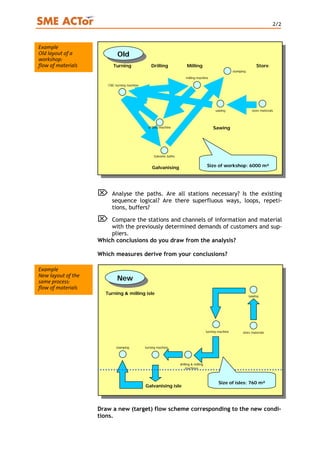
Galvanising Size of workshop: 6000 m²
Turning Drilling Milling Store
stamping
Galvanic baths
store materialssawing
milling machine
drilling machine
CNC-turning machine
Sawing
Old
Example
Old layout of a
workshop:
flow of materials
⌦ Analyse the paths. Are all stations necessary? Is the existing
sequence logical? Are there superfluous ways, loops, repeti-
tions, buffers?
⌦ Compare the stations and channels of information and material
with the previously determined demands of customers and sup-
pliers.
Which conclusions do you draw from the analysis?
Which measures derive from your conclusions?
turning machine
drilling & milling
machines
Galvanising isle
stamping
Size of isles: 760 m²
turning machine store materials
sawing
Turning & milling isle
New
Example
New layout of the
same process:
flow of materials
Draw a new (target) flow scheme corresponding to the new condi-
tions.

D04 Flow analysis

  • 1.
    Tool D4Flow analysisand planning A flow analysis requires the mapping – in the sense of the word: drawing maps - of the channels of information and materials within your company or area in the company. It helps to identify double work, superfluous ways and intermediate stores or other buffers, sources of error etc., thus, serving to organise optimal processes. It is highly recommendable to realise the flow analysis together with the employees of the corresponding area. What you need: ⌦ Do you have a current layout plan of your area or your company buildings showing the arrangement of the different workplaces (machines, rooms, desks etc.)? • If so, please copy it twice on a transparency or, better, scan it. If possible project the layout plan onto a wall or screen. • If not, please make a layout outline roughly true to scale. It will also be sufficient, if you draw the outlines of the room(s) on a flipchart, a pin board or a board. Please do now write the places of work belonging to your area on cards or self-adhesive slips of paper and integrate them into the outline in corre- spondence with their actual position. What you do: ⌦ Now sketch step by step the whole pathway information and materials passing through the corresponding space, from inter- face to interface, i.e. from the entrance of your area or proc- ess right through to the exit, workstation by workstation, • first with regard to the information relevant to orders or issues of a discernible business process, • then with regard to the materials belonging to the same proc- ess. • Produce two separate flow drawings, one for information and one for materials, which you then lay on top of each other (op- timum, one transparency on top of the other) so that you can compare them. • Please use different colours for marking information and mate- rials. What you do What you need 21.07.2008, 11:04:54
  • 2.
    2/2 Galvanising Size ofworkshop: 6000 m² Turning Drilling Milling Store stamping Galvanic baths store materialssawing milling machine drilling machine CNC-turning machine Sawing Old Example Old layout of a workshop: flow of materials ⌦ Analyse the paths. Are all stations necessary? Is the existing sequence logical? Are there superfluous ways, loops, repeti- tions, buffers? ⌦ Compare the stations and channels of information and material with the previously determined demands of customers and sup- pliers. Which conclusions do you draw from the analysis? Which measures derive from your conclusions? turning machine drilling & milling machines Galvanising isle stamping Size of isles: 760 m² turning machine store materials sawing Turning & milling isle New Example New layout of the same process: flow of materials Draw a new (target) flow scheme corresponding to the new condi- tions.