Cylc: the Python
workflow engine for
cycling systems
Declan Valters
Scientific Software Engineer
@dvalts
Modelling Infrastructure Support Systems
Met Office
@MetOffice_Sci
www.metoffice.gov.uk © Crown Copyright 2017, Met Office
Cylc team
MetOffice
Exeter, UK
Dave Matthews
Matthew Shin
Oliver Sanders
Declan Valters
www.metoffice.gov.uk © Crown Copyright 2017, Met Office
NIWA
Wellington, New Zealand
Hilary Oliver
(original developer)
www.metoffice.gov.uk © Crown Copyright 2017, Met Office
What is a workflow?
A workflow consists of an orchestrated and
repeatable pattern of business activity enabled
by the systematic organization of resources
into processes that transform materials,
provide services, or process information.
—Wikipedia
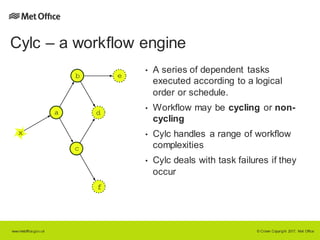
Cylc – a workflow engine
www.metoffice.gov.uk © Crown Copyright 2017, Met Office
• Python software fororchestrating workflows
• Workflow:a series of dependenttasks or actions.
• Cylc automatically executes tasks according to complexschedules and
dependencies
• Scientific research& operations workflows
• Business logic workflows
www.metoffice.gov.uk © Crown Copyright 2017, Met Office
Cylc – a workflow engine
www.metoffice.gov.uk © Crown Copyright 2017, Met Office
• A series of dependent tasks
executed according to a logical
order or schedule.
• Workflow may be cycling or non-
cycling
• Cylc handles a range of workflow
complexities
• Cylc deals with task failures if they
occur
www.metoffice.gov.uk © Crown Copyright 2017, Met Office
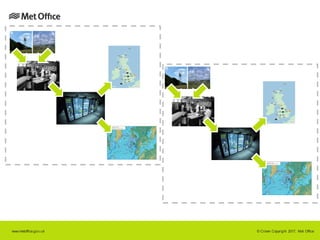
An example workflow:
weather forecasting
www.metoffice.gov.uk © Crown Copyright 2017, Met Office
Cylc – a workflow engine
www.metoffice.gov.uk © Crown Copyright 2017, Met Office
Cylc can handle simple workflows like
this one…
www.metoffice.gov.uk © Crown Copyright 2017, Met Office
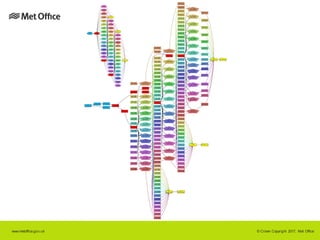
…to more complex workflows
www.metoffice.gov.uk © Crown Copyright 2017, Met Office
Cylc history
www.metoffice.gov.uk © Crown Copyright 2017, Met Office
• Pre-Cylc (at the Met Office):
• SCS “Suite Control System”
• Developed 1996/7
• Tcl/Tk, C, Shell scripts
• Strongly coupled to specific models
• Needed a system that could manage:
• Different runtime configurations
• Different compute resources
• Easily deployable
• Multiple applications
• Cylc:
2009/10 – development began
2012 – First deployed in Met Office,
use within R&D
2013 – Switched operational
forecasting over to using Cylc
2017 – now at version 7.5
www.metoffice.gov.uk © Crown Copyright 2017, Met Office
How does Cylc manage workflows?
Cylc workflows in more depth
www.metoffice.gov.uk © Crown Copyright 2017, Met Office
To recap, a Cylc workflow may:
• Be cycling or non-cycling
• Cycle indefinitely, or have an endpoint
• Cycle according to integers (Cycle 1, Cycle 2, etc…)
• Cycle according to date-times (2017-01-01,2017-02-01,… )
• Date times in Cylc may be simulated or connected to real time.
For example, simulating historic case studies.
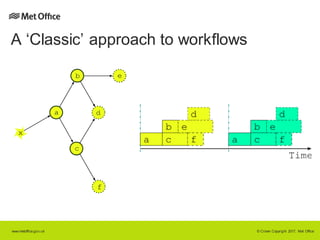
A ‘Classic’ approach to workflows
www.metoffice.gov.uk © Crown Copyright 2017, Met Office
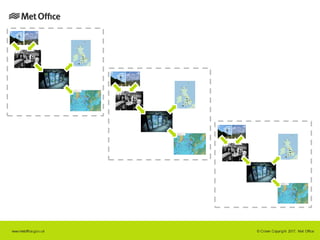
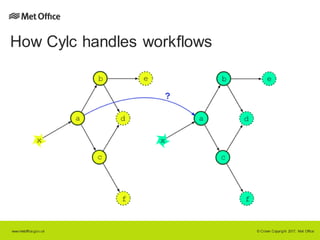
How Cylc handles workflows
www.metoffice.gov.uk © Crown Copyright 2017, Met Office
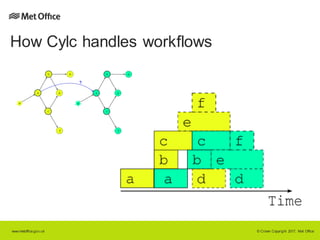
How Cylc handles workflows
www.metoffice.gov.uk © Crown Copyright 2017, Met Office
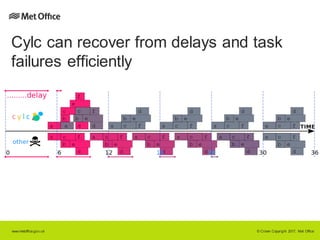
Cylc can recover from delays and task
failures efficiently
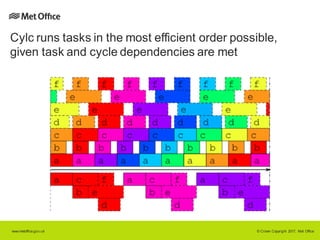
Cylc runs tasks in the most efficient order possible,
given task and cycle dependencies are met
www.metoffice.gov.uk © Crown Copyright 2017, Met Office
Using Cylc
www.metoffice.gov.uk © Crown Copyright 2017, Met Office
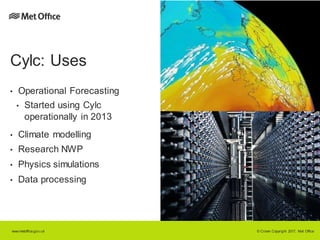
• Operational Forecasting
• Started using Cylc
operationally in 2013
• Climate modelling
• Research NWP
• Physics simulations
• Data processing
Cylc: Uses
www.metoffice.gov.uk © Crown Copyright 2017, Met Office
• Met Office
• NIWA
• Bureau of Meteorology
• Max-Planck-Institut für Meteorologie
• Geophysical Fluid Dynamics Laboratory
• Korean Meteorological Administration
• South African Weather Service
• NCAR (National Centers for
Atmospheric Research)
• Many others…
• Your organisation?
Cylc: Users
www.metoffice.gov.uk © Crown Copyright 2017, Met Office
• Three supercomputers in the
Top 50
• Many other smaller clusters in
use
• Generate a lot of data every
day (200TB daily)
• 480,000 cores
• How does Cylc help us?
Supercomputer use
at the Met Office
www.metoffice.gov.uk © Crown Copyright 2017, Met Office
• Tasks can be run as soon as
dependencies are met
• No need to run tasks
sequentially
• Run tasks in parallel
• More efficient use of HPC
resources
Cylc keeps our
supercomputer busy
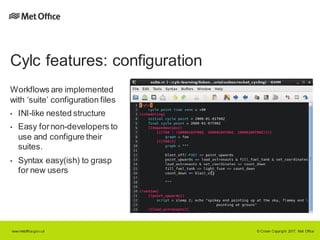
Cylc features: configuration
www.metoffice.gov.uk © Crown Copyright 2017, Met Office
Workflows are implemented
with ‘suite’ configuration files
• INI-like nested structure
• Easy fornon-developers to
use and configure their
suites.
• Syntax easy(ish) to grasp
for new users
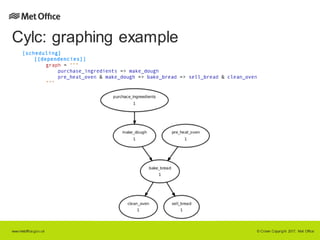
Cylc: graphing example
www.metoffice.gov.uk © Crown Copyright 2017, Met Office
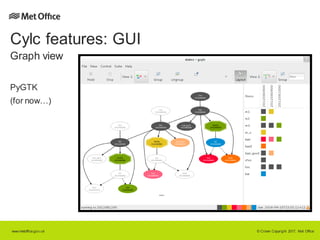
Cylc features: GUI
Graph view
PyGTK
(for now…)
Cylc features: GUI
www.metoffice.gov.uk © Crown Copyright 2017, Met Office
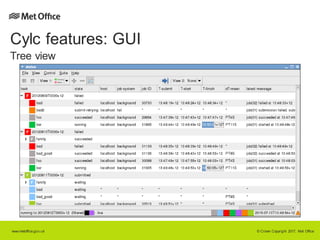
Tree view
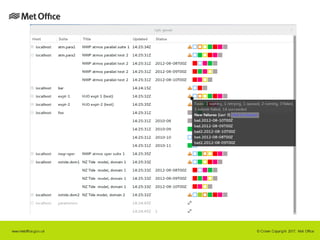
Cylc features: GUI
www.metoffice.gov.uk © Crown Copyright 2017, Met Office
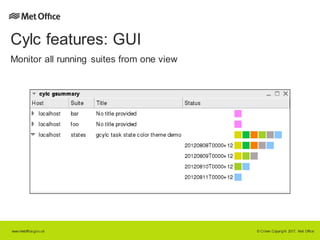
Monitor all running suites from one view
www.metoffice.gov.uk © Crown Copyright 2017, Met Office
Cylc features: remote hosts
www.metoffice.gov.uk © Crown Copyright 2017, Met Office
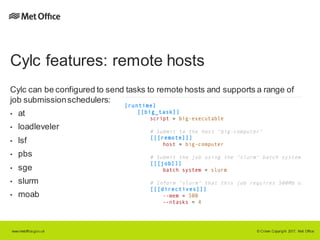
Cylc can be configured to send tasks to remote hosts and supports a range of
job submissionschedulers:
• at
• loadleveler
• lsf
• pbs
• sge
• slurm
• moab
Python in Cylc
www.metoffice.gov.uk © Crown Copyright 2017, Met Office
Cylc developmentalmost entirely in Python (save for a few shell scripts)
Python has enabled rapid developmentof Cylc, prototyping new features,
testing.
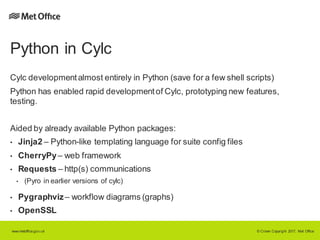
Aided by already available Python packages:
• Jinja2 – Python-like templating language for suite config files
• CherryPy– web framework
• Requests – http(s) communications
• (Pyro in earlier versions of cylc)
• Pygraphviz– workflow diagrams (graphs)
• OpenSSL
Cylc community
www.metoffice.gov.uk © Crown Copyright 2017, Met Office
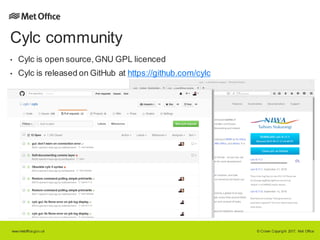
• Cylc is open source,GNU GPL licenced
• Cylc is released on GitHub at https://github.com/cylc
Cylc community
www.metoffice.gov.uk © Crown Copyright 2017, Met Office
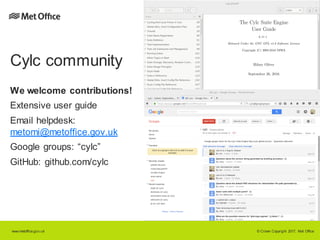
We welcome contributions!
Extensive user guide
Email helpdesk:
metomi@metoffice.gov.uk
Google groups: “cylc”
GitHub: github.com/cylc
Summary
www.metoffice.gov.uk © Crown Copyright 2017, Met Office
• Cylc is a general-purposeworkflowengine,written in Python
• Cylc automatically executes tasks according to complex schedules and
dependencies,dealing with task failures if they occur
• Cylc is ideal for cycling workflows (workflows that repeat according to a
pattern or schedule)
…but can just as easily be used with non-cycling workflows
• Cylc works on a rangeof computingplatforms from your desktop or
laptop to supercomputers
• Cylc scales well to highly complex,large workflows.
…but no workflow is too small for Cylc!
Summary
www.metoffice.gov.uk © Crown Copyright 2017, Met Office
Cylc homepage: http://cylc.github.io/cylc
Contact us at the Met Office: metomi@metoffice.gov.uk
Follow code development, contribute, see issues and pull requests
at: http://github.com/cylc
Ask us questions!
Cylc future development
www.metoffice.gov.uk © Crown Copyright 2017, Met Office
• Python API
• Web-based single GUI
• More efficiency in Cylc internals
• Future suites may contain tens of thousands of tasks
• Challenge to maintain scalability as complexity grows

Cylc - the Python workflow engine for cycling systems.

  • 1.
    Cylc: the Python workflowengine for cycling systems Declan Valters Scientific Software Engineer @dvalts Modelling Infrastructure Support Systems Met Office @MetOffice_Sci www.metoffice.gov.uk © Crown Copyright 2017, Met Office
  • 2.
    Cylc team MetOffice Exeter, UK DaveMatthews Matthew Shin Oliver Sanders Declan Valters www.metoffice.gov.uk © Crown Copyright 2017, Met Office NIWA Wellington, New Zealand Hilary Oliver (original developer)
  • 3.
    www.metoffice.gov.uk © CrownCopyright 2017, Met Office What is a workflow? A workflow consists of an orchestrated and repeatable pattern of business activity enabled by the systematic organization of resources into processes that transform materials, provide services, or process information. —Wikipedia
  • 4.
    Cylc – aworkflow engine www.metoffice.gov.uk © Crown Copyright 2017, Met Office • Python software fororchestrating workflows • Workflow:a series of dependenttasks or actions. • Cylc automatically executes tasks according to complexschedules and dependencies • Scientific research& operations workflows • Business logic workflows
  • 5.
    www.metoffice.gov.uk © CrownCopyright 2017, Met Office
  • 6.
    Cylc – aworkflow engine www.metoffice.gov.uk © Crown Copyright 2017, Met Office • A series of dependent tasks executed according to a logical order or schedule. • Workflow may be cycling or non- cycling • Cylc handles a range of workflow complexities • Cylc deals with task failures if they occur
  • 7.
    www.metoffice.gov.uk © CrownCopyright 2017, Met Office An example workflow: weather forecasting
  • 8.
    www.metoffice.gov.uk © CrownCopyright 2017, Met Office
  • 9.
    www.metoffice.gov.uk © CrownCopyright 2017, Met Office
  • 10.
    www.metoffice.gov.uk © CrownCopyright 2017, Met Office
  • 11.
    www.metoffice.gov.uk © CrownCopyright 2017, Met Office
  • 12.
    Cylc – aworkflow engine www.metoffice.gov.uk © Crown Copyright 2017, Met Office Cylc can handle simple workflows like this one…
  • 13.
    www.metoffice.gov.uk © CrownCopyright 2017, Met Office …to more complex workflows
  • 14.
    www.metoffice.gov.uk © CrownCopyright 2017, Met Office
  • 15.
    www.metoffice.gov.uk © CrownCopyright 2017, Met Office
  • 16.
    Cylc history www.metoffice.gov.uk ©Crown Copyright 2017, Met Office • Pre-Cylc (at the Met Office): • SCS “Suite Control System” • Developed 1996/7 • Tcl/Tk, C, Shell scripts • Strongly coupled to specific models • Needed a system that could manage: • Different runtime configurations • Different compute resources • Easily deployable • Multiple applications • Cylc: 2009/10 – development began 2012 – First deployed in Met Office, use within R&D 2013 – Switched operational forecasting over to using Cylc 2017 – now at version 7.5
  • 17.
    www.metoffice.gov.uk © CrownCopyright 2017, Met Office How does Cylc manage workflows?
  • 18.
    Cylc workflows inmore depth www.metoffice.gov.uk © Crown Copyright 2017, Met Office To recap, a Cylc workflow may: • Be cycling or non-cycling • Cycle indefinitely, or have an endpoint • Cycle according to integers (Cycle 1, Cycle 2, etc…) • Cycle according to date-times (2017-01-01,2017-02-01,… ) • Date times in Cylc may be simulated or connected to real time. For example, simulating historic case studies.
  • 19.
    A ‘Classic’ approachto workflows www.metoffice.gov.uk © Crown Copyright 2017, Met Office
  • 20.
    How Cylc handlesworkflows www.metoffice.gov.uk © Crown Copyright 2017, Met Office
  • 21.
    www.metoffice.gov.uk © CrownCopyright 2017, Met Office How Cylc handles workflows
  • 22.
    www.metoffice.gov.uk © CrownCopyright 2017, Met Office Cylc can recover from delays and task failures efficiently
  • 23.
    Cylc runs tasksin the most efficient order possible, given task and cycle dependencies are met www.metoffice.gov.uk © Crown Copyright 2017, Met Office
  • 24.
    www.metoffice.gov.uk © CrownCopyright 2017, Met Office Using Cylc
  • 25.
    www.metoffice.gov.uk © CrownCopyright 2017, Met Office • Operational Forecasting • Started using Cylc operationally in 2013 • Climate modelling • Research NWP • Physics simulations • Data processing Cylc: Uses
  • 26.
    www.metoffice.gov.uk © CrownCopyright 2017, Met Office • Met Office • NIWA • Bureau of Meteorology • Max-Planck-Institut für Meteorologie • Geophysical Fluid Dynamics Laboratory • Korean Meteorological Administration • South African Weather Service • NCAR (National Centers for Atmospheric Research) • Many others… • Your organisation? Cylc: Users
  • 27.
    www.metoffice.gov.uk © CrownCopyright 2017, Met Office • Three supercomputers in the Top 50 • Many other smaller clusters in use • Generate a lot of data every day (200TB daily) • 480,000 cores • How does Cylc help us? Supercomputer use at the Met Office
  • 28.
    www.metoffice.gov.uk © CrownCopyright 2017, Met Office • Tasks can be run as soon as dependencies are met • No need to run tasks sequentially • Run tasks in parallel • More efficient use of HPC resources Cylc keeps our supercomputer busy
  • 29.
    Cylc features: configuration www.metoffice.gov.uk© Crown Copyright 2017, Met Office Workflows are implemented with ‘suite’ configuration files • INI-like nested structure • Easy fornon-developers to use and configure their suites. • Syntax easy(ish) to grasp for new users
  • 30.
    Cylc: graphing example www.metoffice.gov.uk© Crown Copyright 2017, Met Office
  • 31.
    www.metoffice.gov.uk © CrownCopyright 2017, Met Office Cylc features: GUI Graph view PyGTK (for now…)
  • 32.
    Cylc features: GUI www.metoffice.gov.uk© Crown Copyright 2017, Met Office Tree view
  • 33.
    Cylc features: GUI www.metoffice.gov.uk© Crown Copyright 2017, Met Office Monitor all running suites from one view
  • 34.
    www.metoffice.gov.uk © CrownCopyright 2017, Met Office
  • 35.
    Cylc features: remotehosts www.metoffice.gov.uk © Crown Copyright 2017, Met Office Cylc can be configured to send tasks to remote hosts and supports a range of job submissionschedulers: • at • loadleveler • lsf • pbs • sge • slurm • moab
  • 36.
    Python in Cylc www.metoffice.gov.uk© Crown Copyright 2017, Met Office Cylc developmentalmost entirely in Python (save for a few shell scripts) Python has enabled rapid developmentof Cylc, prototyping new features, testing. Aided by already available Python packages: • Jinja2 – Python-like templating language for suite config files • CherryPy– web framework • Requests – http(s) communications • (Pyro in earlier versions of cylc) • Pygraphviz– workflow diagrams (graphs) • OpenSSL
  • 37.
    Cylc community www.metoffice.gov.uk ©Crown Copyright 2017, Met Office • Cylc is open source,GNU GPL licenced • Cylc is released on GitHub at https://github.com/cylc
  • 38.
    Cylc community www.metoffice.gov.uk ©Crown Copyright 2017, Met Office We welcome contributions! Extensive user guide Email helpdesk: metomi@metoffice.gov.uk Google groups: “cylc” GitHub: github.com/cylc
  • 39.
    Summary www.metoffice.gov.uk © CrownCopyright 2017, Met Office • Cylc is a general-purposeworkflowengine,written in Python • Cylc automatically executes tasks according to complex schedules and dependencies,dealing with task failures if they occur • Cylc is ideal for cycling workflows (workflows that repeat according to a pattern or schedule) …but can just as easily be used with non-cycling workflows • Cylc works on a rangeof computingplatforms from your desktop or laptop to supercomputers • Cylc scales well to highly complex,large workflows. …but no workflow is too small for Cylc!
  • 40.
    Summary www.metoffice.gov.uk © CrownCopyright 2017, Met Office Cylc homepage: http://cylc.github.io/cylc Contact us at the Met Office: metomi@metoffice.gov.uk Follow code development, contribute, see issues and pull requests at: http://github.com/cylc Ask us questions!
  • 41.
    Cylc future development www.metoffice.gov.uk© Crown Copyright 2017, Met Office • Python API • Web-based single GUI • More efficiency in Cylc internals • Future suites may contain tens of thousands of tasks • Challenge to maintain scalability as complexity grows