1
Cybersecurity Maturity Model Certification
Version 2.0
Overview Briefing
December 3, 2021
Note: The information in this presentation reflects the Department’s strategic intent with respect to the CMMC
program. The Department will be engaging in rulemaking and internal resourcing as part of implementation,
and program details are subject to change during these processes.
DISTRIBUTION A. Approved for public release
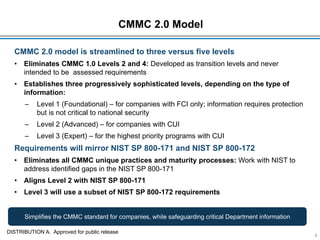
CMMC 2.0 Model
CMMC 2.0 model is streamlined to three versus five levels
• Eliminates CMMC 1.0 Levels 2 and 4: Developed as transition levels and never
intended to be assessed requirements
• Establishes three progressively sophisticated levels, depending on the type of
information:
– Level 1 (Foundational) – for companies with FCI only; information requires protection
but is not critical to national security
– Level 2 (Advanced) – for companies with CUI
– Level 3 (Expert) – for the highest priority programs with CUI
Requirements will mirror NIST SP 800-171 and NIST SP 800-172
• Eliminates all CMMC unique practices and maturity processes: Work with NIST to
address identified gaps in the NIST SP 800-171
• Aligns Level 2 with NIST SP 800-171
• Level 3 will use a subset of NIST SP 800-172 requirements
2
Simplifies the CMMC standard for companies, while safeguarding critical Department information
DISTRIBUTION A. Approved for public release
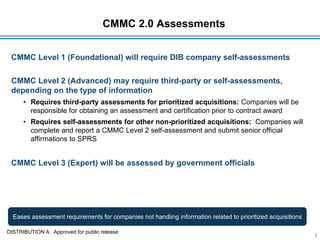
CMMC 2.0 Assessments
CMMC Level 1 (Foundational) will require DIB company self-assessments
CMMC Level 2 (Advanced) may require third-party or self-assessments,
depending on the type of information
• Requires third-party assessments for prioritized acquisitions: Companies will be
responsible for obtaining an assessment and certification prior to contract award
• Requires self-assessments for other non-prioritized acquisitions: Companies will
complete and report a CMMC Level 2 self-assessment and submit senior official
affirmations to SPRS
CMMC Level 3 (Expert) will be assessed by government officials
3
Eases assessment requirements for companies not handling information related to prioritized acquisitions
DISTRIBUTION A. Approved for public release
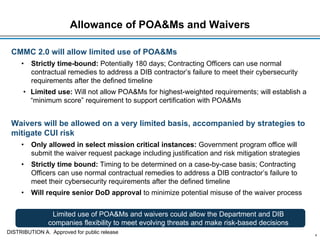
Allowance of POA&Ms and Waivers
CMMC 2.0 will allow limited use of POA&Ms
• Strictly time-bound: Potentially 180 days; Contracting Officers can use normal
contractual remedies to address a DIB contractor’s failure to meet their cybersecurity
requirements after the defined timeline
• Limited use: Will not allow POA&Ms for highest-weighted requirements; will establish a
“minimum score” requirement to support certification with POA&Ms
Waivers will be allowed on a very limited basis, accompanied by strategies to
mitigate CUI risk
• Only allowed in select mission critical instances: Government program office will
submit the waiver request package including justification and risk mitigation strategies
• Strictly time bound: Timing to be determined on a case-by-case basis; Contracting
Officers can use normal contractual remedies to address a DIB contractor’s failure to
meet their cybersecurity requirements after the defined timeline
• Will require senior DoD approval to minimize potential misuse of the waiver process
4
Limited use of POA&Ms and waivers could allow the Department and DIB
companies flexibility to meet evolving threats and make risk-based decisions
DISTRIBUTION A. Approved for public release
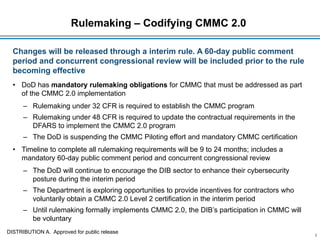
Changes will be released through a interim rule. A 60-day public comment
period and concurrent congressional review will be included prior to the rule
becoming effective
• DoD has mandatory rulemaking obligations for CMMC that must be addressed as part
of the CMMC 2.0 implementation
– Rulemaking under 32 CFR is required to establish the CMMC program
– Rulemaking under 48 CFR is required to update the contractual requirements in the
DFARS to implement the CMMC 2.0 program
– The DoD is suspending the CMMC Piloting effort and mandatory CMMC certification
• Timeline to complete all rulemaking requirements will be 9 to 24 months; includes a
mandatory 60-day public comment period and concurrent congressional review
– The DoD will continue to encourage the DIB sector to enhance their cybersecurity
posture during the interim period
– The Department is exploring opportunities to provide incentives for contractors who
voluntarily obtain a CMMC 2.0 Level 2 certification in the interim period
– Until rulemaking formally implements CMMC 2.0, the DIB’s participation in CMMC will
be voluntary
Rulemaking – Codifying CMMC 2.0
5
DISTRIBUTION A. Approved for public release
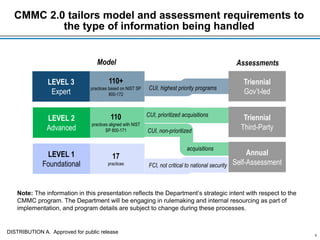
CMMC 2.0 tailors model and assessment requirements to
the type of information being handled
6
LEVEL 3
Expert
LEVEL 2
Advanced
LEVEL 1
Foundational
110+
practices based on NIST SP
800-172
110
practices aligned with NIST
SP 800-171
17
practices
Triennial
Gov’t-led
Triennial
Third-Party
Annual
Self-Assessment
CUI, highest priority programs
CUI, prioritized acquisitions
CUI, non-prioritized
acquisitions
FCI, not critical to national security
Model Assessments
Note: The information in this presentation reflects the Department’s strategic intent with respect to the
CMMC program. The Department will be engaging in rulemaking and internal resourcing as part of
implementation, and program details are subject to change during these processes.
DISTRIBUTION A. Approved for public release
7
Questions?
DISTRIBUTION A. Approved for public release

Cybersecurity Maturity Model Certification

  • 1.
    1 Cybersecurity Maturity ModelCertification Version 2.0 Overview Briefing December 3, 2021 Note: The information in this presentation reflects the Department’s strategic intent with respect to the CMMC program. The Department will be engaging in rulemaking and internal resourcing as part of implementation, and program details are subject to change during these processes. DISTRIBUTION A. Approved for public release
  • 2.
    CMMC 2.0 Model CMMC2.0 model is streamlined to three versus five levels • Eliminates CMMC 1.0 Levels 2 and 4: Developed as transition levels and never intended to be assessed requirements • Establishes three progressively sophisticated levels, depending on the type of information: – Level 1 (Foundational) – for companies with FCI only; information requires protection but is not critical to national security – Level 2 (Advanced) – for companies with CUI – Level 3 (Expert) – for the highest priority programs with CUI Requirements will mirror NIST SP 800-171 and NIST SP 800-172 • Eliminates all CMMC unique practices and maturity processes: Work with NIST to address identified gaps in the NIST SP 800-171 • Aligns Level 2 with NIST SP 800-171 • Level 3 will use a subset of NIST SP 800-172 requirements 2 Simplifies the CMMC standard for companies, while safeguarding critical Department information DISTRIBUTION A. Approved for public release
  • 3.
    CMMC 2.0 Assessments CMMCLevel 1 (Foundational) will require DIB company self-assessments CMMC Level 2 (Advanced) may require third-party or self-assessments, depending on the type of information • Requires third-party assessments for prioritized acquisitions: Companies will be responsible for obtaining an assessment and certification prior to contract award • Requires self-assessments for other non-prioritized acquisitions: Companies will complete and report a CMMC Level 2 self-assessment and submit senior official affirmations to SPRS CMMC Level 3 (Expert) will be assessed by government officials 3 Eases assessment requirements for companies not handling information related to prioritized acquisitions DISTRIBUTION A. Approved for public release
  • 4.
    Allowance of POA&Msand Waivers CMMC 2.0 will allow limited use of POA&Ms • Strictly time-bound: Potentially 180 days; Contracting Officers can use normal contractual remedies to address a DIB contractor’s failure to meet their cybersecurity requirements after the defined timeline • Limited use: Will not allow POA&Ms for highest-weighted requirements; will establish a “minimum score” requirement to support certification with POA&Ms Waivers will be allowed on a very limited basis, accompanied by strategies to mitigate CUI risk • Only allowed in select mission critical instances: Government program office will submit the waiver request package including justification and risk mitigation strategies • Strictly time bound: Timing to be determined on a case-by-case basis; Contracting Officers can use normal contractual remedies to address a DIB contractor’s failure to meet their cybersecurity requirements after the defined timeline • Will require senior DoD approval to minimize potential misuse of the waiver process 4 Limited use of POA&Ms and waivers could allow the Department and DIB companies flexibility to meet evolving threats and make risk-based decisions DISTRIBUTION A. Approved for public release
  • 5.
    Changes will bereleased through a interim rule. A 60-day public comment period and concurrent congressional review will be included prior to the rule becoming effective • DoD has mandatory rulemaking obligations for CMMC that must be addressed as part of the CMMC 2.0 implementation – Rulemaking under 32 CFR is required to establish the CMMC program – Rulemaking under 48 CFR is required to update the contractual requirements in the DFARS to implement the CMMC 2.0 program – The DoD is suspending the CMMC Piloting effort and mandatory CMMC certification • Timeline to complete all rulemaking requirements will be 9 to 24 months; includes a mandatory 60-day public comment period and concurrent congressional review – The DoD will continue to encourage the DIB sector to enhance their cybersecurity posture during the interim period – The Department is exploring opportunities to provide incentives for contractors who voluntarily obtain a CMMC 2.0 Level 2 certification in the interim period – Until rulemaking formally implements CMMC 2.0, the DIB’s participation in CMMC will be voluntary Rulemaking – Codifying CMMC 2.0 5 DISTRIBUTION A. Approved for public release
  • 6.
    CMMC 2.0 tailorsmodel and assessment requirements to the type of information being handled 6 LEVEL 3 Expert LEVEL 2 Advanced LEVEL 1 Foundational 110+ practices based on NIST SP 800-172 110 practices aligned with NIST SP 800-171 17 practices Triennial Gov’t-led Triennial Third-Party Annual Self-Assessment CUI, highest priority programs CUI, prioritized acquisitions CUI, non-prioritized acquisitions FCI, not critical to national security Model Assessments Note: The information in this presentation reflects the Department’s strategic intent with respect to the CMMC program. The Department will be engaging in rulemaking and internal resourcing as part of implementation, and program details are subject to change during these processes. DISTRIBUTION A. Approved for public release
  • 7.