Cyber Security Risk
Mitigation Checklist
Contents
Contents
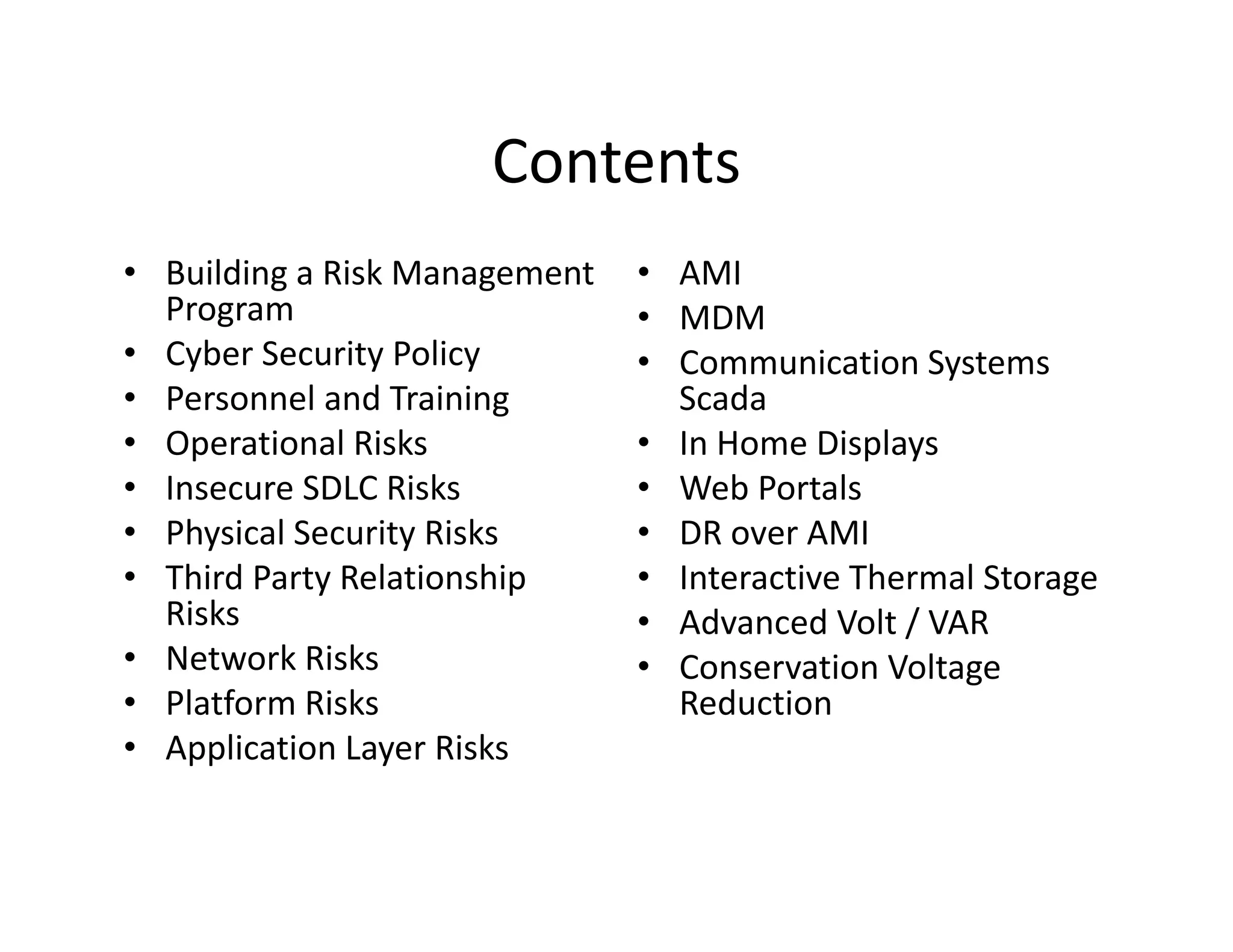
• Building a Risk Management • AMI
Program
• Cyber Security Policy
• Personnel and Training
• MDM
• Communication Systems
Scada
g
• Operational Risks
• Insecure SDLC Risks
• Physical Security Risks
• In Home Displays
• Web Portals
• DR over AMI
• Physical Security Risks
• Third Party Relationship
Risks
• Network Risks
• DR over AMI
• Interactive Thermal Storage
• Advanced Volt / VAR
C i V l
• Network Risks
• Platform Risks
• Application Layer Risks
• Conservation Voltage
Reduction
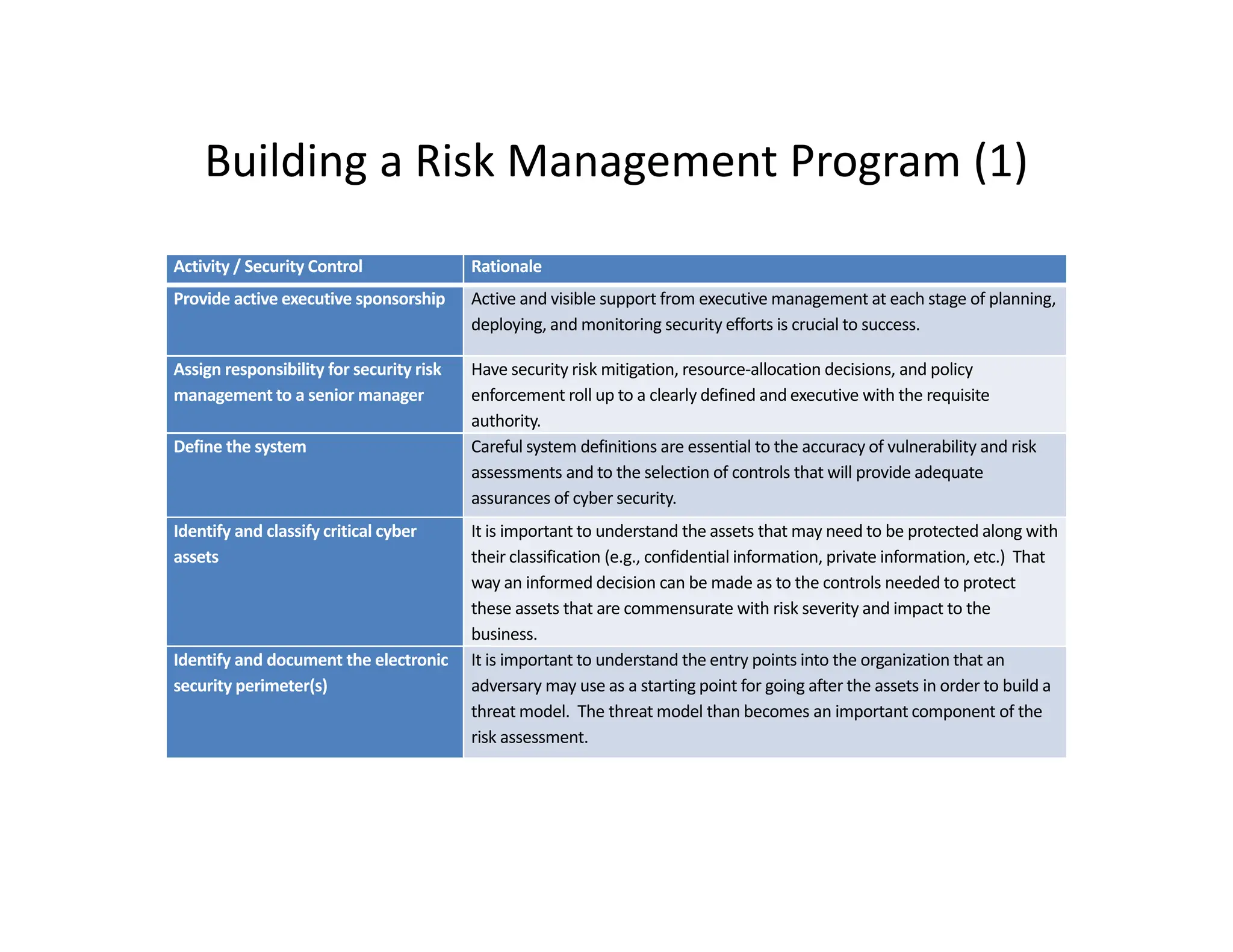
Building a Risk Management Program (1)
Activity / Security Control Rationale
Provide active executive sponsorship Active and visible support from executive management at each stage of planning
Provide active executive sponsorship Active and visible support from executive management at each stage of planning,
deploying, and monitoring security efforts is crucial to success.
Assign responsibility for security risk
management to a senior manager
Have security risk mitigation, resource‐allocation decisions, and policy
enforcement roll up to a clearly defined and executive with the requisite
th it
authority.
Define the system Careful system definitions are essential to the accuracy of vulnerability and risk
assessments and to the selection of controls that will provide adequate
assurances of cyber security.
Identify and classify critical cyber It is important to understand the assets that may need to be protected along with
Identify and classify critical cyber
assets
It is important to understand the assets that may need to be protected along with
their classification (e.g., confidential information, private information, etc.) That
way an informed decision can be made as to the controls needed to protect
these assets that are commensurate with risk severity and impact to the
business.
Id tif d d t th l t i It i i t t t d t d th t i t i t th i ti th t
Identify and document the electronic
security perimeter(s)
It is important to understand the entry points into the organization that an
adversary may use as a starting point for going after the assets in order to build a
threat model. The threat model than becomes an important component of the
risk assessment.
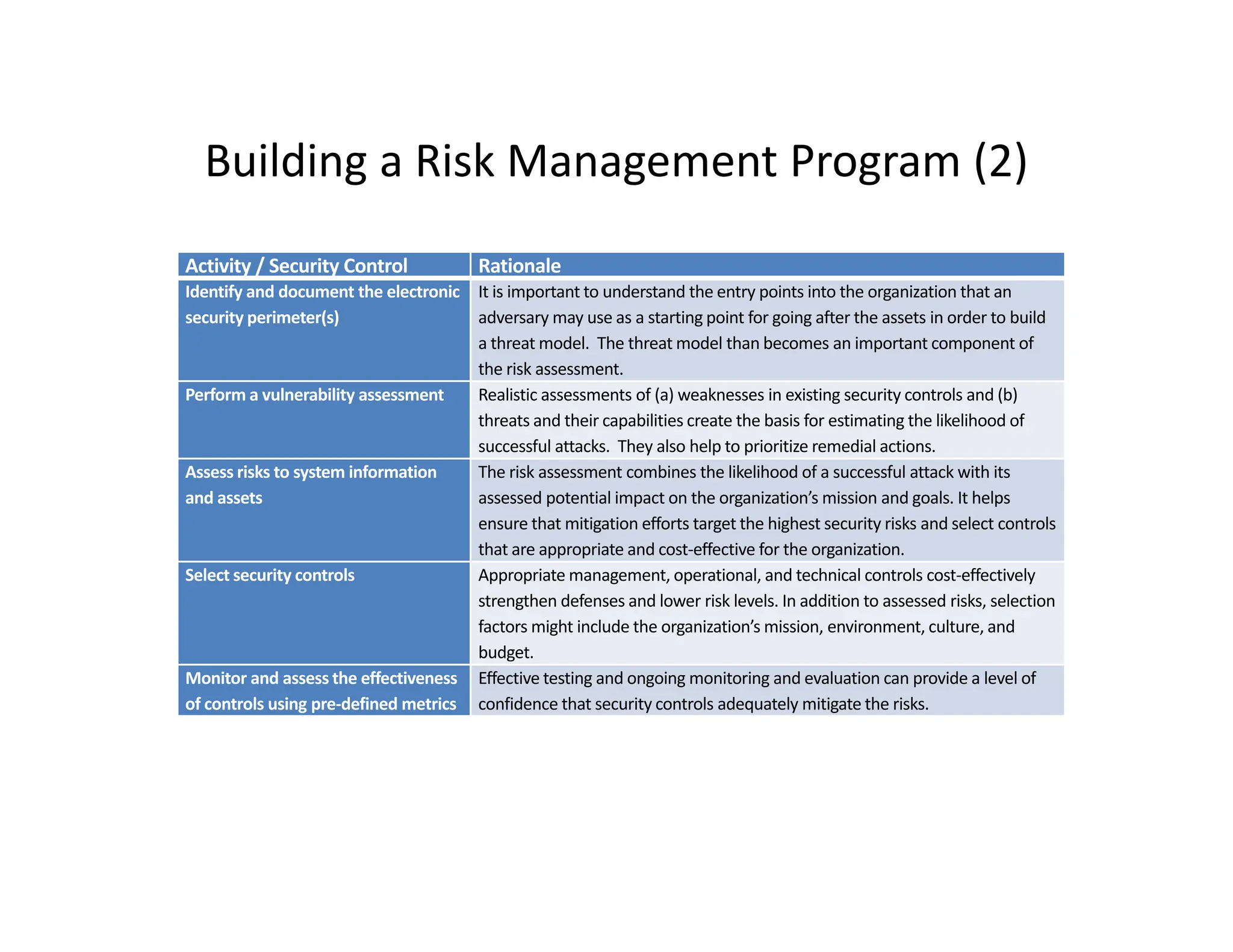
Building a Risk Management Program (2)
Activity / Security Control Rationale
Identify and document the electronic It is important to understand the entry points into the organization that an
Identify and document the electronic
security perimeter(s)
It is important to understand the entry points into the organization that an
adversary may use as a starting point for going after the assets in order to build
a threat model. The threat model than becomes an important component of
the risk assessment.
Perform a vulnerability assessment Realistic assessments of (a) weaknesses in existing security controls and (b)
th t d th i biliti t th b i f ti ti th lik lih d f
threats and their capabilities create the basis for estimating the likelihood of
successful attacks. They also help to prioritize remedial actions.
Assess risks to system information
and assets
The risk assessment combines the likelihood of a successful attack with its
assessed potential impact on the organization’s mission and goals. It helps
ensure that mitigation efforts target the highest security risks and select controls
that are appropriate and cost‐effective for the organization.
Select security controls Appropriate management, operational, and technical controls cost‐effectively
strengthen defenses and lower risk levels. In addition to assessed risks, selection
factors might include the organization’s mission, environment, culture, and
budget
budget.
Monitor and assess the effectiveness
of controls using pre‐defined metrics
Effective testing and ongoing monitoring and evaluation can provide a level of
confidence that security controls adequately mitigate the risks.
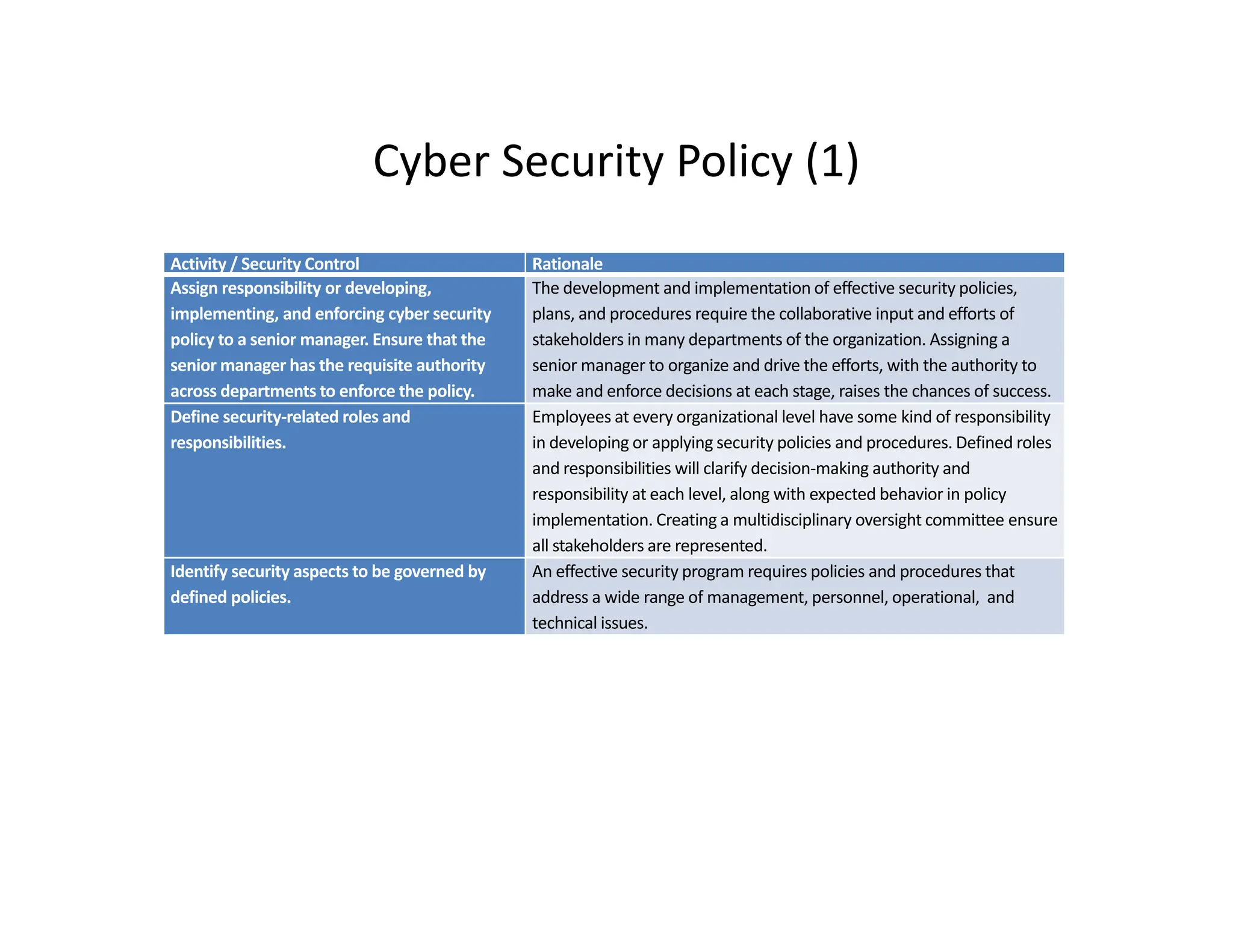
Cyber Security Policy (1)
Activity / Security Control Rationale
Assign responsibility or developing, The development and implementation of effective security policies,
g p y p g,
implementing, and enforcing cyber security
policy to a senior manager. Ensure that the
senior manager has the requisite authority
across departments to enforce the policy.
p p y p ,
plans, and procedures require the collaborative input and efforts of
stakeholders in many departments of the organization. Assigning a
senior manager to organize and drive the efforts, with the authority to
make and enforce decisions at each stage, raises the chances of success.
Define security related roles and Employees at every organizational level have some kind of responsibility
Define security‐related roles and
responsibilities.
Employees at every organizational level have some kind of responsibility
in developing or applying security policies and procedures. Defined roles
and responsibilities will clarify decision‐making authority and
responsibility at each level, along with expected behavior in policy
implementation. Creating a multidisciplinary oversight committee ensure
all stakeholders are represented.
Identify security aspects to be governed by
defined policies.
An effective security program requires policies and procedures that
address a wide range of management, personnel, operational, and
technical issues.
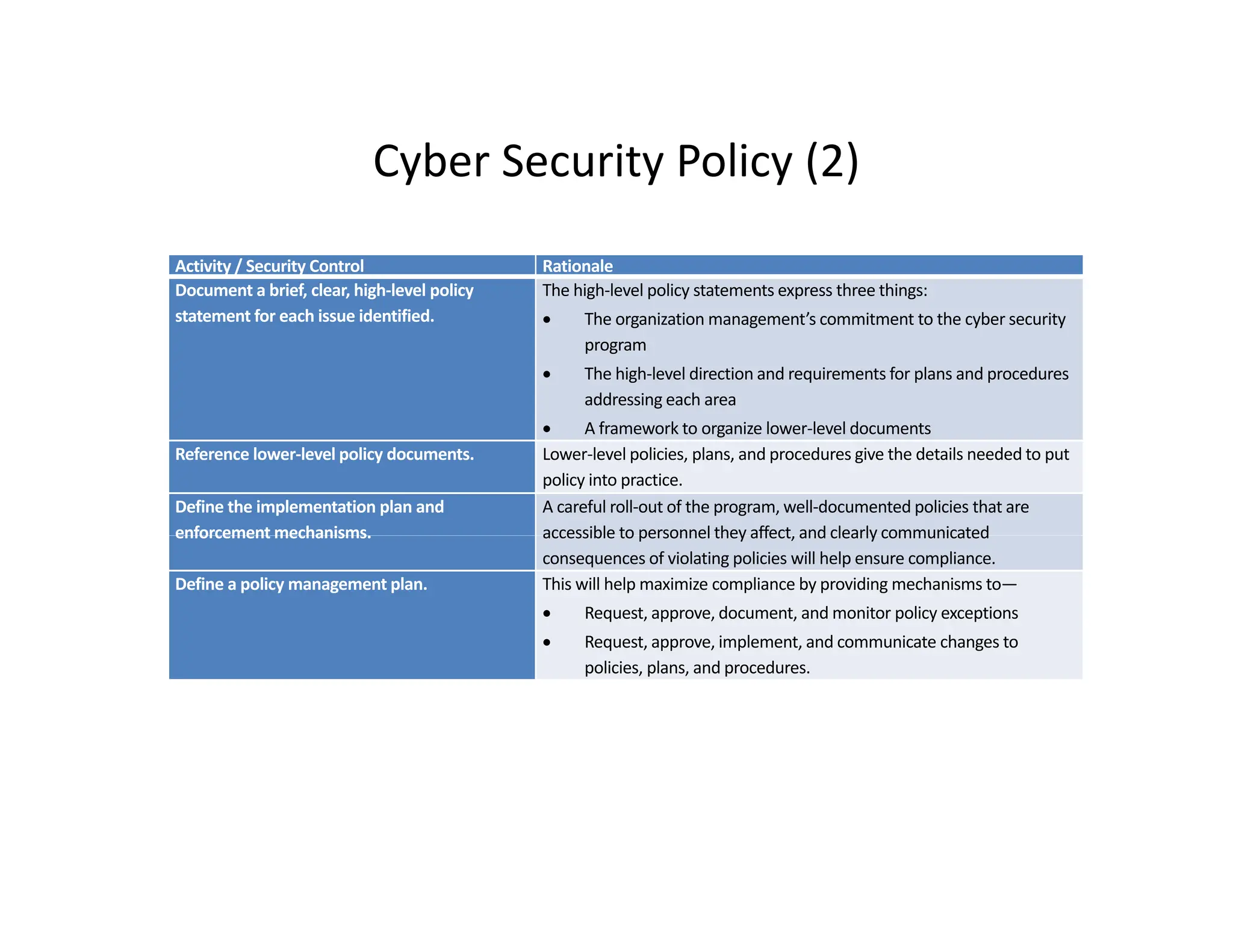
Cyber Security Policy (2)
Activity / Security Control Rationale
Document a brief, clear, high‐level policy The high‐level policy statements express three things:
Document a brief, clear, high level policy
statement for each issue identified.
The high level policy statements express three things:
• The organization management’s commitment to the cyber security
program
• The high‐level direction and requirements for plans and procedures
addressing each area
• A framework to organize lower‐level documents
Reference lower‐level policy documents. Lower‐level policies, plans, and procedures give the details needed to put
policy into practice.
Define the implementation plan and
enforcement mechanisms.
A careful roll‐out of the program, well‐documented policies that are
accessible to personnel they affect and clearly communicated
enforcement mechanisms. accessible to personnel they affect, and clearly communicated
consequences of violating policies will help ensure compliance.
Define a policy management plan. This will help maximize compliance by providing mechanisms to—
• Request, approve, document, and monitor policy exceptions
• Request, approve, implement, and communicate changes to
policies, plans, and procedures.
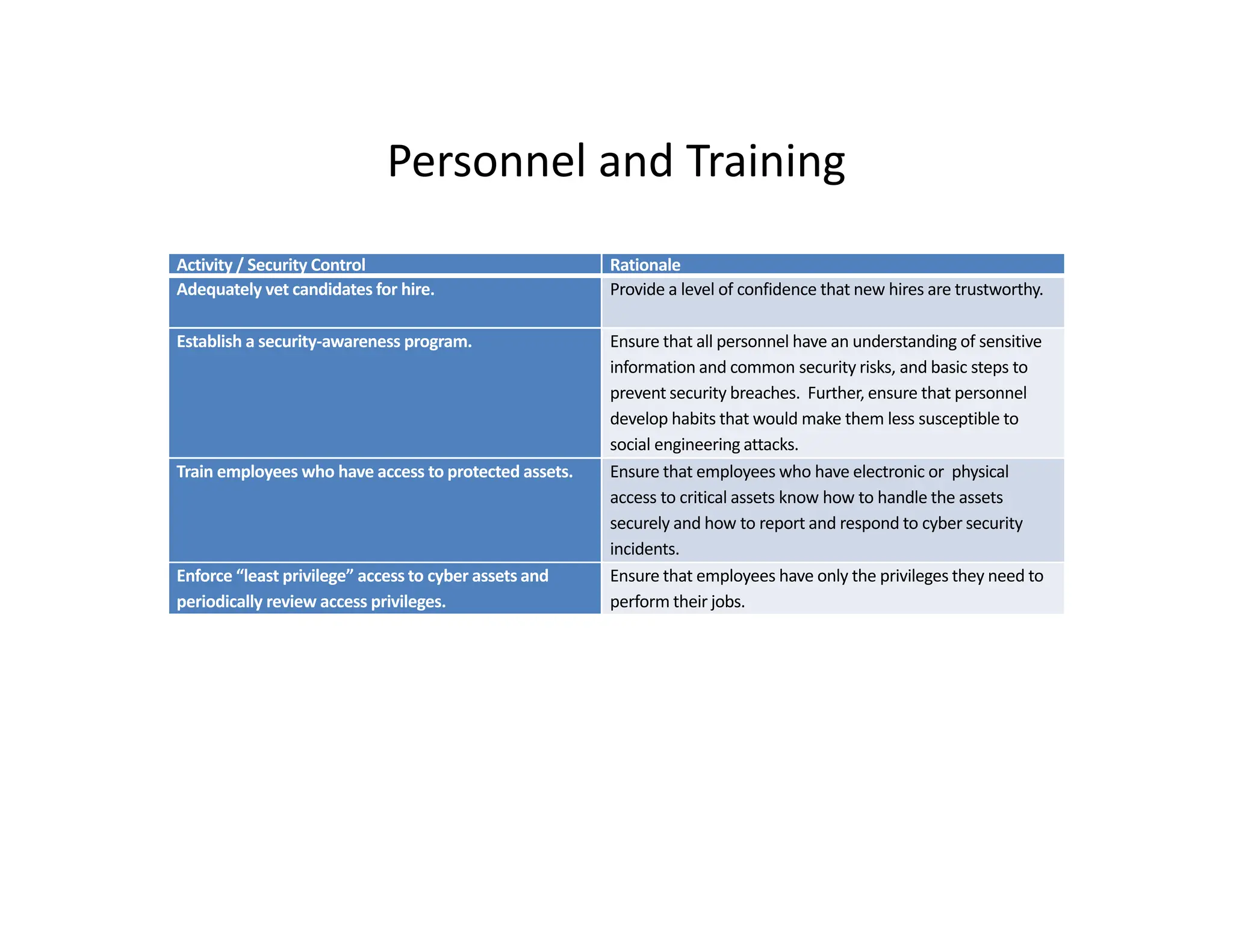
Personnel and Training
Activity / Security Control Rationale
Adequately vet candidates for hire. Provide a level of confidence that new hires are trustworthy.
q y y
Establish a security‐awareness program. Ensure that all personnel have an understanding of sensitive
information and common security risks, and basic steps to
prevent security breaches. Further, ensure that personnel
develop habits that would make them less susceptible to
social engineering attacks.
Train employees who have access to protected assets. Ensure that employees who have electronic or physical
access to critical assets know how to handle the assets
securely and how to report and respond to cyber security
incidents.
Enforce “least privilege” access to cyber assets and
periodically review access privileges.
Ensure that employees have only the privileges they need to
perform their jobs.
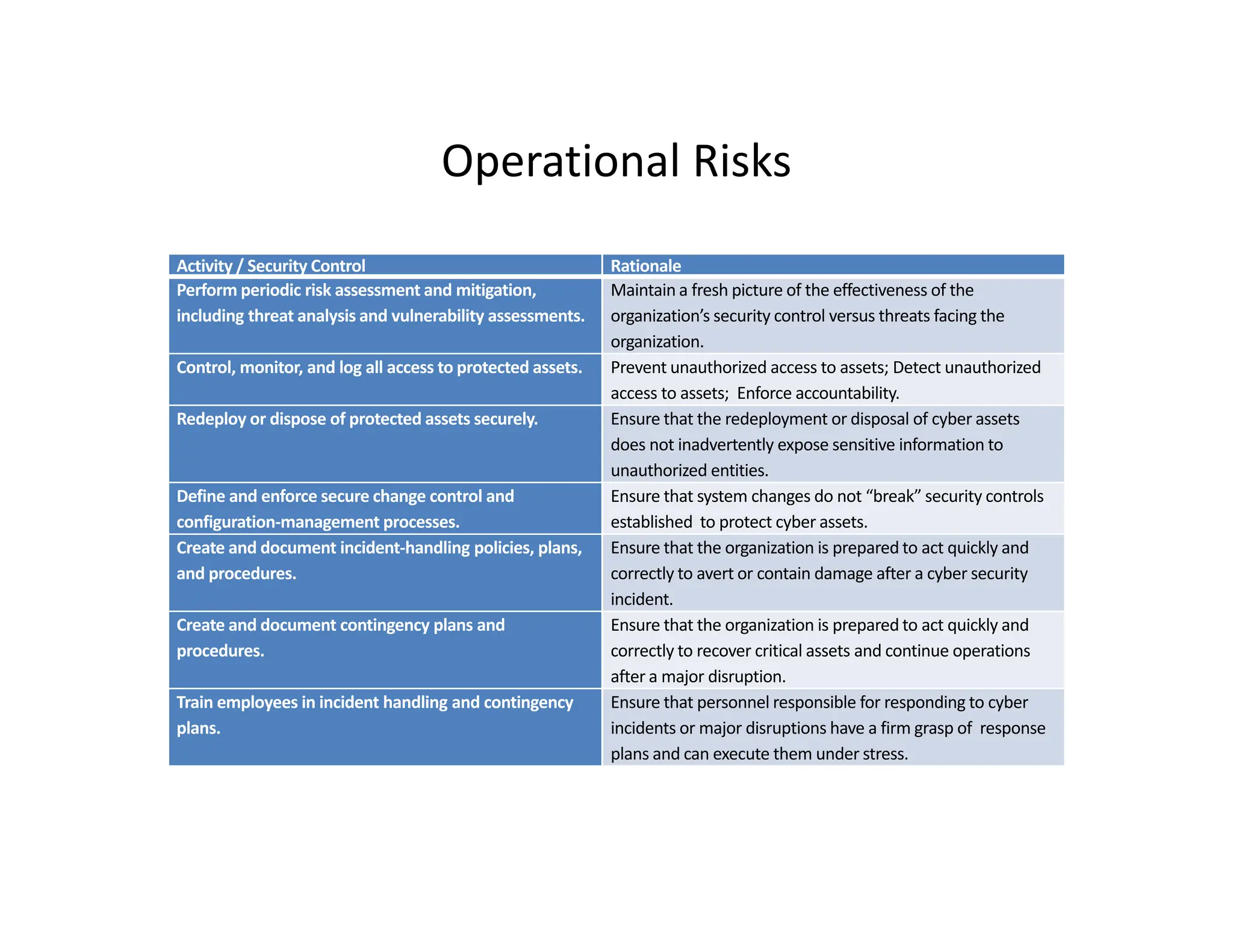
Operational Risks
Operational Risks
Activity / Security Control Rationale
Perform periodic risk assessment and mitigation, Maintain a fresh picture of the effectiveness of the
e o pe od c s assess e t a d t gat o ,
including threat analysis and vulnerability assessments.
a ta a es p ctu e o t e e ect e ess o t e
organization’s security control versus threats facing the
organization.
Control, monitor, and log all access to protected assets. Prevent unauthorized access to assets; Detect unauthorized
access to assets; Enforce accountability.
Redeploy or dispose of protected assets securely Ens re that the redeplo ment or disposal of c ber assets
Redeploy or dispose of protected assets securely. Ensure that the redeployment or disposal of cyber assets
does not inadvertently expose sensitive information to
unauthorized entities.
Define and enforce secure change control and
configuration‐management processes.
Ensure that system changes do not “break” security controls
established to protect cyber assets.
Create and document incident‐handling policies, plans,
and procedures.
Ensure that the organization is prepared to act quickly and
correctly to avert or contain damage after a cyber security
incident.
Create and document contingency plans and
procedures.
Ensure that the organization is prepared to act quickly and
correctly to recover critical assets and continue operations
procedures. correctly to recover critical assets and continue operations
after a major disruption.
Train employees in incident handling and contingency
plans.
Ensure that personnel responsible for responding to cyber
incidents or major disruptions have a firm grasp of response
plans and can execute them under stress.
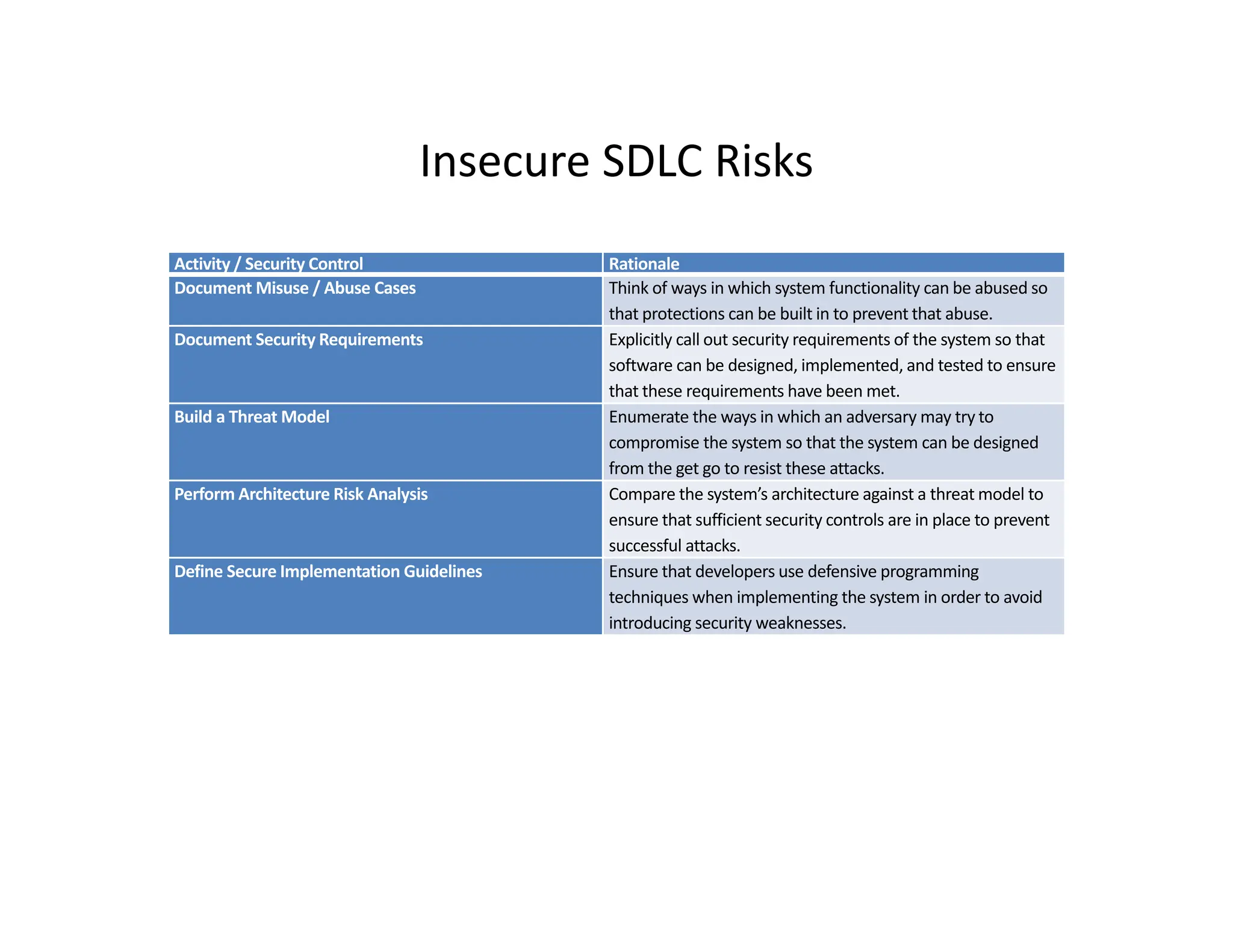
Insecure SDLC Risks
Insecure SDLC Risks
Activity / Security Control Rationale
Document Misuse / Abuse Cases Think of ways in which system functionality can be abused so
/ y y y
that protections can be built in to prevent that abuse.
Document Security Requirements Explicitly call out security requirements of the system so that
software can be designed, implemented, and tested to ensure
that these requirements have been met.
Build a Threat Model Enumerate the ways in which an adversary may try to
compromise the system so that the system can be designed
from the get go to resist these attacks.
Perform Architecture Risk Analysis Compare the system’s architecture against a threat model to
ensure that sufficient security controls are in place to prevent
successful attacks.
Define Secure Implementation Guidelines Ensure that developers use defensive programming
techniques when implementing the system in order to avoid
introducing security weaknesses.
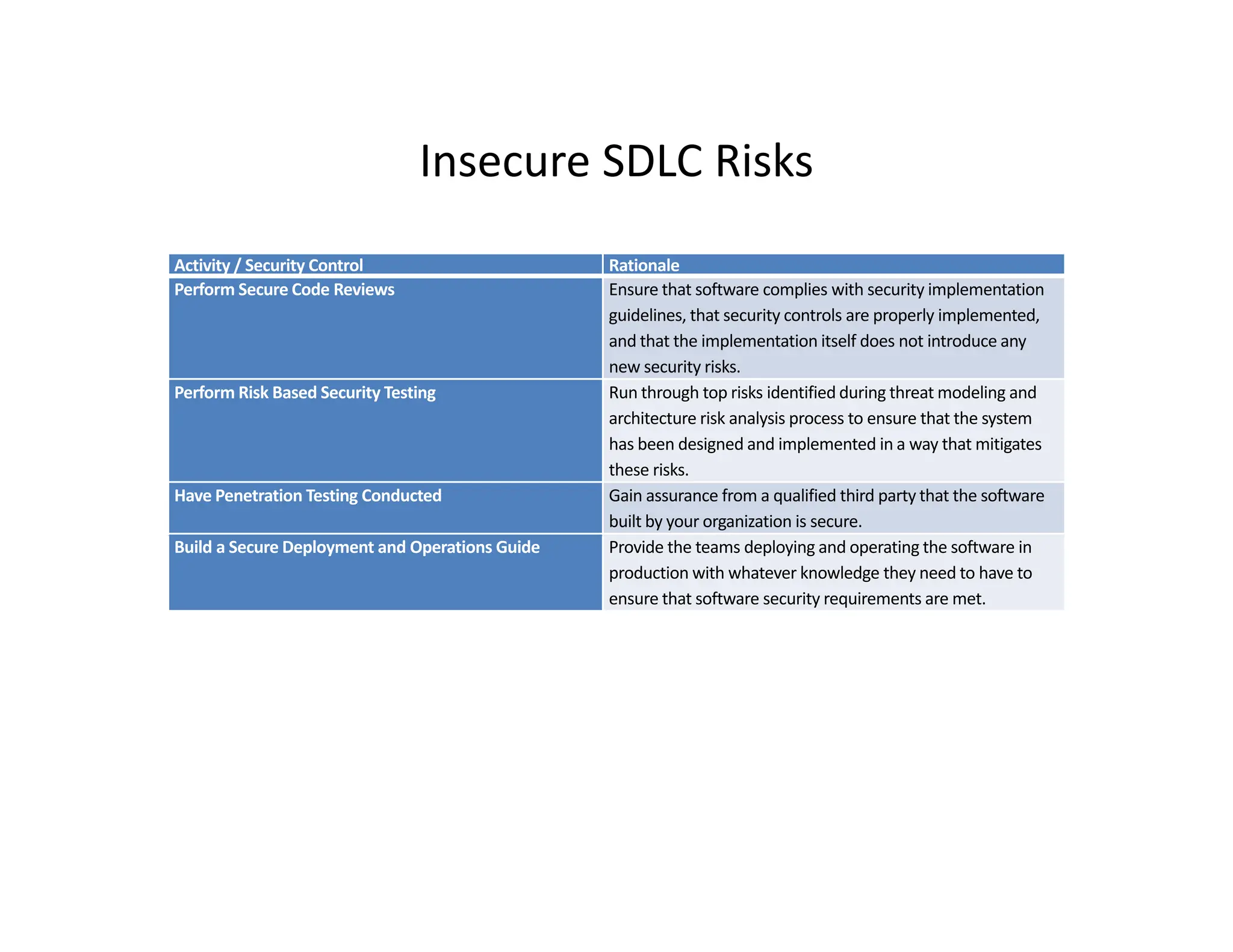
Insecure SDLC Risks
Insecure SDLC Risks
Activity / Security Control Rationale
Perform Secure Code Reviews Ensure that software complies with security implementation
p y p
guidelines, that security controls are properly implemented,
and that the implementation itself does not introduce any
new security risks.
Perform Risk Based Security Testing Run through top risks identified during threat modeling and
architecture risk analysis process to ensure that the system
has been designed and implemented in a way that mitigates
these risks.
Have Penetration Testing Conducted Gain assurance from a qualified third party that the software
built by your organization is secure.
Build a Secure Deployment and Operations Guide Provide the teams deploying and operating the software in
production with whatever knowledge they need to have to
ensure that software security requirements are met.
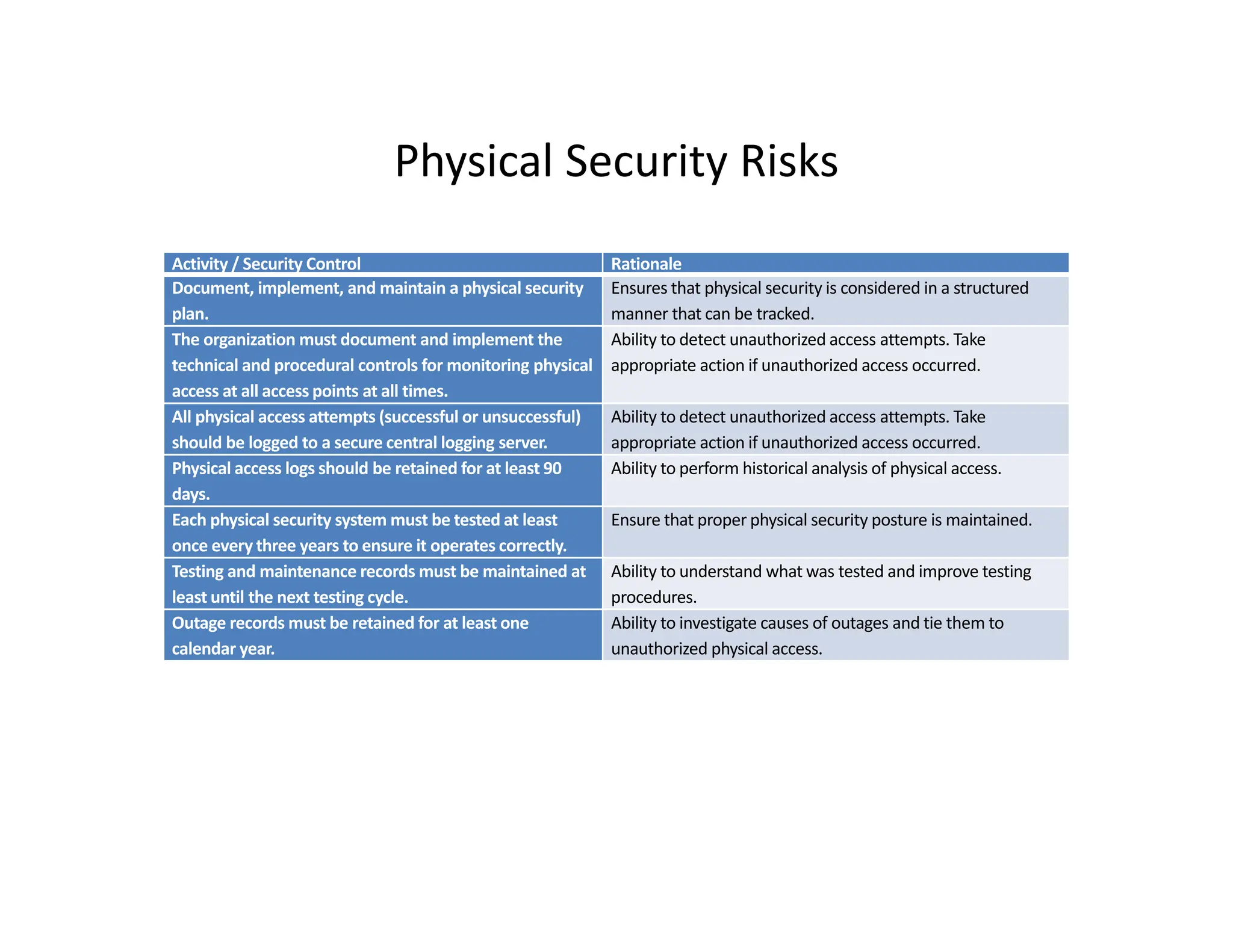
Physical Security Risks
Activity / Security Control Rationale
Document, implement, and maintain a physical security Ensures that physical security is considered in a structured
, p , p y y
plan.
p y y
manner that can be tracked.
The organization must document and implement the
technical and procedural controls for monitoring physical
access at all access points at all times.
Ability to detect unauthorized access attempts. Take
appropriate action if unauthorized access occurred.
All physical access attempts (successful or unsuccessful) Ability to detect unauthorized access attempts Take
All physical access attempts (successful or unsuccessful)
should be logged to a secure central logging server.
Ability to detect unauthorized access attempts. Take
appropriate action if unauthorized access occurred.
Physical access logs should be retained for at least 90
days.
Ability to perform historical analysis of physical access.
Each physical security system must be tested at least Ensure that proper physical security posture is maintained.
once every three years to ensure it operates correctly.
Testing and maintenance records must be maintained at
least until the next testing cycle.
Ability to understand what was tested and improve testing
procedures.
Outage records must be retained for at least one
calendar year.
Ability to investigate causes of outages and tie them to
unauthorized physical access.
y p y
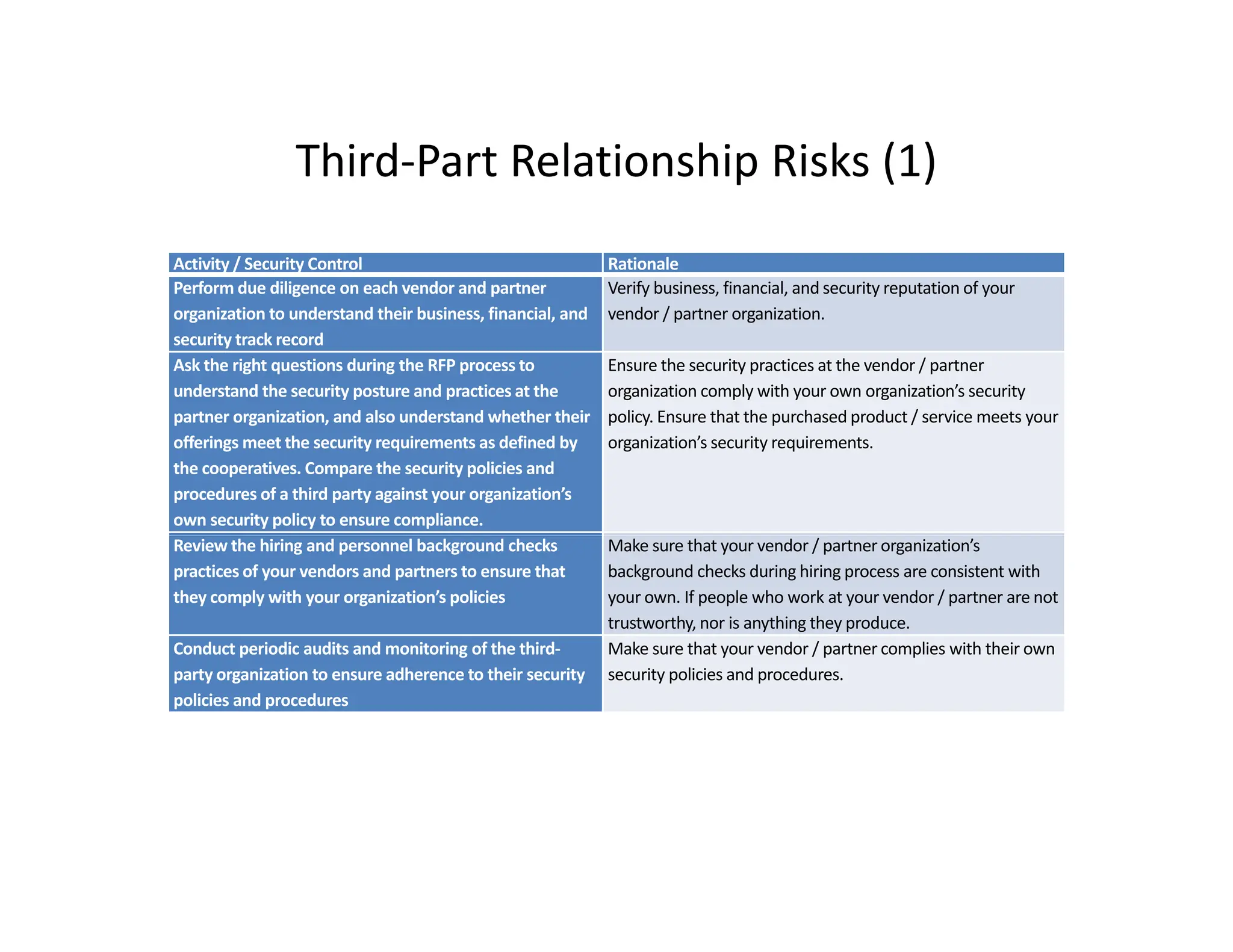
Third‐Part Relationship Risks (1)
Third Part Relationship Risks (1)
Activity / Security Control Rationale
Perform due diligence on each vendor and partner Verify business, financial, and security reputation of your
g p
organization to understand their business, financial, and
security track record
y , , y p y
vendor / partner organization.
Ask the right questions during the RFP process to
understand the security posture and practices at the
partner organization and also understand whether their
Ensure the security practices at the vendor / partner
organization comply with your own organization’s security
policy Ensure that the purchased product / service meets your
partner organization, and also understand whether their
offerings meet the security requirements as defined by
the cooperatives. Compare the security policies and
procedures of a third party against your organization’s
own security policy to ensure compliance.
policy. Ensure that the purchased product / service meets your
organization’s security requirements.
Review the hiring and personnel background checks
practices of your vendors and partners to ensure that
they comply with your organization’s policies
Make sure that your vendor / partner organization’s
background checks during hiring process are consistent with
your own. If people who work at your vendor / partner are not
trustworthy, nor is anything they produce.
Conduct periodic audits and monitoring of the third‐ Make sure that your vendor / partner complies with their own
p g
party organization to ensure adherence to their security
policies and procedures
y / p p
security policies and procedures.
Third‐Part Relationship Risks (2)
Third Part Relationship Risks (2)
Activity / Security Control Rationale
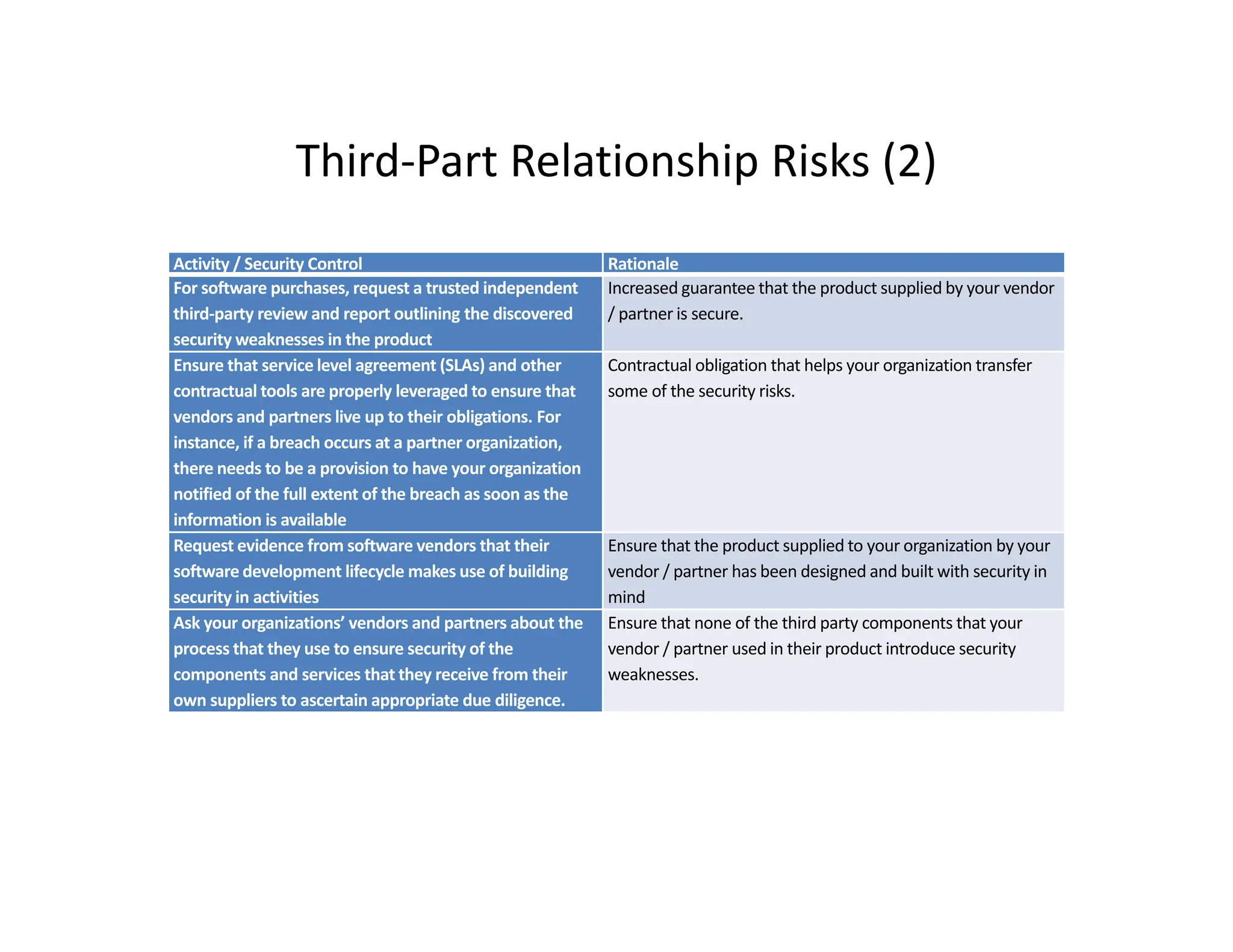
For software purchases, request a trusted independent Increased guarantee that the product supplied by your vendor
p , q p
third‐party review and report outlining the discovered
security weaknesses in the product
g p pp y y
/ partner is secure.
Ensure that service level agreement (SLAs) and other
contractual tools are properly leveraged to ensure that
vendors and partners live up to their obligations For
Contractual obligation that helps your organization transfer
some of the security risks.
vendors and partners live up to their obligations. For
instance, if a breach occurs at a partner organization,
there needs to be a provision to have your organization
notified of the full extent of the breach as soon as the
information is available
Request evidence from software vendors that their
software development lifecycle makes use of building
security in activities
Ensure that the product supplied to your organization by your
vendor / partner has been designed and built with security in
mind
Ask your organizations’ vendors and partners about the
process that they use to ensure security of the
Ensure that none of the third party components that your
vendor / partner used in their product introduce security
p y y
components and services that they receive from their
own suppliers to ascertain appropriate due diligence.
/ p p y
weaknesses.
Network Risks (1)
Network Risks (1)
Activity / Security Control Rationale
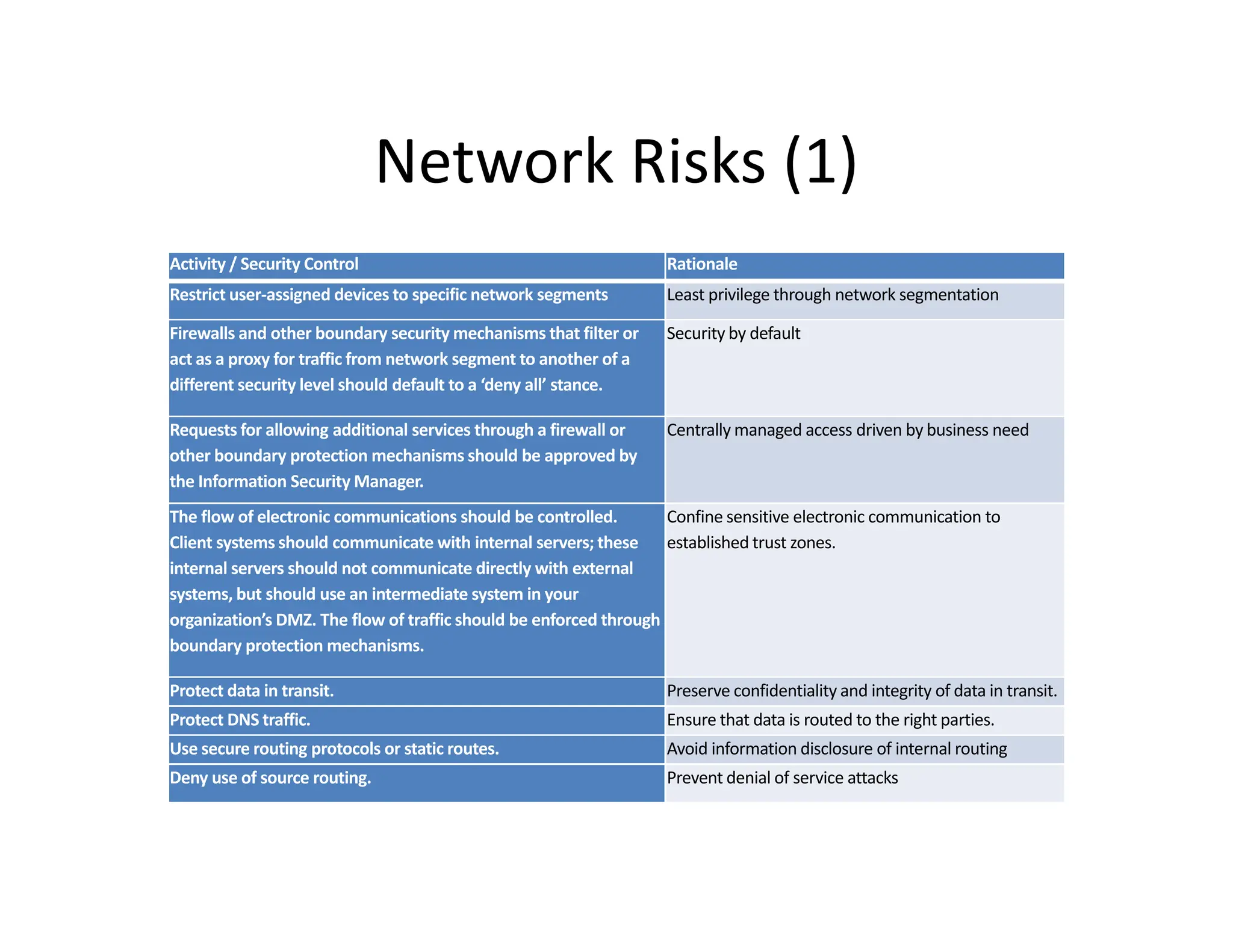
Restrict user‐assigned devices to specific network segments Least privilege through network segmentation
Firewalls and other boundary security mechanisms that filter or
act as a proxy for traffic from network segment to another of a
different security level should default to a ‘deny all’ stance.
Security by default
Requests for allowing additional services through a firewall or
other boundary protection mechanisms should be approved by
the Information Security Manager.
Centrally managed access driven by business need
The flow of electronic communications should be controlled.
l h ld h l h
Confine sensitive electronic communication to
bl h d
Client systems should communicate with internal servers; these
internal servers should not communicate directly with external
systems, but should use an intermediate system in your
organization’s DMZ. The flow of traffic should be enforced through
boundary protection mechanisms.
established trust zones.
Protect data in transit. Preserve confidentiality and integrity of data in transit.
Protect DNS traffic. Ensure that data is routed to the right parties.
Use secure routing protocols or static routes. Avoid information disclosure of internal routing
Deny use of source routing Prevent denial of service attacks
Deny use of source routing. Prevent denial of service attacks
Network Risks (2)
Network Risks (2)
Activity / Security Control Rationale
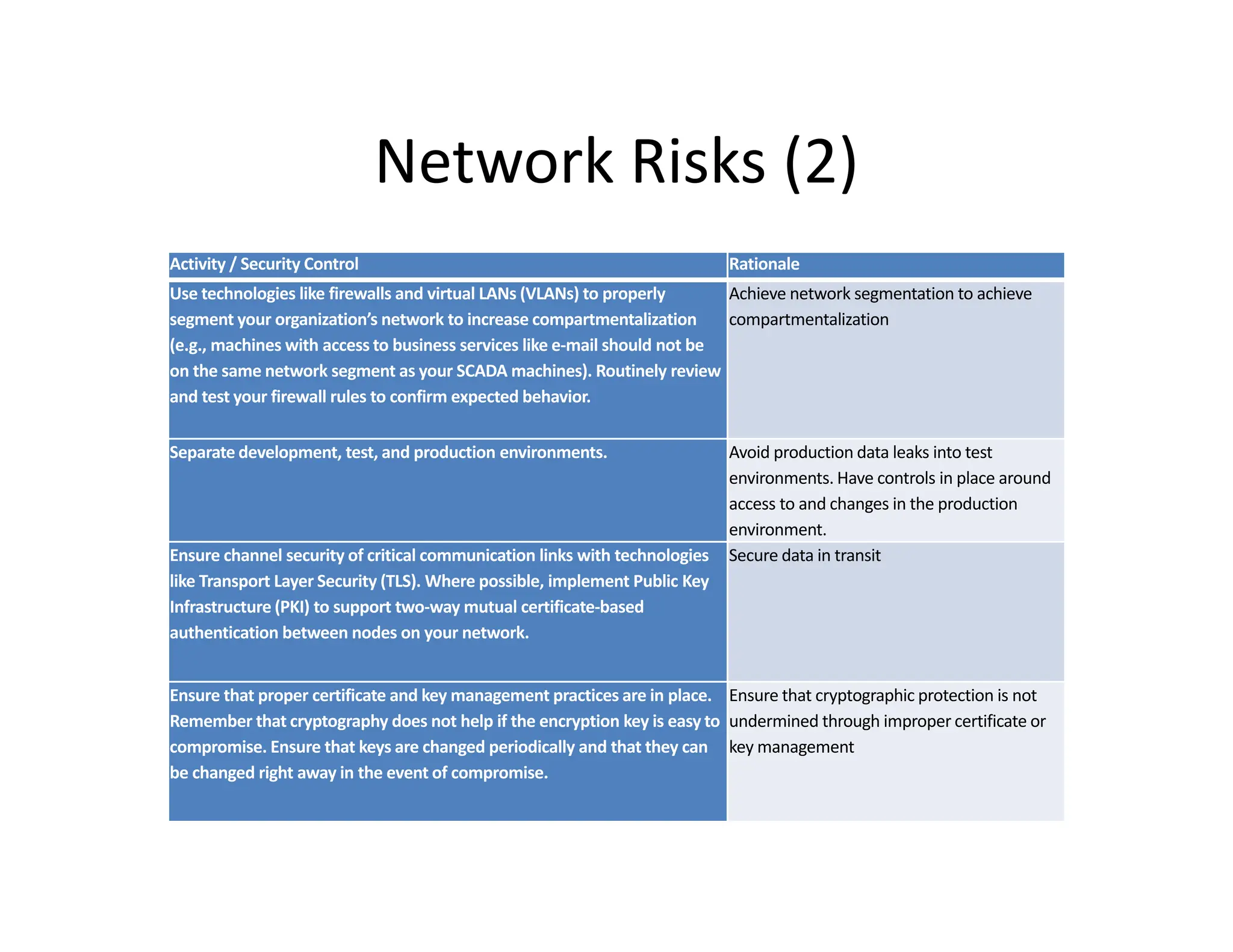
Use technologies like firewalls and virtual LANs (VLANs) to properly Achieve network segmentation to achieve
Use technologies like firewalls and virtual LANs (VLANs) to properly
segment your organization’s network to increase compartmentalization
(e.g., machines with access to business services like e‐mail should not be
on the same network segment as your SCADA machines). Routinely review
and test your firewall rules to confirm expected behavior.
Achieve network segmentation to achieve
compartmentalization
Separate development, test, and production environments. Avoid production data leaks into test
environments. Have controls in place around
access to and changes in the production
environment.
Ensure channel security of critical communication links with technologies
like Transport Layer Security (TLS). Where possible, implement Public Key
Infrastructure (PKI) to support two‐way mutual certificate‐based
authentication between nodes on your network.
Secure data in transit
Ensure that proper certificate and key management practices are in place.
Remember that cryptography does not help if the encryption key is easy to
compromise. Ensure that keys are changed periodically and that they can
be changed right away in the event of compromise
Ensure that cryptographic protection is not
undermined through improper certificate or
key management
be changed right away in the event of compromise.
Network Risks (3)
Network Risks (3)
Activity / Security Control Rationale
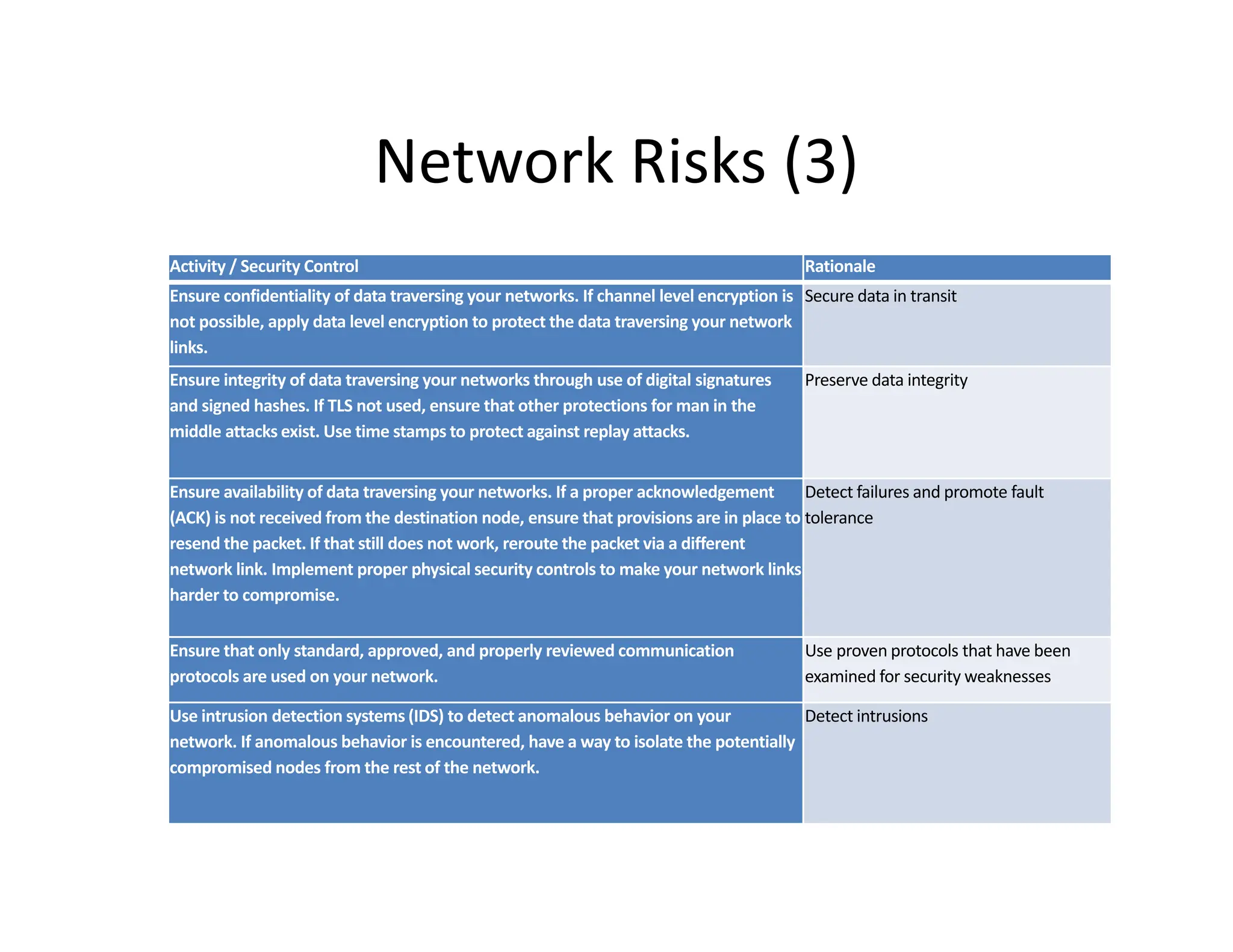
Ensure confidentiality of data traversing your networks If channel level encryption is Secure data in transit
Ensure confidentiality of data traversing your networks. If channel level encryption is
not possible, apply data level encryption to protect the data traversing your network
links.
Secure data in transit
Ensure integrity of data traversing your networks through use of digital signatures
and signed hashes. If TLS not used, ensure that other protections for man in the
Preserve data integrity
middle attacks exist. Use time stamps to protect against replay attacks.
Ensure availability of data traversing your networks. If a proper acknowledgement
(ACK) is not received from the destination node, ensure that provisions are in place to
Detect failures and promote fault
tolerance
resend the packet. If that still does not work, reroute the packet via a different
network link. Implement proper physical security controls to make your network links
harder to compromise.
Ensure that only standard, approved, and properly reviewed communication Use proven protocols that have been
Ensure that only standard, approved, and properly reviewed communication
protocols are used on your network.
Use proven protocols that have been
examined for security weaknesses
Use intrusion detection systems (IDS) to detect anomalous behavior on your
network. If anomalous behavior is encountered, have a way to isolate the potentially
compromised nodes from the rest of the network.
Detect intrusions
p
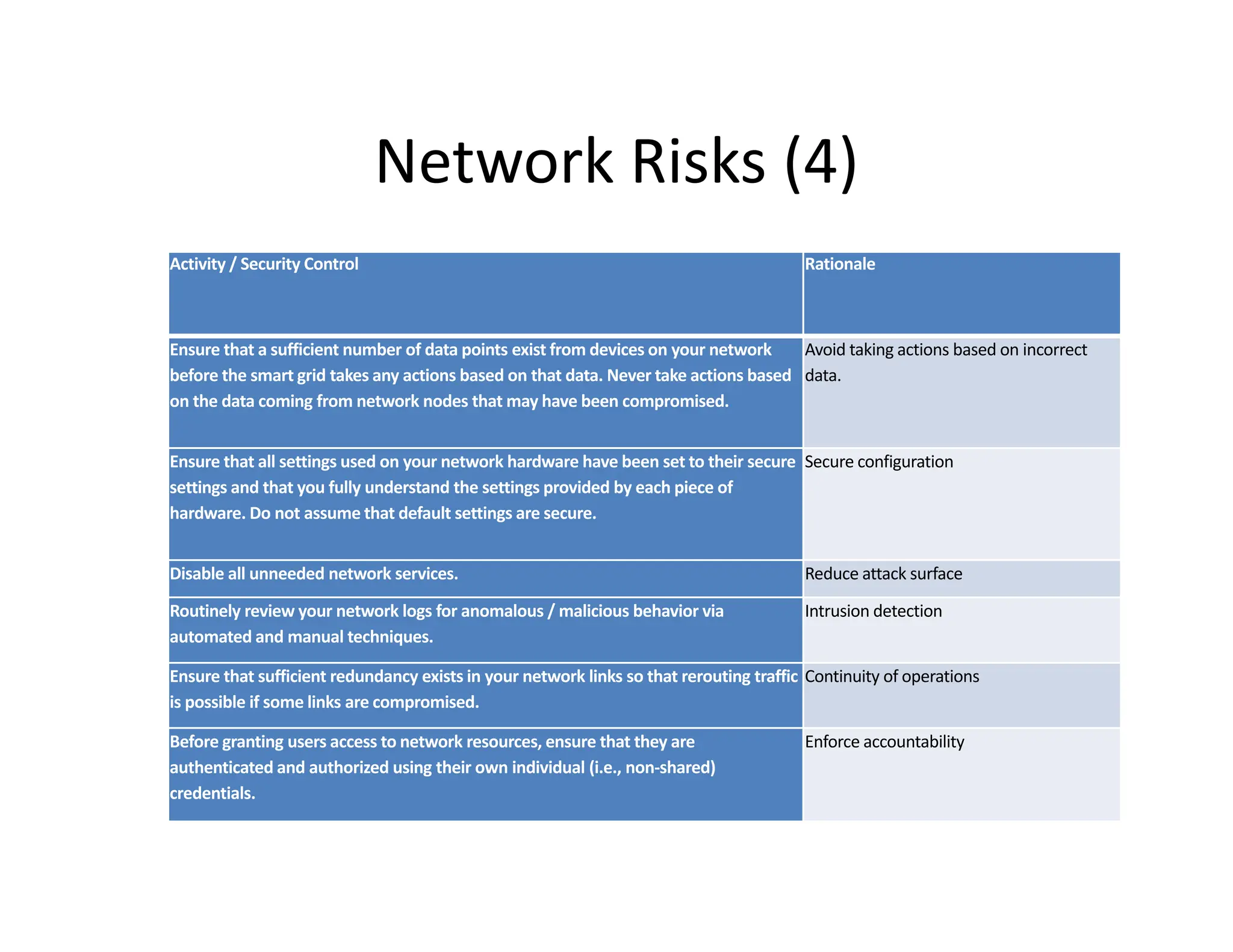
Network Risks (4)
Network Risks (4)
Activity / Security Control Rationale
Ensure that a sufficient number of data points exist from devices on your network
before the smart grid takes any actions based on that data. Never take actions based
on the data coming from network nodes that may have been compromised.
Avoid taking actions based on incorrect
data.
Ensure that all settings used on your network hardware have been set to their secure
settings and that you fully understand the settings provided by each piece of
hardware. Do not assume that default settings are secure.
Secure configuration
Disable all unneeded network services. Reduce attack surface
Routinely review your network logs for anomalous / malicious behavior via
automated and manual techniques.
Intrusion detection
Ensure that sufficient redundancy exists in your network links so that rerouting traffic
is possible if some links are compromised.
Continuity of operations
Before granting users access to network resources, ensure that they are
authenticated and authorized using their own individual (i.e., non‐shared)
Enforce accountability
g ( , )
credentials.
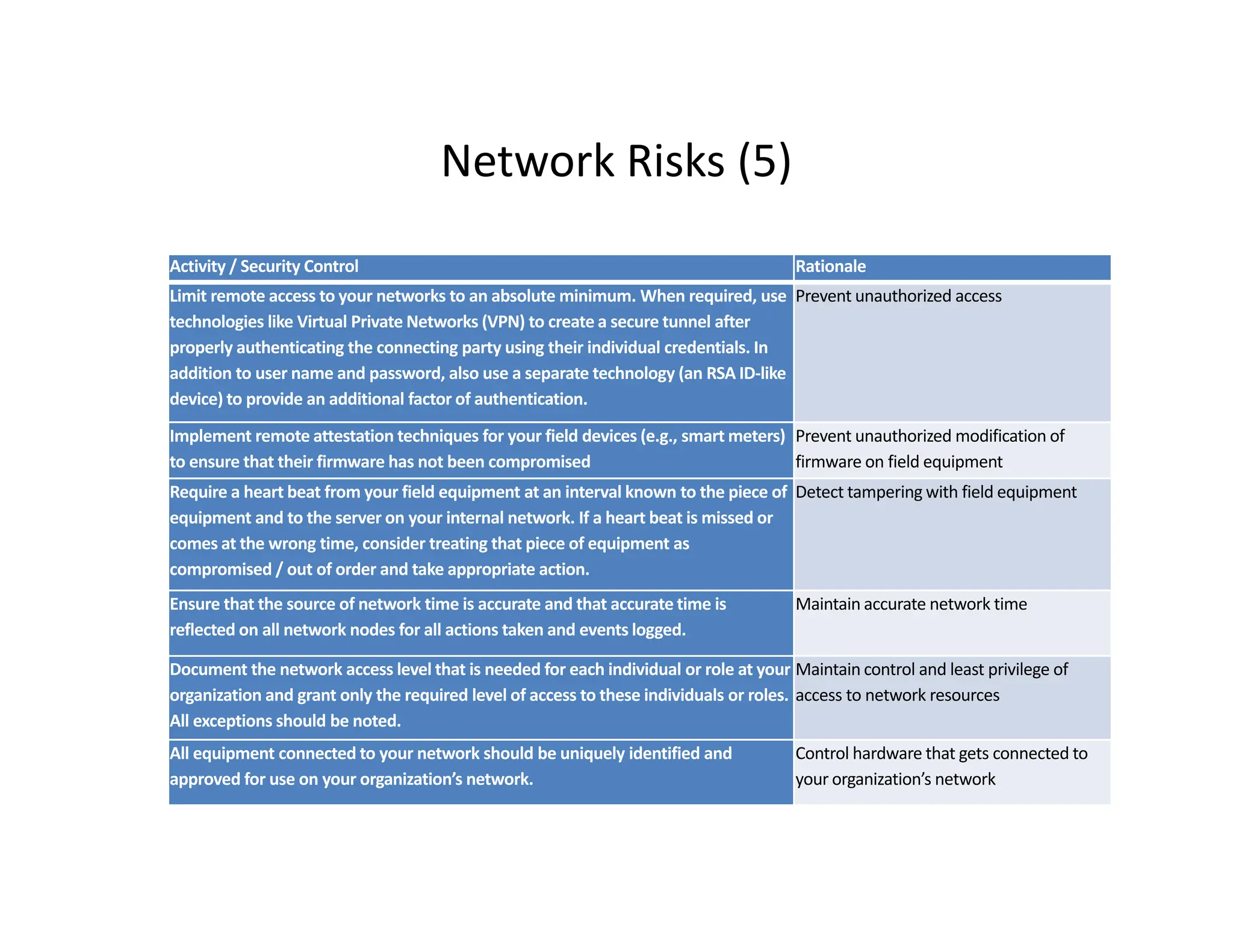
Network Risks (5)
Network Risks (5)
Activity / Security Control Rationale
Limit remote access to your networks to an absolute minimum When required use Prevent unauthorized access
Limit remote access to your networks to an absolute minimum. When required, use
technologies like Virtual Private Networks (VPN) to create a secure tunnel after
properly authenticating the connecting party using their individual credentials. In
addition to user name and password, also use a separate technology (an RSA ID‐like
device) to provide an additional factor of authentication.
Prevent unauthorized access
Implement remote attestation techniques for your field devices (e.g., smart meters)
to ensure that their firmware has not been compromised
Prevent unauthorized modification of
firmware on field equipment
Require a heart beat from your field equipment at an interval known to the piece of
equipment and to the server on your internal network. If a heart beat is missed or
Detect tampering with field equipment
comes at the wrong time, consider treating that piece of equipment as
compromised / out of order and take appropriate action.
Ensure that the source of network time is accurate and that accurate time is
reflected on all network nodes for all actions taken and events logged.
Maintain accurate network time
Document the network access level that is needed for each individual or role at your
organization and grant only the required level of access to these individuals or roles.
All exceptions should be noted.
Maintain control and least privilege of
access to network resources
All equipment connected to your network should be uniquely identified and
d f i ti ’ t k
Control hardware that gets connected to
i ti ’ t k
approved for use on your organization’s network. your organization’s network
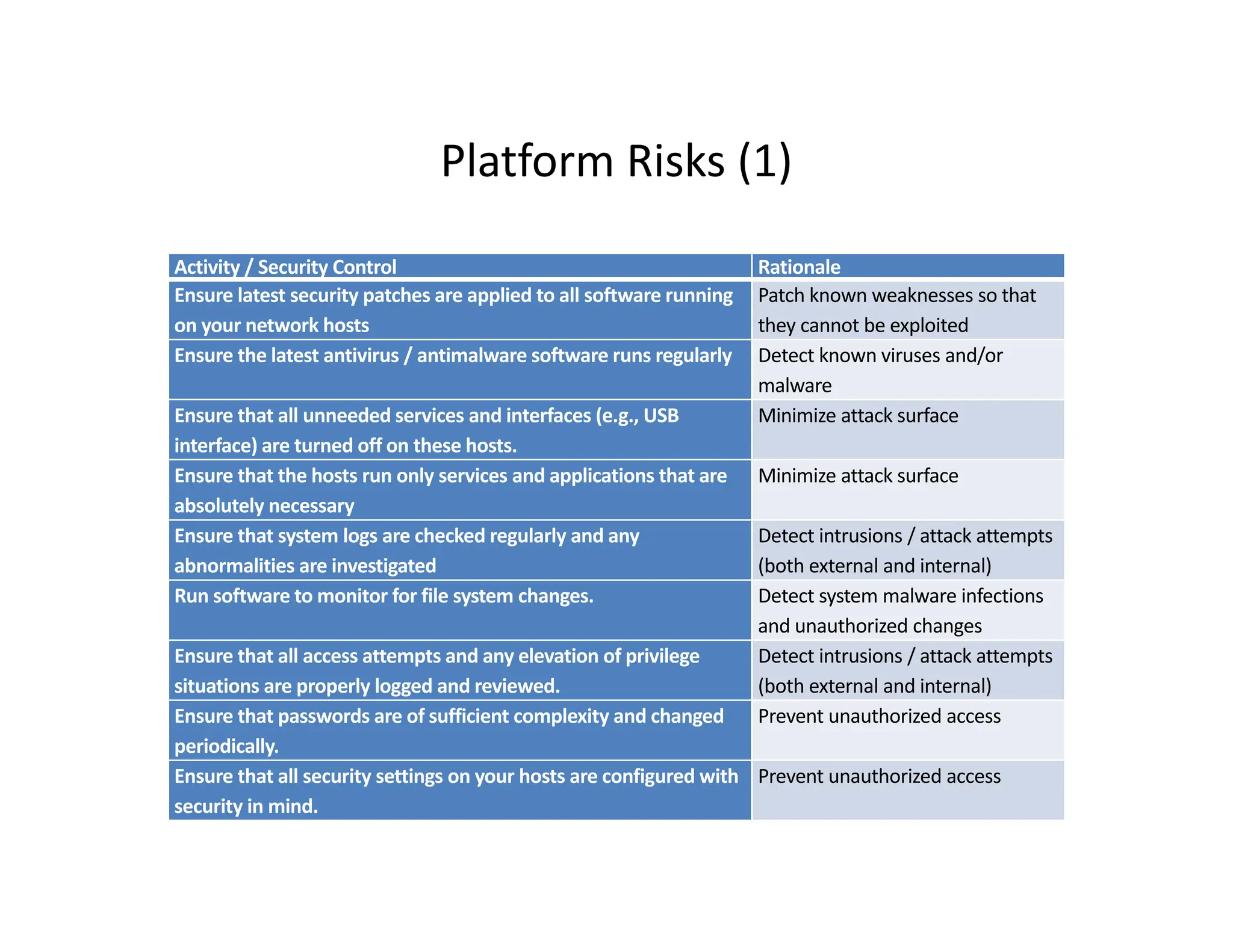
Platform Risks (1)
Platform Risks (1)
Activity / Security Control Rationale
Ensure latest security patches are applied to all software running Patch known weaknesses so that
Ensure latest security patches are applied to all software running
on your network hosts
Patch known weaknesses so that
they cannot be exploited
Ensure the latest antivirus / antimalware software runs regularly Detect known viruses and/or
malware
Ensure that all unneeded services and interfaces (e g USB Minimize attack surface
Ensure that all unneeded services and interfaces (e.g., USB
interface) are turned off on these hosts.
Minimize attack surface
Ensure that the hosts run only services and applications that are
absolutely necessary
Minimize attack surface
Ensure that system logs are checked regularly and any Detect intrusions / attack attempts
Ensure that system logs are checked regularly and any
abnormalities are investigated
Detect intrusions / attack attempts
(both external and internal)
Run software to monitor for file system changes. Detect system malware infections
and unauthorized changes
Ensure that all access attempts and any elevation of privilege Detect intrusions / attack attempts
Ensure that all access attempts and any elevation of privilege
situations are properly logged and reviewed.
Detect intrusions / attack attempts
(both external and internal)
Ensure that passwords are of sufficient complexity and changed
periodically.
Prevent unauthorized access
Ensure that all security settings on your hosts are configured with Prevent unauthorized access
Ensure that all security settings on your hosts are configured with
security in mind.
Prevent unauthorized access
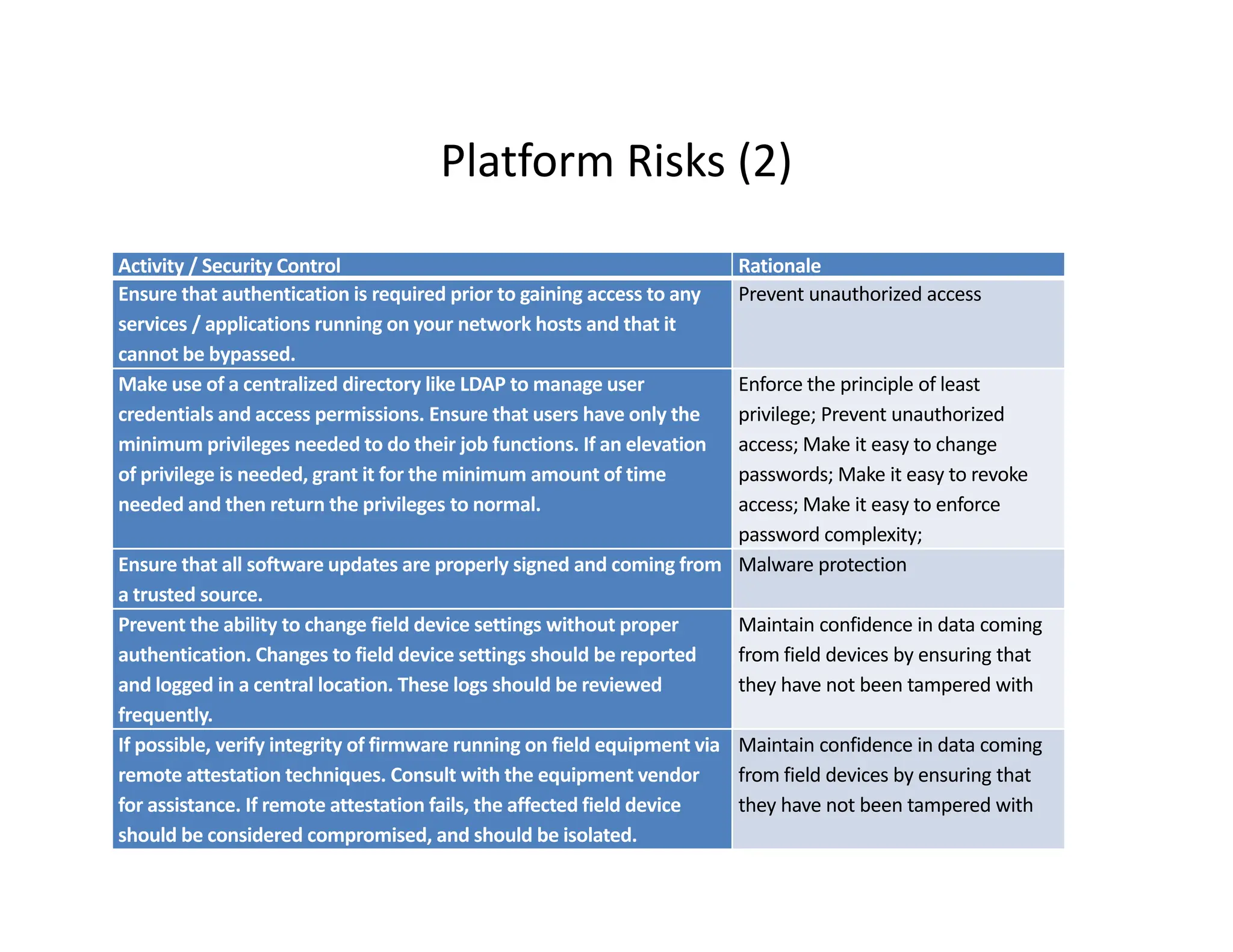
Platform Risks (2)
Platform Risks (2)
Activity / Security Control Rationale
Ensure that authentication is required prior to gaining access to any Prevent unauthorized access
Ensure that authentication is required prior to gaining access to any
services / applications running on your network hosts and that it
cannot be bypassed.
Prevent unauthorized access
Make use of a centralized directory like LDAP to manage user
credentials and access permissions Ensure that users have only the
Enforce the principle of least
privilege; Prevent unauthorized
credentials and access permissions. Ensure that users have only the
minimum privileges needed to do their job functions. If an elevation
of privilege is needed, grant it for the minimum amount of time
needed and then return the privileges to normal.
privilege; Prevent unauthorized
access; Make it easy to change
passwords; Make it easy to revoke
access; Make it easy to enforce
password complexity;
Ensure that all software updates are properly signed and coming from
a trusted source.
Malware protection
Prevent the ability to change field device settings without proper
authentication Changes to field device settings should be reported
Maintain confidence in data coming
from field devices by ensuring that
authentication. Changes to field device settings should be reported
and logged in a central location. These logs should be reviewed
frequently.
from field devices by ensuring that
they have not been tampered with
If possible, verify integrity of firmware running on field equipment via
remote attestation techniques Consult with the equipment vendor
Maintain confidence in data coming
from field devices by ensuring that
remote attestation techniques. Consult with the equipment vendor
for assistance. If remote attestation fails, the affected field device
should be considered compromised, and should be isolated.
from field devices by ensuring that
they have not been tampered with
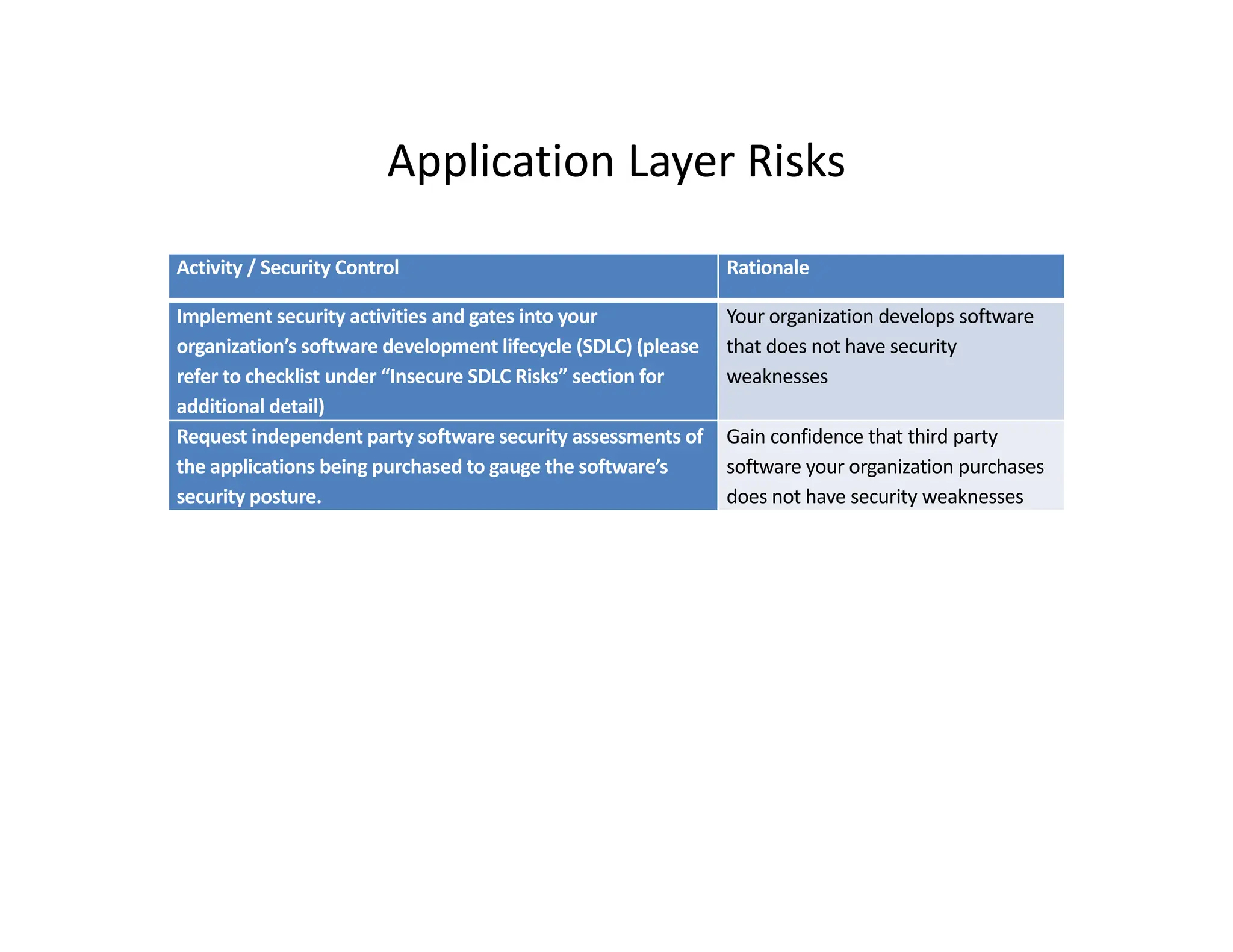
Application Layer Risks
Activity / Security Control Rationale
Implement security activities and gates into your
organization’s software development lifecycle (SDLC) (please
refer to checklist under “Insecure SDLC Risks” section for
additional detail)
Your organization develops software
that does not have security
weaknesses
)
Request independent party software security assessments of
the applications being purchased to gauge the software’s
security posture.
Gain confidence that third party
software your organization purchases
does not have security weaknesses
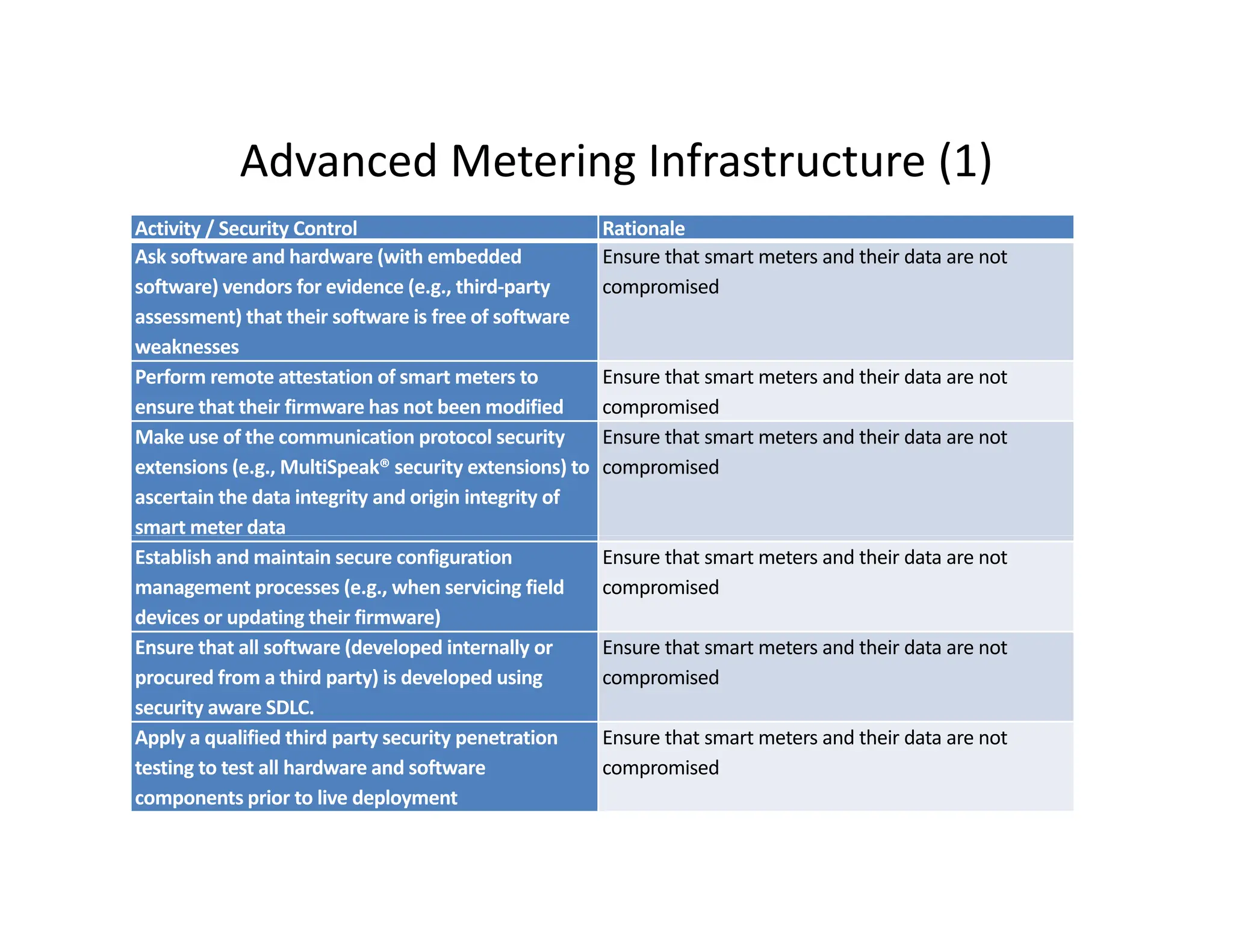
Advanced Metering Infrastructure (1)
Activity / Security Control Rationale
Ask software and hardware (with embedded
software) vendors for evidence (e.g., third‐party
Ensure that smart meters and their data are not
compromised
) ( g , p y
assessment) that their software is free of software
weaknesses
p
Perform remote attestation of smart meters to
ensure that their firmware has not been modified
Ensure that smart meters and their data are not
compromised
p
Make use of the communication protocol security
extensions (e.g., MultiSpeak® security extensions) to
ascertain the data integrity and origin integrity of
smart meter data
Ensure that smart meters and their data are not
compromised
Establish and maintain secure configuration
management processes (e.g., when servicing field
devices or updating their firmware)
Ensure that smart meters and their data are not
compromised
Ensure that all software (developed internally or Ensure that smart meters and their data are not
( p y
procured from a third party) is developed using
security aware SDLC.
compromised
Apply a qualified third party security penetration
testing to test all hardware and software
Ensure that smart meters and their data are not
compromised
g
components prior to live deployment
p
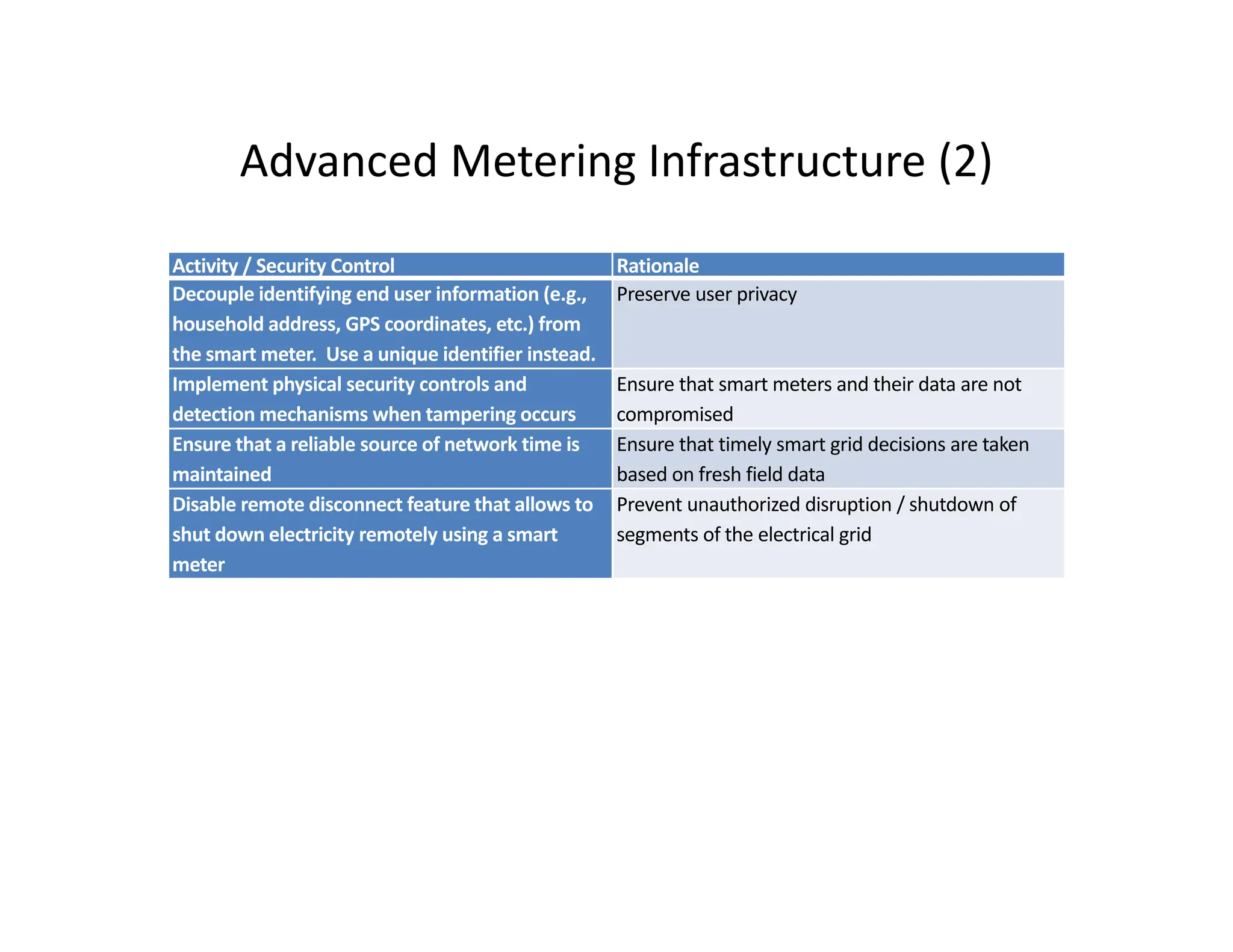
Advanced Metering Infrastructure (2)
Activity / Security Control Rationale
Decouple identifying end user information (e g Preserve user privacy
Decouple identifying end user information (e.g.,
household address, GPS coordinates, etc.) from
the smart meter. Use a unique identifier instead.
Preserve user privacy
Implement physical security controls and
detection mechanisms when tampering occurs
Ensure that smart meters and their data are not
compromised
detection mechanisms when tampering occurs compromised
Ensure that a reliable source of network time is
maintained
Ensure that timely smart grid decisions are taken
based on fresh field data
Disable remote disconnect feature that allows to
shut down electricity remotely using a smart
Prevent unauthorized disruption / shutdown of
segments of the electrical grid
shut down electricity remotely using a smart
meter
segments of the electrical grid
Meter Data Management
Activity / Security Control Rationale
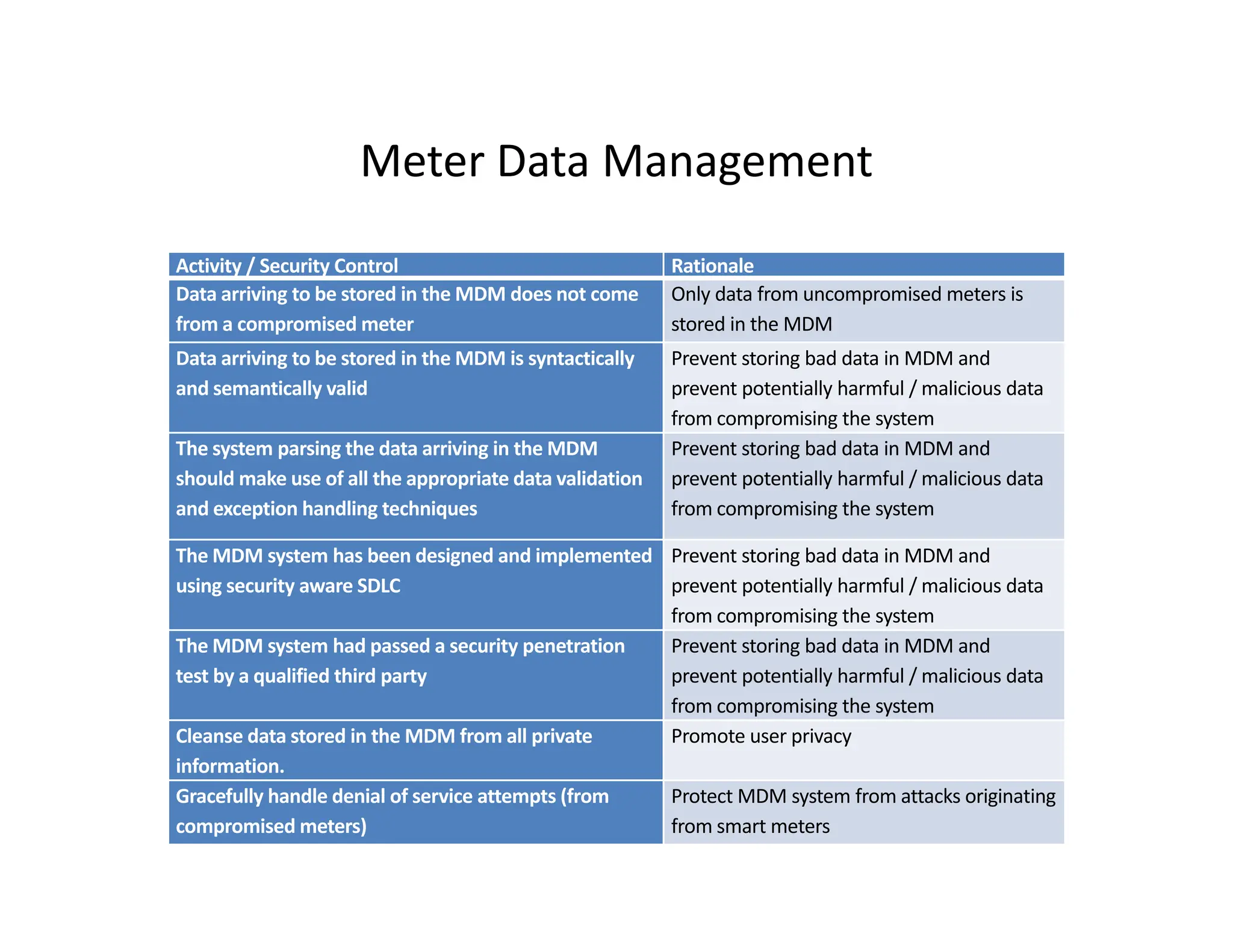
Data arriving to be stored in the MDM does not come Only data from uncompromised meters is
Data arriving to be stored in the MDM does not come
from a compromised meter
Only data from uncompromised meters is
stored in the MDM
Data arriving to be stored in the MDM is syntactically
and semantically valid
Prevent storing bad data in MDM and
prevent potentially harmful / malicious data
from compromising the system
The system parsing the data arriving in the MDM
should make use of all the appropriate data validation
and exception handling techniques
Prevent storing bad data in MDM and
prevent potentially harmful / malicious data
from compromising the system
The MDM system has been designed and implemented
using security aware SDLC
Prevent storing bad data in MDM and
prevent potentially harmful / malicious data
from compromising the system
The MDM system had passed a security penetration Prevent storing bad data in MDM and
y p y p
test by a qualified third party
g
prevent potentially harmful / malicious data
from compromising the system
Cleanse data stored in the MDM from all private
information.
Promote user privacy
Gracefully handle denial of service attempts (from
compromised meters)
Protect MDM system from attacks originating
from smart meters
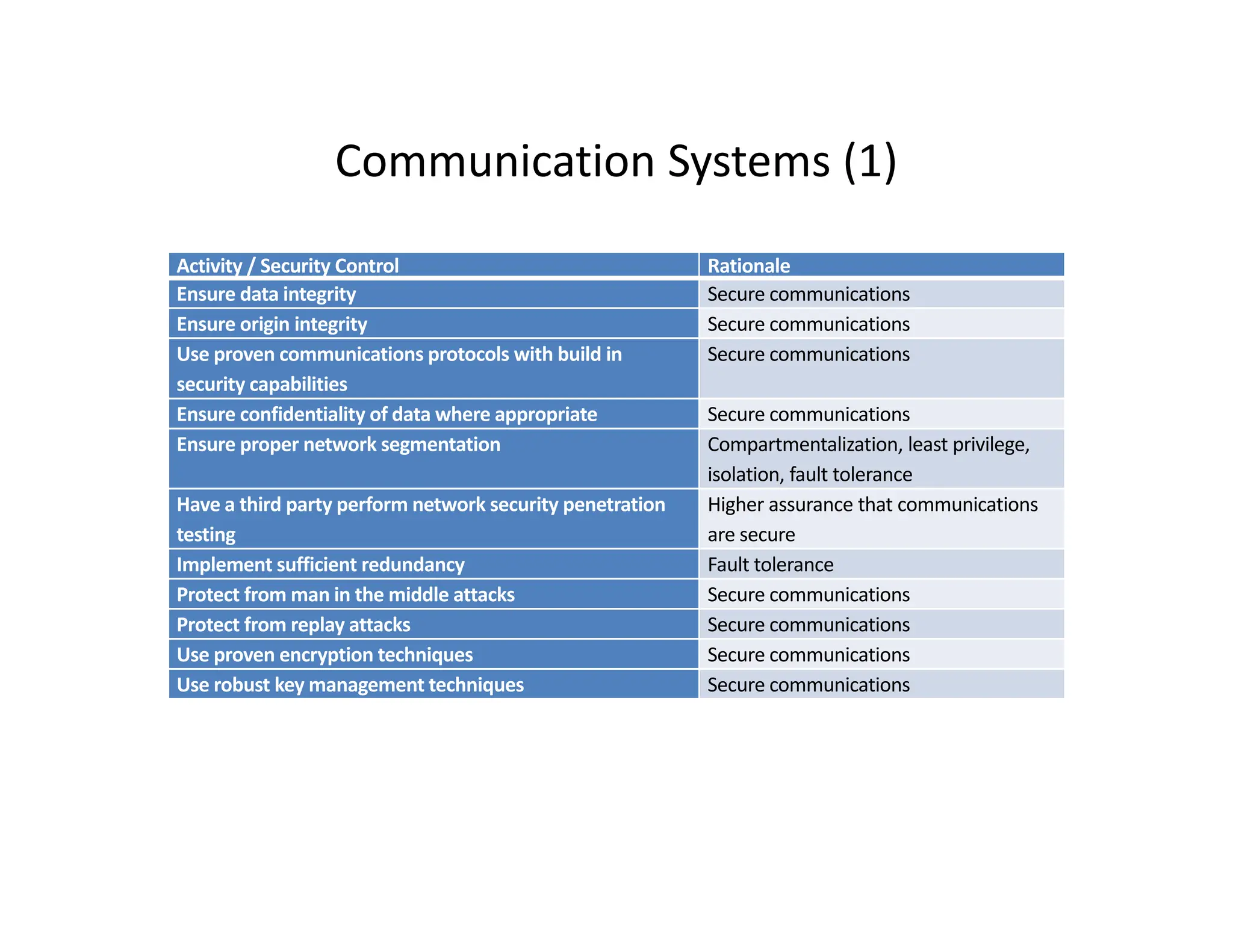
Communication Systems (1)
Activity / Security Control Rationale
Ensure data integrity Secure communications
Ensure origin integrity Secure communications
Use proven communications protocols with build in
security capabilities
Secure communications
Ensure confidentiality of data where appropriate Secure communications
Ensure proper network segmentation Compartmentalization, least privilege,
isolation, fault tolerance
Have a third party perform network security penetration
testing
Higher assurance that communications
are secure
testing are secure
Implement sufficient redundancy Fault tolerance
Protect from man in the middle attacks Secure communications
Protect from replay attacks Secure communications
Use proven encryption techniques Secure communications
Use robust key management techniques Secure communications
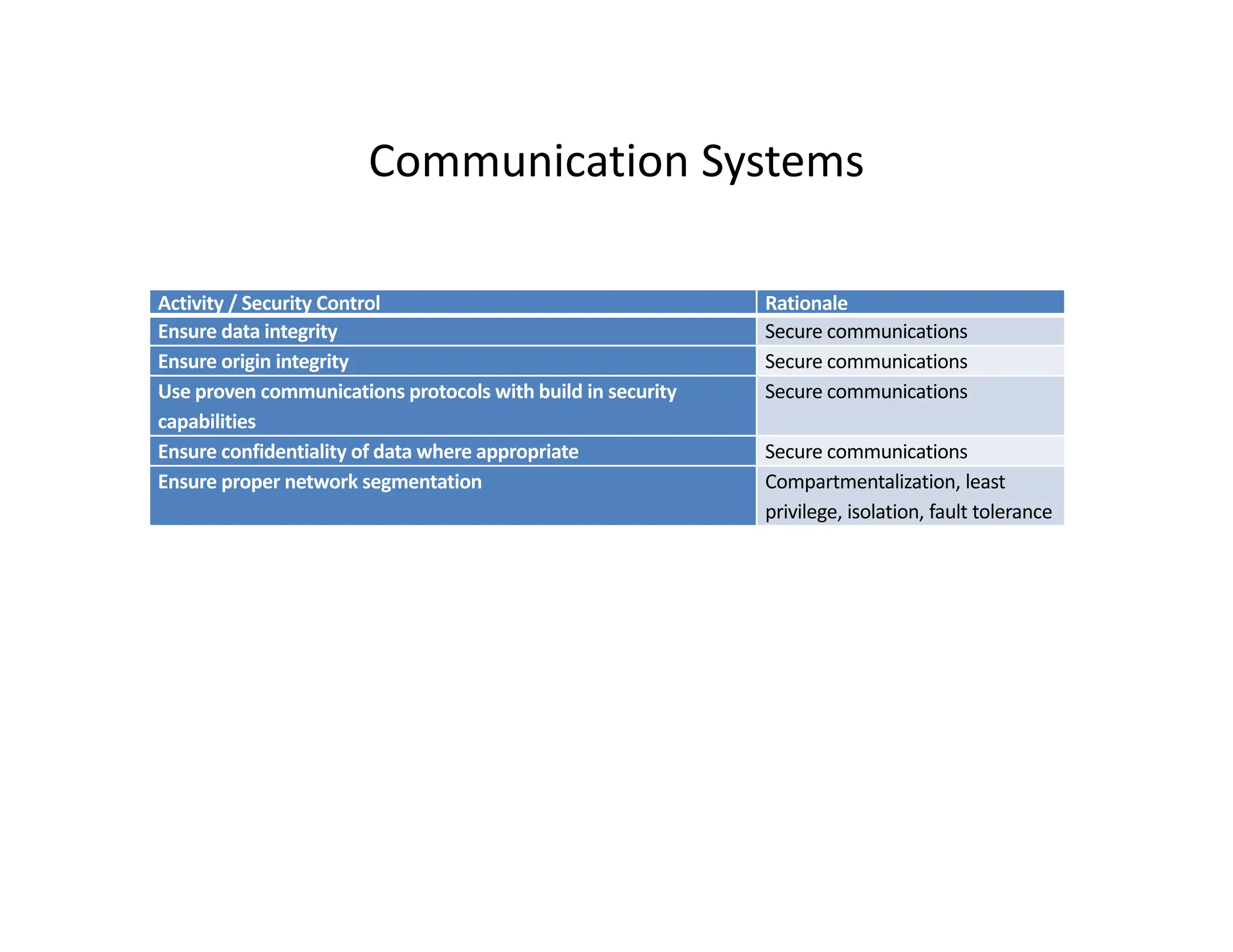
Communication Systems
i i / i l i l
Activity / Security Control Rationale
Ensure data integrity Secure communications
Ensure origin integrity Secure communications
Use proven communications protocols with build in security
biliti
Secure communications
capabilities
Ensure confidentiality of data where appropriate Secure communications
Ensure proper network segmentation Compartmentalization, least
privilege, isolation, fault tolerance
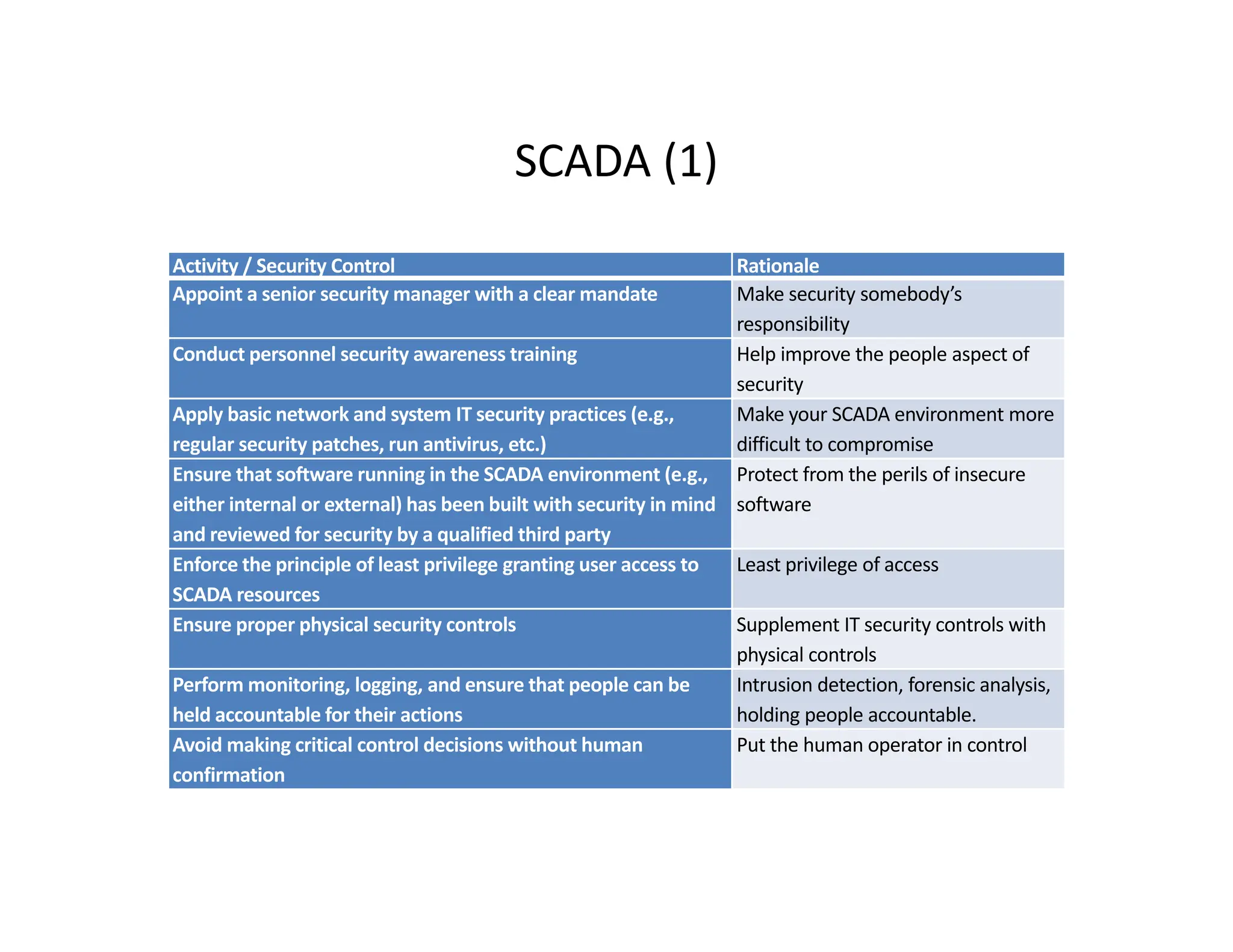
SCADA (1)
SCADA (1)
Activity / Security Control Rationale
Appoint a senior security manager with a clear mandate Make security somebody’s
Appoint a senior security manager with a clear mandate Make security somebody s
responsibility
Conduct personnel security awareness training Help improve the people aspect of
security
Apply basic network and system IT security practices (e g Make your SCADA environment more
Apply basic network and system IT security practices (e.g.,
regular security patches, run antivirus, etc.)
Make your SCADA environment more
difficult to compromise
Ensure that software running in the SCADA environment (e.g.,
either internal or external) has been built with security in mind
and reviewed for security by a qualified third party
Protect from the perils of insecure
software
and reviewed for security by a qualified third party
Enforce the principle of least privilege granting user access to
SCADA resources
Least privilege of access
Ensure proper physical security controls Supplement IT security controls with
physical controls
physical controls
Perform monitoring, logging, and ensure that people can be
held accountable for their actions
Intrusion detection, forensic analysis,
holding people accountable.
Avoid making critical control decisions without human
confirmation
Put the human operator in control
confirmation
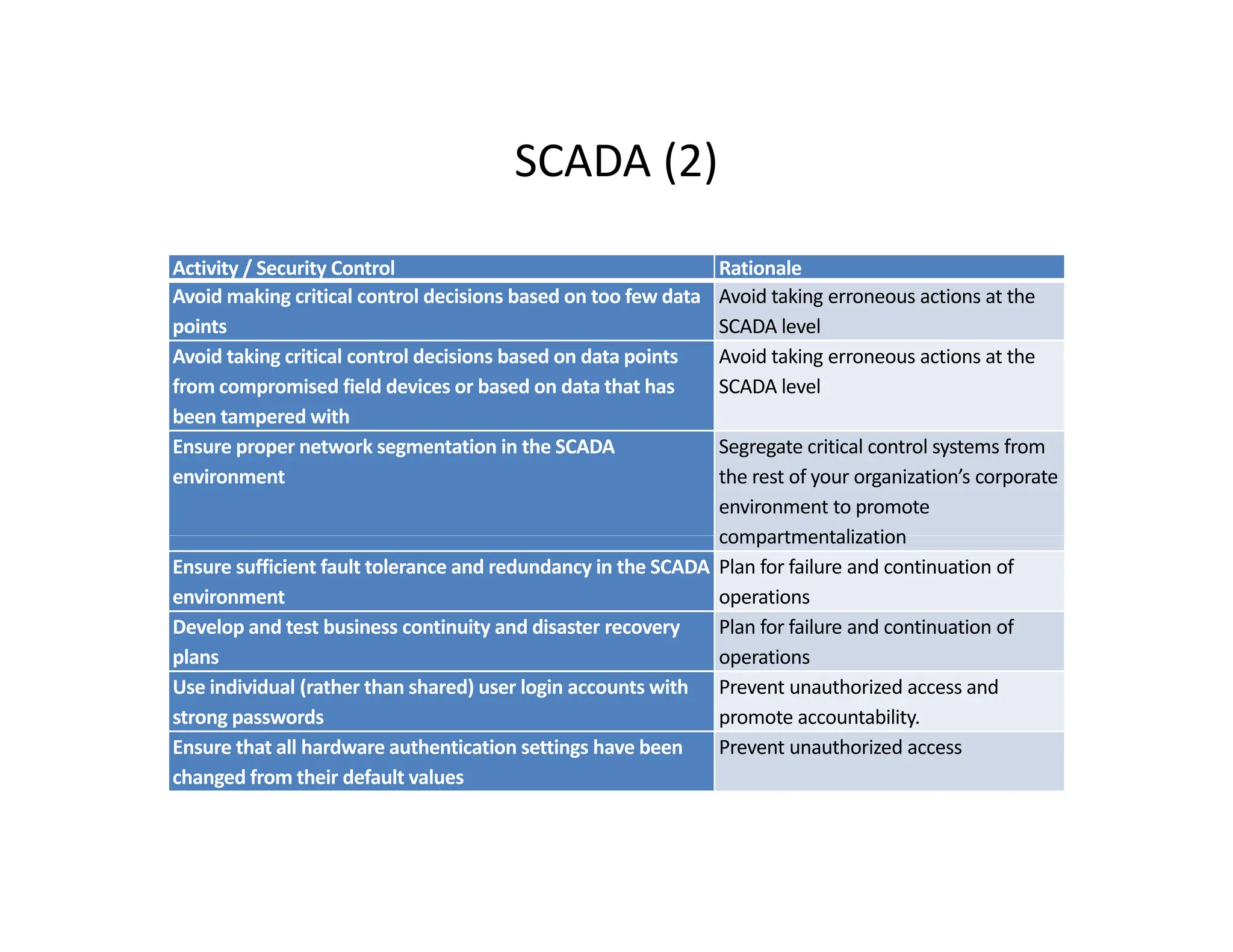
SCADA (2)
SCADA (2)
Activity / Security Control Rationale
Avoid making critical control decisions based on too few data Avoid taking erroneous actions at the
Avoid making critical control decisions based on too few data
points
Avoid taking erroneous actions at the
SCADA level
Avoid taking critical control decisions based on data points
from compromised field devices or based on data that has
been tampered with
Avoid taking erroneous actions at the
SCADA level
been tampered with
Ensure proper network segmentation in the SCADA
environment
Segregate critical control systems from
the rest of your organization’s corporate
environment to promote
compartmentalization
Ensure sufficient fault tolerance and redundancy in the SCADA
environment
Plan for failure and continuation of
operations
Develop and test business continuity and disaster recovery
plans
Plan for failure and continuation of
operations
plans operations
Use individual (rather than shared) user login accounts with
strong passwords
Prevent unauthorized access and
promote accountability.
Ensure that all hardware authentication settings have been
changed from their default values
Prevent unauthorized access
changed from their default values
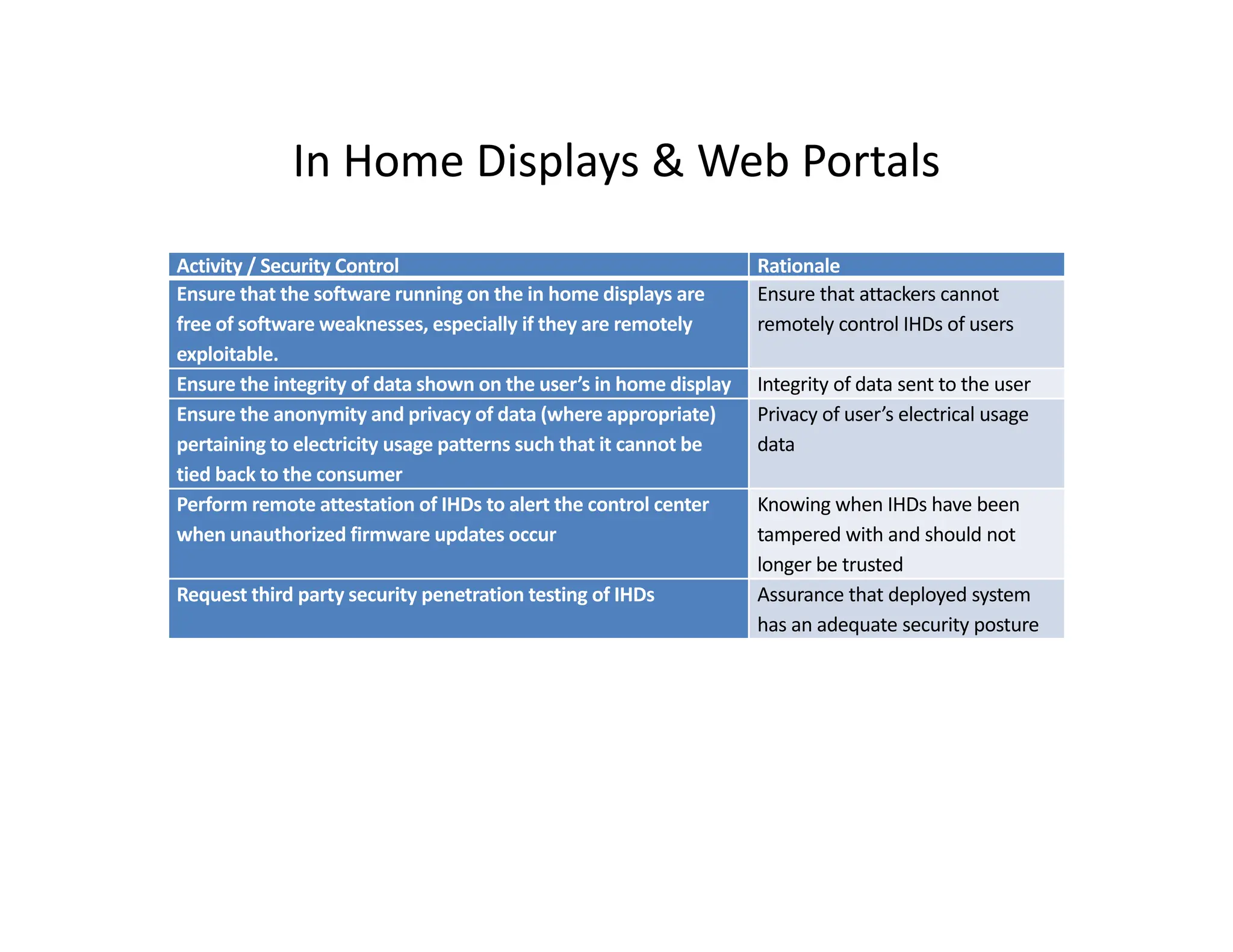
In Home Displays & Web Portals
Activity / Security Control Rationale
Ensure that the software running on the in home displays are Ensure that attackers cannot
Ensure that the software running on the in home displays are
free of software weaknesses, especially if they are remotely
exploitable.
Ensure that attackers cannot
remotely control IHDs of users
Ensure the integrity of data shown on the user’s in home display Integrity of data sent to the user
Ensure the anonymity and privacy of data (where appropriate) Privacy of user’s electrical usage
Ensure the anonymity and privacy of data (where appropriate)
pertaining to electricity usage patterns such that it cannot be
tied back to the consumer
Privacy of user s electrical usage
data
Perform remote attestation of IHDs to alert the control center
when unauthorized firmware updates occur
Knowing when IHDs have been
tampered with and should not
when unauthorized firmware updates occur tampered with and should not
longer be trusted
Request third party security penetration testing of IHDs Assurance that deployed system
has an adequate security posture
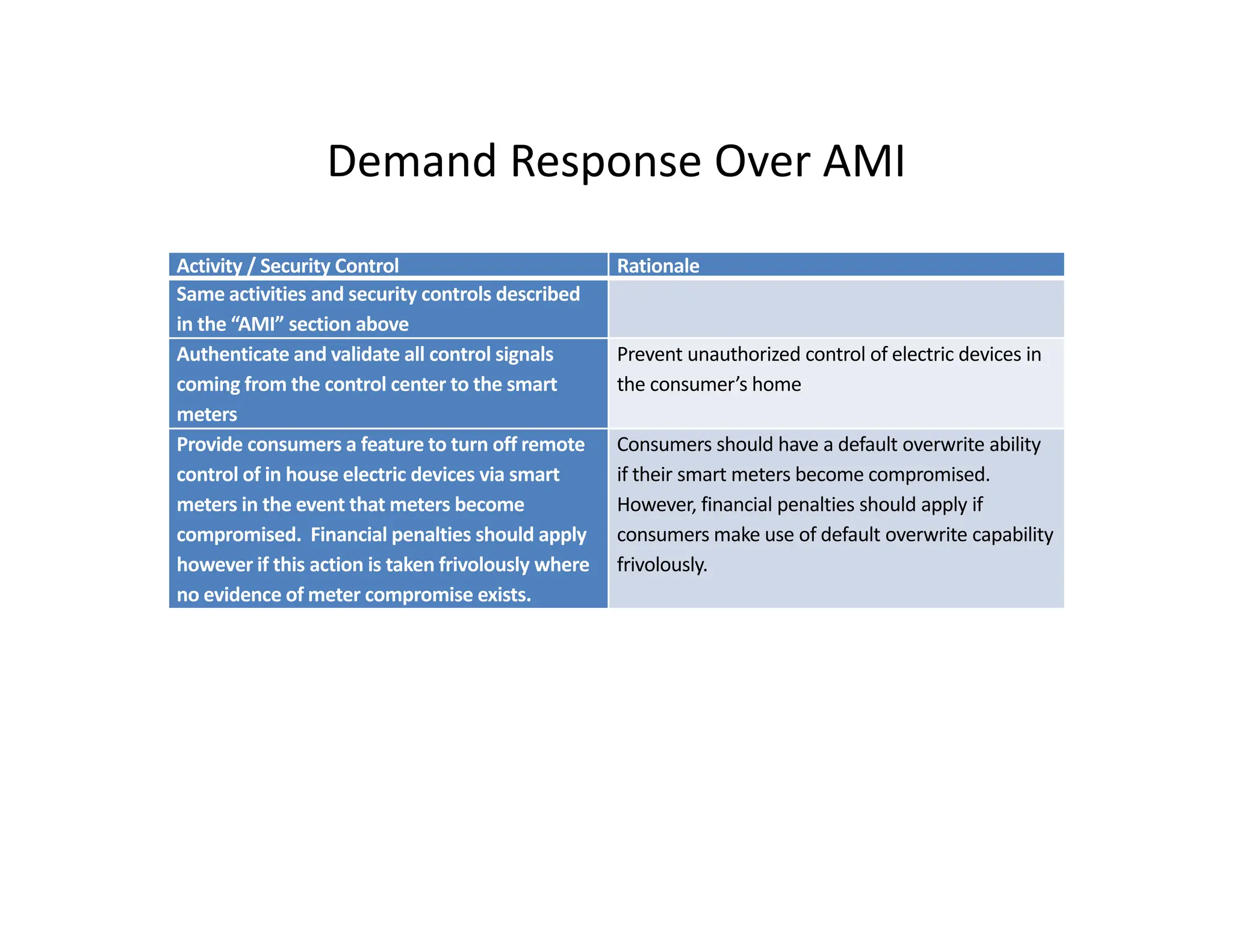
Demand Response Over AMI
Activity / Security Control Rationale
Same activities and security controls described
in the “AMI” section above
Authenticate and validate all control signals
coming from the control center to the smart
meters
Prevent unauthorized control of electric devices in
the consumer’s home
meters
Provide consumers a feature to turn off remote
control of in house electric devices via smart
meters in the event that meters become
compromised Financial penalties should apply
Consumers should have a default overwrite ability
if their smart meters become compromised.
However, financial penalties should apply if
consumers make use of default overwrite capability
compromised. Financial penalties should apply
however if this action is taken frivolously where
no evidence of meter compromise exists.
consumers make use of default overwrite capability
frivolously.
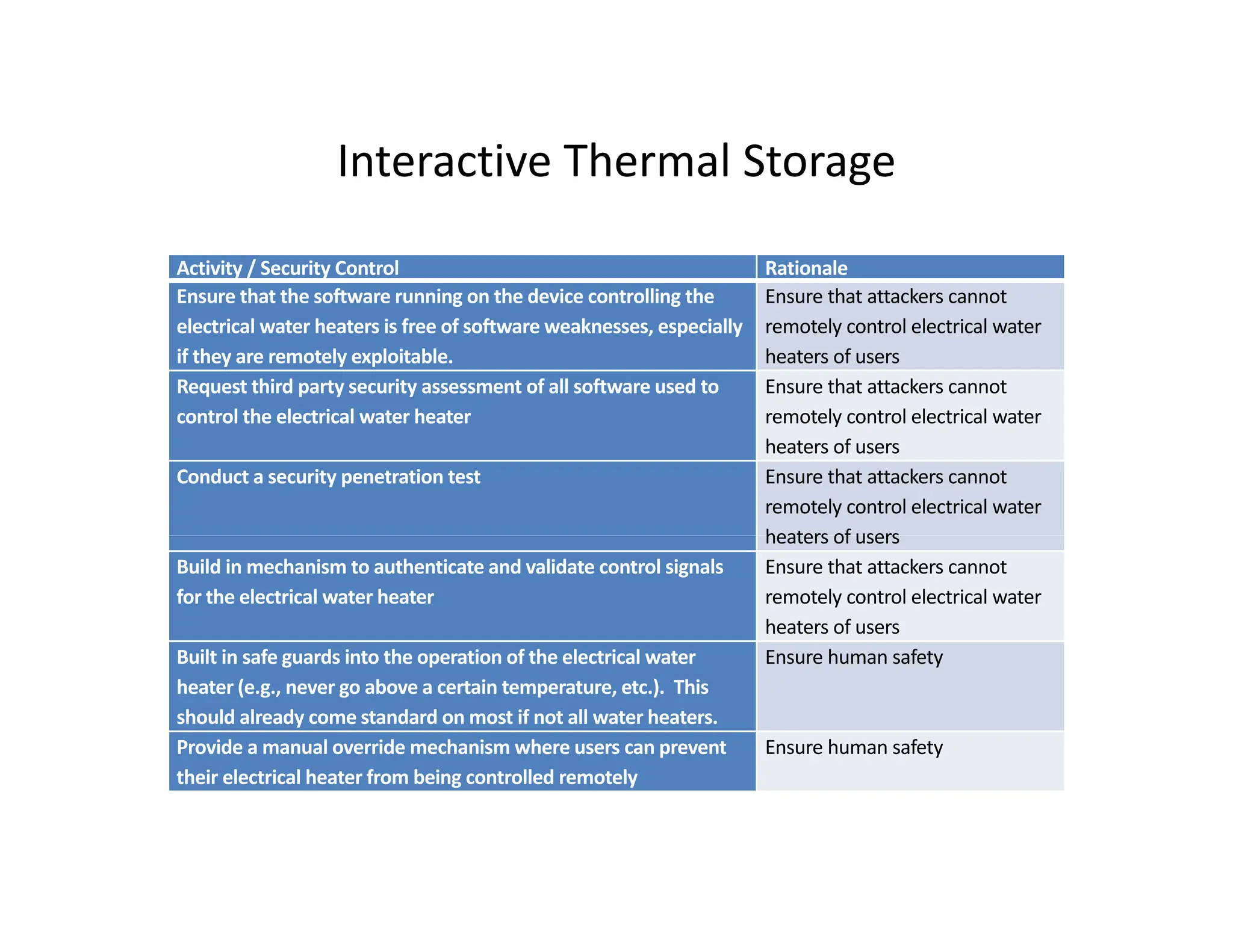
Interactive Thermal Storage
Activity / Security Control Rationale
Ensure that the software running on the device controlling the Ensure that attackers cannot
Ensure that the software running on the device controlling the
electrical water heaters is free of software weaknesses, especially
if they are remotely exploitable.
Ensure that attackers cannot
remotely control electrical water
heaters of users
Request third party security assessment of all software used to
control the electrical water heater
Ensure that attackers cannot
remotely control electrical water
control the electrical water heater remotely control electrical water
heaters of users
Conduct a security penetration test Ensure that attackers cannot
remotely control electrical water
heaters of users
heaters of users
Build in mechanism to authenticate and validate control signals
for the electrical water heater
Ensure that attackers cannot
remotely control electrical water
heaters of users
Built in safe guards into the operation of the electrical water Ensure human safety
Built in safe guards into the operation of the electrical water
heater (e.g., never go above a certain temperature, etc.). This
should already come standard on most if not all water heaters.
Ensure human safety
Provide a manual override mechanism where users can prevent
their electrical heater from being controlled remotely
Ensure human safety
their electrical heater from being controlled remotely
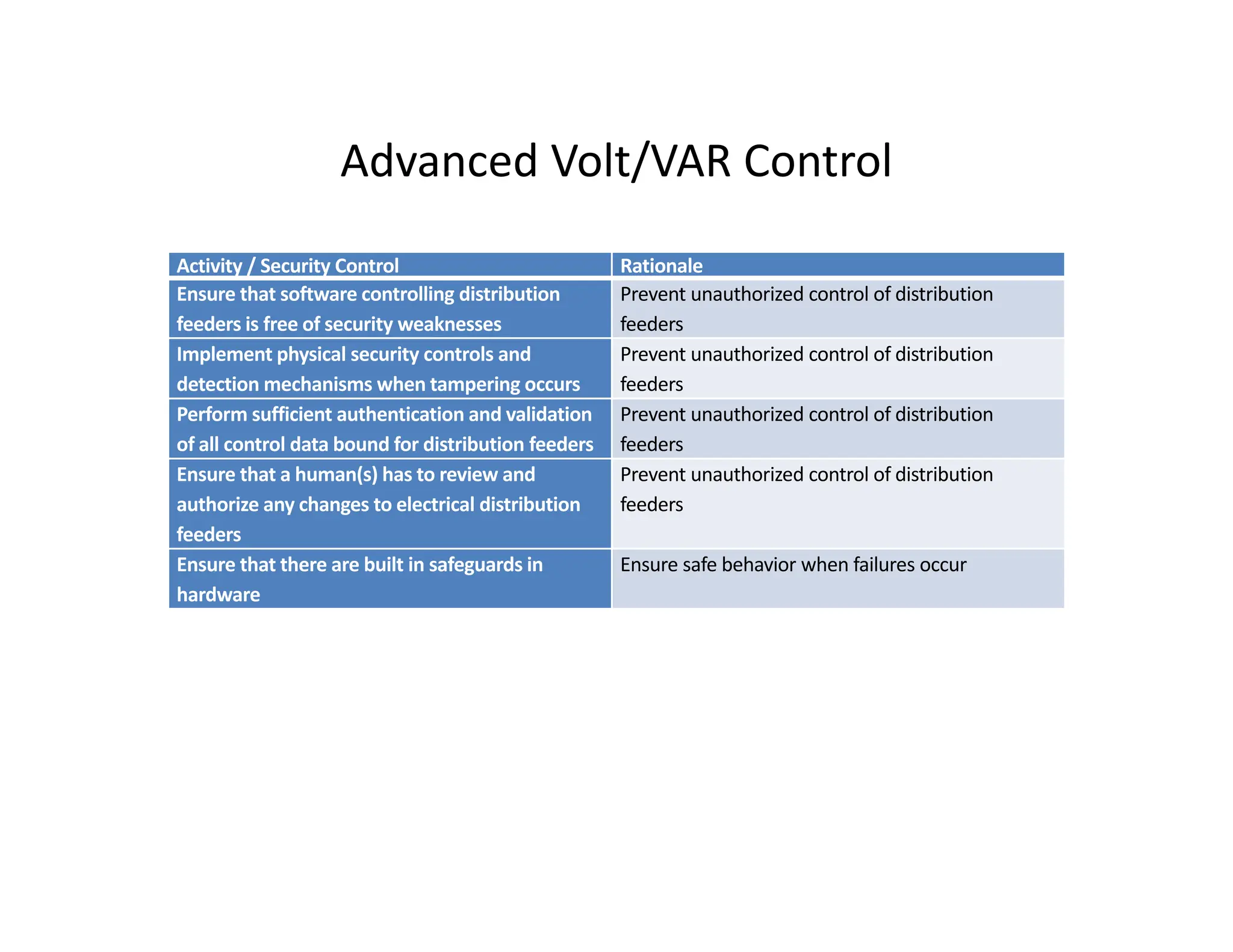
Advanced Volt/VAR Control
Activity / Security Control Rationale
Ensure that software controlling distribution Prevent unauthorized control of distribution
Ensure that software controlling distribution
feeders is free of security weaknesses
Prevent unauthorized control of distribution
feeders
Implement physical security controls and
detection mechanisms when tampering occurs
Prevent unauthorized control of distribution
feeders
Perform sufficient authentication and validation Prevent unauthorized control of distribution
Perform sufficient authentication and validation
of all control data bound for distribution feeders
Prevent unauthorized control of distribution
feeders
Ensure that a human(s) has to review and
authorize any changes to electrical distribution
feeders
Prevent unauthorized control of distribution
feeders
feeders
Ensure that there are built in safeguards in
hardware
Ensure safe behavior when failures occur
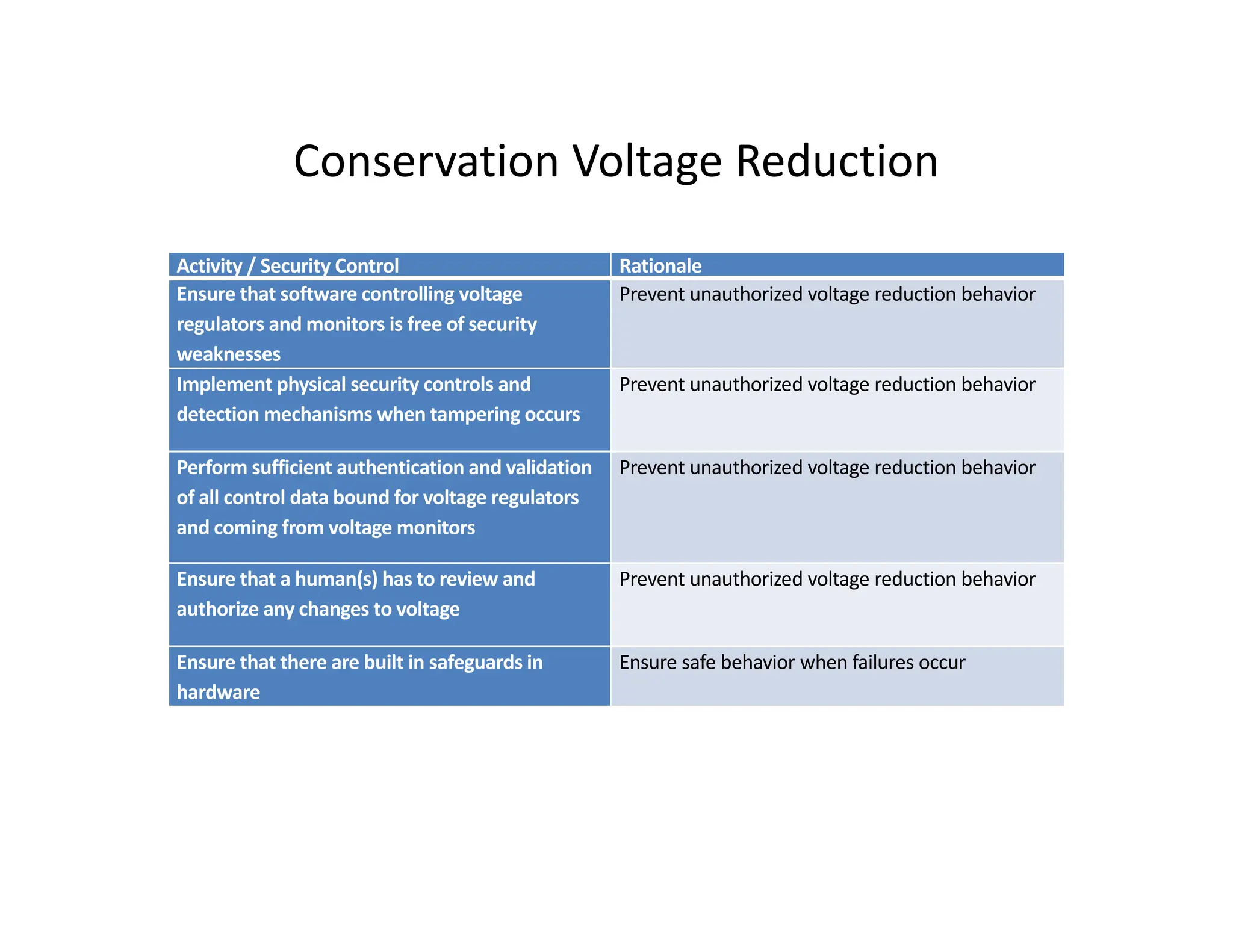
Conservation Voltage Reduction
Activity / Security Control Rationale
Ensure that software controlling voltage Prevent unauthorized voltage reduction behavior
Ensure that software controlling voltage
regulators and monitors is free of security
weaknesses
Prevent unauthorized voltage reduction behavior
Implement physical security controls and
detection mechanisms when tampering occurs
Prevent unauthorized voltage reduction behavior
detection mechanisms when tampering occurs
Perform sufficient authentication and validation
of all control data bound for voltage regulators
and coming from voltage monitors
Prevent unauthorized voltage reduction behavior
g g
Ensure that a human(s) has to review and
authorize any changes to voltage
Prevent unauthorized voltage reduction behavior
E h h b il i f d i E f b h i h f il
Ensure that there are built in safeguards in
hardware
Ensure safe behavior when failures occur

Cyber Security Risk Mitigation Checklist

  • 1.
  • 2.
    Contents Contents • Building aRisk Management • AMI Program • Cyber Security Policy • Personnel and Training • MDM • Communication Systems Scada g • Operational Risks • Insecure SDLC Risks • Physical Security Risks • In Home Displays • Web Portals • DR over AMI • Physical Security Risks • Third Party Relationship Risks • Network Risks • DR over AMI • Interactive Thermal Storage • Advanced Volt / VAR C i V l • Network Risks • Platform Risks • Application Layer Risks • Conservation Voltage Reduction
  • 3.
    Building a RiskManagement Program (1) Building a Risk Management Program (1) Activity / Security Control Rationale Provide active executive sponsorship Active and visible support from executive management at each stage of planning Provide active executive sponsorship Active and visible support from executive management at each stage of planning, deploying, and monitoring security efforts is crucial to success. Assign responsibility for security risk management to a senior manager Have security risk mitigation, resource‐allocation decisions, and policy enforcement roll up to a clearly defined and executive with the requisite th it authority. Define the system Careful system definitions are essential to the accuracy of vulnerability and risk assessments and to the selection of controls that will provide adequate assurances of cyber security. Identify and classify critical cyber It is important to understand the assets that may need to be protected along with Identify and classify critical cyber assets It is important to understand the assets that may need to be protected along with their classification (e.g., confidential information, private information, etc.) That way an informed decision can be made as to the controls needed to protect these assets that are commensurate with risk severity and impact to the business. Id tif d d t th l t i It i i t t t d t d th t i t i t th i ti th t Identify and document the electronic security perimeter(s) It is important to understand the entry points into the organization that an adversary may use as a starting point for going after the assets in order to build a threat model. The threat model than becomes an important component of the risk assessment.
  • 4.
    Building a RiskManagement Program (2) Building a Risk Management Program (2) Activity / Security Control Rationale Identify and document the electronic It is important to understand the entry points into the organization that an Identify and document the electronic security perimeter(s) It is important to understand the entry points into the organization that an adversary may use as a starting point for going after the assets in order to build a threat model. The threat model than becomes an important component of the risk assessment. Perform a vulnerability assessment Realistic assessments of (a) weaknesses in existing security controls and (b) th t d th i biliti t th b i f ti ti th lik lih d f threats and their capabilities create the basis for estimating the likelihood of successful attacks. They also help to prioritize remedial actions. Assess risks to system information and assets The risk assessment combines the likelihood of a successful attack with its assessed potential impact on the organization’s mission and goals. It helps ensure that mitigation efforts target the highest security risks and select controls that are appropriate and cost‐effective for the organization. Select security controls Appropriate management, operational, and technical controls cost‐effectively strengthen defenses and lower risk levels. In addition to assessed risks, selection factors might include the organization’s mission, environment, culture, and budget budget. Monitor and assess the effectiveness of controls using pre‐defined metrics Effective testing and ongoing monitoring and evaluation can provide a level of confidence that security controls adequately mitigate the risks.
  • 5.
    Cyber Security Policy(1) Cyber Security Policy (1) Activity / Security Control Rationale Assign responsibility or developing, The development and implementation of effective security policies, g p y p g, implementing, and enforcing cyber security policy to a senior manager. Ensure that the senior manager has the requisite authority across departments to enforce the policy. p p y p , plans, and procedures require the collaborative input and efforts of stakeholders in many departments of the organization. Assigning a senior manager to organize and drive the efforts, with the authority to make and enforce decisions at each stage, raises the chances of success. Define security related roles and Employees at every organizational level have some kind of responsibility Define security‐related roles and responsibilities. Employees at every organizational level have some kind of responsibility in developing or applying security policies and procedures. Defined roles and responsibilities will clarify decision‐making authority and responsibility at each level, along with expected behavior in policy implementation. Creating a multidisciplinary oversight committee ensure all stakeholders are represented. Identify security aspects to be governed by defined policies. An effective security program requires policies and procedures that address a wide range of management, personnel, operational, and technical issues.
  • 6.
    Cyber Security Policy(2) Cyber Security Policy (2) Activity / Security Control Rationale Document a brief, clear, high‐level policy The high‐level policy statements express three things: Document a brief, clear, high level policy statement for each issue identified. The high level policy statements express three things: • The organization management’s commitment to the cyber security program • The high‐level direction and requirements for plans and procedures addressing each area • A framework to organize lower‐level documents Reference lower‐level policy documents. Lower‐level policies, plans, and procedures give the details needed to put policy into practice. Define the implementation plan and enforcement mechanisms. A careful roll‐out of the program, well‐documented policies that are accessible to personnel they affect and clearly communicated enforcement mechanisms. accessible to personnel they affect, and clearly communicated consequences of violating policies will help ensure compliance. Define a policy management plan. This will help maximize compliance by providing mechanisms to— • Request, approve, document, and monitor policy exceptions • Request, approve, implement, and communicate changes to policies, plans, and procedures.
  • 7.
    Personnel and Training Personneland Training Activity / Security Control Rationale Adequately vet candidates for hire. Provide a level of confidence that new hires are trustworthy. q y y Establish a security‐awareness program. Ensure that all personnel have an understanding of sensitive information and common security risks, and basic steps to prevent security breaches. Further, ensure that personnel develop habits that would make them less susceptible to develop habits that would make them less susceptible to social engineering attacks. Train employees who have access to protected assets. Ensure that employees who have electronic or physical access to critical assets know how to handle the assets securely and how to report and respond to cyber security incidents. Enforce “least privilege” access to cyber assets and periodically review access privileges. Ensure that employees have only the privileges they need to perform their jobs.
  • 8.
    Operational Risks Operational Risks Activity/ Security Control Rationale Perform periodic risk assessment and mitigation, Maintain a fresh picture of the effectiveness of the e o pe od c s assess e t a d t gat o , including threat analysis and vulnerability assessments. a ta a es p ctu e o t e e ect e ess o t e organization’s security control versus threats facing the organization. Control, monitor, and log all access to protected assets. Prevent unauthorized access to assets; Detect unauthorized access to assets; Enforce accountability. Redeploy or dispose of protected assets securely Ens re that the redeplo ment or disposal of c ber assets Redeploy or dispose of protected assets securely. Ensure that the redeployment or disposal of cyber assets does not inadvertently expose sensitive information to unauthorized entities. Define and enforce secure change control and configuration‐management processes. Ensure that system changes do not “break” security controls established to protect cyber assets. Create and document incident‐handling policies, plans, and procedures. Ensure that the organization is prepared to act quickly and correctly to avert or contain damage after a cyber security incident. Create and document contingency plans and procedures. Ensure that the organization is prepared to act quickly and correctly to recover critical assets and continue operations procedures. correctly to recover critical assets and continue operations after a major disruption. Train employees in incident handling and contingency plans. Ensure that personnel responsible for responding to cyber incidents or major disruptions have a firm grasp of response plans and can execute them under stress.
  • 9.
    Insecure SDLC Risks InsecureSDLC Risks Activity / Security Control Rationale Document Misuse / Abuse Cases Think of ways in which system functionality can be abused so / y y y that protections can be built in to prevent that abuse. Document Security Requirements Explicitly call out security requirements of the system so that software can be designed, implemented, and tested to ensure that these requirements have been met. Build a Threat Model Enumerate the ways in which an adversary may try to Build a Threat Model Enumerate the ways in which an adversary may try to compromise the system so that the system can be designed from the get go to resist these attacks. Perform Architecture Risk Analysis Compare the system’s architecture against a threat model to ensure that sufficient security controls are in place to prevent successful attacks. Define Secure Implementation Guidelines Ensure that developers use defensive programming techniques when implementing the system in order to avoid introducing security weaknesses.
  • 10.
    Insecure SDLC Risks InsecureSDLC Risks Activity / Security Control Rationale Perform Secure Code Reviews Ensure that software complies with security implementation p y p guidelines, that security controls are properly implemented, and that the implementation itself does not introduce any new security risks. Perform Risk Based Security Testing Run through top risks identified during threat modeling and architecture risk analysis process to ensure that the system architecture risk analysis process to ensure that the system has been designed and implemented in a way that mitigates these risks. Have Penetration Testing Conducted Gain assurance from a qualified third party that the software built by your organization is secure. Build a Secure Deployment and Operations Guide Provide the teams deploying and operating the software in production with whatever knowledge they need to have to ensure that software security requirements are met.
  • 11.
    Physical Security Risks PhysicalSecurity Risks Activity / Security Control Rationale Document, implement, and maintain a physical security Ensures that physical security is considered in a structured , p , p y y plan. p y y manner that can be tracked. The organization must document and implement the technical and procedural controls for monitoring physical access at all access points at all times. Ability to detect unauthorized access attempts. Take appropriate action if unauthorized access occurred. All physical access attempts (successful or unsuccessful) Ability to detect unauthorized access attempts Take All physical access attempts (successful or unsuccessful) should be logged to a secure central logging server. Ability to detect unauthorized access attempts. Take appropriate action if unauthorized access occurred. Physical access logs should be retained for at least 90 days. Ability to perform historical analysis of physical access. Each physical security system must be tested at least Ensure that proper physical security posture is maintained. once every three years to ensure it operates correctly. Testing and maintenance records must be maintained at least until the next testing cycle. Ability to understand what was tested and improve testing procedures. Outage records must be retained for at least one calendar year. Ability to investigate causes of outages and tie them to unauthorized physical access. y p y
  • 12.
    Third‐Part Relationship Risks(1) Third Part Relationship Risks (1) Activity / Security Control Rationale Perform due diligence on each vendor and partner Verify business, financial, and security reputation of your g p organization to understand their business, financial, and security track record y , , y p y vendor / partner organization. Ask the right questions during the RFP process to understand the security posture and practices at the partner organization and also understand whether their Ensure the security practices at the vendor / partner organization comply with your own organization’s security policy Ensure that the purchased product / service meets your partner organization, and also understand whether their offerings meet the security requirements as defined by the cooperatives. Compare the security policies and procedures of a third party against your organization’s own security policy to ensure compliance. policy. Ensure that the purchased product / service meets your organization’s security requirements. Review the hiring and personnel background checks practices of your vendors and partners to ensure that they comply with your organization’s policies Make sure that your vendor / partner organization’s background checks during hiring process are consistent with your own. If people who work at your vendor / partner are not trustworthy, nor is anything they produce. Conduct periodic audits and monitoring of the third‐ Make sure that your vendor / partner complies with their own p g party organization to ensure adherence to their security policies and procedures y / p p security policies and procedures.
  • 13.
    Third‐Part Relationship Risks(2) Third Part Relationship Risks (2) Activity / Security Control Rationale For software purchases, request a trusted independent Increased guarantee that the product supplied by your vendor p , q p third‐party review and report outlining the discovered security weaknesses in the product g p pp y y / partner is secure. Ensure that service level agreement (SLAs) and other contractual tools are properly leveraged to ensure that vendors and partners live up to their obligations For Contractual obligation that helps your organization transfer some of the security risks. vendors and partners live up to their obligations. For instance, if a breach occurs at a partner organization, there needs to be a provision to have your organization notified of the full extent of the breach as soon as the information is available Request evidence from software vendors that their software development lifecycle makes use of building security in activities Ensure that the product supplied to your organization by your vendor / partner has been designed and built with security in mind Ask your organizations’ vendors and partners about the process that they use to ensure security of the Ensure that none of the third party components that your vendor / partner used in their product introduce security p y y components and services that they receive from their own suppliers to ascertain appropriate due diligence. / p p y weaknesses.
  • 14.
    Network Risks (1) NetworkRisks (1) Activity / Security Control Rationale Restrict user‐assigned devices to specific network segments Least privilege through network segmentation Restrict user‐assigned devices to specific network segments Least privilege through network segmentation Firewalls and other boundary security mechanisms that filter or act as a proxy for traffic from network segment to another of a different security level should default to a ‘deny all’ stance. Security by default Requests for allowing additional services through a firewall or other boundary protection mechanisms should be approved by the Information Security Manager. Centrally managed access driven by business need The flow of electronic communications should be controlled. l h ld h l h Confine sensitive electronic communication to bl h d Client systems should communicate with internal servers; these internal servers should not communicate directly with external systems, but should use an intermediate system in your organization’s DMZ. The flow of traffic should be enforced through boundary protection mechanisms. established trust zones. Protect data in transit. Preserve confidentiality and integrity of data in transit. Protect DNS traffic. Ensure that data is routed to the right parties. Use secure routing protocols or static routes. Avoid information disclosure of internal routing Deny use of source routing Prevent denial of service attacks Deny use of source routing. Prevent denial of service attacks
  • 15.
    Network Risks (2) NetworkRisks (2) Activity / Security Control Rationale Use technologies like firewalls and virtual LANs (VLANs) to properly Achieve network segmentation to achieve Use technologies like firewalls and virtual LANs (VLANs) to properly segment your organization’s network to increase compartmentalization (e.g., machines with access to business services like e‐mail should not be on the same network segment as your SCADA machines). Routinely review and test your firewall rules to confirm expected behavior. Achieve network segmentation to achieve compartmentalization Separate development, test, and production environments. Avoid production data leaks into test environments. Have controls in place around access to and changes in the production environment. Ensure channel security of critical communication links with technologies like Transport Layer Security (TLS). Where possible, implement Public Key Infrastructure (PKI) to support two‐way mutual certificate‐based authentication between nodes on your network. Secure data in transit Ensure that proper certificate and key management practices are in place. Remember that cryptography does not help if the encryption key is easy to compromise. Ensure that keys are changed periodically and that they can be changed right away in the event of compromise Ensure that cryptographic protection is not undermined through improper certificate or key management be changed right away in the event of compromise.
  • 16.
    Network Risks (3) NetworkRisks (3) Activity / Security Control Rationale Ensure confidentiality of data traversing your networks If channel level encryption is Secure data in transit Ensure confidentiality of data traversing your networks. If channel level encryption is not possible, apply data level encryption to protect the data traversing your network links. Secure data in transit Ensure integrity of data traversing your networks through use of digital signatures and signed hashes. If TLS not used, ensure that other protections for man in the Preserve data integrity middle attacks exist. Use time stamps to protect against replay attacks. Ensure availability of data traversing your networks. If a proper acknowledgement (ACK) is not received from the destination node, ensure that provisions are in place to Detect failures and promote fault tolerance resend the packet. If that still does not work, reroute the packet via a different network link. Implement proper physical security controls to make your network links harder to compromise. Ensure that only standard, approved, and properly reviewed communication Use proven protocols that have been Ensure that only standard, approved, and properly reviewed communication protocols are used on your network. Use proven protocols that have been examined for security weaknesses Use intrusion detection systems (IDS) to detect anomalous behavior on your network. If anomalous behavior is encountered, have a way to isolate the potentially compromised nodes from the rest of the network. Detect intrusions p
  • 17.
    Network Risks (4) NetworkRisks (4) Activity / Security Control Rationale Ensure that a sufficient number of data points exist from devices on your network before the smart grid takes any actions based on that data. Never take actions based on the data coming from network nodes that may have been compromised. Avoid taking actions based on incorrect data. Ensure that all settings used on your network hardware have been set to their secure settings and that you fully understand the settings provided by each piece of hardware. Do not assume that default settings are secure. Secure configuration Disable all unneeded network services. Reduce attack surface Routinely review your network logs for anomalous / malicious behavior via automated and manual techniques. Intrusion detection Ensure that sufficient redundancy exists in your network links so that rerouting traffic is possible if some links are compromised. Continuity of operations Before granting users access to network resources, ensure that they are authenticated and authorized using their own individual (i.e., non‐shared) Enforce accountability g ( , ) credentials.
  • 18.
    Network Risks (5) NetworkRisks (5) Activity / Security Control Rationale Limit remote access to your networks to an absolute minimum When required use Prevent unauthorized access Limit remote access to your networks to an absolute minimum. When required, use technologies like Virtual Private Networks (VPN) to create a secure tunnel after properly authenticating the connecting party using their individual credentials. In addition to user name and password, also use a separate technology (an RSA ID‐like device) to provide an additional factor of authentication. Prevent unauthorized access Implement remote attestation techniques for your field devices (e.g., smart meters) to ensure that their firmware has not been compromised Prevent unauthorized modification of firmware on field equipment Require a heart beat from your field equipment at an interval known to the piece of equipment and to the server on your internal network. If a heart beat is missed or Detect tampering with field equipment comes at the wrong time, consider treating that piece of equipment as compromised / out of order and take appropriate action. Ensure that the source of network time is accurate and that accurate time is reflected on all network nodes for all actions taken and events logged. Maintain accurate network time Document the network access level that is needed for each individual or role at your organization and grant only the required level of access to these individuals or roles. All exceptions should be noted. Maintain control and least privilege of access to network resources All equipment connected to your network should be uniquely identified and d f i ti ’ t k Control hardware that gets connected to i ti ’ t k approved for use on your organization’s network. your organization’s network
  • 19.
    Platform Risks (1) PlatformRisks (1) Activity / Security Control Rationale Ensure latest security patches are applied to all software running Patch known weaknesses so that Ensure latest security patches are applied to all software running on your network hosts Patch known weaknesses so that they cannot be exploited Ensure the latest antivirus / antimalware software runs regularly Detect known viruses and/or malware Ensure that all unneeded services and interfaces (e g USB Minimize attack surface Ensure that all unneeded services and interfaces (e.g., USB interface) are turned off on these hosts. Minimize attack surface Ensure that the hosts run only services and applications that are absolutely necessary Minimize attack surface Ensure that system logs are checked regularly and any Detect intrusions / attack attempts Ensure that system logs are checked regularly and any abnormalities are investigated Detect intrusions / attack attempts (both external and internal) Run software to monitor for file system changes. Detect system malware infections and unauthorized changes Ensure that all access attempts and any elevation of privilege Detect intrusions / attack attempts Ensure that all access attempts and any elevation of privilege situations are properly logged and reviewed. Detect intrusions / attack attempts (both external and internal) Ensure that passwords are of sufficient complexity and changed periodically. Prevent unauthorized access Ensure that all security settings on your hosts are configured with Prevent unauthorized access Ensure that all security settings on your hosts are configured with security in mind. Prevent unauthorized access
  • 20.
    Platform Risks (2) PlatformRisks (2) Activity / Security Control Rationale Ensure that authentication is required prior to gaining access to any Prevent unauthorized access Ensure that authentication is required prior to gaining access to any services / applications running on your network hosts and that it cannot be bypassed. Prevent unauthorized access Make use of a centralized directory like LDAP to manage user credentials and access permissions Ensure that users have only the Enforce the principle of least privilege; Prevent unauthorized credentials and access permissions. Ensure that users have only the minimum privileges needed to do their job functions. If an elevation of privilege is needed, grant it for the minimum amount of time needed and then return the privileges to normal. privilege; Prevent unauthorized access; Make it easy to change passwords; Make it easy to revoke access; Make it easy to enforce password complexity; password complexity; Ensure that all software updates are properly signed and coming from a trusted source. Malware protection Prevent the ability to change field device settings without proper authentication Changes to field device settings should be reported Maintain confidence in data coming from field devices by ensuring that authentication. Changes to field device settings should be reported and logged in a central location. These logs should be reviewed frequently. from field devices by ensuring that they have not been tampered with If possible, verify integrity of firmware running on field equipment via remote attestation techniques Consult with the equipment vendor Maintain confidence in data coming from field devices by ensuring that remote attestation techniques. Consult with the equipment vendor for assistance. If remote attestation fails, the affected field device should be considered compromised, and should be isolated. from field devices by ensuring that they have not been tampered with
  • 21.
    Application Layer Risks ApplicationLayer Risks Activity / Security Control Rationale Implement security activities and gates into your organization’s software development lifecycle (SDLC) (please refer to checklist under “Insecure SDLC Risks” section for additional detail) Your organization develops software that does not have security weaknesses ) Request independent party software security assessments of the applications being purchased to gauge the software’s security posture. Gain confidence that third party software your organization purchases does not have security weaknesses
  • 22.
    Advanced Metering Infrastructure(1) Advanced Metering Infrastructure (1) Activity / Security Control Rationale Ask software and hardware (with embedded software) vendors for evidence (e.g., third‐party Ensure that smart meters and their data are not compromised ) ( g , p y assessment) that their software is free of software weaknesses p Perform remote attestation of smart meters to ensure that their firmware has not been modified Ensure that smart meters and their data are not compromised p Make use of the communication protocol security extensions (e.g., MultiSpeak® security extensions) to ascertain the data integrity and origin integrity of smart meter data Ensure that smart meters and their data are not compromised Establish and maintain secure configuration management processes (e.g., when servicing field devices or updating their firmware) Ensure that smart meters and their data are not compromised Ensure that all software (developed internally or Ensure that smart meters and their data are not ( p y procured from a third party) is developed using security aware SDLC. compromised Apply a qualified third party security penetration testing to test all hardware and software Ensure that smart meters and their data are not compromised g components prior to live deployment p
  • 23.
    Advanced Metering Infrastructure(2) Advanced Metering Infrastructure (2) Activity / Security Control Rationale Decouple identifying end user information (e g Preserve user privacy Decouple identifying end user information (e.g., household address, GPS coordinates, etc.) from the smart meter. Use a unique identifier instead. Preserve user privacy Implement physical security controls and detection mechanisms when tampering occurs Ensure that smart meters and their data are not compromised detection mechanisms when tampering occurs compromised Ensure that a reliable source of network time is maintained Ensure that timely smart grid decisions are taken based on fresh field data Disable remote disconnect feature that allows to shut down electricity remotely using a smart Prevent unauthorized disruption / shutdown of segments of the electrical grid shut down electricity remotely using a smart meter segments of the electrical grid
  • 24.
    Meter Data Management MeterData Management Activity / Security Control Rationale Data arriving to be stored in the MDM does not come Only data from uncompromised meters is Data arriving to be stored in the MDM does not come from a compromised meter Only data from uncompromised meters is stored in the MDM Data arriving to be stored in the MDM is syntactically and semantically valid Prevent storing bad data in MDM and prevent potentially harmful / malicious data from compromising the system from compromising the system The system parsing the data arriving in the MDM should make use of all the appropriate data validation and exception handling techniques Prevent storing bad data in MDM and prevent potentially harmful / malicious data from compromising the system The MDM system has been designed and implemented using security aware SDLC Prevent storing bad data in MDM and prevent potentially harmful / malicious data from compromising the system The MDM system had passed a security penetration Prevent storing bad data in MDM and y p y p test by a qualified third party g prevent potentially harmful / malicious data from compromising the system Cleanse data stored in the MDM from all private information. Promote user privacy Gracefully handle denial of service attempts (from compromised meters) Protect MDM system from attacks originating from smart meters
  • 25.
    Communication Systems (1) CommunicationSystems (1) Activity / Security Control Rationale Ensure data integrity Secure communications Ensure data integrity Secure communications Ensure origin integrity Secure communications Use proven communications protocols with build in security capabilities Secure communications Ensure confidentiality of data where appropriate Secure communications Ensure confidentiality of data where appropriate Secure communications Ensure proper network segmentation Compartmentalization, least privilege, isolation, fault tolerance Have a third party perform network security penetration testing Higher assurance that communications are secure testing are secure Implement sufficient redundancy Fault tolerance Protect from man in the middle attacks Secure communications Protect from replay attacks Secure communications Use proven encryption techniques Secure communications Use proven encryption techniques Secure communications Use robust key management techniques Secure communications
  • 26.
    Communication Systems Communication Systems ii / i l i l Activity / Security Control Rationale Ensure data integrity Secure communications Ensure origin integrity Secure communications Use proven communications protocols with build in security biliti Secure communications capabilities Ensure confidentiality of data where appropriate Secure communications Ensure proper network segmentation Compartmentalization, least privilege, isolation, fault tolerance
  • 27.
    SCADA (1) SCADA (1) Activity/ Security Control Rationale Appoint a senior security manager with a clear mandate Make security somebody’s Appoint a senior security manager with a clear mandate Make security somebody s responsibility Conduct personnel security awareness training Help improve the people aspect of security Apply basic network and system IT security practices (e g Make your SCADA environment more Apply basic network and system IT security practices (e.g., regular security patches, run antivirus, etc.) Make your SCADA environment more difficult to compromise Ensure that software running in the SCADA environment (e.g., either internal or external) has been built with security in mind and reviewed for security by a qualified third party Protect from the perils of insecure software and reviewed for security by a qualified third party Enforce the principle of least privilege granting user access to SCADA resources Least privilege of access Ensure proper physical security controls Supplement IT security controls with physical controls physical controls Perform monitoring, logging, and ensure that people can be held accountable for their actions Intrusion detection, forensic analysis, holding people accountable. Avoid making critical control decisions without human confirmation Put the human operator in control confirmation
  • 28.
    SCADA (2) SCADA (2) Activity/ Security Control Rationale Avoid making critical control decisions based on too few data Avoid taking erroneous actions at the Avoid making critical control decisions based on too few data points Avoid taking erroneous actions at the SCADA level Avoid taking critical control decisions based on data points from compromised field devices or based on data that has been tampered with Avoid taking erroneous actions at the SCADA level been tampered with Ensure proper network segmentation in the SCADA environment Segregate critical control systems from the rest of your organization’s corporate environment to promote compartmentalization compartmentalization Ensure sufficient fault tolerance and redundancy in the SCADA environment Plan for failure and continuation of operations Develop and test business continuity and disaster recovery plans Plan for failure and continuation of operations plans operations Use individual (rather than shared) user login accounts with strong passwords Prevent unauthorized access and promote accountability. Ensure that all hardware authentication settings have been changed from their default values Prevent unauthorized access changed from their default values
  • 29.
    In Home Displays& Web Portals In Home Displays & Web Portals Activity / Security Control Rationale Ensure that the software running on the in home displays are Ensure that attackers cannot Ensure that the software running on the in home displays are free of software weaknesses, especially if they are remotely exploitable. Ensure that attackers cannot remotely control IHDs of users Ensure the integrity of data shown on the user’s in home display Integrity of data sent to the user Ensure the anonymity and privacy of data (where appropriate) Privacy of user’s electrical usage Ensure the anonymity and privacy of data (where appropriate) pertaining to electricity usage patterns such that it cannot be tied back to the consumer Privacy of user s electrical usage data Perform remote attestation of IHDs to alert the control center when unauthorized firmware updates occur Knowing when IHDs have been tampered with and should not when unauthorized firmware updates occur tampered with and should not longer be trusted Request third party security penetration testing of IHDs Assurance that deployed system has an adequate security posture
  • 30.
    Demand Response OverAMI Demand Response Over AMI Activity / Security Control Rationale Same activities and security controls described Same activities and security controls described in the “AMI” section above Authenticate and validate all control signals coming from the control center to the smart meters Prevent unauthorized control of electric devices in the consumer’s home meters Provide consumers a feature to turn off remote control of in house electric devices via smart meters in the event that meters become compromised Financial penalties should apply Consumers should have a default overwrite ability if their smart meters become compromised. However, financial penalties should apply if consumers make use of default overwrite capability compromised. Financial penalties should apply however if this action is taken frivolously where no evidence of meter compromise exists. consumers make use of default overwrite capability frivolously.
  • 31.
    Interactive Thermal Storage InteractiveThermal Storage Activity / Security Control Rationale Ensure that the software running on the device controlling the Ensure that attackers cannot Ensure that the software running on the device controlling the electrical water heaters is free of software weaknesses, especially if they are remotely exploitable. Ensure that attackers cannot remotely control electrical water heaters of users Request third party security assessment of all software used to control the electrical water heater Ensure that attackers cannot remotely control electrical water control the electrical water heater remotely control electrical water heaters of users Conduct a security penetration test Ensure that attackers cannot remotely control electrical water heaters of users heaters of users Build in mechanism to authenticate and validate control signals for the electrical water heater Ensure that attackers cannot remotely control electrical water heaters of users Built in safe guards into the operation of the electrical water Ensure human safety Built in safe guards into the operation of the electrical water heater (e.g., never go above a certain temperature, etc.). This should already come standard on most if not all water heaters. Ensure human safety Provide a manual override mechanism where users can prevent their electrical heater from being controlled remotely Ensure human safety their electrical heater from being controlled remotely
  • 32.
    Advanced Volt/VAR Control AdvancedVolt/VAR Control Activity / Security Control Rationale Ensure that software controlling distribution Prevent unauthorized control of distribution Ensure that software controlling distribution feeders is free of security weaknesses Prevent unauthorized control of distribution feeders Implement physical security controls and detection mechanisms when tampering occurs Prevent unauthorized control of distribution feeders Perform sufficient authentication and validation Prevent unauthorized control of distribution Perform sufficient authentication and validation of all control data bound for distribution feeders Prevent unauthorized control of distribution feeders Ensure that a human(s) has to review and authorize any changes to electrical distribution feeders Prevent unauthorized control of distribution feeders feeders Ensure that there are built in safeguards in hardware Ensure safe behavior when failures occur
  • 33.
    Conservation Voltage Reduction ConservationVoltage Reduction Activity / Security Control Rationale Ensure that software controlling voltage Prevent unauthorized voltage reduction behavior Ensure that software controlling voltage regulators and monitors is free of security weaknesses Prevent unauthorized voltage reduction behavior Implement physical security controls and detection mechanisms when tampering occurs Prevent unauthorized voltage reduction behavior detection mechanisms when tampering occurs Perform sufficient authentication and validation of all control data bound for voltage regulators and coming from voltage monitors Prevent unauthorized voltage reduction behavior g g Ensure that a human(s) has to review and authorize any changes to voltage Prevent unauthorized voltage reduction behavior E h h b il i f d i E f b h i h f il Ensure that there are built in safeguards in hardware Ensure safe behavior when failures occur