Email: ics@suntelecom.cn Skype: suntelecom.s01 Whatsapp: +86 21 6013 8637
Wavelength division multiplexing (WDM) is a technology for transporting large amounts of data between
sites. It increases bandwidth by allowing different data streams to be sent simultaneously over a single
optical fiber network. There are two main types of WDM systems: coarse wavelength division
multiplexing (CWDM) and dense wavelength division multiplexing (DWDM). This article provides some
knowledge about CWDM.
What is CWDM?
Coarse Wavelength Division Multiplexing (CWDM) is a wavelength multiplexing technology for
cities and access networks. The word coarse means the wavelength spacing between channels is
relatively large. Furthermore, CWDM is an ideal solution for short-range applications and is used
to improve the transmission capacity of optical fiber and the utilization of optical fiber resources.
Email: ics@suntelecom.cn Skype: suntelecom.s01 Whatsapp: +86 21 6013 8637
CWDM Operating Principle
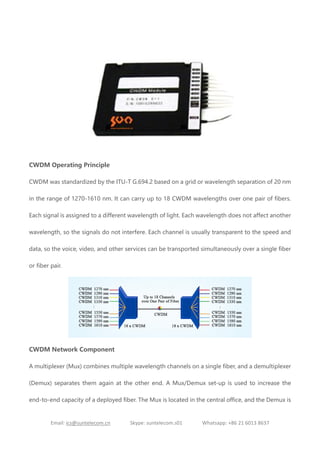
CWDM was standardized by the ITU-T G.694.2 based on a grid or wavelength separation of 20 nm
in the range of 1270-1610 nm. It can carry up to 18 CWDM wavelengths over one pair of fibers.
Each signal is assigned to a different wavelength of light. Each wavelength does not affect another
wavelength, so the signals do not interfere. Each channel is usually transparent to the speed and
data, so the voice, video, and other services can be transported simultaneously over a single fiber
or fiber pair.
CWDM Network Component
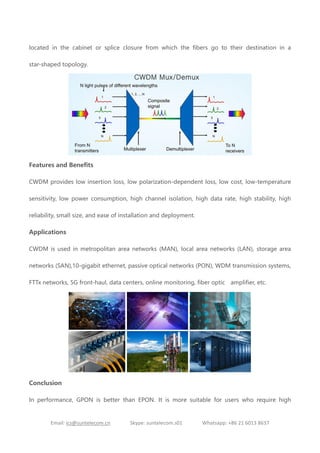
A multiplexer (Mux) combines multiple wavelength channels on a single fiber, and a demultiplexer
(Demux) separates them again at the other end. A Mux/Demux set-up is used to increase the
end-to-end capacity of a deployed fiber. The Mux is located in the central office, and the Demux is
Email: ics@suntelecom.cn Skype: suntelecom.s01 Whatsapp: +86 21 6013 8637
located in the cabinet or splice closure from which the fibers go to their destination in a
star-shaped topology.
Features and Benefits
CWDM provides low insertion loss, low polarization-dependent loss, low cost, low-temperature
sensitivity, low power consumption, high channel isolation, high data rate, high stability, high
reliability, small size, and ease of installation and deployment.
Applications
CWDM is used in metropolitan area networks (MAN), local area networks (LAN), storage area
networks (SAN),10-gigabit ethernet, passive optical networks (PON), WDM transmission systems,
FTTx networks, 5G front-haul, data centers, online monitoring, fiber optic amplifier, etc.
Conclusion
In performance, GPON is better than EPON. It is more suitable for users who require high
Email: ics@suntelecom.cn Skype: suntelecom.s01 Whatsapp: +86 21 6013 8637
bandwidth, triple-play multi-service, QoS, security, and ATM backbone network. In contrast, it
would be better to choose EPON for those who pay more attention to the cost and less security.
Sun Telecom specializes in providing one-stop total fiber optic solutions for all fiber optic
application industries worldwide. Contact us if any needs.

CWDM What You Need to Know

  • 1.
    Email: ics@suntelecom.cn Skype:suntelecom.s01 Whatsapp: +86 21 6013 8637 Wavelength division multiplexing (WDM) is a technology for transporting large amounts of data between sites. It increases bandwidth by allowing different data streams to be sent simultaneously over a single optical fiber network. There are two main types of WDM systems: coarse wavelength division multiplexing (CWDM) and dense wavelength division multiplexing (DWDM). This article provides some knowledge about CWDM. What is CWDM? Coarse Wavelength Division Multiplexing (CWDM) is a wavelength multiplexing technology for cities and access networks. The word coarse means the wavelength spacing between channels is relatively large. Furthermore, CWDM is an ideal solution for short-range applications and is used to improve the transmission capacity of optical fiber and the utilization of optical fiber resources.
  • 2.
    Email: ics@suntelecom.cn Skype:suntelecom.s01 Whatsapp: +86 21 6013 8637 CWDM Operating Principle CWDM was standardized by the ITU-T G.694.2 based on a grid or wavelength separation of 20 nm in the range of 1270-1610 nm. It can carry up to 18 CWDM wavelengths over one pair of fibers. Each signal is assigned to a different wavelength of light. Each wavelength does not affect another wavelength, so the signals do not interfere. Each channel is usually transparent to the speed and data, so the voice, video, and other services can be transported simultaneously over a single fiber or fiber pair. CWDM Network Component A multiplexer (Mux) combines multiple wavelength channels on a single fiber, and a demultiplexer (Demux) separates them again at the other end. A Mux/Demux set-up is used to increase the end-to-end capacity of a deployed fiber. The Mux is located in the central office, and the Demux is
  • 3.
    Email: ics@suntelecom.cn Skype:suntelecom.s01 Whatsapp: +86 21 6013 8637 located in the cabinet or splice closure from which the fibers go to their destination in a star-shaped topology. Features and Benefits CWDM provides low insertion loss, low polarization-dependent loss, low cost, low-temperature sensitivity, low power consumption, high channel isolation, high data rate, high stability, high reliability, small size, and ease of installation and deployment. Applications CWDM is used in metropolitan area networks (MAN), local area networks (LAN), storage area networks (SAN),10-gigabit ethernet, passive optical networks (PON), WDM transmission systems, FTTx networks, 5G front-haul, data centers, online monitoring, fiber optic amplifier, etc. Conclusion In performance, GPON is better than EPON. It is more suitable for users who require high
  • 4.
    Email: ics@suntelecom.cn Skype:suntelecom.s01 Whatsapp: +86 21 6013 8637 bandwidth, triple-play multi-service, QoS, security, and ATM backbone network. In contrast, it would be better to choose EPON for those who pay more attention to the cost and less security. Sun Telecom specializes in providing one-stop total fiber optic solutions for all fiber optic application industries worldwide. Contact us if any needs.