BASIC RULES AND
GUIDELINES
1. COMFORT
Massage must always be
comfortable. It must not hurt
or injure the client, even the
vigorous and stimulating
techniques.
2. DIRECTION
pressure must be applied in the
direction of venous drainage
towards the heart and the direction
of lymphatic drainage to the nearest
lymphatic nodes. (Do not pull back
what you have pushed along as this
is counter-productive.)
3. ORDER
begin with effleurage, follow with
applicable petrissage manipulations then
percussion if suitable, and complete with
effleurage. Effleurage and stroking may
be interspersed among any of the other
manipulations.
4. CONTINUITY
Massage should be continuous – the
transition between strokes should be
barely perceptible.The hands should not
be lifted off the area once treatment has
commenced until that area is completed.
Move smoothly from one stroke to
another.
5. SPEED
This must be selected according
to the type of massage required,
slow for relaxing, moderate for a
general massage, and faster for
a vigorous, stimulating massage.
6. DEPTH
This must be selected according to the type of
massage, as described – moderate depth for a
relaxing and general massage, deeper for a vigorous
massage.
Depth must also be adjusted to suit the client and the
desired outcome of the treatment.Those accustomed
to massage generally prefer a deeper massage than
new nervous clients. (Always ask the client if
manipulations are too deep or not deep enough.)
7. RHYTHM
This must be consistent regardless of the type
of client.The rhythm is selected at the
beginning of the massage and maintained
throughout, e.g. slow rhythm for a relaxing
massage, moderate for a general, and a faster
rhythm for a vigorous massage.
8. STANCE
Protect yourself from strain and injury by adopting the
correct posture.
There are two standing positions used in massage:
A. walk standing (i.e. with one foot in front of the other) is
used when massaging up and down the length of the
body.
B. stride standing (i.e. with the feet apart) is used when
working across the body. Always keep the back straight
and the shoulders relaxed.
8. STANCE
c. Allow the knees to bend when necessary to apply body
weight and to reach all areas.
Increased depth and pressure must come from body
weight transmitted through the arms, but not by pushing
with the arms.
Use a slight swaying body movement to achieve this.
Keep the feet apart – this improves balance and provides
stability, as it gives a wider base.
9. CONCENTRATION
Maintain your concentration throughout the
massage. Although massage movements become
semi-automatic as expertise develops, it is still
important to concentrate fully on the task in
hand.
Continuity and rhythm will suffer if there is a
lapse in concentration, and this is transmitted to
the client.
10. COVERAGE
Cover the whole area thoroughly. Do not
neglect small areas as this will result in
uneven coverage.
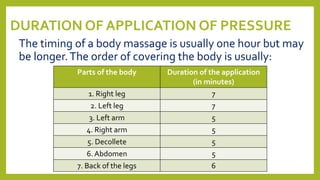
DURATION OF APPLICATION OF PRESSURE
The timing of a body massage is usually one hour but may
be longer.The order of covering the body is usually:
Parts of the body Duration of the application
(in minutes)
1. Right leg 7
2. Left leg 7
3. Left arm 5
4. Right arm 5
5. Decollete 5
6. Abdomen 5
7. Back of the legs 6
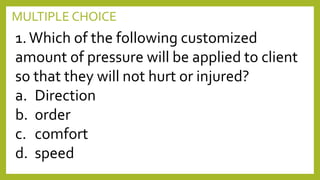
MULTIPLE CHOICE
1.Which of the following customized
amount of pressure will be applied to client
so that they will not hurt or injured?
a. Direction
b. order
c. comfort
d. speed
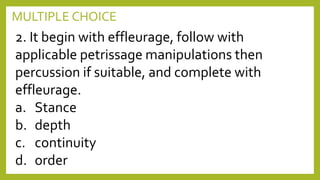
MULTIPLE CHOICE
2. It begin with effleurage, follow with
applicable petrissage manipulations then
percussion if suitable, and complete with
effleurage.
a. Stance
b. depth
c. continuity
d. order
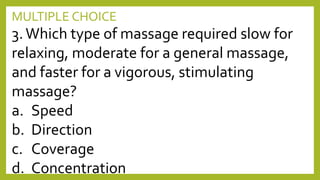
MULTIPLE CHOICE
3.Which type of massage required slow for
relaxing, moderate for a general massage,
and faster for a vigorous, stimulating
massage?
a. Speed
b. Direction
c. Coverage
d. Concentration
MULTIPLE CHOICE
4. It is one of the customized amount of
pressure applied that protect yourself from
strain and injury by adopting the correct
posture.
a. Stance
b. Rhythm
c. Comfort
d. Continuity
MULTIPLE CHOICE
5.What type of customized amount of
pressure applied that can be adjusted to suit
the client and the desired outcome of the
treatment.
a. Speed
b. Order
c. Continuity
d. Depth
ENUMERATION
Directions: Enumerate and discuss the five
(5) duration of pressure application. Put your
answer on the paper.
ANSWER KEY
1. C
2. D
3. A
4. A
5. D

Customized amount pressured in Wellness Massage

  • 1.
  • 2.
    1. COMFORT Massage mustalways be comfortable. It must not hurt or injure the client, even the vigorous and stimulating techniques.
  • 3.
    2. DIRECTION pressure mustbe applied in the direction of venous drainage towards the heart and the direction of lymphatic drainage to the nearest lymphatic nodes. (Do not pull back what you have pushed along as this is counter-productive.)
  • 4.
    3. ORDER begin witheffleurage, follow with applicable petrissage manipulations then percussion if suitable, and complete with effleurage. Effleurage and stroking may be interspersed among any of the other manipulations.
  • 5.
    4. CONTINUITY Massage shouldbe continuous – the transition between strokes should be barely perceptible.The hands should not be lifted off the area once treatment has commenced until that area is completed. Move smoothly from one stroke to another.
  • 6.
    5. SPEED This mustbe selected according to the type of massage required, slow for relaxing, moderate for a general massage, and faster for a vigorous, stimulating massage.
  • 7.
    6. DEPTH This mustbe selected according to the type of massage, as described – moderate depth for a relaxing and general massage, deeper for a vigorous massage. Depth must also be adjusted to suit the client and the desired outcome of the treatment.Those accustomed to massage generally prefer a deeper massage than new nervous clients. (Always ask the client if manipulations are too deep or not deep enough.)
  • 8.
    7. RHYTHM This mustbe consistent regardless of the type of client.The rhythm is selected at the beginning of the massage and maintained throughout, e.g. slow rhythm for a relaxing massage, moderate for a general, and a faster rhythm for a vigorous massage.
  • 9.
    8. STANCE Protect yourselffrom strain and injury by adopting the correct posture. There are two standing positions used in massage: A. walk standing (i.e. with one foot in front of the other) is used when massaging up and down the length of the body. B. stride standing (i.e. with the feet apart) is used when working across the body. Always keep the back straight and the shoulders relaxed.
  • 10.
    8. STANCE c. Allowthe knees to bend when necessary to apply body weight and to reach all areas. Increased depth and pressure must come from body weight transmitted through the arms, but not by pushing with the arms. Use a slight swaying body movement to achieve this. Keep the feet apart – this improves balance and provides stability, as it gives a wider base.
  • 11.
    9. CONCENTRATION Maintain yourconcentration throughout the massage. Although massage movements become semi-automatic as expertise develops, it is still important to concentrate fully on the task in hand. Continuity and rhythm will suffer if there is a lapse in concentration, and this is transmitted to the client.
  • 12.
    10. COVERAGE Cover thewhole area thoroughly. Do not neglect small areas as this will result in uneven coverage.
  • 13.
    DURATION OF APPLICATIONOF PRESSURE The timing of a body massage is usually one hour but may be longer.The order of covering the body is usually: Parts of the body Duration of the application (in minutes) 1. Right leg 7 2. Left leg 7 3. Left arm 5 4. Right arm 5 5. Decollete 5 6. Abdomen 5 7. Back of the legs 6
  • 14.
    MULTIPLE CHOICE 1.Which ofthe following customized amount of pressure will be applied to client so that they will not hurt or injured? a. Direction b. order c. comfort d. speed
  • 15.
    MULTIPLE CHOICE 2. Itbegin with effleurage, follow with applicable petrissage manipulations then percussion if suitable, and complete with effleurage. a. Stance b. depth c. continuity d. order
  • 16.
    MULTIPLE CHOICE 3.Which typeof massage required slow for relaxing, moderate for a general massage, and faster for a vigorous, stimulating massage? a. Speed b. Direction c. Coverage d. Concentration
  • 17.
    MULTIPLE CHOICE 4. Itis one of the customized amount of pressure applied that protect yourself from strain and injury by adopting the correct posture. a. Stance b. Rhythm c. Comfort d. Continuity
  • 18.
    MULTIPLE CHOICE 5.What typeof customized amount of pressure applied that can be adjusted to suit the client and the desired outcome of the treatment. a. Speed b. Order c. Continuity d. Depth
  • 19.
    ENUMERATION Directions: Enumerate anddiscuss the five (5) duration of pressure application. Put your answer on the paper.
  • 20.
    ANSWER KEY 1. C 2.D 3. A 4. A 5. D