Customer Value Segmentation
NA Commercial Customers
WW Integrated Marketing Communication
Scott Berg – Director, WW Direct and Database Marketing
Victor Howard – Sr. Manager, WW Database Marketing
Project Objectives
 Develop clearly defined, value-based segments for NA
commercial customers
 Understand best opportunities for strategic marketing
investments
 Identify tactical marketing opportunities
 Create a repeatable and transferable process for other
Geos (dependent on data availability)
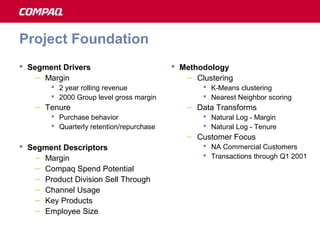
Project Foundation
 Segment Drivers
– Margin
 2 year rolling revenue
 2000 Group level gross margin
– Tenure
 Purchase behavior
 Quarterly retention/repurchase
 Segment Descriptors
– Margin
– Compaq Spend Potential
– Product Division Sell Through
– Channel Usage
– Key Products
– Employee Size
 Methodology
– Clustering
 K-Means clustering
 Nearest Neighbor scoring
– Data Transforms
 Natural Log - Margin
 Natural Log - Tenure
– Customer Focus
 NA Commercial Customers
 Transactions through Q1 2001
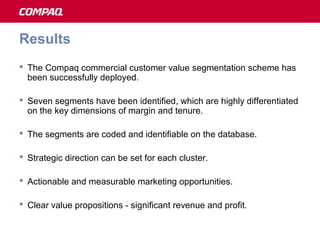
Results
 The Compaq commercial customer value segmentation scheme has
been successfully deployed.
 Seven segments have been identified, which are highly differentiated
on the key dimensions of margin and tenure.
 The segments are coded and identifiable on the database.
 Strategic direction can be set for each cluster.
 Actionable and measurable marketing opportunities.
 Clear value propositions - significant revenue and profit.
5
Microsoft Word
Document
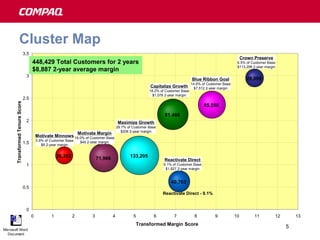
65,558
81,486
133,20526,352
40,763
29,099
71,966
0
0.5
1
1.5
2
2.5
3
3.5
0 1 2 3 4 5 6 7 8 9 10 11 12 13
Transformed Margin Score
TransformedTenureScore
Crown Preserve
6.5% of Customer Base
$113,298 2-year margin
Blue Ribbon Goal
14.6% of Customer Base
$7,512 2-year margin
Reactivate Direct - 9.1%
Motivate
Capitalize Growth
18.2% of Customer Base
$1,078 2-year margin
Maximize Growth
29.7% of Customer Base
$206 2-year margin
Motivate Margin
16.0% of Customer Base
$40 2-year margin
Motivate Minnows
5.9% of Customer Base
$6 2-year margin
Reactivate Direct
9.1% of Customer Base
$1,827 2-year margin
448,429 Total Customers for 2 years
$8,887 2-year average margin
Cluster Map
Cluster Characteristics
# of Customers  29,099 (6.5%)
Average 2-year Margin  $113,398
Compaq Spend Potential  Comprise 90% of “At Potential” customers
Product Division Sell Through  95% purchased in more than one unique division during
1999 and 2000
 40% purchased in 4 or 5 unique divisions during 1999 and
2000
Employee Size  57% of customers with a known employee range have
greater than 100 employees
Channel Usage  73% purchased from more than one reseller
Key Products  95% purchased an industry standard server
 Generated 85% of total industry standard server margin
Purchase Frequency  During each quarter of 1999 and 2000, at least 53% of
customers made a purchase.
Crown Preserve
Cluster Characteristics
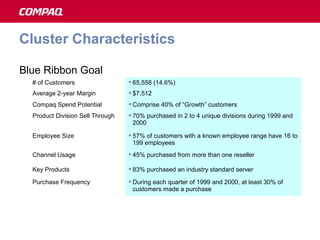
# of Customers  65,558 (14.6%)
Average 2-year Margin  $7,512
Compaq Spend Potential  Comprise 40% of “Growth” customers
Product Division Sell Through  70% purchased in 2 to 4 unique divisions during 1999 and
2000
Employee Size  57% of customers with a known employee range have 16 to
199 employees
Channel Usage  45% purchased from more than one reseller
Key Products  83% purchased an industry standard server
Purchase Frequency  During each quarter of 1999 and 2000, at least 30% of
customers made a purchase
Blue Ribbon Goal
Cluster Characteristics
# of Customers  81,486 (18.2%)
Average 2-year Margin  $1,078
Compaq Spend Potential  Comprise 28% of “Growth” customers
Product Division Sell Through  60% purchased in more than one unique division during
1999 and 2000
Employee Size  75% purchased from one reseller
Channel Usage  54% of customers with a known employee range have 10 to
99 employees
Key Products  50% purchased an industry standard server
Purchase Frequency  Percent of customers purchasing per quarter increased
from 13% in Q1 1999 to a steady 25% in Q2 through Q4
2000
Capitalize Growth
Cluster Characteristics
# of Customers  133,205 (29.7%)
Average 2-year Margin  $206
Compaq Spend Potential  Comprise 30% of “Develop” customers
Product Division Sell Through  72% purchased in one unique division in 1999 and 2000
 22% purchased in two unique divisions in 1999 and 2000
Employee Size  63% of customers with a known employee range have less
than 31 employees
Channel Usage  91% purchased from one reseller
 Comprise 40% of agent direct channel customers and 26%
of all direct channel customers
Key Products  48% purchased a PC Desktop
–Generated 33% of total PC Desktop margin
Purchase Frequency  Percent of customers purchasing per quarter decreased
from approximately 15% in 1999 to 10% in 2000
Maximize Growth
Cluster Characteristics
# of Customers  71,966 (16%)
Average 2-year Margin  $40
Compaq Spend Potential  99% of customers are in the “Develop” level
–11% of “Develop” customers
Product Division Sell Through  93% purchased in one unique division in 1999 and 2000
Employee Size  63% have a known employee range have less than 31
employees
Channel Usage  92% purchased from one reseller
Key Products  25% of their total margin is from purchases of displays and
peripherals
Purchase Frequency  During each quarter of 1999 and 2000, 10-15% of
customers made a purchase
Motivate Margin
Cluster Characteristics
# of Customers  26,352 (5.9%)
Average 2-year Margin  $6
Compaq Spend Potential  100% are in the “Develop” level, comprising 8% of
“Develop” customers
Product Division Sell Through  99% purchased in one unique division during 1999 and
2000
Employee Size  61% of customers with a known employee range have less
than 31 employees
Channel Usage  96% purchased from one reseller
Key Products  39% of customers purchased Internet Products and
Services
–20% of all commercial Internet Products and Services
customers
Purchase Frequency  Percent of customers purchasing per quarter increased
from 7% in Q1 1999 to 23% in Q4 2000
Motivate Minnows
Cluster Characteristics
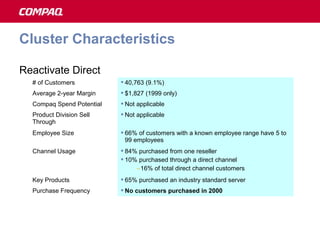
# of Customers  40,763 (9.1%)
Average 2-year Margin  $1,827 (1999 only)
Compaq Spend Potential  Not applicable
Product Division Sell
Through
 Not applicable
Employee Size  66% of customers with a known employee range have 5 to
99 employees
Channel Usage  84% purchased from one reseller
 10% purchased through a direct channel
–16% of total direct channel customers
Key Products  65% purchased an industry standard server
Purchase Frequency  No customers purchased in 2000
Reactivate Direct
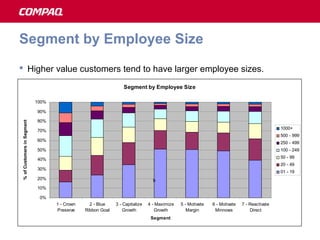
Segment by Employee Size
0%
10%
20%
30%
40%
50%
60%
70%
80%
90%
100%
1 - Crown
Preserve
2 - Blue
Ribbon Goal
3 - Capitalize
Growth
4 - Maximize
Growth
5 - Motivate
Margin
6 - Motivate
Minnows
7 - Reactivate
Direct
Segment
%ofCustomersinSegment
1000+
500 - 999
250 - 499
100 - 249
50 - 99
20 - 49
01 - 19
b
 Higher value customers tend to have larger employee sizes.
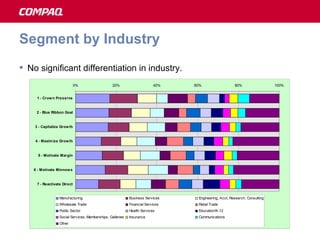
Segment by Industry
0% 20% 40% 60% 80% 100%
1 - Crown Preserve
2 - Blue Ribbon Goal
3 - Capitalize Growth
4 - Maximize Growth
5 - Motivate Margin
6 - Motivate Minnows
7 - Reactivate Direct
Manufacturing Business Services Engineering, Acct, Research, Consulting
Wholesale Trade Financial Services Retail Trade
Public Sector Health Services Education/K-12
Social Services, Memberships, Galleries Insurance Communications
Other
 No significant differentiation in industry.
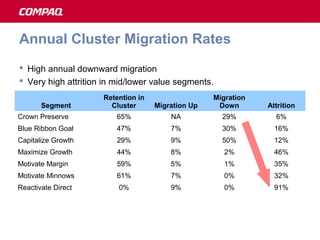
Annual Cluster Migration Rates
Segment
Retention in
Cluster Migration Up
Migration
Down Attrition
Crown Preserve 65% NA 29% 6%
Blue Ribbon Goal 47% 7% 30% 16%
Capitalize Growth 29% 9% 50% 12%
Maximize Growth 44% 8% 2% 46%
Motivate Margin 59% 5% 1% 35%
Motivate Minnows 61% 7% 0% 32%
Reactivate Direct 0% 9% 0% 91%
 High annual downward migration
 Very high attrition in mid/lower value segments.

Customer Value Segmentation

  • 1.
    Customer Value Segmentation NACommercial Customers WW Integrated Marketing Communication Scott Berg – Director, WW Direct and Database Marketing Victor Howard – Sr. Manager, WW Database Marketing
  • 2.
    Project Objectives  Developclearly defined, value-based segments for NA commercial customers  Understand best opportunities for strategic marketing investments  Identify tactical marketing opportunities  Create a repeatable and transferable process for other Geos (dependent on data availability)
  • 3.
    Project Foundation  SegmentDrivers – Margin  2 year rolling revenue  2000 Group level gross margin – Tenure  Purchase behavior  Quarterly retention/repurchase  Segment Descriptors – Margin – Compaq Spend Potential – Product Division Sell Through – Channel Usage – Key Products – Employee Size  Methodology – Clustering  K-Means clustering  Nearest Neighbor scoring – Data Transforms  Natural Log - Margin  Natural Log - Tenure – Customer Focus  NA Commercial Customers  Transactions through Q1 2001
  • 4.
    Results  The Compaqcommercial customer value segmentation scheme has been successfully deployed.  Seven segments have been identified, which are highly differentiated on the key dimensions of margin and tenure.  The segments are coded and identifiable on the database.  Strategic direction can be set for each cluster.  Actionable and measurable marketing opportunities.  Clear value propositions - significant revenue and profit.
  • 5.
    5 Microsoft Word Document 65,558 81,486 133,20526,352 40,763 29,099 71,966 0 0.5 1 1.5 2 2.5 3 3.5 0 12 3 4 5 6 7 8 9 10 11 12 13 Transformed Margin Score TransformedTenureScore Crown Preserve 6.5% of Customer Base $113,298 2-year margin Blue Ribbon Goal 14.6% of Customer Base $7,512 2-year margin Reactivate Direct - 9.1% Motivate Capitalize Growth 18.2% of Customer Base $1,078 2-year margin Maximize Growth 29.7% of Customer Base $206 2-year margin Motivate Margin 16.0% of Customer Base $40 2-year margin Motivate Minnows 5.9% of Customer Base $6 2-year margin Reactivate Direct 9.1% of Customer Base $1,827 2-year margin 448,429 Total Customers for 2 years $8,887 2-year average margin Cluster Map
  • 6.
    Cluster Characteristics # ofCustomers  29,099 (6.5%) Average 2-year Margin  $113,398 Compaq Spend Potential  Comprise 90% of “At Potential” customers Product Division Sell Through  95% purchased in more than one unique division during 1999 and 2000  40% purchased in 4 or 5 unique divisions during 1999 and 2000 Employee Size  57% of customers with a known employee range have greater than 100 employees Channel Usage  73% purchased from more than one reseller Key Products  95% purchased an industry standard server  Generated 85% of total industry standard server margin Purchase Frequency  During each quarter of 1999 and 2000, at least 53% of customers made a purchase. Crown Preserve
  • 7.
    Cluster Characteristics # ofCustomers  65,558 (14.6%) Average 2-year Margin  $7,512 Compaq Spend Potential  Comprise 40% of “Growth” customers Product Division Sell Through  70% purchased in 2 to 4 unique divisions during 1999 and 2000 Employee Size  57% of customers with a known employee range have 16 to 199 employees Channel Usage  45% purchased from more than one reseller Key Products  83% purchased an industry standard server Purchase Frequency  During each quarter of 1999 and 2000, at least 30% of customers made a purchase Blue Ribbon Goal
  • 8.
    Cluster Characteristics # ofCustomers  81,486 (18.2%) Average 2-year Margin  $1,078 Compaq Spend Potential  Comprise 28% of “Growth” customers Product Division Sell Through  60% purchased in more than one unique division during 1999 and 2000 Employee Size  75% purchased from one reseller Channel Usage  54% of customers with a known employee range have 10 to 99 employees Key Products  50% purchased an industry standard server Purchase Frequency  Percent of customers purchasing per quarter increased from 13% in Q1 1999 to a steady 25% in Q2 through Q4 2000 Capitalize Growth
  • 9.
    Cluster Characteristics # ofCustomers  133,205 (29.7%) Average 2-year Margin  $206 Compaq Spend Potential  Comprise 30% of “Develop” customers Product Division Sell Through  72% purchased in one unique division in 1999 and 2000  22% purchased in two unique divisions in 1999 and 2000 Employee Size  63% of customers with a known employee range have less than 31 employees Channel Usage  91% purchased from one reseller  Comprise 40% of agent direct channel customers and 26% of all direct channel customers Key Products  48% purchased a PC Desktop –Generated 33% of total PC Desktop margin Purchase Frequency  Percent of customers purchasing per quarter decreased from approximately 15% in 1999 to 10% in 2000 Maximize Growth
  • 10.
    Cluster Characteristics # ofCustomers  71,966 (16%) Average 2-year Margin  $40 Compaq Spend Potential  99% of customers are in the “Develop” level –11% of “Develop” customers Product Division Sell Through  93% purchased in one unique division in 1999 and 2000 Employee Size  63% have a known employee range have less than 31 employees Channel Usage  92% purchased from one reseller Key Products  25% of their total margin is from purchases of displays and peripherals Purchase Frequency  During each quarter of 1999 and 2000, 10-15% of customers made a purchase Motivate Margin
  • 11.
    Cluster Characteristics # ofCustomers  26,352 (5.9%) Average 2-year Margin  $6 Compaq Spend Potential  100% are in the “Develop” level, comprising 8% of “Develop” customers Product Division Sell Through  99% purchased in one unique division during 1999 and 2000 Employee Size  61% of customers with a known employee range have less than 31 employees Channel Usage  96% purchased from one reseller Key Products  39% of customers purchased Internet Products and Services –20% of all commercial Internet Products and Services customers Purchase Frequency  Percent of customers purchasing per quarter increased from 7% in Q1 1999 to 23% in Q4 2000 Motivate Minnows
  • 12.
    Cluster Characteristics # ofCustomers  40,763 (9.1%) Average 2-year Margin  $1,827 (1999 only) Compaq Spend Potential  Not applicable Product Division Sell Through  Not applicable Employee Size  66% of customers with a known employee range have 5 to 99 employees Channel Usage  84% purchased from one reseller  10% purchased through a direct channel –16% of total direct channel customers Key Products  65% purchased an industry standard server Purchase Frequency  No customers purchased in 2000 Reactivate Direct
  • 13.
    Segment by EmployeeSize Segment by Employee Size 0% 10% 20% 30% 40% 50% 60% 70% 80% 90% 100% 1 - Crown Preserve 2 - Blue Ribbon Goal 3 - Capitalize Growth 4 - Maximize Growth 5 - Motivate Margin 6 - Motivate Minnows 7 - Reactivate Direct Segment %ofCustomersinSegment 1000+ 500 - 999 250 - 499 100 - 249 50 - 99 20 - 49 01 - 19 b  Higher value customers tend to have larger employee sizes.
  • 14.
    Segment by Industry 0%20% 40% 60% 80% 100% 1 - Crown Preserve 2 - Blue Ribbon Goal 3 - Capitalize Growth 4 - Maximize Growth 5 - Motivate Margin 6 - Motivate Minnows 7 - Reactivate Direct Manufacturing Business Services Engineering, Acct, Research, Consulting Wholesale Trade Financial Services Retail Trade Public Sector Health Services Education/K-12 Social Services, Memberships, Galleries Insurance Communications Other  No significant differentiation in industry.
  • 15.
    Annual Cluster MigrationRates Segment Retention in Cluster Migration Up Migration Down Attrition Crown Preserve 65% NA 29% 6% Blue Ribbon Goal 47% 7% 30% 16% Capitalize Growth 29% 9% 50% 12% Maximize Growth 44% 8% 2% 46% Motivate Margin 59% 5% 1% 35% Motivate Minnows 61% 7% 0% 32% Reactivate Direct 0% 9% 0% 91%  High annual downward migration  Very high attrition in mid/lower value segments.