Customary Law
September 2010 – Question 5

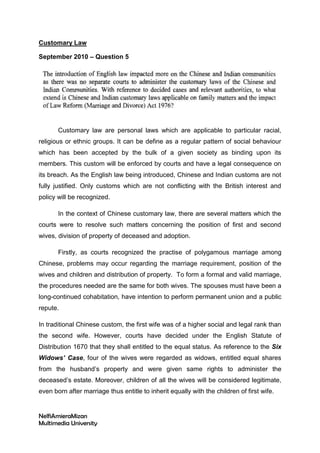
Customary law are personal laws which are applicable to particular racial,
religious or ethnic groups. It can be define as a regular pattern of social behaviour
which has been accepted by the bulk of a given society as binding upon its
members. This custom will be enforced by courts and have a legal consequence on
its breach. As the English law being introduced, Chinese and Indian customs are not
fully justified. Only customs which are not conflicting with the British interest and
policy will be recognized.
In the context of Chinese customary law, there are several matters which the
courts were to resolve such matters concerning the position of first and second
wives, division of property of deceased and adoption.
Firstly, as courts recognized the practise of polygamous marriage among
Chinese, problems may occur regarding the marriage requirement, position of the
wives and children and distribution of property. To form a formal and valid marriage,
the procedures needed are the same for both wives. The spouses must have been a
long-continued cohabitation, have intention to perform permanent union and a public
repute.
In traditional Chinese custom, the first wife was of a higher social and legal rank than
the second wife. However, courts have decided under the English Statute of
Distribution 1670 that they shall entitled to the equal status. As reference to the Six
Widows’ Case, four of the wives were regarded as widows, entitled equal shares
from the husband’s property and were given same rights to administer the
deceased’s estate. Moreover, children of all the wives will be considered legitimate,
even born after marriage thus entitle to inherit equally with the children of first wife.

NelfiAmieraMizan
Multimedia University
As Chinese practise adoption to maintain lineage, an adopted child stands in all
respects as a legitimate natural born child in the matter of succession. However,
adoption was not recognized in the Strait Settlements and Malay States.InTan Kui
Lim v Lai Sin Fah, the Federal Court considered the issue of adoption under
customary law of the Hakka community. The son of a deceased mother applied for
an order declaring the adoption of her grandson by the deceased to be null and void.
The Federal Court held on advice of expert opinion that the adoption was not in
accordance with the Chinese customs practice by the Hakka community.
In context of Indian customary law, matters of polygamous marriage and
jointfamily property had been discussed by the judiciary. In Pooto v ValeeUtaTaven,
the court recognizes polygamous marriages in Indian customs. In this case, the
Hindu customary law on a wife’s ownership of her separate property was applied.
Besides that, in Re the Estate of T.M.R.M VengadasalamChettiar, Hindu law
relating to joint Hindu families was applied in the Straits Settlements. A Hindu
testator left a will which stated that he was the sole owner of a half share in a chettiar
firm. The executor contended that at the time of the testator’s death, he was a
member of an undivided joint Hindu family which comprised himself and his two
sons. It meant that the joint Hindu family and not the testator himself was the owner
of the half share in the chettiar firm. The essential feature of the joint family is that all
property inherited by a male Hindu from his lineage was ancestral property. The
male heirs acquire an interest in it by birth and this was accepted by the court.
The impact of Law Reform (Marriage and Divorce) Act 1976introduced a
significant change to regulate aspects of marriage and divorce among non-Muslims.
The changes are made are by abolished polygamous marriages among non-Muslims
and provided irretrievable breakdown of marriage or marriage failure as a ground of
divorce.
However the act does not affect the customary form of marriage. This means
that the marriage ceremony can still be in the form of a custom practice by its
community as long as the marriage is registered after the ceremony.
However the act does not affect the customary form of marriage. This means
that the marriage ceremony can still be in the form of a custom practice by its
NelfiAmieraMizan
Multimedia University
community as long as the marriage is registered after the ceremony. The act does
not affect the validity of any marriage solemnize under any law prior to its affective
date of the Law Reform Act.
This act introduces an offence for polygamous marriage and divorce under
three grounds where firstly, when one of the parties of marriage has converted to
Islam as in Letchumy v Ramadason. Petitioner obtained a divorce from the
respondent on the ground of desertion. After the judgment was made she applied for
maintenance and the matter came before the Judicial Commissioner after the
judgement became absolute. The Judicial Commissioner ordered the respondent to
pay the petitioner $200 a month as her maintenance. The respondent subsequently
applied for the order to be set-aside on the ground that he had become a Muslim and
under Islamic law the petitioner has no right to claim maintenance because she has
not converted to Islam with her husband during the eddah11 period. The Court held
that since section 3(1) of Law Reform Act excludes the operation of the Act to a
Muslim, and as the respondent had become a Muslim, the Act cannot be made to
apply to him. Besides that,the Act also introduces offence in matters of irretrievable
breakdown of marriage as in the case of Sivanesan v Shymala and mutual consent
governed by Section 52 of law Reform Marriage Act. As in the case of Re Divorce
Petition Nos 18, 20 and 24, if the parties have been married for more than 2 years,
have freely consented to the dissolution and a proper provision is made for the wife
and for the support, care and custody of the children, a judgment of divorce must be
given.
In conclusion, the application of Chinese and Indian customary law was
restricted only to family matters and it was not fully applicable until today as
Malaysian are governed by a supreme law of the land which is the Federal
Constitution. However, their marriage customs had been governed by the Law
Reform Marriage Act to settle dispute occur among them besides distinguishing it
from the Islamic law which govern the Malay Muslims.

NelfiAmieraMizan
Multimedia University

Customary law 1

  • 1.
    Customary Law September 2010– Question 5 Customary law are personal laws which are applicable to particular racial, religious or ethnic groups. It can be define as a regular pattern of social behaviour which has been accepted by the bulk of a given society as binding upon its members. This custom will be enforced by courts and have a legal consequence on its breach. As the English law being introduced, Chinese and Indian customs are not fully justified. Only customs which are not conflicting with the British interest and policy will be recognized. In the context of Chinese customary law, there are several matters which the courts were to resolve such matters concerning the position of first and second wives, division of property of deceased and adoption. Firstly, as courts recognized the practise of polygamous marriage among Chinese, problems may occur regarding the marriage requirement, position of the wives and children and distribution of property. To form a formal and valid marriage, the procedures needed are the same for both wives. The spouses must have been a long-continued cohabitation, have intention to perform permanent union and a public repute. In traditional Chinese custom, the first wife was of a higher social and legal rank than the second wife. However, courts have decided under the English Statute of Distribution 1670 that they shall entitled to the equal status. As reference to the Six Widows’ Case, four of the wives were regarded as widows, entitled equal shares from the husband’s property and were given same rights to administer the deceased’s estate. Moreover, children of all the wives will be considered legitimate, even born after marriage thus entitle to inherit equally with the children of first wife. NelfiAmieraMizan Multimedia University
  • 2.
    As Chinese practiseadoption to maintain lineage, an adopted child stands in all respects as a legitimate natural born child in the matter of succession. However, adoption was not recognized in the Strait Settlements and Malay States.InTan Kui Lim v Lai Sin Fah, the Federal Court considered the issue of adoption under customary law of the Hakka community. The son of a deceased mother applied for an order declaring the adoption of her grandson by the deceased to be null and void. The Federal Court held on advice of expert opinion that the adoption was not in accordance with the Chinese customs practice by the Hakka community. In context of Indian customary law, matters of polygamous marriage and jointfamily property had been discussed by the judiciary. In Pooto v ValeeUtaTaven, the court recognizes polygamous marriages in Indian customs. In this case, the Hindu customary law on a wife’s ownership of her separate property was applied. Besides that, in Re the Estate of T.M.R.M VengadasalamChettiar, Hindu law relating to joint Hindu families was applied in the Straits Settlements. A Hindu testator left a will which stated that he was the sole owner of a half share in a chettiar firm. The executor contended that at the time of the testator’s death, he was a member of an undivided joint Hindu family which comprised himself and his two sons. It meant that the joint Hindu family and not the testator himself was the owner of the half share in the chettiar firm. The essential feature of the joint family is that all property inherited by a male Hindu from his lineage was ancestral property. The male heirs acquire an interest in it by birth and this was accepted by the court. The impact of Law Reform (Marriage and Divorce) Act 1976introduced a significant change to regulate aspects of marriage and divorce among non-Muslims. The changes are made are by abolished polygamous marriages among non-Muslims and provided irretrievable breakdown of marriage or marriage failure as a ground of divorce. However the act does not affect the customary form of marriage. This means that the marriage ceremony can still be in the form of a custom practice by its community as long as the marriage is registered after the ceremony. However the act does not affect the customary form of marriage. This means that the marriage ceremony can still be in the form of a custom practice by its NelfiAmieraMizan Multimedia University
  • 3.
    community as longas the marriage is registered after the ceremony. The act does not affect the validity of any marriage solemnize under any law prior to its affective date of the Law Reform Act. This act introduces an offence for polygamous marriage and divorce under three grounds where firstly, when one of the parties of marriage has converted to Islam as in Letchumy v Ramadason. Petitioner obtained a divorce from the respondent on the ground of desertion. After the judgment was made she applied for maintenance and the matter came before the Judicial Commissioner after the judgement became absolute. The Judicial Commissioner ordered the respondent to pay the petitioner $200 a month as her maintenance. The respondent subsequently applied for the order to be set-aside on the ground that he had become a Muslim and under Islamic law the petitioner has no right to claim maintenance because she has not converted to Islam with her husband during the eddah11 period. The Court held that since section 3(1) of Law Reform Act excludes the operation of the Act to a Muslim, and as the respondent had become a Muslim, the Act cannot be made to apply to him. Besides that,the Act also introduces offence in matters of irretrievable breakdown of marriage as in the case of Sivanesan v Shymala and mutual consent governed by Section 52 of law Reform Marriage Act. As in the case of Re Divorce Petition Nos 18, 20 and 24, if the parties have been married for more than 2 years, have freely consented to the dissolution and a proper provision is made for the wife and for the support, care and custody of the children, a judgment of divorce must be given. In conclusion, the application of Chinese and Indian customary law was restricted only to family matters and it was not fully applicable until today as Malaysian are governed by a supreme law of the land which is the Federal Constitution. However, their marriage customs had been governed by the Law Reform Marriage Act to settle dispute occur among them besides distinguishing it from the Islamic law which govern the Malay Muslims. NelfiAmieraMizan Multimedia University