How to cite your sources the way you wantCustom Source Types
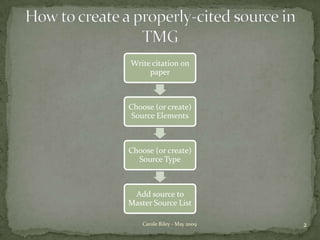
How to create a properly-cited source in TMG2Carole Riley - May 2009
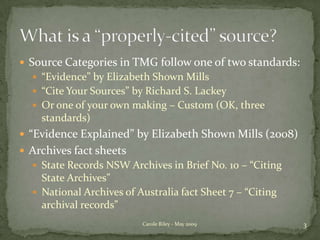
Source Categories in TMG follow one of two standards:“Evidence” by Elizabeth Shown Mills“Cite Your Sources” by Richard S. LackeyOr one of your own making – Custom (OK, three standards)“Evidence Explained” by Elizabeth Shown Mills (2008)Archives fact sheetsState Records NSW Archives in Brief No. 10 – “Citing State Archives”National Archives of Australia fact Sheet 7 – “Citing archival records”3Carole Riley - May 2009What is a “properly-cited” source?
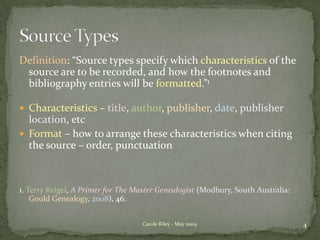
Definition: “Source types specify which characteristics of the source are to be recorded, and how the footnotes and bibliography entries will be formatted.”1Characteristics – title, author, publisher, date, publisher location, etcFormat – how to arrange these characteristics when citing the source – order, punctuation1. Terry Reigel, A Primer for The Master Genealogist(Modbury, South Australia: Gould Genealogy, 2008), 46. Source Types4Carole Riley - May 2009
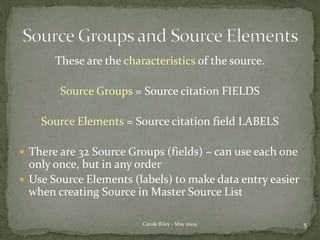
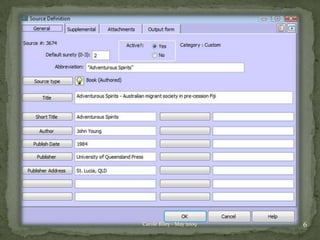
These are the characteristics of the source.Source Groups = Source citation FIELDSSource Elements = Source citation field LABELSThere are 32 Source Groups (fields) – can use each one only once, but in any orderUse Source Elements (labels) to make data entry easier when creating Source in Master Source ListSource Groups and Source Elements5Carole Riley - May 2009
6Carole Riley - May 2009
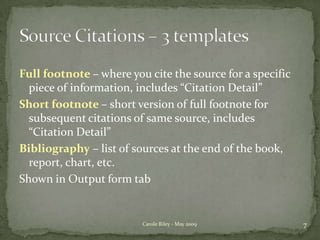
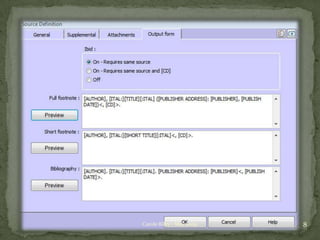
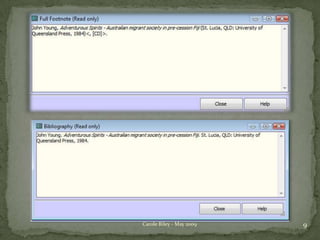
Full footnote – where you cite the source for a specific piece of information, includes “Citation Detail”Short footnote – short version of full footnote for subsequent citations of same source, includes “Citation Detail”Bibliography – list of sources at the end of the book, report, chart, etc.Shown in Output form tabSource Citations – 3 templates7Carole Riley - May 2009
8Carole Riley - May 2009
9Carole Riley - May 2009
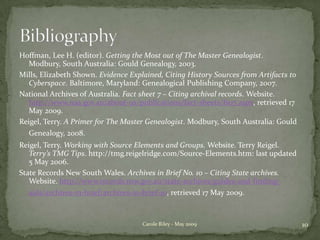
Hoffman, Lee H. (editor). Getting the Most out of The Master Genealogist. Modbury, South Australia: Gould Genealogy, 2003.Mills, Elizabeth Shown. Evidence Explained, Citing History Sources from Artifacts to Cyberspace. Baltimore, Maryland: Genealogical Publishing Company, 2007.National Archives of Australia. Fact sheet 7 – Citing archival records. Website. http://www.naa.gov.au/about-us/publications/fact-sheets/fs07.aspx, retrieved 17 May 2009.Reigel, Terry. A Primer for The Master Genealogist. Modbury, South Australia: Gould Genealogy, 2008.Reigel, Terry. Working with Source Elements and Groups. Website. Terry Reigel. Terry’s TMG Tips. http://tmg.reigelridge.com/Source-Elements.htm: last updated 5 May 2006.State Records New South Wales. Archives in Brief No. 10 – Citing State archives. Website. http://www.records.nsw.gov.au/state-archives/guides-and-finding-aids/archives-in-brief/archives-in-brief-10, retrieved 17 May 2009.Bibliography10Carole Riley - May 2009

Custom source types

  • 1.
    How to citeyour sources the way you wantCustom Source Types
  • 2.
    How to createa properly-cited source in TMG2Carole Riley - May 2009
  • 3.
    Source Categories inTMG follow one of two standards:“Evidence” by Elizabeth Shown Mills“Cite Your Sources” by Richard S. LackeyOr one of your own making – Custom (OK, three standards)“Evidence Explained” by Elizabeth Shown Mills (2008)Archives fact sheetsState Records NSW Archives in Brief No. 10 – “Citing State Archives”National Archives of Australia fact Sheet 7 – “Citing archival records”3Carole Riley - May 2009What is a “properly-cited” source?
  • 4.
    Definition: “Source typesspecify which characteristics of the source are to be recorded, and how the footnotes and bibliography entries will be formatted.”1Characteristics – title, author, publisher, date, publisher location, etcFormat – how to arrange these characteristics when citing the source – order, punctuation1. Terry Reigel, A Primer for The Master Genealogist(Modbury, South Australia: Gould Genealogy, 2008), 46. Source Types4Carole Riley - May 2009
  • 5.
    These are thecharacteristics of the source.Source Groups = Source citation FIELDSSource Elements = Source citation field LABELSThere are 32 Source Groups (fields) – can use each one only once, but in any orderUse Source Elements (labels) to make data entry easier when creating Source in Master Source ListSource Groups and Source Elements5Carole Riley - May 2009
  • 6.
  • 7.
    Full footnote –where you cite the source for a specific piece of information, includes “Citation Detail”Short footnote – short version of full footnote for subsequent citations of same source, includes “Citation Detail”Bibliography – list of sources at the end of the book, report, chart, etc.Shown in Output form tabSource Citations – 3 templates7Carole Riley - May 2009
  • 8.
  • 9.
  • 10.
    Hoffman, Lee H.(editor). Getting the Most out of The Master Genealogist. Modbury, South Australia: Gould Genealogy, 2003.Mills, Elizabeth Shown. Evidence Explained, Citing History Sources from Artifacts to Cyberspace. Baltimore, Maryland: Genealogical Publishing Company, 2007.National Archives of Australia. Fact sheet 7 – Citing archival records. Website. http://www.naa.gov.au/about-us/publications/fact-sheets/fs07.aspx, retrieved 17 May 2009.Reigel, Terry. A Primer for The Master Genealogist. Modbury, South Australia: Gould Genealogy, 2008.Reigel, Terry. Working with Source Elements and Groups. Website. Terry Reigel. Terry’s TMG Tips. http://tmg.reigelridge.com/Source-Elements.htm: last updated 5 May 2006.State Records New South Wales. Archives in Brief No. 10 – Citing State archives. Website. http://www.records.nsw.gov.au/state-archives/guides-and-finding-aids/archives-in-brief/archives-in-brief-10, retrieved 17 May 2009.Bibliography10Carole Riley - May 2009