EJMT 2(11) 2016 • European Journal of Medical Technology
7 Copyright © 2016 by ISASDMT
European Journal
of Medical Technologies
2016; 2(11): 7-14
Copyright © 2016 by ISASDMT
All rights reserved
www. medical-technologies.eu
Published online 19.07.2016
Corresponding
­address:
Studio Odontoiatrico
Associato
Dr.I Spizzo E Spitaleri
Clinica Medica
Safe Spitaleri
Via Lungolavia 1 –
Palazzo Inserco
Martignacco (Ud) Italia
www.spitaleri.it
www.spizzospitaleri.it
tel.+390432657187
Current usage of monophasic
latest generation implant
devices (one-piece)
Dario Spitaleri1
, Maciej Michalak2
, Andrea Palermo3
,
Andrzej Bożyk4
, Grigore Ion Lazarescu5
1
Studio Odontoiatrico Associato Dr. I Spizzo E
Spitaleri Clinica Medica Safe Spitaleri Via Lungolavia
1 – Palazzo Inserco Martignacco (Ud) Italia
2
Military Institute of Medicine, Warsaw, Poland
Private practice in Lecce, senior clinical lecturer BBP
University city of London, United Kingdom
4
Department of Dental Prosthetics, Medical
University of Lublin, Poland
5
Corresponding Author at‘Titu Maiorescu’University,
Faculty of Dentistry – Bucharest, Romania
Key words:
Monophasic
implants, Crestal
bone loss, POWER
Immediateload SA
Abstract
The purpose of this article is to redefine, in a modern way and in light of cur-
rent technology and industrial engineering, the clinical and biomechanical
concepts of the monophasic implant to assess the rational use through a com-
parison with biphasic implant devices..Maintaining crestal bone has become in
recent years a key criterion in assessing the success of an implant.The ideal case
would be the homogeneous distribution of the loads along the entire contact
bone/implant surface. The work presented here has set itself the objective of
assessing the biomechanical behavior in the short and medium term of the IM-
MEDIATELOAD SA (Lugano-CH) dental implant – line POWER – then loaded by
a denture of crown type. To increase the functional surface area of the POWER
implant, the IMMEDIATELOAD SA Company has also acted on the depth of the
EJMT 2(11) 2016 • European Journal of Medical Technology
8 Copyright © 2016 by ISASDMT
Introduction
The medical devices for intraosseous implantology
are developed with the currently known concepts
and features since the 60s of last century. With the
contribution of Dr. Tramonte and other authors the
first case reports were written and the first publica-
tions appeared on the topic of the treatment of vario-
us kinds of edentulous patients with the use of screw
type fixture implants made of titanium. The implant
design and implementation of the fixtures are the re-
sult of clinical experience and technology available at
the time.
The purpose of this short article is to redefine, in
a modern way and in light of current technology and
industrial engineering, the clinical and biomechani-
cal concepts of the monophasic implant to assess the
rational use through a comparison with biphasic im-
plant devices.
The criteria for the success of implant therapy such
as the stillness of the individual implants, the absence
of the peri-implant radiolucency, the total absence of
bone resorption, of pain, of inflammation and pare-
sthesia may be currently considered the benchmarks
for he rated short-term and long-term survival.
Numerous studies have shown a  high success rate
of dental implants (over 95% after 10 years), but the
complications around the implant as peri-implantitis
and crestal marginal bone loss at the implant neck are
still under evaluation, study and research. Maintain-
ing crestal bone has become in recent years a key
criterion in assessing the success of an implant. The
loss of marginal bone around an implant depends on
several factors including the distribution of loads in
relation to the quality and quantity of the bone sur-
rounding the implant, which has got a primary im-
portance. The latter factor has become a key issue in
the long-term evaluation of an implant success. As
a matter of fact, the bone has the ability to adapt its
structure through the processes of resorption and
deposition due to mechanical stimuli to which it is
subjected during the chewing cycles.
The ideal case would be the homogeneous distri-
bution of the loads along the entire contact bone/im-
plant surface which is, however, in direct relation with
the type of implant geometry and with the chemical-
physical characteristics of the implant material.
It’s now scientifically consolidated the fact that the
biomechanical aspect of osseous-integrated dental
implants is directly dependent on the geometry of
the implant with particular reference to the fixture
profile and the shape of the emerging part and the
surface treatment of the implantable device.
Materials and methods
The work presented here has set itself the objective
of assessing the biomechanical behavior in the short
and medium term of the IMMEDIATELOAD SA
(Lugano-CH) dental implant – line POWER – then
loaded by a denture of crown type.
A peculiar characteristic of this device is the fact
that the implant has been specifically designed and
it has got, on its intraosseous area, the ‘V’ shape stan-
dard coils which are used for the insertion and the
stabilization of the implant in the bone, in association
with ‘square’ shape coils which are the key issue so as
to make the load transfer to the surrounding biologi-
cal tissue homogeneous and uniform.
To increase the functional surface area of the
POWER implant, the IMMEDIATELOAD SA Com-
pany has also acted on the depth of the coils. The
depth of the loop is the distance between the major
diameter and the minor diameter of the loop. This
coils depth varies along the implant body to provide
greater functional surface in the regions of greatest
stress (crestal area).
coils. In the light of modern possibilities of computerized preoperative analysis,
the author's intent is to evaluate and propose the monophasic implants as an
alternative rational therapeutic choice in the prosthetic-implant rehabilitation
with the help of modern knowledge and technology currently available of the
design area, of surface treatment and of the performing precision. Case report.
EJMT 2(11) 2016 • European Journal of Medical Technology
9 Copyright © 2016 by ISASDMT
Case report
In light of the promising results obtained through the
analysis of simulated biomechanics finite elements
produced by bio - engineers at IMMEDIATELOAD
SA, it is presented in this report the resolution of
a case of single edentulous with an evidence-based
indication for a bi-phasic implant associated with al-
veolar bone regeneration, using a monophasic device
in order to evaluate the latest generation character-
istics of the implant design, of the surface treatment
and of the implant behavior in the process of bone
rearrangement.
Description
Male patient, 56 years old, comes to my attention for
the edentulous resolution of 4.6 lower first molar, on
the right side, recently extracted for endo-periodon-
tal reasons.
Within the anamnesis there were no local or gen-
eral diseases or contraindications to an implant-pros-
thetic rehabilitation. On objective examination there
comes out the lack of the tooth, signs of remodeling
following the recent tooth extraction (after 45 days)
with good preservation of soft tissue.
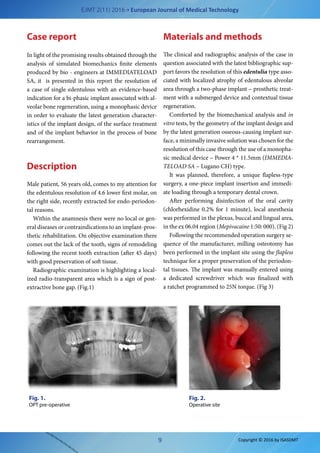
Radiographic examination is highlighting a local-
ized ​​radio-transparent area which is a sign of post-
extractive bone gap. (Fig.1)
Materials and methods
The clinical and radiographic analysis of the case in
question associated with the latest bibliographic sup-
port favors the resolution of this edentulia type asso-
ciated with localized atrophy of edentulous alveolar
area through a two-phase implant – prosthetic treat-
ment with a submerged device and contextual tissue
regeneration.
Comforted by the biomechanical analysis and in
vitro tests, by the geometry of the implant design and
by the latest generation osseous-causing implant sur-
face, a minimally invasive solution was chosen for the
resolution of this case through the use of a monopha-
sic medical device – Power 4 * 11.5mm (IMMEDIA-
TELOAD SA – Lugano CH) type.
It was planned, therefore, a  unique flapless-type
surgery, a one-piece implant insertion and immedi-
ate loading through a temporary dental crown.
After performing disinfection of the oral cavity
(chlorhexidine 0.2% for 1 minute), local anesthesia
was performed in the plexus, buccal and lingual area,
in the ex 06.04 region (Mepivacaine 1:50: 000). (Fig 2)
Following the recommended operation surgery se-
quence of the manufacturer, milling osteotomy has
been performed in the implant site using the flapless
technique for a proper preservation of the periodon-
tal tissues. The implant was manually entered using
a  dedicated screwdriver which was finalized with
a ratchet programmed to 25N torque. (Fig 3)
Fig. 1.
OPT pre-operative
Fig. 2.
Operative site
EJMT 2(11) 2016 • European Journal of Medical Technology
10 Copyright © 2016 by ISASDMT
Fig. 3.
Power Implant inserted – flapless technique
Fig. 4.
Rx intra-operative
Fig. 5.
Splinting by means of electro-welding
To promote quiescence of the implant and to limit
potential overloads of the chewing and of the tongue
thrust, the POWER implant was immobilized with
splints by an intraoral welder (DentWeld) to the sur-
rounding teeth elements which were not periodon-
tally compromised.
To make such way to facilitate the osseous-genetic
process, the implant was immediately loaded with
temporary resin crown.
Within the three subsequent months, pending
completion of the osseous-integration process, the
implant was monthly monitored by an intraoral ra-
diograph that showed a gradual bone consolidation
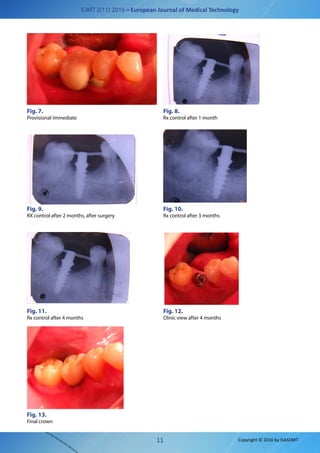
on the implant surface. (Fig. 4-13)
At the end of the osseous-integrative process,
the implant was finalized by a final alloy-composite
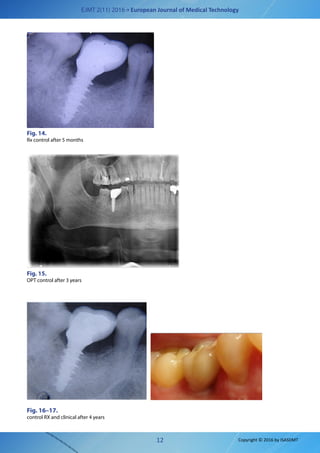
crown and annually monitored. (Fig 14-17)
Conclusions
In the past, but also currently in some nowadays ar-
eas, the clinical use of the monophasic implants has
been remarkable, especially in Italy, where the one-
piece implant technique associated with intraoral
welding had its birth and its most widespread, despite
the unequal distribution of studies and bibliographic
analysis comparing to the biphasic devices which had
a greater use.
In the light of modern possibilities of computer-
ized preoperative analysis, the author's intent is to
evaluate and propose the monophasic implants as an
alternative rational therapeutic choice in the pros-
thetic-implant rehabilitation with the help of modern
knowledge and technology currently available of the
Fig. 6.
OPT post-operative
EJMT 2(11) 2016 • European Journal of Medical Technology
11 Copyright © 2016 by ISASDMT
Fig. 7.
Provisional immediate
Fig. 8.
Rx control after 1 month
Fig. 9.
RX control after 2 months, after surgery
Fig. 10.
Rx control after 3 months
Fig. 11.
Rx control after 4 months
Fig. 12.
Clinic view after 4 months
Fig. 13.
Final crown
EJMT 2(11) 2016 • European Journal of Medical Technology
12 Copyright © 2016 by ISASDMT
Fig. 14.
Rx control after 5 months
Fig. 15.
OPT control after 3 years
Fig. 16–17.
control RX and clinical after 4 years
EJMT 2(11) 2016 • European Journal of Medical Technology
13 Copyright © 2016 by ISASDMT
design area, of surface treatment and of the perform-
ing precision.
In the executed clinical case, a  latest generation
monophasic implant was chosen having an osseous-
causing surface where the surgical rational supported
by the recent bibliography indicates, as a gold stan-
dard, the use of the biphasic implant associated with
tissue regeneration.
Theminimallyinvasivesurgicaltechniqueinvolved
the ‘flapless’ insertion of the device to better respect
periodontal tissues and the regenerative potential of
the residual socket. During the osseous-integration
process a soft tissues consolidation was highlighted
as well as a progressive osseous-densification of the
bone tissue on the coils and on the implant surface
that allowed the total osseous-integration of the de-
vice, where no kind of pathological survey could
show. The implant abutment was immediately fin-
ished after the insertion so as to prevent possible
micro-traumas in the consolidation phase.
Not reaching 30N torque of primary stability, a fur-
ther stabilization process through intraoral welding
was chosen, by splinting to adjacent elements which
did not show any type of periodontal impairment.
The implant was immediately loaded with resin tem-
porary crown out of occlusion to promote the masti-
cation osseous-inductive stimuli.
After four months, comforted by radiographic
examination and by optimal secondary stability, the
implant has been finalized with a final alloy – com-
posite crown, every six months clinically monitored
and annually radiographically monitored.
The clinical case individually taken into account
requires of course further discussion, a proper evalu-
ation and long-term monitoring, but it highlights the
possible resolution of the partial and total edentulous
issues through also a rational use of the latest gen-
eration monophasic implants properly selected and
used.
Experience and personal
considerations
I have been using the implant lines of IMMEDIATE-
LOAD SA and I am honored to serve on the Opinion
Leader Committee. In recent years I have used more
than 800 POWER monophasic implants with consid-
erable satisfaction with the surgery quality and the re-
sults of the implant survival that in my personal case
histories goes up to 95,8% success and I have been us-
ing these implants even in those cases in which they
could not find primary indication such as vertical and
horizontal atrophy or mini and large maxillary sinus
lift with lateral and crestal approach.
Bibliografia
1.	 UNI EN 1642. Dispositivi medici per l’odontoiatria.
Impianti dentali. Milano: Ente Nazionale Italiano
di Unificazione; 1997.
2.	 ISO TR 11175. Dental implants. Guidelines for de-
velopment dental implants. Geneva: International
Organization for Standardization; 1993.
3.	 Brunski JB. Biomaterials and biomechanics in den-
tal implant design. Int J Oral Maxillofac Implants
1988; 3(2): 85-97.
4.	 Lekholm U, Zarb GA.Tissue integrated prostheses:
osseointegration in clinical dentistry. Chicago: Br-
anemark, Zarb & Albrektsson Eds.; 1985.
5.	 Albrektsson T, Bränemark PI, Hansson HA, Lind-
strom J. Osseointegrated titanium implants. Re-
quirements for ensuring a  long lasting, direct
bone anchorage in man. Acta Orthop Scand 1981;
52(2): 155-70.
6.	 Adell R, Lekholm U, Rockler B, Bränemark PI. A 15-
year study of osseointegrated implants in the
treatment of the edentulous jaw. Int J Oral Surg
1981; 10(6): 387-416.
7.	 Bränemark PI, Adell R, Breine U, Hansson BO, Lind-
strom J, Ohlsson A. Intra-osseous anchorage of
dental prostheses I. Experimental studies. Scand J
Plast Reconstr Surg 1969; 3: 81-100.
8.	 Asikainen P, Klemetti E,VuilleminT, Sutter F, Rainio
V, Kotilainen R. Titanium implants and lateral forc-
es. An experimental study with sheep. Clin Oral
Implants Res 1997; 8(6): 465-468.
9.	 Keltjens HMAM, Creugers TJ, Creugers NHJ. Three
different filling materials in overdenture abut-
ments; a 30-months evaluation. J Dent Res 1997;
76(5):1103.
10.	 Weinlaender M. Bone growth around dental im-
plants. Dent Clin North Am 1991; 35: 585-601.
EJMT 2(11) 2016 • European Journal of Medical Technology
14 Copyright © 2016 by ISASDMT
11.	 M. Marincola, L. Paracchini, V. Morgan, J. Schulte.
Impianti corti: principi biomeccanici e predicibil-
ità a lungo termine. Quintessenza Internazionale
2008, Settembre-Ottobre 2008, 45-53, 24, 5bis.
12.	 M. Danza, I. Zollino, L. Paracchini, G. Riccardo, S.
Fanali, F. Carinci. 3D finite element analysis to de-
tect stress distribution: Spiral family implants. J.
Maxillofac. Oral Surg 8(4): 334-339.
13.	 M. Danza, I. Zollino, L. Paracchini, I. Vozza, R. Guidi,
F. Carinci. 3D finite element analysis comparing
standard and reverse conical neck implants: Bone
platform switching. EDI Journal. 2(2010):334-339.
14.	 M. Danza, A. Quaranta, F. Carinci, L. Paracchini, G.
Pompa, I. Vozza. Biomechanical evaluation of den-
tal implants in D1 and D4 bone by Finite Element
Analysis. Minerva Stomatol. 2010 Jun;59(6):305-
13. English, Italian.
15.	 M. Danza, L. Paracchini, F. Carinci. Analisi agli el-
ementi finiti per la definizione della distribuzione
degli stress meccanici negli impianti. Dental Cad-
mos 2012; 80(10): 598-602.

current_usage_of_monophasic_latest_generation_implant_devices_-_spitaleri_-2

  • 1.
    EJMT 2(11) 2016• European Journal of Medical Technology 7 Copyright © 2016 by ISASDMT European Journal of Medical Technologies 2016; 2(11): 7-14 Copyright © 2016 by ISASDMT All rights reserved www. medical-technologies.eu Published online 19.07.2016 Corresponding ­address: Studio Odontoiatrico Associato Dr.I Spizzo E Spitaleri Clinica Medica Safe Spitaleri Via Lungolavia 1 – Palazzo Inserco Martignacco (Ud) Italia www.spitaleri.it www.spizzospitaleri.it tel.+390432657187 Current usage of monophasic latest generation implant devices (one-piece) Dario Spitaleri1 , Maciej Michalak2 , Andrea Palermo3 , Andrzej Bożyk4 , Grigore Ion Lazarescu5 1 Studio Odontoiatrico Associato Dr. I Spizzo E Spitaleri Clinica Medica Safe Spitaleri Via Lungolavia 1 – Palazzo Inserco Martignacco (Ud) Italia 2 Military Institute of Medicine, Warsaw, Poland Private practice in Lecce, senior clinical lecturer BBP University city of London, United Kingdom 4 Department of Dental Prosthetics, Medical University of Lublin, Poland 5 Corresponding Author at‘Titu Maiorescu’University, Faculty of Dentistry – Bucharest, Romania Key words: Monophasic implants, Crestal bone loss, POWER Immediateload SA Abstract The purpose of this article is to redefine, in a modern way and in light of cur- rent technology and industrial engineering, the clinical and biomechanical concepts of the monophasic implant to assess the rational use through a com- parison with biphasic implant devices..Maintaining crestal bone has become in recent years a key criterion in assessing the success of an implant.The ideal case would be the homogeneous distribution of the loads along the entire contact bone/implant surface. The work presented here has set itself the objective of assessing the biomechanical behavior in the short and medium term of the IM- MEDIATELOAD SA (Lugano-CH) dental implant – line POWER – then loaded by a denture of crown type. To increase the functional surface area of the POWER implant, the IMMEDIATELOAD SA Company has also acted on the depth of the
  • 2.
    EJMT 2(11) 2016• European Journal of Medical Technology 8 Copyright © 2016 by ISASDMT Introduction The medical devices for intraosseous implantology are developed with the currently known concepts and features since the 60s of last century. With the contribution of Dr. Tramonte and other authors the first case reports were written and the first publica- tions appeared on the topic of the treatment of vario- us kinds of edentulous patients with the use of screw type fixture implants made of titanium. The implant design and implementation of the fixtures are the re- sult of clinical experience and technology available at the time. The purpose of this short article is to redefine, in a modern way and in light of current technology and industrial engineering, the clinical and biomechani- cal concepts of the monophasic implant to assess the rational use through a comparison with biphasic im- plant devices. The criteria for the success of implant therapy such as the stillness of the individual implants, the absence of the peri-implant radiolucency, the total absence of bone resorption, of pain, of inflammation and pare- sthesia may be currently considered the benchmarks for he rated short-term and long-term survival. Numerous studies have shown a  high success rate of dental implants (over 95% after 10 years), but the complications around the implant as peri-implantitis and crestal marginal bone loss at the implant neck are still under evaluation, study and research. Maintain- ing crestal bone has become in recent years a key criterion in assessing the success of an implant. The loss of marginal bone around an implant depends on several factors including the distribution of loads in relation to the quality and quantity of the bone sur- rounding the implant, which has got a primary im- portance. The latter factor has become a key issue in the long-term evaluation of an implant success. As a matter of fact, the bone has the ability to adapt its structure through the processes of resorption and deposition due to mechanical stimuli to which it is subjected during the chewing cycles. The ideal case would be the homogeneous distri- bution of the loads along the entire contact bone/im- plant surface which is, however, in direct relation with the type of implant geometry and with the chemical- physical characteristics of the implant material. It’s now scientifically consolidated the fact that the biomechanical aspect of osseous-integrated dental implants is directly dependent on the geometry of the implant with particular reference to the fixture profile and the shape of the emerging part and the surface treatment of the implantable device. Materials and methods The work presented here has set itself the objective of assessing the biomechanical behavior in the short and medium term of the IMMEDIATELOAD SA (Lugano-CH) dental implant – line POWER – then loaded by a denture of crown type. A peculiar characteristic of this device is the fact that the implant has been specifically designed and it has got, on its intraosseous area, the ‘V’ shape stan- dard coils which are used for the insertion and the stabilization of the implant in the bone, in association with ‘square’ shape coils which are the key issue so as to make the load transfer to the surrounding biologi- cal tissue homogeneous and uniform. To increase the functional surface area of the POWER implant, the IMMEDIATELOAD SA Com- pany has also acted on the depth of the coils. The depth of the loop is the distance between the major diameter and the minor diameter of the loop. This coils depth varies along the implant body to provide greater functional surface in the regions of greatest stress (crestal area). coils. In the light of modern possibilities of computerized preoperative analysis, the author's intent is to evaluate and propose the monophasic implants as an alternative rational therapeutic choice in the prosthetic-implant rehabilitation with the help of modern knowledge and technology currently available of the design area, of surface treatment and of the performing precision. Case report.
  • 3.
    EJMT 2(11) 2016• European Journal of Medical Technology 9 Copyright © 2016 by ISASDMT Case report In light of the promising results obtained through the analysis of simulated biomechanics finite elements produced by bio - engineers at IMMEDIATELOAD SA, it is presented in this report the resolution of a case of single edentulous with an evidence-based indication for a bi-phasic implant associated with al- veolar bone regeneration, using a monophasic device in order to evaluate the latest generation character- istics of the implant design, of the surface treatment and of the implant behavior in the process of bone rearrangement. Description Male patient, 56 years old, comes to my attention for the edentulous resolution of 4.6 lower first molar, on the right side, recently extracted for endo-periodon- tal reasons. Within the anamnesis there were no local or gen- eral diseases or contraindications to an implant-pros- thetic rehabilitation. On objective examination there comes out the lack of the tooth, signs of remodeling following the recent tooth extraction (after 45 days) with good preservation of soft tissue. Radiographic examination is highlighting a local- ized ​​radio-transparent area which is a sign of post- extractive bone gap. (Fig.1) Materials and methods The clinical and radiographic analysis of the case in question associated with the latest bibliographic sup- port favors the resolution of this edentulia type asso- ciated with localized atrophy of edentulous alveolar area through a two-phase implant – prosthetic treat- ment with a submerged device and contextual tissue regeneration. Comforted by the biomechanical analysis and in vitro tests, by the geometry of the implant design and by the latest generation osseous-causing implant sur- face, a minimally invasive solution was chosen for the resolution of this case through the use of a monopha- sic medical device – Power 4 * 11.5mm (IMMEDIA- TELOAD SA – Lugano CH) type. It was planned, therefore, a  unique flapless-type surgery, a one-piece implant insertion and immedi- ate loading through a temporary dental crown. After performing disinfection of the oral cavity (chlorhexidine 0.2% for 1 minute), local anesthesia was performed in the plexus, buccal and lingual area, in the ex 06.04 region (Mepivacaine 1:50: 000). (Fig 2) Following the recommended operation surgery se- quence of the manufacturer, milling osteotomy has been performed in the implant site using the flapless technique for a proper preservation of the periodon- tal tissues. The implant was manually entered using a  dedicated screwdriver which was finalized with a ratchet programmed to 25N torque. (Fig 3) Fig. 1. OPT pre-operative Fig. 2. Operative site
  • 4.
    EJMT 2(11) 2016• European Journal of Medical Technology 10 Copyright © 2016 by ISASDMT Fig. 3. Power Implant inserted – flapless technique Fig. 4. Rx intra-operative Fig. 5. Splinting by means of electro-welding To promote quiescence of the implant and to limit potential overloads of the chewing and of the tongue thrust, the POWER implant was immobilized with splints by an intraoral welder (DentWeld) to the sur- rounding teeth elements which were not periodon- tally compromised. To make such way to facilitate the osseous-genetic process, the implant was immediately loaded with temporary resin crown. Within the three subsequent months, pending completion of the osseous-integration process, the implant was monthly monitored by an intraoral ra- diograph that showed a gradual bone consolidation on the implant surface. (Fig. 4-13) At the end of the osseous-integrative process, the implant was finalized by a final alloy-composite crown and annually monitored. (Fig 14-17) Conclusions In the past, but also currently in some nowadays ar- eas, the clinical use of the monophasic implants has been remarkable, especially in Italy, where the one- piece implant technique associated with intraoral welding had its birth and its most widespread, despite the unequal distribution of studies and bibliographic analysis comparing to the biphasic devices which had a greater use. In the light of modern possibilities of computer- ized preoperative analysis, the author's intent is to evaluate and propose the monophasic implants as an alternative rational therapeutic choice in the pros- thetic-implant rehabilitation with the help of modern knowledge and technology currently available of the Fig. 6. OPT post-operative
  • 5.
    EJMT 2(11) 2016• European Journal of Medical Technology 11 Copyright © 2016 by ISASDMT Fig. 7. Provisional immediate Fig. 8. Rx control after 1 month Fig. 9. RX control after 2 months, after surgery Fig. 10. Rx control after 3 months Fig. 11. Rx control after 4 months Fig. 12. Clinic view after 4 months Fig. 13. Final crown
  • 6.
    EJMT 2(11) 2016• European Journal of Medical Technology 12 Copyright © 2016 by ISASDMT Fig. 14. Rx control after 5 months Fig. 15. OPT control after 3 years Fig. 16–17. control RX and clinical after 4 years
  • 7.
    EJMT 2(11) 2016• European Journal of Medical Technology 13 Copyright © 2016 by ISASDMT design area, of surface treatment and of the perform- ing precision. In the executed clinical case, a  latest generation monophasic implant was chosen having an osseous- causing surface where the surgical rational supported by the recent bibliography indicates, as a gold stan- dard, the use of the biphasic implant associated with tissue regeneration. Theminimallyinvasivesurgicaltechniqueinvolved the ‘flapless’ insertion of the device to better respect periodontal tissues and the regenerative potential of the residual socket. During the osseous-integration process a soft tissues consolidation was highlighted as well as a progressive osseous-densification of the bone tissue on the coils and on the implant surface that allowed the total osseous-integration of the de- vice, where no kind of pathological survey could show. The implant abutment was immediately fin- ished after the insertion so as to prevent possible micro-traumas in the consolidation phase. Not reaching 30N torque of primary stability, a fur- ther stabilization process through intraoral welding was chosen, by splinting to adjacent elements which did not show any type of periodontal impairment. The implant was immediately loaded with resin tem- porary crown out of occlusion to promote the masti- cation osseous-inductive stimuli. After four months, comforted by radiographic examination and by optimal secondary stability, the implant has been finalized with a final alloy – com- posite crown, every six months clinically monitored and annually radiographically monitored. The clinical case individually taken into account requires of course further discussion, a proper evalu- ation and long-term monitoring, but it highlights the possible resolution of the partial and total edentulous issues through also a rational use of the latest gen- eration monophasic implants properly selected and used. Experience and personal considerations I have been using the implant lines of IMMEDIATE- LOAD SA and I am honored to serve on the Opinion Leader Committee. In recent years I have used more than 800 POWER monophasic implants with consid- erable satisfaction with the surgery quality and the re- sults of the implant survival that in my personal case histories goes up to 95,8% success and I have been us- ing these implants even in those cases in which they could not find primary indication such as vertical and horizontal atrophy or mini and large maxillary sinus lift with lateral and crestal approach. Bibliografia 1. UNI EN 1642. Dispositivi medici per l’odontoiatria. Impianti dentali. Milano: Ente Nazionale Italiano di Unificazione; 1997. 2. ISO TR 11175. Dental implants. Guidelines for de- velopment dental implants. Geneva: International Organization for Standardization; 1993. 3. Brunski JB. Biomaterials and biomechanics in den- tal implant design. Int J Oral Maxillofac Implants 1988; 3(2): 85-97. 4. Lekholm U, Zarb GA.Tissue integrated prostheses: osseointegration in clinical dentistry. Chicago: Br- anemark, Zarb & Albrektsson Eds.; 1985. 5. Albrektsson T, Bränemark PI, Hansson HA, Lind- strom J. Osseointegrated titanium implants. Re- quirements for ensuring a  long lasting, direct bone anchorage in man. Acta Orthop Scand 1981; 52(2): 155-70. 6. Adell R, Lekholm U, Rockler B, Bränemark PI. A 15- year study of osseointegrated implants in the treatment of the edentulous jaw. Int J Oral Surg 1981; 10(6): 387-416. 7. Bränemark PI, Adell R, Breine U, Hansson BO, Lind- strom J, Ohlsson A. Intra-osseous anchorage of dental prostheses I. Experimental studies. Scand J Plast Reconstr Surg 1969; 3: 81-100. 8. Asikainen P, Klemetti E,VuilleminT, Sutter F, Rainio V, Kotilainen R. Titanium implants and lateral forc- es. An experimental study with sheep. Clin Oral Implants Res 1997; 8(6): 465-468. 9. Keltjens HMAM, Creugers TJ, Creugers NHJ. Three different filling materials in overdenture abut- ments; a 30-months evaluation. J Dent Res 1997; 76(5):1103. 10. Weinlaender M. Bone growth around dental im- plants. Dent Clin North Am 1991; 35: 585-601.
  • 8.
    EJMT 2(11) 2016• European Journal of Medical Technology 14 Copyright © 2016 by ISASDMT 11. M. Marincola, L. Paracchini, V. Morgan, J. Schulte. Impianti corti: principi biomeccanici e predicibil- ità a lungo termine. Quintessenza Internazionale 2008, Settembre-Ottobre 2008, 45-53, 24, 5bis. 12. M. Danza, I. Zollino, L. Paracchini, G. Riccardo, S. Fanali, F. Carinci. 3D finite element analysis to de- tect stress distribution: Spiral family implants. J. Maxillofac. Oral Surg 8(4): 334-339. 13. M. Danza, I. Zollino, L. Paracchini, I. Vozza, R. Guidi, F. Carinci. 3D finite element analysis comparing standard and reverse conical neck implants: Bone platform switching. EDI Journal. 2(2010):334-339. 14. M. Danza, A. Quaranta, F. Carinci, L. Paracchini, G. Pompa, I. Vozza. Biomechanical evaluation of den- tal implants in D1 and D4 bone by Finite Element Analysis. Minerva Stomatol. 2010 Jun;59(6):305- 13. English, Italian. 15. M. Danza, L. Paracchini, F. Carinci. Analisi agli el- ementi finiti per la definizione della distribuzione degli stress meccanici negli impianti. Dental Cad- mos 2012; 80(10): 598-602.