Current Electricity
ICSE Class 10 Physics - Chapter 8
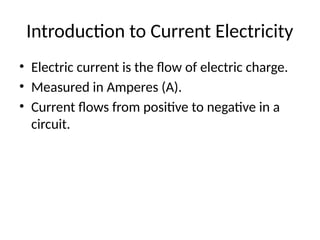
Introduction to Current Electricity
• Electric current is the flow of electric charge.
• Measured in Amperes (A).
• Current flows from positive to negative in a
circuit.
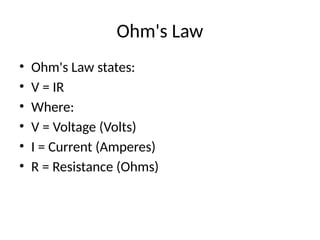
Ohm's Law
• Ohm's Law states:
• V = IR
• Where:
• V = Voltage (Volts)
• I = Current (Amperes)
• R = Resistance (Ohms)
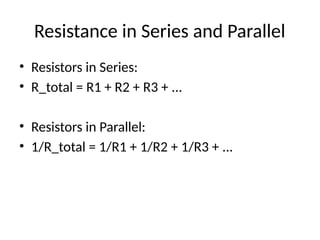
Resistance in Series and Parallel
• Resistors in Series:
• R_total = R1 + R2 + R3 + ...
• Resistors in Parallel:
• 1/R_total = 1/R1 + 1/R2 + 1/R3 + ...
Heating Effects of Electric Current
• When current flows through a resistor, it
produces heat.
• Heat generated (H) = I²Rt
• Applications:
• - Electric heaters
• - Electric irons
Electromotive Force (EMF) and
Potential Difference
• Electromotive Force (EMF):
• The energy provided by a cell/battery per
coulomb of charge.
• Potential Difference:
• The difference in electric potential between
two points in a circuit.
Practical Applications of Electricity
• 1. Lighting (e.g., bulbs, LEDs)
• 2. Heating devices (e.g., geysers, ovens)
• 3. Motors and Fans
• 4. Charging devices (e.g., phones, laptops)

Current_Electricity_Presentation.pptx cl

  • 1.
    Current Electricity ICSE Class10 Physics - Chapter 8
  • 2.
    Introduction to CurrentElectricity • Electric current is the flow of electric charge. • Measured in Amperes (A). • Current flows from positive to negative in a circuit.
  • 3.
    Ohm's Law • Ohm'sLaw states: • V = IR • Where: • V = Voltage (Volts) • I = Current (Amperes) • R = Resistance (Ohms)
  • 4.
    Resistance in Seriesand Parallel • Resistors in Series: • R_total = R1 + R2 + R3 + ... • Resistors in Parallel: • 1/R_total = 1/R1 + 1/R2 + 1/R3 + ...
  • 5.
    Heating Effects ofElectric Current • When current flows through a resistor, it produces heat. • Heat generated (H) = I²Rt • Applications: • - Electric heaters • - Electric irons
  • 6.
    Electromotive Force (EMF)and Potential Difference • Electromotive Force (EMF): • The energy provided by a cell/battery per coulomb of charge. • Potential Difference: • The difference in electric potential between two points in a circuit.
  • 7.
    Practical Applications ofElectricity • 1. Lighting (e.g., bulbs, LEDs) • 2. Heating devices (e.g., geysers, ovens) • 3. Motors and Fans • 4. Charging devices (e.g., phones, laptops)