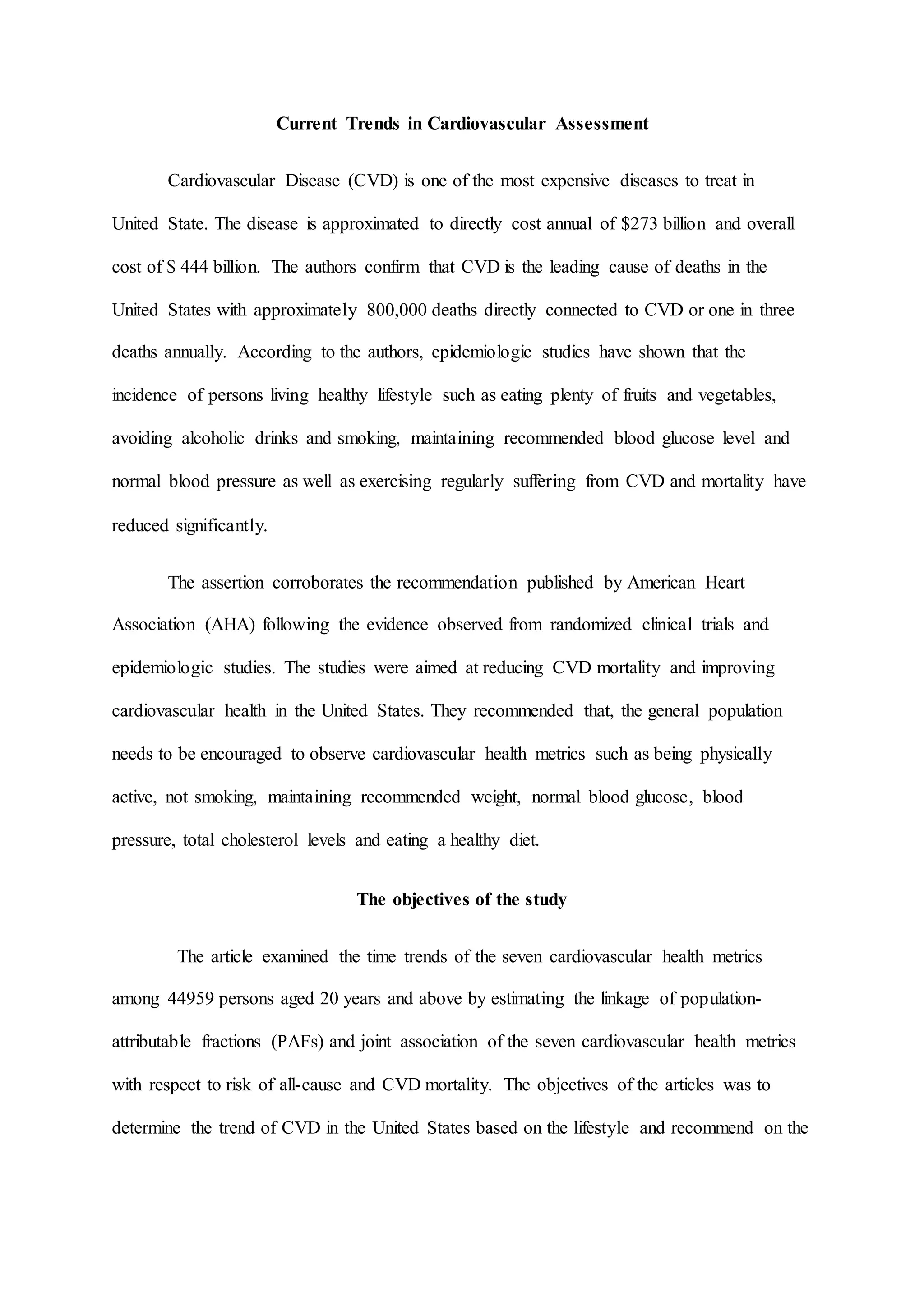
Current Trends in Cardiovascular Assessment
Cardiovascular Disease (CVD) is one of the most expensive diseases to treat in
United State. The disease is approximated to directly cost annual of $273 billion and overall
cost of $ 444 billion. The authors confirm that CVD is the leading cause of deaths in the
United States with approximately 800,000 deaths directly connected to CVD or one in three
deaths annually. According to the authors, epidemiologic studies have shown that the
incidence of persons living healthy lifestyle such as eating plenty of fruits and vegetables,
avoiding alcoholic drinks and smoking, maintaining recommended blood glucose level and
normal blood pressure as well as exercising regularly suffering from CVD and mortality have
reduced significantly.
The assertion corroborates the recommendation published by American Heart
Association (AHA) following the evidence observed from randomized clinical trials and
epidemiologic studies. The studies were aimed at reducing CVD mortality and improving
cardiovascular health in the United States. They recommended that, the general population
needs to be encouraged to observe cardiovascular health metrics such as being physically
active, not smoking, maintaining recommended weight, normal blood glucose, blood
pressure, total cholesterol levels and eating a healthy diet.
The objectives of the study
The article examined the time trends of the seven cardiovascular health metrics
among 44959 persons aged 20 years and above by estimating the linkage of population-
attributable fractions (PAFs) and joint association of the seven cardiovascular health metrics
with respect to risk of all-cause and CVD mortality. The objectives of the articles was to
determine the trend of CVD in the United States based on the lifestyle and recommend on the
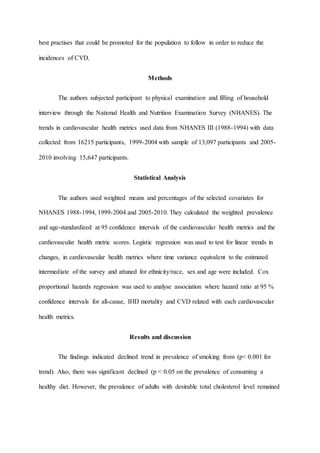
best practises that could be promoted for the population to follow in order to reduce the
incidences of CVD.
Methods
The authors subjected participant to physical examination and filling of household
interview through the National Health and Nutrition Examination Survey (NHANES). The
trends in cardiovascular health metrics used data from NHANES III (1988-1994) with data
collected from 16215 participants, 1999-2004 with sample of 13,097 participants and 2005-
2010 involving 15,647 participants.
Statistical Analysis
The authors used weighted means and percentages of the selected covariates for
NHANES 1988-1994, 1999-2004 and 2005-2010. They calculated the weighted prevalence
and age-standardized at 95 confidence intervals of the cardiovascular health metrics and the
cardiovascular health metric scores. Logistic regression was used to test for linear trends in
changes, in cardiovascular health metrics where time variance equivalent to the estimated
intermediate of the survey and attuned for ethnicity/race, sex and age were included. Cox
proportional hazards regression was used to analyse association where hazard ratio at 95 %
confidence intervals for all-cause, IHD mortality and CVD related with each cardiovascular
health metrics.
Results and discussion
The findings indicated declined trend in prevalence of smoking from (p< 0.001 for
trend). Also, there was significant declined (p < 0.05 on the prevalence of consuming a
healthy diet. However, the prevalence of adults with desirable total cholesterol level remained
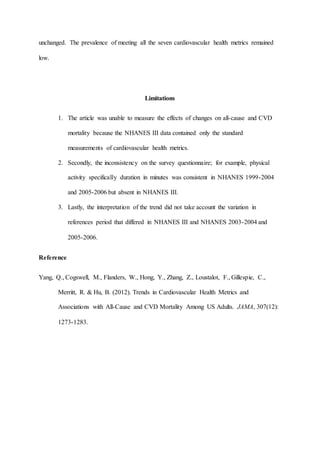
unchanged. The prevalence of meeting all the seven cardiovascular health metrics remained
low.
Limitations
1. The article was unable to measure the effects of changes on all-cause and CVD
mortality because the NHANES III data contained only the standard
measurements of cardiovascular health metrics.
2. Secondly, the inconsistency on the survey questionnaire; for example, physical
activity specifically duration in minutes was consistent in NHANES 1999-2004
and 2005-2006 but absent in NHANES III.
3. Lastly, the interpretation of the trend did not take account the variation in
references period that differed in NHANES III and NHANES 2003-2004 and
2005-2006.
Reference
Yang, Q., Cogswell, M., Flanders, W., Hong, Y., Zhang, Z., Loustalot, F., Gillespie, C.,
Merritt, R. & Hu, B. (2012). Trends in Cardiovascular Health Metrics and
Associations with All-Cause and CVD Mortality Among US Adults. JAMA, 307(12):
1273-1283.

Current trends in cardiovascular assessment

  • 1.
    Current Trends inCardiovascular Assessment Cardiovascular Disease (CVD) is one of the most expensive diseases to treat in United State. The disease is approximated to directly cost annual of $273 billion and overall cost of $ 444 billion. The authors confirm that CVD is the leading cause of deaths in the United States with approximately 800,000 deaths directly connected to CVD or one in three deaths annually. According to the authors, epidemiologic studies have shown that the incidence of persons living healthy lifestyle such as eating plenty of fruits and vegetables, avoiding alcoholic drinks and smoking, maintaining recommended blood glucose level and normal blood pressure as well as exercising regularly suffering from CVD and mortality have reduced significantly. The assertion corroborates the recommendation published by American Heart Association (AHA) following the evidence observed from randomized clinical trials and epidemiologic studies. The studies were aimed at reducing CVD mortality and improving cardiovascular health in the United States. They recommended that, the general population needs to be encouraged to observe cardiovascular health metrics such as being physically active, not smoking, maintaining recommended weight, normal blood glucose, blood pressure, total cholesterol levels and eating a healthy diet. The objectives of the study The article examined the time trends of the seven cardiovascular health metrics among 44959 persons aged 20 years and above by estimating the linkage of population- attributable fractions (PAFs) and joint association of the seven cardiovascular health metrics with respect to risk of all-cause and CVD mortality. The objectives of the articles was to determine the trend of CVD in the United States based on the lifestyle and recommend on the
  • 2.
    best practises thatcould be promoted for the population to follow in order to reduce the incidences of CVD. Methods The authors subjected participant to physical examination and filling of household interview through the National Health and Nutrition Examination Survey (NHANES). The trends in cardiovascular health metrics used data from NHANES III (1988-1994) with data collected from 16215 participants, 1999-2004 with sample of 13,097 participants and 2005- 2010 involving 15,647 participants. Statistical Analysis The authors used weighted means and percentages of the selected covariates for NHANES 1988-1994, 1999-2004 and 2005-2010. They calculated the weighted prevalence and age-standardized at 95 confidence intervals of the cardiovascular health metrics and the cardiovascular health metric scores. Logistic regression was used to test for linear trends in changes, in cardiovascular health metrics where time variance equivalent to the estimated intermediate of the survey and attuned for ethnicity/race, sex and age were included. Cox proportional hazards regression was used to analyse association where hazard ratio at 95 % confidence intervals for all-cause, IHD mortality and CVD related with each cardiovascular health metrics. Results and discussion The findings indicated declined trend in prevalence of smoking from (p< 0.001 for trend). Also, there was significant declined (p < 0.05 on the prevalence of consuming a healthy diet. However, the prevalence of adults with desirable total cholesterol level remained
  • 3.
    unchanged. The prevalenceof meeting all the seven cardiovascular health metrics remained low. Limitations 1. The article was unable to measure the effects of changes on all-cause and CVD mortality because the NHANES III data contained only the standard measurements of cardiovascular health metrics. 2. Secondly, the inconsistency on the survey questionnaire; for example, physical activity specifically duration in minutes was consistent in NHANES 1999-2004 and 2005-2006 but absent in NHANES III. 3. Lastly, the interpretation of the trend did not take account the variation in references period that differed in NHANES III and NHANES 2003-2004 and 2005-2006. Reference Yang, Q., Cogswell, M., Flanders, W., Hong, Y., Zhang, Z., Loustalot, F., Gillespie, C., Merritt, R. & Hu, B. (2012). Trends in Cardiovascular Health Metrics and Associations with All-Cause and CVD Mortality Among US Adults. JAMA, 307(12): 1273-1283.