Dr. Azmath KhanPhysiomatix
What is cupping therapy?
How can I utilize in my practice?
How can I convince my patient for cupping
therapy ?
How can I generate remuneration using this?
How good clinician will I be utilizing this?
What I am going to learn here?
3.
Dr. Azmath KhanPhysiomatix
Cupping therapy is one of the oldest and most
effective method of alternative medicine. It
involves the application of hollow cups on the
patient’s body by creating a local suction on the
skin.
When hollow cups are applied on the skin with
the help of a vacuum, a negative pressure is
created which in turn produces effects on the
myofascia.
What is Cupping Therapy?
4.
Dr. Azmath KhanPhysiomatix
There are 3 major physiological responses with cupping:
◦ NEGATIVE PRESSURE
◦ VASODILATION
◦ ENHANCED FLUID EXCHANGE in blood, interstitial fluid
and lymph.
The combination of these responses allows some
incredible reactions to take place.
PHYSIOLOGY OF CUPPING
5.
Dr. Azmath KhanPhysiomatix
Altering the pain signal processing.
Using counter irritation or pain to reduce pain.
Stimulating the immune system with artificial
local inflammation.
Stimulating the increased blood circulation
through the release of nitric oxide.
Increasing the flow of lymph in the lymphatic
system.
Decreases uric acid and both types of
cholesterol.
CUPPING AND REVIEWS
6.
Dr. Azmath KhanPhysiomatix
Changing the molecular structure and function
of hemoglobin.
Increasing the level of immune products such
as interferon and tumor necrotizing factor.
Changing the molecular structure and function
of hemoglobin.
Increasing the level of immune products such
as interferon and tumor necrotizing factor.
Contd.
Dr. Azmath KhanPhysiomatix
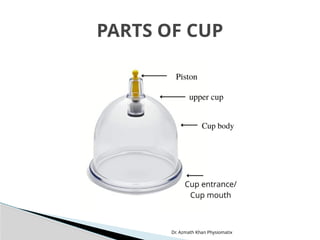
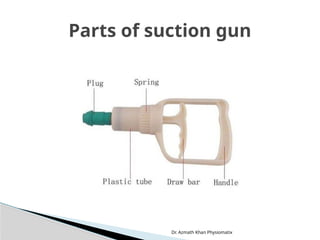
It involves creating suction by placing the cups
on the skin with the help of a vacuum gun.
The cups vary in sizes and shapes (6 size of
cups )
The most commonly used are the plastic cups
followed by bamboo, fire, silicone, bronze.
In the ancient days, horn were used for
cupping which later got replaced with plastic
cups.
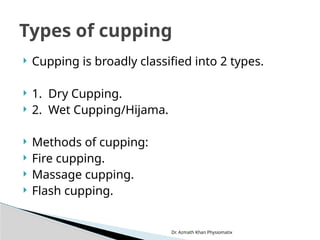
Dry cupping
12.
Dr. Azmath KhanPhysiomatix
This type of cupping can be given to sensitive
patients on their first session, for facial toning,
geriatric and pediatric population.
It doesn’t leave any marks.
Half a vacuum gun pull is applied to achieve
weak or light cupping.
It can also be given to patients with muscle
tightness and pain due to neurological origin.
Duration : 10-12 minutes .
Light cupping
13.
Dr. Azmath KhanPhysiomatix
This type of cupping can be done for pain,
trigger point release and while performing
sliding or massage cupping.
1-2 full vacuum gun pull is applied.
It leaves a light mark which fades off in 2-3
days.
Duration : 5-8 minutes.
Medium cupping
14.
Dr. Azmath KhanPhysiomatix
2-3 full vacuum gun pull is applied.
This type of cupping can be done on the bulky
areas of the body to reduce pain in the areas
with huge muscles (gluteus, back ).
This should be avoided on face, pediatric and
geriatric population.
This leaves mark which fades off in a week.
Duration : 3-5 minutes.
Strong cupping
15.
Dr. Azmath KhanPhysiomatix
The process of flash cupping is similar to that
of dry cupping except that flash cupping
involves quick repeated application of cups
with minimal retention.
It helps in reducing local congestion and
stimulate the circulation over a broader area.
This type of cupping can specifically be used for
sensitive patients in their first session and to
have reduced post cupping marks.
Flash cupping
16.
Dr. Azmath KhanPhysiomatix
Hijama is an ancient Islamic practice.
It was practiced by prophet Muhammad (PBUH) and
he encouraged others to do so.
Hijama involves placing cups on the body with a
vacuum gun to create a negative pressure after
which cups are left on the skin for a few minutes;
now the cups are removed, small incisions are made
with a surgical blade and cups are reapplied. After a
few minutes cup is removed and the area is cleaned.
Plastic cups are used in Hijama which should be
discarded after every use.
Hijama (wet cupping therapy)
17.
Dr. Azmath KhanPhysiomatix
The suction in fire cupping is created by heating the air
inside the cup with an open flame, then placing it against
the skin.
A cotton ball is soaked in 70% alcohol which is used for
creating suction.
Glass cups are used in fire cupping which is transparent
and thus makes it easy to monitor the temperature inside
the glass.
The cotton soaked in 70% alcohol is clamped by a pair of
forceps, lit with a lighter or a matchstick. The flaming
cotton ball is then placed into the cup; quickly removed and
the cup is placed on the skin. As the air inside the cup cools,
it contracts and draws the skin slightly inside.
Fire cupping
18.
Dr. Azmath KhanPhysiomatix
By adding fire to the inside of the cup, oxygen is
removed (which is replaced by and equal volume of
carbon dioxide) and a smaller amount of suction is
created by the air cooling down again and
contracting.
Oil may be applied to create a better seal. After
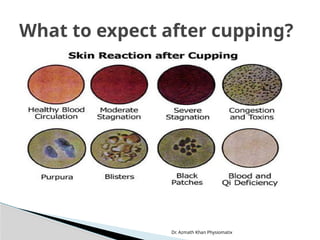
removing the cup it is common to notice a dark patch
which is caused because of rupture of the capillaries
under the skin, but are not the same as a bruise
caused by blunt force trauma.
This type of cupping is commonly used for cellulite
reduction along with the other cupping techniques.
contd.
19.
Dr. Azmath KhanPhysiomatix
Light or medium suction is used in this type of cupping.
This is of 2 types; unidirectional and bi-directional.
Application of oil is necessary in this type of cupping. Cups
are placed on the skin with a light to medium suction and
slowly moved to and fro along the muscle fibers.(this is two
directional).
In unidirectional dynamic cupping, cups are placed on the
skin; moved in one direction towards the lymph nodes and
the cup is taken off. Cups are reapplied with light to
medium cupping, again moved towards the lymph nodes.
While performing dynamic cupping, always stabilize the
area distally with the left hand wherein the movement of
the cup should be done with the right hand.
Sliding cupping/ Massage cupping/
Dynamic cupping
20.
Dr. Azmath KhanPhysiomatix
Easy application.
No bruises are left post cupping session.
Light to medium suction is created by the
silicone cups.
It helps in increasing the blood circulation.
This type of cupping is widely used for facial
toning, cellulite loss, and relaxation.
Application of moisturizer or oil is necessary in
this type of cupping before and after the
therapy.
Silicone cupping
21.
Dr. Azmath KhanPhysiomatix
This type of cupping has a same plastic cups;
the only difference is the suction here is
created automatically with a suction machine.
The process of cupping remains the same, this
is preferred for dynamic cupping and Hijama.
The automatic suction machine is used for
hairy areas of the body.
Automatic suction cupping
22.
Dr. Azmath KhanPhysiomatix
Needle cupping is a combination of Dry cupping
and Dry needling.
It can be practiced only when both Dry needling
and Dry cupping is known to the practitioner.
It starts with palpation, inserting an appropriate
needle on the trigger point above which the Dry
cup is placed.
This type of cupping has additional benefits and
faster results when treating a trigger point along
with an associated muscle spam or a tightness.
Needle cupping
23.
Dr. Azmath KhanPhysiomatix
The electrodes are connected to the cups and
the same is applied on the patient’s body with
the suction created manually by the vacuum
gun.
It can be used with TENS..
The effects are same as that of the modalities
except that there are additional benefits of
cupping which in turn gives faster results.
Electro cupping
24.
Musculoskeletal conditionsare the second
largest contributor to disability worldwide
with low back pain being the single leading
cause of disability globally.
Musculoskeletal conditions and injuries are
not just conditions of older age – they are
relevant across the life-course. Between one
in three and one in five people live with a
painful and disabling musculoskeletal
condition.
Dr. Azmath Khan Physiomatix
Cupping in MSK conditions
25.
Dr. Azmath KhanPhysiomatix
Promotes overall skeletal muscle health.
Promotes lengthening of tight muscles.
Encourages lymph movement.
Stimulates Peristalsis.
Supports body temperature regulation.
HOW CUPPING AFFECTS SKELETAL
SYSTEM
26.
Dr. Azmath KhanPhysiomatix
Promotes muscle recovery.
Relieves inflammation.
Work proximal to the affected area in case of acute
inflammation and on the affected area in chronic
inflammation.
Works with limited range of motion by offering tissue
hydration and lifting up the restricting structures.
27.
Dr. Azmath KhanPhysiomatix
Uncooperative patient
DVT
On the pulsating areas
Directly over an ulcer/Open wounds
Cannot give consent due to age, language or cognitive
Pregnancy
Hemophilia
Pacemaker
Medical emergency
Contagious skin conditions (eg: Chicken pox, herpes blisters, unknown
rashes etc.).
DO NOT apply over bulging or herniated disc.
Avoid cupping on fracture sites (4 weeks).
Avoid scraping cups over any bones; this can be painful; also avoid moles
or skin tags as this can tear the tissue.
CONTRAINDICATIONS
28.
Dr. Azmath KhanPhysiomatix
Any pain due to musculoskeletal disorders.
Muscle spasm/ tightness/ stiffness.
Trigger points.
Reduced blood flow
Swelling and edema/lymphatic drainage.
Restricted ROM
Arthritis both osteo and rheumatoid.
Ankylosing spondylitis.
INDICATIONS
29.
Dr. Azmath KhanPhysiomatix
Cupping therapy is relatively safe. The side
effects are infrequently reported but not rare.
Skin rupture
Blister
Ecchymosis, swelling
Ice burn
Occluded circulation
Blood pressure fluctuation, fainting
ADVERSE EFFECTS
30.
Dr. Azmath KhanPhysiomatix
Increases blood circulation
Decreases pain
Relieves muscle spasm
Increases flexibility
Removes toxins from the body - Hijama
Helps in cellulite reduction
Activates lymphatic system
Improves micro circulation
Boosts collagen production
Opens and shrinks the pores
Reduces stretch marks and scars
Activates the immune system
BENEFITS
Dr. Azmath KhanPhysiomatix
Trigger point
It increases the circulation (similar to ischemic
compression but with a more direct approach)
and reduces the mechanical tension associated
with the trigger point.
Breaking down of the pain-spasm-pain cycle by
flushing out the metabolites further helps in
trigger point deactivation.
THERAPEUTIC EFFECTS OF CUPPING
THERAPY
33.
Dr. Azmath KhanPhysiomatix
The negative pressure brings fluid from circulation
to tissues. Increased fluid in the myofascia aids in
better movement. The myofascial decompression
breaks down micro adhesion and aids in stretching
of the tight areas. EX: Upper trapezius in chronic
neck issues. The separations of the layers result in
better sliding of different layers of muscles.
Cupping also reduces muscle spasm by both
mechanical effects as well as neural stimulation.
The combined effects of cupping can produce
better activation of the muscle and improved
performance.
Effect on muscle
34.
Dr. Azmath KhanPhysiomatix
Nervous system
Mechanoreceptors are stimulated by cupping.
It produces analgesia and inhibits muscle
spasm. Activation of ANS can produce local as
well as generalized relaxation.
Circulation
The areas cupped gets improved circulation in
terms of both blood as well as lymph.
35.
Dr. Azmath KhanPhysiomatix
Scar tissue
Cupping expands the contracted scar tissue and increases the
local circulation, the local circulation which helps in formation of
stretchable collagen; alignment of the collagen can be achieved
with dynamic cupping therapy.
Skin/non contractile soft tissue
Changes in stretchability of the collagen tissue produces
improved texture of the skin and reduces wrinkles. The
immediate hyperaemia is beneficial for the health of the skin
and other soft tissue. Negative pressure improves the health of
the pores and regulates oil production. Many observers have
reported toning, rejuvenation and lifting of the skin following
use of cupping therapy.
36.
Dr. Azmath KhanPhysiomatix
Pain modulation
A beta primary afferent receptors travel to higher
centers via dorsal column. At the same time the A
Beta nerve fibers inhibit the cells of substantia
gelatinosa of rolando (SGR) and block the
transmission of pain. This is known as segmental
modulation.
The fast A Beta fibers of dorsal column also give
collaterals to peri aqueductal gray matter (PAG) of mid
brain. PAG in turn activates nucleus raphe magnus
(NRM) to medulla which stimulates ST cells and
inhibits SGR.
37.
Dr. Azmath KhanPhysiomatix
Reflex inhibition : “head zones”- Reflex paths from skin to
organ :
British neurologist Henry Head discovered that reflex path
exists between the body’s surface and vice versa. He realized
that patients with gall bladder disorders tend to be particularly
sensitive to pain at the costal arches and at certain regions on
the back.
Kidney patients experience skin and muscle pain in the lower
back on the affected side or frontally in the area around the
bladder. Henry head discovered that the painful and
hypersensitive skin areas almost always lie on the same side of
the body as diseased organ. These observations led to the
discovery of cutivisceral reflex.
38.
Dr. Azmath KhanPhysiomatix
Nitric oxide theory
Ferid Murad and Robert F. Furchgott who discovered
nitric oxide were awarded the noble price of
medicine in 1998. The substance is very important
substance released in the body from any trauma and
released also during and after cupping therapy.
The functions of nitric oxide are vasodilation; this
gives more blood to the areas (has 2-way
vasodilation effect) muscle relaxation which cures
muscle spasms and anti-thrombotic which protects
the blood vessels from thrombosis.
39.
Dr. Azmath KhanPhysiomatix
Changes in immune system
Cupping produces minor injury and
subcutaneous bleeding. This is reported to
have immunomodulatory effects.
40.
Dr. Azmath KhanPhysiomatix
Patient preparation
Explanation and consent
Patient positioning and exposure according to
the area to be treated, draping the other areas.
Ask the patient to shave the area to be treated
if required
Adequately moisturize the area to be treated.
CUPPING PROCESS
41.
Dr. Azmath KhanPhysiomatix
Tray.
Gloves.
Oil.
Cotton.
Antibacterial solution (if required).
Cups and vacuum gun
For fire cups - lighter, forceps, alcohol solution,
fire cups, gloves, oil, cotton, antibacterial
solution.
Cupping apparatus
preparation
42.
Dr. Azmath KhanPhysiomatix
Moisturize the area to be treated and place the
cups on the targeted area.
Attach the vacuum gun.
Now according to light, medium or strong
cupping apply the suction.
Let the cups stay for a few minutes then
remove the cups by loosening the nozzle at the
top.
Procedure for dry cupping
43.
Dr. Azmath KhanPhysiomatix
Apply oil adequately. Apply cups on the
targeted area with a light or medium
suction(strictly not to use strong cupping), now
pull the cup slowly with your right hand
whereas use your left hand to stabilize the skin
of the starting point of cupping. Move the cups
to and fro or draining it in the lymph nodes.
Dynamic/massage/ moving cupping
44.
Dr. Azmath KhanPhysiomatix
Apply oil adequately. Carefully take a cotton
swab and use a forceps to dip in the spirit. Now
ignite the cotton with a lighter (keep the
alcohol solution away from the bed), create
suction in the glass cups using this and apply
the cups on the targeted area.
Fire Cupping
45.
Dr. Azmath KhanPhysiomatix
Number of cups :- Depends on the area of concern and type of cupping.
When treating shoulder 6-8 cups, neck 5-6 cups, large areas like back 10-12
cups or as required, calf 3-4 cups.
When using dynamic cupping only one cup is used and for static cupping
multiple cups can be used together.
Size of cups:-
Size of the cups depends on the area to be treated. Larger cups gives much
better and uniform suction whereas smaller cups gives sensory stimulation.
Frequency :-
One session in a gap of 2-3 days is preferable but cupping can still be done
daily or on alternative days if treating different areas and different types of
cupping.
DOSAGE
46.
Dr. Azmath KhanPhysiomatix
Duration:-
Static cupping -5-20 minutes
Dynamic cupping – 2-5 minutes
Flash cupping – 2-5 minutes
Fire cupping – 5- 15 minutes
Number of sessions :-
5-10 sessions