INTRODUCTION
 Brazil is a country full of colors, flavors,
sounds, arts and charm. They have their
Portuguese language to their fascinating
dances, sports and rhythms that fill the soul
with joy and joy, even going through modern
professional and technological Brazil. All this
without forgetting the succulent dishes of its
varied regions and the mystical nature of its
people, its places and passages that invite all
to know the paradise that Brazil offers.
CULTURE BRAZIL
 Brazil is fascinated by its miscegenation. Native,
European, Asian and African roots, among many
others, are reflected not only in the culture but also in
the customs of Brazilians.
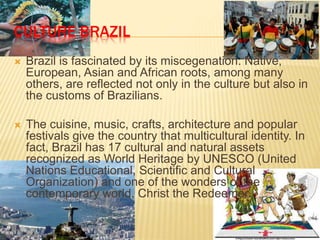
 The cuisine, music, crafts, architecture and popular
festivals give the country that multicultural identity. In
fact, Brazil has 17 cultural and natural assets
recognized as World Heritage by UNESCO (United
Nations Educational, Scientific and Cultural
Organization) and one of the wonders of the
contemporary world, Christ the Redeemer.
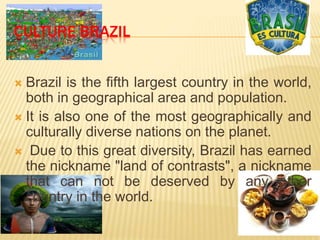
 Brazil is the fifth largest country in the world,
both in geographical area and population.
 It is also one of the most geographically and
culturally diverse nations on the planet.
 Due to this great diversity, Brazil has earned
the nickname "land of contrasts", a nickname
that can not be deserved by any other
country in the world.
CULTURE BRAZIL
THE CULTURE OF BRAZIL: CUSTOMS AND
ETIQUETTE
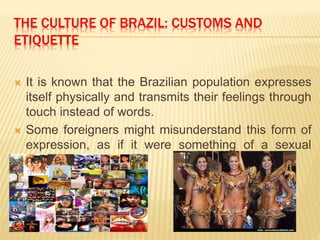
 It is known that the Brazilian population expresses
itself physically and transmits their feelings through
touch instead of words.
 Some foreigners might misunderstand this form of
expression, as if it were something of a sexual
nature.
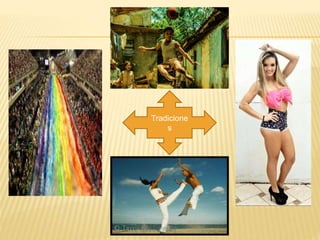
Tradicione
s
THE CULTURE OF BRAZIL: THE LANGUAGE
 Almost ninety-nine percent of the Brazilian
population speaks Portuguese, a Romance
language belonging to the Indo-European family
of languages. Portuguese was initially
introduced in Brazil in the early 1500s. Before
the arrival of the Portuguese, the natives spoke
languages ​​belonging to at least four linguistic
families:
 Arahuaca, Ge, Carib and Tupí-Guarani. As the
Tupi-Guaraní was the language spoken by the
Indians of the coast.
THE CULTURE OF BRAZIL: RELIGION
 Roman Catholicism is the predominant religious
faith in Brazil.
 In Brazil there is the separation of Church and
State and the Constitution of 1988 grants to all
citizens freedom of belief and religious
expression. However, there is a very close
relationship between the Catholic Church and
the State, as it has for most of the country's
history.
 The main Catholic holidays are also public
holidays in Brazil.
CULTURE OF BRAZIL
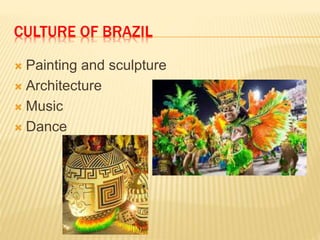
 Painting and sculpture
 Architecture
 Music
 Dance
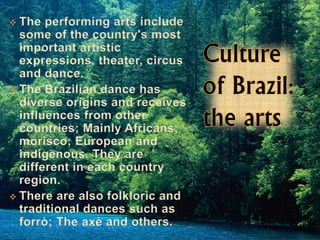
 The performing arts include
some of the country's most
important artistic
expressions, theater, circus
and dance.
 The Brazilian dance has
diverse origins and receives
influences from other
countries; Mainly Africans;
morisco; European and
indigenous. They are
different in each country
region.
 There are also folkloric and
traditional dances such as
forrò; The axè and others.
THE CULTURE OF BRAZIL: MUSIC
 Music is one of the most important artistic
manifestations and national culture, and it is also very
respected internationally.
 Let's get acquainted with some of the musical styles:
 Samba: Of Afrobaian origin, the rhythm descends of
the lundu and was used in the festivities of the
squares between umbigadas and movements of
capoeira. At the beginning of the 20th century it was
adopted by composers such as Ernesto Nazareth,
Noel Rosa, Cartola and Donga, who extracted it from
the ostracism and legitimized it in the official culture.
THE CULTURE OF BRAZIL: MUSIC
 Bossa Nova
 Urban movement originated in the late 50's. At first it was simply a
different way of singing samba, but later incorporated elements of
jazz, with tones based on voice and piano or guitar. Among the
main authors we can mention Nara Leão, Carlos Lyra, João
Gilberto,
 I cry
 Genre created from the mixture of elements of European
ballroom dancing and Portuguese popular music, with African
influences. Chiquinha Gonzaga was the first pianist of the genre
and, in 1897, wrote Corta-Jaca, one of the greatest contributions
to the choro repertoire. Pixinguinha, Ernesto Nazareth and Waldir
Azevedo
THE CULTURE OF BRAZIL: MUSIC
 Tropicalism
 Tropicalism combines elements of pop culture
and elite culture, in addition to making use in
many occasions of a politically committed and
protest speech, since it was born in the years of
the military dictatorship. Caetano Veloso,
Gilberto Gil, Gal Costa, Maria Bethânia
 young guard
 This movement was basically linked to
American and English rock, although with a
more romantic style. Its main representatives
are Roberto Carlos, Erasmo Carlos and
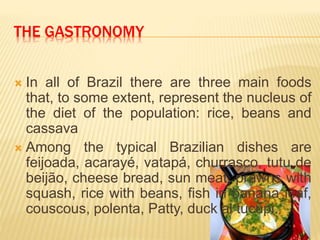
THE GASTRONOMY
 In all of Brazil there are three main foods
that, to some extent, represent the nucleus of
the diet of the population: rice, beans and
cassava
 Among the typical Brazilian dishes are
feijoada, acarayé, vatapá, churrasco, tutu de
beijão, cheese bread, sun meat, prawns with
squash, rice with beans, fish in banana leaf,
couscous, polenta, Patty, duck al tucupi.
THE CULTURE OF BRAZIL: CELEBRATIONS,
CELEBRATIONS
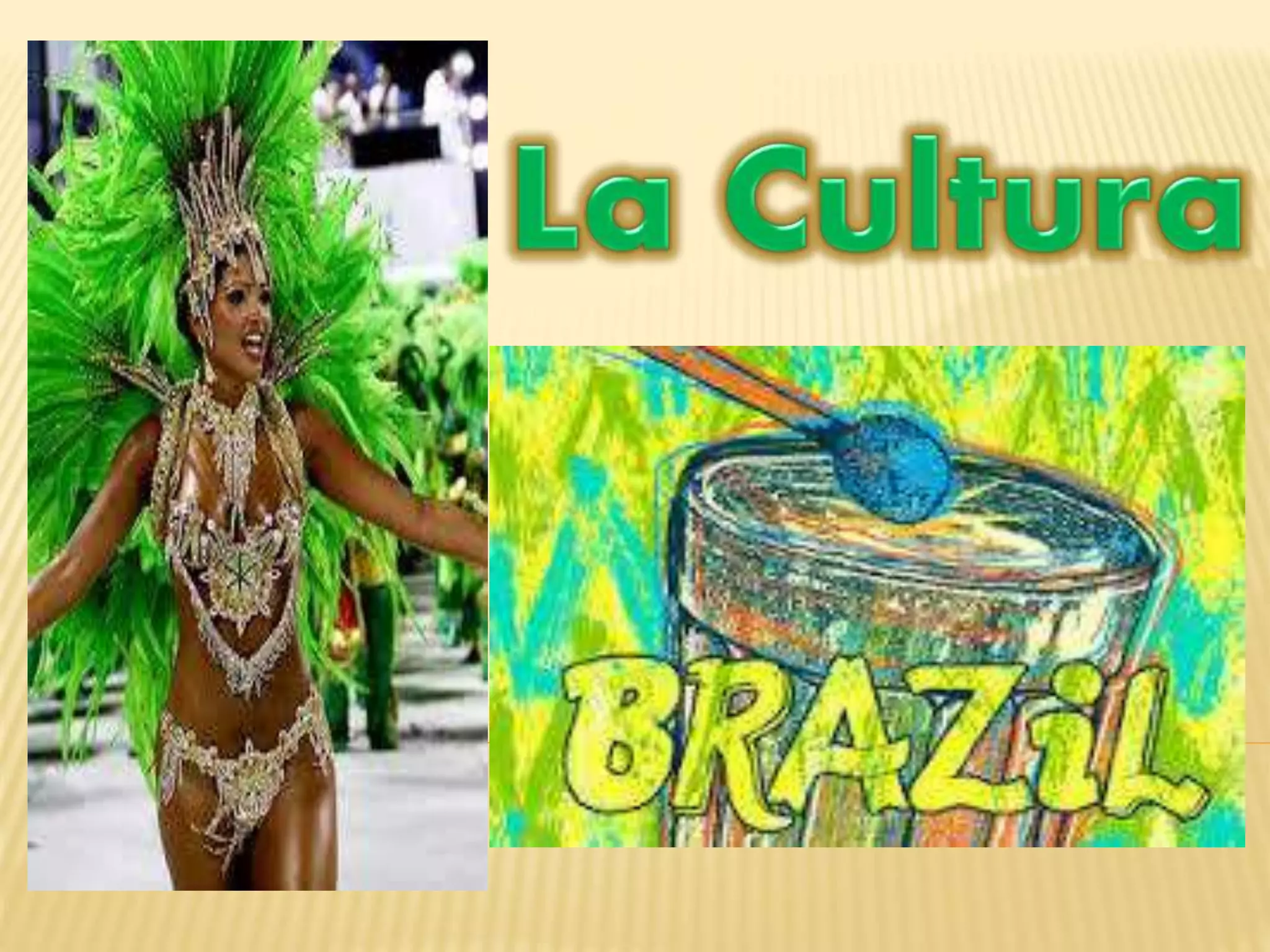
 The Carnival is four days of all kinds of parties,
characterized by the daily parades of dancers and
musicians in disguise, formal encounters, street
performers and musical contests
 During the month of June a series of popular
celebrations are celebrated like
 The Juninas Festivals (June Festivals). These
festivities, originating in the Catholic convention, are
the feasts of San Antonio (June 13), San Juan (June
24) and San Pedro (June 29). They are celebrated
with huge public bonfires, traditional foods and
games, dances and parties for children
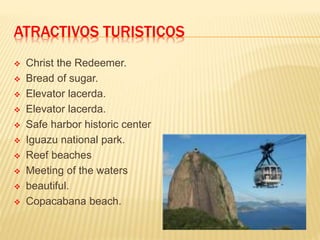
ATRACTIVOS TURISTICOS
 Christ the Redeemer.
 Bread of sugar.
 Elevator lacerda.
 Elevator lacerda.
 Safe harbor historic center
 Iguazu national park.
 Reef beaches
 Meeting of the waters
 beautiful.
 Copacabana beach.

Culture brazil

  • 2.
    INTRODUCTION  Brazil isa country full of colors, flavors, sounds, arts and charm. They have their Portuguese language to their fascinating dances, sports and rhythms that fill the soul with joy and joy, even going through modern professional and technological Brazil. All this without forgetting the succulent dishes of its varied regions and the mystical nature of its people, its places and passages that invite all to know the paradise that Brazil offers.
  • 4.
    CULTURE BRAZIL  Brazilis fascinated by its miscegenation. Native, European, Asian and African roots, among many others, are reflected not only in the culture but also in the customs of Brazilians.  The cuisine, music, crafts, architecture and popular festivals give the country that multicultural identity. In fact, Brazil has 17 cultural and natural assets recognized as World Heritage by UNESCO (United Nations Educational, Scientific and Cultural Organization) and one of the wonders of the contemporary world, Christ the Redeemer.
  • 5.
     Brazil isthe fifth largest country in the world, both in geographical area and population.  It is also one of the most geographically and culturally diverse nations on the planet.  Due to this great diversity, Brazil has earned the nickname "land of contrasts", a nickname that can not be deserved by any other country in the world. CULTURE BRAZIL
  • 6.
    THE CULTURE OFBRAZIL: CUSTOMS AND ETIQUETTE  It is known that the Brazilian population expresses itself physically and transmits their feelings through touch instead of words.  Some foreigners might misunderstand this form of expression, as if it were something of a sexual nature.
  • 7.
  • 8.
    THE CULTURE OFBRAZIL: THE LANGUAGE  Almost ninety-nine percent of the Brazilian population speaks Portuguese, a Romance language belonging to the Indo-European family of languages. Portuguese was initially introduced in Brazil in the early 1500s. Before the arrival of the Portuguese, the natives spoke languages ​​belonging to at least four linguistic families:  Arahuaca, Ge, Carib and Tupí-Guarani. As the Tupi-Guaraní was the language spoken by the Indians of the coast.
  • 9.
    THE CULTURE OFBRAZIL: RELIGION  Roman Catholicism is the predominant religious faith in Brazil.  In Brazil there is the separation of Church and State and the Constitution of 1988 grants to all citizens freedom of belief and religious expression. However, there is a very close relationship between the Catholic Church and the State, as it has for most of the country's history.  The main Catholic holidays are also public holidays in Brazil.
  • 10.
    CULTURE OF BRAZIL Painting and sculpture  Architecture  Music  Dance
  • 11.
     The performingarts include some of the country's most important artistic expressions, theater, circus and dance.  The Brazilian dance has diverse origins and receives influences from other countries; Mainly Africans; morisco; European and indigenous. They are different in each country region.  There are also folkloric and traditional dances such as forrò; The axè and others.
  • 12.
    THE CULTURE OFBRAZIL: MUSIC  Music is one of the most important artistic manifestations and national culture, and it is also very respected internationally.  Let's get acquainted with some of the musical styles:  Samba: Of Afrobaian origin, the rhythm descends of the lundu and was used in the festivities of the squares between umbigadas and movements of capoeira. At the beginning of the 20th century it was adopted by composers such as Ernesto Nazareth, Noel Rosa, Cartola and Donga, who extracted it from the ostracism and legitimized it in the official culture.
  • 13.
    THE CULTURE OFBRAZIL: MUSIC  Bossa Nova  Urban movement originated in the late 50's. At first it was simply a different way of singing samba, but later incorporated elements of jazz, with tones based on voice and piano or guitar. Among the main authors we can mention Nara Leão, Carlos Lyra, João Gilberto,  I cry  Genre created from the mixture of elements of European ballroom dancing and Portuguese popular music, with African influences. Chiquinha Gonzaga was the first pianist of the genre and, in 1897, wrote Corta-Jaca, one of the greatest contributions to the choro repertoire. Pixinguinha, Ernesto Nazareth and Waldir Azevedo
  • 14.
    THE CULTURE OFBRAZIL: MUSIC  Tropicalism  Tropicalism combines elements of pop culture and elite culture, in addition to making use in many occasions of a politically committed and protest speech, since it was born in the years of the military dictatorship. Caetano Veloso, Gilberto Gil, Gal Costa, Maria Bethânia  young guard  This movement was basically linked to American and English rock, although with a more romantic style. Its main representatives are Roberto Carlos, Erasmo Carlos and
  • 15.
    THE GASTRONOMY  Inall of Brazil there are three main foods that, to some extent, represent the nucleus of the diet of the population: rice, beans and cassava  Among the typical Brazilian dishes are feijoada, acarayé, vatapá, churrasco, tutu de beijão, cheese bread, sun meat, prawns with squash, rice with beans, fish in banana leaf, couscous, polenta, Patty, duck al tucupi.
  • 16.
    THE CULTURE OFBRAZIL: CELEBRATIONS, CELEBRATIONS  The Carnival is four days of all kinds of parties, characterized by the daily parades of dancers and musicians in disguise, formal encounters, street performers and musical contests  During the month of June a series of popular celebrations are celebrated like  The Juninas Festivals (June Festivals). These festivities, originating in the Catholic convention, are the feasts of San Antonio (June 13), San Juan (June 24) and San Pedro (June 29). They are celebrated with huge public bonfires, traditional foods and games, dances and parties for children
  • 17.
    ATRACTIVOS TURISTICOS  Christthe Redeemer.  Bread of sugar.  Elevator lacerda.  Elevator lacerda.  Safe harbor historic center  Iguazu national park.  Reef beaches  Meeting of the waters  beautiful.  Copacabana beach.