
SOIL FERTILITY & PRODUCTIVITY
TOPIC
Assistant Professor
Mr. B.S Cheema
By
SOIL PRODUCTIVITY
Soil productivity means the crop producing capacity of a soil which is
measured in terms of yield (bio-mass). Productivity is a very broad term and
fertility is only one of the factors that determine the crop yields.
Soil, climate, pests, disease, genetic potential of crop and management
are the main factors governing land productivity, as measured by the yield of
crop. To be productive, soil must contain all the 17 essential nutrients required
by the plants.
The total quantity of nutrients is not only being sufficient but they should
also be present in an easily “available” form and in “balanced” proportions.
Over and above fertility, there are other factors deciding productivity.
SOIL FERTILITY
Capacity of soil to give the necessary substances in correct amounts to plants avoiding
toxic concentration of any substance. So fertile soils have a leveled amount of nutrients which are
enough to fulfil the requirements of plants. A fertile soil will contain all the nutrients required in
greater amount i.e., nitrogen, phosphorus, potassium etc. and will also contain the nutrients
required in smaller amount i.e., magnesium, molybdenum, iron, zinc etc.
Soil fertility and soil productivity are two different terms. Potential of soil to produce a
definite yield of crops using some management system is soil productivity. Soil fertility has a
great influence on soil productivity. A productive soil must be fertile but a fertile soil may or may
not be productive
•Natural or Inherent fertility
•Acquired fertility
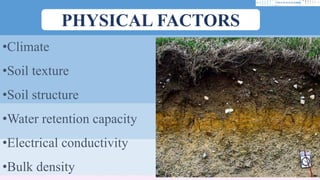
PHYSICAL FACTORS
•Climate
•Soil texture
•Soil structure
•Water retention capacity
•Electrical conductivity
•Bulk density
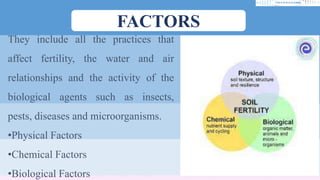
FACTORS
They include all the practices that
affect fertility, the water and air
relationships and the activity of the
biological agents such as insects,
pests, diseases and microorganisms.
•Physical Factors
•Chemical Factors
•Biological Factors
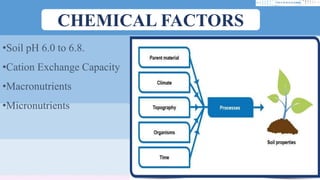
CHEMICAL FACTORS
•Soil pH 6.0 to 6.8.
•Cation Exchange Capacity
•Macronutrients
•Micronutrients
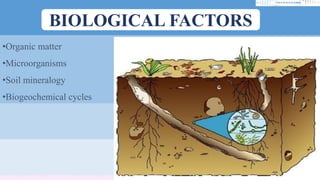
BIOLOGICAL FACTORS
•Organic matter
•Microorganisms
•Soil mineralogy
•Biogeochemical cycles
Characteristics of Fertile Soil
•Contains all basic nutrients i.e., nitrogen, potassium and other minerals
such as boron, iron, copper, zinc necessary for plant survival.
•Has a pH in the range of
•Has a large amount of topsoil.
•Has a diversity of microbes which helps in plant growth.
•Has organic matter which maintains the soil structure.
•Has capacity to retain more moisture.
•Has a depth that permits plants to grow their roots deep for nutrition.
•High cation exchange capacity.
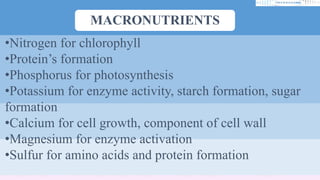
•Nitrogen for chlorophyll
•Protein’s formation
•Phosphorus for photosynthesis
•Potassium for enzyme activity, starch formation, sugar
formation
•Calcium for cell growth, component of cell wall
•Magnesium for enzyme activation
•Sulfur for amino acids and protein formation
MACRONUTRIENTS
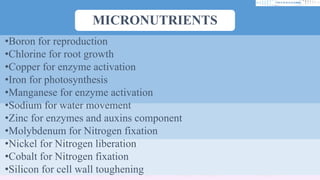
MICRONUTRIENTS
•Boron for reproduction
•Chlorine for root growth
•Copper for enzyme activation
•Iron for photosynthesis
•Manganese for enzyme activation
•Sodium for water movement
•Zinc for enzymes and auxins component
•Molybdenum for Nitrogen fixation
•Nickel for Nitrogen liberation
•Cobalt for Nitrogen fixation
•Silicon for cell wall toughening
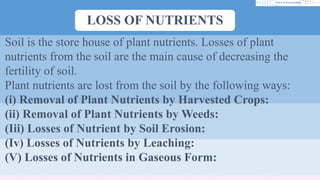
LOSS OF NUTRIENTS
Soil is the store house of plant nutrients. Losses of plant
nutrients from the soil are the main cause of decreasing the
fertility of soil.
Plant nutrients are lost from the soil by the following ways:
(i) Removal of Plant Nutrients by Harvested Crops:
(ii) Removal of Plant Nutrients by Weeds:
(Iii) Losses of Nutrient by Soil Erosion:
(Iv) Losses of Nutrients by Leaching:
(V) Losses of Nutrients in Gaseous Form:
THANK YOU
FOR
WATCHING

Soil parent material.pptx

  • 1.
    SOIL FERTILITY &PRODUCTIVITY TOPIC Assistant Professor Mr. B.S Cheema By
  • 2.
    SOIL PRODUCTIVITY Soil productivitymeans the crop producing capacity of a soil which is measured in terms of yield (bio-mass). Productivity is a very broad term and fertility is only one of the factors that determine the crop yields. Soil, climate, pests, disease, genetic potential of crop and management are the main factors governing land productivity, as measured by the yield of crop. To be productive, soil must contain all the 17 essential nutrients required by the plants. The total quantity of nutrients is not only being sufficient but they should also be present in an easily “available” form and in “balanced” proportions. Over and above fertility, there are other factors deciding productivity.
  • 3.
    SOIL FERTILITY Capacity ofsoil to give the necessary substances in correct amounts to plants avoiding toxic concentration of any substance. So fertile soils have a leveled amount of nutrients which are enough to fulfil the requirements of plants. A fertile soil will contain all the nutrients required in greater amount i.e., nitrogen, phosphorus, potassium etc. and will also contain the nutrients required in smaller amount i.e., magnesium, molybdenum, iron, zinc etc. Soil fertility and soil productivity are two different terms. Potential of soil to produce a definite yield of crops using some management system is soil productivity. Soil fertility has a great influence on soil productivity. A productive soil must be fertile but a fertile soil may or may not be productive •Natural or Inherent fertility •Acquired fertility
  • 4.
    PHYSICAL FACTORS •Climate •Soil texture •Soilstructure •Water retention capacity •Electrical conductivity •Bulk density
  • 5.
    FACTORS They include allthe practices that affect fertility, the water and air relationships and the activity of the biological agents such as insects, pests, diseases and microorganisms. •Physical Factors •Chemical Factors •Biological Factors
  • 6.
    CHEMICAL FACTORS •Soil pH6.0 to 6.8. •Cation Exchange Capacity •Macronutrients •Micronutrients
  • 7.
  • 8.
    Characteristics of FertileSoil •Contains all basic nutrients i.e., nitrogen, potassium and other minerals such as boron, iron, copper, zinc necessary for plant survival. •Has a pH in the range of •Has a large amount of topsoil. •Has a diversity of microbes which helps in plant growth. •Has organic matter which maintains the soil structure. •Has capacity to retain more moisture. •Has a depth that permits plants to grow their roots deep for nutrition. •High cation exchange capacity.
  • 9.
    •Nitrogen for chlorophyll •Protein’sformation •Phosphorus for photosynthesis •Potassium for enzyme activity, starch formation, sugar formation •Calcium for cell growth, component of cell wall •Magnesium for enzyme activation •Sulfur for amino acids and protein formation MACRONUTRIENTS
  • 10.
    MICRONUTRIENTS •Boron for reproduction •Chlorinefor root growth •Copper for enzyme activation •Iron for photosynthesis •Manganese for enzyme activation •Sodium for water movement •Zinc for enzymes and auxins component •Molybdenum for Nitrogen fixation •Nickel for Nitrogen liberation •Cobalt for Nitrogen fixation •Silicon for cell wall toughening
  • 11.
    LOSS OF NUTRIENTS Soilis the store house of plant nutrients. Losses of plant nutrients from the soil are the main cause of decreasing the fertility of soil. Plant nutrients are lost from the soil by the following ways: (i) Removal of Plant Nutrients by Harvested Crops: (ii) Removal of Plant Nutrients by Weeds: (Iii) Losses of Nutrient by Soil Erosion: (Iv) Losses of Nutrients by Leaching: (V) Losses of Nutrients in Gaseous Form:
  • 12.