Download to read offline
![International Journal of Education (IJE), Vol. 4, No. 2/3, September 2016
DOI: 10.5121/ije.2016.4301 1
CULTIVATING STUDENTS' INNOVATIVE PRACTICE
ABILITY IN HARDWARE EXPERIMENT
Shanshan Li, Ninghan Zheng, Chengbin Quan and Yongqiang Chen
Department of Computer Science & Technology, Tsinghua University, Beijing, China
ABSTRACT
How to cultivate students' innovative practical ability effectively is the subject of Computer Science in
Colleges and Universities, especially for the first-year or second-year undergraduate students. This paper
introduces the experimental teaching reform trial of the Digital Logic Circuit courses, and sums up the
experience of how to stimulate students' awareness of innovation in the hardware experiment teaching and
how to improve the students' practical ability. This paper proposes that we should start the student
independent innovation experiment as soon as possible at the university stage. We design the independent
innovation experiment in Digital Logic Circuit of the hardware experiment, that experiment is an open-
minded experiment. After years of experiments carried out, the students deepened understanding of the
knowledge of theory course, improve the interest in the design of hardware, understand the basic processes
of the design of electronic products, improve the ability of practical, and establish the consciousness of
innovation and practice. Our trial has proved that it is very meaningful and feasible to enhance the ability
of innovation practice in the low grade students of computer major.
KEYWORDS
Experimental Teaching; Computer Hardware; Innovation Ability; Practice Training
1. INTRODUCTION
Currently all aspects of society need a large number of high quality talents who have the ability of
innovation and practice [1]. However, for the colleges and universities, how to effectively
cultivate the students’ abilities of the innovation and practice is still a challenge and problem.
Many colleges and universities made a lot of exploration to find a good method for improving the
innovation and practice abilities [2]. They set up a series of specialized courses for students to
help the students improve their creative skills and innovative thinking, such as through
interdisciplinary or innovative training. For example, in Tsinghua university X-lab or I-center
provide a platform for the students who have new ideas and want to make some new things, and
these platforms will provide the technical or financial support. But these trainings or platform are
generally for the higher grade undergraduates. They have the technology basis or some skills, so
they can independently accomplish some innovation projects with little help. But for the lower
grade undergraduates, they are under the stage for learning the basic course, so they perhaps have
not much time or willing to join such projects for improving their creative ability. So how to do
some creative training for the lower grade undergraduates in these basic courses, and how to
stimulate their innovative consciousness. We made some exploration on our courses in computer
professional these years and get some benefit progress.](https://image.slidesharecdn.com/antj-161008072033/85/CULTIVATING-STUDENTS-INNOVATIVE-PRACTICE-ABILITY-IN-HARDWARE-EXPERIMENT-1-320.jpg)
![International Journal of Education (IJE), Vol. 4, No. 2/3, September 2016
DOI: 10.5121/ije.2016.4301 1
CULTIVATING STUDENTS' INNOVATIVE PRACTICE
ABILITY IN HARDWARE EXPERIMENT
Shanshan Li, Ninghan Zheng, Chengbin Quan and Yongqiang Chen
Department of Computer Science & Technology, Tsinghua University, Beijing, China
ABSTRACT
How to cultivate students' innovative practical ability effectively is the subject of Computer Science in
Colleges and Universities, especially for the first-year or second-year undergraduate students. This paper
introduces the experimental teaching reform trial of the Digital Logic Circuit courses, and sums up the
experience of how to stimulate students' awareness of innovation in the hardware experiment teaching and
how to improve the students' practical ability. This paper proposes that we should start the student
independent innovation experiment as soon as possible at the university stage. We design the independent
innovation experiment in Digital Logic Circuit of the hardware experiment, that experiment is an open-
minded experiment. After years of experiments carried out, the students deepened understanding of the
knowledge of theory course, improve the interest in the design of hardware, understand the basic processes
of the design of electronic products, improve the ability of practical, and establish the consciousness of
innovation and practice. Our trial has proved that it is very meaningful and feasible to enhance the ability
of innovation practice in the low grade students of computer major.
KEYWORDS
Experimental Teaching; Computer Hardware; Innovation Ability; Practice Training
1. INTRODUCTION
Currently all aspects of society need a large number of high quality talents who have the ability of
innovation and practice [1]. However, for the colleges and universities, how to effectively
cultivate the students’ abilities of the innovation and practice is still a challenge and problem.
Many colleges and universities made a lot of exploration to find a good method for improving the
innovation and practice abilities [2]. They set up a series of specialized courses for students to
help the students improve their creative skills and innovative thinking, such as through
interdisciplinary or innovative training. For example, in Tsinghua university X-lab or I-center
provide a platform for the students who have new ideas and want to make some new things, and
these platforms will provide the technical or financial support. But these trainings or platform are
generally for the higher grade undergraduates. They have the technology basis or some skills, so
they can independently accomplish some innovation projects with little help. But for the lower
grade undergraduates, they are under the stage for learning the basic course, so they perhaps have
not much time or willing to join such projects for improving their creative ability. So how to do
some creative training for the lower grade undergraduates in these basic courses, and how to
stimulate their innovative consciousness. We made some exploration on our courses in computer
professional these years and get some benefit progress.](https://image.slidesharecdn.com/antj-161008072033/75/CULTIVATING-STUDENTS-INNOVATIVE-PRACTICE-ABILITY-IN-HARDWARE-EXPERIMENT-1-2048.jpg)
![International Journal of Education (IJE), Vol. 4, No. 2/3, September 2016
2
The computer professional requires many practices, so the experimental teaching is very
important in computer professional students training process [3]. Thus we try to stimulate
students' innovation consciousness through the practice in the process of experiment teaching.
Using the hardware experiment to improve the students’ practical hands-on participation, to
cultivate their ability of innovation and practice. How to cultivate students' innovative practical
ability effectively is the subject of Computer Science in Colleges and Universities, especially for
the first-year or second-year undergraduate students. We select the Digital Logic course as a
starting point [4]. This course is a compulsory fundamental hardware course for computer
professional sophomore in Tsinghua University. We made a lot investigation and research for this
course, especially on experimental teaching. We generalized and analyzed the old experiment
contents, set up the new content, and adopted some new experimental methods, in order to
consolidate the students’ theoretical knowledge, in the meanwhile cultivate their ability of
innovation and practice.
2. EXPERIMENT DESIGN
Digital Logic course in sophomore is one of the earliest hardware courses for computer
professional students. The experimental teaching is an important part in this course [5]. The
experiments of computer major mainly include following types: the basic verification experiment,
the advanced comprehensive experiment, the independent innovation experiment, and etc. In our
department, we select following experiments as course experiment, shown in Table 1.
Table 1. Experiments
Experiment Description Type
Instrument
Operation
Learn how to the use of experimental
instruments, including the oscilloscope,
logic analyzer, etc.
Basic
Chip Measurement
Measurement of the delay and transmission
characteristics for 74 series chip.
Basic
Adder
Assemble the adder circuit using 74 series
chip.
Basic
Timing Control
Using 74 series chip to assemble a circuit,
which can control an device with three
period of timing.
Advanced
Adder/ Counter
Use hardware description language to design
and implement an adder and a counter.
Basic
Traffic
Lights
Use hardware description language to design
and implement a controller of the traffic
lights.
Advanced
Electronic Cipher
Lock
Use hardware description language to design
and implement an electronic cipher lock.
Advanced
Colored LED
Show Originality
Use the light emitting diode or light array to
complete a creative idea experiment.
Innovation
After learning the basic theoretical knowledge of Digital Logic course, the independent
innovation experiment is arranged. This arrangement is mainly based on the following
considerations.](https://image.slidesharecdn.com/antj-161008072033/85/CULTIVATING-STUDENTS-INNOVATIVE-PRACTICE-ABILITY-IN-HARDWARE-EXPERIMENT-2-320.jpg)
![International Journal of Education (IJE), Vol. 4, No. 2/3, September 2016
3
1. Independent innovation experiment can cultivate students' ability of innovation and practice.
Here the innovation practice includes two aspects, the initiative of innovative awareness and
the ability to do hands-on practice. The basic verification experiments and the advanced
comprehensive experiments usually involve only one or several points of knowledge. For the
cultivation of innovative consciousness and practical ability, these experiments are obviously
deficient. However, the innovative experiment can stimulate students' creative thinking and
training their practical ability. As long as the experimental difficulty is designed
appropriately, it will be of great advantage for cultivating the students' engineering practice
ability and innovation consciousness [6].
2. Experiment teaching of the hardware courses is a good opportunity to cultivate students'
ability of innovation and practice. Arrangement of the independent innovation experiment is
not only beneficial to give full play to the teaching resources of hardware experimental
teaching, but also can enhance the students' understanding of hardware in the process of
innovation practice.
3. It is a long term work to cultivate students' innovation and practice ability. The training
process must keep on throughout the whole the course of the university education [7]. Due to
the influence of the oriented examination education in primary and secondary schools, the
students who just enter universities are often lack of interest and initiative in innovation
practice. Therefore, the students should do the innovation training as soon as possible at the
university stage, in order to help them to change their inherent thinking formed by the
oriented examination education. In the university, we should mobilize the students’
enthusiasm of innovation practice first, which will help the students learn the new knowledge
more efficient, and help them adapt to the society requirement quickly after graduation [8].
The students in Digital Logic course are just touching the hardware experiment, so the experiment
should not be very difficult, and the experiment should have good visible display, thus it can
arouse more interest and motivation in students for hardware experiment. So we designed the
innovation experiment called Colored LED Show Originality, in which the students should use
the LED (light-emitting diodes) or LED array to do a show or other things to display their
creative ideas. The implementation can use ready-made circuit board, or the circuit board
designed by the students themselves.
In this hardware experiment, the students are required to think the topic themselves, using the
knowledge learned in Digital Logic course to design and implement a circuit demonstration
device to show their ideas or have some distinctive functions. The experiment requires the
students to have their own ideas, but also need them to realize their ideas in practice. This is a
good exercise for fostering the students’ ability of innovation and practice.
3. EXPERIMENT ARRANGEMENT
Because the experiment contents thought out by the students themselves are different, the results
of the experiments are various. Good experimental results are welcome of course, but for the
independent innovation experiment, the process of the experiment should get more attention. This
is because the students’ ability of innovation and practice is gradually accumulated in the
experiment process. The whole process of the experiment should always around inspiring the
innovative thinking and improving the practice ability.](https://image.slidesharecdn.com/antj-161008072033/85/CULTIVATING-STUDENTS-INNOVATIVE-PRACTICE-ABILITY-IN-HARDWARE-EXPERIMENT-3-320.jpg)
![International Journal of Education (IJE), Vol. 4, No. 2/3, September 2016
5
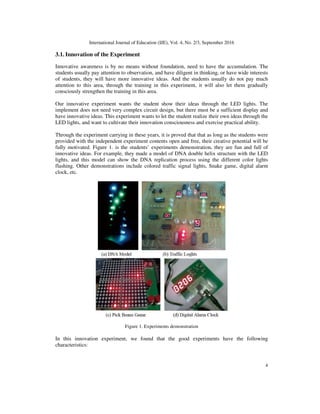
1. It has unique or creative ideas. It chooses some interesting or meaningful things in life to
show through the lights, such as the DNA double helix structure, showing its replication
process.
2. It has innovation in the design or function. It is good at trying to do things that others have
not done, such as using the competition mechanism to show which side of the game press the
key faster.
3. It helps to achieve a good display effect. The show need to be clear and not monotonous,
demonstration rich and colorful, such as traffic signal lights, Snake game, etc.
4. It need the combination of functional and interesting as far as possible. the pursuit of
practical and interesting, such as electronic cube, digital alarm clock, etc.
[
3.2. Implement of the Experiment
Any innovation must be based on a certain material and technical basis. We want to let the
student implement their creative ideas into the real thing; otherwise, the idea will become a
dream.
In the first few years, the experimental equipment and material we provided to the students
mainly includes TTL chip and GAL (General Array Logic). The students mainly adopt two ways
to realize their design: First is only use TTL devices, the second is mixed with GAL and TTL
devices. The first way will use what they have learned in course, in the experiment it can
consolidate and deepen the understanding of basic knowledge; the second, because of the
advantages of GAL devices, the students will use the HDL (Hardware Description Language) to
achieve a complex design more easily and will learn more new technologies [9]. Students need to
design their own circuit board or using the bread-board to complete the experiment.
From 2012, we provide a control core board for the students in the experiment. This board
contains a CPLD (Complex Programmable Logic Device) with many Input/ Output connection
pins, which will be used as a universal function board. Using this core board, the students only
need to focus on the internal function implement. By writing HDL code and simulation, the
students can easily realize the control function. Combined with self-designed display board, the
students will get their final implement. At 2014, we designed an experimental board with built-in
128*64 light emitting diode array, and this board has ten chip sockets that can plug in 74 series
chips. It also has a CPLD, switch as input and seven segments LED, etc. The students can directly
do the experiment on this experiment board.
3.3. Practice in Experiment
Practical ability is important for the student. The students of computer professional generally pay
more attention to software skill training, but for the ability of hardware practice they do not have
enough training. However, to become an outstanding innovative students of computer
professional, the students must have good hardware knowledge and skillful practice ability [10].
In hardware experiment, we cultivate students' practical ability mainly from the following two
aspects.](https://image.slidesharecdn.com/antj-161008072033/85/CULTIVATING-STUDENTS-INNOVATIVE-PRACTICE-ABILITY-IN-HARDWARE-EXPERIMENT-5-320.jpg)
![International Journal of Education (IJE), Vol. 4, No. 2/3, September 2016
6
3.2.1. Inspire Practice Motivation
In order to improve the students’ practical ability, it should encourage the students to practice
consciously [11]. If we only focus on learning the basics theory knowledge, overlook the
cultivation of this consciousness, the students will miss the valuable opportunity to accumulate
the experience for improving the practical ability. In the experiment, the teachers and laboratory
only provide some knowledge and technical support, the students are always the dominant in
experiment. Compared to the traditional validation experiments, the opening experiment content,
independent selection, efforts to complete their own creativity, the students will get higher
fulfillment from the experiment, which will promote the students to have more interest and
enthusiasm into hands-on practice.
3.2.2. Accumulate Practice Experience
Practical ability improving is a process of gradual accumulation of the experience. In this
hardware experiment, students should realize their ideas, in which they will experience the
process from the circuit design, simulation and debugging, PCB (Printed Circuit Board) design, to
the final implement. This specific steps of the experiment will improve students' practical ability
gradually. In the experiment, the students will encounter a variety of practical problems, and
some problem maybe not easily found the solution directly from the textbook, the students
perhaps take many detours to solve these problems. But it is such a process gives students hands-
on practice for a personal experience, accumulated experience, improve the ability to solve
specific problems. For example, the students in the PCB board design, should take into account
the location of each chip in the circuit board as well as the beauty of the circuit board, and in
circuit design they should consider the driving ability of chip pins. These are all the problems
only met in the real design. From such an experiment training, the students will get much more
experience on hardware design.
After the completion of their own creative products, the students will give a presentation in class,
and submit an experiment report. The report must include the design ideas, schematics, printed
circuit board diagram or HDL code, and the product demonstrations instructions. Meanwhile the
report also must include the problems encountered in the design or debugging and the
corresponding solving method.
The design of this experiment will help students to sum up their own innovation practice
experience in a timely manner, and it will be a good inspiration for them to improve their
innovation ability in the future engineering practice.
4. RESULT
This innovation experiment is not a course required experiment, students can choose whether to
do the experiment according to their time and interest. In order to motivate students to do the
innovation experiment, we will give additional score points to those who have creative ideas or
completed the experiment outstandingly.
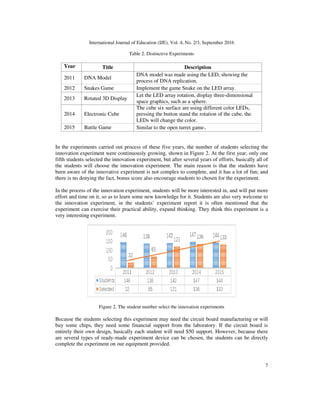
In the past five years of experiment teaching in Digital Logic courses, we continuously improve
our innovation experiment, and the students have designed and implemented a lot of very creative
experimental content. Table 2. is the distinctive experiments in these years.](https://image.slidesharecdn.com/antj-161008072033/85/CULTIVATING-STUDENTS-INNOVATIVE-PRACTICE-ABILITY-IN-HARDWARE-EXPERIMENT-6-320.jpg)
![International Journal of Education (IJE), Vol. 4, No. 2/3, September 2016
8
But with the experiments carried out and continuous accumulation in experiment, the students
reflect that it is more and more difficult to think out a new experiment that is different from the
previous experiments. So the experiment content the students choose, slowly focus to the games,
such as pinball, aircraft fighting. We are also introducing a number of new content and
equipment, so that the students can have more choice in experiment.
5. SUMMARY
We designed the independent innovation experiment in Digital Logic Circuit of the hardware
experiment, that experiment is an open-minded experiment. After years of experiments carried
out, the students deepened understanding of the knowledge in theory course, improve the interest
in the design of hardware, understand the basic processes of the design of electronic products,
improve the ability of practical, and establish the consciousness of innovation and practice. Our
trial has proved that it is very meaningful and feasible to enhance the ability of innovation
practice in the low grade students of computer professional.
ACKNOWLEDGEMENTS
Thanks are due to professor Yang Shiqiang and Zhao Youjian for assistance in the corresponding
theory courses and to professor Liu Weidong for valuable discussion. We gratefully acknowledge
the valuable cooperation of Tian Shuzhen in experiment teaching with us and thanks to Gao
Yuchao and Sun Yongqian for the work in experiment preparing and checking.
REFERENCES
[1] Y. Zhu, J. Yang and Q. Zhu, “Enhancing undergraduates' capabilities of practice and innovation to meet the
regional needs”, 5th IEEE/ACIS Int. Conf. on Comput. and Info. Sci., ICIS 2006, pp. 305-308.
[2] F. Omer, S. Chandra R., A. Jai P., B. Essaid, A. Ashfaq and Moghbelli, “Computer engineering technology
program - A curriculum innovation initiative”, ASEE Annual Conference and Exposition, Conference
Proceedings, 2011.
[3] M. Bahman and R. Alireza, “The fundamental digital circuits laboratory at the University of Central
Florida”, ASEE Annual Conference Proceedings, pp. 4985-4988.
[4] B. Cordelia M, P. Dimitrios and L. Greg, “Sophomore-level curriculum innovation in electrical and
computer engineering”, ASEE Annual Conference and Exposition, Conference Proceedings, 2013.
[5] O. B. Adam, P. Guturu and M. R. Varanasi, “An innovative method of teaching digital system design in an
undergraduate electrical and computer engineering curriculum”, 2009 IEEE International Conference on
Microelectronic Systems Education, MSE 2009, pp. 25-28.
[6] N. Na and D. Hu, “Computer engineering technology program - A curriculum innovation initiative”, 118th
ASEE Annual Conference and Exposition, June 26, 2011 - June 29, 2011.
[7] J. Li and Y. Zhou, “The exploration and practice in innovative personnel training of computer science and
technology”, Proceedings of 2012 International Symposium on Information Technologies in Medicine and
Education, ITME 2012, v 1, pp. 385-389.
[8] Fan Wei, Huang Xianying and Xu Shijun, “Thinking on the innovation mode of computer applied talents
training”, Computer Education, vol 17, 2011, pp.13-15.
[9] M. Felipe, B. Susana and M. Norberto, “Project based learning experience in VHDL digital electronic
circuit design”, 2009 IEEE International Conference on Microelectronic Systems Education, MSE 2009,
pp. 49-52.
[10] Cifredo-Chacõn, M. D. L Ángeles, Quirõs-Olozábal, Ángel, Guerrero-Rodrígueza and J. María, “Computer
architecture and FPGAs: A learning-by-doing methodology for digital-native students”, Computer
Applications in Engineering Education, v 23, n 3, pp. 464-470.
[11] X. Su, J. Liang and Z. Tong, “Explore the creative potential of undergraduates : improve the consciousness
of innovation and practical ability” Computer Education, vol 19, 2009, pp.4-9.](https://image.slidesharecdn.com/antj-161008072033/85/CULTIVATING-STUDENTS-INNOVATIVE-PRACTICE-ABILITY-IN-HARDWARE-EXPERIMENT-8-320.jpg)


This paper discusses a reform in teaching digital logic circuits at Tsinghua University aimed at enhancing first and second-year computer science students' innovative practical abilities through independent hardware experiments. The study emphasizes the importance of practical training and creativity by allowing students to design and implement their own projects, resulting in improved engagement and innovation awareness. The initiative has shown success over several years, leading to an increase in student participation and the development of unique experimental projects.


