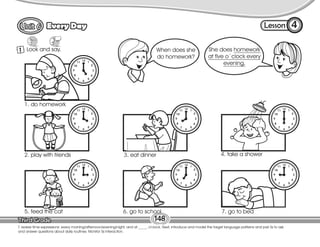
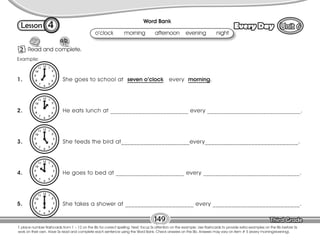
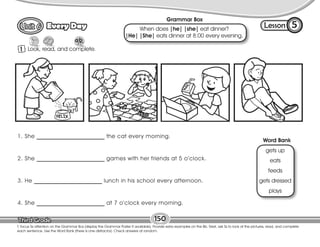
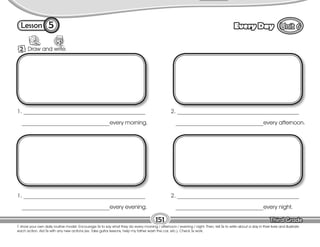
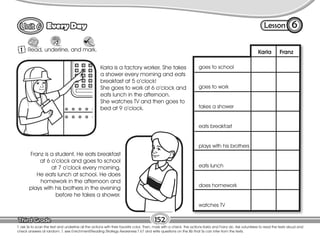
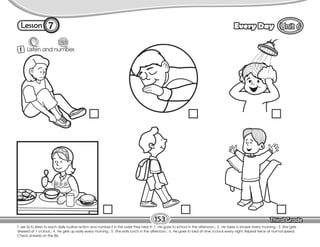
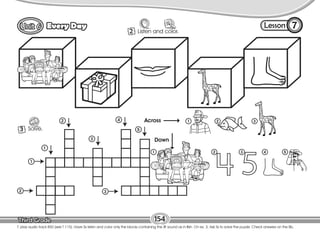
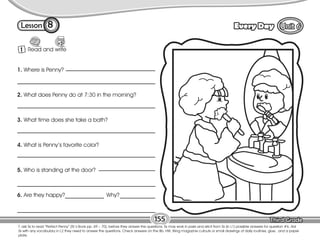
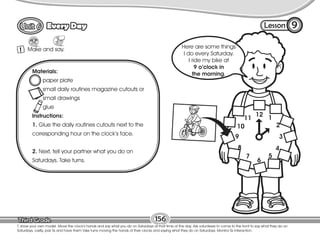
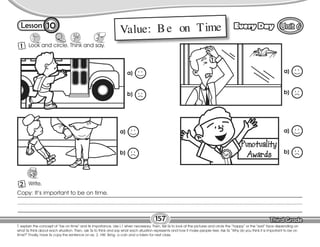
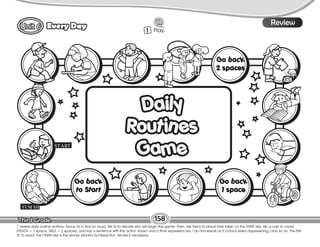
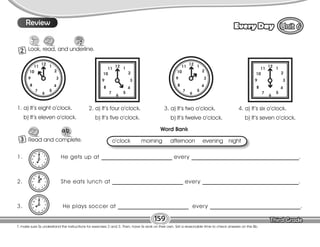
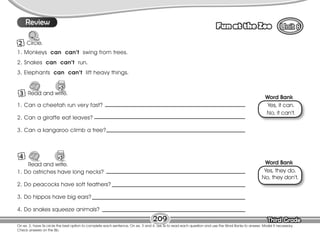
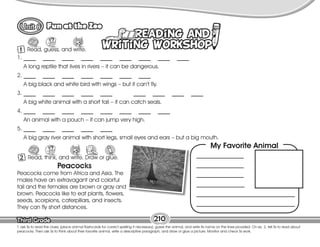
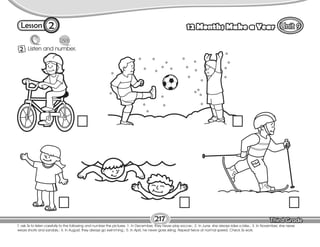
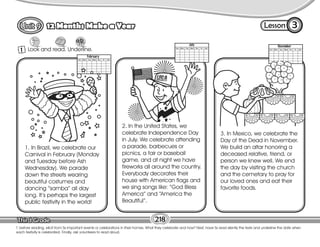
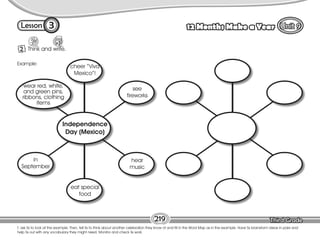
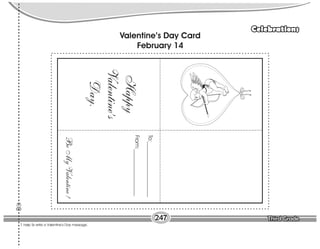
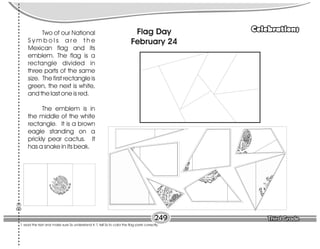
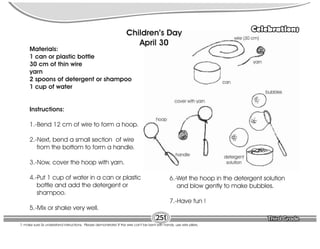
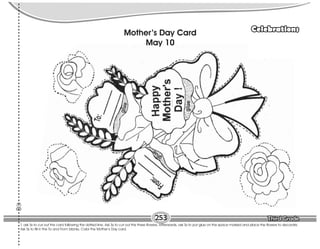
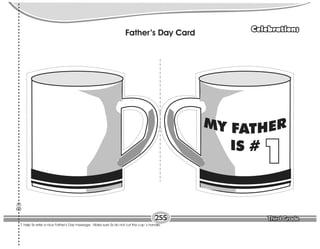
Third Grade
Third Grade
Third Grade
Third Grade
Name
School
Teacher´s name
Grade
Section #
My English Class Schedule
Monday Tuesday Wednesday Thursday Friday
Third Grade
Third Grade
I
Este cuaderno de trabajo ha sido elaborado por el Gobierno del Estado de Coahuila, y se entrega en forma gratuita a
los niños que participan en el Programa de Inglés en Educación Básica Nivel Primaria.
Esta edición estuvo a cargo de la Coordinación Estatal de Inglés de la Secretaría de Educación y Cultura :
Profra. Elsa Patricia Jiménez Flores
Profra. Elvia Alicia Maltos Gutiérrez
Profra. Graciela Valdez González
Diseño Gráfico: Carlos Mendoza Alemán, Luis Angel Domingo Cerecero Rodríguez
Ilustración: Carlos Mendoza Alemán, Liliana Hernández Elizondo
Los comentarios y sugerencias de los maestros, padres de familia y alumnos son muy importantes para mejorar la
calidad de este cuaderno.
Favor de enviarlos a:
Secretaría de Educación y Cultura
Coordinación Estatal de Inglés
Blvd. Francisco Coss y Av. Magisterio s/n
C.P
. 25000 Saltillo, Coah. México
Segunda edición, 2011.
Saltillo, Coahuila.
México.
c SEC
Third Grade
Third Grade
III
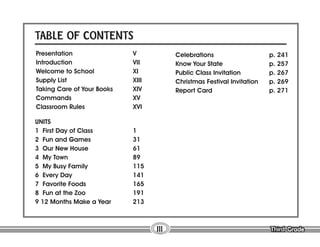
Presentation
Introduction
Welcome to School
Supply List
Taking Care of Your Books
Commands
Classroom Rules
V
VII
XI
XIII
XIV
XV
XVI
Celebrations
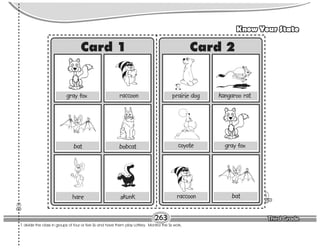
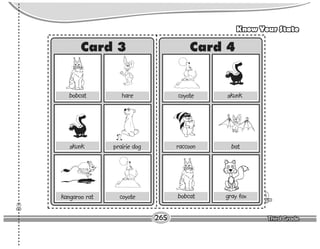
Know Your State
Public Class Invitation
Christmas Festival Invitation
Report Card
p. 241
p. 257
p. 267
p. 269
p. 271
TABLE OF CONTENTS
UNITS
1 First Day of Class
2 Fun and Games
3 Our New House
4 My Town
5 My Busy Family
6 Every Day
7 Favorite Foods
8 Fun at the Zoo
9 12 Months Make a Year
1
31
61
89
115
141
165
191
213
Third Grade
Third Grade IV
Third Grade
Third Grade
V
Con el propósito de ofrecer una educación de mayor calidad que brinde a las nuevas generaciones de alumnos
una formación cultural pertinente que les permita responder con habilidad a los retos del nuevo milenio, la
Secretaría de Educación y Cultura de Coahuila ha desarrollado diversas estrategias que han permitido llevar a
cabo acciones relevantes, entre las que destacan: la dotación de material didáctico a los maestros y de útiles
escolares a los alumnos, el equipamiento y rehabilitación de escuelas, así como desayunos escolares.
Convencidos de que el crecimiento y desarrollo de nuestro país se dará en la medida en que se apoye a la
educación y formación de su gente, a partir de los tratados de libre comercio con Estados Unidos, Canadá y otros
países, la enseñanza de lenguas extranjeras, especialmente el inglés, ha cobrado gran interés.
La adquisición del aprendizaje de otra lengua potencializa el desarrollo intelectual del educando y fortalece su
autoestima, al brindarle la oportunidad de comprender y comunicarse en una lengua extranjera en forma
práctica y efectiva.
Conscientes de esto, se han realizado innovaciones en el sistema educativo nacional, y en particular, en el Estado
de Coahuila donde se ofrece el Programa de Inglés en Educación Básica en los niveles de Preescolar y Primaria a
niños de escuelas públicas.
La Secretaría de Educación y Cultura proporciona, a través de la Coordinación Estatal de Inglés, los apoyos
didácticos, asesoría, capacitación y supervisión a los Maestros, para asegurar la calidad del Programa a las futuras
generaciones.
PRESENTACIÓN
Third Grade
Third Grade VI
Third Grade
Third Grade
VII
La educación es la principal fuente de igualdad de oportunidades, y factor determinante para contribuir a la
formación integral del educando.
El uso efectivo de una lengua extranjera es uno de los grandes retos de la modernidad. La adquisición de este
aprendizaje constituye una herramienta primordial para que nuestros niños de hoy sean ciudadanos de éxito en el
siglo XXI.
De acuerdo con los especialistas, el acceso a este conocimiento se facilita en la etapa de la niñez, por lo que la
Secretaría de Educación y Cultura del Estado de Coahuila instituyó el Programa de Inglés en Educación Básica,
cuya primera generación del nivel de primaria egresó en el ciclo escolar 2000-2001, iniciándose su continuidad
en el nivel de secundaria.
Con la finalidad de fortalecer el aprendizaje del idioma y facilitar la práctica docente, la Secretaría de Educación
y Cultura, a través de la Coordinación Estatal de Inglés, ha diseñado y elaborado cuadernos de trabajo y cuader-
nillos de exámenes para los alumnos de primaria, con las respectivas guías didácticas y materiales de apoyo para
el maestro.
Estos cuadernos contienen actividades a través de las cuales se desarrollan las habilidades comunicativas: expre-
sión oral y escrita; y comprensión oral y escrita. Así mismo, se han incluido anexos con el propósito de fomentar
hábitos de estudio y organización escolar, despertar e/o incrementar el gusto por la lectura, promover la creativi-
dad, fortalecer el desarrollo intelectual del alumno por medio de las habilidades del pensamiento, reforzar su
identidad nacional reconociendo los valores de su propia cultura al ponerse en contacto con otra, así como
ampliar sus conocimientos sobre el estado de Coahuila.
INTRODUCCIÓN
Third Grade
Third Grade VIII
Third Grade
Third Grade
IX
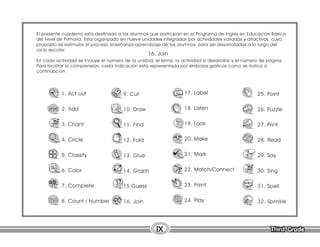
El presente cuaderno está destinado a los alumnos que participan en el Programa de Inglés en Educación Básica
del Nivel de Primaria. Está organizado en nueve unidades integradas por actividades variadas y atractivas, cuyo
propósito es estimular el proceso enseñanza-aprendizaje de los alumnos, para ser desarrolladas a lo largo del
ciclo escolar.
En cada actividad se incluye el número de la unidad, el tema, la actividad a desarrollar y el número de página.
Para facilitar la comprensión, cada indicación está representada por símbolos gráficos como se indica a
continuación
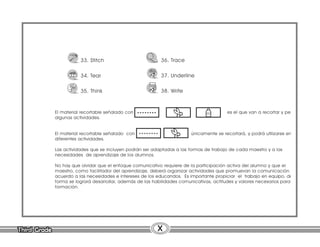
1. Act out
2. Add
3. Chant
4. Circle
5. Classify
6. Color
7. Complete
8. Count / Number
16. Join
9. Cut
10. Draw
11. Find
12. Fold
13. Glue
14. Graph
15 Guess
16. Join
17. Label
18. Listen
19. Look
20. Make
21. Mark
22. Match/Connect
23. Paint
24. Play
25. Point
26. Puzzle
27. Print
28. Read
29. Say
30. Sing
31. Spell
32. Sprinkle
Third Grade
Third Grade X
El material recortable señalado con es el que van a recortar y peg
algunas actividades.
El material recortable señalado con únicamente se recortará, y podrá utilizarse en
diferentes actividades.
Las actividades que se incluyen podrán ser adaptadas a las formas de trabajo de cada maestro y a las
necesidades de aprendizaje de los alumnos.
No hay que olvidar que el enfoque comunicativo requiere de la participación activa del alumno y que el
maestro, como facilitador del aprendizaje, deberá organizar actividades que promuevan la comunicación d
acuerdo a las necesidades e intereses de los educandos. Es importante propiciar el trabajo en equipo, de
forma se logrará desarrollar, además de las habilidades comunicativas, actitudes y valores necesarios para
formación.
33. Stitch
34. Tear
35. Think
36. Trace
37. Underline
38. Write
Third Grade
Third Grade
XI
Welcome to
Third Grade
Third Grade XII
Third Grade
Third Grade
XIII
SUPPLY LIST
Draw and color.
T. ask Ss to brainstorm for items that they will need for his / her English class. Have Ss draw and label all items.
Third Grade
Third Grade XIV
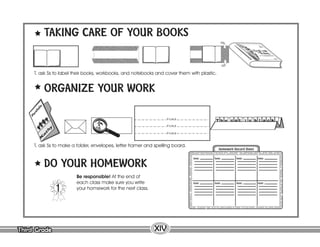
TAKING CARE OF YOUR BOOKS
ORGANIZE YOUR WORK
DO YOUR HOMEWORK
Date: Date:
Homework Record Sheet
Date: Date:
Date: Date: Date: Date:
T. ask Ss to label their books, workbooks, and notebooks and cover them with plastic.
T. ask Ss to make a folder, envelopes, letter framer and spelling board.
Be responsible! At the end of
each class make sure you write
your homework for the next class.
Third Grade
Third Grade
XV
Third Grade
Third Grade XVI
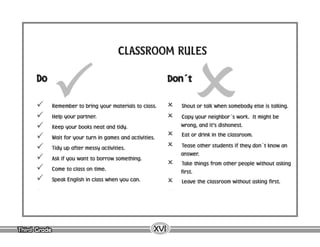
CLASSROOM RULES
Lesson First Day of Class
Unit 1
First
Day of
Class
1
Lesson
First Day of Class
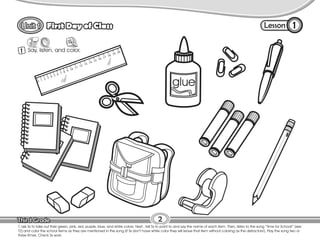
1 Say, listen, and color.
1
2
T. ask Ss to take out their green, pink, red, purple, blue, and white colors. Next , tell Ss to point to and say the name of each item. Then, listen to the song “Time for School!” (see
T2) and color the school items as they are mentioned in the song (if Ss don’t have white color they will leave that item without coloring as the distractors!). Play the song two or
three times. Check Ss work.
Lesson First Day of Class
2
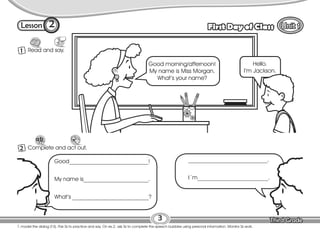
1 Read and say.
3
T. model the dialog (T-S). Pair Ss to practice and say. On ex.2, ask Ss to complete the speech bubbles using personal information. Monitor Ss work.
2 Complete and act out.
Good morning/afternoon!
My name is Miss Morgan.
What’s your name?
Hello.
I’m Jackson.
Good____________________________!
My name is_______________________.
What’s ___________________________?
____________________________.
I´m_________________________.
Lesson
First Day of Class
4
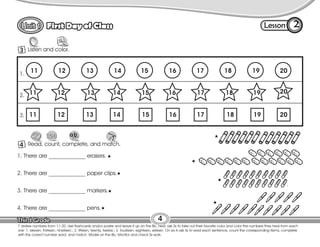
3 Listen and color.
2
T. review numbers from 11-20. Use flashcards and/or poster and leave it up on the Bb. Next, ask Ss to take out their favorite color and color the numbers they hear from each
row: 1. eleven, thirteen, nineteen.; 2. fifteen, twenty, twelve.; 3. fourteen, eighteen, sixteen. On ex.4 ask Ss to read each sentence, count the corresponding items, complete
with the correct number word, and match. Model on the Bb. Monitor and check Ss work.
4 Read, count, complete, and match.
11 12 13 14 15 16 17 18 19 20
11 12
11 12
20
20
1.
2.
3.
1. There are _____________ erasers.
2. There are _____________ paper clips.
3. There are _____________ markers.
4. There are _____________ pens.
13 14 15 16 17 18 19
13 14 15 16 17 18 19
Lesson First Day of Class
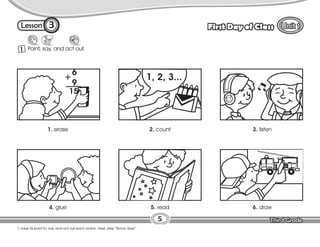
1 Point, say, and act out.
T. have Ss point to, say, and act out each action. Next, play “Simon Says”.
5
3
1. erase 2. count 3. listen
4. glue 5. read 6. draw
Lesson
First Day of Class
6
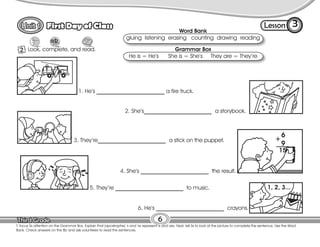
T. focus Ss attention on the Grammar Box. Explain that (apostrophe) ‘s and ‘re represent is and are. Next, tell Ss to look at the picture to complete the sentence. Use the Word
Bank. Check answers on the Bb and ask volunteers to read the sentences.
2 Look, complete, and read.
3
Word Bank
gluing listening erasing counting drawing reading
Grammar Box
He is = He’s She is = She’s They are = They’re
1. He’s ________________________ a fire truck.
2. She’s________________________ a storybook.
3. They’re________________________ a stick on the puppet.
4. She’s ________________________ the result.
5. They’re ________________________ to music.
6. He’s ________________________ crayons.
Lesson First Day of Class
4
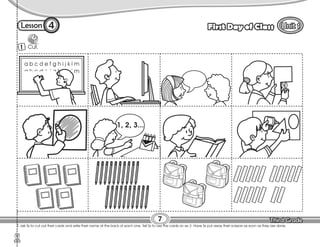
T. ask Ss to cut out their cards and write their name at the back of each one. Tell Ss to use the cards on ex 2. Have Ss put away their scissors as soon as they are done.
7
1 Cut.
Lesson
First Day of Class
8
Lesson First Day of Class
4
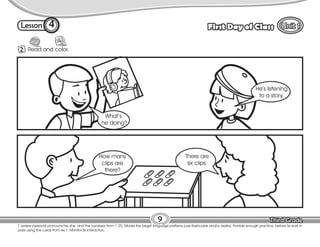
2 Read and color.
9
T. review personal pronouns he, she, and the numbers from 1-20. Model the target language patterns (use flashcards and/or realia). Provide enough practice, before Ss work in
pairs using the cards from ex.1. Monitor Ss interaction.
What’s
he doing?
He’s listening
to a story.
How many
clips are
there?
There are
six clips.
Lesson
First Day of Class
10
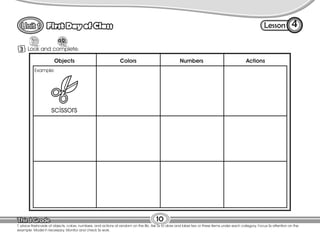
3 Look and complete.
4
Example:
T. place flashcards of objects, colors, numbers, and actions at random on the Bb. Ask Ss to draw and label two or three items under each category. Focus Ss attention on the
example. Model if necessary. Monitor and check Ss work.
scissors
Objects Colors Numbers Actions
Example:
Lesson First Day of Class
5
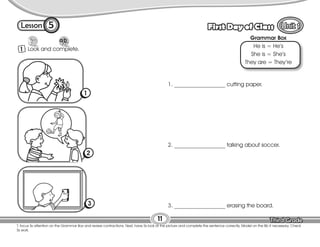
1 Look and complete.
T. focus Ss attention on the Grammar Box and review contractions. Next, have Ss look at the picture and complete the sentence correctly. Model on the Bb if necessary. Check
Ss work.
11
1. __________________ cutting paper.
2. __________________ talking about soccer.
3. __________________ erasing the board.
Grammar Box
He is = He’s
She is = She’s
They are = They’re
1
2
3
Lesson
First Day of Class
2
5
12
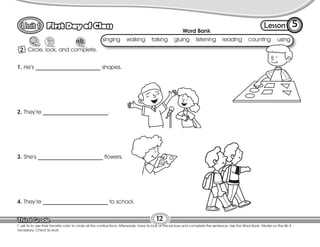
T. ask Ss to use their favorite color to circle all the contractions. Afterwards, have Ss look at the picture and complete the sentence. Use the Word Bank. Model on the Bb if
necessary. Check Ss work.
Circle, look, and complete.
1. He’s _______________________ shapes.
2. They’re _______________________.
3. She’s _______________________ flowers.
4. They’re _______________________ to school.
Word Bank
singing walking talking gluing listening reading counting using
Lesson First Day of Class
5
13
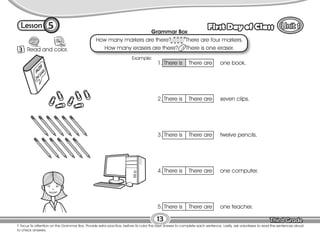
T. focus Ss attention on the Grammar Box. Provide extra practice, before Ss color the best answer to complete each sentence. Lastly, ask volunteers to read the sentences aloud
to check answers.
3
Color
Read and color.
1. There is There are one book.
2. There is There are seven clips.
3. There is There are twelve pencils.
4. There is There are one computer.
5. There is There are one teacher.
Grammar Box
How many markers are there? There are four markers.
How many erasers are there? There is one eraser.
Example:
Lesson
First Day of Class 6
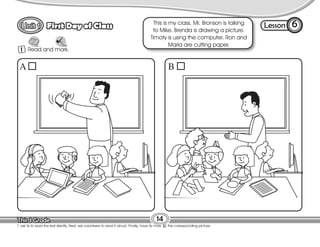
1 Read and mark.
T. ask Ss to read the text silently. Next, ask volunteers to read it aloud. Finally, have Ss mark the corresponding picture.
14
This is my class. Mr. Bronson is talking
to Mike. Brenda is drawing a picture.
Timoty is using the computer. Ron and
Maria are cutting paper.
A B
Lesson First Day of Class
6
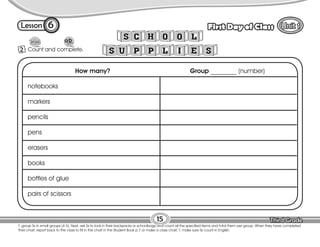
2 Count and complete.
15
T. group Ss in small groups (4-5). Next, ask Ss to look in their backpacks or schoolbags and count all the specified items and total them per group. When they have completed
their chart, report back to the class to fill in the chart in the Student Book p.7 or make a class chart. T. make sure Ss count in English.
How many? Group ________ (number)
notebooks
markers
pencils
pens
erasers
books
bottles of glue
pairs of scissors
Lesson
First Day of Class
16
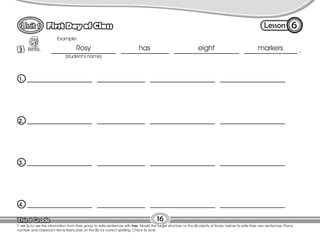
Write.
3
6
T. ask Ss to use the information from their group to write sentences with has. Model the target structure on the Bb plenty of times, before Ss write their own sentences. Place
number and classroom items flashcards on the Bb for correct spelling. Check Ss work.
1. _______________________ _________________ _______________________ _______________________
2. _______________________ _________________ _______________________ _______________________
3. _______________________ _________________ _______________________ _______________________
4. _______________________ _________________ _______________________ _______________________
_______________________ _________________ _______________________ ___________________ .
Example:
Rosy has eight markers
(student’s name)
Lesson First Day of Class
17
7
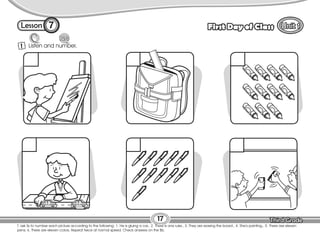
T. ask Ss to number each picture according to the following: 1. He is gluing a car., 2. There is one ruler., 3. They are erasing the board., 4. She’s painting., 5. There are eleven
pens; 6. There are eleven colors. Repeat twice at normal speed. Check answers on the Bb.
Listen and number.
1
Lesson
First Day of Class 7
1 Listen, circle, and say.
18
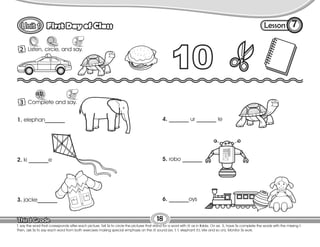
T. say the word that corresponds after each picture. Tell Ss to circle the pictures that stand for a word with /t/ as in table. On ex. 3, have Ss complete the words with the missing t.
Then, ask Ss to say each word from both exercises making special emphasis on the /t/ sound (ex. t, t, elephant /t,t, kite and so on). Monitor Ss work.
2
1 Complete and say.
3
1. elephan_______
2. ki _______e
3. jacke_______
4. _______ ur _______ le
5. robo _______
6. _______oys
Lesson First Day of Class
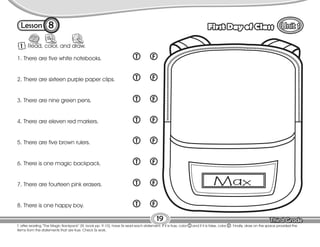
T. after reading “The Magic Backpack” (St. book pp. 9-10), have Ss read each statement. If it is true, color T and if it is false, color F . Finally, draw on the space provided the
items from the statements that are true. Check Ss work.
19
1 Read, color, and draw.
8
1. There are five white notebooks.
2. There are sixteen purple paper clips.
3. There are nine green pens.
4. There are eleven red markers.
5. There are five brown rulers.
6. There is one magic backpack.
7. There are fourteen pink erasers.
8. There is one happy boy.
T F
T F
T F
T F
T F
T F
T F
T F
Lesson
First Day of Class
20
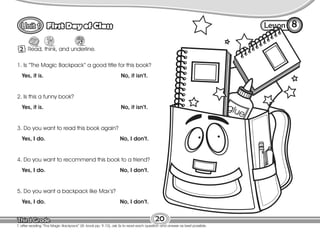
T. after reading “Tha Magic Backpack” (St. book pp. 9-10), ask Ss to read each question and answer as best possible.
2 Read, think, and underline.
8
1. Is “The Magic Backpack” a good title for this book?
Yes, it is. No, it isn’t.
2. Is this a funny book?
Yes, it is. No, it isn’t.
3. Do you want to read this book again?
Yes, I do. No, I don’t.
4. Do you want to recommend this book to a friend?
Yes, I do. No, I don’t.
5. Do you want a backpack like Max’s?
Yes, I do. No, I don’t.
Lesson First Day of Class
T. elicit from Ss items they might carry in a backpack. List on the Bb or place flashcards. Then, ask Ss to take a look in their backpack, count the items, draw them on the spaces
provided, and write proper sentences using “There is” and “There are”. Model on the Bb and help Ss put their Mini-Book together. Use pp. 21-24. HW: Bring an old magazine.
21
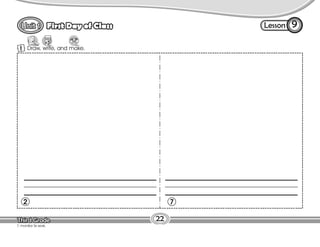
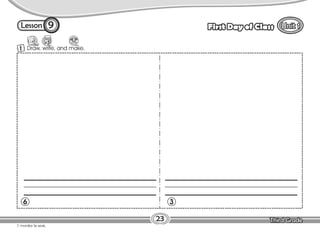
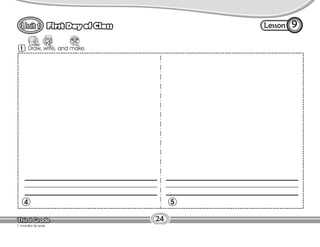
1 Draw, write, and make.
9
The End.
8
by
Lesson
First Day of Class
22
1 Draw, write, and make.
2 7
9
T. monitor Ss work.
Lesson First Day of Class
23
1 Draw, write, and make.
6 3
9
T. monitor Ss work.
Lesson
First Day of Class
24
1 Draw, write, and make.
4 5
9
T. monitor Ss work.
Lesson First Day of Class
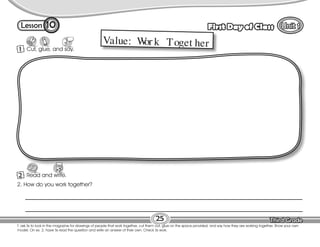
1 Cut, glue, and say.
Cut
T. ask Ss to look in the magazine for drawings of people that work together, cut them out, glue on the space provided, and say how they are working together. Show your own
model. On ex. 2, have Ss read the question and write an answer of their own. Check Ss work.
25
10
Value: W
or k Toget her
2. How do you work together?
__________________________________________________________________________________________________
__________________________________________________________________________________________________
2 Read and write.
Lesson
First Day of Class
T. focus Ss attention on the example. Model using the target language from the speech bubbles. Next, pair Ss, have them take turns asking and answering the question as they
count and write the correct amount of items in each box. Ask Ss to write the number word on the line and the number symbol in the small box. Monitor and check Ss work.
26
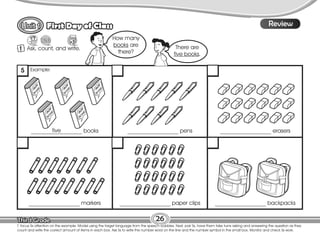
8
Review
1 Ask, count, and write.
Guess
1. erase
__________________ books __________________ pens __________________ erasers
__________________ markers __________________ paper clips __________________ backpacks
five
How many
books are
there?
There are
five books.
Example:
5
Lesson First Day of Class
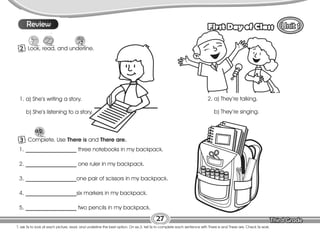
27
T. ask Ss to look at each picture, read, and underline the best option. On ex.3, tell Ss to complete each sentence with There is and There are. Check Ss work.
2 Look, read, and underline.
9
Review
3 Complete. Use There is and There are.
1. __________________ three notebooks in my backpack.
2. __________________ one ruler in my backpack.
3. __________________one pair of scissors in my backpack.
4. __________________six markers in my backpack.
5. __________________ two pencils in my backpack.
1. a) She’s writing a story.
b) She’s listening to a story.
2. a) They’re talking.
b) They’re singing.
Lesson
First Day of Class
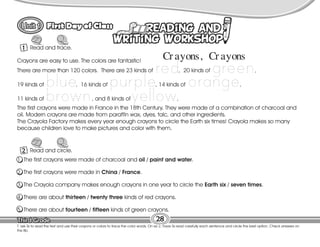
28
T. ask Ss to read the text and use their crayons or colors to trace the color words. On ex 2, have Ss read carefully each sentence and circle the best option. Check answers on
the Bb.
1 Read and trace.
Cr ayons, Cr ayons
There are more than 120 colors. There are 23 kinds of , 20 kinds of ,
19 kinds of , 16 kinds of , 14 kinds of ,
11 kinds of , and 8 kinds of ,
red
The first crayons were made in France in the 18th Century. They were made of a combination of charcoal and
oil. Modern crayons are made from paraffin wax, dyes, talc, and other ingredients.
The Crayola Factory makes every year enough crayons to circle the Earth six times! Crayola makes so many
because children love to make pictures and color with them.
green
blue purple orange
brown yellow
Crayons are easy to use. The colors are fantastic!
2 Read and circle.
1. The first crayons were made of charcoal and oil / paint and water.
2. The first crayons were made in China / France.
3. The Crayola company makes enough crayons in one year to circle the Earth six / seven times.
4. There are about thirteen / twenty three kinds of red crayons.
5. There are about fourteen / fifteen kinds of green crayons.
Lesson First Day of Class
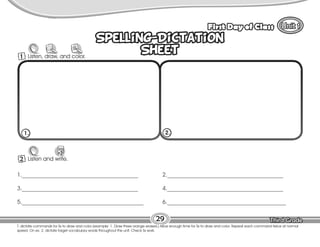
29
Spelling-Dictation
Sheet
Spelling-Dictation
Sheet
2 Listen and write.
W
1._________________________________________
3._________________________________________
5.___________________________________________
2._________________________________________
4._________________________________________
6.__________________________________________
1. 2.
T. dictate commands for Ss to draw and color (example: 1. Draw three orange erasers.) Allow enough time for Ss to draw and color. Repeat each command twice at normal
speed. On ex. 2, dictate target vocabulary words throughout the unit. Check Ss work.
1 Listen, draw, and color.
Lesson
First Day of Class
30
Date:
Date:
Date:
Date:
Date:
Date:
Lesson Fun and Games
Unit 2
Fun and
Games
31
Lesson
Fun and Games
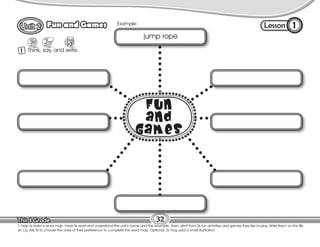
1 Think, say, and write.
1
32
T. help Ss build a word map. Have Ss read and understand the unit’s name and the example. Then, elicit from Ss fun activities and games they like to play. Write them on the Bb
(in L2). Ask Ss to choose the ones of their preference to complete the word map. Optional: Ss may add a small illustration.
Example:
jump rope
Lesson Fun and Games
1
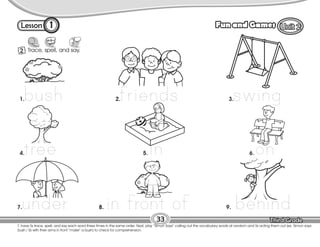
2 Trace, spell, and say.
33
T. have Ss trace, spell, and say each word three times in the same order. Next, play “Simon Says” calling out the vocabulary words at random and Ss acting them out (ex. Simon says:
bush / Ss with their arms in front “make” a bush) to check for comprehension.
bush friends swing
tree in on
under in front of behind
1. 2. 3.
4. 5. 6.
7. 8. 9.
Lesson
Fun and Games
34
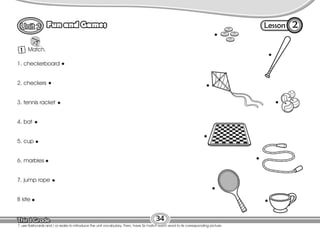
1 Match.
2
T. use flashcards and / or realia to introduce the unit vocabulary. Then, have Ss match each word to its corresponding picture.
1. checkerboard
2. checkers
3. tennis racket
4. bat
5. cup
6. marbles
7. jump rope
8 kite
Lesson Fun and Games
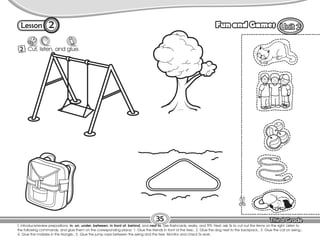
2 Cut, listen, and glue.
T. introduce/review prepositions: in, on, under, between, in front of, behind, and next to. Use flashcards, realia, and TPR. Next, ask Ss to cut out the items on the right. Listen to
the following commands, and glue them on the corresponding place: 1. Glue the friends in front of the tree.; 2. Glue the dog next to the backpack.; 3. Glue the cat on swing.;
4. Glue the marbles in the triangle.; 5. Glue the jump rope between the swing and the tree. Monitor and check Ss work.
35
2
Lesson
Fun and Games
36
1 Look, complete and read.
Lesson Fun and Games
3
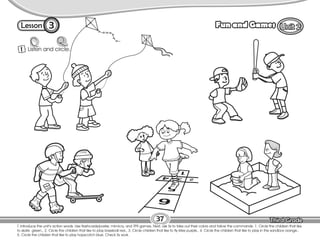
T. introduce the unit’s action words. Use flashcards/poster, mimicry, and TPR games. Next, ask Ss to take out their colors and follow the commands: 1. Circle the children that like
to skate green., 2. Circle the children that like to play baseball red., 3. Circle children that like to fly kites purple., 4. Circle the children that like to play in the sandbox orange.,
5. Circle the children that like to play hopscotch blue. Check Ss work.
37
1 Listen and circle.
Lesson
Fun and Games
38
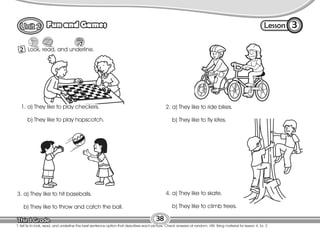
T. tell Ss to look, read, and underline the best sentence option that describes each picture. Check answers at random. HW: Bring material for lesson 4, Ex. 2
2 Look, read, and underline.
3
4. a) They like to skate.
b) They like to climb trees.
1. a) They like to play checkers.
b) They like to play hopscotch.
2. a) They like to ride bikes.
b) They like to fly kites.
3. a) They like to hit baseballs.
b) They like to throw and catch the ball.
Lesson Fun and Games
4
1 Look and complete.
39
T. review the unit’s action words. Use flashcards and a TPR game. Next, ask Ss to look at each picture and complete the sentence. Use the Action Words Bank. Monitor and
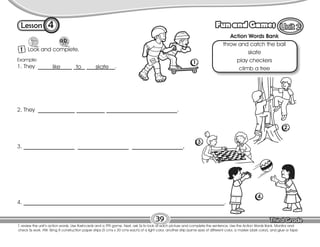
check Ss work. HW: Bring 8 construction paper strips (5 cms x 30 cms each) of a light color, another strip (same size) of different color, a marker (dark color), and glue or tape.
4. _______________________________________________________________________.
Action Words Bank
throw and catch the ball
skate
play checkers
climb a tree
Example:
1. They ____________ ____ __________.
like to skate
2. They _____________ __________ _________________________.
3. __________________ __________________ __________________.
1.
2.
3.
4.
Lesson
Fun and Games
40
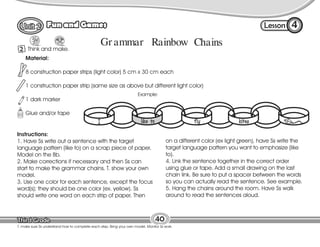
2 Think and make.
4
Material:
8 construction paper strips (light color) 5 cm x 30 cm each
1 construction paper strip (same size as above but different light color)
1 dark marker
Glue and/or tape
T. make sure Ss understand how to complete each step. Bring your own model. Monitor Ss work.
Instructions:
1. Have Ss write out a sentence with the target
language pattern (like to) on a scrap piece of paper.
Model on the Bb.
2. Make corrections if necessary and then Ss can
start to make the grammar chains. T. show your own
model.
3. Use one color for each sentence, except the focus
word(s); they should be one color (ex. yellow). Ss
should write one word on each strip of paper. Then
on a different color (ex light green), have Ss write the
target language pattern you want to emphasize (like
to).
4. Link the sentence together in the correct order
using glue or tape. Add a small drawing on the last
chain link. Be sure to put a spacer between the words
so you can actually read the sentence. See example.
5. Hang the chains around the room. Have Ss walk
around to read the sentences aloud.
Gr ammar Rainbow Chains
Example:
Lesson Fun and Games
5
1 Look and say.
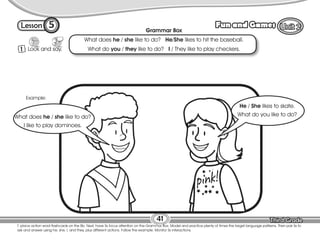
T. place action word flashcards on the Bb. Next, have Ss focus attention on the Grammar Box. Model and practice plenty of times the target language patterns. Then pair Ss to
ask and answer using he, she, I, and they, plus different actions. Follow the example. Monitor Ss interactions.
41
Grammar Box
What does he / she like to do? He/She likes to hit the baseball.
What do you / they like to do? I / They like to play checkers.
Example:
He / She likes to skate.
What do you like to do?
What does he / she like to do?
I like to play dominoes.
Lesson
Fun and Games
2
5
42
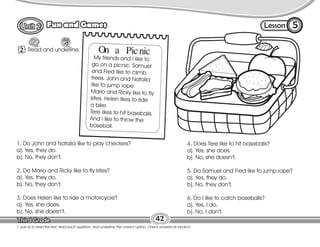
T. pair Ss to read the text, read each question, and underline the correct option. Check answers at random.
Read and underline.
1. Do John and Natalia like to play checkers?
a). Yes, they do.
b). No, they don’t.
2. Do Mario and Ricky like to fly kites?
a). Yes, they do.
b). No, they don’t.
3. Does Helen like to ride a motorcycle?
a). Yes, she does.
b). No, she doesn’t.
4. Does Tere like to hit baseballs?
a). Yes, she does.
b). No, she doesn’t.
5. Do Samuel and Fred like to jump rope?
a). Yes, they do.
b). No, they don’t.
6. Do I like to catch baseballs?
a). Yes, I do.
b). No, I don’t.
On a Picnic
My friends and I like to
go on a picnic. Samuel
and Fred like to climb
trees. John and Natalia
like to jump rope.
Mario and Ricky like to fly
kites. Helen likes to ride
a bike.
Tere likes to hit baseballs.
And I like to throw the
baseball.
Lesson Fun and Games
6
43
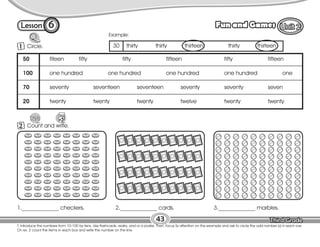
T. introduce the numbers from 10-100 by tens. Use flashcards, realia, and or a poster. Then, focus Ss attention on the example and ask to circle the odd number (s) in each row.
On ex. 2 count the items in each box and write the number on the line.
1 Circle.
2 Count and write.
thirty thirty thirteen thirty thirteen
30
Example:
fiteen fifty fifty fifteen fifty fifteen
one hundred one hundred one hundred one hundred one
seventy seventeen seventeen seventy seventy seven
twenty twenty twenty twelve twenty twenty
50
100
70
20
1._____________ checkers. 2._____________ cards. 3._____________ marbles.
Lesson
Fun and Games 6
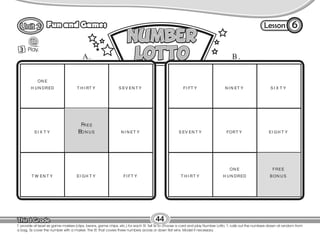
3 Play.
T. provide at least six game markers (clips, beans, game chips, etc.) for each St. Tell Ss to choose a card and play Number Lotto. T. calls out the numbers drawn at random from
a bag. Ss cover the number with a marker. The St. that covers three numbers across or down first wins. Model if necessary.
44
ON E
H UN DRED T H I RT Y S EV EN T Y
S I X T Y N I N ET Y
T W EN T Y EI GH T Y FI FT Y
FI FT Y N I N ET Y S I X T Y
S EV EN T Y FORT Y EI GH T Y
T H I RT Y
ON E
H UN DRED
FREE
BON US
FREE
BON US
A. B.
Lesson Fun and Games
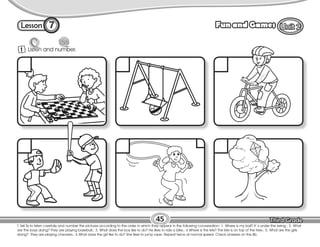
7
1 Listen and number.
45
T. tell Ss to listen carefully and number the pictures according to the order in which they appear in the following conversation: 1. Where is my ball? It´s under the swing.; 2. What
are the boys doing? They are playing baseball.; 3. What does the boy like to do? He likes to ride a bike.; 4 Where is the kite? The kite is on top of the tree.; 5. What are the girls
doing? They are playing checkers.; 6 What does the girl like to do? She likes to jump rope. Repeat twice at normal speed. Check answers on the Bb.
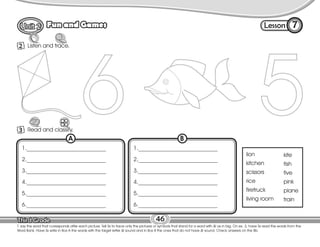
Lesson
Fun and Games
46
Listen and trace.
2
7
T. say the word that corresponds after each picture. Tell Ss to trace only the pictures or symbols that stand for a word with /i/ as in big. On ex. 3, have Ss read the words from the
Word Bank. Have Ss write in Box A the words with the target letter /i/ sound and in Box B the ones that do not have /i/ sound. Check answers on the Bb.
Read and classify.
3
1.____________________________
2.____________________________
3.____________________________
4.____________________________
5.____________________________
6.____________________________
A
1.____________________________
2.____________________________
3.____________________________
4.____________________________
5.____________________________
6.____________________________
B
lion
kitchen
scissors
rice
firetruck
living room
kite
fish
five
pink
plane
train
Lesson Fun and Games
47
8
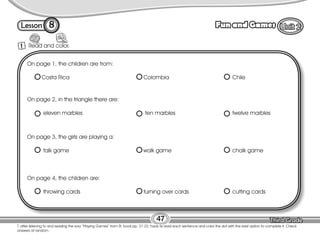
T. after listening to and reading the sory “Playing Games” from St. book pp. 21-22, have Ss read each sentence and color the dot with the best option to complete it. Check
answers at random.
Read and color.
1
On page 1, the children are from:
Costa Rica Colombia Chile
On page 2, in the triangle there are:
eleven marbles ten marbles twelve marbles
On page 3, the girls are playing a:
talk game walk game chalk game
On page 4, the children are:
throwing cards turning over cards cutting cards
Lesson
Fun and Games 8
1 Draw and write.
48
Draw
T. elicit from Ss which are their favorite games. List on the Bb. Next, ask Ss to draw their favorite game and then describe what type of game it is (card, ball, marbles, jump rope,
etc.) and how it is played. Praise Ss work and aid them with any necessary vocabulary. HW: Ask Ss to bring a jump rope next class.
2
My Favor it e Game
Lesson Fun and Games
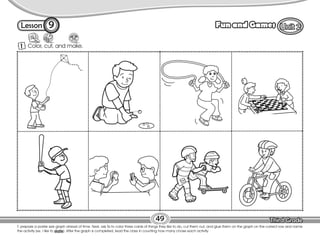
T. prepare a poster size graph ahead of time. Next, ask Ss to color three cards of things they like to do, cut them out, and glue them on the graph on the correct row and name
the activity (ex. I like to skate). After the graph is completed, lead the class in counting how many chose each activity.
49
1 Color, cut, and make.
9
Lesson
Fun and Games
50
Lesson Fun and Games
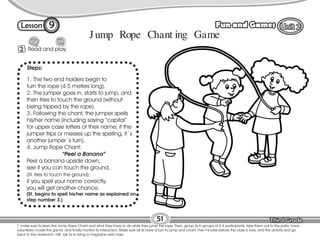
T. make sure Ss learn the Jump Rope Chant and what they have to do while they jump the rope. Then, group Ss in groups of 5-6 participants, take them out to the patio, have
volunteers model the game, and finally monitor Ss interaction. Make sure all Ss have a turn to jump and chant. Five minutes before the class is over, end the activity and go
back to the classroom. HW: Ask Ss to bring a magazine next class.
51
2 Read and play.
9
1. The two end holders begin to
turn the rope (4-5 meters long).
2. The jumper goes in, starts to jump, and
then tries to touch the ground (without
being tripped by the rope).
3. Following the chant, the jumper spells
his/her name (including saying “capital”
for upper case letters of their name; if the
jumper trips or messes up the spelling, it´s
another jumper´s turn).
4. Jump Rope Chant:
“Peel a Banana”
Peel a banana upside down,
see if you can touch the ground,
(St. tries to touch the ground)
if you spell your name correctly,
you will get another chance.
(St. begins to spell his/her name as explained on
step number 3.)
Jump Rope Chant ing Game
Steps:
Lesson
Fun and Games
52
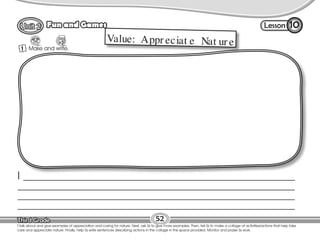
T.talk about and give examples of appreciation and caring for nature. Next, ask Ss to give more examples. Then, tell Ss to make a collage of activities/actions that help take
care and appreciate nature. Finally, help Ss write sentences describing actions in the collage in the space provided. Monitor and praise Ss work.
10
1 Make and write.
Value: Appr eciat e Nat ur e
I ________________________________________________________________________________________________
__________________________________________________________________________________________________
__________________________________________________________________________________________________
__________________________________________________________________________________________________
Lesson Fun and Games
53
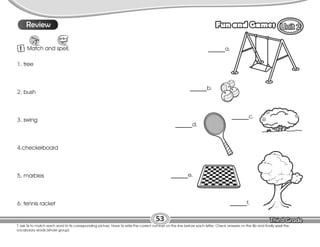
T. ask Ss to match each word to its corresponding picture. Have Ss write the correct number on the line before each letter. Check answers on the Bb and finally spell the
vocabulary words (whole group).
10
Review
1 Match and spell.
1. tree
2. bush
3. swing
4.checkerboard
5. marbles
6. tennis racket
______a.
______b.
______c.
______d.
______e.
______f.
Lesson
Fun and Games
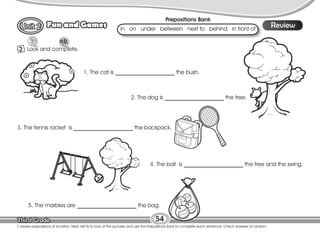
2 Look and complete.
54
T. review prepositions of location. Next, tell Ss to look at the pictures and use the Prepositions Bank to complete each sentence. Check answers at random.
Review
1. The cat is _____________________ the bush.
2. The dog is _____________________ the tree.
3. The tennis racket is _____________________ the backpack.
5. The marbles are _____________________ the bag.
4. The ball is _____________________ the tree and the swing.
Prepositions Bank
in on under between next to behind in front of
Lesson Fun and Games
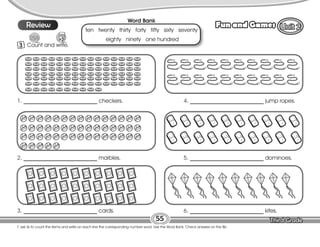
T. ask Ss to count the items and write on each line the corresponding number word. Use the Word Bank. Check answers on the Bb
55
10
Review
1. __________________________ checkers.
2. __________________________ marbles.
3. __________________________ cards.
4. __________________________ jump ropes.
5. __________________________ dominoes.
6. __________________________ kites.
3 Count and write.
Word Bank
ten twenty thirty forty fifty sixty seventy
eighty ninety one hundred
Lesson
Fun and Games
T. ask Ss to look at the pictures and underline the correct option. Check Ss work at random.
56
Review
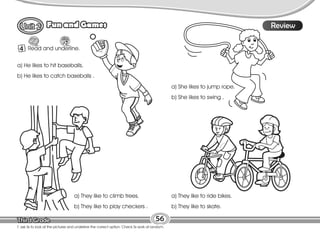
4 Read and underline.
a) He likes to hit baseballs.
b) He likes to catch baseballs .
a) She likes to jump rope.
b) She likes to swing .
a) They like to climb trees.
b) They like to play checkers .
a) They like to ride bikes.
b) They like to skate.
Lesson Fun and Games
57
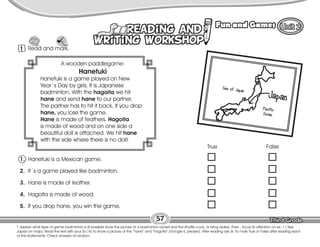
T. explain what type of game badminton is (if possible show the picture of a badminton racket and the shuttle cock, or bring realia). Then , focus Ss attention on ex. 1 ( See
Japan on map). Read the text with your Ss ( try to show a picture of the “hane” and “hagoita” (Google it, please!). After reading ask Ss to mark True or False after reading each
of the statements. Check answers at random.
1 Read and mark.
A wooden paddlegame:
Hanetuki
Hanetuki is a game played on New
Year´s Day by girls. It is Japanese
badminton. With the hagoita we hit
hane and send hane to our partner.
The partner has to hit it back. If you drop
hane, you lose the game.
Hane is made of feathers. Hagoita
is made of wood and on one side a
beautiful doll is attached. We hit hane
with the side where there is no doll!
1. Hanetuki is a Mexican game.
2. It´s a game played like badminton.
3. Hane is made of leather.
4. Hagoita is made of wood.
5. If you drop hane, you win the game.
True False
Lesson
Fun and Games
58
T. pair Ss to think about a game they would like to play. Have Ss write the instructions and then draw the game. Use the spaces provided. Monitor and aid Ss with any necessary
vocabulary words.
2 Write and draw.
Instructions:
Lesson Fun and Games
59
T. dictate commands for Ss to draw and color (example: 1. Draw the ball under the swing.) Allow enough time for Ss to draw and color. Repeat each command twice at normal
speed. On ex. 2, dictate target vocabulary words throughout the unit. Check Ss work.
Spelling-Dictation
Sheet
Spelling-Dictation
Sheet
2 Listen and write.
W
1._________________________________________
3._________________________________________
5.___________________________________________
2._________________________________________
4._________________________________________
6.__________________________________________
1. 2.
1 Listen, draw, and color.
Lesson
Fun and Games
60
Date:
Date:
Date:
Date:
Date:
Date:
Lesson Our New House
61
Unit 3
Our New
House
Lesson
Our New House
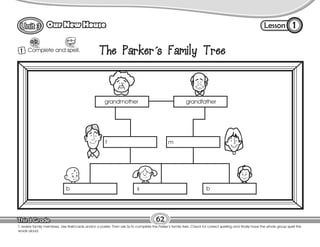
1 Complete and spell.
1
62
T. review family members. Use flashcards and/or a poster. Then ask Ss to complete the Parker’s family tree. Check for correct spelling and finally have the whole group spell the
words aloud.
grandmother grandfather
f m
b s b
Lesson Our New House
1
2 Draw and write. Say.
63
T. ask Ss to draw their own family members and write their name. Finally, pair Ss to ask and answer who is each member from each of the families. Model if necessary and monitor Ss
interaction.
Lesson
Our New House
64
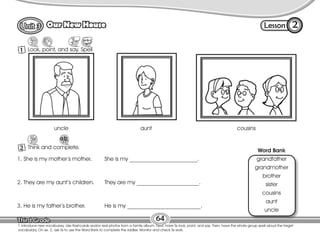
1 Look, point, and say. Spell
2
T. introduce new vocabulary. Use flashcards and/or real photos from a family album. Next, have Ss look, point, and say. Then, have the whole group spell aloud the target
vocabulary. On ex. 2, ask Ss to use the Word Bank to complete the riddles. Monitor and check Ss work.
2 Think and complete.
uncle aunt cousins
1. She is my mother’s mother. She is my ________________________.
2. They are my aunt’s children. They are my ______________________.
3. He is my father’s brother. He is my __________________________.
Word Bank
grandfather
grandmother
brother
sister
cousins
aunt
uncle
Lesson Our New House
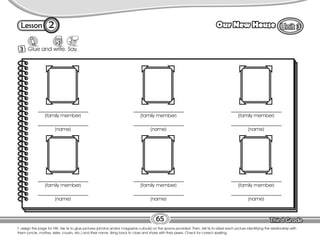
3 Glue and write. Say.
T. assign this page for HW. Ask Ss to glue pictures (photos and/or magazine cutouts) on the space provided. Then, tell Ss to label each picture identifying the relationship with
them (uncle, mother, sister, cousin, etc.) and their name. Bring back to class and share with their peers. Check for correct spelling.
65
2
(family member)
(name)
(family member)
(name)
(family member)
(name)
(family member)
(name)
(family member)
(name)
(family member)
(name)
Lesson
Our New House
66
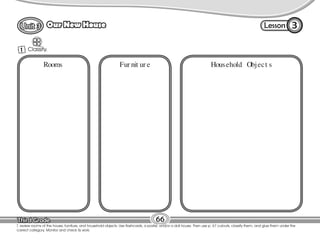
1 Classify.
T. review rooms of the house, furniture, and household objects. Use flashcards, a poster, and/or a doll house. Then use p. 67 cutouts, classify them, and glue them under the
correct category. Monitor and check Ss work.
3
Rooms Fur nit ur e Household Object s
Lesson Our New House
3
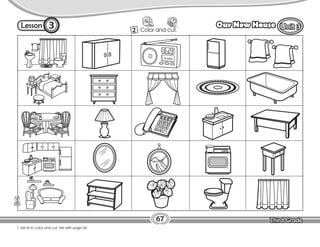
T. ask Ss to color and cut. Use with page 66.
67
2 Color and cut.
1
4
7
8
9
0
*
5
6
2
3
Lesson
Our New House
68
2 Look, read, and underline.
3
Lesson Our New House
3
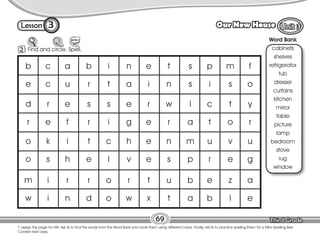
2 Find and circle. Spell.
69
T. assign this page for HW. Ask Ss to find the words from the Word Bank and circle them using different colors. Finally, tell Ss to practice spelling them for a Mini–Spelling Bee
Contest next class.
Word Bank
cabinets
shelves
refrigerator
tub
dresser
curtains
kitchen
mirror
table
picture
lamp
bedroom
stove
rug
window
b
e
d
r
o
o
m
w
c
c
r
e
k
s
i
i
a
u
e
f
i
h
r
n
b
r
s
r
t
e
r
d
i
t
s
i
c
l
o
o
n
a
e
g
h
v
r
w
e
i
r
e
e
e
t
x
t
n
w
r
n
s
u
t
s
s
l
a
m
p
b
a
p
i
c
t
u
r
e
b
m
s
t
o
v
e
z
l
f
o
y
r
u
g
a
e
Lesson
Our New House
70
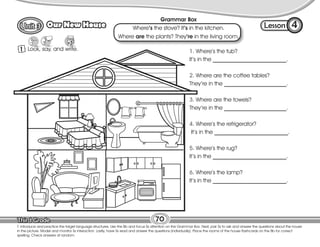
1 Look, say, and write.
4
T. introduce and practice the target language structures. Use the Bb and focus Ss attention on the Grammar Box. Next, pair Ss to ask and answer the questions about the house
in the picture. Model and monitor Ss interaction. Lastly, have Ss read and answer the questions (individually). Place the rooms of the house flashcards on the Bb for correct
spelling. Check answers at random.
1. Where’s the tub?
It’s in the __________________________.
2. Where are the coffee tables?
They’re in the ______________________.
3. Where are the towels?
They’re in the ______________________.
4. Where’s the refrigerator?
It’s in the __________________________.
5. Where’s the rug?
It’s in the __________________________.
6. Where’s the lamp?
It’s in the __________________________.
Grammar Box
Where’s the stove? It’s in the kitchen.
Where are the plants? They’re in the living room.
Lesson Our New House
4
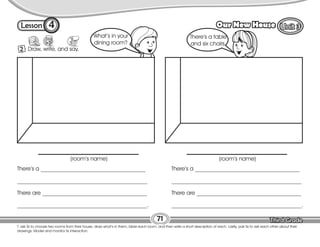
2 Draw, write, and say.
T. ask Ss to choose two rooms from their house, draw what’s in them, label each room, and then write a short description of each. Lastly, pair Ss to ask each other about their
drawings. Model and monitor Ss interaction.
71
What’s in your
dining room?
There’s a table
and six chairs.
(room’s name) (room’s name)
There’s a _____________________________________
______________________________________________
There are _____________________________________
______________________________________________.
There’s a _____________________________________
______________________________________________
There are _____________________________________
______________________________________________.
Lesson
Our New House
1
5
72
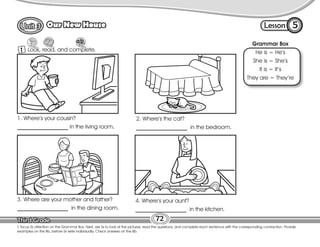
T. focus Ss attention on the Grammar Box. Next, ask Ss to look at the pictures, read the questions, and complete each sentence with the corresponding contraction. Provide
examples on the Bb, before Ss write individually. Check answers on the Bb.
Look, read, and complete.
Grammar Box
He is = He’s
She is = She’s
It is = It’s
They are = They’re
1. Where’s your cousin?
__________________ in the living room.
2. Where’s the cat?
__________________ in the bedroom.
3. Where are your mother and father?
__________________ in the dining room.
4. Where’s your aunt?
__________________ in the kitchen.
Lesson Our New House
5
73
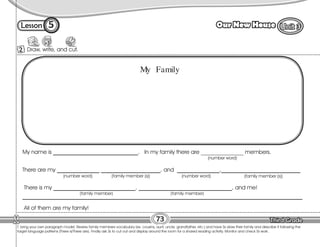
T. bring your own paragraph model. Review family members vocabulary (ex. cousins, aunt, uncle, grandfather, etc.) and have Ss draw their family and describe it following the
target language patterns (There is/There are). Finally ask Ss to cut out and display around the room for a shared reading activity. Monitor and check Ss work.
2 Draw, write, and cut.
My name is ______________________________. In my family there are _______________ members.
There are my _______________ _____________________, and _______________,____________________________
There is my _____________________________, _________________________________, and me!
___________________________________________________________________________________________________
All of them are my family!
(number word)
(number word) (family member (s))
(family member)
My Family
(family member)
(number word)
(family member (s))
Lesson
Our New House 6
3 Play.
74
Lesson Our New House
6
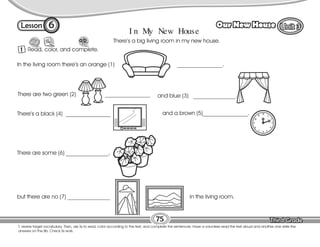
1 Read, color, and complete.
75
T. review target vocabulary. Then, ask Ss to read, color according to the text, and complete the sentences. Have a volunteer read the text aloud and another one write the
answers on the Bb. Check Ss work.
I n My New House
There’s a big living room in my new house.
In the living room there’s an orange (1) ________________.
There are two green (2) ________________ and blue (3) _______________.
and a brown (5)________________.
There are some (6) _______________,
but there are no (7) _______________ in the living room.
There’s a black (4) ________________ 12
1
2
3
4
5
6
7
8
9
10
11
Lesson
Our New House
76
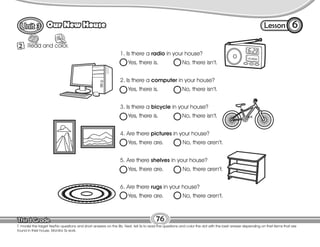
Read and color.
R
2
6
T. model the target Yes/No questions and short answers on the Bb. Next, tell Ss to read the questions and color the dot with the best answer depending on thet items that are
found in their house. Monitor Ss work.
1. Is there a radio in your house?
Yes, there is. No, there isn’t.
2. Is there a computer in your house?
Yes, there is. No, there isn’t.
3. Is there a bicycle in your house?
Yes, there is. No, there isn’t.
4. Are there pictures in your house?
Yes, there are. No, there aren’t.
5. Are there shelves in your house?
Yes, there are. No, there aren’t.
6. Are there rugs in your house?
Yes, there are. No, there aren’t.
Lesson Our New House
77
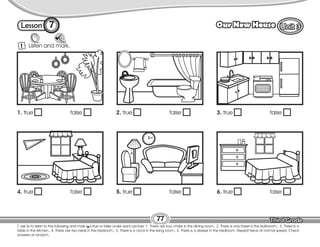
7
T. ask Ss to listen to the following and mark ( ) true or false under each picture: 1. There are four chairs in the dining room.; 2. There is one towel in the bathroom.; 3. There is a
table in the kitchen.; 4. There are two beds in the bedroom.; 5. There is a clock in the living room.; 6. There is a dresser in the bedroom. Repeat twice at normal speed. Check
answers at random.
Listen and mark.
1
12
1
2
3
4
5
6
7
8
9
10
11
1. true false 2. true false 3. true false
4. true false 5. true false 6. true false
Lesson
Our New House 7
1 Listen and mark.
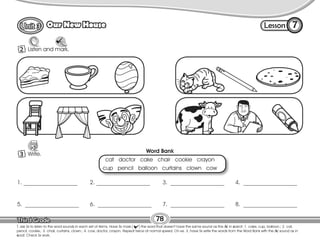
78
T. ask Ss to listen to the word sounds in each set of items. Have Ss mark ( ) the word that doesn’t have the same sound as the /k/ in carrot. 1. cake, cup, balloon.; 2. cat,
pencil, cookie.; 3. chair, curtains, clown.; 4. cow, doctor, crayon. Repeat twice at normal speed. On ex. 3, have Ss write the words from the Word Bank with the /k/ sound as in
coat. Check Ss work.
2
1 Write.
3
1. ___________________ 2. ___________________ 3. ___________________ 4. ___________________
5. ___________________ 6. ___________________ 7. ___________________ 8. ___________________
Word Bank
cat doctor cake chair cookie crayon
cup pencil balloon curtains clown cow
Lesson Our New House
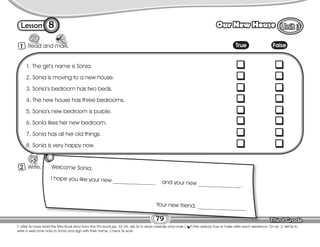
T. after Ss have read the Mini-Book story from the St’s book pp. 33-34, ask Ss to read carefully and mark ( ) the options True or False after each sentence. On ex. 2, tell Ss to
write a welcome note to Sonia and sign with their name. Check Ss work.
79
1 Read and mark.
8
1. The girl’s name is Sonia.
2. Sonia is moving to a new house.
3. Sonia’s bedroom has two beds.
4. The new house has three bedrooms.
5. Sonia’s new bedroom is purple.
6. Sonia likes her new bedroom.
7. Sonia has all her old things.
8. Sonia is very happy now.
Welcome Sonia,
I hope you like your new _______________ and your new _______________.
Your new friend, _________________
True False
1 Write.
2
Lesson
Our New House
80
T. ask Ss to invent a special room for their house, such as a homework room, or a play room. Have Ss furnish it and tell about it. Pair Ss to describe and name their room. Monitor
Ss interaction.
1 Think, draw, and say.
9
Lesson Our New House
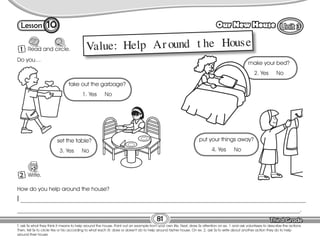
T. ask Ss what they think it means to help around the house. Point out an example from your own life. Next, draw Ss attention on ex. 1 and ask volunteers to describe the actions.
Then, tell Ss to circle Yes or No according to what each St. does or doesn’t do to help around his/her house. On ex. 2, ask Ss to write about another action they do to help
around their house.
81
1 Read and circle.
10
How do you help around the house?
I _____________________________________________________________________________________________________
____________________________________________________________________________________________________.
Do you…
Value: Help Ar ound t he House
1 Write.
2
take out the garbage?
1. Yes No
make your bed?
2. Yes No
set the table?
3. Yes No
put your things away?
4. Yes No
Lesson
Our New House
82
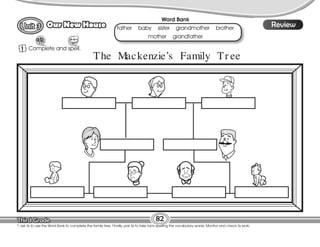
T. ask Ss to use the Word Bank to complete the family tree. Finally, pair Ss to take turns spelling the vocabulary words. Monitor and check Ss work.
10
1 Complete and spell.
Review
The Mackenzie’s Family Tr ee
Word Bank
father baby sister grandmother brother
mother grandfather
Lesson Our New House
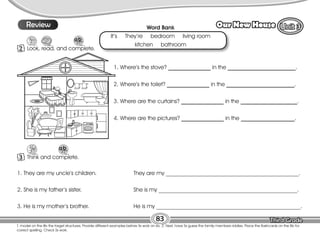
83
T. model on the Bb the target structures. Provide different examples before Ss work on ex. 2. Next, have Ss guess the family members riddles. Place the flashcards on the Bb for
correct spelling. Check Ss work.
10
Review
2 Look, read, and complete.
3 Think and complete.
1. Where’s the stove? _______________ in the ________________________.
2. Where’s the toilet? _______________ in the ________________________.
3. Where are the curtains? _______________ in the ____________________.
4. Where are the pictures? _______________ in the ___________________.
Word Bank
It’s They’re bedroom living room
kitchen bathroom
1. They are my uncle’s children. They are my _______________________________________________.
2. She is my father’s sister. She is my _________________________________________________.
3. He is my mother’s brother. He is my ___________________________________________________.
Lesson
Our New House
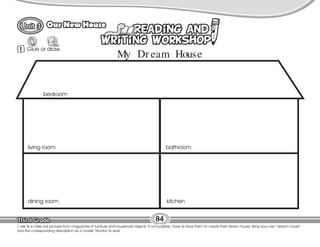
1 Glue or draw.
84
T. ask Ss to take out pictures from magazines of furniture and household objects. If not possible, have Ss draw them to create their dream house. Bring your own “dream house”
and the corresponding description as a model. Monitor Ss work.
My Dr eam House
bedroom
living room bathroom
dining room kitchen
Lesson Our New House
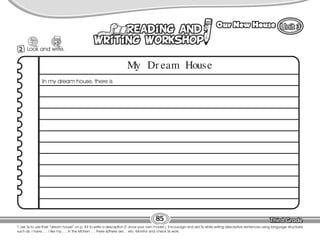
T. ask Ss to use their “dream house” on p. 84 to write a description (T. show your own model.). Encourage and aid Ss while writing descriptive sentences using language structures
such as: I have… , I like my… , In the kitchen… , there is/there are… etc. Monitor and check Ss work.
85
2 Look and write.
10
My Dr eam House
In my dream house, there is
Lesson
Our New House
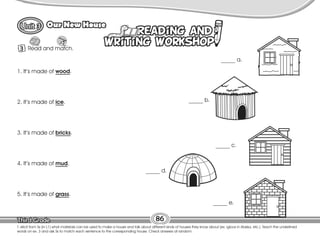
T. elicit from Ss (in L1) what materials can be used to make a house and talk about different kinds of houses they know about (ex. igloos in Alaska, etc.). Teach the underlined
words on ex. 3 and ask Ss to match each sentence to the corresponding house. Check answers at random.
86
3 Read and match.
1. It’s made of wood.
2. It’s made of ice.
3. It’s made of bricks.
4. It’s made of mud.
5. It’s made of grass.
_____ a.
_____ b.
_____ c.
_____ d.
_____ e.
Lesson Our New House
87
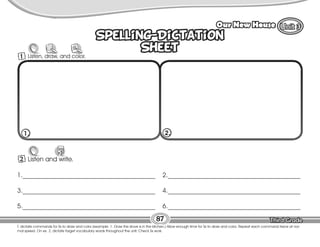
Spelling-Dictation
Sheet
Spelling-Dictation
Sheet
2 Listen and write.
W
1._________________________________________
3._________________________________________
5._________________________________________
2._________________________________________
4._________________________________________
6._________________________________________
1. 2.
T. dictate commands for Ss to draw and color (example: 1. Draw the stove is in the kitchen.) Allow enough time for Ss to draw and color. Repeat each command twice at nor-
mal speed. On ex. 2, dictate target vocabulary words throughout the unit. Check Ss work.

1 Listen, draw, and color.
Lesson
Our New House
88
Date:
Date:
Date:
Date:
Date:
Date:
Lesson My Town
89
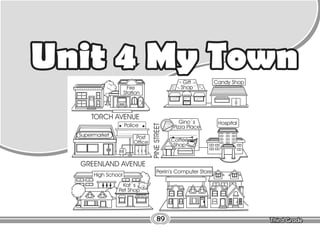
Unit 4 My Town
TORCH AVENUE
Police
Post
Office
GREENLAND AVENUE
PINE
STREET
CENTRAL AVENUE
Fire
Station
Gift
Shop
Candy Shop
Hospital
Gino´s
Pizza Place
Coffee
Shop
Supermarket
High School
Kat´s
Pet Shop
Enter on Torch Ave. Enter on Torch Ave.
Perrin’s Computer Store
Enter on Greenland Ave.
Lesson
My Town
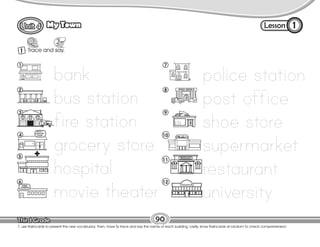
1 Trace and say.
1
90
T. use flashcards to present the new vocabulary. Then, have Ss trace and say the name of each building. Lastly, show flashcards at random to check comprehension.
police station
post office
shoe store
supermarket
restaurant
university
bank
bus station
fire station
grocery store
hospital
movie theater
1
2
3
4
5
6
7
8
9
12
11
10
Restaurant
Lesson My Town
1
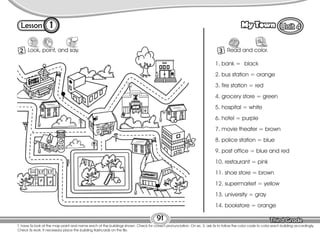
2 Look, point, and say.
91
T. have Ss look at the map point and name each of the buildings shown. Check for correct pronunciation. On ex. 3, ask Ss to follow the color code to color each building accordingly.
Check Ss work. If necessary place the building flashcards on the Bb.
3 Read and color.
1. bank = black
2. bus station = orange
3. fire station = red
4. grocery store = green
5. hospital = white
6. hotel = purple
7. movie theater = brown
8. police station = blue
9. post office = blue and red
10. restaurant = pink
11. shoe store = brown
12. supermarket = yellow
13. university = gray
14. bookstore = orange
Lesson
My Town
92
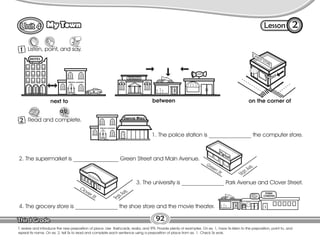
1 Listen, point, and say.
2
T. review and introduce the new preposition of place. Use flashcards, realia, and TPR. Provide plenty of examples. On ex. 1, have Ss listen to the preposition, point to, and
repeat its name. On ex. 2, tell Ss to read and complete each sentence using a preposition of place from ex. 1. Check Ss work.
2 Read and complete.
Restaurant
next to between on the corner of
1. The police station is _______________ the computer store.
2. The supermarket is ________________ Green Street and Main Avenue.
3. The university is _______________ Park Avenue and Clover Street.
4. The grocery store is _______________ the shoe store and the movie theater.
Green St.
M
a
i
n
A
v
e
.
Clover St.
P
a
r
k
A
v
e
.
Lesson My Town
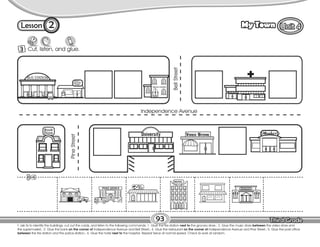
3 Cut, listen, and glue.
T. ask Ss to identify the buildings, cut out the cards, and listen to the following commands: 1. Glue the fire station next to the grocery store.; 2. Glue the music store between the video store and
the supermarket.; 3. Glue the bank on the corner of Independence Avenue and Bell Street.; 4. Glue the restaurant on the corner of Independence Avenue and Pine Street.; 5. Glue the post office
between the fire station and the police station.; 6. Glue the hotel next to the hospital. Repeat twice at normal speed. Check Ss work at random.
93
2
Restaurant
Independence Avenue
Pine
Street
Bell
Street
Lesson
My Town
94
3
Lesson My Town
3
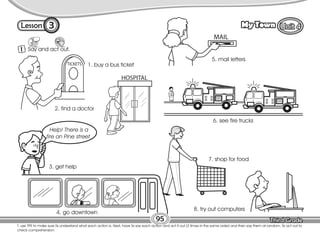
T. use TPR to make sure Ss understand what each action is. Next, have Ss say each action and act it out (3 times in the same order) and then say them at random. Ss act out to
check comprehension.
95
1 Say and act out.
1. buy a bus ticket
2. find a doctor
3. get help
4. go downtown
5. mail letters
6. see fire trucks
7. shop for food
8. try out computers
Help! There is a
fire on Pine street.
Lesson
My Town
96
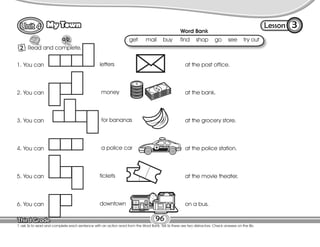
2 Read and complete.
3
T. ask Ss to read and complete each sentence with an action word from the Word Bank. Tell Ss there are two distractors. Check answers on the Bb.
at the post office.
at the bank.
at the grocery store.
at the police station.
at the movie theater.
on a bus.
Word Bank
get mail buy find shop go see try out
1. You can
2. You can
3. You can
4. You can
5. You can
6. You can
letters
money
for bananas
a police car
tickets
downtown
Lesson My Town
4
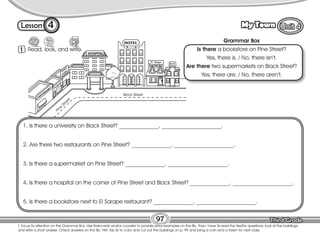
1 Read, look, and write.
97
T. focus Ss attention on the Grammar Box. Use flashcards and/or a poster to provide extra examples on the Bb. Then, have Ss read the Yes/No questions, look at the buildings,
and write a short answer. Check answers on the Bb. HW: Ask Ss to color and cut out the buildings on p. 99 and bring a coin and a token for next class.
Black Street
Pine
Street
Grammar Box
Is there a bookstore on Pine Street?
Yes, there is. / No, there isn’t.
Are there two supermarkets on Black Street?
Yes, there are. / No, there aren’t.
1. Is there a university on Black Street? ______________, _____________________.
2. Are there two restaurants on Pine Street? ______________, _____________________.
3. Is there a supermarket on Pine Street? ______________, _____________________.
4. Is there a hospital on the corner of Pine Street and Black Street? ______________, _____________________.
5. Is there a bookstore next to El Sarape restaurant? ______________, _____________________.
Lesson
My Town
98
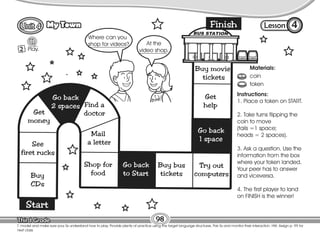
2 Play.
4
T. model and make sure your Ss understand how to play. Provide plenty of practice using the target language structures. Pair Ss and monitor their interaction. HW: Assign p. 99 for
next class.
Instructions:
1. Place a token on START.
2. Take turns flipping the
coin to move
(tails =1 space;
heads = 2 spaces).
3. Ask a question. Use the
information from the box
where your token landed.
Your peer has to answer
and viceversa.
4. The first player to land
on FINISH is the winner!
Where can you
shop for videos? At the
video shop.
Materials:
coin
token
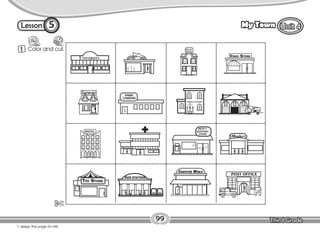
Lesson My Town
5
1 Color and cut.
T. assign this page for HW.
99
Lesson
My Town
1
5
100
Look, read, and complete.
Lesson My Town
5
101
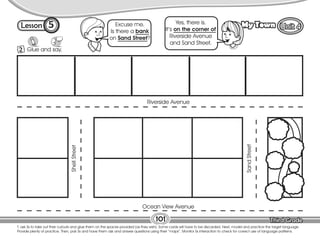
T. ask Ss to take out their cutouts and glue them on the spaces provided (as they wish). Some cards will have to be discarded. Next, model and practice the target language.
Provide plenty of practice. Then, pair Ss and have them ask and answer questions using their “maps”. Monitor Ss interaction to check for correct use of language patterns.
2 Glue and say.
Riverside Avenue
Ocean View Avenue
Shell
Street
Sand
Street
Excuse me.
Is there a bank
on Sand Street?
Yes, there is.
It’s on the corner of
Riverside Avenue
and Sand Street.
Lesson
My Town
Silver Street
Bank
Avenue
6
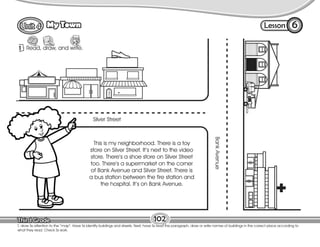
1 Read, draw, and write.
102
T. draw Ss attention to the “map”. Have Ss identify buildings and streets. Next, have Ss read the paragraph, draw or write names of buildings in the correct place according to
what they read. Check Ss work.
This is my neighborhood. There is a toy
store on Silver Street. It’s next to the video
store. There’s a shoe store on Silver Street
too. There’s a supermarket on the corner
of Bank Avenue and Silver Street. There is
a bus station between the fire station and
the hospital. It’s on Bank Avenue.
Lesson My Town
Restaurant
7
1 Listen and number.
103
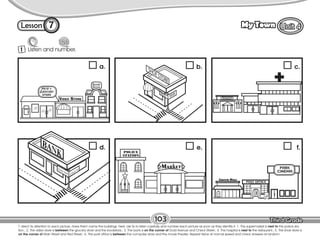
T. direct Ss attention to each picture. Have them name the buildings. Next, ask Ss to listen carefully and number each picture as soon as they identify it. 1. The supermarket is next to the police sta-
tion.; 2. The video store is between the grocery store and the bookstore.; 3. The bank is on the corner of Gold Avenue and Check Street.; 4. The hospital is next to the restaurant.; 5. The shoe store is
on the corner of Main Street and Red Street.; 6. The post office is between the computer store and the movie theater. Repeat twice at normal speed and check answers at random.
a. b. c.
d. e. f.
Lesson
My Town
104
Listen and color.
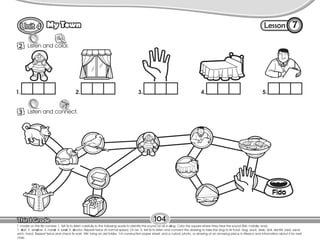
Listen
2
7
T. model on the Bb number 1. Tell Ss to listen carefully to the following words to identify the sound /d/ as in dog. Color the square where they hear the sound (first, middle, end).
1. doll; 2. window; 3. hand; 4. bed; 5. doctor. Repeat twice at normal speed. On ex. 3, tell Ss to listen and connect the drawing to take the dog to its food: dog, duck, desk, doll, dentist, bed, sand-
wich, hand. Repeat twice and check Ss work. HW: bring an old folder, 1/4 construction paper sheet, and a cutout, photo, or drawing of an amazing place in Mexico and information about it for next
class.
Listen and connect.
3
Listen
1. 2. 3. 4. 5.
Lesson My Town
105
8
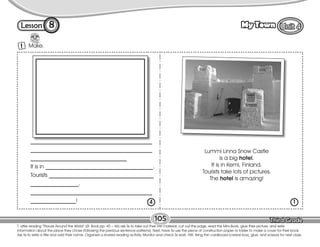
T. after reading “Places Around the World” (St. Book pp. 45 – 46) ask Ss to take out their HW material, cut out this page, read the Mini-Book, glue their picture, and write
information about the place they chose (following the previous sentence patterns). Next, have Ss use the piece of construction paper or folder to make a cover for their book.
Ask Ss to write a title and add their name. Organize a shared reading activity. Monitor and check Ss work. HW: Bring thin cardboard (cereal box), glue, and scissors for next class.
Make.
1
___________________________________________
___________________________________________
__________________________________
It is in ______________________________________.
Tourists _____________________________________
_________________.
___________________________________________
________________!
Lummi Linna Snow Castle
is a big hotel.
It is in Kemi, Finland.
Tourists take lots of pictures.
The hotel is amazing!
4 1
Lesson
My Town 8
1 Make.
106
T. monitor Ss work.
2
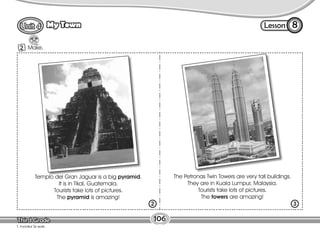
The Petronas Twin Towers are very tall buildings.
They are in Kuala Lumpur, Malaysia.
Tourists take lots of pictures.
The towers are amazing!
Templo del Gran Jaguar is a big pyramid.
It is in Tikal, Guatemala.
Tourists take lots of pictures.
The pyramid is amazing!
2 3
Lesson My Town
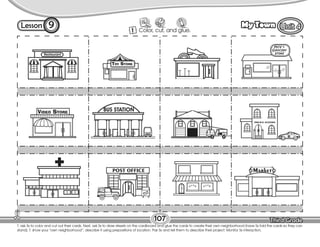
T. ask Ss to color and cut out their cards. Next, ask Ss to draw streets on the cardboard and glue the cards to create their own neighborhood (have Ss fold the cards so they can
stand). T. show your “own neighborhood”; describe it using prepositions of location. Pair Ss and tell them to describe their project. Monitor Ss interaction.
107
1 Color, cut, and glue.
9
Restaurant
Lesson
My Town
108
9
Lesson My Town
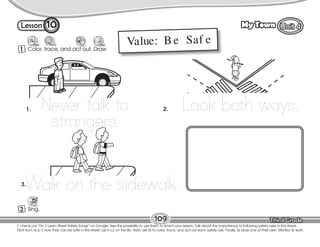
T. check out “Do 2 Learn Street Safety Songs” on Google. See the possibility to use them to enrich your lesson. Talk about the importance of following safety rules in the street.
Elicit from Ss (L1) how they can be safe in the street. List in L2 on the Bb. Next, ask Ss to color, trace, and act out each safety rule. Finally, Ss draw one of their own. Monitor Ss work.
109
1 Color, trace, and act out. Draw
act out
10
2 Sing.
Value: Be Saf e
Never talk to
strangers.
1. Look both ways.
2.
Walk on the sidewalk.
3.
Lesson
My Town
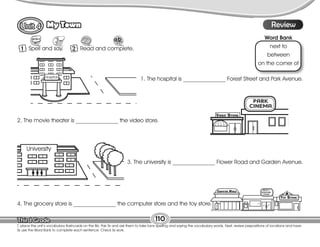
110
T. place the unit’s vocabulary flashcards on the Bb. Pair Ss and ask them to take turns spelling and saying the vocabulary words. Next, review prepositions of locations and have
Ss use the Word Bank to complete each sentence. Check Ss work.
10
1 Spell and say.
Review
2 Read and complete.
1. The hospital is _______________ Forest Street and Park Avenue.
2. The movie theater is _______________ the video store.
3. The university is _______________ Flower Road and Garden Avenue.
4. The grocery store is _______________ the computer store and the toy store.
Word Bank
next to
between
on the corner of
University
Lesson My Town
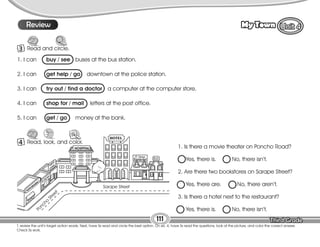
111
T. review the unit’s target action words. Next, have Ss read and circle the best option. On ex. 4, have Ss read the questions, look at the picture, and color the correct answer.
Check Ss work.
10
Review
3 Read and circle.
4 Read, look, and color.
1. Is there a movie theater on Poncho Road?
Yes, there is. No, there isn’t.
2. Are there two bookstores on Sarape Street?
Yes, there are. No, there aren’t.
3. Is there a hotel next to the restaurant?
Yes, there is. No, there isn’t.
1. I can buy / see buses at the bus station.
2. I can get help / go downtown at the police station.
3. I can try out / find a doctor a computer at the computer store.
4. I can shop for / mail letters at the post office.
5. I can get / go money at the bank.
Black Street
Pine
Street
Sarape Street
Poncho
Street
Lesson
My Town
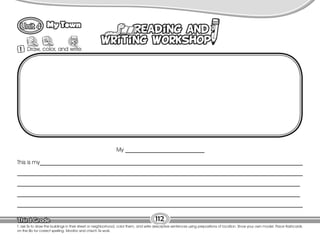
1 Draw, color, and write.
112
T. ask Ss to draw the buildings in their street or neighborhood, color them, and write descriptive sentences using prepositions of location. Show your own model. Place flashcards
on the Bb for correct spelling. Monitor and chech Ss work.
This is my_____________________________________________________________________________________________
_____________________________________________________________________________________________________
____________________________________________________________________________________________________
____________________________________________________________________________________________________
_____________________________________________________________________________________________________
My ____________________________
Lesson My Town
113
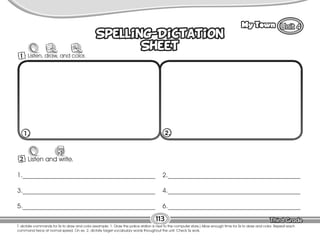
T. dictate commands for Ss to draw and color (example: 1. Draw the police station is next to the computer store.) Allow enough time for Ss to draw and color. Repeat each
command twice at normal speed. On ex. 2, dictate target vocabulary words throughout the unit. Check Ss work.
Spelling-Dictation
Sheet
Spelling-Dictation
Sheet
2 Listen and write.
W
1._________________________________________
3._________________________________________
5._________________________________________
2._________________________________________
4._________________________________________
6._________________________________________
1. 2.
1 Listen, draw, and color.
Lesson
My Town
114
Date:
Date:
Date:
Date:
Date:
Date:
Lesson My Busy Family
Unit 5
My Busy
Family
115
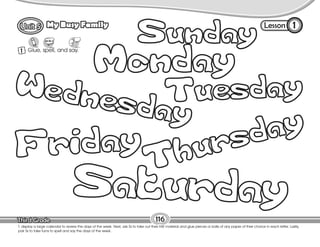
Lesson
My Busy Family
1 Glue, spell, and say.
1
116
T. display a large calendar to review the days of the week. Next, ask Ss to take out their HW material and glue pieces or balls of any paper of their choice in each letter. Lastly,
pair Ss to take turns to spell and say the days of the week.
Lesson My Busy Family
2
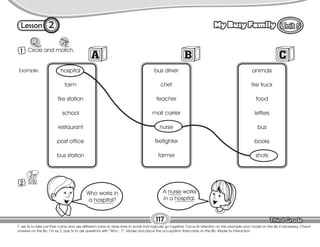
1 Circle and match.
117
T. ask Ss to take out their colors and use different colors to draw lines to words that logically go together. Focus Ss attention on the example and model on the Bb if necessary. Check
answers on the Bb. On ex.2, pair Ss to ask questions with “Who…?”. Model and place the occupation flashcards on the Bb. Model Ss interaction.
2 Say.
hospital
farm
fire station
school
restaurant
post office
bus station
bus driver
chef
teacher
mail carrier
nurse
firefighter
farmer
animals
fire truck
food
letters
bus
books
shots
Example:
Who works in
a hospital?
A nurse works
in a hospital.
Lesson
My Busy Family
118
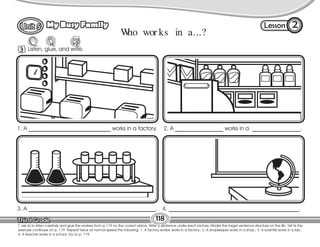
3 Listen, glue, and write.
2
T. ask Ss to listen carefully and glue the workers from p.119 on the correct place. Write a sentence under each picture. Model the target sentence structure on the Bb. Tell Ss the
exercise continues on p. 119. Repeat twice at normal speed the following: 1. A factory worker works in a factory.; 2. A shopkeeper works in a shop.; 3. A scientist works in a lab.;
4. A teacher works in a school. Go to p. 119.
4. ______________________________________________.
1. A _____________________________ works in a factory. 2. A _________________ works in a _________________.
3. A _____________________________________________.
W
ho wor ks in a...?
Lesson My Busy Family
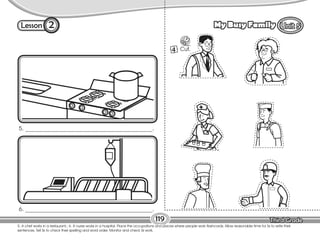
5. A chef works in a restaurant.; 6. A nurse works in a hospital. Place the occupations and places where people work flashcards. Allow reasonable time for Ss to write their
sentences. Tell Ss to check their spelling and word order. Monitor and check Ss work.
119
2
5. _____________________________________________.
6. _____________________________________________.
4 Cut.
Lesson
My Busy Family
120
3
Lesson My Busy Family
3
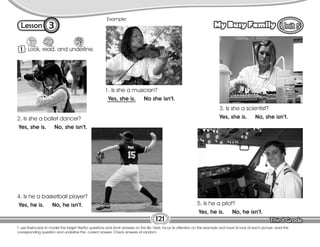
T. use flashcards to model the target Yes/No questions and short answers on the Bb. Next, focus Ss attention on the example and have Ss look at each picture, read the
corresponding question and underline the correct answer. Check answers at random.
121
1 Look, read, and underline.
Example:
1. Is she a musician?
Yes, she is. No she isn’t.
2. Is she a ballet dancer?
Yes, she is. No, she isn’t.
3. Is she a scientist?
Yes, she is. No, she isn’t.
4. Is he a basketball player?
Yes, he is. No, he isn’t. 5. Is he a pilot?
Yes, he is. No, he isn’t.
Lesson
My Busy Family
122
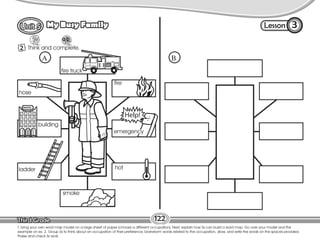
2 Think and complete.
3
T. bring your own word map model on a large sheet of paper (choose a different occupation). Next, explain how Ss can build a word map. Go over your model and the
example on ex. 2. Group Ss to think about an occupation of their preference, brainstorm words related to the occupation, draw, and write the words on the spaces provided.
Praise and check Ss work.
A B
hose
building
ladder
smoke
hot
fire
fire truck
emergency
Lesson My Busy Family
4
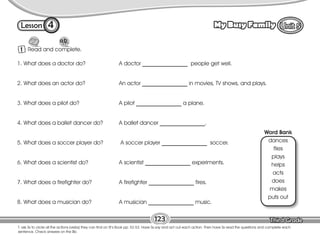
1 Read and complete.
123
T. ask Ss to circle all the actions (verbs) they can find on St’s Book pp. 52-53. Have Ss say and act out each action. Then have Ss read the questions and complete each
sentence. Check answers on the Bb.
1. What does a doctor do? A doctor ________________ people get well.
2. What does an actor do? An actor ________________ in movies, TV shows, and plays.
3. What does a pilot do? A pilot ________________ a plane.
4. What does a ballet dancer do? A ballet dancer ________________.
5. What does a soccer player do? A soccer player ________________ soccer.
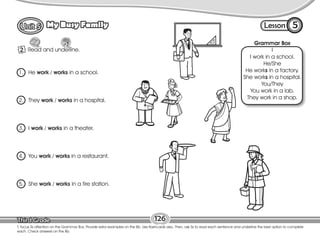
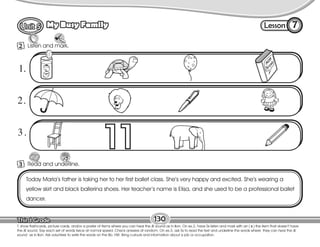
6. What does a scientist do? A scientist ________________ experiments.
7. What does a firefighter do? A firefighter ________________ fires.
8. What does a musician do? A musician ________________ music.
Word Bank
dances
flies
plays
helps
acts
does
makes
puts out
Lesson
My Busy Family
124
2 Draw, color, and write.
4
T. ask Ss what they want to be when they grow up. Next, ask Ss to draw and color the occupation they chose. Then, show your own model and help Ss write a descriptive
paragraph about the occupation. Make sure they write where this person works and what he/she does. Monitor and check Ss work.
I want to be a ___________________________________
________________________________________________
________________________________________________________________
________________________________________________________________
________________________________________________________________
________________________________________________________________
________________________________________________________________
________________________________________________________________
________________________________________________________________
________________________________________________________________
________________________________________________________________
________________________________________________________________
________________________________________________________________
________________________________________________________________.
Lesson My Busy Family
5
1 Read and complete.
T. focus Ss attention on the Grammar Box. Provide extra examples on the Bb. Use flashcards. Then, ask Ss to read and complete each sentence. Check answers on the Bb.
125
1. She _____________________ a chef.
2. I _____________________ a teacher.
3. They _____________________ police officers.
4. He _____________________ an actor.
5. You _____________________ a shopkeeper.
Grammar Box
am
is
are
Lesson
My Busy Family
2
5
126
Read and underline.
Grammar Box
I
I work in a school.
He/She
He works in a factory.
She works in a hospital.
You/They
You work in a lab.
They work in a shop.
T. focus Ss attention on the Grammar Box. Provide extra examples on the Bb. Use flashcards also. Then, ask Ss to read each sentence and underline the best option to complete
each. Check answers on the Bb.
1. He work / works in a school.
2. They work / works in a hospital.
3. I work / works in a theater.
4. You work / works in a restaurant.
5. She work / works in a fire station.
Lesson My Busy Family
6
127
T. introduce the concept: housewife. Then, pair Ss to solve the crossword puzzle. Check answers on the Bb.
1 Solve.
6
5
3
1
2
4
4
3
1
2
Down
1. He plays soccer.
2. She works in a hospital.
3. He works in a theater.
4. He puts out fires.
Across
1. He makes music.
2. She works in a restaurant.
3. He works in a factory.
4. He flies a plane.
5. She works in a lab.
6. She works in her house.
f a c t o r y w o r k e r
Example:
6
2 Say.
128
T. place the occupations flashcards on the Bb. Next, ask Ss to write under Father and Mother what their parents do. Then, practice the target language patterns and survey four
friends to find out what their parents do. Model as necessary. On ex.3 have Ss draw a family member and write about what he/she does. Monitor and check Ss work.
3 Draw and write.
What does your
mother do?
She is a
housewife.
She works in
our house.
Friends Father Mother
Me
1.
Lesson
My Busy Family
2.
3.
4.
My ________________ is a _________________________________.
He / She ________________________________________________
________________________________________________________
________________________________________________________
________________________________________________________
________________________________________________________
128
6
7
1 Listen and number. Write.
129
T. review the occupations vocabulary. Next, ask Ss to listen carefully and number each picture. 1. Marco is an actor.; 2. Leila is a factory worker.; 3. Perla is a firefighter.; 4. Raul
is a photographer.; 5. Yolanda is a shopkeeper. Model on the Bb if necessary. Repeat twice at normal speed. Lastly, ask Ss to use the Word Bank to complete each sentence.
Check Ss work.
Lesson My Busy Family
129
7
1. Marco is an _____________________________________________________________________.
2. Leila es a_______________________________________________________________________.
3. Perla is a ______________________________________________________________________.
4. Raul is a _____________________________________________________________________.
5. Yolanda is a ____________________________________________________________________.
Word Bank
housewife
photographer
firefighter
teacher
factory worker
actor
shopkeeper
Lesson
My Busy Family
130
Listen and mark.
Listen
2
7
T. show flashcards, picture cards, and/or a poster of items where you can hear the /l/ sound as in lion. On ex.2, have Ss listen and mark with an ( x ) the item that doesn’t have
the /l/ sound. Say each set of words twice at normal speed. Check answers at random. On ex.3, ask Ss to read the text and underline the words where they can hear the /l/
sound as in lion. Ask volunteer to write the words on the Bb. HW: Bring cutouts and information about a job or occupation.
Today Marla’s father is taking her to her first ballet class. She’s very happy and excited. She’s wearing a
yellow skirt and black ballerina shoes. Her teacher’s name is Elisa, and she used to be a professional ballet
dancer.
Read and underline.
3
1.
2.
3.
Lesson My Busy Family
131
8
T. provide the materials to make the cover of the class book (hole puncher, yarn, construction paper or an old folder, etc.). Next, ask Ss to glue or draw a picture of what they
want to be when they grow up, then write a description about what the person does in this job or occupation. T. monitor Ss work; provide any extra vocabulary, and help Ss put
together their class book. See T 58/. Make a Class Book. HW: Bring scissors, glue, and colors for next class.
Make.
1
My name is _________________.
When I grow up I want to be a/an ______________.
_____________________________________________
_____________________________________________
_______________________________________________________________
_______________________________________________________________
_______________________________________________________________
_______________________________________________________________
_______________________________________________________________
_______________________________________________________________
_______________________________________________________________
_______________________________________________________________
_______________________________________________________________
Lesson
My Busy Family 8
132
Lesson My Busy Family
1 Make and play.
T. ask Ss to color and cut out the finger puppets. Tell Ss to think about two other occupations of their preference and draw them on the blank templates. Next, introduce and
practice the target language patterns to play a guessing game. The St with the most correct job descriptions is the winner. Tell Ss to glue or tape the ends of their puppets to
fasten them around two fingers. Monitor Ss interaction.
133
1
9
You’re a
chef.
I cook food.
Who am I?
Lesson
My Busy Family
134
9
Lesson My Busy Family
T. explain the concept: set goals. Provide examples in L1 to clarify meaning. Make sure they are realistic and positive; instead of “I will not eat junk food any more.” rephrase the
goal and say “I will eat more fresh and healthy food.”. On ex. 1 ask Ss to think about how they can develop goals from their interests and then prepare to reach those goals. Tell
Ss to illustrate each goal and write what they are going to do to achieve them. Monitor Ss work.
135
1 Think, draw, and write.
10
Value: Set Goals
Copy: One day I will reach my goal.
Goal # 1 Goal # 2
Lesson
My Busy Family
136
T. review the days of the week. Next, ask Ss to complete and spell each week day in pairs. On ex.2, ask Ss to read and mark with a check the correct ending and write the
complete sentence on the line provided. Check answers on the Bb.
10
Review
1 Complete and spell.
1. S ____ ____ day 2. ____ o ____ day 3. ____ u ____ sday 4. W ____ ____ ____ ____ ____ day
5. ____ h ____ r ____ ____ ____ y 6. ____ r ____ ____ a ____ 7. S ____ ____ ____ ____ d ____ ____
2 Read, mark, and write.
1. A musician cooks food. makes music.
A musician makes music.
2. A scientist does experiments. gives shots.
____________________________________________________________________________________________________.
3. An actor acts in movies. puts out fires.
____________________________________________________________________________________________________.
4. A pilot sells books in a store. flies planes.
____________________________________________________________________________________________________.
Example:
Lesson My Busy Family
137
T. ask Ss to underline or circle the best option in each exercise. Model on the Bb if necessary. Check answers at random.
10
Review
3 Read and underline.
1. Is he a shopkeeper?
a) Yes, he is. b) No, he isn’t.
2. Is she a teacher?
a) Yes, she is. b) No, she isn’t.
4 Read and circle.
1. She is / am a police officer.
2. They is / are musicians.
3. I is / am an actor.
4. He work / works in a restaurant.
5. You work / works in a shop.
Lesson
My Busy Family
1 Read, think, and write.
138
T. ask Ss to read and solve the riddles. Ask Ss to write their answers on the lines provided. On ex.2, tell Ss to write their own riddles and say them to a peer. If the peer guesses,
he/she writes the occupation on the line. Monitor and check Ss work.
Example:
1. I paint pictures. Who am I? You’re a painter.
2. I play soccer. Who am I ? You’re ___________________.
3. I work in a hospital. I give shots. Who am I? You’re ___________________.
4. I work in a lab. I do experiments. Who am I? You’re ___________________.
2 Write and say.
1. I _________________________________. Who am I? You’re ________________________________.
2. ____________________________________________? You’re ________________________________.
Lesson My Busy Family
139
T. dictate commands for Ss to draw and color (example: 1. Draw a nurse.) Allow enough time for Ss to draw and color. Repeat each command twice at normal speed. On ex.
2, dictate target vocabulary words throughout the unit. Check Ss work.
Spelling-Dictation
Sheet
Spelling-Dictation
Sheet
2 Listen and write.
W
1._________________________________________
3._________________________________________
5._________________________________________
2._________________________________________
4._________________________________________
6._________________________________________
1. 2.
1 Listen, draw, and color.
Lesson
My Busy Family
140
Date:
Date:
Date:
Date:
Date:
Date:
Lesson Every Day
Unit 6
Every
Day
141
Lesson
Every Day
1 Look, say, and draw.
1
142
T. introduce the concepts: morning, afternoon, evening, and night. Relate each one to an activity done during that period of time and draw on the space provided. Provide
plenty of examples. On ex. 2, focus Ss attention on the verses of the unit song (see Enrichment/Rhyming words T62) and identify words that rhyme within each verse. Write them
down on the lines provided. See the example. Check answers on the Bb.
2 Write.
W
morning afternoon evening night
Example:
1. morning
warning
2. 3. 4. 5.
Lesson Every Day
1
3 Listen and color.
143
T. review numbers from 1 – 12. Use flashcards and realia. Next, tell Ss to take out a color, listen to the series of numbers, and color the corresponding dots: 1. three, six, nine.; 2.
ten, five, one.; 3. two, eight, twelve.; 4. seven, four, eleven.; 5. twelve, two, eight. Repeat twice at normal speed. HW: Bring a paper plate or toy clock for next class.
1.
2.
3.
4.
5.
1
2
3
4
5
6
7
8
9
10
11
12
1
2
3
4
5
6
7
8
9
10
11
12
1
2
3
4
5
6
7
8
9
10
11
12
1
2
3
4
5
6
7
8
9
10
11
12
1
2
3
4
5
6
7
8
9
10
11
12
Lesson
Every Day
12
1
2
3
4
5
6
7
8
9
10
11
12
1
2
3
4
5
6
7
8
9
10
11
12
1
2
3
4
5
6
7
8
9
10
11
144
1 Look and underline.
2
T. ask Ss to take out their paper plate or toy clock. Model and practice telling time as a whole group and then in pairs. Next, tell Ss to look at the clocks and underline the best
option. On ex. 2, model asking for and telling time. Pair Ss and ask them to use their paper plate or toy clocks to take turns asking for and telling time. Monitor Ss interaction.
2 Say.
1.
a) It’s two o’clock.
b) It’s three o’clock.
2.
a) It’s four o’clock.
b) It’s five o’clock.
3.
a) it’s ten o’clock.
b) It’s twelve o’clock.
It’s two o’clock.
What time is it?
Lesson Every Day
3 Listen and draw. Write.
T. ask Ss to listen carefully and draw the hands on each clock with the corresponding time: 1. It’s six o’clock.; 2. It’s eleven o’clock.; 3. It’s two o’clock.; 4. It’s seven o’clock.
Repeat twice at normal speed. Lastly, tell Ss to write the time under each clock. Check Ss work.
145
2
1. It’s o’clock.
12
1
2
3
4
5
6
7
8
9
10
11
2.
12
1
2
3
4
5
6
7
8
9
10
11
3.
12
1
2
3
4
5
6
7
8
9
10
11
4.
12
1
2
3
4
5
6
7
8
9
10
11
Lesson
Every Day
146
T. ask Ss to look at the pictures, point to, and say the actions (three times in the same order). Check comprehension by saying the actions at random and having Ss point to
each one. Monitor Ss work. On ex. 2, play “Simon Says”.
1
2
Look, point, and say.
Act out.
3
1. get up 2. take a shower 3. get dressed 4. eat breakfast
5. go to school 6. do homework 7. play with friends 8. go to bed
Lesson Every Day
3
T. tell Ss to focus their attention on the example and then match each action to its corresponding picture. Check Ss work.
147
3 Match.
Example:
1. do homework
2. eat breakfast
3. go to bed
4. get up
5. go to school
6. take a shower
7. play with friends
8. get dressed
1
Lesson
Every Day 4
148
T. review time expressions: every morning/afternoon/evening/night, and at _____ o’clock. Next, introduce and model the target language patterns and pair Ss to ask
and answer questions about daily routines. Monitor Ss interaction.
1 Look and say.
1. do homework
2. play with friends 3. eat dinner 4. take a shower
5. feed the cat 6. go to school 7. go to bed
She does homework
at five o´clock every
evening.
When does she
do homework?
Lesson Every Day
4
2 Read and complete.
149
T. place number flashcards from 1 – 12 on the Bb for correct spelling. Next, focus Ss attention on the example. Use flashcards to provide extra examples on the Bb before Ss
work on their own. Have Ss read and complete each sentence using the Word Bank. Check answers on the Bb. Answers may vary on item # 5 (every morning/evening).
o’clock morning afternoon evening night
Word Bank
1. She goes to school at seven o’clock every morning.
2. He eats lunch at _________________________ every ______________________________.
3. She feeds the bird at______________________every______________________________.
4. He goes to bed at ______________________ every _______________________________.
5. She takes a shower at ______________________ every ____________________________.
Example:
Lesson
Every Day
1 Look, read, and complete.
5
T. focus Ss attention on the Grammar Box (display the Grammar Poster if available). Provide extra examples on the Bb. Next, ask Ss to look at the pictures, read, and complete
each sentence. Use the Word Bank (there is one distractor). Check answers at random.
150
Grammar Box
When does |he| |she| eat dinner?
|He| |She| eats dinner at 8:00 every evening.
Word Bank
gets up
eats
feeds
gets dressed
plays
1. She ________________________ the cat every morning.
2. She ________________________ games with her friends at 5 o’clock.
3. He ________________________ lunch in his school every afternoon.
4. She ________________________ at 7 o’clock every morning.
Lesson Every Day
5
2 Draw and write.
T. show your own daily routine model. Encourage Ss to say what they do every morning / afternoon / evening / night. Then, tell Ss to write about a day in their lives and illustrate
each action. Aid Ss with any new actions (ex. Take guitar lessons, help my father wash the car, etc.). Check Ss work.
151
1. ___________________________________________
_______________________________every morning.
2. ___________________________________________
_______________________________every afternoon.
1. ___________________________________________
_______________________________every evening.
2. ___________________________________________
_______________________________every night.
Lesson
Every Day
1
Mark
6
T. ask Ss to scan the text and underline all the actions with their favorite color. Then, mark with a check the actions Karla and Franz do. Ask volunteers to read the texts aloud and
check answers at random. T. see Enrichment/Reading Strategy Awareness T 67 and write questions on the Bb that Ss can infer from the texts.
Read, underline, and mark.
152
goes to school
goes to work
takes a shower
eats breakfast
plays with his brothers
eats lunch
does homework
watches TV
Franz is a student. He eats breakfast
at 6 o’clock and goes to school
at 7 o’clock every morning.
He eats lunch at school. He does
homework in the afternoon and
plays with his brothers in the evening
before he takes a shower.
Karla is a factory worker. She takes
a shower every morning and eats
breakfast at 5 o’clock!
She goes to work at 6 o’clock and
eats lunch in the afternoon.
She watches TV and then goes to
bed at 9 o’clock.
Karla Franz
Lesson Every Day
7
T. ask Ss to listen to each daily routine action and number it in the order they hear it: 1. He goes to school in the afternoon.; 2. He takes a shower every morning.; 3. She gets
dressed at 7 o’clock.; 4. He gets up early every morning.; 5. She eats lunch in the afternoon.; 6. He goes to bed at nine o’clock every night. Repeat twice at normal speed.
Check answers on the Bb.
1 Listen and number.
153
Lesson
Every Day 7
2
3
Listen and color.
Solve.
T. play audio track B50 (see T 115). Have Ss listen and color only the blocks containing the /f/ sound as in fish. On ex. 3, Ask Ss to solve the puzzle. Check answers on the Bb.
154
2
1
3
2
1
3
4
5
1
1 2 3 4 5
2 3
Across
Down
Lesson Every Day
8
1 Read and write
155
T. ask Ss to read “Perfect Penny” (St.’s Book pp. 69 – 70), before they answer the questions. Ss may work in pairs and elicit from Ss (in L1) possible answers for question #6. Aid
Ss with any vocabulary in L2 they need to answer the questions. Check answers on the Bb. HW: Bring magazine cutouts or small drawings of daily routines, glue, and a paper
plate.
1. Where is Penny?
2. What does Penny do at 7:30 in the morning?
3. What time does she take a bath?
4. What is Penny’s favorite color?
5. Who is standing at the door?
6. Are they happy? Why?
Lesson
Every Day
12 1
2
3
4
5
6
7
8
9
10
11
Make and say.
1
9
T. show your own model. Move the clock’s hands and say what you do on Saturdays at that time of the day. Ask volunteers to come to the front to say what they do on
Saturdays. Lastly, pair Ss and have them take turns moving the hands of their clocks and saying what they do on Saturdays. Monitor Ss interaction.
156
Materials:
paper plate
small daily routines magazine cutouts or
small drawings
glue
Instructions:
1. Glue the daily routines cutouts next to the
corresponding hour on the clock’s face.
2. Next, tell your partner what you do on
Saturdays. Take turns.
Here are some things
I do every Saturday.
I ride my bike at
9 o’clock in
the morning.
Lesson Every Day
157
10
T. explain the concept of “be on time” and its importance. Use L1 when necessary. Then, tell Ss to look at the pictures and circle the “happy” or the “sad” face depending on
what Ss think about each situation. Then, ask Ss to think and say what each situation represents and how it make people feel. Ask Ss “Why do you think it is important to be on
time?” Finally, have Ss copy the sentence on ex. 2. HW: Bring a coin and a token for next class.
Look and circle. Think and say.
Write.
1
2
Copy: It’s important to be on time.
Value: Be on Time
a)
b)
a)
b)
a)
b)
a)
b)
Lesson
Every Day 7
1 Play.
158
T. review daily routine actions. Group Ss in trios (or fours). Tell Ss to decide who will begin the game. Then, ask them to place their token on the START star, flip a coin to move
(HEADS = 1 space; TAILS = 2 spaces), and say a sentence with the action shown and a time expression (ex. I do homework at 5 o’clock every day/evening.) and so on. The first
St. to reach the FINISH star is the winner. Monitor Ss interaction. Model if necessary.
1
Review
Go back
2 spaces
Go back
1 space
Go back
to Start
START
FI NI SH
Lesson Every Day
T. make sure Ss understand the instructions for exercises 2 and 3. Then, have Ss work on their own. Set a reasonable time to check answers on the Bb.
159
8
2 Look, read, and underline.
Read and complete.
3
Review
Review
1. a) It’s eight o’clock.
b) It’s eleven o’clock.
1. He gets up at _________________________ every ______________________________________.
2. She eats lunch at _________________________ every __________________________________.
3. He plays soccer at _________________________ every ________________________________.
o’clock morning afternoon evening night
Word Bank
2. a) It’s four o’clock.
b) It’s five o’clock.
3. a) It’s two o’clock.
b) It’s twelve o’clock.
4. a) It’s six o’clock.
b) It’s seven o’clock.
Lesson
Every Day
160
T. ask Ss to look at the pictures, read each sentence, and complete using the Word Bank (there are two distractors). Check answers on the Bb. HW: Bring material to make Hour
Glass (p. 161) for next class.
8
Review
4 Look, read, and complete.
1. He _______________________________________ every evening.
2. He _______________________________________at 9 o’clock every night.
3. She_______________________________________at 7 o’clock every morning.
4. He _______________________________________at 12 o’clock every afternoon.
Word Bank
goes to school
takes a shower
eats dinner
gets dressed
goes to bed
plays with friends
1 2 3 4
Lesson Every Day
T. ask Ss to take out their HW material. Go over the instructions together and show your own model of the hour glass. Monitor Ss work and aid them with step 3. Lastly, have Ss
record how long it takes the sand to flow (step 9).
161
1 Read and make.
9
Instructions:
1. Use strong glue to glue the top of one
cap to the top of the other.
2. Tape them together with electrical tape
for reinforcement.
3. Drill a hole through the center of both
caps using a drill (this task should be done
by the teacher or steps 1 – 3 should be
assigned for HW asking for parents aid).
4. Screw the drilled and glued cap piece
onto one of the plastic bottles.
5. Pour the sand through a funnel into the
other bottle.
6. Tightly screw the empty bottle to the
sand-filled bottle.
7. Poke a tiny hole with a push pin into the
side of each plastic bottle.
8. Turn the bottle upside down and watch
the sand flow into the empty bottle.
9. Use a digital watch to measure how
long it takes the sand to flow from one
bottle into the other.
Hour Glass
Materials:
2 plastic soda bottles with lids (600 ml.)
contact adhesive or strong glue
electrical black tape (duct tape)
2 cups clean sand or colored craft sand
1 push pin
1 funnel
small drill with thin bit (only for T’s use)
1
2
3
4
5
6
8 7
Lesson
Every Day
162
2 Read and number.
9
T. pair Ss and have them number in the correct sequence the steps for making an Hour Glass. Check answers at random or on the Bb.
a) Poke a tiny hole with a push pin into the side of each plastic bottle.
b) Screw the drilled and glued cap piece onto one of the plastic bottles.
c) Use strong glue to glue the top of one cap to the top of the other.
d) Turn the bottle upside down and watch the sand flow into the
empty bottle.
e) Tightly screw the empty bottle to the sand-filled bottle.
f ) Drill a hole through the center of both caps using a drill.
g) Tape them together with electrical tape for reinforcement.
h) Use a digital watch to measure how long it takes the sand to
flow into the empty bottle.
i) Pour the sand through a funnel into the other bottle.
Example:
7
Lesson Every Day
163
9
Spelling-Dictation
Sheet
Spelling-Dictation
Sheet
2 Listen and write.
W
1._________________________________________
3._________________________________________
5.___________________________________________
2._________________________________________
4._________________________________________
6.__________________________________________
1. 2.
1 Listen, draw, and color.
T. dictate commands for Ss to draw and color (example: 1. Draw it’s six o’ clock.) Allow enough time for Ss to draw and color. Repeat each command twice at normal speed.
On ex. 2, dictate target vocabulary words throughout the unit. Check Ss work.
Lesson
Every Day
164
9
Date:
Date:
Date:
Date:
Date:
Date:
Lesson Favorite Foods
Third Grade
Third Grade
Unit 7
Favorite
Foods
165
Lesson
Favorite Foods
Third Grade
Third Grade
1 Match and spell.
1
166
T. introduce the vocabulary. Use flashcards, a poster, and/or toy food. Then ask Ss to match each item to its corresponding word. Finally, have the whole group spell the words.
Check Ss work.
chicken
ice cream
tomato
hamburger
chocolate cake
orange juice
carrots
1.
2.
3.
4.
5.
6.
7.
Lesson Favorite Foods
Third Grade
Third Grade
1
2 Color and cut.
167
T. ask Ss to identify the items and color them before they cut them out. Glue on ex. 3. Monitor Ss work.
Lesson
Favorite Foods
Third Grade
Third Grade 168
2
Lesson Favorite Foods
Third Grade
Third Grade
3 Classify.
T. ask Ss to use cutouts from ex. 2 to classify under the correct categories. Model on the Bb if necessary. Monitor and check Ss work.
169
1
Fruits Vegetables Desserts Other Foods
Lesson
Favorite Foods
Third Grade
Third Grade 170
T. explain the use of: a, an, and some (see T 75). Then, have Ss read making emphasis on the target words. First, Ss read as a whole group and then ask for volunteers to read
several times more.
1 Read and say.
2
1. Betty has an orange. 2. Victor has a sandwich. 3. Sara has some cake.
4. Daniel has some ice cream. 5. Lola has a carrot. 6. Franz has an apple.
Lesson Favorite Foods
Third Grade
Third Grade
2
T. ask Ss to take out three different colors to trace the paths from each of the words (a, an, some) and say what they matched (ex. a hamburger, and so on). On ex. 3, have Ss
write the correct word next to each food item. Provide extra practice if necessary. Monitor and check Ss work. HW: Bring magazine cutouts of fruits, vegetables, drinks, snacks,
desserts, and meat/poultry/fish.
171
2 Trace and say.
3 Complete.
1. ______________ sandwich
2. ______________ grapes
3. ______________ cheese
4. ______________orange
5.______________ apple
6.______________ carrot
Word Bank
a an some
some
an
a
Lesson
Favorite Foods
Third Grade
Third Grade
3
172
T. ask Ss to take out their HW material. Introduce the new vocabulary concepts. Provide Ss with plenty of examples, before they classify their cutouts and glue them
under the correct category. Monitor Ss work.
1 Classify
Fruits Vegetables Snacks
Meat, Poultry, Fish Drinks Desserts
Lesson Favorite Foods
Third Grade
Third Grade
3
2 Say and mark.
173
T. review the food items from ex. 2. Introduce the target language patterns. Model and provide plenty of practice before Ss stand up to survey four peers. Tell Ss to mark with a
check ( ) the box or boxes of your peers´ preferences. Then, mark your own preferences. Have Ss go back to their places and graph (on ex. 3) their survey results. Tell Ss to use
different colors to make their graph. Model on the Bb if necessary. Monitor Ss interaction.
3 Graph.
chicken
Name:
1.
2.
3.
4.
5. Me
1
2
3
4
5
pear corn peas cheese
No, I don´t.
I like
tomatoes.
Do you like
onions?
Lesson
Favorite Foods
Third Grade
Third Grade
1 Draw.
4
T. ask Ss to draw their favorite foods and drinks. On ex. 2, present the target language structures. Model and provide plenty of practice. Pair Ss and tell them to use their favorite
foods and drinks to express what they want. Monitor Ss interaction.
174
2 Say.
My Favor it e Foods
I want to eat
some cookies
and ice cream.
What do you
want to eat?
I want to drink
some lemonade.
What do you
want to drink?
Lesson Favorite Foods
Third Grade
Third Grade
5
1 Read and circle.
T. show flashcards for each category. Make sure Ss identify each food item from ex. 1. Then, ask Ss to circle the odd one out (ex. meat sausage hamburger onions chicken
ham). Model on the Bb if necessary. Check Ss work.
175
1. meat sausage hamburger chicken ham
2. snacks crackers cheese nuts lamb chops
3. vegetables cake corn green beans peppers
4. drinks tea chicken milk water lemonade
5. fruit grapes strawberries carrots oranges
6. desserts sandwiches flan rice pudding pie cookies
Lesson
Favorite Foods
Third Grade
Third Grade
1
W
6
T. go over the Word Bank vocabulary to make sure every St. identifies the items. Then, provide riddle examples before Ss read and solve the ones on ex. 1. Check answers at
random. On ex. 2, have Ss write their own riddle. Then, pair Ss to solve their riddle. Tell peer to draw and say the answer. Monitor Ss interaction.
Read, guess, and write.
176
2 Write, guess, and draw.
W
Word Bank
popcorn
lamb chops
flan
cheese
chocolate milk
water
cherry
banana
1. It’s a drink. It’s brown. It isn’t tea, and it isn’t coffee.
It’s ______________________________________.
2. It’s a meat. It isn’t sausage, and it isn’t chicken. It comes from an animal that says: baa.
They are ______________________________________.
3. It’s a fruit. It’s red and small. It isn’t a strawberry, and it isn’t a grape.
It’s a ______________________________________.
4. It’s a snack. It’s white. It isn’t a cookie, and it isn’t rice pudding.
It’s ______________________________________.
It’s a _____________________________________________________________
__________________________________________________________________
__________________________________________________________________
__________________________________________________________________
Lesson Favorite Foods
Third Grade
Third Grade
6
T. pair Ss to talk about what they like and don’t like. Then, show your Ss how to fill in a Venn diagram. Model with a volunteer St. until you find a food item you both like. Monitor Ss
interaction.
3 Say and write.
177
W
hat we bot h like
W
hat I like W
hat my part ner
l
i
k
e
s
Lesson
Favorite Foods
Third Grade
Third Grade
7
1 Listen and number.
T. ask Ss to listen carefully to the following and number the pictures: 1. Carlos doesn’t like fish. He likes chicken.; 2. Lola doesn’t like bananas. She likes strawberries.; 3. I want to
drink tea.; 4. I like to eat cheese and crackers.; 5. Vicky likes to eat vegetables.; 6. Benito doesn’t like rice pudding. He likes flan. Repeat twice at normal speed. Check answers
on the Bb.
178
Lesson Favorite Foods
Third Grade
Third Grade
7
2 Listen and trace.
179
T. ask Ss to listen to the following and only trace the items where you hear the /m/ as in map: 1. marker; 2. milk; 3. apple; 4. monkey. Repeat twice at normal speed. Allow
enough time for Ss to trace. On ex. 3, ask Ss to read the text and underline all the words where they identify /m/ as in mouse. Finally, tell Ss to say the underlined words aloud.
Monitor and check Ss work.
3 Read and underline. Say.
Margarita is my mother.
She likes to make lemon muffins.
I eat my muffins and drink
a glass of milk when
I finish my homework.
Lesson
Favorite Foods
Third Grade
Third Grade
Read, write, and spell.
1
8
T. after reading the Little Book from St. Book pp. 81 – 82, have Ss answer ex. 1. Model on the Bb. Lastly, check answers on the Bb and spell aloud the words. On ex. 2, ask Ss to
read the sentences and circle Yes or No according to the information on the Little Book. Check answers at random. HW: Bring magazine cutouts of your favorite foods and
drinks and an old folder or piece of construction paper.
180
Read and circle.
Circle
2
1. Food from plants: _________________________, _________________________, _________________________,
_________________________, _________________________.
2. Food from trees: _________________________, _________________________, _________________________,
_________________________.
3. Food from animals: _________________________, _________________________, _________________________,
_________________________.
4. Food from the water: _________________________, _________________________, _________________________,
_________________________, _________________________.
1. Tortilla chips come from rice.
2. Pine nuts come from trees.
3. Cheese and ice cream come from cows.
4. Trout is a kind of fish.
5. Lemons come from animals.
6. Spaghetti and noodles come from wheat.
Yes No
Yes No
Yes No
Yes No
Yes No
Yes No
Lesson Favorite Foods
Third Grade
Third Grade
181
9
T. ask Ss to take out their HW materials and glue them on pp. 1 – 2. Then ask Ss to complete each sentence with the correct names of the items. Aid Ss with new vocabulary
spelling. On p. 3, Ss must glue or draw ALL their favorite foods. Ask Ss to not forget to write their name on the front page and make a book cover with the old folder and
decorate. Help Ss put together their book and do a shared reading activity.
Make.
1
by __________________________________
These
are my
favorite foods!
3
Lesson
Favorite Foods
Third Grade
Third Grade
9
182
Make.
1
I like to eat _________________________________
___________________________________________.
I like to drink _________________________________
___________________________________________.
1 2
T. monitor Ss work.
Lesson Favorite Foods
Third Grade
Third Grade
T. ask Ss to list their five favorite foods, one at the tip of each finger. Aid Ss with correct spelling at their request. Then, ask them to think if those foods are good and healthy food
or not. Elicit from Ss a list of Good & Bad Food for their health. Write it on the Bb. Lastly, tell Ss to only color the fingers on the hand where they named good food for them. On ex.
2, have Ss read the sentences and copy them on the line provided. Monitor and check Ss work.
183
10
1 Write, think, and color.
Read and write.
Review
2
Do you eat good food? Don’t eat too many desserts.
Value:
Eat Good Food
Lesson
Favorite Foods
Third Grade
Third Grade 184
T. ask Ss to identify each category and then classify the items from the Word Bank under the correct one. Check answers on the Bb.
8
1 Classify.
Review
Word Bank
milk peas nuts grapes cheese shrimp pear water mangoes cabbage pie
cookies chicken corn tea steak lemonade flan popcorn ice cream cherries onion
ham potato crackers tortilla chips rice pudding sausage pineapple chocolate milk
Meat,
Poultry, Fish
Fruits Vegetables Drinks Snacks Desserts
Lesson Favorite Foods
Third Grade
Third Grade
1. orange 3. mango 5. hamburger
2. strawberries 4. apple juice 6. tea
T. ask Ss to use a, an, or some to fill in the blanks. On ex. 3, tell Ss to listen carefully to the following and circle the correct item to complete each sentence: 1. Henry wants to
drink lemonade.; 2. Sofía wants to eat a sandwich.; 3. Rebeca wants to drink apple juice.; 4. Johnny wants to eat some shrimp. Repeat twice at normal speed. Finally on ex. 4,
have Ss read and answer each question with personal information. Check answers at random.
185
3 Listen and circle.
9
Review
2 Complete. Use a, an, or some.
Read and write.
4
1. Henry wants to drink… hot chocolate / lemonade.
2. Sofía wants to eat a… sandwich / hamburger.
3. Rebeca wants to drink… apple juice / orange juice.
4. Johnny wants to eat… a steak / some shrimp.
1. What do you want to eat? I
2. What do you want to drink? I
Lesson
Favorite Foods
Third Grade
Third Grade 186
1 Read.
9
T. explain briefly what the story is about, before your Ss read it silently. Let Ss know this is a real story and that some of Johnny´s apple trees still grow apples even though they are
over 200 years old. OPTIONAL: Check the following web page and share it with your Ss: www.weeklyreader.com/interactivestories/appleseed.html
A man named Johnny Appleseed
lived long ago. His real name was
John Chapman. Why did people
call him Johnny Appleseed? Let’s
read this story to find out.
Johnny Appleseed was born in
Massachusetts. He walked west
across the country. He carried a
sack of apple seeds. He planted
seeds in Illinois, Indiana, Kentucky,
Pennsylvania, and Ohio.
The St or y of Johnny Appleseed
A man named Johnny Appleseed
lived long ago. His real name was
John Chapman. Why did people
call him Johnny Appleseed? Let’s
read this story to find out.
Johnny Appleseed was born in
Massachusetts. He walked west
across the country. He carried a
sack of apple seeds. He planted
seeds in Illinois, Indiana, Kentucky,
Pennsylvania, and Ohio.
Lesson Favorite Foods
Third Grade
Third Grade
187
9
T. monitor Ss work.
Johnny did not have a
home. He made clothes
from sacks, and he did not
have shoes to wear. As a
hat, he wore a tin cooking
pot. In fact, he used the pot
for cooking!
Johnny Appleseed was
a kind and gentle man.
He was a friend to all the
people he met. He was
also a friend to animals.
Sometimes he would sleep with
them in their barn.
Years later, many apple trees grew
from all the seeds Johnny had
planted. People across the country
had apples to eat. Johnny liked to
tell people the story about his life.
People have told the story about
Johnny Appleseed for hundreds of
years. So the next time
you bite into an apple,
thank Johnny Appleseed!
1 Read.
Lesson
Favorite Foods
Third Grade
Third Grade 188
9
2 Draw and write.
W
T. ask Ss to think about the part of the story they liked best and illustrate it on the space provided. Then, have Ss write a description in their own words of their drawing. Monitor
and check Ss work.
Johnny Appleseed ________________________________
_________________________________________________
_________________________________________________
___________________________________________________________________
___________________________________________________________________
___________________________________________________________________
___________________________________________________________________
__________________________________________________________________
_________________________________________________
_________________________________________________
_________________________________________________
_________________________________________________
_________________________________________________
_________________________________________________
_________________________________________________
Lesson Favorite Foods
Third Grade
Third Grade
189
Spelling-Dictation
Sheet
Spelling-Dictation
Sheet
2 Listen and write.
W
1._________________________________________
3._________________________________________
5.___________________________________________
2._________________________________________
4._________________________________________
6.__________________________________________
1. 2.
1 Listen, draw, and color.
T. dictate commands for Ss to draw and color (example: 1. Draw an apple.) Allow enough time for Ss to draw and color. Repeat each command twice at normal speed. On
ex. 2, dictate target vocabulary words throughout the unit. Check Ss work.
Lesson
Favorite Foods
Third Grade
Third Grade 190
Date:
Date:
Date:
Date:
Date:
Date:
Lesson Fun at the Zoo
Third Grade
Third Grade
191
Unit 8
Fun at
the Zoo
Lesson
Fun at the Zoo
Third Grade
Third Grade
1 Glue and say.
1
192
T. introduce the concepts: claws, tails, feathers, and teeth. Then, have Ss look at their HW cutouts and group the pictures according to the characteristics they recognize. Have
them glue their pictures. Monitor Ss work and ask for the name of the animal part they are gluing.
claws
feathers
teeth
tails
Lesson Fun at the Zoo
Third Grade
Third Grade
1
2 Look, guess, and match. Spell.
193
T. introduce the zoo animals vocabulary before teaching the unit song (see T86). Use flashcards, a poster, toy animals, and/or a DVD (where possible). Then, ask Ss to match
each animal to its corresponding name. Check Ss work. Finally, pair Ss and have them take turns spelling the animal words. Monitor Ss interaction.
snake
monkey
crocodile
lion
peacock
elephant
bear
kangaroo
giraffe
tiger
hippo
zebra
Lesson
Fun at the Zoo
Third Grade
Third Grade 194
2
1 Read and underline.
T. introduce the highlighted words (descriptive adjectives). Provide plenty of examples. Then, ask Ss (in their first reading) to identify and underline all the animal words with a red
color and underline the body parts words with a green color. Lastly, have Ss read a second time. T. ask comprehension questions and ask volunteers to read aloud after the
second reading.
1. A cheetah has strong legs.
Its teeth are sharp.
2. Elephants are tall.
Their trunks are long.
3. A crocodile is short.
Its tail is strong.
4. Polar bears are big.
Their tails are short.
5. A peacock is small.
Its feathers are soft.
Lesson Fun at the Zoo
Third Grade
Third Grade
2 Look, read, and complete.
T. ask Ss to look at each picture, read each sentence, and use the Word Bank to complete it. Check answers on the Bb.
195
2
Word Bank
feathers
neck
mouth
teeth
short
tall
big
small
long
soft
sharp
strong
A giraffe is t___________.
Its n__________________
is l___________________.
Lions are s___________.
Their t__________________
are sh__________________.
Hippos are sh____________.
Their m__________
is b___________.
A peacock is s___________.
Its f______________________
are s____________________.
Lesson
Fun at the Zoo
Third Grade
Third Grade 196
T. assign this page for HW. Tell Ss to think about and draw two animals they would like to describe. Tell Ss to use words from the Word Bank on ex 2.
3 Think, draw, and write.
2
Lesson Fun at the Zoo
Third Grade
Third Grade
3
T. introduce animal actions. Model. Explain the meaning of the following concepts: heavy, fast, and high. Have Ss read and say each action after you three times in the same
order. Then, say them at random and tell Ss to act out each one for comprehension. Monitor Ss TPR performance.
197
1 Say and act out.
1. catch fish 2.lift heavy things 3. swim fast 4. jump high
5. climb 6. eat 7. swing
8. run fast 9. squeeze animals
Lesson
Fun at the Zoo
Third Grade
Third Grade
3
198
T. elicit from Ss information they know about ostriches (L1is accepted). Next, tell Ss to read the text a first time to underline all the descriptive words, and lastly read one
more time to circle what an ostrich can do. Explain the concept; “lay eggs” if necessary. Monitor and check Ss work.
2 Read, underline, and circle.
An ostrich likes to eat
plants and insects. It lives in
groups of five to fifty birds.
And it can lay the biggest
eggs in the planet! An
ostrich can lay 40 to 100
eggs in a year.
An ostrich is a big bird. It
has long legs and a long
neck. Its eyes are very
big, but the head is small.
Its feathers are long, soft,
and decorative. Its feet
have very sharp claws.
It can attack with a kick
from its strong legs. It can
run very fast (72km/hr),
but it can’t fly.
One ostrich egg is equivalent
to 24 chicken eggs!
Do you want to know?
Lesson Fun at the Zoo
Third Grade
Third Grade
4
1 Read, think, and mark.
199
T. focus Ss attention on the Grammar Box. Point out the use of singular and plural responses. Provide extra examples. Use flashcards. On ex. 1, ask Ss to look at the example.
Check answers at random.
Grammar Box
Can a hippo swim? Yes, it can.
Can an ostrich fly? No, it can’t.
Can elephants lift heavy things? Yes, they can.
Can seals squeeze animals? No, they can’t.
1. Can a monkey climb trees? Yes, it can. No, it can’t.
2. Can cheetahs run very fast? Yes, they can. No, they can’t.
3. Can a giraffe jump very high? Yes, it can. No, it can’t.
4. Can snakes walk? Yes, they can. No, they can’t.
5. Can crocodiles fly? Yes, they can. No, they can’t.
6. Can an elephant spray water with its trunk? Yes, it can. No, it can’t.
Example:
Lesson
Fun at the Zoo
Third Grade
Third Grade
2 Read and complete.
4
T. review the actions. Use flashcards and TPR. Then have Ss read and complete ex 2. Use the Word Bank. Check answers on the Bb.
200
Word Bank
catch swim carry eat run jump fly swing climb
A giraffe can (1) e____________ leaves from a tall tree, but it can’t (2) s____________ from a tree.
A crocodile can (3) s____________ fast, but it can’t (4) r____________ fast.
An ostrich can (5) r____________ fast, but it can’t (6) f____________.
An elephant can (7) c____________ heavy things with its trunk, but it can’t (8) j_____________ high.
A monkey can (9) c____________ trees, but it can’t (10) c____________ a seal!
Animals Can Do Many Things
Lesson Fun at the Zoo
Third Grade
Third Grade
5
1 Read and write.
T. place the target animals flashcards on the Bb. Focus Ss attention on the Grammar Box. Provide extra models for Ss to understand the target language structures. Next, ask Ss
to read each question and write an appropriate answer referring to the Grammar Box if necessary. Monitor and check Ss work.
201
Grammar Box
Does a tiger have sharp claws? Yes, it does.
Does a peacock have short feathers on its tail? No, it doesn’t. It has long feathers.
1. Does a cheetah have sharp teeth?
2. Does an elephant have a short trunk?
3. Does a hippo have a big mouth?
4. Does a lion have a short tail?
5. Does a bear have big ears?
6. Does a seal have big eyes?
Third Grade
Third Grade
1
W
5
T. bring your own model (see T91/10. Ask Five Friends.). Explain to Ss they have to write their name on the first box, then their favorite animal, and a brief description of the
animal. Afterwards, they have to survey six peers and fill in the chart. Monitor Ss interaction and provide any extra vocabulary they might need (ex. how to spell dinosaur and its
description, etc.).
Say and write.
What´s your
favorite animal?
Name Favorite animal Description
1.
Lesson
Fun at the Zoo
2.
3.
4.
5.
6.
7.
6
202
Third Grade
Third Grade
Third Grade
Third Grade
7
T. tell Ss to listen to the following information, mark with a check ( ) if it’s TRUE and with an ex (x) if it’s FALSE. 1. Crocodiles can’t jump high.; Ostriches have long necks.; 3.
Peacocks have long feathers on their tails.; 4. Monkeys can swing and climb.; 5. Kangaroos have short tails.; 6. Hippos can’t swim. Repeat twice at normal speed.
Answers: 1. , 2. , 3. , 4. , 5. x, 6. x . Check answers on the Bb.
1
Mark
Listen and mark
Lesson Fun at the Zoo
7
1.
2.
3.
4.
5.
6.
203 Third Grade
Third Grade
Lesson
Fun at the Zoo
Third Grade
Third Grade
7
2 Listen and mark.
204
3 Read, underline, and draw.
R
A baby dog is a puppy.
My uncle Peter has a new
puppy named Lucky.
He likes to run in the garden.
After he eats his food, he likes
to sleep on a rug under the
sun. He is a lovely puppy.
T. explain that the letter u stands for different sounds in English or different spellings. Provide several examples (cup/ – purple/ ), (love/ - juice/ ), (bus/ -
book / ). Today they’re going to identify / / as in sun. Listen to the following and mark with a check the box of the item that stands for / /. Repeat twice at normal
speed: 1. duck; 2. hundred; 3. umbrella; 4. computer. On ex. 3, ask Ss to read and underline the words with the / / sound. Check answers and finally ask Ss to draw their
favorite / / word.
Lesson Fun at the Zoo
Third Grade
Third Grade
8
205
T. after reading the Little Book on pp. 93-94 ask the comprehension questions (see T94). Then, tell Ss to read and mark with a check ( ) the best answer. If necessary have Ss
read the story one more time. Lastly, elicit from Ss other folktales they know about and list them on the Bb (ex. The Hare and the Turtle/The Lion and the Mouse, etc.). Have Ss
draw a part of the tale to share it with a peer. Monitor and check Ss work. HW: Bring a stuffed or toy zoo animal and information about it; also bring markers, colors, and paper
plate or tube for next class.
1 Read and mark.
2 Draw and say.
1. King Lion catches Rabbit for his dinner.
2. King Lion takes Rabbit to a deep well.
3. King Lion looks at his reflection in the well.
4. King Lion roars, “I am king of the forest”.
5. Rabbit jumps in to the well because he is happy.
6. Rabbit goes to the forest to eat.
True False
Lesson
Fun at the Zoo
Third Grade
Third Grade
9
T. ask Ss to take out their HW material, draw, and write about their zoo animal. Help Ss set up a zoo area with different habitats. Ss place their animal and give information about
it to their peers. Monitor Ss interaction. Praise Ss work.
Make.
1
206
Instructions:
1. Bring a zoo animal (stuffed, paper plate, or paper tube)
2. Each St. will draw a picture of his/her animal and write about it.
(Where it lives, what it eats, how many legs it has, and any other
feature or information they can give).
3. Next, set up an area in the classroom as a zoo, with different
habitats.
4. Each child is their animal’s zookeeper and tells about his/her
animal. Invite other classes to come if possible.
5. Enjoy and take pictures!
St uf f ed or Paper
Animal Zoo
Materials:
1 zoo animal, (stuffed, paper plate, or paper tube)
1 sheet of paper
markers/colors
corresponding zoo animal’s habitat (natural
environment: jungle, forest, desert, rainforest,
savanna, ocean, tundra, etc.)
Lesson Fun at the Zoo
Third Grade
Third Grade
207
10
T. ask Ss what they think to “appreciate animals” means. Discuss in L1. Encourage Ss to think about their attitudes towards animals. Do they treat pets well? Do they like wild
animals? Do they like and respect animals? How? On ex. 1, tell Ss to draw the “How?” and label their drawing. Provide any necessary vocabulary. Next, have Ss answer the
questions on the line provided and discuss. Monitor Ss work; help Ss with vocabulary if necessary.
2 Write and say.
1 Draw and label .
Do you appreciate animals? Why?
Value: Appr eciat e Animals
Lesson
Fun at the Zoo
Third Grade
Third Grade 208
T. review the unit’s target vocabulary. Then, ask Ss to look at the pictures, read, and complete each sentence. Use the Word Bank. Check answers on the Bb.
8
1 Look, read, and complete.
Review
Word Bank
big
short
long
soft
sharp
small
eyes
neck
mouth
ears
teeth
claws
feathers
tail
trunk
A polar bear is b________________.
Its t________________ is s________________.
Elephants are b___________.
Their t________________
is l________________.
3. Lions like to eat meat.
Lions have s________________ t________________
An ostrich has a s________________ head
and b________________e________________.
Its f_____________are l_____________ and s_____________.
Lesson Fun at the Zoo
Third Grade
Third Grade
On ex. 2, have Ss circle the best option to complete each sentence. On ex. 3 and 4, ask Ss to read each question and use the Word Banks to answer. Model if necessary.
Check answers on the Bb.
209
3 Read and write.
9
Review
2 Circle.
Read and write.
4
Word Bank
Word Bank
1. Monkeys can can’t swing from trees.
2. Snakes can can’t run.
3. Elephants can can’t lift heavy things.
Yes, it can.
No, it can’t.
Yes, they do.
No, they don’t.
1. Can a cheetah run very fast?
2. Can a giraffe eat leaves?
3. Can a kangaroo climb a tree?
1. Do ostriches have long necks?
2. Do peacocks have soft feathers?
3. Do hippos have big ears?
4. Do snakes squeeze animals?
Lesson
Fun at the Zoo
Third Grade
Third Grade 210
1 Read, guess, and write.
9
T. ask Ss to read the clues, (place animal flashcards for correct spelling if necessary), guess the animal, and write its name on the lines provided. On ex. 2, tell Ss to read about
peacocks. Then ask Ss to think about their favorite animal, write a descriptive paragraph, and draw or glue a picture. Monitor and check Ss work.
1. ____ ____ ____ ____ ____ ____ ____ ____ ____
A long reptile that lives in rivers – it can be dangerous.
2. ____ ____ ____ ____ ____ ____ ____
A big black and white bird with wings – but it can’t fly.
3. ____ ____ ____ ____ ____ ____ ____ ____ ____
A big white animal with a short tail – it can catch seals.
4. ____ ____ ____ ____ ____ ____ ____ ____
An animal with a pouch – it can jump very high.
5. ____ ____ ____ ____ ____
A big gray river animal with short legs, small eyes and ears – but a big mouth.
2 Read, think, and write. Draw or glue.
Peacocks
Peacocks come from Africa and Asia. The
males have an extravagant and colorful
tail and the females are brown or gray and
brown. Peacocks like to eat plants, flowers,
seeds, scorpions, caterpillars, and insects.
They can fly short distances.
My Favorite Animal
Lesson Fun at the Zoo
Third Grade
Third Grade
211
Spelling-Dictation
Sheet
Spelling-Dictation
Sheet
2 Listen and write.
W
1._________________________________________
3._________________________________________
5.___________________________________________
2._________________________________________
4._________________________________________
6.__________________________________________
1. 2.
1 Listen, draw, and color.
T. dictate commands for Ss to draw and color (example: 1. Draw a snake.) Allow enough time for Ss to draw and color. Repeat each command twice at normal speed. On ex.
2, dictate target vocabulary words throughout the unit. Check Ss work.
Lesson
Fun at the Zoo
Third Grade
Third Grade 212
Date:
Date:
Date:
Date:
Date:
Date:
Lesson 12 Months Make a Year
213
Unit 9
12 Months
Make a
Year
Lesson
12 Months Make a Year
1 Color.
1
214
T. review the days of the week and introduce the months in a year. Use flashcards and/or a large calendar. Then, ask Ss to take out two of their favorite colors. Use one to color
the days of the week and the other one to color the months. Check Ss work.
Saturday
April
July
February
Tuesday
October
May
Monday
September
Thursday
August
January
December
June
November
Wednesday
March
Friday
Sunday
Lesson 12 Months Make a Year
1
2 Chant or sing.
215
T. pre – teach the following vocabulary: summer, winter, another year, Christmas. Next, teach the chant and chant or sing throughout the unit. Optional: Visit www.britishcouncil.org/
kids-songs-months-2.htm to hear the song.
January, February, March.
April, May, and June,
July and August, goodbye summer.
Hey September, October, November.
It’s December, winter’s here.
Goodbye Christmas, that’s the end.
Time for another year.
Time For
Anot her Year
Lesson
12 Months Make a Year
216
1 Read, underline, and say.
2
T. ask Ss to read the first time silently and underline in red all the months of the year they can spot and all the action words in blue. For the second time Ss read, ask them to
read aloud. Aid Ss with any new vocabulary. Monitor and check Ss work.
Lupita lives in Arteaga,
México. In September,
she always helps her
family pick apples. She
never plants trees.
Jason lives in New
York, U.S. In January,
he always goes ice
skating. He never goes
swimming. It’s too
cold. Brrr!
Jehangir lives in Agra,
India. In May, he
always goes swimming
in the Yamona River.
He never wears a
jacket. It’s very hot!
Lesson 12 Months Make a Year
2 Listen and number.
T. ask Ss to listen carefully to the following and number the pictures. 1. In December, they never play soccer.; 2. In June, she always rides a bike.; 3. In November, she never
wears shorts and sandals.; 4. In August, they always go swimming.; 5. In April, he never goes skiing. Repeat twice at normal speed. Check Ss work.
217
2
Lesson
12 Months Make a Year
218
T. before reading, elicit from Ss important events or celebrations in their homes. What they celebrate and how? Next, have Ss read silently the texts and underline the date when
each festivity is celebrated. Finally, ask volunteers to read aloud.
1 Look and read. Underline.
3
1. In Brazil, we celebrate our
Carnival in February (Monday
and Tuesday before Ash
Wednesday). We parade
down the streets wearing
beautiful costumes and
dancing “samba” all day
long. It’s perhaps the largest
public festivity in the world!
2. In the United States, we
celebrate Independence Day
in July. We celebrate attending
a parade, barbecues or
picnics, a fair or baseball
game, and at night we have
fireworks all around the country.
Everybody decorates their
house with American flags and
we sing songs like: “God Bless
America” and “America the
Beautiful”.
3. In Mexico, we celebrate the
Day of the Dead in November.
We build an altar honoring a
deceased relative, friend, or
person we knew well. We end
the day by visiting the church
and the cemetary to pray for
our loved ones and eat their
favorite foods.
Lesson 12 Months Make a Year
3
T. ask Ss to look at the example. Then, tell Ss to think about another celebration they know of and fill in the Word Map as in the example. Have Ss brainstorm ideas in pairs and
help Ss out with any vocabulary they might need. Monitor and check Ss work.
219
2 Think and write.
Example:
Independence
Day (Mexico)
eat special
food
hear
music
see
fireworks
in
September
wear red, white,
and green pins,
ribbons, clothing
items
cheer “Viva
Mexico”!
Lesson
12 Months Make a Year
220
T. introduce the target language models. Provide enough practice, before you pair Ss to ask and answer the questions. Monitor Ss interaction and check answers. Place months
flashcards or calendar poster if necessary.
4
1 Say and write.
1. When do you start school? We / I start school in August.
2. When do you celebrate Independence Day? _______________________________________________
_________________________________________________________________________________________.
3. When is your birthday? My________________________________________________________________
_________________________________________________________________________________________.
4. When do you plant trees and flowers? _____________________________________________________
_________________________________________________________________________________________.
5. When do you give each other presents? ___________________________________________________
_________________________________________________________________________________________.
6. When do you go on vacation? ____________________________________________________________
_________________________________________________________________________________________.
Lesson 12 Months Make a Year
4
2 Look, read, and write.
T. use photos to introduce the target language structures. Provide enough practice before the Ss work on ex. 2. Make sure Ss understand the Phrase Bank phrases. Then, ask Ss to
look, read, and write about what they see. Tell them to follow the example. Check answers on the Bb.
221
celebrate
Christmas
rolls down
a cheese
throws
tomatoes
goes back
to school
celebrate
Valentine’s Day
2. What does she do?
She ______________________________________________________
When does she do it?
__________________________________________________________
Example:
Phrase Bank
USA in December
Argentina in September
England in May
3. What does he do?
He _______________________________________________________
When does he do it?
_________________________________________________________
1. What do they do?
They celebrate Christmas.
When do they do it?
__________________________________________________________
Lesson
12 Months Make a Year
1 Look, read, and write.
5
T. focus Ss attention on the Grammar Box. Provide plenty of examples in the Bb and elicit some from your Ss. Next, have Ss look at the pictures, read each question, and write
appropriate sentences with always and never. Monitor and check Ss work.
222
1. What do you do in November?
We always________________________________________________
We never_________________________________________________
2. What do you do in January?
We ______________________________________________________
3. What do you do in May?
We ______________________________________________________
4. What do you do in July?
We _______________________________________________________
Grammar Box
What do you do in September? We always celebrate Independence Day.
We never plant a tree.
Lesson 12 Months Make a Year
5
2 Listen and number.
T. tell Ss to listen and number the calendar pages according to the order in which they hear each month’s name: 1. October; 2. June; 3. April; 4. March. Repeat twice at
normal speed. Next, place the months of the year poster or flashcards on the Bb. Then, have Ss read the riddles, think, and write down the correct month of the year. Check
answers on the Bb or ask volunteers to provide the answers.
223
3 Read, think, and write.
1. It’s between August and October.
In Mexico we celebrate Independence Day. It’s __________________________________.
2. It’s between April and June.
Many people celebrate Mother’s Day. ___________________________________________.
3. It’s between January and March.
Some people celebrate Valentine’s Day._________________________________________.
Which
month is it?
March June April October
Lesson
12 Months Make a Year
4
5
T. ask Ss to read each question carefully and answer according to their personal information and knowledge. On ex. 5, ask Ss to draw a special event or celebration that
happens in their favorite month and write about it. Monitor and check Ss work.
Read and write. Say.
224
1. When is your birthday? _____________________________________________________________________
2. When do you start school? _________________________________________________________________
3. When do you finish school? _________________________________________________________________
4. When does your family have a big party? ____________________________________________________
Why? Because we celebrate _______________________________________________________________
5. When do people have a parade? __________________________________________________________
My favorite month is _______________________________
because _________________________________________
_________________________________________________
_________________________________________________
__________________________________________________
5 Draw and write.
Draw
Lesson 12 Months Make a Year
6
T. ask Ss to survey their peers to find out when their birthday is. Tell Ss to write their peers’ name next to the corresponding month. Finally, make a class Birthday Graph. Ask Wh-
questions (see Enrichment/T103).
1 Say and write.
225
January
February
March
April
May
June
July
August
September
October
November
December
When is
your birthday?
Lesson
12 Months Make a Year 7
1 Listen and write.
T. ask Ss to listen carefully to the following information to complete each sentence with the correct month: 1. Lola’s brother’s birthday is in November.; 2. Her family always celebrates New Year with
a great party in January.; 3. We never go to the mountains in April, because it rains a lot.; 4. Lola’s favorite month is July, because school is over.; 5. This year Easter vacation starts in March. Repeat
twice at normal speed. On ex. 2, have Ss read, guess, and match each month to its corresponding text. Check answers at random.
226
My favorite month is _____________________,
because there are many flowers and we
celebrate Mother’s Day.
My favorite month is _____________________,
because we give Valentine’s Day cards to
each other and candy sometimes.
My favorite month is _____________________,
because we celebrate “Las Posadas”.
1. Her brother’s birthday is in ____________________________________________.
2. Her family always has a party in ______________________________________.
3. They never go to the mountains in ____________________________________.
4. Her favorite month is ________________________________________________.
5. This year Easter vacation starts in ________________________________________.
2 Read, guess, and match.
Guess Connect
December
February
May
Lesson 12 Months Make a Year
7
3 Look and circle.
T. introduce the /h/ sound. Have Ss understand, identify, and say the /h/ sound as represented by the letter h. Use realia or flashcards to present words that begin with the target
sound. On ex. 3, ask Ss to look at the picture and circle the corresponding word. On ex. 4, have Ss color and label only the pictures that begin with h. Monitor and check
answers on the Bb. HW: Do research about a favorite holiday and bring cutouts and proper decorations.
227
4 Color and label.
1. had ham hand head
2. horse house hose hook
3. hoses house hobble horse
4. hot dog hot hat ham
Word Bank
hammer
hat
heart
hundred
hippo
hamburger
1.
4.
7.
2.
5.
8.
3.
6.
9.
Lesson
12 Months Make a Year
Read.
1
8
T. read the passage with your Ss. Display a World Map for them to locate India and Mexico (see how far they are from one another). After reading the first time ask Ss if they can
find similarities in Diwali celebration with any Mexican celebration (special food/Day of the Dead; fireworks/Independence Day or New Year, etc.). Have Ss read silently a second
time and answer some comprehension questions.
228
Diwali or Deepavali means Festival of
Light. It is an official holiday in India. It’s
the favorite time of the year for many
Hindus.
Each year, Hindus around the world
celebrate for five days during the
months of October or November.
During Diwali people play card games,
and dress up in special clothes. Hindus
give boxes of colorful coconut sweets
called barfi to their family and friends.
They light decorated candles and clay
lamps called diyas. People put them in
their windows and even on their roofs.
You can see beautiful fireworks, too.
Remember, most festivals bring families
together!
Lesson 12 Months Make a Year
8
T. ask Ss to think about the information they found about their favorite holiday. Have Ss use the guidelines to write a descriptive paragraph. Lastly, tell Ss to take out their holiday
cutouts and decorations. Ss must design a mini-collage on the space provided. Check and praise Ss work.
Think, write, and glue.
2
229
My favorite holiday is _________________________________________________________________________________.
It is celebrated in the month of ________________________________________________________________________.
My favorite tradition for this holiday is ___________________________________________________________________
____________________________________________________________________________________________________.
This is my favorite holiday because _____________________________________________________________________
____________________________________________________________________________________________________.
Lesson
12 Months Make a Year 9
1 Make.
T. ask Ss to take out their HW materials and team them up. Read the instructions and make sure they understand what to do. Show your own banner! Monitor and praise Ss work
(see Enrichment/Plan a Class Parade – T 106). HW: Bring a photo of a special family gathering (weding, birthday, etc.).
1
230
Materials:
1 sheet of construction paper
markers
researched information
cutouts
scrap material for decorating
glue
scissors
Instructions: Group students.
1. Each group takes out their material. Assign a month
of the year to each group.
2. Each group discusses the information about
holidays or special events held during the month of
the year they were assigned.
3. Make and decorate a banner, containing pictures
that occur during their month. Include things you can
eat, wear, do, or places to go.
4. When all the banners are ready, organize by
months and have a parade! Sing “Twelve Months” or
chant “Favorite Months”.
Example:
Class Par ade
Lesson 12 Months Make a Year
T. ask Ss to take out their photo. Elicit from Ss information about a special event where relatives spend time together to celebrate a great occasion. Next, ask Ss to look at the
picture and read about Christmas in Australia. Finally, tell Ss to glue their photo on the space provided and write a descriptive paragraph. Monitor and aid Ss if necessary. HW:
Assign pages 232 and 233 for next class.
1 Read, glue, and write.
10
231
Value: Celebr at e Special Days
In ______________________________________________.
We celebrate ____________________________________
_________________________________________________
_________________________________________________
_________________________________________________
_________________________________________________
_________________________________.
In Australia at Christmas time we have hot weather.
We celebrate Christmas going on picnics or having
a barbecue on the beach with our family and
relatives. We all have a great time!
Lesson
12 Months Make a Year
T. ask Ss to color the wheel: red, blue, green, orange, and yellow. Ask Ss to alternate colors. See Know it? Show it!/T109, to explain how to play the game.
1 Color and play.
8
232
8
Review
Lesson 12 Months Make a Year
T. tell Ss to color the wheel, poke a hole with a pencil, and use it as a spinner to play the game. Next, have Ss glue a thin cardboard at the back of the page and cut out all the
items. Tell Ss to bring them to class in an envelope, small box, or plastic bag. Use with p. 232.
2 Color, glue, and cut.
9
233
yellow
orange
green
blue
r
e
d
9
Review
Lesson
12 Months Make a Year 9
234
8
Lesson 12 Months Make a Year
9
235
T. ask Ss to find out about a special holiday from around the world. You can refer Ss to the following web pages: www.kidsturncentral.com/holidays; www.kidsyahoo.com/
directory/Around-the-World/; www.sunniebunniezz.com/holiday/. Write about it, specially if people wear costumes, sing, eat special food, play, pray, etc. Finally, tell Ss to glue
the page on half a sheet of construction paper, illustrate, and get ready to share the information found next class. Praise Ss work and display poster during your public class!
9
Review
3 Make and say.
A Special Holiday f r om Ar ound t he W
or ld
______________________________ is celebrated in______________________________ in the month of
(holiday) (country)
______________________________ .
(month)
Everyone ____________________________________________________________________________________
_____________________________________________________________________________________________
_____________________________________________________________________________________________
_____________________________________________________________________________________________
_____________________________________________________________________________________________
_____________________________________________________________________________________________
_____________________________________________________________________________________________
_____________________________________________________________________________________________
_____________________________________________________________________________________________
_____________________________________________________________________________________________
_____________________________________________________________________________________________
Lesson
12 Months Make a Year
236
Lesson 12 Months Make a Year
237
T. preteach the words in bold letters. Next ask Ss to read silently and then voluntees can report back what the holiday is about. FInally tell Ss to think and complete the following
text. Have Ss use the reading passage to accomplish the task. Check answers on the Bb, and have volunteers read the text.
1 Read, think, and complete.
Gr oundhog Day
Groundhog Day is on February 2. It
is said that if the groundhog sees his
shadow, there will be six more weeks of
bad weather. And if he doesn’t, spring
will be here soon. The groundhog will stay
outside and won’t go back to hibernate!
He will wait for spring to come.
Groundhog Day is on (1)_______________________. It is said that if the groundhog sees his (2) _________________
___________, there will be (3) _____________________ more weeks of (4) _____________________. If the (5)_______
______________ doesn’t see his shadow, (6) _____________________will be here soon. The (7) __________________
___will stay (8)_____________________and won’t go back to _______________!
Lesson
12 Months Make a Year
2 Think, write, and draw.
My holiday’s name is ___________________________
______________.
It is celebrated in the month of ___________________
_____________.
We ____________________________________________
_______________________________________________
_
_
_
_
_
_
_
_
_
_
_
_
_
_
_
_
_
_
_
_
_
_
_
_
_
_
_
_
_
_
_
_
_
_
_
_
_
_
_
_
_
_
_
_
_
_
_
_
_
_
_
_
_
_
_
_
_
_
_
_
_
_
_
_
_
_
_
_
_
_
_
_
_
_
_
_
_
_
_____________________________________________________________________________
_______________________________________________
_______________________________________________
________________________________________________________________
_________________________________________________________________
_________________________________________________________________
238
On ex. 2, ask Ss to think about a “new” holiday they would like to celebrate, draw, illustrate, and write about it. Ss may use p. 237 as a model. Praise and check Ss work.
Lesson 12 Months Make a Year
239
Spelling-Dictation
Sheet
Spelling-Dictation
Sheet
2 Listen and write.
W
1._________________________________________
3._________________________________________
5.___________________________________________
2._________________________________________
4._________________________________________
6.__________________________________________
1. 2.
1 Listen, draw, and color.
T. dictate commands for Ss to draw and color (example: 1. Draw They always play soccer.) Allow enough time for Ss to draw and color. Repeat each command twice at nor-
mal speed. On ex. 2, dictate target vocabulary words throughout the unit. Check Ss work.
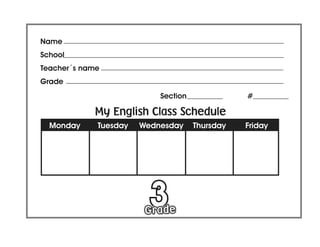
Lesson
12 Months Make a Year
240
Date:
Date:
Date:
Date:
Date:
Date:
Cuadernillo de Inglés 3°grado de primaria

Cuadernillo de Inglés 3°grado de primaria

  • 1.
  • 2.
    Third Grade Third Grade Name School Teacher´sname Grade Section # My English Class Schedule Monday Tuesday Wednesday Thursday Friday
  • 3.
  • 4.
    Este cuaderno detrabajo ha sido elaborado por el Gobierno del Estado de Coahuila, y se entrega en forma gratuita a los niños que participan en el Programa de Inglés en Educación Básica Nivel Primaria. Esta edición estuvo a cargo de la Coordinación Estatal de Inglés de la Secretaría de Educación y Cultura : Profra. Elsa Patricia Jiménez Flores Profra. Elvia Alicia Maltos Gutiérrez Profra. Graciela Valdez González Diseño Gráfico: Carlos Mendoza Alemán, Luis Angel Domingo Cerecero Rodríguez Ilustración: Carlos Mendoza Alemán, Liliana Hernández Elizondo Los comentarios y sugerencias de los maestros, padres de familia y alumnos son muy importantes para mejorar la calidad de este cuaderno. Favor de enviarlos a: Secretaría de Educación y Cultura Coordinación Estatal de Inglés Blvd. Francisco Coss y Av. Magisterio s/n C.P . 25000 Saltillo, Coah. México Segunda edición, 2011. Saltillo, Coahuila. México. c SEC
  • 5.
    Third Grade Third Grade III Presentation Introduction Welcometo School Supply List Taking Care of Your Books Commands Classroom Rules V VII XI XIII XIV XV XVI Celebrations Know Your State Public Class Invitation Christmas Festival Invitation Report Card p. 241 p. 257 p. 267 p. 269 p. 271 TABLE OF CONTENTS UNITS 1 First Day of Class 2 Fun and Games 3 Our New House 4 My Town 5 My Busy Family 6 Every Day 7 Favorite Foods 8 Fun at the Zoo 9 12 Months Make a Year 1 31 61 89 115 141 165 191 213
  • 6.
  • 7.
    Third Grade Third Grade V Conel propósito de ofrecer una educación de mayor calidad que brinde a las nuevas generaciones de alumnos una formación cultural pertinente que les permita responder con habilidad a los retos del nuevo milenio, la Secretaría de Educación y Cultura de Coahuila ha desarrollado diversas estrategias que han permitido llevar a cabo acciones relevantes, entre las que destacan: la dotación de material didáctico a los maestros y de útiles escolares a los alumnos, el equipamiento y rehabilitación de escuelas, así como desayunos escolares. Convencidos de que el crecimiento y desarrollo de nuestro país se dará en la medida en que se apoye a la educación y formación de su gente, a partir de los tratados de libre comercio con Estados Unidos, Canadá y otros países, la enseñanza de lenguas extranjeras, especialmente el inglés, ha cobrado gran interés. La adquisición del aprendizaje de otra lengua potencializa el desarrollo intelectual del educando y fortalece su autoestima, al brindarle la oportunidad de comprender y comunicarse en una lengua extranjera en forma práctica y efectiva. Conscientes de esto, se han realizado innovaciones en el sistema educativo nacional, y en particular, en el Estado de Coahuila donde se ofrece el Programa de Inglés en Educación Básica en los niveles de Preescolar y Primaria a niños de escuelas públicas. La Secretaría de Educación y Cultura proporciona, a través de la Coordinación Estatal de Inglés, los apoyos didácticos, asesoría, capacitación y supervisión a los Maestros, para asegurar la calidad del Programa a las futuras generaciones. PRESENTACIÓN
  • 8.
  • 9.
    Third Grade Third Grade VII Laeducación es la principal fuente de igualdad de oportunidades, y factor determinante para contribuir a la formación integral del educando. El uso efectivo de una lengua extranjera es uno de los grandes retos de la modernidad. La adquisición de este aprendizaje constituye una herramienta primordial para que nuestros niños de hoy sean ciudadanos de éxito en el siglo XXI. De acuerdo con los especialistas, el acceso a este conocimiento se facilita en la etapa de la niñez, por lo que la Secretaría de Educación y Cultura del Estado de Coahuila instituyó el Programa de Inglés en Educación Básica, cuya primera generación del nivel de primaria egresó en el ciclo escolar 2000-2001, iniciándose su continuidad en el nivel de secundaria. Con la finalidad de fortalecer el aprendizaje del idioma y facilitar la práctica docente, la Secretaría de Educación y Cultura, a través de la Coordinación Estatal de Inglés, ha diseñado y elaborado cuadernos de trabajo y cuader- nillos de exámenes para los alumnos de primaria, con las respectivas guías didácticas y materiales de apoyo para el maestro. Estos cuadernos contienen actividades a través de las cuales se desarrollan las habilidades comunicativas: expre- sión oral y escrita; y comprensión oral y escrita. Así mismo, se han incluido anexos con el propósito de fomentar hábitos de estudio y organización escolar, despertar e/o incrementar el gusto por la lectura, promover la creativi- dad, fortalecer el desarrollo intelectual del alumno por medio de las habilidades del pensamiento, reforzar su identidad nacional reconociendo los valores de su propia cultura al ponerse en contacto con otra, así como ampliar sus conocimientos sobre el estado de Coahuila. INTRODUCCIÓN
  • 10.
  • 11.
    Third Grade Third Grade IX Elpresente cuaderno está destinado a los alumnos que participan en el Programa de Inglés en Educación Básica del Nivel de Primaria. Está organizado en nueve unidades integradas por actividades variadas y atractivas, cuyo propósito es estimular el proceso enseñanza-aprendizaje de los alumnos, para ser desarrolladas a lo largo del ciclo escolar. En cada actividad se incluye el número de la unidad, el tema, la actividad a desarrollar y el número de página. Para facilitar la comprensión, cada indicación está representada por símbolos gráficos como se indica a continuación 1. Act out 2. Add 3. Chant 4. Circle 5. Classify 6. Color 7. Complete 8. Count / Number 16. Join 9. Cut 10. Draw 11. Find 12. Fold 13. Glue 14. Graph 15 Guess 16. Join 17. Label 18. Listen 19. Look 20. Make 21. Mark 22. Match/Connect 23. Paint 24. Play 25. Point 26. Puzzle 27. Print 28. Read 29. Say 30. Sing 31. Spell 32. Sprinkle
  • 12.
    Third Grade Third GradeX El material recortable señalado con es el que van a recortar y peg algunas actividades. El material recortable señalado con únicamente se recortará, y podrá utilizarse en diferentes actividades. Las actividades que se incluyen podrán ser adaptadas a las formas de trabajo de cada maestro y a las necesidades de aprendizaje de los alumnos. No hay que olvidar que el enfoque comunicativo requiere de la participación activa del alumno y que el maestro, como facilitador del aprendizaje, deberá organizar actividades que promuevan la comunicación d acuerdo a las necesidades e intereses de los educandos. Es importante propiciar el trabajo en equipo, de forma se logrará desarrollar, además de las habilidades comunicativas, actitudes y valores necesarios para formación. 33. Stitch 34. Tear 35. Think 36. Trace 37. Underline 38. Write
  • 13.
  • 14.
  • 15.
    Third Grade Third Grade XIII SUPPLYLIST Draw and color. T. ask Ss to brainstorm for items that they will need for his / her English class. Have Ss draw and label all items.
  • 16.
    Third Grade Third GradeXIV TAKING CARE OF YOUR BOOKS ORGANIZE YOUR WORK DO YOUR HOMEWORK Date: Date: Homework Record Sheet Date: Date: Date: Date: Date: Date: T. ask Ss to label their books, workbooks, and notebooks and cover them with plastic. T. ask Ss to make a folder, envelopes, letter framer and spelling board. Be responsible! At the end of each class make sure you write your homework for the next class.
  • 17.
  • 18.
    Third Grade Third GradeXVI CLASSROOM RULES
  • 19.
    Lesson First Dayof Class Unit 1 First Day of Class 1
  • 20.
    Lesson First Day ofClass 1 Say, listen, and color. 1 2 T. ask Ss to take out their green, pink, red, purple, blue, and white colors. Next , tell Ss to point to and say the name of each item. Then, listen to the song “Time for School!” (see T2) and color the school items as they are mentioned in the song (if Ss don’t have white color they will leave that item without coloring as the distractors!). Play the song two or three times. Check Ss work.
  • 21.
    Lesson First Dayof Class 2 1 Read and say. 3 T. model the dialog (T-S). Pair Ss to practice and say. On ex.2, ask Ss to complete the speech bubbles using personal information. Monitor Ss work. 2 Complete and act out. Good morning/afternoon! My name is Miss Morgan. What’s your name? Hello. I’m Jackson. Good____________________________! My name is_______________________. What’s ___________________________? ____________________________. I´m_________________________.
  • 22.
    Lesson First Day ofClass 4 3 Listen and color. 2 T. review numbers from 11-20. Use flashcards and/or poster and leave it up on the Bb. Next, ask Ss to take out their favorite color and color the numbers they hear from each row: 1. eleven, thirteen, nineteen.; 2. fifteen, twenty, twelve.; 3. fourteen, eighteen, sixteen. On ex.4 ask Ss to read each sentence, count the corresponding items, complete with the correct number word, and match. Model on the Bb. Monitor and check Ss work. 4 Read, count, complete, and match. 11 12 13 14 15 16 17 18 19 20 11 12 11 12 20 20 1. 2. 3. 1. There are _____________ erasers. 2. There are _____________ paper clips. 3. There are _____________ markers. 4. There are _____________ pens. 13 14 15 16 17 18 19 13 14 15 16 17 18 19
  • 23.
    Lesson First Dayof Class 1 Point, say, and act out. T. have Ss point to, say, and act out each action. Next, play “Simon Says”. 5 3 1. erase 2. count 3. listen 4. glue 5. read 6. draw
  • 24.
    Lesson First Day ofClass 6 T. focus Ss attention on the Grammar Box. Explain that (apostrophe) ‘s and ‘re represent is and are. Next, tell Ss to look at the picture to complete the sentence. Use the Word Bank. Check answers on the Bb and ask volunteers to read the sentences. 2 Look, complete, and read. 3 Word Bank gluing listening erasing counting drawing reading Grammar Box He is = He’s She is = She’s They are = They’re 1. He’s ________________________ a fire truck. 2. She’s________________________ a storybook. 3. They’re________________________ a stick on the puppet. 4. She’s ________________________ the result. 5. They’re ________________________ to music. 6. He’s ________________________ crayons.
  • 25.
    Lesson First Dayof Class 4 T. ask Ss to cut out their cards and write their name at the back of each one. Tell Ss to use the cards on ex 2. Have Ss put away their scissors as soon as they are done. 7 1 Cut.
  • 26.
  • 27.
    Lesson First Dayof Class 4 2 Read and color. 9 T. review personal pronouns he, she, and the numbers from 1-20. Model the target language patterns (use flashcards and/or realia). Provide enough practice, before Ss work in pairs using the cards from ex.1. Monitor Ss interaction. What’s he doing? He’s listening to a story. How many clips are there? There are six clips.
  • 28.
    Lesson First Day ofClass 10 3 Look and complete. 4 Example: T. place flashcards of objects, colors, numbers, and actions at random on the Bb. Ask Ss to draw and label two or three items under each category. Focus Ss attention on the example. Model if necessary. Monitor and check Ss work. scissors Objects Colors Numbers Actions Example:
  • 29.
    Lesson First Dayof Class 5 1 Look and complete. T. focus Ss attention on the Grammar Box and review contractions. Next, have Ss look at the picture and complete the sentence correctly. Model on the Bb if necessary. Check Ss work. 11 1. __________________ cutting paper. 2. __________________ talking about soccer. 3. __________________ erasing the board. Grammar Box He is = He’s She is = She’s They are = They’re 1 2 3
  • 30.
    Lesson First Day ofClass 2 5 12 T. ask Ss to use their favorite color to circle all the contractions. Afterwards, have Ss look at the picture and complete the sentence. Use the Word Bank. Model on the Bb if necessary. Check Ss work. Circle, look, and complete. 1. He’s _______________________ shapes. 2. They’re _______________________. 3. She’s _______________________ flowers. 4. They’re _______________________ to school. Word Bank singing walking talking gluing listening reading counting using
  • 31.
    Lesson First Dayof Class 5 13 T. focus Ss attention on the Grammar Box. Provide extra practice, before Ss color the best answer to complete each sentence. Lastly, ask volunteers to read the sentences aloud to check answers. 3 Color Read and color. 1. There is There are one book. 2. There is There are seven clips. 3. There is There are twelve pencils. 4. There is There are one computer. 5. There is There are one teacher. Grammar Box How many markers are there? There are four markers. How many erasers are there? There is one eraser. Example:
  • 32.
    Lesson First Day ofClass 6 1 Read and mark. T. ask Ss to read the text silently. Next, ask volunteers to read it aloud. Finally, have Ss mark the corresponding picture. 14 This is my class. Mr. Bronson is talking to Mike. Brenda is drawing a picture. Timoty is using the computer. Ron and Maria are cutting paper. A B
  • 33.
    Lesson First Dayof Class 6 2 Count and complete. 15 T. group Ss in small groups (4-5). Next, ask Ss to look in their backpacks or schoolbags and count all the specified items and total them per group. When they have completed their chart, report back to the class to fill in the chart in the Student Book p.7 or make a class chart. T. make sure Ss count in English. How many? Group ________ (number) notebooks markers pencils pens erasers books bottles of glue pairs of scissors
  • 34.
    Lesson First Day ofClass 16 Write. 3 6 T. ask Ss to use the information from their group to write sentences with has. Model the target structure on the Bb plenty of times, before Ss write their own sentences. Place number and classroom items flashcards on the Bb for correct spelling. Check Ss work. 1. _______________________ _________________ _______________________ _______________________ 2. _______________________ _________________ _______________________ _______________________ 3. _______________________ _________________ _______________________ _______________________ 4. _______________________ _________________ _______________________ _______________________ _______________________ _________________ _______________________ ___________________ . Example: Rosy has eight markers (student’s name)
  • 35.
    Lesson First Dayof Class 17 7 T. ask Ss to number each picture according to the following: 1. He is gluing a car., 2. There is one ruler., 3. They are erasing the board., 4. She’s painting., 5. There are eleven pens; 6. There are eleven colors. Repeat twice at normal speed. Check answers on the Bb. Listen and number. 1
  • 36.
    Lesson First Day ofClass 7 1 Listen, circle, and say. 18 T. say the word that corresponds after each picture. Tell Ss to circle the pictures that stand for a word with /t/ as in table. On ex. 3, have Ss complete the words with the missing t. Then, ask Ss to say each word from both exercises making special emphasis on the /t/ sound (ex. t, t, elephant /t,t, kite and so on). Monitor Ss work. 2 1 Complete and say. 3 1. elephan_______ 2. ki _______e 3. jacke_______ 4. _______ ur _______ le 5. robo _______ 6. _______oys
  • 37.
    Lesson First Dayof Class T. after reading “The Magic Backpack” (St. book pp. 9-10), have Ss read each statement. If it is true, color T and if it is false, color F . Finally, draw on the space provided the items from the statements that are true. Check Ss work. 19 1 Read, color, and draw. 8 1. There are five white notebooks. 2. There are sixteen purple paper clips. 3. There are nine green pens. 4. There are eleven red markers. 5. There are five brown rulers. 6. There is one magic backpack. 7. There are fourteen pink erasers. 8. There is one happy boy. T F T F T F T F T F T F T F T F
  • 38.
    Lesson First Day ofClass 20 T. after reading “Tha Magic Backpack” (St. book pp. 9-10), ask Ss to read each question and answer as best possible. 2 Read, think, and underline. 8 1. Is “The Magic Backpack” a good title for this book? Yes, it is. No, it isn’t. 2. Is this a funny book? Yes, it is. No, it isn’t. 3. Do you want to read this book again? Yes, I do. No, I don’t. 4. Do you want to recommend this book to a friend? Yes, I do. No, I don’t. 5. Do you want a backpack like Max’s? Yes, I do. No, I don’t.
  • 39.
    Lesson First Dayof Class T. elicit from Ss items they might carry in a backpack. List on the Bb or place flashcards. Then, ask Ss to take a look in their backpack, count the items, draw them on the spaces provided, and write proper sentences using “There is” and “There are”. Model on the Bb and help Ss put their Mini-Book together. Use pp. 21-24. HW: Bring an old magazine. 21 1 Draw, write, and make. 9 The End. 8 by
  • 40.
    Lesson First Day ofClass 22 1 Draw, write, and make. 2 7 9 T. monitor Ss work.
  • 41.
    Lesson First Dayof Class 23 1 Draw, write, and make. 6 3 9 T. monitor Ss work.
  • 42.
    Lesson First Day ofClass 24 1 Draw, write, and make. 4 5 9 T. monitor Ss work.
  • 43.
    Lesson First Dayof Class 1 Cut, glue, and say. Cut T. ask Ss to look in the magazine for drawings of people that work together, cut them out, glue on the space provided, and say how they are working together. Show your own model. On ex. 2, have Ss read the question and write an answer of their own. Check Ss work. 25 10 Value: W or k Toget her 2. How do you work together? __________________________________________________________________________________________________ __________________________________________________________________________________________________ 2 Read and write.
  • 44.
    Lesson First Day ofClass T. focus Ss attention on the example. Model using the target language from the speech bubbles. Next, pair Ss, have them take turns asking and answering the question as they count and write the correct amount of items in each box. Ask Ss to write the number word on the line and the number symbol in the small box. Monitor and check Ss work. 26 8 Review 1 Ask, count, and write. Guess 1. erase __________________ books __________________ pens __________________ erasers __________________ markers __________________ paper clips __________________ backpacks five How many books are there? There are five books. Example: 5
  • 45.
    Lesson First Dayof Class 27 T. ask Ss to look at each picture, read, and underline the best option. On ex.3, tell Ss to complete each sentence with There is and There are. Check Ss work. 2 Look, read, and underline. 9 Review 3 Complete. Use There is and There are. 1. __________________ three notebooks in my backpack. 2. __________________ one ruler in my backpack. 3. __________________one pair of scissors in my backpack. 4. __________________six markers in my backpack. 5. __________________ two pencils in my backpack. 1. a) She’s writing a story. b) She’s listening to a story. 2. a) They’re talking. b) They’re singing.
  • 46.
    Lesson First Day ofClass 28 T. ask Ss to read the text and use their crayons or colors to trace the color words. On ex 2, have Ss read carefully each sentence and circle the best option. Check answers on the Bb. 1 Read and trace. Cr ayons, Cr ayons There are more than 120 colors. There are 23 kinds of , 20 kinds of , 19 kinds of , 16 kinds of , 14 kinds of , 11 kinds of , and 8 kinds of , red The first crayons were made in France in the 18th Century. They were made of a combination of charcoal and oil. Modern crayons are made from paraffin wax, dyes, talc, and other ingredients. The Crayola Factory makes every year enough crayons to circle the Earth six times! Crayola makes so many because children love to make pictures and color with them. green blue purple orange brown yellow Crayons are easy to use. The colors are fantastic! 2 Read and circle. 1. The first crayons were made of charcoal and oil / paint and water. 2. The first crayons were made in China / France. 3. The Crayola company makes enough crayons in one year to circle the Earth six / seven times. 4. There are about thirteen / twenty three kinds of red crayons. 5. There are about fourteen / fifteen kinds of green crayons.
  • 47.
    Lesson First Dayof Class 29 Spelling-Dictation Sheet Spelling-Dictation Sheet 2 Listen and write. W 1._________________________________________ 3._________________________________________ 5.___________________________________________ 2._________________________________________ 4._________________________________________ 6.__________________________________________ 1. 2. T. dictate commands for Ss to draw and color (example: 1. Draw three orange erasers.) Allow enough time for Ss to draw and color. Repeat each command twice at normal speed. On ex. 2, dictate target vocabulary words throughout the unit. Check Ss work. 1 Listen, draw, and color.
  • 48.
    Lesson First Day ofClass 30 Date: Date: Date: Date: Date: Date:
  • 49.
    Lesson Fun andGames Unit 2 Fun and Games 31
  • 50.
    Lesson Fun and Games 1Think, say, and write. 1 32 T. help Ss build a word map. Have Ss read and understand the unit’s name and the example. Then, elicit from Ss fun activities and games they like to play. Write them on the Bb (in L2). Ask Ss to choose the ones of their preference to complete the word map. Optional: Ss may add a small illustration. Example: jump rope
  • 51.
    Lesson Fun andGames 1 2 Trace, spell, and say. 33 T. have Ss trace, spell, and say each word three times in the same order. Next, play “Simon Says” calling out the vocabulary words at random and Ss acting them out (ex. Simon says: bush / Ss with their arms in front “make” a bush) to check for comprehension. bush friends swing tree in on under in front of behind 1. 2. 3. 4. 5. 6. 7. 8. 9.
  • 52.
    Lesson Fun and Games 34 1Match. 2 T. use flashcards and / or realia to introduce the unit vocabulary. Then, have Ss match each word to its corresponding picture. 1. checkerboard 2. checkers 3. tennis racket 4. bat 5. cup 6. marbles 7. jump rope 8 kite
  • 53.
    Lesson Fun andGames 2 Cut, listen, and glue. T. introduce/review prepositions: in, on, under, between, in front of, behind, and next to. Use flashcards, realia, and TPR. Next, ask Ss to cut out the items on the right. Listen to the following commands, and glue them on the corresponding place: 1. Glue the friends in front of the tree.; 2. Glue the dog next to the backpack.; 3. Glue the cat on swing.; 4. Glue the marbles in the triangle.; 5. Glue the jump rope between the swing and the tree. Monitor and check Ss work. 35 2
  • 54.
    Lesson Fun and Games 36 1Look, complete and read.
  • 55.
    Lesson Fun andGames 3 T. introduce the unit’s action words. Use flashcards/poster, mimicry, and TPR games. Next, ask Ss to take out their colors and follow the commands: 1. Circle the children that like to skate green., 2. Circle the children that like to play baseball red., 3. Circle children that like to fly kites purple., 4. Circle the children that like to play in the sandbox orange., 5. Circle the children that like to play hopscotch blue. Check Ss work. 37 1 Listen and circle.
  • 56.
    Lesson Fun and Games 38 T.tell Ss to look, read, and underline the best sentence option that describes each picture. Check answers at random. HW: Bring material for lesson 4, Ex. 2 2 Look, read, and underline. 3 4. a) They like to skate. b) They like to climb trees. 1. a) They like to play checkers. b) They like to play hopscotch. 2. a) They like to ride bikes. b) They like to fly kites. 3. a) They like to hit baseballs. b) They like to throw and catch the ball.
  • 57.
    Lesson Fun andGames 4 1 Look and complete. 39 T. review the unit’s action words. Use flashcards and a TPR game. Next, ask Ss to look at each picture and complete the sentence. Use the Action Words Bank. Monitor and check Ss work. HW: Bring 8 construction paper strips (5 cms x 30 cms each) of a light color, another strip (same size) of different color, a marker (dark color), and glue or tape. 4. _______________________________________________________________________. Action Words Bank throw and catch the ball skate play checkers climb a tree Example: 1. They ____________ ____ __________. like to skate 2. They _____________ __________ _________________________. 3. __________________ __________________ __________________. 1. 2. 3. 4.
  • 58.
    Lesson Fun and Games 40 2Think and make. 4 Material: 8 construction paper strips (light color) 5 cm x 30 cm each 1 construction paper strip (same size as above but different light color) 1 dark marker Glue and/or tape T. make sure Ss understand how to complete each step. Bring your own model. Monitor Ss work. Instructions: 1. Have Ss write out a sentence with the target language pattern (like to) on a scrap piece of paper. Model on the Bb. 2. Make corrections if necessary and then Ss can start to make the grammar chains. T. show your own model. 3. Use one color for each sentence, except the focus word(s); they should be one color (ex. yellow). Ss should write one word on each strip of paper. Then on a different color (ex light green), have Ss write the target language pattern you want to emphasize (like to). 4. Link the sentence together in the correct order using glue or tape. Add a small drawing on the last chain link. Be sure to put a spacer between the words so you can actually read the sentence. See example. 5. Hang the chains around the room. Have Ss walk around to read the sentences aloud. Gr ammar Rainbow Chains Example:
  • 59.
    Lesson Fun andGames 5 1 Look and say. T. place action word flashcards on the Bb. Next, have Ss focus attention on the Grammar Box. Model and practice plenty of times the target language patterns. Then pair Ss to ask and answer using he, she, I, and they, plus different actions. Follow the example. Monitor Ss interactions. 41 Grammar Box What does he / she like to do? He/She likes to hit the baseball. What do you / they like to do? I / They like to play checkers. Example: He / She likes to skate. What do you like to do? What does he / she like to do? I like to play dominoes.
  • 60.
    Lesson Fun and Games 2 5 42 T.pair Ss to read the text, read each question, and underline the correct option. Check answers at random. Read and underline. 1. Do John and Natalia like to play checkers? a). Yes, they do. b). No, they don’t. 2. Do Mario and Ricky like to fly kites? a). Yes, they do. b). No, they don’t. 3. Does Helen like to ride a motorcycle? a). Yes, she does. b). No, she doesn’t. 4. Does Tere like to hit baseballs? a). Yes, she does. b). No, she doesn’t. 5. Do Samuel and Fred like to jump rope? a). Yes, they do. b). No, they don’t. 6. Do I like to catch baseballs? a). Yes, I do. b). No, I don’t. On a Picnic My friends and I like to go on a picnic. Samuel and Fred like to climb trees. John and Natalia like to jump rope. Mario and Ricky like to fly kites. Helen likes to ride a bike. Tere likes to hit baseballs. And I like to throw the baseball.
  • 61.
    Lesson Fun andGames 6 43 T. introduce the numbers from 10-100 by tens. Use flashcards, realia, and or a poster. Then, focus Ss attention on the example and ask to circle the odd number (s) in each row. On ex. 2 count the items in each box and write the number on the line. 1 Circle. 2 Count and write. thirty thirty thirteen thirty thirteen 30 Example: fiteen fifty fifty fifteen fifty fifteen one hundred one hundred one hundred one hundred one seventy seventeen seventeen seventy seventy seven twenty twenty twenty twelve twenty twenty 50 100 70 20 1._____________ checkers. 2._____________ cards. 3._____________ marbles.
  • 62.
    Lesson Fun and Games6 3 Play. T. provide at least six game markers (clips, beans, game chips, etc.) for each St. Tell Ss to choose a card and play Number Lotto. T. calls out the numbers drawn at random from a bag. Ss cover the number with a marker. The St. that covers three numbers across or down first wins. Model if necessary. 44 ON E H UN DRED T H I RT Y S EV EN T Y S I X T Y N I N ET Y T W EN T Y EI GH T Y FI FT Y FI FT Y N I N ET Y S I X T Y S EV EN T Y FORT Y EI GH T Y T H I RT Y ON E H UN DRED FREE BON US FREE BON US A. B.
  • 63.
    Lesson Fun andGames 7 1 Listen and number. 45 T. tell Ss to listen carefully and number the pictures according to the order in which they appear in the following conversation: 1. Where is my ball? It´s under the swing.; 2. What are the boys doing? They are playing baseball.; 3. What does the boy like to do? He likes to ride a bike.; 4 Where is the kite? The kite is on top of the tree.; 5. What are the girls doing? They are playing checkers.; 6 What does the girl like to do? She likes to jump rope. Repeat twice at normal speed. Check answers on the Bb.
  • 64.
    Lesson Fun and Games 46 Listenand trace. 2 7 T. say the word that corresponds after each picture. Tell Ss to trace only the pictures or symbols that stand for a word with /i/ as in big. On ex. 3, have Ss read the words from the Word Bank. Have Ss write in Box A the words with the target letter /i/ sound and in Box B the ones that do not have /i/ sound. Check answers on the Bb. Read and classify. 3 1.____________________________ 2.____________________________ 3.____________________________ 4.____________________________ 5.____________________________ 6.____________________________ A 1.____________________________ 2.____________________________ 3.____________________________ 4.____________________________ 5.____________________________ 6.____________________________ B lion kitchen scissors rice firetruck living room kite fish five pink plane train
  • 65.
    Lesson Fun andGames 47 8 T. after listening to and reading the sory “Playing Games” from St. book pp. 21-22, have Ss read each sentence and color the dot with the best option to complete it. Check answers at random. Read and color. 1 On page 1, the children are from: Costa Rica Colombia Chile On page 2, in the triangle there are: eleven marbles ten marbles twelve marbles On page 3, the girls are playing a: talk game walk game chalk game On page 4, the children are: throwing cards turning over cards cutting cards
  • 66.
    Lesson Fun and Games8 1 Draw and write. 48 Draw T. elicit from Ss which are their favorite games. List on the Bb. Next, ask Ss to draw their favorite game and then describe what type of game it is (card, ball, marbles, jump rope, etc.) and how it is played. Praise Ss work and aid them with any necessary vocabulary. HW: Ask Ss to bring a jump rope next class. 2 My Favor it e Game
  • 67.
    Lesson Fun andGames T. prepare a poster size graph ahead of time. Next, ask Ss to color three cards of things they like to do, cut them out, and glue them on the graph on the correct row and name the activity (ex. I like to skate). After the graph is completed, lead the class in counting how many chose each activity. 49 1 Color, cut, and make. 9
  • 68.
  • 69.
    Lesson Fun andGames T. make sure Ss learn the Jump Rope Chant and what they have to do while they jump the rope. Then, group Ss in groups of 5-6 participants, take them out to the patio, have volunteers model the game, and finally monitor Ss interaction. Make sure all Ss have a turn to jump and chant. Five minutes before the class is over, end the activity and go back to the classroom. HW: Ask Ss to bring a magazine next class. 51 2 Read and play. 9 1. The two end holders begin to turn the rope (4-5 meters long). 2. The jumper goes in, starts to jump, and then tries to touch the ground (without being tripped by the rope). 3. Following the chant, the jumper spells his/her name (including saying “capital” for upper case letters of their name; if the jumper trips or messes up the spelling, it´s another jumper´s turn). 4. Jump Rope Chant: “Peel a Banana” Peel a banana upside down, see if you can touch the ground, (St. tries to touch the ground) if you spell your name correctly, you will get another chance. (St. begins to spell his/her name as explained on step number 3.) Jump Rope Chant ing Game Steps:
  • 70.
    Lesson Fun and Games 52 T.talkabout and give examples of appreciation and caring for nature. Next, ask Ss to give more examples. Then, tell Ss to make a collage of activities/actions that help take care and appreciate nature. Finally, help Ss write sentences describing actions in the collage in the space provided. Monitor and praise Ss work. 10 1 Make and write. Value: Appr eciat e Nat ur e I ________________________________________________________________________________________________ __________________________________________________________________________________________________ __________________________________________________________________________________________________ __________________________________________________________________________________________________
  • 71.
    Lesson Fun andGames 53 T. ask Ss to match each word to its corresponding picture. Have Ss write the correct number on the line before each letter. Check answers on the Bb and finally spell the vocabulary words (whole group). 10 Review 1 Match and spell. 1. tree 2. bush 3. swing 4.checkerboard 5. marbles 6. tennis racket ______a. ______b. ______c. ______d. ______e. ______f.
  • 72.
    Lesson Fun and Games 2Look and complete. 54 T. review prepositions of location. Next, tell Ss to look at the pictures and use the Prepositions Bank to complete each sentence. Check answers at random. Review 1. The cat is _____________________ the bush. 2. The dog is _____________________ the tree. 3. The tennis racket is _____________________ the backpack. 5. The marbles are _____________________ the bag. 4. The ball is _____________________ the tree and the swing. Prepositions Bank in on under between next to behind in front of
  • 73.
    Lesson Fun andGames T. ask Ss to count the items and write on each line the corresponding number word. Use the Word Bank. Check answers on the Bb 55 10 Review 1. __________________________ checkers. 2. __________________________ marbles. 3. __________________________ cards. 4. __________________________ jump ropes. 5. __________________________ dominoes. 6. __________________________ kites. 3 Count and write. Word Bank ten twenty thirty forty fifty sixty seventy eighty ninety one hundred
  • 74.
    Lesson Fun and Games T.ask Ss to look at the pictures and underline the correct option. Check Ss work at random. 56 Review 4 Read and underline. a) He likes to hit baseballs. b) He likes to catch baseballs . a) She likes to jump rope. b) She likes to swing . a) They like to climb trees. b) They like to play checkers . a) They like to ride bikes. b) They like to skate.
  • 75.
    Lesson Fun andGames 57 T. explain what type of game badminton is (if possible show the picture of a badminton racket and the shuttle cock, or bring realia). Then , focus Ss attention on ex. 1 ( See Japan on map). Read the text with your Ss ( try to show a picture of the “hane” and “hagoita” (Google it, please!). After reading ask Ss to mark True or False after reading each of the statements. Check answers at random. 1 Read and mark. A wooden paddlegame: Hanetuki Hanetuki is a game played on New Year´s Day by girls. It is Japanese badminton. With the hagoita we hit hane and send hane to our partner. The partner has to hit it back. If you drop hane, you lose the game. Hane is made of feathers. Hagoita is made of wood and on one side a beautiful doll is attached. We hit hane with the side where there is no doll! 1. Hanetuki is a Mexican game. 2. It´s a game played like badminton. 3. Hane is made of leather. 4. Hagoita is made of wood. 5. If you drop hane, you win the game. True False
  • 76.
    Lesson Fun and Games 58 T.pair Ss to think about a game they would like to play. Have Ss write the instructions and then draw the game. Use the spaces provided. Monitor and aid Ss with any necessary vocabulary words. 2 Write and draw. Instructions:
  • 77.
    Lesson Fun andGames 59 T. dictate commands for Ss to draw and color (example: 1. Draw the ball under the swing.) Allow enough time for Ss to draw and color. Repeat each command twice at normal speed. On ex. 2, dictate target vocabulary words throughout the unit. Check Ss work. Spelling-Dictation Sheet Spelling-Dictation Sheet 2 Listen and write. W 1._________________________________________ 3._________________________________________ 5.___________________________________________ 2._________________________________________ 4._________________________________________ 6.__________________________________________ 1. 2. 1 Listen, draw, and color.
  • 78.
  • 79.
    Lesson Our NewHouse 61 Unit 3 Our New House
  • 80.
    Lesson Our New House 1Complete and spell. 1 62 T. review family members. Use flashcards and/or a poster. Then ask Ss to complete the Parker’s family tree. Check for correct spelling and finally have the whole group spell the words aloud. grandmother grandfather f m b s b
  • 81.
    Lesson Our NewHouse 1 2 Draw and write. Say. 63 T. ask Ss to draw their own family members and write their name. Finally, pair Ss to ask and answer who is each member from each of the families. Model if necessary and monitor Ss interaction.
  • 82.
    Lesson Our New House 64 1Look, point, and say. Spell 2 T. introduce new vocabulary. Use flashcards and/or real photos from a family album. Next, have Ss look, point, and say. Then, have the whole group spell aloud the target vocabulary. On ex. 2, ask Ss to use the Word Bank to complete the riddles. Monitor and check Ss work. 2 Think and complete. uncle aunt cousins 1. She is my mother’s mother. She is my ________________________. 2. They are my aunt’s children. They are my ______________________. 3. He is my father’s brother. He is my __________________________. Word Bank grandfather grandmother brother sister cousins aunt uncle
  • 83.
    Lesson Our NewHouse 3 Glue and write. Say. T. assign this page for HW. Ask Ss to glue pictures (photos and/or magazine cutouts) on the space provided. Then, tell Ss to label each picture identifying the relationship with them (uncle, mother, sister, cousin, etc.) and their name. Bring back to class and share with their peers. Check for correct spelling. 65 2 (family member) (name) (family member) (name) (family member) (name) (family member) (name) (family member) (name) (family member) (name)
  • 84.
    Lesson Our New House 66 1Classify. T. review rooms of the house, furniture, and household objects. Use flashcards, a poster, and/or a doll house. Then use p. 67 cutouts, classify them, and glue them under the correct category. Monitor and check Ss work. 3 Rooms Fur nit ur e Household Object s
  • 85.
    Lesson Our NewHouse 3 T. ask Ss to color and cut. Use with page 66. 67 2 Color and cut. 1 4 7 8 9 0 * 5 6 2 3
  • 86.
    Lesson Our New House 68 2Look, read, and underline. 3
  • 87.
    Lesson Our NewHouse 3 2 Find and circle. Spell. 69 T. assign this page for HW. Ask Ss to find the words from the Word Bank and circle them using different colors. Finally, tell Ss to practice spelling them for a Mini–Spelling Bee Contest next class. Word Bank cabinets shelves refrigerator tub dresser curtains kitchen mirror table picture lamp bedroom stove rug window b e d r o o m w c c r e k s i i a u e f i h r n b r s r t e r d i t s i c l o o n a e g h v r w e i r e e e t x t n w r n s u t s s l a m p b a p i c t u r e b m s t o v e z l f o y r u g a e
  • 88.
    Lesson Our New House 70 1Look, say, and write. 4 T. introduce and practice the target language structures. Use the Bb and focus Ss attention on the Grammar Box. Next, pair Ss to ask and answer the questions about the house in the picture. Model and monitor Ss interaction. Lastly, have Ss read and answer the questions (individually). Place the rooms of the house flashcards on the Bb for correct spelling. Check answers at random. 1. Where’s the tub? It’s in the __________________________. 2. Where are the coffee tables? They’re in the ______________________. 3. Where are the towels? They’re in the ______________________. 4. Where’s the refrigerator? It’s in the __________________________. 5. Where’s the rug? It’s in the __________________________. 6. Where’s the lamp? It’s in the __________________________. Grammar Box Where’s the stove? It’s in the kitchen. Where are the plants? They’re in the living room.
  • 89.
    Lesson Our NewHouse 4 2 Draw, write, and say. T. ask Ss to choose two rooms from their house, draw what’s in them, label each room, and then write a short description of each. Lastly, pair Ss to ask each other about their drawings. Model and monitor Ss interaction. 71 What’s in your dining room? There’s a table and six chairs. (room’s name) (room’s name) There’s a _____________________________________ ______________________________________________ There are _____________________________________ ______________________________________________. There’s a _____________________________________ ______________________________________________ There are _____________________________________ ______________________________________________.
  • 90.
    Lesson Our New House 1 5 72 T.focus Ss attention on the Grammar Box. Next, ask Ss to look at the pictures, read the questions, and complete each sentence with the corresponding contraction. Provide examples on the Bb, before Ss write individually. Check answers on the Bb. Look, read, and complete. Grammar Box He is = He’s She is = She’s It is = It’s They are = They’re 1. Where’s your cousin? __________________ in the living room. 2. Where’s the cat? __________________ in the bedroom. 3. Where are your mother and father? __________________ in the dining room. 4. Where’s your aunt? __________________ in the kitchen.
  • 91.
    Lesson Our NewHouse 5 73 T. bring your own paragraph model. Review family members vocabulary (ex. cousins, aunt, uncle, grandfather, etc.) and have Ss draw their family and describe it following the target language patterns (There is/There are). Finally ask Ss to cut out and display around the room for a shared reading activity. Monitor and check Ss work. 2 Draw, write, and cut. My name is ______________________________. In my family there are _______________ members. There are my _______________ _____________________, and _______________,____________________________ There is my _____________________________, _________________________________, and me! ___________________________________________________________________________________________________ All of them are my family! (number word) (number word) (family member (s)) (family member) My Family (family member) (number word) (family member (s))
  • 92.
  • 93.
    Lesson Our NewHouse 6 1 Read, color, and complete. 75 T. review target vocabulary. Then, ask Ss to read, color according to the text, and complete the sentences. Have a volunteer read the text aloud and another one write the answers on the Bb. Check Ss work. I n My New House There’s a big living room in my new house. In the living room there’s an orange (1) ________________. There are two green (2) ________________ and blue (3) _______________. and a brown (5)________________. There are some (6) _______________, but there are no (7) _______________ in the living room. There’s a black (4) ________________ 12 1 2 3 4 5 6 7 8 9 10 11
  • 94.
    Lesson Our New House 76 Readand color. R 2 6 T. model the target Yes/No questions and short answers on the Bb. Next, tell Ss to read the questions and color the dot with the best answer depending on thet items that are found in their house. Monitor Ss work. 1. Is there a radio in your house? Yes, there is. No, there isn’t. 2. Is there a computer in your house? Yes, there is. No, there isn’t. 3. Is there a bicycle in your house? Yes, there is. No, there isn’t. 4. Are there pictures in your house? Yes, there are. No, there aren’t. 5. Are there shelves in your house? Yes, there are. No, there aren’t. 6. Are there rugs in your house? Yes, there are. No, there aren’t.
  • 95.
    Lesson Our NewHouse 77 7 T. ask Ss to listen to the following and mark ( ) true or false under each picture: 1. There are four chairs in the dining room.; 2. There is one towel in the bathroom.; 3. There is a table in the kitchen.; 4. There are two beds in the bedroom.; 5. There is a clock in the living room.; 6. There is a dresser in the bedroom. Repeat twice at normal speed. Check answers at random. Listen and mark. 1 12 1 2 3 4 5 6 7 8 9 10 11 1. true false 2. true false 3. true false 4. true false 5. true false 6. true false
  • 96.
    Lesson Our New House7 1 Listen and mark. 78 T. ask Ss to listen to the word sounds in each set of items. Have Ss mark ( ) the word that doesn’t have the same sound as the /k/ in carrot. 1. cake, cup, balloon.; 2. cat, pencil, cookie.; 3. chair, curtains, clown.; 4. cow, doctor, crayon. Repeat twice at normal speed. On ex. 3, have Ss write the words from the Word Bank with the /k/ sound as in coat. Check Ss work. 2 1 Write. 3 1. ___________________ 2. ___________________ 3. ___________________ 4. ___________________ 5. ___________________ 6. ___________________ 7. ___________________ 8. ___________________ Word Bank cat doctor cake chair cookie crayon cup pencil balloon curtains clown cow
  • 97.
    Lesson Our NewHouse T. after Ss have read the Mini-Book story from the St’s book pp. 33-34, ask Ss to read carefully and mark ( ) the options True or False after each sentence. On ex. 2, tell Ss to write a welcome note to Sonia and sign with their name. Check Ss work. 79 1 Read and mark. 8 1. The girl’s name is Sonia. 2. Sonia is moving to a new house. 3. Sonia’s bedroom has two beds. 4. The new house has three bedrooms. 5. Sonia’s new bedroom is purple. 6. Sonia likes her new bedroom. 7. Sonia has all her old things. 8. Sonia is very happy now. Welcome Sonia, I hope you like your new _______________ and your new _______________. Your new friend, _________________ True False 1 Write. 2
  • 98.
    Lesson Our New House 80 T.ask Ss to invent a special room for their house, such as a homework room, or a play room. Have Ss furnish it and tell about it. Pair Ss to describe and name their room. Monitor Ss interaction. 1 Think, draw, and say. 9
  • 99.
    Lesson Our NewHouse T. ask Ss what they think it means to help around the house. Point out an example from your own life. Next, draw Ss attention on ex. 1 and ask volunteers to describe the actions. Then, tell Ss to circle Yes or No according to what each St. does or doesn’t do to help around his/her house. On ex. 2, ask Ss to write about another action they do to help around their house. 81 1 Read and circle. 10 How do you help around the house? I _____________________________________________________________________________________________________ ____________________________________________________________________________________________________. Do you… Value: Help Ar ound t he House 1 Write. 2 take out the garbage? 1. Yes No make your bed? 2. Yes No set the table? 3. Yes No put your things away? 4. Yes No
  • 100.
    Lesson Our New House 82 T.ask Ss to use the Word Bank to complete the family tree. Finally, pair Ss to take turns spelling the vocabulary words. Monitor and check Ss work. 10 1 Complete and spell. Review The Mackenzie’s Family Tr ee Word Bank father baby sister grandmother brother mother grandfather
  • 101.
    Lesson Our NewHouse 83 T. model on the Bb the target structures. Provide different examples before Ss work on ex. 2. Next, have Ss guess the family members riddles. Place the flashcards on the Bb for correct spelling. Check Ss work. 10 Review 2 Look, read, and complete. 3 Think and complete. 1. Where’s the stove? _______________ in the ________________________. 2. Where’s the toilet? _______________ in the ________________________. 3. Where are the curtains? _______________ in the ____________________. 4. Where are the pictures? _______________ in the ___________________. Word Bank It’s They’re bedroom living room kitchen bathroom 1. They are my uncle’s children. They are my _______________________________________________. 2. She is my father’s sister. She is my _________________________________________________. 3. He is my mother’s brother. He is my ___________________________________________________.
  • 102.
    Lesson Our New House 1Glue or draw. 84 T. ask Ss to take out pictures from magazines of furniture and household objects. If not possible, have Ss draw them to create their dream house. Bring your own “dream house” and the corresponding description as a model. Monitor Ss work. My Dr eam House bedroom living room bathroom dining room kitchen
  • 103.
    Lesson Our NewHouse T. ask Ss to use their “dream house” on p. 84 to write a description (T. show your own model.). Encourage and aid Ss while writing descriptive sentences using language structures such as: I have… , I like my… , In the kitchen… , there is/there are… etc. Monitor and check Ss work. 85 2 Look and write. 10 My Dr eam House In my dream house, there is
  • 104.
    Lesson Our New House T.elicit from Ss (in L1) what materials can be used to make a house and talk about different kinds of houses they know about (ex. igloos in Alaska, etc.). Teach the underlined words on ex. 3 and ask Ss to match each sentence to the corresponding house. Check answers at random. 86 3 Read and match. 1. It’s made of wood. 2. It’s made of ice. 3. It’s made of bricks. 4. It’s made of mud. 5. It’s made of grass. _____ a. _____ b. _____ c. _____ d. _____ e.
  • 105.
    Lesson Our NewHouse 87 Spelling-Dictation Sheet Spelling-Dictation Sheet 2 Listen and write. W 1._________________________________________ 3._________________________________________ 5._________________________________________ 2._________________________________________ 4._________________________________________ 6._________________________________________ 1. 2. T. dictate commands for Ss to draw and color (example: 1. Draw the stove is in the kitchen.) Allow enough time for Ss to draw and color. Repeat each command twice at nor- mal speed. On ex. 2, dictate target vocabulary words throughout the unit. Check Ss work. 1 Listen, draw, and color.
  • 106.
  • 107.
    Lesson My Town 89 Unit4 My Town TORCH AVENUE Police Post Office GREENLAND AVENUE PINE STREET CENTRAL AVENUE Fire Station Gift Shop Candy Shop Hospital Gino´s Pizza Place Coffee Shop Supermarket High School Kat´s Pet Shop Enter on Torch Ave. Enter on Torch Ave. Perrin’s Computer Store Enter on Greenland Ave.
  • 108.
    Lesson My Town 1 Traceand say. 1 90 T. use flashcards to present the new vocabulary. Then, have Ss trace and say the name of each building. Lastly, show flashcards at random to check comprehension. police station post office shoe store supermarket restaurant university bank bus station fire station grocery store hospital movie theater 1 2 3 4 5 6 7 8 9 12 11 10 Restaurant
  • 109.
    Lesson My Town 1 2Look, point, and say. 91 T. have Ss look at the map point and name each of the buildings shown. Check for correct pronunciation. On ex. 3, ask Ss to follow the color code to color each building accordingly. Check Ss work. If necessary place the building flashcards on the Bb. 3 Read and color. 1. bank = black 2. bus station = orange 3. fire station = red 4. grocery store = green 5. hospital = white 6. hotel = purple 7. movie theater = brown 8. police station = blue 9. post office = blue and red 10. restaurant = pink 11. shoe store = brown 12. supermarket = yellow 13. university = gray 14. bookstore = orange
  • 110.
    Lesson My Town 92 1 Listen,point, and say. 2 T. review and introduce the new preposition of place. Use flashcards, realia, and TPR. Provide plenty of examples. On ex. 1, have Ss listen to the preposition, point to, and repeat its name. On ex. 2, tell Ss to read and complete each sentence using a preposition of place from ex. 1. Check Ss work. 2 Read and complete. Restaurant next to between on the corner of 1. The police station is _______________ the computer store. 2. The supermarket is ________________ Green Street and Main Avenue. 3. The university is _______________ Park Avenue and Clover Street. 4. The grocery store is _______________ the shoe store and the movie theater. Green St. M a i n A v e . Clover St. P a r k A v e .
  • 111.
    Lesson My Town 3Cut, listen, and glue. T. ask Ss to identify the buildings, cut out the cards, and listen to the following commands: 1. Glue the fire station next to the grocery store.; 2. Glue the music store between the video store and the supermarket.; 3. Glue the bank on the corner of Independence Avenue and Bell Street.; 4. Glue the restaurant on the corner of Independence Avenue and Pine Street.; 5. Glue the post office between the fire station and the police station.; 6. Glue the hotel next to the hospital. Repeat twice at normal speed. Check Ss work at random. 93 2 Restaurant Independence Avenue Pine Street Bell Street
  • 112.
  • 113.
    Lesson My Town 3 T.use TPR to make sure Ss understand what each action is. Next, have Ss say each action and act it out (3 times in the same order) and then say them at random. Ss act out to check comprehension. 95 1 Say and act out. 1. buy a bus ticket 2. find a doctor 3. get help 4. go downtown 5. mail letters 6. see fire trucks 7. shop for food 8. try out computers Help! There is a fire on Pine street.
  • 114.
    Lesson My Town 96 2 Readand complete. 3 T. ask Ss to read and complete each sentence with an action word from the Word Bank. Tell Ss there are two distractors. Check answers on the Bb. at the post office. at the bank. at the grocery store. at the police station. at the movie theater. on a bus. Word Bank get mail buy find shop go see try out 1. You can 2. You can 3. You can 4. You can 5. You can 6. You can letters money for bananas a police car tickets downtown
  • 115.
    Lesson My Town 4 1Read, look, and write. 97 T. focus Ss attention on the Grammar Box. Use flashcards and/or a poster to provide extra examples on the Bb. Then, have Ss read the Yes/No questions, look at the buildings, and write a short answer. Check answers on the Bb. HW: Ask Ss to color and cut out the buildings on p. 99 and bring a coin and a token for next class. Black Street Pine Street Grammar Box Is there a bookstore on Pine Street? Yes, there is. / No, there isn’t. Are there two supermarkets on Black Street? Yes, there are. / No, there aren’t. 1. Is there a university on Black Street? ______________, _____________________. 2. Are there two restaurants on Pine Street? ______________, _____________________. 3. Is there a supermarket on Pine Street? ______________, _____________________. 4. Is there a hospital on the corner of Pine Street and Black Street? ______________, _____________________. 5. Is there a bookstore next to El Sarape restaurant? ______________, _____________________.
  • 116.
    Lesson My Town 98 2 Play. 4 T.model and make sure your Ss understand how to play. Provide plenty of practice using the target language structures. Pair Ss and monitor their interaction. HW: Assign p. 99 for next class. Instructions: 1. Place a token on START. 2. Take turns flipping the coin to move (tails =1 space; heads = 2 spaces). 3. Ask a question. Use the information from the box where your token landed. Your peer has to answer and viceversa. 4. The first player to land on FINISH is the winner! Where can you shop for videos? At the video shop. Materials: coin token
  • 117.
    Lesson My Town 5 1Color and cut. T. assign this page for HW. 99
  • 118.
  • 119.
    Lesson My Town 5 101 T.ask Ss to take out their cutouts and glue them on the spaces provided (as they wish). Some cards will have to be discarded. Next, model and practice the target language. Provide plenty of practice. Then, pair Ss and have them ask and answer questions using their “maps”. Monitor Ss interaction to check for correct use of language patterns. 2 Glue and say. Riverside Avenue Ocean View Avenue Shell Street Sand Street Excuse me. Is there a bank on Sand Street? Yes, there is. It’s on the corner of Riverside Avenue and Sand Street.
  • 120.
    Lesson My Town Silver Street Bank Avenue 6 1Read, draw, and write. 102 T. draw Ss attention to the “map”. Have Ss identify buildings and streets. Next, have Ss read the paragraph, draw or write names of buildings in the correct place according to what they read. Check Ss work. This is my neighborhood. There is a toy store on Silver Street. It’s next to the video store. There’s a shoe store on Silver Street too. There’s a supermarket on the corner of Bank Avenue and Silver Street. There is a bus station between the fire station and the hospital. It’s on Bank Avenue.
  • 121.
    Lesson My Town Restaurant 7 1Listen and number. 103 T. direct Ss attention to each picture. Have them name the buildings. Next, ask Ss to listen carefully and number each picture as soon as they identify it. 1. The supermarket is next to the police sta- tion.; 2. The video store is between the grocery store and the bookstore.; 3. The bank is on the corner of Gold Avenue and Check Street.; 4. The hospital is next to the restaurant.; 5. The shoe store is on the corner of Main Street and Red Street.; 6. The post office is between the computer store and the movie theater. Repeat twice at normal speed and check answers at random. a. b. c. d. e. f.
  • 122.
    Lesson My Town 104 Listen andcolor. Listen 2 7 T. model on the Bb number 1. Tell Ss to listen carefully to the following words to identify the sound /d/ as in dog. Color the square where they hear the sound (first, middle, end). 1. doll; 2. window; 3. hand; 4. bed; 5. doctor. Repeat twice at normal speed. On ex. 3, tell Ss to listen and connect the drawing to take the dog to its food: dog, duck, desk, doll, dentist, bed, sand- wich, hand. Repeat twice and check Ss work. HW: bring an old folder, 1/4 construction paper sheet, and a cutout, photo, or drawing of an amazing place in Mexico and information about it for next class. Listen and connect. 3 Listen 1. 2. 3. 4. 5.
  • 123.
    Lesson My Town 105 8 T.after reading “Places Around the World” (St. Book pp. 45 – 46) ask Ss to take out their HW material, cut out this page, read the Mini-Book, glue their picture, and write information about the place they chose (following the previous sentence patterns). Next, have Ss use the piece of construction paper or folder to make a cover for their book. Ask Ss to write a title and add their name. Organize a shared reading activity. Monitor and check Ss work. HW: Bring thin cardboard (cereal box), glue, and scissors for next class. Make. 1 ___________________________________________ ___________________________________________ __________________________________ It is in ______________________________________. Tourists _____________________________________ _________________. ___________________________________________ ________________! Lummi Linna Snow Castle is a big hotel. It is in Kemi, Finland. Tourists take lots of pictures. The hotel is amazing! 4 1
  • 124.
    Lesson My Town 8 1Make. 106 T. monitor Ss work. 2 The Petronas Twin Towers are very tall buildings. They are in Kuala Lumpur, Malaysia. Tourists take lots of pictures. The towers are amazing! Templo del Gran Jaguar is a big pyramid. It is in Tikal, Guatemala. Tourists take lots of pictures. The pyramid is amazing! 2 3
  • 125.
    Lesson My Town T.ask Ss to color and cut out their cards. Next, ask Ss to draw streets on the cardboard and glue the cards to create their own neighborhood (have Ss fold the cards so they can stand). T. show your “own neighborhood”; describe it using prepositions of location. Pair Ss and tell them to describe their project. Monitor Ss interaction. 107 1 Color, cut, and glue. 9 Restaurant
  • 126.
  • 127.
    Lesson My Town T.check out “Do 2 Learn Street Safety Songs” on Google. See the possibility to use them to enrich your lesson. Talk about the importance of following safety rules in the street. Elicit from Ss (L1) how they can be safe in the street. List in L2 on the Bb. Next, ask Ss to color, trace, and act out each safety rule. Finally, Ss draw one of their own. Monitor Ss work. 109 1 Color, trace, and act out. Draw act out 10 2 Sing. Value: Be Saf e Never talk to strangers. 1. Look both ways. 2. Walk on the sidewalk. 3.
  • 128.
    Lesson My Town 110 T. placethe unit’s vocabulary flashcards on the Bb. Pair Ss and ask them to take turns spelling and saying the vocabulary words. Next, review prepositions of locations and have Ss use the Word Bank to complete each sentence. Check Ss work. 10 1 Spell and say. Review 2 Read and complete. 1. The hospital is _______________ Forest Street and Park Avenue. 2. The movie theater is _______________ the video store. 3. The university is _______________ Flower Road and Garden Avenue. 4. The grocery store is _______________ the computer store and the toy store. Word Bank next to between on the corner of University
  • 129.
    Lesson My Town 111 T.review the unit’s target action words. Next, have Ss read and circle the best option. On ex. 4, have Ss read the questions, look at the picture, and color the correct answer. Check Ss work. 10 Review 3 Read and circle. 4 Read, look, and color. 1. Is there a movie theater on Poncho Road? Yes, there is. No, there isn’t. 2. Are there two bookstores on Sarape Street? Yes, there are. No, there aren’t. 3. Is there a hotel next to the restaurant? Yes, there is. No, there isn’t. 1. I can buy / see buses at the bus station. 2. I can get help / go downtown at the police station. 3. I can try out / find a doctor a computer at the computer store. 4. I can shop for / mail letters at the post office. 5. I can get / go money at the bank. Black Street Pine Street Sarape Street Poncho Street
  • 130.
    Lesson My Town 1 Draw,color, and write. 112 T. ask Ss to draw the buildings in their street or neighborhood, color them, and write descriptive sentences using prepositions of location. Show your own model. Place flashcards on the Bb for correct spelling. Monitor and chech Ss work. This is my_____________________________________________________________________________________________ _____________________________________________________________________________________________________ ____________________________________________________________________________________________________ ____________________________________________________________________________________________________ _____________________________________________________________________________________________________ My ____________________________
  • 131.
    Lesson My Town 113 T.dictate commands for Ss to draw and color (example: 1. Draw the police station is next to the computer store.) Allow enough time for Ss to draw and color. Repeat each command twice at normal speed. On ex. 2, dictate target vocabulary words throughout the unit. Check Ss work. Spelling-Dictation Sheet Spelling-Dictation Sheet 2 Listen and write. W 1._________________________________________ 3._________________________________________ 5._________________________________________ 2._________________________________________ 4._________________________________________ 6._________________________________________ 1. 2. 1 Listen, draw, and color.
  • 132.
  • 133.
    Lesson My BusyFamily Unit 5 My Busy Family 115
  • 134.
    Lesson My Busy Family 1Glue, spell, and say. 1 116 T. display a large calendar to review the days of the week. Next, ask Ss to take out their HW material and glue pieces or balls of any paper of their choice in each letter. Lastly, pair Ss to take turns to spell and say the days of the week.
  • 135.
    Lesson My BusyFamily 2 1 Circle and match. 117 T. ask Ss to take out their colors and use different colors to draw lines to words that logically go together. Focus Ss attention on the example and model on the Bb if necessary. Check answers on the Bb. On ex.2, pair Ss to ask questions with “Who…?”. Model and place the occupation flashcards on the Bb. Model Ss interaction. 2 Say. hospital farm fire station school restaurant post office bus station bus driver chef teacher mail carrier nurse firefighter farmer animals fire truck food letters bus books shots Example: Who works in a hospital? A nurse works in a hospital.
  • 136.
    Lesson My Busy Family 118 3Listen, glue, and write. 2 T. ask Ss to listen carefully and glue the workers from p.119 on the correct place. Write a sentence under each picture. Model the target sentence structure on the Bb. Tell Ss the exercise continues on p. 119. Repeat twice at normal speed the following: 1. A factory worker works in a factory.; 2. A shopkeeper works in a shop.; 3. A scientist works in a lab.; 4. A teacher works in a school. Go to p. 119. 4. ______________________________________________. 1. A _____________________________ works in a factory. 2. A _________________ works in a _________________. 3. A _____________________________________________. W ho wor ks in a...?
  • 137.
    Lesson My BusyFamily 5. A chef works in a restaurant.; 6. A nurse works in a hospital. Place the occupations and places where people work flashcards. Allow reasonable time for Ss to write their sentences. Tell Ss to check their spelling and word order. Monitor and check Ss work. 119 2 5. _____________________________________________. 6. _____________________________________________. 4 Cut.
  • 138.
  • 139.
    Lesson My BusyFamily 3 T. use flashcards to model the target Yes/No questions and short answers on the Bb. Next, focus Ss attention on the example and have Ss look at each picture, read the corresponding question and underline the correct answer. Check answers at random. 121 1 Look, read, and underline. Example: 1. Is she a musician? Yes, she is. No she isn’t. 2. Is she a ballet dancer? Yes, she is. No, she isn’t. 3. Is she a scientist? Yes, she is. No, she isn’t. 4. Is he a basketball player? Yes, he is. No, he isn’t. 5. Is he a pilot? Yes, he is. No, he isn’t.
  • 140.
    Lesson My Busy Family 122 2Think and complete. 3 T. bring your own word map model on a large sheet of paper (choose a different occupation). Next, explain how Ss can build a word map. Go over your model and the example on ex. 2. Group Ss to think about an occupation of their preference, brainstorm words related to the occupation, draw, and write the words on the spaces provided. Praise and check Ss work. A B hose building ladder smoke hot fire fire truck emergency
  • 141.
    Lesson My BusyFamily 4 1 Read and complete. 123 T. ask Ss to circle all the actions (verbs) they can find on St’s Book pp. 52-53. Have Ss say and act out each action. Then have Ss read the questions and complete each sentence. Check answers on the Bb. 1. What does a doctor do? A doctor ________________ people get well. 2. What does an actor do? An actor ________________ in movies, TV shows, and plays. 3. What does a pilot do? A pilot ________________ a plane. 4. What does a ballet dancer do? A ballet dancer ________________. 5. What does a soccer player do? A soccer player ________________ soccer. 6. What does a scientist do? A scientist ________________ experiments. 7. What does a firefighter do? A firefighter ________________ fires. 8. What does a musician do? A musician ________________ music. Word Bank dances flies plays helps acts does makes puts out
  • 142.
    Lesson My Busy Family 124 2Draw, color, and write. 4 T. ask Ss what they want to be when they grow up. Next, ask Ss to draw and color the occupation they chose. Then, show your own model and help Ss write a descriptive paragraph about the occupation. Make sure they write where this person works and what he/she does. Monitor and check Ss work. I want to be a ___________________________________ ________________________________________________ ________________________________________________________________ ________________________________________________________________ ________________________________________________________________ ________________________________________________________________ ________________________________________________________________ ________________________________________________________________ ________________________________________________________________ ________________________________________________________________ ________________________________________________________________ ________________________________________________________________ ________________________________________________________________ ________________________________________________________________.
  • 143.
    Lesson My BusyFamily 5 1 Read and complete. T. focus Ss attention on the Grammar Box. Provide extra examples on the Bb. Use flashcards. Then, ask Ss to read and complete each sentence. Check answers on the Bb. 125 1. She _____________________ a chef. 2. I _____________________ a teacher. 3. They _____________________ police officers. 4. He _____________________ an actor. 5. You _____________________ a shopkeeper. Grammar Box am is are
  • 144.
    Lesson My Busy Family 2 5 126 Readand underline. Grammar Box I I work in a school. He/She He works in a factory. She works in a hospital. You/They You work in a lab. They work in a shop. T. focus Ss attention on the Grammar Box. Provide extra examples on the Bb. Use flashcards also. Then, ask Ss to read each sentence and underline the best option to complete each. Check answers on the Bb. 1. He work / works in a school. 2. They work / works in a hospital. 3. I work / works in a theater. 4. You work / works in a restaurant. 5. She work / works in a fire station.
  • 145.
    Lesson My BusyFamily 6 127 T. introduce the concept: housewife. Then, pair Ss to solve the crossword puzzle. Check answers on the Bb. 1 Solve. 6 5 3 1 2 4 4 3 1 2 Down 1. He plays soccer. 2. She works in a hospital. 3. He works in a theater. 4. He puts out fires. Across 1. He makes music. 2. She works in a restaurant. 3. He works in a factory. 4. He flies a plane. 5. She works in a lab. 6. She works in her house. f a c t o r y w o r k e r Example:
  • 146.
    6 2 Say. 128 T. placethe occupations flashcards on the Bb. Next, ask Ss to write under Father and Mother what their parents do. Then, practice the target language patterns and survey four friends to find out what their parents do. Model as necessary. On ex.3 have Ss draw a family member and write about what he/she does. Monitor and check Ss work. 3 Draw and write. What does your mother do? She is a housewife. She works in our house. Friends Father Mother Me 1. Lesson My Busy Family 2. 3. 4. My ________________ is a _________________________________. He / She ________________________________________________ ________________________________________________________ ________________________________________________________ ________________________________________________________ ________________________________________________________ 128 6
  • 147.
    7 1 Listen andnumber. Write. 129 T. review the occupations vocabulary. Next, ask Ss to listen carefully and number each picture. 1. Marco is an actor.; 2. Leila is a factory worker.; 3. Perla is a firefighter.; 4. Raul is a photographer.; 5. Yolanda is a shopkeeper. Model on the Bb if necessary. Repeat twice at normal speed. Lastly, ask Ss to use the Word Bank to complete each sentence. Check Ss work. Lesson My Busy Family 129 7 1. Marco is an _____________________________________________________________________. 2. Leila es a_______________________________________________________________________. 3. Perla is a ______________________________________________________________________. 4. Raul is a _____________________________________________________________________. 5. Yolanda is a ____________________________________________________________________. Word Bank housewife photographer firefighter teacher factory worker actor shopkeeper
  • 148.
    Lesson My Busy Family 130 Listenand mark. Listen 2 7 T. show flashcards, picture cards, and/or a poster of items where you can hear the /l/ sound as in lion. On ex.2, have Ss listen and mark with an ( x ) the item that doesn’t have the /l/ sound. Say each set of words twice at normal speed. Check answers at random. On ex.3, ask Ss to read the text and underline the words where they can hear the /l/ sound as in lion. Ask volunteer to write the words on the Bb. HW: Bring cutouts and information about a job or occupation. Today Marla’s father is taking her to her first ballet class. She’s very happy and excited. She’s wearing a yellow skirt and black ballerina shoes. Her teacher’s name is Elisa, and she used to be a professional ballet dancer. Read and underline. 3 1. 2. 3.
  • 149.
    Lesson My BusyFamily 131 8 T. provide the materials to make the cover of the class book (hole puncher, yarn, construction paper or an old folder, etc.). Next, ask Ss to glue or draw a picture of what they want to be when they grow up, then write a description about what the person does in this job or occupation. T. monitor Ss work; provide any extra vocabulary, and help Ss put together their class book. See T 58/. Make a Class Book. HW: Bring scissors, glue, and colors for next class. Make. 1 My name is _________________. When I grow up I want to be a/an ______________. _____________________________________________ _____________________________________________ _______________________________________________________________ _______________________________________________________________ _______________________________________________________________ _______________________________________________________________ _______________________________________________________________ _______________________________________________________________ _______________________________________________________________ _______________________________________________________________ _______________________________________________________________
  • 150.
  • 151.
    Lesson My BusyFamily 1 Make and play. T. ask Ss to color and cut out the finger puppets. Tell Ss to think about two other occupations of their preference and draw them on the blank templates. Next, introduce and practice the target language patterns to play a guessing game. The St with the most correct job descriptions is the winner. Tell Ss to glue or tape the ends of their puppets to fasten them around two fingers. Monitor Ss interaction. 133 1 9 You’re a chef. I cook food. Who am I?
  • 152.
  • 153.
    Lesson My BusyFamily T. explain the concept: set goals. Provide examples in L1 to clarify meaning. Make sure they are realistic and positive; instead of “I will not eat junk food any more.” rephrase the goal and say “I will eat more fresh and healthy food.”. On ex. 1 ask Ss to think about how they can develop goals from their interests and then prepare to reach those goals. Tell Ss to illustrate each goal and write what they are going to do to achieve them. Monitor Ss work. 135 1 Think, draw, and write. 10 Value: Set Goals Copy: One day I will reach my goal. Goal # 1 Goal # 2
  • 154.
    Lesson My Busy Family 136 T.review the days of the week. Next, ask Ss to complete and spell each week day in pairs. On ex.2, ask Ss to read and mark with a check the correct ending and write the complete sentence on the line provided. Check answers on the Bb. 10 Review 1 Complete and spell. 1. S ____ ____ day 2. ____ o ____ day 3. ____ u ____ sday 4. W ____ ____ ____ ____ ____ day 5. ____ h ____ r ____ ____ ____ y 6. ____ r ____ ____ a ____ 7. S ____ ____ ____ ____ d ____ ____ 2 Read, mark, and write. 1. A musician cooks food. makes music. A musician makes music. 2. A scientist does experiments. gives shots. ____________________________________________________________________________________________________. 3. An actor acts in movies. puts out fires. ____________________________________________________________________________________________________. 4. A pilot sells books in a store. flies planes. ____________________________________________________________________________________________________. Example:
  • 155.
    Lesson My BusyFamily 137 T. ask Ss to underline or circle the best option in each exercise. Model on the Bb if necessary. Check answers at random. 10 Review 3 Read and underline. 1. Is he a shopkeeper? a) Yes, he is. b) No, he isn’t. 2. Is she a teacher? a) Yes, she is. b) No, she isn’t. 4 Read and circle. 1. She is / am a police officer. 2. They is / are musicians. 3. I is / am an actor. 4. He work / works in a restaurant. 5. You work / works in a shop.
  • 156.
    Lesson My Busy Family 1Read, think, and write. 138 T. ask Ss to read and solve the riddles. Ask Ss to write their answers on the lines provided. On ex.2, tell Ss to write their own riddles and say them to a peer. If the peer guesses, he/she writes the occupation on the line. Monitor and check Ss work. Example: 1. I paint pictures. Who am I? You’re a painter. 2. I play soccer. Who am I ? You’re ___________________. 3. I work in a hospital. I give shots. Who am I? You’re ___________________. 4. I work in a lab. I do experiments. Who am I? You’re ___________________. 2 Write and say. 1. I _________________________________. Who am I? You’re ________________________________. 2. ____________________________________________? You’re ________________________________.
  • 157.
    Lesson My BusyFamily 139 T. dictate commands for Ss to draw and color (example: 1. Draw a nurse.) Allow enough time for Ss to draw and color. Repeat each command twice at normal speed. On ex. 2, dictate target vocabulary words throughout the unit. Check Ss work. Spelling-Dictation Sheet Spelling-Dictation Sheet 2 Listen and write. W 1._________________________________________ 3._________________________________________ 5._________________________________________ 2._________________________________________ 4._________________________________________ 6._________________________________________ 1. 2. 1 Listen, draw, and color.
  • 158.
  • 159.
    Lesson Every Day Unit6 Every Day 141
  • 160.
    Lesson Every Day 1 Look,say, and draw. 1 142 T. introduce the concepts: morning, afternoon, evening, and night. Relate each one to an activity done during that period of time and draw on the space provided. Provide plenty of examples. On ex. 2, focus Ss attention on the verses of the unit song (see Enrichment/Rhyming words T62) and identify words that rhyme within each verse. Write them down on the lines provided. See the example. Check answers on the Bb. 2 Write. W morning afternoon evening night Example: 1. morning warning 2. 3. 4. 5.
  • 161.
    Lesson Every Day 1 3Listen and color. 143 T. review numbers from 1 – 12. Use flashcards and realia. Next, tell Ss to take out a color, listen to the series of numbers, and color the corresponding dots: 1. three, six, nine.; 2. ten, five, one.; 3. two, eight, twelve.; 4. seven, four, eleven.; 5. twelve, two, eight. Repeat twice at normal speed. HW: Bring a paper plate or toy clock for next class. 1. 2. 3. 4. 5. 1 2 3 4 5 6 7 8 9 10 11 12 1 2 3 4 5 6 7 8 9 10 11 12 1 2 3 4 5 6 7 8 9 10 11 12 1 2 3 4 5 6 7 8 9 10 11 12 1 2 3 4 5 6 7 8 9 10 11 12
  • 162.
    Lesson Every Day 12 1 2 3 4 5 6 7 8 9 10 11 12 1 2 3 4 5 6 7 8 9 10 11 12 1 2 3 4 5 6 7 8 9 10 11 144 1 Lookand underline. 2 T. ask Ss to take out their paper plate or toy clock. Model and practice telling time as a whole group and then in pairs. Next, tell Ss to look at the clocks and underline the best option. On ex. 2, model asking for and telling time. Pair Ss and ask them to use their paper plate or toy clocks to take turns asking for and telling time. Monitor Ss interaction. 2 Say. 1. a) It’s two o’clock. b) It’s three o’clock. 2. a) It’s four o’clock. b) It’s five o’clock. 3. a) it’s ten o’clock. b) It’s twelve o’clock. It’s two o’clock. What time is it?
  • 163.
    Lesson Every Day 3Listen and draw. Write. T. ask Ss to listen carefully and draw the hands on each clock with the corresponding time: 1. It’s six o’clock.; 2. It’s eleven o’clock.; 3. It’s two o’clock.; 4. It’s seven o’clock. Repeat twice at normal speed. Lastly, tell Ss to write the time under each clock. Check Ss work. 145 2 1. It’s o’clock. 12 1 2 3 4 5 6 7 8 9 10 11 2. 12 1 2 3 4 5 6 7 8 9 10 11 3. 12 1 2 3 4 5 6 7 8 9 10 11 4. 12 1 2 3 4 5 6 7 8 9 10 11
  • 164.
    Lesson Every Day 146 T. askSs to look at the pictures, point to, and say the actions (three times in the same order). Check comprehension by saying the actions at random and having Ss point to each one. Monitor Ss work. On ex. 2, play “Simon Says”. 1 2 Look, point, and say. Act out. 3 1. get up 2. take a shower 3. get dressed 4. eat breakfast 5. go to school 6. do homework 7. play with friends 8. go to bed
  • 165.
    Lesson Every Day 3 T.tell Ss to focus their attention on the example and then match each action to its corresponding picture. Check Ss work. 147 3 Match. Example: 1. do homework 2. eat breakfast 3. go to bed 4. get up 5. go to school 6. take a shower 7. play with friends 8. get dressed 1
  • 166.
    Lesson Every Day 4 148 T.review time expressions: every morning/afternoon/evening/night, and at _____ o’clock. Next, introduce and model the target language patterns and pair Ss to ask and answer questions about daily routines. Monitor Ss interaction. 1 Look and say. 1. do homework 2. play with friends 3. eat dinner 4. take a shower 5. feed the cat 6. go to school 7. go to bed She does homework at five o´clock every evening. When does she do homework?
  • 167.
    Lesson Every Day 4 2Read and complete. 149 T. place number flashcards from 1 – 12 on the Bb for correct spelling. Next, focus Ss attention on the example. Use flashcards to provide extra examples on the Bb before Ss work on their own. Have Ss read and complete each sentence using the Word Bank. Check answers on the Bb. Answers may vary on item # 5 (every morning/evening). o’clock morning afternoon evening night Word Bank 1. She goes to school at seven o’clock every morning. 2. He eats lunch at _________________________ every ______________________________. 3. She feeds the bird at______________________every______________________________. 4. He goes to bed at ______________________ every _______________________________. 5. She takes a shower at ______________________ every ____________________________. Example:
  • 168.
    Lesson Every Day 1 Look,read, and complete. 5 T. focus Ss attention on the Grammar Box (display the Grammar Poster if available). Provide extra examples on the Bb. Next, ask Ss to look at the pictures, read, and complete each sentence. Use the Word Bank (there is one distractor). Check answers at random. 150 Grammar Box When does |he| |she| eat dinner? |He| |She| eats dinner at 8:00 every evening. Word Bank gets up eats feeds gets dressed plays 1. She ________________________ the cat every morning. 2. She ________________________ games with her friends at 5 o’clock. 3. He ________________________ lunch in his school every afternoon. 4. She ________________________ at 7 o’clock every morning.
  • 169.
    Lesson Every Day 5 2Draw and write. T. show your own daily routine model. Encourage Ss to say what they do every morning / afternoon / evening / night. Then, tell Ss to write about a day in their lives and illustrate each action. Aid Ss with any new actions (ex. Take guitar lessons, help my father wash the car, etc.). Check Ss work. 151 1. ___________________________________________ _______________________________every morning. 2. ___________________________________________ _______________________________every afternoon. 1. ___________________________________________ _______________________________every evening. 2. ___________________________________________ _______________________________every night.
  • 170.
    Lesson Every Day 1 Mark 6 T. askSs to scan the text and underline all the actions with their favorite color. Then, mark with a check the actions Karla and Franz do. Ask volunteers to read the texts aloud and check answers at random. T. see Enrichment/Reading Strategy Awareness T 67 and write questions on the Bb that Ss can infer from the texts. Read, underline, and mark. 152 goes to school goes to work takes a shower eats breakfast plays with his brothers eats lunch does homework watches TV Franz is a student. He eats breakfast at 6 o’clock and goes to school at 7 o’clock every morning. He eats lunch at school. He does homework in the afternoon and plays with his brothers in the evening before he takes a shower. Karla is a factory worker. She takes a shower every morning and eats breakfast at 5 o’clock! She goes to work at 6 o’clock and eats lunch in the afternoon. She watches TV and then goes to bed at 9 o’clock. Karla Franz
  • 171.
    Lesson Every Day 7 T.ask Ss to listen to each daily routine action and number it in the order they hear it: 1. He goes to school in the afternoon.; 2. He takes a shower every morning.; 3. She gets dressed at 7 o’clock.; 4. He gets up early every morning.; 5. She eats lunch in the afternoon.; 6. He goes to bed at nine o’clock every night. Repeat twice at normal speed. Check answers on the Bb. 1 Listen and number. 153
  • 172.
    Lesson Every Day 7 2 3 Listenand color. Solve. T. play audio track B50 (see T 115). Have Ss listen and color only the blocks containing the /f/ sound as in fish. On ex. 3, Ask Ss to solve the puzzle. Check answers on the Bb. 154 2 1 3 2 1 3 4 5 1 1 2 3 4 5 2 3 Across Down
  • 173.
    Lesson Every Day 8 1Read and write 155 T. ask Ss to read “Perfect Penny” (St.’s Book pp. 69 – 70), before they answer the questions. Ss may work in pairs and elicit from Ss (in L1) possible answers for question #6. Aid Ss with any vocabulary in L2 they need to answer the questions. Check answers on the Bb. HW: Bring magazine cutouts or small drawings of daily routines, glue, and a paper plate. 1. Where is Penny? 2. What does Penny do at 7:30 in the morning? 3. What time does she take a bath? 4. What is Penny’s favorite color? 5. Who is standing at the door? 6. Are they happy? Why?
  • 174.
    Lesson Every Day 12 1 2 3 4 5 6 7 8 9 10 11 Makeand say. 1 9 T. show your own model. Move the clock’s hands and say what you do on Saturdays at that time of the day. Ask volunteers to come to the front to say what they do on Saturdays. Lastly, pair Ss and have them take turns moving the hands of their clocks and saying what they do on Saturdays. Monitor Ss interaction. 156 Materials: paper plate small daily routines magazine cutouts or small drawings glue Instructions: 1. Glue the daily routines cutouts next to the corresponding hour on the clock’s face. 2. Next, tell your partner what you do on Saturdays. Take turns. Here are some things I do every Saturday. I ride my bike at 9 o’clock in the morning.
  • 175.
    Lesson Every Day 157 10 T.explain the concept of “be on time” and its importance. Use L1 when necessary. Then, tell Ss to look at the pictures and circle the “happy” or the “sad” face depending on what Ss think about each situation. Then, ask Ss to think and say what each situation represents and how it make people feel. Ask Ss “Why do you think it is important to be on time?” Finally, have Ss copy the sentence on ex. 2. HW: Bring a coin and a token for next class. Look and circle. Think and say. Write. 1 2 Copy: It’s important to be on time. Value: Be on Time a) b) a) b) a) b) a) b)
  • 176.
    Lesson Every Day 7 1Play. 158 T. review daily routine actions. Group Ss in trios (or fours). Tell Ss to decide who will begin the game. Then, ask them to place their token on the START star, flip a coin to move (HEADS = 1 space; TAILS = 2 spaces), and say a sentence with the action shown and a time expression (ex. I do homework at 5 o’clock every day/evening.) and so on. The first St. to reach the FINISH star is the winner. Monitor Ss interaction. Model if necessary. 1 Review Go back 2 spaces Go back 1 space Go back to Start START FI NI SH
  • 177.
    Lesson Every Day T.make sure Ss understand the instructions for exercises 2 and 3. Then, have Ss work on their own. Set a reasonable time to check answers on the Bb. 159 8 2 Look, read, and underline. Read and complete. 3 Review Review 1. a) It’s eight o’clock. b) It’s eleven o’clock. 1. He gets up at _________________________ every ______________________________________. 2. She eats lunch at _________________________ every __________________________________. 3. He plays soccer at _________________________ every ________________________________. o’clock morning afternoon evening night Word Bank 2. a) It’s four o’clock. b) It’s five o’clock. 3. a) It’s two o’clock. b) It’s twelve o’clock. 4. a) It’s six o’clock. b) It’s seven o’clock.
  • 178.
    Lesson Every Day 160 T. askSs to look at the pictures, read each sentence, and complete using the Word Bank (there are two distractors). Check answers on the Bb. HW: Bring material to make Hour Glass (p. 161) for next class. 8 Review 4 Look, read, and complete. 1. He _______________________________________ every evening. 2. He _______________________________________at 9 o’clock every night. 3. She_______________________________________at 7 o’clock every morning. 4. He _______________________________________at 12 o’clock every afternoon. Word Bank goes to school takes a shower eats dinner gets dressed goes to bed plays with friends 1 2 3 4
  • 179.
    Lesson Every Day T.ask Ss to take out their HW material. Go over the instructions together and show your own model of the hour glass. Monitor Ss work and aid them with step 3. Lastly, have Ss record how long it takes the sand to flow (step 9). 161 1 Read and make. 9 Instructions: 1. Use strong glue to glue the top of one cap to the top of the other. 2. Tape them together with electrical tape for reinforcement. 3. Drill a hole through the center of both caps using a drill (this task should be done by the teacher or steps 1 – 3 should be assigned for HW asking for parents aid). 4. Screw the drilled and glued cap piece onto one of the plastic bottles. 5. Pour the sand through a funnel into the other bottle. 6. Tightly screw the empty bottle to the sand-filled bottle. 7. Poke a tiny hole with a push pin into the side of each plastic bottle. 8. Turn the bottle upside down and watch the sand flow into the empty bottle. 9. Use a digital watch to measure how long it takes the sand to flow from one bottle into the other. Hour Glass Materials: 2 plastic soda bottles with lids (600 ml.) contact adhesive or strong glue electrical black tape (duct tape) 2 cups clean sand or colored craft sand 1 push pin 1 funnel small drill with thin bit (only for T’s use) 1 2 3 4 5 6 8 7
  • 180.
    Lesson Every Day 162 2 Readand number. 9 T. pair Ss and have them number in the correct sequence the steps for making an Hour Glass. Check answers at random or on the Bb. a) Poke a tiny hole with a push pin into the side of each plastic bottle. b) Screw the drilled and glued cap piece onto one of the plastic bottles. c) Use strong glue to glue the top of one cap to the top of the other. d) Turn the bottle upside down and watch the sand flow into the empty bottle. e) Tightly screw the empty bottle to the sand-filled bottle. f ) Drill a hole through the center of both caps using a drill. g) Tape them together with electrical tape for reinforcement. h) Use a digital watch to measure how long it takes the sand to flow into the empty bottle. i) Pour the sand through a funnel into the other bottle. Example: 7
  • 181.
    Lesson Every Day 163 9 Spelling-Dictation Sheet Spelling-Dictation Sheet 2Listen and write. W 1._________________________________________ 3._________________________________________ 5.___________________________________________ 2._________________________________________ 4._________________________________________ 6.__________________________________________ 1. 2. 1 Listen, draw, and color. T. dictate commands for Ss to draw and color (example: 1. Draw it’s six o’ clock.) Allow enough time for Ss to draw and color. Repeat each command twice at normal speed. On ex. 2, dictate target vocabulary words throughout the unit. Check Ss work.
  • 182.
  • 183.
    Lesson Favorite Foods ThirdGrade Third Grade Unit 7 Favorite Foods 165
  • 184.
    Lesson Favorite Foods Third Grade ThirdGrade 1 Match and spell. 1 166 T. introduce the vocabulary. Use flashcards, a poster, and/or toy food. Then ask Ss to match each item to its corresponding word. Finally, have the whole group spell the words. Check Ss work. chicken ice cream tomato hamburger chocolate cake orange juice carrots 1. 2. 3. 4. 5. 6. 7.
  • 185.
    Lesson Favorite Foods ThirdGrade Third Grade 1 2 Color and cut. 167 T. ask Ss to identify the items and color them before they cut them out. Glue on ex. 3. Monitor Ss work.
  • 186.
  • 187.
    Lesson Favorite Foods ThirdGrade Third Grade 3 Classify. T. ask Ss to use cutouts from ex. 2 to classify under the correct categories. Model on the Bb if necessary. Monitor and check Ss work. 169 1 Fruits Vegetables Desserts Other Foods
  • 188.
    Lesson Favorite Foods Third Grade ThirdGrade 170 T. explain the use of: a, an, and some (see T 75). Then, have Ss read making emphasis on the target words. First, Ss read as a whole group and then ask for volunteers to read several times more. 1 Read and say. 2 1. Betty has an orange. 2. Victor has a sandwich. 3. Sara has some cake. 4. Daniel has some ice cream. 5. Lola has a carrot. 6. Franz has an apple.
  • 189.
    Lesson Favorite Foods ThirdGrade Third Grade 2 T. ask Ss to take out three different colors to trace the paths from each of the words (a, an, some) and say what they matched (ex. a hamburger, and so on). On ex. 3, have Ss write the correct word next to each food item. Provide extra practice if necessary. Monitor and check Ss work. HW: Bring magazine cutouts of fruits, vegetables, drinks, snacks, desserts, and meat/poultry/fish. 171 2 Trace and say. 3 Complete. 1. ______________ sandwich 2. ______________ grapes 3. ______________ cheese 4. ______________orange 5.______________ apple 6.______________ carrot Word Bank a an some some an a
  • 190.
    Lesson Favorite Foods Third Grade ThirdGrade 3 172 T. ask Ss to take out their HW material. Introduce the new vocabulary concepts. Provide Ss with plenty of examples, before they classify their cutouts and glue them under the correct category. Monitor Ss work. 1 Classify Fruits Vegetables Snacks Meat, Poultry, Fish Drinks Desserts
  • 191.
    Lesson Favorite Foods ThirdGrade Third Grade 3 2 Say and mark. 173 T. review the food items from ex. 2. Introduce the target language patterns. Model and provide plenty of practice before Ss stand up to survey four peers. Tell Ss to mark with a check ( ) the box or boxes of your peers´ preferences. Then, mark your own preferences. Have Ss go back to their places and graph (on ex. 3) their survey results. Tell Ss to use different colors to make their graph. Model on the Bb if necessary. Monitor Ss interaction. 3 Graph. chicken Name: 1. 2. 3. 4. 5. Me 1 2 3 4 5 pear corn peas cheese No, I don´t. I like tomatoes. Do you like onions?
  • 192.
    Lesson Favorite Foods Third Grade ThirdGrade 1 Draw. 4 T. ask Ss to draw their favorite foods and drinks. On ex. 2, present the target language structures. Model and provide plenty of practice. Pair Ss and tell them to use their favorite foods and drinks to express what they want. Monitor Ss interaction. 174 2 Say. My Favor it e Foods I want to eat some cookies and ice cream. What do you want to eat? I want to drink some lemonade. What do you want to drink?
  • 193.
    Lesson Favorite Foods ThirdGrade Third Grade 5 1 Read and circle. T. show flashcards for each category. Make sure Ss identify each food item from ex. 1. Then, ask Ss to circle the odd one out (ex. meat sausage hamburger onions chicken ham). Model on the Bb if necessary. Check Ss work. 175 1. meat sausage hamburger chicken ham 2. snacks crackers cheese nuts lamb chops 3. vegetables cake corn green beans peppers 4. drinks tea chicken milk water lemonade 5. fruit grapes strawberries carrots oranges 6. desserts sandwiches flan rice pudding pie cookies
  • 194.
    Lesson Favorite Foods Third Grade ThirdGrade 1 W 6 T. go over the Word Bank vocabulary to make sure every St. identifies the items. Then, provide riddle examples before Ss read and solve the ones on ex. 1. Check answers at random. On ex. 2, have Ss write their own riddle. Then, pair Ss to solve their riddle. Tell peer to draw and say the answer. Monitor Ss interaction. Read, guess, and write. 176 2 Write, guess, and draw. W Word Bank popcorn lamb chops flan cheese chocolate milk water cherry banana 1. It’s a drink. It’s brown. It isn’t tea, and it isn’t coffee. It’s ______________________________________. 2. It’s a meat. It isn’t sausage, and it isn’t chicken. It comes from an animal that says: baa. They are ______________________________________. 3. It’s a fruit. It’s red and small. It isn’t a strawberry, and it isn’t a grape. It’s a ______________________________________. 4. It’s a snack. It’s white. It isn’t a cookie, and it isn’t rice pudding. It’s ______________________________________. It’s a _____________________________________________________________ __________________________________________________________________ __________________________________________________________________ __________________________________________________________________
  • 195.
    Lesson Favorite Foods ThirdGrade Third Grade 6 T. pair Ss to talk about what they like and don’t like. Then, show your Ss how to fill in a Venn diagram. Model with a volunteer St. until you find a food item you both like. Monitor Ss interaction. 3 Say and write. 177 W hat we bot h like W hat I like W hat my part ner l i k e s
  • 196.
    Lesson Favorite Foods Third Grade ThirdGrade 7 1 Listen and number. T. ask Ss to listen carefully to the following and number the pictures: 1. Carlos doesn’t like fish. He likes chicken.; 2. Lola doesn’t like bananas. She likes strawberries.; 3. I want to drink tea.; 4. I like to eat cheese and crackers.; 5. Vicky likes to eat vegetables.; 6. Benito doesn’t like rice pudding. He likes flan. Repeat twice at normal speed. Check answers on the Bb. 178
  • 197.
    Lesson Favorite Foods ThirdGrade Third Grade 7 2 Listen and trace. 179 T. ask Ss to listen to the following and only trace the items where you hear the /m/ as in map: 1. marker; 2. milk; 3. apple; 4. monkey. Repeat twice at normal speed. Allow enough time for Ss to trace. On ex. 3, ask Ss to read the text and underline all the words where they identify /m/ as in mouse. Finally, tell Ss to say the underlined words aloud. Monitor and check Ss work. 3 Read and underline. Say. Margarita is my mother. She likes to make lemon muffins. I eat my muffins and drink a glass of milk when I finish my homework.
  • 198.
    Lesson Favorite Foods Third Grade ThirdGrade Read, write, and spell. 1 8 T. after reading the Little Book from St. Book pp. 81 – 82, have Ss answer ex. 1. Model on the Bb. Lastly, check answers on the Bb and spell aloud the words. On ex. 2, ask Ss to read the sentences and circle Yes or No according to the information on the Little Book. Check answers at random. HW: Bring magazine cutouts of your favorite foods and drinks and an old folder or piece of construction paper. 180 Read and circle. Circle 2 1. Food from plants: _________________________, _________________________, _________________________, _________________________, _________________________. 2. Food from trees: _________________________, _________________________, _________________________, _________________________. 3. Food from animals: _________________________, _________________________, _________________________, _________________________. 4. Food from the water: _________________________, _________________________, _________________________, _________________________, _________________________. 1. Tortilla chips come from rice. 2. Pine nuts come from trees. 3. Cheese and ice cream come from cows. 4. Trout is a kind of fish. 5. Lemons come from animals. 6. Spaghetti and noodles come from wheat. Yes No Yes No Yes No Yes No Yes No Yes No
  • 199.
    Lesson Favorite Foods ThirdGrade Third Grade 181 9 T. ask Ss to take out their HW materials and glue them on pp. 1 – 2. Then ask Ss to complete each sentence with the correct names of the items. Aid Ss with new vocabulary spelling. On p. 3, Ss must glue or draw ALL their favorite foods. Ask Ss to not forget to write their name on the front page and make a book cover with the old folder and decorate. Help Ss put together their book and do a shared reading activity. Make. 1 by __________________________________ These are my favorite foods! 3
  • 200.
    Lesson Favorite Foods Third Grade ThirdGrade 9 182 Make. 1 I like to eat _________________________________ ___________________________________________. I like to drink _________________________________ ___________________________________________. 1 2 T. monitor Ss work.
  • 201.
    Lesson Favorite Foods ThirdGrade Third Grade T. ask Ss to list their five favorite foods, one at the tip of each finger. Aid Ss with correct spelling at their request. Then, ask them to think if those foods are good and healthy food or not. Elicit from Ss a list of Good & Bad Food for their health. Write it on the Bb. Lastly, tell Ss to only color the fingers on the hand where they named good food for them. On ex. 2, have Ss read the sentences and copy them on the line provided. Monitor and check Ss work. 183 10 1 Write, think, and color. Read and write. Review 2 Do you eat good food? Don’t eat too many desserts. Value: Eat Good Food
  • 202.
    Lesson Favorite Foods Third Grade ThirdGrade 184 T. ask Ss to identify each category and then classify the items from the Word Bank under the correct one. Check answers on the Bb. 8 1 Classify. Review Word Bank milk peas nuts grapes cheese shrimp pear water mangoes cabbage pie cookies chicken corn tea steak lemonade flan popcorn ice cream cherries onion ham potato crackers tortilla chips rice pudding sausage pineapple chocolate milk Meat, Poultry, Fish Fruits Vegetables Drinks Snacks Desserts
  • 203.
    Lesson Favorite Foods ThirdGrade Third Grade 1. orange 3. mango 5. hamburger 2. strawberries 4. apple juice 6. tea T. ask Ss to use a, an, or some to fill in the blanks. On ex. 3, tell Ss to listen carefully to the following and circle the correct item to complete each sentence: 1. Henry wants to drink lemonade.; 2. Sofía wants to eat a sandwich.; 3. Rebeca wants to drink apple juice.; 4. Johnny wants to eat some shrimp. Repeat twice at normal speed. Finally on ex. 4, have Ss read and answer each question with personal information. Check answers at random. 185 3 Listen and circle. 9 Review 2 Complete. Use a, an, or some. Read and write. 4 1. Henry wants to drink… hot chocolate / lemonade. 2. Sofía wants to eat a… sandwich / hamburger. 3. Rebeca wants to drink… apple juice / orange juice. 4. Johnny wants to eat… a steak / some shrimp. 1. What do you want to eat? I 2. What do you want to drink? I
  • 204.
    Lesson Favorite Foods Third Grade ThirdGrade 186 1 Read. 9 T. explain briefly what the story is about, before your Ss read it silently. Let Ss know this is a real story and that some of Johnny´s apple trees still grow apples even though they are over 200 years old. OPTIONAL: Check the following web page and share it with your Ss: www.weeklyreader.com/interactivestories/appleseed.html A man named Johnny Appleseed lived long ago. His real name was John Chapman. Why did people call him Johnny Appleseed? Let’s read this story to find out. Johnny Appleseed was born in Massachusetts. He walked west across the country. He carried a sack of apple seeds. He planted seeds in Illinois, Indiana, Kentucky, Pennsylvania, and Ohio. The St or y of Johnny Appleseed A man named Johnny Appleseed lived long ago. His real name was John Chapman. Why did people call him Johnny Appleseed? Let’s read this story to find out. Johnny Appleseed was born in Massachusetts. He walked west across the country. He carried a sack of apple seeds. He planted seeds in Illinois, Indiana, Kentucky, Pennsylvania, and Ohio.
  • 205.
    Lesson Favorite Foods ThirdGrade Third Grade 187 9 T. monitor Ss work. Johnny did not have a home. He made clothes from sacks, and he did not have shoes to wear. As a hat, he wore a tin cooking pot. In fact, he used the pot for cooking! Johnny Appleseed was a kind and gentle man. He was a friend to all the people he met. He was also a friend to animals. Sometimes he would sleep with them in their barn. Years later, many apple trees grew from all the seeds Johnny had planted. People across the country had apples to eat. Johnny liked to tell people the story about his life. People have told the story about Johnny Appleseed for hundreds of years. So the next time you bite into an apple, thank Johnny Appleseed! 1 Read.
  • 206.
    Lesson Favorite Foods Third Grade ThirdGrade 188 9 2 Draw and write. W T. ask Ss to think about the part of the story they liked best and illustrate it on the space provided. Then, have Ss write a description in their own words of their drawing. Monitor and check Ss work. Johnny Appleseed ________________________________ _________________________________________________ _________________________________________________ ___________________________________________________________________ ___________________________________________________________________ ___________________________________________________________________ ___________________________________________________________________ __________________________________________________________________ _________________________________________________ _________________________________________________ _________________________________________________ _________________________________________________ _________________________________________________ _________________________________________________ _________________________________________________
  • 207.
    Lesson Favorite Foods ThirdGrade Third Grade 189 Spelling-Dictation Sheet Spelling-Dictation Sheet 2 Listen and write. W 1._________________________________________ 3._________________________________________ 5.___________________________________________ 2._________________________________________ 4._________________________________________ 6.__________________________________________ 1. 2. 1 Listen, draw, and color. T. dictate commands for Ss to draw and color (example: 1. Draw an apple.) Allow enough time for Ss to draw and color. Repeat each command twice at normal speed. On ex. 2, dictate target vocabulary words throughout the unit. Check Ss work.
  • 208.
    Lesson Favorite Foods Third Grade ThirdGrade 190 Date: Date: Date: Date: Date: Date:
  • 209.
    Lesson Fun atthe Zoo Third Grade Third Grade 191 Unit 8 Fun at the Zoo
  • 210.
    Lesson Fun at theZoo Third Grade Third Grade 1 Glue and say. 1 192 T. introduce the concepts: claws, tails, feathers, and teeth. Then, have Ss look at their HW cutouts and group the pictures according to the characteristics they recognize. Have them glue their pictures. Monitor Ss work and ask for the name of the animal part they are gluing. claws feathers teeth tails
  • 211.
    Lesson Fun atthe Zoo Third Grade Third Grade 1 2 Look, guess, and match. Spell. 193 T. introduce the zoo animals vocabulary before teaching the unit song (see T86). Use flashcards, a poster, toy animals, and/or a DVD (where possible). Then, ask Ss to match each animal to its corresponding name. Check Ss work. Finally, pair Ss and have them take turns spelling the animal words. Monitor Ss interaction. snake monkey crocodile lion peacock elephant bear kangaroo giraffe tiger hippo zebra
  • 212.
    Lesson Fun at theZoo Third Grade Third Grade 194 2 1 Read and underline. T. introduce the highlighted words (descriptive adjectives). Provide plenty of examples. Then, ask Ss (in their first reading) to identify and underline all the animal words with a red color and underline the body parts words with a green color. Lastly, have Ss read a second time. T. ask comprehension questions and ask volunteers to read aloud after the second reading. 1. A cheetah has strong legs. Its teeth are sharp. 2. Elephants are tall. Their trunks are long. 3. A crocodile is short. Its tail is strong. 4. Polar bears are big. Their tails are short. 5. A peacock is small. Its feathers are soft.
  • 213.
    Lesson Fun atthe Zoo Third Grade Third Grade 2 Look, read, and complete. T. ask Ss to look at each picture, read each sentence, and use the Word Bank to complete it. Check answers on the Bb. 195 2 Word Bank feathers neck mouth teeth short tall big small long soft sharp strong A giraffe is t___________. Its n__________________ is l___________________. Lions are s___________. Their t__________________ are sh__________________. Hippos are sh____________. Their m__________ is b___________. A peacock is s___________. Its f______________________ are s____________________.
  • 214.
    Lesson Fun at theZoo Third Grade Third Grade 196 T. assign this page for HW. Tell Ss to think about and draw two animals they would like to describe. Tell Ss to use words from the Word Bank on ex 2. 3 Think, draw, and write. 2
  • 215.
    Lesson Fun atthe Zoo Third Grade Third Grade 3 T. introduce animal actions. Model. Explain the meaning of the following concepts: heavy, fast, and high. Have Ss read and say each action after you three times in the same order. Then, say them at random and tell Ss to act out each one for comprehension. Monitor Ss TPR performance. 197 1 Say and act out. 1. catch fish 2.lift heavy things 3. swim fast 4. jump high 5. climb 6. eat 7. swing 8. run fast 9. squeeze animals
  • 216.
    Lesson Fun at theZoo Third Grade Third Grade 3 198 T. elicit from Ss information they know about ostriches (L1is accepted). Next, tell Ss to read the text a first time to underline all the descriptive words, and lastly read one more time to circle what an ostrich can do. Explain the concept; “lay eggs” if necessary. Monitor and check Ss work. 2 Read, underline, and circle. An ostrich likes to eat plants and insects. It lives in groups of five to fifty birds. And it can lay the biggest eggs in the planet! An ostrich can lay 40 to 100 eggs in a year. An ostrich is a big bird. It has long legs and a long neck. Its eyes are very big, but the head is small. Its feathers are long, soft, and decorative. Its feet have very sharp claws. It can attack with a kick from its strong legs. It can run very fast (72km/hr), but it can’t fly. One ostrich egg is equivalent to 24 chicken eggs! Do you want to know?
  • 217.
    Lesson Fun atthe Zoo Third Grade Third Grade 4 1 Read, think, and mark. 199 T. focus Ss attention on the Grammar Box. Point out the use of singular and plural responses. Provide extra examples. Use flashcards. On ex. 1, ask Ss to look at the example. Check answers at random. Grammar Box Can a hippo swim? Yes, it can. Can an ostrich fly? No, it can’t. Can elephants lift heavy things? Yes, they can. Can seals squeeze animals? No, they can’t. 1. Can a monkey climb trees? Yes, it can. No, it can’t. 2. Can cheetahs run very fast? Yes, they can. No, they can’t. 3. Can a giraffe jump very high? Yes, it can. No, it can’t. 4. Can snakes walk? Yes, they can. No, they can’t. 5. Can crocodiles fly? Yes, they can. No, they can’t. 6. Can an elephant spray water with its trunk? Yes, it can. No, it can’t. Example:
  • 218.
    Lesson Fun at theZoo Third Grade Third Grade 2 Read and complete. 4 T. review the actions. Use flashcards and TPR. Then have Ss read and complete ex 2. Use the Word Bank. Check answers on the Bb. 200 Word Bank catch swim carry eat run jump fly swing climb A giraffe can (1) e____________ leaves from a tall tree, but it can’t (2) s____________ from a tree. A crocodile can (3) s____________ fast, but it can’t (4) r____________ fast. An ostrich can (5) r____________ fast, but it can’t (6) f____________. An elephant can (7) c____________ heavy things with its trunk, but it can’t (8) j_____________ high. A monkey can (9) c____________ trees, but it can’t (10) c____________ a seal! Animals Can Do Many Things
  • 219.
    Lesson Fun atthe Zoo Third Grade Third Grade 5 1 Read and write. T. place the target animals flashcards on the Bb. Focus Ss attention on the Grammar Box. Provide extra models for Ss to understand the target language structures. Next, ask Ss to read each question and write an appropriate answer referring to the Grammar Box if necessary. Monitor and check Ss work. 201 Grammar Box Does a tiger have sharp claws? Yes, it does. Does a peacock have short feathers on its tail? No, it doesn’t. It has long feathers. 1. Does a cheetah have sharp teeth? 2. Does an elephant have a short trunk? 3. Does a hippo have a big mouth? 4. Does a lion have a short tail? 5. Does a bear have big ears? 6. Does a seal have big eyes?
  • 220.
    Third Grade Third Grade 1 W 5 T.bring your own model (see T91/10. Ask Five Friends.). Explain to Ss they have to write their name on the first box, then their favorite animal, and a brief description of the animal. Afterwards, they have to survey six peers and fill in the chart. Monitor Ss interaction and provide any extra vocabulary they might need (ex. how to spell dinosaur and its description, etc.). Say and write. What´s your favorite animal? Name Favorite animal Description 1. Lesson Fun at the Zoo 2. 3. 4. 5. 6. 7. 6 202 Third Grade Third Grade
  • 221.
    Third Grade Third Grade 7 T.tell Ss to listen to the following information, mark with a check ( ) if it’s TRUE and with an ex (x) if it’s FALSE. 1. Crocodiles can’t jump high.; Ostriches have long necks.; 3. Peacocks have long feathers on their tails.; 4. Monkeys can swing and climb.; 5. Kangaroos have short tails.; 6. Hippos can’t swim. Repeat twice at normal speed. Answers: 1. , 2. , 3. , 4. , 5. x, 6. x . Check answers on the Bb. 1 Mark Listen and mark Lesson Fun at the Zoo 7 1. 2. 3. 4. 5. 6. 203 Third Grade Third Grade
  • 222.
    Lesson Fun at theZoo Third Grade Third Grade 7 2 Listen and mark. 204 3 Read, underline, and draw. R A baby dog is a puppy. My uncle Peter has a new puppy named Lucky. He likes to run in the garden. After he eats his food, he likes to sleep on a rug under the sun. He is a lovely puppy. T. explain that the letter u stands for different sounds in English or different spellings. Provide several examples (cup/ – purple/ ), (love/ - juice/ ), (bus/ - book / ). Today they’re going to identify / / as in sun. Listen to the following and mark with a check the box of the item that stands for / /. Repeat twice at normal speed: 1. duck; 2. hundred; 3. umbrella; 4. computer. On ex. 3, ask Ss to read and underline the words with the / / sound. Check answers and finally ask Ss to draw their favorite / / word.
  • 223.
    Lesson Fun atthe Zoo Third Grade Third Grade 8 205 T. after reading the Little Book on pp. 93-94 ask the comprehension questions (see T94). Then, tell Ss to read and mark with a check ( ) the best answer. If necessary have Ss read the story one more time. Lastly, elicit from Ss other folktales they know about and list them on the Bb (ex. The Hare and the Turtle/The Lion and the Mouse, etc.). Have Ss draw a part of the tale to share it with a peer. Monitor and check Ss work. HW: Bring a stuffed or toy zoo animal and information about it; also bring markers, colors, and paper plate or tube for next class. 1 Read and mark. 2 Draw and say. 1. King Lion catches Rabbit for his dinner. 2. King Lion takes Rabbit to a deep well. 3. King Lion looks at his reflection in the well. 4. King Lion roars, “I am king of the forest”. 5. Rabbit jumps in to the well because he is happy. 6. Rabbit goes to the forest to eat. True False
  • 224.
    Lesson Fun at theZoo Third Grade Third Grade 9 T. ask Ss to take out their HW material, draw, and write about their zoo animal. Help Ss set up a zoo area with different habitats. Ss place their animal and give information about it to their peers. Monitor Ss interaction. Praise Ss work. Make. 1 206 Instructions: 1. Bring a zoo animal (stuffed, paper plate, or paper tube) 2. Each St. will draw a picture of his/her animal and write about it. (Where it lives, what it eats, how many legs it has, and any other feature or information they can give). 3. Next, set up an area in the classroom as a zoo, with different habitats. 4. Each child is their animal’s zookeeper and tells about his/her animal. Invite other classes to come if possible. 5. Enjoy and take pictures! St uf f ed or Paper Animal Zoo Materials: 1 zoo animal, (stuffed, paper plate, or paper tube) 1 sheet of paper markers/colors corresponding zoo animal’s habitat (natural environment: jungle, forest, desert, rainforest, savanna, ocean, tundra, etc.)
  • 225.
    Lesson Fun atthe Zoo Third Grade Third Grade 207 10 T. ask Ss what they think to “appreciate animals” means. Discuss in L1. Encourage Ss to think about their attitudes towards animals. Do they treat pets well? Do they like wild animals? Do they like and respect animals? How? On ex. 1, tell Ss to draw the “How?” and label their drawing. Provide any necessary vocabulary. Next, have Ss answer the questions on the line provided and discuss. Monitor Ss work; help Ss with vocabulary if necessary. 2 Write and say. 1 Draw and label . Do you appreciate animals? Why? Value: Appr eciat e Animals
  • 226.
    Lesson Fun at theZoo Third Grade Third Grade 208 T. review the unit’s target vocabulary. Then, ask Ss to look at the pictures, read, and complete each sentence. Use the Word Bank. Check answers on the Bb. 8 1 Look, read, and complete. Review Word Bank big short long soft sharp small eyes neck mouth ears teeth claws feathers tail trunk A polar bear is b________________. Its t________________ is s________________. Elephants are b___________. Their t________________ is l________________. 3. Lions like to eat meat. Lions have s________________ t________________ An ostrich has a s________________ head and b________________e________________. Its f_____________are l_____________ and s_____________.
  • 227.
    Lesson Fun atthe Zoo Third Grade Third Grade On ex. 2, have Ss circle the best option to complete each sentence. On ex. 3 and 4, ask Ss to read each question and use the Word Banks to answer. Model if necessary. Check answers on the Bb. 209 3 Read and write. 9 Review 2 Circle. Read and write. 4 Word Bank Word Bank 1. Monkeys can can’t swing from trees. 2. Snakes can can’t run. 3. Elephants can can’t lift heavy things. Yes, it can. No, it can’t. Yes, they do. No, they don’t. 1. Can a cheetah run very fast? 2. Can a giraffe eat leaves? 3. Can a kangaroo climb a tree? 1. Do ostriches have long necks? 2. Do peacocks have soft feathers? 3. Do hippos have big ears? 4. Do snakes squeeze animals?
  • 228.
    Lesson Fun at theZoo Third Grade Third Grade 210 1 Read, guess, and write. 9 T. ask Ss to read the clues, (place animal flashcards for correct spelling if necessary), guess the animal, and write its name on the lines provided. On ex. 2, tell Ss to read about peacocks. Then ask Ss to think about their favorite animal, write a descriptive paragraph, and draw or glue a picture. Monitor and check Ss work. 1. ____ ____ ____ ____ ____ ____ ____ ____ ____ A long reptile that lives in rivers – it can be dangerous. 2. ____ ____ ____ ____ ____ ____ ____ A big black and white bird with wings – but it can’t fly. 3. ____ ____ ____ ____ ____ ____ ____ ____ ____ A big white animal with a short tail – it can catch seals. 4. ____ ____ ____ ____ ____ ____ ____ ____ An animal with a pouch – it can jump very high. 5. ____ ____ ____ ____ ____ A big gray river animal with short legs, small eyes and ears – but a big mouth. 2 Read, think, and write. Draw or glue. Peacocks Peacocks come from Africa and Asia. The males have an extravagant and colorful tail and the females are brown or gray and brown. Peacocks like to eat plants, flowers, seeds, scorpions, caterpillars, and insects. They can fly short distances. My Favorite Animal
  • 229.
    Lesson Fun atthe Zoo Third Grade Third Grade 211 Spelling-Dictation Sheet Spelling-Dictation Sheet 2 Listen and write. W 1._________________________________________ 3._________________________________________ 5.___________________________________________ 2._________________________________________ 4._________________________________________ 6.__________________________________________ 1. 2. 1 Listen, draw, and color. T. dictate commands for Ss to draw and color (example: 1. Draw a snake.) Allow enough time for Ss to draw and color. Repeat each command twice at normal speed. On ex. 2, dictate target vocabulary words throughout the unit. Check Ss work.
  • 230.
    Lesson Fun at theZoo Third Grade Third Grade 212 Date: Date: Date: Date: Date: Date:
  • 231.
    Lesson 12 MonthsMake a Year 213 Unit 9 12 Months Make a Year
  • 232.
    Lesson 12 Months Makea Year 1 Color. 1 214 T. review the days of the week and introduce the months in a year. Use flashcards and/or a large calendar. Then, ask Ss to take out two of their favorite colors. Use one to color the days of the week and the other one to color the months. Check Ss work. Saturday April July February Tuesday October May Monday September Thursday August January December June November Wednesday March Friday Sunday
  • 233.
    Lesson 12 MonthsMake a Year 1 2 Chant or sing. 215 T. pre – teach the following vocabulary: summer, winter, another year, Christmas. Next, teach the chant and chant or sing throughout the unit. Optional: Visit www.britishcouncil.org/ kids-songs-months-2.htm to hear the song. January, February, March. April, May, and June, July and August, goodbye summer. Hey September, October, November. It’s December, winter’s here. Goodbye Christmas, that’s the end. Time for another year. Time For Anot her Year
  • 234.
    Lesson 12 Months Makea Year 216 1 Read, underline, and say. 2 T. ask Ss to read the first time silently and underline in red all the months of the year they can spot and all the action words in blue. For the second time Ss read, ask them to read aloud. Aid Ss with any new vocabulary. Monitor and check Ss work. Lupita lives in Arteaga, México. In September, she always helps her family pick apples. She never plants trees. Jason lives in New York, U.S. In January, he always goes ice skating. He never goes swimming. It’s too cold. Brrr! Jehangir lives in Agra, India. In May, he always goes swimming in the Yamona River. He never wears a jacket. It’s very hot!
  • 235.
    Lesson 12 MonthsMake a Year 2 Listen and number. T. ask Ss to listen carefully to the following and number the pictures. 1. In December, they never play soccer.; 2. In June, she always rides a bike.; 3. In November, she never wears shorts and sandals.; 4. In August, they always go swimming.; 5. In April, he never goes skiing. Repeat twice at normal speed. Check Ss work. 217 2
  • 236.
    Lesson 12 Months Makea Year 218 T. before reading, elicit from Ss important events or celebrations in their homes. What they celebrate and how? Next, have Ss read silently the texts and underline the date when each festivity is celebrated. Finally, ask volunteers to read aloud. 1 Look and read. Underline. 3 1. In Brazil, we celebrate our Carnival in February (Monday and Tuesday before Ash Wednesday). We parade down the streets wearing beautiful costumes and dancing “samba” all day long. It’s perhaps the largest public festivity in the world! 2. In the United States, we celebrate Independence Day in July. We celebrate attending a parade, barbecues or picnics, a fair or baseball game, and at night we have fireworks all around the country. Everybody decorates their house with American flags and we sing songs like: “God Bless America” and “America the Beautiful”. 3. In Mexico, we celebrate the Day of the Dead in November. We build an altar honoring a deceased relative, friend, or person we knew well. We end the day by visiting the church and the cemetary to pray for our loved ones and eat their favorite foods.
  • 237.
    Lesson 12 MonthsMake a Year 3 T. ask Ss to look at the example. Then, tell Ss to think about another celebration they know of and fill in the Word Map as in the example. Have Ss brainstorm ideas in pairs and help Ss out with any vocabulary they might need. Monitor and check Ss work. 219 2 Think and write. Example: Independence Day (Mexico) eat special food hear music see fireworks in September wear red, white, and green pins, ribbons, clothing items cheer “Viva Mexico”!
  • 238.
    Lesson 12 Months Makea Year 220 T. introduce the target language models. Provide enough practice, before you pair Ss to ask and answer the questions. Monitor Ss interaction and check answers. Place months flashcards or calendar poster if necessary. 4 1 Say and write. 1. When do you start school? We / I start school in August. 2. When do you celebrate Independence Day? _______________________________________________ _________________________________________________________________________________________. 3. When is your birthday? My________________________________________________________________ _________________________________________________________________________________________. 4. When do you plant trees and flowers? _____________________________________________________ _________________________________________________________________________________________. 5. When do you give each other presents? ___________________________________________________ _________________________________________________________________________________________. 6. When do you go on vacation? ____________________________________________________________ _________________________________________________________________________________________.
  • 239.
    Lesson 12 MonthsMake a Year 4 2 Look, read, and write. T. use photos to introduce the target language structures. Provide enough practice before the Ss work on ex. 2. Make sure Ss understand the Phrase Bank phrases. Then, ask Ss to look, read, and write about what they see. Tell them to follow the example. Check answers on the Bb. 221 celebrate Christmas rolls down a cheese throws tomatoes goes back to school celebrate Valentine’s Day 2. What does she do? She ______________________________________________________ When does she do it? __________________________________________________________ Example: Phrase Bank USA in December Argentina in September England in May 3. What does he do? He _______________________________________________________ When does he do it? _________________________________________________________ 1. What do they do? They celebrate Christmas. When do they do it? __________________________________________________________
  • 240.
    Lesson 12 Months Makea Year 1 Look, read, and write. 5 T. focus Ss attention on the Grammar Box. Provide plenty of examples in the Bb and elicit some from your Ss. Next, have Ss look at the pictures, read each question, and write appropriate sentences with always and never. Monitor and check Ss work. 222 1. What do you do in November? We always________________________________________________ We never_________________________________________________ 2. What do you do in January? We ______________________________________________________ We ______________________________________________________ 3. What do you do in May? We ______________________________________________________ We ______________________________________________________ 4. What do you do in July? We _______________________________________________________ We _______________________________________________________ Grammar Box What do you do in September? We always celebrate Independence Day. We never plant a tree.
  • 241.
    Lesson 12 MonthsMake a Year 5 2 Listen and number. T. tell Ss to listen and number the calendar pages according to the order in which they hear each month’s name: 1. October; 2. June; 3. April; 4. March. Repeat twice at normal speed. Next, place the months of the year poster or flashcards on the Bb. Then, have Ss read the riddles, think, and write down the correct month of the year. Check answers on the Bb or ask volunteers to provide the answers. 223 3 Read, think, and write. 1. It’s between August and October. In Mexico we celebrate Independence Day. It’s __________________________________. 2. It’s between April and June. Many people celebrate Mother’s Day. ___________________________________________. 3. It’s between January and March. Some people celebrate Valentine’s Day._________________________________________. Which month is it? March June April October
  • 242.
    Lesson 12 Months Makea Year 4 5 T. ask Ss to read each question carefully and answer according to their personal information and knowledge. On ex. 5, ask Ss to draw a special event or celebration that happens in their favorite month and write about it. Monitor and check Ss work. Read and write. Say. 224 1. When is your birthday? _____________________________________________________________________ 2. When do you start school? _________________________________________________________________ 3. When do you finish school? _________________________________________________________________ 4. When does your family have a big party? ____________________________________________________ Why? Because we celebrate _______________________________________________________________ 5. When do people have a parade? __________________________________________________________ My favorite month is _______________________________ because _________________________________________ _________________________________________________ _________________________________________________ __________________________________________________ 5 Draw and write. Draw
  • 243.
    Lesson 12 MonthsMake a Year 6 T. ask Ss to survey their peers to find out when their birthday is. Tell Ss to write their peers’ name next to the corresponding month. Finally, make a class Birthday Graph. Ask Wh- questions (see Enrichment/T103). 1 Say and write. 225 January February March April May June July August September October November December When is your birthday?
  • 244.
    Lesson 12 Months Makea Year 7 1 Listen and write. T. ask Ss to listen carefully to the following information to complete each sentence with the correct month: 1. Lola’s brother’s birthday is in November.; 2. Her family always celebrates New Year with a great party in January.; 3. We never go to the mountains in April, because it rains a lot.; 4. Lola’s favorite month is July, because school is over.; 5. This year Easter vacation starts in March. Repeat twice at normal speed. On ex. 2, have Ss read, guess, and match each month to its corresponding text. Check answers at random. 226 My favorite month is _____________________, because there are many flowers and we celebrate Mother’s Day. My favorite month is _____________________, because we give Valentine’s Day cards to each other and candy sometimes. My favorite month is _____________________, because we celebrate “Las Posadas”. 1. Her brother’s birthday is in ____________________________________________. 2. Her family always has a party in ______________________________________. 3. They never go to the mountains in ____________________________________. 4. Her favorite month is ________________________________________________. 5. This year Easter vacation starts in ________________________________________. 2 Read, guess, and match. Guess Connect December February May
  • 245.
    Lesson 12 MonthsMake a Year 7 3 Look and circle. T. introduce the /h/ sound. Have Ss understand, identify, and say the /h/ sound as represented by the letter h. Use realia or flashcards to present words that begin with the target sound. On ex. 3, ask Ss to look at the picture and circle the corresponding word. On ex. 4, have Ss color and label only the pictures that begin with h. Monitor and check answers on the Bb. HW: Do research about a favorite holiday and bring cutouts and proper decorations. 227 4 Color and label. 1. had ham hand head 2. horse house hose hook 3. hoses house hobble horse 4. hot dog hot hat ham Word Bank hammer hat heart hundred hippo hamburger 1. 4. 7. 2. 5. 8. 3. 6. 9.
  • 246.
    Lesson 12 Months Makea Year Read. 1 8 T. read the passage with your Ss. Display a World Map for them to locate India and Mexico (see how far they are from one another). After reading the first time ask Ss if they can find similarities in Diwali celebration with any Mexican celebration (special food/Day of the Dead; fireworks/Independence Day or New Year, etc.). Have Ss read silently a second time and answer some comprehension questions. 228 Diwali or Deepavali means Festival of Light. It is an official holiday in India. It’s the favorite time of the year for many Hindus. Each year, Hindus around the world celebrate for five days during the months of October or November. During Diwali people play card games, and dress up in special clothes. Hindus give boxes of colorful coconut sweets called barfi to their family and friends. They light decorated candles and clay lamps called diyas. People put them in their windows and even on their roofs. You can see beautiful fireworks, too. Remember, most festivals bring families together!
  • 247.
    Lesson 12 MonthsMake a Year 8 T. ask Ss to think about the information they found about their favorite holiday. Have Ss use the guidelines to write a descriptive paragraph. Lastly, tell Ss to take out their holiday cutouts and decorations. Ss must design a mini-collage on the space provided. Check and praise Ss work. Think, write, and glue. 2 229 My favorite holiday is _________________________________________________________________________________. It is celebrated in the month of ________________________________________________________________________. My favorite tradition for this holiday is ___________________________________________________________________ ____________________________________________________________________________________________________. This is my favorite holiday because _____________________________________________________________________ ____________________________________________________________________________________________________.
  • 248.
    Lesson 12 Months Makea Year 9 1 Make. T. ask Ss to take out their HW materials and team them up. Read the instructions and make sure they understand what to do. Show your own banner! Monitor and praise Ss work (see Enrichment/Plan a Class Parade – T 106). HW: Bring a photo of a special family gathering (weding, birthday, etc.). 1 230 Materials: 1 sheet of construction paper markers researched information cutouts scrap material for decorating glue scissors Instructions: Group students. 1. Each group takes out their material. Assign a month of the year to each group. 2. Each group discusses the information about holidays or special events held during the month of the year they were assigned. 3. Make and decorate a banner, containing pictures that occur during their month. Include things you can eat, wear, do, or places to go. 4. When all the banners are ready, organize by months and have a parade! Sing “Twelve Months” or chant “Favorite Months”. Example: Class Par ade
  • 249.
    Lesson 12 MonthsMake a Year T. ask Ss to take out their photo. Elicit from Ss information about a special event where relatives spend time together to celebrate a great occasion. Next, ask Ss to look at the picture and read about Christmas in Australia. Finally, tell Ss to glue their photo on the space provided and write a descriptive paragraph. Monitor and aid Ss if necessary. HW: Assign pages 232 and 233 for next class. 1 Read, glue, and write. 10 231 Value: Celebr at e Special Days In ______________________________________________. We celebrate ____________________________________ _________________________________________________ _________________________________________________ _________________________________________________ _________________________________________________ _________________________________. In Australia at Christmas time we have hot weather. We celebrate Christmas going on picnics or having a barbecue on the beach with our family and relatives. We all have a great time!
  • 250.
    Lesson 12 Months Makea Year T. ask Ss to color the wheel: red, blue, green, orange, and yellow. Ask Ss to alternate colors. See Know it? Show it!/T109, to explain how to play the game. 1 Color and play. 8 232 8 Review
  • 251.
    Lesson 12 MonthsMake a Year T. tell Ss to color the wheel, poke a hole with a pencil, and use it as a spinner to play the game. Next, have Ss glue a thin cardboard at the back of the page and cut out all the items. Tell Ss to bring them to class in an envelope, small box, or plastic bag. Use with p. 232. 2 Color, glue, and cut. 9 233 yellow orange green blue r e d 9 Review
  • 252.
    Lesson 12 Months Makea Year 9 234 8
  • 253.
    Lesson 12 MonthsMake a Year 9 235 T. ask Ss to find out about a special holiday from around the world. You can refer Ss to the following web pages: www.kidsturncentral.com/holidays; www.kidsyahoo.com/ directory/Around-the-World/; www.sunniebunniezz.com/holiday/. Write about it, specially if people wear costumes, sing, eat special food, play, pray, etc. Finally, tell Ss to glue the page on half a sheet of construction paper, illustrate, and get ready to share the information found next class. Praise Ss work and display poster during your public class! 9 Review 3 Make and say. A Special Holiday f r om Ar ound t he W or ld ______________________________ is celebrated in______________________________ in the month of (holiday) (country) ______________________________ . (month) Everyone ____________________________________________________________________________________ _____________________________________________________________________________________________ _____________________________________________________________________________________________ _____________________________________________________________________________________________ _____________________________________________________________________________________________ _____________________________________________________________________________________________ _____________________________________________________________________________________________ _____________________________________________________________________________________________ _____________________________________________________________________________________________ _____________________________________________________________________________________________ _____________________________________________________________________________________________
  • 254.
  • 255.
    Lesson 12 MonthsMake a Year 237 T. preteach the words in bold letters. Next ask Ss to read silently and then voluntees can report back what the holiday is about. FInally tell Ss to think and complete the following text. Have Ss use the reading passage to accomplish the task. Check answers on the Bb, and have volunteers read the text. 1 Read, think, and complete. Gr oundhog Day Groundhog Day is on February 2. It is said that if the groundhog sees his shadow, there will be six more weeks of bad weather. And if he doesn’t, spring will be here soon. The groundhog will stay outside and won’t go back to hibernate! He will wait for spring to come. Groundhog Day is on (1)_______________________. It is said that if the groundhog sees his (2) _________________ ___________, there will be (3) _____________________ more weeks of (4) _____________________. If the (5)_______ ______________ doesn’t see his shadow, (6) _____________________will be here soon. The (7) __________________ ___will stay (8)_____________________and won’t go back to _______________!
  • 256.
    Lesson 12 Months Makea Year 2 Think, write, and draw. My holiday’s name is ___________________________ ______________. It is celebrated in the month of ___________________ _____________. We ____________________________________________ _______________________________________________ _ _ _ _ _ _ _ _ _ _ _ _ _ _ _ _ _ _ _ _ _ _ _ _ _ _ _ _ _ _ _ _ _ _ _ _ _ _ _ _ _ _ _ _ _ _ _ _ _ _ _ _ _ _ _ _ _ _ _ _ _ _ _ _ _ _ _ _ _ _ _ _ _ _ _ _ _ _ _____________________________________________________________________________ _______________________________________________ _______________________________________________ ________________________________________________________________ _________________________________________________________________ _________________________________________________________________ 238 On ex. 2, ask Ss to think about a “new” holiday they would like to celebrate, draw, illustrate, and write about it. Ss may use p. 237 as a model. Praise and check Ss work.
  • 257.
    Lesson 12 MonthsMake a Year 239 Spelling-Dictation Sheet Spelling-Dictation Sheet 2 Listen and write. W 1._________________________________________ 3._________________________________________ 5.___________________________________________ 2._________________________________________ 4._________________________________________ 6.__________________________________________ 1. 2. 1 Listen, draw, and color. T. dictate commands for Ss to draw and color (example: 1. Draw They always play soccer.) Allow enough time for Ss to draw and color. Repeat each command twice at nor- mal speed. On ex. 2, dictate target vocabulary words throughout the unit. Check Ss work.
  • 258.
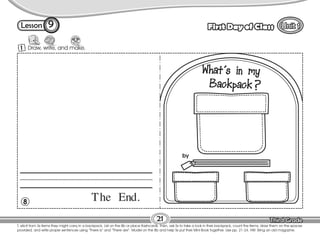
    Lesson 12 Months Makea Year 240 Date: Date: Date: Date: Date: Date: