Container Security
1. Container integrity must be maintained to
protect against the introduction of
unauthorized material and/or persons.
2. At point of stuffing, procedures must be in
place to properly seal and maintain the
integrity of the shipping containers.
A high security seal must be affixed to all
loaded containers bound for the U.S. All
seals must meet or exceed the current
PAS ISO 17712 standards for high security
seals.
C-TPAT
(Customs-Trade Partnership
Against Terrorism)
C-TPAT is a joint government-business
initiative to build cooperative
relationships overall supply chain and
boarder security.
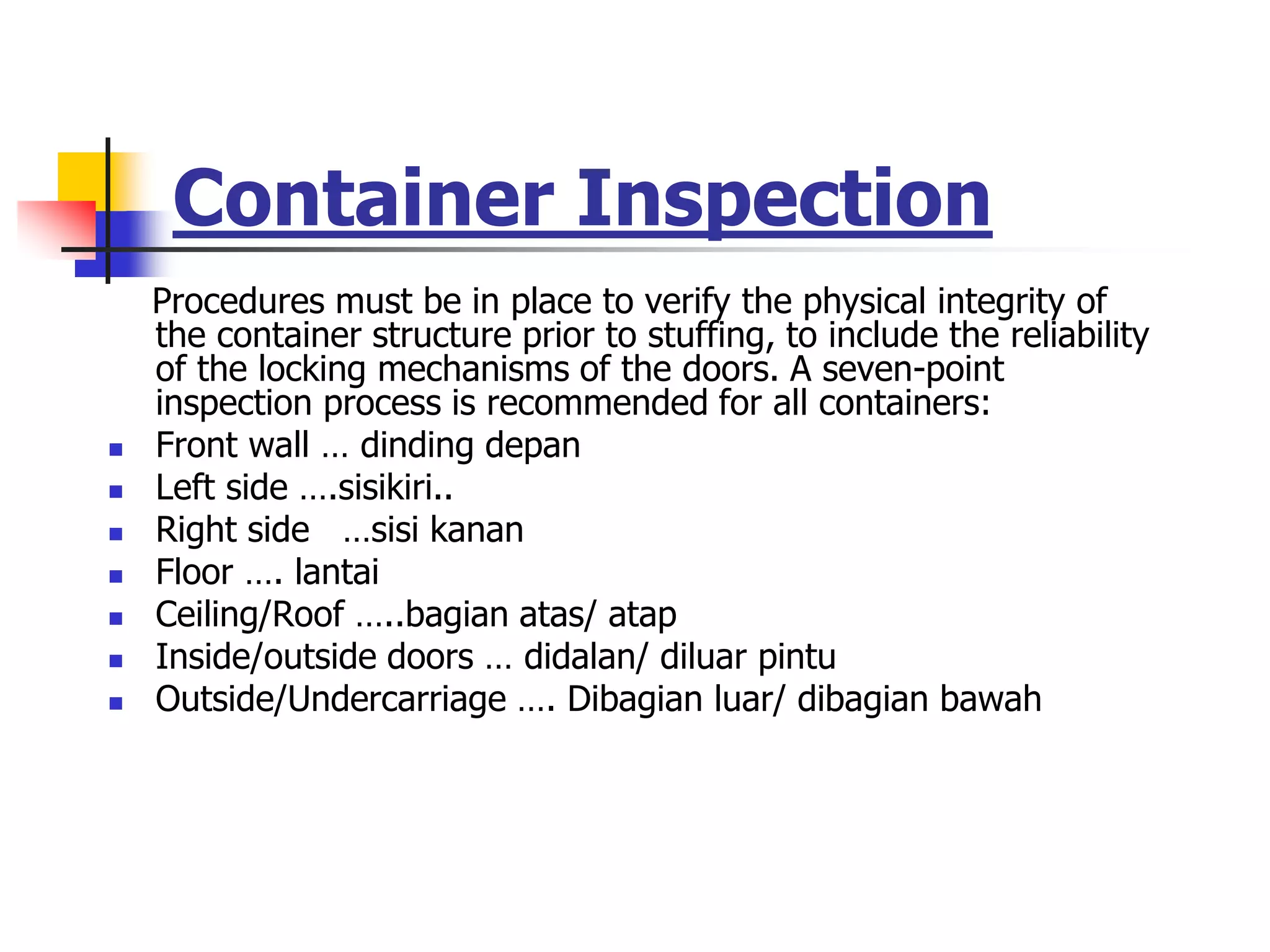
Container Inspection
Procedures must be in place to verify the physical integrity of
the container structure prior to stuffing, to include the reliability
of the locking mechanisms of the doors. A seven-point
inspection process is recommended for all containers:
 Front wall … dinding depan
 Left side ….sisikiri..
 Right side …sisi kanan
 Floor …. lantai
 Ceiling/Roof …..bagian atas/ atap
 Inside/outside doors … didalan/ diluar pintu
 Outside/Undercarriage …. Dibagian luar/ dibagian bawah
Container Seals
1. Written procedures must stipulate how seals
are to be controlled and affixed to loaded
containers - to include procedures for
recognizing and reporting compromised seals
and/or containers to the appropriate foreign
authority.
Only designated employees should distribute
container seals for integrity purposes.
Container Storage
1. Containers must be stored in a secure
area to prevent unauthorized access
and/or manipulation.
Procedures must be in place for
reporting and neutralizing unauthorized
entry into containers or container
storage areas.
Physical Access Controls
pengendali akses pisik
1. Access controls prevent unauthorized
entry to facilities, maintain control of
employees and visitors, and protect
company assets.
2. Access controls must include the
positive identification of all employees,
visitors, and vendors at all points of
entry.
Employees
1. An employee identification system must be in place for positive
identification and access control purposes.
Sistem indektitas pekerja harus ditujukan untuk indentifikasi + dan tujuan
pengendalian akses
1. Employees should only be given access to those secure areas needed for
the performance of their duties.
Pekerja harus seharusnya diberikan akses ke area yang dibutuhkan untuk
melaksanakan perkerjaan mereka
1. Company management or security personnel must adequately control the
issuance and removal of employee, visitor and vendor identification
badges.
2. Menejemen perusahaan untuk pengamanan personel harus dapat
mengendalikan permasalahan dan pemindahan indentitas pekerja.
Pengunjung dan pemasok
3. Procedures for the issuance, removal and changing of access devices
(e.g. keys, key cards, etc.) must be documented.
4. Prosedur untuk menjamin pemindahan dan perubahan dari peralatan
akses ( contoh: kunci.kartu kunci, dsb)harus di dokumentasikan
Visitors
1. Visitors must present photo identification
for documentation purposes upon arrival.
2. All visitors should be escorted and visibly
display temporary identification.
Deliveries (including mail)
1. Proper vendor ID and/or photo
identification must be presented for
documentation purposes upon arrival by
all vendors.
2. Arriving packages and mail should be
periodically screened before being
disseminated.
Challenging and Removing
Unauthorized Persons
Procedures must be in place to identify,
challenge and address
unauthorized/unidentified persons.
Personnel Security
Processes must be in place to screen
prospective employees and to
periodically check current employees.
Pre-Employment Verification
Application information, such as
employment history and references
must be verified prior to employment.
Background checks /
investigations
1. Consistent with foreign, federal, state,
and local regulations, background
checks and investigations should be
conducted for prospective employees.
2. Once employed, periodic checks and
reinvestigations should be performed
based on cause, and/or the sensitivity
of the employee’s position.
Personnel Termination
Procedures
Companies must have procedures in place
to remove identification, facility, and
system access for terminated
employees.
Procedural Security
Security measures must be in place to
ensure the integrity and security of
processes relevant to the
transportation, handling, and storage of
cargo in the supply chain.
Documentation Processing
1. Procedures must be in place to ensure
that all information used in the clearing
of merchandise/cargo, is legible,
complete, accurate, and protected
against the exchange, loss or
introduction of erroneous information.
2. Documentation control must include
safeguarding computer access and
information.
Manifesting Procedures
To help ensure the integrity of cargo
received from abroad, procedures must
be in place to ensure that information
received from business partners is
reported accurately and timely.
Shipping & Receiving
1. Arriving cargo should be reconciled against
information on the cargo manifest.
2. The cargo should be accurately described, and
the weights, labels, marks and piece count
indicated and verified.
3. Departing cargo should be verified against
purchase or delivery orders.
4. Drivers delivering or receiving cargo must be
positively identified before cargo is received or
released.
Cargo Discrepancies
1. All shortages, overages, and other
significant discrepancies or anomalies
must be resolved and/or investigated
appropriately.
2. Customs and/or other appropriate law
enforcement agencies must be notified if
illegal or suspicious activities are
detected - as appropriate.
Security Training and Threat
Awareness
1. A threat awareness program should be established
and maintained by security personnel to recognize
and foster awareness of the threat posed by
terrorists at each point in the supply chain.
2. Employees must be made aware of the procedures
the company has in place to address a situation and
how to report it.
3. Additional training should be provided to employees
in the shipping and receiving areas, as well as those
receiving and opening mail.
4. Additionally, specific training should be offered to
assist employees in maintaining cargo integrity,
recognizing internal conspiracies, and protecting
access controls. These programs should offer
incentives for active employee participation.
Physical Security
Cargo handling and storage facilities must
have physical barriers and deterrents that
guard against unauthorized access.
Fencing
1. Perimeter fencing should enclose the
areas around cargo handling and storage
facilities.
2. Interior fencing within a cargo handling
structure should be used to segregate
domestic, international, high value, and
hazardous cargo.
3. All fencing must be regularly inspected
for integrity and damage.
Gates and Gate Houses
1. Gates through which vehicles and/or
personnel enter or exit must be manned
and/or monitored.
2. The number of gates should be kept to
the minimum necessary for proper
access and safety.
Parking
Private passenger vehicles should be
prohibited from parking in or adjacent
to cargo handling and storage areas.
Building Structure
1. Buildings must be constructed of
materials that resist unlawful entry.
2. The integrity of structures must be
maintained by periodic inspection and
repair.
Locking Devices and Key
Controls
1. All external and internal windows,
gates and fences must be secured
with locking devices.
2. Management or security personnel
must control the issuance of all locks
and keys.
Lighting
Adequate lighting must be provided inside
and outside the facility including the
following areas: entrances and exits,
cargo handling and storage areas, fence
lines and parking areas.
Information Technology
Security
Password Protection
Automated systems must use
individually assigned accounts that
require a periodic change of password.
IT security policies, procedures and
standards must be in place and
provided to employees in the form of
training
Accountability
A system must be in place to identify the abuse of IT
including improper access, tampering or the
altering of business data.
All system violators must be subject to appropriate
disciplinary actions for abuse.

CTPAT PRESENTATION.ppt

  • 1.
    Container Security 1. Containerintegrity must be maintained to protect against the introduction of unauthorized material and/or persons. 2. At point of stuffing, procedures must be in place to properly seal and maintain the integrity of the shipping containers. A high security seal must be affixed to all loaded containers bound for the U.S. All seals must meet or exceed the current PAS ISO 17712 standards for high security seals.
  • 2.
    C-TPAT (Customs-Trade Partnership Against Terrorism) C-TPATis a joint government-business initiative to build cooperative relationships overall supply chain and boarder security.
  • 3.
    Container Inspection Procedures mustbe in place to verify the physical integrity of the container structure prior to stuffing, to include the reliability of the locking mechanisms of the doors. A seven-point inspection process is recommended for all containers:  Front wall … dinding depan  Left side ….sisikiri..  Right side …sisi kanan  Floor …. lantai  Ceiling/Roof …..bagian atas/ atap  Inside/outside doors … didalan/ diluar pintu  Outside/Undercarriage …. Dibagian luar/ dibagian bawah
  • 4.
    Container Seals 1. Writtenprocedures must stipulate how seals are to be controlled and affixed to loaded containers - to include procedures for recognizing and reporting compromised seals and/or containers to the appropriate foreign authority. Only designated employees should distribute container seals for integrity purposes.
  • 5.
    Container Storage 1. Containersmust be stored in a secure area to prevent unauthorized access and/or manipulation. Procedures must be in place for reporting and neutralizing unauthorized entry into containers or container storage areas.
  • 6.
    Physical Access Controls pengendaliakses pisik 1. Access controls prevent unauthorized entry to facilities, maintain control of employees and visitors, and protect company assets. 2. Access controls must include the positive identification of all employees, visitors, and vendors at all points of entry.
  • 7.
    Employees 1. An employeeidentification system must be in place for positive identification and access control purposes. Sistem indektitas pekerja harus ditujukan untuk indentifikasi + dan tujuan pengendalian akses 1. Employees should only be given access to those secure areas needed for the performance of their duties. Pekerja harus seharusnya diberikan akses ke area yang dibutuhkan untuk melaksanakan perkerjaan mereka 1. Company management or security personnel must adequately control the issuance and removal of employee, visitor and vendor identification badges. 2. Menejemen perusahaan untuk pengamanan personel harus dapat mengendalikan permasalahan dan pemindahan indentitas pekerja. Pengunjung dan pemasok 3. Procedures for the issuance, removal and changing of access devices (e.g. keys, key cards, etc.) must be documented. 4. Prosedur untuk menjamin pemindahan dan perubahan dari peralatan akses ( contoh: kunci.kartu kunci, dsb)harus di dokumentasikan
  • 8.
    Visitors 1. Visitors mustpresent photo identification for documentation purposes upon arrival. 2. All visitors should be escorted and visibly display temporary identification.
  • 9.
    Deliveries (including mail) 1.Proper vendor ID and/or photo identification must be presented for documentation purposes upon arrival by all vendors. 2. Arriving packages and mail should be periodically screened before being disseminated.
  • 10.
    Challenging and Removing UnauthorizedPersons Procedures must be in place to identify, challenge and address unauthorized/unidentified persons.
  • 11.
    Personnel Security Processes mustbe in place to screen prospective employees and to periodically check current employees.
  • 12.
    Pre-Employment Verification Application information,such as employment history and references must be verified prior to employment.
  • 13.
    Background checks / investigations 1.Consistent with foreign, federal, state, and local regulations, background checks and investigations should be conducted for prospective employees. 2. Once employed, periodic checks and reinvestigations should be performed based on cause, and/or the sensitivity of the employee’s position.
  • 14.
    Personnel Termination Procedures Companies musthave procedures in place to remove identification, facility, and system access for terminated employees.
  • 15.
    Procedural Security Security measuresmust be in place to ensure the integrity and security of processes relevant to the transportation, handling, and storage of cargo in the supply chain.
  • 16.
    Documentation Processing 1. Proceduresmust be in place to ensure that all information used in the clearing of merchandise/cargo, is legible, complete, accurate, and protected against the exchange, loss or introduction of erroneous information. 2. Documentation control must include safeguarding computer access and information.
  • 17.
    Manifesting Procedures To helpensure the integrity of cargo received from abroad, procedures must be in place to ensure that information received from business partners is reported accurately and timely.
  • 18.
    Shipping & Receiving 1.Arriving cargo should be reconciled against information on the cargo manifest. 2. The cargo should be accurately described, and the weights, labels, marks and piece count indicated and verified. 3. Departing cargo should be verified against purchase or delivery orders. 4. Drivers delivering or receiving cargo must be positively identified before cargo is received or released.
  • 19.
    Cargo Discrepancies 1. Allshortages, overages, and other significant discrepancies or anomalies must be resolved and/or investigated appropriately. 2. Customs and/or other appropriate law enforcement agencies must be notified if illegal or suspicious activities are detected - as appropriate.
  • 20.
    Security Training andThreat Awareness 1. A threat awareness program should be established and maintained by security personnel to recognize and foster awareness of the threat posed by terrorists at each point in the supply chain. 2. Employees must be made aware of the procedures the company has in place to address a situation and how to report it. 3. Additional training should be provided to employees in the shipping and receiving areas, as well as those receiving and opening mail. 4. Additionally, specific training should be offered to assist employees in maintaining cargo integrity, recognizing internal conspiracies, and protecting access controls. These programs should offer incentives for active employee participation.
  • 21.
    Physical Security Cargo handlingand storage facilities must have physical barriers and deterrents that guard against unauthorized access.
  • 22.
    Fencing 1. Perimeter fencingshould enclose the areas around cargo handling and storage facilities. 2. Interior fencing within a cargo handling structure should be used to segregate domestic, international, high value, and hazardous cargo. 3. All fencing must be regularly inspected for integrity and damage.
  • 23.
    Gates and GateHouses 1. Gates through which vehicles and/or personnel enter or exit must be manned and/or monitored. 2. The number of gates should be kept to the minimum necessary for proper access and safety.
  • 24.
    Parking Private passenger vehiclesshould be prohibited from parking in or adjacent to cargo handling and storage areas.
  • 25.
    Building Structure 1. Buildingsmust be constructed of materials that resist unlawful entry. 2. The integrity of structures must be maintained by periodic inspection and repair.
  • 26.
    Locking Devices andKey Controls 1. All external and internal windows, gates and fences must be secured with locking devices. 2. Management or security personnel must control the issuance of all locks and keys.
  • 27.
    Lighting Adequate lighting mustbe provided inside and outside the facility including the following areas: entrances and exits, cargo handling and storage areas, fence lines and parking areas.
  • 28.
    Information Technology Security Password Protection Automatedsystems must use individually assigned accounts that require a periodic change of password. IT security policies, procedures and standards must be in place and provided to employees in the form of training
  • 29.
    Accountability A system mustbe in place to identify the abuse of IT including improper access, tampering or the altering of business data. All system violators must be subject to appropriate disciplinary actions for abuse.