CSVs….Purpose, focus, scale, and
more….
Julian Gonsalves
FP 1.3 partner (IIRR ,ICRAF)
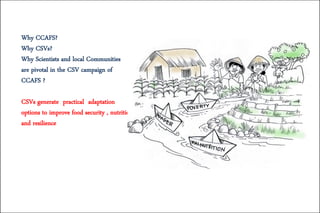
Why CCAFS?
Why CSVs?
Why Scientists and local Communities
are pivotal in the CSV campaign of
CCAFS ?
CSVs generate practical adaptation
options to improve food security , nutrition
and resilience
• CSVs are primarily focal points for LOCATION
specific research
• CVS focus on climate change hotspots
• Multiple CSV sites representing different agro
ecologies, different climate risks etc(diversity is
useful for comparison, extrapolation, climate
analogue )
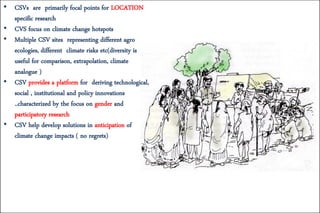
• CSV provides a platform for deriving technological,
social , institutional and policy innovations
..characterized by the focus on gender and
participatory research
• CSV help develop solutions in anticipation of
climate change impacts ( no regrets)
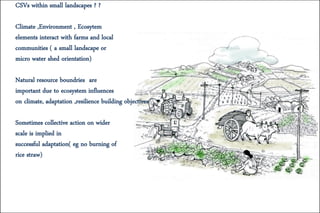
CSVs within small landscapes ? ?
Climate ,Environment , Ecosytem
elements interact with farms and local
communities ( a small landscape or
micro water shed orientation)
Natural resource boundries are
important due to ecosystem influences
on climate, adaptation ,resilience building objectives
Sometimes collective action on wider
scale is implied in
successful adaptation( eg no burning of
rice straw)
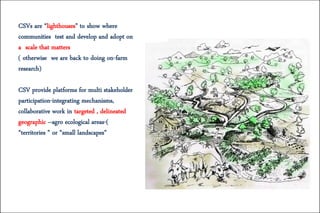
CSVs are “lighthouses” to show where
communities test and develop and adopt on
a scale that matters
( otherwise we are back to doing on-farm
research)
CSV provide platforms for multi stakeholder
participation-integrating mechanisms,
collaborative work in targeted , delineated
geographic –agro ecological areas-(
“territories ” or “small landscapes”
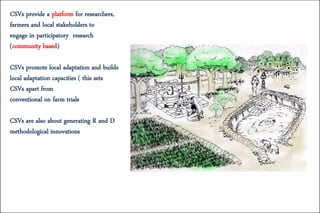
CSVs provide a platform for researchers,
farmers and local stakeholders to
engage in participatory research
(community based)
CSVs promote local adaptation and builds
local adaptation capacities ( this sets
CSVs apart from
conventional on farm trials
CSVs are also about generating R and D
methodological innovations
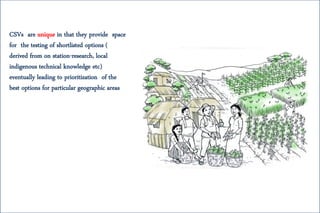
CSVs are unique in that they provide space
for the testing of shortlisted options (
derived from on station-research, local
indigenous technical knowledge etc)
eventually leading to prioritization of the
best options for particular geographic areas
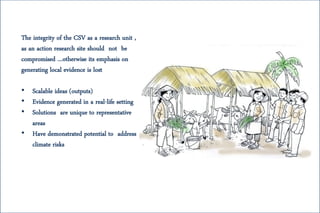
The integrity of the CSV as a research unit ,
as an action research site should not be
compromised …otherwise its emphasis on
generating local evidence is lost
• Scalable ideas (outputs)
• Evidence generated in a real-life setting
• Solutions are unique to representative
areas
• Have demonstrated potential to address
climate risks
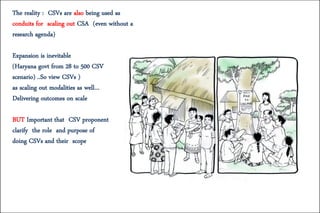
The reality : CSVs are also being used as
conduits for scaling out CSA (even without a
research agenda)
Expansion is inevitable
(Haryana govt from 28 to 500 CSV
scenario) ..So view CSVs )
as scaling out modalities as well…
Delivering outcomes on scale
BUT Important that CSV proponent
clarify the role and purpose of
doing CSVs and their scope
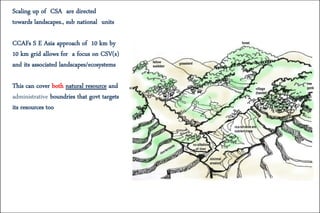
Scaling up of CSA are directed
towards landscapes., sub national units
CCAFs S E Asia approach of 10 km by
10 km grid allows for a focus on CSV(s)
and its associated landscapes/ecosystems
This can cover both natural resource and
administrative boundries that govt targets
its resources too
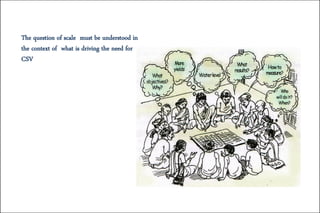
The question of scale must be understood in
the context of what is driving the need for
CSV
REMINDER 1
Adaptation research characterized by CSVs
helps build and nuture local capacities at
different levels, to continue to innovate,
experiment, and adapt…often incremental
adaptation is implied
Communities which have had successful
community level adaptation management
experience are likely to adapt better to
future change
REMINDER 2
In a CSV, ultimately we need to ask
ourselves whose needs are being
addressed?
Reduced poverty, improved
livelihoods, better nutrition (and
more research papers as side benefit)
CSVs: Purpose, focus, scale and more...

CSVs: Purpose, focus, scale and more...

  • 1.
    CSVs….Purpose, focus, scale,and more…. Julian Gonsalves FP 1.3 partner (IIRR ,ICRAF)
  • 2.
    Why CCAFS? Why CSVs? WhyScientists and local Communities are pivotal in the CSV campaign of CCAFS ? CSVs generate practical adaptation options to improve food security , nutrition and resilience
  • 3.
    • CSVs areprimarily focal points for LOCATION specific research • CVS focus on climate change hotspots • Multiple CSV sites representing different agro ecologies, different climate risks etc(diversity is useful for comparison, extrapolation, climate analogue ) • CSV provides a platform for deriving technological, social , institutional and policy innovations ..characterized by the focus on gender and participatory research • CSV help develop solutions in anticipation of climate change impacts ( no regrets)
  • 4.
    CSVs within smalllandscapes ? ? Climate ,Environment , Ecosytem elements interact with farms and local communities ( a small landscape or micro water shed orientation) Natural resource boundries are important due to ecosystem influences on climate, adaptation ,resilience building objectives Sometimes collective action on wider scale is implied in successful adaptation( eg no burning of rice straw)
  • 5.
    CSVs are “lighthouses”to show where communities test and develop and adopt on a scale that matters ( otherwise we are back to doing on-farm research) CSV provide platforms for multi stakeholder participation-integrating mechanisms, collaborative work in targeted , delineated geographic –agro ecological areas-( “territories ” or “small landscapes”
  • 6.
    CSVs provide aplatform for researchers, farmers and local stakeholders to engage in participatory research (community based) CSVs promote local adaptation and builds local adaptation capacities ( this sets CSVs apart from conventional on farm trials CSVs are also about generating R and D methodological innovations
  • 7.
    CSVs are uniquein that they provide space for the testing of shortlisted options ( derived from on station-research, local indigenous technical knowledge etc) eventually leading to prioritization of the best options for particular geographic areas
  • 8.
    The integrity ofthe CSV as a research unit , as an action research site should not be compromised …otherwise its emphasis on generating local evidence is lost • Scalable ideas (outputs) • Evidence generated in a real-life setting • Solutions are unique to representative areas • Have demonstrated potential to address climate risks
  • 9.
    The reality :CSVs are also being used as conduits for scaling out CSA (even without a research agenda) Expansion is inevitable (Haryana govt from 28 to 500 CSV scenario) ..So view CSVs ) as scaling out modalities as well… Delivering outcomes on scale BUT Important that CSV proponent clarify the role and purpose of doing CSVs and their scope
  • 10.
    Scaling up ofCSA are directed towards landscapes., sub national units CCAFs S E Asia approach of 10 km by 10 km grid allows for a focus on CSV(s) and its associated landscapes/ecosystems This can cover both natural resource and administrative boundries that govt targets its resources too
  • 11.
    The question ofscale must be understood in the context of what is driving the need for CSV
  • 12.
    REMINDER 1 Adaptation researchcharacterized by CSVs helps build and nuture local capacities at different levels, to continue to innovate, experiment, and adapt…often incremental adaptation is implied Communities which have had successful community level adaptation management experience are likely to adapt better to future change
  • 13.
    REMINDER 2 In aCSV, ultimately we need to ask ourselves whose needs are being addressed? Reduced poverty, improved livelihoods, better nutrition (and more research papers as side benefit)