The 38th Quarterly C-Suite Survey
The Impact of Lower Oil Prices &
Outlook for 2015
March 24, 2015
Sponsored by:
Published and
broadcast by:
2222
Introduction
 This is the 38th edition of the C-Suite Quarterly Survey, conducted on
behalf of KPMG; published and broadcast by The Globe and Mail’s
Report on Business and BNN.
 Previous quarters’ surveys are available at GandalfGroup.ca .
 This quarter’s survey included questions about:
 The price of oil and a low dollar
 The state of the Canadian economy
 Federal budget policy options
 Methodology: telephone interviews with 152 C-Suite executives from
ROB1000 companies between February 23rd and March 16th, 2015.
3
Key Findings - I
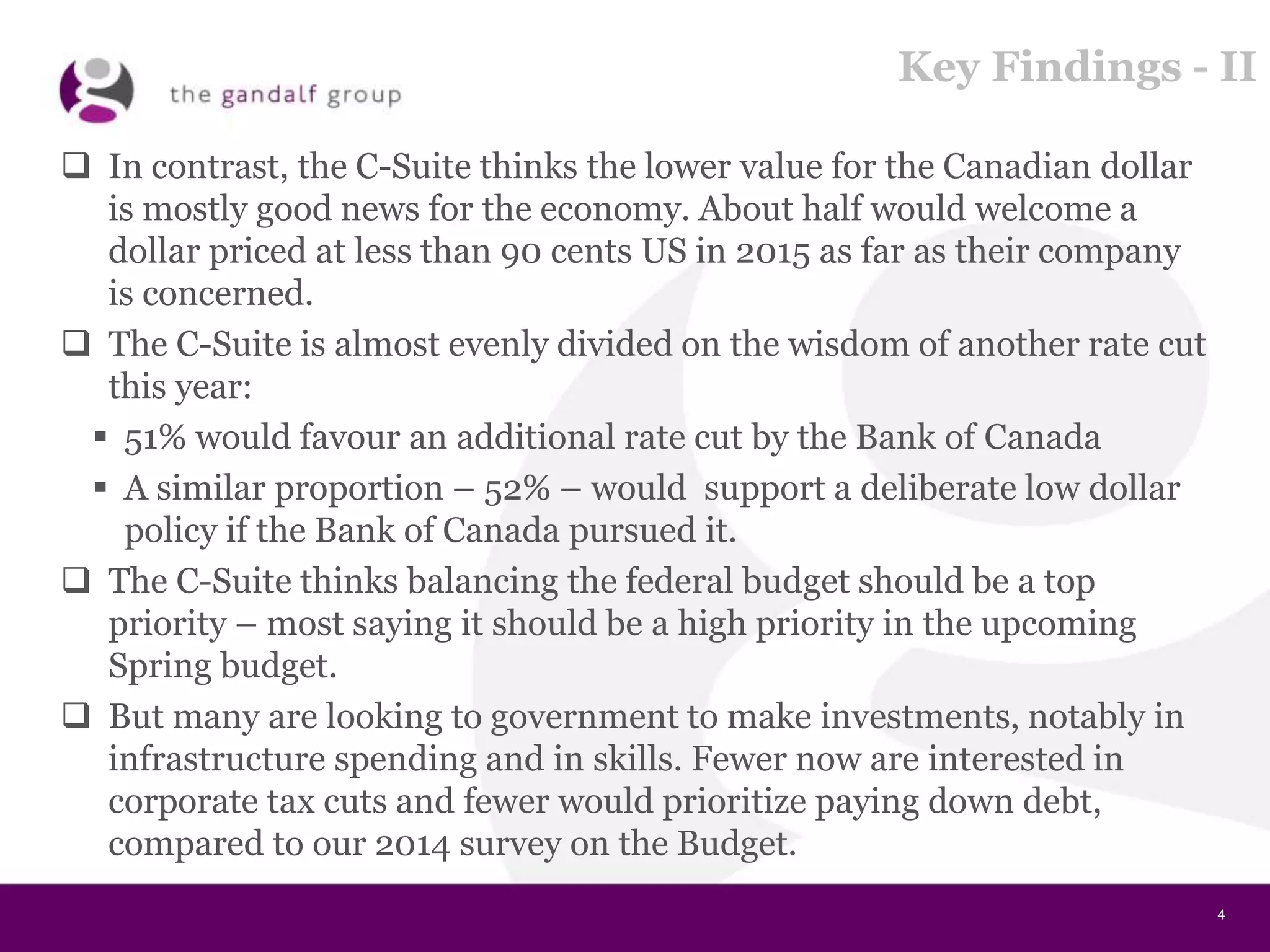
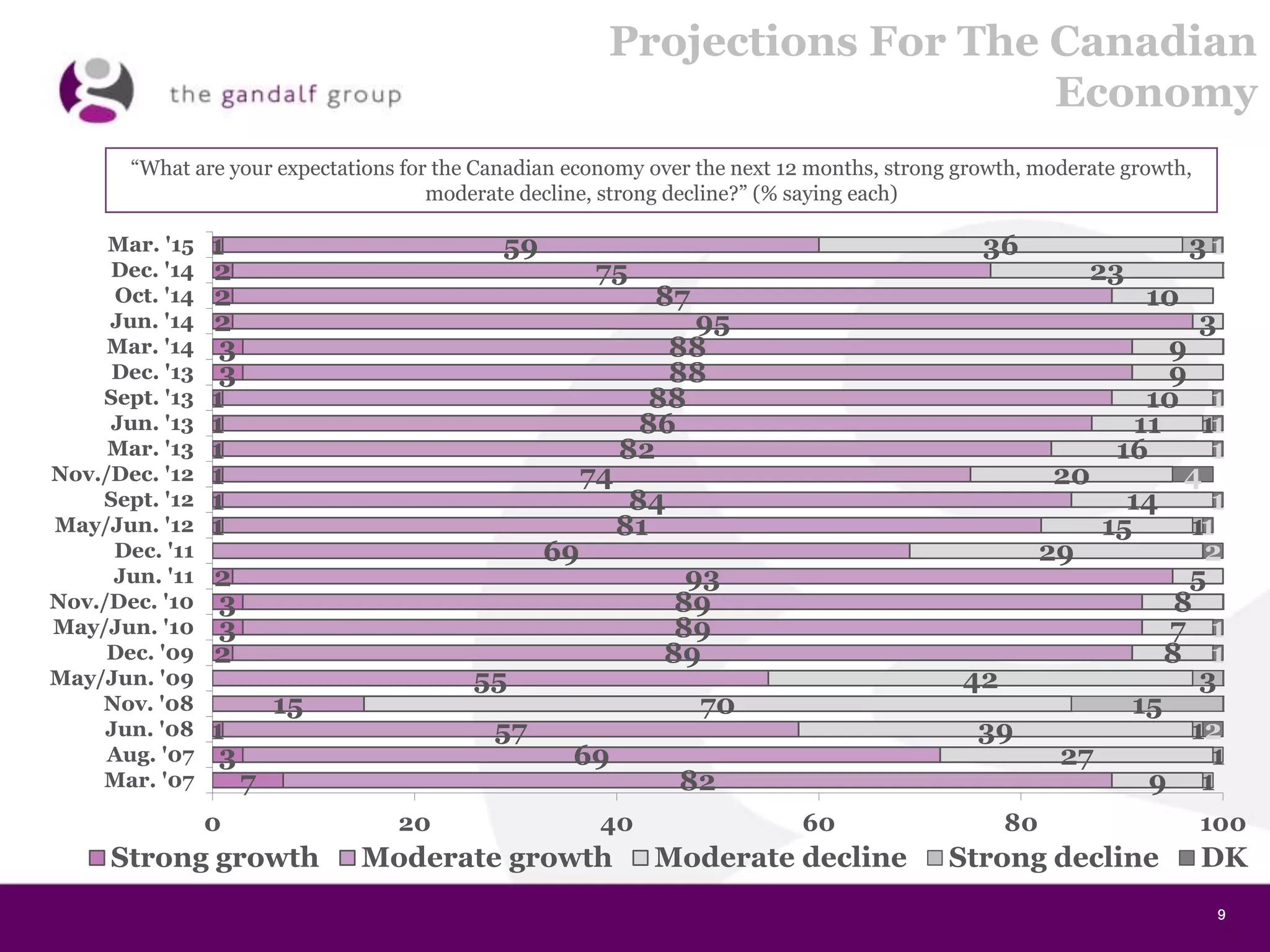
 The outlook for Canada’s economy has weakened significantly. This is
the most pessimistic outlook among the C-suite since 2009 - the
aftermath of the recession.
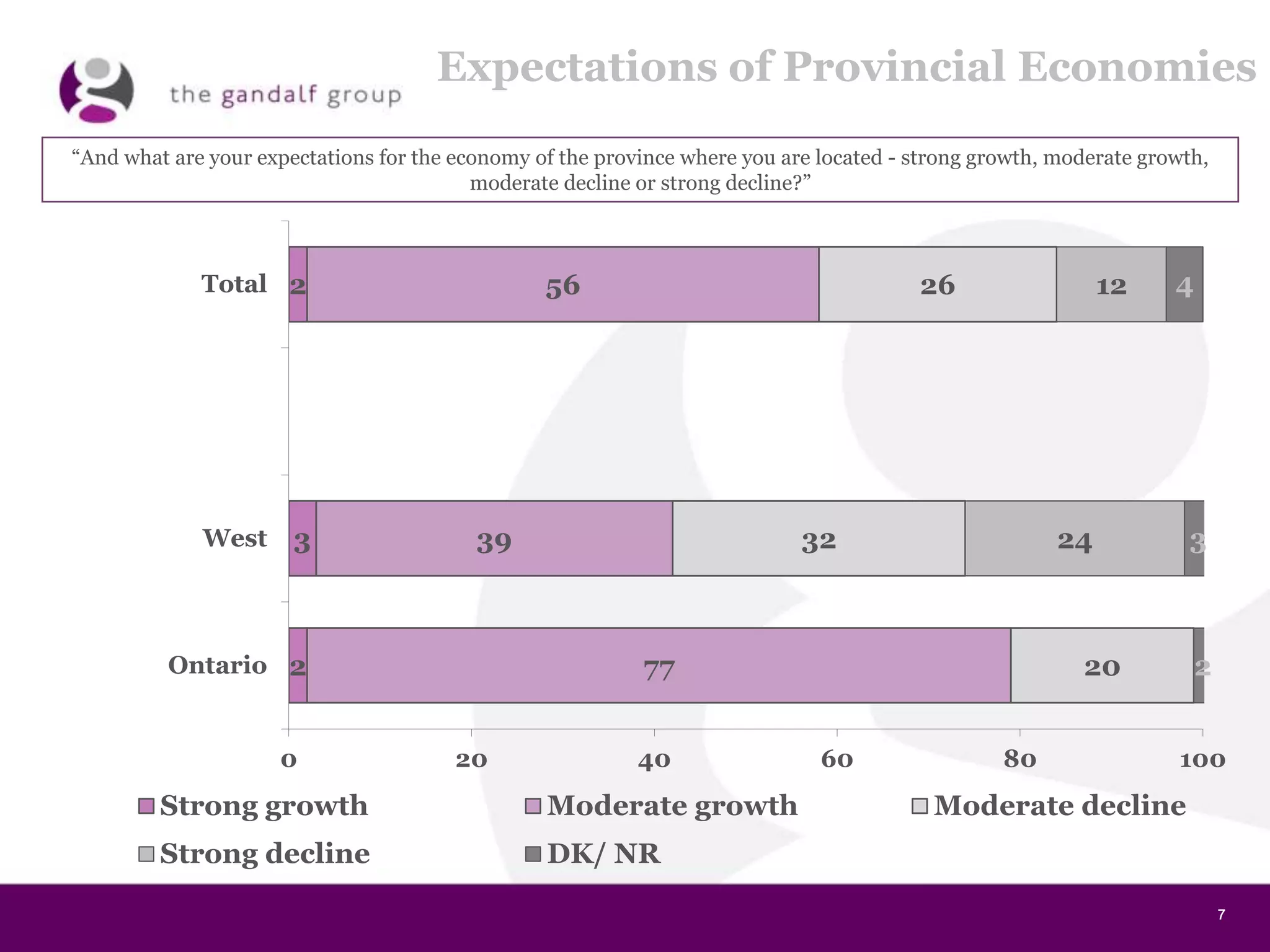
 Few expect strong growth for the Ontario economy but expectations
for provincial economies in Western Canadian are very negative.
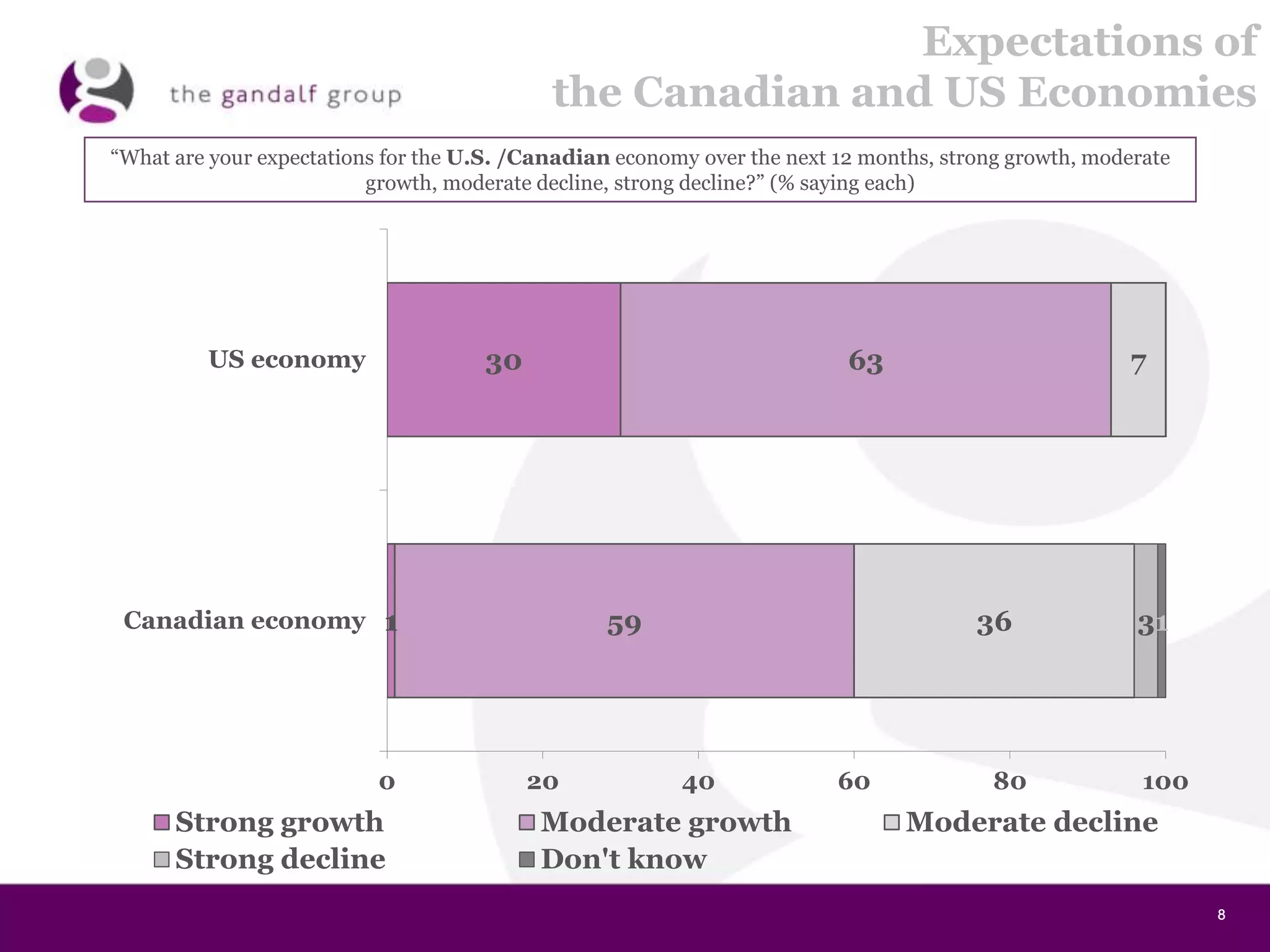
 The US economy is now leading the way to growth, rather than
tracking with or behind the Canadian economy as it did in the years
following the great recession.
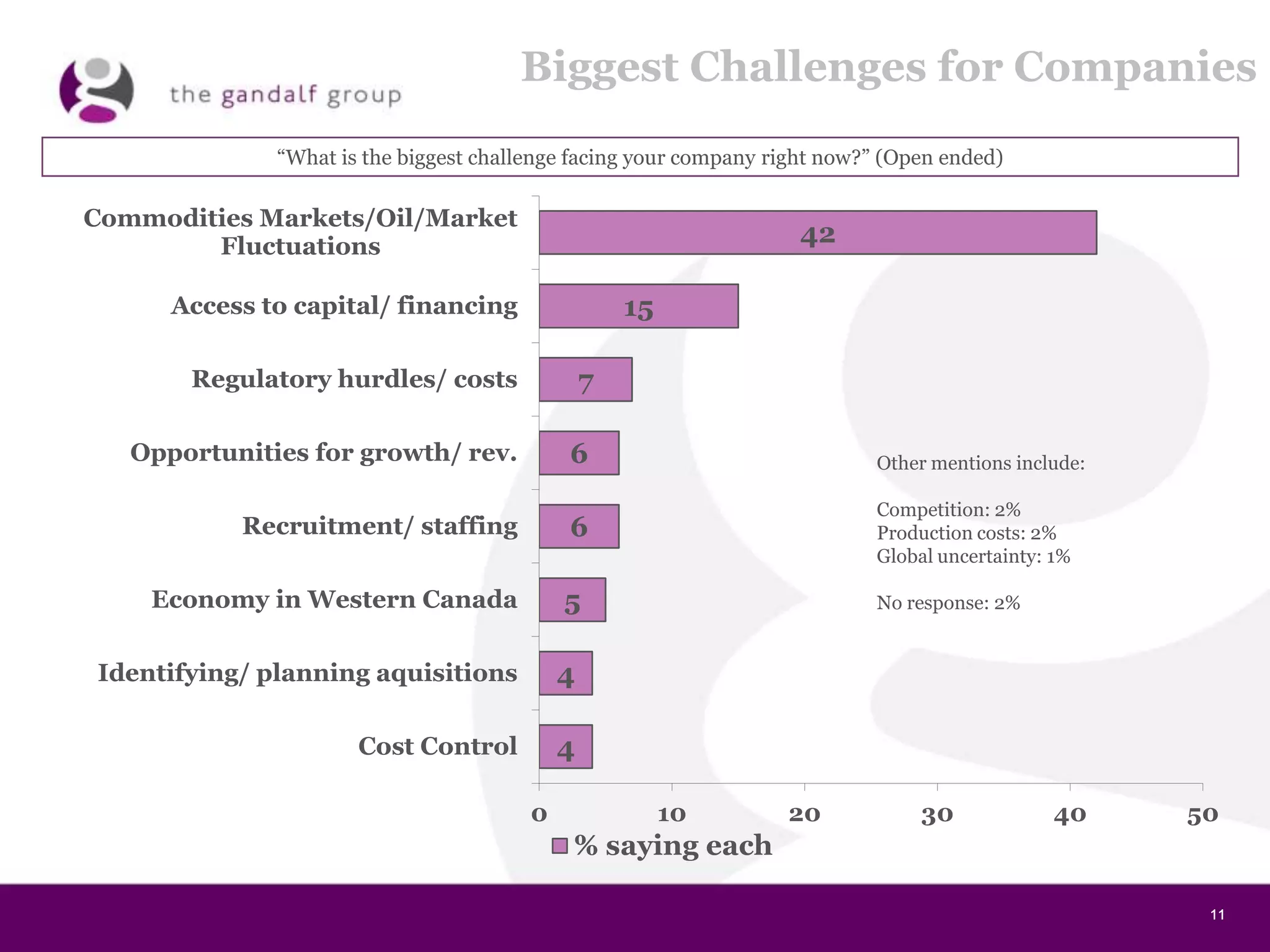
 The most commonly cited concern for businesses are low oil or
commodities prices. However, many other companies are concerned
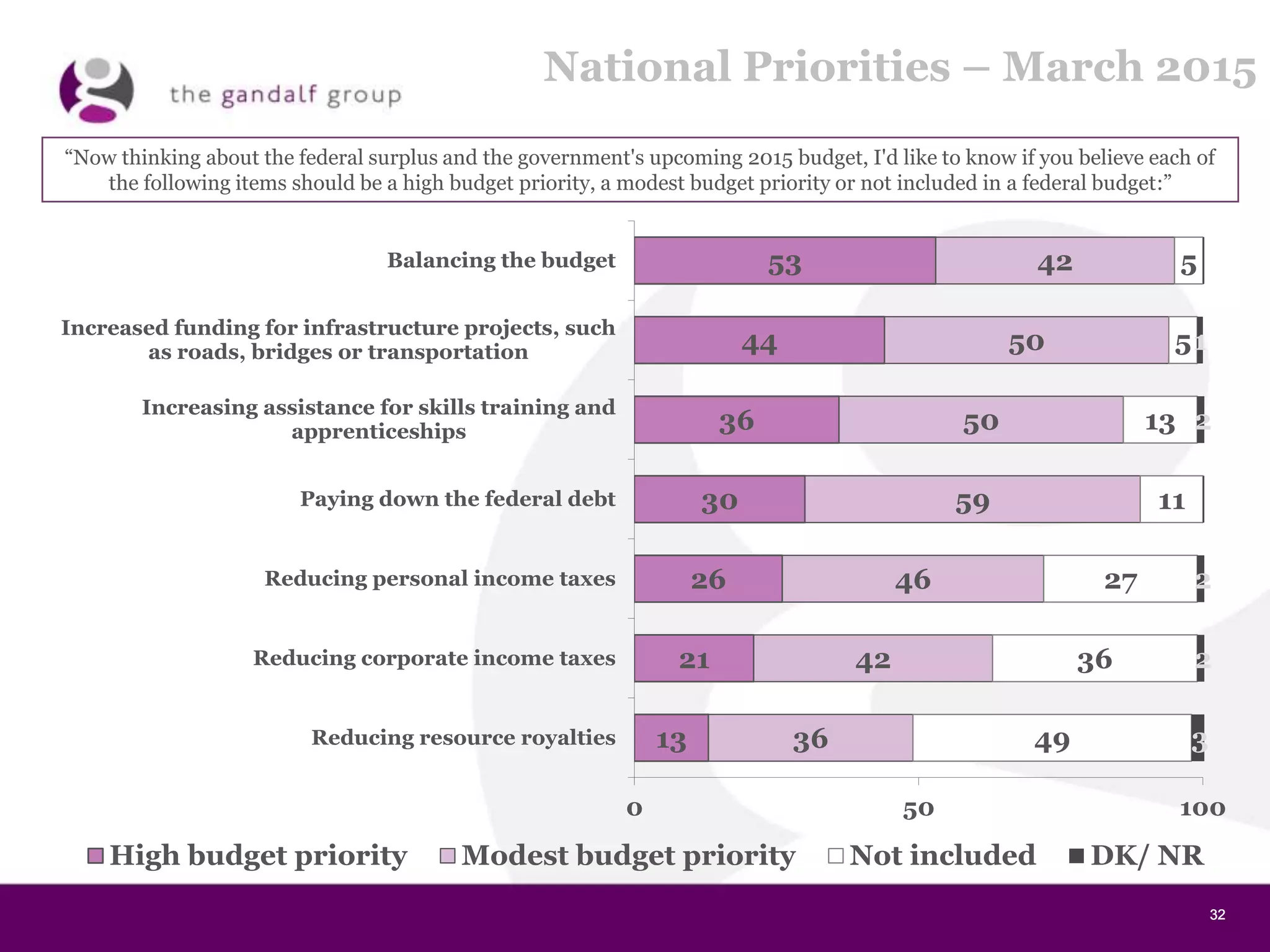
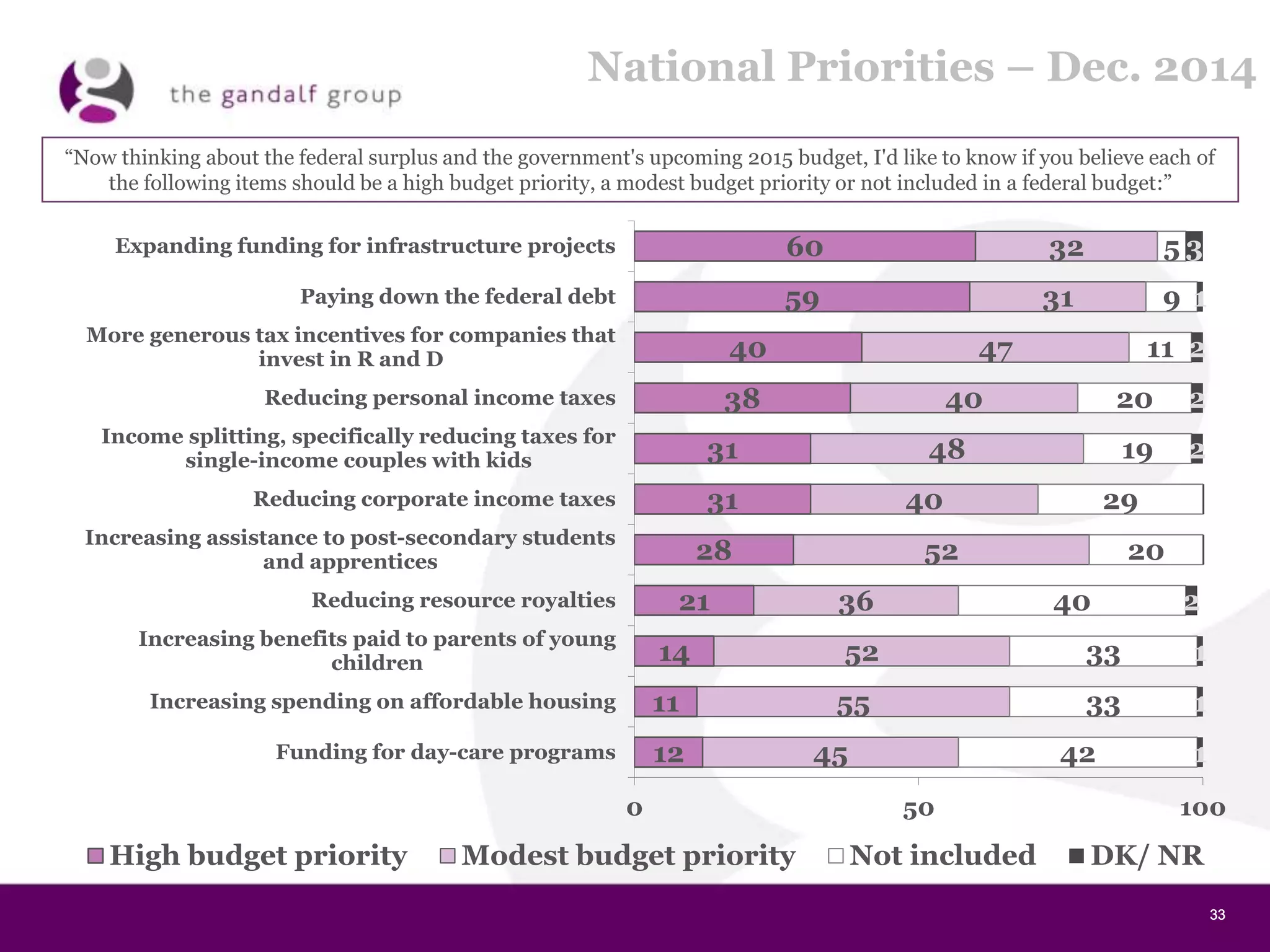
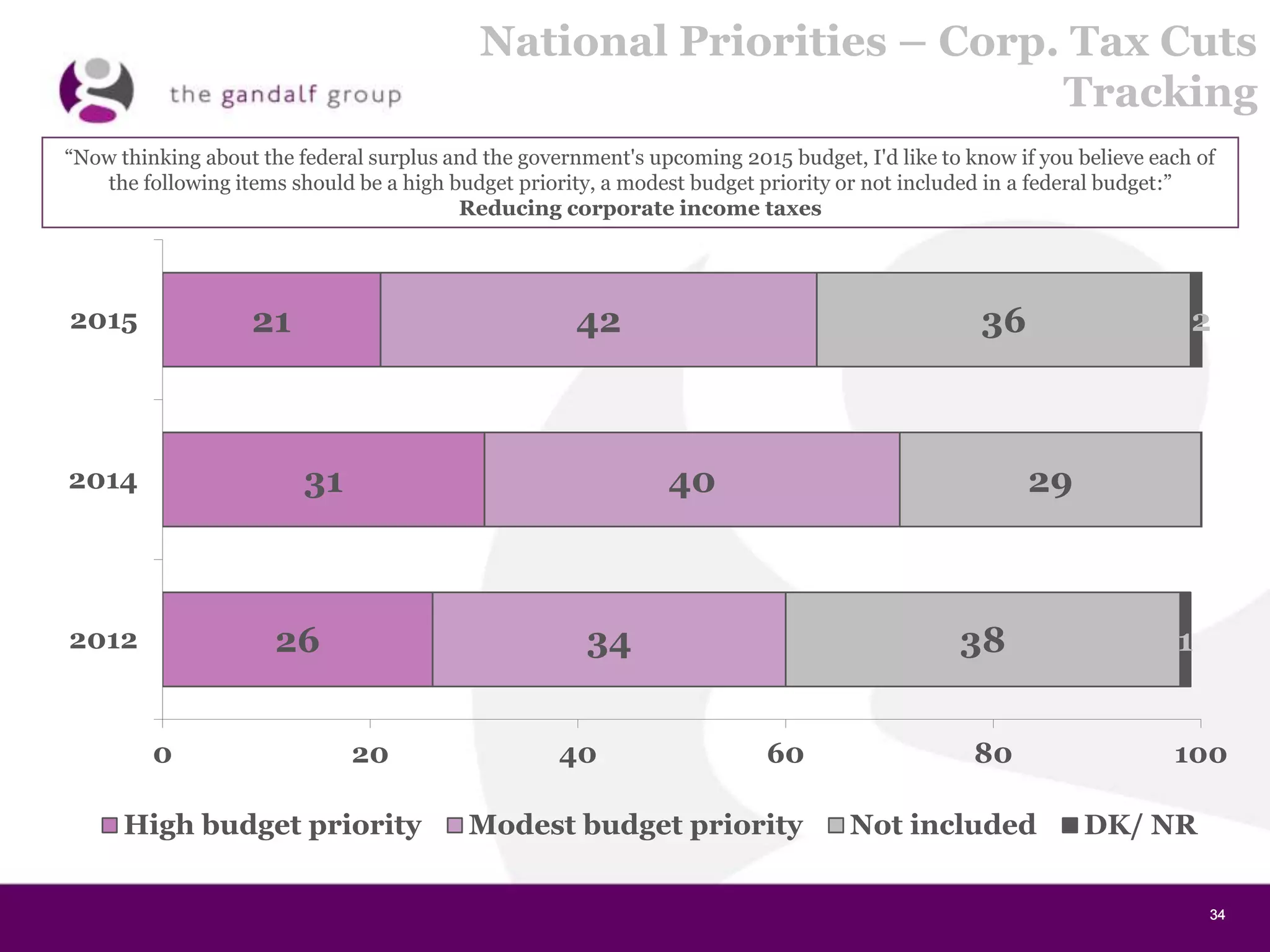
about access to finance, raising equity or funding.
 The drop in the price of oil has hurt many companies and they are
cutting not just capital but salaries or staff levels.
 A minority of executives said their companies are benefitting somewhat from
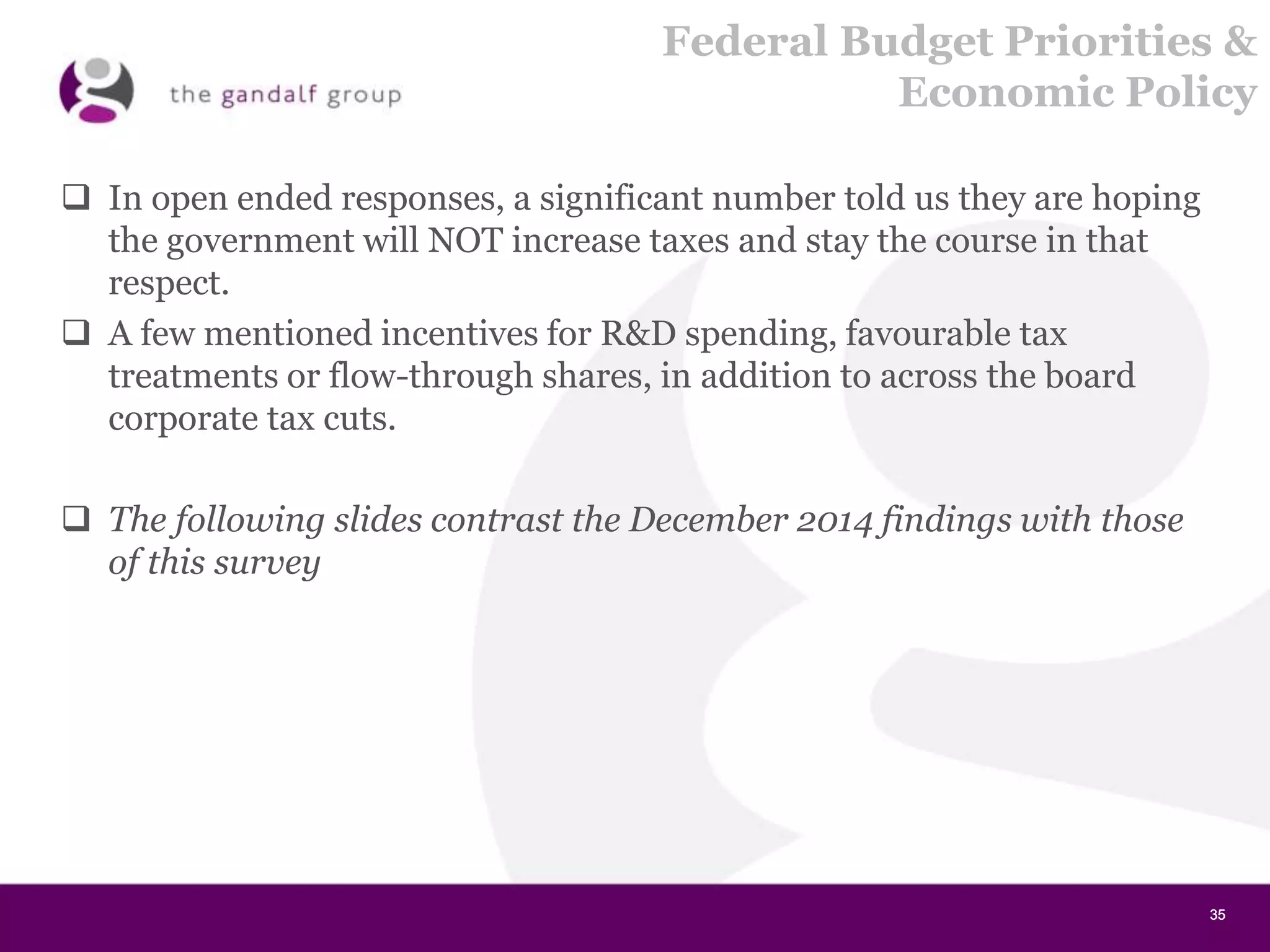
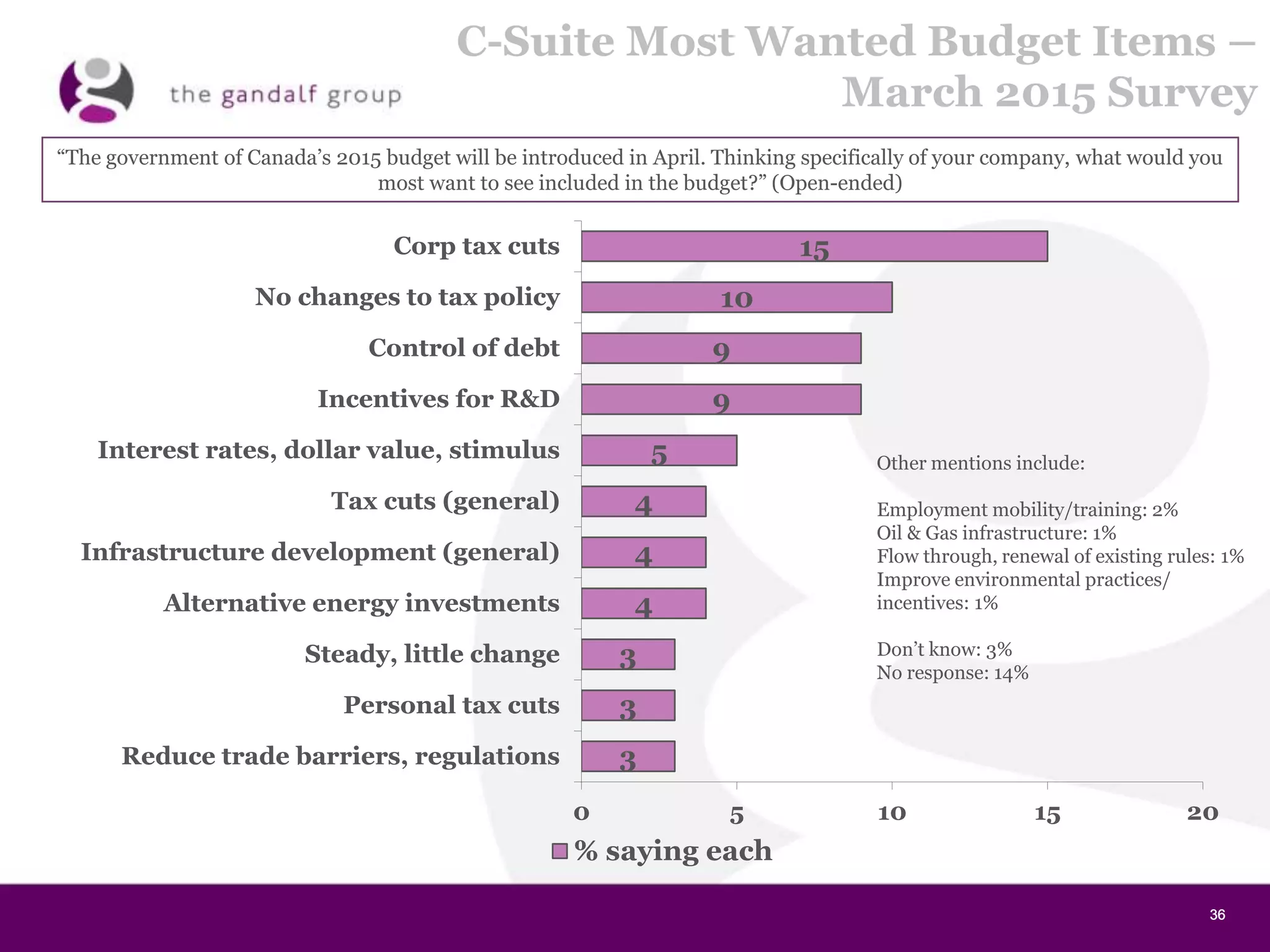
cheaper energy prices.
4
Key Findings - II
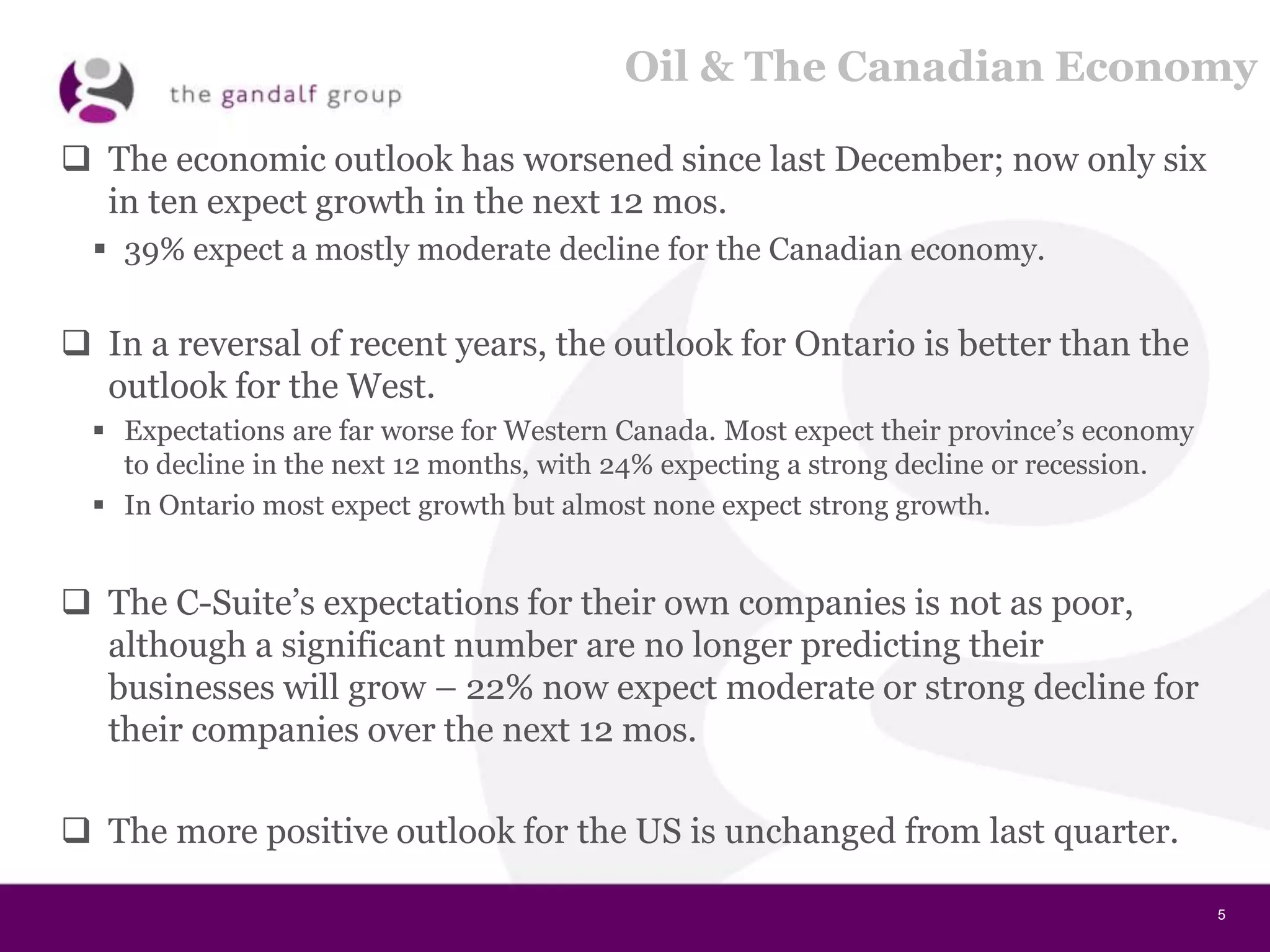
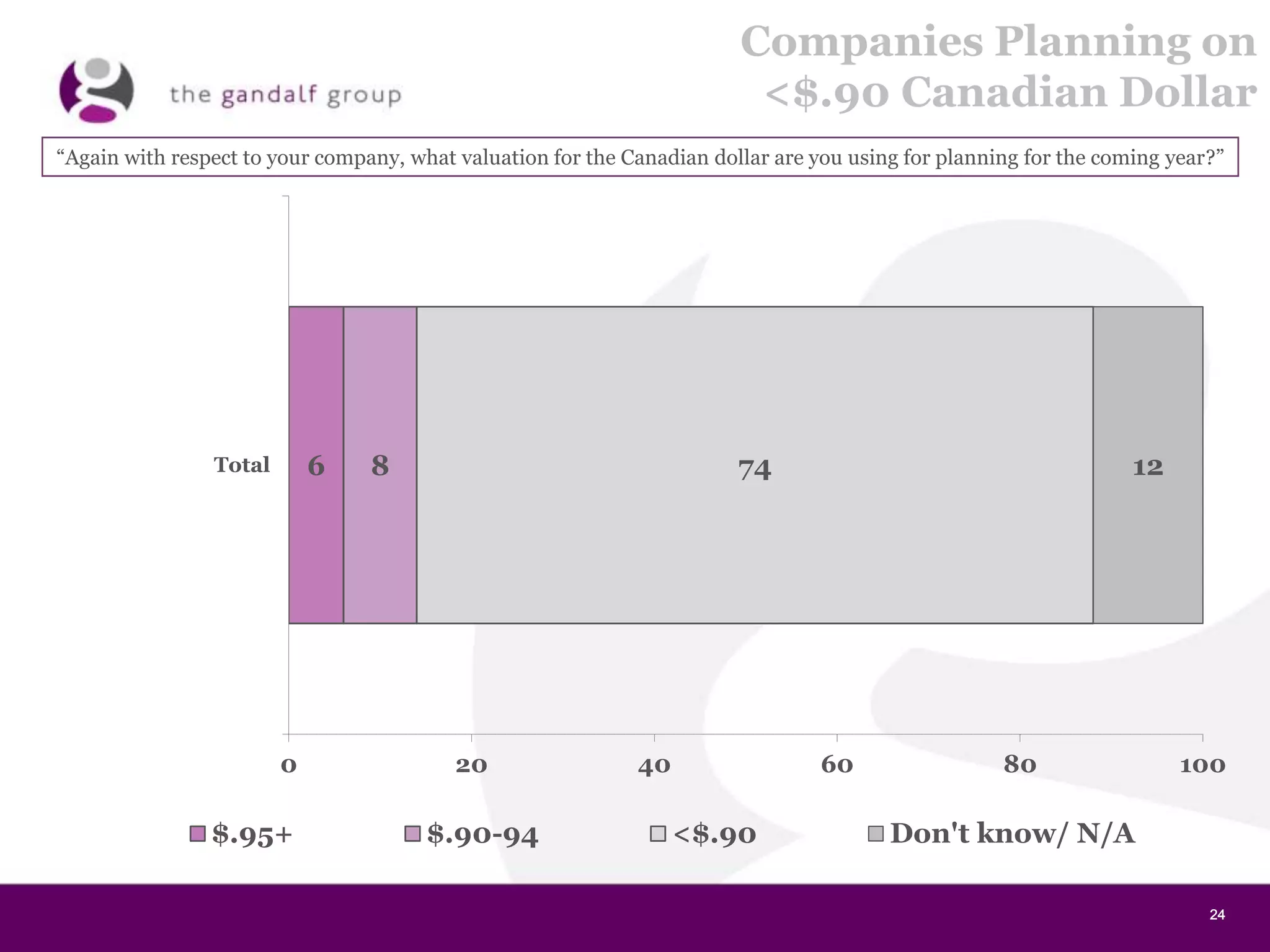
 In contrast, the C-Suite thinks the lower value for the Canadian dollar
is mostly good news for the economy. About half would welcome a
dollar priced at less than 90 cents US in 2015 as far as their company
is concerned.
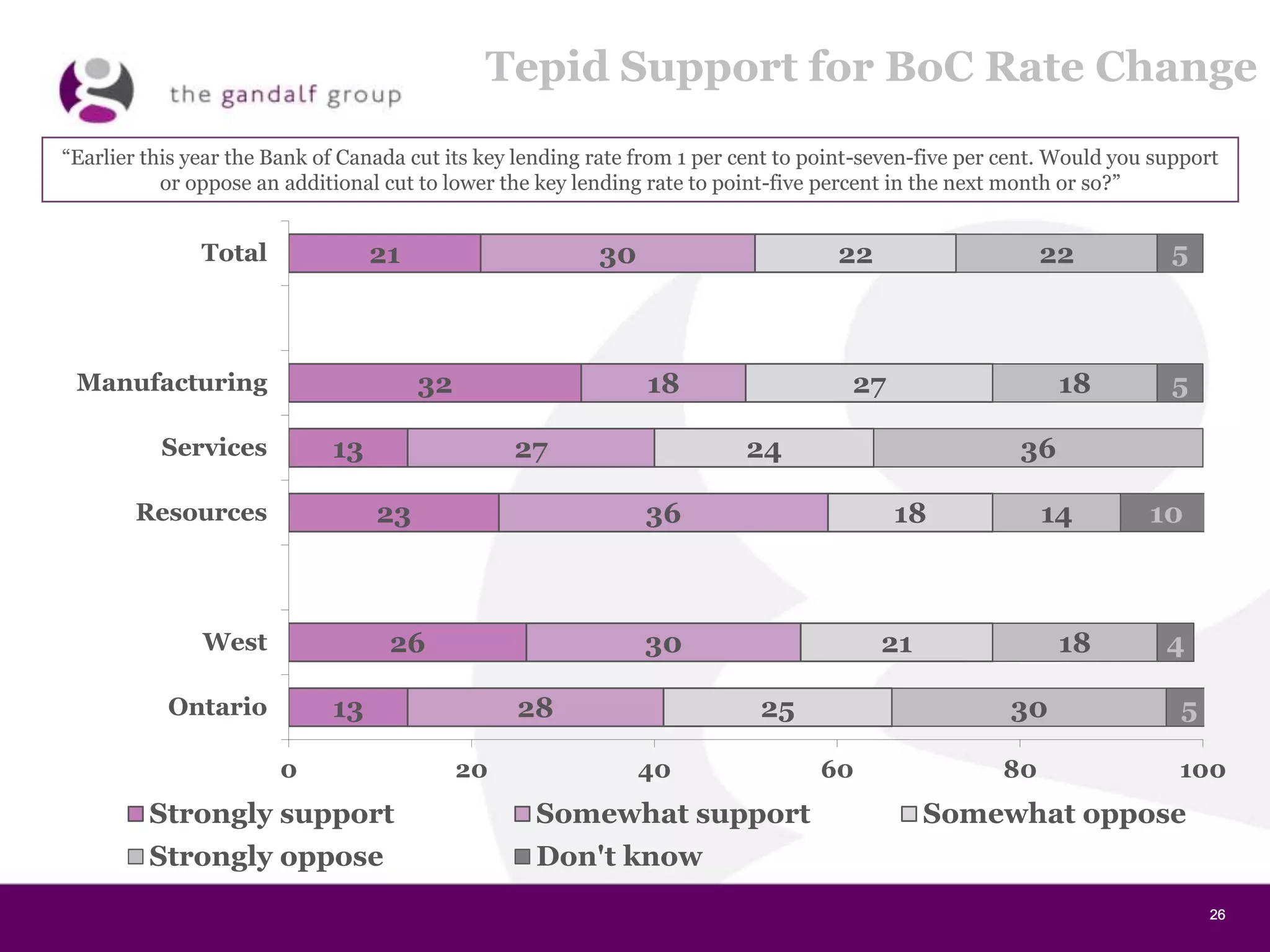
 The C-Suite is almost evenly divided on the wisdom of another rate cut
this year:
 51% would favour an additional rate cut by the Bank of Canada
 A similar proportion – 52% – would support a deliberate low dollar
policy if the Bank of Canada pursued it.
 The C-Suite thinks balancing the federal budget should be a top
priority – most saying it should be a high priority in the upcoming
Spring budget.
 But many are looking to government to make investments, notably in
infrastructure spending and in skills. Fewer now are interested in
corporate tax cuts and fewer would prioritize paying down debt,
compared to our 2014 survey on the Budget.
5
Oil & The Canadian Economy
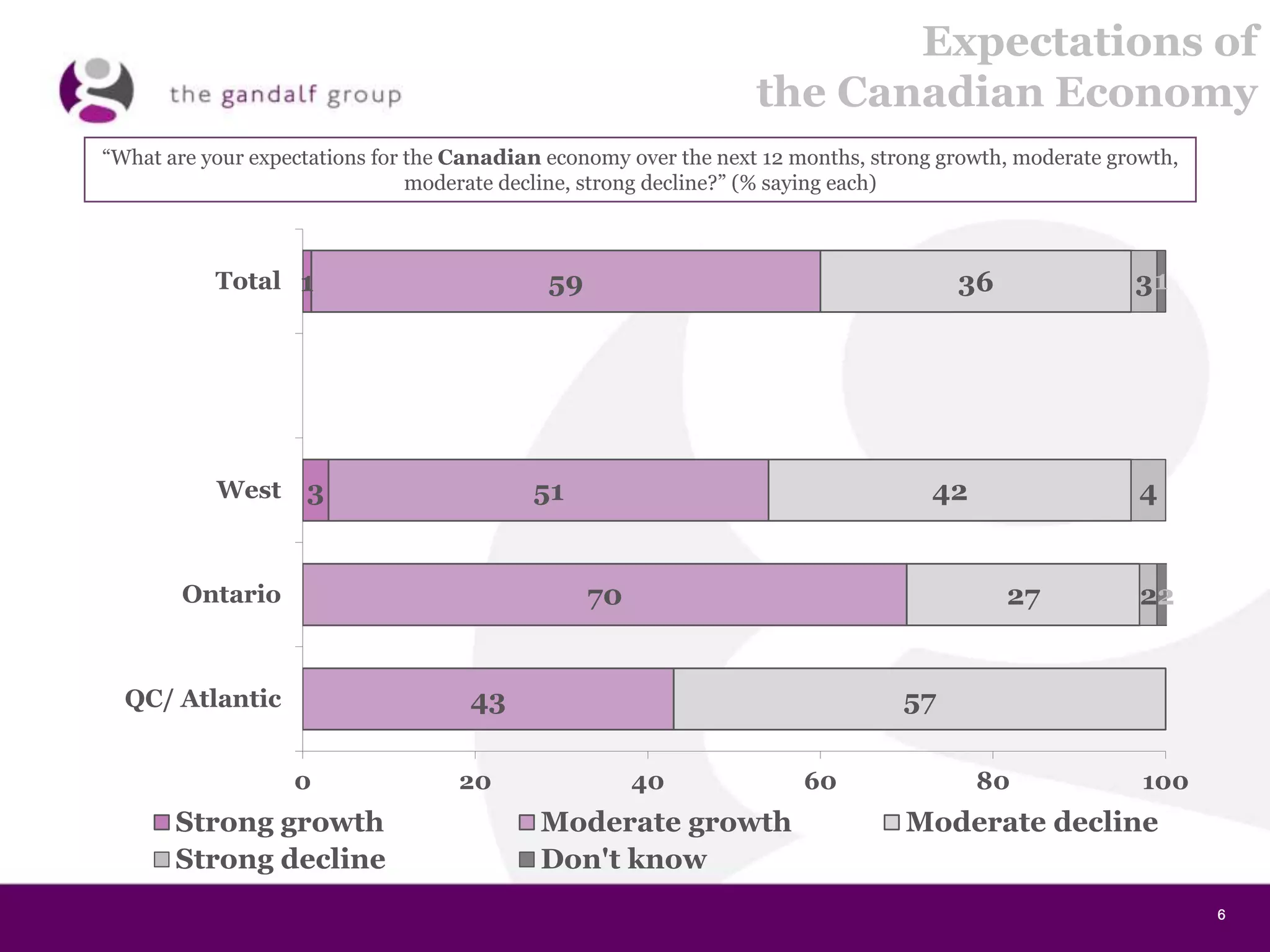
 The economic outlook has worsened since last December; now only six
in ten expect growth in the next 12 mos.
 39% expect a mostly moderate decline for the Canadian economy.
 In a reversal of recent years, the outlook for Ontario is better than the
outlook for the West.
 Expectations are far worse for Western Canada. Most expect their province’s economy
to decline in the next 12 months, with 24% expecting a strong decline or recession.
 In Ontario most expect growth but almost none expect strong growth.
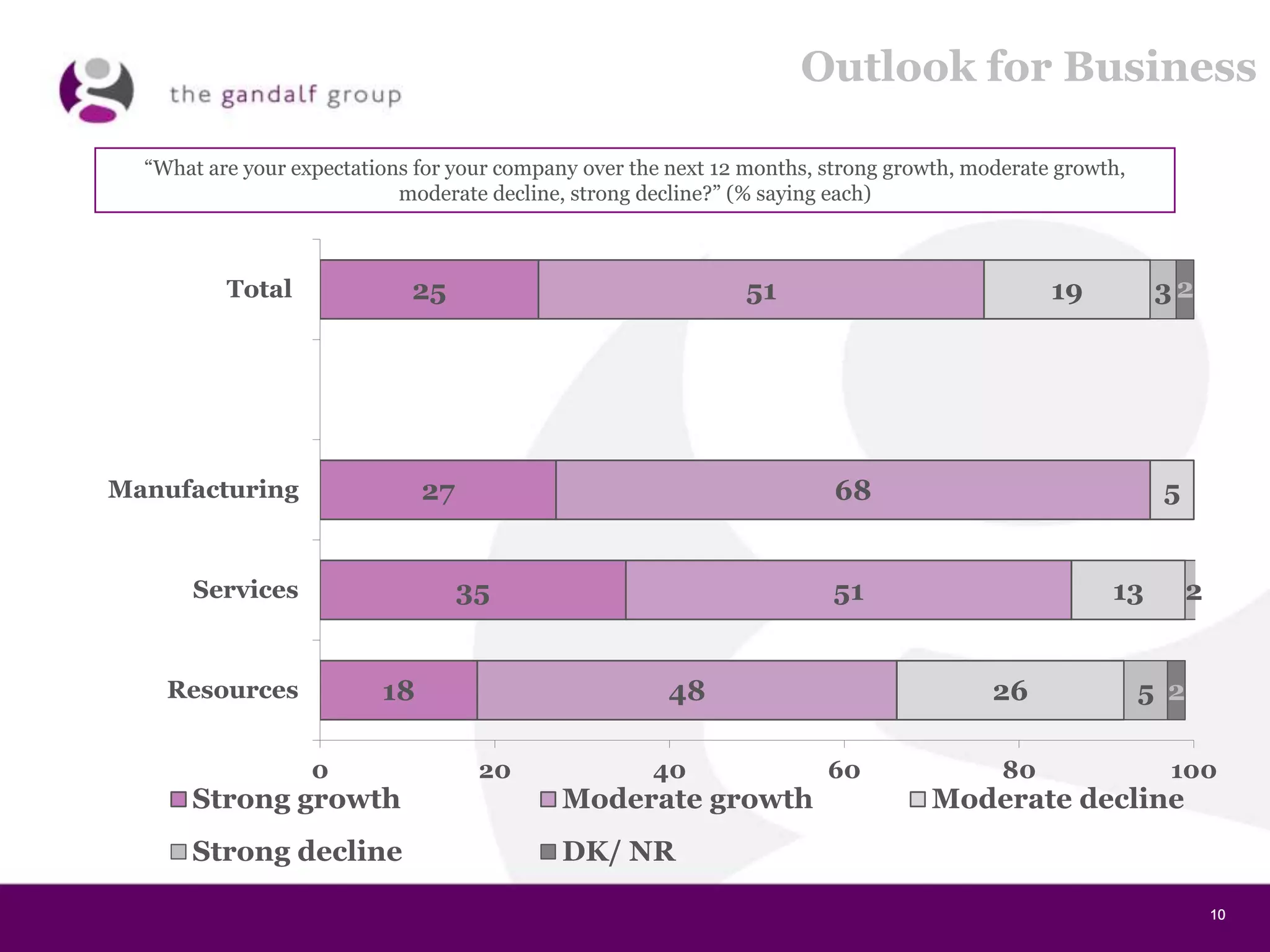
 The C-Suite’s expectations for their own companies is not as poor,
although a significant number are no longer predicting their
businesses will grow – 22% now expect moderate or strong decline for
their companies over the next 12 mos.
 The more positive outlook for the US is unchanged from last quarter.
6666
Expectations of
the Canadian Economy
1
3
59
51
70
43
36
42
27
57
3
4
2
1
2
0 20 40 60 80 100
Total
West
Ontario
QC/ Atlantic
Strong growth Moderate growth Moderate decline
Strong decline Don't know
“What are your expectations for the Canadian economy over the next 12 months, strong growth, moderate growth,
moderate decline, strong decline?” (% saying each)
7777
Expectations of Provincial Economies
2
3
2
56
39
77
26
32
20
12
24
4
3
2
0 20 40 60 80 100
Total
West
Ontario
Strong growth Moderate growth Moderate decline
Strong decline DK/ NR
“And what are your expectations for the economy of the province where you are located - strong growth, moderate growth,
moderate decline or strong decline?”
8888
Expectations of
the Canadian and US Economies
30
1
63
59
7
36 31
0 20 40 60 80 100
US economy
Canadian economy
Strong growth Moderate growth Moderate decline
Strong decline Don't know
“What are your expectations for the U.S. /Canadian economy over the next 12 months, strong growth, moderate
growth, moderate decline, strong decline?” (% saying each)
9999
Projections For The Canadian
Economy
“What are your expectations for the Canadian economy over the next 12 months, strong growth, moderate growth,
moderate decline, strong decline?” (% saying each)
7
3
1
2
3
3
2
1
1
1
1
1
1
3
3
2
2
2
1
82
69
57
15
55
89
89
89
93
69
81
84
74
82
86
88
88
88
95
87
75
59
9
27
39
70
42
8
7
8
5
29
15
14
20
16
11
10
9
9
3
10
23
36
1
1
1
15
3
1
1
3
2
1
1
2
1
1
4
1
1
1
1
0 20 40 60 80 100
Mar. '07
Aug. '07
Jun. '08
Nov. '08
May/Jun. '09
Dec. '09
May/Jun. '10
Nov./Dec. '10
Jun. '11
Dec. '11
May/Jun. '12
Sept. '12
Nov./Dec. '12
Mar. '13
Jun. '13
Sept. '13
Dec. '13
Mar. '14
Jun. '14
Oct. '14
Dec. '14
Mar. '15
Strong growth Moderate growth Moderate decline Strong decline DK
25
27
35
18
51
68
51
48
19
5
13
26
3
2
5
2
2
0 20 40 60 80 100
Total
Manufacturing
Services
Resources
Strong growth Moderate growth Moderate decline
Strong decline DK/ NR
10101010
Outlook for Business
“What are your expectations for your company over the next 12 months, strong growth, moderate growth,
moderate decline, strong decline?” (% saying each)
11111111
Biggest Challenges for Companies
42
15
7
6
6
5
4
4
0 10 20 30 40 50
Commodities Markets/Oil/Market
Fluctuations
Access to capital/ financing
Regulatory hurdles/ costs
Opportunities for growth/ rev.
Recruitment/ staffing
Economy in Western Canada
Identifying/ planning aquisitions
Cost Control
% saying each
“What is the biggest challenge facing your company right now?” (Open ended)
Other mentions include:
Competition: 2%
Production costs: 2%
Global uncertainty: 1%
No response: 2%
12
Oil & The Canadian Economy
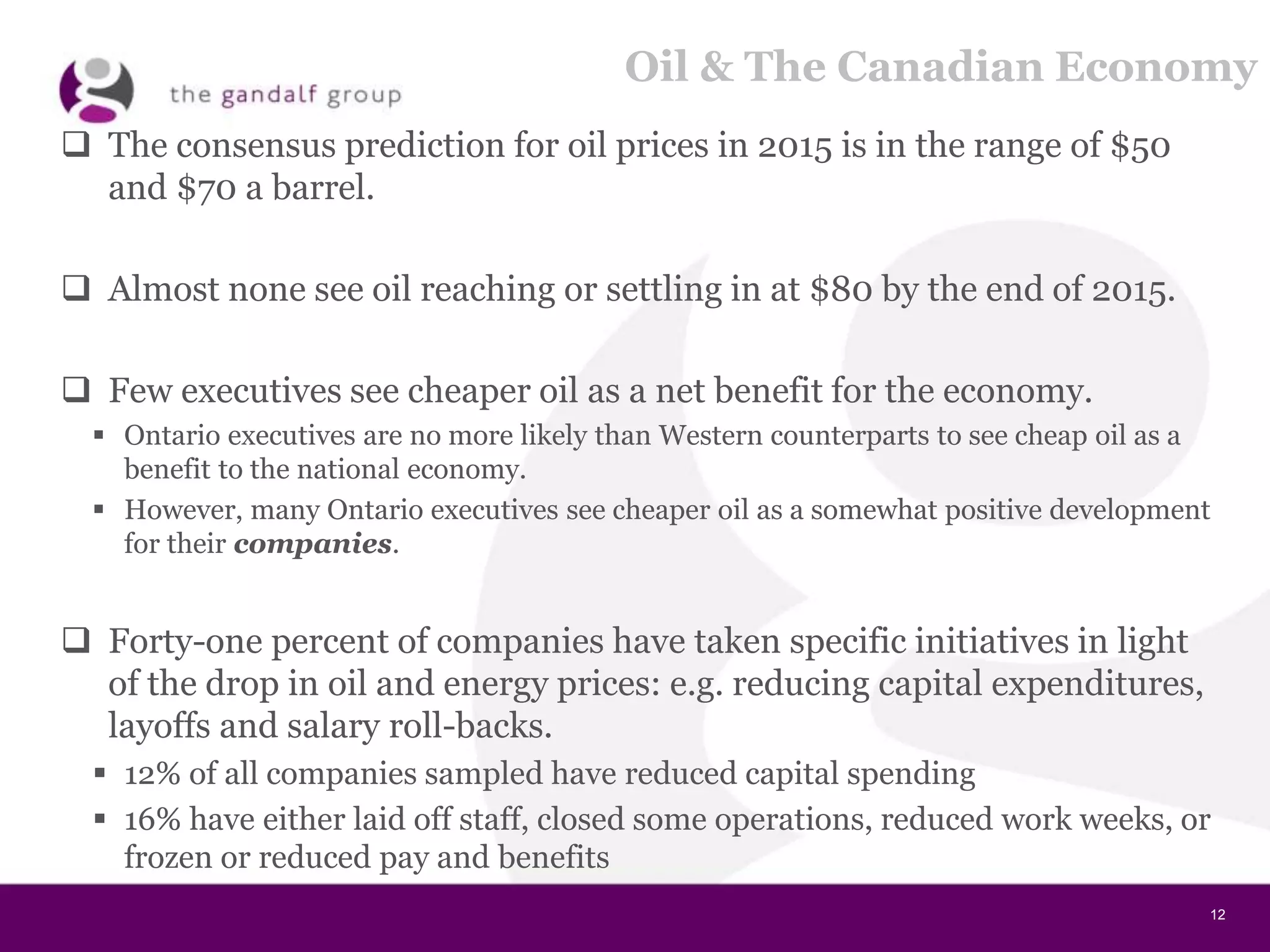
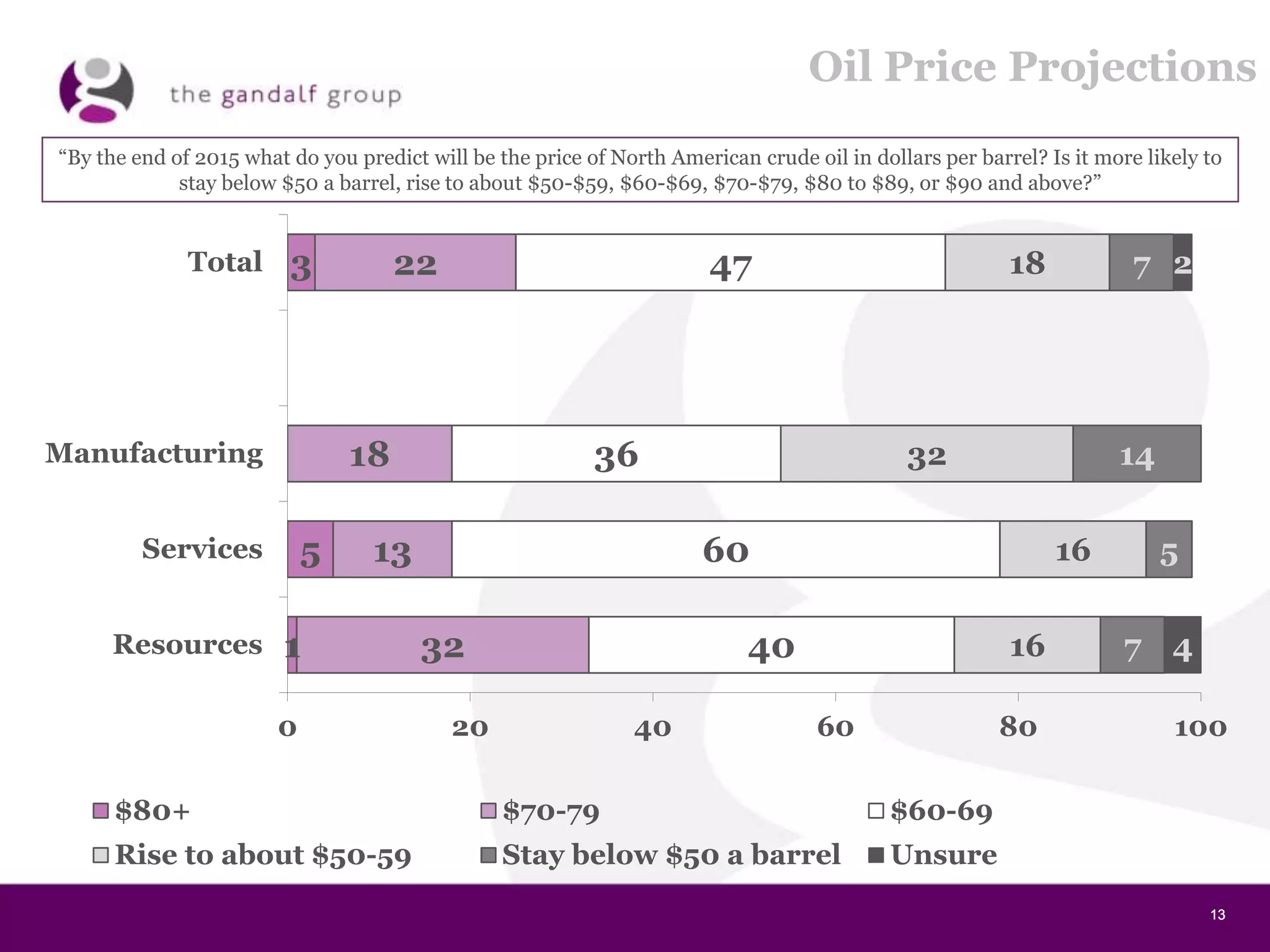
 The consensus prediction for oil prices in 2015 is in the range of $50
and $70 a barrel.
 Almost none see oil reaching or settling in at $80 by the end of 2015.
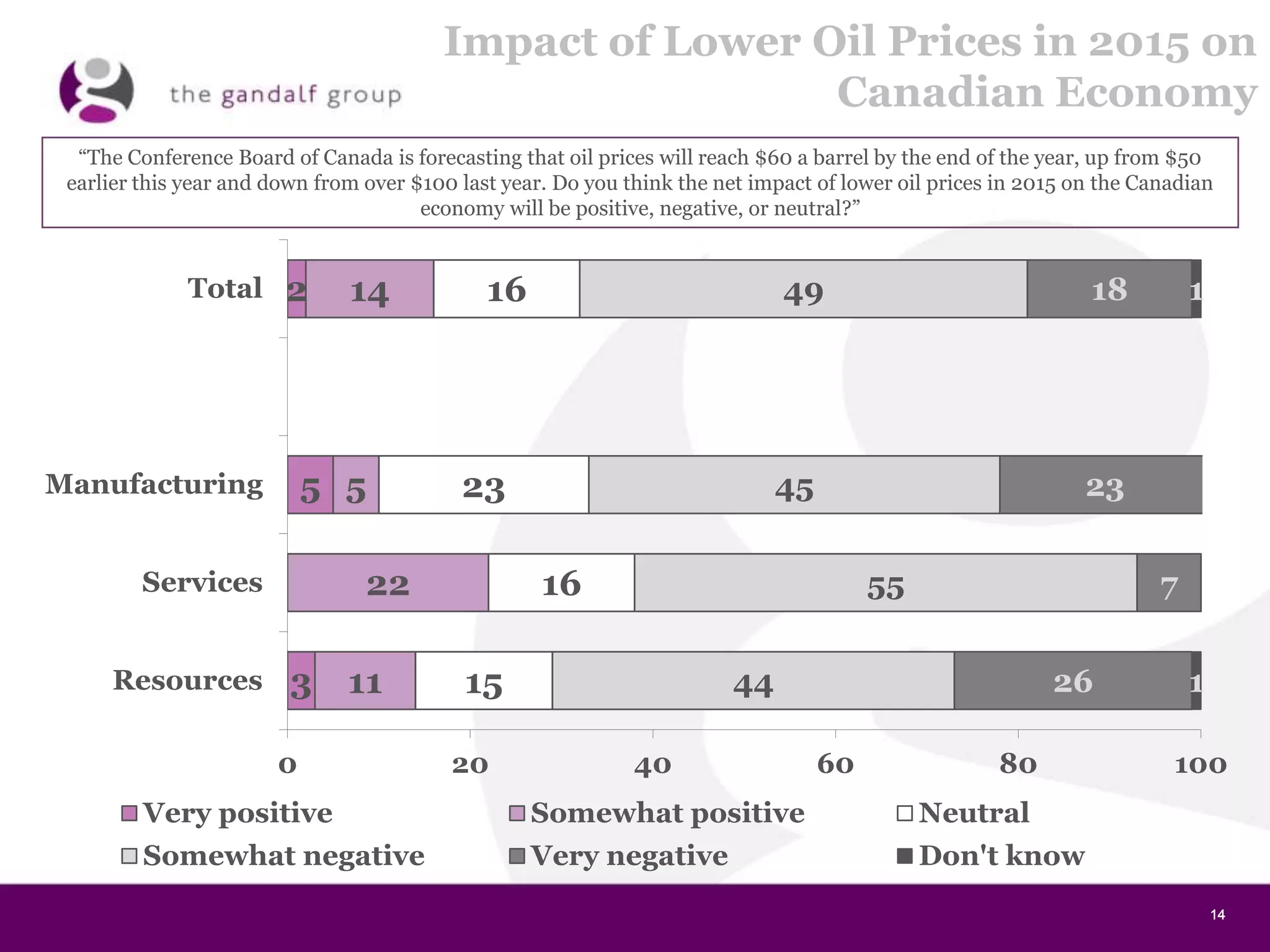
 Few executives see cheaper oil as a net benefit for the economy.
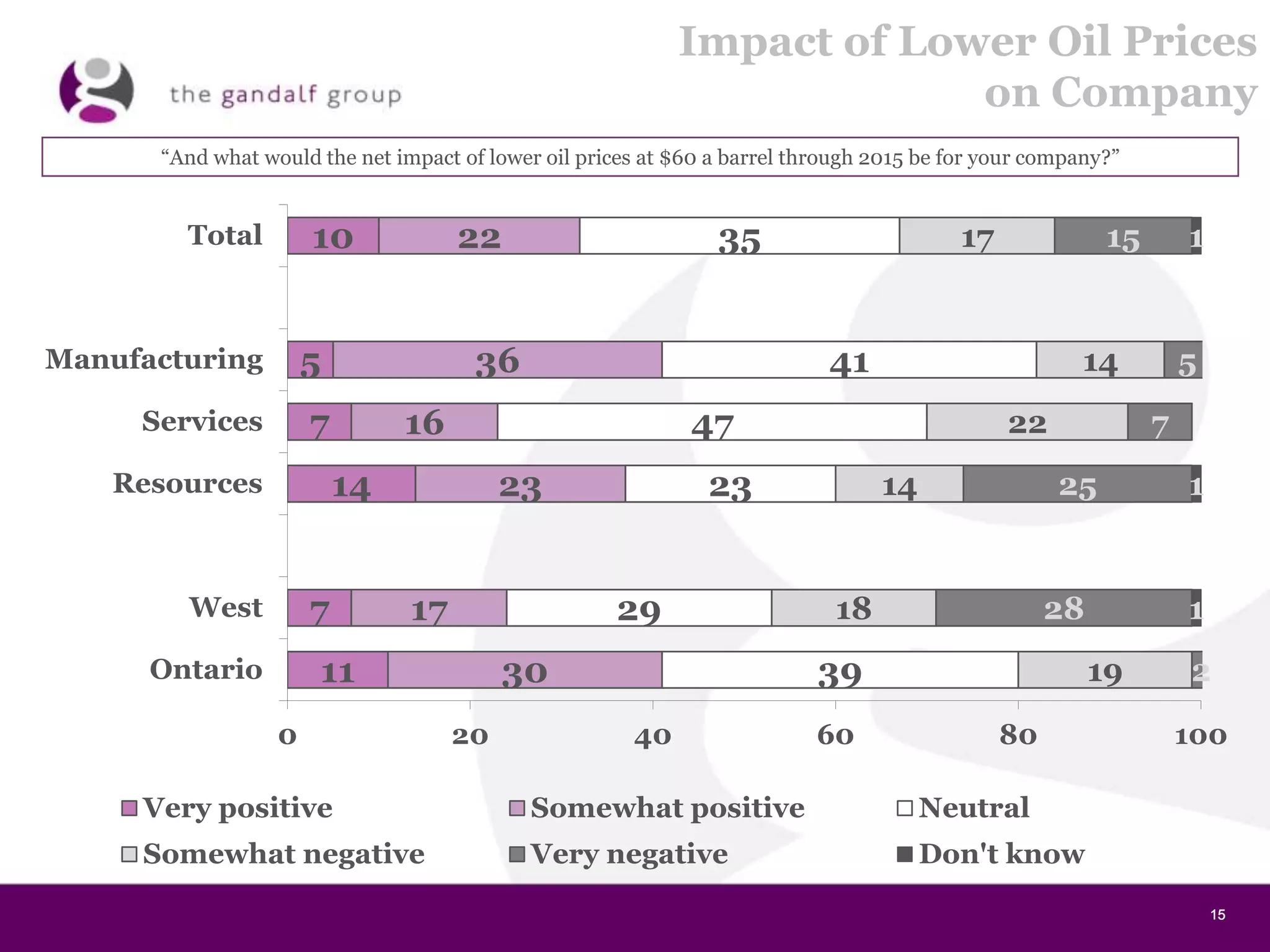
 Ontario executives are no more likely than Western counterparts to see cheap oil as a
benefit to the national economy.
 However, many Ontario executives see cheaper oil as a somewhat positive development
for their companies.
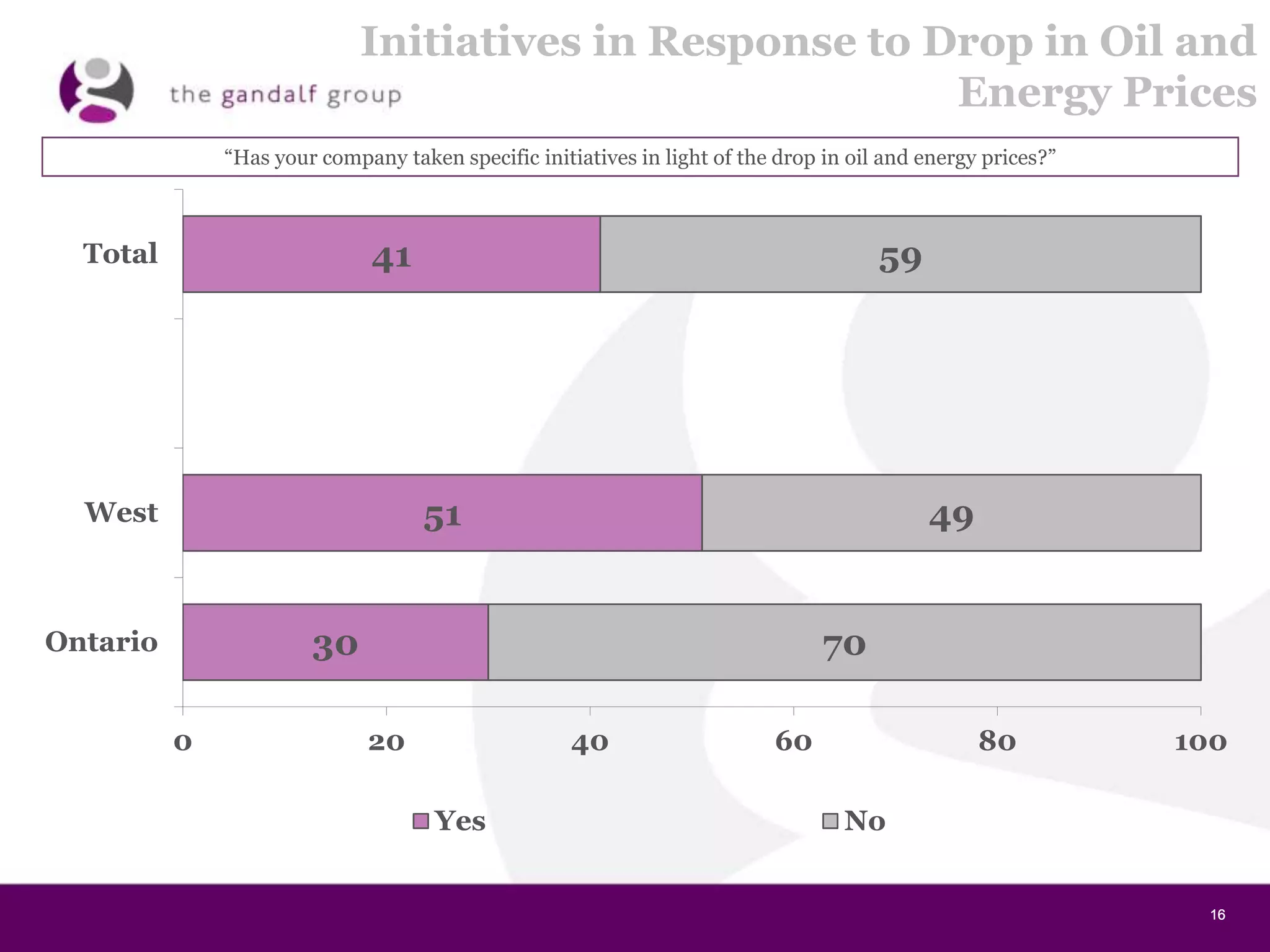
 Forty-one percent of companies have taken specific initiatives in light
of the drop in oil and energy prices: e.g. reducing capital expenditures,
layoffs and salary roll-backs.
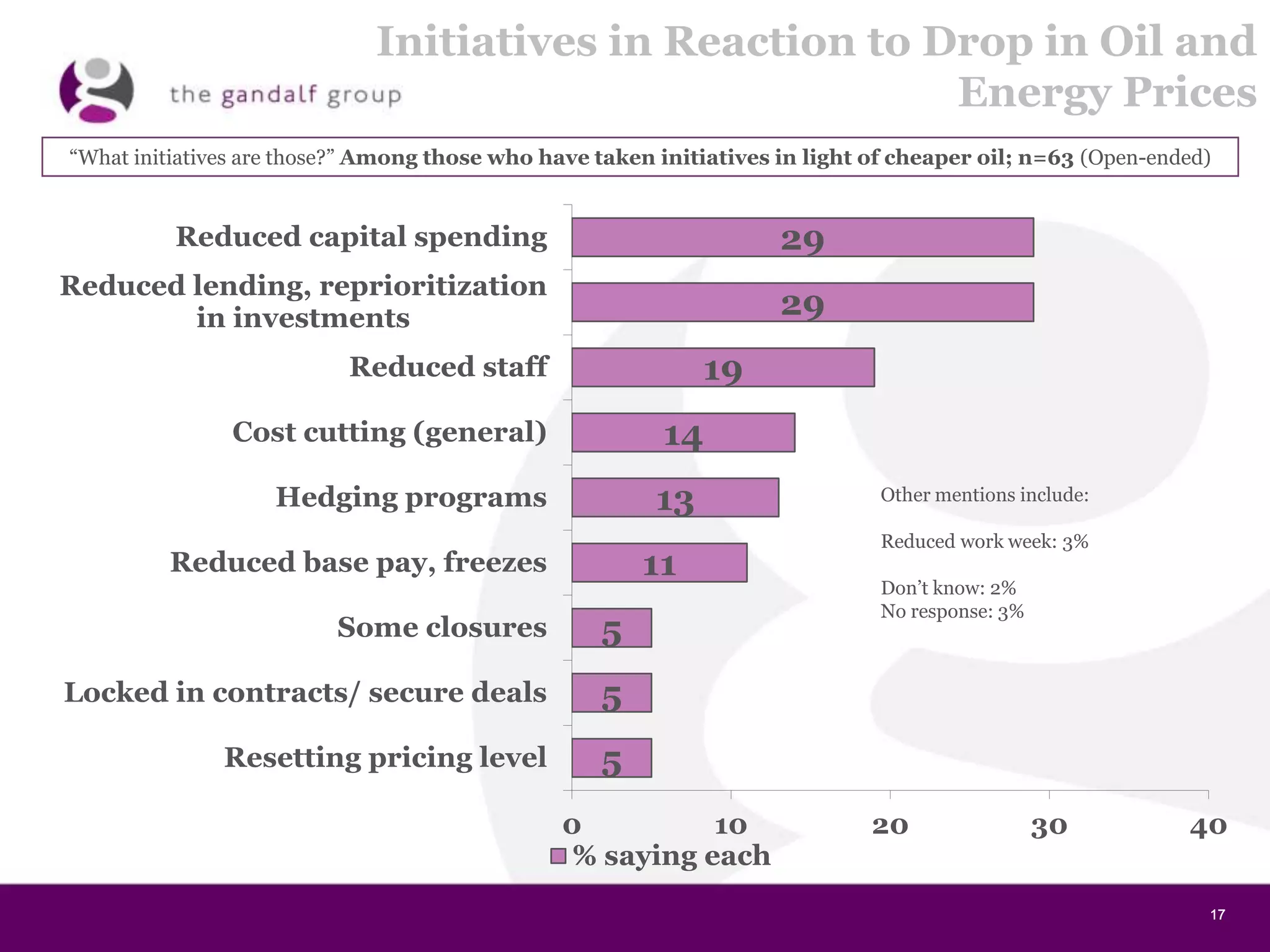
 12% of all companies sampled have reduced capital spending
 16% have either laid off staff, closed some operations, reduced work weeks, or
frozen or reduced pay and benefits
13131313
Oil Price Projections
3
5
1
22
18
13
32
47
36
60
40
18
32
16
16
7
14
5
7
2
4
0 20 40 60 80 100
Total
Manufacturing
Services
Resources
$80+ $70-79 $60-69
Rise to about $50-59 Stay below $50 a barrel Unsure
“By the end of 2015 what do you predict will be the price of North American crude oil in dollars per barrel? Is it more likely to
stay below $50 a barrel, rise to about $50-$59, $60-$69, $70-$79, $80 to $89, or $90 and above?”
14141414
Impact of Lower Oil Prices in 2015 on
Canadian Economy
2
5
3
14
5
22
11
16
23
16
15
49
45
55
44
18
23
7
26
1
1
0 20 40 60 80 100
Total
Manufacturing
Services
Resources
Very positive Somewhat positive Neutral
Somewhat negative Very negative Don't know
“The Conference Board of Canada is forecasting that oil prices will reach $60 a barrel by the end of the year, up from $50
earlier this year and down from over $100 last year. Do you think the net impact of lower oil prices in 2015 on the Canadian
economy will be positive, negative, or neutral?”
15151515
Impact of Lower Oil Prices
on Company
10
5
7
14
7
11
22
36
16
23
17
30
35
41
47
23
29
39
17
14
22
14
18
19
15
5
7
25
28
2
1
1
1
0 20 40 60 80 100
Total
Manufacturing
Services
Resources
West
Ontario
Very positive Somewhat positive Neutral
Somewhat negative Very negative Don't know
“And what would the net impact of lower oil prices at $60 a barrel through 2015 be for your company?”
16161616
Initiatives in Response to Drop in Oil and
Energy Prices
41
51
30
59
49
70
0 20 40 60 80 100
Total
West
Ontario
Yes No
“Has your company taken specific initiatives in light of the drop in oil and energy prices?”
17171717
Initiatives in Reaction to Drop in Oil and
Energy Prices
“What initiatives are those?” Among those who have taken initiatives in light of cheaper oil; n=63 (Open-ended)
29
29
19
14
13
11
5
5
5
0 10 20 30 40
Reduced capital spending
Reduced lending, reprioritization
in investments
Reduced staff
Cost cutting (general)
Hedging programs
Reduced base pay, freezes
Some closures
Locked in contracts/ secure deals
Resetting pricing level
% saying each
Other mentions include:
Reduced work week: 3%
Don’t know: 2%
No response: 3%
18181818
Canadian $
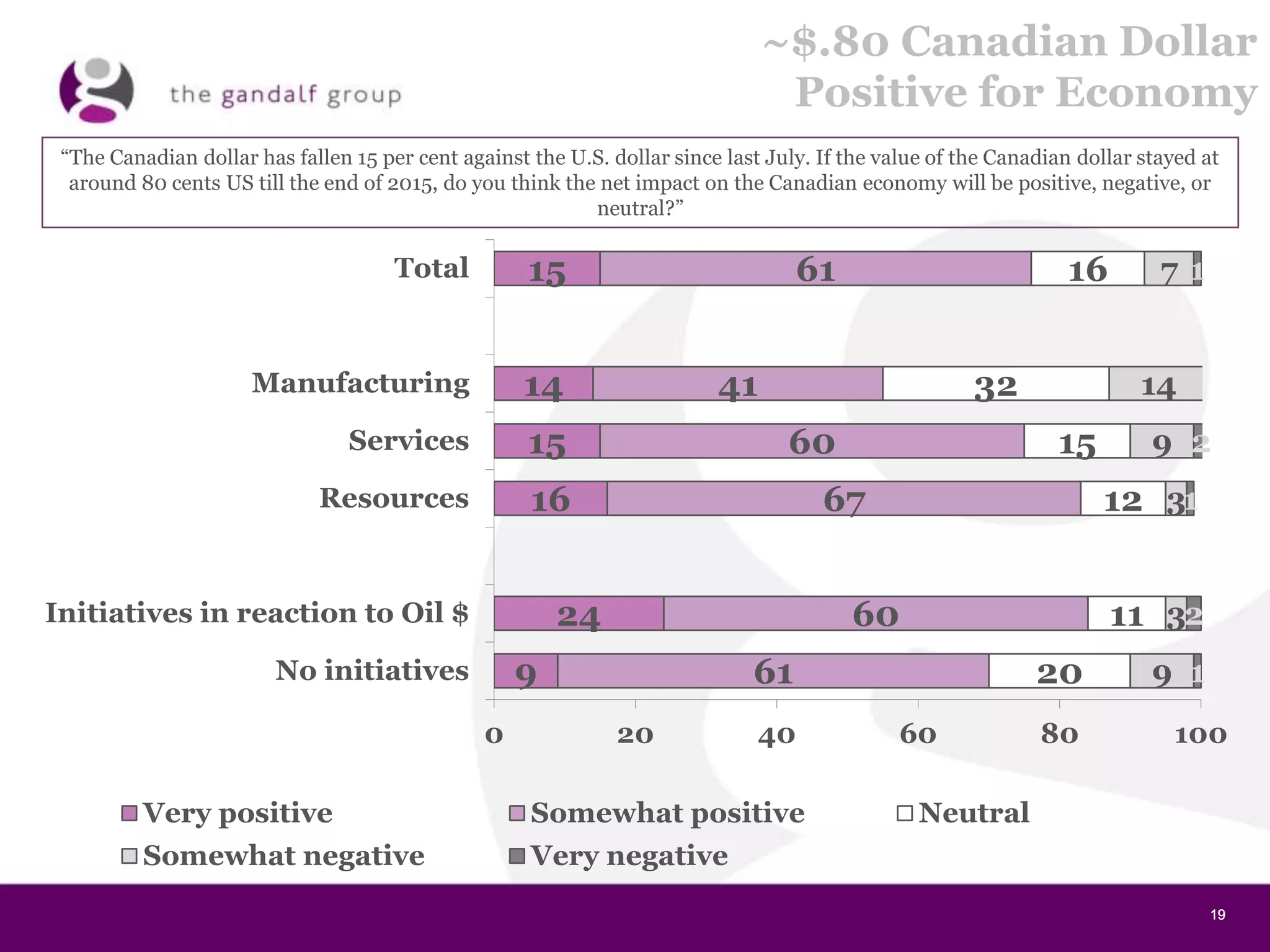
 In contrast to the impact of cheaper oil, a clear majority said a lower
valuation of the Canadian dollar in 2015 would be a positive for the
Canadian economy (i.e. ~80 cents US).
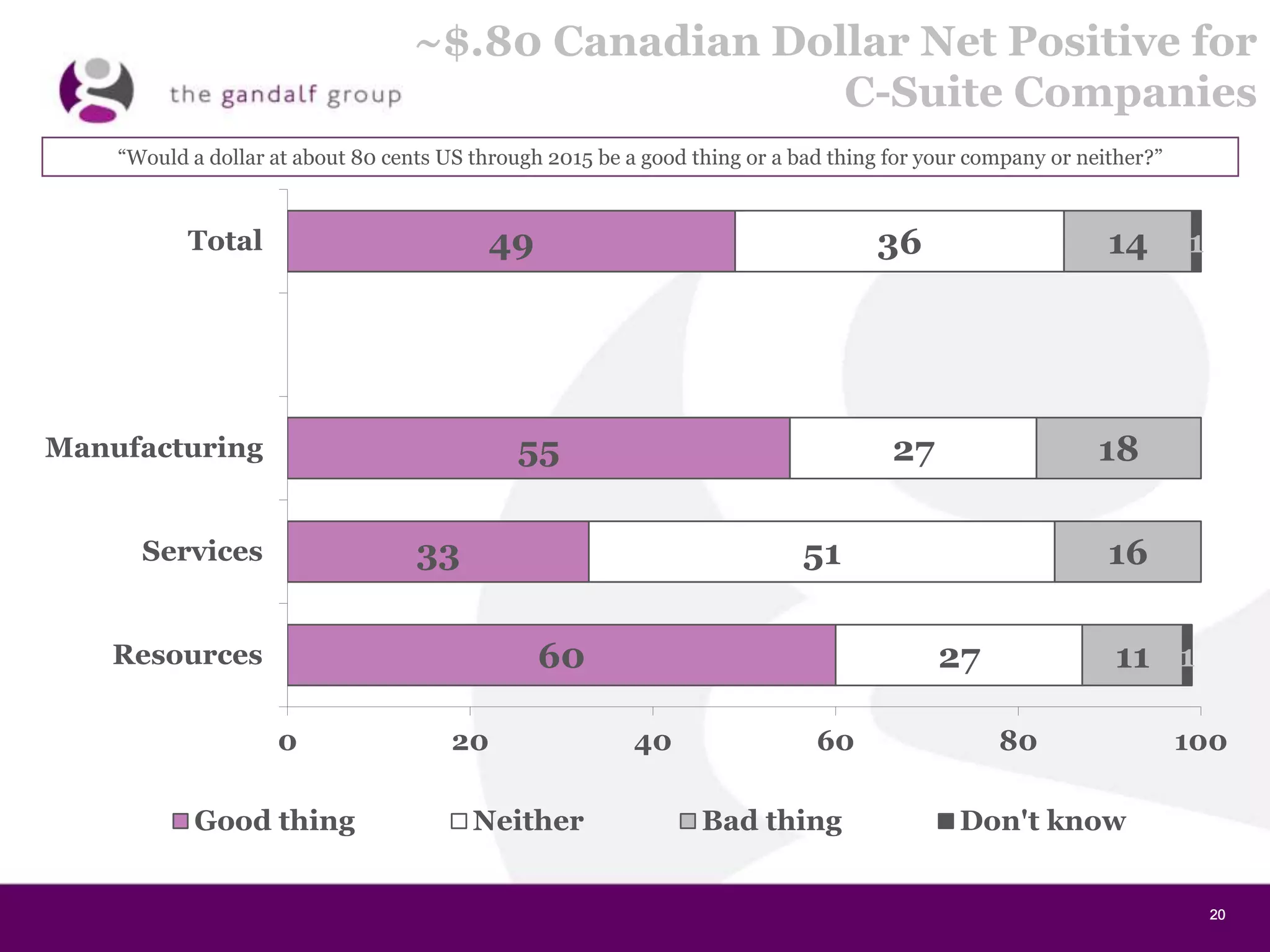
 Forty-nine percent of the C-Suite said a low-dollar in 2015 would be a
positive for their companies.
 Fewer than half would favour a dollar priced at higher than 90 cents
US in terms of their companies’ best interests.
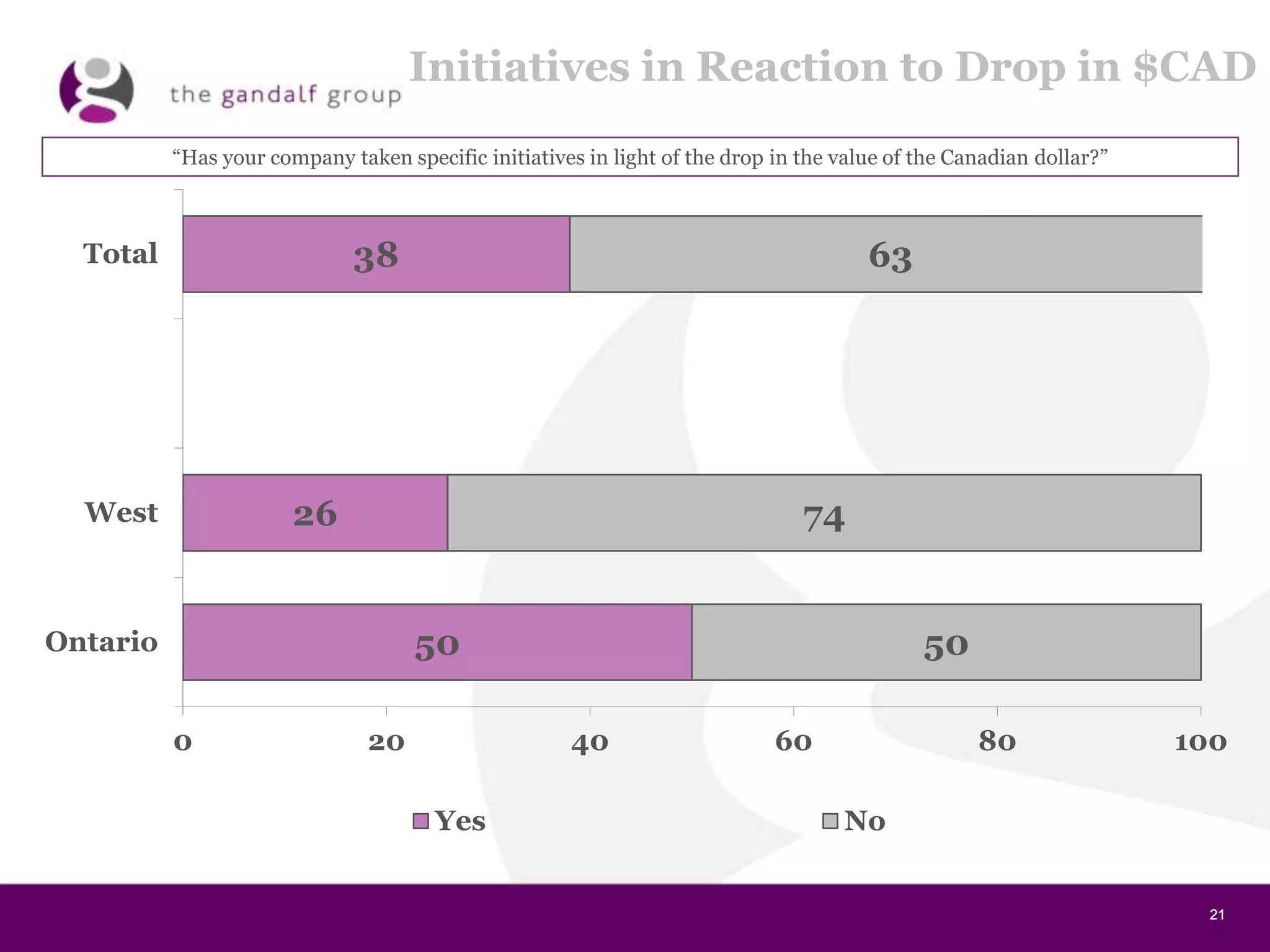
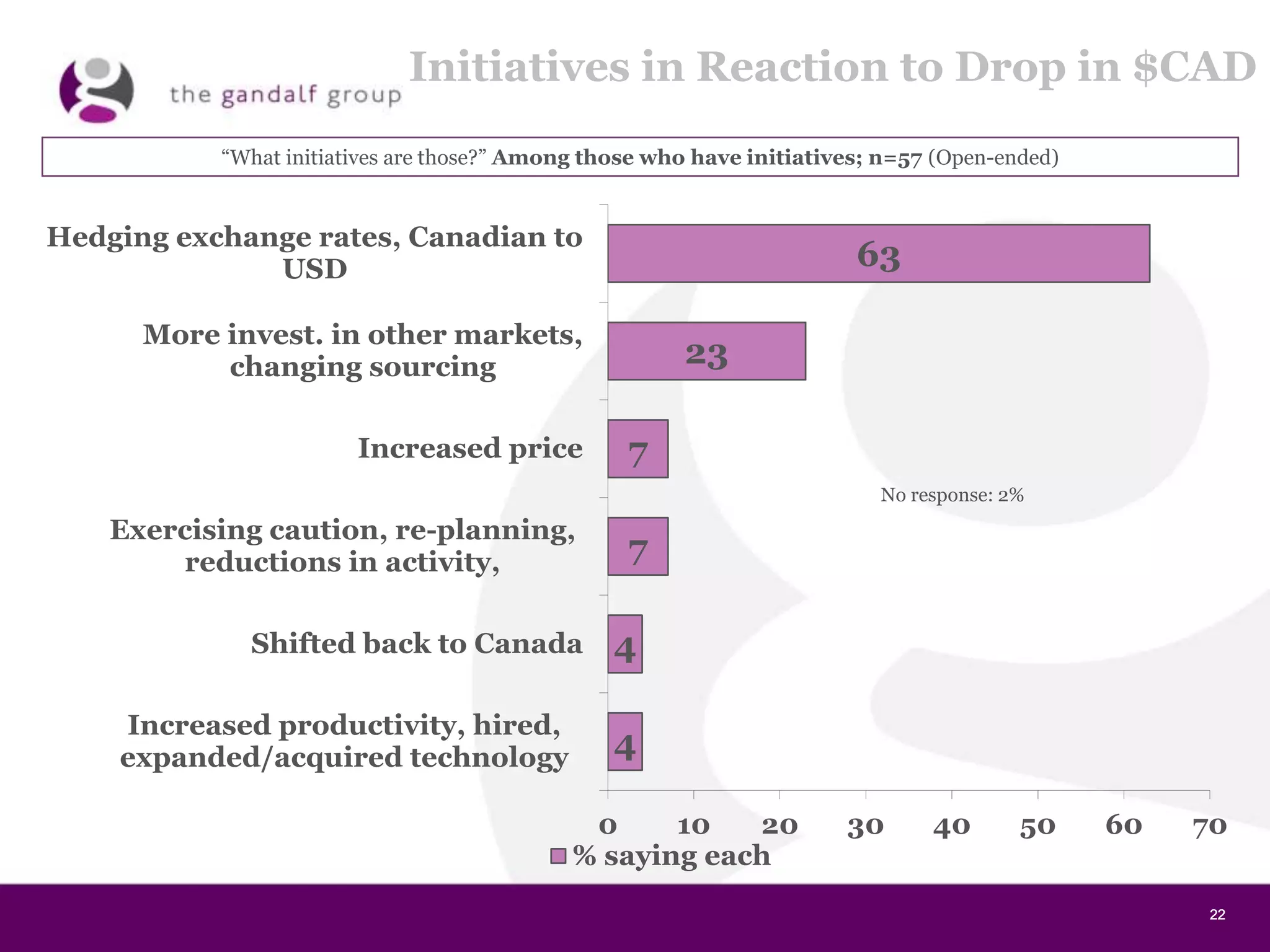
 Thirty-eight percent have taken action in light of the drop in the
loonie.
 “Hedging our money, our business is more in US Dollars”, “hedging foreign
currency”, “owning USD to increase cash reserves. Foreign exchange, we sell
in USD, operate in CAD and take the spread.”
 “Manufacturers in Canada increasing their sales to the US”, “higher exports
to US companies”
 “We have moved our manufacturing back to Canada from the US”
19191919
~$.80 Canadian Dollar
Positive for Economy
15
14
15
16
24
9
61
41
60
67
60
61
16
32
15
12
11
20
7
14
9
3
3
9
1
2
1
2
1
0 20 40 60 80 100
Total
Manufacturing
Services
Resources
Initiatives in reaction to Oil $
No initiatives
Very positive Somewhat positive Neutral
Somewhat negative Very negative
“The Canadian dollar has fallen 15 per cent against the U.S. dollar since last July. If the value of the Canadian dollar stayed at
around 80 cents US till the end of 2015, do you think the net impact on the Canadian economy will be positive, negative, or
neutral?”
20202020
~$.80 Canadian Dollar Net Positive for
C-Suite Companies
49
55
33
60
36
27
51
27
14
18
16
11
1
1
0 20 40 60 80 100
Total
Manufacturing
Services
Resources
Good thing Neither Bad thing Don't know
“Would a dollar at about 80 cents US through 2015 be a good thing or a bad thing for your company or neither?”
21212121
Initiatives in Reaction to Drop in $CAD
“Has your company taken specific initiatives in light of the drop in the value of the Canadian dollar?”
38
26
50
63
74
50
0 20 40 60 80 100
Total
West
Ontario
Yes No
22222222
Initiatives in Reaction to Drop in $CAD
“What initiatives are those?” Among those who have initiatives; n=57 (Open-ended)
63
23
7
7
4
4
0 10 20 30 40 50 60 70
Hedging exchange rates, Canadian to
USD
More invest. in other markets,
changing sourcing
Increased price
Exercising caution, re-planning,
reductions in activity,
Shifted back to Canada
Increased productivity, hired,
expanded/acquired technology
% saying each
No response: 2%
23232323
Ideal Dollar Value for Companies
20
14
25
22
29
16
47
49
45
12
8
15
0 20 40 60 80 100
Total
West
Ontario
$.95+ $.90-94 <$.90 Don't know/ N/A
“Thinking specifically of your company, what would be the optimal value of the Canadian dollar against the US dollar?”
24242424
Companies Planning on
<$.90 Canadian Dollar
6 8 74 12
0 20 40 60 80 100
Total
$.95+ $.90-94 <$.90 Don't know/ N/A
“Again with respect to your company, what valuation for the Canadian dollar are you using for planning for the coming year?”
25
Interest Rates, the $, Housing
& Inflation
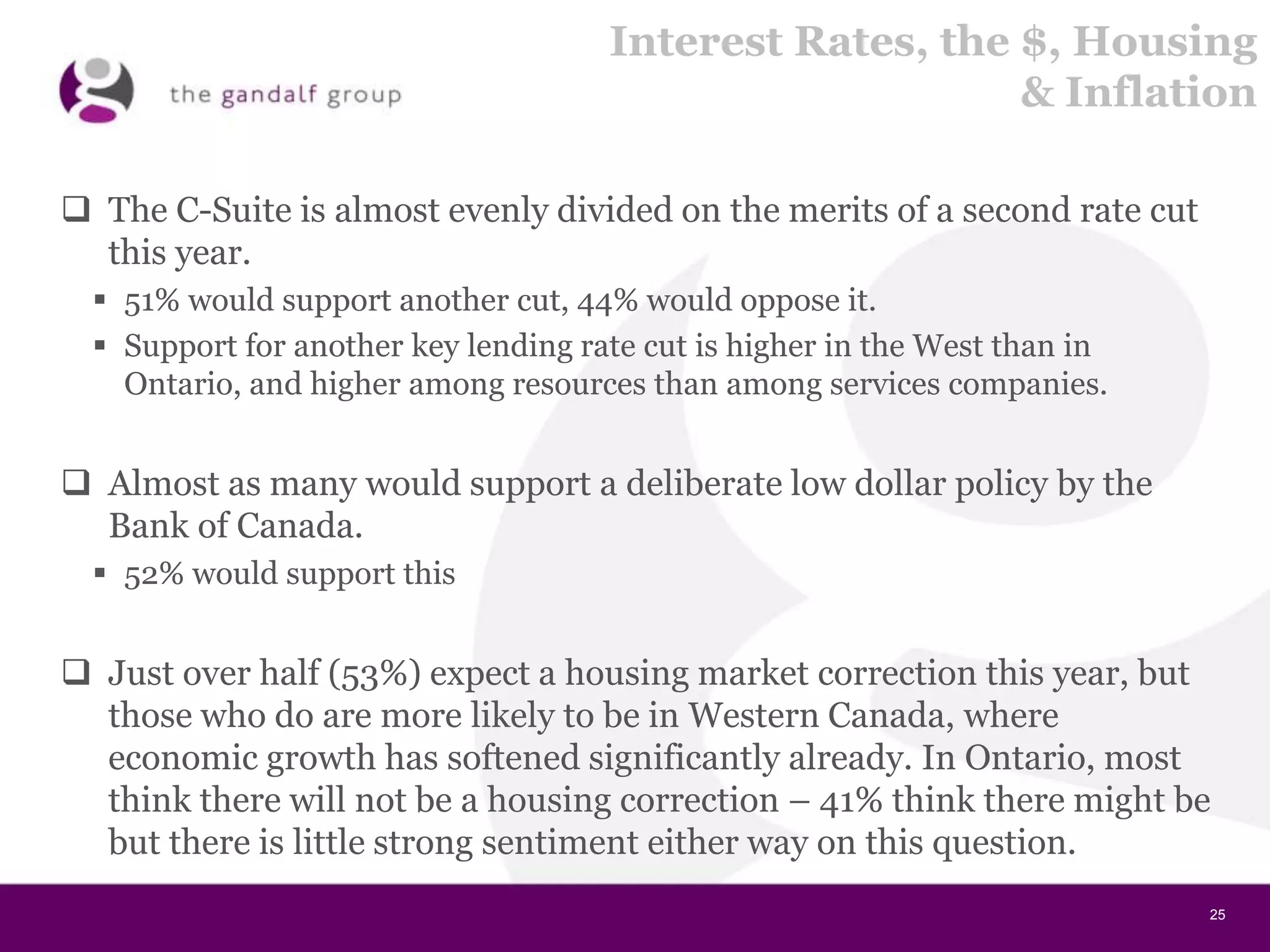
 The C-Suite is almost evenly divided on the merits of a second rate cut
this year.
 51% would support another cut, 44% would oppose it.
 Support for another key lending rate cut is higher in the West than in
Ontario, and higher among resources than among services companies.
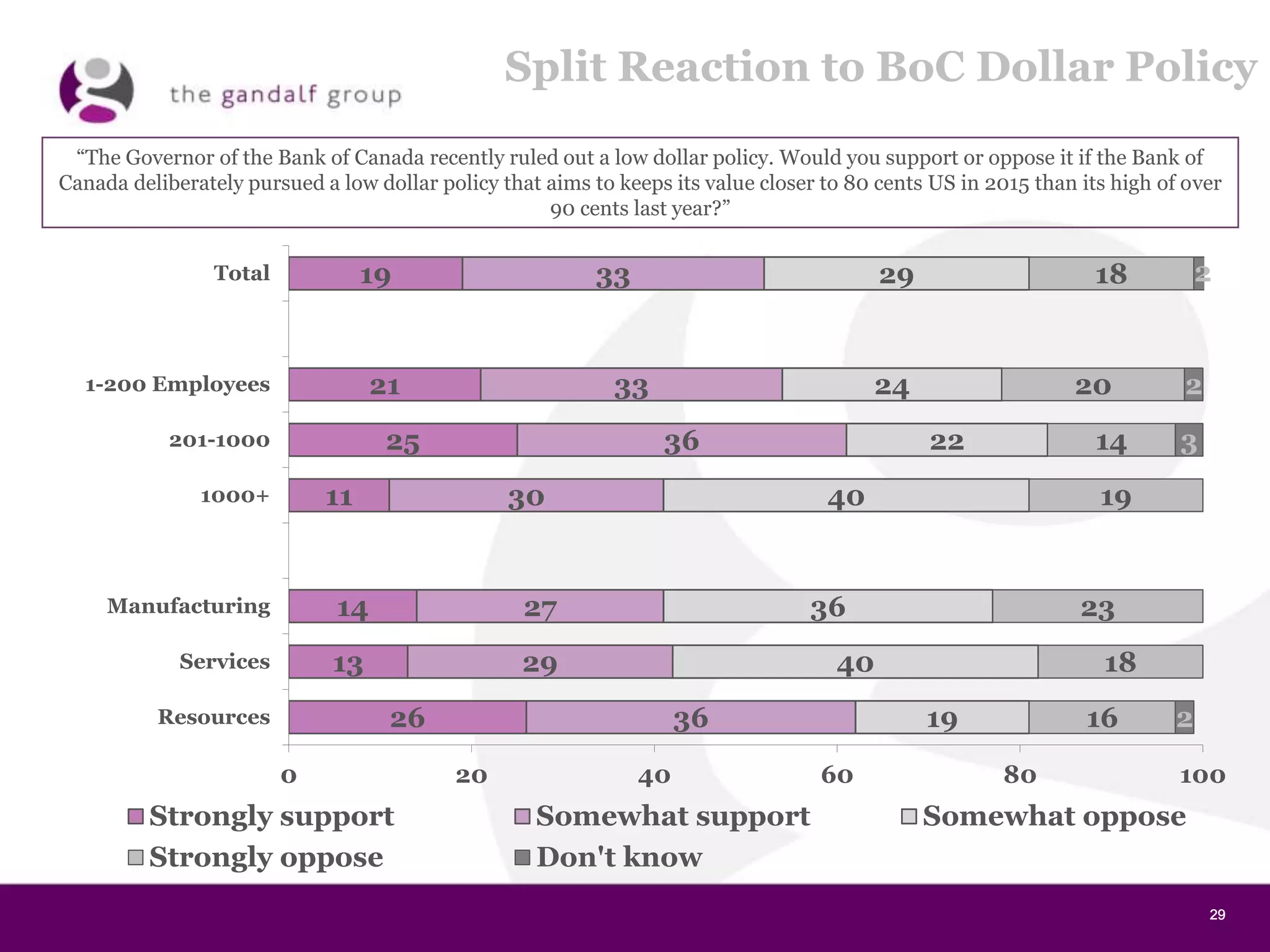
 Almost as many would support a deliberate low dollar policy by the
Bank of Canada.
 52% would support this
 Just over half (53%) expect a housing market correction this year, but
those who do are more likely to be in Western Canada, where
economic growth has softened significantly already. In Ontario, most
think there will not be a housing correction – 41% think there might be
but there is little strong sentiment either way on this question.
26262626
Tepid Support for BoC Rate Change
21
32
13
23
26
13
30
18
27
36
30
28
22
27
24
18
21
25
22
18
36
14
18
30
5
5
10
4
5
0 20 40 60 80 100
Total
Manufacturing
Services
Resources
West
Ontario
Strongly support Somewhat support Somewhat oppose
Strongly oppose Don't know
“Earlier this year the Bank of Canada cut its key lending rate from 1 per cent to point-seven-five per cent. Would you support
or oppose an additional cut to lower the key lending rate to point-five percent in the next month or so?”
27272727
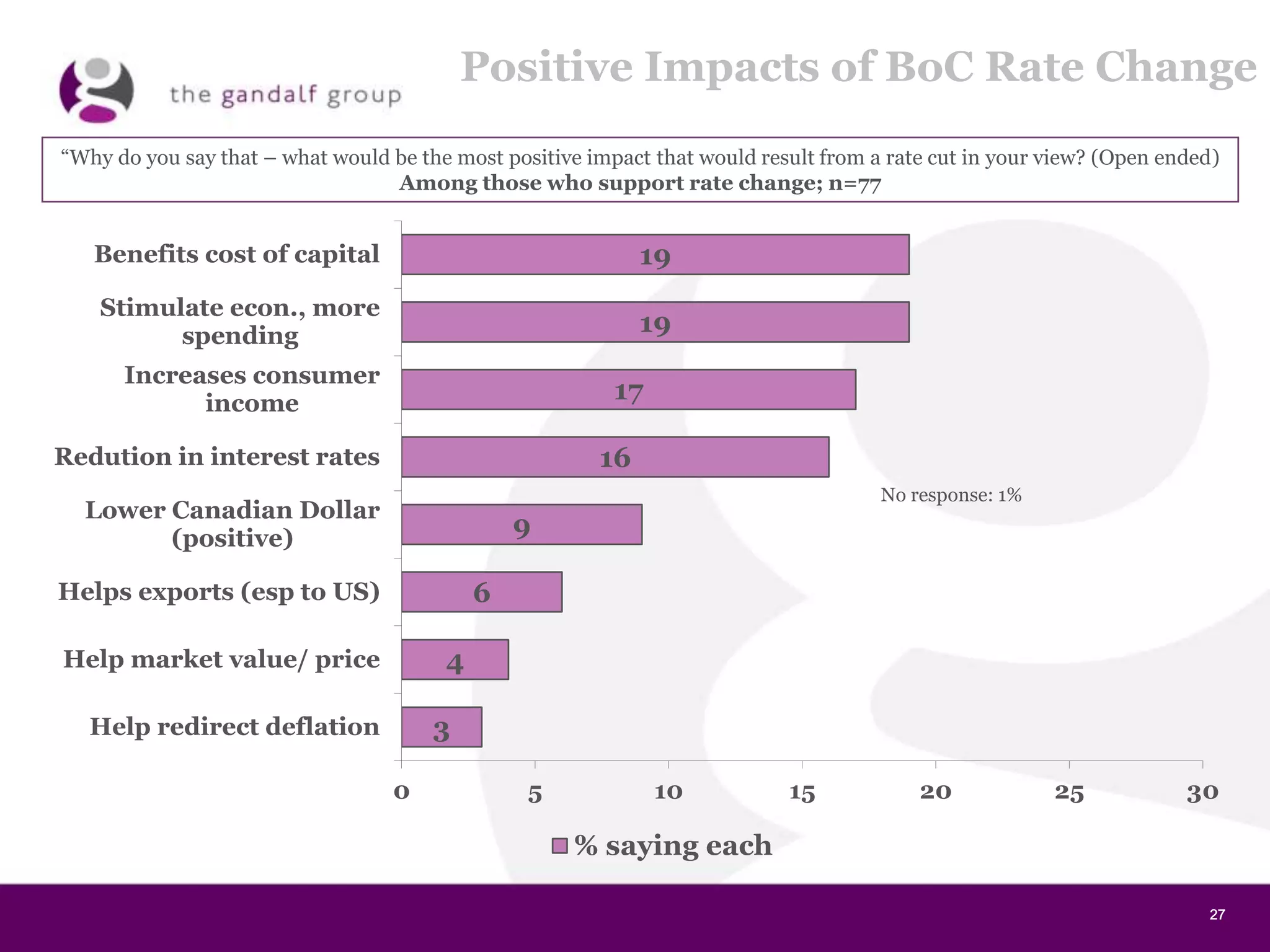
Positive Impacts of BoC Rate Change
19
19
17
16
9
6
4
3
0 5 10 15 20 25 30
Benefits cost of capital
Stimulate econ., more
spending
Increases consumer
income
Redution in interest rates
Lower Canadian Dollar
(positive)
Helps exports (esp to US)
Help market value/ price
Help redirect deflation
% saying each
“Why do you say that – what would be the most positive impact that would result from a rate cut in your view? (Open ended)
Among those who support rate change; n=77
No response: 1%
28282828
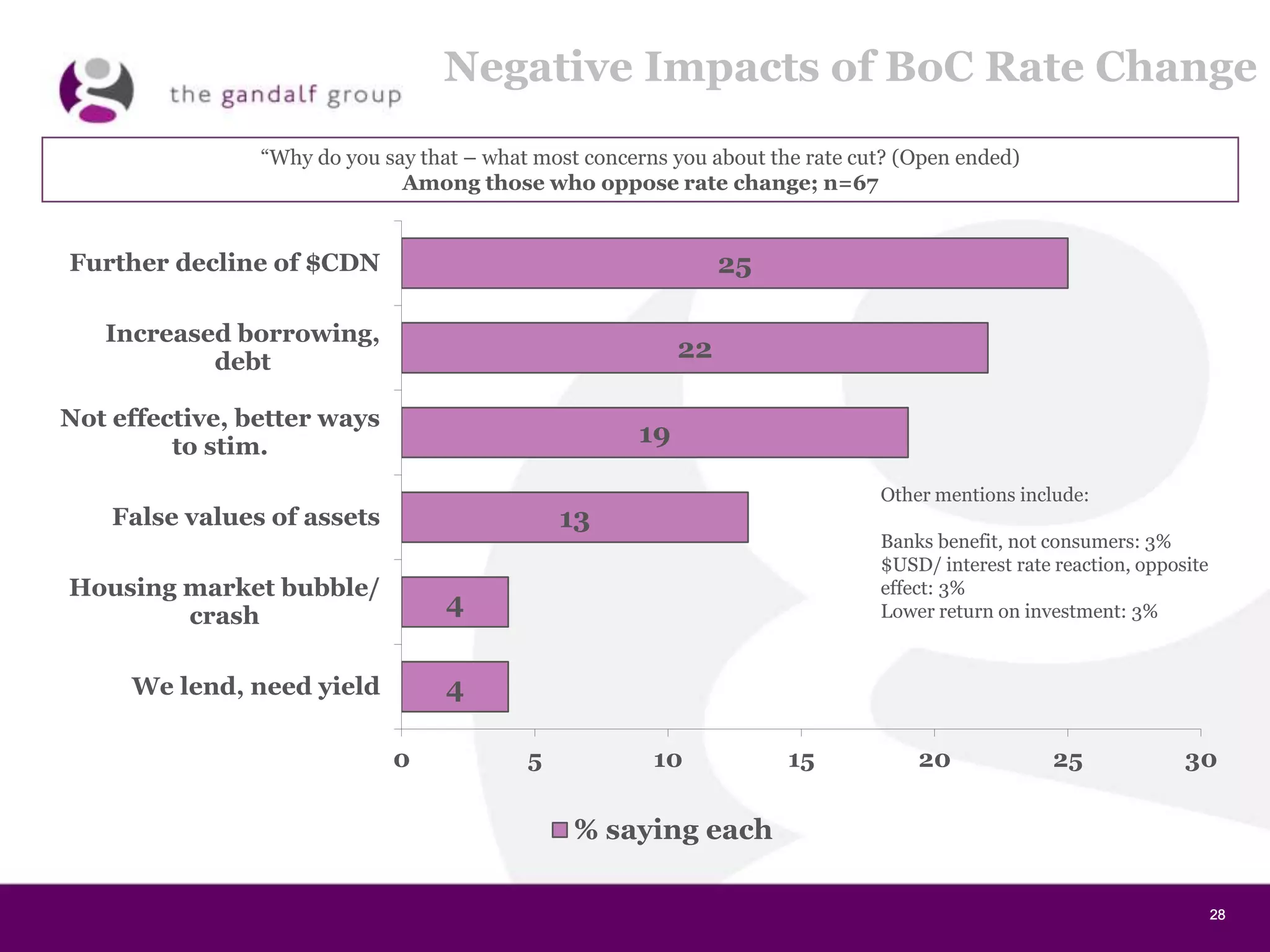
Negative Impacts of BoC Rate Change
25
22
19
13
4
4
0 5 10 15 20 25 30
Further decline of $CDN
Increased borrowing,
debt
Not effective, better ways
to stim.
False values of assets
Housing market bubble/
crash
We lend, need yield
% saying each
“Why do you say that – what most concerns you about the rate cut? (Open ended)
Among those who oppose rate change; n=67
Other mentions include:
Banks benefit, not consumers: 3%
$USD/ interest rate reaction, opposite
effect: 3%
Lower return on investment: 3%
29292929
Split Reaction to BoC Dollar Policy
19
21
25
11
14
13
26
33
33
36
30
27
29
36
29
24
22
40
36
40
19
18
20
14
19
23
18
16
2
2
3
2
0 20 40 60 80 100
Total
1-200 Employees
201-1000
1000+
Manufacturing
Services
Resources
Strongly support Somewhat support Somewhat oppose
Strongly oppose Don't know
“The Governor of the Bank of Canada recently ruled out a low dollar policy. Would you support or oppose it if the Bank of
Canada deliberately pursued a low dollar policy that aims to keeps its value closer to 80 cents US in 2015 than its high of over
90 cents last year?”
30303030
Half Expect Housing Market Correction
in 2015
10
9
2
16
12
5
13
8
43
36
49
42
50
36
51
38
36
41
36
34
30
47
25
44
8
5
13
4
5
11
8
8
3
9
2
2
2
4
2
0 20 40 60 80 100
Total
Manufacturing
Services
Resources
West
Ontario
Initiatives in
reaction to Oil $
No initiatives
Strongly agree Somewhat agree Somewhat disagree
Strongly disagree Don't know
“I’m going to read some statements relating to the markets and interest rates, and I would like you to tell me if you strongly or
somewhat agree, or strongly or somewhat disagree with each.”
“There will likely be a housing market correction in 2015”
31313131
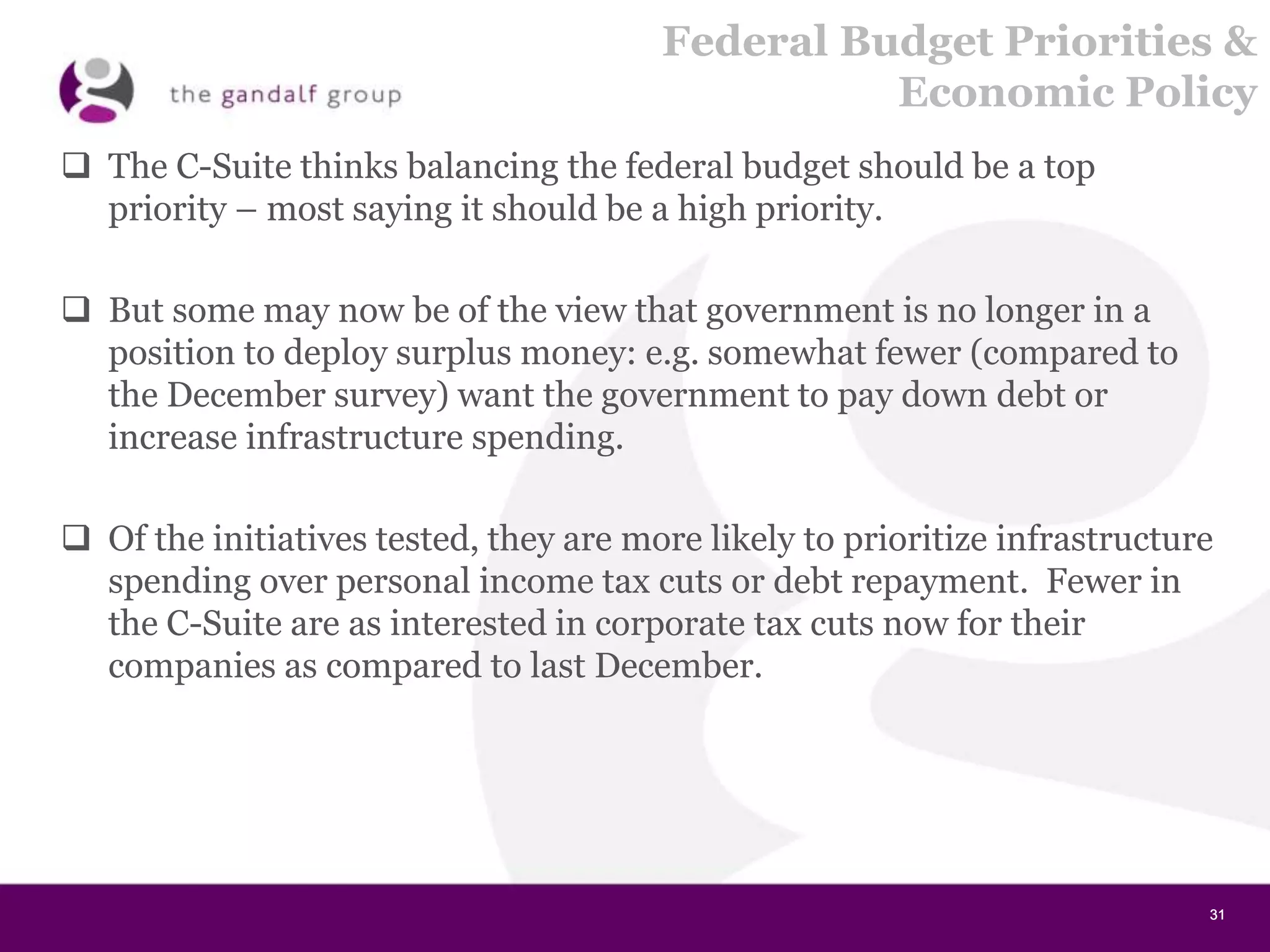
Federal Budget Priorities &
Economic Policy
 The C-Suite thinks balancing the federal budget should be a top
priority – most saying it should be a high priority.
 But some may now be of the view that government is no longer in a
position to deploy surplus money: e.g. somewhat fewer (compared to
the December survey) want the government to pay down debt or
increase infrastructure spending.
 Of the initiatives tested, they are more likely to prioritize infrastructure
spending over personal income tax cuts or debt repayment. Fewer in
the C-Suite are as interested in corporate tax cuts now for their
companies as compared to last December.
32323232
National Priorities – March 2015
53
44
36
30
26
21
13
42
50
50
59
46
42
36
5
5
13
11
27
36
49
1
2
2
2
3
0 50 100
Balancing the budget
Increased funding for infrastructure projects, such
as roads, bridges or transportation
Increasing assistance for skills training and
apprenticeships
Paying down the federal debt
Reducing personal income taxes
Reducing corporate income taxes
Reducing resource royalties
High budget priority Modest budget priority Not included DK/ NR
“Now thinking about the federal surplus and the government's upcoming 2015 budget, I'd like to know if you believe each of
the following items should be a high budget priority, a modest budget priority or not included in a federal budget:”
33333333
National Priorities – Dec. 2014
60
59
40
38
31
31
28
21
14
11
12
32
31
47
40
48
40
52
36
52
55
45
5
9
11
20
19
29
20
40
33
33
42
3
1
2
2
2
2
1
1
1
0 50 100
Expanding funding for infrastructure projects
Paying down the federal debt
More generous tax incentives for companies that
invest in R and D
Reducing personal income taxes
Income splitting, specifically reducing taxes for
single-income couples with kids
Reducing corporate income taxes
Increasing assistance to post-secondary students
and apprentices
Reducing resource royalties
Increasing benefits paid to parents of young
children
Increasing spending on affordable housing
Funding for day-care programs
High budget priority Modest budget priority Not included DK/ NR
“Now thinking about the federal surplus and the government's upcoming 2015 budget, I'd like to know if you believe each of
the following items should be a high budget priority, a modest budget priority or not included in a federal budget:”
34343434
National Priorities – Corp. Tax Cuts
Tracking
21
31
26
42
40
34
36
29
38
2
1
0 20 40 60 80 100
2015
2014
2012
High budget priority Modest budget priority Not included DK/ NR
“Now thinking about the federal surplus and the government's upcoming 2015 budget, I'd like to know if you believe each of
the following items should be a high budget priority, a modest budget priority or not included in a federal budget:”
Reducing corporate income taxes
35353535
Federal Budget Priorities &
Economic Policy
 In open ended responses, a significant number told us they are hoping
the government will NOT increase taxes and stay the course in that
respect.
 A few mentioned incentives for R&D spending, favourable tax
treatments or flow-through shares, in addition to across the board
corporate tax cuts.
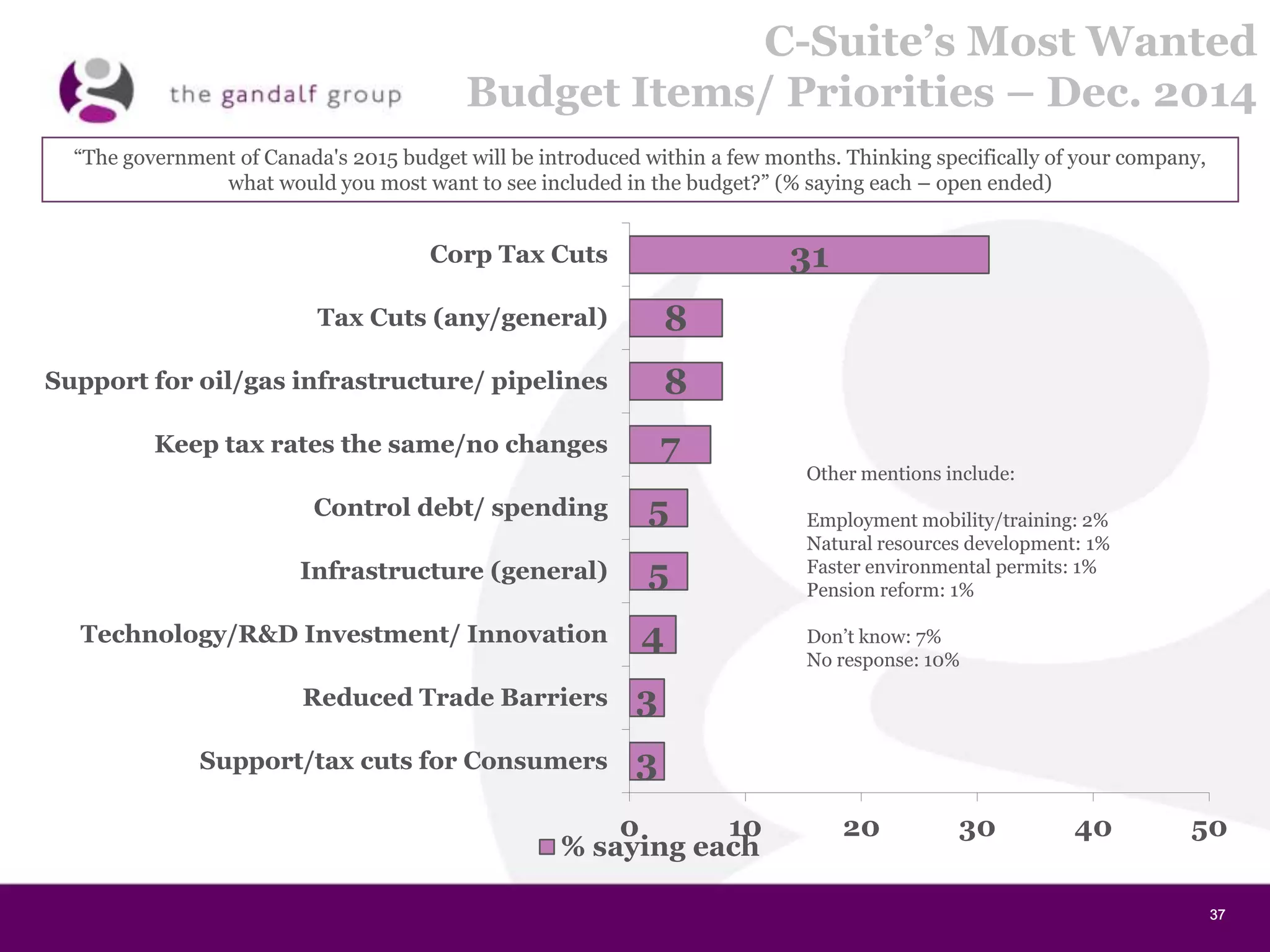
 The following slides contrast the December 2014 findings with those
of this survey
36363636
C-Suite Most Wanted Budget Items –
March 2015 Survey
15
10
9
9
5
4
4
4
3
3
3
0 5 10 15 20
Corp tax cuts
No changes to tax policy
Control of debt
Incentives for R&D
Interest rates, dollar value, stimulus
Tax cuts (general)
Infrastructure development (general)
Alternative energy investments
Steady, little change
Personal tax cuts
Reduce trade barriers, regulations
% saying each
“The government of Canada’s 2015 budget will be introduced in April. Thinking specifically of your company, what would you
most want to see included in the budget?” (Open-ended)
Other mentions include:
Employment mobility/training: 2%
Oil & Gas infrastructure: 1%
Flow through, renewal of existing rules: 1%
Improve environmental practices/
incentives: 1%
Don’t know: 3%
No response: 14%
37373737
C-Suite’s Most Wanted
Budget Items/ Priorities – Dec. 2014
31
8
8
7
5
5
4
3
3
0 10 20 30 40 50
Corp Tax Cuts
Tax Cuts (any/general)
Support for oil/gas infrastructure/ pipelines
Keep tax rates the same/no changes
Control debt/ spending
Infrastructure (general)
Technology/R&D Investment/ Innovation
Reduced Trade Barriers
Support/tax cuts for Consumers
% saying each
Other mentions include:
Employment mobility/training: 2%
Natural resources development: 1%
Faster environmental permits: 1%
Pension reform: 1%
Don’t know: 7%
No response: 10%
“The government of Canada's 2015 budget will be introduced within a few months. Thinking specifically of your company,
what would you most want to see included in the budget?” (% saying each – open ended)

C-Suite 38th Quarterly Survey 2015

  • 1.
    The 38th QuarterlyC-Suite Survey The Impact of Lower Oil Prices & Outlook for 2015 March 24, 2015 Sponsored by: Published and broadcast by:
  • 2.
    2222 Introduction  This isthe 38th edition of the C-Suite Quarterly Survey, conducted on behalf of KPMG; published and broadcast by The Globe and Mail’s Report on Business and BNN.  Previous quarters’ surveys are available at GandalfGroup.ca .  This quarter’s survey included questions about:  The price of oil and a low dollar  The state of the Canadian economy  Federal budget policy options  Methodology: telephone interviews with 152 C-Suite executives from ROB1000 companies between February 23rd and March 16th, 2015.
  • 3.
    3 Key Findings -I  The outlook for Canada’s economy has weakened significantly. This is the most pessimistic outlook among the C-suite since 2009 - the aftermath of the recession.  Few expect strong growth for the Ontario economy but expectations for provincial economies in Western Canadian are very negative.  The US economy is now leading the way to growth, rather than tracking with or behind the Canadian economy as it did in the years following the great recession.  The most commonly cited concern for businesses are low oil or commodities prices. However, many other companies are concerned about access to finance, raising equity or funding.  The drop in the price of oil has hurt many companies and they are cutting not just capital but salaries or staff levels.  A minority of executives said their companies are benefitting somewhat from cheaper energy prices.
  • 4.
    4 Key Findings -II  In contrast, the C-Suite thinks the lower value for the Canadian dollar is mostly good news for the economy. About half would welcome a dollar priced at less than 90 cents US in 2015 as far as their company is concerned.  The C-Suite is almost evenly divided on the wisdom of another rate cut this year:  51% would favour an additional rate cut by the Bank of Canada  A similar proportion – 52% – would support a deliberate low dollar policy if the Bank of Canada pursued it.  The C-Suite thinks balancing the federal budget should be a top priority – most saying it should be a high priority in the upcoming Spring budget.  But many are looking to government to make investments, notably in infrastructure spending and in skills. Fewer now are interested in corporate tax cuts and fewer would prioritize paying down debt, compared to our 2014 survey on the Budget.
  • 5.
    5 Oil & TheCanadian Economy  The economic outlook has worsened since last December; now only six in ten expect growth in the next 12 mos.  39% expect a mostly moderate decline for the Canadian economy.  In a reversal of recent years, the outlook for Ontario is better than the outlook for the West.  Expectations are far worse for Western Canada. Most expect their province’s economy to decline in the next 12 months, with 24% expecting a strong decline or recession.  In Ontario most expect growth but almost none expect strong growth.  The C-Suite’s expectations for their own companies is not as poor, although a significant number are no longer predicting their businesses will grow – 22% now expect moderate or strong decline for their companies over the next 12 mos.  The more positive outlook for the US is unchanged from last quarter.
  • 6.
    6666 Expectations of the CanadianEconomy 1 3 59 51 70 43 36 42 27 57 3 4 2 1 2 0 20 40 60 80 100 Total West Ontario QC/ Atlantic Strong growth Moderate growth Moderate decline Strong decline Don't know “What are your expectations for the Canadian economy over the next 12 months, strong growth, moderate growth, moderate decline, strong decline?” (% saying each)
  • 7.
    7777 Expectations of ProvincialEconomies 2 3 2 56 39 77 26 32 20 12 24 4 3 2 0 20 40 60 80 100 Total West Ontario Strong growth Moderate growth Moderate decline Strong decline DK/ NR “And what are your expectations for the economy of the province where you are located - strong growth, moderate growth, moderate decline or strong decline?”
  • 8.
    8888 Expectations of the Canadianand US Economies 30 1 63 59 7 36 31 0 20 40 60 80 100 US economy Canadian economy Strong growth Moderate growth Moderate decline Strong decline Don't know “What are your expectations for the U.S. /Canadian economy over the next 12 months, strong growth, moderate growth, moderate decline, strong decline?” (% saying each)
  • 9.
    9999 Projections For TheCanadian Economy “What are your expectations for the Canadian economy over the next 12 months, strong growth, moderate growth, moderate decline, strong decline?” (% saying each) 7 3 1 2 3 3 2 1 1 1 1 1 1 3 3 2 2 2 1 82 69 57 15 55 89 89 89 93 69 81 84 74 82 86 88 88 88 95 87 75 59 9 27 39 70 42 8 7 8 5 29 15 14 20 16 11 10 9 9 3 10 23 36 1 1 1 15 3 1 1 3 2 1 1 2 1 1 4 1 1 1 1 0 20 40 60 80 100 Mar. '07 Aug. '07 Jun. '08 Nov. '08 May/Jun. '09 Dec. '09 May/Jun. '10 Nov./Dec. '10 Jun. '11 Dec. '11 May/Jun. '12 Sept. '12 Nov./Dec. '12 Mar. '13 Jun. '13 Sept. '13 Dec. '13 Mar. '14 Jun. '14 Oct. '14 Dec. '14 Mar. '15 Strong growth Moderate growth Moderate decline Strong decline DK
  • 10.
    25 27 35 18 51 68 51 48 19 5 13 26 3 2 5 2 2 0 20 4060 80 100 Total Manufacturing Services Resources Strong growth Moderate growth Moderate decline Strong decline DK/ NR 10101010 Outlook for Business “What are your expectations for your company over the next 12 months, strong growth, moderate growth, moderate decline, strong decline?” (% saying each)
  • 11.
    11111111 Biggest Challenges forCompanies 42 15 7 6 6 5 4 4 0 10 20 30 40 50 Commodities Markets/Oil/Market Fluctuations Access to capital/ financing Regulatory hurdles/ costs Opportunities for growth/ rev. Recruitment/ staffing Economy in Western Canada Identifying/ planning aquisitions Cost Control % saying each “What is the biggest challenge facing your company right now?” (Open ended) Other mentions include: Competition: 2% Production costs: 2% Global uncertainty: 1% No response: 2%
  • 12.
    12 Oil & TheCanadian Economy  The consensus prediction for oil prices in 2015 is in the range of $50 and $70 a barrel.  Almost none see oil reaching or settling in at $80 by the end of 2015.  Few executives see cheaper oil as a net benefit for the economy.  Ontario executives are no more likely than Western counterparts to see cheap oil as a benefit to the national economy.  However, many Ontario executives see cheaper oil as a somewhat positive development for their companies.  Forty-one percent of companies have taken specific initiatives in light of the drop in oil and energy prices: e.g. reducing capital expenditures, layoffs and salary roll-backs.  12% of all companies sampled have reduced capital spending  16% have either laid off staff, closed some operations, reduced work weeks, or frozen or reduced pay and benefits
  • 13.
    13131313 Oil Price Projections 3 5 1 22 18 13 32 47 36 60 40 18 32 16 16 7 14 5 7 2 4 020 40 60 80 100 Total Manufacturing Services Resources $80+ $70-79 $60-69 Rise to about $50-59 Stay below $50 a barrel Unsure “By the end of 2015 what do you predict will be the price of North American crude oil in dollars per barrel? Is it more likely to stay below $50 a barrel, rise to about $50-$59, $60-$69, $70-$79, $80 to $89, or $90 and above?”
  • 14.
    14141414 Impact of LowerOil Prices in 2015 on Canadian Economy 2 5 3 14 5 22 11 16 23 16 15 49 45 55 44 18 23 7 26 1 1 0 20 40 60 80 100 Total Manufacturing Services Resources Very positive Somewhat positive Neutral Somewhat negative Very negative Don't know “The Conference Board of Canada is forecasting that oil prices will reach $60 a barrel by the end of the year, up from $50 earlier this year and down from over $100 last year. Do you think the net impact of lower oil prices in 2015 on the Canadian economy will be positive, negative, or neutral?”
  • 15.
    15151515 Impact of LowerOil Prices on Company 10 5 7 14 7 11 22 36 16 23 17 30 35 41 47 23 29 39 17 14 22 14 18 19 15 5 7 25 28 2 1 1 1 0 20 40 60 80 100 Total Manufacturing Services Resources West Ontario Very positive Somewhat positive Neutral Somewhat negative Very negative Don't know “And what would the net impact of lower oil prices at $60 a barrel through 2015 be for your company?”
  • 16.
    16161616 Initiatives in Responseto Drop in Oil and Energy Prices 41 51 30 59 49 70 0 20 40 60 80 100 Total West Ontario Yes No “Has your company taken specific initiatives in light of the drop in oil and energy prices?”
  • 17.
    17171717 Initiatives in Reactionto Drop in Oil and Energy Prices “What initiatives are those?” Among those who have taken initiatives in light of cheaper oil; n=63 (Open-ended) 29 29 19 14 13 11 5 5 5 0 10 20 30 40 Reduced capital spending Reduced lending, reprioritization in investments Reduced staff Cost cutting (general) Hedging programs Reduced base pay, freezes Some closures Locked in contracts/ secure deals Resetting pricing level % saying each Other mentions include: Reduced work week: 3% Don’t know: 2% No response: 3%
  • 18.
    18181818 Canadian $  Incontrast to the impact of cheaper oil, a clear majority said a lower valuation of the Canadian dollar in 2015 would be a positive for the Canadian economy (i.e. ~80 cents US).  Forty-nine percent of the C-Suite said a low-dollar in 2015 would be a positive for their companies.  Fewer than half would favour a dollar priced at higher than 90 cents US in terms of their companies’ best interests.  Thirty-eight percent have taken action in light of the drop in the loonie.  “Hedging our money, our business is more in US Dollars”, “hedging foreign currency”, “owning USD to increase cash reserves. Foreign exchange, we sell in USD, operate in CAD and take the spread.”  “Manufacturers in Canada increasing their sales to the US”, “higher exports to US companies”  “We have moved our manufacturing back to Canada from the US”
  • 19.
    19191919 ~$.80 Canadian Dollar Positivefor Economy 15 14 15 16 24 9 61 41 60 67 60 61 16 32 15 12 11 20 7 14 9 3 3 9 1 2 1 2 1 0 20 40 60 80 100 Total Manufacturing Services Resources Initiatives in reaction to Oil $ No initiatives Very positive Somewhat positive Neutral Somewhat negative Very negative “The Canadian dollar has fallen 15 per cent against the U.S. dollar since last July. If the value of the Canadian dollar stayed at around 80 cents US till the end of 2015, do you think the net impact on the Canadian economy will be positive, negative, or neutral?”
  • 20.
    20202020 ~$.80 Canadian DollarNet Positive for C-Suite Companies 49 55 33 60 36 27 51 27 14 18 16 11 1 1 0 20 40 60 80 100 Total Manufacturing Services Resources Good thing Neither Bad thing Don't know “Would a dollar at about 80 cents US through 2015 be a good thing or a bad thing for your company or neither?”
  • 21.
    21212121 Initiatives in Reactionto Drop in $CAD “Has your company taken specific initiatives in light of the drop in the value of the Canadian dollar?” 38 26 50 63 74 50 0 20 40 60 80 100 Total West Ontario Yes No
  • 22.
    22222222 Initiatives in Reactionto Drop in $CAD “What initiatives are those?” Among those who have initiatives; n=57 (Open-ended) 63 23 7 7 4 4 0 10 20 30 40 50 60 70 Hedging exchange rates, Canadian to USD More invest. in other markets, changing sourcing Increased price Exercising caution, re-planning, reductions in activity, Shifted back to Canada Increased productivity, hired, expanded/acquired technology % saying each No response: 2%
  • 23.
    23232323 Ideal Dollar Valuefor Companies 20 14 25 22 29 16 47 49 45 12 8 15 0 20 40 60 80 100 Total West Ontario $.95+ $.90-94 <$.90 Don't know/ N/A “Thinking specifically of your company, what would be the optimal value of the Canadian dollar against the US dollar?”
  • 24.
    24242424 Companies Planning on <$.90Canadian Dollar 6 8 74 12 0 20 40 60 80 100 Total $.95+ $.90-94 <$.90 Don't know/ N/A “Again with respect to your company, what valuation for the Canadian dollar are you using for planning for the coming year?”
  • 25.
    25 Interest Rates, the$, Housing & Inflation  The C-Suite is almost evenly divided on the merits of a second rate cut this year.  51% would support another cut, 44% would oppose it.  Support for another key lending rate cut is higher in the West than in Ontario, and higher among resources than among services companies.  Almost as many would support a deliberate low dollar policy by the Bank of Canada.  52% would support this  Just over half (53%) expect a housing market correction this year, but those who do are more likely to be in Western Canada, where economic growth has softened significantly already. In Ontario, most think there will not be a housing correction – 41% think there might be but there is little strong sentiment either way on this question.
  • 26.
    26262626 Tepid Support forBoC Rate Change 21 32 13 23 26 13 30 18 27 36 30 28 22 27 24 18 21 25 22 18 36 14 18 30 5 5 10 4 5 0 20 40 60 80 100 Total Manufacturing Services Resources West Ontario Strongly support Somewhat support Somewhat oppose Strongly oppose Don't know “Earlier this year the Bank of Canada cut its key lending rate from 1 per cent to point-seven-five per cent. Would you support or oppose an additional cut to lower the key lending rate to point-five percent in the next month or so?”
  • 27.
    27272727 Positive Impacts ofBoC Rate Change 19 19 17 16 9 6 4 3 0 5 10 15 20 25 30 Benefits cost of capital Stimulate econ., more spending Increases consumer income Redution in interest rates Lower Canadian Dollar (positive) Helps exports (esp to US) Help market value/ price Help redirect deflation % saying each “Why do you say that – what would be the most positive impact that would result from a rate cut in your view? (Open ended) Among those who support rate change; n=77 No response: 1%
  • 28.
    28282828 Negative Impacts ofBoC Rate Change 25 22 19 13 4 4 0 5 10 15 20 25 30 Further decline of $CDN Increased borrowing, debt Not effective, better ways to stim. False values of assets Housing market bubble/ crash We lend, need yield % saying each “Why do you say that – what most concerns you about the rate cut? (Open ended) Among those who oppose rate change; n=67 Other mentions include: Banks benefit, not consumers: 3% $USD/ interest rate reaction, opposite effect: 3% Lower return on investment: 3%
  • 29.
    29292929 Split Reaction toBoC Dollar Policy 19 21 25 11 14 13 26 33 33 36 30 27 29 36 29 24 22 40 36 40 19 18 20 14 19 23 18 16 2 2 3 2 0 20 40 60 80 100 Total 1-200 Employees 201-1000 1000+ Manufacturing Services Resources Strongly support Somewhat support Somewhat oppose Strongly oppose Don't know “The Governor of the Bank of Canada recently ruled out a low dollar policy. Would you support or oppose it if the Bank of Canada deliberately pursued a low dollar policy that aims to keeps its value closer to 80 cents US in 2015 than its high of over 90 cents last year?”
  • 30.
    30303030 Half Expect HousingMarket Correction in 2015 10 9 2 16 12 5 13 8 43 36 49 42 50 36 51 38 36 41 36 34 30 47 25 44 8 5 13 4 5 11 8 8 3 9 2 2 2 4 2 0 20 40 60 80 100 Total Manufacturing Services Resources West Ontario Initiatives in reaction to Oil $ No initiatives Strongly agree Somewhat agree Somewhat disagree Strongly disagree Don't know “I’m going to read some statements relating to the markets and interest rates, and I would like you to tell me if you strongly or somewhat agree, or strongly or somewhat disagree with each.” “There will likely be a housing market correction in 2015”
  • 31.
    31313131 Federal Budget Priorities& Economic Policy  The C-Suite thinks balancing the federal budget should be a top priority – most saying it should be a high priority.  But some may now be of the view that government is no longer in a position to deploy surplus money: e.g. somewhat fewer (compared to the December survey) want the government to pay down debt or increase infrastructure spending.  Of the initiatives tested, they are more likely to prioritize infrastructure spending over personal income tax cuts or debt repayment. Fewer in the C-Suite are as interested in corporate tax cuts now for their companies as compared to last December.
  • 32.
    32323232 National Priorities –March 2015 53 44 36 30 26 21 13 42 50 50 59 46 42 36 5 5 13 11 27 36 49 1 2 2 2 3 0 50 100 Balancing the budget Increased funding for infrastructure projects, such as roads, bridges or transportation Increasing assistance for skills training and apprenticeships Paying down the federal debt Reducing personal income taxes Reducing corporate income taxes Reducing resource royalties High budget priority Modest budget priority Not included DK/ NR “Now thinking about the federal surplus and the government's upcoming 2015 budget, I'd like to know if you believe each of the following items should be a high budget priority, a modest budget priority or not included in a federal budget:”
  • 33.
    33333333 National Priorities –Dec. 2014 60 59 40 38 31 31 28 21 14 11 12 32 31 47 40 48 40 52 36 52 55 45 5 9 11 20 19 29 20 40 33 33 42 3 1 2 2 2 2 1 1 1 0 50 100 Expanding funding for infrastructure projects Paying down the federal debt More generous tax incentives for companies that invest in R and D Reducing personal income taxes Income splitting, specifically reducing taxes for single-income couples with kids Reducing corporate income taxes Increasing assistance to post-secondary students and apprentices Reducing resource royalties Increasing benefits paid to parents of young children Increasing spending on affordable housing Funding for day-care programs High budget priority Modest budget priority Not included DK/ NR “Now thinking about the federal surplus and the government's upcoming 2015 budget, I'd like to know if you believe each of the following items should be a high budget priority, a modest budget priority or not included in a federal budget:”
  • 34.
    34343434 National Priorities –Corp. Tax Cuts Tracking 21 31 26 42 40 34 36 29 38 2 1 0 20 40 60 80 100 2015 2014 2012 High budget priority Modest budget priority Not included DK/ NR “Now thinking about the federal surplus and the government's upcoming 2015 budget, I'd like to know if you believe each of the following items should be a high budget priority, a modest budget priority or not included in a federal budget:” Reducing corporate income taxes
  • 35.
    35353535 Federal Budget Priorities& Economic Policy  In open ended responses, a significant number told us they are hoping the government will NOT increase taxes and stay the course in that respect.  A few mentioned incentives for R&D spending, favourable tax treatments or flow-through shares, in addition to across the board corporate tax cuts.  The following slides contrast the December 2014 findings with those of this survey
  • 36.
    36363636 C-Suite Most WantedBudget Items – March 2015 Survey 15 10 9 9 5 4 4 4 3 3 3 0 5 10 15 20 Corp tax cuts No changes to tax policy Control of debt Incentives for R&D Interest rates, dollar value, stimulus Tax cuts (general) Infrastructure development (general) Alternative energy investments Steady, little change Personal tax cuts Reduce trade barriers, regulations % saying each “The government of Canada’s 2015 budget will be introduced in April. Thinking specifically of your company, what would you most want to see included in the budget?” (Open-ended) Other mentions include: Employment mobility/training: 2% Oil & Gas infrastructure: 1% Flow through, renewal of existing rules: 1% Improve environmental practices/ incentives: 1% Don’t know: 3% No response: 14%
  • 37.
    37373737 C-Suite’s Most Wanted BudgetItems/ Priorities – Dec. 2014 31 8 8 7 5 5 4 3 3 0 10 20 30 40 50 Corp Tax Cuts Tax Cuts (any/general) Support for oil/gas infrastructure/ pipelines Keep tax rates the same/no changes Control debt/ spending Infrastructure (general) Technology/R&D Investment/ Innovation Reduced Trade Barriers Support/tax cuts for Consumers % saying each Other mentions include: Employment mobility/training: 2% Natural resources development: 1% Faster environmental permits: 1% Pension reform: 1% Don’t know: 7% No response: 10% “The government of Canada's 2015 budget will be introduced within a few months. Thinking specifically of your company, what would you most want to see included in the budget?” (% saying each – open ended)