PEPSICO INDIA
CORPORATE SOCIAL
RESPONSIBILITY (CSR)
POLICY
By- Rhythm Garg
About PepsiCo India
 PepsiCo entered India in 1989 and has grown to become the country's
largest selling food and Beverage Company. One of the largest
multinational investors in the country, PepsiCo has established a business
which aims to serve the long term dynamic needs of consumers in India.
 PepsiCo nourishes consumers with a range of products from treats to
healthy eats that deliver joy as well as nutrition and always, good taste.
 PepsiCo India has been consistently investing in the country and has built
an expansive beverage and snack food business supported by 10 beverage
bottling plants and 3 food plants.
 PepsiCo India’s diverse portfolio includes iconic brands like Pepsi, Lay’s,
Kurkure, Tropicana, Gatorade and Quaker
 Within two decades, the company has been able to organically grow
eight brands each of which generate Rs.1,000 crore or more in estimated
annual retail sales and are household names, trusted across the country.
Performance With Purpose
 Performance with Purpose articulates PepsiCo India's belief
that its businesses are intrinsically connected to the
communities and world that surrounds it.
 Performance with Purpose means delivering superior
financial performance at the same time as we improve the
world.
 Performance with purpose is the CSR (Corporate Social
Responsibility) initiative of Pepsi Co. India and is something
that the company has taken up in a big way.
Corporate Social Responsibility
initiatives
1. HUMAN SUSTAINABILITY POLICIES –
 Quality & Food Safety Programs: PepsiCo is dedicated
to producing the safest, highest-quality and best-tasting beverages
and foods in every part of the world. Developing and maintaining
robust food safety programs is how we assure safety for every
package, every day in every market. PepsiCo has detailed internal
programs and procedures for food safety.
 Responsible Marketing: Teaching children sensible eating
habits at an early age is a critical part of their up-bringing. PepsiCo
India’s approach has been to join a leading set of other food and
beverage companies in agreeing to change what younger children
are seeing advertised on TV and in other media, such as magazines
and the internet. From PepsiCo's perspective, these are products
that meet specific nutrition criteria intended to encourage the
consumption of healthier foods and beverages.
 Healthcare Reform: PepsiCo values the health and well-being
of our associates, partners, customers and consumers. PepsiCo
offers a wide range of benefits that encourages wellness, promotes
healthy living and gives associates and their families tools and
information to make educated healthcare decisions.
2. ENVIRONMENTAL SUSTAINABILITY POLICIES –
PepsiCo is committed to being an environmentally responsible
corporate citizen.
 PepsiCo's Environmental Policy: PepsiCo's Environmental
Policy applies to all our operations. PepsiCo monitors company-
owned operations and joint ventures where we hold a majority share.
They encourage their suppliers, service providers, bottlers and other
partners to adhere to the policy.
 Sustainable Agriculture Policy: PepsiCo have developed
and published their Global Sustainable Agriculture Policy, which
demonstrates their approach to sustainable development across their
entire agriculture supply chain, including water savings, waste reuse,
soil protection and chemical use.
 Sustainable Packaging Policy: PepsiCo India have launched
a global sustainable packaging policy and formed a Sustainable
Packaging Council (SPC). This multidisciplinary team includes leaders
from their R&D, Innovation, Procurement, Sales & Marketing and
Public Policy groups. The council's objectives are to develop
sustainable packaging strategies, goals, targets and alternative
material technologies and to support responsible disposal practices.
3. TALENT SUSTAINABILITY-
 Pepsi Co India’s belief that cherishing its extraordinary group of
people is crucial to building an empowered workforce.
 Pepsi Co India pursues diversity and creates an inclusive
environment which encourages associates to bring their whole
selves to work.
 Pepsi Co India has increased female and minority representation in
the management ranks and has encouraged employees to
participate in community service activities while continuing to create
rewarding job opportunities for people with different abilities.
Core CSR Activities
Activities are divided in 4 parts-
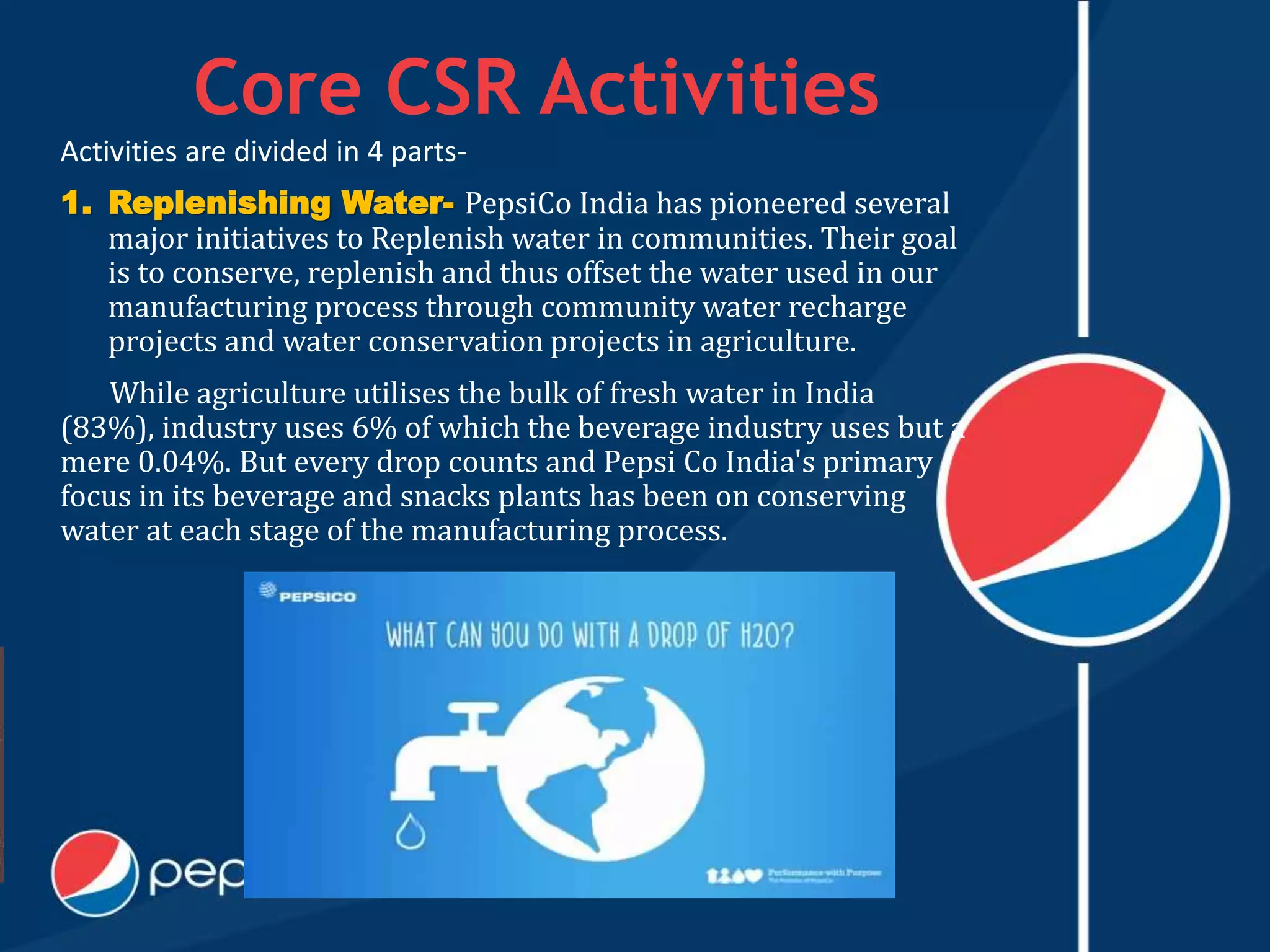
1. Replenishing Water- PepsiCo India has pioneered several
major initiatives to Replenish water in communities. Their goal
is to conserve, replenish and thus offset the water used in our
manufacturing process through community water recharge
projects and water conservation projects in agriculture.
While agriculture utilises the bulk of fresh water in India
(83%), industry uses 6% of which the beverage industry uses but a
mere 0.04%. But every drop counts and Pepsi Co India's primary
focus in its beverage and snacks plants has been on conserving
water at each stage of the manufacturing process.
2. Waste to Wealth- Waste to Wealth is Pepsi Co India and
Exnora's solid waste management programme. These Solid Waste
Management initiatives are in partnership with Exnora, an
environmental NGO.
This award winning, income generating partnership provides a clean
environment to more than 450000 people across Pammal, Chennai,
Nagapattinam, Tenkasi and Cuddalore in Tamil Nadu, Sangareddy in
Andhra Pradesh and Panipat, Haryana.
 Unique income generating partnership with leading
environmental NGO, Exnora, a pioneer in waste management.
 Community members enjoy the benefits of a clean environment
and are educated on how to recycle waste, not just relocate it.
 Households segregate their bio-degradable waste from their
recyclable waste. Bio-degradable waste is then converted into
organic manure through the process of vermi-culture.
 Programme recycles 97% of household garbage; this project
provides livelihood to more than 500 community members. Bio-
degradable waste is converted into high quality organic manure
through vermi-culture.
 Recyclable waste such as PET and plastics, waste paper and tetra
packs are recycled.
3. Pepsi Co India's agri-partnerships with
farmers- PepsiCo India continues to strengthen its partnerships
with farmers across the country to boost their productivity and
income. The plan is to strengthen farmer connect from 21,000 in
2009 to 50,000 by 2012.
Helping farmers improve yield and income
The company's vision is to create a cost-effective, localized agri supply
chain for its business by :
o Strengthening farmer connect from 21,000 in 2009 to 50,000 by
2012.
o Introduction of new high yielding varieties of Potato, Oats, Citrus
and others.
o Introduction of sustainable farming methods and contract farming.
o Working closely with farmers and state governments to improve
agri sustainability, crop diversification and enhance farmer
incomes.
o Customized solutions to suit specific geographies and locations.
o Facilitate financial and insurance services so as to de-risk farming.
High Quality Seed Program
In order to provide its farmers "The best quality potato seeds",
PepsiCo collaborated with the Thapar Institute of Technology to
develop quality potato mini-tubers.
PepsiCo has also made an investment in a world class potato mini-
tuber facility at Zahura in Punjab which helps getting robust and
disease-free seeds to its contract farmers.
Contract Farming
PepsiCo has pioneered the concept of contract farming under which
the company transfers agricultural best practices and technology
and procures the produce at a pre-agreed price.
o A 27-acre research and demonstration farm was set up in Punjab
to support the initiative to conduct farm trials of new varieties of
potato, chilli, corn, peanut and other crops.
o PepsiCo India's technical team implemented a high quality seed
programme to deliver early generation and disease-free seeds to
farmers.
Potato Farming
o World class, top quality, high-yielding potato varieties
introduced.
o High yielding potato seeds have enabled farmers to produce
world class potatoes and procure higher returns.
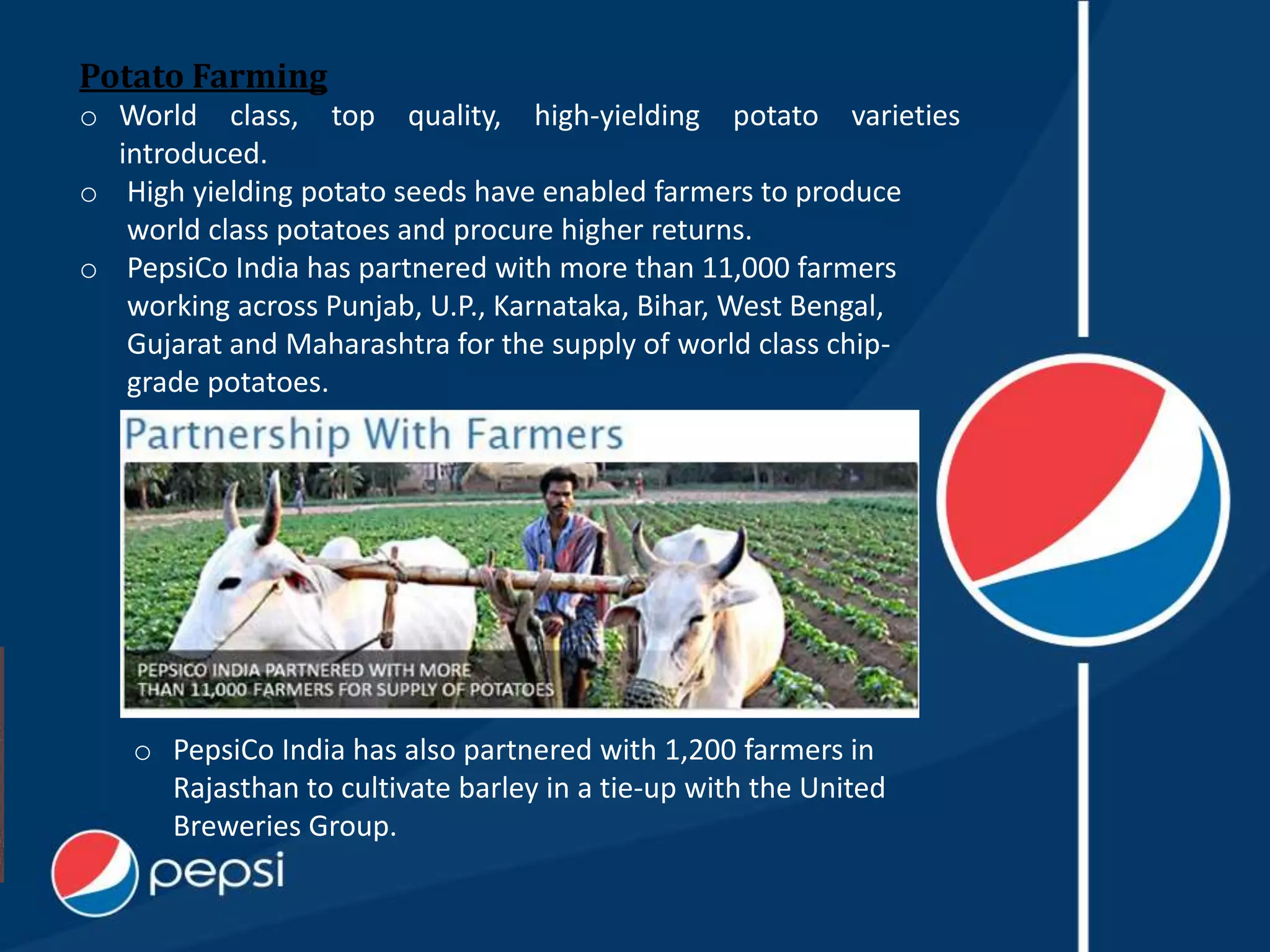
o PepsiCo India has partnered with more than 11,000 farmers
working across Punjab, U.P., Karnataka, Bihar, West Bengal,
Gujarat and Maharashtra for the supply of world class chip-
grade potatoes.
o PepsiCo India has also partnered with 1,200 farmers in
Rajasthan to cultivate barley in a tie-up with the United
Breweries Group.
PepsiCo Citrus Project
The PepsiCo and PAGREXCO (Punjab Agri Export Corporation)
partnered to start a Citrus Development initiative in 2002, marked a
step forward in PepsiCo's commitment to diversification of agriculture
and improvement in quality of life for farmers.
The Impact
o Initiative has emerged as one of the most successful models of
public-private partnerships in Indian agri-business and would create
a localized supply base for citrus juice for Tropicana business.
o Project played a significant role in introducing a less water intensive
alternative to crops such as paddy.
o Today, farmers can choose from 16 varieties of rootstock and 34
varieties of citrus, largest collection at a commercial nursery.
o Each plant is capable of processing multiple fruits and capable of
acting as a catalyst for farmers to adopt horticulture.
4. Healthy Kids –
Pepsi Co India stays committed to the health and well-being
of children. It will continue to provide children with a, diverse,
healthful and fun portfolio while simultaneously tackling the
'calories out' side of the equation by expanding its Get Active
programme for kids.
 Get Active programs have a central objective: to raise
awareness on the importance of balanced nutrition and
regular physical activity for a healthy lifestyle among school
children.
 Get Active believes in combining simplicity and enjoyment.
The basic principle is simple & to establish the fundamentals
of Calories In = Calories Out.
The programs have yielded great results. A look at the Highlights:
2008
 Get Active reached 250,000 children across 6 metros and 240
schools in 2008 - a significant 150% rise over 100,000 children
across 2 metros in 2007
 Prestigious schools like Modern School, Delhi organized a
program to enhance nutrition awareness and the importance of
'Power Breakfast' among children - a first for the school. Scottish
High School and Rotary Club also organized similar events
 The Healthy Lifestyle Exhibition gave visibility to 1000 children
from Delhi
2009
 Get Active reached 300,000 children across 10 cities and 350
schools in 2009
SUMMARY
To minimize its environmental impact, Pepsi has improved water,
fuels, and electricity efficiency - saving about five billion litres of
water and nearly 500 million kilowatt hours of energy from 2007 to
2008. By the end of 2008, the company started using a recently
installed natural gas heat and power system to bottle beverages at
its plant saving a potential $408000(Rs.2.4cr) a year.
Pepsi renewed its commitments to recycling and launched a
sustainable packaging policy. In the spring, Pepsi launched its “Have
We Met Before?” campaign to communicate the benefits of
aluminum can recycling and encourage Pepsi consumers to make
recycling a part of their daily routines.
Around the same time it used the Aquafina water bottle label to tell
customers of its CSR goal of making PepsiCo India a “positive water
balance” operation. The report noted that Pepsi has put more than
$16 million (Rs.80 cr.) toward bringing safe water to developing
countries.

Csr policy of pepsico india

  • 1.
  • 2.
    About PepsiCo India PepsiCo entered India in 1989 and has grown to become the country's largest selling food and Beverage Company. One of the largest multinational investors in the country, PepsiCo has established a business which aims to serve the long term dynamic needs of consumers in India.  PepsiCo nourishes consumers with a range of products from treats to healthy eats that deliver joy as well as nutrition and always, good taste.  PepsiCo India has been consistently investing in the country and has built an expansive beverage and snack food business supported by 10 beverage bottling plants and 3 food plants.  PepsiCo India’s diverse portfolio includes iconic brands like Pepsi, Lay’s, Kurkure, Tropicana, Gatorade and Quaker  Within two decades, the company has been able to organically grow eight brands each of which generate Rs.1,000 crore or more in estimated annual retail sales and are household names, trusted across the country.
  • 3.
    Performance With Purpose Performance with Purpose articulates PepsiCo India's belief that its businesses are intrinsically connected to the communities and world that surrounds it.  Performance with Purpose means delivering superior financial performance at the same time as we improve the world.  Performance with purpose is the CSR (Corporate Social Responsibility) initiative of Pepsi Co. India and is something that the company has taken up in a big way.
  • 4.
    Corporate Social Responsibility initiatives 1.HUMAN SUSTAINABILITY POLICIES –  Quality & Food Safety Programs: PepsiCo is dedicated to producing the safest, highest-quality and best-tasting beverages and foods in every part of the world. Developing and maintaining robust food safety programs is how we assure safety for every package, every day in every market. PepsiCo has detailed internal programs and procedures for food safety.  Responsible Marketing: Teaching children sensible eating habits at an early age is a critical part of their up-bringing. PepsiCo India’s approach has been to join a leading set of other food and beverage companies in agreeing to change what younger children are seeing advertised on TV and in other media, such as magazines and the internet. From PepsiCo's perspective, these are products that meet specific nutrition criteria intended to encourage the consumption of healthier foods and beverages.  Healthcare Reform: PepsiCo values the health and well-being of our associates, partners, customers and consumers. PepsiCo offers a wide range of benefits that encourages wellness, promotes healthy living and gives associates and their families tools and information to make educated healthcare decisions.
  • 5.
    2. ENVIRONMENTAL SUSTAINABILITYPOLICIES – PepsiCo is committed to being an environmentally responsible corporate citizen.  PepsiCo's Environmental Policy: PepsiCo's Environmental Policy applies to all our operations. PepsiCo monitors company- owned operations and joint ventures where we hold a majority share. They encourage their suppliers, service providers, bottlers and other partners to adhere to the policy.  Sustainable Agriculture Policy: PepsiCo have developed and published their Global Sustainable Agriculture Policy, which demonstrates their approach to sustainable development across their entire agriculture supply chain, including water savings, waste reuse, soil protection and chemical use.  Sustainable Packaging Policy: PepsiCo India have launched a global sustainable packaging policy and formed a Sustainable Packaging Council (SPC). This multidisciplinary team includes leaders from their R&D, Innovation, Procurement, Sales & Marketing and Public Policy groups. The council's objectives are to develop sustainable packaging strategies, goals, targets and alternative material technologies and to support responsible disposal practices.
  • 6.
    3. TALENT SUSTAINABILITY- Pepsi Co India’s belief that cherishing its extraordinary group of people is crucial to building an empowered workforce.  Pepsi Co India pursues diversity and creates an inclusive environment which encourages associates to bring their whole selves to work.  Pepsi Co India has increased female and minority representation in the management ranks and has encouraged employees to participate in community service activities while continuing to create rewarding job opportunities for people with different abilities.
  • 7.
    Core CSR Activities Activitiesare divided in 4 parts- 1. Replenishing Water- PepsiCo India has pioneered several major initiatives to Replenish water in communities. Their goal is to conserve, replenish and thus offset the water used in our manufacturing process through community water recharge projects and water conservation projects in agriculture. While agriculture utilises the bulk of fresh water in India (83%), industry uses 6% of which the beverage industry uses but a mere 0.04%. But every drop counts and Pepsi Co India's primary focus in its beverage and snacks plants has been on conserving water at each stage of the manufacturing process.
  • 8.
    2. Waste toWealth- Waste to Wealth is Pepsi Co India and Exnora's solid waste management programme. These Solid Waste Management initiatives are in partnership with Exnora, an environmental NGO. This award winning, income generating partnership provides a clean environment to more than 450000 people across Pammal, Chennai, Nagapattinam, Tenkasi and Cuddalore in Tamil Nadu, Sangareddy in Andhra Pradesh and Panipat, Haryana.  Unique income generating partnership with leading environmental NGO, Exnora, a pioneer in waste management.  Community members enjoy the benefits of a clean environment and are educated on how to recycle waste, not just relocate it.  Households segregate their bio-degradable waste from their recyclable waste. Bio-degradable waste is then converted into organic manure through the process of vermi-culture.  Programme recycles 97% of household garbage; this project provides livelihood to more than 500 community members. Bio- degradable waste is converted into high quality organic manure through vermi-culture.  Recyclable waste such as PET and plastics, waste paper and tetra packs are recycled.
  • 9.
    3. Pepsi CoIndia's agri-partnerships with farmers- PepsiCo India continues to strengthen its partnerships with farmers across the country to boost their productivity and income. The plan is to strengthen farmer connect from 21,000 in 2009 to 50,000 by 2012. Helping farmers improve yield and income The company's vision is to create a cost-effective, localized agri supply chain for its business by : o Strengthening farmer connect from 21,000 in 2009 to 50,000 by 2012. o Introduction of new high yielding varieties of Potato, Oats, Citrus and others. o Introduction of sustainable farming methods and contract farming. o Working closely with farmers and state governments to improve agri sustainability, crop diversification and enhance farmer incomes. o Customized solutions to suit specific geographies and locations. o Facilitate financial and insurance services so as to de-risk farming.
  • 10.
    High Quality SeedProgram In order to provide its farmers "The best quality potato seeds", PepsiCo collaborated with the Thapar Institute of Technology to develop quality potato mini-tubers. PepsiCo has also made an investment in a world class potato mini- tuber facility at Zahura in Punjab which helps getting robust and disease-free seeds to its contract farmers. Contract Farming PepsiCo has pioneered the concept of contract farming under which the company transfers agricultural best practices and technology and procures the produce at a pre-agreed price. o A 27-acre research and demonstration farm was set up in Punjab to support the initiative to conduct farm trials of new varieties of potato, chilli, corn, peanut and other crops. o PepsiCo India's technical team implemented a high quality seed programme to deliver early generation and disease-free seeds to farmers.
  • 11.
    Potato Farming o Worldclass, top quality, high-yielding potato varieties introduced. o High yielding potato seeds have enabled farmers to produce world class potatoes and procure higher returns. o PepsiCo India has partnered with more than 11,000 farmers working across Punjab, U.P., Karnataka, Bihar, West Bengal, Gujarat and Maharashtra for the supply of world class chip- grade potatoes. o PepsiCo India has also partnered with 1,200 farmers in Rajasthan to cultivate barley in a tie-up with the United Breweries Group.
  • 12.
    PepsiCo Citrus Project ThePepsiCo and PAGREXCO (Punjab Agri Export Corporation) partnered to start a Citrus Development initiative in 2002, marked a step forward in PepsiCo's commitment to diversification of agriculture and improvement in quality of life for farmers. The Impact o Initiative has emerged as one of the most successful models of public-private partnerships in Indian agri-business and would create a localized supply base for citrus juice for Tropicana business. o Project played a significant role in introducing a less water intensive alternative to crops such as paddy. o Today, farmers can choose from 16 varieties of rootstock and 34 varieties of citrus, largest collection at a commercial nursery. o Each plant is capable of processing multiple fruits and capable of acting as a catalyst for farmers to adopt horticulture.
  • 13.
    4. Healthy Kids– Pepsi Co India stays committed to the health and well-being of children. It will continue to provide children with a, diverse, healthful and fun portfolio while simultaneously tackling the 'calories out' side of the equation by expanding its Get Active programme for kids.  Get Active programs have a central objective: to raise awareness on the importance of balanced nutrition and regular physical activity for a healthy lifestyle among school children.  Get Active believes in combining simplicity and enjoyment. The basic principle is simple & to establish the fundamentals of Calories In = Calories Out.
  • 14.
    The programs haveyielded great results. A look at the Highlights: 2008  Get Active reached 250,000 children across 6 metros and 240 schools in 2008 - a significant 150% rise over 100,000 children across 2 metros in 2007  Prestigious schools like Modern School, Delhi organized a program to enhance nutrition awareness and the importance of 'Power Breakfast' among children - a first for the school. Scottish High School and Rotary Club also organized similar events  The Healthy Lifestyle Exhibition gave visibility to 1000 children from Delhi 2009  Get Active reached 300,000 children across 10 cities and 350 schools in 2009
  • 15.
    SUMMARY To minimize itsenvironmental impact, Pepsi has improved water, fuels, and electricity efficiency - saving about five billion litres of water and nearly 500 million kilowatt hours of energy from 2007 to 2008. By the end of 2008, the company started using a recently installed natural gas heat and power system to bottle beverages at its plant saving a potential $408000(Rs.2.4cr) a year. Pepsi renewed its commitments to recycling and launched a sustainable packaging policy. In the spring, Pepsi launched its “Have We Met Before?” campaign to communicate the benefits of aluminum can recycling and encourage Pepsi consumers to make recycling a part of their daily routines. Around the same time it used the Aquafina water bottle label to tell customers of its CSR goal of making PepsiCo India a “positive water balance” operation. The report noted that Pepsi has put more than $16 million (Rs.80 cr.) toward bringing safe water to developing countries.