Computational Science and Engineering
Master of Science @ TUM
In today’s research and development, the validation
of theoretical models is being replaced by
simulations of increasing complexity. This process
requires a detailed knowledge of efficient numerical
methods, visualisation techniques, and data
analysis. These tools are crucial for the
implementation and assessment of sophisticated
mathematical models.
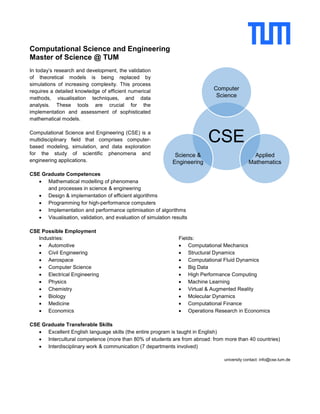
Computational Science and Engineering (CSE) is a
multidisciplinary field that comprises computer-
based modeling, simulation, and data exploration
for the study of scientific phenomena and
engineering applications.
CSE Graduate Competences
 Mathematical modelling of phenomena
and processes in science & engineering
 Design & implementation of efficient algorithms
 Programming for high-performance computers
 Implementation and performance optimisation of algorithms
 Visualisation, validation, and evaluation of simulation results
CSE Possible Employment
Industries:
 Automotive
 Civil Engineering
 Aerospace
 Computer Science
 Electrical Engineering
 Physics
 Chemistry
 Biology
 Medicine
 Economics
Fields:
 Computational Mechanics
 Structural Dynamics
 Computational Fluid Dynamics
 Big Data
 High Performance Computing
 Machine Learning
 Virtual & Augmented Reality
 Molecular Dynamics
 Computational Finance
 Operations Research in Economics
CSE Graduate Transferable Skills
 Excellent English language skills (the entire program is taught in English)
 Intercultural competence (more than 80% of students are from abroad: from more than 40 countries)
 Interdisciplinary work & communication (7 departments involved)
university contact: info@cse.tum.de
CSE
Computer
Science
Applied
Mathematics
Science &
Engineering

CSE Expertise Overview

  • 1.
    Computational Science andEngineering Master of Science @ TUM In today’s research and development, the validation of theoretical models is being replaced by simulations of increasing complexity. This process requires a detailed knowledge of efficient numerical methods, visualisation techniques, and data analysis. These tools are crucial for the implementation and assessment of sophisticated mathematical models. Computational Science and Engineering (CSE) is a multidisciplinary field that comprises computer- based modeling, simulation, and data exploration for the study of scientific phenomena and engineering applications. CSE Graduate Competences  Mathematical modelling of phenomena and processes in science & engineering  Design & implementation of efficient algorithms  Programming for high-performance computers  Implementation and performance optimisation of algorithms  Visualisation, validation, and evaluation of simulation results CSE Possible Employment Industries:  Automotive  Civil Engineering  Aerospace  Computer Science  Electrical Engineering  Physics  Chemistry  Biology  Medicine  Economics Fields:  Computational Mechanics  Structural Dynamics  Computational Fluid Dynamics  Big Data  High Performance Computing  Machine Learning  Virtual & Augmented Reality  Molecular Dynamics  Computational Finance  Operations Research in Economics CSE Graduate Transferable Skills  Excellent English language skills (the entire program is taught in English)  Intercultural competence (more than 80% of students are from abroad: from more than 40 countries)  Interdisciplinary work & communication (7 departments involved) university contact: info@cse.tum.de CSE Computer Science Applied Mathematics Science & Engineering