Overview
Overview
of
of
Client/Server Application
Agenda
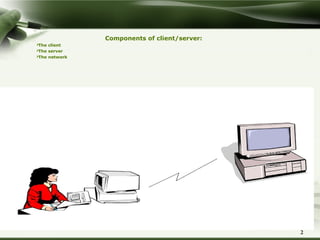
Components of client/server:

The client

The server

The network
2
2
Shri Shankarlal Sundarbai Shasun Jain College for Women
Shri Shankarlal Sundarbai Shasun Jain College for Women 3
3
 The client hardware is a desktop machine that
runs client software.
 The client hardware is the desktop machine that
runs client software.
 The client software formulates data requests and
passes the requests to the network software.
 The client communication software running on the
client hardware. The client network software
handlles the transmission of requests and receives
the results of the requests
Client
Shri Shankarlal Sundarbai Shasun Jain College for Women
Shri Shankarlal Sundarbai Shasun Jain College for Women 4
4
 A server is the machine that runs data
management software.
 It has operating system software, data
management software and a portion of a network
software.
 When evaluating server hardware , the following
points should be kept in mind.
I. Reliability
II. Availability
III. Flexibility and scalability.
Server
Shri Shankarlal Sundarbai Shasun Jain College for Women
 The network hardware is the cabling,the
communication cards and the devices that links
the server and clients.
 The network operating system manges the
network related input/output processes of the
server.
Network
Shri Shankarlal Sundarbai Shasun Jain College for Women
Client/server application can be categorized
by class, based on where most of the processing is
done.
 Host-based processing
 Client-based processing
 Cooperative processing
Classes of client/server Application
6
6
Shri Shankarlal Sundarbai Shasun Jain College for Women
 The most basic class of client/server applications
has a presentation layer running on the desktop
machine with all the application processing
running on the server/host.
 Host/based processing applications require less
functionality on the client than the other classes of
client/server applications.
 Existing equipment(desktop micros) is used to
provide this increased productivity.
Host-Based processing
Shri Shankarlal Sundarbai Shasun Jain College for Women
 The client-based processing class of client/server
application puts all the application logic on the
client machine, with the exception of data
validation routines, which are coded into the
DBMS on the server.
 This environment requires coordination between
the platform and the software running on the
platforms.
 Users can access data on any node.
 Many of the host functions , such as security and
reliability, must be built into these new
client/server applications.
Client based processing
8
8
Shri Shankarlal Sundarbai Shasun Jain College for Women
 The third class of client/server applications uses a
fully cooperative peer-to-peer processing
approach.
 The processing is performed wherever computing
resources are available.
 A single system could act as a client for other
servers for other clients.
 Data manipulation may be performed on both the
client and the server.
 client-based processing applications do some
cooperative processing because data validation,
stored procedures, and triggers may be executed
on the server.
Cooperative processing
9
9
Shri Shankarlal Sundarbai Shasun Jain College for Women
Client/server applications can also be
categorized by their support function.
 Office systems
 Front ends to existing systems
 Database access
 Transaction processing applications
 Investigative applications
Categories of client/server
application
10
10
Shri Shankarlal Sundarbai Shasun Jain College for Women
 Client/server computing provides a framework for
electronic communication.
 Businesses are trying to improve interpersonal
communications, both internally and externally.
 Many organizations are using their linked LAN’s as
a network for enterprise-wide mail systems and
workgroup applications.
 The two major LAN mail products are:
 Microsoft’s Mail 3.0
 Lotus’s cc:Mail
Office systems
11
11
Shri Shankarlal Sundarbai Shasun Jain College for Women
 Client/server applications consists of screen-
emulation systems, which convert existing
character based screens to GUI screens.
 The benefits of these systems are:
 Ease of use
 Increased worker productivity
Front-ends to existing systems
12
12
Shri Shankarlal Sundarbai Shasun Jain College for Women
 Client/server applications are being written to
provide GUI for accessing corporate data.
 The query oriented applications provide a single
window to the data of the organization.
 The benefits are:
 Ease of use
 Increased worker productivity.
Database access
13
13
Shri Shankarlal Sundarbai Shasun Jain College for Women
 Transaction processing applications are known as
mission critical applications , Include order entry ,
inventory and point of sale systems.
 A transaction is two or more operations performed
as a group.
 Transactions are generated at the client and sent
to the server for other servers.
 In these processing, ALL operations must be
successfully performed. If ANY operation of a
transaction cannot be completed, the operations
that have taken effect must be reversed using a
process called commit and rollback.
Transaction-processing
applications
14
14
Shri Shankarlal Sundarbai Shasun Jain College for Women
 Investigative applications are designed to support
decision markers and are not usually based on
real-time data.
 These applications, usually a series of queries,
provide some manipulation capabilities using SQL
functions.
 It is often called Decision Support System(DSS) or
Executive Information Systems(EIS) by the
client/server literature and the press.
Investigative applications
15
15

CSC UNIT II IN THE SUBJECT CLIENT SERVER COMPUTING

  • 1.
  • 2.
    Agenda Components of client/server:  Theclient  The server  The network 2 2
  • 3.
    Shri Shankarlal SundarbaiShasun Jain College for Women Shri Shankarlal Sundarbai Shasun Jain College for Women 3 3  The client hardware is a desktop machine that runs client software.  The client hardware is the desktop machine that runs client software.  The client software formulates data requests and passes the requests to the network software.  The client communication software running on the client hardware. The client network software handlles the transmission of requests and receives the results of the requests Client
  • 4.
    Shri Shankarlal SundarbaiShasun Jain College for Women Shri Shankarlal Sundarbai Shasun Jain College for Women 4 4  A server is the machine that runs data management software.  It has operating system software, data management software and a portion of a network software.  When evaluating server hardware , the following points should be kept in mind. I. Reliability II. Availability III. Flexibility and scalability. Server
  • 5.
    Shri Shankarlal SundarbaiShasun Jain College for Women Shri Shankarlal Sundarbai Shasun Jain College for Women  The network hardware is the cabling,the communication cards and the devices that links the server and clients.  The network operating system manges the network related input/output processes of the server. Network
  • 6.
    Shri Shankarlal SundarbaiShasun Jain College for Women Shri Shankarlal Sundarbai Shasun Jain College for Women Client/server application can be categorized by class, based on where most of the processing is done.  Host-based processing  Client-based processing  Cooperative processing Classes of client/server Application 6 6
  • 7.
    Shri Shankarlal SundarbaiShasun Jain College for Women Shri Shankarlal Sundarbai Shasun Jain College for Women  The most basic class of client/server applications has a presentation layer running on the desktop machine with all the application processing running on the server/host.  Host/based processing applications require less functionality on the client than the other classes of client/server applications.  Existing equipment(desktop micros) is used to provide this increased productivity. Host-Based processing
  • 8.
    Shri Shankarlal SundarbaiShasun Jain College for Women Shri Shankarlal Sundarbai Shasun Jain College for Women  The client-based processing class of client/server application puts all the application logic on the client machine, with the exception of data validation routines, which are coded into the DBMS on the server.  This environment requires coordination between the platform and the software running on the platforms.  Users can access data on any node.  Many of the host functions , such as security and reliability, must be built into these new client/server applications. Client based processing 8 8
  • 9.
    Shri Shankarlal SundarbaiShasun Jain College for Women Shri Shankarlal Sundarbai Shasun Jain College for Women  The third class of client/server applications uses a fully cooperative peer-to-peer processing approach.  The processing is performed wherever computing resources are available.  A single system could act as a client for other servers for other clients.  Data manipulation may be performed on both the client and the server.  client-based processing applications do some cooperative processing because data validation, stored procedures, and triggers may be executed on the server. Cooperative processing 9 9
  • 10.
    Shri Shankarlal SundarbaiShasun Jain College for Women Shri Shankarlal Sundarbai Shasun Jain College for Women Client/server applications can also be categorized by their support function.  Office systems  Front ends to existing systems  Database access  Transaction processing applications  Investigative applications Categories of client/server application 10 10
  • 11.
    Shri Shankarlal SundarbaiShasun Jain College for Women Shri Shankarlal Sundarbai Shasun Jain College for Women  Client/server computing provides a framework for electronic communication.  Businesses are trying to improve interpersonal communications, both internally and externally.  Many organizations are using their linked LAN’s as a network for enterprise-wide mail systems and workgroup applications.  The two major LAN mail products are:  Microsoft’s Mail 3.0  Lotus’s cc:Mail Office systems 11 11
  • 12.
    Shri Shankarlal SundarbaiShasun Jain College for Women Shri Shankarlal Sundarbai Shasun Jain College for Women  Client/server applications consists of screen- emulation systems, which convert existing character based screens to GUI screens.  The benefits of these systems are:  Ease of use  Increased worker productivity Front-ends to existing systems 12 12
  • 13.
    Shri Shankarlal SundarbaiShasun Jain College for Women Shri Shankarlal Sundarbai Shasun Jain College for Women  Client/server applications are being written to provide GUI for accessing corporate data.  The query oriented applications provide a single window to the data of the organization.  The benefits are:  Ease of use  Increased worker productivity. Database access 13 13
  • 14.
    Shri Shankarlal SundarbaiShasun Jain College for Women Shri Shankarlal Sundarbai Shasun Jain College for Women  Transaction processing applications are known as mission critical applications , Include order entry , inventory and point of sale systems.  A transaction is two or more operations performed as a group.  Transactions are generated at the client and sent to the server for other servers.  In these processing, ALL operations must be successfully performed. If ANY operation of a transaction cannot be completed, the operations that have taken effect must be reversed using a process called commit and rollback. Transaction-processing applications 14 14
  • 15.
    Shri Shankarlal SundarbaiShasun Jain College for Women Shri Shankarlal Sundarbai Shasun Jain College for Women  Investigative applications are designed to support decision markers and are not usually based on real-time data.  These applications, usually a series of queries, provide some manipulation capabilities using SQL functions.  It is often called Decision Support System(DSS) or Executive Information Systems(EIS) by the client/server literature and the press. Investigative applications 15 15