CSA07 – Computer Networks
Slot C – Tutorial Hour
Question 1
1. Imagine that you have trained your St. Bernard, Bernie, to carry a box of
three 8-mm tapes instead of a flask of brandy. (When your disk fills up, you
consider that an emergency.) These tapes each contain 7 gigabytes. The dog
can travel to your side, wherever you may be, at 18 km/hour. For what
range of distances does Bernie have a higher data rate than a transmission
line whose data rate (excluding overhead) is 150 Mbps? How does your
answer change if
(i) Bernie’s speed is doubled;
(ii) each tape capacity is doubled;
(iii) the data rate of the transmission line is doubled.
Question 2
2. An image is 1600 × 1200 pixels with 3 bytes/pixel.
Assume the image is uncompressed. How long does it
take to transmit it over a 56-kbps modem channel? Over
a 1-Mbps cable modem? Over a 10-Mbps Ethernet? Over
100-Mbps Ethernet? Over gigabit Ethernet?
Question 3
3. a) How much bandwidth is there in 0.1 microns of spectrum at a
wavelength of 1 micron?
b) It is desired to send a sequence of computer screen images over an
optical fiber. The screen is 2560 × 1600 pixels, each pixel being 24 bits.
There are 60 screen images per second. How much bandwidth is needed,
and how many microns of wavelength are needed for this band at 1.30
microns?
c) Radio antennas often work best when the diameter of the antenna is
equal to the wavelength of the radio wave. Reasonable antennas range
from 1 cm to 5 meters in diameter. What frequency range does this cover?
Question 4
4. A 1024-bit message is sent that contains 992 data bits and 32 CRC bits. CRC is
computed using the IEEE 802 standardized, 32-degree CRC polynomial. For each of
the following, explain whether the errors during message transmission will be
detected by the receiver:
(a) There was a single-bit error.
(b) There were two isolated bit errors.
(c) There were 18 isolated bit errors.
(d) There were 47 isolated bit errors.
(e) There was a 24-bit long burst error.
(f) There was a 35-bit long burst error.
Question 5
5. For this problem, use a formula from this chapter, but first state the formula.
Frames arrive randomly at a 100-Mbps channel for transmission. If the
channel is busy when a frame arrives, it waits its turn in a queue. Frame
length is exponentially distributed with a mean of 10,000 bits/frame. For
each of the following frame arrival rates, give the delay experienced by the
average frame, including both queueing time and transmission time.
(a) 90 frames/sec.
(b) 900 frames/sec.
(c) 9000 frames/sec.
Question 6
6. A large population of ALOHA users manages to
generate 50 requests/sec, including both originals and
retransmissions. Time is slotted in units of 40 msec.
(a) What is the chance of success on the first attempt?
(b) What is the probability of exactly k collisions and
then a success?
(c) What is the expected number of transmission
attempts needed?
Question 7
7. A seven-story office building has 15 adjacent offices per floor. Each
office contains a wall socket for a terminal in the front wall, so the
sockets form a rectangular grid in the vertical plane, with a
separation of 4 m between sockets, both horizontally and vertically.
Assuming that it is feasible to run a straight cable between any pair
of sockets, horizontally, vertically, or diagonally, how many meters
of cable are needed to connect all sockets using
(a) A star configuration with a single router in the middle?
(b) A classic 802.3 LAN?
Question 8
8. A 1-km-long, 10-Mbps CSMA/CD LAN (not 802.3) has a
propagation speed of 200 m/μsec. Repeaters are not allowed
in this system. Data frames are 256 bits long, including 32 bits
of header, checksum, and other overhead. The first bit slot
after a successful transmission is reserved for the receiver to
capture the channel in order to send a 32-bit
acknowledgement frame. What is the effective data rate,
excluding overhead, assuming that there are no collisions?
Question 9
9. Suppose that an 11-Mbps 802.11b LAN is
transmitting 64-byte frames back-to-back
over a radio channel with a bit error rate
of 10−7
. How many frames per second will
be damaged on average?
Question 10
10. Consider the extended LAN connected using bridges B1 and B2 in Fig. 4-41(b).
Suppose the hash tables in the two bridges are empty. List all ports on which a
packet will be forwarded for the following sequence of data transmissions:
(a) A sends a packet to C.
(b) E sends a packet to F.
(c) F sends a packet to E.
(d) G sends a packet to E.
(e) D sends a packet to A.
(f) B sends a packet to F
Question 11
11. A router can process 2 million
packets/sec. The load offered to it is 1.5
million packets/sec on average. If a route
from source to destination contains 10
routers, how much time is spent being
queued and serviced by the router?
Question 12
12. Suppose that host A is connected to a router R 1, R 1 is connected to
another router, R 2, and R 2 is connected to host B. Suppose that a TCP
message that contains 900 bytes of data and 20 bytes of TCP header is
passed to the IP code at host A for delivery to B. Show the Total length,
Identification, DF, MF, and Fragment offset fields of the IP header in
each packet transmitted over the three links. Assume that link A-R1 can
support a maximum frame size of 1024 bytes including a 14-byte frame
header, link R1-R2 can support a maximum frame size of 512 bytes,
including an 8-byte frame header, and link R2-B can support a
maximum frame size of 512 bytes including a 12-byte frame header.
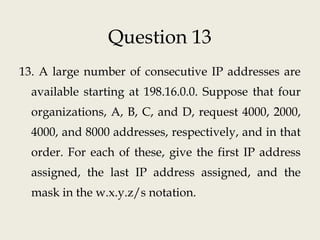
Question 13
13. A large number of consecutive IP addresses are
available starting at 198.16.0.0. Suppose that four
organizations, A, B, C, and D, request 4000, 2000,
4000, and 8000 addresses, respectively, and in that
order. For each of these, give the first IP address
assigned, the last IP address assigned, and the
mask in the w.x.y.z/s notation.
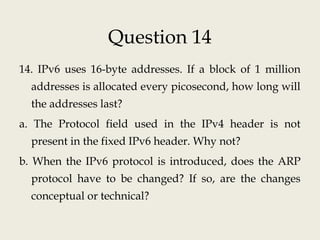
Question 14
14. IPv6 uses 16-byte addresses. If a block of 1 million
addresses is allocated every picosecond, how long will
the addresses last?
a. The Protocol field used in the IPv4 header is not
present in the fixed IPv6 header. Why not?
b. When the IPv6 protocol is introduced, does the ARP
protocol have to be changed? If so, are the changes
conceptual or technical?
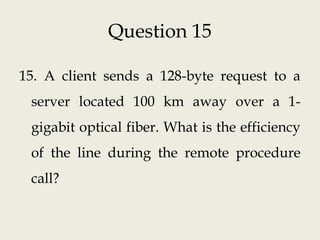
Question 15
15. A client sends a 128-byte request to a
server located 100 km away over a 1-
gigabit optical fiber. What is the efficiency
of the line during the remote procedure
call?
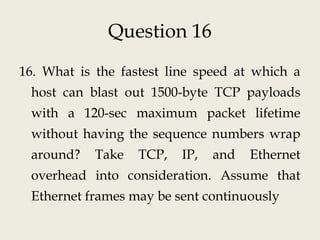
Question 16
16. What is the fastest line speed at which a
host can blast out 1500-byte TCP payloads
with a 120-sec maximum packet lifetime
without having the sequence numbers wrap
around? Take TCP, IP, and Ethernet
overhead into consideration. Assume that
Ethernet frames may be sent continuously
Question 17
17. Compute Fig. 1 Distance vector algorithm and Link
State algorithm.
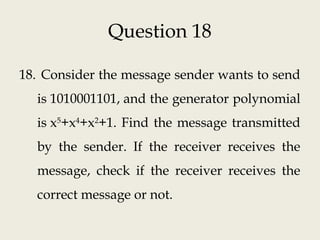
Question 18
18. Consider the message sender wants to send
is 1010001101, and the generator polynomial
is x5
+x4
+x2
+1. Find the message transmitted
by the sender. If the receiver receives the
message, check if the receiver receives the
correct message or not.
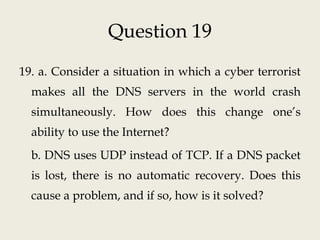
Question 19
19. a. Consider a situation in which a cyber terrorist
makes all the DNS servers in the world crash
simultaneously. How does this change one’s
ability to use the Internet?
b. DNS uses UDP instead of TCP. If a DNS packet
is lost, there is no automatic recovery. Does this
cause a problem, and if so, how is it solved?
Question 20
20. We need to use synchronous TDM and combine 20 digital sources, each of
100 Kbps. Each output slot carries 1 bit from each digital source, but one
extra bit is added to each frame for synchronization. Answer the following
questions:
a. What is the size of an output frame in bits?
b. What is the output frame rate? 188
c. What is the duration of an output frame?
d. What is the output data rate?
e. What is the efficiency of the system (ratio of useful bits to the total bits).
f. if each output slot carries 2 bits from each source.
Thank You

CSA07 – Computer Networks- Slot C Tutorial hour.ppt

  • 1.
    CSA07 – ComputerNetworks Slot C – Tutorial Hour
  • 2.
    Question 1 1. Imaginethat you have trained your St. Bernard, Bernie, to carry a box of three 8-mm tapes instead of a flask of brandy. (When your disk fills up, you consider that an emergency.) These tapes each contain 7 gigabytes. The dog can travel to your side, wherever you may be, at 18 km/hour. For what range of distances does Bernie have a higher data rate than a transmission line whose data rate (excluding overhead) is 150 Mbps? How does your answer change if (i) Bernie’s speed is doubled; (ii) each tape capacity is doubled; (iii) the data rate of the transmission line is doubled.
  • 3.
    Question 2 2. Animage is 1600 × 1200 pixels with 3 bytes/pixel. Assume the image is uncompressed. How long does it take to transmit it over a 56-kbps modem channel? Over a 1-Mbps cable modem? Over a 10-Mbps Ethernet? Over 100-Mbps Ethernet? Over gigabit Ethernet?
  • 4.
    Question 3 3. a)How much bandwidth is there in 0.1 microns of spectrum at a wavelength of 1 micron? b) It is desired to send a sequence of computer screen images over an optical fiber. The screen is 2560 × 1600 pixels, each pixel being 24 bits. There are 60 screen images per second. How much bandwidth is needed, and how many microns of wavelength are needed for this band at 1.30 microns? c) Radio antennas often work best when the diameter of the antenna is equal to the wavelength of the radio wave. Reasonable antennas range from 1 cm to 5 meters in diameter. What frequency range does this cover?
  • 5.
    Question 4 4. A1024-bit message is sent that contains 992 data bits and 32 CRC bits. CRC is computed using the IEEE 802 standardized, 32-degree CRC polynomial. For each of the following, explain whether the errors during message transmission will be detected by the receiver: (a) There was a single-bit error. (b) There were two isolated bit errors. (c) There were 18 isolated bit errors. (d) There were 47 isolated bit errors. (e) There was a 24-bit long burst error. (f) There was a 35-bit long burst error.
  • 6.
    Question 5 5. Forthis problem, use a formula from this chapter, but first state the formula. Frames arrive randomly at a 100-Mbps channel for transmission. If the channel is busy when a frame arrives, it waits its turn in a queue. Frame length is exponentially distributed with a mean of 10,000 bits/frame. For each of the following frame arrival rates, give the delay experienced by the average frame, including both queueing time and transmission time. (a) 90 frames/sec. (b) 900 frames/sec. (c) 9000 frames/sec.
  • 7.
    Question 6 6. Alarge population of ALOHA users manages to generate 50 requests/sec, including both originals and retransmissions. Time is slotted in units of 40 msec. (a) What is the chance of success on the first attempt? (b) What is the probability of exactly k collisions and then a success? (c) What is the expected number of transmission attempts needed?
  • 8.
    Question 7 7. Aseven-story office building has 15 adjacent offices per floor. Each office contains a wall socket for a terminal in the front wall, so the sockets form a rectangular grid in the vertical plane, with a separation of 4 m between sockets, both horizontally and vertically. Assuming that it is feasible to run a straight cable between any pair of sockets, horizontally, vertically, or diagonally, how many meters of cable are needed to connect all sockets using (a) A star configuration with a single router in the middle? (b) A classic 802.3 LAN?
  • 9.
    Question 8 8. A1-km-long, 10-Mbps CSMA/CD LAN (not 802.3) has a propagation speed of 200 m/μsec. Repeaters are not allowed in this system. Data frames are 256 bits long, including 32 bits of header, checksum, and other overhead. The first bit slot after a successful transmission is reserved for the receiver to capture the channel in order to send a 32-bit acknowledgement frame. What is the effective data rate, excluding overhead, assuming that there are no collisions?
  • 10.
    Question 9 9. Supposethat an 11-Mbps 802.11b LAN is transmitting 64-byte frames back-to-back over a radio channel with a bit error rate of 10−7 . How many frames per second will be damaged on average?
  • 11.
    Question 10 10. Considerthe extended LAN connected using bridges B1 and B2 in Fig. 4-41(b). Suppose the hash tables in the two bridges are empty. List all ports on which a packet will be forwarded for the following sequence of data transmissions: (a) A sends a packet to C. (b) E sends a packet to F. (c) F sends a packet to E. (d) G sends a packet to E. (e) D sends a packet to A. (f) B sends a packet to F
  • 12.
    Question 11 11. Arouter can process 2 million packets/sec. The load offered to it is 1.5 million packets/sec on average. If a route from source to destination contains 10 routers, how much time is spent being queued and serviced by the router?
  • 13.
    Question 12 12. Supposethat host A is connected to a router R 1, R 1 is connected to another router, R 2, and R 2 is connected to host B. Suppose that a TCP message that contains 900 bytes of data and 20 bytes of TCP header is passed to the IP code at host A for delivery to B. Show the Total length, Identification, DF, MF, and Fragment offset fields of the IP header in each packet transmitted over the three links. Assume that link A-R1 can support a maximum frame size of 1024 bytes including a 14-byte frame header, link R1-R2 can support a maximum frame size of 512 bytes, including an 8-byte frame header, and link R2-B can support a maximum frame size of 512 bytes including a 12-byte frame header.
  • 14.
    Question 13 13. Alarge number of consecutive IP addresses are available starting at 198.16.0.0. Suppose that four organizations, A, B, C, and D, request 4000, 2000, 4000, and 8000 addresses, respectively, and in that order. For each of these, give the first IP address assigned, the last IP address assigned, and the mask in the w.x.y.z/s notation.
  • 15.
    Question 14 14. IPv6uses 16-byte addresses. If a block of 1 million addresses is allocated every picosecond, how long will the addresses last? a. The Protocol field used in the IPv4 header is not present in the fixed IPv6 header. Why not? b. When the IPv6 protocol is introduced, does the ARP protocol have to be changed? If so, are the changes conceptual or technical?
  • 16.
    Question 15 15. Aclient sends a 128-byte request to a server located 100 km away over a 1- gigabit optical fiber. What is the efficiency of the line during the remote procedure call?
  • 17.
    Question 16 16. Whatis the fastest line speed at which a host can blast out 1500-byte TCP payloads with a 120-sec maximum packet lifetime without having the sequence numbers wrap around? Take TCP, IP, and Ethernet overhead into consideration. Assume that Ethernet frames may be sent continuously
  • 18.
    Question 17 17. ComputeFig. 1 Distance vector algorithm and Link State algorithm.
  • 19.
    Question 18 18. Considerthe message sender wants to send is 1010001101, and the generator polynomial is x5 +x4 +x2 +1. Find the message transmitted by the sender. If the receiver receives the message, check if the receiver receives the correct message or not.
  • 20.
    Question 19 19. a.Consider a situation in which a cyber terrorist makes all the DNS servers in the world crash simultaneously. How does this change one’s ability to use the Internet? b. DNS uses UDP instead of TCP. If a DNS packet is lost, there is no automatic recovery. Does this cause a problem, and if so, how is it solved?
  • 21.
    Question 20 20. Weneed to use synchronous TDM and combine 20 digital sources, each of 100 Kbps. Each output slot carries 1 bit from each digital source, but one extra bit is added to each frame for synchronization. Answer the following questions: a. What is the size of an output frame in bits? b. What is the output frame rate? 188 c. What is the duration of an output frame? d. What is the output data rate? e. What is the efficiency of the system (ratio of useful bits to the total bits). f. if each output slot carries 2 bits from each source.
  • 22.