DATA COMMUNICATION
& NETWORKING
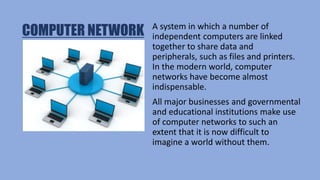
COMPUTER NETWORK A system in which a number of
independent computers are linked
together to share data and
peripherals, such as files and printers.
In the modern world, computer
networks have become almost
indispensable.
All major businesses and governmental
and educational institutions make use
of computer networks to such an
extent that it is now difficult to
imagine a world without them.
Three very common types of networks include:
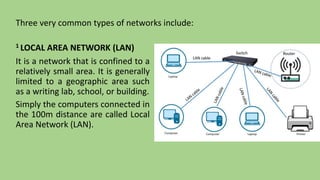
1 LOCAL AREA NETWORK (LAN)
It is a network that is confined to a
relatively small area. It is generally
limited to a geographic area such
as a writing lab, school, or building.
Simply the computers connected in
the 100m distance are called Local
Area Network (LAN).
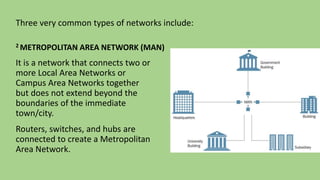
2 METROPOLITAN AREA NETWORK (MAN)
It is a network that connects two or
more Local Area Networks or
Campus Area Networks together
but does not extend beyond the
boundaries of the immediate
town/city.
Three very common types of networks include:
Routers, switches, and hubs are
connected to create a Metropolitan
Area Network.
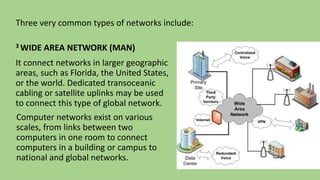
3 WIDE AREA NETWORK (MAN)
It connect networks in larger geographic
areas, such as Florida, the United States,
or the world. Dedicated transoceanic
cabling or satellite uplinks may be used
to connect this type of global network.
Three very common types of networks include:
Computer networks exist on various
scales, from links between two
computers in one room to connect
computers in a building or campus to
national and global networks.
COMPONENTS OF A DATA COMMUNICATION
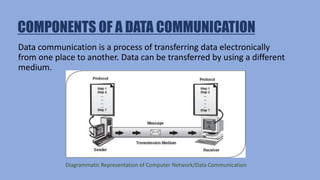
Data communication is a process of transferring data electronically
from one place to another. Data can be transferred by using a different
medium.
Diagrammatic Representation of Computer Network/Data Communication
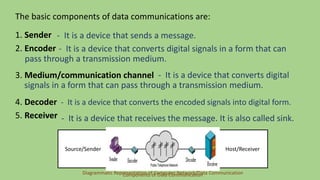
1. Sender
2. Encoder
3. Medium/communication channel
4. Decoder
5. Receiver
The basic components of data communications are:
- It is a device that sends a message.
- It is a device that converts digital signals in a form that can
pass through a transmission medium.
- It is a device that converts digital
signals in a form that can pass through a transmission medium.
- It is a device that converts the encoded signals into digital form.
- It is a device that receives the message. It is also called sink.
Source/Sender Medium Host/Receiver
Diagrammatic Representation of Computer Network/Data Communication
Components of Data Communication
MODES OF DATA COMMUNICATION
OR MODES OF NETWORK
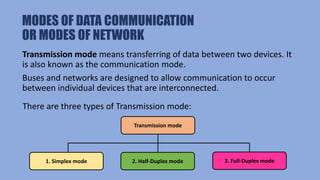
Transmission mode means transferring of data between two devices. It
is also known as the communication mode.
Buses and networks are designed to allow communication to occur
between individual devices that are interconnected.
There are three types of Transmission mode:
Transmission mode
2. Half-Duplex mode
1. Simplex mode 3. Full-Duplex mode
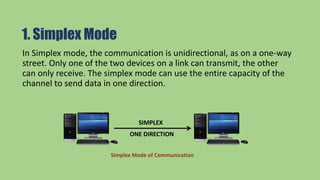
1. Simplex Mode
In Simplex mode, the communication is unidirectional, as on a one-way
street. Only one of the two devices on a link can transmit, the other
can only receive. The simplex mode can use the entire capacity of the
channel to send data in one direction.
SIMPLEX
ONE DIRECTION
Simplex Mode of Communication
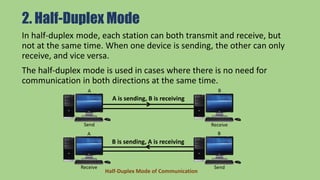
2. Half-Duplex Mode
In half-duplex mode, each station can both transmit and receive, but
not at the same time. When one device is sending, the other can only
receive, and vice versa.
A is sending, B is receiving
Half-Duplex Mode of Communication
B is sending, A is receiving
Send
Send
Receive
Receive
A B
A B
The half-duplex mode is used in cases where there is no need for
communication in both directions at the same time.
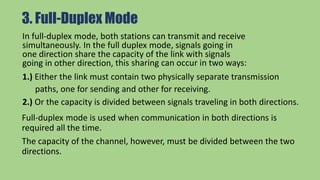
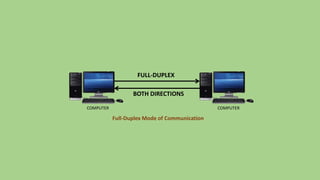
3. Full-Duplex Mode
In full-duplex mode, both stations can transmit and receive
simultaneously. In the full duplex mode, signals going in
one direction share the capacity of the link with signals
going in other direction, this sharing can occur in two ways:
1.) Either the link must contain two physically separate transmission
paths, one for sending and other for receiving.
2.) Or the capacity is divided between signals traveling in both directions.
Full-duplex mode is used when communication in both directions is
required all the time.
The capacity of the channel, however, must be divided between the two
directions.
FULL-DUPLEX
BOTH DIRECTIONS
Full-Duplex Mode of Communication
COMPUTER COMPUTER
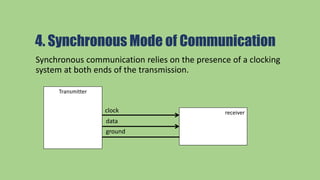
4. Synchronous Mode of Communication
Synchronous communication relies on the presence of a clocking
system at both ends of the transmission.
clock
Transmitter
receiver
data
ground
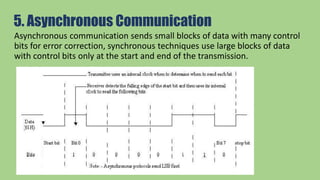
5. Asynchronous Communication
Asynchronous communication sends small blocks of data with many control
bits for error correction, synchronous techniques use large blocks of data
with control bits only at the start and end of the transmission.
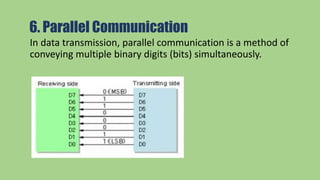
6. Parallel Communication
In data transmission, parallel communication is a method of
conveying multiple binary digits (bits) simultaneously.
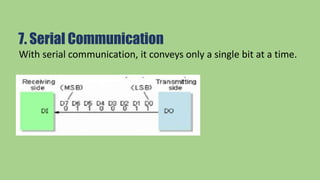
7. Serial Communication
With serial communication, it conveys only a single bit at a time.
NETWORK TOPOLOGY
Think of a topology as a network’s virtual shape or structure. This
shape does not necessarily correspond to the actual physical layout of
the devices on the network.
Network topologies are categorized into the following basic types:
1. Bus 2. Ring
3. Star 4. Mesh
More complex networks can be built as hybrids of two or more of the
basic above topologies.
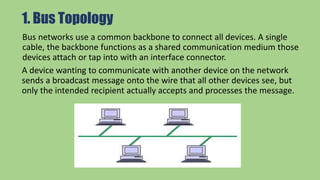
1. Bus Topology
Bus networks use a common backbone to connect all devices. A single
cable, the backbone functions as a shared communication medium those
devices attach or tap into with an interface connector.
A device wanting to communicate with another device on the network
sends a broadcast message onto the wire that all other devices see, but
only the intended recipient actually accepts and processes the message.
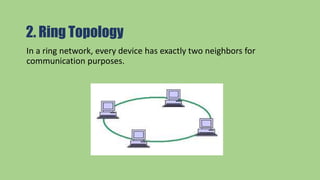
2. Ring Topology
In a ring network, every device has exactly two neighbors for
communication purposes.
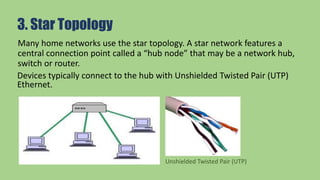
3. Star Topology
Many home networks use the star topology. A star network features a
central connection point called a “hub node” that may be a network hub,
switch or router.
Devices typically connect to the hub with Unshielded Twisted Pair (UTP)
Ethernet.
Unshielded Twisted Pair (UTP)
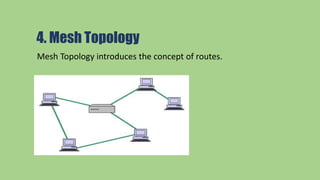
4. Mesh Topology
Mesh Topology introduces the concept of routes.
SEATWORK

CS111-PART 6 (DATA COMMUNICATION & NETWORKING).pptx

  • 1.
  • 2.
    COMPUTER NETWORK Asystem in which a number of independent computers are linked together to share data and peripherals, such as files and printers. In the modern world, computer networks have become almost indispensable. All major businesses and governmental and educational institutions make use of computer networks to such an extent that it is now difficult to imagine a world without them.
  • 3.
    Three very commontypes of networks include: 1 LOCAL AREA NETWORK (LAN) It is a network that is confined to a relatively small area. It is generally limited to a geographic area such as a writing lab, school, or building. Simply the computers connected in the 100m distance are called Local Area Network (LAN).
  • 4.
    2 METROPOLITAN AREANETWORK (MAN) It is a network that connects two or more Local Area Networks or Campus Area Networks together but does not extend beyond the boundaries of the immediate town/city. Three very common types of networks include: Routers, switches, and hubs are connected to create a Metropolitan Area Network.
  • 5.
    3 WIDE AREANETWORK (MAN) It connect networks in larger geographic areas, such as Florida, the United States, or the world. Dedicated transoceanic cabling or satellite uplinks may be used to connect this type of global network. Three very common types of networks include: Computer networks exist on various scales, from links between two computers in one room to connect computers in a building or campus to national and global networks.
  • 6.
    COMPONENTS OF ADATA COMMUNICATION Data communication is a process of transferring data electronically from one place to another. Data can be transferred by using a different medium. Diagrammatic Representation of Computer Network/Data Communication
  • 7.
    1. Sender 2. Encoder 3.Medium/communication channel 4. Decoder 5. Receiver The basic components of data communications are: - It is a device that sends a message. - It is a device that converts digital signals in a form that can pass through a transmission medium. - It is a device that converts digital signals in a form that can pass through a transmission medium. - It is a device that converts the encoded signals into digital form. - It is a device that receives the message. It is also called sink. Source/Sender Medium Host/Receiver Diagrammatic Representation of Computer Network/Data Communication Components of Data Communication
  • 8.
    MODES OF DATACOMMUNICATION OR MODES OF NETWORK Transmission mode means transferring of data between two devices. It is also known as the communication mode. Buses and networks are designed to allow communication to occur between individual devices that are interconnected. There are three types of Transmission mode: Transmission mode 2. Half-Duplex mode 1. Simplex mode 3. Full-Duplex mode
  • 9.
    1. Simplex Mode InSimplex mode, the communication is unidirectional, as on a one-way street. Only one of the two devices on a link can transmit, the other can only receive. The simplex mode can use the entire capacity of the channel to send data in one direction. SIMPLEX ONE DIRECTION Simplex Mode of Communication
  • 10.
    2. Half-Duplex Mode Inhalf-duplex mode, each station can both transmit and receive, but not at the same time. When one device is sending, the other can only receive, and vice versa. A is sending, B is receiving Half-Duplex Mode of Communication B is sending, A is receiving Send Send Receive Receive A B A B The half-duplex mode is used in cases where there is no need for communication in both directions at the same time.
  • 11.
    3. Full-Duplex Mode Infull-duplex mode, both stations can transmit and receive simultaneously. In the full duplex mode, signals going in one direction share the capacity of the link with signals going in other direction, this sharing can occur in two ways: 1.) Either the link must contain two physically separate transmission paths, one for sending and other for receiving. 2.) Or the capacity is divided between signals traveling in both directions. Full-duplex mode is used when communication in both directions is required all the time. The capacity of the channel, however, must be divided between the two directions.
  • 12.
    FULL-DUPLEX BOTH DIRECTIONS Full-Duplex Modeof Communication COMPUTER COMPUTER
  • 13.
    4. Synchronous Modeof Communication Synchronous communication relies on the presence of a clocking system at both ends of the transmission. clock Transmitter receiver data ground
  • 14.
    5. Asynchronous Communication Asynchronouscommunication sends small blocks of data with many control bits for error correction, synchronous techniques use large blocks of data with control bits only at the start and end of the transmission.
  • 15.
    6. Parallel Communication Indata transmission, parallel communication is a method of conveying multiple binary digits (bits) simultaneously.
  • 16.
    7. Serial Communication Withserial communication, it conveys only a single bit at a time.
  • 17.
    NETWORK TOPOLOGY Think ofa topology as a network’s virtual shape or structure. This shape does not necessarily correspond to the actual physical layout of the devices on the network. Network topologies are categorized into the following basic types: 1. Bus 2. Ring 3. Star 4. Mesh More complex networks can be built as hybrids of two or more of the basic above topologies.
  • 18.
    1. Bus Topology Busnetworks use a common backbone to connect all devices. A single cable, the backbone functions as a shared communication medium those devices attach or tap into with an interface connector. A device wanting to communicate with another device on the network sends a broadcast message onto the wire that all other devices see, but only the intended recipient actually accepts and processes the message.
  • 19.
    2. Ring Topology Ina ring network, every device has exactly two neighbors for communication purposes.
  • 20.
    3. Star Topology Manyhome networks use the star topology. A star network features a central connection point called a “hub node” that may be a network hub, switch or router. Devices typically connect to the hub with Unshielded Twisted Pair (UTP) Ethernet. Unshielded Twisted Pair (UTP)
  • 21.
    4. Mesh Topology MeshTopology introduces the concept of routes.
  • 22.