micheleplayfair
CS in Schools
1
micheleplayfair
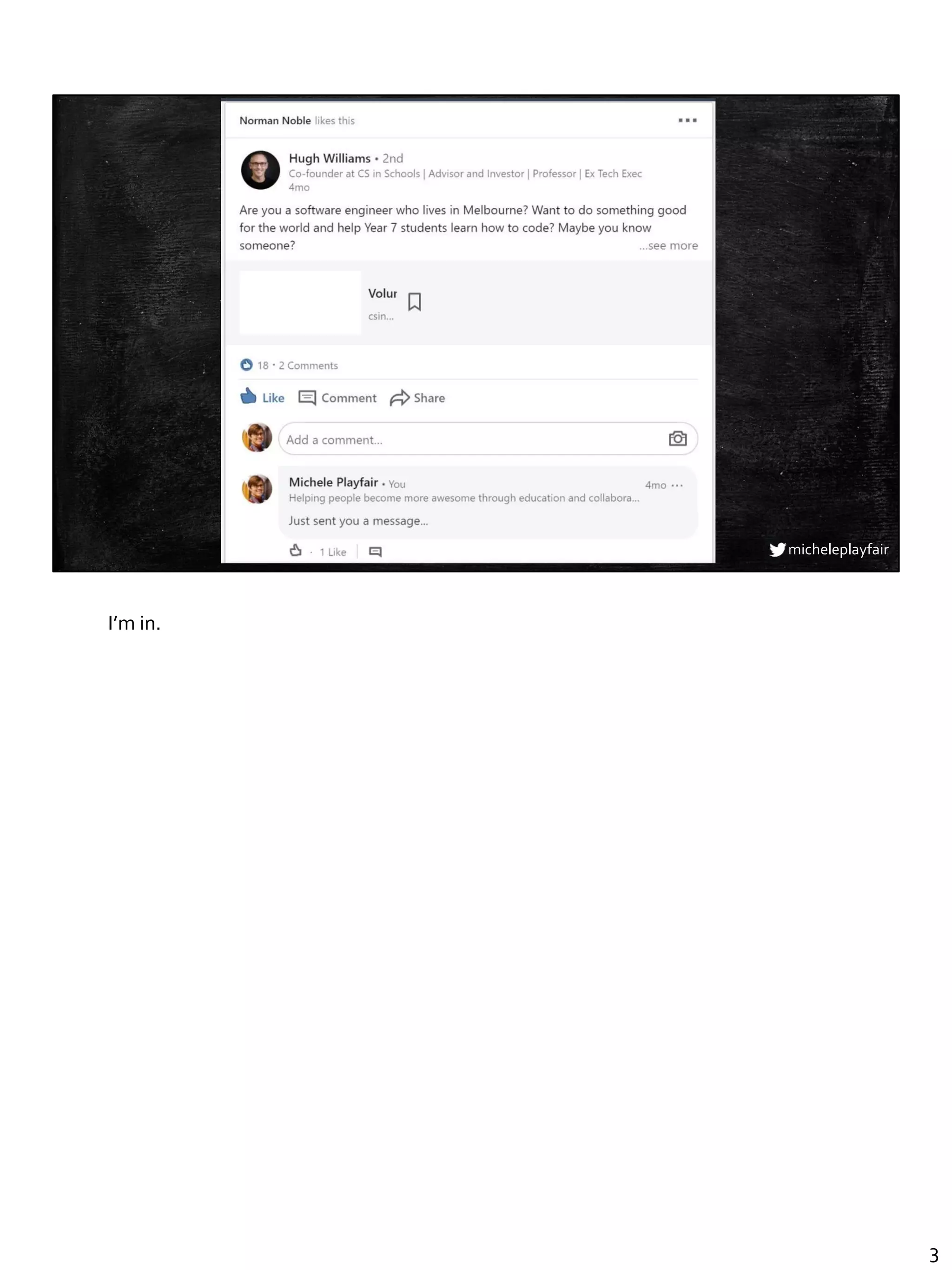
This is how I got involved – randomly saw something on LinkedIn because Norm
liked it.
Had never heard of CS in Schools before then – it was a bit of a fluke really!! So this is
one of the reasons I wanted to do a talk about it.
Now this was already January, a volunteer had pulled out so they were perhaps a wee
bit desperate. Greensborough is not exactly close to my house but driveable in a
reasonable timeframe, I don’t have any conferences scheduled inTerm 1 so I could
commit to the classroom bit, and I have been a highschool IT teacher in a past life,
so….
2
micheleplayfair
I’m in.
3
micheleplayfair
What makes CS In Schools
different?
But what is CS In Schools? There are a lot of programs that teach kids to code. This
program teachesTEACHERS to teach kids how to code….
Which we need, because….
4
micheleplayfair
Schools are required to have Digital
Technology programs
Schools are required to have digital technology programs, yet there are almost no
computer scientists who are practising teachers,
5
micheleplayfair
CS Grads in Teaching Meetup
(Actual Photo).
There is a chronic shortage of teachers who feel qualified and able to teach
computing.
6
micheleplayfair
The goal is to help teachers become
confident and skilled in teaching computing.
CS in Schools believe that today’s teachers can effectively teach coding if they’re
supported through in-class professional development.
Teaching teachers is also of course more scalable in the long term!
7
micheleplayfair
Part of
Another difference worth mentioning is that CS In Schools is actually part of RMIT
university which opens a number of options in terms of philanthropic status, ability
to provide professional development hours/certifications, recognised programs of
study etc.
“Success is defined as being able to demonstrate with academic rigor that teachers
can be effectively trained in the classroom to be confident and competent at
teaching coding using this program”
8
micheleplayfair
How does it work?
9
micheleplayfair
Term 1 – You teach the class!
You teach, the teacher learns from you. 2 hours a week in the classroom for one or
preferably 2 terms of 10 weeks.
Sound a bit scary?
10
micheleplayfair
Materials are provided
Don’t panic – the classwork and materials are provided to you byCS in Schools, you
don’t have to create them. (However if you’re picky like me, you might spend too
much time each week messing about with them to make sure you’re prepared)
These materials are provided to the schools & teachers free of charge, and they have
perpetual access to the materials under a creative commons license.
11
micheleplayfair
The coding is done with Python using repl.it - CS In Schools has a classroom set up
with activities and an end of term assignment. Students can complete their work
and submit it using this system – it can be marked complete or returned with
feedback.
Depending on the arrangement you have with your class teacher, you might spend a
bit of time outside class reviewing students’ work and giving feedback.
12
micheleplayfair
Classroom Prep Workshop
Before the start of the program there is a two day weekend training workshop at
RMIT University, learning the basics of being part of a high school classroom: student
safety, discussing good practices for working with schools, teachers and in the
classroom; and understanding basic classroom scenarios.
You will also get coaching on presentation skills.
If you have sharp eyes you will notice I am not in the photo - I missed this entirely,
having joined late I had holidays planned… but I RPL’d in since I am a qualified High
School IT teacher already :D
13
micheleplayfair
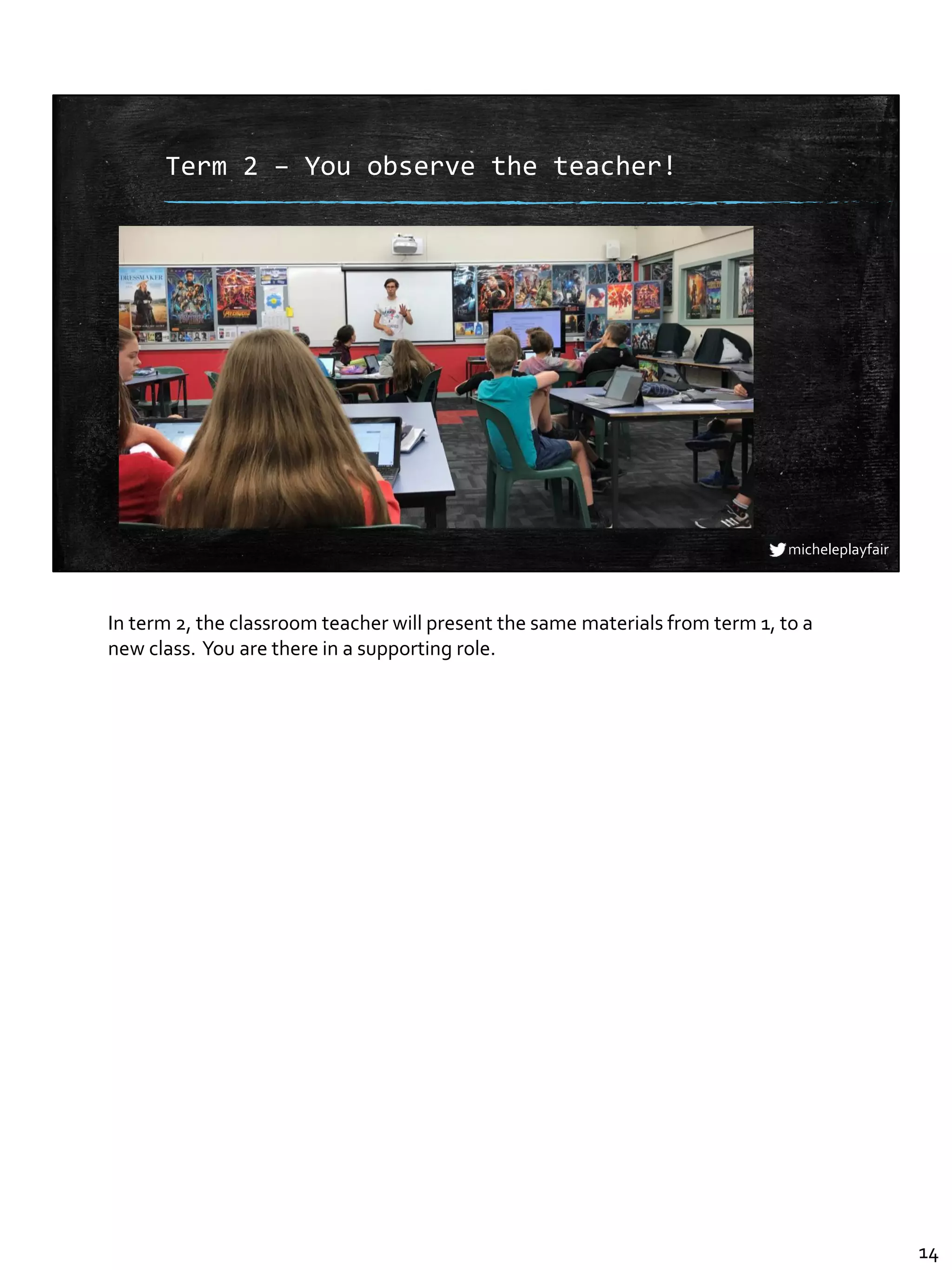
Term 2 – You observe the teacher!
In term 2, the classroom teacher will present the same materials from term 1, to a
new class. You are there in a supporting role.
14
micheleplayfair
The program is in pilot phase
▪ 10 teachers, 14 volunteers and 8 schools inTerm 1, 2019
▪ Over 1000 year 7 students in term 1 alone!
▪ 2020 goal: 100 schools
▪ 2020 – expand to a year 8 program
▪ 2021 – expand beyondVictoria
▪ Future – classes to year 12 level aroundAustralia… then….
▪ THEWORLD
This program has only just begun!! Here’s a few quick stats….
15
micheleplayfair
How do I sign up?
So I know what you’re thinking – how can I help?
16
micheleplayfair
https://csinschools.io/volunteer
17

CS In Schools

  • 1.
  • 2.
    micheleplayfair This is howI got involved – randomly saw something on LinkedIn because Norm liked it. Had never heard of CS in Schools before then – it was a bit of a fluke really!! So this is one of the reasons I wanted to do a talk about it. Now this was already January, a volunteer had pulled out so they were perhaps a wee bit desperate. Greensborough is not exactly close to my house but driveable in a reasonable timeframe, I don’t have any conferences scheduled inTerm 1 so I could commit to the classroom bit, and I have been a highschool IT teacher in a past life, so…. 2
  • 3.
  • 4.
    micheleplayfair What makes CSIn Schools different? But what is CS In Schools? There are a lot of programs that teach kids to code. This program teachesTEACHERS to teach kids how to code…. Which we need, because…. 4
  • 5.
    micheleplayfair Schools are requiredto have Digital Technology programs Schools are required to have digital technology programs, yet there are almost no computer scientists who are practising teachers, 5
  • 6.
    micheleplayfair CS Grads inTeaching Meetup (Actual Photo). There is a chronic shortage of teachers who feel qualified and able to teach computing. 6
  • 7.
    micheleplayfair The goal isto help teachers become confident and skilled in teaching computing. CS in Schools believe that today’s teachers can effectively teach coding if they’re supported through in-class professional development. Teaching teachers is also of course more scalable in the long term! 7
  • 8.
    micheleplayfair Part of Another differenceworth mentioning is that CS In Schools is actually part of RMIT university which opens a number of options in terms of philanthropic status, ability to provide professional development hours/certifications, recognised programs of study etc. “Success is defined as being able to demonstrate with academic rigor that teachers can be effectively trained in the classroom to be confident and competent at teaching coding using this program” 8
  • 9.
  • 10.
    micheleplayfair Term 1 –You teach the class! You teach, the teacher learns from you. 2 hours a week in the classroom for one or preferably 2 terms of 10 weeks. Sound a bit scary? 10
  • 11.
    micheleplayfair Materials are provided Don’tpanic – the classwork and materials are provided to you byCS in Schools, you don’t have to create them. (However if you’re picky like me, you might spend too much time each week messing about with them to make sure you’re prepared) These materials are provided to the schools & teachers free of charge, and they have perpetual access to the materials under a creative commons license. 11
  • 12.
    micheleplayfair The coding isdone with Python using repl.it - CS In Schools has a classroom set up with activities and an end of term assignment. Students can complete their work and submit it using this system – it can be marked complete or returned with feedback. Depending on the arrangement you have with your class teacher, you might spend a bit of time outside class reviewing students’ work and giving feedback. 12
  • 13.
    micheleplayfair Classroom Prep Workshop Beforethe start of the program there is a two day weekend training workshop at RMIT University, learning the basics of being part of a high school classroom: student safety, discussing good practices for working with schools, teachers and in the classroom; and understanding basic classroom scenarios. You will also get coaching on presentation skills. If you have sharp eyes you will notice I am not in the photo - I missed this entirely, having joined late I had holidays planned… but I RPL’d in since I am a qualified High School IT teacher already :D 13
  • 14.
    micheleplayfair Term 2 –You observe the teacher! In term 2, the classroom teacher will present the same materials from term 1, to a new class. You are there in a supporting role. 14
  • 15.
    micheleplayfair The program isin pilot phase ▪ 10 teachers, 14 volunteers and 8 schools inTerm 1, 2019 ▪ Over 1000 year 7 students in term 1 alone! ▪ 2020 goal: 100 schools ▪ 2020 – expand to a year 8 program ▪ 2021 – expand beyondVictoria ▪ Future – classes to year 12 level aroundAustralia… then…. ▪ THEWORLD This program has only just begun!! Here’s a few quick stats…. 15
  • 16.
    micheleplayfair How do Isign up? So I know what you’re thinking – how can I help? 16
  • 17.