Computer Science 151
An introduction to the art of
computing
Exploration in Python
Rudy Martinez
Sol
• The Sun accounts for 99.86% of the mass in the solar system.
• Over one million Earth’s could fit inside the Sun.
• The energy created by the Sun’s core is nuclear fusion.
• It takes eight minutes for light reach Earth from the Sun.
• The Sun generates solar winds.
• The Sun is classified as a yellow dwarf star.
• What color is the sun?
• Red/Yellow/Green?
4/8/2019CS151SP19
Sol
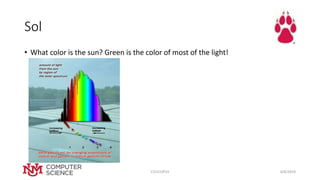
• What color is the sun? Green is the color of most of the light!
4/8/2019CS151SP19
Sol
• What color is the sun?
Our eyes see this from
space.
• This is because the sun
is basically a ‘black’
body emitter.
• Black body emitters
release radiation in all
wave lengths.
4/8/2019CS151SP19
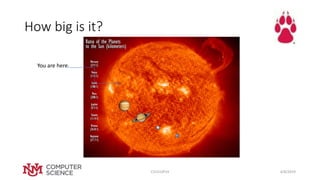
How big is it?
4/8/2019CS151SP19
You are here.
Final Project Sunspot
• What is a sunspot?
• Sunspots are an indication of magnetic disturbances in the Sun’s magnetic
Field.
4/8/2019CS151SP19
Final Project Sunspot
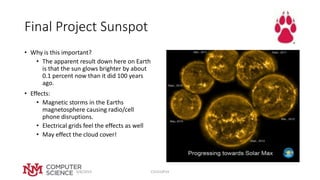
• Why is this important?
• The apparent result down here on Earth
is that the sun glows brighter by about
0.1 percent now than it did 100 years
ago.
• Effects:
• Magnetic storms in the Earths
magnetosphere causing radio/cell
phone disruptions.
• Electrical grids feel the effects as well
• May effect the cloud cover!
4/8/2019 CS151SP19
Final Project
• Your assignment is to graph the sunspots from 1749 to 2018.
• Sunspots.csv
• Use what you know about cleaning data, averaging and graphing to create a
graph that will allow you to interpret the data to see if the sun spots have
cycles.
• The answer is yes, now you have to find it.
• Once you have the data file cleaned and you have a graph you should write a
short report with your conclusions.
• You will turn in a python file (FinalPro-ject.py) and a PDF of your write up
including your graph.
4/8/2019CS151SP19
Alternatives:
• Image Classification in 10 minutes with MNIST Dataset
• https://towardsdatascience.com/image-classification-in-10-minutes-with-
mnist-dataset-54c35b77a38d
• Face Recognition with Python
• https://realpython.com/face-recognition-with-python/
• Sentiment Analysis with Python
• https://towardsdatascience.com/sentiment-analysis-with-python-part-1-
5ce197074184
• Develop your first Neural Network in Python
• https://machinelearningmastery.com/tutorial-first-neural-network-python-
keras/
4/8/2019CS151SP19
Tutorial Turn in
• The code you copied/wrote to make the project work.
• A one page report on what you learned in the tutorial, and what you
would like to have seen to make it better.
4/8/2019CS151SP19

CS 151Exploration of python

  • 1.
    Computer Science 151 Anintroduction to the art of computing Exploration in Python Rudy Martinez
  • 2.
    Sol • The Sunaccounts for 99.86% of the mass in the solar system. • Over one million Earth’s could fit inside the Sun. • The energy created by the Sun’s core is nuclear fusion. • It takes eight minutes for light reach Earth from the Sun. • The Sun generates solar winds. • The Sun is classified as a yellow dwarf star. • What color is the sun? • Red/Yellow/Green? 4/8/2019CS151SP19
  • 3.
    Sol • What coloris the sun? Green is the color of most of the light! 4/8/2019CS151SP19
  • 4.
    Sol • What coloris the sun? Our eyes see this from space. • This is because the sun is basically a ‘black’ body emitter. • Black body emitters release radiation in all wave lengths. 4/8/2019CS151SP19
  • 5.
    How big isit? 4/8/2019CS151SP19 You are here.
  • 6.
    Final Project Sunspot •What is a sunspot? • Sunspots are an indication of magnetic disturbances in the Sun’s magnetic Field. 4/8/2019CS151SP19
  • 7.
    Final Project Sunspot •Why is this important? • The apparent result down here on Earth is that the sun glows brighter by about 0.1 percent now than it did 100 years ago. • Effects: • Magnetic storms in the Earths magnetosphere causing radio/cell phone disruptions. • Electrical grids feel the effects as well • May effect the cloud cover! 4/8/2019 CS151SP19
  • 8.
    Final Project • Yourassignment is to graph the sunspots from 1749 to 2018. • Sunspots.csv • Use what you know about cleaning data, averaging and graphing to create a graph that will allow you to interpret the data to see if the sun spots have cycles. • The answer is yes, now you have to find it. • Once you have the data file cleaned and you have a graph you should write a short report with your conclusions. • You will turn in a python file (FinalPro-ject.py) and a PDF of your write up including your graph. 4/8/2019CS151SP19
  • 9.
    Alternatives: • Image Classificationin 10 minutes with MNIST Dataset • https://towardsdatascience.com/image-classification-in-10-minutes-with- mnist-dataset-54c35b77a38d • Face Recognition with Python • https://realpython.com/face-recognition-with-python/ • Sentiment Analysis with Python • https://towardsdatascience.com/sentiment-analysis-with-python-part-1- 5ce197074184 • Develop your first Neural Network in Python • https://machinelearningmastery.com/tutorial-first-neural-network-python- keras/ 4/8/2019CS151SP19
  • 10.
    Tutorial Turn in •The code you copied/wrote to make the project work. • A one page report on what you learned in the tutorial, and what you would like to have seen to make it better. 4/8/2019CS151SP19