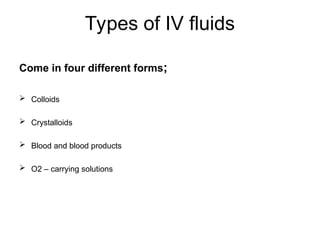
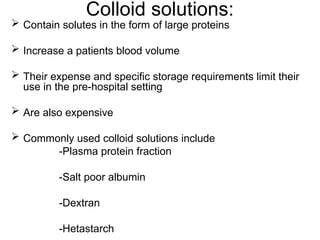
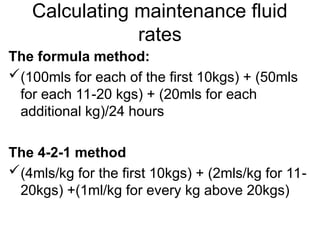
Intravenous (IV) fluids are chemically prepared solutions used to replace lost fluids and aid in medication delivery, categorized into colloids, crystalloids, blood products, and O2-carrying solutions. Colloids contain large proteins and are used to increase blood volume but are expensive and have specific storage needs, while crystalloids contain electrolytes without large proteins and can be isotonic, hypertonic, or hypotonic. Maintenance fluid rates can be calculated using specific formulas based on a patient's weight.
![Crystalloid solutions:
Contain electrolytes e.g. sodium,potassium,calcium,chloride.
Lack large proteins and molecules
Its tonicity describes the concentrations of electrolytes [solutes] dissolved in the
water as compared with that of body plasma.
I.e. Isotonic - electrolytes concentration= electrolyte in plasma
Hypertonic - electrolytes concentration> electrolytes in plasma
Hypotonic - electrolyte concentration< electrolytes in plasma](https://image.slidesharecdn.com/s3ub6pytos8eotpskerh-intravenous-fluids-240909135511-58aa4c45/85/CRYSTALLOIDS-AND-COLLOIDS-FOR-FLUID-REPLACEMENT-4-320.jpg)
![Examples:
Isotonic solutions include – Lactated Ringers
[LR]
normal saline solutions [0.9%Nacl in sterile
water NSS]
5% Dextrose in water [D5W]
LR and NSS used for fluid replacement
because of their ability to expand the volume
of circulating blood.](https://image.slidesharecdn.com/s3ub6pytos8eotpskerh-intravenous-fluids-240909135511-58aa4c45/85/CRYSTALLOIDS-AND-COLLOIDS-FOR-FLUID-REPLACEMENT-5-320.jpg)


![Fluids & electrolytes seminar [autosaved]](https://cdn.slidesharecdn.com/ss_thumbnails/fluidselectrolytesseminarautosaved-180206093120-thumbnail.jpg?width=640&height=640&fit=bounds)


