Crystal internals
Part 1
Is a compiler a hard thing?
At Manas we usually do webapps
Let’s talk about webapps...
● HTML/CSS/JS
● React/Angular/Knockout
● Ruby/Erlang/Elixir
● Database (mysql/postgres)
● Elasticsearch
● Redis/Sidekiq/Background-jobs
● Docker, capistrano, deploy, servers
Let’s talk about webapps...
● HTML/CSS/JS
● React/Angular/Knockout
● Ruby/Erlang/Elixir
● Database (mysql/postgres)
● Elasticsearch
● Redis/Sidekiq/Background-jobs
● Docker, capistrano, deploy, servers
Easy…?
Let’s talk about compilers...
● HTML/CSS/JS
● React/Angular/Knockout
● Ruby/Erlang/Elixir
● Database (mysql/postgres)
● Elasticsearch
● Redis/Sidekiq/Background-jobs
● Docker, capistrano, deploy, servers
Easy!
Let’s talk about compilers...
No, let’s talk about usual programs
INPUT -> [PROCESSING…] -> OUTPUT
No, let’s talk about compilers
SOURCE CODE -> [PROCESSING…] -> EXECUTABLE
No, let’s talk about compilers
SOURCE CODE -> [PROCESSING…] -> EXECUTABLE
How do we go from source code to an executable?
Traditional stages of a compiler
class Foo
def bar
1 + 2
end
end
● Lexer: [“class”, “Foo”, “;”, “def”, “bar”, “;”, “1”, “+”, “2”, “;”, “end”, “;”, “end”]
● Parser: ClassDef(“Foo”, body: [Def.new(“bar”)])
● Semantic (a.k.a “type check”): make sure there are no type errors
● Codegen: generate machine code
Let’s start with the codegen phase
Goal: generate efficient assembly code for many architectures (32 bits, 64 bits,
intel, arm, etc.)
● Generating assembly code is hard
● Generating efficient assembly code is harder
● Generating assembly code for many architectures is hard/tedious/boring
Let’s start with the codegen phase
Goal: generate efficient assembly code for many architectures (32 bits, 64 bits,
intel, arm, etc.)
● Generating assembly code is hard
● Generating efficient assembly code is harder
● Generating assembly code for many architectures is hard/tedious/boring
Thus: writing a compiler is HARD! :-(
Let’s start with the codegen phase
Goal: generate efficient assembly code for many architectures (32 bits, 64 bits,
intel, arm, etc.)
● Generating assembly code is hard
● Generating efficient assembly code is harder
● Generating assembly code for many architectures is hard/tedious/boring
Thus: writing a compiler is HARD! :-(
Well, not anymore...
Codegen
With LLVM, we generate LLVM IR (internal representation) instead of assembly,
and LLVM takes care of generating efficient assembly code for us!
The hardest part is solved :-)
define i32 @add(i32 %x, i32 %y) {
%0 = add i32 %x, %y
ret i32 %0
}
Codegen: LLVM (example)
LLVM provides a nice API to generate IR
require "llvm"
mod = LLVM::Module.new("main")
mod.functions.add("add", [LLVM::Int32, LLVM::Int32], LLVM::Int32) do |func|
func.basic_blocks.append do |builder|
res = builder.add(func.params[0], func.params[1])
builder.ret(res)
end
end
puts mod
● Lexer
● Parser
● Semantic
Remaining phases
● Kind of easy: go char by char until we get a keyword, identifier, number, etc.
● We won’t go into implementation details...
Lexer
● Kind of easy: go token by token and create a tree of expressions
● This tree is called AST: Abstract Syntax Tree
● An AST is like a directed, acyclic graph
● We won’t go into implementation details...
Parser
● This is the fundamental piece of the compiler
● It takes an AST as input and analyzes it
● Analysis can result in:
○ Declaring types: for example “class Foo; end” will declare a type Foo
○ Checking methods: for example “Foo.bar” will check that “Foo” is a declared type and that the
method “bar” exists in it, and has the correct arity and types
○ Giving each non-dead expression in the program a type
○ Gathering some info for the codegen phase: for example know the local variables of a method,
and their type
Semantic
● The interesting part of the compiler is the semantic phase
● It’s just about processing an AST
● In Crystal’s compiler you just need to know one language: Crystal!
● No HTML/CSS/JS/JSX/etc.
● No untyped, dynamic languages: no Ruby/Erlang/Elixir. Type safe!
● Stuff is processed in memory
● No databases, no Elasticsearch, no Redis
Semantic
● The interesting part of the compiler is the semantic phase
● It’s just about processing an AST
● In Crystal’s compiler you just need to know one language: Crystal!
● No HTML/CSS/JS/JSX/etc.
● No untyped, dynamic languages: no Ruby/Erlang/Elixir. Type safe!
● Stuff is processed in memory
● No databases, no Elasticsearch, no Redis
Writing a compiler is easier than writing a web app! ^_^
Semantic
● The interesting part of the compiler is the semantic phase
● It’s just about processing an AST
● In Crystal’s compiler you just need to know one language: Crystal!
● No HTML/CSS/JS/JSX/etc.
● No untyped, dynamic languages: no Ruby/Erlang/Elixir. Type safe!
● Stuff is processed in memory
● No databases, no Elasticsearch, no Redis
Writing a compiler is easier than writing a web app! ^_^
(Or at least it’s more fun :-P)
Semantic
Directory layout
● src/compiler/crystal
○ command/
○ syntax/
○ semantic/
○ macros/
○ codegen/
○ tools/
○ compiler.cr
○ types.cr
○ program.cr
Directory layout
● src/compiler/crystal
○ command/ : the command line interface
○ syntax/ : lexer, parser, ast, visitor, transformer
○ semantic/ : type declaration, method lookup, etc.
○ macros/ : macro expansion logic
○ codegen/ : codegen
○ tools/ : doc generator, formatter, init
○ compiler.cr : combines syntax + semantic + codegen
○ types.cr : all possible types in Crystal (Int32, String, unions, custom types, etc.)
○ program.cr : holds definitions of a program (holds Int32, String, etc.)
Directory layout
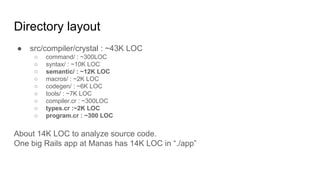
● src/compiler/crystal : ~43K LOC
○ command/ : ~300LOC
○ syntax/ : ~10K LOC
○ semantic/ : ~12K LOC
○ macros/ : ~2K LOC
○ codegen/ : ~6K LOC
○ tools/ : ~7K LOC
○ compiler.cr : ~300LOC
○ types.cr :~2K LOC
○ program.cr : ~300 LOC
Directory layout
● src/compiler/crystal : ~43K LOC
○ command/ : ~300LOC
○ syntax/ : ~10K LOC
○ semantic/ : ~12K LOC
○ macros/ : ~2K LOC
○ codegen/ : ~6K LOC
○ tools/ : ~7K LOC
○ compiler.cr : ~300LOC
○ types.cr :~2K LOC
○ program.cr : ~300 LOC
About 14K LOC to analyze source code.
Directory layout
● src/compiler/crystal : ~43K LOC
○ command/ : ~300LOC
○ syntax/ : ~10K LOC
○ semantic/ : ~12K LOC
○ macros/ : ~2K LOC
○ codegen/ : ~6K LOC
○ tools/ : ~7K LOC
○ compiler.cr : ~300LOC
○ types.cr :~2K LOC
○ program.cr : ~300 LOC
About 14K LOC to analyze source code.
One big Rails app at Manas has 14K LOC in “./app”
Directory layout
● src/compiler/crystal : ~43K LOC
○ command/ : ~300LOC
○ syntax/ : ~10K LOC
○ semantic/ : ~12K LOC
○ macros/ : ~2K LOC
○ codegen/ : ~6K LOC
○ tools/ : ~7K LOC
○ compiler.cr : ~300LOC
○ types.cr :~2K LOC
○ program.cr : ~300 LOC
About 14K LOC to analyze source code.
One big Rails app at Manas has 14K LOC in “./app”
A compiler can’t be that hard! ;-)
Show me the code
Show me the code
# src/compiler/crystal/compiler.cr
def compile(source : Source | Array(Source), output_filename : String) : Result
source = [source] unless source.is_a?(Array)
program = new_program(source)
node = parse program, source
node = program.semantic node, @stats
codegen program, node, source, output_filename unless @no_codegen
Result.new program, node
end
Show me the code
# src/compiler/crystal/compiler.cr
def compile(source : Source | Array(Source), output_filename : String) : Result
source = [source] unless source.is_a?(Array)
program = new_program(source)
node = parse program, source
node = program.semantic node, @stats
codegen program, node, source, output_filename unless @no_codegen
Result.new program, node
end
Show me the code
# src/compiler/crystal/compiler.cr
def compile(source : Source | Array(Source), output_filename : String) : Result
source = [source] unless source.is_a?(Array)
program = new_program(source)
node = parse program, source
node = program.semantic node, @stats
codegen program, node, source, output_filename unless @no_codegen
Result.new program, node
end
What is a program?
Program
● Holds all types and top-level methods for a given compilation
● For example, if I compile “class Foo; end” and you compile “class Bar; end”,
the first program will have a type named “Foo”, and the second one won’t (but
it will have a type named “Bar”)
● It lets us test the compiler more easily, because we can use different Program
instances for each snippet of code that we want to test
● In contrast of having global variables holding all of a program’s data
● A Program is passed around in all phases of a compilation (except lexing and
parsing, which don’t need semantic info)
Show me the code
# src/compiler/crystal/compiler.cr
def compile(source : Source | Array(Source), output_filename : String) : Result
source = [source] unless source.is_a?(Array)
program = new_program(source)
node = parse program, source # from source to Crystal::ASTNode
node = program.semantic node, @stats
codegen program, node, source, output_filename unless @no_codegen
Result.new program, node
end
What is a program?
Show me the code
# src/compiler/crystal/compiler.cr
def compile(source : Source | Array(Source), output_filename : String) : Result
source = [source] unless source.is_a?(Array)
program = new_program(source)
node = parse program, source
node = program.semantic node, @stats # Semantic! :-)
codegen program, node, source, output_filename unless @no_codegen
Result.new program, node
end
What is a program?
Semantic
● The entry point for semantic analysis is in
src/compiler/crystal/semantic.cr
● Other files are in src/compiler/crystal/semantic/
● The file semantic.cr has comments that explain the overall algorithm :-)
Semantic: overall algorithm
● top level: declare classes, modules, macros, defs and other top-level stuff
● new methods: create `new` methods for every `initialize` method
● type declarations: process type declarations like `@x : Int32`
● check abstract defs: check that abstract defs are implemented
● class_vars_initializers: process initializers like `@@x = 1`
● instance_vars_initializers: process initializers like `@x = 1`
● main: process "main" code, calls and method bodies (the whole program).
● cleanup: remove dead code and other simplifications
● check recursive structs: check that structs are not recursive (impossible to
codegen)
Semantic: overall algorithm
Note!
● This algorithm didn’t come from the Skies
(nor from a textbook, nor from a paper)
● It’s not written in stone!
● It can definitely be improved: readability,
performance, etc.
Note!
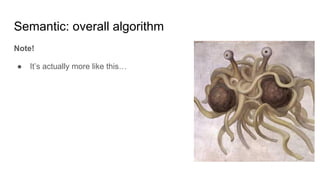
● It’s actually more like this…
Semantic: overall algorithm
Semantic
But before looking at each phase, we need to learn about the most useful pattern
for analyzing an AST...
The Visitor pattern
require "compiler/crystal/syntax"
class SumVisitor < Crystal::Visitor
getter sum = 0
def visit(node : Crystal::NumberLiteral)
@sum += node.value.to_i
end
def visit(node : Crystal::ASTNode)
true # true: continue visiting children nodes
end
end
ast = Crystal::Parser.parse("foo(1 + 2, 3, [4])")
visitor = SumVisitor.new
ast.accept(visitor)
puts visitor.sum
The Visitor pattern
● We define a visit method for each node of interest
● We process the nodes
● We return true if we want to process children, false otherwise
● Example: if we only want to process class declarations, we could just define
visit(node : Crystal::ClassDef) and define some logic there (and return true,
because of nested class definitions)
● A visitor abstracts over the way nodes are composed
● ...though in many cases, for semantic purposes, we need and use the way a
node is composed (for example, to analyze a call we need to know the
argument types, so we check the arguments, not all children in a generic way)
Semantic: overall algorithm
● top level: declare classes, modules, macros, defs and other top-level stuff
● new methods
● type declarations
● check abstract defs
● class_vars_initializers
● instance_vars_initializers
● main
● cleanup
● check recursive structs
Top level: declare classes, modules, macros, defs...
# src/compiler/crystal/semantic/top_level_visitor.cr
class Crystal::TopLevelVisitor < Crystal::SemanticVisitor
# ...
end
● Located at semantic_visitor.cr
● This is a base visitor used in most of the phases of the semantic analysis
● It keeps track of the “current type”
● For example in “class Foo; class Bar; baz; end; end”, “current type” starts at
the top-level (the Program). When “class Foo” is found, the current type
becomes “Foo” (we search “Foo” in the current type). When “class Bar” is
found, the current type becomes “Foo::Bar” (we search “Bar” in the current
type). When “baz” is found, it will be looked up inside the current type.
● But initially there’s no “Foo” inside the current type (the Program). Who
defines it? … The top-level visitor!
Crystal::SemanticVisitor
● Located at top_level_visitor.cr
● Defines classes, methods, etc.
● Given “class Foo; class Bar; baz; end; end”...
● current_type starts at Program
● When “class Foo” is found (ClassDef), we check if “Foo” exists in the current
type. If not, we create it. If it exists with a different type (if it’s a module), we
give an error.
● We attach this type “Foo” to the AST node ClassDef. SemnticVisitor will use
this in every subsequent phase.
● … the “baz” call is not analyzed here (unless it’s a macro)
Crystal::TopLevelVisitor
● Many other things done in this visitor: methods and macros are added to
types, aliases and enums are defined, etc.
● Question: why are methods and macros defined at this phase?
● The “inherited” macro hook must be processed as soon as “Bar <
Foo” and “Baz < Foo” are found
● The macro expands to “do_something”, which must expand to
“def foo; 1; end”
● This must happen before we continue processing Baz’s body:
“def foo; 3; end” must win and be the method found when doing
“Baz.new.foo”
● Conclusion: methods, macros and hooks must be defined in the
first pass, when defining types. Additionally, macros might be
looked up in types in this same pass (like “do_something”)
● SemanticVisitor takes care to look up and expand calls that
resolve to macro calls
When should macros be defined and expanded
class Foo
macro inherited
do_something
end
macro do_something
def foo; 1; end
end
end
class Bar < Foo; end
class Baz < Foo
def foo; 3; end
end
puts Bar.new.foo # => 1
puts Baz.new.foo # => 3
Method overloads
● Crystal methods are very powerful! For example: optional type restrictions,
different number of arguments, default arguments, splat, etc.
● When methods are added to types we need to:
○ Know if a method replaces (redefines) an old method
○ Track whether a method is “stricter” than another method, to quickly know, given a call
argument types, in which order they are going to be tested
Method restrictions
def foo(x : Int32)
puts 1
end
def foo(x)
puts 2
end
foo(1)
foo('a')
● Given foo(1), both methods match it. However, the first overload
should be invoked because it has a stronger restriction than the
second overload.
● If we define the methods in a different order, it still works the
same
● This is because an argument with a type restriction is stronger than
one without one. We say that the first one is a restriction of the
second one (we should probably rename this to use stronger)
● This applies to types too: Int32 is stronger than Int32 |
String. And Bar is stronger than Foo, if Bar < Foo.
● Given two methods with the same name, if all arguments of a
method are stronger than the others’, the whole method is stronger
and should come first. Each type stores an ordered list of methods
indexed by method name, with this notion.
● If the methods are both stronger than each other, they have the
same restriction.
Method restrictions
def foo(x : Int32)
puts 1
end
def foo(x)
puts 2
end
foo(1)
foo('a')
● This logic is located at restrictions.cr
● A lot of cases to consider: generics, tuples, splats, etc.
● The code and algorithms could probably use a simpler, unified logic
and a cleanup, but first all of these concepts and definitions must be
defined much more formally
Semantic: overall algorithm
● top level
● new methods: create `new` methods for every `initialize` method
● type declarations
● check abstract defs
● class_vars_initializers
● instance_vars_initializers
● main
● cleanup
● check recursive structs
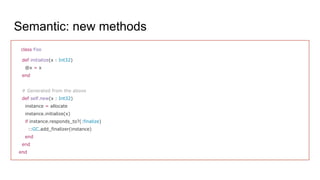
● Located at new.cr
● TopLevelVisitor creates a `new` class method for every `initialize` method it
finds (the logic for this is also in new.cr)
● Classes that end up without an `initialize` need a default, argless `self.new`
method
● This phase is a bit messy right now because of some missing things related to
generics…
Semantic: new methods
class Foo
def initialize(x : Int32)
@x = x
end
# Generated from the above
def self.new(x : Int32)
instance = allocate
instance.initialize(x)
if instance.responds_to?(:finalize)
::GC.add_finalizer(instance)
end
end
end
Semantic: new methods
Semantic: overall algorithm
● top level
● new methods
● type declarations: process type declarations like `@x : Int32`
● check abstract defs
● class_vars_initializers
● instance_vars_initializers
● main
● cleanup
● check recursive structs
● Located at type_declaration_processor.cr (and
type_declaration_visitor.cr and type_guess_visitor.cr)
● Combines info gathered by these two visitors to declare the type of instance
and class variables.
● TypeDeclarationVisitor deals with explicit type declarations
● TypeGuessVisitor tries to “guess” the type of instance and class variables
without an explicit type annotations (for example @x = 1 and @x =
Foo.new)
Semantic: type declarations
Semantic: overall algorithm
● top level
● new methods
● type declarations
● check abstract defs: check that abstract defs are implemented
● class_vars_initializers
● instance_vars_initializers
● main
● cleanup
● check recursive structs
● Located at abstract_def_checker.cr
● Not a visitor, but traverses all types, and for those that have abstract defs
checks that subclasses or including modules defined those methods
Semantic: check abstract defs

Crystal internals (part 1)

  • 1.
  • 2.
    Is a compilera hard thing?
  • 3.
    At Manas weusually do webapps
  • 4.
  • 5.
    Let’s talk aboutwebapps... ● HTML/CSS/JS ● React/Angular/Knockout ● Ruby/Erlang/Elixir ● Database (mysql/postgres) ● Elasticsearch ● Redis/Sidekiq/Background-jobs ● Docker, capistrano, deploy, servers
  • 6.
    Let’s talk aboutwebapps... ● HTML/CSS/JS ● React/Angular/Knockout ● Ruby/Erlang/Elixir ● Database (mysql/postgres) ● Elasticsearch ● Redis/Sidekiq/Background-jobs ● Docker, capistrano, deploy, servers Easy…?
  • 7.
    Let’s talk aboutcompilers... ● HTML/CSS/JS ● React/Angular/Knockout ● Ruby/Erlang/Elixir ● Database (mysql/postgres) ● Elasticsearch ● Redis/Sidekiq/Background-jobs ● Docker, capistrano, deploy, servers Easy!
  • 8.
    Let’s talk aboutcompilers...
  • 9.
    Let’s talk aboutcompilers...
  • 10.
    No, let’s talkabout usual programs
  • 11.
    No, let’s talkabout usual programs INPUT -> [PROCESSING…] -> OUTPUT
  • 12.
    No, let’s talkabout compilers SOURCE CODE -> [PROCESSING…] -> EXECUTABLE
  • 13.
    No, let’s talkabout compilers SOURCE CODE -> [PROCESSING…] -> EXECUTABLE How do we go from source code to an executable?
  • 14.
    Traditional stages ofa compiler class Foo def bar 1 + 2 end end ● Lexer: [“class”, “Foo”, “;”, “def”, “bar”, “;”, “1”, “+”, “2”, “;”, “end”, “;”, “end”] ● Parser: ClassDef(“Foo”, body: [Def.new(“bar”)]) ● Semantic (a.k.a “type check”): make sure there are no type errors ● Codegen: generate machine code
  • 15.
    Let’s start withthe codegen phase Goal: generate efficient assembly code for many architectures (32 bits, 64 bits, intel, arm, etc.) ● Generating assembly code is hard ● Generating efficient assembly code is harder ● Generating assembly code for many architectures is hard/tedious/boring
  • 16.
    Let’s start withthe codegen phase Goal: generate efficient assembly code for many architectures (32 bits, 64 bits, intel, arm, etc.) ● Generating assembly code is hard ● Generating efficient assembly code is harder ● Generating assembly code for many architectures is hard/tedious/boring Thus: writing a compiler is HARD! :-(
  • 17.
    Let’s start withthe codegen phase Goal: generate efficient assembly code for many architectures (32 bits, 64 bits, intel, arm, etc.) ● Generating assembly code is hard ● Generating efficient assembly code is harder ● Generating assembly code for many architectures is hard/tedious/boring Thus: writing a compiler is HARD! :-( Well, not anymore...
  • 20.
    Codegen With LLVM, wegenerate LLVM IR (internal representation) instead of assembly, and LLVM takes care of generating efficient assembly code for us! The hardest part is solved :-)
  • 21.
    define i32 @add(i32%x, i32 %y) { %0 = add i32 %x, %y ret i32 %0 } Codegen: LLVM (example)
  • 22.
    LLVM provides anice API to generate IR require "llvm" mod = LLVM::Module.new("main") mod.functions.add("add", [LLVM::Int32, LLVM::Int32], LLVM::Int32) do |func| func.basic_blocks.append do |builder| res = builder.add(func.params[0], func.params[1]) builder.ret(res) end end puts mod
  • 23.
    ● Lexer ● Parser ●Semantic Remaining phases
  • 24.
    ● Kind ofeasy: go char by char until we get a keyword, identifier, number, etc. ● We won’t go into implementation details... Lexer
  • 25.
    ● Kind ofeasy: go token by token and create a tree of expressions ● This tree is called AST: Abstract Syntax Tree ● An AST is like a directed, acyclic graph ● We won’t go into implementation details... Parser
  • 26.
    ● This isthe fundamental piece of the compiler ● It takes an AST as input and analyzes it ● Analysis can result in: ○ Declaring types: for example “class Foo; end” will declare a type Foo ○ Checking methods: for example “Foo.bar” will check that “Foo” is a declared type and that the method “bar” exists in it, and has the correct arity and types ○ Giving each non-dead expression in the program a type ○ Gathering some info for the codegen phase: for example know the local variables of a method, and their type Semantic
  • 27.
    ● The interestingpart of the compiler is the semantic phase ● It’s just about processing an AST ● In Crystal’s compiler you just need to know one language: Crystal! ● No HTML/CSS/JS/JSX/etc. ● No untyped, dynamic languages: no Ruby/Erlang/Elixir. Type safe! ● Stuff is processed in memory ● No databases, no Elasticsearch, no Redis Semantic
  • 28.
    ● The interestingpart of the compiler is the semantic phase ● It’s just about processing an AST ● In Crystal’s compiler you just need to know one language: Crystal! ● No HTML/CSS/JS/JSX/etc. ● No untyped, dynamic languages: no Ruby/Erlang/Elixir. Type safe! ● Stuff is processed in memory ● No databases, no Elasticsearch, no Redis Writing a compiler is easier than writing a web app! ^_^ Semantic
  • 29.
    ● The interestingpart of the compiler is the semantic phase ● It’s just about processing an AST ● In Crystal’s compiler you just need to know one language: Crystal! ● No HTML/CSS/JS/JSX/etc. ● No untyped, dynamic languages: no Ruby/Erlang/Elixir. Type safe! ● Stuff is processed in memory ● No databases, no Elasticsearch, no Redis Writing a compiler is easier than writing a web app! ^_^ (Or at least it’s more fun :-P) Semantic
  • 31.
    Directory layout ● src/compiler/crystal ○command/ ○ syntax/ ○ semantic/ ○ macros/ ○ codegen/ ○ tools/ ○ compiler.cr ○ types.cr ○ program.cr
  • 32.
    Directory layout ● src/compiler/crystal ○command/ : the command line interface ○ syntax/ : lexer, parser, ast, visitor, transformer ○ semantic/ : type declaration, method lookup, etc. ○ macros/ : macro expansion logic ○ codegen/ : codegen ○ tools/ : doc generator, formatter, init ○ compiler.cr : combines syntax + semantic + codegen ○ types.cr : all possible types in Crystal (Int32, String, unions, custom types, etc.) ○ program.cr : holds definitions of a program (holds Int32, String, etc.)
  • 33.
    Directory layout ● src/compiler/crystal: ~43K LOC ○ command/ : ~300LOC ○ syntax/ : ~10K LOC ○ semantic/ : ~12K LOC ○ macros/ : ~2K LOC ○ codegen/ : ~6K LOC ○ tools/ : ~7K LOC ○ compiler.cr : ~300LOC ○ types.cr :~2K LOC ○ program.cr : ~300 LOC
  • 34.
    Directory layout ● src/compiler/crystal: ~43K LOC ○ command/ : ~300LOC ○ syntax/ : ~10K LOC ○ semantic/ : ~12K LOC ○ macros/ : ~2K LOC ○ codegen/ : ~6K LOC ○ tools/ : ~7K LOC ○ compiler.cr : ~300LOC ○ types.cr :~2K LOC ○ program.cr : ~300 LOC About 14K LOC to analyze source code.
  • 35.
    Directory layout ● src/compiler/crystal: ~43K LOC ○ command/ : ~300LOC ○ syntax/ : ~10K LOC ○ semantic/ : ~12K LOC ○ macros/ : ~2K LOC ○ codegen/ : ~6K LOC ○ tools/ : ~7K LOC ○ compiler.cr : ~300LOC ○ types.cr :~2K LOC ○ program.cr : ~300 LOC About 14K LOC to analyze source code. One big Rails app at Manas has 14K LOC in “./app”
  • 36.
    Directory layout ● src/compiler/crystal: ~43K LOC ○ command/ : ~300LOC ○ syntax/ : ~10K LOC ○ semantic/ : ~12K LOC ○ macros/ : ~2K LOC ○ codegen/ : ~6K LOC ○ tools/ : ~7K LOC ○ compiler.cr : ~300LOC ○ types.cr :~2K LOC ○ program.cr : ~300 LOC About 14K LOC to analyze source code. One big Rails app at Manas has 14K LOC in “./app” A compiler can’t be that hard! ;-)
  • 37.
  • 38.
    Show me thecode # src/compiler/crystal/compiler.cr def compile(source : Source | Array(Source), output_filename : String) : Result source = [source] unless source.is_a?(Array) program = new_program(source) node = parse program, source node = program.semantic node, @stats codegen program, node, source, output_filename unless @no_codegen Result.new program, node end
  • 39.
    Show me thecode # src/compiler/crystal/compiler.cr def compile(source : Source | Array(Source), output_filename : String) : Result source = [source] unless source.is_a?(Array) program = new_program(source) node = parse program, source node = program.semantic node, @stats codegen program, node, source, output_filename unless @no_codegen Result.new program, node end
  • 40.
    Show me thecode # src/compiler/crystal/compiler.cr def compile(source : Source | Array(Source), output_filename : String) : Result source = [source] unless source.is_a?(Array) program = new_program(source) node = parse program, source node = program.semantic node, @stats codegen program, node, source, output_filename unless @no_codegen Result.new program, node end What is a program?
  • 41.
    Program ● Holds alltypes and top-level methods for a given compilation ● For example, if I compile “class Foo; end” and you compile “class Bar; end”, the first program will have a type named “Foo”, and the second one won’t (but it will have a type named “Bar”) ● It lets us test the compiler more easily, because we can use different Program instances for each snippet of code that we want to test ● In contrast of having global variables holding all of a program’s data ● A Program is passed around in all phases of a compilation (except lexing and parsing, which don’t need semantic info)
  • 42.
    Show me thecode # src/compiler/crystal/compiler.cr def compile(source : Source | Array(Source), output_filename : String) : Result source = [source] unless source.is_a?(Array) program = new_program(source) node = parse program, source # from source to Crystal::ASTNode node = program.semantic node, @stats codegen program, node, source, output_filename unless @no_codegen Result.new program, node end What is a program?
  • 43.
    Show me thecode # src/compiler/crystal/compiler.cr def compile(source : Source | Array(Source), output_filename : String) : Result source = [source] unless source.is_a?(Array) program = new_program(source) node = parse program, source node = program.semantic node, @stats # Semantic! :-) codegen program, node, source, output_filename unless @no_codegen Result.new program, node end What is a program?
  • 44.
    Semantic ● The entrypoint for semantic analysis is in src/compiler/crystal/semantic.cr ● Other files are in src/compiler/crystal/semantic/ ● The file semantic.cr has comments that explain the overall algorithm :-)
  • 45.
    Semantic: overall algorithm ●top level: declare classes, modules, macros, defs and other top-level stuff ● new methods: create `new` methods for every `initialize` method ● type declarations: process type declarations like `@x : Int32` ● check abstract defs: check that abstract defs are implemented ● class_vars_initializers: process initializers like `@@x = 1` ● instance_vars_initializers: process initializers like `@x = 1` ● main: process "main" code, calls and method bodies (the whole program). ● cleanup: remove dead code and other simplifications ● check recursive structs: check that structs are not recursive (impossible to codegen)
  • 46.
    Semantic: overall algorithm Note! ●This algorithm didn’t come from the Skies (nor from a textbook, nor from a paper) ● It’s not written in stone! ● It can definitely be improved: readability, performance, etc.
  • 47.
    Note! ● It’s actuallymore like this… Semantic: overall algorithm
  • 48.
    Semantic But before lookingat each phase, we need to learn about the most useful pattern for analyzing an AST...
  • 49.
  • 50.
    require "compiler/crystal/syntax" class SumVisitor< Crystal::Visitor getter sum = 0 def visit(node : Crystal::NumberLiteral) @sum += node.value.to_i end def visit(node : Crystal::ASTNode) true # true: continue visiting children nodes end end ast = Crystal::Parser.parse("foo(1 + 2, 3, [4])") visitor = SumVisitor.new ast.accept(visitor) puts visitor.sum
  • 51.
    The Visitor pattern ●We define a visit method for each node of interest ● We process the nodes ● We return true if we want to process children, false otherwise ● Example: if we only want to process class declarations, we could just define visit(node : Crystal::ClassDef) and define some logic there (and return true, because of nested class definitions) ● A visitor abstracts over the way nodes are composed ● ...though in many cases, for semantic purposes, we need and use the way a node is composed (for example, to analyze a call we need to know the argument types, so we check the arguments, not all children in a generic way)
  • 52.
    Semantic: overall algorithm ●top level: declare classes, modules, macros, defs and other top-level stuff ● new methods ● type declarations ● check abstract defs ● class_vars_initializers ● instance_vars_initializers ● main ● cleanup ● check recursive structs
  • 53.
    Top level: declareclasses, modules, macros, defs... # src/compiler/crystal/semantic/top_level_visitor.cr class Crystal::TopLevelVisitor < Crystal::SemanticVisitor # ... end
  • 54.
    ● Located atsemantic_visitor.cr ● This is a base visitor used in most of the phases of the semantic analysis ● It keeps track of the “current type” ● For example in “class Foo; class Bar; baz; end; end”, “current type” starts at the top-level (the Program). When “class Foo” is found, the current type becomes “Foo” (we search “Foo” in the current type). When “class Bar” is found, the current type becomes “Foo::Bar” (we search “Bar” in the current type). When “baz” is found, it will be looked up inside the current type. ● But initially there’s no “Foo” inside the current type (the Program). Who defines it? … The top-level visitor! Crystal::SemanticVisitor
  • 55.
    ● Located attop_level_visitor.cr ● Defines classes, methods, etc. ● Given “class Foo; class Bar; baz; end; end”... ● current_type starts at Program ● When “class Foo” is found (ClassDef), we check if “Foo” exists in the current type. If not, we create it. If it exists with a different type (if it’s a module), we give an error. ● We attach this type “Foo” to the AST node ClassDef. SemnticVisitor will use this in every subsequent phase. ● … the “baz” call is not analyzed here (unless it’s a macro) Crystal::TopLevelVisitor
  • 56.
    Crystal::TopLevelVisitor ● Many otherthings done in this visitor: methods and macros are added to types, aliases and enums are defined, etc. ● Question: why are methods and macros defined at this phase?
  • 57.
    ● The “inherited”macro hook must be processed as soon as “Bar < Foo” and “Baz < Foo” are found ● The macro expands to “do_something”, which must expand to “def foo; 1; end” ● This must happen before we continue processing Baz’s body: “def foo; 3; end” must win and be the method found when doing “Baz.new.foo” ● Conclusion: methods, macros and hooks must be defined in the first pass, when defining types. Additionally, macros might be looked up in types in this same pass (like “do_something”) ● SemanticVisitor takes care to look up and expand calls that resolve to macro calls When should macros be defined and expanded class Foo macro inherited do_something end macro do_something def foo; 1; end end end class Bar < Foo; end class Baz < Foo def foo; 3; end end puts Bar.new.foo # => 1 puts Baz.new.foo # => 3
  • 58.
    Method overloads ● Crystalmethods are very powerful! For example: optional type restrictions, different number of arguments, default arguments, splat, etc. ● When methods are added to types we need to: ○ Know if a method replaces (redefines) an old method ○ Track whether a method is “stricter” than another method, to quickly know, given a call argument types, in which order they are going to be tested
  • 59.
    Method restrictions def foo(x: Int32) puts 1 end def foo(x) puts 2 end foo(1) foo('a') ● Given foo(1), both methods match it. However, the first overload should be invoked because it has a stronger restriction than the second overload. ● If we define the methods in a different order, it still works the same ● This is because an argument with a type restriction is stronger than one without one. We say that the first one is a restriction of the second one (we should probably rename this to use stronger) ● This applies to types too: Int32 is stronger than Int32 | String. And Bar is stronger than Foo, if Bar < Foo. ● Given two methods with the same name, if all arguments of a method are stronger than the others’, the whole method is stronger and should come first. Each type stores an ordered list of methods indexed by method name, with this notion. ● If the methods are both stronger than each other, they have the same restriction.
  • 60.
    Method restrictions def foo(x: Int32) puts 1 end def foo(x) puts 2 end foo(1) foo('a') ● This logic is located at restrictions.cr ● A lot of cases to consider: generics, tuples, splats, etc. ● The code and algorithms could probably use a simpler, unified logic and a cleanup, but first all of these concepts and definitions must be defined much more formally
  • 61.
    Semantic: overall algorithm ●top level ● new methods: create `new` methods for every `initialize` method ● type declarations ● check abstract defs ● class_vars_initializers ● instance_vars_initializers ● main ● cleanup ● check recursive structs
  • 62.
    ● Located atnew.cr ● TopLevelVisitor creates a `new` class method for every `initialize` method it finds (the logic for this is also in new.cr) ● Classes that end up without an `initialize` need a default, argless `self.new` method ● This phase is a bit messy right now because of some missing things related to generics… Semantic: new methods
  • 63.
    class Foo def initialize(x: Int32) @x = x end # Generated from the above def self.new(x : Int32) instance = allocate instance.initialize(x) if instance.responds_to?(:finalize) ::GC.add_finalizer(instance) end end end Semantic: new methods
  • 64.
    Semantic: overall algorithm ●top level ● new methods ● type declarations: process type declarations like `@x : Int32` ● check abstract defs ● class_vars_initializers ● instance_vars_initializers ● main ● cleanup ● check recursive structs
  • 65.
    ● Located attype_declaration_processor.cr (and type_declaration_visitor.cr and type_guess_visitor.cr) ● Combines info gathered by these two visitors to declare the type of instance and class variables. ● TypeDeclarationVisitor deals with explicit type declarations ● TypeGuessVisitor tries to “guess” the type of instance and class variables without an explicit type annotations (for example @x = 1 and @x = Foo.new) Semantic: type declarations
  • 66.
    Semantic: overall algorithm ●top level ● new methods ● type declarations ● check abstract defs: check that abstract defs are implemented ● class_vars_initializers ● instance_vars_initializers ● main ● cleanup ● check recursive structs
  • 67.
    ● Located atabstract_def_checker.cr ● Not a visitor, but traverses all types, and for those that have abstract defs checks that subclasses or including modules defined those methods Semantic: check abstract defs