Cross-national Cooperation and
Agreements
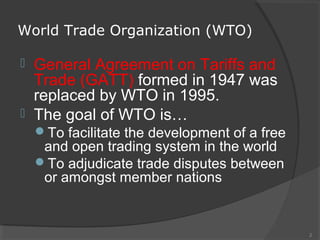
World Trade Organization (WTO)
 General Agreement on Tariffs and
Trade (GATT) formed in 1947 was
replaced by WTO in 1995.
 The goal of WTO is…
To facilitate the development of a free
and open trading system in the world
To adjudicate trade disputes between
or amongst member nations
2
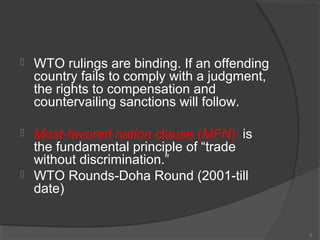
 WTO rulings are binding. If an offending
country fails to comply with a judgment,
the rights to compensation and
countervailing sanctions will follow.
 Most-favored nation clause (MFN): is
the fundamental principle of “trade
without discrimination.”
 WTO Rounds-Doha Round (2001-till
date)
3
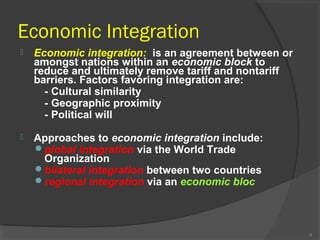
Economic Integration
 Economic integration: is an agreement between or
amongst nations within an economic block to
reduce and ultimately remove tariff and nontariff
barriers. Factors favoring integration are:
- Cultural similarity
- Geographic proximity
- Political will
 Approaches to economic integration include:
global integration via the World Trade
Organization
bilateral integration between two countries
regional integration via an economic bloc
4
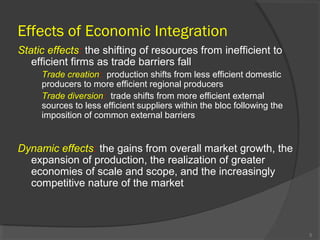
Effects of Economic Integration
Static effects: the shifting of resources from inefficient to
efficient firms as trade barriers fall
Trade creation: production shifts from less efficient domestic
producers to more efficient regional producers
Trade diversion: trade shifts from more efficient external
sources to less efficient suppliers within the bloc following the
imposition of common external barriers
Dynamic effects: the gains from overall market growth, the
expansion of production, the realization of greater
economies of scale and scope, and the increasingly
competitive nature of the market
5
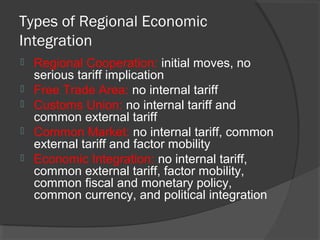
Types of Regional Economic
Integration
 Regional Cooperation: initial moves, no
serious tariff implication
 Free Trade Area: no internal tariff
 Customs Union: no internal tariff and
common external tariff
 Common Market: no internal tariff, common
external tariff and factor mobility
 Economic Integration: no internal tariff,
common external tariff, factor mobility,
common fiscal and monetary policy,
common currency, and political integration
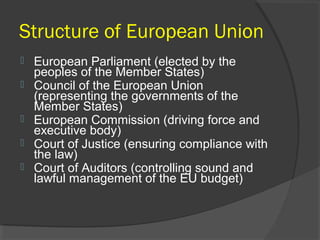
Structure of European Union
 European Parliament (elected by the
peoples of the Member States)
 Council of the European Union
(representing the governments of the
Member States)
 European Commission (driving force and
executive body)
 Court of Justice (ensuring compliance with
the law)
 Court of Auditors (controlling sound and
lawful management of the EU budget)
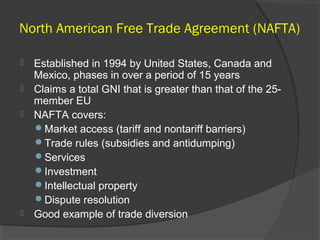
North American Free Trade Agreement (NAFTA)
 Established in 1994 by United States, Canada and
Mexico, phases in over a period of 15 years
 Claims a total GNI that is greater than that of the 25-
member EU
 NAFTA covers:
Market access (tariff and nontariff barriers)
Trade rules (subsidies and antidumping)
Services
Investment
Intellectual property
Dispute resolution
 Good example of trade diversion
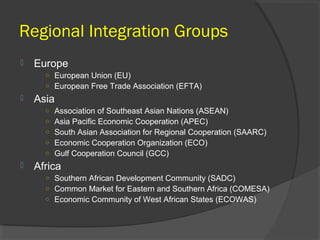
Regional Integration Groups
 Europe
○ European Union (EU)
○ European Free Trade Association (EFTA)
 Asia
○ Association of Southeast Asian Nations (ASEAN)
○ Asia Pacific Economic Cooperation (APEC)
○ South Asian Association for Regional Cooperation (SAARC)
○ Economic Cooperation Organization (ECO)
○ Gulf Cooperation Council (GCC)
 Africa
○ Southern African Development Community (SADC)
○ Common Market for Eastern and Southern Africa (COMESA)
○ Economic Community of West African States (ECOWAS)
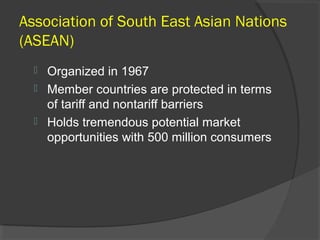
Association of South East Asian Nations
(ASEAN)
 Organized in 1967
 Member countries are protected in terms
of tariff and nontariff barriers
 Holds tremendous potential market
opportunities with 500 million consumers

Cross national cooperation and agreements

  • 1.
  • 2.
    World Trade Organization(WTO)  General Agreement on Tariffs and Trade (GATT) formed in 1947 was replaced by WTO in 1995.  The goal of WTO is… To facilitate the development of a free and open trading system in the world To adjudicate trade disputes between or amongst member nations 2
  • 3.
     WTO rulingsare binding. If an offending country fails to comply with a judgment, the rights to compensation and countervailing sanctions will follow.  Most-favored nation clause (MFN): is the fundamental principle of “trade without discrimination.”  WTO Rounds-Doha Round (2001-till date) 3
  • 4.
    Economic Integration  Economicintegration: is an agreement between or amongst nations within an economic block to reduce and ultimately remove tariff and nontariff barriers. Factors favoring integration are: - Cultural similarity - Geographic proximity - Political will  Approaches to economic integration include: global integration via the World Trade Organization bilateral integration between two countries regional integration via an economic bloc 4
  • 5.
    Effects of EconomicIntegration Static effects: the shifting of resources from inefficient to efficient firms as trade barriers fall Trade creation: production shifts from less efficient domestic producers to more efficient regional producers Trade diversion: trade shifts from more efficient external sources to less efficient suppliers within the bloc following the imposition of common external barriers Dynamic effects: the gains from overall market growth, the expansion of production, the realization of greater economies of scale and scope, and the increasingly competitive nature of the market 5
  • 6.
    Types of RegionalEconomic Integration  Regional Cooperation: initial moves, no serious tariff implication  Free Trade Area: no internal tariff  Customs Union: no internal tariff and common external tariff  Common Market: no internal tariff, common external tariff and factor mobility  Economic Integration: no internal tariff, common external tariff, factor mobility, common fiscal and monetary policy, common currency, and political integration
  • 7.
    Structure of EuropeanUnion  European Parliament (elected by the peoples of the Member States)  Council of the European Union (representing the governments of the Member States)  European Commission (driving force and executive body)  Court of Justice (ensuring compliance with the law)  Court of Auditors (controlling sound and lawful management of the EU budget)
  • 8.
    North American FreeTrade Agreement (NAFTA)  Established in 1994 by United States, Canada and Mexico, phases in over a period of 15 years  Claims a total GNI that is greater than that of the 25- member EU  NAFTA covers: Market access (tariff and nontariff barriers) Trade rules (subsidies and antidumping) Services Investment Intellectual property Dispute resolution  Good example of trade diversion
  • 9.
    Regional Integration Groups Europe ○ European Union (EU) ○ European Free Trade Association (EFTA)  Asia ○ Association of Southeast Asian Nations (ASEAN) ○ Asia Pacific Economic Cooperation (APEC) ○ South Asian Association for Regional Cooperation (SAARC) ○ Economic Cooperation Organization (ECO) ○ Gulf Cooperation Council (GCC)  Africa ○ Southern African Development Community (SADC) ○ Common Market for Eastern and Southern Africa (COMESA) ○ Economic Community of West African States (ECOWAS)
  • 10.
    Association of SouthEast Asian Nations (ASEAN)  Organized in 1967  Member countries are protected in terms of tariff and nontariff barriers  Holds tremendous potential market opportunities with 500 million consumers