SENIOR HIGH SCHOOL DEPARTMENT
Foundation Preparatory Academy
Foundation University
Dumaguete City, 6200
Academic Year 2022-2023
BRIEF LESSON PLAN IN READING AND WRITING 11
Name of Teacher Maybell B. Largavista Grade/Year Level Grade 11 ABM
Quarter Unit 2:
Lesson 7
Date March 2023 Duration
(minutes/hours)
1 hour
Competency/cies
Explain critical reading as reasoning
Learning Objectives
Cognitive Describe critical reading as reasoning through group work
activity “4s brainstorming”;
Psychomotor Construct an argument based on a given situation; and
Affective Share the significance of critical reading as reasoning to
practical situations such as responding to dilemmas.
Values Integration Excellence
Incorporated 21st
Century
Skills
Critical thinking, collaboration, and communication skills
Materials/Resources
Needed
Laptop, iPad, PowerPoint presentation, Cartolina, popsicle stick, wheel of
names and marker
Elements of Plan Methodology
Preparations
• How will I make
the learners ready?
• How do I prepare
the learners for the
new lesson?
How will I connect my next
lesson with the past
lesson?
Introductory
Activity
A. Prayer
Teacher will request all students to stand and request one
student to lead the prayer.
B. Greetings
Teacher will greet the students by saying “Good morning”
and asking how their day was.
C. Checking of attendance
Teacher will check the attendance by asking the 2 group
leaders to tell the absentees in their group.
D. Classroom Rules
Teacher will ask the students “are you ready?” After that,
the class will read the classroom rules and teacher will give
a short details about the rules.
Classroom Rules:
R-espect each other and be responsible
E-levate and believe in yourself
A-rrange chairs properly and maintain cleanliness
D-o your tasks and assignments on time
Y-ou must do your best
E. Word of the day
Teacher will present the word of the day and request all
students to read it and they will identify what’s the
definition of the word in the given choices.
desolate
Sample sentence:
The little children were left desolate after they were
abandoned by their parents.
a. very unpleasant
b. feeling or showing pleasure or contentment.
c. crushed by grief
F. Recap
In 5 minutes, teacher will review the previous lesson by
flashing the questions in the slide presentation. Using a
“popsicle stick with names” teacher will ask the students
the following questions:
1. As a student, how can you apply hypertext and intertext
in your outputs, activities or your presentations?
2. What is hypertext?
3. What is intertext?
4. What do you think is the similarity of the two?
E. Motivational Activity
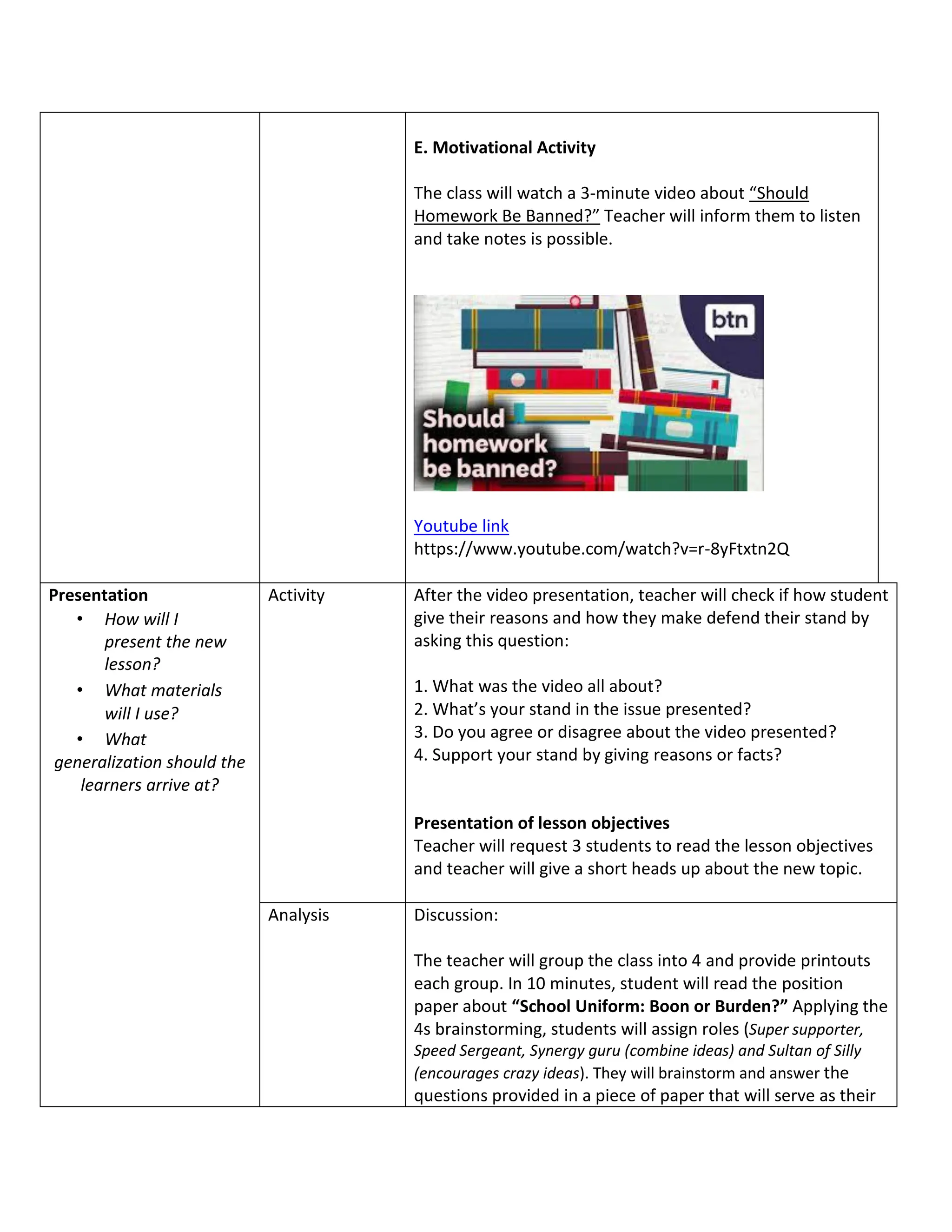
The class will watch a 3-minute video about “Should
Homework Be Banned?” Teacher will inform them to listen
and take notes is possible.
Youtube link
https://www.youtube.com/watch?v=r-8yFtxtn2Q
Presentation
• How will I
present the new
lesson?
• What materials
will I use?
• What
generalization should the
learners arrive at?
Activity After the video presentation, teacher will check if how student
give their reasons and how they make defend their stand by
asking this question:
1. What was the video all about?
2. What’s your stand in the issue presented?
3. Do you agree or disagree about the video presented?
4. Support your stand by giving reasons or facts?
Presentation of lesson objectives
Teacher will request 3 students to read the lesson objectives
and teacher will give a short heads up about the new topic.
Analysis Discussion:
The teacher will group the class into 4 and provide printouts
each group. In 10 minutes, student will read the position
paper about “School Uniform: Boon or Burden?” Applying the
4s brainstorming, students will assign roles (Super supporter,
Speed Sergeant, Synergy guru (combine ideas) and Sultan of Silly
(encourages crazy ideas). They will brainstorm and answer the
questions provided in a piece of paper that will serve as their
guide for this activity.
Group 1
1. What’s the text all about?
2. What’s the stand of the author?
Group 2
3. Mention evidences that will support the stand of the
author?
Group 3
4. Do you agree or disagree to the author’s stand?
5. Agreed or disagreed? Provide at least 3 reasons that will
support your stand.
Group 4
6. Cite 3 evidences or claims (facts, value, policy)
During presentation, each group will have 5 minutes to
present their output in front of the class. The teacher will
facilitate the discussion by asking give probing questions that
would relate to the topic and will deepen their understanding
in critical reading as reasoning.
Facilitating discussion points:
 Critical reading is engaging in analytic activity which
involves the reader by asking questions about the text
and the author’s claim. Critical readers are doing the
process of evaluating, analyzing, and interpreting the
assertion of the hidden meaning of the whole text.
 Reasoning as defined by Merriam Webster dictionary
is an act of giving statements for justification and
explanation. It is the ability of someone to defend
something by giving out reasons.
 Argument is a statement that you use in order to try to
convince people that your opinion about something is
correct. It is a reason given for or against a matter
discussion.
Therefore, when reading critically, it is necessary to question
the different arguments used by the author, as any problem
can weaken the authenticity of the conclusion.
Steps Used in Critical Reading as Reasoning
by Maxine Rafaella C. Rodriguez and Marella Therese A.
Tiongson
1. Identifying assertions
Identify by a common type of assertion such as fact,
convention, opinion and preference
2. Formulating counterclaim
Counterclaims are made to rebut a previous claim
3. Determining evidence
Evidence is the details given by the authors to support his/her
claims.
Abstraction After the group presentation, teacher will pick a student to
answer the following questions using the “wheel of names.”
Processing questions:
1. How do you define reasoning?
2. Is reasoning helpful in critical reading? Why or Why not?
3. As a student, how would you use your reasoning skills in
your daily life?
Practice
 What practice,
exercises/applicati
on activities will I
give to the
learners?
Activity 1: Social media boon or bane?
Teacher will require the students to find their partner in this activity and will
provide handouts to the students. In 10 minutes, they will use the “Think-pair-
share” strategy and read a text about “Social media boon or bane?” The teacher
will call random pairs of students that will answer the following questions to
make sure that they were able to understand critical reading as reasoning.
Questions:
1. What’s the text all about?
2. What’s the stand of the author?
3. Mention evidences that will support the stand of the author?
4. Do you agree or disagree to the author’s stand?
5. Agreed or disagreed, provide at least 3 reasons or claims that will support your
stand.
6. Provide 2 counterclaims to your stand.
7. Cite 3 evidences or claims (facts, value, policy)
Assessment Activity 2: Individual activity: Support your stand
Teacher will let the students access their FUEL for this activity. In 15 minutes,
students will choose one situation and they will support their stand based on
their chosen topic. They will be graded based on the attached rubric and
submit their outputs in FUEL.
Rubric
Category Excellence
15
Very good
10
Good
5
Overall Score
30
Focus or
Thesis
Statement
The thesis
statement
clearly
names the
topic of the
essay and
outlines the
main points
The thesis
statement
names the
topic of the
essay. The
author's
position is
stated
The thesis
statement
outlines
some or all
of the main
points to be
discussed but
does not
Situation 1
Your friend tells you that they committed a crime. They explain that they are
having trouble sleeping at night and feel you are the only one they can trust
with their confession. A few days later, you read in the paper that someone
has been arrested for your friend’s crime.
Do you:
• Go to the police and tell them what you know?
• Encourage your friend to confess and warn him if he does not do so, you
will tell?
• Say nothing because you will not betray a friend’s confidence?
Situation 2
Your friend has a great sense of humor. However, sometimes his jokes
involve making fun of others in inappropriate ways. He will point out a
physical flaw or look for something odd or different about a person and
make an unkind comment. You feel uncomfortable when your friend does
this.
• Do you say something or just laugh along with him?
to be
discussed.
The author's
position is
strongly and
clearly
stated.
name the
topic.
Support for
Position
Includes 3 or
more pieces
of evidence
(facts,
statistics,
examples,
real-life
experiences)
that support
the position
statement.
The writer
anticipates
the reader's
concerns,
biases or
arguments
and has
provided at
least 1
counterargu
ment.
Includes 3 or
more pieces
of evidence
(facts,
statistics,
examples,
real-life
experiences)
that support
the position
statement.
Includes 2
pieces of
evidence
(facts,
statistics,
examples,
real-life
experiences)
that support
the position
statement.
Evidence and
Examples
All of the
evidence and
examples are
specific,
relevant and
explanations
are given
that show
how each
piece of
evidence
supports the
author's
position
Most of the
evidence and
examples are
specific,
relevant and
explanations
are given
that show
how each
piece of
evidence
supports the
author's
position.
At least one
of the pieces
of evidence
and
examples is
relevant and
has an
explanation
that shows
how that
piece of
evidence
supports the
author's
position.
Writing
Mechanics
Piece is
clearly
written with
no grammar,
spelling,
punctuation,
or
capitalization
errors.
Author paid
attention to
writing
conventions;
Minor errors
do not
distract from
meaning.
Errors may
be present
and may
slightly take
away from
the clarity;
yet, the
writer’s
meaning can
be
determined.
Assignment Assignment:
Write 150 words letter on “How to seek permission from our parents to let
spend a night with friends”. You will be graded based on the attached rubric.
Rubric
Category Excellence
15
Very good
10
Good
5
Overall Score
30
Focus or
Thesis
Statement
The thesis
statement
clearly
names the
topic of the
essay and
outlines the
main points
to be
discussed.
The author's
position is
strongly and
clearly
stated.
The thesis
statement
names the
topic of the
essay. The
author's
position is
stated
The thesis
statement
outlines
some or all
of the main
points to be
discussed but
does not
name the
topic.
Support for
Position
Includes 3 or
more pieces
of evidence
(facts,
Includes 3 or
more pieces
of evidence
(facts,
Includes 2
pieces of
evidence
(facts,
statistics,
examples,
real-life
experiences)
that support
the position
statement.
The writer
anticipates
the reader's
concerns,
biases or
arguments
and has
provided at
least 1
counterargu
ment.
statistics,
examples,
real-life
experiences)
that support
the position
statement.
statistics,
examples,
real-life
experiences)
that support
the position
statement.
Evidence and
Examples
All of the
evidence and
examples are
specific,
relevant and
explanations
are given
that show
how each
piece of
evidence
supports the
author's
position
Most of the
evidence and
examples are
specific,
relevant and
explanations
are given
that show
how each
piece of
evidence
supports the
author's
position.
At least one
of the pieces
of evidence
and
examples is
relevant and
has an
explanation
that shows
how that
piece of
evidence
supports the
author's
position.
Writing
Mechanics
Piece is
clearly
written with
no grammar,
spelling,
punctuation,
or
capitalization
errors.
Author paid
attention to
writing
conventions;
Minor errors
do not
distract from
meaning.
Errors may
be present
and may
slightly take
away from
the clarity;
yet, the
writer’s
meaning can
be
determined.
References:
https://depedtambayan.net/wp-
content/uploads/2022/03/readingandwritingskills_q4_m5_criticalreadingasreasoning_v2.pdf
https://www.studocu.com/ph/document/icct-colleges-foundation/abm-accounting-business-
and-management-strand/chapter-5-critical-reading-as-reasoning/25347616
https://www.skillsyouneed.com/learn/critical-
reading.html#:~:text=Critical%20reading%20means%20engaging%20in,analyses%20what%20yo
u%20have%20read.
https://www.scholastic.com/content/dam/teachers/lesson-plans/migrated-featured-
files/persuasiveessay.pdf

Lesson-7-Sample-LP-in-SHS (1).pdf senior high school

  • 1.
    SENIOR HIGH SCHOOLDEPARTMENT Foundation Preparatory Academy Foundation University Dumaguete City, 6200 Academic Year 2022-2023 BRIEF LESSON PLAN IN READING AND WRITING 11 Name of Teacher Maybell B. Largavista Grade/Year Level Grade 11 ABM Quarter Unit 2: Lesson 7 Date March 2023 Duration (minutes/hours) 1 hour Competency/cies Explain critical reading as reasoning Learning Objectives Cognitive Describe critical reading as reasoning through group work activity “4s brainstorming”; Psychomotor Construct an argument based on a given situation; and Affective Share the significance of critical reading as reasoning to practical situations such as responding to dilemmas. Values Integration Excellence Incorporated 21st Century Skills Critical thinking, collaboration, and communication skills Materials/Resources Needed Laptop, iPad, PowerPoint presentation, Cartolina, popsicle stick, wheel of names and marker Elements of Plan Methodology Preparations • How will I make the learners ready? • How do I prepare the learners for the new lesson? How will I connect my next lesson with the past lesson? Introductory Activity A. Prayer Teacher will request all students to stand and request one student to lead the prayer. B. Greetings Teacher will greet the students by saying “Good morning” and asking how their day was. C. Checking of attendance Teacher will check the attendance by asking the 2 group
  • 2.
    leaders to tellthe absentees in their group. D. Classroom Rules Teacher will ask the students “are you ready?” After that, the class will read the classroom rules and teacher will give a short details about the rules. Classroom Rules: R-espect each other and be responsible E-levate and believe in yourself A-rrange chairs properly and maintain cleanliness D-o your tasks and assignments on time Y-ou must do your best E. Word of the day Teacher will present the word of the day and request all students to read it and they will identify what’s the definition of the word in the given choices. desolate Sample sentence: The little children were left desolate after they were abandoned by their parents. a. very unpleasant b. feeling or showing pleasure or contentment. c. crushed by grief F. Recap In 5 minutes, teacher will review the previous lesson by flashing the questions in the slide presentation. Using a “popsicle stick with names” teacher will ask the students the following questions: 1. As a student, how can you apply hypertext and intertext in your outputs, activities or your presentations? 2. What is hypertext? 3. What is intertext? 4. What do you think is the similarity of the two?
  • 3.
    E. Motivational Activity Theclass will watch a 3-minute video about “Should Homework Be Banned?” Teacher will inform them to listen and take notes is possible. Youtube link https://www.youtube.com/watch?v=r-8yFtxtn2Q Presentation • How will I present the new lesson? • What materials will I use? • What generalization should the learners arrive at? Activity After the video presentation, teacher will check if how student give their reasons and how they make defend their stand by asking this question: 1. What was the video all about? 2. What’s your stand in the issue presented? 3. Do you agree or disagree about the video presented? 4. Support your stand by giving reasons or facts? Presentation of lesson objectives Teacher will request 3 students to read the lesson objectives and teacher will give a short heads up about the new topic. Analysis Discussion: The teacher will group the class into 4 and provide printouts each group. In 10 minutes, student will read the position paper about “School Uniform: Boon or Burden?” Applying the 4s brainstorming, students will assign roles (Super supporter, Speed Sergeant, Synergy guru (combine ideas) and Sultan of Silly (encourages crazy ideas). They will brainstorm and answer the questions provided in a piece of paper that will serve as their
  • 4.
    guide for thisactivity. Group 1 1. What’s the text all about? 2. What’s the stand of the author? Group 2 3. Mention evidences that will support the stand of the author? Group 3 4. Do you agree or disagree to the author’s stand? 5. Agreed or disagreed? Provide at least 3 reasons that will support your stand. Group 4 6. Cite 3 evidences or claims (facts, value, policy) During presentation, each group will have 5 minutes to present their output in front of the class. The teacher will facilitate the discussion by asking give probing questions that would relate to the topic and will deepen their understanding in critical reading as reasoning. Facilitating discussion points:  Critical reading is engaging in analytic activity which involves the reader by asking questions about the text and the author’s claim. Critical readers are doing the process of evaluating, analyzing, and interpreting the assertion of the hidden meaning of the whole text.  Reasoning as defined by Merriam Webster dictionary is an act of giving statements for justification and explanation. It is the ability of someone to defend something by giving out reasons.  Argument is a statement that you use in order to try to convince people that your opinion about something is correct. It is a reason given for or against a matter discussion. Therefore, when reading critically, it is necessary to question the different arguments used by the author, as any problem
  • 5.
    can weaken theauthenticity of the conclusion. Steps Used in Critical Reading as Reasoning by Maxine Rafaella C. Rodriguez and Marella Therese A. Tiongson 1. Identifying assertions Identify by a common type of assertion such as fact, convention, opinion and preference 2. Formulating counterclaim Counterclaims are made to rebut a previous claim 3. Determining evidence Evidence is the details given by the authors to support his/her claims. Abstraction After the group presentation, teacher will pick a student to answer the following questions using the “wheel of names.” Processing questions: 1. How do you define reasoning? 2. Is reasoning helpful in critical reading? Why or Why not? 3. As a student, how would you use your reasoning skills in your daily life? Practice  What practice, exercises/applicati on activities will I give to the learners? Activity 1: Social media boon or bane? Teacher will require the students to find their partner in this activity and will provide handouts to the students. In 10 minutes, they will use the “Think-pair- share” strategy and read a text about “Social media boon or bane?” The teacher will call random pairs of students that will answer the following questions to make sure that they were able to understand critical reading as reasoning. Questions: 1. What’s the text all about? 2. What’s the stand of the author? 3. Mention evidences that will support the stand of the author? 4. Do you agree or disagree to the author’s stand? 5. Agreed or disagreed, provide at least 3 reasons or claims that will support your stand. 6. Provide 2 counterclaims to your stand. 7. Cite 3 evidences or claims (facts, value, policy) Assessment Activity 2: Individual activity: Support your stand Teacher will let the students access their FUEL for this activity. In 15 minutes, students will choose one situation and they will support their stand based on
  • 6.
    their chosen topic.They will be graded based on the attached rubric and submit their outputs in FUEL. Rubric Category Excellence 15 Very good 10 Good 5 Overall Score 30 Focus or Thesis Statement The thesis statement clearly names the topic of the essay and outlines the main points The thesis statement names the topic of the essay. The author's position is stated The thesis statement outlines some or all of the main points to be discussed but does not Situation 1 Your friend tells you that they committed a crime. They explain that they are having trouble sleeping at night and feel you are the only one they can trust with their confession. A few days later, you read in the paper that someone has been arrested for your friend’s crime. Do you: • Go to the police and tell them what you know? • Encourage your friend to confess and warn him if he does not do so, you will tell? • Say nothing because you will not betray a friend’s confidence? Situation 2 Your friend has a great sense of humor. However, sometimes his jokes involve making fun of others in inappropriate ways. He will point out a physical flaw or look for something odd or different about a person and make an unkind comment. You feel uncomfortable when your friend does this. • Do you say something or just laugh along with him?
  • 7.
    to be discussed. The author's positionis strongly and clearly stated. name the topic. Support for Position Includes 3 or more pieces of evidence (facts, statistics, examples, real-life experiences) that support the position statement. The writer anticipates the reader's concerns, biases or arguments and has provided at least 1 counterargu ment. Includes 3 or more pieces of evidence (facts, statistics, examples, real-life experiences) that support the position statement. Includes 2 pieces of evidence (facts, statistics, examples, real-life experiences) that support the position statement. Evidence and Examples All of the evidence and examples are specific, relevant and explanations are given that show how each piece of evidence supports the author's position Most of the evidence and examples are specific, relevant and explanations are given that show how each piece of evidence supports the author's position. At least one of the pieces of evidence and examples is relevant and has an explanation that shows how that piece of evidence supports the author's position.
  • 8.
    Writing Mechanics Piece is clearly written with nogrammar, spelling, punctuation, or capitalization errors. Author paid attention to writing conventions; Minor errors do not distract from meaning. Errors may be present and may slightly take away from the clarity; yet, the writer’s meaning can be determined. Assignment Assignment: Write 150 words letter on “How to seek permission from our parents to let spend a night with friends”. You will be graded based on the attached rubric. Rubric Category Excellence 15 Very good 10 Good 5 Overall Score 30 Focus or Thesis Statement The thesis statement clearly names the topic of the essay and outlines the main points to be discussed. The author's position is strongly and clearly stated. The thesis statement names the topic of the essay. The author's position is stated The thesis statement outlines some or all of the main points to be discussed but does not name the topic. Support for Position Includes 3 or more pieces of evidence (facts, Includes 3 or more pieces of evidence (facts, Includes 2 pieces of evidence (facts,
  • 9.
    statistics, examples, real-life experiences) that support the position statement. Thewriter anticipates the reader's concerns, biases or arguments and has provided at least 1 counterargu ment. statistics, examples, real-life experiences) that support the position statement. statistics, examples, real-life experiences) that support the position statement. Evidence and Examples All of the evidence and examples are specific, relevant and explanations are given that show how each piece of evidence supports the author's position Most of the evidence and examples are specific, relevant and explanations are given that show how each piece of evidence supports the author's position. At least one of the pieces of evidence and examples is relevant and has an explanation that shows how that piece of evidence supports the author's position. Writing Mechanics Piece is clearly written with no grammar, spelling, punctuation, or capitalization errors. Author paid attention to writing conventions; Minor errors do not distract from meaning. Errors may be present and may slightly take away from the clarity; yet, the writer’s meaning can be determined.
  • 10.