Dean’s	
  Circle	
  
2016
UNIVERSITY OF SANTO
TOMAS
Digested by: DC 2016 Members
Editors:
Tricia Lacuesta
Lorenzo Gayya
Cristopher Reyes
Macky Siazon
Janine Arenas
Ninna Bonsol
Lloyd Javier
CRIMINAL
LAW
[Type the abstract of the document here. The abstract is typically a short summary of the contents of
the document. Type the abstract of the document here. The abstract is typically a short summary of
the contents of the document.]
Criminal Law (Cases Penned by J. Velasco Dean’s	
  Circle	
  
2016
Page 1 of 116
Table of Contents
BOOK 1 REVISED PENAL CODE AND RELATED SPECIAL LAWS ....................................................................................................3
Felonies ...............................................................................................................................................................................3
Conspiracy and Proposal to Commit a Crime .........................................................................................................................5
Complex Crimes and Special Complex Crimes........................................................................................................................8
Circumstances affecting criminal liability................................................................................................................................10
Justifying Circumstances.....................................................................................................................................................10
Exempting Circumstances..............................................................................................................................................17
Mitigating Circumstances...............................................................................................................................................18
Aggravating Circumstances............................................................................................................................................19
Defenses ................................................................................................................................................................................26
Alibi ...................................................................................................................................................................................26
Persons Criminally Liable........................................................................................................................................................29
Degree of Participation.......................................................................................................................................................29
Penalties ................................................................................................................................................................................31
Prescription of Crimes (RPC and Special Penal Laws) ..............................................................................................................32
BOOK 2 REVISED PENAL CODE AND SPECIAL LAWS.................................................................................................................34
Crimes Against Public Order................................................................................................................................................34
RA 9165 Comprehensive Dangerous Drugs Act and Its Implementing Rules and Regulations (IRR) ........................................35
Art. 171, RPC......................................................................................................................................................................61
Art. 177, RPC......................................................................................................................................................................62
RA 7877 Anti-Sexual Harrasment Act...................................................................................................................................63
Crimes Committed by Public Officers ..................................................................................................................................64
Arts. 203-245, RPC..............................................................................................................................................................64
RA 3019 Anti-Graft and Corrupt Practices Act......................................................................................................................66
Misconduct ........................................................................................................................................................................68
Crimes Against Persons.......................................................................................................................................................70
Arts. 246-266, RPC..............................................................................................................................................................70
RA 7610 Anti-Child Abuse Law ..........................................................................................................................................107
Crimes Against Property ...................................................................................................................................................108
Crimes Against Honor.......................................................................................................................................................111
Tariffs and Customs Code .................................................................................................................................................113
Criminal Law (Cases Penned by J. Velasco Dean’s	
  Circle	
  
2016
Page 2 of 116
FELONIES
A. Classifications (Intentional and Culpable Felonies)
PEOPLE OF THE PHILIPPINES v. BONIFACIO BADRIAGO
G.R. No. 183566, May 8, 2009, Velasco, J.
The offender is said to have performed all the acts of execution if the wound inflicted on the
victim is mortal and could cause the death of the victim without medical intervention or attendance.
Facts:
Adrian Quinto, together with Oliver Quinto (deceased), was delivering a letter. On their way
home, they had an encounter with Badriago. The latter hacked Adrian with a Sundang. Adrian
managed to push Oliver out of the pedicab to call for help and was able to run before he lost
consciousness. When he woke in the hospital, he found out that Oliver was dead. Badriago claimed
that	
  he	
  tried	
  to	
  get	
  away	
  with	
  the	
  Quinto’s	
  but	
  the	
  latter	
  chased	
  him	
  and	
  insisted	
  a	
  fight.	
  He	
  claimed	
  
that Adrian bumped his pedicab that caused the respondent to swerve to the middle of the road.
Seeing Adrian was about to stab him, he grabbed a bolo from his pedicabs passenger seat and used
it	
   to	
   strike	
   at	
   Adrian,	
   injuring	
   his	
   left	
   hand.	
   Adrian’s	
   knife	
   fell	
   and	
   when	
   he	
   bent	
   to	
   pick	
   it	
   up,	
  
Badriago again hacked at him with his bolo.
On a complaint filed by Adrian, RTC convicted Badriago for (1) the crime of frustrated
murder instead of frustrated homicide for hacking Adrian and (2) murder for the death of Oliver.
CA however modified the same and held him guilty of frustrated homicide and murder. Badriago
challenged the conviction on the ground that his guilt was not proven beyond reasonable doubt.
Issue:
Whether or not Badriago is guilty of the crime of frustrated homicide for hacking Adrian
Ruling:
Yes. To successfully prosecute the crime of homicide, the following elements must be
proved beyond reasonable doubt: (1) that a person was killed; (2) that the accused killed that
person without any justifying circumstance; (3) that the accused had the intention to kill, which is
presumed; and (4) that the killing was not attended by any of the qualifying circumstances of
murder, or by that of parricide or infanticide. Moreover, the offender is said to have performed all
the acts of execution if the wound inflicted on the victim is mortal and could cause the death of the
victim without medical intervention or attendance.
On the other hand, the essential elements of a frustrated felony are as follows: (1) The
offender performs all the acts of execution; (2) all the acts performed would produce the felony as a
consequence; (3) but the felony is not produced; and (4) by reason of causes independent of the
will of the perpetrator.
BOOK 1 REVISED PENAL CODE and related SPECIAL LAWS
Criminal Law (Cases Penned by J. Velasco Dean’s	
  Circle	
  
2016
Page 3 of 116
From the evidence presented to the trial court, it is very much clear that accused-appellant
was	
  able	
  to	
  perform	
  all	
  the	
  acts	
  that	
  would	
  necessarily	
  result	
  in	
  Adrian’s	
  death.	
  His	
  intention	
  to	
  kill	
  
can be presumed from the lethal hacking blows Adrian received. His attack on Adrian with a bolo
was not justified. His claim of self-defense was not given credence by both the trial and appellate
courts. Neither are there any of the qualifying circumstances of murder, parricide, and infanticide.
The circumstances, thus, make out a case for frustrated homicide as accused-appellant performed
all the acts necessary to kill Adrian; Adrian only survived due to timely medical intervention as
testified to by his examining physician.
PEOPLE OF THE PHILIPPINES v. MICHAEL LINDO y VERGARA
G.R. No. 189818 August 9, 2010 Velasco Jr. J.
The mere introduction of the male organ in the labia majora of	
   the	
   victim’s	
   genitalia	
  
consummates the crime; the mere touching of the labia by the penis was held to be sufficient.
Facts:
AAA, the private complainant, was 11 years old while Lindo was her neighbor. While AAA
was sleeping in the pabasa she attended, Lindo took her away to a place near a creek. He tried
inserting his penis into her vagina, whereupon his penis made contact with her sex organ but there
was no complete penetration. Not achieving full penile penetration, he then made her bend over,
and inserted his penis into her anus, causing her to cry out in pain. RTC found him guilty of
statutory rape under Art. 335 of the RPC in relation to R.A No. 7610. The CA affirmed the judgment
and awarded exemplary damages.
Issue:
Whether the CA erred in convicting the accused.
Ruling:
No. It has been proved beyond reasonable doubt that accused-appellant Lindo had carnal
knowledge of AAA. The insertion of his penis into the vagina of AAA, though incomplete, was
sufficient. As held in People v. Tablang, the mere introduction of the male organ in the labia
majora of the victims genitalia consummates the crime; the mere touching of the labia by the penis
was held to be sufficient. The elements of the crime of rape under Art. 266-A of the Revised Penal
Code are present. Under the said article, it provides that rape is committed by a man who shall have
carnal knowledge of a woman when the offended party is under twelve years of age. AAA was 11
years old at the time accused-appellant had carnal knowledge of her. As such, that constitutes
statutory rape. The two elements of the crime are: (1) that the accused had carnal knowledge of a
woman; and (2) that the woman was below 12 years of age. Thus, the CA correctly upheld the
conviction of accused-appellant by the RTC.
Both the RTC and the CA, however, erred in finding only one count of rape in the present
case. From the information filed, it is clear that accused-appellant was charged with two offenses,
rape under Art. 266-A, par. 1 (d) of the RPC, and rape as an act of sexual assault under Art. 266-A,
Criminal Law (Cases Penned by J. Velasco Dean’s	
  Circle	
  
2016
Page 4 of 116
par. 2. Accused-appellant was charged with having carnal knowledge of AAA, who was under
twelve years of age at the time, under par. 1(d) of Art. 266-A, and he was also charged with
committing	
   an	
   act	
   of	
   sexual	
   assault	
   by	
   inserting	
  his	
   penis	
   into	
   another	
   person’s	
   mouth	
   or	
   anal	
  
orifice, or any instrument or object, into the genital or anal orifice of another person under the
second paragraph of Art. 266-A. Two instances of rape were indeed proved at the trial, as it was
established that there was contact between accused-appellants penis and AAAs labia; then AAAs
testimony established that accused-appellant was able to partially insert his penis into her anal
orifice.
Conspiracy and Proposal to Commit a Crime
JOEL YONGCO and JULIETO LAÑOJAN v. PEOPLE OF THE PHILIPPINES
G.R. No. 209373, July 30, 2014, Velasco, J.
It is common design which is the essence of conspiracy—conspirators may act separately or
together in different manners but always leading to the same unlawful result. The character and effect
of conspiracy are not to be adjudged by dismembering it and viewing its separate parts but only by
looking at it as a whole—acts done to give effect to conspiracy may be, in fact, wholly innocent acts.
Facts:
Petitioners	
  Yongco	
  and	
  Lañojan,	
  as	
  security	
  guards	
  in	
  the	
  premises	
  of	
  the	
  City	
  Engineer’s	
  
Office (CEO), and Tangian as garbage truck driver of the City Government of Iligan were charged for
allegedly stealing one unit transmission of Tamaraw and l-beam of Nissan with a total value of P40,
000.00. RTC held petitioners liable for qualified theft via conspiracy.
Aggrieved, petitioners, in their appeal, prayed that the CA reverse the RTC decision.
Tangian claimed that he should not be considered as a conspirator since he merely innocently
obeyed	
  Lañojan’s	
  instructions	
  on	
  the	
  assumption	
  that	
  the	
  latter	
  was	
  his	
  superior	
  and	
  that he had no
criminal intent whatsoever. Yongco, in his defense, argued that Tangian and his two other helpers
asked	
  for	
  his	
  assistance	
  which	
  he	
  extended	
  in	
  good	
  faith,	
  in	
  view	
  of	
  Lañojan’s	
  statement	
  earlier	
  that	
  
day that the office garage has to be cleared. Lañojan, on the other hand, insisted that he cannot be
considered as a conspirator since he was not present at the time of taking, and that the mere giving
of a thumbs-up sign to Tangian when the latter delivered the materials to the junk shop does not
amount	
  to	
  conspiracy.	
  CA	
  affirmed	
  RTC’s	
  decision.	
  Hence,	
  this	
  Petition.
Issue:
Whether or not Lañojan is liable for Qualified Theft via conspiracy despite his absence
during the commission of the crime.
Ruling:
Yes. There is conspiracy when two or more persons come to an agreement concerning a
felony and decide to commit it. Well-settled is the rule that in conspiracy, direct proof of a previous
agreement is not necessary as it may be deduced from the mode, method, and manner by which the
Criminal Law (Cases Penned by J. Velasco Dean’s	
  Circle	
  
2016
Page 5 of 116
offense was perpetrated. It may be inferred from the acts of the accused before, during, or after the
commission of the crime which, when taken together, would be enough to reveal a community of
criminal design, as the proof of conspiracy is frequently made by evidence of a chain of
circumstances.
The RTC correctly ruled that Lañojan have instigated and marshalled the entire scheme. In
conspiracy, the act of one is the act of all. Once conspiracy is established, all the conspirators are
answerable as co-principals regardless of the extent or degree of their participation.The guilt of one
is the guilt of all. Applying this doctrine in the case at bench, it can reasonably be concluded that
despite	
  Lañojan’s	
  lack	
  of	
  physical	
  participation	
  in	
  hauling	
  the	
  items	
  to	
  Tangian’s truck and bringing
them to the junk shop, he can still be liable for Qualified Theft via conspiracy.
PEOPLE OF THE PHILIPPINES v. BARANGAY CAPTAIN TONY TOMAS, SR., BENEDICTO
DOCTOR, AND NESTOR GATCHALIAN
G.R. No. 192251, February 16, 2011, Velasco, Jr., J.
Conspiracy exists when two or more persons come to an agreement concerning the
commission of a crime and decide to commit it. It may be proved by direct or circumstantial evidence
consisting of acts, words or conduct of the alleged conspirators before, during and after the
commission of the felony to achieve a common design or purpose.
Facts:
One evening, Estrella Doctor Casco along with her mother named Damiana and two care-
takers Liezl and Angelita, were	
  walking	
  home	
  from	
  Damiana’s	
  medical	
  check-up	
  when	
  Estrella’s	
  
cousins Tony Tomas and Benedicto Doctor, together with Nestor Gatchalian, suddenly came out
from the side of the road. Without uttering a word, Tomas drew a gun and shot Estrella twice, while
Gatchalian, without a gun, allegedly blocked the road, and Doctor positioned himself at the back of
Damiana and Angelina and poked a gun at them. Estrella fell down but Tomas fired three more
gunshots at the former when she was already down on the ground. After which, the three accused
fled from the scene of the crime. The RTC convicted the accused Tomas, Doctor and Gatchalian of
the offense of Murder and appreciated the attendance of treachery and conspiracy which the CA
affirmed with modification. Hence, this petition was filed.
Issue:
Whether or not the finding of conspiracy in the commission of the crime of murder gives the
same criminal liability to three accused.
Ruling:
No. The court cannot agree to the finding of the trial court as affirmed by the appellate court
that Gatchalian is equally guilty on account of conspiracy to merit the same criminal liability as
accused-appellants Tomas, Sr. and Doctor.
Conspiracy exists when two or more persons come to an agreement concerning the
commission of a crime and decide to commit it. It may be proved by direct or circumstantial
Criminal Law (Cases Penned by J. Velasco Dean’s	
  Circle	
  
2016
Page 6 of 116
evidence consisting of acts, words or conduct of the alleged conspirators before, during and after
the commission of the felony to achieve a common design or purpose. To be equally guilty for
murder, it must be shown that Doctor and Gatchalian conspired with Tomas, Sr., for in a conspiracy,
every act of one of the conspirators in furtherance of a common design or purpose of such a
conspiracy is the act of all. From the clear testimony of Angelita and Liezl, it has been duly
established that Doctor’s contemporaneous act was made in furtherance of the common purpose of
killing Estrella and ensuring impunity from the act. Indeed, Doctors cooperation in the shooting of
Estrella ensured its accomplishment and their successful escape from the crime scene. Doctor is,
thus, equally guilty and liable with Tomas for the murder of Estrella on account of conspiracy.
PEOPLE OF THE PHILIPPINES v. FERNANDO BUCAYO, HECTOR BUCAYO AND JAYSON ORTIZ
G.R. No. 178770, June 13, 2008, Velasco, Jr., J.
There is conspiracy when the separate acts committed, taken collectively, emanate from a
concerted and associated action, albeit each circumstance, if considered separately, may not show
confabulation.
Facts:
In Tondo, Manila, Perez and Buencillo were on their way home when they passed by the
group of Fernando Bucayo, Hector Bucayo and Jayson Ortiz (whom Perez recognized). The group
surrounded and blocked their way, taunting and shouting incentives at them until a rumble ensued.
Perez, who attempted to flee, was dragged back to the melee by Hector. Perez saw Hector and Ortiz
gang up on Buencillo as Fernando struck him repeatedly with a steel chair. As Perez was trying to
escape, he got hold of a barbecue stick and stabbed Hector with it. When his attempt to make the
group stop assaulting Buencillo proved futile, he asked for assistance from the police and went to
Buencillo’s	
  house. After the melee, Buencillo was pronounced dead by Jose Reyes Memorial Medical
Hospital.
Fernando, Hector and Ortiz were charged with the murder of Buencillo but Ortiz and
another member of the group remained at large. The RTC found the accused persons guilty beyond
reasonable doubt of the crime of murder qualified by superior strength. The CA affirmed with
modification, asserting conspiracy as a qualifying circumstance.
Issue:
Whether or not conspiracy has transpired.
Ruling:
Yes. Altogether, the incidents prior to the melee, the simultaneous active participation of the
accused and use of their superior strength and number, and the flight of the Ortiz brothers
undoubtedly establish a conspiracy to assault and harm Jonathan and Edison, leading to Edison’s	
  
death. In this case, to reiterate, the CA observed that (1) Fernando and his group blocked Jonathan
and Edison as the two were on their way home; (2) they all participated in the attack on Jonathan
and Edison; (3) when Jonathan had a chance to flee, Hector dragged him back; and (4) Hector and
Jayson exchanged blows with Jonathan and Edison as Fernando viciously hit Edison with a steel
Criminal Law (Cases Penned by J. Velasco Dean’s	
  Circle	
  
2016
Page 7 of 116
chair causing the demise of Edison. All these constitute circumstances that lead to the conclusion
that all the accused conspired to harm their prey. These, taken with the eyewitness testimonies and
the physical evidence supported by the medico-legal’s	
  findings,	
  establish	
  without	
  doubt	
  the	
  guilt	
  of	
  
the accused-appellants.
Complex Crimes and Special Complex Crimes
PEOPLE OF THE PHILIPPINES v. ABDUL AMINOLA y OMAR
and MIKE MAITIMBANG y ABUBAKAR,
G.R. No. 178062, September 8, 2010, Velasco, Jr., J.
Essential for conviction of robbery with homicide is proof of a direct relation, an intimate
connection between the robbery and the killing, whether the latter be prior or subsequent to the
former or whether both crimes are committed at the same time.
Facts:
Aminola and Maitimbang were accused of the crime of robbery with homicide for robbing
one Nestor Gabuya of his personal properties and for killing the latter by reason or on occasion
thereof with the use of an unlicensed firearm. The eyewitness Jesus Oliva identified the two accused
to have perpetrated the same. The RTC convicted Maitimbang of the crime charged and sentenced
them to death. The	
   CA	
   affirmed	
   the	
   trial	
   court’s	
   decision	
   but	
   reduced	
   the	
   penalty	
   imposed	
  
to reclusion perpetua in view of the abolition of the death penalty. Hence, this petition.
ISSUE
Whether or not the two accused are guilty of the crime of homicide with robbery.
RULING
Yes. The following elements must be established for a conviction in the special complex
crime of robbery with homicide: (1) The taking of personal property is committed with violence or
intimidation against persons; (2) The property taken belongs to another; (3) The taking is animo
lucrandi; and (4) By reason of the robbery or on the occasion thereof, homicide is committed.
The prosecution was able to establish that accused-appellants committed robbery with
homicide through the totality of their evidence. The first three elements were established when an
eyewitness testified that he saw, and positively identified, accused-appellants	
   taking	
   Gabuya’s	
  
property by force and both shooting Gabuya. Gabuya’s	
  death	
  resulting	
  from	
  their	
  attack	
  proves	
  the	
  
last element of the complex crime as duly confirmed by the post-mortem report.
PEOPLE OF THE PHILIPPINES v. MITSUEL L. ELARCOSA and JERRY B. ORIAS
G.R. No. 186539, 29 June 2010, Velasco, Jr., J.
Criminal Law (Cases Penned by J. Velasco Dean’s	
  Circle	
  
2016
Page 8 of 116
In a complex crime, although two or more crimes are actually committed, they constitute only
one crime in the eyes of the law, as well as in the conscience of the offender x x x when various victims
expire from separate shots, such acts constitute separate and distinct crimes.
Facts:
One evening, Elarcosa and accused-appellant Orias, both members of the CAFGU, entered
the house of Segundina Cruz and requested that supper be prepared for them as they were roving.
While Segundina and Rosemarie were preparing in the kitchen, Elarcosa and Orias fired their guns
at Jose and Jorge Cruz. Segundina ran towards his son while Rosemarie hid in the shrubs.
Rosemarie heard her mother crying loudly and after a series of gunshots, silence ensued. The
following morning, Rosemarie returned to their house where she found the dead bodies of her
parents and her brother. The amount of P40,000 and a certificate of registration of large cattle
were also gone. Elarcosa and Orias were thereafter charged with robbery with multiple homicide.
RTC convicted the accused of the offense as charged. The CA, however, changed the conviction to
multiple murder, ratiocinating that robbery was not proved and that the killing was qualified by
treachery.
Issue:
Whether or not the accused-appellant is guilty of the crime of multiple murder.
Ruling:
Yes. Accused-appellant Orias should be convicted of three (3) counts of murder and not of
the complex crime of murder.
In a complex crime, although two or more crimes are actually committed, they constitute
only one crime in the eyes of the law, as well as in the conscience of the offender. Hence, there is
only one penalty imposed for the commission of a complex crime. It is clear from the evidence on
record that the three (3) crimes of murder did not result from a single act but from several
individual and distinct acts. Deeply rooted is the doctrine that when various victims expire from
separate shots, such acts constitute separate and distinct crimes.
Simon Fernan Jr. and Expedito Torrevilas v. People of the Philippines
G.R. No. 145927, August 24, 2007, Velasco, Jr., J.
Reasonable doubt is present when after the entire comparison and consideration of all the
evidences, leaves the minds of the judges in that condition that they cannot say they feel an abiding
conviction, to a moral certainty, of the truth of the charge; a certainty that convinces and directs the
understanding, and satisfies the reason and judgment of those who are bound to act conscientiously
upon it
Facts:
Simon Fernan Jr. and Expendito Torrevilas were engineers of CEBU Highway project. Later
on it was discovered that there were falsified Letters of Advice Allotment and vouchers for the
project which are needed for the release of the fund. The funds were illegally released based on
Criminal Law (Cases Penned by J. Velasco Dean’s	
  Circle	
  
2016
Page 9 of 116
alleged ghost deliveries in conjunction with false or fake tally sheets and other documents which
they admittedly signed for the said construction. Thus the amount released was P3, 839 ,810.74.
They were charged together with the several persons for complex crime of Estafa thru falsification
of Public Documents and convicted by the Sandiganbayan as conspirators. However, they
contended that the prosecution has failed to prove their guilt beyond reasonable doubt.
Issue:
Whether or not the accused our guilty beyond reasonable doubt of the complex crime of
Estafa thru falsification of public documents.
Ruling:
Yes, their guilt was proven beyond reasonable doubt. A thorough scrutiny of the records is
imperative to determine whether or not reasonable doubt exists as to the guilt of accused Fernan,
Jr. and Torrevillas. The prosecution presented evidences that the accused Fernan, Jt. And
Torrevillas has knowledge of the fake tally sheets and the Letters of Allotment which led to the
release of government funds and based on the testimony of state witness which is the accountant
for the project. Thus, the prosecution has proved the guilt of the accused beyond reasonable doubt.
CIRCUMSTANCES AFFECTING CRIMINAL LIABILITY
Justifying Circumstances
PEOPLE OF THE PHILIPPINES v. ARBALATE
G.R. No. 183457, September 17, 2009, Velasco, Jr., J.
To support a claim of self-defense, it is essential that the killing of the victim be simultaneous
with the attack on the accused, or at least both acts succeeded each other without appreciable interval
of time.
Facts:
Ruperto Arbalate and his sons Roel and Ramil Arbalate were charged with murder for
killing Selemen. Roel and Ramil were able to evade arrest and remain at large. Hence, only Ruperto
faced trial. During the arraignment, Ruperto pleaded not guilty. In his defense, Ruperto invoked
self-defense. Moreover, he argued that there was no abuse of superior strength. The presence of
two or more aggressors does not necessarily create such aggravating circumstance; there must be
proof of superiority of strength notoriously advantageous for the aggressors. In this case, the attack
of the three accused was not clearly shown. Without clear proof of this qualifying circumstance, he
must be convicted of homicide only.
Issue:
Whether or not Ruperto correctly invoked self-defense.
Ruling:
Criminal Law (Cases Penned by J. Velasco Dean’s	
  Circle	
  
2016
Page 10 of 116
No. In the case at bar, there was no unlawful aggression shown by the victim. The victim’s
action hardly constitutes unlawful aggression since it was a reaction to Rupertos assault with a
piece of wood. After that push, the victim ceased to attack him. Where the
inceptual unlawful aggression of the victim had already ceased, the accused had no more right to
kill the victim. In addition, the court found Rupertos theory of self-defense to be incredulous in light
of the physical evidence, i.e., the nature, character, location, and extent of the wounds inflicted on
the victim. The death certificate, the due execution of which was admitted by the defense; and the
photographs of the victim show that he sustained multiple hacking and stab wounds. The cause of
his death was severe hemorrhage secondary to irreversible shock. The wounds as well as the act of
beheading the victim clearly belie self-defense.
PEOPLE OF THE PHILIPPINES v. DAVID MANINGDING
G.R. No. 195665, September 14, 2011, Velasco, Jr., J.
Unlawful aggression is defined as an actual physical assault, or at least a threat to inflict real
imminent injury, upon a person. In case of threat, it must be offensive and strong, positively showing
the wrongful intent to cause injury. It presupposes actual, sudden, unexpected or imminent danger––
not merely threatening and intimidating action. It is present only when the one attacked faces real
and	
  immediate	
  threat	
  to	
  one’s	
  life.
Facts:
At around 10:25 in the evening in Pangasinan, while Aladino	
  (prosecution’s	
  1st witness) was
tending to his sari-sari store, he noticed brothers Rommel and Marlon conversing with each other
while seated on a bench beside his store. While this was transpiring, the accused arrived. The
victim, Marlon, stood up and greeted the accused, who happened to be his brother-in-law, "good
evening."He stated that the accused kept quiet and suddenly raised the right hand of Marlon and
stabbed him by the armpit with a knife that he was carrying. Marlon shouted because of the pain,
which caused the people in the neighborhood to come out. At this instance, the accused ran away.
Dr. De Guzman and Rommel were presented by the prosecution as its corroborating witnesses.
After his arrest, David Maningding pleaded not guilty of the murder charged against him.
The RTC convicted the accused. The RTC found that treachery attended the stabbing of the victim,
being sudden and unexpected. The RTC also explained that the facts indicate no showing that there
was any altercation between the accused and the victim immediately prior to the stabbing that
could have warned the latter of the said ensuing incident. The accused appealed the Decision of the
RTC, reiterating his argument of self-defense	
  but	
  the	
  CA	
  affirmed	
  the	
  lower	
  court’s	
  decision.
Issue:
Whether or not accused-appellant’s	
  stabbing	
  of	
  the	
  victim	
  is	
  justified	
  by	
  self-defense.
Ruling:
No. Preliminarily, it is a settled rule that when an accused claims the justifying circumstance
of self-defense, an accused admits the commission of the act of killing. The burden of evidence,
Criminal Law (Cases Penned by J. Velasco Dean’s	
  Circle	
  
2016
Page 11 of 116
therefore,	
  shifts	
  to	
  the	
  accused’s	
  side	
  in	
  clearly	
  and	
  convincingly	
  proving	
  that	
  the	
  elements	
  of	
  self-
defense	
   exist	
   that	
   could	
   justify	
   the	
   accused’s	
   act.	
   In	
   this	
   case,	
   considering	
   that	
   at	
   the	
   outset,	
  
accused-appellant has already maintained a claim of self-defense, the burden of evidence rests upon
him in proving his act of stabbing as justifiable under the circumstances.
According to Article 11 of the Revised Penal Code, "any person who acts in defense of his
person or rights" do not incur any criminal liability provided that the following requisites concur:
(1) unlawful aggression; (2) reasonable necessity of the means employed to prevent or repel it; and
(3) lack of sufficient provocation on the part of the person defending himself. Conversely, the
accused	
  must	
  be	
  able	
  to	
  establish	
  that	
  all	
  three	
  circumstances	
  concur	
  in	
  order	
  for	
  the	
  accused’s	
  act	
  
to be justified under the law.
Particularly, in the case of unlawful aggression, People v. Gabrino, following the ruling in
People v. Manulit,	
  explained	
  that	
  “Unlawful	
  aggression	
  is	
  defined	
  as	
  an	
  actual	
  physical	
  assault,	
  or	
  at	
  
least a threat to inflict real imminent injury, upon a person. In case of threat, it must be offensive
and strong, positively showing the wrongful intent to cause injury. It presupposes actual, sudden,
unexpected or imminent danger––not merely threatening and intimidating action. It is present only
when	
  the	
  one	
  attacked	
  faces	
  real	
  and	
  immediate	
  threat	
  to	
  one’s	
  life.”	
  
In this case, the records would show that accused-appellant was clearly not able to establish
the aforementioned requisites. Worse, his sole evidence––his own testimony––was found by the
RTC to be so weak and devoid of any credibility as against those presented by the prosecution.
From the facts of the present case, the RTC gave credence and weight to the evidence presented by
the prosecution, whose testimonies rule out accused-appellant’s	
  claim	
  of	
  self-defense.
PEOPLE OF THE PHILIPPINES v. ROGELIO DOLORIDO y ESTRADA
G.R. No. 191721, January 12, 2011, Velasco, Jr., J.
This Court said in People v. Catbagan, "There can be no self-defense, whether complete or
incomplete, unless the victim had committed unlawful aggression against the person who resorted to
self-defense."
Facts:
An information was filed against respondent Rogelio Dolorido (Dolorido) charging him of
murder for the death of one Daniel Estose (Estose). During trial, the witnesses for the prosecution,
Aniolito Avila and Adrian Avila (the Avilas), testified that on the day of the murder while the Avilas
were walking towards the coconut plantation they saw Dolorido standing near the coconut drier of
Estose,	
  appearing	
  very	
  angry.	
  Thereafter,	
  Dolorido	
  proceeded	
  to	
  Rustica	
  Dolorido’s	
  coconut	
  drier	
  
located a hundred meters away and hid behind a coconut tree. Moments later, when Estose passed
by	
  Rustica	
  Dolorido’s	
  coconut	
  drier,	
  they	
  saw	
  Dolorido	
  suddenly	
  hack	
  Estose	
  twice.	
  When	
  Estose	
  
tried to retreat, he fell down and it was then that Dolorido stabbed him, which caused his death. For
his part, Dolorido raised the defense of self-defense. Dolorido was found guilty of murder qualified
by treachery.
Issue:
Criminal Law (Cases Penned by J. Velasco Dean’s	
  Circle	
  
2016
Page 12 of 116
Whether or not self-defense should be appreciated as interposed by Dolorido.
Ruling:
No. In order for self-defense to be successfully invoked, the following essential elements
must be proved: (1) unlawful aggression on the part of the victim; (2) reasonable necessity of the
means employed to prevent or repel such aggression; and (3) lack of sufficient provocation on the
part of the person resorting to self-defense.
In this case, we agree with the trial court that the accused-appellant failed to prove the
existence of unlawful aggression. But he maintains that Estose provoked him when the latter
started to unsheathe his bolo from his scabbard. Nevertheless, as aptly found by the trial court, his
testimony is too incredible to be believed, viz:
Dolorido’s	
  plea	
  failed	
  to	
  impress	
  the	
  Court.	
  To	
  be	
  sure,	
  his	
  story	
  on	
  how	
  the	
  deceased	
  
was killed is too incredible to inspire belief. According to him, it was the deceased who first
unsheathed his bolo but did not succeed in his attempt to fully unsheathe it because he
(Accused)	
  hacked	
  him.	
  Thereafter,	
  the	
  deceased	
  tried	
  to	
  wrest	
  Accused’s	
  bolo	
  but	
  was	
  injured
instead. If the deceased failed to unsheathe his bolo because Accused was able to hack him,
how	
  could	
  the	
  deceased	
  then	
  have	
  attempted	
  to	
  dispossess	
  the	
  Accused	
  of	
  the	
  latter’s	
  bolo?	
  
The truth, of course, is that the Accused waylaid the deceased, as testified to by the
prosecution witnesses.
SPO2 LOLITO T. NACNAC v. PEOPLE OF THE PHILIPPINES
G.R. No. 191913 March 21, 2012, Velasco, Jr., J.
Unlawful aggression does not contemplate a mere threatening or intimidating attitude.
Facts:
Shortly before 10pm, officer-of-the-day Lolito gave a lawful order to SPO1 Eduardo Basilio
and the victim SPO1 Doddie Espejo to stop boarding a tricycle. Lolito told Doddie that he should
stay because he was already drunk and that he is still on duty. Doddie, known for his combative
behaviour, alighted from the tricycle and held his .45 caliber gun. Lolito fired his M-16 armalite
upward as a warning shot. Undaunted, Doddie drew his gun and pointed it at Lolito. The accused
then shot Doddie on the head, killing the victim instantly. Lolito then surrendered to the station
Chief of Police.
Lolito was charged with homicide, but Lolito claimed self-defense. Reverse trial ensued, and
both the RTC and CA found Lolito guilty of homicide for lack of unlawful aggression	
  on	
  Doddie’s	
  
part.
Issue:
Whether or not Lolito should be acquitted on the ground that there was unlawful
aggression on the part of Doddie.
Criminal Law (Cases Penned by J. Velasco Dean’s	
  Circle	
  
2016
Page 13 of 116
Ruling:
Yes. For self-defense to be credited as a justifying circumstance, the following elements
must be present: (1) Unlawful aggression; (2) Reasonable means employed to prevent or repel it;
(3) Lack of sufficient provocation by the accused.
Unlawful aggression presupposes an actual, sudden and unexpected attack or imminent
danger on the life and limb of a person at the time the defensive action was taken against the
aggressor, Unlawful aggression does not contemplate a mere threatening or intimidating attitude.
Hence, the act of Doddie pointing a gun at the accused establishes the presence of unlawful
aggression.
Even assuming that the prosecution is correct in saying that Doddie only drew his gun
without pointing it to Lolito, the accused still had every reason to suspect that his life was in actual
danger. To be sure, jurisprudence holds that the act of drawing a gun per se is ordinarily insufficient
to establish unlawful aggression. But in this case, the following circumstances confirm the actual
and	
  imminent	
  threat	
  to	
  Lolito’s	
  life	
  when	
  Doddie	
  drew	
  his	
  gun:	
  (1)	
  The	
  victim	
  was	
  drunk;	
  (2)	
  The	
  
victim was a police officer trained to shoot; (3) The victim was known for his combative behavior;
(4)	
  The	
  victim	
  ignored	
  the	
  accused’s	
  lawful	
  order;	
  and	
  (5)	
  The	
  victim	
  ignored	
  the	
  warning	
  shot	
  by	
  
the accused.
PEOPLE OF THE PHILIPPINES v. DENNIS D. MANULIT
G.R. No. 192581, November 17, 2010, Velasco, Jr. J.
Unlawful aggression is an actual physical assault, or at least a threat to inflict real imminent
injury, upon a person. In case of threat, it must be offensive and strong, positively showing the
wrongful intent to cause injury. It is present only when the one attacked faces real and immediate
threat	
  to	
  ones’	
  life.
Facts:
Anabel Bautista and Reynaldo Juguilon, were walking along Dagupan Extension, Tondo,
Manila on their way home when they passed by accused-appellant Manulit, who was sitting in front
of his house across the barangay hall. Upon seeing them, Manulit stood up and successively shot
Reynaldo at the back, resulting in the latter’s death. He then tucked the gun in his waist, raised his
hands, and shouted, O, wala akong ginawang kasalanan at wala kayong nakita. And he ran towards
the direction of the basketball court adjoining the barangay hall. This was corroborated by the
testimonies of two eye witnesses
In his defense, Manulit offered a story of self-defense. He testified he asked his cousin,
Marvin Manulit, to have a drink with him. While they were drinking, Reynaldo barged in holding a
gun with both his hands. He appeared not to be his normal self with reddish eyes, as if high on
drugs. His cousin, Marvin Manulit, corroborated his testimony. Thereby he was charged with
murder. RTC convicted him with murder aggravated by treachery which was later on affirmed by
the CA which added that the he has failed to prove the presence of unlawful aggression, which is
one of the key elements of self-defense.
Criminal Law (Cases Penned by J. Velasco Dean’s	
  Circle	
  
2016
Page 14 of 116
Issue:
Whether or not the unlawful aggression was present which would absolve Manulit of the
crime of murder.
Ruling:
No. Unlawful aggression was not present. The essential elements of self-defense are: (1)
unlawful aggression on the part of the victim; (2) reasonable necessity of the means employed to
prevent or repel such aggression; and (3) lack of sufficient provocation on the part of the person
resorting to self-defense. The person who invokes self-defense has the burden of proof of proving
all the elements. More importantly, to invoke self-defense successfully, there must have been an
unlawful and unprovoked attack that endangered the life of the accused, who was then forced to
inflict severe wounds upon the assailant by employing reasonable means to resist the attack.
Although all of the three elements must concur, unlawful aggression must be proved first in order
for self-defense to be successfully pleaded, whether complete or incomplete. In other words, there
can be no self-defense, whether complete or incomplete, unless the victim had committed unlawful
aggression against the person who resorted to self-defense.
In the instant case, accused-appellant failed to prove the existence of unlawful aggression.
After a careful perusal of the records of this case, this Court finds no plausible reason to question
the trial courts assessment of the credibility of the witnesses.
PEOPLE OF THE PHILIPPINES v. ROMEO SATONERO @ RUBEN
G.R. No. 186233; October 2, 2009; Velasco, Jr., J.
For unlawful aggression to be present, there must be a real danger to life or personal
safety. There must be an actual, sudden, and unexpected attack or imminent danger, and not merely a
threatening or intimidating attitude.
Facts:
Leticia and her nephew, Ramon Amigable were in Brgy. La Esperanza, Tulunan waiting for a
tricycle ride to a place called Mlang. Leticia had just received a gift from her sister. Accused-
appellant, Leticias nephew too, happened to be nearby. Accused-appellant, upon seeing the gift
Leticia was holding, inquired where it came from. When told of the source, accused-appellant
mocked the gift-giver for giving more to those who have more in life. Accused-appellant then asked
Leticia if she knew who he was, followed by a remark that he would throw her into the irrigation
ditch. When Ramon was about to board the tricycle, accused-appellant followed him, shot him three
times with a short-barreled gun, then stabbed him several times. All told, Ramon sustained nine
stab wounds on different parts of his body.
Accused-appellant urges his acquittal on the ground he acted in self-defense. He asserts that
the unlawful aggressor in the fatal episode in question was Ramon, who started it by
calling accused-appellant a fool and then chasing him around with a knife. Pressing the
point, accused-appellant alleges that the assault came without sufficient provocation on his part,
having just arrived from a farm work when Ramon attacked him. Ramon, so accused-appellant
Criminal Law (Cases Penned by J. Velasco Dean’s	
  Circle	
  
2016
Page 15 of 116
claims, resented the fact that he, accused-appellant, was presently working on a piece of land which
the former used to till and longed to possess.
Issue:
Whether or not self-defense should be appreciated in the case at bar.
Ruling:
No. There was no self-defense on the part of accused-appellant in the instant case. The
element of unlawful aggression on the part of the victim is absent, or at least not convincingly
proved,accused-appellants claim of self-defense cannot be appreciated. For unlawful aggression to
be present, there must be a real danger to life or personal safety. There must be an actual, sudden,
and unexpected attack or imminent danger, and not merely a threatening or intimidating
attitude. But assuming arguendo that	
   there	
   was	
   unlawful	
   aggression	
   on	
   Ramon’s	
   part,	
   the	
   Court	
  
distinctly noted that the means accused-appellant employed to prevent or repel the supposed
unlawful aggression were far from reasonably necessary. The number and nature of the wounds
sustained by Ramon certainly belie a claim of self-defense. It is worth stressing that accused-
appellant	
  inflicted	
  nine	
  stab	
  wounds	
  on	
  Ramon	
  after	
  he	
  pumped	
  a	
  bullet	
  on	
  the	
  latter’s	
  lower	
  left	
  
chest. Said gunshot wound, as medical report later showed, was by itself already fatal. Significantly,
after Ramon fell as a result of his bullet wound, accused-appellant still proceeded to stab him. As
aptly observed by the trial court, Ramon could not have walked far after he was hit by the
bullet. Accused-appellants pretense, therefore, that he had no intention to harm Ramon after the
shooting and that he only approached the fallen Ramon to bring him to the doctor, stretches
credulity to the absurd and must be rejected. Certainly, the nature and number of the injuries
inflicted by accused-appellant on the victim should be significant indicia in determining the
plausibility of the self-defense plea.
ALBERTO GARONG v. PEOPLE OF THE PHILIPPINES
G.R. No. 148971, November 29, 2006, Velasco, Jr., J.
Where two criminal cases arose from one incident, and the accused cries self-defense, it is
incumbent upon the accused to prove all of its elements. Self-defense is a factual allegation which
should be proved during trial. Since the findings of the trial court are regarded with finality, we cannot
review such factual issue on appeal.
Facts:
Morta tried to stab Guevarra and Garong. The two were able to avoid the stab blows. A
single shot was then fired at Morta. When the police investigated the incident, Morta reported that
Garong shot him.
Two criminal cases were filed from this single incident. Morta was charged with multiple
attempted homicide while Garong was charged with frustrated murder. Garong contends that he
acted in self-defense against the real aggressor, Morta. He theorizes that the plea of self-defense, if
considered, would introduce an element of reasonable doubt which would entitle him to acquittal.
Criminal Law (Cases Penned by J. Velasco Dean’s	
  Circle	
  
2016
Page 16 of 116
Issue:
Whether or not Garong acted in self-defense.
Ruling:
No. For self-defense to prosper, there must be: (1) unlawful aggression; (2) reasonable
necessity of the means employed to prevent or repel it; and (3) lack of sufficient provocation on the
part of the person defending himself. The burden of proving the elements of self-defense shifts to
the accused.
In this case, the prosecution presented the following compelling evidence, among others: 1)
positive identification by the complainant; 2) physical evidence of blood drops found by the police
officer; 3) the admission of petitioner that he had a gun at the time of the incident; and 4) the point
of entry of the gunshot in the complainants left buttock. The foregoing circumstantial and pieces of
physical evidence disprove the claim of self-defense. While petitioner harps on the alleged
complainant’s unlawful aggression, the trial court found that there was no proof beyond reasonable
doubt against the complainant. Hence, Gerson Morta was acquitted in Criminal Case No. C-
3402. Assuming arguendo that Gerson Morta was the aggressor, petitioner must prove the
existence of the two (2) other elements of self-defense: the aforecited second (2nd) and third (3rd)
elements. A mere allegation of self-defense will not exempt Garong from criminal
liability. Petitioner should squarely meet the circumstantial and physical evidence presented by the
prosecution. Unfortunately, there was no sufficient or satisfactory explanation for the
aforementioned evidence against the petitioner.
Exempting Circumstances
PEOPLE OF THE PHILIPPINES v. PAUL ALIPIO
G.R. No. 185285, October 5, 2009, Velasco, Jr., J.
The moral and legal presumption is always in favor of soundness of mind; that freedom and
intelligence constitute the normal condition of a person. It is improper to assume the contrary.
Facts:
AAA is a 41-year old mentally retarded woman. Marilou Gipit Alipio often hired AAA to
watch over her children. Marilou sent AAA to Sitio Liman, Sorsogon to borrow money from
Marilou’s	
   father,	
   Saul	
   but	
   Saul	
   told	
   AAA	
   that	
   he	
   would	
   give	
   the	
   necessary	
   amount	
   to	
   Marilou	
  
directly. While about to head for home, AAA heard Paul calling her from his house. Suddenly, Paul
held her hand, pushed her inside and, while covering AAAs mouth, brought her to his bedroom. He
then removed her shorts and panty and likewise, undressed himself. Paul then went on top of her,
kissed her, and fondled her breasts. Eventually, he entered her, first using his finger, then his penis.
Before finally letting the crying AAA go, however, Paul threatened her with death should she
disclose to anybody what had just happened between them. Psychiatric evaluation revealed that
AAA, although 42 years old at that time, had the mental capacity and disposition of a nine or 10
year-old child. Accused-appellant maintains that the trial court erred in giving full credence to and
reliance on AAAs inculpatory statements in the witness box, it being his contention that her account
Criminal Law (Cases Penned by J. Velasco Dean’s	
  Circle	
  
2016
Page 17 of 116
of what purportedly happened reeks of inconsistencies and does not jibe with the normal flow of
things. As asserted, it is quite unnatural for a woman finding herself in a sexually-charged situation
not make an outcry or use her hands to ward off the advances of a sex fiend.
In a bid to escape from criminal liability, accused-appellant invokes insanity. He contends
that the psychiatrist who examined him consistently testified that there was a high possibility that
he was suffering from schizoaffective disorder when the alleged rape incident happened.
Issue:
Whether or not the exempting circumstance of insanity can be properly invoked by Alipio.
Ruling:
No. Exempting Circumstance of Insanity Is Absent. The moral and legal presumption is
always in favor of soundness of mind; that freedom and intelligence constitute the normal condition
of a person. It is improper to assume the contrary. This presumption, however, may be overcome by
evidence of insanity, which, under Art. 12(1) of the RPC, exempts a person from criminal liability.
The evidence offered by the defense in this case miserably failed to establish clearly and
convincingly the presence of the stringent criterion for insanity. On the contrary, the evidence
tended to show, albeit impliedly, that accused-appellant was not deprived of reason at all and can
still distinguish right from wrong when, after satisfying his lust, he threatened AAA not to tell
anybody about what he had done; otherwise, she would be killed. This single episode irresistibly
implies, for one, that accused-appellant knew what he was doing, that it was wrong, and wanted to
keep it a secret. And for another, it indicated that the crime was committed during one of accused-
appellants lucid intervals. In this regard, no less than his father admitted in open court that there
were times when his son was in his proper senses.
Mitigating Circumstances
Nemrod Gotis v. People of the Philippines
G.R. No. 157201, September 14, 2007, Velasco, Jr., J.
In order to determine the sufficiency of a provocation for the purpose of mitigating a crime,
one must look into the act constituting the provocation, the social standing of the person provoked,
and the place and time when the provocation is made. In the present case, a finding that the act of the
victim did not constitute unlawful aggression does not automatically negate the attendant
circumstance of sufficient provocation.
Facts:
Nahom and Nemrod Gotis were brothers. They went to the house of Serafin to kill him but
he was not found thereby threatening to Nilda the wife of Serfin that he would kill the latter. Nilda
told Serafin about what happened and he went to Nahoms house. Upon reaching the gate of
Nahoms house, Serafin called for Nahom and asked him to come out. When Nahom heard the shouts
of Serafin, he immediately called Nemrod for help. Nemrod came over and advised Serafin to go
home, but he refused to leave. Instead, Serafin attempted to hack Nemrod and tried to enter the
Criminal Law (Cases Penned by J. Velasco Dean’s	
  Circle	
  
2016
Page 18 of 116
gate of Nahoms house. Thereafter, Nahom struck Serafin on the head with a bolo. Meanwhile,
Nemrod his brothers house to look for a bolo. After being hit, Serafin ran away. Nemrod, however,
pursued him, and hit him several times on the back and arm. Thereafter Nemrod ran away. The two
were charged with homicide. Serafin died eventually during treatment. Nemrod voluntarily
surrender to the authorities. The trial court ruled that they were guilty beyond reasonable doubt of
the crime of homicide. But for Nemrod a mitigating circumstance of sufficient provocation and
voluntary surrender is thereby credited. However he appealed to the CA and ruled that he has failed
to prove satisfactorily the elements of self defense and that unlawful aggression did not exist at the
time he attacked the Serafin. observed that the unlawful aggression against Nemrods life had
already ceased when petitioner went inside his brothers house and the victim ran away. Thus, his
coming out of the house with a bolo is indicative of a determination to kill Serafin Gotis and not
merely	
  to	
  defend	
  himself.	
  Thereby	
  he’s	
  not	
  entitled	
  to	
  mitigating	
  circumstance.
Issue:
Whether or not Nemrod is entitled to mitigating circumstance of sufficient provocation
Ruling:
Yes. As an element of self-defense, unlawful aggression presupposes an actual, sudden, and
unexpected attack, or imminent danger of the attack, from the victim. On the other hand, as a
mitigating circumstance, sufficient provocation is any unjust or improper conduct or act of the
victim adequate enough to excite a person to commit a wrong, which is accordingly proportionate
in gravity. Notably, while an act cannot be considered an unlawful aggression for the purpose of
self-defense, the same act can be considered as sufficient provocation for the purpose of mitigating
the crime.
In the present case, a finding that the act of the victim did not constitute unlawful
aggression does not automatically negate the attendant circumstance of sufficient provocation. In
the present case, Nemrod was merely pacifying Serafin when the latter suddenly attempted to hack
the former. Although Nemrod evaded the attack, Serafins act was enough provocation to anger
Nemrod and cause him to strike back. Thus, SC find that sufficient provocation attended the crime.
Aggravating Circumstances
PEOPLE OF THE PHILIPPINES v. ROEL RUEL SALLY,
G.R. No. 191254, October 13, 2010, Velasco, Jr., J.
The essence of treachery is the sudden and unexpected attack by the aggressor on
unsuspecting victims, thereby ensuring its commission without risk to the aggressor, and without the
slightest provocation on the part of the victims. The kind of weapon used is immaterial.
Facts:
Two criminal informations were filed against Roel Ruel Sally for the murder of Edwin Lucas
and Jose Bersero. According to the prosecution witness Roger Lara, he saw the accused hit the
victims with a piece of pipe while sleeping. Sally denied the charges against him and alleged that he
Criminal Law (Cases Penned by J. Velasco Dean’s	
  Circle	
  
2016
Page 19 of 116
had no knowledge of the matters testified to by Lara. The RTC found Sally guilty of murder. In his
appeal to the CA, Sally questioned the finding that treachery attended the killings, qualifying the
crime to murder, instead of homicide. He pointed out that the prosecution failed to prove that an
iron pipe was used in the killing of the victims as the weapon was not retrieved or presented in
evidence, nor was the medico-legal officer certain if an iron pipe would cause the injuries suffered
by the victims. However, the CA upheld the decision of the RTC. Hence, this petition.
Issue:
Whether or not Sally should have been convicted of homicide.
Ruling:
No. Article 14, paragraph 16(2) of the Revised Penal Code provides that there is treachery
when the offender commits any of the crimes against the person, employing means, methods or
forms in the execution thereof which tend directly and specially to insure its execution, without risk
to himself arising from the defense which the offended party might make. This precisely covers the
situation that accused-appellant took advantage of, when he attacked the victims while they were
sleeping. The essence of treachery is the sudden and unexpected attack by the aggressor on
unsuspecting victims, thereby ensuring its commission without risk to the aggressor, and without
the slightest provocation on the part of the victims.
The RTC was thus correct in appreciating the circumstance of treachery accompanying the
act, which qualifies the killing to murder under the first paragraph of Art. 248 of the Revised Penal
Code, not homicide.
PEOPLE OF THE PHILIPPINES v. LARRY TORRES, SR.
G.R. No. 190317, August 22, 2011, Velasco, Jr., J.
Treachery is present when the offender commits any of the crimes against persons, employing
means, methods or forms in its execution which tend directly and especially to ensure its execution,
without risk to himself.
Facts:
Larry Torres, Sr. was charged with murder for shooting Michael Santonia with an
unlicensed firearm and without warning. The brother of Michael, Mitchell, testified that they were
at the house of Perez and he heard Santonia and the accused having an argument so he pulled his
brother aside and told him that they should leave. On their way out, Mitchell heard a gunshot and
he	
  looked	
  back	
  when	
  he	
  sensed	
  that	
  his	
  brother	
  was	
  falling	
  over.	
  He	
  saw	
  the	
  accused	
  at	
  an	
  arm’s	
  
length	
  away	
  holding	
  a	
  .38	
  caliber	
  gun.	
  He	
  noticed	
  blood	
  oozing	
  from	
  his	
  brother’s	
  head.	
  Santonia	
  
was brought to the hospital but was declared dead on arrival. Another witness, Carandang,
corroborated	
  such	
  testimony	
  and	
  added	
  that	
  he	
  was	
  two	
  arms’	
  length	
  away	
  from	
  Santonia	
  when	
  the	
  
latter fell down. The accused alleged that Santonia poked a gun at him while he was about to take a
shot of alcohol. He said that Santonia had his right hand on the firearm so he tried to stop Santonia
by	
   placing	
   his	
   hand	
   on	
   the	
   former’s	
   right	
   hand.	
   The	
   gun	
   fired	
   while	
   they	
   were	
   struggling.	
   He	
  
maintains that treachery did not attend the killing of Santonia, because there was an altercation
Criminal Law (Cases Penned by J. Velasco Dean’s	
  Circle	
  
2016
Page 20 of 116
between him and the victim, making it impossible for the latter not to have been forewarned of any
danger to himself. Both the RTC and CA found him guilty of the crime charged and that there was
treachery.
Issue:
Whether or not treachery was correctly appreciated as a qualifying circumstance.
Ruling:
Yes. The charge of murder was established by the prosecution through its documentary and
testimonial evidence. All the elements of the crime of murder under Article 248 of the Revised
Penal Code were duly proved. Santonia was shown to have died of internal hemorrhage caused by a
gunshot wound. The accused was positively identified. The testimonies on how the accused shot
Santonia	
  materially	
  corroborated	
  each	
  other.	
  Santonia’s	
  death	
  and	
  the	
  treachery	
  that	
  qualified	
  the	
  
killing to murder were established. The qualifying circumstance of treachery is present when the
offender commits any of the crimes against persons, employing means, methods or forms in its
execution which tend directly and especially to ensure its execution, without risk to himself or
herself arising from any defense which the offended party might make. Santonia was not afforded
any means of defending himself or an opportunity to retaliate. The attack on the victim was sudden,
unexpected and without warning because he was on his way home already and had no reason to
feel that his life was in danger. He could not have protected or defended himself as his back was
turned when he was suddenly shot from behind. The strategy employed by accused-appellant and
the means he used to accomplish the act ensured that the killing of Santonia would be without risk
to himself. The conviction of the accused is affirmed.
PEOPLE OF THE PHILIPPINES v. ALEX PALING, ERNIE VILBAR @ "DODONG" (at large),
and ROY VILBAR ALEX PALING
G.R. No. 185390, March 16, 2011, Velasco, J.
The aggravating circumstance of taking advantage of superior strength is considered
whenever there is notorious inequality of forces between the victim and the aggressors that is plainly
and obviously advantageous to the aggressors and purposely selected or taken advantage of to
facilitate the commission of the crime.
Facts:
On July 1, 1996, accused Paling, accompanied by Vilbar, allegedly killed Walter Nolasco in
Roxas, Cotabato. When arraigned, they both pleaded not guilty. One of the witnesses for the
prosecution, Richard, said that he saw Paling and Ernie stabbing Walter while Vilbar held him. After
killing Walter, the accused warned Richard not to speak about what he saw otherwise, they would
also kill him. On the other hand, the defense denied all the allegations against the accused. The RTC
convicted Paling and Vilbar of the crime of murder with a qualifying circumstance of treachery and
evident premeditation which decision was affirmed by the CA.
Issue:
Criminal Law (Cases Penned by J. Velasco Dean’s	
  Circle	
  
2016
Page 21 of 116
Whether or not Paling is guilty of the crime of murder.
Ruling:
Yes. The killing of Walter is qualified by abuse of superior strength, not by treachery or
evident premeditation. In this regard, it is worth noting that "qualifying circumstances cannot be
presumed, but must be established by clear and convincing evidence as conclusively as the killing
itself."
The aggravating circumstance of taking advantage of superior strength is considered
whenever there is notorious inequality of forces between the victim and the aggressors that is
plainly and obviously advantageous to the aggressors and purposely selected or taken advantage of
to facilitate the commission of the crime. It is taken into account whenever the aggressor purposely
used excessive force that is "out of proportion to the means of defense available to the person
attacked." The victim need not be completely defenseless in order for the said aggravating
circumstance to be appreciated. To take advantage of superior strength means to purposely use
excessive force out of proportion to the means of defense available to the person attacked. Taking
advantage of superior strength does not mean that the victim was completely defenseless.
In the present case, the victim, Walter, while being restrained by Vilbar, was simultaneously
stabbed by Paling and Ernie. Plainly, not only did the perpetrators outnumber their victim, more
importantly, they secured advantage of their combined strength to perpetrate the crime with
impunity. Under these circumstances, it is undeniable that there was gross inequality of forces
between the victim and the three accused.
PEOPLE OF THE PHILIPPINES v. DAVID MANINGDING
G.R. No. 195665, September 14, 2011, Velasco, Jr., J.
There is treachery when "the offender commits any of the crimes against persons, employing
means, methods, or forms in the execution, which tend directly and specially to insure its execution,
without risk to the offender arising from	
  the	
  defense	
  which	
  the	
  offended	
  party	
  might	
  make.”
Facts:
At	
  around	
  10:25	
  in	
  the	
  evening	
  in	
  Pangasinan,	
  while	
  Aladino	
  (prosecution’s	
  1st witness) was
tending to his sari-sari store, he noticed brothers Rommel and Marlon conversing with each other
while seated on a bench beside his store. While this was transpiring, the accused arrived. The
victim, Marlon, stood up and greeted the accused, who happened to be his brother-in-law, "good
evening."He stated that the accused kept quiet and suddenly raised the right hand of Marlon and
stabbed him by the armpit with a knife that he was carrying. Marlon shouted because of the pain,
which caused the people in the neighborhood to come out. At this instance, the accused ran away.
Dr. De Guzman and Rommel were presented by the prosecution as its corroborating witnesses.
After his arrest, David Maningding pleaded not guilty of the murder charged against him.
The RTC convicted the accused. The RTC found that treachery attended the stabbing of the victim,
being sudden and unexpected. The RTC also explained that the facts indicate no showing that there
was any altercation between the accused and the victim immediately prior to the stabbing that
Criminal Law (Cases Penned by J. Velasco Dean’s	
  Circle	
  
2016
Page 22 of 116
could have warned the latter of the said ensuing incident. The accused appealed the Decision of the
RTC, reiterating his argument of self-defense	
  but	
  the	
  CA	
  affirmed	
  the	
  lower	
  court’s	
  decision.
Issue:
Whether or not treachery is present in the case.
Ruling:
Yes. In People v. Dela Cruz, this Court discussed that in order for an accused to be convicted
of murder, the following elements must concur: 1) That a person was killed, 2) That the accused
killed him, 3) That the killing was attended by any of the qualifying circumstances mentioned in Art.
248, and 4) The killing is not parricide or infanticide.
Moreover, Art. 248 of the Revised Penal Code states that "[a]ny person who, not falling
within the provisions of Article 246, shall kill another, shall be guilty of murder and shall be
punished by reclusion perpetua, to death if committed with x x x treachery." There is treachery
when "the offender commits any of the crimes against persons, employing means, methods, or
forms in the execution, which tend directly and specially to insure its execution, without risk to the
offender arising from the defense which the offended party might make."These means or methods
are made in the form of a swift, deliberate and unexpected attack, without any warning and
affording the victim, which is usually unarmed and unsuspecting, no chance at all to resist or escape
the impending attack.
In this case, it is undisputed that it was accused-appellant who stabbed and killed the
victim, which is neither a crime of parricide nor infanticide. We are, therefore, left with the issue of
whether there was treachery in the attack. Going over the records of the case, We are convinced
that, indeed, treachery was employed and present in the stabbing by accused-appellant of the
victim,	
  which	
  led	
  to	
  the	
  latter’s	
  ultimate	
  death.	
  From	
  the	
  testimonies	
  of	
  Aladino	
  and	
  Rommel,	
  it	
  
cannot be gainsaid that accused-appellant without any warning or suspicion, and taking advantage
of the circumstances, immediately attacked the victim. The victim did not have any suspicion that
could have alerted him of the impending attack. As clearly demonstrated in the trial court, the
attack was swift and unexpected, even to the eyewitnesses, Aladino and Rommel. We, therefore,
agree	
  with	
  the	
  RTC’s	
  ruling	
  and	
  finding,	
  and	
  We	
  find	
  no	
  reason	
  to	
  veer	
  away	
  from	
  them.
PEOPLE OF THE PHILIPPINES v. ROGELIO DOLORIDO y ESTRADA
G.R. No. 191721, January 12, 2011, Velasco, Jr., J.
The "essence of treachery is the sudden and unexpected attack by an aggressor on the
unsuspecting victim, depriving the latter of any chance to defend himself and thereby ensuring its
commission without risk of himself."
Facts:
An information was filed against respondent Rogelio Dolorido (Dolorido) charging him of
murder for the death of one Daniel Estose (Estose). During trial, the witnesses for the prosecution,
Aniolito Avila and Adrian Avila (the Avilas), testified that on the day of the murder while the Avilas
Criminal Law (Cases Penned by J. Velasco Dean’s	
  Circle	
  
2016
Page 23 of 116
were walking towards the coconut plantation they saw Dolorido standing near the coconut drier of
Estose,	
  appearing	
  very	
  angry.	
  Thereafter,	
  Dolorido	
  proceeded	
  to	
  Rustica	
  Dolorido’s	
  coconut	
  drier	
  
located a hundred meters away and hid behind a coconut tree. Moments later, when Estose passed
by Rustica Dolorido’s	
  coconut	
  drier,	
  they	
  saw	
  Dolorido	
  suddenly	
  hack	
  Estose	
  twice.	
  When	
  Estose	
  
tried to retreat, he fell down and it was then that Dolorido stabbed him, which caused his death. For
his part, Dolorido raised the defense of self-defense. Dolorido was found guilty of murder qualified
by treachery.
Issue:
Whether or not the prosecution failed to prove the elements of treachery.
Ruling:
No. Paragraph 16 of Article 14 of the Revised Penal Code (RPC) defines treachery as the
direct employment of means, methods, or forms in the execution of the crime against persons which
tend directly and specially to insure its execution, without risk to the offender arising from the
defense which the offended party might make. In order for treachery to be properly appreciated,
two elements must be present: (1) at the time of the attack, the victim was not in a position to
defend himself; and (2) the accused consciously and deliberately adopted the particular means,
methods or forms of attack employed by him.
In the case at bar, it was clearly shown that Estose was deprived of any means to ward off
the sudden and unexpected attack by accused-appellant. The evidence showed that accused-
appellant hid behind a coconut tree and when Estose passed by the tree, completely unaware of any
danger, accused-appellant immediately hacked him with a bolo. Estose could only attempt to parry
the blows with his bare hands and as a result, he got wounded. Furthermore, when Estose tried to
retreat, stumbling in the process, accused-appellant even took advantage of this and stabbed him
resulting in his death. Evidently, the means employed by accused-appellant assured himself of no
risk at all arising from the defense which the deceased might make. What is decisive is that the
attack was executed in a manner that the victim was rendered defenseless and unable to retaliate.
Without a doubt, treachery attended the killing.
People of the Philippines v. Prince Francisco y Zafe
G.R. No. 192818, November 17, 2010, Velasco, Jr., J.
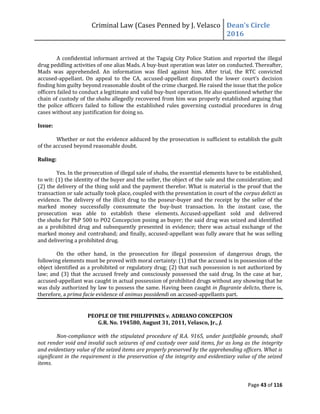
Treachery exists even if the attack is frontal if it is sudden and unexpected, giving the victim no
opportunity to repel it or defend himself, for what is decisive in treachery is that the execution of the
attack made it impossible for the victim to defend himself or to retaliate
Facts:
Ramil while he was attending a wake with his brother Cristopher was sitting nearby on a
parked motorcycle talking to someone when Prince appeared from behind and started stabbing
Ramil using a knife. He pleaded to Prince to stop for he might die but Prince kept on stabbing him.
Then later on died. Prince was charged with murder. Prince admitted the death of Ramil which
resulted from his assault but he argued that the offense was only homicide and not murder because
Criminal Law (Cases Penned by J. Velasco Dean’s	
  Circle	
  
2016
Page 24 of 116
there was no treachery. He argued that he did not attack Ramil from behind. RTC convicted Prince
with murder which was later on affirmed by the Court of Appeals. Prince argues that the attack was
not from behind but frontal thereby treachery was not present
Issue:
Whether or not there was treachery.
Ruling:
Yes. There was treachery. Settled jurisprudence prescribes two essential elements in order
to support the finding of treachery as an aggravating circumstance: (1) the employment of means,
methods or manner of execution that would ensure the offenders safety from any retaliatory act on
the part of the offended party, who has, thus, no opportunity for self-defense or retaliation; and (2)
deliberate and conscious choice of means, methods or manner of execution.
In this factual setting, the selection of the knife as the weapon to kill Ramil was arrived at so
as not to create any noise that can alert the victim. Prince planned to attack Ramil when Ramils
back is turned from appellant to preclude any window for self-defense or retaliation on the part of
Ramil. The attack was swift and unexpected. He rained numerous stabbing blows on the body of
Ramil to ensure the success of his assault. Ramil was unarmed at the time of the attack depriving
him of any opportunity to defend himself. Indeed, there was a deliberate, premeditated choice of
the means, method, or manner of executing the crime that would shield appellant from any
counterattack from Ramil. Ergo, the two elements of treachery were unquestionably met.
While Prince may claim that the attack is frontal and Ramil had the opportunity to defend
himself, the Court explained in People v. Segobre that treachery exists even if the attack is frontal if
it is sudden and unexpected, giving the victim no opportunity to repel it or defend himself, for what
is decisive in treachery is that the execution of the attack made it impossible for the victim to
defend himself or to retaliate. This is the unfortunate case of Ramil who was unable to repel the
attack except only to plead for his life. As the CA aptly pointed out, even if Ramil was attacked
frontally which is definitely not the case he was bereft of any opportunity to defend himself due to
the swiftness and suddenness of the attack.
PEOPLE OF THE PHILIPPINES v. JOHBERT AMODIA y BABA,MARIO MARINO y PATNON,
and ROY LO-OC y PENDANG,
G.R. No. 177356, November 20, 2008, Velasco, Jr., J.
To stress, qualifying circumstances must be proved as clearly as the crime itself. In order to
appreciate the attendant circumstance of abuse of superior strength, not only is it necessary to
evaluate the physical conditions of the protagonists or opposing forces and the arms or objects
employed by both sides, but it is further necessary to analyze the incidents and episodes constituting
the total development of the event.
Facts:
Criminal Law (Cases Penned by J. Velasco Dean’s	
  Circle	
  
2016
Page 25 of 116
Richard Roda, an Assistant Manager of Nognog Videoke Restaurant in Quezon City, noticed
that Amodia, Marino, and Lo-oc, were beating Jaime. As a result of the beating died. Roda went
to Camp Karingal in Quezon City to report what he had witnessed. The police then filed an
investigation report which became the basis for the filing of Information against Amodia et al. RTC
ruled that Amodia et al. were guilty of Murder. The CA, moreover, held that the killing was qualified
by the circumstance of abuse of superior strength; thus, affirming the RTC decision. Hence, this
appeal.
Issue:
Whether or not the accused-appellants are guilty of the crime of murder.
Ruling:
No. To appreciate the attendant circumstance of abuse of superior strength, what should be
considered is whether the aggressors took advantage of their combined strength in order to
consummate the offense. Mere superiority in number is not enough to constitute superior
strength. There must be clear proof that the assailants purposely used excessive force out of
proportion to the defense available to the person attacked.
In this case, although the victim was unquestionably outnumbered, it was not shown that
accused-appellants deliberately applied their combined strength to weaken the defense of the
victim and guarantee the execution of the crime. Notably, accused-appellants took turns in boxing
the victim. When the victim fell, the prosecution witness was able to hold him, preventing accused-
appellants from further hurting him. Then accused-appellants simply turned away. To be sure, had
accused-appellants really intended to use their superior strength to kill the victim, they would have
finished off the victim, and probably even the lone prosecution eyewitness.
PEOPLE OF THE PHILIPPINES v. NOEL CUASAY
G.R. No. 180512, October 17, 2008, Velasco, Jr., J.
We held that treachery exists when the offender commits any of the crimes against the person,
employing means, methods or forms in the execution thereof which tend directly or specially to ensure
its execution, without risk to himself arising from the defense which the offended party might make.
Facts:
Cuasay with treachery, without any justifiable cause and with the deliberate intent to take
the life of Ansuli with a sharp-pointed instrument thereby inflicting upon the latter mortal wound
on the chest, causing his untimely demise. Cuasay plead "not guilty" to the charge. Cuasay claimed
killing Ansuli in self-defense. RTC found him guilty beyond reasonable doubt and awarded moral
damages to the heirs of the victim. CA affirmed but modified the award.
Issue:
Whether or not the CA erred in appreciating the qualifying circumstance of treachery.
Criminal Law (Cases Penned by J. Velasco Dean’s	
  Circle	
  
2016
Page 26 of 116
Ruling:
No. We	
   agree	
   with	
   CA’s	
   finding	
   of	
   treachery.	
   We	
   held	
   that	
   treachery	
   exists	
   when	
   the	
  
offender commits any of the crimes against the person, employing means, methods or forms in the
execution thereof which tend directly or specially to ensure its execution, without risk to himself
arising from the defense which the offended party might make.
In the case at bar, the victim was unarmed and unsuspecting when accused-appellant
suddenly	
  stabbed	
  him.	
  Treachery	
  was	
  clearly	
  present	
  in	
  Cuasay’s	
  method.	
  Also,	
  the	
  CA	
  should	
  not	
  
have deleted the award of moral damages. In murder cases, the heirs of the victim should be
automatically indemnified in the amount of P50, 000 as moral damages. No proof is necessary since
the emotional and mental suffering of the heirs is apparent.
DEFENSES
Alibi
PEOPLE OF THE PHILIPPINES v. JUANITO APATTAD
G.R. No. 193188, August 10, 2011, Velasco, Jr., J.
Alibi cannot prevail over the positive identification of the accused as the perpetrator of the
crime.
Facts:
Accused Juanito Apattad was charged in four separate informations with the crime of rape
against his 12-year old daughter. The child, AAA, testified that in 2001, she was molested and in
June 10 and 11, 2003, she was raped by the accused. The accused threatened to kill her if she will
report the incident to her mother. However, she finally told her mother on June 13, 2003 that she
was being abused by her father. Her mother whipped her not telling it immediately. She was
interviewed by a DSWD personnel and Dr. Mila Simangan conducted a physical examination on her
and discovered that AAA had a healed hymen laceration. The accused denied the accusation of rape
and claimed that his wife was the one who initiated the criminal complaint against him because she
thinks that he has a mistress. A defense witness claimed that on the date of the incident, the accused
stayed	
  in	
  the	
  former’s house, which was only three kilometers away from the house of the accused.
The RTC found him guilty of three counts of rape. CA affirmed with modification as to the award of
damages.
Issue:
Whether or not the prosecution was able to establish the guilt of the accused beyond
reasonable doubt.
Ruling:
Yes. The accused contends that while the defense of alibi is frowned upon, it assumes
signifance when corroborated by credible and disinterested witness, in his case, that of Calimag.
Criminal Law (Cases Penned by J. Velasco Dean’s	
  Circle	
  
2016
Page 27 of 116
The guidelines for assessing the the defense of alibis and denials are: (1) they are generally
disfavored by the courts for being weak; (2) they cannot prevail over the positive identification of
the accused as the perpetrators of the crime; (3) for alibi to prosper, the accused must prove not
only that they were somewhere else when the crime was committed, but also that it was physically
impossible for them to be at the scene of the crime at the time of its commission; (4) alibi assumes
significance or strength only when it is amply corroborated by credible and disinterested
witnesses; (5) alibi is an issue of fact that hinges on the credibility of witnesses, and the assessment
made by the trial court, unless patently and clearly inconsistent, must be accepted.
Measured against the foregoing yardstick, accused-appellant’s	
  defenses	
  of	
  alibi	
  and	
  denial	
  
cannot prosper as AAA positively identified him in her testimony as the very perpetrator of the
crime of rape committed against her. In addition, a distance of three kilometers does not make it
physically impossible for accused-appellant to be at the scene of the crime at the time it was
committed. Alibi also becomes unworthy of merit where it is established mainly by the accused
himself, his relatives, friends and comrades-in-arms, and not by credible persons. Accused is guilty
beyond reasonable doubt of 3 counts of rape.
PO1 LORETO NERPIO v. PEOPLE OF THE PHILIPPINES
G.R. No. 155153 July 24, 2007 Velasco, Jr., J.
It is a settled doctrine that for alibi to prosper, it is not enough to prove that the accused was
at some other place when the crime was committed; but the defense must likewise demonstrate that
the accused could not have been physically present at the place of the crime, or in its immediate
vicinity, during its commission.
Facts:
SPO1	
   Loreto	
   Nerpio	
   held	
   a	
   children’s	
   birthday	
   party	
   for	
   his	
   son	
   at	
   his	
   residence.	
   Mario	
  
Salazar joined the drinking session and later on left the house of Nerpio. Thereafter, Nelly
Villanueva, who was then waiting for a friend, saw Salazar walking along the street. Villanueva saw
a	
   man	
   poked	
   a	
   gun	
   at	
   the	
   right	
   side	
   of	
   Salazar’s	
   neck,	
   and	
   fired	
   it.	
   He	
   identified	
   Nerpio	
   as	
   the	
  
malefactor. Nerpio was charged with homicide. He was found guilty as charged by the RTC. His
conviction was affirmed by the CA.
Issue:
Whether	
  the	
  CA	
  seriously	
  erred	
  in	
  disregarding	
  the	
  accused’s	
  defense	
  of	
  alibi	
  despite	
  the	
  
patent	
  weakness	
  of	
  the	
  prosecution’s	
  evidence.
Ruling:
NO. In considering the physical distance of the accused from the crime scene, the Court has
rejected alibi where the two places are in the same municipality, where they are easily accessible by
any mode of public transportation, where the distance can be covered by walking for thirty minutes
or by riding a vehicle for twenty minutes, or even when it could be reached after approximately an
hour.
Criminal Law (Cases Penned by J. Velasco Dean’s	
  Circle	
  
2016
Page 28 of 116
In the present case, the geographical proximity of petitioner to the scene of the crime at the
time of its commission was clearly established by the prosecution. Petitioner claims that at the time
of the alleged killing, he was at home hosting a party. However, he also testified that it was only 150
meters away from the crime scene. He even admitted that he went to the crime scene but only after
the shooting took place. Apparently, petitioner failed to show, by clear and convincing proof, that it
was physically impossible for him to have been at the locus criminis.
PEOPLE OF THE PHILIPPINES v. ALFREDO DELA CRUZ y MIRANDA, alias DIDONG
G.R. No. 184792, October 12, 2009, Velasco Jr., J.
Where the possibility exists for the accused to be present at the crime scene, the defense of alibi
must fail.
Facts:
On November 20, 2001 in a forested area nearby the place and house of the accused Didong
and company, Didong hit with his piece of wood the nape of Ahladdin (the victim who was also
drunk at the time) then held by the hand by Nante. When Nante released his hold, Didong again hit
Ahladdin on the back of the knees. After Boyet, Nante and Didong stabbed Ahladdin, Fred Gongon
shot	
  him	
  saying	
  “Siguraduhin	
  niyo	
  patay	
  na	
  yan”.	
  The	
  following	
  morning	
  the	
  dead	
  body	
  of	
  Ahladdin	
  
was discovered. Consequently, based on these established facts Didong and company were charged
of murder qualified by treachery. On this charge Didong merely provided the defense of alibi and
denial. He testified to being at Tata Freds house from five in the afternoon of November 20, 2001
until seven in the evening. Accordingly, he then headed home and stayed there the whole night. He
only found out about Ahlladins death when his neighbors informed him about it the next day.
Issue:
Whether or not the defense of alibi will prosper.
Ruling:
No. Didong’s proffered defense to evade criminal responsibility is too feeble to merit
consideration. His defense of alibi cannot overcome, and is in fact destroyed by the categorical
testimony of Anthony, who positively pointed to and identified him as one of the malefactors.
Moreover, in order to justify an acquittal based on alibi, the accused must establish by clear and
convincing evidence that (1) he was somewhere else at the time of the commission of the offense;
and (2) it was physically impossible for him to be at the scene of the crime at the time it was
committed. And when the law speaks of physical impossibility, the reference is to the distance
between the place where the accused was when the crime transpired and the locus criminis, as well
as the facility of access between the two places. Evidently, here, the requisites for appreciating alibi
are not present. In fact, by appellants own admission, he was with one of his co-accused the day
before Ahlladins death was uncovered. Even supposing that during the latter part of the day, he
really did go home, such a detail does not remove the possibility of his being at the forested area,
the scene of the crime.
Criminal Law (Cases Penned by J. Velasco Dean’s	
  Circle	
  
2016
Page 29 of 116
PERSONS CRIMINALLY LIABLE
Degree of Participation
ALBERT G. AMBAGAN JR. v. PEOPLE OF THE PHILIPPINES
GR NO. 204481-82, October 14, 2015, Velasco Jr., J.
The conviction of a person as a principal by inducement requires (1) that the inducement be
made with the intention of procuring the commission of the crime; and (2) that such inducement be
the determining cause of the commission by the material executor.
Facts:
Accused Mayor Ambagan Jr. was charged and convicted by the Sandiganbayan with two
counts of homicide as principal by inducement. The prosecution presented statements from two
persons who was said to be directly present during the shooting. The first witness (Bawalan) said
that	
  shooting	
  started	
  after	
  he	
  heard	
  the	
  mayor	
  said	
  “GE,	
  IYAN	
  PALA	
  ANG	
  GUSTO	
  MO,	
  MGA	
  KASAMA	
  
BANATAN	
   N’YO	
   NA	
   YAN”.	
   However,	
   the	
   second	
   witness	
   contradicts	
   this	
   when	
   he	
   said	
   that	
   he	
  
instead pushed the mayor out of the road where the shooting incident occurred and that he did not
hear the mayor saying those words which could have provoked and initiate the shooting of the
victims.	
  Further,	
  evidence	
  provides	
  that	
  Rene	
  Amparo	
  (one	
  of	
  Mayor	
  Ambagan’s	
  men)	
  has	
  negative	
  
paraffin test which	
  would	
  lead	
  to	
  the	
  fact	
  that	
  it	
  is	
  not	
  the	
  Mayor’s	
  men	
  who	
  initiated	
  the	
  shooting	
  
but rather from the deceased Rey Santos. The Sandiganbayan convicted Ambagan of the crime of
double homicide. Aggrieved, petitioner moved for reconsideration of the aforequoted ruling. The
Sandiganbayan, however, would deny petitioner's motion through its assailed October 31, 2012
Resolution. Hence, the instant petition.
Issue:
Whether or not Ambagan can be held guilty for double homicide as principal by
inducement.
Ruling:
No. This Court is not inclined to believe that petitioner indeed made the declaration that
started the fray. The court a quo failed to take note of substantial inconsistencies in the testimonies
of star prosecution witnesses Patam and Ronnel Bawalan. These contradictions refer not only to
minor details but even to the facts constituting important aspects of the case, seriously eroding the
weight of the evidence of the prosecution, and casting reasonable doubt on the culpability of
petitioner Ambagan.
This Court is not bound by the findings of the Sandiganbayan should it discover that the
testimonies of the prosecution witnesses are marred with inconsistencies that are neither collateral
nor trivial, but are material and substantial in matters determinative of petitioner's guilt beyond
reasonable doubt.
In conclusion, the scant evidence for the prosecution casts serious doubts as to the guilt of
petitioner as principal by inducement. It was not convincingly established, beyond reasonable
Criminal Law (Cases Penned by J. Velasco Dean’s	
  Circle	
  
2016
Page 30 of 116
doubt, that petitioner indeed ordered his men to open fire at Santos and Domingo Bawalan. The
evidence offered against him in court does not pass the test of moral certainty and is insufficient to
rebut the presumption of innocence that petitioner is entitled to under the Bill of Rights. And where
there is reasonable doubt as to the guilt of an accused, he must be acquitted even though his
innocence may be questioned, for it is not sufficient for the proof to establish a probability, even
though strong, that the fact charged is more likely to be true than the contrary.
PEOPLE OF THE PHILIPPINES v. BARANGAY CAPTAIN TONY TOMAS, SR., BENEDICTO
DOCTOR, AND NESTOR GATCHALIAN
G.R. No. 192251, February 16, 2011, Velasco, Jr., J.
The court ruled in People v. Ballesta that mere presence at the scene of the incident,
knowledge of the plan and acquiescence thereto are not sufficient grounds to hold a person as a
conspirator. x x x Lacking sufficient evidence of conspiracy and there being doubt as to whether
appellant acted as a principal or just a mere accomplice, the doubt should be resolved in his favor and
is thus held liable only as an accomplice.
Facts:
One evening, Estrella Doctor Casco along with her mother named Damiana and two care-
takers Liezl and Angelita, were walking home	
  from	
  Damiana’s	
  medical	
  check-up	
  when	
  Estrella’s	
  
cousins Tony Tomas and Benedicto Doctor, together with Nestor Gatchalian, suddenly came out
from the side of the road. Without uttering a word, Tomas drew a gun and shot Estrella twice, while
Gatchalian, without a gun, allegedly blocked the road, and Doctor positioned himself at the back of
Damiana and Angelina and poked a gun at them. Estrella fell down but Tomas fired three more
gunshots at the former when she was already down on the ground. After which, the three accused
fled from the scene of the crime. The RTC convicted the accused Tomas, Doctor and Gatchalian of
the offense of Murder and appreciated the attendance of treachery and conspiracy which the CA
affirmed with modification. Hence, this petition was filed.
Issue:
Whether or not the finding of conspiracy made Gatchalian guilty as a conspirator.
Ruling:
No. Gatchalian is differently situated as Doctor. The evidence adduced and the records
would show that Gatchalian did not do overt acts for the furtherance of the shooting of Estrella. The
mere presence at the scene of the crime at the time of its commission without proof of cooperation
or agreement to cooperate is not enough to constitute one a party to a conspiracy.
Gatchalian’s presence is merely extraneous to the accomplishment of the crime. Thus, with
his lack of overt acts manifestly contributing to the accomplishment of the common design to shoot
Estrella, there is some doubt if he indeed conspired with Tomas, Sr. and Doctor. This, however, does
not exculpate him from criminal liability absent proof that he merely tagged along or just happened
to meet his employer (Tomas, Sr.) shortly before the incident or was merely taken along without
being told about the other accused-appellants plan. The fact that Gatchalian appeared together with
Criminal Law (Cases Penned by J. Velasco Dean’s	
  Circle	
  
2016
Page 31 of 116
the other accused-appellants and fled with them, while not constitutive of proof beyond reasonable
doubt of conspiracy, still proves a certain degree of participation and cooperation in the execution
of the crime. Consequently, in line with the principle that whatever is favorable to an accused must
be accorded him, Gatchalian is guilty as an accomplice only.
PENALTIES
ROSVEE C. CELESTIAL v. PEOPLE OF THE PHILIPPINES
G.R. No. 214865, August 19, 2015, Velasco, Jr., J.
Applying article 70 of the RPC, such maximum period shall in no case exceed forty years.
Therefore, in spite of the six (6) penalties of forty (40) years of reclusion perpetua, petitioner shall only
suffer imprisonment for a period not exceeding 40 years. A downward modification of the penalty
imposed by the RTC is then in order.
Facts:
Celestial was convicted of six counts of qualified theft through falsification of commercial
document. The issue of conviction	
  has	
  attained	
  finality	
  after	
  the	
  failure	
  of	
  Celestial’s	
  counsel	
  to	
  file	
  
her appellant brief. The court now only delves on the issue of the imposition of proper penalty.
Issue:
What	
  is	
  the	
  proper	
  penalty	
  for	
  Celestial’s	
  conviction	
  of	
  six	
  counts	
  of qualified theft with the
total amount of $50, 000.00
Ruling:
In ascertaining the proper penalty, we are guided by our pronouncement in People v.
Mercado:
First, we get the value of the property stolen as determined by the trial court
Second, we determine the imposable base penalty under Art. 309 of the RPC. Here, since
the totality of the stolen amounts for each case exceeds P22,000.00, the imposable base penalty for
each count, as per Art. 309 (1), is prision mayor in its minimum and medium periods to be imposed
in the maximum period, which is eight (8) years, eight (8) months and one (1) day to ten (10) years
of prision mayor, had the crime charged been simple theft.
Third, since the value of the stolen goods exceeds P22,000.00, We compute for the
additional years of maximum imprisonment under Art. 309 (1) by deducting P22,000.00 from each
case, and by subsequently dividing each difference by P10,000.00, disregarding any remainder
amount.
Fourth, we add the maximum of the base penalty to the above-determined quotient to
arrive at the maximum imprisonment term imposable had the crime committed been simple theft
Criminal Law (Cases Penned by J. Velasco Dean’s	
  Circle	
  
2016
Page 32 of 116
Fifth, the maximum imprisonment term should not exceed the 20-year cap under Art. 309
(1), and any imprisonment term in excess of the cap should be disregarded. In this case, since all
sums exceeded 20 years, the proper penalty - the maximum period adverted to in Art. 309 (1) -
would have been 20 years of reclusion temporal, before the application of the indeterminate
sentence law, for each count, had petitioner been convicted of simple theft.
Sixth, the penalty for qualified theft is two degrees higher than that for simple theft. Under
Art. 25 of the RPC, two (2) degrees higher than reclusion temporal- the penalty following reclusion
perpetua
Lastly, since petitioner is convicted of six (6) counts of qualified theft through falsification
of commercial documents with corresponding six (6) penalties of forty (40) years of reclusion
perpetua, Art. 70 of the RPC on successive service of sentences shall apply.
Prescription of Crimes (RPC and Special Penal Laws)
PRESIDENTIAL COMMISISON ON GOOD GOVERNMENT v.
THE HONORABLE OMBUDSMAN Conchita Carpio-Morales et al.
G.R. No. 206357, November 12, 2014, Third Division, Velasco, Jr., J.
When date of the violation was committed be not known, then it shall begin to run from the
discovery of said violation and the institution of judicial proceedings for investigation and punishment.
Facts:
By virtue of Administrative Order No. 13 issued by then President Fidel V. Ramos creating a
Presidential Ad-Hoc Fact-Finding Committee on Behest Loans, a report dated January 4, 1993
identified the accounts of Resorts Hotel Corporation (RHC) as behest in character. Later the
Republic of the Philippines, represented by the PCGG, filed an Affidavit-Complaint on January 6,
2003 with the Office of the Ombudsman, against respondent directors and officers of RHC and the
directors of DBP for violation of Sections 3(e) and 3 (g) of Republic Act (RA) No. 3019 or the Anti-
Graft	
   and	
   Corrupt	
   Practices	
   Act.	
   However	
   the	
   Ombudsman	
   dismissed	
   petitioner’s	
   Affidavit-
Complaint on grounds of prescription. Hence, this petition.
Issue:
Whether or not the offense has already prescribed.
Ruling:
Yes. RA 3019, Section 11 provides that all offenses punishable under said law shall
prescribe in ten years. This period was later increased to 15 years with the passage of BP Blg. 195,
which took effect on March 16, 1982. This does not mean, however, that the longer prescriptive
period shall apply to all violations of RA 3019. The longer prescriptive period of 15 years pursuant
to BP Blg. 195 cannot be applied to crimes committed prior to the effectivity of the said amending
law on March 16, 1982. Considering that the crimes were committed in 1969, 1970, 1973, 1975,
and 1977, the applicable prescriptive period thereon is the ten-year period set in RA 3019, the law
Criminal Law (Cases Penned by J. Velasco Dean’s	
  Circle	
  
2016
Page 33 of 116
in force at that time. What is, then, left for determination is the reckoning point for the 10-year
period.
Notably, RA 3019 is silent as to when the period of prescription shall begin to run. This void,
however, is remedied by Act No. 3326, Section 2 which provides for two reckoning points for the
counting of the prescription of an offense: 1) the day of the commission of the violation of the law;
and 2) if the day when the violation was committed be not known, then it shall begin to run from
the discovery of said violation and the institution of judicial proceedings for investigation and
punishment.
In the case at bar, involving as it does the grant of behest loans which the Court have
recognized as a violation that, by their nature, could be concealed from the public eye by the simple
expedient of suppressing their documentation, the second mode applies. The Court, therefore,
count the running of the prescriptive period from the date of discovery thereof on January 4, 1993,
when the Presidential Ad Hoc Fact-Finding Committee reported to the President its findings and
conclusions	
  anent	
  RHC’s	
  loans.	
  This	
  being	
  the	
  case,	
  the	
  filing	
  by	
  the	
  PCGG	
  of	
  its	
  Affidavit-Complaint
before the Office of the Ombudsman on January 6, 2003, a little over ten years from the date of
discovery of the crimes, is clearly belated. Undoubtedly, the ten-year period within which to
institute	
  the	
  action	
  has	
  already	
  lapsed,	
  making	
  it	
  proper	
  for	
  the	
  Ombudsman	
  to	
  dismiss	
  petitioner’s	
  
complaint on the ground of prescription.
CRIMES AGAINST PUBLIC ORDER
EDMUND SYDECO Y SIONZON v. PEOPLE OF THE PHILIPPINES
G.R. No. 202692, November 12, 2014, Velasco, Jr., J.
The presumption of regularity in the conduct of police duty is disputable by contrary proof and
which when challenged by the evidence cannot be regarded as binding truth. The absence of
conclusive proof being under the influence of liquor while driving coupled with the forceful manner the
police yanked petitioner out of his vehicle argues against or at least cast doubt on the finding of guilt
for drunken driving and resisting arrest.
Facts:
The prosecution alleged that four police officers, manning a legal checkpoint, spotted a
swerving vehicle, driven by Sydeco who was under the influence of liquor. The police officers
flagged the vehicle down and asked Sydeco to alight from the vehicle. However, Sydeco denied
being drunk, and yelled at the officers. At that remark, they arrested Sydeco who put up resistance,
and brought him to the hospital where he was examined and found to be positive of alcohol breath.
BOOK 2 REVISED PENAL CODE and related SPECIAL LAWS
Criminal Law (Cases Penned by J. Velasco Dean’s	
  Circle	
  
2016
Page 34 of 116
On the other hand, Sydeco averred that he was signaled to stop by the police officers and asked him
to	
  open	
  the	
  vehicle’s	
  door	
  and	
  to	
  alight	
  from	
  the	
  vehicle	
  for	
  a	
  body	
  and	
  vehicle search. He refused
and insisted on a plain view search only. By this remark, the policemen told him that he was drunk,
boxed him, and poked a gun at his head. The officers pulled Sydeco out of the vehicle and brought
him to the hospital where they succeeded in securing a medical certificate depicting Sydeco as
positive of alcohol breath.
Sydeco was charged for violation of Section 56(f) of RA 4136 or the Land Transportation
Code and another for violation of Article 151 of the RPC. Sydeco then filed a complaint-affidavit
against	
   the	
   police	
   officers.	
   MeTC	
   found	
   Sydeco	
   guilty	
   as	
   charged.	
   The	
   RTC	
   affirmed	
   Sydeco’s	
  
conviction. This was affirmed by the CA and upheld the presumption of regularity in the
performance of duties by the police officers.
Issue:
Whether or not the police officers performed their duties as required by law.
Ruling:
No. At	
   the	
   time	
   of	
   Sydeco’s	
   apprehension,	
   or	
   when	
   he	
   was	
   signaled	
   to	
   stop,	
   he	
   has	
   not	
  
committed any crime or suspected of having committed one. Swerving may become punishable
when there is a sign indicating that it is prohibited or where swerving partakes the nature of
reckless driving. Swerving is not necessarily indicative of imprudent behavior let alone constitutive
of reckless driving. To constitute the offense of reckless driving Sec. 48 of RA 4136, the act must be
something more than a mere negligence in the operation of a motor vehicle, and a willful and
wanton disregard of the consequences is required. Moreover, the area where Sydeco was spotted
was	
  a	
  ”no	
  swerving	
  or	
  overtaking	
  zone.”	
  
Furthermore, under Article 151 of the RPC, two elements of resistance and serious
disobedience must be present: (1) that a person in authority or his agent is engaged in the
performance of official duty or gives a lawful order to the offender; and (2) that the offender resists
or seriously disobeys such person or his agent. Clearly, the police officers are persons in authority
or	
  agents	
  of	
  a	
  person	
  in	
  authority	
  manning	
  a	
  legal	
  checkpoint.	
  But	
  Sydeco’s	
  act	
  of	
  exercising	
  one’s	
  
right against unreasonable searches to be conducted cannot be equated to disobedience nor
resisting a lawful order. There is also nothing in RA 4136 that authorized the checkpoint-manning
policemen to order Sydeco to get out of the vehicle for a vehicle and body search. And none of the
police officers denied the allegation of Sydeco about being physically hurt before being brought to
the hospital. What the policemen claimed was that it took the three of them to subdue Sydeco. Both
actions were done in excess of their authority granted under RA 4136.
RA 9165 COMPREHENSIVE DANGEROUS DRUGS ACT AND ITS IMPLEMENTING RULES AND
REGULATION (IRR)
PEOPLE OF THE PHILIPPINES v. NENE QUIAMANLON Y MALOG
G.R. No. 191198, January 26, 2011, Velasco, Jr., J.
Criminal Law (Cases Penned by J. Velasco Dean’s	
  Circle	
  
2016
Page 35 of 116
The IRR of RA 9165 readily reveals that the custodial chain rule is not to be rigorously applied,
provided "the integrity and evidentiary value of the seized items are properly preserved by the
apprehending officer/team." Moreover, the integrity of the evidence is presumed to be preserved,
unless there is a showing of bad faith, ill will, or proof that the evidence has been tampered
with. Evidently, the prosecution established the crucial link in the chain of custody of the seized drugs.
Facts:
Acting upon a tip from a female confidential informant, the District Anti-Illegal Drugs
(DAID) of Quezon City formed a team to conduct a buy-bust operation to apprehend a certain
“Myrna”	
  who	
  was	
  allegedly	
  conducting	
  illegal	
  drug	
  activities	
  within	
  Quezon	
  City.	
  According	
  to	
  the	
  
prosecution, the DAID recovered the marked 500-peso bill used by the team from "Myrna," as well
as two plastic sachets, at the time of arrest of both "Myrna" and her companion, later identified as
Saguera Samula y Dalunan (Samula). "Myrna," who was later identified as Nene Quiamanlon, and
Samula, as well as the recovered articles were brought to the station for proper investigation and
disposition.
RTC convicted Quiamanlon of violations of the Comprehensive Dangerous Drugs Act,
specifically Sections 5 and 11 of Article II thereof. Quiamanlon was sentenced to life imprisonment,
P800, 000.00 in fines, and costs of suit. Upon appeal, the CA affirmed the ruling of the trial court.
Quiamanlon claimed that the police officers who conducted the buy-bust operation failed to
observe the existing rules in the proper custody of the seized items, thereby casting doubt as to the
identity and integrity of the sachets allegedly containing shabu presented as evidence by the
prosecution. Quiamanlon insisted that any apprehending team having initial control of said drugs
and/or paraphernalia, should immediately after seizure or confiscation, have the same physically
inventoried and photographed in the presence of the accused, if there be any, and or his
representative, who shall be required to sign the copies of the inventory and be given a copy
thereof.
Issue:
Whether or not Quiamanlon is guilty of violating the Comprehensive Dangerous Drugs Act
of 2002.
Ruling:
Yes. Contrary	
  to	
  Quiamanlon’s	
  assertion,	
  the	
  chain	
  of	
  custody of the seized prohibited drugs
was adequately established in the instant case. A testimony about a perfect chain is not always the
standard as it is almost always impossible to obtain an unbroken chain. What is of utmost
importance is the preservation of the integrity and the evidentiary value of the seized items. The
IRR of RA 9165 readily reveals that the custodial chain rule is not to be rigorously applied, provided
"the integrity and evidentiary value of the seized items are properly preserved by the apprehending
officer/team." Thus, the supposed procedural infirmities alleged by Quiamanlon with regard to the
custody, photographing, inventory, and marking of the seized items do not, in any manner, affect
the prosecution of the instant case and do not render her arrest illegal or the items seized from her
inadmissible.
Criminal Law (Cases Penned by J. Velasco Dean’s	
  Circle	
  
2016
Page 36 of 116
Moreover, the integrity of the evidence is presumed to be preserved, unless there is a
showing of bad faith, ill will, or proof that the evidence has been tampered with. In this case,
Quiamanlon bears the burden to show that the evidence was tampered or meddled with to
overcome a presumption of regularity in the handling of exhibits by public officers and a
presumption that they properly discharged their duties. Failing to discharge such burden, there can
be no doubt that the drugs seized from Quiamanlon were the same ones examined in the crime
laboratory. Evidently, the prosecution established the crucial link in the chain of custody of the
seized drugs.
PEOPLE OF THE PHILIPPINES v. EVANGELINE SOBANGEE Y EDAÑO
G.R. No. 186120, January 31, 2011, Velasco, Jr., J.
In order to successfully prosecute an accused for illegal sale of drugs, the prosecution must be
able to prove the following elements: (1) identities of the buyer and seller, the object, and the
consideration; and (2) the delivery of the thing sold and the payment for it.
Facts:
A confidential informant reported to the Drug Enforcement Unit (DEU) of Makati City that a
certain "Vangie" was engaged in drug pushing activities. Hence, a buy-bust operation was planned
by the DEU. Vangie was contacted by SPO4 Mangulabnan through a mobile phone, and a drug deal
worth P150, 000.00 was agreed upon. Vangie arranged to meet at Starbucks Café on Rockwell
Drive, Makati City. SPO1 Fulleros acceded to her request and headed to the coffee shop. Minutes
after, Vangie arrived and looked for the poseur-buyer. He gave Vangie the boodle money after
examining the plastic bags. Afterwards, he gave the pre-arranged signal to alert his team that the
transaction had been consummated. The back-up operatives arrived while he was introducing
himself to Vangie as a DEU operative. She was placed under arrest and later identified as Sobangee.
RTC and CA found Sobangee guilty beyond reasonable doubt of having violated Sec. 5, Art. II
of RA No. 9165 or the Comprehensive Dangerous Drugs Act of 2002, for selling methylamphetamine
hydrochloride. Sobangee claimed that the testimonies of the prosecution witnesses suffered from
major inconsistencies, such as: (1) the date the alleged informant came to the DEU office; (2) the
time the buy-bust team left the office to conduct its operation; (3) the place that the team first went
to before going to the buy-bust at Rockwell Center, Makati City; (4) the location of the operatives
during the buy-bust operation; (5) the site where the illegal substances seized were marked; (6) the
amount involved in the buy-bust; (7) the officer who informed Sobangee of her constitutional
rights; and (8) the identity of the informant.
Issue:
Whether or not Sobangee violated the Comprehensive Dangerous Drugs Act of 2002.
Ruling:
Yes. The inconsistencies referred to are inconsequential. What is important is that the
prosecution was able to establish the key elements needed for a conviction. Minor variances in the
Criminal Law (Cases Penned by J. Velasco Dean’s	
  Circle	
  
2016
Page 37 of 116
details of the witnesses' accounts, more frequently than not, are badges of truth rather than indicia
of falsehood, and they often bolster the probative value of their testimonies.
The RTC correctly ruled that the prosecution succeeded in proving the presence of all the
elements of the offense charged. The plastic bags containing white crystalline substance taken from
the accused. The identity of the accused was positively established. In open court, witnesses for the
prosecution pointed to the accused as the person they arrested after consummation of the buy-bust
operation. This same person when asked of her identity identified herself as Evangeline Sobangee.
The marked money found in the possession of the accused consisting of one genuine one thousand
peso bill placed on top of a bundle of money was likewise positively identified by the arresting
officers as the same one provided and used in the operation.
PEOPLE OF THE PHILIPPINES v. RUFINO VICENTE, JR. y CRUZ
G.R. No. 188847, January 31, 2011, Velasco, Jr., J.
Sec. 21 of RA 9165 need not be followed as an exact science. Non-compliance with Sec. 21 does
not	
  render	
  an	
  accused’s	
  arrest	
  illegal	
  or	
  the	
  items	
  seized/confiscated	
  from	
  him	
  inadmissible.	
  It	
  is	
  not	
  a	
  
serious flaw that can render void the seizures and custody of drugs in a buy-bust operation. What is
essential is the preservation of the integrity and the evidentiary value of the seized items, as the same
would be utilized in the determination of the guilt or innocence of the accused.
Facts:
An informant arrived at the District Anti-Illegal Drugs at the Southern Police District, Fort
Bonifacio, Taguig	
  and	
  reported	
  that	
  a	
  certain	
  “Paks” was pushing shabu on P. Mariano St., Taguig.
Acting on the information from the informant, P/Insp. Rodolfo Anicoche ordered PO2 Boiser to
verify the drug-peddling activities of Paks. PO2 Boiser proceeded to Ususan accompanied by the
informant. After	
  confirming	
  the	
  informant’s	
  report,	
  they	
  went	
  back	
  to	
  the	
  police	
  station	
  to	
  recount	
  
what they had seen to P/Insp. Anicoche. Thereafter, a team was dispatched to conduct a buy-bust
operation. PO2 Boiser and PO2 Lagos walked with the informant to meet Paks. PO2 Boiser was
then introduced to Paks as a balikbayan who wanted to score some drugs. He also told Paks that he
had been released from rehab and wanted to use again. Paks, satisfied that PO2 Boiser was indeed
a drug user, agreed to sell P500.00 worth of shabu. He reached from his camouflage shorts a plastic
sachet and handed it to PO2 Boiser. After receiving the plastic sachet from Paks, PO2 Boiser
examined it under the light of a lamppost. Seeing the pre-arranged signal acted out by PO2 Boiser,
PO2 Lagos went to the scene and introduced himself as a police officer to Paks. The buy-bust
money was then seized from Paks.
RTC found Vicente, Jr. guilty of the crime charged. On appeal, Vicente, Jr. is convinced that
Sec. 21 of the Implementing Rules and Regulations (IRR) of RA 9165 were not complied with, since
the buy-bust team failed to present a pre-operation report and photographs of the seized items. He
concludes that there is uncertainty as to the identity of the illegal drugs seized. He says that due to
the buy-bust team's omissions, there is a lingering doubt as to whether the drugs that underwent
laboratory	
  examination	
  were	
  the	
  same	
  items	
  allegedly	
  seized	
  from	
  him.	
  CA	
  affirmed	
  RTC’s	
  decision.
Issue:
Criminal Law (Cases Penned by J. Velasco Dean’s	
  Circle	
  
2016
Page 38 of 116
Whether or not Vicente Jr. is guilty of violating the Comprehensive Dangerous Drugs Acts of
2002.
Ruling:
Yes. The prosecution showed that there was a meeting of the minds between the witness
Boiser, poseur-buyer and the seller, accused Rufino Vicente, Jr., to sell to the former shabu for
P500.00. The act of the accused-seller in receiving the money and delivering the said shabu
consummated the sale. The straightforward testimonies of the witnesses for the prosecution
clearly established the elements. Prosecutions involving illegal drugs depend largely on the
credibility of the police officers who conducted the buy-bust operation. In cases involving violations
of the Comprehensive Dangerous Drugs Act, credence is given to prosecution witnesses who are
police officers for they are presumed to have performed their duties in a regular manner, unless
there is evidence to the contrary. Absent any indication that the police officers were ill-motivated
in testifying against the accused, full credence should be given to their testimonies.
PEOPLE OF THE PHILIPPINES v. TEDDY BATOON y MIGUEL and MELCHOR BATOON y MIGUEL
G.R. No. 184599, November 24, 2010, Velasco Jr. J.
For conviction of illegal possession of a prohibited drug to lie, the following elements must be
established: (1) the accused was in possession of an item or an object identified to be a prohibited or
regulated drug; (2) such possession is not authorized by law; and (3) the accused was freely and
consciously aware of being in possession of the drug. Notably, exclusive possession of the prohibited
drug is not required.
Facts:
Sometime in 2005, the police received a report that there was rampant selling of shabu
somewhere in Ilocos Norte. According to the report, the brothers Teddy (Teddy) and Melchor
Batoon (Melchor), herein accused-appellants were two of the most notorious sellers of illegal drugs
in the area. Acting on the report, the police conducted a buy-bust operation which led to the arrest
of Teddy and Melchor. Sachets containing shabu were seized from Teddy and Melchor. Thereafter,
Teddy and Melchor were charged with violation of the Dangerous Drugs Act for possession and
selling of illegal drugs.
The RTC and CA found Teddy and Melchor guilty beyond reasonable doubt for the offense
charged. Now, Teddy and Melchor come before the SC assailing the decision of the RTC and CA. In
their defense, they aver that the chain of custody over the alleged confiscated prohibited drugs was
not	
  followed	
  and	
  that	
  there	
  was	
  an	
  absence	
  of	
  regularity	
  in	
  the	
  performance	
  of	
  the	
  police	
  officers’	
  
duty when they were arrested. Hence, this petition.
Issue:
Whether or not the conviction of Melchor Batoon of the crime of illegal possession of shabu
is proper.
Ruling:
Criminal Law (Cases Penned by J. Velasco Dean’s	
  Circle	
  
2016
Page 39 of 116
Yes. In this case, although the three sachets containing shabu were found solely in the
possession of Teddy, it was evident that Melchor had knowledge of its existence. Moreover, as
correctly found by the CA, Melchor had easy access to the shabu, because they conspired to engage
in the illegal business of drugs. The CA explained, thus: “As the records would show, when PO2
Vicente handed to Melchor Batoon a marked [PhP] 500.00 bill, the latter went to his brother Teddy
and gave him money. Upon receipt of the money, Teddy Batoon handed a sachet to Melchor, who
then gave it to PO2 Vicente. When the arrest [was] affected on both of them, the three additional
sachets were found on [Teddy] by PO1 Cabotaje. These acts of the accused indubitably demonstrate
a coordinated plan on their part to actively engage in the illegal business of drugs. From their
concerted conduct, it can easily be deduced that there was common design to deal with illegal
drugs. Needless to state, when conspiracy is shown, the act of one is the act of all conspirators.”
PEOPLE OF THE PHILIPPINES v. MARLON ABETONG Y ENDRADO
G.R. No. 209785, June 04, 2014, Velasco, Jr., J.
The chain of custody rule requires that the admission of an exhibit be preceded by evidence
sufficient to support a finding that the matter in question is what the proponent claims it to be. It
would include testimony about every link in the chain, from the moment the item was picked up to the
time it is offered into evidence, in such a way that every person who touched the exhibit would describe
how	
   and	
   from	
   whom	
   it	
   was	
  received,	
   where	
   it	
   was	
   and	
   what	
   happened	
  to	
   it	
   while	
   in	
   the	
   witness’	
  
possession, the condition in which it was received and the condition in which it was delivered to the
next link in the chain.
Facts:
In a buy-bust operation conducted, the accused, Marlon Abetong, was caught selling shabu
to a police poseur buyer. The RTC rendered a decision finding him guilty beyond reasonable doubt
of a violation of Section 5, Article II of R.A. 9165. The CA affirmed his conviction. The accused
contended that the prosecution failed to sufficiently prove that the integrity of the evidence was
preserved. Raising non-compliance with Sec. 21 of RA 9165, he argued, among others: (1) that the
markings on the items seized do not bear the date and time of the confiscation, as required; (2) that
about three days have passed since the items were confiscated before they were brought to the
crime laboratory; and (3) that there was neither an inventory nor a photograph of the recovered
plastic sachet. He likewise hinged his appeal on the fact that Inspector Lorilla, who had the only key
to the evidence locker, did not testify during trial.
Issue:
Whether or not the prosecution was able to establish an unbroken chain of custody over the
drug evidence.
Ruling:
No. Jurisprudence indeed instructs that failure to observe strictly the above-quoted
provision can be excused as long as (1) the integrity and evidentiary value of the seized items are
properly preserved by the apprehending officers and (2) non-compliance was attended by
Criminal Law (Cases Penned by J. Velasco Dean’s	
  Circle	
  
2016
Page 40 of 116
justifiable grounds. However, the prosecution in this case was unsuccessful in showing that there
was no opportunity for tampering, contamination, substitution, nor alteration of the specimens
submitted. The prosecution likewise failed to offer any justification on why the afore-quoted
provision was not complied with.
In the case at bar, the failure of Inspector Lorilla to testify is fatal to the	
  prosecution’s	
  case.	
  
As	
  the	
  lone	
  key	
  holder	
  and	
  consequentially	
  a	
  link	
  in	
  the	
  chain,	
  Inspector	
  Lorilla’s	
  testimony	
  became	
  
indispensable in proving the guilt of accused-appellant beyond reasonable doubt.
The prosecution cannot skirt the issue of the broken chain of custody by relying on the
presumption of regularity. This presumption, it must be stressed, is not conclusive. Any taint of
irregularity affects the whole performance and should make the presumption unavailable.
PEOPLE OF THE PHILIPPINES v. VICTORIO PAGKALINAWAN
G.R. No. 184805, March 3, 2010, Velasco, J.
A police officer's act of soliciting drugs from the accused during a buy-bust operation or what
is known as a decoy solicitation, is not prohibited by law and does not render the buy-bust operation
invalid.
Facts:
The Taguig police formed a buy-bust team upon receipt of a report of illegal activities of
Pagkalinawan. He was arrested after sachets of shabu were recovered from him. Pagkalinawan,
interposed the defense of alibi. He said that armed men barged into his house and pointed a gun at
him. He was brought to the police station when the police could not find any prohibited drugs.
Pagkalinawan insists that what actually happened was an instigation and not a buy-bust
operation. He claimed that there was no compliance with the law as to the proper requirements for
a valid buy-bust operation.
Issue:
Whether or not there was a valid buy-bust operation.
Ruling:
Yes. One form of entrapment is the buy-bust operation. It is legal and has been proved to be
an effective method of apprehending drug peddlers, provided due regard to constitutional and legal
safeguards is undertaken.
In order to determine the validity of a buy-bust operation, this Court has consistently
applied the objective test. In People v. Doria, this Court stressed that in applying the objective test,
the details of the purported transaction during the buy-bust operation must be clearly and
adequately shown, i.e., the initial contact between the poseur-buyer and the pusher, the offer to
purchase, and the promise or payment of the consideration until the consummation of the sale by
the delivery of the illegal drug subject of the sale. It further emphasized that the manner by which
Criminal Law (Cases Penned by J. Velasco Dean’s	
  Circle	
  
2016
Page 41 of 116
the initial contact was made, whether or not through an informant, the offer to purchase the drug,
the payment of the buy-bust money, and the delivery of the illegal drug, whether to the informant
alone or the police officer, must be subject of strict scrutiny by courts to insure that law-abiding
citizens are not unlawfully induced to commit an offense.
In the instant case, the evidence clearly shows that the police officers used entrapment, not
instigation, to capture appellant in the act of selling a dangerous drug. It was the confidential
informant who made initial contact with appellant when he introduced PO1 Memoracion as a buyer
for shabu. Appellant immediately took the P500.00 buy-bust money from PO1 Memoracion and
showed him three pieces of sachet containing shabu and asked him to pick one. Once PO1
Memoracion got the shabu, he gave the pre-arranged signal and appellant was arrested. The facts
categorically show a typical buy-bust operation as a form of entrapment. The police officers
conduct was within the acceptable standards for the fair and honorable administration of justice.
PEOPLE OF THE PHILIPPINES v. DARIUS BAUTISTA Y ORSINO @ DADA
G.R. No. 191266, June 06, 2011, Velasco, Jr., J.
In cases of dangerous drugs, what is important and necessary is for the prosecution to prove
with moral certainty "that the dangerous drug presented in court as evidence against the accused be
the same item recovered from his possession." As long as the integrity and evidentiary value of the
seized items are properly preserved by the apprehending officer/team," the seizure of and custody
over the dangerous drugs shall not be rendered void and invalid
Facts:
As a result of a buy-bust operation, Darius O. Bautista was charged with and convicted of
drug pushing. In his appeal to the SC, he alleged that reasonable doubt exists because there is a
break in the chain of custody of the seized dangerous drug. He further alleged that there was a
serious deviation from the requirements of Sec. 21 of the Comprehensive Dangerous Drugs Act of
2002on the custody and disposition of the said seized dangerous drug.
Issue:
Whether non-compliance with chain of custody in drug cases render the seizure of drugs
void.
Ruling:
No. The law itself lays down certain exceptions to the general compliance requirement,
stressing the point that "as long as the integrity and evidentiary value of the seized items are
properly preserved by the apprehending officer/team," the seizure of and custody over the
dangerous drugs shall not be rendered void and invalid.
In cases of dangerous drugs, what is important and necessary is for the prosecution to
prove with moral certainty "that the dangerous drug presented in court as evidence against the
accused be the same item recovered from his possession." In this case, it is undoubted that the
witnesses for the prosecution clearly established such essential requirement.
Criminal Law (Cases Penned by J. Velasco Dean’s	
  Circle	
  
2016
Page 42 of 116
PEOPLE OF THE PHILIPPINES v. GARRY DE LA CRUZ Y DELA CRUZ
G.R. No. 185717, June 08, 2011, Velasco, Jr., J.
The prosecution must offer the testimony of key witnesses to establish a sufficiently complete
chain of custody. The failure of the police to comply with the procedure in the custody of the seized
drugs raises doubt as to its origins and also negates the operation of the presumption of regularity
accorded to police officers.
Facts:
As a result of a buy-bust operation, Dela Cruz was charged with and convicted of the crime
of drug pushing. In his defense, the accused denied selling shabu to PO2 Ibasco. In short, the
accused used the defense of denial and alleged a frame-up by the arresting officers. On appeal, he
imputed material irregularities on the chain of custody of the seized drugs.
Issue:
Whether the required chain of custody is properly observed.
Ruling:
No. The records belie a conclusion that there was an unbroken chain of custody of the
purportedly confiscated shabu specimen. While both PO2 Ibasco and PO1 Valencia testified on the
identity of the plastic sachet duly marked with the initials EIGC, there was no sufficient proof of
compliance with the chain of custody. The records merely show that, after the arrest of accused-
appellant, the specimen was allegedly turned over to the desk officer on duty, whose identity was
not revealed. The Court cannot make an inference that PO2 Ibasco passed the specimen to an
unnamed desk officer on duty until it made its way to the laboratory examination. There are no
details on who kept custody of the specimen, who brought it to the Crime Laboratory, and who
received and kept custody of it until Engr. Jabonillo conducted the forensic examination. The
stipulated facts merely made an allusion that the specimen custodian of the Crime Laboratory had
possession of the specimen and released it for the proceedings before the trial court.
In sum, considering the multifarious irregularities and non-compliance with the chain of
custody, the accused is acquitted on the ground of reasonable doubt.
PEOPLE OF THE PHILIPPINES v. HASANADDIN GUIARA y BANSIL
G.R. No. 186497, September 17, 2009, Velasco, Jr., J.
What is material is the proof that the transaction or sale actually took place, coupled with the
presentation in court of the corpus delicti as evidence. The delivery of the illicit drug to the poseur-
buyer and the receipt by the seller of the marked money successfully consummate the buy-bust
transaction.
Facts:
Criminal Law (Cases Penned by J. Velasco Dean’s	
  Circle	
  
2016
Page 43 of 116
A confidential informant arrived at the Taguig City Police Station and reported the illegal
drug peddling activities of one alias Mads. A buy-bust operation was later on conducted. Thereafter,
Mads was apprehended. An information was filed against him. After trial, the RTC convicted
accused-appellant. On appeal to the CA, accused-appellant	
   disputed	
   the	
   lower	
   court’s	
   decision
finding him guilty beyond reasonable doubt of the crime charged. He raised the issue that the police
officers failed to conduct a legitimate and valid buy-bust operation. He also questioned whether the
chain of custody of the shabu allegedly recovered from him was properly established arguing that
the police officers failed to follow the established rules governing custodial procedures in drug
cases without any justification for doing so.
Issue:
Whether or not the evidence adduced by the prosecution is sufficient to establish the guilt
of the accused beyond reasonable doubt.
Ruling:
Yes. In the prosecution of illegal sale of shabu, the essential elements have to be established,
to wit: (1) the identity of the buyer and the seller, the object of the sale and the consideration; and
(2) the delivery of the thing sold and the payment therefor. What is material is the proof that the
transaction or sale actually took place, coupled with the presentation in court of the corpus delicti as
evidence. The delivery of the illicit drug to the poseur-buyer and the receipt by the seller of the
marked money successfully consummate the buy-bust transaction. In the instant case, the
prosecution was able to establish these elements. Accused-appellant sold and delivered
the shabu for PhP 500 to PO2 Concepcion posing as buyer; the said drug was seized and identified
as a prohibited drug and subsequently presented in evidence; there was actual exchange of the
marked money and contraband; and finally, accused-appellant was fully aware that he was selling
and delivering a prohibited drug.
On the other hand, in the prosecution for illegal possession of dangerous drugs, the
following elements must be proved with moral certainty: (1) that the accused is in possession of the
object identified as a prohibited or regulatory drug; (2) that such possession is not authorized by
law; and (3) that the accused freely and consciously possessed the said drug. In the case at bar,
accused-appellant was caught in actual possession of prohibited drugs without any showing that he
was duly authorized by law to possess the same. Having been caught in flagrante delicto, there is,
therefore, a prima facie evidence of animus possidendi on accused-appellants part.
PEOPLE OF THE PHILIPPINES v. ADRIANO CONCEPCION
G.R. No. 194580, August 31, 2011, Velasco, Jr., J.
Non-compliance with the stipulated procedure of R.A. 9165, under justifiable grounds, shall
not render void and invalid such seizures of and custody over said items, for as long as the integrity
and evidentiary value of the seized items are properly preserved by the apprehending officers. What is
significant in the requirement is the preservation of the integrity and evidentiary value of the seized
items.
Criminal Law (Cases Penned by J. Velasco Dean’s	
  Circle	
  
2016
Page 44 of 116
Facts:
P01 Willie Tadeo received a phone call that there was rampant selling of drugs in Banga,
Meycauayan, Bulacan. The chief of police instructed the police officers to form a team to conduct a
buy-bust operation, with PO1 Tadeo acting as the poseur-buyer. In the target area, a club located at
Banga, PO1 Tadeo was given two pieces of P100-bills, and he marked the same with his initials
"WCT." PO1 Tadeo handed alias Joel the marked P100-bills, while the latter in turn gave PO1 Tadeo
a plastic sachet containing white crystalline substance. PO1 Tadeo, thereafter, made contact with
his back-up officers and they, in turn, entered the premises and arrested the following: Robert
Carmelo and accused-appellant Adriano Pascua.
After placing the necessary markings, the 2 plastic sachets containing white crystalline
substance recovered from the accused-appellant and Carmelo were submitted to the PNP Crime
Laboratory for analysis. The seized specimen yielded positive for Methamphetamine
Hydrochloride, also known as "shabu", a dangerous drug. During his arraignment, the accused-
appellant plead guilty of violating R.A. 9165. The RTC found him guilty of the offense charged. On
appeal, accused averred that the trial court erred in proving the integrity of the seized drug for
failure to comply with the rule on chain of custody and in convicting Concepcion based solely on the
testimony	
  of	
  PO1	
  Tadeo.	
  The	
  CA	
  affirmed	
  the	
  RTC’s	
  ruling.
Issue:
Whether or not Concepcion is guilty	
  despite	
  the	
  prosecution’s	
  failure	
  to	
  prove	
  the	
  integrity	
  
of the seized drug.
Ruling:
No. Apart from establishing the elements in the illegal sale of drugs, it must further be
shown by the prosecution that the drugs seized and tested are the same as the corpus delicti
presented in court.
In the instant case, the chain of custody over the seized drugs was testified on by PO1
Tadeo. After the buy-bust was completed, PO1 Tadeo marked the plastic sachet sold by accused-
appellant with the initials "WCT." PO1 Michael Sarangaya, who arrested accused-appellant’s	
   co-
accused Carmelo, marked the plastic sachet from Carmelo with "MCS." A request for laboratory
examination of the seized items was made. Afterwards, PO1 Tadeo personally brought the request
and the seized items to the PNP crime laboratory. The same specimens tested positive for shabu as
evidenced in Chemistry Report No. D-768-2003 and were subsequently presented during trial.
PEOPLE OF THE PHILIPPINES v. CARLO MAGNO AURE y ARNALDO
and MELCHOR AUSTRIACO y AGUILA
G.R. No. 185163, January 17, 2011, Velasco, Jr., J.
In the prosecution for the crime of illegal sale of prohibited drugs under Sec. 5, Art. II of RA
9165, the following elements must concur: (1) the identities of the buyer and seller, object, and
consideration; and (2) the delivery of the thing sold and the payment for it. What is material to the
Criminal Law (Cases Penned by J. Velasco Dean’s	
  Circle	
  
2016
Page 45 of 116
prosecution for illegal sale of dangerous drugs is the proof that the transaction or sale actually
occurred, coupled with the presentation in court of the substance seized as evidence.
Facts:
An information reached the Office of Makati Anti-Drug Abuse Council (MADAC) Cluster 2
that a certain Carlo, later identified as respondent Carlo Magno Aure y Arnaldo (Aure), was
rampantly selling illegal drugs along F. Nazario Street, Barangay Singkamas, Makati City.
Accordingly, a buy-bust team was formed. MADAC operative Bilason (Bilason) was assigned as the
poseur-buyer to be provided with 12 marked five hundred peso bills, amounting to PhP 6,000.
When the buy-bust team reached F. Nazario St., Bilason approached the car where Aure and
respondent Austriaco was then sitting. Aure gave Bilason a plastic sachet containing white
crystalline substance and the latter in turn gave Aure the 12 marked five hundred peso bills. After
ascertaining that what Aure gave him was shabu, the buy-bust team proceeded to arrest Aure and
Austriaco. Another plastic sachet containing substantial amount of shabu wrapped in red wrapping
paper, empty plastic sachets, and glass pipe tooter were recovered from the bag of Aure.
Consequently, respondents were convicted of the crimes of illegal sale and illegal possession of
dangerous drugs.
Issue:
Whether or not the prosecution was able to prove beyond reasonable doubt the guilt of the
two accused.
Ruling:
Yes. As	
  shown	
  in	
  Bilason’s	
  testimony,	
  a	
  buy-bust operation took place. Being the poseur-
buyer, he positively identified accused-appellants as the sellers of a sachet containing a white
crystalline substance for a sum of P6, 000.00. The sachet was confiscated and marked with the
initials "CAA" and was subsequently taken to the crime laboratory for examination, where a
chemical analysis on its contents confirmed that the substance is indeed Methylamphetamine
Hydrochloride or shabu. Moreover, the testimonies of the other members of the buy-bust team, PO3
Lagasca	
  and	
  MADAC	
  operative	
  Flores,	
  substantially	
  corroborated	
  Bilason’s	
  testimony.
As regards the charge of illegal possession of dangerous drugs under Sec. 11, Art. II of RA
9165 against accused-appellant Aure, We also find that the elements of the offense have been
established by the evidence of the prosecution. In the instant case, a brown bag was found inside
the car of accused-appellant Aure. It yielded a plastic sachet of shabu weighing 86.23 grams
wrapped in red wrapping paper, small plastic sachets, and an improvised plastic tooter.
Considering that during the sale to Bilason, it was from the same bag that accused-appellant
Austriaco took the sachet of shabu, per order of accused-appellant Aure, the owner-possessor of
said bag and its contents is no other than accused-appellant Aure, who has not shown any proof
that he was duly authorized by law to possess them or any evidence to rebut his animus possidendi
of the shabu found in his car during the buy-bust operation.
PEOPLE OF THE PHILIPPINES v. EDGARDO ADRID y FLORES
G.R. No. 201845, March 6, 2013, Velasco, Jr., J.
Criminal Law (Cases Penned by J. Velasco Dean’s	
  Circle	
  
2016
Page 46 of 116
Reasonable safeguards are provided for in our drugs laws to protect the identity and integrity
of narcotic substances and dangerous drugs seized and/or recovered from drug offenders. Section 21
of R.A. No. 9165 materially requires the apprehending team having initial custody and control of the
drugs to, immediately after seizure and confiscation, physically inventory and photograph the same in
the presence of the accused or the person/s from whom such items were confiscated and/or seized, or
his/her representative or counsel, a representative from the media and the Department of Justice, and
any elected public official who shall be required to sign the copies of the inventory and be given a copy
thereof.
Facts:
A male informant arrived at the Manila Police District (MPD) Anti-Illegal Drugs Unit (DAID)
to report that one "Jon Jon", who was later identified as Edgardo Adrid (Adrid), is pushing illegal
drugs at Tondo, Manila. The DAID Chief immediately formed a team to conduct a buy-bust
operation and the designated poseur-buyer was SPO1 Marinda. While in the area, the informant
approached Adrid and then called SPO1 Marinda, who expressed his desire to purchase shabu.
During the negotiations, SPO1 Marinda told that he was buying the value of P200. Ardid handed to
SPO1 Marinda a sealed plastic sachet, with white substance. SPO1 Marinda received the plastic
sachet and handed Adrid the P200 marked money. SPO1 Marinda then immediately grabbed
Adrid’s	
  arm,	
  introduced	
  himself	
  as	
  a	
  police	
  officer,	
  and	
  arrested	
  the	
  latter. In his testimony during
the trial, SPO1 Marinda claimed that he turned over the plastic sachets recovered from Adrid,
together with the marked money, to the investigator at DAID, a certain SPO1 Pama who, in his
(SPO1	
  Marinda’s)	
  presence,	
  marked	
  the	
  recovered sachet as "DAID-1" He admitted that he had no
participation in the submission of the specimen for examination. The RTC found Adrid guilty
beyond reasonable doubt in sale of illegal drug. The CA affirmed the decision of the RTC.
Issue:
Whether or not the chain of custody under Sec. 21 of RA 9165 was properly followed.
Ruling:
No. The prosecution failed to supply all the links in the chain of custody rule. SPO2 Marinda
testified that he supposedly turned-over the confiscated plastic sachets to the investigator SPO1
Pama. However, the latter was never presented to testify on this matter. The prosecution also failed
to testify on what happened to the subject specimens after these were turned-over to Pama and
who delivered these to the forensic chemist. Thus, there is an unexplained gap in the chain of
custody of the dangerous drug, from the time the same were supposedly seized by SPO2 Marinda
from accused-appellant, until these were turned-over to the crime laboratory.
The Court particularly notes that of the individuals who came into direct contact with or
had physical possession of the sachets of shabu allegedly seized from appellant, only SPO1 Marinda
testified for the specific purpose of identifying the evidence. But his testimony failed to sufficiently
demonstrate an unbroken chain, for he himself admits that at the police station he transferred the
possession of the specimen to an investigator at the MPD DAID, one SPO1 Pama to be precise.
Criminal Law (Cases Penned by J. Velasco Dean’s	
  Circle	
  
2016
Page 47 of 116
It baffles this Court no end why the prosecution opted not to present the investigator,
identified as SPO1 Pama, to whom SPO1 Marinda allegedly handed over the confiscated sachets for
recording and marking. If SPO1 Pama indeed received the sachets containing the illegal drugs and
then turned them over to the laboratory for testing, his testimony is vital in establishing the
whereabouts of the seized illegal drugs and how they were handled from the time SPO1 Marinda
turned them over to him, until he actually delivered them to the laboratory. He could have
accounted for the whereabouts of the illegal drugs from the time he possessed them.
PEOPLE OF THE PHILIPPINES v. ELIZABETH MARCELINO y REYES
G.R. No. 189278 July 26, 2010 Velasco Jr. J.
Non-compliance with the provisions of RA 9165 on the custody and disposition of dangerous
drugs is not necessarily fatal to the prosecution’s case.
Facts:
SPO1 Dela Cruz was part of a team that conducted a test-buy on to verify a report of
Elizabeth engaging in illegal drug activities. When this was confirmed, a buy-bust operation
ensued. SPO1 Dela Cruz subsequently marked the sachet that was sold to him as MDC-1 and the
sachet found on the person of Elizabeth as MDC-2. The chemistry report confirmed that the subject
drugs were positive for shabu. RTC held her guilty of the offenses charged, illegal sale and illegal
possession of prohibited drugs. The CA in its Decision affirmed the appealed RTC Decision.
Elizabeth imputes grave doubts on whether SPO1 Dela Cruz observed the requirements of
RA 9165 on inventory and photographing of the illegal substance, arguing that said police officer
did not state where and when he marked the sachets of shabu.
Issue:
Whether or not Elizabeth should be convicted.
Ruling:
Yes. Here, the chain of custody was established through the following links: (1) SPO1 Dela
Cruz marked the seized sachet with MDC-1 for the sachet that was the subject of the buy-bust, and
MDC-2 for the sachet found on accused-appellants person; (2) a request for laboratory examination
of the seized items MDC-1 and MDC-2 was signed by Police Senior Inspector Arthur Felix Asis; (3)
the request and the marked items seized were received by the Bulacan Provincial Crime
Laboratory; (4) Chemistry Report No. D-628-02 confirmed that the marked items seized from
accused-appellant were shabu; and (5) the marked items were offered in evidence as Exhibits C-1
and C-2.
As it is, there was substantial compliance with the requirements under RA 9165, and the
prosecution adequately established that there was an unbroken chain of custody over
the shabu seized from Elizabeth.
Criminal Law (Cases Penned by J. Velasco Dean’s	
  Circle	
  
2016
Page 48 of 116
PEOPLE OF THE PHILIPPINES v. ELSIE BARBA Y BIAZON
G.R. No. 182420, July 23, 2009, Velasco, Jr., J.
The chain of custody requirements that must be met in proving that the seized drugs are the
same ones presented in court; otherwise, the case shall be resolved in the acquittal of the accused
based on reasonable doubt.
Facts:
The prosecution alleged that a buy-bust operation was conducted against Barba as the
police officers were satisfied that she was engaged in the sale of illegal drugs. PO2 Rabina, who
acted as poseur-buyer,	
  went	
  to	
  Barba’s	
  house	
  with	
  their	
  informant	
  and	
  asked	
  Barba	
  if	
  he	
  could	
  buy	
  
PHp 200 worth of shabu from her. Barba left to go inside her house and came back with two sachets
which she gave to PO2 Rabina. He gave a PHP 200 marked bill to Barba and signaled the other
member of the buy-bust team to arrest Barba. The Php 200 marked bill, shabu, drug paraphernalia
found were seized and brought to the police station. PO2 Rabina marked the plastic sachets and
PO1 Almacen marked the confiscated tooter. The seized dug and paraphernalia were then
submitted for laboratory examination and tested positive for shabu. Barba was subsequently
charged for drug pushing.
Barba, on the other hand, alleged that the door of her house was forcibly opened by 8
persons, entered her house and searched the premises. Although no illegal drugs had been found,
she was still arrested and brought to the police station. RTC ruled against Barba and this was
affirmed by the CA. Barba asserted that the RTC erred giving credence to the evidence presented by
the prosecution, with regard to the identity of the substance.
Issue:
Whether or not the identity of the subject substance is properly established.
Ruling:
No. The identity of the subject substance is established by showing the chain of custody. The
chain of custody requirements that must be met in proving that the seized drugs are the same ones
presented in court: (1) testimony about every link in the chain, from the moment the item was
picked up to the time it is offered into evidence; and (2) witnesses should describe the precautions
taken to ensure that there had been no change in the condition of the item and no opportunity for
someone not in the chain to have possession of the item.
The	
  prosecution’s	
  evidence	
  does	
  not	
  supply	
  all	
  the	
  links	
  needed	
  in	
  the	
  chain	
  of	
  custody	
  rule.	
  
The records do not provide what happened after the seized items were brought to the police station
and after these were tested at the laboratory. Doubt is now formed as to the integrity of the
evidence. Furthermore, no explanation was proffered as to why key individuals who had custody
over the drugs at certain periods were not identified and/or not presented as witnesses.
Uncertainty, therefore, arises if the drugs and paraphernalia seized during the buy-bust operation
were the same specimens presented in court. Thus, given the failure of the prosecution to identify
the continuous whereabouts of such fungible pieces of evidence, all elements of the crime have not
been established beyond reasonable doubt.
Criminal Law (Cases Penned by J. Velasco Dean’s	
  Circle	
  
2016
Page 49 of 116
PEOPLE OF THE PHILIPPINES v. ARSENIO CORTEZ Y MACALINDONG A.K.A. ARCHE
G.R. No. 183819, July 23, 2009, Velasco, Jr., J.
A buy-bust operation is a form of entrapment. And under the objective test in determining its
validity, the details of the purported transaction during the buy-bust operation must be clearly and
adequately shown and must be subject of strict scrutiny by courts to insure that law-abiding citizens
are not unlawfully induced to commit an offense.
Facts:
The prosecution alleged that an informant reported to the Pasig City Police that a certain
Archie was selling shabu. SPO2 Zipagan was designated as the team leader poseur-buyer to conduct
a buy-bust operation. Two Php 100 bills to be used as buy-bust money were marked. They then
located Archie whereupon the informant introduced the poseur-buyer to him. When asked how
much he wanted to buy, SPO2 Zipagan replied Php 200 worth only and gave Archie the marked
money. Archie gave a transparent plastic sheet containing a white crystalline substance. Signifying
the	
   consummation	
   of	
  the	
   transaction,	
   SPO2	
   Zipagan	
   introduced	
   himself	
   and	
   announced	
   Archie’s	
  
arrest. The seized transparent plastic sheet containing the white crystalline substance was
examined and tested positive for shabu. On the other hand, the defense alleged that Archie was in
his house when a visitor offered to sell a cell phone to him. When he expressed disinterest, the
visitor made a call and four persons suddenly entered. He was then brought to the police station for
investigation and was detained.
Cortez was then charged with the crime of violation of Sec. 5, Art. II, RA 9165 or the
Comprehensive Drugs Act. RTC then found him guilty of the offense charged and was affirmed by
the CA. Cortez contended that the buy-bust operation was illegal as he was a victim of a frame-up.
Issue:
Whether or not the buy-bust operation conducted was legal.
Ruling:
Yes. A buy-bust operation is a form of entrapment. It is legal and has been proved to be an
effective method of apprehending drug peddlers, provided due regard to constitutional and legal
safeguards is undertaken. In determining the occurrence of entrapment, two tests have been
developed: the subjective test and the objective test. Under the subjective view, the focus is on the
intent of the accused to commit a crime. Under the objective view, the primary focus is on the
particular conduct of law enforcement officials or their agents. Courts have adopted the objective
test in upholding the validity of a buy-bust operation and under this test, the details of the
purported transaction during the buy-bust operation must be clearly and adequately shown and
must be subject of strict scrutiny by courts to insure that law-abiding citizens are not unlawfully
induced to commit an offense.
The evidence clearly shows that the police officers used entrapment to nab Cortez in the act
of selling shabu. The established sequence of events categorically shows a typical buy-bust
Criminal Law (Cases Penned by J. Velasco Dean’s	
  Circle	
  
2016
Page 50 of 116
operation as a form of entrapment. The police officers conduct was within the acceptable standard
of fair and honorable administration of justice.
PEOPLE OF THE PHILIPPINES v. ARSENIO CORTEZ Y MACALINDONG A.K.A. ARCHE
G.R. No. 183819, July 23, 2009, Velasco, Jr., J.
The chain of custody rule requires that the admission of an exhibit be preceded by evidence
sufficient to support a finding that the matter in question is what the proponent claims it to be.
However, the prescriptions of Sec. 21 of IRR are not condition sine qua non for a prosecution for illegal
sale of dangerous drugs. Non-compliance therewith does not render the arrest illegal or the items
seized inadmissible in evidence. What is essential is the preservation of the integrity and the
evidentiary value of the seized items.
Facts:
The prosecution alleged that an informant reported to the Pasig City Police that a certain
Archie was selling shabu. SPO2 Zipagan was the team leader poseur-buyer to conduct a buy-bust
operation. Two Php 100 bills to be used as buy-bust money were marked. They then located Archie
whereupon the informant introduced the poseur-buyer to him. When asked how much he wanted
to buy, SPO2 Zipagan replied Php 200 worth only and gave Archie the marked money. Archie gave a
transparent plastic sheet containing a white crystalline substance. Signifying the consummation of
the	
   transaction,	
   SPO2	
   Zipagan	
   introduced	
   himself	
   and	
   announced	
   Archie’s	
   arrest.	
   The	
   seized
transparent plastic sheet containing the white crystalline substance was without delay brought to
the police station and was forwarded to the crime laboratory for examination. It tested positive for
shabu.
Cortez was then charged with the crime of violation of Sec. 5, Art. II, RA 9165. RTC then
found him guilty of the offense charged and was affirmed by the CA. Cortez asserted that the
apprehending police officers failed to make an inventory of the seized item and mark the container
of the substance recovered from him, thus raising doubts as to the identity of what was seized.
Issue:
Whether or not the chain in the custody of the illicit drug purchased was broken.
Ruling:
No. The chain of custody rule requires that the admission of an exhibit be preceded by
evidence sufficient to support a finding that the matter in question is what the proponent claims it
to be. This would cover the testimony about every link in the chain, from seizure of the prohibited
drug up to the time it is offered in evidence. However, IRR of RA 9165 states that the custodial chain
rule admits of exceptions. The prescriptions of the Sec. 21 of IRR need not be followed with
pedantic rigor as a condition sine qua non for a prosecution for illegal sale of dangerous drugs. Non-
compliance with Sec. 21 does not render the arrest illegal or the items seized from the accused
inadmissible in evidence. What is essential is the preservation of the integrity and the evidentiary
value of the seized items, as the same would be utilized in the determination of the guilt or
innocence of the accused.
Criminal Law (Cases Penned by J. Velasco Dean’s	
  Circle	
  
2016
Page 51 of 116
In this case, there had been substantial compliance with the legal requirements on the
handling of the seized item. Its integrity and evidentiary value had not been diminished. The chain
of custody of the drugs subject matter of the case has not been shown to have been broken.
PEOPLE OF THE PHILIPPINES v. ASIA MUSA y PINASALO, ARA MONONGAN y PAPAO, FAISAH
ABAS y MAMA, and MIKE SOLALO y MILOK
G.R. No. 199735 October 24, 2012, Velasco, Jr., J.
The privileged mitigating circumstance of minority can be appreciated in fixing the penalty
that should be imposed in prosecutions for violations of the Dangerous Drugs Act.
Facts:
Musa et al. were charged with violating RA 9165 of the Comprehensive Dangerous Drugs
Act of 2002. The Taguig police organized a buy-bust operation upon a tip from an informant that
Musa et. al. were selling drugs. PO1 Memoracion was the poseur-buyer with five P1000 bills as
marked money. Memoracion wanted to buy P5000 worth of shabu from Abas and Solano, but they
didn’t	
  have	
  that	
  amount	
  on	
  stock.	
  They	
  accompanied	
  Memoracion	
  to	
  a	
  nearby	
  condomimium	
  where	
  
Memoracion bought shabu from Musa and Monongan. Monongan accepted the marked money
while Musa gave a sachet of shabu to the poseur-buyer. Memoracion then called the rest of the team
and Musa et al were arrested. PO1 Arago confiscated the marked money and Memoracion marked
the seized sachet of shabu with APM or the initials of Aisa Pinasilo Musa. He then delivered the
confiscated item to the PNP Crime Lab and the Report showed that the substance was 4.05 grams of
shabu.
The RTC found all of the accused guilty. Citing Art. 62 of the RPC, it imposed the maximum
penalty of life imprisonment. The RTC also found that the offense was committed by an
organized/syndicated crime group and imposed a fine of P10 million. However, the RTC lowered
the penalty of Monongan who was only 17, a minor at the time of the commission of the offense, to
an indeterminate penalty of imprisonment of fourteen (14) years, eight (8) months and one (1) day
of reclusion temporal, as minimum, to sixteen (16) years of reclusion temporal, as maximum. The
CA affirmed the decision but imposed upon Monongan the penalty of life imprisonment.
Issue:
Whether or not the penalty of Monongan should be life imprisonment despite her minority.
Ruling:
No. The CA erred in imposing life imprisonment. Jurisprudence holds that: (a) pursuant to
Sec. 98 of RA 9165, the penalty for acts punishable by life imprisonment to death provided in the
same law shall be reclusion perpetua to death when the offender is a minor; and (b) that the
penalty should be graduated since the said provision adopted the technical nomenclature of
penalties provided for in the Revised Penal Code. The privileged mitigating circumstance of
minority can now be appreciated in fixing the penalty that should be imposed.
Criminal Law (Cases Penned by J. Velasco Dean’s	
  Circle	
  
2016
Page 52 of 116
The proper penalty should be one degree lower than reclusion perpetua, which is reclusion
temporal, the privileged mitigating circumstance of minority having been appreciated. Necessarily,
also applying the Indeterminate Sentence Law (ISLAW), the minimum penalty should be taken from
the penalty next lower in degree which is prision mayor and the maximum penalty shall be taken
from the medium period of reclusion temporal, there being no other mitigating circumstance nor
aggravating circumstance. The ISLAW is applicable in the present case because the penalty which
has been originally an indivisible penalty (reclusion perpetua to death), where ISLAW is
inapplicable, became a divisible penalty (reclusion temporal) by virtue of the presence of the
privileged mitigating circumstance of minority. Therefore, a penalty of six (6) years and one (1) day
of prision mayor, as minimum, and fourteen (14) years, eight (8) months and one (1) day of
reclusion temporal, as maximum, would be the proper imposable penalty.
PEOPLE OF THE PHILIPPINES v. ASIA MUSA y PINASALO, ARA MONONGAN y PAPAO, FAISAH
ABAS y MAMA, and MIKE SOLALO y MILOK
G.R. No. 199735 October 24, 2012, Velasco, Jr., J.
A drug syndicate is any organized group of two (2) or more persons forming or joining
together with the intention of committing any offense prescribed under RA 9165.
Facts:
Musa et al. were charged with violating RA 9165 of the Comprehensive Dangerous Drugs
Act of 2002. The Taguig police organized a buy-bust operation upon a tip from an informant that
Musa et. al. were selling drugs. PO1 Memoracion was the poseur-buyer with five P1000 bills as
marked money. Memoracion wanted to buy P5000 worth of shabu from Abas and Solano, but they
didn’t	
  have	
  that	
  amount	
  on	
  stock.	
  They	
  accompanied	
  Memoracion	
  to	
  a	
  nearby	
  condomimium	
  where	
  
Memoracion bought shabu from Musa and Monongan. Monongan accepted the marked money
while Musa gave a sachet of shabu to the poseur-buyer. Memoracion then called the rest of the team
and Musa et al were arrested. PO1 Arago confiscated the marked money and Memoracion marked
the seized sachet of shabu with APM or the initials of Aisa Pinasilo Musa. He then delivered the
confiscated item to the PNP Crime Lab and the Report showed that the substance was 4.05 grams of
shabu.
The RTC found all of the accused guilty. Citing Art. 62 of the RPC, it imposed the maximum
penalty of life imprisonment. The RTC also found that the offense was committed by an
organized/syndicated crime group and imposed a fine of P10 million. However, the RTC lowered
the penalty of Monongan who was only 17, a minor at the time of the commission of the offense, to
an indeterminate penalty of imprisonment of fourteen (14) years, eight (8) months and one (1) day
of reclusion temporal, as minimum, to sixteen (16) years of reclusion temporal, as maximum. The
CA affirmed the decision but imposed upon Monongan the penalty of life imprisonment.
Issue:
Whether or not a fine of P10M should be imposed due to the existence of an aggravating
circumstance of an offense committed by a syndicated group.
Ruling:
Criminal Law (Cases Penned by J. Velasco Dean’s	
  Circle	
  
2016
Page 53 of 116
No. The lower courts erred in imposing a fine of P10 million. The records are bereft of any
proof that accused-appellants operated as members of a drug syndicate. By definition, a drug
syndicate is any organized group of two (2) or more persons forming or joining together with the
intention of committing any offense prescribed under RA 9165. The existence of conspiracy among
accused-appellants in selling shabu was duly established, but the prosecution failed to provide
proof that they operated as an organized group or as a drug syndicate. Consequently, the
aggravating circumstance that "the offense was committed by an organized/syndicated group"
cannot be appreciated. Thus, the maximum P10 million imposed by the trial and appellate courts
upon each of accused-appellants should be modified to P500, 000.00.
PEOPLE OF THE PHILIPPINES v. ROGELIO J. ROSIALDA
GR. No. 188330 August 25, 2010, Velasco Jr. J.
What is of utmost importance is the preservation of the integrity and evidentiary value of the
seized items, as the same would be utilized in the determination of the guilt or innocence of the
accused.
Facts:
A buy-bust operation was conducted by police officers and an informant where Police
Officer 1 Roland A. Panis acted as poseur buyer. Thereafter, PO1 Panis marked the plastic sachet as
Exh A RAP 3/27/03. At the police station, PO1 Panis turned over the plastic sachet to Police Senior
Inspector Rodrigo Villaruel, who prepared a laboratory examination request. The contents of the
plastic sachet were then examined yielding positive for shabu. An Information was filed against
Rosialda for violation of Sec. 5, Article II of RA 9165. The RTC held him liable for the offense
charged. This was affirmed by the CA.
Issue:
Whether or not the chain of custody of the alleged illegal drugs was unbroken.
Ruling:
Yes. The existence of the dangerous drug is a condition sine qua non for conviction for the
illegal sale of dangerous drugs. The dangerous drug itself constitutes the very corpus delicti of the
crime and the fact of its existence is vital to a judgment of conviction. Thus, it is essential that the
identity of the prohibited drug be established beyond doubt. The chain of custody requirement
performs the function of ensuring that the integrity and evidentiary value of the seized items are
preserved, so much so that unnecessary doubts as to the identity of the evidence are removed.
To be admissible, the prosecution must show by records or testimony, the continuous
whereabouts of the exhibit at least between the time it came into possession of the police officers
and until it was tested in the laboratory to determine its composition up to the time it was offered
in evidence.
Criminal Law (Cases Penned by J. Velasco Dean’s	
  Circle	
  
2016
Page 54 of 116
The Court finds that the prosecution has adequately showed the continuous and unbroken
possession and subsequent transfers of the plastic sachet containing dangerous drugs from the time
accused-appellant Rosialda handed it to PO1 Panis to consummate the sale of illicit drugs until it
was offered in court. The fact that the plastic sachet containing shabu was immediately marked by
PO1 Panis with such marking remaining until the plastic sachet was presented in court persuasively
proves not only the identity of the shabu as seized from Rosialda, but more importantly that it is the
same item seized from the buy-bust operation. Its integrity and evidentiary value were, thus, duly
preserved.
PEOPLE OF THE PHILIPPINES v. LITO MACABARE y LOPEZ
G.R. No. 179941. August 24, 2009. Third Division. Velasco, Jr., J.
Conviction need not be predicated upon exclusive possession, and a showing of non-exclusive
possession would not exonerate the accused.
Facts:
Lito Macabare, a detention prisoner at Manila City Jail, was found in possession of illegal
drugs thereby violating Section 16 of RA 6425 or The Dangerous Drugs Act of 1972. Macabare
denied ownership or knowledge of the confiscated shabu and claimed that the arrangement of the
occupants of the each cell made it possible for other inmates to place the confiscated drugs in his
cell. Information charging for the unlawful possession of drugs was filed against him with the RTC
of Manila to which he pleaded not guilty. The RTC found him guilty beyond reasonable doubt. On
appeal,	
  the	
  CA	
  affirmed	
  the	
  RTC’s	
  decision.	
  Hence,	
  this	
  appeal.
Issue:
Whether or not the circumstantial evidence presented was sufficient to convict Macabare.
Ruling:
Yes. The	
   appellate	
   court,	
   in	
   affirming	
   Macabare’s	
   conviction,	
   relied	
   on	
   the	
   following	
  
circumstantial evidence: First, Macabare was assigned a kubol inside Cell No. 2. This served as his
quarters. Second, he was the lone occupant assigned to the kubol. Third, when the inspection team
reached	
  Macabare’s	
  kubol	
  inside	
  Cell	
  No.	
  2,	
  SJO2	
  Sarino	
  spotted	
  a	
  Coleman	
  cooler.	
  He	
  discovered	
  a	
  
plastic pack wrapped in a towel which was on top of the cooler. Fourth, the plastic pack contained
white crystalline granules which later tested positive for shabu. And last, Macabare was not able to
explain how the plastic pack containing the shabu ended up in his kubol. These circumstances were
duly proved at the trial and are consistent with a finding of guilt. This set of circumstances
sufficiently leads one to conclude that Macabare indeed owned the contraband. Moreover, the
prosecution	
  was	
  able	
  to	
  show	
  Macabare’s	
  liability	
  under	
  the	
  concepts	
  of	
  disputable	
  presumption	
  of	
  
ownership and constructive possession.
The	
  defense	
  failed	
  to	
  disprove	
  Macabare’s	
  ownership	
  of	
  the	
  contraband.	
  They	
  were	
  unable	
  
to rebut the finding of possession by Macabare of the shabu found in his kubol. Such possession
gave rise to a disputable presumption. Moreover, conviction need not be predicated upon exclusive
possession, and a showing of non-exclusive possession would not exonerate the accused. Such fact
Criminal Law (Cases Penned by J. Velasco Dean’s	
  Circle	
  
2016
Page 55 of 116
of possession may be proved by direct or circumstantial evidence and any reasonable inference
drawn therefrom. Finally, the defense was not able to present evidence refuting the showing of
animus	
   possidendi	
   over	
   the	
   shabu	
   found	
   in	
   his	
   kubol.	
   Macabare’s	
   insistence	
   that	
   someone	
   else	
  
owned the shabu is unpersuasive and uncorroborated. It is a mere denial which by itself is
insufficient to overcome this presumption. The presumption of ownership, thus, lies against
Macabare. Moreover, it is well-established that the defense of alibi or denial, in the absence of
convincing evidence, is invariably viewed with disfavor by the courts for it can be easily concocted,
especially in cases involving the Dangerous Drugs Act.
PEOPLE OF THE PHILIPPINES v. REYNALDO CAPALAD y ESTO
G.R. No. 184174, April 7, 2009, Velasco, Jr., J.
Findings of the trial courts, which are factual in nature and which involve the credibility of
witnesses, are accorded respect when no glaring errors, gross misapprehension of facts, or speculative,
arbitrary, and unsupported conclusions can be gathered from such findings.
Facts:
Reynaldo Capalad was charged with violation of Secs. 5 and 11 of the R.A. 9165. At the trial,
the prosecution presented PO3 Fernando Moran, PO1 Jeffred Pacis, and PO1 Victor Manansala as
witnesses. The defense, on the other hand, presented the accused and his son, Reymel Capalad.
After the trial, he was convicted by the RTC of both charges. On appeal, he questioned the legality of
his	
  arrest.	
  He	
  disputed	
  the	
  prosecution	
  witnesses’	
  claim	
  that	
  an	
  entrapment	
  operation	
  took	
  place.	
  
He also argued that the testimony of his son, Reymel, should have been given more weight. The CA,
however,	
  still	
  affirmed	
  the	
  lower	
  court’s	
  judgment.	
  The	
  accused	
  contends	
  before	
  the	
  Court	
  among	
  
others that the principle that a child is the best witness should have been applied to his case giving
emphasis on his son's testimony corroborating his version of events.
Issue:
Whether or not Reynaldo Capalad is guilty of violating R.A. 9165.
Ruling:
Yes. The accused in a prosecution for drug pushing or possession has to contend with the
credibility contest that ensues between the accused and the police. In scrutinizing this issue, the
Court is guided by the rule that findings of the trial courts, which are factual in nature and which
involve the credibility of witnesses, are accorded respect when no glaring errors, gross
misapprehension of facts, or speculative, arbitrary, and unsupported conclusions can be gathered
from such findings. This rule is applied more rigorously where said findings are sustained by the
CA.
As	
  the	
  defense	
  asserts,	
  a	
  child	
  witness’	
  testimony	
  should	
  normally	
  be	
  found	
  credible	
  due	
  to	
  
his unlikely propensity to be dishonest. This Court, however, finds the credibility of accused-
appellant’s	
  nine-year old son, Reymel, to be doubtful. His testimony is necessarily suspect, as he is
accused-appellant’s	
  close	
  relative.	
  Furthermore,	
  Reymel	
  allegedly	
  heard	
  the	
  police	
  officers	
  barge	
  in	
  
and claim that they had a warrant of arrest for accused-appellant. Yet on cross-examination, he
Criminal Law (Cases Penned by J. Velasco Dean’s	
  Circle	
  
2016
Page 56 of 116
admitted having only heard the words "warrant of arrest" on television. Besides, even if accused-
appellant and his son were actually playing a video game around 8:00 in the evening of October 29,
2003,	
   this	
   does	
   not	
   refute	
   the	
   police	
   officers’	
   testimonies	
   that	
   he	
   was	
   arrested	
   at	
   1:00 a.m. the
following morning after an entrapment operation. He could have very well finished playing with
Reymel when the buy-bust operation took place. All told, the elements necessary for the
prosecution of illegal sale of drugs have been established by the prosecution.
PEOPLE OF THE PHILIPPINES v. MONALYN CERVANTES y SOLAR
G.R. No. 181494, March 17, 2009, Velasco, Jr., J.
As embodied in Sec. 21(1), Art. II of RA 9165, i.e., the apprehending officer/team having initial
custody and control of the drug shall immediately after seizure and confiscation, physically inventory
and photograph the [drug] in the presence of the accused or the person/s from whom such items were
confiscated and/or seized, or his/her representative or counsel, a representative from the media and
the Department of Justice (DOJ), and any elected public official who shall be required to sign the copies
of the inventory and be given a copy thereof.
Facts:
The Regional Special Operations Group IV (RSOG-IV) received a tip about a group of drug
traffickers led by Isidro Arguson operating in Cavite. Acting on the information, a team was
arranged to conduct a buy-bust operation led by SPO2 Geronimo Pastrana, PO3 Ramos, and PO2
Emerson Balosbalos. They arranged the operation in front of the McDonald’s	
  branch	
  in	
  P.	
  Ocampo	
  
St., Pasay City, when Arguson instructed the would-be-buyers to wait for someone who will come
out from the nearby Estrella St. Later, the accused-appellant emerged approached PO3 Ramos to
check if he still had the money. The sale was then consummated and PO3 Ramos gave his signal and
arrested them. The accused, by way of defense, alleged that she just finished her laundry when she
took her child to McDonalds when she saw a commotion. She then saw a woman who alighted from
a van and pointed at her to her companions and boarded her inside the van causing her to lose hold
of her child. The RTC and the CA ruled against the accused. Hence, the case.
Issue:
Whether or not Cervantes is proven guilty beyond reasonable doubt for violating RA 9165.
Ruling:
No. The prosecution, having failed to positively and convincingly prove the identity of the
seized regulated substance, is deemed to have also failed to prove beyond reasonable doubt
accused-appellant’s	
  guilt.	
  As	
  the	
  Court	
  distinctly	
  notes	
  in	
  this	
  case,	
  only	
  PO3 Ramos testified for the
specific purpose of identifying the evidence. In the witness box, however, he did not indicate how
he and his companions, right after the buy bust, handled the seized plastic bag and its contents. It is
fairly evident that the police operatives trifled with the procedures in the custody of seized
prohibited drugs in a buy-bust operation, as embodied in Sec. 21(1), Art. II of RA 9165. In this case,
no physical inventory was made and no photograph taken nor markings made on the seized articles
at the crime scene which PO3 Ramos admitted.
Criminal Law (Cases Penned by J. Velasco Dean’s	
  Circle	
  
2016
Page 57 of 116
Both the trial and appellate courts made much of the presumption of regularity in the
performance of official functions both with respect to the acts of PO3 Ramos and other PNP
personnel at Camp Vicente Lim. This presumption is, however, disputable and may be overturned
by affirmative evidence of irregularity or failure to perform a duty; any taint of irregularity vitiates
the performance and negates the presumption. Lest it be overlooked, the presumption of regularity
in the performance of official duty always yields to the presumption of innocence and does not
constitute proof beyond reasonable doubt. For failure then of the prosecution to establish the guilt
of accused-appellant beyond reasonable doubt, she must perforce be exonerated from criminal
liability.
PEOPLE OF THE PHILIPPINES v. MANUEL RESURRECCION
G.R. No. 186380, OCTOBER 12, 2009, Velasco, Jr., J.
Jurisprudence tells us that the failure to immediately mark seized drugs will not automatically
impair the integrity of chain of custody.
Facts:
Manuel Ressurreccion was convicted of illegal sale of shabu. On appeal to the Supreme
Court	
  he	
  broaches	
  the	
  view	
  that	
  SA	
  Isidoro’s	
  failure	
  to	
  mark	
  the	
  confiscated	
  shabu	
  immediately	
  
after seizure creates a reasonable doubt as to the drugs identity. Accused-appellant Resurreccion
now points to the failure of the buy-bust team to immediately mark the seized drugs as a cause to
doubt the identity of the shabu allegedly confiscated from him.
Issue:
Whether or not the failure of the buy-bust team to immediately mark the seized drugs
causes doubt as to the identity of the shabu allegedly confiscated.
Ruling:
No. The failure to strictly comply with Sec. 21(1), Art. II of RA 9165 does not necessarily
render an accuseds arrest illegal or the items seized or confiscated from him inadmissible. What is
of utmost importance is the preservation of the integrity and the evidentiary value of the seized
items, as these would be utilized in the determination of the guilt or innocence of the accused. As
we held in People v. Cortez, testimony about a perfect chain is not always the standard because it is
almost always impossible to obtain an unbroken chain.
People v. Sanchez explains that RA 9165 does not specify a time frame for immediate
marking, or where said marking should be done. What Section 21 of R.A. No. 9165 and its
implementing rule do not expressly specify is the matter of marking of the seized items in
warrantless seizures to ensure that the evidence seized upon apprehension is the same evidence
subjected to inventory and photography when these activities are undertaken at the police station
rather than at the place of arrest. Consistency with the chain of custody rule requires that the
marking of the seized items to truly ensure that they are the same items that enter the chain and
are eventually the ones offered in evidence should be done (1) in the presence of the apprehended
violator (2) immediately upon confiscation.
Criminal Law (Cases Penned by J. Velasco Dean’s	
  Circle	
  
2016
Page 58 of 116
It is clear then that the prosecution was able to provide all the facts necessary to establish
adherence to the chain of custody rule. First, SA Vallejo, upon consummation of the transaction with
accused-appellant, handed the sachets of shabu to SI Isidoro; second, SI Isidoro marked the sachets
at their headquarters; third, SI Isidoro then personally brought the specimens to Forensic Chemist
Felicisima Francisco, who found the items positive for shabu; and fourth, the same specimens were
presented during trial as Exhibit C.
PEOPLE OF THE PHILIPPINES v. LEONARDO RUSIANA y BROQUEL
G.R. No. 186139, OCTOBER 5, 2009, Velasco Jr., J.
In People v. Cortez, this Court held that although ideally the prosecution should offer a perfect
chain of custody in the handling of evidence, substantial compliance with the legal requirements on
the handling of the seized item is sufficient.
Facts:
Pursuant to an information of an alleged illegal drug activities a buy-bust team was
conducted. The team proceeded to Manukan in Las Pias past 9:00 p.m. PO2 Paule (Poseur buyer)
and	
  the	
  informant	
  went	
  to	
  Unads	
  Rusiana’s	
  house.	
  The	
  informant	
  called	
  Unad,	
  who	
  met	
  with	
  them	
  
outside. PO2 Paule exchanged the marked PhP 100 bill with suspected shabu from Unad. PO2 Paule
then introduced himself as a police officer, which made Unad try to resist. He was caught by PO2
Paule while running back to his house and was frisked. The marked money and another six (6)
plastic sachets were found on his person. Two other men were found in his house, one of whom
threw a sachet. The man was likewise arrested. Back at the office, all six sachets were marked by
the investigator on duty, PO2 Dalagdagan, with the initials LBR and numbered from 1 to 6.
The defense claims that there were gaps in the chain of custody of the shabu allegedly
seized raising doubts as to the ownership of the shabu. The defense claims that since the
apprehending officers were not the ones who placed the markings on the shabu immediately after
its seizure, there is doubt as to whether this was the one presented during trial.
Issue:
Whether or not the chain of custody requirement was substantially complied with.
Ruling:
Yes. As an exception substantial compliance with the legal requirements on the handling of
the seized item is sufficient. Behind this is an acknowledgment that the chain of custody rule is
difficult to comply with. Hence, exceptions must be recognized, as indeed the Implementing Rules
and Regulations (IRR) of RA 9165 does. On its own, a non-compliance with Sec. 21 of RA 9165 will
not invalidate an accuseds arrest or a seizure made in drug cases. What should be of importance is
the preservation of the integrity and the evidentiary value of the seized items, as the same would be
utilized in the determination of the guilt or innocence of the accused.
Criminal Law (Cases Penned by J. Velasco Dean’s	
  Circle	
  
2016
Page 59 of 116
As gleaned from PO2 Paules testimony, the chain of custody over the shabu was preserved.
It was established by the prosecution, as follows: (1) plastic sachets were seized by PO2 Paule from
accused-appellant; (2) PO2 Paule turned the items over to PO2 Dalagdagan, who marked each item
with the initials LBR; (3) a Request for Laboratory Examination was then made by Police Senior
Inspector Vicente V. Raquion; and (4) the items were examined by Forensic Chemist Abraham
Tecson, and his findings documented in Chemistry Report No. D-432-02 showed that the specimens
tested positive for shabu. These links in the chain are undisputed; the integrity of the seized drugs
remains intact. As jurisprudence has shown, what is of utmost importance is the preservation of the
integrity and evidentiary value of the seized items, a requisite present in the instant case. The
documentary and testimonial evidence, taken together, presented a clear buy-bust operation and
satisfied the requisites for a prosecution of illegal sale of drugs.
PEOPLE OF THE PHILIPPINES v. LEONARDO RUSIANA y BROQUEL
G.R. No. 186139, OCTOBER 5, 2009, Velasco Jr., J.
What is material is the proof that the transaction or sale actually took place, coupled with the
presentation in court of the corpus delicti of the crime.
Facts:
Pursuant to an information of an alleged illegal drug activities a buy-bust team was
conducted. The team proceeded to Manukan in Las Pias past 9:00 p.m. PO2 Paule (Poseur buyer)
and	
  the	
  informant	
  went	
  to	
  Unads	
  Rusiana’s	
  house.	
  The	
  informant	
  called	
  Unad,	
  who	
  met	
  with	
  them	
  
outside. PO2 Paule exchanged the marked PhP 100 bill with suspected shabu from Unad. PO2 Paule
then introduced himself as a police officer, which made Unad try to resist. He was caught by PO2
Paule while running back to his house and was frisked. The marked money and another six (6)
plastic sachets were found on his person. Two other men were found in his house, one of whom
threw a sachet. The man was likewise arrested. Back at the office, all six sachets were marked by
the investigator on duty, PO2 Dalagdagan, with the initials LBR and numbered from 1 to 6.
The defense claims that there were gaps in the chain of custody of the shabu allegedly
seized raising doubts as to the ownership of the shabu. The defense claims that since the
apprehending officers were not the ones who placed the markings on the shabu immediately after
its seizure, there is doubt as to whether this was the one presented during trial.
Issue:
Whether or not Rusiana is guilty of the crime of unauthorized sale of shabu.
Ruling:
Yes. Jurisprudence dictates that conviction can be had in a prosecution for illegal sale of
regulated or prohibited drugs if the following elements are present: (1) the identity of the buyer
and the seller, the object, and the consideration; and (2) the delivery of the thing sold and the
payment for it. We hold that these elements have	
  been	
  satisfied	
  by	
  the	
  prosecution’s	
  evidence.
Criminal Law (Cases Penned by J. Velasco Dean’s	
  Circle	
  
2016
Page 60 of 116
Trial courts are our eyes.. As found by the trial court and affirmed by the CA, the police
officers who testified gave a straightforward narration of the buy-bust operation. We see no
circumstance contradicting this finding.
PEOPLE OF THE PHILIPPINES v. DONATO CAPCO y SABADLAB
G.R. No. 183088, September 17, 2009, Velasco, Jr., J.
In the prosecution for illegal sale of dangerous drugs, what is material is proof that the
transaction or sale actually took place, coupled with the presentation in court of the traded substance
the object evidence which is the core of the corpus delicti.
Facts:
RTC found Capco guilty beyond reasonable of the crime of illegal sale of shabu. On appeal,
Capco questioned the RTCs decision on the ground that it convicted him in spite of the
inadmissibility of the evidence against him and notwithstanding the prosecutions failure to present
the alleged confidential informant. He, too, raised the prosecutions failure to establish the
prohibited nature, and the chain of custody, of the seized item. The CA however, affirmed the
decision, noting, among other things, that the informant was not an indispensable witness. The CA
likewise held that the non-presentation of the police investigator and the PNP Crime Laboratory
personnel who received the shabu did not affect the case, as the prosecution witnesses presented
sufficiently proved that the chain of custody of the seized shabu was never broken.
Issue:
Whether or not the prosecution failed to establish that the item allegedly confiscated was
indeed a prohibited drug.
Ruling:
No. In the prosecution for illegal sale of dangerous drugs, what is material is proof that the
transaction or sale actually took place, coupled with the presentation in court of the traded
substance the object evidence which is the core of the corpus delicti. These requirements have been
sufficiently established in the instant case. What is more, the integrity of the evidence is presumed
to be preserved unless there is a showing of bad faith, ill will, or proof that the evidence has been
tampered with. Capco has the burden to show that the evidence was tampered or meddled with to
overcome a presumption of regularity in the handling of exhibits by public officers. Capco failed in
this respect.
PEOPLE OF THE PHILIPPINES v. CARLOS DELA CRUZ
G.R. NO. 182348, November 20, 2008, Velasco, Jr., J.
An accused can be held to be in constructive possession of illegal drugs if it shown that they
enjoy dominion and control over the premises where these drugs were found.
Facts:
Criminal Law (Cases Penned by J. Velasco Dean’s	
  Circle	
  
2016
Page 61 of 116
An informant tipped off the Drug Enforcement Unit of the Marikina Police Station that
wanted drug pusher Wifredo Loilo alias "Boy Bicol" was at his Nipa hut hideout in San Mateo, Rizal.
When the team reached the said Nipa Hut, Dela Cruz was seen holding a shotgun but he later on
dropped his shotgun when a police officer pointed his firearm at him. The team entered the
premises and saw a plastic bag of shabu and drug paraphernalia. Dela Cruz was subsequently
arrested and was separately indicted for violation of RA 9165 and for illegal possession of firearm.
The RTC acquitted accused-appellant of illegal possession of firearm and ammunition but convicted
him of possession of dangerous drugs. The accused-appellant filed a Notice of Appeal of the RTC
Decision on the ground that the prosecution his arrest was patently illegal and the prosecution
failed to establish the chain of custody of the illegal drug allegedly in his possession. The CA
sustained accused-appellant's conviction.
Issue:
Whether or not Dela Cruz is in actual or constructive possession of Illegal Drugs.
Ruling:
No. The Court finds that the prosecution failed to establish possession of the shabu, whether
in its actual or constructive sense. The two buy-bust team members corroborated each other's
testimonies on how they saw Boy Bicol talking to Dela Cruz by a table inside the Nipa hut and that
table, they testified, was the same table where they saw the shabu once inside the nipa hut. This fact
was used by the prosecution to show that accused-appellant exercised dominion and control over
the shabu on the table. This is too broad an application of the concept of constructive possession.
Dela Cruz did not have dominion or control over the nipa hut. Neither was he a tenant or occupant
of the nipa hut, a fact not disputed by the prosecution. The target of the operation was Boy Bicol.
Accused-appellant was merely a guest of Boy Bicol.
ART. 171, RPC
ATTY. RODOLFO PACTOLIN v. THE HONORABLE FOURTH DIVISION OF THE SANDIGANBAYAN
G.R. No. 161455, May 20, 2008, Velasco, Jr., J.
The settled rule is that in the absence of satisfactory explanation, one found in possession of
and who used a forged document is the forger and therefore guilty of falsification.
Facts:
Atty. Rodolfo Pactolin was a former member of the Sangguniang Panlalawigan of Misamis
Occidental. The mayor of Ozamis City, Benjamin Fuentes, received a letter from the coach of the
city’s	
  volleyball	
  team,	
  Elmer	
  Abastillas,	
  requesting	
  for	
  the	
  government’s	
  financial	
  assistance.	
  Mayor	
  
Fuentes immediately approved and granted the request. The letter was forwarded to the city
treasurer’s	
  office	
  for	
  processing.	
  Shortly	
  thereafter,	
  Mario	
  Ferraren,	
  a	
  member	
  of	
  the	
  city	
  council,	
  
was appointed the Officer-In-Charge Mayor (OIC-M)	
   for	
   the	
   duration	
   of	
   Mayor	
   Fuentes’	
   trip	
   to	
  
Cagayan de Oro City.
Criminal Law (Cases Penned by J. Velasco Dean’s	
  Circle	
  
2016
Page 62 of 116
While Ferraren was the OIC-M, Pactolin	
   borrowed	
   Abastillas’	
   letter	
   from	
   the	
   assistant	
  
treasurer, Alma Toledo, to photocopy the same. Afterwards, Pactolin filed a complaint against Mario
with the Ombudsman, alleging that Mario illegally disbursed public funds in connivance with the
then	
  city	
  accountant,	
  Cynthia	
  Ferarren.	
  Attached	
  as	
  “Annex	
  A”	
  was	
  the	
  alleged	
  falsified	
  version	
  of	
  
Abastillas’	
  letter.	
  Therein,	
  it	
  was	
  shown	
  that	
  it	
  was	
  Mario,	
  not	
  Fuentes,	
  who	
  approved	
  the	
  request	
  
for financial assistance. Aggrieved, Mario instituted a criminal complaint against Pactolin before the
Sandiganbayan. Pactolin was charged of falsification of public document under Article 171(2) of the
Revised Penal Code.
Issue:
Whether or not Pactolin is guilty of falsifying a public document.
Ruling:
Yes. The Sandiganbayan had established the following undisputed facts: (1) the request for
financial assistance of the volleyball players, represented by Abastillas, was approved by Mayor
Fuentes and not by OIC-Mayor Mario; (2) the original Abastillas letter was in the custody of Toledo
in her official capacity and she testified that the approving authority was Mayor Fuentes and no
other; (3) Pactolin borrowed the Abastillas letter for photocopying upon oral request, and Toledo
granted the said request because she knew him as a member of the Sangguniang Panlalawigan of
their province; and (4) Pactolin filed a complaint against Mario with the Ombudsman for illegal
disbursement of public funds, and the principal document he attached to show the alleged illegal
disbursement	
  was	
  the	
  Abastillas	
  letter	
  on	
  which	
  was	
  superimposed	
  Mario’s	
  signature,	
  thus	
  making	
  
it appear that Mario approved the financial assistance to the volleyball players, and not Mayor
Fuentes. In short, the Sandiganbayan clearly established that the copy of the Abastillas letter that
Pactolin attached to his complaint was spurious. Given the clear absence of a satisfactory
explanation	
   regarding	
   Pactolin’s	
   possession	
   and	
   use	
   of	
   the	
   falsified	
   Abastillas	
   letter,	
   the	
  
Sandiganbayan did not err in concluding that it was Pactolin who falsified the letter. The settled
rule is that in the absence of satisfactory explanation, one found in possession of and who used a
forged document is the forger and therefore guilty of falsification.
ART. 177, RPC
LEOVEGILDO R. RUZOL, v. THE HON. SANDIGANBAYAN and the PEOPLE OF THE PHILIPPINES
G.R. Nos. 186739-960, April 17, 2013, Velasco, Jr., J.
DENR is not the sole government agency vested with the authority to issue permits relevant to
the transportation of salvaged forest products, considering that, pursuant to the general welfare
clause, LGUs may also exercise such authority.
Facts:
Ruzol was the mayor of General Nakar, Quezon from 2001 to 2004. Earlier in his term, he
organized a Multi-Sectoral Consultative Assembly with the end in view of regulating and
monitoring the transportation of salvaged forest products within the vicinity of General Nakar.
Consequently, from 2001 to 2004, two hundred twenty-one (221) permits to transport salvaged
Criminal Law (Cases Penned by J. Velasco Dean’s	
  Circle	
  
2016
Page 63 of 116
forest products were issued to various recipients. On the basis of the issued Permits to Transport,
221 Informations for violation of Art. 177 of the RPC or for Usurpation of Authority or Official
Functions were filed against Ruzol for taking advantage of their official position and committing the
offense in relation to his office by willfully, unlawfully and criminally, issuing permit to transport
several forest products under the pretense of official position and without being lawfully entitled to
do so because such authority properly belonging to the Department of Environment and Natural
Resources, to the damage and prejudice of the of the government.
Ruzol contends on the other hand that as Chief Executive of the municipality of General
Nakar, Quezon, he is authorized to issue permits to transport forest products pursuant to RA 7160.
The Sandiganbayan rendered decision finding Ruzol guilty offense of Usurpation of Official
Functions as defined and penalized under Article 177 of the Revised Penal Code.
Issue:
Whether or not Ruzol is guilty of Usurpation of Official Functions as defined and penalized
under Article 177 of the Revised Penal Code.
Ruling:
No. The	
  case	
  of	
  usurpation	
  against	
  Ruzol	
  rests	
  principally	
  on	
  the	
  prosecution’s	
  theory	
  that	
  
the DENR is the only government instrumentality that can issue the permits to transport salvaged
forest products. DENR is not the sole government agency vested with the authority to issue permits
relevant to the transportation of salvaged forest products, considering that, pursuant to the general
welfare clause, LGUs may also exercise such authority. Also, as can be gleaned from the records, the
permits to transport were meant to complement and not to replace the Wood Recovery Permit
issued by the DENR. In effect, Ruzol required the issuance of the subject permits under his authority
as municipal mayor and independently of the official functions granted to the DENR. The records
are likewise bereft of any showing that Ruzol made representations or false pretenses that said
permits could be used in lieu of, or at the least as an excuse not to obtain, the Wood Recovery
Permit from the DENR. In fact, the records will bear that the requirement of permits to transport
was	
  not	
  Ruzol’s	
  decision	
  alone	
  of	
  the	
  participants	
  during	
  the	
  Multi-Sectoral Consultative Assembly.
RA 7877 ANTI-SEXUAL HARRASMENT ACT
DIOSCORO BACSIN v. EDUARDO WAHIMAN
G.R. No. 146053, April 30, 2008, Velasco, Jr., J.
The charge against the respondent in an administrative case need not be drafted with the
precision of information in a criminal prosecution. It is sufficient that he is apprised of the substance of
the charge against him; what is controlling is the allegation of the acts complained of, not the
designation of the offense.
Facts:
Dioscoro Bacsin, a public school teacher of Pandan Elementary School in Camiguin Province,
asked AAA, his student, to be at his office to do an errand. Once inside, he asked her to come closer
Criminal Law (Cases Penned by J. Velasco Dean’s	
  Circle	
  
2016
Page 64 of 116
to	
  his	
  table,	
  held	
  her	
  hand,	
  then	
  touched	
  and	
  fondled	
  her	
  breast	
  five	
  (5)	
  times.	
  A	
  classmate	
  of	
  AAA’s,	
  
claiming to have witnessed the incident, testified in her favor as AAA was relaying the incident.
Bacsin was charged with Misconduct in a Formal Charge by the regional director of the Civil Service
Commission (CSC). In his defense, Bacsin claimed that the touching incident happened by accident
and that AAA left afterwards without any complaint. The CSC found him guilty of grave misconduct
on the ground of acts of sexual harassment and dismissed him from service. The CA affirmed.
Issue:
Whether or not Bacsin could be guilty of acts of sexual harassment, a grave misconduct,
which was an offense not alleged in the formal charge filed against him at the inception of the
administrative case.
Ruling:
Yes. It is clear that petitioner was sufficiently informed of the basis of the charge against
him, which was his act of improperly touching one of his students. Thus informed, he defended
himself from such charge. The failure to designate the offense specifically and with precision is of
no moment in this administrative case. The formal charge, while not specifically mentioning R.A.
7877, imputes on Bacsin acts covered and penalized by said law. Contrary to the argument of
Bacsin, the demand of a sexual favor need not be explicit or stated. In Domingo v. Rayala, it was held
that	
  “it	
  may	
  be	
  discerned,	
  with	
  equal	
  certitude,	
  from	
  the	
  acts	
  of	
  the	
  offender."	
  The	
  CSC	
  found,	
  as	
  did	
  
the CA, that even without an explicit demand from Bacsin, his act of mashing the breast of AAA was
sufficient to constitute sexual harassment. Moreover, under Section 3 (b) (4) of R.A. 7877, sexual
harassment in an education or training environment is committed "when the sexual advances result
in an intimidating, hostile or offensive environment for the student, trainee or apprentice." AAA
even testified that she felt fear at the time Bacsin touched her.
Leaving aside the discrepancy of the designation of the offense in the formal charge, it is
clear that there is misconduct on the part of Bacsin. The term "misconduct" denotes intentional
wrongdoing or deliberate violation of a rule of law or standard of behavior. In grave misconduct,
the elements of corruption, clear intent to violate the law, or flagrant disregard of established rule
must be manifest. The act of Bacsin of fondling one of his students is against a law, R.A. 7877, and is
doubtlessly inexcusable. The particular act cannot in any way be construed as a case of simple
misconduct. Sexually molesting a child is, by any norm, a revolting act that it cannot but be
categorized as a grave offense. Parents entrust the care and molding of their children to teachers,
and expect them to be their guardians while in school. Bacsin has violated that trust. The charge of
grave misconduct proven against him demonstrates his unfitness to remain as a teacher and
continue to discharge the functions of his office.
CRIMES COMMITTED BY PUBLIC OFFICERS
ART. 203-245, RPC
MUNIB S. ESTINO and ERNESTO G. PESCADERA v. PEOPLE OF THE PHILIPPINES
G.R. Nos. 163957-58, April 7, 2009, Velasco, Jr., J.
Criminal Law (Cases Penned by J. Velasco Dean’s	
  Circle	
  
2016
Page 65 of 116
ERNESTO G. PESCADERA v. PEOPLE OF THE PHILIPPINES
G.R. Nos. 164009-11, April 7, 2009, Velasco, Jr., J.
While demand is not an element of the crime of malversation, it is a requisite for the
application of the presumption. Without this presumption, the accused may still be proved guilty
under Art. 217 based on direct evidence of malversation.
Facts:
In 1999, an audit of the disbursement vouchers and payrolls for the period starting July 27,
1998 up to May 23, 1999 was conducted in the Provincial Government of Sulu. The COA Special
Audit Report stated that there were anomalies in the payment of salary differentials, allowances,
and benefits, among others. Pursuant to such findings, three informations were filed by the
Ombudsman against Munib Estino, then Acting Governor, and Ernesto Pescadera, the Provincial
Treasurer	
  during	
  Estino’s	
  stint.	
  The	
  said	
  charges	
  involve	
  malversation	
  of	
  public	
  funds	
  under	
  Art.	
  
217 of the Revised Penal Code and two violations of Sec. 3 (e) of R.A. 3019. The Sandiganbayan, in
the consolidated criminal cases, convicted both Estino and Pescadera for violation of Section 3(e) of
R.A. 3019 for failure to pay the Representation and Transportation Allowance (RATA) of the
provincial government employees of Sulu but acquitted them as to the other charge for the same
violation. As to the charge of malversation of public funds, the Sandiganbayan exonerated Estino
but convicted Pescadera for failure to remit the GSIS contributions of the provincial government
employees.
Issue:
Whether or not Pescadera is guilty of malversation of public funds for failure to remit the
GSIS contributions.
Ruling:
No. There is no proof that Pescadera misappropriated the amount for his personal use.
The demand made by Provincial Auditor recommending to the Chairperson of the COA in
the	
   "State	
   Auditor’s	
   Opinion	
   on	
   the	
   Financial	
   Statements"	
   where	
   it	
   was	
   stated	
   “require	
   the	
  
Provincial Treasurer to remit all trust liabilities such as GSIS premiums/loans repayments/state
insurance,	
   MEDICARE	
   AND	
   PAGIBIG”	
   is	
   not	
   the	
   demand	
   contemplated	
   by	
   law.	
   The	
   demand	
   to	
  
account for public funds must be addressed to the accountable officer. It can be concluded then that
Pescadera was not given an opportunity to explain why the GSIS premiums were not remitted.
Without a formal demand, the prima facie presumption of conversion under Art. 217 cannot be
applied.
The elements of Art. 217 are: (1) the offender is a public officer, (2) he or she has custody or
control of the funds or property by reason of the duties of his office, (3) the funds or property are
public funds or property for which the offender is accountable, and, most importantly, (4) the
offender has appropriated, taken, misappropriated or consented, or, through abandonment or
negligence, permitted another person to take them. The last and most important element of
malversation. There is no proof that Pescadera used the GSIS contributions for his personal benefit.
Criminal Law (Cases Penned by J. Velasco Dean’s	
  Circle	
  
2016
Page 66 of 116
The prosecution merely relied on the presumption of malversation which has already been
disproved due to lack of notice.
ROBERT P. WA-ACON v. PEOPLE OF THE PHILIPPINES
G.R. No. 164575, December 6, 2006, Velasco, Jr., J.
Article 217, as amended by Republic Act 1060, no longer requires proof by the State that the
accused actually appropriated, took, or misappropriated public funds or property. Instead, a
presumption, though disputable and rebuttable, was installed that upon demand by any duly
authorized officer, the failure of a public officer to have duly forthcoming any public funds or property
with which said officer is accountable should be prima facie evidence that he had put such missing
funds or properties to personal use.
Facts:
Wa-acon, a Special Collecting Officer of the National Food Authority, embezzled stocks of
rice worth P114, 303. The Sandiganbayan convicted him of the crime of malversation of public
funds. It held that Wa-acon failed to rebut the presumption that the failure of a public officer to
have duly forthcoming any public funds or property with which he is chargeable, upon demand by
any duly authorized officer, shall be prima facie evidence that he has put such missing funds or
property to personal use.
Wa-acon asserts that the unremitted amounts for the rice stocks and the money allegedly
gained from the empty sacks were not used for his personal use and therefore, the fourth element
of malversation that the accused appropriated, took, or misappropriated public funds or property
for which he was accountable was not proven. According to petitioner, while he might have violated
certain auditing rules and regulations, this violation is not tantamount to malversation.
Issue:
Whether or not Wa-acon is guilty of malversation.
Ruling:
Yes. The elements common to all acts of malversation under Article 217 are: (a) that the
offender be a public officer; (b) that he had custody or control of funds or property by reason of the
duties of his office; (c) these funds were public funds or property for which he was accountable; and
(d) that he appropriated, took, misappropriated or consented or through abandonment or
negligence, permitted another person to take them.
After the government auditors discovered the shortage and demanded an explanation, Wa-
acon was not able to make money readily available, immediately refund the shortage, or explain
satisfactorily the cash deficit. These facts or circumstances constitute prima facie evidence that he
converted such funds to his personal use. Since Wa-acon lamentably fell short of adducing the
desired quantum of evidence, his weak and unconvincing testimony standing alone did not
overthrow the presumption that he misappropriated public funds. Without any strong and
Criminal Law (Cases Penned by J. Velasco Dean’s	
  Circle	
  
2016
Page 67 of 116
convincing proof to bring down the disputable presumption of law, the Court is left with no other
option but to sustain petitioner’s conviction.
RA 3019 ANTI-GRAFT AND CORRUPT PRACTICES ACT
EDELBERT C. UYBOCO v. PEOPLE OF THE PHILIPPINES
G.R. No. 211703, December 10, 2014, Velasco, Jr., J. (Resolution)
Private persons, when acting in conspiracy with public officers, may be indicted and, if found
guilty, held liable for the pertinent offenses under Section 3 of R.A. 3019.
Facts:
Petitioner Uyboco, a private individual, and his co-accused was found guilty beyond
reasonable doubt for violating Section 3(e) of Republic Act No. 3019, otherwise known as the Anti-
Graft and Corrupt Practices Act by the Sandiganbayan. Petitioner asserts that the Sandiganbayan
erred in declaring the existence of a conspiracy and in convicting him in the absence of proof
beyond reasonable doubt of such conspiracy.
Issue:
Whether or not Uyboco is guilty for violating Section 3(e) of Republic Act No. 3019.
Ruling:
Yes. For accused to be found liable under Section 3(e) of RA 3019, the following elements
must concur: 1) The accused must be a public officer discharging administrative, judicial or official
functions; 2) He must have acted with manifest partiality, evident bad faith or gross inexcusable
negligence; and 3) That his action caused undue injury to any party, including the government, or
giving any private party unwarranted benefits, advantage or preference in the discharge of his
functions.
Based on the records of the case, the elements of the crime charged exist in the present case.
Accused Valencia was a public officer at the time the acts in question were committed. Thus, while
petitioner was a private individual, he was found to have been in conspiracy with accused Valencia.
This is in accord with the rule that private persons may be charged in conspiracy with public
officers, as held in People of the Philippines v. Henry T. Go:
At the outset, it bears to reiterate the settled rule that private persons, when acting in
conspiracy with public officers, may be indicted and, if found guilty, held liable for the pertinent
offenses under Section 3 of R.A. 3019, in consonance with the avowed policy of the anti-graft law to
repress certain acts of public officers and private persons alike constituting graft or corrupt
practices act or which may lead thereto.
ENGR. RICARDO SANTILLANO v. PEOPLE OF THE PHILIPPINES
G.R. Nos. 175045-46, March 3, 2010, Velasco, J.
Criminal Law (Cases Penned by J. Velasco Dean’s	
  Circle	
  
2016
Page 68 of 116
Jurisprudence laid to rest the debate on a private persons culpability in cases involving RA
3019 by unequivocally stating that private persons found acting in conspiracy with public officers may
be held liable for the applicable offenses found in Sec. 3 of the law.
Facts:
Santillano, a contractor, was given unwarranted benefits in the construction of a public
market, municipal building and a municipal guest house.
The Sandiganbayan convicted Santillano of three counts of violation of Section 3(e) of RA
3019 or the Anti-Graft and Corrupt Practices Act.
Issue:
Whether or not Santillano should be convicted although he is a private individual and not a
public officer
Ruling:
Yes. RA 3019 punishes not only public officers who commit prohibited acts enumerated
under Sec. 3, but also those who induce or cause the public official to commit those offenses. This is
supported by Sec. 9, which includes private persons as liable for violations under Secs. 3, 4, 5, and 6.
In Go vs. Fifth Division, Sandiganbayan the Court went on to explain that: the fact that one of the
elements of Section 3(g) of RA 3019 is that the accused is a public officer does not necessarily
preclude its application to private persons who, like petitioner Go, are being charged with
conspiring with public officers in the commission of the offense thereunder.
Misconduct
CORAZON TENORIO, REPRESENTED BY IMELDA TENORIO-ORTIZ v.
ALYN C. PERLAS, SHERIFF III
A.M. No. P-10-2817, January 26, 2011, Velasco, Jr., J.
While it is true that sheriffs must comply with their mandated ministerial duty to serve court
writs, execute all processes and carry into effect all court orders promptly and expeditiously, it needs
to be pointed out that this ministerial duty is not without limitation. In the performance of their duties,
they are deemed to know what is inherently right and inherently wrong and are bound to discharge
such duties with prudence, caution and attention which careful men usually exercise in the
management of their affairs.
Facts:
According to the letter-complaint of Tenorio, Sheriff Perlas, accompanied by other persons,
arrived at her store, Ten Rey Gravel and Sand and Construction Materials and served upon her a
Notice of Levy on Attachment clearly addressed to spouses Edgardo Pile and Marissa Pile (spouses
Criminal Law (Cases Penned by J. Velasco Dean’s	
  Circle	
  
2016
Page 69 of 116
Pile) of Apalit, Pampanga. Tenorio emphasized that Sheriff Perlas served the notice in a
discourteous and arrogant manner. After this, Tenorio showed Sheriff Perlas the Certificate of Car
Registration of their two units of dump trucks and pleaded to her not to take the trucks away
because they were the registered owners of the trucks. However, despite this, Sheriff Perlas forcibly
took the two units of trucks without even verifying with the LTO as to who were the true registered
owners of the trucks. Aggrieved, Tenorio filed a Complaint-Affidavit before the Office of the Court
Administrator, charging Sheriff Perlas with Oppression, Dishonesty and Grave Misconduct under
RA 6713 and with violation of RA 3019. According to Tenorio, Sheriff Perlas used her public office
as Sheriff to oppress and harass her.
Sheriff Perlas denied all the allegations and recounted that Judge Gaerlan-Mejorada issued a
Writ of Preliminary Attachment against Spouses Pile in relation to a civil case. She claimed that she
acted within the scope of her authority and maintained that she was not arrogant, discourteous or
callous.
Issue:
Whether or not Sheriff Perlas is guilty of simple misconduct.
Ruling:
Yes. The conduct of Sheriff Perlas in implementing the Writ is inexcusable. The facts clearly
show that the two trucks seized by her did not belong to the spouses Pile but to herein complainant,
Tenorio. What is more, she could have acted in good faith and checked from the LTO the identity of
the registered owners of the said vehicles before proceeding with their seizure. As agents of the
law, sheriffs are called upon to discharge their functions with due care and utmost
diligence because, in serving the court's processes and implementing its order, they cannot afford
to err without affecting the integrity of their office and the efficient administration of justice.
Misconduct is the unlawful behavior of a public officer. It means the "intentional
wrongdoing or deliberate violation of a rule of law or standard of behaviour, especially by a
government official." In order for misconduct to constitute an administrative offense, it should be
related to or connected with the performance of the official functions and duties of a public officer.
Accordingly, Sheriff Perlas is only guilty of misconduct in the discharge of her functions.
FLOR GUPILAN-AGUILAR and HONORE R. HERNANDEZ v. OFFICE OF THE OMBUDSMAN,
represented by HON. SIMEON V. MARCELO; and PNP-CIDG,
represented by DIR. EDUARDO MATILLANO
G.R. No. 197307, February 26, 2014, Velasco, Jr., J.
To constitute misconduct, the complained act/s or omission must have a direct relation and be
linked to the performance of official duties. Owning	
  properties	
  disproportionate	
  to	
  one’s	
  salary	
  and	
  
not declaring them in the corresponding SALNs cannot, without more, be classified as grave
misconduct.
Facts:
Criminal Law (Cases Penned by J. Velasco Dean’s	
  Circle	
  
2016
Page 70 of 116
Flor Gupilan-Aguilar and Honore Hernandez were among the personnel of the Bureau of
Customs against whom an investigation was conducted by PNP-CIDG. According to the
investigation,	
  there	
  is	
  a	
  wide	
  variance	
  between	
  Aguilar’s	
  acquired	
  assets	
  and	
  what	
  she	
  spent	
  for	
  her	
  
four-year overseas travels, on one hand, and her income, on the other, finding that she has violated
RA 1379 in relation to RA 3019 and RA 6713. She was charged with grave misconduct and
dishonesty. Hernandez was charged too with the same offenses. The Ombudsman created an
investigating panel which then conducted administrative proceedings on the complaint. Aguilar
was placed under preventive suspension for six months. She was found guilty by the investigating
panel. In a supplemental decision, Hernandez was likewise found guilty. Aguilar and Hernandez
moved for but were denied reconsideration. Petitioners went to the CA on petition for review under
Rule 43. The CA affirmed the decision of the Ombudsman.
Issue:
Whether or not petitioners are guilty of grave misconduct.
Ruling:
No. The Court finds that even if petitioners, for argument, failed to include several
properties in their SALNs, the omission, by itself, does not amount to grave misconduct. To
constitute misconduct, the complained act/s or omission must have a direct relation and be linked
to the performance of official duties.	
  Owning	
  properties	
  disproportionate	
  to	
  one’s	
  salary	
  and	
  not	
  
declaring them in the corresponding SALNs cannot, without more, be classified as grave
misconduct.
The inculpatory allegations in the controversy, if proved, qualify as acts of dishonesty that
would merit dismissal from service. The requirement of filing a SALN is enshrined, as it were, in the
Constitution to promote transparency in the civil service and operates as a deterrent against
government officials bent on enriching themselves through unlawful means.
The failure to file a truthful SALN puts in doubts the integrity of the officer and would
normally amount to dishonesty. It should be emphasized, however, that mere misdeclaration in the
SALN does not automatically amount to such an offense. Dishonesty requires malicious intent to
conceal the truth or to make false statements; otherwise, the government employee may only be
liable for negligence, not for dishonesty. In addition, only when the accumulated wealth becomes
manifestly disproportionate to the income of the public officer/employee and income from other
sources, and the public officer/employee fails to properly account or explain these sources of
income and acquisitions, does he or she become susceptible to dishonesty.
CRIMES AGAINST PERSONS
ARTS. 246-266, RPC
PEOPLE OF THE PHILIPPINES v. BARANGAY CAPTAIN TONY TOMAS, SR., BENEDICTO
DOCTOR, AND NESTOR GATCHALIAN
G.R. No. 192251, February 16, 2011, Velasco, Jr., J.
Criminal Law (Cases Penned by J. Velasco Dean’s	
  Circle	
  
2016
Page 71 of 116
For alevosia to qualify the crime to murder, it must be shown that: (1) the malefactor
employed such means, method or manner of execution as to ensure his or her safety from the defensive
or retaliatory acts of the victim; and (2) the said means, method and manner of execution were
deliberately adopted. Moreover, for treachery to be appreciated, it must be present and seen by the
witness right at the inception of the attack.
Facts:
One evening, Estrella Doctor Casco along with her mother named Damiana and two care-
takers Liezl and Angelita, were walking home from Damiana’s	
  medical	
  check-up	
  when	
  Estrella’s	
  
cousins Tony Tomas and Benedicto Doctor, together with Nestor Gatchalian, suddenly came out
from the side of the road. Without uttering a word, Tomas drew a gun and shot Estrella twice, while
Gatchalian, without a gun, allegedly blocked the road, and Doctor positioned himself at the back of
Damiana and Angelina and poked a gun at them. Estrella fell down but Tomas fired three more
gunshots at the former when she was already down on the ground. After which, the three accused
fled from the scene of the crime. The RTC convicted the accused Tomas, Doctor and Gatchalian of
the offense of Murder and appreciated the attendance of treachery and conspiracy which the CA
affirmed with modification. Hence, this petition was filed.
Issue:
Whether or not aleviosa or treachery attended the commission of the crime.
Ruling:
Yes. The issue of the presence of treachery hinges on the account of eyewitnesses Liezl and
Angelita, who witnessed everything from the inception of the attack until accused-appellants fled
from the crime scene. Both were not only certain and unwavering in their positive identification of
accused-appellants, but their testimony, as aptly noted by the courts a quo, were also factual,
straightforward and convincing on how the murder transpired.
While the party of Estrella was walking, accused-appellants suddenly appeared from the
side of the road. Without uttering any word, Tomas, Sr. drew his gun and shot Estrella twice, while
Doctor simultaneously poked a gun at Angelita and Damiana. And when Estrella already fell down,
Tomas, Sr. shot her thrice more perhaps to ensure her death. Then accused-appellants fled. It is,
thus, clear that the shooting of Estrella by Tomas, Sr. was done with treachery. The nefarious act
was done in a few moments, it was unexpected as it was sudden. The act of Doctor in immobilizing
Angelita and Damiana in those brief moments afforded and ensured accused-appellants impunity
from the unarmed Estrella and her three similarly unarmed companions.
PEOPLE OF THE PHILIPPINES v. ANTHONY C. DOMINGO and GERRY DOMINGO,
G.R. No. 184958, September 17, 2009, Velasco, Jr., J.
It is elementary that not all inconsistencies in the witnesses’ testimony affect their
credibility. Inconsistencies on minor details and collateral matters do not affect the substance of their
declaration, their veracity, or the weight of their testimonies.
Criminal Law (Cases Penned by J. Velasco Dean’s	
  Circle	
  
2016
Page 72 of 116
Facts:
Anthony was charged with murder and frustrated murder. The court a quo found him guilty
of the offenses charged. On appeal, aside from reiterating his alibi, he also pointed out the
inconsistencies in the testimonies of prosecution witnesses. For one, Nida claimed that the window
was open at the time of the shooting which contradicts Vivians testimony that the window was
closed. Also, according to Anthony, the inaction of Gina de Pedro, Nidas niece, during the incident
was contrary to human nature. Ginas allegation that there was only one shot also contradicts the
prosecution’s evidence showing four gunshot wounds on Vivian, two deformed pellets, and one
plastic cap recovered from the crime scene. He also contended that since Leopoldo was not among
the first to respond to Nidas cries for help, he could not have been at the crime scene and witnessed
the attack. Lastly, Anthony attributed ill motive to the prosecution witnesses since they charged
him of killing Tenorio, Nidas brother. The CA found no merit in Anthonys contentions. In reviewing
the testimonies of the witnesses, the appellate court found no inconsistencies that would question
their credibility. Hence, this petition.
Issue:
Whether or not the guilt of Anthony has been established beyond reasonable doubt
considering the testimonial evidence presented by the prosecution.
Ruling:
Yes. Nida firmly stated that she saw accused-appellants fire at her. The court further affirms
the lower courts reliance on the testimony of Leopoldo, specifically, that the latter was at the crime
scene and witnessed the attack. He was not among the first to arrive at Nidas house because he hid
behind a pile of soil for three minutes after the shooting incident. Also, a witness inability to move,
help or even to run away when the incident occurs is not a ground to label his testimony as doubtful
and unworthy of belief. There is no prescribed behavior when one is faced with a shocking event.
Moreover, The CA correctly held that a shotgun can fire a single bullet with several pellets that can
cause multiple injuries or deaths. Anthonys alibi, that he was at Alfredo Dalidas house, has no
merit. Alibi is the weakest of defenses. The Court has patiently reiterated the requisites for alibi to
prosper, that is, the accused was not at the locus delicti when the offense was committed and it was
physically impossible for him to be at the scene of the crime at the approximate time of its
commission. Anthony failed to comply with the time and distance requisites of alibi.
It is doctrinal that the trial courts evaluation of the credibility of a witness and his or her
testimony is accorded the highest respect because of the courts untrammeled opportunity to
observe directly the demeanor of a witness and, thus, to determine whether he or she is telling the
truth. It is also settled that when the trial courts findings have been affirmed by the appellate court,
said findings are generally conclusive and binding upon this Court.
PEOPLE OF THE PHILIPPINES v. CECILIA LAGMAN y PIRING
G.R. No. 197807 April 16, 2012, Velasco, Jr., J.
Criminal Law (Cases Penned by J. Velasco Dean’s	
  Circle	
  
2016
Page 73 of 116
Treachery exists when (1) at the time of the attack, the victim was not in a position to defend
himself; and (2) the accused consciously and deliberately adopted the particular means, methods, or
forms of attack employed by him.
Facts:
The accused Cecilia was angered upon knowing that Donna Maniego, a woman with whom
she had a close relationship for ten years, eloped with Jondel Santiago. One afternoon, while Donna
and her mother Violeta Sicor were inside a sidecar, Cecilia stabbed Violeta at her buttocks. Donna
ran	
  to	
  the	
  Barangay	
  Hall	
  for	
  help,	
  and	
  later	
  went	
  to	
  check	
  on	
  Jondel	
  at	
  her	
  mother’s	
  house.	
  On	
  her	
  
way there, Donna saw Jondel, who was just lighting his cigarette, get stabbed by Cecilia on the chest,
back, and neck. Both Violeta and Jondel were rushed to the hospital, but Jondel died. Violeta, on the
other hand, was incapacitated to work for two (2) days.
Cecilia was charged with murder of Jondel and frustrated murder of Violeta. Both the RTC
and the CA found Cecilia guilty of murder, but found her guilty only of less serious physical injuries
in the case of Violeta.
Issue:
Whether or not Cecilia is guilty of murder.
Ruling:
Yes. The elements of murder are established: (1) Jondel was killed; (2) the accused Cecilia
killed him; (3) the killing was attended by treachery, a qualifying circumstance mentioned in Art.
248, RPC; and (4) the killing is not parricide or infanticide.
Two elements must be present for treachery to exist: (1) at the time of the attack, the victim
was not in a position to defend himself; and (2) the accused consciously and deliberately adopted
the particular means, methods, or forms of attack employed by him. Both elements were present
when Cecilia deliberately, swiftly, and unexpectedly stabbed Jondel, who was only lighting a
cigarette, offering the latter no chance to resist or escape.
PEOPLE OF THE PHILIPPINES, v. JOHBERT AMODIA y BABA,MARIO MARINO y PATNON,
and ROY LO-OC y PENDANG,
G.R. No. 177356, November 20, 2008, Velasco, Jr., J.
Positive identification of the accused, when categorical and consistent and without any
showing of ill-motive on the part of an eye witness testifying on the matter, prevails over denial of
[the] accused, which if not substantiated by clear and convincing evidence, is negative and self serving
evidence undeserving of weight in law.
Facts:
Richard Roda, an Assistant Manager of Nognog Videoke Restaurant in Quezon City, noticed
that Amodia, Marino, and Lo-oc, were beating Jaime. As a result of the beating died. Roda went
Criminal Law (Cases Penned by J. Velasco Dean’s	
  Circle	
  
2016
Page 74 of 116
to Camp Karingal in Quezon City to report what he had witnessed. The police then filed an
investigation report which became the basis for the filing of Information against Amodia et al. RTC
ruled that Amodia et al. were guilty of Murder. CA affirmed the RTC decision. CA gave credence to
the positive testimony of the prosecution eyewitness who, was not actuated by improper motive to
testify against accused-appellants. The CA, moreover, held that the killing was qualified by the
circumstance of abuse of superior strength.
Amodia et al. contends that conviction is anchored on the positive testimony of the
prosecution eyewitness which was full of inconsistencies. They allege that it was unbelievable that
a person who had witnessed a crime should simply go home without immediately reporting the
matter to the authorities.
Issues:
Whether or not the Court gravely erred in giving full weight and credence to the
incredible testimony of the prosecution witness.
Ruling:
No. Delay in revealing the identity of the perpetrators of a crime does not necessarily impair
the credibility of a witness, especially where sufficient explanation is given. In this case, the
prosecution eyewitness explained that he did not immediately report the incident to the police
because the assailants threatened to hurt him. What made this threat appear so real was the fact
that accused-appellants lingered within the vicinity of the crime for a couple of hours after the
mauling incident. After the authorities had discovered the victim, however, he volunteered to relate
what he had seen. It took him only two days before giving his statement. This delay, if it can be
considered as one, is hardly unreasonable or unjustified under the circumstances.
PEOPLE OF THE PHILIPPINES v. ANSELMO BERONDO, JR. y PATERES
G.R. No. 177827, March 30, 2009, Velasco Jr., J.
Delay in revealing the identity of the perpetrators of a crime does not necessarily impair the
credibility of a witness, especially where sufficient explanation is given.
Facts:
Anselmo Berondo, Jr., Julie Tubigon, and Jesus Sudario were indicted for the crime of
robbery with murder committed against Genaro Laguna. The crime took place on February 13,
1999 but it was only two years later when the witnesses, Herbert Nietes and Pedro Tero, admitted
to	
   Genaro’s	
   widow	
   that	
   they	
   had	
   witnessed	
   the	
   crime.	
   Trial	
   proceeded	
   only	
   against	
   Berondo	
  
because the two other accused remained at-large. He was found by the RTC guilty as principal in the
crime	
   of	
   murder.	
   The	
   CA,	
   on	
   appeal,	
   convicted	
   Berondo	
   only	
   of	
   homicide	
   for	
   the	
   prosecution’s	
  
failure to prove the attendance of the qualifying circumstance of abuse of superior strength.
Nevertheless,	
   it	
   gave	
   credence	
   to	
   Nietes’	
   testimony	
   pointing	
   to	
   accused-appellant as one of the
persons	
  who	
  stabbed	
  the	
  victim.	
  It	
  held	
  that	
  Nietes’	
  delay	
  in	
  reporting	
  the	
  crime	
  was	
  reasonable	
  
considering that eyewitnesses have a tendency to remain silent rather than imperil their lives or
that of their family.
Criminal Law (Cases Penned by J. Velasco Dean’s	
  Circle	
  
2016
Page 75 of 116
Issue:
Whether	
  or	
  not	
  the	
  delay	
  impaired	
  Nietes’	
  credibility.
Ruling:
No. Delay in revealing the identity of the perpetrators of a crime does not necessarily impair
the credibility of a witness, especially where sufficient explanation is given. No standard form of
behavior can be expected from people who had witnessed a strange or frightful experience.
Jurisprudence recognizes that witnesses are naturally reluctant to volunteer information about a
criminal case or are unwilling to be involved in criminal investigations because of varied reasons.
Some fear for their lives and that of their family; while others shy away when those involved in the
crime are their relatives or townmates. And where there is delay, it is more important to consider
the reason for the delay, which must be sufficient or well-grounded, and not the length of delay.
In this case, although it took Nietes more than two years to report the identity of the assailants,
such delay was sufficiently explained. Nietes stated that he feared for his life because the three
accused also lived in the same town and the incident was the first killing in their area. He only had
the courage to reveal to Dolores what he had witnessed because his conscience bothered him.
PEOPLE OF THE PHILIPPINES v. ALFREDO DELA CRUZ y MIRANDA, alias DIDONG
G.R. No. 184792, October 12, 2009, Velasco Jr., J.
The essence of treachery is the sudden and unexpected attack by the aggressors on
unsuspecting victims, depriving the latter of any real chance to defend themselves, thereby ensuring its
commission	
  without	
  risk	
  to	
  the	
  aggressors,	
  and	
  without	
  the	
  slightest	
  provocation	
  on	
  the	
  victims’	
  part.
Facts:
On November 20, 2001 in a forested area nearby the place and house of the accused Didong
and company, Didong hit with his piece of wood the nape of Ahladdin (the victim who was also
drunk at the time) then held by the hand by Nante. When Nante released his hold, Didong again hit
Ahladdin on the back of the knees. After Boyet, Nante and Didong stabbed Ahladdin, Fred Gongon
shot	
  him	
  saying	
  “Siguraduhin	
  niyo	
  patay	
  na	
  yan”.	
  The	
  following	
  morning	
  the	
  dead	
  body	
  of	
  Ahladdin	
  
was discovered. Consequently, based on these established facts Didong and company were charged
of murder qualified by treachery. On this charge Didong merely provided the defense of alibi and
denial. He testified to being at Tata Freds house from five in the afternoon of November 20, 2001
until seven in the evening. Accordingly, he then headed home and stayed there the whole night. He
only found out about Ahlladins death when his neighbors informed him about it the next day.
Issues:
Whether or not Didong was guilty of murder for the killing of Ahladdin as qualified by
treachery.
Ruling:
Criminal Law (Cases Penned by J. Velasco Dean’s	
  Circle	
  
2016
Page 76 of 116
Yes. We find that circumstances do exist to justify the finding of treachery in this case. The
prosecution alleged and sufficiently proved that Ahlladin was too drunk to fight off any aggression
from his four assailants, at least two of them armed. His killers took advantage of his condition and
attacked him without considerable difficulty, as plainly seen in the post mortem report on
Ahlladin’s body.
PEOPLE OF THE PHILIPPINES v. JIMMY ALVERIO
G.R. No. 194259, March 16, 2011, Velasco, J.
In	
  cases	
  involving	
  the	
  prosecution	
  for	
  forcible	
  rape,	
  corroboration	
  of	
  the	
  victim’s	
  testimony	
  is	
  
not	
  a	
  necessary	
  condition	
  to	
  a	
  conviction	
  for	
  rape	
  where	
  the	
  victim’s	
  testimony	
  is	
  credible,	
  or	
  clear	
  and	
  
convincing or sufficient to prove the elements of the offense beyond a reasonable doubt.
Facts:
The accused was charged of the crime rape of certain AAA. The prosecution presented the
fact that the victim together with her friends, went to a dance event but later on as she noticed that
her	
  friends	
  were	
  no	
  longer	
  at	
  the	
  dance	
  floor,	
  she	
  decided	
  to	
  go	
  home	
  to	
  her	
  grandmother’s	
  house	
  
when on her way home, Alverio suddenly appeared and took hold of her and dragged her towards
the back of the barangay hall where she was raped by the accused. During the incident, Alverio was
armed with a knife which he used to poke the victim and threatened her that he would kill her if she
told anyone of what he has done. On the other hand, the accused denied all the accusations against
him with an alibi that he was just in the adjacent barangay chapel and went home at 12:00
midnight. He likewise admitted that AAA is his cousin. The RTC convicted Alverio which decision
was affirmed by the CA.
Issue:
Whether or not the accused is guilty of the crime of rape by relying on the sole testimony of
the victim.
Ruling:
Yes. This court held that in cases involving the prosecution for forcible rape, corroboration
of	
  the	
  victim’s	
  testimony	
  is	
  not	
  a	
  necessary	
  condition	
  to	
  a	
  conviction	
  for	
  rape	
  where	
  the	
  victim’s	
  
testimony is credible, or clear and convincing or sufficient to prove the elements of the offense
beyond a reasonable doubt. As such, appellate courts generally do not disturb the findings of the
trial court with regard to the assessment of the credibility of witnesses, the reason being that the
trial court has the "unique opportunity to observe the witnesses first hand and note their
demeanor, conduct and attitude under grilling examination." More importantly, courts generally
give full credence to the testimony of a complainant for rape, especially one who is only a minor.
The	
   exceptions	
   to	
   this	
   rule	
   are	
   when	
   the	
   trial	
   court’s	
   findings of facts and conclusions are not
supported by the evidence on record, or when certain facts of substance and value likely to change
the outcome of the case have been overlooked by the lower court, or when the assailed decision is
based on a misapprehension of facts. However, this Court finds none of these exceptions present in
the instant case.
Criminal Law (Cases Penned by J. Velasco Dean’s	
  Circle	
  
2016
Page 77 of 116
Furthermore,	
   Alverio’s	
   defense	
   of	
   alibi	
   cannot	
   stand	
   versus	
   the	
   positive	
   identification	
   of	
  
AAA. Nothing is more settled in criminal law jurisprudence than the rule that alibi and denial
cannot prevail over the positive and categorical testimony and identification of the accused by the
complainant.
PEOPLE OF THE PHILIPPINES v. ELMER BARBEROS ALIAS EMIE
G.R. No. 187494 December 23, 2009, Velasco, Jr., J.
Full penile penetration of the penis into the vagina is not required for the commission of rape,
as mere penile entry into the labia of the pudendum of the vagina, even without rupture or laceration
of the hymen, is enough to justify a conviction for rape.
Facts:
AAA,	
  then	
  15	
  years	
  old,	
  went	
  to	
  her	
  grandmother’s	
  house	
  upon	
  learning	
  that	
  her	
  father	
  and	
  
uncle were quarreling there. When she cried for help, Elmer Barberos, a neighbor, went to her and
told her that he would protect her. Barberos brought AAA to his house and led her to a room where
he made his move and succeeded in placing himself on top of her. AAA tried to shout for help, but
Barberos choked her and threatened her with death. Barberos was able to get inside her, although
AAA felt less-than-total penetration. AAA was able to escape by jumping out of the window when
someone knocked at the door. Both the RTC and CA convicted Barberos of the crime of rape.
Issue:
Whether or not the elements of rape are present.
Ruling:
Yes. Rape is defined and penalized under Arts. 266-A and 266-B of the RPC, as amended.
For the charge of rape to prosper, the prosecution must prove that (1) the offender had carnal
knowledge of a woman, (2) through force, threat, or intimidation.
The absence of external signs	
   or	
   physical	
   injuries	
   on	
   the	
   complainant’s	
   body	
   does	
   not	
  
necessarily negate the commission of rape. This is because hymenal laceration is not an element of
the crime of rape, albeit a healed or fresh laceration is a compelling proof of defloration. What is
more,	
  the	
  foremost	
  consideration	
  in	
  the	
  prosecution	
  of	
  rape	
  is	
  the	
  victim’s	
  testimony	
  and	
  not	
  the	
  
findings of the medico-legal officer. In fact, a medical examination of the victim is not indispensable
in	
  a	
  prosecution	
  for	
  rape;	
  the	
  victim’s	
  testimony alone, if credible, is sufficient to convict.
PEOPLE OF THE PHILIPPINES v. CRIZALDO PACHECO y VILLANUEVA
G.R. No. 187742, April 20, 2010, Velasco, J.
In People v. Ofemiano, the Court ruled that the failure of the victim to shout for help does not
negate rape. Even the victims lack of resistance, especially when intimidated by the offender into
submission, does not signify voluntariness or consent. In People v. Corpuz, we acknowledged that even
Criminal Law (Cases Penned by J. Velasco Dean’s	
  Circle	
  
2016
Page 78 of 116
absent any actual force or intimidation, rape may be committed if the malefactor has moral
ascendancy over the victim. We emphasized that in rape committed by a close kin, such as the victim’s
father, stepfather, uncle, or the common-law spouse of her mother, moral influence or ascendancy
substitutes for violence or intimidation.
Facts:
AAA was raped by her stepfather Pacheco many times. The accused insists that he cannot
rape AAA since there were nine of them living in the same house. He was convicted by the RTC. On
appeal, Pacheco argued that the demeanor of AAA was inconsistent with that of a girl who had been
ravaged: she did not shout for help, she did not report the rape to her family. The accused further
stressed that his brother in law also allegedly raped AAA, and that fact creates a serious doubt as to
who the real offender was. The prosecution, on the other hand, argues that the healing of AAA's
hymenal laceration does not negate the fact that she had been raped.
Issue:
Whether or not the accused was guilty beyond reasonable doubt.
Ruling:
Yes. There are those charged with the serious crime of rape who try to escape liability by
questioning why the alleged rape victim did not struggle against the rapist or at least shout for help.
They attempt to shift blame on the victim for failing to manifest resistance to sexual abuse. This
Court, however, has repeatedly held that there is no clear-cut behavior that can be expected of one
who is being raped or has been raped.
The ruling in Ofemiano applies to this case. While AAA may not have exerted effort to free
herself from her rapist, her actions can be explained by the fear she already had of accused-
appellant, who had beat her up on more than one occasion. Accused-appellant’s moral ascendancy
over AAA, combined with memories of previous beatings, was more than enough to intimidate AAA
and rendered her helpless while she was being victimized. Moreover, in People v. Bagos, we held
that the lack of a struggle or an outcry from the victim is immaterial to the rape of a child below 12
years of age. The law presumes that such a victim, on account of her tender age, does not and
cannot have a will of her own. On this score, accused-appellants defense is wanting.
Accused-appellant cannot as well count on the much-abused line that rape is not committed
when others are present. Sadly, the presence of family members in the same room has not
discouraged rapists from preying on children, giving this Court to observe before that lust is no
respecter of time and place. Rape has been shown to have been committed even in places where
people congregate, in parks, along the roadside, within school premises, inside a house where there
are other occupants, and even in the same room where other members of the family are also
sleeping.
PEOPLE OF THE PHILIPPINES v. DOMINGO BANAN Y LUMIDO
G.R. No. 193664, March 23, 2011, Velasco, Jr., J.
Criminal Law (Cases Penned by J. Velasco Dean’s	
  Circle	
  
2016
Page 79 of 116
The date of the crime of rape is not an essential element of the said crime; it is merely a minor
inconsistency which cannot affect the credibility of the testimony of the victim. Further, it is well-
settled in rape cases that "the lone testimony of the victim, if credible, is sufficient to sustain the verdict
of conviction."
Facts:
Domingo Banan was convicted with the crime of statutory rape and acts of lasciviousness.
On appeal to the SC, Banan argued that there were inconsistencies in the testimony of the
complainant, with respect to the date of the incident. He also contended that there was no credible
and admissible evidence that he had sexual congress with the private complainant, because the
physician who conducted the medical examination did not testify in court.
Issue:
Whether	
  inconsistencies	
  in	
  the	
  victim’s	
  testimony	
  with	
  respect	
  to	
  the	
  date	
  of	
  the	
  crime	
  of	
  
rape affect its veracity and credibility.
Ruling:
No. The date of the rape is not important. It is not even an element of the crime of rape;
what should control is the fact of the commission of the rape or that there is proof of the
penetration of the female organ. In fact, if a minor inconsistency existed, such as the date, it
"strengthens rather than diminishes the credibility of complainant as it erases suspicion of a
contrived testimony." Again, the date of the crime is not an essential element of the crime of rape; it
is merely a minor inconsistency which cannot affect the credibility of the testimony of the victim.
Furthermore, the non-presentation of the doctor who conducted the medical examination is
of no concern. It is well-settled in rape cases that "the lone testimony of the victim, if credible, is
sufficient to sustain the verdict of conviction."
PEOPLE OF THE PHILIPPINES v. FELICIANO "SAYSOT" CIAS
G.R. No. 194379, June 01, 2011, Velasco, Jr., J.
A love affair does not justify rape for a man does not have an unbridled license to subject his
beloved to his carnal desires against her will.
Facts:
Cias was charged with the crime of rape. In his defense, he argued that he and the victim
had been carrying an illicit affair for about six months. He alleged that in all their previous
assignations, she submitted herself to him voluntarily and willingly on each occasion that they had
sexual intercourse.
Issue:
Criminal Law (Cases Penned by J. Velasco Dean’s	
  Circle	
  
2016
Page 80 of 116
Whether the fact of love affair between the victim and accused negates the commission of
rape.
Ruling:
No. The fact alone that the victim and accused had an illicit affair, does not rule out rape as it
does not necessarily mean that consent was present. A love affair does not justify rape for a man
does not have an unbridled license to subject his beloved to his carnal desires against her will.
Moreover, the theory that Cias and AAA were having an illicit affair is unsupported by evidence.
Cias did not offer any other evidence--such as a love letter, a memento, or even a single photograph-
-to substantiate his claim that they had a romantic relationship.
PEOPLE OF THE PHILIPPINES v. DOMINGO ARAOJO
G.R. No. 185203, September 17, 2009, Velasco, Jr., J.
The credibility of the victim is always the single most important issue in prosecution for
rape. Withal, in passing upon the credibility of witnesses, the highest degree of respect must be
accorded to the findings of the trial court.
Facts:
Four separate informations for rape and one for acts of lasciviousness were filed against
Araojo. The latter tags AAAs account of the alleged rape incidents, which, for the most part,
consisted of the same details, as utterly incredulous. And evidently proceeding on the assumption
that rape victims usually put up a struggle, he invites attention to AAA’s failure to significantly
resist the alleged sexual attack. Also, Araojo maintains that the physical evidence ran counter to
AAA’s allegations of rape. If, as AAA alleged, she was raped, then the results of her medical
examinations would have yielded complete hymenal lacerations, considering AAAs tender age and
the manner of the sexual assault. Araojo theorizes that, since AAA had been hired as a babysitter, it
is possible that she was exposed to various forms of exploitation.
Issue:
Whether or not the witnesses for the prosecution are credible.
Ruling:
Yes. As the Court has often repeated, the issue of credibility is a matter best addressed by
the trial court which had the chance to observe the demeanor of the witnesses while testifying. For
this reason, the Court accords great weight and even finality to factual findings of the trial court,
especially its assessments of the witnesses and their credibility, barring arbitrariness or oversight
of some fact or circumstance of weight and substance. Testimonies of child-victims are normally
given full weight and credit, since when a girl, particularly if she is a minor, says that she has been
raped, she says in effect all that is necessary to show that rape has in fact been committed. When
the offended party is of tender age and immature, courts are inclined to give credit to her account of
what transpired, considering not only her relative vulnerability but also the shame to which she
Criminal Law (Cases Penned by J. Velasco Dean’s	
  Circle	
  
2016
Page 81 of 116
would be exposed if the matter to which she testified is not true. Youth and immaturity are
generally badges of truth and sincerity.
Where the victim is below 12 years old, the only subject of inquiry is whether carnal
knowledge took place. Proof of force, threat or intimidation is unnecessary since none of these is an
element of statutory rape. There is statutory rape where, as in this case, the offended party is
below 12 years of age. In light of this perspective, the absence of a struggle or an outcry from AAA, if
this really be the case, vis--vis the first three, i.e., 1997, 1998 and 1999, dastardly attacks, would not
carry the day for Araojo.
PEOPLE OF THE PHILIPPINES v. JOSELITO ORJE
G.R. No. 189579, September 12, 2011, Velasco, Jr., J.
Courts look with disfavor on affidavits of desistance and/or retraction as it can easily be
secured from poor and ignorant witnesses, usually for monetary considerations and because it is quite
incredible that after going through the process of having the accused apprehended by the police,
positively identifying him as the rapist, and enduring humiliation and examination of her private
parts, the victim would suddenly declare that the wrongful act of the accused does not merit
prosecution.
Facts:
AAA	
  testified	
  sleeping	
  in	
  their	
  house	
  and	
  waking	
  up	
  at	
  around	
  6	
  o’clock	
  in	
  the	
  evening	
  with	
  
the feeling of something heavy pressing on her body. It turned out to be her father, Joselito Orje,
who proceeded to strip out her shorts and underwear and inserted his penis into her vagina. Even
though she attempted to shout and struggle to break free in the beginning, her efforts proved futile
as he was holding her hands and covering her mouth at the same time. Eventually, she succeeded in
extricating herself and got hold of a chair which she threw at the accused. Two days after the
harrowing incident, the accused slapped her for arriving home late. When she was combing her
hair, accused suddenly came up from behind and started to fondle her breasts. This turn of events
prompted	
  AAA	
  to	
  run	
  to	
  her	
  cousin,	
  BBB,	
  for	
  help	
  and	
  in	
  the	
  latter’s	
  house,	
  AAA	
  confided	
  what	
  she	
  
had gone through. BBB informed her parents who, in turn, reported the matter to the police.
Accused’s	
   arrest	
   followed.	
   AAA	
   also	
   testified	
   that	
   apart	
   from the above incidents, accused also
molested her two years prior on two different dates. She, however, kept the painful episodes to
herself	
  for	
  fear	
  that	
  her	
  father	
  would	
  make	
  good	
  on	
  his	
  threat	
  to	
  kill	
  her	
  mother.	
  Apart	
  from	
  AAA’s	
  
testimony in the witness stand, the Medico-Legal Report shows clear evidence of forceful insertion
or	
  penetration	
  of	
  something	
  into	
  AAA’s	
  vagina.	
  The	
  RTC	
  and	
  the	
  CA	
  found	
  accused	
  guilty	
  beyond	
  
reasonable doubt, appreciating the twin qualifying aggravating circumstances of minority and
relationship.
Issue:
Whether or not the prosecution has established accused-appellant’s	
   guilt	
   beyond	
  
reasonable doubt.
Ruling:
Criminal Law (Cases Penned by J. Velasco Dean’s	
  Circle	
  
2016
Page 82 of 116
Yes. We fully agree with the findings of the RTC, as affirmed by the CA, that accused-
appellant sexually abused AAA. Both courts were correct in giving credence to AAAs positive
testimony the first time around notwithstanding her retraction of her previous testimonies and the
allegations contained in her affidavit of desistance.
Rape may now be prosecuted de oficio; a complaint for rape commenced by the offended
party is no longer necessary for its prosecution. As corollary proposition, an affidavit of desistance
by the complaining witness is not, by itself, a ground for the dismissal of a rape action over which
the court has already assumed jurisdiction. An affidavit of desistance is merely an additional
ground to buttress the accused’s defenses, not the sole consideration that can result in
acquittal. There must be other circumstances which, when coupled with the retraction or
desistance, create doubts as to the truth of the testimony given by the witnesses at the trial and
accepted by the judge.
PEOPLE OF THE PHILIPPINES v. BEN RUBIO y ACOSTA
G.R. No. 195239 March 7, 2012, Velasco, Jr., J.
In rape cases, the credibility of the victim is very important because of the following guiding
principles: (a) an accusation for rape is easy to make, difficult to prove and even more difficult to
disprove; (b) in view of the intrinsic nature of the crime, the testimony of the complainant must be
scrutinized with utmost caution; and (c) the evidence of the prosecution must stand on its own merits
and cannot draw strength from the weakness of the evidence for the defense.
Facts:
While AAA was sleeping with her siblings in her house at around 2pm, the accused Ben
Rubio approached her and removed her shorts and panty. AAA tried to resist but he was too strong,
and Ben succeeded in inserting his penis inside AAA's vagina.
Ben was charged with qualified rape. During pre-trial, the parties stipulated that AAA was a
minor	
   at	
   the	
   time	
   of	
   the	
   incident	
   and	
   that	
  the	
   accused	
   was	
   AAA’s	
   father.	
   Both	
   the	
   RTC	
   and	
   CA	
  
convicted Ben as charged. The accused appealed to the SC, challenging the credibility of the victim-
complainant based on minor inconsistencies. The accused also claims that AAA failed to shout
during the alleged assault.
Issue:
Whether or not Ben is guilty of qualified rape.
Ruling:
Yes. There is qualified rape if the crime of rape is committed and coupled with any of the
aggravating circumstances mentioned in Art. 266-B, i.e. when the victim is under eighteen (18)
years of age and the offender is a parent. The crime of rape is committed when a man shall have
carnal knowledge of a woman against her will through force, threat, or intimidation. Here, the
parties stipulated that the victim was a minor at the time of the incident, and that the accused was
her	
   father.	
   AAA’s	
   testimony	
   also	
   establishes the fact that Ben had carnal knowledge with her
Criminal Law (Cases Penned by J. Velasco Dean’s	
  Circle	
  
2016
Page 83 of 116
through force and/or intimidation. The fact that she was not able to shout is immaterial since
physical resistance is not an essential element of rape.
The challenge must fall since (1) rape victims are not expected to make an errorless
recollection of a very humiliating and painful incident, so humiliating and painful that they might in
fact be trying to remove it from their memory. Inaccuracies, for as long as not material, will not
impair	
  AAA’s	
  testimony. (2) The testimonies of child victims are given full weight and credit, for
youth and immaturity are badges of truth.
PEOPLE OF THE PHILIPPINES v. WARLITO MARTINEZ
G.R. No. 182687, July 23, 2009, Velasco, Jr., J.
Anyone who can perceive, and perceiving, can make known such perception to others, may be
a witness. Thus, mental retardation does not disqualify a person from testifying. What is essential is
the quality of perception, and the manner in which this perception is made known to the court.
Facts:
On three different dates, Martinez allegedly raped his 13-year old daughter, AAA, who was
mentally retarded. Martinez threatened to kill AAA if she would reveal the incident to her mother.
However,	
   AAA’s	
   teacher	
   noticed	
   that	
   she	
   appeared	
   to	
   be	
   unusually weak. Aware of the fat that
Martinez	
  had	
  sired	
  two	
  children	
  from	
  AAA’s	
  elder	
  sister,	
  the	
  teacher	
  asked	
  AAA	
  if	
  her	
  father	
  had	
  
raped her, to which AAA answered in the affirmative. The teacher reported the same to the DSWD,
and BBB, her mother learned the rape incident. Martinez was then charged with three counts of
qualified rape. In his defense, Martinez raised denial and alibi that he was away from their house
during the times that the alleged rape took place. RTC found Martinez guilty of three counts of rape
under	
   Art.	
   365	
   of	
   the	
   RPC.	
   Convinced	
   of	
   AAA’s	
   credibility,	
   the	
   CA	
   affirmed	
   the	
   RTC	
   decision.	
  
Martinez	
  argued	
  that	
  AAA’s	
  testimony	
  is	
  not	
  credible	
  for	
  she	
  is	
  mentally	
  retarded.
Issue:
Whether or not the credibility of a mentally retarded complaining witness should be upheld.
Ruling:
Yes. It is a basic doctrine that anyone who can perceive, and perceiving, can make known
such perception to others, may be a witness. Thus, by itself, mental retardation does not disqualify a
person from testifying. What is essential is the quality of perception, and the manner in which this
perception is made known to the court. The Court ruled in several cases that the credibility of the
mentally retarded complaining witness after noting that the witness spoke unequivocally on the
details of the crime should be upheld. The witness would not have spoken tenaciously about her
experience had it not really happened to her.
In this case, AAA testified in a straightforward and categorical manner that her father had
raped her. She even demonstrated before the court their relative positions during the molestations.
And even during grueling cross-examination, she remained consistent with her statement that her
Criminal Law (Cases Penned by J. Velasco Dean’s	
  Circle	
  
2016
Page 84 of 116
father had raped her. Thus, her conduct before the court does not indicate that she had been
coached.
PEOPLE OF THE PHILIPPINES v. WARLITO MARTINEZ
G.R. No. 182687, July 23, 2009, Velasco, Jr., J.
The date of the commission of the crime is not an element of the crime of rape and has no
substantial bearing on its commission. What is essential is that there be proof of carnal knowledge of a
woman against her will.
Facts:
On three different dates, Martinez allegedly raped his 13-year old daughter, AAA, who was
mentally retarded. Martinez threatened to kill AAA if she would reveal the incident to her mother.
However,	
   AAA’s	
   teacher	
   noticed	
   that	
   she	
   appeared	
   to	
   be	
   unusually	
   weak.	
   Aware	
   of	
   the	
   fat	
   that	
  
Martinez	
  had	
  sired	
  two	
  children	
  from	
  AAA’s	
  elder	
  sister,	
  the	
  teacher	
  asked	
  AAA	
  if	
  her	
  father	
  had	
  
raped her, to which AAA answered in the affirmative. The teacher reported the same to the DSWD,
and BBB, her mother learned the rape incident. Martinez was then charged with three counts of
qualified rape. In his defense, Martinez raised denial and alibi that he was away from their house
during the times that the alleged rape took place. RTC found Martinez guilty of three counts of rape
under	
   Art.	
   365	
   of	
   the	
   RPC.	
   Convinced	
   of	
   AAA’s	
   credibility,	
   the	
   CA	
   affirmed	
   the	
   RTC	
   decision.	
  
Martinez	
  argued	
  that	
  there	
  are	
  inconsistencies	
  in	
  AAA’s	
  testimony.
Issue:
Whether or not the testimony of AAA should be upheld despite the inconsistencies.
Ruling:
Yes. The inconsistencies that Martinez faults AAA with are too minor to be considered. The
date of the commission of the crime is not an element of the crime of rape and has no substantial
bearing on its commission. What is essential is that there be proof of carnal knowledge of a woman
against her will. And the testimony of AAA clearly proved that Martinez had raped her. She would
not have been firm in her allegations had not the same really happened.
PEOPLE OF THE PHILIPPINES v. WARLITO MARTINEZ
G.R. No. 182687, July 23, 2009, Velasco, Jr., J.
When	
  the	
  victim’s	
  forthright	
  testimony	
  is	
  consistent	
  with	
  the	
  physical	
  finding	
  of	
  penetration,	
  
there is then, sufficient basis for concluding that sexual intercourse did take place.
Facts:
On three different dates, Martinez allegedly raped his 13-year old daughter, AAA, who was
mentally retarded. Martinez threatened to kill AAA if she would reveal the incident to her mother.
However,	
   AAA’s	
   teacher	
   noticed	
   that	
   she	
   appeared	
   to	
   be	
   unusually	
   weak.	
   Aware	
   of	
   the	
   fat	
   that	
  
Criminal Law (Cases Penned by J. Velasco Dean’s	
  Circle	
  
2016
Page 85 of 116
Martinez	
  had	
  sired	
  two	
  children	
  from	
  AAA’s	
  elder	
  sister,	
  the	
  teacher	
  asked	
  AAA	
  if	
  her	
  father	
  had	
  
raped her, to which AAA answered in the affirmative. The teacher reported the same to the DSWD,
and BBB, her mother learned the rape incident. Martinez was then charged with three counts of
qualified rape. In his defense, Martinez raised denial and alibi that he was away from their house
during the times that the alleged rape took place. RTC found Martinez guilty of three counts of rape
under	
   Art.	
   365	
   of	
   the	
   RPC.	
   Convinced	
   of	
   AAA’s	
   credibility,	
   the	
   CA	
   affirmed	
   the	
   RTC	
   decision.	
  
Martinez	
   argued	
   that	
   AAA’s	
   testimony	
   is	
   not	
   supported	
   by	
   physical	
   evidence	
   and	
   that	
   the	
  
lacerations on	
  AAA’s	
  hymen	
  are	
  not	
  conclusive	
  proof	
  of	
  the	
  crime	
  attributed	
  to	
  him.
Issue:
Whether	
  or	
  not	
  there	
  is	
  sexual	
  intercourse	
  that	
  did	
  take	
  place	
  based	
  on	
  AAA’s	
  testimony.
Ruling:
Yes. AAA’s healed lacerations on her hymen support her testimony rather than destroy it.
True, a physician’s finding that the hymen of the alleged victim was lacerated does not establish
rape. Such result, however, is not presented to prove the fact of rape; rather, it is presented to show
the loss of virginity. And when, as in this case, the victims forthright testimony is consistent with
the physical finding of penetration, there is then, sufficient basis for concluding that sexual
intercourse did take place.
PEOPLE OF THE PHILIPPINES v. FELIX WASIT
G.R. No. 182454, July 23, 2009, Velasco, Jr., J.
The	
  purported	
  flaws	
  in	
  the	
  prosecution’s	
  testimonial	
  evidence	
  do	
  not	
  have	
  any	
  negative	
  effect	
  
on the credibility of its witnesses. There are no material inconsistencies that merit a reversal of the
accused’s	
  conviction
Facts:
AAA,	
   then	
   13	
   years	
   old,	
   was	
   asleep	
   in	
   her	
   room	
   in	
   a	
   boarding	
   house	
   owned	
   by	
   Wasit’s	
  
parents. She was awakened by Wasit who was already on top of her, undressing and molesting her.
After succeeding in having penile penetration, Wasit proceeded to insert his finers	
  inside	
  AAA’s	
  
sexual	
  organ	
  and	
  told	
  her	
  not	
  to	
  shout.	
  After	
  the	
  rape	
  incident,	
  AAA	
  report	
  the	
  matter	
  to	
  Wasit’s	
  
sister but prevented her from leaving the boarding house. The next day, AAA told her teacher about
the incident and a few days later, AAA’s	
  uncle	
  brought	
  her	
  to	
  a	
  hospital	
  for	
  medical	
  examination,	
  
wherein it was reported that there was a notable disruption of the continuity of the hymenal folds.
On the other hand, Wasit, a gardener, denied the rape incident. Wasit then was charged with rape.
RTC found him guilty as charged and this was affirmed by the CA. Wasit then questioned the
credibility	
  of	
  AAA’s	
  testimony.
Issue:
Whether or not the credibility of the complaining victim should be upheld.
Ruling:
Criminal Law (Cases Penned by J. Velasco Dean’s	
  Circle	
  
2016
Page 86 of 116
Yes. An	
   accused’s	
   conviction	
   or	
   acquittal	
   depends	
   on	
   the	
   credibility	
   of	
   prosecution’s	
  
witnesses, most especially that of the private complainant, and her candor, sincerity, and like
virtues play a very significant role in the disposition of the case. If, in the eyes, heart, and mind of
the trial	
  court,	
  a	
   complainant’s	
  testimony	
  meets	
  the	
  test	
  of	
   credibility,	
  then	
  the	
  accused	
  may	
  be	
  
convicted	
   solely	
   on	
   that	
   basis.	
   And	
   it	
   is	
   clearly	
   showed	
   that	
   AAA’s	
   testimony	
   on	
   Wasit’s	
   act	
   of	
  
molestation was positive and credible.
Second, the testimony of a minor rape victim is given full weight and credence as no young
woman would plausibly concoct a story of defloration, allow an examination of her private parts,
and thereafter pervert herself by being subject to a public trial, if she was not motivated solely by
the desire to obtain justice for the wrong committed against her. Youth and immaturity are badges
of truth.
Third, jurisprudence provides that between categorical testimonies that ring of truth, on
one hand, and a bare denial, on the other, the Court has strongly ruled that the former must prevail.
Indeed, positive identification of the accused, when categorical and consistent and without any ill
motive on the part of the eyewitnesses testifying on the matter, prevails over alibi and denial. In
this case, considering that alibis are easy to fabricate with the aid of immediate family members or
relatives, they assume no importance in the face of positive identification by the victim herself.
PEOPLE OF THE PHILIPPINES v. PASTOR LLANAS, JR. Y BELCHES
G.R. No. 190616, June 29, 2010, Velasco, Jr., J.
An offended woman's testimony hurdling the exacting test of credibility would suffice to
convict. In fine, the credibility of the victim is always the single most important issue in prosecution for
rape. Withal, in passing upon the credibility of the victim-witness, the highest degree of respect must
be afforded to the evaluation and findings of the trial court.
Facts:
Pastor Llanas tricked his 9-year old daughter AAA into going with him to a "camalig" to play.
Llanas laid AAA and removed her garments and told AAA not to report anything or else he would
kill	
  her	
  and	
  BBB,	
  AAA’s	
  mother. Llanas was able to have carnal knowledge with AAA and the latter
was left crying in pain. At home later, AAA, remembering the threat her father made, kept her
peace. One day the following year, Llanas again sexually abused AAA, now 10 years old. AAA, now
15 years old, was approached by Llanas and asked her to play. AAA rejected as she was frightened
by the remark but Llanas told her that: "para lang yan. It's just that. You are not going to be
pregnant because I'm withdrawing my semen." Llanas was again able to have carnal knowledge
with AAA. On a later date, Llanas again attempted to ravish AAA but failed to do so. Later, AAA
disclosed everything to her mother and they reported to the police the incident. Llanas denied all
the allegations about raping AAA and said that he was working at that time. The RTC found Llanas
guilty which was affirmed by the CA. Llanas questions	
   the	
   credibility	
   of	
   the	
   prosecution’s	
   key	
  
witness	
  and	
  its	
  evidence	
  since	
  AAA’s	
  account	
  is	
  inconsistent	
  and	
  does	
  not	
  jibe	
  with	
  the	
  normal	
  flow	
  
of things.
Issue:
Criminal Law (Cases Penned by J. Velasco Dean’s	
  Circle	
  
2016
Page 87 of 116
Whether or not the testimony of AAA is sufficient to render conviction for Llanas.
Ruling:
Yes. Rape is essentially an offense of secrecy involving only two persons and not generally
attempted save in secluded places far from prying eyes. By the intrinsic nature of rape cases, the
crime usually commences solely upon the word of the offended girl herself and conviction
invariably turns upon her credibility, as the People's single witness of the actual occurrence.
Without hesitation, AAA had pointed an accusing finger at the appellant, her father no less,
as the person who forced himself on her on at least three occasions and who caused her pain when
he inserted his sex organ into her vagina. As determined by the trial court, AAA's testimony on the
fact of molestation was given "in a straightforward and candid manner, unshaken by rigid cress-
examination that indeed she has been raped by her father in 3 occasions which are the subject of
these cases."
Testimonies of rape-victims normally carry and are given full weight and credit, since when
a girl, particularly if she is a minor, says that she has been raped, she says in effect all that is
necessary to show that rape has in fact been committed. When the offended party is of tender age
and immature, courts are inclined to give credit to her account of what transpired, considering not
only her relative vulnerability but also the shame to which she would be exposed if the matter to
which she testified is not true. Youth and immaturity are generally badges of truth and sincerity.
PEOPLE OF THE PHILIPPINES v. ROMMEL BELO Y DE LEON
G.R. No. 187075, July 5, 2010, Velasco, Jr., J.
"Sweetheart" theory, being an affirmative defense, must be established by convincing evidence
-- some documentary and/or other evidence like mementos, love letters, notes, photographs and the
like.
Facts:
AAA was alone in her house and was taking a bath when she noticed that the lights in the
living room were turned off which she thought was done by her live-in partner so she called his
name. However, upon opening of the bathroom door, she saw Rommel Belo who was holding a
bread knife and said "Sandali lang ito" and pushed her inside the bathroom. Belo kissed and
touched AAA's private parts while pointing the knife at AAA and eventually he was able to insert his
penis into her vagina. Belo threatened her not to tell anybody about what just happened, or else, he
would kill her. AAA told her live-in partner about it and they reported the incident to the
authorities. Belo, in his defense, claims that it was a consensual sex and that AAA was his girlfriend.
Further,	
  he	
  claims	
  that	
  the	
  absence	
  of	
  bruises	
  and	
  contusions	
  on	
  AAA’s	
  body,	
  based	
  on	
  the	
  medico-
legal report, negates the crime of rape. The RTC found Belo guilty of rape and was affirmed by the
CA.
Issue:
Criminal Law (Cases Penned by J. Velasco Dean’s	
  Circle	
  
2016
Page 88 of 116
Whether or not Belo is guilty of rape despite his defense of consensual rape.
Ruling:
Yes. Further, the defense of consensual sex must be established by strong evidence in order
to be worthy of judicial acceptance. Notably, apart from accused-appellant's allegation that he and
AAA were sweethearts, no love letter, memento or picture was presented by him to prove that such
romantic relationship existed. While Vergara testified on his knowledge of the supposed
relationship, he admitted that his basis was merely the information previously given by accused-
appellant and that he really had no personal knowledge concerning the same. And as correctly
observed by the Court of Appeals, even supposing that the sweetheart theory is true, a love affair
does not justify rape, for the beloved cannot be sexually violated against her will for love is not a
license for lust.
The absence of bruises and contusions does not negate the commission of rape. As held
in People v. Dado (G.R. No. 87775, June 1, 1995): The absence of finger grips, contusions, bruises or
scratches on; the different parts of Eden's body does not negate the commission of rape. It is not
necessary that the victim should bear marks of physical violence sustained by reason of the
persistence of the sexual attacker, nor is the exertion of irresistible force by the culprit an
indispensable element of the offense. Corollarily, Eden's failure to shout or offer tenacious
resistance cannot be said to render voluntary her submission to the lustful criminal act of appellant.
PEOPLE OF THE PHILIPPINES v. ROBERTO GARBIDA
G.R. No. 188569, July 13, 2010, Velasco, Jr., J.
The only elements of statutory rape are: (1) that the offender had carnal knowledge of a
woman; and (2) the such woman is under twelve (12) years of age.
Facts:
AAA's biological father and mother separated after the birth of AAA and another child.
AAA's mother married Roberto Garbida and had children of their own. While at home, Garbida
suddenly pulled AAA into a room and undressed her. Garbida had sexual intercourse with AAA,
even as AAA's mother witnessed the act who tried to intervene but was unsuccessful. The act was
repeated	
  and	
  the	
  AAA’s	
  mother	
  who	
  again	
  intervened	
  failed	
  to	
  do	
  so.	
  They	
  reported	
  the	
  crime	
  and	
  
Garbida was arrested and was charged with rape in 7 separate amended informations for each act
of sexual intercourse with AAA. Garbida admitted having sexual intercourse with AAA but he
claimed that the acts of sexual intercourse were consensual. The RTC found Garbida liable for 7
counts of statutory rape but the circumstances of minority and relationship were not proved
beyond reasonable doubt. AAA's birth certificate was not presented as well as the marriage
certificate between Garbida and AAA's mother. The RTC also ruled that the offense was aggravated
by	
   ignominy	
   since	
   the	
   omission	
   was	
   done	
   in	
   the	
   presence	
   AAA’s	
   mother.	
   The	
   CA	
   modified	
   the	
  
penalty imposed reclusion perpetua due to the abolishment of the death penalty.
Issue:
Whether or not Garbida is guilty of statutory rape.
Criminal Law (Cases Penned by J. Velasco Dean’s	
  Circle	
  
2016
Page 89 of 116
Ruling:
Yes. The acts were committed by accused-appellant in April of 1997, before RA 8353, the
Anti-Rape Law of 1997, took effect on October 22, 1997 and amended the provisions of the Revised
Penal Code on the crime of rape. Thus, Article 335(3) of the Revised Penal Code defining how
statutory rape is committed is the applicable law. The very act of sexual intercourse was
established, in fact admitted by accused-appellant. The age of AAA was established before the RTC
to be 11 years. The acts of accused-appellant fall squarely under Art. 335 of the Revised Penal Code,
as the elements of the crime of statutory rape have been sufficiently proved. We held in People v.
Lopez (G.R. No. 179714, October 2, 2009): “It must be remembered that under the law and prevailing
jurisprudence, the gravamen of the offense of statutory rape as provided under Article 335 of the
Revised Penal Code is the carnal knowledge of a woman below twelve years old. The only elements
of statutory rape are: (1) that the offender had carnal knowledge of a woman; and (2) the such
woman	
  is	
  under	
  twelve	
  (12)	
  years	
  of	
  age.”
The voluntary submission of AAA, even if the Court were convinced that such is the case, to
the sexual desires of accused-appellant will not relieve him of criminal liability. As she was 11
years old at the time, she could not give consent, and if she had indicated in any way to accused-
appellant that she consented to having sexual intercourse with him, there is no reason for him,
were he not morally depraved, to take advantage of her consent. Sexual congress with a girl under
12 years old is always rape.
PEOPLE OF THE PHILIPPINES v. ARTURO PALER
G.R. No. 186411, July 5, 2010, Velasco, Jr., J.
A mental condition of retardation deprives the complainant of that natural instinct to resist a
bestial assault on her chastity and womanhood. For this reason, sexual intercourse with one who is
intellectually weak to the extent that she is incapable of giving consent to the carnal act already
constitutes rape; without requiring proof that the accused used force or intimidation in committing
the act.
Facts:
AAA has a mental condition akin to that of a 5 years old child. AAA went home after
attending classes which is at the eastern portion of the cemetery. While she was walking along the
path near the Chinese pagoda, Arturo Paler pulled her to the side of the pagoda. Arturo had sexual
intercourse with AAA who felt pain. AAA went home after what happened without telling anyone
about the incident. The same incident happened again. AAA told her aunt about what happened
who later helped her in filing the case. AAA underwent 3 medical examinations. AAA also
underwent a psychological examination in which it was reported that AAA's mental condition is
classified as severely retarded. It was noted that AAA's IQ is equivalent to that of a 5-year-old child
and needs to be under continued counseling to help her develop the skills needed to enable her to
perform her daily living as a normal person. Paler denied the charges against him. The RTC found
him	
   guilty	
   and	
   was	
   affirmed	
   by	
   the	
   CA	
   which	
   upheld	
   AAA’s	
   credibility	
   despite	
   AAA’s	
   mental	
  
capacity.
Criminal Law (Cases Penned by J. Velasco Dean’s	
  Circle	
  
2016
Page 90 of 116
Issue:
Whether or not the testimony of Paler is guilty of rape despite	
  the	
  fact	
  of	
   AAA’s	
  mental	
  
retardation was not alleged in the informations.
Ruling:
Yes. In Article 256 of the Revised Penal Code, carnal knowledge of a woman who is a mental
retardate is rape. In this circumstance, what needs to be alleged in the information and proven
during trial are the facts of appellant's carnal knowledge of the victim, and the victim's mental
retardation. However, such is not the situation here. In the case at bar, appellant was charged with
rape through force and intimidation. For conviction to lie, it is necessary for the prosecution to
prove two elements--that appellant had carnal knowledge of the victim and that such act was done
through force or intimidation. Clearly, contrary to appellant's claims, an allegation in the
Information of the victim's mental retardation was not necessary.
Appellant attacks the victim's capacity to testify based on her weak mental
condition. However, as correctly held by the appellate court, mental retardation, by itself, does not
disqualify a person from testifying. What is essential is the quality of perception, and the manner in
which this perception is made known to the court. In this case, records show that despite the
victim's mental retardation, she testified in a straightforward and categorical manner that appellant
had raped her.
Appellant's carnal knowledge of the victim was established by her categorical narration of
the incident. The victim clearly recounted how appellant pulled her in a secluded portion of the
cemetery, removed her clothes, and had sexual intercourse with her. Aware that appellant had
committed an act she describes as "niyotnak" and "eyot", she said that she felt pain after the
incident. Her testimony is supported by the medico-legal findings of lacerations on her hymen.
Lacerations, whether healed or fresh, are the best physical evidence of forcible defloration.
PEOPLE OF THE PHILIPPINES v. MARIANO OFEMIANO
G.R. No. 187155 February 1, 2010, Velasco, J.
The victim’s inability to remember the exact dates of the rape should not be taken against her.
The exact time of the commission of the crime of rape is not a material ingredient of this crime.
Facts:
AAA,	
   BBB’s	
   eldest	
   daughter,	
   live	
   with	
   BBB	
   and	
   her	
   lover	
   accused-appellant Mariano
Ofemiano.	
  On	
  the	
  very	
  night	
  of	
  AAA’s	
  arrival	
  and	
  the	
  following	
  days	
  thereafter, Ofemiano sexually
molested her. AAA reported to her mother BBB what Ofemiano was doing to her but BBB did not
believe her daughter. But when AAA had the chance, she told her aunt what Ofemiano was doing to
her. The aunt immediately reported the matter to the authorities. RTC and the CA convicted
Ofemiano with rape. Hence, this case. Ofemiano argues that it was unlikely that the complaining
witness did not struggle to free herself or scream for help, considering that her mother and siblings
were sleeping beside her and could easily be awakened. Likewise, accused-appellant questions the
Criminal Law (Cases Penned by J. Velasco Dean’s	
  Circle	
  
2016
Page 91 of 116
fact that the complaining witness could not remember the dates when the sexual molestations
occurred.
Issue:
Whehter or not Ofemiano is guilty of rape.
Ruling:
Yes. In People v. Corpuz, we acknowledged that even absent any actual force or
intimidation, rape may be committed if the malefactor has moral ascendancy over the victim. We
emphasized that in rape committed by a close kin, such as the victim’s father, stepfather, uncle, or
the common-law spouse of her mother, moral influence or ascendancy substitutes for violence or
intimidation. Thus, in this case, it was understandable for the victim to have silently endured the
sexual attacks of her mother’s live-in partner. As correctly observed by the appellate court, accused-
appellant evidently used his moral ascendancy over the victim to carry out his bestial desire.
Moreover, it is of no moment that the rape occurred in a small room where other people
were sleeping together with the victim. Court has already taken judicial notice of the fact that
among poor couples with big families cramped in small quarters, copulation does not seem to be a
problem despite the presence of other persons. Notably, the victim sufficiently explained that
accused-appellant prevented her from screaming by covering her mouth with his hand and by his
constant threat of harm on her family.
In this case, the victim was raped almost every night for a year by her mother’s live-in
partner, with her mother turning a deaf ear to her cries for help. Under these circumstances, we
could not expect the victim to recall her harrowing experiences in an exact, detailed, and flawless
testimony. Verily, as in this case, it is sufficient if the acts complained of are alleged to have taken
place as near to the actual date at which the offenses are committed as the information or complaint
will permit.
PEOPLE OF THE PHILIPPINES v. JESSIE MALATE y CAÑETE
G.R. No. 185724, June 5, 2009, Velasco, J.
Minor and insignificant inconsistencies tend to bolster, rather than weaken, the credibility of
the witness for they show that his testimony was not contrived or rehearsed. Trivial inconsistencies do
not rock the pedestal upon which the credibility of the witness rests, but enhances credibility as they
manifest spontaneity and lack of scheming.
Facts:
Malate was accused of a crime of raping BBB. After trial, the RTC convicted Malate. CA
affirmed the same. Hence, this Appeal. Malate argues that the trial court erred in giving full
credence and reliance on the narration of the private complainant who gave implausible statements
and whose testimony was full of inconsistencies, thus rendering the entire charge incredible. He
asserts	
  that	
  BBB’s	
  varied	
  versions	
  of	
  the	
  incident demonstrate her lack of credibility.
Criminal Law (Cases Penned by J. Velasco Dean’s	
  Circle	
  
2016
Page 92 of 116
In support of his position, Malate draws attention to the fact that during direct examination,
BBB testified that her path was allegedly blocked by him and, then and there, she was forcibly
assaulted. But during her cross-examination, she stated that Malate passed by her and then
suddenly	
  grabbed	
  her	
  from	
  behind.	
  Likewise,	
  he	
  points	
  out	
  that	
  BBB	
  was	
  positive	
  of	
  the	
  rapist’s	
  
identity because of a light emanating from the houses nearby; but again, during her cross-
examination, she stated that the light came from the brightness of the moon and a lamp post. To
him, the foregoing inconsistencies and discrepancies in the testimony should suffice to support a
judgment of acquittal.
Issue:
Whether or not trial court gravely erred in giving full weight and credence to the
prosecution	
  witness’	
  materially	
  inconsistent	
  and	
  unreliable	
  testimony.
Ruling:
No. Accused-appellant cannot plausibly bank on the minor inconsistencies in the testimony
of the complainant to discredit her account of the incident. Even if they do exist, minor and
insignificant inconsistencies tend to bolster, rather than weaken, the credibility of the witness for
they show that his testimony was not contrived or rehearsed. Trivial inconsistencies do not rock
the pedestal upon which the credibility of the witness rests, but enhances credibility as they
manifest spontaneity and lack of scheming. As aptly held in the American case of State v. Erikson,
the	
  rule	
  that	
   a	
  victim’s	
  testimony	
  in	
  sexual	
  assault	
  cases	
  must	
  be	
  corroborated	
  "does	
  not	
   apply	
  
where the inconsistency or contradiction bears upon proof not essential to the case." Well to point,
even the most truthful witnesses can sometimes make mistakes, but such minor lapses do not
necessarily affect their credibility.
Undoubtedly,	
  the	
  complainant’s	
  testimony	
  has	
  been	
  found	
  to	
  be	
  credible	
  by	
  the	
  trial	
  court	
  
and this Court finds no reason to disturb such determination. Further, it is worth noting that no
married woman in her right mind would subject herself to public scrutiny and humiliation in order
to perpetuate a falsehood.
PEOPLE OF THE PHILIPPINES v. CARMELITO LAURENTE CAPWA
G.R. No. 172368, December 27, 2007, Velasco, Jr., J.
To sustain a conviction for rape, there must be proof of the penetration of the female organ.
Facts:
On	
  the	
  evening	
  of	
  September	
  4,	
  1998,	
  Capwa	
  entered	
  his	
  children’s	
  room	
  and	
  raped	
  AAA,	
  
her 15-year old daughter. AAA	
  went	
  to	
  her	
  auntie	
  BBB’s	
  house	
  and	
  told	
  her	
  that	
  she	
  was	
  raped	
  by	
  
her father. AAA, assisted by a social worker, lodged a complaint against Capwa before the police.
Consequently, an Information for attempted rape was filed. However, before arraignment, the
prosecution	
  filed	
  an	
  Amended	
  Information	
  for	
  consummated	
  qualified	
  rape.	
  Capwa’s	
  defense	
  was	
  
denial, claiming that AAA accused him of raping her only because he scolded and threatened to kill
her for refusing to end her relationship with her boyfriend. RTC found Capwa guilty of incestuous
rape and taking into consideration the aggravating/qualifying circumstance that the victim is under
Criminal Law (Cases Penned by J. Velasco Dean’s	
  Circle	
  
2016
Page 93 of 116
18 years old and the offender is her own father, RTC imposed upon him the mandatory penalty of
death by lethal injection.
Issue:
Whether or not RTC erred in allowing the amendment of the Information and in ruling that
Capwa is guilty of raping his daughter
Ruling:
No. Capwa confused the determination of probable cause to hold a person for trial with the
determination of probable cause to issue a warrant of arrest. The duty to determine the existence
of probable cause in order to charge a person for committing a crime rests on the public
prosecutor. On the other hand, the duty to determine whether probable cause exists to issue a
warrant of arrest rests on the judge––a judicial function to decide whether there is a necessity for
placing the accused under immediate custody in order not to frustrate the ends of justice. Courts
cannot interfere with the discretion of the public prosecutor in evaluating the offense charged.
Thus, it cannot dismiss the information on the ground that the evidence upon which the
information is based is inadequate.
Moreover, to sustain a conviction for rape, there must be proof of the penetration of the
female	
  organ.	
  In	
  this	
  case,	
  the	
  inaccuracy	
  in	
  AAA’s Sinumpaang Salaysay may be attributed to the
inadequacy	
  of	
  the	
  investigator’s language, and not on her alleged lack of honesty. Moreover,	
  AAA’s	
  
testimony in court clearly proved that Capwa had sexually abused her. It must be stressed that
affidavits taken ex parte are inferior to testimony given in court, the affidavits being invariably
incomplete and oftentimes inaccurate due to partial suggestions or want of specific inquiries.
PEOPLE OF THE PHILIPPINES v. FLORANTE ELA
G.R. No. 172368, December 27, 2007, Velasco, Jr., J.
In rape cases, the lone testimony of the victim, if credible and free from fatal and material
inconsistencies and contradictions, can be the basis for the prosecution and conviction of the
accused. The rule can no less be true than when a rape victim testifies against her own father;
unquestionably, there would be reason to give it greater weight than usual.
Facts:
At at around two a.m, AAA was asleep at her residence, specifically on the lower portion of a
double-decker bed, while her three younger sisters on the upper portion. Florante Ela, the victim's
biological father, entered the room, turned off the light, pressed a sharp object against her neck, and
told her not to shout. He then proceeded to undress her and, after placing himself on top of her,
inserted his penis into her vagina. In the morning after the rape occurred, BBB, her stepsister,
approached her and asked why she screamed during the night. At first AAA didn't answer, but later
she told BBB that her father raped her. BBB accompanied AAA to the police and they both executed
sworn testimonies. During her testimony, the trial court noted that the victim began to weep when
she testified that her father raped her. AAA stated that this was not the first time she was raped by
him. She alleged that she was raped at least 10 times previously and that the rapes occurred when
Criminal Law (Cases Penned by J. Velasco Dean’s	
  Circle	
  
2016
Page 94 of 116
her mother was not around. On	
  Ela’s	
  part,	
  he	
  alleged	
  that	
  he	
  went	
  to	
  Laguna	
  to	
  work	
  as	
  a	
  carpenter	
  	
  
and went home only during the latter part of the month, implying that he was not home during the
date when the alleged rape occurred. He further alleged that he did not know why AAA would
accuse him of raping her; and the fact that AAA failed to immediately tell her mother of the rape
right after it occurred cast serious doubt on the credibility of the victim.
Issue:
Whether or not Ela is guilty of raping his minor daughter.
Ruling:
Yes. In prosecuting for rape, the single most important issue is the complainant's credibility.
A medical examination and a medical certificate are merely corroborative and are not indispensable
to a prosecution for rape. The court may convict the accused based solely on the victim's credible,
natural, and convincing testimony. In rape cases, the lone testimony of the victim, if credible and
free from fatal and material inconsistencies and contradictions, can be the basis for the prosecution
and conviction of the accused. The rule can no less be true than when a rape victim testifies against
her own father; unquestionably, there would be reason to give it greater weight than usual.
One of the most convincing pieces of evidence that leaves no doubt as to the guilt of Ela is
the testimony of his wife, CCC, who incidentally testified in his favor. Ela claimed, as an alibi, that he
was in Laguna at the time the rape occurred. It is clear that he would like to make it appear that he
was too far away from their residence in Tagaytay City to rape his daughter. However, CCC clearly
stated in her testimony that when she found out about the rape incident, she went to Dasmariñas,
Cavite where the Ela worked in order to confront him. Dasmariñas, Cavite is merely a half-an-hour
away from Tagaytay City via public transportation. In other words, it was not physically impossible
for accused-appellant to be in Tagaytay City at the time of the rape. Hence, the eloquent testimony
of the victim, coupled with the medical findings attesting to her non-virgin state, should be enough
to confirm the truth of the charges.
PEOPLE OF THE PHILIPPINES v. LILIO U. ACHAS
G.R. No. 185712. August 4, 2009. Third Division. Velasco, Jr., J.
The	
  failure	
  to	
  shout	
  or	
  offer	
  tenuous	
  resistance	
  does	
  not	
  make	
  voluntary	
  the	
  victim’s	
  
submission to the criminal acts of the accused.
Facts:
Lilio U. Achas was charged of two (2) counts of the crime of rape committed against AAA,
the daughter of his common-law	
   wife,	
   BBB.	
   	
   Achas	
   denied	
   the	
   charges	
   and	
   claimed	
   that	
   AAA’s	
  
account is inconsistent with human experience as she never cried for help during the incident when
in fact AAA was not alone in the house. He further asserts that the lack of hymenal laceration in the
medical	
  records	
  of	
  AAA	
  ran	
  counter	
  to	
  AAA’s	
  testimonial	
  evidence.	
  
The RTC found Achas guilty sentencing him to death for each crime. On intermediate
review,	
  the	
  CA	
  affirmed	
  the	
  RTC’s	
  decision.	
  Hence,	
  this	
  appeal.
Criminal Law (Cases Penned by J. Velasco Dean’s	
  Circle	
  
2016
Page 95 of 116
Issue:
Whether or not Achas is guilty.
Ruling:
Yes. Physical resistance need not be established when intimidation is brought to bear on the
victim and the latter submits herself out of fear. As has been held, the failure to shout or offer
tenuous	
   resistance	
   does	
   not	
   make	
   voluntary	
   the	
   victim’s	
   submission	
   to	
   the	
   criminal	
   acts	
   of	
   the	
  
accused. Intimidation is addressed to the mind of the victim and is, therefore, subjective.	
  AAA’s	
  
credibility should, thus, not be undercut just because she did not cry out, if this really be the case,
for help.
Achas has made much of the absence of medical traces of hymenal laceration on AAA. The
Court cannot accord merit to the argument that the lack of physical manifestation of rape weakens
the case against Achas. The medical report on AAA is only corroborative of the finding of rape. The
absence	
  of	
  external	
  signs	
  or	
  physical	
  injuries	
  on	
  the	
  complainant’s	
  body	
  does	
  not	
  necessarily	
  negate
the commission of rape. This is because hymenal laceration is not an element of the crime of rape,
albeit a healed or fresh laceration is a compelling proof of defloration. What is more, the foremost
consideration in the prosecution for rape is the victim’s	
   testimony	
   and	
   not	
   the	
   findings	
   of	
   the	
  
medico-legal officer. In fact, a medical examination of the victim is not indispensable in a
prosecution	
  for	
  rape;	
  the	
  victim’s	
  testimony	
  alone,	
  if	
  credible,	
  is	
  sufficient	
  to	
  convict.	
  
PEOPLE OF THE PHILIPPINES v. JESUS PARAGAS CRUZ
G.R. No. 186129. August 4, 2009. Third Division. Velasco, Jr., J.
Impotency as a defense in rape cases must likewise be proved with certainty to overcome the
presumption in favor of potency.
Facts:
Cruz was charged with one count of rape committed against AAA, 9 years old. Upon
arraignment Cruz pleaded not guilty. Medical examination result showed that AAA had two (2)
hymenal lacerations. For his part, Cruz claimed that it was impossible for him to commit rape as he
had been sexually impotent since 1995. This was further corroborated by his wife by saying that
they seldom had sexual intercourse after 1995. In 2001, Cruz was diagnosed to be suffering from
erectile dysfunction.
The RTC found Cruz guilty for the crime charged. On appeal, the CA affirmed the ruling of
RTC and ruled that his impotency was not proved with certainty and that the medical finding of
erectile dysfunction was based on an examination more than three years after the rape occurred;
thus, no categorical conclusion could be made that Cruz was impotent when the rape was
committed.
Issue:
Criminal Law (Cases Penned by J. Velasco Dean’s	
  Circle	
  
2016
Page 96 of 116
Whether or not the defense of impotence is sufficient to exculpate Cruz from the criminal
liability.
Ruling:
No. As a defense, impotence is both a physical and medical question that should be
satisfactorily established with the aid of an expert and competent testimony. Impotency as a
defense in rape cases must likewise be proved with certainty to overcome the presumption in favor
of potency. While Cruz was indeed diagnosed as suffering from erectile dysfunction, this does not
preclude the possibility of his having sexual intercourse with AAA. The diagnosis on Cruz in 2001 is,
therefore, useless to disprove his sexual potency at the time of the rape incident. It merely
corroborates his assertion that he is currently sexually impotent, and not that he has been so since
1995. Cruz was not able to adduce hard evidence to demonstrate his impotency prior to or on June
6, 1998 when the crime of rape was committed. Moreover, assuming arguendo that he was indeed
impotent since 1995, it does not discount the possibility that his erection was cured by drugs like
Viagra or Ciales. There was simply no proof of his alleged impotency on June 6, 1998 when the
beastly act of rape was committed against AAA.
Furthermore,	
  we	
  find	
  the	
  testimony	
  of	
  Cruz’s	
  wife	
  Melinda	
  more	
  harmful	
  than	
  helpful	
  to	
  the	
  
theory of the defense. It can be recalled that she testified as to having infrequent sexual intercourse
with her husband	
  after	
  1995	
  because	
  he	
  had	
  become	
  impotent.	
  This	
  contradicts	
  Cruz’s	
  claim	
  that	
  it	
  
was impossible for him to have raped AAA because of his medical condition. Apparently his alleged
impotence, which started in 1995, did not completely stop him from engaging in sexual intercourse
over the years.
PEOPLE OF THE PHILIPPINES v. EDUARDO ABOGANDA
G.R. No. 183565, April 8, 2009, Velasco, Jr., J.
The only elements of rape that are relevant to the instant case are (1) carnal knowledge of a
woman and (2) this was committed by using force, threat, or intimidation. A slew of cases has
discussed the elements of such a crime, and the time and date of its commission are not one of these
elements.
Facts:
Eduardo Aboganda was charged with two counts of rape committed against his own
daughter	
  who	
  was	
  then	
  13	
  years	
  old.	
  The	
  informations	
  state	
  that	
  the	
  crimes	
  were	
  committed	
  “on	
  or	
  
about the month of February,	
  2000”	
  and	
  “on	
  or	
  about	
  the	
  month	
  of	
  March	
  2000.”	
  The	
  RTC	
  found	
  
him guilty of incestuous rape. On appeal, he questioned the vagueness of the date and time alleged
in the informations. The said decision was affirmed by the CA with modification ruling that the
information suffices if there is an approximation of the date the offense was committed, more so in
the case of rape when the time it was committed is not an essential element of the crime. However,
he cannot be convicted of incestuous rape in view of	
  the	
  failure	
  of	
  the	
  informations	
  to	
  allege	
  AAA’s	
  
minority. Nevertheless, he is still guilty of qualified rape since it was shown that the accused used a
deadly weapon when he committed the offenses.
Issue:
Criminal Law (Cases Penned by J. Velasco Dean’s	
  Circle	
  
2016
Page 97 of 116
Whether or not the precise date of the commission of the rape is an essential element of the
crime charged.
Ruling:
No. Section 10, Rule 110 of the Revised Rules of Criminal Procedure states:
Sec. 10. Date of the Commission of the Offense.––It is not necessary to state in the complaint or
information the precise date the offense was committed except when it is material ingredient of the
offense. The offense may be alleged to have been committed on a date as near as possible to the
actual date of its commission.
Accused-appellant’s	
  argument	
  does not apply to the crime of rape. The only elements of
rape that are relevant to the instant case are (1) carnal knowledge of a woman and (2) this was
committed by using force, threat, or intimidation. A slew of cases has discussed the elements of
such a crime, and the time and date of its commission are not one of these elements.
PEOPLE OF THE PHILIPPINES v. YOON CHANG WOOK
G.R. No. 178199, October 5, 2009, Velasco, Jr., J.
Rape is committed by a man who has carnal knowledge of a woman through force, threat, or
intimidation.
Facts:
Yoon and AAA, both Korean nationals, met in Seoul, South Korea in 1995 through a third
party to whom AAA intimated her wish to send her daughter to the Philippines to study. In January
1996, Yoon enrolled AAAs daughter at Brent Southville International School in Metro Manila. Soon
enough, both Korean nationals entered into a relationship which was, was short-lived owing to guilt
feelings on the part of AAA and her realization that Yoon was just after her money. Sometime in
April 1998, AAA, now back in Seoul, received a call from Yoon. After informing AAA that he has
changed for the better and now owning a restaurant, Yoon asked AAA to come to Manila, promising
to	
   pay	
   80	
   million	
   Won	
   he	
   owed	
   her.	
   AAA	
   went	
   at	
   Yoon’s	
   restaurant	
   alone on June 6, 1998 at
around 2:00 p.m. Yoon suddenly got hold of her neck, pushed her head down, and dragged her
towards the door of the restaurant.
Once inside, Yoon and four unidentified Korean nationals brought her to the second floor of
the restaurant. Yoon then stripped her of clothes while his companions punched and kicked her,
gagged her mouth, bound her legs and arms, and blindfolded her. They then dragged her to the
bathroom where they poured gasoline all over her body.The men scratched a lighter as if to set her
on fire. There and then, Yoon asked her to copy a promissory note showing indebtedness to Yoon,
which she did against her will. After she had put on her clothes, AAA was allowed to leave. When
she looked into her bag, 50,000,000 and USD 350 were missing. Yoon denied raping AAA, but
admitted to having a two-year relationship with her which ended in 1997 when AAA suggested that
he eliminate her husband. Two complaints were filed against Yoon and four John Does, one for rape
and one for robbery. The RTC rendered judgment acquitting Yoon of robbery, but convicting him of
the crime of rape and the CA affirmed the decision in toto.
Criminal Law (Cases Penned by J. Velasco Dean’s	
  Circle	
  
2016
Page 98 of 116
Issue:
Whether	
  or	
  not	
  the	
  CA	
  erred	
  affirming	
  the	
  RTC’s	
  decision	
  convicting	
  the	
  accused	
  of	
  rape.	
  
Ruling:
No. The CA was correct. Rape, in context, is committed by a man who has carnal knowledge
of a woman through force, threat, or intimidation. The elements of carnal knowledge and the use of
force, threat and/or intimidation have sufficiently been proved. The second element came in the
form of being threatened, beaten up, bound on a chair, and blindfolded by Yoon and his bullies. But
being threatened with death by fire before the molestation was perhaps the most frightful act of
violence employed on AAA on the fateful day of June 6, 1998.
PEOPLE OF THE PHILIPPINES v. NELSON ABON Y NOVIDO
G.R. No. 169245, February 15, 2008, Velasco, Jr., J.
The credibility of the testimony of a young incestuous rape victim cannot be diminished by an
unsupported allegation that she is mentally disturbed. Considering that family honor is at stake, a
minor rape victim will not fabricate a story that she was raped by her own father unless it was true.
Facts:
Nelso Abon was charged with the crime of qualified rape. He interposed denial and alibi as
his	
  defenses.	
  He	
  further	
  casted	
  doubt	
  on	
  AAA’s	
  credibility	
  by	
  tagging	
  her	
  as	
  a	
  disturbed	
  child	
  who	
  
invented the accusation against him because he maltreated her. However, the court found him
guilty of having raped his own daughter.
Issue:
Whether	
  the	
  victim’s	
  alleged	
  mental	
  disturbance	
  makes	
  her	
  testimony	
  incredible.
Ruling:
No. Rape victims, especially those of tender age, would not concoct a story of sexual
violation, or allow an examination of their private parts and undergo public trial, if they are not
motivated by the desire to obtain justice for the wrong committed against them. Moreover, a rape
victim’s	
   testimony	
   against	
   her	
   father	
   goes	
   against	
   the	
   grain	
   of	
   Filipino	
   culture	
   as	
   it	
   yields	
  
unspeakable trauma and social stigma on the child and the entire family. Thus, great weight is given
to an accusation a child directs against her father.
PEOPLE OF THE PHILIPPINES v. ABRAHAM BUNAGAN Y SONIO
G.R. No. 177161 June 30, 2008, Velasco, Jr., J.
Failure	
  of	
  the	
  victim	
  to	
  shout	
   or	
  offer	
  tenacious	
  resistance	
   alone	
  did	
  not	
   make	
   the	
  victim’s	
  
submission voluntary.
Criminal Law (Cases Penned by J. Velasco Dean’s	
  Circle	
  
2016
Page 99 of 116
Facts:
Sometime in the first week of February 2002, a 12-year old AAA passed by the house of
Abraham, who was then holding a bolo. There and then, Abraham approached AAA, approached
AAA, held her hands, covered her mouth with his palm, and brought her at the back of his house
where he succeeded in inserting his two fingers into her vagina.
On April 2, 2003, Abraham approached AAA while armed with a bolo. Abraham brought
AAA to a grassy area and inserted his penis inside her vagina. AAA tried to resist but she was
threatened with a bolo.
Abraham was charged with rape by sexual assault and simple rape. In his defense, Abraham
argued that the date of the sexual assault was not precisely stated. Abraham also admitted that he
had carnal knowledge with AAA, but claims that their sexual relations was consensual.
Issues:
Whether	
  or	
  not	
  the	
  sexual	
  encounters	
  happened	
  with	
  AAA’s	
  consent.
Ruling:
No. Intimidation is generally addressed to the mind of the victim. Being subjective, its
presence could not be tested by any hard and fast rule but must be viewed in the light of the
victim’s	
  perception	
  and	
  judgment	
  at	
  the	
  time	
  of	
  the	
  crime.	
  Failure	
  of	
  the	
  victim to shout or offer
tenacious	
   resistance	
   alone	
   did	
   not	
   make	
   the	
   victim’s	
   submission	
   voluntary.	
   Intimidation	
   was	
  
established in this case when Abraham had sexual congress with her while armed with a bolo, and
even warned AAA not to report the incident or else he would kill her.
PEOPLE OF THE PHILIPPINES v. REYNALDO TECZON y PASCUAL
G.R. NO. 174098 September 12, 2008, Velasco, Jr., J.
Infliction of physical injury is not an essential element of rape. The gravamen of rape is carnal
knowledge of a woman through force, threat, or intimidation against her will or without her consent.
What is imperative is that the element of force or intimidation be proven; and force need not always
produce physical injuries.
Facts:
AAA, 14 years old, accompanied her aunt to school to attend a PTA meeting. She left to get
refreshments and on her way back to school, Teczon invited her to eat in his house but she refused.
He then pulled out a fan knife and pointed it to the left side of her neck, dragged her to a forested
area, and raped her there. Teczon was charged with rape. In his defense, he alleged that on the same
day on his way to see the albularyo, he saw a boy and a girl having sex behind some tall plants 10-
15 meters away from the road. He shouted at them and they scampered in different directions and
allegedly	
  told	
  the	
  story	
  to	
  the	
  albularyo	
  and	
  school’s	
  canteen	
  operator.	
  The	
  RTC	
  convicted	
  him	
  of	
  
rape, which the CA affirmed.
Criminal Law (Cases Penned by J. Velasco Dean’s	
  Circle	
  
2016
Page 100 of 116
Issue:
Whether or not Teczon is guilty of rape.
Ruling:
Yes. He is guilty of rape. Infliction of physical injury is not an essential element of rape. What
is imperative is that the element of force or intimidation be proven; and force need not always
produce physical injuries. Notably, force, violence, or intimidation in rape is a relative term,
depending on the age, size, strength, and relationship of the parties. In her testimony, complainant
stated that accused-appellant dragged her into a forested area with a knife pointed on her neck. As
correctly observed by the trial court, complainant submitted to the will of accused-appellant
because of fear for her life.
Complainant could not be faulted for initially concealing the truth from her schoolmates and
teacher as she was, at that time, still overcome by shock and fear. There is no standard form of
reaction for a woman, much more a minor, when confronted with a horrifying experience such as a
sexual assault. The actions of children who have undergone traumatic experience should not be
judged by the norms of behavior expected from adults when placed under similar circumstances.
To stress, when the offended party is a young and immature girl between the ages of 12 to
16, as in this case, courts are inclined to give credence to her version of the incident, considering
not only her relative vulnerability but also the public humiliation to which she would be exposed by
a court trial if her accusation were untrue.
PEOPLE OF THE PHILIPPINES v. ROGER UGOS
G.R. No. 181633 September 12, 2008, Velasco, Jr., J.
Rape can now be committed through sexual assault by inserting "any instrument or object,
into the genital or anal orifice of another person."
Facts:
Ugos was charged with raping AAA, his 7-year old stepdaughter. While they were looking
for	
  AAA’s	
  mother,	
  Ugos	
  brought	
  AAA	
  to	
  a	
  creek	
  and	
  undressed	
  her	
  and	
  inserted	
  his	
  finger	
  into	
  her	
  
vagina	
  four	
  times.	
  He	
  bit	
  AAA’s	
  face	
  and	
  inserted	
  his	
  penis.	
  He	
  held	
  her	
  by	
  the	
  neck	
  and	
  boxed her in
the face and stomach. Ugos denied the allegations and stated that the victim fell while looking for
her mother because the road was dark and slippery. The RTC found him guilty, which the CA
affirmed. Ugos contends that the testimonies of AAA and her mother reveal only the commission of
acts of lasciviousness and not rape since he only inserted his finger into her sex organ.
Issue:
Whether or not Ugos is guilty of rape.
Ruling:
Criminal Law (Cases Penned by J. Velasco Dean’s	
  Circle	
  
2016
Page 101 of 116
Yes. He is guilty of rape, not mere acts of lasciviousness. The charge of rape was supported
by the testimony of AAA, and the medical report on her physical injuries. Accused-appellant’s	
  denial	
  
of the crime cannot prevail over the positive testimony of the victim. A	
   rape	
   victim’s	
  
straightforward and candid account, corroborated by the medical findings of the examining
physician, is sufficient to convict the accused. This conclusion becomes all the more firm where, as
in this case, the child-victim takes the witness stand. Previous decisions involving rape cases have
shown us the high improbability that a girl of tender years would impute to any man a crime so
serious as rape if what she claims is not true.
We reject accused-appellant’s	
  argument	
  that	
  had	
  he	
  been	
  found to have merely fingered
AAA’s	
  sexual	
  organ,	
  he	
  would	
  only	
  be	
  convicted	
  of	
  acts	
  of	
  lasciviousness.	
  As	
  held	
  in	
  De	
  Castro	
  v.	
  
Fernandez, Jr., (515 SCRA 682) the new law on rape now includes sexual assault. Although the
amendment to the law on rape was made after accused-appellant was charged, it is well to point out
that with its expanded definition, rape can now be committed through sexual assault by inserting
"any instrument or object, into the genital or anal orifice of another person."
PEOPLE OF THE PHILIPPINES v. MOISES OLIVA ORBITA
G.R. No. 172091, March 31, 2008, Velasco, Jr., J.
The accused may be convicted solely on the testimony of the victim, provided that such
testimony is credible, natural, convincing, and consistent with human nature and the normal course of
things.
Facts:
AAA, born on January 18, 1995, was the daughter of BBB and CCC. In 2001, accused saw
BBB playing cards games at the condominium unit where he was employed as the security guard.
He was dressed in civilian clothes and reeking of alcohol. He watched for about an hour before he
left. BBB, who was attending to her other child, did not notice the accused leave but she
remembered seeing AAA sitting on the lap of the accused. At around 1 in the morning, AAA went
down the stairs, visibly frightened and walking awkwardly. AAA narrated that she was taken to the
rooftop by Kuya (Brother) Jun, herein accused, and once there, the accused undressed her, laid her
down	
   near	
   the	
   washing	
   area,	
   and	
   then	
   raped	
   her.	
   BBB	
   examined	
   AAA’s	
   underwear	
   and	
   saw	
  
bloodstains on it, which made BBB hysterical. On the same day, the rape incident was reported.
Accused interposed the defenses of denial and alibi. According to him, he proceeded to the
condominium unit of BBB to play tong-its, a card game, until 8:30 in the evening, and left and went
back to the ground floor and took a rest. He testified that BBB and AAA concocted the rape story
because BBB allegedly harbored negative feelings against him after he saw BBB embracing
somebody on several occasions.
Issue:
Whether or not the accused is guilty of statutory rape.
Ruling:
Criminal Law (Cases Penned by J. Velasco Dean’s	
  Circle	
  
2016
Page 102 of 116
Yes. The accused is guilty beyond reasonable doubt. The penalty of reclusion perpetua is
imposed upon him.
Conviction or acquittal in rape cases, more often than not, depends almost entirely on the
credibility	
  of	
  the	
  complainant’s	
  testimony.	
  For,	
  by	
  the	
  very	
  nature of this crime, it is usually only the
victim who can testify as to its occurrence. The accused may be convicted solely on the testimony of
the victim, provided that such testimony is credible, natural, convincing, and consistent with human
nature and	
  the	
  normal	
  course	
  of	
  things.	
  And,	
  in	
  the	
  evaluation	
  of	
  the	
  credibility	
  of	
  the	
  complainant’s	
  
testimony, the sound determination and conclusion by the trial court are accorded much weight
and respect. In this case, he failed to substantiate his claim of ill motive on the part of BBB, as it is
unnatural	
  for	
  a	
  mother	
  to	
  use	
  her	
  offspring	
  as	
  a	
  tool	
  of	
   malice.	
  Moreover,	
  AAA’s	
  testimony	
  was	
  
strongly supported by the evidence of the prosecution culled from the records that leaves no doubt
as to her credibility. And what reinforces the credibility of her testimony is the fact that she was
only six years old when she testified and, indubitably, her statements rang true.
PEOPLE OF THE PHILIPPINES v. ERNESTO MALIBIRAN
G.R. No. 17347, March 17, 2009, Velasco, Jr., J.
We adhere to the following guiding principles in the review of rape cases, to wit: an accusation
for rape can be made with facility; it is difficult to prove but more difficult for the accused, though
innocent, to disprove; in view of the intrinsic nature of the crime of rape where only two persons are
usually involved, the testimony of the complainant must be scrutinized with extreme caution; and the
evidence for the prosecution must stand or fall on its own merits, and cannot be allowed to draw
strength from the weakness of the evidence for the defense.
Facts:
Respondent	
  is	
  the	
  maternal	
  grandfather	
  of	
  AAA.	
  BBB,	
  AAA’s	
  mother,	
  AAA,	
  and	
  her	
  siblings	
  
stayed with Ernesto in Aurora. AAA was a child of seven. Ernesto raped her several times, i.e.,
around 20 times. Ernesto would usually pull her inside the room, strip her of her shorts, lay her
down, go on top of her, and insert his penis into her sex organ, the process accompanied by the
mashing and sucking of breasts. One afternoon, BBB noticed her father suddenly pulling AAA to the
kitchen; and that is when AAA told BBB that Ernesto had mashed her breast and touched her
private part. BBB filed the case against respondent. The RTC and the CA rendered a decision against
respondent imposing the penalty of death. Hence, the case.
Issue:
Whether or not the pieces of evidence adduced are sufficient to convict respondent beyond
reasonable doubt of two counts of Qualified Rape.
Ruling:
Yes. For the following pieces of evidence: First, the testimony of private complainant AAA
was categorical and positive as to the molestations committed by Ernesto through force and threats
of physical harm; Second, medical evidence provides confirmatory dimension to the fact of rape;
Criminal Law (Cases Penned by J. Velasco Dean’s	
  Circle	
  
2016
Page 103 of 116
Third, the defenses of denial and alibi do not foreclose the commission of rape by Ernesto; Fourth,
the qualifying blood relationship between the minor AAA and Ernesto had adequately been proved.
As regard the qualifying circumstance, Minority and relationship which, in a prosecution for
rape, constitute special qualifying circumstances must be alleged in the information and proved
during trial. These aggravating, nay, qualifying, circumstances have been duly alleged and proved
beyond reasonable doubt. In the instant case, the twin aggravating circumstances of minority of the
victim and her blood ties to the offender were properly appreciated. The concurrence of the
minority of the rape victim and her relationship to the offender is a special qualifying circumstance
which ups the penalty.
PEOPLE OF THE PHILIPPINES v. PEPITO NEVERIO
G.R. No. 182792, August 25, 2009, Velasco, Jr., J.
Under Article 266-A of the Revised Penal Code, as amended, if the victim is demented, the
element of force becomes immaterial and absence of consent is presumed.
Facts:
Two Informations were filed against Pepito for the commission of rape against AAA, a
mentally deficient lass. The RTC rendered a Decision, finding the accused, Pepito Neverio, a.k.a.
Totoy, GUILTY in both cases, of the crime of rape. The case was subsequently appealed to the CA.
The CA found that despite AAAs mental retardation, her testimony was direct, natural and
unvarnished. It noted further that the physical evidence fully supports the allegations of AAA.
In his Brief, Pepito argued that the prosecution failed to prove two elements of the crime as
alleged in the Information; AAAs mental retardation and the use of force and intimidation in
committing the sexual act. He claimed that medical findings confirming AAAs mental retardation
should have been presented; however, none was given in this case.Also, he maintained that it was
incredible for him to have managed to hold a knife against AAA with one hand, while at the same
time undressing and later having sex with her with only one hand free. We, however, hold that his
arguments deserve scant consideration.
Issue:
Whether or not the element of force is immaterial in the crime of rape when the victim is
demented.
Ruling:
Yes. Under Article 266-A of the Revised Penal Code, as amended, if the victim is demented,
the element of force becomes immaterial and absence of consent is presumed. Thus, only sexual
intercourse must be proved in order to convict an accused. For this reason, if the mental age of a
woman above 12 years old is that of a child below 12 years old, even if she voluntarily submits
herself to the bestial desires of the accused, or even if the circumstances of force or intimidation are
absent, the accused would still be liable for rape. If the victim, however, is above 12 years old and
Criminal Law (Cases Penned by J. Velasco Dean’s	
  Circle	
  
2016
Page 104 of 116
has normal psychological faculty at the time of the crime, sexual intercourse and the attendant
circumstance of force, violence, intimidation, or threat must be proved.
In this case, the Information alleged that AAA is mentally retarded. It, however, contained
also an allegation that sexual intercourse was committed against AAA through force and
intimidation and without her consent. The trial court convicted Pepito after finding that sexual
congress through force and intimidation had been sufficiently established. It did not consider the
mental condition of AAA because it was no longer necessary. As correctly ruled by the CA, AAAs
mental retardation was inconsequential because the conviction of the accused was based on the use
of force and intimidation.
PEOPLE OF THE PHILIPPINES v. FIDEL CANETE
G.R. No. 182193, November 7, 2008, Velasco, Jr., J.
In People v. Santos, the Court has ruled that it is common for a young victim of tender age to
be fearful in the face of the mildest threat against her life. Although not alleged in the information, the
moral ascendancy of accused-appellant over his victim as her uncle was more than sufficient to cow
her into submission, even without use of a deadly weapon.
Facts:
The six Information filed against accused-appellant Fidel Canete contain the same
accusatory portion as the first Information which provides that in or about the year 1994, in the
municipality of BBB, province of Bulacan, Philippines, the accused, being the uncle of the offended
party, AAA, did then and there willfully, unlawfully and feloniously, by means of force and
intimidation and with lewd designs, have carnal knowledge of the said AAA, then 9 years old,
against her will and without her consent.
Sometime in June 1994, September 199, AAA was raped by accused-appellant. Another rape
incident occurred in 1996 and 1997. Sometime in November 1998, accused-appellant sexually
abused AAA once again. Two more rapes were committed by accused-appellant sometime in 1999.
AAA divulged to her friend, Daisy Manlapit, the sexual abuse to which she had been
subjected. She told the councilor about her ordeal. Accompanied by her friend, Rose, AAA executed
an affidavit at the barangay narrating the rape incidents. As a defense, accused-appellant denied all
the charges hurled at him. The RTC found accused guilty of all six (6) counts of rape. The CA
affirmed	
  the	
  RTC’s	
  decision	
  with	
  a	
  modification	
  on	
  damages	
  awarded.	
  
Issue:
Whether or not the accused-appellant is guilty beyond reasonable doubt of rape.
Ruling:
Yes. Accused-appellant advances the theory of the improbability of the rape incidents
having occurred based on certain details in the victim's testimony. He wonders how it was possible
for the offenses to have transpired when the victim's relatives were in the same room. He likewise
Criminal Law (Cases Penned by J. Velasco Dean’s	
  Circle	
  
2016
Page 105 of 116
avers that the victim should have cried out for help while she was being raped. He argues that there
was no proof that he could inflict immediate harm on AAA as he supposedly did not have a deadly
weapon during the rape incidents.
Canete's exculpatory allegations do not merit concurrence. It is not improbable that
accused-appellant was able to succumb to his lechery while AAA's grandmother and sister were
sound asleep. Moreover, AAA testified that accused-appellant warned her not to tell anyone of the
sexual abuse or else he would kill her. It is not unnatural then for AAA to have kept silent during the
rape for fear for her personal safety. The failure of the victim to shout for help does not negate the
commission of rape.
PHILIPPINE NATIONAL BANK v. AMELIO TRIA AND JOHN DOE
G.R. No. 193250, September 25, 2012, Velasco, Jr., J.
Theft is committed by any person who, with intent to gain, but without violence against, or
intimidation of persons nor force upon things, shall take the personal property of another without the
latter’s	
  consent.	
  If	
  committed	
  with	
  grave	
  abuse	
  of	
  confidence,	
  the	
  crime	
  of	
  theft	
  becomes	
  qualified.
Facts:
Respondent	
   Amelio	
   Tria	
   (Tria)	
   is	
   a	
   former	
   branch	
   manager	
   of	
   Philippine	
   National	
   Bank’s	
  
(PNB) Metropolitan Waterworks and Sewerage System (MWSS) branch. MWSS opened an account
in PNB-MWSS. On April 22, 2004 PNB-MWSS received a letter from MWSS instructing the former to
issue a manager’s	
  check	
  in	
  the	
  amount	
  of	
  P5, 200, 000.00 in favor of a certain Atty. Rodrigo Reyes.
The employees of PNB, after authentication and verification approved the request for the issuance
of	
  the	
  manager’s	
  check.	
  On	
  April	
  26,	
  2004	
  Tria	
  accompanied	
  Atty.	
  Reyes	
  to	
  PNB	
  Quezon	
  City	
  branch	
  
since PNB-MWSS had insufficient funds to pay the amount. He told the employee of PNB QC that
Atty. Reyes is their valued client. On February 2, 2005, Zaida Pulida (Pulida), a MWSS employee
handling the subject bank account inquired to PNB about the P5, 200, 000.00 debited to the
account. Pulida notified	
  PNB	
  that	
  MWSS	
  did	
  not	
  apply	
  for	
  the	
  issuance	
  of	
  the	
  said	
  manager’s	
  check.	
  
Furthermore, upon verification with the Integrated Bar of the Philippines, it was confirmed that
there was no Rodrigo Reyes included in its roster. PNB conducted its own investigation and held
Tria liable for qualified theft. Tria denied the allegation and contended other bank employees
should be liable for the loss.
Issue:
Whether	
  or	
  not	
  Tria	
  is	
  guilty	
  of	
  qualified	
  theft	
  in	
  issuing	
  a	
  manager’s	
  check.
Ruling:
Yes. Amelio Tria is guilty of qualified theft. The requisites of qualified theft are: 1) Taking
personal property; 2) said property belongs to another; 3) Taking with intent to gain; 4) that it be
done without owners consent; 5) accomplished without violence or intimidation against persons
and force upon things; 6) that it be done with grave abuse of confidence.
Criminal Law (Cases Penned by J. Velasco Dean’s	
  Circle	
  
2016
Page 106 of 116
As standard banking practice intended precisely to prevent unauthorized and fraudulent
withdrawals, a bank manager verifies with the client-depositor to authenticate and confirm that
he/she has validly authorized such withdrawal. Such failure of Tria as bank manager to verify the
legitimacy of the requested withdrawal lends credence to the accusation that he colluded with Atty.
Reyes to feloniously take money from PNB, and his complicity includes depriving the bank of its
opportunity to deny and withhold the consent for the necessary issuance of Managers Check. It
cannot, therefore, be gainsaid that PNB consented to the issuance of the check and its eventual
encashment which both constitute the taking of personal property as respondents had made sure
that the bank was rendered inutile and incapable to give its consent.
RYAN VIRAY v. PEOPLE OF THE PHILIPPINES
G.R. No. 205180, November 11, 2013, Velasco, Jr., J.
The allegation in the information that the offender is a laborer of the offended party does not
by itself, without more, create the relation of confidence and intimacy required by law for the
imposition of the penalty prescribed for qualified theft.
Facts:
Private complainant Vedua hired Viray to assist her in feeding the dogs and cleaning their
cage. In October, Vedua, before leaving, locked the doors of her house, and left Viray to attend to her
dogs. Later, Vedua arrived home, entering through the back door of her house. As she was about to
remove her earrings, she noticed that her other earrings worth P25, 000.00 were missing. She then
searched for the missing earrings but could not find them. She also discovered that her jacket,
jewelry, a gameboy, a compact disc player, a Nokia cellular phone and a Nike Air Cap were likewise
missing. The total value of the missing items supposedly amounted to P297, 800.00. Witnesses and
pieces of evidence pointed out to the accused.
The RTC held that the offense charged should have been robbery and not qualified theft as
there was an actual breaking of the screen door and the main door to gain entry into the house.
Aggrieved, Viray elevated the case to the CA. However, the CA found that the Information filed
shows that the prosecution failed to allege one of the essential elements of the crime of robbery,
which is "the use of force upon things." But, the CA still held that a conviction of the accused for
qualified theft is warranted	
  considering	
  that	
  Viray	
  enjoyed	
  Vedua’s	
  confidence,	
  being	
  the	
  caretaker	
  
of	
  the	
  latter’s	
  pets.	
  
Issue:
Whether or not petitioner should be held guilty of simple theft.
Ruling:
Yes. The Court is inclined to agree with the CA that the taking committed by petitioner
cannot be qualified by the breaking of the door, as it was not alleged in the Information. Also, it
cannot be considered as qualified theft since private complainant did not repose on Viray
"confidence" that the latter could have abused to commit qualified theft. The very fact that
Criminal Law (Cases Penned by J. Velasco Dean’s	
  Circle	
  
2016
Page 107 of 116
petitioner "forced open" the main door and screen because he was denied access to private
complainant’s	
  house	
  negates	
  the	
  presence	
  of	
  such	
  confidence in him by private complainant.
The	
  offended	
  party’s	
  very	
  own	
  admission	
  that	
  the	
  accused	
  was	
  never	
  allowed	
  to	
  enter	
  the	
  
house where the stolen properties were kept refutes the existence of the high degree of confidence
that the offender could have	
   allegedly	
   abused	
   by	
   “forcing open the doors of the same house.”
Without the circumstance of a grave abuse of confidence and considering that the use of
force in breaking the door was not alleged in the Information, petitioner can only be held
accountable for the crime of simple theft under Art. 308 in relation to Art. 309 of the RPC.
KYLE ANTHONY ZABALA, v. PEOPLE OF THE PHILIPPINES
G.R. No. 210760, January 26, 2015, VELASCO JR., J.
To sustain a conviction based on circumstantial evidence, it is essential that the circumstantial
evidence presented must constitute an unbroken chain which leads one to a fair and reasonable
conclusion pointing to the accused, to the exclusion of the others, as the guilty person. The
circumstantial evidence must exclude the possibility that some other person has committed the crime.
Facts:
An Information was filed against petitioner Zabala before the RTC, charging him with theft.
The RTC rendered its Judgment convicting petitioner of the offense charged. Petitioner appealed to
the CA but it was denied and the CA likewise affirmed the decision of the TC. The CA ruled that the
prosecution was able to prove beyond reasonable doubt the guilt of the appellant through
circumstantial evidence.
The CA then found that the series of circumstances present in this case supports a
conviction, and constitutes the basis for a reasonable inference of the existence of the facts thereby
sought to be proved. Rejecting the defense of petitioner, the CA ruled that he offered no evidence
other than an alibi to exculpate him from the crime charged. It then cited the rule that alibi is a
weak defense, and cannot prevail over the positive testimony of a truthful witness. Petitioner
moved for reconsideration, but CA denied it. Respondent People insist that the prosecution was
able	
  to	
  establish	
  petitioner’s	
  guilt	
  beyond	
  a	
  reasonable	
  doubt.	
  It	
  argues	
  that	
  the	
  CA	
  correctly	
  ruled	
  
that the series of circumstances presented before the trial court is sufficient to support a conviction.
Petitioner alleges that the evidence presented before the trial court is insufficient to convict him of
the offense charged.
Issue:
Whether or not the evidence presented before the trial court is insufficient to convict
petitioner of theft.
Ruling:
Yes. To sustain a conviction based on circumstantial evidence, it is essential that the
circumstantial evidence presented must constitute an unbroken chain which leads one to a fair and
Criminal Law (Cases Penned by J. Velasco Dean’s	
  Circle	
  
2016
Page 108 of 116
reasonable conclusion pointing to the accused, to the exclusion of the others, as the guilty person.
The circumstantial evidence must exclude the possibility that some other person has committed the
crime. The Court finds that the prosecution failed to present sufficient circumstantial evidence to
convict the petitioner of the offense charged. We find that the pieces of evidence presented before
the trial court fail to provide a sufficient combination of circumstances, as to produce a conviction
beyond reasonable doubt.
RA 7610 Anti-Child Abuse Law
PEOPLE OF THE PHILIPPINES v. ADELADO ANGUAC y RAGADAO
G.R. No. 176744, June 5, 2009, Velasco, Jr., J.
The character of the crime is determined by the recital of the ultimate facts and circumstances
in the information.
Facts:
Adelado Anguac is the common-law spouse of BBB, the mother of AAA. Sometime in 1998
while sleeping with her siblings in a room in their residence, AAA who was then 17 years old, found
herself suddenly awakened by Anguac who threatened and poked a knife at her. Anguac succeeded
in removing the underwear of the struggling AAA and then sexually forced himself on AAA while
pointing the knife just below her ear. The sexual assault on AAA was repeated for five times. AAA
subsequently became pregnant. She disclosed the assaults to her Aunts. Two separate informations
were filed charging Anguac with rape and violation of RA 7610. The RTC found Anguac guilty. CA
affirmed	
  the	
  RTC’s	
  ruling	
  but	
  treated	
  the	
  crime	
  of	
  rape	
  charged	
  in	
  Criminal	
  Case	
  No.	
  RTC	
  2757-I as a
violation of Sec. 5(b) of RA 7610 instead of Sec. 5(a) as found by the trial court. Anguac on the other
hand,	
  questioned	
  the	
  sufficiency	
  of	
  the	
  prosecution’s	
  evidence
Issue:
Whether or not the character of the crime is determined by the caption of the information.
Ruling:
No. The character of the crime is determined neither by the caption or preamble of the
information nor by the specification of the provision of law alleged to have been violated, they
being conclusions of law, but by the recital of the ultimate facts and circumstances in the
information. Consequently, even if the designation of the crime in the information was defective,
what is controlling is the allegation of the facts in the information that comprises a crime and
adequately describes the nature and cause of the accusation against the accused. Sec. 5(a) of RA
7610 refers to engaging in or promoting, facilitating, or inducing child prostitution. Sec. 5(b), on the
other hand, relates to offenders who commit the act of sexual intercourse or lascivious conduct
with a child exploited in prostitution or subject to other sexual abuse. Since the information
charged accused-appellant with having sexual congress with AAA through force, threats, and
intimidation the allegations properly fall under a charge of Sec. 5(b).
Criminal Law (Cases Penned by J. Velasco Dean’s	
  Circle	
  
2016
Page 109 of 116
Anguac’s	
  claim	
  that	
  it	
  is	
  impossible for AAAs young siblings sleeping beside or near her not
to be awakened while she was allegedly being rape is untenable. Lust, being a very powerful human
urge, is no respecter of time and place. Rape can be committed in even the unlikeliest places and
circumstances, and by the most unlikely persons. The alleged motive of AAA is unwarranted.
Motives, such as those arising from family feuds, resentment, or revenge, have not prevented the
Court from giving, if proper, full credence to the testimony of minor complainants.
CRIMES AGAINST PROPERTY
DENNIS MANGANGEY, GABRIEL WANASON, and ANSELMO FORAYO v. HONORABLE
SANDIGANBAYAN (Fifth Division) and the PEOPLE OF THE PHILIPPINES
G.R. Nos. 147773-74, February 18, 2008, J. Velasco, Jr.
The elements of the crime of estafa under Art. 315, par. 2 of the RPC are: (1) the accused made
false pretenses or fraudulent representations as to his power, influence, qualifications, property, credit,
agency, business, or imaginary transactions; (2) such false pretenses or fraudulent representations
were made prior to or simultaneous with the commission of the fraud; (3) such false pretenses or
fraudulent representations constitute the very cause which induced the offended party to part with his
money or property; and (4) as a result thereof, the offended party suffered damage.
Facts:
Petitioners were officers of the Municipality of Paracelis, Mountain Province. They issued a
Certificate of Inspection and Acceptance in relation to the completion of a road construction in the
said municipality. As a result, the Government subsequently issued a check for 106,970 pesos as
payment for the project. After COA investigation, petitioners were charged with Estafa thru
Falsification of Public Documents. It was alleged that petitioners made it appear that they have
personally inspected the construction project and thereafter found the same to have been fully
accomplished 100%, when in truth and in fact, the work on the aforesaid project was not yet
finished.
Issue:
Whether the crime of estafa thru falsification of public document was proven beyond
reasonable doubt.
Ruling:
Yes. All the elements of the complex crime of estafa through falsification of public document
are present. The first element, that the accused made false pretenses or fraudulent representations
was proven. The project was far from finished at the time the certifications were signed by
petitioners and when the government paid for the road project. The second element was likewise
proven. The falsifications were made during the commission of the crime. Lastly, the falsified
certificates of inspection and acceptance resulted in the government paying for the unfinished
Criminal Law (Cases Penned by J. Velasco Dean’s	
  Circle	
  
2016
Page 110 of 116
project to the disadvantage and injury of the State. Altogether, the elements of the complex crime of
estafa through falsification of public document are present.
ELISEO AND ERLINDA ASEJO v. PEOPLE OF THE PHILIPPINES
G.R. No. 157433 July 24, 2007 Velasco, Jr., J.
Demand under this kind of estafa [Art. 315 (b)] need not be formal or written.
Facts:
Spouses Erlinda and Eliseo Asejo went to the house of Vilma Castro to borrow PhP 100,000
to be shown to the bank (show money) and make it appear that the Asejos were financially
liquid. The spouses went	
  back	
  to	
  Castro’s	
  house	
  where	
  she	
  received	
  the	
  amount	
  and	
  signed	
  a	
  Trust	
  
Undertaking. When the obligation became due, Castro went to the spouses to demand payment but
she failed to collect the money. Spouses Asejo were charged with Estafa under Art. 315 (b). They
were found guilty as charged by the RTC. The CA affirmed the judgment but modified the penalty.
Issue:
(1) Whether formal demand is required to hold petitioner liable for estafa under Art.
315 1(b).
(2) Whether the amount received was pursuant to a loan and not a trust agreement.
Ruling:
(1) No. We agree with the CA that demand under this kind of estafa need not be formal or
written. The appellate court observed that the law is silent with regard to the form of demand in
estafa under Art. 315 1(b), thus:
When the law does not qualify, We should not qualify. Should a written
demand be necessary, the law would have stated so. Otherwise, the word
demand should be interpreted in its general meaning as to include both
written and oral demand. Thus, the failure of the prosecution to present a
written demand as evidence is not fatal.
(2) No. As long as the money was received in trust, on commission, for administration, or
under an obligation to return, failure to account for it upon demand is punishable under Art. 315
1(b).
In the case at bar, the amount was received by the petitioner for the sole purpose of using it
as show money to the bank. The money was entrusted to her for a particular purpose. Hence, she
did not acquire the right to dispose or spend the amount as she sees fit; she had the obligation to
account for said amount.
Criminal Law (Cases Penned by J. Velasco Dean’s	
  Circle	
  
2016
Page 111 of 116
PEOPLE OF THE PHILIPPINES v. RODOLFO GALLO y GADOT (accused-appellant), FIDES
PACARDO y JUNGCO and PILAR MANTA DUNGO
G.R. No. 187730, 29 June 2010, Velasco, Jr., J.
The elements of estafa in general are: (1) that the accused defrauded another (a) by abuse of
confidence, or (b) by means of deceit; and (2) that damage or prejudice capable of pecuniary
estimation is caused to the offended party or third person.
Facts:
The accused were convicted for the crime of syndicated illegal recruitment and estafa based
on the complaint of Dela Caza. After having been assured that MPM Agency have already sent many
workers abroad and that there are job placements for the complainant and other applicants as
factory workers in Korea, Dela Caza was convinced to part with her money in the amount of
P45,000, as placement fee. After a few months of waiting in vain to be deployed, Dela Caza and the
other applicants decided to take action, thereafter, the accused were arrested. Rodolfo Gallo denied
the allegations against him and asserted that he was merely an errand boy of the agency, thus, not
being an officer or employee of the agency, he could not be held criminally liable for the crimes
charged.
Issue:
Whether or not the accused-appellant is guilty of the crime of estafa.
Ruling:
Yes. The elements of estafa in general are: (1) that the accused defrauded another (a) by
abuse of confidence, or (b) by means of deceit; and (2) that damage or prejudice capable of
pecuniary estimation is caused to the offended party or third person. Deceit is the false
representation of a matter of fact, whether by words or conduct, by false or misleading allegations,
or by concealment of that which should have been disclosed; and which deceives or is intended to
deceive another so that he shall act upon it, to his legal injury.
All these elements are present in the instant case: the accused-appellant, together with the
other accused at large, deceived the complainants into believing that the agency had the power and
capability to send them abroad for employment; that there were available jobs for them in Korea as
factory workers; that by reason or on the strength of such assurance, the complainants parted with
their money in payment of the placement fees; that after receiving the money, accused-appellant
and his co-accused went into hiding by changing their office locations without informing
complainants; and that complainants were never deployed abroad.
RAMONCITA O. SENADOR v. PEOPLE OF THE PHILIPPINES and CYNTHIA JAIME
G.R. No. 201620, March 6, 2013, Velasco, Jr., J.
It is clear that in offenses against property, the materiality of the erroneous designation of the
offended party would depend on whether or not the subject matter of the offense was sufficiently
described and identified.
Criminal Law (Cases Penned by J. Velasco Dean’s	
  Circle	
  
2016
Page 112 of 116
Facts:
Rita Jaime (Rita) and her daughter-in-law, Cynthia Jaime (Cynthia), were engaged in a
jewelry business. Ramoncita O. Senador (Senador) went to see Rita at her house in Cebu City,
expressing her interest to see the pieces of jewelry that the latter was selling. Cynthia, delivered to
Senador several pieces of jewelry worth P705, 685. Senador failed to turn over the proceeds of the
sale or return the unsold jewelry within 15 days as agreed upon. Rita demanded from Senador the
return of the unsold jewelry or the remittance of the proceeds from the sale of jewelry entrusted to
her. The demand was unheeded prompting Rita to file the instant criminal complaint against
Senador.
Senador refused to testify but instead, she relied on the defense that the facts alleged in the
Information and the facts proven and established during the trial differ. Senador asserted that the
person named as the offended party in the Information is not the same person who made the
demand and filed the complaint. According to Senador, the private complainant in the Information
went by the name "Cynthia Jaime," whereas, during trial, the private complainant turned out to be
"Rita Jaime." Citing People v. Uba, et al. and United States v. Lahoylahoy and Madanlog, Senador
would insist on her acquittal on the postulate that her constitutional right to be informed of the
nature of the accusation against her has been violated.
The RTC finds Senador guilty beyond reasonable doubt of the crime of ESTAFA under Par. 1
(b), Art. 315 of the Revised Penal Code. The CA rendered a decision upholding the finding of the
RTC that the prosecution established the guilt of Senador beyond reasonable doubt. Further, the CA
ruled that Uba is not applicable since Senador is charged with estafa, a crime against property and
not oral defamation, as in Uba.
Issue:
Whether or not an error in the designation in the Information is a ground for the acquittal of
the accused.
Ruling:
No.	
  As	
  correctly	
  held	
  by	
  the	
  appellate	
  court,	
  Senador’s	
  reliance	
  on	
  Uba is misplaced. In Uba,
the appellant was charged with oral defamation, a crime against honor, wherein the identity of the
person against whom the defamatory words were directed is a material element. On the contrary,
in the instant case, Senador was charged with estafa, a crime against property that does not
absolutely require as indispensable the proper designation of the name of the offended party.
Rather, what is absolutely necessary is the correct identification of the criminal act charged in the
information. Thus, in case of an error in the designation of the offended party in crimes against
property, Rule 110, Sec. 12 of the Rules of Court mandates the correction of the information, not its
dismissal.
In offenses against property, if the subject matter of the offense is generic and not
identifiable, such as the money unlawfully taken as in Lahoylahoy, an error in the designation of the
offended party is fatal and would result in the acquittal of the accused. However, if the subject
Criminal Law (Cases Penned by J. Velasco Dean’s	
  Circle	
  
2016
Page 113 of 116
matter of the offense is specific and identifiable, such as a warrant, as in Kepner, an error in the
designation of the offended party is immaterial.
In the present case, the subject matter of the offense does not refer to money or any other
generic property. Instead, the information specified the subject of the offense as "various kinds of
jewelry valued in the total amount of P705 ,685.00." The charge was thereafter sufficiently fleshed
out and proved by the Trust Receipt Agreement signed by Senador and presented during trial. The
error in the designation of the offended party in the information is immaterial and did not violate
Senador’s	
  constitutional	
  right	
  to	
  be	
  informed	
  of	
  the	
  nature	
  and	
  cause	
  of	
  the	
  accusation	
  against	
  her.
CRIMES AGAINST HONOR
ERWIN TULFO v. PEOPLE OF THE PHLIPPINES and ATTY. CARLOS T. SO
G.R. No. 161032 September 12, 2008, Velasco, J.
The mere fact that the subject of the article is a public figure or a matter of public interest
does not automatically exclude the author from liability. For a discreditable imputation to a public
official to be actionable, it must be a false allegation of fact or a comment based on a false supposition.
Facts:
Four Informations for libel were filed against Erwin Tulfo as author/writer, Susan Cambri
as managing editor, Rey Salao as national editor, Joeclyn Barlizo as city editor and Philip Pichay as
president of Carlo Publishing House of the tabloid Remate, in connection with articles written by
Tulfo about one Atty. Carlos So of the Bureau of Customs. In these articles, Atty. So was labeled as
an extortionist, a smuggler, and a corrupt public official who had acquired ill-gotten wealth through
his work in the Customs. The accused were all convicted by the RTC, which the CA affirmed. Before
the SC, the accused Tulfo argued that the articles were qualified privileged communication as they
were fair commentaries on matters of public interest and thus, a valid defense for libel.
Issue:
Whether or not the articles are covered by the shield of qualified privileged communication.
Ruling:
No. The doctrine of fair comment does not apply. In this case, the trial court found that the
allegations against Atty. So were false. Tulfo did not even offer proof of the accusations. The
columns were unsubstantiated attacks on Atty. So, and cannot be countenanced as being privileged
simply because the target was a public official. Although wider latitude is given to defamatory
utterances against public officials in connection with or relevant to their performance of official
duties, or against public officials in relation to matters of public interest involving them, such
defamatory utterances do not automatically fall within the ambit of constitutionally protected
speech. Journalists still bear the burden of writing responsibly when practicing their profession,
even when writing about public figures or matters of public interest.
Criminal Law (Cases Penned by J. Velasco Dean’s	
  Circle	
  
2016
Page 114 of 116
The articles cannot be considered as qualified privileged communication under the second
paragraph of Art. 354 of the RPC which exempts from the presumption of malice "a fair and true
report, made in good faith, without any comments or remarks, of any judicial, legislative, or other
official proceedings which are not of confidential nature, or any statement, report, or speech
delivered in said proceedings, or of any other act performed by public officers in the exercise of
their functions." To be considered privileged, the following must exist: (a) That it is a fair and true
report of a judicial, legislative, or other official proceedings which are not of confidential nature, or
of a statement, report or speech delivered in said proceedings, or of any other act performed by a
public officer in the exercise of his functions; (b) That it is made in good faith; and (c) That it is
without any comments or remarks. In this case, the articles are plain baseless accusations based on
the word of one unnamed source. The	
  articles	
  also	
  failed	
  to	
  satisfy	
  the	
  requirements	
  of	
  being	
  “fair”	
  
and	
  “true”.	
  
ANG KEK CHEN v. SPOUSES ATTY. ELEAZAR S. CALASAN and LETICIA B. CALASAN,
G.R. No. 161685, July 24, 2007, Velasco, Jr., J.
For purposes of determining venue, residence is not synonymous with domicile. One may reside
in a place apart from ones legal residence, without changing domicile, and that residence would
constitute actual residence for purposes of determining venue.
Facts:
Atty. Eleazar S. Calasan was born in Aparri. He owns real property, his ancestral home
situated on Quirino Street, Aparri, Cagayan. However, respondent Atty. Calasan also has a house
and lot in Las Piñas, Metro Manila, which he and his family live in. Atty. Calasan was acting as
counsel for Jaime Lim. Ang Kek Chen, opponent of Lim, wrote a letter and filed a counter-affidavit
which Atty. Calasan believed maligned him. Atty. Calasan then filed criminal cases for libel against
Ang Kek Chen in Aparri, Cagayan, which were dismissed. Spouses Calasan filed a complaint for
damages with the Aparri, Cagayan RTC for alleged malicious imputations against Atty. Calasan. This
was dismissed on the ground that the venue had been improperly laid. On appeal, CA dismissed the
petition for lack of merit. The spouses filed their MR which was granted.
Issue:
Whether the CA erred in granting the MR of the spouses.
Ruling:
Yes. This case will be resolved on the core issue the interpretation and application of the
third paragraph of Article 360 of the RPC. In Saludo, Jr. v. American Express International, Inc., the
term residence was equated with domicile as far as election law was concerned. However the case
also stated that:
for purposes of venue, the less technical definition of residence is adopted. Thus,
it is understood to mean as the personal, actual or physical habitation of a
person, actual residence or place of abode. It signifies physical presence in a
Criminal Law (Cases Penned by J. Velasco Dean’s	
  Circle	
  
2016
Page 115 of 116
place and actual stay thereat. In this popular sense, the term means merely
residence, that is, personal residence, not legal residence or
domicile. Residence simply requires bodily presence as an inhabitant in a given
place, while domicile requires bodily presence in that place and also an intention
to make it ones domicile.
Thus, the trial court was correct in dismissing the complaint because it found that the
offended parties actually resided for the greater part of the year 2000 in Las Piñas, even if their
legal residence was in Aparri, Cagayan. To reiterate, for purposes of determining venue, residence
is not synonymous with domicile. One may reside in a place apart from ones legal residence,
without changing domicile, and that residence would constitute actual residence for purposes of
determining venue.
Tariff and Customs Code
RAUL BASILIO D. BOAC, RAMON B. GOLONG, CESAR F. BELTRAN, and ROGER A. BASADRE v.
PEOPLE OF THE PHILIPPINES
G.R. No. 180597, November 7, 2008, Velasco, Jr., J.
Well-entrenched in jurisprudence is the rule that the conviction of the accused must rest, not
on the weakness of the defense, but on the strength of the prosecution.
Facts:
Raul Basilio Boac, Ramon Betuin Golong, Cesar Fantone Beltran, Roger Alcantara Basadre,
and Benjamin Castaneda Alfonso are members of the PNP-CIDG. They were charged with violation
of Sec. 2203 in relation to Sec. 3612 of the Tariff and Customs Code. Golong, Beltran, Basadre, and
Alfonso, upon the order of Boac, but without the authority from and coordination with the BOC,
Collection District X, Cagayan de Oro City, flagged down three container vans consigned to Kakiage
Surplus.
Dario C. Amolata, license customs broker, testified that he went to see the vans after
learning that they were flagged down by petitioners. The following day, he went to the warehouse
with Melvin Yamit and Richard Godoy of the Enforcement and Security Services of the BOC, Region
X to witness the inspection of the vans. No contrabands were found upon inspection. Yamit
corroborated the testimony of Amolata.
For the defense, Boac testified that on July 27, 2004, he was in Manila on leave. Beltran
allegedly informed him that three container vans with contrabands were released by the BOC; thus,
Boac instructed Golong and his team to flag down the subject vans. After the inspection of the vans
and without finding any contraband, Boac directed Golong to leave the premises. Golong
corroborated Boac's testimony, adding that he and his team did not open the vans on July 27, 2004
because there were no representatives from the BOC.
The Sandiganbayan finds accused guilty, beyond reasonable doubt, for violation of Section
2203 of the Tariff and Customs Code.
Criminal Law (Cases Penned by J. Velasco Dean’s	
  Circle	
  
2016
Page 116 of 116
Issue:
Whether or not the accused were guilty of violation of the Tariff and Customs Code.
Ruling:
No. The foregoing testimony, which Golong corroborated, was not disputed by the
prosecution. It is thus very clear that the search was not done by petitioners but by the Customs
Police. Petitioners did not seize anything nor arrested anybody. They merely observed the search
which they requested to be undertaken to check for contrabands. Notably, the consignee did not file
any complaint against petitioners.
The information charged petitioners for illegally flagging down, searching, and seizing the
three container vans on July 27, 2004. Petitioners, however, could not also be held liable for these
acts. It is a fact that no search and seizure of the vans was done on the night of July 27, 2004. The act
of flagging down the vehicles is not among those proscribed by Sec. 2203 of the Tariff and Customs
Code. Mere flagging down of the container vans is not punishable under the said law.
Well-entrenched in jurisprudence is the rule that the conviction of the accused must rest,
not on the weakness of the defense, but on the strength of the prosecution. The burden is on the
prosecution to prove guilt beyond reasonable doubt, not on the accused to prove his innocence. In
this case, the prosecution failed to show that petitioners committed the acts prohibited by Sec. 2203
of the Tariff and Customs Code. There is no such evidence, testimonial or otherwise, that identifies
petitioners as responsible for the alleged illegal search. Hence, acquittal is in order.

Criminal velasco cases copy

  • 1.
    Dean’s  Circle   2016 UNIVERSITYOF SANTO TOMAS Digested by: DC 2016 Members Editors: Tricia Lacuesta Lorenzo Gayya Cristopher Reyes Macky Siazon Janine Arenas Ninna Bonsol Lloyd Javier CRIMINAL LAW [Type the abstract of the document here. The abstract is typically a short summary of the contents of the document. Type the abstract of the document here. The abstract is typically a short summary of the contents of the document.]
  • 2.
    Criminal Law (CasesPenned by J. Velasco Dean’s  Circle   2016 Page 1 of 116 Table of Contents BOOK 1 REVISED PENAL CODE AND RELATED SPECIAL LAWS ....................................................................................................3 Felonies ...............................................................................................................................................................................3 Conspiracy and Proposal to Commit a Crime .........................................................................................................................5 Complex Crimes and Special Complex Crimes........................................................................................................................8 Circumstances affecting criminal liability................................................................................................................................10 Justifying Circumstances.....................................................................................................................................................10 Exempting Circumstances..............................................................................................................................................17 Mitigating Circumstances...............................................................................................................................................18 Aggravating Circumstances............................................................................................................................................19 Defenses ................................................................................................................................................................................26 Alibi ...................................................................................................................................................................................26 Persons Criminally Liable........................................................................................................................................................29 Degree of Participation.......................................................................................................................................................29 Penalties ................................................................................................................................................................................31 Prescription of Crimes (RPC and Special Penal Laws) ..............................................................................................................32 BOOK 2 REVISED PENAL CODE AND SPECIAL LAWS.................................................................................................................34 Crimes Against Public Order................................................................................................................................................34 RA 9165 Comprehensive Dangerous Drugs Act and Its Implementing Rules and Regulations (IRR) ........................................35 Art. 171, RPC......................................................................................................................................................................61 Art. 177, RPC......................................................................................................................................................................62 RA 7877 Anti-Sexual Harrasment Act...................................................................................................................................63 Crimes Committed by Public Officers ..................................................................................................................................64 Arts. 203-245, RPC..............................................................................................................................................................64 RA 3019 Anti-Graft and Corrupt Practices Act......................................................................................................................66 Misconduct ........................................................................................................................................................................68 Crimes Against Persons.......................................................................................................................................................70 Arts. 246-266, RPC..............................................................................................................................................................70 RA 7610 Anti-Child Abuse Law ..........................................................................................................................................107 Crimes Against Property ...................................................................................................................................................108 Crimes Against Honor.......................................................................................................................................................111 Tariffs and Customs Code .................................................................................................................................................113
  • 3.
    Criminal Law (CasesPenned by J. Velasco Dean’s  Circle   2016 Page 2 of 116 FELONIES A. Classifications (Intentional and Culpable Felonies) PEOPLE OF THE PHILIPPINES v. BONIFACIO BADRIAGO G.R. No. 183566, May 8, 2009, Velasco, J. The offender is said to have performed all the acts of execution if the wound inflicted on the victim is mortal and could cause the death of the victim without medical intervention or attendance. Facts: Adrian Quinto, together with Oliver Quinto (deceased), was delivering a letter. On their way home, they had an encounter with Badriago. The latter hacked Adrian with a Sundang. Adrian managed to push Oliver out of the pedicab to call for help and was able to run before he lost consciousness. When he woke in the hospital, he found out that Oliver was dead. Badriago claimed that  he  tried  to  get  away  with  the  Quinto’s  but  the  latter  chased  him  and  insisted  a  fight.  He  claimed   that Adrian bumped his pedicab that caused the respondent to swerve to the middle of the road. Seeing Adrian was about to stab him, he grabbed a bolo from his pedicabs passenger seat and used it   to   strike   at   Adrian,   injuring   his   left   hand.   Adrian’s   knife   fell   and   when   he   bent   to   pick   it   up,   Badriago again hacked at him with his bolo. On a complaint filed by Adrian, RTC convicted Badriago for (1) the crime of frustrated murder instead of frustrated homicide for hacking Adrian and (2) murder for the death of Oliver. CA however modified the same and held him guilty of frustrated homicide and murder. Badriago challenged the conviction on the ground that his guilt was not proven beyond reasonable doubt. Issue: Whether or not Badriago is guilty of the crime of frustrated homicide for hacking Adrian Ruling: Yes. To successfully prosecute the crime of homicide, the following elements must be proved beyond reasonable doubt: (1) that a person was killed; (2) that the accused killed that person without any justifying circumstance; (3) that the accused had the intention to kill, which is presumed; and (4) that the killing was not attended by any of the qualifying circumstances of murder, or by that of parricide or infanticide. Moreover, the offender is said to have performed all the acts of execution if the wound inflicted on the victim is mortal and could cause the death of the victim without medical intervention or attendance. On the other hand, the essential elements of a frustrated felony are as follows: (1) The offender performs all the acts of execution; (2) all the acts performed would produce the felony as a consequence; (3) but the felony is not produced; and (4) by reason of causes independent of the will of the perpetrator. BOOK 1 REVISED PENAL CODE and related SPECIAL LAWS
  • 4.
    Criminal Law (CasesPenned by J. Velasco Dean’s  Circle   2016 Page 3 of 116 From the evidence presented to the trial court, it is very much clear that accused-appellant was  able  to  perform  all  the  acts  that  would  necessarily  result  in  Adrian’s  death.  His  intention  to  kill   can be presumed from the lethal hacking blows Adrian received. His attack on Adrian with a bolo was not justified. His claim of self-defense was not given credence by both the trial and appellate courts. Neither are there any of the qualifying circumstances of murder, parricide, and infanticide. The circumstances, thus, make out a case for frustrated homicide as accused-appellant performed all the acts necessary to kill Adrian; Adrian only survived due to timely medical intervention as testified to by his examining physician. PEOPLE OF THE PHILIPPINES v. MICHAEL LINDO y VERGARA G.R. No. 189818 August 9, 2010 Velasco Jr. J. The mere introduction of the male organ in the labia majora of   the   victim’s   genitalia   consummates the crime; the mere touching of the labia by the penis was held to be sufficient. Facts: AAA, the private complainant, was 11 years old while Lindo was her neighbor. While AAA was sleeping in the pabasa she attended, Lindo took her away to a place near a creek. He tried inserting his penis into her vagina, whereupon his penis made contact with her sex organ but there was no complete penetration. Not achieving full penile penetration, he then made her bend over, and inserted his penis into her anus, causing her to cry out in pain. RTC found him guilty of statutory rape under Art. 335 of the RPC in relation to R.A No. 7610. The CA affirmed the judgment and awarded exemplary damages. Issue: Whether the CA erred in convicting the accused. Ruling: No. It has been proved beyond reasonable doubt that accused-appellant Lindo had carnal knowledge of AAA. The insertion of his penis into the vagina of AAA, though incomplete, was sufficient. As held in People v. Tablang, the mere introduction of the male organ in the labia majora of the victims genitalia consummates the crime; the mere touching of the labia by the penis was held to be sufficient. The elements of the crime of rape under Art. 266-A of the Revised Penal Code are present. Under the said article, it provides that rape is committed by a man who shall have carnal knowledge of a woman when the offended party is under twelve years of age. AAA was 11 years old at the time accused-appellant had carnal knowledge of her. As such, that constitutes statutory rape. The two elements of the crime are: (1) that the accused had carnal knowledge of a woman; and (2) that the woman was below 12 years of age. Thus, the CA correctly upheld the conviction of accused-appellant by the RTC. Both the RTC and the CA, however, erred in finding only one count of rape in the present case. From the information filed, it is clear that accused-appellant was charged with two offenses, rape under Art. 266-A, par. 1 (d) of the RPC, and rape as an act of sexual assault under Art. 266-A,
  • 5.
    Criminal Law (CasesPenned by J. Velasco Dean’s  Circle   2016 Page 4 of 116 par. 2. Accused-appellant was charged with having carnal knowledge of AAA, who was under twelve years of age at the time, under par. 1(d) of Art. 266-A, and he was also charged with committing   an   act   of   sexual   assault   by   inserting  his   penis   into   another   person’s   mouth   or   anal   orifice, or any instrument or object, into the genital or anal orifice of another person under the second paragraph of Art. 266-A. Two instances of rape were indeed proved at the trial, as it was established that there was contact between accused-appellants penis and AAAs labia; then AAAs testimony established that accused-appellant was able to partially insert his penis into her anal orifice. Conspiracy and Proposal to Commit a Crime JOEL YONGCO and JULIETO LAÑOJAN v. PEOPLE OF THE PHILIPPINES G.R. No. 209373, July 30, 2014, Velasco, J. It is common design which is the essence of conspiracy—conspirators may act separately or together in different manners but always leading to the same unlawful result. The character and effect of conspiracy are not to be adjudged by dismembering it and viewing its separate parts but only by looking at it as a whole—acts done to give effect to conspiracy may be, in fact, wholly innocent acts. Facts: Petitioners  Yongco  and  Lañojan,  as  security  guards  in  the  premises  of  the  City  Engineer’s   Office (CEO), and Tangian as garbage truck driver of the City Government of Iligan were charged for allegedly stealing one unit transmission of Tamaraw and l-beam of Nissan with a total value of P40, 000.00. RTC held petitioners liable for qualified theft via conspiracy. Aggrieved, petitioners, in their appeal, prayed that the CA reverse the RTC decision. Tangian claimed that he should not be considered as a conspirator since he merely innocently obeyed  Lañojan’s  instructions  on  the  assumption  that  the  latter  was  his  superior  and  that he had no criminal intent whatsoever. Yongco, in his defense, argued that Tangian and his two other helpers asked  for  his  assistance  which  he  extended  in  good  faith,  in  view  of  Lañojan’s  statement  earlier  that   day that the office garage has to be cleared. Lañojan, on the other hand, insisted that he cannot be considered as a conspirator since he was not present at the time of taking, and that the mere giving of a thumbs-up sign to Tangian when the latter delivered the materials to the junk shop does not amount  to  conspiracy.  CA  affirmed  RTC’s  decision.  Hence,  this  Petition. Issue: Whether or not Lañojan is liable for Qualified Theft via conspiracy despite his absence during the commission of the crime. Ruling: Yes. There is conspiracy when two or more persons come to an agreement concerning a felony and decide to commit it. Well-settled is the rule that in conspiracy, direct proof of a previous agreement is not necessary as it may be deduced from the mode, method, and manner by which the
  • 6.
    Criminal Law (CasesPenned by J. Velasco Dean’s  Circle   2016 Page 5 of 116 offense was perpetrated. It may be inferred from the acts of the accused before, during, or after the commission of the crime which, when taken together, would be enough to reveal a community of criminal design, as the proof of conspiracy is frequently made by evidence of a chain of circumstances. The RTC correctly ruled that Lañojan have instigated and marshalled the entire scheme. In conspiracy, the act of one is the act of all. Once conspiracy is established, all the conspirators are answerable as co-principals regardless of the extent or degree of their participation.The guilt of one is the guilt of all. Applying this doctrine in the case at bench, it can reasonably be concluded that despite  Lañojan’s  lack  of  physical  participation  in  hauling  the  items  to  Tangian’s truck and bringing them to the junk shop, he can still be liable for Qualified Theft via conspiracy. PEOPLE OF THE PHILIPPINES v. BARANGAY CAPTAIN TONY TOMAS, SR., BENEDICTO DOCTOR, AND NESTOR GATCHALIAN G.R. No. 192251, February 16, 2011, Velasco, Jr., J. Conspiracy exists when two or more persons come to an agreement concerning the commission of a crime and decide to commit it. It may be proved by direct or circumstantial evidence consisting of acts, words or conduct of the alleged conspirators before, during and after the commission of the felony to achieve a common design or purpose. Facts: One evening, Estrella Doctor Casco along with her mother named Damiana and two care- takers Liezl and Angelita, were  walking  home  from  Damiana’s  medical  check-up  when  Estrella’s   cousins Tony Tomas and Benedicto Doctor, together with Nestor Gatchalian, suddenly came out from the side of the road. Without uttering a word, Tomas drew a gun and shot Estrella twice, while Gatchalian, without a gun, allegedly blocked the road, and Doctor positioned himself at the back of Damiana and Angelina and poked a gun at them. Estrella fell down but Tomas fired three more gunshots at the former when she was already down on the ground. After which, the three accused fled from the scene of the crime. The RTC convicted the accused Tomas, Doctor and Gatchalian of the offense of Murder and appreciated the attendance of treachery and conspiracy which the CA affirmed with modification. Hence, this petition was filed. Issue: Whether or not the finding of conspiracy in the commission of the crime of murder gives the same criminal liability to three accused. Ruling: No. The court cannot agree to the finding of the trial court as affirmed by the appellate court that Gatchalian is equally guilty on account of conspiracy to merit the same criminal liability as accused-appellants Tomas, Sr. and Doctor. Conspiracy exists when two or more persons come to an agreement concerning the commission of a crime and decide to commit it. It may be proved by direct or circumstantial
  • 7.
    Criminal Law (CasesPenned by J. Velasco Dean’s  Circle   2016 Page 6 of 116 evidence consisting of acts, words or conduct of the alleged conspirators before, during and after the commission of the felony to achieve a common design or purpose. To be equally guilty for murder, it must be shown that Doctor and Gatchalian conspired with Tomas, Sr., for in a conspiracy, every act of one of the conspirators in furtherance of a common design or purpose of such a conspiracy is the act of all. From the clear testimony of Angelita and Liezl, it has been duly established that Doctor’s contemporaneous act was made in furtherance of the common purpose of killing Estrella and ensuring impunity from the act. Indeed, Doctors cooperation in the shooting of Estrella ensured its accomplishment and their successful escape from the crime scene. Doctor is, thus, equally guilty and liable with Tomas for the murder of Estrella on account of conspiracy. PEOPLE OF THE PHILIPPINES v. FERNANDO BUCAYO, HECTOR BUCAYO AND JAYSON ORTIZ G.R. No. 178770, June 13, 2008, Velasco, Jr., J. There is conspiracy when the separate acts committed, taken collectively, emanate from a concerted and associated action, albeit each circumstance, if considered separately, may not show confabulation. Facts: In Tondo, Manila, Perez and Buencillo were on their way home when they passed by the group of Fernando Bucayo, Hector Bucayo and Jayson Ortiz (whom Perez recognized). The group surrounded and blocked their way, taunting and shouting incentives at them until a rumble ensued. Perez, who attempted to flee, was dragged back to the melee by Hector. Perez saw Hector and Ortiz gang up on Buencillo as Fernando struck him repeatedly with a steel chair. As Perez was trying to escape, he got hold of a barbecue stick and stabbed Hector with it. When his attempt to make the group stop assaulting Buencillo proved futile, he asked for assistance from the police and went to Buencillo’s  house. After the melee, Buencillo was pronounced dead by Jose Reyes Memorial Medical Hospital. Fernando, Hector and Ortiz were charged with the murder of Buencillo but Ortiz and another member of the group remained at large. The RTC found the accused persons guilty beyond reasonable doubt of the crime of murder qualified by superior strength. The CA affirmed with modification, asserting conspiracy as a qualifying circumstance. Issue: Whether or not conspiracy has transpired. Ruling: Yes. Altogether, the incidents prior to the melee, the simultaneous active participation of the accused and use of their superior strength and number, and the flight of the Ortiz brothers undoubtedly establish a conspiracy to assault and harm Jonathan and Edison, leading to Edison’s   death. In this case, to reiterate, the CA observed that (1) Fernando and his group blocked Jonathan and Edison as the two were on their way home; (2) they all participated in the attack on Jonathan and Edison; (3) when Jonathan had a chance to flee, Hector dragged him back; and (4) Hector and Jayson exchanged blows with Jonathan and Edison as Fernando viciously hit Edison with a steel
  • 8.
    Criminal Law (CasesPenned by J. Velasco Dean’s  Circle   2016 Page 7 of 116 chair causing the demise of Edison. All these constitute circumstances that lead to the conclusion that all the accused conspired to harm their prey. These, taken with the eyewitness testimonies and the physical evidence supported by the medico-legal’s  findings,  establish  without  doubt  the  guilt  of   the accused-appellants. Complex Crimes and Special Complex Crimes PEOPLE OF THE PHILIPPINES v. ABDUL AMINOLA y OMAR and MIKE MAITIMBANG y ABUBAKAR, G.R. No. 178062, September 8, 2010, Velasco, Jr., J. Essential for conviction of robbery with homicide is proof of a direct relation, an intimate connection between the robbery and the killing, whether the latter be prior or subsequent to the former or whether both crimes are committed at the same time. Facts: Aminola and Maitimbang were accused of the crime of robbery with homicide for robbing one Nestor Gabuya of his personal properties and for killing the latter by reason or on occasion thereof with the use of an unlicensed firearm. The eyewitness Jesus Oliva identified the two accused to have perpetrated the same. The RTC convicted Maitimbang of the crime charged and sentenced them to death. The   CA   affirmed   the   trial   court’s   decision   but   reduced   the   penalty   imposed   to reclusion perpetua in view of the abolition of the death penalty. Hence, this petition. ISSUE Whether or not the two accused are guilty of the crime of homicide with robbery. RULING Yes. The following elements must be established for a conviction in the special complex crime of robbery with homicide: (1) The taking of personal property is committed with violence or intimidation against persons; (2) The property taken belongs to another; (3) The taking is animo lucrandi; and (4) By reason of the robbery or on the occasion thereof, homicide is committed. The prosecution was able to establish that accused-appellants committed robbery with homicide through the totality of their evidence. The first three elements were established when an eyewitness testified that he saw, and positively identified, accused-appellants   taking   Gabuya’s   property by force and both shooting Gabuya. Gabuya’s  death  resulting  from  their  attack  proves  the   last element of the complex crime as duly confirmed by the post-mortem report. PEOPLE OF THE PHILIPPINES v. MITSUEL L. ELARCOSA and JERRY B. ORIAS G.R. No. 186539, 29 June 2010, Velasco, Jr., J.
  • 9.
    Criminal Law (CasesPenned by J. Velasco Dean’s  Circle   2016 Page 8 of 116 In a complex crime, although two or more crimes are actually committed, they constitute only one crime in the eyes of the law, as well as in the conscience of the offender x x x when various victims expire from separate shots, such acts constitute separate and distinct crimes. Facts: One evening, Elarcosa and accused-appellant Orias, both members of the CAFGU, entered the house of Segundina Cruz and requested that supper be prepared for them as they were roving. While Segundina and Rosemarie were preparing in the kitchen, Elarcosa and Orias fired their guns at Jose and Jorge Cruz. Segundina ran towards his son while Rosemarie hid in the shrubs. Rosemarie heard her mother crying loudly and after a series of gunshots, silence ensued. The following morning, Rosemarie returned to their house where she found the dead bodies of her parents and her brother. The amount of P40,000 and a certificate of registration of large cattle were also gone. Elarcosa and Orias were thereafter charged with robbery with multiple homicide. RTC convicted the accused of the offense as charged. The CA, however, changed the conviction to multiple murder, ratiocinating that robbery was not proved and that the killing was qualified by treachery. Issue: Whether or not the accused-appellant is guilty of the crime of multiple murder. Ruling: Yes. Accused-appellant Orias should be convicted of three (3) counts of murder and not of the complex crime of murder. In a complex crime, although two or more crimes are actually committed, they constitute only one crime in the eyes of the law, as well as in the conscience of the offender. Hence, there is only one penalty imposed for the commission of a complex crime. It is clear from the evidence on record that the three (3) crimes of murder did not result from a single act but from several individual and distinct acts. Deeply rooted is the doctrine that when various victims expire from separate shots, such acts constitute separate and distinct crimes. Simon Fernan Jr. and Expedito Torrevilas v. People of the Philippines G.R. No. 145927, August 24, 2007, Velasco, Jr., J. Reasonable doubt is present when after the entire comparison and consideration of all the evidences, leaves the minds of the judges in that condition that they cannot say they feel an abiding conviction, to a moral certainty, of the truth of the charge; a certainty that convinces and directs the understanding, and satisfies the reason and judgment of those who are bound to act conscientiously upon it Facts: Simon Fernan Jr. and Expendito Torrevilas were engineers of CEBU Highway project. Later on it was discovered that there were falsified Letters of Advice Allotment and vouchers for the project which are needed for the release of the fund. The funds were illegally released based on
  • 10.
    Criminal Law (CasesPenned by J. Velasco Dean’s  Circle   2016 Page 9 of 116 alleged ghost deliveries in conjunction with false or fake tally sheets and other documents which they admittedly signed for the said construction. Thus the amount released was P3, 839 ,810.74. They were charged together with the several persons for complex crime of Estafa thru falsification of Public Documents and convicted by the Sandiganbayan as conspirators. However, they contended that the prosecution has failed to prove their guilt beyond reasonable doubt. Issue: Whether or not the accused our guilty beyond reasonable doubt of the complex crime of Estafa thru falsification of public documents. Ruling: Yes, their guilt was proven beyond reasonable doubt. A thorough scrutiny of the records is imperative to determine whether or not reasonable doubt exists as to the guilt of accused Fernan, Jr. and Torrevillas. The prosecution presented evidences that the accused Fernan, Jt. And Torrevillas has knowledge of the fake tally sheets and the Letters of Allotment which led to the release of government funds and based on the testimony of state witness which is the accountant for the project. Thus, the prosecution has proved the guilt of the accused beyond reasonable doubt. CIRCUMSTANCES AFFECTING CRIMINAL LIABILITY Justifying Circumstances PEOPLE OF THE PHILIPPINES v. ARBALATE G.R. No. 183457, September 17, 2009, Velasco, Jr., J. To support a claim of self-defense, it is essential that the killing of the victim be simultaneous with the attack on the accused, or at least both acts succeeded each other without appreciable interval of time. Facts: Ruperto Arbalate and his sons Roel and Ramil Arbalate were charged with murder for killing Selemen. Roel and Ramil were able to evade arrest and remain at large. Hence, only Ruperto faced trial. During the arraignment, Ruperto pleaded not guilty. In his defense, Ruperto invoked self-defense. Moreover, he argued that there was no abuse of superior strength. The presence of two or more aggressors does not necessarily create such aggravating circumstance; there must be proof of superiority of strength notoriously advantageous for the aggressors. In this case, the attack of the three accused was not clearly shown. Without clear proof of this qualifying circumstance, he must be convicted of homicide only. Issue: Whether or not Ruperto correctly invoked self-defense. Ruling:
  • 11.
    Criminal Law (CasesPenned by J. Velasco Dean’s  Circle   2016 Page 10 of 116 No. In the case at bar, there was no unlawful aggression shown by the victim. The victim’s action hardly constitutes unlawful aggression since it was a reaction to Rupertos assault with a piece of wood. After that push, the victim ceased to attack him. Where the inceptual unlawful aggression of the victim had already ceased, the accused had no more right to kill the victim. In addition, the court found Rupertos theory of self-defense to be incredulous in light of the physical evidence, i.e., the nature, character, location, and extent of the wounds inflicted on the victim. The death certificate, the due execution of which was admitted by the defense; and the photographs of the victim show that he sustained multiple hacking and stab wounds. The cause of his death was severe hemorrhage secondary to irreversible shock. The wounds as well as the act of beheading the victim clearly belie self-defense. PEOPLE OF THE PHILIPPINES v. DAVID MANINGDING G.R. No. 195665, September 14, 2011, Velasco, Jr., J. Unlawful aggression is defined as an actual physical assault, or at least a threat to inflict real imminent injury, upon a person. In case of threat, it must be offensive and strong, positively showing the wrongful intent to cause injury. It presupposes actual, sudden, unexpected or imminent danger–– not merely threatening and intimidating action. It is present only when the one attacked faces real and  immediate  threat  to  one’s  life. Facts: At around 10:25 in the evening in Pangasinan, while Aladino  (prosecution’s  1st witness) was tending to his sari-sari store, he noticed brothers Rommel and Marlon conversing with each other while seated on a bench beside his store. While this was transpiring, the accused arrived. The victim, Marlon, stood up and greeted the accused, who happened to be his brother-in-law, "good evening."He stated that the accused kept quiet and suddenly raised the right hand of Marlon and stabbed him by the armpit with a knife that he was carrying. Marlon shouted because of the pain, which caused the people in the neighborhood to come out. At this instance, the accused ran away. Dr. De Guzman and Rommel were presented by the prosecution as its corroborating witnesses. After his arrest, David Maningding pleaded not guilty of the murder charged against him. The RTC convicted the accused. The RTC found that treachery attended the stabbing of the victim, being sudden and unexpected. The RTC also explained that the facts indicate no showing that there was any altercation between the accused and the victim immediately prior to the stabbing that could have warned the latter of the said ensuing incident. The accused appealed the Decision of the RTC, reiterating his argument of self-defense  but  the  CA  affirmed  the  lower  court’s  decision. Issue: Whether or not accused-appellant’s  stabbing  of  the  victim  is  justified  by  self-defense. Ruling: No. Preliminarily, it is a settled rule that when an accused claims the justifying circumstance of self-defense, an accused admits the commission of the act of killing. The burden of evidence,
  • 12.
    Criminal Law (CasesPenned by J. Velasco Dean’s  Circle   2016 Page 11 of 116 therefore,  shifts  to  the  accused’s  side  in  clearly  and  convincingly  proving  that  the  elements  of  self- defense   exist   that   could   justify   the   accused’s   act.   In   this   case,   considering   that   at   the   outset,   accused-appellant has already maintained a claim of self-defense, the burden of evidence rests upon him in proving his act of stabbing as justifiable under the circumstances. According to Article 11 of the Revised Penal Code, "any person who acts in defense of his person or rights" do not incur any criminal liability provided that the following requisites concur: (1) unlawful aggression; (2) reasonable necessity of the means employed to prevent or repel it; and (3) lack of sufficient provocation on the part of the person defending himself. Conversely, the accused  must  be  able  to  establish  that  all  three  circumstances  concur  in  order  for  the  accused’s  act   to be justified under the law. Particularly, in the case of unlawful aggression, People v. Gabrino, following the ruling in People v. Manulit,  explained  that  “Unlawful  aggression  is  defined  as  an  actual  physical  assault,  or  at   least a threat to inflict real imminent injury, upon a person. In case of threat, it must be offensive and strong, positively showing the wrongful intent to cause injury. It presupposes actual, sudden, unexpected or imminent danger––not merely threatening and intimidating action. It is present only when  the  one  attacked  faces  real  and  immediate  threat  to  one’s  life.”   In this case, the records would show that accused-appellant was clearly not able to establish the aforementioned requisites. Worse, his sole evidence––his own testimony––was found by the RTC to be so weak and devoid of any credibility as against those presented by the prosecution. From the facts of the present case, the RTC gave credence and weight to the evidence presented by the prosecution, whose testimonies rule out accused-appellant’s  claim  of  self-defense. PEOPLE OF THE PHILIPPINES v. ROGELIO DOLORIDO y ESTRADA G.R. No. 191721, January 12, 2011, Velasco, Jr., J. This Court said in People v. Catbagan, "There can be no self-defense, whether complete or incomplete, unless the victim had committed unlawful aggression against the person who resorted to self-defense." Facts: An information was filed against respondent Rogelio Dolorido (Dolorido) charging him of murder for the death of one Daniel Estose (Estose). During trial, the witnesses for the prosecution, Aniolito Avila and Adrian Avila (the Avilas), testified that on the day of the murder while the Avilas were walking towards the coconut plantation they saw Dolorido standing near the coconut drier of Estose,  appearing  very  angry.  Thereafter,  Dolorido  proceeded  to  Rustica  Dolorido’s  coconut  drier   located a hundred meters away and hid behind a coconut tree. Moments later, when Estose passed by  Rustica  Dolorido’s  coconut  drier,  they  saw  Dolorido  suddenly  hack  Estose  twice.  When  Estose   tried to retreat, he fell down and it was then that Dolorido stabbed him, which caused his death. For his part, Dolorido raised the defense of self-defense. Dolorido was found guilty of murder qualified by treachery. Issue:
  • 13.
    Criminal Law (CasesPenned by J. Velasco Dean’s  Circle   2016 Page 12 of 116 Whether or not self-defense should be appreciated as interposed by Dolorido. Ruling: No. In order for self-defense to be successfully invoked, the following essential elements must be proved: (1) unlawful aggression on the part of the victim; (2) reasonable necessity of the means employed to prevent or repel such aggression; and (3) lack of sufficient provocation on the part of the person resorting to self-defense. In this case, we agree with the trial court that the accused-appellant failed to prove the existence of unlawful aggression. But he maintains that Estose provoked him when the latter started to unsheathe his bolo from his scabbard. Nevertheless, as aptly found by the trial court, his testimony is too incredible to be believed, viz: Dolorido’s  plea  failed  to  impress  the  Court.  To  be  sure,  his  story  on  how  the  deceased   was killed is too incredible to inspire belief. According to him, it was the deceased who first unsheathed his bolo but did not succeed in his attempt to fully unsheathe it because he (Accused)  hacked  him.  Thereafter,  the  deceased  tried  to  wrest  Accused’s  bolo  but  was  injured instead. If the deceased failed to unsheathe his bolo because Accused was able to hack him, how  could  the  deceased  then  have  attempted  to  dispossess  the  Accused  of  the  latter’s  bolo?   The truth, of course, is that the Accused waylaid the deceased, as testified to by the prosecution witnesses. SPO2 LOLITO T. NACNAC v. PEOPLE OF THE PHILIPPINES G.R. No. 191913 March 21, 2012, Velasco, Jr., J. Unlawful aggression does not contemplate a mere threatening or intimidating attitude. Facts: Shortly before 10pm, officer-of-the-day Lolito gave a lawful order to SPO1 Eduardo Basilio and the victim SPO1 Doddie Espejo to stop boarding a tricycle. Lolito told Doddie that he should stay because he was already drunk and that he is still on duty. Doddie, known for his combative behaviour, alighted from the tricycle and held his .45 caliber gun. Lolito fired his M-16 armalite upward as a warning shot. Undaunted, Doddie drew his gun and pointed it at Lolito. The accused then shot Doddie on the head, killing the victim instantly. Lolito then surrendered to the station Chief of Police. Lolito was charged with homicide, but Lolito claimed self-defense. Reverse trial ensued, and both the RTC and CA found Lolito guilty of homicide for lack of unlawful aggression  on  Doddie’s   part. Issue: Whether or not Lolito should be acquitted on the ground that there was unlawful aggression on the part of Doddie.
  • 14.
    Criminal Law (CasesPenned by J. Velasco Dean’s  Circle   2016 Page 13 of 116 Ruling: Yes. For self-defense to be credited as a justifying circumstance, the following elements must be present: (1) Unlawful aggression; (2) Reasonable means employed to prevent or repel it; (3) Lack of sufficient provocation by the accused. Unlawful aggression presupposes an actual, sudden and unexpected attack or imminent danger on the life and limb of a person at the time the defensive action was taken against the aggressor, Unlawful aggression does not contemplate a mere threatening or intimidating attitude. Hence, the act of Doddie pointing a gun at the accused establishes the presence of unlawful aggression. Even assuming that the prosecution is correct in saying that Doddie only drew his gun without pointing it to Lolito, the accused still had every reason to suspect that his life was in actual danger. To be sure, jurisprudence holds that the act of drawing a gun per se is ordinarily insufficient to establish unlawful aggression. But in this case, the following circumstances confirm the actual and  imminent  threat  to  Lolito’s  life  when  Doddie  drew  his  gun:  (1)  The  victim  was  drunk;  (2)  The   victim was a police officer trained to shoot; (3) The victim was known for his combative behavior; (4)  The  victim  ignored  the  accused’s  lawful  order;  and  (5)  The  victim  ignored  the  warning  shot  by   the accused. PEOPLE OF THE PHILIPPINES v. DENNIS D. MANULIT G.R. No. 192581, November 17, 2010, Velasco, Jr. J. Unlawful aggression is an actual physical assault, or at least a threat to inflict real imminent injury, upon a person. In case of threat, it must be offensive and strong, positively showing the wrongful intent to cause injury. It is present only when the one attacked faces real and immediate threat  to  ones’  life. Facts: Anabel Bautista and Reynaldo Juguilon, were walking along Dagupan Extension, Tondo, Manila on their way home when they passed by accused-appellant Manulit, who was sitting in front of his house across the barangay hall. Upon seeing them, Manulit stood up and successively shot Reynaldo at the back, resulting in the latter’s death. He then tucked the gun in his waist, raised his hands, and shouted, O, wala akong ginawang kasalanan at wala kayong nakita. And he ran towards the direction of the basketball court adjoining the barangay hall. This was corroborated by the testimonies of two eye witnesses In his defense, Manulit offered a story of self-defense. He testified he asked his cousin, Marvin Manulit, to have a drink with him. While they were drinking, Reynaldo barged in holding a gun with both his hands. He appeared not to be his normal self with reddish eyes, as if high on drugs. His cousin, Marvin Manulit, corroborated his testimony. Thereby he was charged with murder. RTC convicted him with murder aggravated by treachery which was later on affirmed by the CA which added that the he has failed to prove the presence of unlawful aggression, which is one of the key elements of self-defense.
  • 15.
    Criminal Law (CasesPenned by J. Velasco Dean’s  Circle   2016 Page 14 of 116 Issue: Whether or not the unlawful aggression was present which would absolve Manulit of the crime of murder. Ruling: No. Unlawful aggression was not present. The essential elements of self-defense are: (1) unlawful aggression on the part of the victim; (2) reasonable necessity of the means employed to prevent or repel such aggression; and (3) lack of sufficient provocation on the part of the person resorting to self-defense. The person who invokes self-defense has the burden of proof of proving all the elements. More importantly, to invoke self-defense successfully, there must have been an unlawful and unprovoked attack that endangered the life of the accused, who was then forced to inflict severe wounds upon the assailant by employing reasonable means to resist the attack. Although all of the three elements must concur, unlawful aggression must be proved first in order for self-defense to be successfully pleaded, whether complete or incomplete. In other words, there can be no self-defense, whether complete or incomplete, unless the victim had committed unlawful aggression against the person who resorted to self-defense. In the instant case, accused-appellant failed to prove the existence of unlawful aggression. After a careful perusal of the records of this case, this Court finds no plausible reason to question the trial courts assessment of the credibility of the witnesses. PEOPLE OF THE PHILIPPINES v. ROMEO SATONERO @ RUBEN G.R. No. 186233; October 2, 2009; Velasco, Jr., J. For unlawful aggression to be present, there must be a real danger to life or personal safety. There must be an actual, sudden, and unexpected attack or imminent danger, and not merely a threatening or intimidating attitude. Facts: Leticia and her nephew, Ramon Amigable were in Brgy. La Esperanza, Tulunan waiting for a tricycle ride to a place called Mlang. Leticia had just received a gift from her sister. Accused- appellant, Leticias nephew too, happened to be nearby. Accused-appellant, upon seeing the gift Leticia was holding, inquired where it came from. When told of the source, accused-appellant mocked the gift-giver for giving more to those who have more in life. Accused-appellant then asked Leticia if she knew who he was, followed by a remark that he would throw her into the irrigation ditch. When Ramon was about to board the tricycle, accused-appellant followed him, shot him three times with a short-barreled gun, then stabbed him several times. All told, Ramon sustained nine stab wounds on different parts of his body. Accused-appellant urges his acquittal on the ground he acted in self-defense. He asserts that the unlawful aggressor in the fatal episode in question was Ramon, who started it by calling accused-appellant a fool and then chasing him around with a knife. Pressing the point, accused-appellant alleges that the assault came without sufficient provocation on his part, having just arrived from a farm work when Ramon attacked him. Ramon, so accused-appellant
  • 16.
    Criminal Law (CasesPenned by J. Velasco Dean’s  Circle   2016 Page 15 of 116 claims, resented the fact that he, accused-appellant, was presently working on a piece of land which the former used to till and longed to possess. Issue: Whether or not self-defense should be appreciated in the case at bar. Ruling: No. There was no self-defense on the part of accused-appellant in the instant case. The element of unlawful aggression on the part of the victim is absent, or at least not convincingly proved,accused-appellants claim of self-defense cannot be appreciated. For unlawful aggression to be present, there must be a real danger to life or personal safety. There must be an actual, sudden, and unexpected attack or imminent danger, and not merely a threatening or intimidating attitude. But assuming arguendo that   there   was   unlawful   aggression   on   Ramon’s   part,   the   Court   distinctly noted that the means accused-appellant employed to prevent or repel the supposed unlawful aggression were far from reasonably necessary. The number and nature of the wounds sustained by Ramon certainly belie a claim of self-defense. It is worth stressing that accused- appellant  inflicted  nine  stab  wounds  on  Ramon  after  he  pumped  a  bullet  on  the  latter’s  lower  left   chest. Said gunshot wound, as medical report later showed, was by itself already fatal. Significantly, after Ramon fell as a result of his bullet wound, accused-appellant still proceeded to stab him. As aptly observed by the trial court, Ramon could not have walked far after he was hit by the bullet. Accused-appellants pretense, therefore, that he had no intention to harm Ramon after the shooting and that he only approached the fallen Ramon to bring him to the doctor, stretches credulity to the absurd and must be rejected. Certainly, the nature and number of the injuries inflicted by accused-appellant on the victim should be significant indicia in determining the plausibility of the self-defense plea. ALBERTO GARONG v. PEOPLE OF THE PHILIPPINES G.R. No. 148971, November 29, 2006, Velasco, Jr., J. Where two criminal cases arose from one incident, and the accused cries self-defense, it is incumbent upon the accused to prove all of its elements. Self-defense is a factual allegation which should be proved during trial. Since the findings of the trial court are regarded with finality, we cannot review such factual issue on appeal. Facts: Morta tried to stab Guevarra and Garong. The two were able to avoid the stab blows. A single shot was then fired at Morta. When the police investigated the incident, Morta reported that Garong shot him. Two criminal cases were filed from this single incident. Morta was charged with multiple attempted homicide while Garong was charged with frustrated murder. Garong contends that he acted in self-defense against the real aggressor, Morta. He theorizes that the plea of self-defense, if considered, would introduce an element of reasonable doubt which would entitle him to acquittal.
  • 17.
    Criminal Law (CasesPenned by J. Velasco Dean’s  Circle   2016 Page 16 of 116 Issue: Whether or not Garong acted in self-defense. Ruling: No. For self-defense to prosper, there must be: (1) unlawful aggression; (2) reasonable necessity of the means employed to prevent or repel it; and (3) lack of sufficient provocation on the part of the person defending himself. The burden of proving the elements of self-defense shifts to the accused. In this case, the prosecution presented the following compelling evidence, among others: 1) positive identification by the complainant; 2) physical evidence of blood drops found by the police officer; 3) the admission of petitioner that he had a gun at the time of the incident; and 4) the point of entry of the gunshot in the complainants left buttock. The foregoing circumstantial and pieces of physical evidence disprove the claim of self-defense. While petitioner harps on the alleged complainant’s unlawful aggression, the trial court found that there was no proof beyond reasonable doubt against the complainant. Hence, Gerson Morta was acquitted in Criminal Case No. C- 3402. Assuming arguendo that Gerson Morta was the aggressor, petitioner must prove the existence of the two (2) other elements of self-defense: the aforecited second (2nd) and third (3rd) elements. A mere allegation of self-defense will not exempt Garong from criminal liability. Petitioner should squarely meet the circumstantial and physical evidence presented by the prosecution. Unfortunately, there was no sufficient or satisfactory explanation for the aforementioned evidence against the petitioner. Exempting Circumstances PEOPLE OF THE PHILIPPINES v. PAUL ALIPIO G.R. No. 185285, October 5, 2009, Velasco, Jr., J. The moral and legal presumption is always in favor of soundness of mind; that freedom and intelligence constitute the normal condition of a person. It is improper to assume the contrary. Facts: AAA is a 41-year old mentally retarded woman. Marilou Gipit Alipio often hired AAA to watch over her children. Marilou sent AAA to Sitio Liman, Sorsogon to borrow money from Marilou’s   father,   Saul   but   Saul   told   AAA   that   he   would   give   the   necessary   amount   to   Marilou   directly. While about to head for home, AAA heard Paul calling her from his house. Suddenly, Paul held her hand, pushed her inside and, while covering AAAs mouth, brought her to his bedroom. He then removed her shorts and panty and likewise, undressed himself. Paul then went on top of her, kissed her, and fondled her breasts. Eventually, he entered her, first using his finger, then his penis. Before finally letting the crying AAA go, however, Paul threatened her with death should she disclose to anybody what had just happened between them. Psychiatric evaluation revealed that AAA, although 42 years old at that time, had the mental capacity and disposition of a nine or 10 year-old child. Accused-appellant maintains that the trial court erred in giving full credence to and reliance on AAAs inculpatory statements in the witness box, it being his contention that her account
  • 18.
    Criminal Law (CasesPenned by J. Velasco Dean’s  Circle   2016 Page 17 of 116 of what purportedly happened reeks of inconsistencies and does not jibe with the normal flow of things. As asserted, it is quite unnatural for a woman finding herself in a sexually-charged situation not make an outcry or use her hands to ward off the advances of a sex fiend. In a bid to escape from criminal liability, accused-appellant invokes insanity. He contends that the psychiatrist who examined him consistently testified that there was a high possibility that he was suffering from schizoaffective disorder when the alleged rape incident happened. Issue: Whether or not the exempting circumstance of insanity can be properly invoked by Alipio. Ruling: No. Exempting Circumstance of Insanity Is Absent. The moral and legal presumption is always in favor of soundness of mind; that freedom and intelligence constitute the normal condition of a person. It is improper to assume the contrary. This presumption, however, may be overcome by evidence of insanity, which, under Art. 12(1) of the RPC, exempts a person from criminal liability. The evidence offered by the defense in this case miserably failed to establish clearly and convincingly the presence of the stringent criterion for insanity. On the contrary, the evidence tended to show, albeit impliedly, that accused-appellant was not deprived of reason at all and can still distinguish right from wrong when, after satisfying his lust, he threatened AAA not to tell anybody about what he had done; otherwise, she would be killed. This single episode irresistibly implies, for one, that accused-appellant knew what he was doing, that it was wrong, and wanted to keep it a secret. And for another, it indicated that the crime was committed during one of accused- appellants lucid intervals. In this regard, no less than his father admitted in open court that there were times when his son was in his proper senses. Mitigating Circumstances Nemrod Gotis v. People of the Philippines G.R. No. 157201, September 14, 2007, Velasco, Jr., J. In order to determine the sufficiency of a provocation for the purpose of mitigating a crime, one must look into the act constituting the provocation, the social standing of the person provoked, and the place and time when the provocation is made. In the present case, a finding that the act of the victim did not constitute unlawful aggression does not automatically negate the attendant circumstance of sufficient provocation. Facts: Nahom and Nemrod Gotis were brothers. They went to the house of Serafin to kill him but he was not found thereby threatening to Nilda the wife of Serfin that he would kill the latter. Nilda told Serafin about what happened and he went to Nahoms house. Upon reaching the gate of Nahoms house, Serafin called for Nahom and asked him to come out. When Nahom heard the shouts of Serafin, he immediately called Nemrod for help. Nemrod came over and advised Serafin to go home, but he refused to leave. Instead, Serafin attempted to hack Nemrod and tried to enter the
  • 19.
    Criminal Law (CasesPenned by J. Velasco Dean’s  Circle   2016 Page 18 of 116 gate of Nahoms house. Thereafter, Nahom struck Serafin on the head with a bolo. Meanwhile, Nemrod his brothers house to look for a bolo. After being hit, Serafin ran away. Nemrod, however, pursued him, and hit him several times on the back and arm. Thereafter Nemrod ran away. The two were charged with homicide. Serafin died eventually during treatment. Nemrod voluntarily surrender to the authorities. The trial court ruled that they were guilty beyond reasonable doubt of the crime of homicide. But for Nemrod a mitigating circumstance of sufficient provocation and voluntary surrender is thereby credited. However he appealed to the CA and ruled that he has failed to prove satisfactorily the elements of self defense and that unlawful aggression did not exist at the time he attacked the Serafin. observed that the unlawful aggression against Nemrods life had already ceased when petitioner went inside his brothers house and the victim ran away. Thus, his coming out of the house with a bolo is indicative of a determination to kill Serafin Gotis and not merely  to  defend  himself.  Thereby  he’s  not  entitled  to  mitigating  circumstance. Issue: Whether or not Nemrod is entitled to mitigating circumstance of sufficient provocation Ruling: Yes. As an element of self-defense, unlawful aggression presupposes an actual, sudden, and unexpected attack, or imminent danger of the attack, from the victim. On the other hand, as a mitigating circumstance, sufficient provocation is any unjust or improper conduct or act of the victim adequate enough to excite a person to commit a wrong, which is accordingly proportionate in gravity. Notably, while an act cannot be considered an unlawful aggression for the purpose of self-defense, the same act can be considered as sufficient provocation for the purpose of mitigating the crime. In the present case, a finding that the act of the victim did not constitute unlawful aggression does not automatically negate the attendant circumstance of sufficient provocation. In the present case, Nemrod was merely pacifying Serafin when the latter suddenly attempted to hack the former. Although Nemrod evaded the attack, Serafins act was enough provocation to anger Nemrod and cause him to strike back. Thus, SC find that sufficient provocation attended the crime. Aggravating Circumstances PEOPLE OF THE PHILIPPINES v. ROEL RUEL SALLY, G.R. No. 191254, October 13, 2010, Velasco, Jr., J. The essence of treachery is the sudden and unexpected attack by the aggressor on unsuspecting victims, thereby ensuring its commission without risk to the aggressor, and without the slightest provocation on the part of the victims. The kind of weapon used is immaterial. Facts: Two criminal informations were filed against Roel Ruel Sally for the murder of Edwin Lucas and Jose Bersero. According to the prosecution witness Roger Lara, he saw the accused hit the victims with a piece of pipe while sleeping. Sally denied the charges against him and alleged that he
  • 20.
    Criminal Law (CasesPenned by J. Velasco Dean’s  Circle   2016 Page 19 of 116 had no knowledge of the matters testified to by Lara. The RTC found Sally guilty of murder. In his appeal to the CA, Sally questioned the finding that treachery attended the killings, qualifying the crime to murder, instead of homicide. He pointed out that the prosecution failed to prove that an iron pipe was used in the killing of the victims as the weapon was not retrieved or presented in evidence, nor was the medico-legal officer certain if an iron pipe would cause the injuries suffered by the victims. However, the CA upheld the decision of the RTC. Hence, this petition. Issue: Whether or not Sally should have been convicted of homicide. Ruling: No. Article 14, paragraph 16(2) of the Revised Penal Code provides that there is treachery when the offender commits any of the crimes against the person, employing means, methods or forms in the execution thereof which tend directly and specially to insure its execution, without risk to himself arising from the defense which the offended party might make. This precisely covers the situation that accused-appellant took advantage of, when he attacked the victims while they were sleeping. The essence of treachery is the sudden and unexpected attack by the aggressor on unsuspecting victims, thereby ensuring its commission without risk to the aggressor, and without the slightest provocation on the part of the victims. The RTC was thus correct in appreciating the circumstance of treachery accompanying the act, which qualifies the killing to murder under the first paragraph of Art. 248 of the Revised Penal Code, not homicide. PEOPLE OF THE PHILIPPINES v. LARRY TORRES, SR. G.R. No. 190317, August 22, 2011, Velasco, Jr., J. Treachery is present when the offender commits any of the crimes against persons, employing means, methods or forms in its execution which tend directly and especially to ensure its execution, without risk to himself. Facts: Larry Torres, Sr. was charged with murder for shooting Michael Santonia with an unlicensed firearm and without warning. The brother of Michael, Mitchell, testified that they were at the house of Perez and he heard Santonia and the accused having an argument so he pulled his brother aside and told him that they should leave. On their way out, Mitchell heard a gunshot and he  looked  back  when  he  sensed  that  his  brother  was  falling  over.  He  saw  the  accused  at  an  arm’s   length  away  holding  a  .38  caliber  gun.  He  noticed  blood  oozing  from  his  brother’s  head.  Santonia   was brought to the hospital but was declared dead on arrival. Another witness, Carandang, corroborated  such  testimony  and  added  that  he  was  two  arms’  length  away  from  Santonia  when  the   latter fell down. The accused alleged that Santonia poked a gun at him while he was about to take a shot of alcohol. He said that Santonia had his right hand on the firearm so he tried to stop Santonia by   placing   his   hand   on   the   former’s   right   hand.   The   gun   fired   while   they   were   struggling.   He   maintains that treachery did not attend the killing of Santonia, because there was an altercation
  • 21.
    Criminal Law (CasesPenned by J. Velasco Dean’s  Circle   2016 Page 20 of 116 between him and the victim, making it impossible for the latter not to have been forewarned of any danger to himself. Both the RTC and CA found him guilty of the crime charged and that there was treachery. Issue: Whether or not treachery was correctly appreciated as a qualifying circumstance. Ruling: Yes. The charge of murder was established by the prosecution through its documentary and testimonial evidence. All the elements of the crime of murder under Article 248 of the Revised Penal Code were duly proved. Santonia was shown to have died of internal hemorrhage caused by a gunshot wound. The accused was positively identified. The testimonies on how the accused shot Santonia  materially  corroborated  each  other.  Santonia’s  death  and  the  treachery  that  qualified  the   killing to murder were established. The qualifying circumstance of treachery is present when the offender commits any of the crimes against persons, employing means, methods or forms in its execution which tend directly and especially to ensure its execution, without risk to himself or herself arising from any defense which the offended party might make. Santonia was not afforded any means of defending himself or an opportunity to retaliate. The attack on the victim was sudden, unexpected and without warning because he was on his way home already and had no reason to feel that his life was in danger. He could not have protected or defended himself as his back was turned when he was suddenly shot from behind. The strategy employed by accused-appellant and the means he used to accomplish the act ensured that the killing of Santonia would be without risk to himself. The conviction of the accused is affirmed. PEOPLE OF THE PHILIPPINES v. ALEX PALING, ERNIE VILBAR @ "DODONG" (at large), and ROY VILBAR ALEX PALING G.R. No. 185390, March 16, 2011, Velasco, J. The aggravating circumstance of taking advantage of superior strength is considered whenever there is notorious inequality of forces between the victim and the aggressors that is plainly and obviously advantageous to the aggressors and purposely selected or taken advantage of to facilitate the commission of the crime. Facts: On July 1, 1996, accused Paling, accompanied by Vilbar, allegedly killed Walter Nolasco in Roxas, Cotabato. When arraigned, they both pleaded not guilty. One of the witnesses for the prosecution, Richard, said that he saw Paling and Ernie stabbing Walter while Vilbar held him. After killing Walter, the accused warned Richard not to speak about what he saw otherwise, they would also kill him. On the other hand, the defense denied all the allegations against the accused. The RTC convicted Paling and Vilbar of the crime of murder with a qualifying circumstance of treachery and evident premeditation which decision was affirmed by the CA. Issue:
  • 22.
    Criminal Law (CasesPenned by J. Velasco Dean’s  Circle   2016 Page 21 of 116 Whether or not Paling is guilty of the crime of murder. Ruling: Yes. The killing of Walter is qualified by abuse of superior strength, not by treachery or evident premeditation. In this regard, it is worth noting that "qualifying circumstances cannot be presumed, but must be established by clear and convincing evidence as conclusively as the killing itself." The aggravating circumstance of taking advantage of superior strength is considered whenever there is notorious inequality of forces between the victim and the aggressors that is plainly and obviously advantageous to the aggressors and purposely selected or taken advantage of to facilitate the commission of the crime. It is taken into account whenever the aggressor purposely used excessive force that is "out of proportion to the means of defense available to the person attacked." The victim need not be completely defenseless in order for the said aggravating circumstance to be appreciated. To take advantage of superior strength means to purposely use excessive force out of proportion to the means of defense available to the person attacked. Taking advantage of superior strength does not mean that the victim was completely defenseless. In the present case, the victim, Walter, while being restrained by Vilbar, was simultaneously stabbed by Paling and Ernie. Plainly, not only did the perpetrators outnumber their victim, more importantly, they secured advantage of their combined strength to perpetrate the crime with impunity. Under these circumstances, it is undeniable that there was gross inequality of forces between the victim and the three accused. PEOPLE OF THE PHILIPPINES v. DAVID MANINGDING G.R. No. 195665, September 14, 2011, Velasco, Jr., J. There is treachery when "the offender commits any of the crimes against persons, employing means, methods, or forms in the execution, which tend directly and specially to insure its execution, without risk to the offender arising from  the  defense  which  the  offended  party  might  make.” Facts: At  around  10:25  in  the  evening  in  Pangasinan,  while  Aladino  (prosecution’s  1st witness) was tending to his sari-sari store, he noticed brothers Rommel and Marlon conversing with each other while seated on a bench beside his store. While this was transpiring, the accused arrived. The victim, Marlon, stood up and greeted the accused, who happened to be his brother-in-law, "good evening."He stated that the accused kept quiet and suddenly raised the right hand of Marlon and stabbed him by the armpit with a knife that he was carrying. Marlon shouted because of the pain, which caused the people in the neighborhood to come out. At this instance, the accused ran away. Dr. De Guzman and Rommel were presented by the prosecution as its corroborating witnesses. After his arrest, David Maningding pleaded not guilty of the murder charged against him. The RTC convicted the accused. The RTC found that treachery attended the stabbing of the victim, being sudden and unexpected. The RTC also explained that the facts indicate no showing that there was any altercation between the accused and the victim immediately prior to the stabbing that
  • 23.
    Criminal Law (CasesPenned by J. Velasco Dean’s  Circle   2016 Page 22 of 116 could have warned the latter of the said ensuing incident. The accused appealed the Decision of the RTC, reiterating his argument of self-defense  but  the  CA  affirmed  the  lower  court’s  decision. Issue: Whether or not treachery is present in the case. Ruling: Yes. In People v. Dela Cruz, this Court discussed that in order for an accused to be convicted of murder, the following elements must concur: 1) That a person was killed, 2) That the accused killed him, 3) That the killing was attended by any of the qualifying circumstances mentioned in Art. 248, and 4) The killing is not parricide or infanticide. Moreover, Art. 248 of the Revised Penal Code states that "[a]ny person who, not falling within the provisions of Article 246, shall kill another, shall be guilty of murder and shall be punished by reclusion perpetua, to death if committed with x x x treachery." There is treachery when "the offender commits any of the crimes against persons, employing means, methods, or forms in the execution, which tend directly and specially to insure its execution, without risk to the offender arising from the defense which the offended party might make."These means or methods are made in the form of a swift, deliberate and unexpected attack, without any warning and affording the victim, which is usually unarmed and unsuspecting, no chance at all to resist or escape the impending attack. In this case, it is undisputed that it was accused-appellant who stabbed and killed the victim, which is neither a crime of parricide nor infanticide. We are, therefore, left with the issue of whether there was treachery in the attack. Going over the records of the case, We are convinced that, indeed, treachery was employed and present in the stabbing by accused-appellant of the victim,  which  led  to  the  latter’s  ultimate  death.  From  the  testimonies  of  Aladino  and  Rommel,  it   cannot be gainsaid that accused-appellant without any warning or suspicion, and taking advantage of the circumstances, immediately attacked the victim. The victim did not have any suspicion that could have alerted him of the impending attack. As clearly demonstrated in the trial court, the attack was swift and unexpected, even to the eyewitnesses, Aladino and Rommel. We, therefore, agree  with  the  RTC’s  ruling  and  finding,  and  We  find  no  reason  to  veer  away  from  them. PEOPLE OF THE PHILIPPINES v. ROGELIO DOLORIDO y ESTRADA G.R. No. 191721, January 12, 2011, Velasco, Jr., J. The "essence of treachery is the sudden and unexpected attack by an aggressor on the unsuspecting victim, depriving the latter of any chance to defend himself and thereby ensuring its commission without risk of himself." Facts: An information was filed against respondent Rogelio Dolorido (Dolorido) charging him of murder for the death of one Daniel Estose (Estose). During trial, the witnesses for the prosecution, Aniolito Avila and Adrian Avila (the Avilas), testified that on the day of the murder while the Avilas
  • 24.
    Criminal Law (CasesPenned by J. Velasco Dean’s  Circle   2016 Page 23 of 116 were walking towards the coconut plantation they saw Dolorido standing near the coconut drier of Estose,  appearing  very  angry.  Thereafter,  Dolorido  proceeded  to  Rustica  Dolorido’s  coconut  drier   located a hundred meters away and hid behind a coconut tree. Moments later, when Estose passed by Rustica Dolorido’s  coconut  drier,  they  saw  Dolorido  suddenly  hack  Estose  twice.  When  Estose   tried to retreat, he fell down and it was then that Dolorido stabbed him, which caused his death. For his part, Dolorido raised the defense of self-defense. Dolorido was found guilty of murder qualified by treachery. Issue: Whether or not the prosecution failed to prove the elements of treachery. Ruling: No. Paragraph 16 of Article 14 of the Revised Penal Code (RPC) defines treachery as the direct employment of means, methods, or forms in the execution of the crime against persons which tend directly and specially to insure its execution, without risk to the offender arising from the defense which the offended party might make. In order for treachery to be properly appreciated, two elements must be present: (1) at the time of the attack, the victim was not in a position to defend himself; and (2) the accused consciously and deliberately adopted the particular means, methods or forms of attack employed by him. In the case at bar, it was clearly shown that Estose was deprived of any means to ward off the sudden and unexpected attack by accused-appellant. The evidence showed that accused- appellant hid behind a coconut tree and when Estose passed by the tree, completely unaware of any danger, accused-appellant immediately hacked him with a bolo. Estose could only attempt to parry the blows with his bare hands and as a result, he got wounded. Furthermore, when Estose tried to retreat, stumbling in the process, accused-appellant even took advantage of this and stabbed him resulting in his death. Evidently, the means employed by accused-appellant assured himself of no risk at all arising from the defense which the deceased might make. What is decisive is that the attack was executed in a manner that the victim was rendered defenseless and unable to retaliate. Without a doubt, treachery attended the killing. People of the Philippines v. Prince Francisco y Zafe G.R. No. 192818, November 17, 2010, Velasco, Jr., J. Treachery exists even if the attack is frontal if it is sudden and unexpected, giving the victim no opportunity to repel it or defend himself, for what is decisive in treachery is that the execution of the attack made it impossible for the victim to defend himself or to retaliate Facts: Ramil while he was attending a wake with his brother Cristopher was sitting nearby on a parked motorcycle talking to someone when Prince appeared from behind and started stabbing Ramil using a knife. He pleaded to Prince to stop for he might die but Prince kept on stabbing him. Then later on died. Prince was charged with murder. Prince admitted the death of Ramil which resulted from his assault but he argued that the offense was only homicide and not murder because
  • 25.
    Criminal Law (CasesPenned by J. Velasco Dean’s  Circle   2016 Page 24 of 116 there was no treachery. He argued that he did not attack Ramil from behind. RTC convicted Prince with murder which was later on affirmed by the Court of Appeals. Prince argues that the attack was not from behind but frontal thereby treachery was not present Issue: Whether or not there was treachery. Ruling: Yes. There was treachery. Settled jurisprudence prescribes two essential elements in order to support the finding of treachery as an aggravating circumstance: (1) the employment of means, methods or manner of execution that would ensure the offenders safety from any retaliatory act on the part of the offended party, who has, thus, no opportunity for self-defense or retaliation; and (2) deliberate and conscious choice of means, methods or manner of execution. In this factual setting, the selection of the knife as the weapon to kill Ramil was arrived at so as not to create any noise that can alert the victim. Prince planned to attack Ramil when Ramils back is turned from appellant to preclude any window for self-defense or retaliation on the part of Ramil. The attack was swift and unexpected. He rained numerous stabbing blows on the body of Ramil to ensure the success of his assault. Ramil was unarmed at the time of the attack depriving him of any opportunity to defend himself. Indeed, there was a deliberate, premeditated choice of the means, method, or manner of executing the crime that would shield appellant from any counterattack from Ramil. Ergo, the two elements of treachery were unquestionably met. While Prince may claim that the attack is frontal and Ramil had the opportunity to defend himself, the Court explained in People v. Segobre that treachery exists even if the attack is frontal if it is sudden and unexpected, giving the victim no opportunity to repel it or defend himself, for what is decisive in treachery is that the execution of the attack made it impossible for the victim to defend himself or to retaliate. This is the unfortunate case of Ramil who was unable to repel the attack except only to plead for his life. As the CA aptly pointed out, even if Ramil was attacked frontally which is definitely not the case he was bereft of any opportunity to defend himself due to the swiftness and suddenness of the attack. PEOPLE OF THE PHILIPPINES v. JOHBERT AMODIA y BABA,MARIO MARINO y PATNON, and ROY LO-OC y PENDANG, G.R. No. 177356, November 20, 2008, Velasco, Jr., J. To stress, qualifying circumstances must be proved as clearly as the crime itself. In order to appreciate the attendant circumstance of abuse of superior strength, not only is it necessary to evaluate the physical conditions of the protagonists or opposing forces and the arms or objects employed by both sides, but it is further necessary to analyze the incidents and episodes constituting the total development of the event. Facts:
  • 26.
    Criminal Law (CasesPenned by J. Velasco Dean’s  Circle   2016 Page 25 of 116 Richard Roda, an Assistant Manager of Nognog Videoke Restaurant in Quezon City, noticed that Amodia, Marino, and Lo-oc, were beating Jaime. As a result of the beating died. Roda went to Camp Karingal in Quezon City to report what he had witnessed. The police then filed an investigation report which became the basis for the filing of Information against Amodia et al. RTC ruled that Amodia et al. were guilty of Murder. The CA, moreover, held that the killing was qualified by the circumstance of abuse of superior strength; thus, affirming the RTC decision. Hence, this appeal. Issue: Whether or not the accused-appellants are guilty of the crime of murder. Ruling: No. To appreciate the attendant circumstance of abuse of superior strength, what should be considered is whether the aggressors took advantage of their combined strength in order to consummate the offense. Mere superiority in number is not enough to constitute superior strength. There must be clear proof that the assailants purposely used excessive force out of proportion to the defense available to the person attacked. In this case, although the victim was unquestionably outnumbered, it was not shown that accused-appellants deliberately applied their combined strength to weaken the defense of the victim and guarantee the execution of the crime. Notably, accused-appellants took turns in boxing the victim. When the victim fell, the prosecution witness was able to hold him, preventing accused- appellants from further hurting him. Then accused-appellants simply turned away. To be sure, had accused-appellants really intended to use their superior strength to kill the victim, they would have finished off the victim, and probably even the lone prosecution eyewitness. PEOPLE OF THE PHILIPPINES v. NOEL CUASAY G.R. No. 180512, October 17, 2008, Velasco, Jr., J. We held that treachery exists when the offender commits any of the crimes against the person, employing means, methods or forms in the execution thereof which tend directly or specially to ensure its execution, without risk to himself arising from the defense which the offended party might make. Facts: Cuasay with treachery, without any justifiable cause and with the deliberate intent to take the life of Ansuli with a sharp-pointed instrument thereby inflicting upon the latter mortal wound on the chest, causing his untimely demise. Cuasay plead "not guilty" to the charge. Cuasay claimed killing Ansuli in self-defense. RTC found him guilty beyond reasonable doubt and awarded moral damages to the heirs of the victim. CA affirmed but modified the award. Issue: Whether or not the CA erred in appreciating the qualifying circumstance of treachery.
  • 27.
    Criminal Law (CasesPenned by J. Velasco Dean’s  Circle   2016 Page 26 of 116 Ruling: No. We   agree   with   CA’s   finding   of   treachery.   We   held   that   treachery   exists   when   the   offender commits any of the crimes against the person, employing means, methods or forms in the execution thereof which tend directly or specially to ensure its execution, without risk to himself arising from the defense which the offended party might make. In the case at bar, the victim was unarmed and unsuspecting when accused-appellant suddenly  stabbed  him.  Treachery  was  clearly  present  in  Cuasay’s  method.  Also,  the  CA  should  not   have deleted the award of moral damages. In murder cases, the heirs of the victim should be automatically indemnified in the amount of P50, 000 as moral damages. No proof is necessary since the emotional and mental suffering of the heirs is apparent. DEFENSES Alibi PEOPLE OF THE PHILIPPINES v. JUANITO APATTAD G.R. No. 193188, August 10, 2011, Velasco, Jr., J. Alibi cannot prevail over the positive identification of the accused as the perpetrator of the crime. Facts: Accused Juanito Apattad was charged in four separate informations with the crime of rape against his 12-year old daughter. The child, AAA, testified that in 2001, she was molested and in June 10 and 11, 2003, she was raped by the accused. The accused threatened to kill her if she will report the incident to her mother. However, she finally told her mother on June 13, 2003 that she was being abused by her father. Her mother whipped her not telling it immediately. She was interviewed by a DSWD personnel and Dr. Mila Simangan conducted a physical examination on her and discovered that AAA had a healed hymen laceration. The accused denied the accusation of rape and claimed that his wife was the one who initiated the criminal complaint against him because she thinks that he has a mistress. A defense witness claimed that on the date of the incident, the accused stayed  in  the  former’s house, which was only three kilometers away from the house of the accused. The RTC found him guilty of three counts of rape. CA affirmed with modification as to the award of damages. Issue: Whether or not the prosecution was able to establish the guilt of the accused beyond reasonable doubt. Ruling: Yes. The accused contends that while the defense of alibi is frowned upon, it assumes signifance when corroborated by credible and disinterested witness, in his case, that of Calimag.
  • 28.
    Criminal Law (CasesPenned by J. Velasco Dean’s  Circle   2016 Page 27 of 116 The guidelines for assessing the the defense of alibis and denials are: (1) they are generally disfavored by the courts for being weak; (2) they cannot prevail over the positive identification of the accused as the perpetrators of the crime; (3) for alibi to prosper, the accused must prove not only that they were somewhere else when the crime was committed, but also that it was physically impossible for them to be at the scene of the crime at the time of its commission; (4) alibi assumes significance or strength only when it is amply corroborated by credible and disinterested witnesses; (5) alibi is an issue of fact that hinges on the credibility of witnesses, and the assessment made by the trial court, unless patently and clearly inconsistent, must be accepted. Measured against the foregoing yardstick, accused-appellant’s  defenses  of  alibi  and  denial   cannot prosper as AAA positively identified him in her testimony as the very perpetrator of the crime of rape committed against her. In addition, a distance of three kilometers does not make it physically impossible for accused-appellant to be at the scene of the crime at the time it was committed. Alibi also becomes unworthy of merit where it is established mainly by the accused himself, his relatives, friends and comrades-in-arms, and not by credible persons. Accused is guilty beyond reasonable doubt of 3 counts of rape. PO1 LORETO NERPIO v. PEOPLE OF THE PHILIPPINES G.R. No. 155153 July 24, 2007 Velasco, Jr., J. It is a settled doctrine that for alibi to prosper, it is not enough to prove that the accused was at some other place when the crime was committed; but the defense must likewise demonstrate that the accused could not have been physically present at the place of the crime, or in its immediate vicinity, during its commission. Facts: SPO1   Loreto   Nerpio   held   a   children’s   birthday   party   for   his   son   at   his   residence.   Mario   Salazar joined the drinking session and later on left the house of Nerpio. Thereafter, Nelly Villanueva, who was then waiting for a friend, saw Salazar walking along the street. Villanueva saw a   man   poked   a   gun   at   the   right   side   of   Salazar’s   neck,   and   fired   it.   He   identified   Nerpio   as   the   malefactor. Nerpio was charged with homicide. He was found guilty as charged by the RTC. His conviction was affirmed by the CA. Issue: Whether  the  CA  seriously  erred  in  disregarding  the  accused’s  defense  of  alibi  despite  the   patent  weakness  of  the  prosecution’s  evidence. Ruling: NO. In considering the physical distance of the accused from the crime scene, the Court has rejected alibi where the two places are in the same municipality, where they are easily accessible by any mode of public transportation, where the distance can be covered by walking for thirty minutes or by riding a vehicle for twenty minutes, or even when it could be reached after approximately an hour.
  • 29.
    Criminal Law (CasesPenned by J. Velasco Dean’s  Circle   2016 Page 28 of 116 In the present case, the geographical proximity of petitioner to the scene of the crime at the time of its commission was clearly established by the prosecution. Petitioner claims that at the time of the alleged killing, he was at home hosting a party. However, he also testified that it was only 150 meters away from the crime scene. He even admitted that he went to the crime scene but only after the shooting took place. Apparently, petitioner failed to show, by clear and convincing proof, that it was physically impossible for him to have been at the locus criminis. PEOPLE OF THE PHILIPPINES v. ALFREDO DELA CRUZ y MIRANDA, alias DIDONG G.R. No. 184792, October 12, 2009, Velasco Jr., J. Where the possibility exists for the accused to be present at the crime scene, the defense of alibi must fail. Facts: On November 20, 2001 in a forested area nearby the place and house of the accused Didong and company, Didong hit with his piece of wood the nape of Ahladdin (the victim who was also drunk at the time) then held by the hand by Nante. When Nante released his hold, Didong again hit Ahladdin on the back of the knees. After Boyet, Nante and Didong stabbed Ahladdin, Fred Gongon shot  him  saying  “Siguraduhin  niyo  patay  na  yan”.  The  following  morning  the  dead  body  of  Ahladdin   was discovered. Consequently, based on these established facts Didong and company were charged of murder qualified by treachery. On this charge Didong merely provided the defense of alibi and denial. He testified to being at Tata Freds house from five in the afternoon of November 20, 2001 until seven in the evening. Accordingly, he then headed home and stayed there the whole night. He only found out about Ahlladins death when his neighbors informed him about it the next day. Issue: Whether or not the defense of alibi will prosper. Ruling: No. Didong’s proffered defense to evade criminal responsibility is too feeble to merit consideration. His defense of alibi cannot overcome, and is in fact destroyed by the categorical testimony of Anthony, who positively pointed to and identified him as one of the malefactors. Moreover, in order to justify an acquittal based on alibi, the accused must establish by clear and convincing evidence that (1) he was somewhere else at the time of the commission of the offense; and (2) it was physically impossible for him to be at the scene of the crime at the time it was committed. And when the law speaks of physical impossibility, the reference is to the distance between the place where the accused was when the crime transpired and the locus criminis, as well as the facility of access between the two places. Evidently, here, the requisites for appreciating alibi are not present. In fact, by appellants own admission, he was with one of his co-accused the day before Ahlladins death was uncovered. Even supposing that during the latter part of the day, he really did go home, such a detail does not remove the possibility of his being at the forested area, the scene of the crime.
  • 30.
    Criminal Law (CasesPenned by J. Velasco Dean’s  Circle   2016 Page 29 of 116 PERSONS CRIMINALLY LIABLE Degree of Participation ALBERT G. AMBAGAN JR. v. PEOPLE OF THE PHILIPPINES GR NO. 204481-82, October 14, 2015, Velasco Jr., J. The conviction of a person as a principal by inducement requires (1) that the inducement be made with the intention of procuring the commission of the crime; and (2) that such inducement be the determining cause of the commission by the material executor. Facts: Accused Mayor Ambagan Jr. was charged and convicted by the Sandiganbayan with two counts of homicide as principal by inducement. The prosecution presented statements from two persons who was said to be directly present during the shooting. The first witness (Bawalan) said that  shooting  started  after  he  heard  the  mayor  said  “GE,  IYAN  PALA  ANG  GUSTO  MO,  MGA  KASAMA   BANATAN   N’YO   NA   YAN”.   However,   the   second   witness   contradicts   this   when   he   said   that   he   instead pushed the mayor out of the road where the shooting incident occurred and that he did not hear the mayor saying those words which could have provoked and initiate the shooting of the victims.  Further,  evidence  provides  that  Rene  Amparo  (one  of  Mayor  Ambagan’s  men)  has  negative   paraffin test which  would  lead  to  the  fact  that  it  is  not  the  Mayor’s  men  who  initiated  the  shooting   but rather from the deceased Rey Santos. The Sandiganbayan convicted Ambagan of the crime of double homicide. Aggrieved, petitioner moved for reconsideration of the aforequoted ruling. The Sandiganbayan, however, would deny petitioner's motion through its assailed October 31, 2012 Resolution. Hence, the instant petition. Issue: Whether or not Ambagan can be held guilty for double homicide as principal by inducement. Ruling: No. This Court is not inclined to believe that petitioner indeed made the declaration that started the fray. The court a quo failed to take note of substantial inconsistencies in the testimonies of star prosecution witnesses Patam and Ronnel Bawalan. These contradictions refer not only to minor details but even to the facts constituting important aspects of the case, seriously eroding the weight of the evidence of the prosecution, and casting reasonable doubt on the culpability of petitioner Ambagan. This Court is not bound by the findings of the Sandiganbayan should it discover that the testimonies of the prosecution witnesses are marred with inconsistencies that are neither collateral nor trivial, but are material and substantial in matters determinative of petitioner's guilt beyond reasonable doubt. In conclusion, the scant evidence for the prosecution casts serious doubts as to the guilt of petitioner as principal by inducement. It was not convincingly established, beyond reasonable
  • 31.
    Criminal Law (CasesPenned by J. Velasco Dean’s  Circle   2016 Page 30 of 116 doubt, that petitioner indeed ordered his men to open fire at Santos and Domingo Bawalan. The evidence offered against him in court does not pass the test of moral certainty and is insufficient to rebut the presumption of innocence that petitioner is entitled to under the Bill of Rights. And where there is reasonable doubt as to the guilt of an accused, he must be acquitted even though his innocence may be questioned, for it is not sufficient for the proof to establish a probability, even though strong, that the fact charged is more likely to be true than the contrary. PEOPLE OF THE PHILIPPINES v. BARANGAY CAPTAIN TONY TOMAS, SR., BENEDICTO DOCTOR, AND NESTOR GATCHALIAN G.R. No. 192251, February 16, 2011, Velasco, Jr., J. The court ruled in People v. Ballesta that mere presence at the scene of the incident, knowledge of the plan and acquiescence thereto are not sufficient grounds to hold a person as a conspirator. x x x Lacking sufficient evidence of conspiracy and there being doubt as to whether appellant acted as a principal or just a mere accomplice, the doubt should be resolved in his favor and is thus held liable only as an accomplice. Facts: One evening, Estrella Doctor Casco along with her mother named Damiana and two care- takers Liezl and Angelita, were walking home  from  Damiana’s  medical  check-up  when  Estrella’s   cousins Tony Tomas and Benedicto Doctor, together with Nestor Gatchalian, suddenly came out from the side of the road. Without uttering a word, Tomas drew a gun and shot Estrella twice, while Gatchalian, without a gun, allegedly blocked the road, and Doctor positioned himself at the back of Damiana and Angelina and poked a gun at them. Estrella fell down but Tomas fired three more gunshots at the former when she was already down on the ground. After which, the three accused fled from the scene of the crime. The RTC convicted the accused Tomas, Doctor and Gatchalian of the offense of Murder and appreciated the attendance of treachery and conspiracy which the CA affirmed with modification. Hence, this petition was filed. Issue: Whether or not the finding of conspiracy made Gatchalian guilty as a conspirator. Ruling: No. Gatchalian is differently situated as Doctor. The evidence adduced and the records would show that Gatchalian did not do overt acts for the furtherance of the shooting of Estrella. The mere presence at the scene of the crime at the time of its commission without proof of cooperation or agreement to cooperate is not enough to constitute one a party to a conspiracy. Gatchalian’s presence is merely extraneous to the accomplishment of the crime. Thus, with his lack of overt acts manifestly contributing to the accomplishment of the common design to shoot Estrella, there is some doubt if he indeed conspired with Tomas, Sr. and Doctor. This, however, does not exculpate him from criminal liability absent proof that he merely tagged along or just happened to meet his employer (Tomas, Sr.) shortly before the incident or was merely taken along without being told about the other accused-appellants plan. The fact that Gatchalian appeared together with
  • 32.
    Criminal Law (CasesPenned by J. Velasco Dean’s  Circle   2016 Page 31 of 116 the other accused-appellants and fled with them, while not constitutive of proof beyond reasonable doubt of conspiracy, still proves a certain degree of participation and cooperation in the execution of the crime. Consequently, in line with the principle that whatever is favorable to an accused must be accorded him, Gatchalian is guilty as an accomplice only. PENALTIES ROSVEE C. CELESTIAL v. PEOPLE OF THE PHILIPPINES G.R. No. 214865, August 19, 2015, Velasco, Jr., J. Applying article 70 of the RPC, such maximum period shall in no case exceed forty years. Therefore, in spite of the six (6) penalties of forty (40) years of reclusion perpetua, petitioner shall only suffer imprisonment for a period not exceeding 40 years. A downward modification of the penalty imposed by the RTC is then in order. Facts: Celestial was convicted of six counts of qualified theft through falsification of commercial document. The issue of conviction  has  attained  finality  after  the  failure  of  Celestial’s  counsel  to  file   her appellant brief. The court now only delves on the issue of the imposition of proper penalty. Issue: What  is  the  proper  penalty  for  Celestial’s  conviction  of  six  counts  of qualified theft with the total amount of $50, 000.00 Ruling: In ascertaining the proper penalty, we are guided by our pronouncement in People v. Mercado: First, we get the value of the property stolen as determined by the trial court Second, we determine the imposable base penalty under Art. 309 of the RPC. Here, since the totality of the stolen amounts for each case exceeds P22,000.00, the imposable base penalty for each count, as per Art. 309 (1), is prision mayor in its minimum and medium periods to be imposed in the maximum period, which is eight (8) years, eight (8) months and one (1) day to ten (10) years of prision mayor, had the crime charged been simple theft. Third, since the value of the stolen goods exceeds P22,000.00, We compute for the additional years of maximum imprisonment under Art. 309 (1) by deducting P22,000.00 from each case, and by subsequently dividing each difference by P10,000.00, disregarding any remainder amount. Fourth, we add the maximum of the base penalty to the above-determined quotient to arrive at the maximum imprisonment term imposable had the crime committed been simple theft
  • 33.
    Criminal Law (CasesPenned by J. Velasco Dean’s  Circle   2016 Page 32 of 116 Fifth, the maximum imprisonment term should not exceed the 20-year cap under Art. 309 (1), and any imprisonment term in excess of the cap should be disregarded. In this case, since all sums exceeded 20 years, the proper penalty - the maximum period adverted to in Art. 309 (1) - would have been 20 years of reclusion temporal, before the application of the indeterminate sentence law, for each count, had petitioner been convicted of simple theft. Sixth, the penalty for qualified theft is two degrees higher than that for simple theft. Under Art. 25 of the RPC, two (2) degrees higher than reclusion temporal- the penalty following reclusion perpetua Lastly, since petitioner is convicted of six (6) counts of qualified theft through falsification of commercial documents with corresponding six (6) penalties of forty (40) years of reclusion perpetua, Art. 70 of the RPC on successive service of sentences shall apply. Prescription of Crimes (RPC and Special Penal Laws) PRESIDENTIAL COMMISISON ON GOOD GOVERNMENT v. THE HONORABLE OMBUDSMAN Conchita Carpio-Morales et al. G.R. No. 206357, November 12, 2014, Third Division, Velasco, Jr., J. When date of the violation was committed be not known, then it shall begin to run from the discovery of said violation and the institution of judicial proceedings for investigation and punishment. Facts: By virtue of Administrative Order No. 13 issued by then President Fidel V. Ramos creating a Presidential Ad-Hoc Fact-Finding Committee on Behest Loans, a report dated January 4, 1993 identified the accounts of Resorts Hotel Corporation (RHC) as behest in character. Later the Republic of the Philippines, represented by the PCGG, filed an Affidavit-Complaint on January 6, 2003 with the Office of the Ombudsman, against respondent directors and officers of RHC and the directors of DBP for violation of Sections 3(e) and 3 (g) of Republic Act (RA) No. 3019 or the Anti- Graft   and   Corrupt   Practices   Act.   However   the   Ombudsman   dismissed   petitioner’s   Affidavit- Complaint on grounds of prescription. Hence, this petition. Issue: Whether or not the offense has already prescribed. Ruling: Yes. RA 3019, Section 11 provides that all offenses punishable under said law shall prescribe in ten years. This period was later increased to 15 years with the passage of BP Blg. 195, which took effect on March 16, 1982. This does not mean, however, that the longer prescriptive period shall apply to all violations of RA 3019. The longer prescriptive period of 15 years pursuant to BP Blg. 195 cannot be applied to crimes committed prior to the effectivity of the said amending law on March 16, 1982. Considering that the crimes were committed in 1969, 1970, 1973, 1975, and 1977, the applicable prescriptive period thereon is the ten-year period set in RA 3019, the law
  • 34.
    Criminal Law (CasesPenned by J. Velasco Dean’s  Circle   2016 Page 33 of 116 in force at that time. What is, then, left for determination is the reckoning point for the 10-year period. Notably, RA 3019 is silent as to when the period of prescription shall begin to run. This void, however, is remedied by Act No. 3326, Section 2 which provides for two reckoning points for the counting of the prescription of an offense: 1) the day of the commission of the violation of the law; and 2) if the day when the violation was committed be not known, then it shall begin to run from the discovery of said violation and the institution of judicial proceedings for investigation and punishment. In the case at bar, involving as it does the grant of behest loans which the Court have recognized as a violation that, by their nature, could be concealed from the public eye by the simple expedient of suppressing their documentation, the second mode applies. The Court, therefore, count the running of the prescriptive period from the date of discovery thereof on January 4, 1993, when the Presidential Ad Hoc Fact-Finding Committee reported to the President its findings and conclusions  anent  RHC’s  loans.  This  being  the  case,  the  filing  by  the  PCGG  of  its  Affidavit-Complaint before the Office of the Ombudsman on January 6, 2003, a little over ten years from the date of discovery of the crimes, is clearly belated. Undoubtedly, the ten-year period within which to institute  the  action  has  already  lapsed,  making  it  proper  for  the  Ombudsman  to  dismiss  petitioner’s   complaint on the ground of prescription. CRIMES AGAINST PUBLIC ORDER EDMUND SYDECO Y SIONZON v. PEOPLE OF THE PHILIPPINES G.R. No. 202692, November 12, 2014, Velasco, Jr., J. The presumption of regularity in the conduct of police duty is disputable by contrary proof and which when challenged by the evidence cannot be regarded as binding truth. The absence of conclusive proof being under the influence of liquor while driving coupled with the forceful manner the police yanked petitioner out of his vehicle argues against or at least cast doubt on the finding of guilt for drunken driving and resisting arrest. Facts: The prosecution alleged that four police officers, manning a legal checkpoint, spotted a swerving vehicle, driven by Sydeco who was under the influence of liquor. The police officers flagged the vehicle down and asked Sydeco to alight from the vehicle. However, Sydeco denied being drunk, and yelled at the officers. At that remark, they arrested Sydeco who put up resistance, and brought him to the hospital where he was examined and found to be positive of alcohol breath. BOOK 2 REVISED PENAL CODE and related SPECIAL LAWS
  • 35.
    Criminal Law (CasesPenned by J. Velasco Dean’s  Circle   2016 Page 34 of 116 On the other hand, Sydeco averred that he was signaled to stop by the police officers and asked him to  open  the  vehicle’s  door  and  to  alight  from  the  vehicle  for  a  body  and  vehicle search. He refused and insisted on a plain view search only. By this remark, the policemen told him that he was drunk, boxed him, and poked a gun at his head. The officers pulled Sydeco out of the vehicle and brought him to the hospital where they succeeded in securing a medical certificate depicting Sydeco as positive of alcohol breath. Sydeco was charged for violation of Section 56(f) of RA 4136 or the Land Transportation Code and another for violation of Article 151 of the RPC. Sydeco then filed a complaint-affidavit against   the   police   officers.   MeTC   found   Sydeco   guilty   as   charged.   The   RTC   affirmed   Sydeco’s   conviction. This was affirmed by the CA and upheld the presumption of regularity in the performance of duties by the police officers. Issue: Whether or not the police officers performed their duties as required by law. Ruling: No. At   the   time   of   Sydeco’s   apprehension,   or   when   he   was   signaled   to   stop,   he   has   not   committed any crime or suspected of having committed one. Swerving may become punishable when there is a sign indicating that it is prohibited or where swerving partakes the nature of reckless driving. Swerving is not necessarily indicative of imprudent behavior let alone constitutive of reckless driving. To constitute the offense of reckless driving Sec. 48 of RA 4136, the act must be something more than a mere negligence in the operation of a motor vehicle, and a willful and wanton disregard of the consequences is required. Moreover, the area where Sydeco was spotted was  a  ”no  swerving  or  overtaking  zone.”   Furthermore, under Article 151 of the RPC, two elements of resistance and serious disobedience must be present: (1) that a person in authority or his agent is engaged in the performance of official duty or gives a lawful order to the offender; and (2) that the offender resists or seriously disobeys such person or his agent. Clearly, the police officers are persons in authority or  agents  of  a  person  in  authority  manning  a  legal  checkpoint.  But  Sydeco’s  act  of  exercising  one’s   right against unreasonable searches to be conducted cannot be equated to disobedience nor resisting a lawful order. There is also nothing in RA 4136 that authorized the checkpoint-manning policemen to order Sydeco to get out of the vehicle for a vehicle and body search. And none of the police officers denied the allegation of Sydeco about being physically hurt before being brought to the hospital. What the policemen claimed was that it took the three of them to subdue Sydeco. Both actions were done in excess of their authority granted under RA 4136. RA 9165 COMPREHENSIVE DANGEROUS DRUGS ACT AND ITS IMPLEMENTING RULES AND REGULATION (IRR) PEOPLE OF THE PHILIPPINES v. NENE QUIAMANLON Y MALOG G.R. No. 191198, January 26, 2011, Velasco, Jr., J.
  • 36.
    Criminal Law (CasesPenned by J. Velasco Dean’s  Circle   2016 Page 35 of 116 The IRR of RA 9165 readily reveals that the custodial chain rule is not to be rigorously applied, provided "the integrity and evidentiary value of the seized items are properly preserved by the apprehending officer/team." Moreover, the integrity of the evidence is presumed to be preserved, unless there is a showing of bad faith, ill will, or proof that the evidence has been tampered with. Evidently, the prosecution established the crucial link in the chain of custody of the seized drugs. Facts: Acting upon a tip from a female confidential informant, the District Anti-Illegal Drugs (DAID) of Quezon City formed a team to conduct a buy-bust operation to apprehend a certain “Myrna”  who  was  allegedly  conducting  illegal  drug  activities  within  Quezon  City.  According  to  the   prosecution, the DAID recovered the marked 500-peso bill used by the team from "Myrna," as well as two plastic sachets, at the time of arrest of both "Myrna" and her companion, later identified as Saguera Samula y Dalunan (Samula). "Myrna," who was later identified as Nene Quiamanlon, and Samula, as well as the recovered articles were brought to the station for proper investigation and disposition. RTC convicted Quiamanlon of violations of the Comprehensive Dangerous Drugs Act, specifically Sections 5 and 11 of Article II thereof. Quiamanlon was sentenced to life imprisonment, P800, 000.00 in fines, and costs of suit. Upon appeal, the CA affirmed the ruling of the trial court. Quiamanlon claimed that the police officers who conducted the buy-bust operation failed to observe the existing rules in the proper custody of the seized items, thereby casting doubt as to the identity and integrity of the sachets allegedly containing shabu presented as evidence by the prosecution. Quiamanlon insisted that any apprehending team having initial control of said drugs and/or paraphernalia, should immediately after seizure or confiscation, have the same physically inventoried and photographed in the presence of the accused, if there be any, and or his representative, who shall be required to sign the copies of the inventory and be given a copy thereof. Issue: Whether or not Quiamanlon is guilty of violating the Comprehensive Dangerous Drugs Act of 2002. Ruling: Yes. Contrary  to  Quiamanlon’s  assertion,  the  chain  of  custody of the seized prohibited drugs was adequately established in the instant case. A testimony about a perfect chain is not always the standard as it is almost always impossible to obtain an unbroken chain. What is of utmost importance is the preservation of the integrity and the evidentiary value of the seized items. The IRR of RA 9165 readily reveals that the custodial chain rule is not to be rigorously applied, provided "the integrity and evidentiary value of the seized items are properly preserved by the apprehending officer/team." Thus, the supposed procedural infirmities alleged by Quiamanlon with regard to the custody, photographing, inventory, and marking of the seized items do not, in any manner, affect the prosecution of the instant case and do not render her arrest illegal or the items seized from her inadmissible.
  • 37.
    Criminal Law (CasesPenned by J. Velasco Dean’s  Circle   2016 Page 36 of 116 Moreover, the integrity of the evidence is presumed to be preserved, unless there is a showing of bad faith, ill will, or proof that the evidence has been tampered with. In this case, Quiamanlon bears the burden to show that the evidence was tampered or meddled with to overcome a presumption of regularity in the handling of exhibits by public officers and a presumption that they properly discharged their duties. Failing to discharge such burden, there can be no doubt that the drugs seized from Quiamanlon were the same ones examined in the crime laboratory. Evidently, the prosecution established the crucial link in the chain of custody of the seized drugs. PEOPLE OF THE PHILIPPINES v. EVANGELINE SOBANGEE Y EDAÑO G.R. No. 186120, January 31, 2011, Velasco, Jr., J. In order to successfully prosecute an accused for illegal sale of drugs, the prosecution must be able to prove the following elements: (1) identities of the buyer and seller, the object, and the consideration; and (2) the delivery of the thing sold and the payment for it. Facts: A confidential informant reported to the Drug Enforcement Unit (DEU) of Makati City that a certain "Vangie" was engaged in drug pushing activities. Hence, a buy-bust operation was planned by the DEU. Vangie was contacted by SPO4 Mangulabnan through a mobile phone, and a drug deal worth P150, 000.00 was agreed upon. Vangie arranged to meet at Starbucks Café on Rockwell Drive, Makati City. SPO1 Fulleros acceded to her request and headed to the coffee shop. Minutes after, Vangie arrived and looked for the poseur-buyer. He gave Vangie the boodle money after examining the plastic bags. Afterwards, he gave the pre-arranged signal to alert his team that the transaction had been consummated. The back-up operatives arrived while he was introducing himself to Vangie as a DEU operative. She was placed under arrest and later identified as Sobangee. RTC and CA found Sobangee guilty beyond reasonable doubt of having violated Sec. 5, Art. II of RA No. 9165 or the Comprehensive Dangerous Drugs Act of 2002, for selling methylamphetamine hydrochloride. Sobangee claimed that the testimonies of the prosecution witnesses suffered from major inconsistencies, such as: (1) the date the alleged informant came to the DEU office; (2) the time the buy-bust team left the office to conduct its operation; (3) the place that the team first went to before going to the buy-bust at Rockwell Center, Makati City; (4) the location of the operatives during the buy-bust operation; (5) the site where the illegal substances seized were marked; (6) the amount involved in the buy-bust; (7) the officer who informed Sobangee of her constitutional rights; and (8) the identity of the informant. Issue: Whether or not Sobangee violated the Comprehensive Dangerous Drugs Act of 2002. Ruling: Yes. The inconsistencies referred to are inconsequential. What is important is that the prosecution was able to establish the key elements needed for a conviction. Minor variances in the
  • 38.
    Criminal Law (CasesPenned by J. Velasco Dean’s  Circle   2016 Page 37 of 116 details of the witnesses' accounts, more frequently than not, are badges of truth rather than indicia of falsehood, and they often bolster the probative value of their testimonies. The RTC correctly ruled that the prosecution succeeded in proving the presence of all the elements of the offense charged. The plastic bags containing white crystalline substance taken from the accused. The identity of the accused was positively established. In open court, witnesses for the prosecution pointed to the accused as the person they arrested after consummation of the buy-bust operation. This same person when asked of her identity identified herself as Evangeline Sobangee. The marked money found in the possession of the accused consisting of one genuine one thousand peso bill placed on top of a bundle of money was likewise positively identified by the arresting officers as the same one provided and used in the operation. PEOPLE OF THE PHILIPPINES v. RUFINO VICENTE, JR. y CRUZ G.R. No. 188847, January 31, 2011, Velasco, Jr., J. Sec. 21 of RA 9165 need not be followed as an exact science. Non-compliance with Sec. 21 does not  render  an  accused’s  arrest  illegal  or  the  items  seized/confiscated  from  him  inadmissible.  It  is  not  a   serious flaw that can render void the seizures and custody of drugs in a buy-bust operation. What is essential is the preservation of the integrity and the evidentiary value of the seized items, as the same would be utilized in the determination of the guilt or innocence of the accused. Facts: An informant arrived at the District Anti-Illegal Drugs at the Southern Police District, Fort Bonifacio, Taguig  and  reported  that  a  certain  “Paks” was pushing shabu on P. Mariano St., Taguig. Acting on the information from the informant, P/Insp. Rodolfo Anicoche ordered PO2 Boiser to verify the drug-peddling activities of Paks. PO2 Boiser proceeded to Ususan accompanied by the informant. After  confirming  the  informant’s  report,  they  went  back  to  the  police  station  to  recount   what they had seen to P/Insp. Anicoche. Thereafter, a team was dispatched to conduct a buy-bust operation. PO2 Boiser and PO2 Lagos walked with the informant to meet Paks. PO2 Boiser was then introduced to Paks as a balikbayan who wanted to score some drugs. He also told Paks that he had been released from rehab and wanted to use again. Paks, satisfied that PO2 Boiser was indeed a drug user, agreed to sell P500.00 worth of shabu. He reached from his camouflage shorts a plastic sachet and handed it to PO2 Boiser. After receiving the plastic sachet from Paks, PO2 Boiser examined it under the light of a lamppost. Seeing the pre-arranged signal acted out by PO2 Boiser, PO2 Lagos went to the scene and introduced himself as a police officer to Paks. The buy-bust money was then seized from Paks. RTC found Vicente, Jr. guilty of the crime charged. On appeal, Vicente, Jr. is convinced that Sec. 21 of the Implementing Rules and Regulations (IRR) of RA 9165 were not complied with, since the buy-bust team failed to present a pre-operation report and photographs of the seized items. He concludes that there is uncertainty as to the identity of the illegal drugs seized. He says that due to the buy-bust team's omissions, there is a lingering doubt as to whether the drugs that underwent laboratory  examination  were  the  same  items  allegedly  seized  from  him.  CA  affirmed  RTC’s  decision. Issue:
  • 39.
    Criminal Law (CasesPenned by J. Velasco Dean’s  Circle   2016 Page 38 of 116 Whether or not Vicente Jr. is guilty of violating the Comprehensive Dangerous Drugs Acts of 2002. Ruling: Yes. The prosecution showed that there was a meeting of the minds between the witness Boiser, poseur-buyer and the seller, accused Rufino Vicente, Jr., to sell to the former shabu for P500.00. The act of the accused-seller in receiving the money and delivering the said shabu consummated the sale. The straightforward testimonies of the witnesses for the prosecution clearly established the elements. Prosecutions involving illegal drugs depend largely on the credibility of the police officers who conducted the buy-bust operation. In cases involving violations of the Comprehensive Dangerous Drugs Act, credence is given to prosecution witnesses who are police officers for they are presumed to have performed their duties in a regular manner, unless there is evidence to the contrary. Absent any indication that the police officers were ill-motivated in testifying against the accused, full credence should be given to their testimonies. PEOPLE OF THE PHILIPPINES v. TEDDY BATOON y MIGUEL and MELCHOR BATOON y MIGUEL G.R. No. 184599, November 24, 2010, Velasco Jr. J. For conviction of illegal possession of a prohibited drug to lie, the following elements must be established: (1) the accused was in possession of an item or an object identified to be a prohibited or regulated drug; (2) such possession is not authorized by law; and (3) the accused was freely and consciously aware of being in possession of the drug. Notably, exclusive possession of the prohibited drug is not required. Facts: Sometime in 2005, the police received a report that there was rampant selling of shabu somewhere in Ilocos Norte. According to the report, the brothers Teddy (Teddy) and Melchor Batoon (Melchor), herein accused-appellants were two of the most notorious sellers of illegal drugs in the area. Acting on the report, the police conducted a buy-bust operation which led to the arrest of Teddy and Melchor. Sachets containing shabu were seized from Teddy and Melchor. Thereafter, Teddy and Melchor were charged with violation of the Dangerous Drugs Act for possession and selling of illegal drugs. The RTC and CA found Teddy and Melchor guilty beyond reasonable doubt for the offense charged. Now, Teddy and Melchor come before the SC assailing the decision of the RTC and CA. In their defense, they aver that the chain of custody over the alleged confiscated prohibited drugs was not  followed  and  that  there  was  an  absence  of  regularity  in  the  performance  of  the  police  officers’   duty when they were arrested. Hence, this petition. Issue: Whether or not the conviction of Melchor Batoon of the crime of illegal possession of shabu is proper. Ruling:
  • 40.
    Criminal Law (CasesPenned by J. Velasco Dean’s  Circle   2016 Page 39 of 116 Yes. In this case, although the three sachets containing shabu were found solely in the possession of Teddy, it was evident that Melchor had knowledge of its existence. Moreover, as correctly found by the CA, Melchor had easy access to the shabu, because they conspired to engage in the illegal business of drugs. The CA explained, thus: “As the records would show, when PO2 Vicente handed to Melchor Batoon a marked [PhP] 500.00 bill, the latter went to his brother Teddy and gave him money. Upon receipt of the money, Teddy Batoon handed a sachet to Melchor, who then gave it to PO2 Vicente. When the arrest [was] affected on both of them, the three additional sachets were found on [Teddy] by PO1 Cabotaje. These acts of the accused indubitably demonstrate a coordinated plan on their part to actively engage in the illegal business of drugs. From their concerted conduct, it can easily be deduced that there was common design to deal with illegal drugs. Needless to state, when conspiracy is shown, the act of one is the act of all conspirators.” PEOPLE OF THE PHILIPPINES v. MARLON ABETONG Y ENDRADO G.R. No. 209785, June 04, 2014, Velasco, Jr., J. The chain of custody rule requires that the admission of an exhibit be preceded by evidence sufficient to support a finding that the matter in question is what the proponent claims it to be. It would include testimony about every link in the chain, from the moment the item was picked up to the time it is offered into evidence, in such a way that every person who touched the exhibit would describe how   and   from   whom   it   was  received,   where   it   was   and   what   happened  to   it   while   in   the   witness’   possession, the condition in which it was received and the condition in which it was delivered to the next link in the chain. Facts: In a buy-bust operation conducted, the accused, Marlon Abetong, was caught selling shabu to a police poseur buyer. The RTC rendered a decision finding him guilty beyond reasonable doubt of a violation of Section 5, Article II of R.A. 9165. The CA affirmed his conviction. The accused contended that the prosecution failed to sufficiently prove that the integrity of the evidence was preserved. Raising non-compliance with Sec. 21 of RA 9165, he argued, among others: (1) that the markings on the items seized do not bear the date and time of the confiscation, as required; (2) that about three days have passed since the items were confiscated before they were brought to the crime laboratory; and (3) that there was neither an inventory nor a photograph of the recovered plastic sachet. He likewise hinged his appeal on the fact that Inspector Lorilla, who had the only key to the evidence locker, did not testify during trial. Issue: Whether or not the prosecution was able to establish an unbroken chain of custody over the drug evidence. Ruling: No. Jurisprudence indeed instructs that failure to observe strictly the above-quoted provision can be excused as long as (1) the integrity and evidentiary value of the seized items are properly preserved by the apprehending officers and (2) non-compliance was attended by
  • 41.
    Criminal Law (CasesPenned by J. Velasco Dean’s  Circle   2016 Page 40 of 116 justifiable grounds. However, the prosecution in this case was unsuccessful in showing that there was no opportunity for tampering, contamination, substitution, nor alteration of the specimens submitted. The prosecution likewise failed to offer any justification on why the afore-quoted provision was not complied with. In the case at bar, the failure of Inspector Lorilla to testify is fatal to the  prosecution’s  case.   As  the  lone  key  holder  and  consequentially  a  link  in  the  chain,  Inspector  Lorilla’s  testimony  became   indispensable in proving the guilt of accused-appellant beyond reasonable doubt. The prosecution cannot skirt the issue of the broken chain of custody by relying on the presumption of regularity. This presumption, it must be stressed, is not conclusive. Any taint of irregularity affects the whole performance and should make the presumption unavailable. PEOPLE OF THE PHILIPPINES v. VICTORIO PAGKALINAWAN G.R. No. 184805, March 3, 2010, Velasco, J. A police officer's act of soliciting drugs from the accused during a buy-bust operation or what is known as a decoy solicitation, is not prohibited by law and does not render the buy-bust operation invalid. Facts: The Taguig police formed a buy-bust team upon receipt of a report of illegal activities of Pagkalinawan. He was arrested after sachets of shabu were recovered from him. Pagkalinawan, interposed the defense of alibi. He said that armed men barged into his house and pointed a gun at him. He was brought to the police station when the police could not find any prohibited drugs. Pagkalinawan insists that what actually happened was an instigation and not a buy-bust operation. He claimed that there was no compliance with the law as to the proper requirements for a valid buy-bust operation. Issue: Whether or not there was a valid buy-bust operation. Ruling: Yes. One form of entrapment is the buy-bust operation. It is legal and has been proved to be an effective method of apprehending drug peddlers, provided due regard to constitutional and legal safeguards is undertaken. In order to determine the validity of a buy-bust operation, this Court has consistently applied the objective test. In People v. Doria, this Court stressed that in applying the objective test, the details of the purported transaction during the buy-bust operation must be clearly and adequately shown, i.e., the initial contact between the poseur-buyer and the pusher, the offer to purchase, and the promise or payment of the consideration until the consummation of the sale by the delivery of the illegal drug subject of the sale. It further emphasized that the manner by which
  • 42.
    Criminal Law (CasesPenned by J. Velasco Dean’s  Circle   2016 Page 41 of 116 the initial contact was made, whether or not through an informant, the offer to purchase the drug, the payment of the buy-bust money, and the delivery of the illegal drug, whether to the informant alone or the police officer, must be subject of strict scrutiny by courts to insure that law-abiding citizens are not unlawfully induced to commit an offense. In the instant case, the evidence clearly shows that the police officers used entrapment, not instigation, to capture appellant in the act of selling a dangerous drug. It was the confidential informant who made initial contact with appellant when he introduced PO1 Memoracion as a buyer for shabu. Appellant immediately took the P500.00 buy-bust money from PO1 Memoracion and showed him three pieces of sachet containing shabu and asked him to pick one. Once PO1 Memoracion got the shabu, he gave the pre-arranged signal and appellant was arrested. The facts categorically show a typical buy-bust operation as a form of entrapment. The police officers conduct was within the acceptable standards for the fair and honorable administration of justice. PEOPLE OF THE PHILIPPINES v. DARIUS BAUTISTA Y ORSINO @ DADA G.R. No. 191266, June 06, 2011, Velasco, Jr., J. In cases of dangerous drugs, what is important and necessary is for the prosecution to prove with moral certainty "that the dangerous drug presented in court as evidence against the accused be the same item recovered from his possession." As long as the integrity and evidentiary value of the seized items are properly preserved by the apprehending officer/team," the seizure of and custody over the dangerous drugs shall not be rendered void and invalid Facts: As a result of a buy-bust operation, Darius O. Bautista was charged with and convicted of drug pushing. In his appeal to the SC, he alleged that reasonable doubt exists because there is a break in the chain of custody of the seized dangerous drug. He further alleged that there was a serious deviation from the requirements of Sec. 21 of the Comprehensive Dangerous Drugs Act of 2002on the custody and disposition of the said seized dangerous drug. Issue: Whether non-compliance with chain of custody in drug cases render the seizure of drugs void. Ruling: No. The law itself lays down certain exceptions to the general compliance requirement, stressing the point that "as long as the integrity and evidentiary value of the seized items are properly preserved by the apprehending officer/team," the seizure of and custody over the dangerous drugs shall not be rendered void and invalid. In cases of dangerous drugs, what is important and necessary is for the prosecution to prove with moral certainty "that the dangerous drug presented in court as evidence against the accused be the same item recovered from his possession." In this case, it is undoubted that the witnesses for the prosecution clearly established such essential requirement.
  • 43.
    Criminal Law (CasesPenned by J. Velasco Dean’s  Circle   2016 Page 42 of 116 PEOPLE OF THE PHILIPPINES v. GARRY DE LA CRUZ Y DELA CRUZ G.R. No. 185717, June 08, 2011, Velasco, Jr., J. The prosecution must offer the testimony of key witnesses to establish a sufficiently complete chain of custody. The failure of the police to comply with the procedure in the custody of the seized drugs raises doubt as to its origins and also negates the operation of the presumption of regularity accorded to police officers. Facts: As a result of a buy-bust operation, Dela Cruz was charged with and convicted of the crime of drug pushing. In his defense, the accused denied selling shabu to PO2 Ibasco. In short, the accused used the defense of denial and alleged a frame-up by the arresting officers. On appeal, he imputed material irregularities on the chain of custody of the seized drugs. Issue: Whether the required chain of custody is properly observed. Ruling: No. The records belie a conclusion that there was an unbroken chain of custody of the purportedly confiscated shabu specimen. While both PO2 Ibasco and PO1 Valencia testified on the identity of the plastic sachet duly marked with the initials EIGC, there was no sufficient proof of compliance with the chain of custody. The records merely show that, after the arrest of accused- appellant, the specimen was allegedly turned over to the desk officer on duty, whose identity was not revealed. The Court cannot make an inference that PO2 Ibasco passed the specimen to an unnamed desk officer on duty until it made its way to the laboratory examination. There are no details on who kept custody of the specimen, who brought it to the Crime Laboratory, and who received and kept custody of it until Engr. Jabonillo conducted the forensic examination. The stipulated facts merely made an allusion that the specimen custodian of the Crime Laboratory had possession of the specimen and released it for the proceedings before the trial court. In sum, considering the multifarious irregularities and non-compliance with the chain of custody, the accused is acquitted on the ground of reasonable doubt. PEOPLE OF THE PHILIPPINES v. HASANADDIN GUIARA y BANSIL G.R. No. 186497, September 17, 2009, Velasco, Jr., J. What is material is the proof that the transaction or sale actually took place, coupled with the presentation in court of the corpus delicti as evidence. The delivery of the illicit drug to the poseur- buyer and the receipt by the seller of the marked money successfully consummate the buy-bust transaction. Facts:
  • 44.
    Criminal Law (CasesPenned by J. Velasco Dean’s  Circle   2016 Page 43 of 116 A confidential informant arrived at the Taguig City Police Station and reported the illegal drug peddling activities of one alias Mads. A buy-bust operation was later on conducted. Thereafter, Mads was apprehended. An information was filed against him. After trial, the RTC convicted accused-appellant. On appeal to the CA, accused-appellant   disputed   the   lower   court’s   decision finding him guilty beyond reasonable doubt of the crime charged. He raised the issue that the police officers failed to conduct a legitimate and valid buy-bust operation. He also questioned whether the chain of custody of the shabu allegedly recovered from him was properly established arguing that the police officers failed to follow the established rules governing custodial procedures in drug cases without any justification for doing so. Issue: Whether or not the evidence adduced by the prosecution is sufficient to establish the guilt of the accused beyond reasonable doubt. Ruling: Yes. In the prosecution of illegal sale of shabu, the essential elements have to be established, to wit: (1) the identity of the buyer and the seller, the object of the sale and the consideration; and (2) the delivery of the thing sold and the payment therefor. What is material is the proof that the transaction or sale actually took place, coupled with the presentation in court of the corpus delicti as evidence. The delivery of the illicit drug to the poseur-buyer and the receipt by the seller of the marked money successfully consummate the buy-bust transaction. In the instant case, the prosecution was able to establish these elements. Accused-appellant sold and delivered the shabu for PhP 500 to PO2 Concepcion posing as buyer; the said drug was seized and identified as a prohibited drug and subsequently presented in evidence; there was actual exchange of the marked money and contraband; and finally, accused-appellant was fully aware that he was selling and delivering a prohibited drug. On the other hand, in the prosecution for illegal possession of dangerous drugs, the following elements must be proved with moral certainty: (1) that the accused is in possession of the object identified as a prohibited or regulatory drug; (2) that such possession is not authorized by law; and (3) that the accused freely and consciously possessed the said drug. In the case at bar, accused-appellant was caught in actual possession of prohibited drugs without any showing that he was duly authorized by law to possess the same. Having been caught in flagrante delicto, there is, therefore, a prima facie evidence of animus possidendi on accused-appellants part. PEOPLE OF THE PHILIPPINES v. ADRIANO CONCEPCION G.R. No. 194580, August 31, 2011, Velasco, Jr., J. Non-compliance with the stipulated procedure of R.A. 9165, under justifiable grounds, shall not render void and invalid such seizures of and custody over said items, for as long as the integrity and evidentiary value of the seized items are properly preserved by the apprehending officers. What is significant in the requirement is the preservation of the integrity and evidentiary value of the seized items.
  • 45.
    Criminal Law (CasesPenned by J. Velasco Dean’s  Circle   2016 Page 44 of 116 Facts: P01 Willie Tadeo received a phone call that there was rampant selling of drugs in Banga, Meycauayan, Bulacan. The chief of police instructed the police officers to form a team to conduct a buy-bust operation, with PO1 Tadeo acting as the poseur-buyer. In the target area, a club located at Banga, PO1 Tadeo was given two pieces of P100-bills, and he marked the same with his initials "WCT." PO1 Tadeo handed alias Joel the marked P100-bills, while the latter in turn gave PO1 Tadeo a plastic sachet containing white crystalline substance. PO1 Tadeo, thereafter, made contact with his back-up officers and they, in turn, entered the premises and arrested the following: Robert Carmelo and accused-appellant Adriano Pascua. After placing the necessary markings, the 2 plastic sachets containing white crystalline substance recovered from the accused-appellant and Carmelo were submitted to the PNP Crime Laboratory for analysis. The seized specimen yielded positive for Methamphetamine Hydrochloride, also known as "shabu", a dangerous drug. During his arraignment, the accused- appellant plead guilty of violating R.A. 9165. The RTC found him guilty of the offense charged. On appeal, accused averred that the trial court erred in proving the integrity of the seized drug for failure to comply with the rule on chain of custody and in convicting Concepcion based solely on the testimony  of  PO1  Tadeo.  The  CA  affirmed  the  RTC’s  ruling. Issue: Whether or not Concepcion is guilty  despite  the  prosecution’s  failure  to  prove  the  integrity   of the seized drug. Ruling: No. Apart from establishing the elements in the illegal sale of drugs, it must further be shown by the prosecution that the drugs seized and tested are the same as the corpus delicti presented in court. In the instant case, the chain of custody over the seized drugs was testified on by PO1 Tadeo. After the buy-bust was completed, PO1 Tadeo marked the plastic sachet sold by accused- appellant with the initials "WCT." PO1 Michael Sarangaya, who arrested accused-appellant’s   co- accused Carmelo, marked the plastic sachet from Carmelo with "MCS." A request for laboratory examination of the seized items was made. Afterwards, PO1 Tadeo personally brought the request and the seized items to the PNP crime laboratory. The same specimens tested positive for shabu as evidenced in Chemistry Report No. D-768-2003 and were subsequently presented during trial. PEOPLE OF THE PHILIPPINES v. CARLO MAGNO AURE y ARNALDO and MELCHOR AUSTRIACO y AGUILA G.R. No. 185163, January 17, 2011, Velasco, Jr., J. In the prosecution for the crime of illegal sale of prohibited drugs under Sec. 5, Art. II of RA 9165, the following elements must concur: (1) the identities of the buyer and seller, object, and consideration; and (2) the delivery of the thing sold and the payment for it. What is material to the
  • 46.
    Criminal Law (CasesPenned by J. Velasco Dean’s  Circle   2016 Page 45 of 116 prosecution for illegal sale of dangerous drugs is the proof that the transaction or sale actually occurred, coupled with the presentation in court of the substance seized as evidence. Facts: An information reached the Office of Makati Anti-Drug Abuse Council (MADAC) Cluster 2 that a certain Carlo, later identified as respondent Carlo Magno Aure y Arnaldo (Aure), was rampantly selling illegal drugs along F. Nazario Street, Barangay Singkamas, Makati City. Accordingly, a buy-bust team was formed. MADAC operative Bilason (Bilason) was assigned as the poseur-buyer to be provided with 12 marked five hundred peso bills, amounting to PhP 6,000. When the buy-bust team reached F. Nazario St., Bilason approached the car where Aure and respondent Austriaco was then sitting. Aure gave Bilason a plastic sachet containing white crystalline substance and the latter in turn gave Aure the 12 marked five hundred peso bills. After ascertaining that what Aure gave him was shabu, the buy-bust team proceeded to arrest Aure and Austriaco. Another plastic sachet containing substantial amount of shabu wrapped in red wrapping paper, empty plastic sachets, and glass pipe tooter were recovered from the bag of Aure. Consequently, respondents were convicted of the crimes of illegal sale and illegal possession of dangerous drugs. Issue: Whether or not the prosecution was able to prove beyond reasonable doubt the guilt of the two accused. Ruling: Yes. As  shown  in  Bilason’s  testimony,  a  buy-bust operation took place. Being the poseur- buyer, he positively identified accused-appellants as the sellers of a sachet containing a white crystalline substance for a sum of P6, 000.00. The sachet was confiscated and marked with the initials "CAA" and was subsequently taken to the crime laboratory for examination, where a chemical analysis on its contents confirmed that the substance is indeed Methylamphetamine Hydrochloride or shabu. Moreover, the testimonies of the other members of the buy-bust team, PO3 Lagasca  and  MADAC  operative  Flores,  substantially  corroborated  Bilason’s  testimony. As regards the charge of illegal possession of dangerous drugs under Sec. 11, Art. II of RA 9165 against accused-appellant Aure, We also find that the elements of the offense have been established by the evidence of the prosecution. In the instant case, a brown bag was found inside the car of accused-appellant Aure. It yielded a plastic sachet of shabu weighing 86.23 grams wrapped in red wrapping paper, small plastic sachets, and an improvised plastic tooter. Considering that during the sale to Bilason, it was from the same bag that accused-appellant Austriaco took the sachet of shabu, per order of accused-appellant Aure, the owner-possessor of said bag and its contents is no other than accused-appellant Aure, who has not shown any proof that he was duly authorized by law to possess them or any evidence to rebut his animus possidendi of the shabu found in his car during the buy-bust operation. PEOPLE OF THE PHILIPPINES v. EDGARDO ADRID y FLORES G.R. No. 201845, March 6, 2013, Velasco, Jr., J.
  • 47.
    Criminal Law (CasesPenned by J. Velasco Dean’s  Circle   2016 Page 46 of 116 Reasonable safeguards are provided for in our drugs laws to protect the identity and integrity of narcotic substances and dangerous drugs seized and/or recovered from drug offenders. Section 21 of R.A. No. 9165 materially requires the apprehending team having initial custody and control of the drugs to, immediately after seizure and confiscation, physically inventory and photograph the same in the presence of the accused or the person/s from whom such items were confiscated and/or seized, or his/her representative or counsel, a representative from the media and the Department of Justice, and any elected public official who shall be required to sign the copies of the inventory and be given a copy thereof. Facts: A male informant arrived at the Manila Police District (MPD) Anti-Illegal Drugs Unit (DAID) to report that one "Jon Jon", who was later identified as Edgardo Adrid (Adrid), is pushing illegal drugs at Tondo, Manila. The DAID Chief immediately formed a team to conduct a buy-bust operation and the designated poseur-buyer was SPO1 Marinda. While in the area, the informant approached Adrid and then called SPO1 Marinda, who expressed his desire to purchase shabu. During the negotiations, SPO1 Marinda told that he was buying the value of P200. Ardid handed to SPO1 Marinda a sealed plastic sachet, with white substance. SPO1 Marinda received the plastic sachet and handed Adrid the P200 marked money. SPO1 Marinda then immediately grabbed Adrid’s  arm,  introduced  himself  as  a  police  officer,  and  arrested  the  latter. In his testimony during the trial, SPO1 Marinda claimed that he turned over the plastic sachets recovered from Adrid, together with the marked money, to the investigator at DAID, a certain SPO1 Pama who, in his (SPO1  Marinda’s)  presence,  marked  the  recovered sachet as "DAID-1" He admitted that he had no participation in the submission of the specimen for examination. The RTC found Adrid guilty beyond reasonable doubt in sale of illegal drug. The CA affirmed the decision of the RTC. Issue: Whether or not the chain of custody under Sec. 21 of RA 9165 was properly followed. Ruling: No. The prosecution failed to supply all the links in the chain of custody rule. SPO2 Marinda testified that he supposedly turned-over the confiscated plastic sachets to the investigator SPO1 Pama. However, the latter was never presented to testify on this matter. The prosecution also failed to testify on what happened to the subject specimens after these were turned-over to Pama and who delivered these to the forensic chemist. Thus, there is an unexplained gap in the chain of custody of the dangerous drug, from the time the same were supposedly seized by SPO2 Marinda from accused-appellant, until these were turned-over to the crime laboratory. The Court particularly notes that of the individuals who came into direct contact with or had physical possession of the sachets of shabu allegedly seized from appellant, only SPO1 Marinda testified for the specific purpose of identifying the evidence. But his testimony failed to sufficiently demonstrate an unbroken chain, for he himself admits that at the police station he transferred the possession of the specimen to an investigator at the MPD DAID, one SPO1 Pama to be precise.
  • 48.
    Criminal Law (CasesPenned by J. Velasco Dean’s  Circle   2016 Page 47 of 116 It baffles this Court no end why the prosecution opted not to present the investigator, identified as SPO1 Pama, to whom SPO1 Marinda allegedly handed over the confiscated sachets for recording and marking. If SPO1 Pama indeed received the sachets containing the illegal drugs and then turned them over to the laboratory for testing, his testimony is vital in establishing the whereabouts of the seized illegal drugs and how they were handled from the time SPO1 Marinda turned them over to him, until he actually delivered them to the laboratory. He could have accounted for the whereabouts of the illegal drugs from the time he possessed them. PEOPLE OF THE PHILIPPINES v. ELIZABETH MARCELINO y REYES G.R. No. 189278 July 26, 2010 Velasco Jr. J. Non-compliance with the provisions of RA 9165 on the custody and disposition of dangerous drugs is not necessarily fatal to the prosecution’s case. Facts: SPO1 Dela Cruz was part of a team that conducted a test-buy on to verify a report of Elizabeth engaging in illegal drug activities. When this was confirmed, a buy-bust operation ensued. SPO1 Dela Cruz subsequently marked the sachet that was sold to him as MDC-1 and the sachet found on the person of Elizabeth as MDC-2. The chemistry report confirmed that the subject drugs were positive for shabu. RTC held her guilty of the offenses charged, illegal sale and illegal possession of prohibited drugs. The CA in its Decision affirmed the appealed RTC Decision. Elizabeth imputes grave doubts on whether SPO1 Dela Cruz observed the requirements of RA 9165 on inventory and photographing of the illegal substance, arguing that said police officer did not state where and when he marked the sachets of shabu. Issue: Whether or not Elizabeth should be convicted. Ruling: Yes. Here, the chain of custody was established through the following links: (1) SPO1 Dela Cruz marked the seized sachet with MDC-1 for the sachet that was the subject of the buy-bust, and MDC-2 for the sachet found on accused-appellants person; (2) a request for laboratory examination of the seized items MDC-1 and MDC-2 was signed by Police Senior Inspector Arthur Felix Asis; (3) the request and the marked items seized were received by the Bulacan Provincial Crime Laboratory; (4) Chemistry Report No. D-628-02 confirmed that the marked items seized from accused-appellant were shabu; and (5) the marked items were offered in evidence as Exhibits C-1 and C-2. As it is, there was substantial compliance with the requirements under RA 9165, and the prosecution adequately established that there was an unbroken chain of custody over the shabu seized from Elizabeth.
  • 49.
    Criminal Law (CasesPenned by J. Velasco Dean’s  Circle   2016 Page 48 of 116 PEOPLE OF THE PHILIPPINES v. ELSIE BARBA Y BIAZON G.R. No. 182420, July 23, 2009, Velasco, Jr., J. The chain of custody requirements that must be met in proving that the seized drugs are the same ones presented in court; otherwise, the case shall be resolved in the acquittal of the accused based on reasonable doubt. Facts: The prosecution alleged that a buy-bust operation was conducted against Barba as the police officers were satisfied that she was engaged in the sale of illegal drugs. PO2 Rabina, who acted as poseur-buyer,  went  to  Barba’s  house  with  their  informant  and  asked  Barba  if  he  could  buy   PHp 200 worth of shabu from her. Barba left to go inside her house and came back with two sachets which she gave to PO2 Rabina. He gave a PHP 200 marked bill to Barba and signaled the other member of the buy-bust team to arrest Barba. The Php 200 marked bill, shabu, drug paraphernalia found were seized and brought to the police station. PO2 Rabina marked the plastic sachets and PO1 Almacen marked the confiscated tooter. The seized dug and paraphernalia were then submitted for laboratory examination and tested positive for shabu. Barba was subsequently charged for drug pushing. Barba, on the other hand, alleged that the door of her house was forcibly opened by 8 persons, entered her house and searched the premises. Although no illegal drugs had been found, she was still arrested and brought to the police station. RTC ruled against Barba and this was affirmed by the CA. Barba asserted that the RTC erred giving credence to the evidence presented by the prosecution, with regard to the identity of the substance. Issue: Whether or not the identity of the subject substance is properly established. Ruling: No. The identity of the subject substance is established by showing the chain of custody. The chain of custody requirements that must be met in proving that the seized drugs are the same ones presented in court: (1) testimony about every link in the chain, from the moment the item was picked up to the time it is offered into evidence; and (2) witnesses should describe the precautions taken to ensure that there had been no change in the condition of the item and no opportunity for someone not in the chain to have possession of the item. The  prosecution’s  evidence  does  not  supply  all  the  links  needed  in  the  chain  of  custody  rule.   The records do not provide what happened after the seized items were brought to the police station and after these were tested at the laboratory. Doubt is now formed as to the integrity of the evidence. Furthermore, no explanation was proffered as to why key individuals who had custody over the drugs at certain periods were not identified and/or not presented as witnesses. Uncertainty, therefore, arises if the drugs and paraphernalia seized during the buy-bust operation were the same specimens presented in court. Thus, given the failure of the prosecution to identify the continuous whereabouts of such fungible pieces of evidence, all elements of the crime have not been established beyond reasonable doubt.
  • 50.
    Criminal Law (CasesPenned by J. Velasco Dean’s  Circle   2016 Page 49 of 116 PEOPLE OF THE PHILIPPINES v. ARSENIO CORTEZ Y MACALINDONG A.K.A. ARCHE G.R. No. 183819, July 23, 2009, Velasco, Jr., J. A buy-bust operation is a form of entrapment. And under the objective test in determining its validity, the details of the purported transaction during the buy-bust operation must be clearly and adequately shown and must be subject of strict scrutiny by courts to insure that law-abiding citizens are not unlawfully induced to commit an offense. Facts: The prosecution alleged that an informant reported to the Pasig City Police that a certain Archie was selling shabu. SPO2 Zipagan was designated as the team leader poseur-buyer to conduct a buy-bust operation. Two Php 100 bills to be used as buy-bust money were marked. They then located Archie whereupon the informant introduced the poseur-buyer to him. When asked how much he wanted to buy, SPO2 Zipagan replied Php 200 worth only and gave Archie the marked money. Archie gave a transparent plastic sheet containing a white crystalline substance. Signifying the   consummation   of  the   transaction,   SPO2   Zipagan   introduced   himself   and   announced   Archie’s   arrest. The seized transparent plastic sheet containing the white crystalline substance was examined and tested positive for shabu. On the other hand, the defense alleged that Archie was in his house when a visitor offered to sell a cell phone to him. When he expressed disinterest, the visitor made a call and four persons suddenly entered. He was then brought to the police station for investigation and was detained. Cortez was then charged with the crime of violation of Sec. 5, Art. II, RA 9165 or the Comprehensive Drugs Act. RTC then found him guilty of the offense charged and was affirmed by the CA. Cortez contended that the buy-bust operation was illegal as he was a victim of a frame-up. Issue: Whether or not the buy-bust operation conducted was legal. Ruling: Yes. A buy-bust operation is a form of entrapment. It is legal and has been proved to be an effective method of apprehending drug peddlers, provided due regard to constitutional and legal safeguards is undertaken. In determining the occurrence of entrapment, two tests have been developed: the subjective test and the objective test. Under the subjective view, the focus is on the intent of the accused to commit a crime. Under the objective view, the primary focus is on the particular conduct of law enforcement officials or their agents. Courts have adopted the objective test in upholding the validity of a buy-bust operation and under this test, the details of the purported transaction during the buy-bust operation must be clearly and adequately shown and must be subject of strict scrutiny by courts to insure that law-abiding citizens are not unlawfully induced to commit an offense. The evidence clearly shows that the police officers used entrapment to nab Cortez in the act of selling shabu. The established sequence of events categorically shows a typical buy-bust
  • 51.
    Criminal Law (CasesPenned by J. Velasco Dean’s  Circle   2016 Page 50 of 116 operation as a form of entrapment. The police officers conduct was within the acceptable standard of fair and honorable administration of justice. PEOPLE OF THE PHILIPPINES v. ARSENIO CORTEZ Y MACALINDONG A.K.A. ARCHE G.R. No. 183819, July 23, 2009, Velasco, Jr., J. The chain of custody rule requires that the admission of an exhibit be preceded by evidence sufficient to support a finding that the matter in question is what the proponent claims it to be. However, the prescriptions of Sec. 21 of IRR are not condition sine qua non for a prosecution for illegal sale of dangerous drugs. Non-compliance therewith does not render the arrest illegal or the items seized inadmissible in evidence. What is essential is the preservation of the integrity and the evidentiary value of the seized items. Facts: The prosecution alleged that an informant reported to the Pasig City Police that a certain Archie was selling shabu. SPO2 Zipagan was the team leader poseur-buyer to conduct a buy-bust operation. Two Php 100 bills to be used as buy-bust money were marked. They then located Archie whereupon the informant introduced the poseur-buyer to him. When asked how much he wanted to buy, SPO2 Zipagan replied Php 200 worth only and gave Archie the marked money. Archie gave a transparent plastic sheet containing a white crystalline substance. Signifying the consummation of the   transaction,   SPO2   Zipagan   introduced   himself   and   announced   Archie’s   arrest.   The   seized transparent plastic sheet containing the white crystalline substance was without delay brought to the police station and was forwarded to the crime laboratory for examination. It tested positive for shabu. Cortez was then charged with the crime of violation of Sec. 5, Art. II, RA 9165. RTC then found him guilty of the offense charged and was affirmed by the CA. Cortez asserted that the apprehending police officers failed to make an inventory of the seized item and mark the container of the substance recovered from him, thus raising doubts as to the identity of what was seized. Issue: Whether or not the chain in the custody of the illicit drug purchased was broken. Ruling: No. The chain of custody rule requires that the admission of an exhibit be preceded by evidence sufficient to support a finding that the matter in question is what the proponent claims it to be. This would cover the testimony about every link in the chain, from seizure of the prohibited drug up to the time it is offered in evidence. However, IRR of RA 9165 states that the custodial chain rule admits of exceptions. The prescriptions of the Sec. 21 of IRR need not be followed with pedantic rigor as a condition sine qua non for a prosecution for illegal sale of dangerous drugs. Non- compliance with Sec. 21 does not render the arrest illegal or the items seized from the accused inadmissible in evidence. What is essential is the preservation of the integrity and the evidentiary value of the seized items, as the same would be utilized in the determination of the guilt or innocence of the accused.
  • 52.
    Criminal Law (CasesPenned by J. Velasco Dean’s  Circle   2016 Page 51 of 116 In this case, there had been substantial compliance with the legal requirements on the handling of the seized item. Its integrity and evidentiary value had not been diminished. The chain of custody of the drugs subject matter of the case has not been shown to have been broken. PEOPLE OF THE PHILIPPINES v. ASIA MUSA y PINASALO, ARA MONONGAN y PAPAO, FAISAH ABAS y MAMA, and MIKE SOLALO y MILOK G.R. No. 199735 October 24, 2012, Velasco, Jr., J. The privileged mitigating circumstance of minority can be appreciated in fixing the penalty that should be imposed in prosecutions for violations of the Dangerous Drugs Act. Facts: Musa et al. were charged with violating RA 9165 of the Comprehensive Dangerous Drugs Act of 2002. The Taguig police organized a buy-bust operation upon a tip from an informant that Musa et. al. were selling drugs. PO1 Memoracion was the poseur-buyer with five P1000 bills as marked money. Memoracion wanted to buy P5000 worth of shabu from Abas and Solano, but they didn’t  have  that  amount  on  stock.  They  accompanied  Memoracion  to  a  nearby  condomimium  where   Memoracion bought shabu from Musa and Monongan. Monongan accepted the marked money while Musa gave a sachet of shabu to the poseur-buyer. Memoracion then called the rest of the team and Musa et al were arrested. PO1 Arago confiscated the marked money and Memoracion marked the seized sachet of shabu with APM or the initials of Aisa Pinasilo Musa. He then delivered the confiscated item to the PNP Crime Lab and the Report showed that the substance was 4.05 grams of shabu. The RTC found all of the accused guilty. Citing Art. 62 of the RPC, it imposed the maximum penalty of life imprisonment. The RTC also found that the offense was committed by an organized/syndicated crime group and imposed a fine of P10 million. However, the RTC lowered the penalty of Monongan who was only 17, a minor at the time of the commission of the offense, to an indeterminate penalty of imprisonment of fourteen (14) years, eight (8) months and one (1) day of reclusion temporal, as minimum, to sixteen (16) years of reclusion temporal, as maximum. The CA affirmed the decision but imposed upon Monongan the penalty of life imprisonment. Issue: Whether or not the penalty of Monongan should be life imprisonment despite her minority. Ruling: No. The CA erred in imposing life imprisonment. Jurisprudence holds that: (a) pursuant to Sec. 98 of RA 9165, the penalty for acts punishable by life imprisonment to death provided in the same law shall be reclusion perpetua to death when the offender is a minor; and (b) that the penalty should be graduated since the said provision adopted the technical nomenclature of penalties provided for in the Revised Penal Code. The privileged mitigating circumstance of minority can now be appreciated in fixing the penalty that should be imposed.
  • 53.
    Criminal Law (CasesPenned by J. Velasco Dean’s  Circle   2016 Page 52 of 116 The proper penalty should be one degree lower than reclusion perpetua, which is reclusion temporal, the privileged mitigating circumstance of minority having been appreciated. Necessarily, also applying the Indeterminate Sentence Law (ISLAW), the minimum penalty should be taken from the penalty next lower in degree which is prision mayor and the maximum penalty shall be taken from the medium period of reclusion temporal, there being no other mitigating circumstance nor aggravating circumstance. The ISLAW is applicable in the present case because the penalty which has been originally an indivisible penalty (reclusion perpetua to death), where ISLAW is inapplicable, became a divisible penalty (reclusion temporal) by virtue of the presence of the privileged mitigating circumstance of minority. Therefore, a penalty of six (6) years and one (1) day of prision mayor, as minimum, and fourteen (14) years, eight (8) months and one (1) day of reclusion temporal, as maximum, would be the proper imposable penalty. PEOPLE OF THE PHILIPPINES v. ASIA MUSA y PINASALO, ARA MONONGAN y PAPAO, FAISAH ABAS y MAMA, and MIKE SOLALO y MILOK G.R. No. 199735 October 24, 2012, Velasco, Jr., J. A drug syndicate is any organized group of two (2) or more persons forming or joining together with the intention of committing any offense prescribed under RA 9165. Facts: Musa et al. were charged with violating RA 9165 of the Comprehensive Dangerous Drugs Act of 2002. The Taguig police organized a buy-bust operation upon a tip from an informant that Musa et. al. were selling drugs. PO1 Memoracion was the poseur-buyer with five P1000 bills as marked money. Memoracion wanted to buy P5000 worth of shabu from Abas and Solano, but they didn’t  have  that  amount  on  stock.  They  accompanied  Memoracion  to  a  nearby  condomimium  where   Memoracion bought shabu from Musa and Monongan. Monongan accepted the marked money while Musa gave a sachet of shabu to the poseur-buyer. Memoracion then called the rest of the team and Musa et al were arrested. PO1 Arago confiscated the marked money and Memoracion marked the seized sachet of shabu with APM or the initials of Aisa Pinasilo Musa. He then delivered the confiscated item to the PNP Crime Lab and the Report showed that the substance was 4.05 grams of shabu. The RTC found all of the accused guilty. Citing Art. 62 of the RPC, it imposed the maximum penalty of life imprisonment. The RTC also found that the offense was committed by an organized/syndicated crime group and imposed a fine of P10 million. However, the RTC lowered the penalty of Monongan who was only 17, a minor at the time of the commission of the offense, to an indeterminate penalty of imprisonment of fourteen (14) years, eight (8) months and one (1) day of reclusion temporal, as minimum, to sixteen (16) years of reclusion temporal, as maximum. The CA affirmed the decision but imposed upon Monongan the penalty of life imprisonment. Issue: Whether or not a fine of P10M should be imposed due to the existence of an aggravating circumstance of an offense committed by a syndicated group. Ruling:
  • 54.
    Criminal Law (CasesPenned by J. Velasco Dean’s  Circle   2016 Page 53 of 116 No. The lower courts erred in imposing a fine of P10 million. The records are bereft of any proof that accused-appellants operated as members of a drug syndicate. By definition, a drug syndicate is any organized group of two (2) or more persons forming or joining together with the intention of committing any offense prescribed under RA 9165. The existence of conspiracy among accused-appellants in selling shabu was duly established, but the prosecution failed to provide proof that they operated as an organized group or as a drug syndicate. Consequently, the aggravating circumstance that "the offense was committed by an organized/syndicated group" cannot be appreciated. Thus, the maximum P10 million imposed by the trial and appellate courts upon each of accused-appellants should be modified to P500, 000.00. PEOPLE OF THE PHILIPPINES v. ROGELIO J. ROSIALDA GR. No. 188330 August 25, 2010, Velasco Jr. J. What is of utmost importance is the preservation of the integrity and evidentiary value of the seized items, as the same would be utilized in the determination of the guilt or innocence of the accused. Facts: A buy-bust operation was conducted by police officers and an informant where Police Officer 1 Roland A. Panis acted as poseur buyer. Thereafter, PO1 Panis marked the plastic sachet as Exh A RAP 3/27/03. At the police station, PO1 Panis turned over the plastic sachet to Police Senior Inspector Rodrigo Villaruel, who prepared a laboratory examination request. The contents of the plastic sachet were then examined yielding positive for shabu. An Information was filed against Rosialda for violation of Sec. 5, Article II of RA 9165. The RTC held him liable for the offense charged. This was affirmed by the CA. Issue: Whether or not the chain of custody of the alleged illegal drugs was unbroken. Ruling: Yes. The existence of the dangerous drug is a condition sine qua non for conviction for the illegal sale of dangerous drugs. The dangerous drug itself constitutes the very corpus delicti of the crime and the fact of its existence is vital to a judgment of conviction. Thus, it is essential that the identity of the prohibited drug be established beyond doubt. The chain of custody requirement performs the function of ensuring that the integrity and evidentiary value of the seized items are preserved, so much so that unnecessary doubts as to the identity of the evidence are removed. To be admissible, the prosecution must show by records or testimony, the continuous whereabouts of the exhibit at least between the time it came into possession of the police officers and until it was tested in the laboratory to determine its composition up to the time it was offered in evidence.
  • 55.
    Criminal Law (CasesPenned by J. Velasco Dean’s  Circle   2016 Page 54 of 116 The Court finds that the prosecution has adequately showed the continuous and unbroken possession and subsequent transfers of the plastic sachet containing dangerous drugs from the time accused-appellant Rosialda handed it to PO1 Panis to consummate the sale of illicit drugs until it was offered in court. The fact that the plastic sachet containing shabu was immediately marked by PO1 Panis with such marking remaining until the plastic sachet was presented in court persuasively proves not only the identity of the shabu as seized from Rosialda, but more importantly that it is the same item seized from the buy-bust operation. Its integrity and evidentiary value were, thus, duly preserved. PEOPLE OF THE PHILIPPINES v. LITO MACABARE y LOPEZ G.R. No. 179941. August 24, 2009. Third Division. Velasco, Jr., J. Conviction need not be predicated upon exclusive possession, and a showing of non-exclusive possession would not exonerate the accused. Facts: Lito Macabare, a detention prisoner at Manila City Jail, was found in possession of illegal drugs thereby violating Section 16 of RA 6425 or The Dangerous Drugs Act of 1972. Macabare denied ownership or knowledge of the confiscated shabu and claimed that the arrangement of the occupants of the each cell made it possible for other inmates to place the confiscated drugs in his cell. Information charging for the unlawful possession of drugs was filed against him with the RTC of Manila to which he pleaded not guilty. The RTC found him guilty beyond reasonable doubt. On appeal,  the  CA  affirmed  the  RTC’s  decision.  Hence,  this  appeal. Issue: Whether or not the circumstantial evidence presented was sufficient to convict Macabare. Ruling: Yes. The   appellate   court,   in   affirming   Macabare’s   conviction,   relied   on   the   following   circumstantial evidence: First, Macabare was assigned a kubol inside Cell No. 2. This served as his quarters. Second, he was the lone occupant assigned to the kubol. Third, when the inspection team reached  Macabare’s  kubol  inside  Cell  No.  2,  SJO2  Sarino  spotted  a  Coleman  cooler.  He  discovered  a   plastic pack wrapped in a towel which was on top of the cooler. Fourth, the plastic pack contained white crystalline granules which later tested positive for shabu. And last, Macabare was not able to explain how the plastic pack containing the shabu ended up in his kubol. These circumstances were duly proved at the trial and are consistent with a finding of guilt. This set of circumstances sufficiently leads one to conclude that Macabare indeed owned the contraband. Moreover, the prosecution  was  able  to  show  Macabare’s  liability  under  the  concepts  of  disputable  presumption  of   ownership and constructive possession. The  defense  failed  to  disprove  Macabare’s  ownership  of  the  contraband.  They  were  unable   to rebut the finding of possession by Macabare of the shabu found in his kubol. Such possession gave rise to a disputable presumption. Moreover, conviction need not be predicated upon exclusive possession, and a showing of non-exclusive possession would not exonerate the accused. Such fact
  • 56.
    Criminal Law (CasesPenned by J. Velasco Dean’s  Circle   2016 Page 55 of 116 of possession may be proved by direct or circumstantial evidence and any reasonable inference drawn therefrom. Finally, the defense was not able to present evidence refuting the showing of animus   possidendi   over   the   shabu   found   in   his   kubol.   Macabare’s   insistence   that   someone   else   owned the shabu is unpersuasive and uncorroborated. It is a mere denial which by itself is insufficient to overcome this presumption. The presumption of ownership, thus, lies against Macabare. Moreover, it is well-established that the defense of alibi or denial, in the absence of convincing evidence, is invariably viewed with disfavor by the courts for it can be easily concocted, especially in cases involving the Dangerous Drugs Act. PEOPLE OF THE PHILIPPINES v. REYNALDO CAPALAD y ESTO G.R. No. 184174, April 7, 2009, Velasco, Jr., J. Findings of the trial courts, which are factual in nature and which involve the credibility of witnesses, are accorded respect when no glaring errors, gross misapprehension of facts, or speculative, arbitrary, and unsupported conclusions can be gathered from such findings. Facts: Reynaldo Capalad was charged with violation of Secs. 5 and 11 of the R.A. 9165. At the trial, the prosecution presented PO3 Fernando Moran, PO1 Jeffred Pacis, and PO1 Victor Manansala as witnesses. The defense, on the other hand, presented the accused and his son, Reymel Capalad. After the trial, he was convicted by the RTC of both charges. On appeal, he questioned the legality of his  arrest.  He  disputed  the  prosecution  witnesses’  claim  that  an  entrapment  operation  took  place.   He also argued that the testimony of his son, Reymel, should have been given more weight. The CA, however,  still  affirmed  the  lower  court’s  judgment.  The  accused  contends  before  the  Court  among   others that the principle that a child is the best witness should have been applied to his case giving emphasis on his son's testimony corroborating his version of events. Issue: Whether or not Reynaldo Capalad is guilty of violating R.A. 9165. Ruling: Yes. The accused in a prosecution for drug pushing or possession has to contend with the credibility contest that ensues between the accused and the police. In scrutinizing this issue, the Court is guided by the rule that findings of the trial courts, which are factual in nature and which involve the credibility of witnesses, are accorded respect when no glaring errors, gross misapprehension of facts, or speculative, arbitrary, and unsupported conclusions can be gathered from such findings. This rule is applied more rigorously where said findings are sustained by the CA. As  the  defense  asserts,  a  child  witness’  testimony  should  normally  be  found  credible  due  to   his unlikely propensity to be dishonest. This Court, however, finds the credibility of accused- appellant’s  nine-year old son, Reymel, to be doubtful. His testimony is necessarily suspect, as he is accused-appellant’s  close  relative.  Furthermore,  Reymel  allegedly  heard  the  police  officers  barge  in   and claim that they had a warrant of arrest for accused-appellant. Yet on cross-examination, he
  • 57.
    Criminal Law (CasesPenned by J. Velasco Dean’s  Circle   2016 Page 56 of 116 admitted having only heard the words "warrant of arrest" on television. Besides, even if accused- appellant and his son were actually playing a video game around 8:00 in the evening of October 29, 2003,   this   does   not   refute   the   police   officers’   testimonies   that   he   was   arrested   at   1:00 a.m. the following morning after an entrapment operation. He could have very well finished playing with Reymel when the buy-bust operation took place. All told, the elements necessary for the prosecution of illegal sale of drugs have been established by the prosecution. PEOPLE OF THE PHILIPPINES v. MONALYN CERVANTES y SOLAR G.R. No. 181494, March 17, 2009, Velasco, Jr., J. As embodied in Sec. 21(1), Art. II of RA 9165, i.e., the apprehending officer/team having initial custody and control of the drug shall immediately after seizure and confiscation, physically inventory and photograph the [drug] in the presence of the accused or the person/s from whom such items were confiscated and/or seized, or his/her representative or counsel, a representative from the media and the Department of Justice (DOJ), and any elected public official who shall be required to sign the copies of the inventory and be given a copy thereof. Facts: The Regional Special Operations Group IV (RSOG-IV) received a tip about a group of drug traffickers led by Isidro Arguson operating in Cavite. Acting on the information, a team was arranged to conduct a buy-bust operation led by SPO2 Geronimo Pastrana, PO3 Ramos, and PO2 Emerson Balosbalos. They arranged the operation in front of the McDonald’s  branch  in  P.  Ocampo   St., Pasay City, when Arguson instructed the would-be-buyers to wait for someone who will come out from the nearby Estrella St. Later, the accused-appellant emerged approached PO3 Ramos to check if he still had the money. The sale was then consummated and PO3 Ramos gave his signal and arrested them. The accused, by way of defense, alleged that she just finished her laundry when she took her child to McDonalds when she saw a commotion. She then saw a woman who alighted from a van and pointed at her to her companions and boarded her inside the van causing her to lose hold of her child. The RTC and the CA ruled against the accused. Hence, the case. Issue: Whether or not Cervantes is proven guilty beyond reasonable doubt for violating RA 9165. Ruling: No. The prosecution, having failed to positively and convincingly prove the identity of the seized regulated substance, is deemed to have also failed to prove beyond reasonable doubt accused-appellant’s  guilt.  As  the  Court  distinctly  notes  in  this  case,  only  PO3 Ramos testified for the specific purpose of identifying the evidence. In the witness box, however, he did not indicate how he and his companions, right after the buy bust, handled the seized plastic bag and its contents. It is fairly evident that the police operatives trifled with the procedures in the custody of seized prohibited drugs in a buy-bust operation, as embodied in Sec. 21(1), Art. II of RA 9165. In this case, no physical inventory was made and no photograph taken nor markings made on the seized articles at the crime scene which PO3 Ramos admitted.
  • 58.
    Criminal Law (CasesPenned by J. Velasco Dean’s  Circle   2016 Page 57 of 116 Both the trial and appellate courts made much of the presumption of regularity in the performance of official functions both with respect to the acts of PO3 Ramos and other PNP personnel at Camp Vicente Lim. This presumption is, however, disputable and may be overturned by affirmative evidence of irregularity or failure to perform a duty; any taint of irregularity vitiates the performance and negates the presumption. Lest it be overlooked, the presumption of regularity in the performance of official duty always yields to the presumption of innocence and does not constitute proof beyond reasonable doubt. For failure then of the prosecution to establish the guilt of accused-appellant beyond reasonable doubt, she must perforce be exonerated from criminal liability. PEOPLE OF THE PHILIPPINES v. MANUEL RESURRECCION G.R. No. 186380, OCTOBER 12, 2009, Velasco, Jr., J. Jurisprudence tells us that the failure to immediately mark seized drugs will not automatically impair the integrity of chain of custody. Facts: Manuel Ressurreccion was convicted of illegal sale of shabu. On appeal to the Supreme Court  he  broaches  the  view  that  SA  Isidoro’s  failure  to  mark  the  confiscated  shabu  immediately   after seizure creates a reasonable doubt as to the drugs identity. Accused-appellant Resurreccion now points to the failure of the buy-bust team to immediately mark the seized drugs as a cause to doubt the identity of the shabu allegedly confiscated from him. Issue: Whether or not the failure of the buy-bust team to immediately mark the seized drugs causes doubt as to the identity of the shabu allegedly confiscated. Ruling: No. The failure to strictly comply with Sec. 21(1), Art. II of RA 9165 does not necessarily render an accuseds arrest illegal or the items seized or confiscated from him inadmissible. What is of utmost importance is the preservation of the integrity and the evidentiary value of the seized items, as these would be utilized in the determination of the guilt or innocence of the accused. As we held in People v. Cortez, testimony about a perfect chain is not always the standard because it is almost always impossible to obtain an unbroken chain. People v. Sanchez explains that RA 9165 does not specify a time frame for immediate marking, or where said marking should be done. What Section 21 of R.A. No. 9165 and its implementing rule do not expressly specify is the matter of marking of the seized items in warrantless seizures to ensure that the evidence seized upon apprehension is the same evidence subjected to inventory and photography when these activities are undertaken at the police station rather than at the place of arrest. Consistency with the chain of custody rule requires that the marking of the seized items to truly ensure that they are the same items that enter the chain and are eventually the ones offered in evidence should be done (1) in the presence of the apprehended violator (2) immediately upon confiscation.
  • 59.
    Criminal Law (CasesPenned by J. Velasco Dean’s  Circle   2016 Page 58 of 116 It is clear then that the prosecution was able to provide all the facts necessary to establish adherence to the chain of custody rule. First, SA Vallejo, upon consummation of the transaction with accused-appellant, handed the sachets of shabu to SI Isidoro; second, SI Isidoro marked the sachets at their headquarters; third, SI Isidoro then personally brought the specimens to Forensic Chemist Felicisima Francisco, who found the items positive for shabu; and fourth, the same specimens were presented during trial as Exhibit C. PEOPLE OF THE PHILIPPINES v. LEONARDO RUSIANA y BROQUEL G.R. No. 186139, OCTOBER 5, 2009, Velasco Jr., J. In People v. Cortez, this Court held that although ideally the prosecution should offer a perfect chain of custody in the handling of evidence, substantial compliance with the legal requirements on the handling of the seized item is sufficient. Facts: Pursuant to an information of an alleged illegal drug activities a buy-bust team was conducted. The team proceeded to Manukan in Las Pias past 9:00 p.m. PO2 Paule (Poseur buyer) and  the  informant  went  to  Unads  Rusiana’s  house.  The  informant  called  Unad,  who  met  with  them   outside. PO2 Paule exchanged the marked PhP 100 bill with suspected shabu from Unad. PO2 Paule then introduced himself as a police officer, which made Unad try to resist. He was caught by PO2 Paule while running back to his house and was frisked. The marked money and another six (6) plastic sachets were found on his person. Two other men were found in his house, one of whom threw a sachet. The man was likewise arrested. Back at the office, all six sachets were marked by the investigator on duty, PO2 Dalagdagan, with the initials LBR and numbered from 1 to 6. The defense claims that there were gaps in the chain of custody of the shabu allegedly seized raising doubts as to the ownership of the shabu. The defense claims that since the apprehending officers were not the ones who placed the markings on the shabu immediately after its seizure, there is doubt as to whether this was the one presented during trial. Issue: Whether or not the chain of custody requirement was substantially complied with. Ruling: Yes. As an exception substantial compliance with the legal requirements on the handling of the seized item is sufficient. Behind this is an acknowledgment that the chain of custody rule is difficult to comply with. Hence, exceptions must be recognized, as indeed the Implementing Rules and Regulations (IRR) of RA 9165 does. On its own, a non-compliance with Sec. 21 of RA 9165 will not invalidate an accuseds arrest or a seizure made in drug cases. What should be of importance is the preservation of the integrity and the evidentiary value of the seized items, as the same would be utilized in the determination of the guilt or innocence of the accused.
  • 60.
    Criminal Law (CasesPenned by J. Velasco Dean’s  Circle   2016 Page 59 of 116 As gleaned from PO2 Paules testimony, the chain of custody over the shabu was preserved. It was established by the prosecution, as follows: (1) plastic sachets were seized by PO2 Paule from accused-appellant; (2) PO2 Paule turned the items over to PO2 Dalagdagan, who marked each item with the initials LBR; (3) a Request for Laboratory Examination was then made by Police Senior Inspector Vicente V. Raquion; and (4) the items were examined by Forensic Chemist Abraham Tecson, and his findings documented in Chemistry Report No. D-432-02 showed that the specimens tested positive for shabu. These links in the chain are undisputed; the integrity of the seized drugs remains intact. As jurisprudence has shown, what is of utmost importance is the preservation of the integrity and evidentiary value of the seized items, a requisite present in the instant case. The documentary and testimonial evidence, taken together, presented a clear buy-bust operation and satisfied the requisites for a prosecution of illegal sale of drugs. PEOPLE OF THE PHILIPPINES v. LEONARDO RUSIANA y BROQUEL G.R. No. 186139, OCTOBER 5, 2009, Velasco Jr., J. What is material is the proof that the transaction or sale actually took place, coupled with the presentation in court of the corpus delicti of the crime. Facts: Pursuant to an information of an alleged illegal drug activities a buy-bust team was conducted. The team proceeded to Manukan in Las Pias past 9:00 p.m. PO2 Paule (Poseur buyer) and  the  informant  went  to  Unads  Rusiana’s  house.  The  informant  called  Unad,  who  met  with  them   outside. PO2 Paule exchanged the marked PhP 100 bill with suspected shabu from Unad. PO2 Paule then introduced himself as a police officer, which made Unad try to resist. He was caught by PO2 Paule while running back to his house and was frisked. The marked money and another six (6) plastic sachets were found on his person. Two other men were found in his house, one of whom threw a sachet. The man was likewise arrested. Back at the office, all six sachets were marked by the investigator on duty, PO2 Dalagdagan, with the initials LBR and numbered from 1 to 6. The defense claims that there were gaps in the chain of custody of the shabu allegedly seized raising doubts as to the ownership of the shabu. The defense claims that since the apprehending officers were not the ones who placed the markings on the shabu immediately after its seizure, there is doubt as to whether this was the one presented during trial. Issue: Whether or not Rusiana is guilty of the crime of unauthorized sale of shabu. Ruling: Yes. Jurisprudence dictates that conviction can be had in a prosecution for illegal sale of regulated or prohibited drugs if the following elements are present: (1) the identity of the buyer and the seller, the object, and the consideration; and (2) the delivery of the thing sold and the payment for it. We hold that these elements have  been  satisfied  by  the  prosecution’s  evidence.
  • 61.
    Criminal Law (CasesPenned by J. Velasco Dean’s  Circle   2016 Page 60 of 116 Trial courts are our eyes.. As found by the trial court and affirmed by the CA, the police officers who testified gave a straightforward narration of the buy-bust operation. We see no circumstance contradicting this finding. PEOPLE OF THE PHILIPPINES v. DONATO CAPCO y SABADLAB G.R. No. 183088, September 17, 2009, Velasco, Jr., J. In the prosecution for illegal sale of dangerous drugs, what is material is proof that the transaction or sale actually took place, coupled with the presentation in court of the traded substance the object evidence which is the core of the corpus delicti. Facts: RTC found Capco guilty beyond reasonable of the crime of illegal sale of shabu. On appeal, Capco questioned the RTCs decision on the ground that it convicted him in spite of the inadmissibility of the evidence against him and notwithstanding the prosecutions failure to present the alleged confidential informant. He, too, raised the prosecutions failure to establish the prohibited nature, and the chain of custody, of the seized item. The CA however, affirmed the decision, noting, among other things, that the informant was not an indispensable witness. The CA likewise held that the non-presentation of the police investigator and the PNP Crime Laboratory personnel who received the shabu did not affect the case, as the prosecution witnesses presented sufficiently proved that the chain of custody of the seized shabu was never broken. Issue: Whether or not the prosecution failed to establish that the item allegedly confiscated was indeed a prohibited drug. Ruling: No. In the prosecution for illegal sale of dangerous drugs, what is material is proof that the transaction or sale actually took place, coupled with the presentation in court of the traded substance the object evidence which is the core of the corpus delicti. These requirements have been sufficiently established in the instant case. What is more, the integrity of the evidence is presumed to be preserved unless there is a showing of bad faith, ill will, or proof that the evidence has been tampered with. Capco has the burden to show that the evidence was tampered or meddled with to overcome a presumption of regularity in the handling of exhibits by public officers. Capco failed in this respect. PEOPLE OF THE PHILIPPINES v. CARLOS DELA CRUZ G.R. NO. 182348, November 20, 2008, Velasco, Jr., J. An accused can be held to be in constructive possession of illegal drugs if it shown that they enjoy dominion and control over the premises where these drugs were found. Facts:
  • 62.
    Criminal Law (CasesPenned by J. Velasco Dean’s  Circle   2016 Page 61 of 116 An informant tipped off the Drug Enforcement Unit of the Marikina Police Station that wanted drug pusher Wifredo Loilo alias "Boy Bicol" was at his Nipa hut hideout in San Mateo, Rizal. When the team reached the said Nipa Hut, Dela Cruz was seen holding a shotgun but he later on dropped his shotgun when a police officer pointed his firearm at him. The team entered the premises and saw a plastic bag of shabu and drug paraphernalia. Dela Cruz was subsequently arrested and was separately indicted for violation of RA 9165 and for illegal possession of firearm. The RTC acquitted accused-appellant of illegal possession of firearm and ammunition but convicted him of possession of dangerous drugs. The accused-appellant filed a Notice of Appeal of the RTC Decision on the ground that the prosecution his arrest was patently illegal and the prosecution failed to establish the chain of custody of the illegal drug allegedly in his possession. The CA sustained accused-appellant's conviction. Issue: Whether or not Dela Cruz is in actual or constructive possession of Illegal Drugs. Ruling: No. The Court finds that the prosecution failed to establish possession of the shabu, whether in its actual or constructive sense. The two buy-bust team members corroborated each other's testimonies on how they saw Boy Bicol talking to Dela Cruz by a table inside the Nipa hut and that table, they testified, was the same table where they saw the shabu once inside the nipa hut. This fact was used by the prosecution to show that accused-appellant exercised dominion and control over the shabu on the table. This is too broad an application of the concept of constructive possession. Dela Cruz did not have dominion or control over the nipa hut. Neither was he a tenant or occupant of the nipa hut, a fact not disputed by the prosecution. The target of the operation was Boy Bicol. Accused-appellant was merely a guest of Boy Bicol. ART. 171, RPC ATTY. RODOLFO PACTOLIN v. THE HONORABLE FOURTH DIVISION OF THE SANDIGANBAYAN G.R. No. 161455, May 20, 2008, Velasco, Jr., J. The settled rule is that in the absence of satisfactory explanation, one found in possession of and who used a forged document is the forger and therefore guilty of falsification. Facts: Atty. Rodolfo Pactolin was a former member of the Sangguniang Panlalawigan of Misamis Occidental. The mayor of Ozamis City, Benjamin Fuentes, received a letter from the coach of the city’s  volleyball  team,  Elmer  Abastillas,  requesting  for  the  government’s  financial  assistance.  Mayor   Fuentes immediately approved and granted the request. The letter was forwarded to the city treasurer’s  office  for  processing.  Shortly  thereafter,  Mario  Ferraren,  a  member  of  the  city  council,   was appointed the Officer-In-Charge Mayor (OIC-M)   for   the   duration   of   Mayor   Fuentes’   trip   to   Cagayan de Oro City.
  • 63.
    Criminal Law (CasesPenned by J. Velasco Dean’s  Circle   2016 Page 62 of 116 While Ferraren was the OIC-M, Pactolin   borrowed   Abastillas’   letter   from   the   assistant   treasurer, Alma Toledo, to photocopy the same. Afterwards, Pactolin filed a complaint against Mario with the Ombudsman, alleging that Mario illegally disbursed public funds in connivance with the then  city  accountant,  Cynthia  Ferarren.  Attached  as  “Annex  A”  was  the  alleged  falsified  version  of   Abastillas’  letter.  Therein,  it  was  shown  that  it  was  Mario,  not  Fuentes,  who  approved  the  request   for financial assistance. Aggrieved, Mario instituted a criminal complaint against Pactolin before the Sandiganbayan. Pactolin was charged of falsification of public document under Article 171(2) of the Revised Penal Code. Issue: Whether or not Pactolin is guilty of falsifying a public document. Ruling: Yes. The Sandiganbayan had established the following undisputed facts: (1) the request for financial assistance of the volleyball players, represented by Abastillas, was approved by Mayor Fuentes and not by OIC-Mayor Mario; (2) the original Abastillas letter was in the custody of Toledo in her official capacity and she testified that the approving authority was Mayor Fuentes and no other; (3) Pactolin borrowed the Abastillas letter for photocopying upon oral request, and Toledo granted the said request because she knew him as a member of the Sangguniang Panlalawigan of their province; and (4) Pactolin filed a complaint against Mario with the Ombudsman for illegal disbursement of public funds, and the principal document he attached to show the alleged illegal disbursement  was  the  Abastillas  letter  on  which  was  superimposed  Mario’s  signature,  thus  making   it appear that Mario approved the financial assistance to the volleyball players, and not Mayor Fuentes. In short, the Sandiganbayan clearly established that the copy of the Abastillas letter that Pactolin attached to his complaint was spurious. Given the clear absence of a satisfactory explanation   regarding   Pactolin’s   possession   and   use   of   the   falsified   Abastillas   letter,   the   Sandiganbayan did not err in concluding that it was Pactolin who falsified the letter. The settled rule is that in the absence of satisfactory explanation, one found in possession of and who used a forged document is the forger and therefore guilty of falsification. ART. 177, RPC LEOVEGILDO R. RUZOL, v. THE HON. SANDIGANBAYAN and the PEOPLE OF THE PHILIPPINES G.R. Nos. 186739-960, April 17, 2013, Velasco, Jr., J. DENR is not the sole government agency vested with the authority to issue permits relevant to the transportation of salvaged forest products, considering that, pursuant to the general welfare clause, LGUs may also exercise such authority. Facts: Ruzol was the mayor of General Nakar, Quezon from 2001 to 2004. Earlier in his term, he organized a Multi-Sectoral Consultative Assembly with the end in view of regulating and monitoring the transportation of salvaged forest products within the vicinity of General Nakar. Consequently, from 2001 to 2004, two hundred twenty-one (221) permits to transport salvaged
  • 64.
    Criminal Law (CasesPenned by J. Velasco Dean’s  Circle   2016 Page 63 of 116 forest products were issued to various recipients. On the basis of the issued Permits to Transport, 221 Informations for violation of Art. 177 of the RPC or for Usurpation of Authority or Official Functions were filed against Ruzol for taking advantage of their official position and committing the offense in relation to his office by willfully, unlawfully and criminally, issuing permit to transport several forest products under the pretense of official position and without being lawfully entitled to do so because such authority properly belonging to the Department of Environment and Natural Resources, to the damage and prejudice of the of the government. Ruzol contends on the other hand that as Chief Executive of the municipality of General Nakar, Quezon, he is authorized to issue permits to transport forest products pursuant to RA 7160. The Sandiganbayan rendered decision finding Ruzol guilty offense of Usurpation of Official Functions as defined and penalized under Article 177 of the Revised Penal Code. Issue: Whether or not Ruzol is guilty of Usurpation of Official Functions as defined and penalized under Article 177 of the Revised Penal Code. Ruling: No. The  case  of  usurpation  against  Ruzol  rests  principally  on  the  prosecution’s  theory  that   the DENR is the only government instrumentality that can issue the permits to transport salvaged forest products. DENR is not the sole government agency vested with the authority to issue permits relevant to the transportation of salvaged forest products, considering that, pursuant to the general welfare clause, LGUs may also exercise such authority. Also, as can be gleaned from the records, the permits to transport were meant to complement and not to replace the Wood Recovery Permit issued by the DENR. In effect, Ruzol required the issuance of the subject permits under his authority as municipal mayor and independently of the official functions granted to the DENR. The records are likewise bereft of any showing that Ruzol made representations or false pretenses that said permits could be used in lieu of, or at the least as an excuse not to obtain, the Wood Recovery Permit from the DENR. In fact, the records will bear that the requirement of permits to transport was  not  Ruzol’s  decision  alone  of  the  participants  during  the  Multi-Sectoral Consultative Assembly. RA 7877 ANTI-SEXUAL HARRASMENT ACT DIOSCORO BACSIN v. EDUARDO WAHIMAN G.R. No. 146053, April 30, 2008, Velasco, Jr., J. The charge against the respondent in an administrative case need not be drafted with the precision of information in a criminal prosecution. It is sufficient that he is apprised of the substance of the charge against him; what is controlling is the allegation of the acts complained of, not the designation of the offense. Facts: Dioscoro Bacsin, a public school teacher of Pandan Elementary School in Camiguin Province, asked AAA, his student, to be at his office to do an errand. Once inside, he asked her to come closer
  • 65.
    Criminal Law (CasesPenned by J. Velasco Dean’s  Circle   2016 Page 64 of 116 to  his  table,  held  her  hand,  then  touched  and  fondled  her  breast  five  (5)  times.  A  classmate  of  AAA’s,   claiming to have witnessed the incident, testified in her favor as AAA was relaying the incident. Bacsin was charged with Misconduct in a Formal Charge by the regional director of the Civil Service Commission (CSC). In his defense, Bacsin claimed that the touching incident happened by accident and that AAA left afterwards without any complaint. The CSC found him guilty of grave misconduct on the ground of acts of sexual harassment and dismissed him from service. The CA affirmed. Issue: Whether or not Bacsin could be guilty of acts of sexual harassment, a grave misconduct, which was an offense not alleged in the formal charge filed against him at the inception of the administrative case. Ruling: Yes. It is clear that petitioner was sufficiently informed of the basis of the charge against him, which was his act of improperly touching one of his students. Thus informed, he defended himself from such charge. The failure to designate the offense specifically and with precision is of no moment in this administrative case. The formal charge, while not specifically mentioning R.A. 7877, imputes on Bacsin acts covered and penalized by said law. Contrary to the argument of Bacsin, the demand of a sexual favor need not be explicit or stated. In Domingo v. Rayala, it was held that  “it  may  be  discerned,  with  equal  certitude,  from  the  acts  of  the  offender."  The  CSC  found,  as  did   the CA, that even without an explicit demand from Bacsin, his act of mashing the breast of AAA was sufficient to constitute sexual harassment. Moreover, under Section 3 (b) (4) of R.A. 7877, sexual harassment in an education or training environment is committed "when the sexual advances result in an intimidating, hostile or offensive environment for the student, trainee or apprentice." AAA even testified that she felt fear at the time Bacsin touched her. Leaving aside the discrepancy of the designation of the offense in the formal charge, it is clear that there is misconduct on the part of Bacsin. The term "misconduct" denotes intentional wrongdoing or deliberate violation of a rule of law or standard of behavior. In grave misconduct, the elements of corruption, clear intent to violate the law, or flagrant disregard of established rule must be manifest. The act of Bacsin of fondling one of his students is against a law, R.A. 7877, and is doubtlessly inexcusable. The particular act cannot in any way be construed as a case of simple misconduct. Sexually molesting a child is, by any norm, a revolting act that it cannot but be categorized as a grave offense. Parents entrust the care and molding of their children to teachers, and expect them to be their guardians while in school. Bacsin has violated that trust. The charge of grave misconduct proven against him demonstrates his unfitness to remain as a teacher and continue to discharge the functions of his office. CRIMES COMMITTED BY PUBLIC OFFICERS ART. 203-245, RPC MUNIB S. ESTINO and ERNESTO G. PESCADERA v. PEOPLE OF THE PHILIPPINES G.R. Nos. 163957-58, April 7, 2009, Velasco, Jr., J.
  • 66.
    Criminal Law (CasesPenned by J. Velasco Dean’s  Circle   2016 Page 65 of 116 ERNESTO G. PESCADERA v. PEOPLE OF THE PHILIPPINES G.R. Nos. 164009-11, April 7, 2009, Velasco, Jr., J. While demand is not an element of the crime of malversation, it is a requisite for the application of the presumption. Without this presumption, the accused may still be proved guilty under Art. 217 based on direct evidence of malversation. Facts: In 1999, an audit of the disbursement vouchers and payrolls for the period starting July 27, 1998 up to May 23, 1999 was conducted in the Provincial Government of Sulu. The COA Special Audit Report stated that there were anomalies in the payment of salary differentials, allowances, and benefits, among others. Pursuant to such findings, three informations were filed by the Ombudsman against Munib Estino, then Acting Governor, and Ernesto Pescadera, the Provincial Treasurer  during  Estino’s  stint.  The  said  charges  involve  malversation  of  public  funds  under  Art.   217 of the Revised Penal Code and two violations of Sec. 3 (e) of R.A. 3019. The Sandiganbayan, in the consolidated criminal cases, convicted both Estino and Pescadera for violation of Section 3(e) of R.A. 3019 for failure to pay the Representation and Transportation Allowance (RATA) of the provincial government employees of Sulu but acquitted them as to the other charge for the same violation. As to the charge of malversation of public funds, the Sandiganbayan exonerated Estino but convicted Pescadera for failure to remit the GSIS contributions of the provincial government employees. Issue: Whether or not Pescadera is guilty of malversation of public funds for failure to remit the GSIS contributions. Ruling: No. There is no proof that Pescadera misappropriated the amount for his personal use. The demand made by Provincial Auditor recommending to the Chairperson of the COA in the   "State   Auditor’s   Opinion   on   the   Financial   Statements"   where   it   was   stated   “require   the   Provincial Treasurer to remit all trust liabilities such as GSIS premiums/loans repayments/state insurance,   MEDICARE   AND   PAGIBIG”   is   not   the   demand   contemplated   by   law.   The   demand   to   account for public funds must be addressed to the accountable officer. It can be concluded then that Pescadera was not given an opportunity to explain why the GSIS premiums were not remitted. Without a formal demand, the prima facie presumption of conversion under Art. 217 cannot be applied. The elements of Art. 217 are: (1) the offender is a public officer, (2) he or she has custody or control of the funds or property by reason of the duties of his office, (3) the funds or property are public funds or property for which the offender is accountable, and, most importantly, (4) the offender has appropriated, taken, misappropriated or consented, or, through abandonment or negligence, permitted another person to take them. The last and most important element of malversation. There is no proof that Pescadera used the GSIS contributions for his personal benefit.
  • 67.
    Criminal Law (CasesPenned by J. Velasco Dean’s  Circle   2016 Page 66 of 116 The prosecution merely relied on the presumption of malversation which has already been disproved due to lack of notice. ROBERT P. WA-ACON v. PEOPLE OF THE PHILIPPINES G.R. No. 164575, December 6, 2006, Velasco, Jr., J. Article 217, as amended by Republic Act 1060, no longer requires proof by the State that the accused actually appropriated, took, or misappropriated public funds or property. Instead, a presumption, though disputable and rebuttable, was installed that upon demand by any duly authorized officer, the failure of a public officer to have duly forthcoming any public funds or property with which said officer is accountable should be prima facie evidence that he had put such missing funds or properties to personal use. Facts: Wa-acon, a Special Collecting Officer of the National Food Authority, embezzled stocks of rice worth P114, 303. The Sandiganbayan convicted him of the crime of malversation of public funds. It held that Wa-acon failed to rebut the presumption that the failure of a public officer to have duly forthcoming any public funds or property with which he is chargeable, upon demand by any duly authorized officer, shall be prima facie evidence that he has put such missing funds or property to personal use. Wa-acon asserts that the unremitted amounts for the rice stocks and the money allegedly gained from the empty sacks were not used for his personal use and therefore, the fourth element of malversation that the accused appropriated, took, or misappropriated public funds or property for which he was accountable was not proven. According to petitioner, while he might have violated certain auditing rules and regulations, this violation is not tantamount to malversation. Issue: Whether or not Wa-acon is guilty of malversation. Ruling: Yes. The elements common to all acts of malversation under Article 217 are: (a) that the offender be a public officer; (b) that he had custody or control of funds or property by reason of the duties of his office; (c) these funds were public funds or property for which he was accountable; and (d) that he appropriated, took, misappropriated or consented or through abandonment or negligence, permitted another person to take them. After the government auditors discovered the shortage and demanded an explanation, Wa- acon was not able to make money readily available, immediately refund the shortage, or explain satisfactorily the cash deficit. These facts or circumstances constitute prima facie evidence that he converted such funds to his personal use. Since Wa-acon lamentably fell short of adducing the desired quantum of evidence, his weak and unconvincing testimony standing alone did not overthrow the presumption that he misappropriated public funds. Without any strong and
  • 68.
    Criminal Law (CasesPenned by J. Velasco Dean’s  Circle   2016 Page 67 of 116 convincing proof to bring down the disputable presumption of law, the Court is left with no other option but to sustain petitioner’s conviction. RA 3019 ANTI-GRAFT AND CORRUPT PRACTICES ACT EDELBERT C. UYBOCO v. PEOPLE OF THE PHILIPPINES G.R. No. 211703, December 10, 2014, Velasco, Jr., J. (Resolution) Private persons, when acting in conspiracy with public officers, may be indicted and, if found guilty, held liable for the pertinent offenses under Section 3 of R.A. 3019. Facts: Petitioner Uyboco, a private individual, and his co-accused was found guilty beyond reasonable doubt for violating Section 3(e) of Republic Act No. 3019, otherwise known as the Anti- Graft and Corrupt Practices Act by the Sandiganbayan. Petitioner asserts that the Sandiganbayan erred in declaring the existence of a conspiracy and in convicting him in the absence of proof beyond reasonable doubt of such conspiracy. Issue: Whether or not Uyboco is guilty for violating Section 3(e) of Republic Act No. 3019. Ruling: Yes. For accused to be found liable under Section 3(e) of RA 3019, the following elements must concur: 1) The accused must be a public officer discharging administrative, judicial or official functions; 2) He must have acted with manifest partiality, evident bad faith or gross inexcusable negligence; and 3) That his action caused undue injury to any party, including the government, or giving any private party unwarranted benefits, advantage or preference in the discharge of his functions. Based on the records of the case, the elements of the crime charged exist in the present case. Accused Valencia was a public officer at the time the acts in question were committed. Thus, while petitioner was a private individual, he was found to have been in conspiracy with accused Valencia. This is in accord with the rule that private persons may be charged in conspiracy with public officers, as held in People of the Philippines v. Henry T. Go: At the outset, it bears to reiterate the settled rule that private persons, when acting in conspiracy with public officers, may be indicted and, if found guilty, held liable for the pertinent offenses under Section 3 of R.A. 3019, in consonance with the avowed policy of the anti-graft law to repress certain acts of public officers and private persons alike constituting graft or corrupt practices act or which may lead thereto. ENGR. RICARDO SANTILLANO v. PEOPLE OF THE PHILIPPINES G.R. Nos. 175045-46, March 3, 2010, Velasco, J.
  • 69.
    Criminal Law (CasesPenned by J. Velasco Dean’s  Circle   2016 Page 68 of 116 Jurisprudence laid to rest the debate on a private persons culpability in cases involving RA 3019 by unequivocally stating that private persons found acting in conspiracy with public officers may be held liable for the applicable offenses found in Sec. 3 of the law. Facts: Santillano, a contractor, was given unwarranted benefits in the construction of a public market, municipal building and a municipal guest house. The Sandiganbayan convicted Santillano of three counts of violation of Section 3(e) of RA 3019 or the Anti-Graft and Corrupt Practices Act. Issue: Whether or not Santillano should be convicted although he is a private individual and not a public officer Ruling: Yes. RA 3019 punishes not only public officers who commit prohibited acts enumerated under Sec. 3, but also those who induce or cause the public official to commit those offenses. This is supported by Sec. 9, which includes private persons as liable for violations under Secs. 3, 4, 5, and 6. In Go vs. Fifth Division, Sandiganbayan the Court went on to explain that: the fact that one of the elements of Section 3(g) of RA 3019 is that the accused is a public officer does not necessarily preclude its application to private persons who, like petitioner Go, are being charged with conspiring with public officers in the commission of the offense thereunder. Misconduct CORAZON TENORIO, REPRESENTED BY IMELDA TENORIO-ORTIZ v. ALYN C. PERLAS, SHERIFF III A.M. No. P-10-2817, January 26, 2011, Velasco, Jr., J. While it is true that sheriffs must comply with their mandated ministerial duty to serve court writs, execute all processes and carry into effect all court orders promptly and expeditiously, it needs to be pointed out that this ministerial duty is not without limitation. In the performance of their duties, they are deemed to know what is inherently right and inherently wrong and are bound to discharge such duties with prudence, caution and attention which careful men usually exercise in the management of their affairs. Facts: According to the letter-complaint of Tenorio, Sheriff Perlas, accompanied by other persons, arrived at her store, Ten Rey Gravel and Sand and Construction Materials and served upon her a Notice of Levy on Attachment clearly addressed to spouses Edgardo Pile and Marissa Pile (spouses
  • 70.
    Criminal Law (CasesPenned by J. Velasco Dean’s  Circle   2016 Page 69 of 116 Pile) of Apalit, Pampanga. Tenorio emphasized that Sheriff Perlas served the notice in a discourteous and arrogant manner. After this, Tenorio showed Sheriff Perlas the Certificate of Car Registration of their two units of dump trucks and pleaded to her not to take the trucks away because they were the registered owners of the trucks. However, despite this, Sheriff Perlas forcibly took the two units of trucks without even verifying with the LTO as to who were the true registered owners of the trucks. Aggrieved, Tenorio filed a Complaint-Affidavit before the Office of the Court Administrator, charging Sheriff Perlas with Oppression, Dishonesty and Grave Misconduct under RA 6713 and with violation of RA 3019. According to Tenorio, Sheriff Perlas used her public office as Sheriff to oppress and harass her. Sheriff Perlas denied all the allegations and recounted that Judge Gaerlan-Mejorada issued a Writ of Preliminary Attachment against Spouses Pile in relation to a civil case. She claimed that she acted within the scope of her authority and maintained that she was not arrogant, discourteous or callous. Issue: Whether or not Sheriff Perlas is guilty of simple misconduct. Ruling: Yes. The conduct of Sheriff Perlas in implementing the Writ is inexcusable. The facts clearly show that the two trucks seized by her did not belong to the spouses Pile but to herein complainant, Tenorio. What is more, she could have acted in good faith and checked from the LTO the identity of the registered owners of the said vehicles before proceeding with their seizure. As agents of the law, sheriffs are called upon to discharge their functions with due care and utmost diligence because, in serving the court's processes and implementing its order, they cannot afford to err without affecting the integrity of their office and the efficient administration of justice. Misconduct is the unlawful behavior of a public officer. It means the "intentional wrongdoing or deliberate violation of a rule of law or standard of behaviour, especially by a government official." In order for misconduct to constitute an administrative offense, it should be related to or connected with the performance of the official functions and duties of a public officer. Accordingly, Sheriff Perlas is only guilty of misconduct in the discharge of her functions. FLOR GUPILAN-AGUILAR and HONORE R. HERNANDEZ v. OFFICE OF THE OMBUDSMAN, represented by HON. SIMEON V. MARCELO; and PNP-CIDG, represented by DIR. EDUARDO MATILLANO G.R. No. 197307, February 26, 2014, Velasco, Jr., J. To constitute misconduct, the complained act/s or omission must have a direct relation and be linked to the performance of official duties. Owning  properties  disproportionate  to  one’s  salary  and   not declaring them in the corresponding SALNs cannot, without more, be classified as grave misconduct. Facts:
  • 71.
    Criminal Law (CasesPenned by J. Velasco Dean’s  Circle   2016 Page 70 of 116 Flor Gupilan-Aguilar and Honore Hernandez were among the personnel of the Bureau of Customs against whom an investigation was conducted by PNP-CIDG. According to the investigation,  there  is  a  wide  variance  between  Aguilar’s  acquired  assets  and  what  she  spent  for  her   four-year overseas travels, on one hand, and her income, on the other, finding that she has violated RA 1379 in relation to RA 3019 and RA 6713. She was charged with grave misconduct and dishonesty. Hernandez was charged too with the same offenses. The Ombudsman created an investigating panel which then conducted administrative proceedings on the complaint. Aguilar was placed under preventive suspension for six months. She was found guilty by the investigating panel. In a supplemental decision, Hernandez was likewise found guilty. Aguilar and Hernandez moved for but were denied reconsideration. Petitioners went to the CA on petition for review under Rule 43. The CA affirmed the decision of the Ombudsman. Issue: Whether or not petitioners are guilty of grave misconduct. Ruling: No. The Court finds that even if petitioners, for argument, failed to include several properties in their SALNs, the omission, by itself, does not amount to grave misconduct. To constitute misconduct, the complained act/s or omission must have a direct relation and be linked to the performance of official duties.  Owning  properties  disproportionate  to  one’s  salary  and  not   declaring them in the corresponding SALNs cannot, without more, be classified as grave misconduct. The inculpatory allegations in the controversy, if proved, qualify as acts of dishonesty that would merit dismissal from service. The requirement of filing a SALN is enshrined, as it were, in the Constitution to promote transparency in the civil service and operates as a deterrent against government officials bent on enriching themselves through unlawful means. The failure to file a truthful SALN puts in doubts the integrity of the officer and would normally amount to dishonesty. It should be emphasized, however, that mere misdeclaration in the SALN does not automatically amount to such an offense. Dishonesty requires malicious intent to conceal the truth or to make false statements; otherwise, the government employee may only be liable for negligence, not for dishonesty. In addition, only when the accumulated wealth becomes manifestly disproportionate to the income of the public officer/employee and income from other sources, and the public officer/employee fails to properly account or explain these sources of income and acquisitions, does he or she become susceptible to dishonesty. CRIMES AGAINST PERSONS ARTS. 246-266, RPC PEOPLE OF THE PHILIPPINES v. BARANGAY CAPTAIN TONY TOMAS, SR., BENEDICTO DOCTOR, AND NESTOR GATCHALIAN G.R. No. 192251, February 16, 2011, Velasco, Jr., J.
  • 72.
    Criminal Law (CasesPenned by J. Velasco Dean’s  Circle   2016 Page 71 of 116 For alevosia to qualify the crime to murder, it must be shown that: (1) the malefactor employed such means, method or manner of execution as to ensure his or her safety from the defensive or retaliatory acts of the victim; and (2) the said means, method and manner of execution were deliberately adopted. Moreover, for treachery to be appreciated, it must be present and seen by the witness right at the inception of the attack. Facts: One evening, Estrella Doctor Casco along with her mother named Damiana and two care- takers Liezl and Angelita, were walking home from Damiana’s  medical  check-up  when  Estrella’s   cousins Tony Tomas and Benedicto Doctor, together with Nestor Gatchalian, suddenly came out from the side of the road. Without uttering a word, Tomas drew a gun and shot Estrella twice, while Gatchalian, without a gun, allegedly blocked the road, and Doctor positioned himself at the back of Damiana and Angelina and poked a gun at them. Estrella fell down but Tomas fired three more gunshots at the former when she was already down on the ground. After which, the three accused fled from the scene of the crime. The RTC convicted the accused Tomas, Doctor and Gatchalian of the offense of Murder and appreciated the attendance of treachery and conspiracy which the CA affirmed with modification. Hence, this petition was filed. Issue: Whether or not aleviosa or treachery attended the commission of the crime. Ruling: Yes. The issue of the presence of treachery hinges on the account of eyewitnesses Liezl and Angelita, who witnessed everything from the inception of the attack until accused-appellants fled from the crime scene. Both were not only certain and unwavering in their positive identification of accused-appellants, but their testimony, as aptly noted by the courts a quo, were also factual, straightforward and convincing on how the murder transpired. While the party of Estrella was walking, accused-appellants suddenly appeared from the side of the road. Without uttering any word, Tomas, Sr. drew his gun and shot Estrella twice, while Doctor simultaneously poked a gun at Angelita and Damiana. And when Estrella already fell down, Tomas, Sr. shot her thrice more perhaps to ensure her death. Then accused-appellants fled. It is, thus, clear that the shooting of Estrella by Tomas, Sr. was done with treachery. The nefarious act was done in a few moments, it was unexpected as it was sudden. The act of Doctor in immobilizing Angelita and Damiana in those brief moments afforded and ensured accused-appellants impunity from the unarmed Estrella and her three similarly unarmed companions. PEOPLE OF THE PHILIPPINES v. ANTHONY C. DOMINGO and GERRY DOMINGO, G.R. No. 184958, September 17, 2009, Velasco, Jr., J. It is elementary that not all inconsistencies in the witnesses’ testimony affect their credibility. Inconsistencies on minor details and collateral matters do not affect the substance of their declaration, their veracity, or the weight of their testimonies.
  • 73.
    Criminal Law (CasesPenned by J. Velasco Dean’s  Circle   2016 Page 72 of 116 Facts: Anthony was charged with murder and frustrated murder. The court a quo found him guilty of the offenses charged. On appeal, aside from reiterating his alibi, he also pointed out the inconsistencies in the testimonies of prosecution witnesses. For one, Nida claimed that the window was open at the time of the shooting which contradicts Vivians testimony that the window was closed. Also, according to Anthony, the inaction of Gina de Pedro, Nidas niece, during the incident was contrary to human nature. Ginas allegation that there was only one shot also contradicts the prosecution’s evidence showing four gunshot wounds on Vivian, two deformed pellets, and one plastic cap recovered from the crime scene. He also contended that since Leopoldo was not among the first to respond to Nidas cries for help, he could not have been at the crime scene and witnessed the attack. Lastly, Anthony attributed ill motive to the prosecution witnesses since they charged him of killing Tenorio, Nidas brother. The CA found no merit in Anthonys contentions. In reviewing the testimonies of the witnesses, the appellate court found no inconsistencies that would question their credibility. Hence, this petition. Issue: Whether or not the guilt of Anthony has been established beyond reasonable doubt considering the testimonial evidence presented by the prosecution. Ruling: Yes. Nida firmly stated that she saw accused-appellants fire at her. The court further affirms the lower courts reliance on the testimony of Leopoldo, specifically, that the latter was at the crime scene and witnessed the attack. He was not among the first to arrive at Nidas house because he hid behind a pile of soil for three minutes after the shooting incident. Also, a witness inability to move, help or even to run away when the incident occurs is not a ground to label his testimony as doubtful and unworthy of belief. There is no prescribed behavior when one is faced with a shocking event. Moreover, The CA correctly held that a shotgun can fire a single bullet with several pellets that can cause multiple injuries or deaths. Anthonys alibi, that he was at Alfredo Dalidas house, has no merit. Alibi is the weakest of defenses. The Court has patiently reiterated the requisites for alibi to prosper, that is, the accused was not at the locus delicti when the offense was committed and it was physically impossible for him to be at the scene of the crime at the approximate time of its commission. Anthony failed to comply with the time and distance requisites of alibi. It is doctrinal that the trial courts evaluation of the credibility of a witness and his or her testimony is accorded the highest respect because of the courts untrammeled opportunity to observe directly the demeanor of a witness and, thus, to determine whether he or she is telling the truth. It is also settled that when the trial courts findings have been affirmed by the appellate court, said findings are generally conclusive and binding upon this Court. PEOPLE OF THE PHILIPPINES v. CECILIA LAGMAN y PIRING G.R. No. 197807 April 16, 2012, Velasco, Jr., J.
  • 74.
    Criminal Law (CasesPenned by J. Velasco Dean’s  Circle   2016 Page 73 of 116 Treachery exists when (1) at the time of the attack, the victim was not in a position to defend himself; and (2) the accused consciously and deliberately adopted the particular means, methods, or forms of attack employed by him. Facts: The accused Cecilia was angered upon knowing that Donna Maniego, a woman with whom she had a close relationship for ten years, eloped with Jondel Santiago. One afternoon, while Donna and her mother Violeta Sicor were inside a sidecar, Cecilia stabbed Violeta at her buttocks. Donna ran  to  the  Barangay  Hall  for  help,  and  later  went  to  check  on  Jondel  at  her  mother’s  house.  On  her   way there, Donna saw Jondel, who was just lighting his cigarette, get stabbed by Cecilia on the chest, back, and neck. Both Violeta and Jondel were rushed to the hospital, but Jondel died. Violeta, on the other hand, was incapacitated to work for two (2) days. Cecilia was charged with murder of Jondel and frustrated murder of Violeta. Both the RTC and the CA found Cecilia guilty of murder, but found her guilty only of less serious physical injuries in the case of Violeta. Issue: Whether or not Cecilia is guilty of murder. Ruling: Yes. The elements of murder are established: (1) Jondel was killed; (2) the accused Cecilia killed him; (3) the killing was attended by treachery, a qualifying circumstance mentioned in Art. 248, RPC; and (4) the killing is not parricide or infanticide. Two elements must be present for treachery to exist: (1) at the time of the attack, the victim was not in a position to defend himself; and (2) the accused consciously and deliberately adopted the particular means, methods, or forms of attack employed by him. Both elements were present when Cecilia deliberately, swiftly, and unexpectedly stabbed Jondel, who was only lighting a cigarette, offering the latter no chance to resist or escape. PEOPLE OF THE PHILIPPINES, v. JOHBERT AMODIA y BABA,MARIO MARINO y PATNON, and ROY LO-OC y PENDANG, G.R. No. 177356, November 20, 2008, Velasco, Jr., J. Positive identification of the accused, when categorical and consistent and without any showing of ill-motive on the part of an eye witness testifying on the matter, prevails over denial of [the] accused, which if not substantiated by clear and convincing evidence, is negative and self serving evidence undeserving of weight in law. Facts: Richard Roda, an Assistant Manager of Nognog Videoke Restaurant in Quezon City, noticed that Amodia, Marino, and Lo-oc, were beating Jaime. As a result of the beating died. Roda went
  • 75.
    Criminal Law (CasesPenned by J. Velasco Dean’s  Circle   2016 Page 74 of 116 to Camp Karingal in Quezon City to report what he had witnessed. The police then filed an investigation report which became the basis for the filing of Information against Amodia et al. RTC ruled that Amodia et al. were guilty of Murder. CA affirmed the RTC decision. CA gave credence to the positive testimony of the prosecution eyewitness who, was not actuated by improper motive to testify against accused-appellants. The CA, moreover, held that the killing was qualified by the circumstance of abuse of superior strength. Amodia et al. contends that conviction is anchored on the positive testimony of the prosecution eyewitness which was full of inconsistencies. They allege that it was unbelievable that a person who had witnessed a crime should simply go home without immediately reporting the matter to the authorities. Issues: Whether or not the Court gravely erred in giving full weight and credence to the incredible testimony of the prosecution witness. Ruling: No. Delay in revealing the identity of the perpetrators of a crime does not necessarily impair the credibility of a witness, especially where sufficient explanation is given. In this case, the prosecution eyewitness explained that he did not immediately report the incident to the police because the assailants threatened to hurt him. What made this threat appear so real was the fact that accused-appellants lingered within the vicinity of the crime for a couple of hours after the mauling incident. After the authorities had discovered the victim, however, he volunteered to relate what he had seen. It took him only two days before giving his statement. This delay, if it can be considered as one, is hardly unreasonable or unjustified under the circumstances. PEOPLE OF THE PHILIPPINES v. ANSELMO BERONDO, JR. y PATERES G.R. No. 177827, March 30, 2009, Velasco Jr., J. Delay in revealing the identity of the perpetrators of a crime does not necessarily impair the credibility of a witness, especially where sufficient explanation is given. Facts: Anselmo Berondo, Jr., Julie Tubigon, and Jesus Sudario were indicted for the crime of robbery with murder committed against Genaro Laguna. The crime took place on February 13, 1999 but it was only two years later when the witnesses, Herbert Nietes and Pedro Tero, admitted to   Genaro’s   widow   that   they   had   witnessed   the   crime.   Trial   proceeded   only   against   Berondo   because the two other accused remained at-large. He was found by the RTC guilty as principal in the crime   of   murder.   The   CA,   on   appeal,   convicted   Berondo   only   of   homicide   for   the   prosecution’s   failure to prove the attendance of the qualifying circumstance of abuse of superior strength. Nevertheless,   it   gave   credence   to   Nietes’   testimony   pointing   to   accused-appellant as one of the persons  who  stabbed  the  victim.  It  held  that  Nietes’  delay  in  reporting  the  crime  was  reasonable   considering that eyewitnesses have a tendency to remain silent rather than imperil their lives or that of their family.
  • 76.
    Criminal Law (CasesPenned by J. Velasco Dean’s  Circle   2016 Page 75 of 116 Issue: Whether  or  not  the  delay  impaired  Nietes’  credibility. Ruling: No. Delay in revealing the identity of the perpetrators of a crime does not necessarily impair the credibility of a witness, especially where sufficient explanation is given. No standard form of behavior can be expected from people who had witnessed a strange or frightful experience. Jurisprudence recognizes that witnesses are naturally reluctant to volunteer information about a criminal case or are unwilling to be involved in criminal investigations because of varied reasons. Some fear for their lives and that of their family; while others shy away when those involved in the crime are their relatives or townmates. And where there is delay, it is more important to consider the reason for the delay, which must be sufficient or well-grounded, and not the length of delay. In this case, although it took Nietes more than two years to report the identity of the assailants, such delay was sufficiently explained. Nietes stated that he feared for his life because the three accused also lived in the same town and the incident was the first killing in their area. He only had the courage to reveal to Dolores what he had witnessed because his conscience bothered him. PEOPLE OF THE PHILIPPINES v. ALFREDO DELA CRUZ y MIRANDA, alias DIDONG G.R. No. 184792, October 12, 2009, Velasco Jr., J. The essence of treachery is the sudden and unexpected attack by the aggressors on unsuspecting victims, depriving the latter of any real chance to defend themselves, thereby ensuring its commission  without  risk  to  the  aggressors,  and  without  the  slightest  provocation  on  the  victims’  part. Facts: On November 20, 2001 in a forested area nearby the place and house of the accused Didong and company, Didong hit with his piece of wood the nape of Ahladdin (the victim who was also drunk at the time) then held by the hand by Nante. When Nante released his hold, Didong again hit Ahladdin on the back of the knees. After Boyet, Nante and Didong stabbed Ahladdin, Fred Gongon shot  him  saying  “Siguraduhin  niyo  patay  na  yan”.  The  following  morning  the  dead  body  of  Ahladdin   was discovered. Consequently, based on these established facts Didong and company were charged of murder qualified by treachery. On this charge Didong merely provided the defense of alibi and denial. He testified to being at Tata Freds house from five in the afternoon of November 20, 2001 until seven in the evening. Accordingly, he then headed home and stayed there the whole night. He only found out about Ahlladins death when his neighbors informed him about it the next day. Issues: Whether or not Didong was guilty of murder for the killing of Ahladdin as qualified by treachery. Ruling:
  • 77.
    Criminal Law (CasesPenned by J. Velasco Dean’s  Circle   2016 Page 76 of 116 Yes. We find that circumstances do exist to justify the finding of treachery in this case. The prosecution alleged and sufficiently proved that Ahlladin was too drunk to fight off any aggression from his four assailants, at least two of them armed. His killers took advantage of his condition and attacked him without considerable difficulty, as plainly seen in the post mortem report on Ahlladin’s body. PEOPLE OF THE PHILIPPINES v. JIMMY ALVERIO G.R. No. 194259, March 16, 2011, Velasco, J. In  cases  involving  the  prosecution  for  forcible  rape,  corroboration  of  the  victim’s  testimony  is   not  a  necessary  condition  to  a  conviction  for  rape  where  the  victim’s  testimony  is  credible,  or  clear  and   convincing or sufficient to prove the elements of the offense beyond a reasonable doubt. Facts: The accused was charged of the crime rape of certain AAA. The prosecution presented the fact that the victim together with her friends, went to a dance event but later on as she noticed that her  friends  were  no  longer  at  the  dance  floor,  she  decided  to  go  home  to  her  grandmother’s  house   when on her way home, Alverio suddenly appeared and took hold of her and dragged her towards the back of the barangay hall where she was raped by the accused. During the incident, Alverio was armed with a knife which he used to poke the victim and threatened her that he would kill her if she told anyone of what he has done. On the other hand, the accused denied all the accusations against him with an alibi that he was just in the adjacent barangay chapel and went home at 12:00 midnight. He likewise admitted that AAA is his cousin. The RTC convicted Alverio which decision was affirmed by the CA. Issue: Whether or not the accused is guilty of the crime of rape by relying on the sole testimony of the victim. Ruling: Yes. This court held that in cases involving the prosecution for forcible rape, corroboration of  the  victim’s  testimony  is  not  a  necessary  condition  to  a  conviction  for  rape  where  the  victim’s   testimony is credible, or clear and convincing or sufficient to prove the elements of the offense beyond a reasonable doubt. As such, appellate courts generally do not disturb the findings of the trial court with regard to the assessment of the credibility of witnesses, the reason being that the trial court has the "unique opportunity to observe the witnesses first hand and note their demeanor, conduct and attitude under grilling examination." More importantly, courts generally give full credence to the testimony of a complainant for rape, especially one who is only a minor. The   exceptions   to   this   rule   are   when   the   trial   court’s   findings of facts and conclusions are not supported by the evidence on record, or when certain facts of substance and value likely to change the outcome of the case have been overlooked by the lower court, or when the assailed decision is based on a misapprehension of facts. However, this Court finds none of these exceptions present in the instant case.
  • 78.
    Criminal Law (CasesPenned by J. Velasco Dean’s  Circle   2016 Page 77 of 116 Furthermore,   Alverio’s   defense   of   alibi   cannot   stand   versus   the   positive   identification   of   AAA. Nothing is more settled in criminal law jurisprudence than the rule that alibi and denial cannot prevail over the positive and categorical testimony and identification of the accused by the complainant. PEOPLE OF THE PHILIPPINES v. ELMER BARBEROS ALIAS EMIE G.R. No. 187494 December 23, 2009, Velasco, Jr., J. Full penile penetration of the penis into the vagina is not required for the commission of rape, as mere penile entry into the labia of the pudendum of the vagina, even without rupture or laceration of the hymen, is enough to justify a conviction for rape. Facts: AAA,  then  15  years  old,  went  to  her  grandmother’s  house  upon  learning  that  her  father  and   uncle were quarreling there. When she cried for help, Elmer Barberos, a neighbor, went to her and told her that he would protect her. Barberos brought AAA to his house and led her to a room where he made his move and succeeded in placing himself on top of her. AAA tried to shout for help, but Barberos choked her and threatened her with death. Barberos was able to get inside her, although AAA felt less-than-total penetration. AAA was able to escape by jumping out of the window when someone knocked at the door. Both the RTC and CA convicted Barberos of the crime of rape. Issue: Whether or not the elements of rape are present. Ruling: Yes. Rape is defined and penalized under Arts. 266-A and 266-B of the RPC, as amended. For the charge of rape to prosper, the prosecution must prove that (1) the offender had carnal knowledge of a woman, (2) through force, threat, or intimidation. The absence of external signs   or   physical   injuries   on   the   complainant’s   body   does   not   necessarily negate the commission of rape. This is because hymenal laceration is not an element of the crime of rape, albeit a healed or fresh laceration is a compelling proof of defloration. What is more,  the  foremost  consideration  in  the  prosecution  of  rape  is  the  victim’s  testimony  and  not  the   findings of the medico-legal officer. In fact, a medical examination of the victim is not indispensable in  a  prosecution  for  rape;  the  victim’s  testimony alone, if credible, is sufficient to convict. PEOPLE OF THE PHILIPPINES v. CRIZALDO PACHECO y VILLANUEVA G.R. No. 187742, April 20, 2010, Velasco, J. In People v. Ofemiano, the Court ruled that the failure of the victim to shout for help does not negate rape. Even the victims lack of resistance, especially when intimidated by the offender into submission, does not signify voluntariness or consent. In People v. Corpuz, we acknowledged that even
  • 79.
    Criminal Law (CasesPenned by J. Velasco Dean’s  Circle   2016 Page 78 of 116 absent any actual force or intimidation, rape may be committed if the malefactor has moral ascendancy over the victim. We emphasized that in rape committed by a close kin, such as the victim’s father, stepfather, uncle, or the common-law spouse of her mother, moral influence or ascendancy substitutes for violence or intimidation. Facts: AAA was raped by her stepfather Pacheco many times. The accused insists that he cannot rape AAA since there were nine of them living in the same house. He was convicted by the RTC. On appeal, Pacheco argued that the demeanor of AAA was inconsistent with that of a girl who had been ravaged: she did not shout for help, she did not report the rape to her family. The accused further stressed that his brother in law also allegedly raped AAA, and that fact creates a serious doubt as to who the real offender was. The prosecution, on the other hand, argues that the healing of AAA's hymenal laceration does not negate the fact that she had been raped. Issue: Whether or not the accused was guilty beyond reasonable doubt. Ruling: Yes. There are those charged with the serious crime of rape who try to escape liability by questioning why the alleged rape victim did not struggle against the rapist or at least shout for help. They attempt to shift blame on the victim for failing to manifest resistance to sexual abuse. This Court, however, has repeatedly held that there is no clear-cut behavior that can be expected of one who is being raped or has been raped. The ruling in Ofemiano applies to this case. While AAA may not have exerted effort to free herself from her rapist, her actions can be explained by the fear she already had of accused- appellant, who had beat her up on more than one occasion. Accused-appellant’s moral ascendancy over AAA, combined with memories of previous beatings, was more than enough to intimidate AAA and rendered her helpless while she was being victimized. Moreover, in People v. Bagos, we held that the lack of a struggle or an outcry from the victim is immaterial to the rape of a child below 12 years of age. The law presumes that such a victim, on account of her tender age, does not and cannot have a will of her own. On this score, accused-appellants defense is wanting. Accused-appellant cannot as well count on the much-abused line that rape is not committed when others are present. Sadly, the presence of family members in the same room has not discouraged rapists from preying on children, giving this Court to observe before that lust is no respecter of time and place. Rape has been shown to have been committed even in places where people congregate, in parks, along the roadside, within school premises, inside a house where there are other occupants, and even in the same room where other members of the family are also sleeping. PEOPLE OF THE PHILIPPINES v. DOMINGO BANAN Y LUMIDO G.R. No. 193664, March 23, 2011, Velasco, Jr., J.
  • 80.
    Criminal Law (CasesPenned by J. Velasco Dean’s  Circle   2016 Page 79 of 116 The date of the crime of rape is not an essential element of the said crime; it is merely a minor inconsistency which cannot affect the credibility of the testimony of the victim. Further, it is well- settled in rape cases that "the lone testimony of the victim, if credible, is sufficient to sustain the verdict of conviction." Facts: Domingo Banan was convicted with the crime of statutory rape and acts of lasciviousness. On appeal to the SC, Banan argued that there were inconsistencies in the testimony of the complainant, with respect to the date of the incident. He also contended that there was no credible and admissible evidence that he had sexual congress with the private complainant, because the physician who conducted the medical examination did not testify in court. Issue: Whether  inconsistencies  in  the  victim’s  testimony  with  respect  to  the  date  of  the  crime  of   rape affect its veracity and credibility. Ruling: No. The date of the rape is not important. It is not even an element of the crime of rape; what should control is the fact of the commission of the rape or that there is proof of the penetration of the female organ. In fact, if a minor inconsistency existed, such as the date, it "strengthens rather than diminishes the credibility of complainant as it erases suspicion of a contrived testimony." Again, the date of the crime is not an essential element of the crime of rape; it is merely a minor inconsistency which cannot affect the credibility of the testimony of the victim. Furthermore, the non-presentation of the doctor who conducted the medical examination is of no concern. It is well-settled in rape cases that "the lone testimony of the victim, if credible, is sufficient to sustain the verdict of conviction." PEOPLE OF THE PHILIPPINES v. FELICIANO "SAYSOT" CIAS G.R. No. 194379, June 01, 2011, Velasco, Jr., J. A love affair does not justify rape for a man does not have an unbridled license to subject his beloved to his carnal desires against her will. Facts: Cias was charged with the crime of rape. In his defense, he argued that he and the victim had been carrying an illicit affair for about six months. He alleged that in all their previous assignations, she submitted herself to him voluntarily and willingly on each occasion that they had sexual intercourse. Issue:
  • 81.
    Criminal Law (CasesPenned by J. Velasco Dean’s  Circle   2016 Page 80 of 116 Whether the fact of love affair between the victim and accused negates the commission of rape. Ruling: No. The fact alone that the victim and accused had an illicit affair, does not rule out rape as it does not necessarily mean that consent was present. A love affair does not justify rape for a man does not have an unbridled license to subject his beloved to his carnal desires against her will. Moreover, the theory that Cias and AAA were having an illicit affair is unsupported by evidence. Cias did not offer any other evidence--such as a love letter, a memento, or even a single photograph- -to substantiate his claim that they had a romantic relationship. PEOPLE OF THE PHILIPPINES v. DOMINGO ARAOJO G.R. No. 185203, September 17, 2009, Velasco, Jr., J. The credibility of the victim is always the single most important issue in prosecution for rape. Withal, in passing upon the credibility of witnesses, the highest degree of respect must be accorded to the findings of the trial court. Facts: Four separate informations for rape and one for acts of lasciviousness were filed against Araojo. The latter tags AAAs account of the alleged rape incidents, which, for the most part, consisted of the same details, as utterly incredulous. And evidently proceeding on the assumption that rape victims usually put up a struggle, he invites attention to AAA’s failure to significantly resist the alleged sexual attack. Also, Araojo maintains that the physical evidence ran counter to AAA’s allegations of rape. If, as AAA alleged, she was raped, then the results of her medical examinations would have yielded complete hymenal lacerations, considering AAAs tender age and the manner of the sexual assault. Araojo theorizes that, since AAA had been hired as a babysitter, it is possible that she was exposed to various forms of exploitation. Issue: Whether or not the witnesses for the prosecution are credible. Ruling: Yes. As the Court has often repeated, the issue of credibility is a matter best addressed by the trial court which had the chance to observe the demeanor of the witnesses while testifying. For this reason, the Court accords great weight and even finality to factual findings of the trial court, especially its assessments of the witnesses and their credibility, barring arbitrariness or oversight of some fact or circumstance of weight and substance. Testimonies of child-victims are normally given full weight and credit, since when a girl, particularly if she is a minor, says that she has been raped, she says in effect all that is necessary to show that rape has in fact been committed. When the offended party is of tender age and immature, courts are inclined to give credit to her account of what transpired, considering not only her relative vulnerability but also the shame to which she
  • 82.
    Criminal Law (CasesPenned by J. Velasco Dean’s  Circle   2016 Page 81 of 116 would be exposed if the matter to which she testified is not true. Youth and immaturity are generally badges of truth and sincerity. Where the victim is below 12 years old, the only subject of inquiry is whether carnal knowledge took place. Proof of force, threat or intimidation is unnecessary since none of these is an element of statutory rape. There is statutory rape where, as in this case, the offended party is below 12 years of age. In light of this perspective, the absence of a struggle or an outcry from AAA, if this really be the case, vis--vis the first three, i.e., 1997, 1998 and 1999, dastardly attacks, would not carry the day for Araojo. PEOPLE OF THE PHILIPPINES v. JOSELITO ORJE G.R. No. 189579, September 12, 2011, Velasco, Jr., J. Courts look with disfavor on affidavits of desistance and/or retraction as it can easily be secured from poor and ignorant witnesses, usually for monetary considerations and because it is quite incredible that after going through the process of having the accused apprehended by the police, positively identifying him as the rapist, and enduring humiliation and examination of her private parts, the victim would suddenly declare that the wrongful act of the accused does not merit prosecution. Facts: AAA  testified  sleeping  in  their  house  and  waking  up  at  around  6  o’clock  in  the  evening  with   the feeling of something heavy pressing on her body. It turned out to be her father, Joselito Orje, who proceeded to strip out her shorts and underwear and inserted his penis into her vagina. Even though she attempted to shout and struggle to break free in the beginning, her efforts proved futile as he was holding her hands and covering her mouth at the same time. Eventually, she succeeded in extricating herself and got hold of a chair which she threw at the accused. Two days after the harrowing incident, the accused slapped her for arriving home late. When she was combing her hair, accused suddenly came up from behind and started to fondle her breasts. This turn of events prompted  AAA  to  run  to  her  cousin,  BBB,  for  help  and  in  the  latter’s  house,  AAA  confided  what  she   had gone through. BBB informed her parents who, in turn, reported the matter to the police. Accused’s   arrest   followed.   AAA   also   testified   that   apart   from the above incidents, accused also molested her two years prior on two different dates. She, however, kept the painful episodes to herself  for  fear  that  her  father  would  make  good  on  his  threat  to  kill  her  mother.  Apart  from  AAA’s   testimony in the witness stand, the Medico-Legal Report shows clear evidence of forceful insertion or  penetration  of  something  into  AAA’s  vagina.  The  RTC  and  the  CA  found  accused  guilty  beyond   reasonable doubt, appreciating the twin qualifying aggravating circumstances of minority and relationship. Issue: Whether or not the prosecution has established accused-appellant’s   guilt   beyond   reasonable doubt. Ruling:
  • 83.
    Criminal Law (CasesPenned by J. Velasco Dean’s  Circle   2016 Page 82 of 116 Yes. We fully agree with the findings of the RTC, as affirmed by the CA, that accused- appellant sexually abused AAA. Both courts were correct in giving credence to AAAs positive testimony the first time around notwithstanding her retraction of her previous testimonies and the allegations contained in her affidavit of desistance. Rape may now be prosecuted de oficio; a complaint for rape commenced by the offended party is no longer necessary for its prosecution. As corollary proposition, an affidavit of desistance by the complaining witness is not, by itself, a ground for the dismissal of a rape action over which the court has already assumed jurisdiction. An affidavit of desistance is merely an additional ground to buttress the accused’s defenses, not the sole consideration that can result in acquittal. There must be other circumstances which, when coupled with the retraction or desistance, create doubts as to the truth of the testimony given by the witnesses at the trial and accepted by the judge. PEOPLE OF THE PHILIPPINES v. BEN RUBIO y ACOSTA G.R. No. 195239 March 7, 2012, Velasco, Jr., J. In rape cases, the credibility of the victim is very important because of the following guiding principles: (a) an accusation for rape is easy to make, difficult to prove and even more difficult to disprove; (b) in view of the intrinsic nature of the crime, the testimony of the complainant must be scrutinized with utmost caution; and (c) the evidence of the prosecution must stand on its own merits and cannot draw strength from the weakness of the evidence for the defense. Facts: While AAA was sleeping with her siblings in her house at around 2pm, the accused Ben Rubio approached her and removed her shorts and panty. AAA tried to resist but he was too strong, and Ben succeeded in inserting his penis inside AAA's vagina. Ben was charged with qualified rape. During pre-trial, the parties stipulated that AAA was a minor   at   the   time   of   the   incident   and   that  the   accused   was   AAA’s   father.   Both   the   RTC   and   CA   convicted Ben as charged. The accused appealed to the SC, challenging the credibility of the victim- complainant based on minor inconsistencies. The accused also claims that AAA failed to shout during the alleged assault. Issue: Whether or not Ben is guilty of qualified rape. Ruling: Yes. There is qualified rape if the crime of rape is committed and coupled with any of the aggravating circumstances mentioned in Art. 266-B, i.e. when the victim is under eighteen (18) years of age and the offender is a parent. The crime of rape is committed when a man shall have carnal knowledge of a woman against her will through force, threat, or intimidation. Here, the parties stipulated that the victim was a minor at the time of the incident, and that the accused was her   father.   AAA’s   testimony   also   establishes the fact that Ben had carnal knowledge with her
  • 84.
    Criminal Law (CasesPenned by J. Velasco Dean’s  Circle   2016 Page 83 of 116 through force and/or intimidation. The fact that she was not able to shout is immaterial since physical resistance is not an essential element of rape. The challenge must fall since (1) rape victims are not expected to make an errorless recollection of a very humiliating and painful incident, so humiliating and painful that they might in fact be trying to remove it from their memory. Inaccuracies, for as long as not material, will not impair  AAA’s  testimony. (2) The testimonies of child victims are given full weight and credit, for youth and immaturity are badges of truth. PEOPLE OF THE PHILIPPINES v. WARLITO MARTINEZ G.R. No. 182687, July 23, 2009, Velasco, Jr., J. Anyone who can perceive, and perceiving, can make known such perception to others, may be a witness. Thus, mental retardation does not disqualify a person from testifying. What is essential is the quality of perception, and the manner in which this perception is made known to the court. Facts: On three different dates, Martinez allegedly raped his 13-year old daughter, AAA, who was mentally retarded. Martinez threatened to kill AAA if she would reveal the incident to her mother. However,   AAA’s   teacher   noticed   that   she   appeared   to   be   unusually weak. Aware of the fat that Martinez  had  sired  two  children  from  AAA’s  elder  sister,  the  teacher  asked  AAA  if  her  father  had   raped her, to which AAA answered in the affirmative. The teacher reported the same to the DSWD, and BBB, her mother learned the rape incident. Martinez was then charged with three counts of qualified rape. In his defense, Martinez raised denial and alibi that he was away from their house during the times that the alleged rape took place. RTC found Martinez guilty of three counts of rape under   Art.   365   of   the   RPC.   Convinced   of   AAA’s   credibility,   the   CA   affirmed   the   RTC   decision.   Martinez  argued  that  AAA’s  testimony  is  not  credible  for  she  is  mentally  retarded. Issue: Whether or not the credibility of a mentally retarded complaining witness should be upheld. Ruling: Yes. It is a basic doctrine that anyone who can perceive, and perceiving, can make known such perception to others, may be a witness. Thus, by itself, mental retardation does not disqualify a person from testifying. What is essential is the quality of perception, and the manner in which this perception is made known to the court. The Court ruled in several cases that the credibility of the mentally retarded complaining witness after noting that the witness spoke unequivocally on the details of the crime should be upheld. The witness would not have spoken tenaciously about her experience had it not really happened to her. In this case, AAA testified in a straightforward and categorical manner that her father had raped her. She even demonstrated before the court their relative positions during the molestations. And even during grueling cross-examination, she remained consistent with her statement that her
  • 85.
    Criminal Law (CasesPenned by J. Velasco Dean’s  Circle   2016 Page 84 of 116 father had raped her. Thus, her conduct before the court does not indicate that she had been coached. PEOPLE OF THE PHILIPPINES v. WARLITO MARTINEZ G.R. No. 182687, July 23, 2009, Velasco, Jr., J. The date of the commission of the crime is not an element of the crime of rape and has no substantial bearing on its commission. What is essential is that there be proof of carnal knowledge of a woman against her will. Facts: On three different dates, Martinez allegedly raped his 13-year old daughter, AAA, who was mentally retarded. Martinez threatened to kill AAA if she would reveal the incident to her mother. However,   AAA’s   teacher   noticed   that   she   appeared   to   be   unusually   weak.   Aware   of   the   fat   that   Martinez  had  sired  two  children  from  AAA’s  elder  sister,  the  teacher  asked  AAA  if  her  father  had   raped her, to which AAA answered in the affirmative. The teacher reported the same to the DSWD, and BBB, her mother learned the rape incident. Martinez was then charged with three counts of qualified rape. In his defense, Martinez raised denial and alibi that he was away from their house during the times that the alleged rape took place. RTC found Martinez guilty of three counts of rape under   Art.   365   of   the   RPC.   Convinced   of   AAA’s   credibility,   the   CA   affirmed   the   RTC   decision.   Martinez  argued  that  there  are  inconsistencies  in  AAA’s  testimony. Issue: Whether or not the testimony of AAA should be upheld despite the inconsistencies. Ruling: Yes. The inconsistencies that Martinez faults AAA with are too minor to be considered. The date of the commission of the crime is not an element of the crime of rape and has no substantial bearing on its commission. What is essential is that there be proof of carnal knowledge of a woman against her will. And the testimony of AAA clearly proved that Martinez had raped her. She would not have been firm in her allegations had not the same really happened. PEOPLE OF THE PHILIPPINES v. WARLITO MARTINEZ G.R. No. 182687, July 23, 2009, Velasco, Jr., J. When  the  victim’s  forthright  testimony  is  consistent  with  the  physical  finding  of  penetration,   there is then, sufficient basis for concluding that sexual intercourse did take place. Facts: On three different dates, Martinez allegedly raped his 13-year old daughter, AAA, who was mentally retarded. Martinez threatened to kill AAA if she would reveal the incident to her mother. However,   AAA’s   teacher   noticed   that   she   appeared   to   be   unusually   weak.   Aware   of   the   fat   that  
  • 86.
    Criminal Law (CasesPenned by J. Velasco Dean’s  Circle   2016 Page 85 of 116 Martinez  had  sired  two  children  from  AAA’s  elder  sister,  the  teacher  asked  AAA  if  her  father  had   raped her, to which AAA answered in the affirmative. The teacher reported the same to the DSWD, and BBB, her mother learned the rape incident. Martinez was then charged with three counts of qualified rape. In his defense, Martinez raised denial and alibi that he was away from their house during the times that the alleged rape took place. RTC found Martinez guilty of three counts of rape under   Art.   365   of   the   RPC.   Convinced   of   AAA’s   credibility,   the   CA   affirmed   the   RTC   decision.   Martinez   argued   that   AAA’s   testimony   is   not   supported   by   physical   evidence   and   that   the   lacerations on  AAA’s  hymen  are  not  conclusive  proof  of  the  crime  attributed  to  him. Issue: Whether  or  not  there  is  sexual  intercourse  that  did  take  place  based  on  AAA’s  testimony. Ruling: Yes. AAA’s healed lacerations on her hymen support her testimony rather than destroy it. True, a physician’s finding that the hymen of the alleged victim was lacerated does not establish rape. Such result, however, is not presented to prove the fact of rape; rather, it is presented to show the loss of virginity. And when, as in this case, the victims forthright testimony is consistent with the physical finding of penetration, there is then, sufficient basis for concluding that sexual intercourse did take place. PEOPLE OF THE PHILIPPINES v. FELIX WASIT G.R. No. 182454, July 23, 2009, Velasco, Jr., J. The  purported  flaws  in  the  prosecution’s  testimonial  evidence  do  not  have  any  negative  effect   on the credibility of its witnesses. There are no material inconsistencies that merit a reversal of the accused’s  conviction Facts: AAA,   then   13   years   old,   was   asleep   in   her   room   in   a   boarding   house   owned   by   Wasit’s   parents. She was awakened by Wasit who was already on top of her, undressing and molesting her. After succeeding in having penile penetration, Wasit proceeded to insert his finers  inside  AAA’s   sexual  organ  and  told  her  not  to  shout.  After  the  rape  incident,  AAA  report  the  matter  to  Wasit’s   sister but prevented her from leaving the boarding house. The next day, AAA told her teacher about the incident and a few days later, AAA’s  uncle  brought  her  to  a  hospital  for  medical  examination,   wherein it was reported that there was a notable disruption of the continuity of the hymenal folds. On the other hand, Wasit, a gardener, denied the rape incident. Wasit then was charged with rape. RTC found him guilty as charged and this was affirmed by the CA. Wasit then questioned the credibility  of  AAA’s  testimony. Issue: Whether or not the credibility of the complaining victim should be upheld. Ruling:
  • 87.
    Criminal Law (CasesPenned by J. Velasco Dean’s  Circle   2016 Page 86 of 116 Yes. An   accused’s   conviction   or   acquittal   depends   on   the   credibility   of   prosecution’s   witnesses, most especially that of the private complainant, and her candor, sincerity, and like virtues play a very significant role in the disposition of the case. If, in the eyes, heart, and mind of the trial  court,  a   complainant’s  testimony  meets  the  test  of   credibility,  then  the  accused  may  be   convicted   solely   on   that   basis.   And   it   is   clearly   showed   that   AAA’s   testimony   on   Wasit’s   act   of   molestation was positive and credible. Second, the testimony of a minor rape victim is given full weight and credence as no young woman would plausibly concoct a story of defloration, allow an examination of her private parts, and thereafter pervert herself by being subject to a public trial, if she was not motivated solely by the desire to obtain justice for the wrong committed against her. Youth and immaturity are badges of truth. Third, jurisprudence provides that between categorical testimonies that ring of truth, on one hand, and a bare denial, on the other, the Court has strongly ruled that the former must prevail. Indeed, positive identification of the accused, when categorical and consistent and without any ill motive on the part of the eyewitnesses testifying on the matter, prevails over alibi and denial. In this case, considering that alibis are easy to fabricate with the aid of immediate family members or relatives, they assume no importance in the face of positive identification by the victim herself. PEOPLE OF THE PHILIPPINES v. PASTOR LLANAS, JR. Y BELCHES G.R. No. 190616, June 29, 2010, Velasco, Jr., J. An offended woman's testimony hurdling the exacting test of credibility would suffice to convict. In fine, the credibility of the victim is always the single most important issue in prosecution for rape. Withal, in passing upon the credibility of the victim-witness, the highest degree of respect must be afforded to the evaluation and findings of the trial court. Facts: Pastor Llanas tricked his 9-year old daughter AAA into going with him to a "camalig" to play. Llanas laid AAA and removed her garments and told AAA not to report anything or else he would kill  her  and  BBB,  AAA’s  mother. Llanas was able to have carnal knowledge with AAA and the latter was left crying in pain. At home later, AAA, remembering the threat her father made, kept her peace. One day the following year, Llanas again sexually abused AAA, now 10 years old. AAA, now 15 years old, was approached by Llanas and asked her to play. AAA rejected as she was frightened by the remark but Llanas told her that: "para lang yan. It's just that. You are not going to be pregnant because I'm withdrawing my semen." Llanas was again able to have carnal knowledge with AAA. On a later date, Llanas again attempted to ravish AAA but failed to do so. Later, AAA disclosed everything to her mother and they reported to the police the incident. Llanas denied all the allegations about raping AAA and said that he was working at that time. The RTC found Llanas guilty which was affirmed by the CA. Llanas questions   the   credibility   of   the   prosecution’s   key   witness  and  its  evidence  since  AAA’s  account  is  inconsistent  and  does  not  jibe  with  the  normal  flow   of things. Issue:
  • 88.
    Criminal Law (CasesPenned by J. Velasco Dean’s  Circle   2016 Page 87 of 116 Whether or not the testimony of AAA is sufficient to render conviction for Llanas. Ruling: Yes. Rape is essentially an offense of secrecy involving only two persons and not generally attempted save in secluded places far from prying eyes. By the intrinsic nature of rape cases, the crime usually commences solely upon the word of the offended girl herself and conviction invariably turns upon her credibility, as the People's single witness of the actual occurrence. Without hesitation, AAA had pointed an accusing finger at the appellant, her father no less, as the person who forced himself on her on at least three occasions and who caused her pain when he inserted his sex organ into her vagina. As determined by the trial court, AAA's testimony on the fact of molestation was given "in a straightforward and candid manner, unshaken by rigid cress- examination that indeed she has been raped by her father in 3 occasions which are the subject of these cases." Testimonies of rape-victims normally carry and are given full weight and credit, since when a girl, particularly if she is a minor, says that she has been raped, she says in effect all that is necessary to show that rape has in fact been committed. When the offended party is of tender age and immature, courts are inclined to give credit to her account of what transpired, considering not only her relative vulnerability but also the shame to which she would be exposed if the matter to which she testified is not true. Youth and immaturity are generally badges of truth and sincerity. PEOPLE OF THE PHILIPPINES v. ROMMEL BELO Y DE LEON G.R. No. 187075, July 5, 2010, Velasco, Jr., J. "Sweetheart" theory, being an affirmative defense, must be established by convincing evidence -- some documentary and/or other evidence like mementos, love letters, notes, photographs and the like. Facts: AAA was alone in her house and was taking a bath when she noticed that the lights in the living room were turned off which she thought was done by her live-in partner so she called his name. However, upon opening of the bathroom door, she saw Rommel Belo who was holding a bread knife and said "Sandali lang ito" and pushed her inside the bathroom. Belo kissed and touched AAA's private parts while pointing the knife at AAA and eventually he was able to insert his penis into her vagina. Belo threatened her not to tell anybody about what just happened, or else, he would kill her. AAA told her live-in partner about it and they reported the incident to the authorities. Belo, in his defense, claims that it was a consensual sex and that AAA was his girlfriend. Further,  he  claims  that  the  absence  of  bruises  and  contusions  on  AAA’s  body,  based  on  the  medico- legal report, negates the crime of rape. The RTC found Belo guilty of rape and was affirmed by the CA. Issue:
  • 89.
    Criminal Law (CasesPenned by J. Velasco Dean’s  Circle   2016 Page 88 of 116 Whether or not Belo is guilty of rape despite his defense of consensual rape. Ruling: Yes. Further, the defense of consensual sex must be established by strong evidence in order to be worthy of judicial acceptance. Notably, apart from accused-appellant's allegation that he and AAA were sweethearts, no love letter, memento or picture was presented by him to prove that such romantic relationship existed. While Vergara testified on his knowledge of the supposed relationship, he admitted that his basis was merely the information previously given by accused- appellant and that he really had no personal knowledge concerning the same. And as correctly observed by the Court of Appeals, even supposing that the sweetheart theory is true, a love affair does not justify rape, for the beloved cannot be sexually violated against her will for love is not a license for lust. The absence of bruises and contusions does not negate the commission of rape. As held in People v. Dado (G.R. No. 87775, June 1, 1995): The absence of finger grips, contusions, bruises or scratches on; the different parts of Eden's body does not negate the commission of rape. It is not necessary that the victim should bear marks of physical violence sustained by reason of the persistence of the sexual attacker, nor is the exertion of irresistible force by the culprit an indispensable element of the offense. Corollarily, Eden's failure to shout or offer tenacious resistance cannot be said to render voluntary her submission to the lustful criminal act of appellant. PEOPLE OF THE PHILIPPINES v. ROBERTO GARBIDA G.R. No. 188569, July 13, 2010, Velasco, Jr., J. The only elements of statutory rape are: (1) that the offender had carnal knowledge of a woman; and (2) the such woman is under twelve (12) years of age. Facts: AAA's biological father and mother separated after the birth of AAA and another child. AAA's mother married Roberto Garbida and had children of their own. While at home, Garbida suddenly pulled AAA into a room and undressed her. Garbida had sexual intercourse with AAA, even as AAA's mother witnessed the act who tried to intervene but was unsuccessful. The act was repeated  and  the  AAA’s  mother  who  again  intervened  failed  to  do  so.  They  reported  the  crime  and   Garbida was arrested and was charged with rape in 7 separate amended informations for each act of sexual intercourse with AAA. Garbida admitted having sexual intercourse with AAA but he claimed that the acts of sexual intercourse were consensual. The RTC found Garbida liable for 7 counts of statutory rape but the circumstances of minority and relationship were not proved beyond reasonable doubt. AAA's birth certificate was not presented as well as the marriage certificate between Garbida and AAA's mother. The RTC also ruled that the offense was aggravated by   ignominy   since   the   omission   was   done   in   the   presence   AAA’s   mother.   The   CA   modified   the   penalty imposed reclusion perpetua due to the abolishment of the death penalty. Issue: Whether or not Garbida is guilty of statutory rape.
  • 90.
    Criminal Law (CasesPenned by J. Velasco Dean’s  Circle   2016 Page 89 of 116 Ruling: Yes. The acts were committed by accused-appellant in April of 1997, before RA 8353, the Anti-Rape Law of 1997, took effect on October 22, 1997 and amended the provisions of the Revised Penal Code on the crime of rape. Thus, Article 335(3) of the Revised Penal Code defining how statutory rape is committed is the applicable law. The very act of sexual intercourse was established, in fact admitted by accused-appellant. The age of AAA was established before the RTC to be 11 years. The acts of accused-appellant fall squarely under Art. 335 of the Revised Penal Code, as the elements of the crime of statutory rape have been sufficiently proved. We held in People v. Lopez (G.R. No. 179714, October 2, 2009): “It must be remembered that under the law and prevailing jurisprudence, the gravamen of the offense of statutory rape as provided under Article 335 of the Revised Penal Code is the carnal knowledge of a woman below twelve years old. The only elements of statutory rape are: (1) that the offender had carnal knowledge of a woman; and (2) the such woman  is  under  twelve  (12)  years  of  age.” The voluntary submission of AAA, even if the Court were convinced that such is the case, to the sexual desires of accused-appellant will not relieve him of criminal liability. As she was 11 years old at the time, she could not give consent, and if she had indicated in any way to accused- appellant that she consented to having sexual intercourse with him, there is no reason for him, were he not morally depraved, to take advantage of her consent. Sexual congress with a girl under 12 years old is always rape. PEOPLE OF THE PHILIPPINES v. ARTURO PALER G.R. No. 186411, July 5, 2010, Velasco, Jr., J. A mental condition of retardation deprives the complainant of that natural instinct to resist a bestial assault on her chastity and womanhood. For this reason, sexual intercourse with one who is intellectually weak to the extent that she is incapable of giving consent to the carnal act already constitutes rape; without requiring proof that the accused used force or intimidation in committing the act. Facts: AAA has a mental condition akin to that of a 5 years old child. AAA went home after attending classes which is at the eastern portion of the cemetery. While she was walking along the path near the Chinese pagoda, Arturo Paler pulled her to the side of the pagoda. Arturo had sexual intercourse with AAA who felt pain. AAA went home after what happened without telling anyone about the incident. The same incident happened again. AAA told her aunt about what happened who later helped her in filing the case. AAA underwent 3 medical examinations. AAA also underwent a psychological examination in which it was reported that AAA's mental condition is classified as severely retarded. It was noted that AAA's IQ is equivalent to that of a 5-year-old child and needs to be under continued counseling to help her develop the skills needed to enable her to perform her daily living as a normal person. Paler denied the charges against him. The RTC found him   guilty   and   was   affirmed   by   the   CA   which   upheld   AAA’s   credibility   despite   AAA’s   mental   capacity.
  • 91.
    Criminal Law (CasesPenned by J. Velasco Dean’s  Circle   2016 Page 90 of 116 Issue: Whether or not the testimony of Paler is guilty of rape despite  the  fact  of   AAA’s  mental   retardation was not alleged in the informations. Ruling: Yes. In Article 256 of the Revised Penal Code, carnal knowledge of a woman who is a mental retardate is rape. In this circumstance, what needs to be alleged in the information and proven during trial are the facts of appellant's carnal knowledge of the victim, and the victim's mental retardation. However, such is not the situation here. In the case at bar, appellant was charged with rape through force and intimidation. For conviction to lie, it is necessary for the prosecution to prove two elements--that appellant had carnal knowledge of the victim and that such act was done through force or intimidation. Clearly, contrary to appellant's claims, an allegation in the Information of the victim's mental retardation was not necessary. Appellant attacks the victim's capacity to testify based on her weak mental condition. However, as correctly held by the appellate court, mental retardation, by itself, does not disqualify a person from testifying. What is essential is the quality of perception, and the manner in which this perception is made known to the court. In this case, records show that despite the victim's mental retardation, she testified in a straightforward and categorical manner that appellant had raped her. Appellant's carnal knowledge of the victim was established by her categorical narration of the incident. The victim clearly recounted how appellant pulled her in a secluded portion of the cemetery, removed her clothes, and had sexual intercourse with her. Aware that appellant had committed an act she describes as "niyotnak" and "eyot", she said that she felt pain after the incident. Her testimony is supported by the medico-legal findings of lacerations on her hymen. Lacerations, whether healed or fresh, are the best physical evidence of forcible defloration. PEOPLE OF THE PHILIPPINES v. MARIANO OFEMIANO G.R. No. 187155 February 1, 2010, Velasco, J. The victim’s inability to remember the exact dates of the rape should not be taken against her. The exact time of the commission of the crime of rape is not a material ingredient of this crime. Facts: AAA,   BBB’s   eldest   daughter,   live   with   BBB   and   her   lover   accused-appellant Mariano Ofemiano.  On  the  very  night  of  AAA’s  arrival  and  the  following  days  thereafter, Ofemiano sexually molested her. AAA reported to her mother BBB what Ofemiano was doing to her but BBB did not believe her daughter. But when AAA had the chance, she told her aunt what Ofemiano was doing to her. The aunt immediately reported the matter to the authorities. RTC and the CA convicted Ofemiano with rape. Hence, this case. Ofemiano argues that it was unlikely that the complaining witness did not struggle to free herself or scream for help, considering that her mother and siblings were sleeping beside her and could easily be awakened. Likewise, accused-appellant questions the
  • 92.
    Criminal Law (CasesPenned by J. Velasco Dean’s  Circle   2016 Page 91 of 116 fact that the complaining witness could not remember the dates when the sexual molestations occurred. Issue: Whehter or not Ofemiano is guilty of rape. Ruling: Yes. In People v. Corpuz, we acknowledged that even absent any actual force or intimidation, rape may be committed if the malefactor has moral ascendancy over the victim. We emphasized that in rape committed by a close kin, such as the victim’s father, stepfather, uncle, or the common-law spouse of her mother, moral influence or ascendancy substitutes for violence or intimidation. Thus, in this case, it was understandable for the victim to have silently endured the sexual attacks of her mother’s live-in partner. As correctly observed by the appellate court, accused- appellant evidently used his moral ascendancy over the victim to carry out his bestial desire. Moreover, it is of no moment that the rape occurred in a small room where other people were sleeping together with the victim. Court has already taken judicial notice of the fact that among poor couples with big families cramped in small quarters, copulation does not seem to be a problem despite the presence of other persons. Notably, the victim sufficiently explained that accused-appellant prevented her from screaming by covering her mouth with his hand and by his constant threat of harm on her family. In this case, the victim was raped almost every night for a year by her mother’s live-in partner, with her mother turning a deaf ear to her cries for help. Under these circumstances, we could not expect the victim to recall her harrowing experiences in an exact, detailed, and flawless testimony. Verily, as in this case, it is sufficient if the acts complained of are alleged to have taken place as near to the actual date at which the offenses are committed as the information or complaint will permit. PEOPLE OF THE PHILIPPINES v. JESSIE MALATE y CAÑETE G.R. No. 185724, June 5, 2009, Velasco, J. Minor and insignificant inconsistencies tend to bolster, rather than weaken, the credibility of the witness for they show that his testimony was not contrived or rehearsed. Trivial inconsistencies do not rock the pedestal upon which the credibility of the witness rests, but enhances credibility as they manifest spontaneity and lack of scheming. Facts: Malate was accused of a crime of raping BBB. After trial, the RTC convicted Malate. CA affirmed the same. Hence, this Appeal. Malate argues that the trial court erred in giving full credence and reliance on the narration of the private complainant who gave implausible statements and whose testimony was full of inconsistencies, thus rendering the entire charge incredible. He asserts  that  BBB’s  varied  versions  of  the  incident demonstrate her lack of credibility.
  • 93.
    Criminal Law (CasesPenned by J. Velasco Dean’s  Circle   2016 Page 92 of 116 In support of his position, Malate draws attention to the fact that during direct examination, BBB testified that her path was allegedly blocked by him and, then and there, she was forcibly assaulted. But during her cross-examination, she stated that Malate passed by her and then suddenly  grabbed  her  from  behind.  Likewise,  he  points  out  that  BBB  was  positive  of  the  rapist’s   identity because of a light emanating from the houses nearby; but again, during her cross- examination, she stated that the light came from the brightness of the moon and a lamp post. To him, the foregoing inconsistencies and discrepancies in the testimony should suffice to support a judgment of acquittal. Issue: Whether or not trial court gravely erred in giving full weight and credence to the prosecution  witness’  materially  inconsistent  and  unreliable  testimony. Ruling: No. Accused-appellant cannot plausibly bank on the minor inconsistencies in the testimony of the complainant to discredit her account of the incident. Even if they do exist, minor and insignificant inconsistencies tend to bolster, rather than weaken, the credibility of the witness for they show that his testimony was not contrived or rehearsed. Trivial inconsistencies do not rock the pedestal upon which the credibility of the witness rests, but enhances credibility as they manifest spontaneity and lack of scheming. As aptly held in the American case of State v. Erikson, the  rule  that   a  victim’s  testimony  in  sexual  assault  cases  must  be  corroborated  "does  not   apply   where the inconsistency or contradiction bears upon proof not essential to the case." Well to point, even the most truthful witnesses can sometimes make mistakes, but such minor lapses do not necessarily affect their credibility. Undoubtedly,  the  complainant’s  testimony  has  been  found  to  be  credible  by  the  trial  court   and this Court finds no reason to disturb such determination. Further, it is worth noting that no married woman in her right mind would subject herself to public scrutiny and humiliation in order to perpetuate a falsehood. PEOPLE OF THE PHILIPPINES v. CARMELITO LAURENTE CAPWA G.R. No. 172368, December 27, 2007, Velasco, Jr., J. To sustain a conviction for rape, there must be proof of the penetration of the female organ. Facts: On  the  evening  of  September  4,  1998,  Capwa  entered  his  children’s  room  and  raped  AAA,   her 15-year old daughter. AAA  went  to  her  auntie  BBB’s  house  and  told  her  that  she  was  raped  by   her father. AAA, assisted by a social worker, lodged a complaint against Capwa before the police. Consequently, an Information for attempted rape was filed. However, before arraignment, the prosecution  filed  an  Amended  Information  for  consummated  qualified  rape.  Capwa’s  defense  was   denial, claiming that AAA accused him of raping her only because he scolded and threatened to kill her for refusing to end her relationship with her boyfriend. RTC found Capwa guilty of incestuous rape and taking into consideration the aggravating/qualifying circumstance that the victim is under
  • 94.
    Criminal Law (CasesPenned by J. Velasco Dean’s  Circle   2016 Page 93 of 116 18 years old and the offender is her own father, RTC imposed upon him the mandatory penalty of death by lethal injection. Issue: Whether or not RTC erred in allowing the amendment of the Information and in ruling that Capwa is guilty of raping his daughter Ruling: No. Capwa confused the determination of probable cause to hold a person for trial with the determination of probable cause to issue a warrant of arrest. The duty to determine the existence of probable cause in order to charge a person for committing a crime rests on the public prosecutor. On the other hand, the duty to determine whether probable cause exists to issue a warrant of arrest rests on the judge––a judicial function to decide whether there is a necessity for placing the accused under immediate custody in order not to frustrate the ends of justice. Courts cannot interfere with the discretion of the public prosecutor in evaluating the offense charged. Thus, it cannot dismiss the information on the ground that the evidence upon which the information is based is inadequate. Moreover, to sustain a conviction for rape, there must be proof of the penetration of the female  organ.  In  this  case,  the  inaccuracy  in  AAA’s Sinumpaang Salaysay may be attributed to the inadequacy  of  the  investigator’s language, and not on her alleged lack of honesty. Moreover,  AAA’s   testimony in court clearly proved that Capwa had sexually abused her. It must be stressed that affidavits taken ex parte are inferior to testimony given in court, the affidavits being invariably incomplete and oftentimes inaccurate due to partial suggestions or want of specific inquiries. PEOPLE OF THE PHILIPPINES v. FLORANTE ELA G.R. No. 172368, December 27, 2007, Velasco, Jr., J. In rape cases, the lone testimony of the victim, if credible and free from fatal and material inconsistencies and contradictions, can be the basis for the prosecution and conviction of the accused. The rule can no less be true than when a rape victim testifies against her own father; unquestionably, there would be reason to give it greater weight than usual. Facts: At at around two a.m, AAA was asleep at her residence, specifically on the lower portion of a double-decker bed, while her three younger sisters on the upper portion. Florante Ela, the victim's biological father, entered the room, turned off the light, pressed a sharp object against her neck, and told her not to shout. He then proceeded to undress her and, after placing himself on top of her, inserted his penis into her vagina. In the morning after the rape occurred, BBB, her stepsister, approached her and asked why she screamed during the night. At first AAA didn't answer, but later she told BBB that her father raped her. BBB accompanied AAA to the police and they both executed sworn testimonies. During her testimony, the trial court noted that the victim began to weep when she testified that her father raped her. AAA stated that this was not the first time she was raped by him. She alleged that she was raped at least 10 times previously and that the rapes occurred when
  • 95.
    Criminal Law (CasesPenned by J. Velasco Dean’s  Circle   2016 Page 94 of 116 her mother was not around. On  Ela’s  part,  he  alleged  that  he  went  to  Laguna  to  work  as  a  carpenter     and went home only during the latter part of the month, implying that he was not home during the date when the alleged rape occurred. He further alleged that he did not know why AAA would accuse him of raping her; and the fact that AAA failed to immediately tell her mother of the rape right after it occurred cast serious doubt on the credibility of the victim. Issue: Whether or not Ela is guilty of raping his minor daughter. Ruling: Yes. In prosecuting for rape, the single most important issue is the complainant's credibility. A medical examination and a medical certificate are merely corroborative and are not indispensable to a prosecution for rape. The court may convict the accused based solely on the victim's credible, natural, and convincing testimony. In rape cases, the lone testimony of the victim, if credible and free from fatal and material inconsistencies and contradictions, can be the basis for the prosecution and conviction of the accused. The rule can no less be true than when a rape victim testifies against her own father; unquestionably, there would be reason to give it greater weight than usual. One of the most convincing pieces of evidence that leaves no doubt as to the guilt of Ela is the testimony of his wife, CCC, who incidentally testified in his favor. Ela claimed, as an alibi, that he was in Laguna at the time the rape occurred. It is clear that he would like to make it appear that he was too far away from their residence in Tagaytay City to rape his daughter. However, CCC clearly stated in her testimony that when she found out about the rape incident, she went to Dasmariñas, Cavite where the Ela worked in order to confront him. Dasmariñas, Cavite is merely a half-an-hour away from Tagaytay City via public transportation. In other words, it was not physically impossible for accused-appellant to be in Tagaytay City at the time of the rape. Hence, the eloquent testimony of the victim, coupled with the medical findings attesting to her non-virgin state, should be enough to confirm the truth of the charges. PEOPLE OF THE PHILIPPINES v. LILIO U. ACHAS G.R. No. 185712. August 4, 2009. Third Division. Velasco, Jr., J. The  failure  to  shout  or  offer  tenuous  resistance  does  not  make  voluntary  the  victim’s   submission to the criminal acts of the accused. Facts: Lilio U. Achas was charged of two (2) counts of the crime of rape committed against AAA, the daughter of his common-law   wife,   BBB.     Achas   denied   the   charges   and   claimed   that   AAA’s   account is inconsistent with human experience as she never cried for help during the incident when in fact AAA was not alone in the house. He further asserts that the lack of hymenal laceration in the medical  records  of  AAA  ran  counter  to  AAA’s  testimonial  evidence.   The RTC found Achas guilty sentencing him to death for each crime. On intermediate review,  the  CA  affirmed  the  RTC’s  decision.  Hence,  this  appeal.
  • 96.
    Criminal Law (CasesPenned by J. Velasco Dean’s  Circle   2016 Page 95 of 116 Issue: Whether or not Achas is guilty. Ruling: Yes. Physical resistance need not be established when intimidation is brought to bear on the victim and the latter submits herself out of fear. As has been held, the failure to shout or offer tenuous   resistance   does   not   make   voluntary   the   victim’s   submission   to   the   criminal   acts   of   the   accused. Intimidation is addressed to the mind of the victim and is, therefore, subjective.  AAA’s   credibility should, thus, not be undercut just because she did not cry out, if this really be the case, for help. Achas has made much of the absence of medical traces of hymenal laceration on AAA. The Court cannot accord merit to the argument that the lack of physical manifestation of rape weakens the case against Achas. The medical report on AAA is only corroborative of the finding of rape. The absence  of  external  signs  or  physical  injuries  on  the  complainant’s  body  does  not  necessarily  negate the commission of rape. This is because hymenal laceration is not an element of the crime of rape, albeit a healed or fresh laceration is a compelling proof of defloration. What is more, the foremost consideration in the prosecution for rape is the victim’s   testimony   and   not   the   findings   of   the   medico-legal officer. In fact, a medical examination of the victim is not indispensable in a prosecution  for  rape;  the  victim’s  testimony  alone,  if  credible,  is  sufficient  to  convict.   PEOPLE OF THE PHILIPPINES v. JESUS PARAGAS CRUZ G.R. No. 186129. August 4, 2009. Third Division. Velasco, Jr., J. Impotency as a defense in rape cases must likewise be proved with certainty to overcome the presumption in favor of potency. Facts: Cruz was charged with one count of rape committed against AAA, 9 years old. Upon arraignment Cruz pleaded not guilty. Medical examination result showed that AAA had two (2) hymenal lacerations. For his part, Cruz claimed that it was impossible for him to commit rape as he had been sexually impotent since 1995. This was further corroborated by his wife by saying that they seldom had sexual intercourse after 1995. In 2001, Cruz was diagnosed to be suffering from erectile dysfunction. The RTC found Cruz guilty for the crime charged. On appeal, the CA affirmed the ruling of RTC and ruled that his impotency was not proved with certainty and that the medical finding of erectile dysfunction was based on an examination more than three years after the rape occurred; thus, no categorical conclusion could be made that Cruz was impotent when the rape was committed. Issue:
  • 97.
    Criminal Law (CasesPenned by J. Velasco Dean’s  Circle   2016 Page 96 of 116 Whether or not the defense of impotence is sufficient to exculpate Cruz from the criminal liability. Ruling: No. As a defense, impotence is both a physical and medical question that should be satisfactorily established with the aid of an expert and competent testimony. Impotency as a defense in rape cases must likewise be proved with certainty to overcome the presumption in favor of potency. While Cruz was indeed diagnosed as suffering from erectile dysfunction, this does not preclude the possibility of his having sexual intercourse with AAA. The diagnosis on Cruz in 2001 is, therefore, useless to disprove his sexual potency at the time of the rape incident. It merely corroborates his assertion that he is currently sexually impotent, and not that he has been so since 1995. Cruz was not able to adduce hard evidence to demonstrate his impotency prior to or on June 6, 1998 when the crime of rape was committed. Moreover, assuming arguendo that he was indeed impotent since 1995, it does not discount the possibility that his erection was cured by drugs like Viagra or Ciales. There was simply no proof of his alleged impotency on June 6, 1998 when the beastly act of rape was committed against AAA. Furthermore,  we  find  the  testimony  of  Cruz’s  wife  Melinda  more  harmful  than  helpful  to  the   theory of the defense. It can be recalled that she testified as to having infrequent sexual intercourse with her husband  after  1995  because  he  had  become  impotent.  This  contradicts  Cruz’s  claim  that  it   was impossible for him to have raped AAA because of his medical condition. Apparently his alleged impotence, which started in 1995, did not completely stop him from engaging in sexual intercourse over the years. PEOPLE OF THE PHILIPPINES v. EDUARDO ABOGANDA G.R. No. 183565, April 8, 2009, Velasco, Jr., J. The only elements of rape that are relevant to the instant case are (1) carnal knowledge of a woman and (2) this was committed by using force, threat, or intimidation. A slew of cases has discussed the elements of such a crime, and the time and date of its commission are not one of these elements. Facts: Eduardo Aboganda was charged with two counts of rape committed against his own daughter  who  was  then  13  years  old.  The  informations  state  that  the  crimes  were  committed  “on  or   about the month of February,  2000”  and  “on  or  about  the  month  of  March  2000.”  The  RTC  found   him guilty of incestuous rape. On appeal, he questioned the vagueness of the date and time alleged in the informations. The said decision was affirmed by the CA with modification ruling that the information suffices if there is an approximation of the date the offense was committed, more so in the case of rape when the time it was committed is not an essential element of the crime. However, he cannot be convicted of incestuous rape in view of  the  failure  of  the  informations  to  allege  AAA’s   minority. Nevertheless, he is still guilty of qualified rape since it was shown that the accused used a deadly weapon when he committed the offenses. Issue:
  • 98.
    Criminal Law (CasesPenned by J. Velasco Dean’s  Circle   2016 Page 97 of 116 Whether or not the precise date of the commission of the rape is an essential element of the crime charged. Ruling: No. Section 10, Rule 110 of the Revised Rules of Criminal Procedure states: Sec. 10. Date of the Commission of the Offense.––It is not necessary to state in the complaint or information the precise date the offense was committed except when it is material ingredient of the offense. The offense may be alleged to have been committed on a date as near as possible to the actual date of its commission. Accused-appellant’s  argument  does not apply to the crime of rape. The only elements of rape that are relevant to the instant case are (1) carnal knowledge of a woman and (2) this was committed by using force, threat, or intimidation. A slew of cases has discussed the elements of such a crime, and the time and date of its commission are not one of these elements. PEOPLE OF THE PHILIPPINES v. YOON CHANG WOOK G.R. No. 178199, October 5, 2009, Velasco, Jr., J. Rape is committed by a man who has carnal knowledge of a woman through force, threat, or intimidation. Facts: Yoon and AAA, both Korean nationals, met in Seoul, South Korea in 1995 through a third party to whom AAA intimated her wish to send her daughter to the Philippines to study. In January 1996, Yoon enrolled AAAs daughter at Brent Southville International School in Metro Manila. Soon enough, both Korean nationals entered into a relationship which was, was short-lived owing to guilt feelings on the part of AAA and her realization that Yoon was just after her money. Sometime in April 1998, AAA, now back in Seoul, received a call from Yoon. After informing AAA that he has changed for the better and now owning a restaurant, Yoon asked AAA to come to Manila, promising to   pay   80   million   Won   he   owed   her.   AAA   went   at   Yoon’s   restaurant   alone on June 6, 1998 at around 2:00 p.m. Yoon suddenly got hold of her neck, pushed her head down, and dragged her towards the door of the restaurant. Once inside, Yoon and four unidentified Korean nationals brought her to the second floor of the restaurant. Yoon then stripped her of clothes while his companions punched and kicked her, gagged her mouth, bound her legs and arms, and blindfolded her. They then dragged her to the bathroom where they poured gasoline all over her body.The men scratched a lighter as if to set her on fire. There and then, Yoon asked her to copy a promissory note showing indebtedness to Yoon, which she did against her will. After she had put on her clothes, AAA was allowed to leave. When she looked into her bag, 50,000,000 and USD 350 were missing. Yoon denied raping AAA, but admitted to having a two-year relationship with her which ended in 1997 when AAA suggested that he eliminate her husband. Two complaints were filed against Yoon and four John Does, one for rape and one for robbery. The RTC rendered judgment acquitting Yoon of robbery, but convicting him of the crime of rape and the CA affirmed the decision in toto.
  • 99.
    Criminal Law (CasesPenned by J. Velasco Dean’s  Circle   2016 Page 98 of 116 Issue: Whether  or  not  the  CA  erred  affirming  the  RTC’s  decision  convicting  the  accused  of  rape.   Ruling: No. The CA was correct. Rape, in context, is committed by a man who has carnal knowledge of a woman through force, threat, or intimidation. The elements of carnal knowledge and the use of force, threat and/or intimidation have sufficiently been proved. The second element came in the form of being threatened, beaten up, bound on a chair, and blindfolded by Yoon and his bullies. But being threatened with death by fire before the molestation was perhaps the most frightful act of violence employed on AAA on the fateful day of June 6, 1998. PEOPLE OF THE PHILIPPINES v. NELSON ABON Y NOVIDO G.R. No. 169245, February 15, 2008, Velasco, Jr., J. The credibility of the testimony of a young incestuous rape victim cannot be diminished by an unsupported allegation that she is mentally disturbed. Considering that family honor is at stake, a minor rape victim will not fabricate a story that she was raped by her own father unless it was true. Facts: Nelso Abon was charged with the crime of qualified rape. He interposed denial and alibi as his  defenses.  He  further  casted  doubt  on  AAA’s  credibility  by  tagging  her  as  a  disturbed  child  who   invented the accusation against him because he maltreated her. However, the court found him guilty of having raped his own daughter. Issue: Whether  the  victim’s  alleged  mental  disturbance  makes  her  testimony  incredible. Ruling: No. Rape victims, especially those of tender age, would not concoct a story of sexual violation, or allow an examination of their private parts and undergo public trial, if they are not motivated by the desire to obtain justice for the wrong committed against them. Moreover, a rape victim’s   testimony   against   her   father   goes   against   the   grain   of   Filipino   culture   as   it   yields   unspeakable trauma and social stigma on the child and the entire family. Thus, great weight is given to an accusation a child directs against her father. PEOPLE OF THE PHILIPPINES v. ABRAHAM BUNAGAN Y SONIO G.R. No. 177161 June 30, 2008, Velasco, Jr., J. Failure  of  the  victim  to  shout   or  offer  tenacious  resistance   alone  did  not   make   the  victim’s   submission voluntary.
  • 100.
    Criminal Law (CasesPenned by J. Velasco Dean’s  Circle   2016 Page 99 of 116 Facts: Sometime in the first week of February 2002, a 12-year old AAA passed by the house of Abraham, who was then holding a bolo. There and then, Abraham approached AAA, approached AAA, held her hands, covered her mouth with his palm, and brought her at the back of his house where he succeeded in inserting his two fingers into her vagina. On April 2, 2003, Abraham approached AAA while armed with a bolo. Abraham brought AAA to a grassy area and inserted his penis inside her vagina. AAA tried to resist but she was threatened with a bolo. Abraham was charged with rape by sexual assault and simple rape. In his defense, Abraham argued that the date of the sexual assault was not precisely stated. Abraham also admitted that he had carnal knowledge with AAA, but claims that their sexual relations was consensual. Issues: Whether  or  not  the  sexual  encounters  happened  with  AAA’s  consent. Ruling: No. Intimidation is generally addressed to the mind of the victim. Being subjective, its presence could not be tested by any hard and fast rule but must be viewed in the light of the victim’s  perception  and  judgment  at  the  time  of  the  crime.  Failure  of  the  victim to shout or offer tenacious   resistance   alone   did   not   make   the   victim’s   submission   voluntary.   Intimidation   was   established in this case when Abraham had sexual congress with her while armed with a bolo, and even warned AAA not to report the incident or else he would kill her. PEOPLE OF THE PHILIPPINES v. REYNALDO TECZON y PASCUAL G.R. NO. 174098 September 12, 2008, Velasco, Jr., J. Infliction of physical injury is not an essential element of rape. The gravamen of rape is carnal knowledge of a woman through force, threat, or intimidation against her will or without her consent. What is imperative is that the element of force or intimidation be proven; and force need not always produce physical injuries. Facts: AAA, 14 years old, accompanied her aunt to school to attend a PTA meeting. She left to get refreshments and on her way back to school, Teczon invited her to eat in his house but she refused. He then pulled out a fan knife and pointed it to the left side of her neck, dragged her to a forested area, and raped her there. Teczon was charged with rape. In his defense, he alleged that on the same day on his way to see the albularyo, he saw a boy and a girl having sex behind some tall plants 10- 15 meters away from the road. He shouted at them and they scampered in different directions and allegedly  told  the  story  to  the  albularyo  and  school’s  canteen  operator.  The  RTC  convicted  him  of   rape, which the CA affirmed.
  • 101.
    Criminal Law (CasesPenned by J. Velasco Dean’s  Circle   2016 Page 100 of 116 Issue: Whether or not Teczon is guilty of rape. Ruling: Yes. He is guilty of rape. Infliction of physical injury is not an essential element of rape. What is imperative is that the element of force or intimidation be proven; and force need not always produce physical injuries. Notably, force, violence, or intimidation in rape is a relative term, depending on the age, size, strength, and relationship of the parties. In her testimony, complainant stated that accused-appellant dragged her into a forested area with a knife pointed on her neck. As correctly observed by the trial court, complainant submitted to the will of accused-appellant because of fear for her life. Complainant could not be faulted for initially concealing the truth from her schoolmates and teacher as she was, at that time, still overcome by shock and fear. There is no standard form of reaction for a woman, much more a minor, when confronted with a horrifying experience such as a sexual assault. The actions of children who have undergone traumatic experience should not be judged by the norms of behavior expected from adults when placed under similar circumstances. To stress, when the offended party is a young and immature girl between the ages of 12 to 16, as in this case, courts are inclined to give credence to her version of the incident, considering not only her relative vulnerability but also the public humiliation to which she would be exposed by a court trial if her accusation were untrue. PEOPLE OF THE PHILIPPINES v. ROGER UGOS G.R. No. 181633 September 12, 2008, Velasco, Jr., J. Rape can now be committed through sexual assault by inserting "any instrument or object, into the genital or anal orifice of another person." Facts: Ugos was charged with raping AAA, his 7-year old stepdaughter. While they were looking for  AAA’s  mother,  Ugos  brought  AAA  to  a  creek  and  undressed  her  and  inserted  his  finger  into  her   vagina  four  times.  He  bit  AAA’s  face  and  inserted  his  penis.  He  held  her  by  the  neck  and  boxed her in the face and stomach. Ugos denied the allegations and stated that the victim fell while looking for her mother because the road was dark and slippery. The RTC found him guilty, which the CA affirmed. Ugos contends that the testimonies of AAA and her mother reveal only the commission of acts of lasciviousness and not rape since he only inserted his finger into her sex organ. Issue: Whether or not Ugos is guilty of rape. Ruling:
  • 102.
    Criminal Law (CasesPenned by J. Velasco Dean’s  Circle   2016 Page 101 of 116 Yes. He is guilty of rape, not mere acts of lasciviousness. The charge of rape was supported by the testimony of AAA, and the medical report on her physical injuries. Accused-appellant’s  denial   of the crime cannot prevail over the positive testimony of the victim. A   rape   victim’s   straightforward and candid account, corroborated by the medical findings of the examining physician, is sufficient to convict the accused. This conclusion becomes all the more firm where, as in this case, the child-victim takes the witness stand. Previous decisions involving rape cases have shown us the high improbability that a girl of tender years would impute to any man a crime so serious as rape if what she claims is not true. We reject accused-appellant’s  argument  that  had  he  been  found to have merely fingered AAA’s  sexual  organ,  he  would  only  be  convicted  of  acts  of  lasciviousness.  As  held  in  De  Castro  v.   Fernandez, Jr., (515 SCRA 682) the new law on rape now includes sexual assault. Although the amendment to the law on rape was made after accused-appellant was charged, it is well to point out that with its expanded definition, rape can now be committed through sexual assault by inserting "any instrument or object, into the genital or anal orifice of another person." PEOPLE OF THE PHILIPPINES v. MOISES OLIVA ORBITA G.R. No. 172091, March 31, 2008, Velasco, Jr., J. The accused may be convicted solely on the testimony of the victim, provided that such testimony is credible, natural, convincing, and consistent with human nature and the normal course of things. Facts: AAA, born on January 18, 1995, was the daughter of BBB and CCC. In 2001, accused saw BBB playing cards games at the condominium unit where he was employed as the security guard. He was dressed in civilian clothes and reeking of alcohol. He watched for about an hour before he left. BBB, who was attending to her other child, did not notice the accused leave but she remembered seeing AAA sitting on the lap of the accused. At around 1 in the morning, AAA went down the stairs, visibly frightened and walking awkwardly. AAA narrated that she was taken to the rooftop by Kuya (Brother) Jun, herein accused, and once there, the accused undressed her, laid her down   near   the   washing   area,   and   then   raped   her.   BBB   examined   AAA’s   underwear   and   saw   bloodstains on it, which made BBB hysterical. On the same day, the rape incident was reported. Accused interposed the defenses of denial and alibi. According to him, he proceeded to the condominium unit of BBB to play tong-its, a card game, until 8:30 in the evening, and left and went back to the ground floor and took a rest. He testified that BBB and AAA concocted the rape story because BBB allegedly harbored negative feelings against him after he saw BBB embracing somebody on several occasions. Issue: Whether or not the accused is guilty of statutory rape. Ruling:
  • 103.
    Criminal Law (CasesPenned by J. Velasco Dean’s  Circle   2016 Page 102 of 116 Yes. The accused is guilty beyond reasonable doubt. The penalty of reclusion perpetua is imposed upon him. Conviction or acquittal in rape cases, more often than not, depends almost entirely on the credibility  of  the  complainant’s  testimony.  For,  by  the  very  nature of this crime, it is usually only the victim who can testify as to its occurrence. The accused may be convicted solely on the testimony of the victim, provided that such testimony is credible, natural, convincing, and consistent with human nature and  the  normal  course  of  things.  And,  in  the  evaluation  of  the  credibility  of  the  complainant’s   testimony, the sound determination and conclusion by the trial court are accorded much weight and respect. In this case, he failed to substantiate his claim of ill motive on the part of BBB, as it is unnatural  for  a  mother  to  use  her  offspring  as  a  tool  of   malice.  Moreover,  AAA’s  testimony  was   strongly supported by the evidence of the prosecution culled from the records that leaves no doubt as to her credibility. And what reinforces the credibility of her testimony is the fact that she was only six years old when she testified and, indubitably, her statements rang true. PEOPLE OF THE PHILIPPINES v. ERNESTO MALIBIRAN G.R. No. 17347, March 17, 2009, Velasco, Jr., J. We adhere to the following guiding principles in the review of rape cases, to wit: an accusation for rape can be made with facility; it is difficult to prove but more difficult for the accused, though innocent, to disprove; in view of the intrinsic nature of the crime of rape where only two persons are usually involved, the testimony of the complainant must be scrutinized with extreme caution; and the evidence for the prosecution must stand or fall on its own merits, and cannot be allowed to draw strength from the weakness of the evidence for the defense. Facts: Respondent  is  the  maternal  grandfather  of  AAA.  BBB,  AAA’s  mother,  AAA,  and  her  siblings   stayed with Ernesto in Aurora. AAA was a child of seven. Ernesto raped her several times, i.e., around 20 times. Ernesto would usually pull her inside the room, strip her of her shorts, lay her down, go on top of her, and insert his penis into her sex organ, the process accompanied by the mashing and sucking of breasts. One afternoon, BBB noticed her father suddenly pulling AAA to the kitchen; and that is when AAA told BBB that Ernesto had mashed her breast and touched her private part. BBB filed the case against respondent. The RTC and the CA rendered a decision against respondent imposing the penalty of death. Hence, the case. Issue: Whether or not the pieces of evidence adduced are sufficient to convict respondent beyond reasonable doubt of two counts of Qualified Rape. Ruling: Yes. For the following pieces of evidence: First, the testimony of private complainant AAA was categorical and positive as to the molestations committed by Ernesto through force and threats of physical harm; Second, medical evidence provides confirmatory dimension to the fact of rape;
  • 104.
    Criminal Law (CasesPenned by J. Velasco Dean’s  Circle   2016 Page 103 of 116 Third, the defenses of denial and alibi do not foreclose the commission of rape by Ernesto; Fourth, the qualifying blood relationship between the minor AAA and Ernesto had adequately been proved. As regard the qualifying circumstance, Minority and relationship which, in a prosecution for rape, constitute special qualifying circumstances must be alleged in the information and proved during trial. These aggravating, nay, qualifying, circumstances have been duly alleged and proved beyond reasonable doubt. In the instant case, the twin aggravating circumstances of minority of the victim and her blood ties to the offender were properly appreciated. The concurrence of the minority of the rape victim and her relationship to the offender is a special qualifying circumstance which ups the penalty. PEOPLE OF THE PHILIPPINES v. PEPITO NEVERIO G.R. No. 182792, August 25, 2009, Velasco, Jr., J. Under Article 266-A of the Revised Penal Code, as amended, if the victim is demented, the element of force becomes immaterial and absence of consent is presumed. Facts: Two Informations were filed against Pepito for the commission of rape against AAA, a mentally deficient lass. The RTC rendered a Decision, finding the accused, Pepito Neverio, a.k.a. Totoy, GUILTY in both cases, of the crime of rape. The case was subsequently appealed to the CA. The CA found that despite AAAs mental retardation, her testimony was direct, natural and unvarnished. It noted further that the physical evidence fully supports the allegations of AAA. In his Brief, Pepito argued that the prosecution failed to prove two elements of the crime as alleged in the Information; AAAs mental retardation and the use of force and intimidation in committing the sexual act. He claimed that medical findings confirming AAAs mental retardation should have been presented; however, none was given in this case.Also, he maintained that it was incredible for him to have managed to hold a knife against AAA with one hand, while at the same time undressing and later having sex with her with only one hand free. We, however, hold that his arguments deserve scant consideration. Issue: Whether or not the element of force is immaterial in the crime of rape when the victim is demented. Ruling: Yes. Under Article 266-A of the Revised Penal Code, as amended, if the victim is demented, the element of force becomes immaterial and absence of consent is presumed. Thus, only sexual intercourse must be proved in order to convict an accused. For this reason, if the mental age of a woman above 12 years old is that of a child below 12 years old, even if she voluntarily submits herself to the bestial desires of the accused, or even if the circumstances of force or intimidation are absent, the accused would still be liable for rape. If the victim, however, is above 12 years old and
  • 105.
    Criminal Law (CasesPenned by J. Velasco Dean’s  Circle   2016 Page 104 of 116 has normal psychological faculty at the time of the crime, sexual intercourse and the attendant circumstance of force, violence, intimidation, or threat must be proved. In this case, the Information alleged that AAA is mentally retarded. It, however, contained also an allegation that sexual intercourse was committed against AAA through force and intimidation and without her consent. The trial court convicted Pepito after finding that sexual congress through force and intimidation had been sufficiently established. It did not consider the mental condition of AAA because it was no longer necessary. As correctly ruled by the CA, AAAs mental retardation was inconsequential because the conviction of the accused was based on the use of force and intimidation. PEOPLE OF THE PHILIPPINES v. FIDEL CANETE G.R. No. 182193, November 7, 2008, Velasco, Jr., J. In People v. Santos, the Court has ruled that it is common for a young victim of tender age to be fearful in the face of the mildest threat against her life. Although not alleged in the information, the moral ascendancy of accused-appellant over his victim as her uncle was more than sufficient to cow her into submission, even without use of a deadly weapon. Facts: The six Information filed against accused-appellant Fidel Canete contain the same accusatory portion as the first Information which provides that in or about the year 1994, in the municipality of BBB, province of Bulacan, Philippines, the accused, being the uncle of the offended party, AAA, did then and there willfully, unlawfully and feloniously, by means of force and intimidation and with lewd designs, have carnal knowledge of the said AAA, then 9 years old, against her will and without her consent. Sometime in June 1994, September 199, AAA was raped by accused-appellant. Another rape incident occurred in 1996 and 1997. Sometime in November 1998, accused-appellant sexually abused AAA once again. Two more rapes were committed by accused-appellant sometime in 1999. AAA divulged to her friend, Daisy Manlapit, the sexual abuse to which she had been subjected. She told the councilor about her ordeal. Accompanied by her friend, Rose, AAA executed an affidavit at the barangay narrating the rape incidents. As a defense, accused-appellant denied all the charges hurled at him. The RTC found accused guilty of all six (6) counts of rape. The CA affirmed  the  RTC’s  decision  with  a  modification  on  damages  awarded.   Issue: Whether or not the accused-appellant is guilty beyond reasonable doubt of rape. Ruling: Yes. Accused-appellant advances the theory of the improbability of the rape incidents having occurred based on certain details in the victim's testimony. He wonders how it was possible for the offenses to have transpired when the victim's relatives were in the same room. He likewise
  • 106.
    Criminal Law (CasesPenned by J. Velasco Dean’s  Circle   2016 Page 105 of 116 avers that the victim should have cried out for help while she was being raped. He argues that there was no proof that he could inflict immediate harm on AAA as he supposedly did not have a deadly weapon during the rape incidents. Canete's exculpatory allegations do not merit concurrence. It is not improbable that accused-appellant was able to succumb to his lechery while AAA's grandmother and sister were sound asleep. Moreover, AAA testified that accused-appellant warned her not to tell anyone of the sexual abuse or else he would kill her. It is not unnatural then for AAA to have kept silent during the rape for fear for her personal safety. The failure of the victim to shout for help does not negate the commission of rape. PHILIPPINE NATIONAL BANK v. AMELIO TRIA AND JOHN DOE G.R. No. 193250, September 25, 2012, Velasco, Jr., J. Theft is committed by any person who, with intent to gain, but without violence against, or intimidation of persons nor force upon things, shall take the personal property of another without the latter’s  consent.  If  committed  with  grave  abuse  of  confidence,  the  crime  of  theft  becomes  qualified. Facts: Respondent   Amelio   Tria   (Tria)   is   a   former   branch   manager   of   Philippine   National   Bank’s   (PNB) Metropolitan Waterworks and Sewerage System (MWSS) branch. MWSS opened an account in PNB-MWSS. On April 22, 2004 PNB-MWSS received a letter from MWSS instructing the former to issue a manager’s  check  in  the  amount  of  P5, 200, 000.00 in favor of a certain Atty. Rodrigo Reyes. The employees of PNB, after authentication and verification approved the request for the issuance of  the  manager’s  check.  On  April  26,  2004  Tria  accompanied  Atty.  Reyes  to  PNB  Quezon  City  branch   since PNB-MWSS had insufficient funds to pay the amount. He told the employee of PNB QC that Atty. Reyes is their valued client. On February 2, 2005, Zaida Pulida (Pulida), a MWSS employee handling the subject bank account inquired to PNB about the P5, 200, 000.00 debited to the account. Pulida notified  PNB  that  MWSS  did  not  apply  for  the  issuance  of  the  said  manager’s  check.   Furthermore, upon verification with the Integrated Bar of the Philippines, it was confirmed that there was no Rodrigo Reyes included in its roster. PNB conducted its own investigation and held Tria liable for qualified theft. Tria denied the allegation and contended other bank employees should be liable for the loss. Issue: Whether  or  not  Tria  is  guilty  of  qualified  theft  in  issuing  a  manager’s  check. Ruling: Yes. Amelio Tria is guilty of qualified theft. The requisites of qualified theft are: 1) Taking personal property; 2) said property belongs to another; 3) Taking with intent to gain; 4) that it be done without owners consent; 5) accomplished without violence or intimidation against persons and force upon things; 6) that it be done with grave abuse of confidence.
  • 107.
    Criminal Law (CasesPenned by J. Velasco Dean’s  Circle   2016 Page 106 of 116 As standard banking practice intended precisely to prevent unauthorized and fraudulent withdrawals, a bank manager verifies with the client-depositor to authenticate and confirm that he/she has validly authorized such withdrawal. Such failure of Tria as bank manager to verify the legitimacy of the requested withdrawal lends credence to the accusation that he colluded with Atty. Reyes to feloniously take money from PNB, and his complicity includes depriving the bank of its opportunity to deny and withhold the consent for the necessary issuance of Managers Check. It cannot, therefore, be gainsaid that PNB consented to the issuance of the check and its eventual encashment which both constitute the taking of personal property as respondents had made sure that the bank was rendered inutile and incapable to give its consent. RYAN VIRAY v. PEOPLE OF THE PHILIPPINES G.R. No. 205180, November 11, 2013, Velasco, Jr., J. The allegation in the information that the offender is a laborer of the offended party does not by itself, without more, create the relation of confidence and intimacy required by law for the imposition of the penalty prescribed for qualified theft. Facts: Private complainant Vedua hired Viray to assist her in feeding the dogs and cleaning their cage. In October, Vedua, before leaving, locked the doors of her house, and left Viray to attend to her dogs. Later, Vedua arrived home, entering through the back door of her house. As she was about to remove her earrings, she noticed that her other earrings worth P25, 000.00 were missing. She then searched for the missing earrings but could not find them. She also discovered that her jacket, jewelry, a gameboy, a compact disc player, a Nokia cellular phone and a Nike Air Cap were likewise missing. The total value of the missing items supposedly amounted to P297, 800.00. Witnesses and pieces of evidence pointed out to the accused. The RTC held that the offense charged should have been robbery and not qualified theft as there was an actual breaking of the screen door and the main door to gain entry into the house. Aggrieved, Viray elevated the case to the CA. However, the CA found that the Information filed shows that the prosecution failed to allege one of the essential elements of the crime of robbery, which is "the use of force upon things." But, the CA still held that a conviction of the accused for qualified theft is warranted  considering  that  Viray  enjoyed  Vedua’s  confidence,  being  the  caretaker   of  the  latter’s  pets.   Issue: Whether or not petitioner should be held guilty of simple theft. Ruling: Yes. The Court is inclined to agree with the CA that the taking committed by petitioner cannot be qualified by the breaking of the door, as it was not alleged in the Information. Also, it cannot be considered as qualified theft since private complainant did not repose on Viray "confidence" that the latter could have abused to commit qualified theft. The very fact that
  • 108.
    Criminal Law (CasesPenned by J. Velasco Dean’s  Circle   2016 Page 107 of 116 petitioner "forced open" the main door and screen because he was denied access to private complainant’s  house  negates  the  presence  of  such  confidence in him by private complainant. The  offended  party’s  very  own  admission  that  the  accused  was  never  allowed  to  enter  the   house where the stolen properties were kept refutes the existence of the high degree of confidence that the offender could have   allegedly   abused   by   “forcing open the doors of the same house.” Without the circumstance of a grave abuse of confidence and considering that the use of force in breaking the door was not alleged in the Information, petitioner can only be held accountable for the crime of simple theft under Art. 308 in relation to Art. 309 of the RPC. KYLE ANTHONY ZABALA, v. PEOPLE OF THE PHILIPPINES G.R. No. 210760, January 26, 2015, VELASCO JR., J. To sustain a conviction based on circumstantial evidence, it is essential that the circumstantial evidence presented must constitute an unbroken chain which leads one to a fair and reasonable conclusion pointing to the accused, to the exclusion of the others, as the guilty person. The circumstantial evidence must exclude the possibility that some other person has committed the crime. Facts: An Information was filed against petitioner Zabala before the RTC, charging him with theft. The RTC rendered its Judgment convicting petitioner of the offense charged. Petitioner appealed to the CA but it was denied and the CA likewise affirmed the decision of the TC. The CA ruled that the prosecution was able to prove beyond reasonable doubt the guilt of the appellant through circumstantial evidence. The CA then found that the series of circumstances present in this case supports a conviction, and constitutes the basis for a reasonable inference of the existence of the facts thereby sought to be proved. Rejecting the defense of petitioner, the CA ruled that he offered no evidence other than an alibi to exculpate him from the crime charged. It then cited the rule that alibi is a weak defense, and cannot prevail over the positive testimony of a truthful witness. Petitioner moved for reconsideration, but CA denied it. Respondent People insist that the prosecution was able  to  establish  petitioner’s  guilt  beyond  a  reasonable  doubt.  It  argues  that  the  CA  correctly  ruled   that the series of circumstances presented before the trial court is sufficient to support a conviction. Petitioner alleges that the evidence presented before the trial court is insufficient to convict him of the offense charged. Issue: Whether or not the evidence presented before the trial court is insufficient to convict petitioner of theft. Ruling: Yes. To sustain a conviction based on circumstantial evidence, it is essential that the circumstantial evidence presented must constitute an unbroken chain which leads one to a fair and
  • 109.
    Criminal Law (CasesPenned by J. Velasco Dean’s  Circle   2016 Page 108 of 116 reasonable conclusion pointing to the accused, to the exclusion of the others, as the guilty person. The circumstantial evidence must exclude the possibility that some other person has committed the crime. The Court finds that the prosecution failed to present sufficient circumstantial evidence to convict the petitioner of the offense charged. We find that the pieces of evidence presented before the trial court fail to provide a sufficient combination of circumstances, as to produce a conviction beyond reasonable doubt. RA 7610 Anti-Child Abuse Law PEOPLE OF THE PHILIPPINES v. ADELADO ANGUAC y RAGADAO G.R. No. 176744, June 5, 2009, Velasco, Jr., J. The character of the crime is determined by the recital of the ultimate facts and circumstances in the information. Facts: Adelado Anguac is the common-law spouse of BBB, the mother of AAA. Sometime in 1998 while sleeping with her siblings in a room in their residence, AAA who was then 17 years old, found herself suddenly awakened by Anguac who threatened and poked a knife at her. Anguac succeeded in removing the underwear of the struggling AAA and then sexually forced himself on AAA while pointing the knife just below her ear. The sexual assault on AAA was repeated for five times. AAA subsequently became pregnant. She disclosed the assaults to her Aunts. Two separate informations were filed charging Anguac with rape and violation of RA 7610. The RTC found Anguac guilty. CA affirmed  the  RTC’s  ruling  but  treated  the  crime  of  rape  charged  in  Criminal  Case  No.  RTC  2757-I as a violation of Sec. 5(b) of RA 7610 instead of Sec. 5(a) as found by the trial court. Anguac on the other hand,  questioned  the  sufficiency  of  the  prosecution’s  evidence Issue: Whether or not the character of the crime is determined by the caption of the information. Ruling: No. The character of the crime is determined neither by the caption or preamble of the information nor by the specification of the provision of law alleged to have been violated, they being conclusions of law, but by the recital of the ultimate facts and circumstances in the information. Consequently, even if the designation of the crime in the information was defective, what is controlling is the allegation of the facts in the information that comprises a crime and adequately describes the nature and cause of the accusation against the accused. Sec. 5(a) of RA 7610 refers to engaging in or promoting, facilitating, or inducing child prostitution. Sec. 5(b), on the other hand, relates to offenders who commit the act of sexual intercourse or lascivious conduct with a child exploited in prostitution or subject to other sexual abuse. Since the information charged accused-appellant with having sexual congress with AAA through force, threats, and intimidation the allegations properly fall under a charge of Sec. 5(b).
  • 110.
    Criminal Law (CasesPenned by J. Velasco Dean’s  Circle   2016 Page 109 of 116 Anguac’s  claim  that  it  is  impossible for AAAs young siblings sleeping beside or near her not to be awakened while she was allegedly being rape is untenable. Lust, being a very powerful human urge, is no respecter of time and place. Rape can be committed in even the unlikeliest places and circumstances, and by the most unlikely persons. The alleged motive of AAA is unwarranted. Motives, such as those arising from family feuds, resentment, or revenge, have not prevented the Court from giving, if proper, full credence to the testimony of minor complainants. CRIMES AGAINST PROPERTY DENNIS MANGANGEY, GABRIEL WANASON, and ANSELMO FORAYO v. HONORABLE SANDIGANBAYAN (Fifth Division) and the PEOPLE OF THE PHILIPPINES G.R. Nos. 147773-74, February 18, 2008, J. Velasco, Jr. The elements of the crime of estafa under Art. 315, par. 2 of the RPC are: (1) the accused made false pretenses or fraudulent representations as to his power, influence, qualifications, property, credit, agency, business, or imaginary transactions; (2) such false pretenses or fraudulent representations were made prior to or simultaneous with the commission of the fraud; (3) such false pretenses or fraudulent representations constitute the very cause which induced the offended party to part with his money or property; and (4) as a result thereof, the offended party suffered damage. Facts: Petitioners were officers of the Municipality of Paracelis, Mountain Province. They issued a Certificate of Inspection and Acceptance in relation to the completion of a road construction in the said municipality. As a result, the Government subsequently issued a check for 106,970 pesos as payment for the project. After COA investigation, petitioners were charged with Estafa thru Falsification of Public Documents. It was alleged that petitioners made it appear that they have personally inspected the construction project and thereafter found the same to have been fully accomplished 100%, when in truth and in fact, the work on the aforesaid project was not yet finished. Issue: Whether the crime of estafa thru falsification of public document was proven beyond reasonable doubt. Ruling: Yes. All the elements of the complex crime of estafa through falsification of public document are present. The first element, that the accused made false pretenses or fraudulent representations was proven. The project was far from finished at the time the certifications were signed by petitioners and when the government paid for the road project. The second element was likewise proven. The falsifications were made during the commission of the crime. Lastly, the falsified certificates of inspection and acceptance resulted in the government paying for the unfinished
  • 111.
    Criminal Law (CasesPenned by J. Velasco Dean’s  Circle   2016 Page 110 of 116 project to the disadvantage and injury of the State. Altogether, the elements of the complex crime of estafa through falsification of public document are present. ELISEO AND ERLINDA ASEJO v. PEOPLE OF THE PHILIPPINES G.R. No. 157433 July 24, 2007 Velasco, Jr., J. Demand under this kind of estafa [Art. 315 (b)] need not be formal or written. Facts: Spouses Erlinda and Eliseo Asejo went to the house of Vilma Castro to borrow PhP 100,000 to be shown to the bank (show money) and make it appear that the Asejos were financially liquid. The spouses went  back  to  Castro’s  house  where  she  received  the  amount  and  signed  a  Trust   Undertaking. When the obligation became due, Castro went to the spouses to demand payment but she failed to collect the money. Spouses Asejo were charged with Estafa under Art. 315 (b). They were found guilty as charged by the RTC. The CA affirmed the judgment but modified the penalty. Issue: (1) Whether formal demand is required to hold petitioner liable for estafa under Art. 315 1(b). (2) Whether the amount received was pursuant to a loan and not a trust agreement. Ruling: (1) No. We agree with the CA that demand under this kind of estafa need not be formal or written. The appellate court observed that the law is silent with regard to the form of demand in estafa under Art. 315 1(b), thus: When the law does not qualify, We should not qualify. Should a written demand be necessary, the law would have stated so. Otherwise, the word demand should be interpreted in its general meaning as to include both written and oral demand. Thus, the failure of the prosecution to present a written demand as evidence is not fatal. (2) No. As long as the money was received in trust, on commission, for administration, or under an obligation to return, failure to account for it upon demand is punishable under Art. 315 1(b). In the case at bar, the amount was received by the petitioner for the sole purpose of using it as show money to the bank. The money was entrusted to her for a particular purpose. Hence, she did not acquire the right to dispose or spend the amount as she sees fit; she had the obligation to account for said amount.
  • 112.
    Criminal Law (CasesPenned by J. Velasco Dean’s  Circle   2016 Page 111 of 116 PEOPLE OF THE PHILIPPINES v. RODOLFO GALLO y GADOT (accused-appellant), FIDES PACARDO y JUNGCO and PILAR MANTA DUNGO G.R. No. 187730, 29 June 2010, Velasco, Jr., J. The elements of estafa in general are: (1) that the accused defrauded another (a) by abuse of confidence, or (b) by means of deceit; and (2) that damage or prejudice capable of pecuniary estimation is caused to the offended party or third person. Facts: The accused were convicted for the crime of syndicated illegal recruitment and estafa based on the complaint of Dela Caza. After having been assured that MPM Agency have already sent many workers abroad and that there are job placements for the complainant and other applicants as factory workers in Korea, Dela Caza was convinced to part with her money in the amount of P45,000, as placement fee. After a few months of waiting in vain to be deployed, Dela Caza and the other applicants decided to take action, thereafter, the accused were arrested. Rodolfo Gallo denied the allegations against him and asserted that he was merely an errand boy of the agency, thus, not being an officer or employee of the agency, he could not be held criminally liable for the crimes charged. Issue: Whether or not the accused-appellant is guilty of the crime of estafa. Ruling: Yes. The elements of estafa in general are: (1) that the accused defrauded another (a) by abuse of confidence, or (b) by means of deceit; and (2) that damage or prejudice capable of pecuniary estimation is caused to the offended party or third person. Deceit is the false representation of a matter of fact, whether by words or conduct, by false or misleading allegations, or by concealment of that which should have been disclosed; and which deceives or is intended to deceive another so that he shall act upon it, to his legal injury. All these elements are present in the instant case: the accused-appellant, together with the other accused at large, deceived the complainants into believing that the agency had the power and capability to send them abroad for employment; that there were available jobs for them in Korea as factory workers; that by reason or on the strength of such assurance, the complainants parted with their money in payment of the placement fees; that after receiving the money, accused-appellant and his co-accused went into hiding by changing their office locations without informing complainants; and that complainants were never deployed abroad. RAMONCITA O. SENADOR v. PEOPLE OF THE PHILIPPINES and CYNTHIA JAIME G.R. No. 201620, March 6, 2013, Velasco, Jr., J. It is clear that in offenses against property, the materiality of the erroneous designation of the offended party would depend on whether or not the subject matter of the offense was sufficiently described and identified.
  • 113.
    Criminal Law (CasesPenned by J. Velasco Dean’s  Circle   2016 Page 112 of 116 Facts: Rita Jaime (Rita) and her daughter-in-law, Cynthia Jaime (Cynthia), were engaged in a jewelry business. Ramoncita O. Senador (Senador) went to see Rita at her house in Cebu City, expressing her interest to see the pieces of jewelry that the latter was selling. Cynthia, delivered to Senador several pieces of jewelry worth P705, 685. Senador failed to turn over the proceeds of the sale or return the unsold jewelry within 15 days as agreed upon. Rita demanded from Senador the return of the unsold jewelry or the remittance of the proceeds from the sale of jewelry entrusted to her. The demand was unheeded prompting Rita to file the instant criminal complaint against Senador. Senador refused to testify but instead, she relied on the defense that the facts alleged in the Information and the facts proven and established during the trial differ. Senador asserted that the person named as the offended party in the Information is not the same person who made the demand and filed the complaint. According to Senador, the private complainant in the Information went by the name "Cynthia Jaime," whereas, during trial, the private complainant turned out to be "Rita Jaime." Citing People v. Uba, et al. and United States v. Lahoylahoy and Madanlog, Senador would insist on her acquittal on the postulate that her constitutional right to be informed of the nature of the accusation against her has been violated. The RTC finds Senador guilty beyond reasonable doubt of the crime of ESTAFA under Par. 1 (b), Art. 315 of the Revised Penal Code. The CA rendered a decision upholding the finding of the RTC that the prosecution established the guilt of Senador beyond reasonable doubt. Further, the CA ruled that Uba is not applicable since Senador is charged with estafa, a crime against property and not oral defamation, as in Uba. Issue: Whether or not an error in the designation in the Information is a ground for the acquittal of the accused. Ruling: No.  As  correctly  held  by  the  appellate  court,  Senador’s  reliance  on  Uba is misplaced. In Uba, the appellant was charged with oral defamation, a crime against honor, wherein the identity of the person against whom the defamatory words were directed is a material element. On the contrary, in the instant case, Senador was charged with estafa, a crime against property that does not absolutely require as indispensable the proper designation of the name of the offended party. Rather, what is absolutely necessary is the correct identification of the criminal act charged in the information. Thus, in case of an error in the designation of the offended party in crimes against property, Rule 110, Sec. 12 of the Rules of Court mandates the correction of the information, not its dismissal. In offenses against property, if the subject matter of the offense is generic and not identifiable, such as the money unlawfully taken as in Lahoylahoy, an error in the designation of the offended party is fatal and would result in the acquittal of the accused. However, if the subject
  • 114.
    Criminal Law (CasesPenned by J. Velasco Dean’s  Circle   2016 Page 113 of 116 matter of the offense is specific and identifiable, such as a warrant, as in Kepner, an error in the designation of the offended party is immaterial. In the present case, the subject matter of the offense does not refer to money or any other generic property. Instead, the information specified the subject of the offense as "various kinds of jewelry valued in the total amount of P705 ,685.00." The charge was thereafter sufficiently fleshed out and proved by the Trust Receipt Agreement signed by Senador and presented during trial. The error in the designation of the offended party in the information is immaterial and did not violate Senador’s  constitutional  right  to  be  informed  of  the  nature  and  cause  of  the  accusation  against  her. CRIMES AGAINST HONOR ERWIN TULFO v. PEOPLE OF THE PHLIPPINES and ATTY. CARLOS T. SO G.R. No. 161032 September 12, 2008, Velasco, J. The mere fact that the subject of the article is a public figure or a matter of public interest does not automatically exclude the author from liability. For a discreditable imputation to a public official to be actionable, it must be a false allegation of fact or a comment based on a false supposition. Facts: Four Informations for libel were filed against Erwin Tulfo as author/writer, Susan Cambri as managing editor, Rey Salao as national editor, Joeclyn Barlizo as city editor and Philip Pichay as president of Carlo Publishing House of the tabloid Remate, in connection with articles written by Tulfo about one Atty. Carlos So of the Bureau of Customs. In these articles, Atty. So was labeled as an extortionist, a smuggler, and a corrupt public official who had acquired ill-gotten wealth through his work in the Customs. The accused were all convicted by the RTC, which the CA affirmed. Before the SC, the accused Tulfo argued that the articles were qualified privileged communication as they were fair commentaries on matters of public interest and thus, a valid defense for libel. Issue: Whether or not the articles are covered by the shield of qualified privileged communication. Ruling: No. The doctrine of fair comment does not apply. In this case, the trial court found that the allegations against Atty. So were false. Tulfo did not even offer proof of the accusations. The columns were unsubstantiated attacks on Atty. So, and cannot be countenanced as being privileged simply because the target was a public official. Although wider latitude is given to defamatory utterances against public officials in connection with or relevant to their performance of official duties, or against public officials in relation to matters of public interest involving them, such defamatory utterances do not automatically fall within the ambit of constitutionally protected speech. Journalists still bear the burden of writing responsibly when practicing their profession, even when writing about public figures or matters of public interest.
  • 115.
    Criminal Law (CasesPenned by J. Velasco Dean’s  Circle   2016 Page 114 of 116 The articles cannot be considered as qualified privileged communication under the second paragraph of Art. 354 of the RPC which exempts from the presumption of malice "a fair and true report, made in good faith, without any comments or remarks, of any judicial, legislative, or other official proceedings which are not of confidential nature, or any statement, report, or speech delivered in said proceedings, or of any other act performed by public officers in the exercise of their functions." To be considered privileged, the following must exist: (a) That it is a fair and true report of a judicial, legislative, or other official proceedings which are not of confidential nature, or of a statement, report or speech delivered in said proceedings, or of any other act performed by a public officer in the exercise of his functions; (b) That it is made in good faith; and (c) That it is without any comments or remarks. In this case, the articles are plain baseless accusations based on the word of one unnamed source. The  articles  also  failed  to  satisfy  the  requirements  of  being  “fair”   and  “true”.   ANG KEK CHEN v. SPOUSES ATTY. ELEAZAR S. CALASAN and LETICIA B. CALASAN, G.R. No. 161685, July 24, 2007, Velasco, Jr., J. For purposes of determining venue, residence is not synonymous with domicile. One may reside in a place apart from ones legal residence, without changing domicile, and that residence would constitute actual residence for purposes of determining venue. Facts: Atty. Eleazar S. Calasan was born in Aparri. He owns real property, his ancestral home situated on Quirino Street, Aparri, Cagayan. However, respondent Atty. Calasan also has a house and lot in Las Piñas, Metro Manila, which he and his family live in. Atty. Calasan was acting as counsel for Jaime Lim. Ang Kek Chen, opponent of Lim, wrote a letter and filed a counter-affidavit which Atty. Calasan believed maligned him. Atty. Calasan then filed criminal cases for libel against Ang Kek Chen in Aparri, Cagayan, which were dismissed. Spouses Calasan filed a complaint for damages with the Aparri, Cagayan RTC for alleged malicious imputations against Atty. Calasan. This was dismissed on the ground that the venue had been improperly laid. On appeal, CA dismissed the petition for lack of merit. The spouses filed their MR which was granted. Issue: Whether the CA erred in granting the MR of the spouses. Ruling: Yes. This case will be resolved on the core issue the interpretation and application of the third paragraph of Article 360 of the RPC. In Saludo, Jr. v. American Express International, Inc., the term residence was equated with domicile as far as election law was concerned. However the case also stated that: for purposes of venue, the less technical definition of residence is adopted. Thus, it is understood to mean as the personal, actual or physical habitation of a person, actual residence or place of abode. It signifies physical presence in a
  • 116.
    Criminal Law (CasesPenned by J. Velasco Dean’s  Circle   2016 Page 115 of 116 place and actual stay thereat. In this popular sense, the term means merely residence, that is, personal residence, not legal residence or domicile. Residence simply requires bodily presence as an inhabitant in a given place, while domicile requires bodily presence in that place and also an intention to make it ones domicile. Thus, the trial court was correct in dismissing the complaint because it found that the offended parties actually resided for the greater part of the year 2000 in Las Piñas, even if their legal residence was in Aparri, Cagayan. To reiterate, for purposes of determining venue, residence is not synonymous with domicile. One may reside in a place apart from ones legal residence, without changing domicile, and that residence would constitute actual residence for purposes of determining venue. Tariff and Customs Code RAUL BASILIO D. BOAC, RAMON B. GOLONG, CESAR F. BELTRAN, and ROGER A. BASADRE v. PEOPLE OF THE PHILIPPINES G.R. No. 180597, November 7, 2008, Velasco, Jr., J. Well-entrenched in jurisprudence is the rule that the conviction of the accused must rest, not on the weakness of the defense, but on the strength of the prosecution. Facts: Raul Basilio Boac, Ramon Betuin Golong, Cesar Fantone Beltran, Roger Alcantara Basadre, and Benjamin Castaneda Alfonso are members of the PNP-CIDG. They were charged with violation of Sec. 2203 in relation to Sec. 3612 of the Tariff and Customs Code. Golong, Beltran, Basadre, and Alfonso, upon the order of Boac, but without the authority from and coordination with the BOC, Collection District X, Cagayan de Oro City, flagged down three container vans consigned to Kakiage Surplus. Dario C. Amolata, license customs broker, testified that he went to see the vans after learning that they were flagged down by petitioners. The following day, he went to the warehouse with Melvin Yamit and Richard Godoy of the Enforcement and Security Services of the BOC, Region X to witness the inspection of the vans. No contrabands were found upon inspection. Yamit corroborated the testimony of Amolata. For the defense, Boac testified that on July 27, 2004, he was in Manila on leave. Beltran allegedly informed him that three container vans with contrabands were released by the BOC; thus, Boac instructed Golong and his team to flag down the subject vans. After the inspection of the vans and without finding any contraband, Boac directed Golong to leave the premises. Golong corroborated Boac's testimony, adding that he and his team did not open the vans on July 27, 2004 because there were no representatives from the BOC. The Sandiganbayan finds accused guilty, beyond reasonable doubt, for violation of Section 2203 of the Tariff and Customs Code.
  • 117.
    Criminal Law (CasesPenned by J. Velasco Dean’s  Circle   2016 Page 116 of 116 Issue: Whether or not the accused were guilty of violation of the Tariff and Customs Code. Ruling: No. The foregoing testimony, which Golong corroborated, was not disputed by the prosecution. It is thus very clear that the search was not done by petitioners but by the Customs Police. Petitioners did not seize anything nor arrested anybody. They merely observed the search which they requested to be undertaken to check for contrabands. Notably, the consignee did not file any complaint against petitioners. The information charged petitioners for illegally flagging down, searching, and seizing the three container vans on July 27, 2004. Petitioners, however, could not also be held liable for these acts. It is a fact that no search and seizure of the vans was done on the night of July 27, 2004. The act of flagging down the vehicles is not among those proscribed by Sec. 2203 of the Tariff and Customs Code. Mere flagging down of the container vans is not punishable under the said law. Well-entrenched in jurisprudence is the rule that the conviction of the accused must rest, not on the weakness of the defense, but on the strength of the prosecution. The burden is on the prosecution to prove guilt beyond reasonable doubt, not on the accused to prove his innocence. In this case, the prosecution failed to show that petitioners committed the acts prohibited by Sec. 2203 of the Tariff and Customs Code. There is no such evidence, testimonial or otherwise, that identifies petitioners as responsible for the alleged illegal search. Hence, acquittal is in order.