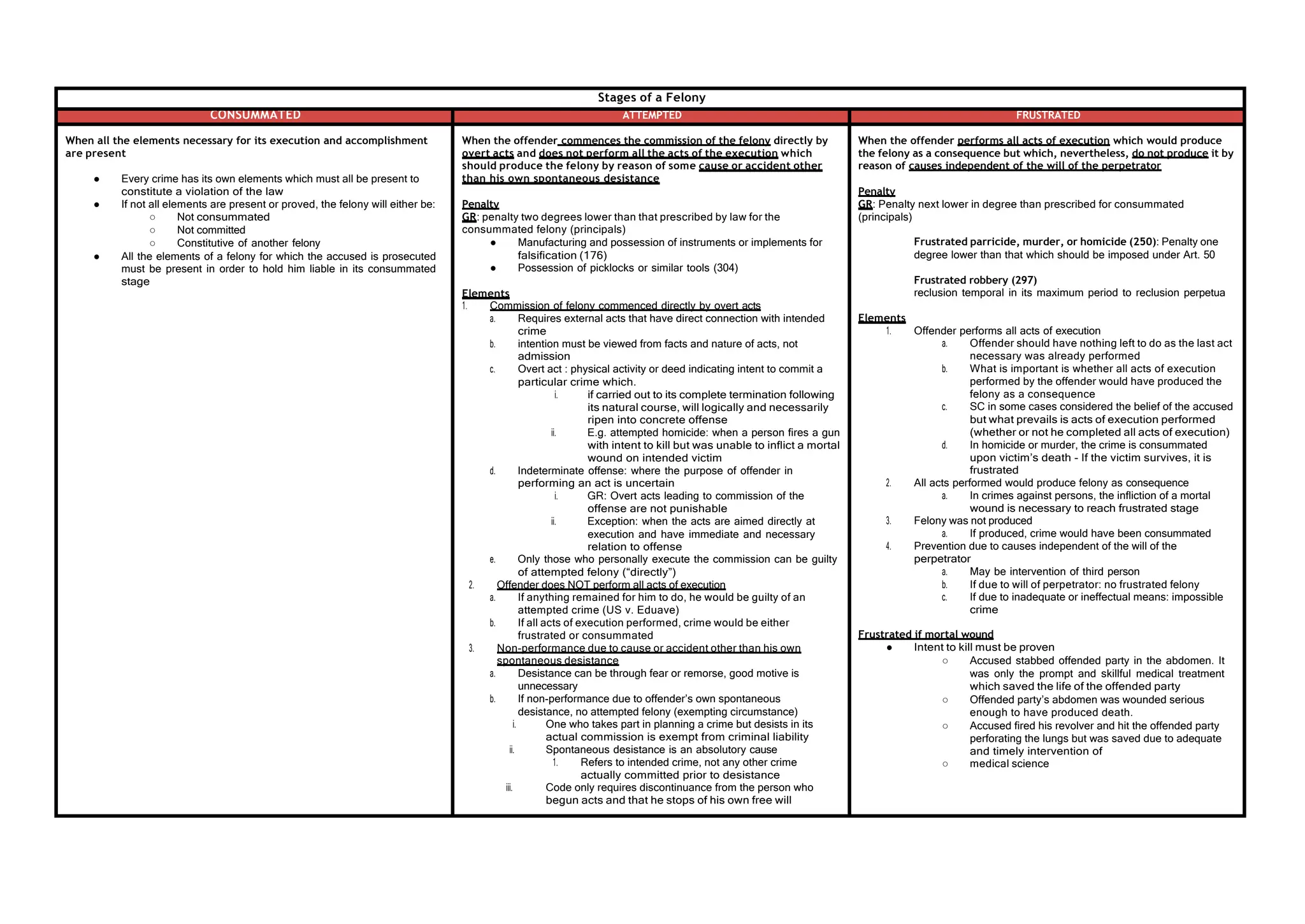
Stages of aFelony
CONSUMMATED ATTEMPTED FRUSTRATED
When all the elements necessary for its execution and accomplishment
are present
● Every crime has its own elements which must all be present to
constitute a violation of the law
● If not all elements are present or proved, the felony will either be:
○ Not consummated
○ Not committed
○ Constitutive of another felony
● All the elements of a felony for which the accused is prosecuted
must be present in order to hold him liable in its consummated
stage
When the offender commences the commission of the felony directly by
overt acts and does not perform all the acts of the execution which
should produce the felony by reason of some cause or accident other
than his own spontaneous desistance
Penalty
GR: penalty two degrees lower than that prescribed by law for the
consummated felony (principals)
● Manufacturing and possession of instruments or implements for
falsification (176)
● Possession of picklocks or similar tools (304)
Elements
1. Commission of felony commenced directly by overt acts
a. Requires external acts that have direct connection with intended
crime
b. intention must be viewed from facts and nature of acts, not
admission
c. Overt act : physical activity or deed indicating intent to commit a
particular crime which.
i. if carried out to its complete termination following
its natural course, will logically and necessarily
ripen into concrete offense
ii. E.g. attempted homicide: when a person fires a gun
with intent to kill but was unable to inflict a mortal
wound on intended victim
d. Indeterminate offense: where the purpose of offender in
performing an act is uncertain
i. GR: Overt acts leading to commission of the
offense are not punishable
ii. Exception: when the acts are aimed directly at
execution and have immediate and necessary
relation to offense
e. Only those who personally execute the commission can be guilty
of attempted felony (“directly”)
2. Offender does NOT perform all acts of execution
a. If anything remained for him to do, he would be guilty of an
attempted crime (US v. Eduave)
b. If all acts of execution performed, crime would be either
frustrated or consummated
3. Non-performance due to cause or accident other than his own
spontaneous desistance
a. Desistance can be through fear or remorse, good motive is
unnecessary
b. If non-performance due to offender’s own spontaneous
desistance, no attempted felony (exempting circumstance)
i. One who takes part in planning a crime but desists in its
actual commission is exempt from criminal liability
ii. Spontaneous desistance is an absolutory cause
1. Refers to intended crime, not any other crime
actually committed prior to desistance
iii. Code only requires discontinuance from the person who
begun acts and that he stops of his own free will
When the offender performs all acts of execution which would produce
the felony as a consequence but which, nevertheless, do not produce it by
reason of causes independent of the will of the perpetrator
Penalty
GR: Penalty next lower in degree than prescribed for consummated
(principals)
Frustrated parricide, murder, or homicide (250): Penalty one
degree lower than that which should be imposed under Art. 50
Frustrated robbery (297)
reclusion temporal in its maximum period to reclusion perpetua
Elements
1. Offender performs all acts of execution
a. Offender should have nothing left to do as the last act
necessary was already performed
b. What is important is whether all acts of execution
performed by the offender would have produced the
felony as a consequence
c. SC in some cases considered the belief of the accused
but what prevails is acts of execution performed
(whether or not he completed all acts of execution)
d. In homicide or murder, the crime is consummated
upon victim’s death - If the victim survives, it is
frustrated
2. All acts performed would produce felony as consequence
a. In crimes against persons, the infliction of a mortal
wound is necessary to reach frustrated stage
3. Felony was not produced
a. If produced, crime would have been consummated
4. Prevention due to causes independent of the will of the
perpetrator
a. May be intervention of third person
b. If due to will of perpetrator: no frustrated felony
c. If due to inadequate or ineffectual means: impossible
crime
Frustrated if mortal wound
● Intent to kill must be proven
○ Accused stabbed offended party in the abdomen. It
was only the prompt and skillful medical treatment
which saved the life of the offended party
○ Offended party’s abdomen was wounded serious
enough to have produced death.
○ Accused fired his revolver and hit the offended party
perforating the lungs but was saved due to adequate
and timely intervention of
○ medical science
2.
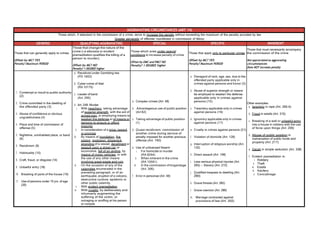
AGGRAVATING CIRCUMSTANCES (ART14)
Those which, if attendant in the commission of a crime, serve to increase the penalty without exceeding the maximum of the penalty provided by law
Greater perversity of offender manifested in commission of felony
GENERIC QUALIFYING AGGRAVATING SPECIAL SPECIFIC INHERENT
Those that can generally apply to crimes.
Offset by MC? YES
Penalty? Maximum PERIOD
Those that change the nature of the
crime (i.e alevosia or evident
premeditation qualifies the killing of a
person to murder);
Offset by MC? NO
Penalty? 1 DEGREE higher
Those which arise under special
conditions to increase penalty of crime
Offset by OMC and PMC? NO
Penalty? 1 DEGREE higher
Those that apply only to particular crimes
Offset by MC? YES
Penalty? Maximum PERIOD
Those that must necessarily accompany
the commission of the crime
Not appreciated as aggravating
circumstances
Does NOT increase penalty
1. Contempt or insult to public authority
(2)
2. Crime committed in the dwelling of
the offended party (3)
3. Abuse of confidence or obvious
ungratefulness (4)
4. Place and time of commission of
offense (5)
5. Nighttime, uninhabited place, or band
(6)
6. Recidivism (9)
7. Habituality (10)
8. Craft, fraud, or disguise (14)
9. Unlawful entry (18)
10. Breaking of parts of the house (19)
11. Use of persons under 15 yrs. of age
(20)
a. Recidivist under Gambling law
(PD 1602)
b. Cyber-crime of libel
(RA 10175)
c. Leader of band
(Art. 295)
d. Art. 248. Murder
i. With treachery, taking advantage
of superior strength, with the aid of
armed men, or employing means to
weaken the defense or of means or
persons to ensure or afford
impunity
ii. In consideration of a price, reward,
or promise
iii. By means of inundation, fire,
poison, explosion, shipwreck,
stranding of a vessel, derailment or
assault upon a street car or
locomotive, fall of an airship, by
means of motor vehicles, or with
the use of any other means
involving great waste and ruin.
iv. On the occasion of any of the
calamities enumerated in the
preceding paragraph, or of an
earthquake, eruption of a volcano,
destructive cyclone, epidemic or
other public calamity.
v. With evident premeditation.
vi. With cruelty, by deliberately and
inhumanly augmenting the
suffering of the victim, or
outraging or scoffing at his person
or corpse.
a. Complex crimes (Art. 48)
b. Advantageous use of public position
(Art 62)
c. Taking advantage of public position
(1)
d. Ǫuasi-recidivism: commission of
another crime during service of
penalty imposed for another previous
offense (Art. 160)
e. Use of unlicensed firearm
i. For homicide or murder
(RA 8294)
ii. When inherent in the crime
(RA 10591)
iii. In the commission of brigandage
(Art. 306)
f. Error in personae (Art. 49)
a. Disregard of rank, age, sex, due to the
offended party applicable only in
crimes against persons and honor (3)
b. Abuse of superior strength or means
be employed to weaken the defense
applicable only in crimes against
persons (15)
c. Treachery applicable only in crimes
against persons (16)
d. Ignominy applicable only in crimes
against persons (17)
e. Cruelty in crimes against persons (21)
f. Violation of domicile (Art. 128)
g. Interruption of religious worship (Art.
132)
h. Direct assault (Art. 148)
i. Less serious physical injuries (Art.
265) ○ Slavery (Art. 272)
j. Ǫualified trespass to dwelling (Art.
280)
k. Grave threats (Art. 282)
l. Grave coercion (Art. 286)
m. Marriage contracted against
provisions of law (Art. 350)
Other examples:
a. Ignominy in rape (Art. 266-A)
b. Fraud in estafa (Art. 315)
c. Breaking of a wall or unlawful entry
into a house in robbery with the use
of force upon things (Art. 299)
d. Abuse of public position in
malversation of public funds and
property (Art. 217)
e. Deceit in simple seduction (Art. 338)
f. Evident premediation in:
i. Robbery
ii. Theft
iii. Estafa
iv. Adultery
v. Concubinage
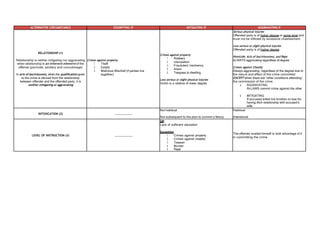
3.
ALTERNATIVE CIRCUMSTANCE EXEMPTINGIF MITIGATING IF AGGRAVATING IF
RELATIONSHIP (1)
Relationship is neither mitigating nor aggravating
when relationship is an inherent element of the
offense (parricide, adultery and concubinage)
In acts of lasciviouness, when the qualification given
to the crime is derived from the relationship
between offender and the offended party, it is
neither mitigating or aggravating
Crimes against property
1. Theft
2. Estafa
3. Malicious Mischief (if parties live
together)
Crimes against property
1. Robbery
2. Usurpation
3. Fraudulent Insolvency
4. Arson
5. Trespass to dwelling
Less serious or slight physical injuries
Victim is a relative of lower degree
Serious physical injuries
Offended party is of higher degree or same level and
must not be inflicted by excessive chastisement.
Less serious or slight physical injuries
Offended party is of higher degree
Homicide, Acts of lasciviousness, and Rape
ALWAYS aggravating regardless of degree
Crimes against Chastity
Always aggravating, regardless of the degree due to
the nature and effect of the crime committed
EXCEPT when there are “other conditions attending”
the commission of the crime
a. AGGRAVATING
IN-LAWS commit crime against the other
b. MITIGATING
If accused killed his brother-in-law for
having illicit relationship with accused’s
wife
INTOXICATION (2)
Not habitual
Not subsequent to the plan to commit a felony
Habitual
Intentional
LEVEL OF INSTRUCTION (3)
GR:
Lack of sufficient education
Exception
1. Crimes against property
2. Crimes against chastity
3. Treason
4. Murder
5. Rape
The offender availed himself or took advantage of it
in committing the crime
4.
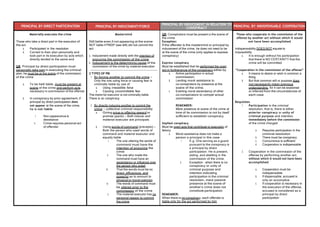
PRINCIPAL BY DIRECTPARTICIPATION PRINCIPAL BY INDUCEMENT/FORCE
PRINCIPAL BY INDUCEMENT IN RELATION TO
CONSPIRACY PRINCIPAL BY INDISPENSABLE COOPERATION
Materially executes the crime
Those who take a direct part in the execution of
the act
a. Participated in the resolution
b. Carried to their plan personally and
took part in its execution by acts which
directly tended to the same end
GR: Principal by direct participation must
personally take part in executing the criminal
plan; he must be at the scene of the commission
of the crime
a. To be held liable, must be present at
scene of the crime and perform acts
necessary in commission of the offense
b. In conspiracy by prior agreement, if
principal by direct participation does
not appear at the scene of the crime,
he is not liable
i. Non-appearance is
desistance
ii. Crime requires personal act
of offender
Mastermind
Still liable even if not appearing at the scene
NOT liable if PBDP (see left) did not commit the
act
a. Inducement made directly with the intention of
procuring the commission of the crime
b. Inducement is the determining cause of the
commission of the crime by material execution
2 TYPES OF PBI
1. By forcing another to commit the crime —
Only the one using force or causing fear is
criminally liable by use of:
a. Using irresistible force
b. Causing uncontrollable fear
The material executor is not criminally liable
There is no conspiracy
2. By directly inducing another to commit the
crime — collective criminal responsibility
a. Giving price or offering reward or
promise (pacto) — Both inducer and
material executor are principals
b. Using words of command (precepto) —
Both the person who used words of
command and material executor and
equally liable
i. The one uttering the words of
command must have the
intention of procuring the
crime
ii. The one who made the
command must have an
ascendancy or influence over
the person who acted
iii. That the words must be so
direct, efficacious, and
powerful as to amount to
physical or moral coercion
iv. The words of command must
be uttered prior to the
commission of the crime
v. The material executor has no
personal reason to commit
the crime
GR: Conspirators must be present a the scene of
the crime
Exception:
If the offender is the mastermind or principal by
inducement of the crime, he does not need to be
at the scene of the crime (only applies to express
conspiracy)
Express conspiracy
Must be established that he performed the overt
act in furtherance of the conspiracy either by
a. Active participation in actual
commission;
b. Lending moral assistance to
co-conspirators by presence at the
scene of the crime;
c. Exerting moral ascendancy of other
co-conspirators to compel actual
commission
REMEMBER:
Mere presence at scene of the crime at
time of its commission is not by itself
sufficient to establish conspiracy
Implied conspiracy
Must be overt acts that contribute to execution of
felony
a. Moral assistance does not make a
person a principal in this case
i. E.g. One serving as a guard
pursuant to the conspiracy is
a principal by direct
participation. He is present,
aiding, and abetting in the
commission of the crime.
ii. Exception : when there is no
conspiracy or unity of
criminal purpose and
intention indicating
participation in the criminal
resolution, mere passive
presence at the scene of
another’s crime does not
constitute participation
REMEMBER:
When there is no conspiracy, each offender is
liable only for the act performed by him
Those who cooperate in the commission of the
offense by another act without which it would
not have been accomplished
Indispensability DOES NOT equate to
impossibility
a. It is enough without his participation
that there is NO CERTAINTY that the
crime will be committed
“Cooperation in the commission of the offense”
a. It means to desire or wish in common a
thing
b. But that common will or purpose does
not necessarily mean previous
understanding, for it can be explained
or inferred from the circumstances of
each case
Requisites
1. Participation in the criminal
resolution, that is, there is either
anterior conspiracy or unity of
criminal purpose and intention
immediately before the commission
of the crime charged
a. Requires participation in the
criminal resolution
b. There must be conspiracy
c. Concurrence is sufficient
d. Cooperation is indispensable
2. Cooperation in the commission of the
offense by performing another act,
without which it would not have been
accomplished:
a. Cooperation must be
indispensable
b. If dispensable, accused is
only an accomplice
c. If cooperation is necessary in
the execution of the offense,
accused is considered as a
principal by direct
participation
5.
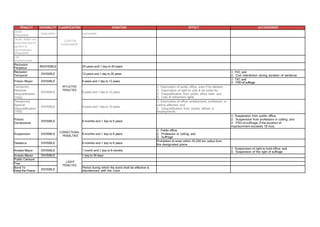
PENALTY DIVISIBILITY CLASSIFICATIONDURATION EFFECT ACCESSORIES
Death
(Repealed) Indivisible
CAPITAL
PUNISHMENT
Indivisible
Death, when not
executed due to
pardon or
commutation
(Repealed)
Life
Imprisonment
Reclusion
Perpetua INDIVISIBLE
AFFLICTIVE
PENALTIES
20 years and 1 day to 40 years
Reclusion
Temporal DIVISIBLE 12 years and 1 day to 20 years
(1) PAD; and
(2) Civil interdiction during duration of sentence
Prision Mayor DIVISIBLE 6 years and 1 day to 12 years
(1) TAD; and
(2) PSD of suffrage
Temporary
Absolute
Disqualification
(TAD)
DIVISIBLE 6 years and 1 day to 12 years
(1) Deprivation of public office, even if by election;
(2) Deprivation of right to vote & be voted for;
(3) Disqualification from public office held; and
(4) Loss of retirement rights
Temporary
Special
Disqualification
(TSD)
DIVISIBLE 6 years and 1 day to 12 years
(1) Deprivation of office, employment, profession, or
calling affected; and
(2) Disqualification from similar offices or
employments
Prision
Correccional
DIVISIBLE
CORRECTIONAL
PENALTIES
6 months and 1 day to 6 years
(1) Suspension from public office;
(2) Suspension from profession or calling; and
(3) PSD of suffrage, if the duration of
imprisonment exceeds 18 mos.
Suspension DIVISIBLE 6 months and 1 day to 6 years
(1) Public office;
(2) Profession or calling; and
(3) Suffrage
Destierro DIVISIBLE 6 months and 1 day to 6 years
Prohibition to enter within 25-250 km radius from
the designated place
Arresto Mayor DIVISIBLE 1 month and 1 day to 6 months
(1) Suspension of right to hold office; and
(2) Suspension of the right of suffrage
Arresto Menor DIVISIBLE
LIGHT
PENALTIES
1 day to 30 days
Public Censure
Fine
Bond To
Keep the Peace DIVISIBLE
Period during which the bond shall be effective is
discretionary with the Court
6.
Accessory penalty EffectsApplicable to
Perpetual or temporary absolute disqualification
Deprivation of public office, even if by election
Perpetual:
Reclusion perpetua
Reclusion temporal
Temporary:
Prision mayor
Deprivation of public office, even if by election
Disqualification from public office held
Loss of retirement rights
Perpetual or temporary special disqualification
Deprivation of office, employment, profession, or calling
affected Perpetual:
Prision mayor
Prision correccional (if duration of imprisonment exceeds
18 months)
Disqualification from similar offices or employments
Deprivation of right to vote and be voted for
Suspension
Public office
Prision correccional
Arresto mayor
Arresto menor
Profession or calling Prision correccional
Suffrage
Arresto mayor
Arresto menor
Civil interdiction
Deprivation of the rights of parental authority or
guardianship of any ward
Reclusion perpetua
Reclusion temporal
Deprivation of marital authority
Deprivation of the right to manage property and right to
dispose of such
Indemnification Indemnification of consequential damages
ART 100
Every person criminally liable for a felony is also civilly
liable Includes those under exempting circumstances
EXCEPT if by
accident [12(4)]
insuperable cause [12(7)]
justifying circumstance of state of necessity [11(4)]
only to those benefited
Forfeiture or confiscation of instruments and proceeds of
the offense
Proceeds and instruments or tools of the crime are
confiscated and forfeited in favor of the Government Every penalty imposed for the commission of a felony
carries with it forfeiture of the proceeds of the crime and
7.
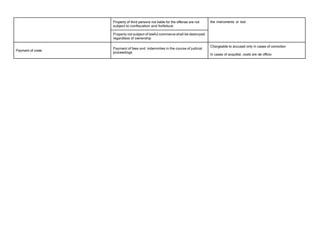
Property of thirdpersons not liable for the offense are not
subject to confiscation and forfeiture
the instruments or tool
Property not subject of lawful commerce shall be destroyed
regardless of ownership
Payment of costs
Payment of fees and indemnities in the course of judicial
proceedings
Chargeable to accused only in cases of conviction
In cases of acquittal, costs are de officio
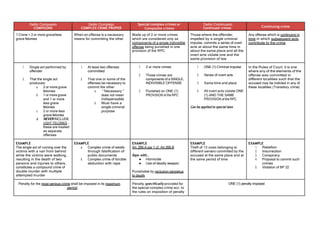
8.
Delito Compuesto
COMPOUND
Delito Complejo
COMPLEXCRIME PROPER
Special complex crimes or
Composite crimes
Delito Continuado
Continued crimes Continuing crime
1 Crime = 2 or more grave/less
grave felonies
When an offense is a necessary
means for committing the other
Made up of 2 or more crimes
which are considered only as
components of a single indivisible
offense being punished in one
provision of the RPC
Those where the offender,
impelled by a single criminal
impulse, commits a series of overt
acts at about the same time in
about the same place and all the
overt acts violate one and the
same provision of law
Any offense which is continuing in
time in which subsequent acts
contribute to the crime
1. Single act performed by
offender
2. That the single act
produces:
a. 2 or more grave
felonies
b. 1 or more grave
and 1 or more
less grave
felonies
c. 2 or more less
grave felonies
d. NEVER INCLUDE
LIGHT FELONIES -
these are treated
as separate
offenses
1. At least two offenses
committed
2. That one or some of the
offenses be necessary to
commit the other
a. “ Necessary ”
does not mean
indispensable
b. Must have a
single criminal
purpose
1. 2 or more crimes
2. Those crimes are
components of a SINGLE,
INDIVISIBLE OFFENSE
3. Punished on ONE (1)
PROVISION of the RPC
1. ONE (1) Criminal impulse
2. Series of overt acts
3. Same time and place
4. All overt acts violate ONE
(1) AND THE SAME
PROVISION of the RPC
Can be applied to special laws
In the Rules of Court, it is one
where any of the elements of the
offense was committed in
different localities such that the
accused may be indicted in any of
these localities (Transitory crime)
EXAMPLE
The single act of running over the
victims with a van from behind
while the victims were walking,
resulting in the death of two
persons and injuries to others,
constitutes a compound crime of
double murder with multiple
attempted murder
EXAMPLE
a. Complex crime of estafa
through falsification of
public documents
b. Complex crime of forcible
abduction with rape
EXAMPLE
Art. 266-A par 1 cf. Art 266-B
Rape with…
● Homicide
● Use of deadly weapon
Punishable by reclusion perpetua
to death
EXAMPLE
Theft of 13 cows belonging to
different owners committed by the
accused at the same place and at
the same period of time
EXAMPLE
1. Rebellion
2. Insurrection
3. Conspiracy
4. Proposal to commit such
crimes
5. Violation of BP 22
Penalty for the most serious crime shall be imposed in its maximum
period
Penalty specifically provided for
the special complex crime acc. to
the rules on imposition of penalty
ONE (1) penalty imposed
9.
ART 27
DURATION OFPENALTIES
ART 70
SUCCESSIVE/SIMULTANEOUS SERVICE OF SENTENCE
ART 71
GRADUATED SCALES
Reclusion Perpetua
40 years
20 years & 1 day
1. Death
2. Reclusion Perpetua
3. Reclusion Temporal
4. Prision Mayor
5. Prision Correccional
6. Arresto Mayor
7. Arresto Menor
8. Destierro
9. Perpetual Absolute Disqualification (PAD)
10. Temporary Absolute Disqualification (TAD)
11. Suspension
12. Public Censure
1. Death [INDIV]
2. Reclusion Perpetua [INDIV]
3. Prision Mayor [DIV]
4. Prision Coreccional [DIV]
5. Arresto Mayor [DIV]
6. Destierro [DIV]
7. Arresto Menor [DIV]
8. Public Censure [DIV]
9. Fine [INDIV]
Reclusion Temporal
20 years
12 years & 1 day
Prision Mayor
12 years
6 years & 1 day
Prision Correccional
6 years
6 months & 1 day
Suspension
Destierro
Arresto Mayor
6 months
1 month & 1 day
Arresto Menor
30 days
1 day
Bond to keep the
Peace
Up to the Court’s
Discretion
REMEMBER
1. DISQUALIFICATION as an accessory
penalty follows the PRINCIPAL
PENALTY
2. SUSPENSION as an accessory
follows the PRINCIPAL PENALTY
3. DESTIERRO - person penalized
shall not be permitted to enter the
place designated in sentence
[ 25km ≤ place ≤ 250km ]
a. Death or physical injuries
under exceptional
circumstances
b. Failure to give bond for
good behavior
c. Concubinage
d. In reducing the penalty
by 1 or more degrees
REMEMBER
1. Maximum duration must NOT EXCEED 40 YEARS
[3-FOLD RULE]
REMEMBER
1. Divisible = Minimum, Medium, Maximum
2. Must be written in the sentence/dispositive portion
3. Must be written in their proper period
10.
Quasi-recidivism
[Art. 160]
Recidivism
[Art. 14(9)]
Reitaractionor Habituality
[Art. 14(10)]
Multi-recidivism or
Habitual delinquency
[Art. 62(5)]
Kind
Special, cannot be offset by an ordinary
MC
Increases the penalty to maximum
period
Generic, can be offset by ordinary MC
If not offset, increases the penalty to
maximum period
Generic, can be offset by ordinary MC
If not offset, increases the penalty to
maximum period
Special, cannot be offset by an ordinary
MC
Additional penalty will be imposed upon
third conviction, fourth, and so on
(unique)
Definition
When the offender has been previously
convicted by final judgement and
before serving sentence, or while
serving the same, he committed a
felony
When a person on separate occasions,
is convicted of 2 offenses embraced in
the same Title in the RPC
Where the offender has been previously
punished for an offense to which the
law attaches an equal or greater penalty
or for two crimes to which it attaches a
lighter penalty
Where a person within a period of 10
years from the date of his release or last
conviction of the crimes of serious or
less serious physical injuries, robbery,
theft, estafa, or falsification, is found
guilty of the said crimes a third time or
oftener
Rationale Inclination to commit crime Inclination to commit crime Resistance to rehabilitation Inclination to commit crime
1st offense Felony Felony
Offense attached to equal or greater
penalty OR Two or more crimes attached
to a lighter penalty
Robbery, theft, less serious PI, serious
PI, falsification, estafa
2nd offense Felony Felony embraced in same Title
Need not be a felony nor under same
Title
Robbery, theft, less serious PI, serious
PI, falsification, estafa (Third or oftener
offense must also be among the
enumerated)
Prescription
None (no time limit given by law
between the 1st and 2nd convictions)
None (no time limit given by law
between the 1st and 2nd convictions)
None (no time limit given by law
between the 1st and 2nd convictions)
10 years between the last conviction or
release to the present conviction
11.
MITIGATING
CIRCUMSTANCES
ORDINARY MITIGATING CIRCUMSTANCEPRIVILEGED MITIGATING CIRCUMSTANCE
May be offset by generic aggravating circumstance Penalty reduced by 1 or 2 degrees
If not offset, penalty imposed at its minimum period if divisible CANNOT BE OFFSET
Not considered when penalty prescribed is SINGLE and INDIVISIBLE Always considered whether the penalty imposable is divisible or indivisible
1. Over 15 and under 18 years old acting with discernment, or over 70 years
old [Art. 13(2)]
2. Praeter Intentionem: no intention to commit so grave a wrong as that
committed [Art. 13(3)]
3. Sufficient provocation or threat on the part of the offended party [Art.
13(4)]
4. Vindication of Grave Offenses [Art. 13(5)]
5. Passion or obfuscation [Art. 13(6)]
6. Voluntary surrender and voluntary confession of guilt [Art. 13(7)]
7. Physical defect of offender [Art. 13(8)]
8. Illness of the offender [Art. 13(9)]
9. Similar or analogous circumstances [Art. 13(10)]
1. Incomplete justifying or exempting circumstances [Art. 13(1)]
If 2 requisites are present, it is a PMC under Art. 69
2. Above 15 and below 18 with discernment [Art. 68 (minor under 18)]
3. Penalty lower by 1 or 2 degrees when deed is not wholly excusable and
that the majority of such conditions be present [Art. 69]
4. Penalties which contain three periods
2 or more mitigating + no aggravating = next lower than prescribed
by law [Art. 64]
(ex. Voluntary surrender and voluntary confession of guilt with no
accompanying AC)
AGGRAVATING
CIRCUMSTANCES
GENERIC SPECIFIC QUALIFYING AGGRAVATING SPECIAL
Offset by Mitigating Circumstance CANNOT BY OFFSET BY ANY MC CANNOT BE OFFSET BY OMC
MAXIMUM PERIOD penalty 1 DEGREE HIGHER
1. Contempt or insult to public authority (2)
2. Crime committed in the dwelling of the
offended party (3)
3. Abuse of confidence or obvious
ungratefulness (4)
4. Place and time of commission of offense
(5)
5. Nighttime, uninhabited place, or band
(6)
6. Recidivism (9)
7. Habituality (10) C
8. Craft, fraud, or disguise (14)
9. Unlawful entry (18)
10. Breaking of parts of the house (19)
11. Use of persons under 15 yrs. of age (20)
a. Disregard of rank, age, sex in crimes
against persons and honor (3)
b. Abuse of superior strength or means be
employed to weaken the defense in
crimes against persons (15)
c. Treachery applicable only in crimes
against persons (16)
d. Ignominy applicable only in crimes
against persons (17)
e. Cruelty in crimes against persons (21)
f. Violation of domicile (Art. 128)
g. Interruption of religious worship (Art. 132)
h. Direct assault (Art. 148)
i. Less serious physical injuries (Art. 265)
j. Slavery (Art. 272)
k. Ǫualified trespass to dwelling (Art. 280)
l. Grave threats (Art. 282)
m. Grave coercion (Art. 286)
n. Marriage contracted against law(Art. 350)
a. Recidivist under Gambling law
(PD 1602)
b. Cyber-crime of libel
(RA 10175)
c. Leader of band
(Art. 295)
d. Art. 248. Murder
Treachery Calamity
Superior Strength Evident premeditation
Means to weaken Cruelty
defense
Ignominy
Indunation
Price/reward/promise
Means of motor
vehicle
a. Complex crimes (Art. 48)
b. Advantageous use of public position (Art
62)
c. Taking advantage of public position (1)
d. Ǫuasi-recidivism: commission of another
crime during service of penalty imposed
for another previous offense (Art. 160)
e. Use of unlicensed firearm
i. For homicide or murder
(RA 8294)
ii. When inherent in the crime
(RA 10591)
iii. In the commission of brigandage
(Art. 306)
f. Error in personae (Art. 49)
12.
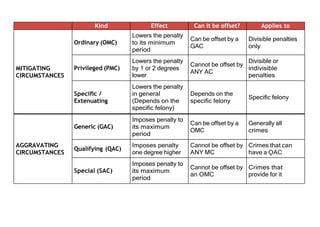
Kind Effect Canit be offset? Applies to
MITIGATING
CIRCUMSTANCES
Ordinary (OMC)
Lowers the penalty
to its minimum
period
Can be offset by a
GAC
Divisible penalties
only
Privileged (PMC)
Lowers the penalty
by 1 or 2 degrees
lower
Cannot be offset by
ANY AC
Divisible or
indivisible
penalties
Specific /
Extenuating
Lowers the penalty
in general
(Depends on the
specific felony)
Depends on the
specific felony
Specific felony
AGGRAVATING
CIRCUMSTANCES
Generic (GAC)
Imposes penalty to
its maximum
period
Can be offset by a
OMC
Generally all
crimes
Qualifying (QAC)
Imposes penalty
one degree higher
Cannot be offset by
ANY MC
Crimes that can
have a ǪAC
Special (SAC)
Imposes penalty to
its maximum
period
Cannot be offset by
an OMC
Crimes that
provide for it

![Accessory penalty Effects Applicable to
Perpetual or temporary absolute disqualification
Deprivation of public office, even if by election
Perpetual:
Reclusion perpetua
Reclusion temporal
Temporary:
Prision mayor
Deprivation of public office, even if by election
Disqualification from public office held
Loss of retirement rights
Perpetual or temporary special disqualification
Deprivation of office, employment, profession, or calling
affected Perpetual:
Prision mayor
Prision correccional (if duration of imprisonment exceeds
18 months)
Disqualification from similar offices or employments
Deprivation of right to vote and be voted for
Suspension
Public office
Prision correccional
Arresto mayor
Arresto menor
Profession or calling Prision correccional
Suffrage
Arresto mayor
Arresto menor
Civil interdiction
Deprivation of the rights of parental authority or
guardianship of any ward
Reclusion perpetua
Reclusion temporal
Deprivation of marital authority
Deprivation of the right to manage property and right to
dispose of such
Indemnification Indemnification of consequential damages
ART 100
Every person criminally liable for a felony is also civilly
liable Includes those under exempting circumstances
EXCEPT if by
accident [12(4)]
insuperable cause [12(7)]
justifying circumstance of state of necessity [11(4)]
only to those benefited
Forfeiture or confiscation of instruments and proceeds of
the offense
Proceeds and instruments or tools of the crime are
confiscated and forfeited in favor of the Government Every penalty imposed for the commission of a felony
carries with it forfeiture of the proceeds of the crime and](https://image.slidesharecdn.com/crim-i-tables-250903040336-9ac4c4b9/85/Criminal-Law-1-Revised-Penal-Code-Article-11-24-6-320.jpg)
![ART 27
DURATION OF PENALTIES
ART 70
SUCCESSIVE/SIMULTANEOUS SERVICE OF SENTENCE
ART 71
GRADUATED SCALES
Reclusion Perpetua
40 years
20 years & 1 day
1. Death
2. Reclusion Perpetua
3. Reclusion Temporal
4. Prision Mayor
5. Prision Correccional
6. Arresto Mayor
7. Arresto Menor
8. Destierro
9. Perpetual Absolute Disqualification (PAD)
10. Temporary Absolute Disqualification (TAD)
11. Suspension
12. Public Censure
1. Death [INDIV]
2. Reclusion Perpetua [INDIV]
3. Prision Mayor [DIV]
4. Prision Coreccional [DIV]
5. Arresto Mayor [DIV]
6. Destierro [DIV]
7. Arresto Menor [DIV]
8. Public Censure [DIV]
9. Fine [INDIV]
Reclusion Temporal
20 years
12 years & 1 day
Prision Mayor
12 years
6 years & 1 day
Prision Correccional
6 years
6 months & 1 day
Suspension
Destierro
Arresto Mayor
6 months
1 month & 1 day
Arresto Menor
30 days
1 day
Bond to keep the
Peace
Up to the Court’s
Discretion
REMEMBER
1. DISQUALIFICATION as an accessory
penalty follows the PRINCIPAL
PENALTY
2. SUSPENSION as an accessory
follows the PRINCIPAL PENALTY
3. DESTIERRO - person penalized
shall not be permitted to enter the
place designated in sentence
[ 25km ≤ place ≤ 250km ]
a. Death or physical injuries
under exceptional
circumstances
b. Failure to give bond for
good behavior
c. Concubinage
d. In reducing the penalty
by 1 or more degrees
REMEMBER
1. Maximum duration must NOT EXCEED 40 YEARS
[3-FOLD RULE]
REMEMBER
1. Divisible = Minimum, Medium, Maximum
2. Must be written in the sentence/dispositive portion
3. Must be written in their proper period](https://image.slidesharecdn.com/crim-i-tables-250903040336-9ac4c4b9/85/Criminal-Law-1-Revised-Penal-Code-Article-11-24-9-320.jpg)
![Quasi-recidivism
[Art. 160]
Recidivism
[Art. 14(9)]
Reitaraction or Habituality
[Art. 14(10)]
Multi-recidivism or
Habitual delinquency
[Art. 62(5)]
Kind
Special, cannot be offset by an ordinary
MC
Increases the penalty to maximum
period
Generic, can be offset by ordinary MC
If not offset, increases the penalty to
maximum period
Generic, can be offset by ordinary MC
If not offset, increases the penalty to
maximum period
Special, cannot be offset by an ordinary
MC
Additional penalty will be imposed upon
third conviction, fourth, and so on
(unique)
Definition
When the offender has been previously
convicted by final judgement and
before serving sentence, or while
serving the same, he committed a
felony
When a person on separate occasions,
is convicted of 2 offenses embraced in
the same Title in the RPC
Where the offender has been previously
punished for an offense to which the
law attaches an equal or greater penalty
or for two crimes to which it attaches a
lighter penalty
Where a person within a period of 10
years from the date of his release or last
conviction of the crimes of serious or
less serious physical injuries, robbery,
theft, estafa, or falsification, is found
guilty of the said crimes a third time or
oftener
Rationale Inclination to commit crime Inclination to commit crime Resistance to rehabilitation Inclination to commit crime
1st offense Felony Felony
Offense attached to equal or greater
penalty OR Two or more crimes attached
to a lighter penalty
Robbery, theft, less serious PI, serious
PI, falsification, estafa
2nd offense Felony Felony embraced in same Title
Need not be a felony nor under same
Title
Robbery, theft, less serious PI, serious
PI, falsification, estafa (Third or oftener
offense must also be among the
enumerated)
Prescription
None (no time limit given by law
between the 1st and 2nd convictions)
None (no time limit given by law
between the 1st and 2nd convictions)
None (no time limit given by law
between the 1st and 2nd convictions)
10 years between the last conviction or
release to the present conviction](https://image.slidesharecdn.com/crim-i-tables-250903040336-9ac4c4b9/85/Criminal-Law-1-Revised-Penal-Code-Article-11-24-10-320.jpg)
![MITIGATING
CIRCUMSTANCES
ORDINARY MITIGATING CIRCUMSTANCE PRIVILEGED MITIGATING CIRCUMSTANCE
May be offset by generic aggravating circumstance Penalty reduced by 1 or 2 degrees
If not offset, penalty imposed at its minimum period if divisible CANNOT BE OFFSET
Not considered when penalty prescribed is SINGLE and INDIVISIBLE Always considered whether the penalty imposable is divisible or indivisible
1. Over 15 and under 18 years old acting with discernment, or over 70 years
old [Art. 13(2)]
2. Praeter Intentionem: no intention to commit so grave a wrong as that
committed [Art. 13(3)]
3. Sufficient provocation or threat on the part of the offended party [Art.
13(4)]
4. Vindication of Grave Offenses [Art. 13(5)]
5. Passion or obfuscation [Art. 13(6)]
6. Voluntary surrender and voluntary confession of guilt [Art. 13(7)]
7. Physical defect of offender [Art. 13(8)]
8. Illness of the offender [Art. 13(9)]
9. Similar or analogous circumstances [Art. 13(10)]
1. Incomplete justifying or exempting circumstances [Art. 13(1)]
If 2 requisites are present, it is a PMC under Art. 69
2. Above 15 and below 18 with discernment [Art. 68 (minor under 18)]
3. Penalty lower by 1 or 2 degrees when deed is not wholly excusable and
that the majority of such conditions be present [Art. 69]
4. Penalties which contain three periods
2 or more mitigating + no aggravating = next lower than prescribed
by law [Art. 64]
(ex. Voluntary surrender and voluntary confession of guilt with no
accompanying AC)
AGGRAVATING
CIRCUMSTANCES
GENERIC SPECIFIC QUALIFYING AGGRAVATING SPECIAL
Offset by Mitigating Circumstance CANNOT BY OFFSET BY ANY MC CANNOT BE OFFSET BY OMC
MAXIMUM PERIOD penalty 1 DEGREE HIGHER
1. Contempt or insult to public authority (2)
2. Crime committed in the dwelling of the
offended party (3)
3. Abuse of confidence or obvious
ungratefulness (4)
4. Place and time of commission of offense
(5)
5. Nighttime, uninhabited place, or band
(6)
6. Recidivism (9)
7. Habituality (10) C
8. Craft, fraud, or disguise (14)
9. Unlawful entry (18)
10. Breaking of parts of the house (19)
11. Use of persons under 15 yrs. of age (20)
a. Disregard of rank, age, sex in crimes
against persons and honor (3)
b. Abuse of superior strength or means be
employed to weaken the defense in
crimes against persons (15)
c. Treachery applicable only in crimes
against persons (16)
d. Ignominy applicable only in crimes
against persons (17)
e. Cruelty in crimes against persons (21)
f. Violation of domicile (Art. 128)
g. Interruption of religious worship (Art. 132)
h. Direct assault (Art. 148)
i. Less serious physical injuries (Art. 265)
j. Slavery (Art. 272)
k. Ǫualified trespass to dwelling (Art. 280)
l. Grave threats (Art. 282)
m. Grave coercion (Art. 286)
n. Marriage contracted against law(Art. 350)
a. Recidivist under Gambling law
(PD 1602)
b. Cyber-crime of libel
(RA 10175)
c. Leader of band
(Art. 295)
d. Art. 248. Murder
Treachery Calamity
Superior Strength Evident premeditation
Means to weaken Cruelty
defense
Ignominy
Indunation
Price/reward/promise
Means of motor
vehicle
a. Complex crimes (Art. 48)
b. Advantageous use of public position (Art
62)
c. Taking advantage of public position (1)
d. Ǫuasi-recidivism: commission of another
crime during service of penalty imposed
for another previous offense (Art. 160)
e. Use of unlicensed firearm
i. For homicide or murder
(RA 8294)
ii. When inherent in the crime
(RA 10591)
iii. In the commission of brigandage
(Art. 306)
f. Error in personae (Art. 49)](https://image.slidesharecdn.com/crim-i-tables-250903040336-9ac4c4b9/85/Criminal-Law-1-Revised-Penal-Code-Article-11-24-11-320.jpg)