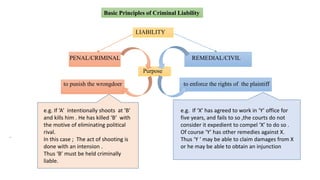
Basic Principles of Criminal Liability
LIABILITY
PENAL/CRIMINAL REMEDIAL/CIVIL
Purpose
to punish the wrongdoer to enforce the rights of the plaintiff
.
e.g. If ‘X’ has agreed to work in ‘Y’ office for
five years, and fails to so ,the courts do not
consider it expedient to compel ‘X’ to do so .
Of course ‘Y’ has other remedies against X.
Thus ‘Y ‘ may be able to claim damages from X
or he may be able to obtain an injunction
e.g. If ‘A’ intentionally shoots at ‘B’
and kills him . He has killed ‘B’ with
the motive of eliminating political
rival.
In this case ; The act of shooting is
done with an intension .
Thus ‘B’ must be held criminally
liable.
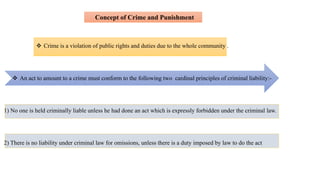
 Crime is a violation of public rights and duties due to the whole community .
1) No one is held criminally liable unless he had done an act which is expressly forbidden under the criminal law.
2) There is no liability under criminal law for omissions, unless there is a duty imposed by law to do the act
 An act to amount to a crime must conform to the following two cardinal principles of criminal liability:-
Concept of Crime and Punishment
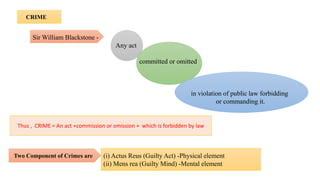
Sir William Blackstone -
Any act
committed or omitted
in violation of public law forbidding
or commanding it.
Two Component of Crimes are (i) Actus Reus (Guilty Act) -Physical element
(ii) Mens rea (Guilty Mind) -Mental element
CRIME
Thus , CRIME = An act +commission or omission + which is forbidden by law
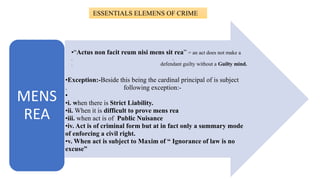
ESSENTIALS ELEMENS OF CRIME
•“Actus non facit reum nisi mens sit rea” = an act does not make a
. .
. defendant guilty without a Guilty mind.
•Exception:-Beside this being the cardinal principal of is subject
. following exception:-
•
•i. when there is Strict Liability.
•ii. When it is difficult to prove mens rea
•iii. when act is of Public Nuisance
•iv. Act is of criminal form but at in fact only a summary mode
of enforcing a civil right.
•v. When act is subject to Maxim of “ Ignorance of law is no
excuse”
MENS
REA
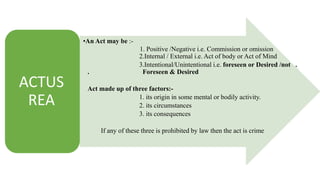
ACTUS
REA
•An Act may be :-
1. Positive /Negative i.e. Commission or omission
2.Internal / External i.e. Act of body or Act of Mind
3.Intentional/Unintentional i.e. foreseen or Desired /not .
. Foreseen & Desired
Act made up of three factors:-
1. its origin in some mental or bodily activity.
2. its circumstances
3. its consequences
If any of these three is prohibited by law then the act is crime
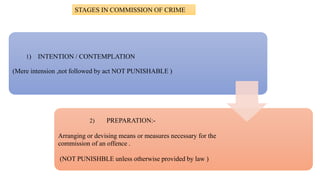
STAGES IN COMMISSION OF CRIME
1) INTENTION / CONTEMPLATION
(Mere intension ,not followed by act NOT PUNISHABLE )
2) PREPARATION:-
Arranging or devising means or measures necessary for the
commission of an offence .
(NOT PUNISHBLE unless otherwise provided by law )
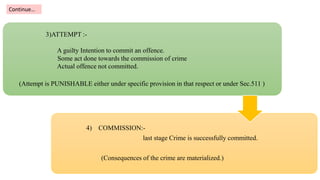
3)ATTEMPT :-
A guilty Intention to commit an offence.
Some act done towards the commission of crime
Actual offence not committed.
(Attempt is PUNISHABLE either under specific provision in that respect or under Sec.511 )
4) COMMISSION:-
last stage Crime is successfully committed.
(Consequences of the crime are materialized.)
Continue…
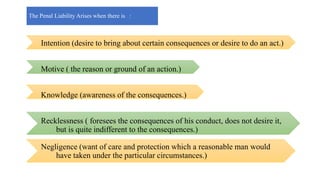
Intention (desire to bring about certain consequences or desire to do an act.)
Motive ( the reason or ground of an action.)
Knowledge (awareness of the consequences.)
Recklessness ( foresees the consequences of his conduct, does not desire it,
but is quite indifferent to the consequences.)
Negligence (want of care and protection which a reasonable man would
have taken under the particular circumstances.)
The Penal Liability Arises when there is :
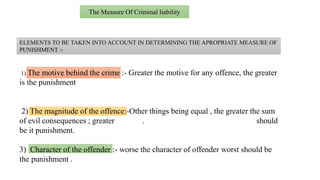
The Measure Of Criminal liability
ELEMENTS TO BE TAKEN INTO ACCOUNT IN DETERMINING THE APROPRIATE MEASURE OF
PUNISHMENT :-
1) The motive behind the crime :- Greater the motive for any offence, the greater
is the punishment
2) The magnitude of the offence:-Other things being equal , the greater the sum
of evil consequences ; greater . should
be it punishment.
3) Character of the offender :- worse the character of offender worst should be
the punishment .
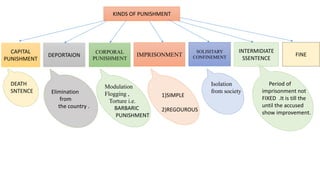
KINDS OF PUNISHMENT
INTERMIDIATE
SSENTENCE
SOLISITARY
CONFINEMENT FINEDEPORTAION
CAPITAL
PUNISHMENT
CORPORAL
PUNISHMENT
IMPRISONMENT
Period of
imprisonment not
FIXED .It is till the
until the accused
show improvement.
Isolation
from society
1)SIMPLE
2)REGOUROUS
Modulation
Flogging ,
Torture i.e.
BARBARIC
PUNISHMENT
Elimination
from
the country .
DEATH
SNTENCE
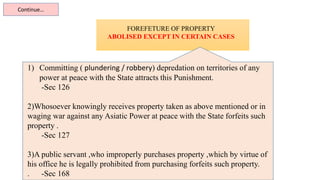
FOREFETURE OF PROPERTY
ABOLISED EXCEPT IN CERTAIN CASES
Continue…
1) Committing ( plundering / robbery) depredation on territories of any
power at peace with the State attracts this Punishment.
-Sec 126
2)Whosoever knowingly receives property taken as above mentioned or in
waging war against any Asiatic Power at peace with the State forfeits such
property .
-Sec 127
3)A public servant ,who improperly purchases property ,which by virtue of
his office he is legally prohibited from purchasing forfeits such property.
. -Sec 168
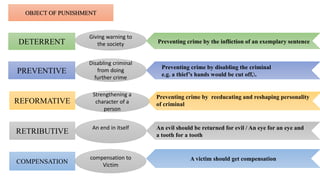
OBJECT OF PUNISHMENT
DETERRENT
PREVENTIVE
REFORMATIVE
RETRIBUTIVE
COMPENSATION
Preventing crime by the infliction of an exemplary sentence
Giving warning to
the society
Disabling criminal
from doing
further crime
Preventing crime by disabling the criminal
e.g. a thief’s hands would be cut off,.
Strengthening a
character of a
person
Preventing crime by reeducating and reshaping personality
of criminal
compensation to
Victim
An end in itself An evil should be returned for evil / An eye for an eye and
a tooth for a tooth
A victim should get compensation
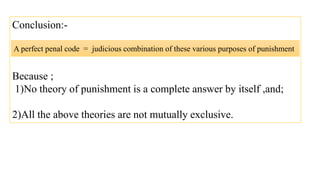
Conclusion:-
Because ;
1)No theory of punishment is a complete answer by itself ,and;
2)All the above theories are not mutually exclusive.
A perfect penal code = judicious combination of these various purposes of punishment

Crimes and punishment

  • 2.
    Basic Principles ofCriminal Liability LIABILITY PENAL/CRIMINAL REMEDIAL/CIVIL Purpose to punish the wrongdoer to enforce the rights of the plaintiff . e.g. If ‘X’ has agreed to work in ‘Y’ office for five years, and fails to so ,the courts do not consider it expedient to compel ‘X’ to do so . Of course ‘Y’ has other remedies against X. Thus ‘Y ‘ may be able to claim damages from X or he may be able to obtain an injunction e.g. If ‘A’ intentionally shoots at ‘B’ and kills him . He has killed ‘B’ with the motive of eliminating political rival. In this case ; The act of shooting is done with an intension . Thus ‘B’ must be held criminally liable.
  • 3.
     Crime isa violation of public rights and duties due to the whole community . 1) No one is held criminally liable unless he had done an act which is expressly forbidden under the criminal law. 2) There is no liability under criminal law for omissions, unless there is a duty imposed by law to do the act  An act to amount to a crime must conform to the following two cardinal principles of criminal liability:- Concept of Crime and Punishment
  • 4.
    Sir William Blackstone- Any act committed or omitted in violation of public law forbidding or commanding it. Two Component of Crimes are (i) Actus Reus (Guilty Act) -Physical element (ii) Mens rea (Guilty Mind) -Mental element CRIME Thus , CRIME = An act +commission or omission + which is forbidden by law
  • 5.
    ESSENTIALS ELEMENS OFCRIME •“Actus non facit reum nisi mens sit rea” = an act does not make a . . . defendant guilty without a Guilty mind. •Exception:-Beside this being the cardinal principal of is subject . following exception:- • •i. when there is Strict Liability. •ii. When it is difficult to prove mens rea •iii. when act is of Public Nuisance •iv. Act is of criminal form but at in fact only a summary mode of enforcing a civil right. •v. When act is subject to Maxim of “ Ignorance of law is no excuse” MENS REA
  • 6.
    ACTUS REA •An Act maybe :- 1. Positive /Negative i.e. Commission or omission 2.Internal / External i.e. Act of body or Act of Mind 3.Intentional/Unintentional i.e. foreseen or Desired /not . . Foreseen & Desired Act made up of three factors:- 1. its origin in some mental or bodily activity. 2. its circumstances 3. its consequences If any of these three is prohibited by law then the act is crime
  • 7.
    STAGES IN COMMISSIONOF CRIME 1) INTENTION / CONTEMPLATION (Mere intension ,not followed by act NOT PUNISHABLE ) 2) PREPARATION:- Arranging or devising means or measures necessary for the commission of an offence . (NOT PUNISHBLE unless otherwise provided by law )
  • 8.
    3)ATTEMPT :- A guiltyIntention to commit an offence. Some act done towards the commission of crime Actual offence not committed. (Attempt is PUNISHABLE either under specific provision in that respect or under Sec.511 ) 4) COMMISSION:- last stage Crime is successfully committed. (Consequences of the crime are materialized.) Continue…
  • 9.
    Intention (desire tobring about certain consequences or desire to do an act.) Motive ( the reason or ground of an action.) Knowledge (awareness of the consequences.) Recklessness ( foresees the consequences of his conduct, does not desire it, but is quite indifferent to the consequences.) Negligence (want of care and protection which a reasonable man would have taken under the particular circumstances.) The Penal Liability Arises when there is :
  • 10.
    The Measure OfCriminal liability ELEMENTS TO BE TAKEN INTO ACCOUNT IN DETERMINING THE APROPRIATE MEASURE OF PUNISHMENT :- 1) The motive behind the crime :- Greater the motive for any offence, the greater is the punishment 2) The magnitude of the offence:-Other things being equal , the greater the sum of evil consequences ; greater . should be it punishment. 3) Character of the offender :- worse the character of offender worst should be the punishment .
  • 11.
    KINDS OF PUNISHMENT INTERMIDIATE SSENTENCE SOLISITARY CONFINEMENTFINEDEPORTAION CAPITAL PUNISHMENT CORPORAL PUNISHMENT IMPRISONMENT Period of imprisonment not FIXED .It is till the until the accused show improvement. Isolation from society 1)SIMPLE 2)REGOUROUS Modulation Flogging , Torture i.e. BARBARIC PUNISHMENT Elimination from the country . DEATH SNTENCE
  • 12.
    FOREFETURE OF PROPERTY ABOLISEDEXCEPT IN CERTAIN CASES Continue… 1) Committing ( plundering / robbery) depredation on territories of any power at peace with the State attracts this Punishment. -Sec 126 2)Whosoever knowingly receives property taken as above mentioned or in waging war against any Asiatic Power at peace with the State forfeits such property . -Sec 127 3)A public servant ,who improperly purchases property ,which by virtue of his office he is legally prohibited from purchasing forfeits such property. . -Sec 168
  • 13.
    OBJECT OF PUNISHMENT DETERRENT PREVENTIVE REFORMATIVE RETRIBUTIVE COMPENSATION Preventingcrime by the infliction of an exemplary sentence Giving warning to the society Disabling criminal from doing further crime Preventing crime by disabling the criminal e.g. a thief’s hands would be cut off,. Strengthening a character of a person Preventing crime by reeducating and reshaping personality of criminal compensation to Victim An end in itself An evil should be returned for evil / An eye for an eye and a tooth for a tooth A victim should get compensation
  • 14.
    Conclusion:- Because ; 1)No theoryof punishment is a complete answer by itself ,and; 2)All the above theories are not mutually exclusive. A perfect penal code = judicious combination of these various purposes of punishment