STUDENT GUIDE

                  FOR

CAREER RECRUITING FORCE CONTINUUM COURSE


                S-501-0007

              PREPARED BY
 NAVY RECRUITER ORIENTATION UNIT (NORU)
           385 Millington Avenue
        PENSACOLA, FLORIDA 32508


               APRIL 2011
STUDENT GUIDE                                                      S-501-0007


                               STUDENT GUIDE S-501-0007

                                     CHANGE RECORD


Number and Description of Change                      Entered By      Date

Ch. 1 – OR Curriculum added                           CCH             18APR11

Ch. 2 – Ethics/Prohibited Practices lesson modified   CCH             19APR11


                                               2
STUDENT GUIDE                                            S-501-0007


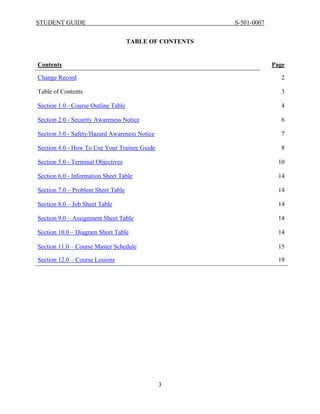
                                     TABLE OF CONTENTS


Contents                                                              Page

Change Record                                                            2

Table of Contents                                                        3

Section 1.0 - Course Outline Table                                       4

Section 2.0 - Security Awareness Notice                                  6

Section 3.0 - Safety/Hazard Awareness Notice                             7

Section 4.0 - How To Use Your Trainee Guide                              8

Section 5.0 - Terminal Objectives                                       10

Section 6.0 - Information Sheet Table                                   14

Section 7.0 – Problem Sheet Table                                       14

Section 8.0 – Job Sheet Table                                           14

Section 9.0 – Assignment Sheet Table                                    14

Section 10.0 – Diagram Sheet Table                                      14

Section 11.0 – Course Master Schedule                                   15

Section 12.0 – Course Lessons                                           19


                                               3
STUDENT GUIDE                                          S-501-0007


                                     SECTION 1.0
                                COURSE OUTLINE TABLE

CRFC WEEK 1                                  Topic         Outline Sheet
Lesson Topic 1.1    Ethics & Prohibited Practices         1.1
Lesson Topic 1.2    Operational Stress Control            1.2
Lesson Topic 1.3    GENOFF Programs                       1.3
Lesson Topic 1.4    Medical Program Knowledge             1.4
Lesson Topic 1.5    Medical market ID                     1.5
Lesson Topic 1.6    Reserve Structure                     1.6
Lesson Topic 1.7    Reserve Program Knowledge             1.7
Lesson Topic 1.8    Reserve Market ID                     1.8
Lesson Topic 1.9    NAVET/DCO Affiliation                 1.9
Lesson Topic 1.10   Career Transition Office              1.10
Lesson Topic 1.11   Reserve Bonus Programs                1.11
Lesson Topic 1.12   Reserve Inst & Mob Dif                1.12
Lesson Topic 1.13   Marketing Operations Plan             1.13
Lesson Topic 1.14   Campus Data Notebook                  1.14
Lesson Topic 1.15   Speakers Bureau                       1.15
Lesson Topic 1.16   Diversity & Cultural Competence       1.16
Lesson Topic 1.17   Credentialing                         1.17
Lesson Topic 1.18   Fitness & Nutrition                   1.18
Lesson Topic 1.19   Social Media                          1.19
Lesson Topic 1.20   Diversity Recruiting                  1.20
Lesson Topic 1.21   Collegiate Management                 1.21
Lesson Topic 1.22   Kit Building                          1.22

CRFC WEEK 2                                Topic           Outline Sheet
Lesson Topic 2.1    Processing                            2.1
Lesson Topic 2.2    Prospecting                           2.2
Lesson Topic 2.3    Fairshare Goaling                     2.3
Lesson Topic 2.4    LCPO RPMS                             2.4
Lesson Topic 2.5    PRIDE                                 2.5
Lesson Topic 2.6    Privacy Program                       2.6
Lesson Topic 2.7    Training                              2.7
Lesson Topic 2.8    Recruiting Personnel Management       2.8
Lesson Topic 2.9    NIT Inspection Trends                 2.9
Lesson Topic 2.10   Awards & Incentives                   2.10


                                             4
STUDENT GUIDE                                                    S-501-0007


                                  SECTION 2.0
                      SECURITY AWARENESS NOTICE
           *****************************************************
                This course does not contain any classified material.
          ******************************************************


                                      5
STUDENT GUIDE                                                               S-501-0007


                                  SECTION 3.0
                        SAFETY/HAZARD AWARENESS NOTICE

This notice promulgates safety precautions for students at Navy Recruiting Orientation Unit
(NORU). All personnel must remain alert for any hazards within the training facilities. At a
minimum, each individual is responsible for knowing, understanding, and observing all safety
precautions applicable to NORU. In addition, you are responsible for observing the following
general safety precautions:

   a. Each individual shall report for work rested and emotionally prepared for the tasks at
      hand.
   b. You shall use normal prudence in all your functions, commensurate with the work at
      hand.
   c. You shall report any unsafe conditions, or any equipment or material which you consider
      to be unsafe, and any unusual or developing hazards.
   d. You shall warn others whom you believe to be endangered by known hazards or by
      failure to observe safety precautions, and of any unusual or developing hazards.
   e. You shall report to the school any mishap, injury, or evidence of impaired health
      occurring in the course of your work or during non-training environment.


                                              6
STUDENT GUIDE                                                                     S-501-0007


                                  SECTION 4.0
                         HOW TO USE YOUR STUDENT GUIDE

This publication has been prepared for your use while under instruction. It is arranged in
accordance with the topics taught, and is in sequence with those topics. By using the table of
contents you should be able to locate the lesson topics easily. By following the enclosed course
schedule, you should be able to follow the course of instruction in a logical manner.

Under each topic there may be the following instruction sheets:

•   OUTLINE SHEETS: Provide a listing of major teaching points. The outline is consistent
    with the outline of the discussion points contained on the DDA pages in the lesson plan. It
    allows the trainee to follow the progress of lesson topic, to take notes as desired, and to retain
    topic information for future reference.

•   INFORMATION SHEETS: Amplify supplemental information from the reference materials
    for the course, from technical manuals, or from instruction books. You may be tested on this
    material during the course.

•   PROBLEM SHEETS: Normally used for paperwork troubleshooting when the equipment is
    not available. Can also be used for drill-and-practice problems related to the topic.

•   JOB SHEETS: Provide step-by-step instructions for developing your skills in performing
    assigned tasks and maintaining the equipment when and where the work is assigned, in the
    laboratory or practical areas.

•   ASSIGNMENT SHEETS: To assist you in being prepared for the lesson topics and
    laboratory/practical exercises BEFORE they are presented by the instructor or occur in the
    course.

•   DIAGRAM SHEETS: These are used as necessary to simplify the instruction. They are to
    aid you in understanding the systems, equipment, or topics presented.

All of the instruction sheets are identified by their unit and lesson topic number. They are
listed in the order of their use. Each lesson topic will contain at least one Enabling
Objective.

The Enabling Objectives listed in this Guide specify the knowledge and/or skills that you
will learn during the course, and reflect the performance expected of you on the job. The
Enabling Objectives specify the knowledge and/or skills you will learn in a specific lesson
topic. You should thoroughly understand the Enabling


                                                  7
STUDENT GUIDE                                                                    S-501-0007


Objectives for a lesson topic and what these objectives mean to you before you start each
lesson topic. Each learning objective contains behavior(s), conditions, and standards. They
are defined as follows:

         The behavior is a description of the performance and/or knowledge
         that you will learn in that lesson topic;

         The conditions under which you will be able to perform or use the
         knowledge;

         The standard(s) to which you will be able to perform or use the
         knowledge.

The objectives provide a means by which you can check your progress during training. The
objectives also enable you to evaluate your training when you have finished, so you can ensure
that you have satisfied the goals of the course. Your instructor will explain the objectives to you
at the start of the course. Feel free to ask for additional information during training if you feel
that you are not learning as you should.

•   STUDY TECHNIQUES:

Classroom and laboratory sessions will be conducted by one or more instructors. You will be
responsible for completing the material in this guide, some of it before class time. Prior to
starting to use this guide, read through the front matter and become familiar with the
organization of the material, then follow directions below for each lesson topic:

    1.   READ the Enabling Objectives for the lesson topic and familiarize yourself with what
         will be expected of you.

    2.   STUDY each reading assignment.

    3. WRITE any written assignment.
•   EXAMINATIONS AND QUIZZES

Exams and quizzes will be administered as required by the Course Master Schedule. A blitz is an
informal test used to check for understanding, and may be given by your instructor at any time.
These quizzes do not count toward your final grade. In any event, only the material covered will
be tested. All written tests will be in the form of multiple choice, completion, or true/false items.
Performance tests will be provided to test job skills as appropriate. Success on exams is
dependent upon an understanding of the objectives, involvement in class activities, and good
study habits.


                                                  8
STUDENT GUIDE                                                                  S-501-0007


                                    SECTION 5.0
                                TERMINAL OBJECTIVES

1.1.0   Explain ethical behavior and prohibited practices to include Fraternization, Sexual
        Harassment, Government Vehicles, Government Travel Card, and Government Cell
        Phones, as it pertains to Navy Recruiting Command Personnel in accordance with Navy
        and NRC Directives.

1.2.0   Recognize how Navy Operational Stress Control (OSC) can enhance your ability to
        prosper physically, emotionally and professionally.

1.3.0   Identify General Officer Direct Accession and Collegiate programs.

1.4.0   Identify Direct Accession and Collegiate programs; Program Authorizations and
        Program Managers.

1.5.0   Identify the marketing plan and timelines for marketing medical programs.

1.6.0   Explain the Reserve Structure.

1.7.0   Explain the NAVET & DCO Programs for Navy Reserve Officers.

1.8.0   Identify the competitive profiles, marketing concepts and timelines for reserve programs.

1.9.0   Define NAVET and DCO affiliation.

1.10.0 Explain the functionality of the Career Transition Office (CTO).

1.11.0 Explain the incentives available for qualified Navy Reserve Officers.

1.12.0 Describe the Mobilization Deferment policy for transition from Active Component to
       Reserve Component.

1.13.0 Explain the Officer's Marketing Operation Plan (MOP) including purpose, sections, and
       how to create a Plan of Action and Milestones to prevent failure.

1.14.0 Explain the purpose of the Campus Data Notebook (CDN).

1.15.0 Explain the procedures necessary to effectively utilize Navy Recruiting Commands
       Speakers Bureau Funds.

1.17.0 Describe the credentialing process for Active/Reserve Dental Corps, Medical Corps
       (MC), Medical Service Corps (MSC), and Nurse Corps (NC).

1.18.0 Explain the importance of proper fitness and nutrition in preparation for Officer
       Candidate School (OCS) and Recruit Training Command.

                                                9
STUDENT GUIDE                                                                   S-501-0007


1.19.0 Recognize how social media and social networking benefit Navy awareness.

1.20.0 Demonstrate the ability to maximize Officer Recruiting Diversity Production, utilizing
       tools and strategies to become a successful U.S. Navy Officer recruiter in Outreach
       Markets.

1.21.0 Describe the Collegiate Management Process and Reporting requirements.

1.22.0 KIT BUILDING

2.1.0 PROCESSING

2.2.0 PROSPECTING

2.3.0   Identify the process of goaling throughout Navy Recruiting Command.

2.4.0   Demonstrate the ability to manage the Enlisted Recruiter Production Management
        System as a Leading Chief Petty Officer.

2.5.0   Explain the programs and reports located in the PRIDE System and how they are used in
        the enlistment and management of Navy Applicants.

2.6.0   Explain the NRC Privacy Program requirements as outlined in DoD Directive 5400.11,
        COMNAVCRUITCOMINST 5211.4 (Series), COMNAVCRUITCOMINST 1130.8
        (Series) and COMNAVCRUITCOMINST 1131.2 (Series) as it pertains to Officer and
        Enlisted recruitment and processing.

2.7.0   Utilize the Training Program to identify and correct production recruiter deficiencies to
        maximize productivity.

2.8.0   Utilize Recruiter Development, Recruiter Qualification, and Recruiter Eligibility Boards
        to determine a recruiter’s ability to perform on recruiting duty.
        Initiate recruiting personnel actions, including fault/no-fault transfers, and NRD change
        of station/move procedures.

2.9.0   Build a Plan of Action with Milestones to correct NIT Inspection discrepancies.

2.10.0 Utilize Navy Recruiting Commands various awards and incentive programs to provide
       timely recognition to successful field recruiters.
Back to Course Outline


                                                10
STUDENT GUIDE                                                                    S-501-0007


                                     OUTLINE SHEET 1.1

                         ETHICS AND PROHIBITED PRACTICES

A. Introduction

   The mission and requirements of Navy Recruiting create a unique environment in which
   NRC personnel are consistently placed in situations requiring strict adherence to rules,
   regulations and ethical guidelines.

B. Enabling Objectives

   1.1.1   Describe NRC Fraternization policy as it pertains to applicants, prospects, DEP
           personnel, Future Sailors, and Collegiates.

   1.1.2   Explain the policies regarding providing familiarization and/or coaching to prospects,
           applicants, DEP personnel, Future Sailors, and Collegiates.

   1.1.3   Identify the four different types of recruiting irregularities and investigations.

   1.1.4   Describe the authorized use of government vehicles (GOV) to include Domicile to
           Duty procedures, credit card use and limitations and emergency/accident procedures.

   1.1.5   Explain the policies regarding government cellular phones.

   1.1.6   Explain the policies and member responsibilities associated with the Government
           Travel Card.

C. Topic Outline

   1. Fraternization: Personal relationships that are unduly familiar between recruiting
      personnel, prospect, applicants, DEP personnel, Future Sailors, and Collegiates are
      prohibited.

      a. Prospect. Any person who has expressed to recruiting personnel an interest in
         enlisting or receiving an appointment in the U.S. Navy or U.S. Navy Reserve and
         who appears to possess the potential, or who may in the future possess the potential
         and qualifications for enlistment or appointment.

           1) A prospect that expresses a loss of interest in enlistment or appointment shall
              continue to be a prospect under this instruction for a period of one year from the
              date they express this loss of interest.
           2) Individuals who may in the future possess the potential and qualifications for
              enlistment or appointment include, but are not limited to, individuals who do not
              meet minimum age requirements, who score too low on the qualification testing
              but will be eligible to re-test, or who have not completed their education.

                                                 11
STUDENT GUIDE                                                               S-501-0007


         3) An individual who expresses an interest in enlistment or appointment but is
            permanently barred under existing regulations is not a prospect.
     b. Applicant: Any person who has commenced processing for enlistment or
        appointment in any of the Armed Forces.

     c. Future Sailor: Any person who accesses into the Delayed Entry Program of the
        United States Navy.

     d. DEP personnel: Any person who accesses into the Delayed Entry Programs of any of
        the Armed Forces.

     e. Collegiate: Any individual who has been selected and enlisted into one of the
        following programs:

         1) Baccalaureate Degree Completion Program (BDCP)

         2) Civil Engineer Corps (CEC) Exceptional Student Program

         3) Nuclear Power Officer Candidate (NUPOC)

         4) Naval Reactors Engineer (NRE)

         5) Nuclear Power School Instructor (NPI)

         6) Health Services Collegiate Program (HSCP)

     f. Recruiting Environment: Any function, gathering or meeting in a public or private
        place that recruiting personnel attend in their official capacity.

  2. Prohibited Activities. Recruiting personnel shall not:

     a. Form or attempt to form a dating, private or unofficial social relationship with anyone
        known to be a prospect, applicant, DEP personnel, Future Sailor, or Collegiate.

     b. Allow anyone known to be a prospect, applicant, DEP personnel, Future Sailor, or
        Collegiate to remain in any recruiting offices except for official business.

     c. Allow anyone known to be a prospect, applicant, DEP personnel, Future Sailor, or
        Collegiate to ride in any Government vehicle except for official purposes or ride in
        the personal vehicle of anyone known to be a prospect, applicant, DEP personnel,
        Future Sailor, or Collegiate.

     d. Engage in consensual or nonconsensual physical contact with anyone known to be a
        prospect, applicant, DEP personnel, Future Sailor, or Collegiate when the contact is
        not authorized in the performance of official duties or required in an emergency to
        protect against injury, or in self-defense against an unprovoked attack.

                                             12
STUDENT GUIDE                                                                   S-501-0007


     e. Perform body fat measurements on any prospect, applicant, DEP personnel, Future
        Sailor, or Collegiate of the opposite sex. If a prospect, applicant, DEP personnel,
        Future Sailor, or Collegiate requires measurement and none of the recruiting
        personnel at the station are of the same gender of that individual, the measurement
        can be delayed until the individual goes to MEPS for processing.

     f. Harass any prospect, applicant, DEP personnel, Future Sailor, or Collegiate.
        Harassment includes, but is not limited to:

          1) Any language or act, which would, measured by an objective standard, constitute
             cruelty, oppression or maltreatment under article 93, UCMJ.

          2) Abusive language which, when taking due consideration of the individual
             sensitivities of the victim, tends to degrade a prospect, applicant, DEP personnel,
             Future Sailor, or Collegiate whether directed at or used in the presence of such
             person.

     g.   Use anyone known to be a prospect, applicant, DEP personnel, Future Sailor, or
          Collegiate to provide any benefit, financial or otherwise.

     h. Allow or invite any prospect, applicant, DEP personnel, Future Sailor, or Collegiate
        to enter into, operate or be transported in the recruiting personnel's private vehicle
        unless authorized in advance by a POV use authority for official purposes only.

     i. Gamble with any prospect, applicant, DEP personnel, Future Sailor, or Collegiate.

     j.    Solicit or accept, directly or indirectly, anything of value from any source in return
          for granting favors, privileges or other preferential treatment to any prospect,
          applicant, DEP personnel, Future Sailor, or Collegiate.

     k. Borrow money or any articles of value from, lend the same to, anyone known to be a
        prospect, applicant, DEP personnel, Future Sailor, or Collegiate.

     l. Offer to engage in, or engage in, any unofficial financial or business dealings with
        anyone known to be a prospect, applicant, DEP personnel, Future Sailor, or
        Collegiate.

     m. Photograph or accept any pictures of anyone known to be a prospect, applicant, DEP
        personnel, Future Sailor, or Collegiate other than those required for official purposes.

     n. Spend the night with, or allow anyone known to be a prospect, applicant, DEP
        personnel, Future Sailor, or Collegiate to spend the night in the same home or
        apartment without prior command approval

     o. Process for enlistment or appointment, any person with whom they developed a
        social relationship prior to that person becoming a prospect, applicant, DEP

                                               13
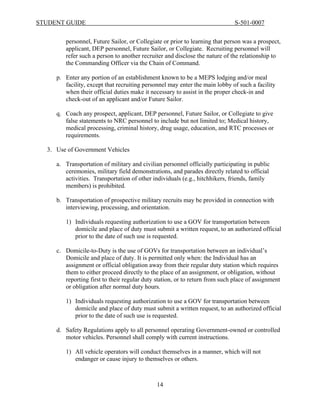
STUDENT GUIDE                                                                 S-501-0007


        personnel, Future Sailor, or Collegiate or prior to learning that person was a prospect,
        applicant, DEP personnel, Future Sailor, or Collegiate. Recruiting personnel will
        refer such a person to another recruiter and disclose the nature of the relationship to
        the Commanding Officer via the Chain of Command.

     p. Enter any portion of an establishment known to be a MEPS lodging and/or meal
        facility, except that recruiting personnel may enter the main lobby of such a facility
        when their official duties make it necessary to assist in the proper check-in and
        check-out of an applicant and/or Future Sailor.

     q. Coach any prospect, applicant, DEP personnel, Future Sailor, or Collegiate to give
        false statements to NRC personnel to include but not limited to; Medical history,
        medical processing, criminal history, drug usage, education, and RTC processes or
        requirements.

  3. Use of Government Vehicles

     a. Transportation of military and civilian personnel officially participating in public
        ceremonies, military field demonstrations, and parades directly related to official
        activities. Transportation of other individuals (e.g., hitchhikers, friends, family
        members) is prohibited.

     b. Transportation of prospective military recruits may be provided in connection with
        interviewing, processing, and orientation.

        1) Individuals requesting authorization to use a GOV for transportation between
           domicile and place of duty must submit a written request, to an authorized official
           prior to the date of such use is requested.

     c. Domicile-to-Duty is the use of GOVs for transportation between an individual’s
        Domicile and place of duty. It is permitted only when: the Individual has an
        assignment or official obligation away from their regular duty station which requires
        them to either proceed directly to the place of an assignment, or obligation, without
        reporting first to their regular duty station, or to return from such place of assignment
        or obligation after normal duty hours.

        1) Individuals requesting authorization to use a GOV for transportation between
           domicile and place of duty must submit a written request, to an authorized official
           prior to the date of such use is requested.

     d. Safety Regulations apply to all personnel operating Government-owned or controlled
        motor vehicles. Personnel shall comply with current instructions.

        1) All vehicle operators will conduct themselves in a manner, which will not
           endanger or cause injury to themselves or others.


                                              14
STUDENT GUIDE                                                                  S-501-0007


        2) Safe/defensive driving shall be practiced at all times.

        3) No individual shall operate a Government-owned or leased motor vehicle while
           consuming, or within a period of eight hours after consuming, any quantity of
           alcoholic beverage.

        4) Consuming or permitting the consumption of alcoholic beverages by any
           occupant of a Government motor vehicle is prohibited.

        5) The driver has the responsibility for maintaining the mechanical and cosmetic
           condition of the vehicle.

     e. Monthly Vehicle Log Report shall be forwarded within 5 calendar days of the end of
        each month to the NRD Vehicle Coordinator.

     f. Emergency/Accident Procedures. Vehicle operators must report any accidents and
        incidents immediately by telephone to the Logistics Support Department and the
        chain of command. This includes damage resulting from accidents, thefts, vandalism,
        or arising from natural phenomena.

        1) Within three working days of an accident, the motor vehicle accident reporting kit,
           which is contained in the glove compartment of each vehicle, shall be submitted
           by the operator in involved in the accident/mishap to the Logistics Support
           Department. If you are involved in an accident:

            (a) Take necessary emergency action.

            (b) Do not sign or make a statement as to responsibility except to your supervisor
                or Government Investigator. Do not engage in arguments at the accident
                scene. Do not divulge personal insurance information.

            (c) Get names and addresses of all persons involved and extent of injuries, if any.

            (d) If it is a serious accident, report by telephone to your supervisor.
     g. Credit Card Use. Tight security of credit cards shall be maintained. Upon
        completion of a trip and at the end of each working day, credit cards will be removed
        from the vehicle and placed in a secure location.

     h. On all purchases, the vehicle operator shall ensure that the number of gallons, price
        per gallon, value of purchase, vehicle tag number, mileage, and driver’s signature are
        on the driver’s copy of the receipt. Copies of all credit card purchase receipts will be
        forwarded monthly to the district Vehicle Coordinator. Guidelines are as follows:

           1)   Use self-service pumps only.

           2)   Fraudulent use of the credit card is subject to criminal prosecution.

                                              15
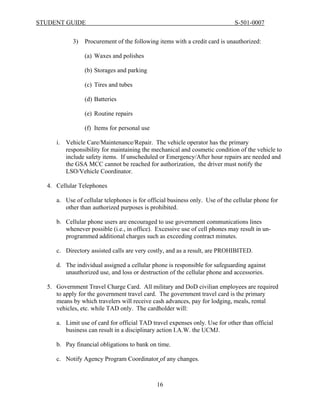
STUDENT GUIDE                                                                S-501-0007


           3)   Procurement of the following items with a credit card is unauthorized:

                (a) Waxes and polishes

                (b) Storages and parking

                (c) Tires and tubes

                (d) Batteries

                (e) Routine repairs

                (f) Items for personal use

     i. Vehicle Care/Maintenance/Repair. The vehicle operator has the primary
        responsibility for maintaining the mechanical and cosmetic condition of the vehicle to
        include safety items. If unscheduled or Emergency/After hour repairs are needed and
        the GSA MCC cannot be reached for authorization, the driver must notify the
        LSO/Vehicle Coordinator.

  4. Cellular Telephones

     a. Use of cellular telephones is for official business only. Use of the cellular phone for
        other than authorized purposes is prohibited.

     b. Cellular phone users are encouraged to use government communications lines
        whenever possible (i.e., in office). Excessive use of cell phones may result in un-
        programmed additional charges such as exceeding contract minutes.

     c. Directory assisted calls are very costly, and as a result, are PROHIBITED.

     d. The individual assigned a cellular phone is responsible for safeguarding against
        unauthorized use, and loss or destruction of the cellular phone and accessories.

  5. Government Travel Charge Card. All military and DoD civilian employees are required
     to apply for the government travel card. The government travel card is the primary
     means by which travelers will receive cash advances, pay for lodging, meals, rental
     vehicles, etc. while TAD only. The cardholder will:

     a. Limit use of card for official TAD travel expenses only. Use for other than official
        business can result in a disciplinary action I.A.W. the UCMJ.

     b. Pay financial obligations to bank on time.

     c. Notify Agency Program Coordinator of any changes.


                                             16
STUDENT GUIDE                                                                S-501-0007


     d. Use of the split pay option (mandatory for all military personnel) upon travel
        liquidation.
     e. Assume liability for all billed charges. Cardholder must pay on time whether or not
        reimbursement has been received.

  6. Familiarization/Coaching are methods directing, instructing and training a person or
     group of people, with the aim to achieve some goal or develop specific skills.

     a. Coaching any prospect, Applicant, DEP personnel, or Future Sailor to give false
        statements to NRC and RTC personnel is Strictly Prohibited. These include but not
        limited to; medical history, medical processing, criminal history, drug usage, and
        education.

     b. ASVAB Familiarization/Coaching. Several information devices are available to
        familiarize applicants with the ASVAB:

         (1) Use of the official ASVAB website is authorized

         (2) Use of the Enlistment Screening Test (EST) is authorized.

         (3) Sample for School Officials. An ASVAB specimen set is a sample for school
             Officials to familiarize them with the institutional ASVAB. NRC personnel are
             strictly prohibited from using it to familiarize applicants or students.

         (4) Study Guides. Several ASVAB information/study guides, such as the ARCO
             ASVAB preparatory study guide, have been commercially produced. Use of these
             commercial publications by NRC personnel is Strictly Prohibited. It is recognized
             that these commercial publications are available to applicants; however, NRC
             involvement with these publications is limited to informing applicants that they
             are available in some stores. Under no circumstances shall NRC personnel use a
             commercial ASVAB study guide to familiarize applicants with the ASVAB. NRC
             personnel are prohibited from possessing any ASVAB Study Guides.

         (5) Schools. NRC personnel must NOT refer applicants to any commercial ventures
             or schools whose purpose is to familiarize applicants with the ASVAB. NRC
             personnel may not offer their services to these schools, act as a distributor for
             their information materials, or become involved with them in any way.

         (6) NRC personnel must be fully aware that acts which are conducive to test loss or
             compromise will not be tolerated and that individuals who are found to have aided
             or abetted test compromise will be subject to disciplinary action under the UCMJ.

  7. Recruiting Irregularities and Investigations

     a. Malpractice: Malpractice is concealment of or conspiracy to conceal a disqualifying
        factor of an applicant; action to qualify an ineligible applicant in violation of

                                              17
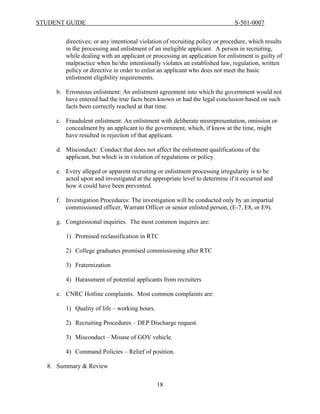
STUDENT GUIDE                                                                S-501-0007


        directives; or any intentional violation of recruiting policy or procedure, which results
        in the processing and enlistment of an ineligible applicant. A person in recruiting,
        while dealing with an applicant or processing an application for enlistment is guilty of
        malpractice when he/she intentionally violates an established law, regulation, written
        policy or directive in order to enlist an applicant who does not meet the basic
        enlistment eligibility requirements.

     b. Erroneous enlistment: An enlistment agreement into which the government would not
        have entered had the true facts been known or had the legal conclusion based on such
        facts been correctly reached at that time.

     c. Fraudulent enlistment: An enlistment with deliberate misrepresentation, omission or
        concealment by an applicant to the government, which, if know at the time, might
        have resulted in rejection of that applicant.

     d. Misconduct: Conduct that does not affect the enlistment qualifications of the
        applicant, but which is in violation of regulations or policy.

     e. Every alleged or apparent recruiting or enlistment processing irregularity is to be
        acted upon and investigated at the appropriate level to determine if it occurred and
        how it could have been prevented.

     f. Investigation Procedures: The investigation will be conducted only by an impartial
        commissioned officer, Warrant Officer or senior enlisted person, (E-7, E8, or E9).

     g. Congressional inquiries. The most common inquires are:

        1) Promised reclassification in RTC

        2) College graduates promised commissioning after RTC

        3) Fraternization

        4) Harassment of potential applicants from recruiters

     e. CNRC Hotline complaints. Most common complaints are:

        1) Quality of life – working hours.

        2) Recruiting Procedures – DEP Discharge request.

        3) Misconduct – Misuse of GOV vehicle.

        4) Command Policies – Relief of position.

  8. Summary & Review

                                              18
STUDENT GUIDE                  S-501-0007


   9. Application

   10. Assignment: None

Back to Course Outline


                          19
STUDENT GUIDE                                                                 S-501-0007


                               INFORMATION SHEET 1.1-1

                        ETHICS AND PROHIBITED PRACTICES

A. Introduction

   This information sheet provides references and abbreviations used in this lesson.

B. References
   1. OPNAVINST 5354.1 (Series), Navy EO Policy
   2. COMNAVCRUITCOMINST 1130.8 (Series)
   3. COMNAVCRUITCOMINST 5370.1 (Series) Fraternization
   4. COMNAVCRUITCOMINST 1137.3 (Series), Invest. & Reporting of Allegations &
      Complaints
   5. SECNAVINST 5350.15 (Series), DON Core Values
   6. COMNAVCRUITCOMINST 4400.1 (Series) Logistics Support Manual
   7. COMNAVCRUITCOMINST 2061.2 (Series) Telecommunications Service
   8. http://www.asvabprogram.com/index.cfm?fuseaction=overview.test

C. Information

ASVAB       Armed Services Vocational Aptitude Battery

BDCP        Baccalaureate Degree Completion Program

CEC         Civil Engineer Corps

EST         Enlisted Screening Test

DEP         Delayed Entry Program

GSA MCC General Services Administration, Maintenance Control Center

GOV         Government Vehicle

HSCP        Health Service collegiate Program

NPI         Nuclear Power School Instructor

NRE         Naval Reactors Engineer

NUPOC       Nuclear Power Officer Candidate


                                                20
STUDENT GUIDE                                                                   S-501-0007


                                 OUTLINE SHEET 1.2
                            OPERATIONAL STRESS CONTROL

Terminal Objective:

1.2.0   Recognize how Navy Operational Stress Control (OSC) can enhance your ability to
        prosper physically, emotionally and professionally.

Enabling Objectives:

1.2.1   Identify common sources of stress.

1.2.2   Describe indicators of the four phases in the Stress Continuum.

1.2.3   Identify actions for managing stress reactions and injuries and getting help for stress
        illnesses.

1.2.4   Explain your role in OSC.

Topic Outline:

1. Introduction

2. What is Stress?

   a. The process by which we respond to challenges to the body or mind.

   b. Stress can be positive or negative.

3. Operational Stress Control

   a. Comprehensive approach to prevent, identify & manage the adverse effects of Operational
      Stress and Stress injuries on the health and readiness of Sailors.

   b. OSC is not just for “operational” commands in the historic sense. It is for all Navy
      personnel, in any mission, any environment.

   c. OSC seeks to create an environment where Sailors, commands and families can thrive in
      the midst of stressful operations. Just as world-class athletes gain the winning edge by
      using every means at their disposal – coaches, trainers, even sports psychologists – our
      world-class Sailors need to employ every available resource to stay fit, ready and resilient
      as well as seek assistance for stress reactions early before they become problems.


                                                 21
STUDENT GUIDE                                                                  S-501-0007


       Causes of Stress
   a. The levels of reported stress have shown significant increase in recent years in both the
      officer and enlisted ranks.

   b. Of the top ten reported causes of stress Navy-wide, most will still apply while on
      recruiting duty.

   c. Stressors can have different effects on Sailors and their families.

4. Impact of Negative Stress

   a. Irritability

   b. Physical symptoms (migraine, fatigue, weight gain/loss, trouble sleeping)

   c. Decrease in work quality or output

   d. Damaged Relationships (personal /professional)

   e. Compromise of morals or ethics

   f. Depression/Suicide

5. Stress Continuum – Refer to Information Sheet 1.2-1

   a. The goal of Navy OSC is to get back to Green.

       1. Ready – Green - To stay mission ready. Keep fit, eat right, relax and balance.

       2. Reacting – Yellow - To recover and build resilience. Get adequate sleep, talk to
          someone you trust.

       3. Injured - Orange - To begin healing. Talk to a chaplain, counselor or medical
          provider.

       4. Ill – Red - To get help. Seek medical treatment.

6. Your Role in OSC

   a. Help build positive relationships

   b. Help to foster trust

   c. Communicate

   d. Help others to see the bigger picture

                                                22
STUDENT GUIDE                                                                   S-501-0007


   e. Refer to the right resources

7. Resources

   a. Shipmate, family member, or command leadership

   b. Ombudsman

   c. Fleet and Family Support Center

   d. Doctor, nurse or other medical staff member

   e. Military One Source (www.militaryonesource.com)

   f. Chaplain/Religious leader (www.navychaplaincare.navy.mil)

   g. Navy Operational Stress blog (www.navynavstress.com)

   h. Navy Stress Facebook Page (www.facebook.com/navstress)

   i. Navy Personnel Command Suicide Prevention (www.suicide.navy.mil)

8. Summary & Review

   a. Stress is a fact of life, some stress can actually push us to achieve our personal best, but
      it’s important to know how to recognize when stress is becoming a problem. Using the
      Stress Continuum can help you learn more about the signs and symptoms of too much
      stress, as well as what you can do to help yourself or your shipmates stay healthy.

9. Application

   a. None

10. Evaluation

   a. CBT

11. Assignment

   a. None

12. Back to Course Outline


                                                23
STUDENT GUIDE                                                        S-501-0007


                               INFORMATION SHEET 1.2-1

                           OPERATIONAL STRESS CONTROL

A. Introduction

   This information sheet provides references used in this lesson.

B. References
   1. Navy Operational Stress blog (www.navynavstress.com)

   2. Navy Stress Facebook Page (www.facebook.com/navstress)

   3. Navy Personnel Command Suicide Prevention (www.suicide.navy.mil)

C. Information


                                               24
STUDENT GUIDE                                                                S-501-0007


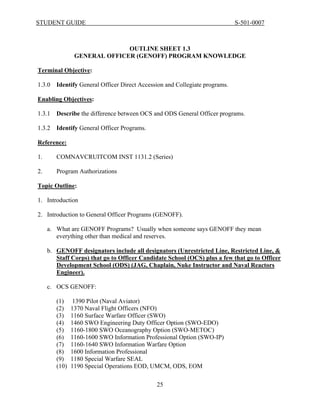
                              OUTLINE SHEET 1.3
                GENERAL OFFICER (GENOFF) PROGRAM KNOWLEDGE

Terminal Objective:

1.3.0   Identify General Officer Direct Accession and Collegiate programs.

Enabling Objectives:

1.3.1   Describe the difference between OCS and ODS General Officer programs.

1.3.2   Identify General Officer Programs.

Reference:

1.      COMNAVCRUITCOM INST 1131.2 (Series)

2.      Program Authorizations

Topic Outline:

1. Introduction

2. Introduction to General Officer Programs (GENOFF).

     a. What are GENOFF Programs? Usually when someone says GENOFF they mean
        everything other than medical and reserves.

     b. GENOFF designators include all designators (Unrestricted Line, Restricted Line, &
        Staff Corps) that go to Officer Candidate School (OCS) plus a few that go to Officer
        Development School (ODS) (JAG, Chaplain, Nuke Instructor and Naval Reactors
        Engineer).

     c. OCS GENOFF:

        (1)    1390 Pilot (Naval Aviator)
        (2)    1370 Naval Flight Officers (NFO)
        (3)    1160 Surface Warfare Officer (SWO)
        (4)    1460 SWO Engineering Duty Officer Option (SWO-EDO)
        (5)    1160-1800 SWO Oceanography Option (SWO-METOC)
        (6)    1160-1600 SWO Information Professional Option (SWO-IP)
        (7)    1160-1640 SWO Information Warfare Option
        (8)    1600 Information Professional
        (9)    1180 Special Warfare SEAL
        (10)   1190 Special Operations EOD, UMCM, ODS, EOM

                                              25
STUDENT GUIDE                                                                S-501-0007


      (11)    1630 Special Duty Intelligence
      (12)    1640 Special Duty Information Warfare (IW)
      (13)    3100 Supply Corps
      (14)    1520 Aerospace Maintenance Duty Officer (AMDO)
      (15)    1650 Public Affairs Officers (PAO)
      (16)    5100 Civil Engineering Corps (CEC)
      (17)    5100 CEC Collegiate
      (18)    1810 Cyber Warfare Engineer
      (19)    1170/1160 NUPOC Sub & Surface
      (20)    XXX7 Baccalaureate Degree Completion Program (BDCP)

   d. ODS GENOFF:
      (1) 2500 Judge Advocate General (JAG)
      (2) 1950 JAG Student
      (3) 4100 Chaplain
      (4) 1945 Chaplain Candidate Program
      (5) 1210 Nuclear Power School Instructor
      (6) 1220 Naval Reactors Engineer

   e. GENOFF programs are competitive (i.e. many applicants will not get selected even
      though they are qualified). Being qualified to apply does not mean an applicant will be
      selected. Selection is based on the whole person concept.

3. Officer Candidate School (OCS) Programs.

   a. Pilot

      (1) Community Overview

          (a) Navy pilots are members of the select, highly skilled Naval Aviation team. The
              Navy maintains and operates more than 4,000 aircraft including carrier-based jets,
              land-based patrol and reconnaissance aircraft, transport planes and sea and land-
              based helicopters.

      (2) Age

          (a) At least 19 and less than 27 at time of commission.

          (b) Waiver up to 24 months for prior AD service.

      (3) Education


          (a) BA/BS in any major; technical degrees preferred.


          (b) Min 2.5 GPA.

                                              26
STUDENT GUIDE                                                             S-501-0007


     (4) Testing

        (a) OAR-40; AQR-4; PFAR-5; PRT

     (5) Training

        (a) OCS (12 wks)

        (b) API Basic/Intermediate Advanced Winged (18-24 mo)

        (c) FRS (6-12 mo)

     (6) Obligation

        (a) 8 yrs Active Duty from earning wings.

  b. Naval Flight Officer (NFO)

     (1) Community Overview

        (a) Naval Flight Officers (NFOs) are members of the select, highly skilled Naval
            Aviation team. NFOs may be radar intercept officers, tactical coordinators or
            airborne electronic warfare specialists. The Navy maintains and operates more
            than 4,000 aircraft including carrier-based jets, land-based patrol and
            reconnaissance aircraft, transport planes and sea and land-based helicopters.

     (2) Age

        (a) At least 19 and less than 27 at time of commission.

        (b) Waiver up to 48 months for prior AD service.

     (3) Education

        (a) BA/BS in any major.

        (b) No restrictions, but technical degrees preferred.

        (c) Min 2.5 GPA

     (4) Testing


        (a) OAR-40; AQR-4; FOFAR-5; PRT

     (5) Training


                                             27
STUDENT GUIDE                                                             S-501-0007


        (a) OCS (12 wks)

        (b) API (6 wks)

        (c) Basic/Intermediate/Advanced Winged (15 – 24 mo)

        (d) FRS (6 – 12 mo)

     (6) Obligation

        (a) 6 yrs Active Duty from date of designation as NFO.

  c. Surface Warfare Officer (SWO)

     (1) Community Overview

        (a) Surface Warfare Officers are Navy officers whose training and primary duties
            focus on the operation of Navy ships at sea and the management of various
            shipboard systems. Their ultimate goal is to command a Navy surface ship. Navy
            systems such as the vertical launch system that fires surface-to-air and cruise
            missiles require the skills and expertise of people trained in high-tech fields.

     (2) Age

        (a) At least 19 and less than 29 at time of commission.

        (b) Waiver up to 2 yrs for prior AD service.

     (3) Education

        (a) BA/BS

     (4) Testing

        (a) OAR – 35+

        (b) PRT (higher scores are more competitive)

     (5) Training

        (a) OCS (12 wks)


        (b) DIVO (6 – 10 mo)

        (c) SWOS (4 – 6 wks)


                                            28
STUDENT GUIDE                                                                 S-501-0007


        (d) Complete DIVO tour

        (e) Specialty School (3 – 7 wks)

     (6) Obligation

        (a) 4 yrs Active from date of commission.

        (b) Total of 8 yrs Active & Inactive.

  d. SWO Engineering Duty Officer Option (SWO-EDO)

     (1) Community Overview

        (a) Engineering Duty (ED) Officers are the technical leaders of the United States
            Navy, and are a unique cadre of Naval officers who are highly educated, and have
            a broad continuum of operational experience and engineering expertise. EDs
            develop system-engineered, cost effective solutions to meet fleet war fighting
            requirements. We lead the integration of research and development, design,
            acquisition, construction, modernization, and life cycle management.

        (b) Engineering Duty Option Program. Ten Officer Candidate School quotas are
            available per year for this program. Officers begin their careers as conventional
            Surface Warfare Officers, and can exercise their option to become EDs after
            completing their warfare qualification, and a minimum sea tour, typically two
            years. Shortly after reporting to their ship, they'll be assigned a local ED mentor,
            available to provide information and answer questions.

     (2) Age

        (a) At least 19 and less than 29 at time of commission.

        (b) Waiver up to 2 yrs for prior AD service.

     (3) Education

        (a) BS/MS in Engineering or Science.

        (b) Req. evidence of academic excellence (B or better avg.)

        (c) Top ¼ of class.

     (4) Testing

        (a) OAR – 35; PRT


                                             29
STUDENT GUIDE                                                            S-501-0007


     (5) Training

        (a) OCS (12 wks)

        (b) DIVO (6-10 months)

        (c) SWOS (4-6 wks)

        (d) Complete DIVO tour

        (e) NPS/MITEDO School (6 wks)

     (6) Obligation

        (a) 4 yrs Active from date of commission.

        (b) Total of 8 yrs Active & Inactive.

        (c) If NPS/MIT for MS, then additional 3 yrs for 1st yr and month for month
            thereafter.

  e. SWO Oceanography Option (SWO-METOC)

     (1) Community Overview

        (a) Special Duty (Oceanography) Officers (designator 180X) are commonly referred
            to in the fleet as Meteorology and Oceanography (METOC) Officers. The
            METOC Community is a small Restricted Line community of just under 400
            officers (0.7% of the Navy's Officer Corps). It is a technically oriented
            community that provides meteorological, oceanographic, and Geospatial
            Information and Systems (GI&S) support to the fleet. Also, it is a sea going
            community; about 16% of our billets are afloat on ships, staffs, or Mobile
            Environmental Teams. Seventy percent of our officers currently have warfare
            qualifications.

     (2) Age

        (a) Less than 35 years at time of commissioning.


     (3) Education

        (a) BS in Physical Oceanography or Meteorology is preferred, but not required.

        (b) Min. 2.2 GPA. C+ or better in Calc & Physics.

     (4) Testing

                                            30
STUDENT GUIDE                                                               S-501-0007


        (a) OAR – 35; PRT

     (5) Training

        (a) OCS (12 wks)

        (b) DIVO (6-10 months)

        (c) SWOS (4-6 wks)

        (d) Complete DIVO tour

        (e) Basic Oceanography Accession Training (11 wks)

     (6) Obligation

        (a) 4 yrs Active from date of commission.

        (b) Total of 8 yrs Active & Inactive.

        (c) Officers must serve two years following re-designation to 1800 or until the
            completion of four years from the date of commission, whichever is greater.

  f. IP and SWO Information Professional Option (SWO-IP)

     (1) Community Overview

        (a) The IP community was established in October 2001 and is one of the newest
            officer communities in the Navy. IP officers plan, acquire, operate, maintain, and
            secure the Naval network and the systems that support Navy's operational and
            business processes to ensure they are reliable, available, survivable, and secure.
            They evaluate and integrate cutting edge technologies, innovative concepts, and
            essential information elements to ensure a war fighting advantage.
        (b) Age Less than 35 years at time of commissioning.

     (2) Education

        (a) BS in Computer Science, Computer of Electrical Engineering, Math, Physics,
            Information Systems or Operations preferred, but not required.

        (b) Min. 2.2 GPA. C+ or better in Calc & Physics.

     (3) Testing

        (a) OAR – 35; PRT


                                            31
STUDENT GUIDE                                                              S-501-0007


     (4) Training

        (a) IP

            i    OCS (12 wks)

        (b) SWO IP Option

            i    OCS (12 wks)

            ii DIVO (6-10 months)

            iii SWOS (4-6 wks)

            iv Complete DIVO tour

     (5) Obligation

        (a) IP & SWO IP Option

            i    4 yrs Active from date of commission.

            ii Total of 8 yrs Active & Inactive.

        (b) SWO IP Option only

            i    Officers must serve two years following re-designation to 1600 or until the
                 completion of four years from the date of commission, whichever is greater.

  g. Special Warfare SEAL

     (1) Community Overview

        (a) The word SEAL is an acronym that stands for the environments in which Naval
            Special Warfare (NSW) units operate; the Sea, the air and the land. NSW
            personnel are organized, trained, and equipped to conduct maritime special
            operations across the spectrum of conflict. These highly trained specialists are
            deployed worldwide in support of joint and fleet operations. The unique training
            regimen in place to produce the basic SEAL operator is based on the four Special
            Operations Forces (SOF) Truths: Humans are more important than hardware;
            Quality is better than quantity; SOF cannot be mass produced; and, Competent
            SOF cannot be created after emergencies occur.

     (2) Age

        (a) At least 19 and less than 29 at time of commission.

                                             32
STUDENT GUIDE                                                              S-501-0007


        (b) Waiver up to 2 yrs for prior AD service.

     (3) Education

        (a) BA/BS

        (b) Technical degree preferred.

        (c) Min 2.0 GPA. (Higher GPA more competitive.)

     (4) Testing

        (a) OAR – 35

        (b) Physical Fitness Screen

            i   Special Warfare/Special Operations Physical Fitness Screen consists of: swim
                50 meters with mask, fins and snorkel to show waterborne confidence with no
                time limit; 500yd swim using breast/side stroke in 12.5 min (competitive time
                of < 9 min); 10 min rest; minimum of 42 push-ups in 2 min (competitive >
                100); 2 min rest; minimum of 50 sit-ups in 2 min (competitive > 100); 2 min
                rest; minimum of 6 pull-ups with no time limit (competitive > 20); 10 min
                rest; and 1.5 mile run in boots and long pants in 11.5 min (competitive time <
                9 min).

     (5) Training
        (a) OCS (12 wks)

        (b) BUD/S (6 mo)

     (6) Obligation

        (a) 4 years Active from commission or 3 years from completion of training,
            whichever is longer.

        (b) Total of 8 yrs Active & Inactive.

  h. Special Operations Explosive Ordinance Disposal (EOD), Under-water Mine Counter
     Measures (UMCM), Operational Diving & Salvage (ODS), Expendable Ordnance
     Management (EOM).

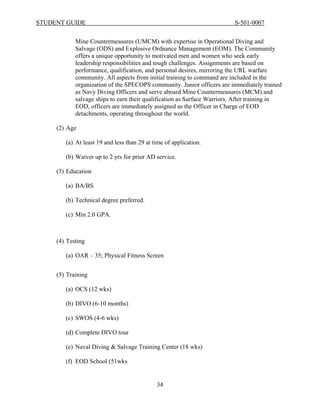
     (1) Community Overview

        (a) The 1140 Navy Special Operations (SPECOPS) community comprises the war
            fighting communities of Explosive Ordnance Disposal (EOD) and Under-Water

                                            33
STUDENT GUIDE                                                            S-501-0007


            Mine Countermeasures (UMCM) with expertise in Operational Diving and
            Salvage (ODS) and Explosive Ordnance Management (EOM). The Community
            offers a unique opportunity to motivated men and women who seek early
            leadership responsibilities and tough challenges. Assignments are based on
            performance, qualification, and personal desires, mirroring the URL warfare
            community. All aspects from initial training to command are included in the
            organization of the SPECOPS community. Junior officers are immediately trained
            as Navy Diving Officers and serve aboard Mine Countermeasures (MCM) and
            salvage ships to earn their qualification as Surface Warriors. After training in
            EOD, officers are immediately assigned as the Officer in Charge of EOD
            detachments, operating throughout the world.

     (2) Age

        (a) At least 19 and less than 29 at time of application.

        (b) Waiver up to 2 yrs for prior AD service.

     (3) Education

        (a) BA/BS

        (b) Technical degree preferred.

        (c) Min 2.0 GPA.


     (4) Testing

        (a) OAR – 35; Physical Fitness Screen


     (5) Training

        (a) OCS (12 wks)

        (b) DIVO (6-10 months)

        (c) SWOS (4-6 wks)

        (d) Complete DIVO tour

        (e) Naval Diving & Salvage Training Center (18 wks)

        (f) EOD School (51wks


                                             34
STUDENT GUIDE                                                                  S-501-0007


     (6) Obligation

         (a) 2 yrs Active after EOD School grad. or until completion of previously acquired
             min. obligated svc., whichever is longer.

         (b) Total of 8 yrs Active & Inactive.

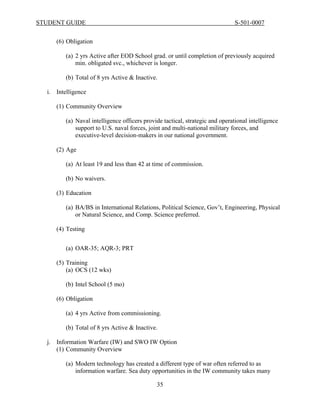
  i. Intelligence

     (1) Community Overview

         (a) Naval intelligence officers provide tactical, strategic and operational intelligence
             support to U.S. naval forces, joint and multi-national military forces, and
             executive-level decision-makers in our national government.

     (2) Age

         (a) At least 19 and less than 42 at time of commission.

         (b) No waivers.

     (3) Education

         (a) BA/BS in International Relations, Political Science, Gov’t, Engineering, Physical
             or Natural Science, and Comp. Science preferred.

     (4) Testing


         (a) OAR-35; AQR-3; PRT

     (5) Training
         (a) OCS (12 wks)

         (b) Intel School (5 mo)

     (6) Obligation

         (a) 4 yrs Active from commissioning.

         (b) Total of 8 yrs Active & Inactive.

  j. Information Warfare (IW) and SWO IW Option
     (1) Community Overview

         (a) Modern technology has created a different type of war often referred to as
             information warfare. Sea duty opportunities in the IW community takes many

                                              35
STUDENT GUIDE                                                              S-501-0007


            forms from TAD deployments onboard ships and submarines, to PCS assignments
            aboard aircraft carriers, amphibious units, cruisers and destroyers, to staff
            assignments with the numbered fleet commanders. IW officers may be assigned to
            flight duty at commands which conduct fleet airborne reconnaissance operations.
            The Navy's IW officers perform:

            i   Naval Information Warfare and related functions as directed by the Chief of
                Naval Operations.

            ii National Signals Intelligence tasks assigned by the Director, National Security
               Agency/Chief, Central Security Service (DIRNSA/CHCSS). These functions
               include:

            iii Information Warfare (IW) support to deployed ships, submarines, and aircraft.

            iv Signals Intelligence (SIGINT) tasks assigned by both CNO and DIRNSA
               where appropriate.

            v   Information Warfare (Protect) to minimize foreign exploitation of the Navy's
                electromagnetic system.

     (2) Age

        (a) At least 19 and less than 35 at time of commission.

        (b) No waivers.

     (3) Education
        (a) IW. BA/BS in Computer Science, Info. Systems, Mathematics, Physics,
            Electrical Engineering preferred.

        (b) SWO IW Option. BS in Computer Science, Math, Engineering, Physics and
            Foreign Area studies with a concentration in Language are preferred, but not
            required. Min. 2.2 GPA. C+ or better in Calc & Physics.

     (4) Testing

        (a) OAR – 35; PRT

     (5) Training IW

        (a) OCS (12 wks)

        (b) Crypto Officer Basic Course (13 wks)

     (6) Training SWO IW Option

                                            36
STUDENT GUIDE                                                              S-501-0007


        (a) OCS (12 wks)

        (b) DIVO (6-10 months)

        (c) SWOS (4-6 wks)

        (d) Complete DIVO tour

     (7) Obligation

        (a) 4 yrs Active from date of commission.

        (b) Total of 8 yrs Active & Inactive.

        (c) SWO IW Option: Officers must serve two years following re-designation to 1640
            or until the completion of four years from the date of commission, whichever is
            greater.

  k. Supply Corps

     (1) Community Overview
        (a) The Supply Corps is the United States Navy's professional staff corps responsible
            for the supply phases of naval logistics. The broad responsibilities of the Supply
            Corps are closely related to those of many executive positions in private industry
            and embrace such areas as financial management, inventory control,
            merchandising, transportation, procurement, data processing, and personnel
            services, including feeding U.S. naval forces and operating the Navy's Exchanges.

     (2) Age

        (a) At least 19 and less than 29 at time of commission.

        (b) Waiver up to 31 yrs prior to AD service.

     (3) Education

        (a) BA/BS in Math, Econ., Accounting, Business Admin., Finance, or Comp.
            Science/Info. Systems preferred.

     (4) Testing

        (a) OAR – 35; PRT

     (5) Training


                                            37
STUDENT GUIDE                                                              S-501-0007


        (a) OCS (12 wks)

        (b) Supply Corps School (24 weeks)

     (6) Obligation

        (a) 4 yrs Active from date of commission.

        (b) Total of 8 yrs Active & Inactive.

  l. Aerospace Maintenance Duty Officer (AMDO)

     (1) Community Overview
         (a) Aerospace Maintenance Duty Officer's (AMDOs) are maintenance and logistics
             professionals with formal technical and managerial education. AMDOs use their
             extensive Fleet experience to provide leadership at all levels of the integrated
             logistics and operational support of Naval Aviation. No other designator mirrors
             AMDO education, Fleet experience, and knowledge of the integrated logistics
             system.
     (2) Age

        (a) At least 19 and less than 35 at time of commission.

        (b) No waivers.

     (3) Education

        (a) BA/BS in Technical/ Business/Engineering/ Physical Science.

        (b) Min 2.0 GPA.

     (4) Testing

        (a) OAR-35: AQR-3; PRT

     (5) Training

        (a) OCS (12 wks)

        (b) Aviation Maint. Officer School (10 wks)

     (6) Obligation

        (a) 4 yrs active from commissioning.

        (b) Total of 8 yrs Active & Inactive.

                                            38
STUDENT GUIDE                                                               S-501-0007


  m. Public Affairs Officers (PAO)

     (1) Community Overview

         (a) A Navy Public Affairs Officer handles visual, audio and written communications
             for internal and public audiences, chooses the best media to deliver information,
             responds to reporters, and provides intuitive advice to top-level Navy decision
             makers.
             Navy Public Affairs Officers manage the flow of news and information for the
             Navy, the media and the public.

     (2) Age

         (a) At least 19 and less than 35 at time of commission.

         (b) No waivers.
     (3) Education

         (a) BA/BS in English, Communication, PR, Journalism, Speech or Broadcasting.

     (4) Testing

         (a) OAR – 35; PRT

     (5) Training

         (a) OCS (12 wks)

         (b) PAOC(10 wks

     (6) Obligation

         (a) 4 yrs from date of commission.

         (b) Total of 8 yrs Active & Inactive.

  n. Civil Engineering Corps (CEC)

     (1) Community Overview

         (a) Hundreds of naval shore facilities worldwide-like small cities with hospitals,
             airfields, power plants, housing, stores, office buildings and much more-make up
             the fleet support establishment. As a Navy Civil Engineer Corps (CEC) officers
             are a special group of officers in charge of engineering, management, planning,
             construction and maintenance of the Navy's shore facilities. Civil Engineer Corps
             officers may work in any or all of the following three areas:

                                              39
STUDENT GUIDE                                                          S-501-0007


        (b) Contract Management.

        (c) Public Works.

        (d) Construction Battalions.

     (2) Age

        (a) At least 19 and less than 29 at time of commission.

        (b) Waivers may be considered for those who would not exceed age 35 at
            commission.

     (3) Education
        (a) BS/MS in ABET accredited Engineering program (Civil/ Mechanical/Electrical,
            etc.) or NAAB accredited Architecture Program.

     (4) Testing

        (a) PRT

     (5) Training

        (a) OCS (12 wks)

        (b) CECOS (13 wks)

        (c) Three tour areas: 1) Construction Management 2) Public Works 3) SEABEES

     (6) Obligation

        (a) 4 yrs Active from date of commission.

        (b) Total of 8 yrs Active & Inactive.

  o. CEC Collegiate

     (1) Age

        (a) At least 19 and less than 29 at time of commission.

        (b) Waivers may be considered for those who would not exceed age 35 at
            commission.

     (2) Education


                                            40
STUDENT GUIDE                                                              S-501-0007


        (a) Within 2 yrs of graduation in AABET/ NAAB accredited BS program (1 yr for
            MS).

        (b) Collegiate: Min 3.0 GPA and "B" or better all science/tech courses.

        (c) Applications will not be considered if prospect not already within the 24/36
            month windows listed above.

     (3) Testing

        (a) PRT

     (4) Training

        (a) OCS (12 wks)

        (b) CECOS (13 wks)

        (c) Three tour areas: 1) Construction Management 2) Public Works 3) SEABEES

     (5) Obligation

        (a) 4 yrs Active from date of commission.

        (b) Total of 8 yrs Active & Inactive.

  p. Cyber Warfare Engineer

     (1) Community Overview

        (a) The Cyber Warfare Engineer was created as a means of addressing the increased
            demand for officers with specific computer network operations (CNO) focused
            knowledge, skills and abilities. Initial employment is focused on CNO
            capability/tool development under the purview of fleet cyber command. Selection
            is based on outstanding technical academic records in the field of computer
            science and computer engineering degree programs. After completion of
            obligation CWE’s are encouraged to laterally transfer into another community
            within the information dominance corps.

     (2) Age

        (a) Less than 35 years at time of commissioning.

     (3) Education


                                            41
STUDENT GUIDE                                                              S-501-0007


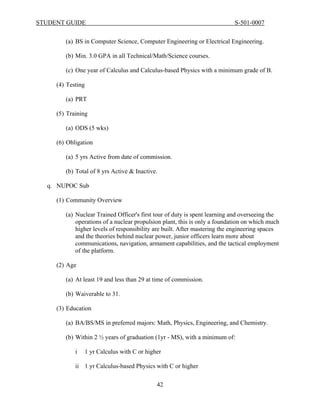
        (a) BS in Computer Science, Computer Engineering or Electrical Engineering.

        (b) Min. 3.0 GPA in all Technical/Math/Science courses.

        (c) One year of Calculus and Calculus-based Physics with a minimum grade of B.

     (4) Testing

        (a) PRT

     (5) Training

        (a) ODS (5 wks)

     (6) Obligation

        (a) 5 yrs Active from date of commission.

        (b) Total of 8 yrs Active & Inactive.

  q. NUPOC Sub

     (1) Community Overview

        (a) Nuclear Trained Officer's first tour of duty is spent learning and overseeing the
            operations of a nuclear propulsion plant, this is only a foundation on which much
            higher levels of responsibility are built. After mastering the engineering spaces
            and the theories behind nuclear power, junior officers learn more about
            communications, navigation, armament capabilities, and the tactical employment
            of the platform.

     (2) Age

        (a) At least 19 and less than 29 at time of commission.

        (b) Waiverable to 31.

     (3) Education

        (a) BA/BS/MS in preferred majors: Math, Physics, Engineering, and Chemistry.

        (b) Within 2 ½ years of graduation (1yr - MS), with a minimum of:

            i   1 yr Calculus with C or higher

            ii 1 yr Calculus-based Physics with C or higher

                                            42
STUDENT GUIDE                                                               S-501-0007


            iii Calculus must be through differential and integral calculus of one real
                variable. Physics must cover the classic fundamentals of mechanics,
                magnetism, and electricity.

     (4) Testing

        (a) PRT

     (5) Training (SUB)

        (a) OCS (12 wks)

        (b) NPS (6 mos)

        (c) Prototype (6 mos)

        (d) Sub School (13 wks)

        (e) Fleet qualify DNR, Wash., DC for Engineering Exam

     (6) Training (SURFACE)

        (a) OCS (12 wks)

        (b) DIVO (6-10 mos)

        (c) SWOS (4-6 wks)

        (d) Complete DIVO tour

        (e) NPS (6 mos)

        (f) Prototype (6 mos)

        (g) Fleet qualify DNR, Wash., DC for Engineering Exam

     (7) Obligation

        (a) 5 yrs from date of commission.

        (b) Total of 8 yrs Active & Inactive.

  r. BDCP (1160, 1370, 1390, 1460, 1860, 1520, 1630, 1640, 1800, 3100, 5100)

     (1) Program Overview


                                             43
STUDENT GUIDE                                                                 S-501-0007


        (a) BDCP a very financially rewarding program for applicants and a tremendous tool
            for recruiters to attract top quality college students to begin a career as a Naval
            Officer. BDCP candidates are selected by an officer community (Aviation
            Officer and Surface Warfare Officer BDCP professional selections are made by
            NRC staff vice community representatives) when determined that the applicant
            possesses the desired skills, abilities, and professional growth potential desired by
            the specific community. Once professionally selected, the NRC staff conducts an
            evaluation of the applicant's academic record and selection is based on the
            assessment of the individual's potential to meet the academic performance
            standards prescribed for the program.

     (2) Age

        (a) At least 18 and cannot exceed designator age limit prior to commission.

     (3) Education

        (a) Enrolled full time in accredited 4-yr college with at least 30 sem. or 45 qtr hrs.

        (b) Min. 2.7 GPA.

        (c) No waivers.

        (d) Candidates can be enrolled in the program for up to 36 months

            i   For Technical Degrees: Generally, should have taken or be scheduled to take
                Calculus and Physics prior to graduation. Technical Degrees include: all
                Engineering, Architecture, Aeronautics, Operations Research/Systems
                Analysis/Operations Analysis, Meteorology/Climatology, Biochemistry,
                Chemistry, Metallurgy, Mathematics, Computer Science (Math Oriented),
                Physics, Astronomy, Physical Sciences, and Statistics.

        (e) Applications will not be considered if appl not already within the 36 month
            window listed above.

     (4) Test

        (a) OAR-35 or as required by program designator

        (b) PRT

        (c) Others as required by program designator

     (5) Training

        (a) OCS (12 wks)

                                             44
STUDENT GUIDE                                                                   S-501-0007


         (b) Follow-up training per designator


      (6) Obligation

         (a) Obligation upon commissioning as required by program designator

4. Officer Development School (ODS) Programs

   a. Judge Advocate General (JAG)

      (1) Community Overview

         (a) The Judge Advocate General's (JAG) Corps Direct Appointment Program (DA)
             permits attorneys to be appointed directly into the Navy Judge Advocate General's
             Corps as lieutenants (junior grade) in the U.S. Naval Reserve for eight years and
             serve on active duty for at least the first three or four years of that obligation. This
             is a small program.

      (2) Age

         (a) At least 21 and less than 35.

         (b) Waiver for every month prior commission service.

      (3) Education

         (a) Graduate of ABA accredited law school.

      (4) Testing

         (a) Passed Bar Exam in one of the 50 states.

      (5) Training

         (a) ODS (5 wks)

         (b) Naval Justice School (9 wks)

         (c) Naval Legal Service Office Orientation (1 wk)

         (d) Ship Orientation (2 wks)

      (6) Obligation

         (a) 4 yrs Active from reporting to 1st duty station.


                                               45
STUDENT GUIDE                                                               S-501-0007


        (b) Total of 8 yrs Active & Inactive.


  b. JAG Student

     (1) Program Overview
        (a) The Judge Advocate General's (JAG) Corps Student Program (SP) permits law
            students to
            receive a commission in the inactive Naval Reserve while attending law school.
            Upon graduation and successful completion of a bar examination, SP participants
            serve in the Navy Judge Advocate General's Corps as lieutenants (junior grade) in
            the U.S. Naval Reserve. This is our largest source of attorneys and the best way to
            become a Navy JAG.

     (2) Age (same as JAG DA)

        (a) At least 21 and less than 35.

        (b) Waiver for every month prior commission service.

     (3) Education

        (a) Full-time student at ABA Law School with at least one year completed or
            graduate awaiting Bar admission.

        (b) Part-time or dual-degree students must be within 2 yrs of completion.

     (4) Testing

        (a) None

     (5) Training (same as JAG DA)

        (a) OIS (5 wks, if possible, done summer prior to 3rd yr, otherwise after Bar exam)

        (b) Naval Justice School (9 wks)

        (c) NLSO Orientation (1 wk)

        (d) Ship Orientation (2 wks

     (6) Obligation

        (a) 4 yrs Active from reporting to 1st duty station.

        (b) Total of 8 yrs Active & Inactive.

                                             46
STUDENT GUIDE                                                               S-501-0007


  c. Chaplain

     (1) Community Overview
        (a) Chaplain Corps officers are religious professionals in spiritual care. They work in
            collaboration with all Navy, Marine Corps and Coast Guard commands
            throughout the world to deliver religious ministry to active duty personnel and
            their families. The areas of responsibility include:

            i   Navy ships at sea, home ported in the continental United States and overseas.

            ii Navy, Marine Corps and Coast Guard units and chapels at home and around
               the world.

            iii Navy hospitals near military bases.

            iv Service academies and military training schools.

     (2) Age

        (a) Must not have reached age 40 at time of commission.

        (b) Waivers on a case by case basis to meet the needs of the Navy. Age waiver boards
            for Chaplains will be announced by the Program Manager, and are currently very
            limited in number available.

     (3) Education

        (a) 120 semester hrs for undergrad degree, plus a graduate degree (72 grad. semester
            hrs; at least 36 of these hours must be in "religious/ministry" core areas); from
            accredited schools.

     (4) Testing

        (a) None

     (5) Training

        (a) Chaplain School (length of school varies depending on whether first assignment is
            with a Marine Corps or Navy command).

        (b) Active Duty applicants, with an initial assignment to a US Navy command, will
            complete approximately 80 days of Chaplain Basic Course curriculum. Applicants
            with an initial assignment to a US Marine Corps will complete an additional
            (approximate) 25 days of USMC orientation (CREST training).

     (6) Obligation

                                            47
STUDENT GUIDE                                                              S-501-0007


        (a) 3 yrs from date of initial Active Duty orders.
        (b) Total of 8 yrs Active & Inactive.

  d. Chaplain Candidate Program

     (1) Program Overview

        (a) This program is designed to expose seminary students to the diverse and
            demanding ministry of Navy chaplains serving sea service personnel in a variety
            of settings. Chaplain candidates wear the uniform and receive pay and benefits
            only while on annual training.

            i   Active Duty - This program leads to a direct commission as a Naval Reserve
                officer on three years of active service. Chaplains on active duty may apply
                for an indefinite extension and a regular commission after selection and
                promotion to Lieutenant Commander.

            ii Reserve Duty - This program leads to a commission as an officer in the Naval
               Reserve and a commitment of two days each month for drills and two weeks
               of annual training. While remaining in their civilian careers, Naval Reserve
               chaplains also have the opportunity to serve their country and accumulate
               points toward retirement. Naval Reserve chaplains also may apply for
               temporary or full-time active duty assignments

     (2) Age

        (a) At least 21 and not older than 38 at time of graduation from seminary.

     (3) Education

        (a) 120 semester hrs for undergrad degree, plus enrolled full-time in an accredited
            graduate program.

     (4) Testing

        (a) None

     (5) Training

        (a) Chaplain School (approximately 45 days).

     (6) Obligation ACITVE

        (a) 3 yrs from date of initial Active Duty orders.

        (b) Total of 8 yrs Active & Inactive.

                                             48
STUDENT GUIDE                                                               S-501-0007


     (7) Obligation RESERVE

        (a) Total 8 yrs USNR Ready Reserve.

        (b) Not subject to recall or mobilization while in a 1945 status.

        (c) No annual or weekend drill obligations.

        (d) Annual on-the-job-training (OJT) periods, with pay, strongly encouraged.

  e. Nuclear Power School Instructor

     (1) Community Overview

        (a) Nuclear Power School Instructors are responsible for teaching future nuclear
            trained officers and enlisted personnel the theory and fundamentals behind the
            design and operation of Naval nuclear propulsion plants.

     (2) Age

        (a) At least 19 and less than 29 at time of commission.

        (b) Waivers may be considered for those who would not exceed age 35 at
            commission.

     (3) Education

        (a) BA/BS/MS in preferred majors; Math, Physics, Engineering, and Chemistry.

        (b) Within 2 ½ years of graduation (1yr - MS), with a minimum of:

            i   1 yr Calculus with B or higher

            ii 1 yr Calculus-based Physics with B or higher

            iii Calculus must be through differential and integral calculus of one real
                variable. Physics must cover the classic fundamentals of mechanics,
                magnetism, and electricity.

            iv "B" or better in all technical courses.

     (4) Testing – None

     (5) Training
         (a) ODS (5 wks)


                                             49
STUDENT GUIDE                                                               S-501-0007


        (b) NPS OJT (4 mo)

     (6) Obligation

        (a) 4 yrs from ODS graduation.

        (b) Total of 8 yrs Active & Inactive.

  f. Naval Reactors Engineer

     (1) Community Overview

        (a) NR Headquarters consists of about 250 engineers, who technically manage the
            Naval Nuclear Propulsion Program. About 100 of these engineers are junior naval
            officers with engineering or technical degrees. This Headquarters group is
            responsible for all aspects of the Nuclear Propulsion Program including:

            i   Advanced research and development in concepts, materials, design, and
                operation of nuclear propulsion plants.

            ii Training and qualification of nuclear propulsion plant operators.

            iii Reactor safety and radiological controls.

            iv Development of equipment, procedures, and specifications for naval nuclear
               propulsion plants.

            v   Overseeing the acquisition, construction, testing, and operation of propulsion
                plants.

            vi Developing and implementing the operating, maintenance, and refueling
               procedures for these plants.

            vii Resolving emergent fleet technical issues.


            viii Decommissioning the nuclear propulsion plants when removed from service.

     (2) Age

        (a) At least 19 and less than 29 at time of commission.
        (b) Waivers may be considered for those who would not exceed age 35 at
            commission.

     (3) Education


                                             50
STUDENT GUIDE                                                                   S-501-0007


          (a) BA/BS/MS in preferred majors: Math, Physics, Engineering, and Chemistry.

          (b) Within 2 ½ years of graduation (1yr - MS), with a minimum of:

                i   1 yr Calculus with B or higher

                ii 1 yr Calculus-based Physics with B or higher

                iii Calculus must be through differential and integral calculus of one real
                    variable. Physics must cover the classic fundamentals of mechanics,
                    magnetism, and electricity.

                iv "B" or better in all technical courses.

          (c) Competitive GPA = 3.3+; top 10% of class.

      (4) Testing

          (a) None

      (5) Training

          (a) ODS (5 wks)

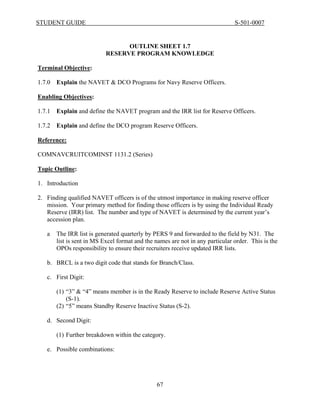
          (b) Department of Naval Reactors OJT (4-5 months)

          (c) Land-based prototype (2 wks)

          (d) Reactor Design Study at Bettis Reactor Engineer School (6 months)

      (6) Obligation

          (a) 5 yrs from OIS graduation.
          (b) Total of 8 yrs Active & Inactive.

5. Summary & Review

6. Application

7. Evaluation

   a. CBT

8. Assignment
9. Back to Course Outline


                                                 51
STUDENT GUIDE                                                                    S-501-0007


                                  OUTLINE SHEET 1.4
                            MEDICAL PROGRAM KNOWLEDGE

Terminal Objective:

1.4.0    Identify Direct Accession and Collegiate programs; Program Authorizations and
         Program Managers.

Enabling Objectives:

1.4.1    Describe Active Duty Direct Accession Medical, Dental, Nurse and Medical Service
         Corps programs.

1.4.2    Describe Active and Reserve Collegiate programs offered within the Medical, Dental,
         Nurse and Medical Service Corps.

1.4.3    Explain Bonus Options and Payback Requirements for each medical program.

1.4.4    Identify the purpose of Program Authorizations.

1.4.5    Identify the role of Medical Program Managers (PM).

Reference:

1.   Program Authorizations: 113 – 119; 130 – 132
2.   N34 Active Duty Medical Program Matrix
3.   Lesson Topic: Intro to Collegiates
4.   Information Sheet (I-2): Competitive Board Profiles

Topic Outline:

1. Introduction

2    Active Duty Direct Accession Medical Programs

     a   Medical Corps Direct Accession
         (1) Fully licensed and specialized. Can also be ready to finish residency or be right out
             of Medical School.
         (2) Accession Bonuses vary by specialty, higher for Critical Wartime Skills (CWS).
             Health Professions Loan Repayment Program (HPLRP) available.
         (3) Obligation 3 years, 4 years if bonus or HPLRP is taken.
     b   Dental Corps Direct Accession
         (1) Fully licensed and/or specialized. Can be right out of Dental School.

                                                 52
STUDENT GUIDE                                                               S-501-0007


      (2) Accession Bonus is $75,000. HPLRP available. CWS bonus may be more.
      (3) Obligation 3 years, 4 years if bonus or HPLRP is taken. CWS bonuses may incur
          even more obligation.
  c   Nurse Corps Direct Accession
      (1) Must have 4 year BSN degree and have passed license exam.
      (2) Accession Bonus options are $20,000 or $30,000. HPLRP is available dependent
          upon need for Navy Nurses.
      (3) Obligation is 3 years with or without the $20,000 bonus. 4 years with $30,000 or
          HPLRP. 5 years if $30,000 and HPLRP are taken.
  d   Medical Service Corps Direct Accession. The MSC consists of 22 specialties. Accession
      bonuses vary year to year dependent on the needs of the Navy. Minimum payback for all
      MSC direct accession programs is 3 years. If bonus is available and taken payback is + 1
      year in addition to minimum (3) for a total of 4 years. Same for HPLRP. If a bonus and
      HPLRP are available and taken together payback is + 2. Not all of these specialties are
      needed each fiscal year as some specialty communities are very small.
      (1) Aerospace Physiology (AP)

      (2) Aerospace Experimental Psychology (AEP)

      (3) Audiology

      (4) Biochemistry (BIOCHEM)

      (5) Clinical Psychology Workforce (CLINPSYCH)

         (a) Clinical Psychology Uniformed Services University of Health Sciences (USUHS)

         (b) Clinical Psychology INTERN

         (c) Clinical Psychology Post Doctoral Fellowship

      (6) Clinical Dietetics

      (7) Environmental Health (EHO)

      (8) Entomology (ENTO)

      (9) Health Care Administration (HCA)

      (10)   Industrial Hygiene (IHO)

      (11)   Medical Technology (MEDTECH)


                                             53
STUDENT GUIDE                                                                  S-501-0007


        (12)   Microbiology

        (13)   Occupational Therapy (OT)

        (14)   Optometry

        (15)   Pharmacy (PHARMD)

        (16)   Physical Therapy (PT)

               (a) Physical Therapy Baylor Program

        (17)   Physician Assistant (PA)

        (18)   Physiology

        (19)   Podiatry

        (20)   Radiation Health (RHO)

        (21)   Research Psychology

        (22)   Social Work (SW)

3   Collegiate Medical Programs. These are the same programs you were introduced to during
    Introduction to Collegiates.
    a   Active Collegiate Programs
        (1) Health Services Collegiate Program (HSCP) provides opportunities to the following
            types of students.
           (a) Dental students
               i   There are not many HSCP positions available to dental students, some years
                   there may be none offered at all.
           (b) Medical Students
           (c) MSC
               i   Only offered to certain specialties and can change year to year, even mid-year.
        (2) Benefits and payback.
           (a) All benefits and pay commensurate to all other active duty personnel with the
               exception of tuition assistance.
           (b) Payback is generally year for year.


                                               54
STUDENT GUIDE                                                                S-501-0007


  b   Reserve Collegiate Programs
      (1) Armed Forces Health Professional Scholarship Program (AFHPSP). This is a
          program identical to the Army and Air Force, thus why it’s called Armed Forces
          HPSP. It provides scholarships for the following types of students.
         (a) Medical Students

         (b) Dental Students

         (c) Physician Assistant Students

         (d) Optometry Students

         (e) Podiatry Students

         (f) Clinical Psychology Students

         (g) Nurse Corps

         (h) The above specialties may be authorized per program authorization to use the
             AFHPSP but this does not mean all of them do each year. It’s all dependent on
             funding and needs of the specific Corps.

         (i) There is a $20,000 signing bonus associated with this program. Whether it is
             offered to each of the 7 specialties above may change year to year. Currently it is
             only offered to Medical Students. Stipend is the same no matter the specialty,
             currently $2,060 per month, taxable.

         (j) Payback for all specialties is generally year for year + 1.

         (k) As with most accession bonuses, accepting the bonus incurs 1 more year of
             obligation IF not taken at the beginning of a 4 year program or currently in the
             first year of a 4 year program. For example, a medical student is waiting to begin
             or is currently in their first year of medical school and signs the AFHPSP contract
             accepting the bonus will not incur any further obligation.

      (2) Dental Student Program. This is a specific program offered only to Dental Students.
         (a) Sign on any time during dental school, but student decides whether to obligate at
             graduation.

         (b) Time in program earns time towards pay- this could result in $1000.00 or more
             per month if they obligate.

         (c) Upon graduations they have four options.

             i   Option 1 –$75,000.00 sign on bonus;

                                               55
STUDENT GUIDE                                                                   S-501-0007


              ii Option 2 – HPLRP;
              iii Option 3 - $75,000 and HPLRP;
              iv Option 4 – do not obligate at all and return a civilian at graduation.

          (d) Payback is 3 years if no bonus or HPLRP taken. 4 years if bonus or HPLRP taken.
              5 years if bonus and HPLRP taken.

          (e) This program only offers a guaranteed job.

       (3) Nurse Candidate Program (NCP). As the name implies this is specific to the Nurse
           Corps.
          (a) Offered to 3rd and 4th year Nursing Students.

          (b) A $10,000 accession bonus is broken into 2 payments. $5,000 at accession and
              $5,000 six months later.
          (c) A monthly taxable stipend of $1,000 is earned monthly.
          (d) Payback is tricky with this program. If a student accesses between 24 and 12
              months from graduation they are obligated 5 years. If accessing within a year of
              graduation they are obligated 4 years.
          (e) For those students falling into the 4 year obligation it may be in the best interest
              for the student to apply for a direct accession. Ensure you have all goaling and
              bonus information up to date and that the student understands their options.
       (4) Financial Assistance Program (FAP). This program offers an annual grant and
          stipend to the following:
          (a) Medical

          (b) Dental

          (c) The grant for both is $45,000 and is paid on their anniversary date of accession.

          (d) Both also receive the same stipend allotted to the AFHPSP of $2,060 per month.

          (e) Payback is year for year + 1, or a minimum of 3 years, whichever is greater. For
              example, a medical school graduate is accepted to a 3 year residency and signs the
              Navy contract. At the completion of the residency the Doctor will owe 4 years. 3
              years for the program plus 1 year.

          (f) Keep in mind that the Doctor, while in a military program, is attending a civilian
              residency. This means they will also be paid by the civilian residency.

4   Program Authorizations (PA)


                                                56
STUDENT GUIDE                                                                     S-501-0007


    a   PA’s are written laws of basic eligibility requirements such as age limits and citizenship,
        and education requirements such as Grade Point Averages and professional test scores,
        for each different program the Navy has to offer.

    b   It’s unrealistic to memorize every single PA but it is important to know where to find,
        view, and/or review a PA prior to beginning the “blueprinting” process with a Prospect.

    c   PA’s are public information and can be found on the Navy Recruiting Command (NRC)
        website under “Publications” then click on “Directives.”

    d   NRC Website address is: http://www.cnrc.navy.mil/

5   Program Managers (PM)

    a   PM’s reside at NRC Headquarters in Millington, TN. Their primary job is to accomplish
        annual goals assigned to them by the Director of Medical Accessions.

    b   PM’s other duties involve screening your kits for accuracy and applicant eligibility in
        preparation for the professional review boards.

    c   It is in your best interest to contact a PM if there is any question whether a prospect is
        qualified. Guessing in the recruiting business equals wasted time for you and more
        importantly, the prospect. It is highly stressed that you read the respective PA prior to
        calling a PM.

    d   PM contact information can be found on the NRC website by selecting “Internal Links”,
        then “Recruiting Quarterdeck” (CAC Required), then “Departments”, then “N3”. Scroll
        down to N314; these are the PM’s for the programs discussed in this lesson.

6   Summary & Review

    a   None

7   Assignment

    a   Review N34 Program Matrix

8   Testing

    a   CBT

9   Application


Back to Course Outline


                                                 57
STUDENT GUIDE                                                                   S-501-0007


                                 OUTLINE SHEET 1.5
                           MEDICAL MARKET IDENTIFICATION

Terminal Objective:

1.5.0    Identify the marketing plan and timelines for marketing medical programs.

Enabling Objectives:

1.5.1    Determine the most efficient marketing for each Medical Program.

1.5.2    Explain the timelines involved with Medical Marketing to meet your goal.

1.5.3    Identify the required marketing plan developed and maintained by NRC, Regions East
         and West, and NRDs.

Reference:

    1.   COMNAVCRUITCOM 1131.2 (SERIES), Chapter 6
    2.   Current Fiscal Year District Marketing Operations Plans
    3.   Program Authorizations: 113 – 119; 130 – 132
    4.   Information Sheet (I-2) Competitive Board Profiles

Topic Outline:

1. Introduction

2   Marketing Medical Programs

    a    Out of the 43 separate medical programs discussed in lesson 2.13 Medical Program
         Knowledge, each one has a distinct target market.

    b    Each Navy Recruiting District (NRD) has its own distinct market consisting of some or
         all of the 43 medical programs discussed.

    c    There are many tools available to you in order to target your assigned goal to your
         specific market.

         (1) Marketing Operations Plan

         (2) College Navigator Website

         (3) Your assigned College/University Websites

         (4) Center of Influence (COI)


                                                 58
STUDENT GUIDE                                                                 S-501-0007


      (5) Fellowship and Residency Electronic interactive Database (FREIDA) website.

      (6) Officer Production Analysis Training & Evaluation (OPATE)

  d   Program Specific Targeting. Details will be different throughout every corner of our
      country. This is a general overview of who we’re looking for.

      (1) Medical Corps Direct Accession

         (a) MD (Doctorate of Medicine) – AMA (American Medical Association)

         (b) DO (Osteopathic Doctor) – AOA (American Osteopathic Association)

         (c) Foreign Medical Graduate (FMG) is not qualified for scholarship but can gain
             entry to Medical Corps.

      (2) Dental Corps Direct Accession

         (a) ADA accredited 4th year dental school program

         (b) Graduated from an accredited ADA school in the U.S., Canada, or Puerto Rico,
             and must be licensed to practice in at least one of the U.S. States or District of
             Columbia.

      (3) Nurse Corps Direct Accession

         (a) NLN/CCNE accredited 4 year Nursing Schools

      (4) Medical Service Corps Direct Accession

         (a) Review associated Program Authorization (PA)

         (b) You are looking for specific accreditation requirements

      (5) Health Services Collegiate Program (HSCP)

         (a) Medical and Dental Corps. Market to current or future medical school students
             interested in active duty benefits vs. scholarship money.

         (b) MSC Specialties. You will need to stay in close contact with your MSC Program
             Manager (PM) due to the extremely competitive nature of this program within the
             MSC Corps. PA’s for direct accession will show accreditations you’ll be looking
             for within colleges/universities.

      (6) Armed Forces Health Professional Scholarship Program (AFHPSP)

                                              59
STUDENT GUIDE                                                                    S-501-0007


           (a) Medical and Dental Corps. Market to those motivated to have little to no debt
               from school.

           (b) MSC Specialties. (Physician Assistant; Clinical Psychology; Podiatry;
               Optometry) You will need to stay in close contact with your MSC Program
               Manager (PM) due to the extremely competitive nature of this program within the
               MSC Corps. PA’s for direct accession will show accreditations you’ll be looking
               for within colleges/universities.

           (c) Nurse Corps. Currently authorized within the PA but no funding.

        (7) Dental Student Program.

           (a) Accepted to or attending an ADA accredited Dental School.

        (8) Nurse Candidate Program (NCP).

           (a) 2nd through 4th year students currently enrolled in an NLN or CCNE accredited
               Nursing School.

        (9) Financial Assistance Program (FAP).

           (a) Dental School graduates accepted for or enrolled in an approved ADA graduate
               dental program.

           (b) Medical School graduates accepted for or enrolled in an ACGME or AOA
               residency program. Cannot be a Foreign Medical Graduate (FMG) unless from
               an AMA or AOA accredited Canadian School.

3   Marketing Timelines.

    a   Timing your prospecting to meet board dates is critical to meeting your goals.

    b   Two factors are considered in accomplishing your assigned goals.

        (1) Goaling Letter. Ask yourself the following questions.

           (a) As a new Officer Recruiter, is your first goaling letter mid-year, partial year, or
               full year?

           (b) How much time does it take to get a contact to applicant in each individual goal?

           (c) What is your lead to applicant & applicant to accession ratio from the Officer
               Production Analysis Training and Evaluation (OPATE) data?


                                                60
STUDENT GUIDE                                                                S-501-0007


      (2) Board Dates

         (a) Board dates for medical programs are published by Program Managers. Some are
             frequent such as every Wednesday, some may be only twice per year. Every
             effort is made to keep the board dates on schedule but keep in mind there are
             uncontrollable factors that can result in boards being postponed or even cancelled.

  c   With this knowledge you are able to create a solid marketing plan with timelines.
      Knowing the board date allows you to work backwards.

      (1) Board date. Mark this on your calendar.

      (2) Date to PM. Two weeks prior to board date. Mark this on your calendar as well.
          The PM needs 2 weeks with your kit to prepare and deliver it to the board. Keep in
          mind not all boards are held at NRC in Millington, TN.

      (3) Date to Processor. About two weeks prior to above. This depends on the speed of
          your processor who will need time to QC the kit, submit to OPO for signature, and
          upload into CIRMS. Allow time for; corrections to any mistakes your processor
          finds; postal time.

      (4) Date Kit Complete. About a week prior to above set a date that you want the kit
          completely done. There may still be some final signatures you’ll need from the
          prospect once you QC the kit.

      (5) Kit processing time. This area is where the prospect and you are gathering and
          completing portions of the kit. The amount of time will be determined by the
          particular program. Most kit requirements are out of your control. Or are they?

         (a) Motivation of prospect

         (b) Medical Forms and supporting medical documentation; MEPS; Consults

         (c) SF-86 security questionnaire

         (d) Employer/Character references

         (e) Collection of professional documents; educational documents

         (f) Prior Service Record; Conditional Release; CO recommendation letter

         (g) Police Record Check

         (h) Credentialing


                                             61
STUDENT GUIDE                                                                  S-501-0007


           (i) Motivational Statement

           (j) Family Care Plans

           (k) Resume/CV

        (6) Finding the prospects. This is where your OPATE will be useful if the data is
            accurate. From the data you will estimate how much time you will need to prospect,
            generating X amount of leads for X amount of prospects.

           (a) Scenario: It is September and you just received your new Goaling Letter for next
               FY. You have several goals on your letter and decide to start with AFHPSP MC;
               you were not goaled with this last FY.

               i     FY Goal 6
               ii    OPATE shows 2:1 lead to applicant ratio (50%)
               iii   Applicant to accession ratio is 2:1 (50%)
               iv     Two schools in your area are productive in this goal.
               v     There is only 1 board this FY in July.
               vi    Both schools only allow you to speak to the pre-med clubs during meetings
                     and they only meet twice per year in October and March.

           (b) How long will it take to generate 24 leads in time for 12 kits to make board,
               producing your 6 accessions?

        (7) Prospecting Plan. We’re not done yet, there’s still time needed for planning and
            preparation.

           (a) Time to create this prospecting plan; you’ll have more than just AFHPSP MC on
               your Goaling Letter.

           (b) Time to create campus visit plans for multiple schools.

4   Marketing Operations Plan (MOP)

    a   When building your medical prospecting plan there is no need to start from scratch. The
        MOP is a marketing plan requirement produced and maintained by NRC, Regions East
        and West, as well as each individual NRD. Within each NRD the MOP is the Officer
        Programs Officer’s (OPO) tool to accomplish mission each FY.

    b   Each District’s MOP is different just as each area throughout the United States is
        different IRT economic, social and demographic differences.

    c   Review your district’s MOP.


                                                62
STUDENT GUIDE                                                   S-501-0007


        (1) What are the advantages of using your MOP?

        (2) What challenges did you observe?

5   Summary & Review

    a   None

6   Assignment

    a   Review your assigned district MOP (Disregard for now)

7   Testing

    a   CBT

8   Application


Back to Course Outline


                                               63
STUDENT GUIDE                                                                 S-501-0007


                                     OUTLINE SHEET 1.6
                                    RESERVE STRUCTURE

Terminal Objective:

1.6.0   Explain the Reserve Structure.

Enabling Objectives:

1.6.1   Define the Ready Reserve.

1.6.2   Define the Individual Ready Reserve (IRR).

1.6.3   Define the Selected Reserve (SELRES).

Reference:

  1. COMNAVCRUITCOMINST 1131.2 (Series)
  2. BUPERSINST 1001.39 (Series)

Topic Outline:

1. Introduction

2. Navy Reserve. The Navy Reserve is composed of three (3) categories:

   a. Active Status
      (1) SELRES (USNR-R)
      (2) Individual Ready Reserve (USNR-R)
          (a) Voluntary Training Unit
          (b) Active Status Pool
      (3) Standby Reserve Active (USNR-S1)
   b. Inactive Status
      (1) Standby Reserve Inactive (USNR-S2)
   c. Retired

3. USNR-R (SELRES, IRR). Officers stay in USNR-R Status until transferred or discharged.
   They are eligible for involuntary recall to active duty in time of national emergency or when
   authorized by law.

4. USNR-S1 Status – Active Status.
   a. They were transferred into this status by PERS 911 formerly PERS 4911.
   b. May participate for drill points however they are not authorized pay, allowances or travel
      allowances.
   c. Continue to be eligible for promotion and they are subject to recall.

                                               64
STUDENT GUIDE                                                                   S-501-0007


   d.   Temporary Mobilization Restrictions
   e.   Key Federal Employees
   f.   Medical or Dental Program Students
   g.   Persons whose retention in an active status, for reasons other than those specified above,
        considered by SECNAV to be in the best interest of the Navy.

5. USNR-S2 Status – Inactive Status.
   a. May not participate for retirement points or pay.
   b. They are in the inactive status pool at NAVRESPERCEN.
   c. Not considered for promotion.
   d. They are subject to recall.
   e. May be returned to USNR-R Status if qualified and requested.
   f. Reservists who have complete MSO may be transferred to USNR-S2 for:
      (1) Failure to complete a Ready Reserve Service Agreement.
      (2) Failure to satisfy minimum participation requirements.
      (3) Personal Request approved by NAVRESPERSCOM.
      (4) Eligible for Retired Pay with a disability rating of less than 30% and assigned to the
          S2 Status instead of being separated for that disability.
      (5) Best interest of the Navy.

6. USNR – Retired.
   a. Reservists in USNR-R1, S1 or S2 are transferred to the Retired Reserve upon request or
      as directed per SECNAVINST 1820.2 (Series).
   b. Subject o recall to active duty.
   c. May not receive Retirement point credit for the performance of any duty after the
      effective date of their retired status (except while authorized to serve on active duty).
   d. May do permissive orders with exceptions; reference BUPERSINST 1001.39 (Series) for
      specifics.

7. Minimum Participation Requirements to Remain in an Active Status.
   a. Monitored by PERS 911.
   b. Officers earning fewer than 27 points (15 gratuitous + 12 additional) are in jeopardy.
   c. Good Year for retirement is 50 > points.
   d. Keep in mind that a good year for retirement and the minimum participation standards for
      drilling members are different.

8. Reserve Promotion Criteria.
   a. Serve continuously of the RASL or ADL during the one (1) year period ending on the
      date of the convening of the promotion board.
   b. Officers returning to an active status from broken service of S-2 Status aren’t eligible for
      promotion until the one (1) year requirement has been met.

9. Broken Service for Reserve Officers.
   a. Officers leaving Active Duty going into the IRR do not have broken service.
   b. Officers resigning their commission after meeting their MSO and then request to come
      back in have broken service.

                                                65
STUDENT GUIDE                                                                  S-501-0007


   c. Therefore a person off of active duty into the IRR Status is eligible for promotion at the
      next promotion board – if they are in zone.
   d. This generally only effects people with over eight (8) years service. A person under 8
      years goes into the IRR.

10. Status Check.
    a. Important to conduct a status check prior to working a NAVET.
        (1) Person may be in S-2 Status due to:
            (a) Poor performance.
            (b) Not enough satisfactory participation years to retire.
            (c) Other service.
    b. Status checks are conducted by calling PERS 911.

11. Summary & Review.

   a. Review Objectives

12. Assignment:

   a. None

13. Testing:

   a. CBT

14. Application:

   a. None
Back to Course Outline


                                               66
STUDENT GUIDE                                                                   S-501-0007


                                  OUTLINE SHEET 1.7
                            RESERVE PROGRAM KNOWLEDGE

Terminal Objective:

1.7.0   Explain the NAVET & DCO Programs for Navy Reserve Officers.

Enabling Objectives:

1.7.1   Explain and define the NAVET program and the IRR list for Reserve Officers.

1.7.2   Explain and define the DCO program Reserve Officers.

Reference:

COMNAVCRUITCOMINST 1131.2 (Series)

Topic Outline:

1. Introduction

2. Finding qualified NAVET officers is of the utmost importance in making reserve officer
   mission. Your primary method for finding those officers is by using the Individual Ready
   Reserve (IRR) list. The number and type of NAVET is determined by the current year’s
   accession plan.

   a    The IRR list is generated quarterly by PERS 9 and forwarded to the field by N31. The
        list is sent in MS Excel format and the names are not in any particular order. This is the
        OPOs responsibility to ensure their recruiters receive updated IRR lists.

   b. BRCL is a two digit code that stands for Branch/Class.

   c. First Digit:

        (1) “3” & “4” means member is in the Ready Reserve to include Reserve Active Status
            (S-1).
        (2) “5” means Standby Reserve Inactive Status (S-2).

   d. Second Digit:

        (1) Further breakdown within the category.

   e. Possible combinations:


                                                67
STUDENT GUIDE                                                                 S-501-0007


    (1) 31 – in the RR and eight year Military Service Obligation (MSO) has expired
    (2) 32 – in the RR and still servicing MSO
    (3) 33 – in the RR, subject to attrition, but continued in active service
    (4) 34 – in the RR, retained with at least 18, but less than 20 good years.
    (5) 35 – in the RR, with age-in-grade waiver or past age 60 waiver
    (6) 36 – in the RR, serving under a Ready Reserve Transfer Request Service Agreement
    (7) 37 – in the RR, in Naval Active Duty Delayed Study Program.
    (8) 38 – in the RR, not SELRES, in Armed Forces Health Scholarship Program.
    (9) 41 – S-1 due to Key Federal Employee
    (10)     42 – S-1 due to hardship, expects to return to RR
    (11)     44 – S-1 due to age, at least 18 but less than 20 good years.
    (12)     51 – S-2 due to promotional attrition
    (13)     55 - S-2 due to max age in grade or age 60 restrictions
    (14)     56 – S-2, retained in S-2 due to recommendation of Naval Reserve Officer
        Mobilization Board
    (15)     57 – S-2 due to failure to earn sufficient retirement points in an anniversary year
    (16)     58 - S-2, selected for non-continuation by board

  f. ANNIV. Month and day of member’s anniversary date. This is the date that the member
     will gain another “good year” for retirement purposes if they accrue the necessary points.
     These dates do not run by fiscal year.

  g. APGD. IRR lists actual rank, older versions use codes.

  h. DOR. Year, month, day of member’s date of rank. The date the member was promoted
     to their current rank.

  i. PEBD. Pay Entry Base Date, typically the date the member first entered military service.
     Eight year MSO is measured from this date.

  j. DOB. Year, month, day of member’s date of birth.

  k. LRAD. Last Released From Active Duty, most recent date that member was on active
     duty.

  l. DESIG. Member’s designator. This can be used to filter data and specify designators we
     are looking for.

  m. TOTSF - Total Satisfactory (Service). This is how many “qualifying years” for
     retirement the member has accrued.

  n. ABCD. This column contains retirement point information on the member’s most recent
     year for which there is data. The first digit (letter) indicates how many retirement points
     earned in the year. Second digit indicated which year the activity occurred in. In most
     cases, the year will be 200X, where X is the second digit. Exceptions are for where the
     year is 199X.

                                              68
STUDENT GUIDE                                                                  S-501-0007


       (1) A – > 50 points (qualifying year for retirement)

       (2) B – 27 to 49 points (not a “good year” but sufficient to maintain good standing.

       (3) C - < 27 points accrued, not a “good year” for satisfactory participation requirements.

   o. PROST. Promotion Status. This column contains information on the member’s recent
      promotion activity. The first digit (letter) indicates the type of promotion activity. The
      remaining digits are the year(s) in which the activity occurred. In most cases the year
      will be 200X, where X is the digit. Exceptions for 199X.

       (1) S – Selected for promotion.

       (2) F – Failed to select (FOS).

       (3) C – Considered, not promoted (O-6 and above).

       (4) D – Consideration for promotion has been delayed for administrative reasons.

   p. UNAME. Unit Name.

   q. BDCS. Base Date of Commissioned Service. Will differ from PEBD if member had
      prior enlisted service.

3. Now that you have the list and information, now you can use it for prospecting. You can
   transfer this information to an Excel file and use the sort function to sort by LRAD or any
   other category i.e., designator.

4. Prospecting. You can analyze all the data fields for a member to get the big picture” before
   contacting the member but you will want to consider the following factors before beginning
   your prospecting evolution.

   a. BRCL. How did the member get to be in the status he/she is in?

   b. ANNIV. By being cognizant of the member’s anniversary date, you may be able to
      advise them that coming back to active duty/SELRES by a certain date may be in their
      best interest to avoid losing a “good year.”

   c. TOTSF. Definitely important to have this number in mind when contacting the member.
      You will need to be able to discuss how many years left to lock in the “million dollar”
      retirement package.

   d. 20 by 24 Rule. A LCDR must reach 20 “good years” towards retirement by their 24th
      year of commissioned service. If they cannot do that, they need to make CDR to earn a
      retirement (tough to do in the IRR). This can be calculated by figuring their total service
      and the BCDS date.

                                               69
STUDENT GUIDE                                                                  S-501-0007


        (1) If total service (TOTSF) is 8 years in 2008; but their BDCS is 1994, they cannot
            make 20 good years in 24 years.

5.    Direct Commission Officer (DCO). The Direct Commissioning Program allows university-
     educated professionals, between ages 19 to 42 (or older, in some cases i.e. medical), the
     opportunity to be appointed as an officer in the Naval Reserve. Most DCOs hold advanced
     degrees (MAs, MBAs, JDs, MDs, DOs, PharmD’s and Ph.D’s) and/or significant civilian
     work experience. DCO candidates will attend the two week school located in Newport, RI
     and are required to complete this training within the first year of commissioning.
     Information on the DCO School can be found at: http://www.ocs.navy.mil/nrows_inst.asp.
     The following is a list of available designators for the DCO program.

        a.   Human Resources Officer (1205)
        b.   Special Warfare Officer (1135)
        c.   Special Operations Officer – EOD (1145)
        d.   Engineering Duty Officer – (1465/1445)
        e.   Aeronautical Engineering Duty Officer (1515)
        f.   Aviation Maintenance Duty Officer (1525)
        g.   Special Duty Officer (Information Professional) (1605)
        h.   Special Duty Officer (Information Warfare former Cryptology) (1645)
        i.   Special Duty Officer (Merchant Marine) (1625, 1665, 1675, 1695)
        j.   Special Duty Officer (Intelligence) (1635)
        k.   Special Duty Officer (Public Affairs) (1655)
        l.   Special Duty Officer (Oceanography) (1805)
        m.   Supply Corps (3165/3105)
        n.   Civil Engineer Corps (5105)
        o.   Medical Corps (2105)
        p.   Nurse Corps (2905)
        q.   Medical Service Corps (2305)
        r.   Dental Corps and General Residency (2205)

6. Program Authorizations. You will need to reference Program Authorization (PA) for
   specifics regarding the program, basic qualifications, work experience requirements, age
   limitations and service obligations for each DCO program. Program Authorizations can be
   located on the NRC website at
   http://www.cnrc.navy.mil/publications/ProgramAuthorizations.htm The Medical and Non-
   Medical program matrixes consolidate the main points of the Program Authorizations.

7. Summary & Review.

8. Assignment:

     a. None


                                               70
STUDENT GUIDE                 S-501-0007


9. Testing:

   a. CBT

10. Application:

   a. None

Back to Course Outline


                         71
STUDENT GUIDE                                                                  S-501-0007


                                OUTLINE SHEET 1.8
                          RESERVE MARKET IDENTIFICATION

Terminal Objective:

1.8.0   Identify the competitive profiles, marketing concepts and timelines for reserve programs.

Enabling Objectives:

1.8.1   Determine the basic characteristic differences between NAVETS and DCO Applicants.

1.8.2   Explain the timeline involved with Navy Veteran and DCO applicant processing.

1.8.3   Identify the marketing strategies and best business practices involved with finding Navy
        Veterans and Direct Commission Officer applicants.

Reference:

COMNAVCRUITCOMINST 1131.2 (Series)

Topic Outline:

1. Introduction

 2. Navy Veteran. The current year accession plan dictates exactly what type of NAVET
    Officer can successfully affiliate into the Selected Reserve. As long as the Officer has the
    correct designator and rank, stipulated by the current year accession plan, to include meeting
    physical requirements and documentation requirements by PERS-9, then the Officer will
    obviously be competitive. There really is no competitive profile, if the NAVET is
    physically qualified and meets the accession plan they will get approved.

 3. Direct Commission Officer. DCOs are broken down into two primary categories, Medical
    and Non-Medical.

   a. Medical DCO. If you have an applicant that meets the minimum requirements as
      specified in the Program Authorizations ( P.A.) for the MC, DC, MSC and NC, and the
      applicant meets physical requirements, they will be competitive! The selection rate for
      medical applicants is the highest out of all the DCO programs.

   b. Non-Medical DCO. Every DCO program has different competitive requirements.
      However, they all have the following general characteristics for competitive applicants.
      (1) Strong Prior Enlisted Record
      (2) Advanced Degree in a Related Field
      (3) Working Professional in a Related Field


                                               72
STUDENT GUIDE                                                                  S-501-0007


   c. Examine Competitive Profile Sheets for Non-Medical DCOs.

 4. Marketing Timelines. An Officer Recruiter must be fully cognizant of the timelines
    involved with processing applicants, either DCO or NAVET. This is critical in preparing
    how far in advance marketing strategies need to be in place prior to a realistic kit submission
    date as well as selection date to make assigned goal. Again this is broken up into two
    primary categories: NAVET and DCO.

   a. NAVET Timelines. If a NAVET has all their required paperwork, i.e. DD-214, signed
      Ready Reserve Agreement, current physical, etc. then affiliation approval can be as fast
      as a week. In short, the NAVET timeline is dependent upon the NAVET having the
      required paperwork and motivation. If you find a NAVET that is qualified and motivated
      they can be a gain for that same month. Remember, all that is required is the affiliation
      paperwork.

   b. DCO Timelines. DCO timelines are dependent upon three general issues: building the
      kit and submitting the kit, the DCO board convening dates and commissioning
      documents generation which will include items such as the scroll process. It can
      sometimes take as long as 6 months to a year to successfully commission a DCO
      applicant. Therefore marketing strategies are long term and may not provide results in
      the short term. If you find a qualified CEC DCO applicant it may take months until the
      individual is affiliated with the SELRES and you receive credit.

 5. Marketing Strategies. NAVET and DCO marketing strategies vary, however both do
    require heavy involvement with your local Navy Operational Support Center. SELRES
    personnel at the NOSCs assigned to your territory are your one of your best sources in
    getting the word out on Navy Reserve programs. Therefore any marketing strategy
    developed will need to incorporate building strong relationships with NOSC personnel.

   a. NAVET Marketing. The following are the primary tools for finding Navy Veterans in
      your area of responsibility.

       (1) IRR list***

       (2) TAP class

       (3) Local PSD

       (4) Branch Medical Clinics

       (5) Active Duty Installations Visits

       (6) CTO

       (7) NOSC COI Development


                                                73
STUDENT GUIDE                                                               S-501-0007


  b. NAVET Marketing Strategies.

     (1) Mail Outs with Benefit Information. Knowing benefits is paramount and one of the
         most powerful tools to sell NAVETS is the reserve retirement calculator:
         https://staynavytools.bol.navy.mil/RetCalc/Default.aspx

     (2) Phone Power: Finding NAVET phone numbers can be challenging because they are
         not located on the IRR list. Do your research prior to phoning any NAVET! Do not
         call without knowing how many years of service they have, points toward retirement,
         billets available etc. You will have to do some solid research before conducting
         phone power. Some good resources at finding phone numbers are:
         http://www.whitepages.com/ http://theultimates.com/

     (3) NOSC COI Development. It is imperative that Reserve Officer Recruiters work drill
         weekends, every drill weekend! Selected Reservists will be a powerful tool at selling
         NAVETS the benefits of being a drilling member of the reserves, extra income,
         retirement benefits, SGLI, medical benefits, and networking.

        1. Example: 1115 SWO Officers will be able to talk to SWO NAVETS on the
           realities of being a SWO in the SELRES, i.e. not standing bridge watches and the
           variety of jobs available etc.

  c. DCO Marketing Strategies. DCO Marketing is broken down into two categories.
     Medical and Non-Medical.

     (1) Non-Medical DCO. Some of the primary areas for finding non-medical DCO
         applicants are:

        1. Enlisted SELRES population. Enlisted SELRES that have advanced degrees and
           that are working in a related field are highly competitive. Again, knowing your
           NOSC population is key.

        2. Professional Organizations. Professional organizations are excellent resources for
           finding applicants with specific skill sets such as engineers, business professionals
           etc. The below are general examples of a myriad of national, state and local
           professional organizations.

             a. http://www.nspe.org/index.html

             b. http://www.mbaworld.com/

             c. http://www.afcea.org/mission/intel/default.asp

        3.      Career Fairs

        4.      Colleges and Universities: specifically Career Service Centers

                                             74
STUDENT GUIDE                                                                S-501-0007


      (2) Medical DCO (MC, DC, MSC, NC). Active and Reserve medical markets are very
          similar. However, the primary difference for the MC is that the RC does not look for
          medical students while they are in medical school. The RC is only interested in fully
          qualified (board certified) physicians and residents for the DCO program. For the
          Nurse Corps the RC is only interested in nurses who have completed their BSN and
          who have at least 3 months of work experience. For the DC they need to be already
          licensed and practicing as well. In short, the RC is no looking for students but fully
          qualified medical practitioners and residents. s

          1. School Lists (Residencies) and Professional Organizations. ID every university in
             your area that offers a residency program and BSN program. Also ID every
             medical professional organization available. The following websites illustrate the
             myriad of online resources available:

              a. http://dbapps.ama-assn.org/aps/amahg.htm

              b. http://www.acgme.org/adspublic

              c. http://www.ama-assn.org/ama/pub/education-careers/graduate-medical-
                 education/freida-online.shtml

          2. Develop Residency Coordinator as COI. Email or call for a meeting to discuss
             what you’re trying to do, and ask for a school listing of all residents. Ask your
             coordinator if you can post or leave flyers and or business cards. Once you have
             spoken with the residency coordinator ask also for permission to provide a 15-20
             minute brief, possibly during lunch or after the monthly residency meeting. From
             there, plan your brief by preparing your handouts outlining the highlights of the
             TMS program as well as the LRP/STIPEND bonuses. Also, ask one of your
             drilling Doctors if he/she would be interested in attending as well.

          3. Mail outs. As with NAVETS, mail outs can be a powerful tool in attracting
             qualified applicants. Many medical professional organizations such as the
             American Society of Anesthesiologists at http://www.asahq.org/ can provide
             lists of doctors and addresses, typically for a fee.

6. Summary & Review.

7. Assignment:

   a. None

8. Testing:

   a. CBT


                                              75
STUDENT GUIDE                 S-501-0007


9. Application:

   a. None

Back to Course Outline


                         76
STUDENT GUIDE                                                                   S-501-0007


                            OUTLINE SHEET 1.9
         NAVAL VETERAN (NAVET) & DIRECT COMMISSION OFFICER (DCO)
                               AFFILIATION

Terminal Objective:

1.9.0    Define NAVET and DCO affiliation.

Enabling Objectives:

1.9.1    Explain Navy Reserve Affiliation.

1.9.2    Define the three types of billet assignment.

1.9.3    Explain the Reserve Functional Area and Sex (RFAS) code.

1.9.4    Explain the specific components of a billet and where to find billets for NAVETS and
         newly commissioned DCOs.

1.9.5    Explain the importance of the Navy Reserve Affiliation checklist.

Reference:

COMNAVRESFORINST 1001.5F (May 2010)

Topic Outline:

1. Introduction

2. Navy Reserve Affiliation. The affiliation process is simply taking an Officer and assigning
   them into the Selected Reserves.

     a. NAVETS. Taking Officers from Active Duty and the Individual Ready Reserve and
        placing them into the Selected Reserves.

     b. DCOs. Taking newly commissioned Direct Commission Officers and placing them into
        the Selected Reserves. Once the DCO application process is complete and the officer
        receives their commission they need to be affiliated into the Selected Reserve. After being
        commissioned they are in the Individual Ready Reserve and need to be placed into the
        Selected Reserve.

3.   There are three different types of Reserve Billet Assignments.

     a. Hard Billet Assignment. This is the ideal assignment where the member drills with the
        unit that they will be mobilized to. Training Reserve Unit Identification Code (TRUIC)

                                                 77
STUDENT GUIDE                                                                  S-501-0007


       and Unit Mobilization Unit Identification Code (UMUIC) are the same command. The
       TRUIC supports the UMUIC.

   b. Cross Assignment. Ideal for members not living close to the NOSC that contains their
      billet. They will drill with a unit at a closer NOSC and therefore complete drills with an
      alternate unit. With cross assignment the RUIC and TRUIC will not match. The TRUIC
      is the unit the member drills with and the RUIC is the unit the member belongs to. The
      UMUIC is the unit the member will be mobilized to. The member conducts Annual
      Training (AT) periods with UMUIC.

   c. In Assignment Processing. With IAP the member does not actually hold a billet.
      Personnel can be in IAP status for 90 days to allow time to search for a hard billet or
      cross assignment. DCOs and CWOs can be IAP for their first 3 years following
      commissioning.

4. Reserve Functional and Sex (RFAS) Codes. This code is used to determine which type of
   officer can fill a particular billet. RFAS Codes consist of the following:

  a.   Designator
  b.   Rank
  c.   Rank Substitution
  d.   Designator & NOBC (Navy Officer Billet Classification) Substitutions
  e.   Sex
  f.   Funded & Not Funded

5. The components of a reserve billet.

  a. Naval Reserve Activity (NRA): 0858 NOSC Pensacola, NRA is the NOSC the billet
     belongs to.

  b. RUIC (Reserve Unit Identification Code) = TRUIC. The exception to this is for Cross
     Assignment, the RUIC is the unit the Officer belongs to, the TRUIC is where the officer
     drills.

  c. AUIC (Active Unit Identification Code) = UMUIC

  d. RBSC = Reserve Billet Sequence Code

6. Where to find reserve billets.

  a. In general, all designators can use JO APPLY except for HR, EDO, Information Warfare
     (Crypto), Intel, PAO and CEC.

  b. For (URL) 1105, 1115, 1125, 1135, 1145 use JO APPLY.


                                               78
STUDENT GUIDE                                                              S-501-0007


  c. For (Aviation URL) 1305, 1315, 1325 use JO APPLY. Exception for those seeking
     assignment to squadron assignments and flight billets, squadron convenes board.

  d. For (HR) 1205 contact CAPT Teri Barber (PERS 4421) at teri.barber@navy.mil, (901)
     874-4054.

  e. For (Engineering) 1445, 1465 contact YNC(SW) Charles Shelton (NAVSEA) at
     charles.c.shelton@navy.mil, (202) 781-3959.

  f. For (AEDO) 1515, 1525 use JO APPLY, however, recommend contacting CDR Matthew
     Browning (NAVAIR, Program 25) at matthew.browning@navy.mil, (301) 757-2153 (may
     have to speak to squadron MANPOWER personnel, if they are seeking an operational
     assignment).

  g. For (Information Professional) 1605 use JO APPLY.

  h. For (Information Warfare) 1615, 6445 use JO APPLY, recommend contacting Mr. Ronald
     Whittle (Navy Network Warfare Command) at ronald.whittle1@navy.mil, (240) 373-
     3081.

  i. For (Merchant Marine) 1625, 1665, 1675 use JO APPLY.

  j. For (Intel) 1635, 6455, 7458 contact local Navy Intelligence Reserve Region Officer-in-
     Charge for billet assignment.

  k. For(PAO) 1655 contact CDR Kyra Hawn (CHINFO) at kyra.hawn@navy.mil, (703)
     614-4288.

  l. For (Oceanography) 1805, 6465 use JO APPLY, recommend contacting LCDR Ricky
     Baker (Commander Naval Meteorology and Oceanography Command) at
     ricky.baker@navy.mil, (228) 688-4531.

  m. For (Medical) 2105, 2205, 2305, 2905 use JO APPLY, recommend contacting LT Brian
     Allen (BUMED) at reserve.manpower@med.navy.mil, (202)762-3842.

  n. For (JAG) 2505 use JO APPLY, recommend contacting LCDR Joseph Schaaf (CNRFC
     N01J) at joseph.schaaf@navy.mil, (757) 322-5648.

  o. For (Supply) 3105, 6515, 7518, 7528 use JO APPLY, recommend contacting RCC N4,
     CDR Eileen Werve at eileen.b.werve@navy.mil, (904) 542-2486 x196.

  p. For (Chaplain) 4105 use JO APPLY, recommend contacting Chaplain CDR Steven Smith
     (CNRFC N01G) at steven.c.smith4@navy.mil, (757) 322-5671.

  q. For (CEC) 5105, 6535, 7538 use CDR Stanley Sikes (PERS 4413D) at
     stanley.sikes@navy.mil, (901) 874-4031.

                                            79
STUDENT GUIDE                                                               S-501-0007


   r. All LDOs and all CWOs use JO APPLY.

7. Affiliation Paperwork. The Affiliation Checklist will provide you with every necessary
   form required for proper affiliation into the Navy Reserve. This paperwork is what makes
   effective Inactive Duty Orders (NAVRES 1321.1) placing a member into the SELRES in a
   specific billet to include SGLI setup, processing of W4, processing of direct deposit etc.
   Once the affiliation paperwork is complete provide a copy to the member and the originals to
   the Navy Operational Support Center staff.

8. Summary & Review.
   a. Navy Reserve Affiliation
   b. 3 Types of Billet Assignments
   c. RFAS Codes
   d. Billet Components & Where to Find Billets
   e. Importance of the Affiliation Checklist

9. Assignment:

   a. None

10. Testing:

   a. CBT

11. Application:

   a. None
Back to Course Outline


                                              80
STUDENT GUIDE                                                                  S-501-0007


                                OUTLINE SHEET 1.10
                          CAREER TRANSITION OFFICE (CTO)

Terminal Objective:

1.10.0 Explain the functionality of the Career Transition Office (CTO).

Enabling Objectives:

1.10.1 Define CTO and how they assist in making Reserve Officers Mission.

Reference:

COMNAVCRUITCOMINST 1131.2 (Series)

Topic Outline:

1. Introduction

2. The Career Transition Office (CTO) has been established (NAVADMIN 229/09) to support
   the Navy’s Total Force Vision for the 21st Century and the Chief of Naval Personnel’s
   Continuum of Service (CoS) initiative (NAVADMIN 114/10). This supports rapid and
   seamless transitions across Active and Reserve Components (AC/RC) that will encourage a
   lifetime of Navy service, whether in uniform or as a Civil Servant. The CTO will become
   the single point of contact for all Navy personnel transitional guidance and transition
   processing. The CTO has been initiated and implemented in the following three phases:

   a. OFFICER AC TO RC TRANSITIONS: On 29 May 2009, Phase One of the CTO
      commenced operations. The CTO Officer Transition Branch transitions Navy Officers
      directly from the AC to the RC as a drilling Navy Reservist. An Officer Transition
      Assistant (TA) from the CTO contacts and advises all officers approved to leave the AC
      and are eligible for continued Navy service, informing them of the benefits and
      opportunities available in the Navy Reserve. If an officer desires direct transition to the
      RC as a drilling Navy Reservist, the CTO will facilitate the transition process to include
      preparation and processing of all required transition documents and assignment to a
      drilling Unit at their desired Navy Operational Support Center (NOSC). The TA is
      responsible for affecting the transition as quickly and seamlessly as possible and
      addressing any questions for the transitioning Officer, but additional assistance and
      information may be provided by a local Reserve Officer Recruiter if desired. Officers
      that separate from the AC and do not desire direct transition from the AC to the RC will
      have to contact a Reserve Officer Recruiter at a later date to affiliate with the RC as a
      drilling reservist.

   b. ENLISTED AC TO RC TRANSITIONS: On 24 November 2009, Phase Two of the
      CTO commenced operations. The CTO Enlisted Transition Branch directly transitions
      Enlisted Sailors from the AC to the RC as a drilling Navy Reservist. Enlisted Sailors

                                               81
STUDENT GUIDE                                                                S-501-0007


      desiring a direct transition into the RC should contact their Command Career Counselor
      to apply RC in the Fleet RIDE/Perform to Serve (PTS) system. A CTO Enlisted
      Transition Assistant will contact and advise transitioning Sailors about the benefits and
      opportunities available in the Navy Reserve as well as facilitate the transition process
      from beginning to end. The CTO has also established a Centralized Processing of
      all required loss and gain activities within the CTO. These actions will continue to make
      the transition process as seamless as possible and work towards the Chief of Naval
      Personnel’s goal of achieving AC/RC transitions within 72 hours.

   c. RC to AC : On October 1, 2010, Phase Three of the CTO commenced operations. This
      recall program is only available to Drilling Navy Reserve Sailors. IRR members must
      contact a local Active Officer/Enlisted recruiter to transition to the AC. Select "RC to
      AC Opportunities" on the Hotlinks in the left column for more information.

3. CTO and Navy Reserve Officer Affiliations.

   a. Background. The CTO is a new program developed as a CNP initiative in support of the
      Continuum of Service. The CTO has been established to ease the transition from Active
      Component (AC) to Reserve Component (RC) for our fleet officers and will complete all
      paperwork/processing of these applicants. NAVCRUITCOM recruiters are no longer
      required to process members directly transitioning from AC to RC; however, it is vital to
      keep recruiters involved in the process to establish ongoing referrals and to inform of RC
      opportunities when required, as well as to work those NAVETs who have already
      separated. CTO and NAVCRUITCOM are working in collaboration to create a "win-
      win" situation for the recruiters, CTO and NAVETs. In addition, CTO and
      NAVCRUITCOM are working together to achieve our FY11 NAVET recruiting goal.
      CTO is responsible for gaining all AC members who are directly accessing into the RC;
      however, NAVCRUITCOM is still accountable for the goal; therefore, it is imperative
      that CTO and NAVCRUITCOM work closely in establishing a working relationship that
      benefits all. The following guidelines have been jointly established by NAVCRUITCOM
      and CTO and are effective on the date of release.

   b. General Guidelines

      (1) CTO will access all AC members who directly transition to RC. Recruiters will
          assess all NAVETs that have been referred to by CTO or that already have been
          separated to include members of the IRR. All NAVETs still on active duty will be
          referred to CTO for processing per directions below.

      (2) Recruiters need to continue to be engaged in order to gain referrals and inform
          transitioning members on opportunities in the Navy Reserve. Officer recruiters will
          receive accession credit for CTO accessions rather than having goals reduced.


      (3) Recruiters who have already begun to work with NAVETs will refer them to CTO for
          processing. Recruiters will follow process below and points will be awarded
          accordingly.

                                              82
STUDENT GUIDE                                                                   S-501-0007


       (4) Recruiters will not contact CTO directly regarding NAVET applicants. If issues or
           questions arise, recruiters will contact the regional OPO and NAVCRUITCOM CTO
           staff liaison.

  c.   General Process Information

       (1) Goal attainment: Attainments will be awarded rather than goal reduction according to
           the following guidelines and processes. Awarding of points is similar to that of
           “Touch and Go” recruiting.

       (2) Front End Process: Recruiters will continue to contact AC officers at active
           commands, TAP classes, etc. Recruiters will enter the leads per
           COMNAVCRUITCOMINST 1131.2D, Chapter 10, Section 1. Next action is up
           loading the record to CTO via OTools and provide the transitioning officer with
           contact information for the CTO which is as follows:

          (a) (901)874-4192/DSN 882-4192 or email cto.officer@navy.mil, website
              http://www.npc.navy.mil/CareerInfo/Transition

          (b) Once initial contact is established, CTO will be responsible for contacting and
              processing the NAVET. Recruiters are expected to offer assistance to NAVETs in
              answering questions and offering support as well as obtaining referrals, but will
              not process kits.

          (c) Recruiters will let the NAVETs know that CTO does not contact members
              directly until the CTO has received approved release/resignation paperwork. The
              NAVET is free to contact CTO at anytime to receive information. NAVETs will
              all be turned over to the CTO, unless the officer have already separated.

          (d) If the NAVET affiliates, the recruiter who initially entered the record in OTOOLs
              will gain one half points.

  d. Mid-Process

       (1) Once they receive approved release/ resignation papers, CTO makes initial contact
           with the NAVET. If the NAVET is not yet in OTOOLs and desires to affiliate in the
           RC, CTO enters NAVET into OTOOLs and processes him/her.

       (2) If he/she does not desire to affiliate, CTO will re-contact him or her 90 days prior to
           separation.


       (3) If s/he still does not desire to affiliate, NAVET lead is forwarded to
           NAVCRUITCOM to be assigned to a local recruiter.


                                                83
STUDENT GUIDE                                                                       S-501-0007


        (4) If the recruiter is able to “sell” applicants, then the recruiter will update the record in
            OTOOLs.

        (5) The “next action” the CTO will direct the officer to re-contact the CTO Transition
            Assistant (TA) who will process the case. Upon affiliation, the recruiter will receive
            one half points for the sale and be considered the front end recruiter, and recruiter on
            back end will receive one half point upon obtaining drill verification. If NAVET
            affiliates in the same area, this recruiter receives a full point.

   e.   End-Process

        (1) Once the NAVET has separated, CTO will load the affiliation kit and DD214 into
            OTOOLs. The NAVCRUITDIST OPO for the NOSC where NAVET will drill will
            assign a local recruiter to contact the NAVET, and the recruiter should initiate contact
            immediately and make every effort to meet the NAVET at the NOSC for his/her
            initial drill weekend. Recruiter will upload drill verification form into OTOOLs,
            ensuring that all necessary fields are completed. This will result in a gain of one half
            points for the local recruiter if there was a front end recruiter. If CTO made initial
            contact and no recruiter has been involved yet, this recruiter will earn a full point.

4. Summary and Review.

   a.   Background
   b.   Front Process
   c.   Mid Process
   d.   End Process
   e.   Points

5. Assignment
   a. None

6. Testing
   a. CBT

7. Application
   a. None
Back to Course Outline


                                                   84
STUDENT GUIDE                                                                  S-501-0007


                                 OUTLINE SHEET 1.11
                              RESERVE BONUS PROGRAMS

Terminal Objective:

1.11.0 Explain the incentives available for qualified Navy Reserve Officers.

Enabling Objectives:

1.11.1 Define Special Pay and basic eligibility requirements.

1.11.2 Define Loan Repayment Program (LRP) and basic eligibility requirements.

1.11.3 Define STIPEND and basic eligibility requirements.

1.11.4 Define the Affiliation bonus program for NAVETS and basic eligibility requirements.

1.11.5 Define the Accession bonus program for new medical DCOs and basic eligibility
       requirements.

1.11.6 List the point of contact for all Navy Reserve bonus programs and incentives.

Reference:

1. NAVADMIN 322/10 - 20FEB10
2. Navy Reserve Officer Affiliation/Accession Incentives Listing Effective 01OCT10 (QUICK
   GUIDE)
3. LRP and STIPEND Obligation Chart

Topic Outline:

1. Introduction

2. Special Pay qualifications, entitlements and obligation.

   a   Must be a commissioned Medical Corps, Dental Corps, Medical Service Corps or Nurse
       Corps Officer or be qualified and applying for an appointment as a Direct Commission
       Medical Corps, Dental Corps, Medical Service Corps or Nurse Corps Officer.

       (1) Must be affiliating with the Navy Reserve for the FIRST TIME after completion of a
           required period of obligated active duty (not mobilized or ADSW), this is for
           NAVETS only.


                                               85
STUDENT GUIDE                                                                     S-501-0007


       (2) If previously in the drilling Navy Reserve, must not have been a member of the
           drilling Reserve (SELRES) for the previous 12 months prior to re-affiliation.
       (3) Be qualified and currently possess, or be eligible to qualify for a listed Critical Skill
           Shortage (CSS) NOBC/SSP/AQD.

       (4) Have no current contractual obligations for receipt of any other incentive or
           educational assistance program (i.e. LRP/STIPEND/MBIG-SR).

       (5) Have not previously received this incentive.

   b   Entitlements and Obligation.

       (1) Medical/Dental Corps/Nurse Corps (Anesthetists, Perioperative Nurses, Mental
           Health Nurse Practioners).

          (a) $25,000 annually (less tax)

          (b) 2 or 3 year obligation (maximum 3 years)

       (2) Medical Service Corps/Nurse Corps.

          (a) $10,000 annually (less tax)

          (b) 2 or 3 year obligation (maximum 3 years)

       (3) Payments are made at the beginning of each year of eligibility.

       (4) Must serve satisfactory in the drilling Navy Reserve for each year of the obligation.

       (5) Serve in the same service and critical specialty.

       (6) Termination & recoupment. If member does not perform satisfactorily in the drilling
           Navy Reserve for the entire year in which a payment has been received, eligibility
           will be terminated and the TOTAL payment for that year will be processed for
           recoupment.

3. Loan Repayment Program (LRP) qualification, entitlements and obligation.

   a   Eligibility. Must be a commissioned Medical Corps, Dental Corps, Medical Service
       Corps or Nurse Corps Officer or be qualified and applying for an appointment as a Direct
       Commission Medical Corps, Dental Corps, Medical Service Corps or Nurse Corps
       Officer.

       (1) Must be affiliating with the Navy Reserve for the FIRST time after completion of a
           required period of obligated active duty (not mobilized or ADSW), this is for
           NAVETS only.

                                                 86
STUDENT GUIDE                                                                   S-501-0007


       (2) If previously in the drilling Navy Reserve, must not have been a member of the
           drilling Reserve (SELRES) for the previous 12 months prior to re-affiliation.

       (3) Must currently possess, or be eligible to qualify for a listed Healthcare Professional
           Critical Shortage Specialty (CSS) NOBC/SSP/AQD.

       (4) Be fully qualified and possess a current valid unrestricted health professional
           license(s)/certification, or have completed at least 2 years of their residency.

       (5) If currently in a residency program:

          (a) Member may become eligible for LRP after completion of their 1st year, however,
              they are not entitled to their first Loan Repayment until completion of the 2nd year
              of residency.

          (b) Member must also enroll in STIPEND to be eligible for LRP.

       (6) Are not under contractual agreement for any other incentive program with the
           exception of the STIPEND program. Obligations run consecutively, not concurrently!

   b   Entitlements & Obligations. Payments may not exceed $20,000 annually, and shall not
       exceed a combined total of $50,000 ($20K year 1, $20K year 2, $10K year 3). Payments
       are considered TAXABLE income.

       (1) LRP Payments will be made to the loan institution and will go towards the current
           balance of approved loans.

       (2) Loans must be a minimum of one year old and must not be in default.

   c   Serve satisfactory in the Drilling Navy Reserve for each year prior to loan repayment
       being made.

       (1) Payments will be made at the end of each satisfactory year of eligibility upon
           MEMBER’s submission of DD Form 2475 (DoD LRP Application).

       (2) It is the MEMBER’s responsibility to submit this annually.

   d   Termination & Recoupment. If the member does not perform satisfactorily in the drilling
       Navy Reserve for the entire year for which payment will be made, eligibility will be
       terminated and no payment will be made.

       (1) There is no recoupment because no payment will be made.

4. STIPEND basic eligibility requirements, entitlements and obligation.
   a Basic eligibility for Physicians.

                                                  87
STUDENT GUIDE                                                                  S-501-0007


     (1) Eligibility. Must be a commissioned Medical/Dental Corps/Medical Corps Service
         officer or be qualified and applying for an appointment as a Direct Commission
         Medical Corps, Dental Corps or Medical Service Corps.

     (2) Be affiliating with the Navy Reserve for the FIRST time after completion of a
         required period of obligated active duty (not mobilized or ADSW), for NAVETS
         only.

     (3) If previously in the drilling Reserve, have not been members of the drilling Navy
         Reserve (SELRES) for the previous 12 months prior to re-affiliation.

     (4) Currently possess, or be eligible to qualify for a listed Healthcare Professional
         Critical Shortage Specialty (CCS) NOBC/SSP/AQD.

     (5) Be a graduate of a medical or dental school.

     (6) Be currently enrolled in an accredited medical or dentist residency program.

  b. STIPEND basic eligibility for Registered Nurses.

     (1) Eligibility. Must be a commissioned Nurse Corps officer or be qualified and applying
         for an appointment as a Direct Commission Nurse Corps Officer.

     (2) Be a commissioned Nurse Corps Officer and be affiliating with the Navy Reserve for
         the FIRST time after completion of a required period of obligated active duty (not
         mobilized or ADSW), for NAVETS only.

     (3) If previously in the drilling Reserve, cannot been a member of the drilling Navy
         Reserve for the previous 12 months prior to re-affiliation.

     (4) Currently possess, or be eligible to qualify for a healthcare professional Critical
         Shortage Specialty (CSS) NOBC/SSP/AQD.

     (5) Be e a registered Nurse.

     (6) Be currently enrolled, or have been accepted for enrollment, in an accredited nursing
         residency program in a CCS specialty.

  c. STIPEND Entitlement. Rate in effect for participation in the Armed Forces Health
     Professional Scholarship Program under DOD 7000.14-R.

     (1) Current rate = $2,060 per month


                                              88
STUDENT GUIDE                                                                   S-501-0007


   d. Obligation. Must successfully complete the entire residency program for which
      STIPEND enrollment was approved, i.e. must elect to receive the STIPEND for the entire
      residency period.

       (1) Incur a Drilling Navy Reserve obligation of two years for each year or partial year for
           which STIPEND assistance is provided.

           (a) Example: Member received STIPEND for 2 years and 3 months, Navy Reserve
               Drilling obligation would equal 6 years.

   e. Repayment of the obligation will begin immediately upon completion of their residency
      program. (If also enrolled in LRP, repayment of STIPEND obligation will begin upon
      LRP obligation completion).

       (1) Serve satisfactory in the drilling Navy Reserve for each year of obligation.

       (2) Serve in the same service and critical specialty.

   f. STIPEND Termination & Recoupment. If the member does not complete their residency
      program, eligibility will be terminated, and the TOTAL amount of STIPEND paid will be
      recouped.

       (1) If member does not perform satisfactorily in the drilling Navy Reserve for the entire
           period of obligation, eligibility will be terminated, and the TOTAL amount of
           STIPEND paid will be recouped.

5. Affiliation Bonus eligibility, entitlement and obligation.

   a. Must be a commissioned officer and be affiliating with the Navy Reserve for the FIRST
      time after completion of required period of obligated active duty (not mobilized or
      ADSW).

   b. If previously in the drilling Reserve, have not been members of the drilling Navy Reserve
      (SELRES) for the previous 12 months prior to re-affiliation.

       (1) New Direct Commission Officer’s (DCO’s) are ineligible for an affiliation bonus.

   c. Currently qualified in an eligible DESIGNATOR.

   d. Obligate to serve in the drilling Navy Reserve for a period of 3 years.

   e. Must serve satisfactorily in the drilling Navy Reserve for the entire 3 year period of
      obligation.


                                                89
STUDENT GUIDE                                                                    S-501-0007


     f. Affiliation Bonus Entitlement. Members are entitled to a $10.000 lump sum bonus.
        Currently only 1445, 1635 and 3105 Officers are only allotted a $6,000 lump sum for
        FY11. See the latest NAVADMIN 322/10 for changes.

     g. Affiliation Bonus Termination and Recoupment. If a member does not satisfactorily
        complete the entire 3 year obligation, eligibility will be terminated, and a pro-rated
        amount will be recouped.

6.   Accession bonus eligibility, entitlement and obligation.

     a. Must be a Direct Commissioned Officer commissioning for the first time in the armed
        forces in healthcare professional designators only. Must be qualified and applying for an
        appointment as a commissioned officer with a designation as a Medical Corps, Dental
        Corps, Nurse Corps or Medical Service Corps Officer.

     b. Must possess a current, valid and unrestricted health professional license(s)/certification
        and such additional credentials and privileges as required to perform duties in the
        designators for which the bonus is authorized.

     c. Must affiliate in the drilling reserve in an Inactive Duty Training (IDT) pay status
        (SELRES) for a minimum of three years and serve satisfactorily for each year of this
        obligation. Failure to satisfactorily complete the required obligated period will
        result in bonus eligibility termination and recoupment of unearned portions of the
        bonus.

     d. A member who qualifies for and elects any of the CCS incentives (LRP, STIPEND, and
        Special Pay) CANNOT also receive an accession bonus.

     e. If previously in the drilling Reserve, have not been members of the drilling Navy Reserve
        (SELRES) for the previous 12 months prior to re-affiliation.

7. Incentive Quota Application Process.

     a. If an applicant is eligible and requests a financial incentive, NAVCRUITCOM Program
        Managers will obtain a quota number and financial incentive written agreement from
        COMNAVRESFORCOM (N112) for eligible designators and subspecialties.

     b. If approved, COMNAVRESFORCOM (N112) will complete the financial incentive
        written agreement and a copy will be emailed to the NAVCRUITCOM PM and recruiter.
        The applicant must sign the agreement and the OP will email the signed agreement to the
        COMNAVRESFORCOM Officer Bonus Shop (in NMCI Global address list) and upload
        it into OTOOLs. Then the OP will send a “Next Action” to the NAVET PM.

     c. If an applicant declines a financial incentive program, a Declination Statement of
        Financial Incentives must be submitted on a NAVPERS 1070/613. The completed
        NAVPERS 1070/613 must be uploaded into OTOOLs.

                                                 90
STUDENT GUIDE                 S-501-0007


8. Summary & Review.

   a. None

9. Assignment:

   a. None

10. Testing:

   a. CBT

11. Application:

   a. None
Back to Course Outline


                         91
STUDENT GUIDE                                                              S-501-0007


                           OUTLINE SHEET 1.12
           RESERVE INSTRUCTIONS AND MOBILIZATION DIFFERMENT

Terminal Objective:

1.12.0 Define the most pertinent Reserve Instructions.

Enabling Objectives:

1.12.1 Explain the most important elements of BUPERSINST 1001.39F Administrative
       Procedures for Navy Reservists.

1.12.2 Explain the most important elements of COMNAVRESFORINST 1001.5F
       Administrative Procedures for Drilling Reservists.

1.12.3 Explain MILPERSMAN Article 1131-040 Reappointment Procedures.

Reference:

1. COMNAVRESFORINST 1001.5F
2. BUPERSINST 1001.39F
3. MILPERSMAN Article 1131-040

Topic Outline:

1. Introduction

2. Purpose: It is imperative that Reserve Officer Recruiters understand the inner workings of
   the Navy Reserve. Understanding where to locate information is paramount when answering
   questions from DCO applicants as well as providing mentoring and career advice to Navy
   Veterans.

3. BUPERSINST 1001.39F Administrative Procedures for Navy Reservists.

  a. Chapter 1 – Naval Reserve Status Categories

  b. Chapter 2 – Physical Qualifications

  c. Chapter 3 – Individual Ready Reserve

  d. Chapter 4 – Enlisted Programs and Obligations

  e. Chapter 5 – Enlisted Classification/Assignment/Transfer

  f. Chapter 6 – Change of Rating


                                              92
STUDENT GUIDE                                                                S-501-0007


  g. Chapter 7 – Transfers to Other Components or Services

  h. Chapter 8 – Enlisted Administrative Separations

  i. Chapter 9 – Navy Officer Occupational Classification System (NOOCS)

  j. Chapter 10 – Officer Assignment
     (1) Located on page 10-11 there is the standard letter format for redesignation in the
         Navy Reserve.

  k. Chapter 11 – Participation Requirements

  l. Chapter 12 – Inactive Duty Training (IDT) and Inactive Duty (ID)

  m. Chapter 13 – Active Training (AT), Active Duty Training (ADT), and Active Duty Other
     Than for Training

  n. Chapter 14 – Pay and Allowances

  o. Chapter 15 – Group Life Insurance

  p. Chapter 16 – Family Member Identification Cards and Defense Enrollment Eligibility
     Reporting System (DEERS) Enrollment Program

  q. Chapter 17 – Military Exchange; Morale, Welfare, and Recreation; and Transient Housing
     Facilities Privileges

  r. Chapter 18 – General Reserve Entitlements

  s. Chapter 19 – Air Travel

  t. Chapter 20 – Retirement

  u. Chapter 21 – Navy Reserve Screening

  v. Chapter 22 – Mobilization

  w. Chapter 23 - Navy Reserve Reemployment Rights

4. COMNAVERESFORINST 1001.5F Participation Policy for Navy Reservists

   a. Chapter 1 – General Assignment Information

   b. Chapter 2 – Inactive Duty Training and Administration


                                               93
STUDENT GUIDE                                                                S-501-0007


     (1) Section 209 – Flexible (FLEX) IDT Drill Option

     (2) Section 210 - Special Drilling Categories

         1. Training in Medical Specialty (TMS) – Main Elements:

            a. Formerly called MIT Medical in Training.

            b. Training at hospital or school is the drill credit.

            c. Open to all residents where billets exist.

            d. Mentored via the PSLO (Professional School Liaison Officers) and Unit
               leadership.

            e. If a CCS (Critical Shortage Specialties) cannot be mobilized. If not CCS must
               request a waiver.

            f. AT (Annual Training) encouraged but not required.

            g. 1 year obligation for every year in program.

            h. 2 days annual drill required for administrative purposes and to take the PFA.

         2. Critical Medical Specialty (CMS)

            a. Must be a CCS.

            b. Fully trained and able to mobilize.

            c. Perform a minimum of one drill weekend (4 IDTs) per quarter.

            d.   If under financial agreement will have to do two week AT.

            e. 35 points can be accumulated by completing CME (Continuing Medical
               Education)

  c. Chapter 3 – Pay

  d. Chapter 4 – Medical

  e. Chapter 5 – Enlisted Classification Program

  f. Chapter 6 – Codes


                                              94
STUDENT GUIDE                                                                   S-501-0007


     g. Chapter 7 – Merchant Marine Reserve

5. MILPERSMAN Article 1131-040. This article stipulates how former Officers can request to
   obtain their commissions back after resignation. Officers can request their commission back
   after 3 years from the date of their discharge.


Terminal Objective:

Describe the Mobilization Deferment policy for transition from Active Component to Reserve
Component.

Enabling Objectives:

Define the purpose for Mobilization Deferment.

List the qualifying Reserve programs.

Explain timeframes of separation for qualification.

Explain the NOSC reporting procedures for Mobilization Deferment.

Explain voluntary Mobilization procedures.

Reference:

1.   COMVAVCRUITCOMISNT 1131.2D
2.   NAVADMIN 007/07
3.   NAVADMIN 273/06
4.   10 U.S.C 12302

Topic Outline:

1. Introduction

2. Purpose:

     a. Based upon length and nature of previous service, family responsibilities, and
        employment interests it is imperative to permit a reasonable transition period to avoid
        back-to-back deployments or mobilizations.

3. Reserve Programs:

     a. The following Active and Reserve programs qualify for deferment:


                                                 95
STUDENT GUIDE                                                               S-501-0007


      (1) Navy Veterans (NAVETS)

      (2) Other Service Veterans (OSVETS)
   b. New Accessions to reserve programs are subject to mobilization upon completion of
      required training.

4. Mobilization Program Guidance:

   a. All NAVETS and OSVETS who affiliate with the Navy Reserve within 6 months (183
      Days) of release of Active Duty qualify for a 2-year deferment from involuntary
      mobilization.

   b. All personnel who affiliate between 7 and 12 months qualify for a 1-year deferment from
      involuntary mobilization.

      (1) Commences on the date of affiliation

      (2) Mobilization deferment applies to all sailors regardless of previous deployment
          schedule, last duty station, NECs held or designator.

5. Navy Operational Support Center (NOSC) reporting procedures:

   a. Sailors gained at a NOSC will receive a manpower availability status (MAS) code in
      NSIPS defining their mobilization category.

      (1) AS1 for a 1-year deferment.

      (2) TS1 for a 2-year deferment.

   b. Upon reaching the end of the deferment the NOSC will remove the MAS code.

6. Voluntary Mobilization.

   a. Sailors may volunteer for a mobilization any time during the deferment period. They
      must:

      (1) Sign a page 13 to reflect a volunteer status.

      (2) NOSC will remove or change the MAS cod to VOL.

   b. If the Sailor desires to remove the VOL MAS code and is not currently identified for
      mobilization the AS1 or TS1 may be re-entered until the 1 or 2-year deferment date has
      passed.

7. Summary & Review:


                                               96
STUDENT GUIDE                                                              S-501-0007


   a. This is a good tool to use when speaking with recently transitioned personnel or their
      family members. Print out the NAVADMIN 007/07 for relevant proof when referring to
      the Mobilization program.

6. Summary & Review

7. Assignment
         a. None

8. Testing
          a. None

9. Application
           a. None
10. Back to Course Outline


                                             97
STUDENT GUIDE                                                                 S-501-0007


                              HOMEWORK ASSIGNMENT # 3

Terminal Objective:

       Explain Residency programs as they relate to finding Doctors for service in the Navy
       and Navy Reserve.

Enabling Objectives:

       Identify resources available to search for Doctors.

       Demonstrate the ability to navigate the American Medical Association website.

Reference:

http://dbapps.ama-assn.org/aps/a,ahg.htm

Topic Outline:

1. Introduction

3. Residency programs are critical in search for qualified physicians for service in the Navy and
   Navy Reserve. By searching the American Medical Association website you will be able to
   quickly search specific physicians and their residencies. Follow the steps listed below for
   easy navigation:

     h. Visit http://dbapps.ama-assn.org/aps/a,ahg.htm


                                               98
STUDENT GUIDE                                     S-501-0007


    i. Select accept terms and conditions.


    j. Search by Physicians name.


                                             99
STUDENT GUIDE                                             S-501-0007


    k. Type in your Physician’s name and select search.


    l. Select your doctor’s name.


                                           100
STUDENT GUIDE                                                             S-501-0007


     Looks as though Dr. Gehrke is an Anesthesiology Resident at the University of
     Minnesota.


    m. Next log it to BUPERS Online and select ARPR/ASOSH Online.


                                           101
STUDENT GUIDE                                                                S-501-0007


    n. Request that your OPO speak with BUPERS to give you access to the Pick a Record
       option. When access has been approved, select “pick a record.”


    o. Next type in either the physician’s name or social security number.


                                            102
STUDENT GUIDE                                                              S-501-0007


    p. Choose ASOSH.


    q. Let’s find Dr. Gehrke’s Residency. Search the ACGME Website:
       http://www/acgme.org/adspublic/. Next select Accredited Programs.


                                          103
STUDENT GUIDE                                                           S-501-0007


    r. Type in the Residency you are looking for.


    s. As noted, Michigan has three Anesthesiology Residency Programs. Select the
       University of Michigan.


                                           104
STUDENT GUIDE                                                                S-501-0007


     t. Listed is all the contact information for the University of Michigan. You can then
        scroll down and see the number of residents, directors information etc. in helping with
        your prospecting activities.


 3. Summary & Review.

     a. None

 4. Assignment:

     a. Complete CBT 4.17

 5. Testing:

     a. CBT

 6. Application:

     a. None

Back to Course Outline


                                              105
STUDENT GUIDE                                                                  S-501-0007


                              OUTLINE SHEET 1.13
                        MARKETING OPERATIONS PLAN (MOP)

Terminal Objective:

1.13.0 Explain the Officer's Marketing Operation Plan (MOP) including purpose, sections, and
       how to create a Plan of Action and Milestones to prevent failure.

Enabling Objectives:

1.13.1 List the recruiting personnel who are required to maintain a MOP.

1.13.2 Explain the purpose of the MOP.

1.13.3 Explain the three major sections of the MOP: Overview, Situation Analysis, and
       Production Analysis and Planning.

1.13.4 Calculate formulas to determine the number of prospects required to make goal by
       utilizing the MOP functions.

1.13.5 Explain how to develop work-lists for the MOP for each goaled program.

1.13.6 Explain Out-of-Limit conditions and developing Plan of Action and Milestones
       (POAM) to address them.

1.13.7 Explain Officer Program goaling to include active and reserve programs and how goals
       are determined for the Navy Recruiting District.

Reference Publications:

   a. COMNAVCRUITCOMINST 1131.2 (Series)

Topic Outline

1. Introduction.

2. Presentation.

   a. Marketing Operations Plan. Who must have one and what is the benefit of the plan?

       (1) CNRC, Regions and the individual Districts per the instruction are required to have a
           Marketing Operation Plan.

   b. Why have a plan - it stimulates thinking and as a recruiter you shouldn't fly by the seat of
      your pants. A well-developed Marketing Plan helps reduce crisis management, improves


                                              106
STUDENT GUIDE                                                                 S-501-0007


       communication, and will result in a coordinated effort by the entire department. In
       addition, it identifies market and gives your team a day-to-day working plan.

       (1) The plan needs to be clear, practical, flexible and complete. It must have actionable
           items, be realistic, and executable.

3. Officer Programs Plan Sections.

   a. The Marketing Plan's first section is the Overview. The Overview is just that it gives the
      reader a snapshot of the current district's past and current situation.

   b. The second section is the situation analysis - in this section the personnel, operating
      assets, demographic analysis, political economic and marketing, social assumptions are
      discussed. When properly written this gives your marketing plan an identity.

   c. The OPO shall list all their personnel with PCS dates, and discuss the current situation
      with personnel i.e. new recruiters, experienced recruiters, award winners, etc. This
      information is very useful for goaling purposes as well as determining the best plan of
      action. A new recruiter replacing a very successful recruiter should not be expected to
      produce the same results right away. This will need to be figured into goaling letters and
      planning prospecting events. It can also be used to plan for future FY’s and set the
      district up for success. As a new Officer Recruiter this information is valuable, it can
      guide you on who to talk to for guidance during your recruiting efforts.

   d. The MOP should address the financial capability of the district and determine priorities
      for allocating financial resources. Ensure the cost of all planned events get taken into
      consideration (lunch and learns, applicant travel, production meetings, etc.) As well as
      the cost of any school and name lists. This is important for your future planning as a
      Officer Recruiter and essential for future budget request.

   e. Assumptions are made about the social and marketing aspects affecting the District.
      Demographic analysis would be obviously quite different from NRD Denver to NRD
      New York. The diversity, medical and engineering markets should be explored.

   f. The Production analysis and planning section. This is an area many districts struggle
      with as it takes past production data to ensure the numbers are correct. The purpose for
      production planning for the officer programs recruiter is to determine based on the goal
      the desired number of prospects needed to achieve that specific goal. . For instance if a
      district has a goal of 2 physicians they may need four completed applications. To get the
      four completed applications they need 10 applicants. To get 10 applicants they need 50
      prospects. To get the 50 prospects it could be a combination of a certain percentage of
      mail-outs, walk-ins, cold calls, career fairs, magazine advertisements, newspaper
      advertisements, etc. The purpose of production analysis is to get the best use of your
      personnel and resources in order to attract prospects. This also takes into account
      working with the advertising coordinator to see what adds in the past worked past to
      attract Leads and etc. These numbers also give recruiters benchmarks for the amount of

                                              107
STUDENT GUIDE                                                                   S-501-0007


       activity they need to generate. The data from recruiter’s OPATEs can also be
       consolidated and analyzed to determine the most effective way to generate accessions and
       aid in allocating resources.

4. How do you get Prospects?

   a. National LEADS

   b.Walk-ins

   c. Referrals

   d.Campus Visits

   e. PDC

   f. Mail-outs

   g.Local Advertising

   h.Presentations

   i. Email campaigns

   j. YOU DECIDE!!!!

5. Plan of Action and Milestones.

Per the MOP and OPATE, when a production area is identified as out-of-limits after the first
quarter of the fiscal year, the Officer Recruiter along with the OPO will develop a POA&M. The
CO will review and approve, by signature and date, each POA&M every week until noted out-
of-limit criteria are resolved.

   a. POA&Ms will be developed utilizing the following developmental steps:

   Step 1: Identify the relationship(s) that is out of limits.

   Step 2: Examine/Analyze all relevant activities within the MOP previously assigned for
           the purpose of achieving the desired level of activity in support of the particular area
           that is out of limits to assess MOP compliance and effectiveness. Variables such as
          media (type and quality), prospecting activities, PSS proficiency, processing
          procedures, etc., are to be principal among the activities examined.

    Step 3: Develop activities and procedures to address the
           identified weaknesses


                                                 108
STUDENT GUIDE                                                                   S-501-0007


   Step 4: Implement the POA&M with specific timeline
          requirements.

   Step 5: Review/Assess the plan’s effectiveness in resolving
           the out-of-limits condition(s).

   b. The OPO will provide a monthly written status report to the CO on the status of all
      outstanding POA&Ms. Once a program is no longer out-of-limits, the completed
      POA&Ms will be initialed and dated by the CO. Completed POA&M will be retained for
      two years.

5. The reasons MOPS fail.

 a. DEVELOPED TO SATISFY INSPECTION REQUIREMENTS

 b. TOO MUCH/TOO COMPLEX

 c. NO RECRUITER OWNERSHIP

 d. POORLY WRITTEN WORK LIST

 e. LACK OF LEADERSHIP

6. Goaling Facts

   a. At the beginning of each fiscal year NRC, Regions, Districts, and recruiters are give
      goaling letters detailing the number of officers they are expected to recruit that FY. It is
      good to know how that process works so you, your chain of command, and your
      department understand the reasons and methodology for the goals.

   b. National Goals. NRC doesn’t just make their goal up. They are goaled by higher
      authority. Each summer NRC is given a goaling letter from the Deputy Chief of Naval
      Operations (N13) for Manpower, Personnel, Training, and Education listing the
      accessions needed by program/designator for the FY. These numbers are calculated
      forecasts base on projected number of separations, resignations, retirements, authorized
      & funded billets, End Strength, DOPMA, and other inputs.

   c. The Goaling letter NRC receives is sent from MPT&E (N13). This Goaling letter also is
      sent to the Naval Academy, Naval Education and Training Command (NETC), and Naval
      Service Training Command (NSTC). This letter details what N13 is expecting from each
      of the commissioning sources by designator/program for the FY.

   d. Enclosure (2) is specific to NRC. It lists NRC’s recruiting goals for
      Designators/Programs (note: Goal = Accession Plan + Attrition – Rollovers). This is
      used by the Officer Programs Officer to analyze this to determine what programs his/her
      recruiters should focus on.

                                               109
STUDENT GUIDE                                                                 S-501-0007


   e. Enclosure (3) is the Selected Reserves (SELRES) Officer Accession Plan. It shows the
      goals for reserve designators for both Direct Commission Officer (DCO) and Navy
      Veterans (NAVETS

       (1) Enclosure (3) also lists the Subspecialties (SSP) needed for Medical programs and
           which ones are designated as critical shortages and eligible for special pay,
           STIPEND, and/or Loan Repayment Programs (LRP).

       (2) Enclosure (4) lists the Program Authorization (PA) number for each
           designator/program, the PA manager, and date the PA was signed.

7. Region Goals. There are only two regions; east and west. NRC splits the goal between
   them. Region east usually has a higher goal due to a higher population. NRC also
   recommends district goals to the Regions based on historical production, number of
   recruiters, market size, etc.

8. District Goals. Region usually sticks with NRC recommendations. Regions have goaling
   conferences usually in August each year to work out the goaling specifics with each of their
   perspective Districts. Some goal trading is usually allowed so that districts can work
   together to get a best case for all.

   a. These goals are then trickled down to the recruiters based on factors such as but not
      limited to: Markets, Manning, Past Production History etc.

9. Summary & Review
   a. CNRC, Region, District
   b. Stimulates Thinking, Reviews Past Productions, Reduces Crisis Management, Improves
      Communication, Coordination Efforts, Evaluation of Results.
   c. Divided into three major sections: Overview, Situation Analysis, and Production
      Analysis and Planning.
   d. National Leads, Walk-Ins, Referrals, Campus Visits, PDC Mail-outs, Local Advertising
   e. Plan of Action and Milestones
   f. Means you haven't made your goal and addresses alternative or more intense
      marketing/prospecting means to create more prospects.

   g. Conclusion: A MOP is a manager's tool. Like any management tool it is only as good as
      the information put within it. A MOP SHOULDN'T BE COMPLETED JUST TO
      SATISFY AN INSPECTION. Make the MOP work for you and your team!!!

10. Assignment

    a. None
11. Back to Course Outline


                                              110
STUDENT GUIDE                                                                S-501-0007


                                   OUTLINE SHEET 1.14
                                 CAMPUS DATA NOTEBOOK

Terminal Objective:

1.14.1 Explain the purpose of the Campus Data Notebook (CDN).

Enabling Objectives:

1.14.2 Identify the contents of the CDN, and specific responsibilities of Officer Programs
       Officer (OPO) and Officer Recruiter (OR).

Reference:

COMNAVCRUITCOMINST 1131.2 (Series)

Topic Outline:

1   Introduction

2. Importance

    a. A tracking and monitoring system to ensure all colleges have been identified and contacts
       leading to relationships for COI development and student contact activity are ongoing.

3. Campus Data Notebook (CDN).

    a. Purpose
       - Mandatory for priority 1 and 2 schools.
       - Highly recommended for priority 3 schools.
       - Provides specific information about the school and the student body.
       - Provides contact information about college administration and faculty.
       - Provides tracking mechanism on students interested or currently in the Navy
          attending the school.
       - Helpful in continuity of officer recruiting.

    b. The Notebook
       - 3 ring binder, 2”size.
       - Contact Data
       - Officer Recruiting Post Prospecting Reports (NAVCRUIT 1131/25).
       - Additional Information.

    c. Section 1: contact data
       - COI Roster


                                              111
STUDENT GUIDE                                                           S-501-0007


       -   Active duty and IRR roster
       -   Selected reserve (Selres)

   d. Section 2: Officer Recruiting Post Prospecting Activity Reports
      - NAVCRUIT 1131/25
      - Submit and maintain reports

   e. Section 3: Additional Information

   f. Responsibilities of OPO
      - Maintain lists within NRD
      - Assign recruiters to schools
      - Conduct quarterly review

   g. Responsibilities of OR
      - Maintain notebook for assigned school
      - Update COI roster
      - Update collegiate roster

Summary & Review:
Back to Course Outline


                                             112
STUDENT GUIDE                                                                   S-501-0007


                                   OUTLINE SHEET 1.15
                                 NRC SPEAKERS’ BUREAU

Terminal Objective:

1.15.0 Explain the procedures necessary to effectively utilize Navy Recruiting Commands
       Speakers’ Bureau Funds.

Enabling Objectives:

1.15.1 Explain the purpose of Navy Recruiting Commands Speakers’ Bureau Funds.

1.15.2 Describe the guidelines associated with the Speakers’ Bureau.

Reference:

1. COMNAVCRUITCOMINST 5721.1
2. BUMED INSTRUCTION 5721.3C

Topic Outline:

1   Introduction

2. Importance

    a. Recruiting high quality applicants for positions as Naval Officers is vital to the continued
       success of the Navy, especially in critical specialties which include; Aviation, Nuclear
       Power, Intelligence, Special Warfare and all Medical specialties.

    b. The primary objective of the bureau is to maximize the use of local assets when
       executing recruiting events and facilitate the recruitment of the most diversified pool of
       applicants possible.

3. Guidelines

    a. The Speakers’ Bureau provides Navy Recruiting Districts with a list of Junior Officers
       from various communities and personal backgrounds that have volunteered to speak at
       recruiting events.

    b. NAVCRUITDIST’s will make every effort to solicit local Navy Operational Support
       Center’s (NOSC’s) and local Navy commands for speakers before contacting a speaker
       on the bureau list.

    c. In the event a speaker is requested for a non-local event, NAVCRUITCOM will fund
       travel on a case-by-case basis when necessary as funding is available.

                                                113
STUDENT GUIDE                                                                    S-501-0007


   d. Speakers shall only be used for speaking events. A speaker shall be scheduled for
      minimum duration travel to reduce impact on their parent command.

   e. After action reports are required from the NAVCRUITDIST requestor and the speaker
      for any speaking engagement by a bureau member.

   f. Event and venue information shall be prepared by the requesting command to provide to
      speakers prior to their arrival. In general, junior officers will be speaking about their
      experiences as a Naval Officer.

   g. It is the responsibility of the person requesting the service to ensure that the speaker is
      able to meet the requirements of the event.

4. Areas of desired use

   a. Diversity Events

   b. Nuclear Recruiting Events

   c. Medical Recruiting Events

   d. Civil Engineer Recruiting Events

   e. Navy Special Warfare Recruiting Events

   f. Aviation Recruiting Events

5. Summary & Review
   a. Utilizing the Speaker Bureau is a way for recruiters to bring the Navy to locations that do
      not have a strong Navy presence. This is particularly useful when trying to recruit critical
      wartime specialties such as Medical Professionals, Nuclear Engineers and Special
      Warfare candidates. These speakers lend a certain amount of credibility to the
      information that the recruiters in the field are conveying to potential applicants.

6. Application

   a. None

7. Testing

   a. CBT

8. Assignment
       None
Back to Course Outline


                                                114
STUDENT GUIDE                                            S-501-0007


                              OUTLINE SHEET 1.16
                     DIVERSITY AND CULTURAL COMPETENCE
Back to Course Outline


                                 115
STUDENT GUIDE                                                                 S-501-0007


                                     OUTLINE SHEET 1.17
                                      CREDENTIALING

Terminal Objective:

1.17.0 Describe the credentialing process for Active/Reserve Dental Corps, Medical Corps
       (MC), Medical Service Corps (MSC), and Nurse Corps (NC).

Enabling Objectives:

1.17.1 Define the purpose for credentialing.

1.17.2 List the Navy medical programs requiring credentialing.

1.17.3 Explain the credentialing process for each medical program.

1.17.4 Explain the use of the credentialing checklist.

1.17.5 Explain routing procedures.

Reference:

1. COMVAVCRUITCOMISNT 1131.2D
2. NMSCINST 6010.1.

Topic Outline:

1. Introduction

2. Purpose:

   a. Credentialing is used to ensure the Navy and Marine Corps not only have the highest
      quality of Medical readiness, but also to have the most qualified Medical staff available.

3. Medial Credentialing Programs:

   a. The following Active and Reserve medical programs require Credentialing:

       (3) Dental Corps (DC)

       (4) Medical Corps (MC)

       (5) Medical Service Corps (MSC)

       (6) Nurse Corps (NC) - qualified Anesthetist, Practitioner and Midwives only.

                                               116
STUDENT GUIDE                                                                  S-501-0007


     b. All programs requiring credentialing follow the same guidelines and process using
        NMSCINST 6010.1 in conjunction with the credentialing checklist.

4.   Credentialing Process and Checklist items needed:

     a. Curriculum Vitae (Resume).

        (1) Signed and Dated

        (2) Full Name

        (3) Social Security

        (4) Date of Birth

     b. Qualifying Degree.

     c. ECFMG (Education Commission for Foreign Medical Graduates).

        (1) For non US degrees

        (2) Test Date

        (3) Certificate number

        (4) If they have this they know what they need

     d. ACGME (Accreditation Council for Graduate Medical Education) Certification if
        available (where applicable).

     e. Academic/Professional International Evaluation (for foreign graduates only).

     f. Professional Licenses, Board Certification, and resuscitation cards (i.e. BLS, ACLS etc.).

        (1) Must have ALL active U.S. Licenses.

        (2) ALL expired/inactive U.S. Licenses.

        (3) Expired/inactive licenses need explanation as to why they are expired.

     g. All post graduate training

        (1) Program manager will ask for transcripts.

        (2) Residencies, fellowships, master degrees, etc.


                                                117
STUDENT GUIDE                                                                  S-501-0007


       (3) Provide complete address where training was completed.

   h. Prior military records if job experience was part of military service.

   i. Professional Peer Inquiry.

       (1) Need two Peer Inquiries.

       (2) A peer is a person who has equivalent education and training and has worked with
           you in the same specialty.

       (3) Make sure if handwritten it is legible.

   j. Drug Enforcement Agency Certificates (DEA) and/or controlled Dangerous Substance
      Certificates (CDS)

       (1) For administering narcotics.

   k. National Provider Identifier (NPI)

   l. Applicants should fill form out themselves. They may need help if they are right out of
      school.

5. Routing of Credentialing form.

   a. All forms and documentation will be sent to Centralized Credentials and Privileging
      Department (CCPD)

   b. Once everything is completed, it will be scanned and submitted to CCPD via OTOOLS.

   c. After CCPD approves package, it will be sent to the proper program manager for further
      approval.

   d. CCPD will call all references.

   e. The more you can do for the package and applicant the quicker it will be approved.
      Quality paperwork is key.

6. Summary & Review:

   a. Remember Doctors don’t have the best hand writing. If you can send this to them
      electronically it will help.

   b. Ensure that all signatures are complete where applicable.


                                               118
STUDENT GUIDE                                                                  S-501-0007


   c. The responsibility for credentialing rests with the applicant. Good recruiters will ensure
      that it is filled out right the first time!

7. Application:

   a. None

8. Evaluation:

   a. CBT

9. Assignment

   a. None
Back to Course Outline


                                              119
STUDENT GUIDE                                                                  S-501-0007


                               HOMEWORK ASSIGNMENT # 4

Terminal Objective:

2.5.0   Identify examples of Navy Branding

Enabling Objectives:

2.5.1   Explain the purpose of Navy Branding.

2.5.2   Demonstrate how to access Navy Awareness Videos and Posters via CNRC website.

Reference:

1. None

Topic Outline:

1. Introduction.

2. The purpose of the new branding campaign is designed to ignite a passion within those
   currently serving in uniform. We who serve are well aware that something very special
   resides within the spirit of the men and women who dedicate themselves to serving others.

3. Understanding Millenials.

  a.    Young people today want to be a part of something much bigger and more-powerful than
        themselves.

 b.     Recognize their contributions to the whole, while maintaining their individuality.

  c.    Sailors (including millenials) helped develop the new brand.

4. Navy Recruiting slogan history.

  a.    “America’s Navy. A Global Force For Good.” (2009-present)

 b.     “Accelerate Your Life” (2001-2009)

  c.    “Let the Journey Begin” (1996-2000)

 d.     “Navy. It’s not just a job, it’s an adventure. (1976-1996)

  e.    “Be Someone Special” (1973-1975)


                                               120
STUDENT GUIDE                                                                 S-501-0007


5. Maritime strategy.

   a. This may be a new tagline, but our mission of maintaining, training and equipping
      combat-ready naval forces, deterring aggression, winning wars and maintaining freedom
      of the seas remains the same.

   b. Our security, stability and seapower focuses on opportunities – not threats; on optimism –
      not fear, and on confidence – not doubt.

   c. Current maritime strategy elevates Humanitarian Assistance & Disaster Relief to core
      elements of maritime power. We’ve always done this, but now we’ll plan to do it.

   d. Maritime strategy was shaped through a partnership with the American people. The
      American people want us to remain strong; they want us to protect them and our
      homeland, and they want us to work with partners around the world to prevent war.

6. All Navy branding material including access to links for Navy Social Media websites can be
   found at Navy Recruiting Command website located at http://www.cnrc.navy.mil/.

 a.    From the home page you can click on Creative Services and this will take you to the page
       where you can view and download videos and print media material for your use while on
       recruiting duty.

 b.    From here you can also access the entire list of links to the Navy’s Social Media
       websites.


                                              121
STUDENT GUIDE                                                                 S-501-0007


7. Summary & Review
   a. It is vital that recruiters in the field understand the Navy brand of Global Force for Good
      and are able to communicate that in our daily activities as we spread Navy awareness.
      With the use of social media and your contacts in the community we can develop a better
      awareness of what the Navy does every day.

8. Application

   a. None

9. Evaluation

   a. CBT

10. Assignment

Back to Course Outline


                                              122
STUDENT GUIDE                                                                    S-501-0007


                                    OUTLINE SHEET 1.18
                            Pre Accession Fitness and Nutrition Guide

Terminal Objective:

1.18.0 Explain the importance of proper fitness and nutrition in preparation for Officer
       Candidate School (OCS) and Recruit Training Command.

Enabling Objectives:

1.18.1 Explain the three primary elements of a physical fitness program.

1.18.2 Describe the importance of proper nutrition and the role that it has in promoting fitness
       and overall health.

1.18.3 Explain the recommended exercise sequence to improve performance and reduce injury.

1.18.4 Explain how to avoid common initial training injuries.


Topic Outline:

   1. Introduction

   2.   The three primary elements of a physical fitness program

        a.   Aerobic (Cardiovascular)

             (1) Aerobic activities, such as running and swimming, help the heart, lungs and
                 blood vessels become more effective at delivering to the muscles what they need
                 to function – oxygen and glucose.

        b.   Muscular Strength and Endurance

             (1) These activities include exercises such as pushups, curl-ups, or weight training.
                 Muscular strength and endurance activities help your muscles become stronger,
                 giving them both the raw strength and ability to work repeatedly without undue
                 fatigue.

        c.   Flexibility

             (1) Flexibility or stretching exercises are necessary to prevent injury to the muscles
                 and joints, and to allow the muscles to work efficiently through a full range of
                 motion.


                                                 123
STUDENT GUIDE                                                               S-501-0007


  3. Nutrition is vital in maintaining a healthy diet and providing your body with the proper
     nutrients needed for a lifestyle which promotes fitness and overall health. Your body is
     like a car. How well it performs is based on:

          •   Quality Fuel                      Good Nutrition
          •   How well it is tuned              Exercise
          •   How much drag Factor             Excess Weight

     a.   Here are some helpful guidelines to follow:

          (1) Eat at least 3 meals per day. Add an additional 3 healthy snacks in between
              meals to suppress hunger. Avoid missing any meals

          (2) Eat 2-3 cups of fruit and vegetables per day

          (3) Choose Whole grains (“whole” wheat bread, cereal)

          (4) Choose lean protein (non fried chicken, fish, pork, beef)

          (5) Limit sugary beverages (soda, energy drinks, punch)

          (6) No more than one dessert or sweet per day

     b. During the course of the day snacking on healthy foods can minimize the amount of
        sugars and unhealthy preservatives. Some healthy alternatives include:

          (1) Whole grain breads, bananas

          (2) Low fat cheese, turkey

          (3) Rice, fruit, low fat yogurt

          (4) Instant oatmeal, raisins, nuts

     c. Effective weight loss and living a healthy lifestyle requires healthy food choices and
        regular physical activity. Diets and starvation do not work in the long run, and should
        not be attempted as a means of rapid weight loss! A food diary is one of the most
        effective tools for making changes to the way that you eat. Include everything you
        eat and drink for multiple days. Identify trends and set goals for your to make
        gradual improvements. The following two charts show examples of a healthy diet
        plan and an unhealthy diet plan.


                                               124
STUDENT GUIDE                                                                            S-501-0007


Healthy Diet Plan

                 Mon           Tues            Wed        Thurs            Fri           Sat            Sun
            1 cup Whole    1 cup Plain    1 cup Raison   1 cup low     1/2           1 cup Plain   1 egg toast
            grain cereal   Oatmeal and    Bran and       fat yogurt    grapefruit    Oatmeal and   with low fat
Breakfast   B and          ½ Banana       1 cup Low-     and ½         1 cup Low-    ½ Banana      butter and
            1 cup Low-                    Fat Milk       Banana        Fat Milk                    1 cup Low-
            Fat Milk                                                                               Fat Milk
            Turkey and     Subway         Caesar Salad   Subway cold   2 Slices      Turkey and    1 Hamburger
            Swiss Cheese   turkey Sub     w/ Blue        cut sub       Cheese        Swiss         w/ Tomato,
            Sandwich on    and            Cheese         baked chips   Pizza and     Cheese        Onion,
 Lunch      Rye Bread      20 oz un-      Dressing and   20oz. un-     20 oz         Sandwich on   Ketchup and
            and 6 oz of    sweetened      (2) Bread-     sweetened     bottled       whole wheat   Relish and 1
            Plain Yogurt   tea            sticks         tea           water         Bread and 6   cup Sweet
                                                                                     oz of Plain   Potato Fries
                                                                                     Yogurt
            8 oz Chicken   1½ cups        6 oz           4 Ground      6 oz          2 Fish        2 cups
            Breast and     Chili and      Tenderloin     Beef Tacos    Grilled       Tacos         Spaghetti w/
            Baked Potato   Peanut         Steak with ½   with          Chicken       (Flounder)    Sauce and 1
 Dinner     w/low fat      Butter         cup Broccoli   Lettuce,      Breast with   with 1 cup    Slice Garlic
            Sour Cream     Sandwich       and ½ cup      Tomatoes,     ½ cup         Brown Rice    Bread
                                          Carrots        Onions, and   Cauliflower   and ½ cup
                                                         Taco Sauce    and ½         Green Beans
                                                                       Steamed
                                                                       Carrots
            Apple          ¾ cup Blue-    Powerbar       ½ cup         Apple and     1 cup Plain   Powerbar and
 Snacks                    berries and    4 oz and       Almonds and   1 can         Yogurt and    ½ Walnuts
                           ½ Apple        baked lays     Pear          Sliced        Tangerine
                                          chips                        Peaches
                                                                       (Lite)
            Walked 2       N/A            30 min         N/A           Walked 3      45 min        N/A
Activity    Miles                         Stationary                   Miles         Elliptical
                                          Bike
Unhealthy Diet Plan
                 Mon             Tues         Wed              Thurs       Fri            Sat           Sun
                                                                                     Bacon,        Breakfast
                                                                                     White toast   sandwich
Breakfast                                                                            with          with
                 0               0            0                 0          0         butter, 3     sausage,
                                                                                     eggs          bisquit,
                                                                                                   eggs,
                                                                                                   hashbrown,
                                                                                                   12oz. juice
                                          Fast food                    Fast food     Fast food     ! frozen
                                                                                                   dinner
                 0                0                             0
 Lunch
            1 Frozen       Fast food      Fried          Fast food     Pizza, 2      Meatloaf,     Fast Food
            Pizza                         chicken,                     cans of       potatoes,
                                          fries, 1 can                 soda          Vegetable,
 Dinner                                   of soda                                    sweet tea
            Chips, 1 can   Candy Bar ,1   Pastry, 1             0          0         Ice Cream     Pastry, 1
 Snacks     of soda        can of soda    can of soda                                              can of soda
            Walk to and    Walk to and    Walk to and    Walk to and   Walk to and   Walk from
Activity    from parking   from parking   from parking   from          from          mall
            lot            lot            lot            parking lot   parking lot   parking lot


          d. There is no magic pill or dad diet that will help you achieve the results that you
             desire to achieve. Following these simple steps will help you prepare physically for
             Officer Candidate School or Recruit Basic Training:

             (1) Track your food intake on a food log (provided)

             (2) Be active 60 minutes per day

             (3) Eat breakfast

                                                       125
STUDENT GUIDE                                                                 S-501-0007


            (4) Sleep 7-8 hours per night

            (5) Set realistic goals: No more than 1-2 pounds of weight loss per week.

            (6) Get support from your recruiter

            (7) Never give up!

               Food Diary
               Mon          Tues            Wed         Thurs    Fri         Sat           Sun


Breakfast


 Lunch


 Dinner


 Snacks


Activity


                                                  126
STUDENT GUIDE                                                                 S-501-0007


  4. The recommended exercise sequence to improve performance and reduce risk of injury is
     shown below. This exercise sequence should be conducted between 3 to 6 days per
     week. As with any exercise program there is always some risk of injury. To prevent
     injury, remember to pace yourself, especially if you have not participated regularly in an
     exercise program.

             (1) Warm-Up
             (2) Stretching
             (3) Physical Activity Session
             (Aerobic, Muscular Strength and Endurance Exercise, Sporting Event)
             (4) Cool Down
             (5) Stretching Diagram 2

     a.   Warm-up

          (1) A warm-up prior to exercise is recommended to prepare the muscles and heart for
              the workout. Participation in a 3 to 5 minute warm-up during the first portion of
              your exercise session will assist you in decreasing your chances of getting injured.
              Examples of warm-up exercises include walking, slow jogging, or any non-
              vigorous, low intensity activity.

     b.   Stretching

          (1) After your warm-up, you should always begin with a period of stretching.
              Stretching makes the muscles, ligaments, and tendons more flexible and elastic-
              like. Rather than tearing or breaking when under strain, a flexible muscle is more
              likely to stretch and give. Flexibility prevents injuries, like back injuries and
              sprained ankles, and helps you perform everyday tasks with greater ease. The
              following diagram provides various different stretches to include into your daily
              exercise program.


                                              127
STUDENT GUIDE                                                                    S-501-0007


     c.   Physical Activity Session

          (1) One physical fitness component that stands out in virtually all studies for the
              prevention of injuries is aerobic fitness. Studies show that being aerobically
              conditioned prior to entering initial training will greatly decrease your chances of
              getting injured. The lower the initial level of fitness when starting initial training,
              the greater the risk of experiencing a training related injury. Though running is a
              primary component of initial training exercise sessions, you may choose to
              participate in a wide variety of aerobic activities prior to and beginning initial
              training. Other types of aerobic activity include, but are not limited to, the
              following exercises: cycling, swimming, aerobics classes, hiking, rowing, and
              stair-climbing.

          (2) Running will be one of the more strenuous tasks you will perform during initial
              training programs.

          (3) Curl-ups are an indicator of abdominal muscle group endurance which has been
              identified as an important predictor in low back injury. This exercise, along with
              running and push-ups, will be tested many times throughout your career in the
              Navy. The following diagrams show a proper curl-up.


          (4) Push-Ups are a measure of your upper body strength (chest, shoulders, and
              triceps). Always use correct form to prevent injury and to improve physical
              performance. The following diagrams show a proper push-up.


                                               128
STUDENT GUIDE                                                                  S-501-0007


          (5) Squat (Quadriceps and Hamstring Strengthening Exercise). Though the squat is
              not a component of the Navy Physical Readiness Test it is an extremely important
              exercise for preparing for initial training prior to Officer Candidate School and
              Recruit Training Command. Refer to the diagram below for the proper squat
              form.


          (6) Lunge (Quadriceps and Hamstring Strengthening Exercise


  5. The 5 primary injuries most commonly incurred by personnel during Navy initial
     training schools include the following: ligament sprains, muscle strains, shin splints,
     stress fractures, and runners knee (also known as Iliotibial Band Friction Syndrome
     [ITBS]). Approximately 20% of individuals participating in initial training will obtain
     these types of injuries, which could affect their successful completion of initial training.

     a.   Sprains

          (1) A sprain is a partial or complete tear of a ligament, the tissue that binds bones
              together to form a joint. A sprain is most often a result of a sudden force,
              typically a twisting motion that surrounding muscles are not strong enough to
              control. Both ankles and knees are vulnerable to sprains during initial training.

     b.   Strains


                                              129
STUDENT GUIDE                                                                    S-501-0007


            (1) A muscle strain is a partial or complete tear of muscle fibers or a tendon and is
                sometimes referred to as a muscle “pull”. There are many different causes, but it
                most often results from a violent contraction of the muscle. A strain may be
                caused by fatigue, overexertion, muscle imbalance or weakness, or electrolyte or
                water imbalance. To prevent strains, complete a full-body warm-up before
                working out, take precautions not to overdo, and work toward balancing the
                strength and flexibility in opposing muscles.

       c.   Shin Splints

            (1) A shin splint refers to any pain in the front of the lower leg (shin). Early signs
                are acute burning pain or irritation in the lower third of the leg. This may
                progress to slight swelling, redness, warmth, and inflammation. Shin splints may
                come early in an exercise program and are particularly common in those who are
                out of shape, overweight, or who have anatomical/mechanical problems.

       d. Stress Fracture

            (1) A stress fracture is a very small, microscopic break in a bone caused by overuse.
                Unlike a broken bone, which occurs with a distinct traumatic event, a stress
                fracture is the result f cumulative overload that occurs over many days or weeks.
                Doing too much too soon is the major cause. Bone is living tissue that adjusts to
                exercise force demands planced on it. As force is applied, bone will remodel
                itself to better handle the force. If too much force is applied, the bone may
                fracture before it can successfully remodel. Running extreme mileage, doing
                impact activities such as running, wearing worn-out shoes, exercising on hard
                surfaces such as asphalt or concrete, and having poor foot mechanics may cause a
                stress fracture.

       e.   Runner’s Knee (Iliotibial Band Friction Syndrome)

            (1) Runners knee is an overuse condition commonly occurring in runners, in
                individuals who are out of shape or who do too much physical activity too soon
                (overuse). Running repetitively along the outside slope found on many paved
                streets may also cause Runner’s Knee. The iliotibial band is located on the
                outside part of the thigh and connects at the knee. Irritation usually develops at
                the outside thigh and knee area where friction is created.

Back to Course Outline


                                                130
STUDENT GUIDE                                                                S-501-0007


                          OUTLINE SHEET 1.19
         INTRODUCTION TO SOCIAL NETWORKING AND SOCIAL MEDIA

Terminal Objective:

1.19.0   Recognize how social media and social networking benefit Navy awareness.

Enabling Objectives:

1.19.1   Describe Social Media and Social Networking.

1.19.2   Define the target market that utilizes Social Media.

1.19.3   List potential benefits of networking via Social Media.

1.19.4   Identify Navy Recruiting Command (NRC) Social Media websites.

1.19.5   Explain the proper use of social media in Navy recruiting.

Reference:

1. SECNAVINST 5720.47B

Topic Outline:

1. Introduction.

2. What is Social Media?

   a. While there is no current definition of Social Media, it can be described as “A form of
      communication where the users publish the content with the specific intention of sharing
      it with others”. Social Media is often associated with marketing, advertising, or
      persuasive communication…”

   b. Social Media versus Industrial Media. Social Media are distinct from Industrial Media
      such as newspapers, television, and film. While Social Media are relatively inexpensive
      and accessible tools that enable anyone to publish or access information, Industrial Media
      generally require significant resources to publish information.

   c. One characteristic shared by both Social and Industrial Media is the capability to reach
      small or large audiences; for example, either a blog post or a television show may reach
      zero people or millions of people. The properties that help describe the differences
      between Social and Industrial Media depend on the study. Some of these properties are:


                                               131
STUDENT GUIDE                                                               S-501-0007


     (1) Reach. Both Industrial and Social Media technologies provide scale and enable
         anyone to reach a global audience.

     (2) Accessibility. The means of production for Industrial Media are typically owned
         privately or by government; Social Media tools are generally available to anyone at
         little or no cost.

     (3) Usability. Industrial Media production typically requires specialized skills and
         training. Most Social Media do not, or in some cases reinvent skills, so anyone can
         operate the means of production.

     (4) Recency. The time lag between communications produced by Industrial Media can
         be long (days, weeks, or even months) compared to Social Media (which can be
         capable of virtually instantaneous responses; only the participants determine any
         delay in response).

     (5) Permanence. Industrial Media, once created, cannot be altered (once a magazine
         article is printed and distributed changes cannot be made to that same article) whereas
         Social Media can be altered almost instantaneously by comments or editing.

  d. Community Media constitute an interesting hybrid of Industrial and Social Media.
     Though community-owned, some community radios, TV and newspapers are run by
     professionals and some by amateurs.

  e. There are various statistics out now that account for Social Media’s usage and
     effectiveness for individuals worldwide. However, some of the most recent statistics are:

     (1) Social networking now accounts for 11 percent of all time spent online in the U.S.

     (2) A total of 234 million people age 13 and older in the U.S. used mobile devices in
         December 2009.

     (3) Twitter is as of December 2009 processing more than one billion Tweets per month.
         January 2010 passed 1.2 billion, averaging almost 40 million Tweets per day.

     (4) One in four of all U.S. internet page views occurred at one of the top social
         networking sites in December 2009, up 83 percent from 13.8 percent in December
         2008.

  f. Social Media can be said to have three components:

     (1) Concept. (art, information, or meme).

     (2) Media. (physical, electronic, or verbal).


                                             132
STUDENT GUIDE                                                                   S-501-0007


      (3) Social Interface. (intimate, direct, community engagement, social viral, electronic
          broadcast or syndication, or other physical media such as print).

3. Who utilizes Social Media?

   a. For enlisted recruiting, our available recruitable market is from the ages of 17-34 for
      enlisted active duty. This market is subdivided down into primary market (17-21) and
      secondary market (22-34). For the reserve component, our primary market is NAVETS
      from 21-39 years of age and the secondary market is OSVETS from 21-39 years of age
      and non-prior service from 18-39 years of age.

   b. For officer programs we recruit individual from their junior year in college
      (approximately 20 years of age) to upwards of 45 years old (for some programs like
      Chaplain).

   c. At this point, it is safe to assume that most of our applicants for both enlisted and officer
      programs are aware of and quite possibly visit social networking sites on the internet,
      whether for personal or professional purposes.

   d. Here is some data from a recent study (February 10, 2010) by the web-based group
      Pingdom:


   e. Here below you can examine the age distribution for each of the 19 social network sites
      that were included in this study. The list has been sorted by the average user age per site
      (see further down for that), with the “youngest” site showing at the top and the “oldest” at
      the bottom


                                               133
STUDENT GUIDE                                                               S-501-0007


4. The Benefits of Social Media for Recruiting.

   a. There are many benefits to utilizing social networking for recruiting from managing and
      communicating with future sailors, to marketing and prospect development, and of course
      Navy awareness.

   b. Navy Recruiting can experience some of the following general benefits:

       (1) Return on Investment

       (2) Brand Identification

       (3) College Impact

       (4) Communications Responsiveness

       (5) Message Impact

   c. Benefits in regards to DEP. Sites like Facebook and Twitter will allow you to stay in
      constant contact with your future sailors.

       (1) Communications through these sites can satisfy a weekly “phone” contact.


                                             134
STUDENT GUIDE                                                                      S-501-0007


       (2) Scheduling of events can be made in a mass evolution as well as the gentle reminders
           that can also be made. They are more likely to promptly respond to your event than a
           message left on an answering machine.

       (3) Posting appropriate photos of various evolutions helps allow the future sailor to build
           ownership of the Navy team through visuals.

   d. Navy Awareness, Marketing, and Prospect Development. Social Media sites will allow
      you to expand your prospecting efforts as well as help identify new prospects.

       (1) Referral prospecting via future sailors “friend” lists can provide you with not only
           potentially qualified applicants; it will also give you visual and informational insight
           into their potential qualifications.

       (2) Blogging can help attract applicants through personal experiences shared in a public
           forum.

       (3) Sites like Flickr enable users to either post or view high resolution photos. The Navy
           YouTube page allows short videos to be posted. Visual understanding of the day to
           day life of a sailor can easily be accessed and aids the future sailor or applicant to
           “see” themselves in the Navy.

5. Appropriate Social Media Sites.

   a. While there are many Social Media sites available, many contain inappropriate material.
      While there is no “official” list of sites that the Navy utilizes, there are sites that basically
      adhere to many of the same principles that the Navy supports.

   b. A directory of commands that utilize Social Media and their pages can be found at
      www.navy.mil/media/smd.asp. On this page, it lists the following Social Media sites for
      Navy use:

       (1) Facebook. Facebook’s mission is to give people the power to share and make the
           world more open and connected. Millions of people use Facebook everyday to keep
           up with friends, upload an unlimited number of photos, share links and videos, and
           learn more about the people they meet.

       (2) Twitter. Twitter is a real-time information network powered by people all around the
           world that lets you share and discover what’s happening now. Twitter is a simple tool
           that helps connect businesses more meaningfully with the right audience at the right
           time.

       (3) You Tube. YouTube is a video sharing website where users can upload, view and
           share video clips.


                                                 135
STUDENT GUIDE                                                                 S-501-0007


       (4) Flickr. Flickr provides online photo management and sharing applications for visual
           enjoyment.

       (5) Weblog. Weblog is a free and easy way to create a website where you can share
           anything with anyone.

6. Social Media Site Use Guidelines.

   a. No Classified Information. Do not post classified, controlled unclassified, or sensitive
      information. If in doubt, consult a supervisor or the unit security manager.

   b. Identify Yourself. Don’t hide the fact that you are a Navy Recruiter. Identification
      makes posts more credible.

   c. Maintain Privacy. Do not post any information that would infringe upon the privacy or
      personal rights of others.

   d. Be Factual. Correct errors with fact, not argument. Factual statements should be used in
      communications on social networks. All are empowered to point out the errors and
      misrepresentations made about the Navy in Social Media. Always do so with respect and
      with the facts. Avoid arguments.

   e. Admit Mistakes. You should be the first to respond to your own mistakes. Be up front
      about the mistake and correct it quickly. If you modify and earlier post, make it clear
      (such as using a strikethrough function).

   f. Use Sound Judgment. The nature of social networking and the culture of free-flowing
      unstructured text require increased diligence to adhere to high ethical standards in the
      public domain. If still unsure, and the post is about the Navy, discuss the proposed post
      with your supervisor. Ultimately, you are responsible for the post.

   g. Do Not Go On The Offensive. Be positive. Do no post any defamatory, libelous, vulgar,
      obscene, abusive, profane, threatening, racially and ethnically hateful, or otherwise
      offensive or illegal information or material. If you have to ask you probably shouldn’t
      post it.

   h. No Copyright and/or Trademark Breaches. Do not include any copyrighted material in
      online postings without permission of the owner. Ensure proper credit is given.

   i. No Endorsements. Do not use the Navy name to endorse or promote products, opinions,
      or causes.

   j. No Impersonations. Do not forge or otherwise manipulate identifiers in posts in an
      attempt to disguise, impersonate or otherwise misrepresent identity or affiliation with any
      other person or entity.


                                              136
STUDENT GUIDE                                                                 S-501-0007


   k. Additionally, it is highly recommended to establish an account separate from your
      personal accounts when utilizing Social Media networks in an official recruiting capacity
      in order to maintain your personal privacy.

   l. Social Media usage is being reviewed at the Department of Defense and Department of
      the Navy level, and while we await specific DOD DON regulations, our purpose is to
      provide Navy Recruiting with the guidelines necessary to continue the great work you are
      doing.

   m. Lastly, all new “Navy” pages must register your Social Media sites in the Navy’s Social
      Media Directory located at http://www.navy.mil/media/smd.asp.

7. Starting a Facebook Page.

   a. Building a Facebook page is relatively easy. The work actually begins once the page is
      officially open for business. You will have to dedicate time to the page on a daily basis
      to ensure that questions are answered ant the network you are establishing continues to
      grow.

   b. For Navy guidance on building a Facebook page visit the website:
      http://www.chinfo.navy.mil/socialmedia.html and go to the Facebook Basics for Navy
      Commands dated December 1, 2009. It is downloadable PDF file which gives you step-
      by-step directions on setting up your page.

8. Summary & Review

   a. Review Objectives

9. Application

   a. None

10. Evaluation

   a. CBT

11. Assignment

   a. Set up a Facebook profile and become a fan of the Navy Recruiting Command Facebook
       page.
Back to Course Outline


                                              137
STUDENT GUIDE                                                                S-501-0007


                                   OUTLINE SHEET 1.20
                                 DIVERSITY RECRUITING

Terminal Objective:

1.20.0 Demonstrate the ability to maximize Officer Recruiting Diversity Production, utilizing
       tools and strategies to become a successful U.S. Navy Officer recruiter in Outreach
       Markets.

Enabling Objectives:

1.20.1 Identify Resources to maximize your diversity recruiting efforts.

1.20.2 Identify Diverse markets to provide vital marketing data required to generate a sound
       prospecting plan.

1.20.3 Create a diverse prospecting plan to accomplish assigned tasks and diversity goals.

1.20.4 Analyze the effectiveness of your prospecting plan by utilizing Officer Recruiting
       Production Management System (ORPMS).

Reference:

1. COMNAVCRUITCOMINST 1131.2D (Series)
2. COMNAVCRUITCOMINST 1100.8F (Series)
3. COMNAVCRUITCOMINST 1156.1B (Series)
4. COMNAVRESFORINST 1001.5F                (Series)
5. Strategic Calendar posted on Recruiter Quarterdeck

Topic Outline:

1. Introduction

2. Diversity Prospecting Tips 101

   a. Guiding Principles when recruiting officers: Step out of your comfort zone and visit
      Historically Black/Hispanic University/Colleges.

   b. The most successful recruiters are the ones who have research their market thoroughly
      and have established a solid prospecting plan.

   c. You have to go and find qualified diverse applicants in the same manner as you go and
      find medical, nukes, and chaplains. You have to go where the fish are!

3. Identify Diverse Resources:


                                              138
STUDENT GUIDE                                                                 S-501-0007


  The importance of identifying diversity resources as your first step is crucial to your
  recruiting efforts. As the recruiter, you must gain this critical knowledge in order to generate
  a prospecting plan that will provide results. The most successful recruiters know where to go
  and who can help them!

  a. Diversity Calendar.

     (1) A general Diversity Calendar can be found in the Recruiting Quarterdeck under
         Departments and select 00C for Diversity Department. This calendar will display
         outreach events and awards which provide excellent opportunities to inform the
         community about the many Navy programs to our youth. Utilize this information to
         participate in the events in your recruiting area.

     (2) A copy of the calendar is sent to the OPO, NRD CO and Region once a month by the
         NRC Diversity Staff.

     (3) A diversity calendar of events is also published at each campus on upcoming events
         which is sponsored by the specific minority organizations.

  b. Officer College Degree Market Report (OCDMR)

     (1) OCDMR can be requested from the Region or OPO. This report will display colleges
         and universities within NRDs Area of Responsibility (AOR). Also, the report displays
         student diverse population as well as degree level and programs. Utilize this
         information to prospect programs in your recruiting area.

  c. Centers of Influence (COI).

     (1) Centers of Influence are persons who have access to your markets and can assist you
         in your recruiting efforts. There are things to consider when developing productive
         relationships with these key persons to help in your recruiting efforts.

         (a) The efforts involved in developing your COI’s should be spent on building
             relationships with gate keepers and/or decision makers. These persons have the
             authority and influence to allow you to access not only your markets, but also
             allow access to pools of contacts. Where should you look for COI’s to help in
             your minority recruiting efforts?

         (b) Minority Student Organizations.

             i. Research the organization, and preferably the potential COI’s, to gain some
                knowledge before your meeting. It would be helpful to know if the potential
                COI is prior service, etc.


                                              139
STUDENT GUIDE                                                                 S-501-0007


            ii. Meet with the head program coordinators or the Career Service
                Representative. Remember to look your best, be genuine and courteous.

            iii. Build rapport with these decision makers. Utilize good probing strategies
                 when speaking with a potential COIs to establish their willingness and ability
                 to allow access to the minority target population.

            iv. Informing your COI’s of your objectives and programs is the ultimate goal.
                You must maintain constant contact with these key persons.

               (i) Face to Face contact is always best. In between your Face to Face contacts
                   utilize social networking, email, or just a quick telephone call to maintain
                   contact and rapport.

               (ii) Provide COI’s with current program requirements and information. Keep
                    them in the loop; This allows them to know what your looking for and
                    who may be a likely candidate.

     (2) COI Events for Minority Student Organizations.

        (a) The purpose of participating in Outreach Events is to maximize exposure to Navy
            Diversity Programs, Navy Opportunities, and generate positive Navy awareness
            to minority markets.


            i. Most minority event calendars are available on organization websites.

            ii. Identify events that support your recruiting goals.

            iii. Contact the President and/or Vice President to schedule a presentation or
                 attend the specific event.

            iv. Preparation is the key to a successful presentation. Practice, Practice, Practice!

     (3) Example, Minority Student Organizations.

        (a) National Society of Black Engineers (NSBE)

        (b) Society of Hispanic Professional Engineers (SHPE)

        (c) Hispanic Association of College and Universities (HACU)

        (d) African American Graduate Student Association (AAGSA)

        (e) Student National Medical Association (SNMA)


                                             140
STUDENT GUIDE                                                               S-501-0007


        (f) National Asian Pacific American Bar Association (NAPABA).

        (g) National Historically Black Fraternities and Sororities

        (h) American Indian Science and Engineering Society (AISES)

        (i) Society of Mexican American Engineers and Scientist (MAES)

        (j) Asian Pacific American Medical Students Association (PAMSA)

        (k) Society of Women Engineers (SWE)

        (l) Asian American Society of Engineers (AASE)

        (m) East Coast Asian American Student Union (ECAASU)

  b. Campus Liaison Officer (CLO)

     (1) The purpose of the CLO is to increase community awareness of the opportunities and
         upward mobility available to all persons in the Navy as well as to increase Navy
         diversity officer accessions. CLO’s:

        (a) Bridge the gap between higher education and minority recruiting.

        (b) CLOs are college/seminary faculty members, administrators, administrative
            professionals who are affiliated with a Community College or University level
            educational facility.

        (c) Recruited as Naval Officers who are members of the IRR and drill for retirement
            points (dual-affiliation is also allowed). Most CLOs have a bachelor or higher
            degree and also have influential access to students.

     (2) CLO’s are given direction from the NRD and delegated to the OPO to outline the
         CLO’s responsibilities and duties. CLO’s are well networked in numerous
         organizations in your recruiting areas and are usually faculty.

        (a) Ensure you schedule a meeting with your CLO after arrival at the NRD to
            establish rapport and exchange information.

     (3) CLO’s provide:

        (a) Referrals, qualified contacts, access to decision makers, and potential COI’s.

        (b) Personal contacts with the minority students.


                                            141
STUDENT GUIDE                                                                  S-501-0007


          (c) Personal contacts with advisors, deans, secretaries, student class presidents,
              minority student org advisors etc.

          (d) Knowledge and expertise of the features and benefits of Naval Service.

4. Senior Minority Assistance to Recruiting (SEMINAR)

   a. SEMINAR provides outstanding minority personnel; E-6 through O-6 to interface with
      leaders in the minority community to inform them of the opportunities for minorities in
      today’s Navy.

   b. SEMINAR was established to provide assistance to the Navy in its effort to recruit more
      African American, Hispanic, and Asian/Pacific Islander candidates, and to enhance
      Navy's image in these diverse communities. SEMINAR temporarily returns highly
      qualified African American, Hispanic, and Asian/Pacific Islander officers and senior
      enlisted personnel to their home communities. All personnel assigned for the duty will
      be on PCS orders and will be required to be onboard a NRD for 20 calendar day period.

   c. The SEMINAR particpant will assist the Officer Recruiter, and attend school visits and
      meet with local leaders in community to discuss the vast educational, career, and
      advancement opportunities the Navy offers.

   d. Successful use of a SEMINAR participant is having a prospecting plan to utilize them
      upon arrival. Some elements of their prospecting plan should include, but not limited to:

      (1) Campus visits

      (2) Participate on events for Minority Student Organizations

      (3) Assistance in Interviewing

      (4) Developing existing and establishing new, COI’s

5. Education Orientation Visits (EOV).

      (1) EOV’s are designed to enhance civilian awareness of the training and educational
          opportunities available to the men and women in the Navy.

          (a) Coordinate an annual EOV trip with the NRD Education Services Specialist
              (ESS).

          (b) Choose the visit site wisely; ensure your itinerary has enough activities planned to
              enhance the education of the participating members. Items on an itinerary could
              include, but not limited to:


                                              142
STUDENT GUIDE                                                                     S-501-0007


              i. Establish contact with Naval Education and Training Command activities for
                 coordination and support.

                  (i) Briefings with Navy officials, instructors, and students.

                  (ii) Tours of ships, schools, berthing, messing, and recreational areas and
                       other support activities.

                  (iii)Choose your participants wisely; don’t always invite your motivated
                       COI’s. The EOV visit could be a good vehicle to provide a positive image
                       for a decision maker who is expressing indifference to the Navy.

6. Mother Load Report.

   a. The Mother Load Report identifies all collegiates attending school within your area of
      responsibility.

       (1) The personnel on the Mother Load Report may not be Collegiates who you physically
           processed for officer recruiting programs.

       (2) Once you identify your personnel in your markets, identify and make contact with
           minority Collegiates, Develop a plan with them to enhance diverse recruitment
           efforts, such as referrals, developing future COI’s, market identification, interview
           assist, etc.

7. Identifying Diverse Markets.

   a. The key to diversity success for all Navy Officer Recruiters is knowing where the
      outreach markets are located. The most common ways to identify your diverse markets
      are:

       (1) Identify colleges with significant minority enrollment.

          (a) A Priority 1 College for non diverse goals may not be a Priority 1 College for
              your diverse market. You will need to create two matrices identifying both
              markets.

       (2) Prioritize the identified colleges in terms of minority population and size.

          (a) All Priority 1 diverse schools shall be visited at a minimum once per month.

          (b) All Priority 2 diverse schools shall be visited at a minimum of once per quarter.

          (c) All Priority 3 diverse schools will be visited twice per year by the campus
              managers.


                                               143
STUDENT GUIDE                                                                   S-501-0007


      (3) Obtain the mother load report.

      (4) Acquire lists of all minority juniors and seniors enrolled at the identified colleges.

          (a) Ensure the acquired list in entered into your RTOOLS data base for market
              identification and to utilize when conducting prospecting evolutions.

              i. Inputting lists can be a time management nightmare. You must make a daily
                 plan to implement these lists, do 20 per day, utilize your active duty and IRR
                 Collegiates, family etc.

          (b) Ensure lists are delivered to your Advertising Coordinator (ADCO) to conduct
              mass mail outs immediately.

          (c) Conduct market analysis on your specific campus data notebook to ensure your
              market is 100% identified.

      (5) Visit minority websites to acquire contacts in minority organizations such as:

          (a) President and Vice President

          (b) Student Officers

          (c) Faculty Advisors

      (6) Utilize ADCO to purchase organizational student lists if necessary.

      (7) Visit outreach civic organizations.

8. Monthly Diverse Prospecting Plan.

   a. The prospecting plan for diversity will be included into your monthly planning calendar.

      (1) Utilize your diversity calendar to capture events occurring within your area. The
          diversity calendar you generate will be more comprehensive in its coverage of
          diversity events. Officer Recruiters will have to visit each Diverse Priority 1 Campus
          website to identify upcoming outreach events.

      (2) Building into your prospecting plan takes many things into consideration. There are
          sequences of basic steps to include into your prospecting plan. These steps are not all
          inclusive to your specific recruiting environment.

          (a) List all known activity into your monthly prospecting plan. (Scheduled
              interviews, processing of current applicants, doctors appointments, etc.) This will
              allow you as the recruiter to schedule your prospecting around key events that


                                                144
STUDENT GUIDE                                                                  S-501-0007


              will happen, and not schedule your task and goals where they will not be
              accomplished.


          (b) Utilize your MOP to identify your scheduled outreach events and place them on
              your calendar. This will allow you as the recruiter to pre-prospect these events
              before attending.

          (c) Ensure your LEADS obtained from these organizations are loaded into your
              tickler to contact before the event. This will allow you to set up interviews while
              you’re already in the general area.

          (d) Schedule contact with existing COI’s and leaders in these minority organizations
              to allow them to assist you in contacting LEADS or other potential candidates
              before your arrival.

          (e) Ensure an ample supply of LEADS generating RAD’s and take those that are at
              the ready for all prospecting events.

          (f) Simply visiting minority organizations in your campuses is not enough! You must
              be engaging new people on every visit to increase your sphere of influence inside
              these diverse markets.

          (e) Once the prospecting calendar is complete, it should encompass enough
              prospecting to generate the required activity to obtain your diverse goals.

       (2) Utilize your Post Prospecting Activity Report within the Campus Data Notebook to
           assist you in planning future events.

          (a) Return On Investment (ROI) for past events.

              i. LEADs generated

              ii. Contracts accessed

              iii. What Centers of Influences (COI) were utilized

          (b) Identify budget requirements from your previous events to facilitate timely budget
              input.

9. Diversity Prospecting Plan Exercise.

   a. Utilizing your training from Navy Officer Recruiter Prospecting, Post Prospecting
      Activity Report (Form NC1131-5), and Web research classes. Generate a 1 month
      prospecting plan to penetrate the Campus assigned to your team.


                                              145
STUDENT GUIDE                                                                 S-501-0007


       (1) Utilize a blank monthly calendar to build your daily and weekly activities to support
           your prospecting.
       .
       (2) Utilize resources as discussed in this Lesson Topic and through your Web research.

       (3) Research and identify potential COI’s in the campuses assigned through research.

       (4) Incorporate the use of your Campus Liaison Officer (CLO) into your prospecting
           plan.

       (5) Present your prospecting plan in a 15 minute presentation.

10. Evaluating the Diversity Plan

   a. Ask yourself the following questions to evaluate the success of your diversity plan
      exercise and again at your NRD in the future.

       (1) What diverse program requirements still need to be filled?

       (2) Is the current prospecting plan working and/or are adjustments necessary?

       (3) Was all known activity provided on the planning calendar to minimize conflicts?

       (4) Are there any constraints in certain programs?

       (5) Are there any scheduling problems or special circumstances?

       (6) Are there any follow-ups from previous minority prospects and/or minority applicants
           that need to be scheduled for the visit?

       (7) Have all LEADS in RTOOLS been attempted/contacted within 48 hours?

       (8) Does the prospecting plan have an sufficient amount of planned diverse recruiting
           activity to support assigned diversity program tasks?

       (9) How many interviews are scheduled throughout the next two weeks to ensure
           diversity tasks are met?

       (10)   Did your web research reveal the right potential
              COIs and future events?

       (11)   What are your best modes of prospecting in
              accordance with OPATE?

       (12)   Did you use previous ORPMS reports to reveal
              strengths and weakness of prior visits and/ or

                                              146
STUDENT GUIDE                                                    S-501-0007


              prospecting evolutions?

       (13)   Did you utilize CDNs to maximize resources
              during your visit?

       (14)   Did you contact and use a CLO prior to your
              campus visit or event?

       (15)   Did you indentify and utilize Collegiates during
              your prospecting efforts?

       (16)   Did you do everything you could have done for
              The United States Navy today?

11. Summary & Review

12. Assignment

   a   None

13. Testing

   a   CBT

14. Application

   a   None

Back to Course Outline


                                             147
STUDENT GUIDE                                                                   S-501-0007


                                  OUTLINE SHEET 1.21
                               COLLEGIATE MANAGEMENT

Terminal Objective:

1.21.0 Describe the Collegiate Management Process and Reporting requirements.

Enabling Objectives:

1.21.1 Define the purpose of Collegiate Management.

1.21.2 Explain the responsibilities of the NRD to the Collegiate.

1.21.3 Explain the responsibilities of a Collegiate.

1.21.4 List the qualifying Collegiate Programs.

1.21.5 Explain the reporting process for Collegiate Contact Reports (CCR).

1.21.6 Explain the requirements and deadlines for Collegiate Management Reports (CMR).

Reference:

COMVAVCRUITCOMISNT 1131.2 (series)

Topic Outline:

1. Introduction

2. Purpose:

   b. Purpose of the Collegiate Program is to provide incentives and responsibilities for
      individuals selected for commission into Navy Officer Programs.

       (1) These individuals are entitled to all benefits and privileges commensurate with their
           pay grade and are required to fulfill all obligations and their service agreement, with
           the exception of wearing uniforms and adhering to grooming standards.

3. Active Duty Collegiates:

   a. The following programs qualify as an Active Duty Collegiate:

       (1) Bachelor Degree Completion Program (BDCP)

       (2) Civil Engineer Corps (CEC)

                                               148
STUDENT GUIDE                                                                 S-501-0007


       (3) Nuclear Power Officer Candidate (NUPOC)

       (4) Naval Reactors Engineer (NRE)

       (5) Nuclear Power School Instructor (NPI)

       (6) Health Services Collegiate Program (HSCP)

   b. Responsibilities include:

       (1) Conform to the Uniform Code of Military Justice

       (2) Submit official transcripts 30 days following the completion of each semester,
           quarter, or term (including summer school).

       (3) Comply with the Navy’s PFA program, this includes annual PHAs. All OCS
           candidates must complete the 2nd class swim test.

       (4) They are not required to take leave unless leaving the continental United States. They
           receive 2.5 days a month.

       (5) They are required to participate in command urinalysis program.

4. Active Duty Collegiate Promotion opportunities:

   a. All Active Duty Collegiates are eligible for promotion by recruiting someone that
      Accesses into the same category.

       (1) BDCP/CEC – Referring any applicant that accesses into an officer program or
           making the Dean’s list (or 3.5 GPA) for two consecutive semesters (or three
           quarters).

       (2) NUPOC – Referring an applicant that accesses into a Nuclear Officer Program.

       (3) HSCP – Referring an applicant that accesses into a Medical Officer Program.

   b. GENOFF Collegiates enter the program as an E-3 and can promote up to E-5.

   c. BDCP and CEC are advanced to E-5 upon graduation then sent to OCS where they will
      commission upon graduating.

   d. HSCP starts at E-6 and can only promote one time to E-7.

5. Active Duty Collegiate Academic Consequences:


                                              149
STUDENT GUIDE                                                                  S-501-0007


   a. The most frequently encountered problem with Collegiates is failure to comply with the
      academic requirements of their service agreements.

   b. Collegiates who are not complying with academic requirements will be issued a warning
      from NRC.

   c. Collegiates who fail to respond to counseling or whose academic performance warrants
      further action may be:

       (1) Disenrolled from their program and transferred to the fleet via RTC.

       (2) Enlisted active duty will commence within 60 days and complete a 24 month
           minimum tour.

       (3) Reduced to E-3.

   d. There will be times when sending someone to boot camp is not in the best interest of the
      individual or the Navy. The NRD CO may submit a request for discharge from BUPERS.

6. Active Duty Collegiate Reporting Procedures:

   a. Must make contact with the NRD recruiter twice a month and complete a Collegiate
      Contact Report (CCR) NAVCRUIT Form 1131/39. Any yes response is considered a
      negative report and must be forwarded up to signature.

   b. Once in a two month period (1 in 4 contacts) Collegiate must conduct contact report face-
      to-face with NRD recruiter.

       (1) During contacts make sure you are aware of any personal matters, not just what is
           listed on the CCR.

       (2) Mentor them during their visits to keep motivation and for referrals.

   c. Active Duty Collegiate Management Reports (CMR)

       (1) Submitted on each Collegiate assigned to NRD twice a year on January 30th and June
           30th.

       (2) Collegiates will need to bring transcripts, PFA, and current physical.

   d. Active Duty Collegiate Medical, Physical and NPQ procedures:

       (1) Any change in physical or medical conditions must be relayed to the NRD. This
           includes prescription medications.


                                               150
STUDENT GUIDE                                                                  S-501-0007


       (2) Physicals are good for two years and must be good through the Collegiates graduation
           date from OCS/OIS.

       (3) When a Collegiate becomes Not Physically Qualified (NPQ) the member will be
           processed for discharge.

       (4) NRD will arrange a fitness for duty medical board at the closest military hospital.

       (5) Forward a copy of results to NRC with original to BUPERS.

       (6) BUPERS determines fitness for duty and notifies NRD if a disability board in
           required. PERS-281 will initiate discharge paperwork.

7. Inactive Ready Reserve (IRR) Collegiates.

   a. The following programs qualify as Individual Ready Reserve (IRR) Collegiate:

       (1)   MC HPSP – 1975
       (2)   DC HPSP – 1955
       (3)   MSC (Optometry) – 1995
       (4)   NCP (Nurse Candidate) – 29002
       (5)   FAP (Financial Assistant Program) – 21053
       (6)   JAG Students
       (7)   Chaplain

   b. IRR Collegiates are under the official supervision of the appropriate program manager.
      They do not have to check in with the NAVCRUITDIST or adhere to the same Active
      Duty Collegiate requirements. (e.g. PFA, urinalysis) They do have to maintain their
      academic program requirements.

       (1) IRR Collegiates must give updated contact information to their appropriate program
           manager.

       (2) They are not physically monitored by their managers.

       (3) OPO will require contact once a month by NRD recruiters and quarterly using
           NAVCRUIT 1131.39 (CCR).

8. Summary & Review:

   a. NRD’s are responsible for ensuring Collegiates are taken care of during their college
      time. They are a good source of referrals and by providing outstanding service to
      Collegiates you give them a good first impression of the Navy.


                                               151
STUDENT GUIDE                  S-501-0007


9. Application:

   a. None

10. Evaluation:

   a. CBT

11. Assignment

   a. None
Back to Course Outline


                         152
STUDENT GUIDE                                 S-501-0007


                         OUTLINE SHEET 1.22
                           KIT BUILDING

Back to Course Outline


                                153
STUDENT GUIDE                                S-501-0007


                         OUTLINE SHEET 2.1
                           PROCESSING

Back to Course Outline


                                154
STUDENT GUIDE                                S-501-0007


                         OUTLINE SHEET 2.2
                           PROSPECTING

Back to Course Outline


                                155
STUDENT GUIDE                                                                  S-501-0007


                                    OUTLINE SHEET 2.3
                                   FAIR SHARE GOALING

Terminal Objective:

2.3.0 Identify the process of goaling throughout Navy Recruiting Command.

Enabling Objectives:

2.3.1 Explain the Navy Recruiting Command goal process.

2.3.2 Identify the factors that are used in NRD goaling.

2.3.3 Explain goal share calculations to include weight factors, anomalies, and the other
      elements used.

2.3.4 Describe the NRD Goaling Letter.

2.3.5 Perform goal share calculations to ensure fair share distribution of Zone goal.

Topic Outline:

1. GOALING (BUPERS)

   a. The Bureau of Personnel must ensure that the Navy is manned to the level required by
      Congress. Some of the factors considered by BUPERS are:

       (1) End Strength Objectives: Replace 20% annually.

       (2) Hardware: Ships, Submarines and Air Squadrons.

       (3) Budget: Early FY/Late FY.

       (4) Affirmative Action.

       (5) Quality.

       (6) RTC and A-school capacity.

2. GOALING COMNAVCRUITCOM (NRC)

   a. NRC uses computerized statistical analysis of past years to determine cause and effect of
      various variables. These variables include but are not limited to:

       (1) Military available (Male and Female)

                                               156
STUDENT GUIDE                                                             S-501-0007


     (2) Diversity

     (3) “A” Cells (upper mental groups)

     (4) Past new contract production

     (5) Recruiters assigned.

     (6) Unemployment

     (7) Relative military to civilian pay ratio

3. GOALING (REGIONS)

  a. Goals are provided to Region from CNRC. The Region then breaks down those goals and
     provides fair share goaling for each Navy Recruiting District (NRD). Factors considered
     in determining NRD goal:

     (1) Production History

     (2) RAF/Manning

     (3) Market Share

  b. Regions may make minor adjustments based on anomalies, which do not fit any CNRC
     Goaling models.

  c. Regions may make phasing adjustments to NCO by month.

  d. Regions have10% flexibility in assigning NCO phase.

4. GOALING (NRD)

  a. REGION recommends Annual goals for each NRD based on CNRC goaling model.

  b. NRD determines average % of New Contract goal written for each month.

  c. NRD applies monthly % to NCO goal planning matrix, the result should be a logical
     phasing plan.

5. MARKET SHARE GOALING

  a. Ensures goals are equitably distributed.

  b. NRD’S will use market share goaling method on a monthly basis to calculate goal share
     for each division and station.

                                                157
STUDENT GUIDE                                                                S-501-0007


6. GOAL SHARE (calculation)

   a. Zone Goal Share = Weight x MKT Share + (1-WT) x Recruiter Share.

   b. Two elements needed for Zone Goal:

      (1) Zone percent of NRD market.

      (2) Zone percent of NRD recruiters assigned.

   c. Zones % of market derived from the Zone Level Market Report.

   d. Recruiter number must be converted into % for formula to work.

   e. NRD’S use a computer program to assist in goal determination.

   f. NRD CO’S will review program to ensure fair goaling.

7. WEIGHT FACTORS

   a. Determined by a subjective evaluation of current conditions.

   b. Evaluation is done to decide which of the 2 elements outweigh the other:

      (1) Recruiters

      (2) Market

8. ANOMALIES (subjective evaluation)

   a. Chief Recruiters will take many factors into consideration when assigning goals to the
      individual divisions in their districts. These factors are usually anomalies and should
      only affect the goaling process for short periods of time. Examples of these anomalies
      are:

      (1) Local unemployment variations.

      (2) Management Expertise.

      (3) Recruiters TAD.

      (4) School access.

      (5) Large PPR variations.


                                             158
STUDENT GUIDE                                                              S-501-0007


     (6) Field level experience
     (7) Zone manning inequities

9. GOAL SHARE ELEMENTS

  a. Recruiter Share = Actual recruiters on-board.

  b. Market Share = Zone Level Market Share report.

  c. Recruiter Share plus Market Share determine Goal Share.

  d. (%MKT Share x Weight) + (% Recruiter Share x Weight) = Goal share.

10. NRD GOALING LETTER

  a. The NRD Goaling Letter is a NRD Notice that is published monthly, superseded by the
     following month’s notice. It will not be published until the NRD receives it’s DEP Slope
     Target (DST) Line from Region. Region assigns the NRD’S in-month DST by the third
     working day of the month. Out-month DST will be assigned by no later than the fifth
     working day of the month. Some of the topics covered in the goaling letter are:

     (1) Last months Production.

     (2) Last months Award winners.

     (3) Policy changes and priorities.

     (4) Communications and training.

     (5) MEPS operational dates.

     (6) Prospecting guidance.

11. GOALING LETTER GOALS

  a. The NRD Goaling Letter is also used to convey the current month’s goals to the field.

     (1) NRD Goals broken down to Division and NRS.

     (2) Basic Contract: New Contract Objective.

     (3) “A” Cell : Upper Mental group contracts needed.(including Diversity Goals)

     (4) NPS work force: graduates who are eligible to ship directly to RTC.

     (5) NUKE, SEAL, Priority Ratings etc…

                                            159
STUDENT GUIDE                  S-501-0007


12. Application

   Job sheet 2.3-1

13. Summary

14. Testing

15. Assignment

Back to Course Outline


                         160
STUDENT GUIDE                                                               S-501-0007


                                   OUTLINE SHEET 2.4
                                      LCPO RPMS
Terminal Objective:

2.4.0 Demonstrate the ability to manage the Enlisted Recruiter Production Management System
      as a LCPO.

Enabling Objectives:

2.4.1 List the components of ERPMS and explain the LCPO’s responsibilities in
      regards to each component.

2.4.2 Explain the purpose of the LCPO. monthly planner and should be accomplished on a
      station visit.

2.4.3 Identify items for discussion during a LCPO. to Watch Center Supervisor DPR to resolve
      prospecting or production shortfalls.

2.4.4 State the retention term of ERPMS items.

2.4.5 Analyze an existing NRS PATE to determine prospecting and processing strengths and
      weaknesses.

Topic Outline:

1. Enlisted Recruiter Production Management System (ERPMS).

   a. ERPMS is designed for the Watch Center Supervisor to manage all available resources
      within the NRS to achieve goal. The LCPO. shall train and direct each Watch Center
      Supervisor in system use and monitor recruiter production though the Watch Center
      Supervisor.

   b. ERPMS provides production personnel with the tools necessary to effectively plan and
      evaluate recruiting activities to achieve goal.

2. The Components of ERPMS.

   a. Monthly Planner/Itinerary: Each CR, ACR, LCPO, CT, NSW/NSO Coordinator and NF
      Coordinator shall maintain a monthly planner/itinerary to be published. Monthly
      planners/itineraries should be retained current plus twelve previous months.

       (1) Before a LCPO builds his monthly planner, he should analyze his Division’s needs in
           the following areas:

          (a) PQS Qualifications

                                             161
STUDENT GUIDE                                                                 S-501-0007


         (b)   Training
         (c)   Inspections
         (d)   Follow-up visits
         (e)   DEP Meetings
         (f)   Leadership Issues

     (2) The LCPO should make every effort to follow his planner once it is published. Since
         all planned activity should be directly related to improving production, the planner
         may require adjustments during the month.

     (3) The purposes of the LCPO visit are to provide training, improve production, and
         present awards. You should show up prepared to conduct business.

     (4) It is imperative that the LCPO follows up on any previous training or coaching
         provided to the Watch Center Supervisor.

     (5) One of the most productive days for the NRS should be when the LCPO visits!


  b. Station Planner. The Station Planner is the primary tool used to indicate
     prospecting/processing activity that must be accomplished to achieve a NRS’S goal. It is
     to be retained by the Watch Center Supervisor current plus twelve previous months.

     (1) It is developed with the following input:

         (a) Recruiters weekly planner/PATE
         (b) All previously scheduled and known activity
         (c) Any command scheduled evolutions

     (2) The LCPO should analyze the NRS planner on each visit for effectiveness. The
         LCPO has the authority to modify any subordinates plan.

  c. Recruiter’s Weekly Planner. The recruiters planner should reflect their prospecting
     and processing plan. Recruiters retain their planners current plus twelve previous
     months.

  d. Applicant Logs. The Applicant Log is used by recruiting personnel to track applicants
     from initial appointment to final disposition and serves as a training aid. While there is
     no set number of applicants for a recruiter to actively prospect, the recruiter cannot
     consistently work prospects that do not qualify for enlistment. A prospect is defined as
     an individual who appears to be mentally, morally, and physically qualified. Qualified
     interviews are defined as prospects that are mentally, morally, and physically qualified,
     and a complete PSS sales presentation was conducted. Applicant Logs will be retained
     for current plus 12 months. The LCPO and Watch Center Supervisor shall analyze the
     applicant log to determine the status of all applicants.


                                              162
STUDENT GUIDE                                                                  S-501-0007


      (1) Recruiting personnel must ensure that true and accurate data is maintained on these
          logs. Fudging numbers creates a disparity in their daily efforts.

      (2) The key is to keep as many people on the logs as possible to work. This comes from
          consistent and constant prospecting.

   e. Production Analysis Training and Evaluation Sheet (PATE). Pate shall be used to
      analyze division, NRS, and recruiter prospecting and sales performance. Each recruiter,
      Watch Center Supervisor, and LCPO shall maintain a monthly PATE sheet. All will
      retain their PATE sheets current plus previous twenty-four months.

      (1) Once again, the data is useless unless it is accurate and used to make the recruiting
          effort more efficient.

      (2) The PATE is not only an analysis and training tool; it can help establish a baseline for
          building a prospecting plan.

3. The LCPO to Watch Center Supervisor Daily Production Review.

   a. DPR is one of the most critical operations in Navy Recruiting. It allows the chain of
      command to review, plan, adjust, and train to recruiting activities.

   b. The purpose of the LCPO to Watch Center Supervisor DPR is to determine whether the
      NRS is following the prospecting plan and is on track to attain all assigned goals.

   c. The depth and frequency of the DPR will depend on the experience level of the Watch
      Center Supervisor. The following items shall be discussed:

      (1) Review new appointments and interviews

      (2) Review previous entries on the applicant log. Ensure that processing is scheduled or
          accomplished.

      (3) Applicants have been scheduled for MEPS

      (4) Was today’s planned activity accomplished? If not, what adjustments were made?

      (5) What is tomorrow’s plan shaping up to be?

      (6) What is the status of any LEADS received today?

      (7) What is the status of your FUTURE SAILORS?

      (8) What is the status of next 2 months of Shippers?


                                              163
STUDENT GUIDE                                                                 S-501-0007


               Officer Recruiter Production Management System (ORPMS)

Terminal Objective:

Explain how the Officer Recruiting Production management System (ORPMS) aids the Officer
Programs team in evaluating and improving Officer Recruiter and Officer Processor efficiency
and effectiveness.


Enabling Objectives:

Explain the purpose of Officer Recruiting Production Management System (ORPMS).

Describe the components of the ORPMS to include: Officer Prospecting Activity Log, Officer
Planning Calendar and Officer Production Training Evaluation.

Explain how to analyze the Officer Production Analysis Training and Evaluation (OPATE)
worksheet and how prospecting ratio’s are determined.

Explain the purpose and requirements for planning calendars and how to make proper
adjustments as required meeting personal goal objectives in conjunction with Applicant Log and
OPATE information.

References:

1. COMNAVCRUITCOMINST 1131.2 (Series)
2. NRC N3-OPERATIONS NOTICE #8

1. Introduction

2. Purpose:

   a. The Officer Recruiting Production Management System (ORPMS) is designed to provide
      production personnel with the tools necessary to effectively evaluate recruiting activities
      and achieve goal. When used in conjunction with other available systems, ORPMS will
      effectively increase production, manage assets and improve recruiter quality of life.

3. Components of the Officer Recruiting Production Management System (ORPMS) consist of
   the: Officer Prospecting Activity Log, Officer Production Training Evaluation and Officer
   Planning Calendar.

   a. Officer Prospecting Activity Log (Applicant Log Exhibit 2).


                                              164
STUDENT GUIDE                                                                  S-501-0007


      i   Each recruiter will maintain a current month Applicant Log and retain the previous 12
          months. This allows you to track applicants being processed for possible
          commissioning and also serves as a training tool. All applicant logs will be updated
          daily.

      ii Recruiter’s Prospecting Activity Log. Enter all sales interviews (contacts) conducted
         into Web-RTOOLS. Any contact that has been conducted in the last 12 months and is
         interviewed again will be considered a carryover designated in the remarks section by
         (C/O).

      iii A qualified contact is defined as an applicant who appears to be mentally, morally,
          physically qualified and has been formally interviewed.

          (1) Once a contact starts the application process they become a Prospect (PRS).

          (2) When the application for the Prospect to NRC and is awaiting board results these
              prospects are then called Applicants (APP).

          (3) Applicants that have final selection board results and sworn into the Navy are
              titles Accession (ACC).

      iv Contacts that disclose problems during the blueprinting process and do not meet Basic
         Eligibility Requirements (BERs) are not to be considered as qualified contacts until
         the applicant resolves all issues pertaining to the disclosed items that deem them not
         qualified for Naval Service at that time.

  b. Analysis of Prospecting Activity Log (Exhibit 2).

      i   A sense of urgency is essential in getting face to face with qualified contacts that can
          be moved to the next step. Contacts on the Prospecting Activity Log must be
          analyzed by order of priority.

             (a) Hot - These are contacts that have a high probability of selection, and are
                 awaiting some form of documentation or medical consultation. These
                 contacts require daily follow-up by the recruiter.

             (b) Warm - These contacts have given a favorable response to the recruiter’s
                 proposal, but need time to think about it or consult with a significant other
                 prior to making a decision. These applicants require daily recruiter attention.

              (c) Cold - These contacts are basic follow-ups that declined or were not qualified
                  at the time of interview. A waiting period may be required prior to
                  processing. These applicants require ongoing recruiter attention to determine
                  if circumstances have changed.
  c. There is a logical chain of events that takes place from a contact to new accession. The
     cause and effect relationship between these chains of events are the essence of analyzing

                                              165
STUDENT GUIDE                                                                   S-501-0007


      recruiter performance. Interest levels of contacts usually decrease over time. It is
      imperative that recruiters focus their efforts on contacts at the peak time.

4. Officer Production Analysis Training and Evaluation (OPATE Exhibit 1).

   a. Recruiting uses standard forms to collect and analyze data and set mission objectives.
      The collected data helps identify whether enough prospecting was accomplished to meet
      mission objectives.

   b. Analysis of the data will indicate how effective a recruiter was at various recruiting
      activities (prospecting, screening, selling, processing) and identifies specific strengths
      and weaknesses.

   c. Collecting data is meaningless unless it is accurate and used to make the recruiting effort
      more efficient.

   d. The OPATE (Exhibit 1) shall be used to analyze individual prospecting and sales
      performance.

   e. The OPATE (Exhibit 1) provides information necessary to conduct proper activity
      analysis and is a baseline to develop an effective prospecting plan.

   f. The data for the OPATE (Exhibit 1) sheet comes from the past three months prospecting
      logs and planners of the Recruiter.

       i   The following criteria shall be used to build and analyze the OPATE sheet:

       ii Each Recruiter will maintain a current month OPATE sheet. OPATE sheets shall
          accompany the applicant logs for the month in which the activity is being tracked.

       iii Retain current plus previous 2 years of recruiter OPATE worksheets.

5. The OPATE (Exhibit 1) sheet has four sections:

   a. Section I - Prospecting Generated – This section is the three month historical prospecting
      data broken down into five primary source codes: Phone/LEADS, Referrals, Personally
      Developed Contacts, Presentations, and Email. Place all Contacts, Prospects, Applicants
      and New Accessions in the three months prospecting activity blocks which totals at the
      bottom of Section 1 in the Totals block.

   b. Section II – Prospecting Summary -- (Ratios for 1 New Accession): This section
      calculates each prospecting mode into an average number of Contacts, Prospects,
      Applicants and Accessions required to write one Accession in each of the 5 primary
      modes of prospecting. These averages are obtained by dividing the total number of
      Contacts, Prospects, and Applicants by the total New Accession in each prospecting
      mode.

                                               166
STUDENT GUIDE                                                                    S-501-0007


   c. Section III – Prospecting Plan Guidance

       (1) Quarterly Goal – In this sub-section, the recruiter will place their quarterly goal
           broken down by each primary source code and place the total of the three source
           codes in the Accession total block.

       (2) Monthly Activity Required to Achieve Goal – This Sub-section includes the total
           number of Contacts, Prospects, Applicants and Accessions for the current month that
           a recruiter is required to obtain to meet the monthly prospecting objectives. This
           section will add from each primary source in code in section II, the total number of
           Contacts, Prospects, Applicants and Accessions required based on the three month
           averages. This section is where the recruiter will utilize the information to build daily,
           weekly and monthly prospecting plans.

   d. Section IV – Other Activity – This section provides the recruiter the three month
      historical look at the total number of prospects and New Accessions written for the two
      remaining source codes MO (Mail outs) and WI (Walk-ins).

6. Planning Calendars.

   a. Officer Planning Calendar Purpose. Success is measured by results obtained from daily,
      weekly, monthly, and annual activities. Many people wrongly equate effort with the
      amount of time spent at work. Wasted time is a recruiters’ greatest enemy. Once lost,
      time can never be made up.

   b. Scheduling and Planning. Detailed scheduling and planning reduces conflicts, maximizes
      productive time, and focuses effort.

   c. Recruiters shall be able to construct daily, weekly, monthly, and yearly plans and shall
      revolve around the two most important tasks for a recruiter: prospecting and selling.
      These planners and category tables shall be retained for inspection purposes; a copy of
      the previous 12 months will be printed and retained on file.

   d. “Permissions “will be set to allow for the Chain of Command to view planners via the
      internet.

  e.   The recruiter’s planner is used to keep track of daily activities. Recruiters must keep
       planners with them at all times to ensure each scheduled activity fits into the plan.

   f. Recruiters should know what they want to accomplish for the next day, prior to walking
       into the office. Planning calendar’s should display campus visits, training needs, PQS
       requirements, prospecting, appointments and other necessary activities scheduled to
       achieve the OPO departments prospecting and production goals.

       (1) The OPO has the authority to modify a recruiters schedule or plan.

                                                167
STUDENT GUIDE                                                                        S-501-0007


          (2) The Officer Recruiters planner will be used for effective long range planning;
              supervisory personnel will make every effort to use consistent dates for meetings,
              training and other recurring events. The calendar will be used as a tool by the OPO
              and OR in developing a training plan and assisting in identifying recruiting strengths
              and weaknesses of assigned personnel.

7.    Building a Prospecting Plan.

     a.    Building an effective Prospecting Plan encompasses many different sources of
          information to consider.

          i   Known Activity.

              (1) All known activity must be listed on the Plan first. These specific items are
                  normally not in your direct control and will affect time during a specific
                  date/time. You must make a list of all of these events to incorporate into your
                  planner. An example of known activity is but not limited to:

                  (a) Production Meetings.

                  (b) Previously scheduled Interviews.

                  (c) Training.

                  (d) Collegiate Management.

                  (e) Processing.

                  (f) Campus events (job fairs etc.)

              (2) The purpose of ensuring that all known activity is documented on your planner
                  during the initial building phase is to allow for a beneficial use of the time left in a
                  production month to focus prospecting efforts.

          ii Market Analysis.

              (1) Utilize the Marketing Operation Plan to identify the Priority 1 Schools in your
                  area. These schools will give you the most return on your recruiting investment
                  due to sheer volume of students. Keep in mind that when recruiting specific
                  programs you must conduct further analysis to ensure these Priority 1 Schools
                  have the program that supports your needs.

                  (a) When you analyze the marketing data you will identify the “hot” market, it is
                      simply one that produces and/or has the potential to produce based on all


                                                    168
STUDENT GUIDE                                                                  S-501-0007


                  factors (i.e. Population, Degree Programs, Propensity to Commission, Pro
                  Navy etc.).

           (2) Utilize your Campus Data Note Book to gain critical information about your
               college or university. This binder will contain all relevant data on a specific
               campus to include Post Visit Reports. These reports can be used to clarify what
               recruitment efforts existed in the past and where they were beneficial.

              (a) Conducting your first analysis on these reports should be with an open mind.
                  You should take the data in to consideration but also ensure you quantify all
                  of the information by conducting visits yourself for continuity. Some
                  recruiters may not document well and/or at all. Find Out for Yourself!

           (3) Utilize your Mother Load report to obtain your list of collegiate personnel in your
               scope of responsibility. These personnel are a great source of information on the
               campus and potential referrals to include potential Centers of Influence.

           (4) Use of College Websites can tailor your efforts by providing information on
               statistics, programs, events, and influential personnel that can assist you in your
               recruiting efforts. These things must be taken into consideration when developing
               your prospecting plan.

       iii Effective Prospecting Modes.

           (1) Re-visit your Officer Production Analysis Training Evaluation (OPATE) to
               identify what your most productive prospecting modes are. These modes of
               prospecting should be used in your recruiting markets to ensure your success in
               achieving your targets. Remember you must take action on modes not utilized and
               show a declination compared to your strong modes. Through training and practice
               your “weak” modes of prospecting will be in line with the modes that show your
               “strength”.

  b.    Upon the completion of the analysis the planner should take form in MS Outlook
       Calendar. This planning calendar is the primary method for planning and executing daily
       activities. Required planner documentation at a minimum, will consist of the following:

       i   Prospecting.

       ii Processing.

       iii Training.

       iv College Visits.

       v   Collegiate Management.


                                               169
STUDENT GUIDE                                                                 S-501-0007


     vi Other activity deemed necessary to achieve assigned targets.

  c. Activity targets for prospecting expectations.

     i   Place at top of Outlook calendar right below the calendar day as follows: Month=A:
         22/0, I: 13/0. On the second and all consecutive weeks, the activity required for the
         week will be annotated in the same fashion.

     ii When positioning your targets for activity attainment on the planner you must
        consider all known activity as previously mentioned and front loading activity.

         (1) Front loading activity allows the recruiter to stage his/her activity to allowing the
             recruiter to create an atmosphere in faster activity attainment and complete his/her
             goals before timelines and processing life cycles.

             (a) Break your activity needed for the month into your four week schedule to
                 allow equal distribution of appointment and interviews; it is important to see
                 what these attainments would look like before front loading.

             (b) Now based on your known activity (things beyond your control) and dissect
                 your appointment target for the month into percentages (i.e. 35% Week 1,
                 35% Week 2, 20% Week 3 and 10% Week 4). These percentages are an
                 example for any given month; the recruiter will need to take all factors into
                 consideration when placing activity targets.

                 (i) When you address your appointment targets in this fashion it allows
                     flexibility towards the end of the month or quarter to make-up any missed
                     or rescheduled activity.

                 (ii) The interview target should be evenly spread evenly over the 4 Week
                      Planner. Remember Appointments create Interviews. If you are front
                      loading your appointments your interviews will take the same shape even
                      though you have not front loaded this target.

                 (iii)This method of breaking out your activity targets over a 4 Week month
                      can be taken further. The recruiter can also break down this activity again
                      into five day week just as he/she did for the month. This creates the
                      potential for great quality of life without missing activity.

     iii Daily required appointments and interviews documented in the 0800 time slot of the
         recruiters’ planner as follows: A=Req’d/Attn, I=Req’d/Attn.

  d. Categorizing activity with color code applications. These minimum categories are
     required and will be known as the “Master Categories”.

     i   Prospecting (Orange).

                                              170
STUDENT GUIDE                                                                S-501-0007


      ii Appointments to include No-Show and rescheduled (Yellow).

      iii Interviews (Green).

      iv Officer Production Review (Blue).

      v   Training (Purple).

      vi Collegiate activities/training (Red).

      vii Recruiter Leave/Special Liberty (Maroon).

   e. Adjustments.

      i   The prospecting expectations and adjustments should be documented as outlined
          below. Results of documenting in this fashion will allow this information to be
          tracked on the table views via Microsoft Outlook.

          (1) All specific targets will be documented on planner as outlined above.

          (2) Appointment and Interviews shall be documented on the planner using the
              applicants last name, education code and prospecting source (i.e. Blair 16K PD)
              and highlighted based on the master category color code.

          (3) Rescheduled/Adjusted prospecting shall be documented in the appropriate
              rescheduled time slot as follows:

              (a) Prospecting.

                  (i) RS=16K PH PWR

              (b) Rescheduled/Adjusted appointments.
                  RS=1204 Blair 16K PH highlighted in accordance with the master category
                  color code.

8. Plan of Action and Milestones (POA&Ms)

      3. POA&Ms are developed when a production area is identified as out-of-limits, as
         defined by the MOP.

      4. POA&Ms will be developed using the following steps:

          Step 1: Identify the relationship(s) that are out of limits.


                                                 171
STUDENT GUIDE                                                                 S-501-0007


          Step 2: Examine/Analyze relevant activities in MOP previously assigned to see level
                   of activity generated and weaknesses. (Media, prospecting activities, PSS
                   proficiency, processing procedures etc.)

          Step 3: Develop activities and procedures to address the weaknesses.

          Step 4: Implement the POA&M with specific timeline requirements.

          Step 5: Review/assess the plan’s effectiveness in resolving out-of-limits condition.

       3. OPO shall provide monthly reports to the CO on the status of all outstanding
          POA&Ms. Once program is no longer out-of-limits the completed POA&M shall be
          initialed and dated by the CO. Retain completed POA&Ms for two years.

9. Summary & Review

10. Assignment

Back to Course Outline


                                              172
STUDENT GUIDE                                                                                                 S-501-0007


                                                                  Exhibit 1 (Pg1 of 3)

              PHONE/LEADS                                REFERRALS                                               PERSONALLY DEVELOPED
                                                         (RR,RA, RC, RD, RI, RS, PN)                             CONTACTS
MONTH       CON      PRS     APP       ACC               MONTH       CON    PRS   APP            ACC             MONTH          CON    PRS   APP   ACC
JUL         11       7       1         1                 JUL         2      1     0              0               JUL            7      4     1     1
AUG         12       8       1         0                 AUG         2      0     0              0               AUG            8      4     1     1
SEP         11       7       3         2                 SEP         1      1     1              1               SEP            9      5     0     0
Totals      34       22      5         3                 Totals      5      2     1              1               Totals         24     13    2     2

                             PRESENTATIONS                                        EMAIL

                             MONTH     CON      PRS      APP         ACC          MONTH          CON     PRS     APP            ACC
                             JUL       7        4        1           1            JUL            7       4       1              1
                             AUG       8        4        1           1            AUG            8       4       1              1
                             SEP       9        5        0           0            SEP            9       5       0              0
                             Totals    24       13       2           2            Totals         24      13      2              2

                                            SECTION II PROSPECTING SUMMARY (Ratios for 1 Accession)
                    PHONE/LEADS                                REFFERRALS                           PERSONALLY DEVELOPED
                                                               (RR,RA, RC, RD, RI, RS, PN)                       CONTACTS
            CON      PRS     APP       ACC                           CON    PRS   APP            ACC                            CON    PRS   APP   ACC
 REQ'D                                                   REQ'D                                                   REQ'D
 FOR 1      11.3     7.3     1.7       1                 FOR 1       5.0    2.0   1.0            1               FOR 1          12.0   6.5   1.0   1
PH ACC                                                   RF ACC                                                  PD ACC
            0.0      0.0     0.0       0.0                           0.0    0.0   0.0            0.0                            0.0    0.0   0.0   0.0
                                       PRESENTATIONS                                             EMAIL

                             REQ'D     CON      PRS      APP         ACC          REQ'D          CON     PRS     APP            ACC
                             FOR 1                                                FOR 1
                             PR ACC    12.0     6.5      1.0         1            EM ACC         12.0    6.5     1.0            1


                                                     SECTION III PROSPECTING PLAN GUIDANCE
A. Quarterly Goal

3                                      Quarterly Goal by             0            0                      0                      0            0
ACC Total                              Source Code                   PH           RF                     PD                     PR           EM

B. Total Monthly Activity Required To Achieve Goal (Used to build Prospecting Plan)

                             CONTACTS                    PROSPECTS                APPLICANTS                     ACCESS
                               0.0                         0.0
                                                                                           0.0                            0.0


                                                             SECTION IV OTHER ACTIVITY

                                                MAIL OUTS AND WALK-INS
                                                MONTH         PRS   ACC
                                                JUL           2     0
                                                AUG           3     1
                                                SEP           0     0
                                                Totals               5      1


                  RECRUITER SIGN:

                           OPO SIGN:                                                                     DATE:


                                                                           173
STUDENT GUIDE                                                                                                 S-501-0007


                                                                  Exhibit 1 (Pg2 of 3)

              PHONE/LEADS                                REFERRALS                                               PERSONALLY DEVELOPED
                                                         (RR,RA, RC, RD, RI, RS, PN)                             CONTACTS
MONTH       CON      PRS     APP       ACC               MONTH       CON    PRS   APP            ACC             MONTH          CON    PRS   APP   ACC
JUL         11       7       1         1                 JUL         2      1     0              0               JUL            7      4     1     1
AUG         12       8       1         0                 AUG         2      0     0              0               AUG            8      4     1     1
SEP         11       7       3         2                 SEP         1      1     1              1               SEP            9      5     0     0
Totals      34       22      5         3                 Totals      5      2     1              1               Totals         24     13    2     2

                             PRESENTATIONS                                        EMAIL

                             MONTH     CON      PRS      APP         ACC          MONTH          CON     PRS     APP            ACC
                             JUL       7        4        1           1            JUL            7       4       1              1
                             AUG       8        4        1           1            AUG            8       4       1              1
                             SEP       9        5        0           0            SEP            9       5       0              0
                             Totals    24       13       2           2            Totals         24      13      2              2

                                            SECTION II PROSPECTING SUMMARY (Ratios for 1 Accession)
                    PHONE/LEADS                                REFFERRALS                           PERSONALLY DEVELOPED
                                                               (RR,RA, RC, RD, RI, RS, PN)                       CONTACTS
            CON      PRS     APP       ACC                           CON    PRS   APP            ACC                            CON    PRS   APP   ACC
 REQ'D                                                   REQ'D                                                   REQ'D
 FOR 1      11.3     7.3     1.7       1                 FOR 1       5.0    2.0   1.0            1               FOR 1          12.0   6.5   1.0   1
PH ACC                                                   RF ACC                                                  PD ACC
            0.0      0.0     0.0       0.0                           0.0    0.0   0.0            0.0                            0.0    0.0   0.0   0.0
                                       PRESENTATIONS                                             EMAIL

                             REQ'D     CON      PRS      APP         ACC          REQ'D          CON     PRS     APP            ACC
                             FOR 1                                                FOR 1
                             PR ACC    12.0     6.5      1.0         1            EM ACC         12.0    6.5     1.0            1


                                                     SECTION III PROSPECTING PLAN GUIDANCE
A. Quarterly Goal

3                                      Quarterly Goal by             0            0                      0                      0            0
ACC Total                              Source Code                   PH           RF                     PD                     PR           EM

B. Total Monthly Activity Required To Achieve Goal (Used to build Prospecting Plan)

                             CONTACTS                    PROSPECTS                APPLICANTS                     ACCESS
                               0.0                         0.0
                                                                                           0.0                            0.0


                                                             SECTION IV OTHER ACTIVITY

                                                MAIL OUTS AND WALK-INS
                                                MONTH         PRS   ACC
                                                JUL           2     0
                                                AUG           3     1
                                                SEP           0     0
                                                Totals               5      1


                  RECRUITER SIGN:

                           OPO SIGN:                                                                     DATE:
                                                                  Exhibit 1 (Pg3 of 3)

                                                                           174
STUDENT GUIDE                                                                                                 S-501-0007


                                                                  Exhibit 2 (Pg1 of 3)
              PHONE/LEADS                                REFERRALS                                               PERSONALLY DEVELOPED
                                                         (RR,RA, RC, RD, RI, RS, PN)                             CONTACTS
MONTH       CON      PRS     APP       ACC               MONTH       CON    PRS   APP            ACC             MONTH          CON    PRS   APP   ACC
JUL         11       7       1         1                 JUL         2      1     0              0               JUL            7      4     1     1
AUG         12       8       1         0                 AUG         2      0     0              0               AUG            8      4     1     1
SEP         11       7       3         2                 SEP         1      1     1              1               SEP            9      5     0     0
Totals      34       22      5         3                 Totals      5      2     1              1               Totals         24     13    2     2

                             PRESENTATIONS                                        EMAIL

                             MONTH     CON      PRS      APP         ACC          MONTH          CON     PRS     APP            ACC
                             JUL       7        4        1           1            JUL            7       4       1              1
                             AUG       8        4        1           1            AUG            8       4       1              1
                             SEP       9        5        0           0            SEP            9       5       0              0
                             Totals    24       13       2           2            Totals         24      13      2              2

                                            SECTION II PROSPECTING SUMMARY (Ratios for 1 Accession)
                    PHONE/LEADS                                REFFERRALS                           PERSONALLY DEVELOPED
                                                               (RR,RA, RC, RD, RI, RS, PN)                       CONTACTS
            CON      PRS     APP       ACC                           CON    PRS   APP            ACC                            CON    PRS   APP   ACC
 REQ'D                                                   REQ'D                                                   REQ'D
 FOR 1      11.3     7.3     1.7       1                 FOR 1       5.0    2.0   1.0            1               FOR 1          12.0   6.5   1.0   1
PH ACC                                                   RF ACC                                                  PD ACC
            0.0      0.0     0.0       0.0                           0.0    0.0   0.0            0.0                            0.0    0.0   0.0   0.0
                                       PRESENTATIONS                                             EMAIL

                             REQ'D     CON      PRS      APP         ACC          REQ'D          CON     PRS     APP            ACC
                             FOR 1                                                FOR 1
                             PR ACC    12.0     6.5      1.0         1            EM ACC         12.0    6.5     1.0            1


                                                     SECTION III PROSPECTING PLAN GUIDANCE
A. Quarterly Goal

3                                      Quarterly Goal by             0            0                      0                      0            0
ACC Total                              Source Code                   PH           RF                     PD                     PR           EM

B. Total Monthly Activity Required To Achieve Goal (Used to build Prospecting Plan)

                             CONTACTS                    PROSPECTS                APPLICANTS                     ACCESS
                               0.0                         0.0
                                                                                           0.0                            0.0


                                                             SECTION IV OTHER ACTIVITY

                                                MAIL OUTS AND WALK-INS
                                                MONTH         PRS   ACC
                                                JUL           2     0
                                                AUG           3     1
                                                SEP           0     0
                                                Totals               5      1


                  RECRUITER SIGN:

                           OPO SIGN:                                                                     DATE:


                                                                           175
STUDENT GUIDE                                                                                S-501-0007


 NORS STATION:                                                               RECRUITER:
                                                                                Program
                              EMAIL ADDRESS                                                     GENOF
    Name (Last, FI, MI)                           APPT       INTV     INTV      CODE(S)
    Last four of SSN, ZIP                         Date       Date     Code
                              Cell/Home Phone #                               Degree / GPA     MEDICAL


 LINEBACK, C.A.               CALINE@GO.NAVY       19-      19-Mar-          31001160013700       X
                                                                       RI
                                                  Mar-09      09

 3503                 43056     330-555-5555                                 BASKET/3.98         N/A


 INT CODE
 PH PHONE
 RL LOCAL LEAD
 RN NATIONAL LEAD
 RD COLLEGIATE REFERRAL
 RA APPLICANT REFERRAL
 RI COI/COUNSELOR
 RS REFERRAL OTHER SERVICE
 PD PERSONALLY DEVELOPED CONTACT
 RP PRESENTATION/HARP/SEMINAR
 WI WALK IN
 RR Recruiter
 Refferral
 PN Pro Navy


                                                      176
STUDENT GUIDE                                                                                S-501-0007


                                            Exhibit 2 (Pg2 of 3)
                                         Applicant Log View - Center


 ACT        AGE        TEST    DATE              OTOOLS                     PFA        HT
                                       PRO/COM               PRO
                                        DOCS                 REC
 RES    Sex    Race     SCORES                   STATUS                  (pass/fail)   WT


                                                                                       72
  X           26        X       3-19               X
                                          X               31000 11600      PASS
        M          Y                                                                   167
 N/A                        35111                AT NRC


 Disposition Codes                               NBQ      Not BEERS Qualified
 AFF Affiliation                                 NME      Not Morally Qualified
 C/O Carry Over                                  NMQ      Not Mentally Qualified
 DECL Decline to enlist                          PMR      Permanently Medically Rejected
 DEP Delayed Entry Program
                                                 QNE      Qualified, Not Enlisted
 DIR   Direct Ship
 ENL Enlistment/Commission                       TMR      Temporary Medically Rejected
 EOS Enlisted other service/Referred


                                                       177
STUDENT GUIDE                                                                            S-501-0007


                                           Exhibit 2 (Pg3 of 3)
                                        Applicant Log View - Right


 MONTH/YEAR:

      PHYSICAL                      SELECT
                         JPAS                    OCS/ODS
                                                                  DISPO / REMARKS
                         SENT                     DATE
 PASS   FAIL     WVR               PQ LETTER


                                   31000 16000     OCS
  P              N/A   25-Mar-09

                                     25-Mar-09   15-Jun-09   GOOD TO GO, READY TO SHIP


                        TOTALS:


                 Waiver Codes & Authority
                 1 Re-Code        N - NRD
                 2 Dependency     R - REGION
                 3 Accession      C - CNRC
                 4 Medical        P- PERS
                 5 Civil          B- BUMED
                 6 Drug/Alcohol   G- GRADE
                 7 SCROLL


                                                       178
STUDENT GUIDE                    S-501-0007


                      MONTHLY VIEW


                179
STUDENT GUIDE                                             S-501-0007


                                        WEEKLY VIEW


         Planners and category tables shall be printed on a weekly
                   basis and maintained for inspection.


                                  180
STUDENT GUIDE                                                   S-501-0007
 
                                                     DAILY VIEW


    It’s okay to leave a spot blank to fill in later for missed activity and/or an appointment


                                          181
STUDENT GUIDE                                                    S-501-0007


                                             When the reminder is set for 24 hours prior to
                                            evolution, it will pop up on recruiters computer.
                                          This can be utilized for several important evolutions
                                                            and be controlled.


                This is where the Recruiter will put in the goals of each evolution
                          he or she wishes to obtain for that evolution


                                   182
STUDENT GUIDE         S-501-0007


                            Appointment (ALL)
                            Prospecting (All) 
                            Interview  
                            DPR 
                            Goals 
                            Training 
                             Leave / Liberty 


                183
STUDENT GUIDE                                    S-501-0007


            This is a snapshot of where the recruiter will
               input most of their taskers. To include
           Appointments, School Presentations, ASTB’s,
               EOM’s, Monthly mentoring, Collegiate
                  meetings, PT, PTO, Leave, ETC.


                             184
STUDENT GUIDE                                                     S-501-0007


Once the recruiter or Watch Center Supervisor builds a TASK, they will then
click on Assign Task, then insert names for all that need it on their planner.
For example, this is a DEP meeting, so it needs to be sent to all Recruiters
   in the NRS, the Watch Center Supervisor and the guests which are the
                                LCPO and EPO.
Once that is sent, all will receive an email and just have to click accept for it
                to be automatically populated to their planner.


                                           185
STUDENT GUIDE         S-501-0007


_


                186
STUDENT GUIDE         S-501-0007


_


                187
STUDENT GUIDE                                                                S-501-0007


                                   OUTLINE SHEET 2.5
                                        PRIDE
Terminal Objective:

2.5.0 Explain the programs and reports located in the PRIDE System and how they are used in
       the enlistment and management of Navy Applicants.

Enabling Objectives:

2.5.1 Explain PRIDE programs and there functions.

2.5.2 Determine which PRIDE report to use in the management of various enlistment
       situations.

Topic Outline:

1. PRIDE Overview. PRIDE is a group of management reports. The program allows for the
   efficient processing of enlistments while utilizing the Classification and Assignment within
   PRIDE (CLASP) Program, which is a series of programs which enables the classifier to place
   the applicant in the “right” job. The system does not provide a Quality Control point for
   enlistment or program eligibility. The MEPS staff must do that. NRC’S SOPMAN (CNRC
   5400.2 Series) along with the PRIDE User’s Guide (4/92) provides specific guidance.

2. PRIDE Reports.

   a. PASSID. This report allows the user to change LOGON password to prevent
      unauthorized access to the PRIDE system. You can access PRIDE from any secure
      browser. Click on “Change PRIDE Password” at the log-on screen.

   b. LIST. After log-in, the first screen that will appear is the LIST. This report shows
      programs that you are authorized to access. It provides the number of runs allowed per
      day and the total number of runs executed per day. Not every log-on ID will have the
      same access, so therefore the number of reports that you are able to view may differ
      depending on your role within the NRC organization.

   c. AFEESM. The Armed Forces Entrance and Examining Station Management report is
      used to report the enlistees that have or have not confirmed outside the cycle of their
      scheduled enlistment date by NRD or Team Code.

       (1) The report will only search for enlistment reservation records with conformation
           dates within the range specified by the user.

       (2) The AFEESM program does not give totals but prints two lines of data on each
           record found under the specified search criteria.


                                              188
STUDENT GUIDE                                                                 S-501-0007


       (3) Other purposes of AFEESM include:

          (a) List of personnel scheduled to ship by shipping cycle within a month sorted by
              Ship Day.

          (b) Lists all NRD DEP members

          (c) Updates as shippers are confirmed, rolled, or cancelled.

          (d) MLPO or Shipping PO will utilize this to ensure all shippers are scheduled with
              the MEPS for transportation to RTC.

       (4) This program should be checked daily at the close of business to ensure all shippers
           for the day have been confirmed. If not, a DAR should be generated either to attrite
           or roll-out the remaining names on the list.

       (5) This must be cleared every day.

  d. ARGOAL. This report is used to access and update information stored in the Region
     goal file. The file contains goals and Reservations To Date (RTD) by NRD, Region, and
     NRC for different categories by gender, and by month. It shows the openings (not
     specific schools) for USN/USNR seats. Availability is determined by status codes set by
     the Region or NRC. They are:

              0-NRC must have openings. Call Region
              1-Open season. 1st come, 1st served.
              2-NRD and Region must have seats.
              3-Closed. Nobody gets in these seats.

       An opening must exist before a job can be sold. This report is interactive with the
       reservation system, and updates in real time. This is one of several programs that must
       align to successfully reserve a job for an applicant.

  e. ATRRPT. The Attrite Report is a tool that is utilized at the Enlisted Recruiting
     Leadership Level to identify and analyze all attrition and roll-outs. Using this report, we
     can identify trends, whether with a particular recruiter, station, or division and build a
     training plan to correct the deficiency. It can also be used comparatively to past attrition
     to identify time frames when attrition is more likely to occur.

  f.   ATRSEE. The Attrite See report should be utilized in conjunction with the ATRRPT
       when doing attrition analysis. It provides the names, programs, Station ID’S, recruiter,
       classifier, ship date, attrite date, type of attrite, and how the attrite was coded.

  g. DAILY and DAILY/R. The DAILY report is used report the number of USN/USNR
     school seats available. It displays, by gender, the program and rating, and rating, and
     the seats available in a given cycle, and is run for only one month at a time.

                                              189
STUDENT GUIDE                                                                     S-501-0007


       (1) Those seats displaying negative numbers will offset the school seats displaying
           positive numbers.

       (2) This report shows the school seats available, however it does not guarantee that a
           reservation will go through.

       (3) Classifiers must not use the DAILY/R as an alternative to selling seats offered in
           OCEAN.

  h. DELDDD. This report gives you the ability to seat all seats that are not traditional DEP.

  i.   DEPMAN. Delayed Entry Program Manning. This report lists all types of activity in
       PRIDE by reservation type. It should be used in conjunction with the NETCON, SOLD,
       and UNSOLD reports to verify contract numbers.

  j. DUPS. This report displays the SSN’S of duplicate records found under the Team
     Codes.

       (1) If duplicates appear, the user should run the GETREC on each SSN displayed to
           find out where and how the dup occurred.

       (2) The duplicate records must be removed by utilizing the CANCEL report.

       (3) Though not required, it’s a good idea to run this report every day at the close of
             business.

  k. GETREC. The Get Record report provides a history of all reservations under a particular
     SSN, including those that have been cancelled.

       (1) It is used to display the contents of a recruit’s enlisted reservation record.

       (2) The records can be retrieved by using either the Pride Control Number (PCN) or
           the Team Code and SSN under which the reservation was made.

       (3) Classifiers must put a copy into the applicant’s residual file.

  l. LPRLST. Loan Repayment List. Provides a detailed list of all recruits that have selected
     the Loan Repayment Program. You will utilize this report to track the status of these
     applicants prior to shipping.

  m. NETCON. The New Enlistment Contracts report provides real-time data on the total
     number of net active and reserve enlistment contracts written during a 13-month period.
     The user may request the report to begin with the current month or the prior month. The
     report can be run for district or region with district totals. It’s run daily to help classifiers
     focus on placement targets, and to help NRD managers monitor progress throughout the
     month.

                                                190
STUDENT GUIDE                                                                   S-501-0007


  n. OCEAN. OCEAN is one of two reports considered the bread and butter of classification.
     When run with the ONBRD report, it can be used to identify enlistment opportunities and
     make class “A” school, and RTC reservations for Non-Prior Service Applicants, and for
     qualifying Prior Service applicants.

     (1) The OCEAN report considers applicant preferences and abilities, demographic
         factors, Navy priorities and needs, and PRIDE availability, and then computes an
         Optimality Indicator (OPT) for all Navy ratings for which the applicant is qualified
         and there is an availability.

     (2) OCEAN will initially display the priority ratings for the desired shipping month
         range. If it is run a second, third, or fourth time for a particular applicant, additional
         enlistment ratings are displayed.

     (3) Classifiers are trained to encourage applicants to enlist for the opportunities having
         the highest OPT’S because they offer the best chances to successfully complete
         training, advancement, and job satisfaction.

  o. ONBRD. Onboard is used to make reservations for applicants who have been previously
     classified (the same day) using the OCEAN report.

     (1) It allows reservations for only those enlistment opportunities which have been
         displayed by the OCEAN report.

     (2) ONBRD will prompt for enlistment opportunity, and will also I.D. the available
         shipping cycles for the rates available.

     (3) Classifiers must also pay attention to accession types making a reservation.

     (4) Once the seat is reserved, it becomes a permanent part of the system and can be
         accessed by the GETREC program.

     (5) If a seat is not reserved, all information in the applicant’s OCEAN is purged at
        midnight.

  p. QUEST. The QUEST report provides a list of records for applicants in DEP, already
     shipped, or discharged that fall within certain parameters. Originally designed for
     investigative use by inspectors. Regions and NRDS should use this report for self-
     assessment.

  q. REPORT. The REPORT is used to list recruits scheduled to ship within a specific
     shipping cycle. The user provides the report with a TEAM Code and date within the
     cycle that is to be reported. The REPORT then searches all enlistment records
     associated with the Team Code and reports all records (confirmed and unconfirmed)
     with enlistment dates within the specified cycle. The information presented on each

                                               191
STUDENT GUIDE                                                                   S-501-0007


       recruit enlistment retrieved by the REPORT is identical to that of the SOLD. The
       REPORT also:

       (1) May be run up to one month at a time.

       (2) Should be run one month prior to ship month and distributed to the CR, LCPO, Watch
       Center SupervisorS,
          and MLPO for verification.

       (3) Can be run three months back or up to one year ahead.

       (4) Classifiers can use this report track missing diplomas by importing the information to
           a spread sheet.

  r.   SOLD. The SOLD report displays all enlistment reservations made under a particular
       Team Code.

       (1) The program will displays a one line listing of each unconfirmed or un-cancelled
           enlistment reservation under the TEAM Code.

       (2) This report is one of several that will be run at the close of business each day to
           ensure each new contract is listed.

  s. UNSOLD. The UNSOLD report is used to display all enlistment reservations that
     have been cancelled under a specific Team Code and within a specific period of time.

       (1) Unlike the SOLD report, there are no restrictions on the time period specified by
           the user.

       (2) For each cancellation the report will display three lines of information.

       (3) This report is run along with the SOLD at the close of shop each day to ensure
           each contract is listed.

  t.   NEWZ. The NEWZ is designed to keep recruiting personnel informed of policy
       changes affecting USN and USNR recruiting as well as give NRC and Regions a
       means of providing immediate information to the NRDS. Run NEWZ twice daily.

  u. ONE NAVY. This report is a combination of all active duty programs (including
     active duty Navy Reserve programs). These add up to your Shipping Goal. Your
     Shipping Goal changes every month according to DEP Slope Target (DST). Your
     ONE NAVY or Shipping Goal will be the net of what you started the month with plus
     or minus your DST for that month. Use the program PCLOAD to obtain the ONE
     NAVY report.


                                               192
STUDENT GUIDE                                                               S-501-0007


   v. WAIVER. This report is used to track any NRC waiver status. To run WAIVER
      click on “report menu” then “field report” then the NRD number.

       (1) Act quickly on needed additional information requested.

       (2) Retain in residual and service record for approved and disapproved waivers.


Summary & Review
Back to Course Outline


                                             193
STUDENT GUIDE                                                                  S-501-0007


                                    OUTLINE SHEET 2.6
                                    PRIVACY PROGRAM


Terminal Objective:

2.6.0   Explain the NRC Privacy Program requirements as outlined in DoD Directive 5400.11,
        COMNAVCRUITCOMINST 5211.4 (Series), COMNAVCRUITCOMINST 1130.8
        (Series) and COMNAVCRUITCOMINST 1131.2 (Series) as it pertains to Officer and
        Enlisted recruitment and processing.

Enabling Objectives:

2.6.1   Define Personally Identifiable Information (PII) and the reasons why it must be
        protected.

2.6.2   Identify common examples of PII and how it is maintained.

2.6.3   Describe current requirements and restrictions for creating, possessing, and handling PII
        and the use of authorized forms and IT equipment.

2.6.4   Explain how PII collected for the purpose of recruiting is required under a federal system
        of records.

2.6.5   Describe the potential for PII loss posed by laptop computers and thumb drives.

2.6.6   Describe current requirements and restrictions for possessing PII and the type of media
        on which it is maintained.

Reference:

   1. COMNAVCRUITCOMINST 5211.4 (Series)

   2. COMNAVCRUITCOMINST 1130.8 (Series)

   3. COMNAVCRUITCOMINST 1131.2 (Series)

   4. DoD Directive 5400.11

   5.   www.privacy.navy.mil


Topic Outline:

1. Introduction


                                               194
STUDENT GUIDE                                                                  S-501-0007


2. Background

   a. The collection of Personally Identifiable Information (PII) by NRC personnel is
      authorized under the Navy Privacy Act Systems of Records’ Notices.

   b. This information is routinely used to determine eligibility for enlistment and
      commissioning in both the active and reserve components of the Navy.
   c. Due to the recent loss and compromise of PII by various activities within DoD and DoN,
      new policies and procedures have been implemented.

3. What is Personally Identifiable Information?

   a. Financial, credit, and medical data

   b. Security clearance level

   c. Leave balances/types of leave

   d. Home address and telephone

   e. Email/web address

   f. SSN

   g. Mother’s maiden name

   h. Drug test results/rehab participation

   i. Family data

   j. Religion, race, national origin

   k. Performance ratings

   l. Names of GOV Travel card holders

4. Why we collect PII

   a. To hire, retain, pay, separate, compensate, locate, educate, discipline, rate, and provide
      services to individuals.

   b. All PII is Privacy Sensitive and requires protection

5. The following is the guidance for authorized Recruiting Forms and Documents for all Officer
   and Enlisted Recruiting, to include the processing of applicants for Active and Reserve
   Components.

                                               195
STUDENT GUIDE                                                                  S-501-0007


   a. Forms and Documents necessary for the processing of Navy applicants for Active and
      Reserve Components for enlistment, affiliation and commissioning can be located on the
      NAVCRUITCOM directives/forms web page.

   b. Recruiters must only utilize the applications found in WebRTools, CIRIMS and
      OTOOLS or Official NRC forms to build enlistment, affiliation, and commissioning kits
      to process applicants.

6. Unauthorized PII Documents and storage media.

   a. Locally generated forms and documents are prohibited. These include but are not limited
      to.

       (1) Self-created blueprinting forms.

       (2) Locally generated forms or documents that recruiters utilize for the capturing of PII
           information on potential candidates for Naval service.

   b. Unauthorized storage media.

       (1) Only media devices issued and approved by NRC can be utilized by recruiting
           personnel for the processing of potential candidates for Naval service.

       (2) Personal media devices include but are not limited to the following: Laptop
           computers, external hard drives, data base systems, thumb drives and all forms
           compact disk/DVD are strictly PROHIBITED!

7. All NRC personnel shall:

   a. Ensure that each office space/NORS/NRS/NRPS under their purview has stopped using
      unauthorized forms and media devices.

   b. Ensure that any and all unauthorized forms are destroyed immediately.

   c. Ensure the removal of any links to unauthorized forms posted on any websites.

   d. Ensure that there are no personal computers/electronics devices being utilized by any
      NRC personnel to collect PII.

8. NRC personnel responsibilities for the collection and protection of PII material.

   a. NRC must be fully aware and capable of executing the protection of PII in accordance
      with applicable instructions and guidance.

   b. All NRC personnel must practice situational awareness in all environments to ensure

                                               196
STUDENT GUIDE                                                                S-501-0007


        compliance with current directives and instructions.

9. Protecting PII

   a. Challenge anyone who asks to see Privacy Act Information

   b. Do not maintain records longer than permitted under records disposal

   c. Do not destroy records before disposal requirements are met

   d. Do not place unauthorized documents in Privacy Act record systems

   e. Do not commingle information about different people in the same file

   f. Do not transmit personal data without ensuring it is properly marked with:

        “For official use only - Privacy Sensitive”.

   g. Do not use interoffice envelopes to mail Privacy Data

   h. Do not place privacy data on shared drives, multi-access calendars, the Intranet or
      Internet that can be accessed by individuals who do not have an official need to know

   i. Do not create a new system of records without first consulting Privacy Office (DNS-36)

   j. If you collect it . . . You must protect it!

   k. PSDs should only be removed from authorized workspaces for “compelling operational
      necessities”. Any PSD containing 500 or more PII records removed from an authorized
      work space shall be encrypted, properly marked, and signed in and out by a designated
      command representative.

   l. When transmitting information with PII (letters, memos, emails, etc.), mark with:

        “For Official Use Only (FOUO) - Privacy Sensitive”

   m. Dispose of paper PII via cross-cut shredders.

   n.   Extra caution must be used by personnel who maintain PII on laptops, PDAs, and
        Blackberrys.

   o. COMNAVNETWARCOM VA 061635Z OCT 06 provides amplifying guidance.

   p. IAW COMNAVNETWARCOM VA ALCOM 071/07, effective 01OCT2007, storage of
      any form of PII is prohibited on personally owned computers (including laptops), mobile
      computing devices, and removable storage media.

                                               197
STUDENT GUIDE                                                                  S-501-0007


   q. Laptop computers, mobile computing devices and data stored on removable storage
      media must be password protected. In the event of an unauthorized disclosure of PII is
      made, the activity shall take immediate action by reporting to the NRC PA Coordinator.

   r. The following information must be provided within 24 hours:
      (1) Organization involved

       (2) Number of individuals impacted (government employees and private citizens
           affected)

       (3) Brief description of the incident, including date, circumstances, PII lost or
           compromised

       (4) Description of remedial efforts, including notification of those affected

   s. The NRC PA Coordinator, upon notification, will take the following actions:

       (1) Help determine whether OPREP 3 reporting required

       (2) Within 10 days, notify all affected individuals by letter, including the specific data
           involved and the circumstances surrounding the incident

       (3) If unable to readily identify affected individuals, will send a generalized notice to
           the potentially affected population

10. Training Requirements

   a. Distribute a copy of 301309Z MAR 07 CNO POLICY FOR HANDLING PROTECTED
      PERSONAL INFORMATION AND PRIVACY ACT TRAINING REQUIREMENTS to
      each member of your command.

   b. All personnel must complete “What You Need to Know About Protecting Personally
      Identifiable Information” PowerPoint (available at www.privacy.navy.mil)

   c. Complete Privacy Act 100, 101, 102, 103 (as appropriate) for every new military
      member, GS, or contractor within 10 business days of reporting for duty.

   d. Implement procedures to ensure the above requirements are completed at check-in for all
      newly reporting personnel

11. What can I do?

   a. Conduct refresher training annually.

   b. Have an aggressive PA program that seeks out and corrects bad practices.


                                               198
STUDENT GUIDE                                                                 S-501-0007


   c. Send frequent reminders to Recruiting Stations via POW.

   d. Add “informal” requirement to review PII security on Station Inspection Checklist.

   e. Ensure all station laptops have downloaded the RTOOLS patch to eliminate SSNs from
      the local database.

   f. Inspect command spaces frequently (including trash cans) to ensure PII is disposed of
      properly.

   g. Review your systems of records and ensure each has the appropriate level of PII
      protection (command recall rosters, applicant/Future Sailor residual files, qualifying
      ADMIN databases, service records, etc.).

   h. Treat your laptop computers as your “weapon”.

   i. Use only the last four of the SSN whenever possible.

   j. Train, train, train!!

12. Assignment

   a. None
Back to Course Outline


                                              199
STUDENT GUIDE                                                                   S-501-0007


                                     OUTLINE SHEET 2.7
                                        TRAINING

Terminal Objective:

2.7.0 Utilize the Training Program to identify and correct production recruiter deficiencies to
      maximize productivity.

Enabling Objectives:

2.7.1 Outline the Initial Training Phase to include timelines.

2.7.2 List the types of training.

2.7.3 Define On-The-Job Training.

2.7.4 State the purpose of the Training Jacket.

2.7.5 State the deadlines for PQS Qualification of the billets of Recruiter and Watch Center
      Supervisor.

2.7.6 Explain the purpose of Transitional Training and the Turnover Notebooks.

Topic Outline:

1. Training Program for Field Activities. CNRC has established formal training at NORU
   (N7N) for many functional areas in recruiting. Most importantly, the formal training
   courses Enlisted Navy Recruiting Orientation (ENRO) and the Career Recruiter Force
   Academy (CRF “A”) are the beginning of an important training continuum for Recruiters.
   NRLA or the Navy Recruiting Leadership Academy provides advanced skills and applied
   leadership training to all levels of recruiting leadership.

   a. ENRO and NRLA provide orientation to the basic skills of the Enlisted and Officer
      Recruiters. NORU’S formal classroom training must be followed by a sound training
      program at the Navy Recruiting Districts.

   b. At the Districts, each individual must receive a quality station level indoctrination, a
      Recruiter Development Board, and the PSS Applications workshop.

   c. The initial training phase ends with a successful Personnel Qualification Board.

   d. Training continues after the PQS board with continued meaningful demonstration of PQS
      criteria, ongoing leadership, professional development training, and skill-based
      production-related training.


                                                  200
STUDENT GUIDE                                                                S-501-0007


  e. The field provides the most effective environment to practice and refine those skills
     initially learned in the classroom.

  f. Supervisors must be the subject matter experts and therefore the primary source for this
     training in the field.

  g. The NRD Executive Officer is the Commands Training Officer and is responsible for
     implementing, monitoring, and evaluating the NRD’S Training Program. The NRD
     Department Heads must ensure they are proactive in identifying and training to any
     recognized weaknesses.

  h. The types of training to be incorporated are:

     (1) Professional Training

     (2) Personnel Qualification Standard (PQS)

     (3) Recruiter Development Board (RDB)

     (4) Command Indoctrination: There are two types of indoctrination, Command and
         Station. Indoctrination training must be completed within 45 working days of
         reporting. The individual’s immediate supervisor shall prepare the Indoctrination
         Completion Letter and forward the Letter along with a copy of the Station and
         Command Indoctrination checklist’s to the Executive Officer for inclusion in the
         command’s training file. The original of each of the above shall be maintained in the
         members Training Jacket until the member transfers from the command.

     (5) General Military Training (GMT)

     (6) On-the Job Training (OJT): is a form of training where an individual is shown how to
         perform a certain task and is given an opportunity to perform the task while being
         observed by the trainer. This process starts with the supervisor identifying a specific
         weakness and then builds a plan with solutions to the weakness. This is usually
         completed during the Coaching Conversation and is documented on the
         Developmental Action Plan. Once the OJT session is completed, follow-up training
         is required. Schedule the date immediately and stick to it. In some instances,
         multiple training evolutions may be required to remedy the issue.

     (7) In-rate Training: preparation for advancement examinations is a continual process for
         which an individual is responsible. We must provide the requisite time to the
         individual to ensure the opportunity to succeed is available.

     (8) Sales Training: Ongoing sales training is vital to the sustained productivity of the
         recruiting team. Each Recruiter begins with PSS-Core during their NORU training.
         At the NRD, it must be followed by an Applications course no earlier than their 4th
         month on board the NRD. In addition to this, a monthly sales lab is required to be

                                             201
STUDENT GUIDE                                                                   S-501-0007


           completed by all members of each NRS and the results are to be maintained in their
           Training Jackets.

        (9) Required Annual Training: Each member of the recruiting team will receive the
            following training annually.

           (a)   Ethics Training
           (b)   Privacy Act Training
           (c)   Information Assurance Awareness Training
           (d)   Trafficking in Persons Basic Awareness Training
           (e)   Prevention of Sexual Harassment Training

   i.   Training Documentation. Individual Training Jacket shall capture all training completed.
        The training shall be documented on the Training Log and also Coaching Developmental
        Action Plans with the names of the trainer and trainee. The Training Jacket is to be used
        as a library of training resources where the individual can reflect back to for refreshment
        of previously received training. Documentation of       training should never be one-liners
        or titles of training given only. Training Spot-Checklist. Individual Training Jackets may
        reviewed during routine Station visits, inspections, assist visits, or boards using the
        Training Jacket Spot-Checklist and all entries will be initialed and dated.

   j. Departmental/Division Training Binders. Each department and division shall maintain a
      Departmental/Division Training Binder to document formal training items not normally
      contained in an individual’s Training Jacket. Zones are considered divisions, and each
      division shall maintain one Division Training Binder to document the division’s formal
      training. These binders shall include:

        (1) All lesson plans, power point presentations and training aides used during the
            current and previous four quarters.

        (2) Any training aids used directly from another source without any changes need only
            document the location of the source with enough specifics to be able to locate at a
            later date if needed.

2. Personnel Qualification Standards (PQS). A standardized, on-the-job training and
   qualification system for NAVCRUITCOM is an integral component of an effective
   continuum of learning. This continuum starts with formal classroom based training;
   however, the need to reinforce knowledge gained in the classroom exists for all production
   recruiters. Only through a good handoff between formal training and field training will the
   learning continuum be effective across the entire spectrum of skills needed within Navy
   Recruiting. The desired outcome is to provide a systematic method to optimize “show and
   tell” training within the actual work environment and ensure the trainee masters needed
   knowledge, skills and abilities resulting in increased productivity.


                                                202
STUDENT GUIDE                                                                S-501-0007


  a. PQS System Implementation. Upon initial check-in or initial assignment to a position
     requiring PQS completion, the trainee shall initiate position qualification procedures
     using the appropriate qualification module.

  b. Qualification Time. Upon commencement of initial qualifications or higher level
     qualifications, individuals shall complete their qualifications and have an initial board
     within SIX months. An additional THREE months is authorized if remediation is
     required. The nine month period includes all boards, re-boards and remedial training. If
     the recruiter fails to complete PQS within the nine month period, a Recruiter Evaluation
     Board should be convened immediately to determine the recruiter’s potential to succeed
     in recruiting and to make necessary recommendations in regards to his/her future. Failure
     to complete PQS within prescribed time constraints may result in initiating an
     incompatible/fault/no-fault transfer since the qualification is required for current
     positional assignment.

  c. Positional Prerequisites. To fill any position of Watch Center Supervisor or above, the
     member must be PQS qualified in that position. To maximize trained assets within the
     NRD and reduce the need for costly relocations, Training Officers will ensure that all
     recruiters commence Watch Center Supervisor PQS within one year of assignment to the
     NRD. Completion of PQS and a qualification board must be held within 18 months of
     reporting aboard. This timeline will ensure the command has sufficient resources to
     account for normal Watch Center Supervisor turnover. Immediate fill requirements
     requiring a waiver should be extremely rare circumstances, based upon unforeseen
     events.

     (1) LCPO Additional Requirements. LCPO positions shall be filled by a Chief or above
         personnel

     (2) Assistant Chief Recruiter (ACR) Additional Requirements:

         (a)   Be LCPO certified with a minimum of 24 months experience.
         (b)   Be recommended for advancement to the next pay grade.
         (c)   Obtain positive Commanding Officer and Region Commander recommendations.
         (d)   Be a graduate of the CRF Academy.

  d. PQS Disqualifications. Personnel, who after reasonable extensions fail to achieve PQS,
     fail to maintain PQS for their billet, or lose the confidence of the chain of command, shall
     be remedially trained, counseled and possibly disqualified. The final decision for
     relieving personnel due to loss of confidence always resides with the NRD Commanding
     Officer.

     (1) Commanding Officers may, at times, have to fill critical billets with individuals not
         currently qualified for that billet. Only in rare circumstances should a Commanding
         Officer continue to fill a billet with an individual who has been submitted for
         disqualification due to the failure of PQS qualification.


                                             203
STUDENT GUIDE                                                                 S-501-0007


        (2) Additionally, Commanding Officers may at their discretion, remove an individual
            from a billet without formally removing their qualification. For any position with
            qualifications granted above the Commanding Officer level, the Commanding Officer
            must seek approval from their Region Commander for the removal in writing together
            with the anticipated disposition of the individual’s qualifications.

   e. Additional Qualifications. Individuals with multiple PQS qualifications give the
      command greater flexibility in personnel assignment and development. Any person
      striving for a higher or alternate track qualification may initiate the training track and
      PQS for that billet, if approved by their chain of command. Districts are encouraged to
      support multiple PQS qualifications. LCPOs are highly encouraged to learn as much as
      possible about the qualifications for the ACR billet.

   f.   PQS Boards. Final certification shall be accomplished by a PQS qualification board.
        Though specifically identified as required in several boards, the CMC and CR should
        participate in all NRD level boards as feasible to help monitor overall command
        production readiness, training status, and quality of life.

   g. Recertification. Personnel reporting to a new command may be required to re-certify
      at their current PQS level within 90 days at the Commanding Officer’s discretion.

   h. CRF PQS and Career Development. Recruiting personnel will have completed at least
      Watch Center Supervisor PQS prior to selection for the CRF. CRF personnel shall be
      qualified LCPO no later than two years following graduation from the CRF Academy.

3. Transitional Training, Turnover Notebooks.

   a. Purpose. To facilitate transition training to incoming personnel from outgoing personnel,
      who currently hold the billet.

   b. Background. Transition of personnel from functional recruiting billets is ongoing.
      Billets are sometimes gapped at inopportune times and leave the new personnel starting
      the billet from the beginning instead of having a seamless transition.

   c. The contents of the turnover notebook shall be used as a minimum guideline to assist in
      the turnover of the addressed positions. They can also be of great benefit in the
      development of subordinate personnel and cross training within the command for
      turnover items.


Summary & Review
Back to Course Outline


                                              204
STUDENT GUIDE                                                                  S-501-0007


                                OUTLINE SHEET 2.8
                       RECRUITING PERSONNEL MANAGEMENT

Terminal Objective:

2.8.0 Utilize Recruiter Development, Recruiter Qualification, and Recruiter Eligibility Boards
         to determine a recruiter’s ability to perform on recruiting duty.

2.8.1 Initiate recruiting personnel actions, including fault/no-fault transfers, and NRD change
         of station/move procedures.

Enabling Objectives:

2.8.2 Describe the assignment of recruiting personnel to the NRS level.

2.8.3 Identify the three types of Boards used to assess recruiters.

2.8.4 Define Incompatible, No-Fault, and Fault Transfers.

2.8.5 Define NRD Change of Station/Move Procedures.

2.8.6 List the Authorized Moves that can be made within a NRD

2.8.7 State the use of the NRD Personnel Status Report (PSR).

Topic Outline:

1. NRD Assignment of Personnel

   a. Upon initial communication with a member desiring orders to Recruiting Duty, the NRD
      must temporarily assign the member to a Zone prior to release of orders. Every effort
      must be made to assign the member to a NRS within that Zone upon receipt of the
      member’s PCS orders.

   b. Upon receipt of PCS orders assigning a member to recruiting duty, the NRD must
      provide the transferring command with the Ultimate Duty Assignment (UDA) for
      inclusion in the members transfer package.

   c. Changing the UDA must be done with the members express permission once the UDA
      has been issued.

2. Measurement Boards

   a. ENRO Student Training Record Review. NORU will provide the NRD with an
      assessment of the recruiter’s performance while at ENRO. This should be reviewed by

                                                205
STUDENT GUIDE                                                                 S-501-0007


       the NRD to assist with the development of a tailored training plan. Maintain in the
       command residual and the recruiter’s training jacket.

   b. Recruiter Development Board. Held during the recruiters third month of production and
      anytime afterwards as needed.

       (1) Purpose: Check the recruiter’s progress since graduation from NORU, determine
           status towards PQS qualification, identify training needs, and discuss
           personal/professional issues that may hinder their development.

       (2) Final Recommendations: Must be either:

          (a) Satisfactory
          (b) Unsatisfactory. Requires a specific training track within two days to help qualify
              by the sixth month of production.

   c. Recruiter Qualification Board. Typically held no later than the recruiter’s sixth month of
      production. Normally, recruiters who have been on production for six months have
      developed the initial skill sets and self-confidence necessary to become consistent in
      production.

       (1) Final recommendations must be either:

          (a) Qualified
          (b) Failed with only limited improvement needed to qualify by their ninth month
          (c) Unsatisfactory with formal counseling required and a detailed POAM.

   d. Recruiter Evaluation Board. Is held for those recruiters who fail to pass the RQB by their
      ninth month of production, or who successfully pass the RQB but whose production has
      been continually below the average during their time on production.

       (1) Purpose: Evaluate whether the recruiter has the potential to eventually succeed or is
           incompatible with recruiting duty and should be made available for orders.

       (2) Should be held no later than the end of the recruiter’s ninth month on production.

       (3) Final recommendations must be either:

          (a) Retain on recruiting duty.
          (b) Recommended for transfer for incompatibility with recruiting duty.

3. Incompatible/No-Fault/Fault Transfers.

   a. General Policies

       (1) Cannot be substituted for disciplinary action.

                                               206
STUDENT GUIDE                                                                    S-501-0007


     (2) Only apply to fleet personnel with 9585, 9586, or 9587 NECS.

     (3) The recruiter cannot request these transfers.

     (4) If transfer is approved, their NEC is revoked. SDAP must be terminated.

     (5) Recruiters being processed for transfer must be provided an opportunity to review
         the transfer request package.

     (6) Requests are initiated at the NRD by the CO or by Region, routed through CNRC
         and forwarded to CNP.

     (7) If eligible, the recruiter can request transfer to the Fleet Reserve.

     (8) Requests must be handled expeditiously, as retention of nonproductive personnel for
         extended periods imposes undue hardship on the individual and is counterproductive
         to the maintenance of high production and good morale.

     (9) Reassignments are made IAW the guidelines of the MILPERSMAN.

     (10)Personnel made available for transfer are considered ineligible for either future
        assignment to recruiter duty or recruiter support duty.

  b. Incompatible for recruiting duty transfer. Are made without prejudice to the recruiter and
     should not reflect unfavorably on their record.

  c. No-Fault transfer. Are made without prejudice to the recruiter and should not reflect
     unfavorably on their record. Reasons for no fault transfers normally relate to the mental
     and physical well being of the recruiter and/or their family.

     (1) They should not be requested due to low production.

     (2) The command should provide adequate assistance to help rectify the problem
         whatever it may be.

  d. Fault transfer. Are made with prejudice to the recruiter and should reflect unfavorably on
     their record. CO’S should use the fault transfer when the infraction could impact
     recruiting efforts in the community or results in the inability of the member to perform in
     the capacity of a recruiter. The request cannot be submitted prior to the final disposition
     of NJP/civil action/medical boards, including appeals. Reasons for fault transfers
     include:

     (1) Recruiter Malpractice

     (2) Misconduct

                                               207
STUDENT GUIDE                                                                S-501-0007


      (3) Misuse of government property or funds

      (4) Indebtedness and failure to discharge just obligations.

   e. Pregnancy on recruiting duty. Female recruiters who become pregnant must be
      retained on recruiting duty as recruiters unless they request to be separated from active
      duty. OPNAVINST 6000.1 contains the guidelines to be followed for the management of
      pregnant sailors.

4. Change Of Station/NRD Move Procedures and Criteria.

   a. PCS procedures have been established for the purpose of moving production recruiters,
      CRF, and recruiter/classifiers within a NRD to meet emergent requirements and provide
      for upward mobility.

   b. Definitions:

      (1) Permanent Duty Station (PDS). A member’s PDS is the activity to which they were
          originally assigned and includes corporate boundaries of the city or town in which the
          activity is located. A move within the same PDS is a “NO COST” move.

      (2) Short Distance Move. Both permanent duty stations are in an area serviced by the
          same local transportation network or where the member can reasonably be expected
          to commute daily from home to both duty stations. A relocation of household is not
          authorized.

   c. Authorized Moves:

      (1) Short Distance (No Cost) Moves. All short distance moves that are no cost less than
          50 miles from the member’s household goods to proposed PDS can be approved by
          the NRD CO. All moves more than 50 miles can be approved by the Region
          Commander.

      (2) Out of Proximity Moves. If the new assignment involves a change of PDS that is not
          in proximity to the old PDS, a PCS order is required. Members executing these
          moves receive all PCS allowances. This move must be requested using TAB G. The
          member must have a minimum of twelve months on board with at least eighteen
          months remaining on board until PRD. Moves cannot be executed until the month
          authorized by the official BUPERS order.

      (3) Permissive Reassignment for Personal Convenience. A member may wish to be
          transferred to an new PDS solely for personal convenience. Conversely, permissive
          reassignments should not be used solely to move personnel into positions of upward
          mobility. All of these reassignments less than 50 miles from the members household
          goods can be approved by the NRD CO. Region Commanders are the approval
          authority on any move over 50 miles.

                                              208
STUDENT GUIDE                                                                S-501-0007


       (4) Important. Under NO circumstances should moves be executed until the month
           authorized by official approving letter.

5. Off-Duty Employment. Subject to CO’S approval and provisions of SECNAVINST 5370.2

6. Manpower Authorization Billet Change Requests. Any requests for manpower authorization
   must be forwarded to CNRC N1 via the chain of command.

7. NRD Personnel Status Report (PSR). The PSR is designed to give Navy Recruiting
   Command a quick reference of all personnel on a monthly basis. This tool gives each NRD
   the ability to foresee any manning problems than may occur in the future regarding the status
   of personnel.

Summary & Review
Back to Course Outline


                                              209
STUDENT GUIDE                                                                  S-501-0007


                                    OUTLINE SHEET 2.9
                                     NIT INSPECTIONS

Terminal Objective:

2.9.0 Build a Plan of Action with Milestones to correct NIT Inspection discrepancies.

Enabling Objectives:

2.9.1 Identify trends from the LCPO and Watch Center Supervisor NIT Inspections.

2.9.2 Analyze the individual discrepancies from the NIT Inspections and identify potential
      long-term negative effects of the discrepancies.

Topic Outline:

1. Start the Lab.

2. Discuss current Watch Center Supervisor Inspection Trends.

   a. Talk about each hit.

   b. Spend time on the major hits discussing corrective action to take to rectify the situation.

3. Discuss current LCPO Inspection Trends.

   a. Talk about each hit

   b. Discuss “Fleet-Ups”

   c. Spend time on the major hits discussing corrective action to take to rectify the situation.

Summary & Review
Back to Course Outline


                                               210
STUDENT GUIDE                                                                      S-501-0007


                                  OUTLINE SHEET 2.10
                                AWARDS AND INCENTIVES

Terminal Objective:

2.10.0 Utilize Navy Recruiting Commands various awards and incentive programs to provide
     timely recognition to successful field recruiters.

Enabling Objectives:

2.10.1 Describe the effects of providing timely recognition of exceptional performance.

2.10.2 List the criteria for End of Tour and General Awards

2.10.3 Identify the correct OPNAV forms for award submission.

2.10.4 List the annual Recruiting Production Awards and Incentives that are available from
       NRC, Regions, and the NRD’S.

2.10.5 Compute RCAP quotas for both the Production RCAP and the Meritorious RCAP.

2.10.6 List the eligibility criteria for individuals to be considered under RCAP

Topic Outline:

2. Awards and Incentives Discussion.

   a. Awards are intended to recognize exceptional performance and valor. Navy Recruiting
      Command personnel, who in the judgment of their Commanding Officer or Department
      Head, have performed noteworthy or commendable accomplishments beyond the usual
      requirements of duty, should receive special recognition.

   b. Awarding recruiting teams and individuals for exceptional performance is an effective
      method of enhancing morale. Recognizing that teams are made up of individuals with a
      common goal, it’s important to recognize both the successes of the team and individuals
      separately.

   c. Awards and incentives are established by Navy Recruiting Command to recognize
      superior performance of both teams and individuals for their contribution towards
      accomplishing the Navy’s recruiting mission.

2. General Awards and End-of-Tour Awards.

   a. Eligibility Criteria. Recommendations for awards must meet specific criteria.
      Considerations include:

                                               211
STUDENT GUIDE                                                                 S-501-0007


     (1) The circumstances involved

     (2) The type of achievement or service

     (3) The duration of the period of action.

     (4) In all cases, the act, achievement or service should clearly exceed that which is
         normally required or expected of the individual.

     (5) Mid-tour awards are not appropriate and the information supporting the award should
         be maintained for an End of Tour award.

     (6) Sailor of the Year, Recruiter of the Year and similar awards denote specific
         competitive achievement. This award can support an End of Tour award. Only one
         award of this nature can be earned in any year.

     (7) A routine End of Tour award is not consistent with the purpose of awarding
         exceptional performance.

  b. Authority to Approve Awards.

     (1) The Legion of Merit is awarded by the Chief of Naval Personnel for the President.

     (2) The Meritorious Service Medal is awarded by the Commander, Navy Recruiting
         Command for the President.

     (3) The Navy and Marine Corps Commendation Medal is awarded by Region
         Commanders for the Secretary of the Navy.

     (4) The Navy and Marine Corps Achievement Medal is awarded by Region and NRD
         Commanders for the Secretary of the Navy. Quotas are no longer in effect for
         specific achievements per command.

  c. Timeline for Submissions. All award recommendations must be submitted to
     NAVCRUITCOM Code 002SA for processing via the appropriate chain of command
     for Meritorious Service Medals and higher. Awards for specific actions should be
     submitted within two weeks of the specific action to permit rapid recognition of the
     individual’s efforts. End of Tour awards that require NAVCRUITCOM approval
     must be submitted to arrive at NAVCRUITCOM code 002SA no later than 90 days prior
     to the transfer, separation, or retirement. If the award requires Chief of Naval Personnel
     or higher approval, the submission must arrive at NAVCRUITCOM Code 002SA via the
     Region no later than four months prior to transfer, separation, or retirement.

  d. Preparation of Awards. Recommendations for all medals must be submitted using an
     OPNAV 1650/3 Personal Award Recommendation including a summary of action.
     NRD’S are to submit original OPNAV 1650/3 with original signature of the

                                              212
STUDENT GUIDE                                                                  S-501-0007


       Commanding Officer. Blocks 1-25 must be completed per SECNAVINST
       1650.1, reflecting the individual’s personal data and award information. The
       following blocks of the OPNAV 1650/3 are pertinent for the completion of the form
       and will expedite the completion of awards:

       (1) At the top of the form, above the words Personal Award Recommendation, type in the
           date the member reported for this tour of duty.

       (2) Ensure that there is a point of contact in the from block with a phone number and
           extension.

       (3) Block 6. Use only the last four digits of the SSN.

       (4) Blocks 19. Ensure that you list all previous awards and the timelines in sequence.

       (5) Block 8. Indicate the individual’s date of detachment.

       (6) Block 12. Indicate the individual’s next duty station or retirement address.

       (7) Block 35, Summary of Action must be used to document the circumstances
           surrounding the action. The introductory paragraph should cite the command, period
           of action, position held and overall achievement(s). Specific accomplishments to
           support the overall achievement should be in bullet format.

3. Gold Wreath Awards. The Gold Wreath Award is a metallic device worn by designated
   recruiting personnel in conjunction with the recruiting badge to signify various levels of
   success in pursuit of the recruiting mission. It is award to both production personnel and
   support or staff personnel at all levels of the Navy Recruiting Command Hierarchy. Specific
   criteria for the award at various positions of responsibility are:

   a. The EPO, CR, ACR, and Trainers are eligible for a Gold Wreath when the NRD achieves
      100% Active Accession, 100% Active NCO, 100% NAT NCO, 100% NAT Accession,
      and 100% Enlisted Prior Service Affiliation for a consecutive (non-overlapping), three
      month period.

   b. LCPOs are eligible for a Gold Wreath award when their Zone achieves 100% Active
      NCO, 100% NPS Reserve Accession, 100% NAT NCO and 100% Prior Service
      Affiliation for a consecutive (non-overlapping), three month period.

   c. Watch Center Supervisors are eligible for a Gold Wreath when their NRS achieves 100%
      Active Accession, 100% Active NCO, 100% NPS Reserve Accession, 100% NAT NCO,
      and 100% Enlisted Prior Service Affiliation for a consecutive (non-overlapping), three
      month period.

   d. Enlisted Recruiters are eligible for a Gold Wreath award when they net any combination
      of four net new contracts or Reserve gains (affiliations and/or enlistments) within a

                                               213
STUDENT GUIDE                                                                S-501-0007


       consecutive (non-overlapping), three month period or less, or three net upper mental
       group new contracts in a three month (non-overlapping) period.

4. Annual Recruiting Production Awards and Incentives. Once again, awarding recruiting
   teams and individuals for exceptional performance is an effective method of enhancing
   morale. Recognition stimulates competition and enhances the mission capability of a
   motivated, goal oriented team or individual. The various awards and incentives are:

   a. Recruiting “R” for Recruiting Excellence. Awarded to commands for superior
      performance in mission attainment. This is not an individual award.

   b. _Admiral’s Accelerator Award_ (AAA). This is a quarterly award program designed
      to provide incentive for specific production requirements as identified by
      NAVCRUITCOM in both the enlisted and officer production, processing, and
      recruiter training. COMNAVCRUITCOMNOTICE 1650 displays the current Fiscal
      Year’s quarter and the categories of the award.

   c. _Inspirational Leadership Award_. Success in today’s complex, fast changing recruiting
      environment requires strong leadership at all levels. Managers and supervisors are not
      leaders by virtue of their position. A leader has insightful vision, which successfully
      contributes to creative problem solving, team vision and critical thinking. Leaders have
      the ability to encourage and inspire others to be their best. They are creative and get
      things done through networks of relationships both inside and outside the organization.

       (1) Qualifications. The Inspirational Leadership Award is based solely on peer and
           subordinate nominations. All Navy Recruiting Command personnel serving in
           leadership positions may be nominated for this award. Qualities to consider when
           nominating a truly effective leader include:

          (a) A good leader recognizes that people have different skills and bring a unique
              value to the organization.
          (b) A good leader not only uses “WE” but practices it.
          (c) A good leader is a teacher and an example of self-discipline, sensitive to others
              with the ability to place any issues in proper prospective. They create the
              motivation and command climate essential for job satisfaction and Navy pride.
          (d) A good leader is committed to a personal code of conduct that emphasizes strong
              moral ethics, courage, resolve, and humanity as demonstrated by personal
              professional service to members of the Naval Service.
          (e) Above all, a good leader embodies the Navy’s Core Values of Honor, Courage
              and Commitment.

       (2) Nominations. All nominations are confidential and should be forwarded to the
           appropriate Region Commander. Region Commanders will review and appropriately
           endorse each nomination, then forward them to NRC Code (002S) for final approval.


                                              214
STUDENT GUIDE                                                                   S-501-0007


   d. _Centurion Award_. Recognizes recruiters who achieve 100 net new           contracts during
      their current recruiting tour. The period will cover three consecutive    years of
      recruiting. Contracts from previous recruiting tours will not be counted towards this
      award. Recruiters who earn this award will receive:

        (1) The Centurion Award with display stand

        (2) Navy Commendation Medal

        (3) A framed certificate

        (4) Recognition in the Recruiter Magazine.

   e. Navy and Marine Corps Achievement Medal for Recruiting Production. Enlisted mission
      recruiters who achieve a Fiscal Year ERIS points total of 80 or greater are eligible to
      receive a Navy and Marine Corps Achievement Medal. Officer mission recruiters who
      achieve 125% of assigned goals are eligible to also receive a NAM.

   f.   Navy and Marine Corps Commendation Medal for Recruiting Production. Enlisted
        mission recruiters who achieve a Fiscal Year ERIS points total of 120 or greater are
        eligible to receive a Navy and Marine Corps Commendation Medal. Officer mission
        recruiters who achieve 150% or greater of assigned goals are eligible to also receive a
        COM.

        (1) Regions may award five additional production COM’S per year to each NRD based
            on the CO’S recommendation (e.g. LCPO of the Year, Watch Center Supervisor of
            the Year, etc.).

   g. Critical Programs Awards. These awards are presented to the top recruiter in each NRD
      at the end of the year:

        (1) Commander Navy Reserve Force Award. Highest number of NAT contracts net per
            year.

        (2) Commander Navy Special Warfare Command Award. Highest number of NSO and
            NSW combined net new contracts per year.

        (3) Commander Navy Expeditionary Combat Command Award. Highest number of
            EOD and Navy Diver net new contracts per year.

   h. Annual Awards. National, Regional, and District level awards that recognize recruiter
      performance at all levels. The National Award Winners attend all Recruiter of the Year
      Week activities in Washington, DC.

5. Recruiting Command Advancement Program (RCAP). The Chief of Naval Personnel
   approved a Recruiting Advancement Program for active personnel on 15 April 1993. The

                                               215
STUDENT GUIDE                                                               S-501-0007


   Chief of Naval Operations approved a Recruiting Advancement Program for reserve
   personnel on 18 February 1982.

   a. RCAP is an incentive program designed to provide increased meritorious promotion
      opportunities and enhance the overall production of the enlisted recruiting force in
      order to meet Navy’s accession and Test Category Upper (TCU) quality goals.

   b. RCAP provides personnel serving in the recruiting environment advancement
      opportunities for working outside their rate and under stressful conditions.

   c. NAVCRUITCOM is the only shore command authorized to advance Sailors outside the
      Navy’s established advancement system.

   d. RCAP differs from the Command Advancement Program (CAP) in that RCAP is
      designed to incentivize production of 100% of recruiting goals.

   e. Each NRD is authorized a base number of RCAP advancements (meritorious) as a factor
      of average annual enlisted manning.

   f. Additional RCAP advancements (production) may be authorized if the NRD meets
      specific recruiting goals.

6. Computing RCAP Authorizations. NAVCRUITCOM (N1/N3) computes total NRD RCAP
   authorizations by adding meritorious and production RCAP authorizations. RCAP
   authorizations will be derived from the Automated Readiness System (ARIS), based on
   average annual enlisted manning data and the New Contract Summary provided by
   NAVCRUITCOM (N3) for FY goal attainments. NRD RCAP authorization numbers are
   based on the following formulas:

   a. Meritorious: based on the average annual enlisted manning of each NRD. Meritorious
      advancements are equal to one per 50 enlisted. Any fraction will be rounded to the next
      highest whole number.

   b. Production: NRDS achieving 100% NSW/NSO New Contract Objective are eligible for
      1% x (NRD average annual enlisted manning). NRDS must meet two of the following
      production criteria to earn an additional 1%:

      (1) 100% FY Reserve Component TCU

      (2) 100% FY Active Component TCU

      (3) 100% FY Reserve Component Accession

      (4) 100% FY Active Component Accession


                                             216
STUDENT GUIDE                                                                S-501-0007


   c. The total number of RCAP advancement authorizations for a NRD may not exceed five
      percent of the NRDS average annual enlisted manning.

   d. Each NRD will submit their best RC Canvasser Recruiter candidates to Region. NRC
      will not submit more than 26 RC candidates per RCAP cycle. The allowable amount
      of RC promotion authorizations will be evenly distributed to the Regions from NRC.

   e. Unused NRD RCAP opportunities cannot be redistributed to other NRDS. NRC’S
      total “production” RCAP advancements many not exceed two percent of NRC’S total
      average annual enlisted manning.

7. Eligibility for RCAP Advancement. Sailors nominated should be among the finest personnel
   in our service. Enlisted personnel in pay grades E-4 through E-6, excluding AC and RC
   CRF personnel, are eligible for RCAP considerations. Only AC E-5 and E-6 and RC E-5
   personnel selected for conversion to CRF within the current fiscal year are eligible for
   nomination. Basic eligibility requirements are:

   a. PQS Qualified. Personnel must be PQS qualified for their current position. No waivers
      are authorized.

   b. Time-In-Rate (TIR). Members must meet all TIR advancement requirements.

   c. E-7 candidates must have taken the E-7 advancement examination and be selection board
      eligible in the year that they are nominated.

   d. Personnel who have been previously advanced under any recruiting meritorious
      advancement program, i.e. RCAP or REIP, are not eligible for consideration.

   e. Candidates must meet all health and physical readiness requirements.

   f. All personnel who have transferred via PCS orders are eligible if nominated in the FY
      they transferred in.

   g. All E5/E6 nominees must have passed the September Navy-wide advancement exam
      given in the FY for which they are nominated.

8. NRD RCAP Action. NRD Commanding Officers shall:

   a. Confirm RCAP quotas with NRC (N1/N3)

   b. Convene an internal RCAP board to consider ALL candidates for advancement based on
      the above eligibility requirements, merit, demonstrated leadership, contribution to
      command mission objectives, and technical readiness to perform in the next higher pay
      grade. Emphasis should be placed on sustained superior performance and overall
      contribution to the team effort. Strong consideration should be given to contributions
      toward achievement of priority and diversity targets. The CMC shall chair the board and

                                             217
STUDENT GUIDE                                                                S-501-0007


       members should consist of senior enlisted (Chiefs and above) and representatives from all
       departments. The board should be convened upon receipt of the September E-5 and E-6
       advancement exam results and the final candidates must be submitted no later than 31
       December to NRC code N1121A, RCAP Program Manager for quota management.

   c. Screen the service records of all potential E-7 candidates to verify they meet
      advancement requirements. For each nominee, forward their last three evaluations no
      later than five working days after published results of official Navy-wide CPO Selection
      Board to N1121A, RCAP Program Manager.

9. Region RCAP Action. Region Commanders shall:

   a. Confirm RC authorizations with NRC (N1).

   b. Convene an RCAP board to consider All candidates for advancement. Each Region is
      authorized to submit their primary and alternate RC E-4 and E-5 CANREC candidates to
      N1 for meritorious consideration not later than 15 November. The same considerations
      are determined on this board as the NRD boards.

10. Navy Recruiting Command RCAP Action. NRC shall:

   a. Advise NRD’S no later than the second Wednesday in October of the total number of
      RCAPS authorized.

   b. Submit not more than 26 RC candidates per RCAP cycle. NRC will coordinate with the
      Reserve Enlisted Community Manager (PERS-4011) no later than 30 September each
      year. Code N1 will forward finalized RC RCAPS to PERS-4812 for advancement no
      later than the third week of December.

   c. Provide administrative assistance for the E-7 selection board (N1). The board will
      consist of five members, to include a military designee (06) who will function as the
      President of the Board; NRC Command Master Chief or designee; and three additional
      Fleet/Force/Command Master Chief Petty Officers to be selected by the MCPON. N1
      will prepare the E-7 RCAP results message for release after the selection board.

   d. Alternate nominees for advancement under RCAP will replace those not selected for
       advancement as a result of the E-7 RCAP selection board or if nominee is selected as the
       National Recruiter of the Year. Names of RCAP selectees published by NRC are final.
Summary & Review
Back to Course Outline


                                              218
STUDENT GUIDE                                                                  S-501-0007


                                INFORMATION SHEET I – 1

                                     RECRUITER BINDER

Reference:

1. COMNAVCRUITCOMINST 1131.12 (Series)
2. COMNAVCRUITCOMINST 1100.8 (Series)
3. COMNAVCRUITCOMINST 1156.1 (Series)
4. COMNAVRESFORINST 1001.5                (Series)
5. Strategic Calendar posted on Recruiter Quarterdeck

Information:

1. Guidance for building and maintaining a recruiter binder.

2. Program Authorizations (PA) and Competitive profiles for all Active Duty and Reserve
   Component Programs.

   a. Obtain all PAs from NRC website.

   b. Obtain competitive profiles from NRC code N3.

3. Strategic Calendars.

   a. An Events calendar can be found in the Recruiting Quarterdeck under Strategic
      Calendars. This calendar will display outreach events and awards which provide
      excellent opportunities to inform the community and target audiences about the Navy’s
      medical. It allows you as the recruiter to demonstrate our rich Navy heritage and
      commitment to growing a diverse force. Utilize this information to participate in the
      events in your recruiting area to build a community of trust and increase recruitment
      opportunities.

       (1) These calendars should be included in your MOP. If these events do not exist in your
           specific MOP you must ensure these events are identified and a prospecting plan put
           in place to attend these upcoming events. Ensure you have an ample supply of
           Recruiter Devices (you may have to order them depending on the size and scope of
           the event).

   b. A diversity calendar of events is also published at each campus on upcoming events
      which is sponsored by the specific diversity organizations.

4. Professional Organizations List. Various organizations are tremendous resources in helping
   identify potential applicants. Building long term relationships will produce continual results
   that will not only help you achieve your goals every year but will enable you to build a

                                               219
STUDENT GUIDE                                                                  S-501-0007


   community of trust. Maintaining these relationships will foster a mutual relationship that will
   continually develop new possibilities and opportunities.

       (1) Student Doctor Network (www.StudentDoctor.net)

       (2) American Osteopathic Association (www.osteopathic.org)

       (3) Medical Association and Medical Societies (www.medilexicon.com)

       (4) American Medical Women’s Association (www.amwa-doc.org)

       (5) Association of American Medical Colleges (www.aamc.org)

       (6) Medical Alumni Association (www.medalum.org)

       (7) Society of Mexican American Engineers and Scientist Inc. (www.MAES.org)

       (8) American Academy of Family Physicians Placement Services (www.aafp.org)

       (9) American Academy for Pediatric Dentist (www.aapd.org)

       (10)   National Dental Association (www.ndaonline.org)

       (11)   Student National Dental Association (www.ndaonline.org)

       (12)   American Dental Education Association (FACEBOOK)

       (13)    American Academy of Medical Administrators (www.aameda.org)

       (14)   American College of Healthcare Executives (www.ache.org)

       (15)   American Nurses Association (www.nursingworld.org)

5. Physical Requirements. The standards are one of the most basic blueprinting criteria to
   which a waiver is not possible. Ensuring you have the most current and up to date standards
   available to show applicants will let them know what they need to be prepared for prior to
   continuing with the application process.

   a. Navy Height/Weight Standards

   b. Physical Fitness requirements

   c. Conditions and circumstances that require a waiver:

       -   Most Common Medical Disqualifying Conditions:
           -Asthma

                                              220
STUDENT GUIDE                                                               S-501-0007


          -Hearing Loss
          -Vision
          -Retained Hardware
          -ADHD/ADD
          -ACL Repair
          -Psych Issues
          -Food/Insect Allergies
          -Elevated Blood Pressure

          - Certain conditions may be waived under special circumstances and are on a case by
          case basis only. However, promises should NEVER be made and the possibility of
          disqualification should be addressed up front.

          - Certain conditions are permanently disqualifying and will not permit waiver
          consideration by N3M.

     -    Permanently Disqualifying Conditions:
          -Single Kidney
          -Diabetes Mellitus (Type I & II)
          -Loss of a Limb
          -Cataract
          -Glaucoma
          -Cirrhosis
          -Chronic Hepatitis
          -Eczema – after age 9
          -Severe headaches
          -Major Psych Issues
          -Eating Disorders
          -Cancer (must be cancer free for more than 5 years)
          -Loss of one eye
          -Lens replacement
          -Crohn’
          -Ulcerative Colitis
          -Keratoconus
          -Severe Scoliosis (L > 20 degrees, T > 30 degrees,
           K/L > 55 degrees) measured using Cobb Method
          -Unrepaired Congenital Heart Defects
          -Bowel Resection
          -Gastric Bypass/Lap band
          -Chronic Back pain
          -Pes Planus (flat feet) – symptomatic

6. Important Points of Contacts to include phone numbers and e-mail addresses of key NRC and
   BUMED personnel.


                                             221
STUDENT GUIDE                                                                     S-501-0007


   a. Having a readily available list of contacts can save precious time for the recruiters
      however, you should try and find answers on your own before going outside of your
      Chain of Command.

7. Marketing Operations Plan.

   a. Your MOP is your plan that will get you to your goal and should be continually adjusted
      and updated as needs and circumstances change.

8. Officer Training Schools.

   a. It is the recruiter’s responsibility to properly prepare their applicants for officer training
      and is often one of the major concerns for applicants.

9. Community Briefs.

   a. Each community has its own nuances and dynamics which can be difficult to understand.
      Gather some information from each community to better prepare you fro potential
      applicant questions.

10. Frequently Asked Questions.

   a. Whenever an applicant asks you a question you do not have an immediate answer to it is
      important to capture that information. The question will likely come up again and you’ll
      be prepared to respond. This will ease the fears of your applicants.

Back to Course Outline


                                                222
STUDENT GUIDE                                                                                                                                S-501-0007


                                                 INFORMATION SHEEET I – 2


                                       ACTIVE DUTY BOARD PROFILE
                         PA REQUIREMENTS                                  BOARD RESULTS
                                                             PFAR/F0                        PFAR/                                                            Significant Negative
 Desig      Community            Age      GPA    OAR   AQR             GPA     OAR    AQR           Major/Coursework          Other Positive Factors
                                                               FAR                          F0FAR                                                                   Factors


                                                                                                                            Leadership/management
                                                                                                                            experience,
 1160         SWO                 29      2.00   35                    3.37    54                                           extracurricular/sports
                                                                                                                            involvement, Strong EVALs if
                                                                                                                            prior service


                                                                                                    Engineering,
                                          3.0                                                       Technical, Physical   Extracurricular/sports
 11607      SWO BDCP              29             35                    3.45    55
                                          3.3                                                       Science, Math (though involvement
                                                                                                    not req)


                                                                                                    Mechanical, Electrical,
                                                                                                                            Quality of academic program,
 11601        SWO-N             19-29     2.00                         3.30                         and Nuclear
                                                                                                                            SAT>1200
                                                                                                    Engineering(preferred)


                                                                                                    Mechanical, Electrical,
                                                                                                                            Quality of academic program,
 11701     SUBMARINE            19-29     2.00                         3.30                         and Nuclear
                                                                                                                            SAT>1200
                                                                                                    Engineering(preferred)


 13700         NFO                27      2.50   35     4       5      3.31    55      7      7

                                          3.0
 13707      NFO BDCP              27             35     4       5      3.49    56     6.5    6.6
                                          3.3                                                                                                              Any drug use; Body fat
                                                                                                                            Flight license / experience    >20% (30% for female);
 13900         Pilot              27      2.50   35     4       5      3.32    58      7      7                                                            Weight >235lb (required)

                                          3.0
 13907      Pilot BDCP            27             35     4       5      3.54    60     7.2    7.3
                                          3.3


 11800   SPECWAR (SEAL)           28      2.00   35                    3.5     43
                                                                                                                            Run/Swim <9:00 Pushups
                                                                                                                            >100 Situps >100  Pullups
                                                                                                                            >20 Foreign language
                                                                                                                            proficiency
 11900    SPECOPS (EOD)           29      2.00   35                    3.0     45


                                                                                                    B.S. Engineering/
 11602    SWO-ED Option        Under 29   3.00   35                    3.36    58
                                                                                                    Physical Science


                                                                                                    Meteorology/
 1800        METOC             under35    2.20   35                    3.34    50.5
                                                                                                    Oceanography (pref)


                                                                                                    Meteorology/
 11604   SWO-METOC Option      Under 35   2.20   35                    3.37    59
                                                                                                    Oceanography (pref)


                                                                                                    Technical/Engineering
 15200        AMDO             Under 35   2.00   40     3      3/3     3.2     48     4.2
                                                                                                    (pref)


                                                                                                                         All family members, close
                                                                                                    Com Sci, Info
                                                                                                                         friends and associates must
 16000          IP             Under 35   2.20   35                    3.4                          System,System Eng or
                                                                                                                         Be US or Naturalized US
                                                                                                    EE
                                                                                                                         Citizens


Back to Course Outline


                                                                              223
STUDENT GUIDE                                                                                                                                    S-501-0007


                                            ACTIVE DUTY BOARD PROFILE
                             PA REQUIREMENTS                                     BOARD RESULTS
                                                                  PFAR/F0                       PFAR/                                                             Significant Negative
 Desig          Community             Age      GPA    OAR   AQR             GPA     OAR   AQR           Major/Coursework           Other Positive Factors
                                                                    FAR                         F0FAR                                                                    Factors


                                                                                                                              All family members, close        No Drug use less than 1 yr
                                                                                                        Technical/Engineering friends and associates must      old. OCS - GPA < 3.0 or
 16300            INTEL             Under 42   2.00   35                    3.4     52
                                                                                                        (pref)                Be US or Naturalized US          OAR < 40. BDCP - GPA <
                                                                                                                              Citizens                         3.25 or OAR < 40.


                                                                                                                                 All family members, close
                                                                                                        Technical, at least 1                                  No Drug use less than 1 yr
                                                                                                                                 friends and associates must
 16400         IW (CRYPTO)          Under 35   2.00   35                    3.55    57                  semester of Calculus                                   old. Not having 1 semester
                                                                                                                                 Be US or Naturalized US
                                                                                                        and Physics                                            of Calculus or Physics.
                                                                                                                                 Citizens


                                                                                                                                 Exp. in PA. Good evals.       Must have BS/BA degree.
                                                                                                                                 Interview Appraisals from     Applications old/not
 16500             PAO              Under 42   2.50   35                     3      54                  Public Affairs related
                                                                                                                                 higher ranking PAOs. Strong   updated. No exp. in PA.
                                                                                                                                 motivation stmt.              Not physically fit.


                                                                                                        Business-related,
                                                                                                                                 Will take prior enlisted to age Drug use; poor math scores
 31000                                                                                                  Math, Economics,
          SUPPLY            BDCP    Under 29   2.00   35                    3.36    49                                           31 and fleet applicants to age directly impacts ability to
 31007                                                                                                  Comp Sci / Info
                                                                                                                                 35                              send to NPS in future
                                                                                                        Systems


                                                                                                                                                               Not in good physical shape.
                                                                                                                                 EIT; Eng/Construction work    No EIT (engineers) or
                                                                                                        Civil/Mech/Elec/Env      history; strong references    NCARB progress
 51000             CEC              Under 35   2.00                         3.25
                                                                                                        Eng; Architecture        from employers; opportunity   (architects). Weak
                                                                                                                                 to supervise personnel.       references and lack of
                                                                                                                                                               leadership.


                                                                                                                                 EIT; Eng/Construction         Criminal record, no
                                                                                                                                 internships; Community        employment or EC
                                                                                                        Civil/Mech/Elec/Env
 51001         CEC - COLL           Under 35   3.00                         3.25                                                 Involvement; Leadership       activities while completing
                                                                                                        Eng; Architecture
                                                                                                                                 positions in athletics or     degree, lack of engineering
                                                                                                                                 campus organizations          experience.


                                                                                                                                                                 Drug use other than
                                                                                                                                 Prior military service < 10 yrs
                                                                                                                                                                 Marijuana Criminal record
         All GOF Programs                                                                                                        Military Family History
                                                                                                                                                                 Personal bankruptcy or
                                                                                                                                 Meaningful work experience
                                                                                                                                                                 financial issues


                                                                                                                                                               Semester or Cum GPA <2.9
                                               3.00                                                                                                            Not F/T student
            All BDCP               TECH NON                                 3.5
                                               3.30                                                                                                            Not yet taken courses for
                                                                                                                                                               major


Back to Course Outline


                                                                                   224
STUDENT GUIDE                                                                                                                                                                     S-501-0007


                                                       ACTIVE DUTY BOARD PROFILE
                                  PA REQUIREMENTS                                                       BOARD RESULTS
                                                                                       PFAR/F0                                PFAR/                                                                Significant Negative
 Desig             Community                     Age         GPA      OAR      AQR                  GPA      OAR     AQR                 Major/Coursework          Other Positive Factors
                                                                                         FAR                                  F0FAR                                                                       Factors
 21000                  MC

                                                                                                                                                                 Handled on a case by case
 22000               DENTAL
                                                                                                                                                                 basis. Applicants must meet
                                                                                                                                                                 PA and governing OPNAV
 23000                 MSC                                                                                                                                       inst. PM and BUMED review
                                                                                                                                                                 CVs on all MC DA. DCO,
                                                                                                                                                                 FAP applicants.
 29000                NURSE


                                                                                                                                                                 MEMBER OF
                                                                                                                                                                 FEDERAL/STATE BAR,
                                                                                                                                         LAW SCHOOL
                                                                                                                                                                 Quality of Law program.
 25000                 JAG                      21-35         2.00                                                                       ACCREDITED BY
                                                                                                                                                                 Submitted via
                                                                                                                                         ABA
                                                                                                                                                                 http://www.jag.navy.mil/career
                                                                                                                                                                 s_/careers/apply.html


                                                                                                                                                                                                Questionable character,
                                                                                                                                         Master's of Divinity or
 41000             CHAPLAIN                       39          N/A                                    3.72                                                        Min 2 yrs experience in Field. Legal, finacial or Alcohol/
                                                                                                                                         related field
                                                                                                                                                                                                Drug abuse problems


NOTE: These attributes are the quantifiable portion of the whole person criteria, and are not intended to preclude any individual meeting the Program Authorization requirements from applying. Contributing factors such
as adversity, community involvement and leadership roles are also considered.


Back to Course Outline


                                                                                                            225
STUDENT GUIDE                                                                                                                     S-501-0007


                                               RESERVES BOARD PROFILE
                      PA REQUIREMENTS                   BOARD RESULTS
                                                PFAR/             PFAR/                                                                         Significant Negative 
 Desig      Community       Age     GPA OAR AQR F0FAR GPA OAR AQR F0FAR        Major/Coursework            Other Positive Factors                      Factors
                                                                                                      Run/Swim <9:00   Pushups >100     
 1185      SPECWAR (SEAL)   22‐35   2.2               3.5                                             Situps >100    Pullups >20          
                                                                                                      Foreign language proficiency

                                                                                                      Run/Swim <9:00   Pushups >100     
 1195      SPECOPS (EOD) Under 35 2.00    35          3.0    45                                       Situps >100    Pullups >20          
                                                                                                      Foreign language proficiency

 1465           EDO         19‐42   2.5               3.4                                             Masters Degree Preferred
                                                                           Meteorology, 
 1805         METOC         19‐42   2.2               3.3                  Oceanography, Math,        Masters Degree a plus
                                                                           Physics, Geophysics 
                                                                                                      Aviation / Aeronautical                No Aeronautical 
 1515          AEDO         19‐42   2.5               3.2                  Technical
                                                                                                      Background                             Engineering Experience
                                                                                                      Aviation / Aeronautical 
 1525          AMDO         19‐42   2.5               3.2                  Technical
                                                                                                      Background
                                                                           Com Sci, Info              All family members, close friends 
 1605            IP         19‐42   2.2               3.4    52            System,System Eng or       and associates must Be US or 
                                                                           EE                         Naturalized US Citizens

                                                                           BA/BS from U.S.            Must hold current USCG Officer 
 1625 /                                                                    Merchant Marine            unlimited (tonnage or 
 1665 /      MERCHANT                                                      Academy or accredited      horsepower) license, a Great        No significant merchant 
                            19‐42   2.0               3.3
 1675 /       MARINE                                                       industry school, and       Lakes unresticted pilot's license,  marine experience.
 1695 /                                                                    prescribed Naval           or a USCG license as a radio 
                                                                           Science courses            telegraph operator 
                                                                                                      Strong 
                                                                                                                                             No Drug use less than 1 yr 
                                                                                                      interviews/recommendations
                                                                           History, Political                                                old.  All family members, 
                                                                                                      Meaningful work experience and 
 1635          INTEL        19‐42   2.0   35          3.4    52   5   5    Science, International                                            close friends and 
                                                                                                      achievement
                                                                           Relations, Technical                                              associates must be US or 
                                                                                                      Competitive evals for prior 
                                                                                                                                             Naturalized US Citizens
                                                                                                      enlisted
                                                                                                      Strong                                 No Drug use less than 1 yr 
                                                                           Technical, at least 1     interviews/recommendations              old.  All family members, 
 1645       IW (CRYPTO)     19‐42   2.0               3.35                 semester of Calculus and  Meaningful work experience and          close friends and 
                                                                           Physics                   achievement.   Competitive evals        associates must be US or 
                                                                                                     for prior enlisted                      Naturalized US Citizens

                                                                                                                                          Must have BS/BA degree. 
                                                                                                      Exp. in PA. Good evals.  Interview 
                                                                                                                                          Applications old/not 
 1655           PAO         19‐42   2.5               3.25   40            Public Affairs related     Appraisals from higher ranking 
                                                                                                                                          updated.  No exp. in PA.  
                                                                                                      PAOs. Strong motivation stmt.
                                                                                                                                          Not physically fit.

                                                                           Business‐related, Math, 
 3105         SUPPLY        19‐42   2.2               3.49                 Economics, Comp Sci / 
                                                                           Info Systems

                                                                           Civil/Mech/Elec Eng;       EIT; Eng/Construction work 
 5105           CEC         19‐42   2.0               3.3
                                                                           Architecture               history


Back to Course Outline


                                                                      226
STUDENT GUIDE                                                                                                                                    S-501-0007


                                                   RESERVES BOARD PROFILE
                   PA REQUIREMENTS                                BOARD RESULTS

                                                 PFAR/             PFAR/                                                                                    Significant Negative 
 Desig      Community         Age    GPA OAR AQR F0FAR GPA OAR AQR F0FAR                     Major/Coursework             Other Positive Factors                   Factors

 21000          MC
                                                                                                                     Handled on a case by case basis. 
 22000        DENTAL                                                                                                 Applicants must meet PA and 
                                                                                                                     governing OPNAV inst.  PM and 
 23000         MSC                                                                                                   BUMED review  CVs on all  MC DA. 
                                                                                                                     DCO, FAP applicants.
 29000        NURSE


 25000          JAG                                                                                                  NAVET only.  No board.  

                                                                                                                                                         Questionable character, 
                                                                                          Master's of Divinity or 
 41000       CHAPLAIN         39     N/A                        3.42                                                 Min 2 yrs experience in Field.      Legal, finacial or Alcohol/ 
                                                                                          related field
                                                                                                                                                         Drug abuse problems
NOTE: These attributes are the quantifiable portion of the whole person criteria, and are not intended to preclude any individual meeting the Program Authorization 
requirements from applying. Contributing factors such as adversity, community involvement and leadership roles are also considered.

Back to Course Outline


                                                                                    227

Crfc sg jun 11

  • 1.
    STUDENT GUIDE FOR CAREER RECRUITING FORCE CONTINUUM COURSE S-501-0007 PREPARED BY NAVY RECRUITER ORIENTATION UNIT (NORU) 385 Millington Avenue PENSACOLA, FLORIDA 32508 APRIL 2011
  • 2.
    STUDENT GUIDE S-501-0007 STUDENT GUIDE S-501-0007 CHANGE RECORD Number and Description of Change Entered By Date Ch. 1 – OR Curriculum added CCH 18APR11 Ch. 2 – Ethics/Prohibited Practices lesson modified CCH 19APR11 2
  • 3.
    STUDENT GUIDE S-501-0007 TABLE OF CONTENTS Contents Page Change Record 2 Table of Contents 3 Section 1.0 - Course Outline Table 4 Section 2.0 - Security Awareness Notice 6 Section 3.0 - Safety/Hazard Awareness Notice 7 Section 4.0 - How To Use Your Trainee Guide 8 Section 5.0 - Terminal Objectives 10 Section 6.0 - Information Sheet Table 14 Section 7.0 – Problem Sheet Table 14 Section 8.0 – Job Sheet Table 14 Section 9.0 – Assignment Sheet Table 14 Section 10.0 – Diagram Sheet Table 14 Section 11.0 – Course Master Schedule 15 Section 12.0 – Course Lessons 19 3
  • 4.
    STUDENT GUIDE S-501-0007 SECTION 1.0 COURSE OUTLINE TABLE CRFC WEEK 1 Topic Outline Sheet Lesson Topic 1.1 Ethics & Prohibited Practices 1.1 Lesson Topic 1.2 Operational Stress Control 1.2 Lesson Topic 1.3 GENOFF Programs 1.3 Lesson Topic 1.4 Medical Program Knowledge 1.4 Lesson Topic 1.5 Medical market ID 1.5 Lesson Topic 1.6 Reserve Structure 1.6 Lesson Topic 1.7 Reserve Program Knowledge 1.7 Lesson Topic 1.8 Reserve Market ID 1.8 Lesson Topic 1.9 NAVET/DCO Affiliation 1.9 Lesson Topic 1.10 Career Transition Office 1.10 Lesson Topic 1.11 Reserve Bonus Programs 1.11 Lesson Topic 1.12 Reserve Inst & Mob Dif 1.12 Lesson Topic 1.13 Marketing Operations Plan 1.13 Lesson Topic 1.14 Campus Data Notebook 1.14 Lesson Topic 1.15 Speakers Bureau 1.15 Lesson Topic 1.16 Diversity & Cultural Competence 1.16 Lesson Topic 1.17 Credentialing 1.17 Lesson Topic 1.18 Fitness & Nutrition 1.18 Lesson Topic 1.19 Social Media 1.19 Lesson Topic 1.20 Diversity Recruiting 1.20 Lesson Topic 1.21 Collegiate Management 1.21 Lesson Topic 1.22 Kit Building 1.22 CRFC WEEK 2 Topic Outline Sheet Lesson Topic 2.1 Processing 2.1 Lesson Topic 2.2 Prospecting 2.2 Lesson Topic 2.3 Fairshare Goaling 2.3 Lesson Topic 2.4 LCPO RPMS 2.4 Lesson Topic 2.5 PRIDE 2.5 Lesson Topic 2.6 Privacy Program 2.6 Lesson Topic 2.7 Training 2.7 Lesson Topic 2.8 Recruiting Personnel Management 2.8 Lesson Topic 2.9 NIT Inspection Trends 2.9 Lesson Topic 2.10 Awards & Incentives 2.10 4
  • 5.
    STUDENT GUIDE S-501-0007 SECTION 2.0 SECURITY AWARENESS NOTICE ***************************************************** This course does not contain any classified material. ****************************************************** 5
  • 6.
    STUDENT GUIDE S-501-0007 SECTION 3.0 SAFETY/HAZARD AWARENESS NOTICE This notice promulgates safety precautions for students at Navy Recruiting Orientation Unit (NORU). All personnel must remain alert for any hazards within the training facilities. At a minimum, each individual is responsible for knowing, understanding, and observing all safety precautions applicable to NORU. In addition, you are responsible for observing the following general safety precautions: a. Each individual shall report for work rested and emotionally prepared for the tasks at hand. b. You shall use normal prudence in all your functions, commensurate with the work at hand. c. You shall report any unsafe conditions, or any equipment or material which you consider to be unsafe, and any unusual or developing hazards. d. You shall warn others whom you believe to be endangered by known hazards or by failure to observe safety precautions, and of any unusual or developing hazards. e. You shall report to the school any mishap, injury, or evidence of impaired health occurring in the course of your work or during non-training environment. 6
  • 7.
    STUDENT GUIDE S-501-0007 SECTION 4.0 HOW TO USE YOUR STUDENT GUIDE This publication has been prepared for your use while under instruction. It is arranged in accordance with the topics taught, and is in sequence with those topics. By using the table of contents you should be able to locate the lesson topics easily. By following the enclosed course schedule, you should be able to follow the course of instruction in a logical manner. Under each topic there may be the following instruction sheets: • OUTLINE SHEETS: Provide a listing of major teaching points. The outline is consistent with the outline of the discussion points contained on the DDA pages in the lesson plan. It allows the trainee to follow the progress of lesson topic, to take notes as desired, and to retain topic information for future reference. • INFORMATION SHEETS: Amplify supplemental information from the reference materials for the course, from technical manuals, or from instruction books. You may be tested on this material during the course. • PROBLEM SHEETS: Normally used for paperwork troubleshooting when the equipment is not available. Can also be used for drill-and-practice problems related to the topic. • JOB SHEETS: Provide step-by-step instructions for developing your skills in performing assigned tasks and maintaining the equipment when and where the work is assigned, in the laboratory or practical areas. • ASSIGNMENT SHEETS: To assist you in being prepared for the lesson topics and laboratory/practical exercises BEFORE they are presented by the instructor or occur in the course. • DIAGRAM SHEETS: These are used as necessary to simplify the instruction. They are to aid you in understanding the systems, equipment, or topics presented. All of the instruction sheets are identified by their unit and lesson topic number. They are listed in the order of their use. Each lesson topic will contain at least one Enabling Objective. The Enabling Objectives listed in this Guide specify the knowledge and/or skills that you will learn during the course, and reflect the performance expected of you on the job. The Enabling Objectives specify the knowledge and/or skills you will learn in a specific lesson topic. You should thoroughly understand the Enabling 7
  • 8.
    STUDENT GUIDE S-501-0007 Objectives for a lesson topic and what these objectives mean to you before you start each lesson topic. Each learning objective contains behavior(s), conditions, and standards. They are defined as follows: The behavior is a description of the performance and/or knowledge that you will learn in that lesson topic; The conditions under which you will be able to perform or use the knowledge; The standard(s) to which you will be able to perform or use the knowledge. The objectives provide a means by which you can check your progress during training. The objectives also enable you to evaluate your training when you have finished, so you can ensure that you have satisfied the goals of the course. Your instructor will explain the objectives to you at the start of the course. Feel free to ask for additional information during training if you feel that you are not learning as you should. • STUDY TECHNIQUES: Classroom and laboratory sessions will be conducted by one or more instructors. You will be responsible for completing the material in this guide, some of it before class time. Prior to starting to use this guide, read through the front matter and become familiar with the organization of the material, then follow directions below for each lesson topic: 1. READ the Enabling Objectives for the lesson topic and familiarize yourself with what will be expected of you. 2. STUDY each reading assignment. 3. WRITE any written assignment. • EXAMINATIONS AND QUIZZES Exams and quizzes will be administered as required by the Course Master Schedule. A blitz is an informal test used to check for understanding, and may be given by your instructor at any time. These quizzes do not count toward your final grade. In any event, only the material covered will be tested. All written tests will be in the form of multiple choice, completion, or true/false items. Performance tests will be provided to test job skills as appropriate. Success on exams is dependent upon an understanding of the objectives, involvement in class activities, and good study habits. 8
  • 9.
    STUDENT GUIDE S-501-0007 SECTION 5.0 TERMINAL OBJECTIVES 1.1.0 Explain ethical behavior and prohibited practices to include Fraternization, Sexual Harassment, Government Vehicles, Government Travel Card, and Government Cell Phones, as it pertains to Navy Recruiting Command Personnel in accordance with Navy and NRC Directives. 1.2.0 Recognize how Navy Operational Stress Control (OSC) can enhance your ability to prosper physically, emotionally and professionally. 1.3.0 Identify General Officer Direct Accession and Collegiate programs. 1.4.0 Identify Direct Accession and Collegiate programs; Program Authorizations and Program Managers. 1.5.0 Identify the marketing plan and timelines for marketing medical programs. 1.6.0 Explain the Reserve Structure. 1.7.0 Explain the NAVET & DCO Programs for Navy Reserve Officers. 1.8.0 Identify the competitive profiles, marketing concepts and timelines for reserve programs. 1.9.0 Define NAVET and DCO affiliation. 1.10.0 Explain the functionality of the Career Transition Office (CTO). 1.11.0 Explain the incentives available for qualified Navy Reserve Officers. 1.12.0 Describe the Mobilization Deferment policy for transition from Active Component to Reserve Component. 1.13.0 Explain the Officer's Marketing Operation Plan (MOP) including purpose, sections, and how to create a Plan of Action and Milestones to prevent failure. 1.14.0 Explain the purpose of the Campus Data Notebook (CDN). 1.15.0 Explain the procedures necessary to effectively utilize Navy Recruiting Commands Speakers Bureau Funds. 1.17.0 Describe the credentialing process for Active/Reserve Dental Corps, Medical Corps (MC), Medical Service Corps (MSC), and Nurse Corps (NC). 1.18.0 Explain the importance of proper fitness and nutrition in preparation for Officer Candidate School (OCS) and Recruit Training Command. 9
  • 10.
    STUDENT GUIDE S-501-0007 1.19.0 Recognize how social media and social networking benefit Navy awareness. 1.20.0 Demonstrate the ability to maximize Officer Recruiting Diversity Production, utilizing tools and strategies to become a successful U.S. Navy Officer recruiter in Outreach Markets. 1.21.0 Describe the Collegiate Management Process and Reporting requirements. 1.22.0 KIT BUILDING 2.1.0 PROCESSING 2.2.0 PROSPECTING 2.3.0 Identify the process of goaling throughout Navy Recruiting Command. 2.4.0 Demonstrate the ability to manage the Enlisted Recruiter Production Management System as a Leading Chief Petty Officer. 2.5.0 Explain the programs and reports located in the PRIDE System and how they are used in the enlistment and management of Navy Applicants. 2.6.0 Explain the NRC Privacy Program requirements as outlined in DoD Directive 5400.11, COMNAVCRUITCOMINST 5211.4 (Series), COMNAVCRUITCOMINST 1130.8 (Series) and COMNAVCRUITCOMINST 1131.2 (Series) as it pertains to Officer and Enlisted recruitment and processing. 2.7.0 Utilize the Training Program to identify and correct production recruiter deficiencies to maximize productivity. 2.8.0 Utilize Recruiter Development, Recruiter Qualification, and Recruiter Eligibility Boards to determine a recruiter’s ability to perform on recruiting duty. Initiate recruiting personnel actions, including fault/no-fault transfers, and NRD change of station/move procedures. 2.9.0 Build a Plan of Action with Milestones to correct NIT Inspection discrepancies. 2.10.0 Utilize Navy Recruiting Commands various awards and incentive programs to provide timely recognition to successful field recruiters. Back to Course Outline 10
  • 11.
    STUDENT GUIDE S-501-0007 OUTLINE SHEET 1.1 ETHICS AND PROHIBITED PRACTICES A. Introduction The mission and requirements of Navy Recruiting create a unique environment in which NRC personnel are consistently placed in situations requiring strict adherence to rules, regulations and ethical guidelines. B. Enabling Objectives 1.1.1 Describe NRC Fraternization policy as it pertains to applicants, prospects, DEP personnel, Future Sailors, and Collegiates. 1.1.2 Explain the policies regarding providing familiarization and/or coaching to prospects, applicants, DEP personnel, Future Sailors, and Collegiates. 1.1.3 Identify the four different types of recruiting irregularities and investigations. 1.1.4 Describe the authorized use of government vehicles (GOV) to include Domicile to Duty procedures, credit card use and limitations and emergency/accident procedures. 1.1.5 Explain the policies regarding government cellular phones. 1.1.6 Explain the policies and member responsibilities associated with the Government Travel Card. C. Topic Outline 1. Fraternization: Personal relationships that are unduly familiar between recruiting personnel, prospect, applicants, DEP personnel, Future Sailors, and Collegiates are prohibited. a. Prospect. Any person who has expressed to recruiting personnel an interest in enlisting or receiving an appointment in the U.S. Navy or U.S. Navy Reserve and who appears to possess the potential, or who may in the future possess the potential and qualifications for enlistment or appointment. 1) A prospect that expresses a loss of interest in enlistment or appointment shall continue to be a prospect under this instruction for a period of one year from the date they express this loss of interest. 2) Individuals who may in the future possess the potential and qualifications for enlistment or appointment include, but are not limited to, individuals who do not meet minimum age requirements, who score too low on the qualification testing but will be eligible to re-test, or who have not completed their education. 11
  • 12.
    STUDENT GUIDE S-501-0007 3) An individual who expresses an interest in enlistment or appointment but is permanently barred under existing regulations is not a prospect. b. Applicant: Any person who has commenced processing for enlistment or appointment in any of the Armed Forces. c. Future Sailor: Any person who accesses into the Delayed Entry Program of the United States Navy. d. DEP personnel: Any person who accesses into the Delayed Entry Programs of any of the Armed Forces. e. Collegiate: Any individual who has been selected and enlisted into one of the following programs: 1) Baccalaureate Degree Completion Program (BDCP) 2) Civil Engineer Corps (CEC) Exceptional Student Program 3) Nuclear Power Officer Candidate (NUPOC) 4) Naval Reactors Engineer (NRE) 5) Nuclear Power School Instructor (NPI) 6) Health Services Collegiate Program (HSCP) f. Recruiting Environment: Any function, gathering or meeting in a public or private place that recruiting personnel attend in their official capacity. 2. Prohibited Activities. Recruiting personnel shall not: a. Form or attempt to form a dating, private or unofficial social relationship with anyone known to be a prospect, applicant, DEP personnel, Future Sailor, or Collegiate. b. Allow anyone known to be a prospect, applicant, DEP personnel, Future Sailor, or Collegiate to remain in any recruiting offices except for official business. c. Allow anyone known to be a prospect, applicant, DEP personnel, Future Sailor, or Collegiate to ride in any Government vehicle except for official purposes or ride in the personal vehicle of anyone known to be a prospect, applicant, DEP personnel, Future Sailor, or Collegiate. d. Engage in consensual or nonconsensual physical contact with anyone known to be a prospect, applicant, DEP personnel, Future Sailor, or Collegiate when the contact is not authorized in the performance of official duties or required in an emergency to protect against injury, or in self-defense against an unprovoked attack. 12
  • 13.
    STUDENT GUIDE S-501-0007 e. Perform body fat measurements on any prospect, applicant, DEP personnel, Future Sailor, or Collegiate of the opposite sex. If a prospect, applicant, DEP personnel, Future Sailor, or Collegiate requires measurement and none of the recruiting personnel at the station are of the same gender of that individual, the measurement can be delayed until the individual goes to MEPS for processing. f. Harass any prospect, applicant, DEP personnel, Future Sailor, or Collegiate. Harassment includes, but is not limited to: 1) Any language or act, which would, measured by an objective standard, constitute cruelty, oppression or maltreatment under article 93, UCMJ. 2) Abusive language which, when taking due consideration of the individual sensitivities of the victim, tends to degrade a prospect, applicant, DEP personnel, Future Sailor, or Collegiate whether directed at or used in the presence of such person. g. Use anyone known to be a prospect, applicant, DEP personnel, Future Sailor, or Collegiate to provide any benefit, financial or otherwise. h. Allow or invite any prospect, applicant, DEP personnel, Future Sailor, or Collegiate to enter into, operate or be transported in the recruiting personnel's private vehicle unless authorized in advance by a POV use authority for official purposes only. i. Gamble with any prospect, applicant, DEP personnel, Future Sailor, or Collegiate. j. Solicit or accept, directly or indirectly, anything of value from any source in return for granting favors, privileges or other preferential treatment to any prospect, applicant, DEP personnel, Future Sailor, or Collegiate. k. Borrow money or any articles of value from, lend the same to, anyone known to be a prospect, applicant, DEP personnel, Future Sailor, or Collegiate. l. Offer to engage in, or engage in, any unofficial financial or business dealings with anyone known to be a prospect, applicant, DEP personnel, Future Sailor, or Collegiate. m. Photograph or accept any pictures of anyone known to be a prospect, applicant, DEP personnel, Future Sailor, or Collegiate other than those required for official purposes. n. Spend the night with, or allow anyone known to be a prospect, applicant, DEP personnel, Future Sailor, or Collegiate to spend the night in the same home or apartment without prior command approval o. Process for enlistment or appointment, any person with whom they developed a social relationship prior to that person becoming a prospect, applicant, DEP 13
  • 14.
    STUDENT GUIDE S-501-0007 personnel, Future Sailor, or Collegiate or prior to learning that person was a prospect, applicant, DEP personnel, Future Sailor, or Collegiate. Recruiting personnel will refer such a person to another recruiter and disclose the nature of the relationship to the Commanding Officer via the Chain of Command. p. Enter any portion of an establishment known to be a MEPS lodging and/or meal facility, except that recruiting personnel may enter the main lobby of such a facility when their official duties make it necessary to assist in the proper check-in and check-out of an applicant and/or Future Sailor. q. Coach any prospect, applicant, DEP personnel, Future Sailor, or Collegiate to give false statements to NRC personnel to include but not limited to; Medical history, medical processing, criminal history, drug usage, education, and RTC processes or requirements. 3. Use of Government Vehicles a. Transportation of military and civilian personnel officially participating in public ceremonies, military field demonstrations, and parades directly related to official activities. Transportation of other individuals (e.g., hitchhikers, friends, family members) is prohibited. b. Transportation of prospective military recruits may be provided in connection with interviewing, processing, and orientation. 1) Individuals requesting authorization to use a GOV for transportation between domicile and place of duty must submit a written request, to an authorized official prior to the date of such use is requested. c. Domicile-to-Duty is the use of GOVs for transportation between an individual’s Domicile and place of duty. It is permitted only when: the Individual has an assignment or official obligation away from their regular duty station which requires them to either proceed directly to the place of an assignment, or obligation, without reporting first to their regular duty station, or to return from such place of assignment or obligation after normal duty hours. 1) Individuals requesting authorization to use a GOV for transportation between domicile and place of duty must submit a written request, to an authorized official prior to the date of such use is requested. d. Safety Regulations apply to all personnel operating Government-owned or controlled motor vehicles. Personnel shall comply with current instructions. 1) All vehicle operators will conduct themselves in a manner, which will not endanger or cause injury to themselves or others. 14
  • 15.
    STUDENT GUIDE S-501-0007 2) Safe/defensive driving shall be practiced at all times. 3) No individual shall operate a Government-owned or leased motor vehicle while consuming, or within a period of eight hours after consuming, any quantity of alcoholic beverage. 4) Consuming or permitting the consumption of alcoholic beverages by any occupant of a Government motor vehicle is prohibited. 5) The driver has the responsibility for maintaining the mechanical and cosmetic condition of the vehicle. e. Monthly Vehicle Log Report shall be forwarded within 5 calendar days of the end of each month to the NRD Vehicle Coordinator. f. Emergency/Accident Procedures. Vehicle operators must report any accidents and incidents immediately by telephone to the Logistics Support Department and the chain of command. This includes damage resulting from accidents, thefts, vandalism, or arising from natural phenomena. 1) Within three working days of an accident, the motor vehicle accident reporting kit, which is contained in the glove compartment of each vehicle, shall be submitted by the operator in involved in the accident/mishap to the Logistics Support Department. If you are involved in an accident: (a) Take necessary emergency action. (b) Do not sign or make a statement as to responsibility except to your supervisor or Government Investigator. Do not engage in arguments at the accident scene. Do not divulge personal insurance information. (c) Get names and addresses of all persons involved and extent of injuries, if any. (d) If it is a serious accident, report by telephone to your supervisor. g. Credit Card Use. Tight security of credit cards shall be maintained. Upon completion of a trip and at the end of each working day, credit cards will be removed from the vehicle and placed in a secure location. h. On all purchases, the vehicle operator shall ensure that the number of gallons, price per gallon, value of purchase, vehicle tag number, mileage, and driver’s signature are on the driver’s copy of the receipt. Copies of all credit card purchase receipts will be forwarded monthly to the district Vehicle Coordinator. Guidelines are as follows: 1) Use self-service pumps only. 2) Fraudulent use of the credit card is subject to criminal prosecution. 15
  • 16.
    STUDENT GUIDE S-501-0007 3) Procurement of the following items with a credit card is unauthorized: (a) Waxes and polishes (b) Storages and parking (c) Tires and tubes (d) Batteries (e) Routine repairs (f) Items for personal use i. Vehicle Care/Maintenance/Repair. The vehicle operator has the primary responsibility for maintaining the mechanical and cosmetic condition of the vehicle to include safety items. If unscheduled or Emergency/After hour repairs are needed and the GSA MCC cannot be reached for authorization, the driver must notify the LSO/Vehicle Coordinator. 4. Cellular Telephones a. Use of cellular telephones is for official business only. Use of the cellular phone for other than authorized purposes is prohibited. b. Cellular phone users are encouraged to use government communications lines whenever possible (i.e., in office). Excessive use of cell phones may result in un- programmed additional charges such as exceeding contract minutes. c. Directory assisted calls are very costly, and as a result, are PROHIBITED. d. The individual assigned a cellular phone is responsible for safeguarding against unauthorized use, and loss or destruction of the cellular phone and accessories. 5. Government Travel Charge Card. All military and DoD civilian employees are required to apply for the government travel card. The government travel card is the primary means by which travelers will receive cash advances, pay for lodging, meals, rental vehicles, etc. while TAD only. The cardholder will: a. Limit use of card for official TAD travel expenses only. Use for other than official business can result in a disciplinary action I.A.W. the UCMJ. b. Pay financial obligations to bank on time. c. Notify Agency Program Coordinator of any changes. 16
  • 17.
    STUDENT GUIDE S-501-0007 d. Use of the split pay option (mandatory for all military personnel) upon travel liquidation. e. Assume liability for all billed charges. Cardholder must pay on time whether or not reimbursement has been received. 6. Familiarization/Coaching are methods directing, instructing and training a person or group of people, with the aim to achieve some goal or develop specific skills. a. Coaching any prospect, Applicant, DEP personnel, or Future Sailor to give false statements to NRC and RTC personnel is Strictly Prohibited. These include but not limited to; medical history, medical processing, criminal history, drug usage, and education. b. ASVAB Familiarization/Coaching. Several information devices are available to familiarize applicants with the ASVAB: (1) Use of the official ASVAB website is authorized (2) Use of the Enlistment Screening Test (EST) is authorized. (3) Sample for School Officials. An ASVAB specimen set is a sample for school Officials to familiarize them with the institutional ASVAB. NRC personnel are strictly prohibited from using it to familiarize applicants or students. (4) Study Guides. Several ASVAB information/study guides, such as the ARCO ASVAB preparatory study guide, have been commercially produced. Use of these commercial publications by NRC personnel is Strictly Prohibited. It is recognized that these commercial publications are available to applicants; however, NRC involvement with these publications is limited to informing applicants that they are available in some stores. Under no circumstances shall NRC personnel use a commercial ASVAB study guide to familiarize applicants with the ASVAB. NRC personnel are prohibited from possessing any ASVAB Study Guides. (5) Schools. NRC personnel must NOT refer applicants to any commercial ventures or schools whose purpose is to familiarize applicants with the ASVAB. NRC personnel may not offer their services to these schools, act as a distributor for their information materials, or become involved with them in any way. (6) NRC personnel must be fully aware that acts which are conducive to test loss or compromise will not be tolerated and that individuals who are found to have aided or abetted test compromise will be subject to disciplinary action under the UCMJ. 7. Recruiting Irregularities and Investigations a. Malpractice: Malpractice is concealment of or conspiracy to conceal a disqualifying factor of an applicant; action to qualify an ineligible applicant in violation of 17
  • 18.
    STUDENT GUIDE S-501-0007 directives; or any intentional violation of recruiting policy or procedure, which results in the processing and enlistment of an ineligible applicant. A person in recruiting, while dealing with an applicant or processing an application for enlistment is guilty of malpractice when he/she intentionally violates an established law, regulation, written policy or directive in order to enlist an applicant who does not meet the basic enlistment eligibility requirements. b. Erroneous enlistment: An enlistment agreement into which the government would not have entered had the true facts been known or had the legal conclusion based on such facts been correctly reached at that time. c. Fraudulent enlistment: An enlistment with deliberate misrepresentation, omission or concealment by an applicant to the government, which, if know at the time, might have resulted in rejection of that applicant. d. Misconduct: Conduct that does not affect the enlistment qualifications of the applicant, but which is in violation of regulations or policy. e. Every alleged or apparent recruiting or enlistment processing irregularity is to be acted upon and investigated at the appropriate level to determine if it occurred and how it could have been prevented. f. Investigation Procedures: The investigation will be conducted only by an impartial commissioned officer, Warrant Officer or senior enlisted person, (E-7, E8, or E9). g. Congressional inquiries. The most common inquires are: 1) Promised reclassification in RTC 2) College graduates promised commissioning after RTC 3) Fraternization 4) Harassment of potential applicants from recruiters e. CNRC Hotline complaints. Most common complaints are: 1) Quality of life – working hours. 2) Recruiting Procedures – DEP Discharge request. 3) Misconduct – Misuse of GOV vehicle. 4) Command Policies – Relief of position. 8. Summary & Review 18
  • 19.
    STUDENT GUIDE S-501-0007 9. Application 10. Assignment: None Back to Course Outline 19
  • 20.
    STUDENT GUIDE S-501-0007 INFORMATION SHEET 1.1-1 ETHICS AND PROHIBITED PRACTICES A. Introduction This information sheet provides references and abbreviations used in this lesson. B. References 1. OPNAVINST 5354.1 (Series), Navy EO Policy 2. COMNAVCRUITCOMINST 1130.8 (Series) 3. COMNAVCRUITCOMINST 5370.1 (Series) Fraternization 4. COMNAVCRUITCOMINST 1137.3 (Series), Invest. & Reporting of Allegations & Complaints 5. SECNAVINST 5350.15 (Series), DON Core Values 6. COMNAVCRUITCOMINST 4400.1 (Series) Logistics Support Manual 7. COMNAVCRUITCOMINST 2061.2 (Series) Telecommunications Service 8. http://www.asvabprogram.com/index.cfm?fuseaction=overview.test C. Information ASVAB Armed Services Vocational Aptitude Battery BDCP Baccalaureate Degree Completion Program CEC Civil Engineer Corps EST Enlisted Screening Test DEP Delayed Entry Program GSA MCC General Services Administration, Maintenance Control Center GOV Government Vehicle HSCP Health Service collegiate Program NPI Nuclear Power School Instructor NRE Naval Reactors Engineer NUPOC Nuclear Power Officer Candidate 20
  • 21.
    STUDENT GUIDE S-501-0007 OUTLINE SHEET 1.2 OPERATIONAL STRESS CONTROL Terminal Objective: 1.2.0 Recognize how Navy Operational Stress Control (OSC) can enhance your ability to prosper physically, emotionally and professionally. Enabling Objectives: 1.2.1 Identify common sources of stress. 1.2.2 Describe indicators of the four phases in the Stress Continuum. 1.2.3 Identify actions for managing stress reactions and injuries and getting help for stress illnesses. 1.2.4 Explain your role in OSC. Topic Outline: 1. Introduction 2. What is Stress? a. The process by which we respond to challenges to the body or mind. b. Stress can be positive or negative. 3. Operational Stress Control a. Comprehensive approach to prevent, identify & manage the adverse effects of Operational Stress and Stress injuries on the health and readiness of Sailors. b. OSC is not just for “operational” commands in the historic sense. It is for all Navy personnel, in any mission, any environment. c. OSC seeks to create an environment where Sailors, commands and families can thrive in the midst of stressful operations. Just as world-class athletes gain the winning edge by using every means at their disposal – coaches, trainers, even sports psychologists – our world-class Sailors need to employ every available resource to stay fit, ready and resilient as well as seek assistance for stress reactions early before they become problems. 21
  • 22.
    STUDENT GUIDE S-501-0007 Causes of Stress a. The levels of reported stress have shown significant increase in recent years in both the officer and enlisted ranks. b. Of the top ten reported causes of stress Navy-wide, most will still apply while on recruiting duty. c. Stressors can have different effects on Sailors and their families. 4. Impact of Negative Stress a. Irritability b. Physical symptoms (migraine, fatigue, weight gain/loss, trouble sleeping) c. Decrease in work quality or output d. Damaged Relationships (personal /professional) e. Compromise of morals or ethics f. Depression/Suicide 5. Stress Continuum – Refer to Information Sheet 1.2-1 a. The goal of Navy OSC is to get back to Green. 1. Ready – Green - To stay mission ready. Keep fit, eat right, relax and balance. 2. Reacting – Yellow - To recover and build resilience. Get adequate sleep, talk to someone you trust. 3. Injured - Orange - To begin healing. Talk to a chaplain, counselor or medical provider. 4. Ill – Red - To get help. Seek medical treatment. 6. Your Role in OSC a. Help build positive relationships b. Help to foster trust c. Communicate d. Help others to see the bigger picture 22
  • 23.
    STUDENT GUIDE S-501-0007 e. Refer to the right resources 7. Resources a. Shipmate, family member, or command leadership b. Ombudsman c. Fleet and Family Support Center d. Doctor, nurse or other medical staff member e. Military One Source (www.militaryonesource.com) f. Chaplain/Religious leader (www.navychaplaincare.navy.mil) g. Navy Operational Stress blog (www.navynavstress.com) h. Navy Stress Facebook Page (www.facebook.com/navstress) i. Navy Personnel Command Suicide Prevention (www.suicide.navy.mil) 8. Summary & Review a. Stress is a fact of life, some stress can actually push us to achieve our personal best, but it’s important to know how to recognize when stress is becoming a problem. Using the Stress Continuum can help you learn more about the signs and symptoms of too much stress, as well as what you can do to help yourself or your shipmates stay healthy. 9. Application a. None 10. Evaluation a. CBT 11. Assignment a. None 12. Back to Course Outline 23
  • 24.
    STUDENT GUIDE S-501-0007 INFORMATION SHEET 1.2-1 OPERATIONAL STRESS CONTROL A. Introduction This information sheet provides references used in this lesson. B. References 1. Navy Operational Stress blog (www.navynavstress.com) 2. Navy Stress Facebook Page (www.facebook.com/navstress) 3. Navy Personnel Command Suicide Prevention (www.suicide.navy.mil) C. Information 24
  • 25.
    STUDENT GUIDE S-501-0007 OUTLINE SHEET 1.3 GENERAL OFFICER (GENOFF) PROGRAM KNOWLEDGE Terminal Objective: 1.3.0 Identify General Officer Direct Accession and Collegiate programs. Enabling Objectives: 1.3.1 Describe the difference between OCS and ODS General Officer programs. 1.3.2 Identify General Officer Programs. Reference: 1. COMNAVCRUITCOM INST 1131.2 (Series) 2. Program Authorizations Topic Outline: 1. Introduction 2. Introduction to General Officer Programs (GENOFF). a. What are GENOFF Programs? Usually when someone says GENOFF they mean everything other than medical and reserves. b. GENOFF designators include all designators (Unrestricted Line, Restricted Line, & Staff Corps) that go to Officer Candidate School (OCS) plus a few that go to Officer Development School (ODS) (JAG, Chaplain, Nuke Instructor and Naval Reactors Engineer). c. OCS GENOFF: (1) 1390 Pilot (Naval Aviator) (2) 1370 Naval Flight Officers (NFO) (3) 1160 Surface Warfare Officer (SWO) (4) 1460 SWO Engineering Duty Officer Option (SWO-EDO) (5) 1160-1800 SWO Oceanography Option (SWO-METOC) (6) 1160-1600 SWO Information Professional Option (SWO-IP) (7) 1160-1640 SWO Information Warfare Option (8) 1600 Information Professional (9) 1180 Special Warfare SEAL (10) 1190 Special Operations EOD, UMCM, ODS, EOM 25
  • 26.
    STUDENT GUIDE S-501-0007 (11) 1630 Special Duty Intelligence (12) 1640 Special Duty Information Warfare (IW) (13) 3100 Supply Corps (14) 1520 Aerospace Maintenance Duty Officer (AMDO) (15) 1650 Public Affairs Officers (PAO) (16) 5100 Civil Engineering Corps (CEC) (17) 5100 CEC Collegiate (18) 1810 Cyber Warfare Engineer (19) 1170/1160 NUPOC Sub & Surface (20) XXX7 Baccalaureate Degree Completion Program (BDCP) d. ODS GENOFF: (1) 2500 Judge Advocate General (JAG) (2) 1950 JAG Student (3) 4100 Chaplain (4) 1945 Chaplain Candidate Program (5) 1210 Nuclear Power School Instructor (6) 1220 Naval Reactors Engineer e. GENOFF programs are competitive (i.e. many applicants will not get selected even though they are qualified). Being qualified to apply does not mean an applicant will be selected. Selection is based on the whole person concept. 3. Officer Candidate School (OCS) Programs. a. Pilot (1) Community Overview (a) Navy pilots are members of the select, highly skilled Naval Aviation team. The Navy maintains and operates more than 4,000 aircraft including carrier-based jets, land-based patrol and reconnaissance aircraft, transport planes and sea and land- based helicopters. (2) Age (a) At least 19 and less than 27 at time of commission. (b) Waiver up to 24 months for prior AD service. (3) Education (a) BA/BS in any major; technical degrees preferred. (b) Min 2.5 GPA. 26
  • 27.
    STUDENT GUIDE S-501-0007 (4) Testing (a) OAR-40; AQR-4; PFAR-5; PRT (5) Training (a) OCS (12 wks) (b) API Basic/Intermediate Advanced Winged (18-24 mo) (c) FRS (6-12 mo) (6) Obligation (a) 8 yrs Active Duty from earning wings. b. Naval Flight Officer (NFO) (1) Community Overview (a) Naval Flight Officers (NFOs) are members of the select, highly skilled Naval Aviation team. NFOs may be radar intercept officers, tactical coordinators or airborne electronic warfare specialists. The Navy maintains and operates more than 4,000 aircraft including carrier-based jets, land-based patrol and reconnaissance aircraft, transport planes and sea and land-based helicopters. (2) Age (a) At least 19 and less than 27 at time of commission. (b) Waiver up to 48 months for prior AD service. (3) Education (a) BA/BS in any major. (b) No restrictions, but technical degrees preferred. (c) Min 2.5 GPA (4) Testing (a) OAR-40; AQR-4; FOFAR-5; PRT (5) Training 27
  • 28.
    STUDENT GUIDE S-501-0007 (a) OCS (12 wks) (b) API (6 wks) (c) Basic/Intermediate/Advanced Winged (15 – 24 mo) (d) FRS (6 – 12 mo) (6) Obligation (a) 6 yrs Active Duty from date of designation as NFO. c. Surface Warfare Officer (SWO) (1) Community Overview (a) Surface Warfare Officers are Navy officers whose training and primary duties focus on the operation of Navy ships at sea and the management of various shipboard systems. Their ultimate goal is to command a Navy surface ship. Navy systems such as the vertical launch system that fires surface-to-air and cruise missiles require the skills and expertise of people trained in high-tech fields. (2) Age (a) At least 19 and less than 29 at time of commission. (b) Waiver up to 2 yrs for prior AD service. (3) Education (a) BA/BS (4) Testing (a) OAR – 35+ (b) PRT (higher scores are more competitive) (5) Training (a) OCS (12 wks) (b) DIVO (6 – 10 mo) (c) SWOS (4 – 6 wks) 28
  • 29.
    STUDENT GUIDE S-501-0007 (d) Complete DIVO tour (e) Specialty School (3 – 7 wks) (6) Obligation (a) 4 yrs Active from date of commission. (b) Total of 8 yrs Active & Inactive. d. SWO Engineering Duty Officer Option (SWO-EDO) (1) Community Overview (a) Engineering Duty (ED) Officers are the technical leaders of the United States Navy, and are a unique cadre of Naval officers who are highly educated, and have a broad continuum of operational experience and engineering expertise. EDs develop system-engineered, cost effective solutions to meet fleet war fighting requirements. We lead the integration of research and development, design, acquisition, construction, modernization, and life cycle management. (b) Engineering Duty Option Program. Ten Officer Candidate School quotas are available per year for this program. Officers begin their careers as conventional Surface Warfare Officers, and can exercise their option to become EDs after completing their warfare qualification, and a minimum sea tour, typically two years. Shortly after reporting to their ship, they'll be assigned a local ED mentor, available to provide information and answer questions. (2) Age (a) At least 19 and less than 29 at time of commission. (b) Waiver up to 2 yrs for prior AD service. (3) Education (a) BS/MS in Engineering or Science. (b) Req. evidence of academic excellence (B or better avg.) (c) Top ¼ of class. (4) Testing (a) OAR – 35; PRT 29
  • 30.
    STUDENT GUIDE S-501-0007 (5) Training (a) OCS (12 wks) (b) DIVO (6-10 months) (c) SWOS (4-6 wks) (d) Complete DIVO tour (e) NPS/MITEDO School (6 wks) (6) Obligation (a) 4 yrs Active from date of commission. (b) Total of 8 yrs Active & Inactive. (c) If NPS/MIT for MS, then additional 3 yrs for 1st yr and month for month thereafter. e. SWO Oceanography Option (SWO-METOC) (1) Community Overview (a) Special Duty (Oceanography) Officers (designator 180X) are commonly referred to in the fleet as Meteorology and Oceanography (METOC) Officers. The METOC Community is a small Restricted Line community of just under 400 officers (0.7% of the Navy's Officer Corps). It is a technically oriented community that provides meteorological, oceanographic, and Geospatial Information and Systems (GI&S) support to the fleet. Also, it is a sea going community; about 16% of our billets are afloat on ships, staffs, or Mobile Environmental Teams. Seventy percent of our officers currently have warfare qualifications. (2) Age (a) Less than 35 years at time of commissioning. (3) Education (a) BS in Physical Oceanography or Meteorology is preferred, but not required. (b) Min. 2.2 GPA. C+ or better in Calc & Physics. (4) Testing 30
  • 31.
    STUDENT GUIDE S-501-0007 (a) OAR – 35; PRT (5) Training (a) OCS (12 wks) (b) DIVO (6-10 months) (c) SWOS (4-6 wks) (d) Complete DIVO tour (e) Basic Oceanography Accession Training (11 wks) (6) Obligation (a) 4 yrs Active from date of commission. (b) Total of 8 yrs Active & Inactive. (c) Officers must serve two years following re-designation to 1800 or until the completion of four years from the date of commission, whichever is greater. f. IP and SWO Information Professional Option (SWO-IP) (1) Community Overview (a) The IP community was established in October 2001 and is one of the newest officer communities in the Navy. IP officers plan, acquire, operate, maintain, and secure the Naval network and the systems that support Navy's operational and business processes to ensure they are reliable, available, survivable, and secure. They evaluate and integrate cutting edge technologies, innovative concepts, and essential information elements to ensure a war fighting advantage. (b) Age Less than 35 years at time of commissioning. (2) Education (a) BS in Computer Science, Computer of Electrical Engineering, Math, Physics, Information Systems or Operations preferred, but not required. (b) Min. 2.2 GPA. C+ or better in Calc & Physics. (3) Testing (a) OAR – 35; PRT 31
  • 32.
    STUDENT GUIDE S-501-0007 (4) Training (a) IP i OCS (12 wks) (b) SWO IP Option i OCS (12 wks) ii DIVO (6-10 months) iii SWOS (4-6 wks) iv Complete DIVO tour (5) Obligation (a) IP & SWO IP Option i 4 yrs Active from date of commission. ii Total of 8 yrs Active & Inactive. (b) SWO IP Option only i Officers must serve two years following re-designation to 1600 or until the completion of four years from the date of commission, whichever is greater. g. Special Warfare SEAL (1) Community Overview (a) The word SEAL is an acronym that stands for the environments in which Naval Special Warfare (NSW) units operate; the Sea, the air and the land. NSW personnel are organized, trained, and equipped to conduct maritime special operations across the spectrum of conflict. These highly trained specialists are deployed worldwide in support of joint and fleet operations. The unique training regimen in place to produce the basic SEAL operator is based on the four Special Operations Forces (SOF) Truths: Humans are more important than hardware; Quality is better than quantity; SOF cannot be mass produced; and, Competent SOF cannot be created after emergencies occur. (2) Age (a) At least 19 and less than 29 at time of commission. 32
  • 33.
    STUDENT GUIDE S-501-0007 (b) Waiver up to 2 yrs for prior AD service. (3) Education (a) BA/BS (b) Technical degree preferred. (c) Min 2.0 GPA. (Higher GPA more competitive.) (4) Testing (a) OAR – 35 (b) Physical Fitness Screen i Special Warfare/Special Operations Physical Fitness Screen consists of: swim 50 meters with mask, fins and snorkel to show waterborne confidence with no time limit; 500yd swim using breast/side stroke in 12.5 min (competitive time of < 9 min); 10 min rest; minimum of 42 push-ups in 2 min (competitive > 100); 2 min rest; minimum of 50 sit-ups in 2 min (competitive > 100); 2 min rest; minimum of 6 pull-ups with no time limit (competitive > 20); 10 min rest; and 1.5 mile run in boots and long pants in 11.5 min (competitive time < 9 min). (5) Training (a) OCS (12 wks) (b) BUD/S (6 mo) (6) Obligation (a) 4 years Active from commission or 3 years from completion of training, whichever is longer. (b) Total of 8 yrs Active & Inactive. h. Special Operations Explosive Ordinance Disposal (EOD), Under-water Mine Counter Measures (UMCM), Operational Diving & Salvage (ODS), Expendable Ordnance Management (EOM). (1) Community Overview (a) The 1140 Navy Special Operations (SPECOPS) community comprises the war fighting communities of Explosive Ordnance Disposal (EOD) and Under-Water 33
  • 34.
    STUDENT GUIDE S-501-0007 Mine Countermeasures (UMCM) with expertise in Operational Diving and Salvage (ODS) and Explosive Ordnance Management (EOM). The Community offers a unique opportunity to motivated men and women who seek early leadership responsibilities and tough challenges. Assignments are based on performance, qualification, and personal desires, mirroring the URL warfare community. All aspects from initial training to command are included in the organization of the SPECOPS community. Junior officers are immediately trained as Navy Diving Officers and serve aboard Mine Countermeasures (MCM) and salvage ships to earn their qualification as Surface Warriors. After training in EOD, officers are immediately assigned as the Officer in Charge of EOD detachments, operating throughout the world. (2) Age (a) At least 19 and less than 29 at time of application. (b) Waiver up to 2 yrs for prior AD service. (3) Education (a) BA/BS (b) Technical degree preferred. (c) Min 2.0 GPA. (4) Testing (a) OAR – 35; Physical Fitness Screen (5) Training (a) OCS (12 wks) (b) DIVO (6-10 months) (c) SWOS (4-6 wks) (d) Complete DIVO tour (e) Naval Diving & Salvage Training Center (18 wks) (f) EOD School (51wks 34
  • 35.
    STUDENT GUIDE S-501-0007 (6) Obligation (a) 2 yrs Active after EOD School grad. or until completion of previously acquired min. obligated svc., whichever is longer. (b) Total of 8 yrs Active & Inactive. i. Intelligence (1) Community Overview (a) Naval intelligence officers provide tactical, strategic and operational intelligence support to U.S. naval forces, joint and multi-national military forces, and executive-level decision-makers in our national government. (2) Age (a) At least 19 and less than 42 at time of commission. (b) No waivers. (3) Education (a) BA/BS in International Relations, Political Science, Gov’t, Engineering, Physical or Natural Science, and Comp. Science preferred. (4) Testing (a) OAR-35; AQR-3; PRT (5) Training (a) OCS (12 wks) (b) Intel School (5 mo) (6) Obligation (a) 4 yrs Active from commissioning. (b) Total of 8 yrs Active & Inactive. j. Information Warfare (IW) and SWO IW Option (1) Community Overview (a) Modern technology has created a different type of war often referred to as information warfare. Sea duty opportunities in the IW community takes many 35
  • 36.
    STUDENT GUIDE S-501-0007 forms from TAD deployments onboard ships and submarines, to PCS assignments aboard aircraft carriers, amphibious units, cruisers and destroyers, to staff assignments with the numbered fleet commanders. IW officers may be assigned to flight duty at commands which conduct fleet airborne reconnaissance operations. The Navy's IW officers perform: i Naval Information Warfare and related functions as directed by the Chief of Naval Operations. ii National Signals Intelligence tasks assigned by the Director, National Security Agency/Chief, Central Security Service (DIRNSA/CHCSS). These functions include: iii Information Warfare (IW) support to deployed ships, submarines, and aircraft. iv Signals Intelligence (SIGINT) tasks assigned by both CNO and DIRNSA where appropriate. v Information Warfare (Protect) to minimize foreign exploitation of the Navy's electromagnetic system. (2) Age (a) At least 19 and less than 35 at time of commission. (b) No waivers. (3) Education (a) IW. BA/BS in Computer Science, Info. Systems, Mathematics, Physics, Electrical Engineering preferred. (b) SWO IW Option. BS in Computer Science, Math, Engineering, Physics and Foreign Area studies with a concentration in Language are preferred, but not required. Min. 2.2 GPA. C+ or better in Calc & Physics. (4) Testing (a) OAR – 35; PRT (5) Training IW (a) OCS (12 wks) (b) Crypto Officer Basic Course (13 wks) (6) Training SWO IW Option 36
  • 37.
    STUDENT GUIDE S-501-0007 (a) OCS (12 wks) (b) DIVO (6-10 months) (c) SWOS (4-6 wks) (d) Complete DIVO tour (7) Obligation (a) 4 yrs Active from date of commission. (b) Total of 8 yrs Active & Inactive. (c) SWO IW Option: Officers must serve two years following re-designation to 1640 or until the completion of four years from the date of commission, whichever is greater. k. Supply Corps (1) Community Overview (a) The Supply Corps is the United States Navy's professional staff corps responsible for the supply phases of naval logistics. The broad responsibilities of the Supply Corps are closely related to those of many executive positions in private industry and embrace such areas as financial management, inventory control, merchandising, transportation, procurement, data processing, and personnel services, including feeding U.S. naval forces and operating the Navy's Exchanges. (2) Age (a) At least 19 and less than 29 at time of commission. (b) Waiver up to 31 yrs prior to AD service. (3) Education (a) BA/BS in Math, Econ., Accounting, Business Admin., Finance, or Comp. Science/Info. Systems preferred. (4) Testing (a) OAR – 35; PRT (5) Training 37
  • 38.
    STUDENT GUIDE S-501-0007 (a) OCS (12 wks) (b) Supply Corps School (24 weeks) (6) Obligation (a) 4 yrs Active from date of commission. (b) Total of 8 yrs Active & Inactive. l. Aerospace Maintenance Duty Officer (AMDO) (1) Community Overview (a) Aerospace Maintenance Duty Officer's (AMDOs) are maintenance and logistics professionals with formal technical and managerial education. AMDOs use their extensive Fleet experience to provide leadership at all levels of the integrated logistics and operational support of Naval Aviation. No other designator mirrors AMDO education, Fleet experience, and knowledge of the integrated logistics system. (2) Age (a) At least 19 and less than 35 at time of commission. (b) No waivers. (3) Education (a) BA/BS in Technical/ Business/Engineering/ Physical Science. (b) Min 2.0 GPA. (4) Testing (a) OAR-35: AQR-3; PRT (5) Training (a) OCS (12 wks) (b) Aviation Maint. Officer School (10 wks) (6) Obligation (a) 4 yrs active from commissioning. (b) Total of 8 yrs Active & Inactive. 38
  • 39.
    STUDENT GUIDE S-501-0007 m. Public Affairs Officers (PAO) (1) Community Overview (a) A Navy Public Affairs Officer handles visual, audio and written communications for internal and public audiences, chooses the best media to deliver information, responds to reporters, and provides intuitive advice to top-level Navy decision makers. Navy Public Affairs Officers manage the flow of news and information for the Navy, the media and the public. (2) Age (a) At least 19 and less than 35 at time of commission. (b) No waivers. (3) Education (a) BA/BS in English, Communication, PR, Journalism, Speech or Broadcasting. (4) Testing (a) OAR – 35; PRT (5) Training (a) OCS (12 wks) (b) PAOC(10 wks (6) Obligation (a) 4 yrs from date of commission. (b) Total of 8 yrs Active & Inactive. n. Civil Engineering Corps (CEC) (1) Community Overview (a) Hundreds of naval shore facilities worldwide-like small cities with hospitals, airfields, power plants, housing, stores, office buildings and much more-make up the fleet support establishment. As a Navy Civil Engineer Corps (CEC) officers are a special group of officers in charge of engineering, management, planning, construction and maintenance of the Navy's shore facilities. Civil Engineer Corps officers may work in any or all of the following three areas: 39
  • 40.
    STUDENT GUIDE S-501-0007 (b) Contract Management. (c) Public Works. (d) Construction Battalions. (2) Age (a) At least 19 and less than 29 at time of commission. (b) Waivers may be considered for those who would not exceed age 35 at commission. (3) Education (a) BS/MS in ABET accredited Engineering program (Civil/ Mechanical/Electrical, etc.) or NAAB accredited Architecture Program. (4) Testing (a) PRT (5) Training (a) OCS (12 wks) (b) CECOS (13 wks) (c) Three tour areas: 1) Construction Management 2) Public Works 3) SEABEES (6) Obligation (a) 4 yrs Active from date of commission. (b) Total of 8 yrs Active & Inactive. o. CEC Collegiate (1) Age (a) At least 19 and less than 29 at time of commission. (b) Waivers may be considered for those who would not exceed age 35 at commission. (2) Education 40
  • 41.
    STUDENT GUIDE S-501-0007 (a) Within 2 yrs of graduation in AABET/ NAAB accredited BS program (1 yr for MS). (b) Collegiate: Min 3.0 GPA and "B" or better all science/tech courses. (c) Applications will not be considered if prospect not already within the 24/36 month windows listed above. (3) Testing (a) PRT (4) Training (a) OCS (12 wks) (b) CECOS (13 wks) (c) Three tour areas: 1) Construction Management 2) Public Works 3) SEABEES (5) Obligation (a) 4 yrs Active from date of commission. (b) Total of 8 yrs Active & Inactive. p. Cyber Warfare Engineer (1) Community Overview (a) The Cyber Warfare Engineer was created as a means of addressing the increased demand for officers with specific computer network operations (CNO) focused knowledge, skills and abilities. Initial employment is focused on CNO capability/tool development under the purview of fleet cyber command. Selection is based on outstanding technical academic records in the field of computer science and computer engineering degree programs. After completion of obligation CWE’s are encouraged to laterally transfer into another community within the information dominance corps. (2) Age (a) Less than 35 years at time of commissioning. (3) Education 41
  • 42.
    STUDENT GUIDE S-501-0007 (a) BS in Computer Science, Computer Engineering or Electrical Engineering. (b) Min. 3.0 GPA in all Technical/Math/Science courses. (c) One year of Calculus and Calculus-based Physics with a minimum grade of B. (4) Testing (a) PRT (5) Training (a) ODS (5 wks) (6) Obligation (a) 5 yrs Active from date of commission. (b) Total of 8 yrs Active & Inactive. q. NUPOC Sub (1) Community Overview (a) Nuclear Trained Officer's first tour of duty is spent learning and overseeing the operations of a nuclear propulsion plant, this is only a foundation on which much higher levels of responsibility are built. After mastering the engineering spaces and the theories behind nuclear power, junior officers learn more about communications, navigation, armament capabilities, and the tactical employment of the platform. (2) Age (a) At least 19 and less than 29 at time of commission. (b) Waiverable to 31. (3) Education (a) BA/BS/MS in preferred majors: Math, Physics, Engineering, and Chemistry. (b) Within 2 ½ years of graduation (1yr - MS), with a minimum of: i 1 yr Calculus with C or higher ii 1 yr Calculus-based Physics with C or higher 42
  • 43.
    STUDENT GUIDE S-501-0007 iii Calculus must be through differential and integral calculus of one real variable. Physics must cover the classic fundamentals of mechanics, magnetism, and electricity. (4) Testing (a) PRT (5) Training (SUB) (a) OCS (12 wks) (b) NPS (6 mos) (c) Prototype (6 mos) (d) Sub School (13 wks) (e) Fleet qualify DNR, Wash., DC for Engineering Exam (6) Training (SURFACE) (a) OCS (12 wks) (b) DIVO (6-10 mos) (c) SWOS (4-6 wks) (d) Complete DIVO tour (e) NPS (6 mos) (f) Prototype (6 mos) (g) Fleet qualify DNR, Wash., DC for Engineering Exam (7) Obligation (a) 5 yrs from date of commission. (b) Total of 8 yrs Active & Inactive. r. BDCP (1160, 1370, 1390, 1460, 1860, 1520, 1630, 1640, 1800, 3100, 5100) (1) Program Overview 43
  • 44.
    STUDENT GUIDE S-501-0007 (a) BDCP a very financially rewarding program for applicants and a tremendous tool for recruiters to attract top quality college students to begin a career as a Naval Officer. BDCP candidates are selected by an officer community (Aviation Officer and Surface Warfare Officer BDCP professional selections are made by NRC staff vice community representatives) when determined that the applicant possesses the desired skills, abilities, and professional growth potential desired by the specific community. Once professionally selected, the NRC staff conducts an evaluation of the applicant's academic record and selection is based on the assessment of the individual's potential to meet the academic performance standards prescribed for the program. (2) Age (a) At least 18 and cannot exceed designator age limit prior to commission. (3) Education (a) Enrolled full time in accredited 4-yr college with at least 30 sem. or 45 qtr hrs. (b) Min. 2.7 GPA. (c) No waivers. (d) Candidates can be enrolled in the program for up to 36 months i For Technical Degrees: Generally, should have taken or be scheduled to take Calculus and Physics prior to graduation. Technical Degrees include: all Engineering, Architecture, Aeronautics, Operations Research/Systems Analysis/Operations Analysis, Meteorology/Climatology, Biochemistry, Chemistry, Metallurgy, Mathematics, Computer Science (Math Oriented), Physics, Astronomy, Physical Sciences, and Statistics. (e) Applications will not be considered if appl not already within the 36 month window listed above. (4) Test (a) OAR-35 or as required by program designator (b) PRT (c) Others as required by program designator (5) Training (a) OCS (12 wks) 44
  • 45.
    STUDENT GUIDE S-501-0007 (b) Follow-up training per designator (6) Obligation (a) Obligation upon commissioning as required by program designator 4. Officer Development School (ODS) Programs a. Judge Advocate General (JAG) (1) Community Overview (a) The Judge Advocate General's (JAG) Corps Direct Appointment Program (DA) permits attorneys to be appointed directly into the Navy Judge Advocate General's Corps as lieutenants (junior grade) in the U.S. Naval Reserve for eight years and serve on active duty for at least the first three or four years of that obligation. This is a small program. (2) Age (a) At least 21 and less than 35. (b) Waiver for every month prior commission service. (3) Education (a) Graduate of ABA accredited law school. (4) Testing (a) Passed Bar Exam in one of the 50 states. (5) Training (a) ODS (5 wks) (b) Naval Justice School (9 wks) (c) Naval Legal Service Office Orientation (1 wk) (d) Ship Orientation (2 wks) (6) Obligation (a) 4 yrs Active from reporting to 1st duty station. 45
  • 46.
    STUDENT GUIDE S-501-0007 (b) Total of 8 yrs Active & Inactive. b. JAG Student (1) Program Overview (a) The Judge Advocate General's (JAG) Corps Student Program (SP) permits law students to receive a commission in the inactive Naval Reserve while attending law school. Upon graduation and successful completion of a bar examination, SP participants serve in the Navy Judge Advocate General's Corps as lieutenants (junior grade) in the U.S. Naval Reserve. This is our largest source of attorneys and the best way to become a Navy JAG. (2) Age (same as JAG DA) (a) At least 21 and less than 35. (b) Waiver for every month prior commission service. (3) Education (a) Full-time student at ABA Law School with at least one year completed or graduate awaiting Bar admission. (b) Part-time or dual-degree students must be within 2 yrs of completion. (4) Testing (a) None (5) Training (same as JAG DA) (a) OIS (5 wks, if possible, done summer prior to 3rd yr, otherwise after Bar exam) (b) Naval Justice School (9 wks) (c) NLSO Orientation (1 wk) (d) Ship Orientation (2 wks (6) Obligation (a) 4 yrs Active from reporting to 1st duty station. (b) Total of 8 yrs Active & Inactive. 46
  • 47.
    STUDENT GUIDE S-501-0007 c. Chaplain (1) Community Overview (a) Chaplain Corps officers are religious professionals in spiritual care. They work in collaboration with all Navy, Marine Corps and Coast Guard commands throughout the world to deliver religious ministry to active duty personnel and their families. The areas of responsibility include: i Navy ships at sea, home ported in the continental United States and overseas. ii Navy, Marine Corps and Coast Guard units and chapels at home and around the world. iii Navy hospitals near military bases. iv Service academies and military training schools. (2) Age (a) Must not have reached age 40 at time of commission. (b) Waivers on a case by case basis to meet the needs of the Navy. Age waiver boards for Chaplains will be announced by the Program Manager, and are currently very limited in number available. (3) Education (a) 120 semester hrs for undergrad degree, plus a graduate degree (72 grad. semester hrs; at least 36 of these hours must be in "religious/ministry" core areas); from accredited schools. (4) Testing (a) None (5) Training (a) Chaplain School (length of school varies depending on whether first assignment is with a Marine Corps or Navy command). (b) Active Duty applicants, with an initial assignment to a US Navy command, will complete approximately 80 days of Chaplain Basic Course curriculum. Applicants with an initial assignment to a US Marine Corps will complete an additional (approximate) 25 days of USMC orientation (CREST training). (6) Obligation 47
  • 48.
    STUDENT GUIDE S-501-0007 (a) 3 yrs from date of initial Active Duty orders. (b) Total of 8 yrs Active & Inactive. d. Chaplain Candidate Program (1) Program Overview (a) This program is designed to expose seminary students to the diverse and demanding ministry of Navy chaplains serving sea service personnel in a variety of settings. Chaplain candidates wear the uniform and receive pay and benefits only while on annual training. i Active Duty - This program leads to a direct commission as a Naval Reserve officer on three years of active service. Chaplains on active duty may apply for an indefinite extension and a regular commission after selection and promotion to Lieutenant Commander. ii Reserve Duty - This program leads to a commission as an officer in the Naval Reserve and a commitment of two days each month for drills and two weeks of annual training. While remaining in their civilian careers, Naval Reserve chaplains also have the opportunity to serve their country and accumulate points toward retirement. Naval Reserve chaplains also may apply for temporary or full-time active duty assignments (2) Age (a) At least 21 and not older than 38 at time of graduation from seminary. (3) Education (a) 120 semester hrs for undergrad degree, plus enrolled full-time in an accredited graduate program. (4) Testing (a) None (5) Training (a) Chaplain School (approximately 45 days). (6) Obligation ACITVE (a) 3 yrs from date of initial Active Duty orders. (b) Total of 8 yrs Active & Inactive. 48
  • 49.
    STUDENT GUIDE S-501-0007 (7) Obligation RESERVE (a) Total 8 yrs USNR Ready Reserve. (b) Not subject to recall or mobilization while in a 1945 status. (c) No annual or weekend drill obligations. (d) Annual on-the-job-training (OJT) periods, with pay, strongly encouraged. e. Nuclear Power School Instructor (1) Community Overview (a) Nuclear Power School Instructors are responsible for teaching future nuclear trained officers and enlisted personnel the theory and fundamentals behind the design and operation of Naval nuclear propulsion plants. (2) Age (a) At least 19 and less than 29 at time of commission. (b) Waivers may be considered for those who would not exceed age 35 at commission. (3) Education (a) BA/BS/MS in preferred majors; Math, Physics, Engineering, and Chemistry. (b) Within 2 ½ years of graduation (1yr - MS), with a minimum of: i 1 yr Calculus with B or higher ii 1 yr Calculus-based Physics with B or higher iii Calculus must be through differential and integral calculus of one real variable. Physics must cover the classic fundamentals of mechanics, magnetism, and electricity. iv "B" or better in all technical courses. (4) Testing – None (5) Training (a) ODS (5 wks) 49
  • 50.
    STUDENT GUIDE S-501-0007 (b) NPS OJT (4 mo) (6) Obligation (a) 4 yrs from ODS graduation. (b) Total of 8 yrs Active & Inactive. f. Naval Reactors Engineer (1) Community Overview (a) NR Headquarters consists of about 250 engineers, who technically manage the Naval Nuclear Propulsion Program. About 100 of these engineers are junior naval officers with engineering or technical degrees. This Headquarters group is responsible for all aspects of the Nuclear Propulsion Program including: i Advanced research and development in concepts, materials, design, and operation of nuclear propulsion plants. ii Training and qualification of nuclear propulsion plant operators. iii Reactor safety and radiological controls. iv Development of equipment, procedures, and specifications for naval nuclear propulsion plants. v Overseeing the acquisition, construction, testing, and operation of propulsion plants. vi Developing and implementing the operating, maintenance, and refueling procedures for these plants. vii Resolving emergent fleet technical issues. viii Decommissioning the nuclear propulsion plants when removed from service. (2) Age (a) At least 19 and less than 29 at time of commission. (b) Waivers may be considered for those who would not exceed age 35 at commission. (3) Education 50
  • 51.
    STUDENT GUIDE S-501-0007 (a) BA/BS/MS in preferred majors: Math, Physics, Engineering, and Chemistry. (b) Within 2 ½ years of graduation (1yr - MS), with a minimum of: i 1 yr Calculus with B or higher ii 1 yr Calculus-based Physics with B or higher iii Calculus must be through differential and integral calculus of one real variable. Physics must cover the classic fundamentals of mechanics, magnetism, and electricity. iv "B" or better in all technical courses. (c) Competitive GPA = 3.3+; top 10% of class. (4) Testing (a) None (5) Training (a) ODS (5 wks) (b) Department of Naval Reactors OJT (4-5 months) (c) Land-based prototype (2 wks) (d) Reactor Design Study at Bettis Reactor Engineer School (6 months) (6) Obligation (a) 5 yrs from OIS graduation. (b) Total of 8 yrs Active & Inactive. 5. Summary & Review 6. Application 7. Evaluation a. CBT 8. Assignment 9. Back to Course Outline 51
  • 52.
    STUDENT GUIDE S-501-0007 OUTLINE SHEET 1.4 MEDICAL PROGRAM KNOWLEDGE Terminal Objective: 1.4.0 Identify Direct Accession and Collegiate programs; Program Authorizations and Program Managers. Enabling Objectives: 1.4.1 Describe Active Duty Direct Accession Medical, Dental, Nurse and Medical Service Corps programs. 1.4.2 Describe Active and Reserve Collegiate programs offered within the Medical, Dental, Nurse and Medical Service Corps. 1.4.3 Explain Bonus Options and Payback Requirements for each medical program. 1.4.4 Identify the purpose of Program Authorizations. 1.4.5 Identify the role of Medical Program Managers (PM). Reference: 1. Program Authorizations: 113 – 119; 130 – 132 2. N34 Active Duty Medical Program Matrix 3. Lesson Topic: Intro to Collegiates 4. Information Sheet (I-2): Competitive Board Profiles Topic Outline: 1. Introduction 2 Active Duty Direct Accession Medical Programs a Medical Corps Direct Accession (1) Fully licensed and specialized. Can also be ready to finish residency or be right out of Medical School. (2) Accession Bonuses vary by specialty, higher for Critical Wartime Skills (CWS). Health Professions Loan Repayment Program (HPLRP) available. (3) Obligation 3 years, 4 years if bonus or HPLRP is taken. b Dental Corps Direct Accession (1) Fully licensed and/or specialized. Can be right out of Dental School. 52
  • 53.
    STUDENT GUIDE S-501-0007 (2) Accession Bonus is $75,000. HPLRP available. CWS bonus may be more. (3) Obligation 3 years, 4 years if bonus or HPLRP is taken. CWS bonuses may incur even more obligation. c Nurse Corps Direct Accession (1) Must have 4 year BSN degree and have passed license exam. (2) Accession Bonus options are $20,000 or $30,000. HPLRP is available dependent upon need for Navy Nurses. (3) Obligation is 3 years with or without the $20,000 bonus. 4 years with $30,000 or HPLRP. 5 years if $30,000 and HPLRP are taken. d Medical Service Corps Direct Accession. The MSC consists of 22 specialties. Accession bonuses vary year to year dependent on the needs of the Navy. Minimum payback for all MSC direct accession programs is 3 years. If bonus is available and taken payback is + 1 year in addition to minimum (3) for a total of 4 years. Same for HPLRP. If a bonus and HPLRP are available and taken together payback is + 2. Not all of these specialties are needed each fiscal year as some specialty communities are very small. (1) Aerospace Physiology (AP) (2) Aerospace Experimental Psychology (AEP) (3) Audiology (4) Biochemistry (BIOCHEM) (5) Clinical Psychology Workforce (CLINPSYCH) (a) Clinical Psychology Uniformed Services University of Health Sciences (USUHS) (b) Clinical Psychology INTERN (c) Clinical Psychology Post Doctoral Fellowship (6) Clinical Dietetics (7) Environmental Health (EHO) (8) Entomology (ENTO) (9) Health Care Administration (HCA) (10) Industrial Hygiene (IHO) (11) Medical Technology (MEDTECH) 53
  • 54.
    STUDENT GUIDE S-501-0007 (12) Microbiology (13) Occupational Therapy (OT) (14) Optometry (15) Pharmacy (PHARMD) (16) Physical Therapy (PT) (a) Physical Therapy Baylor Program (17) Physician Assistant (PA) (18) Physiology (19) Podiatry (20) Radiation Health (RHO) (21) Research Psychology (22) Social Work (SW) 3 Collegiate Medical Programs. These are the same programs you were introduced to during Introduction to Collegiates. a Active Collegiate Programs (1) Health Services Collegiate Program (HSCP) provides opportunities to the following types of students. (a) Dental students i There are not many HSCP positions available to dental students, some years there may be none offered at all. (b) Medical Students (c) MSC i Only offered to certain specialties and can change year to year, even mid-year. (2) Benefits and payback. (a) All benefits and pay commensurate to all other active duty personnel with the exception of tuition assistance. (b) Payback is generally year for year. 54
  • 55.
    STUDENT GUIDE S-501-0007 b Reserve Collegiate Programs (1) Armed Forces Health Professional Scholarship Program (AFHPSP). This is a program identical to the Army and Air Force, thus why it’s called Armed Forces HPSP. It provides scholarships for the following types of students. (a) Medical Students (b) Dental Students (c) Physician Assistant Students (d) Optometry Students (e) Podiatry Students (f) Clinical Psychology Students (g) Nurse Corps (h) The above specialties may be authorized per program authorization to use the AFHPSP but this does not mean all of them do each year. It’s all dependent on funding and needs of the specific Corps. (i) There is a $20,000 signing bonus associated with this program. Whether it is offered to each of the 7 specialties above may change year to year. Currently it is only offered to Medical Students. Stipend is the same no matter the specialty, currently $2,060 per month, taxable. (j) Payback for all specialties is generally year for year + 1. (k) As with most accession bonuses, accepting the bonus incurs 1 more year of obligation IF not taken at the beginning of a 4 year program or currently in the first year of a 4 year program. For example, a medical student is waiting to begin or is currently in their first year of medical school and signs the AFHPSP contract accepting the bonus will not incur any further obligation. (2) Dental Student Program. This is a specific program offered only to Dental Students. (a) Sign on any time during dental school, but student decides whether to obligate at graduation. (b) Time in program earns time towards pay- this could result in $1000.00 or more per month if they obligate. (c) Upon graduations they have four options. i Option 1 –$75,000.00 sign on bonus; 55
  • 56.
    STUDENT GUIDE S-501-0007 ii Option 2 – HPLRP; iii Option 3 - $75,000 and HPLRP; iv Option 4 – do not obligate at all and return a civilian at graduation. (d) Payback is 3 years if no bonus or HPLRP taken. 4 years if bonus or HPLRP taken. 5 years if bonus and HPLRP taken. (e) This program only offers a guaranteed job. (3) Nurse Candidate Program (NCP). As the name implies this is specific to the Nurse Corps. (a) Offered to 3rd and 4th year Nursing Students. (b) A $10,000 accession bonus is broken into 2 payments. $5,000 at accession and $5,000 six months later. (c) A monthly taxable stipend of $1,000 is earned monthly. (d) Payback is tricky with this program. If a student accesses between 24 and 12 months from graduation they are obligated 5 years. If accessing within a year of graduation they are obligated 4 years. (e) For those students falling into the 4 year obligation it may be in the best interest for the student to apply for a direct accession. Ensure you have all goaling and bonus information up to date and that the student understands their options. (4) Financial Assistance Program (FAP). This program offers an annual grant and stipend to the following: (a) Medical (b) Dental (c) The grant for both is $45,000 and is paid on their anniversary date of accession. (d) Both also receive the same stipend allotted to the AFHPSP of $2,060 per month. (e) Payback is year for year + 1, or a minimum of 3 years, whichever is greater. For example, a medical school graduate is accepted to a 3 year residency and signs the Navy contract. At the completion of the residency the Doctor will owe 4 years. 3 years for the program plus 1 year. (f) Keep in mind that the Doctor, while in a military program, is attending a civilian residency. This means they will also be paid by the civilian residency. 4 Program Authorizations (PA) 56
  • 57.
    STUDENT GUIDE S-501-0007 a PA’s are written laws of basic eligibility requirements such as age limits and citizenship, and education requirements such as Grade Point Averages and professional test scores, for each different program the Navy has to offer. b It’s unrealistic to memorize every single PA but it is important to know where to find, view, and/or review a PA prior to beginning the “blueprinting” process with a Prospect. c PA’s are public information and can be found on the Navy Recruiting Command (NRC) website under “Publications” then click on “Directives.” d NRC Website address is: http://www.cnrc.navy.mil/ 5 Program Managers (PM) a PM’s reside at NRC Headquarters in Millington, TN. Their primary job is to accomplish annual goals assigned to them by the Director of Medical Accessions. b PM’s other duties involve screening your kits for accuracy and applicant eligibility in preparation for the professional review boards. c It is in your best interest to contact a PM if there is any question whether a prospect is qualified. Guessing in the recruiting business equals wasted time for you and more importantly, the prospect. It is highly stressed that you read the respective PA prior to calling a PM. d PM contact information can be found on the NRC website by selecting “Internal Links”, then “Recruiting Quarterdeck” (CAC Required), then “Departments”, then “N3”. Scroll down to N314; these are the PM’s for the programs discussed in this lesson. 6 Summary & Review a None 7 Assignment a Review N34 Program Matrix 8 Testing a CBT 9 Application Back to Course Outline 57
  • 58.
    STUDENT GUIDE S-501-0007 OUTLINE SHEET 1.5 MEDICAL MARKET IDENTIFICATION Terminal Objective: 1.5.0 Identify the marketing plan and timelines for marketing medical programs. Enabling Objectives: 1.5.1 Determine the most efficient marketing for each Medical Program. 1.5.2 Explain the timelines involved with Medical Marketing to meet your goal. 1.5.3 Identify the required marketing plan developed and maintained by NRC, Regions East and West, and NRDs. Reference: 1. COMNAVCRUITCOM 1131.2 (SERIES), Chapter 6 2. Current Fiscal Year District Marketing Operations Plans 3. Program Authorizations: 113 – 119; 130 – 132 4. Information Sheet (I-2) Competitive Board Profiles Topic Outline: 1. Introduction 2 Marketing Medical Programs a Out of the 43 separate medical programs discussed in lesson 2.13 Medical Program Knowledge, each one has a distinct target market. b Each Navy Recruiting District (NRD) has its own distinct market consisting of some or all of the 43 medical programs discussed. c There are many tools available to you in order to target your assigned goal to your specific market. (1) Marketing Operations Plan (2) College Navigator Website (3) Your assigned College/University Websites (4) Center of Influence (COI) 58
  • 59.
    STUDENT GUIDE S-501-0007 (5) Fellowship and Residency Electronic interactive Database (FREIDA) website. (6) Officer Production Analysis Training & Evaluation (OPATE) d Program Specific Targeting. Details will be different throughout every corner of our country. This is a general overview of who we’re looking for. (1) Medical Corps Direct Accession (a) MD (Doctorate of Medicine) – AMA (American Medical Association) (b) DO (Osteopathic Doctor) – AOA (American Osteopathic Association) (c) Foreign Medical Graduate (FMG) is not qualified for scholarship but can gain entry to Medical Corps. (2) Dental Corps Direct Accession (a) ADA accredited 4th year dental school program (b) Graduated from an accredited ADA school in the U.S., Canada, or Puerto Rico, and must be licensed to practice in at least one of the U.S. States or District of Columbia. (3) Nurse Corps Direct Accession (a) NLN/CCNE accredited 4 year Nursing Schools (4) Medical Service Corps Direct Accession (a) Review associated Program Authorization (PA) (b) You are looking for specific accreditation requirements (5) Health Services Collegiate Program (HSCP) (a) Medical and Dental Corps. Market to current or future medical school students interested in active duty benefits vs. scholarship money. (b) MSC Specialties. You will need to stay in close contact with your MSC Program Manager (PM) due to the extremely competitive nature of this program within the MSC Corps. PA’s for direct accession will show accreditations you’ll be looking for within colleges/universities. (6) Armed Forces Health Professional Scholarship Program (AFHPSP) 59
  • 60.
    STUDENT GUIDE S-501-0007 (a) Medical and Dental Corps. Market to those motivated to have little to no debt from school. (b) MSC Specialties. (Physician Assistant; Clinical Psychology; Podiatry; Optometry) You will need to stay in close contact with your MSC Program Manager (PM) due to the extremely competitive nature of this program within the MSC Corps. PA’s for direct accession will show accreditations you’ll be looking for within colleges/universities. (c) Nurse Corps. Currently authorized within the PA but no funding. (7) Dental Student Program. (a) Accepted to or attending an ADA accredited Dental School. (8) Nurse Candidate Program (NCP). (a) 2nd through 4th year students currently enrolled in an NLN or CCNE accredited Nursing School. (9) Financial Assistance Program (FAP). (a) Dental School graduates accepted for or enrolled in an approved ADA graduate dental program. (b) Medical School graduates accepted for or enrolled in an ACGME or AOA residency program. Cannot be a Foreign Medical Graduate (FMG) unless from an AMA or AOA accredited Canadian School. 3 Marketing Timelines. a Timing your prospecting to meet board dates is critical to meeting your goals. b Two factors are considered in accomplishing your assigned goals. (1) Goaling Letter. Ask yourself the following questions. (a) As a new Officer Recruiter, is your first goaling letter mid-year, partial year, or full year? (b) How much time does it take to get a contact to applicant in each individual goal? (c) What is your lead to applicant & applicant to accession ratio from the Officer Production Analysis Training and Evaluation (OPATE) data? 60
  • 61.
    STUDENT GUIDE S-501-0007 (2) Board Dates (a) Board dates for medical programs are published by Program Managers. Some are frequent such as every Wednesday, some may be only twice per year. Every effort is made to keep the board dates on schedule but keep in mind there are uncontrollable factors that can result in boards being postponed or even cancelled. c With this knowledge you are able to create a solid marketing plan with timelines. Knowing the board date allows you to work backwards. (1) Board date. Mark this on your calendar. (2) Date to PM. Two weeks prior to board date. Mark this on your calendar as well. The PM needs 2 weeks with your kit to prepare and deliver it to the board. Keep in mind not all boards are held at NRC in Millington, TN. (3) Date to Processor. About two weeks prior to above. This depends on the speed of your processor who will need time to QC the kit, submit to OPO for signature, and upload into CIRMS. Allow time for; corrections to any mistakes your processor finds; postal time. (4) Date Kit Complete. About a week prior to above set a date that you want the kit completely done. There may still be some final signatures you’ll need from the prospect once you QC the kit. (5) Kit processing time. This area is where the prospect and you are gathering and completing portions of the kit. The amount of time will be determined by the particular program. Most kit requirements are out of your control. Or are they? (a) Motivation of prospect (b) Medical Forms and supporting medical documentation; MEPS; Consults (c) SF-86 security questionnaire (d) Employer/Character references (e) Collection of professional documents; educational documents (f) Prior Service Record; Conditional Release; CO recommendation letter (g) Police Record Check (h) Credentialing 61
  • 62.
    STUDENT GUIDE S-501-0007 (i) Motivational Statement (j) Family Care Plans (k) Resume/CV (6) Finding the prospects. This is where your OPATE will be useful if the data is accurate. From the data you will estimate how much time you will need to prospect, generating X amount of leads for X amount of prospects. (a) Scenario: It is September and you just received your new Goaling Letter for next FY. You have several goals on your letter and decide to start with AFHPSP MC; you were not goaled with this last FY. i FY Goal 6 ii OPATE shows 2:1 lead to applicant ratio (50%) iii Applicant to accession ratio is 2:1 (50%) iv Two schools in your area are productive in this goal. v There is only 1 board this FY in July. vi Both schools only allow you to speak to the pre-med clubs during meetings and they only meet twice per year in October and March. (b) How long will it take to generate 24 leads in time for 12 kits to make board, producing your 6 accessions? (7) Prospecting Plan. We’re not done yet, there’s still time needed for planning and preparation. (a) Time to create this prospecting plan; you’ll have more than just AFHPSP MC on your Goaling Letter. (b) Time to create campus visit plans for multiple schools. 4 Marketing Operations Plan (MOP) a When building your medical prospecting plan there is no need to start from scratch. The MOP is a marketing plan requirement produced and maintained by NRC, Regions East and West, as well as each individual NRD. Within each NRD the MOP is the Officer Programs Officer’s (OPO) tool to accomplish mission each FY. b Each District’s MOP is different just as each area throughout the United States is different IRT economic, social and demographic differences. c Review your district’s MOP. 62
  • 63.
    STUDENT GUIDE S-501-0007 (1) What are the advantages of using your MOP? (2) What challenges did you observe? 5 Summary & Review a None 6 Assignment a Review your assigned district MOP (Disregard for now) 7 Testing a CBT 8 Application Back to Course Outline 63
  • 64.
    STUDENT GUIDE S-501-0007 OUTLINE SHEET 1.6 RESERVE STRUCTURE Terminal Objective: 1.6.0 Explain the Reserve Structure. Enabling Objectives: 1.6.1 Define the Ready Reserve. 1.6.2 Define the Individual Ready Reserve (IRR). 1.6.3 Define the Selected Reserve (SELRES). Reference: 1. COMNAVCRUITCOMINST 1131.2 (Series) 2. BUPERSINST 1001.39 (Series) Topic Outline: 1. Introduction 2. Navy Reserve. The Navy Reserve is composed of three (3) categories: a. Active Status (1) SELRES (USNR-R) (2) Individual Ready Reserve (USNR-R) (a) Voluntary Training Unit (b) Active Status Pool (3) Standby Reserve Active (USNR-S1) b. Inactive Status (1) Standby Reserve Inactive (USNR-S2) c. Retired 3. USNR-R (SELRES, IRR). Officers stay in USNR-R Status until transferred or discharged. They are eligible for involuntary recall to active duty in time of national emergency or when authorized by law. 4. USNR-S1 Status – Active Status. a. They were transferred into this status by PERS 911 formerly PERS 4911. b. May participate for drill points however they are not authorized pay, allowances or travel allowances. c. Continue to be eligible for promotion and they are subject to recall. 64
  • 65.
    STUDENT GUIDE S-501-0007 d. Temporary Mobilization Restrictions e. Key Federal Employees f. Medical or Dental Program Students g. Persons whose retention in an active status, for reasons other than those specified above, considered by SECNAV to be in the best interest of the Navy. 5. USNR-S2 Status – Inactive Status. a. May not participate for retirement points or pay. b. They are in the inactive status pool at NAVRESPERCEN. c. Not considered for promotion. d. They are subject to recall. e. May be returned to USNR-R Status if qualified and requested. f. Reservists who have complete MSO may be transferred to USNR-S2 for: (1) Failure to complete a Ready Reserve Service Agreement. (2) Failure to satisfy minimum participation requirements. (3) Personal Request approved by NAVRESPERSCOM. (4) Eligible for Retired Pay with a disability rating of less than 30% and assigned to the S2 Status instead of being separated for that disability. (5) Best interest of the Navy. 6. USNR – Retired. a. Reservists in USNR-R1, S1 or S2 are transferred to the Retired Reserve upon request or as directed per SECNAVINST 1820.2 (Series). b. Subject o recall to active duty. c. May not receive Retirement point credit for the performance of any duty after the effective date of their retired status (except while authorized to serve on active duty). d. May do permissive orders with exceptions; reference BUPERSINST 1001.39 (Series) for specifics. 7. Minimum Participation Requirements to Remain in an Active Status. a. Monitored by PERS 911. b. Officers earning fewer than 27 points (15 gratuitous + 12 additional) are in jeopardy. c. Good Year for retirement is 50 > points. d. Keep in mind that a good year for retirement and the minimum participation standards for drilling members are different. 8. Reserve Promotion Criteria. a. Serve continuously of the RASL or ADL during the one (1) year period ending on the date of the convening of the promotion board. b. Officers returning to an active status from broken service of S-2 Status aren’t eligible for promotion until the one (1) year requirement has been met. 9. Broken Service for Reserve Officers. a. Officers leaving Active Duty going into the IRR do not have broken service. b. Officers resigning their commission after meeting their MSO and then request to come back in have broken service. 65
  • 66.
    STUDENT GUIDE S-501-0007 c. Therefore a person off of active duty into the IRR Status is eligible for promotion at the next promotion board – if they are in zone. d. This generally only effects people with over eight (8) years service. A person under 8 years goes into the IRR. 10. Status Check. a. Important to conduct a status check prior to working a NAVET. (1) Person may be in S-2 Status due to: (a) Poor performance. (b) Not enough satisfactory participation years to retire. (c) Other service. b. Status checks are conducted by calling PERS 911. 11. Summary & Review. a. Review Objectives 12. Assignment: a. None 13. Testing: a. CBT 14. Application: a. None Back to Course Outline 66
  • 67.
    STUDENT GUIDE S-501-0007 OUTLINE SHEET 1.7 RESERVE PROGRAM KNOWLEDGE Terminal Objective: 1.7.0 Explain the NAVET & DCO Programs for Navy Reserve Officers. Enabling Objectives: 1.7.1 Explain and define the NAVET program and the IRR list for Reserve Officers. 1.7.2 Explain and define the DCO program Reserve Officers. Reference: COMNAVCRUITCOMINST 1131.2 (Series) Topic Outline: 1. Introduction 2. Finding qualified NAVET officers is of the utmost importance in making reserve officer mission. Your primary method for finding those officers is by using the Individual Ready Reserve (IRR) list. The number and type of NAVET is determined by the current year’s accession plan. a The IRR list is generated quarterly by PERS 9 and forwarded to the field by N31. The list is sent in MS Excel format and the names are not in any particular order. This is the OPOs responsibility to ensure their recruiters receive updated IRR lists. b. BRCL is a two digit code that stands for Branch/Class. c. First Digit: (1) “3” & “4” means member is in the Ready Reserve to include Reserve Active Status (S-1). (2) “5” means Standby Reserve Inactive Status (S-2). d. Second Digit: (1) Further breakdown within the category. e. Possible combinations: 67
  • 68.
    STUDENT GUIDE S-501-0007 (1) 31 – in the RR and eight year Military Service Obligation (MSO) has expired (2) 32 – in the RR and still servicing MSO (3) 33 – in the RR, subject to attrition, but continued in active service (4) 34 – in the RR, retained with at least 18, but less than 20 good years. (5) 35 – in the RR, with age-in-grade waiver or past age 60 waiver (6) 36 – in the RR, serving under a Ready Reserve Transfer Request Service Agreement (7) 37 – in the RR, in Naval Active Duty Delayed Study Program. (8) 38 – in the RR, not SELRES, in Armed Forces Health Scholarship Program. (9) 41 – S-1 due to Key Federal Employee (10) 42 – S-1 due to hardship, expects to return to RR (11) 44 – S-1 due to age, at least 18 but less than 20 good years. (12) 51 – S-2 due to promotional attrition (13) 55 - S-2 due to max age in grade or age 60 restrictions (14) 56 – S-2, retained in S-2 due to recommendation of Naval Reserve Officer Mobilization Board (15) 57 – S-2 due to failure to earn sufficient retirement points in an anniversary year (16) 58 - S-2, selected for non-continuation by board f. ANNIV. Month and day of member’s anniversary date. This is the date that the member will gain another “good year” for retirement purposes if they accrue the necessary points. These dates do not run by fiscal year. g. APGD. IRR lists actual rank, older versions use codes. h. DOR. Year, month, day of member’s date of rank. The date the member was promoted to their current rank. i. PEBD. Pay Entry Base Date, typically the date the member first entered military service. Eight year MSO is measured from this date. j. DOB. Year, month, day of member’s date of birth. k. LRAD. Last Released From Active Duty, most recent date that member was on active duty. l. DESIG. Member’s designator. This can be used to filter data and specify designators we are looking for. m. TOTSF - Total Satisfactory (Service). This is how many “qualifying years” for retirement the member has accrued. n. ABCD. This column contains retirement point information on the member’s most recent year for which there is data. The first digit (letter) indicates how many retirement points earned in the year. Second digit indicated which year the activity occurred in. In most cases, the year will be 200X, where X is the second digit. Exceptions are for where the year is 199X. 68
  • 69.
    STUDENT GUIDE S-501-0007 (1) A – > 50 points (qualifying year for retirement) (2) B – 27 to 49 points (not a “good year” but sufficient to maintain good standing. (3) C - < 27 points accrued, not a “good year” for satisfactory participation requirements. o. PROST. Promotion Status. This column contains information on the member’s recent promotion activity. The first digit (letter) indicates the type of promotion activity. The remaining digits are the year(s) in which the activity occurred. In most cases the year will be 200X, where X is the digit. Exceptions for 199X. (1) S – Selected for promotion. (2) F – Failed to select (FOS). (3) C – Considered, not promoted (O-6 and above). (4) D – Consideration for promotion has been delayed for administrative reasons. p. UNAME. Unit Name. q. BDCS. Base Date of Commissioned Service. Will differ from PEBD if member had prior enlisted service. 3. Now that you have the list and information, now you can use it for prospecting. You can transfer this information to an Excel file and use the sort function to sort by LRAD or any other category i.e., designator. 4. Prospecting. You can analyze all the data fields for a member to get the big picture” before contacting the member but you will want to consider the following factors before beginning your prospecting evolution. a. BRCL. How did the member get to be in the status he/she is in? b. ANNIV. By being cognizant of the member’s anniversary date, you may be able to advise them that coming back to active duty/SELRES by a certain date may be in their best interest to avoid losing a “good year.” c. TOTSF. Definitely important to have this number in mind when contacting the member. You will need to be able to discuss how many years left to lock in the “million dollar” retirement package. d. 20 by 24 Rule. A LCDR must reach 20 “good years” towards retirement by their 24th year of commissioned service. If they cannot do that, they need to make CDR to earn a retirement (tough to do in the IRR). This can be calculated by figuring their total service and the BCDS date. 69
  • 70.
    STUDENT GUIDE S-501-0007 (1) If total service (TOTSF) is 8 years in 2008; but their BDCS is 1994, they cannot make 20 good years in 24 years. 5. Direct Commission Officer (DCO). The Direct Commissioning Program allows university- educated professionals, between ages 19 to 42 (or older, in some cases i.e. medical), the opportunity to be appointed as an officer in the Naval Reserve. Most DCOs hold advanced degrees (MAs, MBAs, JDs, MDs, DOs, PharmD’s and Ph.D’s) and/or significant civilian work experience. DCO candidates will attend the two week school located in Newport, RI and are required to complete this training within the first year of commissioning. Information on the DCO School can be found at: http://www.ocs.navy.mil/nrows_inst.asp. The following is a list of available designators for the DCO program. a. Human Resources Officer (1205) b. Special Warfare Officer (1135) c. Special Operations Officer – EOD (1145) d. Engineering Duty Officer – (1465/1445) e. Aeronautical Engineering Duty Officer (1515) f. Aviation Maintenance Duty Officer (1525) g. Special Duty Officer (Information Professional) (1605) h. Special Duty Officer (Information Warfare former Cryptology) (1645) i. Special Duty Officer (Merchant Marine) (1625, 1665, 1675, 1695) j. Special Duty Officer (Intelligence) (1635) k. Special Duty Officer (Public Affairs) (1655) l. Special Duty Officer (Oceanography) (1805) m. Supply Corps (3165/3105) n. Civil Engineer Corps (5105) o. Medical Corps (2105) p. Nurse Corps (2905) q. Medical Service Corps (2305) r. Dental Corps and General Residency (2205) 6. Program Authorizations. You will need to reference Program Authorization (PA) for specifics regarding the program, basic qualifications, work experience requirements, age limitations and service obligations for each DCO program. Program Authorizations can be located on the NRC website at http://www.cnrc.navy.mil/publications/ProgramAuthorizations.htm The Medical and Non- Medical program matrixes consolidate the main points of the Program Authorizations. 7. Summary & Review. 8. Assignment: a. None 70
  • 71.
    STUDENT GUIDE S-501-0007 9. Testing: a. CBT 10. Application: a. None Back to Course Outline 71
  • 72.
    STUDENT GUIDE S-501-0007 OUTLINE SHEET 1.8 RESERVE MARKET IDENTIFICATION Terminal Objective: 1.8.0 Identify the competitive profiles, marketing concepts and timelines for reserve programs. Enabling Objectives: 1.8.1 Determine the basic characteristic differences between NAVETS and DCO Applicants. 1.8.2 Explain the timeline involved with Navy Veteran and DCO applicant processing. 1.8.3 Identify the marketing strategies and best business practices involved with finding Navy Veterans and Direct Commission Officer applicants. Reference: COMNAVCRUITCOMINST 1131.2 (Series) Topic Outline: 1. Introduction 2. Navy Veteran. The current year accession plan dictates exactly what type of NAVET Officer can successfully affiliate into the Selected Reserve. As long as the Officer has the correct designator and rank, stipulated by the current year accession plan, to include meeting physical requirements and documentation requirements by PERS-9, then the Officer will obviously be competitive. There really is no competitive profile, if the NAVET is physically qualified and meets the accession plan they will get approved. 3. Direct Commission Officer. DCOs are broken down into two primary categories, Medical and Non-Medical. a. Medical DCO. If you have an applicant that meets the minimum requirements as specified in the Program Authorizations ( P.A.) for the MC, DC, MSC and NC, and the applicant meets physical requirements, they will be competitive! The selection rate for medical applicants is the highest out of all the DCO programs. b. Non-Medical DCO. Every DCO program has different competitive requirements. However, they all have the following general characteristics for competitive applicants. (1) Strong Prior Enlisted Record (2) Advanced Degree in a Related Field (3) Working Professional in a Related Field 72
  • 73.
    STUDENT GUIDE S-501-0007 c. Examine Competitive Profile Sheets for Non-Medical DCOs. 4. Marketing Timelines. An Officer Recruiter must be fully cognizant of the timelines involved with processing applicants, either DCO or NAVET. This is critical in preparing how far in advance marketing strategies need to be in place prior to a realistic kit submission date as well as selection date to make assigned goal. Again this is broken up into two primary categories: NAVET and DCO. a. NAVET Timelines. If a NAVET has all their required paperwork, i.e. DD-214, signed Ready Reserve Agreement, current physical, etc. then affiliation approval can be as fast as a week. In short, the NAVET timeline is dependent upon the NAVET having the required paperwork and motivation. If you find a NAVET that is qualified and motivated they can be a gain for that same month. Remember, all that is required is the affiliation paperwork. b. DCO Timelines. DCO timelines are dependent upon three general issues: building the kit and submitting the kit, the DCO board convening dates and commissioning documents generation which will include items such as the scroll process. It can sometimes take as long as 6 months to a year to successfully commission a DCO applicant. Therefore marketing strategies are long term and may not provide results in the short term. If you find a qualified CEC DCO applicant it may take months until the individual is affiliated with the SELRES and you receive credit. 5. Marketing Strategies. NAVET and DCO marketing strategies vary, however both do require heavy involvement with your local Navy Operational Support Center. SELRES personnel at the NOSCs assigned to your territory are your one of your best sources in getting the word out on Navy Reserve programs. Therefore any marketing strategy developed will need to incorporate building strong relationships with NOSC personnel. a. NAVET Marketing. The following are the primary tools for finding Navy Veterans in your area of responsibility. (1) IRR list*** (2) TAP class (3) Local PSD (4) Branch Medical Clinics (5) Active Duty Installations Visits (6) CTO (7) NOSC COI Development 73
  • 74.
    STUDENT GUIDE S-501-0007 b. NAVET Marketing Strategies. (1) Mail Outs with Benefit Information. Knowing benefits is paramount and one of the most powerful tools to sell NAVETS is the reserve retirement calculator: https://staynavytools.bol.navy.mil/RetCalc/Default.aspx (2) Phone Power: Finding NAVET phone numbers can be challenging because they are not located on the IRR list. Do your research prior to phoning any NAVET! Do not call without knowing how many years of service they have, points toward retirement, billets available etc. You will have to do some solid research before conducting phone power. Some good resources at finding phone numbers are: http://www.whitepages.com/ http://theultimates.com/ (3) NOSC COI Development. It is imperative that Reserve Officer Recruiters work drill weekends, every drill weekend! Selected Reservists will be a powerful tool at selling NAVETS the benefits of being a drilling member of the reserves, extra income, retirement benefits, SGLI, medical benefits, and networking. 1. Example: 1115 SWO Officers will be able to talk to SWO NAVETS on the realities of being a SWO in the SELRES, i.e. not standing bridge watches and the variety of jobs available etc. c. DCO Marketing Strategies. DCO Marketing is broken down into two categories. Medical and Non-Medical. (1) Non-Medical DCO. Some of the primary areas for finding non-medical DCO applicants are: 1. Enlisted SELRES population. Enlisted SELRES that have advanced degrees and that are working in a related field are highly competitive. Again, knowing your NOSC population is key. 2. Professional Organizations. Professional organizations are excellent resources for finding applicants with specific skill sets such as engineers, business professionals etc. The below are general examples of a myriad of national, state and local professional organizations. a. http://www.nspe.org/index.html b. http://www.mbaworld.com/ c. http://www.afcea.org/mission/intel/default.asp 3. Career Fairs 4. Colleges and Universities: specifically Career Service Centers 74
  • 75.
    STUDENT GUIDE S-501-0007 (2) Medical DCO (MC, DC, MSC, NC). Active and Reserve medical markets are very similar. However, the primary difference for the MC is that the RC does not look for medical students while they are in medical school. The RC is only interested in fully qualified (board certified) physicians and residents for the DCO program. For the Nurse Corps the RC is only interested in nurses who have completed their BSN and who have at least 3 months of work experience. For the DC they need to be already licensed and practicing as well. In short, the RC is no looking for students but fully qualified medical practitioners and residents. s 1. School Lists (Residencies) and Professional Organizations. ID every university in your area that offers a residency program and BSN program. Also ID every medical professional organization available. The following websites illustrate the myriad of online resources available: a. http://dbapps.ama-assn.org/aps/amahg.htm b. http://www.acgme.org/adspublic c. http://www.ama-assn.org/ama/pub/education-careers/graduate-medical- education/freida-online.shtml 2. Develop Residency Coordinator as COI. Email or call for a meeting to discuss what you’re trying to do, and ask for a school listing of all residents. Ask your coordinator if you can post or leave flyers and or business cards. Once you have spoken with the residency coordinator ask also for permission to provide a 15-20 minute brief, possibly during lunch or after the monthly residency meeting. From there, plan your brief by preparing your handouts outlining the highlights of the TMS program as well as the LRP/STIPEND bonuses. Also, ask one of your drilling Doctors if he/she would be interested in attending as well. 3. Mail outs. As with NAVETS, mail outs can be a powerful tool in attracting qualified applicants. Many medical professional organizations such as the American Society of Anesthesiologists at http://www.asahq.org/ can provide lists of doctors and addresses, typically for a fee. 6. Summary & Review. 7. Assignment: a. None 8. Testing: a. CBT 75
  • 76.
    STUDENT GUIDE S-501-0007 9. Application: a. None Back to Course Outline 76
  • 77.
    STUDENT GUIDE S-501-0007 OUTLINE SHEET 1.9 NAVAL VETERAN (NAVET) & DIRECT COMMISSION OFFICER (DCO) AFFILIATION Terminal Objective: 1.9.0 Define NAVET and DCO affiliation. Enabling Objectives: 1.9.1 Explain Navy Reserve Affiliation. 1.9.2 Define the three types of billet assignment. 1.9.3 Explain the Reserve Functional Area and Sex (RFAS) code. 1.9.4 Explain the specific components of a billet and where to find billets for NAVETS and newly commissioned DCOs. 1.9.5 Explain the importance of the Navy Reserve Affiliation checklist. Reference: COMNAVRESFORINST 1001.5F (May 2010) Topic Outline: 1. Introduction 2. Navy Reserve Affiliation. The affiliation process is simply taking an Officer and assigning them into the Selected Reserves. a. NAVETS. Taking Officers from Active Duty and the Individual Ready Reserve and placing them into the Selected Reserves. b. DCOs. Taking newly commissioned Direct Commission Officers and placing them into the Selected Reserves. Once the DCO application process is complete and the officer receives their commission they need to be affiliated into the Selected Reserve. After being commissioned they are in the Individual Ready Reserve and need to be placed into the Selected Reserve. 3. There are three different types of Reserve Billet Assignments. a. Hard Billet Assignment. This is the ideal assignment where the member drills with the unit that they will be mobilized to. Training Reserve Unit Identification Code (TRUIC) 77
  • 78.
    STUDENT GUIDE S-501-0007 and Unit Mobilization Unit Identification Code (UMUIC) are the same command. The TRUIC supports the UMUIC. b. Cross Assignment. Ideal for members not living close to the NOSC that contains their billet. They will drill with a unit at a closer NOSC and therefore complete drills with an alternate unit. With cross assignment the RUIC and TRUIC will not match. The TRUIC is the unit the member drills with and the RUIC is the unit the member belongs to. The UMUIC is the unit the member will be mobilized to. The member conducts Annual Training (AT) periods with UMUIC. c. In Assignment Processing. With IAP the member does not actually hold a billet. Personnel can be in IAP status for 90 days to allow time to search for a hard billet or cross assignment. DCOs and CWOs can be IAP for their first 3 years following commissioning. 4. Reserve Functional and Sex (RFAS) Codes. This code is used to determine which type of officer can fill a particular billet. RFAS Codes consist of the following: a. Designator b. Rank c. Rank Substitution d. Designator & NOBC (Navy Officer Billet Classification) Substitutions e. Sex f. Funded & Not Funded 5. The components of a reserve billet. a. Naval Reserve Activity (NRA): 0858 NOSC Pensacola, NRA is the NOSC the billet belongs to. b. RUIC (Reserve Unit Identification Code) = TRUIC. The exception to this is for Cross Assignment, the RUIC is the unit the Officer belongs to, the TRUIC is where the officer drills. c. AUIC (Active Unit Identification Code) = UMUIC d. RBSC = Reserve Billet Sequence Code 6. Where to find reserve billets. a. In general, all designators can use JO APPLY except for HR, EDO, Information Warfare (Crypto), Intel, PAO and CEC. b. For (URL) 1105, 1115, 1125, 1135, 1145 use JO APPLY. 78
  • 79.
    STUDENT GUIDE S-501-0007 c. For (Aviation URL) 1305, 1315, 1325 use JO APPLY. Exception for those seeking assignment to squadron assignments and flight billets, squadron convenes board. d. For (HR) 1205 contact CAPT Teri Barber (PERS 4421) at teri.barber@navy.mil, (901) 874-4054. e. For (Engineering) 1445, 1465 contact YNC(SW) Charles Shelton (NAVSEA) at charles.c.shelton@navy.mil, (202) 781-3959. f. For (AEDO) 1515, 1525 use JO APPLY, however, recommend contacting CDR Matthew Browning (NAVAIR, Program 25) at matthew.browning@navy.mil, (301) 757-2153 (may have to speak to squadron MANPOWER personnel, if they are seeking an operational assignment). g. For (Information Professional) 1605 use JO APPLY. h. For (Information Warfare) 1615, 6445 use JO APPLY, recommend contacting Mr. Ronald Whittle (Navy Network Warfare Command) at ronald.whittle1@navy.mil, (240) 373- 3081. i. For (Merchant Marine) 1625, 1665, 1675 use JO APPLY. j. For (Intel) 1635, 6455, 7458 contact local Navy Intelligence Reserve Region Officer-in- Charge for billet assignment. k. For(PAO) 1655 contact CDR Kyra Hawn (CHINFO) at kyra.hawn@navy.mil, (703) 614-4288. l. For (Oceanography) 1805, 6465 use JO APPLY, recommend contacting LCDR Ricky Baker (Commander Naval Meteorology and Oceanography Command) at ricky.baker@navy.mil, (228) 688-4531. m. For (Medical) 2105, 2205, 2305, 2905 use JO APPLY, recommend contacting LT Brian Allen (BUMED) at reserve.manpower@med.navy.mil, (202)762-3842. n. For (JAG) 2505 use JO APPLY, recommend contacting LCDR Joseph Schaaf (CNRFC N01J) at joseph.schaaf@navy.mil, (757) 322-5648. o. For (Supply) 3105, 6515, 7518, 7528 use JO APPLY, recommend contacting RCC N4, CDR Eileen Werve at eileen.b.werve@navy.mil, (904) 542-2486 x196. p. For (Chaplain) 4105 use JO APPLY, recommend contacting Chaplain CDR Steven Smith (CNRFC N01G) at steven.c.smith4@navy.mil, (757) 322-5671. q. For (CEC) 5105, 6535, 7538 use CDR Stanley Sikes (PERS 4413D) at stanley.sikes@navy.mil, (901) 874-4031. 79
  • 80.
    STUDENT GUIDE S-501-0007 r. All LDOs and all CWOs use JO APPLY. 7. Affiliation Paperwork. The Affiliation Checklist will provide you with every necessary form required for proper affiliation into the Navy Reserve. This paperwork is what makes effective Inactive Duty Orders (NAVRES 1321.1) placing a member into the SELRES in a specific billet to include SGLI setup, processing of W4, processing of direct deposit etc. Once the affiliation paperwork is complete provide a copy to the member and the originals to the Navy Operational Support Center staff. 8. Summary & Review. a. Navy Reserve Affiliation b. 3 Types of Billet Assignments c. RFAS Codes d. Billet Components & Where to Find Billets e. Importance of the Affiliation Checklist 9. Assignment: a. None 10. Testing: a. CBT 11. Application: a. None Back to Course Outline 80
  • 81.
    STUDENT GUIDE S-501-0007 OUTLINE SHEET 1.10 CAREER TRANSITION OFFICE (CTO) Terminal Objective: 1.10.0 Explain the functionality of the Career Transition Office (CTO). Enabling Objectives: 1.10.1 Define CTO and how they assist in making Reserve Officers Mission. Reference: COMNAVCRUITCOMINST 1131.2 (Series) Topic Outline: 1. Introduction 2. The Career Transition Office (CTO) has been established (NAVADMIN 229/09) to support the Navy’s Total Force Vision for the 21st Century and the Chief of Naval Personnel’s Continuum of Service (CoS) initiative (NAVADMIN 114/10). This supports rapid and seamless transitions across Active and Reserve Components (AC/RC) that will encourage a lifetime of Navy service, whether in uniform or as a Civil Servant. The CTO will become the single point of contact for all Navy personnel transitional guidance and transition processing. The CTO has been initiated and implemented in the following three phases: a. OFFICER AC TO RC TRANSITIONS: On 29 May 2009, Phase One of the CTO commenced operations. The CTO Officer Transition Branch transitions Navy Officers directly from the AC to the RC as a drilling Navy Reservist. An Officer Transition Assistant (TA) from the CTO contacts and advises all officers approved to leave the AC and are eligible for continued Navy service, informing them of the benefits and opportunities available in the Navy Reserve. If an officer desires direct transition to the RC as a drilling Navy Reservist, the CTO will facilitate the transition process to include preparation and processing of all required transition documents and assignment to a drilling Unit at their desired Navy Operational Support Center (NOSC). The TA is responsible for affecting the transition as quickly and seamlessly as possible and addressing any questions for the transitioning Officer, but additional assistance and information may be provided by a local Reserve Officer Recruiter if desired. Officers that separate from the AC and do not desire direct transition from the AC to the RC will have to contact a Reserve Officer Recruiter at a later date to affiliate with the RC as a drilling reservist. b. ENLISTED AC TO RC TRANSITIONS: On 24 November 2009, Phase Two of the CTO commenced operations. The CTO Enlisted Transition Branch directly transitions Enlisted Sailors from the AC to the RC as a drilling Navy Reservist. Enlisted Sailors 81
  • 82.
    STUDENT GUIDE S-501-0007 desiring a direct transition into the RC should contact their Command Career Counselor to apply RC in the Fleet RIDE/Perform to Serve (PTS) system. A CTO Enlisted Transition Assistant will contact and advise transitioning Sailors about the benefits and opportunities available in the Navy Reserve as well as facilitate the transition process from beginning to end. The CTO has also established a Centralized Processing of all required loss and gain activities within the CTO. These actions will continue to make the transition process as seamless as possible and work towards the Chief of Naval Personnel’s goal of achieving AC/RC transitions within 72 hours. c. RC to AC : On October 1, 2010, Phase Three of the CTO commenced operations. This recall program is only available to Drilling Navy Reserve Sailors. IRR members must contact a local Active Officer/Enlisted recruiter to transition to the AC. Select "RC to AC Opportunities" on the Hotlinks in the left column for more information. 3. CTO and Navy Reserve Officer Affiliations. a. Background. The CTO is a new program developed as a CNP initiative in support of the Continuum of Service. The CTO has been established to ease the transition from Active Component (AC) to Reserve Component (RC) for our fleet officers and will complete all paperwork/processing of these applicants. NAVCRUITCOM recruiters are no longer required to process members directly transitioning from AC to RC; however, it is vital to keep recruiters involved in the process to establish ongoing referrals and to inform of RC opportunities when required, as well as to work those NAVETs who have already separated. CTO and NAVCRUITCOM are working in collaboration to create a "win- win" situation for the recruiters, CTO and NAVETs. In addition, CTO and NAVCRUITCOM are working together to achieve our FY11 NAVET recruiting goal. CTO is responsible for gaining all AC members who are directly accessing into the RC; however, NAVCRUITCOM is still accountable for the goal; therefore, it is imperative that CTO and NAVCRUITCOM work closely in establishing a working relationship that benefits all. The following guidelines have been jointly established by NAVCRUITCOM and CTO and are effective on the date of release. b. General Guidelines (1) CTO will access all AC members who directly transition to RC. Recruiters will assess all NAVETs that have been referred to by CTO or that already have been separated to include members of the IRR. All NAVETs still on active duty will be referred to CTO for processing per directions below. (2) Recruiters need to continue to be engaged in order to gain referrals and inform transitioning members on opportunities in the Navy Reserve. Officer recruiters will receive accession credit for CTO accessions rather than having goals reduced. (3) Recruiters who have already begun to work with NAVETs will refer them to CTO for processing. Recruiters will follow process below and points will be awarded accordingly. 82
  • 83.
    STUDENT GUIDE S-501-0007 (4) Recruiters will not contact CTO directly regarding NAVET applicants. If issues or questions arise, recruiters will contact the regional OPO and NAVCRUITCOM CTO staff liaison. c. General Process Information (1) Goal attainment: Attainments will be awarded rather than goal reduction according to the following guidelines and processes. Awarding of points is similar to that of “Touch and Go” recruiting. (2) Front End Process: Recruiters will continue to contact AC officers at active commands, TAP classes, etc. Recruiters will enter the leads per COMNAVCRUITCOMINST 1131.2D, Chapter 10, Section 1. Next action is up loading the record to CTO via OTools and provide the transitioning officer with contact information for the CTO which is as follows: (a) (901)874-4192/DSN 882-4192 or email cto.officer@navy.mil, website http://www.npc.navy.mil/CareerInfo/Transition (b) Once initial contact is established, CTO will be responsible for contacting and processing the NAVET. Recruiters are expected to offer assistance to NAVETs in answering questions and offering support as well as obtaining referrals, but will not process kits. (c) Recruiters will let the NAVETs know that CTO does not contact members directly until the CTO has received approved release/resignation paperwork. The NAVET is free to contact CTO at anytime to receive information. NAVETs will all be turned over to the CTO, unless the officer have already separated. (d) If the NAVET affiliates, the recruiter who initially entered the record in OTOOLs will gain one half points. d. Mid-Process (1) Once they receive approved release/ resignation papers, CTO makes initial contact with the NAVET. If the NAVET is not yet in OTOOLs and desires to affiliate in the RC, CTO enters NAVET into OTOOLs and processes him/her. (2) If he/she does not desire to affiliate, CTO will re-contact him or her 90 days prior to separation. (3) If s/he still does not desire to affiliate, NAVET lead is forwarded to NAVCRUITCOM to be assigned to a local recruiter. 83
  • 84.
    STUDENT GUIDE S-501-0007 (4) If the recruiter is able to “sell” applicants, then the recruiter will update the record in OTOOLs. (5) The “next action” the CTO will direct the officer to re-contact the CTO Transition Assistant (TA) who will process the case. Upon affiliation, the recruiter will receive one half points for the sale and be considered the front end recruiter, and recruiter on back end will receive one half point upon obtaining drill verification. If NAVET affiliates in the same area, this recruiter receives a full point. e. End-Process (1) Once the NAVET has separated, CTO will load the affiliation kit and DD214 into OTOOLs. The NAVCRUITDIST OPO for the NOSC where NAVET will drill will assign a local recruiter to contact the NAVET, and the recruiter should initiate contact immediately and make every effort to meet the NAVET at the NOSC for his/her initial drill weekend. Recruiter will upload drill verification form into OTOOLs, ensuring that all necessary fields are completed. This will result in a gain of one half points for the local recruiter if there was a front end recruiter. If CTO made initial contact and no recruiter has been involved yet, this recruiter will earn a full point. 4. Summary and Review. a. Background b. Front Process c. Mid Process d. End Process e. Points 5. Assignment a. None 6. Testing a. CBT 7. Application a. None Back to Course Outline 84
  • 85.
    STUDENT GUIDE S-501-0007 OUTLINE SHEET 1.11 RESERVE BONUS PROGRAMS Terminal Objective: 1.11.0 Explain the incentives available for qualified Navy Reserve Officers. Enabling Objectives: 1.11.1 Define Special Pay and basic eligibility requirements. 1.11.2 Define Loan Repayment Program (LRP) and basic eligibility requirements. 1.11.3 Define STIPEND and basic eligibility requirements. 1.11.4 Define the Affiliation bonus program for NAVETS and basic eligibility requirements. 1.11.5 Define the Accession bonus program for new medical DCOs and basic eligibility requirements. 1.11.6 List the point of contact for all Navy Reserve bonus programs and incentives. Reference: 1. NAVADMIN 322/10 - 20FEB10 2. Navy Reserve Officer Affiliation/Accession Incentives Listing Effective 01OCT10 (QUICK GUIDE) 3. LRP and STIPEND Obligation Chart Topic Outline: 1. Introduction 2. Special Pay qualifications, entitlements and obligation. a Must be a commissioned Medical Corps, Dental Corps, Medical Service Corps or Nurse Corps Officer or be qualified and applying for an appointment as a Direct Commission Medical Corps, Dental Corps, Medical Service Corps or Nurse Corps Officer. (1) Must be affiliating with the Navy Reserve for the FIRST TIME after completion of a required period of obligated active duty (not mobilized or ADSW), this is for NAVETS only. 85
  • 86.
    STUDENT GUIDE S-501-0007 (2) If previously in the drilling Navy Reserve, must not have been a member of the drilling Reserve (SELRES) for the previous 12 months prior to re-affiliation. (3) Be qualified and currently possess, or be eligible to qualify for a listed Critical Skill Shortage (CSS) NOBC/SSP/AQD. (4) Have no current contractual obligations for receipt of any other incentive or educational assistance program (i.e. LRP/STIPEND/MBIG-SR). (5) Have not previously received this incentive. b Entitlements and Obligation. (1) Medical/Dental Corps/Nurse Corps (Anesthetists, Perioperative Nurses, Mental Health Nurse Practioners). (a) $25,000 annually (less tax) (b) 2 or 3 year obligation (maximum 3 years) (2) Medical Service Corps/Nurse Corps. (a) $10,000 annually (less tax) (b) 2 or 3 year obligation (maximum 3 years) (3) Payments are made at the beginning of each year of eligibility. (4) Must serve satisfactory in the drilling Navy Reserve for each year of the obligation. (5) Serve in the same service and critical specialty. (6) Termination & recoupment. If member does not perform satisfactorily in the drilling Navy Reserve for the entire year in which a payment has been received, eligibility will be terminated and the TOTAL payment for that year will be processed for recoupment. 3. Loan Repayment Program (LRP) qualification, entitlements and obligation. a Eligibility. Must be a commissioned Medical Corps, Dental Corps, Medical Service Corps or Nurse Corps Officer or be qualified and applying for an appointment as a Direct Commission Medical Corps, Dental Corps, Medical Service Corps or Nurse Corps Officer. (1) Must be affiliating with the Navy Reserve for the FIRST time after completion of a required period of obligated active duty (not mobilized or ADSW), this is for NAVETS only. 86
  • 87.
    STUDENT GUIDE S-501-0007 (2) If previously in the drilling Navy Reserve, must not have been a member of the drilling Reserve (SELRES) for the previous 12 months prior to re-affiliation. (3) Must currently possess, or be eligible to qualify for a listed Healthcare Professional Critical Shortage Specialty (CSS) NOBC/SSP/AQD. (4) Be fully qualified and possess a current valid unrestricted health professional license(s)/certification, or have completed at least 2 years of their residency. (5) If currently in a residency program: (a) Member may become eligible for LRP after completion of their 1st year, however, they are not entitled to their first Loan Repayment until completion of the 2nd year of residency. (b) Member must also enroll in STIPEND to be eligible for LRP. (6) Are not under contractual agreement for any other incentive program with the exception of the STIPEND program. Obligations run consecutively, not concurrently! b Entitlements & Obligations. Payments may not exceed $20,000 annually, and shall not exceed a combined total of $50,000 ($20K year 1, $20K year 2, $10K year 3). Payments are considered TAXABLE income. (1) LRP Payments will be made to the loan institution and will go towards the current balance of approved loans. (2) Loans must be a minimum of one year old and must not be in default. c Serve satisfactory in the Drilling Navy Reserve for each year prior to loan repayment being made. (1) Payments will be made at the end of each satisfactory year of eligibility upon MEMBER’s submission of DD Form 2475 (DoD LRP Application). (2) It is the MEMBER’s responsibility to submit this annually. d Termination & Recoupment. If the member does not perform satisfactorily in the drilling Navy Reserve for the entire year for which payment will be made, eligibility will be terminated and no payment will be made. (1) There is no recoupment because no payment will be made. 4. STIPEND basic eligibility requirements, entitlements and obligation. a Basic eligibility for Physicians. 87
  • 88.
    STUDENT GUIDE S-501-0007 (1) Eligibility. Must be a commissioned Medical/Dental Corps/Medical Corps Service officer or be qualified and applying for an appointment as a Direct Commission Medical Corps, Dental Corps or Medical Service Corps. (2) Be affiliating with the Navy Reserve for the FIRST time after completion of a required period of obligated active duty (not mobilized or ADSW), for NAVETS only. (3) If previously in the drilling Reserve, have not been members of the drilling Navy Reserve (SELRES) for the previous 12 months prior to re-affiliation. (4) Currently possess, or be eligible to qualify for a listed Healthcare Professional Critical Shortage Specialty (CCS) NOBC/SSP/AQD. (5) Be a graduate of a medical or dental school. (6) Be currently enrolled in an accredited medical or dentist residency program. b. STIPEND basic eligibility for Registered Nurses. (1) Eligibility. Must be a commissioned Nurse Corps officer or be qualified and applying for an appointment as a Direct Commission Nurse Corps Officer. (2) Be a commissioned Nurse Corps Officer and be affiliating with the Navy Reserve for the FIRST time after completion of a required period of obligated active duty (not mobilized or ADSW), for NAVETS only. (3) If previously in the drilling Reserve, cannot been a member of the drilling Navy Reserve for the previous 12 months prior to re-affiliation. (4) Currently possess, or be eligible to qualify for a healthcare professional Critical Shortage Specialty (CSS) NOBC/SSP/AQD. (5) Be e a registered Nurse. (6) Be currently enrolled, or have been accepted for enrollment, in an accredited nursing residency program in a CCS specialty. c. STIPEND Entitlement. Rate in effect for participation in the Armed Forces Health Professional Scholarship Program under DOD 7000.14-R. (1) Current rate = $2,060 per month 88
  • 89.
    STUDENT GUIDE S-501-0007 d. Obligation. Must successfully complete the entire residency program for which STIPEND enrollment was approved, i.e. must elect to receive the STIPEND for the entire residency period. (1) Incur a Drilling Navy Reserve obligation of two years for each year or partial year for which STIPEND assistance is provided. (a) Example: Member received STIPEND for 2 years and 3 months, Navy Reserve Drilling obligation would equal 6 years. e. Repayment of the obligation will begin immediately upon completion of their residency program. (If also enrolled in LRP, repayment of STIPEND obligation will begin upon LRP obligation completion). (1) Serve satisfactory in the drilling Navy Reserve for each year of obligation. (2) Serve in the same service and critical specialty. f. STIPEND Termination & Recoupment. If the member does not complete their residency program, eligibility will be terminated, and the TOTAL amount of STIPEND paid will be recouped. (1) If member does not perform satisfactorily in the drilling Navy Reserve for the entire period of obligation, eligibility will be terminated, and the TOTAL amount of STIPEND paid will be recouped. 5. Affiliation Bonus eligibility, entitlement and obligation. a. Must be a commissioned officer and be affiliating with the Navy Reserve for the FIRST time after completion of required period of obligated active duty (not mobilized or ADSW). b. If previously in the drilling Reserve, have not been members of the drilling Navy Reserve (SELRES) for the previous 12 months prior to re-affiliation. (1) New Direct Commission Officer’s (DCO’s) are ineligible for an affiliation bonus. c. Currently qualified in an eligible DESIGNATOR. d. Obligate to serve in the drilling Navy Reserve for a period of 3 years. e. Must serve satisfactorily in the drilling Navy Reserve for the entire 3 year period of obligation. 89
  • 90.
    STUDENT GUIDE S-501-0007 f. Affiliation Bonus Entitlement. Members are entitled to a $10.000 lump sum bonus. Currently only 1445, 1635 and 3105 Officers are only allotted a $6,000 lump sum for FY11. See the latest NAVADMIN 322/10 for changes. g. Affiliation Bonus Termination and Recoupment. If a member does not satisfactorily complete the entire 3 year obligation, eligibility will be terminated, and a pro-rated amount will be recouped. 6. Accession bonus eligibility, entitlement and obligation. a. Must be a Direct Commissioned Officer commissioning for the first time in the armed forces in healthcare professional designators only. Must be qualified and applying for an appointment as a commissioned officer with a designation as a Medical Corps, Dental Corps, Nurse Corps or Medical Service Corps Officer. b. Must possess a current, valid and unrestricted health professional license(s)/certification and such additional credentials and privileges as required to perform duties in the designators for which the bonus is authorized. c. Must affiliate in the drilling reserve in an Inactive Duty Training (IDT) pay status (SELRES) for a minimum of three years and serve satisfactorily for each year of this obligation. Failure to satisfactorily complete the required obligated period will result in bonus eligibility termination and recoupment of unearned portions of the bonus. d. A member who qualifies for and elects any of the CCS incentives (LRP, STIPEND, and Special Pay) CANNOT also receive an accession bonus. e. If previously in the drilling Reserve, have not been members of the drilling Navy Reserve (SELRES) for the previous 12 months prior to re-affiliation. 7. Incentive Quota Application Process. a. If an applicant is eligible and requests a financial incentive, NAVCRUITCOM Program Managers will obtain a quota number and financial incentive written agreement from COMNAVRESFORCOM (N112) for eligible designators and subspecialties. b. If approved, COMNAVRESFORCOM (N112) will complete the financial incentive written agreement and a copy will be emailed to the NAVCRUITCOM PM and recruiter. The applicant must sign the agreement and the OP will email the signed agreement to the COMNAVRESFORCOM Officer Bonus Shop (in NMCI Global address list) and upload it into OTOOLs. Then the OP will send a “Next Action” to the NAVET PM. c. If an applicant declines a financial incentive program, a Declination Statement of Financial Incentives must be submitted on a NAVPERS 1070/613. The completed NAVPERS 1070/613 must be uploaded into OTOOLs. 90
  • 91.
    STUDENT GUIDE S-501-0007 8. Summary & Review. a. None 9. Assignment: a. None 10. Testing: a. CBT 11. Application: a. None Back to Course Outline 91
  • 92.
    STUDENT GUIDE S-501-0007 OUTLINE SHEET 1.12 RESERVE INSTRUCTIONS AND MOBILIZATION DIFFERMENT Terminal Objective: 1.12.0 Define the most pertinent Reserve Instructions. Enabling Objectives: 1.12.1 Explain the most important elements of BUPERSINST 1001.39F Administrative Procedures for Navy Reservists. 1.12.2 Explain the most important elements of COMNAVRESFORINST 1001.5F Administrative Procedures for Drilling Reservists. 1.12.3 Explain MILPERSMAN Article 1131-040 Reappointment Procedures. Reference: 1. COMNAVRESFORINST 1001.5F 2. BUPERSINST 1001.39F 3. MILPERSMAN Article 1131-040 Topic Outline: 1. Introduction 2. Purpose: It is imperative that Reserve Officer Recruiters understand the inner workings of the Navy Reserve. Understanding where to locate information is paramount when answering questions from DCO applicants as well as providing mentoring and career advice to Navy Veterans. 3. BUPERSINST 1001.39F Administrative Procedures for Navy Reservists. a. Chapter 1 – Naval Reserve Status Categories b. Chapter 2 – Physical Qualifications c. Chapter 3 – Individual Ready Reserve d. Chapter 4 – Enlisted Programs and Obligations e. Chapter 5 – Enlisted Classification/Assignment/Transfer f. Chapter 6 – Change of Rating 92
  • 93.
    STUDENT GUIDE S-501-0007 g. Chapter 7 – Transfers to Other Components or Services h. Chapter 8 – Enlisted Administrative Separations i. Chapter 9 – Navy Officer Occupational Classification System (NOOCS) j. Chapter 10 – Officer Assignment (1) Located on page 10-11 there is the standard letter format for redesignation in the Navy Reserve. k. Chapter 11 – Participation Requirements l. Chapter 12 – Inactive Duty Training (IDT) and Inactive Duty (ID) m. Chapter 13 – Active Training (AT), Active Duty Training (ADT), and Active Duty Other Than for Training n. Chapter 14 – Pay and Allowances o. Chapter 15 – Group Life Insurance p. Chapter 16 – Family Member Identification Cards and Defense Enrollment Eligibility Reporting System (DEERS) Enrollment Program q. Chapter 17 – Military Exchange; Morale, Welfare, and Recreation; and Transient Housing Facilities Privileges r. Chapter 18 – General Reserve Entitlements s. Chapter 19 – Air Travel t. Chapter 20 – Retirement u. Chapter 21 – Navy Reserve Screening v. Chapter 22 – Mobilization w. Chapter 23 - Navy Reserve Reemployment Rights 4. COMNAVERESFORINST 1001.5F Participation Policy for Navy Reservists a. Chapter 1 – General Assignment Information b. Chapter 2 – Inactive Duty Training and Administration 93
  • 94.
    STUDENT GUIDE S-501-0007 (1) Section 209 – Flexible (FLEX) IDT Drill Option (2) Section 210 - Special Drilling Categories 1. Training in Medical Specialty (TMS) – Main Elements: a. Formerly called MIT Medical in Training. b. Training at hospital or school is the drill credit. c. Open to all residents where billets exist. d. Mentored via the PSLO (Professional School Liaison Officers) and Unit leadership. e. If a CCS (Critical Shortage Specialties) cannot be mobilized. If not CCS must request a waiver. f. AT (Annual Training) encouraged but not required. g. 1 year obligation for every year in program. h. 2 days annual drill required for administrative purposes and to take the PFA. 2. Critical Medical Specialty (CMS) a. Must be a CCS. b. Fully trained and able to mobilize. c. Perform a minimum of one drill weekend (4 IDTs) per quarter. d. If under financial agreement will have to do two week AT. e. 35 points can be accumulated by completing CME (Continuing Medical Education) c. Chapter 3 – Pay d. Chapter 4 – Medical e. Chapter 5 – Enlisted Classification Program f. Chapter 6 – Codes 94
  • 95.
    STUDENT GUIDE S-501-0007 g. Chapter 7 – Merchant Marine Reserve 5. MILPERSMAN Article 1131-040. This article stipulates how former Officers can request to obtain their commissions back after resignation. Officers can request their commission back after 3 years from the date of their discharge. Terminal Objective: Describe the Mobilization Deferment policy for transition from Active Component to Reserve Component. Enabling Objectives: Define the purpose for Mobilization Deferment. List the qualifying Reserve programs. Explain timeframes of separation for qualification. Explain the NOSC reporting procedures for Mobilization Deferment. Explain voluntary Mobilization procedures. Reference: 1. COMVAVCRUITCOMISNT 1131.2D 2. NAVADMIN 007/07 3. NAVADMIN 273/06 4. 10 U.S.C 12302 Topic Outline: 1. Introduction 2. Purpose: a. Based upon length and nature of previous service, family responsibilities, and employment interests it is imperative to permit a reasonable transition period to avoid back-to-back deployments or mobilizations. 3. Reserve Programs: a. The following Active and Reserve programs qualify for deferment: 95
  • 96.
    STUDENT GUIDE S-501-0007 (1) Navy Veterans (NAVETS) (2) Other Service Veterans (OSVETS) b. New Accessions to reserve programs are subject to mobilization upon completion of required training. 4. Mobilization Program Guidance: a. All NAVETS and OSVETS who affiliate with the Navy Reserve within 6 months (183 Days) of release of Active Duty qualify for a 2-year deferment from involuntary mobilization. b. All personnel who affiliate between 7 and 12 months qualify for a 1-year deferment from involuntary mobilization. (1) Commences on the date of affiliation (2) Mobilization deferment applies to all sailors regardless of previous deployment schedule, last duty station, NECs held or designator. 5. Navy Operational Support Center (NOSC) reporting procedures: a. Sailors gained at a NOSC will receive a manpower availability status (MAS) code in NSIPS defining their mobilization category. (1) AS1 for a 1-year deferment. (2) TS1 for a 2-year deferment. b. Upon reaching the end of the deferment the NOSC will remove the MAS code. 6. Voluntary Mobilization. a. Sailors may volunteer for a mobilization any time during the deferment period. They must: (1) Sign a page 13 to reflect a volunteer status. (2) NOSC will remove or change the MAS cod to VOL. b. If the Sailor desires to remove the VOL MAS code and is not currently identified for mobilization the AS1 or TS1 may be re-entered until the 1 or 2-year deferment date has passed. 7. Summary & Review: 96
  • 97.
    STUDENT GUIDE S-501-0007 a. This is a good tool to use when speaking with recently transitioned personnel or their family members. Print out the NAVADMIN 007/07 for relevant proof when referring to the Mobilization program. 6. Summary & Review 7. Assignment a. None 8. Testing a. None 9. Application a. None 10. Back to Course Outline 97
  • 98.
    STUDENT GUIDE S-501-0007 HOMEWORK ASSIGNMENT # 3 Terminal Objective: Explain Residency programs as they relate to finding Doctors for service in the Navy and Navy Reserve. Enabling Objectives: Identify resources available to search for Doctors. Demonstrate the ability to navigate the American Medical Association website. Reference: http://dbapps.ama-assn.org/aps/a,ahg.htm Topic Outline: 1. Introduction 3. Residency programs are critical in search for qualified physicians for service in the Navy and Navy Reserve. By searching the American Medical Association website you will be able to quickly search specific physicians and their residencies. Follow the steps listed below for easy navigation: h. Visit http://dbapps.ama-assn.org/aps/a,ahg.htm 98
  • 99.
    STUDENT GUIDE S-501-0007 i. Select accept terms and conditions. j. Search by Physicians name. 99
  • 100.
    STUDENT GUIDE S-501-0007 k. Type in your Physician’s name and select search. l. Select your doctor’s name. 100
  • 101.
    STUDENT GUIDE S-501-0007 Looks as though Dr. Gehrke is an Anesthesiology Resident at the University of Minnesota. m. Next log it to BUPERS Online and select ARPR/ASOSH Online. 101
  • 102.
    STUDENT GUIDE S-501-0007 n. Request that your OPO speak with BUPERS to give you access to the Pick a Record option. When access has been approved, select “pick a record.” o. Next type in either the physician’s name or social security number. 102
  • 103.
    STUDENT GUIDE S-501-0007 p. Choose ASOSH. q. Let’s find Dr. Gehrke’s Residency. Search the ACGME Website: http://www/acgme.org/adspublic/. Next select Accredited Programs. 103
  • 104.
    STUDENT GUIDE S-501-0007 r. Type in the Residency you are looking for. s. As noted, Michigan has three Anesthesiology Residency Programs. Select the University of Michigan. 104
  • 105.
    STUDENT GUIDE S-501-0007 t. Listed is all the contact information for the University of Michigan. You can then scroll down and see the number of residents, directors information etc. in helping with your prospecting activities. 3. Summary & Review. a. None 4. Assignment: a. Complete CBT 4.17 5. Testing: a. CBT 6. Application: a. None Back to Course Outline 105
  • 106.
    STUDENT GUIDE S-501-0007 OUTLINE SHEET 1.13 MARKETING OPERATIONS PLAN (MOP) Terminal Objective: 1.13.0 Explain the Officer's Marketing Operation Plan (MOP) including purpose, sections, and how to create a Plan of Action and Milestones to prevent failure. Enabling Objectives: 1.13.1 List the recruiting personnel who are required to maintain a MOP. 1.13.2 Explain the purpose of the MOP. 1.13.3 Explain the three major sections of the MOP: Overview, Situation Analysis, and Production Analysis and Planning. 1.13.4 Calculate formulas to determine the number of prospects required to make goal by utilizing the MOP functions. 1.13.5 Explain how to develop work-lists for the MOP for each goaled program. 1.13.6 Explain Out-of-Limit conditions and developing Plan of Action and Milestones (POAM) to address them. 1.13.7 Explain Officer Program goaling to include active and reserve programs and how goals are determined for the Navy Recruiting District. Reference Publications: a. COMNAVCRUITCOMINST 1131.2 (Series) Topic Outline 1. Introduction. 2. Presentation. a. Marketing Operations Plan. Who must have one and what is the benefit of the plan? (1) CNRC, Regions and the individual Districts per the instruction are required to have a Marketing Operation Plan. b. Why have a plan - it stimulates thinking and as a recruiter you shouldn't fly by the seat of your pants. A well-developed Marketing Plan helps reduce crisis management, improves 106
  • 107.
    STUDENT GUIDE S-501-0007 communication, and will result in a coordinated effort by the entire department. In addition, it identifies market and gives your team a day-to-day working plan. (1) The plan needs to be clear, practical, flexible and complete. It must have actionable items, be realistic, and executable. 3. Officer Programs Plan Sections. a. The Marketing Plan's first section is the Overview. The Overview is just that it gives the reader a snapshot of the current district's past and current situation. b. The second section is the situation analysis - in this section the personnel, operating assets, demographic analysis, political economic and marketing, social assumptions are discussed. When properly written this gives your marketing plan an identity. c. The OPO shall list all their personnel with PCS dates, and discuss the current situation with personnel i.e. new recruiters, experienced recruiters, award winners, etc. This information is very useful for goaling purposes as well as determining the best plan of action. A new recruiter replacing a very successful recruiter should not be expected to produce the same results right away. This will need to be figured into goaling letters and planning prospecting events. It can also be used to plan for future FY’s and set the district up for success. As a new Officer Recruiter this information is valuable, it can guide you on who to talk to for guidance during your recruiting efforts. d. The MOP should address the financial capability of the district and determine priorities for allocating financial resources. Ensure the cost of all planned events get taken into consideration (lunch and learns, applicant travel, production meetings, etc.) As well as the cost of any school and name lists. This is important for your future planning as a Officer Recruiter and essential for future budget request. e. Assumptions are made about the social and marketing aspects affecting the District. Demographic analysis would be obviously quite different from NRD Denver to NRD New York. The diversity, medical and engineering markets should be explored. f. The Production analysis and planning section. This is an area many districts struggle with as it takes past production data to ensure the numbers are correct. The purpose for production planning for the officer programs recruiter is to determine based on the goal the desired number of prospects needed to achieve that specific goal. . For instance if a district has a goal of 2 physicians they may need four completed applications. To get the four completed applications they need 10 applicants. To get 10 applicants they need 50 prospects. To get the 50 prospects it could be a combination of a certain percentage of mail-outs, walk-ins, cold calls, career fairs, magazine advertisements, newspaper advertisements, etc. The purpose of production analysis is to get the best use of your personnel and resources in order to attract prospects. This also takes into account working with the advertising coordinator to see what adds in the past worked past to attract Leads and etc. These numbers also give recruiters benchmarks for the amount of 107
  • 108.
    STUDENT GUIDE S-501-0007 activity they need to generate. The data from recruiter’s OPATEs can also be consolidated and analyzed to determine the most effective way to generate accessions and aid in allocating resources. 4. How do you get Prospects? a. National LEADS b.Walk-ins c. Referrals d.Campus Visits e. PDC f. Mail-outs g.Local Advertising h.Presentations i. Email campaigns j. YOU DECIDE!!!! 5. Plan of Action and Milestones. Per the MOP and OPATE, when a production area is identified as out-of-limits after the first quarter of the fiscal year, the Officer Recruiter along with the OPO will develop a POA&M. The CO will review and approve, by signature and date, each POA&M every week until noted out- of-limit criteria are resolved. a. POA&Ms will be developed utilizing the following developmental steps: Step 1: Identify the relationship(s) that is out of limits. Step 2: Examine/Analyze all relevant activities within the MOP previously assigned for the purpose of achieving the desired level of activity in support of the particular area that is out of limits to assess MOP compliance and effectiveness. Variables such as media (type and quality), prospecting activities, PSS proficiency, processing procedures, etc., are to be principal among the activities examined. Step 3: Develop activities and procedures to address the identified weaknesses 108
  • 109.
    STUDENT GUIDE S-501-0007 Step 4: Implement the POA&M with specific timeline requirements. Step 5: Review/Assess the plan’s effectiveness in resolving the out-of-limits condition(s). b. The OPO will provide a monthly written status report to the CO on the status of all outstanding POA&Ms. Once a program is no longer out-of-limits, the completed POA&Ms will be initialed and dated by the CO. Completed POA&M will be retained for two years. 5. The reasons MOPS fail. a. DEVELOPED TO SATISFY INSPECTION REQUIREMENTS b. TOO MUCH/TOO COMPLEX c. NO RECRUITER OWNERSHIP d. POORLY WRITTEN WORK LIST e. LACK OF LEADERSHIP 6. Goaling Facts a. At the beginning of each fiscal year NRC, Regions, Districts, and recruiters are give goaling letters detailing the number of officers they are expected to recruit that FY. It is good to know how that process works so you, your chain of command, and your department understand the reasons and methodology for the goals. b. National Goals. NRC doesn’t just make their goal up. They are goaled by higher authority. Each summer NRC is given a goaling letter from the Deputy Chief of Naval Operations (N13) for Manpower, Personnel, Training, and Education listing the accessions needed by program/designator for the FY. These numbers are calculated forecasts base on projected number of separations, resignations, retirements, authorized & funded billets, End Strength, DOPMA, and other inputs. c. The Goaling letter NRC receives is sent from MPT&E (N13). This Goaling letter also is sent to the Naval Academy, Naval Education and Training Command (NETC), and Naval Service Training Command (NSTC). This letter details what N13 is expecting from each of the commissioning sources by designator/program for the FY. d. Enclosure (2) is specific to NRC. It lists NRC’s recruiting goals for Designators/Programs (note: Goal = Accession Plan + Attrition – Rollovers). This is used by the Officer Programs Officer to analyze this to determine what programs his/her recruiters should focus on. 109
  • 110.
    STUDENT GUIDE S-501-0007 e. Enclosure (3) is the Selected Reserves (SELRES) Officer Accession Plan. It shows the goals for reserve designators for both Direct Commission Officer (DCO) and Navy Veterans (NAVETS (1) Enclosure (3) also lists the Subspecialties (SSP) needed for Medical programs and which ones are designated as critical shortages and eligible for special pay, STIPEND, and/or Loan Repayment Programs (LRP). (2) Enclosure (4) lists the Program Authorization (PA) number for each designator/program, the PA manager, and date the PA was signed. 7. Region Goals. There are only two regions; east and west. NRC splits the goal between them. Region east usually has a higher goal due to a higher population. NRC also recommends district goals to the Regions based on historical production, number of recruiters, market size, etc. 8. District Goals. Region usually sticks with NRC recommendations. Regions have goaling conferences usually in August each year to work out the goaling specifics with each of their perspective Districts. Some goal trading is usually allowed so that districts can work together to get a best case for all. a. These goals are then trickled down to the recruiters based on factors such as but not limited to: Markets, Manning, Past Production History etc. 9. Summary & Review a. CNRC, Region, District b. Stimulates Thinking, Reviews Past Productions, Reduces Crisis Management, Improves Communication, Coordination Efforts, Evaluation of Results. c. Divided into three major sections: Overview, Situation Analysis, and Production Analysis and Planning. d. National Leads, Walk-Ins, Referrals, Campus Visits, PDC Mail-outs, Local Advertising e. Plan of Action and Milestones f. Means you haven't made your goal and addresses alternative or more intense marketing/prospecting means to create more prospects. g. Conclusion: A MOP is a manager's tool. Like any management tool it is only as good as the information put within it. A MOP SHOULDN'T BE COMPLETED JUST TO SATISFY AN INSPECTION. Make the MOP work for you and your team!!! 10. Assignment a. None 11. Back to Course Outline 110
  • 111.
    STUDENT GUIDE S-501-0007 OUTLINE SHEET 1.14 CAMPUS DATA NOTEBOOK Terminal Objective: 1.14.1 Explain the purpose of the Campus Data Notebook (CDN). Enabling Objectives: 1.14.2 Identify the contents of the CDN, and specific responsibilities of Officer Programs Officer (OPO) and Officer Recruiter (OR). Reference: COMNAVCRUITCOMINST 1131.2 (Series) Topic Outline: 1 Introduction 2. Importance a. A tracking and monitoring system to ensure all colleges have been identified and contacts leading to relationships for COI development and student contact activity are ongoing. 3. Campus Data Notebook (CDN). a. Purpose - Mandatory for priority 1 and 2 schools. - Highly recommended for priority 3 schools. - Provides specific information about the school and the student body. - Provides contact information about college administration and faculty. - Provides tracking mechanism on students interested or currently in the Navy attending the school. - Helpful in continuity of officer recruiting. b. The Notebook - 3 ring binder, 2”size. - Contact Data - Officer Recruiting Post Prospecting Reports (NAVCRUIT 1131/25). - Additional Information. c. Section 1: contact data - COI Roster 111
  • 112.
    STUDENT GUIDE S-501-0007 - Active duty and IRR roster - Selected reserve (Selres) d. Section 2: Officer Recruiting Post Prospecting Activity Reports - NAVCRUIT 1131/25 - Submit and maintain reports e. Section 3: Additional Information f. Responsibilities of OPO - Maintain lists within NRD - Assign recruiters to schools - Conduct quarterly review g. Responsibilities of OR - Maintain notebook for assigned school - Update COI roster - Update collegiate roster Summary & Review: Back to Course Outline 112
  • 113.
    STUDENT GUIDE S-501-0007 OUTLINE SHEET 1.15 NRC SPEAKERS’ BUREAU Terminal Objective: 1.15.0 Explain the procedures necessary to effectively utilize Navy Recruiting Commands Speakers’ Bureau Funds. Enabling Objectives: 1.15.1 Explain the purpose of Navy Recruiting Commands Speakers’ Bureau Funds. 1.15.2 Describe the guidelines associated with the Speakers’ Bureau. Reference: 1. COMNAVCRUITCOMINST 5721.1 2. BUMED INSTRUCTION 5721.3C Topic Outline: 1 Introduction 2. Importance a. Recruiting high quality applicants for positions as Naval Officers is vital to the continued success of the Navy, especially in critical specialties which include; Aviation, Nuclear Power, Intelligence, Special Warfare and all Medical specialties. b. The primary objective of the bureau is to maximize the use of local assets when executing recruiting events and facilitate the recruitment of the most diversified pool of applicants possible. 3. Guidelines a. The Speakers’ Bureau provides Navy Recruiting Districts with a list of Junior Officers from various communities and personal backgrounds that have volunteered to speak at recruiting events. b. NAVCRUITDIST’s will make every effort to solicit local Navy Operational Support Center’s (NOSC’s) and local Navy commands for speakers before contacting a speaker on the bureau list. c. In the event a speaker is requested for a non-local event, NAVCRUITCOM will fund travel on a case-by-case basis when necessary as funding is available. 113
  • 114.
    STUDENT GUIDE S-501-0007 d. Speakers shall only be used for speaking events. A speaker shall be scheduled for minimum duration travel to reduce impact on their parent command. e. After action reports are required from the NAVCRUITDIST requestor and the speaker for any speaking engagement by a bureau member. f. Event and venue information shall be prepared by the requesting command to provide to speakers prior to their arrival. In general, junior officers will be speaking about their experiences as a Naval Officer. g. It is the responsibility of the person requesting the service to ensure that the speaker is able to meet the requirements of the event. 4. Areas of desired use a. Diversity Events b. Nuclear Recruiting Events c. Medical Recruiting Events d. Civil Engineer Recruiting Events e. Navy Special Warfare Recruiting Events f. Aviation Recruiting Events 5. Summary & Review a. Utilizing the Speaker Bureau is a way for recruiters to bring the Navy to locations that do not have a strong Navy presence. This is particularly useful when trying to recruit critical wartime specialties such as Medical Professionals, Nuclear Engineers and Special Warfare candidates. These speakers lend a certain amount of credibility to the information that the recruiters in the field are conveying to potential applicants. 6. Application a. None 7. Testing a. CBT 8. Assignment None Back to Course Outline 114
  • 115.
    STUDENT GUIDE S-501-0007 OUTLINE SHEET 1.16 DIVERSITY AND CULTURAL COMPETENCE Back to Course Outline 115
  • 116.
    STUDENT GUIDE S-501-0007 OUTLINE SHEET 1.17 CREDENTIALING Terminal Objective: 1.17.0 Describe the credentialing process for Active/Reserve Dental Corps, Medical Corps (MC), Medical Service Corps (MSC), and Nurse Corps (NC). Enabling Objectives: 1.17.1 Define the purpose for credentialing. 1.17.2 List the Navy medical programs requiring credentialing. 1.17.3 Explain the credentialing process for each medical program. 1.17.4 Explain the use of the credentialing checklist. 1.17.5 Explain routing procedures. Reference: 1. COMVAVCRUITCOMISNT 1131.2D 2. NMSCINST 6010.1. Topic Outline: 1. Introduction 2. Purpose: a. Credentialing is used to ensure the Navy and Marine Corps not only have the highest quality of Medical readiness, but also to have the most qualified Medical staff available. 3. Medial Credentialing Programs: a. The following Active and Reserve medical programs require Credentialing: (3) Dental Corps (DC) (4) Medical Corps (MC) (5) Medical Service Corps (MSC) (6) Nurse Corps (NC) - qualified Anesthetist, Practitioner and Midwives only. 116
  • 117.
    STUDENT GUIDE S-501-0007 b. All programs requiring credentialing follow the same guidelines and process using NMSCINST 6010.1 in conjunction with the credentialing checklist. 4. Credentialing Process and Checklist items needed: a. Curriculum Vitae (Resume). (1) Signed and Dated (2) Full Name (3) Social Security (4) Date of Birth b. Qualifying Degree. c. ECFMG (Education Commission for Foreign Medical Graduates). (1) For non US degrees (2) Test Date (3) Certificate number (4) If they have this they know what they need d. ACGME (Accreditation Council for Graduate Medical Education) Certification if available (where applicable). e. Academic/Professional International Evaluation (for foreign graduates only). f. Professional Licenses, Board Certification, and resuscitation cards (i.e. BLS, ACLS etc.). (1) Must have ALL active U.S. Licenses. (2) ALL expired/inactive U.S. Licenses. (3) Expired/inactive licenses need explanation as to why they are expired. g. All post graduate training (1) Program manager will ask for transcripts. (2) Residencies, fellowships, master degrees, etc. 117
  • 118.
    STUDENT GUIDE S-501-0007 (3) Provide complete address where training was completed. h. Prior military records if job experience was part of military service. i. Professional Peer Inquiry. (1) Need two Peer Inquiries. (2) A peer is a person who has equivalent education and training and has worked with you in the same specialty. (3) Make sure if handwritten it is legible. j. Drug Enforcement Agency Certificates (DEA) and/or controlled Dangerous Substance Certificates (CDS) (1) For administering narcotics. k. National Provider Identifier (NPI) l. Applicants should fill form out themselves. They may need help if they are right out of school. 5. Routing of Credentialing form. a. All forms and documentation will be sent to Centralized Credentials and Privileging Department (CCPD) b. Once everything is completed, it will be scanned and submitted to CCPD via OTOOLS. c. After CCPD approves package, it will be sent to the proper program manager for further approval. d. CCPD will call all references. e. The more you can do for the package and applicant the quicker it will be approved. Quality paperwork is key. 6. Summary & Review: a. Remember Doctors don’t have the best hand writing. If you can send this to them electronically it will help. b. Ensure that all signatures are complete where applicable. 118
  • 119.
    STUDENT GUIDE S-501-0007 c. The responsibility for credentialing rests with the applicant. Good recruiters will ensure that it is filled out right the first time! 7. Application: a. None 8. Evaluation: a. CBT 9. Assignment a. None Back to Course Outline 119
  • 120.
    STUDENT GUIDE S-501-0007 HOMEWORK ASSIGNMENT # 4 Terminal Objective: 2.5.0 Identify examples of Navy Branding Enabling Objectives: 2.5.1 Explain the purpose of Navy Branding. 2.5.2 Demonstrate how to access Navy Awareness Videos and Posters via CNRC website. Reference: 1. None Topic Outline: 1. Introduction. 2. The purpose of the new branding campaign is designed to ignite a passion within those currently serving in uniform. We who serve are well aware that something very special resides within the spirit of the men and women who dedicate themselves to serving others. 3. Understanding Millenials. a. Young people today want to be a part of something much bigger and more-powerful than themselves. b. Recognize their contributions to the whole, while maintaining their individuality. c. Sailors (including millenials) helped develop the new brand. 4. Navy Recruiting slogan history. a. “America’s Navy. A Global Force For Good.” (2009-present) b. “Accelerate Your Life” (2001-2009) c. “Let the Journey Begin” (1996-2000) d. “Navy. It’s not just a job, it’s an adventure. (1976-1996) e. “Be Someone Special” (1973-1975) 120
  • 121.
    STUDENT GUIDE S-501-0007 5. Maritime strategy. a. This may be a new tagline, but our mission of maintaining, training and equipping combat-ready naval forces, deterring aggression, winning wars and maintaining freedom of the seas remains the same. b. Our security, stability and seapower focuses on opportunities – not threats; on optimism – not fear, and on confidence – not doubt. c. Current maritime strategy elevates Humanitarian Assistance & Disaster Relief to core elements of maritime power. We’ve always done this, but now we’ll plan to do it. d. Maritime strategy was shaped through a partnership with the American people. The American people want us to remain strong; they want us to protect them and our homeland, and they want us to work with partners around the world to prevent war. 6. All Navy branding material including access to links for Navy Social Media websites can be found at Navy Recruiting Command website located at http://www.cnrc.navy.mil/. a. From the home page you can click on Creative Services and this will take you to the page where you can view and download videos and print media material for your use while on recruiting duty. b. From here you can also access the entire list of links to the Navy’s Social Media websites. 121
  • 122.
    STUDENT GUIDE S-501-0007 7. Summary & Review a. It is vital that recruiters in the field understand the Navy brand of Global Force for Good and are able to communicate that in our daily activities as we spread Navy awareness. With the use of social media and your contacts in the community we can develop a better awareness of what the Navy does every day. 8. Application a. None 9. Evaluation a. CBT 10. Assignment Back to Course Outline 122
  • 123.
    STUDENT GUIDE S-501-0007 OUTLINE SHEET 1.18 Pre Accession Fitness and Nutrition Guide Terminal Objective: 1.18.0 Explain the importance of proper fitness and nutrition in preparation for Officer Candidate School (OCS) and Recruit Training Command. Enabling Objectives: 1.18.1 Explain the three primary elements of a physical fitness program. 1.18.2 Describe the importance of proper nutrition and the role that it has in promoting fitness and overall health. 1.18.3 Explain the recommended exercise sequence to improve performance and reduce injury. 1.18.4 Explain how to avoid common initial training injuries. Topic Outline: 1. Introduction 2. The three primary elements of a physical fitness program a. Aerobic (Cardiovascular) (1) Aerobic activities, such as running and swimming, help the heart, lungs and blood vessels become more effective at delivering to the muscles what they need to function – oxygen and glucose. b. Muscular Strength and Endurance (1) These activities include exercises such as pushups, curl-ups, or weight training. Muscular strength and endurance activities help your muscles become stronger, giving them both the raw strength and ability to work repeatedly without undue fatigue. c. Flexibility (1) Flexibility or stretching exercises are necessary to prevent injury to the muscles and joints, and to allow the muscles to work efficiently through a full range of motion. 123
  • 124.
    STUDENT GUIDE S-501-0007 3. Nutrition is vital in maintaining a healthy diet and providing your body with the proper nutrients needed for a lifestyle which promotes fitness and overall health. Your body is like a car. How well it performs is based on: • Quality Fuel Good Nutrition • How well it is tuned Exercise • How much drag Factor Excess Weight a. Here are some helpful guidelines to follow: (1) Eat at least 3 meals per day. Add an additional 3 healthy snacks in between meals to suppress hunger. Avoid missing any meals (2) Eat 2-3 cups of fruit and vegetables per day (3) Choose Whole grains (“whole” wheat bread, cereal) (4) Choose lean protein (non fried chicken, fish, pork, beef) (5) Limit sugary beverages (soda, energy drinks, punch) (6) No more than one dessert or sweet per day b. During the course of the day snacking on healthy foods can minimize the amount of sugars and unhealthy preservatives. Some healthy alternatives include: (1) Whole grain breads, bananas (2) Low fat cheese, turkey (3) Rice, fruit, low fat yogurt (4) Instant oatmeal, raisins, nuts c. Effective weight loss and living a healthy lifestyle requires healthy food choices and regular physical activity. Diets and starvation do not work in the long run, and should not be attempted as a means of rapid weight loss! A food diary is one of the most effective tools for making changes to the way that you eat. Include everything you eat and drink for multiple days. Identify trends and set goals for your to make gradual improvements. The following two charts show examples of a healthy diet plan and an unhealthy diet plan. 124
  • 125.
    STUDENT GUIDE S-501-0007 Healthy Diet Plan Mon Tues Wed Thurs Fri Sat Sun 1 cup Whole 1 cup Plain 1 cup Raison 1 cup low 1/2 1 cup Plain 1 egg toast grain cereal Oatmeal and Bran and fat yogurt grapefruit Oatmeal and with low fat Breakfast B and ½ Banana 1 cup Low- and ½ 1 cup Low- ½ Banana butter and 1 cup Low- Fat Milk Banana Fat Milk 1 cup Low- Fat Milk Fat Milk Turkey and Subway Caesar Salad Subway cold 2 Slices Turkey and 1 Hamburger Swiss Cheese turkey Sub w/ Blue cut sub Cheese Swiss w/ Tomato, Sandwich on and Cheese baked chips Pizza and Cheese Onion, Lunch Rye Bread 20 oz un- Dressing and 20oz. un- 20 oz Sandwich on Ketchup and and 6 oz of sweetened (2) Bread- sweetened bottled whole wheat Relish and 1 Plain Yogurt tea sticks tea water Bread and 6 cup Sweet oz of Plain Potato Fries Yogurt 8 oz Chicken 1½ cups 6 oz 4 Ground 6 oz 2 Fish 2 cups Breast and Chili and Tenderloin Beef Tacos Grilled Tacos Spaghetti w/ Baked Potato Peanut Steak with ½ with Chicken (Flounder) Sauce and 1 Dinner w/low fat Butter cup Broccoli Lettuce, Breast with with 1 cup Slice Garlic Sour Cream Sandwich and ½ cup Tomatoes, ½ cup Brown Rice Bread Carrots Onions, and Cauliflower and ½ cup Taco Sauce and ½ Green Beans Steamed Carrots Apple ¾ cup Blue- Powerbar ½ cup Apple and 1 cup Plain Powerbar and Snacks berries and 4 oz and Almonds and 1 can Yogurt and ½ Walnuts ½ Apple baked lays Pear Sliced Tangerine chips Peaches (Lite) Walked 2 N/A 30 min N/A Walked 3 45 min N/A Activity Miles Stationary Miles Elliptical Bike Unhealthy Diet Plan Mon Tues Wed Thurs Fri Sat Sun Bacon, Breakfast White toast sandwich Breakfast with with 0 0 0 0 0 butter, 3 sausage, eggs bisquit, eggs, hashbrown, 12oz. juice Fast food Fast food Fast food ! frozen dinner 0 0 0 Lunch 1 Frozen Fast food Fried Fast food Pizza, 2 Meatloaf, Fast Food Pizza chicken, cans of potatoes, fries, 1 can soda Vegetable, Dinner of soda sweet tea Chips, 1 can Candy Bar ,1 Pastry, 1 0 0 Ice Cream Pastry, 1 Snacks of soda can of soda can of soda can of soda Walk to and Walk to and Walk to and Walk to and Walk to and Walk from Activity from parking from parking from parking from from mall lot lot lot parking lot parking lot parking lot d. There is no magic pill or dad diet that will help you achieve the results that you desire to achieve. Following these simple steps will help you prepare physically for Officer Candidate School or Recruit Basic Training: (1) Track your food intake on a food log (provided) (2) Be active 60 minutes per day (3) Eat breakfast 125
  • 126.
    STUDENT GUIDE S-501-0007 (4) Sleep 7-8 hours per night (5) Set realistic goals: No more than 1-2 pounds of weight loss per week. (6) Get support from your recruiter (7) Never give up! Food Diary Mon Tues Wed Thurs Fri Sat Sun Breakfast Lunch Dinner Snacks Activity 126
  • 127.
    STUDENT GUIDE S-501-0007 4. The recommended exercise sequence to improve performance and reduce risk of injury is shown below. This exercise sequence should be conducted between 3 to 6 days per week. As with any exercise program there is always some risk of injury. To prevent injury, remember to pace yourself, especially if you have not participated regularly in an exercise program. (1) Warm-Up (2) Stretching (3) Physical Activity Session (Aerobic, Muscular Strength and Endurance Exercise, Sporting Event) (4) Cool Down (5) Stretching Diagram 2 a. Warm-up (1) A warm-up prior to exercise is recommended to prepare the muscles and heart for the workout. Participation in a 3 to 5 minute warm-up during the first portion of your exercise session will assist you in decreasing your chances of getting injured. Examples of warm-up exercises include walking, slow jogging, or any non- vigorous, low intensity activity. b. Stretching (1) After your warm-up, you should always begin with a period of stretching. Stretching makes the muscles, ligaments, and tendons more flexible and elastic- like. Rather than tearing or breaking when under strain, a flexible muscle is more likely to stretch and give. Flexibility prevents injuries, like back injuries and sprained ankles, and helps you perform everyday tasks with greater ease. The following diagram provides various different stretches to include into your daily exercise program. 127
  • 128.
    STUDENT GUIDE S-501-0007 c. Physical Activity Session (1) One physical fitness component that stands out in virtually all studies for the prevention of injuries is aerobic fitness. Studies show that being aerobically conditioned prior to entering initial training will greatly decrease your chances of getting injured. The lower the initial level of fitness when starting initial training, the greater the risk of experiencing a training related injury. Though running is a primary component of initial training exercise sessions, you may choose to participate in a wide variety of aerobic activities prior to and beginning initial training. Other types of aerobic activity include, but are not limited to, the following exercises: cycling, swimming, aerobics classes, hiking, rowing, and stair-climbing. (2) Running will be one of the more strenuous tasks you will perform during initial training programs. (3) Curl-ups are an indicator of abdominal muscle group endurance which has been identified as an important predictor in low back injury. This exercise, along with running and push-ups, will be tested many times throughout your career in the Navy. The following diagrams show a proper curl-up. (4) Push-Ups are a measure of your upper body strength (chest, shoulders, and triceps). Always use correct form to prevent injury and to improve physical performance. The following diagrams show a proper push-up. 128
  • 129.
    STUDENT GUIDE S-501-0007 (5) Squat (Quadriceps and Hamstring Strengthening Exercise). Though the squat is not a component of the Navy Physical Readiness Test it is an extremely important exercise for preparing for initial training prior to Officer Candidate School and Recruit Training Command. Refer to the diagram below for the proper squat form. (6) Lunge (Quadriceps and Hamstring Strengthening Exercise 5. The 5 primary injuries most commonly incurred by personnel during Navy initial training schools include the following: ligament sprains, muscle strains, shin splints, stress fractures, and runners knee (also known as Iliotibial Band Friction Syndrome [ITBS]). Approximately 20% of individuals participating in initial training will obtain these types of injuries, which could affect their successful completion of initial training. a. Sprains (1) A sprain is a partial or complete tear of a ligament, the tissue that binds bones together to form a joint. A sprain is most often a result of a sudden force, typically a twisting motion that surrounding muscles are not strong enough to control. Both ankles and knees are vulnerable to sprains during initial training. b. Strains 129
  • 130.
    STUDENT GUIDE S-501-0007 (1) A muscle strain is a partial or complete tear of muscle fibers or a tendon and is sometimes referred to as a muscle “pull”. There are many different causes, but it most often results from a violent contraction of the muscle. A strain may be caused by fatigue, overexertion, muscle imbalance or weakness, or electrolyte or water imbalance. To prevent strains, complete a full-body warm-up before working out, take precautions not to overdo, and work toward balancing the strength and flexibility in opposing muscles. c. Shin Splints (1) A shin splint refers to any pain in the front of the lower leg (shin). Early signs are acute burning pain or irritation in the lower third of the leg. This may progress to slight swelling, redness, warmth, and inflammation. Shin splints may come early in an exercise program and are particularly common in those who are out of shape, overweight, or who have anatomical/mechanical problems. d. Stress Fracture (1) A stress fracture is a very small, microscopic break in a bone caused by overuse. Unlike a broken bone, which occurs with a distinct traumatic event, a stress fracture is the result f cumulative overload that occurs over many days or weeks. Doing too much too soon is the major cause. Bone is living tissue that adjusts to exercise force demands planced on it. As force is applied, bone will remodel itself to better handle the force. If too much force is applied, the bone may fracture before it can successfully remodel. Running extreme mileage, doing impact activities such as running, wearing worn-out shoes, exercising on hard surfaces such as asphalt or concrete, and having poor foot mechanics may cause a stress fracture. e. Runner’s Knee (Iliotibial Band Friction Syndrome) (1) Runners knee is an overuse condition commonly occurring in runners, in individuals who are out of shape or who do too much physical activity too soon (overuse). Running repetitively along the outside slope found on many paved streets may also cause Runner’s Knee. The iliotibial band is located on the outside part of the thigh and connects at the knee. Irritation usually develops at the outside thigh and knee area where friction is created. Back to Course Outline 130
  • 131.
    STUDENT GUIDE S-501-0007 OUTLINE SHEET 1.19 INTRODUCTION TO SOCIAL NETWORKING AND SOCIAL MEDIA Terminal Objective: 1.19.0 Recognize how social media and social networking benefit Navy awareness. Enabling Objectives: 1.19.1 Describe Social Media and Social Networking. 1.19.2 Define the target market that utilizes Social Media. 1.19.3 List potential benefits of networking via Social Media. 1.19.4 Identify Navy Recruiting Command (NRC) Social Media websites. 1.19.5 Explain the proper use of social media in Navy recruiting. Reference: 1. SECNAVINST 5720.47B Topic Outline: 1. Introduction. 2. What is Social Media? a. While there is no current definition of Social Media, it can be described as “A form of communication where the users publish the content with the specific intention of sharing it with others”. Social Media is often associated with marketing, advertising, or persuasive communication…” b. Social Media versus Industrial Media. Social Media are distinct from Industrial Media such as newspapers, television, and film. While Social Media are relatively inexpensive and accessible tools that enable anyone to publish or access information, Industrial Media generally require significant resources to publish information. c. One characteristic shared by both Social and Industrial Media is the capability to reach small or large audiences; for example, either a blog post or a television show may reach zero people or millions of people. The properties that help describe the differences between Social and Industrial Media depend on the study. Some of these properties are: 131
  • 132.
    STUDENT GUIDE S-501-0007 (1) Reach. Both Industrial and Social Media technologies provide scale and enable anyone to reach a global audience. (2) Accessibility. The means of production for Industrial Media are typically owned privately or by government; Social Media tools are generally available to anyone at little or no cost. (3) Usability. Industrial Media production typically requires specialized skills and training. Most Social Media do not, or in some cases reinvent skills, so anyone can operate the means of production. (4) Recency. The time lag between communications produced by Industrial Media can be long (days, weeks, or even months) compared to Social Media (which can be capable of virtually instantaneous responses; only the participants determine any delay in response). (5) Permanence. Industrial Media, once created, cannot be altered (once a magazine article is printed and distributed changes cannot be made to that same article) whereas Social Media can be altered almost instantaneously by comments or editing. d. Community Media constitute an interesting hybrid of Industrial and Social Media. Though community-owned, some community radios, TV and newspapers are run by professionals and some by amateurs. e. There are various statistics out now that account for Social Media’s usage and effectiveness for individuals worldwide. However, some of the most recent statistics are: (1) Social networking now accounts for 11 percent of all time spent online in the U.S. (2) A total of 234 million people age 13 and older in the U.S. used mobile devices in December 2009. (3) Twitter is as of December 2009 processing more than one billion Tweets per month. January 2010 passed 1.2 billion, averaging almost 40 million Tweets per day. (4) One in four of all U.S. internet page views occurred at one of the top social networking sites in December 2009, up 83 percent from 13.8 percent in December 2008. f. Social Media can be said to have three components: (1) Concept. (art, information, or meme). (2) Media. (physical, electronic, or verbal). 132
  • 133.
    STUDENT GUIDE S-501-0007 (3) Social Interface. (intimate, direct, community engagement, social viral, electronic broadcast or syndication, or other physical media such as print). 3. Who utilizes Social Media? a. For enlisted recruiting, our available recruitable market is from the ages of 17-34 for enlisted active duty. This market is subdivided down into primary market (17-21) and secondary market (22-34). For the reserve component, our primary market is NAVETS from 21-39 years of age and the secondary market is OSVETS from 21-39 years of age and non-prior service from 18-39 years of age. b. For officer programs we recruit individual from their junior year in college (approximately 20 years of age) to upwards of 45 years old (for some programs like Chaplain). c. At this point, it is safe to assume that most of our applicants for both enlisted and officer programs are aware of and quite possibly visit social networking sites on the internet, whether for personal or professional purposes. d. Here is some data from a recent study (February 10, 2010) by the web-based group Pingdom: e. Here below you can examine the age distribution for each of the 19 social network sites that were included in this study. The list has been sorted by the average user age per site (see further down for that), with the “youngest” site showing at the top and the “oldest” at the bottom 133
  • 134.
    STUDENT GUIDE S-501-0007 4. The Benefits of Social Media for Recruiting. a. There are many benefits to utilizing social networking for recruiting from managing and communicating with future sailors, to marketing and prospect development, and of course Navy awareness. b. Navy Recruiting can experience some of the following general benefits: (1) Return on Investment (2) Brand Identification (3) College Impact (4) Communications Responsiveness (5) Message Impact c. Benefits in regards to DEP. Sites like Facebook and Twitter will allow you to stay in constant contact with your future sailors. (1) Communications through these sites can satisfy a weekly “phone” contact. 134
  • 135.
    STUDENT GUIDE S-501-0007 (2) Scheduling of events can be made in a mass evolution as well as the gentle reminders that can also be made. They are more likely to promptly respond to your event than a message left on an answering machine. (3) Posting appropriate photos of various evolutions helps allow the future sailor to build ownership of the Navy team through visuals. d. Navy Awareness, Marketing, and Prospect Development. Social Media sites will allow you to expand your prospecting efforts as well as help identify new prospects. (1) Referral prospecting via future sailors “friend” lists can provide you with not only potentially qualified applicants; it will also give you visual and informational insight into their potential qualifications. (2) Blogging can help attract applicants through personal experiences shared in a public forum. (3) Sites like Flickr enable users to either post or view high resolution photos. The Navy YouTube page allows short videos to be posted. Visual understanding of the day to day life of a sailor can easily be accessed and aids the future sailor or applicant to “see” themselves in the Navy. 5. Appropriate Social Media Sites. a. While there are many Social Media sites available, many contain inappropriate material. While there is no “official” list of sites that the Navy utilizes, there are sites that basically adhere to many of the same principles that the Navy supports. b. A directory of commands that utilize Social Media and their pages can be found at www.navy.mil/media/smd.asp. On this page, it lists the following Social Media sites for Navy use: (1) Facebook. Facebook’s mission is to give people the power to share and make the world more open and connected. Millions of people use Facebook everyday to keep up with friends, upload an unlimited number of photos, share links and videos, and learn more about the people they meet. (2) Twitter. Twitter is a real-time information network powered by people all around the world that lets you share and discover what’s happening now. Twitter is a simple tool that helps connect businesses more meaningfully with the right audience at the right time. (3) You Tube. YouTube is a video sharing website where users can upload, view and share video clips. 135
  • 136.
    STUDENT GUIDE S-501-0007 (4) Flickr. Flickr provides online photo management and sharing applications for visual enjoyment. (5) Weblog. Weblog is a free and easy way to create a website where you can share anything with anyone. 6. Social Media Site Use Guidelines. a. No Classified Information. Do not post classified, controlled unclassified, or sensitive information. If in doubt, consult a supervisor or the unit security manager. b. Identify Yourself. Don’t hide the fact that you are a Navy Recruiter. Identification makes posts more credible. c. Maintain Privacy. Do not post any information that would infringe upon the privacy or personal rights of others. d. Be Factual. Correct errors with fact, not argument. Factual statements should be used in communications on social networks. All are empowered to point out the errors and misrepresentations made about the Navy in Social Media. Always do so with respect and with the facts. Avoid arguments. e. Admit Mistakes. You should be the first to respond to your own mistakes. Be up front about the mistake and correct it quickly. If you modify and earlier post, make it clear (such as using a strikethrough function). f. Use Sound Judgment. The nature of social networking and the culture of free-flowing unstructured text require increased diligence to adhere to high ethical standards in the public domain. If still unsure, and the post is about the Navy, discuss the proposed post with your supervisor. Ultimately, you are responsible for the post. g. Do Not Go On The Offensive. Be positive. Do no post any defamatory, libelous, vulgar, obscene, abusive, profane, threatening, racially and ethnically hateful, or otherwise offensive or illegal information or material. If you have to ask you probably shouldn’t post it. h. No Copyright and/or Trademark Breaches. Do not include any copyrighted material in online postings without permission of the owner. Ensure proper credit is given. i. No Endorsements. Do not use the Navy name to endorse or promote products, opinions, or causes. j. No Impersonations. Do not forge or otherwise manipulate identifiers in posts in an attempt to disguise, impersonate or otherwise misrepresent identity or affiliation with any other person or entity. 136
  • 137.
    STUDENT GUIDE S-501-0007 k. Additionally, it is highly recommended to establish an account separate from your personal accounts when utilizing Social Media networks in an official recruiting capacity in order to maintain your personal privacy. l. Social Media usage is being reviewed at the Department of Defense and Department of the Navy level, and while we await specific DOD DON regulations, our purpose is to provide Navy Recruiting with the guidelines necessary to continue the great work you are doing. m. Lastly, all new “Navy” pages must register your Social Media sites in the Navy’s Social Media Directory located at http://www.navy.mil/media/smd.asp. 7. Starting a Facebook Page. a. Building a Facebook page is relatively easy. The work actually begins once the page is officially open for business. You will have to dedicate time to the page on a daily basis to ensure that questions are answered ant the network you are establishing continues to grow. b. For Navy guidance on building a Facebook page visit the website: http://www.chinfo.navy.mil/socialmedia.html and go to the Facebook Basics for Navy Commands dated December 1, 2009. It is downloadable PDF file which gives you step- by-step directions on setting up your page. 8. Summary & Review a. Review Objectives 9. Application a. None 10. Evaluation a. CBT 11. Assignment a. Set up a Facebook profile and become a fan of the Navy Recruiting Command Facebook page. Back to Course Outline 137
  • 138.
    STUDENT GUIDE S-501-0007 OUTLINE SHEET 1.20 DIVERSITY RECRUITING Terminal Objective: 1.20.0 Demonstrate the ability to maximize Officer Recruiting Diversity Production, utilizing tools and strategies to become a successful U.S. Navy Officer recruiter in Outreach Markets. Enabling Objectives: 1.20.1 Identify Resources to maximize your diversity recruiting efforts. 1.20.2 Identify Diverse markets to provide vital marketing data required to generate a sound prospecting plan. 1.20.3 Create a diverse prospecting plan to accomplish assigned tasks and diversity goals. 1.20.4 Analyze the effectiveness of your prospecting plan by utilizing Officer Recruiting Production Management System (ORPMS). Reference: 1. COMNAVCRUITCOMINST 1131.2D (Series) 2. COMNAVCRUITCOMINST 1100.8F (Series) 3. COMNAVCRUITCOMINST 1156.1B (Series) 4. COMNAVRESFORINST 1001.5F (Series) 5. Strategic Calendar posted on Recruiter Quarterdeck Topic Outline: 1. Introduction 2. Diversity Prospecting Tips 101 a. Guiding Principles when recruiting officers: Step out of your comfort zone and visit Historically Black/Hispanic University/Colleges. b. The most successful recruiters are the ones who have research their market thoroughly and have established a solid prospecting plan. c. You have to go and find qualified diverse applicants in the same manner as you go and find medical, nukes, and chaplains. You have to go where the fish are! 3. Identify Diverse Resources: 138
  • 139.
    STUDENT GUIDE S-501-0007 The importance of identifying diversity resources as your first step is crucial to your recruiting efforts. As the recruiter, you must gain this critical knowledge in order to generate a prospecting plan that will provide results. The most successful recruiters know where to go and who can help them! a. Diversity Calendar. (1) A general Diversity Calendar can be found in the Recruiting Quarterdeck under Departments and select 00C for Diversity Department. This calendar will display outreach events and awards which provide excellent opportunities to inform the community about the many Navy programs to our youth. Utilize this information to participate in the events in your recruiting area. (2) A copy of the calendar is sent to the OPO, NRD CO and Region once a month by the NRC Diversity Staff. (3) A diversity calendar of events is also published at each campus on upcoming events which is sponsored by the specific minority organizations. b. Officer College Degree Market Report (OCDMR) (1) OCDMR can be requested from the Region or OPO. This report will display colleges and universities within NRDs Area of Responsibility (AOR). Also, the report displays student diverse population as well as degree level and programs. Utilize this information to prospect programs in your recruiting area. c. Centers of Influence (COI). (1) Centers of Influence are persons who have access to your markets and can assist you in your recruiting efforts. There are things to consider when developing productive relationships with these key persons to help in your recruiting efforts. (a) The efforts involved in developing your COI’s should be spent on building relationships with gate keepers and/or decision makers. These persons have the authority and influence to allow you to access not only your markets, but also allow access to pools of contacts. Where should you look for COI’s to help in your minority recruiting efforts? (b) Minority Student Organizations. i. Research the organization, and preferably the potential COI’s, to gain some knowledge before your meeting. It would be helpful to know if the potential COI is prior service, etc. 139
  • 140.
    STUDENT GUIDE S-501-0007 ii. Meet with the head program coordinators or the Career Service Representative. Remember to look your best, be genuine and courteous. iii. Build rapport with these decision makers. Utilize good probing strategies when speaking with a potential COIs to establish their willingness and ability to allow access to the minority target population. iv. Informing your COI’s of your objectives and programs is the ultimate goal. You must maintain constant contact with these key persons. (i) Face to Face contact is always best. In between your Face to Face contacts utilize social networking, email, or just a quick telephone call to maintain contact and rapport. (ii) Provide COI’s with current program requirements and information. Keep them in the loop; This allows them to know what your looking for and who may be a likely candidate. (2) COI Events for Minority Student Organizations. (a) The purpose of participating in Outreach Events is to maximize exposure to Navy Diversity Programs, Navy Opportunities, and generate positive Navy awareness to minority markets. i. Most minority event calendars are available on organization websites. ii. Identify events that support your recruiting goals. iii. Contact the President and/or Vice President to schedule a presentation or attend the specific event. iv. Preparation is the key to a successful presentation. Practice, Practice, Practice! (3) Example, Minority Student Organizations. (a) National Society of Black Engineers (NSBE) (b) Society of Hispanic Professional Engineers (SHPE) (c) Hispanic Association of College and Universities (HACU) (d) African American Graduate Student Association (AAGSA) (e) Student National Medical Association (SNMA) 140
  • 141.
    STUDENT GUIDE S-501-0007 (f) National Asian Pacific American Bar Association (NAPABA). (g) National Historically Black Fraternities and Sororities (h) American Indian Science and Engineering Society (AISES) (i) Society of Mexican American Engineers and Scientist (MAES) (j) Asian Pacific American Medical Students Association (PAMSA) (k) Society of Women Engineers (SWE) (l) Asian American Society of Engineers (AASE) (m) East Coast Asian American Student Union (ECAASU) b. Campus Liaison Officer (CLO) (1) The purpose of the CLO is to increase community awareness of the opportunities and upward mobility available to all persons in the Navy as well as to increase Navy diversity officer accessions. CLO’s: (a) Bridge the gap between higher education and minority recruiting. (b) CLOs are college/seminary faculty members, administrators, administrative professionals who are affiliated with a Community College or University level educational facility. (c) Recruited as Naval Officers who are members of the IRR and drill for retirement points (dual-affiliation is also allowed). Most CLOs have a bachelor or higher degree and also have influential access to students. (2) CLO’s are given direction from the NRD and delegated to the OPO to outline the CLO’s responsibilities and duties. CLO’s are well networked in numerous organizations in your recruiting areas and are usually faculty. (a) Ensure you schedule a meeting with your CLO after arrival at the NRD to establish rapport and exchange information. (3) CLO’s provide: (a) Referrals, qualified contacts, access to decision makers, and potential COI’s. (b) Personal contacts with the minority students. 141
  • 142.
    STUDENT GUIDE S-501-0007 (c) Personal contacts with advisors, deans, secretaries, student class presidents, minority student org advisors etc. (d) Knowledge and expertise of the features and benefits of Naval Service. 4. Senior Minority Assistance to Recruiting (SEMINAR) a. SEMINAR provides outstanding minority personnel; E-6 through O-6 to interface with leaders in the minority community to inform them of the opportunities for minorities in today’s Navy. b. SEMINAR was established to provide assistance to the Navy in its effort to recruit more African American, Hispanic, and Asian/Pacific Islander candidates, and to enhance Navy's image in these diverse communities. SEMINAR temporarily returns highly qualified African American, Hispanic, and Asian/Pacific Islander officers and senior enlisted personnel to their home communities. All personnel assigned for the duty will be on PCS orders and will be required to be onboard a NRD for 20 calendar day period. c. The SEMINAR particpant will assist the Officer Recruiter, and attend school visits and meet with local leaders in community to discuss the vast educational, career, and advancement opportunities the Navy offers. d. Successful use of a SEMINAR participant is having a prospecting plan to utilize them upon arrival. Some elements of their prospecting plan should include, but not limited to: (1) Campus visits (2) Participate on events for Minority Student Organizations (3) Assistance in Interviewing (4) Developing existing and establishing new, COI’s 5. Education Orientation Visits (EOV). (1) EOV’s are designed to enhance civilian awareness of the training and educational opportunities available to the men and women in the Navy. (a) Coordinate an annual EOV trip with the NRD Education Services Specialist (ESS). (b) Choose the visit site wisely; ensure your itinerary has enough activities planned to enhance the education of the participating members. Items on an itinerary could include, but not limited to: 142
  • 143.
    STUDENT GUIDE S-501-0007 i. Establish contact with Naval Education and Training Command activities for coordination and support. (i) Briefings with Navy officials, instructors, and students. (ii) Tours of ships, schools, berthing, messing, and recreational areas and other support activities. (iii)Choose your participants wisely; don’t always invite your motivated COI’s. The EOV visit could be a good vehicle to provide a positive image for a decision maker who is expressing indifference to the Navy. 6. Mother Load Report. a. The Mother Load Report identifies all collegiates attending school within your area of responsibility. (1) The personnel on the Mother Load Report may not be Collegiates who you physically processed for officer recruiting programs. (2) Once you identify your personnel in your markets, identify and make contact with minority Collegiates, Develop a plan with them to enhance diverse recruitment efforts, such as referrals, developing future COI’s, market identification, interview assist, etc. 7. Identifying Diverse Markets. a. The key to diversity success for all Navy Officer Recruiters is knowing where the outreach markets are located. The most common ways to identify your diverse markets are: (1) Identify colleges with significant minority enrollment. (a) A Priority 1 College for non diverse goals may not be a Priority 1 College for your diverse market. You will need to create two matrices identifying both markets. (2) Prioritize the identified colleges in terms of minority population and size. (a) All Priority 1 diverse schools shall be visited at a minimum once per month. (b) All Priority 2 diverse schools shall be visited at a minimum of once per quarter. (c) All Priority 3 diverse schools will be visited twice per year by the campus managers. 143
  • 144.
    STUDENT GUIDE S-501-0007 (3) Obtain the mother load report. (4) Acquire lists of all minority juniors and seniors enrolled at the identified colleges. (a) Ensure the acquired list in entered into your RTOOLS data base for market identification and to utilize when conducting prospecting evolutions. i. Inputting lists can be a time management nightmare. You must make a daily plan to implement these lists, do 20 per day, utilize your active duty and IRR Collegiates, family etc. (b) Ensure lists are delivered to your Advertising Coordinator (ADCO) to conduct mass mail outs immediately. (c) Conduct market analysis on your specific campus data notebook to ensure your market is 100% identified. (5) Visit minority websites to acquire contacts in minority organizations such as: (a) President and Vice President (b) Student Officers (c) Faculty Advisors (6) Utilize ADCO to purchase organizational student lists if necessary. (7) Visit outreach civic organizations. 8. Monthly Diverse Prospecting Plan. a. The prospecting plan for diversity will be included into your monthly planning calendar. (1) Utilize your diversity calendar to capture events occurring within your area. The diversity calendar you generate will be more comprehensive in its coverage of diversity events. Officer Recruiters will have to visit each Diverse Priority 1 Campus website to identify upcoming outreach events. (2) Building into your prospecting plan takes many things into consideration. There are sequences of basic steps to include into your prospecting plan. These steps are not all inclusive to your specific recruiting environment. (a) List all known activity into your monthly prospecting plan. (Scheduled interviews, processing of current applicants, doctors appointments, etc.) This will allow you as the recruiter to schedule your prospecting around key events that 144
  • 145.
    STUDENT GUIDE S-501-0007 will happen, and not schedule your task and goals where they will not be accomplished. (b) Utilize your MOP to identify your scheduled outreach events and place them on your calendar. This will allow you as the recruiter to pre-prospect these events before attending. (c) Ensure your LEADS obtained from these organizations are loaded into your tickler to contact before the event. This will allow you to set up interviews while you’re already in the general area. (d) Schedule contact with existing COI’s and leaders in these minority organizations to allow them to assist you in contacting LEADS or other potential candidates before your arrival. (e) Ensure an ample supply of LEADS generating RAD’s and take those that are at the ready for all prospecting events. (f) Simply visiting minority organizations in your campuses is not enough! You must be engaging new people on every visit to increase your sphere of influence inside these diverse markets. (e) Once the prospecting calendar is complete, it should encompass enough prospecting to generate the required activity to obtain your diverse goals. (2) Utilize your Post Prospecting Activity Report within the Campus Data Notebook to assist you in planning future events. (a) Return On Investment (ROI) for past events. i. LEADs generated ii. Contracts accessed iii. What Centers of Influences (COI) were utilized (b) Identify budget requirements from your previous events to facilitate timely budget input. 9. Diversity Prospecting Plan Exercise. a. Utilizing your training from Navy Officer Recruiter Prospecting, Post Prospecting Activity Report (Form NC1131-5), and Web research classes. Generate a 1 month prospecting plan to penetrate the Campus assigned to your team. 145
  • 146.
    STUDENT GUIDE S-501-0007 (1) Utilize a blank monthly calendar to build your daily and weekly activities to support your prospecting. . (2) Utilize resources as discussed in this Lesson Topic and through your Web research. (3) Research and identify potential COI’s in the campuses assigned through research. (4) Incorporate the use of your Campus Liaison Officer (CLO) into your prospecting plan. (5) Present your prospecting plan in a 15 minute presentation. 10. Evaluating the Diversity Plan a. Ask yourself the following questions to evaluate the success of your diversity plan exercise and again at your NRD in the future. (1) What diverse program requirements still need to be filled? (2) Is the current prospecting plan working and/or are adjustments necessary? (3) Was all known activity provided on the planning calendar to minimize conflicts? (4) Are there any constraints in certain programs? (5) Are there any scheduling problems or special circumstances? (6) Are there any follow-ups from previous minority prospects and/or minority applicants that need to be scheduled for the visit? (7) Have all LEADS in RTOOLS been attempted/contacted within 48 hours? (8) Does the prospecting plan have an sufficient amount of planned diverse recruiting activity to support assigned diversity program tasks? (9) How many interviews are scheduled throughout the next two weeks to ensure diversity tasks are met? (10) Did your web research reveal the right potential COIs and future events? (11) What are your best modes of prospecting in accordance with OPATE? (12) Did you use previous ORPMS reports to reveal strengths and weakness of prior visits and/ or 146
  • 147.
    STUDENT GUIDE S-501-0007 prospecting evolutions? (13) Did you utilize CDNs to maximize resources during your visit? (14) Did you contact and use a CLO prior to your campus visit or event? (15) Did you indentify and utilize Collegiates during your prospecting efforts? (16) Did you do everything you could have done for The United States Navy today? 11. Summary & Review 12. Assignment a None 13. Testing a CBT 14. Application a None Back to Course Outline 147
  • 148.
    STUDENT GUIDE S-501-0007 OUTLINE SHEET 1.21 COLLEGIATE MANAGEMENT Terminal Objective: 1.21.0 Describe the Collegiate Management Process and Reporting requirements. Enabling Objectives: 1.21.1 Define the purpose of Collegiate Management. 1.21.2 Explain the responsibilities of the NRD to the Collegiate. 1.21.3 Explain the responsibilities of a Collegiate. 1.21.4 List the qualifying Collegiate Programs. 1.21.5 Explain the reporting process for Collegiate Contact Reports (CCR). 1.21.6 Explain the requirements and deadlines for Collegiate Management Reports (CMR). Reference: COMVAVCRUITCOMISNT 1131.2 (series) Topic Outline: 1. Introduction 2. Purpose: b. Purpose of the Collegiate Program is to provide incentives and responsibilities for individuals selected for commission into Navy Officer Programs. (1) These individuals are entitled to all benefits and privileges commensurate with their pay grade and are required to fulfill all obligations and their service agreement, with the exception of wearing uniforms and adhering to grooming standards. 3. Active Duty Collegiates: a. The following programs qualify as an Active Duty Collegiate: (1) Bachelor Degree Completion Program (BDCP) (2) Civil Engineer Corps (CEC) 148
  • 149.
    STUDENT GUIDE S-501-0007 (3) Nuclear Power Officer Candidate (NUPOC) (4) Naval Reactors Engineer (NRE) (5) Nuclear Power School Instructor (NPI) (6) Health Services Collegiate Program (HSCP) b. Responsibilities include: (1) Conform to the Uniform Code of Military Justice (2) Submit official transcripts 30 days following the completion of each semester, quarter, or term (including summer school). (3) Comply with the Navy’s PFA program, this includes annual PHAs. All OCS candidates must complete the 2nd class swim test. (4) They are not required to take leave unless leaving the continental United States. They receive 2.5 days a month. (5) They are required to participate in command urinalysis program. 4. Active Duty Collegiate Promotion opportunities: a. All Active Duty Collegiates are eligible for promotion by recruiting someone that Accesses into the same category. (1) BDCP/CEC – Referring any applicant that accesses into an officer program or making the Dean’s list (or 3.5 GPA) for two consecutive semesters (or three quarters). (2) NUPOC – Referring an applicant that accesses into a Nuclear Officer Program. (3) HSCP – Referring an applicant that accesses into a Medical Officer Program. b. GENOFF Collegiates enter the program as an E-3 and can promote up to E-5. c. BDCP and CEC are advanced to E-5 upon graduation then sent to OCS where they will commission upon graduating. d. HSCP starts at E-6 and can only promote one time to E-7. 5. Active Duty Collegiate Academic Consequences: 149
  • 150.
    STUDENT GUIDE S-501-0007 a. The most frequently encountered problem with Collegiates is failure to comply with the academic requirements of their service agreements. b. Collegiates who are not complying with academic requirements will be issued a warning from NRC. c. Collegiates who fail to respond to counseling or whose academic performance warrants further action may be: (1) Disenrolled from their program and transferred to the fleet via RTC. (2) Enlisted active duty will commence within 60 days and complete a 24 month minimum tour. (3) Reduced to E-3. d. There will be times when sending someone to boot camp is not in the best interest of the individual or the Navy. The NRD CO may submit a request for discharge from BUPERS. 6. Active Duty Collegiate Reporting Procedures: a. Must make contact with the NRD recruiter twice a month and complete a Collegiate Contact Report (CCR) NAVCRUIT Form 1131/39. Any yes response is considered a negative report and must be forwarded up to signature. b. Once in a two month period (1 in 4 contacts) Collegiate must conduct contact report face- to-face with NRD recruiter. (1) During contacts make sure you are aware of any personal matters, not just what is listed on the CCR. (2) Mentor them during their visits to keep motivation and for referrals. c. Active Duty Collegiate Management Reports (CMR) (1) Submitted on each Collegiate assigned to NRD twice a year on January 30th and June 30th. (2) Collegiates will need to bring transcripts, PFA, and current physical. d. Active Duty Collegiate Medical, Physical and NPQ procedures: (1) Any change in physical or medical conditions must be relayed to the NRD. This includes prescription medications. 150
  • 151.
    STUDENT GUIDE S-501-0007 (2) Physicals are good for two years and must be good through the Collegiates graduation date from OCS/OIS. (3) When a Collegiate becomes Not Physically Qualified (NPQ) the member will be processed for discharge. (4) NRD will arrange a fitness for duty medical board at the closest military hospital. (5) Forward a copy of results to NRC with original to BUPERS. (6) BUPERS determines fitness for duty and notifies NRD if a disability board in required. PERS-281 will initiate discharge paperwork. 7. Inactive Ready Reserve (IRR) Collegiates. a. The following programs qualify as Individual Ready Reserve (IRR) Collegiate: (1) MC HPSP – 1975 (2) DC HPSP – 1955 (3) MSC (Optometry) – 1995 (4) NCP (Nurse Candidate) – 29002 (5) FAP (Financial Assistant Program) – 21053 (6) JAG Students (7) Chaplain b. IRR Collegiates are under the official supervision of the appropriate program manager. They do not have to check in with the NAVCRUITDIST or adhere to the same Active Duty Collegiate requirements. (e.g. PFA, urinalysis) They do have to maintain their academic program requirements. (1) IRR Collegiates must give updated contact information to their appropriate program manager. (2) They are not physically monitored by their managers. (3) OPO will require contact once a month by NRD recruiters and quarterly using NAVCRUIT 1131.39 (CCR). 8. Summary & Review: a. NRD’s are responsible for ensuring Collegiates are taken care of during their college time. They are a good source of referrals and by providing outstanding service to Collegiates you give them a good first impression of the Navy. 151
  • 152.
    STUDENT GUIDE S-501-0007 9. Application: a. None 10. Evaluation: a. CBT 11. Assignment a. None Back to Course Outline 152
  • 153.
    STUDENT GUIDE S-501-0007 OUTLINE SHEET 1.22 KIT BUILDING Back to Course Outline 153
  • 154.
    STUDENT GUIDE S-501-0007 OUTLINE SHEET 2.1 PROCESSING Back to Course Outline 154
  • 155.
    STUDENT GUIDE S-501-0007 OUTLINE SHEET 2.2 PROSPECTING Back to Course Outline 155
  • 156.
    STUDENT GUIDE S-501-0007 OUTLINE SHEET 2.3 FAIR SHARE GOALING Terminal Objective: 2.3.0 Identify the process of goaling throughout Navy Recruiting Command. Enabling Objectives: 2.3.1 Explain the Navy Recruiting Command goal process. 2.3.2 Identify the factors that are used in NRD goaling. 2.3.3 Explain goal share calculations to include weight factors, anomalies, and the other elements used. 2.3.4 Describe the NRD Goaling Letter. 2.3.5 Perform goal share calculations to ensure fair share distribution of Zone goal. Topic Outline: 1. GOALING (BUPERS) a. The Bureau of Personnel must ensure that the Navy is manned to the level required by Congress. Some of the factors considered by BUPERS are: (1) End Strength Objectives: Replace 20% annually. (2) Hardware: Ships, Submarines and Air Squadrons. (3) Budget: Early FY/Late FY. (4) Affirmative Action. (5) Quality. (6) RTC and A-school capacity. 2. GOALING COMNAVCRUITCOM (NRC) a. NRC uses computerized statistical analysis of past years to determine cause and effect of various variables. These variables include but are not limited to: (1) Military available (Male and Female) 156
  • 157.
    STUDENT GUIDE S-501-0007 (2) Diversity (3) “A” Cells (upper mental groups) (4) Past new contract production (5) Recruiters assigned. (6) Unemployment (7) Relative military to civilian pay ratio 3. GOALING (REGIONS) a. Goals are provided to Region from CNRC. The Region then breaks down those goals and provides fair share goaling for each Navy Recruiting District (NRD). Factors considered in determining NRD goal: (1) Production History (2) RAF/Manning (3) Market Share b. Regions may make minor adjustments based on anomalies, which do not fit any CNRC Goaling models. c. Regions may make phasing adjustments to NCO by month. d. Regions have10% flexibility in assigning NCO phase. 4. GOALING (NRD) a. REGION recommends Annual goals for each NRD based on CNRC goaling model. b. NRD determines average % of New Contract goal written for each month. c. NRD applies monthly % to NCO goal planning matrix, the result should be a logical phasing plan. 5. MARKET SHARE GOALING a. Ensures goals are equitably distributed. b. NRD’S will use market share goaling method on a monthly basis to calculate goal share for each division and station. 157
  • 158.
    STUDENT GUIDE S-501-0007 6. GOAL SHARE (calculation) a. Zone Goal Share = Weight x MKT Share + (1-WT) x Recruiter Share. b. Two elements needed for Zone Goal: (1) Zone percent of NRD market. (2) Zone percent of NRD recruiters assigned. c. Zones % of market derived from the Zone Level Market Report. d. Recruiter number must be converted into % for formula to work. e. NRD’S use a computer program to assist in goal determination. f. NRD CO’S will review program to ensure fair goaling. 7. WEIGHT FACTORS a. Determined by a subjective evaluation of current conditions. b. Evaluation is done to decide which of the 2 elements outweigh the other: (1) Recruiters (2) Market 8. ANOMALIES (subjective evaluation) a. Chief Recruiters will take many factors into consideration when assigning goals to the individual divisions in their districts. These factors are usually anomalies and should only affect the goaling process for short periods of time. Examples of these anomalies are: (1) Local unemployment variations. (2) Management Expertise. (3) Recruiters TAD. (4) School access. (5) Large PPR variations. 158
  • 159.
    STUDENT GUIDE S-501-0007 (6) Field level experience (7) Zone manning inequities 9. GOAL SHARE ELEMENTS a. Recruiter Share = Actual recruiters on-board. b. Market Share = Zone Level Market Share report. c. Recruiter Share plus Market Share determine Goal Share. d. (%MKT Share x Weight) + (% Recruiter Share x Weight) = Goal share. 10. NRD GOALING LETTER a. The NRD Goaling Letter is a NRD Notice that is published monthly, superseded by the following month’s notice. It will not be published until the NRD receives it’s DEP Slope Target (DST) Line from Region. Region assigns the NRD’S in-month DST by the third working day of the month. Out-month DST will be assigned by no later than the fifth working day of the month. Some of the topics covered in the goaling letter are: (1) Last months Production. (2) Last months Award winners. (3) Policy changes and priorities. (4) Communications and training. (5) MEPS operational dates. (6) Prospecting guidance. 11. GOALING LETTER GOALS a. The NRD Goaling Letter is also used to convey the current month’s goals to the field. (1) NRD Goals broken down to Division and NRS. (2) Basic Contract: New Contract Objective. (3) “A” Cell : Upper Mental group contracts needed.(including Diversity Goals) (4) NPS work force: graduates who are eligible to ship directly to RTC. (5) NUKE, SEAL, Priority Ratings etc… 159
  • 160.
    STUDENT GUIDE S-501-0007 12. Application Job sheet 2.3-1 13. Summary 14. Testing 15. Assignment Back to Course Outline 160
  • 161.
    STUDENT GUIDE S-501-0007 OUTLINE SHEET 2.4 LCPO RPMS Terminal Objective: 2.4.0 Demonstrate the ability to manage the Enlisted Recruiter Production Management System as a LCPO. Enabling Objectives: 2.4.1 List the components of ERPMS and explain the LCPO’s responsibilities in regards to each component. 2.4.2 Explain the purpose of the LCPO. monthly planner and should be accomplished on a station visit. 2.4.3 Identify items for discussion during a LCPO. to Watch Center Supervisor DPR to resolve prospecting or production shortfalls. 2.4.4 State the retention term of ERPMS items. 2.4.5 Analyze an existing NRS PATE to determine prospecting and processing strengths and weaknesses. Topic Outline: 1. Enlisted Recruiter Production Management System (ERPMS). a. ERPMS is designed for the Watch Center Supervisor to manage all available resources within the NRS to achieve goal. The LCPO. shall train and direct each Watch Center Supervisor in system use and monitor recruiter production though the Watch Center Supervisor. b. ERPMS provides production personnel with the tools necessary to effectively plan and evaluate recruiting activities to achieve goal. 2. The Components of ERPMS. a. Monthly Planner/Itinerary: Each CR, ACR, LCPO, CT, NSW/NSO Coordinator and NF Coordinator shall maintain a monthly planner/itinerary to be published. Monthly planners/itineraries should be retained current plus twelve previous months. (1) Before a LCPO builds his monthly planner, he should analyze his Division’s needs in the following areas: (a) PQS Qualifications 161
  • 162.
    STUDENT GUIDE S-501-0007 (b) Training (c) Inspections (d) Follow-up visits (e) DEP Meetings (f) Leadership Issues (2) The LCPO should make every effort to follow his planner once it is published. Since all planned activity should be directly related to improving production, the planner may require adjustments during the month. (3) The purposes of the LCPO visit are to provide training, improve production, and present awards. You should show up prepared to conduct business. (4) It is imperative that the LCPO follows up on any previous training or coaching provided to the Watch Center Supervisor. (5) One of the most productive days for the NRS should be when the LCPO visits! b. Station Planner. The Station Planner is the primary tool used to indicate prospecting/processing activity that must be accomplished to achieve a NRS’S goal. It is to be retained by the Watch Center Supervisor current plus twelve previous months. (1) It is developed with the following input: (a) Recruiters weekly planner/PATE (b) All previously scheduled and known activity (c) Any command scheduled evolutions (2) The LCPO should analyze the NRS planner on each visit for effectiveness. The LCPO has the authority to modify any subordinates plan. c. Recruiter’s Weekly Planner. The recruiters planner should reflect their prospecting and processing plan. Recruiters retain their planners current plus twelve previous months. d. Applicant Logs. The Applicant Log is used by recruiting personnel to track applicants from initial appointment to final disposition and serves as a training aid. While there is no set number of applicants for a recruiter to actively prospect, the recruiter cannot consistently work prospects that do not qualify for enlistment. A prospect is defined as an individual who appears to be mentally, morally, and physically qualified. Qualified interviews are defined as prospects that are mentally, morally, and physically qualified, and a complete PSS sales presentation was conducted. Applicant Logs will be retained for current plus 12 months. The LCPO and Watch Center Supervisor shall analyze the applicant log to determine the status of all applicants. 162
  • 163.
    STUDENT GUIDE S-501-0007 (1) Recruiting personnel must ensure that true and accurate data is maintained on these logs. Fudging numbers creates a disparity in their daily efforts. (2) The key is to keep as many people on the logs as possible to work. This comes from consistent and constant prospecting. e. Production Analysis Training and Evaluation Sheet (PATE). Pate shall be used to analyze division, NRS, and recruiter prospecting and sales performance. Each recruiter, Watch Center Supervisor, and LCPO shall maintain a monthly PATE sheet. All will retain their PATE sheets current plus previous twenty-four months. (1) Once again, the data is useless unless it is accurate and used to make the recruiting effort more efficient. (2) The PATE is not only an analysis and training tool; it can help establish a baseline for building a prospecting plan. 3. The LCPO to Watch Center Supervisor Daily Production Review. a. DPR is one of the most critical operations in Navy Recruiting. It allows the chain of command to review, plan, adjust, and train to recruiting activities. b. The purpose of the LCPO to Watch Center Supervisor DPR is to determine whether the NRS is following the prospecting plan and is on track to attain all assigned goals. c. The depth and frequency of the DPR will depend on the experience level of the Watch Center Supervisor. The following items shall be discussed: (1) Review new appointments and interviews (2) Review previous entries on the applicant log. Ensure that processing is scheduled or accomplished. (3) Applicants have been scheduled for MEPS (4) Was today’s planned activity accomplished? If not, what adjustments were made? (5) What is tomorrow’s plan shaping up to be? (6) What is the status of any LEADS received today? (7) What is the status of your FUTURE SAILORS? (8) What is the status of next 2 months of Shippers? 163
  • 164.
    STUDENT GUIDE S-501-0007 Officer Recruiter Production Management System (ORPMS) Terminal Objective: Explain how the Officer Recruiting Production management System (ORPMS) aids the Officer Programs team in evaluating and improving Officer Recruiter and Officer Processor efficiency and effectiveness. Enabling Objectives: Explain the purpose of Officer Recruiting Production Management System (ORPMS). Describe the components of the ORPMS to include: Officer Prospecting Activity Log, Officer Planning Calendar and Officer Production Training Evaluation. Explain how to analyze the Officer Production Analysis Training and Evaluation (OPATE) worksheet and how prospecting ratio’s are determined. Explain the purpose and requirements for planning calendars and how to make proper adjustments as required meeting personal goal objectives in conjunction with Applicant Log and OPATE information. References: 1. COMNAVCRUITCOMINST 1131.2 (Series) 2. NRC N3-OPERATIONS NOTICE #8 1. Introduction 2. Purpose: a. The Officer Recruiting Production Management System (ORPMS) is designed to provide production personnel with the tools necessary to effectively evaluate recruiting activities and achieve goal. When used in conjunction with other available systems, ORPMS will effectively increase production, manage assets and improve recruiter quality of life. 3. Components of the Officer Recruiting Production Management System (ORPMS) consist of the: Officer Prospecting Activity Log, Officer Production Training Evaluation and Officer Planning Calendar. a. Officer Prospecting Activity Log (Applicant Log Exhibit 2). 164
  • 165.
    STUDENT GUIDE S-501-0007 i Each recruiter will maintain a current month Applicant Log and retain the previous 12 months. This allows you to track applicants being processed for possible commissioning and also serves as a training tool. All applicant logs will be updated daily. ii Recruiter’s Prospecting Activity Log. Enter all sales interviews (contacts) conducted into Web-RTOOLS. Any contact that has been conducted in the last 12 months and is interviewed again will be considered a carryover designated in the remarks section by (C/O). iii A qualified contact is defined as an applicant who appears to be mentally, morally, physically qualified and has been formally interviewed. (1) Once a contact starts the application process they become a Prospect (PRS). (2) When the application for the Prospect to NRC and is awaiting board results these prospects are then called Applicants (APP). (3) Applicants that have final selection board results and sworn into the Navy are titles Accession (ACC). iv Contacts that disclose problems during the blueprinting process and do not meet Basic Eligibility Requirements (BERs) are not to be considered as qualified contacts until the applicant resolves all issues pertaining to the disclosed items that deem them not qualified for Naval Service at that time. b. Analysis of Prospecting Activity Log (Exhibit 2). i A sense of urgency is essential in getting face to face with qualified contacts that can be moved to the next step. Contacts on the Prospecting Activity Log must be analyzed by order of priority. (a) Hot - These are contacts that have a high probability of selection, and are awaiting some form of documentation or medical consultation. These contacts require daily follow-up by the recruiter. (b) Warm - These contacts have given a favorable response to the recruiter’s proposal, but need time to think about it or consult with a significant other prior to making a decision. These applicants require daily recruiter attention. (c) Cold - These contacts are basic follow-ups that declined or were not qualified at the time of interview. A waiting period may be required prior to processing. These applicants require ongoing recruiter attention to determine if circumstances have changed. c. There is a logical chain of events that takes place from a contact to new accession. The cause and effect relationship between these chains of events are the essence of analyzing 165
  • 166.
    STUDENT GUIDE S-501-0007 recruiter performance. Interest levels of contacts usually decrease over time. It is imperative that recruiters focus their efforts on contacts at the peak time. 4. Officer Production Analysis Training and Evaluation (OPATE Exhibit 1). a. Recruiting uses standard forms to collect and analyze data and set mission objectives. The collected data helps identify whether enough prospecting was accomplished to meet mission objectives. b. Analysis of the data will indicate how effective a recruiter was at various recruiting activities (prospecting, screening, selling, processing) and identifies specific strengths and weaknesses. c. Collecting data is meaningless unless it is accurate and used to make the recruiting effort more efficient. d. The OPATE (Exhibit 1) shall be used to analyze individual prospecting and sales performance. e. The OPATE (Exhibit 1) provides information necessary to conduct proper activity analysis and is a baseline to develop an effective prospecting plan. f. The data for the OPATE (Exhibit 1) sheet comes from the past three months prospecting logs and planners of the Recruiter. i The following criteria shall be used to build and analyze the OPATE sheet: ii Each Recruiter will maintain a current month OPATE sheet. OPATE sheets shall accompany the applicant logs for the month in which the activity is being tracked. iii Retain current plus previous 2 years of recruiter OPATE worksheets. 5. The OPATE (Exhibit 1) sheet has four sections: a. Section I - Prospecting Generated – This section is the three month historical prospecting data broken down into five primary source codes: Phone/LEADS, Referrals, Personally Developed Contacts, Presentations, and Email. Place all Contacts, Prospects, Applicants and New Accessions in the three months prospecting activity blocks which totals at the bottom of Section 1 in the Totals block. b. Section II – Prospecting Summary -- (Ratios for 1 New Accession): This section calculates each prospecting mode into an average number of Contacts, Prospects, Applicants and Accessions required to write one Accession in each of the 5 primary modes of prospecting. These averages are obtained by dividing the total number of Contacts, Prospects, and Applicants by the total New Accession in each prospecting mode. 166
  • 167.
    STUDENT GUIDE S-501-0007 c. Section III – Prospecting Plan Guidance (1) Quarterly Goal – In this sub-section, the recruiter will place their quarterly goal broken down by each primary source code and place the total of the three source codes in the Accession total block. (2) Monthly Activity Required to Achieve Goal – This Sub-section includes the total number of Contacts, Prospects, Applicants and Accessions for the current month that a recruiter is required to obtain to meet the monthly prospecting objectives. This section will add from each primary source in code in section II, the total number of Contacts, Prospects, Applicants and Accessions required based on the three month averages. This section is where the recruiter will utilize the information to build daily, weekly and monthly prospecting plans. d. Section IV – Other Activity – This section provides the recruiter the three month historical look at the total number of prospects and New Accessions written for the two remaining source codes MO (Mail outs) and WI (Walk-ins). 6. Planning Calendars. a. Officer Planning Calendar Purpose. Success is measured by results obtained from daily, weekly, monthly, and annual activities. Many people wrongly equate effort with the amount of time spent at work. Wasted time is a recruiters’ greatest enemy. Once lost, time can never be made up. b. Scheduling and Planning. Detailed scheduling and planning reduces conflicts, maximizes productive time, and focuses effort. c. Recruiters shall be able to construct daily, weekly, monthly, and yearly plans and shall revolve around the two most important tasks for a recruiter: prospecting and selling. These planners and category tables shall be retained for inspection purposes; a copy of the previous 12 months will be printed and retained on file. d. “Permissions “will be set to allow for the Chain of Command to view planners via the internet. e. The recruiter’s planner is used to keep track of daily activities. Recruiters must keep planners with them at all times to ensure each scheduled activity fits into the plan. f. Recruiters should know what they want to accomplish for the next day, prior to walking into the office. Planning calendar’s should display campus visits, training needs, PQS requirements, prospecting, appointments and other necessary activities scheduled to achieve the OPO departments prospecting and production goals. (1) The OPO has the authority to modify a recruiters schedule or plan. 167
  • 168.
    STUDENT GUIDE S-501-0007 (2) The Officer Recruiters planner will be used for effective long range planning; supervisory personnel will make every effort to use consistent dates for meetings, training and other recurring events. The calendar will be used as a tool by the OPO and OR in developing a training plan and assisting in identifying recruiting strengths and weaknesses of assigned personnel. 7. Building a Prospecting Plan. a. Building an effective Prospecting Plan encompasses many different sources of information to consider. i Known Activity. (1) All known activity must be listed on the Plan first. These specific items are normally not in your direct control and will affect time during a specific date/time. You must make a list of all of these events to incorporate into your planner. An example of known activity is but not limited to: (a) Production Meetings. (b) Previously scheduled Interviews. (c) Training. (d) Collegiate Management. (e) Processing. (f) Campus events (job fairs etc.) (2) The purpose of ensuring that all known activity is documented on your planner during the initial building phase is to allow for a beneficial use of the time left in a production month to focus prospecting efforts. ii Market Analysis. (1) Utilize the Marketing Operation Plan to identify the Priority 1 Schools in your area. These schools will give you the most return on your recruiting investment due to sheer volume of students. Keep in mind that when recruiting specific programs you must conduct further analysis to ensure these Priority 1 Schools have the program that supports your needs. (a) When you analyze the marketing data you will identify the “hot” market, it is simply one that produces and/or has the potential to produce based on all 168
  • 169.
    STUDENT GUIDE S-501-0007 factors (i.e. Population, Degree Programs, Propensity to Commission, Pro Navy etc.). (2) Utilize your Campus Data Note Book to gain critical information about your college or university. This binder will contain all relevant data on a specific campus to include Post Visit Reports. These reports can be used to clarify what recruitment efforts existed in the past and where they were beneficial. (a) Conducting your first analysis on these reports should be with an open mind. You should take the data in to consideration but also ensure you quantify all of the information by conducting visits yourself for continuity. Some recruiters may not document well and/or at all. Find Out for Yourself! (3) Utilize your Mother Load report to obtain your list of collegiate personnel in your scope of responsibility. These personnel are a great source of information on the campus and potential referrals to include potential Centers of Influence. (4) Use of College Websites can tailor your efforts by providing information on statistics, programs, events, and influential personnel that can assist you in your recruiting efforts. These things must be taken into consideration when developing your prospecting plan. iii Effective Prospecting Modes. (1) Re-visit your Officer Production Analysis Training Evaluation (OPATE) to identify what your most productive prospecting modes are. These modes of prospecting should be used in your recruiting markets to ensure your success in achieving your targets. Remember you must take action on modes not utilized and show a declination compared to your strong modes. Through training and practice your “weak” modes of prospecting will be in line with the modes that show your “strength”. b. Upon the completion of the analysis the planner should take form in MS Outlook Calendar. This planning calendar is the primary method for planning and executing daily activities. Required planner documentation at a minimum, will consist of the following: i Prospecting. ii Processing. iii Training. iv College Visits. v Collegiate Management. 169
  • 170.
    STUDENT GUIDE S-501-0007 vi Other activity deemed necessary to achieve assigned targets. c. Activity targets for prospecting expectations. i Place at top of Outlook calendar right below the calendar day as follows: Month=A: 22/0, I: 13/0. On the second and all consecutive weeks, the activity required for the week will be annotated in the same fashion. ii When positioning your targets for activity attainment on the planner you must consider all known activity as previously mentioned and front loading activity. (1) Front loading activity allows the recruiter to stage his/her activity to allowing the recruiter to create an atmosphere in faster activity attainment and complete his/her goals before timelines and processing life cycles. (a) Break your activity needed for the month into your four week schedule to allow equal distribution of appointment and interviews; it is important to see what these attainments would look like before front loading. (b) Now based on your known activity (things beyond your control) and dissect your appointment target for the month into percentages (i.e. 35% Week 1, 35% Week 2, 20% Week 3 and 10% Week 4). These percentages are an example for any given month; the recruiter will need to take all factors into consideration when placing activity targets. (i) When you address your appointment targets in this fashion it allows flexibility towards the end of the month or quarter to make-up any missed or rescheduled activity. (ii) The interview target should be evenly spread evenly over the 4 Week Planner. Remember Appointments create Interviews. If you are front loading your appointments your interviews will take the same shape even though you have not front loaded this target. (iii)This method of breaking out your activity targets over a 4 Week month can be taken further. The recruiter can also break down this activity again into five day week just as he/she did for the month. This creates the potential for great quality of life without missing activity. iii Daily required appointments and interviews documented in the 0800 time slot of the recruiters’ planner as follows: A=Req’d/Attn, I=Req’d/Attn. d. Categorizing activity with color code applications. These minimum categories are required and will be known as the “Master Categories”. i Prospecting (Orange). 170
  • 171.
    STUDENT GUIDE S-501-0007 ii Appointments to include No-Show and rescheduled (Yellow). iii Interviews (Green). iv Officer Production Review (Blue). v Training (Purple). vi Collegiate activities/training (Red). vii Recruiter Leave/Special Liberty (Maroon). e. Adjustments. i The prospecting expectations and adjustments should be documented as outlined below. Results of documenting in this fashion will allow this information to be tracked on the table views via Microsoft Outlook. (1) All specific targets will be documented on planner as outlined above. (2) Appointment and Interviews shall be documented on the planner using the applicants last name, education code and prospecting source (i.e. Blair 16K PD) and highlighted based on the master category color code. (3) Rescheduled/Adjusted prospecting shall be documented in the appropriate rescheduled time slot as follows: (a) Prospecting. (i) RS=16K PH PWR (b) Rescheduled/Adjusted appointments. RS=1204 Blair 16K PH highlighted in accordance with the master category color code. 8. Plan of Action and Milestones (POA&Ms) 3. POA&Ms are developed when a production area is identified as out-of-limits, as defined by the MOP. 4. POA&Ms will be developed using the following steps: Step 1: Identify the relationship(s) that are out of limits. 171
  • 172.
    STUDENT GUIDE S-501-0007 Step 2: Examine/Analyze relevant activities in MOP previously assigned to see level of activity generated and weaknesses. (Media, prospecting activities, PSS proficiency, processing procedures etc.) Step 3: Develop activities and procedures to address the weaknesses. Step 4: Implement the POA&M with specific timeline requirements. Step 5: Review/assess the plan’s effectiveness in resolving out-of-limits condition. 3. OPO shall provide monthly reports to the CO on the status of all outstanding POA&Ms. Once program is no longer out-of-limits the completed POA&M shall be initialed and dated by the CO. Retain completed POA&Ms for two years. 9. Summary & Review 10. Assignment Back to Course Outline 172
  • 173.
    STUDENT GUIDE S-501-0007 Exhibit 1 (Pg1 of 3) PHONE/LEADS REFERRALS PERSONALLY DEVELOPED (RR,RA, RC, RD, RI, RS, PN) CONTACTS MONTH CON PRS APP ACC MONTH CON PRS APP ACC MONTH CON PRS APP ACC JUL 11 7 1 1 JUL 2 1 0 0 JUL 7 4 1 1 AUG 12 8 1 0 AUG 2 0 0 0 AUG 8 4 1 1 SEP 11 7 3 2 SEP 1 1 1 1 SEP 9 5 0 0 Totals 34 22 5 3 Totals 5 2 1 1 Totals 24 13 2 2 PRESENTATIONS EMAIL MONTH CON PRS APP ACC MONTH CON PRS APP ACC JUL 7 4 1 1 JUL 7 4 1 1 AUG 8 4 1 1 AUG 8 4 1 1 SEP 9 5 0 0 SEP 9 5 0 0 Totals 24 13 2 2 Totals 24 13 2 2 SECTION II PROSPECTING SUMMARY (Ratios for 1 Accession) PHONE/LEADS REFFERRALS PERSONALLY DEVELOPED (RR,RA, RC, RD, RI, RS, PN) CONTACTS CON PRS APP ACC CON PRS APP ACC CON PRS APP ACC REQ'D REQ'D REQ'D FOR 1 11.3 7.3 1.7 1 FOR 1 5.0 2.0 1.0 1 FOR 1 12.0 6.5 1.0 1 PH ACC RF ACC PD ACC 0.0 0.0 0.0 0.0 0.0 0.0 0.0 0.0 0.0 0.0 0.0 0.0 PRESENTATIONS EMAIL REQ'D CON PRS APP ACC REQ'D CON PRS APP ACC FOR 1 FOR 1 PR ACC 12.0 6.5 1.0 1 EM ACC 12.0 6.5 1.0 1 SECTION III PROSPECTING PLAN GUIDANCE A. Quarterly Goal 3 Quarterly Goal by 0 0 0 0 0 ACC Total Source Code PH RF PD PR EM B. Total Monthly Activity Required To Achieve Goal (Used to build Prospecting Plan) CONTACTS PROSPECTS APPLICANTS ACCESS 0.0 0.0 0.0 0.0 SECTION IV OTHER ACTIVITY MAIL OUTS AND WALK-INS MONTH PRS ACC JUL 2 0 AUG 3 1 SEP 0 0 Totals 5 1 RECRUITER SIGN: OPO SIGN: DATE: 173
  • 174.
    STUDENT GUIDE S-501-0007 Exhibit 1 (Pg2 of 3) PHONE/LEADS REFERRALS PERSONALLY DEVELOPED (RR,RA, RC, RD, RI, RS, PN) CONTACTS MONTH CON PRS APP ACC MONTH CON PRS APP ACC MONTH CON PRS APP ACC JUL 11 7 1 1 JUL 2 1 0 0 JUL 7 4 1 1 AUG 12 8 1 0 AUG 2 0 0 0 AUG 8 4 1 1 SEP 11 7 3 2 SEP 1 1 1 1 SEP 9 5 0 0 Totals 34 22 5 3 Totals 5 2 1 1 Totals 24 13 2 2 PRESENTATIONS EMAIL MONTH CON PRS APP ACC MONTH CON PRS APP ACC JUL 7 4 1 1 JUL 7 4 1 1 AUG 8 4 1 1 AUG 8 4 1 1 SEP 9 5 0 0 SEP 9 5 0 0 Totals 24 13 2 2 Totals 24 13 2 2 SECTION II PROSPECTING SUMMARY (Ratios for 1 Accession) PHONE/LEADS REFFERRALS PERSONALLY DEVELOPED (RR,RA, RC, RD, RI, RS, PN) CONTACTS CON PRS APP ACC CON PRS APP ACC CON PRS APP ACC REQ'D REQ'D REQ'D FOR 1 11.3 7.3 1.7 1 FOR 1 5.0 2.0 1.0 1 FOR 1 12.0 6.5 1.0 1 PH ACC RF ACC PD ACC 0.0 0.0 0.0 0.0 0.0 0.0 0.0 0.0 0.0 0.0 0.0 0.0 PRESENTATIONS EMAIL REQ'D CON PRS APP ACC REQ'D CON PRS APP ACC FOR 1 FOR 1 PR ACC 12.0 6.5 1.0 1 EM ACC 12.0 6.5 1.0 1 SECTION III PROSPECTING PLAN GUIDANCE A. Quarterly Goal 3 Quarterly Goal by 0 0 0 0 0 ACC Total Source Code PH RF PD PR EM B. Total Monthly Activity Required To Achieve Goal (Used to build Prospecting Plan) CONTACTS PROSPECTS APPLICANTS ACCESS 0.0 0.0 0.0 0.0 SECTION IV OTHER ACTIVITY MAIL OUTS AND WALK-INS MONTH PRS ACC JUL 2 0 AUG 3 1 SEP 0 0 Totals 5 1 RECRUITER SIGN: OPO SIGN: DATE: Exhibit 1 (Pg3 of 3) 174
  • 175.
    STUDENT GUIDE S-501-0007 Exhibit 2 (Pg1 of 3) PHONE/LEADS REFERRALS PERSONALLY DEVELOPED (RR,RA, RC, RD, RI, RS, PN) CONTACTS MONTH CON PRS APP ACC MONTH CON PRS APP ACC MONTH CON PRS APP ACC JUL 11 7 1 1 JUL 2 1 0 0 JUL 7 4 1 1 AUG 12 8 1 0 AUG 2 0 0 0 AUG 8 4 1 1 SEP 11 7 3 2 SEP 1 1 1 1 SEP 9 5 0 0 Totals 34 22 5 3 Totals 5 2 1 1 Totals 24 13 2 2 PRESENTATIONS EMAIL MONTH CON PRS APP ACC MONTH CON PRS APP ACC JUL 7 4 1 1 JUL 7 4 1 1 AUG 8 4 1 1 AUG 8 4 1 1 SEP 9 5 0 0 SEP 9 5 0 0 Totals 24 13 2 2 Totals 24 13 2 2 SECTION II PROSPECTING SUMMARY (Ratios for 1 Accession) PHONE/LEADS REFFERRALS PERSONALLY DEVELOPED (RR,RA, RC, RD, RI, RS, PN) CONTACTS CON PRS APP ACC CON PRS APP ACC CON PRS APP ACC REQ'D REQ'D REQ'D FOR 1 11.3 7.3 1.7 1 FOR 1 5.0 2.0 1.0 1 FOR 1 12.0 6.5 1.0 1 PH ACC RF ACC PD ACC 0.0 0.0 0.0 0.0 0.0 0.0 0.0 0.0 0.0 0.0 0.0 0.0 PRESENTATIONS EMAIL REQ'D CON PRS APP ACC REQ'D CON PRS APP ACC FOR 1 FOR 1 PR ACC 12.0 6.5 1.0 1 EM ACC 12.0 6.5 1.0 1 SECTION III PROSPECTING PLAN GUIDANCE A. Quarterly Goal 3 Quarterly Goal by 0 0 0 0 0 ACC Total Source Code PH RF PD PR EM B. Total Monthly Activity Required To Achieve Goal (Used to build Prospecting Plan) CONTACTS PROSPECTS APPLICANTS ACCESS 0.0 0.0 0.0 0.0 SECTION IV OTHER ACTIVITY MAIL OUTS AND WALK-INS MONTH PRS ACC JUL 2 0 AUG 3 1 SEP 0 0 Totals 5 1 RECRUITER SIGN: OPO SIGN: DATE: 175
  • 176.
    STUDENT GUIDE S-501-0007 NORS STATION: RECRUITER: Program EMAIL ADDRESS GENOF Name (Last, FI, MI) APPT INTV INTV CODE(S) Last four of SSN, ZIP Date Date Code Cell/Home Phone # Degree / GPA MEDICAL LINEBACK, C.A. CALINE@GO.NAVY 19- 19-Mar- 31001160013700 X RI Mar-09 09 3503 43056 330-555-5555 BASKET/3.98 N/A INT CODE PH PHONE RL LOCAL LEAD RN NATIONAL LEAD RD COLLEGIATE REFERRAL RA APPLICANT REFERRAL RI COI/COUNSELOR RS REFERRAL OTHER SERVICE PD PERSONALLY DEVELOPED CONTACT RP PRESENTATION/HARP/SEMINAR WI WALK IN RR Recruiter Refferral PN Pro Navy 176
  • 177.
    STUDENT GUIDE S-501-0007 Exhibit 2 (Pg2 of 3) Applicant Log View - Center ACT AGE TEST DATE OTOOLS PFA HT PRO/COM PRO DOCS REC RES Sex Race SCORES STATUS (pass/fail) WT 72 X 26 X 3-19 X X 31000 11600 PASS M Y 167 N/A 35111 AT NRC Disposition Codes NBQ Not BEERS Qualified AFF Affiliation NME Not Morally Qualified C/O Carry Over NMQ Not Mentally Qualified DECL Decline to enlist PMR Permanently Medically Rejected DEP Delayed Entry Program QNE Qualified, Not Enlisted DIR Direct Ship ENL Enlistment/Commission TMR Temporary Medically Rejected EOS Enlisted other service/Referred 177
  • 178.
    STUDENT GUIDE S-501-0007 Exhibit 2 (Pg3 of 3) Applicant Log View - Right MONTH/YEAR: PHYSICAL SELECT JPAS OCS/ODS DISPO / REMARKS SENT DATE PASS FAIL WVR PQ LETTER 31000 16000 OCS P N/A 25-Mar-09 25-Mar-09 15-Jun-09 GOOD TO GO, READY TO SHIP TOTALS: Waiver Codes & Authority 1 Re-Code N - NRD 2 Dependency R - REGION 3 Accession C - CNRC 4 Medical P- PERS 5 Civil B- BUMED 6 Drug/Alcohol G- GRADE 7 SCROLL 178
  • 179.
    STUDENT GUIDE S-501-0007 MONTHLY VIEW 179
  • 180.
    STUDENT GUIDE S-501-0007 WEEKLY VIEW Planners and category tables shall be printed on a weekly basis and maintained for inspection. 180
  • 181.
    STUDENT GUIDE S-501-0007   DAILY VIEW It’s okay to leave a spot blank to fill in later for missed activity and/or an appointment 181
  • 182.
    STUDENT GUIDE S-501-0007 When the reminder is set for 24 hours prior to   evolution, it will pop up on recruiters computer. This can be utilized for several important evolutions and be controlled. This is where the Recruiter will put in the goals of each evolution he or she wishes to obtain for that evolution 182
  • 183.
    STUDENT GUIDE S-501-0007      Appointment (ALL)      Prospecting (All)       Interview        DPR       Goals       Training        Leave / Liberty  183
  • 184.
    STUDENT GUIDE S-501-0007 This is a snapshot of where the recruiter will input most of their taskers. To include Appointments, School Presentations, ASTB’s, EOM’s, Monthly mentoring, Collegiate meetings, PT, PTO, Leave, ETC. 184
  • 185.
    STUDENT GUIDE S-501-0007   Once the recruiter or Watch Center Supervisor builds a TASK, they will then click on Assign Task, then insert names for all that need it on their planner. For example, this is a DEP meeting, so it needs to be sent to all Recruiters in the NRS, the Watch Center Supervisor and the guests which are the LCPO and EPO. Once that is sent, all will receive an email and just have to click accept for it to be automatically populated to their planner. 185
  • 186.
    STUDENT GUIDE S-501-0007 _ 186
  • 187.
    STUDENT GUIDE S-501-0007 _ 187
  • 188.
    STUDENT GUIDE S-501-0007 OUTLINE SHEET 2.5 PRIDE Terminal Objective: 2.5.0 Explain the programs and reports located in the PRIDE System and how they are used in the enlistment and management of Navy Applicants. Enabling Objectives: 2.5.1 Explain PRIDE programs and there functions. 2.5.2 Determine which PRIDE report to use in the management of various enlistment situations. Topic Outline: 1. PRIDE Overview. PRIDE is a group of management reports. The program allows for the efficient processing of enlistments while utilizing the Classification and Assignment within PRIDE (CLASP) Program, which is a series of programs which enables the classifier to place the applicant in the “right” job. The system does not provide a Quality Control point for enlistment or program eligibility. The MEPS staff must do that. NRC’S SOPMAN (CNRC 5400.2 Series) along with the PRIDE User’s Guide (4/92) provides specific guidance. 2. PRIDE Reports. a. PASSID. This report allows the user to change LOGON password to prevent unauthorized access to the PRIDE system. You can access PRIDE from any secure browser. Click on “Change PRIDE Password” at the log-on screen. b. LIST. After log-in, the first screen that will appear is the LIST. This report shows programs that you are authorized to access. It provides the number of runs allowed per day and the total number of runs executed per day. Not every log-on ID will have the same access, so therefore the number of reports that you are able to view may differ depending on your role within the NRC organization. c. AFEESM. The Armed Forces Entrance and Examining Station Management report is used to report the enlistees that have or have not confirmed outside the cycle of their scheduled enlistment date by NRD or Team Code. (1) The report will only search for enlistment reservation records with conformation dates within the range specified by the user. (2) The AFEESM program does not give totals but prints two lines of data on each record found under the specified search criteria. 188
  • 189.
    STUDENT GUIDE S-501-0007 (3) Other purposes of AFEESM include: (a) List of personnel scheduled to ship by shipping cycle within a month sorted by Ship Day. (b) Lists all NRD DEP members (c) Updates as shippers are confirmed, rolled, or cancelled. (d) MLPO or Shipping PO will utilize this to ensure all shippers are scheduled with the MEPS for transportation to RTC. (4) This program should be checked daily at the close of business to ensure all shippers for the day have been confirmed. If not, a DAR should be generated either to attrite or roll-out the remaining names on the list. (5) This must be cleared every day. d. ARGOAL. This report is used to access and update information stored in the Region goal file. The file contains goals and Reservations To Date (RTD) by NRD, Region, and NRC for different categories by gender, and by month. It shows the openings (not specific schools) for USN/USNR seats. Availability is determined by status codes set by the Region or NRC. They are: 0-NRC must have openings. Call Region 1-Open season. 1st come, 1st served. 2-NRD and Region must have seats. 3-Closed. Nobody gets in these seats. An opening must exist before a job can be sold. This report is interactive with the reservation system, and updates in real time. This is one of several programs that must align to successfully reserve a job for an applicant. e. ATRRPT. The Attrite Report is a tool that is utilized at the Enlisted Recruiting Leadership Level to identify and analyze all attrition and roll-outs. Using this report, we can identify trends, whether with a particular recruiter, station, or division and build a training plan to correct the deficiency. It can also be used comparatively to past attrition to identify time frames when attrition is more likely to occur. f. ATRSEE. The Attrite See report should be utilized in conjunction with the ATRRPT when doing attrition analysis. It provides the names, programs, Station ID’S, recruiter, classifier, ship date, attrite date, type of attrite, and how the attrite was coded. g. DAILY and DAILY/R. The DAILY report is used report the number of USN/USNR school seats available. It displays, by gender, the program and rating, and rating, and the seats available in a given cycle, and is run for only one month at a time. 189
  • 190.
    STUDENT GUIDE S-501-0007 (1) Those seats displaying negative numbers will offset the school seats displaying positive numbers. (2) This report shows the school seats available, however it does not guarantee that a reservation will go through. (3) Classifiers must not use the DAILY/R as an alternative to selling seats offered in OCEAN. h. DELDDD. This report gives you the ability to seat all seats that are not traditional DEP. i. DEPMAN. Delayed Entry Program Manning. This report lists all types of activity in PRIDE by reservation type. It should be used in conjunction with the NETCON, SOLD, and UNSOLD reports to verify contract numbers. j. DUPS. This report displays the SSN’S of duplicate records found under the Team Codes. (1) If duplicates appear, the user should run the GETREC on each SSN displayed to find out where and how the dup occurred. (2) The duplicate records must be removed by utilizing the CANCEL report. (3) Though not required, it’s a good idea to run this report every day at the close of business. k. GETREC. The Get Record report provides a history of all reservations under a particular SSN, including those that have been cancelled. (1) It is used to display the contents of a recruit’s enlisted reservation record. (2) The records can be retrieved by using either the Pride Control Number (PCN) or the Team Code and SSN under which the reservation was made. (3) Classifiers must put a copy into the applicant’s residual file. l. LPRLST. Loan Repayment List. Provides a detailed list of all recruits that have selected the Loan Repayment Program. You will utilize this report to track the status of these applicants prior to shipping. m. NETCON. The New Enlistment Contracts report provides real-time data on the total number of net active and reserve enlistment contracts written during a 13-month period. The user may request the report to begin with the current month or the prior month. The report can be run for district or region with district totals. It’s run daily to help classifiers focus on placement targets, and to help NRD managers monitor progress throughout the month. 190
  • 191.
    STUDENT GUIDE S-501-0007 n. OCEAN. OCEAN is one of two reports considered the bread and butter of classification. When run with the ONBRD report, it can be used to identify enlistment opportunities and make class “A” school, and RTC reservations for Non-Prior Service Applicants, and for qualifying Prior Service applicants. (1) The OCEAN report considers applicant preferences and abilities, demographic factors, Navy priorities and needs, and PRIDE availability, and then computes an Optimality Indicator (OPT) for all Navy ratings for which the applicant is qualified and there is an availability. (2) OCEAN will initially display the priority ratings for the desired shipping month range. If it is run a second, third, or fourth time for a particular applicant, additional enlistment ratings are displayed. (3) Classifiers are trained to encourage applicants to enlist for the opportunities having the highest OPT’S because they offer the best chances to successfully complete training, advancement, and job satisfaction. o. ONBRD. Onboard is used to make reservations for applicants who have been previously classified (the same day) using the OCEAN report. (1) It allows reservations for only those enlistment opportunities which have been displayed by the OCEAN report. (2) ONBRD will prompt for enlistment opportunity, and will also I.D. the available shipping cycles for the rates available. (3) Classifiers must also pay attention to accession types making a reservation. (4) Once the seat is reserved, it becomes a permanent part of the system and can be accessed by the GETREC program. (5) If a seat is not reserved, all information in the applicant’s OCEAN is purged at midnight. p. QUEST. The QUEST report provides a list of records for applicants in DEP, already shipped, or discharged that fall within certain parameters. Originally designed for investigative use by inspectors. Regions and NRDS should use this report for self- assessment. q. REPORT. The REPORT is used to list recruits scheduled to ship within a specific shipping cycle. The user provides the report with a TEAM Code and date within the cycle that is to be reported. The REPORT then searches all enlistment records associated with the Team Code and reports all records (confirmed and unconfirmed) with enlistment dates within the specified cycle. The information presented on each 191
  • 192.
    STUDENT GUIDE S-501-0007 recruit enlistment retrieved by the REPORT is identical to that of the SOLD. The REPORT also: (1) May be run up to one month at a time. (2) Should be run one month prior to ship month and distributed to the CR, LCPO, Watch Center SupervisorS, and MLPO for verification. (3) Can be run three months back or up to one year ahead. (4) Classifiers can use this report track missing diplomas by importing the information to a spread sheet. r. SOLD. The SOLD report displays all enlistment reservations made under a particular Team Code. (1) The program will displays a one line listing of each unconfirmed or un-cancelled enlistment reservation under the TEAM Code. (2) This report is one of several that will be run at the close of business each day to ensure each new contract is listed. s. UNSOLD. The UNSOLD report is used to display all enlistment reservations that have been cancelled under a specific Team Code and within a specific period of time. (1) Unlike the SOLD report, there are no restrictions on the time period specified by the user. (2) For each cancellation the report will display three lines of information. (3) This report is run along with the SOLD at the close of shop each day to ensure each contract is listed. t. NEWZ. The NEWZ is designed to keep recruiting personnel informed of policy changes affecting USN and USNR recruiting as well as give NRC and Regions a means of providing immediate information to the NRDS. Run NEWZ twice daily. u. ONE NAVY. This report is a combination of all active duty programs (including active duty Navy Reserve programs). These add up to your Shipping Goal. Your Shipping Goal changes every month according to DEP Slope Target (DST). Your ONE NAVY or Shipping Goal will be the net of what you started the month with plus or minus your DST for that month. Use the program PCLOAD to obtain the ONE NAVY report. 192
  • 193.
    STUDENT GUIDE S-501-0007 v. WAIVER. This report is used to track any NRC waiver status. To run WAIVER click on “report menu” then “field report” then the NRD number. (1) Act quickly on needed additional information requested. (2) Retain in residual and service record for approved and disapproved waivers. Summary & Review Back to Course Outline 193
  • 194.
    STUDENT GUIDE S-501-0007 OUTLINE SHEET 2.6 PRIVACY PROGRAM Terminal Objective: 2.6.0 Explain the NRC Privacy Program requirements as outlined in DoD Directive 5400.11, COMNAVCRUITCOMINST 5211.4 (Series), COMNAVCRUITCOMINST 1130.8 (Series) and COMNAVCRUITCOMINST 1131.2 (Series) as it pertains to Officer and Enlisted recruitment and processing. Enabling Objectives: 2.6.1 Define Personally Identifiable Information (PII) and the reasons why it must be protected. 2.6.2 Identify common examples of PII and how it is maintained. 2.6.3 Describe current requirements and restrictions for creating, possessing, and handling PII and the use of authorized forms and IT equipment. 2.6.4 Explain how PII collected for the purpose of recruiting is required under a federal system of records. 2.6.5 Describe the potential for PII loss posed by laptop computers and thumb drives. 2.6.6 Describe current requirements and restrictions for possessing PII and the type of media on which it is maintained. Reference: 1. COMNAVCRUITCOMINST 5211.4 (Series) 2. COMNAVCRUITCOMINST 1130.8 (Series) 3. COMNAVCRUITCOMINST 1131.2 (Series) 4. DoD Directive 5400.11 5. www.privacy.navy.mil Topic Outline: 1. Introduction 194
  • 195.
    STUDENT GUIDE S-501-0007 2. Background a. The collection of Personally Identifiable Information (PII) by NRC personnel is authorized under the Navy Privacy Act Systems of Records’ Notices. b. This information is routinely used to determine eligibility for enlistment and commissioning in both the active and reserve components of the Navy. c. Due to the recent loss and compromise of PII by various activities within DoD and DoN, new policies and procedures have been implemented. 3. What is Personally Identifiable Information? a. Financial, credit, and medical data b. Security clearance level c. Leave balances/types of leave d. Home address and telephone e. Email/web address f. SSN g. Mother’s maiden name h. Drug test results/rehab participation i. Family data j. Religion, race, national origin k. Performance ratings l. Names of GOV Travel card holders 4. Why we collect PII a. To hire, retain, pay, separate, compensate, locate, educate, discipline, rate, and provide services to individuals. b. All PII is Privacy Sensitive and requires protection 5. The following is the guidance for authorized Recruiting Forms and Documents for all Officer and Enlisted Recruiting, to include the processing of applicants for Active and Reserve Components. 195
  • 196.
    STUDENT GUIDE S-501-0007 a. Forms and Documents necessary for the processing of Navy applicants for Active and Reserve Components for enlistment, affiliation and commissioning can be located on the NAVCRUITCOM directives/forms web page. b. Recruiters must only utilize the applications found in WebRTools, CIRIMS and OTOOLS or Official NRC forms to build enlistment, affiliation, and commissioning kits to process applicants. 6. Unauthorized PII Documents and storage media. a. Locally generated forms and documents are prohibited. These include but are not limited to. (1) Self-created blueprinting forms. (2) Locally generated forms or documents that recruiters utilize for the capturing of PII information on potential candidates for Naval service. b. Unauthorized storage media. (1) Only media devices issued and approved by NRC can be utilized by recruiting personnel for the processing of potential candidates for Naval service. (2) Personal media devices include but are not limited to the following: Laptop computers, external hard drives, data base systems, thumb drives and all forms compact disk/DVD are strictly PROHIBITED! 7. All NRC personnel shall: a. Ensure that each office space/NORS/NRS/NRPS under their purview has stopped using unauthorized forms and media devices. b. Ensure that any and all unauthorized forms are destroyed immediately. c. Ensure the removal of any links to unauthorized forms posted on any websites. d. Ensure that there are no personal computers/electronics devices being utilized by any NRC personnel to collect PII. 8. NRC personnel responsibilities for the collection and protection of PII material. a. NRC must be fully aware and capable of executing the protection of PII in accordance with applicable instructions and guidance. b. All NRC personnel must practice situational awareness in all environments to ensure 196
  • 197.
    STUDENT GUIDE S-501-0007 compliance with current directives and instructions. 9. Protecting PII a. Challenge anyone who asks to see Privacy Act Information b. Do not maintain records longer than permitted under records disposal c. Do not destroy records before disposal requirements are met d. Do not place unauthorized documents in Privacy Act record systems e. Do not commingle information about different people in the same file f. Do not transmit personal data without ensuring it is properly marked with: “For official use only - Privacy Sensitive”. g. Do not use interoffice envelopes to mail Privacy Data h. Do not place privacy data on shared drives, multi-access calendars, the Intranet or Internet that can be accessed by individuals who do not have an official need to know i. Do not create a new system of records without first consulting Privacy Office (DNS-36) j. If you collect it . . . You must protect it! k. PSDs should only be removed from authorized workspaces for “compelling operational necessities”. Any PSD containing 500 or more PII records removed from an authorized work space shall be encrypted, properly marked, and signed in and out by a designated command representative. l. When transmitting information with PII (letters, memos, emails, etc.), mark with: “For Official Use Only (FOUO) - Privacy Sensitive” m. Dispose of paper PII via cross-cut shredders. n. Extra caution must be used by personnel who maintain PII on laptops, PDAs, and Blackberrys. o. COMNAVNETWARCOM VA 061635Z OCT 06 provides amplifying guidance. p. IAW COMNAVNETWARCOM VA ALCOM 071/07, effective 01OCT2007, storage of any form of PII is prohibited on personally owned computers (including laptops), mobile computing devices, and removable storage media. 197
  • 198.
    STUDENT GUIDE S-501-0007 q. Laptop computers, mobile computing devices and data stored on removable storage media must be password protected. In the event of an unauthorized disclosure of PII is made, the activity shall take immediate action by reporting to the NRC PA Coordinator. r. The following information must be provided within 24 hours: (1) Organization involved (2) Number of individuals impacted (government employees and private citizens affected) (3) Brief description of the incident, including date, circumstances, PII lost or compromised (4) Description of remedial efforts, including notification of those affected s. The NRC PA Coordinator, upon notification, will take the following actions: (1) Help determine whether OPREP 3 reporting required (2) Within 10 days, notify all affected individuals by letter, including the specific data involved and the circumstances surrounding the incident (3) If unable to readily identify affected individuals, will send a generalized notice to the potentially affected population 10. Training Requirements a. Distribute a copy of 301309Z MAR 07 CNO POLICY FOR HANDLING PROTECTED PERSONAL INFORMATION AND PRIVACY ACT TRAINING REQUIREMENTS to each member of your command. b. All personnel must complete “What You Need to Know About Protecting Personally Identifiable Information” PowerPoint (available at www.privacy.navy.mil) c. Complete Privacy Act 100, 101, 102, 103 (as appropriate) for every new military member, GS, or contractor within 10 business days of reporting for duty. d. Implement procedures to ensure the above requirements are completed at check-in for all newly reporting personnel 11. What can I do? a. Conduct refresher training annually. b. Have an aggressive PA program that seeks out and corrects bad practices. 198
  • 199.
    STUDENT GUIDE S-501-0007 c. Send frequent reminders to Recruiting Stations via POW. d. Add “informal” requirement to review PII security on Station Inspection Checklist. e. Ensure all station laptops have downloaded the RTOOLS patch to eliminate SSNs from the local database. f. Inspect command spaces frequently (including trash cans) to ensure PII is disposed of properly. g. Review your systems of records and ensure each has the appropriate level of PII protection (command recall rosters, applicant/Future Sailor residual files, qualifying ADMIN databases, service records, etc.). h. Treat your laptop computers as your “weapon”. i. Use only the last four of the SSN whenever possible. j. Train, train, train!! 12. Assignment a. None Back to Course Outline 199
  • 200.
    STUDENT GUIDE S-501-0007 OUTLINE SHEET 2.7 TRAINING Terminal Objective: 2.7.0 Utilize the Training Program to identify and correct production recruiter deficiencies to maximize productivity. Enabling Objectives: 2.7.1 Outline the Initial Training Phase to include timelines. 2.7.2 List the types of training. 2.7.3 Define On-The-Job Training. 2.7.4 State the purpose of the Training Jacket. 2.7.5 State the deadlines for PQS Qualification of the billets of Recruiter and Watch Center Supervisor. 2.7.6 Explain the purpose of Transitional Training and the Turnover Notebooks. Topic Outline: 1. Training Program for Field Activities. CNRC has established formal training at NORU (N7N) for many functional areas in recruiting. Most importantly, the formal training courses Enlisted Navy Recruiting Orientation (ENRO) and the Career Recruiter Force Academy (CRF “A”) are the beginning of an important training continuum for Recruiters. NRLA or the Navy Recruiting Leadership Academy provides advanced skills and applied leadership training to all levels of recruiting leadership. a. ENRO and NRLA provide orientation to the basic skills of the Enlisted and Officer Recruiters. NORU’S formal classroom training must be followed by a sound training program at the Navy Recruiting Districts. b. At the Districts, each individual must receive a quality station level indoctrination, a Recruiter Development Board, and the PSS Applications workshop. c. The initial training phase ends with a successful Personnel Qualification Board. d. Training continues after the PQS board with continued meaningful demonstration of PQS criteria, ongoing leadership, professional development training, and skill-based production-related training. 200
  • 201.
    STUDENT GUIDE S-501-0007 e. The field provides the most effective environment to practice and refine those skills initially learned in the classroom. f. Supervisors must be the subject matter experts and therefore the primary source for this training in the field. g. The NRD Executive Officer is the Commands Training Officer and is responsible for implementing, monitoring, and evaluating the NRD’S Training Program. The NRD Department Heads must ensure they are proactive in identifying and training to any recognized weaknesses. h. The types of training to be incorporated are: (1) Professional Training (2) Personnel Qualification Standard (PQS) (3) Recruiter Development Board (RDB) (4) Command Indoctrination: There are two types of indoctrination, Command and Station. Indoctrination training must be completed within 45 working days of reporting. The individual’s immediate supervisor shall prepare the Indoctrination Completion Letter and forward the Letter along with a copy of the Station and Command Indoctrination checklist’s to the Executive Officer for inclusion in the command’s training file. The original of each of the above shall be maintained in the members Training Jacket until the member transfers from the command. (5) General Military Training (GMT) (6) On-the Job Training (OJT): is a form of training where an individual is shown how to perform a certain task and is given an opportunity to perform the task while being observed by the trainer. This process starts with the supervisor identifying a specific weakness and then builds a plan with solutions to the weakness. This is usually completed during the Coaching Conversation and is documented on the Developmental Action Plan. Once the OJT session is completed, follow-up training is required. Schedule the date immediately and stick to it. In some instances, multiple training evolutions may be required to remedy the issue. (7) In-rate Training: preparation for advancement examinations is a continual process for which an individual is responsible. We must provide the requisite time to the individual to ensure the opportunity to succeed is available. (8) Sales Training: Ongoing sales training is vital to the sustained productivity of the recruiting team. Each Recruiter begins with PSS-Core during their NORU training. At the NRD, it must be followed by an Applications course no earlier than their 4th month on board the NRD. In addition to this, a monthly sales lab is required to be 201
  • 202.
    STUDENT GUIDE S-501-0007 completed by all members of each NRS and the results are to be maintained in their Training Jackets. (9) Required Annual Training: Each member of the recruiting team will receive the following training annually. (a) Ethics Training (b) Privacy Act Training (c) Information Assurance Awareness Training (d) Trafficking in Persons Basic Awareness Training (e) Prevention of Sexual Harassment Training i. Training Documentation. Individual Training Jacket shall capture all training completed. The training shall be documented on the Training Log and also Coaching Developmental Action Plans with the names of the trainer and trainee. The Training Jacket is to be used as a library of training resources where the individual can reflect back to for refreshment of previously received training. Documentation of training should never be one-liners or titles of training given only. Training Spot-Checklist. Individual Training Jackets may reviewed during routine Station visits, inspections, assist visits, or boards using the Training Jacket Spot-Checklist and all entries will be initialed and dated. j. Departmental/Division Training Binders. Each department and division shall maintain a Departmental/Division Training Binder to document formal training items not normally contained in an individual’s Training Jacket. Zones are considered divisions, and each division shall maintain one Division Training Binder to document the division’s formal training. These binders shall include: (1) All lesson plans, power point presentations and training aides used during the current and previous four quarters. (2) Any training aids used directly from another source without any changes need only document the location of the source with enough specifics to be able to locate at a later date if needed. 2. Personnel Qualification Standards (PQS). A standardized, on-the-job training and qualification system for NAVCRUITCOM is an integral component of an effective continuum of learning. This continuum starts with formal classroom based training; however, the need to reinforce knowledge gained in the classroom exists for all production recruiters. Only through a good handoff between formal training and field training will the learning continuum be effective across the entire spectrum of skills needed within Navy Recruiting. The desired outcome is to provide a systematic method to optimize “show and tell” training within the actual work environment and ensure the trainee masters needed knowledge, skills and abilities resulting in increased productivity. 202
  • 203.
    STUDENT GUIDE S-501-0007 a. PQS System Implementation. Upon initial check-in or initial assignment to a position requiring PQS completion, the trainee shall initiate position qualification procedures using the appropriate qualification module. b. Qualification Time. Upon commencement of initial qualifications or higher level qualifications, individuals shall complete their qualifications and have an initial board within SIX months. An additional THREE months is authorized if remediation is required. The nine month period includes all boards, re-boards and remedial training. If the recruiter fails to complete PQS within the nine month period, a Recruiter Evaluation Board should be convened immediately to determine the recruiter’s potential to succeed in recruiting and to make necessary recommendations in regards to his/her future. Failure to complete PQS within prescribed time constraints may result in initiating an incompatible/fault/no-fault transfer since the qualification is required for current positional assignment. c. Positional Prerequisites. To fill any position of Watch Center Supervisor or above, the member must be PQS qualified in that position. To maximize trained assets within the NRD and reduce the need for costly relocations, Training Officers will ensure that all recruiters commence Watch Center Supervisor PQS within one year of assignment to the NRD. Completion of PQS and a qualification board must be held within 18 months of reporting aboard. This timeline will ensure the command has sufficient resources to account for normal Watch Center Supervisor turnover. Immediate fill requirements requiring a waiver should be extremely rare circumstances, based upon unforeseen events. (1) LCPO Additional Requirements. LCPO positions shall be filled by a Chief or above personnel (2) Assistant Chief Recruiter (ACR) Additional Requirements: (a) Be LCPO certified with a minimum of 24 months experience. (b) Be recommended for advancement to the next pay grade. (c) Obtain positive Commanding Officer and Region Commander recommendations. (d) Be a graduate of the CRF Academy. d. PQS Disqualifications. Personnel, who after reasonable extensions fail to achieve PQS, fail to maintain PQS for their billet, or lose the confidence of the chain of command, shall be remedially trained, counseled and possibly disqualified. The final decision for relieving personnel due to loss of confidence always resides with the NRD Commanding Officer. (1) Commanding Officers may, at times, have to fill critical billets with individuals not currently qualified for that billet. Only in rare circumstances should a Commanding Officer continue to fill a billet with an individual who has been submitted for disqualification due to the failure of PQS qualification. 203
  • 204.
    STUDENT GUIDE S-501-0007 (2) Additionally, Commanding Officers may at their discretion, remove an individual from a billet without formally removing their qualification. For any position with qualifications granted above the Commanding Officer level, the Commanding Officer must seek approval from their Region Commander for the removal in writing together with the anticipated disposition of the individual’s qualifications. e. Additional Qualifications. Individuals with multiple PQS qualifications give the command greater flexibility in personnel assignment and development. Any person striving for a higher or alternate track qualification may initiate the training track and PQS for that billet, if approved by their chain of command. Districts are encouraged to support multiple PQS qualifications. LCPOs are highly encouraged to learn as much as possible about the qualifications for the ACR billet. f. PQS Boards. Final certification shall be accomplished by a PQS qualification board. Though specifically identified as required in several boards, the CMC and CR should participate in all NRD level boards as feasible to help monitor overall command production readiness, training status, and quality of life. g. Recertification. Personnel reporting to a new command may be required to re-certify at their current PQS level within 90 days at the Commanding Officer’s discretion. h. CRF PQS and Career Development. Recruiting personnel will have completed at least Watch Center Supervisor PQS prior to selection for the CRF. CRF personnel shall be qualified LCPO no later than two years following graduation from the CRF Academy. 3. Transitional Training, Turnover Notebooks. a. Purpose. To facilitate transition training to incoming personnel from outgoing personnel, who currently hold the billet. b. Background. Transition of personnel from functional recruiting billets is ongoing. Billets are sometimes gapped at inopportune times and leave the new personnel starting the billet from the beginning instead of having a seamless transition. c. The contents of the turnover notebook shall be used as a minimum guideline to assist in the turnover of the addressed positions. They can also be of great benefit in the development of subordinate personnel and cross training within the command for turnover items. Summary & Review Back to Course Outline 204
  • 205.
    STUDENT GUIDE S-501-0007 OUTLINE SHEET 2.8 RECRUITING PERSONNEL MANAGEMENT Terminal Objective: 2.8.0 Utilize Recruiter Development, Recruiter Qualification, and Recruiter Eligibility Boards to determine a recruiter’s ability to perform on recruiting duty. 2.8.1 Initiate recruiting personnel actions, including fault/no-fault transfers, and NRD change of station/move procedures. Enabling Objectives: 2.8.2 Describe the assignment of recruiting personnel to the NRS level. 2.8.3 Identify the three types of Boards used to assess recruiters. 2.8.4 Define Incompatible, No-Fault, and Fault Transfers. 2.8.5 Define NRD Change of Station/Move Procedures. 2.8.6 List the Authorized Moves that can be made within a NRD 2.8.7 State the use of the NRD Personnel Status Report (PSR). Topic Outline: 1. NRD Assignment of Personnel a. Upon initial communication with a member desiring orders to Recruiting Duty, the NRD must temporarily assign the member to a Zone prior to release of orders. Every effort must be made to assign the member to a NRS within that Zone upon receipt of the member’s PCS orders. b. Upon receipt of PCS orders assigning a member to recruiting duty, the NRD must provide the transferring command with the Ultimate Duty Assignment (UDA) for inclusion in the members transfer package. c. Changing the UDA must be done with the members express permission once the UDA has been issued. 2. Measurement Boards a. ENRO Student Training Record Review. NORU will provide the NRD with an assessment of the recruiter’s performance while at ENRO. This should be reviewed by 205
  • 206.
    STUDENT GUIDE S-501-0007 the NRD to assist with the development of a tailored training plan. Maintain in the command residual and the recruiter’s training jacket. b. Recruiter Development Board. Held during the recruiters third month of production and anytime afterwards as needed. (1) Purpose: Check the recruiter’s progress since graduation from NORU, determine status towards PQS qualification, identify training needs, and discuss personal/professional issues that may hinder their development. (2) Final Recommendations: Must be either: (a) Satisfactory (b) Unsatisfactory. Requires a specific training track within two days to help qualify by the sixth month of production. c. Recruiter Qualification Board. Typically held no later than the recruiter’s sixth month of production. Normally, recruiters who have been on production for six months have developed the initial skill sets and self-confidence necessary to become consistent in production. (1) Final recommendations must be either: (a) Qualified (b) Failed with only limited improvement needed to qualify by their ninth month (c) Unsatisfactory with formal counseling required and a detailed POAM. d. Recruiter Evaluation Board. Is held for those recruiters who fail to pass the RQB by their ninth month of production, or who successfully pass the RQB but whose production has been continually below the average during their time on production. (1) Purpose: Evaluate whether the recruiter has the potential to eventually succeed or is incompatible with recruiting duty and should be made available for orders. (2) Should be held no later than the end of the recruiter’s ninth month on production. (3) Final recommendations must be either: (a) Retain on recruiting duty. (b) Recommended for transfer for incompatibility with recruiting duty. 3. Incompatible/No-Fault/Fault Transfers. a. General Policies (1) Cannot be substituted for disciplinary action. 206
  • 207.
    STUDENT GUIDE S-501-0007 (2) Only apply to fleet personnel with 9585, 9586, or 9587 NECS. (3) The recruiter cannot request these transfers. (4) If transfer is approved, their NEC is revoked. SDAP must be terminated. (5) Recruiters being processed for transfer must be provided an opportunity to review the transfer request package. (6) Requests are initiated at the NRD by the CO or by Region, routed through CNRC and forwarded to CNP. (7) If eligible, the recruiter can request transfer to the Fleet Reserve. (8) Requests must be handled expeditiously, as retention of nonproductive personnel for extended periods imposes undue hardship on the individual and is counterproductive to the maintenance of high production and good morale. (9) Reassignments are made IAW the guidelines of the MILPERSMAN. (10)Personnel made available for transfer are considered ineligible for either future assignment to recruiter duty or recruiter support duty. b. Incompatible for recruiting duty transfer. Are made without prejudice to the recruiter and should not reflect unfavorably on their record. c. No-Fault transfer. Are made without prejudice to the recruiter and should not reflect unfavorably on their record. Reasons for no fault transfers normally relate to the mental and physical well being of the recruiter and/or their family. (1) They should not be requested due to low production. (2) The command should provide adequate assistance to help rectify the problem whatever it may be. d. Fault transfer. Are made with prejudice to the recruiter and should reflect unfavorably on their record. CO’S should use the fault transfer when the infraction could impact recruiting efforts in the community or results in the inability of the member to perform in the capacity of a recruiter. The request cannot be submitted prior to the final disposition of NJP/civil action/medical boards, including appeals. Reasons for fault transfers include: (1) Recruiter Malpractice (2) Misconduct 207
  • 208.
    STUDENT GUIDE S-501-0007 (3) Misuse of government property or funds (4) Indebtedness and failure to discharge just obligations. e. Pregnancy on recruiting duty. Female recruiters who become pregnant must be retained on recruiting duty as recruiters unless they request to be separated from active duty. OPNAVINST 6000.1 contains the guidelines to be followed for the management of pregnant sailors. 4. Change Of Station/NRD Move Procedures and Criteria. a. PCS procedures have been established for the purpose of moving production recruiters, CRF, and recruiter/classifiers within a NRD to meet emergent requirements and provide for upward mobility. b. Definitions: (1) Permanent Duty Station (PDS). A member’s PDS is the activity to which they were originally assigned and includes corporate boundaries of the city or town in which the activity is located. A move within the same PDS is a “NO COST” move. (2) Short Distance Move. Both permanent duty stations are in an area serviced by the same local transportation network or where the member can reasonably be expected to commute daily from home to both duty stations. A relocation of household is not authorized. c. Authorized Moves: (1) Short Distance (No Cost) Moves. All short distance moves that are no cost less than 50 miles from the member’s household goods to proposed PDS can be approved by the NRD CO. All moves more than 50 miles can be approved by the Region Commander. (2) Out of Proximity Moves. If the new assignment involves a change of PDS that is not in proximity to the old PDS, a PCS order is required. Members executing these moves receive all PCS allowances. This move must be requested using TAB G. The member must have a minimum of twelve months on board with at least eighteen months remaining on board until PRD. Moves cannot be executed until the month authorized by the official BUPERS order. (3) Permissive Reassignment for Personal Convenience. A member may wish to be transferred to an new PDS solely for personal convenience. Conversely, permissive reassignments should not be used solely to move personnel into positions of upward mobility. All of these reassignments less than 50 miles from the members household goods can be approved by the NRD CO. Region Commanders are the approval authority on any move over 50 miles. 208
  • 209.
    STUDENT GUIDE S-501-0007 (4) Important. Under NO circumstances should moves be executed until the month authorized by official approving letter. 5. Off-Duty Employment. Subject to CO’S approval and provisions of SECNAVINST 5370.2 6. Manpower Authorization Billet Change Requests. Any requests for manpower authorization must be forwarded to CNRC N1 via the chain of command. 7. NRD Personnel Status Report (PSR). The PSR is designed to give Navy Recruiting Command a quick reference of all personnel on a monthly basis. This tool gives each NRD the ability to foresee any manning problems than may occur in the future regarding the status of personnel. Summary & Review Back to Course Outline 209
  • 210.
    STUDENT GUIDE S-501-0007 OUTLINE SHEET 2.9 NIT INSPECTIONS Terminal Objective: 2.9.0 Build a Plan of Action with Milestones to correct NIT Inspection discrepancies. Enabling Objectives: 2.9.1 Identify trends from the LCPO and Watch Center Supervisor NIT Inspections. 2.9.2 Analyze the individual discrepancies from the NIT Inspections and identify potential long-term negative effects of the discrepancies. Topic Outline: 1. Start the Lab. 2. Discuss current Watch Center Supervisor Inspection Trends. a. Talk about each hit. b. Spend time on the major hits discussing corrective action to take to rectify the situation. 3. Discuss current LCPO Inspection Trends. a. Talk about each hit b. Discuss “Fleet-Ups” c. Spend time on the major hits discussing corrective action to take to rectify the situation. Summary & Review Back to Course Outline 210
  • 211.
    STUDENT GUIDE S-501-0007 OUTLINE SHEET 2.10 AWARDS AND INCENTIVES Terminal Objective: 2.10.0 Utilize Navy Recruiting Commands various awards and incentive programs to provide timely recognition to successful field recruiters. Enabling Objectives: 2.10.1 Describe the effects of providing timely recognition of exceptional performance. 2.10.2 List the criteria for End of Tour and General Awards 2.10.3 Identify the correct OPNAV forms for award submission. 2.10.4 List the annual Recruiting Production Awards and Incentives that are available from NRC, Regions, and the NRD’S. 2.10.5 Compute RCAP quotas for both the Production RCAP and the Meritorious RCAP. 2.10.6 List the eligibility criteria for individuals to be considered under RCAP Topic Outline: 2. Awards and Incentives Discussion. a. Awards are intended to recognize exceptional performance and valor. Navy Recruiting Command personnel, who in the judgment of their Commanding Officer or Department Head, have performed noteworthy or commendable accomplishments beyond the usual requirements of duty, should receive special recognition. b. Awarding recruiting teams and individuals for exceptional performance is an effective method of enhancing morale. Recognizing that teams are made up of individuals with a common goal, it’s important to recognize both the successes of the team and individuals separately. c. Awards and incentives are established by Navy Recruiting Command to recognize superior performance of both teams and individuals for their contribution towards accomplishing the Navy’s recruiting mission. 2. General Awards and End-of-Tour Awards. a. Eligibility Criteria. Recommendations for awards must meet specific criteria. Considerations include: 211
  • 212.
    STUDENT GUIDE S-501-0007 (1) The circumstances involved (2) The type of achievement or service (3) The duration of the period of action. (4) In all cases, the act, achievement or service should clearly exceed that which is normally required or expected of the individual. (5) Mid-tour awards are not appropriate and the information supporting the award should be maintained for an End of Tour award. (6) Sailor of the Year, Recruiter of the Year and similar awards denote specific competitive achievement. This award can support an End of Tour award. Only one award of this nature can be earned in any year. (7) A routine End of Tour award is not consistent with the purpose of awarding exceptional performance. b. Authority to Approve Awards. (1) The Legion of Merit is awarded by the Chief of Naval Personnel for the President. (2) The Meritorious Service Medal is awarded by the Commander, Navy Recruiting Command for the President. (3) The Navy and Marine Corps Commendation Medal is awarded by Region Commanders for the Secretary of the Navy. (4) The Navy and Marine Corps Achievement Medal is awarded by Region and NRD Commanders for the Secretary of the Navy. Quotas are no longer in effect for specific achievements per command. c. Timeline for Submissions. All award recommendations must be submitted to NAVCRUITCOM Code 002SA for processing via the appropriate chain of command for Meritorious Service Medals and higher. Awards for specific actions should be submitted within two weeks of the specific action to permit rapid recognition of the individual’s efforts. End of Tour awards that require NAVCRUITCOM approval must be submitted to arrive at NAVCRUITCOM code 002SA no later than 90 days prior to the transfer, separation, or retirement. If the award requires Chief of Naval Personnel or higher approval, the submission must arrive at NAVCRUITCOM Code 002SA via the Region no later than four months prior to transfer, separation, or retirement. d. Preparation of Awards. Recommendations for all medals must be submitted using an OPNAV 1650/3 Personal Award Recommendation including a summary of action. NRD’S are to submit original OPNAV 1650/3 with original signature of the 212
  • 213.
    STUDENT GUIDE S-501-0007 Commanding Officer. Blocks 1-25 must be completed per SECNAVINST 1650.1, reflecting the individual’s personal data and award information. The following blocks of the OPNAV 1650/3 are pertinent for the completion of the form and will expedite the completion of awards: (1) At the top of the form, above the words Personal Award Recommendation, type in the date the member reported for this tour of duty. (2) Ensure that there is a point of contact in the from block with a phone number and extension. (3) Block 6. Use only the last four digits of the SSN. (4) Blocks 19. Ensure that you list all previous awards and the timelines in sequence. (5) Block 8. Indicate the individual’s date of detachment. (6) Block 12. Indicate the individual’s next duty station or retirement address. (7) Block 35, Summary of Action must be used to document the circumstances surrounding the action. The introductory paragraph should cite the command, period of action, position held and overall achievement(s). Specific accomplishments to support the overall achievement should be in bullet format. 3. Gold Wreath Awards. The Gold Wreath Award is a metallic device worn by designated recruiting personnel in conjunction with the recruiting badge to signify various levels of success in pursuit of the recruiting mission. It is award to both production personnel and support or staff personnel at all levels of the Navy Recruiting Command Hierarchy. Specific criteria for the award at various positions of responsibility are: a. The EPO, CR, ACR, and Trainers are eligible for a Gold Wreath when the NRD achieves 100% Active Accession, 100% Active NCO, 100% NAT NCO, 100% NAT Accession, and 100% Enlisted Prior Service Affiliation for a consecutive (non-overlapping), three month period. b. LCPOs are eligible for a Gold Wreath award when their Zone achieves 100% Active NCO, 100% NPS Reserve Accession, 100% NAT NCO and 100% Prior Service Affiliation for a consecutive (non-overlapping), three month period. c. Watch Center Supervisors are eligible for a Gold Wreath when their NRS achieves 100% Active Accession, 100% Active NCO, 100% NPS Reserve Accession, 100% NAT NCO, and 100% Enlisted Prior Service Affiliation for a consecutive (non-overlapping), three month period. d. Enlisted Recruiters are eligible for a Gold Wreath award when they net any combination of four net new contracts or Reserve gains (affiliations and/or enlistments) within a 213
  • 214.
    STUDENT GUIDE S-501-0007 consecutive (non-overlapping), three month period or less, or three net upper mental group new contracts in a three month (non-overlapping) period. 4. Annual Recruiting Production Awards and Incentives. Once again, awarding recruiting teams and individuals for exceptional performance is an effective method of enhancing morale. Recognition stimulates competition and enhances the mission capability of a motivated, goal oriented team or individual. The various awards and incentives are: a. Recruiting “R” for Recruiting Excellence. Awarded to commands for superior performance in mission attainment. This is not an individual award. b. _Admiral’s Accelerator Award_ (AAA). This is a quarterly award program designed to provide incentive for specific production requirements as identified by NAVCRUITCOM in both the enlisted and officer production, processing, and recruiter training. COMNAVCRUITCOMNOTICE 1650 displays the current Fiscal Year’s quarter and the categories of the award. c. _Inspirational Leadership Award_. Success in today’s complex, fast changing recruiting environment requires strong leadership at all levels. Managers and supervisors are not leaders by virtue of their position. A leader has insightful vision, which successfully contributes to creative problem solving, team vision and critical thinking. Leaders have the ability to encourage and inspire others to be their best. They are creative and get things done through networks of relationships both inside and outside the organization. (1) Qualifications. The Inspirational Leadership Award is based solely on peer and subordinate nominations. All Navy Recruiting Command personnel serving in leadership positions may be nominated for this award. Qualities to consider when nominating a truly effective leader include: (a) A good leader recognizes that people have different skills and bring a unique value to the organization. (b) A good leader not only uses “WE” but practices it. (c) A good leader is a teacher and an example of self-discipline, sensitive to others with the ability to place any issues in proper prospective. They create the motivation and command climate essential for job satisfaction and Navy pride. (d) A good leader is committed to a personal code of conduct that emphasizes strong moral ethics, courage, resolve, and humanity as demonstrated by personal professional service to members of the Naval Service. (e) Above all, a good leader embodies the Navy’s Core Values of Honor, Courage and Commitment. (2) Nominations. All nominations are confidential and should be forwarded to the appropriate Region Commander. Region Commanders will review and appropriately endorse each nomination, then forward them to NRC Code (002S) for final approval. 214
  • 215.
    STUDENT GUIDE S-501-0007 d. _Centurion Award_. Recognizes recruiters who achieve 100 net new contracts during their current recruiting tour. The period will cover three consecutive years of recruiting. Contracts from previous recruiting tours will not be counted towards this award. Recruiters who earn this award will receive: (1) The Centurion Award with display stand (2) Navy Commendation Medal (3) A framed certificate (4) Recognition in the Recruiter Magazine. e. Navy and Marine Corps Achievement Medal for Recruiting Production. Enlisted mission recruiters who achieve a Fiscal Year ERIS points total of 80 or greater are eligible to receive a Navy and Marine Corps Achievement Medal. Officer mission recruiters who achieve 125% of assigned goals are eligible to also receive a NAM. f. Navy and Marine Corps Commendation Medal for Recruiting Production. Enlisted mission recruiters who achieve a Fiscal Year ERIS points total of 120 or greater are eligible to receive a Navy and Marine Corps Commendation Medal. Officer mission recruiters who achieve 150% or greater of assigned goals are eligible to also receive a COM. (1) Regions may award five additional production COM’S per year to each NRD based on the CO’S recommendation (e.g. LCPO of the Year, Watch Center Supervisor of the Year, etc.). g. Critical Programs Awards. These awards are presented to the top recruiter in each NRD at the end of the year: (1) Commander Navy Reserve Force Award. Highest number of NAT contracts net per year. (2) Commander Navy Special Warfare Command Award. Highest number of NSO and NSW combined net new contracts per year. (3) Commander Navy Expeditionary Combat Command Award. Highest number of EOD and Navy Diver net new contracts per year. h. Annual Awards. National, Regional, and District level awards that recognize recruiter performance at all levels. The National Award Winners attend all Recruiter of the Year Week activities in Washington, DC. 5. Recruiting Command Advancement Program (RCAP). The Chief of Naval Personnel approved a Recruiting Advancement Program for active personnel on 15 April 1993. The 215
  • 216.
    STUDENT GUIDE S-501-0007 Chief of Naval Operations approved a Recruiting Advancement Program for reserve personnel on 18 February 1982. a. RCAP is an incentive program designed to provide increased meritorious promotion opportunities and enhance the overall production of the enlisted recruiting force in order to meet Navy’s accession and Test Category Upper (TCU) quality goals. b. RCAP provides personnel serving in the recruiting environment advancement opportunities for working outside their rate and under stressful conditions. c. NAVCRUITCOM is the only shore command authorized to advance Sailors outside the Navy’s established advancement system. d. RCAP differs from the Command Advancement Program (CAP) in that RCAP is designed to incentivize production of 100% of recruiting goals. e. Each NRD is authorized a base number of RCAP advancements (meritorious) as a factor of average annual enlisted manning. f. Additional RCAP advancements (production) may be authorized if the NRD meets specific recruiting goals. 6. Computing RCAP Authorizations. NAVCRUITCOM (N1/N3) computes total NRD RCAP authorizations by adding meritorious and production RCAP authorizations. RCAP authorizations will be derived from the Automated Readiness System (ARIS), based on average annual enlisted manning data and the New Contract Summary provided by NAVCRUITCOM (N3) for FY goal attainments. NRD RCAP authorization numbers are based on the following formulas: a. Meritorious: based on the average annual enlisted manning of each NRD. Meritorious advancements are equal to one per 50 enlisted. Any fraction will be rounded to the next highest whole number. b. Production: NRDS achieving 100% NSW/NSO New Contract Objective are eligible for 1% x (NRD average annual enlisted manning). NRDS must meet two of the following production criteria to earn an additional 1%: (1) 100% FY Reserve Component TCU (2) 100% FY Active Component TCU (3) 100% FY Reserve Component Accession (4) 100% FY Active Component Accession 216
  • 217.
    STUDENT GUIDE S-501-0007 c. The total number of RCAP advancement authorizations for a NRD may not exceed five percent of the NRDS average annual enlisted manning. d. Each NRD will submit their best RC Canvasser Recruiter candidates to Region. NRC will not submit more than 26 RC candidates per RCAP cycle. The allowable amount of RC promotion authorizations will be evenly distributed to the Regions from NRC. e. Unused NRD RCAP opportunities cannot be redistributed to other NRDS. NRC’S total “production” RCAP advancements many not exceed two percent of NRC’S total average annual enlisted manning. 7. Eligibility for RCAP Advancement. Sailors nominated should be among the finest personnel in our service. Enlisted personnel in pay grades E-4 through E-6, excluding AC and RC CRF personnel, are eligible for RCAP considerations. Only AC E-5 and E-6 and RC E-5 personnel selected for conversion to CRF within the current fiscal year are eligible for nomination. Basic eligibility requirements are: a. PQS Qualified. Personnel must be PQS qualified for their current position. No waivers are authorized. b. Time-In-Rate (TIR). Members must meet all TIR advancement requirements. c. E-7 candidates must have taken the E-7 advancement examination and be selection board eligible in the year that they are nominated. d. Personnel who have been previously advanced under any recruiting meritorious advancement program, i.e. RCAP or REIP, are not eligible for consideration. e. Candidates must meet all health and physical readiness requirements. f. All personnel who have transferred via PCS orders are eligible if nominated in the FY they transferred in. g. All E5/E6 nominees must have passed the September Navy-wide advancement exam given in the FY for which they are nominated. 8. NRD RCAP Action. NRD Commanding Officers shall: a. Confirm RCAP quotas with NRC (N1/N3) b. Convene an internal RCAP board to consider ALL candidates for advancement based on the above eligibility requirements, merit, demonstrated leadership, contribution to command mission objectives, and technical readiness to perform in the next higher pay grade. Emphasis should be placed on sustained superior performance and overall contribution to the team effort. Strong consideration should be given to contributions toward achievement of priority and diversity targets. The CMC shall chair the board and 217
  • 218.
    STUDENT GUIDE S-501-0007 members should consist of senior enlisted (Chiefs and above) and representatives from all departments. The board should be convened upon receipt of the September E-5 and E-6 advancement exam results and the final candidates must be submitted no later than 31 December to NRC code N1121A, RCAP Program Manager for quota management. c. Screen the service records of all potential E-7 candidates to verify they meet advancement requirements. For each nominee, forward their last three evaluations no later than five working days after published results of official Navy-wide CPO Selection Board to N1121A, RCAP Program Manager. 9. Region RCAP Action. Region Commanders shall: a. Confirm RC authorizations with NRC (N1). b. Convene an RCAP board to consider All candidates for advancement. Each Region is authorized to submit their primary and alternate RC E-4 and E-5 CANREC candidates to N1 for meritorious consideration not later than 15 November. The same considerations are determined on this board as the NRD boards. 10. Navy Recruiting Command RCAP Action. NRC shall: a. Advise NRD’S no later than the second Wednesday in October of the total number of RCAPS authorized. b. Submit not more than 26 RC candidates per RCAP cycle. NRC will coordinate with the Reserve Enlisted Community Manager (PERS-4011) no later than 30 September each year. Code N1 will forward finalized RC RCAPS to PERS-4812 for advancement no later than the third week of December. c. Provide administrative assistance for the E-7 selection board (N1). The board will consist of five members, to include a military designee (06) who will function as the President of the Board; NRC Command Master Chief or designee; and three additional Fleet/Force/Command Master Chief Petty Officers to be selected by the MCPON. N1 will prepare the E-7 RCAP results message for release after the selection board. d. Alternate nominees for advancement under RCAP will replace those not selected for advancement as a result of the E-7 RCAP selection board or if nominee is selected as the National Recruiter of the Year. Names of RCAP selectees published by NRC are final. Summary & Review Back to Course Outline 218
  • 219.
    STUDENT GUIDE S-501-0007 INFORMATION SHEET I – 1 RECRUITER BINDER Reference: 1. COMNAVCRUITCOMINST 1131.12 (Series) 2. COMNAVCRUITCOMINST 1100.8 (Series) 3. COMNAVCRUITCOMINST 1156.1 (Series) 4. COMNAVRESFORINST 1001.5 (Series) 5. Strategic Calendar posted on Recruiter Quarterdeck Information: 1. Guidance for building and maintaining a recruiter binder. 2. Program Authorizations (PA) and Competitive profiles for all Active Duty and Reserve Component Programs. a. Obtain all PAs from NRC website. b. Obtain competitive profiles from NRC code N3. 3. Strategic Calendars. a. An Events calendar can be found in the Recruiting Quarterdeck under Strategic Calendars. This calendar will display outreach events and awards which provide excellent opportunities to inform the community and target audiences about the Navy’s medical. It allows you as the recruiter to demonstrate our rich Navy heritage and commitment to growing a diverse force. Utilize this information to participate in the events in your recruiting area to build a community of trust and increase recruitment opportunities. (1) These calendars should be included in your MOP. If these events do not exist in your specific MOP you must ensure these events are identified and a prospecting plan put in place to attend these upcoming events. Ensure you have an ample supply of Recruiter Devices (you may have to order them depending on the size and scope of the event). b. A diversity calendar of events is also published at each campus on upcoming events which is sponsored by the specific diversity organizations. 4. Professional Organizations List. Various organizations are tremendous resources in helping identify potential applicants. Building long term relationships will produce continual results that will not only help you achieve your goals every year but will enable you to build a 219
  • 220.
    STUDENT GUIDE S-501-0007 community of trust. Maintaining these relationships will foster a mutual relationship that will continually develop new possibilities and opportunities. (1) Student Doctor Network (www.StudentDoctor.net) (2) American Osteopathic Association (www.osteopathic.org) (3) Medical Association and Medical Societies (www.medilexicon.com) (4) American Medical Women’s Association (www.amwa-doc.org) (5) Association of American Medical Colleges (www.aamc.org) (6) Medical Alumni Association (www.medalum.org) (7) Society of Mexican American Engineers and Scientist Inc. (www.MAES.org) (8) American Academy of Family Physicians Placement Services (www.aafp.org) (9) American Academy for Pediatric Dentist (www.aapd.org) (10) National Dental Association (www.ndaonline.org) (11) Student National Dental Association (www.ndaonline.org) (12) American Dental Education Association (FACEBOOK) (13) American Academy of Medical Administrators (www.aameda.org) (14) American College of Healthcare Executives (www.ache.org) (15) American Nurses Association (www.nursingworld.org) 5. Physical Requirements. The standards are one of the most basic blueprinting criteria to which a waiver is not possible. Ensuring you have the most current and up to date standards available to show applicants will let them know what they need to be prepared for prior to continuing with the application process. a. Navy Height/Weight Standards b. Physical Fitness requirements c. Conditions and circumstances that require a waiver: - Most Common Medical Disqualifying Conditions: -Asthma 220
  • 221.
    STUDENT GUIDE S-501-0007 -Hearing Loss -Vision -Retained Hardware -ADHD/ADD -ACL Repair -Psych Issues -Food/Insect Allergies -Elevated Blood Pressure - Certain conditions may be waived under special circumstances and are on a case by case basis only. However, promises should NEVER be made and the possibility of disqualification should be addressed up front. - Certain conditions are permanently disqualifying and will not permit waiver consideration by N3M. - Permanently Disqualifying Conditions: -Single Kidney -Diabetes Mellitus (Type I & II) -Loss of a Limb -Cataract -Glaucoma -Cirrhosis -Chronic Hepatitis -Eczema – after age 9 -Severe headaches -Major Psych Issues -Eating Disorders -Cancer (must be cancer free for more than 5 years) -Loss of one eye -Lens replacement -Crohn’ -Ulcerative Colitis -Keratoconus -Severe Scoliosis (L > 20 degrees, T > 30 degrees, K/L > 55 degrees) measured using Cobb Method -Unrepaired Congenital Heart Defects -Bowel Resection -Gastric Bypass/Lap band -Chronic Back pain -Pes Planus (flat feet) – symptomatic 6. Important Points of Contacts to include phone numbers and e-mail addresses of key NRC and BUMED personnel. 221
  • 222.
    STUDENT GUIDE S-501-0007 a. Having a readily available list of contacts can save precious time for the recruiters however, you should try and find answers on your own before going outside of your Chain of Command. 7. Marketing Operations Plan. a. Your MOP is your plan that will get you to your goal and should be continually adjusted and updated as needs and circumstances change. 8. Officer Training Schools. a. It is the recruiter’s responsibility to properly prepare their applicants for officer training and is often one of the major concerns for applicants. 9. Community Briefs. a. Each community has its own nuances and dynamics which can be difficult to understand. Gather some information from each community to better prepare you fro potential applicant questions. 10. Frequently Asked Questions. a. Whenever an applicant asks you a question you do not have an immediate answer to it is important to capture that information. The question will likely come up again and you’ll be prepared to respond. This will ease the fears of your applicants. Back to Course Outline 222
  • 223.
    STUDENT GUIDE S-501-0007 INFORMATION SHEEET I – 2 ACTIVE DUTY BOARD PROFILE PA REQUIREMENTS BOARD RESULTS PFAR/F0 PFAR/ Significant Negative Desig Community Age GPA OAR AQR GPA OAR AQR Major/Coursework Other Positive Factors FAR F0FAR Factors Leadership/management experience, 1160 SWO 29 2.00 35 3.37 54 extracurricular/sports involvement, Strong EVALs if prior service Engineering, 3.0 Technical, Physical Extracurricular/sports 11607 SWO BDCP 29 35 3.45 55 3.3 Science, Math (though involvement not req) Mechanical, Electrical, Quality of academic program, 11601 SWO-N 19-29 2.00 3.30 and Nuclear SAT>1200 Engineering(preferred) Mechanical, Electrical, Quality of academic program, 11701 SUBMARINE 19-29 2.00 3.30 and Nuclear SAT>1200 Engineering(preferred) 13700 NFO 27 2.50 35 4 5 3.31 55 7 7 3.0 13707 NFO BDCP 27 35 4 5 3.49 56 6.5 6.6 3.3 Any drug use; Body fat Flight license / experience >20% (30% for female); 13900 Pilot 27 2.50 35 4 5 3.32 58 7 7 Weight >235lb (required) 3.0 13907 Pilot BDCP 27 35 4 5 3.54 60 7.2 7.3 3.3 11800 SPECWAR (SEAL) 28 2.00 35 3.5 43 Run/Swim <9:00 Pushups >100 Situps >100 Pullups >20 Foreign language proficiency 11900 SPECOPS (EOD) 29 2.00 35 3.0 45 B.S. Engineering/ 11602 SWO-ED Option Under 29 3.00 35 3.36 58 Physical Science Meteorology/ 1800 METOC under35 2.20 35 3.34 50.5 Oceanography (pref) Meteorology/ 11604 SWO-METOC Option Under 35 2.20 35 3.37 59 Oceanography (pref) Technical/Engineering 15200 AMDO Under 35 2.00 40 3 3/3 3.2 48 4.2 (pref) All family members, close Com Sci, Info friends and associates must 16000 IP Under 35 2.20 35 3.4 System,System Eng or Be US or Naturalized US EE Citizens Back to Course Outline 223
  • 224.
    STUDENT GUIDE S-501-0007 ACTIVE DUTY BOARD PROFILE PA REQUIREMENTS BOARD RESULTS PFAR/F0 PFAR/ Significant Negative Desig Community Age GPA OAR AQR GPA OAR AQR Major/Coursework Other Positive Factors FAR F0FAR Factors All family members, close No Drug use less than 1 yr Technical/Engineering friends and associates must old. OCS - GPA < 3.0 or 16300 INTEL Under 42 2.00 35 3.4 52 (pref) Be US or Naturalized US OAR < 40. BDCP - GPA < Citizens 3.25 or OAR < 40. All family members, close Technical, at least 1 No Drug use less than 1 yr friends and associates must 16400 IW (CRYPTO) Under 35 2.00 35 3.55 57 semester of Calculus old. Not having 1 semester Be US or Naturalized US and Physics of Calculus or Physics. Citizens Exp. in PA. Good evals. Must have BS/BA degree. Interview Appraisals from Applications old/not 16500 PAO Under 42 2.50 35 3 54 Public Affairs related higher ranking PAOs. Strong updated. No exp. in PA. motivation stmt. Not physically fit. Business-related, Will take prior enlisted to age Drug use; poor math scores 31000 Math, Economics, SUPPLY BDCP Under 29 2.00 35 3.36 49 31 and fleet applicants to age directly impacts ability to 31007 Comp Sci / Info 35 send to NPS in future Systems Not in good physical shape. EIT; Eng/Construction work No EIT (engineers) or Civil/Mech/Elec/Env history; strong references NCARB progress 51000 CEC Under 35 2.00 3.25 Eng; Architecture from employers; opportunity (architects). Weak to supervise personnel. references and lack of leadership. EIT; Eng/Construction Criminal record, no internships; Community employment or EC Civil/Mech/Elec/Env 51001 CEC - COLL Under 35 3.00 3.25 Involvement; Leadership activities while completing Eng; Architecture positions in athletics or degree, lack of engineering campus organizations experience. Drug use other than Prior military service < 10 yrs Marijuana Criminal record All GOF Programs Military Family History Personal bankruptcy or Meaningful work experience financial issues Semester or Cum GPA <2.9 3.00 Not F/T student All BDCP TECH NON 3.5 3.30 Not yet taken courses for major Back to Course Outline 224
  • 225.
    STUDENT GUIDE S-501-0007 ACTIVE DUTY BOARD PROFILE PA REQUIREMENTS BOARD RESULTS PFAR/F0 PFAR/ Significant Negative Desig Community Age GPA OAR AQR GPA OAR AQR Major/Coursework Other Positive Factors FAR F0FAR Factors 21000 MC Handled on a case by case 22000 DENTAL basis. Applicants must meet PA and governing OPNAV 23000 MSC inst. PM and BUMED review CVs on all MC DA. DCO, FAP applicants. 29000 NURSE MEMBER OF FEDERAL/STATE BAR, LAW SCHOOL Quality of Law program. 25000 JAG 21-35 2.00 ACCREDITED BY Submitted via ABA http://www.jag.navy.mil/career s_/careers/apply.html Questionable character, Master's of Divinity or 41000 CHAPLAIN 39 N/A 3.72 Min 2 yrs experience in Field. Legal, finacial or Alcohol/ related field Drug abuse problems NOTE: These attributes are the quantifiable portion of the whole person criteria, and are not intended to preclude any individual meeting the Program Authorization requirements from applying. Contributing factors such as adversity, community involvement and leadership roles are also considered. Back to Course Outline 225
  • 226.
    STUDENT GUIDE S-501-0007 RESERVES BOARD PROFILE PA REQUIREMENTS BOARD RESULTS PFAR/ PFAR/  Significant Negative  Desig Community Age GPA OAR AQR F0FAR GPA OAR AQR F0FAR Major/Coursework Other Positive Factors Factors Run/Swim <9:00   Pushups >100      1185 SPECWAR (SEAL) 22‐35 2.2 3.5 Situps >100    Pullups >20           Foreign language proficiency Run/Swim <9:00   Pushups >100      1195 SPECOPS (EOD) Under 35 2.00 35 3.0 45   Situps >100    Pullups >20           Foreign language proficiency 1465 EDO 19‐42 2.5 3.4 Masters Degree Preferred Meteorology,  1805 METOC   19‐42 2.2 3.3 Oceanography, Math,  Masters Degree a plus Physics, Geophysics  Aviation / Aeronautical  No Aeronautical  1515 AEDO 19‐42 2.5 3.2 Technical Background Engineering Experience Aviation / Aeronautical  1525 AMDO 19‐42 2.5 3.2 Technical Background Com Sci, Info  All family members, close friends  1605 IP 19‐42 2.2 3.4 52 System,System Eng or  and associates must Be US or  EE Naturalized US Citizens BA/BS from U.S.  Must hold current USCG Officer  1625 /  Merchant Marine  unlimited (tonnage or  1665 /  MERCHANT  Academy or accredited  horsepower) license, a Great  No significant merchant  19‐42 2.0 3.3 1675 /  MARINE industry school, and  Lakes unresticted pilot's license,  marine experience. 1695 / prescribed Naval  or a USCG license as a radio  Science courses  telegraph operator  Strong  No Drug use less than 1 yr  interviews/recommendations History, Political  old.  All family members,  Meaningful work experience and  1635 INTEL 19‐42 2.0 35 3.4 52 5 5 Science, International  close friends and  achievement Relations, Technical associates must be US or  Competitive evals for prior  Naturalized US Citizens enlisted Strong  No Drug use less than 1 yr  Technical, at least 1  interviews/recommendations old.  All family members,  1645 IW (CRYPTO) 19‐42 2.0 3.35 semester of Calculus and  Meaningful work experience and  close friends and  Physics achievement.   Competitive evals  associates must be US or  for prior enlisted Naturalized US Citizens Must have BS/BA degree.  Exp. in PA. Good evals.  Interview  Applications old/not  1655 PAO 19‐42 2.5 3.25 40 Public Affairs related Appraisals from higher ranking  updated.  No exp. in PA.   PAOs. Strong motivation stmt. Not physically fit. Business‐related, Math,  3105 SUPPLY 19‐42 2.2 3.49 Economics, Comp Sci /  Info Systems Civil/Mech/Elec Eng;  EIT; Eng/Construction work  5105 CEC 19‐42 2.0 3.3 Architecture history Back to Course Outline 226
  • 227.
    STUDENT GUIDE S-501-0007 RESERVES BOARD PROFILE PA REQUIREMENTS BOARD RESULTS PFAR/ PFAR/  Significant Negative  Desig Community Age GPA OAR AQR F0FAR GPA OAR AQR F0FAR Major/Coursework Other Positive Factors Factors 21000 MC Handled on a case by case basis.  22000 DENTAL Applicants must meet PA and  governing OPNAV inst.  PM and  23000 MSC BUMED review  CVs on all  MC DA.  DCO, FAP applicants. 29000 NURSE 25000 JAG NAVET only.  No board.   Questionable character,  Master's of Divinity or  41000 CHAPLAIN 39 N/A 3.42 Min 2 yrs experience in Field. Legal, finacial or Alcohol/  related field Drug abuse problems NOTE: These attributes are the quantifiable portion of the whole person criteria, and are not intended to preclude any individual meeting the Program Authorization  requirements from applying. Contributing factors such as adversity, community involvement and leadership roles are also considered. Back to Course Outline 227