Credit Risk Off-shoring, Should you do it? -- Ram Iyer
Risk Off-shoring is a task that banks (should) carry out once they have a good understanding of their risk
capital allocation. Understanding what can be off-shored is an even more important task than the actual
process of off-shoring. If executed correctly Off-shoring unquestionably brings tangible cost benefit but
brings even more valuable intangible benefit of building risk knowledge through Risk Centralization for
the bank. There have been cases where banks have failed to execute this correctly leading to fault lines
through which risk ownership has crept leading to regulatory fines (e.g. a global bank money laundering
case). It is extremely important to set a central risk ownership and governance for every section of risk
process and risk management, irrespective of the location where the work is executed. Risk off-shoring
has been successful for market risk; however various financial institutions have experienced different
levels of success with off-shoring wholesale credit risk, since this requires a higher level of client
interaction. In this paper I walk you through the varieties of risk-off shoring carried out by institutions.

Risk Centralization brings the risk knowledge across the bank under the administration of a single
governance unit thereby upgrading the bank culture from indicative to predictive risk management. Risk
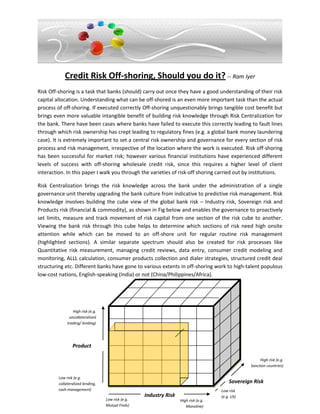
knowledge involves building the cube view of the global bank risk – Industry risk, Sovereign risk and
Products risk (financial & commodity), as shown in Fig below and enables the governance to proactively
set limits, measure and track movement of risk capital from one section of the risk cube to another.
Viewing the bank risk through this cube helps to determine which sections of risk need high onsite
attention while which can be moved to an off-shore unit for regular routine risk management
(highlighted sections). A similar separate spectrum should also be created for risk processes like
Quantitative risk measurement, managing credit reviews, data entry, consumer credit modeling and
monitoring, ALLL calculation, consumer products collection and dialer strategies, structured credit deal
structuring etc. Different banks have gone to various extents in off-shoring work to high-talent populous
low-cost nations, English-speaking (India) or not (China/Philippines/Africa).


                 High risk (e.g.
               uncollateralized
              trading/ lending)


                 Product
                 Risk
                                                                                                       High risk (e.g.
                                                                                                  Sanction countries)

         Low risk (e.g.
         collateralized lending,                                                          Sovereign Risk
         cash management)                                                             Low risk
                                                    Industry Risk                     (e.g. US)
                                   Low risk (e.g.                   High risk (e.g.
                                   Mutual Finds)                       Monoline)
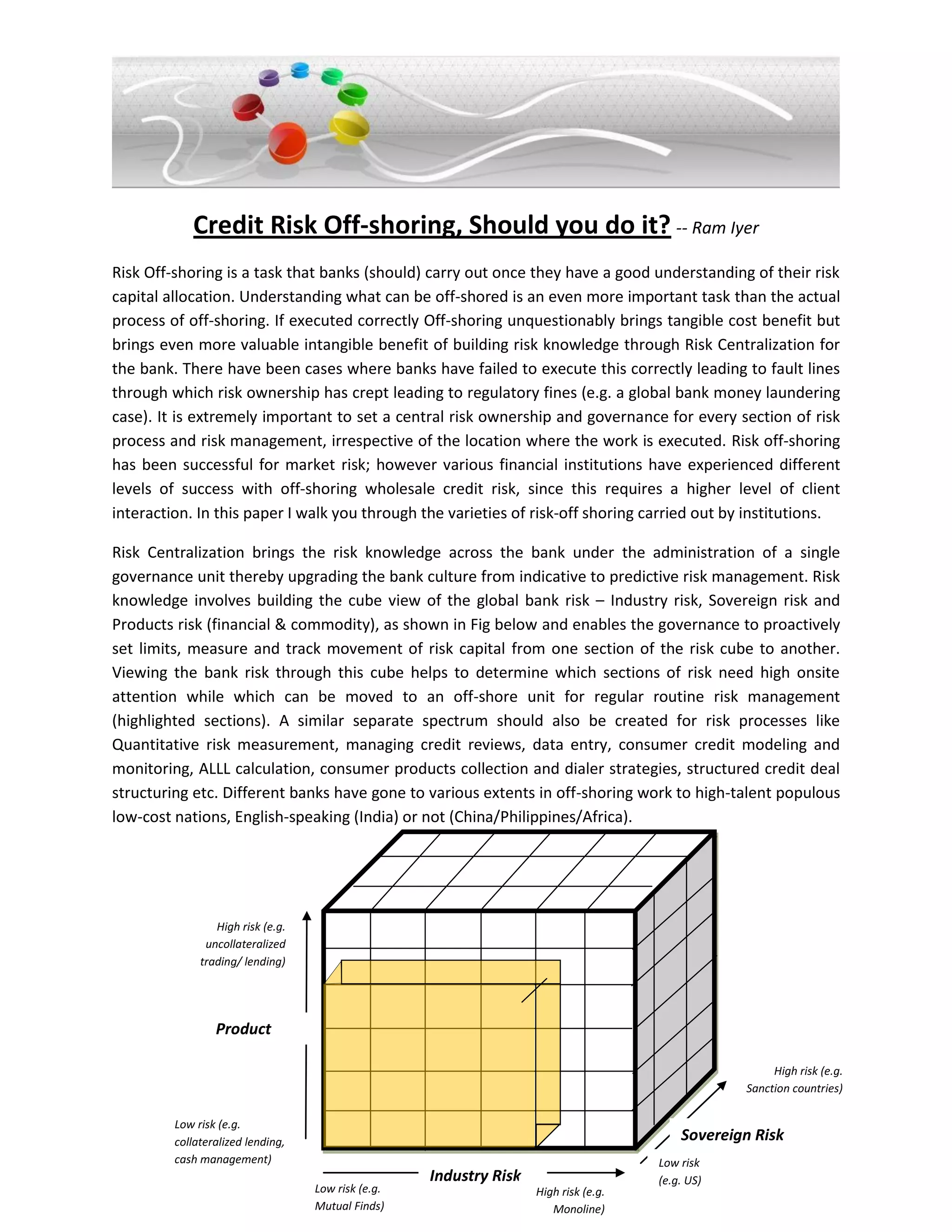
Once the bank has performed its assessment on which sections of risk does not need onsite risk
presence, Risk Off-shoring takes various forms, each having its level of cost. Risk Partnering is an most
risk-effective but relatively less cost-effective way (30% efficiency) of On-shore-Off-shore risk efficiency
model that ensures control over quality of work, maintaining bank culture, maintaining employee
morale and thereby satisfaction & retention.

               Using External Agency      Separate     off-shore Extended Risk Team         Risk Partnering
                                          Business Unit within
                                          the Bank
Pricing        Widget based pricing       Widget based pricing   Extension of global        Extension of global
                                                                 Risk unit, overall         Risk unit, overall
                                                                 cost a percentage          cost a percentage
                                                                 onsite cost                onsite cost
Approximate        45% - 50%                       40%                   35%                     25% - 30%
Cost
                            (added tax benefit if located in Tax exempt service export zone)
Efficiency
E.g.        Large US Consumer Major Global Bank                  Major            Asian Top US Investment
            bank                                                 Investment Bank         Bank
Location    Chennai, Bangalore       Bangalore                   Mumbai                  Bangalore
Activities  Consumer       products Write credit reviews, Write                   credit Deal     structuring,
Performed   analytics,    collection data entry                  reviews, regulatory Regulatory Capital
            and dialer strategy                                  capital calculation, calculation, Credit
            analytics, write credit                              credit       reviews, reviews, market risk
            reviews, data entry                                  market             risk calculation
                                                                 calculation
Pros        Low cost                 Low cost, use of bank Motivated                     Highly    motivated
                                     risk infrastructure and employee maintains employee                  give
                                     systems                     company        culture onsite-like
                                                                 and risk policy.        performance,
                                                                                         Maintains company
                                                                                         culture,       global
                                                                                         employees willing
                                                                                         to relocate
Cons        Performance based on Low employee morale, Above                    average Top             quality
            Service            Level High           employee quality professionals employees expect
            Agreement, Expecting turnover                        expect good local top local pay and
            over and beyond                                      pay.                    good local perks.
            comes at extra cost,
            reliance on agency
            controls to avoid
            compromise            of
            proprietary data.
Risk Management performs two types of tasks – Flow-based tasks and Deal-based tasks. In general flow-
based task (such as risk measurement, monthly risk reporting, annual reviews etc) could be easily off-
shored. A good understanding of the bank’s risk guidelines and procedures will help determine which
sections of Deal-based work can off-shored (analysis, reviews, modeling, DG and LGD generation).

Irrespective of the type of Risk Off-shoring model the banks will face challenges in the areas of

    1) Work Schedule Alignment: It is common for work to take several days due to limited time-zone
       overlap, some onsite units overlapping more than others. Setting expectations on each
       assignment is very critical to obtain satisfaction at both ends, alternatively having London
       mediator helps in maintaining flow of communication.

    2) Out of Sight, Out of Mind: Off-Shore employees get morally de-motivated relatively quickly due
       lack of onsite executive leadership presence. Regular Web seminars, intermittent executive
       visits and performance gifts (points) help in maintaining motivation for the local staff.

    3) Culture difference: Asian culture has a tendency to refrain from open healthy confrontation on
       topics of work, especially where there is a difference in opinion between on-shore and off-shore
       units. This is viewed and disrespectful by the Asian community, however lack of an open
       discussion is viewed as uneducated and ignorance by the West. Fortunately several
       professionals now have returned back to Asia after decades of experience in America or Europe
       and should be hired to head units within risk. This ensures healthy discussion is maintained
       across geographies while also coaching the Asian employees on the expectations of the West.

    4) People Management: Asian offices tend to hold 7X – 10X more people than the size of any
       US/Europe based operations. People management takes further more precedence in Asia than
       in any Western office. A Strong team of Human Resources personnel is required to address
       issues pertaining to managing and keeping a motivated team.

    5) Competitive Demand for Risk Professionals: Risk professionals hold the center-stage in this
       high regulatory environment. Banks as well as Advisory firms are setting up risk off-shoring units
       in Asia. This has increased the demand for good risk professionals locally. Companies tend to
       hire twice the amount of people needed for the job as the attrition rate remains high. Also, with
       the developed infrastructure in Asia many onsite risk professionals now agree to move to Off-
       shore locations.

Every company has taken their unique approach in setting up their off-shore units; their challenges are
similar. Learn from their experience and succeed in your venture.
Ram Iyer
Ram Iyer is an experienced risk management professional with coverage across consumer, commercial
and investment banking. Through his Deloitte management advisory work he has experience in building
risk infrastructure (policy, risk rating, PD and LGD models) and gaining Basel-II AIRB approval and
compliance with regulatory OCC bank lending guidelines for several financial institutions as well as
executing deals using the risk framework at Barclays Capital and Lehman Brothers. He has worked jointly
with the financial institution and the regulator (FED, SEC and FSA) to gain necessary regulatory approval
or remediate MOUs given to the banks. His work at Bank of America helped develop default, recovery
models for consumer credit portfolio and assess collections and dialer strategy to improve the credit
card, auto and specialty finance pool performance. He has led risk management for counterparties
including private equity, BDC (NBFC), asset managers, bond insurance (Monoline), structured credit and
financial institutions.


For further discussion contact:

Ram Iyer

(+91) 9820477010

(+1) 646.648.3762

Email: Iyerve@Gmail.com

Credit risk off shoring

  • 1.
    Credit Risk Off-shoring,Should you do it? -- Ram Iyer Risk Off-shoring is a task that banks (should) carry out once they have a good understanding of their risk capital allocation. Understanding what can be off-shored is an even more important task than the actual process of off-shoring. If executed correctly Off-shoring unquestionably brings tangible cost benefit but brings even more valuable intangible benefit of building risk knowledge through Risk Centralization for the bank. There have been cases where banks have failed to execute this correctly leading to fault lines through which risk ownership has crept leading to regulatory fines (e.g. a global bank money laundering case). It is extremely important to set a central risk ownership and governance for every section of risk process and risk management, irrespective of the location where the work is executed. Risk off-shoring has been successful for market risk; however various financial institutions have experienced different levels of success with off-shoring wholesale credit risk, since this requires a higher level of client interaction. In this paper I walk you through the varieties of risk-off shoring carried out by institutions. Risk Centralization brings the risk knowledge across the bank under the administration of a single governance unit thereby upgrading the bank culture from indicative to predictive risk management. Risk knowledge involves building the cube view of the global bank risk – Industry risk, Sovereign risk and Products risk (financial & commodity), as shown in Fig below and enables the governance to proactively set limits, measure and track movement of risk capital from one section of the risk cube to another. Viewing the bank risk through this cube helps to determine which sections of risk need high onsite attention while which can be moved to an off-shore unit for regular routine risk management (highlighted sections). A similar separate spectrum should also be created for risk processes like Quantitative risk measurement, managing credit reviews, data entry, consumer credit modeling and monitoring, ALLL calculation, consumer products collection and dialer strategies, structured credit deal structuring etc. Different banks have gone to various extents in off-shoring work to high-talent populous low-cost nations, English-speaking (India) or not (China/Philippines/Africa). High risk (e.g. uncollateralized trading/ lending) Product Risk High risk (e.g. Sanction countries) Low risk (e.g. collateralized lending, Sovereign Risk cash management) Low risk Industry Risk (e.g. US) Low risk (e.g. High risk (e.g. Mutual Finds) Monoline)
  • 2.
    Once the bankhas performed its assessment on which sections of risk does not need onsite risk presence, Risk Off-shoring takes various forms, each having its level of cost. Risk Partnering is an most risk-effective but relatively less cost-effective way (30% efficiency) of On-shore-Off-shore risk efficiency model that ensures control over quality of work, maintaining bank culture, maintaining employee morale and thereby satisfaction & retention. Using External Agency Separate off-shore Extended Risk Team Risk Partnering Business Unit within the Bank Pricing Widget based pricing Widget based pricing Extension of global Extension of global Risk unit, overall Risk unit, overall cost a percentage cost a percentage onsite cost onsite cost Approximate 45% - 50% 40% 35% 25% - 30% Cost (added tax benefit if located in Tax exempt service export zone) Efficiency E.g. Large US Consumer Major Global Bank Major Asian Top US Investment bank Investment Bank Bank Location Chennai, Bangalore Bangalore Mumbai Bangalore Activities Consumer products Write credit reviews, Write credit Deal structuring, Performed analytics, collection data entry reviews, regulatory Regulatory Capital and dialer strategy capital calculation, calculation, Credit analytics, write credit credit reviews, reviews, market risk reviews, data entry market risk calculation calculation Pros Low cost Low cost, use of bank Motivated Highly motivated risk infrastructure and employee maintains employee give systems company culture onsite-like and risk policy. performance, Maintains company culture, global employees willing to relocate Cons Performance based on Low employee morale, Above average Top quality Service Level High employee quality professionals employees expect Agreement, Expecting turnover expect good local top local pay and over and beyond pay. good local perks. comes at extra cost, reliance on agency controls to avoid compromise of proprietary data.
  • 3.
    Risk Management performstwo types of tasks – Flow-based tasks and Deal-based tasks. In general flow- based task (such as risk measurement, monthly risk reporting, annual reviews etc) could be easily off- shored. A good understanding of the bank’s risk guidelines and procedures will help determine which sections of Deal-based work can off-shored (analysis, reviews, modeling, DG and LGD generation). Irrespective of the type of Risk Off-shoring model the banks will face challenges in the areas of 1) Work Schedule Alignment: It is common for work to take several days due to limited time-zone overlap, some onsite units overlapping more than others. Setting expectations on each assignment is very critical to obtain satisfaction at both ends, alternatively having London mediator helps in maintaining flow of communication. 2) Out of Sight, Out of Mind: Off-Shore employees get morally de-motivated relatively quickly due lack of onsite executive leadership presence. Regular Web seminars, intermittent executive visits and performance gifts (points) help in maintaining motivation for the local staff. 3) Culture difference: Asian culture has a tendency to refrain from open healthy confrontation on topics of work, especially where there is a difference in opinion between on-shore and off-shore units. This is viewed and disrespectful by the Asian community, however lack of an open discussion is viewed as uneducated and ignorance by the West. Fortunately several professionals now have returned back to Asia after decades of experience in America or Europe and should be hired to head units within risk. This ensures healthy discussion is maintained across geographies while also coaching the Asian employees on the expectations of the West. 4) People Management: Asian offices tend to hold 7X – 10X more people than the size of any US/Europe based operations. People management takes further more precedence in Asia than in any Western office. A Strong team of Human Resources personnel is required to address issues pertaining to managing and keeping a motivated team. 5) Competitive Demand for Risk Professionals: Risk professionals hold the center-stage in this high regulatory environment. Banks as well as Advisory firms are setting up risk off-shoring units in Asia. This has increased the demand for good risk professionals locally. Companies tend to hire twice the amount of people needed for the job as the attrition rate remains high. Also, with the developed infrastructure in Asia many onsite risk professionals now agree to move to Off- shore locations. Every company has taken their unique approach in setting up their off-shore units; their challenges are similar. Learn from their experience and succeed in your venture.
  • 4.
    Ram Iyer Ram Iyeris an experienced risk management professional with coverage across consumer, commercial and investment banking. Through his Deloitte management advisory work he has experience in building risk infrastructure (policy, risk rating, PD and LGD models) and gaining Basel-II AIRB approval and compliance with regulatory OCC bank lending guidelines for several financial institutions as well as executing deals using the risk framework at Barclays Capital and Lehman Brothers. He has worked jointly with the financial institution and the regulator (FED, SEC and FSA) to gain necessary regulatory approval or remediate MOUs given to the banks. His work at Bank of America helped develop default, recovery models for consumer credit portfolio and assess collections and dialer strategy to improve the credit card, auto and specialty finance pool performance. He has led risk management for counterparties including private equity, BDC (NBFC), asset managers, bond insurance (Monoline), structured credit and financial institutions. For further discussion contact: Ram Iyer (+91) 9820477010 (+1) 646.648.3762 Email: Iyerve@Gmail.com