The Credit Crunch Crisis and Opportunity Wynn Quon Oct 9, 2008
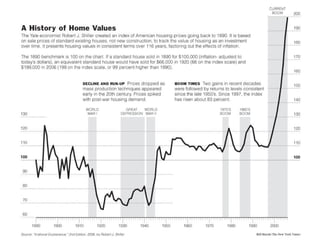
How did we get into this mess? Real-estate prices normally go up and down like a roller-coaster….but something weird happened beginning in the late 90’s in the U.S. Go for a ride:  http://www.speculativebubble.com/videos/real-estate-roller-coaster.php
 
If you believe that real estate prices always go up then…. ...It doesn’t matter what interest rate you as a homebuyer pay on your mortgage, because you can always sell your house for a higher price.... ...high-interest mortgages are safe ...Wall Street can package high-interest mortgages and even rate many as safe AAA securities (and make billions of $ in fees)…. … and since the mortgages are AAA, they can make billions more in selling insurance against default (CDS - credit default swaps) … so Wall Street said “Gimme more mortgages!”
Attack of the NINJA loans! “ Mike Garner, is a bartender in Nevada turned mortgage broker. Mr. Garner said that Wall Street’s appetite for mortgages, pushed loan standards down: ‘No income, no asset. You don’t have to state anything. Just have a credit score and a pulse.’ ” -- This American Life, NPR, “The Giant Pool of Money” May 9 2008
You can’t make this stuff up In one case, mortgages were also granted to 23 dead people in Ohio.
Wall Street Mortgage mania  Banks float $2.6 trillion of mortgages in 2006 alone. (20% subprime) Investment banks issue $45 trillion of mortgage/debt insurance (credit default swaps). Use of 30x leverage - $1 down on a $30 loan Amount of bad investments >> dot.com bubble
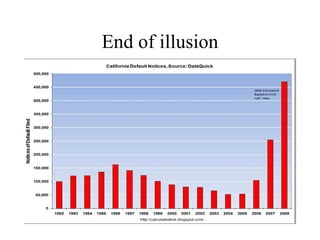
End of illusion
Bad news 1000 foreclosures a day in California as real estate prices plunge. Housing prices fall 25-30%+ in Las Vegas, San Francisco, LA, Detroit, Miami, San Diego, Phoenix... Lehman Bros, Bear Stearns, Countrywide Financial, Fannie Mae, Freddie Mac, AIG collapse or get taken over. Severe declines in bank shares. Bank failures. ($1 trillion in shareholder losses). Failures ripple through bank sector internationally. U.S. stock market falls 20%, wiping out $4 trillion in wealth.
Worse News Credit crunch - Without banks lending, the economy will grind to a halt. (car loans, mortgages, business loans e.g. Ford Sept. sales down 35%) Default rates increasing on prime mortgages, auto loans, credit cards Unemployment in the U.S. growing; 6.1% up from 4.7% a year ago. Real-estate bubbles in U.K., Ireland, Spain, China. Stock market crashes in China (-60%), India(-43%)... Danger of a decline spiral
What about Canada? We’re the tail on the U.S. dog real-estate bubble in Vancouver, Calgary, Edmonton worrying: levels of personal debt are high - household net borrowing at 6.3% of disposable income, just shy of the peak in the U.S. in 2005. the credit crunch is already here - ABCP mess, 5 yr mortgage rates have increased to 7.2%, CIBC troubles ,  interbank lending has stopped
How bad will things get? The longer and bigger the boom, the bigger the crash Lack of transparency breeds fear “ rational panic” Bank crises strike at the core of the global economy $850 billion U.S. bailout unlikely to stop recession
Lessons of history 5 severe post-war banking/real-estate crises (Japan, Spain, Finland, Norway, Sweden) On average, home prices fall 20% from peak, stock prices fall 20%. Bear market average length 2 yrs. But every crisis is different...
Optimistic case An average crisis? Stocks have already fallen by more than 20% as have real estate prices in the U.S.  Bear market has already lasted ~1 yr Optimistic case - we’re near the bottom What’s the pessimistic case?
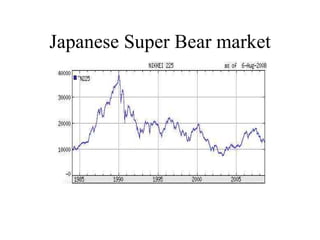
Japanese Super Bear market
Japanese Super Bear market 13-year bear market Stocks lost 78% of their value Real-estate prices still down 50% from 1991 peak, down 64% in six largest cities.
Fog of forecasting Huge Unknowns:  How much bad debt will there be? Policy response - competence? Investor response - confidence? Investment companies - liquidity? System feedback loops As difficult as hurricane forecasting
Wrong question How bad will it get?
Right questions What is your risk tolerance?  What is your time frame?
Most common mistake …of investors is to overestimate their risk tolerance. - during bull markets, the downside is completely theoretical - during bear markets, losses are real.  Investors suffer loss aversion. - fear, regret and panic overwhelm rational decision-making - therefore, take your assumed risk tolerance and divide by 2. E.g. if you think you can have 70% of your portfolio in stocks, your real tolerance level is actually 35%. Use scenarios to test drive your risk tolerance
Hope for the best, prepare for the worst If we are hit by the equivalent of a Japanese Super bear scenario:  Dow Jones Ind. Avg would fall to 2800 TSX would fall to 3000. … .prices would begin recovery sometime after 2021. Yikes. A $100,000 all-stock portfolio would fall to $20,000.
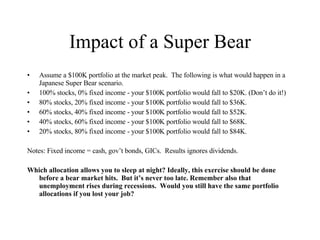
Impact of a Super Bear Assume a $100K portfolio at the market peak.  The following is what would happen in a Japanese Super Bear scenario. 100% stocks, 0% fixed income - your $100K portfolio would fall to $20K. (Don’t do it!) 80% stocks, 20% fixed income - your $100K portfolio would fall to $36K. 60% stocks, 40% fixed income - your $100K portfolio would fall to $52K. 40% stocks, 60% fixed income - your $100K portfolio would fall to $68K. 20% stocks, 80% fixed income - your $100K portfolio would fall to $84K. Notes: Fixed income = cash, gov’t bonds, GICs.  Results ignores dividends. Which allocation allows you to sleep at night? Ideally, this exercise should be done before a bear market hits.  But it’s never too late. Remember also that unemployment rises during recessions.  Would you still have the same portfolio allocations if you lost your job?
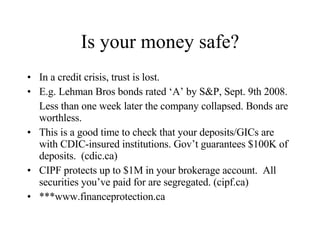
Is your money safe? In a credit crisis, trust is lost. E.g. Lehman Bros bonds rated ‘A’ by S&P, Sept. 9th 2008. Less than one week later the company collapsed. Bonds are worthless. This is a good time to check that your deposits/GICs are with CDIC-insured institutions. Gov’t guarantees $100K of deposits.  (cdic.ca) CIPF protects up to $1M in your brokerage account.  All securities you’ve paid for are segregated. (cipf.ca) ***www.financeprotection.ca
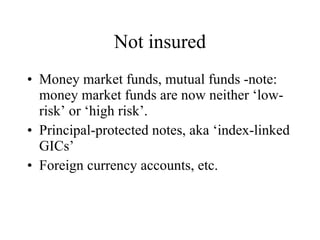
Not insured Money market funds, mutual funds -note: money market funds are now neither ‘low-risk’ or ‘high risk’. Principal-protected notes, aka ‘index-linked GICs’ Foreign currency accounts, etc.
Success in the stock market In bull markets investors ignore risk. In bear markets investors ignore return.
Bear market buying Bear markets are the best time to buy  But if your portfolio doesn’t match your risk tolerance, you will be too scared to do it. Or buy too soon.
Buying strategies Make a plan beforehand! Decide how much $ you want to commit Divide it into chunks Tie your buying decisions to price points or index levels. E.g. TSX - 8000, 6000, 4000, 2000…. Or say MCD @ $40, $30, $20….
Stocks to watch Dividend-payers (e.g. Telus, Enbridge, Cameco) with relatively low debt in the TSX60  Avoid for now: financials (banks, insurance companies) unless you know something I don’t; Add some gold (Barrick, Goldcorp) Pfizer, yield 6.5%+;  Analog Devices
Speculations Nortel Networks - Common shares @ $2.00; Floating-Rate Preferred Cumulative F shares. $4-$5.  Guess the yield! BCE.  Currently @$33.  Upside to $42.  Downside to $16.  A gamble. Gold Fields, currently $7, 3.2% yield.

Credit Crisis Presentation - Oct 9th 2008

  • 1.
    The Credit CrunchCrisis and Opportunity Wynn Quon Oct 9, 2008
  • 2.
    How did weget into this mess? Real-estate prices normally go up and down like a roller-coaster….but something weird happened beginning in the late 90’s in the U.S. Go for a ride: http://www.speculativebubble.com/videos/real-estate-roller-coaster.php
  • 3.
  • 4.
    If you believethat real estate prices always go up then…. ...It doesn’t matter what interest rate you as a homebuyer pay on your mortgage, because you can always sell your house for a higher price.... ...high-interest mortgages are safe ...Wall Street can package high-interest mortgages and even rate many as safe AAA securities (and make billions of $ in fees)…. … and since the mortgages are AAA, they can make billions more in selling insurance against default (CDS - credit default swaps) … so Wall Street said “Gimme more mortgages!”
  • 5.
    Attack of theNINJA loans! “ Mike Garner, is a bartender in Nevada turned mortgage broker. Mr. Garner said that Wall Street’s appetite for mortgages, pushed loan standards down: ‘No income, no asset. You don’t have to state anything. Just have a credit score and a pulse.’ ” -- This American Life, NPR, “The Giant Pool of Money” May 9 2008
  • 6.
    You can’t makethis stuff up In one case, mortgages were also granted to 23 dead people in Ohio.
  • 7.
    Wall Street Mortgagemania Banks float $2.6 trillion of mortgages in 2006 alone. (20% subprime) Investment banks issue $45 trillion of mortgage/debt insurance (credit default swaps). Use of 30x leverage - $1 down on a $30 loan Amount of bad investments >> dot.com bubble
  • 8.
  • 9.
    Bad news 1000foreclosures a day in California as real estate prices plunge. Housing prices fall 25-30%+ in Las Vegas, San Francisco, LA, Detroit, Miami, San Diego, Phoenix... Lehman Bros, Bear Stearns, Countrywide Financial, Fannie Mae, Freddie Mac, AIG collapse or get taken over. Severe declines in bank shares. Bank failures. ($1 trillion in shareholder losses). Failures ripple through bank sector internationally. U.S. stock market falls 20%, wiping out $4 trillion in wealth.
  • 10.
    Worse News Creditcrunch - Without banks lending, the economy will grind to a halt. (car loans, mortgages, business loans e.g. Ford Sept. sales down 35%) Default rates increasing on prime mortgages, auto loans, credit cards Unemployment in the U.S. growing; 6.1% up from 4.7% a year ago. Real-estate bubbles in U.K., Ireland, Spain, China. Stock market crashes in China (-60%), India(-43%)... Danger of a decline spiral
  • 11.
    What about Canada?We’re the tail on the U.S. dog real-estate bubble in Vancouver, Calgary, Edmonton worrying: levels of personal debt are high - household net borrowing at 6.3% of disposable income, just shy of the peak in the U.S. in 2005. the credit crunch is already here - ABCP mess, 5 yr mortgage rates have increased to 7.2%, CIBC troubles , interbank lending has stopped
  • 12.
    How bad willthings get? The longer and bigger the boom, the bigger the crash Lack of transparency breeds fear “ rational panic” Bank crises strike at the core of the global economy $850 billion U.S. bailout unlikely to stop recession
  • 13.
    Lessons of history5 severe post-war banking/real-estate crises (Japan, Spain, Finland, Norway, Sweden) On average, home prices fall 20% from peak, stock prices fall 20%. Bear market average length 2 yrs. But every crisis is different...
  • 14.
    Optimistic case Anaverage crisis? Stocks have already fallen by more than 20% as have real estate prices in the U.S. Bear market has already lasted ~1 yr Optimistic case - we’re near the bottom What’s the pessimistic case?
  • 15.
  • 16.
    Japanese Super Bearmarket 13-year bear market Stocks lost 78% of their value Real-estate prices still down 50% from 1991 peak, down 64% in six largest cities.
  • 17.
    Fog of forecastingHuge Unknowns: How much bad debt will there be? Policy response - competence? Investor response - confidence? Investment companies - liquidity? System feedback loops As difficult as hurricane forecasting
  • 18.
    Wrong question Howbad will it get?
  • 19.
    Right questions Whatis your risk tolerance? What is your time frame?
  • 20.
    Most common mistake…of investors is to overestimate their risk tolerance. - during bull markets, the downside is completely theoretical - during bear markets, losses are real. Investors suffer loss aversion. - fear, regret and panic overwhelm rational decision-making - therefore, take your assumed risk tolerance and divide by 2. E.g. if you think you can have 70% of your portfolio in stocks, your real tolerance level is actually 35%. Use scenarios to test drive your risk tolerance
  • 21.
    Hope for thebest, prepare for the worst If we are hit by the equivalent of a Japanese Super bear scenario: Dow Jones Ind. Avg would fall to 2800 TSX would fall to 3000. … .prices would begin recovery sometime after 2021. Yikes. A $100,000 all-stock portfolio would fall to $20,000.
  • 22.
    Impact of aSuper Bear Assume a $100K portfolio at the market peak. The following is what would happen in a Japanese Super Bear scenario. 100% stocks, 0% fixed income - your $100K portfolio would fall to $20K. (Don’t do it!) 80% stocks, 20% fixed income - your $100K portfolio would fall to $36K. 60% stocks, 40% fixed income - your $100K portfolio would fall to $52K. 40% stocks, 60% fixed income - your $100K portfolio would fall to $68K. 20% stocks, 80% fixed income - your $100K portfolio would fall to $84K. Notes: Fixed income = cash, gov’t bonds, GICs. Results ignores dividends. Which allocation allows you to sleep at night? Ideally, this exercise should be done before a bear market hits. But it’s never too late. Remember also that unemployment rises during recessions. Would you still have the same portfolio allocations if you lost your job?
  • 23.
    Is your moneysafe? In a credit crisis, trust is lost. E.g. Lehman Bros bonds rated ‘A’ by S&P, Sept. 9th 2008. Less than one week later the company collapsed. Bonds are worthless. This is a good time to check that your deposits/GICs are with CDIC-insured institutions. Gov’t guarantees $100K of deposits. (cdic.ca) CIPF protects up to $1M in your brokerage account. All securities you’ve paid for are segregated. (cipf.ca) ***www.financeprotection.ca
  • 24.
    Not insured Moneymarket funds, mutual funds -note: money market funds are now neither ‘low-risk’ or ‘high risk’. Principal-protected notes, aka ‘index-linked GICs’ Foreign currency accounts, etc.
  • 25.
    Success in thestock market In bull markets investors ignore risk. In bear markets investors ignore return.
  • 26.
    Bear market buyingBear markets are the best time to buy But if your portfolio doesn’t match your risk tolerance, you will be too scared to do it. Or buy too soon.
  • 27.
    Buying strategies Makea plan beforehand! Decide how much $ you want to commit Divide it into chunks Tie your buying decisions to price points or index levels. E.g. TSX - 8000, 6000, 4000, 2000…. Or say MCD @ $40, $30, $20….
  • 28.
    Stocks to watchDividend-payers (e.g. Telus, Enbridge, Cameco) with relatively low debt in the TSX60 Avoid for now: financials (banks, insurance companies) unless you know something I don’t; Add some gold (Barrick, Goldcorp) Pfizer, yield 6.5%+; Analog Devices
  • 29.
    Speculations Nortel Networks- Common shares @ $2.00; Floating-Rate Preferred Cumulative F shares. $4-$5. Guess the yield! BCE. Currently @$33. Upside to $42. Downside to $16. A gamble. Gold Fields, currently $7, 3.2% yield.