INTERNATIONAL
DIMENSIONS IN ASSESSMENT


Prof. Dinesh Selvam S.


                         1/6/2013   1
Overview. .
 Meaning
 History
 Need for International Assessment
 Research Framework
 Issues
 Components
    Credentialing
    Credit
    GPA

                    1/6/2013         2
Meaning

     International dimension literally
means ‘between countries’- as in
international relationships.

  The study of assessment as it
manifests in different countries.


                   1/6/2013               3
What is International Assessment?


   International assessments can provide
  countries with information that allows them
  to identify areas of relative strengths and
  weaknesses and monitor the pace of progress
  of their education system


                      1/6/2013                  4
WHAT IS INTERNATIONAL ASSESSMENT?


  stimulate countries to raise aspirations
 by showing what is possible in education
 in terms of the quality, equity, and
 efficiency of educational services
 provided.
 foster better understanding of how
 different education systems address
 similar problems


                     1/6/2013                 5
HISTORY OF INTERNATIONAL
ASSESSMENT
 1950-1960 : The discourse on international
  comparisons of learning outcomes started to
  emerge .
 1958 : An expert group led by William Douglas
  Wall of UNESCO’s International Institute of
  Education in Hamburg, Germany, conducted a
  feasibility study to compare student
  performance internationally.
 The International Association for the
  Evaluation of Educational Achievement (IEA)
  emerged out of this .
                       1/6/2013               6
HISTORY . . .

   1998-The U.S. Education Testing Service
    conducted the International Assessment of
    Educational Progress (IAEP) in 1998 and a
    follow-up study in 1991.

 The latest generation of international
  assessments has been developed by the
  OECD as part of the Program for
  International Student Assessment (PISA).
 PISA is currently the most rigorous and also
  the most comprehensive international
  assessment.
                        1/6/2013                 7
Needs for International dimension in
Assessment
    Global job market
     Influx of foreign workers with unknown
     qualifications.
    To increase the visibility of the qualifications
     of their own members abroad.
     In Europe, several of these organizations are
     now in the process of equating their certifying
     examinations.
    The attempts to make degrees and certificates
     comparable could be a systematic input from
     international educational assessments.
                           1/6/2013                     8
Research Frameworks of International
              Assessments

OECD and IEA:
 Context: measures of student learning
  outcomes
 Background information collected from
  students, principals, and sometimes teachers
  and parents
 Interpretation: the observed variation in
  learning outcomes between
  students, classrooms, schools, and education
  systems.
                       1/6/2013                  9
Research Frameworks. .


 Three research areas (learning
  outcomes, policies shaping education
  outcomes, and factors that constrain policies and
  outcomes) to
 four levels of the education system (individual
  learners, classrooms or instructional
  settings, educational institutions and providers
  of educational services, and the education
  system as a whole).


                        1/6/2013                  10
Issues related to International
Assessment
  Putting national targets into a broader perspective
  Assessing the pace of change in educational
   improvement
  Design Issues and Challenges for International
   Assessments
  Cross-country validity and comparability in the
   assessment instruments
  Establishing the assessment domains
  Reflecting national, cultural, and linguistic variety
  Selecting assessment nature and form
  Ensuring external validity
  Comparability of the target populations
  Comparability in survey implementation

                              1/6/2013                     11
Components of International
Dimensions in Assessment


Credentialing,
Calculating   or converting credit
 hours
Calculating the grade point average


                   1/6/2013            12
CREDENTIALING
A credential is an attestation of
qualification, competence, or authority
issued to an individual by a third party with
a relevant or de facto authority or assumed
competence to do so.
Examples of credentials include academic
diplomas, academic
degrees, certifications, security
clearances, identification
documents, badges, passwords, user
names, keys, powers of attorney, and so on.
                     1/6/2013                   13
Credentialing. . .

 The Nurse Credential recognises the skills,
expertise and experience of nurses. It
demonstrates that an individual nurse has
achieved the professional standard for practice
 Credentialing is a core component of
clinical/professional governance or self
regulation where members of a profession set
standards for practice and establish a minimum
requirement for entry, continuing professional
development, endorsement and recognition.


                      1/6/2013                14
Credentialing. . .


    Registered nurses working in
   specialised fields and other disciplines
   have developed credentialing as a
   means to ensure standards of practice
   and competence within their specialist
   domain beyond entry to practice.


                     1/6/2013             15
Credentialing. . .


      Credentialing is an administrative
  procedure to examine information about a
  practitioner's education, certification, training,
  continuing education, and experience or
  actions by the Board of Registration
      Credentials relate to the qualification of an
  individual to practice in their state within the
  scope of practice for that individual's
  profession.
   Factors stimulating credentialing -
  globalization, competition, consumerism, and
  telecommunication.
                         1/6/2013                  16
Principles of Credentialing (ANA)

  In addition to benefitting and protecting the public,
  credentialing also benefit those who are
  credentialed.
  The legitimate interest of the involved occupation
  or institution and of the general public should be
  reflected in each credentialing mechanism.
  Accountability should be an essential component of
  any credentialing process.
  A system of checks and balances within the
  credentialing system should assure equitable
  treatment for all patient involved.

                           1/6/2013                   17
Principles . . .

Objective standards and criteria and persons
competent in their use are essential to the
credentialing process .
Professional identity and responsibility should
evolve from the credentialing process.
An effective system of role delineation is
fundamental to any credentialing mechanism
for individuality.
Periodic assessment with potential for sanction
are essential components of an effective
credentialing mechanism.
                      1/6/2013                18
Principles . . .


  An effective system of programme identification
  is fundamental to any credentialing mechanism for
  the institutions.
  Co-ordination of credentialing mechanism should
  lead to efficiency and cost effectiveness and avoid
  duplication.
  Widely accepted definitions and terminologies are
  basic to an effective credentialing system.
  Communications and understanding between
  health care providers and society should be
  facilitated through the credentialing process.

                          1/6/2013                  19
Organisations providing Credentialing Services


ANCC- American Nursing Credentialing Center
 Identification:
    It credentials nurses in a chosen field of
 specialty, ensures safe working environments, and
 provided accreditation for schools offering
 continuing education credits for nurses.


                          1/6/2013                   20
ANCC. .


Types:
 Credentialed in specialties such as
  surgical, pediatric, cardiac, community
  nursing, gerontology, home health
  nursing, psychiatric and pain management.
 Advanced credentials can be obtained to work in
  diabetes management or other condition-specific
  fields, public health or in executive positions.


                          1/6/2013                   21
ANCC. .
Considerations:
    first hold a degree in nursing from an accredited
    college.

   must choose a specialty.

   take courses either in person, online or by reading
    manuals.

 work   for a specific period of time as a nurse before
    applying.

    Depending on specialty, may also have to complete
    a certain number of hours working in your field.
                               1/6/2013                    22
ANCC. . .


Time Frame:
   vary in length - in person, online or through
  self study with books and manuals.
Benefits:
 keeps up to date on the latest treatment
  options and research.
 Changing Medical knowledge
 stay on top of recent developments.
 Increase salary

                         1/6/2013                  23
American Credential Evaluation Services
 Since 1995, ACES has provided assistance to
 individuals who have completed their education in
 any foreign country in the world and translate and
 convert their educational documents (degree,
 diploma, certificate, and transcript) into the U.S.
 educational equivalency.

 Evaluation equivalency report may be used for:
 Immigration
 Employment
 Education
 Licensing
 Military Enlistment
                          1/6/2013                     24
AECS. . .

Four types of evaluation services:

A.   Educational Evaluation Report (Document
     by Document)
B.   Professional Work Experience
C.   Course by Course
D.   Position Evaluation


                       1/6/2013                25
AECS. . .


A. Educational Evaluation Reports
 the foreign academic credentials of the applicant.
 determine the applicant's level of education, the

  number of years completed and the specialization
  of the applicant.


                          1/6/2013                     26
AECS. . .

B. Professional Work Experience Evaluations:
- evaluate the applicants' education (if applicable),
  as well as their work experience.

C. Course by Course Evaluations:
- educational evaluation report - list the courses
  the applicant has taken - the grades received -
  and the credit equivalence earned in the United
  States.


                          1/6/2013                      27
AECS. . .


D. Position Evaluations:
analyze the job duties of a particular
position - determine if the job duties of the
position are so complex.


                     1/6/2013                   28
CALCULATING GPA AND CREDIT HOURS
    GRADE POINT AVERAGE


 Grades are standardized measurements of varying
  levels of comprehension within a subject area.
 Grades can be assigned in letters
   (for example, A, B, C, D, or F), as a range (for
  example 4.0–1.0), as descriptors
  (excellent, great, satisfactory, needs
  improvement), in percentages, or, as is common in
  some post-secondary institutions in some
  countries, as a grade point average (GPA).

                          1/6/2013                    29
GPA. . .


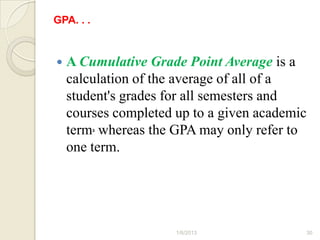
   A Cumulative Grade Point Average is a
    calculation of the average of all of a
    student's grades for all semesters and
    courses completed up to a given academic
    term, whereas the GPA may only refer to
    one term.


                      1/6/2013             30
GPA. . .

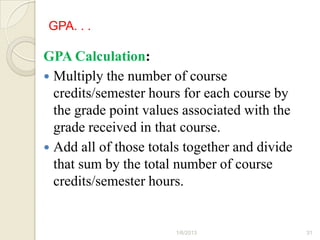
GPA Calculation:
 Multiply the number of course
  credits/semester hours for each course by
  the grade point values associated with the
  grade received in that course.
 Add all of those totals together and divide
  that sum by the total number of course
  credits/semester hours.


                       1/6/2013                 31
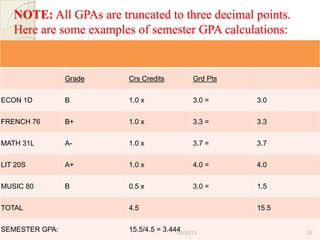
NOTE: All GPAs are truncated to three decimal points.
   Here are some examples of semester GPA calculations:


                Grade    Crs Credits          Grd Pts


ECON 1D         B        1.0 x                3.0 =     3.0


FRENCH 76       B+       1.0 x                3.3 =     3.3


MATH 31L        A-       1.0 x                3.7 =     3.7


LIT 20S         A+       1.0 x                4.0 =     4.0


MUSIC 80        B        0.5 x                3.0 =     1.5


TOTAL                    4.5                            15.5


SEMESTER GPA:            15.5/4.5 = 3.444
                                        1/6/2013               32
Cumulative grade point average


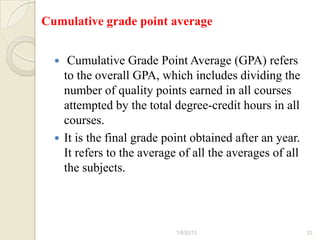
    Cumulative Grade Point Average (GPA) refers
    to the overall GPA, which includes dividing the
    number of quality points earned in all courses
    attempted by the total degree-credit hours in all
    courses.
   It is the final grade point obtained after an year.
    It refers to the average of all the averages of all
    the subjects.


                            1/6/2013                      33
CREDIT HOURS

 Credit hours are effectively how many hours
 per week you are in that class.
  The number of hours you receive for taking
 a class. It's roughly equivalent to the amount
 of time you will spend in class (i.e., a 3 hour
 class means you will probably have 3 1-hour
 lectures during the week).


                        1/6/2013                   34
CONVERTING CLOCK HOURS INTO CREDIT
 HOURS
 Lecture Hours: Instructional hours.
 Lecture Credit Hours: Semester Credits – Must teach a
 minimum of 15 lecture hours to award 1 semester credit
 hour (divide lecture hours by 15).
 Quarter Credits – Must teach a minimum of 10 lecture
 hours to award 1 quarter credit (divide lecture hours by
 10).


                            1/6/2013                        35
Laboratory Hours: Instructional hours consisting
of supervised student practice of a previously
introduced theory/principle during which practical
skills and knowledge are developed and reinforced.
Laboratory Credit Hours: Semester Credits – Must
teach a minimum of 30 laboratory hours to award 1
semester credit (divide laboratory hours by 30).
Quarter Credits – Must teach a minimum of 20
laboratory hours to award 1 quarter credit (divide
laboratory hours by 20).

                        1/6/2013                     36
Externship/Internship Hours: Instructional
hours consisting of supervised work experience
activities related to skills/ knowledge acquired
during the training program.
Externship/Internship Credit Hours:
Semester Credits – Must teach a minimum of 45
externship hours to award 1 semester credit
(divide externship/ internship hours by 45).


                       1/6/2013                    37
THANK YOU


 1/6/2013   38

Credentials

  • 1.
  • 2.
    Overview. . Meaning History Need for International Assessment Research Framework Issues Components Credentialing Credit GPA 1/6/2013 2
  • 3.
    Meaning  International dimension literally means ‘between countries’- as in international relationships.  The study of assessment as it manifests in different countries. 1/6/2013 3
  • 4.
    What is InternationalAssessment? International assessments can provide countries with information that allows them to identify areas of relative strengths and weaknesses and monitor the pace of progress of their education system 1/6/2013 4
  • 5.
    WHAT IS INTERNATIONALASSESSMENT?  stimulate countries to raise aspirations by showing what is possible in education in terms of the quality, equity, and efficiency of educational services provided.  foster better understanding of how different education systems address similar problems 1/6/2013 5
  • 6.
    HISTORY OF INTERNATIONAL ASSESSMENT 1950-1960 : The discourse on international comparisons of learning outcomes started to emerge .  1958 : An expert group led by William Douglas Wall of UNESCO’s International Institute of Education in Hamburg, Germany, conducted a feasibility study to compare student performance internationally.  The International Association for the Evaluation of Educational Achievement (IEA) emerged out of this . 1/6/2013 6
  • 7.
    HISTORY . ..  1998-The U.S. Education Testing Service conducted the International Assessment of Educational Progress (IAEP) in 1998 and a follow-up study in 1991.  The latest generation of international assessments has been developed by the OECD as part of the Program for International Student Assessment (PISA).  PISA is currently the most rigorous and also the most comprehensive international assessment. 1/6/2013 7
  • 8.
    Needs for Internationaldimension in Assessment  Global job market  Influx of foreign workers with unknown qualifications.  To increase the visibility of the qualifications of their own members abroad.  In Europe, several of these organizations are now in the process of equating their certifying examinations.  The attempts to make degrees and certificates comparable could be a systematic input from international educational assessments. 1/6/2013 8
  • 9.
    Research Frameworks ofInternational Assessments OECD and IEA:  Context: measures of student learning outcomes  Background information collected from students, principals, and sometimes teachers and parents  Interpretation: the observed variation in learning outcomes between students, classrooms, schools, and education systems. 1/6/2013 9
  • 10.
    Research Frameworks. . Three research areas (learning outcomes, policies shaping education outcomes, and factors that constrain policies and outcomes) to  four levels of the education system (individual learners, classrooms or instructional settings, educational institutions and providers of educational services, and the education system as a whole). 1/6/2013 10
  • 11.
    Issues related toInternational Assessment  Putting national targets into a broader perspective  Assessing the pace of change in educational improvement  Design Issues and Challenges for International Assessments  Cross-country validity and comparability in the assessment instruments  Establishing the assessment domains  Reflecting national, cultural, and linguistic variety  Selecting assessment nature and form  Ensuring external validity  Comparability of the target populations  Comparability in survey implementation 1/6/2013 11
  • 12.
    Components of International Dimensionsin Assessment Credentialing, Calculating or converting credit hours Calculating the grade point average 1/6/2013 12
  • 13.
    CREDENTIALING A credential isan attestation of qualification, competence, or authority issued to an individual by a third party with a relevant or de facto authority or assumed competence to do so. Examples of credentials include academic diplomas, academic degrees, certifications, security clearances, identification documents, badges, passwords, user names, keys, powers of attorney, and so on. 1/6/2013 13
  • 14.
    Credentialing. . . The Nurse Credential recognises the skills, expertise and experience of nurses. It demonstrates that an individual nurse has achieved the professional standard for practice Credentialing is a core component of clinical/professional governance or self regulation where members of a profession set standards for practice and establish a minimum requirement for entry, continuing professional development, endorsement and recognition. 1/6/2013 14
  • 15.
    Credentialing. . . Registered nurses working in specialised fields and other disciplines have developed credentialing as a means to ensure standards of practice and competence within their specialist domain beyond entry to practice. 1/6/2013 15
  • 16.
    Credentialing. . . Credentialing is an administrative procedure to examine information about a practitioner's education, certification, training, continuing education, and experience or actions by the Board of Registration Credentials relate to the qualification of an individual to practice in their state within the scope of practice for that individual's profession. Factors stimulating credentialing - globalization, competition, consumerism, and telecommunication. 1/6/2013 16
  • 17.
    Principles of Credentialing(ANA) In addition to benefitting and protecting the public, credentialing also benefit those who are credentialed. The legitimate interest of the involved occupation or institution and of the general public should be reflected in each credentialing mechanism. Accountability should be an essential component of any credentialing process. A system of checks and balances within the credentialing system should assure equitable treatment for all patient involved. 1/6/2013 17
  • 18.
    Principles . .. Objective standards and criteria and persons competent in their use are essential to the credentialing process . Professional identity and responsibility should evolve from the credentialing process. An effective system of role delineation is fundamental to any credentialing mechanism for individuality. Periodic assessment with potential for sanction are essential components of an effective credentialing mechanism. 1/6/2013 18
  • 19.
    Principles . .. An effective system of programme identification is fundamental to any credentialing mechanism for the institutions. Co-ordination of credentialing mechanism should lead to efficiency and cost effectiveness and avoid duplication. Widely accepted definitions and terminologies are basic to an effective credentialing system. Communications and understanding between health care providers and society should be facilitated through the credentialing process. 1/6/2013 19
  • 20.
    Organisations providing CredentialingServices ANCC- American Nursing Credentialing Center Identification: It credentials nurses in a chosen field of specialty, ensures safe working environments, and provided accreditation for schools offering continuing education credits for nurses. 1/6/2013 20
  • 21.
    ANCC. . Types:  Credentialedin specialties such as surgical, pediatric, cardiac, community nursing, gerontology, home health nursing, psychiatric and pain management.  Advanced credentials can be obtained to work in diabetes management or other condition-specific fields, public health or in executive positions. 1/6/2013 21
  • 22.
    ANCC. . Considerations:  first hold a degree in nursing from an accredited college.  must choose a specialty.  take courses either in person, online or by reading manuals.  work for a specific period of time as a nurse before applying.  Depending on specialty, may also have to complete a certain number of hours working in your field. 1/6/2013 22
  • 23.
    ANCC. . . TimeFrame: vary in length - in person, online or through self study with books and manuals. Benefits:  keeps up to date on the latest treatment options and research.  Changing Medical knowledge  stay on top of recent developments.  Increase salary 1/6/2013 23
  • 24.
    American Credential EvaluationServices Since 1995, ACES has provided assistance to individuals who have completed their education in any foreign country in the world and translate and convert their educational documents (degree, diploma, certificate, and transcript) into the U.S. educational equivalency. Evaluation equivalency report may be used for:  Immigration  Employment  Education  Licensing  Military Enlistment 1/6/2013 24
  • 25.
    AECS. . . Fourtypes of evaluation services: A. Educational Evaluation Report (Document by Document) B. Professional Work Experience C. Course by Course D. Position Evaluation 1/6/2013 25
  • 26.
    AECS. . . A.Educational Evaluation Reports  the foreign academic credentials of the applicant.  determine the applicant's level of education, the number of years completed and the specialization of the applicant. 1/6/2013 26
  • 27.
    AECS. . . B.Professional Work Experience Evaluations: - evaluate the applicants' education (if applicable), as well as their work experience. C. Course by Course Evaluations: - educational evaluation report - list the courses the applicant has taken - the grades received - and the credit equivalence earned in the United States. 1/6/2013 27
  • 28.
    AECS. . . D.Position Evaluations: analyze the job duties of a particular position - determine if the job duties of the position are so complex. 1/6/2013 28
  • 29.
    CALCULATING GPA ANDCREDIT HOURS GRADE POINT AVERAGE  Grades are standardized measurements of varying levels of comprehension within a subject area.  Grades can be assigned in letters (for example, A, B, C, D, or F), as a range (for example 4.0–1.0), as descriptors (excellent, great, satisfactory, needs improvement), in percentages, or, as is common in some post-secondary institutions in some countries, as a grade point average (GPA). 1/6/2013 29
  • 30.
    GPA. . .  A Cumulative Grade Point Average is a calculation of the average of all of a student's grades for all semesters and courses completed up to a given academic term, whereas the GPA may only refer to one term. 1/6/2013 30
  • 31.
    GPA. . . GPACalculation:  Multiply the number of course credits/semester hours for each course by the grade point values associated with the grade received in that course.  Add all of those totals together and divide that sum by the total number of course credits/semester hours. 1/6/2013 31
  • 32.
    NOTE: All GPAsare truncated to three decimal points. Here are some examples of semester GPA calculations: Grade Crs Credits Grd Pts ECON 1D B 1.0 x 3.0 = 3.0 FRENCH 76 B+ 1.0 x 3.3 = 3.3 MATH 31L A- 1.0 x 3.7 = 3.7 LIT 20S A+ 1.0 x 4.0 = 4.0 MUSIC 80 B 0.5 x 3.0 = 1.5 TOTAL 4.5 15.5 SEMESTER GPA: 15.5/4.5 = 3.444 1/6/2013 32
  • 33.
    Cumulative grade pointaverage  Cumulative Grade Point Average (GPA) refers to the overall GPA, which includes dividing the number of quality points earned in all courses attempted by the total degree-credit hours in all courses.  It is the final grade point obtained after an year. It refers to the average of all the averages of all the subjects. 1/6/2013 33
  • 34.
    CREDIT HOURS Credithours are effectively how many hours per week you are in that class. The number of hours you receive for taking a class. It's roughly equivalent to the amount of time you will spend in class (i.e., a 3 hour class means you will probably have 3 1-hour lectures during the week). 1/6/2013 34
  • 35.
    CONVERTING CLOCK HOURSINTO CREDIT HOURS Lecture Hours: Instructional hours. Lecture Credit Hours: Semester Credits – Must teach a minimum of 15 lecture hours to award 1 semester credit hour (divide lecture hours by 15). Quarter Credits – Must teach a minimum of 10 lecture hours to award 1 quarter credit (divide lecture hours by 10). 1/6/2013 35
  • 36.
    Laboratory Hours: Instructionalhours consisting of supervised student practice of a previously introduced theory/principle during which practical skills and knowledge are developed and reinforced. Laboratory Credit Hours: Semester Credits – Must teach a minimum of 30 laboratory hours to award 1 semester credit (divide laboratory hours by 30). Quarter Credits – Must teach a minimum of 20 laboratory hours to award 1 quarter credit (divide laboratory hours by 20). 1/6/2013 36
  • 37.
    Externship/Internship Hours: Instructional hoursconsisting of supervised work experience activities related to skills/ knowledge acquired during the training program. Externship/Internship Credit Hours: Semester Credits – Must teach a minimum of 45 externship hours to award 1 semester credit (divide externship/ internship hours by 45). 1/6/2013 37
  • 38.