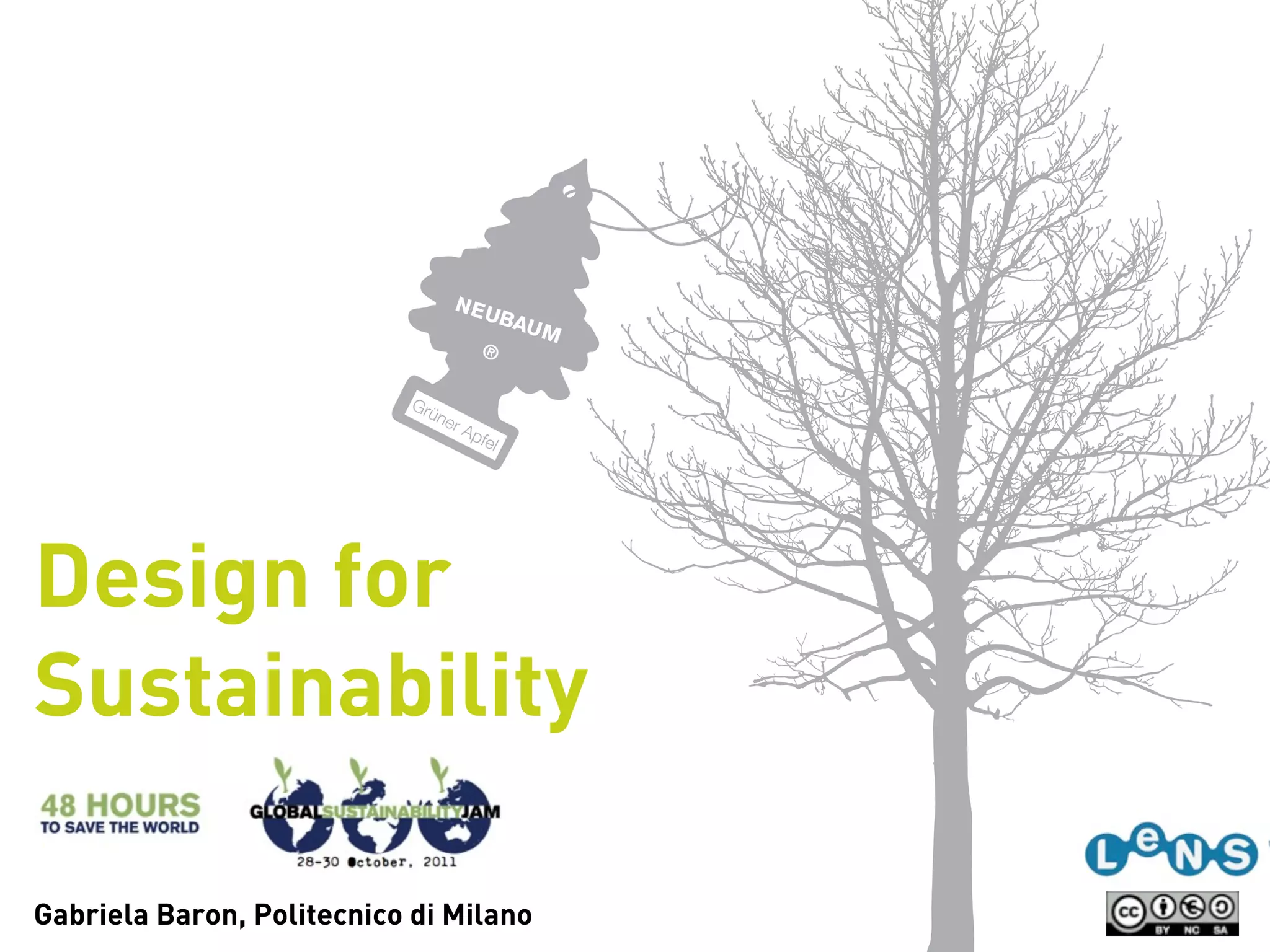















Design for
Sustainability

Gabriela Baron, Politecnico di Milano
Contents


1.The urgent need for a Radical Change!

2.Redesigning wellbeing & consumerism

3.Social Innovation and those promising minorities

4.Sustainable development and the design
   of sustainable systems: Criteria

5.Design for social equity and cohesion: Criteria
1.The urgent need for
a Radical Change!
1.The urgent need for
a Radical Change!
The irreversibility of
environmental
damages
In 50 years the worldwide systems of production and consumption

should use   90% LESS               resources, than what are
being used today
So... which
products
are really
sustainable?
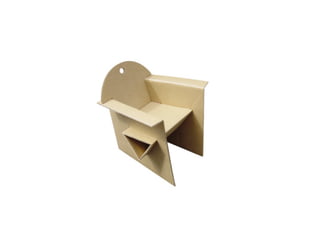
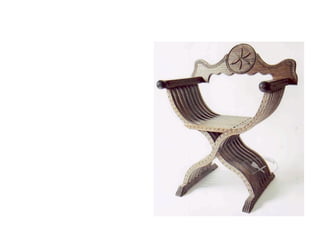
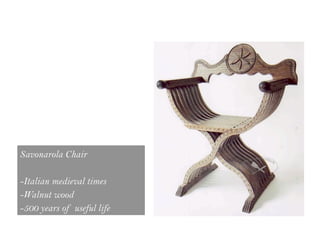
Savonarola Chair

-Italian medieval times
-Walnut wood
-500 years of useful life
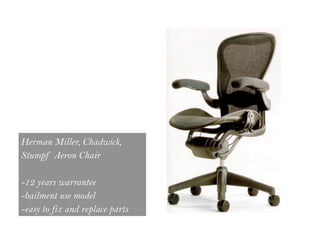
Herman Miller, Chadwick,
Stumpf Aeron Chair

-12 years warrantee
-bailment use model
-easy to fix and replace parts
What is environmental
sustainability?
What is environmental
sustainability?
It refers to the systematic conditions through which, at a global and regional
level, human activities should not interfere with the natural cycles (on which they
are based) more than the planet’s resiliency can take.
What is environmental
sustainability?
It refers to the systematic conditions through which, at a global and regional
level, human activities should not interfere with the natural cycles (on which they
are based) more than the planet’s resiliency can take.

>and, at the same time, these human activities shouldn’t impoverish
the natural capital to be transmitted to future generations
What is environmental
sustainability?
It refers to the systematic conditions through which, at a global and regional
level, human activities should not interfere with the natural cycles (on which they
are based) more than the planet’s resiliency can take.

>and, at the same time, these human activities shouldn’t impoverish
the natural capital to be transmitted to future generations


! To these mainly ‘physical’ characteristics, we should add an ethical one:
the equity principle by which each person has the right to the same
environmental space, that is, the same availability of global natural
resources
“el desarrollo sustentable responde a las necesidades del presente sin
comprometer las posibilidades de responder a las necesidades de las
generaciones futuras”

World Commission for Environment and Development (WCED) Our Common
Future (nuestro futuro compartido), 1987
“Sustainable development responds to
the present needs
without compromising the needs of
“el desarrollo sustentable responde a las necesidades del presente sin
future generations”
comprometer las posibilidades de responder a las necesidades de las
generaciones futuras”

World Commission for Environment and Development (WCED) Our Common
Future (nuestro futuro compartido), 1987
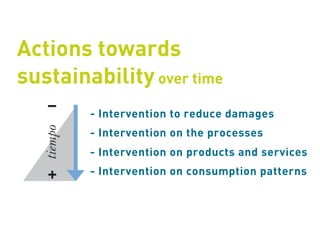
Actions towards
Acciones hacia la sustentabilidad
sustainability over time
en el tiempo:
    -
            - Intervention to reduce damages
            - Intervention on the processes
   tiempo


            - Intervention on products and services

    +       - Intervention on consumption patterns
The truth is that today
design seems to be more
part of the problem
than part of the solution
There are four levels of
Intervention
There are four levels of
Intervention
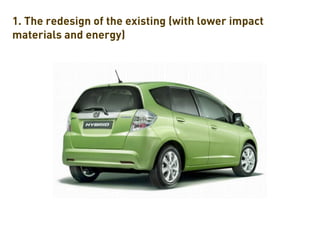
1. The redesign of the existing (with lower impact
materials and energy)
There are four levels of
Intervention
1. The redesign of the existing (with lower impact
materials and energy)

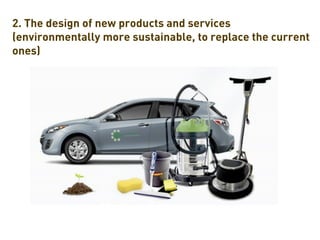
2. The design of new products and services
(environmentally more sustainable, to replace the
current ones)
There are four levels of
Intervention
1. The redesign of the existing (with lower impact
materials and energy)

2. The design of new products and services
(environmentally more sustainable, to replace the
current ones)
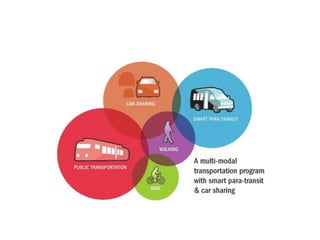
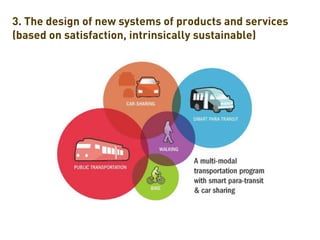
3. The design of new systems of products and services
(based on satisfaction, intrinsically sustainable)
There are four levels of
Intervention
1. The redesign of the existing (with lower impact
materials and energy)

2. The design of new products and services
(environmentally more sustainable, to replace the
current ones)
3. The design of new systems of products and services
(based on satisfaction, intrinsically sustainable)

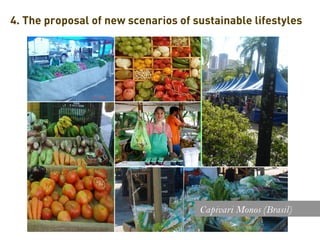
4. The proposal of new scenarios of sustainable lifestyles
1. The redesign of the existing (with lower impact
materials and energy)
2. The design of new products and services
(environmentally more sustainable, to replace the current
ones)
3. The design of new systems of products and services
(based on satisfaction, intrinsically sustainable)
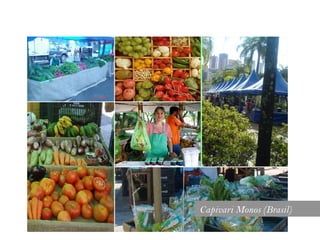
Capivari Monos (Brasil)
4. The proposal of new scenarios of sustainable lifestyles


                                     Capivari Monos (Brasil)
And that is how Design could be the activity that....


           connects the Technically-possible
And that is how Design could be the activity that....


           connects the Technically-possible
           to the Environmentally-necessary
And that is how Design could be the activity that....


           connects the Technically-possible
           to the Environmentally-necessary
            and formulates NEW PROPOSALS
And that is how Design could be the activity that....


           connects the Technically-possible
           to the Environmentally-necessary
            and formulates NEW PROPOSALS
            - socially and culturally attractive-
And that is how Design could be the activity that....


           connects the Technically-possible
           to the Environmentally-necessary
            and formulates NEW PROPOSALS
            - socially and culturally attractive-


   through the strategic coordination of
And that is how Design could be the activity that....


           connects the Technically-possible
           to the Environmentally-necessary
            and formulates NEW PROPOSALS
            - socially and culturally attractive-


  through the strategic coordination of
 Products, communication and services.
2.Redesigning wellbeing
& consumerism
A social ‘learning’ process
The transition towards sustainability will be a
social learning process thanks to which,
progressively, through trial and error, we will
learn to live better consuming (much) less and
regenerating the quality of our physical and social
environment.
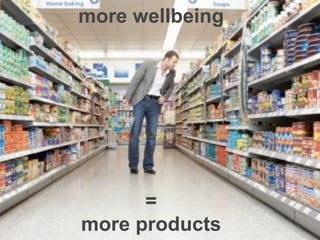
more wellbeing


      =
more products
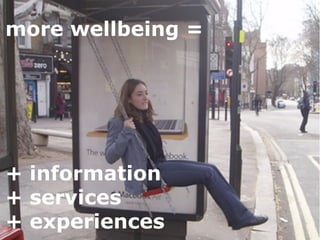
more wellbeing =


+ information
+ services
+ experiences
In order to reduce the material and energetic quantity that a
system needs, we propose a process of


de-materialization
of the social demand of welfare
This is intended as a drastic reduction of the number of products
and services needed to reach a socially acceptable welfare
Possession Access
         vs.
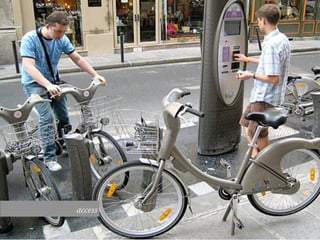
possession
access
access
access
We need to
We need to


BREAK the connection
We need to


BREAK the connection
established between
We need to


BREAK the connection
established between


the perceived welfare,
the availability of products

and the consumption of

resources
For example


New products and services
based on what the user
knows, wants and can do.
> These are systems of products and services that, depending on
the result to be achieved, provide the user with the best means to
reach it by making the best use of his capacities and skills
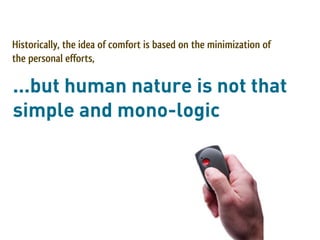
Historically, the idea of comfort is based on the minimization of
the personal efforts,

...but human nature is not that
simple and mono-logic
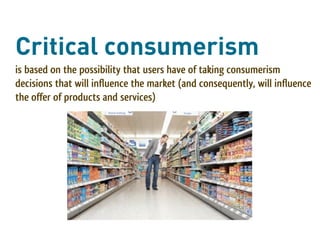
Critical consumerism
is based on the possibility that users have of taking consumerism
decisions that will influence the market (and consequently, will influence
the offer of products and services)
The social role of the Designer
> To contribute by rising the number of alternatives, technically and
economically practicable.

> To promote the capacities of the users, their possibility to participate
personally and directly in the definition of results and the means to
achieve those results

> To stimulate people’s imagination with new cultural proposals, new
values and ideas of quality, to influence them with new standards of
welfare (influencing then the demand of goods and services)
And remember that....


       Aesthetics are


       very
       important
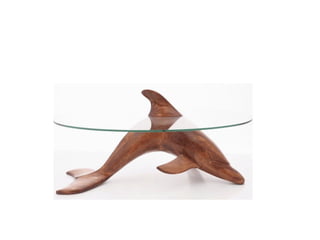
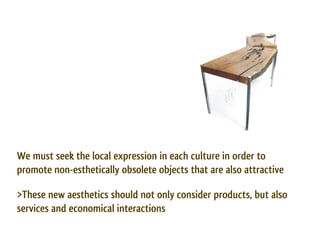
We must seek the local expression in each culture in order to
promote non-esthetically obsolete objects that are also attractive

>These new aesthetics should not only consider products, but also
services and economical interactions
3.Social Innovation and
those promising
minorities
>creative communities
>glocalization,
>open-source ethics
>co-design / crowdsourcing
>....
4.Sustainable development
and the design of
sustainable systems
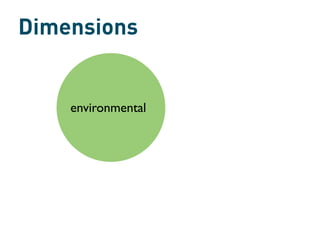
Dimensions
Dimensions


    environmental
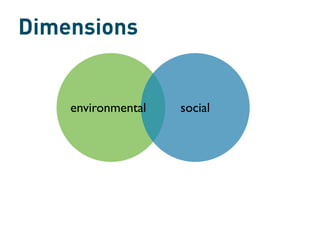
Dimensions


    environmental   social
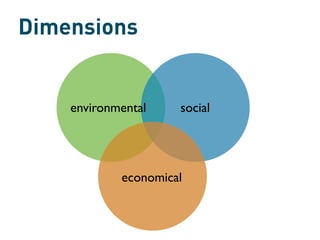
Dimensions


    environmental    social


            economical
Therefore, we talk about


System innovation
It’s the shift from designing products and services to designing a
System
Therefore, we talk about


System innovation
It’s the shift from designing products and services to designing a
System

The innovation will lie on the combination of these products and services that jointly satisfy a need,
but also the innovation on the economical (or collaborative) relationships amongst the actors of
the system
Therefore, we talk about


System innovation
It’s the shift from designing products and services to designing a
System

The innovation will lie on the combination of these products and services that jointly satisfy a need,
but also the innovation on the economical (or collaborative) relationships amongst the actors of
the system

>Satisfaction-based systems: the systems is based on the satisfaction of a need, not on the selling
of a new product, so it’s not a bout a new product, but about all the products and services (and
processes) involved in the satisfaction of a need.
For example

Ariston + Enel:
pay per use
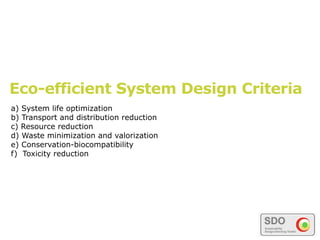
Eco-efficient System Design Criteria
a) System life optimization
b) Transport and distribution reduction
c) Resource reduction
d) Waste minimization and valorization
e) Conservation-biocompatibility
f) Toxicity reduction
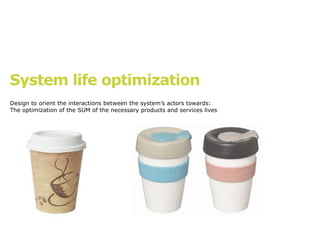
System life optimization
Design to orient the interactions between the system’s actors towards:
The optimization of the SUM of the necessary products and services lives
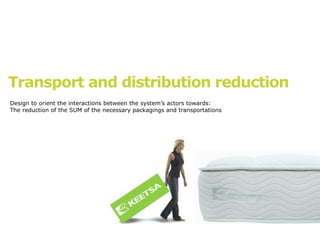
Transport and distribution reduction
Design to orient the interactions between the system’s actors towards:
The reduction of the SUM of the necessary packagings and transportations
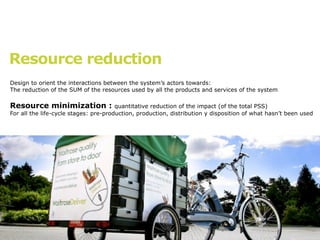
Resource reduction
Design to orient the interactions between the system’s actors towards:
The reduction of the SUM of the resources used by all the products and services of the system

Resource minimization :                quantitative reduction of the impact (of the total PSS)
For all the life-cycle stages: pre-production, production, distribution y disposition of what hasn’t been used
Waste minimization and valorization
Design to orient the interactions between the system’s actors towards:
Improving the SUM of the recycling methods for the system’s elements, energy recovery and composting; an
the reduction of the SUM of the waste produced by the system
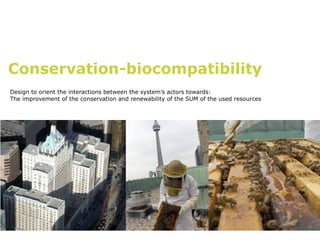
Conservation-biocompatibility
Design to orient the interactions between the system’s actors towards:
The improvement of the conservation and renewability of the SUM of the used resources
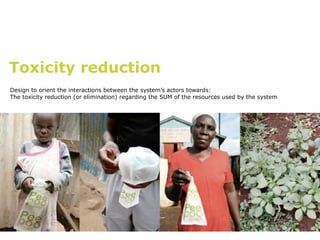
Toxicity reduction
Design to orient the interactions between the system’s actors towards:
The toxicity reduction (or elimination) regarding the SUM of the resources used by the system
5.Design for social equity
and cohesion
‘Design for social equity and cohesion’
Criteria:
a) Improve working conditions
b) Ensure justice and equality for all the actors of the system
c) Encourage sustainable and responsible consumption
d) Favor and integrate the weak and marginalized
e) Improve social cohesion
f) Enable and empower local resources
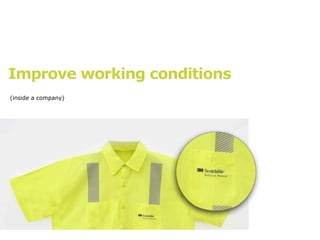
Improve working conditions
(inside a company)
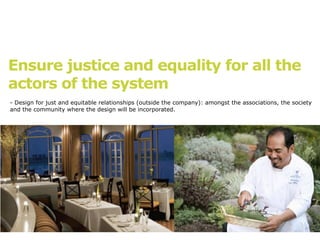
Ensure justice and equality for all the
actors of the system
- Design for just and equitable relationships (outside the company): amongst the associations, the society
and the community where the design will be incorporated.
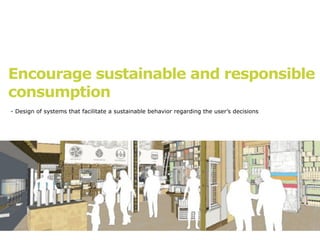
Encourage sustainable and responsible
consumption
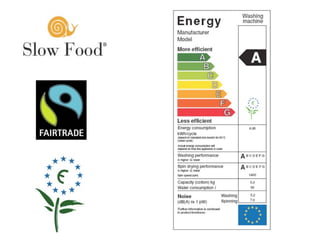
- Design of systems that facilitate a sustainable behavior regarding the user’s decisions
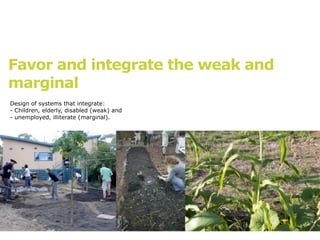
Favor and integrate the weak and
marginal
Design of systems that integrate:
- Children, elderly, disabled (weak) and
- unemployed, illiterate (marginal).
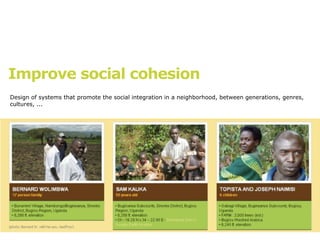
Improve social cohesion
Design of systems that promote the social integration in a neighborhood, between generations, genres,
cultures, ...
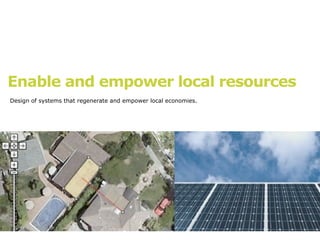
Enable and empower local resources
Design of systems that regenerate and empower local economies.
How do environmental and social
sustainability converge?
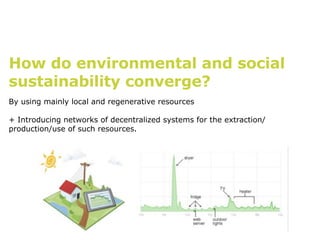
How do environmental and social
sustainability converge?
By using mainly local and regenerative resources

+ Introducing networks of decentralized systems for the extraction/
production/use of such resources.
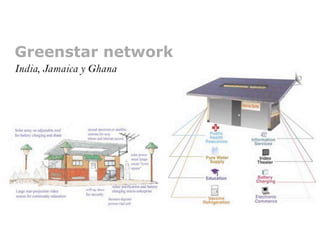
Greenstar network
India, Jamaica y Ghana
clock is ticking...

Quick and thorough intro to Design for Sustainability

  • 1.
  • 2.
    Contents 1.The urgent needfor a Radical Change! 2.Redesigning wellbeing & consumerism 3.Social Innovation and those promising minorities 4.Sustainable development and the design of sustainable systems: Criteria 5.Design for social equity and cohesion: Criteria
  • 3.
    1.The urgent needfor a Radical Change!
  • 4.
    1.The urgent needfor a Radical Change!
  • 5.
    The irreversibility of environmental damages In50 years the worldwide systems of production and consumption should use 90% LESS resources, than what are being used today
  • 7.
  • 11.
    Savonarola Chair -Italian medievaltimes -Walnut wood -500 years of useful life
  • 16.
    Herman Miller, Chadwick, StumpfAeron Chair -12 years warrantee -bailment use model -easy to fix and replace parts
  • 17.
  • 18.
    What is environmental sustainability? Itrefers to the systematic conditions through which, at a global and regional level, human activities should not interfere with the natural cycles (on which they are based) more than the planet’s resiliency can take.
  • 19.
    What is environmental sustainability? Itrefers to the systematic conditions through which, at a global and regional level, human activities should not interfere with the natural cycles (on which they are based) more than the planet’s resiliency can take. >and, at the same time, these human activities shouldn’t impoverish the natural capital to be transmitted to future generations
  • 20.
    What is environmental sustainability? Itrefers to the systematic conditions through which, at a global and regional level, human activities should not interfere with the natural cycles (on which they are based) more than the planet’s resiliency can take. >and, at the same time, these human activities shouldn’t impoverish the natural capital to be transmitted to future generations ! To these mainly ‘physical’ characteristics, we should add an ethical one: the equity principle by which each person has the right to the same environmental space, that is, the same availability of global natural resources
  • 22.
    “el desarrollo sustentableresponde a las necesidades del presente sin comprometer las posibilidades de responder a las necesidades de las generaciones futuras” World Commission for Environment and Development (WCED) Our Common Future (nuestro futuro compartido), 1987
  • 23.
    “Sustainable development respondsto the present needs without compromising the needs of “el desarrollo sustentable responde a las necesidades del presente sin future generations” comprometer las posibilidades de responder a las necesidades de las generaciones futuras” World Commission for Environment and Development (WCED) Our Common Future (nuestro futuro compartido), 1987
  • 24.
    Actions towards Acciones haciala sustentabilidad sustainability over time en el tiempo: - - Intervention to reduce damages - Intervention on the processes tiempo - Intervention on products and services + - Intervention on consumption patterns
  • 25.
    The truth isthat today design seems to be more part of the problem than part of the solution
  • 26.
    There are fourlevels of Intervention
  • 27.
    There are fourlevels of Intervention 1. The redesign of the existing (with lower impact materials and energy)
  • 28.
    There are fourlevels of Intervention 1. The redesign of the existing (with lower impact materials and energy) 2. The design of new products and services (environmentally more sustainable, to replace the current ones)
  • 29.
    There are fourlevels of Intervention 1. The redesign of the existing (with lower impact materials and energy) 2. The design of new products and services (environmentally more sustainable, to replace the current ones) 3. The design of new systems of products and services (based on satisfaction, intrinsically sustainable)
  • 30.
    There are fourlevels of Intervention 1. The redesign of the existing (with lower impact materials and energy) 2. The design of new products and services (environmentally more sustainable, to replace the current ones) 3. The design of new systems of products and services (based on satisfaction, intrinsically sustainable) 4. The proposal of new scenarios of sustainable lifestyles
  • 32.
    1. The redesignof the existing (with lower impact materials and energy)
  • 34.
    2. The designof new products and services (environmentally more sustainable, to replace the current ones)
  • 36.
    3. The designof new systems of products and services (based on satisfaction, intrinsically sustainable)
  • 37.
  • 38.
    4. The proposalof new scenarios of sustainable lifestyles Capivari Monos (Brasil)
  • 40.
    And that ishow Design could be the activity that....
  • 41.
    And that ishow Design could be the activity that.... connects the Technically-possible
  • 42.
    And that ishow Design could be the activity that.... connects the Technically-possible to the Environmentally-necessary
  • 43.
    And that ishow Design could be the activity that.... connects the Technically-possible to the Environmentally-necessary and formulates NEW PROPOSALS
  • 44.
    And that ishow Design could be the activity that.... connects the Technically-possible to the Environmentally-necessary and formulates NEW PROPOSALS - socially and culturally attractive-
  • 45.
    And that ishow Design could be the activity that.... connects the Technically-possible to the Environmentally-necessary and formulates NEW PROPOSALS - socially and culturally attractive- through the strategic coordination of
  • 46.
    And that ishow Design could be the activity that.... connects the Technically-possible to the Environmentally-necessary and formulates NEW PROPOSALS - socially and culturally attractive- through the strategic coordination of Products, communication and services.
  • 47.
  • 48.
    A social ‘learning’process The transition towards sustainability will be a social learning process thanks to which, progressively, through trial and error, we will learn to live better consuming (much) less and regenerating the quality of our physical and social environment.
  • 49.
    more wellbeing = more products
  • 50.
    more wellbeing = +information + services + experiences
  • 51.
    In order toreduce the material and energetic quantity that a system needs, we propose a process of de-materialization of the social demand of welfare This is intended as a drastic reduction of the number of products and services needed to reach a socially acceptable welfare
  • 52.
  • 53.
  • 54.
  • 55.
  • 56.
  • 57.
  • 58.
    We need to BREAKthe connection
  • 59.
    We need to BREAKthe connection established between
  • 60.
    We need to BREAKthe connection established between the perceived welfare, the availability of products and the consumption of resources
  • 61.
    For example New productsand services based on what the user knows, wants and can do. > These are systems of products and services that, depending on the result to be achieved, provide the user with the best means to reach it by making the best use of his capacities and skills
  • 62.
    Historically, the ideaof comfort is based on the minimization of the personal efforts, ...but human nature is not that simple and mono-logic
  • 64.
    Critical consumerism is basedon the possibility that users have of taking consumerism decisions that will influence the market (and consequently, will influence the offer of products and services)
  • 66.
    The social roleof the Designer > To contribute by rising the number of alternatives, technically and economically practicable. > To promote the capacities of the users, their possibility to participate personally and directly in the definition of results and the means to achieve those results > To stimulate people’s imagination with new cultural proposals, new values and ideas of quality, to influence them with new standards of welfare (influencing then the demand of goods and services)
  • 67.
    And remember that.... Aesthetics are very important
  • 72.
    We must seekthe local expression in each culture in order to promote non-esthetically obsolete objects that are also attractive >These new aesthetics should not only consider products, but also services and economical interactions
  • 73.
    3.Social Innovation and thosepromising minorities
  • 75.
  • 76.
    4.Sustainable development and thedesign of sustainable systems
  • 77.
  • 78.
    Dimensions environmental
  • 79.
    Dimensions environmental social
  • 80.
    Dimensions environmental social economical
  • 81.
    Therefore, we talkabout System innovation It’s the shift from designing products and services to designing a System
  • 82.
    Therefore, we talkabout System innovation It’s the shift from designing products and services to designing a System The innovation will lie on the combination of these products and services that jointly satisfy a need, but also the innovation on the economical (or collaborative) relationships amongst the actors of the system
  • 83.
    Therefore, we talkabout System innovation It’s the shift from designing products and services to designing a System The innovation will lie on the combination of these products and services that jointly satisfy a need, but also the innovation on the economical (or collaborative) relationships amongst the actors of the system >Satisfaction-based systems: the systems is based on the satisfaction of a need, not on the selling of a new product, so it’s not a bout a new product, but about all the products and services (and processes) involved in the satisfaction of a need.
  • 84.
    For example Ariston +Enel: pay per use
  • 85.
    Eco-efficient System DesignCriteria a) System life optimization b) Transport and distribution reduction c) Resource reduction d) Waste minimization and valorization e) Conservation-biocompatibility f) Toxicity reduction
  • 86.
    System life optimization Designto orient the interactions between the system’s actors towards: The optimization of the SUM of the necessary products and services lives
  • 87.
    Transport and distributionreduction Design to orient the interactions between the system’s actors towards: The reduction of the SUM of the necessary packagings and transportations
  • 88.
    Resource reduction Design toorient the interactions between the system’s actors towards: The reduction of the SUM of the resources used by all the products and services of the system Resource minimization : quantitative reduction of the impact (of the total PSS) For all the life-cycle stages: pre-production, production, distribution y disposition of what hasn’t been used
  • 89.
    Waste minimization andvalorization Design to orient the interactions between the system’s actors towards: Improving the SUM of the recycling methods for the system’s elements, energy recovery and composting; an the reduction of the SUM of the waste produced by the system
  • 90.
    Conservation-biocompatibility Design to orientthe interactions between the system’s actors towards: The improvement of the conservation and renewability of the SUM of the used resources
  • 91.
    Toxicity reduction Design toorient the interactions between the system’s actors towards: The toxicity reduction (or elimination) regarding the SUM of the resources used by the system
  • 92.
    5.Design for socialequity and cohesion
  • 93.
    ‘Design for socialequity and cohesion’ Criteria: a) Improve working conditions b) Ensure justice and equality for all the actors of the system c) Encourage sustainable and responsible consumption d) Favor and integrate the weak and marginalized e) Improve social cohesion f) Enable and empower local resources
  • 94.
  • 95.
    Ensure justice andequality for all the actors of the system - Design for just and equitable relationships (outside the company): amongst the associations, the society and the community where the design will be incorporated.
  • 96.
    Encourage sustainable andresponsible consumption - Design of systems that facilitate a sustainable behavior regarding the user’s decisions
  • 98.
    Favor and integratethe weak and marginal Design of systems that integrate: - Children, elderly, disabled (weak) and - unemployed, illiterate (marginal).
  • 99.
    Improve social cohesion Designof systems that promote the social integration in a neighborhood, between generations, genres, cultures, ...
  • 100.
    Enable and empowerlocal resources Design of systems that regenerate and empower local economies.
  • 101.
    How do environmentaland social sustainability converge?
  • 102.
    How do environmentaland social sustainability converge? By using mainly local and regenerative resources + Introducing networks of decentralized systems for the extraction/ production/use of such resources.
  • 103.
  • 106.