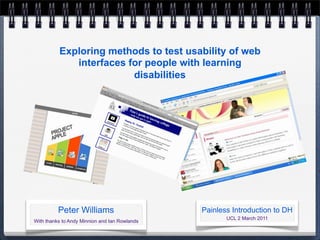



Exploring methods to test usability of web
             interfaces for people with learning
                         disabilities


          Peter Williams                       Painless Introduction to DH
                                                      UCL 2 March 2011
With thanks to Andy Minnion and Ian Rowlands
Plan of talk
★Background, context, aims etc.

★Study Part One: Eliciting the (usability)
 issues

    ★   Methods; individual studies; findings

★Study Part Two: Comparing websites

    ★   Introducing ‘trade-off’ analysis
Background and context
Introduction: definition of LD
“a state of arrested or incomplete development of mind”
   Intellectual impairment
   Social or adaptive dysfunction
   Early onset (WHO, 2006)


   Classified into ‘Mild’, ‘Moderate’, ‘Profound (and multiple)’
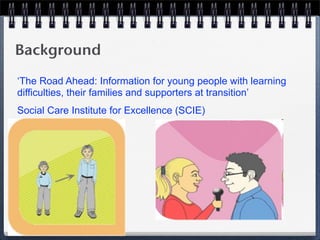
Background
‘The Road Ahead: Information for young people with learning
difficulties, their families and supporters at transition’
Social Care Institute for Excellence (SCIE)
Problem statement
   Lack of appropriate information (Tarleton, 2004)
   Much is inaccessible (Tarleton, 2004)
   Even ‘accessible’ information hard to access (Davis et al, 2001; Minnion et
al, 2008)

   ICT lauded as possible answer (Florian & Hegarty 2004)
   But, little research on the most effective interfaces (Bohman, 2007)
Aims and scope
Aim
✦To determine which Web page interface factors facilitate
success in information retrieval by people with LD
Scope
   Participants
   Technology/platform
   Focus (IR)


Stages/steps
Stages/steps
PART ONE
   Explore contextual factors
   Develop usability set-tasks
   Elicit the factors affecting information retrieval
   Test methods of capturing user preferences (I’ll tell you about that later!)


PART TWO
   Construct various different ‘accessible’ websites
   Compare - performance and preference
   Determine the optimum websites for different user groups
Part One:
Eliciting the issues
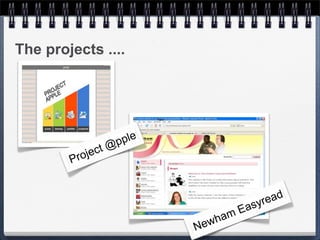
The projects ....


                               Text


                       p ple
              jec t@
        Pro


                                                         s yr ead
                                                  m Ea
                                          ew ha
                                      N
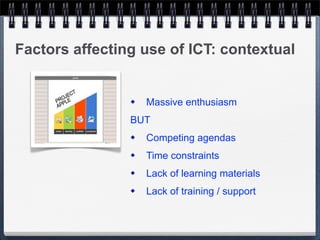
Factors affecting use of ICT: contextual


                   Massive enthusiasm
                BUT
                   Competing agendas
                   Time constraints
                   Lack of learning materials
                   Lack of training / support
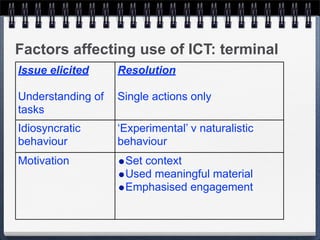
Factors affecting use of ICT: terminal
Issue elicited     Resolution

Understanding of   Single actions only
tasks
Idiosyncratic      ‘Experimental’ v naturalistic
behaviour          behaviour
Motivation         •Set context
                   •Used meaningful material
                   •Emphasised engagement
Individual studies
   Study one: Effectiveness of images (in game playing)
   Study two: Navigation
   Study three: Information retrieval
   Study four: Capturing preference data (I’ll tell you later!)

       Methods:
          Observation
          Think aloud protocol (where possible)
          Informal interview
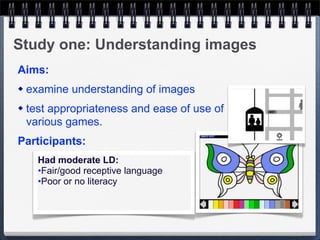
Study one: Understanding images
Aims:
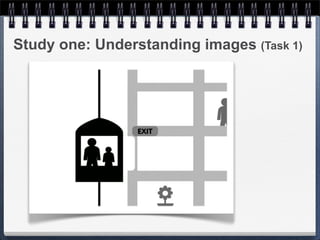
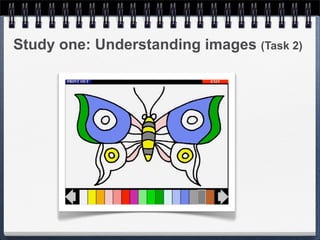
   examine understanding of images
   test appropriateness and ease of use of
    various games.
Participants:
      Had moderate LD:
      •Fair/good receptive language
      •Poor or no literacy
Study one: Understanding images (Task 1)
Study one: Understanding images (Task 2)
Study two: Navigation
Aims:
To determine
   Whether websites can be navigated effectively by
    people with very low literacy skills
   If usability tests can be effective with such a
    community
Participants:
   Again, had ‘moderate’ LD
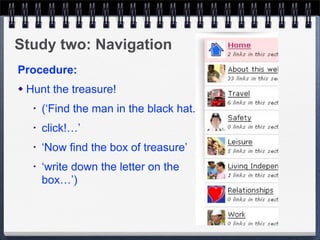
Study two: Navigation
Procedure:
   Hunt the treasure!
     •   (‘Find the man in the black hat...
     •   click!…’
     •   ‘Now find the box of treasure’
     •   ‘write down the letter on the
         box…’)
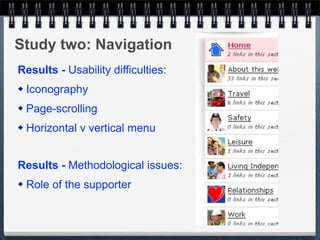
Study two: Navigation
Results - Usability difficulties:
   Iconography
   Page-scrolling
   Horizontal v vertical menu


Results - Methodological issues:
   Role of the supporter
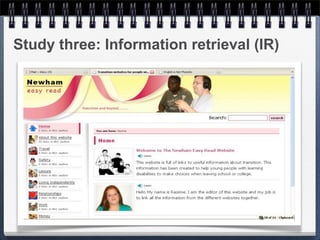
Study three: Information retrieval (IR)
Aims:
   To examine navigation, scrolling and IR.
   to elicit any methodological issues
Paricipants:
 Mild LD
Tasks:
   Where will you find information about money? (scroll)
   How to you get the sound to play? (icon recognition)
   Can you go back to the previous page? (navigation)
Study three: Information retrieval (IR)
Results
   Audio / text issue
   Text size v scrolling
   Menu bar position
From the results we can ask ... for example:
✦   What is more important - large text or minimising
    scrolling? Do images help?
Part two:
compare and contrast …
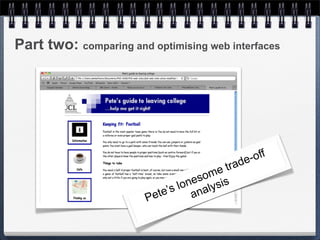
Part two: comparing and optimising web interfaces


                                                e- off
                                        etrad
                                    som is
                                 one alys
                             ’s l an
                        Pete
Part two: comparing and optimising web interfaces
Method (1):
First, imagine 3 mobile phones …
   Which do you prefer?


Then whiz the results through a Conjoint Analysis
Part two: comparing and optimising web interfaces
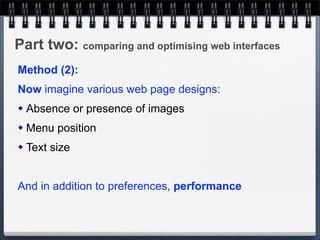
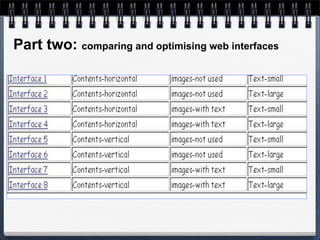
Method (2):
Now imagine various web page designs:
   Absence or presence of images
   Menu position
   Text size


And in addition to preferences, performance
Part two: comparing and optimising web interfaces
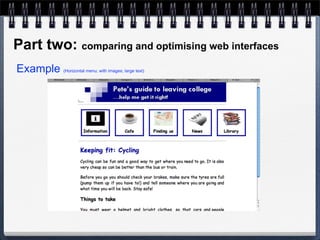
Example   (Horizontal menu; with images; large text)
Part two: comparing and optimising web interfaces
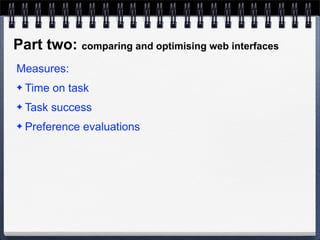
Measures:
✦   Time on task
✦   Task success
✦   Preference evaluations
By the end of my study …
… I should be able to reveal the optimum website
 interface!!


                                 Thanks for listening!
References
Merson E, Hatton, C (2008) Estimating Future Need for Adult Social Care for People with Learning
     Disabilities in England Project report, Centre for Disability Reserach, Lancaster University,
     Lancaster.

Foundation for People with Learning Disabilities (2007) Statistics about people with learning
     disabilities Available online at: http://www.learningdisabilities.org.uk/information/learning-
     disabilities-statistics/

Disability Rights Commission (2006) Equal Treatment: Closing the Gap London: Disability Rights
      Commission

Tarleton, B. (2004), The Road Ahead? Information for Young People with Learning Difficulties, Their
       Families and Supporters at Transition, Norah Fry Research Centre, University of Bristol,
       Bristol.

WHO (World Health Organisation) (2006)A Need Assessment of Health and Welfare among the
    Disabled for Community Based Rehabilitation in Jeju Available online at: http://
    www.wpro.who.int/internet/resources.ashx/HSE/occupational_health/jeju_CBR_2006_rep.pdf

Creating usable websites for people with learning disabilities

  • 1.
    Exploring methods totest usability of web interfaces for people with learning disabilities Peter Williams Painless Introduction to DH UCL 2 March 2011 With thanks to Andy Minnion and Ian Rowlands
  • 2.
    Plan of talk ★Background,context, aims etc. ★Study Part One: Eliciting the (usability) issues ★ Methods; individual studies; findings ★Study Part Two: Comparing websites ★ Introducing ‘trade-off’ analysis
  • 3.
  • 4.
    Introduction: definition ofLD “a state of arrested or incomplete development of mind”  Intellectual impairment  Social or adaptive dysfunction  Early onset (WHO, 2006)  Classified into ‘Mild’, ‘Moderate’, ‘Profound (and multiple)’
  • 5.
    Background ‘The Road Ahead:Information for young people with learning difficulties, their families and supporters at transition’ Social Care Institute for Excellence (SCIE)
  • 6.
    Problem statement  Lack of appropriate information (Tarleton, 2004)  Much is inaccessible (Tarleton, 2004)  Even ‘accessible’ information hard to access (Davis et al, 2001; Minnion et al, 2008)  ICT lauded as possible answer (Florian & Hegarty 2004)  But, little research on the most effective interfaces (Bohman, 2007)
  • 7.
    Aims and scope Aim ✦Todetermine which Web page interface factors facilitate success in information retrieval by people with LD Scope  Participants  Technology/platform  Focus (IR)  
  • 8.
  • 9.
    Stages/steps PART ONE  Explore contextual factors  Develop usability set-tasks  Elicit the factors affecting information retrieval  Test methods of capturing user preferences (I’ll tell you about that later!) PART TWO  Construct various different ‘accessible’ websites  Compare - performance and preference  Determine the optimum websites for different user groups
  • 10.
  • 11.
    The projects .... Text p ple jec t@ Pro s yr ead m Ea ew ha N
  • 12.
    Factors affecting useof ICT: contextual  Massive enthusiasm BUT  Competing agendas  Time constraints  Lack of learning materials  Lack of training / support
  • 13.
    Factors affecting useof ICT: terminal Issue elicited Resolution Understanding of Single actions only tasks Idiosyncratic ‘Experimental’ v naturalistic behaviour behaviour Motivation •Set context •Used meaningful material •Emphasised engagement
  • 14.
    Individual studies  Study one: Effectiveness of images (in game playing)  Study two: Navigation  Study three: Information retrieval  Study four: Capturing preference data (I’ll tell you later!) Methods:  Observation  Think aloud protocol (where possible)  Informal interview
  • 15.
    Study one: Understandingimages Aims:  examine understanding of images  test appropriateness and ease of use of various games. Participants: Had moderate LD: •Fair/good receptive language •Poor or no literacy
  • 16.
    Study one: Understandingimages (Task 1)
  • 17.
    Study one: Understandingimages (Task 2)
  • 18.
    Study two: Navigation Aims: Todetermine  Whether websites can be navigated effectively by people with very low literacy skills  If usability tests can be effective with such a community Participants:  Again, had ‘moderate’ LD
  • 19.
    Study two: Navigation Procedure:  Hunt the treasure! • (‘Find the man in the black hat... • click!…’ • ‘Now find the box of treasure’ • ‘write down the letter on the box…’)
  • 20.
    Study two: Navigation Results- Usability difficulties:  Iconography  Page-scrolling  Horizontal v vertical menu Results - Methodological issues:  Role of the supporter
  • 21.
  • 22.
    Study three: Informationretrieval (IR) Aims:  To examine navigation, scrolling and IR.  to elicit any methodological issues Paricipants:  Mild LD Tasks:  Where will you find information about money? (scroll)  How to you get the sound to play? (icon recognition)  Can you go back to the previous page? (navigation)
  • 23.
    Study three: Informationretrieval (IR) Results  Audio / text issue  Text size v scrolling  Menu bar position From the results we can ask ... for example: ✦ What is more important - large text or minimising scrolling? Do images help?
  • 24.
  • 25.
    Part two: comparingand optimising web interfaces e- off etrad som is one alys ’s l an Pete
  • 26.
    Part two: comparingand optimising web interfaces Method (1): First, imagine 3 mobile phones …  Which do you prefer? Then whiz the results through a Conjoint Analysis
  • 27.
    Part two: comparingand optimising web interfaces Method (2): Now imagine various web page designs:  Absence or presence of images  Menu position  Text size And in addition to preferences, performance
  • 28.
    Part two: comparingand optimising web interfaces
  • 29.
    Part two: comparingand optimising web interfaces Example (Horizontal menu; with images; large text)
  • 30.
    Part two: comparingand optimising web interfaces Measures: ✦ Time on task ✦ Task success ✦ Preference evaluations
  • 31.
    By the endof my study … … I should be able to reveal the optimum website interface!! Thanks for listening!
  • 32.
    References Merson E, Hatton,C (2008) Estimating Future Need for Adult Social Care for People with Learning Disabilities in England Project report, Centre for Disability Reserach, Lancaster University, Lancaster. Foundation for People with Learning Disabilities (2007) Statistics about people with learning disabilities Available online at: http://www.learningdisabilities.org.uk/information/learning- disabilities-statistics/ Disability Rights Commission (2006) Equal Treatment: Closing the Gap London: Disability Rights Commission Tarleton, B. (2004), The Road Ahead? Information for Young People with Learning Difficulties, Their Families and Supporters at Transition, Norah Fry Research Centre, University of Bristol, Bristol. WHO (World Health Organisation) (2006)A Need Assessment of Health and Welfare among the Disabled for Community Based Rehabilitation in Jeju Available online at: http:// www.wpro.who.int/internet/resources.ashx/HSE/occupational_health/jeju_CBR_2006_rep.pdf